0001829126-21-014734.txt : 20211123 0001829126-21-014734.hdr.sgml : 20211123 20211123145941 ACCESSION NUMBER: 0001829126-21-014734 CONFORMED SUBMISSION TYPE: S-1 PUBLIC DOCUMENT COUNT: 52 FILED AS OF DATE: 20211123 DATE AS OF CHANGE: 20211123 FILER: COMPANY DATA: COMPANY CONFORMED NAME: Nuvo Group Ltd. CENTRAL INDEX KEY: 0001861520 STANDARD INDUSTRIAL CLASSIFICATION: SURGICAL & MEDICAL INSTRUMENTS & APPARATUS [3841] IRS NUMBER: 000000000 STATE OF INCORPORATION: L3 FISCAL YEAR END: 1231 FILING VALUES: FORM TYPE: S-1 SEC ACT: 1933 Act SEC FILE NUMBER: 333-261300 FILM NUMBER: 211437813 BUSINESS ADDRESS: STREET 1: YIGAL ALON 94. ST., ALON TOWER 1 CITY: TEL AVIV STATE: L3 ZIP: 6789155 BUSINESS PHONE: 97236242266 MAIL ADDRESS: STREET 1: YIGAL ALON 94. ST., ALON TOWER 1 CITY: TEL AVIV STATE: L3 ZIP: 6789155 S-1 1 nuvogroup_s1.htm S-1


As filed with the Securities and Exchange Commission on November 23, 2021.


Registration No. 333-                


UNITED STATES

SECURITIES AND EXCHANGE COMMISSION

WASHINGTON, D.C. 20549


FORM S-1

REGISTRATION STATEMENT

UNDER

THE SECURITIES ACT OF 1933


NUVO GROUP LTD.

(Exact Name of Registrant as Specified in its Charter)


State of Israel   3841   27-0282727

(State or Other Jurisdiction of

Incorporation or Organization)


(Primary Standard Industrial

Classification Code Number)


(I.R.S. Employer

Identification Number)


Yigal Alon 94. St., Alon Tower 1

Tel Aviv, Israel 6789155

972-3-624-2266

(Address, including zip code, and telephone number, including area code, of registrant’s principal executive offices)


Nuvo Group USA, Inc.

c/o Kelly Londy

252 Nassau St.

Princeton, NJ 08542

734-717-2416
(Name, address, including zip code, and telephone number, including area code, of agent for service)


Copies to:


Robert L. Grossman, Esq.

Drew M. Altman, Esq.

Greenberg Traurig, P.A.

333 S.E. 2nd Avenue,
Suite 4400

Miami, Florida 33131

(305) 579-0500


Yoav Sade

Shachar Hadar

Ran Camchy

Meitar | Law Offices

16 Abba Hillel Silver Rd.

Ramat Gan 52506, Israel

Telephone: (+972) (3) 610-3100

Fax: (+972) (3) 610-3111


Andrea L. Nicolás, Esq.

Skadden, Arps, Slate,
Meagher & Flom LLP

One Manhattan West

New York, New York 10001

(212) 735-3000


Ehud (Udi) Arad

Agmon & Co.,
Rosenberg Hacohen & Co.

Electra Tower

Yigal Alon Street 98

Tel Aviv 6789141, Israel

Tel.: (+972) (3) 607-8607

Fax: (+972) (3) 607-8666


Approximate date of commencement of proposed sale of the securities to the public: As soon as practicable after this registration statement becomes effective.


If any of the securities being registered on this Form are to be offered on a delayed or continuous basis pursuant to Rule 415 under the Securities Act of 1933, check the following box. ☐


If this Form is filed to register additional securities for an offering pursuant to Rule 462(b) under the Securities Act, please check the following box and list the Securities Act registration statement number of the earlier effective registration statement for the same offering. ☐ 


If this Form is a post-effective amendment filed pursuant to Rule 462(c) under the Securities Act, check the following box and list the Securities Act registration statement number of the earlier effective registration statement for the same offering. ☐ 


If this Form is a post-effective amendment filed pursuant to Rule 462(d) under the Securities Act, check the following box and list the Securities Act registration statement number of the earlier effective registration statement for the same offering. ☐ 


Indicate by check mark whether the registrant is a large accelerated filer, an accelerated filer, a non-accelerated filer, smaller reporting company, or an emerging growth company. See the definitions of “large accelerated filer,” “accelerated filer,” “smaller reporting company,” and “emerging growth company” in Rule 12b-2 of the Exchange Act. 


Large accelerated filer  ☐ Accelerated filer  ☐ Non-accelerated filer  ☒

Smaller reporting company  ☒

Emerging growth company  ☒


If an emerging growth company, indicate by check mark if the registrant has elected not to use the extended transition period for complying with any new or revised financial accounting standards provided pursuant to Section 7(a)(2)(B) of the Securities Act. ☐


CALCULATION OF REGISTRATION FEE


Title of Each Class of

Securities to be Registered


Proposed
Maximum
Aggregate

Offering Price(1)(2)


Amount of

Registration Fee(3)

 
Ordinary Shares, no par value per share  $50,000,000   $4,635.00 


(1) Estimated solely for the purpose of calculating the registration fee in accordance with Rule 457(o) of the Securities Act of 1933, as amended, or the Securities Act.
(2) Includes the offering price of ordinary shares that may be sold if the option to purchase additional ordinary shares granted by the registrant to the underwriters is exercised. See “Underwriting.”
(3) Calculated pursuant to Rule 457(o) under the Securities Act based on an estimate of the proposed maximum aggregate offering price.


The registrant hereby amends this registration statement on such date or dates as may be necessary to delay its effective date until the registrant shall file a further amendment which specifically states that this registration statement shall thereafter become effective in accordance with Section 8(a) of the Securities Act or until the registration statement shall become effective on such date as the U.S. Securities and Exchange Commission, acting pursuant to said Section 8(a), may determine.


The information in this preliminary prospectus is not complete and may be changed. We may not sell these securities until the registration statement filed with the Securities and Exchange Commission is effective. This preliminary prospectus is not an offer to sell nor does it seek an offer to buy these securities in any jurisdiction where the offer or sale is not permitted.


SUBJECT TO COMPLETION, DATED                , 2021


Preliminary Prospectus


                 Shares


Nuvo Group Ltd.


              Ordinary Shares


This is the initial public offering of ordinary shares of Nuvo Group Ltd., or the ordinary shares. We are offering                ordinary shares.


Prior to this offering, there has been no public market for our ordinary shares. We anticipate that the initial public offering price will be between $        and $         per share. We have applied to list our ordinary shares on the New York Stock Exchange (the “NYSE”) under the symbol “NUVO.”


We are an “emerging growth company” and a “smaller reporting company” as defined under the U.S. federal securities laws and, as such, have elected to comply with certain reduced public company reporting requirements. This prospectus complies with the requirements that apply to an issuer that is an emerging growth company and smaller reporting company. See “Prospectus Summary—Implications of Being an Emerging Growth Company and a Smaller Reporting Company.”


Investing in our ordinary shares involves a high degree of risk. See “Risk Factors” beginning on page 20 to read about factors you should consider before buying our ordinary shares.


Neither the Securities and Exchange Commission nor any state securities commission has approved or disapproved of these securities or determined if this prospectus is truthful or complete. Any representation to the contrary is a criminal offense.


   Per Share   Total 
Initial public offering price  $    $  
Underwriting discounts and commissions(1)  $    $  
Proceeds to us, before expenses  $    $  


(1) We have agreed to reimburse the underwriters for certain expenses in connection with this offering. See “Underwriting.”


We have entered into a subscription agreement with           , who will purchase an aggregate of $            million of warrants to purchase up to           ordinary shares, each exercisable to purchase one ordinary share at $0.01 per share, at a price per warrant equal to the initial public offering price per share, in a separate private placement transaction. Such warrants will be exercisable immediately and will expire ten years from the date of this prospectus.               is an affiliate of            , our existing shareholder. The underwriters serve as placement agents for the concurrent private placement. The closing of the private placement and the closing of this offering are conditioned upon each other. The issuance and sale of our warrants to the investor are being made in reliance on an exemption from registration contained in Regulation S under the Securities Act of 1933, as amended.


We have also granted the underwriters an option for a period of 30 days from the date of this prospectus to purchase up to an additional                ordinary shares on the same terms set forth above. See “Underwriting.”


Delivery of the ordinary shares is expected to be made on or about                , 2021.


Cantor Berenberg
   
Ladenburg Thalmann


Prospectus dated                , 2021


TABLE OF CONTENTS


ABOUT THIS PROSPECTUS   ii
TRADEMARKS, SERVICE MARKS AND TRADE NAMES   ii
INDUSTRY AND MARKET DATA   ii
Letter from Oren Oz, FOUNDER   iii
PROSPECTUS SUMMARY   1
RISK FACTORS   20
CAUTIONARY NOTE REGARDING FORWARD-LOOKING STATEMENTS   64
USE OF PROCEEDS   65
CAPITALIZATION   66
DIVIDEND POLICY   68
DILUTION   69
MANAGEMENT’S DISCUSSION AND ANALYSIS OF FINANCIAL CONDITION AND RESULTS OF OPERATIONS   71
BUSINESS   85
MANAGEMENT   141
EXECUTIVE COMPENSATION   151
CERTAIN RELATIONSHIPS AND RELATED PARTY TRANSACTIONS   168
PRINCIPAL SHAREHOLDERS   173
DESCRIPTION OF SHARE CAPITAL   175
SHARES ELIGIBLE FOR FUTURE SALE   182
MATERIAL U.S. FEDERAL INCOME TAX CONSIDERATIONS FOR U.S. HOLDERS OF ORDINARY SHARES   184
MATERIAL ISRAELI TAX CONSIDERATIONS FOR NUVO AND ITS SHAREHOLDERS   190
UNDERWRITING   193
LEGAL MATTERS   202
EXPERTS   202
WHERE YOU CAN FIND MORE INFORMATION   204
INDEX TO CONSOLIDATED FINANCIAL STATEMENTS   F-1


Neither we nor any of the underwriters have authorized anyone to provide any information or make any representations other than those contained in this prospectus or in any free writing prospectus filed with the Securities and Exchange Commission, or the SEC. Neither we nor any of the underwriters take responsibility for, and can provide no assurance as to the reliability of, any other information that others may give you. We are offering to sell, and seeking offers to buy, ordinary shares only in jurisdictions where such offers and sales are permitted. The information contained in this prospectus is accurate only as of the date of this prospectus, regardless of the time of delivery of this prospectus or of any sale of ordinary shares. Our business, financial condition, results of operations and prospects may have changed since such date.


For investors outside of the United States, neither we nor any of the underwriters have done anything that would permit this offering or possession or distribution of this prospectus in any jurisdiction where action for that purpose is required, other than in the United States. You are required to inform yourselves about, and to observe any restrictions relating to, this offering and the distribution of this prospectus outside of the United States.


Through and including                 , 2021 (the 25th day after the date of this prospectus), all dealers effecting transactions in these securities, whether or not participating in this offering, may be required to deliver a prospectus. This is in addition to a dealer’s obligation to deliver a prospectus when acting as an underwriter and with respect to an unsold allotment or subscription.


i


ABOUT THIS PROSPECTUS


As used in this prospectus, unless the context otherwise indicates, any reference to “Nuvo,” “our Company,” “the Company,” “us,” “we” and “our” refers to Nuvo Group Ltd., the issuer of the ordinary shares offered hereby, together with its consolidated subsidiary.


Basis of Presentation


Our financial statements have been prepared in accordance with generally accepted accounting principles in the United States, or GAAP. We present our consolidated financial statements in U.S. dollars. Our fiscal year ends on December 31 of each year. 


Certain monetary amounts, percentages and other figures included elsewhere in this prospectus have been subject to rounding adjustments. Accordingly, figures shown as totals in certain tables or charts may not be the arithmetic aggregation of the figures that precede them, and figures expressed as percentages in the text may not total 100% or, as applicable, when aggregated may not be the arithmetic aggregation of the percentages that precede them.


Unless derived from our financial statements or otherwise noted, the terms “shekels” and “NIS” refer to New Israeli Shekels, the lawful currency of the State of Israel, and the terms “dollar” or “$” refer to U.S. dollars, the lawful currency of the United States. The disclosure contains translations of certain NIS amounts into U.S. dollar amounts based on an exchange rate as of December 31, 2020 of 3.215, unless otherwise noted.


TRADEMARKS, SERVICE MARKS AND TRADE NAMES


We have proprietary rights to trademarks used in this prospectus that are important to our business, many of which are registered under applicable intellectual property laws. Solely for convenience, the trademarks, service marks, logos and trade names referred to in this prospectus are without the ® and TM symbols, but such references are not intended to indicate, in any way, that we will not assert, to the fullest extent under applicable law, our rights or the rights of the applicable licensors to these trademarks, service marks and trade names.


This prospectus contains additional trademarks, service marks and trade names of others, which are the property of their respective owners. All trademarks, service marks and trade names appearing in this prospectus are, to our knowledge, the property of their respective owners. We do not intend our use or display of other companies’ trademarks, service marks, copyrights or trade names to imply a relationship with, or endorsement or sponsorship of us by, any other companies.


INDUSTRY AND MARKET DATA


This prospectus includes industry data that we obtained from periodic industry publications. Industry publications generally state that the information contained therein has been obtained from sources believed to be reliable, but there can be no assurance as to the accuracy or completeness of such information. This information involves many assumptions and limitations, and you are cautioned not to give undue weight to these estimates and information. Neither we nor the underwriters have independently verified any of the data from third-party sources nor have we or the underwriters ascertained the underlying economic assumptions relied upon therein. Although we have not independently verified the accuracy or completeness of any third-party information, we believe the information in this prospectus concerning the industries in which we operate, competitive positions and the markets in which we operate is reliable.


ii


To Future Investors in Nuvo,


I want to take the opportunity to share my personal story and the Nuvo journey to Reinvent Pregnancy Care for the 21st Century.


In 2014, my wife, Hila and I were thrilled to be expecting our third child, but our excitement soon turned to anxiety and stress when her pregnancy was diagnosed as high risk.


Managing our high-risk pregnancy required frequent visits to the clinic for routine check-ups. As working parents with two young children at home, frequent monitoring trips proved very challenging. Ultimately, Hila had to quit her job, we had to hire a babysitter to take care of the kids and travel several times each week back and forth to the clinic.


Adding to the stress of managing a high-risk pregnancy, a misinterpretation of data almost resulted in an emergency C-section. The diagnosis that our baby was in distress seemed odd as Hila felt fine and we could feel the baby moving. We were skeptical about this diagnosis, and I jumped into gear as a data scientist and used the available monitoring tools to track the baby’s movement and create my own data tracing. We refused the C-section and complied with the doctor’s advice for more intensive monitoring.


During our intensive monitoring sessions, I was surprised by the shallow and limited data views generated by existing fetal monitoring technology, and witnessed the imprecision of current tools, as well as subjective interpretations as opposed to data-driven methods.


Ultimately, we were able to have a healthy regular delivery and our beautiful son, Uri, was born. Some families are not so lucky.


I remember sitting in the hospital for our monitoring sessions and seeing other families in similar positions of anxiety and testing and then more waiting for results.


I recall thinking, in an age of incredible technological advancements, why do pregnant women still have to travel to a hospital to be plugged into a wall for routine monitoring? As a data scientist, I questioned, why are the pregnant women travelling and not the data?


I knew there had to be a better way and that sparked my passion to reinvent pregnancy care for the 21st Century.


Based on our experience, I knew a deeper view of the womb was needed and it needs to be available to mom, wherever she is. I invented an AI-driven platform reimagining pregnancy care through the eyes of a data scientist and in partnership with a team of leading obstetricians and health tech experts.


What may simply look like just a wearable sensory band is actually an AI-powered connected care data platform that enables expectant mothers and their unborn babies to receive clinical-quality care in a virtual, self-applied way both at home and in the clinic.


It is pregnancy care reimagined for the 21st Century. I invite you to join us on our mission to Give Life a Better Beginning!


Sincerely,


Oren Oz

Founder


iii


PROSPECTUS SUMMARY


This summary contains selected information about our business and this offering contained elsewhere in this prospectus. It may not contain all the information that may be important to you. Investors should carefully read this entire prospectus before making an investment decision, including the information set forth under “Risk Factors,” “Management’s Discussion and Analysis of Financial Condition and Results of Operations” and our consolidated financial statements and notes thereto included elsewhere in this prospectus. Some of the statements in this prospectus constitute forward-looking statements. See “Cautionary Note Regarding Forward-Looking Statements.”


Company Overview


Our Business


We believe we are the most advanced data-driven remote healthcare solution focused exclusively on pregnancy care. Our business model today consists of a hardware/software hybrid platform that provides remote access to medical-grade data to all key participants in the pregnancy care ecosystem. Our solution, which we refer to as our INVU platform, is at the core of our business model and provides connected pregnancy care management both at home and in the clinic. We believe INVU is the first remote pregnancy monitoring platform cleared by the United States Food and Drug Administration, or FDA, that provides expectant mothers with a self-administered wireless sensory band that enables them and their obstetricians to monitor maternal and fetal heart rate, or MHR and FHR, and maternal uterine activity, or MUA, and its intended use, in conjunction with MHR and FHR, for non-stress tests, or NSTs, using passive technology both at home and in the clinic, from the 32nd week of pregnancy until the beginning of labor. Our goal is for our INVU platform to increase the ability for remote pregnancy care visits and to augment pregnancy care and to benefit all participants in the pregnancy care ecosystem through improved quality of care and healthcare outcomes, improved satisfaction and cost reduction for payers. Longer term, we aspire to expand our reach to become a global leader in pregnancy solutions from the first days of pregnancy onward.


The hardware component of our INVU platform is a proprietary self-administered wireless sensory band that obstetricians prescribe to expectant mothers who wear the sensory band during virtual visits to capture real-time data on key maternal and fetal health metrics. During these visits, a live reading allows the expectant mother to access simplified data and insights via the paired INVU application. Our wireless sensory band captures a unique set of in-depth physiological data from the expectant mother and unborn baby in a passive manner, without sending energy signals into the womb. Next, the data is digitized and sent wirelessly for analysis on our cloud-based servers by our sophisticated algorithms. Today, when obstetricians connect to our INVU platform, they have access to a digital dashboard that contains fetal and maternal heart rate tracings recorded during the session and data derived from these measurements for all expectant mothers and unborn babies in their care that use our INVU platform. This data is comparable to the fetal viability checks that normally occur during in-office prenatal visits. Our INVU platform is also capable of integrating with other peripheral and medical devices, such as blood pressure cuffs, subject to and in accordance with FDA regulation, which would allow expectant mothers and their obstetricians to easily record and track important vitals all on one application to inform personalized care plans. In the future, we intend to seek FDA clearance to use advanced machine-learning and AI capabilities to analyze the data we collect to provide obstetricians and expectant mothers with significantly more actionable predictive data and insights.


In order to do so, we have developed an external data platform which automatically captures and analyzes all data recorded by our INVU platform in research, clinical and commercial domains, to the extent we have a data sharing agreement in place, which we believe will enable the rapid development of future AI models. First, we plan to provide a rule-based decision support system based on the automation of existing clinical guidelines to support obstetricians in clinical decisions they are already making, which we believe will only require technical validation. Second, we plan to develop AI models aimed at providing obstetricians with new information they otherwise would not have access to, such as predicting risks before they become visible later in pregnancy, which will require clinical validation and FDA clearance. We are in various stages of development with our strategic partners. For example, mood disorder has reached the data collection and analysis stages, while some other AI models such as preeclampsia and diabetes are currently being conceptually designed.


1


Currently, our products are categorized as Class II devices and subject to the premarket notification requirements under section 510(k) of the Federal Food, Drug, and Cosmetic Act of 1938, or FDCA. See “Business—Government Regulation—The 510(k) remarket Notification Pathway.” Our INVU platform received 510(k) clearance from the FDA to conduct a five minute trace of MHR and FHR for singleton pregnancies from the 32nd week of pregnancy until the beginning of labor in March 2020. We refer to this five minute trace as a fetal viability check and to this time frame as the INVU monitoring period. MUA, and its intended use, in conjunction with MHR and FHR, for NSTs, during the INVU monitoring period, received FDA clearance in May 2021, allowing us to perform fetal viability checks and measure MUA, and as a result, offer NSTs during the INVU monitoring period. We also received ISO 13485 certification in February 2020 for the development, manufacturing, marketing and sales of pregnancy monitoring devices. We are in the process of commercializing our INVU platform with an initial focus on large healthcare systems and obstetrician-physician practice management groups that practice value-based pregnancy care and that focus on value contracting with payers, mainly insurers and self-insured employers. In addition, obstetrician-physician practice management groups play a significant role in pregnancy care management during the INVU monitoring period, as they work with expectant mothers starting early in the pregnancy and therefore have a strong interest in improving pregnancy care during the period of pregnancy before labor, or antepartum period. We believe these groups will be most effective at implementing our technology in clinical practice due to the continuous flow of expectant mothers that they care for and their desire for improved outcomes at reduced cost that we believe our remote care platform will ultimately enable. We believe our INVU platform is the first device cleared to perform fetal viability checks and measure MUA during the antepartum period, and, as a result, offer NSTs, passively, remotely and through a self-administered wireless sensory band. Our technology acquires and records deep and rich data outputs during each monitoring session through our biopotential sensors, that detect electrical signals, and acoustic sensors, and extracts multiple physiological measurements from these data, including maternal and fetal electrocardiography, or mECG and fECG, and maternal and fetal phonocardiography, or mPCG and fPCG. We believe that these and other metrics based on our collected data will be critical to pregnancy management tests and procedures we plan to offer in the future. Over the longer term, we intend to conduct clinical trials to examine the impact of our INVU platform on monitoring compliance, quality of care and healthcare outcomes, as well as costs. If these trials demonstrate that our INVU platform increases monitoring compliance, improves quality of care and healthcare outcomes, as well as reduces payer costs, we expect this will drive adoption of our INVU platform.


In December 2020, we entered into our first commercial contract with Axia Women’s Health, or Axia, one of the largest obstetrician private practice group of physicians focused on women’s health in the United States. We refer to our commercial contracts with major healthcare systems and obstetrician-physician practice management groups as enterprise level agreements. For a discussion of our current and intended enterprise level agreements, please see “Business—Overview—Our Revenue Model.” If we demonstrate that our INVU platform increases monitoring compliance, improves quality of care and healthcare outcomes, as well as reduces payer costs, we expect to focus on seeking long-term contracts with payers that allow us to benefit from a percentage of any cost-savings that we achieve. We also believe that any cost-savings achieved from utilizing our INVU platform will incentivize payers to encourage their obstetrician networks and expectant mothers to utilize our INVU platform. We aspire to develop an INVU-centered ecosystem for broader pregnancy-related and mother-centric services, and to provide every expectant mother an opportunity for access to clinical-quality care for herself and her unborn baby, independent of her geographic location.


As more expectant mothers have access to and use our INVU platform, we intend to use the increasing amount of data we capture and aggregate to identify patterns and trends that are associated with certain risks and outcomes that we expect will enable us to make highly useful and actionable predictive recommendations to benefit our user community of expectant mothers and obstetricians and population health in general. We intend to apply data algorithms and other innovative digital tools to conduct AI-powered machine learning and computer-based predictive analytics to make targeted predictive recommendations to individual expectant mothers who have health profiles for which we have identified particular, notable patterns and trends. We believe these predictive insights, such as identifying risks before they become visible later in pregnancy, will help obstetricians to improve monitoring schedules and frequency and identify appropriate times to intervene for individual pregnancies and facilitate population health strategies aimed at improving a specific population’s health outcome as efficiencies are improved and costs are reduced. We expect that our ability to develop biomarkers and predictive analytics will set us apart from other pregnancy management monitoring systems and make us more effective at enabling proactive pregnancy management to improve outcomes for expectant mothers and unborn babies.


Our innovative technology is protected by an extensive global patent portfolio consisting of 14 issued U.S. patents, 10 pending U.S. utility patent applications, 33 issued foreign patents, 12 pending foreign patent applications and two pending international, or PCT, patent applications, which we constantly review and seek to expand. We believe that we will be able to obtain patents relating to data input, the means of analysis and the output from such analysis. We believe that our technology and the protection that we have afforded it currently give us a significant competitive advantage and is a barrier to competitors. Subject to the receipt of required regulatory clearances and approvals, we expect to further strengthen our INVU platform by gathering and analyzing more data and potentially identifying patterns and trends to develop predictive models and population health strategies.


2


Our Market Opportunity


According to Rabin Martin, a global health strategy firm, as of 2013, approximately $111 billion was being spent annually on prenatal and neonatal care in the United States. Our INVU solution, which has the potential to cover global prenatal monitoring throughout a pregnancy term, we believe represents about $45 billion of this total spend. In the United States, there are 3.75 million annual pregnancies of which 75% are treated as low-risk and 25% are treated as high-risk, according to UCSF Health and L.E.K. research and analysis. According to the Journal of the American Medical Association, or JAMA, low-risk pregnancies represent approximately $53 billion of spending and high-risk pregnancies represent approximately $58 billion of spending. Furthermore, according to the American Journal of Managed Care, or AJMC, the average national cost of childbirth admission for an individual with employer-sponsored insurance is approximately $14,000. We believe that this large, dynamic market is ripe for disruption for several reasons in addition to the shortage of obstetricians. First, the rise in adverse outcomes for infants and mothers, including increased mortality and an increase in high-risk pregnancies, or HRPs, requires better solutions. Second, current remote fetal monitoring technology is outdated, as it is primarily based upon cardiotocography, or CTG, which was designed for monitoring during labor and delivery, or intrapartum period, in clinics by experienced professionals. As a result, we believe it is significantly less reliable or accurate than monitoring provided in healthcare facilities, is not well-designed for self-administration and is ill-equipped to remotely monitor many pregnancy-related problems during the antepartum period. Third, the substantial costs of pregnancy care continues to increase without any meaningful corresponding improvement in results and, in some cases, results in a failure to receive care. Fourth, the United States is facing a growing and severe shortage of obstetricians during a time when better care is needed. Healthcare has been trending to telehealth infrastructure and remote monitoring solutions, such as INVU, for care delivery and practice revenue generation. The COVID-19 pandemic has also greatly accelerated the move to telehealth.


According to the World Factbook, the United States currently ranks 52nd in the world for infant mortality, with 5.2 deaths per 1,000 live births, making it the most dangerous developed country to give birth in, behind many emerging countries. The American College of Obstetricians and Gynecologists, or ACOG, reported in 2017 that approximately 50% of U.S. counties did not have access to an obstetrician, and currently, there is a national shortage of approximately 9,000 obstetricians. This shortage is expected to increase to approximately 22,000 by 2050. In addition, according to the Centers for Disease Control and Prevention, or CDC, approximately 50,000 women have avoidable complications from pregnancy, involving life-threatening labor and delivery complications. In addition, maternal mortality in the United States rose 145% from 1998 to 2018 with no signs of declining, according to The Commonwealth Fund. According to the World Health Organization, or WHO, globally, approximately 295,000 women died from preventable causes related to pregnancy in 2017, or approximately 810 women every day. According to a study published in 2017, approximately 36% of the pregnant women who participated in the study had at least one visit to the emergency department that was non-urgent. While WHO has recommended that C-sections should not exceed 10% to 15% of all deliveries in any country, the CDC reported more than 31% of all deliveries in the United States were by C-section in 2018. According to the March of Dimes, prolonged labor and pre-term labor each occur in approximately 10% of annual births, or approximately 380,000 births per year.


3


We believe that our INVU platform has the potential to benefit from this market opportunity and our goal is to (i) optimize health outcomes for expectant mothers and unborn babies through the right care and support at the right time and from any location that the expectant mother chooses, and (ii) focus on value-based care through an emphasis on decreasing costs, while increasing quality of care, and improving the expectant mother’s experience and health outcomes.


Our Platform


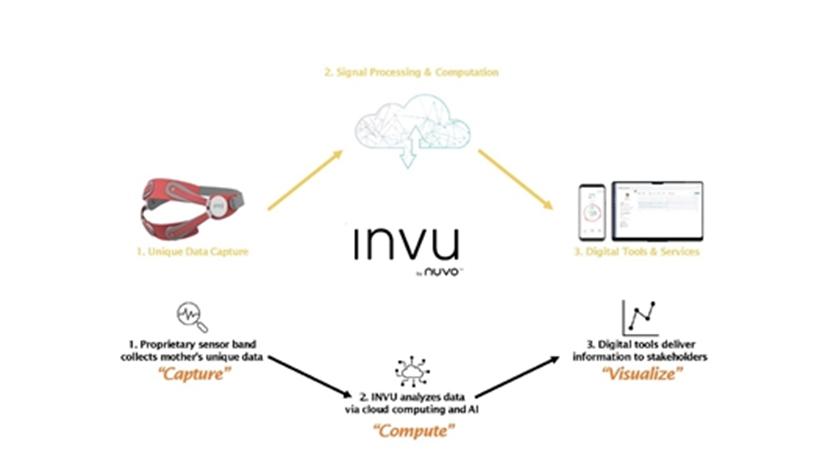
Our INVU platform was designed to allow expectant mothers to access prenatal care both at home and in the clinic according to their obstetrician’s protocol, through a self-administered and easy to use wireless sensory band that connects to our cloud-based platform and provides personalized clinical-quality care in a virtual environment, in real time. Our technology is based on the actions of capture, compute and visualize, and was built to provide an inside view of the pregnancy through deep physiological measurements and advanced data analysis for purposes of providing better information to inform the care of expectant mothers and unborn babies. Through our INVU platform we are able to gather relevant data, analyze this data to report key maternal and fetal health metrics and, ultimately, in the future we expect to facilitate preventive care.


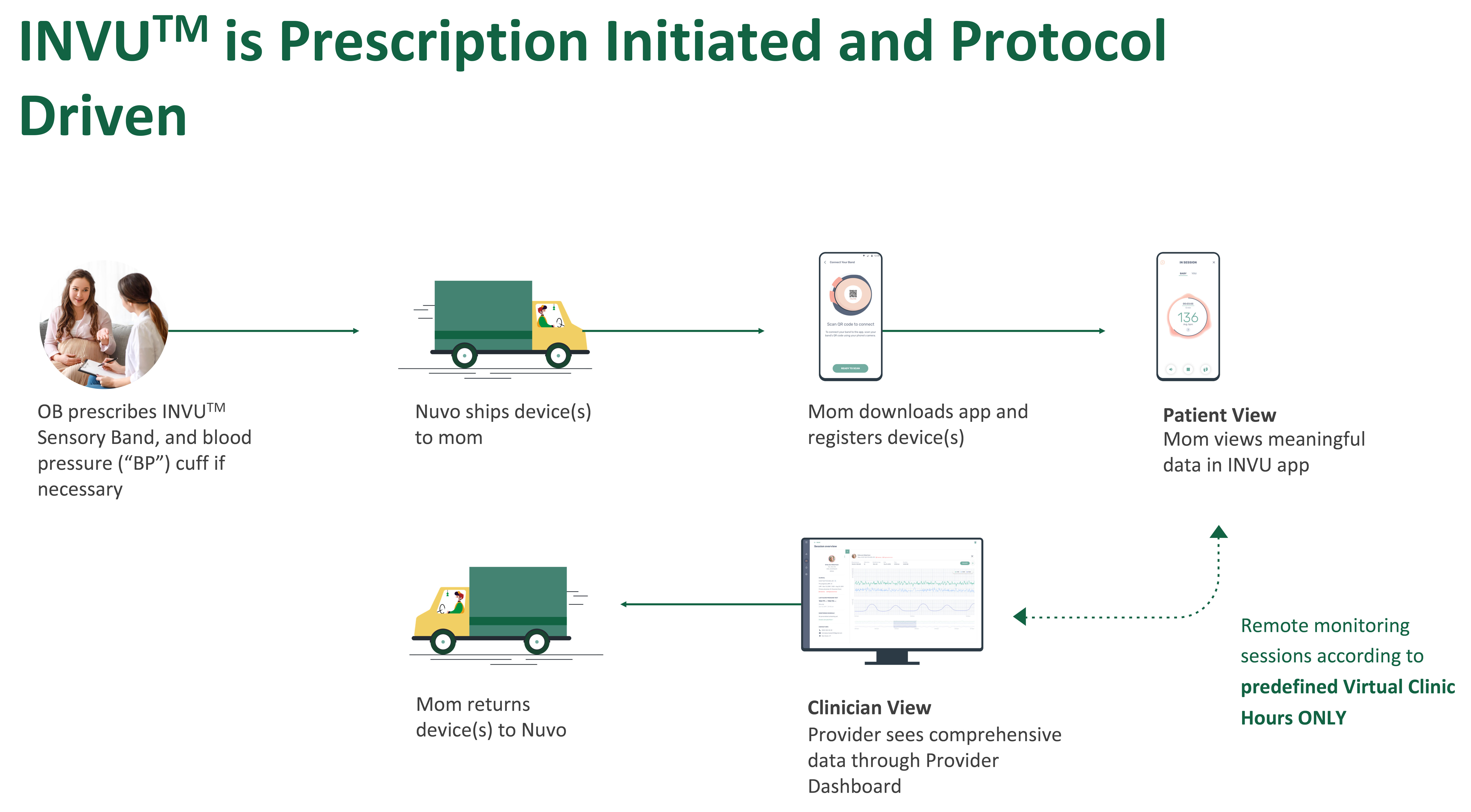
The prescription initiated, protocol-driven process from the expectant mother’s completion of monitoring to return of our device is demonstrated below.


Our INVU platform is a holistic pregnancy care solution with two integrated components, hardware and software. The hardware component comprises a proprietary, wireless sensory band with multi-modality technology, which captures detailed and granular signals that we believe enables our INVU platform, after analysis of the signals, to provide more useful data relative to other remote and in-office monitoring devices. Our wireless sensory band transmits signals from any location to the software component, a dynamic cloud computing environment that processes and analyzes data and, ultimately, transmits personalized reports on key maternal and fetal health metrics to the expectant mother and her obstetrician through digital visualization tools. This capture, compute and visualization process is demonstrated below.


4


Key Attributes


We believe our INVU platform provides the following key benefits for expectant mothers, unborn babies, obstetricians and payers:


  Increased access to care: Expectant mothers can access clinical-quality pregnancy care anytime, anywhere during the antepartum period subject to any restrictions as to time and place in any FDA clearance, without the need to travel to medical offices or spend time in waiting rooms and regardless of obstetrician proximity. Obstetricians can access medical-grade data from any location they desire through a digital dashboard that displays key maternal and fetal health metrics from the expectant mothers and unborn babies that they care for who use our INVU platform.


  Improved user experience: Expectant mothers can administer our wireless sensory band without assistance from a medical professional. Obstetricians can integrate our INVU platform with other existing systems and protocols, subject to FDA clearance in some cases, can easily schedule monitoring sessions and conduct monitoring on short notice on a near real time basis if concerns arise, and can send messages to the expectant mothers in their care.


  Reduced cost of care: We believe that use of our INVU platform will lead to fewer required in-person visits by expectant mothers to obstetricians and healthcare facilities, and ultimately fewer procedures, which would result in lower costs across the healthcare system.


5


  Improved outcomes: We believe that expectant mothers will be more likely to comply with our monitoring protocols, which, together with other benefits of our INVU platform, has the potential to result in better health outcomes if the frequency of complications and other events, such as C-sections, emergency department visits, hospital stays and NICU stays are reduced.


  Improved population health strategies: We believe that our future ability to analyze aggregated data will enable us to make highly useful and actionable predictive recommendations which will result in a healthier population of expectant mothers and unborn babies.


We believe our INVU platform is the only platform that contains all of the above attributes and that also (i) utilizes multimodality technology in one instrument to monitor pregnancy, (ii) utilizes ECG and PCG for remote monitoring, (iii) can monitor continuously, passively and remotely in accordance with obstetrician-prescribed protocol when the expectant mother is wearing our wireless sensory band, (iv) provides substantially equivalent results to CTG, which is the existing standard of care for pregnancy care monitoring and offers NSTs passively, remotely and through self-administration during the INVU monitoring period, (v) delivers high resolution and personalized medical-grade data to the obstetrician and the expectant mother and (vi) has the potential to aggregate data and apply innovative digital tools to make targeted predictive recommendations, as well as enable population health strategies.


Future Plans and Expectations


We intend to seek clearance to extend our INVU monitoring period as well as report other measurements. If we obtain additional clearances to report other measurements that our INVU platform is able to capture, compute and visualize, we will be able to provide and market additional pregnancy health metrics to participants in the pregnancy care management process, including expectant mothers and obstetricians. We intend to utilize the data we collect, combined with external guidelines, to establish cloud-based decision support systems. We also expect to add external data provided by third-party sources such as Hadassah Medical Organization, or Hadassah, and harmonize all data we have collected into one cohesive set. We intend to develop decision support tools to analyze the data we collect to develop and execute new personalized care protocols and population health strategies which we believe will enhance our value-based care model. We also intend to apply data algorithms and other innovative digital tools to conduct AI-powered machine learning computer analyses to identify patterns and trends based on the data and to develop predictive models to ultimately enable population health strategies. These population health strategies are expected to (i) enable us to develop and validate personalized care protocols and population health strategies and ultimately be able to make AI-based recommendations, including as to digital and other therapies, that will enhance preemptive care and provide predictive insights to tackle significant pregnancy challenges, and (ii) assist us in building our data-driven digital healthcare platform, increasing our revenues and realizing our vision to become the standard of care for remote pregnancy monitoring and pregnancy care management.


In addition to providing better care for expectant mothers and unborn babies, we believe that as our INVU platform develops, obstetricians will be able to use existing and expanded current procedural terminology, or CPT, codes for reimbursement for expectant mothers utilizing our platform and to employ our INVU platform, to maintain or increase their revenue and improve effectiveness. This is due, in part, to the additional efficiencies which we believe will allow them to increase the number of expectant mothers they care for and be more available when procedures are required. To convince more obstetricians, we will need to present sufficient impact evidence of the increased monitoring compliance, improved quality of care and healthcare outcomes, as well as reduced payer costs, obtained from our services to our initial obstetricians. If we can provide such evidence, we believe our strategic partners will be more likely to incentivize payers to enter into value contracts and partner with them, and payers will be more likely to encourage their obstetrician networks and expectant mothers to utilize our services.


As part of our operational strategy, we expect to establish a third-party operated servicing center where our wireless sensory bands will be prepared for use by the next expectant mother after thorough cleaning and quality control testing and, if needed, fixing and refurbishing, which could involve replacement of some sensors. See “Business—Manufacturing and Supply.” We believe that, on average, a wireless sensory band should be viable for approximately 12 mothers over a two-year period before needing to be replaced.


6


Our Revenue Model


Current State


We have recently begun to commercialize our INVU platform. Currently, we have one enterprise level contract which we entered into in December 2020 with Axia, one of the largest obstetrician private practice group of physicians focused on women’s health in the United States which in recent years, accounted for approximately 30,000 births annually and is a leading proponent of value-based care. See “Business—Overview—Our Revenue Model—Current State” for more information.


Future State


We intend to focus on the most significant providers of prenatal care in the United States that often control the entire pregnancy journey. Our primary initial customer focus is on long-term enterprise level contracts with larger obstetrician-physician practice management groups, such as Axia, and renowned U.S. healthcare systems. If we establish evidence of the short and long-term benefits of our INVU platform and our ability to generate value for payers, we aim to seek long-term contracts with payers, primarily insurers and self-insured employers.


We believe that the data we expect to acquire from expectant mothers and unborn babies we monitor as we expand and improve our pregnancy care platform, the clinical innovation that we expect to result from the decision support tools we expect to develop and the insights we expect to gain and predictive models created based on our analysis of such data with these tools, will lead to increased efficiency and improved outcomes. We expect these improvements will, in turn, generate cost savings and result in higher profitability through individual and population health strategies. We intend to monetize these capabilities, if developed, by selling to payers the anonymized population insights we obtain through our INVU platform, and by sharing in the cost savings that payers realize from these insights. See “Business—Overview—Our Revenue Model—Future State” for more information.


Our Strategic Partnerships


We believe our strategic partnerships are fundamental to our current and future business model. We have a structured business development process to map the landscape of potential strategic partners. Over time, we have developed and cultivated a number of strategic relationships and we are seeking to develop additional relationships in each of the three categories described below.


Implementers


Implementers are provider partners with an installed base of clinicians that understand how to prescribe and use our INVU platform for the expectant mothers under their care. Our current implementers include Axia, Babyscripts and a medical institution located in the Pacific United States. Axia is one of the largest obstetrician private practice group of physicians in the United States focused on women’s health, accounting for approximately 30,000 births annually in recent years. Implementation within Axia’s care delivery will also monitor for provider and patient satisfaction and NST services. Our ultimate goal is to have up to 80% to 100% of Axia’s population of expectant mothers utilizing our INVU platform, and to seek payer/provider partnership, per our enterprise contract. Babyscripts is a leading virtual care platform for managing obstetrics, with which we entered into a collaboration in late September 2021 to offer non-stress tests by INVU, within Babyscripts’ commercial ecosystem, which includes approximately 200,000 unique pregnancies across 30 states. In recent years, the medical institution located in the Pacific United States has cared for over one-third of the births of the state where it is located and a disproportionate amount of the HRPs of the state, and is currently studying shifting delivery of care to a remote setting and the ability to obtain shared savings, primarily through reducing transportation costs and operational inefficiencies, using our INVU platform. If successful, we intend to negotiate a payer-involved enterprise agreement with such medical institution. We are also in discussions with other obstetrician-physician practice management groups with scale, size and value contracting ability and regional healthcare systems with affiliate health plans.


7


Validators


Validators are academic medical institutions that have experience in building robust clinical evidence based on our already developed INVU platform to create new care pathways backed by key opinion leaders. Our initial validators are the University of Pennsylvania, or UPenn, as well as an academic medical institution located in the South Central United States. UPenn has been a key academic partner since our inception, and has already run clinical trials for comparative endpoints for MHR, FHR and MUA. It is conducting an NST operational viability trial seeking to validate our INVU platform’s NST capabilities for home use HRP. We expect to continue to work with UPenn to validate the most important aspects of our INVU platform. The academic medical institution located in the South Central United States participated with UPenn in the completed study comparing MUA to intrauterine pressure catheter, or IUPC, and is working with us to evaluate innovative rural management solutions through INVU remote monitoring.


Pioneers


Pioneers are research experts, mainly academic centers, with specific domain expertise that have the goal of advancing pregnancy care and have the ability to analyze our rich and robust data signals to help determine predictive markers through such data. We anticipate that most of our pioneers will have clinical champions or data and research scientists specialized in their specific domain. Currently, a lab affiliated with the University of Utah’s Psychology Department and Hadasit Medical Research Services & Development, Ltd., or Hadasit, are our first pioneers, and we have strong relationships with other potential pioneers with whom we are in discussions to develop other predictive markers for such indications as diabetes, preeclampsia and mood disorders. The University of Utah is conducting a study, sponsored by a National Institute of Mental Health, or NIMH grant, of maternal mood disorders through an analysis of MHR and FHR variability, from which we intend to develop a predictive biomarker for mood disorder in pregnant women. The study is expected to involve 200 subjects and be completed within two years from March 2021. The University of Utah chose our INVU platform because of its remote monitoring capabilities and the superior resolution of its data, including the ability to measure beat-by-beat HR variability. Hadasit is working with us to commence a future study, which will utilize its extensive pregnancy care database, to develop and validate AI-based predictive capabilities of our INVU platform for FHR, maternal and neonatal clinical outcome-related measures and the ability to predict the likelihood of C-sections.


We continue to actively and deliberately reach out across our entire strategic growth map to new potential implementers, validators and pioneers directly, through our developing network or via scientific collaboration.


8


Our Competitive Advantages


We believe the following combination of strengths, capabilities and features of our data-driven connected pregnancy care management platform distinguishes us from our competitors and positions us to successfully compete, to address certain market opportunities and weaknesses, and to disrupt the pregnancy care management and monitoring market, through our innovative INVU platform. We also believe that this market will show significant growth over the next years and decades, and that we are well-positioned to benefit from such growth.


Our INVU platform increases access to care through a remote solution. In recent years, telehealth infrastructure and remote monitoring solutions have become indispensable tools for care delivery and medical practice revenue generation. Pregnancy care has lagged behind other medical fields with respect to remote care due to difficulty in developing remote technology that can be easily administered early in the pregnancy without assistance and that provides monitoring within protocols at home that yield substantially equivalent results as the current standard of care obtained within healthcare facilities. Through clinical studies, we have established that our INVU platform is capable of providing substantially equivalent fetal viability measurements and offering NSTs, which capabilities are based on HR beat-by-beat detection technology, and MUA measurements, as applicable. Our INVU platform, which we believe is the only platform that uses new technology cleared by the FDA for pregnancy monitoring during the antepartum period, will be of particular benefit to three types of expectant mothers: Those living in rural areas without access to care, or those whose clinics see a high volume of expectant mothers; expectant mothers with low-risk pregnancies, or LRPs, who can enjoy greater freedoms associated with remote visits; and expectant mothers with HRPs who can also travel less frequently for in-office visits and should enjoy more flexibility and freedom in receiving the proper level of care that they need. In addition, COVID-19 and variants of the virus have further accelerated acceptance of remote preventive care by both care providers and patients. We believe our INVU platform will be unmatched in remote care and in distributing access to safe and enhanced pregnancy care.


Our wireless sensory band is designed to be self-administered by expectant mothers both at home and in the clinic. Our wireless sensory band was designed from the perspective of the expectant mother to be easy to use and applied by the expectant mother. We continue to modify the material and fabric of our wireless sensory band to maximize comfort in addition to ease of use. Most other devices that are labeled as remote-use devices are, in effect, miniaturized CTGs, which have proven to be difficult to properly self-administer without assistance from a medical professional. We believe an expectant mother’s ability to utilize our INVU platform both at home and in the clinic, and without assistance, significantly enhances the expectant mother’s experience, and we expect will increase compliance with routine monitoring protocols.


Our INVU platform has the potential to enable proactive pregnancy management, which we believe will result in better outcomes. Today, our INVU platform is capable of helping obstetricians provide expectant mothers with routine prenatal care and offer NSTs, in each case during the INVU monitoring period for singleton pregnancies. As we offer more NSTs, we will capture more data in a less costly manner, which we believe, among other things, will help to identify patterns and trends that may allow detection of certain complications earlier and facilitate timely intervention. As we continue to utilize our measurement capabilities, we also expect to develop biomarkers and predictive analytics, which we believe will set us apart from our competitors and make us more effective at enabling proactive pregnancy management to improve outcomes for expectant mothers and unborn babies.


Our INVU platform should make clinical-quality remote pregnancy care more attractive for obstetricians and payers, which we believe will increase adoption as a new standard of care. We believe obstetricians will be incentivized to prescribe our solution because they will gain access to medical-grade data remotely, efficiently and with less effort for both expectant mother and obstetrician. These features are tangible differentiators in the practitioners’ service offerings, which we expect to create the opportunity to strengthen the relationship to the expectant mother via virtual visits, while also potentially enabling increased compliance and better outcomes. Ultimately, the ability for improved virtual access to the expectant mothers they care for may allow obstetricians to reallocate scarce resources to cases where their physical presence and care is otherwise required. We believe payers will be incentivized to adopt our solution as a way to rationalize systemic healthcare costs. Even expectant mothers with LRPs should benefit through their improved access to basic prenatal care and virtual triaging and visits, as well as on transportation, childcare, and missed work costs, among other costs. As we commercialize our INVU platform, we believe we will be able to provide impact evidence to obstetricians and payers of the cost-benefits of our solution.


9


Our distributed care technology provides detailed data to enable population health strategies, and our database becomes harder to replicate as it grows. Through our advanced, multi-modality pregnancy monitoring technology, we believe we capture more detailed and granular signals and multiple physiological measurements, remotely, passively and in near real time, and acquire significantly more data from the expectant mother and unborn baby than other pregnancy monitoring systems. As we validate, aggregate and analyze data with respect to other physiological measurements, we will strengthen our predictive abilities and, we believe, will eventually be successful in tackling significant pregnancy challenges. As our database increases with additional expectant mothers being monitored and data from clinical studies and other third-party sources, we plan to aggregate data in the cloud and combine it with existing guidelines to develop decision support systems, harmonize our data into one cohesive set, and apply data algorithms and other innovative digital tools to conduct AI-powered machine learning and computer-based predictive analytics. In addition, we expect these results will enable us to develop personalized and predictive care pathways for expectant mothers and unborn babies, make Al-based recommendations for treatment to the obstetrician, and provide more personalized care and better outcomes for expectant mothers and unborn babies. In addition, we believe these results will enable us to develop population health strategies to tackle significant pregnancy challenges. As a result, we believe that we will be able to increase our revenues, make it harder for competitors to replicate our capabilities and establish INVU as the standard for pregnancy care management.


We have a comprehensive intellectual property portfolio. Our innovative technology is protected by an extensive global patent portfolio consisting of 11 issued U.S. utility patents, 10 pending U.S. utility patent applications, 26 issued foreign utility patents, 12 pending foreign utility patent applications and two PCT patent applications. Our patent portfolio also includes three issued U.S. design patents and seven issued foreign design patents. In addition, we own trade secrets and research and development know-how supporting our INVU platform. Our comprehensive portfolio of intellectual property enables our highly advanced INVU platform, and we believe it would be difficult for a competitor to develop an equivalent product without considerable time and expense.


Our senior management team and Board have deep industry experience. Our organization is characterized by a strong, entrepreneurial corporate culture that fosters our vision of improved, remote, accessible and affordable pregnancy management. Our founder is a major shareholder who drives our focus on long-term success in our mission to become the standard of care for remote pregnancy monitoring and pregnancy care management. Our senior management team and Board consist of seasoned medical device and other professionals, with a wide array of experience. Our Board has significant and diverse public market expertise in small and large U.S.-listed entities, as well as executive leadership experience in listed digital healthcare companies. Together, we have over a century of experience in operating, growing and overseeing multi-national companies and healthcare related businesses. We believe our mission-driven team spirit, diverse background and significant experience in our industry, positions us to excel and deliver against our strategic objectives.


See “Business—Our Competitive Advantages” for more information about the strengths of our platform.


Our Growth Strategies


Our goal is to become the standard of care for remote pregnancy monitoring and pregnancy care management through the development of our INVU platform. To achieve our growth plan, we expect to employ the following core strategies:


Continue to scale our operations in the United States to accelerate the adoption of our INVU platform. We expect to continue to scale our business in the United States by hiring additional U.S.-based managers as well as sales and marketing and end-user support personnel to enhance our ability to acquire customers and retain and grow these relationships. We expect that by expanding our U.S. team, we will acquire additional commercial expertise that will enable us to grow our customer and revenue base by continuing to cultivate satisfied customers and building key relationships with U.S. medical societies, which we believe will position us to create the value and tools required to win in an evolving competitive landscape.


10


Build a growing user and partner base through a stepwise approach, from providers to payers, while investing in expanding awareness of our INVU platform. We envision our stepwise approach to include a strategy that initially focuses on care providers and subsequently on attracting payer networks, which we believe will provide us with access to the largest population of expectant mothers. We expect strategic partnerships with care providers, such as Axia, to increase traction for our services and allow us to scale more quickly. We believe we have a healthy pipeline of U.S. and international providers and payers of strategic relevance, which we believe we will be able to convert to long-term partners and customers over time. In addition, we intend to spend considerable time and money seeking to educate expectant mothers and their obstetricians about the benefits of our remote monitoring technology. We expect that increased awareness among these groups will highlight the benefits of our INVU platform, including ease of use, cost savings, access, and quality of data, which should increase adoption and accelerate our growth.


Aggregate the data we capture to identify patterns and trends that will enable us to make predictive recommendations to benefit our user community and population health in general. Our INVU platform is currently capable of collecting a significant amount of detailed and granular data from each expectant mother whenever the expectant mother is wearing our wireless sensory band. As we validate, aggregate and analyze data with respect to other physiological measurements, we will strengthen our predictive abilities and, we believe, will eventually be successful in tackling significant pregnancy challenges, such as C-sections, preeclampsia, fetal and maternal arrhythmia and mood disorder. Our predictive insights, such as identifying risks before they become visible later in a pregnancy, will help obstetricians to improve monitoring schedules and frequency and identify appropriate times to intervene, both for individual pregnancies and population health applications. These capabilities, if developed, may facilitate a more efficient use of resources and lead to improved outcomes, which we believe will further enhance our value-based care model and, in turn, generate cost savings for our payer partners. We intend to monetize these capabilities by selling to payers the anonymized population insights that we obtain through our INVU platform, and by sharing in the cost savings that payers realize from these insights. We expect that these strategies will set us apart from other pregnancy management monitoring systems in the future.


Continue investing in research and development to enhance the quality and performance of our INVU platform. We believe that continued investment in our research and development capabilities will enable us to obtain additional regulatory clearances to support the expansion of our service offerings from our INVU platform. We believe we are one of a few remote providers able to capture, compute and visualize this data to obstetricians. Next, we plan to develop and utilize the measurements within our capabilities to power and fuel our predictive model. We may also expand our offerings by seeking clearance to provide some of these measurements to expectant mothers and obstetricians. We expect that continued investment in research and development will allow us to improve our product offerings and enable our products to become the standard of care for remote pregnancy monitoring and pregnancy care management. We believe that maintaining and growing our intellectual property portfolio will protect and expand our competitive position. See “—Our Competitive Advantages” and “Business—Research and Development.”


We intend to expand our reach globally. Our ambition is to improve pregnancy care globally. We intend to file for a CE mark in Europe in 2022, which if approved, should allow us to offer NSTs using our FHR, MHR and MUA capabilities in certain circumstances. Our business development work in this region indicates substantial demand for our solutions. We are in discussions already in Germany and Israel with various enterprise-level healthcare systems as well as payer networks. As we obtain clearances and approvals in these and other jurisdictions, we believe our expanded reach will allow us to become a global leader in pregnancy solutions from the first days of pregnancy onward. As we scale globally, we expect to maintain our fundamental approach to commercialization to focus on building strong relationships with local care networks and payers as our anchor partners.


See “Business—Our Growth Strategies” for more information about how we intend to further develop our platform going forward.


11


Recent Developments


Senior Management Appointment


In August 2021, Kelly Londy was appointed our Chief Executive Officer. Prior to joining us, Ms. Londy served as Chief Executive Officer of Innoblative Designs, Inc., an early-stage medical device company, where she led product development, regulatory strategy, go-to-market process and fundraising to support multiple indications and market access development. Ms. Londy succeeds Oren Oz, founder and former Chief Executive Officer, who has transitioned to the role of our Chief Innovation Officer and remains a member of our Board of Directors.


SAFEs


We entered into Simple Agreements for Future Equity, or SAFEs, with several existing shareholders and new investors, pursuant to which we issued to the investors the right to acquire certain shares of our share capital in exchange for payment by the investors, subject to certain terms and conditions. During 2020, a total of approximately $2.4 million was raised through SAFEs. From January 2021 through August 2021, we entered into additional SAFEs for approximately $18.1 million.


The SAFEs entered into prior to April 26, 2021, as revised, in an aggregate amount of approximately $15.0 million provide for a pre-money valuation cap of $200 million, in the event of a Liquidity Event (as defined below), and a 15% discount conversion rate, or the Discount Rate, in the event of an Equity Financing (as defined below). The SAFEs entered into on or after April 26, 2021 contain substantially identical terms but provide for a pre-money valuation cap of $625 million and a 25% Discount Rate. These SAFEs will convert into ordinary shares in the event of: (i) an equity financing in which we issue and sell shares of equity for proceeds of at least $20.0 million, or an Equity Financing or (ii) either a change of control transaction or an initial public offering, whichever occurs sooner, which in each case is referred to as a Liquidity Event. Upon the occurrence of a Liquidity Event, the investor will, at its discretion, receive either a cash repayment (without interest) or shares of the most senior series. In the event of a conversion, the conversion price is calculated as either: (i) in the case of an Equity Financing, either (a) the price per share of the ordinary shares sold in connection with the Equity Financing less the Discount Rate when the pre-money valuation is less than $200 million or $625 million, as applicable, or (b) the price per ordinary share equal to the pre-money valuation cap divided by our outstanding capitalization in effect immediately prior to the Equity Financing, calculated on an as-converted and fully diluted basis when the pre-money valuation is greater than $200 million or $625 million, as applicable, and (ii) in the case of a Liquidity Event, the price per ordinary share equal to the pre-money valuation cap divided by our outstanding capitalization in effect immediately prior to the Liquidity Event, calculated on an as-converted and fully diluted basis.


In October and November 2021, we entered into SAFEs with certain investors in a financing round pursuant to which $25.7 million was raised. The terms of these SAFEs are identical to the SAFEs entered into on or after April 26, 2021, except that (i) the definition of Equity Financing contemplates an equity offering, including an initial public offering, of at least $30.0 million, (ii) instead of a Liquidity Event, there is a conversion trigger upon a Change of Control (as defined therein), in which case the conversion price is calculated as the price per share received by either the Company or its shareholders in connection with the Change of Control less the Discount Rate, divided by our outstanding capitalization in effect immediately prior to the Equity Financing, calculated on an as-converted and fully diluted basis, and (iii) the funds received from these SAFEs were placed into an escrow account and will be returned to investors if no Equity Financing or Change of Control occurs by December 31, 2021, unless we and the investors agree to extend such date.


We expect this offering to (i) constitute both an Equity Financing and a Liquidity Event under the SAFEs entered into prior to April 26, 2021, and the investors will be entitled to receive either a cash repayment (without interest) or our ordinary shares at their discretion, and (ii) an Equity Financing under the SAFEs entered into on and after April 26, 2021, and the applicable investor will be entitled to receive our ordinary shares, in each case pursuant to the terms of the SAFEs.


12


New Commercial Relationships


Charite – Universitatsmedizin Berlin and Berlin Institute of Health at Charite (BIH) (collectively, “Charite”) is one of Europe’s largest university hospitals, affiliated with Humboldt University and Free University Berlin. Pursuant to our Evaluation Agreement with Charite, dated as of September 29, 2021 (the “Charite Agreement”), we have agreed to sponsor a clinical trial within and carried out by Charite in Berlin, Germany that focuses on shifting the delivery of care from hospitals to home settings for routine pregnancies.


Philips North America LLC (“Philips”) is a leading health technology company focused on improving people’s health and well-being, and enabling better outcomes across the health continuum – from healthy living and prevention, to diagnosis, treatment and home care. Pursuant to the Master Pilot Study Cooperation Agreement, dated October 29, 2021 (the “Philips Agreement”), the parties have agreed to cooperate on improving the prenatal care experience for patients, providers and payers alike.


Sheba Medical Center (“Sheba”) is the largest hospital in Israel. The letter of intent entered into on October 31, 2021 (the “Sheba LOI”) contemplates that, together with Sheba’s deployment of INVU, the parties will collaborate on the development of personalized care pathways, predictive/prescriptive analytics, and other care delivery data-management tools, all of which would largely utilize AI in different capacities.


IHC Health Services, Inc. (“Intermountain”), with a team of more than 41,000 caregivers, is an integrated, not-for-profit health system based in Salt Lake City, Utah, with clinics, a medical group, affiliate networks, hospitals, homecare, telehealth, health insurance plans, and other services. Pursuant to the Clinical Trial Agreement, dated November 10, 2021 (the “IHC Agreement”), Intermountain has agreed to carry out a two-part study sponsored by us, entitled “A Single center, Open-Label, Prospective Clinical Study evaluating the data utility and usability of remote NST performed by INVU system.”


Unified Women’s Healthcare, LP (“Unified”) is a diversified women’s health company, which collectively supports more than 2,500 providers across nearly 900 locations in North America. Pursuant to the Collaboration Agreement, dated November 16, 2021 (the “Unified Agreement”), we and Unified agreed to pursue an early stage collaboration that will seek to advance pre-natal care through the use of INVU with Unified’s advanced care delivery practices in order to better manage at-risk pregnancies.


For a further description of each of the Charite Agreement, the Philips Agreement, the Sheba LOI and the Unified Agreement, see “Business—Recent Developments—New Commercial Relationships.”


13


Share Split


Immediately prior to the completion of this offering, we intend to declare a 1-for- share split of all outstanding ordinary shares. See “Description of Capital Stock.”


Private Placement


We have entered into a subscription agreement with                   , who will purchase an aggregate of $          million of warrants to purchase up to          ordinary shares, each exercisable to purchase one ordinary share at $0.01 per share, at a price per warrant equal to the initial public offering price per share, in a separate private placement transaction. Such warrants will be exercisable immediately and will expire ten years from the date of this prospectus. The exercise price and number of ordinary shares issuable upon exercise of such warrants are subject to appropriate adjustment in the event of dividends, share splits, reorganizations or similar events affecting ordinary shares and the exercise price.          is an affiliate of          , our existing shareholder.


The underwriters serve as placement agents for the private placement. The closing of the private placement and the closing of this offering are conditioned upon each other. The issuance and sale of warrants to the investor are being made in reliance on an exemption from registration contained in Regulation S under the Securities Act. The warrants to be sold in the private placement are not registered by the registration statement of which this prospectus is a part and have not been registered under the Securities Act, and may be offered or sold only pursuant to an effective registration statement or pursuant to an available exemption from the registration requirements of the Securities Act.


Implications of Being an Emerging Growth Company and a Smaller Reporting Company


As a company with less than $1.07 billion in revenue during our last fiscal year, we qualify as an “emerging growth company” as defined in the Jumpstart Our Business Startups Act of 2012, or the JOBS Act. For as long as we are an emerging growth company, we will not be required to comply with certain requirements that are applicable to other public companies that are not emerging growth companies, including the auditor attestation requirements of Section 404 of the Sarbanes-Oxley Act of 2002, as amended, or the Sarbanes-Oxley Act, and we may also take advantage of certain reduced disclosure obligations regarding executive compensation in our periodic reports and proxy statements and the exemptions from the requirements of holding a nonbinding advisory vote on executive compensation and shareholder approval of any golden parachute payments not previously approved. In addition, as an emerging growth company, we may take advantage of certain reduced reporting obligations, including a requirement to have only two years of audited financial statements and only two years of related management’s discussion and analysis of financial condition and results of operations disclosure in this prospectus. We may choose to take advantage of some but not all of these reduced burdens. We have taken advantage of many of these reduced burdens in this prospectus, and intend to do so in future filings. As a result, the information we provide shareholders may be different than the comparable information you may get from other public companies that are not emerging growth companies. In addition, the JOBS Act provides that an emerging growth company can delay adopting new or revised accounting standards until those standards apply to private companies. We have elected to avail ourselves of this exemption.


We will remain an emerging growth company until the earliest to occur of: the last day of the fiscal year in which we have more than $1.07 billion in annual revenue; the last day of the fiscal year in which we qualify as a “large accelerated filer;” the date on which we have, during the previous three-year period, issued more than $1.0 billion in non-convertible debt securities; and the last day of the fiscal year in which the fifth anniversary of this offering occurs.


We are also a “smaller reporting company,” meaning that the market value of our stock held by non-affiliates plus the proposed aggregate amount of gross proceeds to us as a result of this offering is expected to be less than $700 million, and our annual revenues were less than $100 million during our most recently completed fiscal year. We may continue to be a smaller reporting company after this offering if either (i) the market value of our ordinary shares held by non-affiliates is less than $250 million as of the last business day of our second fiscal quarter or (ii) our annual revenue was less than $100 million during the most recently completed fiscal year and the market value of our ordinary shares held by non-affiliates is less than $700 million as of the last business day of our second fiscal quarter. If we are a smaller reporting company at the time we cease to be an emerging growth company, then we may continue to rely on exemptions from certain disclosure requirements that are available to smaller reporting companies. Specifically, as a smaller reporting company we may choose to present only the two most recent fiscal years of audited financial statements in our Annual Report on Form 10-K, and, similar to emerging growth companies, smaller reporting companies have reduced disclosure obligations regarding executive compensation as compared to companies that are neither emerging growth companies or smaller reporting companies.


14


Summary Risk Factors


Our business is subject to numerous risks and uncertainties, including those described in “Risk Factors” and elsewhere in this prospectus. You should carefully consider these risks before making an investment. These risks include, among others, the following:


  We are a development-stage company with a limited operating history. We may never be able to effectuate our business plan, achieve meaningful revenue or attain profitability.


  We have a history of net losses, and we expect to continue to incur losses for the foreseeable future. If we ever achieve profitability, we may not be able to sustain it.


  Our business model contemplates, among other things, an expansion of the approved uses for our INVU platform, proof to payers of reduced cost of delivering quality healthcare for expectant mothers, and additional collaborations with partners willing to recommend and prescribe the use of our INVU platform, all of which are subject to numerous risks and uncertainties and could result in the failure of our business model.


  Our business model contemplates a revenue model that is yet to be proved viable, and is subject to numerous risks and uncertainties.


  Our business, financial condition and results of operations have been and continue to be impacted by the COVID-19 pandemic.


  Our success depends in large part on our ability to develop, market and sell our INVU platform. If we are unable to successfully develop, market and sell this product, our business prospects will be significantly harmed and we may be unable to achieve revenue growth or profitability.


  We are highly dependent on the successful development, marketing and sale of our INVU platform and the related products and services.


  Our commercial success will depend upon attaining significant market acceptance of our INVU platform among expectant mothers, care providers, payers and others in the medical community. If we are unable to successfully achieve substantial market acceptance and adoption of our INVU platform, our business, financial condition and results of operations would be harmed.


  We currently have a limited sales and marketing organization. If we are unable to develop our sales and marketing capability on our own or through collaborations with marketing partners, we will not be successful in commercializing our INVU platform.


  The success of our business may be dependent on our strategic partnerships and collaborations.


  We conduct business in a heavily regulated industry, and changes in regulations or violations of regulations may, directly or indirectly, reduce our revenue, adversely affect our results of operations and financial condition and harm our business.


  If we fail to comply with U.S. federal and state fraud and abuse and other healthcare laws and regulations, including those relating to kickbacks and false claims for reimbursement, we could face substantial penalties and our business operations and financial condition could be harmed.


  Our employees, independent contractors, consultants, commercial partners and suppliers may engage in misconduct or other improper activities, including noncompliance with regulatory standards and requirements, which could harm our business, financial condition and results of operations.


15


  Regulatory compliance is expensive, complex and uncertain, and a failure to comply could lead to enforcement actions against us and other negative consequences for our business.


  Our medical device operations are subject to pervasive and continuing FDA regulatory requirements, and failure to comply with these requirements could harm our business, financial condition and results of operations.


If we are unable to adequately address these and other risk we face, our business may be harmed.


Corporate Information


Nuvo Group Ltd. is an Israeli company and was incorporated on June 28, 2006. Nuvo’s principal executive offices are located at Yigal Alon 94. St., Alon Tower 1, Tel Aviv, Israel 6789155 and its phone number is 972-3-624-2266. Nuvo’s website can be found at www.nuvocares.com.


The information contained on Nuvo’s website or that can be accessed through its website is not part of this prospectus and you should not rely on any such information when making a decision whether or not to acquire ordinary shares in this offering.


16


The Offering


Issuer  

Nuvo Group Ltd.

     
Ordinary shares offered by us  

           ordinary shares (or                ordinary shares if the underwriters exercise their option in full).

     
Ordinary shares to be outstanding after this offering              ordinary shares (or                ordinary shares if the underwriters exercise their option in full).
     
Option to purchase additional ordinary shares  

We have granted the underwriters an option to purchase up to an additional                 ordinary shares from us. The underwriters can exercise this option at any time within 30 days from the date of this prospectus.

     
Private placement   We have entered into a subscription agreement with                    , who will purchase an aggregate of $                million of warrants to purchase up to                ordinary shares, each exercisable to purchase one ordinary share at $0.01 per share, at a price per warrant equal to the initial public offering price per share, in a separate private placement transaction. Such warrants will be exercisable immediately and will expire ten years from the date of this prospectus. The exercise price and number of ordinary shares issuable upon exercise of such warrants are subject to appropriate adjustment in the event of dividends, share splits, reorganizations or similar events affecting ordinary shares and the exercise price.         is an affiliate of         , our existing shareholder.
     
    The underwriters serve as placement agents for the private placement. The closing of the private placement and the closing of this offering are conditioned upon each other.
     
Use of proceeds  

We estimate that the net proceeds from the sale of ordinary shares in this offering and the private placement, after deducting the discounts and commissions and estimated offering expenses payable by us, will be approximately $         (or $         if the underwriters exercise their option to purchase additional ordinary shares in full) based on an assumed initial public offering price of $         per share (the midpoint of the estimated public offering price range set forth on the cover page of this prospectus).


We intend to use these net proceeds from this offering and the private placement to fund sales and marketing activities to support commercialization of our INVU platform, purchase supplies and manufacture products, fund research and development activities, and for general corporate purposes. See “Use of Proceeds.”

     
Dividend policy  

We currently intend to retain all available funds and any future earnings to fund the development and growth of our business; therefore, we do not anticipate paying any cash dividends in the foreseeable future. Any future determination to declare and pay dividends, if any, will be at the discretion of our board of directors, or the Board of Directors or the Board, subject to compliance with any contractual restrictions and covenants in the agreements governing our current and future indebtedness. Any such determination will be dependent upon then-existing conditions, including our earnings, capital requirements, results of operations, financial condition, business prospects and any other factors that our Board of Directors considers relevant. Further, the Companies Law imposes restrictions on our ability to declare and pay dividends. See “Dividend Policy.”

     
Risk factors   Investing in our ordinary shares involves a high degree of risk. See “—Summary Risk Factors” above, the section of this prospectus entitled “Risk Factors” and the other information included in this prospectus for a discussion of factors you should carefully consider before investing in our ordinary shares.
     
Listing   We have applied to list our ordinary shares on the New York Stock Exchange (the “NYSE”) under the symbol “NUVO.”


17


The number of ordinary shares that will be outstanding after this offering is based on 15,387,735 ordinary shares outstanding as of September 30, 2021, and excludes:


  3,474,893 ordinary shares issuable upon the exercise of options to purchase ordinary shares outstanding as of September 30, 2021 under our 2015 Share Incentive Plan, or the 2015 Plan, at a weighted average exercise price of $5.85 per share;


  346,575 ordinary shares issuable upon the exercise of options to purchase ordinary shares that will be granted to Oren Oz, our Chief Innovation Officer and director, upon the consummation of this offering, to the extent this offering is consummated on or prior to December 31, 2021, at an exercise price of NIS 0.01 per share;


850,000 ordinary shares available for future issuance under our 2021 employee stock purchase plan that we plan to adopt immediately prior to the completion of this offering, or the ESPP;


1,250,000 ordinary shares available for future issuance under the 2021 share incentive plan we are adopting in connection with this offering, or the 2021 Plan;


  389,527 ordinary shares reserved for future issuance under our 2015 Plan as of September 30, 2021;


                ordinary shares issuable in connection with the conversion of the SAFEs upon the consummation of this offering (assuming all the SAFEs are converted into ordinary shares and no cash is paid to investors); and
     
                ordinary shares issuable upon the exercise of warrants we expect to issue in a private placement to an institutional investor concurrently with the consummation of this offering, each exercisable to purchase one ordinary share at $0.01 per share.


Unless we indicate otherwise or unless the context otherwise requires, all information in this prospectus:


  assumes no exercise of the underwriters’ option to purchase additional ordinary shares;


  gives effect to our third amended and restated articles of association, or the Amended Articles, which will become effective upon the consummation of this offering;


gives effect to a 1-for-      share split of all outstanding ordinary shares immediately prior to this offering;


  assumes no exercise of outstanding options; and


  assumes an initial public offering price of $            per share, the midpoint of the estimated public offering price range on the cover page of this prospectus.


18


Summary HISTORICAL CONSOLIDATED financial data


The following table sets forth the summary historical consolidated financial data of the Company as of and for the periods presented. The summary consolidated financial data for the fiscal years 2020 and 2019 are derived from our audited consolidated financial statements and the related notes appearing elsewhere in this prospectus. The summary historical consolidated financial data for the nine months ended September 30, 2021 and 2020 and as of September 30, 2021 have been derived from our unaudited consolidated financial statements and the related notes contained elsewhere in this prospectus. The historical results presented below are not necessarily indicative of financial results to be achieved in future periods and should be read in conjunction with “Capitalization,” “Management’s Discussion and Analysis of Financial Condition and Results of Operations” and our historical financial statements and accompanying notes, which are included elsewhere in this prospectus.


(Amounts in thousands, except for share and per share data)  Years Ended
December 31,
  

Nine Months Ended
September 30,

 
   2020   2019   2021   2020 
           (Unaudited) 
Consolidated Statements of Comprehensive Loss:                
Operating expenses:                    
Research and development, net  $6,876   $7,361    7,460    4,992 
Selling and marketing   1,505    1,483    1,723    1,127 
General and administrative   2,893    2,577    11,650    1,763 
Operating loss   11,274    11,421    20,833    7,882 
Financial (income) expenses, net   30    (79)   13,512    (53)
Total comprehensive loss  $11,244   $11,500    34,345    7,829 
Net loss per share attributable to ordinary shareholders, basic and diluted(1)  $(0.679)  $(0.807)   (2.032)   (0.476)
Weighted-average share used in computing net loss per share attributable to ordinary shareholders, basic and diluted(1)   16,566,543    14,245,367    16,902,713    16,459,542 


(1)Does not give effect to the 1-for- share split of all of our outstanding ordinary shares immediately prior to the completion of this offering.


(Amounts in thousands)  Years Ended
December 31,
  

Nine Months Ended
September 30,

 
   2020   2019   2021   2020 
           (Unaudited) 
Consolidated Statements of Cash Flows:                
Net cash used in operating activities  $(10,691)  $(10,088)   (8,617)   (7,854)
Net cash used in investing activities  $(396)  $(61)   (341)   (127)
Net cash provided by financing activities  $10,568   $10,652    13,858    9,843 
Cash and cash equivalents and restricted cash at the end of the year  $1,227   $1,746    6,127    3,608 


(Amounts in thousands)  As of
December 31,
   As of
September 30,
 
   2020   2019  

2021

 
           (Unaudited) 
Consolidated Balance Sheet:               
Cash and cash equivalents  $838   $1,384   $5,614 
Total current assets   1,341    1,618    6,662 
Total assets   2,911    2,934    9,858 
Total current liabilities   1,422    1,858    7,895 
Total non-current liabilities   2,705    296    30,985 
Total shareholders’ equity (deficit)  $(1,216)  $780   $(29,022)


19


RISK FACTORS


Investing in our ordinary shares involves a high degree of risk. You should carefully consider the following risk factors and all other information contained in this prospectus before purchasing our ordinary shares. If any of the following risks occur, our business, financial condition and results of operations could be materially and adversely affected. In that case, the trading price of our ordinary shares could decline, and you may lose some or all of your investment. This prospectus also contains forward-looking statements and estimates that involve risks and uncertainties. Our actual results could differ materially from those anticipated in the forward-looking statements as a result of specific factors, including the risks and uncertainties described below. Please also see “Cautionary Note Regarding Forward-Looking Statements.” In addition, the impacts of the COVID-19 pandemic and any worsening of the economic environment may exacerbate the risks described below, any of which could have a material impact on us. Changes can be rapid and additional impacts may arise that we are not currently aware of.


Risks Related to Our Business and Our INVU Platform


We are a development-stage company with a limited operating history. We may never be able to effectuate our business plan, achieve meaningful revenue or attain profitability.


We are a development-stage company and are subject to all of the risks inherent in the establishment of a new business enterprise. We have a limited operating history and only a preliminary and unproven business plan upon which investors may evaluate our prospects. We have not yet demonstrated the commercial feasibility of our INVU platform, and we currently have only a single commercial agreement from which we may generate revenue. See “Business—Strategic Relationships—Implementers—Axia Women’s Health.” Additionally, our INVU platform is currently cleared by the FDA for only limited monitoring capabilities, and the future commercial interest in our INVU platform, if any, will require FDA and other regulatory clearances or approvals for additional capabilities, and we may never obtain such clearances or approvals. Our ability to generate revenue from our operations and, ultimately, achieve profitability will depend on, among others things, whether we can commercialize our INVU platform as currently planned, whether we can complete the development of other features of our INVU platform, whether we can utilize the data we capture to make predictive recommendations and monetize these capabilities, our obtaining additional regulatory clearances, commercial adoption of our INVU platform, whether we can manufacture INVU on a commercial scale in such amounts and at such costs as we anticipate would be required to begin to achieve commercial success, and whether we can achieve market acceptance of our INVU platform and business model. We may never generate meaningful revenue or operate on a profitable basis. Even if we achieve profitability, we may not be able to sustain it.


We have a history of net losses, and we expect to continue to incur losses for the foreseeable future. If we ever achieve profitability, we may not be able to sustain it.


We have incurred losses since our inception, and we expect to continue to incur losses for the foreseeable future. For the nine months ended September 30, 2021 and 2020 and the years ended December 31, 2020 and 2019, we reported net losses of $34.35 million, $7.83 million, $11.24 million and $11.50 million, respectively. As a result of these losses, as of September 30, 2021 and December 31, 2020, we had an accumulated deficit of $89.27 million and $54.93 million, respectively. We expect to continue to incur significant sales and marketing expenses as we expand our sales and marketing efforts to increase adoption of our INVU platform, including through scaling our business in the United States and globally, expanding relationships with care providers, payer networks and strategic partners, and increasing awareness of our solutions among expectant mothers and their obstetricians. In addition, we expect to continue to incur significant research and development and other expenses as we develop and utilize the measurements within our capabilities, expand our offerings by seeking clearance to provide some of these measurements to expectant mothers and obstetricians, conduct additional clinical trials and studies on our INVU platform, and maintain and grow our intellectual property portfolio. In addition, we expect our general and administrative expenses to increase following this offering due to the additional costs associated with being a public company. The net losses that we incur may fluctuate significantly from period to period. We will need to generate significant revenue and maintain or improve our gross margins to achieve and sustain profitability. Even if we achieve profitability, we may not remain profitable for any substantial period of time.


20


Our business model contemplates, among other things, an expansion of the approved uses for our INVU platform, proof to payers of reduced cost of delivering quality healthcare to expectant mothers, and additional collaborations with partners willing to recommend and prescribe the use of our INVU platform, all of which are subject to numerous risks and uncertainties and could result in the failure of our business model.


We have not yet demonstrated the feasibility of our INVU platform for commercial applications, including its ability to provide clinical-quality remote pregnancy care on a commercial scale. Currently, our INVU platform is cleared by the FDA only for fetal viability checks and remote monitoring of MUA and the provision of remote NSTs. In addition, the ability to deliver MHR and FHR data is not necessarily novel and therefore may not enable us to gain or sustain a competitive advantage. Our business plan contemplates that our INVU platform ultimately provides monitoring for additional data and metrics. We may not be able to develop and utilize such additional measurements and include such measurements in our offerings, and even if we are able to do so, such data may not be of medical quality or equivalent to the data obtained from current standard of care. The expansion of our INVU platform’s usable capabilities, or the modification of our existing FDA cleared platform in response to feedback from third parties, such as medical professionals, also requires additional FDA clearance, which we may never receive, and any delay in receiving such clearance could also have a material adverse effect on our business. Additionally, as we expand globally, our INVU platform may be subject to the regulatory regimes of other non-U.S. jurisdictions, such as in Europe where we intend to file for a CE mark in 2022 to offer NSTs using our FHR, MHR and MUA capabilities.


The software component of our INVU platform uses a cloud computing environment that processes and analyzes data and, ultimately, transmits personalized reports on maternal and fetal health metrics to the expectant mother and her obstetrician through digital visualization tools. The development of this cloud computing environment requires a considerable investment of technical, financial, and legal resources, which may not be available to us. It may also require separate regulatory clearances or approvals. Furthermore, it may not be technically viable for care providers and our partners to integrate the cloud with their businesses or platforms. There may also be public concerns regarding privacy and compliance with restrictive laws or regulations, including those with respect to management of health data, as well as concerns regarding hardware and software security and reliability issues associated with third-party mobile devices such as smartphones that would be used to access our cloud services.


Further, our business model contemplates the collection of a significant amount of personalized health data to develop a database sufficient for us to develop algorithms that may allow for effective and accurate predictive tools. We have yet to develop such a database, and we are not yet cleared to provide any such analytics, nor have we yet applied for or sought such clearances. Furthermore, even if we are able to develop such a database, we may not successfully develop effectively predictive algorithms. As a result, we may never ultimately develop our planned capabilities, or, if we do, care providers, expectant mothers or payers may not find such capabilities useful or cost effective.


The success of our business model also depends on our ability to:


  generate widespread awareness, acceptance and adoption of our INVU platform and future products or services;


  prove out cost savings such that providers and payers clearly see value in the prescribing and use of our INVU platform;


  develop enhanced of new technologies or features that improve the convenience, efficiency, safety or perceived safety, and productivity of our INVU platform and future products or services, including the receipt of all regulatory clearances and approvals necessary for such enhanced or new technologies and features;


  significantly expand our strategic partnerships with enterprise-level entities, such as our partnership with Axia, in order to develop necessary product awareness and scale;


  properly identify customer needs and deliver new products or services or product enhancements to address those needs;


21


  obtain the regulatory approvals in a timely and cost-effective manner; attract and retain qualified personnel and collaborators;


  maintain quality control as we continue to commercialize our INVU platform;


  protect our inventions with patents or otherwise develop proprietary products and processes; and


  secure sufficient capital resources to expand both our continued research and development, and sales and marketing efforts.


Given the foregoing, our success depends significantly upon, among other things, our ability to obtain additional regulatory approvals for our INVU platform’s more advanced capabilities and further expand such capabilities, materially expand our strategic partnerships to drive brand awareness and product usage, and prove that INVU reduces the cost of delivering quality healthcare for expectant mothers in order to help convince payers that INVU should be regularly prescribed and used. Our failure to successfully accomplish the foregoing could have a material adverse effect on our business, prospects, results of operation and financial position.


Our business model contemplates a revenue model that is yet to be proven viable, and is subject to numerous risks and uncertainties.


Our ability to generate revenue will depend on securing commercial contracts on favorable economic terms. Currently, we have one enterprise level agreement with Axia. This agreement calls for three-phases over a five-year term, and we will only negotiate the scope, nature and pricing terms for our services to be provided in the third phase. We did not receive any revenues under the Axia contract in 2020. While we have received a nominal down payment to date in 2021 under the Axia contract, we might not realize any revenues if certain milestones under the contract are not met. As a result, we may not be able to generate significant revenue from this agreement. See “Business—Strategic Relationships—Implementers—Axia Women’s Health.” We plan to focus on long-term enterprise level agreements with larger obstetrician-physician practice management groups, such as Axia, and renowned U.S. healthcare systems, and we are exploring a number of other models with such entities such as introductory preferential pricing, fee-for-service, volume pricing or shared savings. However, we may not prove the benefits of our INVU platform, or such entities may not find our pricing to be attractive, either of which could cause our pricing model to fail. Ultimately, we aim to seek long-term contracts with payers, where we expect to receive revenue based, at least in part, on a percentage of cost-savings achieved by the applicable payers. We may not be able to develop a substantial body of data to prove to care providers and payers that the use of our INVU platform reduces medical care costs, and even if we are able to collect such data, we may not demonstrate cost savings, including as a result of the improvement of cost baseline in the long term, whether due to the success of our INVU platform or as other cost-effective offerings become available, or demonstrate improved quality of care and healthcare outcomes, in order to incentivize payers to encourage their obstetrician networks and expectant mothers to utilize our INVU platform. Our revenue model is also subject to many other factors, including the following:


  payment models for remote healthcare solutions are still evolving, and the pricing arrangement we favor may not be accepted by care provider or payers;


  we may not be able to find a sufficient number of implementers to stimulate market interest or reach the scale necessary to make our INVU platform a cost-effective solution, which is a key factor for acceptance by care providers and ultimately the payers;


  even if we can demonstrate cost savings from use of our INVU platform, we may be unable to secure arrangements with payers that share any cost-saving with us, on favorable terms to us or at all;


  we may not be able to secure meaningful up-front and ongoing payments;


  contracted payment terms will likely vary among counterparties, making it difficult to predict revenues;


22


  manufacturing or maintenance costs may be higher than expected and we may not be able to adjust our pricing model to accommodate for these increases, which will increase our operating expenses and reduce our margins; and


  we may not be able to accumulate sufficient data of the type and quality we need to develop predictive tools, and even if we are able to do so, we may not be successful in generating revenue from these tools.


Manufacturers of medical devices have a history of price competition, and we may not be able to achieve or maintain satisfactory pricing for our INVU platform. If we are forced to lower the price we charge for our INVU platform, our gross margins will decrease, which will harm our ability to invest in and grow our business. If we are unable to maintain our prices, or if our costs increase and we are unable to offset such increase with an increase in our prices, our margins could erode. We may be subject to significant pricing pressure, which could harm our business and results of operations. Any of these risks and uncertainties could cause our revenue model to fail.


Our business, financial condition and results of operations have been and continue to be impacted by the COVID-19 pandemic.


The global spread of the COVID-19 pandemic and measures introduced by local, state and federal governments to contain the virus and mitigate its public health effects have significantly impacted the global economy. There remains considerable uncertainty around the duration and extent of the COVID-19 pandemic and its ongoing impacts, and we expect the evolving COVID-19 pandemic to continue to impact our business, such as our research and development and commercialization efforts, and these impacts may be substantial. Moreover, it is possible that the acceleration of the move to telehealth solutions in pregnancy care driven by the COVID-19 pandemic may not be sustained following the easing and ultimate end of the COVID-19 pandemic; consequently, those assumptions we have made with respect to the demand for our INVU platform may be based on data that ultimately prove to have changed materially following the end of the COVID-19 pandemic and the potential return to almost entirely in-person care, all of which may have a material adverse effect on our business model and prospects for commercial success.


While many such jurisdictions have partially or entirely relaxed various “shelter-in-place” orders, quarantines, executive orders and similar government orders and restrictions, some have not, such as those in much of Europe. Additionally, if there is a resurgence in infections in jurisdictions that have eased restrictions, then such restrictions may be reimplemented. Such orders or restrictions, as well as the perceived need by individuals to continue such practices to avoid infection, among other factors, continue to result in business closures, work stoppages, slowdowns and delays, work-from-home policies, travel restrictions and cancellation of events, among other effects. The states and countries in which our INVU platform or its components are manufactured, assembled, shipped and distributed are in varying stages of restrictions and re-opening to address the COVID-19 pandemic. Any existing or renewed quarantines, government actions related to the pandemic or shutdowns could disrupt our supply chain, manufacturing or shipping process, or sales channel.


The widespread pandemic has resulted, and may continue to result for an extended period, in significant disruption of global financial markets, reducing our ability to access capital, which would negatively affect our liquidity. In addition, if the COVID-19 pandemic results in a prolonged economic recession, it could harm our future sales, if any, and our ability to continue as a going concern. A prolonged economic contraction or recession may also result in employer layoffs in markets where we conduct business.


Our success depends in large part on our ability to develop, market and sell our INVU platform. If we are unable to successfully develop, market and sell this product, our business prospects will be significantly harmed and we may be unable to achieve revenue growth or profitability.


Our future financial success will depend substantially on our ability to further development, and effectively and profitably market and sell, our INVU platform. Our products may not gain market acceptance in the United States or internationally or otherwise attain and maintain any level of market share.


23


The commercial success of our INVU platform and any of our planned or future products will depend on a number of factors, including, but not limited to, the following:


  the actual and perceived effectiveness, safety and reliability, and clinical benefit, of our INVU platform, especially relative to the current standard of care obtained within healthcare facilities;


  the degree to which expectant mothers, care providers, such as large healthcare systems obstetrician- physician practice management groups, and payer networks adopt and continue to use and prescribe our INVU platform;


  the degree to which expectant mothers use our INVU platform correctly and consider it a valuable tool during their pregnancies;


  the availability, relative cost and perceived advantages and disadvantages of alternative technologies for pregnancy monitoring;


  the results of additional clinical and other studies relating to the health, safety, economic or other benefits of our INVU platform;


  whether key thought leaders in the medical community adopt our INVU platform over alternatives and products offered by our competitors, and the extent to which we are successful in educating physicians and healthcare providers about the benefits of our INVU platform;


  the success of our strategic partnerships, including those with Axia and a medical institution located in the Pacific United States, as well as those with our current and future strategic partners;


  our ability to successfully market, sell and distribute our INVU platform and any related platform products, including, without limitation, any of our planned cloud-based solutions derived from the data we expect to collect from expectant mothers, including our plan to identify patterns and trends associated with certain risks and outcomes from which we may derive predictive recommendations that could be useful to individual expectant mothers;


  our reputation among care providers, such as obstetrician-physician management groups;


  our ability to obtain, maintain, protect and enforce our intellectual property rights in and to our INVU platform;


  our ability to maintain compliance with all regulatory requirements applicable to our INVU platform; and


  our ability to continue to maintain quality control and real-time data processing ability as we continue to commercialize our INVU platform.


If we fail to successfully market and sell our products cost-effectively and develop, maintain and expand our market share, we will not be able to achieve profitability, which will harm our business, financial condition and results of operations. Our ability to grow our revenue in future periods will depend on our ability to successfully penetrate our target markets and increase sales of our product, which will, in turn, depend in part on our success in driving adoption and increased use of our products as well as the prices we can charge.


We are highly dependent on the successful development, marketing and sale of our INVU platform and the related products and services.


Our INVU platform comprises the basis of our business. As a result, the success of our business plan is highly dependent on our ability to develop, manufacture and commercialize our INVU platform and related products and services, and our failure to do so could cause our business to fail. Successful commercialization of medical devices, such as our INVU platform, is a complex and uncertain process, dependent on the efforts of management, manufacturers, medical professionals, third-party payers, our strategic partners, as well as general economic conditions, among other factors. Any factor that adversely impacts the development and commercialization of our INVU platform will have a negative impact on our business, financial condition, results of operations and prospects. Some potential factors include:


24


  our ability to significantly scale our pregnancy care population, together with the necessary increase in manufacturing capacity that would be required to produce the hardware components of our INVU platform to serve a much larger population of expectant mothers;


  our ability to adapt our INVU platform to the extent necessary to work for a substantial majority of expectant mothers;


  our ability to achieve sufficient market acceptance by expectant mothers, strategic partners, such as Axia, and other medical and clinical professionals, third-party payers and others in the medical community;


  our ability to compete with existing pregnancy care solutions, such as currently standard in-person, non-remote, monitoring solutions and current or future competing remote solutions;


  our ability to establish, maintain and expand our sales, marketing and distribution networks;


  our ability to obtain or maintain necessary regulatory approvals, including with respect to any changes to our products based upon feedback from third parties such as medical professionals; and


  our ability to effectively protect our intellectual property.


Our inability to successfully obtain clearance or approval for and subsequently commercialize our INVU platform or related products and services would have a material adverse effect on our business, financial condition, results of operations and prospects.


Our commercial success will depend upon attaining significant market acceptance of our INVU platform among expectant mothers, care providers, payers and others in the medical community. If we are unable to successfully achieve substantial market acceptance and adoption of our INVU platform, our business, financial condition and results of operations would be harmed.


Our commercial success will depend in large part on the acceptance of our INVU platform by expectant mothers, care providers, payers and others in the medical community as safe for both an expectant mother and her unborn baby, useful and cost-effective. We cannot predict how quickly, if at all, care providers, such as obstetrician-physician practice management groups, and payers will accept our INVU platform. These participants may not readily accept our INVU platform over current standard of care obtained within healthcare facilities or competing products or alternatives in the near term or at all. Additionally, expectant mothers may prefer the current standard of care, including in-office visits during which they have the in-person attention of a medical professional. Further, some expectant mothers may be unwilling to use our INVU platform given that it represents new technology without a significant history of use and results. Care providers, or value analysis committees at their hospitals, as well as third-party payers, may also perceive our products to be too costly, or may believe that the benefits of our INVU platform and results from clinical trials, such as relative ease of use, are not sufficiently greater than other alternatives to justify our INVU platform’s pricing. This perception may continue to be heightened due to the ongoing COVID-19 pandemic and resulting budgetary and financial constraints faced by care providers, including hospitals and other facilities. Moreover, the medical community may be unwilling to depart from the current standard of care for pregnancy monitoring and pregnancy care management. Medical professionals tend to be slow to change their medical diagnostic practices because of perceived liability risks arising from the use of new technology or products, and they may not recommend our INVU platform or other products integrated with our technology until there is long-term clinical evidence to convince them to alter or modify their existing pregnancy monitoring methods. The use of wearable technology, artificial intelligence, machine learning and other technology-based platforms to provide pregnancy monitoring and care management is a recent phenomenon, and therefore, our INVU platform may not become broadly accepted by physicians, patients, hospitals and others in the medical community, even if it is approved by the appropriate regulatory authorities for marketing and sale. Our efforts to educate expectant mothers, care providers, payers and others in the medical community on the benefits of our INVU platform require significant resources and may not be successful. Our efforts to educate the marketplace may require more resources than are required by conventional technologies marketed by our competitors. Moreover, in the event that our INVU platform or other products integrated with our technology are the subject of guidelines, clinical studies or scientific publications that are unfavorable or damaging, or otherwise call into question its benefits. Our ability to grow sales of our INVU platform and drive market acceptance will depend on successfully educating expectant mothers, care providers, such as obstetrician-physician practice management groups, payers and others in the medical community of the relative benefits of our INVU platform and its cost-effectiveness.


25


The degree of market acceptance by both care providers and expectant mothers of our INVU platform will depend on a number of additional factors, including:


  regulatory requirements regarding product labeling or product inserts;


  limitations or warnings contained in the labeling cleared or approved by the FDA or other regulatory authorities;


  the existence of current in-person monitoring for expectant mothers, including that certain expectant mothers may prefer in-person care by a medical professional;


  coverage determinations and reimbursement levels of third party payers;


  pricing and cost of our INVU platform in relation to alternative products and methods;


  timing of market introduction of competing products and the sales and marketing initiatives of such products;


  the access to, ease of use, stability of device performance and error rate of our INVU platform by both care providers and expectant mothers relative to alternative products and methods;


  the willingness and ability of expectant mothers to adopt new technology, including its perceived safety and ease of use;


  our ability to provide incremental clinical and economic data that show the safety, clinical efficacy and cost-effectiveness of, and benefits from, our INVU platform; and


  the effectiveness of our sales and marketing efforts for our INVU platform.


If we are unable to successfully achieve substantial market acceptance and adoption of our INVU platform, our business, financial condition and results of operations would be harmed. Even if our INVU platform achieves market acceptance, it may not maintain that market acceptance over time if competing products or technologies, which are more cost effective or received more favorably, are introduced. Failure to achieve or maintain market acceptance or market share would limit our ability to generate revenue and would significantly harm our business, financial condition and results of operations.


We currently have a limited sales and marketing organization. If we are unable to develop our sales and marketing capability on our own or through collaborations with marketing partners, we will not be successful in commercializing our INVU platform.


Currently, our sales and marketing team consists of our VP, Strategic Business and Marketing, Communications Manager and our business development team in Israel under the guidance of our Chief Innovation Officer and, as a result, we have no meaningful marketing and sales capabilities. We intend to sell our INVU platform primarily to and through our implementers in the near term, such as Axia, and ultimately through third-party payers. We also intend to utilize the data we capture to make predictive recommendations and monetize these capabilities. However, we may not be successful in doing so. To the extent that we enter into co-promotion or other licensing arrangements, our INVU platform revenue is likely to be lower than if we directly marketed or sold our INVU platform. In addition, any revenue we receive will depend in whole or in part upon the efforts of such third parties, which may not be successful and are generally not within our control. If we are unable to enter into such arrangements on acceptable terms or at all, we may not be able to successfully commercialize our INVU platform. If we are not successful in commercializing our INVU platform, either on our own or through collaborations with one or more third parties, our future revenue will suffer and we may incur significant additional losses.


26


The success of our business may be dependent on our strategic partnerships and collaborations.


Strategic relationships with our implementers, such as Axia, validators and pioneers are and will be important to the success of our business. We anticipate deriving a significant portion of revenues in the near term from our implementers, which are provider partners with an installed base of clinicians that understand how to prescribe and use our INVU platform for the expectant mothers they care for. We currently have only one enterprise-level agreement, and our future success depends on our ability to enter into such agreements with additional implementers. Our prospects also depend on our validators to build robust clinical evidence based on our already developed INVU platform, as well as our pioneers to analyze our data signals and help determine predictive markers through such data. See “Business—Our Strategic Partnerships.” Our strategic partners may have the right to abandon the use of our INVU platform and terminate applicable agreements, including payment obligations, prior to or upon the expiration of the agreed-upon agreement terms. We may not be successful in establishing strategic partnerships or collaborative arrangements on acceptable terms or at all, our collaborative partners may terminate any such agreements prior to their stated terms, our collaborative arrangements may not result in successful product development, validation or commercialization and we may not derive any revenues from such arrangements. If we do not successfully develop and maintain strategic partnerships or collaborative arrangements, our business, financial condition and results of operations would be materially and adversely affected.


Any strategic partnerships or collaborative arrangements that we have established or may establish in the future may not be successful or we may otherwise not realize the anticipated benefits from these strategic partnerships or collaborations. We do not control third parties with whom we have or may have strategic partnerships or collaborative arrangements, and we will rely on them to achieve results which may be significant to us. In addition, any current or future strategic partnerships or collaborative arrangements may place the development and commercialization of our technology outside our control, may require us to relinquish important rights or may otherwise be on terms unfavorable to us.


We have entered into certain, and expect to enter into additional, strategic partnerships or collaborative arrangements with respect to the development, validation and commercialization of our INVU platform with different relevant industry participants, including our implementers, validators and pioneers. Any future potential strategic partnerships or collaborative arrangements may require us to rely on external consultants, advisors and experts for assistance in several key functions, including research and development, manufacturing, regulatory, intellectual property, commercialization and distribution. We cannot and will not control these third parties, but we may rely on them to achieve results, which may be significant to us. Relying upon these strategic partnerships or collaborative arrangements subjects us to a number of risks, including:


  we may not be able to control the amount and timing of resources that our partners or collaborators may devote to our technology;


  should a partner or collaborator fail to comply with applicable laws, rules or regulations when performing services for us, we could be held liable for such violations;


  we may be required to relinquish important rights, such as marketing and distribution rights;


  business combinations or significant changes in a partner or collaborator’s business strategy may adversely affect such person’s willingness or ability to complete its obligations under any arrangement;


  our partners or collaborators may default on their payments to us or fail to deliver standby letters of credit or financial guarantees, and it may be time consuming and difficult to enforce such payment obligations and obligations to provide standby letters of credit and financial guarantees in various jurisdictions, and we may be unsuccessful in enforcing such obligations;


27


  our current or future partners or collaborators may utilize our proprietary information in a way that could expose us to competitive harm;


  our partners or collaborators could obtain ownership or other control over intellectual property that is material to our business, or we may be required to jointly own certain of our intellectual property with such third parties; and


  strategic partnerships or collaborative arrangements are often terminated or allowed to expire or remain unformalized by a written agreement, which could delay the ability to commercialize our technology.


In addition, if disputes arise between us and any of our partners or collaborators, it could result in the delay or termination of the development, validation or commercialization of products containing our technology, lead to protracted and costly legal proceedings, or cause partners or collaborators to act in their own interest, which may not be in our interest. As a result, the strategic partnerships or collaborative arrangements that we have entered into or may enter into may not achieve their intended goals.


If any of these scenarios materialize, they could have a material adverse effect on our business, financial condition, results of operations and prospects.


We will need to obtain additional financing to fund our future operations and continue as a going concern. If we are unable to obtain such financing, we may be unable to complete the development and commercialization of our INVU platform.


Our operations have consumed substantial amounts of cash since inception. Our net losses were $34.35 million, $7.83 million, $11.24 million and $11.50 million for the nine months ended September 30, 2021 and 2020 and the years ended December 31, 2020 and 2019, respectively. We anticipate that our future cash requirements will continue to be significant. Additionally, the opinion of our independent registered accountants on our audited financial statements included in this prospectus contains an explanatory paragraph regarding substantial doubt about our ability to continue as a going concern. Our ability to continue operations as a going concern will depend on, among other things, our ability to obtain funding through equity and/or debt financing, potential partnership arrangements, sale of products, as well as our ability to manage our expenses. While we believe our strategies will generate funding that will be sufficient to continue as a going concern, if these strategies are unsuccessful, then we may need to realize assets and extinguish liabilities other than in the ordinary course of business and at amounts different to those disclosed in our financial statements. Our financial statements do not contain any adjustments to the amounts or classifications of recorded assets or liabilities that might be necessary if we do not continue as a going concern. The financial statements take no account of the consequences, if any, of the effects of unsuccessful product development or commercialization, nor of any inability of our Company to obtain adequate funding in the future. We expect that we will need to obtain additional financing to implement our business plan as described in this prospectus. Such financings could include equity financing, which may be dilutive to shareholders, or debt financing, which would likely restrict our ability to borrow from other sources. In addition, such securities may contain rights, preferences or privileges senior to those of the rights of our current shareholders. Additional funds may not be available when we need them, on terms attractive to us, or at all. If adequate funds are not available on a timely basis, we may be required to curtail the development of our INVU platform and related products or services, or materially delay, curtail, reduce or terminate our research and development and commercialization activities. We could be forced to sell or dispose of our rights or assets. Any inability to raise adequate funds on commercially reasonable terms could have a material adverse effect on our business, financial condition, results of operation and prospects, including the possibility that a lack of funds could cause our business to fail and liquidate with little or no return to investors.


28


The manufacturing and supply of our INVU platform is subject to various factors outside our direct control, including those related to our dependence on third-party manufacturers and suppliers, which could harm our business, financial condition and results of operations.


To date, we have manufactured our INVU platform in-house. As we begin commercializing our INVU platform, we do not have the capacity to manufacture sufficient quantities in-house for commercialization. As a result, in 2019, we began a hybrid production process, involving both in-house assembly of our wearable wireless sensory band and the use of sub-contractors for the supply and production of the component elements. Earlier this year, we started to fully outsource our manufacturing operation for our first production batch to Flextronics Medical Sales and Marketing, Ltd., a company located in Israel, and we currently anticipate continuing to do so for all future production batches. Pursuant to our manufacturing plan, our printed circuit boards, or PCBs, will be manufactured in China and Israel and fabricated in China, acoustic sensors will be sourced from Japan, reusable ECG sensors will be sourced from China and accessories will be sourced from Israel and the United States. The products will then be shipped to Israel where they are assembled into a complete sensory band. Accessories will be added in the United States. While the foregoing manufacturing and supplier relationships are adequate for our current operations, our successful growth will require that we either expand our existing manufacturing and supplier relationships or enter into new relationships, which we may not be able to do on a commercially reasonable basis or at all. We do not have significant experience with scalable manufacturing, and we expect to remain dependent for the foreseeable future on third-parties. Given our dependence on third-party manufacturers and suppliers, we are subject to additional risks relating to these third-parties, including: insufficient capacity or delays in meeting our demand (including due to any problems with our third-party manufacturers’ and suppliers’ respective supply chains); inadequate manufacturing yields, inferior quality and excessive costs; inability to manufacture products that meet the agreed upon specifications; inability to obtain an adequate supply of materials; inability to comply with the relevant regulatory requirements for the manufacturing process; limited warranties on products supplied to us; inability or failure to comply with our contractual obligations; potential increases in prices; and increased exposure to potential misappropriation of our intellectual property. Additionally, we currently do not have immediate contingency arrangements if one of our primary suppliers or manufacturers became unable to meet our product demand, including, without limitation, due to international shipping delays, whether due to trade embargo issues, weather-related delays or otherwise.


The manufacture and supply of our INVU platform, both in-house and by our third-party manufacturing and supply partners, in compliance with ISO standards and the FDA’s regulations requires significant expertise and capital investment, including the development of advanced manufacturing techniques and process controls. We and our third-party manufacturers and suppliers may encounter difficulties in production, including difficulties with production costs and yields, quality control, quality assurance testing, shortages of qualified personnel, as well as compliance with strictly enforced FDA requirements, other federal and state regulatory requirements, as well as foreign regulations. If we fail to manufacture our INVU platform in compliance with ISO standards and the FDA’s regulations, or if the manufacturing facilities suffer disruptions, machine failures, slowdowns or disrepair, we may not be able to fulfill customer demand and our business would be harmed. Further, we do not expect to maintain excess product inventory on hand and intend to manufacture our INVU platform using near term demand forecasts and customer orders. As a result, deviations from our forecasts or large unexpected customer orders may result in delays in fulfilling customer orders, which would cause customer dissatisfaction and may harm our reputation. Finally, failure to comply with local laws, regulations and standards, in the countries in which our manufacturing facilities are located, which may be outside of our control, may subject us to legal and regulatory scrutiny, proceedings and penalties from such outside authorities.


If we fail to grow or optimize our sales and marketing capabilities and develop widespread brand awareness cost-effectively, our growth will be impeded and our business may suffer.


We intend to commercialize our INVU platform and grow brand awareness, commencing in the United States, by establishing a network of implementers, validators and pioneers. We may also expand our presence in international territories in the future, with the goal of becoming a global leader in pregnancy solutions from the first days of pregnancy onward. We plan to take a measured approach to expand and optimize our sales infrastructure to grow our customer base and our business. In developing a U.S. team, identifying and recruiting qualified personnel and training them on the use of our INVU platform, on applicable federal and state laws and regulations and on our internal policies and procedures, will require significant time, expense and attention. It may take significant time before our sales representatives are fully trained and productive. In particular, if we are unable to hire, develop and retain talented sales personnel or if new sales personnel are unable to achieve desired productivity levels in a reasonable period of time, we may not be able to realize the expected benefits of this investment or increase our revenue. Our business may be harmed if our efforts to expand either fail to generate a corresponding increase in revenue or otherwise result in a decrease in our operating margin.


29


We plan to dedicate significant financial and other resources to our marketing programs, particularly as we grow our sales territories, which may require us to incur significant upfront costs, such as in connection with care provider training seminars and sessions. The COVID-19 pandemic, for the length of its duration, will likely limit the activities of our sales force and progression of our marketing programs.


In addition, we believe that developing and maintaining awareness of our INVU platform in a cost-effective manner is critical to achieving broad acceptance of our INVU platform and attracting new provider groups and expectant mothers. Brand promotion activities, such as advertising, social media and other communication channels, may not generate awareness or increase revenue and, even if they do, any increase in revenue may not offset the costs and expenses we incur in building our brand. If we fail to successfully promote, maintain and protect our brand, we may fail to attract or retain the care providers and expectant mothers necessary to realize a sufficient return on our brand-building efforts, or to achieve the widespread brand awareness that is critical for broad customer adoption of our INVU platform.


We plan to do business globally, including in certain countries in which we may have limited resources and would be subject to additional regulatory burdens and other risks and uncertainties.


We expect to do business globally, currently including North America and certain countries in Europe. Commercialization of our INVU platform in foreign markets, either directly or through third parties, is subject to additional risks and uncertainties, including:


  reimbursement and insurance coverage;


  our inability to find strategic partners, dealers or distributors in specific countries or regions;


  our inability to directly control commercial activities of third parties;


  Our limited resources to be deployed to a specific jurisdiction;


  the burden of complying with complex and changing regulatory, tax, accounting and legal requirements;


  different clinical practice and customs in foreign countries affecting acceptance of our INVU platform in the marketplace;


  import or export licensing and other requirements;


  longer accounts receivable collection times;


  longer lead times for shipping;


  language barriers for technical training;


  reduced protection of intellectual property rights in some foreign countries;


  foreign currency exchange rate fluctuations; and


  interpretations of contractual provisions governed by foreign laws in the event of a contract dispute.


Specifically, we are or may be subject to the U.S. Foreign Corrupt Practices Act of 1977, as amended, or FCPA, the U.S. domestic bribery statute contained in 18 U.S.C. § 201, the U.S. Travel Act, the USA PATRIOT Act, the United Kingdom Bribery Act 2010, the Proceeds of Crime Act 2002, Chapter 9 (sub-chapter 5) of the Israeli Penal Law, 1977, the Israeli Prohibition on Money Laundering Law–2000 and possibly other anti-bribery and anti-money laundering laws in countries outside of the United States in which we conduct our activities. As we engage in business in certain countries, we and our agents and independent contractors may have direct or indirect interactions with officials and employees of government agencies or state-owned or affiliated entities. We may be held liable for the corrupt or other illegal activities of these third-party business partners and intermediaries, our employees, representatives, contractors, partners and agents, even if we do not explicitly authorize such activities. As we expand our international business, our risks under these laws may increase, including that we may become subject to government actions against, fines, penalties and resultant reputational harm, any of which could have a material adverse effect on our business, financial position and results of operations.


30


We are highly dependent on our senior management team and key personnel, as well as other employees, and our business could be harmed if we are unable to attract and retain personnel necessary for our success.


We are highly dependent on our senior management team and directors and key personnel (many of whom are seasoned medical device professionals with a wide array of experience, such as women’s health, medical technology and healthcare), as well as other employees. Our success will depend on our ability to retain senior management and to attract and retain qualified personnel in the future, including sales and marketing professionals, engineers and other highly skilled personnel and to integrate current and additional personnel in all departments. The loss of members of our senior management, sales and marketing professionals and engineers as well as contract employees at our manufacturing facilities could result in delays in product development and harm our business. If we are not successful in attracting and retaining highly qualified personnel, it would have a negative impact on our business, financial condition and results of operations.


Competition for skilled personnel in our market is intense and may limit our ability to hire and retain highly qualified personnel on acceptable terms, or at all. Despite our efforts to retain valuable employees, members of our management and development teams may terminate their employment with us on short notice.


Our industry is highly competitive and is subject to technological change, which may result in new products or solutions that are superior to our INVU platform or other future products we may bring to market from time to time. If we are unable to anticipate or keep pace with changes in the marketplace and the direction of technological innovation and customer demands, our technology may become less useful or obsolete and our operating results will suffer.


The pregnancy monitoring and management industry is rapidly evolving and subject to intense and increasing competition. To compete successfully and to be able to establish and maintain a competitive position in current and future technologies, we will need to demonstrate the advantages of our technology, specifically our INVU platform, over currently well-established alternative solutions, such as conventional in-person monitoring at an obstetrician’s office, in a hospital or at another healthcare facility. There are currently a number of existing monitoring devices that strive to provide rich and robust data, all of which are also located at healthcare facilities. These include Monica Healthcare, now part of General Electric, Nemo Healthcare and Philips Avalon CL, and their respective competitive technologies and devices all have received regulatory approval for the intrapartum period for singleton pregnancies at healthcare facilities by medical professionals. There are also devices that seek to provide distributed care and generally work remotely, such as Sense4Baby, Pregnabit, Heramed and Babyscripts. Bloomlife, or Bloom, also plans to compete in this area, and to our knowledge, it has a product in development and is seeking regulatory clearance. Furthermore, as the market expands, we expect the entry of additional competitors, such as cloud computing companies or leading IT companies, who may have longer operating histories, more extensive international operations, greater name recognition, and substantially greater technical, marketing and financial resources. If our technology is not, or our future products or services are not, competitive based on these or other factors, our business would be harmed.


Failure to maintain the security and functionality of our information systems, or to defend against or otherwise prevent a cybersecurity attack or breach, could adversely affect our business, financial position, results of operations and liquidity.


We depend on our information technology systems for the efficient functioning of our business, including the manufacture, distribution and maintenance of our INVU platform, as well as for purchasing and inventory management. We also collect, store, use, retain, disclose, transfer and otherwise process a significant amount of confidential, sensitive and personal information from and about the expectant mothers that we care for and our employees, including tax information, health information and payroll data. In addition to internal resources, we rely on third party service providers in providing our services, including to provide continual maintenance and enhancements and security of any protected data. Such third-party service providers have access to confidential, sensitive and personal information about the expectant mothers we care for and employees, and some of these service providers in turn subcontract with other third-party service providers. Through contractual provisions and third-party risk management processes, we take steps to require that our service providers, and their subcontractors, protect our confidential, sensitive and personal information. However, due to the size and complexity of our technology platform and services, the amount of confidential, sensitive and personal information that we store and the number of expectant mothers, employees and third-party service providers with access to confidential, sensitive and personal information, we are potentially vulnerable to a variety of intentional and inadvertent cybersecurity attacks and other security-related incidents and threats, which could result in a material adverse effect on our business, financial position, results of operations and liquidity. Technological interruptions would disrupt our operations, including our ability to timely ship and track product orders, project inventory requirements, manage our supply chain and otherwise adequately service providers or expectant mothers or disrupt their ability to use our INVU platform.


31


Threats to our information technology systems and data security can take a variety of forms. Hackers may develop and deploy viruses, worms and other malicious software programs that attack our networks and data centers or those of our service providers. Additionally, unauthorized parties may attempt to gain access to our systems or facilities, or those of third parties with whom we do business, through fraud, trickery, or other forms of deceiving our employees or contractors, direct social engineering, phishing, credential stuffing, ransomware, denial or degradation of service attacks and similar types of attacks against any or all of us, the expectant mothers we care for and our service providers. Other threats include inadvertent security breaches or theft, misuse, unauthorized access or other improper actions by our employees, expectant mothers we care for, service providers and other business partners. Cybersecurity attacks and other security-related incidents are increasing in frequency and evolving in nature.


We have implemented policy, procedural, technical, physical and administrative controls with the aim of protecting our networks, applications, bank accounts, and the confidential, sensitive and personal information entrusted to us from such threats. However, given the unpredictability of the timing, nature and scope of cybersecurity attacks and other security related incidents, our technology may fail to adequately secure the confidential health information and personally identifiable information we maintain in our databases and security procedures and controls that we or our service providers have implemented may not be sufficient to prevent such incidents from occurring. Furthermore, because the methods of attack and deception change frequently, are increasingly complex and sophisticated, and can originate from a wide variety of sources, including third parties such as service providers and even nation-state actors, it is possible that we may not be able to anticipate, detect, appropriately react and respond to, or implement effective preventative measures against, all cybersecurity attacks and other security-related incidents. As a result, our business, financial condition, results of operations and liquidity could be materially and adversely affected.


The occurrence of any actual or attempted cybersecurity attack or other security-related incident, the reporting of such an incident, whether accurate or not, or our failure to make adequate or timely disclosures to the public or law enforcement agencies following any such event, whether due to delayed discovery or a failure to follow existing protocols, could result in liability to the expectant mothers we care for and/or regulators, which could result in significant fines, litigation penalties, orders, sanctions, adverse publicity, litigation or actions against us or our service providers by governmental bodies and other regulatory authorities, expectant mothers we care for or third parties, that could have a material adverse effect on our business, consolidated financial condition, results of operations, cash flows and liquidity. Any such proceeding or action, any related indemnification obligation, even if we are not held liable, and any resulting negative publicity, could harm our business, damage our reputation, force us to incur significant expenses in defense of these proceedings, increase the costs of conducting our business, distract the attention of management or result in the imposition of financial liability.


We may be required to expend significant capital and other resources to protect against the threat of cybersecurity attacks and security breaches or to alleviate problems caused by breaches, including unauthorized access to data regarding expectant mothers and unborn babies and personally identifiable information stored in our information systems, the introduction of computer viruses or other malicious software programs to our systems, cybersecurity attacks, email phishing schemes, network disruption, denial of service attacks, malware and ransomware. A cybersecurity attack or other incident that bypasses our, the expectant mothers we care for or third-party service providers’ information system’s security could cause a security breach that may lead to a material disruption to our information systems infrastructure or business and may involve a significant loss of business or patient health information and other confidential, sensitive or personal information. If a cybersecurity attack or other unauthorized attempt to access our systems or facilities, or those of the expectant mothers we care for or third-party service providers, were to be successful, it could result in the theft, destruction, loss, misappropriation or release of confidential, sensitive or personal information or intellectual property, and could cause operational or business delays that may materially impact our ability to provide various services. Any successful cybersecurity attack or other unauthorized attempt to access our systems or facilities, or those of the expectant mothers we care for or third-party service providers, also could result in negative publicity which could damage our reputation or brand with the expectant mothers we care for, referral sources, payers or other third parties and could subject us to substantial sanctions, fines and damages and other additional civil and criminal penalties under the Health Insurance Portability and Accountability Act, or HIPAA, the Health Information Technology for Economic and Clinical Health Act, or HITECH Act, the HIPAA Omnibus Rule, and other federal and state privacy laws, in addition to litigation with those affected.


32


We and our third-party service providers may become the victims of these types of threats, attacks and security breaches. No security measures, procedures, technology or amount of preparation can provide guaranteed protection from these threats, or ensure that we, the expectant mothers we care for and our third-party service providers will not be victims in the future. Cybersecurity attacks may disrupt, or result in unauthorized access to, our networks, applications and confidential, personal or sensitive data, and those of the expectant mothers we care for or service providers, and successful attacks may occur in the future.


Our information systems require an ongoing commitment of significant resources to maintain, protect and enhance our existing systems. As we expand our business, we will need to continue to scale our information technology systems and personnel to support our growth, including the manufacture and supply chain management of our INVU platform. Difficulties with implementing new technology systems, delays in our timeline for planned improvements, significant system failures or our inability to successfully modify our information systems to respond to changes in our business needs may cause disruptions in our business operations and adversely affect our business, financial condition and results of operations. Failure to maintain the security and functionality of our information systems and related software, or to defend a cybersecurity attack or other attempt to gain unauthorized access to our systems, facilities or health information regarding expectant mothers and unborn babies could expose us to a number of adverse consequences, the vast majority of which are not insurable, including but not limited to disruptions in our operations, regulatory and other civil and criminal penalties, fines, investigations and enforcement actions (including, but not limited to, those arising from the SEC, Federal Trade Commission, the HHS Office of Inspector General, or OIG, or State Attorneys General), litigation with those affected by the data breach, loss of expectant mothers wanting to utilize our services, disputes with payers and increased operating expense, which either individually or in the aggregate could have a material adverse effect on our business, financial position, results of operations and liquidity.


Our collection, use, storage, disclosure, transfer and other processing of personal information, could give rise to significant costs, liabilities and other risks, including as a result of investigations, inquiries, litigation, fines, legislative and regulatory action and negative press about our privacy and data protection practices, which may harm our business, financial conditions, results of operations and prospects.


In the course of our operations, we collect, use, store, disclose, transfer and otherwise process an increasing volume of personal information, including from our employees and third parties with whom we conduct business. Additionally, our expansion plans for our INVU platform contemplate our collection, use and storage of an increasing amount of personal health data. The collection, use, storage, disclosure, transfer and other processing of personal information is increasingly subject to a wide array of federal, state and foreign laws and regulations regarding data privacy and security, including comprehensive laws of broad application, such as the EU General Data Protection Regulation (EU) 2016/679, which took effect across all member states of the European Economic Area in May 2018, and the GDPR as transposed into the national laws of the UK, or UK GDPR, that are intended to protect the privacy of personal information that is collected, used, stored, disclosed, transferred and otherwise processed in or from the governing jurisdiction. As we seek to expand our business, we are, and may increasingly become, subject to various laws, regulations and standards, as well as contractual obligations, relating to data privacy and security in the jurisdictions in which we operate. When conducting clinical trials, we face risks associated with collecting trial participants’ data, especially health data, in a manner consistent with applicable laws and regulations, such as GCP guidelines or FDA human subject protection regulations. The GDPR/UK GDPR would also increase our obligations with respect to any clinical trials conducted in the EEA/UK, requiring changes to informed consent practices and more detailed notices for clinical trial subjects and investigators. In particular, the processing of ‘special category data’ (such as personal data relating to health and genetic information), which will be relevant to our operations in the context of our conduct of clinical trials, imposes heightened compliance burdens under European and UK data protection laws.


In many cases, these laws and regulations apply not only to third-party transactions, but also to transfers of information between or among us, any affiliates and other parties with whom we conduct business. These laws, regulations and standards may be interpreted and applied differently over time and from jurisdiction to jurisdiction, and it is possible that they will be interpreted and applied in ways that may harm our business, financial condition and results of operations. The regulatory framework for data privacy and security worldwide is continuously evolving and developing and, as a result, interpretation and implementation standards and enforcement practices are likely to remain uncertain for the foreseeable future.


33


We are subject to diverse laws and regulations relating to data privacy and security. In the EEA/UK, the collection, use, disclosure, transfer or other processing of personal data is subject to the GDPR/UK GDPR. The GDPR/UK GDPR is wide-ranging in scope and imposes numerous, significant and complex requirements on organizations that process personal data, including (without limitation) requirements relating to processing health and other sensitive data, establishing a legal basis for any processing of personal data, obtaining consent of the individuals to whom the personal data relates, providing information to individuals regarding data processing activities, limiting the collection and retention of personal data through ‘data minimization’ and ‘storage limitation’ principles, implementing safeguards to protect the security and confidentiality of personal data, honoring increased rights for data subjects, providing notification of data breaches in some instances and taking certain measures when engaging third-party processors. In the United States, various federal and state regulators have adopted, or are considering adopting, laws and regulations concerning personal information and data security, including HIPAA. This patchwork of legislation and regulation may give rise to conflicts or differing views of personal privacy rights. For example, certain state laws may be more stringent or broader in scope, or offer greater individual rights, with respect to personal information than federal, international or other state laws, and such laws may differ from each other, all of which may complicate compliance efforts. Additionally, new privacy rules are being enacted in the United States and globally, and existing ones are being updated and strengthened. For example, the California Consumer Privacy Act, or the CCPA, which increases privacy rights for California residents and imposes obligations on companies that process their personal information, came into effect on January 1, 2020. Among other things, the CCPA requires covered companies to provide new disclosures to California consumers and provide such consumers new data protection and privacy rights, including the ability to opt-out of certain sales of personal information. The CCPA provides for civil penalties for violations, as well as a private right of action for certain data breaches that result in the loss of personal information. This private right of action may increase the likelihood of, and risks associated with, data breach litigation. The CCPA was amended in September 2018 and November 2019, and on November 3, 2020, California voters approved a new privacy law, the California Privacy Rights Act, or the CPRA, which significantly modifies the CCPA, including by expanding consumers’ rights with respect to certain personal information and creating a new state agency to oversee implementation and enforcement efforts. Many of the CPRA’s provisions will become effective on January 1, 2023. It is possible that further amendments will be enacted, but even in its current form it remains unclear how various provisions of the CCPA will be interpreted and enforced. State laws are changing rapidly and there is discussion in Congress of a new federal data protection and privacy law to which we would become subject if it is enacted. All of these evolving compliance and operational requirements impose significant costs that are likely to increase over time, may require us to modify our data processing practices and policies, divert resources from other initiatives and projects, and could restrict the way products and services involving data are offered, all of which may harm our business, financial condition and results of operations.


The GDPR/UK GDPR also imposes strict rules on the transfer of EEA/UK personal data to countries outside the EEA/UK. The GDPR/UK GDPR generally prohibits the transfer of EEA and UK personal data to third countries whose laws do not ensure an adequate level of protection, unless a valid data transfer mechanism has been implemented or an Article 49 GDPR/UK GDPR derogation applies. Recent legal developments in the EEA and UK have created complexity and uncertainty regarding transfers of personal data. On 16 July 2020, the Court of Justice of the European Union issued its judgement in Schrems II, which invalidated the EU-US Privacy Shield as a valid data transfer mechanism. The decision upheld the use of the European Commission Standard Contractual Clauses, or SCCs, as a valid data transfer mechanism, but required organizations to take supplementary measures where relying on the SCCs. As supervisory authorities issue further guidance on personal data export mechanisms, including circumstances where the SCCs cannot be used, and/or start taking enforcement action, we could suffer additional costs, complaints and/or regulatory investigations or fines, and/or if we are otherwise unable to transfer personal data between and among countries and regions in which we operate, it could affect the manner in which we operate our business and could harm our business, financial condition and results of operations. On June 4, 2021, the European Commission published a new set of modular SCCs, providing for an 18-month implementation period and the non-legally binding guidance on supplementary measures that has been issued by the European Data Protection Board casts doubt on the ability to transfer unencrypted data to the United States. The new SCCs also apply only to the transfer of data outside of the EEA and not the UK. Although the European Commission adopted an adequacy decision for the UK on 28 June 2021, allowing the continued flow of personal data from the EEA to the UK, this decision will be regularly reviewed going forward and may be revoked if the UK diverges from its current adequate data protection laws following its exit from the European Union. In addition, the UK Information Commissioner’s Office, or ICO, has undergone a period of public consultation on its own specific international data transfer agreement. We are monitoring these developments, but we may, in addition to other impacts, experience additional costs associated with increased compliance burdens and be required to engage in new contract negotiations with third parties that aid in processing data on our behalf or localize certain data. We may also experience reluctance or refusal by prospective European customers to use our solutions, and we may find it necessary or desirable to make further changes to our handling of personal data of EEA- and UK-based data subjects.


34


In addition to government regulation, privacy advocates and industry groups have and may in the future propose self-regulatory standards from time to time. These and other industry standards may legally or contractually apply to us, or we may elect to comply with such standards. We expect that there will continue to be new proposed laws and regulations concerning data privacy and security, and we cannot yet determine the impact such future laws, regulations and standards may have on our business. New laws, amendments to or re-interpretations of existing laws, regulations, standards and other obligations may require us to incur additional costs and restrict our business operations. Because the interpretation and application of laws, regulations, standards and other obligations relating to data privacy and security are still uncertain, it is possible that these laws, regulations, standards and other obligations may be interpreted and applied in a manner that is inconsistent with our data processing practices and policies or the features of our INVU platform and services. If so, in addition to the possibility of fines, lawsuits, regulatory investigations, public censure, other claims and penalties, and significant costs for remediation and damage to our reputation, we could be materially and adversely affected if legislation or regulations are expanded to require changes in our data processing practices and policies or if governing jurisdictions interpret or implement their legislation or regulations in ways that negatively impact our business, financial condition and results of operations. We may be unable to make such changes and modifications in a commercially reasonable manner, or at all. In relation to enforcement under the GDPR/UK GDPR, European and UK data protection laws now also provide for greater penalties for non-compliance than previous data protection laws, including, for example, separate administrative fines ranging from €10 million/£8.7 million to €20 million/£17.5 million or 2% to 4% of global annual revenue of any non-compliant organization for the preceding financial year, whichever is higher. Any inability to adequately address data privacy or security-related concerns, even if unfounded, or to comply with applicable laws, regulations, standards and other obligations relating to data privacy and security, could result in additional cost and liability to us, harm our reputation and brand, damage our relationships with consumers and harm our business, financial condition and results of operations.


We make public statements about our use and disclosure of personal information through our privacy policies, information provided on our website and press statements. Although we endeavor to comply with our public statements and documentation, we may at times fail to do so or be alleged to have failed to do so. The publication of our privacy policies and other statements that provide promises and assurances about data privacy and security can subject us to potential government or legal action if they are found to be deceptive, unfair or misrepresentative of our actual practices. Furthermore, in the EEA/UK, regulators are increasingly focusing on compliance with requirements in the online behavioral advertising ecosystem, and current national laws that implement the ePrivacy Directive are highly likely to be replaced in Europe by a regulation known as the ePrivacy Regulation, which will significantly increase fines for non-compliance, noting that the ePrivacy Regulation when it comes into effect will have no bearings on the UK in a post-Brexit world. Recent guidance and case law in the European Union and UK require opt-in, informed consent for the placement of a cookie or similar tracking technologies on a customer’s device and for direct electronic marketing. The GDPR/UK GDPR also imposes conditions on obtaining valid consent, such as a prohibition on pre-checked consents and a requirement to ensure separate consents are sought for each type of cookie or tracking technology. While the text of the ePrivacy Regulation is still under development, recent European case law and regulators’ recent guidance are driving increased attention to cookies and tracking technologies. This could lead to substantial costs, require significant systems changes, limit the effectiveness of our marketing activities, divert the attention of our technology personnel, adversely affect our margins, increase costs and subject us to additional liabilities. Regulation of cookies and similar technologies, and any decline of cookies or similar online tracking technologies as a means to identify and potentially target users, may lead to broader restrictions and impairments on our marketing and personalization activities and may negatively impact our efforts to understand our customers. Any concerns about our data privacy and security practices, even if unfounded, could damage the reputation of our business and harm our business, financial condition and results of operations.


Complying with these numerous, complex and often changing regulations is expensive and difficult. Any failure or perceived failure by us or our service providers to comply with our posted privacy policies or with any applicable federal, state or similar foreign laws, regulations, standards, certifications or orders relating to data privacy, security or consumer protection, or any compromise of security that results in the theft, unauthorized access, acquisition, use, disclosure or misappropriation of personal information or other user data, could result in significant fines or penalties, negative publicity or proceedings or litigation by governmental agencies or consumers, including class action privacy litigation in certain jurisdictions, which would subject us to significant awards, penalties or judgments, one or all of which could require us to change our business practices or increase our costs and could materially and adversely affect our business, financial condition and results of operations. In addition, if our practices are not consistent, or viewed as not consistent, with legal and regulatory requirements, including changes in laws, regulations and standards or new interpretations or applications of existing laws, regulations and standards, we may also become subject to audits, inquiries, whistleblower complaints, adverse media coverage, investigations, criminal or civil sanctions, all of which may harm our business, financial condition and results of operations.


35


We could become subject to product liability claims, product recalls, and warranty claims that could be expensive, divert management’s attention and harm our business reputation and financial results.


Our business exposes us to potential liability risks that are inherent in the marketing and sale of products used in healthcare. We may be held liable if our INVU platform or if any other product that integrates our technology causes injury or death or is found otherwise unsafe or unsuitable during usage, including misuse by the user or by care providers, whether or not such use is consistent with our products’ instructions. Additionally, while our INVU platform is currently cleared only for fetal viability checks, we plan to significantly expand our INVU platform’s permitted uses; and the added complexity may expose us to additional potential liability, including if our INVU platform provides incorrect data that leads to missed complications, false positives or negatives or other reported results that are inconsistent with otherwise accurate readings. Our INVU platform incorporates sophisticated components and computer software. Complex software can contain errors, particularly when first introduced. In addition, new products or enhancements may contain undetected errors or performance problems that, despite testing, are discovered only after installation. Patients could allege or possibly prove defects of our INVU platform or other products that integrate our technology. Additionally, disruptions in access to or availability of the cloud-based services on which our INVU platform will rely, whether due to service interruptions, cyberattacks or other reasons, could result in product liability issues, including as a result of the failure of our INVU platform to timely provide results to healthcare professionals.


A product liability claim, regardless of its merit or eventual outcome, could result in significant legal defense costs and divert management’s attention. Regardless of merit or eventual outcome, liability claims may result in:


  decreased demand for our INVU platform;


  injury to our reputation;


  costs of related litigation;


  substantial monetary awards to patients and others;


  loss of revenue; and


  the inability to commercialize future products.


Any of these outcomes may have an adverse effect on our business, financial condition and results of operations, and may increase the volatility of our share price.


The coverage limits of our insurance policies we may choose to purchase to cover related risks may not be sufficient to cover future claims. If sales of our INVU platform or other products integrating our technology increase or we suffer future product liability claims, we may be unable to maintain product liability insurance at satisfactory rates or with adequate amounts or at all. A product liability claim, any product recalls or excessive warranty claims, whether arising from defects in design or manufacture or otherwise, could negatively affect our sales or require a change in the design or manufacturing process, any of which could harm our relationship with our customers and partners, and have a material adverse impact on our reputation and business, financial condition, results of operations and prospects.


In addition, if our INVU platform or other products integrating our technology are defective, we, our future customers or partners may be required to notify regulatory authorities and/or to recall the products. Any recall would divert management’s attention and financial resources and harm our reputation with customers, patients, medical professionals and third-party payers. A recall involving our INVU platform would be particularly harmful to our business. The adverse publicity resulting from any of these actions could adversely affect the perception of our customers or partners. These investigations or recalls, especially if accompanied by unfavorable publicity, could result in our incurring substantial costs, losing revenues and damaging our reputation, each of which would harm our business, financial condition, results of operations and prospects.


36


Our INVU platform is not yet approved for third-party payer coverage or reimbursement. If in the future we are approved for and are otherwise able to commercialize it, but are unable to obtain adequate reimbursement or insurance coverage from third-party payers, we may not be able to generate significant revenue, in which case we may need to obtain additional financing.


Our INVU platform is not yet approved for third-party payer coverage or reimbursement. Coding and coverage determinations as well as reimbursement levels and conditions are important to the commercial success of our INVU platform. The future availability of insurance coverage and reimbursement for newly approved medical devices is highly uncertain, and our future business will be greatly impacted by the level of reimbursement provided by third-party payers. In the United States, third-party payers decide which products and services they will cover, how much they will pay and whether they will continue reimbursement. Third-party payers may not cover or provide adequate reimbursement for our INVU platform or the related services, assuming we are able to fully develop and obtain all regulatory approvals and clearances to market it in the United States or other geographies. Accordingly, unless government and other third-party payers provide coverage and reimbursement for our services, patients and healthcare providers may choose not to use them, which would cause investors to lose their entire investment. A primary trend in the United States healthcare industry and elsewhere is cost containment. Government authorities and other third-party payers have attempted to control costs by limiting coverage and the amount of reimbursement for particular products and services. Reimbursement may not be available, or continue to be available, for our INVU platform, other products or systems using our technology or any other products we may develop in the future, or even if reimbursement is available, such reimbursement may not be adequate. We also will be subject to foreign reimbursement policies in the international markets we expect to enter. Decisions by health insurers or other third-party payers in these markets not to cover, or to discontinue reimbursing, our INVU platform could materially and adversely affect our business. If such decisions are made, they could also have a negative impact on our ability to generate revenues, in which case we may need to obtain additional financing.


Our management team has limited experience managing a public company.


Most members of our management team have limited experience managing a publicly traded company, interacting with public company investors and complying with the increasingly complex laws pertaining to public companies in the United States. Our management team may not successfully or efficiently manage our operations a public company subject to significant regulatory oversight and reporting obligations under the U.S. federal securities laws and the continuous scrutiny of securities analysts and investors. These obligations and constituents require significant attention from our senior management and could divert their attention away from the day-to-day management of our business, which could adversely affect our business, financial condition, results of operations and prospects.


37


Risks Related to Government Regulation and Our Industry


We conduct business in a heavily regulated industry, and changes in regulations or violations of regulations may, directly or indirectly, reduce our revenue, adversely affect our results of operations and financial condition and harm our business.


The health care industry is highly regulated, and the regulatory environment in which we operate may change significantly and adversely to us in the future. Areas of the regulatory environment that may affect our ability to conduct business include, without limitation:


  federal and state laws applicable to medical device ordering, documentation of medical devices ordered, billing practices and claims payment and/or regulatory agencies enforcing those laws and regulations, including state licensing laws;


  federal and state fraud and abuse laws;


  federal and state laws applicable to pre-clinical and clinical human subject trials;


  coverage and reimbursement levels by Medicare, Medicaid, other governmental payers and private insurers;


  restrictions on coverage of, and reimbursement for, medical devices;


  federal and state Occupational Safety and Health Administration rules and regulations; and


  HIPAA, and similar state data privacy laws.


If we fail to comply with U.S. federal and state fraud and abuse and other healthcare laws and regulations, including those relating to kickbacks and false claims for reimbursement, we could face substantial penalties and our business operations and financial condition could be harmed.


Healthcare providers play a primary role in the distribution, recommendation, ordering and purchasing of any medical device for which we have or obtain marketing clearance or approval. Through our arrangements with healthcare professionals and customers, we are exposed to broadly applicable anti-fraud and abuse, anti-kickback, false claims and other healthcare laws and regulations that may constrain our business, our arrangements and relationships with customers, and how we market, sell and distribute our marketed medical device. We have a compliance program, code of conduct and associated policies and procedures, but it is not always possible to identify and deter misconduct by our employees and other third parties, and the precautions we take to detect and prevent noncompliance may not be effective in protecting us from governmental investigations for failure to comply with applicable fraud and abuse or other healthcare laws and regulations.


In the United States, we are subject to various state and federal anti-fraud and abuse laws, including, without limitation, the federal Anti-Kickback Statute and federal False Claims Act, or the FCA. There are similar laws in other countries. Our relationships with physicians, other health care professionals and hospitals, and obstetrician physician practice management groups are subject to scrutiny under these laws.


38


The laws that may affect our ability to operate include, among others:


  The federal Anti-Kickback Statute, which prohibits, among other things, knowingly and willingly soliciting, offering, receiving or paying remuneration, directly or indirectly, overtly or covertly, in cash or in kind, to induce or reward either the referral of an individual, or the purchase, order or recommendation of, items or services for which payment may be made, in whole or in part, under a federal healthcare program, such as the Medicare and Medicaid programs. The term “remuneration” has been broadly interpreted to include anything of value, and the government can establish a violation of the Anti-Kickback Statute without proving that a person or entity had actual knowledge of the law or a specific intent to violate. In addition, the government may assert that a claim, including items or services resulting from a violation of the Anti-Kickback Statute, constitutes a false or fraudulent claim for purposes of the FCA. There are a number of statutory exceptions and regulatory safe harbors protecting certain business arrangements from prosecution under the Anti-Kickback Statute; however, those exceptions and safe harbors are drawn narrowly, and there may be limited or no exception or safe harbor for many common business activities. Certain common business activities including, certain reimbursement support programs, educational and research grants or charitable donations, and practices that involve remuneration to those who prescribe, purchase or recommend medical devices, including discounts, providing items or services for free or engaging such individuals as consultants, advisors or speakers, may be subject to scrutiny if they do not fit squarely within an exception or safe harbor and would be subject to a facts and circumstances analysis to determine compliance with the Anti-Kickback Statute. Our business may not in all cases meet all of the criteria for statutory exception or regulatory safe harbor protection from anti-kickback liability;


  Federal, civil and criminal false claims laws, including the FCA, and civil monetary penalties laws, which prohibit, among other things, persons or entities from knowingly presenting, or causing to be presented, a false or fraudulent claim for payment of government funds and knowingly making, using or causing to be made or used, a false record or statement to get a false claim paid or to avoid, decrease or conceal an obligation to pay money to the federal government. A claim including items or services resulting from a violation of the Anti-Kickback Statute constitutes a false or fraudulent claim for purposes of the FCA. Actions under the FCA may be brought by the government or as a qui tam action by a private individual in the name of the government. These individuals, sometimes known as “relators” or, more commonly, as “whistleblowers,” may share in any amounts paid by the entity to the government in fines or settlement. Many medical device manufacturers have been investigated and have reached substantial financial settlements with the federal government under the FCA for a variety of alleged improper activities, including causing false claims to be submitted as a result of the marketing of their products for unapproved and thus non-reimbursable uses and interactions with prescribers and other customers, including those that may have affected their billing or coding practices and submission of claims to the federal government. FCA liability is potentially significant in the healthcare industry because the statute provides for treble damages and mandatory monetary penalties for each false or fraudulent claim or statement. Because of the potential for large monetary exposure, healthcare and medical device companies often resolve allegations without admissions of liability for significant and material amounts to avoid the uncertainty of treble damages and per claim penalties that may be awarded in litigation proceedings;


  HIPAA, which imposes criminal and civil liability for, among other actions, knowingly and willfully executing, or attempting to execute, a scheme to defraud any healthcare benefit program, including private third-party payers, or knowingly and willfully falsifying, concealing or covering up a material fact or making a materially false, fictitious or fraudulent statement or representation, or making or using any false writing or document knowing the same to contain any materially false, fictitious or fraudulent statement or entry in connection with the delivery of or payment for healthcare benefits, items or services;


  HIPAA, as amended by the HITECH Act, and their implementing regulations, also impose obligations, including mandatory contractual terms, on covered entities subject to the rule, such as health plans, healthcare clearinghouses and certain healthcare providers, as well as their business associates and their covered subcontractors that perform certain services for them or on their behalf involving the use or disclosure of individually identifiable health information with respect to safeguarding the privacy, security and transmission of individually identifiable health information;


39


  The federal Physician Payments Sunshine Act, also known as Open Payments, which requires manufacturers of drugs, devices, biologics and medical supplies for which payment is available under Medicare, Medicaid or the Children’s Health Insurance Program to report annually, with certain exceptions to the Centers for Medicare & Medicaid Services, or CMS, information related to payments or other “transfers of value” made to physicians, defined to include doctors, dentists, optometrists, podiatrists and chiropractors, and teaching hospitals, and requires applicable manufacturers and group purchasing organizations to report annually to CMS ownership and investment interests held by physicians and their immediate family members. Beginning in 2022, applicable manufacturers also will be required to report such information regarding payments and transfers of value provided, as well as ownership and investment interests held, during the previous year to physician assistants, nurse practitioners, clinical nurse specialists, anesthesiologist assistants, certified nurse anesthetists and certified nurse-midwives; and


  Analogous state and foreign law equivalents of each of the above federal laws, such as anti-kickback and false claims laws which may apply to items or services reimbursed by any third-party payer, including commercial insurers; state laws that require medical device companies to comply with the industry’s voluntary compliance guidelines and the applicable compliance guidance promulgated by the federal government or otherwise restrict payments that may be made to healthcare providers and other potential referral sources; state beneficiary inducement laws, which are state laws that require medical device manufacturers to report information related to payments and other transfers of value to physicians and other healthcare providers or marketing expenditures; and state and foreign laws governing the privacy and security of health information in certain circumstances, many of which differ from each other in significant ways and may not have the same effect, thus complicating compliance efforts.


State and federal regulatory and enforcement agencies continue to actively investigate violations of healthcare laws and regulations, and the U.S. Congress continues to strengthen the arsenal of enforcement tools. Most recently, the Bipartisan Budget Act of 2018, or the BBA, increased the criminal and civil penalties that can be imposed for violating certain federal health care laws, including the Anti-Kickback Statute. Enforcement agencies also continue to pursue novel theories of liability under these laws. In particular, government agencies have increased regulatory scrutiny and enforcement activity with respect to manufacturer reimbursement support activities and patient support programs, including bringing criminal charges or civil enforcement actions under the Anti-Kickback Statute, federal FCA and HIPAA’s healthcare fraud and privacy provisions.


Because of the breadth of these laws and the narrowness of the statutory exceptions and regulatory safe harbors available under such laws, it is possible that some of our business activities, including certain sales and marketing practices of our INVU platform, and financial arrangements with physicians, other healthcare providers, and other customers, could be subject to challenge under one or more such laws. If an arrangement were deemed to violate the Anti-Kickback Statute, it may also subject us to violations under other fraud and abuse laws such as the federal FCA and civil monetary penalties laws. Moreover, such arrangements could be found to violate comparable state fraud and abuse laws.


Achieving and sustaining compliance with applicable federal and state anti-fraud and abuse laws may prove costly. If we, our employees or our contractors are found to have violated any of the above laws we may be subjected to substantial criminal, civil and administrative penalties, including imprisonment, exclusion from participation in federal healthcare programs, such as Medicare and Medicaid, and significant fines, monetary penalties, forfeiture, disgorgement and damages, contractual damages, reputational harm, administrative burdens, diminished profits and future earnings and the curtailment or restructuring of our operations, any of which could adversely affect our ability to operate our business and our financial results. Any action or investigation against us for the violation of these healthcare fraud and abuse laws, even if successfully defended, could result in significant legal expenses and could divert our management’s attention from the operation of our business. Companies settling federal FCA, Anti-Kickback Statute or civil monetary penalties law cases also may be required to enter into a Corporate Integrity Agreement with the OIG, in order to avoid exclusion from participation (such as loss of coverage for their products) in federal healthcare programs such as Medicare and Medicaid. Corporate Integrity Agreements typically impose substantial costs on companies to ensure compliance. Defending against any such actions can be costly, time-consuming and may require significant personnel resources, and may harm our business, financial condition and results of operations.


In addition, the medical device industry’s relationship with physicians is under increasing scrutiny by the OIG, the U.S. Department of Justice, or the DOJ, the state attorney generals and other foreign and domestic government agencies. Our failure to comply with requirements governing the industry’s relationships with physicians or an investigation into our compliance by the OIG, the DOJ, state attorney generals and other government agencies, could harm our business, financial condition and results of operations.


40


Our employees, independent contractors, consultants, commercial partners and suppliers may engage in misconduct or other improper activities, including noncompliance with regulatory standards and requirements, which could harm our business, financial condition and results of operations.


We are exposed to the risk that our employees, independent contractors, consultants, commercial partners, suppliers and distributors may engage in fraudulent or illegal activity. Misconduct by these parties could include intentional, reckless or negligent conduct or disclosure of unauthorized activities to us that violates: (i) the rules and regulations of the FDA and other similar foreign regulatory bodies, including those laws requiring the reporting of true, complete and accurate information to such regulators; (ii) manufacturing standards; (iii) healthcare fraud and abuse laws in the United States and similar foreign fraudulent misconduct laws; or (iv) laws that require the true, complete and accurate reporting of financial information or data. These laws may impact, among other things, future sales, marketing and education programs. In particular, the promotion, sales and marketing of healthcare items and services, as well as certain business arrangements in the healthcare industry, are subject to extensive laws designed to prevent fraud, kickbacks, self-dealing and other abusive practices. These laws and regulations may restrict or prohibit a wide range of pricing, discounting, marketing and promotion, structuring and commissions, certain customer incentive programs and other business arrangements generally. Activities subject to these laws also involve the improper use of information obtained in the course of patient recruitment for clinical trials.


We have adopted a code of conduct, but it is not always possible to identify and deter misconduct by our employees and other third parties, and the precautions we take to detect and prevent these activities may not be effective in controlling unknown or unmanaged risks or losses or in protecting us from governmental investigations or other actions or lawsuits stemming from a failure to be in compliance with such laws or regulations. If any such actions are instituted against us and we are not successful in defending ourselves or asserting our rights, those actions could result in the imposition of significant fines or other sanctions, including the imposition of significant civil, criminal and administrative penalties, damages, monetary fines, disgorgement, imprisonment, additional integrity reporting and oversight obligations, possible exclusion from participation in Medicare, Medicaid and other federal healthcare programs, contractual damages, reputational harm, diminished profits and future earnings and curtailment of operations, any of which could adversely affect our ability to operate our business and our results of operations. Whether or not we are successful in defending against any such actions or investigations, we could incur substantial costs, including legal fees, and divert the attention of management in defending ourselves against any of these claims or investigations, which could harm our business, financial condition and results of operations.


Regulatory compliance is expensive, complex and uncertain, and a failure to comply could lead to enforcement actions against us and other negative consequences for our business.


The FDA and similar agencies regulate our INVU platform as a medical device. Complying with these regulations is costly, time-consuming, complex and uncertain. For instance, before a new medical device, or a new intended use for, an existing device can be marketed in the United States, a company must first submit and receive either a 510(k) clearance, de novo authorization or approval of a PMA from the FDA, unless an exemption applies. FDA regulations and regulations of similar agencies are wide-ranging and include, among other things, oversight of:


  product design, development, manufacturing (including suppliers) and testing;


  laboratory, preclinical and clinical studies;


  product safety and effectiveness;


  product labeling;


  product storage and shipping;


  record keeping;


  pre-market clearance or approval;


41


  marketing, advertising and promotion;


  product sales and distribution;


  product changes;


  product recalls; and


  post-market surveillance and reporting of deaths or serious injuries and certain malfunctions.


Our INVU platform is subject to extensive regulation by the FDA and non-U.S. regulatory agencies. Further, improvements of our INVU platform and any potential new products will be subject to extensive regulation and will likely require permission from regulatory agencies and ethics boards to conduct clinical trials and clearance or approval from the FDA and non-U.S. regulatory agencies prior to commercial sale and distribution. Failure to comply with applicable U.S. requirements regarding, for example, promoting, manufacturing or labeling our INVU platform, may subject us to a variety of administrative or judicial actions and sanctions, such as Form 483 observations, warning letters, untitled letters, product recalls, product seizures, total or partial suspension of production or distribution, injunctions, fines, civil penalties and criminal prosecution. Any enforcement action by the FDA and other comparable non-U.S. regulatory agencies could harm our business, financial condition and results of operations.


Our failure to comply with applicable regulatory requirements could result in enforcement action by the FDA or state agencies, which may include any of the following actions:


  untitled letters, warning letters, fines, injunctions, consent decrees and civil penalties;


  unanticipated expenditures to address or defend such actions;


  customer notifications for repair, replacement or refunds;


  recall, detention or seizure of our INVU platform;


  operating restrictions or partial suspension or total shutdown or production;


  refusing or delaying our requests for 510(k) clearance or PMA of new products or modified products;


  operating restrictions;


  withdrawing 510(k) clearances or PMAs that have already been granted;


  refusal to grant export approval for our INVU platform; or


  criminal prosecution.


If any of these events were to occur, it would have a negative impact on our business, financial condition and results of operations.


The FDA also regulates the advertising and promotion of our INVU platform to ensure that the claims we make are consistent with our regulatory clearances and approvals, that there are adequate and reasonable data to substantiate the claims and that our promotional labeling and advertising is neither false nor misleading in any respect. If the FDA determines that any of our advertising or promotional claims are misleading, not substantiated or not permissible, we may be subject to enforcement actions, including warning letters, and we may be required to revise our promotional claims and make other corrections or restitutions.


42


Our medical device operations are subject to pervasive and continuing FDA regulatory requirements, and failure to comply with these requirements could harm our business, financial condition and results of operations.


Medical devices regulated by the FDA are subject to “general controls” which include: registration with the FDA; listing commercially distributed products with the FDA; complying with GMPs under QSR; filing reports with the FDA of, and keeping records relative to certain types of adverse events associated with devices under the medical device reporting regulation; assuring that device labeling complies with device labeling requirements; reporting certain device field removals and corrections to the FDA; and obtaining pre-market notification 510(k) clearance for devices prior to marketing. Some devices known as “510(k)-exempt” devices can be marketed without prior marketing-clearance or approval from the FDA. The current indications for use and the passive nature of our platform and hardware classifies our product as a Class II product, although future services or tools may subject our product to different classifications or regulatory pathways.


The medical device industry is now experiencing greater scrutiny and regulation by federal, state and foreign governmental authorities. Companies in our industry are subject to more frequent and more intensive reviews and investigations, often involving the marketing, business practices and product quality management. Such reviews and investigations may result in civil and criminal proceedings; the imposition of substantial fines and penalties; the receipt of warning letters, untitled letters, demands for recalls or the seizure of our INVU platform; the requirement to enter into corporate integrity agreements, stipulated judgments or other administrative remedies; and result in our incurring substantial unanticipated costs and the diversion of key personnel and management’s attention from their regular duties, any of which may harm our business, financial condition and results of operations, and may result in greater and continuing governmental scrutiny of our business in the future.


Additionally, federal, state and foreign governments and entities have enacted laws and issued regulations and other standards requiring increased visibility and transparency of our interactions with healthcare providers. For example, Open Payments requires us to annually report to CMS payments and other transfers of value to all U.S. physicians and U.S. teaching hospitals, with the reported information made publicly available on a searchable website. Failure to comply with these legal and regulatory requirements could impact our business, and we have had and will continue to spend substantial time and financial resources to develop and implement enhanced structures, policies, systems and processes to comply with these legal and regulatory requirements, which could harm our business, financial condition and results of operations.


Material modifications to our INVU platform may require new 510(k) clearances or pre-market approvals or may require us to recall or cease marketing our INVU platform until clearances or approvals are obtained, which could harm our business, financial condition and results of operations.


Modifications that could significantly affect the safety and effectiveness of our approved or cleared products, such as changes to the intended use or technological characteristics of our INVU platform, will require new 510(k) clearances or PMAs or require us to recall or cease marketing the modified device until these clearances or approvals are obtained. Based on FDA published guidelines, the FDA requires device manufacturers to initially make and document a determination of whether or not a modification requires a new approval, supplemental approval or clearance; however, the FDA can review a manufacturer’s decision. Any modification to an FDA-cleared device that could significantly affect its safety or efficacy or that would constitute a major change in its intended use may require a new 510(k) clearance or possibly a PMA. We may not be able to obtain additional 510(k) clearances or PMAs for new products or for modifications to, or additional indications for, our INVU platform in a timely fashion, or at all. Delays in obtaining required future clearances or approvals could adversely affect our ability to introduce new or enhanced products in a timely manner, which in turn would harm our future growth. For example, the FDA may request additional or new clinical studies to prove safety or efficacy. We may make additional modifications to our INVU platform in the future which could require additional clearances or approvals. If the FDA requires new clearances or approvals for these modifications, we may be required to recall and to stop selling or marketing such product as modified, which could harm our operating results and require us to redesign such product. In these circumstances, we may be subject to significant enforcement actions. The FDA may also change its clearance and approval policies, adopt additional regulations or revise existing regulations, or take other actions which may impact our ability to modify our currently approved or cleared products on a timely basis. Any of these actions could harm our business, financial condition and results of operations.


43


There is no guarantee that the FDA will approve a de novo classification application, grant 510(k) clearance or pre-market approval of any material modifications to our INVU platform or for future products and failure to obtain necessary clearances or approvals would adversely affect our ability to grow our business


In the 510(k) clearance process, the FDA must determine that a proposed device is “substantially equivalent” to a device legally on the market, known as a “predicate” device, in order to clear the proposed device for marketing. To be “substantially equivalent,” the proposed device must have the same intended use as the predicate device, and either have the same technological characteristics as the predicate device or have different technological characteristics and not raise different questions of safety or effectiveness than the predicate device. Clinical data is sometimes required to support substantial equivalence. In the de novo classification process, the FDA may classify a novel medical device as Class I or Class II if no predicate device is legally on the market.


The FDA’s de novo classification process generally takes six months from submission, but may take longer. The FDA’s 510(k) clearance process usually takes three to 12 months from submission, but may last longer. The process of obtaining PMA approval is much more rigorous, costly, lengthy and uncertain than the 510(k) clearance process. It generally takes one to three years, or even longer, from the time the PMA is submitted to the FDA until an approval is obtained. In the PMA approval process, the FDA must determine that a proposed device is safe and effective for its intended use based, in part, on extensive data, including, but not limited to, technical, pre-clinical, clinical trial, manufacturing and labeling data. Any delay or failure to obtain necessary regulatory approvals or clearances would have a material adverse effect on our business, financial condition and prospects.


The FDA can delay, limit or deny clearance or approval of a device for many reasons, including:


  our inability to demonstrate to the satisfaction of the FDA that our INVU platform is safe or effective for its intended uses;


  the FDA may request additional information following the receipt of a de novo classification application;


  the FDA may reject a de novo application upon identification of a legally marketed predicate device and require submission of a 510(k) clearance;


  our inability to establish substantial equivalence with a predicate device;


  the disagreement of the FDA with the design, conduct or implementation of our clinical trials or the analysis or interpretation of data from pre-clinical studies or clinical trials;


  serious and unexpected adverse device effects experienced by participants in our clinical trials;


  the data from our pre-clinical studies and clinical trials may be insufficient to support clearance or approval, where required;


  our inability to demonstrate that the clinical and other benefits of the device outweigh the risks;


  an advisory committee, if convened by the FDA, may recommend against approval of our PMA or other application or may recommend that the FDA require, as a condition of approval, additional preclinical studies or clinical trials, limitations on approved labeling or distribution and use restrictions, or even if an advisory committee, if convened, makes a favorable recommendation, the FDA may still not approve the product;


  the FDA may identify deficiencies in our marketing application, and in our manufacturing processes, facilities or analytical methods or those of our third-party contract manufacturers;


  the potential for approval policies or regulations of the FDA or applicable foreign regulatory bodies to change significantly in a manner rendering our clinical data or regulatory filings insufficient for clearance or approval; and


44


  the FDA or foreign regulatory authorities may audit our clinical trial data and conclude that the data is not sufficiently reliable to support a PMA application.


If we are unable to obtain approval for any medical device for which we plan to seek approval, our business may be harmed.


Although we have obtained regulatory clearance for fetal viability checks in the United States through MHR and FHR physiological measurements, as well as measuring MUA, and as a result, offering NSTs, they will remain subject to extensive regulatory scrutiny. If regulatory sanctions are applied or if regulatory clearance or approval is withdrawn, it would harm our business, financial condition and results of operations.


Although we have obtained regulatory clearance for fetal viability checks in the United States through MHR and FHR physiological measurements, as well as measuring MUA, and as a result, offering NSTs, our INVU platform will be subject to ongoing regulatory requirements for manufacturing, distributing, labeling, packaging, storage, advertising, promotion, sampling, record-keeping, conduct of post-marketing studies and submission of safety, effectiveness and other post-market information, including both federal and state requirements in the United States and requirements of comparable non-U.S. regulatory authorities.


Our manufacturing facilities are required to comply with extensive requirements imposed by the FDA and comparable foreign regulatory authorities, including ensuring that quality control and manufacturing procedures conform to the QSR or similar regulations set by foreign regulatory authorities. As such, we will be subject to continual review and inspections to assess compliance with the QSR and adherence to commitments made in any 510(k), de novo classification, or PMA application. Accordingly, we continue to expend time, money and effort in all areas of regulatory compliance, including manufacturing, production and quality control.


Any regulatory clearances or approvals that we have received for our INVU platform will be subject to limitations on the cleared or approved indicated uses for which the product may be marketed and promoted, will be subject to the conditions of approval, or will contain requirements for potentially costly post-marketing testing. We are required to report certain adverse events and production problems, if any, to the FDA and comparable foreign regulatory authorities. Any new legislation addressing product safety issues could result in increased costs to assure compliance. The FDA and other agencies, including the DOJ, closely regulate and monitor the post-clearance or approval marketing and promotion of products to ensure that they are marketed and distributed only for the cleared or approved indications and in accordance with the provisions of the cleared or approved labeling. We have to comply with requirements concerning advertising and promotion for our INVU platform.


Promotional communications with respect to devices are subject to a variety of legal and regulatory restrictions and must be consistent with the information in the products’ cleared or approved labeling. As such, we may not promote our products for indications or uses for which they do not have clearance or approval. For certain changes to a cleared or approved product, including certain changes to product labeling, the holder of a cleared 510(k), de novo classification or approved PMA application may be required to submit a new application and obtain clearance or approval. We train our marketing and sales force against promoting our products for uses outside of the cleared or approved indications for use, known as off-label uses. However, physicians or healthcare providers may use our products for off-label purposes and are allowed to do so when in the physician’s independent professional medical judgment he or she deems it appropriate. If the FDA determines that our promotional materials or training constitute promotion of an off-label or other improper use, or that our internal policies and procedures are inadequate to prevent such off-label uses, it could subject us to regulatory or enforcement actions as discussed below.


If a regulatory agency discovers previously unknown problems with a product, such as adverse events of unanticipated severity or frequency, or problems with our facilities where the product is manufactured or disagrees with the promotion, marketing or labeling of a product, such regulatory agency may impose restrictions on that product or on us, including requiring withdrawal of the product from the market. If we fail to comply with applicable regulatory requirements, a regulatory agency or enforcement authority may, among other things:


  subject our facilities to an adverse inspectional finding or Form 483, or other compliance or enforcement notice, communication or correspondence;


45


  issue warning or untitled letters that would result in adverse publicity or may require corrective advertising;


  impose civil or criminal penalties;


  suspend or withdraw regulatory clearances or approvals;


  refuse to clear or approve pending applications or supplements to approved applications submitted by us;


  impose restrictions on our operations, including closing our suppliers’ facilities;


  seize or detain products; or


  require a product recall.


In addition, violations of the Federal Food, Drug and Cosmetic Act, relating to the promotion of approved products may lead to investigations alleging violations of federal and state healthcare fraud and abuse and other laws, as well as state consumer protection laws.


Any government investigation of alleged violations of law could require us to expend significant time and resources in response, and could generate negative publicity. Any failure to comply with ongoing regulatory requirements may significantly and negatively impact our ability to commercialize and generate revenue from our INVU platform. If regulatory sanctions are applied or if regulatory clearance or approval is withdrawn, it would harm our business, financial condition and results of operations.


If we or our suppliers fail to comply with the FDA’s QSR, or any applicable state equivalent, our operations could be interrupted and our potential product sales and operating results could suffer.


Our manufacturing processes and those of our third-party suppliers are required to comply with the FDA’s QSR, which covers the design controls, document controls, purchasing controls, identification and traceability, production and process controls, acceptance activities, nonconforming product requirements, corrective and preventive action requirements, labeling and packaging controls, handling, storage, distribution and installation requirements, complaint handling, records requirements, servicing requirements and statistical techniques potentially applicable to the production of our medical device product. In addition, we must engage in extensive recordkeeping and reporting and must make available our manufacturing facilities and records for periodic announced or unannounced inspections by governmental agencies, including the FDA, state authorities and comparable agencies in other countries. If we experience an unsuccessful Quality System inspection, our operations could be disrupted and our manufacturing could be interrupted. Failure to take adequate corrective action in response to an adverse Quality System inspection could result in, among other things, a shut-down of our manufacturing operations, significant fines, suspension of marketing clearances and approvals, seizures or recalls of our device, operating restrictions and criminal prosecutions, any of which would cause our business to suffer. Furthermore, our key component suppliers may not currently be or may not continue to be in compliance with applicable regulatory requirements, which may result in manufacturing delays for our INVU platform and cause our revenue to decline. We have registered with the FDA as a medical device manufacturer. We anticipate that we and certain of our third-party component suppliers will be subject to FDA and local regulatory inspections.


We or our suppliers may not be able to continue to remain in compliance with QSR. If any manufacturer’s facilities in the United States were found to be in noncompliance or fail to take satisfactory corrective action in response to adverse QSR inspectional findings, the FDA could take legal or regulatory enforcement actions against us and/or our products, including, but not limited to, the cessation of sales or the recall of our products, which could impair our ability to produce our products in a cost-effective and timely manner in order to meet our customers’ demands. We may also be required to bear other costs or take other actions that may have a negative impact on our future sales and our ability to generate profits. Taking corrective action may be expensive, time-consuming and a distraction for management, and if we experience a shutdown or delay at our manufacturing facilities, we may be unable to produce our products, which would harm our business.


46


Current regulations depend heavily on administrative interpretation. If the FDA does not believe that we are in compliance with applicable FDA regulations, the agency could take legal or regulatory enforcement actions against us and/or our products. We are also subject to periodic inspections and audits by the FDA and other governmental regulatory agencies, as well as certain third-party regulatory groups. If any such inspection or audit identifies a failure to comply with applicable regulations or if a violation of our product specifications or applicable regulations occurs independent of such an inspection or audit, we or the relevant regulatory authority may require remedial measures that may be costly and/or time-consuming for us or a third party to implement and that may include the temporary or permanent suspension of a clinical study or commercial sales or the temporary or permanent closure of a facility. Any such remedial measures imposed upon us or third parties with whom we contract could materially harm our business. Future interpretations made by the FDA or other regulatory bodies made during the course of these inspections or audits may vary from current interpretations and may adversely affect our business and prospects. The FDA’s and other comparable non-U.S. regulatory agencies’ statutes, regulations, policies or interpretations may change, and additional government regulation or statutes may be enacted, which could increase post-approval regulatory requirements, or delay, suspend or prevent marketing of any cleared or approved products or necessitate the recall of distributed products. We cannot predict the likelihood, nature or extent of adverse governmental regulation that might arise from future legislative or administrative action, either in the United States or abroad.


The medical device industry has been under heightened FDA scrutiny as the subject of government investigations and enforcement actions. If our operations and activities are found to be in violation of any FDA laws or any other governmental regulations that apply to us, we may be subject to penalties, including civil and criminal penalties, damages, fines and other legal and/or agency enforcement actions. Any penalties, damages, fines or curtailment or restructuring of our operations or activities could harm our ability to operate our business and our financial results. The risk of us being found in violation of FDA law or regulations is increased by the fact that many of these laws and regulations are broad and their provisions are open to a variety of interpretations. Any action against us for violation of these laws, even if we successfully defend ourselves against that action and its underlying allegations, could cause us to incur significant legal expenses and divert management’s attention from the operation of our business. Where there is a dispute with a federal or state governmental agency that cannot be resolved to the mutual satisfaction of all relevant parties, we may determine that the costs, both real and contingent, are not justified by the commercial returns to us from maintaining the dispute or the product.


Various claims, design features or performance characteristics of our medical device that we may regard as permitted by the FDA without marketing clearance or approval may be challenged by the FDA or state or foreign regulators. The FDA or state or foreign regulatory authorities may find that certain claims, design features or performance characteristics, in order to be made or included in the product, may have to be supported by further studies and marketing clearances or approvals, which could be lengthy, costly and possibly unobtainable.


Our INVU platform and wearable wireless sensory band may cause or contribute to adverse medical events or be subject to failures or malfunctions that we are required to report to the FDA, and if we fail to do so, we would be subject to sanctions that could harm our reputation, business, financial condition and results of operations. The discovery of serious safety issues with our wearable wireless sensory band, or a recall of our wearable wireless sensory band either voluntarily or at the direction of the FDA or another governmental authority, could have a negative impact on us.


We are subject to the FDA’s medical device reporting regulations and similar foreign regulations, which require us to report to the FDA when we receive or become aware of information that reasonably suggests that one or more of our products may have caused or contributed to a death or serious injury or malfunctioned in a way that, if the malfunction were to recur, it could cause or contribute to a death or serious injury. The timing of our obligation to report is triggered by the date we become aware of the adverse event as well as the nature of the event. We may fail to report adverse events of which we become aware within the prescribed timeframe. We may also fail to recognize that we have become aware of a reportable adverse event, especially if it is not reported to us as an adverse event or if it is an adverse event that is unexpected or removed in time from the use of the product. If we fail to comply with our reporting obligations, the FDA could take action, including warning letters, untitled letters, administrative actions, criminal prosecution, imposition of civil monetary penalties, revocation of our device clearance or approval, seizure of our products or delay in clearance or approval of future products.


The FDA and foreign regulatory bodies have the authority to require the recall of commercialized products in the event of material deficiencies or defects in design or manufacture of a product or in the event that a product poses an unacceptable risk to health. The FDA’s authority to require a recall must be based on a finding that there is reasonable probability that the device could cause serious injury or death. We may also choose to voluntarily recall a product if any material deficiency is found. A government-mandated or voluntary recall by us could occur as a result of an unacceptable risk to health, component failures, malfunctions, manufacturing defects, labeling or design deficiencies, packaging defects or other deficiencies or failures to comply with applicable regulations. Product defects or other errors may occur in the future.


47


Depending on the corrective action we take to redress a product’s deficiencies or defects, the FDA may require, or we may decide, that we will need to obtain new clearances or approvals for the device before we may market or distribute the corrected device. Seeking such clearances or approvals may delay our ability to replace the recalled devices in a timely manner. Moreover, if we do not adequately address problems associated with our devices, we may face additional regulatory enforcement action, including FDA warning letters, product seizure, injunctions, administrative penalties or civil or criminal fines.


Companies are required to maintain certain records of recalls and corrections, even if they are not reportable to the FDA. We may initiate voluntary withdrawals or corrections for our products in the future that we determine do not require notification of the FDA. If the FDA disagrees with our determinations, it could require us to report those actions as recalls and we may be subject to enforcement action. A future recall announcement could harm our reputation with customers, potentially lead to product liability claims against us and negatively affect our sales. Any corrective action, whether voluntary or involuntary, as well as defending ourselves in a lawsuit, will require the dedication of our time and capital, will distract management from operating our business and may harm our reputation and financial results.


Our products may in the future be subject to product recalls that could harm our reputation, business and financial results.


Medical devices can experience performance problems in the field that require review and possible corrective action. The occurrence of component failures, manufacturing errors, software errors, design defects or labeling inadequacies affecting a medical device could lead to a government-mandated or voluntary recall by the device manufacturer, in particular when such deficiencies may endanger health. The FDA requires that certain classifications of recalls be reported to the FDA within 10 working days after the recall is initiated. Companies are required to maintain certain records of recalls, even if they are not reportable to the FDA. We may initiate voluntary recalls in the future that we determine do not require notification of the FDA. If the FDA disagrees with our determinations, they could require us to report those actions as recalls. Product recalls may divert management attention and financial resources, expose us to product liability or other claims, harm our reputation with customers and adversely impact our business, financial condition and results of operations.


Legislative or regulatory reforms may make it more difficult and costly for us to obtain regulatory clearance or approval of any future products and to manufacture, market and distribute our products after clearance or approval is obtained.


From time to time, legislation is drafted and introduced in Congress that could significantly change the statutory provisions governing the regulatory approval, manufacture and marketing of regulated products or the reimbursement thereof. In addition, the FDA may change its clearance and approval policies, adopt additional regulations or revise existing regulations, or take other actions, which may prevent or delay approval or clearance of our future products under development or impact our ability to modify our currently cleared products on a timely basis. Any new regulations or revisions or reinterpretations of existing regulations may impose additional costs or lengthen review times of planned or future products. It is impossible to predict whether legislative changes will be enacted or FDA regulations, guidance or interpretations changed, and what the impact of such changes, if any, may be.


FDA regulations and guidance are often revised or reinterpreted by the FDA in ways that may significantly affect our business and our products. Any new statutes, regulations or revisions or reinterpretations of existing regulations may impose additional costs or lengthen review times of any future products or make it more difficult to obtain clearance or approval for, manufacture, market or distribute our products. We cannot determine what effect changes in regulations, statutes, legal interpretation or policies, when and if promulgated, enacted or adopted may have on our business in the future. Such changes could, among other things, require: additional testing prior to obtaining clearance or approval; changes to manufacturing methods; recall, replacement or discontinuance of our products; or additional record keeping.


The FDA’s and other regulatory authorities’ policies may change and additional government regulations may be promulgated that could prevent, limit or delay regulatory clearance or approval of our product candidates. We cannot predict the likelihood, nature or extent of government regulation that may arise from future legislation or administrative action, either in the United States or abroad. For example, the recent change in administration may impact our business and industry.


Any change in the laws or regulations that govern the clearance and approval processes relating to our current, planned and future products could make it more difficult and costly to obtain clearance or approval for new products or to produce, market and distribute existing products. Significant delays in receiving clearance or approval or the failure to receive clearance or approval for any new products would have an adverse effect on our ability to expand our business. If we are slow or unable to adapt to changes in existing requirements or the adoption of new requirements or policies, or if we are not able to maintain regulatory compliance, we may lose any marketing clearance that we may have obtained and we may not achieve or sustain profitability.


48


From time to time, we engage outside parties to perform services related to certain of our clinical studies and trials. If these third parties do not successfully carry out their contractual duties or meet expected deadlines, we may not be able to complete our clinical studies and may incur significant additional costs.


From time to time, we engage consultants to help design, monitor and analyze the results of certain of our clinical studies and trials. The consultants we engage interact with clinical investigators to enroll patients in our clinical trials. We depend on these consultants and clinical investigators to conduct clinical studies and trials and monitor and analyze data from these studies and trials under the investigational plan and protocol for the study or trial and in compliance with applicable regulations and standards, such as the FDA’s Good Clinical Practice, or GCP, guidelines and FDA human subject protection regulations. We may face delays in completing our clinical studies if these parties do not perform their obligations in a timely, compliant or competent manner. If these third parties do not successfully carry out their duties or meet expected deadlines, or if the quality, completeness or accuracy of the data they obtain is compromised due to the failure to adhere to our clinical trial protocols or for other reasons, our clinical studies or trials may be extended, delayed or terminated or may otherwise prove to be unsuccessful, and we may have to conduct additional studies, which would significantly increase our costs.


Healthcare reform initiatives and other administrative and legislative proposals may harm our business, financial condition, results of operations and cash flows in our key markets.


There have been and continue to be proposals by the federal government, state and local governments, regulators and third-party payers to control or manage the increased costs of healthcare and, more generally, to reform the U.S. healthcare system. Certain of these proposals could limit the prices we are able to charge for our INVU platform or the coverage and reimbursement available for our products and could limit the acceptance and availability of our products. The adoption of proposals to control costs could harm our business, financial condition and results of operations.


There likely will continue to be legislative and regulatory proposals at the federal, state and local levels directed at containing or lowering the cost of healthcare, particularly in light of recent elections. We cannot predict the initiatives that may be adopted in the future or their full impact. The continuing efforts of federal, state and local governments, insurance companies, managed care organizations and other payers of healthcare services to contain or reduce costs of healthcare may harm:


  our ability to set a price that we believe is fair for our product;


  our ability to generate revenue and achieve or maintain profitability; and


  the availability of capital.


Further, heightened governmental scrutiny over the manner in which manufacturers set prices for their marketed products, has resulted in several U.S. Congressional inquiries and proposed and enacted federal legislation designed to bring transparency to product pricing and reduce the cost of products and services under government healthcare programs. Additionally, individual states in the United States have also increasingly passed legislation and implemented regulations designed to control product pricing, including price or patient reimbursement constraints, discounts, restrictions on certain product access and marketing cost disclosure and transparency measures. Moreover, regional healthcare authorities and individual hospitals are increasingly using bidding procedures to determine what products to purchase and which suppliers will be included in their healthcare programs. Adoption of price controls and other cost-containment measures, and adoption of more restrictive policies in jurisdictions with existing controls and measures may prevent or limit our ability to generate revenue and attain profitability.


Various new healthcare reform proposals are emerging at the federal and state level. It is also possible that additional governmental action will be taken in response to the COVID-19 pandemic. Any new federal, state or local healthcare initiatives that may be adopted could limit the amounts that federal, state or local governments will pay for healthcare products and services, and could harm our business, financial condition and results of operations.


49


Clinical trials may be delayed, suspended or terminated for many reasons, which will increase our expenses and delay the time it takes to expand our evidence base for our products.


We plan to continue to develop and execute clinical studies for our INVU platform. We may experience delays in ongoing or future clinical studies, and we do not know whether future clinical studies will begin on time, need to be redesigned, enroll an adequate number of patients on time or be completed on schedule, if at all. The commencement and completion of clinical trials for future products or indications may be delayed, suspended or terminated as a result of many factors, including:


  the delay or refusal of regulators or Institutional Review Boards, or IRBs, to authorize us to commence a clinical trial at a prospective trial site;


  changes in regulatory requirements, policies and guidelines;


  delays or failure to reach agreement on acceptable terms with prospective clinical research organizations, or CROs, and clinical trial sites, the terms of which can be subject to extensive negotiation and may vary significantly among different CROs and trial sites;


  delays in patient enrollment and variability in the number and types of patients available for clinical trials;


  the inability to enroll a sufficient number of patients in trials to observe statistically significant treatment effects in the trial;


  having clinical sites deviate from the trial protocol or dropping out of a trial;


  safety or tolerability concerns that could cause us to suspend or terminate a trial if we find that participants are being exposed to unacceptable health risks;


  regulators or IRBs require that we or our investigators suspend or terminate clinical research for various reasons, including noncompliance with regulatory requirements or safety concerns, among others;


  lower than anticipated retention rates of patients and volunteers in clinical trials;


  our CROs or clinical trial sites failing to comply with regulatory requirements or meet their contractual obligations to use in a timely manner, or at all, deviating from the protocol or dropping out of a trial;


  delays relating to adding new clinical trial sites; and


  exceeding budgeted costs due to difficulty in accurately predicting costs associated with clinical trials.


We could also encounter delays if a clinical trial is suspended or terminated by us, by the IRBs or the Ethics Committees of institutions at which such trials are being conducted, by the Data Safety Monitoring Board for such trial or by the FDA or other regulatory authorities. Such authorities may suspend or terminate a clinical trial due to a number of factors, including failure to conduct the clinical trial in accordance with regulatory requirements, including GCP regulations, or our clinical protocols, inspection of the clinical trial operations or trial site by the FDA resulting in the imposition of a clinical hold, unforeseen safety issues, failure to demonstrate safety and effectiveness, changes in governmental regulations or administrative actions or lack of adequate funding to continue the clinical trial.


In addition, we may encounter delays if the FDA concludes that our financial relationships with investigators result in a perceived or actual conflict of interest that may have affected the interpretation of a study, the integrity of the data generated at the applicable clinical trial site or the utility of the clinical trial itself. Principal investigators for our clinical trials may serve as scientific advisors or consultants to us from time to time. If these relationships and any related compensation to or ownership interest by the clinical investigator carrying out the study result in perceived or actual conflicts of interest, or if the FDA concludes that the financial relationship may have affected interpretation of the study, the integrity of the data generated at the applicable clinical trial site may be questioned and the utility of the clinical trial itself may be jeopardized, which could result in the delay or rejection by the FDA. Any such delay or rejection could prevent us from expanding the evidence base for our INVU platform and may harm future sales growth of our products.


50


The results of our clinical trials may not support our INVU platform claims or may result in the discovery of adverse side effects.


The results of our future clinical trials may not support our development plans for our INVU platform and the FDA may not agree with our conclusions regarding the results of our trials. Success in pre-clinical studies and early clinical trials does not ensure that later clinical trials will be successful, and later trials may not replicate the results of prior trials and pre-clinical studies. The clinical trial process may fail to demonstrate that our INVU platform is safe and effective for the proposed indicated uses, which could cause us to abandon development of our INVU platform and may delay development of other product candidates. Any delay or termination of our clinical trials will delay the filing of our product submissions and, ultimately, our ability to commercialize our INVU platform and generate revenues. It is also possible that patients enrolled in clinical trials will experience adverse side effects that are not currently part of the future product’s profile.


Risks Related to Israeli Law and Our Operations in Israel


Conditions in Israel could materially and adversely affect our revenues, our results of operations, and our financial condition.


Many of our employees, including certain management members, operate from our offices that are located in Tel Aviv, Israel. In addition, a number of our officers and directors are residents of Israel. Accordingly, political, economic and military conditions in Israel and the surrounding region may directly affect our revenues, our results of operations and our financial condition. In recent years, Israel has been engaged in sporadic armed conflicts with Hamas, an Islamist terrorist group that controls the Gaza Strip, with Hezbollah, an Islamist terrorist group that controls large portions of southern Lebanon, and with Iranian-backed military forces in Syria. In addition, Iran has threatened to attack Israel and may be developing nuclear weapons. Some of these hostilities were accompanied by missiles being fired from the Gaza Strip against civilian targets in various parts of Israel, including areas in which our employees and some of our consultants are located, and negatively affected business conditions in Israel. Any hostilities involving Israel or the interruption or curtailment of trade between Israel and its trading partners could adversely affect our revenues, our results of operations, and our financial condition.


Our commercial insurance does not cover losses that may occur as a result of events associated with war and terrorism. Although the Israeli government currently covers the reinstatement value of direct damages that are caused by terrorist attacks or acts of war, this government coverage may not be maintained or that it will sufficiently cover our potential damages. Any losses or damages incurred by us could have a material adverse effect on our revenues, our results of operations and our financial condition. Any armed conflicts or political instability in the region would likely negatively affect business conditions and could adversely affect our revenues, our results of operations, and our financial condition.


Further, in the past, the State of Israel and Israeli companies have been subjected to economic boycotts. Several countries still restrict business with the State of Israel and with Israeli companies. These restrictive laws and policies may have an adverse impact on our operating results, our financial condition or the expansion of our business. A campaign of boycotts, divestment and sanctions has been undertaken against Israel, which could also adversely impact our revenues, our results of operations and financial condition.


In addition, many Israeli citizens are obligated to perform several days, and in some cases more, of annual military reserve duty each year until they reach the age of 40 (or older, for reservists who are military officers or who have certain occupations) and, in the event of a military conflict, may be called to active duty. In response to increases in terrorist activity, there have been periods of significant call-ups of military reservists. It is possible that there will be military reserve duty call-ups in the future. Our operations could be disrupted by such call-ups, which may include the call-up of members of our management. Such disruption could materially adversely affect our revenues, our results of operations, and our financial condition.


Exchange rate fluctuations between the U.S. dollar, Euro and the New Israeli Shekel currencies may negatively affect our earnings. 


Our functional currency is the U.S. dollar. We incur expenses in U.S. dollars, Euros and NIS. As a result, we are exposed to the risks that the Euro and the U.S. dollar may appreciate relative to the NIS, or, if either the Euro and the U.S. dollar devalue relative to the NIS, that the inflation rate in the EU and in the United States may exceed such rate of devaluation of the Euro and the U.S. dollar, or that the timing of such devaluation may lag behind inflation in the EU and in the United States. In any such event, the Euro denominated cost of our operations in the EU and our NIS denominated costs of our operations in Israel would increase and our U.S. dollar-denominated results of operations would be adversely affected. The average exchange rate for the year ended December 31, 2020 was $1.00 = Euro 0.88 and $1.00 = NIS 3.438. We cannot predict any future trends in the rate of inflation in the EU and in the United States or the rate of devaluation, if any, of either the Euro or the U.S. dollar against the NIS.


51


We have received Israeli government grants for certain research and development activities. The terms of those grants require us to satisfy specified conditions as defined in Israel’s Encouragement of Research, Development and Technological Innovation in Industry Law, 5744-1984, or Innovation Law. Such grants will restrict the transfer or license of know-how, and may restrict the transfer of manufacturing or manufacturing rights of certain products, technologies or know-how outside of Israel, without the prior approval of the IIA.


We received Israeli government grants for certain of our research and development activities. When a company develops know-how, technology or products using grants from the Israel Innovation Authority of the Israeli Ministry of Economy and Industry (formerly known as Office of Chief Scientist), or IIA, the terms of these grants and the Innovation Law restrict the transfer or license of such know-how devolved using such grants, and the transfer of manufacturing or manufacturing rights of such products, technologies or know-how outside of Israel, without the prior approval of the IIA. Therefore, the discretionary approval of an IIA committee would be required for any transfer or license to third parties inside or outside of Israel of know-how or for the transfer outside of Israel of manufacturing or manufacturing rights related to those aspects of such technologies. We may not receive those approvals in the future. Furthermore, the IIA may impose certain conditions on any arrangement under which it permits us to transfer outside of Israel technology or development that were developed using grants from the IIA. In addition, the product candidates of technologies and products developed using grants from the IIA may be manufactured outside of Israel by us or by another entity only if prior approval is received from the IIA. Such approval is not required for the transfer of less than 10% of the manufacturing capacity in the aggregate. In addition to the obligation to receive prior approval to manufacture outside Israel, in general, a company that transfers manufacturing rights abroad will be required to pay royalties at an accelerated rate and will be required to pay increased royalties, as defined under the IIA’s rules and guidelines. The total amount of the increased royalties to be repaid to the IIA shall not exceed, in the aggregate, 300% of the amount of the grant received (dollar linked), plus interest at annual rate based on LIBOR, depending on the manufacturing volume that is performed outside Israel, less royalties already paid to the IIA. Notwithstanding the foregoing, our current manufacturing outside of Israel is not subject to any IIA approvals or accelerated royalties. On November 8, 2021, we filed a request to receive IIA approval for the execution of this offering. The IIA has not yet granted us such approval and we may never receive such approval.


The transfer or license of IIA-supported technology or know-how outside of Israel and the transfer of manufacturing of IIA-supported products, technology or know-how outside of Israel, may require payment to the IIA of amounts which are determined taking into consideration the following elements: (i) the value of the transferred or licensed technology or know-how; (ii) our research and development expenses; (iii) the amount of IIA accumulated grants; (iv) accumulated revenue-based royalties already paid by us; and (v) the time that has passed since the completion of IIA supported period and other factors. Over the years, we received various grants from the IIA in the total amount of $1.038 million, out of which the latest grants in the amount of $0.122 million were received from the IIA in 2017 and in November 2021, we received an approval from the IIA for a plan with a budget of $0.565 million that includes a grant from the IIA in the amount of $0.226 million, for the development of a wearable system for passive monitoring of vital medical indicators, in collaboration with Charite Hospital in Berlin. These restrictions and requirements for payment may impair our ability to sell, license or otherwise transfer our technology assets outside of Israel or to outsource or transfer development or manufacturing activities with respect to any product or technology outside of Israel. The net consideration available to our shareholders in certain transactions (such as a merger or similar change of control transaction) involving the transfer outside of Israel of technology or know-how developed with IIA funding may be reduced by any amounts that we may be required to pay to the IIA.


Provisions of Israeli law and our Amended Articles to be effective upon the consummation of this offering may delay, prevent or make undesirable an acquisition of all or a significant portion of our shares or assets.


Provisions of Israeli law and our Amended Articles to be effective upon the consummation of this offering could have the effect of delaying or preventing a change in control and may make it more difficult for a third party to acquire us or our shareholders to elect different individuals to our Board of Directors, even if doing so would be considered to be beneficial by some of our shareholders, and may limit the price that investors may be willing to pay in the future for our ordinary shares. Among other things:


  the Companies Law regulates mergers and requires that a tender offer be effected when one or more shareholders propose to purchase shares that would result in it or them owning more than a specified percentage of shares in a company;


  the Companies Law requires special approvals for certain transactions involving directors, officers or significant shareholders and regulates other matters that may be relevant to these types of transactions;


  the Companies Law does not provide for shareholder action by written consent for public companies, thereby requiring all shareholder actions to be taken at a general meeting of shareholders;


52


  our Amended Articles to be effective upon the consummation of this offering divide our directors into three classes, each of which is elected once every three years;


  an amendment to our Amended Articles to be effective upon the consummation of this offering generally requires, in addition to the approval of our Board of Directors, a vote of the holders of a majority of our outstanding ordinary shares entitled to vote present and voting on the matter at a general meeting of shareholders (referred to as simple majority), and the amendment of a limited number of provisions, such as the provision empowering our Board of Directors to determine the size of the Board, the provision dividing our directors into three classes, the provision that sets forth the procedures and the requirements that must be met in order for a shareholder to require us to include a matter on the agenda for a general meeting of the shareholders, the provisions relating to the election and removal of members of our Board of Directors and empowering our Board of Directors to fill vacancies on the Board, requires, in addition to the approval of our Board of Directors, a vote of the holders of 65% of our outstanding ordinary shares entitled to vote at a general meeting;


  our Amended Articles to be effective upon the consummation of this offering do not permit a director to be removed, except by a vote of the holders of at least 65% of our outstanding shares entitled to vote at a general meeting of shareholders; and


  our Amended Articles to be effective upon the consummation of this offering provide that director vacancies may be filled by our Board of Directors.


Further, Israeli tax considerations may make potential transactions undesirable to us or to some of our shareholders whose country of residence does not have a tax treaty with Israel granting tax relief to such shareholders from Israeli tax. For example, Israeli tax law does not recognize tax-free share exchanges to the same extent as U.S. tax law. With respect to mergers, Israeli tax law allows for tax deferral in certain circumstances but makes the deferral contingent on the fulfillment of numerous conditions, including a holding period of two years from the date of the transaction during which certain sales and dispositions of shares of the participating companies are restricted. Moreover, with respect to certain share swap transactions, the tax deferral is limited in time, and when such time expires, the tax becomes payable even if no disposition of the shares has occurred.


It may be difficult to enforce a U.S. judgment against us, our officers, and our directors named in this prospectus in Israel or the United States, or to assert U.S. securities laws claims in Israel or serve process on our officers and directors.


Not all of our directors or officers are residents of the United States, and most of their and our assets are located outside the United States. Service of process upon us or our non-U.S. resident directors and officers and enforcement of judgments obtained in the United States against us or our non-U.S. resident directors and officers may be difficult to obtain within the United States. We have been informed that it may be difficult to assert claims under U.S. securities laws in original actions instituted in Israel or obtain a judgment based on the civil liability provisions of U.S. federal securities laws. Israeli courts may refuse to hear a claim based on a violation of U.S. securities laws against us or our non-U.S. officers and directors because Israel may not be the most appropriate forum in which to bring such a claim. In addition, even if an Israeli court agrees to hear a claim, it may determine that Israeli law and not U.S. law is applicable to the claim. If U.S. law is found to be applicable, the content of applicable U.S. law must be proved as a fact, which can be a time-consuming and costly process. Certain matters of procedure will also be governed by Israeli law. There is little binding case law in Israel addressing the matters described above. Israeli courts might not enforce judgments rendered outside Israel, which may make it difficult to collect on judgments rendered against us or our non-U.S. officers and directors.


Moreover, an Israeli court will not enforce a non-Israeli judgment if it was given in a state whose laws do not provide for the enforcement of judgments of Israeli courts (subject to exceptional cases), if its enforcement is likely to prejudice the sovereignty or security of the State of Israel, if it was obtained by fraud or in the absence of due process, if it is at variance with another valid judgment that was given in the same matter between the same parties, or if a suit in the same matter between the same parties was pending before a court or tribunal in Israel at the time the foreign action was brought. For more information, see “Enforceability of Civil Liabilities.”


53


Your rights and responsibilities as our shareholder will be governed by Israeli law, which may differ in some respects from the rights and responsibilities of shareholders of U.S. corporations.


We are incorporated under Israeli law. The rights and responsibilities of holders of our ordinary shares are governed by our Amended Articles to be effective upon the consummation of this offering and the Companies Law. These rights and responsibilities differ in some respects from the rights and responsibilities of shareholders in typical U.S. corporations. In particular, pursuant to the Companies Law, each shareholder of an Israeli company has to act in good faith and in a customary manner in exercising his, her or its rights and fulfilling his, her or its obligations toward our company and other shareholders and to refrain from abusing his, her or its power in our company, including, among other things, in voting at the general meeting of shareholders, on amendments to a company’s articles of association, and with regard to increases in a company’s authorized share capital, mergers, and certain transactions requiring shareholders’ approval under the Companies Law. In addition, a controlling shareholder of an Israeli company or a shareholder who knows that it possesses the power to determine the outcome of a shareholder vote or who has the power to appoint or prevent the appointment of a director or officer in our company, or has other powers toward our company has a duty of fairness toward us. However, Israeli law does not define the substance of this duty of fairness. There is little case law available to assist in understanding the implications of these provisions that govern shareholder behavior.


The termination or reduction of tax and other incentives that the Israeli government provides to Israeli companies may increase our costs and taxes.


The Israeli government currently provides tax and capital investment incentives to Israeli companies, as well as grant and loan programs relating to research and development and marketing and export activities. In recent years, the Israeli government has reduced the benefits available under these programs and the Israeli governmental authorities may in the future further reduce or eliminate the benefits of these programs. We may take advantage of these benefits and programs in the future; however, there can be no assurance that such benefits and programs will be available to us. If we qualify for such benefits and programs and fail to meet the conditions thereof, the benefits could be canceled and we could be required to refund any benefits we might already have enjoyed and become subject to penalties. Additionally, if we qualify for such benefits and programs and they are subsequently terminated or reduced, it could have an adverse effect on our financial condition and results of operations.


Risks Related to Our Intellectual Property


If we are unable to obtain and maintain patent or other intellectual property protection for any product we develop or for our technology, or if the scope of the patent and other intellectual property protection obtained is not sufficiently broad, our competitors could develop and commercialize products and technology similar or identical to ours, and our ability to successfully commercialize any product we may develop, and our technology, may be harmed.


As with other medical device companies, our success depends in large part on our ability to obtain, maintain and solidify a proprietary position for our product, which will depend upon our success in obtaining effective patent protection in the United States and other countries that cover, and other intellectual property with respect to, such product, its manufacturing processes and its intended methods of use and enforcing those patent claims once granted, as well as our other intellectual property. In some cases, we may not be able to obtain issued claims covering our technologies which are sufficient to prevent third parties, such as our competitors, from utilizing our technology. Any failure to obtain or maintain patent and other intellectual property protection with respect to our products or other aspects of our business could harm our business, financial condition and results of operations.


Changes in either the patent laws or their interpretation in the United States and other countries may diminish our ability to protect our inventions, obtain, maintain and enforce our intellectual property rights and, more generally, could affect the value of our intellectual property or narrow the scope of our patents. Additionally, we cannot predict whether the patent applications we are currently pursuing will issue as patents in any particular jurisdiction or whether the claims of any issued patents will provide sufficient protection from competitors or other third parties.


The patent prosecution process is expensive, time-consuming and complex, and we may not be able to file, prosecute, maintain, enforce or license all necessary or desirable patent applications at a reasonable cost or in a timely manner. It is also possible that we will fail to identify patentable aspects of our research and development output in time to obtain patent protection. Although we enter into non-disclosure and confidentiality agreements with parties who have access to confidential or patentable aspects of our research and development output, such as our employees, corporate collaborators, outside scientific collaborators, suppliers, consultants, advisors and other third parties, any of these parties may breach the agreements and disclose such output before a patent application is filed, thereby jeopardizing our ability to seek patent protection.


54


The strength of patent rights generally, and particularly the patent position of medical device companies, involves complex legal and scientific questions and can be uncertain, and has been the subject of much litigation in recent years. This uncertainty includes changes to the patent laws through either legislative action to change statutory patent law or court action that may reinterpret existing law or rules in ways affecting the scope or validity of issued patents. Our current or future patent applications may fail to result in issued patents in the United States or foreign countries with claims that cover our product. Even if patents do successfully issue from our patent applications, third parties may challenge the validity, enforceability or scope of such patents, which may result in such patents being narrowed, invalidated or held unenforceable. Any successful challenge to our patents could deprive us of exclusive rights necessary for the successful commercialization of our product. Furthermore, even if they are unchallenged, our patents may not adequately protect our product, provide exclusivity for our products or prevent others from designing around our claims. If the scope of any patent protection we obtain is not sufficiently broad, or if we lose any of our patent protection, our ability to prevent our competitors from commercializing similar or identical technology and products would be adversely affected. If the breadth or strength of protection provided by the patents we hold or pursue with respect to our products is challenged, it could dissuade companies from collaborating with us to develop, or threaten our ability to commercialize, our product.


Patent terms may be inadequate to protect our competitive position on our future products for an adequate amount of time.


Patents have a limited lifespan. In the United States, if all maintenance fees are timely paid, the natural expiration of a patent is generally 20 years from its earliest U.S. non-provisional filing date. Various extensions may be available, but the life of a patent, and the protection it affords, is limited. Even if patents covering our future products are obtained, once the patent life has expired, we may be open to competition from competitive products.


Given the amount of time required for the development, testing and regulatory review of new products, patents protecting our future products might expire before or shortly after we or our future partners commercialize those products. As a result, our owned and licensed patent portfolio may not provide us with sufficient rights to exclude others from commercializing products similar or identical to ours for a sufficient amount of time, and, as a result, we may not be able to obtain adequate protection from our patent portfolio against competition, in spite of the time and effort invested in the commercialization of our future products.


We may become involved in lawsuits to protect or enforce our patents and other intellectual property rights, which could be expensive, time-consuming and unsuccessful, and which could additionally result in the diversion of management’s time and efforts, require us to pay damages or prevent us from marketing our existing or future products.


Competitors may infringe our patents, or the patents of any future licensing partners, or we may be required to defend against claims of infringement. In addition, our patents or the patents of any such licensing partners also may become involved in inventorship, priority or validity disputes. Patent litigation is prevalent in the medical device and diagnostic sectors. Our commercial success depends in part upon our ability and that of our contract manufacturers and suppliers to manufacture, market, sell our planned product, and use our proprietary technologies without infringing, misappropriating or otherwise violating the proprietary rights or intellectual property of third parties. To prosecute, counter or defend against patent infringement claims can be expensive and time-consuming. In an infringement proceeding, a court may decide that our patent is invalid or unenforceable, or may refuse to stop the other party from using the technology at issue on the grounds that our patents do not cover such technology. An adverse result in any litigation proceeding could put one or more of our patents at risk of being invalidated or interpreted narrowly. Furthermore, because of the substantial amount of discovery required in connection with intellectual property litigation, there is a risk that some of our confidential information could be compromised by disclosure during litigation.


Even if resolved in our favor, litigation or other legal proceedings relating to intellectual property claims may cause us to incur significant expenses and could distract our management and other personnel from their normal responsibilities. In addition, there could be public announcements of the results of hearings, motions or other interim proceedings or developments, and if securities analysts or investors perceive these results to be negative, it could have a substantial negative impact on the price of our ordinary shares. Such litigation or proceedings could substantially increase our operating losses and reduce the resources available for development activities or any future sales, marketing or distribution activities. We may not have sufficient financial or other resources to conduct such litigation or proceedings adequately. Uncertainties resulting from the initiation and continuation of patent litigation or other proceedings could harm our ability to compete in the marketplace. Any of the foregoing could harm our business, financial condition and results of operations.


55


We may in the future become party to, or be threatened with, adversarial proceedings or litigation regarding intellectual property rights with respect to our products and technology. Additional third parties may assert infringement claims against us based on existing or future intellectual property rights, regardless of merit. If we are found to infringe a third-party’s intellectual property rights, we could be required to obtain a license from such third-party to continue developing and marketing our products and technology. We may also elect to enter into such a license in order to settle pending or threatened litigation. However, we may not be able to obtain any required license on commercially reasonable terms, or at all. Even if we were able to obtain a license, it could be non-exclusive, thereby giving our competitors access to the same technologies licensed to us, and could require us to pay significant royalties and other fees. We could be forced, including by court order, to cease commercializing the infringing technology or product. In addition, we could be found liable for monetary damages, which may be significant. If we are found to have willfully infringed a third-party patent, we could be required to pay treble damages and attorneys’ fees. A finding of infringement could prevent us from commercializing our planned products in commercially important territories, or force us to cease some of our business operations, which could harm our business. Although we try to ensure that our employees, advisors and consultants do not use the proprietary information or know-how of others in their work for us, including requiring that our employees, advisors and consultants do not breach any contractual obligations with other third parties related to proprietary information or know-how in connection with their work for us, we may be subject to claims that we, or these employees, have used or disclosed intellectual property, including trade secrets or other proprietary information, of any such employee’s former employer. These and other claims that we have misappropriated the confidential information or trade secrets of third parties can have a similar negative impact on our business to the infringement claims discussed above.


Even if we are successful in prosecuting or defending against intellectual property claims, litigation or other legal proceedings relating to such claims may cause us to incur significant expenses, and could distract our technical and management personnel from their normal responsibilities. In addition, there could be public announcements of the results of hearings, motions or other interim proceedings or developments and if securities analysts or investors perceive these results to be negative, it could have a substantial negative impact on the price of our ordinary shares. Such litigation or proceedings could substantially increase our operating losses and reduce our resources available for development activities. We may not have sufficient financial or other resources to adequately conduct such litigation or proceedings. Some of our competitors may be able to sustain the costs of such litigation or proceedings more effectively than we can. Uncertainties resulting from the initiation and continuation of litigation or other intellectual property related proceedings could harm our business, financial condition and results of operations.


We have foreign intellectual property rights and may not be able to protect our intellectual property and proprietary rights throughout the world, which could harm our business, financial condition and results of operations.


Currently, we have 26 issued foreign utility patents, 12 pending foreign utility patent applications and two PCT patent applications covering various aspects of our INVU platform. Our patent portfolio also includes seven issued foreign design patents. Filing, prosecuting and defending patents on our products in all countries throughout the world would be prohibitively expensive, and the laws of foreign countries may not protect our rights to the same extent as the laws of the United States. Consequently, we may not be able to prevent third parties from practicing our inventions in all countries outside the United States, from selling or importing products made using our inventions in and into the United States or other jurisdictions, or from using our trademarks or trademarks confusingly similar to our trademarks for similar goods and services in any jurisdiction. Competitors may use our technologies in jurisdictions where we have not obtained patent protection to develop their own products and, further, may export otherwise infringing products to territories where we have patent protection, but enforcement is not as strong as that in the United States. These products may compete with our product, and our patents or other intellectual property rights may not be effective or sufficient to prevent them from competing.


Many companies have encountered significant problems in protecting and defending intellectual property rights in foreign jurisdictions. The legal systems of certain countries, particularly certain developing countries, do not favor the enforcement of patents, trade secrets and other intellectual property protection, which could make it difficult for us to stop the infringement of our patents or marketing of competing products in violation of our intellectual property and proprietary rights generally. Proceedings to enforce our intellectual property and proprietary rights in foreign jurisdictions could result in substantial costs and divert our efforts and attention from other aspects of our business, could put our patents at risk of being invalidated or interpreted narrowly, could put our patent applications at risk of not issuing and could provoke third parties to assert claims against us. We may not prevail in any lawsuits that we initiate, and the damages or other remedies awarded, if any, may not be commercially meaningful. Accordingly, our efforts to enforce our intellectual property and proprietary rights around the world may be inadequate to obtain a significant commercial advantage from the intellectual property that we develop or license.


56


Many countries have compulsory licensing laws under which a patent owner may be compelled to grant licenses to third parties. In addition, many countries limit the enforceability of patents against government agencies or government contractors. In these countries, the patent owner may have limited remedies, which could materially diminish the value of such patent. If we are forced to grant a license to third parties with respect to any patents relevant to our business, our competitive position may be impaired, and our business, financial condition and results of operations may be harmed.


If our trademarks and trade names are not adequately protected, then we may not be able to build name recognition in our markets of interest and our business may be harmed.


Our registered and unregistered trademarks or trade names may be challenged, infringed, circumvented, declared generic or determined to be violating or infringing on other marks. We may not be able to protect our rights to these trademarks and trade names, which we need to build name recognition among potential partners and customers in our markets of interest. At times, competitors or other third parties may adopt trade names or trademarks similar to ours, thereby impeding our ability to build brand identity and possibly leading to market confusion. In addition, there could be potential trade name or trademark infringement or dilution claims brought by owners of other trademarks. We have not conducted any registrability studies for possible future trademarks or current trademarks in future jurisdictions to assess whether such marks would be successfully registered. In addition, we may license our trademarks and trade names to third parties, such as distributors. Although these license agreements may provide guidelines for how our trademarks and trade names may be used, a breach of these agreements or misuse by our licensees may jeopardize our rights in or diminish the goodwill associated with our trademarks and trade names. Over the long term, if we are unable to establish name recognition based on our trademarks and trade names, then we may not be able to compete effectively and our business may be adversely affected. Our efforts to enforce or protect our proprietary rights related to trademarks, trade secrets, domain names or other intellectual property may be ineffective, and we may be required, and have been required, to limit the use of our trademarks or trade names to certain classes of goods and services in certain jurisdictions. This could result in substantial costs and diversion of resources and could harm our business, financial condition and results of operations.


Our use of “open source” software could subject our proprietary software to general release, adversely affect our ability to sell our products and subject us to possible litigation.


A portion of the products or technologies licensed, developed and/or distributed by us incorporate so-called “open source” software and we may incorporate open source software into other products and technologies in the future. Such open source software generally is licensed by its authors or other third parties under open source licenses. Some open source licenses may contain certain unfavorable conditions, such as requirements that we disclose source code for modifications or derivative works that we make to the open source software and that we license such modifications or derivative works to third parties at no cost or under the terms of the particular open source license. In some circumstances, distribution of our proprietary software in connection with open source software could require that we disclose and license some or all of our proprietary code in that software, as well as distribute our software that uses particular open source software at no cost to the user. We monitor our use of open source software in an effort to avoid uses in a manner that would require us to disclose or grant licenses under our proprietary source code; however, there can be no assurance that such efforts will be successful. In addition, third-party products that we utilize may also include certain open source software code that if used in combination with our own software may jeopardize our intellectual property rights or limit our ability to sell through certain sales channels (or otherwise subject our proprietary source code to the above-described risks). Open source license terms are often ambiguous and such use could inadvertently occur. There is little legal precedent governing the interpretation of many of the terms of these licenses, and the potential impact of these terms on our business may result in unanticipated obligations regarding our technologies. Companies that incorporate open source software into their products have, in the past, faced claims seeking enforcement of open source license provisions and claims asserting ownership of open source software incorporated into their product. If an author or other third party that distributes such open source software were to allege that we had not complied with the conditions of an open source license, we could incur significant legal costs defending ourselves against such allegations. In the event such claims were successful, we could be subject to significant damages or be enjoined from the distribution of the infringing product. In addition, if we combine our proprietary software with open source software in certain ways, under some open source licenses, we could be required to release the source code of our proprietary software, which could substantially help our competitors develop products that are similar to or better than ours and otherwise adversely affect our business. These risks could be difficult to eliminate or manage, and, if not addressed, could harm our business, financial condition and results of operations.


57


Risks Related to this Offering and Ownership of Our Ordinary Shares


Our management team will have immediate and broad discretion over the use of the net proceeds from this offering and the private placement and may not use them effectively.


We intend to use the net proceeds from this offering and the private placement to fund sales and marketing activities to support commercialization of our INVU platform, purchase supplies and manufacture products, fund research and development activities, and for general corporate purposes. See “Use of Proceeds.” However, our management will have broad discretion in the application of the net proceeds. Our shareholders may not agree with the manner in which our management chooses to allocate the net proceeds from this offering and the private placement and will not have the opportunity as part of their investment decision to assess whether the net proceeds are being used appropriately. The failure by our management to apply these funds effectively could have a material adverse effect on our business, financial condition and results of operation.


Pending their use, we may invest the net proceeds from this offering and the private placement in a manner that does not produce value. The decisions made by our management may not result in positive returns on your investment and you will not have an opportunity to evaluate the economic, financial or other information upon which our management bases its decisions.


The price of our ordinary shares may be volatile or may decline regardless of our operating performance and you may not be able to resell your shares at or above the initial public offering price.


There has not been a public trading market for our ordinary shares. It is possible that after this offering an active trading market will not develop or continue or, if developed, that any market will be sustained, which could make it difficult for you to sell your ordinary shares at an attractive price or at all. The initial public offering price of our ordinary shares will be determined by negotiations between us and the representatives of the underwriters based upon a number of factors and may not be indicative of prices that will prevail in the open market following the consummation of this offering. See “Underwriting.” Consequently, you may not be able to sell your ordinary shares at prices equal to or greater than the price you paid in this offering.


Many factors, which are outside our control, may cause the market price of our ordinary shares to fluctuate significantly, including those described elsewhere in this “Risk Factors” section and this prospectus, as well as the following:


  our operating and financial performance and prospects;


  announcements by us or our competitors of new products, services, strategic investments or acquisitions;


  the public’s reaction to our press releases, other public announcements and filings with the SEC;


  the trading volume of our ordinary shares;


  coverage by or changes in financial estimates by securities analysts or failure to meet their expectations;


  market and industry perception of our success, or lack thereof, in pursuing our growth strategy;


  changes in laws or regulations which adversely affect our industry or us;


  changes in accounting standards, policies, guidance, interpretations or principles;


  changes in senior management or key personnel;


  issuances, exchanges or sales, or expected issuances, exchanges or sales of our capital stock;


  changes in our dividend policy;


  general economic, market and political conditions (such as the effects of the recent COVID-19 pandemic); and


  other developments affecting us, our industry or our competitors.


58


These broad market and industry factors may materially reduce the market price of our ordinary shares, regardless of our operating performance. In addition, price volatility may be greater if the public float and trading volume of our ordinary shares is low. As a result, you may suffer a loss on your investment.


There has been no prior market for our ordinary shares, and an active trading market for our ordinary shares may never develop or be sustained.


There has been no public market for our ordinary shares prior to this offering. The initial public offering price for our ordinary shares was determined through negotiations between the representatives of the underwriters and us and may vary from the market price of our ordinary shares following the completion of this offering. Although we expect that the ordinary shares will be authorized for trading on the NYSE, an active trading market for our ordinary shares may not develop on that exchange or elsewhere or, if developed, that market may not be sustained. Accordingly, if an active trading market for our ordinary shares does not develop or is not maintained, the liquidity of our ordinary shares, your ability to sell your ordinary shares when desired and the prices that you may obtain for your ordinary shares will be adversely affected.


We do not intend to pay dividends for the foreseeable future.


We currently intend to retain all available funds and any future earnings to fund the development and growth of our business, and therefore we do not anticipate paying any cash dividends in the foreseeable future. As a result of our current dividend policy, you may not receive any return on an investment in our ordinary shares unless you sell our ordinary shares for a price greater than that which you paid for it. Any future determination to declare and pay cash dividends, if any, will be entirely at the discretion of our Board of Directors and will depend upon then-existing conditions, including our earnings, capital requirements, results of operations, financial condition, business prospects and any other factors that our Board of Directors considers relevant. For more information, see “Dividend Policy.”


Future sales, or the perception of future sales, by us or our existing shareholders in the public market following this offering could cause the market price for our ordinary shares to decline.


The sale of substantial amounts of our ordinary shares in the public market, or the perception that such sales could occur, could harm the prevailing market price of our ordinary shares. These sales, or the possibility that these sales may occur, also might make it more difficult for us to sell equity securities in the future at a time and at a price that we deem appropriate.


In connection with this offering, our officers, directors and holders of approximately             % of our outstanding ordinary shares and equity securities entered into lock-up agreements with the underwriters of this offering that, subject to certain exceptions, prohibit the signing party from selling, contracting to sell or otherwise disposing of any ordinary shares or securities that are convertible or exchangeable for ordinary shares or entering into any arrangement that transfers the economic consequences of ownership of our ordinary shares for a period of up to 180 days from the date of this prospectus filed in connection with this offering.


In addition, concurrently with the consummation of this offering, we expect to issue and sell to an institutional investor, in a private placement, warrants to purchase up to            ordinary shares, each exercisable to purchase one ordinary share at $0.01 per share, at a price per warrant equal to the initial public offering price per share. The exercise price and number of ordinary shares issuable upon exercise of such warrants is subject to appropriate adjustment in the event of dividends, stock splits, reorganizations or similar events affecting ordinary shares and the exercise price.


The market price of our ordinary shares could drop significantly (i) if the holder of such warrants exercises its warrants, in whole or in part, (ii) if, as the lockup period expires, the holders of the shares restricted by the lock-up agreements sell them, or (iii) if there is a perception in the market that there is an intention to exercise such warrants or sell such shares. These factors could also make it more difficult for us to raise additional funds through future offerings of our ordinary shares or other securities. See “Shares Eligible for Future Sale” for a more detailed description of the shares that will be available for future sales upon completion of this offering.


59


The obligations associated with being a public company will involve significant expenses and will require significant resources and management attention, which may divert from our business operations.


As a result of this offering, we will become subject to the reporting requirements of the Securities Exchange Act of 1934, as amended, the Exchange Act, and the Sarbanes-Oxley Act. The Exchange Act requires that we file annual, quarterly and current reports with respect to our business and financial condition. The Sarbanes-Oxley Act requires, among other things, that we establish and maintain effective internal control over financial reporting. We have a significant number of processes and systems that must become Sarbanes-Oxley compliant. As a result, we will incur significant legal, accounting and other expenses that we did not previously incur. Our entire management team and many of our other employees will need to devote substantial time to compliance, and may not effectively or efficiently manage our transition into a public company.


In addition, the need to establish the corporate infrastructure demanded of a public company may also divert management’s attention from implementing our business strategy, which could prevent us from improving our business, results of operations and financial condition. We may make changes to our internal control over financial reporting, including IT controls, and procedures for financial reporting and accounting systems to meet our reporting obligations as a public company. However, the measures we take may not be sufficient to satisfy our obligations as a public company. If we do not continue to develop and implement the right processes and tools to manage our changing enterprise and maintain our culture, our ability to compete successfully and achieve our business objectives could be impaired, which could negatively impact our business, financial condition and results of operations. In addition, we cannot predict or estimate the amount of additional costs we may incur to comply with these requirements. We anticipate that these costs will materially increase our general and administrative expenses. 


These rules and regulations result in our incurring legal and financial compliance costs and will make some activities more time-consuming and costly. For example, we expect these rules and regulations to make it more difficult and more expensive for us to obtain director and officer liability insurance, and we may be required to accept reduced policy limits and coverage or incur substantially higher costs to obtain the same or similar coverage. As a result, it may be more difficult for us to attract and retain qualified people to serve on our Board of Directors, our board committees or as executive officers.


As a public reporting company, we will be subject to rules and regulations established from time to time by the SEC regarding our internal control over financial reporting. If we fail to establish and maintain effective internal control over financial reporting and disclosure controls and procedures, we may not be able to accurately report our financial results, or report them in a timely manner.


Upon consummation of this offering, we will become a public reporting company subject to the rules and regulations established from time to time by the SEC and the NYSE. These rules and regulations will require, among other things that we establish and periodically evaluate procedures with respect to our internal control over financial reporting. Reporting obligations as a public company are likely to place a considerable strain on our financial and management systems, processes and controls, as well as on our personnel.


In addition, as a public company, we will be required to document and test our internal control over financial reporting pursuant to Section 404 of the Sarbanes-Oxley Act so that our management can certify as to the effectiveness of our internal control over financial reporting. This assessment will need to include disclosure of any material weaknesses identified by our management in our internal control over financial reporting. In addition, our independent registered public accounting firm will be required to attest to the effectiveness of our internal control over financial reporting in our first annual report required to be filed with the SEC following the date we are no longer an emerging growth company. In order to comply with these rules, we expect to incur additional expenses and devote increased management effort. To maintain and improve the effectiveness of our disclosure controls and procedures, we will need to commit significant resources, hire additional staff and provide additional management oversight. We cannot predict or estimate the amount of additional costs we may incur as a result of becoming a public company or the timing of such costs.


There may be material weaknesses or significant deficiencies in our internal control over financial reporting in the future. Any failure to maintain internal control over financial reporting could severely inhibit our ability to accurately report our financial condition or results of operations. The effectiveness of our controls and procedures may be limited by a variety of factors, including:


  faulty human judgment and simple errors, omissions or mistakes;


  fraudulent action of an individual or collusion of two or more people;


  inappropriate management override of procedures; and


  the possibility that any enhancements to controls and procedures may still not be adequate to assure timely and accurate financial control.


60


If our senior management is unable to conclude that we have effective internal control over financial reporting, or to certify the effectiveness of such controls, or if our independent registered public accounting firm cannot render an unqualified opinion on management’s assessment and the effectiveness of our internal control over financial reporting at such time as it is required to do so, or if material weaknesses in our internal control over financial reporting are identified, we could be subject to regulatory scrutiny, a loss of public and investor confidence and to litigation from investors and shareholders, which could have a material adverse effect on our business and our stock price. In addition, if we do not maintain adequate financial and management personnel, processes and controls, we may not be able to manage our business effectively or accurately report our financial performance on a timely basis, which could cause a decline in the price of our ordinary shares and adversely affect our results of operations and financial condition. Failure to comply with the Sarbanes-Oxley Act could potentially subject us to sanctions or investigations by the SEC, the NYSE or other regulatory authorities, which would require additional financial and management resources.


If securities analysts do not publish research or reports about our company, or if they issue unfavorable commentary about us or our industry or downgrade our ordinary shares, the price of our ordinary shares could decline.


The trading market for our ordinary shares will depend in part on the research and reports that third-party securities analysts publish about our company and the industries in which we operate. We may be unable or slow to attract research coverage and if one or more analysts cease coverage of our company, the price and trading volume of our securities would likely be negatively impacted. If any of the analysts that may cover us change their recommendation regarding our securities adversely, or provide more favorable relative recommendations about our competitors, the price of our securities would likely decline. If any analyst that may cover us ceases covering us or fails to regularly publish reports on us, we could lose visibility in the financial markets, which could cause the price or trading volume of our securities to decline. Moreover, if one or more of the analysts who cover us downgrades our ordinary shares, or if our reporting results do not meet their expectations, the market price of our ordinary shares could decline.


If our operating and financial performance in any given period does not meet or exceed the guidance that we provide to the public, the market price of our ordinary shares may decline.


We may, but are not obligated to, provide public guidance on our expected operating and financial results for future periods. If we elect to issue such guidance, it will be composed of forward-looking statements subject to the risks and uncertainties described in this prospectus. Our actual results may not always be in line with or exceed any guidance we have provided, especially in times of economic uncertainty. If, in the future, our operating or financial results for a particular period do not meet any guidance we provide or the expectations of investment analysts, or if we reduce our guidance for future periods, the market price of our ordinary shares may decline.


Investors in this offering will experience immediate and substantial dilution and may experience further dilution in the future.


Based on an assumed initial public offering price of $        per share (the midpoint of the range set forth on the cover of this prospectus), purchasers of our ordinary shares in this offering will experience an immediate and substantial dilution of $        per share in the pro forma as adjusted net tangible book value per share of ordinary shares from the initial public offering price, and our pro forma as adjusted net tangible book value as of September 30, 2021 would be $        per share. This dilution is due in large part to earlier investors having paid substantially less than the initial public offering price when they purchased their shares. See “Dilution.”


Further, we may need to raise additional funds in the future to finance our operations. If we obtain capital in future offerings on a per-share basis that is less than the initial public offering price per share, the value of the price per share of your ordinary shares will likely be reduced. In addition, if we issue additional equity securities in a future offering and you do not participate in such offering, there will effectively be dilution in your percentage ownership interest in us.


We may in the future grant stock options and other awards to certain current or future officers, directors, employees and consultants under equity compensation plans or individual agreements. The grant, exercise, vesting, or settlement of these awards, as applicable, will have the effect of diluting your ownership interest in us. We may also issue additional equity securities in connection with other types of transactions, including shares issued as part of the purchase price for acquisitions of assets or other companies from time to time or in connection with strategic partnerships or joint ventures, or as incentives to providers of resources to us. Such additional issuances are likely to have the same dilutive effect.


61


We are an emerging growth company and a smaller reporting company, and our compliance with the reduced reporting and disclosure requirements applicable to emerging growth companies and smaller reporting companies could make our ordinary shares less attractive to investors and may make it more difficult to raise capital as and when we need it.


We are an emerging growth company, as defined in the JOBS Act, and we expect to take advantage of certain exemptions from various reporting requirements that are applicable to other public companies that are not emerging growth companies, including the auditor attestation requirements of Section 404, reduced disclosure obligations regarding executive compensation in our periodic reports and proxy statements, exemptions from the requirements of holding a nonbinding advisory vote on executive compensation and shareholder approval of any golden parachute payments not previously approved and extended adoption period for accounting pronouncements.


Even after we no longer qualify as an emerging growth company, we may still qualify as a “smaller reporting company,” which would allow us to continue to take advantage of many of the same exemptions from disclosure requirements, including not being required to comply with the auditor attestation requirements of Section 404 of the Sarbanes-Oxley Act and reduced disclosure obligations regarding executive compensation in this prospectus and our periodic reports and proxy statements.


We cannot predict whether investors will find our ordinary shares less attractive as a result of our reliance on these exemptions. If some investors find our ordinary shares less attractive as a result, there may be a less active trading market for our ordinary shares and our stock price may be more volatile.


Additionally, because of the exemptions from various reporting requirements provided to us as an emerging growth company, we may be less attractive to investors and it may be difficult for us to raise additional capital as and when we need it. Investors may be unable to compare our business with other companies in our industry if they believe that our reporting is not as transparent as the reporting of other companies in our industry. If we are unable to raise additional capital as and when we need it, our financial condition and results of operations may be materially and adversely affected.


Our Amended Articles provide that, unless we consent to an alternative forum, the federal district courts of the United States shall be the exclusive forum for resolution of any complaint asserting a cause of action arising under the Securities Act, and the competent courts of Tel Aviv, Israel, shall be the exclusive forum for resolution of substantially all disputes between us and our shareholders under the Companies Law and the Israeli Securities Law, which could limit our shareholders’ ability to choose the judicial forum for disputes with us, our directors, shareholders, or other employees and could result in increased costs to such shareholders who bring a claim.


Section 22 of the Securities Act creates concurrent jurisdiction for U.S. federal and state courts over all such Securities Act actions. Accordingly, both U.S. state and federal courts have jurisdiction to entertain such claims. To prevent having to litigate claims in multiple jurisdictions and the threat of inconsistent or contrary rulings by different courts, among other considerations, our Amended Articles to be effective upon the consummation of this offering provide that, unless we consent in writing to the selection of an alternative forum, the federal district courts of the United States shall be the exclusive forum for the resolution of any complaint asserting a cause of action arising under the Securities Act. This exclusive forum provision will not apply to suits brought to enforce any liability or duty created by the Exchange Act and our shareholders cannot and will not be deemed to have waived our compliance with the U.S. federal securities laws and the rules and regulations thereunder as a result of our exclusive forum provision.


Our Amended Articles to be effective upon the consummation of this offering further provide that, unless we consent in writing to the selection of an alternative forum, the competent courts of Tel Aviv, Israel, shall be the exclusive forum for the resolution of (i) any derivative action or proceeding brought on behalf of us, (ii) any action asserting a claim of breach of fiduciary duty owed by any of our directors, officers or other employees to us or our shareholders, or (iii) any action asserting a claim arising pursuant to any provision of the Companies Law or the Israeli Securities Law, 1968, or the Israeli Securities Law. Such exclusive forum provision is intended to apply to claims arising under Israeli law and shall not apply to claims for which the federal courts would have exclusive jurisdiction, whether by law or pursuant to our Amended Articles, as described above.


62


Any person or entity purchasing or otherwise acquiring any interest in any of our securities shall be deemed to have notice of and consented to the foregoing provisions of our Amended Articles. However, the enforceability of similar forum provisions (including exclusive federal forum provisions for actions, suits or proceedings asserting a cause of action arising under the Securities Act) in other companies’ organizational documents has been challenged in legal proceedings, and there is uncertainty as to whether courts would enforce the exclusive forum provisions in our Amended Articles. If a court were to find the exclusive forum provisions contained in our Amended Articles to be inapplicable or unenforceable in an action, we may incur additional costs associated with resolving such action in other jurisdictions, which could materially adversely affect our business, financial condition and results of operations.


Although we believe these exclusive forum provisions benefit us by providing increased consistency in the application of U.S. federal securities laws or the Companies Law, as applicable, in the types of lawsuits to which they apply, such exclusive forum provisions may limit a shareholder’s ability to bring a claim in the judicial forum of their choosing for disputes with us or any of our directors, shareholders, officers, or other employees, which may discourage lawsuits with respect to such claims against us and our current and former directors, shareholders, officers or other employees and result in increased costs to such shareholders who bring a claim.


We presently anticipate that we will be classified as a passive foreign investment company, which could result in adverse U.S. federal income tax consequences to U.S. Holders of our ordinary shares.


We would be classified as a passive foreign investment company, or PFIC, for any taxable year if, after the application of certain look-through rules, either: (i) 75% or more of our gross income for such year is “passive income” (as defined in the relevant provisions of the Internal Revenue Code of 1986, as amended, or the Code), or (ii) 50% or more of the value of our assets (generally determined on the basis of a quarterly average) during such year is attributable to assets that produce or are held for the production of passive income. Passive income generally includes, among other things, rents, dividends, interest, royalties, gains from the disposition of passive assets, and gains from commodities and securities transactions. For purposes of this test, we will be treated as owning a proportionate share of the assets and earning a proportionate share of the income of any other corporation of which we own, directly or indirectly, at least 25% (by value) of the stock. Based on the nature, composition and value of our income, operations and assets currently and in the future, we presently anticipate that we will be a PFIC for United States federal income tax purposes for the current taxable year and in the foreseeable future. However, this is a factual determination that must be made annually after the close of each taxable year. Even if we determine that we are not a PFIC for a taxable year, there can be no assurance that the IRS will agree with our conclusion and that the IRS would not successfully challenge our position, and, therefore, there can be no assurance that we will not be classified as a PFIC in the current taxable year or in the future. Certain adverse U.S. federal income tax consequences could apply to a U.S. Holder (as defined in “Material U.S. Federal Income Tax Considerations for U.S. Holders of Ordinary Shares”) if we are treated as a PFIC for any taxable year during which such United States holder holds our ordinary shares. U.S. Holders should consult their tax advisors about the potential application of the PFIC rules to their investment in our ordinary shares. For further discussion, see “Material U.S. Federal Income Tax Considerations for U.S. Holders of Ordinary Shares—Passive Foreign Investment Company Consequences.”


63


CAUTIONARY NOTE REGARDING FORWARD-LOOKING STATEMENTS


This prospectus contains “forward-looking statements” within the meaning of applicable securities laws. All statements (other than statements of historical facts) in this prospectus regarding our prospects, plans, financial position and business strategy may constitute forward-looking statements. Forward-looking statements generally can be identified by the use of terminology such as “believe,” “expect,” “anticipate,” “intend,” “plan,” “estimate,” “seek,” “will,” “may,” “should,” “predict,” “project,” “potential,” “continue” or the negatives of these terms or variations of them or similar expressions. These statements are based on certain assumptions that we have made in light of our experience in the industry as well as our perceptions of historical trends, current conditions, expected future developments and other factors we believe are appropriate in these circumstances. As you read and consider this prospectus, you should understand that these statements are not guarantees of performance or results. They involve risks, uncertainties and assumptions. Many factors could affect our actual results and could cause actual results to differ materially from those expressed in the forward-looking statements. Forward-looking statements contained in this prospectus are subject to risks that may cause actual results to differ materially from those expressed or implied in the forward-looking statements, including, but are not limited to, the following risks:


  our limited operating history;


  our history of net losses;


  our ability to demonstrate the feasibility of our INVU platform for commercial applications;


  our ability to generate revenue in accordance with our business model;


  our expectations regarding the impact of the COVID-19 pandemic on our business, results of operations and demand for our INVU platform;


  our ability to develop, market and sell our INVU platform;


  our ability to attain significant market acceptance of our INVU platform;


  our ability to develop our sales and marketing organization;


  the success of our strategic partnerships and collaborations;


  our ability to obtain additional financing to fund our future operations;


  our ability to continue as a going concern;


  our dependence on third-party manufacturers and suppliers for our INVU platform;


  regulatory developments in the United States and foreign countries;


  our ability to maintain and obtain additional regulatory approvals for our INVU platform;


  our ability to retain and hire our senior management and key personnel;


  our expectations regarding our ability to obtain and maintain intellectual property protection for our INVU platform, as well as our ability to operate our business without infringing the intellectual property rights of others;


  our expectations regarding the period during which we qualify as an emerging growth company under the JOBS Act and as a smaller reporting company under the federal securities laws;


  our use of the proceeds from this offering and the private placement;


  our operating and financial performance; and


  the other risks described under “Risk Factors” in this prospectus.


Many important factors, in addition to the factors described above and in other sections of this prospectus, could adversely impact our business and financial performance. The forward-looking statements contained in this prospectus speak only as of the date of this prospectus and are subject to a number of known and unknown risks, uncertainties and assumptions, including those described under the sections in this prospectus titled “Risk Factors” and “Management’s Discussion and Analysis of Financial Condition and Results of Operations” and elsewhere in this prospectus. Because forward-looking statements are inherently subject to risks and uncertainties, some of which cannot be predicted or quantified and some of which are beyond our control, you should not rely on these forward-looking statements as predictions of future events. Moreover, we operate in an evolving environment. New risks and uncertainties emerge from time to time, and it is not possible for our management to predict all risks and uncertainties, nor can we assess the impact of all factors on our business or the extent to which any factor, or combination of factors, may cause actual results to differ materially from estimates or forward-looking statements. We qualify all of our forward-looking statements by these cautionary statements. Except as required by law, we undertake no obligation to update publicly any forward-looking statements after the date of this prospectus to conform these statements to actual results or to changes in our expectations.


64


USE OF PROCEEDS


We estimate that the net proceeds to us from the sale of our ordinary shares in this offering and the private placement will be approximately $           , after deducting the discounts and commissions and estimated offering expenses payable by us. This assumes an initial public offering price of $          per share, which is the midpoint of the estimated public offering price range on the cover page of this prospectus. If the underwriters exercise their option to purchase additional ordinary shares in full, the net proceeds to us will be approximately $            .


We intend to use these net proceeds from this offering and the private placement to fund sales and marketing activities to support commercialization of our INVU platform, purchase supplies and manufacture products, fund research and development activities, and for general corporate purposes.


We cannot specify with certainty all of the uses of the net proceeds that we will receive from this offering and the private placement. Accordingly, we will have broad discretion in the application of these proceeds and our investors will be relying on the judgment of our management regarding the application of the net proceeds of this offering and the private placement.


Assuming no exercise of the underwriters’ option to purchase additional ordinary shares, a $1.00 increase (decrease) in the assumed initial public offering price of $           per share (the midpoint of the estimated public offering price range on the cover page of this prospectus) would increase (decrease) the net proceeds to us from this offering and the private placement by $           , assuming the number of shares offered by us, as set forth on the cover of this prospectus, remains the same and after deducting discounts and commissions and estimated expenses payable by us.


An increase or decrease of 1.0 million ordinary shares sold in this offering by us would increase or decrease, as applicable, our net proceeds, after deducting the underwriting discount and estimated offering expenses payable by us, by $          , based on an assumed initial public offering price of $           per share, which is the midpoint of the estimated public offering price range on the cover page of this prospectus.


65


CAPITALIZATION


The following table sets forth our cash and cash equivalents and capitalization as of September 30, 2021:


  on an actual basis;


  on a pro forma basis to give effect to (1) the receipt of $25.7 million from certain investors in connection with the SAFEs entered into after the nine months ended September 30, 2021 and (2) the issuance of              ordinary shares pursuant to the SAFEs as a result of this offering, which constitutes a Liquidity Event (assuming all the SAFEs are converted into ordinary shares and no cash is paid to investors and assuming the issuance and sale of our ordinary shares in this offering at an assumed offering price of $        per share, which is the midpoint of the estimated price range appearing on the cover page of this prospectus), collectively referred to as the Transactions; and


  on a pro forma as adjusted basis, to give further effect to (1) the issuance and sale of our ordinary shares in this offering at an assumed offering price of $         per share, which is the midpoint of the estimated price range appearing on the cover page of this prospectus, after deducting underwriting discounts and commissions and estimated offering expenses payable by us, (2) the issuance of warrants to purchase                   ordinary shares in the private placement at an assumed price of $                   per warrant, which is the midpoint of the estimated price range appearing on the cover page of this prospectus, after deducting discounts and commissions and estimated offering expense, (3) the 1-for-     share split of all outstanding ordinary shares immediately prior to the completion of this offering and (4) the filing and effectiveness of our Amended Articles upon the consummation of this offering.


You should read this table together with “Management’s Discussion and Analysis of Financial Condition and Results of Operations” and our audited consolidated financial statements and the related notes appearing elsewhere in this prospectus.


As of September 30, 2021

(Unaudited)

 
(Amounts in thousands)  Actual   Pro Forma   Pro Forma As Adjusted (1) 
Cash and cash equivalents  $5,614   $   $ 
SAFE liability   30,624           
Shareholders’ (deficit) equity:             
Ordinary shares, NIS 0.01 par value, 20,000,000 shares authorized, 15,387,735 issued and outstanding, actual; 60,000,000 ordinary shares, no par value, authorized,              ordinary shares, no par value, issued and outstanding, pro forma;                    ordinary shares, no par value, issued and outstanding, pro forma as adjusted   39           
Additional paid-in capital   60,212           
Accumulated deficit   (89,273)          
Total shareholders’ (deficit) equity   (29,022)          
Total capitalization  $1,602   $   $ 


(1) A $1.00 increase (decrease) in the assumed initial public offering price of $       per share, which is the midpoint of the price range set forth on the front cover of this prospectus, would increase (decrease) the amount of each of cash and cash equivalents, additional paid-in capital, total shareholders’ equity and total capitalization on a pro forma as adjusted basis by $       million, assuming the number of shares offered by us, as set forth on the front cover of this prospectus, remains the same and after deducting the estimated discounts and commissions and estimated offering expenses payable by us. An increase (decrease) of 1.0 million ordinary shares from the expected number of ordinary shares to be sold by us in this offering, assuming no change in the assumed initial public offering price per share, which is the midpoint of the price range set forth on the front cover of this prospectus, and after deducting the estimated underwriting discounts and commissions and estimated offering expenses payable by us, would increase (decrease) the pro forma as adjusted amount of each of cash and cash equivalents, additional paid-in capital, total shareholders’ equity and total capitalization by $       million.


66


The number of our ordinary shares that will be outstanding after this offering is based on 15,387,735 ordinary shares outstanding as of September 30, 2021, and excludes:


  3,474,893 ordinary shares issuable upon the exercise of options to purchase ordinary shares outstanding as of September 30, 2021 under our 2015 Plan, at a weighted average exercise price of $5.85 per share;


  346,575 ordinary shares issuable upon the exercise of options to purchase ordinary shares that will be granted to Oren Oz, our Chief Innovation Officer and director, upon the consummation of this offering, to the extent this offering is consummated on or prior to December 31, 2021, at an exercise price of NIS 0.01 per share;


  850,000 ordinary shares available for future issuance under our ESPP that we plan to adopt immediately prior to the completion of this offering;


  1,250,000 ordinary shares available for future issuance under the 2021 Plan we are adopting in connection with this offering;


  389,527 ordinary shares reserved for future issuance under our 2015 Plan as of September 30, 2021;


                 ordinary shares issuable in connection with the conversion of the SAFEs upon consummation of this offering (assuming all the SAFEs are converted into ordinary shares and no cash is paid to investors); and
     

                 ordinary shares issuable upon the exercise of warrants we expect to issue in a private placement to an institutional investor concurrently with the consummation of this offering, each exercisable to purchase one ordinary share at $0.01 per share.


67


DIVIDEND POLICY


We currently intend to retain all available funds and any future earnings to fund the development and growth of our business; therefore, we do not anticipate paying any cash dividends in the foreseeable future. Any future determination to declare and pay dividends, if any, will be at the discretion of our Board of Directors, subject to compliance with contractual restrictions and covenants in the agreements governing our current and future indebtedness. Any such determination will be dependent upon then-existing conditions, including our earnings, capital requirements, results of operations, financial condition, business prospects and any other factors that our Board of Directors considers relevant.


Accordingly, you may need to sell your ordinary shares to realize a return on your investment, and you may not be able to sell your shares at or above the price you paid for them. See “Risk Factors—Risks Related to this Offering and Ownership of our Ordinary Shares—We do not intend to pay dividends for the foreseeable future.”


68


DILUTION


If you invest in our ordinary shares in this offering, your ownership interest will be immediately diluted to the extent of the difference between the initial public offering price per ordinary share and the pro forma as adjusted net tangible book value per ordinary share. Dilution results from the fact that the per share offering price of our ordinary shares is substantially in excess of the book value per share attributable to the ordinary shares held by existing shareholders.


As of September 30, 2021, we had a net tangible book value (deficit) of $            million, or $            per share. Net tangible book value per share represents the amount of our total tangible assets less our total liabilities, divided by the number of ordinary shares outstanding as of September 30, 2021. The share and per share data set forth in this paragraph and below have been adjusted to give effect to a 1-for- share split of our ordinary shares immediately prior to the completion of this offering.


As of September 30, 2021, we had a pro forma net tangible book value (deficit) of $          million, or $          per share. Pro forma net tangible book value per share gives further effect to the Transactions (as defined and further described under “Capitalization”).


After giving effect to (1) the issuance and sale of                   of our ordinary shares in this offering at an assumed offering price of $          per share, which is the midpoint of the estimated price range appearing on the cover page of this prospectus, after deducting underwriting discounts and commissions and estimated offering expenses payable by us, and (2) the issuance of                  warrants to purchase                  ordinary shares in the private placement at an assumed price of $                 per warrant, which is the midpoint of the estimated price range appearing on the cover page of this prospectus, assuming each warrant is exercised at $0.01 per share, after deducting discounts and commissions and estimated offering expenses, our pro forma as adjusted net tangible book value as of                  , 2021 would have been approximately $          million, or approximately $          per ordinary share. This amount represents an immediate increase in pro forma as adjusted net tangible book value of $          per share to our existing shareholders and an immediate dilution in pro forma as adjusted net tangible book value of approximately $          per share to new investors purchasing ordinary shares in this offering at the assumed initial offering price.


Dilution per share to new investors is determined by subtracting pro forma as adjusted net tangible book value per share from the amount of cash that a new investor paid for an ordinary share.


The following table illustrates this dilution (without giving effect to any exercise by the underwriters of their option to purchase additional shares):


Assumed initial public offering price per share       $  
Net tangible book value per share as of September 30, 2021  $     
Increase per share attributable to the Transactions          
Pro forma net tangible book value per share as of September 30, 2021          
Increase in net tangible book value per share attributable to investors purchasing shares in this offering          
Increase in net tangible book value per share attributable to investor purchasing warrants in the private placement          
Pro forma as adjusted net tangible book value per share after this offering and the private placement       $  
Dilution per share to new investors in this offering       $  


The dilution information discussed above is illustrative only and may change based on the actual initial public offering price and other terms of this offering. Each $1.00 increase (decrease) in the assumed initial public offering price of $        per share, the midpoint of the price range set forth on the cover page of this prospectus, would increase (decrease) our pro forma as adjusted net tangible book value per share by approximately $        per share, and increase (decrease) the dilution in the pro forma as adjusted net tangible book value per share to new investors by approximately $        per share, in each case, assuming that the number of ordinary shares offered by us, as set forth on the cover page of this prospectus, remains the same and after deducting the estimated discounts and commissions and estimated offering expenses payable by us.


Each increase (decrease) of 1.0 million shares in the number of ordinary shares offered by us would increase (decrease) our pro forma as adjusted net tangible book value per share by approximately $        per share and decrease (increase) the dilution to investors participating in this offering by approximately $        per share, in each case assuming that the assumed initial public offering price remains the same, and after deducting the estimated underwriting discounts and commissions and estimated offering expenses payable by us.


69


If the underwriters exercise their option to purchase additional shares in full, the pro forma as adjusted net tangible book value after giving effect to the offering would be $        per share, the increase in pro forma as adjusted net tangible book value per share to existing shareholders would be $        per share and the dilution per share to new investors would be $        per share, in each case assuming an initial public offering price of $        per share, the midpoint of the price range set forth on the cover page of this prospectus.


The following table summarizes, as a pro forma as adjusted basis, as of September 30, 2021, the differences between the number of ordinary shares purchased from us by our existing shareholders, the investor purchasing warrants in the private placement and by new investors purchasing shares in this offering, the total consideration paid to us in cash and the average price per share paid by existing shareholders for ordinary shares issued prior to this offering, the price to be paid by the investor for warrants in the private placement and the price to be paid by new investors for ordinary shares in this offering. The calculation below is based on the assumed initial public offering price of $        per share, the midpoint of the price range set forth on the cover page of the prospectus, before deducting the estimated discounts and commissions and estimated offering expenses payable by us.


   Shares Purchased   Total Consideration   Average
Price Per
 
   Number   Percent   Amount   Percent   Share 
Existing shareholders               %  $                   %  $         
Investor purchasing warrants in the private placement, assuming each warrant is exercised at $0.01 per share                         
New investors                         
Total        100%  $     100%  $  


Unless otherwise specified, the number of ordinary shares that will be outstanding after this offering is based on 15,387,735 ordinary shares outstanding as of September 30, 2021, and excludes:


  3,474,893 ordinary shares issuable upon the exercise of options to purchase ordinary shares outstanding as of September 30, 2021 under our 2015 Plan, at a weighted average exercise price of $5.85 per share;


346,575 ordinary shares issuable upon the exercise of options to purchase ordinary shares that will be granted to Oren Oz, our Chief Innovation Officer and director, upon the consummation of this offering, to the extent this offering is consummated on or prior to December 31, 2021, at an exercise price of NIS 0.01 per share;


850,000 ordinary shares available for future issuance under our ESPP that we plan to adopt immediately prior to the completion of this offering;


1,250,000 ordinary shares available for future issuance under the 2021 Plan we are adopting in connection with this offering;


  389,527 ordinary shares reserved for future issuance under our 2015 Plan as of September 30, 2021;


                 ordinary shares issuable in connection with the conversion of the SAFEs upon the consummation of this offering (assuming all the SAFEs are converted into ordinary shares and no cash is paid to investors); and


                 ordinary shares issuable upon the exercise of warrants we expect to issue in a private placement to an institutional investor concurrently with the consummation of this offering, each exercisable to purchase one ordinary share at $0.01 per share.


To the extent any outstanding options are exercised, there will be further dilution to new investors. If all of such outstanding options had been exercised as of September 30, 2021, the pro forma as adjusted net tangible book value per share would be $          , and total dilution per share to new investors would be $            .


If the underwriters exercise their option to purchase additional shares in full, our existing shareholders would own             %, and the investors purchasing our ordinary shares in this offering would own        % of the total number of ordinary shares outstanding immediately after completion of this offering.


70


MANAGEMENT’S DISCUSSION AND ANALYSIS OF FINANCIAL CONDITION AND RESULTS OF OPERATIONS


You should read the following discussion and analysis of our financial condition and results of operations together with the section titled “Summary Financial Data” and our consolidated financial statements and the related notes included elsewhere in this prospectus. This discussion and analysis and other parts of this prospectus contain forward-looking statements that involve risks and uncertainties, such as statements of our plans, objectives, expectations and intentions, that are based on the beliefs of our management, as well as assumptions made by, and information currently available to, our management. As a result of many factors, our actual results could differ materially from those discussed in or implied by these forward-looking statements. Factors that could cause or contribute to such differences include, but are not limited to, those discussed in the section titled “Risk Factors.”


We believe we are the most advanced data-driven remote healthcare solution focused exclusively on pregnancy care. Our business model today consists of a hardware/software hybrid platform that provides remote access to medical-grade data to all key participants in the pregnancy care ecosystem. Our solution, which we refer to as our INVU platform, is at the core of our business model and provides connected pregnancy care management both at home and in the clinic. We believe INVU is the first remote pregnancy monitoring platform cleared by the FDA that provides expectant mothers with a self-administered wireless sensory band that enables them and their obstetricians to monitor MHR and FHR, and MUA, and its intended use, in conjunction with MHR and FHR, for NSTs, both at home and in the clinic, during the INVU monitoring period. Our goal is for our INVU platform to increase the ability for remote pregnancy care visits and to augment pregnancy care and to benefit all participants in the pregnancy care ecosystem through improved quality of care and healthcare outcomes, improved satisfaction and cost reduction for payers. Longer term, we aspire to expand our reach to become a global leader in pregnancy solutions from the first days of pregnancy onward.


The hardware component of our INVU platform is a proprietary self-administered wireless sensory band that obstetricians prescribe to expectant mothers who wear the sensory band during virtual visits to capture real-time data on key maternal and fetal health metrics. During these visits, a live reading allows the expectant mother to access simplified data and insights via the paired INVU application. Our wireless sensory band captures a unique set of in-depth physiological data from the expectant mother and unborn baby in a passive manner, without sending energy signals into the womb. Next, the data is digitized and sent wirelessly for analysis on our cloud-based servers by our sophisticated algorithms. Today, when obstetricians connect to our INVU platform, they have access to a digital dashboard that contains fetal and maternal heart rate tracings recorded during the session and data derived from these measurements for all expectant mothers and unborn babies in their care that use our INVU platform. This data is comparable to the fetal viability checks that normally occur during in-office prenatal visits. Our INVU platform is also capable of integrating with other peripheral and medical devices, such as blood pressure cuffs, subject to and in accordance with FDA regulation, which would allow expectant mothers and their obstetricians to easily record and track important vitals all on one application to inform personalized care plans. In the future, we intend to seek FDA clearance to use advanced machine-learning and AI capabilities to analyze the data we collect to provide obstetricians and expectant mothers with significantly more actionable predictive data and insights.


Currently, our products are categorized as Class II devices and subject to the premarket notification requirements under section 510(k) of the FDCA. Our INVU platform received 510(k) clearance from the FDA to conduct fetal viability checks for singleton pregnancies during the INVU monitoring period in March 2020. MUA and its intended use, in conjunction with MHR and FHR, for NSTs during the INVU monitoring period, received FDA clearance in May 2021, allowing us to perform fetal viability checks and measure MUA, and as a result, offer NSTs during the INVU monitoring period. We are in the process of commercializing our INVU platform with an initial focus on large healthcare systems and obstetrician-physician practice management groups that practice value-based pregnancy care and that focus on value contracting with payers, mainly insurers and self-insured employers. In addition, obstetrician-physician practice management groups play a significant role in pregnancy care management during the INVU monitoring period, as they work with expectant mothers starting early in the pregnancy and therefore have a strong interest in improving pregnancy care during the antepartum period. We believe these groups will be most effective at implementing our technology in clinical practice due to the continuous flow of expectant mothers that they care for and their desire for improved outcomes at reduced cost that we believe our remote care platform will ultimately enable. We believe our INVU platform is the first device cleared to perform fetal viability checks and measure MUA during the antepartum period, and, as a result, offer NSTs, passively, remotely and through a self-administered wireless sensory band. Our technology acquires and records deep and rich data outputs during each monitoring session through our biopotential sensors, that detect electrical signals, and acoustic sensors, and extracts multiple physiological measurements from these data, including mECG and fECG and mPCG and fPCG. We believe that these and other metrics based on our collected data will be critical to pregnancy management tests and procedures we plan to offer in the future. Over the longer term, we intend to conduct clinical trials to examine the impact of our INVU platform on monitoring compliance, quality of care and healthcare outcomes, as well as costs. If these trials demonstrate that our INVU platform increases monitoring compliance, improves quality of care and healthcare outcomes, as well as reduces payer costs, we expect this will drive adoption of our INVU platform.


71


In December 2020, we entered into our first commercial contract with Axia, one of the largest obstetrician private practice group of physicians focused on women’s health in the United States. We refer to our commercial contracts with major healthcare systems and obstetrician-physician practice management groups as enterprise level agreements. For a discussion of our current and intended enterprise level agreements, please see “Business—Our Revenue Model.” If we demonstrate that our INVU platform increases monitoring compliance, improves quality of care and healthcare outcomes, as well as reduces payer costs, we expect to focus on seeking long-term contracts with payers that allow us to benefit from a percentage of any cost-savings that we achieve. We also believe that any cost-savings achieved from utilizing our INVU platform will incentivize payers to encourage their obstetrician networks and expectant mothers to utilize our INVU platform. We aspire to develop an INVU-centered ecosystem for broader pregnancy-related and mother-centric services, and to provide every expectant mother an opportunity for access to clinical-quality care for herself and her unborn baby, independent of her geographic location.


The COVID-19 pandemic did not materially impact our results of operations for the year ended December 31, 2020 and the nine months ended September 30, 2021.


Components of Our Results of Operations


Revenues


As of September 30, 2021, we did not generate any revenues from product sales or otherwise.


In December 2020, we signed our first enterprise level agreement with Axia, one of the largest obstetrician private practice group of physicians focused on women’s health in the United States. The agreement calls for three phases over its five-year term. The first phase started in the first quarter of 2021. For additional information, see “Business—Our Revenue Model—Current State.”


Costs of Revenue


Until we commence sales of INVU, we will not record costs of revenue. Costs of revenue will primarily include cost of raw materials, direct labor, contract manufacturing expenses, in-bound and internal shipping and handling expenses, royalties, allocated overhead, warranty and depreciation expenses.


Gross Profit and Gross Margin


Until we commence sales of INVU, we will not record gross profit and gross margin. Gross margin will reflect our gross profit divided by revenue.


Operating Expenses


Our operating expenses since inception have consisted of research and development expenses, sales and marketing expenses and general and administrative expenses.


Research and Development Expenses


The largest component of our total operating expenses has historically been our investment in research and development activities. We conduct our research and development primarily in-house, and we also contract with third-party vendors to conduct supplemental research. Research and development expenses consist mainly of costs incurred in connection with the research and development of our products and related clinical and regulatory activities. These expenses include:


employee-related expenses, including salaries, related benefits and share-based compensation expenses for employees engaged in research and development activities;


expenses incurred in connection with the development of our products, including payments made pursuant to agreements with third parties, such as outside consultants related to development process and manufacturing activities;


72


costs of components and materials;


costs of external testing facility;


facilities, depreciation and other expenses, including direct or allocated expenses for rent and maintenance of facilities, as well as insurance costs;


costs related to compliance with regulatory requirements; and


expenses related to clinical activities.


We recognize research and development costs as they are incurred, except costs that qualify for capitalization. Research and development activities are central to our business. We expect that our research and development expenses will increase over the next several years as we continue developing various aspects of our INVU platform, including without limitation: hardware, algorithmic engines, machine learning and AI modules, cloud-based infrastructure and product user experience/user interface, or UX/UI design.


At this time, we cannot reasonably estimate or know the nature, timing and costs of the efforts that will be necessary to complete all the future development of our products. This uncertainty is due to the numerous risks and uncertainties associated with product development, including the uncertainty of:


the timing and progress of development activities;


our ability to maintain our current research and development programs and to establish new ones;


the receipt of regulatory approvals from applicable regulatory authorities;


the timing, receipt and terms of any marketing clearances and approvals from applicable regulatory authorities;


our ability to establish new licensing or collaboration arrangements;


the performance of our future collaborators, if any;


establishing and maintaining commercial manufacturing capabilities or making arrangements with third-party manufacturers;


obtaining, maintaining, defending and enforcing patent claims and other intellectual property Rights; and


maintaining a continued acceptable safety profile of the products following approval.


Any changes in the outcome of any of these variables with respect to the development of our products could result in a significant change in the costs and timing associated with the development of these products.


73


Sales and Marketing Expenses


Sales and marketing expenses consist primarily of salaries and related benefits and share-based compensation for employees engaged in sales and marketing activities, as well as public relations and marketing expenses, allocated expenses for rent and maintenance of facilities and insurance costs.


We expect that our sales and marketing expenses will increase as we expand our sales, marketing and sales support teams and increase sales and marketing activity in the United States, as we attempt to accelerate adoption and commercialization of our INVU platform. We expect that the staff growth will also increase share-based compensation expenses.


General and Administrative Expenses


General and administrative expenses consist primarily of salaries and related benefits and share-based compensation, as well as other expenses, direct or allocated, for rent, maintenance of facilities, utilities, insurance and professional fees for legal, IP, consulting, accounting and audit services.


We expect that our general and administrative expenses will increase as a result of our planned growth and operating as a public company, including expenses related to SEC compliance and listing, additional insurance, investor relations activities and the need for additional administrative and professional services, such as accounting, legal, regulatory and tax.


We also expect our administrative expenses, including share-based compensation expenses, to increase as we increase our headcount, expand our facilities and enhance our information technology to support our operations as a public company.


During the nine months ended September 30, 2021, general and administrative expenses also included certain accrued expenses derived from our obligation to pay any taxes resulting from the exercise of certain options granted to our Chief Innovation Officer and any taxes resulting from the sale from the shares underlying such options.


Financial Income (Expenses), Net


Financial income (expenses) consists primarily of the exchange rate difference between U.S. dollars and NIS, as well as bank commissions paid in connection with our financing activities during the year ended December 31, 2020.


For the period ended September 30, 2021, financial expenses consist primarily of the SAFE revaluation.


Provision for Income Taxes


Since our inception, we have not recorded any tax benefits for the net losses we incurred in any year due to the uncertainty of realizing a benefit from those losses. As of December 31, 2020, we had net operating loss carryforward of $45.72 million for which a full valuation allowance was provided.


We account for uncertain tax positions in accordance with ASC 740-10. ASC 740-10 contains a two-step approach to recognizing and measuring uncertain tax positions. The first step is to evaluate the tax position taken or expected to be taken in a tax return by determining if the weight of available evidence indicates that it is more likely than not that, on an evaluation of the technical merits, the tax position will be sustained on audit, including resolution of any related appeals or litigation processes. The second step is to measure the tax benefit as the largest amount that is more than 50% (cumulative probability) likely to be realized upon ultimate settlement.


We have not recorded any provision for income tax.


74


Results of Operations


The following table summarizes our results of operations for the years ended December 31, 2020 and 2019, and the nine-month period ended September 30, 2021 and 2020.


   Year Ended
December 31,
   Change 
   2020   2019   $   % 
   (dollars in thousands, except percentages) 
Operating expenses:                    
Research and development, net  $6,876   $7,361   $(485)   -7%
Sales and marketing   1,505    1,483    22    2%
General and administrative   2,893    2,577    316    12%
Total operating expenses   11,274    11,421    (147)   -1%
Loss from operations   (11,274)   (11,421)   (147)   -1%
Financial income (expenses), net   30    (79)   109    138%
Net loss  $11,244   $11,500   $256    -2%


   Nine Months Ended
September 30,
   Change 
   2021   2020   $   % 
   (Unaudited)         
   (dollars in thousands, except percentages) 
Operating expenses:                    
Research and development, net  $7,460   $4,992   $2,468    49%
Sales and marketing   1,723    1,127    596    53%
General and administrative   11,650    1,763    9,890    561%
Total operating expenses   20,833    7,882    12,954    164%
Loss from operations   (20,833)   (7,882)   (12,954)   164%
Financial income (expenses), net   (13,512)   53    (12,204)   23025%
Net loss  $34,345   $7,829   $25,158    321%


Research and Development Expenses


The table below summarizes our research and development expenses incurred during the periods presented:


Nine Months Ended
September 30,

   Year Ended
December 31,
 
   2021    2020   2020   2019 
   (Unaudited)         
   (dollars in thousands) 
Research and Development Expenses:                     
R&D - salaries and wages  $2,966    $2,496   $3,486   $3,483 
Share-based compensation   2,040     159    200    662 
R&D - professional services   1,215     1,071    1,711    1,579 
Rent, office and utilities, software license and communication   1,024     976    1,151    1,140 
Materials   155     256    259    374 
Other   60     34    69    123 
Total  $7,460    $4,992   $6,876   $7,361 


Research and development expenses decreased by $0.49 million, or 7%, in 2020 compared to 2019. The decrease was mainly attributable to decreases in payroll-related costs and share-based compensation in the amount of $0.46 million and a decrease of $0.15 million attributable to clinical trial expenses, as certain hardware, software and clinical goals were achieved. The decrease was partially offset by increased UX/UI product expenses of $0.10 million.


For the nine months ended September 30, 2021, compared to the same period in 2020, research and development expenses increased by $2.47 million, or 49%. The increase was mainly attributable to increase in share-based compensation in the amount of $1.88 million and payroll-related costs of $0.47 million.


75


Sales and Marketing Expenses


The table below summarizes our sales and marketing expenses incurred during the periods presented:


   Nine Months Ended
September 30,
   Years Ended
December 31,
 
   2021   2020   2020   2019 
   (Unaudited)         
   (dollars in thousands) 
Sales and Marketing Expenses:                    
S&M– salaries and wages  $1,108   $657   $925   $637 
Share-based compensation   255    190    222    496 
Marketing and business development   360    280    358    350 
Total  $1,723   $1,127   $1,505   $1,483 


Sales and marketing expenses increased by $0.01 million, or 2%, in 2020 compared to 2019. This increase was primarily attributable to an increase in payroll related costs and share-based compensation in the amount of $0.01 million, which resulted from an increase in headcount of employees to support the growth of our marketing activities.


For the nine months ended September 30, 2021, sales and marketing expenses were $0.6 million higher than those during the same period in 2020. This increase was primarily attributable to an increase in payroll related costs of $0.45 million, which resulted from an increase in headcount of employees to support the growth of our marketing activities, as well as an increase in share-based compensation in the amount of $0.07 million. Our increase in marketing efforts resulted in an increase of $0.08 million in other marketing expenses during the nine months ended September 30, 2021.


General and Administrative Expenses


The table below summarizes our general and administrative expenses incurred during the periods presented:


   Nine Months Ended
September 30,
   Years Ended
December 31,
 
   2021   2020   2020   2019 
   (Unaudited)         
   (dollars in thousands) 
General and Administrative Expenses:                    
G&A – salaries and wages  $1,100   $1,046   $1,404   $1,226 
Share-based compensation   4,127    159    621    405 
Tax liability gross up   5,760    -    -    - 
Rent, office and utilities, software license and communication   240    251    321    443 
G&A – professional services   282    257    487    387 
Other   141    50    60    116 
Total  $11,650   $1,763   $2,893   $2,577 


General and administrative expenses increased by $0.32 million, or 12%, in 2020 compared to 2019. The increase was primarily attributable to an increase in payroll bonus and share-based compensation in the amount of $0.39 million. The increase in share-based compensation was mainly due to options granted to our Chief Innovation Officer (in his capacity as former Chief Executive Officer) and a new board member. Further increase of $0.10 million was due to fees paid to professional service providers. The increase was partially offset by rent income from the sublease of our offices in the amount of $0.20 million.


During the nine months ended on September 30, 2021, general and administrative expenses increased by $9.9 million compared to the nine months ended on September 30, 2020. The increase was primarily attributable to accrued expenses derived from our obligation to pay any taxes resulting from the exercise of certain options granted to our Chief Innovation Officer and any taxes resulting from the sale from the shares underlying such options in the amount of $5.76 million and an increase in share-based compensation in the amount of $3.97 million. The increase in share-based compensation was due to options granted to directors, officers and other employees.


Financial Income (Expenses), Net


Financial income in 2020 was mainly derived from a foreign exchange rate gain of $0.60 million due to an increase in the NIS cash balance during 2020 and a decrease of the exchange rate for NIS into U.S. dollars that affected our assets denominated in NIS, which were mainly comprised of cash. The gain was partially offset by bank commissions expenses of $0.21 million.


For the nine months ended September 30, 2021 financial expense was $13.51 million, compared to income of $0.05 for the comparable nine month period in 2020. The expense for the nine months ended September 30, 2021 was mainly due to the remeasurement of SAFEs in the amount of $13.49 million.


76


Liquidity and Capital Resources


Sources of Liquidity


Since our inception and through September 30, 2021, we have not generated any revenue from product sales or otherwise and have incurred significant operating losses and negative cash flows from operations. For the years ended December 31, 2020 and 2019, we incurred net losses of $11.24 million and $11.50 million, respectively. For the nine months ended September 30, 2021 and 2020, we incurred net losses of $34.34 million and $7.83 million, respectively. As of September 30, 2021, we had an accumulated deficit of approximately $89.27 million and working capital (current assets minus current liabilities) of approximately $(1.23) million. We expect to incur additional losses and operating expenses in future periods and we expect to incur increasing research and development expenses, including expenses related to the hiring of personnel and conducting preclinical studies and clinical trials. We expect that general and administrative expenses will also increase as we expand our finance and administrative staff and add infrastructure. We have funded our operations to date primarily with proceeds from sale of our ordinary shares and SAFEs, as well as grants from the IIA. Our future funding needs and related risks are discussed in further detail under “—Funding Requirements” below.


In 2019, we received $10.65 million from the sale of ordinary shares. In 2020, we received $8.20 million from the sale of ordinary shares.


From June 2020 through September 2021, we entered into SAFEs, which are characterized as liabilities, with several existing shareholders and new investors.


The SAFEs are divided into two types:


1.SAFEs entered into prior to April 26, 2021, which provide for a $200 million pre-money valuation cap and a 15% discount on the price per share upon conversion based on the terms of future financing rounds.


2.SAFEs entered into on or after April 26, 2021, which provide for a $625 million pre-money valuation cap and a 25% discount on the price per share upon conversion based on the terms of future financing rounds.


According to the SAFEs, upon the occurrence of an Equity Financing, the SAFEs will automatically convert into ordinary shares, and the conversion price is calculated as either: (a) the price per share of the ordinary shares sold in connection with the Equity Financing less the discount rate or (b) the price per ordinary share equal to the pre-money valuation cap divided by our outstanding capitalization in effect immediately prior to the Equity Financing, calculated on an as-converted and fully diluted basis. Upon the occurrence of a Liquidity Event, the investor will, at its discretion, receive either a cash payment or shares of the most senior series, which conversion into shares will be based on a conversion price per ordinary share equal to the pre-money valuation cap divided by our outstanding capitalization in effect immediately prior to the Liquidity Event, calculated on an as-converted and fully diluted basis. In addition, given that a Liquidity Event, such as a change of control transaction, is not at our determination, such SAFEs are characterized as liabilities.


In 2020, we received $2.36 million from the sale of SAFEs.


From January 1, 2021 through September 30, 2021, an additional amount of approximately $18.1 million was raised through SAFEs, comprised of $12.6 million of type 1 listed above and $5.6 million of type 2 listed above, of which $3.5 million is held in escrow.


During October and November 2021, we entered into SAFEs with certain investors in a financing round pursuant to which $25.7 million was raised. These SAFEs are identical to the type 2 SAFEs listed above, except that (i) the definition of Equity Financing contemplates an equity offering, including an initial public offering, of at least $30.0 million, (ii) instead of a Liquidity Event there is a conversion trigger upon a Change of Control (as defined therein), in which case the conversion price is calculated as the price per share received by either us or our shareholders in connection with the Change of Control less the discount rate, divided by our outstanding capitalization in effect immediately prior to the Equity Financing, calculated on an as-converted and fully diluted basis, and (iii) the funds received from these SAFEs were placed into an escrow account and will be returned to investors if no Equity Financing or Change of Control occurs by December 31, 2021, unless we and the investors agree to extend such date. See “Prospectus Summary—Recent Developments—SAFEs” and “Certain Relationships and Related Party Transactions.”


77


Cash Flows


The following table summarizes our cash flows for the periods indicated:


   Nine months Ended
September 30,
   Years Ended
December 31,
 
   2021   2020   2020   2019 
   (dollars in thousands) 
Net cash provided by (used in):                    
Operating activities  $(8,617)  $(7,854)  $(10,691)  $(10,088)
Investing activities   (341)   (127)   (396)   (61)
Financing activities   13,858    9,843    10,568    10,652 
Net (decrease) increase in cash, cash equivalents and restricted cash  $4,900   $1,862   $(519)  $503 


Net Cash Used in Operating Activities


Net cash used in operating activities during the year ended December 31, 2020 was $10.69 million, consisting primarily of our net loss of $11.24 million, partially offset by non-cash charges of $0.55 million. The non-cash charges are mainly due to share-based compensation of $1.04 million, depreciation and amortization of $0.20 million, offset by an increase in inventory of $0.17 million and increase in working capital of $0.53 million.


Net cash used in operating activities during the year ended December 31, 2019 was $10.09 million, consisting primarily of our net loss of $11.50 million, partially offset by non-cash charges of $1.41 million. The non-cash charges are mainly due to share-based compensation of $1.56 million, depreciation of $0.18 million, offset by a decrease in working capital of $0.34 million.


Net cash used in operating activities during the nine months ended September 30, 2021 was $8.62 million, consisting primarily of our net loss of $34.34 million, partially offset by non-cash charges of $25.72 million. The non-cash charges were mainly due to the revaluation of $13.49 million of SAFEs, share-based compensation of $6.4 million, accrued expenses derived from our obligation to pay any taxes resulting from the exercise of certain options granted to our Chief Innovation Officer and any taxes resulting from the sale from the shares underlying such options, net of tax of $5.76 million, depreciation and amortization of $0.15 million and a decrease in working capital of $0.22 million offset by an increase in inventory of $0.3 million.


Net cash used in operating activities during the nine months ended September 30, 2020 was $7.8 million, representing our net loss during that period.


Net Cash Used in Investing Activities


Net cash used in investing activities during the year ended December 31, 2020 was $0.40 million, due to the purchase of computers and clinical data, as well as advance payments on account of production equipment.


Net cash used in investing activities during the year ended December 31, 2019 was $0.10 million, due to the purchase of computers and electrical equipment.


Net cash used in investing activities during the nine months ended September 30, 2021 was $0.34 million, due to the purchase of electronic equipment, as well as advance payments on production equipment.


Net cash used in investing activities during the nine months ended September 30, 2020 was $0.13 million, due to the purchase of computers and electrical equipment.


78


Net Cash Provided by Financing Activities


Net cash provided by financing activities during the year ended December 31, 2020 was $10.57 million, due to proceeds of $8.20 million generated mainly from the issuance of our ordinary shares and $2.36 million generated from issuance of SAFEs, net of issuance costs.


Net cash provided by financing activities during the year ended December 31, 2019 was $10.65 million due to proceeds generated from issuance of our ordinary shares.


Net cash provided by financing activities during the nine months ended September 30, 2021 was $13.86 million, due to proceeds of $14.35 million from the issuance of SAFEs and $0.12 million from the exercise of options, which was offset by $0.61 million in deferred offering cost.


Net cash provided by financing activities during the nine months ended September 30, 2020 was $9.8 million, due to proceeds of $8.20 million mainly from the issuance of our ordinary shares and $1.6 million from issuance of SAFEs, net of issuance costs.


Funding Requirements


We expect our expenses to increase in connection with our ongoing activities and operations as we continue to grow our business. In addition, upon the closing of this offering, we expect to incur additional costs associated with operating as a public company. Our expenses will also increase if, and as, we:


  seek regulatory approvals for additional features of our INVU platform or for additional products;


  seek to develop additional features of our INVU platform or additional products;


  establish or enhance manufacturing, logistics, sales, marketing, support and medical affairs infrastructure to commercialize our INVU platform;


  hire additional relevant personnel to support the growth of the business;


  expand our operational, financial and management systems to support the growth;


  expand our commercialization efforts;


  enter into collaboration arrangements;


  begin operations as a public company;


  maintain, expand and protect our intellectual property portfolio; and


  acquire or in-license other products and technologies.


We believe that the anticipated net proceeds from this offering and the private placement, together with our cash on hand, cash equivalents and short-term investments, will enable us to fund our operating expenses and capital expenditure requirements for at least the next 12 months. We have based this estimate on assumptions that may prove to be wrong, and we could exhaust our available capital resources sooner than we expect.


Because of the numerous risks and uncertainties associated with manufacture, research, development and commercialization of products, we are unable to estimate the exact amount of our capital requirements. Our future funding requirements will depend on, and could increase significantly as a result of, many factors, including:


  the scope, progress, results and costs of researching and developing our INVU platform;


  the costs, timing and outcome of regulatory approval for additional features of our INVU platform and any future products;


79


  the costs of future activities, including product sales, medical affairs, marketing, manufacturing and distribution, for our INVU platform;


  commercial manufacturing, shipping, and distribution of our products and sufficient inventory to support commercial launch;


  the scope, progress and costs of developing a sales and marketing network in the United States;


  the cost and timing of hiring new employees to support our continued growth;


  the costs of preparing, filing and prosecuting patent applications, maintaining and enforcing our intellectual property rights and defending intellectual property-related claims;


  the ability to establish and maintain collaborations on favorable terms, if at all;


  the timing, receipt and amount of sales of our INVU platform, if any;


  our success in expanding and developing our operational, financial and management systems;


  our success at and the cost of becoming a public company;


the success and cost of our product acquisition activities, if any; and


the effects of the COVID-19 virus on our operations and our industry.


A change in any of these or other variables with respect to our business or our INVU platform or any other product could significantly change the costs and timing associated with the development of such product. Further, our operating plans may change in the future, and we may need additional funds to meet operational needs and capital requirements associated with such operating plans.


Our primary uses of cash are to fund our operations as we continue to grow our business. We expect to continue to incur operating losses in the near term as our operating expenses will be increased to support the growth of our business. We expect that our sales, general and administrative expenses, and research and development expenses will continue to increase as we seek additional regulatory clearances, increase our INVU manufacturing volume, expand our marketing efforts, continue our research and development efforts and further develop INVU.


We expect that our near and longer-term liquidity requirements will continue to consist of working capital and general expenses associated with the growth of our business. Based on our current planned operations, we expect that our existing cash and anticipated net proceeds from this offering and the private placement will enable us to fund our operating expenses for at least the next 12 months from the date of this prospectus. In the absence of the net proceeds from this offering and the private placement, we will need additional financial support through the private raise of equity or other capital sources, or we will have to significantly reduce our expenditures, delay clinical trials, or enter into collaborations and/or licensing arrangements, in order to sustain operations for the next 12 months. We have concluded that this circumstance raises substantial doubt about our ability to continue as a going concern for at least one year from the date our financial statements were available for issuance. See Note 1 to our unaudited financial statements included in this prospectus, for additional information on our assessment. Similarly, our independent registered public accounting firm included an explanatory paragraph in its report on our audited financial statements included in this prospectus, describing the existence of substantial doubt about our ability to continue as a going concern.


We have based our estimates as to how long we expect we will be able to fund our operations on assumptions that may prove to be wrong, and we could use our available capital resources sooner than we currently expect, in which case we would be required to obtain additional financing sooner than currently projected, which may not be available to us on acceptable terms, or at all. Our failure to raise capital as and when needed would have a negative impact on our financial condition and our ability to pursue our business strategy. We may raise additional capital through equity offerings, or other capital sources, including potentially collaborations, licenses and other similar arrangements. If we do raise additional capital through public or private equity offerings, the ownership interest of our existing shareholders will be diluted, and the terms of these securities may include liquidation or other preferences that adversely affect our existing shareholders’ rights. If we raise additional capital through debt financing, we may be subject to covenants limiting or restricting our ability to take specific actions, such as incurring additional debt, making capital expenditures or declaring dividends. If we raise funds through collaborations, strategic partnerships or marketing, distribution or licensing arrangements with third parties, we may have to relinquish valuable rights to our technologies, future revenue streams, research programs or products or grant licenses on terms that may not be favorable to us. If we are unable to raise additional funds when needed, we may be required to delay, reduce or eliminate our product development or future commercialization efforts, or grant rights to develop and market our INVU platform that we would otherwise prefer to develop and market ourselves.


80


Contractual Obligations and Other Commitments


The following table summarizes our contractual obligations and other commitments as of December 31, 2020 and the effects that such obligations are expected to have on our liquidity and cash flows in future periods:


   Payments Due by Period 
   Less than
1 Year
   1 to 3
Years
   Total 
   (dollars in thousands) 
Operating lease obligations(1)  $608   $811   $1,419 
                
Total  $608   $811   $1,419 


(1) In January 2020, we signed a sublease agreement for annual consideration of approximately $240,000. In July 2021, we signed a new sublease agreement for annual consideration of approximately $280,000.


We have entered into contracts in the normal course of business with third parties. These contracts do not contain any minimum purchase commitments and are cancellable by us upon prior notice and, as a result, are not included in the table of contractual obligations and commitments above. Payments due upon cancellation consist only of payments for services provided and expenses incurred, including non-cancellable obligations of our service providers, up to the date of cancellation.


We are required to pay royalties to the State of Israel through the IIA, computed on the basis of proceeds from the sale or license of products, the development of which was supported by state grants. In accordance with the terms of the financial participation, the IIA is entitled to royalties on the sale or license of any product which development was supported with State of Israel participation. These royalties are generally 3% - 5% of sales until repayment of 100% of the grants (linked to the dollar) received by us plus annual interest at the LIBOR rate.


The aggregate contingent obligation payable by us as of September 30, 2021 was approximately $1.04 million, which represents the gross amount of grants received by us from the IIA for two grant programs during the period from July 2014 to June 2016, including accrued interest as of September 30, 2021. As of September 30, 2021, we had not paid any royalties to the IIA.


On November 17, 2021, we entered into an agreement with Oren Oz, our Chief Innovation Officer, pursuant to which agreement, we agreed to issue to Mr. Oz options to purchase 346,575 ordinary shares at an exercise price of NIS 0.01, which options will be issued upon the consummation of this offering, if consummated on or prior to December 31, 2021. In exchange for the issuance of the foregoing options, Mr. Oz agreed to waive our obligation to pay any taxes resulting from the exercise of 346,575 options granted to Mr. Oz as part of our financing in December 2014 and any taxes resulting from the sale of such exercised options. In addition, we agreed to reimburse Mr. Oz for up to $50,000 plus VAT for expenses related to a tax ruling Mr. Oz may seek in connection with the tax treatment of such options.


Certain of our executive officers are entitled to future option allocation based on our value increase matrix.


Off-Balance Sheet Arrangements


We did not have during the periods presented, and we do not currently have any off-balance sheet arrangements, as defined in the rules and regulations of the SEC.


81


Quantitative and Qualitative Disclosures about Market Risk


Interest Rate Risk


We are exposed to market risks in the ordinary course of our business. These risks primarily relate to interest rates. As of December 31, 2020, we had cash, cash equivalents and restricted cash of $0.94 million, which consisted of $0.84 million of money held in checking accounts and $0.10 million of restricted cash as guarantee for credit cards. As of September 30, 2021, we had cash, cash equivalents and restricted cash of $6.12 million, which consisted of $5.61 million of money held in checking accounts, $0.22 million of restricted cash composed of $0.1 million as guarantee for credit cards and $0.12 as a deposit that as part of our agreement with Axia, and $0.29 restricted cash which serves as a collateral for our office lease agreement. We therefore do not believe we are exposed to, nor do we anticipate being in the near future exposed to, material risks due to changes in interest rates. A hypothetical 10% change in interest rates during any of the periods presented would not have had a material impact on our audited financial statements or financial position and results of operations.


Inflation-Related Risks


We do not believe that the rate of inflation in Israel has had a material impact on our business to date. However, our costs in Israel will increase if the inflation rate in Israel exceeds the devaluation of the NIS against the U.S. dollar or if the timing of such devaluation lags behind inflation in Israel.


Foreign Currency Exchange Risk


Our foreign currency exposures give rise to market risk associated with exchange rate movements of the NIS mainly against the U.S. dollar, and vice versa, because most of our expenses are denominated in NIS and the U.S. dollar. Our NIS and U.S. dollar expenses consist principally of payments made to employees, subcontractors and consultants for preclinical studies, clinical trials and other research and development activities. We anticipate that a sizable portion of our expenses will continue to be denominated in the NIS and U.S. dollar. Our financial position, results of operations and cash flows are, therefore, subject to fluctuations due to changes in foreign currency exchange rates and may be adversely affected in the future due to changes in foreign exchange rates.


Critical Accounting Policies and Significant Management Estimates


Our management’s discussion and analysis of our financial condition and results of operations is based on our financial statements included elsewhere in this prospectus, that have been prepared in accordance with U.S. GAAP. The preparation of these financial statements requires us to make estimates and assumptions that affect the reported amounts of assets and liabilities and the disclosure of contingent assets and liabilities at the date of the financial statements, as well as the reported income generated and expenses incurred during the reporting periods. Our estimates are based on our historical experience and on various other factors that we believe are reasonable under the circumstances, the results of which form the basis for making judgments about the carrying value of assets and liabilities that are not readily apparent from other sources. Actual results may differ from these estimates under different assumptions or conditions and any such differences may be material.


While our significant accounting policies are more fully described in Note 2 to our audited financial statements included elsewhere in this prospectus, we believe that the accounting policies discussed below are critical to understanding our historical and future performance, as these policies relate to the more significant areas involving management’s judgments and estimates.


We evaluate on an ongoing basis our assumptions, including those related to contingencies, income tax uncertainties, share-based compensation cost, fair value measurement of warrants, accretion of redeemable shares, fair value and useful life of intangible assets, as well as in estimates used in applying the revenue recognition policy.


Inventories


Inventories are stated at the lower of cost or net realizable value. Inventory write-off is provided to cover risks arising from slow-moving items, technological obsolescence, excess inventories and discontinued products. In 2020, 2019 and in period ended September 2021, no write-offs were recorded.


Work-in-progress consists of raw materials plus subcontracting costs, which are calculated on the basis of direct subcontractors’ costs and direct overhead costs. We assess the carrying value of our inventory for each reporting period to ensure inventory is reported at the lower of cost or net realizable value in accordance with ASC No. 330-10-35, “Inventory”. Charges for obsolete and slow-moving inventories are recorded based upon an analysis of specific identification of obsolete inventory items and quantification of slow-moving inventory items. These assessments consider various factors, including historical usage rate, technological obsolescence, estimated current and future market values and new product introduction. In cases when there is evidence that the anticipated utility of goods, in their disposal in the ordinary course of business, will be less than the historical cost of the inventory, we recognize the difference as a current period charge to earnings and carry the inventory at the reduced cost basis until it is sold or disposed of.


82


Share-Based Compensation


We account for share-based compensation in accordance with ASC No. 718, “Compensation-Stock Compensation” (“ASC No. 718”). ASC No. 718 requires companies to estimate the fair value of equity-based payment awards on the grant date using an option-pricing model.


We have selected the Black-Scholes-Merton option pricing model as the most appropriate fair value method for options awards. The option pricing model requires a number of assumptions, of which the most significant are the expected share price volatility and the expected option term. Expected volatility is calculated based upon similar companies in the market, until sufficient historical data is available. The expected term of options granted is calculated based upon the simplified method until sufficient historical exercise data will support using expected life assumptions. The risk-free interest rate is based on the yield from U.S. treasury bonds with an equivalent term to the expected life of the options. We have historically not paid dividends and have no foreseeable plans to pay dividends.


The fair value of ordinary shares underlying the options has historically been determined by management and approved by our Board of Directors. Because there has been no public market for our ordinary shares, management has determined fair value of an ordinary share at the time of grant of the option by considering a number of objective and subjective factors, including financing investment rounds, operating and financial performance, the lack of liquidity of share capital and general and industry specific economic outlook, amongst other factors. The fair value of the underlying ordinary shares will be determined by the management until such time as our ordinary shares are listed on an established stock exchange.


Our Board of Directors determined the fair value of ordinary shares based on third party valuations performed using the option price model, or OPM, for the years ended December 31, 2020 and 2019.


During the nine months ended September 30, 2021, our Board of Directors determined the fair value of ordinary shares based on third party valuations, using a hybrid method. The method utilizes both the Market Approach and the Current Value Method for different scenarios.


In addition, the Monte Carlo methodology was used to value an April 25, 2021 allocation of performance based options.


We recognize compensation cost for options and share awards that have a graded vesting schedule on an accelerated attribution method for the awards. Forfeitures are accounted for as they occur.


Determination of Fair Value of Financial Instruments


ASC 820, “Fair Value Measurements and Disclosures”, defines fair value as the price that would be received to sell an asset or paid to transfer a liability (i.e., the “exit price”) in an orderly transaction between market participants at the measurement date.


In determining fair value, we use various valuation approaches. ASC 820 establishes a hierarchy for inputs used in measuring fair value that maximizes the use of observable inputs and minimizes the use of unobservable inputs by requiring that the most observable inputs be used when available. Observable inputs are inputs that market participants would use in pricing the asset or liability developed based on market data obtained from sources independent of us.


Unobservable inputs are inputs that reflect our assumptions about the assumptions market participants would use in pricing the asset or liability developed based on the best information available in the circumstances.


83


As a basis for considering such assumptions, ASC 820 establishes a three-tier value hierarchy, which prioritizes the inputs used in the valuation methodologies in measuring fair value:


Level 1 - Valuations based on quoted prices in active markets for identical assets that we have the ability to access. Valuation adjustments and block discounts are not applied to Level 1 instruments. Since valuations are based on quoted prices that are readily and regularly available in an active market, valuation of these products does not entail a significant degree of judgment.


Level 2 - Valuations based on one or more quoted prices in markets that are not active or for which all significant inputs are observable, either directly or indirectly.


Level 3 - Valuations based on inputs that are unobservable and significant to the overall fair value measurement.


The carrying amounts of cash, cash equivalents, restricted cash, trade receivables, prepaid expenses and other current assets, employees and payroll accruals, trade payables, accrued expenses and other current liabilities, approximate their fair value due to the short-term maturities of such instruments.


For the purpose of our SAFE valuation, as of December 31, 2020, our management assumed the same probabilities of realization for each scenario mentioned in the SAFEs (equity financing, liquidity event and dissolution), and that no significant changes have occurred in our valuation. Therefore, the method used to value the SAFEs was the cost approach, as of December 31, 2020. Our assessment of the SAFEs includes an assessment using prices from prior transactions without adjustment.


For the purpose of our SAFE valuation as of September 30, 2021, the Hybrid Method was used, utilizing both the Market Approach and Current Value Method, for different scenarios with different probabilities, contemplating 25% probability for an M&A transaction and 75% probability for an initial public offering.


Research and Development Expenses


Research and development expenses are charged to the statements of operations as incurred, except to the extent that such expenses are associated with software product developed for sale that qualifies for capitalization.


Recently Issued and Adopted Accounting Standards


See Note 2 to both our unaudited and audited financial statements included elsewhere in this prospectus for more information.


Emerging Growth Company Status


The JOBS Act contains provisions that, among other things, reduce certain reporting requirements for an “emerging growth company.” The JOBS Act permits an “emerging growth company” such as us to take advantage of an extended transition period to comply with new or revised accounting standards applicable to public companies. We have elected to use this extended transition period under the JOBS Act until the earlier of the date we (i) are no longer an emerging growth company or (ii) affirmatively and irrevocably opt out of the extended transition period provided in the JOBS Act. As a result, our financial statements may not be comparable to companies who have adopted new or revised accounting pronouncements.


We will remain an emerging growth company until the earlier of (i) the last day of the fiscal year (a) following the fifth anniversary of the completion of this offering, (b) in which we have total annual gross revenue of at least $1.07 billion or (c) in which we are deemed to be a “large accelerated filer” as defined in Rule 12b-2 under the Exchange Act, and (ii) the date on which we have issued more than $1.00 billion in non-convertible debt during the prior three-year period.


84


BUSINESS


Overview


Our Business


We believe we are the most advanced data-driven remote healthcare solution focused exclusively on pregnancy care. Our business model today consists of a hardware/software hybrid platform that provides remote access to medical-grade data to all key participants in the pregnancy care ecosystem. Our solution, which we refer to as our INVU platform, is at the core of our business model and provides connected pregnancy care management both at home and in the clinic. We believe INVU is the first remote pregnancy monitoring platform cleared by the FDA that provides expectant mothers with a self-administered wireless sensory band that enables them and their obstetricians to monitor MHR and FHR, and MUA, and its intended use, in conjunction with MHR and FHR, for NSTs, using passive technology both at home and in the clinic, during the INVU monitoring period. Our goal is for our INVU platform to increase the ability for remote pregnancy care visits and to augment pregnancy care and to benefit all participants in the pregnancy care ecosystem through improved quality of care and healthcare outcomes, improved satisfaction and cost reduction for payers. Longer term, we aspire to expand our reach to become a global leader in pregnancy solutions from the first days of pregnancy onward.


We commenced product development of our INVU platform in 2015. For a discussion of our first pivotal trial testing the efficacy and safety of MHR/FHR against the current standard of care and our second pivotal trial testing the efficacy and safety of MUA against IUPC, please see “—Technology—Clinical Studies.” The hardware component of our INVU platform is a proprietary self-administered wireless sensory band that obstetricians prescribe to expectant mothers who wear the sensory band during virtual visits to capture real-time data on key maternal and fetal health metrics. During these visits, a live reading allows the expectant mother to access simplified data and insights via the paired INVU application. Our wireless sensory band captures a unique set of in-depth physiological data from the expectant mother and unborn baby in a passive manner, without sending energy signals into the womb. Next, the data is digitized and sent wirelessly for analysis on our cloud-based servers by our sophisticated algorithms. Today, when obstetricians connect to our INVU platform, they have access to a digital dashboard that contains fetal and maternal heart rate tracings recorded during the session and data derived from these measurements for all expectant mothers and unborn babies in their care that use our INVU platform. This data is comparable to the fetal viability checks that normally occur during in-office prenatal visits. Our INVU platform is also capable of integrating with other peripheral and medical devices, such as blood pressure cuffs, subject to and in accordance with FDA regulation, which would allow expectant mothers and their obstetricians to easily record and track important vitals all on one application to inform personalized care plans. In the future, we intend to seek FDA clearance to use advanced machine-learning and AI capabilities to analyze the data we collect to provide obstetricians and expectant mothers with significantly more actionable predictive data and insights.


In order to do so, we have developed an external data platform which automatically captures and analyzes all data recorded by our INVU platform in research, clinical and commercial domains, to the extent we have a data sharing agreement in place, which we believe will enable the rapid development of future AI models. First, we plan to provide a rule-based decision support system based on the automation of existing clinical guidelines to support obstetricians in clinical decisions they are already making, which we believe will only require technical validation. Second, we plan to develop AI models aimed at providing obstetricians with new information they otherwise would not have access to, such as predicting risks before they become visible later in pregnancy, which will require clinical validation and FDA clearance. We are in various stages of development with our strategic partners. For example, mood disorder has reached the data collection and analysis stages, while some other AI models such as preeclampsia and diabetes are currently being conceptually designed.


Currently, our products are categorized as Class II devices and subject to the premarket notification requirements under section 510(k) of the FDCA. Our INVU platform received 510(k) clearance from the FDA to conduct fetal viability checks for singleton pregnancies during the INVU monitoring period in March 2020. MUA and its intended use, in conjunction with MHR and FHR, for NSTs during the INVU monitoring period, received FDA clearance in May 2021, allowing us to perform fetal viability checks and measure MUA, and as a result, offer NSTs. We also received ISO 13485 certification in February 2020 for the development, manufacturing, marketing and sales of pregnancy monitoring devices. We are in the process of commercializing our INVU platform with an initial focus on large healthcare systems and obstetrician-physician practice management groups that practice value-based pregnancy care and that focus on value contracting with payers, mainly insurers and self-insured employers. In addition, obstetrician-physician practice management groups play a significant role in pregnancy care management during the INVU monitoring period, as they work with expectant mothers starting early in the pregnancy and therefore have a strong interest in improving pregnancy care during the antepartum period. We believe these groups will be most effective at implementing our technology in clinical practice due to the continuous flow of expectant mothers that they care for and their desire for improved outcomes at reduced cost that we believe our remote care platform will ultimately enable. We believe our INVU platform is the first device cleared to perform fetal viability checks and measure MUA during the antepartum period, and, as a result, offer NSTs, passively, remotely and through a self-administered wireless sensory band. Our technology acquires and records deep and rich data outputs during each monitoring session through our biopotential sensors, that detect electrical signals, and acoustic sensors, and extracts multiple physiological measurements from these data, including mECG and fECG and mPCG and fPCG. We believe that these and other metrics based on our collected data will be critical to pregnancy management tests and procedures we plan to offer in the future. Over the longer term, we intend to conduct clinical trials to examine the impact of our INVU platform on monitoring compliance, quality of care and healthcare outcomes, as well as costs. If these trials demonstrate that our INVU platform increases monitoring compliance, improves quality of care and healthcare outcomes, as well as reduces payer costs, we expect this will drive adoption of our INVU platform.


85


In December 2020, we entered into our first commercial contract with Axia, one of the largest obstetrician private practice group of physicians focused on women’s health in the United States. We refer to our commercial contracts with major healthcare systems and obstetrician-physician practice management groups as enterprise level agreements. For a discussion of our current and intended enterprise level agreements, please see “—Our Revenue Model.” If we demonstrate that our INVU platform increases monitoring compliance, improves quality of care and healthcare outcomes, as well as reduces payer costs, we expect to focus on seeking long-term contracts with payers that allow us to benefit from a percentage of any cost-savings that we achieve. We also believe that any cost-savings achieved from utilizing our INVU platform will incentivize payers to encourage their obstetrician networks and expectant mothers to utilize our INVU platform. We aspire to develop an INVU-centered ecosystem for broader pregnancy-related and mother-centric services, and to provide every expectant mother an opportunity for access to clinical-quality care for herself and her unborn baby, independent of her geographic location.


As more expectant mothers have access to and use our INVU platform, we intend to use the increasing amount of data we capture and aggregate to identify patterns and trends that are associated with certain risks and outcomes that we expect will enable us to make highly useful and actionable predictive recommendations to benefit our user community of expectant mothers and obstetricians and population health in general. We intend to apply data algorithms and other innovative digital tools to conduct AI-powered machine learning and computer-based predictive analytics to make targeted predictive recommendations to individual expectant mothers who have health profiles for which we have identified particular, notable patterns and trends. We believe these predictive insights, such as identifying risks before they become visible later in pregnancy, will help obstetricians to improve monitoring schedules and frequency and identify appropriate times to intervene for individual pregnancies and facilitate population health strategies aimed at improving a specific population’s health outcome as efficiencies are improved and costs are reduced. We expect that our ability to develop biomarkers and predictive analytics will set us apart from other pregnancy management monitoring systems and make us more effective at enabling proactive pregnancy management to improve outcomes for expectant mothers and unborn babies.


Our innovative technology is protected by an extensive global patent portfolio consisting of 14 issued U.S. patents, 10 pending U.S. utility patent applications, 33 issued foreign patents, 12 pending foreign patent applications and two PCT patent applications, which we constantly review and seek to expand. We believe that we will be able to obtain patents relating to data input, the means of analysis and the output from such analysis. We believe that our technology and the protection that we have afforded it currently give us a significant competitive advantage and is a barrier to competitors. Subject to the receipt of required regulatory clearances and approvals, we expect to further strengthen our INVU platform by gathering and analyzing more data and potentially identifying patterns and trends to develop predictive models and population health strategies.


86


Our Market Opportunity


According to Rabin Martin, a global health strategy firm, as of 2013, approximately $111 billion was being spent annually on prenatal and neonatal care in the United States. Our INVU solution, which has the potential to cover global prenatal monitoring throughout a pregnancy term, we believe represents about $45 billion of this total spend. In the United States, there are 3.75 million annual pregnancies of which 75% are treated as low-risk and 25% are treated as high-risk, according to UCSF Health and L.E.K. research and analysis. According to JAMA, low-risk pregnancies represent approximately $53 billion of spending and high-risk pregnancies represent approximately $58 billion of spending. Furthermore, according to AJMC, the average national cost of childbirth admission for an individual with employer-sponsored insurance is approximately $14,000. We believe that this large, dynamic market is ripe for disruption for several reasons in addition to the shortage of obstetricians. First, the rise in adverse outcomes for infants and mothers, including increased mortality and an increase in HRPs requires better solutions. Second, current remote fetal monitoring technology is outdated, as it is primarily based upon CTG, which was designed for intrapartum monitoring in clinics by experienced professionals. As a result, we believe it is significantly less reliable or accurate than monitoring provided in healthcare facilities, is not well-designed for self-administration and is ill-equipped to remotely monitor many pregnancy-related problems during the antepartum period. Third, the substantial costs of pregnancy care continues to increase without any meaningful corresponding improvement in results and, in some cases, results in a failure to receive care. Fourth, the United States is facing a growing and severe shortage of obstetricians during a time when better care is needed. Healthcare has been trending to telehealth infrastructure and remote monitoring solutions for care delivery and practice revenue generation. The COVID-19 pandemic has also greatly accelerated the move to telehealth.


According to the World Factbook, the United States currently ranks 52nd in the world for infant mortality, with 5.2 deaths per 1,000 live births, making it the most dangerous developed country to give birth in, behind many emerging countries. The ACOG reported in 2017 that approximately 50% of U.S. counties did not have access to an obstetrician, and currently, there is a national shortage of approximately 9,000 obstetricians. This shortage is expected to increase to approximately 22,000 by 2050. In addition, according to the CDC, approximately 50,000 women have avoidable complications from pregnancy, involving life-threatening labor and delivery complications. In addition, maternal mortality in the United States rose 145% from 1998 to 2018 with no signs of declining, according to The Commonwealth Fund. According to the WHO, globally, approximately 295,000 women died from preventable causes related to pregnancy in 2017, or approximately 810 women every day. According to a study published in 2017, approximately 36% of the pregnant women who participated in the study had at least one visit to the emergency department that was non-urgent. While WHO has recommended that C-sections should not exceed 10% to 15% of all deliveries in any country, the CDC reported more than 31% of all deliveries in the United States were by C-section in 2018. According to the March of Dimes, prolonged labor and pre-term labor each occur in approximately 10% of annual births, or approximately 380,000 births per year.


87


We believe that our INVU platform has the potential to benefit from this market opportunity and our goal is to (i) optimize health outcomes for expectant mothers and unborn babies through the right care and support at the right time and from any location that the expectant mother chooses, and (ii) focus on value-based care through an emphasis on decreasing costs, while increasing quality of care, and improving the expectant mother’s experience and health outcomes.


Our Platform


Our INVU platform was designed to allow expectant mothers to access prenatal care both at home and in the clinic according to their obstetrician’s protocol, through a self-administered and easy to use wireless sensory band that connects to our cloud-based platform and provides personalized clinical-quality care in a virtual environment, in real time. Our technology is based on the actions of capture, compute and visualize, and was built to provide an inside view of the pregnancy through deep physiological measurements and advanced data analysis for purposes of providing better information to inform the care of expectant mothers and unborn babies. Through our INVU platform we are able to gather relevant data, analyze this data to report key maternal and fetal health metrics and, ultimately, in the future we expect to facilitate preventive care.


The prescription initiated, protocol-driven process from the expectant mother’s completion of monitoring to return of our device is demonstrated below.


88


Our INVU platform is a holistic pregnancy care solution with two integrated components, hardware and software. The hardware component comprises a proprietary, wireless sensory band with multi-modality technology, which captures detailed and granular signals that we believe enables our INVU platform, after analysis of the signals, to provide more useful data relative to other remote and in-office monitoring devices. Our wireless sensory band transmits signals from any location to the software component, a dynamic cloud computing environment that processes and analyzes data and, ultimately, transmits personalized reports on key maternal and fetal health metrics to the expectant mother and her obstetrician through digital visualization tools. This capture, compute and visualization process is demonstrated below.


Key Attributes


We believe our INVU platform provides the following key benefits for expectant mothers, unborn babies, obstetricians and payers:


  Increased access to care: Expectant mothers can access clinical-quality pregnancy care anytime, anywhere during the antepartum period subject to any restrictions as to time and place in any FDA clearance, without the need to travel to medical offices or spend time in waiting rooms and regardless of obstetrician proximity. Obstetricians can access medical-grade data from any location they desire through a digital dashboard that displays key maternal and fetal health metrics from the expectant mothers and unborn babies that they care for who use our INVU platform.


  Improved user experience: Expectant mothers can administer our wireless sensory band without assistance from a medical professional. Obstetricians can integrate our INVU platform with other existing systems and protocols, subject to FDA clearance in some cases, can easily schedule monitoring sessions and conduct monitoring on short notice on a near real time basis if concerns arise, and can send messages to the expectant mothers in their care.


  Reduced cost of care: We believe that use of our INVU platform will lead to fewer required in-person visits by expectant mothers to obstetricians and healthcare facilities, and ultimately fewer procedures, which would result in lower costs across the healthcare system.


  Improved outcomes: We believe that expectant mothers will be more likely to comply with our monitoring protocols, which, together with other benefits of our INVU platform, has the potential to result in better health outcomes if the frequency of complications and other events, such as C-sections, emergency department visits, hospital stays and NICU stays are reduced.


  Improved population health strategies: We believe that our future ability to analyze aggregated data will enable us to make highly useful and actionable predictive recommendations which will result in a healthier population of expectant mothers and unborn babies.


89


We believe our INVU platform is the only platform that contains all of the above attributes and that also (i) utilizes multimodality technology in one instrument to monitor pregnancy, (ii) utilizes ECG and PCG for remote monitoring, (iii) can monitor continuously, passively and remotely in accordance with obstetrician-prescribed protocol when the expectant mother is wearing our wireless sensory band, (iv) provides substantially equivalent results to CTG, which is the existing standard of care for pregnancy care monitoring and offers NSTs passively, remotely and through self-administration during the INVU monitoring period, (v) delivers high resolution and personalized medical-grade data to the obstetrician and the expectant mother and (vi) has the potential to aggregate data and apply innovative digital tools to make targeted predictive recommendations, as well as enable population health strategies.


Expectant Mother Experience


We believe the value proposition of our INVU platform for expectant mothers centers around:


  Peace of mind: Expectant mothers and their obstetricians are reassured through the connection of the expectant mother to her care team and the near real-time, medical-grade data on key pregnancy health metrics that they each receive.


  Prevention: We believe our INVU platform can identify problems earlier as a result of ease of use and quality of remote monitoring offered by the INVU platform.


  Prediction: We intend to use integrated data and proprietary predictive analytics to develop personalized care recommendations for expectant mothers.


Upon receiving our wireless sensory band, expectant mothers are advised to open the INVU application and to start a session ten minutes before the scheduled time to ensure proper setup. In the event of a weak signal, for example, the application has animated instructions to assist the expectant mother. The expectant mother is advised on how to clean skin, make sure the application is turned on, fasten or attach sensory bands and sensors, put on the sensory band and tighten the straps. During the session, the expectant mother is advised to keep still in a comfortable position such as lying on her back, sitting or reclining, keep an eye out for notifications from INVU and not make phone calls or use applications that require significant bandwidth. During the session, the wireless sensory band collects data that is transmitted to the expectant mother’s mobile device, and then from the mobile device to the cloud and from the cloud to the expectant mother and obstetrician in the form of meaningful outputs. In effect, the wireless sensory band serves as the bridge to connect the expectant mother and obstetrician to relevant data. An example of the interface that an expectant mother could see during a session is below.


90


Currently, we have only received regulatory clearance for fetal viability checks and measuring MUA, and as a result, offering NSTs, during the INVU monitoring period for a singleton pregnancy. Although the sensory band will be recording significantly more data than that, and will be recording beat-by-beat MHR and FHR, the expectant mother will only receive an average MHR and FHR measurement, as well as any fetal kicks that she separately logs. At the end of the session, an expectant mother will receive a session summary, including the average MHR and FHR.


Obstetrician Experience


We believe the value proposition of our INVU platform for obstetricians centers around:


  Improved Compliance: Opportunity to improve expectant mother adherence to monitoring protocols, such as the 25-45% non-compliance for NSTs in certain healthcare systems, which we believe will ultimately result in improved outcomes.


  At Home Access: Remote connectivity to expectant mothers, including to address concerns as they arise and allow for early intervention when needed.


  Reduced Strain on Obstetricians: Increased ability to effectively triage expectant mothers that require in-office care as opposed to those who can be successfully monitored remotely, which has the potential to reduce the burden on in-office resources and personnel. We believe our INVU platform will lead to improved throughput, as the average staff time directed to a patient in-office for NSTs is between 40-60 minutes, and we estimate our platform will create an estimated 60 minutes of freed bed/room time that can be used towards other billable procedures.


  Reduced Costs: We expect remote monitoring to contribute to practice efficiencies and help reduce operational costs.


  Differentiating Advantage: Ability to attract more expectant mothers by offering a remote care solution not offered by other obstetricians or obstetrician-physician practice management groups, which we expect will be especially attractive to HRPs facing a demanding care regimen.


  Digital Dashboard: Access to a seamless digital dashboard that contains key monitoring metrics for expectant mothers under their care in a single location that can be integrated with other existing systems, such as scheduling tools, messaging tools and broader healthcare records, allowing for improved record-keeping.


  Opportunity for Value-Based Care Revenues: Opportunity to evolve the business model from fee-for-service to value-based care through an opportunity to participate in any shared savings, while still providing clinical-quality medical care that is substantially equivalent to in-office visits.


91


Obstetricians have access to an application known as INVU Pro that provides a digital dashboard reflecting all expectant mothers under their care. This dashboard may be sorted into different presentations by the obstetrician. Most of these pages have the same types of information, although the obstetrician can make some modifications and state preferences. The obstetrician enters certain mandatory details about the expectant mother and pregnancy and establishes a protocol or care plan on the application, which will include the time, frequency and duration of the monitoring sessions. Care plans may also call for blood pressure monitoring during the sessions and the use of other peripheral and medical devices, such as scales and glucometers. The obstetrician may change the protocol or care plan in the application. Sessions may only be prescribed by the obstetrician, and conducted during scheduled times. Our wireless sensory band will not record any data at other times. An example of a screen an obstetrician might see is below.


While at the end of the session, the expectant mother will receive a session summary, including the average MHR and FHR, the obstetrician on the other hand will receive more detailed information relating to MHR and FHR based on the obstetrician’s stated preference. The obstetrician may view the session live or after it is completed. A notification on the application will advise when a session is live and when new session data is ready for the obstetrician to review. The application has a feature that allows an obstetrician to write notes to the expectant mother. This feature is useful for, among other things, conveying information to the expectant mother about her pregnancy, the unborn baby or changes in protocol.


92


Future Plans and Expectations


We intend to seek clearance to extend our INVU monitoring period as well as report other measurements. If we obtain additional clearances to report other measurements that our INVU platform is able to capture, compute and visualize, we will be able to provide and market additional pregnancy health metrics to participants in the pregnancy care management process, including expectant mothers and obstetricians. We intend to utilize the data we collect, combined with external guidelines, to establish cloud-based decision support systems. We also expect to add external data provided by third-party sources such as Hadassah, and harmonize all data we have collected into one cohesive set. We intend to develop decision support tools to analyze the data we collect to develop and execute new personalized care protocols and population health strategies which we believe will enhance our value-based care model. We also intend to apply data algorithms and other innovative digital tools to conduct AI-powered machine learning computer analyses to identify patterns and trends based on the data and to develop predictive models to ultimately enable population health strategies. These population health strategies are expected to (i) enable us to develop and validate personalized care protocols and population health strategies and ultimately be able to make AI-based recommendations, including as to digital and other therapies, that will enhance preemptive care and provide predictive insights to tackle significant pregnancy challenges, and (ii) assist us in building our data-driven digital healthcare platform, increasing our revenues and realizing our vision to become the standard of care for remote pregnancy monitoring and pregnancy care management.


In addition to providing better care for expectant mothers and unborn babies, we believe that as our INVU platform develops, obstetricians will be able to use existing and expanded CPT codes for reimbursement for expectant mothers utilizing our platform and to employ our INVU platform, to maintain or increase their revenue and improve effectiveness. This is due, in part, to the additional efficiencies which we believe will allow them to increase the number of expectant mothers they care for and be more available when procedures are required. The studies we have conducted with leading health consultants have confirmed the applicability of various CPT codes and structures for our services. See “—Reimbursement and Payment.” Additionally, we have confirmed with our commercial partners that using our INVU platform to deliver care is expected to be covered by existing CPT codes and structures and Axia is currently billing these codes against the relevant procedures. See “—Our Revenue Model—Current State”, “—Collaborative Studies with Our Strategic Partners” and “—Strategic Relationships.”


To convince more obstetricians, we will need to present sufficient impact evidence of the increased monitoring compliance, improved quality of care and healthcare outcomes, as well as reduced payer costs, obtained from our services to our initial obstetricians. If we can provide such evidence, we believe our strategic partners will be more likely to incentivize payers to enter into value contracts and partner with them, and payers will be more likely to encourage their obstetrician networks and expectant mothers to utilize our services.


As part of our operational strategy, we expect to establish a third-party operated servicing center where our wireless sensory bands will be prepared for use by the next expectant mother after thorough cleaning and quality control testing and, if needed, fixing and refurbishing, which could involve replacement of some sensors. See “—Manufacturing and Supply.” We believe that, on average, a wireless sensory band should be viable for approximately 12 mothers over a two-year period before needing to be replaced.


93


Our Revenue Model


Current State


We have recently begun to commercialize our INVU platform. Currently, we have one enterprise level contract which we entered into in December 2020 with Axia, one of the largest obstetrician private practice group of physicians focused on women’s health in the United States. In recent years, Axia accounted for approximately 30,000 births annually and is a leading proponent of value-based care. Our current monitoring capabilities cleared by the FDA for MHR and FHR, and MUA, and its intended use, in conjunction with MHR and FHR, for NSTs, allow us to fully provide the services required by the Axia contract. The agreement provides for three phases over its five-year term, the first of which is in progress. The first phase is a pilot program evaluating provider and expectant mother satisfaction utilizing our prenatal visits, or PNV, services and is expected to involve up to 100 expectant mothers. The next phase, which is planned to be completed by the end of the first year of the agreement, would be an evaluation of other INVU platform capabilities, in compliance with any regulatory clearance, and provider and expectant mothers’ satisfaction and is expected to involve up to 500 expectant mothers. The third and final phase is planned to significantly grow the population of expectant mothers being tested through Axia’s system-wide adoption of our INVU platform over the remaining four years of the agreement. By the fifth year, our and Axia’s plan is to scale up to 80% to 100% of Axia’s pregnancy care population, or between 2,000 to 2,500 new expectant mothers utilizing our INVU platform each month. Initially, pricing for the first and second phases is on a per-patient basis. In the third phase, we will negotiate the scope, nature and cost of our services to be provided. We did not receive any revenues under the Axia contract in 2020. While we have received a nominal down payment to date in 2021 under the Axia contract, we might not realize any revenues if certain milestones under the contract are not met. All payments have been and will be made directly by Axia to us and Axia will initially seek reimbursement from payers through applicable CPT codes. Ultimately, we plan to work with Axia to establish payer/provider partnerships through payer pilots with the intent to develop new data-based personalized care protocols and population health strategies supported by payer-relevant evidence, including as to cost savings. See “—Collaborative Studies with Our Strategic Partners” and “—Strategic Relationships.”


Future State


We intend to focus on the most significant providers of prenatal care in the United States that often control the entire pregnancy journey. Our primary initial customer focus is on long-term enterprise level contracts with larger obstetrician-physician practice management groups, such as Axia, and renowned U.S. healthcare systems, that we believe will be most effective at implementing our technology into clinical practice, with weighted emphasis on systems that provide pregnancy care from the beginning of the pregnancy, are leading providers of antenatal care and are stronger in value-based contracting with payers, particularly in connection with HRPs. We plan to structure these agreements to include up-front and ongoing platform payments. Initial agreements may provide for introductory preferential pricing as an incentive to try the platform, and we are examining a number of other models, including fee-for-service, volume pricing or shared savings. If we establish evidence of the short and long-term benefits of our INVU platform and our ability to generate value for payers, we aim to seek long-term contracts with payers, primarily insurers and self-insured employers. Under these agreements, while we will typically initially receive payments as providers are paid, we ultimately expect to receive payments for the use of our INVU platform based, at least in part, on a percentage of cost-savings achieved by the applicable payers, which we believe is potentially larger. The expectation of reduced costs has been supported by at least one study in Denmark that demonstrated that an at home pregnancy solution involving nurses bringing hospital equipment to the home of a mother, led to a 44% reduction in bed occupation for HRPs, 75% less time spent on patient monitoring by hospital staff and 93% improved patient satisfaction. Although not measured directly in this study, the reductions in bed occupation and time spent on patient monitoring would be expected to reduce costs associated with pregnancy care. We believe that our data tools and actionable insights we may develop, for example, through increased monitoring compliance and refined care protocols based upon our proprietary data analyses, should allow payers to realize significant cost-savings through the implementation of INVU in their population, and that if we are able to demonstrate improved quality of care and healthcare outcomes and cost savings, payers should be incentivized to encourage their obstetrician networks and expectant mothers to utilize our INVU platform.


We believe that the data we expect to acquire from expectant mothers and unborn babies we monitor as we expand and improve our pregnancy care platform, the clinical innovation that we expect to result from the decision support tools we expect to develop and the insights we expect to gain and predictive models created based on our analysis of such data with these tools, will lead to increased efficiency and improved outcomes. We expect these improvements will, in turn, generate cost savings and result in higher profitability through individual and population health strategies. We intend to monetize these capabilities, if developed, by selling to payers the anonymized population insights we obtain through our INVU platform, and by sharing in the cost savings that payers realize from these insights. We believe that payers will have a strong interest in what we believe will be high quality, aggregated pregnancy care data, the analysis of such data, actionable insights for the expectant mothers in their systems and to assist in managing population health, in large part to optimize payer spending, as they have with other specialties where remote monitoring platforms have become popular. We intend to further monetize our data pool by continuing to develop and generate decision support tools, predictive insights and population health applications, which we believe will further enhance our value-based care model and, in turn result in higher revenues for us and our payer counterparts. We expect our remote monitoring services to increase preventive care and decrease unnecessary or preventable higher-cost reactive care, which should incentivize payers to advocate our adoption by their affiliated obstetrician providers. As broader adoption occurs, we expect to generate greater enterprise contract revenues, as well as greater monetization potential as our data pool grows. For example, we may choose to monetize specific tests we may develop by charging payers for these tests via shared savings or other agreed upon means. In addition, we believe that the expectant mother’s interest in personalized information and individual care pathways may lead to out-of-pocket payments directly from certain expectant mothers.


94


Our Competitive Advantages


We believe the following combination of strengths, capabilities and features of our data-driven connected pregnancy care management platform distinguishes us from our competitors and positions us to successfully compete, to address certain market opportunities and weaknesses, and to disrupt the pregnancy care management and monitoring market, through our innovative INVU platform. We also believe that this market will show significant growth over the next years and decades, and that we are well-positioned to benefit from such growth.


Our INVU platform increases access to care through a remote solution. In recent years, telehealth infrastructure and remote monitoring solutions have become indispensable tools for care delivery and medical practice revenue generation. Pregnancy care has lagged behind other medical fields with respect to remote care due to difficulty in developing remote technology that can be easily administered early in the pregnancy without assistance and that provides monitoring within protocols at home that yield substantially equivalent results as the current standard of care obtained within healthcare facilities. Through clinical studies, we have established that our INVU platform is capable of providing substantially equivalent fetal viability measurements and offering NSTs, which capabilities are based on HR beat-by-beat detection technology, and MUA measurements, as applicable. Our INVU platform, which we believe is the only platform that uses new technology cleared by the FDA for use during the antepartum period, will be of particular benefit to three types of expectant mothers. First, those living in rural areas without access to care, or those whose clinics see a high volume of expectant mothers. According to the March of Dimes, as of 2020, there were approximately seven million women of childbearing age in the United States living in counties without access or with limited access to maternity care, giving birth to more than 500,000 babies a year. Second, expectant mothers with LRPs can enjoy the freedom associated with remote visits resulting in fewer in-office visits, easier compliance with care protocols and access to virtual triaging. Third, expectant mothers with HRPs who can also travel less frequently for in-office visits should enjoy more flexibility and freedom in receiving the proper level of care that they need, both at home and in the clinic during the INVU monitoring period, which we believe will result in a higher likelihood of monitoring compliance and reassurance for the expectant mother. According to the University of California, San Francisco Health, high-risk complications occur in 6% to 8% of the approximately four million pregnancies in the United States each year. In addition, COVID-19 and variants of the virus have further accelerated acceptance of remote preventive care by both care providers and patients. We believe our INVU platform will be unmatched in remote care and in distributing access to safe and enhanced pregnancy care.


Our wireless sensory band is designed to be self-administered by expectant mothers both at home and in the clinic. Our wireless sensory band was designed from the perspective of the expectant mother to be easy to use and applied by the expectant mother after reviewing simple virtual instructions, beginning in the 32nd week of pregnancy throughout the pregnancy journey, both at home and in the clinic. We continue to modify the material and fabric of our wireless sensory band to maximize comfort in addition to ease of use. Most other devices that are labeled as remote-use devices are, in effect, miniaturized CTGs, whether using Doppler ultrasound, a tocodynamometer, or TOCO, or both, which have proven to be difficult to properly self-administer without assistance from a medical professional. We believe an expectant mother’s ability to utilize our INVU platform both at home and in the clinic, and without assistance, significantly enhances the expectant mother’s experience, and we expect will increase compliance with routine monitoring protocols.


Our INVU platform has the potential to enable proactive pregnancy management, which we believe will result in better outcomes. Today, our INVU platform is capable of helping obstetricians provide expectant mothers with routine prenatal care and offer NSTs, in each case during the INVU monitoring period for singleton pregnancies. As we offer more NSTs, we will capture more data in a less costly manner, which we believe, among other things, will help to identify patterns and trends that may allow detection of certain complications earlier and facilitate timely intervention. Our INVU platform provides both expectant mothers and obstetricians with comparable and, potentially better, information than they would receive at a doctor’s office or a hospital. As we continue to utilize our measurement capabilities, we expect to develop biomarkers and predictive analytics, which we believe will set us apart from our competitors and make us more effective at enabling proactive pregnancy management to improve outcomes for expectant mothers and unborn babies.


95


Our INVU platform should make clinical-quality remote pregnancy care more attractive for obstetricians and payers, which we believe will increase adoption as a new standard of care. We believe obstetricians will be incentivized to prescribe our solution because they will gain access to medical-grade data remotely, efficiently and with less effort for both expectant mother and obstetrician. These features are tangible differentiators in the practitioners’ service offerings, which we expect to create the opportunity to strengthen the relationship to the expectant mother via virtual visits, while also potentially enabling increased compliance and better outcomes. Ultimately, the ability for improved virtual access to the expectant mothers they care for may allow obstetricians to reallocate scarce resources to cases where their physical presence and care is otherwise required. We believe payers will be incentivized to adopt our solution as a way to rationalize systemic healthcare costs. Keeping expectant mothers out of high-cost settings, such as hospitals and doctors’ offices, except when absolutely necessary, should reduce costs to payers and self-insured expectant mothers. In addition, increased compliance with monitoring protocols has the potential to allow obstetricians to identify certain complications earlier and possibly prevent expensive procedures. Furthermore, certain NSTs and potentially other procedures in the future, which are part of HRP management regimens, will no longer need to be performed in an office or hospital during the INVU monitoring period. We believe that the ability to perform these tests remotely should further reduce costs to payers as NSTs are frequently used in the management of HRPs, among other things. Even expectant mothers with LRPs should benefit through their improved access to basic prenatal care and virtual triaging and visits, as well as on transportation, childcare, and missed work costs, among other costs. As we commercialize our INVU platform, we believe we will be able to provide impact evidence to obstetricians and payers of the cost-benefits of our solution.


Our distributed care technology provides detailed data to enable population health strategies, and our database becomes harder to replicate as it grows. Through our advanced, multi-modality pregnancy monitoring technology, we believe we capture more detailed and granular signals and multiple physiological measurements, remotely, passively and in near real time, and acquire significantly more data from the expectant mother and unborn baby than other pregnancy monitoring systems. As we validate, aggregate and analyze data with respect to other physiological measurements, such as fECG, mECG, fPCG, mPCG, fetal activity, fetal position, maternal respiration and AFV, we will strengthen our predictive abilities and, we believe, will eventually be successful in tackling significant pregnancy challenges, such as C-sections, preeclampsia, fetal and maternal arrhythmia and mood disorders. As our database increases with additional expectant mothers being monitored and data from clinical studies and other third-party sources, we plan to aggregate data in the cloud and combine it with existing guidelines to develop decision support systems, harmonize our data into one cohesive set, and apply data algorithms and other innovative digital tools to conduct AI-powered machine learning and computer-based predictive analytics. In addition, we expect these results will enable us to develop personalized and predictive care pathways for expectant mothers and unborn babies, make Al-based recommendations for treatment to the obstetrician, and provide more personalized care and better outcomes for expectant mothers and unborn babies. In addition, we believe these results will enable us to develop population health strategies to tackle significant pregnancy challenges. As a result, we believe that we will be able to increase our revenues, make it harder for competitors to replicate our capabilities and establish INVU as the standard for pregnancy care management.


We have a comprehensive intellectual property portfolio. Our innovative technology is protected by an extensive global patent portfolio consisting of 11 issued U.S. utility patents, 10 pending U.S. utility patent applications, 26 issued foreign utility patents, 12 pending foreign utility patent applications and two PCT patent applications. Our patent portfolio also includes three issued U.S. design patents and seven issued foreign design patents. Our patents cover various aspects of our INVU platform, such as numerous remote, non-invasive uterine, fetal cardiac monitoring techniques, and the use and analysis of ECG and acoustic signal data for various purposes, including the generation of various signals. Our patents also cover hardware elements of our INVU platform, including sensor-laden garments, acoustic sensors and electrodes. We have protected our intellectual property rights through our patent portfolio and have maintained and executed on deliberate innovation areas to sustain the continued growth of our patent portfolio. In addition, we own trade secrets and research and development know-how supporting our INVU platform. Our comprehensive portfolio of intellectual property enables our highly advanced INVU platform, and we believe it would be difficult for a competitor to develop an equivalent product without considerable time and expense.


Our senior management team and Board have deep industry experience. Our organization is characterized by a strong, entrepreneurial corporate culture that fosters our vision of improved, remote, accessible and affordable pregnancy management. Our founder is a major shareholder who drives our focus on long-term success in our mission to become the standard of care for remote pregnancy monitoring and pregnancy care management. Our senior management team and Board consist of seasoned medical device and other professionals, with a wide array of experience, including women’ health, medical technology, medical or healthcare, data science, marketing, financial, consumer products, clinical, navigating regulatory pathways, manufacturing, human resources and commercial expertise. Our Board has significant and diverse public market expertise in small and large U.S.-listed entities, as well as executive leadership experience in listed digital healthcare companies. Together, we have over a century of experience in operating, growing and overseeing multi-national companies and healthcare related businesses. Our experience spans from building and scaling consumer facing medical products and digital healthcare solutions, to leading large U.S.-based hospital groups and running global multi-billion dollar revenue entities in baby care. We believe our mission-driven team spirit, diverse background and significant experience in our industry, positions us to excel and deliver against our strategic objectives.


96


Our Growth Strategies


Our goal is to become the standard of care for remote pregnancy monitoring and pregnancy care management through the development of our INVU platform. To achieve our growth plan, we expect to employ the following core strategies:


Continue to scale our operations in the United States to accelerate the adoption of our INVU platform. We believe we have assembled a core operating infrastructure to support our future growth. For example, we have a seasoned management team based across Israel and the United States, as well as a comprehensive portfolio of intellectual property and strategic relationships with key suppliers, which we believe position us to rapidly grow our operations. We expect to continue to scale our business in the United States by hiring additional U.S.-based managers as well as sales and marketing and end-user support personnel to enhance our ability to acquire customers and retain and grow these relationships. As we grow, we intend to continue to remain asset-light by relying on a network of third-party suppliers and manufacturers to produce our hardware solutions, including our proprietary wireless sensory bands, and to clean and fulfill new orders for our wireless sensory bands. We expect that by expanding our U.S. team, we will acquire additional commercial expertise that will enable us to grow our customer and revenue base by continuing to cultivate satisfied customers and building key relationships with U.S. medical societies, which we believe will position us to create the value and tools required to win in an evolving competitive landscape.


Build a growing user and partner base through a stepwise approach, from providers to payers, while investing in expanding awareness of our INVU platform. We envision our stepwise approach to include a strategy that initially focuses on care providers, such as large healthcare systems and obstetrician-physician practice management groups with significant numbers of expectant mothers, and subsequently focuses on attracting payer networks, which we believe will provide us with access to the largest population of expectant mothers. We expect strategic partnerships with care providers, such as Axia, to increase traction for our services and allow us to scale more quickly. We believe we have a healthy pipeline of U.S. and international providers and payers of strategic relevance, which we believe we will be able to convert to long-term partners and customers over time. In addition, we intend to spend considerable time and money seeking to educate expectant mothers and their obstetricians about the benefits of our remote monitoring technology. We intend to leverage advertising, social media and other communication channels to increase awareness of our solutions among expectant mothers. To increase awareness of our solutions among obstetricians, prenatal care providers and other medical professionals, we intend to participate in industry conferences, advertise in medical journals and seek and promote payer recommendations. We expect that increased awareness among these groups will highlight the benefits of our INVU platform, including ease of use, cost savings, access, and quality of data, which should increase adoption and accelerate our growth.


Aggregate the data we capture to identify patterns and trends that will enable us to make predictive recommendations to benefit our user community and population health in general. Our INVU platform is currently capable of collecting a significant amount of detailed and granular data from each expectant mother whenever the expectant mother is wearing our wireless sensory band. As we validate, aggregate and analyze data with respect to other physiological measurements, such as fECG, mECG, fPCG, mPCG, fetal activity, fetal position, maternal respiration and AFV, we will strengthen our predictive abilities and, we believe, will eventually be successful in tackling significant pregnancy challenges, such as C-sections, preeclampsia, fetal and maternal arrhythmia and mood disorder. As we develop our INVU platform in the future, we intend to apply data algorithms and other innovative digital tools to conduct AI-powered machine learning and computer-based predictive analytics. Collecting data from users on our INVU platform will provide us with significant data that has not been previously captured, either in-office or remotely, about the different stages of pregnancy for both the unborn baby and expectant mother. We expect to expand the data we collect by seeking clearance to extend our INVU monitoring period. We expect that the application of digital tools to this data will enable us to identify patterns and trends that are associated with certain risks and outcomes from which we can make highly useful and actionable predictive recommendations to expectant mothers and their obstetricians. We also intend to aggregate data across our user population in order to make targeted predictive recommendations to individual expectant mothers who have health profiles for which we have identified particular patterns and trends. Our predictive insights, such as identifying risks before they become visible later in a pregnancy, will help obstetricians to improve monitoring schedules and frequency and identify appropriate times to intervene, both for individual pregnancies and population health applications. These capabilities, if developed, may facilitate a more efficient use of resources and lead to improved outcomes, which we believe will further enhance our value-based care model and, in turn, generate cost savings for our payer partners. We intend to monetize these capabilities by selling to payers the anonymized population insights that we obtain through our INVU platform, and by sharing in the cost savings that payers realize from these insights. We expect that these strategies will set us apart from other pregnancy management monitoring systems in the future.


97


Continue investing in research and development to enhance the quality and performance of our INVU platform. We have spent considerable time and money developing our INVU platform and its enhanced system of remote pregnancy monitoring, as well as the intellectual property protecting it. We believe that continued investment in our research and development capabilities will enable us to obtain additional regulatory clearances to support the expansion of our service offerings from our INVU platform. We believe we are one of a few remote providers to be able to capture, compute and visualize this data to obstetricians. A comparative study that we have conducted demonstrated that our measurements of MUA are substantially equivalent to those taken with an IUPC, considered to be the most accurate for MUA measurements. Next, we plan to develop and utilize the measurements within our capabilities, such as mECG, fECG, fPCG, mPCG, fetal activity, fetal position, maternal respiration and AFV, to power and fuel our predictive model. We may also expand our offerings by seeking clearance to provide some of these measurements to expectant mothers and obstetricians. We expect that continued investment in research and development will allow us to improve our product offerings and enable our products to become the standard of care for remote pregnancy monitoring and pregnancy care management. We believe that maintaining and growing our intellectual property portfolio will protect and expand our competitive position. See “—Our Competitive Advantages” and “—Research and Development.”


We intend to expand our reach globally. Our ambition is to improve pregnancy care globally. We intend to file for a CE mark in Europe in 2022, which if approved, should allow us to offer NSTs using our FHR, MHR and MUA capabilities in certain circumstances. Our business development work in this region indicates substantial demand for our solutions. We are in discussions already in Germany and Israel with various enterprise-level healthcare systems as well as payer networks. In Germany we are exploring a partnership with a top medical university and a grant from the IIA for co-development of predictive analytics. Finally, we are also involved with and pursuing a relationship with one of the four leading health maintenance organizations, or HMOs, in Israel that is an innovator in remote marketing, and we also have a relationship with a top ranking Israeli medical center that is a global leader in medical innovation. As we obtain clearances and approvals in these and other jurisdictions, we believe our expanded reach will allow us to become a global leader in pregnancy solutions from the first days of pregnancy onward. As we scale globally, we expect to maintain our fundamental approach to commercialization to focus on building strong relationships with local care networks and payers as our anchor partners.


Recent Developments


Senior Management Appointment


In August 2021, Kelly Londy was appointed our Chief Executive Officer. Prior to joining us, Ms. Londy served as Chief Executive Officer of Innoblative Designs, Inc., an early-stage medical device company, where she led product development, regulatory strategy, go-to-market process and fundraising to support multiple indications and market access development. Ms. Londy succeeds Oren Oz, founder and former Chief Executive Officer, who has transitioned to the role of our Chief Innovation Officer and remain a member of our Board of Directors.


SAFEs


We entered into SAFEs with several existing shareholders and new investors, pursuant to which we issued to the investors the right to acquire certain shares of our share capital in exchange for payment by the investors, subject to certain terms and conditions. During 2020, a total of approximately $2.4 million was raised through SAFEs. From January 2021 through August 2021, we entered into additional SAFEs for approximately $18.1 million.


The SAFEs entered into prior to April 26, 2021, as revised, in an aggregate amount of approximately $15.0 million provide for a pre-money valuation cap of $200 million, in the event of a Liquidity Event (as defined below), and a 15% Discount Rate in the event of an Equity Financing (as defined below). The SAFEs entered into on or after April 26, 2021 contain substantially identical terms but provide for a pre-money valuation cap of $625 million and a 25% Discount Rate. These SAFEs will convert into ordinary shares in the event of: (i) an equity financing in which we issue and sell shares of equity for proceeds of at least $20.0 million, or an Equity Financing or (ii) either a change of control transaction or an initial public offering, whichever occurs sooner, which in each case is referred to as a Liquidity Event. Upon the occurrence of a Liquidity Event, the investor will, at its discretion, receive either a cash repayment (without interest) or shares of the most senior series. In the event of a conversion, the conversion price is calculated as either: (i) in the case of an Equity Financing, either (a) the price per share of the ordinary shares sold in connection with the Equity Financing less the Discount Rate when the pre-money valuation is less than $200 million or $625 million, as applicable, or (b) the price per ordinary share equal to the pre-money valuation cap divided by our outstanding capitalization in effect immediately prior to the Equity Financing, calculated on an as-converted and fully diluted basis when the pre-money valuation is greater than $200 million or $625 million, as applicable, and (ii) in the case of a Liquidity Event, the price per ordinary share equal to the pre-money valuation cap divided by our outstanding capitalization in effect immediately prior to the Liquidity Event, calculated on an as-converted and fully diluted basis.


98


In October and November 2021, we entered into SAFEs with certain investors in a financing round pursuant to which $25.7 million was raised. The terms of these SAFEs are identical to the SAFEs entered into on or after April 26, 2021, except that (i) the definition of Equity Financing contemplates an equity offering, including an initial public offering, of at least $30.0 million, (ii) instead of a Liquidity Event, there is a conversion trigger upon a Change of Control (as defined therein), in which case the conversion price is calculated as the price per share received by either the Company or its shareholders in connection with the Change of Control less the Discount Rate, divided by our outstanding capitalization in effect immediately prior to the Equity Financing, calculated on an as-converted and fully diluted basis, and (iii) the funds received from these SAFEs were placed into an escrow account and will be returned to investors if no Equity Financing or Change of Control occurs by December 31, 2021, unless we and the investors agree to extend such date.


This offering will constitute either an Equity Financing or a Liquidity Event under our outstanding SAFEs, triggering a conversion into shares or, at the option of certain of the investors, the repayment of cash.


New Commercial Relationships


Charite


We entered into an Evaluation Agreement with Charite – Universitatsmedizin Berlin and Berlin Institute of Health at Charite (BIH) (collectively, “Charite”) on September 29, 2021 (the “Charite Agreement”). Charite is one of Europe’s largest university hospitals, affiliated with Humboldt University and Free University Berlin. Under the terms of the Charite Agreement, we have agreed to sponsor a clinical trial within and carried out by Charite in Berlin, Germany (the “Charite Trial”) that focuses on shifting the delivery of care from hospitals to home settings for routine pregnancies, with a special focus on co-developing a biomarker around predicting, preventing and managing preeclampsia. During the course of the Charite Trial, providers would supply participating patients with INVU units for remote monitoring purposes. Although each party will continue to own its own pre-existing intellectual property that is used during the course of the Charite Trial, any new intellectual property that is jointly developed by the parties would be owned by each party based upon its pro rata development contribution thereto, though the other party will be granted a license thereto under the terms of the Charite Agreement.


Philips


We and Philips North America LLC (“Philips”) entered into a 24-month Master Pilot Study Cooperation Agreement on October 29, 2021 (the “Philips Agreement”). Philips is a leading health technology company focused on improving people’s health and well-being, and enabling better outcomes across the health continuum – from healthy living and prevention, to diagnosis, treatment and home care. Pursuant to the Phillips Agreement, the parties have agreed to cooperate on improving the prenatal care experience for patients, providers and payers alike. Under the Phillips Agreement, Philips has agreed to identify a series of potential sites for a pilot study (the “Philips Study”) that will analyze the effectiveness of remote pregnancy monitoring and its impact on patient and provider satisfaction, cost-saving potential for providers and patient outcomes. The parties intend to use commercially reasonable efforts to approach one site for the Philipps Study before the end of the first quarter of 2022. Certain finalized data derived from the Philips Study may be used by either party for its individual product development, innovation and marketing efforts. Our responsibilities under the Philips Agreement include, among other obligations, providing both INVU units and full access to our INVU platform for the Philips Study coordinator and the study participants, as applicable.


Sheba


We and Sheba Medical Center (“Sheba”) entered into a non-binding letter of intent on October 31, 2021, which contemplates the parties entering into a clinical trial agreement relating to the use of INVU around gestational diabetes management. Sheba is the largest hospital in Israel. The letter of intent contemplates that, together with Sheba’s deployment of INVU, the parties will collaborate on the development of personalized care pathways, predictive/prescriptive analytics, and other care delivery data-management tools, all of which would largely utilize AI in different capacities. The letter of intent additionally contemplates that Sheba seeks to eventually adopt INVU within its standard of care protocols, so as to impact the quality of Sheba’s maternal-fetal monitoring and management care. A definitive and binding agreement with respect to the foregoing is currently being negotiated by the parties; however, there can be no assurances that such an agreement will be entered into, or, if entered into, that the milestones described above will be achieved.


99


Intermountain


We and IHC Health Services, Inc. (“Intermountain”) entered into a Clinical Trial Agreement, dated November 10, 2021 (the “IHC Agreement”), together with the study’s principal investigator (“PI”), Helen Feltovich. Under the terms of the IHC Agreement, Intermountain has agreed to carry out a two-part study (the “IHC Study”) sponsored by us, entitled “A Single center, Open-Label, Prospective Clinical Study evaluating the data utility and usability of remote NST performed by INVU system.” Intermountain, with a team of more than 41,000 caregivers, is an integrated, not-for-profit health system based in Salt Lake City, Utah, with clinics, a medical group, affiliate networks, hospitals, homecare, telehealth, health insurance plans, and other services. The IHC Study will be carried out in the Utah Valley Maternal Fetal Medicine Clinic, and the first phase of the study is expected to have an enrollment of up to 15 patient participants. Intermountain will be studying the acceptability of remote NST for clinical utility by clinical personnel, the duration of the in-clinic training with INVU and INVU’s usability and learnability by the lay users. Preceding the commencement of the IHC Study, the PI must seek all consents and approvals from Intermountain’s institutional review board and ethics committees. We have agreed to pay Intermountain approximately $40,000 as compensation for certain expensesas set forth in the IHC Agreement. Both Intermountain and the PI will have the right to publish the results of the IHC Study, subject to their adherence to the requirements and restrictions set forth in the IHC Agreement, including without limitation, their compliance with the notice and disclosure obligations contained therein. All inventions, data and discoveries conceived and generated from the IHC Study will be our sole property; provided, that, Intermountain retains ownership of all raw clinical data contained in any patient medical records. Following commencement, the IHC Study is expected to run for up to approximately six months.


Unified


We and Unified Women’s Healthcare, LP (“Unified”) entered into a Collaboration Agreement, dated November 16, 2021 (the “Unified Agreement”). Unified is a diversified women’s health company, which collectively supports more than 2,500 providers across nearly 900 locations in North America. Pursuant to the Unified Agreement, Nuvo and Unified agree to pursue an early stage collaboration that will seek to advance pre-natal care through the use of INVU with Unified’s advanced care delivery practices in order to better manage at-risk pregnancies. During a pre-defined beta pilot, Unified will deploy INVU amongst its affiliates and we will support such roll-out by carrying out the duties and obligations contained in the Unified Agreement. INVU may be deployed for up to 30 complete pregnancies during this beta pilot. The first provider group to pilot INVU shall be located in Arizona. Enrollment for this pilot will primarily focus on patients with medical indications for NSTs. Subject to the applicable laws and regulations, as well as the terms of the Unified Agreement, Unified will grant us a license to the data generated from patient use of INVU for our internal quality control and data training purposes. This pilot will be led by Dr. Chris Sullivan, MFM Specialist and President of Genesis OBGYN, PLC, and is estimated to run for a period of six months. Upon conclusion of this pilot, and subject to the mutual written consent of the parties, we and Unified may collaborate on the development of a platform-as-a-service payment model predicated on critical value metrics derived from use of INVU, which will be memorialized in a subsequent binding agreement.


Our Market Opportunity


The need for social distancing and lockdowns resulting from the COVID-19 pandemic have greatly accelerated the move to telehealth, and, along with the other factors, provide a significant market opportunity to more effectively and conveniently remotely monitor and virtually care for the expectant mother and her unborn baby. See also “—Overview—Our Market Opportunity.”


Adverse Maternal and Infant Outcomes


The ability to protect the health of mothers and babies in childbirth is generally considered to be one of the fundamental indicators of a society’s development. According to UNICEF, from 2000 to 2017, the global maternal mortality ratio (maternal deaths per 100,000 live births) diminished by 38% globally, with most maternal deaths occurring in developing countries. In contrast to global trends, according to The Commonwealth Fund, maternal mortality is increasing at a rapid pace in the United States, 145% from 1998 to 2018, and continues to be very high, even beyond rates observed in some developing countries. These troubling trends are amplified by a continuous increase in the number of HRPs and dangerous co-morbidities such as diabetes and hypertension, which disproportionately affect women in rural communities and of lower socioeconomic status. According to the March of Dimes, the preterm birth rate in the United States has continued to worsen, with many states reporting an increase in the number of premature births, one of the largest contributors to infant death. While the overall rate of infant mortality has declined, the United States continues to lag behind other developed countries. According to the most recent data from the Organization for Economic Co-operation and Development, or OECD, babies in the United States are 76% less likely to reach their first birthday than babies born in other wealthy member countries.


100


While most women in the United States give birth to healthy babies and without serious complications, pregnancy and childbirth come with a variety of health risks for both mother and baby. A growing number of challenges facing care of the expectant mother and unborn baby in the United States are helping to drive these troubling trends. An increasing incidence of chronic conditions, such as obesity, diabetes and hypertension, among expectant mothers, advancing maternal age, and more multiple births due to in-vitro fertilization, or IVF, treatments is driving up rates of HRP. According to Medscape and JAMA, 10% of pregnancies are hypertensive, including preeclamptic, costing approximately $15,000 on average and resulting in annual spending of $5.5 billion. According to the CDC, rates of the most severe HRP cases (commonly referred to as severe maternal morbidity) have been steadily increasing in recent years and affected more than 50,000 women in the United States in 2014. See also “—Overview—Our Market Opportunity.”


Increased monitoring of the pregnancy’s progression, which enables quicker and earlier intervention, is critical to protecting the health of mother and baby. However, limitations in the portability, effectiveness and administration of current monitoring technology means that even with additional prenatal visits, insight into HRP remains fragmented and makes charting a path towards better outcomes challenging. HRPs pose significant risk to mother and baby and also come at a high-cost for both parents and the healthcare system.


Outdated Practices and Tools


In many areas of medicine, advancements in technology have made healthcare solutions commonplace that only a few decades ago seemed impossible. Digitization of healthcare and the shift of a portion of care delivery to the home, in general, is progressing at a rapid pace. Unfortunately, while a significant number of practice areas, such as oncology, cardiovascular medicine and chronic conditions, have seen substantial technological innovation, innovation with respect to the health of the expectant mother and the unborn baby has been slower. In fact, the technology, which has changed little in more than three decades, is outdated and inefficient and has not developed fundamentally new, scalable and remote approaches to pregnancy monitoring and care, resulting in an overburdened healthcare system in which parents and clinicians have minimal visibility to what is actually happening in the pregnancy.


CTG, the monitoring technology underpinning, in most cases, today’s standard for pregnancy management, was designed and built for intrapartum pregnancy monitoring by a medical professional in a hospital setting. CTG lacks practical portability and, in most cases, requires active in-office administration by a medical professional as it is difficult to apply the device and maintain it in a proper position without a medical professional present. CTG also utilizes Doppler and TOCO technologies that only allow for active indirect and passive indirect, respectively, average measurements of HR and uterine contraction activity. Accordingly, this approach is generally limited to the information about the health of a pregnancy that can be collected during monthly or less often in-office visits, or, in the case of HRPs, for example, far more often.


Despite the large number of global births, existing remote pregnancy monitoring technology has certain weaknesses and has not been able to solve many of the problems facing pregnancy care today, which amplifies the need for technology such as ours, which consists of an innovative sensory form factor and computations resulting in higher quality signals. Existing systems are generally less accurate and have difficulty separating FHR from MHR. Neither are they able to measure HR beat-by-beat or HR variability. As indicated, we obtain both a biopotential signal and an acoustic signal, which allows us to measure HR beat-by-beat and HR variability, and to capture other layers of data. INVU is also able to sense movement of the expectant mother or unborn baby, providing significant advantages as to the data we are able to collect, although it does not currently provide movement data to the obstetrician or expectant mother. Few existing remote pregnancy monitoring technology solutions measure MUA, meaning that, currently, this measurement must almost always be done at the obstetrician’s office, a hospital or similar facility. INVU also takes all measurements passively, or from the body, as opposed to going through the body, as is the case with Doppler ultrasound which is an active technology that sends signals into the womb. Current remote technology that requires placement on the body either cannot be self-administered or self-administration is difficult due to the movement of the transducers, and as the amount of pressure utilized during this procedure varies, results vary. Notwithstanding, even the existing remote pregnancy monitoring has been shown in limited analysis to increase monitoring compliance, improve quality of care and healthcare outcomes and reduce payer costs. Accordingly, we believe that our advanced technology will be even more successful in this regard.


Utilizing outdated technology, parents and obstetricians receive a fragmented and episodic view of the pregnancy that makes it difficult to confidently chart the course of a pregnancy and identify potential problems that could impact the health of the expectant mother and unborn baby. Additionally, the pregnancy management process could consume significantly more travel and work time for parents and cost for payers and uninsured expectant mothers, all of which could have an adverse effect on compliance. Despite the serious implications of complications during pregnancy, to date, we believe that a holistic remote platform for integrated, connected and continuous care has not been available until INVU.


101


As a result of the outdated technology, obstetricians and pregnancy management systems are not generally designed to work well together. The current lack of interoperability, or the ability to understand and work with each other, between practices, hospitals, and systems make it difficult to pool the data necessary to find more than partial answers to the biggest problems in pregnancy management. Pregnancy management requires, and is missing, the tools necessary for greater collaboration, compatibility and communication among all participants in the pregnancy care ecosystem to pool and analyze the necessary data or to develop predictive models based on such data, which would eventually allow obstetricians to employ robust population health strategies or impactful approaches to social determinants of maternal and fetal health.


Substantial Costs of Pregnancy Care


Another factor affecting access is that for all pregnancies, the cost to give birth in America has been increasing without any corresponding improvement in results. Many expectant mothers are forced to pick and choose care based on their ability to pay or insurance, rather than seek the best available medical care. According to The Commonwealth Fund, more than one-third of women in the United States report skipping needed medical care because of costs. According to the U.S. Department of Health and Human Services Office on Women’s Health, babies of mothers who do not get prenatal care are three times more likely to have a low birth weight and five times more likely to die than those born to mothers who do get care. These cost issues which affect access can also be traced back, in part, to the outdated technology and standard of care. The increase in HRPs has also increased the costs of pregnancies. Thus, the need for more affordable and accessible care is significant.


Severe Shortage of Obstetrician Access


Despite rising birth rates and cases of serious HRPs, as previously indicated, access to obstetrics services continues to decline, especially in rural communities. This is due in large part to a growing shortage of obstetricians. The ACOG puts the current shortage at approximately 9,000 obstetricians countrywide and expects this number to grow to 22,000 by 2050, in part because the average age of obstetricians is relatively high, and a number of obstetricians are nearing the end of their career. In 2017, approximately 50% of U.S. counties did not have an obstetrician. Not only is this burden being felt by the dwindling numbers of obstetricians, but a growing number of families are being put at a distance from care that is inconvenient, and at least in some cases, dangerous. Women who live in these counties may also have limited access to appropriate preventive, prenatal and postpartum care. Distance can make the recommended number of office visits difficult to comply with. The shortage of obstetricians can result in fragmented, impersonal care that does not reflect what research has shown produces the best health outcomes for mothers and babies. Even in counties with obstetricians, expectant mothers are reporting seeing a reduction in total time spent in prenatal visits.


One of the largest contributing factors to this decline is the overburdening of obstetricians, many of whom struggle to manage mounting numbers of expectant mothers to care for with unpredictable hours and high liability potential. Rather than offer a solution, standard pregnancy care technology often exacerbates these issues. Current clinical guidelines recommend about 10-16 prenatal visits over the course of a healthy pregnancy. Most of these visits simply confirm that the pregnancy is progressing as expected, but limitations in monitoring often mean that most of these visits must be done in-office with expensive technology regardless of the status of the pregnancy. Current clinical guidelines suggest 8-24 NSTs for HRPs. With these limitations and episodic care, almost 75% of expectant mothers who participated in a study made an unscheduled obstetrics visit, with 38% making two or more unscheduled visits. This is reflective of the unnecessary utilization of resources for clinicians, expectant mothers and health systems. The reduction in the professional labor force available to treat a steadily growing population requires more efficient pregnancy monitoring technology to ensure continuous care.


102


The Need for Our Solution


Connecting all these challenges is a common fundamental issue. The standard of care is in need of significant improvement. The importance of identifying and understanding the challenges facing care of the expectant mother and unborn baby and exploring new and innovative opportunities to address them, continues to increase. While the impetus for change has been in place for a while, the COVID-19 pandemic has greatly accelerated the move to telehealth and remote monitoring and has practically made such practices a necessity. We believe the pregnancy care market, however, does not have an appropriate solution in place to address this need. In today’s world, it is impossible to ask an expectant mother with a chronic condition to visit an obstetrician’s office multiple times a week over the long-term because the technology does not exist to ease her burden. It is likewise difficult to ask an expectant mother to visit multiple specialists in different locations to coordinate care, assuming she can find the appropriate specialist. In both cases, a remote monitoring session is convenient for both the expectant mother and obstetrician and serves the goal of health assurance. Providing value-based, distributed, coordinated, health assurance to expectant mothers requires a fuller picture than what can be provided in intermittent snapshots taken in obstetricians’ offices or by less advanced remote monitoring techniques. Sophisticated remote monitoring, combined with data gathering and analysis and the development of screening and predictive models, represent the missing piece that will make the more dramatic changes possible.


The challenges mentioned above, among others, have had profound implications for the health of the expectant mother and the unborn baby, but we believe the opportunity exists to make a revolutionary and radical change in healthcare for expectant mothers and unborn babies. We believe that a scalable monitoring platform such as our INVU platform has and will continue to advance and improve the technology necessary to satisfy the current and future needs with respect to the health of the expectant mother and unborn baby and is a necessary feature of the future pregnancy care system of the 21st Century.


Our Solution


Background


Prenatal care has experienced recent challenges, with reduced availability of obstetric services due in large part to outdated technology, a growing shortage of obstetricians, higher-risk women pursuing pregnancy, the need for serial clinic visits to acquire measurements relating to the unborn baby and other challenges. This has often led to pregnant women having a difficult time obtaining quality perinatal care. See “—Our Market Opportunity.” While other methods may be used, CTG is the current standard of care for external monitoring of an unborn baby during an NST, including the contraction stress test, or CST, as well as during labor. At present, CTG can practically be applied properly only by a medical professional because CTG sensors must be placed accurately for a robust signal and may need to be repositioned with movement of the expectant mother or unborn baby. Attempts to apply CTG remotely have faced considerable difficulties as a result. In addition, CTG often uses Doppler ultrasound, which has several limitations. See “—Our Market Opportunity—Outdated Practices and Tools.” Effective remote monitoring could improve the ability of pregnant women to obtain prenatal care. Although currently limited, remote monitoring has shown benefits for HRPs, including in women with gestational hypertensive disorders and gestational diabetes, as well as LRPs. Additional potential benefits of remote monitoring could include increased compliance with prenatal healthcare, increased access to prenatal healthcare for women in rural locations, and connected care between multiple obstetricians.


For a remote fetal and maternal monitoring program to be successfully implemented, we believe that the monitoring device should do the following: (i) be designed for self-application by the expectant mother and without the need for device repositioning by a medical professional; (ii) acquire valid data that accurately distinguishes between MHR and FHR; (iii) be capable of continuously monitoring MHR and FHR during the times in a pregnancy when protocol requires monitoring; (iv) have a very low rate of false results, such as detecting a fetal heartbeat when there is none or inaccurately detecting HR, to prevent false reassurance or anxiety outside of a clinical environment; (v) be comfortable; and (vi) have the capability of measuring other variables or to offer other tests, such as MUA, NST, mECG, fECG and others, and be able to analyze such data to identify phenomena and to develop screening and predictive models, including through the discovery of biomarkers, and enable population health strategies. However, currently available technology has difficulty reliably and efficiently measuring most of the above, has not proven to reliably measure FHR at certain times in a pregnancy or MUA in most cases, if at all, and does not aggregate and analyze data in a sophisticated manner. Our INVU platform was designed to be a fully remote, medical-grade maternal and fetal monitoring solution that addresses each of the aforementioned challenges and more.


103


Technology


Overview


Our INVU platform begins with a self-administered, wireless sensory band, containing passive biopotential acoustic and motion sensors. Our wireless sensory band’s multiple sensors acquire granular signals that are designed to overcome variability in body physique or build or changes in fetal position. The sensors acquire underlying fetal and maternal ECG and PCG data, along with motion data, which allow for beat-by-beat precision of HR calculations. This data is transmitted to our cloud computing back-end application which utilizes two modules of algorithms, one for FHR and MHR and another for MUA, to perform the set of signal processing and analysis tasks needed to extract the clinically meaningful physiological measurements, such as FHR, MHR and MUA, from the raw data. Our multi-modality technology enables robust discrimination between FHR and MHR, separating the data into two corresponding channels for computation and visualization, as well as reliable measurements of MUA when compared to the existing standard of care. The algorithm also displays the data we are cleared by the FDA to provide for visualization through one of two mobile applications that provide tailored information for each of the obstetrician and expectant mother. The first, a software application for the expectant mother, runs on her mobile device, which displays the results, controls our wireless sensory band and is utilized as a bridge to send the raw data collected to the cloud-based servers for analysis. The other, a software application for the obstetrician, runs as a web-based application, our INVU Pro application, on any computer with a standard internet browser.


The photographs and diagram below show our wireless sensory band as worn by an expectant mother and a diagram of our wireless sensory band. As can be seen from the diagram, the band consists of an upper and lower band placed at the top and bottom of a woman’s abdomen and connected in the back. Our wireless sensory band contains biopotential, acoustic and motion sensors, some of which are fixed and some of which are removable for ease of repair and replacement.


104


Wireless Sensory Band and Sensors


We designed our wireless sensory band to be easy to administer by a lay person, such as an expectant mother or her significant other. Our wireless sensory band consists of eight biopotential sensors, four acoustic sensors and two motion sensors overlaid on a lightweight but durable band. The biopotential sensors measure small potential or voltage changes on the skin that arise from physiological signals, including the cardiac biopotential signals generated during each heartbeat. The acoustic sensors are highly sensitive microphones that convert sound waves into an analog biopotential signal. These sensors passively detect the ECG and PCG signals unlike most other existing pregnancy monitoring devices, which actively send signals into the womb and which often require constant readjustments by trained professionals, limiting the ability of those devices to monitor continually within protocol. Motion sensors monitor maternal or device motion which could affect the physiological measurements being taken and helps us to validate our captured data or determine if such data was interrupted by an abrupt movement. We are also developing a real-time module that we expect would notify the expectant mother to stop moving if the movement is interrupting signal acquisition and we are testing using the motion sensor to further validate our MUA algorithm. Raw data from each sensor are converted from analog-to-digital, and sent by Bluetooth to the expectant mother’s mobile device, which transmits the signal securely to the cloud for processing.


105


MHR and FHR Signal Detection and Processing


After the data are acquired, they are digitized and sent wirelessly for analysis on cloud-based servers by an algorithm we developed. The goal of the algorithm is to fuse the independent information gathered from the acoustic and biopotential sensors to obtain FHR and MHR. The algorithm validates the data, preprocesses the data to remove noise, detects heartbeat independent from biopotential signals and acoustic signals and fuses detected heartbeats from biopotential and acoustic signals to calculate FHR and MHR. Raw data is examined to determine whether it contains valid data. Biopotential data are treated as containing a valid signal if the mECG can be detected because the mECG has a large enough amplitude to appear with adequate quality in all biopotential channels. Acoustic channels that are suspected of containing only noise are considered invalid and discarded.


Acoustic signals and biopotential signals are then independently filtered to capture the relevant physiological signals and to reduce unwanted signals or noise. An additional filter eliminates low-frequency noise in signals with high levels of noise. Acoustic signals are preprocessed with multiple sensory bandpass filters that accept signals within a specific range of 10-95 Hz and rejects signals outside that range.


mECG is determined by detecting maternal Q, R and S waves, or the QRS complex, which are biopotential signals that spread throughout the ventricles in rapid succession when the heart changes from a resting polarized state, or more negative electrical charge, to a depolarized state, or more positive electrical charge, represent maternal heartbeats. These biopotential signals are cross-correlated between multiple ECG channels and for each detected and adjacent heartbeat to enable extraction of the mECG signals from the detected biopotential signals. Once the mECG is extracted from the signal, it is then subtracted from each channel of biopotential data, leaving the fECG data and noise not earlier eliminated. The remaining data are processed to determine fECG by filtering the signal within a pre-determined range of frequencies and then enhancing it to process the resulting signals for fetal QRS detection through peak detection and cross-correlation.


Each channel is examined through the algorithm to determine whether PCG signals represent “true” heart sounds, for example, the heartbeat when (i) the heart muscle contracts after refilling with and pumping blood from the heart chambers into the arteries and (ii) the aortic valve and pulmonary valve close. This is achieved by calculating an outline of the signal extremes, discarding peaks that are not prominent, and grouping peaks into two groups according to shape and size using a clustering algorithm, or an algorithm that estimates density and tends to group the data points belonging to a single distribution together. An initial estimate of the beat-to-beat interval of each PCG group is calculated. Missing beats are identified and added as appropriate. In parallel, the peaks of the PCG signal are auto-correlated. The algorithm then determines whether or not the heart sounds are coming from the same source and segments the data into two streams to represent the two sources of heartbeats. The acoustic signals are classified as either maternal or fetal using the maternal QRS positions detected by the ECG processing algorithm. If the cross-correlation of the PCG data and the maternal QRS data is high, then the PCG data stream is classified as maternal. If the cross-correlation of the PCG data with the maternal QRS is low, then cross-correlation is performed with the fetal heartbeats calculated from the ECG algorithm. If this correlation is high, the PCG data stream is classified as fetal. If neither correlation is high, the acoustic signal and the respective detected heartbeats are discarded.


The results from the independent analyses of biopotential and acoustic signals by the algorithm are grouped to extract final MHRs and FHRs by combining time-stamped annotations of the biopotential and acoustical data from detected heartbeats. Biopotential signal annotations are earlier in time than acoustic annotations of the same heartbeat. The algorithm then calculates the local variation in time differences between nearby biopotential and acoustic signal annotations and adjusts the time difference between biopotential and acoustic annotations. Missing biopotential annotations or acoustic annotations can be added if there is a corresponding signal in the other data stream in certain circumstances. The annotations are fused into one annotation per heartbeat, and HR is calculated as beats per minute.


106


Below is a diagram of our INVU algorithm for FHR and MHR.


107


MUA Signal Detection and Processing


We have also developed a novel algorithm that enables non-invasive, reliable MUA monitoring based on maternal ECG and PCG signal processing via our wireless sensory band after they pass through the uterus. Since receiving FDA clearance for MUA, and its intended use, in conjunction with MHR and FHR, for NSTs, we are now able to perform remote at home and in-clinic self-administered NSTs during the INVU monitoring period for singleton pregnancies, which we believe enhances our ability to monitor LRPs and HRPs.


The maternal heartbeat creates strong biopotential and acoustic signals, which propagate through the body and are recorded by our wireless sensory band after they have passed through the uterus. When a contraction occurs, the medium through which the signals propagate changes, causing an amplitude modulation of both the biopotential and acoustic signals in a similar manner that correlates with the mechanical effect of the contraction.


Below is a diagram of the three stages of our MUA detection algorithm.


108


Cloud Computing and Software Applications


As our wireless sensory band is used, data is transmitted from a mobile device into our cloud computing-based backend application which performs the set of signal processing and analysis tasks needed to extract the clinically meaningful physiological measurements, such as FHR, MHR and MUA, from the raw data. We maintain an aggregate database that captures all raw data from our wireless sensory band from all the expectant mothers. We also maintain segregated databases for each expectant mother that we build for each obstetrician, group of obstetricians, academic institutions and others.


The algorithm also displays the data we are cleared to provide for visualization through one of two mobile applications that provide tailored information for each of the obstetrician and expectant mother. First, a software application for the expectant mother, which runs on her mobile device, displays the results, controls the wireless sensory band and is utilized as a bridge to send the raw data collected to the cloud-based servers for analysis. Second, a software application for the obstetrician, which runs as a web-based application, our INVU Pro application, on any computer with a standard internet browser, displays a digital dashboard reflecting all expectant mothers under their care.


As we develop our INVU platform in the future, we intend to apply data algorithms and other innovative digital tools to conduct AI-powered machine learning and computer-based predictive analytics. We believe collecting data from users on our INVU platform will provide us with significant knowledge that has not been previously captured, either in-office or remotely, about the different stages of pregnancy for both the unborn baby and expectant mother. We believe that the application of digital tools to the data gathered by our INVU platform will enable us to identify patterns and trends that are associated with certain risks and outcomes from which we believe we will be able to make highly useful and actionable predictive recommendations to expectant mothers and their obstetricians. We also intend to aggregate data across our user population to make targeted predictive recommendations to individual expectant mothers who have health profiles for which we have identified particular patterns and trends.


Clinical Studies


We have completed three clinical trials. In the first pivotal study, we clinically validated the ability to capture FHR and MHR through our wireless sensory band. Both measures were recorded simultaneously through our wireless sensory band and the current standard of care, CTG. This study successfully validated our FHR and MHR measurements as being comparable to CTG. The second study was performed to validate our ability to extract MUA. MUA was simultaneously recorded by an IUPC, TOCO and our wireless sensory band. The recorded data was then marked for contractions by three trained and board-certified maternal-fetal medicine doctors, or MFMs. Our MUA measurements were validated by direct comparison to IUPC and indirect comparison to TOCO in terms of the accuracy of capturing contractions by measuring positive agreement, or PA, and false positive, or FP, rate. The third clinical study was performed to evaluate the clinical utility of FHR recordings captured by our INVU platform in real world remote environments. Following a brief training session, expectant mothers recorded multiple sessions of FHR at home, after self-administering our wireless sensory band. The expectant mothers’ obstetrician then assessed the recorded data as clinically interpretable, or useful, or not. This study successfully validated the ability of our INVU platform to capture remote FHR data in real world conditions following self-administration by the expectant mothers.


A fourth clinical study to validate our ability to replace in-clinic NSTs with remote NSTs is ongoing. Similar to the previous study, following a brief training, expectant mothers perform prescribed NSTs at their home based on their clinical need. The expectant mothers’ obstetrician will then determine whether the NST test is clinically useful. If successful, this study will validate that NSTs may be performed at home without the need to go to the clinic. We expect the results of this study to be available by the second half of 2022.


MHR/FHR Study


In our first clinical study, we conducted a prospective, open-label, multicenter study to compare MHR and FHR monitoring data obtained and processed by our INVU platform to CTG, the current standard of care, commencing in February 2018. The study demonstrated that the FHR and MHR outputs wirelessly obtained and processed by our INVU platform were substantially equivalent to those obtained by CTG. The study was conducted at UPenn, Eastern Virginia Medical School, Hadassah Hospital and Heidelberg University Women’s Hospital.


109


MHR and FHR are important measures of the expectant mother and unborn baby’s health. Various factors can affect the expectant mother or baby’s HR. These include anxiety, obesity, position and other factors. MHR can also affect FHR. A high FHR could mean that the unborn baby is not getting enough oxygen or other problems. A low FHR is often associated with low birth weight and potential fetal development issues.


The MHR/FHR study evaluated concurrent use of our INVU platform and CTG in 147 pregnant women between the ages of 18 to 50 years, with singleton pregnancies of 32 or more weeks’ gestation. The mean maternal age of the women in the study was approximately 32 years, and the mean gestational age was approximately 38 weeks. The mean pre-pregnancy body mass was 26.2kg. Simultaneous recording sessions from our INVU platform and CTG lasted for 30 minutes or more. Women were excluded from the study if (i) they had a pre-pregnancy body mass index, or BMI, of 45 kg/m2 or more or 15 kg/m2 or less; (ii) were carrying more than one child; (iii) a fetal anomaly was present; or (iv) the expectant mother had uncontrolled maternal hypertension, an implanted electronic device such as a pacemaker or defibrillator, or a skin condition in the abdominal area, such as a wound or skin rash. All expectant mothers provided written informed consent to participate in the study. The study population used to validate the device and the inclusion of women with high BMI were strengths of the study. The study was limited in that our wireless sensory band was administered by research staff in a medical setting and not self-administered in the expectant mother’s home or other location. As discussed below, a human factors usability study separately tested the capabilities of expectant mothers to self-administer our wireless sensory band without the assistance of a medical professional. The study also enrolled only pregnant women without pathology before labor, which may not adequately represent complicated FHR patterns, such as those found in active, awake unborn babies and during the second stage of labor. Two participants who enrolled in the study were excluded from the analysis because of a technical failure during the procedure. Two expectant mothers who were screened for the study did not enroll, one of whom withdrew consent, and one of whom was pregnant with twins.


As part of the study, our wireless sensory band and an Avalon FM-30 Fetal Monitor CTG device from Philips Healthcare which utilized Doppler ultrasound technology, were placed on each expectant mother’s abdomen concurrently. MHR was also recorded by the CTG device’s pulse oximeter. Our wireless sensory band was placed on the expectant mother’s abdomen first, a validated signal was obtained, and then the CTG sensors were placed in between the two straps of our wireless sensory band. Signals were acquired and FHR and MHR were measured simultaneously using both instruments.


Data from our wireless sensory band were acquired, digitized and sent for analysis by an algorithm on cloud-based servers, as is typical with our INVU platform. The algorithm validates the data, preprocesses the data to remove noise, detects heartbeats independently from the electrical and acoustic data sources, and fuses the detected heartbeat arrays to calculate FHR and MHR.


The primary performance endpoint was our FHR limit of agreement, or LOA, within ±10 beats per minute, or bpm, of FHR measured with CTG. A co-primary performance endpoint was our MHR LOA within ±7 bpm of MHR measured with CTG. Safety was assessed by reports of adverse events, or AEs.


The study established that reliable FHR measurements can be obtained from a remote, wireless abdominal sensory band self-applied by a pregnant woman who can remain mobile during monitoring. The study also concluded that further work should investigate how remote perinatal monitoring could best address some of the recent challenges seen with prenatal care and maternal and fetal outcomes.


FHR measurements from our INVU platform and CTG were highly correlated (0.92; P <.0001). The mean bias (95% CI) between our INVU platform and CTG FHR measurements was -0.30 (-0.77, 0.18) bpm.


Our MHR measurements were also very similar to those of CTG. The measurements were highly significantly correlated (0.97; P <.0001). The mean bias (95% CI) between our INVU platform and CTG MHR measurements was 0.28 (0.24, 0.33) bpm. No AEs were reported during the study. The study demonstrated that the fusion of data from wireless, passive biopotential and acoustic sensors and the unique placement of the sensors enabled the measurement of FHR in a reliable manner. The LOAs for FHR measured by us were within ± 8 bpm of the CTG FHR, a clinically acceptable range to recognize common clinical phenomena including bradycardia, tachycardia, accelerations and decelerations. Most FHR clinical phenomena are defined as an increase or decrease of 15 bpm from baseline, which could be detected given a ±8 bpm LOA. Clinical practice guidelines state that moderate FHR variability, between five and 25 bpm, is considered normal. Baseline HR variability can range from 3-12 bpm as measured with standard CTG, and which increases with gestational age.


110


FHR calculations derived from CTG have previously been shown to have a high degree of inaccuracy when compared with those derived from fECG-based measurements. Given the known limitations of CTG, some variability quantified by the LOAs in the study may be due to error in CTG measurements and not our measurements. Doppler-based methods cannot provide true beat-by-beat HR calculations but, rather, an approximation. Fetal electrode-based methods can provide accurate timing of each beat, and compute the RR interval and derive a beat-by-beat HR accordingly. This reduced resolution of information available from Doppler-based methods may account for differences seen in indices and measures derived from FHR when recorded in the two different methods, potentially leading to misinterpretations and poor clinical decisions in the last minutes of labor. Obtaining true beat-by-beat HR is important when analyzing HR variability, as it may provide additional information on the well-being of the unborn baby. We use the fECG to calculate a true beat-by-beat FHR, which can provide an accurate measure of FHR variability, improving upon the indirect method of measuring FHR using CTG. The same phenomenon applies to MHR recording, which is usually monitored using photoplethysmography, or PPG. For example, HR variability indices derived from PPG differ from those recorded simultaneously from ECG.


Another limitation of traditional CTG-based FHR measurements relates to the impact of MHR artifacts. Although a noninvasive system to measure FHR will inherently capture maternal recordings, the large amplitude of the maternal signal ensures that it can be captured with sufficient signal-to-noise ratio to validate it and eliminate it from the raw signal. In contrast to strategies that rely on a single or a few biosensors to capture FHR and MHR signals, the use of data from multiple biosensors in our INVU platform detects signal ambiguity and allows the algorithm to remove the mECG from contaminating the fECG, which reduced the likelihood of errors in FHR calculation and interpretation.


MUA Study


In our second clinical trial, we examined amplitude-modulation of mECG and PCG as a novel method for wireless non-invasive uterine monitoring to support our submission of our INVU platform for MHR and FHR for clearance to the FDA. This study evaluated the capability of our INVU platform to detect MUA during labor in comparison to IUPC. In addition, we also performed a comparison between TOCO and IUPC. An abnormal number of uterine contractions could lead to pre-term birth or impaired oxygenation for the unborn baby.


The study was a prospective, comparative, open label, multicenter study commencing in March 2019. Study sites were UPenn and an academic medical institution located in the South Central United States. The study involved 120 laboring women, 40 in the training stage and 80 in the validation stage, with a gestational age greater than 32 weeks and a BMI less than 50kg/m2 who were simultaneously monitored in a healthcare facility for 30-60 minutes with IUPC and our INVU platform. 49 of the subjects were also monitored with TOCO. Three blinded assessors reviewed the MUA recordings obtained from our INVU platform, IUPC and TOCO and documented the presence of each contraction they identified. MUA as measured by IUPC served as the reference. PA was calculated as the percentage of IUPC contractions that were also detected on our INVU platform or TOCO tracings, within a window of +/− 30 seconds. FPs represented contractions noted with our INVU platform or TOCO, but not identified via the IUPC.


In a single case example, a 30-minute session was recorded from a 19 year old subject, with a BMI of 41.4 kg/m² and a gestational age of approximately 38 weeks. IUPC was recorded in parallel with TOCO and our INVU platform. While our INVU platform closely followed the IUPC recorded contractions, TOCO had multiple misses. TOCO did capture some of the contractions in a form of negative deflections which occur when a TOCO sensor is placed in the wrong location and instead of capturing a contraction evidenced by the outward push of the abdomen, it captures the movement in the opposite direction, which is a negative deflection. Negative deflections correlate with actual contractions, but are reflected differently.


111


The chart below depicts PA rates and FP rates per assessor for our INVU platform and TOCO in the training stage, in each case with IUPC. Dashed lines represent the average of three assessors. Error bars show the 95% CI. The PA rate is significantly higher for our INVU platform (P=0.002), while the FP rate for TOCO was not significantly different from our INVU platform (P=0.06).


The results were similar for the validation phase, depicted in B below. The PA rate is significantly higher for our INVU platform (P<0.0001), while the FP rate for TOCO was significantly lower than our INVU platform (P<0.0001). The results indicate that MUA monitoring via our INVU platform proved to be accurate and more precise than TOCO, however, it also demonstrated a higher rate of FP compared to TOCO. The PA and FP rates for our INVU platform remained stable across BMI groups. However, the PA rate of TOCO was significantly lower in the obese group compared to the normal group (P=0.02).


PA and FP Analysis


Normal: BMI<25 kg/m², Overweight: 25<=BMI<30 kg/m², Obese: BMI>=30 kg/m²


A separate automatic contraction identification algorithm was used to mark the onset, peak and offset of contractions. Our INVU platform detected significantly more contractions than IUPC detected. Our MUA measurements capture modulation in signals, caused by changes in the physical medium through which the signals propagate. Some of these changes cause structural changes in the uterus, and thus a modulation in the INVU signal, but do not necessarily lead to a contraction caught by the IUPC. Similar results were reported with recordings of electrohysterogram, or EHG, which captured certain electrical activity, or EMG activity, in the uterus that was not observed in IUPC. This excessive activity may be local electrical activity patterns, that do not amount to a full contraction and are therefore not detected by the IUPC which is pressure-dependent. Additionally, 85% of our FPs were one minute or less away from a true positive contraction. This proximity to a true positive indicates that our FPs are most likely sub-threshold activity of the uterus not captured by IUPC.


112


MUA monitoring via our INVU platform demonstrated a high sensitivity compared to IUPC, which exceeds that of the current standard of care. Unlike TOCO, the sensitivity of our INVU platform is not affected by maternal obesity. The high rate of FPs with our INVU platform may reflect the unique physiologic information captured within our INVU platform. This novel method for MUA detection via our INVU platform expands its remote pregnancy monitoring capabilities to include surveillance such as NSTs, which would be of great benefit to women and obstetricians seeking remote solutions for HRP care. Such a study is in process with UPenn.


Remote Monitoring – Self Administration


In our third clinical study, we conducted a prospective, open-label, proof of concept study with Axia and Henry Ford Health System, or HFHS, evaluating the data utility and usability of our INVU platform on pregnant subjects during virtual care prenatal visits of heart tones and blood pressure. The study commenced in April 2020 and was completed in September 2020. The study demonstrated that pregnant women can successfully use a fully remote, wireless, FHR monitoring platform to collect routine data for prenatal care.


The study evaluated pregnant women with singleton gestation of 20 or more weeks of pregnancy between the ages of 18 and 50. Ultimately, 17 women were to be evaluated by HFHS and Axia, 13 of which completed the study.


The primary objective of this research was to assess the remote clinical utility of the data output retrieved from our INVU platform. The primary performance endpoint was to evaluate if the data collected was deemed acceptable for clinical utility by clinical personnel.


The subjects underwent continuous recording of FHR and MHR for up to ten minutes per session for five days using our wireless sensory band. In addition, blood pressure was recorded using a separate third-party blood pressure monitor. All data was self-collected by each expectant mother in her home through our mobile application. The data was assessed offline by clinical personnel. No AEs were reported.


In summary, the overall percent of acceptable FHR measurements was 97.85%, which was significantly higher than the acceptance criterion of 90%. The overall percent of acceptable blood pressure measurements was 100.0%, which was significantly higher than the acceptance criterion of 90%. The study met its prespecified goals and was deemed successful. The study demonstrated that pregnant women can successfully use a fully remote, wireless, FHR monitoring platform to collect routine data for prenatal care.


We also conducted a study with FDA-recognized Human Factor facilities, Medstar Health National Center for Human Factors and CORE Human Factors, Inc. related to the ability of participants to utilize our INVU platform in remote settings. A first study, which took place in November 2018, examined the ability of the participants to self-administer our wireless sensory band by using our user manual and associated instruction materials. In the first study, 15 eligible users who had been pregnant for 32 weeks or more, in most respects, successfully self-administered placement of our wireless sensory band and utilization of our INVU platform in a remote setting. The users did not have any assistance. The results of this study established that the design implementation and instructive materials for our INVU platform facilitated safe remote use and self-administration. Overall, participants completed four out of five testing scenarios without performing any critical, safety-related errors. We implemented a number of design modifications based on study recommendations to address concerns.


We subsequently conducted additional studies with the assistance of Core Human Factors, Inc., a consulting company which has helped numerous companies navigate human factors submissions to the FDA, particularly medical devices. One study, held in December 2019 with 16 participants, was a supplemental study related to the ability of participants to utilize our INVU platform in remote settings without encountering safety-critical errors. The study was conducted following FDA feedback and was designed to assess newly implemented mitigations to performance failures/use errors observed in the 2018 study. The performance failures/use errors observed in the 2018 study were assigned severity levels. Tasks with a severity score of three or above were considered critical, meaning there was a possibility of recoverable injury to the patient and/or user that may require medical treatment, or possibility of sub-optimal care or significant delay in patient treatment. The two critical tasks observed related to general warnings and cautions, including: (1) use of the sensory band on an open wound or infected skin and (2) use of the sensory band if allergic to the material of the sensory band. Because these errors did not involve a labeling-related root cause, it was determined that no additional mitigations were necessary. Mitigations were implemented, however, in response to the following non-critical tasks observed: (1) cover the biopotential sensors with sensor caps, (2) do not leave the sensory band plugged in and charging for more than four hours, (3) do not wear the sensory band while charging, and (4) use only the provided power cord for charging. In response, the first time use video was updated to include instructions about charging and additional stickers/warnings were added in places participants expected to find them and included more specific language. We concluded that this December 2019 study demonstrated that the design of labeling and instructional materials provided multiple mitigation strategies to prevent the occurrence of these errors to a reasonable extent. The mitigations were found to be effective. The results of these studies established that the design implementation and instructive materials for our INVU platform facilitated safe remote use and self-administration, as determined by the FDA clearance.


113


Ongoing Studies


We are conducting a single-site study at UPenn that is split into two phases. The primary objective of this research is to evaluate the data utility and usability of our INVU platform on women during virtual fetal surveillance of FHR, MHR and blood pressure. The first phase commenced in October 2020 and is currently ongoing, and has enrolled three subjects with singleton gestation of 32 or more weeks of pregnancy between the ages of 18 and 50. We recorded eight remote monitoring sessions using our INVU platform. Six of the seven sessions have been determined to be clinically interpretable. We recently submitted the amended protocol to the Institutional Review Board, or IRB, for the second phase which will use the same inclusion criteria as the first phase. Once approved, the primary objective of this research will be to evaluate the data utility and usability of our INVU platform during virtual fetal surveillance of a remote NST session, consisting of FHR, MHR, MUA and blood pressure readings. We expect to receive the results of the second phase within eight to ten months. Both phases have a secondary objective of evaluating the utility of our INVU platform for a lay user.


Collaborative Studies with Our Strategic Partners


We have a number of strategic relationships and are seeking to develop additional relationships in each of the three categories described below. Our current strategic partners pay fees to us in all instances or leverage grants, such as the medical institution located in the Pacific United States and the University of Utah. Moving forward, however, we will be partially funding our studies with UPenn once we have finalized an updated contract with them.


Implementers


Implementers are provider partners with an installed base of clinicians that understand how to prescribe and use our INVU platform for the expectant mothers under their care. In addition to our current implementers Axia and a medical institution located in the Pacific United States, we are in discussions to work with other obstetrician-physician practice management groups with scale, size and value contracting ability and regional healthcare systems with affiliate health plans.


  Axia Women’s Health. We are running a pilot program with Axia, as part of a three phase program pursuant to a master agreement we entered into with Axia in December 2020. The first phase, which is in progress, involves a study of provider and expectant mother satisfaction utilizing our PNV services and is expected to involve up to 100 expectant mothers. The second phase will be an evaluation of other INVU platform capabilities, in compliance with any regulatory clearance, and provider and expectant mother satisfaction utilizing these services and is expected to involve up to 500 expectant mothers. Both the first phase and the second phase are also measuring and will measure compliance, provider efficiency, health outcomes and COVID-19 exposure. Transition milestones for each next phase are centered around the provider and expectant mothers’ satisfaction. These phases are planned to be completed within the first year of the study. The third phase is planned to significantly grow the population of expectant mothers being tested through the next four years of the agreement up to 80% to 100% of Axia’s pregnancy care population, or between 2,000 to 2,500 new expectant mothers per month.


  Pacific medical institution. We and a medical institution located in the Pacific United States are currently running a pilot study which commenced in February 2021 to study transition of delivery of care to a remote setting through remote PNVs and remote NSTs, and the ability to obtain long-term shared savings, primarily through reducing transportation costs pursuant to a binding letter agreement we entered into with such institution in November 2020. The study will enroll patients with increased frequency over time with a mutual aim to enroll 50 patients. The study is evaluating reduction of transportation, acceptance by the expectant mother and the provider, reduced operational inefficiencies and costs using our INVU platform, reduced COVID-19 exposure and whether our INVU platform results in a parity of outcomes to the standard of care for pregnancy monitoring that the medical institution has been using. These metrics will be jointly monitored by the medical institution and us. We also entered into a non-binding letter of intent with the Pacific medical institution in February 2021 covering the possible clinical implementation of INVU, including both remote PNVs and remote NSTs, which did not include material terms to any potential relationship between us and such institution, and there is no guarantee that we will agree to terms or definitive documentation with the Pacific medical institution on the topics covered by such non-binding letter of intent.


114


Validators


Validators are academic medical institutions that have experience building robust clinical evidence based on our already developed INVU platform to create new care pathways backed by key opinion leaders. Our initial validators are UPenn and an academic medical institution located in the South Central United States.


  University of Pennsylvania. We are pursuing three areas of potential collaboration with UPenn pursuant to a non-binding letter of intent signed in June 2019: (i) implementation of our INVU platform within UPenn by shifting portions of pregnancy care delivery out of the clinic and into the home, beginning with pilot studies of LRPs and HRPs with the goal of establishing that our INVU platform improves compliance, satisfaction and experience of expectant mothers while reducing burden, improves outcomes and keeps the physician income whole, (ii) business modeling of the economic effect and viability within the UPenn system with the goal of creating a win-win financial model for UPenn, the payer and expectant mothers and identifying outcome variables that will support the value proposition of the shift of the delivery of care and (iii) research to explore our INVU platform’s potential in improving prenatal care and value-based care, identify new biomarkers utilizing the biopotential and acoustic signals captured by our INVU platform and validate various aspects of our INVU platform. UPenn has already run two clinical trials for comparative endpoints for MHR, FHR and MUA and is in the midst of an NST operational viability trial seeking to validate our MUA and NST capabilities for home use. See “—Clinical Studies—MHR/FHR Study” and “—MUA Study.” UPenn has also submitted for a National Institutes of Health, or NIH, grant seeking to reduce healthcare outcomes due to racial disparity by leveraging our INVU platform. The non-binding letter of intent with UPenn does not include material terms to any potential relationship between us and UPenn and there is no guarantee that we will agree to terms or definitive documentation with UPenn on the topics covered by such non-binding letter of intent.


  South Central academic medical institution. We are pursuing a long-term collaboration with an academic medical institution located in the South Central United States pursuant to a non-binding letter of intent signed in February 2020, which includes implementation of our INVU platform and its adoption of our INVU platform within its standard of care protocols, with the first step being a pilot study which is currently in progress. Pursuant to the pilot study which commenced in February 2021 with its first enrollee, the academic medical institution is working with us to test product usability, outcome improvements, reimbursement structure and payment mechanisms. One of the specific use cases to be addressed through the pilot study is monitoring expectant mothers with borderline HRPs. These expectant mothers, who are all from rural areas, stay in a facility which is equipped with our INVU platform and they are required to self-report any issues they experience. In addition to any self-reports, staff also perform daily fetal viability spot checks with our wireless sensory band, as well as blood pressure readings through the application. Metrics of success may include reduced bed occupancy, reduced overall cost of care and improved patient and provider satisfaction. This study is expected to be completed by the end of 2021. The academic medical institution also participated with UPenn in the completed study comparing MUA to IUPC. The non-binding letter of intent did not include material terms to any potential relationship between us and the South Central academic medical institution, and there is no guarantee that we will agree to terms or definitive documentation with such institution on the topics covered by such non-binding letter of intent.


Pioneers


Pioneers are research experts, mainly academic centers, with specific domain expertise that have the goal of advancing pregnancy care and have the ability to analyze our rich and robust data signals to help determine predictive markers through such data. While the University of Utah and Hadasit are currently our only pioneers, we believe we have strong relationships with other potential pioneers with whom we are in discussions with to develop other predictive markers for such indications as diabetes, preeclampsia and mood disorders, for example.


  University of Utah. The University of Utah has used and is using our technology to test whether or not certain HR measurements during a pregnancy are indicative of mood disorder and whether mood disorder can be predicted by appropriate pregnancy monitoring pursuant to a data transfer and use agreement we and the University of Utah entered into in February 2021. Initial results have shown a correlation between HR variability and mood disorder in pregnant women. The ongoing study will seek to understand how prenatal maternal distress is related to children’s health outcomes. Supported by a NIMH grant, the study, titled the Baby Affect and Behavior, or BABY Study, plans to analyze MHR and FHR variability as measured by our INVU platform across more than 200 women in their third trimester of pregnancy in relation to emotion dysregulation, which can occur when an individual is under stress or struggles to regulate her emotional responses to support effective behavior. Study participants span the full range of emotion dysregulation and are being studied for a total of 18 months (pre- and post-birth). Full results are expected in 2023.


115


  Hadassah/Hadasit. We are working with Hadassah Medical Organization, or Hadassah, and Hadasit to commence a future study to develop and validate AI-based predictive capabilities of our INVU platform pursuant to a data transfer and revenue sharing agreement among us, Hadassah, and Hadasit, dated September 24, 2019. The study is expected to utilize Hadasit’s extensive pregnancy care database. The data we analyze in this study is divided into two categories, physiological data and clinical data. The physiological data is the digitalized data from the CTG monitors that were collected in the hospital. The clinical data represents all the measurements (e.g., BMI, previous history, etc.) and tests (e.g., blood pressure, glucose, etc.) that were performed during the pregnancy, as well as all outcome-related measures, such as pH, Apgar score, gestational week of birth and NICU-related measurements, among others. By utilizing this database, we intend to develop machine-learning based predictive models. We also intend to prove that our AI application can support additional clinical decisions during pregnancy and after delivery. We are working on our first AI-based model that would utilize this data to predict pH and FHR classification. pH is the most predictive measure of fetal distress and fetal well-being. FHR classification prediction can help to reduce the workload on physicians. We will assess how far back in the pregnancy we can predict pH and FHR classification. We expect to have our first proof of concept in 2022. We plan to work on C-section prediction as a later goal, which is more difficult given its dependency on many abrupt events outside of our current domain and, in the future, we plan to explore other areas of prediction.


Strategic Relationships


Our most prominent strategic relationships are identified below.


Implementers


  Axia Women’s Health. Axia is one of the largest obstetrician private practice group of physicians focused on women’s health and in recent years accounted for approximately 30,000 births annually. Axia is a leading proponent of value-based care and implemented telehealth services upon the advent of COVID-19 within weeks, rather than the six to nine months Axia planned in the beginning of 2020. The practice base is rapidly expanding from the Northeast into the Midwest. As discussed above, we entered into an enterprise level agreement with Axia in December 2020, which is our first enterprise level contract. Our current monitoring capabilities cleared by the FDA for MHR and FHR, and MUA, and its intended use, in conjunction with MHR and FHR, for NSTs, allow us to fully provide the services required by the Axia contract. The agreement calls for pilot programs, the first of which is in progress, and a phased deployment of our INVU platform in the Axia system. The first phase involves a study of provider and expectant mother satisfaction utilizing our PNV services and is expected to involve up to 100 expectant mothers who will each be monitored for a fixed fee. The next phase will be an analysis of other INVU platform capabilities, in compliance with any regulatory clearance, and provider and expectant mother satisfaction utilizing these services and is expected to involve up to 500 expectant mothers who will each be monitored for a fixed fee. During this phase, we and Axia will seek to: (i) identify new protocol identifications and (ii) explore alternative business models. The third phase is planned to significantly grow the population of expectant mothers being tested through the next four years of the agreement up to 80% to 100% of Axia’s pregnancy care population, or between 2,000 to 2,500 new expectant mothers per month. If Axia meets milestone key performance indicators, or KPIs, during and for an entire particular milestone period, it will be entitled to exclusivity in the states where it has at least 30 providers as part of its network as of January 1 of the year following such period during the term of the agreement. The KPI for year one is completion of the first two phases. For future periods, starting with the first and second six-month intervals of year two and each of the three years thereafter, the KPIs relate specifically to any potential exclusive area and for exclusivity to continue for any specific potential exclusive area, require increasing percentages of expectant mothers in each such potential exclusive area being prescribed our INVU platform throughout such period. The specific milestones are subject to renegotiation by Axia. Exclusivity does not extend to academic medical centers, certain unified health centers, smaller physician groups and hospitals or other providers where Axia-affiliated physicians have been granted privileges. We also agreed with Axia to explore and adopt a mutually acceptable framework for our engagement of Axia as a sales agent.


The agreement provides that as long as we are not in breach of the agreement, we and Axia acknowledge and agree that during the term of the agreement, we will be the sole source supplier to Axia of digital health technological solutions for remote patient monitoring of Axia’s pregnancy-centric patients throughout episodes of care which involve the use of devices that capture and process all of the following in an integrated manner – fetal heart rate, maternal heart rate and uterine activity (and if mutually agreed in writing following completion of the first phase described above, maternal blood pressure). We will also have a right of first offer to integrate within our INVU platform additional peripheral devices, tools and features sought by Axia beyond the functionality available via our INVU platform before Axia shall procure such peripherals through other third party suppliers. Pursuant to the agreement, we shall maintain product liability insurance coverage during the term of the agreement.


116


The agreement continues in perpetuity unless otherwise terminated in accordance with its terms. The agreement may be terminated at the end of the second phase if certain milestones are not met. In the third phase, either party may terminate following the effective start date of this phase on 60 days’ written notice and Axia may terminate at any time during the third phase upon 90 days’ written notice provided that it reimburses us for certain costs. Either party may terminate for cause.


The agreement calls for the commercial payers that work with Axia to be involved in each phase to ensure validation behind the reimbursement rates, as well as to incentivize broader utilization for value-based care contracting opportunities. We plan to work with Axia to establish payer/provider partnerships through payer pilots with the intent to develop new data-based care protocols supported by payer-relevant evidence, including as to cost savings.


Babyscripts. On September 22, 2021, we entered into a non-binding memorandum of understanding with Babyscripts, a leading virtual care platform for managing obstetrics, to offer non-stress tests by INVU, within Babyscripts’ commercial ecosystem, which includes approximately 200,000 unique pregnancies across 30 states. The non-binding memorandum of understanding contemplates that we and Babyscripts will agree to the terms of one or more initial pilot programs within 60 days and, upon success of such pilot programs, endeavor to negotiate a long-term value-added reseller agreement. Babyscripts Virtual Maternity Care solution allows providers to deliver risk-specific care to expectant mothers at any time, in any place. Babyscripts Virtual Maternity Care solution includes a digital education layer with daily gestational-age and practice-specific, customizable content extending through one year postpartum, delivering content to the patient via a mobile app. Through connected or manual medical devices and risk assessments, Babyscripts also enables remote monitoring and management of pregnant patients dependent on mental health or blood pressure-related risk (including low-risk, chronic hypertension, gestational hypertension, and postpartum hypertension). By integrating our INVU technology into Babyscripts Virtual Maternity Care platform, we expect Babyscripts’ capabilities will extend to provide a more comprehensive remote pregnancy care platform that builds on Babyscripts existing solution for (i) patient education/engagement, (ii) remote monitoring tools, and (iii) improved care analytics to inform better outcomes.


Pacific medical institution. A medical institution located in the Pacific United States supports the clinical, academic and research activities of the faculty of its affiliated University and covers one-third of the population of the state where it is located. In recent years, the medical institution providers cared for over one-third of the births of the state, with a disproportionate amount of HRPs and the highest concentration of MFMs in the state. We entered into a binding letter agreement with the medical institution in November 2020 to leverage a governmental grant awarded to it to effectuate an offering that creates immediate impact for remote maternal health in the face of COVID-19. We are currently running a pilot study with the medical institution that began in February 2021 with its first enrollee, and we are paid a fee for each of the up to 50 expectant mothers that participates in the study. If the pilot metrics are satisfied and/or exceeded, the medical institution will undertake best efforts to present the findings of the pilot study to a value analysis committee, and the medical institution will have the right to carry out a full commercial launch of our INVU platform within its network, so long as the parties execute a commercial agreement. However, if the pilot metrics are not satisfied by the expiration of the pilot study, we and the medical institution will have the right to: (i) implement the broader expansive commercial launch despite not satisfying the pilot metrics, or (ii) terminate any further collaborations associated with our INVU platform. The agreement provides that its broader objectives are to grow an installed base of support for a lasting collaboration and the eventual enterprise-wide adoption of our INVU platform and unlocking joint value creation by generating and sharing cost-savings data with payers. The transition to the broader expansion will be based on a number of metrics as set forth in the agreement, including without limitation, the reduction in transportation instances for patients, that will be extrapolated for payers, including Medicaid, to determine saved sharing opportunities by reducing flights and airlifts. In that regard, we entered into a non-binding letter of intent with the medical institution in February 2021 that references the pilot study and broader expansion to include both remote PNVs and NSTs in accordance with our labelled use for antepartum use for the time period allowed, for a specified fee per expectant mother monitored and an intent toward enterprise-wide adoption and payers’ involvement to ensure reimbursement under existing CPT codes and to negotiate saved sharing agreements. If the pilot study is successful, we intend to negotiate a payer-involved enterprise agreement with the medical institution that leverages both PNV and NST utility and provides more specifics as to the second study.


Additionally, the binding letter agreement provides that we will (1) repair or replace any defective components within our INVU platform, (2) maintain insurance coverage during the term of the agreement and (3) provide customer/technical support for all of the medical institution’s patients and personnel during virtual clinic hours. Unless terminated by either party in accordance with its terms, the binding letter agreement will continue until the sooner to occur of: (i) the parties’ dual execution of an agreement outlining the more expansive commercial launch of our INVU platform within the medical institution’s network as discussed above, or (ii) either party’s termination of any collaborations associated with our INVU platform if any of the pilot metrics provided for in the agreement are not satisfied by the expiration of the pilot study.


117


Validators


  University of Pennsylvania. We have established a pivotal relationship with UPenn which has been a key academic partner since our inception. We entered into a non-binding letter of intent with UPenn in June 2019. The letter of intent highlights three areas of potential collaboration as discussed above. UPenn has also partnered with us on several publications. We believe that we will have a continuing relationship with the university for clinical studies and other matters and hope to work with UPenn to validate the most important aspects of our INVU platform through implementation of our INVU platform, business modeling and new research.


  South Central academic medical institution. We entered into a non-binding letter of intent with an academic medical institution located in the South Central United States. The letter of intent relates to a long-term collaboration which includes implementation of our INVU platform with the academic medical institution and its adoption of our INVU platform within its standard of care protocols with the first step being the pilot study referenced above, which is currently in progress.


Pioneers


University of Utah. The University of Utah has partnered with us on a study to better understand how prenatal maternal distress is related to children’s health outcomes. We have full access to the data which may be used only in conjunction with the study. The understandings related to this study were memorialized in a data transfer and use agreement entered into in February 2021, after the study commenced.


Pursuant to the data transfer and use agreement, the University of Utah will share with us data it obtains from 384 women with a wide range of emotion dysregulation during their third trimester, by conducting physiological assessments of mood and stress in the home, conducting newborn neurobehavioral exams at birth, and following up with mothers and infants postpartum at seven and 18 months.


This agreement terminates in February 2024, unless otherwise terminated in accordance with its terms. Either party may terminate the agreement without penalty, subject to certain conditions set forth in the agreement.


Hadassah/Hadasit. Hadasit, a leading research institution in pregnancy care globally, has agreed to give us access to anonymous maternal, fetal and neonatal records, including CTG recordings pursuant to a data transfer and revenue sharing agreement entered into in September 2019. We have recently received the first dataset and believe we will have a continuing relationship with Hadasit. We intend to create products based on software algorithms that we may develop in whole or in part from the data received from Hadassah or Hadasit.


We or Hadasit may terminate the data transfer and revenue sharing agreement without penalty, subject to certain conditions set forth in such agreement, and unless the agreement is terminated, Hadasit will continue to transfer qualified data to us each year. We have the option under this agreement to expand the volume of data for up to five one-year extensions. In addition to certain fees and expenses, we are obligated by this agreement to pay Hadasit an amount equivalent to 2% of the revenue derived from the products developed with the data received from Hadasit for the first seven years following first commercialization of such products.


Research and Development


As of September 30, 2021, our research and development, or R&D, team consisted of 33 people, 20 of whom are located in Israel and 13 of whom are located in Ukraine, conducting research and product development activities. We focus on developing our key technology and innovations in-house where we benefit from the expertise of our highly qualified R&D team, which allows us to ensure that the key technologies and innovations used in our INVU platform reflect our core values and mission. Since inception, our R&D team has been working on developing and improving all aspects of data collection on our INVU platform and have optimized the device design, performance and usability for its current uses, including over the course of several clinical studies. Our R&D team is also focused on continuing to enhance our hardware and software, validating other measurements, such as mECG and fECG, among others, and developing and improving all aspects of data management, including data gathering, data harmonization and AI-based and other data analysis.


Our R&D team also assists as needed in clinical or other studies being performed by others using our technology or in conjunction with us. For example, we provide deep analytics for the mood disorder study being run by the University of Utah. In addition, most of our relationships with obstetrician networks and other strategic relationships that we have established or are establishing provide for scaling up in stages and usually involve pilot programs which our R&D team advises, assists or is involved with.


118


Manufacturing and Supply


To date, we have manufactured our products and product candidates in-house. As we begin commercializing our products, we do not have the capacity to manufacture sufficient quantities in-house for commercialization. In 2019, we began a hybrid production process, involving both in-house and sub-contractors. Earlier this year, we were able to fully outsource our manufacturing operation for our first production batch and we plan to do so for all future production batches, which will allow us to engage in high volume manufacturing as needed. Pursuant to our manufacturing plan, our printed circuit boards, or PCBs, will be manufactured in China and Israel and fabricated in China, acoustic sensors will be sourced from Japan, reusable ECG sensors will be sourced from China and accessories will be sourced from Israel and the United States. The products will then be shipped to Israel where they are assembled into a complete sensory band. While there is risk involved in relying on a single major supplier for certain distinguishing production elements, our wireless sensory band’s off-the-shelf components are provided by suppliers according to their availability and lead time of supply. Accessories will be added in the United States and the product is packaged and ready for delivery to the expectant mother. We will also establish a material center where sensory bands will be prepared for reuse after thorough cleaning, quality control testing, fixing and refurbishing, which involves replacement of some sensors. We believe that, on average, a sensory band should be viable for monitoring approximately 12 expectant mothers over a two-year period before needing to be replaced.


We entered into a Framework Product Design and Production Agreement on October 18, 2015 with Orange S.r.l., an Italian company, and Starry Limited, a Hong Kong company, for our manufacturing needs. More recently, on August 8, 2018, we entered into a partnership with Flextronics Medical Sales and Marketing, Ltd., of Israel, to further support our manufacturing needs. Flextronics is a global manufacturer with specific medical device expertise. Flextronics purchases most of the sensory belt components, tests them, performs the PCB assembly, executes final assembly of the device and ships it to the United States. We are also sourcing some of the components in our 2021 production batches directly from third parties based on availability. Starry handles FAB assembly in China. We also entered into a Master Services Agreement with SEKO Worldwide, LLC on February 12, 2021 for our warehousing and other needs, which will continue for an initial term of two years and thereafter on a month-to-month basis. SEKO provides global solutions for medical device logistics, specializing in transportation, logistics, forwarding and warehousing. SEKO’s warehouse that we are planning to utilize is located in Pittsburgh, Pennsylvania. SEKO receives the devices from Flextronics and stocks them until fulfillment to expectant mothers. Final packing is made in accordance with the provider’s prescription for the expectant mother. The wireless sensory bands are sent back to SEKO at the end of the monitoring period.


As we have recently begun commercialization, and started to fully outsource our manufacturing operation, we do not have significant experience with all of our manufacturing and supply partners, although we have worked with Starry and Flextronics during our study phase. See “Risk Factors—Risks Related to Our Business and Our INVU Platform—Various factors outside our direct control, including those related to our dependence on third-party manufacturers and suppliers, may negatively impact our manufacture and supply of our INVU platform, which could harm our business, financial condition, and results of operations.” However, we believe that we are taking the proper steps to develop our manufacturing operation. As we develop our manufacturing process, we will review opportunities to enhance our manufacturing efficiency and effectiveness and to build in some redundancy, which we do not currently have.


Our manufacturing process and our manufacturing partners’ manufacturing processes and facilities are designed to comply with the FDA’s Quality Systems Requirements and enable us to market our product. Each of these facilities operates in conformance with a variety of International Organization for Standardization, or ISO, certifications.


Sales and Marketing


We have an experienced management team with medical technology, women’s health, medical or healthcare, data science, marketing, financial, consumer products, clinical, regulatory, manufacturing, human resources and commercial expertise. We also intend to develop a U.S. team, consisting primarily of sales and marketing employees and a service staff, as well as employees with operational and medical expertise, to carry out our sales and marketing plans in the United States under the guidance of our experienced management team. To achieve this goal, we intend to devote considerable resources to commercializing our INVU platform initially in the United States, before we expand our sales and marketing efforts globally. We also intend to start marketing in Europe shortly after receiving a CE mark, which we intend to file for in 2022. We believe that our INVU platform is capable of becoming a global solution and we ultimately intend to become a global leader in remote pregnancy monitoring.


We are at the initial stages of commercializing our INVU platform. As of now, our sales and marketing team consists of our VP, Strategic Business and Marketing and Communications Manager, who have significant experience in sales and marketing for large medical product companies and our business development team in Israel under the guidance of our Chief Innovation Officer. We intend to shift the center of gravity to the United States for U.S. sales and marketing as indicated below. We are attempting to synchronize the buildup of our sales and marketing team with the availability of our hardware to meet demand. Current marketing efforts include attending scientific conferences, leveraging our Scientific Advisory Board’s network, limited press releases and public relations, information on our website, social media postings and targeted outreach, currently primarily to specific providers. We plan to develop our team gradually as needed. At this stage, we intend to focus initially on sales and marketing in the United States directed at healthcare systems that we believe will be most effective at implementing our technology into clinical practice, with weighted emphasis on systems that are stronger in value contracting with payers. Our initial approach is for implementers such as obstetrician-physician practice management groups and traditional healthcare systems that see a high volume of HRPs, have affiliate health plans or strength in value-based care. We are also targeting validators, or some of the most prestigious academic medical university systems, to work with us to validate specific use cases that demonstrate the highest impact of improved health outcomes and reduced cost of care. We currently have one enterprise contract and several other contracts to run pilot programs, two of which are paid for through grants, and we have been engaging in discussions with a number of other systems and groups, although there is no assurance that these will develop into contracts. Additionally, we will continue our current marketing activities with a view to increase consumer awareness. We believe that increasing consumer interest could have a positive impact on provider acceptance.


119


Over the longer term, we aim to demonstrate through our work with these types of systems and the data we gather that we improve the quality of care and reduce costs. We intend to demonstrate this most convincingly through clinical trials, which we are developing together with our validators, which we believe, if successful, will make our implementers more comfortable to implement and integrate our new care pathways. We will also correspondingly track the results our implementers obtain in expectant mother and obstetrician satisfaction, compliance, cost and outcomes to establish that we improve the quality of care and reduce costs. Once we can provide impact evidence of improved outcomes and reduced hospitalization and other costs, we believe that this will positively affect the ability of our provider partners to incentivize payers such as insurers and self-insured employers to enter into value contracts with them and to become partners, and will incentivize the payers to encourage their obstetrician networks and expectant mothers to utilize our services. Payers have a vested interest in keeping their insured or employees healthy and reducing costs. Finally, we intend to add data partners and to work with them, our obstetricians and payers to gather rich and robust data anytime and anywhere through an AI-enabled platform, obtain useful content, develop, expand and improve our databases and, ultimately identify phenomena and develop screening and predictive models, as well as population health strategies. We believe that the data we obtain and the abilities we currently have and are developing with respect to such data will make us an important player in the maternal and fetal health and pregnancy management world. The thrust of our commercial effort will be business to business, but we intend to also focus on increasing consumer awareness.


Reimbursement and Payment


We currently expect to receive payment directly from providers, including obstetricians, hospitals and other healthcare facilities that perform pregnancy tests for our INVU platform and services and we do not directly bill any third-party payers. Rather, care providers will bill the applicable CPT code against the procedures run on our INVU platform. For example, some will only be billed once the pregnancy is over (e.g., PNV) and others will be billed for each use (e.g., NSTs). Their payers will then reimburse the care provider for the procedure. We are considering different types of payment plans, but initially we are utilizing introductory rates to help build a provider base. Our payment terms may vary from customer to customer. In the United States, providers receive payment for care of mothers from third-party payers, including private insurers and government insurance programs. We intend for the providers, which are expected to be primarily obstetrician-physician practice management groups initially, to become implementation partners that use our INVU platform for procedures that are recognized under existing care protocols and therefore existing reimbursement structures.


The baseline metrics for protocols for the standard of care and our offering model were validated by a leading health consulting agency in 2018. The baseline reimbursement rates for relevant codes were validated by Navigant, another leading health consulting agency in 2018. Presently, reimbursement for provider services, including the cost of our services, during a measurement period may be made under global codes to the provider under a prospective payment system that bundles services into groups for the purposes of payment using a number of factors, including, among other things, the principal diagnosis, major tests and procedures, status of the treatment, maternal age and complicating secondary diagnosis. Classifications are used in both acute and chronic care settings and employed by both private insurers and government payers. Under global codes, rather than paying the provider for what it spent caring for an expectant mother and unborn baby, payers pay a fixed amount based on the classification. Reimbursement may also be made under procedural codes, which are billed every time a procedure occurs, such as NSTs.


Simultaneously with initial commercialization, we are working with leading academic institutions to validate some of the benefits of our INVU platform, which we believe to include improved health outcomes and lower costs. As clinical evidence from the volume of expectant mothers being monitored with our INVU platform develops enough to demonstrate improved health outcomes, reduced cost of care and significant volume, we plan, together with our provider partners, to negotiate value contracts with payers. We believe that our provider partners utilizing today’s model can leverage their own real-world data, combined with clinical evidence, to support more ambitious applications of our INVU platform towards improving health outcomes and reducing cost of care, as well as to negotiate value contracts with payers seeking the advanced utility of our INVU platform. From this data and evidence, we hope to be able to substantiate the specific average savings a payer can expect when our INVU platform is used in certain types of pregnancies. We then intend to partner with provider groups that are capable of working with and managing the pregnancy journey or certain portions thereof with our INVU platform to be more cost-effective to approach payers and to negotiate value contracts with incentivized terms to deliver more cost-effective obstetric monitoring and management. Value contracts may take many forms, including without limitation, shared savings or per member per month, although there is no certainty as to how these contracts will be negotiated or the form that they will take. We believe that under this later payment model we would negotiate to receive a portion of the earnings of the providers from value contracts.


120


Privacy/Data Security


Numerous state, federal and foreign laws and regulations govern the collection, dissemination, use, processing access to, confidentiality and security of critical or sensitive personal information. In the United States, numerous federal and state laws and regulations, including state data breach notification laws, federal and state consumer protection laws and regulations (for example, HIPAA, or Section 5 of the Federal Trade Commission Act), which governs the collection, use, disclosure, and protection of personal information could apply to the data we collect from users (i.e., expectant mothers) of our INVU platform, as well as the providers who access such data. In particular, regulations promulgated pursuant to HIPAA establish privacy and security standards that limit the use and disclosure of individually identifiable health information, known as protected health information or PHI, and require the implementation of administrative, physical and technological safeguards to protect the privacy of protected health information and ensure the confidentiality, integrity and availability of electronic protected health information. Determining whether protected health information has been handled in compliance with applicable privacy standards and our contractual obligations can require complex factual and statistical analyses and may be subject to changing interpretation. State laws may be more stringent, broader in scope or offer greater individual rights with respect to PHI than HIPAA, and state laws may differ from each other, which may complicate compliance efforts. Entities that are found to be in violation of HIPAA as the result of a breach of unsecured PHI, a complaint about privacy practices, or an audit by the U.S. Department of Health and Human Service, or HHS, may be subject to significant civil, criminal and administrative fines and penalties and/or additional reporting and oversight obligations, as well as significant reputational harm, if required to enter into a resolution agreement and corrective action plan with HHS to settle allegations of HIPAA non-compliance.


European Union, or EU, member states, Switzerland and other countries have also adopted data protection laws and regulations that impose significant compliance obligations for companies collecting and/or processing personal data of EU residents. For instance, the collection and use of personal health data in the EEA/UK is governed by the provisions of the General Data Protection Regulation, or GDPR, and the GDPR as transposed into the laws of the UK, or UK GDPR. The GDPR became effective on May 25, 2018 and imposes strict obligations and restrictions on the ability to process, collect, analyze, and transfer personal data. In particular, these obligations and restrictions concern the consent of the individuals (i.e., the data subjects) to whom the personal data relates, the information provided to the individuals, the transfer of personal data out of the EEA, security breach notifications, security and confidentiality of the personal data, and the imposition of substantial potential fines for breaches of the data protection obligations. Data protection authorities from the different EU member states may interpret the GDPR and national laws differently and impose additional requirements, which add to the complexity of processing personal data in the EU. In addition, the United Kingdom having left the EU may also lead to further legislative and regulatory changes if the United Kingdom decides to deviate from the GDPR as currently transposed into domestic law. It remains unclear how the United Kingdom data protection laws or regulations will develop in the medium to longer term and how data transfer to the United Kingdom from the EU will be regulated.. Compliance with these and any other applicable privacy and data security laws and regulations is a rigorous and time-intensive process, and we may be required to put in place additional mechanisms to ensure compliance with the new data protection rules. See “Risk Factors—Risks Related to Our Business and Our INVU Platform—Our collection, use, storage, disclosure, transfer and other processing of personal information, could give rise to significant costs, liabilities and other risks, including as a result of investigations, inquiries, litigation, fines, legislative and regulatory action and negative press about our privacy and data protection practices, which may harm our business, financial conditions, results of operations and prospects.”


We have invested significant resources in building a compliance-centric platform that is designed to comply with HIPAA and the GDPR/UK GDPR with strong privacy and data security protocols, including the bifurcation of our system architecture between user customer relationship management, or CRM data and diagnostic data, all under the day-to-day auspices of our chief privacy and security officer. Among other important steps undertaken by us, we have (i) deployed rigorous encryption for both data at rest and data in transit, (ii) established a comprehensive privacy and data security training program for all employees, (iii) established an EU-cloud instance for the processing of personal data from EU-based users and configured its platform in such a way that data can be geo-fenced for compliance purposes and (iv) adopted a thorough collection of global data privacy and information security policies, and we are continually monitoring the security and stability of our computing environments and systems.


121


Competition


Overview


The pregnancy monitoring and management industry is highly competitive. Traditionally, most of this activity has taken place at an obstetrician’s office, in a hospital or at another healthcare facility. Since their inception, Doppler ultrasound, for monitoring FHR, and TOCO, for monitoring MUA, have dominated as the standards of care for pregnancy monitoring, and each has its own limitations. The Doppler ultrasound cannot be used frequently and continuously under medical guidelines as it is an active technology sending signals into the womb and only provides high-level shallow data. TOCO has proven to be highly inaccurate, with a failure rate of approximately 35%. These tools are commonly combined as a CTG, which delivers both HR and MUA readings in one session. CTG monitoring in most cases requires the expectant mother to be in a clinical setting and physically linked to the transducer with cables and wires. Though acting as the current standard of care, it usually requires an expert to administer and produces limited insights into fetal and maternal wellbeing. While many healthcare facilities and obstetricians also have access to electronic fetal monitoring, or EFM, devices that utilize ECG technology and are more accurate than CTG, depending on the device, these devices are FDA-cleared for use from the 36th week of pregnancy through the intrapartum period. EFM devices are rarely used for pregnancy monitoring in such facilities due to the limitations of these devices, the cost associated with their operation and the need for more advanced technicians. Today, the standard of care is still Doppler ultrasound. We are not aware of any other monitoring device or biopotential fetal monitoring technology that utilizes PCG to monitor HR, although stethoscopes, mainly digital, high-fidelity stethoscopes, that operate based on acoustic signals are used in rare instances by obstetricians for routine tests in developed countries. We have the only device or platform that has been cleared by the FDA for monitoring during the INVU monitoring period that utilizes advanced data modalities, such as ECG and PCG.


In recent years and especially since the outset of COVID-19, remote monitoring has become significantly more important, with COVID-19 making it necessary in many situations. Most of the solutions have faced difficulties for various reasons, including ease of use, inability to take multiple measurements, inability to measure as accurately as in a healthcare facility and others. As a result, we compete with both the traditional brick and mortar pregnancy monitoring and management systems, many of which are owned or used by our initial target customer base, providers and several remote monitoring systems.


Currently, the competitive landscape is divided into two distinct directions. First, to capture reliable, accurate, sophisticated, rich and robust data, and second, in line with the movement to distributed care, to distribute access of care via remote use and, in some cases, through a self-administered technology. While some technologies address the data quality issue and some address the distributed care issue, we believe that our INVU platform is the only system that tackles both at once by ensuring a comfortable shift of care to a remote setting while providing the highest-fidelity digital data available through its digital signal processing for obstetric care today. We intend to leverage our distributed care data, along with other data we obtain, to develop sufficient rich and robust data to enhance the results of our analysis of data.


We believe that our advanced technology gives us strong advantages as we compete against other companies and systems and we intend to compete on that basis. We believe the principal competitive factors in our market are and will include (i) product safety; (ii) expectant mother and obstetrician experience; (iii) strength of clinical evidence; (iv) economic benefits and cost savings, including reducing the need for hospitalization or medical facilities, neonatal intensive care, certain procedures and other costs; (v) ease-of-use; (vi) reliability and accuracy; (vii) acceptance by treating obstetricians and healthcare providers; (viii) effective marketing to and education of expectant mothers, obstetricians, healthcare providers, hospitals and ultimately payers; (ix) intellectual property protection; and (x) quality and granularity of data collected and the ability to utilize such data, including the ability to predict certain conditions such as preeclampsia, diabetes, pre-term birth, mood disorders and cardiovascular anomalies, and to develop personalized care protocols and population health strategies.


122


In addition, we believe our technology is more advanced than existing technologies in many cases. Our INVU platform is a holistic pregnancy care solution with two integrated components, hardware and software. The hardware component comprises a proprietary, wireless sensory band with multi-modality technology, which captures detailed and granular signals that we believe enables our INVU platform, after analysis of the signals, to provide more useful data relative to other remote and in-office monitoring devices. Our wireless sensory band transmits signals from any location to the software component, a dynamic cloud computing environment that processes and analyzes data and, ultimately, transmits personalized reports on key maternal and fetal health metrics to the expectant mother and her obstetrician through digital visualization tools.


We believe our INVU platform is the only platform that (i) utilizes multimodality technology in one instrument to monitor pregnancy, (ii) utilizes ECG and PCG for remote monitoring, (iii) can monitor continuously, passively and remotely in accordance with obstetrician-prescribed protocol when the expectant mother is wearing our wireless sensory band, (iv) provides substantially equivalent results to CTG, which is the existing standard of care for pregnancy care monitoring and offers NSTs passively, remotely and through self-administration during the INVU monitoring period, (v) delivers high resolution and personalized medical-grade data to the obstetrician and the expectant mother and (vi) has the potential to aggregate data and apply innovative digital tools to make targeted predictive recommendations, as well as enable population health strategies.


Healthcare Facility Monitoring and Competition


Technology maintained at healthcare facilities include a number of monitoring devices that strive to provide rich and robust data during the intrapartum stage. Primary competitors in the healthcare facility setting include Monica Healthcare, now part of General Electric, Nemo Healthcare and Philips Avalon CL. These systems mostly operate on biopotential signals (although not necessarily ECG or PCG) that provide better quality data, including more accurate and reliable HR data, than Doppler ultrasound, and are more ambulatory in nature than most other existing technology utilized in a healthcare facility. As mentioned above, there are no competitors that utilize PCG to monitor HR, however competitors such as Nemo Healthcare and Monica Healthcare utilize ECG. None of these competitors are able to collect ECG and PCG biopotential signals simultaneously. All three measure each of MHR, FHR and MUA. Some use EHG to measure MUA, instead of TOCO. However, this method, which is a secondary analysis of uterine activity, causes the outputs to appear much different than the current standard of care, which has led to low adoption rates. All have received regulatory approval. However, these must generally be used in a healthcare facility, are only cleared by the FDA for use during the intrapartum period and must be administered by a medical professional. Often more senior medical professionals are required. As a result, these devices are not easily used across the pregnancy journey. However, Nemo is currently working on developing its technology so it could be utilized remotely.


The Philips Avalon CL wireless Doppler/TOCO-based technology and fetal monitoring solution also has certain advantages, such as no sensory band, being wireless and a claim that it is able to measure the HR of triplets. It was designed specifically to create a more ambulatory intrapartum experience and does not currently enable home care, and, to our knowledge, Philips is not seeking to enable home care. It does reduce the constant repositioning and adjustment of the expectant mother by the obstetrician. At least two of the three devices require expensive patches for each use.


123


Remote Systems and Competition


Devices that move in the other direction, seeking to provide distributed care, generally work remotely and are not based on the provision of rich and robust data. Technologies that are “on label” as being remote-use devices, are usually miniaturized CTGs that are repackaged for home use. As these technologies were originally designed and intended to be applied and administered by a medical professional, modification to lay person use is very difficult. For example, a portable Doppler still requires readjustment on the expectant mother’s belly in the event that the unborn baby moves during a monitoring session. These technologies generally cannot gather information from the entire pregnancy or data such as beat by beat HR, or the same quality of contraction measurements and are unable to make similar analyses from the data as we plan to do. Primary competitors in the remote setting include Sense4Baby, Pregnabit, Heramed and Babyscripts. Bloom also plans to compete in this area, and to our knowledge, it has a product in development and is seeking regulatory clearance.


Some technologies, such as Sense4Baby, incorporate both transducers of the CTG, including TOCO. TOCO is also highly sensitive to placement, and, as indicated above, has a high error rate. Sense4Baby may be the only device currently cleared by the FDA to offer NSTs, but because of the methodology of measurement, is complicated to use. Pregnabit is similar to Sense4Baby but is much smaller. Heramed’s HeraBeat, which is a sleek, handheld Doppler ultrasound transducer often must be handheld for periods of relatively long duration. In addition, HeraBeat can only measure an average FHR and MHR by Doppler technology in short sessions, but has no-label indication for self-administered NSTs. Bloom, although not currently active, may be able to offer NSTs remotely, but, to our knowledge, is not currently cleared to do so. In order to accomplish this, Bloom is taking the opposite approach by gathering data from third party sources, as opposed to distributed data, and using such data to develop algorithms which will enable it to analyze data obtained from expectant mothers and unborn babies remotely.


Babyscripts is a doctor-delivered digital health tool that is designed to educate the expectant mother outside the four walls of the provider. It also claims to provide digital monitoring by connecting doctors with expectant mothers through an application and to connect expectant mothers with each other. Babyscripts does not monitor HR or MUA or have any insights at all into physiological measures of the expectant mother or unborn baby.


The Future


We intend to seek clearance to extend our INVU monitoring period as well as report other measurements. If we obtain additional clearances to report other measurements that our INVU platform is able to capture, compute and visualize, we will be able to provide and market additional pregnancy health metrics to participants in the pregnancy care management process, including expectant mothers and obstetricians. We intend to utilize the data we collect, combined with external guidelines, to establish cloud-based decision support systems. We intend to develop decision support tools to analyze the data we collect to develop and execute new personalized care protocols and population health strategies which we believe will enhance our value-based care model. We also intend to apply data algorithms and other innovative digital tools to conduct AI-powered machine learning computer analyses to identify patterns and trends based on the data and to develop predictive models to ultimately enable population health strategies.


Competitive Risks


Many of our competitors are large, well-capitalized companies with significantly greater market share, name recognition and resources than we have. They are able to spend more on product development, marketing, sales and other product initiatives than we can and have greater name recognition. These competitors may also have established relationships with obstetricians and healthcare providers at our targeted health systems and hospitals and may have existing product approvals from hospital value analysis committees at our targeted customers. In addition to competing for market share, we will also compete against these companies for personnel, including qualified sales and other personnel that are necessary to grow our business. As other companies develop new intellectual property in our market, there is the possibility of a competitor acquiring patents or other rights that may limit our ability to update our technologies and products which may impact demand for our products. See “Risk Factors—Risks Related to Our Business and Our INVU Platform—Our industry is highly competitive and is subject to technological change, which may result in new products or solutions that are superior to our INVU platform or other future products we may bring to market from time to time. If we are unable to anticipate or keep pace with changes in the marketplace and the direction of technological innovation and customer demands, our technology may become less useful or obsolete and our operating results will suffer.”


124


Intellectual Property


Our commercial success depends in part on our ability to obtain and maintain patent and other proprietary protection for our commercially important technology, inventions and know-how, including the systems and methods that constitute our INVU maternal/fetal monitoring platform; to defend and enforce our patents; to operate without infringing, misappropriating or violating the proprietary rights of others; and to prevent others from infringing, misappropriating or violating our proprietary rights. We rely on a combination of patent, copyright, trademark and trade secret laws and confidentiality and invention assignment agreements to protect our intellectual property rights. We also rely on know-how and continuing technological innovation to develop and maintain our competitive position. Notwithstanding these efforts, we cannot be sure that patents will be granted with respect to any patent applications we have filed or may license or file in the future, and we cannot be sure that any patents we own or license or patents that may be licensed or granted to us in the future will not be challenged, invalidated, or circumvented or that such patents will be commercially useful in protecting our test kits and technology. For more information regarding the risks related to our intellectual property, please see “Risk Factors—Risks Related to Our Intellectual Property.”


As of September 30, 2021, our innovative technology is protected by an extensive global patent portfolio consisting of 11 issued U.S. utility patents, 10 pending U.S. utility patent applications, 26 issued foreign utility patents, 12 pending foreign utility patent applications, and two PCT patent applications. Our patent portfolio also includes three issued U.S. design patents and seven issued foreign design patents. Our patents cover various aspects of our INVU maternal/fetal monitoring platform:


ECG-Based Fetal Heart Rate Detection (Computer-Implemented Process) PCG-Based Fetal Heart Rate Detection (Computer-Implemented Process) ECG-PCG Heart Rate Fusion (Computer-Implemented Process) ECG-Based Uterine Activity Detection (Computer-Implemented Process) PCG-Based Uterine Activity Detection (Computer-Implemented Process)

Belt Design (First Generation) (Design Patent)

Big Data (Computer-Implemented Process)
Granted Utility Patents Granted Utility Patents Granted Utility Patents Granted Utility Patent Pending Utility Patent Applications Granted Design Patents Pending Provisional Utility Patent Application
United States (2) United States (2) United States (2) United States United States United States United States
Australia Australia Australia Pending Utility Patent Applications International (PCT) China  
Canada Canada Canada United States   European Union Assessing Amniotic Fluid Volume (Computer-Implemented Process)

China


Europe

China China Australia ECG-PCG Uterine Activity Fusion (Computer-Implemented Process) United Kingdom Pending Provisional Utility Patent Application
South Korea Europe (validated in Germany) Europe (validated in Denmark, France, Germany, Canada Pending Utility Patent Applications South Korea United States
Allowed Utility Patent Application South Korea Netherlands, Norway, Sweden, China United States (2)    
Europe Pending Utility Patent Applications Switzerland, United Kingdom) Europe International (PCT) Belt Design (Second Generation) (Design Patent) Musical Maternity Belt (System, Apparatus, Related Method, and Design Patent)
Pending Utility Patent Application United States Israel India   Granted Design Patents Granted Utility Patent
United States China Japan Israel Self-Adjusting Belt (Device and Method) United States United States
  Europe South Korea Japan Granted Utility Patent China Granted Design Patent
    Pending Utility Patent Applications   United States European Union United States
Dry Electrode (Device) Acoustic Sensor (Device) United States   Pending Utility Patent Applications United Kingdom  
Granted Utility Patent Granted Utility Patent India   United States    
United States United States    

China


Europe


125


The term of individual patents depends on the legal term for patents in the countries in which they are granted. In most countries, including the United States, the patent term is generally 20 years from the earliest claimed filing date of a nonprovisional patent application in the applicable country. Our issued U.S. and foreign patents are anticipated to naturally expire between 2035 and 2039, and our U.S. pending patent applications and pending PCT applications, if issued into patents, are anticipated to naturally expire between 2035 and 2041, excluding any additional patent term adjustment(s) or extension(s), and assuming payment of all applicable maintenance or annuity fees. Once a patent expires, patent protection ends and an invention enters the public domain allowing anyone to commercially exploit the invention without infringing the patent. Our issued U.S. design patents are anticipated to naturally expire between 2032 and 2035. Our European Community Design Registrations are anticipated to naturally expire between 2041 and 2042. Our issued foreign design patents are anticipated to naturally expire between 2026 and 2042. We plan to continuously explore reasonable opportunities to expand our patent portfolio.


Patents may not be issued from any of our pending applications and our issued patents may not be of sufficient scope or strength to provide meaningful protection for our technology. Notwithstanding the scope of the patent protection available to us, a competitor could develop methods or devices that are not covered by our patents or circumvent these patents. Furthermore, numerous U.S. and foreign-issued patents and patent applications owned by third parties exist in the fields in which our maternal/fetal monitoring platform competes. Because patent applications can take many years to publish, there may be applications unknown to us, which may result in issued patents that our existing or future products or technologies may be alleged to infringe.


There has been substantial litigation regarding patent and other intellectual property rights in the medical device industry. We may need to engage in litigation to enforce patents issued to us, to protect our trade secrets or know-how, to defend against claims of infringement of the rights of others or to determine the scope and validity of the proprietary rights of others. Such litigation could be costly and could divert our attention from other functions and responsibilities. Furthermore, even if our patents are found to be valid and infringed, a court may refuse to grant injunctive relief against the infringer and instead grant us monetary damages or ongoing royalties. Such monetary compensation may be insufficient to adequately offset the damage to our business caused by the infringer’s competition in the market. Adverse determinations in litigation could subject us to significant liabilities to third parties, require us to seek licenses from third parties or prevent us from manufacturing, selling or using the product determined to be infringing, any of which could harm our business. See “Risk Factors—Risks Related to Our Intellectual Property” for additional information regarding these and other risks related to our intellectual property portfolio.


We also rely upon trademarks to build and maintain the integrity of our brand. As of September 30, 2021, we owned five registered U.S. trademarks and two pending U.S. trademark applications. We also have six trademarks which are registered or granted or for which we have pending trademark applications in the European Union, the United Kingdom, China, Israel and the World Intellectual Property Organization. Further, we own eight registered trademarks in Israel. One of the trademarks also has pending applications in Canada, India and Japan. The trademarks and trademark applications generally relate to the Company name, INVU and the INVU logo, as well as previous names used in connection with our INVU platform. We also rely, in part, on unpatented trade secrets, know-how, continuing technological innovation, and confidential information, to develop and maintain our competitive position and protect aspects of our business that are not amenable to, or that we do not consider appropriate for, patent protection. However, such proprietary rights are difficult to protect. We seek to protect our proprietary rights through a variety of methods, including confidentiality and assignment agreements with suppliers, employees, consultants and others who may have access to our proprietary information. However, these agreements may not provide meaningful protection. These agreements may be breached, and we may not have an adequate remedy for any such breach. We also seek to preserve the integrity and confidentiality of our data and trade secrets by maintaining physical security of our premises and physical and electronic security of our information technology systems. While we have implemented measures to protect and preserve our trade secrets, such measures can be breached, and we may not have adequate remedies for any such breach. In addition, our trade secrets may otherwise become known or be independently discovered by competitors, or misused by any collaborator to whom we disclose such information. Despite any measures taken to protect our intellectual property, unauthorized parties may attempt to copy aspects of our INVU platform or to obtain or use information that we regard as proprietary. As a result, we may be unable to meaningfully protect our trade secrets and proprietary information. For more information regarding the risks related to our intellectual property, please see “Risk Factors—Risks Related to Our Intellectual Property.”


126


Government Regulation


U.S. Food and Drug Administration


We are subject to extensive and ongoing regulation by the FDA under the Federal Food, Drug, and Cosmetic Act of 1938, as amended, and its implementing regulations, or collectively, the FDCA, as well as other federal and state regulatory bodies in the United States. These laws and regulations govern, among other things, product design and development, pre-clinical and clinical testing, manufacturing, packaging, labeling, storage, record keeping and reporting, clearance and approval, marketing, distribution, promotion, import and export, and post-marketing surveillance.


Unless an exemption applies, each new or significantly modified medical device for distribution in the United States will require either a premarket notification to the FDA requesting permission for distribution under section 510(k) of the FDCA or approval from the FDA under the premarket approval, or PMA, process, or grant of a de novo request for classification. Each of the 510(k) premarket notification, de novo and the PMA process can be resource intensive, expensive, and lengthy, as well as require payment of significant user fees, unless an exemption is available.


Device Classification


The FDCA classifies medical devices into one of three classes—Class I, Class II, or Class III—depending on the level of control necessary to assure the safety and effectiveness of the device.


Class I includes devices with the lowest safety risk to the user and are those for which safety and effectiveness can be reasonably assured by adherence to a set of FDA regulations, referred to as the General Controls for Medical Devices, or general controls, which require compliance with the applicable portions of the FDA’s Quality System Regulation, or QSR, facility registration and product listing, reporting of adverse events, and product problems, and truthful and non-misleading labeling and, in some cases, marketing materials. Although most Class I devices are exempt from the premarket notification process, some Class I or low risk devices also require premarket clearance by the FDA through the 510(k) premarket notification process described below.


Class II devices are those that are subject to general controls and special controls, such as performance standards, post-market surveillance, patient registries, development and dissemination of guidance documents, and recommendations from the FDA. Most Class II devices require premarket clearance by the FDA through the 510(k) premarket notification process described below. Some Class II devices, however, are exempt from the premarket notification process.


Class III devices are devices that require a PMA. Class III devices include devices that are novel and not substantially equivalent to a predicate device, as well as those devices that pose the greatest risk to safety such as life-supporting or life-sustaining devices and implantable devices. Because the safety and effectiveness of Class III devices cannot be assured by general controls and special controls, these devices must undergo the PMA process, which is generally more costly and time-consuming than the 510(k) premarket notification process. A PMA application typically includes, but is not limited to, extensive technical information, non-clinical laboratory studies, labeling, and financial disclosure information for the clinical investigators in the device studies. Additionally, the PMA application must provide valid clinical evidence that demonstrates to the FDA’s satisfaction a reasonable assurance of the safety and effectiveness of the device for its intended use.


127


The Investigational Device Exemption Process


In the United States, absent certain limited exceptions, human clinical trials intended to support medical device clearance or approval with the FDA require an investigational device exemption, or IDE, application. An IDE allows the device to be used in a clinical trial to collect safety and effectiveness data. Clinical studies are most frequently conducted to support a PMA. Only a small percentage of 510(k) premarket notifications require clinical data to support the application. All clinical evaluations of medical devices, unless exempt, must have an approved IDE from the FDA before the study is initiated.


If the device presents a “significant risk,” as defined by the FDA, to human health, the FDA requires the device sponsor to submit an IDE application to the FDA, which must be approved prior to commencing clinical trials. A significant risk device is one that presents a potential for serious risk to the health, safety or welfare of a patient and either is implanted, purported or represented to be used in supporting or sustaining human life; is for a use that is substantially important in diagnosing, curing, mitigating or treating disease or otherwise preventing impairment of human health; or otherwise presents a potential for serious risk to a subject.


An IDE application requires certain data for support, such as animal and laboratory testing results that show the device is safe for human clinical trials. Generally, clinical trials for a device begins once the FDA approves the IDE application, and an institutional review board, or IRB, approves the clinical trial’s protocol and informed consent for trial subjects. The IRB is responsible for the initial and continuing review of the IDE, and may pose additional requirements for the conduct of the study.


If the FDA determines that there are deficiencies or other concerns with an IDE for which it requires modification, the FDA may permit a clinical trial to proceed under a conditional approval. Submission of an IDE application does not assure that human clinical trials will be allowed to commence. Furthermore, the FDA’s approval of an IDE application does not bind the FDA to accept the results of a clinical trial as sufficient proof of the device’s safety and effectiveness.


If the device is considered a “nonsignificant risk” device, IDE submission to FDA is not required. Instead, only approval from the IRB overseeing the investigation at each clinical trial site is required. Abbreviated IDE requirements, such as monitoring the investigation, ensuring that the investigators obtain informed consent from subjects, and labeling and record-keeping requirements also apply to non-significant risk device studies.


All clinical trials also must be conducted in accordance with the FDA’s IDE regulations governing investigational device labeling, prohibition of promotion, record keeping, and reporting and monitoring responsibilities of the clinical trials’ sponsors and investigators. Clinical trials must further comply with the FDA’s good clinical practice regulations for IRB approval, informed consent and other human subject protections. If a human clinical trial receives any funding or support, such as a grant or cooperative research and development agreement, then the clinical trial must also comply with the HHS Office for Human Research Protections regulations for the protection of human subjects in research, including the Common Rule.


If a clinical trial is commenced, its results may be unfavorable or, even if the intended safety and effectiveness success criteria are achieved, may not be considered sufficient by the FDA to grant marketing approval or clearance. The commencement or completion of any clinical trial may be delayed or halted, or be inadequate to support a clearance or approval for numerous reasons, including, but not limited to, the following:


  The FDA or other regulatory authorities do not approve a clinical trial protocol or a clinical trial, or place a clinical trial on hold;


  Patients do not enroll in clinical trials at the rate expected;


  Patients do not comply with trial protocols;


  Patient follow-up is not at the rate expected;


  Patients experience adverse events;


128


  Patients die during a clinical trial, even though their death may not be related to the products that are part of the trial;


  Device malfunctions occur with unexpected frequency or potential adverse consequences;


  Side effects or device malfunctions of similar products already in the market that change the FDA’s view toward approval of new or similar clearances or approvals or result in the imposition of new requirements or testing;


  IRBs and third-party clinical investigators may delay or reject the trial protocol;


  Third-party clinical investigators decline to participate in a trial or do not perform a trial on the anticipated schedule or consistent with the clinical trial protocol, investigator agreement, investigational plan, good clinical practices, the IDE regulations or other FDA or IRB requirements;


  Third-party investigators are disqualified by the FDA;


  We or third-party organizations do not perform data collection, monitoring and analysis in a timely or accurate manner or consistent with the clinical trial protocol or investigational or statistical plans, or otherwise fail to comply with IDE regulations governing responsibilities, records and reports of sponsors of clinical investigations;


  Third-party clinical investigators have significant financial interests related to us or our study such that the FDA deems the study results unreliable, or we or third-party clinical investigators fail to disclose such interests;


  Regulatory inspections of our clinical trials or manufacturing facilities may, among other things, require us to undertake corrective action or suspend or terminate our clinical trials;


  There are changes in government regulations or administrative actions;


  The interim or final results of the clinical trial are inconclusive or unfavorable as to safety or effectiveness; or


  The FDA concludes that our trial design is unreliable or inadequate to demonstrate safety and effectiveness.


The 510(k) Premarket Notification Pathway


Currently, our products are categorized as Class II devices and subject to the premarket notification requirements under section 510(k) of the FDCA. A 510(k) premarket notification submission requires the submitter to demonstrate that the submitter’s device is “substantially equivalent” to a legally marketed device, which is known as a “predicate device.” A predicate device may include a device that was legally marketed prior to May 28, 1976 (a pre-amendment device), a device that has been reclassified from Class III to Class II or Class I or a device that was found substantially equivalent through the 510(k) process. A device is substantially equivalent if, with respect to the predicate device, it has the same intended use and has either (1) the same technological characteristics or (2) different technological characteristics but the information provided in the 510(k) submission demonstrates that the device does not raise new questions of safety and effectiveness and is at least as safe and effective as the predicate device. A showing of substantial equivalence may in some instances require clinical data. Once the 510(k) submission is accepted for review, the FDA has 90 calendar days to review and issue a determination. However, the FDA review often takes longer. Upon review, the FDA may require additional information, including clinical data.


Before the FDA will accept a 510(k) submission for substantive review, the FDA will first assess whether the submission satisfies the minimum threshold of acceptability. If the FDA determines that the 510(k) submission is incomplete, the FDA will issue a “Refuse to Accept” letter that generally outlines the information the FDA believes is necessary to permit a substantive review and to reach a determination regarding substantial equivalence. A submitter must present the requested information within 180 days before the FDA will proceed with additional review.


129


Once the FDA determines that the device is substantially equivalent to a predicate device currently on the market, it will send a letter finding substantial equivalency allowing the commercial marketing of the device. If the FDA determines that the device is not substantially equivalent to a predicate device, then the submitter may resubmit another 510(k) with new data, request a Class I or II designation through the FDA’s de novo classification process, file a reclassification petition or submit a PMA application. In the event the FDA determines that the information provided in a 510(k) submission is insufficient to demonstrate substantial equivalence to a predicate device, the FDA generally informs the submitter of the specific information needed for the FDA to make a determination on substantial equivalence. The submitter may then provide the requested information within the time allotted by the FDA or in a new 510(k) submission.


After a device receives 510(k) marketing clearance, any modification that could significantly affect its safety or effectiveness, or that would constitute a major change or modification in its intended use, will require a new 510(k) premarket notification submission or, depending on the modification, PMA approval. The determination as to whether or not a modification could significantly affect the device’s safety or effectiveness is initially left to the manufacturer using available FDA guidance. Minor modifications may be submitted to the FDA through a “letter to file” in which the manufacturer documents the rationale for the change and an explanation that a new 510(k) premarket notification submission is not required. The FDA, however, may review such letters to file to evaluate the regulatory status of the modified product at any time and may subsequently require the manufacturer to cease marketing and recall the modified device until the manufacturer submits a new 510(k) premarket notification or obtains a PMA. The FDA may also impose significant regulatory fines or penalties.


Over the years, the FDA has proposed reforms to the 510(k) premarket notification and future proposals could include increased requirements for clinical data and a longer review period, or could make it more difficult for manufacturers to utilize the 510(k) premarket notification process for their products. For example, in November 2018, FDA officials announced forthcoming steps that would modernize the 510(k) premarket notification process. Among other proposals, the FDA announced that it planned to develop proposals to drive manufacturers utilizing the 510(k) premarket notification process toward the use of newer predicate devices, to potentially sunset certain older devices that were used as predicate devices and to potentially publish a list of devices that have been cleared on the basis of demonstrated substantial equivalence to predicate devices that are more than ten years old. These proposals have not yet been finalized or adopted, and the FDA may work with Congress to implement such proposals through legislation. More recently, in September 2019, the FDA published revised final guidance to describe an optional “safety and performance based” premarket review pathway for manufacturers of “certain, well-understood device types” to demonstrate substantial equivalence under the 510(k) clearance pathway, by demonstrating that such device meets objective safety and performance criteria established by the FDA, obviating the need for manufacturers to compare the safety and performance of their medical devices to specific predicate devices in the clearance process. The FDA maintains a list of device types appropriate for the “safety and performance based pathway” and has continued to develop product-specific guidance documents that identify the performance criteria for each such device type, as well as the testing methods for such devices where feasible.


De Novo Classification


If the FDA has not previously classified a medical device as Class I, II or III, then the medical device is automatically classified as Class III regardless of the level of risk it poses. A manufacturer whose novel device is automatically classified as Class III may request classification of its medical device as Class I or Class II through the de novo process on the basis that the device presents low to moderate risk, rather than requiring the submission and approval of a PMA application. A medical device may be eligible for de novo classification if the manufacturer first submitted a 510(k) premarket notification and received a determination from the FDA that the device was not substantially equivalent, or a manufacturer may request de novo classification directly without first submitting a 510(k) premarket notification. The FDA must classify the device within 120 calendar days following receipt of the de novo classification application, although in practice, the FDA’s review may take significantly longer. During the pendency of the FDA’s review, the FDA may issue an additional information letter, which places the de novo classification request on hold and stops the review clock pending receipt of the requested additional information from the manufacturer. In the event the de novo classification requestor does not provide the requested information within 180 calendar days, the FDA will consider the de novo request to be withdrawn. If the manufacturer seeks reclassification as Class II, the manufacturer must include a draft proposal for special controls that are necessary to provide a reasonable assurance of the safety and effectiveness of the medical device. In addition, the FDA may reject the de novo classification request if it identifies a legally marketed predicate device that would be appropriate for a 510(k) premarket notification or determines that the device is not low to moderate risk or that general controls would be inadequate to control the risks and special controls cannot be developed. In the event the FDA determines the data and information submitted demonstrate that general controls or general and special controls are adequate to provide reasonable assurance of safety and effectiveness, the FDA will grant the de novo classification request and classify the device as either Class I or Class II. Upon device classification, the FDA authorizes the device to be marketed and allows the device to serve as a predicate device for future 510(k) premarket notifications.


130


The PMA Process


Although our products are Class II devices and require premarket notification under section 510(k) of the FDCA, we may in the future be required to undergo the PMA process for one or more products. This process begins with the submission of a PMA application to the FDA. Upon receipt of a PMA application, the FDA will determine whether the application is suitable for filing by reviewing the application for the information required by the PMA regulations and FDA PMA filing policy. If the application does not meet a minimum threshold of acceptability, then the FDA will refuse to file the PMA application. In that event, the FDA will advise the applicant of the information to be provided, or steps needed to be taken, to make the application fileable.


Within 45 days of receipt of a PMA application, the FDA will notify the applicant whether the application has been filed. If filed, the FDA will send the applicant a letter and begin its substantive review. The date the FDA accepted a PMA application for filing is the date the PMA is considered filed. Thereafter, the FDA has 180 days to substantively review the PMA application. However, the FDA can extend the 180-day period to last a significantly longer period of time.


During the substantive review, the FDA may request additional information or clarification of information already provided, and the FDA may issue a major deficiency letter to the applicant, requesting responses. The FDA considers a PMA or PMA supplement to have been voluntarily withdrawn if an applicant fails to respond to an FDA request for information or a major deficiency letter within 180 days. Additionally, the FDA may refer the PMA to an outside panel of experts, or an advisory committee, for review and recommendation. If referred to an advisory committee, then the committee will hold a public meeting to review the PMA. Thereafter, the advisory committee will issue a final report containing its recommendation on the PMA. The FDA has the discretion to accept or reject the advisory committee’s recommendation, as well as ask for more information from the applicant.


Prior to approval, the FDA may inspect the clinical trial sites, as well as inspections of the manufacturing facility and processes. The FDA can delay, limit or deny approval of a PMA application for many reasons, such as the following:


  The device may not be shown safe or effective to the FDA’s satisfaction;


  The data from pre-clinical studies or clinical trials may be found unreliable or insufficient to support approval;


  The manufacturing process or facilities may not meet applicable requirements; and


  Changes in FDA approval policies or adoption of new regulations may require additional data.


If the FDA evaluation of a PMA is favorable, the FDA will issue either an approval letter, or a letter that contains a number of conditions of approval. Upon fulfilling the conditions of approval, the FDA will issue a letter authorizing commercial marketing of the device, subject to the conditions of approval and the limitations established in the letter. If the FDA’s evaluation of a PMA application or manufacturing facilities is not favorable, the FDA will deny approval of the PMA or issue a not approvable letter. Additionally, the FDA may determine that additional tests or clinical trials are needed, in which case the PMA may be delayed for a period of time while the trials are conducted and data is submitted in an amendment to the PMA, or the PMA is withdrawn and resubmitted when the data are available. The PMA process can be expensive, uncertain and lengthy, and a number of devices for which the FDA approval has been sought by other companies have never been approved by the FDA for marketing.


131


The FDA will require new PMA applications or supplements for modifications that affect the safety and effectiveness of the device that has been approved through the PMA process, including changes to the manufacturing process, equipment or facility, quality control procedures, sterilization, packaging, expiration date, labeling, device specifications, ingredients, materials or design of a device. PMA supplements often require submission of the same type of information as an initial PMA application, except that the supplement is limited to information needed to support any changes from the device covered by the approved PMA application and may or may not require as extensive technical or clinical data or the convening of an advisory panel, depending on the nature of the proposed change.


As a condition of approving a PMA application, the FDA may require a post-approval study, or post-market surveillance, whereby the applicant conducts a follow-up study or follows certain patient groups for a number of years and makes periodic reports to the FDA on the clinical status of those patients when necessary to protect the public health or to provide additional or longer term safety and effectiveness data for the device. The FDA may also require post-market surveillance for certain devices cleared under a 510(k) premarket notification, such as implants or life-supporting or life-sustaining devices used outside a device user facility. The FDA may also approve a PMA application with other post-approval conditions intended to ensure the safety and effectiveness of the device, such as, among other things, restrictions on labeling, promotion, sale, distribution and use.


Post-Market Regulation


After the FDA has cleared or approved a device for marketing, numerous and pervasive regulatory requirements continue to apply. These include the following:


  Establishment registration and device listing with the FDA;


  QSR requirements, which require manufacturers and contract manufacturers, including third-party manufacturers, to follow stringent design, testing, control, documentation and other quality assurance procedures during all aspects of the design and manufacturing process;


  Labeling regulations and FDA prohibitions against the promotion of investigational products, or “off-label” uses of cleared or approved products;


  Requirements related to promotional activities;


  Clearance or approval of product modifications to devices marketed under a 510(k) premarket notification, de novo classification or PMA approval that could significantly affect safety or effectiveness or that would constitute a major change in intended use of one of our cleared devices;


  Medical device reporting requirements, which require that a manufacturer report to the FDA if a marketed device may have caused or contributed to a death or serious injury, or has malfunctioned and the device or a similar marketed device would be likely to cause or contribute to a death or serious injury, if the malfunction were to recur;


  Correction, removal and recall reporting regulations, which require that manufacturers report to the FDA field corrections, product removals, or recalls if undertaken to reduce a risk to health posed by the device or to remedy a violation of the FDCA that may present a risk to health;


  The FDA’s recall authority, whereby it can order device manufacturers to recall from the market a product that is in violation of governing laws and regulations; and


  Post-market surveillance activities and regulations, which apply when deemed by the FDA to be necessary to protect the public health or to provide additional safety and effectiveness data for the device.


132


Advertising and promotion of medical devices, in addition to being regulated by the FDA, are also regulated by the Federal Trade Commission and by state regulatory and enforcement authorities. Recently, promotional activities for FDA-regulated products have been the subject of enforcement actions brought under healthcare reimbursement laws and consumer protection statutes. Competitors and others can also initiate litigation relating to advertising claims under the federal Lanham Act and similar state laws. In general, if the FDA determines that our promotional materials, which may include our product training, constitutes promotion of an unapproved or uncleared use, then it could request that we modify our training or promotional materials or subject us to regulatory or enforcement actions. It is also possible that other federal, state or foreign enforcement authorities might take action if they consider our promotional or training materials to constitute promotion of an unapproved or uncleared use, which could result in significant fines or penalties under other statutory authorities, such as laws prohibiting false claims for reimbursement.


The manufacturing process for medical devices is governed by the FDA’s QSR, which covers the methods, facilities and controls for the design, manufacture, testing, production, quality assurance, labeling, packaging, distribution, installation, and servicing of finished medical devices intended for human use. The QSR also requires, among other things, maintenance of a device master file, design history file, device history records, complaint files and adverse incident files. As a manufacturer, we are subject to periodic scheduled and unscheduled inspections by the FDA. Failure to maintain compliance with the QSR requirements could result in the shut-down of, or restrictions on, manufacturing operations and the recall or seizure of products, which would harm our business. The discovery of previously unknown problems with any of our devices, including unanticipated adverse events or adverse events of increasing severity or frequency, whether resulting from the use of the device within the scope of its clearance or off-label by a physician in the practice of medicine, could result in restrictions on the device, including the removal of the product from the market or voluntary or mandatory device recalls.


The FDA has broad regulatory compliance and enforcement powers. If the FDA determines that we failed to comply with applicable regulatory requirements, it can take a variety of compliance or enforcement actions, which may result in any of the following sanctions:


  Untitled letters, warning letters, fines, injunctions, consent decrees, and civil penalties;


  Unanticipated expenditures to address or defend such actions;


  Customer notifications for repair, replacement or refunds;


  Recall, withdrawal, administrative detention or seizure of our devices;


  Operating restrictions or partial suspension or total shutdown of production;


  Refusal of or delay in granting any of our submissions for 510(k) premarket notification or requests for PMA approval of new devices or modified devices;


  Operating restrictions, partial suspension or total shutdown of production;


  Withdrawing 510(k) premarket notification or PMA approvals that are already granted;


  Refusal to grant export approval for our devices; or


  Criminal prosecution.


133


Emergency Use Authorization


In emergency situations, such as a nationally declared public health emergency, the FDA has the authority to allow unapproved medical products or unapproved uses of cleared or approved medical products to be used in an emergency to diagnose, treat or prevent serious or life-threatening diseases or conditions caused by chemical, biological, radiological or nuclear warfare threat agents when there are no adequate, approved and available alternatives.


Under this authority, the FDA may issue an emergency use authorization, or EUA, for an unapproved device if the following four statutory criteria have been met: (1) a serious or life-threatening condition exists; (2) evidence of effectiveness of the device exists; (3) a risk-benefit analysis shows that the benefits of the product outweigh the risks; and (4) no other alternatives exist for diagnosing, preventing or treating the disease or condition. Evidence of effectiveness includes medical devices that “may be effective” to prevent, diagnose or treat the disease or condition identified in a declaration of emergency issued by the Secretary of HHS. The “may be effective” standard for EUAs requires a lower level of evidence than the “effectiveness” standard that FDA uses for product clearances or approvals in non-emergency situations. The FDA assesses the potential effectiveness of a possible EUA product on a case-by-case basis using a risk-benefit analysis. In determining whether the known and potential benefits of the product outweigh the known and potential risks, the FDA examines the totality of the scientific evidence to make an overall risk-benefit determination. Such evidence, which could arise from a variety of sources, may include (but is not limited to) results of domestic and foreign clinical trials, in vivo efficacy data from animal models and in vitro data, as well as the quality and quantity of the available evidence.


Once granted, an EUA will remain in effect until the earlier of (1) the determination by the Secretary of HHS that the public health emergency has ceased or (2) a change in the approval status of the product such that the authorized use(s) of the product are no longer unapproved. After the EUA is no longer valid, the product is no longer considered to be legally marketed and one of the FDA’s nonemergency premarket pathways would be necessary to resume or continue distribution of the subject product.


The FDA also may revise or revoke an EUA if the circumstances justifying its issuance no longer exist, the criteria for its issuance are no longer met or other circumstances make a revision or revocation appropriate to protect the public health or safety.


On January 31, 2020, the Secretary of HHS issued a declaration of a public health emergency related to COVID-19. On February 4, 2020, HHS determined that COVID-19 represents a public health emergency that has a significant potential to affect national security or the health and security of U.S. citizens living abroad and, subsequently, declared on March 24, 2020, that circumstances exist to justify the authorization of emergency use of medical devices, including alternative products used as medical devices, during the COVID-19 pandemic, subject to the terms of any authorization as issued by the FDA. The public health emergency related to COVID-19 has been extended several times, including most recently on October 15, 2021. The FDA may in the future issue an EUA regarding any of our products pursuant to a public health emergency. In such event, any of our products may be authorized for temporary emergency use.


European Union


The European Union regulates medical devices pursuant to the European Union Regulation 2017/745, or MDR, which sets forth the basic regulatory framework for medical devices in the European Union. Conformity with the MDR is represented by the CE Mark, which is obtained by meeting minimum standards of performance, safety and quality, and then, according to a device’s classification, compliance with one or more of a selection of conformity assessment routes. When a European Union member state issues a CE Mark, then the device can be sold throughout the entire European Union without further conformance tests. The CE Mark is contingent upon continued compliance with the applicable regulations and quality system requirements.


Federal and State Privacy and Security Laws


HIPAA requires us to comply with standards for the exchange of health information within our Company and with third parties, such as payers, business associates and patients. These include standards for common healthcare transactions, such as claims information, plan eligibility, payment information and the use of electronic signatures; unique identifiers for providers, employers, health plans and individuals; and security, privacy, breach notification and enforcement. Under HIPAA, a “covered entity” includes healthcare providers, healthcare clearing houses and health plans, and a “business associate” is a person or entity, other than a member of the workforce of a covered entity, who performs functions or activities on behalf of, or provides certain services to, a covered entity that involve access by the business associate to protected health information. We are business associates under HIPAA.


134


HIPAA transaction regulations establish form, format and data content requirements for most electronic healthcare transactions, such as healthcare claims that are submitted electronically. The HIPAA privacy regulations establish comprehensive requirements relating to the use and disclosure of PHI. The HIPAA security regulations establish minimum standards for the protection of PHI that is stored or transmitted electronically. The HIPAA breach notification regulations establish the applicable requirements for notifying individuals, HHS, and the media in the event of a data breach affecting PHI. Violations of the privacy, security and breach notification regulations are punishable by civil and criminal penalties.


The American Recovery and Economic Reinvestment Act of 2009, or ARRA, increased the amount of civil monetary penalties that can be imposed for violations of HIPAA, and the amounts are updated annually for inflation. The current penalties for HIPAA violations can range from $119 to $1.785 million per violation, with a maximum fine of $1.785 million for identical violations during a calendar year. ARRA also authorized state attorneys general to bring civil enforcement actions under HIPAA, and attorneys general are actively engaged in enforcement. These penalties could be in addition to other penalties assessed by a state for a breach that would be considered reportable under the state’s data breach notification laws.


The HITECH Act was enacted in conjunction with ARRA. Among other things, the HITECH Act makes business associates of covered entities directly liable for compliance with certain HIPAA requirements, strengthens the limitations on the use and disclosure of PHI without individual authorizations and adopts the additional HITECH Act enhancements, including enforcement of noncompliance with HIPAA due to willful neglect. The changes to HIPAA enacted as part of ARRA reflect a Congressional intent that HIPAA’s privacy and security provisions be more strictly enforced. These changes have stimulated increased enforcement activity and enhanced the potential that healthcare providers and their business associates will be subject to financial penalties for violations of HIPAA. In addition, the Secretary of HHS is required to perform periodic audits to ensure covered entities and their business associates comply with the applicable HIPAA requirements, increasing the likelihood that a HIPAA violation will result in an enforcement action.


In addition to the federal HIPAA regulations, most states also have laws that protect the confidentiality of health information and other personal data. Certain of these laws grant individual rights with respect to their information, and we may be required to expend significant resources to comply with these laws. Furthermore, all 50 states and the District of Columbia have adopted data breach notification laws that impose, in varying degrees, an obligation to notify affected persons and/or state regulators in the event of a data breach or compromise, including when their personal information has or may have been accessed by an unauthorized person. Some state breach notification laws may also impose physical and electronic security requirements regarding the safeguarding of personal information, such as social security numbers and bank and credit card account numbers. Violation of state privacy, security, and breach notification laws can trigger significant monetary penalties. In addition, certain states’ privacy, security, and data breach laws, including, for example, the California Consumer Privacy Act, include a private right of action that may expose us to private litigation regarding our privacy practices and significant damages awards or settlements in civil litigation.


Even when HIPAA does not apply, according to the FTC, failing to take appropriate steps to keep consumers’ personal information secure may constitute unfair acts or practices in or affecting commerce in violation of Section 5(a) of the Federal Trade Commission Act, 15 U.S.C § 45(a). The FTC expects a company’s data security measures to be reasonable and appropriate in light of the sensitivity and volume of consumer information it holds, the size and complexity of its business, and the cost of available tools to improve security and reduce vulnerabilities. Individually identifiable health information is considered sensitive data that merits stronger safeguards. The FTC’s guidance for appropriately securing consumers’ personal information is similar to what is required by the HIPAA security regulations.


U.S. Federal, State, and Foreign Fraud and Abuse Laws


The federal and state governments have enacted, and actively enforce, a number of laws to address fraud and abuse in federal healthcare programs, including any healthcare plans or programs that are funded by the United States government (other than certain federal employee health insurance benefits/programs) and certain state healthcare programs that receive federal funds, such as Medicaid. Our business is subject to compliance with these laws..


135


Federal and State Anti-Fraud and Anti-Kickback Laws


Our operations are subject to various federal anti-fraud and abuse laws, including without limitation the federal Anti-Kickback Statute. The federal Anti-Kickback Statute is a broad criminal statute that, among other things, prohibits the knowing and willful offer, solicitation, receipt, or payment of any remuneration, directly or indirectly, overtly or covertly, in cash or in kind, for the purpose of inducing or rewarding the order, purchase, use or recommendation of items or services that may be paid for, or reimbursed by, in whole or in part, a federal healthcare program, such as Medicare or Medicaid. Further, the term “remuneration” has been broadly interpreted to include anything of value, including cash, improper discounts and free or reduced price items and services. Although there are a number of statutory exceptions and regulatory safe harbors protecting some common activities from prosecution, the exceptions and safe harbors are drawn narrowly. Failure to meet all of the requirements of a particular applicable statutory exception or regulatory safe harbor does not make the conduct per se illegal under the federal Anti-Kickback Statute. Instead, the legality of the arrangement will be evaluated on a case-by-case basis based on a cumulative review of all its facts and circumstances. Almost any financial interaction with a healthcare provider, patient or customer may implicate the federal Anti-Kickback Statute.


Several courts have interpreted the federal Anti-Kickback Statute’s intent requirement to mean that if any one purpose of an arrangement involving remuneration is to induce referrals of federal health care covered business, the statute has been violated. In addition, a person or entity does not need to have actual knowledge of the statute or specific intent to violate it in order to have committed a violation. Government officials have focused recent federal Anti-Kickback Statute enforcement efforts on, among other things, the sales and marketing activities of medical device manufacturers and other healthcare companies, and recently have brought cases against individuals or entities who allegedly offered unlawful inducements to potential or existing customers in an attempt to procure their business. Judgments and settlements of these cases by healthcare companies have involved significant fines and, in some instances, criminal pleas and convictions. Conviction under the federal Anti-Kickback Statute results in mandatory exclusion from participation in the federal healthcare programs, meaning an entity cannot receive reimbursement from federal healthcare programs or contract with anyone who receives reimbursement from federal healthcare programs. Violators may be subject to, among other things, imprisonment and significant criminal fines up to $100,000 for each violation under the Anti-Kickback Statute, as well as civil monetary penalties up to $100,000 for each violation, plus up to three times the remuneration involved. Further, a claim including items or services resulting from a violation of the federal Anti-Kickback Statute also constitutes a false or fraudulent claim for purposes of the federal civil False Claims Act. Due to the breadth of these laws, the narrowness of statutory exceptions and regulatory safe harbors available, and the range of interpretations to which they are subject, it is possible that some of our current or future practices might be challenged under one or more of these laws.


Another key federal healthcare law is the federal healthcare fraud statute, which was added by HIPAA. HIPAA created two new federal crimes: healthcare fraud and false statements relating to healthcare matters. The HIPAA healthcare fraud statute prohibits, among other things, knowingly and willfully executing, or attempting to execute, a scheme to defraud any healthcare benefit program, including private payors. A violation of this statute is a felony and may result in fines, imprisonment and/or exclusion from government-sponsored programs. The HIPAA false statements statute prohibits, among other things, knowingly and willfully falsifying, concealing or covering up a material fact or making any materially false, fictitious or fraudulent statement or representation in connection with the delivery of or payment for healthcare benefits, items or services. A violation of this statute is a felony, which requires exclusion from participation in federal healthcare programs, and may result in substantial fines and/or imprisonment. Similar to the federal Anti-Kickback Statute, a person or entity does not need to have actual knowledge of the statutes or specific intent to violate them in order to have committed a violation.


Federal law also includes a provision commonly known as the “Stark Law,” which generally (i) prohibits physicians from making referrals for designated health services to entities in which the physicians have a direct or indirect financial relationship, and (ii) prohibits entities from presenting or causing to be presented claims or bills to any individual, third party payer, or other entity for designated health services furnished pursuant to a prohibited referral, unless permitted under a statutory or regulatory exception. Violations of the Stark Law may result in significant civil sanctions, including civil monetary penalties, denial of payment, refunds of amounts collected in violation of the Stark Law and exclusion from Medicare programs.


In addition to these federal laws, there are often similar state anti-kickback and false claims laws that typically apply to arrangements involving reimbursement by a state-funded Medicaid or other healthcare program. Other laws prohibit certain direct or indirect payments or fee-splitting arrangements between healthcare providers and other persons and entities where they are designed to obtain or induce the referral of patients from a particular person or provider. Often, these laws closely follow the language of their federal law counterparts, although they do not always have the same exceptions or safe harbors. In some states, these anti-kickback laws apply with respect to all payors, including commercial health insurance companies. In addition, many states, including California, also have state anti-“self-referral” and other laws that are not limited to Medicare and Medicaid referrals, with which we must comply.


We monitor all aspects of our business and have developed a comprehensive ethics and compliance program that is designed to monitor and address prevention of anti-fraud and kickback laws.


136


The False Claims Act


The federal False Claims Act, or FCA, prohibits false claims or requests for payment, for which payment may be made by a federal government program, including healthcare services. Under the FCA, the federal government may penalize any person who knowingly submits, or participates in submitting, claims for payment to the federal government that are false or fraudulent, or which contain false information. Any person who knowingly makes or uses a false record or statement to avoid paying the federal government, or knowingly conceals or avoids an obligation to pay money to the federal government, may also be subject to fines under the FCA. Under the FCA, the term “person” means an individual, company or corporation.


The federal government has used the FCA in connection with Medicare, Medicaid and other governmental program fraud in areas such as violations of the federal Anti-Kickback Statute or the Stark Law, coding errors, billing for services not provided and submitting false cost reports. The FCA has also been used to bring suit against people or entities that bill services at a higher reimbursement rate than is allowed and that bill for care that is not medically necessary. In addition to government enforcement, the FCA authorizes private citizens to bring qui tam or “whistleblower” lawsuits, greatly extending the number of actions under the FCA. As of 2021, the per-claim penalty range was between $11,803 and $23,607.


The Fraud Enforcement and Recovery Act of 2009, or FERA, amended the FCA with the intent of enhancing the powers of government enforcement authorities and whistleblowers to bring FCA cases. In particular, FERA attempts to clarify that liability may be established not only for false claims submitted directly to the government but also for claims submitted to government contractors and grantees. FERA also sought to clarify that liability exists for attempts to avoid repayment of overpayments, including improper retention of federal funds. Furthermore, FERA included amendments to the FCA procedures, expanding the government’s ability to use the Civil Investigative Demand process to investigate potential defendants, and permitting government complaints in intervention to relate back to the filing of the whistleblower’s original complaint. FERA has increased both the volume and liability exposure of FCA cases brought against healthcare providers and suppliers.


In the Patient Protection and Affordable Care Act and the Healthcare Education and Reconciliation Act, or, collectively, the ACA, Congress enacted requirements related to identifying and returning overpayments made under Medicare and Medicaid. The Centers for Medicare and Medicaid Services, or CMS, finalized regulations regarding the so-called “60-day rule,” which requires providers and suppliers to report and return Medicare and Medicaid overpayments within 60 days of identifying the same. A provider or supplier who retains identified overpayments beyond 60 days may be liable under the FCA. “Identification” occurs when a person “has, or should have through the exercise of reasonable diligence,” identified and quantified the amount of an overpayment. The final rule also established a six-year lookback period, meaning overpayments must be reported and returned if a person identifies the overpayment within six years of the date the overpayment was received. Providers and suppliers must report and return overpayments even if they did not cause the overpayment. In addition to the FCA, the federal government may use several criminal statutes to prosecute the submission of false or fraudulent claims for payment to the federal government. Many states have similar false claims statutes that impose liability for the types of acts prohibited by the FCA. As part of the Deficit Reduction Act of 2005, or DRA, Congress provided states an incentive to adopt state false claims acts consistent with the federal FCA. Additionally, the DRA required providers who receive $5 million or more annually from Medicaid to include information on federal and state FCAs, whistleblower protections and the providers’ or suppliers’ own policies on detecting and preventing fraud in their written employee policies.


137


Civil Monetary Penalties


The Civil Monetary Penalty Act of 1981 imposes penalties against any person or entity that, among other things, is determined to have presented or caused to be presented a claim to a federal healthcare program that the person knows or should know is for an item or service that was not provided as claimed or is false or fraudulent, or offering or transferring remuneration to a federal healthcare beneficiary that a person knows or should know is likely to influence the beneficiary’s decision to order or receive items or services reimbursable by the government from a particular provider or supplier. The government may assert that a claim including items or services resulting from a violation of the federal Anti-Kickback Statute constitutes a false or fraudulent claim for purposes of the Civil Monetary Penalty Act.


Open Payments


The federal Physician Payments Sunshine Act created the Open Payments Program requiring certain manufacturers of drugs, medical devices, biologics and medical supplies for which payment is available under Medicare, Medicaid or the Children’s Health Insurance Program to report annually to CMS information related to payments and other “transfers of value” to physicians and teaching hospitals. Additionally, applicable manufacturers must report annually ownership and investment interests held by physicians and their immediate family members. Beginning in 2021, applicable manufacturers will also be required to report information and transfers of value provided to physician assistants, nurse practitioners, clinical nurse specialists, certified nurse anesthetists and certified nurse-midwives. Failure to submit timely, accurate and complete reports may result in substantial monetary penalties. We are subject to the Open Payments Program, and the information we disclose may lead to greater scrutiny, which may result in modifications to established practices and additional costs. Furthermore, similar reporting requirements have also been enacted in several states. In particular, a number of states have enacted laws that require medical device companies to monitor and report payments, gifts and other remuneration made to physicians and other healthcare providers, and, in some states, marketing expenditures. In addition, some state statutes impose outright bans on certain manufacturer gifts to physicians or other healthcare professionals. Some of these laws, referred to as “aggregate spend” or “gift” laws, carry substantial fines if they are violated. An increasing number of countries worldwide also are adopting, or considering, similar laws.


Foreign Corrupt Practices Act


The Foreign Corrupt Practices Act, or FCPA, prohibits any United States individual or entity from paying, offering or authorizing payment or offering anything of value, directly or indirectly, to any foreign official, political party or candidate for the purpose of influencing any act or decision of the foreign official, political party or candidate, in order to assist the individual or entity in obtaining or retaining business. The FCPA also obligates publicly traded companies, whose securities are listed in the United States, to comply with accounting provisions that require the maintaining of books and records that accurately and fairly reflect all transactions of the company, including all subsidiaries, international and domestic, if any, and to devise and maintain an adequate system of internal accounting controls for international operations. We face significant risks if we, which includes our employees, contractors, business partners, intermediaries or agents, fail to comply with the FCPA and other laws that prohibit improper payments, offers or promises of payment to foreign governments and their officials and political parties by us and other business entities for the purpose of obtaining or retaining business or other advantages. Any violation of the FCPA and related policies could result in severe criminal or civil sanctions, which could adversely affect our business, results of operations and financial condition.


International Laws


Various European countries have adopted anti-bribery laws for individuals and entities who engage in bribery with public officials that may lead to significant fines and criminal penalties. Violations of these anti-bribery laws, or allegations of any violation, could have a negative impact on our business, operations and reputation. For example, the United Kingdom enacted the Bribery Act of 2010 to combat bribery of British and foreign public officials. Under the Bribery Act of 2010, a bribery occurs when a person offers, gives or promises to give a financial or other advantage to induce or reward another individual to improperly perform certain functions or activities, including any function of a public nature. Penalties under the Bribery Act of 2010 can include imprisonment for up to ten years and substantial fines.


138


In addition to anti-bribery laws, many nations have enacted privacy laws that impose restrictions on the collection, use, storage, disclosure, transfer and other processing of personal information, including health information. For instance, the European Union adopted the GDPR, which imposes stringent data protection requirements, including more robust disclosures to individuals, a strengthened individual data rights regime, shorted timelines for data breach notifications, limitations on retention of information, increased requirements pertaining to special data categories such as health data, and additional obligations regarding third-party processors in connection with the processing of the personal data. The GDPR also imposes strict rules on the transfer of personal data out of the European Union to the United States and other third-party countries. The GDPR authorizes fines for certain violations of up to 4% of global annual revenue or €20 million, whichever is greater. Additionally, the GDPR provides that European Union Member states may make their own stricter laws and regulations limiting the processing of personal data, including genetic, biometric or health data. In 2018, the United Kingdom enacted the Data Protection Act of 2018 as part of its withdrawal from the European Union to apply the GDPR’s standards to the United Kingdom. All of these laws impact our business. Our failure to comply with these privacy laws or significant changes in the laws restricting our ability to obtain required patient information could significantly impact our business and our future business plans.


The United States Medicare and Medicaid Programs


We must comply with regulations promulgated by HHS and CMS that pertain to the Medicare and Medicaid programs. Title XVIII of the Social Security Act establishes the Medicare program to pay for the costs of certain healthcare services and items for eligible individuals. Eligibility for Medicare is based on age, disability or affliction with certain diseases. CMS has established guidelines for the Medicare coverage and reimbursement of certain items and services. Generally, to be reimbursed by Medicare, a healthcare item or service furnished to a Medicare beneficiary must be reasonable and necessary for the diagnosis or treatment of an illness or injury, or to improve the functioning of a malformed body part. The methodology for determining coverage status and the amount of Medicare reimbursement varies based upon, among other factors, the setting in which a Medicare beneficiary received healthcare items and services. Any changes in federal legislation, regulations and policy affecting CMS coverage and reimbursement relative to any procedure using our products could have a material effect.


Title XIX of the Social Security Act establishes the Medicaid program, which is a system of medical assistance for families with dependent children and for aged, blind and disabled individuals who are below certain income thresholds. Though federally created, the Medicaid program is a joint federal-state program. CMS administers the federal portion of the Medicaid program with states establishing additional coverage regulations. Changes to the availability of coverage, method or level of reimbursement for relevant services using our products may have a material effect on us.


The Medicare and Medicaid programs are subject to statutory and regulatory changes, retroactive and prospective rate adjustments, administrative rulings, interpretations of policy, intermediary determinations and government funding restrictions, all of which may materially increase or decrease the rate of program payments to healthcare facilities and other healthcare providers and suppliers.


United States Health Reform


There are continuing efforts to reform governmental healthcare programs by federal and state governments that could result in major changes to healthcare delivery and reimbursement systems on a national and state level. The ACA and other laws and regulations that limit or restrict healthcare reimbursement could adversely impact our customers, resulting in their inability to pay us, or pay us in a timely manner, for our products. Since its passage, there have been numerous challenges in federal courts regarding the constitutionality of the ACA. Most recently, the U.S. Supreme Court held that state and individual plaintiffs did not have standing to challenge the ACA’s minimum essential coverage provision. In so holding, the Supreme Court did not consider the larger constitutional question about the validity of this provision, post-repeal of its associated tax penalty, or the validity of the ACA in its entirety. The ultimate impact of this decision and other efforts to repeal, substantially amend, eliminate or reduce funding for the ACA is unknown. The effect of any major modification or repeal of the ACA on our business, operations or financial condition cannot be predicted, but could be materially adverse.


139


The ACA has changed healthcare financing and delivery by both governmental and commercial third-party payers and affected medical device manufacturers. The ACA provided incentives to programs that increase the federal government’s comparative effectiveness research, and implemented payment system reforms, including a national pilot program on payment bundling to encourage hospitals, physicians and other providers to improve the coordination, quality and efficiency of certain healthcare services through bundled payment models.


Since the ACA, other legislative changes have been proposed and adopted. For example, the Budget Control Act of 2011, among other things, included reductions to CMS payments to providers of 2% per fiscal year, which went into effect on April 1, 2013, and, due to subsequent legislative amendments, will remain in effect through 2030. However, these provisions have been suspended through December 31, 2021. Additionally, the American Taxpayer Relief Act of 2012, among other things, reduced CMS payments to several types of providers, including hospitals, and increased the statute of limitations period for the government to recover overpayments to providers from three to five years.


We believe that there will continue to be proposals by legislators at both the federal and state levels, regulators and third-party payers to reduce costs while expanding individual healthcare benefits. For example, the government may take additional actions in response to the COVID-19 pandemic. Some of these changes could impose additional limitations on rates we will be able to charge for our current and future products or the amounts of reimbursement available for our current and future products from governmental agencies or other third-party payers. Current and future healthcare reform legislation and policies could harm our business and financial condition.


Employees and Human Capital Resources


As of September 30, 2021, we had 41 full-time employees in Israel, 14 in Ukraine and seven in the United States. We believe that the success of our business will depend, in part, on our ability to attract and retain qualified personnel. Our human capital strategy is closely aligned with our vision and focuses on attracting, retaining, developing and engaging top talent. We monitor our success with insights across human capital metrics such as hire per plan, professional growth and promotions, performance and employee development feedback, and turnover. None of our employees are represented by a labor union or are a party to a collective bargaining agreement, and we believe that we have good relations with our employees.


Facilities


We lease approximately 1,500 square meters for our corporate headquarters located in Tel Aviv, Israel under a lease that expires in March 2023. Pursuant to the lease, we have an option to extend the lease for an additional 60 months after the initial lease period expires in 2023. Approximately 1,475 square meters are used for office space and approximately 25 square meters are used for a laboratory. We believe that this facility is adequate to meet our needs in Israel in the near term and that additional space can be obtained on commercially reasonable terms as needed. While our presence in the United States is currently virtual, we expect to seek office space in the near future.


Legal Proceedings


We are not currently subject to any material legal proceedings although we may be subject to legal proceedings and claims in the ordinary course of business in the future. We cannot predict the results of any such disputes, and despite the potential outcomes, the existence thereof may have an adverse material impact on us due to diversion of management time and attention as well as the financial costs related to resolving such disputes.


140


MANAGEMENT


Directors and Executive Officers


The following table provides information regarding our executive officers and members of our Board of Directors as of the date of this prospectus:


Name   Age   Position(s)
Kelly Londy   55   Chief Executive Officer
Oren Oz   45   Chief Innovation Officer and Director
Eran Schindler   56   Chief Financial Officer
Amit Reches   47   Chief Technology Officer
Joseph DeVivo   54   Director
Daniel Gilcher   34   Director
Deborah Henretta(1)   60   Chairperson
Laurence Klein   59   Director
Gerald M. Ostrov(2)   72   Director


(1)Mrs. Henretta is expected to resign from our Board of Directors effective as of immediately prior to and conditioned upon the closing of this offering.

(2)Mr. Ostrov is expected to serve as the Chairperson of our Board of Directors effective as of immediately prior and conditioned upon the closing of this offering.


The following is a brief biography of each executive officer and director.


Executive Officers


Kelly Londy, our Chief Executive Officer, joined Nuvo in August 2021. Prior to that, Ms. Londy served as the Chief Executive Officer of Innoblative Designs, LLC from 2019 to 2021 and as the Chief Executive Officer and Operational Executive of Lumicell, Inc. from 2017 to 2019. Before joining Lumicell, Inc., Ms. Londy served as the Executive Vice President, Chief Operating Officer, Senior Vice President and Chief Commercial Officer at Accuray, Inc. during different periods between 2011 and 2017. Ms. Londy has also worked at GE Healthcare, Philips Healthcare and GE Medical Systems. Ms. Londy currently serves as a non-executive director of CMR Surgical and as an executive director of Innoblative Designs, LLC. Ms. Londy previously served on the boards of Lumicell, Inc. and Leader Dogs for the Blind. In 2018, Ms. Londy was recognized as one of the Top 100 Global Business Women and has spoken at the Institute for Biomedical Entrepreneurship and at the Chief Executive Forum. Ms. Londy received her Bachelor of Business Administration degree (honors) from Cleary University and her Associate of Arts degree in Radiologic Technology from Washtenaw Community College.


Oren Oz, our Chief Innovation Officer and director, founded Nuvo in 2006, and has served on our Board of Directors since June 2016. Mr. Oz is the leader behind the creation of our INVU platform, which combines proprietary hardware, cloud-based software and AI tools to optimize the pregnancy care experience. He is the author and co-author of numerous patents, many of which are at the core of the INVU platform. In 2020, Mr. Oz was invited to join the Challenge Leadership Group for MIT Solves’ Maternal & Newborn Health Challenge, which seeks technology-based solutions to promote the health and wellbeing of women, new mothers and newborns. Prior to Nuvo, Mr. Oz started and led a variety of entrepreneurial ventures, primarily in the technology space. From 2005 to 2006, Mr. Oz worked as a senior software engineer at Octavian Technology Group LLC. Prior to that, he served as a senior software engineer at Amdocs Inc. from 2003 to 2004. Mr. Oz holds a Bachelor of Science degree (honors) in Computer Science from Ben-Gurion University (Israel). Mr. Oz also served in the Israeli Air-Force Intelligence for five years.


Mr. Oz’s qualifications to serve on our Board of Directors include his academic and professional technology background and his years of experience managing the Company as our Chief Executive Officer.


141


Eran Schindler, our Chief Financial Officer, joined Nuvo in October 2018. Mr. Schindler is also the founder and owner of Schindler Financial Consulting, a firm that specializes in providing financial services to technology companies backed by leading venture capitalists and private investors. Prior to that, Mr. Schindler was the Chief Financial Officer of Crosswise Ltd. from 2013 to 2016, the Chief Financial Officer of Xtend Networks Ltd. from 2001 to 2004, a member of the founding team and Chief Financial Officer of the Israeli news site WALLA! Communication Ltd. from 1999 to 2001, and has held other senior positions at various companies. Throughout his career, Mr. Schindler has supported initial public offerings on Nasdaq and the Tel Aviv Stock Exchange, private placements, and M&A transactions. Mr. Schindler received his Bachelor of Arts degree in Social Science and Business Management from the University of Haifa (Israel) and an MBA from the Hebrew University of Jerusalem (Israel).


Amit Reches, our Chief Technology Officer, joined Nuvo in May 2018. Prior to serving in his current role as Chief Technology Officer, Mr. Reches served as the Vice President of AI and Data Science from 2018 to 2020. Before joining Nuvo, Mr. Reches served as a researcher and algorithm developer at EIMindA Ltd., a biomedical device company, from 2007 to 2009, Director of Research and Development from 2009 to 2011, and Vice President of Research and Development from 2011 to 2018, leading a team of neuroscientists, algorithm developers, engineers and data scientists from core algorithm and technological concept phase to commercialization of a state-of-the-art FDA and CE approved product. Before joining EIMindA Ltd., Mr. Reches served as a developer, investigator and team leader of research and development at Textology Inc., which specializes in natural language processing algorithms. Mr. Reches received his Bachelor of Arts degree in Computer Science and Business Administration from the Tel-Aviv University (Israel) and his PhD in Neuroscience and Electrophysiology from Technion Israel Institute of Technology (Israel). Mr. Reches also served as a captain in the Israel Defense Forces.


Directors


Joseph DeVivo has served on our Board of Directors since April 2021. Mr. DeVivo is currently the President of Hospital and Health Systems for Teladoc Health and has served in that position since 2020. He is also currently a member of the board of directors of Mauna Kea Technologies and has served in that position since 2016. Mr. DeVivo was the Chief Executive Officer of InTouch Health from 2016 until 2020 and the President, Chief Executive Officer and Director of Angiodynamics from 2011 to 2016. Mr. DeVivo received his Bachelor of Science degree in Business Administration and Marketing and Management from the University of Richmond.


Mr. DeVivo’s qualifications to serve on our Board of Directors include his extensive experience serving in leadership roles for various technology-focused healthcare companies.


Daniel Gilcher has served on our Board of Directors since April 2018. Mr. Gilcher currently works as an investment professional at Shareholder Value Management AG, a position he has held since 2016. Mr. Gilcher received his Magister Artium degree in Politics, Psychology and Philosophy from Johannes Gutenberg University, his Master in Finance degree from EBS Business School, and his MBA from the Indian Institute of Management.


Mr. Gilcher’s qualifications to serve on our Board of Directors include his experience working as an investment management professional and his extensive academic training in business and finance.


Deborah Henretta has served on our Board of Directors since December 2018 and was appointed as Executive Chair of the Board in April 2021. Ms. Henretta is currently a Partner at Council Advisors, a position she has held since 2021, and a Partner at G100, a position she has held since 2015. She also serves as Vice Chair of SSA & Company, a position she has held since 2015. She currently serves as a board advisor to SKUx, a position she has held since 2019, and to Godiva Chocolatier, a position she has held since 2016. In addition, Ms. Henretta has served on the board of directors of American Eagle Outfitters Inc. since 2019, NiSource since 2015, Corning Incorporated since 2013, and Meritage Homes since 2016. She previously served as a member of the board of directors of Staples from 2016 to 2017. Ms. Henretta received her Bachelor of Arts degree in Communications from St. Bonaventure University, her Master of Arts degree in Public Communications and her Honorary PhD in Humane Letters from St. Bonaventure University. Ms. Henretta is expected to resign from our Board of Directors effective as of immediately prior to and conditioned upon the closing of this offering.


142


Laurence Klein has served on our Board of Directors since January 2014. Mr. Klein has served as the President of Nalay Inc, a private equity investment firm, since 2003. Mr. Klein is the President and is currently serving on the board of directors of CTK Holdings Limited and currently serves as the Managing Partner of Innopark Management Ltd Partnership and the Managing Partner of Nuvo Investors LLC (NILLC). Mr. Klein received his Bachelor of Engineering degree from McGill University in Montreal, Canada.


Mr. Klein’s qualifications to serve on our Board of Directors include his experience as the founder and Chief Executive Officer of several startup companies and his experience authoring patents.


Gerald M. Ostrov has served on our Board of Directors since November 2014. Mr. Ostrov has forty years of senior management experience in healthcare, including several positions with Johnson & Johnson from 1991 to 2006, and as CEO of Bausch & Lomb from 2008 to 2010, where he was responsible for managing sales with some of their most prestigious brands in their fields. Mr. Ostrov has served as a member of the board of directors of Entera Bio Ltd. (Nasdaq: ENTX) since 2019. He also currently serves on the board of directors of several privately held companies. Mr. Ostrov received his Bachelor of Science in Engineering from Cornell University and his MBA from Harvard Business School. Mr. Ostrov is expected to serve as the Chairperson of our Board of Directors effective as of immediately prior and conditioned upon the closing of this offering.


Mr. Ostrov’s qualifications to serve on our Board of Directors include his extensive experience in management positions in the healthcare industry.


Family Relationships


Noah Klein, our Vice President of Business Development, and Ari Klein, one of our employees, are the sons of Larry Klein, one of our directors. Adi Amsalem, one of our employees, is the sister of Oren Oz, our Chief Innovation Officer and one of our directors. There are no other family relationships between any of our officers or directors.


Corporate Governance Practices


As an Israeli company, we are subject to various corporate governance requirements under the Companies Law. However, pursuant to regulations promulgated under the Companies Law, companies with shares traded on certain U.S. stock exchanges, including the NYSE, may, subject to certain conditions, “opt out” from the Companies Law requirements to appoint external directors and related Companies Law rules concerning the composition of the audit committee and compensation committee of the Board of Directors (other than the gender diversification rule under the Companies Law, which requires the appointment of a director from the other gender if at the time a director is appointed all members of the Board of Directors are of the same gender). In accordance with these regulations, we elected to “opt out” from those requirements of the Companies Law. Under these regulations, the exemptions from such Companies Law requirements will continue to be available to us so long as: (i) we do not have a “controlling shareholder” (as such term is defined under the Companies Law), (ii) our shares are traded on certain U.S. stock exchanges, including the NYSE, and (iii) we comply with the director independence requirements and the audit committee and compensation committee composition requirements under U.S. laws (including applicable rules of the NYSE) applicable to U.S. domestic issuers.


143


Board of Directors


Under the Companies Law and our Amended Articles to be in effect upon the consummation of this offering, our business and affairs will be managed under the direction of our Board of Directors. Our Board of Directors may exercise all powers and may take all actions that are not specifically granted to our shareholders or to executive management. Our Chief Executive Officer (referred to as a “general manager” under the Companies Law) is responsible for our day-to-day management. Our Chief Executive Officer is appointed by, and serves at the discretion of, our Board of Directors, subject to the employment agreement that we have entered into with him. All other executive officers are appointed by the Chief Executive Officer, subject to applicable corporate approvals, and are subject to the terms of any applicable employment or consulting agreements that we may enter into with them.


Under our Amended Articles, the number of directors on our Board of Directors will be no less than three and no more than eleven directors divided into three classes with staggered three-year terms. Each class of directors consists, as nearly as possible, of one-third of the total number of directors constituting the entire Board of Directors. At each annual general meeting of our shareholders, the election or re-election of directors following the expiration of the term of office of the directors of that class of directors will be for a term of office that expires on the third annual general meeting following such election or re-election. Therefore, beginning with the annual general meeting of 2022, each year the term of office of only one class of directors will expire.


Our directors will be divided among the three classes as follows:


  the Class I directors will be Gerald Ostrov and Joseph DeVivo, and their terms will expire at the annual general meeting of shareholders to be held in 2022;


  the Class II director will be Laurence Klein and his term will expire at our annual meeting of shareholders to be held in 2023; and


  the Class III directors will be Daniel Gilcher and Oren Oz, and their terms will expire at our annual meeting of shareholders to be held in 2024.


Pursuant to our Amended Articles, our directors will be appointed by a simple majority vote of holders of our ordinary shares, participating and voting at an annual general meeting of our shareholders, provided that (i) in the event of a contested election, the method of calculation of the votes and the manner in which the resolutions will be presented to our shareholders at the general meeting shall be determined by our Board of Directors in its discretion, and (ii) in the event that our Board of Directors does not or is unable to make a determination on such matter, then the directors will be elected by a plurality of the voting power represented at the general meeting in person or by proxy and voting on the election of directors. Each director will hold office until the annual general meeting of our shareholders for the year in which such director’s term expires, unless the tenure of such director expires earlier pursuant to the Companies Law or unless such director is removed from office as described below.


Under our Amended Articles, the approval of the holders of at least 65% of the total voting power of our shareholders will generally be required to remove any of our directors from office or amend the provision requiring the approval of at least 65% of the total voting power of our shareholders to remove any of our directors from office. In addition, vacancies on our Board of Directors may only be filled by a vote of a simple majority of the directors then in office. A director so appointed will hold office until the next annual general meeting of our shareholders for the election of the class of directors in respect of which the vacancy was created. In the case of a vacancy due to the number of directors being less than the maximum number of directors stated in our Amended Articles, the new director filling the vacancy will serve until the next annual general meeting of our shareholders for the election of the class of directors to which such director was assigned by our Board of Directors.


144


Chairperson of the Board of Directors


Our Amended Articles will provide that the Chairperson of the Board of Directors is appointed by the members of the Board of Directors from among them. Under the Companies Law, the chief executive officer of a public company, or a relative of the chief executive officer, may not serve as the chairperson of the Board of Directors, and the chairperson of the Board of Directors, or a relative of the chairperson, may not be vested with authorities of the chief executive officer unless approved by a special majority of our shareholders. There are currently no family relationships among any of our office holders (including directors). The shareholders’ approval can be effective for a period of five years following an initial public offering, and subsequently, for additional periods of up to three years.


In addition, a person who is subordinated, directly or indirectly, to the chief executive officer may not serve as the chairperson of the Board of Directors, the chairperson of the Board of Directors may not be vested with authorities that are granted to persons who are subordinated to the chief executive officer and the chairperson of the Board of Directors may not serve in any other position in the Company or in a controlled subsidiary, but may serve as a director or chairperson of a controlled subsidiary.


External Directors


Under the Companies Law, companies incorporated under the laws of the State of Israel that are “public companies,” including companies with shares listed on the NYSE, are required to appoint at least two external directors. Pursuant to regulations promulgated under the Companies Law, companies with shares traded on certain U.S. stock exchanges, including the NYSE, which do not have a “controlling shareholder,” may, subject to certain conditions, “opt out” from the Companies Law requirements to appoint external directors and related Companies Law rules concerning the composition of the audit committee and compensation committee of the board of directors. In accordance with these regulations, we have elected to “opt out” from the Companies Law requirement to appoint external directors and related Companies Law rules concerning the composition of the audit committee and compensation committee of our Board of Directors.


Director Independence


Prior to the consummation of this offering, our Board of Directors undertook a review of the independence of our directors and considered whether any director had a material relationship with us that could compromise that director’s ability to exercise independent judgment in carrying out that director’s responsibilities. Our Board of Directors has affirmatively determined that each of Daniel Gilcher, Joseph DeVivo and Gerald Ostrov is an “independent director,” as defined under the rules of the NYSE. In making these determinations, our Board of Directors considered the current and prior relationships that each director has with our Company and all other facts and circumstances our Board of Directors deemed relevant in determining their independence, including the beneficial ownership of our capital stock by each director, and the transactions involving them described in the section titled “Certain Relationships and Related Party Transactions.”


Board Committees


Upon consummation of this offering, we will have a standing audit committee, compensation committee and nominating and corporate governance committee. Each committee will operate under a charter approved by our Board of Directors. Members will serve on these committees until their respective resignations or until otherwise determined by our Board of Directors. Following this offering, copies of each committee’s charter will be available on our website, located at www.nuvocares.com. Information contained on or accessible through our website does not form a part of this prospectus and is not incorporated by reference herein. In addition, from time to time, special committees may be established under the direction of the Board of Directors when necessary to address specific issues.


145


Audit Committee


Companies Law Requirements


Under the Companies Law, the board of directors of a public company must appoint an audit committee.


Listing Requirements


Under the corporate governance rules of the NYSE, we are required to maintain an audit committee consisting of at least three independent directors, each of whom is financially literate and one of whom has accounting or related financial management expertise.


Upon the consummation of this offering, our audit committee will consist of           ,           and           .           will serve as the chairperson of the audit committee. All members of our audit committee meet the requirements for financial literacy under the applicable rules and regulations of the SEC and the corporate governance rules of the NYSE.           qualifies as an “audit committee financial expert” as such term has been defined in Item 407(d)(5) of Regulation S-K.


Our Board of Directors has affirmatively determined that each meet the definition of “independent director” for purposes of serving on the audit committee under the rules and the independence standards under Rule 10A-3 of the Exchange Act and the rules.


Audit Committee Role


Our Board of Directors has adopted an initial audit committee charter setting forth the responsibilities of the audit committee, which are consistent with the Companies Law, the SEC rules and the corporate governance rules of and include the following responsibilities, among others:


  retaining and terminating our independent registered public accounting firm, subject to ratification by the Board of Directors, and in the case of retention, to ratification by the shareholders;


  discussing with our independent registered public accounting firm their independence from management;


  pre-approving audit and non-audit services to be provided by the independent registered public accounting firm and related fees and terms;


  overseeing the accounting and financial reporting processes of our company and audits of our financial statements, the effectiveness of our internal control over financial reporting and making such reports as may be required of an audit committee under the rules and regulations promulgated under the Exchange Act;


  reviewing with management and our independent registered public accounting firm our annual and quarterly financial statements prior to publication or filing (or submission, as the case may be) to the SEC;


  recommending to the Board of Directors the retention and termination of the internal auditor, and the internal auditor’s engagement fees and terms, in accordance with the Companies Law as well as approving the yearly or periodic work plan proposed by the internal auditor;


  reviewing with our internal counsel and/or external counsel, as deemed necessary, legal and regulatory matters that could have a material impact on the financial statements;


  identifying irregularities in our business administration, inter alia, by consulting with the internal auditor or with the independent registered public accounting firm, and suggesting corrective measures to the Board of Directors;


146


  reviewing policies and procedures with respect to transactions (other than transactions related to the compensation or terms of services) between the Company and officers and directors, or affiliates of officers or directors, or transactions that are not in the ordinary course of the Company’s business and deciding whether to approve such acts and transactions if so required under the Companies Law; and


  establishing procedures for the handling of employees’ complaints as to the management of our business and the protection to be provided to such employees.


Upon the consummation of this offering, both our independent registered public accounting firm and management personnel will periodically meet privately with our audit committee.


Nominating and Corporate Governance Committee


Upon the consummation of this offering, our nominating and governance committee will consist of           ,           and           . will serve as the chairperson of the nominating and corporate governance committee. Our Board of Directors has adopted a nominating and governance committee charter setting forth the responsibilities of the committee, which include, among others:


  identifying individuals qualified to become members of our Board of Directors, consistent with criteria approved by our Board of Directors;


  overseeing succession planning for our executive officers;


  periodically reviewing our Board of Directors’ leadership structure and recommending any proposed changes to our Board of Directors;


  overseeing an annual evaluation of the effectiveness of our Board of Directors and its committees; and


  establishing and maintaining effective corporate governance policies and practices, including, but not limited to, developing and recommending to our Board of Directors a set of corporate governance guidelines applicable to our business.


Compensation Committee


Companies Law Requirements


Under the Companies Law, the board of directors of a public company must appoint a compensation committee.


Listing Requirements


Under the corporate governance rules of the NYSE, we are required to maintain a fully independent compensation committee.


Upon the consummation of this offering, our compensation committee will consist of           ,           and           .           will serve as chairperson of the committee. Our Board of Directors has determined that each member of our compensation committee is independent under the corporate governance rules of the NYSE, including the additional independence requirements applicable to the members of a compensation committee.


Compensation Committee Role


In accordance with the Companies Law, the roles of the compensation committee are, among others, as follows:


  making recommendations to the Board of Directors with respect to the approval of the compensation policy for office holders and, once every three years, regarding any extensions to a compensation policy that was adopted for a period of more than three years;


147


  reviewing the implementation of the compensation policy and periodically making recommendations to the Board of Directors with respect to any amendments or updates of the compensation policy;


  resolving whether or not to approve arrangements with respect to the terms of office and employment of office holders; and


  exempting, under certain circumstances, a transaction with our Chief Executive Officer from the approval of our shareholders.


An office holder is defined in the Companies Law as a director, general manager, chief business manager, deputy general manager, vice general manager, any other person assuming the responsibilities of any of these positions regardless of such person’s title, and any other manager directly subordinate to the general manager. Each person listed in the table under the section titled “Management—Directors and Executive Officers” is an office holder under the Companies Law.


Our Board of Directors has adopted a compensation committee charter setting forth the responsibilities of the committee, which are consistent with the corporate governance rules of the NYSE and include the following responsibilities, among others:


  recommending to our Board of Directors for its approval a compensation policy in accordance with the requirements of the Companies Law as well as other compensation policies, incentive-based compensation plans and equity-based compensation plans, and overseeing the development and implementation of such policies and recommending to our Board of Directors any amendments or modifications the committee deems appropriate, including as required under the Companies Law;


  reviewing and approving the granting of options and other incentive awards to our Chief Executive Officer and other executive officers, including reviewing and approving corporate goals and objectives relevant to the compensation of our Chief Executive Officer and other executive officers, including evaluating their performance in light of such goals and objectives;


  approving and exempting certain transactions regarding office holders’ compensation pursuant to the Companies Law; and


  administering our equity-based compensation plans, including, without limitation, approving the adoption of such plans, amending and interpreting such plans and the awards and agreements issued pursuant thereto, and making awards to eligible persons under the plans and determining the terms of such awards.


Internal Auditor


Under the Companies Law, the board of directors of a public company must appoint an internal auditor based on the recommendation of the audit committee. The role of the internal auditor is, among other things, to examine whether a company’s actions comply with applicable law and orderly business procedure. Under the Companies Law, the internal auditor cannot be an interested party or an office holder or a relative of an interested party or an office holder, nor may the internal auditor be the company’s independent auditor or its representative. An “interested party” is defined in the Companies Law as (i) a holder of 5% or more of the issued share capital or voting power in a company, (ii) any person or entity who has the right to designate one or more directors or to designate the chief executive officer of the company or (iii) any person who serves as a director or as chief executive officer of the company. We have not yet appointed our internal auditor, but we intend to appoint an internal auditor following the consummation of this offering.


148


Exculpation, Insurance and Indemnification of Directors and Officers


Under the Companies Law, a company may not exculpate an office holder from liability for a breach of the duty of loyalty. An Israeli company may exculpate an office holder in advance from liability to the company, in whole or in part, for damages caused to the company as a result of a breach of duty of care but only if a provision authorizing such exculpation is included in its articles of association. Our Amended Articles, which will become effective upon the consummation of this offering, will include such a provision. The Company may not exculpate in advance a director from liability arising from a breach of his or her duty of care in connection with a prohibited dividend or distribution to shareholders.


As permitted under the Companies Law and the Israeli Securities Law, 5728-1968, or the Securities Law, our Amended Articles, which will become effective upon the consummation of this offering, will provide that we may indemnify an office holder in respect of the following liabilities, payments and expenses incurred for acts performed by him or her as an office holder, either in advance of an event or following an event:


  a monetary liability incurred by or imposed on the office holder in favor of another person pursuant to a court judgment, including pursuant to a settlement confirmed as judgment or arbitrator’s decision approved by a competent court. However, if an undertaking to indemnify an office holder with respect to such liability is provided in advance, then such an undertaking must be limited to events which, in the opinion of the Board of Directors, can be foreseen based on the Company’s activities when the undertaking to indemnify is given, and to an amount or according to criteria determined by the Board of Directors as reasonable under the circumstances, and such undertaking shall detail the abovementioned foreseen events and amount or criteria;
     
  reasonable litigation expenses, including reasonable attorneys’ fees, which were incurred by the office holder (i) as a result of an investigation or proceeding filed against the office holder by an authority authorized to conduct such investigation or proceeding; provided that such investigation or proceeding was either (a) concluded without the filing of an indictment against such office holder and without the imposition on him of any monetary obligation in lieu of a criminal proceeding; (b) concluded without the filing of an indictment against the office holder but with the imposition of a monetary obligation on the office holder in lieu of criminal proceedings for an offense that does not require proof of criminal intent; or (ii) in connection with a monetary sanction;
     
  a monetary liability imposed on the office holder in favor of an injured party at an Administrative Procedure (as defined below) as set forth in Section 52(54)(a)(1)(a) to the Securities Law;
     
  expenses expended by the office holder with respect to an Administrative Procedure under the Securities Law, including reasonable litigation expenses and reasonable attorneys’ fees;
     
  reasonable litigation expenses, including attorneys’ fees, incurred by the office holder or which were imposed on the office holder by a court (i) in a proceeding instituted against him or her by the company, on its behalf, or by a third party, (ii) in connection with criminal indictment of which the office holder was acquitted, or (iii) in connection with a criminal indictment which the office holder was convicted of an offense that does not require proof of criminal intent; and
     
  any other obligation or expense in respect of which it is permitted or will be permitted under applicable law to indemnify an office holder.


An “Administrative Procedure” is defined as a procedure pursuant to chapters H3 (Monetary Sanction by the Israeli Securities Authority), H4 (Administrative Enforcement Procedures of the Administrative Enforcement Committee) or I1 (Arrangement to prevent Procedures or Interruption of procedures subject to conditions) of the Securities Law.


149


As permitted under the Companies Law and the Securities Law, we may insure, if and to the extent provided in our Amended Articles, an office holder against the following liabilities incurred for acts performed by him or her as an office holder :


  a breach of the duty of loyalty to the Company, provided that the office holder acted in good faith and had a reasonable basis to believe that the act would not harm the Company;
     
  a breach of duty of care to the Company or to a third party, to the extent such a breach arises out of the negligent conduct of the office holder;
     
  a monetary liability imposed on the office holder in favor of a third party;
     
  a monetary liability imposed on the office holder in favor of an injured party at an Administrative Procedure pursuant to Section 52(54)(a)(1)(a) of the Securities Law; and
     
  expenses incurred by an office holder in connection with an Administrative Procedure, including reasonable litigation expenses and reasonable attorneys’ fees.


Under the Companies Law, a company may not indemnify, exculpate or insure an office holder against any of the following:


  a breach of the duty of loyalty, except for indemnification and insurance for a breach of the duty of loyalty to the company to the extent that the office holder acted in good faith and had a reasonable basis to believe that the act would not prejudice the company;
     
  a breach of duty of care committed intentionally or recklessly, excluding a breach arising out of the negligent conduct of the office holder;
     
  an act or omission committed with intent to derive illegal personal benefit; or
     
  a fine or forfeit levied against the office holder.


Under the Companies Law, exculpation, indemnification and insurance of office holders must be approved by the compensation committee and the board of directors and, with respect to directors or controlling shareholders, their relatives and third parties in which such controlling shareholders have a personal interest, also by the shareholders.


Our Amended Articles will permit us to exculpate, indemnify and insure our office holders to the fullest extent permitted or to be permitted by law. Our office holders are currently covered by a directors’ and officers’ liability insurance policy. As of the date of this prospectus, no claims for directors’ and officers’ liability insurance have been filed under this policy and we are not aware of any pending or threatened litigation or proceeding involving any of our office holders, including our directors, in which indemnification is sought.


Role of the Board of Directors in Risk Oversight


Our Board of Directors is responsible for overseeing our risk management process. Our Board of Directors focuses on our general risk management strategy, the most significant risks facing us, and oversees the implementation of risk mitigation strategies by management. Our Board of Directors is also apprised of particular risk management matters in connection with its general oversight and approval of corporate matters and significant transactions.


Code of Business Conduct and Ethics


We will adopt a written code of business conduct and ethics that applies to our directors, officers and employees, including our principal executive officer, principal financial officer, principal accounting officer or controller, or persons performing similar functions. A copy of the code will be posted on our website at www.nuvocares.com. In addition, we intend to post on our website all disclosures that are required by law or the listing standards concerning any amendments to, or waivers from, any provision of the code. The information contained on or accessible through our website does not form a part of this prospectus and is not incorporated by reference herein.


Compensation Committee Interlocks and Insider Participation


None of our executive officers serves as a member of the Board of Directors or compensation committee (or other committee performing equivalent functions) of any entity that has one or more executive officers serving on our Board of Directors or compensation committee.


150


EXECUTIVE COMPENSATION


This section discusses the material components of the executive compensation program for our executive officers who are named in the “Summary Compensation Table” below and provides an overview of our compensation policy. In 2020, our “named executive officers,” and their positions, were as follows:


  Oren Oz, Chief Executive Officer;


  Eran Schindler, Chief Financial Officer; and


  Debra Bass, Chief Marketing Officer.


This discussion may contain forward-looking statements that are based on our current plans, considerations, expectations and determinations regarding future compensation programs. Actual compensation programs that we adopt immediately prior to the consummation of this offering may differ materially from the currently planned programs summarized in this discussion.


In August 2021, Kelly Londy was appointed our Chief Executive Officer, replacing Oren Oz, founder, who transitioned to the role of Chief Innovation Officer and remains a member of our Board of Directors. On October 31, 2021, Debra Bass’ employment agreement terminated and, effective November 1, 2021, she transitioned from the role of Chief Marketing Officer to the temporary role of Chief Growth Officer to facilitate a successful transition and support the Company’s strategic and marketing functions pursuant to a part-time employment agreement, entered into on October 26, 2021.


Compensation Policy under the Companies Law


In general, under the Companies Law, a public company must have a compensation policy approved by the board of directors after receiving and considering the recommendations of the compensation committee. In addition, our compensation policy must be approved at least once every three years, first, by our Board of Directors, upon recommendation of our compensation committee, and second, by a simple majority of the ordinary shares present, in person or by proxy, and voting (excluding abstentions) at a general meeting of shareholders, provided that either:


  such majority includes at least a majority of the shares held by shareholders who are not controlling shareholders and shareholders who do not have a personal interest in such compensation policy; or


  the total number of shares of non-controlling shareholders and shareholders who do not have a personal interest in the compensation policy and who vote against the policy does not exceed 2% of the aggregate voting rights in the Company.


Under special circumstances, the Board of Directors may approve the compensation policy despite the objection of the shareholders on the condition that the compensation committee and then the Board of Directors decide, on the basis of detailed grounds and after discussing again the compensation policy, that approval of the compensation policy, despite the objection of shareholders, is for the benefit of the Company.


If a company that initially offers its securities to the public, like us, adopts a compensation policy in advance of its initial public offering, and describes it in its prospectus for such offering, then such compensation policy shall be deemed a validly adopted policy in accordance with the Companies Law requirements described above. Furthermore, if the compensation policy is established in accordance with the aforementioned relief, then it will remain in effect for a term of five years from the date such company becomes a public company.


The compensation policy must be based on certain considerations, include certain provisions and reference certain matters as set forth in the Companies Law. The compensation policy must serve as the basis for decisions concerning the financial terms of employment or engagement of office holders, including exculpation, insurance, indemnification or any monetary payment or obligation of payment in respect of employment or engagement. The compensation policy must be determined and later re-evaluated according to certain factors, including: the advancement of the company’s objectives, business plan and long-term strategy; the creation of appropriate incentives for office holders, while considering, among other things, the company’s risk management policy; the size and the nature of the company’s operations; and with respect to variable compensation, the contribution of the office holder towards the achievement of the company’s long-term goals and the maximization of its profits, all with a long-term objective and according to the position of the office holder. The compensation policy must furthermore consider the following additional factors:


  the education, skills, experience, expertise and accomplishments of the relevant office holder;


  the office holder’s position and responsibilities;


151


  prior compensation agreements with the office holder;


  the ratio between the cost of the terms of employment of an office holder and the cost of the employment of other employees of the company, including employees employed through contractors who provide services to the company, in particular the ratio between such cost to the average and median salary of such employees of the company, as well as the impact of disparities between them on the work relationships in the company;


  if the terms of employment include variable components, the possibility of reducing variable components at the discretion of the Board of Directors and the possibility of setting a limit on the value of non-cash variable equity-based components; and


  if the terms of employment include severance compensation, the term of employment or office of the office holder, the terms of the office holder’s compensation during such period, the Company’s performance during such period, the office holder’s individual contribution to the achievement of the company goals and the maximization of its profits and the circumstances under which he or she is leaving the company.


The compensation policy must also include, among other things:


  with regards to variable components:


  with the exception of office holders who report to the chief executive officer, a means of determining the variable components on the basis of long-term performance and measurable criteria; provided that the Company may determine that an immaterial part of the variable components of the compensation package of an office holder shall be awarded based on non-measurable criteria, or if such amount is not higher than three months’ salary per annum, taking into account such office holder’s contribution to the company; and


  the ratio between variable and fixed components, as well as the limit of the values of variable components at the time of their payment, or in the case of equity-based compensation, at the time of grant.


  a clawback provision under which the office holder will return to the company, according to conditions to be set forth in the compensation policy, any amounts paid as part of the office holder’s terms of employment, if such amounts were paid based on information later to be discovered to be wrong, and such information was restated in the company’s financial statements;


  the minimum holding or vesting period of variable equity-based components to be set in the terms of office or employment, as applicable, while taking into consideration long-term incentives; and


  a limit to retirement grants.


Our compensation policy, which will become effective immediately prior the closing of this offering, is designed to promote retention and motivation of directors and executive officers, incentivize superior individual excellence, align the interests of our directors and executive officers with our long-term performance and provide a risk management tool. To that end, a portion of our executive officer compensation package is targeted to reflect our short and long-term goals, as well as the executive officer’s individual performance. On the other hand, our compensation policy includes measures designed to reduce the executive officer’s incentives to take excessive risks that may harm us in the long-term, such as limits on the value of cash bonuses and equity-based compensation, limitations on the ratio between the variable and the total compensation of an executive officer and minimum vesting periods for equity-based compensation.


152


Our compensation policy also addresses our executive officers’ individual characteristics (such as their respective position, education, scope of responsibilities and contribution to the attainment of our goals) as the basis for compensation variation among our executive officers and considers the internal ratios between compensation of our executive officers and directors and other employees. Pursuant to our compensation policy, the compensation that may be granted to an executive officer may include: base salary, annual bonuses and other cash bonuses (such as a signing bonus, relocation or repatriation bonus, and special bonuses with respect to any special achievements, such as outstanding personal achievement, outstanding personal effort or outstanding company performance), equity-based compensation, benefits, arrangements upon change of control and retirement and termination of service arrangements. All cash bonuses are limited to a maximum amount linked to the executive officer’s base salary.


An annual cash bonus may be awarded to executive officers upon the attainment of pre-set periodic objectives and individual targets. The annual cash bonus that may be granted to our executive officers other than our Chief Executive Officer will be based on performance objectives and a discretionary evaluation of the executive officer’s overall performance by our Chief Executive Officer and subject to minimum thresholds. The annual cash bonus that may be granted to executive officers other than our Chief Executive Officer may alternatively be based entirely on a discretionary evaluation. Furthermore, our Chief Executive Officer will be entitled to approve performance objectives for executive officers who report to him.


The measurable performance objectives of our Chief Executive Officer will be determined annually by our compensation committee (and, if required by law, our Board of Directors). A non-material portion of the Chief Executive Officer’s annual cash bonus, as provided in our compensation policy, may be based on a discretionary evaluation of the Chief Executive Officer’s overall performance by the compensation committee and the Board of Directors based on quantitative and qualitative criteria.


The equity-based compensation under our compensation policy for our executive officers (including non-employee members of our Board of Directors) is designed in a manner consistent with the underlying objectives in determining the base salary and the annual cash bonus, with its main objectives being to enhance the alignment between the executive officers’ interests with our long-term interests and those of our shareholders and to strengthen the retention and the motivation of executive officers in the long term. Our compensation policy provides for executive officer compensation in the form of share options or other equity-based awards, such as restricted shares and restricted share units, in accordance with our equity incentive plan then in place. All equity-based incentives granted to executive officers shall be subject to vesting periods in order to promote long-term retention of the awarded executive officers. The equity-based compensation shall be granted from time to time and be individually determined and awarded according to the performance, educational background, prior business experience, qualifications, role and the personal responsibilities of the executive officer.


In addition, our compensation policy contains compensation recovery provisions which allow us under certain conditions to recover bonuses paid in excess, enable our Chief Executive Officer to approve an immaterial change in the terms of employment of an executive officer who reports directly to him (provided that the changes of the terms of employment are in accordance with our compensation policy) and allow us to exculpate, indemnify and insure our executive officers and directors to the maximum extent permitted by Israeli law subject to certain limitations set forth therein.


Our compensation policy also provides for compensation to the members of our Board of Directors as follows: (i) to the external directors, if elected, in accordance with the amounts provided in the Companies Regulations (Rules Regarding the Compensation and Expenses of an External Director) of 2000, as amended by the Companies Regulations (Relief for Public Companies Traded in Stock Exchange Outside of Israel) of 2000, as such regulations may be amended from time to time, and (ii) to the non-employee directors, in accordance with the amounts determined in our compensation policy.


Our compensation policy, which will be approved by our Board of Directors and shareholders prior to the closing of this offering, will become effective immediately prior to the closing of this offering.


153


Compensation of Directors and Executive Officers


Directors


Under the Companies Law, the compensation of our directors requires the approval of our compensation committee, the subsequent approval of the Board of Directors and, unless exempted under the regulations promulgated under the Companies Law, the approval of the shareholders at a general meeting. If the compensation of our directors is inconsistent with our stated compensation policy, then those provisions that must be included in the compensation policy according to the Companies Law must have been considered by the compensation committee and Board of Directors, and shareholder approval will also be required, provided that:


  at least a majority of the shares held by all shareholders who are not controlling shareholders and do not have a personal interest in such matter, present and voting at such meeting, are voted in favor of the compensation package, excluding abstentions; or


  the total number of shares of non-controlling shareholders and shareholders who do not have a personal interest in such matter voting against the compensation package does not exceed 2% of the aggregate voting rights in the Company.


Executive Officers other than the Chief Executive Officer


The Companies Law requires the approval of the compensation of a public company’s executive officers (other than the chief executive officer) in the following order: (i) the compensation committee, (ii) the company’s board of directors, and (iii) if such compensation arrangement is inconsistent with the company’s stated compensation policy, the company’s shareholders (by a special majority vote as discussed above with respect to the approval of director compensation). However, if the shareholders of the company decline to approve a compensation arrangement with an executive officer that is inconsistent with the company’s stated compensation policy, the compensation committee and board of directors may override the shareholders’ decision if each of the compensation committee and the board of directors provide detailed reasons for their decision.


An amendment to an existing arrangement with an office holder (who is not a director) requires only the approval of the compensation committee, if the compensation committee determines that the amendment is not material in comparison to the existing arrangement. However, according to regulations promulgated under the Companies Law, an amendment to an existing arrangement with an office holder (who is not a director) who is subordinate to the chief executive officer shall not require the approval of the compensation committee, if (i) the amendment is approved by the chief executive officer, (ii) the company’s compensation policy provides that a non-material amendment to the terms of service of an office holder (other than the chief executive officer) may be approved by the chief executive officer and (iii) the engagement terms are consistent with the company’s compensation policy.


Chief Executive Officer


Under the Companies Law, the compensation of a public company’s chief executive officer is required to be approved in the following order: (i) the company’s compensation committee; (ii) the company’s board of directors, and (iii) the company’s shareholders (by a special majority vote as discussed above with respect to the approval of director compensation). However, if the shareholders of the company decline to approve the compensation arrangement with the chief executive officer, the compensation committee and board of directors may override the shareholders’ decision if each of the compensation committee and the board of directors provide a detailed report for their decision. The approval of each of the compensation committee and the board of directors should be in accordance with the company’s stated compensation policy; however, in special circumstances, they may approve compensation terms of a chief executive officer that are inconsistent with such policy provided that they have considered those provisions that must be included in the compensation policy according to the Companies Law and that shareholder approval was obtained (by a special majority vote as discussed above with respect to the approval of director compensation). In addition, the compensation committee may waive the shareholder approval requirement with regards to the approval of the engagement terms of a candidate for the chief executive officer position, if they determine that the compensation arrangement is consistent with the company’s stated compensation policy and that the chief executive officer candidate did not have a prior business relationship with the company or a controlling shareholder of the company and that subjecting the approval of the engagement to a shareholder vote would impede the company’s ability to employ the chief executive officer candidate. In the event that the chief executive officer candidate also serves as a member of the board of directors, his or her compensation terms as chief executive officer will also be approved in accordance with the rules applicable to approval of compensation of directors.


154


Summary Compensation


The following table provides summary information concerning compensation paid or accrued by us to, or on behalf of, our named executive officers, for services rendered to us during the year ended December 31, 2020.


Name and Principal Position  Year   Salary ($)(1)   Bonus ($)   Option awards($)   All other compensation ($)   Total ($) 
Oren Oz                             
Chief Executive Officer(6)  2020    320,378    75,000(2)    347,249(3)    4,208(4)    746,835 
Eran Schindler                             
Chief Financial Officer  2020    204,273    -    -    -    204,273 
Debra Bass                             
Chief Marketing Officer(5)  2020    250,008    -    -    -    250,008 


(1) Amounts reflect the actual base salary paid to each named executive officer during 2020, excluding bonus and all other compensation. The amounts are in U.S. Dollars, or USD, and, for Mr. Oz and Mr. Schindler, are translated from NIS based on the average 2020 NIS to USD exchange rate of 3.437.
(2) Amount reflects the bonus granted to Mr. Oz in June 2020 and is translated to USD based on the June 30, 2020 NIS to USD exchange rate of 3.466.
(3) Amount reflects 48,629 options granted to Mr. Oz in 2020 and reflects the full grant-date fair value of stock options granted during 2020 computed in accordance with ASC Topic 718, rather than the amounts paid to or realized by the named individual. We provide information regarding the assumptions used to calculate the value of all option awards made to executive officers in Note 2 to our audited consolidated financial statements included elsewhere in this prospectus.
(4)

Amount reflects health insurance reimbursement received by Mr. Oz during 2020.

(5) On October 30, 2021, Debra Bass’ employment agreement terminated and effective November 1, 2021, she transitioned from the role of Chief Marketing Officer to the temporary role of Chief Growth Officer to facilitate a successful transition and support the Company’s strategic and marketing functions pursuant to a part-time employment agreement, entered into on October 26, 2021.

(6)In August 2021, Kelly Londy was appointed our Chief Executive Officer, replacing Oren Oz, founder, who transitioned to the role of Chief Innovation Officer and remains a member of our Board of Directors.


155


Outstanding Equity Awards at Fiscal Year End


The following table sets forth certain information concerning outstanding equity awards held by our named executive officers as of December 31, 2020.


      Option awards   
Name  Grant Date  Number of securities underlying unexercised options (#) exercisable   Number of securities underlying unexercised options (#) unexercisable (1)   Option exercise price ($)  Option expiration date
Oren Oz  08/02/12   12,822(2)    -   $0.003  08/02/22
Chief Executive Officer  01/01/13   692,423(2)    -   $0.003  01/01/23
   09/21/14   140,322(2)    -   $0.003  09/21/24
   12/21/14   346,575(2)    -   $0.003  12/21/24
   05/19/15   209,258(2)    -   $0.003  05/19/25
   05/04/17   25,000(2)    -   $0.003  12/31/28
   05/19/14   75,000(2)    -   $0.003  12/31/28
   09/30/20   17,678(2)    -   $0.003  09/30/30
   09/30/20   30,951(2)    -   $0.003  09/30/30
Eran Schindler                    
Chief Financial Officer  10/07/18   25,000(3)    15,000   $5.142  10/06/28
Debra Bass                    
Chief Marketing Officer  10/07/18   114,956(3)    64,083   $6.840  10/06/28


(1) Unexercisable options represent options not vested yet as of December 31, 2020.
(2) Each of Mr. Oz’s options vested immediately upon grant.
(3) Ms. Bass’ and Mr. Schindler’s options vest as follow: 25% of their options vest one year after the grant date, and an additional 6.25% vest every quarter during the subsequent 12 quarters, ending on October 7, 2022.


2021 Founder Grant


On November 17, 2021, we entered into an agreement with Oren Oz, our Chief Innovation Officer (former Chief Executive Officer), pursuant to which agreement, we agreed to issue to Mr. Oz options to purchase 346,575 ordinary shares at an exercise price of NIS 0.01 which options will be issued upon the consummation of this offering, if consummated on or prior to December 31, 2021. In exchange for the issuance of the foregoing options, Mr. Oz agreed to waive our obligation to pay any taxes resulting from the exercise of 346,575 options granted to Mr. Oz as part of our financing in December 2014 and any taxes resulting from the sale of such exercised options. In addition, we agreed to reimburse Mr. Oz for up to $50,000 plus VAT for expenses related to a tax ruling Mr. Oz may seek in connection with the tax treatment of such options.


Retirement and Other Benefits


We provide a comprehensive offering of benefit plans to our employees, including access to insurance for major medical, dental, vision, and life, as well as various other voluntary benefit programs. These benefit programs are generally available to all our eligible full and part time employees. We do not provide any “Cadillac” or “top hat” benefit plans solely for our senior executives, and our executive officers participate in the same plans with the same cost structures as our general employee population.


401(k) Plan. We maintain a defined contribution plan that is tax-qualified under Section 401(k) of the Code. Our 401(k) Plan is offered on a nondiscriminatory basis to all full-time and part-time regular, temporary and contract employees, including our executive officers with no minimum hour requirement for participation. Subject to certain limitations imposed by the Code, the 401(k) Plan permits eligible employees to defer receipt of portions of their eligible compensation by making deferral contributions, including after-tax Roth and catch-up contributions. Participating employees may contribute up to 100% of their eligible compensation, but not more than the statutory limits. Participants are eligible to receive the value of their vested account balance upon termination of employment. Participants are always 100% vested in their voluntary contributions.


Israeli Managers’ Insurance. Israeli law generally requires Israeli employers to pay severance benefits upon (i) the retirement or death of an employee; (ii) termination of employment by the employer (except in circumstances that permit the employer to terminate the employment of the employee without paying severance amounts); or (iii) in certain circumstances, termination of employment by the employee. In accordance with Israeli law, the severance benefit is equal to one month’s salary (at the most recent salary prior to termination) for each full year of employment and to a pro rata portion of one month’s salary for each portion of a year of employment following the first full year of employment. As permitted by Section 14 of The Severance Payments Law (1963), most of our employees, including Mr. Oz and Mr. Schindler, have opted to waive their right to severance if terminated by us and thus are entitled instead to receive all amounts accrued in a managers’ insurance policy upon termination. For such managers’ insurance policies, we contribute an amount equal to 6.5% of the employee’s gross salary for pension and 8.33% of the gross salary to severance compensation, and the employee contributes 6% of his or her gross salary to the insurance policy for pension. For all employees, we also contribute up to 2.5% of the employee’s gross salary for disability insurance.


156


Employment Agreements


The following are the material provisions of the employment agreements for each of our named executive officers.


Oren Oz


We entered into an indefinite employment agreement with Mr. Oz on May 4, 2017, as amended on June 18, 2019, to serve as our Chief Executive Officer. The employment agreement provides that we will pay Mr. Oz a monthly salary of NIS 47,225 (being the USD equivalent of an annual salary of approximately $150,000). The salary will be adjusted at the end of each year so as to be an amount in NIS equivalent to $150,000 according to the Representative Rate (as defined below), provided that the salary will never be adjusted downwards. 


Mr. Oz’s employment agreement further provides that his salary will be increased upon the following events to the following amounts: (i) a gross monthly salary of an amount in NIS equivalent to $15,833 (calculated according to the representative rate of the U.S. dollar on the date of the salary increase as published by the Bank of Israel, but no less than 3.85 NIS to the U.S. dollar, or the Representative Rate, being an annual salary of $190,000) upon the Company having succeeded in achieving new equity investments in the Company in an amount not less than $5,000,000, inclusive of the equity investments in the Company pursuant to the Note Purchase Agreement entered into by the Company and various investors between February 22, 2016 and July 5, 2016 and (ii) a gross monthly salary of an amount in NIS equivalent to $20,833 (calculated according to the Representative Rate on the date of the salary increase, being an annual salary of $250,000) upon the Company having succeeded in achieving new equity investments in the Company in an amount not less than $10,000,000, inclusive of the equity investments referred to above.


Upon execution of his employment agreement, Mr. Oz was entitled to a one-time cash bonus in NIS equivalent to $15,000 for the recent milestone achieved in trials in Heidelberg, Germany as well as a one-time stock option to purchase 25,000 ordinary shares of the Company, subject to the terms of the 2015 Plan. In addition, Mr. Oz may be awarded bonuses (cash or options to purchase shares in the Company) upon achieving mid-year, unique milestone events, and an annual cash bonus based on an assessment of his extraordinary performance of up to 100% of his annual salary, as well as performance-based bonuses in the form of fully vested and immediately exercisable options, upon the Company’s achievement of specified Company performance milestones.


Furthermore, Mr. Oz’s employment agreement provides that he will be insured under an insurance plan (that will provide disability insurance and severance among other things) or pension fund, or a combination of both, receive other benefits such as life insurance and health insurance, maintain the Keren Hishtalmut Fund (as defined therein) with the Company, vacation, sick leave and recuperation, be provided with a car and phone at the Company’s cost to be used in the course of his duties, and reimbursement for necessary and customary business expenses incurred in the course of his duties, among other things.


Eran Schindler


We entered into an indefinite employment agreement with Mr. Schindler on August 26, 2019 to serve as our Chief Financial Officer. The employment agreement provides that we will pay Mr. Schindler a gross monthly salary of NIS 55,000. Mr. Schindler’s employment agreement further provides that he may be granted options to purchase up to 40,000 ordinary shares of the Company. In addition, Mr. Schindler will be entitled to receive performance-based bonuses in the form of fully vested and immediately exercisable options upon the Company’s achievement of specified performance milestones.


Furthermore, Mr. Schindler’s employment agreement provides that he will be insured under an insurance plan (that will provide disability insurance and severance among other things) or pension fund, or a combination of both, maintain the Keren Hishtalmut Fund (as defined therein) with the Company, receive other benefits such as life insurance and health insurance, vacation, sick leave and recuperation pay, payment of travel allowance as well as reimbursement for necessary and customary business expenses incurred in the course of his duties, among other things.


157


Debra Bass


We entered into an indefinite employment agreement with Ms. Bass on February 8, 2018 to serve as our Global Chief Marketing Officer, and interim Chief Growth Officer of Nuvo Group USA, Inc., the wholly owned subsidiary of the Company, which Ms. Bass terminated without Good Reason effective October 31, 2021. The employment agreement provided that we pay Ms. Bass a base salary of $250,000 per year, with a potential increase (but not decrease) as determined by the Board. The employment agreement further provided that Ms. Bass was entitled to an annual cash bonus at the end of each year.


Upon execution of her employment agreement, Ms. Bass was entitled to a fully-vested grant of options to purchase 8,150 Common Shares (as defined therein). In addition, on or about March 12, 2019, Ms. Bass was granted an option to purchase 170,889 ordinary shares, which vest in equal quarterly installments beginning on or about March 12, 2019 and ending 48 months thereafter. Ms. Bass’s employment agreement also provided for additional equity or equity-based awards and performance-based bonuses in the form of fully vested and immediately exercisable options upon the Company’s achievement of specified Company milestones.


Furthermore, Ms. Bass’s employment agreement provided that she was entitled to reimbursement for reasonable business expenses incurred in the performance of her duties, vacation and participation in various employment benefits, among other things.


We entered into an employment agreement with Ms. Bass on October 19, 2021, effective November 1, 2021, pursuant to which Ms. Bass is employed by us on a part time basis, for sixteen hours a week, for a fixed term of three months, renewable by mutual consent of us and Ms. Bass for additional periods of no more than one year. Pursuant to this employment agreement, Ms. Bass will identify market partnership opportunities, lead the Company’s Strategic & Medical Advisory Board and its subcommittees, support the hiring and training of a new Vice President of Marketing and otherwise assist in the transition of her duties as Chief Marketing Officer. This employment agreement provides for a base salary of $135,000 per year, that Ms. Bass is entitled to reimbursement for reasonable business expenses incurred in the performance of her duties, vacation and participation in various employment benefits, among other things. Ms. Bass was also required to execute our Standard Assignment, Non-Competition, Non-Solicitation and Confidentiality Agreement in connection with her continued employment. The options we previously granted Ms. Bass remain outstanding pursuant to this employment agreement.


Kelly Londy


We entered into an employment agreement with Ms. Londy on July 13, 2021 to serve as our Chief Executive Officer, effective as of August 16, 2021. The employment agreement is for an indefinite term and provides that we will pay Ms. Londy a base salary of not less than $350,000 per year.


Upon execution of her employment agreement, Ms. Londy became entitled to receive a sign-on bonus of $30,000, subject to repayment upon certain conditions. Subject to Ms. Londy exceeding certain annual goals set by our Board of Directors in its sole discretion, Ms. Londy will be entitled to an annual bonus equal to a target sum of 75% of her base salary for each calendar year of employment, with such bonus to be earned 100% in the form of equity (options to purchase shares in the Company subject to the terms of the 2015 Plan, or any successor or other equity plan then maintained by the Company) until such time as the Board determines the Company to be in a position to pay 50% of such bonus in cash.


Additionally, Ms. Londy’s employment agreement provides that she will receive an option to purchase ordinary shares equal to 3.25% of the issued and outstanding ordinary shares of the Company on a fully-diluted basis (620,000 ordinary shares), of which 25% will vest on the one-year anniversary of Ms. Londy’s start date, and the balance will vest ratably on a quarterly basis over the subsequent three-year period, in each case subject to Ms. Londy’s continued employment with the Company. Additionally, if the Company consummates a funding round of not less than $10.0 million during the 90-day period following Ms. Londy’s start date of August 16, 2021, then the Company will grant to Ms. Londy an additional option to purchase the Company’s ordinary shares such that, after taking into account the securities issued in the new funding round, the original option grant described above together with this additional option grant would be exercisable for ordinary shares aggregating 3.25% of the issued and outstanding ordinary shares of the Company on a fully diluted basis.


158


Potential Payments Upon Termination or Change in Control


We have entered into written employment agreements with each of our named executive officers. The employment agreements provide for notice periods of varying duration (ranging from 30 days to 90 days) for termination of the agreement by us or by the relevant executive officer, during which time the executive officer will continue to receive base or gross, as applicable, salary and benefits. In addition, the agreements terminate automatically upon the voluntary termination, death or disability of the executive. Depending on the reason for the termination and when it occurs, the executive will be entitled to certain benefits, as described in more detail below and in the respective employment agreements.


Executive’s Death, Disability, Voluntary Termination or Termination for Cause


Under Ms. Bass’s 2018 employment agreement, if she is terminated for Cause, voluntarily resigns without Good Reason or is terminated due to death or Disability (each as defined therein), then she is entitled to receive the salary and benefits that have accrued through the date of termination. Pursuant to her resignation without Good Reason on October 31, 2021, Ms. Bass received all such accrued amounts. The employment agreements of Mr. Oz and Mr. Schindler do not provide for payments upon death, disability, voluntary termination or termination for cause.


Termination without Cause; Resignation for Good Reason


Under Mr. Oz’s employment agreement, if he is terminated without Cause, he will receive the following benefits, in addition to any other rights he is entitled to under the agreement:


  (a) Full and immediate acceleration of any unvested options held by him prior to his employment termination free of charge;


  (b) Payment and/or award of all accrued and unpaid salary and benefits he is entitled to under the employment agreement and/or according to the law;


  (c) All performance-based bonuses accruable over a six-month period following the date of the end of 90 days, or his work at the Company, if later; and


  (d)

All amounts accrued in his Pension Fund and/or Managers’ Insurance Policy (as defined in his employment agreement).


Mr. Schindler’s employment agreement does not provide for payments upon termination without cause or resignation for good reason. However, Mr. Schindler may be entitled to severance upon certain terminations in accordance with his Managers’ Insurance Policy and/or Pension Fund (as defined in his employment agreement).


If the Company terminates Ms. Londy’s employment without cause, or Ms. Londy terminates her employment for good reason (each as described in the employment agreement), then Ms. Londy would be entitled to separation benefits, generally comprising either six or three-months of pay, depending upon the date of termination, together with continuing health benefits for such applicable period. Furthermore, Ms. Londy’s employment agreement provides that she will, among other things, receive benefits such as health insurance, be entitled to vacation, sick leave and recuperation, be provided with Company equipment to be used in the course of her duties and be entitled to reimbursement for necessary and customary business expenses incurred in the course of her duties.


159


Restrictive Covenants


The employment agreements contain customary confidentiality of information, ownership of inventions, non-disparagement, cooperation, non-compete and non-solicitation covenants that apply during the executive’s employment with the Company and varying periods after the executive’s termination of employment. However, the enforceability of the non-competition provisions may be limited under applicable law.


Treatment of Awards Upon the Executive’s Termination, Death or Disability


Under the 2015 Plan, in the event that the employment of a Grantee (as defined in the 2015 Plan) terminates (other than by reason of death, Disability or Retirement (each as defined in the 2015 Plan)), all Options, Restricted Shares, RSUs or any other share-based award granted under the 2015 Plan, that are unvested will terminate, and all awards of such grantee that are vested and exercisable at the time of such termination may be exercised up to three months thereafter; provided, however, that if the Company terminates the Grantee’s employment for Cause (as defined in the 2015 Plan), all awards granted will, to the extent not exercised, terminate on the date thereof.


If a Grantee dies while employed by the Company, or within the three month period after the date of termination, or if the Grantee’s employment terminates by reason of Disability (as defined in the 2015 Plan), all awards granted may (to the extent otherwise vested and exercisable) be exercised by the Grantee or by the Grantee’s estate at any time within one year after such death or Disability. In addition, if the employment of a Grantee terminates on account of the Grantee’s Retirement, all awards that are exercisable may be exercised at any time within the three-month period thereafter.


Change in Control


Our employment agreements provide for the payment of certain compensation and benefits in the event of a change in control of the Company. Providing for payments upon a change in control helps preserve the Company’s value by reducing any incentive for key executive officers to seek employment elsewhere if a change in control of the Company is proposed or becomes likely. Moreover, on an ongoing basis, these arrangements help maintain the continuity of our management team, which we view as a driver of shareholder value.


Mr. Oz’s employment agreement provides that in the event of an M&A Event (as defined therein), in which the Company Value (as defined therein) exceeds 50% towards the next milestone for achievement at such time in the Bonus Matrix (as defined therein), the Company will automatically accelerate the performance based bonus fully towards such next milestone.


Mr. Schindler’s employment agreement provides that in the event of a Merger/Sale (as defined in the 2015 Plan), the vesting of any unvested Shares covered by the Options shall accelerate such that the Options will be exercisable upon the closing of such Merger/Sale for an exercise price equal to the price per share for Ordinary Shares in such Merger/Sale.


Ms. Londy’s employment agreement provides that in the event of a Change of Control (as defined therein), the vesting of any unvested shares covered by the Option granted pursuant to her employment agreement shall accelerate.


160


Equity Compensation


2015 Plan


Our Board of Directors adopted the 2015 Plan in December 2015 in order to incentivize employees, directors, officers, consultants and advisors of the Company, or other service providers, to continue their service and increase their efforts on behalf of the Company, while also promoting the success of the Company’s business.


Awards. The 2015 Plan provides for the grant to service providers of ordinary shares, restricted shares (“Restricted Shares”), options to purchase shares (“Options”) in the forms of both non-qualified options (“NSOs”) and incentive stock options (“ISOs”), restricted share units (“RSUs”), and other share-based awards. Any Option, RSU or other share-based award granted under the 2015 Plan is defined therein as an “Award.”


Administration. A committee established and appointed by the Board of Directors administers the 2015 Plan. Under the 2015 Plan, the committee has the authority to, among other things, determine or recommend to the Board of Directors: the eligible Grantees (as defined therein); grants of Awards and setting the terms and provisions of award agreements; the times at which Awards shall be granted; the terms, conditions and restrictions applicable to each Award; accelerate, continue, extend or defer the exercisability of any Award or the vesting thereof; the interpretation of the 2015 Plan and any award agreement; and any other matter which is necessary or desirable for, or incidental to, the administration of the 2015 Plan and any Award thereunder.


Eligibility. The 2015 Plan provides that Awards may be granted to service providers of the Company or any Affiliate thereof (as defined therein), taking into account, at the committee’s discretion and without an obligation to do so, the qualification under each tax regime pursuant to which such Awards are granted; provided, that ISOs may only be granted to employees of the Company or of a parent or subsidiary of the Company, determined as of the grant date of such Options.


Transactions. The 2015 Plan provides that in the event of a Recapitalization (as defined therein), a merger, consolidation, amalgamation or like transaction, or a reorganization, the committee shall have the authority to make such adjustments as determined by the committee to be appropriate in its discretion, in order to adjust (i) the number and class of shares reserved and available for grants of Awards, (ii) the number and class of shares covered by outstanding Awards, (iii) the Exercise Price (as defined therein) per share covered by any Award, (iv) the terms and conditions concerning vesting and exercisability and the term and duration of the outstanding Awards and (v) any other terms of the Awards that in the opinion of the committee should be adjusted. Any fractional shares resulting from such an adjustment shall be treated as determined by the committee, and in the absence of such determination shall be rounded to the nearest whole share, and the Company shall have no obligation to make any cash or other payment with respect to fractional shares.


In the event of a merger or consolidation of the Company or a sale of all, or substantially all of the Company’s shares or assets or other transaction having a similar effect on the Company, or complete liquidation or dissolution, or such other transaction or circumstances that our Board of Directors determines to be a relevant transaction, then without the consent of the grantee and unless otherwise determined by the committee, any outstanding award will be assumed or substituted by such successor corporation. Regardless of whether or not the successor corporation assumes or substitutes the award the committee may determine to (a) provide the grantee with the option to exercise the award as to all or part of the shares, and may provide for an acceleration of vesting of unvested awards, (b) cancel the award and pay in cash, shares of the Company, the acquirer or other corporation which is a party to such transaction, or such other property as determined by the committee as fair in the circumstances, or (c) provide that the terms of any award shall be otherwise amended, modified or terminated.


Amendment and Termination. The Board of Directors may at any time suspend, terminate, modify or amend the 2015 Plan, whether retroactively or prospectively. Any amendment effected by the Board of Directors shall be binding upon all Grantees and all Awards, whether granted prior to or after the date of such amendment, and without the need to obtain the consent of any Grantee. No termination or amendment of the 2015 Plan shall affect any then outstanding Award unless expressly provided by the Board of Directors.


Transferability of Awards. Other than by will, the laws of descent and distribution or as otherwise provided under the 2015 Plan or determined by the committee, neither the options nor any right in connection with such options are assignable or transferable.


161


2021 Share Incentive Plan


Immediately prior to the completion of this offering, we plan to adopt the 2021 Share Incentive Plan, or the 2021 Plan, which was previously approved by our shareholders at the extraordinary general meeting of shareholders held on November 16, 2021. No awards may be granted under our 2021 Plan prior to the completion of this offering. The 2021 Plan will be the successor to our 2015 Plan, which is described above. The 2021 Plan provides for the grant of equity-based incentive awards to our employees, directors, officers, consultants, advisors and other service providers in order to incentivize them to increase their efforts on behalf of the Company and to promote the success of the Company’s business.


Shares Available for Grants. The maximum number of ordinary shares available for issuance under the 2021 Plan is equal to the sum of (i) 1,250,000 ordinary shares plus (ii) an annual increase on the first day of each year beginning January 1, 2022 and on January 1st of each calendar year thereafter through and including January 1, 2031, equal to the lesser of (A) 5% of the outstanding ordinary shares of the Company on the last day of the immediately preceding calendar year; and (B) such smaller amount as determined by our Board of Directors, if so determined prior to January 1st of the calendar year in which the increase will occur, plus (iii) any shares underlying awards under the prior plans that become available for issuance, provided that no more than 1,250,000 ordinary shares may be issued upon the exercise of Incentive Stock Options (as defined in the 2021 Plan). If permitted by our Board of Directors, shares tendered to pay the exercise price or withholding tax obligations with respect to an award granted under the 2021 Plan or the 2015 Plan may again be available for issuance under the 2021 Plan.


Administration. Our Board of Directors, or a duly authorized committee of our Board of Directors, or the administrator, will administer the 2021 Plan. Under the 2021 Plan, the administrator has the authority, among other things and subject to applicable law, to interpret the terms of the 2021 Plan and any award agreements or awards granted thereunder, designate recipients of awards, determine and amend the terms of awards, including the exercise price of an option award, the fair market value of an ordinary share, the time and vesting schedule applicable to an award or the method of payment for an award, accelerate or amend the vesting schedule applicable to an award, prescribe the forms of agreement for use under the 2021 Plan and take all other actions and make all other determinations necessary for the administration of the 2021 Plan.


The administrator also has the authority to approve the conversion, substitution, cancellation or suspension under and in accordance with the 2021 Plan of any or all awards or ordinary shares, and the authority to modify awards to eligible individuals who are foreign nationals or are individuals who are employed outside Israel or the United States to recognize differences in local law, tax policy or custom, in order to effectuate the purposes of the 2021 Plan but without amending the 2021 Plan.


The administrator also has the authority to amend and rescind rules and regulations relating to the 2021 Plan or terminate the 2021 Plan at any time before the expiration of its ten year term.


Eligibility. The 2021 Plan provides for granting awards under various tax regimes, including, without limitation, in compliance with Section 102 or Section 3(i) of the Ordinance (as defined below), and for awards granted to our United States employees or service providers, including those who are deemed to be residents of the United States for tax purposes, Section 422 of the Code and Section 409A of the Code.


Grants. All awards granted pursuant to the 2021 Plan will be evidenced by an award agreement, in a form approved, from time to time, by the administrator in its sole discretion. The award agreement will set forth the terms and conditions of the award, including the type of award, number of shares subject to such award, vesting schedule and conditions (including performance goals or measures) and the exercise price, if applicable. Certain awards under the 2021 Plan may constitute or provide for a deferral of compensation, subject to Section 409A of the Code, which may impose additional requirements on the terms and conditions of such awards.


162


Unless otherwise determined by the administrator and stated in the award agreement, and subject to the conditions of the 2021 Plan, awards vest and become exercisable under the following schedule: 25% of the shares covered by the award on the first anniversary of the vesting commencement date determined by the administrator (and in the absence of such determination, the date on which such award was granted) and 6.25% of the shares covered by the award at the end of each subsequent three-month period thereafter over the course of the following three years; provided that the grantee remains continuously as an employee or provides services to the Company throughout such vesting dates.


Each award will expire ten years from the date of the grant thereof, unless a shorter term of expiration is otherwise designated by the administrator.


Awards. The 2021 Plan provides for the grant of stock options (including ISOs and NSOs), ordinary shares, restricted shares, RSUs, stock appreciation rights (“SARs”) and other share-based awards.


Options granted under the 2021 Plan to the Company employees who are U.S. residents may qualify as “incentive stock options” within the meaning of Section 422 of the Code, or may be non-qualified stock options. The exercise price of an option may not be less than the par value of the shares (if the shares bear a par value) for which such option is exercisable. The exercise price of an Incentive Stock Option may not be less than 100% of the fair market value of the underlying share on the date of grant or such other amount as may be required pursuant to the Code, and in the case of Incentive Stock Options granted to ten percent shareholders, not less than 110%.


An option under the 2021 Plan may be exercised by providing the Company with a written or electronic notice of exercise and full payment of the exercise price for such shares underlying the award, if applicable, in such form and method as may be determined by the administrator and permitted by applicable law. An award may not be exercised for a fraction of a share. With regard to tax withholding, exercise price and purchase price obligations arising in connection with awards under the 2021 Plan, the administrator may, in its discretion, accept cash, provide for net withholding of shares in a cashless exercise mechanism or direct a securities broker to sell shares and deliver all or a part of the proceeds to the Company or the trustee.


Transferability. Other than by will, the laws of descent and distribution or as otherwise provided under the 2021 Plan or otherwise determined by the committee, neither the awards nor any right in connection with such awards are assignable or transferable.


Termination of Employment. In the event of termination of a grantee’s employment or service with the Company or any of its affiliates, all vested and exercisable awards held by such grantee as of the date of termination may be exercised within three months after such date of termination, unless otherwise determined by the administrator, but in no event later than the date of expiration of the award as set forth in the award agreement. After such three-month period, all such unexercised awards will terminate and the shares covered by such awards shall again be available for issuance under the 2021 Plan.


In the event of termination of a grantee’s employment or service with the Company or any of its affiliates due to such grantee’s death or Disability (as defined in the 2021 Plan), or in the event of the grantee’s death within the three-month period (or such longer period as determined by the administrator) following his or her termination of service, all vested and exercisable awards held by such grantee as of the date of termination may be exercised by the grantee or the grantee’s legal guardian, estate or by a person who acquired the right to exercise the award by bequest or inheritance, as applicable, within one year after such date of termination, unless otherwise provided by the administrator, but in no event later than the date of expiration of the award as set forth in the award agreement. Any awards which are unvested as of the date of such termination or which are vested but not then exercised within the one-year period following such date will terminate and the shares covered by such awards shall again be available for issuance under the 2021 Plan.


Notwithstanding any of the foregoing, if a grantee’s employment or services with the Company or any of its affiliates is terminated for “cause” (as defined in the 2021 Plan), all outstanding awards held by such grantee (whether vested or unvested) will terminate on the date of such termination and the shares covered by such awards shall be subject to recoupment by the Company on the date of such termination.


163


Voting Rights. Except with respect to restricted share awards, grantees will not have rights as a shareholder of the Company with respect to any shares covered by an award until the award has vested and the grantee has exercised such award, paid any exercise price for such award and becomes the record holder of the shares. With respect to restricted share awards, grantees will possess all incidents of ownership of the restricted shares, including the right to vote and receive dividends on such shares.


Dividends. Grantees holding restricted share awards will be entitled to receive dividends and other distributions with respect to the shares underlying the restricted share award. Any share split, share dividend, combination of shares or similar transaction will be subject to the restrictions of the original restricted share award. Grantees holding RSUs will not be eligible to receive dividends but may be eligible to receive dividend equivalents.


Transactions. In the event of a share split, reverse share split, recapitalization, merger, consolidation, amalgamation, reorganization, or reclassification of the Company’s shares, the administrator in its sole discretion may, and where required by applicable law shall, without the need for a consent of any holder, make an appropriate adjustment in order to adjust (i) the number and class of shares reserved and available for the outstanding awards, (ii) the number and class of shares covered by outstanding awards, (iii) the exercise price per share covered by any award, (iv) the terms and conditions concerning vesting and exercisability and the term and duration of the outstanding awards, (v) the type or class of security, asset or right underlying the award (which need not be only that of the Company, and may be that of the surviving corporation or any affiliate thereof or such other entity party to any of the above transactions), and (vi) any other terms of the award that in the opinion of the administrator should be adjusted; provided that any fractional shares resulting from such adjustment shall be rounded to the nearest whole share unless otherwise determined by the administrator. In the event of a distribution of a cash dividend to all shareholders, the administrator may determine, without the consent of any holder of an award, that the exercise price of an outstanding and unexercised award shall be reduced by an amount equal to the per share gross dividend amount distributed by the Company, subject to applicable law.


In the event of a merger or consolidation of the Company or a sale of all, or substantially all, of the Company’s shares or assets or other transaction having a similar effect on the Company, or change in the composition of the Board of Directors, or liquidation or dissolution, or such other transaction or circumstances that our Board of Directors determines to be a relevant transaction, then without the consent of the grantee, (i) unless otherwise determined by the administrator, any outstanding award will be assumed or substituted by such successor corporation, or (ii) regardless of whether or not the successor corporation assumes or substitutes the award (a) provide the grantee with the option to exercise the award as to all or part of the shares, and may provide for an acceleration of vesting of unvested awards, (b) cancel the award and pay in cash, shares of the Company, the acquirer or other corporation which is a party to such transaction or other property as determined by the administrator as fair in the circumstances, or (c) provide that the terms of any award shall be otherwise amended, modified or terminated, as determined by the administrator to be fair in the circumstances.


164


2021 Employee Share Purchase Plan


Immediately prior to the completion of this offering, we plan to adopt the 2021 Employee Share Purchase Plan, or the ESPP, which was previously approved by our shareholders at the extraordinary general meeting of shareholders held on November 16, 2021. The ESPP is comprised of two distinct components: (1) the component intended to qualify for favorable U.S. federal tax treatment under Section 423 of the Code, or the Section 423 Component and (2) the component not intended to be tax qualified under Section 423 of the Code to facilitate participation for employees who are not eligible to benefit from favorable U.S. federal tax treatment and, to the extent applicable, to provide flexibility to comply with non-U.S. law and other considerations, or the Non-Section 423 Component.


Authorized Shares. A total of 850,000 ordinary shares may be issued under the ESPP, subject to adjustment as provided for in the ESPP. In addition, on the first day of each fiscal year beginning on January 1, 2022 and ending on and including January 1, 2030, such pool of ordinary shares shall be increased by that number of our ordinary shares equal to the lesser of: (i) 1.5% of the outstanding ordinary shares as of the last day of the immediately preceding fiscal year, determined on a fully diluted basis; or (ii) such smaller number of ordinary shares as our Board of Directors may determine.


In no event will more than 850,000 ordinary shares be available for issuance under the Section 423 Component, except under certain limited circumstances as described in the ESPP.


ESPP Administration. Unless otherwise determined by our Board of Directors, the compensation committee of our Board of Directors will administer the ESPP and will have the authority to interpret the terms of the ESPP and determine eligibility under the ESPP, to impose a mandatory holding period under which employees may not dispose or transfer shares under the ESPP, prescribe, revoke and amend forms, rules and procedures relating to the ESPP, and otherwise exercise such powers and to perform such acts as the administrator deems necessary or expedient to promote the best interests of the Company and its subsidiaries and to carry out the intent that the ESPP be treated as an “employee stock purchase plan” within the meaning of Section 423 of the Code for the Section 423 Component.


Eligibility. Participation in the Section 423 Component may be limited in the terms of any offering to employees of the Company and any of its designated subsidiaries (a) who customarily work 20 hours or more per week, (b) whose customary employment is for more than five months per calendar year and (c) who satisfy the procedural enrollment and other requirements set forth in the ESPP. Under the Section 423 Component, designated subsidiaries include any subsidiary (within the meaning of Section 424(f) of the Code) of the Company that has been designated by our Board of Directors or the compensation committee as eligible to participate in the ESPP (and if an entity does not so qualify within the meaning of Section 424(f) of the Code, it shall automatically be deemed to be a designated subsidiary in the Non-Section 423 Component). In addition, with respect to the Non-Section 423 Component, designated subsidiaries may include any corporate or noncorporate entity in which the Company has a direct or indirect equity interest or significant business relationship. Under the Section 423 Component, no employee may be granted a purchase right if, immediately after the purchase right is granted, the employee would own (or, under applicable statutory attribution rules, would be deemed to own) shares possessing 5% or more of the total combined voting power or value of all classes of shares of the Company or any of its subsidiaries. In addition, in order to facilitate participation in the ESPP, the compensation committee may provide for such special terms applicable to participants who are citizens or residents of a non-U.S. jurisdiction, or who are employed by a designated subsidiary outside of the U.S., as the compensation committee may consider necessary or appropriate to accommodate differences in local law, tax policy or custom. Except as permitted by Section 423 of the Code, with respect to the Section 423 Component, such special terms may not be more favorable than the terms of rights granted under the Section 423 Component to eligible employees who are residents of the United States.


Offering Periods. The ESPP provides for offering periods, not to exceed 27 months each, during which we will grant rights to purchase our ordinary shares to eligible employees. The timing of the offering periods will be determined by the administrator. The terms and conditions applicable to each offering period will be set forth in an offering document adopted by the administrator for the particular offering period. The provisions of offerings during separate offering periods under the ESPP need not be identical.


165


Contributions. The ESPP will permit participants to purchase our ordinary shares through contributions (in the form of payroll deductions, or otherwise, to the extent permitted by the administrator). The percentage of compensation designated by an eligible employee as payroll deductions for participation in an offering may not be less than 1% and may not be more than the maximum percentage specified by the administrator in the applicable offering document (which maximum percentage shall be 20% in the absence of any such specification). A participant may increase or decrease the percentage of compensation designated in his or her subscription agreement, or may suspend his or her payroll deductions, at any time during an offering period; provided, however, that the administrator may limit the number of changes a participant may make in the applicable offering document. In the absence of any specific designation by the administrator, a participant may decrease (but not increase) his or her payroll deduction elections one time during each offering period.


Exercise of Purchase Right. Amounts contributed and accumulated by the participant will be used to purchase our ordinary shares at the end of each offering period. Unless otherwise determined by the administrator, the purchase price of the shares will be 85% of the lower of the fair market value of our ordinary shares on (i) the first trading day of the offering period or (ii) the last trading day of the offering period (and may not be lower than such amount with respect to the Section 423 Component). Participants may end their participation at any time during an offering period and will be paid their accrued contributions that have not yet been used to purchase our ordinary shares. Participation ends automatically upon termination of employment with us.


Non-Transferability. A participant may not transfer contributions credited to his or her account nor any rights granted under the ESPP other than by will, the laws of descent and distribution or as otherwise provided under the ESPP.


Corporate Transactions. In the event of certain transactions or events such as a change in control, reorganization, consolidation, merger, amalgamation, combination, repurchase, redemption, recapitalization or similar transaction, a sale or transfer of all or substantially all of the Company’s assets, or sale or exchange of shares or other securities of the Company, or a dissolution or liquidation of the Company, the administrator may, in its discretion, (i) provide that each outstanding purchase right will be (a) assumed or substituted for a right granted by the acquiror or successor corporation or by a parent or subsidiary of such entity or (b) terminated in exchange for cash or replacement with other property as determined by the administrator, (ii) adjust the number and type of shares subject to outstanding rights under the plan, (iii) provide that accumulated payroll deductions may be used to purchase shares prior to the next occurring purchase date and (iv) provide that all outstanding rights shall terminate without being exercised.


Amendment; Termination. The administrator will have the authority to amend, suspend or terminate the ESPP at any time, provided that approval of the Company’s shareholders shall be required to (i) increase the aggregate number, or change the type of shares that may be sold under the plan or (ii) change the corporations or classes of corporations whose employees may be granted rights under the plan. The ESPP is not subject to a specific termination date.


Tax Considerations


Section 162(m) of the Code generally disallows public companies a tax deduction for federal income tax purposes of compensation in excess of $1 million paid in a year to a Named Executive Officer. Once an individual has been a Named Executive Officer, the deduction limitation applies indefinitely. As we were not publicly traded, the deduction limit imposed by Section 162(m) did not apply to us. The Board of Directors believes that the potential deductibility of the compensation payable under our executive compensation program should be only one of many relevant considerations in setting compensation. Accordingly, the Board of Directors (or a committee thereof) may deem in the future that it is appropriate to provide one or more executive officers with the opportunity to earn compensation which may be in excess of the amount deductible by reason of Section 162(m) or other provisions of the Code.


Following execution of our agreement with Oren Oz, our Chief Innovation Officer, on November 17, 2021, we do not provide any executive officer with a “gross-up” or other reimbursement payment for any tax liability as a result of the application of Section 280G or 4999 of the Code, and we have not agreed and are not otherwise obligated to provide any Named Executive Officer with such a “gross-up” or other reimbursement.


166


Emerging Growth Company Status


We are an emerging growth company, as defined in the JOBS Act. As an emerging growth company, we will be exempt from certain requirements related to executive compensation, including, but not limited to, the requirements to hold a nonbinding advisory vote on executive compensation and to provide information relating to the ratio of total compensation of our Chief Executive Officer to the median of the annual total compensation of all of our employees, each as required by the Investor Protection and Securities Reform Act of 2010, which is part of the Dodd-Frank Wall Street Reform and Consumer Protection Act.


Director Compensation


Consistent with the Company’s non-employee director compensation policy and pursuant to the director agreements, each director is entitled to a grant of options, subject to the terms and conditions of the 2015 Plan. Each option entitles the director to purchase one ordinary share of the Company and vests over a specified term of years of continuous service on the Board of Directors from the date of the grant according to a vesting schedule, as described therein. The director agreements also provide that the Company will grant each director additional options in consideration of continued service as a member of any additional committee of the Board of Directors.


The following table sets forth information concerning the compensation of our directors for the year ended December 31, 2020.


Name  Fees earned or paid in cash ($)(1)   Option awards ($)   Total ($) 
Daniel Gilcher   -    -    - 
Deborah Henretta   -    -    - 
Dr. Stephen K. Klasko   -    123,868(2)    123,868 
Laurence Klein   -    -    - 
Gerald M. Ostrov   -    -    - 


(1) We did not provide cash compensation to our directors with respect to 2020 other than the compensation paid to our employee director Mr. Oz in respect of his employment with the Company, as discussed in the Summary Compensation Table above.
(2)

Amount reflects 33,014 options granted to Mr. Klasko in 2020 and reflects the full grant-date fair value of stock options granted during 2020 computed in accordance with ASC Topic 718, rather than the amounts paid to or realized by the named individual. We provide information regarding the assumptions used to calculate the value of all option awards made to executive officers in Note 2 to our audited consolidated financial statements included elsewhere in this prospectus. On October 19, 2021, Mr. Klasko resigned from the Board of Directors for personal reasons. Mr. Klasko’s resignation is due to an upcoming transition in his professional life and not as a result of any disagreement with the Company on any matter relating to the Company’s operations, policies or practices.


167


CERTAIN RELATIONSHIPS AND RELATED PARTY TRANSACTIONS


In addition to the compensation arrangements, including employment, termination of employment and change in control arrangements, discussed in the sections titled “Management” and “Executive Compensation,” the following is a description of each transaction since January 1, 2018 and each currently proposed transaction in which:


  we have been or are to be a participant;


  the amount involved exceeded or exceeds $120,000; and


  any of our directors, executive officers or holders of more than 5% of our outstanding capital stock, or any immediate family member of, or person sharing the household with, any of these individuals or entities, had or will have a direct or indirect material interest.


The summaries of certain provisions of our related party agreements are qualified in their entirety by reference to all of the provisions of such agreements.


Advisory Services Agreement


On August 17, 2020, we entered into an advisory services agreement, or the Advisory Services Agreement, with Stephen Klasko, a member of our Board of Directors, pursuant to which we retained Mr. Klasko to serve us as an advisor in the role of Special Advisor to the Chief Executive Officer, providing the following services: collaborate with Company-drive marketing initiatives; undertake strategic investor/commercial partner introductions; assist with our financing activities; engage in and assist with investor relations; accompany the Chief Executive Officer, Directors and other Company executives to strategic networking meetings/conferences; assist senior management with internal growth strategy (particularly, for the U.S. market); participate in recruitment; and participate in monthly CEO-led strategy meetings, quarterly full-day sessions, and one annual two-day offsite meeting.


The Advisory Services Agreement provides that Mr. Klasko will serve in this role for a term of four years, after which the Advisory Services Agreement shall automatically renew for one-year periods, unless earlier terminated pursuant to the terms thereof. Pursuant to the Advisory Services Agreement, we shall grant Mr. Klasko equity in the Company resulting from increases in our FMV during the Term (as defined therein), subject to certain repurchase rights and restrictions on transfer. Mr. Klasko is entitled to up to $2.25 million of equity based upon the following vesting schedule: (i) $750,000 of equity for every $100 million increase in our FMV up to $500 million (assuming a baseline value on the contract start date of $200 million); (ii) $750,000 of equity for every $100 million increase in our FMV between $500 million and $1 billion; (iii) $500,000 of equity for every $100 million increase in our FMV between $1 billion and $2 billion; and (iv) $250,000 of equity for every $100 million increase in our FMV over $2 billion.


SAFEs


From June 2020 through April 2021, we entered into an aggregate of approximately $20 million of SAFEs with several existing and new shareholders, including Haim Blecher in the amount of $250,000, Axxion SA through a different fund vehicle in the amount of $500,000, Deborah Henretta in the amount of $100,000, Daniel Gilcher through Adama GmbH in the amount of $150,000 and Laurence Klein through Nuvo Investors LLC in the amount of $250,000, pursuant to which we issued to the investors the right to certain shares of our share capital in exchange for payment by the investors, subject to certain terms and conditions. In October and November 2021, we entered into SAFEs with certain investors in a financing round pursuant to which $25.7 million was raised, which was placed in escrow pending completion of an Equity Financing, such as this offering, by December 31, 2021, except that Axxion has authorized $1,500,000 of the $5,000,000 SAFEs it purchased in the earlier financing round to be released to the Company upon purchase. For more information regarding the SAFEs, see the section titled “Prospectus Summary—Recent Developments—SAFEs.”


Financial Services Arrangement


We have a service arrangement with a financial services firm at which our Chief Financial Officer is a partner. During the years ended December 31, 2020 and 2019, we received accounting services for a total consideration of $105,000 and $41,000, respectively.


168


Option Award Tax Agreement


On November 17, 2021, we entered into an agreement with Oren Oz, our Chief Innovation Officer, pursuant to which agreement, we agreed to issue to Mr. Oz options to purchase 346,575 ordinary shares at an exercise price of NIS 0.01 which options will be issued upon the consummation of this offering, if consummated on or prior to December 31, 2021. In exchange for the issuance of the foregoing options, Mr. Oz agreed to waive our obligation to pay any taxes resulting from the exercise of 346,575 options granted to Mr. Oz as part of our financing in December 2014 and any taxes resulting from the sale of such exercised options. In addition, we agreed to reimburse Mr. Oz for up to $50,000 plus VAT for expenses related to a tax ruling Mr. Oz may seek in connection with the tax treatment of such options.


Employment Agreements


We have entered into employment agreements with our executive officers. For more information regarding employment agreements with our named executive officers, see the section titled “Executive Compensation—Employment Agreements.”


Director Agreements


We have entered into director agreements with our directors. For more information regarding director agreements with our directors, see the section titled “Executive Compensation—Director Compensation.”


Employment of an Immediate Family Member


Noah Klein, our Vice President of Business Development, and Ari Klein, one of our employees in the role of Executive Assistant, are the sons of Larry Klein, one of our directors.


Pursuant to his employment agreement, as amended, Mr. Noah Klein is entitled to a gross monthly salary of NIS 41,000, comprised of a base salary and additional overtime payment based on the achievement of certain hourly quotas. In addition, Mr. Noah Klein’s employment agreement provides that he will be insured under an insurance plan or pension fund, or a combination of both, maintain the Keren Hishtalmut Fund (as defined therein) with the Company, receive other benefits such as potential grants of options, life insurance and health insurance, and be entitled to vacation, sick leave and recuperation pay and payment of a travel allowance.


Pursuant to his employment agreement, as amended, Mr. Ari Klein is entitled to a gross monthly salary of NIS 12,000, comprised of a base salary and additional overtime payment based on the achievement of certain hourly quotas. In addition, Mr. Ari Klein’s employment agreement provides that he will be entitled to pension arrangements, vacation, sick leave, payment of a travel allowance, and reimbursement of business expenses.


Adi Amsalem, one of our employees in the role of personal assistant to the Chief Executive Officer, is the sister of Oren Oz, our Chief Innovation Officer and one of our directors. Pursuant to her employment agreement, as amended, Ms. Amsalem is entitled to a monthly gross salary of NIS 18,000, comprised of a base salary and additional overtime payment based on the achievement of certain hourly quotas. In addition, Ms. Amsalem’s employment agreement provides that she will be entitled to pension arrangements, vacation and sick leave. 


Director and Officer Indemnification and Insurance


Our Amended Articles will allow us to exculpate, indemnify and insure our office holders for any liability imposed on them as a consequence of an act, including any omission, which was performed by virtue of being an office holder to the extent permitted or to be permitted by law. Our office holders are currently covered by a directors and officers’ liability insurance policy. We have entered into agreements with each of our directors and executive officers exculpating them in advance, to the fullest extent permitted by law, from liability to us for damages caused to us as a result of a breach of duty of care, and undertaking to indemnify them to the fullest extent permitted by law. This indemnification is limited to events determined as foreseeable by the Board of Directors based on our activities, and to an amount or according to criteria determined by the Board of Directors as reasonable under the circumstances.


169


Approval of Related Party Transactions under Israeli Law


Fiduciary Duties of Directors and Executive Officers


The Companies Law codifies the fiduciary duties that office holders owe to a company. An office holder is defined in the Companies Law as a general manager, chief business manager, deputy general manager, vice general manager, any other person assuming the responsibilities of any of these positions regardless of such person’s title, a director and any other manager directly subordinate to the general manager. Each person listed in the table under “Management—Directors and Executive Officers” is an office holder under the Companies Law.


An office holder’s fiduciary duties consist of a duty of care and a duty of loyalty. The duty of care requires an office holder to act with the level of care with which a reasonable office holder in the same position would have acted under the same circumstances. The duty of care includes, among other things, a duty to use reasonable means, in light of the circumstances, to obtain:


  information on the business advisability of a given action brought for his, her or its approval or performed by virtue of his, her or its position; and


  all other important information pertaining to such action.


The duty of loyalty requires that an office holder act in good faith and in the best interests of the company, and includes, among other things, the duty to:


  refrain from any act involving a conflict of interest between the performance of his, her or its duties in the company and his, her or its other duties or personal affairs;


  refrain from any activity that is competitive with the business of the company;


  refrain from exploiting any business opportunity of the company for the purpose of gaining a personal advantage for himself, herself or itself or others; and


  disclose to the company any information or documents relating to the company’s affairs which the office holder received as a result of his, her or its position as an office holder.


Under the Companies Law, a company may approve an act specified above which would otherwise constitute a breach of the office holder’s fiduciary duty, provided that the office holder acted in good faith, neither the act nor its approval harms the company and the office holder discloses his, her or its personal interest a sufficient time before the approval of such act. Any such approval is subject to the terms of the Companies Law setting forth, among other things, the appropriate bodies of the company required to provide such approval and the methods of obtaining such approval.


Disclosure of Personal Interests of an Office Holder and Approval of Certain Transactions


The Companies Law requires that an office holder promptly disclose to the board of directors any personal interest that such office holder may have and all related material information known to such office holder concerning any existing or proposed transaction with the company. A personal interest includes an interest of any person in an act or transaction of a company, including a personal interest of one’s relative or of a corporate body in which such person or a relative of such person is a 5% or greater shareholder, director or general manager or in which such person has the right to appoint at least one director or the general manager, but excluding a personal interest stemming solely from one’s ownership of shares in the company. A personal interest includes the personal interest of a person for whom the office holder holds a voting proxy or the personal interest of the office holder with respect to the officer holder’s vote on behalf of a person for whom he or she holds a proxy even if such shareholder has no personal interest in the matter.


170


If it is determined that an office holder has a personal interest in a non-extraordinary transaction, meaning any transaction that is in the ordinary course of business, on market terms or that is not likely to have a material impact on the company’s profitability, assets or liabilities, approval by the board of directors is required for the transaction unless the company’s articles of association provide for a different method of approval. Any such transaction that is adverse to the company’s interests may not be approved by the board of directors.


Our Amended Articles will provide that for non-extraordinary interested party transactions, the Board of Directors may delegate its approval to our audit committee, or may provide a general approval to certain types of non-extraordinary interested party transactions.


Approval first by the Company’s audit committee and subsequently by the Board of Directors is required for an extraordinary transaction (meaning any transaction that is not in the ordinary course of business, not on market terms or that is likely to have a material impact on the Company’s profitability, assets or liabilities) in which an office holder has a personal interest.


A director and any other office holder who has a personal interest in a transaction which is considered at a meeting of the Board of Directors or the audit committee may generally (unless it is with respect to a transaction which is not an extraordinary transaction) not be present at such a meeting or vote on that matter unless a majority of the directors or members of the audit committee, as applicable, have a personal interest in the matter. If a majority of the members of the audit committee or the Board of Directors have a personal interest in the matter, then all of the directors may participate in deliberations of the audit committee or Board of Directors, as applicable, with respect to such transaction and vote on the approval thereof and, in such case, shareholder approval is also required.


Certain disclosure and approval requirements apply under Israeli law to certain transactions with controlling shareholders, certain transactions in which a controlling shareholder has a personal interest and certain arrangements regarding the terms of service or employment of a controlling shareholder. For these purposes, a controlling shareholder is any shareholder that has the ability to direct the Company’s actions, including any shareholder holding 25% or more of the voting rights if no other shareholder owns more than 50% of the voting rights in the Company. Two or more shareholders with a personal interest in the approval of the same transaction are deemed to be one shareholder.


For a description of the approvals required under Israeli law for compensation arrangements of officers and directors, see “Executive Compensation—Compensation of Directors and Executive Officers.”


Shareholder Duties


Pursuant to the Companies Law, a shareholder has a duty to act in good faith and in a customary manner toward the Company and other shareholders and to refrain from abusing his or her power with respect to the Company, including, among other things, in voting at a general meeting and at shareholder class meetings with respect to the following matters:


  an amendment to the Company’s articles of association;


  an increase of the Company’s authorized share capital;


  a merger; or


  interested party transactions that require shareholder approval.


In addition, a shareholder has a general duty to refrain from discriminating against other shareholders.


Certain shareholders also have a duty of fairness toward the Company. These shareholders include any controlling shareholder, any shareholder who knows that it has the power to determine the outcome of a shareholder vote and any shareholder who has the power to appoint or to prevent the appointment of an office holder of the Company or exercise any other rights available to it under the Company’s articles of association with respect to the Company. The Companies Law does not define the substance of this duty of fairness, except to state that the remedies generally available upon a breach of contract will also apply in the event of a breach of the duty of fairness.


171


Our Policy Regarding Related Party Transactions


Our Board of Directors recognizes the fact that transactions with related persons present a heightened risk of conflicts of interests (or the perception thereof). Prior to the consummation of this offering, our Board of Directors will adopt a written policy on transactions with related persons that is in conformity with the requirements of the Companies Law and for issuers having publicly held ordinary shares that are listed on the NYSE.


We believe that a conflict exists whenever an outside interest could actually or potentially influence the judgment or actions of an individual in the conduct of our business and that conflicts of interest may arise when an employee or director, or a member of his or her family, receives improper personal benefits as a result of his or her position.


Our policy will provide that directors and employees must avoid conflicts or the appearance of conflicts, and that employees should avoid any outside financial interests that might conflict with our interests. Such outside interests could include, among other things:


  personal or family financial interests in, or indebtedness to, enterprises that have business relations with us, such as relatives who are employed by or own an interest in consultants or suppliers;


  acquiring any interest in outside entities or properties in which we have an interest or potential interest;


  conduct of any business not on our behalf with any consultant, contractor, supplier or distributor doing business with us or any of their officers or employees, including service as a director or officer of, or employment or retention as a consultant by, such persons; and


  serving on the board of directors of an outside entity whose business competes with our business.


In addition to the rules promulgated under the Companies Law discussed above and under our policy, employees will be required to report any material transaction or relationship that could result in a conflict of interest to our compliance officer.


Our audit committee will be responsible for the review, approval or ratification of any potential conflict of interest transaction involving any of our directors or executive officers, director nominees, any person known by us to be the beneficial owner of more than 5% of our outstanding capital stock, or any family member of or related party to such persons, including any transaction required to be reported under Item 404(a) of Regulation S-K promulgated by the SEC.


In reviewing any such proposed transaction, our audit committee will be tasked to consider all relevant facts and circumstances, including the commercial reasonableness of the terms, the benefit or perceived benefit, or lack thereof, to us, opportunity costs of alternate transactions, the materiality and character of the related person’s direct or indirect interest and the actual or apparent conflict of interest of the related person.


172


PRINCIPAL SHAREHOLDERS


The following table shows information as of September 30, 2021 regarding the beneficial ownership of our ordinary shares by:


  each person known by us to own beneficially 5% or more of our outstanding ordinary shares;


  each of our directors;


  each of our named executive officers; and


  our directors and executive officers as a group.


Beneficial ownership for the purposes of the following table is determined in accordance with the rules and regulations of the SEC. A person is a “beneficial owner” of a security if that person has or shares “voting power,” which includes the power to vote or to direct the voting of the security, or “investment power,” which includes the power to dispose of or to direct the disposition of the security or has the right to acquire such powers within 60 days. In computing the number of shares beneficially owned by an individual or entity and the percentage ownership of that person, ordinary shares subject to options, or other rights held by such person that are currently exercisable or will become exercisable within 60 days of September 30, 2021 are considered outstanding for such computations, but these shares are not considered outstanding for purposes of computing the percentage ownership of any other person. The percentage ownership of each individual or entity before this offering and the private placement is based on the number of ordinary shares issued and outstanding as of September 30, 2021, after giving effect to the 1-for-       share split of all of our outstanding ordinary shares. The number of shares and percentages of beneficial ownership after this offering and the private placement set forth below are based on the number of our ordinary shares to be issued and outstanding immediately after the consummation of this offering and the private placement, after giving effect to the 1-for-       share split of all of our outstanding ordinary shares.


Unless otherwise noted in the footnotes to the following table, and subject to applicable community property laws, the persons and entities named in the table below have sole voting and investment power with respect to their respective beneficially owned ordinary shares.


Except as otherwise indicated in the footnotes below, the address of each beneficial owner is c/o Nuvo Group Ltd., Yigal Alon 94. St., Alon Tower 1, Tel Aviv, Israel 6789155.


       Shares Beneficially Owned After the Offering and the Private Placement 
   Shares Beneficially Owned Prior to the Offering and the Private Placement   If Underwriters’ Option to Purchase Additional Shares is Not Exercised   If Underwriters’ Option to Purchase Additional Shares is Exercised in Full 
Name of Beneficial Owner  Shares   Percentage   Shares   Percentage   Shares   Percentage 
5% Shareholders:                              
Oren Oz(1)   1,616,029    9.54%                                             
CTK Holdings Limited(2)   3,000,000    19.50%                    
Nuvo Investors LLC(3)   838,741    5.45%                    
Dennis Berman Revocable Trust(4)   1,111,465    7.22%                    
Michael Vermut   871,477    5.66%                    
Haim Blecher   1,036,928    6.74%                    
Axxion SA (acting on behalf of the German UCITS Funds “Frankfurter Aktienfonds für Stiftungen”)(5)   1,657,950    10.77%                    
Directors and Named Executive Officers:                              
Kelly Londy(6)   -    -                     
Oren Oz(1)   1,616,029    9.54%                    
Eran Schindler(7)   84,651    *                    
Amit Reches(8)   56,631    *                    
Joseph DeVivo(9)   6,563    *                    
Daniel Gilcher(10)   114,694     *                   
Deborah Henretta(11)   152,377    *                    
Laurence Klein(2) (3)(12)   3,838,741    24.95%                    
Gerald M. Ostrov(13)   216,539    1.40%                    
All directors and executive officers as a group (9 persons)(14)   6,086,225    35.04%                    


*Indicates beneficial ownership of less than 1%.


173


(1)Consists of 66,000 ordinary shares and of 1,550,029 ordinary shares issuable upon the exercise of options exercisable within 60 days following September 30, 2021 .


(2) Consists of 3,000,000 ordinary shares held directly by CTK Holdings Limited and indirectly by Laurence Klein as President and a director of CTK Holdings Limited. Mr. Klein exercises sole voting and investment power with respect to the securities held by CTK Holdings Limited. The address for CTK Holdings Limited is 10 Prue Ave #303, Toronto, Ontario, Canada M6B 1R4.
   
(3) Consists of 838,741 ordinary shares held directly by Nuvo Investors LLC and indirectly by Laurence Klein as Managing Partner of Nuvo Investors LLC. Mr. Klein exercises sole voting and investment power with respect to the securities held by Nuvo Investors LLC. The address for Nuvo Investors LLC is 803 Wildwood Road, West Hempstead, NY 11552.


(4) Consists of 1,111,465 ordinary shares held directly by the Dennis Berman Revocable Trust. Mr. Dennis Berman has voting and dispositive power over the ordinary shares held by the Dennis Berman Revocable Trust and may be deemed the beneficial owner of such shares. The address for both Dennis Berman and the Dennis Berman Revocable Trust is 5410 Edson Lane, #220, Rockville, MD 20852 USA.


(5) Consists of 1,657,950 ordinary shares held directly by Axxion SA, acting on behalf of the German UCITS Funds “Frankfurter Aktienfonds für Stiftungen.” Voting and dispositive decisions with respect to the ordinary shares held by Axxion SA are made by internal governing bodies composed of three or more persons, and no individual is deemed a beneficial owner of the portfolio securities held by Axxion SA, nor does Axxion SA have a controlling shareholder. The address for Axxion SA is 15, Flaxweiler, L-6776 Grevenmacher, Luxembourg.


(6) Consists of                    ordinary shares and of                    ordinary shares issuable upon the exercise of options exercisable within 60 days following                     .


(7) Consists of 84,651 ordinary shares issuable upon the exercise of options exercisable within 60 days following September 30, 2021.


(8) Consists of 56,631 ordinary shares issuable upon the exercise of options exercisable within 60 days following September 30, 2021.


(9) Consists of 6,563 ordinary shares issuable upon the exercise of options exercisable within 60 days following September 30, 2021.


(10) Consists of 26,530 ordinary shares held indirectly by Daniel Gilcher through Adama GmbH. Mr. Gilcher disclaims beneficial ownership of these securities except to the extent of his pecuniary interest therein. Consists also of 88,164 ordinary shares issuable upon the exercise of options exercisable within 60 days following September 30, 2021.


(11) Consists of 53,060 ordinary shares and of 99,318 ordinary shares issuable upon the exercise of options exercisable within 60 days following September 30, 2021. Mrs. Henretta is expected to resign from our Board of Directors effective as of immediately prior to and conditioned upon the closing of this offering.


(12) Consists of 3,838,741 ordinary shares held indirectly through CTK Holdings Limited and Nuvo Investors LLC.


(13) Consists of 121,925 ordinary shares and of 94,614 ordinary shares issuable upon the exercise of options exercisable within 60 days following September 30, 2021.


(14) Consists of 1,979,969 ordinary shares issuable upon the exercise of options exercisable within 60 days following September 30, 2021 and 4,106,256 ordinary shares held by our current executive officers and directors.


174


DESCRIPTION OF SHARE CAPITAL


The following is a description of the material terms of our Amended Articles to be in effect upon the consummation of this offering and the private placement. The following descriptions of share capital and provisions of our Amended Articles are summaries and are qualified in their entirety by our Amended Articles, a copy of which will be filed with as an exhibit to the registration statement of which this prospectus forms a part. The description of the ordinary shares reflects changes to our capital structure that will occur upon the consummation of this offering and the private placement.


Share Capital


Upon consummation of this offering, our authorized share capital will consist of 60,000,000 ordinary shares, no par value, of which           shares will be issued and outstanding immediately prior to the closing of this offering, after giving effect to the 1-for-          share split of all outstanding ordinary shares that was approved by our shareholders on          , 2021 in connection with this offering.


All of our outstanding ordinary shares are validly issued, fully paid and non-assessable. Our ordinary shares are not redeemable and do not have any preemptive rights. All of our ordinary shares have equal rights and are fully paid.


Our Board of Directors may determine the issue prices and terms for such shares or other securities, and may further determine any other provision relating to such issue of shares or securities. We may also issue and redeem redeemable securities on such terms and in such manner as our Board of Directors shall determine. Our Board of Directors may not make calls or assessments on our ordinary shares.


As of September 30, 2021, we had 81 holders of record of our ordinary shares.


Registration Number and Purposes of the Company


We are registered with the Israeli Registrar of Companies. Our registration number is 513849000. Our affairs are governed by our third amended and restated articles of association, applicable Israeli law and Companies Law. Our purpose as set forth in our Amended Articles to be in effect upon the consummation of this offering is to engage in any lawful act or activity.


Voting Rights


All ordinary shares will have identical voting and other rights in all respects.


Transfer of Shares


Our fully paid ordinary shares are issued in registered form and may be freely transferred under our Amended Articles, unless the transfer is restricted or prohibited by another instrument, applicable law or the rules of any exchange on which our shares trade. The ownership or voting of our ordinary shares by non-residents of Israel will not be restricted in any way by our Amended Articles or the laws of the State of Israel, except for ownership by nationals of some countries that are, have been, or will be, in a state of war with Israel.


Election of Directors


Under the Amended Articles, our Board of Directors must consist of not less than three but no more than eleven directors. Pursuant to our Amended Articles, each of our directors will be appointed by a simple majority vote of holders of our ordinary shares, participating and voting at an annual general meeting of our shareholders, provided that (i) in the event of a contested election, the method of calculation of the votes and the manner in which the resolutions will be presented to our shareholders at the general meeting shall be determined by our Board of Directors in its discretion, and (ii) in the event that our Board of Directors does not or is unable to make a determination on such matter, then the directors will be elected by a plurality of the voting power represented at the general meeting in person or by proxy and voting on the election of directors.


175


In addition, our directors will be divided into three classes, one class being elected each year at the annual general meeting of our shareholders, and serve on our Board of Directors until the third annual general meeting following such election or re-election or until they are removed by a vote of 65% of the total voting power of our shareholders at a general meeting of our shareholders or upon the occurrence of certain events in accordance with the Companies Law and our Amended Articles. In addition, our Amended Articles will provide that vacancies on our Board of Directors may be filled by a vote of a simple majority of the directors then in office. A director so appointed will hold office until the next annual general meeting of our shareholders for the election of the class of directors in respect of which the vacancy was created, or in the case of a vacancy due to the number of directors being less than the maximum number of directors stated in our Amended Articles, until the next annual general meeting of our shareholders for the election of the class of directors to which such director was assigned by our Board of Directors.


Dividend and Liquidation Rights


We may declare a dividend to be paid to the holders of our ordinary shares in proportion to their respective shareholdings. Under the Companies Law, dividend distributions are determined by the board of directors and do not require the approval of the shareholders of a company unless the company’s articles of association provide otherwise. Our Amended Articles will not require shareholder approval of a dividend distribution and provide that dividend distributions may be determined by our Board of Directors.


Pursuant to the Companies Law, the distribution amount is limited to the greater of retained earnings or earnings generated over the previous two years, according to our then last reviewed or audited financial statements (less the amount of previously distributed dividends, if not reduced from the earnings), provided that the end of the period to which the financial statements relate is not more than six months prior to the date of the distribution. If we do not meet such criteria, then we may distribute dividends only with court approval. In each case, we are only permitted to distribute a dividend if our Board of Directors and, if applicable, the court determines that there is no reasonable concern that payment of the dividend will prevent us from satisfying our existing and foreseeable obligations as they become due.


In the event of our liquidation, after satisfaction of liabilities to creditors, our assets will be distributed to the holders of our ordinary shares in proportion to their shareholdings. This right, as well as the right to receive dividends, may be affected by the grant of preferential dividend or distribution rights to the holders of a class of shares with preferential rights that may be authorized in the future.


Exchange Controls


There are currently no Israeli currency control restrictions on remittances of dividends on our ordinary shares, proceeds from the sale of the ordinary shares or interest or other payments to non-residents of Israel, except for shareholders who are subjects of countries that are, have been, or will be, in a state of war with Israel.


Shareholder Meetings


Under Israeli law, we are required to hold an annual general meeting of our shareholders once every calendar year and no later than 15 months after the date of the previous annual general meeting. All meetings other than the annual general meeting of shareholders are referred to in our third amended and restated articles of association as special general meetings. Our Board of Directors may call special general meetings of our shareholders whenever it sees fit, at such time and place, within or outside of Israel, as it may determine. In addition, the Companies Law provides that our Board of Directors is required to convene a special general meeting of our shareholders upon the written request of (i) any two or more of our directors, (ii) one-quarter or more of the serving members of our Board of Directors or (iii) one or more shareholders holding, in the aggregate, either (a) 5% or more of our outstanding issued shares and 1% or more of our outstanding voting power or (b) 5% or more of our outstanding voting power.


Under Israeli law, one or more shareholders holding at least 1% of the voting rights at the general meeting of shareholders may request that the board of directors include a matter in the agenda of a general meeting of shareholders to be convened in the future, provided that it is appropriate to discuss such a matter at the general meeting. Our Amended Articles will contain procedural guidelines and disclosure items with respect to the submission of shareholder proposals for general meetings.


176


Subject to the provisions of the Companies Law and the regulations promulgated thereunder, shareholders entitled to participate and vote at general meetings of shareholders are the shareholders of record on a date to be decided by our Board of Directors, which, as a Company listed on an exchange outside Israel, may be between four and 40 days prior to the date of the meeting. Furthermore, the Companies Law requires that resolutions regarding the following matters must be passed at a general meeting of shareholders:


  amendments to our articles of association (in addition to the approval by our Board of Directors, as required pursuant to our Amended Articles to be in effect upon the consummation of this offering);


  appointment, terms of service, or termination of service of our registered independent public accounting firm;


  appointment of directors, including external directors (if applicable);


  approval of certain related party transactions;


  increases or reductions of our authorized share capital;


  a merger; and


  the exercise of our Board of Directors’ powers by a general meeting, if our Board of Directors is unable to exercise its powers and the exercise of any of its powers is required for our proper management.


The Companies Law requires that a notice of any annual general meeting or special general meeting be provided to shareholders at least 21 days prior to the meeting and, if the agenda of the meeting includes (among other things) the appointment or removal of directors, the approval of transactions with office holders or interested or related parties, or an approval of a merger, notice must be provided at least 35 days prior to the meeting. Under the Companies Law, shareholders are not permitted to take action by way of written consent in lieu of a meeting.


Quorum


Pursuant to our Amended Articles, holders of our ordinary shares have one vote for each ordinary share held on all matters submitted to a vote of the shareholders at a general meeting of shareholders. The quorum required for our general meetings of shareholders consists of at least two shareholders present in person or by proxy who hold or represent at least 33&frac13;% of the total outstanding voting power of our shares. The requisite quorum shall be present within half an hour of the time fixed for the commencement of the general meeting. A general meeting adjourned for lack of a quorum shall be adjourned either to the same day in the next week, at the same time and place, to such day and at such time and place as indicated in the notice to such meeting, or to such day and at such time and place as the chairperson of the meeting shall determine. At the reconvened meeting, any number of shareholders present in person or by proxy shall constitute a quorum, unless a meeting was called pursuant to a request by our shareholders, in which case the quorum required is one or more shareholders, present in person or by proxy and holding the number of shares required to call the meeting as described under “Description of Share Capital—Shareholder Meetings.”


Vote Requirements


Our Amended Articles will provide that all resolutions of our shareholders require a simple majority vote, unless otherwise required by the Companies Law or by our Amended Articles. Under the Companies Law, certain actions require the approval of a special majority, including: (i) an extraordinary transaction with a controlling shareholder or in which the controlling shareholder has a personal interest, (ii) the terms of employment or other engagement of a controlling shareholder of the Company or a controlling shareholder’s relative (even if such terms are not extraordinary) and (iii) certain compensation-related matters described above under “Management—Compensation Committee—Compensation Policy under the Companies Law.” Under our Amended Articles, the alteration of the rights, privileges, preferences or obligations of any class of our shares (to the extent there are classes other than ordinary shares) requires the approval of a simple majority of the class so affected (or such other percentage of the relevant class that may be set forth in the governing documents relevant to such class), in addition to a majority of all classes of shares voting together as a single class at a shareholder meeting.


177


Under our Amended Articles, the approval of the holders of at least 65% of the total voting power of our shareholders will generally be required to remove any of our directors from office, to amend the provision requiring the approval of at least 65% of the total voting power of our shareholders to remove any of our directors from office, or certain other provisions regarding our staggered board, shareholder proposals, the size of our board and plurality voting in contested elections. Another exception to the simple majority vote requirement is a resolution for the voluntary winding up, or an approval of a scheme of arrangement or reorganization, of the Company pursuant to Section 350 of the Companies Law, which requires the approval of holders holding at least 75% of the voting rights represented at the meeting and voting on the resolution.


Access to Corporate Records


Under the Companies Law, all shareholders generally have the right to review minutes of our general meetings, our shareholder register (including with respect to material shareholders), our articles of association, our financial statements, other documents as provided in the Companies Law, and any document we are required by law to file publicly with the Israeli Registrar of Companies or the Israeli Securities Authority. Any shareholder who specifies the purpose of its request may request to review any document in our possession that relates to any action or transaction with a related party which requires shareholder approval under the Companies Law. We may deny a request to review a document if we determine that the request was not made in good faith, that the document contains a trade secret or a patent or that the document’s disclosure may otherwise impair our interests.


Acquisitions under Israeli Law


Full Tender Offer


A person wishing to acquire shares of a public Israeli company who would, as a result, hold over 90% of the target company’s voting rights or the target company’s issued and outstanding share capital (or of a class thereof), is required by the Companies Law to make a tender offer to all of the company’s shareholders for the purchase of all of the issued and outstanding shares of the company (or the applicable class). If (a) the shareholders who do not accept the offer hold less than 5% of the issued and outstanding share capital of the company (or the applicable class) and the shareholders who accept the offer constitute a majority of the offerees that do not have a personal interest in the acceptance of the tender offer or (b) the shareholders who did not accept the tender offer hold less than 2% of the issued and outstanding share capital of the company (or of the applicable class), all of the shares that the acquirer offered to purchase will be transferred to the acquirer by operation of law. A shareholder who had its shares so transferred may petition an Israeli court within six months from the date of acceptance of the full tender offer, regardless of whether such shareholder agreed to the offer, to determine whether the tender offer was for less than fair value and whether the fair value should be paid as determined by the court. However, an offeror may provide in the offer that a shareholder who accepted the offer will not be entitled to petition the court for appraisal rights as described in the preceding sentence, as long as the offeror and the company disclosed the information required by law in connection with the full tender offer. If the full tender offer was not accepted in accordance with any of the above alternatives, the acquirer may not acquire shares of the company that will increase its holdings to more than 90% of the company’s voting rights or the company’s issued and outstanding share capital (or of the applicable class) from shareholders who accepted the tender offer. Shares purchased in contradiction to the full tender offer rules under the Companies Law will have no rights and will become dormant shares.


Special Tender Offer


The Companies Law provides that an acquisition of shares of an Israeli public company must be made by means of a special tender offer if as a result of the acquisition the purchaser would become a holder of 25% or more of the voting rights in the company. This requirement does not apply if there is already another holder of 25% or more of the voting rights in the company. Similarly, the Companies Law provides that an acquisition of shares of an Israeli public company must be made by means of a special tender offer if as a result of the acquisition the purchaser would become a holder of more than 45% of the voting rights in the company, if there is no other shareholder of the company who holds more than 45% of the voting rights in the company. These requirements do not apply if (i) the acquisition occurs in the context of a private placement by the company that received shareholders’ approval as a private placement whose purpose is to give the purchaser 25% or more of the voting rights in the company, if there is no person who holds 25% or more of the voting rights in the company or as a private placement whose purpose is to give the purchaser 45% of the voting rights in the company, if there is no person who holds 45% of the voting rights in the company, (ii) the acquisition was from a shareholder holding 25% or more of the voting rights in the company and resulted in the purchaser becoming a holder of 25% or more of the voting rights in the company, or (iii) the acquisition was from a shareholder holding more than 45% of the voting rights in the company and resulted in the purchaser becoming a holder of more than 45% of the voting rights in the company. A special tender offer must be extended to all shareholders of a company. A special tender offer may be consummated only if (i) at least 5% of the voting power attached to the company’s outstanding shares will be acquired by the offeror and (ii) the number of shares tendered in the offer exceeds the number of shares whose holders objected to the offer (excluding the purchaser, its controlling shareholders, holders of 25% or more of the voting rights in the company and any person having a personal interest in the acceptance of the tender offer, or anyone on their behalf, including any such person’s relatives and entities under their control).


178


In the event that a special tender offer is made, a company’s board of directors is required to express its opinion on the advisability of the offer, or shall abstain from expressing any opinion if it is unable to do so, provided that it gives the reasons for its abstention. The board of directors shall also disclose any personal interest that any of the directors has with respect to the special tender offer or in connection therewith. An office holder in a target company who, in his or her capacity as an office holder, performs an action the purpose of which is to cause the failure of an existing or foreseeable special tender offer or is to impair the chances of its acceptance, is liable to the potential purchaser and shareholders for damages, unless such office holder acted in good faith and had reasonable grounds to believe he or she was acting for the benefit of the company. However, office holders of the target company may negotiate with the potential purchaser in order to improve the terms of the special tender offer, and may further negotiate with third parties in order to obtain a competing offer.


If a special tender offer is accepted, then shareholders who did not respond to or that had objected to the offer may accept the offer within four days of the last day set for the acceptance of the offer and they will be considered to have accepted the offer from the first day it was made.


In the event that a special tender offer is accepted, then the purchaser or any person or entity controlling it or under common control with the purchaser or such controlling person or entity at the time of the offer may not make a subsequent tender offer for the purchase of shares of the target company and may not enter into a merger with the target company for a period of one year from the date of the offer, unless the purchaser or such person or entity undertook to effect such an offer or merger in the initial special tender offer. Shares purchased in contradiction to the special tender offer rules under the Companies Law will have no rights and will become dormant shares.


Merger


The Companies Law permits merger transactions if approved by each party’s board of directors and, unless certain conditions described under the Companies Law are met, a simple majority of the outstanding shares of each party to the merger that are represented and voting on the merger. The board of directors of a merging company is required pursuant to the Companies Law to discuss and determine whether in its opinion there exists a reasonable concern that as a result of a proposed merger, the surviving company will not be able to satisfy its obligations towards its creditors, such determination taking into account the financial status of the merging companies. If the board of directors determines that such a concern exists, it may not approve a proposed merger. Following the approval of the board of directors of each of the merging companies, the boards of directors must jointly prepare a merger proposal for submission to the Israeli Registrar of Companies.


For purposes of the shareholder vote of a merging company whose shares are held by the other merging company, or by a person or entity holding 25% or more of the voting rights at the general meeting of shareholders of the other merging company, or by a person or entity holding the right to appoint 25% or more of the directors of the other merging company, unless a court rules otherwise, the merger will not be deemed approved if a majority of the shares voted on the matter at the general meeting of shareholders (excluding abstentions) that are held by shareholders other than the other party to the merger, or by any person or entity who holds 25% or more of the voting rights of the other party or the right to appoint 25% or more of the directors of the other party, or any one on their behalf including their relatives or corporations controlled by any of them, vote against the merger. In addition, if the non-surviving entity of the merger has more than one class of shares, the merger must be approved by each class of shareholders. If the transaction would have been approved but for the separate approval of each class or the exclusion of the votes of certain shareholders as provided above, a court may still approve the merger upon the request of holders of at least 25% of the voting rights of a company, if the court holds that the merger is fair and reasonable, taking into account the valuation of the merging companies and the consideration offered to the shareholders. If a merger is with a company’s controlling shareholder or if the controlling shareholder has a personal interest in the merger, then the merger is instead subject to the same special majority approval that governs all extraordinary transactions with controlling shareholders.


179


Under the Companies Law, each merging company must deliver to its secured creditors the merger proposal and inform its unsecured creditors of the merger proposal and its content. Upon the request of a creditor of either party to the proposed merger, the court may delay or prevent the merger if it concludes that there exists a reasonable concern that, as a result of the merger, the surviving company will be unable to satisfy the obligations of the merging company, and may further give instructions to secure the rights of creditors.


In addition, a merger may not be completed unless at least 50 days have passed from the date that a proposal for approval of the merger is filed with the Israeli Registrar of Companies and 30 days from the date that shareholder approval of both merging companies is obtained.


Anti-Takeover Measures


The Companies Law allows us to create and issue shares having rights different from those attached to our ordinary shares, including shares providing certain preferred rights with respect to voting, distributions or other matters and shares having preemptive rights. As of the closing of this offering, no preferred shares will be authorized under our Amended Articles. In the future, if we do authorize, create and issue a specific class of preferred shares, such class of shares, depending on the specific rights that may be attached to it, may have the ability to frustrate or prevent a takeover or otherwise prevent our shareholders from realizing a potential premium over the market value of their ordinary shares. The authorization and designation of a class of preferred shares will require an amendment to our Amended Articles, which requires the prior approval of the holders of a majority of the voting power attached to our issued and outstanding shares at a general meeting of shareholders. The convening of the meeting, the shareholders entitled to participate and the vote required to be obtained at such a meeting will be subject to the requirements set forth in the Companies Law and our Amended Articles to be in effect upon the consummation of this offering, as described above in “Description of Share Capital—Shareholder Meetings.” In addition, as disclosed under “Description of Share Capital—Election of Directors,” we will have a classified board structure upon the consummation of this offering, which will effectively limit the ability of any investor or potential investor or group of investors or potential investors to gain control of our Board of Directors.


Borrowing Powers


Pursuant to the Companies Law and our Amended Articles, our Board of Directors may exercise all powers and take all actions that are not required under law or under our Amended Articles to be exercised or taken by our shareholders.


Changes in Capital


Our Amended Articles will enable us to increase or reduce our share capital. Any such changes are subject to Israeli law and must be approved by a resolution duly passed by our shareholders at a general meeting of shareholders. In addition, transactions that have the effect of reducing capital, such as the declaration and payment of dividends in the absence of sufficient retained earnings or profits, require the approval of both our Board of Directors and an Israeli court.


180


Exclusive Forum


Our Amended Articles will provide that unless we consent in writing to the selection of an alternative forum, the federal district courts of the United States of America shall be the exclusive forum for the resolution of any complaint asserting a cause of action arising under the Securities Act. Section 22 of the Securities Act creates concurrent jurisdiction for federal and state courts over all such Securities Act actions, and accordingly, both state and federal courts have jurisdiction to entertain such claims. While the federal forum provision in our Amended Articles does not restrict the ability of our shareholders to bring claims under the Securities Act, we recognize that it may limit shareholders’ ability to bring a claim in the judicial forum that they find favorable and may increase certain litigation costs, which may discourage the filing of claims under the Securities Act against the Company, its directors and officers. However, the enforceability of similar forum provisions (including exclusive federal forum provisions for actions, suits or proceedings asserting a cause of action arising under the Securities Act) in other companies’ organizational documents has been challenged in legal proceedings, and there is uncertainty as to whether courts would enforce the exclusive forum provisions in our Amended Articles. If a court were to find the choice of forum provision contained in our Amended Articles to be inapplicable or unenforceable in an action, we may incur additional costs associated with resolving such action in other jurisdictions, which could materially adversely affect our business, financial condition and results of operations. Alternatively, if a court were to find these provisions of our Amended Articles inapplicable to, or unenforceable in respect of, one or more of the specified types of actions or proceedings, we may incur additional costs associated with resolving such matters in other jurisdictions, which could adversely affect our business and financial condition. Any person or entity purchasing or otherwise acquiring any interest in our share capital shall be deemed to have notice of and to have consented to the choice of forum provisions of our Amended Articles described above. This provision would not apply to suits brought to enforce a duty or liability created by the Exchange Act or any other claim for which the U.S. federal courts have exclusive jurisdiction.


Our Amended Articles will also provide that unless we consent in writing to the selection of an alternative forum, the competent courts in Tel Aviv, Israel shall be the exclusive forum for any derivative action or proceeding brought on behalf of the Company, any action asserting a breach of a fiduciary duty owed by any of our directors, officers or other employees to the Company or our shareholders or any action asserting a claim arising pursuant to any provision of the Companies Law or the Israeli Securities Law.


Transfer Agent and Registrar


Upon the consummation of this offering, the transfer agent and registrar for our ordinary shares will be American Stock Transfer & Trust Company, LLC.


Establishment


We were incorporated under the laws of the State of Israel on June 28, 2006. We are registered with the Israeli Registrar of Companies in Tel Aviv.


Listing


We have applied to list our ordinary shares on the New York Stock Exchange under the symbol “NUVO.”


181


SHARES ELIGIBLE FOR FUTURE SALE


Prior to this offering, there was no public market for our ordinary shares. Future sales of substantial amounts of ordinary shares in the public market, or the perception that such sales may occur, could adversely affect the market price of our ordinary shares. Although we have applied to list our ordinary shares on the NYSE, we cannot assure you that there will be an active public market for our ordinary shares.


Upon the consummation of this offering and the private placement, we will have outstanding an aggregate of          ordinary shares, assuming the issuance of          ordinary shares offered by us in this offering (or           shares, if the underwriters exercise their option to purchase additional shares in full). Of these shares, all shares sold in this offering will be freely tradable without restriction or further registration under the Securities Act, except for any shares purchased by our “affiliates,” as that term is defined in Rule 144 under the Securities Act, whose sales would be subject to the Rule 144 resale restrictions described below as described below under “—Rule 144,” and any ordinary shares subject to the lock-up agreement as described below under “—Lock-Up Agreements.”


The remaining ordinary shares and any ordinary shares that are issued upon exercise of certain of our other securities, including up to             shares issuable upon exercise of the warrants issued and sold in the private placement to be consummated concurrently with the closing of this offering, will be “restricted securities,” as that term is defined in Rule 144 under the Securities Act. These restricted securities are eligible for public sale only if they are registered under the Securities Act or if they qualify for an exemption from registration under Rules 144 or 701 under the Securities Act, which are summarized below.


Lock-Up Agreements


In connection with this offering, we and each of our directors, executive officers and holders of approximately             % of our outstanding ordinary shares and equity securities will enter into lock-up agreements that restrict the sale of our securities for a period of up to 180 days after the date of this prospectus, subject to certain exceptions or an extension in certain circumstances. See “Underwriting—Lock-Up Agreements.”


Upon the expiration of the applicable lock-up periods, substantially all of the shares subject to such lock-up restrictions will become eligible for sale, subject to the limitations discussed above.


Rule 144


The ordinary shares sold in this offering will generally be freely transferable without restriction or further registration under the Securities Act, except that any ordinary shares held by an “affiliate” of ours may not be resold publicly except in compliance with the registration requirements of the Securities Act or under an exemption under Rule 144 or otherwise. Rule 144 permits our ordinary shares that have been acquired by a person who is an affiliate of ours, or has been an affiliate of ours within the past three months, to be sold into the market in an amount that does not exceed, during any three-month period, the greater of:


  1% of the total number of our outstanding ordinary shares; or


  the average weekly reported trading volume of our ordinary shares on the NYSE for the four calendar weeks prior to the sale.


Such sales are also subject to specific manner of sale provisions, a six-month holding period requirement, notice requirements and the availability of current public information about us.


Rule 144 also provides that a person who is not deemed to have been an affiliate of ours at any time during the three months preceding a sale, and who has for at least six months beneficially owned ordinary shares that are restricted securities, will be entitled to freely sell such ordinary shares subject only to the availability of current public information regarding us. A person who is not deemed to have been an affiliate of ours at any time during the three months preceding a sale, and who has beneficially owned for at least one year ordinary shares that are restricted securities, will be entitled to freely sell such ordinary shares under Rule 144 without regard to the current public information requirements of Rule 144.


182


Rule 701


In general, under Rule 701, any of our employees, directors, officers, consultants or advisors who purchases ordinary shares from us in connection with a compensatory stock or option plan or other written agreement before the effective date of the registration statement of which this prospectus forms a part is entitled to sell such shares 90 days after such effective date in reliance on Rule 144. Our affiliates can resell shares in reliance on Rule 144 without having to comply with the holding period requirement, and non-affiliates of the issuer can resell shares in reliance on Rule 144 without having to comply with the current public information and holding period requirements.


The SEC has indicated that Rule 701 will apply to typical stock options granted by an issuer before it becomes subject to the reporting requirements of the Exchange Act, along with the shares acquired upon exercise of such options, including exercises after an issuer becomes subject to the reporting requirements of the Exchange Act.


Equity Plans


We intend to file one or more registration statements on Form S-8 under the Securities Act to register the offer and sale of all ordinary shares subject to outstanding stock options, and ordinary shares issued or issuable under our 2015 Plan, the 2021 Plan and the ESPP. We expect to file the registration statement covering shares offered pursuant to our 2015 Plan, the 2021 Plan and the ESPP shortly after the date of this prospectus, permitting the resale of such shares by non-affiliates in the public market without restriction under the Securities Act and the sale by affiliates in the public market subject to compliance with the resale provisions of Rule 144.


183


MATERIAL U.S. FEDERAL INCOME TAX CONSIDERATIONS FOR U.S. HOLDERS OF ORDINARY SHARES


General


The following discussion describes the material U.S. federal income tax consequences relating to the ownership and disposition of our ordinary shares by U.S. Holders (as defined below). This discussion applies to U.S. Holders that purchase ordinary shares pursuant to this offering and hold such ordinary shares as capital assets within the meaning of Section 1221 of the U.S. Internal Revenue Code of 1986, as amended, or the Code. This discussion is based on the Code, U.S. Treasury regulations promulgated thereunder and administrative and judicial interpretations thereof, all as in effect on the date hereof and all of which are subject to change, possibly with retroactive effect. This discussion does not address all of the U.S. federal income tax consequences that may be relevant to specific U.S. Holders in light of their particular circumstances or to U.S. Holders subject to special treatment under U.S. federal income tax law (such as banks, financial institutions, insurance companies, broker-dealers and traders in securities, commodities or currencies, persons that generally mark their securities to market for U.S. federal income tax purposes, tax-exempt entities, retirement plans, individual retirement accounts or other tax deferred accounts, regulated investment companies, real estate investment trusts, certain former citizens or residents of the United States, persons who hold ordinary shares as part of a “straddle,” “hedge,” “conversion transaction,” “synthetic security” or integrated investment, persons who received their ordinary shares as compensatory payments, persons that have a “functional currency” other than the U.S. dollar, persons that own or are treated for tax purposes as owning directly, indirectly or through attribution 10% or more of our shares by vote or value, persons who are subject to special tax accounting under Section 451(b) of the Code, corporations that accumulate earnings to avoid U.S. federal income tax, partnerships and other pass-through entities and arrangements that are classified as partnerships for U.S. federal income tax purposes, and investors in such pass-through entities, holders receiving or holding ordinary shares in connection with the performance of services, and any holders that are not U.S. Holders). This discussion does not address any U.S. state or local or non-U.S. tax consequences or any U.S. federal estate, gift or alternative minimum tax consequences.


As used in this discussion, the term “U.S. Holder” means a beneficial owner of ordinary shares that is, for U.S. federal income tax purposes, (1) an individual who is a citizen or resident of the United States, (2) a corporation (or entity treated as a corporation for U.S. federal income tax purposes) created or organized in or under the laws of the United States, any state thereof, or the District of Columbia, (3) an estate the income of which is subject to U.S. federal income tax regardless of its source or (4) a trust (x) with respect to which a court within the United States is able to exercise primary supervision over its administration and one or more United States persons have the authority to control all of its substantial decisions or (y) that has elected under applicable U.S. Treasury regulations to be treated as a domestic trust for U.S. federal income tax purposes.


If an entity or arrangement treated as a partnership for U.S. federal income tax purposes holds ordinary shares, the U.S. federal income tax consequences relating to an investment in the ordinary shares will depend in part upon the status and activities of such entity or arrangement and the particular partner. Any such entity or arrangement should consult its own tax advisor regarding the U.S. federal income tax consequences applicable to it and its partners of the purchase, ownership and disposition of ordinary shares.


Persons considering an investment in ordinary shares should consult their own tax advisors as to the particular tax consequences applicable to them relating to the purchase, ownership and disposition of ordinary shares, including the applicability of U.S. federal, state and local tax laws and non-U.S. tax laws.


Passive Foreign Investment Company Consequences


In general, a corporation organized outside the United States will be treated as a passive foreign investment company, or PFIC, for any taxable year in which either (1) at least 75% of its gross income is “passive income”, the PFIC income test, or (2) on average at least 50% of its assets, determined on a quarterly basis, are assets that produce passive income or are held for the production of passive income, the PFIC asset test. Passive income for this purpose generally includes, among other things, dividends, interest, royalties, rents, and gains from the sale or exchange of property that gives rise to passive income. Assets that produce or are held for the production of passive income generally include cash, even if held as working capital or raised in a public offering, marketable securities, and other assets that may produce passive income. Generally, in determining whether a non-U.S. corporation is a PFIC, a proportionate share of the income and assets of each corporation in which it owns, directly or indirectly, at least a 25% interest (by value) is taken into account.


184


Our status as a PFIC will depend on the nature and composition of our income and the nature, composition and value of our assets (which may be determined based on the fair market value of each asset, with the value of goodwill and going concern value being determined in large part by reference to the market value of our common shares, which may be volatile). Based upon the value of our assets, including any goodwill and the nature and composition of our income, we believe that we were classified as a PFIC for the taxable year ended December 31, 2020. Furthermore, we presently anticipate that we will be classified as a PFIC for the current taxable year ending December 31, 2021 based upon the expected value of our assets, including goodwill, and the expected nature and composition of our income and assets. Our status as a PFIC is a fact-intensive determination made on an annual basis after the end of each taxable year. Even if we determine that we are not a PFIC for a taxable year, there can be no assurance that the IRS will agree with our conclusion and that the IRS would not successfully challenge our position. Our U.S. counsel expresses no opinion with respect to our PFIC status for any period.


Subject to the discussion below relating to the making of a QEF election or a mark-to-market election by a U.S. Holder, if we are a PFIC in any taxable year during which a U.S. Holder owns ordinary shares, the U.S. Holder could be liable for additional taxes and interest charges under the “PFIC excess distribution regime” upon (1) a distribution paid during a taxable year that is greater than 125% of the average annual distributions paid in the three preceding taxable years, or, if shorter, the U.S. Holder’s holding period for the ordinary shares, and (2) any gain recognized on a sale, exchange or other disposition, including a pledge, of the ordinary shares, whether or not we continue to be a PFIC. Under the PFIC excess distribution regime, the tax on such distribution or gain would be determined by allocating the distribution or gain ratably over the U.S. Holder’s holding period for ordinary shares. The amount allocated to the current taxable year (i.e., the year in which the distribution occurs or the gain is recognized) and any year prior to the first taxable year in which we are a PFIC will be taxed as ordinary income earned in the current taxable year. The amount allocated to other taxable years will be taxed at the highest marginal rates in effect for individuals or corporations, as applicable, to ordinary income for each such taxable year, and an interest charge, generally applicable to underpayments of tax, will be added to the tax.


If we are a PFIC for any year during which a U.S. Holder holds ordinary shares, we must generally continue to be treated as a PFIC by that holder for all succeeding years during which the U.S. Holder holds the ordinary shares, unless we cease to meet the requirements for PFIC status and the U.S. Holder makes a “deemed sale” election with respect to the ordinary shares. If the election is made, the U.S. Holder will be deemed to sell the ordinary shares it holds at their fair market value on the last day of the last taxable year in which we qualified as a PFIC, and any gain recognized from such deemed sale would be taxed under the PFIC excess distribution regime. After the deemed sale election, the U.S. Holder’s ordinary shares would not be treated as shares of a PFIC unless we subsequently become a PFIC.


If we are a PFIC for any taxable year during which a U.S. Holder holds ordinary shares and one of our non-U.S. corporate subsidiaries is also a PFIC (i.e., a lower-tier PFIC), such U.S. Holder would be treated as owning a proportionate amount (by value) of the shares of the lower-tier PFIC and would be taxed under the PFIC excess distribution regime on distributions by the lower-tier PFIC and on gain from the disposition of shares of the lower-tier PFIC even though such U.S. Holder would not receive the proceeds of those distributions or dispositions. Each U.S. Holder is advised to consult its tax advisors regarding the application of the PFIC rules to our non-U.S. subsidiaries.


In general, if we are determined to be a PFIC, a U.S. Holder may avoid application of the PFIC tax consequences described above in respect to our ordinary shares by making a timely QEF election (if eligible to do so) to include in income its pro rata share of our net capital gains (as long-term capital gain) and other earnings and profits (as ordinary income), on a current basis, in each case whether or not distributed, in the taxable year of the U.S. Holder in which or with which our taxable year ends. A U.S. Holder generally may make a separate election to defer the payment of taxes on undistributed income inclusions under the QEF rules, but if deferred, any such taxes will be subject to an interest charge. It should be noted that dividends paid by a PFIC would generally not qualify for the preferred capital gains rates discussed above. The QEF election is made on a shareholder-by-shareholder basis and, once made, can be revoked only with the consent of the IRS.


185


A U.S. Holder generally makes a QEF election by attaching a completed IRS Form 8621 (Information Return by a Shareholder of a Passive Foreign Investment Company or Qualified Electing Fund), including the information provided in a PFIC annual information statement, to a timely filed U.S. federal income tax return for the tax year to which the election relates. Retroactive QEF elections generally may be made only by filing a protective statement with such return and if certain other conditions are met or with the consent of the IRS. U.S. Holders should consult their own tax advisors regarding the availability and tax consequences of a retroactive QEF election under their particular circumstances.


In order to comply with the requirements of a QEF election, a U.S. Holder must receive a PFIC annual information statement from us. If we determine we are a PFIC for any taxable year, we will endeavor to provide to a U.S. Holder such information as the IRS may require, including a PFIC annual information statement, in order to enable the U.S. Holder to make and maintain a QEF election. However, there is no assurance that we will have timely knowledge of our status as a PFIC in the future or of the required information to be provided.


If a U.S. Holder has made a QEF election with respect to our ordinary shares, and the special tax and interest charge rules do not apply to such shares (because of a timely QEF election for our first taxable year as a PFIC in which the U.S. Holder holds (or is deemed to hold) such shares), any gain recognized on the sale of our ordinary shares generally will be taxable as capital gain and no interest charge will be imposed under the PFIC rules. As discussed above, U.S. Holders of a QEF are currently taxed on their pro rata shares of its earnings and profits, whether or not distributed. In such case, a subsequent distribution of such earnings and profits that were previously included in income generally should not be taxable as a dividend to such U.S. Holders. The tax basis of a U.S. Holder’s shares in a QEF will be increased by amounts that are included in income, and decreased by amounts distributed but not taxed as dividends, under the above rules.


Although a determination as to our PFIC status will be made annually, an initial determination that our company is a PFIC will generally apply for subsequent years to a U.S. Holder who held our ordinary shares while we were a PFIC, whether or not we meet the test for PFIC status in those subsequent years. A U.S. Holder who makes the QEF election discussed above for our first taxable year as a PFIC in which the U.S. Holder holds (or is deemed to hold) our ordinary shares, however, will not be subject to the PFIC tax and interest charge rules discussed above in respect to such shares. In addition, such U.S. Holder will not be subject to the QEF inclusion regime with respect to our ordinary shares for any taxable year of us that ends within or with a taxable year of the U.S. Holder and in which we are not a PFIC. On the other hand, if the QEF election is not effective for each of our taxable years in which we are a PFIC and the U.S. Holder holds our ordinary shares, the PFIC rules discussed above will continue to apply to such ordinary shares unless the holder makes a “deemed sale” election under the PFIC rules. If the U.S. Holder makes such a deemed sale election, the U.S. Holder may thereafter make a QEF election. The deemed sale election creates a deemed sale of such ordinary shares at their fair market value. The gain recognized by the deemed sale election attributable to the pre-QEF election period will be subject to the special tax and interest charge rules treating the gain as an excess distribution under the general PFIC rules described above. As a result of the deemed sale election, the U.S. Holder will have a new basis and holding period in the ordinary shares for purposes of the PFIC rules. U.S. Holders are urged to consult their tax advisors as to the application of the rules governing purging elections to their particular circumstances.


Alternatively, if we are a PFIC, a U.S. Holder will not be subject to tax under the PFIC excess distribution regime on distributions or gain recognized on ordinary shares if such U.S. Holder makes a valid “mark-to-market” election for our ordinary shares. A mark-to-market election is available to a U.S. Holder only for “marketable stock.” Our ordinary shares will be marketable stock as long as they remain listed on the NYSE and are regularly traded, other than in de minimis quantities, on at least 15 days during each calendar quarter. If a mark-to-market election is in effect, a U.S. Holder generally would take into account, as ordinary income for each taxable year of the U.S. Holder, the excess of the fair market value of ordinary shares held at the end of such taxable year over the adjusted tax basis of such ordinary shares. The U.S. Holder would also take into account, as an ordinary loss each year, the excess of the adjusted tax basis of such ordinary shares over their fair market value at the end of the taxable year, but only to the extent of the excess of amounts previously included in income over ordinary losses deducted as a result of the mark-to-market election. The U.S. Holder’s tax basis in ordinary shares would be adjusted to reflect any income or loss recognized as a result of the mark-to-market election. Any gain from a sale, exchange or other disposition of ordinary shares in any taxable year in which we are a PFIC would be treated as ordinary income and any loss from such sale, exchange or other disposition would be treated first as ordinary loss (to the extent of any net mark-to-market gains previously included in income) and thereafter as capital loss.


186


A mark-to-market election will not apply to ordinary shares for any taxable year during which we are not a PFIC, but will remain in effect with respect to any subsequent taxable year in which we become a PFIC. Such election will not apply to any non-U.S. subsidiaries that we may organize or acquire in the future. Accordingly, a U.S. Holder may continue to be subject to tax under the PFIC excess distribution regime with respect to any lower-tier PFICs that we may organize or acquire in the future notwithstanding the U.S. Holder’s mark-to-market election for the ordinary shares.


Each U.S. person that is an investor of a PFIC is generally required to file an annual information return on IRS Form 8621 containing such information as the U.S. Treasury Department may require. The failure to file IRS Form 8621 could result in the imposition of penalties and the extension of the statute of limitations with respect to U.S. federal income tax.


The U.S. federal income tax rules relating to PFICs are very complex. Prospective U.S. investors are strongly urged to consult their own tax advisors with respect to the impact of PFIC status on the purchase, ownership and disposition of ordinary shares, the consequences to them of an investment in a PFIC, any elections available with respect to the ordinary shares and the IRS information reporting obligations with respect to the purchase, ownership and disposition of ordinary shares of a PFIC.


Distributions


Subject to the discussion above under “—Passive Foreign Investment Company Consequences,” a U.S. Holder that receives a distribution with respect to ordinary shares generally will be required to include the gross amount of such distribution (before reduction for any Israeli withholding taxes withheld therefrom) in gross income as a dividend when actually or constructively received to the extent of our current and/or accumulated earnings and profits (as determined under U.S. federal income tax principles). To the extent a distribution received by a U.S. Holder is not a dividend because it exceeds our current and accumulated earnings and profits, it will be treated first as a tax-free return of capital and reduce (but not below zero) the adjusted tax basis of the U.S. Holder’s ordinary shares. To the extent the distribution exceeds the adjusted tax basis of the U.S. Holder’s ordinary shares, the remainder will be taxed as capital gain. Because we may not account for our earnings and profits in accordance with U.S. federal income tax principles, U.S. Holders should expect all distributions to be reported to them as dividends. Such dividends will not be eligible for the “dividends received” deduction generally allowed to corporate shareholders with respect to dividends received from U.S. corporations.


Dividends paid to non-corporate U.S. Holders by a “qualified foreign corporation” are eligible for taxation at a reduced capital gains rate rather than the marginal tax rates generally applicable to ordinary income provided that certain requirements are met. However, if we are a PFIC for the taxable year in which the dividend is paid or the preceding taxable year (see discussion above under “—Passive Foreign Investment Company Consequences”), we will not be treated as a qualified foreign corporation, and therefore the reduced capital gains tax rate described above will not apply. Each U.S. Holder is advised to consult its tax advisors regarding the availability of the reduced tax rate on dividends with regard to its particular circumstances.


A non-United States corporation (other than a corporation that is classified as a PFIC for the taxable year in which the dividend is paid or the preceding taxable year) generally will be considered to be a qualified foreign corporation (a) if it is eligible for the benefits of a comprehensive tax treaty with the United States which the Secretary of Treasury of the United States determines is satisfactory for purposes of this provision and which includes an exchange of information provision, or (b) with respect to any dividend it pays on ordinary shares that are readily tradable on an established securities market in the United States. We believe that we qualify as a resident of Israel for purposes of, and are eligible for the benefits of, the United States-Israel Tax Treaty, or Treaty, although there can be no assurance in this regard. Further, the IRS has determined that the Treaty is satisfactory for purposes of the qualified dividend rules and that it includes an exchange of information provision. Therefore, subject to the discussion above under “—Passive Foreign Investment Company Consequences,” if the Treaty is applicable, such dividends will generally be “qualified dividend income” in the hands of individual U.S. Holders, provided that certain conditions are met. In addition, the Company’s ordinary shares are expected to be listed on the NYSE and it is expected that such ordinary shares will be considered to be readily tradeable on an established securities market in the United States, although no assurances can be given that the ordinary shares will be considered to be readily tradeable on an established securities market in the United States. Subject to the discussion above under “—Passive Foreign Investment Company Consequences,” if the ordinary shares are treated as readily tradable on an established securities market in the United States, such dividends will generally be “qualified dividend income” in the hands of individual U.S. Holders.


187


Distributions on ordinary shares that are treated as dividends generally will constitute income from sources outside the United States for foreign tax credit purposes and generally will constitute passive category income. Subject to applicable limitations, some of which vary depending upon a U.S. Holder’s particular circumstances, Israeli income taxes withheld from dividends on our common shares at a rate not exceeding the rate provided by the Treaty (assuming such U.S. Holder is eligible for the benefits of the Treaty) will be creditable against the U.S. Holder’s U.S. federal income tax liability. The rules governing foreign tax credits are complex and U.S. Holders should consult their tax advisers regarding the creditability of foreign taxes in their particular circumstances. In lieu of claiming a foreign tax credit, U.S. Holders may, at their election, deduct foreign taxes, including any Israeli income tax, in computing their taxable income, subject to generally applicable limitations under U.S. law. An election to deduct foreign taxes instead of claiming foreign tax credits applies to all foreign taxes paid or accrued in the taxable year.


Sale, Exchange or Other Disposition of Ordinary Shares


Subject to the discussion above under “—Passive Foreign Investment Company Consequences,” a U.S. Holder generally will recognize capital gain or loss for U.S. federal income tax purposes upon the sale, exchange or other disposition of ordinary shares in an amount equal to the difference, if any, between the amount realized (i.e., the amount of cash plus the fair market value of any property received) on the sale, exchange or other disposition and such U.S. Holder’s adjusted tax basis in the ordinary shares. Such capital gain or loss generally will be long-term capital gain taxable at a reduced rate for non-corporate U.S. Holders or long-term capital loss if, on the date of sale, exchange or other disposition, the ordinary shares were held by the U.S. Holder for more than one year. Any capital gain of a non-corporate U.S. Holder that is not long-term capital gain is taxed at ordinary income rates. The deductibility of capital losses is subject to limitations. Any gain or loss recognized from the sale or other disposition of ordinary shares will generally be gain or loss from sources within the United States for U.S. foreign tax credit purposes.


Disposition of Foreign Currency


U.S. Holders are urged to consult their tax advisors regarding the tax consequences of receiving, converting or disposing of any non-U.S. currency received as distributions on ordinary shares or on the sale or retirement of ordinary shares.


Medicare Tax


Certain U.S. Holders that are individuals, estates or trusts and whose income exceeds certain thresholds generally are subject to a 3.8% tax on all or a portion of their net investment income, which may include their gross dividend income and net gains from the disposition of ordinary shares. If you are a United States person that is an individual, estate or trust, you are encouraged to consult your tax advisors regarding the applicability of this tax to your income and gains in respect of your investment in ordinary shares.


Information Reporting and Backup Withholding


U.S. Holders may be required to file certain U.S. information reporting returns with the IRS with respect to an investment in ordinary shares, including, among others, IRS Form 8938 (Statement of Specified Foreign Financial Assets). As described above under “Passive Foreign Investment Company Consequences,” each U.S. Holder who is a shareholder of a PFIC must file an annual report containing certain information. U.S. Holders paying more than $100,000 for ordinary shares may be required to file IRS Form 926 (Return by a U.S. Transferor of Property to a Foreign Corporation) reporting this payment. Substantial penalties may be imposed upon a U.S. Holder that fails to comply with the required information reporting.


188


Dividends on and proceeds from the sale or other disposition of ordinary shares may be reported to the IRS unless the U.S. Holder establishes a basis for exemption. Backup withholding (currently at a rate of 24%) may apply to amounts subject to reporting if the holder (1) fails to provide an accurate United States taxpayer identification number or otherwise establish a basis for exemption, or (2) is described in certain other categories of persons. However, U.S. Holders that are corporations generally are excluded from these information reporting and backup withholding tax rules. Backup withholding is not an additional tax. Any amounts withheld under the backup withholding rules generally will be allowed as a refund or a credit against a U.S. Holder’s U.S. federal income tax liability if the required information is furnished by the U.S. Holder on a timely basis to the IRS.


U.S. Holders should consult their own tax advisors regarding the backup withholding tax and information reporting rules.


EACH PROSPECTIVE INVESTOR IS URGED TO CONSULT ITS OWN TAX ADVISOR ABOUT THE TAX CONSEQUENCES TO IT OF AN INVESTMENT IN ORDINARY SHARES IN LIGHT OF THE INVESTOR’S OWN CIRCUMSTANCES.


189


MATERIAL ISRAELI TAX CONSIDERATIONS FOR NUVO AND ITS SHAREHOLDERS


General Corporate Tax Structure in Israel


Generally, Israeli companies are subject to corporate tax on their taxable income. Since 2018, the corporate tax rate has been 23%. However, the effective tax rate payable by a company that derives income from an “Approved Enterprise”, a “Beneficiary Enterprise” or a “Preferred Enterprise”, a “Special Preferred Enterprise”, a “Preferred Technology Enterprise” or “Special Preferred Technology Enterprise”, as those terms are defined under the Law for the Encouragement of Capital Investments, 5719-1959, may be considerably lower. Capital gains derived by an Israeli company are generally subject to the prevailing regular corporate tax rate.


Nuvo does not enjoy the tax benefits under the Law for the Encouragement of Capital Investments, 5719-1959, and therefore is subject to corporate tax on its taxable income at the rate of 23%.


Tax benefits and grants for research and development


Israeli tax law allows, under certain conditions, a tax deduction for expenditures, including capital expenditures, for the year in which they are incurred. Expenditures are deemed related to scientific research and development projects, if:


  The expenditures are approved by the relevant Israeli government ministry, determined by the field of research;


  The research and development must be for the promotion of the company; and


  The research and development is carried out by or on behalf of the company seeking such tax deduction.


The amount of such deductible expenses is reduced by the sum of any funds received through government grants for the finance of such scientific research and development projects. No deduction under these research and development deduction rules is allowed if such deduction is related to an expense invested in an asset depreciable under the general depreciation rules of the Israeli Income Tax Ordinance (New Version) 1961, referred to as the Ordinance. Expenditures that are not qualified under the conditions above are deductible in equal amounts over a three-year period.


Israeli Taxation Considerations for Nuvo Shareholders


Israeli law generally imposes a capital gains tax on the sale of any capital assets by residents of Israel, as defined for Israeli tax purposes, and on the sale of assets located in Israel, including shares of Israeli companies, by both residents and non-residents of Israel unless a specific exemption is available or unless a tax treaty between Israel and the seller’s country of residence provides otherwise. The Ordinance distinguishes between “Real Capital Gain” and “Inflationary Surplus”. The Inflationary Surplus is a portion of the total capital gain which is equivalent to the increase of the relevant asset’s purchase price which is attributable to the increase in the Israeli consumer price index or, in certain circumstances, a foreign currency exchange rate, between the date of purchase and the date of sale. The Real Capital Gain is the excess of the total capital gain over the Inflationary Surplus.


Israeli Resident Individuals


Capital Gain


As of January 1, 2006, the tax rate applicable to Real Capital Gain derived by Israeli individuals from the sale of shares which had been purchased on or after January 1, 2003, whether or not listed on a stock exchange, is 20%, unless such shareholder claims a deduction for interest and linkage differences expenses in connection with the purchase and holding of such shares, in which case the gain will generally be taxed at a rate of 25%. Additionally, if such shareholder is considered a “Significant Shareholder” (i.e., a person who holds, directly or indirectly, alone or together with another person who collaborates with such person on a permanent basis, 10% or more of any of the company’s “means of control” (including, among other things, the right to receive profits of the company, voting rights, the right to receive the company’s liquidation proceeds and the right to appoint a director)) at the time of sale or at any time during the preceding 12-month period, such gain will be taxed at the rate of 25%.


190


Notwithstanding the foregoing, pursuant to the Law for Change in the Tax Burden (Legislative Amendments) (Taxes), 2011, the capital gain tax rate applicable to individuals was raised from 20% to 25% from 2012 and onwards (or from 25% to 30% if the selling individual shareholder is a Significant Shareholder at any time during the 12-month period preceding the sale and/or claims a deduction for interest and linkage differences expenses in connection with the purchase and holding of such shares). With respect to assets (not shares that are listed on a stock exchange) purchased on or after January 1, 2003, the portion of the gain generated from the date of acquisition until December 31, 2011 will be subject to the previous capital gains tax rates (20% or 25%) and the portion of the gain generated from January 1, 2012 until the date of sale will be subject to the new tax rates (25% or 30%).


Individual shareholders dealing in securities in Israel are taxed at their marginal tax rates applicable to business income (up to 47% in 2020, including, excess tax, if any, as described below) unless the benefiting provisions of an applicable treaty applies


Dividend Income


Israeli residents who are individuals are generally subject to Israeli income tax for dividends paid on our ordinary shares (other than bonus shares or share dividends) at 25%, or 30% if the recipient of such dividend is a Significant Shareholder, at the time of distribution or at any time during the preceding 12-month period.


Israeli Resident Corporations


Capital Gain


Under current Israeli tax legislation, the tax rate applicable to Real Capital Gain derived by Israeli resident corporations from the sale of shares of an Israeli company is the general corporate tax rate. The corporate tax rate has been 23% since 2018.


Dividend Income


Generally, Israeli resident corporations are exempt from Israeli corporate tax on the receipt of dividends paid on shares of Israeli resident corporations.


Non-Israeli Residents


Capital Gain


Israeli capital gains tax is imposed on the disposal of capital assets by a non-Israeli resident if such assets are either (i) located in Israel; (ii) shares or rights to shares in an Israeli resident company, or (iii) represent, directly or indirectly, rights to assets located in Israel, unless a tax treaty between Israel and the seller’s country of residence provides otherwise. As mentioned above, Real Capital Gain is generally subject to tax at the corporate tax rate (23% since 2018), if generated by a company, or at the rate of 25% (for any asset other than shares that are listed on a stock exchange, 20% with respect to the portion of the gain generated up to December 31, 2011) or 30% (for any asset other than shares that are listed on a stock exchange, 25% with respect to the portion of the gain generated up to December 31, 2011), if generated by an individual who is Significant Shareholder at the time of sale or at any time during the preceding 12-month period (or claims a deduction for interest and linkage differences expenses in connection with the purchase and holding of such shares) from the sale of assets purchased on or after January 1, 2003.


Individual and corporate shareholders dealing in securities in Israel are taxed at the tax rates applicable to business income (a corporate tax rate for a corporation and a marginal tax rate of up to 47% for an individual in 2020) unless contrary provisions in a relevant tax treaty applies.


Notwithstanding the foregoing, shareholders who are non-Israeli residents (individuals and corporations) should generally exempt from Israeli capital gains tax on any gains derived from the sale, exchange or disposition of shares publicly traded on the Tel Aviv Stock Exchange or on a recognized stock exchange outside of Israel, provided, among other things, that (i) such gains are not generated through a permanent establishment that the non-Israeli resident maintains in Israel; (ii) the shares were purchased after being listed on a recognized stock exchange and (iii) with respect to shares listed on a recognized stock exchange outside of Israel, such shareholders are not subject to the Israeli Income Tax Law (Inflationary Adjustments) 5745-1985. However, non-Israeli corporations will not be entitled to the foregoing exemptions if Israeli residents (a) have a controlling interest of more than 25% in such non-Israeli corporation, or (b) are the beneficiaries of or are entitled to 25% or more of the revenues or profits of such non-Israeli corporation, whether directly or indirectly. Such exemption is not applicable to a person whose gains from selling or otherwise disposing of the shares are deemed to be business income.


191


In addition, a sale of shares may be exempt from Israeli capital gains tax under the provisions of an applicable tax treaty. For example, under the U.S.-Israel Tax Treaty, or U.S.-Israel Treaty, the sale, exchange or disposition of shares of an Israeli company by a shareholder who is a U.S. resident (for purposes of the U.S.-Israel Treaty) holding the shares as a capital asset is exempt from Israeli capital gains tax unless either (i) the shareholder holds, directly or indirectly, shares representing 10% or more of the voting rights during any part of the 12-month period preceding such sale, exchange or disposition, (ii) the shareholder, if an individual, has been present in Israel for a period or periods of 183 days or more in the aggregate during the applicable taxable year, (iii) the capital gains arising from such sale are attributable to a permanent establishment of the shareholder which is maintained in Israel, (iv) the capital gain arising from such sale, exchange or disposition is attributed to real estate located in Israel, or (v) the capital gains arising from such sale, exchange or disposition is attributed to royalties on copyright or film. In any such case, the sale, exchange or disposition of such shares would be subject to Israeli tax, to the extent applicable; however, under the U.S.-Israel Treaty, a U.S. resident would be permitted to claim a credit for the Israeli tax against the U.S. federal income tax imposed with respect to the sale, exchange or disposition, subject to the limitations in U.S. laws applicable to foreign tax credits. The U.S.-Israel Treaty does not provide such credit against any U.S. state or local taxes.


In some instances where our shareholders may be liable for Israeli tax on the sale of their shares, the payment of the consideration may be subject to the withholding of Israeli tax at source. Shareholders may be required to demonstrate that they are exempt from tax on their capital gains in order to avoid withholding at source at the time of sale. Specifically, in transactions involving a sale of all of the shares of an Israeli resident company, in the form of a merger or otherwise, the Israel Tax Authority may require from shareholders who are not liable for Israeli tax to sign declarations in forms specified by this authority or obtain a specific exemption from the Israel Tax Authority to confirm their status as non-Israeli resident, and, in the absence of such declarations or exemptions, may require the purchaser of the shares to withhold taxes at source.


Dividend Income


Non-Israeli residents (whether individuals or corporations) are generally subject to Israeli income tax on the receipt of dividends paid on shares at the rate of 25% or 30%. Such dividends are generally subject to Israeli withholding tax at a rate of 25% so long as the shares are registered with a nominee company (whether the recipient is a Significant Shareholder or not), or such lower rate as may be provided in an applicable tax treaty. For example, under the U.S.-Israel Treaty, the maximum rate of tax withheld at source in Israel on dividends paid to a holder of our ordinary shares who is a U.S. resident (for purposes of the U.S.-Israel Treaty) is 25%. However, generally, the maximum rate of withholding tax on dividends, that are paid to a U.S. corporation holding at least 10% or more of our outstanding voting capital from the start of the tax year preceding the distribution of the dividend through (and including) the distribution of the dividend, is 12.5%, provided that no more than 25% of our gross income for such preceding year consists of certain types of dividends and interest. The aforementioned rates will not apply if the dividend income was generated through a permanent establishment of the U.S. resident that is maintained in Israel. U.S. residents who are subject to Israeli withholding tax on a dividend may be entitled to a credit or deduction for United States federal income tax purposes in the amount of the taxes withheld, subject to detailed rules contained in the Code.


A non-Israeli resident who receives dividends from which tax was withheld is generally exempt from the obligation to file tax returns in Israel with respect to such income, provided that (i) such income was not generated from business conducted in Israel by the taxpayer, (ii) the taxpayer has no other taxable sources of income in Israel with respect to which a tax return is required to be filed, and (iii) the taxpayer is not obligated to pay excess tax (as further explained below).


Excess Tax


Individuals who are subject to tax in Israel (whether any such individual is an Israeli resident or non-Israeli resident) are also subject to an additional tax at a rate of 3% on annual income exceeding NIS 647,640 for 2021, which amount is linked to the annual change in the Israeli consumer price index, including, but not limited to, dividends, interest and capital gain.


192


UNDERWRITING


We and the underwriters for the offering named below have entered into an underwriting agreement with respect to the ordinary shares being offered. Subject to the terms and conditions of the underwriting agreement, each underwriter has severally agreed to purchase from us the number of our ordinary shares set forth opposite its name below. Cantor Fitzgerald & Co. and Berenberg Capital Markets LLC are the representatives of the underwriters.


Underwriters  Number of
ordinary shares
 
Cantor Fitzgerald & Co.    
Berenberg Capital Markets LLC     
Ladenburg Thalmann & Co. Inc.     
Total     


The underwriters and the representatives are collectively referred to as the “underwriters” and the “representatives,” respectively. The underwriting agreement provides that the obligations of the underwriters are subject to certain conditions precedent and that the underwriters have agreed, severally and not jointly, to purchase all of the shares sold under the underwriting agreement if any of these shares are purchased, other than those shares covered by the option to purchase additional shares described below. If an underwriter defaults, the underwriting agreement provides that the purchase commitments of the non-defaulting underwriters may be increased or the underwriting agreement may be terminated.


We have agreed to indemnify the underwriters against certain liabilities, including liabilities under the Securities Act, and to contribute to payments the underwriters may be required to make in respect of those liabilities.


The underwriters are offering the shares, subject to prior sale, when, as and if issued to and accepted by them, subject to approval of legal matters by their counsel, including the validity of the shares, and other conditions contained in the underwriting agreement, such as the receipt by the underwriters of officer’s certificates and legal opinions. The underwriters reserve the right to withdraw, cancel or modify offers to the public and to reject orders in whole or in part.


Option to Purchase Additional Shares


We have granted to the underwriters an option, exercisable for 30 days from the date of this prospectus, to purchase up to              additional ordinary shares at the public offering price listed on the cover page of this prospectus, less underwriting discounts and commissions. This option is exercisable in full or in part for a period of 30 days. To the extent the underwriters exercise this option, the underwriters will purchase additional shares from us in approximately the same proportion as shown in the table above.


Commissions and Discounts


The following table shows the price per ordinary share and total public offering price, underwriting discounts and commissions, and proceeds before expenses to us. These amounts are shown assuming both no exercise and full exercise of the underwriters’ option to purchase up to an additional                 ordinary shares.


We estimate that the total expenses of the offering, excluding underwriting discounts and commissions, will be approximately $           and are payable by us.


       Total(1) 
   Per Ordinary
Share
   Non
Exercise
   Full
Exercise
 
Public offering price  $   $   $ 
Underwriting discounts and commissions to be paid by us               
Proceeds, before expenses, to us  $   $   $ 


(1)Excludes the proceeds to be received by us pursuant to the private placement and any discounts and commissions paid by us to the underwriters in connection with the private placement.


193


The estimated offering expenses payable by us, exclusive of the underwriting discounts and commissions, are approximately $            . We have agreed to reimburse the underwriters for expenses relating to clearance of this offering with the Financial Industry Regulatory Authority of up to $                .


Shares sold by the underwriters to the public will initially be offered at the initial public offering price set forth on the cover of this prospectus. Any shares sold by the underwriters to securities dealers may be sold at a discount of up to $            per share from the initial public offering price. After the initial offering of the shares, the representatives may change the offering price and the other selling terms. The offering of the shares by the underwriters is subject to receipt and acceptance and subject to the underwriters’ right to reject any order in whole or in part.


Pricing of the Offering


Prior to this offering, there has been no public market for our ordinary shares. The initial public offering price will be determined by negotiations between us and the representatives. In addition to prevailing market conditions, the factors to be considered in these negotiations will include:


  the history of, and prospects for, our company and the industry in which we compete;


  our past and present financial information;


  an assessment of our management;


  its past and present operations, and the prospects for, and timing of, our future revenues;


  the present state of our development; and


  the above factors in relation to market values and various valuation measures of other companies engaged in activities similar to ours.


We have applied to list our ordinary shares on the NYSE under the symbol “NUVO.”


The underwriters have informed us that they do not intend sales to discretionary accounts to exceed 5% of the total number of ordinary shares offered by them.


Market Making, Stabilization and Other Transactions


The underwriters may make a market in the ordinary shares as permitted by applicable laws and regulations. However, the underwriters are not obligated to do so, and the Representatives may discontinue any market-making activities at any time without notice in their sole discretion. Accordingly, no assurance can be given as to the liquidity of the trading market for the ordinary shares, that you will be able to sell any of the ordinary shares held by you at a particular time or that the prices that you receive when you sell will be favorable.


The underwriters have advised us that they, pursuant to Regulation M under the Securities Exchange Act of 1934, as amended, may engage in short sale transactions, stabilizing transactions, syndicate covering transactions or the imposition of penalty bids in connection with this offering. These activities may have the effect of stabilizing or maintaining the market price of the ordinary shares at a level above that which might otherwise prevail in the open market. Establishing short sales positions may involve either “covered” short sales or “naked” short sales.


“Covered” short sales are sales made in an amount not greater than the underwriters’ option to purchase additional ordinary shares in this offering. The underwriters may close out any covered short position by either exercising their option to purchase additional ordinary shares or purchasing our ordinary shares in the open market. In determining the source of shares to close out the covered short position, the underwriters will consider, among other things, the price of shares available for purchase in the open market as compared to the price at which they may purchase shares through the option to purchase additional shares.


“Naked” short sales are sales in excess of the option to purchase additional shares of our ordinary shares. The underwriters must close out any naked short position by purchasing shares in the open market. A naked short position is more likely to be created if the underwriters are concerned that there may be downward pressure on the price of our ordinary shares in the open market after pricing that could adversely affect investors who purchase in this offering.


194


A stabilizing bid is a bid for the purchase of ordinary shares on behalf of the underwriters for the purpose of fixing or maintaining the price of the ordinary shares. A syndicate covering transaction is the bid for or the purchase of ordinary shares on behalf of the underwriters to reduce a short position incurred by the underwriters in connection with the offering. Similar to other purchase transactions, the underwriters’ purchases to cover the syndicate short sales may have the effect of raising or maintaining the market price of our ordinary shares or preventing or retarding a decline in the market price of our ordinary shares. As a result, the price of our ordinary shares may be higher than the price that might otherwise exist in the open market. A penalty bid is an arrangement permitting the underwriters to reclaim the selling concession otherwise accruing to a syndicate member in connection with the offering if the ordinary shares originally sold by such syndicate member are purchased in a syndicate covering transaction and therefore have not been effectively placed by such syndicate member.


Neither we, nor any of the underwriters make any representation or prediction as to the direction or magnitude of any effect that the transactions described above may have on the price of our ordinary shares. The underwriters are not obligated to engage in these activities and, if commenced, may end any of these activities at any time. These transactions may be effected on the NYSE in the over-the-counter market or otherwise.


Passive Market Making


The underwriters may also engage in passive market making transactions in our ordinary shares on the NYSE in accordance with Rule 103 of Regulation M during a period before the commencement of offers or sales of our ordinary shares in this offering and extending through the completion of distribution. A passive market maker must display its bid at a price not in excess of the highest independent bid of that security. However, if all independent bids are lowered below the passive market maker’s bid, that bid must then be lowered when specified purchase limits are exceeded. Passive market making may cause the price of our ordinary shares to be higher than the price that otherwise would exist in the open market in the absence of those transactions. The underwriters are not required to engage in passive market making and, if commenced, may end passive market making activities at any time.


Lock-Up Agreements


Pursuant to certain “lock-up” agreements, our officers, directors and holders of approximately             % of our outstanding ordinary shares and equity securities, have agreed, subject to certain exceptions, not to, and not to cause or direct any of its affiliates to, offer, pledge, sell, contract to sell, sell any option or contract to purchase, purchase any option or contract to sell, grant any option, right or warrant to purchase, lend, or otherwise transfer or dispose of, directly or indirectly, any of our ordinary shares or any securities convertible into or exercisable or exchangeable for our ordinary shares (including, without limitation, ordinary shares or such other securities which may be deemed to be beneficially owned by the such persons in accordance with the rules and regulations of the SEC and securities which may be issued upon exercise of a share option or warrant); enter into any hedging, swap or other agreement or transaction that transfers, in whole or in part, any of the economic consequences of ownership of our ordinary shares or such other securities; or make any demand for or exercise any right with respect to the registration of any of our ordinary shares or any security convertible into or exercisable or exchangeable for our ordinary shares, or publicly disclose the intention to do any of the foregoing.


This restriction terminates after the close of business on and including the 180th day after the date of this prospectus. The representatives may, in their sole discretion and at any time or from time to time before the termination of the 180-day period, release all or any portion of the securities subject to lock-up agreements. See “Shares Eligible for Future Sale—Lock-Up Agreements.”


This lock-up provision applies to ordinary shares and to securities convertible into or exchangeable or exercisable for ordinary shares, including options or rights to acquire certain shares of the Company pursuant to the SAFEs. It also applies to ordinary shares owned now or acquired later by the person executing the agreement or for which the person executing the agreement later acquires the power of disposition. The exceptions permit parties to the “lock-up” agreements, among other things and subject to restrictions, to: (a) make certain gifts, (b) if the party is a corporation, partnership, limited liability company or other business entity, make transfers to any stockholders, partners, members of, or owners of similar equity interests in, the party, (c) enter into transactions relating to our ordinary shares acquired in open market transactions after completion of the offering, provided that no public announcement or filing is required to be made regarding such transaction during the 180-day lock-up period and (d) enter into a 10b5-1 trading plan, provided that such plan does not permit the sale of any ordinary shares during the 180-day lock-up period and no public announcement or filing is made regarding such plan during the 180-day lock-up period. In addition, the lock-up provision will not restrict broker-dealers from engaging in market making and similar activities conducted in the ordinary course of their business.


195


In addition, we have agreed, for the 180 days after the date of this prospectus and subject to specified exceptions, not to (a) offer, pledge, sell, contract to sell, sell any option or contract to purchase, purchase any option or contract to sell, grant any option, right or warrant to purchase, lend, or otherwise transfer or dispose of, directly or indirectly, or submit to, or file with, the SEC a registration statement under the Securities Act relating to, any of our ordinary shares or any securities convertible into or exercisable or exchangeable for our ordinary shares, or publicly disclose the intention to undertake any of the foregoing; or (b) enter into any swap or other agreement that transfers, in whole or in part, any of the economic consequences of ownership of our ordinary shares or any such other securities, without the prior written consent of the representatives.


The representatives, in their sole discretion, may release our ordinary shares and other securities subject to the lock-up agreements described above in whole or in part at any time. When determining whether or not to release our ordinary shares and other securities from lock-up agreements, the representatives will consider, among other factors, the holder’s reasons for requesting the release, the number of shares for which the release is being requested and market conditions at the time of the request. In the event of such a release or waiver for one of our directors or officers, the representatives shall provide us with notice of the impending release or waiver at least three business days before the effective date of such release or waiver and we will announce the impending release or waiver by issuing a press release at least two business days before the effective date of the release or waiver.


Stamp Taxes


If you purchase ordinary shares offered in this prospectus, you may be required to pay stamp taxes and other charges under the laws and practices of the country of purchase, in addition to the offering price listed on the cover page of this prospectus.


Electronic Distribution


In connection with the offering, certain of the underwriters or securities dealers may distribute prospectuses by electronic means, such as e-mail.


A prospectus in electronic format may be made available on websites maintained by one or more of the underwriters, or selling group members, if any, participating in this offering. The representatives may agree to allocate a number of ordinary shares to underwriters or selling group members for sale to their online brokerage account holders. Internet distributions will be allocated by the representatives to underwriters and selling group members that may make internet distributions on the same basis as other allocations. Other than the prospectus in electronic format, the information on these websites is not part of this prospectus or the registration statement of which this prospectus forms a part, has not been approved or endorsed by us or any underwriter in its capacity as underwriter, and should not be relied upon by investors.


Other Relationships


Each of the underwriters is acting as placement agent in the private placement to be consummated concurrently with the closing of this offering.


The underwriters and their respective affiliates are full service financial institutions engaged in various activities, which may include securities sales and trading, commercial and investment banking, financial advisory, investment management, investment research, principal investment, hedging, market making, financing and brokerage and other financial and non-financial activities and services. Certain of the underwriters and their respective affiliates have provided and may in the future provide various investment banking, commercial banking and other financial advisory and investment banking services for us and our affiliates, for which they received or will receive customary fees and expenses.


In addition, in the ordinary course of their various business activities, the underwriters and their respective affiliates, officers, directors and employees may purchase, sell, make or hold a broad array of investments and actively trade debt and equity securities, derivatives, loans, commodities, currencies, credit default swaps and other financial instruments (including bank loans) for their own account and for the accounts of their customers, and such investment and trading activities may involve or relate to assets, securities and/or instruments of the issuer (directly, as collateral securing other obligations or otherwise) and/or persons and entities with relationships with the issue, and may at any time hold long and short positions in such securities and instruments. Such investment and securities activities may involve our securities and instruments. The underwriters and their respective affiliates may also communicate independent investment recommendations market color, or trading ideas and/or publish or express independent research views in respect of such assets, securities or instruments and may at any time hold, or recommend to clients that they acquire, long and/or short positions in such securities and instruments.


196


Selling Restrictions


Notice to Prospective Investors in Israel


This document does not constitute a prospectus under the Israeli Securities Law, 5728-1968, or the Securities Law, and has not been filed with or approved by the Israel Securities Authority. In the State of Israel, this document is being distributed only to, and is directed only at, and any offer of the shares is directed only at, investors listed in the first addendum, or the Addendum, to the Israeli Securities Law, consisting primarily of joint investment in trust funds, provident funds, insurance companies, banks, portfolio managers, investment advisors, members of the Tel Aviv Stock Exchange, underwriters, venture capital funds, entities with equity in excess of NIS 50 million and “qualified individuals”, each as defined in the Addendum (as it may be amended from time to time), collectively referred to as qualified investors (in each case purchasing for their own account or, where permitted under the Addendum, for the accounts of their clients who are investors listed in the Addendum). Qualified investors will be required to submit written confirmation that they fall within the scope of the Addendum, are aware of the meaning of same and agree to it.


Notice to Prospective Investors in the European Economic Area


In relation to each member state of the European Economic Area, each a Member State, no securities have been offered or will be offered pursuant to the offer described herein in that Member State prior to the publication of a prospectus in relation to the securities which has been approved by the competent authority in that Member State or, where appropriate, approved in another Member State and notified to the competent authority in that Member State, all in accordance with the Prospectus Regulation, except that the securities may be offered to the public in that Member State at any time:


(i) to any legal entity which is a qualified investor as defined under Article 2 of the Prospectus Regulation;


(ii) to fewer than 150 natural or legal persons (other than qualified investors as defined under Article 2 of the Prospectus Regulation), subject to obtaining the prior consent of the underwriters for any such offer; or


(iii) in any other circumstances falling within Article 1(4) of the Prospectus Regulation,


provided that no such offer of securities shall require the issuer or any underwriter to publish a prospectus pursuant to Article 3 of the Prospectus Regulation or supplement a prospectus pursuant to Article 23 of the Prospectus Regulation.


Each person in a Member State who acquires any securities in the offer or to whom any offer is made will be deemed to have represented, acknowledged and agreed to and with the issuer and the underwriters that it is a qualified investor within the meaning of the Prospectus Regulation.


In the case of any securities being offered to a financial intermediary as that term is used in Article 5(1) of the Prospectus Regulation, each such financial intermediary will be deemed to have represented, acknowledged and agreed to and with the issuer and the underwriters that the securities acquired by it in the offer have not been acquired on a non-discretionary basis on behalf of, nor have they been acquired with a view to their offer or resale to, persons in circumstances which may give rise to an offer to the public other than their offer or resale in a Member State to qualified investors, in circumstances in which the prior consent of the underwriters has been obtained to each such proposed offer or resale. Neither the issuer nor the underwriters have authorised, nor do they authorise, the making of any offer of securities through any financial intermediary, other than offers made by the underwriters which constitute the final placement of securities contemplated in this document.


The issuer and the underwriters and their affiliates will rely upon the truth and accuracy of the foregoing representations, acknowledgements and agreements.


For the purposes of this provision, the expression an “offer to the public” in relation to any securities in any Member State means the communication in any form and by any means of sufficient information on the terms of the offer and any securities to be offered so as to enable an investor to decide to purchase, or subscribe for, any securities and the expression “Prospectus Regulation” means Regulation (EU) 2017/1129.


In Member States, this document is being distributed only to, and is directed only at, persons who are “qualified investors”, or Qualified Investors, within the meaning of Article 2(e) of the Prospectus Regulation. This document must not be acted on or relied on in any Member State by persons who are not Qualified Investors. Any investment or investment activity to which this document relates is available in any Member State only to Qualified Investors and will be engaged in only with such persons.


197


Notice to Prospective Investors in the United Kingdom


In relation to the United Kingdom, no securities have been offered or will be offered pursuant to the offer described herein to the public in the United Kingdom prior to the publication of a prospectus in relation to the securities which has been approved by the UK Financial Conduct Authority, except that the securities may be offered to the public in the United Kingdom at any time:


(i) to any legal entity which is a qualified investor as defined under Article 2 of the UK Prospectus Regulation;


(ii) to fewer than 150 natural or legal persons (other than qualified investors as defined under Article 2 of the UK Prospectus Regulation), subject to obtaining the prior consent of the underwriters for any such offer; or


(iii) in any other circumstances falling within Section 86 of the Financial Services and Markets Act 2000 (as amended) (the “FSMA”),


provided that no such offer of the securities shall require the issuer or any underwriter to publish a prospectus pursuant to Section 85 of the FSMA or supplement a prospectus pursuant to Article 23 of the UK Prospectus Regulation.


Each person in the United Kingdom who acquires any securities in the offer or to whom any offer is made will be deemed to have represented, acknowledged and agreed to and with the issuer and the underwriters that it is a qualified investor within the meaning of the UK Prospectus Regulation.


In the case of any securities being offered to a financial intermediary as that term is used in Article 5(1) of the UK Prospectus Regulation, each such financial intermediary will be deemed to have represented, acknowledged and agreed to and with the issuer and the underwriters that the securities acquired by it in the offer have not been acquired on a non-discretionary basis on behalf of, nor have they been acquired with a view to their offer or resale to, persons in circumstances which may give rise to an offer to the public other than their offer or resale in the United Kingdom to qualified investors, in circumstances in which the prior consent of the underwriters has been obtained to each such proposed offer or resale. Neither the issuer nor the underwriters have authorised, nor do they authorise, the making of any offer of securities through any financial intermediary, other than offers made by the underwriters which constitute the final placement of securities contemplated in this document.


The issuer and the underwriters and their affiliates will rely upon the truth and accuracy of the foregoing representations, acknowledgements and agreements.


For the purposes of this provision, the expression an “offer to the public” in relation to the securities in the United Kingdom means the communication in any form and by any means of sufficient information on the terms of the offer and any securities to be offered so as to enable an investor to decide to purchase or subscribe for any securities and the expression “UK Prospectus Regulation” means Regulation (EU) 2017/1129 as it forms part of United Kingdom law by virtue of the European Union (Withdrawal) Act 2018.


In the United Kingdom, this document is being distributed only to, and is directed only at, persons who are “qualified investors” within the meaning of Article 2(e) of the UK Prospectus Regulation who are also: (i) persons who fall within the definition of “investment professionals” in Article 19(5) of the Financial Services and Markets Act 2000 (Financial Promotion) Order 2005, as amended, or Order; (ii) persons falling within Article 49(2) of the Order; or (iii) persons to whom it may otherwise lawfully be communicated (all such persons together being referred to as “relevant persons”). This document must not be acted on or relied on in the United Kingdom by persons who are not relevant persons. Any investment or investment activity to which this document relates is available in the United Kingdom only to relevant persons and will be engaged in only with such persons.


Any invitation or inducement to engage in investment activity (within the meaning of Section 21 of the FSMA) may only be communicated or caused to be communicated in connection with the issue or sale of the securities in circumstances in which Section 21(1) of the FSMA does not apply. All applicable provisions of the FSMA and the Order must be complied with in respect of anything done by any person in relation to the securities in, from or otherwise involving the United Kingdom.


Notice to Prospective Investors in Canada


This prospectus constitutes an “exempt offering document” as defined in and for the purposes of applicable Canadian securities laws. No prospectus has been filed with any securities commission or similar regulatory authority in Canada in connection with the offer and sale of the securities. No securities commission or similar regulatory authority in Canada has reviewed or in any way passed upon this prospectus or on the merits of the securities and any representation to the contrary is an offence.


198


Canadian investors are advised that this prospectus has been prepared in reliance on section 3A.3 of National Instrument 33-105 Underwriting Conflicts, or NI 33-105. Pursuant to section 3A.3 of NI 33-105, this prospectus is exempt from the requirement that the issuer and the underwriter(s) provide investors with certain conflicts of interest disclosure pertaining to “connected issuer” and/or “related issuer” relationships that may exist between the issuer and the underwriter(s) as would otherwise be required pursuant to subsection 2.1(1) of NI 33-105.


Resale Restrictions


The offer and sale of the securities in Canada is being made on a private placement basis only and is exempt from the requirement that the issuer prepares and files a prospectus under applicable Canadian securities laws. Any resale of the securities acquired by a Canadian investor in this offering must be made in accordance with applicable Canadian securities laws, which may vary depending on the relevant jurisdiction, and which may require resales to be made in accordance with Canadian prospectus requirements, pursuant to a statutory exemption from the prospectus requirements, in a transaction exempt from the prospectus requirements or otherwise under a discretionary exemption from the prospectus requirements granted by the applicable local Canadian securities regulatory authority. These resale restrictions may under certain circumstances apply to resales of the securities outside of Canada.


Representations of Purchasers


Each Canadian investor who purchases the securities will be deemed to have represented to the issuer and the underwriter(s) that the investor (i) is purchasing the securities as principal, or is deemed to be purchasing as principal in accordance with applicable Canadian securities laws, for investment only and not with a view to resale or redistribution; (ii) is an “accredited investor” as such term is defined in section 1.1 of National Instrument 45-106 Prospectus Exemptions, or NI 45-106, or, in Ontario, as such term is defined in section 73.3(1) of the Securities Act (Ontario); and (iii) is a “permitted client” as such term is defined in section 1.1 of National Instrument 31-103 Registration Requirements, Exemptions and Ongoing Registrant Obligations.


Taxation and Eligibility for Investment


Any discussion of taxation and related matters contained in this prospectus does not purport to be a comprehensive description of all of the tax considerations that may be relevant to a Canadian investor when deciding to purchase the securities and, in particular, does not address any Canadian tax considerations. No representation or warranty is hereby made as to the tax consequences to a resident, or deemed resident, of Canada of an investment in the securities or with respect to the eligibility of the securities for investment by such investor under relevant Canadian federal and provincial legislation and regulations.


Rights of Action for Damages or Rescission


Securities legislation in certain of the Canadian jurisdictions provides certain purchasers of securities pursuant to an offering memorandum (such as this prospectus), including where the distribution involves an “eligible foreign security” as such term is defined in Ontario Securities Commission Rule 45-501 Ontario Prospectus and Registration Exemptions and in Multilateral Instrument 45-107 Listing Representation and Statutory Rights of Action Disclosure Exemptions, as applicable, with a remedy for damages or rescission, or both, in addition to any other rights they may have at law, where the offering memorandum, or other offering document that constitutes an offering memorandum, and any amendment thereto, contains a “misrepresentation” as defined under applicable Canadian securities laws. These remedies, or notice with respect to these remedies, must be exercised or delivered, as the case may be, by the purchaser within the time limits prescribed under, and are subject to limitations and defences under, applicable Canadian securities legislation. In addition, these remedies are in addition to and without derogation from any other right or remedy available at law to the investor.


Language of Documents


Upon receipt of this document, each Canadian investor hereby confirms that it has expressly requested that all documents evidencing or relating in any way to the sale of the securities described herein (including for greater certainty any purchase confirmation or any notice) be drawn up in the English language only. Par la réception de ce document, chaque investisseur Canadien confirme par les présentes qu’il a expressément exigé que tous les documents faisant foi ou se rapportant de quelque manière que ce soit à la vente des valeurs mobilières décrites aux présentes (incluant, pour plus de certitude, toute confirmation d’achat ou tout avis) soient rédigés en anglais seulement.


199


Notice to Prospective Investors in Switzerland


The securities may not be publicly offered in Switzerland and will not be listed on the SIX Swiss Exchange, or SIX, or on any other stock exchange or regulated trading facility in Switzerland. This document has been prepared without regard to the disclosure standards for issuance prospectuses under art. 652a or art. 1156 of the Swiss Code of Obligations or the disclosure standards for listing prospectuses under art. 27 ff. of the SIX Listing Rules or the listing rules of any other stock exchange or regulated trading facility in Switzerland. Neither this document nor any other offering or marketing material relating to the securities or the offering may be publicly distributed or otherwise made publicly available in Switzerland.


Neither this document nor any other offering or marketing material relating to the offering, the issuer or the securities have been or will be filed with or approved by any Swiss regulatory authority. In particular, this document will not be filed with, and the offer of securities will not be supervised by, the Swiss Financial Market Supervisory Authority FINMA, or FINMA, and the offer of securities has not been and will not be authorized under the Swiss Federal Act on Collective Investment Schemes, or CISA. The investor protection afforded to acquirers of interests in collective investment schemes under the CISA does not extend to acquirers of securities.


Notice to Prospective Investors in Hong Kong


No securities have been, may be or will be offered or sold in Hong Kong, by means of any document, other than to persons whose ordinary business is to buy or sell shares or debentures, whether as principal or agent; or to “professional investors” as defined in the Securities and Futures Ordinance (Cap. 571) of Hong Kong, or SFO, and any rules made thereunder; or in other circumstances which do not result in the document being a “prospectus” as defined in the Companies (Winding UP and Miscellaneous Provisions) Ordinance (Cap. 32) of Hong Kong, or C(WUMP)O, or which do not constitute an offer to the public within the meaning of the C(WUMP)O. No document, invitation or advertisement relating to the securities has been issued or may be issued or will be issued or may be in the possession of any person for the purpose of issue (in each case whether in Hong Kong or elsewhere), which is directed at, or the contents of which are likely to be accessed or read by, the public of Hong Kong (except if permitted under the securities laws of Hong Kong) other than with respect to securities which are or are intended to be disposed of only to persons outside Hong Kong or only to “professional investors” as defined in the SFO and any rules made thereunder.


This document has not been and will not be registered with the Registrar of Companies in Hong Kong. Accordingly, this document may not be issued, circulated or distributed in Hong Kong, and the securities may not be offered for subscription to members of the public in Hong Kong. Each person acquiring the securities will be required, and is deemed by the acquisition of the securities, to confirm that he is aware of the restriction on offers of the securities described in this document and the relevant offering documents and that he is not acquiring, and has not been offered any securities in circumstances that contravene any such restrictions.


Notice to Prospective Investors in Japan


The offering has not been and will not be registered under the Financial Instruments and Exchange Act of Japan (Act No. 25 of 1948 of Japan, as amended), or FIEA, and the Initial Purchaser will not offer or sell any securities, directly or indirectly, in Japan or to, or for the benefit of, any resident of Japan (which term as used herein means, unless otherwise provided herein, any person resident in Japan, including any corporation or other entity organized under the laws of Japan), or to others for re-offering or resale, directly or indirectly, in Japan or to a resident of Japan, except pursuant to an exemption from the registration requirements of, and otherwise in compliance with, the FIEA and any other applicable laws, regulations and ministerial guidelines of Japan.


200


Notice to Prospective Investors in Singapore


This document has not been and will not be lodged or registered with the Monetary Authority of Singapore. Accordingly, this document and any other document or material in connection with the offer or sale, or the invitation for subscription or purchase of the securities may not be issued, circulated or distributed, nor may the securities be offered or sold, or be made the subject of an invitation for subscription or purchase, whether directly or indirectly, to any person in Singapore other than (i) to an institutional investor under Section 274 of the Securities and Futures Act, Chapter 289 of Singapore, or SFA, (ii) to a relevant person as defined under Section 275(2) of the SFA, or any person pursuant to Section 275(1A) of the SFA, and in accordance with the conditions, specified in Section 275 of the SFA and where (where applicable) Regulation 3 of the Securities and Futures (Classes of Investors) Regulations 2018, or (iii) otherwise pursuant to, and in accordance with the conditions of any other applicable provision of the SFA. In the event that you are not an investor falling within any of the categories set out above, please return this document immediately. You may not forward or circulate this document to any other person in Singapore.


No offer is made to you with a view to the securities being subsequently offered for sale to any other party. There are on-sale restrictions that may be applicable to investors who acquire securities. As such, investors are advised to acquaint themselves with the provisions of the SFA relating to resale restrictions and comply accordingly.


Where the securities are subscribed or purchased under Section 275 of the SFA by a relevant person which is:


a corporation (which is not an accredited investor as defined under Section 4A of the SFA) the sole business of which is to hold investments and the entire share capital of which is owned by one or more individuals, each of whom is an accredited investor; or

a trust (where the trustee is not an accredited investor) whose sole purpose is to hold investments and each beneficiary is an accredited investor,


securities or securities-based derivatives contracts (each term as defined in Section 2(1) of the SFA) of that corporation or the beneficiaries’ rights and interest (howsoever described) in that trust shall not be transferable within six months after that corporation or that trust has acquired the securities under Section 275 of the SFA except:


to an institutional investor under Section 274 of the SFA or to a relevant person defined in Section 275(2) of the SFA, or to any person pursuant to an offer referred to in Section 275(1A) or Section 276(4)(i)(B) of the SFA;

where no consideration is given for the transfer;

where the transfer is by operation of law;

as specified in Section 276(7) of the SFA; or

as specified in Regulation 37A of the Securities and Futures (Offers of Investments) (Securities and Securities-based Derivatives Contracts) Regulations 2018 of Singapore.


Notice to Prospective Investors in Australia


This document does not constitute a prospectus, product disclosure statement or other disclosure document under the Australia’s Corporations Act 2001 (Cth), or Corporations Act, of Australia. This document has not been lodged with the Australian Securities & Investments Commission and is only directed to the categories of exempt persons set out below. Accordingly, if you receive this document in Australia:


You confirm and warrant that you are either:


a “sophisticated investor” under section 708(8)(a) or (b) of the Corporations Act;

a “sophisticated investor” under section 708(8)(c) or (d) of the Corporations Act and that you have provided an accountant’s certificate to the company which complies with the requirements of section 708(8)(c)(i) or (ii) of the Corporations Act and related regulations before the offer has been made; or

a “professional investor” within the meaning of section 708(11)(a) or (b) of the Corporations Act.


To the extent that you are unable to confirm or warrant that you are an exempt sophisticated investor or professional investor under the Corporations Act any offer made to you under this document is void and incapable of acceptance.


You warrant and agree that you will not offer any of the shares issued to you pursuant to this document for resale in Australia within 12 months of those securities being issued unless any such resale offer is exempt from the requirement to issue a disclosure document under section 708 of the Corporations Act.


201


LEGAL MATTERS


Greenberg Traurig, P.A., Miami, Florida has acted as our U.S. counsel, and Meitar Law Offices has acted as our Israeli counsel, in each case in connection with the offering of ordinary shares described herein. Certain legal matters with regard to the validity of the ordinary shares offered hereby will be passed upon for us by Meitar Law Offices. Skadden, Arps, Slate, Meagher & Flom LLP, New York, New York has acted as counsel for the underwriters in connection with certain legal matters related to this offering, and Agmon & Co., Rosenberg Hacohen & Co. has acted as counsel for the underwriters in connection with certain legal matters related to the Israeli Law.


EXPERTS


The consolidated financial statements of Nuvo Group Ltd. as of and for the years ended December 31, 2020 and December 31, 2019 appearing in this prospectus and registration statement have been audited by Kost Forer Gabbay & Kasierer, a member of Ernst & Young Global, independent registered public accounting firm, as stated in their report appearing herein.


202


Enforceability of Civil Liabilities


We are incorporated under the laws of the State of Israel. Service of process upon us and upon our directors and officers and the Israeli experts named in this prospectus, substantially all of whom reside outside the United States, may be difficult to obtain within the United States. Furthermore, because substantially all of our assets and substantially all of our directors and officers are located outside the United States, any judgment obtained in the United States against us or any of our directors and officers may not be collectible within the United States.


We have irrevocably appointed Nuvo Group USA, Inc. as our agent to receive service of process in any action against us in any U.S. federal or state court arising out of this offering or any purchase or sale of securities in connection with this offering. The address of our agent is           .


We have been informed by our legal counsel in Israel, Meitar Law Offices, that it may be difficult to initiate an action with respect to U.S. securities laws claims in original actions instituted in Israel. Israeli courts may refuse to hear a claim based on an alleged violation of U.S. securities laws reasoning that Israel is not the most appropriate forum to hear such a claim. In addition, even if an Israeli court agrees to hear a claim, it may determine that Israeli law and not U.S. law is applicable to the claim. If U.S. law is found to be applicable, the content of applicable U.S. law must be proved as a fact by expert witnesses which can be a time-consuming and costly process. Certain matters of procedure may also be governed by Israeli law.


Subject to certain time limitations and legal procedures, Israeli courts may enforce a U.S. judgment in a civil matter which, subject to certain exceptions, is non-appealable, including judgments based upon the civil liability provisions of the Securities Act and the Exchange Act and including a monetary or compensatory judgment in a non-civil matter, provided that, among other things:


  the judgment was rendered by a court which was, according to the laws of the state of the court, competent to render the judgment;


  the obligation imposed by the judgment is enforceable according to the rules relating to the enforceability of judgments in Israel and the substance of the judgment is not contrary to public policy; and


  the judgment is executory in the state in which it was given.


Even if these conditions are met, an Israeli court may not declare a foreign civil judgment enforceable if:


  the judgment was given in a state whose laws do not provide for the enforcement of judgments of Israeli courts (subject to exceptional cases);


  the enforcement of the judgment is likely to prejudice the sovereignty or security of the State of Israel;


  the judgment was obtained by fraud;


  the opportunity given to the defendant to bring its arguments and evidence before the court was not reasonable in the opinion of the Israeli court;


  the judgment was rendered by a court not competent to render it according to the laws of private international law as they apply in Israel;


  the judgment is contradictory to another judgment that was given in the same matter between the same parties and that is still valid; or


  at the time the action was brought in the foreign court, a lawsuit in the same matter and between the same parties was pending before a court or tribunal in Israel.


If a foreign judgment is enforced by an Israeli court, it generally will be payable in Israeli currency, which can then be converted into non-Israeli currency and transferred out of Israel. The usual practice in an action before an Israeli court to recover an amount in a non-Israeli currency is for the Israeli court to issue a judgment for the equivalent amount in Israeli currency at the rate of exchange in force on the date of the judgment, but the judgment debtor may make payment in foreign currency. Pending collection, the amount of the judgment of an Israeli court stated in Israeli currency ordinarily will be linked to the Israeli consumer price index plus interest at the annual statutory rate set by Israeli regulations prevailing at the time. Judgment creditors must bear the risk of unfavorable exchange rates.


203


WHERE YOU CAN FIND MORE INFORMATION


We have filed with the SEC a registration statement on Form S-1 under the Securities Act with respect to the ordinary shares offered hereby. This prospectus, which constitutes a part of the registration statement, does not contain all of the information set forth in the registration statement or the exhibits and schedules filed with the registration statement. For further information about us and the ordinary shares offered hereby, we refer you to the registration statement and the exhibits filed with the registration statement. Statements contained in this prospectus regarding the contents of any contract or any other document that is filed as an exhibit to the registration statement are not necessarily complete, and each such statement is qualified in all respects by reference to the full text of such contract or other document filed as an exhibit to the registration statement. The SEC maintains an internet website that contains reports, proxy statements and other information about registrants, like us, that file electronically with the SEC. The address of that website is www.sec.gov.


Upon the consummation of this offering, we will be required to file periodic reports, proxy statements, and other information with the SEC pursuant to the Exchange Act. These reports, proxy statements, and other information will be available on the website of the SEC referred to above.


We also maintain a website at www.nuvocares.com, through which you may access these materials free of charge as soon as reasonably practicable after they are electronically filed with, or furnished to, the SEC. Information contained on our website is not a part of this prospectus, and the inclusion of our website address in this prospectus is an inactive textual reference only.


204


NUVO GROUP LTD. AND ITS SUBSIDIARY


INDEX TO FINANCIAL STATEMENTS


Page

Condensed Unaudited Consolidated Financial Statements


Consolidated Balance Sheets as of September 30, 2021 (unaudited) and December 31, 2020 and 2019   F-2 – F-3
     
Consolidated Statements of Operations for the nine months ended September 30, 2021 and 2020 (unaudited) and the years ended December 31, 2020 and 2019   F-4
     
Consolidated Statements Shareholders’ Deficit for the nine months ended September 30, 2021 and 2020 (unaudited) and the years ended December 31, 2020 and 2019   F-5 – F-6
     
Consolidated Statements of Cash Flows for the nine months ended September 30, 2021 and 2020 (unaudited) and the years ended December 31, 2020 and 2019   F-7
     
Notes to the Consolidated Financial Statements   F-8 – F-27
     
Audited Consolidated Financial Statements  
     
Report of Independent Registered Public Accounting Firm   F-28
     
Consolidated Balance Sheets   F-29
     
Consolidated Statements of Comprehensive Loss   F-30
     
Consolidated Statements of Changes in Shareholders Equity (Deficit)   F-31
     
Consolidated Statements of Cash Flows   F-32
     
Notes to Consolidated Financial Statements   F-33 – F-48


F-1


NUVO GROUP LTD. AND ITS SUBSIDIARY


CONSOLIDATED BALANCE SHEETS


U.S. dollars in thousands


September 30,

2021


December 31,

2020


December 31,

2019

 
   Unaudited         
ASSETS               
CURRENT ASSETS               
Cash and cash equivalents  $5,614   $838   $1,384 
Restricted cash   218    93    87 
Inventory   474    166    - 
Other accounts receivable   356    244    147 
                
Total current assets   6,662    1,341    1,618 
                
NON-CURRENT ASSETS               
Severance pay fund   180    146    106 
Restricted cash   295    296    275 
Deferred offering costs   1,407    -    - 
Property and equipment, net   1,314    1,128    935 
                
Total non-current assets   3,196    1,570    1,316 
                
TOTAL ASSETS  $9,858   $2,911   $2,934 
                
LIABILITIES AND SHAREHOLDERS’ DEFICIT               
                
CURRENT LIABILITIES               
Trade payables  $527   $426   $1,030 
Other accounts payable   7,368    996    828 
                
Total current liabilities   7,895    1,422    1,858 
                
NON-CURRENT LIABILITIES               
SAFE liability   30,624    2,362    - 
Accrued severance pay   361    343    296 
                
Total non-current liabilities   30,985    2,705    296 
                
TOTAL LIABILITIES  $38,880   $4,127   $2,154 


The accompanying notes are an integral part of the consolidated financial statements.


F-2


NUVO GROUP LTD. AND ITS SUBSIDIARY


CONSOLIDATED BALANCE SHEETS


U.S. dollars in thousands, except for share data


September 30,

2021


December 31,

2020


December 31,

2019

 
   Unaudited         
                
SHAREHOLDERS’ (DEFICIT) EQUITY               
Ordinary Shares, NIS 0.01 par value - Authorized: 40,000,000 and 40,000,000 and 20,000,000 shares at September 30, 2021 (unaudited), December 31, 2020 and December 31, 2019, respectively. Issued and outstanding: 15,387,735 shares and 15,326,951 shares and 14,042,424 shares at September 30 (unaudited), 2021, December 31, 2020 and December 31, 2019, respectively;  $39   $39   $35 
Additional paid-in capital   60,212    53,673    44,429 
Accumulated deficit   (89,273)   (54,928)   (43,684)
                
Total Shareholders’ (deficit) equity   (29,022)   (1,216)   780 
                
TOTAL LIABILITIES AND SHAREHOLDERS’ (DEFICIT) EQUITY  $9,858   $2,911   $2,934 


The accompanying notes are an integral part of the consolidated financial statements.


F-3


NUVO GROUP LTD. AND ITS SUBSIDIARY


CONSOLIDATED STATEMENTS OF OPERATIONS


(U.S. dollars in thousands, except share and per share data)


Nine months ended

September 30,


Year ended

December 31,

 
   2021   2020   2020   2019 
   Unaudited     
Operating expenses:                    
                     
Research and development, net  $7,460   $4,992   $6,876   $7,361 
Sales and marketing   1,723    1,127    1,505    1,483 
General and administrative   11,650    1,763    2,893    2,577 
                     
Total operating loss   20,833    7,882    11,274    11,421 
                     
Financial expenses (income), net   13,512    (53)   (30)   79
                     
Total comprehensive loss  $34,345   $7,829   $11,244   $11,500 
                     
Net loss per share attributable to Shareholders, basic and diluted  $(2.032)  $(0.476)  $(0.679)  $(0.807)
                     
Weighted average number of shares used in computing net loss per share attributable to Shareholders, basic and diluted   16,902,713    16,459,542    16,566,543    14,245,367 


The accompanying notes are an integral part of the consolidated financial statements.


F-4


NUVO GROUP LTD. AND ITS SUBSIDIARY


CONSOLIDATED STATEMENTS OF CHANGES IN SHAREHOLDERS’ DEFICIT


(U.S. dollars in thousands, except share and per share data)


   Ordinary Shares   Additional
paid-in
   Accumulated   Total
shareholders’
entity
 
   Number   Amount   capital   deficit   (deficit) 
Balance at January 1, 2019   11,390,074   $28   $32,220   $(32,184)  $64 
                          
Issuance of Ordinary Shares   2,652,350    7   **) 10,645    -    10,652 
Share-based compensation   -    -    1,564    -    1,564 
Comprehensive loss   -    -    -    (11,500)   (11,500)
                          
Balance at December 31, 2019   14,042,424   $35   $44,429   $(43,684)  $780 
                          
Issuance of Ordinary Shares   1,261,170    4    8,177    -    8,181 
Exercise of options   23,357    *)    25    -    25 
Share-based compensation   -    -    1,042    -    1,042 
Comprehensive loss   -    -    -    (11,244)   (11,244)
                          
Balance at December 31, 2020   15,326,951   $39   $53,673   $(54,928)  $(1,216)
                          
Exercise of options for Ordinary Shares   60,784     *)    117    -    117 
Share-based compensation   -    -    6,422    -    6,422 
Comprehensive loss   -    -    -    (34,345)   (34,345)
                          
Balance at September 30, 2021 (unaudited)   15,387,735   $39  $60,212   $(89,273)  $(29,022)


*)Represent an amount lower than $1

**)Net of receivable on account of shares of $1,050 – see Note 7b


The accompanying notes are an integral part of the consolidated financial statements.


F-5


NUVO GROUP LTD. AND ITS SUBSIDIARY


CONSOLIDATED STATEMENTS OF CHANGES IN SHAREHOLDERS’ DEFICIT


(U.S. dollars in thousands, except share and per share data)


   Ordinary Shares   Additional
paid-in
   Accumulated   Total
shareholders’
 
   Number   Amount   capital   deficit   deficit 
Balance at December 31, 2019   14,042,424   $35   $44,429   $(43,684)  $780 
                          
Issuance of Ordinary Shares   1,261,170    4    8,177    -    8,181 
Exercise of options   10,000    -    *)    -    - 
Share-based compensation   -    -    508    -    508 
Comprehensive loss   -    -    -    (7,829)   (7,829)
                          
Balance at September 30, 2020 (unaudited)   15,313,594   $39   $53,114   $(51,513)  $1,640 


*)Represents an amount lower than $1


The accompanying notes are an integral part of the consolidated financial statements.


F-6


NUVO GROUP LTD. AND ITS SUBSIDIARY


CONSOLIDATED STATEMENTS OF CASH FLOWS


(U.S. dollars in thousands)


Nine months ended

September 30,


Year Ended

December 31,

 
   2021   2020   2020   2019 
   Unaudited         
Cash flows from operating activities:                    
                     
Net loss  $(34,345)  $(7,829)  $(11,244)  $(11,500)
Adjustments required to reconcile net loss to net cash used in operating activities:                    
Remeasurement of SAFEs   13,495    -    -    - 
Depreciation   154    154    203    182 
Share-based compensation   6,422    508    1,042    1,564 
Increase in inventory   (307)   (87)   (166)   - 
(Increase) decrease in other accounts receivable   (113)   (27)   (97)   211 
Increase (decrease) in trade payables   101    (605)   (604)   (619)
Increase in other accounts payable   5,992    29    168    66 
Decrease (increase) in accrued severance pay, net   (16)   3    7    8 
                     
Net cash used in operating activities   (8,617)   (7,854)   (10,691)   (10,088)
                     
Cash flows from investing activities:                    
                     
Purchases of property and equipment   (341)   (127)   (396)   (61)
                     
Net cash used in investing activities   (341)   (127)   (396)   (61)
                     
Cash flows from financing activities:                    
                     
Proceeds from exercise of options   117    *)    25    - 
Issuance of Ordinary Shares   -    8,181    8,181    10,652 
Deferred offering costs   (611)   -    -    - 
Issuance of SAFE liability   14,352    1,662    2,362    - 
                     
Net cash provided by financing activities   13,858    9,843    10,568    10,652 
                     
Increase in cash, cash equivalents and restricted cash   4,900    1,862    (519)   503 
Cash, cash equivalents and restricted cash at the beginning of the period   1,227    1,746    1,746    1,243 
                     
Cash, cash equivalents and restricted cash at the end of the period  $6,127   $3,608   $1,227   $1,746 
                     
Non-cash activities:                    
Receivables on account of Ordinary Shares   -    -    -    1,050 
Deferred offering costs   796    -    -    - 


*)Represent an amount lower than $1.


The accompanying notes are an integral part of the consolidated financial statements.


F-7


NUVO GROUP LTD. AND ITS SUBSIDIARY


NOTES TO CONSOLIDATED FINANCIAL STATEMENTS


(In thousands of U.S. dollars except of share and per share data)


NOTE 1: - BUSINESS


Description of Business


Nuvo Group Ltd. (the “Company”) was incorporated under the laws of Israel and commenced operations in June 2006.


The Company is engaged in research, development and marketing of medical devices for pregnancy monitoring.


On May 27, 2009 the Company established a wholly-owned subsidiary under the laws of the state of Delaware, Nuvo Group USA, Inc. (the “Subsidiary”), which provides distribution services under an intercompany distribution agreement with the Company.


Substantially all of the Company’s long-lived assets as of December 31, 2020 and 2019 are located in Israel.


Since its inception, the Company has incurred operating losses. The Company has a working capital deficiency of $1,233 and $81 as of September 30, 2021 and as of December 31, 2020 respectively. During the nine month period ended September 30, 2021, and for the year ended December 31, 2020 the Company used cash in operating activities of $8,617 and $10,691 and incurred a net loss of $34,345 and $11,244 respectively. The Company’s cash and cash equivalents position is not sufficient to fund the Company’s planned operations for at least a year beyond the date of the issuance of the consolidated financial statements. These conditions raise substantial doubt about the Company’s ability to continue as a going concern. The Company’s ability to continue to operate is dependent upon additional financial support of existing investors until profitability is achieved. The Company’s management believes that sufficient funds will be available from existing or additional investors, to provide the necessary liquidity to meet the Company’s financial needs. The accompanying financial statements do not include any adjustments to reflect the possible future effects on recoverability and reclassification of assets, or the amounts and classification of liabilities that may result from the outcome of this uncertainty.


For additional information, see Note 11.


NOTE 2: - BASIS OF PRESENTATION AND SUMMARY OF SIGNIFICANT ACCOUNTING POLICIES


Basis of Presentation and Consolidation


These consolidated financial statements have been prepared in accordance with generally accepted accounting principles in the United States (“U.S. GAAP”), as set forth in the Financial Accounting Standards Board (“FASB”) Accounting Standards Codification (“ASC”). The consolidated financial statements include accounts of the Company’s wholly owned subsidiary. All intercompany accounts and transactions have been eliminated.


F-8


NUVO GROUP LTD. AND ITS SUBSIDIARY


NOTES TO CONSOLIDATED FINANCIAL STATEMENTS


(In thousands of U.S. dollars except of share and per share data)


NOTE 2: -BASIS OF PRESENTATION AND SUMMARY OF SIGNIFICANT ACCOUNTING POLICIES (Cont.)


Use of Estimates


The preparation of financial statements in conformity with U.S. GAAP requires management to make estimates, judgments and assumptions that affect the amounts reported in the consolidated financial statements and accompanying notes. The Company evaluates on an ongoing basis its assumptions, including those related to contingencies, income tax uncertainties, share-based compensation cost and fair value measurement of Simple Agreement for Future Equity (“SAFE”) liability. The Company bases these estimates on historical and anticipated results, trends and various other assumptions that it believes are reasonable under the circumstances, including assumptions as to future events. Actual results could differ from those estimates.


The novel coronavirus (“COVID-19”) pandemic has created, and may continue to create significant uncertainty in macroeconomic conditions, and the extent of its impact on the Company’s operational and financial performance will depend on certain developments, including the duration and spread of the outbreak and the impact on the Company’s customers. The Company considered the impact of COVID-19 on the estimates and assumptions and determined that there were no material adverse impacts on the consolidated financial statements for the period ended September 30, 2021. As events continue to evolve and additional information becomes available, the Company’s estimates and assumptions may change materially in future periods.


Unaudited Interim Consolidated Financial Information


The accompanying interim consolidated balance sheet as of September 30, 2021, the interim consolidated statements of operations, comprehensive loss, convertible preferred shares and shareholders’ deficit, and cash flows for the nine months ended September 30, 2021 and 2020, and the related notes to such interim consolidated financial statements are unaudited. These unaudited interim consolidated financial statements have been prepared in accordance with GAAP and are presented in accordance with the rules and regulations of the U.S. Securities and Exchange Commission (“SEC”) and do not include all disclosures normally required in annual consolidated financial statements prepared in accordance with GAAP. In management’s opinion, the unaudited interim consolidated financial statements have been prepared on the same basis as the annual consolidated financial statements. The results for the nine months ended September 30, 2021 are not necessarily indicative of the results to be expected for the full year ending December 31, 2021 or any other future interim or annual period.


Concentration of Credit Risks


Financial instruments that potentially subject the Company to concentrations of credit risk consist principally of cash and cash equivalents and restricted cash.


Cash and cash equivalents are invested in a major bank in Israel and the United States. Generally, these cash equivalents may be redeemed upon demand and, therefore, management believes that they bear lower risk.


Consolidated Financial Statements in U.S. Dollars


The Company’s financing rounds and Share Purchase Agreements are denominated in United States dollars (“Dollars” or “U.S. dollars”). The Company’s management believes that the dollar is the primary currency of the economic environment in which the Company operates. Thus, the functional currency of the Company is the U.S. dollar. Accordingly, monetary accounts maintained in currencies other than the dollar are re-measured into dollars in accordance with Accounting Standards Codification (“ASC”) No. 830 “Foreign Currency Matters”. Changes in currency exchange rates between the Company’s functional currency and the currency in which a transaction is denominated are included in the Company’s results of operations as financial income, net, in the period in which the currency exchange rates change.


F-9


NUVO GROUP LTD. AND ITS SUBSIDIARY


NOTES TO CONSOLIDATED FINANCIAL STATEMENTS


(In thousands of U.S. dollars except of share and per share data)


NOTE 2: -BASIS OF PRESENTATION AND SUMMARY OF SIGNIFICANT ACCOUNTING POLICIES (Cont.)


Principles of Consolidation


The consolidated financial statements include the accounts of the Company and its wholly owned subsidiary, Nuvo Group USA, Inc., intercompany balances and transactions have been eliminated upon consolidation.


Cash and Cash Equivalents


Cash equivalents are short-term highly liquid investments that are readily convertible to cash, with original maturities of three months or less, when purchased.


Restricted Cash


Restricted cash primarily invested in highly liquid deposits, to secure obligations under our operating lease agreements and to secure Company-issued credit cards.


The following table provides a reconciliation of the cash and cash equivalents balances reported on the balance sheets and the cash, cash equivalents and restricted cash balances reported in the statements of cash flows:


   September 30,   December 31, 
   2021   2020   2019 
   (unaudited)     
Cash and cash equivalents, as reported on the balance sheets  $5,614   $838   $1,384 
Restricted cash, as reported on the balance sheets   218    93    87 
Restricted cash in other long-term assets, as reported on the balance sheets   295    296    275 
Cash, cash equivalents, and restricted cash, as reported in the statements of cash flows  $6,127   $1,227   $1,746 


Property and Equipment


Property and equipment are stated at cost, net of accumulated depreciation.


Depreciation is calculated using the straight-line method over the estimated useful lives of the assets, at the following annual rates:


   % 
Computers, peripheral equipment and software   33 
Office furniture and equipment   6-15 
Electronic equipment   12-25 
Leasehold improvements   Over the shorter of the related lease period or the life of the asset 


F-10


NUVO GROUP LTD. AND ITS SUBSIDIARY


NOTES TO CONSOLIDATED FINANCIAL STATEMENTS


(In thousands of U.S. dollars except of share and per share data)


NOTE 2: -BASIS OF PRESENTATION AND SUMMARY OF SIGNIFICANT ACCOUNTING POLICIES (Cont.)


Impairment of Long-Lived Assets


The Company’s long-lived assets are reviewed for impairment in accordance with ASC 360-10-35, “Property, Plant, and Equipment- Subsequent Measurement,” whenever events or changes in circumstances indicate that the carrying amount of an asset may not be recoverable. Recoverability of assets to be held and used is measured by a comparison of the carrying amount of an asset (or an asset group) to the future undiscounted cash flows expected to be generated by the assets. If such assets are considered to be impaired, the impairment to be recognized is measured by the amount by which the carrying amount of the assets exceeds the fair value of the assets. In 2020, 2019 and for the nine months ended 2021, no impairment losses were recorded.


Severance Pay


Pursuant to Section 14 of Israel’s Severance Compensation Law, 1963 (“Section 14”), all of the Company’s employees, apart from the former Chief Executive Officer, are included under this section and entitled only to monthly deposits, at a rate of 8.33% of their monthly salary, made in their name with insurance companies. Payments in accordance with Section 14 release the Company from any future severance payments in respect of those employees. As a result, the related obligation and amounts deposited on behalf of such obligation are not stated on the balance sheets, as the Company is legally released from severance obligation to employees once the amounts have been deposited, and the Company has no further legal ownership on the amounts deposited.


Warrants to Purchase Ordinary Shares


Warrants to purchase the Company’s Ordinary Shares for a fixed number of shares and contain an explicit share limit are presented as equity. See also note 7c.


Concentrations of Credit Risks


Financial instruments that potentially subject the Company to concentrations of credit risk consist principally of cash and cash equivalents and restricted cash.


Cash and cash equivalents are invested in a major bank in Israel and the United States. Generally, these cash equivalents may be redeemed upon demand and, therefore, management believes that they bear lower risk.


Advertising Costs


Advertising costs are expensed as incurred and include marketing activities, demand generation, events, public relations and brand-building activities. Advertising costs for the years ended December 31, 2020, 2019 and the nine months ended September 2021 (unaudited), amounted to $258, $113 and $249, respectively, and are included in sales and marketing expenses in the Consolidated Statements of Comprehensive Loss.


Net Loss Per Share Attributable to Shareholders


The Company’s basic net loss per share is calculated by dividing net loss attributable to Shareholders by the weighted-average number of shares of Ordinary Shares outstanding for the period, without consideration of potentially dilutive securities. The diluted net loss per share is calculated by giving effect to all potentially dilutive securities outstanding for the period using the treasury share method or the if-converted method based on the nature of such securities. Diluted net loss per share is the same as basic net loss per share in periods when the effects of potentially dilutive shares of Ordinary Shares are anti-dilutive.


The potentially dilutive options to purchase Ordinary Shares that were excluded from the computation amounted to 1,278,954, 3,059,281 and 5,303,743 for the years ended December 31, 2020, 2019 and for the nine months ended September 2021 (unaudited), respectively.


F-11


NUVO GROUP LTD. AND ITS SUBSIDIARY


NOTES TO CONSOLIDATED FINANCIAL STATEMENTS


(In thousands of U.S. dollars except of share and per share data)


NOTE 2: -BASIS OF PRESENTATION AND SUMMARY OF SIGNIFICANT ACCOUNTING POLICIES (Cont.)


Research and Development Costs, Net


Research and development costs, net of grants received, are charged to the statements of operations as incurred.


Share-Based Compensation


Service-based awards


The Company accounts for share-based compensation in accordance with ASC No. 718, “Compensation-Stock Compensation” (“ASC No. 718”). ASC No. 718 requires companies to estimate the fair value of equity-based payment awards on the grant date using an option-pricing model (“OPM”).


The Company selected the Black-Scholes-Merton OPM as the most appropriate fair value method for its options awards. The option-pricing model requires a number of assumptions, of which the most significant are the expected share price volatility and the expected option term. Expected volatility was calculated based upon similar companies in the market, until sufficient historical data will be available. The expected term of options granted is calculated based upon the simplified method until sufficient historical exercise data will support using expected life assumptions. The risk-free interest rate is based on the yield from U.S. treasury bonds with an equivalent term to the expected life of the options. The Company has historically not paid dividends and has no foreseeable plans to pay dividends.


The fair value of Ordinary Shares underlying the options has historically been determined by management and approved by the Company’s Board of Directors. Because there has been no public market for the Company’s Ordinary Shares, the management has determined fair value of an Ordinary Share at the time of grant of the option by considering a number of objective and subjective factors including financing investment rounds, operating and financial performance, the lack of liquidity of share capital and general and industry specific economic outlook, amongst other factors. The fair value of the underlying Ordinary Shares will be determined by the management until such time as the Company’s Ordinary Shares are listed on an established stock exchange.


In order to estimate fair value of the Company’s Ordinary Shares, management used a third-party valuation expert. The methodology which was used for years 2020 and 2019 was based on the OPM model while for the nine months period ended September 2021 the methodology was based on a hybrid model. This model utilized the Market Approach and the Current Value Method for different scenarios.


The Company recognizes compensation cost for options and share awards that have a graded vesting schedule on an accelerated attribution method for the awards. Forfeitures are accounted for as they occur. For Equity-based Payment to Non-Employees, refer to note 2 (Recently Issued Accounting Pronouncements).


Market-based awards


The Company has granted for certain executive officers of the Company mainly options that vest based on the Company’s value increase matrix. The market-based conditions reflect specific valuation that needs to be met in order to have the grant vested.


For market-based awards, the Company determines the grant-date fair value utilizing a Monte Carlo simulation model, which incorporates various assumptions including expected share price volatility, risk- free interest rates, expected exercise behavior for vested options. The Company estimates the volatility of the ordinary shares on the date of grant based on the historical stock price volatility of comparable publicly traded companies. Because the option does not qualify as “plain vanilla” per SEC Staff Accounting Bulletin 107, the expected term cannot be estimated based on the simplified model described in the Bulletin. In order to address the term, the Monte Carlo simulation model includes an assumption about the price level at which vested options are expected to be exercised (the “Sub Optimal Exercise” factor). The risk-free interest rate is based on the U.S. Treasury yield curve in effect at the time of grant. The rate used is based on the expected term of the option.


F-12


NUVO GROUP LTD. AND ITS SUBSIDIARY


NOTES TO CONSOLIDATED FINANCIAL STATEMENTS


(In thousands of U.S. dollars except of share and per share data)


NOTE 2: -BASIS OF PRESENTATION AND SUMMARY OF SIGNIFICANT ACCOUNTING POLICIES (Cont.)


The Company recognizes compensation expenses for the value of its market-based awards based on the accelerated attribution method over the estimated requisite service period of each of the awards. The Company has determined that there is no explicit or implicit service period for the awards, and therefore the requisite service period is based on the derived service period. The derived service period is the term calculated in the Monte Carlo valuation model as described above. The derived service period is the median duration of the simulated price paths in which the option tranche vests, which is determined by the above assumptions.


Legal Contingencies


From time to time, the Company or its subsidiary become involved in legal proceedings or are subject to claims arising in the ordinary course of business. Such matters are generally subject to many uncertainties and outcomes and are not predictable with assurance. The Company accrues for contingencies when the loss is probable and it can reasonably estimate the amount of any such loss.


Taxes


The Company accounts for income taxes in accordance with ASC 740, “Income Taxes”. This codification prescribes the use of the asset and liability method whereby deferred tax asset and liability account balances are determined based on differences between financial reporting and tax bases of assets and liabilities and for carry-forward tax losses. Deferred taxes are measured using the enacted tax rates and laws that will be in effect when the differences are expected to reverse. The Company provides a valuation allowance, if necessary, to reduce deferred tax assets to their estimated realizable value if it is more likely than not that some portion or all of the deferred tax asset will not be realized. The Company accounts for uncertain tax positions in accordance with the provisions of ASC 740, “Income Taxes”. Accounting guidance addresses the determination of whether tax benefits claimed or expected to be claimed on a tax return should be recorded in the consolidated financial statements, under which a company may recognize the tax benefit from an uncertain tax position only if it is more likely than not that the tax position will be sustained on examination by the taxing authorities, based on the technical merits of the position. The tax benefits recognized in the consolidated financial statements from such a position should be measured based on the largest benefit that has a greater than fifty percent likelihood of being realized upon ultimate settlement. Accordingly, as needed, the Company reports a liability for unrecognized tax benefits resulting from uncertain tax positions taken or expected to be taken in a tax return.


Inventory


Inventories are stated at the lower of cost or net realizable value. Inventory write-off is provided to cover risks arising from slow-moving items, technological obsolescence, excess inventories and discontinued products. In 2020 and 2019 no write-offs were recorded; in the nine month period ended September 2021 (unaudited), write-offs were recorded in amount of $1.


Cost is determined as follows:


Raw materials and components - mainly using the “first-in, first-out” method.


Work-in-progress - raw materials as above with the addition of overhead costs.


The Company assesses the carrying value of its inventory for each reporting period to ensure inventory is reported at the lower of cost or net realizable value in accordance with ASC No. 330-10-35, “Inventory”. Charges for obsolete and slow-moving inventories are recorded based upon an analysis of specific identification of obsolete inventory items and quantification of slow-moving inventory items. These assessments consider various factors, including historical usage rate, technological obsolescence, estimated current and future market values and new product introduction. In cases when there is evidence that the anticipated utility of goods, in their disposal in the ordinary course of business, will be less than the historical cost of the inventory, the Company recognizes the difference as a current period charge to earnings and carries the inventory at the reduced cost basis until it is sold or disposed of.


F-13


NUVO GROUP LTD. AND ITS SUBSIDIARY


NOTES TO CONSOLIDATED FINANCIAL STATEMENTS


(In thousands of U.S. dollars except of share and per share data)


NOTE 2: -BASIS OF PRESENTATION AND SUMMARY OF SIGNIFICANT ACCOUNTING POLICIES (Cont.)


Deferred Offering Costs


Deferred offering costs consist primarily of accounting, legal, and other fees related to the Company’s proposed Initial Public Offering (‘IPO”). Upon consummation of the IPO, the deferred offering costs will be reclassified to shareholders’ (deficit) equity and recorded against the proceeds from the offering. In the event the offering is aborted, deferred offering costs will be expensed. The Company capitalized $1,407 of deferred offering costs within other assets, noncurrent in the consolidated balance sheets as of the nine months ended September 30, 2021. No offering costs were capitalized as of December 31, 2020 and 2019.


Fair Value of Financial Instruments


ASC 820, “Fair Value Measurements and Disclosures”, defines fair value as the price that would be received to sell an asset or paid to transfer a liability (i.e., the “exit price”) in an orderly transaction between market participants at the measurement date.


In determining fair value, the Company uses various valuation approaches. ASC 820 establishes a hierarchy for inputs used in measuring fair value that maximizes the use of observable inputs and minimizes the use of unobservable inputs by requiring that the most observable inputs be used when available. Observable inputs are inputs that market participants would use in pricing the asset or liability developed based on market data obtained from sources independent of the Company.


Unobservable inputs are inputs that reflect the Company’s assumptions about the assumptions market participants would use in pricing the asset or liability developed based on the best information available in the circumstances.


As a basis for considering such assumptions, ASC 820 establishes a three-tier value hierarchy, which prioritizes the inputs used in the valuation methodologies in measuring fair value:


Level 1 - Valuations based on quoted prices in active markets for identical assets that the Company has the ability to access. Valuation adjustments and block discounts are not applied to Level 1 instruments. Since valuations are based on quoted prices that are readily and regularly available in an active market, valuation of these products does not entail a significant degree of judgment.


Level 2 - Valuations based on one or more quoted prices in markets that are not active or for which all significant inputs are observable, either directly or indirectly.


Level 3 - Valuations based on inputs that are unobservable and significant to the overall fair value measurement.


The carrying amounts of cash and cash equivalents, restricted cash, prepaid expenses and other current assets, employees and payroll accruals, trade payables, accrued expenses and other current liabilities, approximate their fair value due to the short-term maturities of such instruments.


For the purpose of the Company’s SAFE valuation, as of December 31, 2020, the Company’s management assumed the same probabilities of realization for each scenario mentioned in the SAFEs (equity financing, liquidity event and dissolution), and that no significant changes have occurred in the Company’s valuation. Therefore, as of December 31, 2020, the method used to value the SAFEs was the cost approach, and the Company’s assessment of the SAFEs includes an assessment using Level 3 inputs.


F-14


NUVO GROUP LTD. AND ITS SUBSIDIARY


NOTES TO CONSOLIDATED FINANCIAL STATEMENTS


(In thousands of U.S. dollars except of share and per share data)


NOTE 2: -BASIS OF PRESENTATION AND SUMMARY OF SIGNIFICANT ACCOUNTING POLICIES (Cont.)


As of September 30, 2021, for the purpose of the Company’s SAFE valuation, and of the nine months ended September 30, 2021, the Company’s management used the Hybrid Method, based on the following scenarios:


  1. Scenario 1 – Mergers & Acquisitions (“M&A”) – According to management, the probability of the occurrence of this event is 25%. Since the Company is not profitable and cash flow projections are highly uncertain, for the purpose of this Valuation Analysis, the Company utilized the Market Approach.


  2. Scenario 2 - IPO – According to management, the probability of an IPO to occur within 3 months following the valuation date is 75%. The Current Value Method was used under this scenario.


  3. Scenario 3 – Termination – According to management, the probability for a termination event is 0%.


The following table presents information about the Company’s financial instruments that are measured at fair value on a recurring basis:


   As of December 31, 2020 
   Fair Value   Level 1   Level 2   Level 3 
Financial Liabilities                    
SAFE Liability  $2,362   $-   $-   $2,362 


   As of September 30, 2021 
   Fair Value   Level 1   Level 2   Level 3 
Financial Liabilities                    
SAFE Liability  $30,624   $-   $-   $30,624 


  SAFE Liability  
Balance as of December 31, 2019  $- 
Issuance of SAFE liability   2,362 
Change in fair value   - 
Balance as of December 31, 2020  $2,362 
Issuance of SAFE liability   14,767 
Change in fair value   13,495 
Balance as of September 30, 2021   30,624 


The Company considers the fair value of the SAFEs to be a Level 3 measurement as the fair value is estimated using significant unobservable inputs. The fair value of the SAFEs was measured using the Hybrid Method. Inputs used to determine the estimated fair value of the SAFEs include the probabilities weighting of each scenario mentioned above, expected time to liquidity, equity volatility based on comparable companies, risk-free interest rate and assumptions related to the Company's equity value and projected revenues. Significant inputs for Level 3 fair value measurement at September 30, 2021 are as follows:


   M&A   IPO 
Key assumptions:          
Probability weighting   25%   75%
Time to liquidity (in years)   1    0.25 
Volatility   68.30%   

Not applicable

Risk-free interest rate   2.02%   2.02%
Equity value (in thousands)  $358,845   $400,000 (*


(* Expected equity value


F-15


NUVO GROUP LTD. AND ITS SUBSIDIARY


NOTES TO CONSOLIDATED FINANCIAL STATEMENTS


(In thousands of U.S. dollars except of share and per share data)


NOTE 2: -BASIS OF PRESENTATION AND SUMMARY OF SIGNIFICANT ACCOUNTING POLICIES (Cont.)


Recently Adopted Accounting Pronouncements


As an “Emerging Growth Company,” the Jumpstart Our Business Startups Act (“JOBS Act”) allows the Company to delay adoption of new or revised accounting pronouncements applicable to public companies until such pronouncements are made applicable to private companies. The Company has elected to use this extended transition period under the JOBS Act. The adoption dates discussed below reflects this election.


Recently Issued Accounting Pronouncements


In November 2016, the FASB issued ASU No. 2016-18, which provides guidance on the treatment of restricted cash in the statements of cash flows. Amounts generally described as restricted cash and restricted cash equivalents should be included with the cash and cash equivalents when reconciling the beginning-of-period and end-of-period total amounts shown on the statements of cash flows. The guidance is effective for the fiscal years beginning January 1, 2019; including interim periods within that year (early adoption is permitted). The Company retrospectively adopted the guidance starting January 1, 2019.


In September 2018, the FASB issued ASU No. 2018-07, Improvements to Nonemployee Share-Based Payment Accounting, which simplifies the accounting for share-based payments granted to nonemployees for goods and services and aligns most of the guidance on such payments to the nonemployees with the requirements for share-based payments granted to employees. The guidance is effective beginning January 1, 2020, and interim periods in fiscal years beginning January 1, 2021, using a modified retrospective approach. Early adoption is permitted. The Company adopted the guidance as of January 1, 2019, the adoption of the standard did not have a material impact on the consolidated statements of operations.


In February 2016, the FASB issued ASU 2016-02, “Leases,” related to how an entity should recognize lease assets and lease liabilities. The guidance specifies that an entity that is a lessee under lease agreements should recognize lease assets and lease liabilities for those leases classified as operating leases under previous FASB guidance. Accounting for leases by lessors is largely unchanged under the new guidance. In September 2017, the FASB issued additional amendments providing clarification and implementation guidance. In January 2018, the FASB issued an update that permits an entity to elect an optional transition practical expedient to not evaluate land easements that existed or expired before the entity’s adoption of the new standard and that were not previously accounted for as leases. The provisions of ASU 2016-02 are to be applied using a modified retrospective approach. In July 2018, the FASB issued an update, which provides entities with an additional (and optional) transition method to adopt the new leases standard. Under this method, an entity initially applies the new leases standard at the adoption date and recognizes a cumulative-effect adjustment to the opening balance of retained earnings in the period of adoption. Consequently, the prior comparative period’s financials will remain the same as those previously presented. The new standard becomes effective for the Company for fiscal years beginning after December 15, 2020, and interim periods within fiscal years beginning after December 15, 2021. The guidance will be effective for the Company beginning January 1, 2022, and interim periods in fiscal years beginning January 1, 2023. The standard requires a modified retrospective adoption, with early adoption permitted. The Company is currently evaluating the impact of adopting this new guidance on its consolidated financial statements.


In September 2016, the FASB issued ASU No. 2016-13, Financial Instruments – Credit Losses (Topic 326): Measurement of Credit Losses on Financial Instruments, which replaces the existing incurred loss impairment model with an expected credit loss model and requires a financial asset measured at amortized cost to be presented at the net amount expected to be collected. The guidance will be effective for the Company beginning January 1, 2023, and interim periods therein. Early adoption is permitted. The Company is currently evaluating the effect that ASU 2016-13 will have on its consolidated financial statements and related disclosures.


F-16


NUVO GROUP LTD. AND ITS SUBSIDIARY


NOTES TO CONSOLIDATED FINANCIAL STATEMENTS


(In thousands of U.S. dollars except of share and per share data)


NOTE 3: - SAFE LIABILITY


The Company entered into Simple Agreements for Future Equity (“SAFEs”), with several existing shareholders and new investors, pursuant to which the Company issued to the investors the right to acquire certain shares of its share capital in exchange for payment by the investors, subject to certain terms and conditions. During 2020, a total of approximately $2,362 was raised through SAFEs.


As of December 31, 2020, an aggregate amount of $2,200, which represents a significant majority of the 2020 SAFEs, do not contain a valuation cap, applicable in the case of a Liquidity Event (as defined below), and a 15% discount conversion rate (“Discount Rate”), in the event of an equity financing in which the Company issues and sells shares of equity for proceeds of at least $20,000 (“Equity Financing”). The SAFEs contain certain conversion triggers which provide for the conversion of the investment into ordinary shares in the event of: (i) an Equity Financing or (ii) either a change of control transaction or an initial public offering, whichever occurs sooner, which in each case is referred to as a Liquidity Event. In the event of a conversion, the conversion price is calculated as either: (i) in the case of an Equity Financing (or a Liquidity Event in respect of those SAFEs that do not have a valuation cap), the price per share of the ordinary shares sold in connection with the Equity Financing less the Discount Rate, and (ii) in the case of a Liquidity Event for those SAFEs with a valuation cap, the price per ordinary share equal to the pre-money valuation cap divided by the Company’s outstanding capitalization in effect immediately prior to the Liquidity Event, calculated on an as-converted and fully diluted basis. Upon the occurrence of a Liquidity Event, the SAFEs also provide the investors with the option to be repaid in cash for their investment pursuant to the SAFEs, without interest, rather than receive ordinary shares through a conversion (“the 2020 detailed terms”).


The SAFEs were initially and subsequently measured at fair value with change in fair value recognized in earnings based on the following analysis:


The SAFEs were first evaluated under ASC 480-10 “Distinguishing Liabilities from Equity”. Each SAFE was determined to be a freestanding financial instrument since it was entered into separately and apart from any of the Company’s other financial instruments or equity transactions. In addition, each SAFE is legally detachable and separately exercisable.


The SAFEs are liabilities pursuant to ASC 480-10-25-8 since the SAFEs embody an obligation that is indexed to an obligation to repurchase the Company’s shares (the Company may be obligated to repurchase the SAFEs if a change in control occurs, which is not under the Company’s control). Under a change in control scenario, the holders of the SAFEs can choose the settlement method and can require the Company to transfer assets. Therefore, the SAFEs are required to be initially and subsequently measured at fair value with change in fair value recognized in earnings pursuant to ASC 480-10-30-7 and ASC 480-10-35-5.


The Company did not assess the SAFEs for embedded derivatives since any recognized derivatives shall not be separated from the SAFEs pursuant to ASC 815-15-25-1(b), as the SAFEs are measured at fair value through earnings.


For the purpose of the valuation analysis, as of December 31, 2020, the SAFEs were issued at different times during the period from June 2020 to October 2020 with similar terms, as described above. Each issuance was to new investors and not under a preexisting commitment of the Company to issue the SAFEs. Therefore, the Company determined that as of October 2020, the value of all the previous SAFE instruments is the value that the new investors paid in October 2020.


The Company continued to raise funds through SAFEs subsequent to December 31, 2020, as describe below, and the Company’s management expected no change from October 2020 to December 31, 2020 in the probabilities of realization for any scenario mentioned in the SAFEs (equity financing, liquidity event and dissolution).


As of December 31, 2020, management concluded that the probabilities of realization for each scenario mentioned in the SAFEs (equity financing, liquidity event and dissolution) were equal because there were no facts or circumstances on which management could reasonably base a determination that the occurrence of one scenario would be more likely than another scenario.


As of December 31, 2020, management believes that the cost approach is the most appropriate method under the provisions of ASC 820-10-35 to determine the fair value of the SAFEs at December 31, 2020 because each SAFE was entered into between a willing buyer and a willing seller, resulting in its cost representing the fair value as of its issuance date. In future periods, the Company may consider using a different approach, depending on the circumstances.


F-17


NUVO GROUP LTD. AND ITS SUBSIDIARY


NOTES TO CONSOLIDATED FINANCIAL STATEMENTS


(In thousands of U.S. dollars except of share and per share data)


NOTE 3: -SAFE LIABILITY (Cont.)


Additionally, no significant change occurred following the SAFEs respective issuance dates that would have impacted upon the foregoing determination; therefore, management believes that the cost represents the SAFEs fair value as of December 31, 2020.


For the foregoing reasons, management concluded that the fair value of the respective SAFEs did not change during the period from July 2020 to December 31, 2020.


During 2020, a total amount of $2,362 was raised. During 2021, the Company adjusted the 2020 SAFEs terms and added a cap of $200,000.


During January through April 2021, an additional amount of $12,638 was raised under the SAFE, according to the following terms:


1. Valuation cap of $200,000 applicable in the case of a Liquidity Event (as defined above)


2. A 15% discount conversion rate (Discount Rate - as defined above)


The rest of the SAFEs conditions are similar to the 2020 detailed terms.


On April 26, 2021, a SAFE agreement between the Company and an investor was signed (“the April 2021 SAFE”). According to the agreement, the investor will invest $1,500 in exchange for a SAFE. In addition, the investor will invest an additional $3,500, if certain conditions will be met by the Company including the occurrence of an IPO prior to January 1, 2022. The April 2021 SAFE agreement was measured at fair value through earnings. The April 2021 SAFE additional conditions were the same as those included in the SAFEs issued during May through September 2021.


During May through September 2021, SAFEs in amount of $629 were signed and paid to the Company, according to the following terms:


1. Valuation cap of $625,000 applicable in the case of a Liquidity Event (as defined above)


2. A 25% discount conversion rate (Discount Rate - as defined above)


The rest of the SAFEs conditions are similar to the 2020 detailed terms.


See Note 11 regarding additional SAFEs signed after the reporting date.


See Note 2 regarding SAFE remeasurements.


NOTE 4: - COMMITMENTS AND CONTINGENCIES


a.Royalties to the Israel Innovation Authority (“IIA”):


Under the Company’s research and development agreements with the IIA and pursuant to applicable laws, the Company is required to pay royalties at the rate of 3%-3.5% of sales of products developed with funds provided by the IIA, up to an amount equal to 100% of the IIA research and development grants received, totals to $ 1,038, linked to the dollar including accrued interest at the LIBOR rate. The Company is obligated to repay the IIA for the grants received only to the extent that there are sales of the funded products. As of September 30, 2021, the Company has not paid any royalties with respect to the IIA grants because it has not yet generated revenues.


F-18


NUVO GROUP LTD. AND ITS SUBSIDIARY


NOTES TO CONSOLIDATED FINANCIAL STATEMENTS


(In thousands of U.S. dollars except of share and per share data)


NOTE 4: -COMMITMENTS AND CONTINGENCIES (Cont.)


b.Operating lease commitments:


During 2017 the Company entered into an operating lease agreement, according to which the paid rent started August 2018. Future minimum annual payments under non-cancellable operating leases for the period remaining subsequent to December 31, 2020, are as follows:


Year ended December 31,  Rental of premises 
2021  $608 
2022   608 
2023   203 
Total  $1,419 


In January 2020, the Company signed a sublease agreement for annual consideration of approximately $240. This agreement ended in August 2021.


In August 2021, the Company signed a new sublease agreement for annual consideration of approximately $280 which ends on August 31, 2022. The total lease expenses for the nine months period ended September 30, 2021 amount to $496.


c.Tax gross-up:


The Company granted the Company’s founder and the former Chief Executive Officer, currently its Chief Innovation Officer, 346,575 options which can be exercised under certain terms. The Company agreed to pay all tax expenses related to these options upon their exercise once certain terms are met.


As of September 30, 2021 such 346,575 options were exercisable pursuant to their terms, hence the Company accrued the tax undertaking amount of $5,760 based on its Ordinary share price per share (or “PPS”) valuation as of September 30, 2021.


d.Performance-based compensation:


Certain executive officers of the Company are entitled to future option allocation based on the Company’s value increase matrix.


NOTE 5: - CONSOLIDATED BALANCE SHEET COMPONENTS


a.Other accounts receivable


Other accounts receivable consisted of the following:


   September 30,
2021
   December 31,
2020
   December 31,
2019
 
   (Unaudited)         
Government authorities  $122   $92   $53 
Advances to vendors   71    39    - 
Prepaid expenses   108    87    94 
Other   55    26    - 
   $356   $244   $147 


F-19


NUVO GROUP LTD. AND ITS SUBSIDIARY


NOTES TO CONSOLIDATED FINANCIAL STATEMENTS


(In thousands of U.S. dollars except of share and per share data)


NOTE 5: -CONSOLIDATED BALANCE SHEET COMPONENTS (Cont.)


b.Property and equipment, net:


Composition of property and equipment is as follows:


   September 30,
2021
   December 31,
2020
   December 31,
2019
 
   (Unaudited)         
Cost:               
                
Office furniture and equipment  $482   $453   $456 
Leasehold improvements   439    439    439 
Electronic equipment*)   580    304    62 
Computers and software   672    636    479 
                
    2,173    1,832    1,436 
                
Office furniture and equipment   131    101    67 
Leasehold improvements   144    111    66 
Electronic equipment   64    46    34 
Computers and software   520    446    334 
                
Accumulated depreciation   859    704    501 
                
Depreciated cost  $1,314   $1,128   $935 


*)Including down payments on account of production equipment in the amount of $260.


Depreciation expenses for the nine months ended September 30, 2021, and for the years ended December 31, 2020 and 2019 were $155, $203 and $182 respectively.


c.Other accounts payable:


Other accounts payable consisted of the following:


   September 30,
2021
   December 31,
2020
   December 31,
2019
 
   (Unaudited)         
Employees and payroll accruals  $481   $466   $396 
Accrued expenses   527    47    162 
Accrued vacation and recuperation   240    315    180 
Other   225    168    90 
Accrued liability   5,895    -    - 
   $7,368   $996   $828 


F-20


NUVO GROUP LTD. AND ITS SUBSIDIARY


NOTES TO CONSOLIDATED FINANCIAL STATEMENTS


(In thousands of U.S. dollars except of share and per share data)


NOTE 6: - NET LOSS PER SHARE ATTRIBUTABLE TO SHAREHOLDERS


The following table sets forth the computation of basic and diluted net loss per share attributable to Shareholders for the periods presented:


Nine months ended

September 30,

   December 31,
2020
   December 31,
2019
 
   2021   2020     
   (Unaudited)         
Numerator:                
Net loss  $34,345   $7,829   $11,244   $11,500 
                     
Total loss attributable to Shareholders, for basic net loss per share  $34,345   $7,829   $11,244   $11,500 
                     
Denominator:                    
Weighted-average shares used in computing net loss per share attributable to Shareholders, basic and diluted   16,902,713    16,459,542    16,566,543    14,245,367 
                     
Net loss per share:                    
Net loss per share attributable to Shareholders, basic and diluted  $(2.032)  $(0.476)  $(0.679)  $(0.807)


NOTE 7: - SHAREHOLDERS’ DEFICIT


a.The share capital consists of Ordinary Shares of NIS 0.01 par value each (the “Ordinary Shares”):


   September 30,
2021
   December 31,
2020
   December 31,
2019
 
   (unaudited)         
   Authorized   Issued and outstanding   Authorized   Issued and outstanding   Authorized   Issued and outstanding 
Ordinary Shares   40,000,000    15,387,735    40,000,000    15,326,951    20,000,000    14,042,424 


b.Issuance of shares:


During May 2018, the Company entered into a share purchase agreement with investors to issue Ordinary Shares (the “SPA”). Under the SPA, which closed in March 2020, the Company issued 1,261,170, 2,652,350 and 509,658 Ordinary Shares during 2020, 2019 and 2018 for total consideration of $7,131, $11,702 and $6,175, respectively. A total of $1,050 of this amount was subscribed for in 2019 and received in 2020.


During 2020, three of the Company’s consultants had exercised their options to purchase 23,357 Ordinary Shares in consideration of $24.


During the nine month period ended September 30, 2021, one of the members of the Company’s Board of Directors had exercised his options to purchase 60,784 Ordinary Shares in consideration of $117.


F-21


NUVO GROUP LTD. AND ITS SUBSIDIARY


NOTES TO CONSOLIDATED FINANCIAL STATEMENTS


(In thousands of U.S. dollars except of share and per share data)


NOTE 7: -SHAREHOLDERS’ DEFICIT (Cont.)


Each Ordinary Share confers on its holder the rights to receive notice of, and to participate and vote in, all meetings of the shareholders, to receive dividends, to participate in the distribution of the surplus assets and funds of the Company in the event of the liquidation, dissolution or winding up of the Company, all, as set forth in the Company’s Articles of Association and subject to applicable law.


c.Warrants to investors:


On December 13, 2018, the Company offered all its shareholders the right to purchase 2,000,000 of its Ordinary Shares in a number equal to each shareholder’s pro-rata holdings (the “Warrants”), with an exercise price per share of:


Until January 15, 2019: $ 12.116

Starting January 16, 2019: $ 20.0


The exercise period of the Warrants initially was to end on December 31, 2019 but was automatically extended thereafter for successive periods of three months each, until the occurrence of an early expiration event under the Warrants or until terminated by resolution of the Company’s Board of Directors.


Until December 31, 2019, Warrants to purchase 1,639,808 shares were issued. None have been exercised.


On March 30, 2020, the Company’s Board of Directors terminated the exercise period of the Warrants.


d.Former Chief Executive Officer’s options:


During the years 2012 through 2017, the Company’s Board of Directors authorized the issuance of 1,501,400 options to the Company’s former Chief Executive Officer. The options granted are fully vested at each grant date and are exercisable for the Company’s Ordinary Shares for a period of 10-20 years with an exercise price of NIS 0.01 (approximately $0.0026).


On September 30, 2020, the Company’s Board of Directors authorized the issuance of an additional 48,629 fully vested options to the Company’s former Chief Executive Officer for a period of 10 years with an exercise price of NIS 0.01 (approximately $0.003).


e.Share Option Plan:


On December 2015, the Board of Directors of the Company adopted the Plan, which provides for the grant of up to 1,000,000 options to purchase Ordinary Shares of the Company to employees, officers, directors and consultants of the Company. During 2020 and 2019, the pool of options to purchase Ordinary Shares under the Plan was increased to 2,950,000 and 1,700,000, respectively.


Options granted under the Plan expire 10 years from the date of grant.


F-22


NUVO GROUP LTD. AND ITS SUBSIDIARY


NOTES TO CONSOLIDATED FINANCIAL STATEMENTS


(In thousands of U.S. dollars except of share and per share data)


NOTE 7: -SHAREHOLDERS’ DEFICIT (Cont.)


The options generally vest 25% on the first anniversary of vesting start date and 6.25% at the end of each subsequent quarter over the course of the following three years.


The Company’s Board of Directors determined the fair value of Ordinary Shares, based on valuations performed using the OPM for the years 2020 and 2019.


On April 28, 2021 the Board of Directors of the Company adopted amendments to the plan. The main amendment was a cashless exercise mechanism.


During the nine months ended September 30 2021, the Company’s Board of Directors determined the fair value of ordinary shares based on third party valuation, using a hybrid method. The method utilized the Market Approach the Current Value Method for different scenarios. In addition, the Monte Carlo methodology was used to value an allocation done on April 25, 2021 of market based options.


The fair value for options granted to employees are estimated at the date of grant with the following weighted average assumptions:


   September 30,
2021
   December 31,
2020
   December 31,
2019
 
   (unaudited)         
Risk free interest   0.09%   1.49%   1.81%
Dividend yields   -    -    - 
Volatility   38.7%   62.5%   55.5%
Expected term (in years)   8.19    8    5.72 


On July 13, 2021, the Company entered into an Employment Agreement with a new Chief Executive Officer. According to the agreement, the Chief Executive Officer shall receive, an Option to purchase Ordinary Shares equal to three and one-quarter percent (3.25%) of the issued and outstanding Ordinary Shares of the Company on a fully diluted basis as of the Start Date, with such Ordinary Shares to vest and become exercisable in accordance with the following schedule: 25% equity incentive with a one year cliff vest and with full vesting over 4 years as defined in the Employment.


3.25% of the current and outstanding shares as of the Effective Date is equal to 620,000 shares.


The Option shall be subject to accelerated vesting upon a Change of Control (as defined in section d(1) of the Employment Agreement) and such other accelerated vesting as provided in the Employment Agreement or the Plan (2015).


In the event that the Company closes a new funding round and receives at least $10,000 from such funding round after the Start Date and on or prior to the ninety day anniversary of the start date, the Executive shall receive an additional option (the “Top-Up Option”) to purchase an additional number of Ordinary Shares so that, after taking into account such new funding round, the Ordinary Shares subject to the Option and the Top-Up Option together represent 3.25% of the Ordinary Shares of the Company on a fully diluted basis as of the date of the funding of such round. The Top-Up Option shall be subject to all the same terms and conditions as the Option, including but not limited to the vesting schedule set forth above (i.e., the Equity Grant Date shall be the first vesting date and not the anniversary of the Top-Up Option grant date) provided, however, that the exercise price of the Top-Up Option shall be equal to the fair market value per Ordinary Share as of the date of grant of the Top-Up Option as determined by the Board in good faith.


F-23


NUVO GROUP LTD. AND ITS SUBSIDIARY


NOTES TO CONSOLIDATED FINANCIAL STATEMENTS


(In thousands of U.S. dollars except of share and per share data)


NOTE 7: -SHAREHOLDERS’ DEFICIT (Cont.)


f.Summary of the Company’s total share option activity is as follows:


   Number of
Options
  

Weighted

Average
Exercise
Price


Aggregate
Intrinsic
Value ($)

 
Outstanding as of January 1, 2019   2,783,469    1.3533    4,869,465 
                
Granted   241,878    7.4344      
Exercised   -    -      
Forfeited   104,474    3.7536      
                
Outstanding as of December 31, 2019   2,920,873    1.7537    11,392,125 
                
Granted   81,643    4.3487      
Exercised   23,357    0.9773    107,767 
Forfeited   150,176    2.5057      
                
Outstanding as of December 31, 2020   2,828,983    1.7692    19,432,899 
Exercisable options as of December 31, 2020   2,466,642    1.0354    18,752,977 
                
Granted   2,409,520    6.125    - 
Exercised   (60,784)   1.93    (117,313)
Forfeited   (104,274)   3.056    - 
                
Outstanding as of September 30, 2021 (unaudited)   5,073,445    4.011    61,459,779 
                
Exercisable options as of September 30, 2021 (unaudited)   3,055,288    2.292    41,270,568 


The weighted average remaining contractual life of the outstanding options as of September 30, 2021 (unaudited), December 31, 2020 and 2019 are 9.06 years, 9.06 years and 9.6 years, respectively.


The weighted average grant-date fair value of options granted during the nine months ended September 30, 2021 (unaudited), and for the years ended December 31, 2020 and 2019 were $8.63, $6.943 and $1.86 per share, respectively.


As of December 31, 2020, and as of the nine months ended September 30, 2021 (unaudited), there were $463 and $344 of total unrecognized compensation cost related to non-vested options granted under the Plan, respectively. These costs are expected to be recognized over a weighted-average period of approximately 1 year.


F-24


NUVO GROUP LTD. AND ITS SUBSIDIARY


NOTES TO CONSOLIDATED FINANCIAL STATEMENTS


(In thousands of U.S. dollars except of share and per share data)


NOTE 8: - SELECTED STATEMENT OF OPERATIONS DATA


   Nine months ended
September 30,
  

Year ended
December 31

 
   2021   2020   2020   2019 
   (unaudited)     
Financial expenses (income):                    
                     
Foreign currency translation adjustment, net  $(2)  $(66)  $(56)  $58 
                     
Financial expenses:                    
                     
SAFE revaluation   13,495    -    -    - 
                     
Bank fees   19    13    26    20 
                     
Financial expenses, net  $13,512   $(53)  $(30)  $78 


NOTE 9: - TAXES ON INCOME


  a. Tax laws applicable to the Company and the Subsidiary:


Nuvo Group Ltd. is taxed under the Israeli income tax laws. The Israeli corporate income tax rate was 23% in 2019 and thereafter. The Company’s subsidiary in the U.S. is subject to U.S. federal tax at the flat rate of 21% in 2019 and thereafter.


The Company’s subsidiary is separately taxed under the domestic tax laws of the jurisdiction of incorporation of the state of Delaware.


  b. Net operating losses carry forward:


Nuvo Group Ltd. has accumulated losses for tax purposes in Israel of approximately $45,718 and $31,800 as of December 31, 2020 and 2019 respectively which may be carried forward and offset against future taxable income for an indefinite period. The Subsidiary has accumulated losses for tax purposes of $847 and $898 as of December 31, 2020 and 2019 respectively.


  c. Tax assessments:


As of December 31, 2020, the Company had open tax years for the periods between 2012 and 2015 in Israel.


  d. Deferred taxes:


The Company has provided a full valuation allowance against deferred tax assets in the Company’s financial statements for the years ended December 31, 2020 and 2019 for carryforward losses and other temporary differences because their utilization in the foreseeable future is not probable.


Deferred income taxes reflect the net tax effects of temporary differences between the carrying amounts of assets and liabilities for financial reporting purposes and the amounts used for income tax purposes. As of December 31, 2020, and 2019 the Company has provided a full valuation allowance in respect of deferred tax assets. Management currently believes that it is more likely than not that the deferred tax regarding the tax losses carry forwards and other temporary differences will not be realized in the foreseeable future.


F-25


NUVO GROUP LTD. AND ITS SUBSIDIARY


NOTES TO CONSOLIDATED FINANCIAL STATEMENTS


(In thousands of U.S. dollars except of share and per share data)


NOTE 9: - TAXES ON INCOME (Cont.)


Significant components of the Company’s deferred tax assets are as follows:


   December 31, 
   2020   2019 
Deferred tax assets:          
           
Net operating losses carryforward  $10,709   $7,491 
Research and development expenses   1,637    1,667 
Other temporary differences   145    106 
           
Deferred tax assets before valuation allowance   12,491    9,264 
Valuation allowance   (12,491)   (9,264)
           
Total deferred tax assets   -    - 
           
Total deferred tax liabilities   -    - 
           
Deferred tax assets, net  $-   $- 


  e. A reconciliation of the Company’s theoretical income tax expense to actual income tax expense is as follows:


Year ended

December 31,

 
   2020   2019 
Loss before tax as reported at the consolidated statement of operations  $11,244   $11,500 
           
Statutory tax rate   23%   23%
           
Theoretical tax benefit   2,586    2,645 
           
Non-deductible expenses and other permanent differences   12    12 
Share-based compensation   240    360 
Change in valuation allowance   (3,227)   (2,886)
Exchange rate differences   381    (228)
Other   8    97 
           
Total tax expenses  $-   $- 


F-26


NUVO GROUP LTD. AND ITS SUBSIDIARY


NOTES TO CONSOLIDATED FINANCIAL STATEMENTS


(In thousands of U.S. dollars except of share and per share data)


NOTE 10: - RELATED PARTY TRANSACTIONS


a.The Company has a service arrangement with a financial services firm in which its CFO is a partner.


During the years ended December 31, 2020, 2019 and the nine months ended September 30, 2021, the Company received accounting services for total consideration of $105, $41 and $102, respectively.


b.During the nine months ended September 30, 2021, several board members invested a total amount of $500 in SAFE. During 2020 and 2019 several board members invested a total amount of $400 and $186 in the Company’s Ordinary Shares. See also Note 7b.


On August 17, 2020 one of the Company’s directors signed a consulting agreement with the Company, according to which he is entitled to a future options allocation based on the Company’s valuation matrix. During October 2021 the director resigned from the Company’s Board of Directors and gave up all his right.


NOTE 11: - SUBSEQUENT EVENTS


a.During October and November 2021, the Company entered into additional SAFE agreements in amount of $25,750 out of which, $24,650 were received as of November 14, 2021 under a dedicated Escrow account. According to the Escrow agreement, these amounts will be released from the Escrow account to the Company account upon the IPO. The terms of those SAFE are similar to the SAFEs which were signed following April 26, 2021 except for the following: 


1.the definition of Equity Financing contemplates an equity offering, including an initial public offering, of at least $30,000.


2.instead of a Liquidity Event as a trigger for conversion, a conversion triggering event upon a Change of Control.


  b. On November 17, 2021, the Company entered into an agreement with its former Chief Executive Officer, who is the Company’s current Chief Innovation Officer (“CIO”), pursuant to which, the Company agreed to issue to the CIO options to purchase 346,575 ordinary shares at an exercise price of NIS 0.01. In exchange for the issuance of the foregoing options, the CIO agreed to waive the Company’s previously agreed obligation to pay any taxes resulting from the exercise of 346,575 options granted to him as part of the Company’s December 2014 financing round and any taxes resulting from the sale of those options. In addition, the Company agreed to reimburse the CIO for expenses related to a tax ruling in connection with Company’s securities previously granted to him. As detailed in note 4, as of September 30, 2021, the Company accrued a liability of approximately $5,760. in respect of the said agreed undertaking.


c.The Company has evaluated subsequent events from the balance sheet date through November 23, 2021, the date at which the consolidated financial statements were available to be issued.


F-27


Report of Independent Registered Public Accounting Firm


To the Stockholders and the Board of Directors of Nuvo Group Ltd.


Opinion on the Financial Statements


We have audited the accompanying consolidated balance sheets of Nuvo Group Ltd. and its subsidiary (the “Company”) as of December 31, 2020 and 2019, the related consolidated statements of comprehensive loss, changes in shareholders’ equity (deficit) and cash flows for each of the two years in the period ended December 31, 2020, and the related notes (collectively referred to as the “consolidated financial statements”). In our opinion, the consolidated financial statements, present fairly, in all material respects, the financial position of the Company at December 31, 2020 and 2019, and the results of its operations and its cash flows for each of the two years in the period ended December 31, 2020, in conformity with U.S. generally accepted accounting principles.


The Company’s Ability to Continue as a Going Concern


The accompanying consolidated financial statements have been prepared assuming that the Company will continue as a going concern. As discussed in Note 1d to the financial statements, the Company has suffered recurring losses from operations, has a working capital deficiency, and has stated that substantial doubt exists about the Company’s ability to continue as a going concern. Management’s evaluation of the events and conditions and management’s plans regarding these matters are also described in Note 1d. The consolidated financial statements do not include any adjustments that might result from the outcome of this uncertainty.


Basis for Opinion


These financial statements are the responsibility of the Company’s management. Our responsibility is to express an opinion on the Company’s financial statements based on our audits. We are a public accounting firm registered with the Public Company Accounting Oversight Board (United States) (“PCAOB”) and are required to be independent with respect to the Company in accordance with the U.S. federal securities laws and the applicable rules and regulations of the Securities and Exchange Commission and the PCAOB.


We conducted our audits in accordance with the standards of the PCAOB. Those standards require that we plan and perform the audit to obtain reasonable assurance about whether the financial statements are free of material misstatement, whether due to error or fraud. The Company is not required to have, nor were we engaged to perform, an audit of its internal control over financial reporting. As part of our audits we are required to obtain an understanding of internal control over financial reporting but not for the purpose of expressing an opinion on the effectiveness of the Company’s internal control over financial reporting. Accordingly, we express no such opinion.


Our audits included performing procedures to assess the risks of material misstatement of the financial statements, whether due to error or fraud, and performing procedures that respond to those risks. Such procedures included examining, on a test basis, evidence regarding the amounts and disclosures in the financial statements. Our audits also included evaluating the accounting principles used and significant estimates made by management, as well as evaluating the overall presentation of the financial statements. We believe that our audits provide a reasonable basis for our opinion.


/s/ KOST FORER GABBAY & KASIERER


A Member of Ernst & Young Global


We have served as the Company’s auditor since 2013.


Tel-Aviv, Israel  
   
October 1, 2021  


F-28


NUVO GROUP LTD. AND ITS SUBSIDIARY


CONSOLIDATED BALANCE SHEETS

U.S. dollars in thousands (except share and per share data)


        December 31,  
    Note   2020     2019  
ASSETS                    
                     
CURRENT ASSETS:                    
Cash and cash equivalents       $ 838     $ 1,384  
Restricted cash         93       87  
Inventory         166       -  
Other accounts receivable   3     244       147  
                     
Total current assets         1,341       1,618  
                     
NON-CURRENT ASSETS:                    
Severance pay fund         146       106  
Restricted cash         296       275  
Property and equipment, net   4     1,128       935  
                     
Total assets       $ 2,911     $ 2,934  
                     
CURRENT LIABILITIES:                    
Trade payables       $ 426     $ 1,030  
Other accounts payable   5     996       828  
                     
Total current liabilities         1,422       1,858  
                     
NON-CURRENT LIABILITIES                    
SAFE liability   6     2,362       -  
Accrued severance pay         343       296  
                     
Total non-current liabilities         2,705       296  
                     
COMMITMENTS AND CONTINGENT LIABILITIES   7                
                     
SHAREHOLDERS’ EQUITY   8                
Ordinary Shares of NIS 0.01 par value - Authorized: 40,000,000 and 20,000,000 shares at December 31, 2020 and 2019, respectively. Issued and outstanding: 15,326,951 shares and 14,042,424 shares at December 31, 2020 and 2019, respectively;         39       35  
Additional paid-in capital         53,673       44,429  
Accumulated deficit         (54,928 )     (43,684 )
                     
Total shareholders’ equity (deficit)         (1,216 )     780  
                     
Total liabilities and shareholders’ equity (deficit)       $ 2,911     $ 2,934  


The accompanying notes are an integral part of the consolidated financial statements.


F-29


NUVO GROUP LTD. AND ITS SUBSIDIARY


CONSOLIDATED STATEMENTS OF COMPREHENSIVE LOSS

U.S. dollars in thousands (except share data)


        Year ended
December 31,
 
    Note   2020     2019  
Operating expenses:                    
                     
Research and development, net       $ 6,876     $ 7,361  
Sales and marketing         1,505       1,483  
General and administrative         2,893       2,577  
                     
Operating loss         11,274       11,421  
                     
Financial income (expenses), net         30       (79 )
                     
Total comprehensive loss       $ 11,244     $ 11,500  
                     
Net loss per share attributable to Shareholders, basic and diluted   10   $ (0.679 )   $ (0.807 )
                     
Weighted-average share used in computing net loss per share attributable to Shareholders, basic and diluted   10     16,566,543       14,245,367  


The accompanying notes are an integral part of the consolidated financial statements.


F-30


NUVO GROUP LTD. AND ITS SUBSIDIARY


CONSOLIDATED STATEMENTS OF CHANGES IN SHAREHOLDERS’ EQUITY (DEFICIT)

U.S. dollars in thousands (except share data)


    Ordinary Shares     Additional
paid-in
    Accumulated        
    Number     Amount     capital     deficit     Total  
Balance at January 1, 2019     11,390,074     $ 28     $ 32,220     $ (32,184 )   $ 64  
                                         
Issuance of Ordinary Shares     2,652,350       7       **)10,645       -       10,652  
Share-based compensation     -       -       1,564       -       1,564  
Comprehensive loss     -       -       -       (11,500 )     (11,500 )
                                         
Balance at December 31, 2019     14,042,424     $ 35     $ 44,429     $ (43,684 )   $ 780  
                                         
Issuance of Ordinary Shares     1,261,170       4       8,177       -       8,181  
Exercise of options     23,357       *)       25       -       25  
Share-based compensation     -       -       1,042       -       1,042  
Comprehensive loss     -       -       -       (11,244 )     (11,244 )
                                         
Balance at December 31, 2020     15,326,951     $ 39     $ 53,673     $ (54,928 )   $ (1,216 )


The accompanying notes are an integral part of the consolidated financial statements.


*)Less than $1 thousand.
**)Net of receivable on account of shares of $1,050 – see Note 10b


F-31


NUVO GROUP LTD. AND ITS SUBSIDIARY


CONSOLIDATED STATEMENTS OF CASH FLOWS

U.S. dollars in thousands


    Year ended
December 31,
 
    2020     2019  
Cash flows from operating activities:                
                 
Net loss   $ (11,244 )   $ (11,500 )
                 
Adjustments to reconcile net loss to net cash used in operating activities:                
                 
Depreciation and amortization     203       182  
Share-based compensation     1,042       1,564  
Increase in inventory     (166 )     -  
Decrease (increase) in other accounts receivable     (97 )     211  
Decrease in trade payables     (604 )     (619 )
Increase in other accounts payable     168       66  
Increase in accrued severance pay, net     7       8  
                 
Net cash used in operating activities     (10,691 )     (10,088 )
                 
Cash flows from investing activities:                
                 
Purchase of property and equipment     (396 )     (61 )
                 
Net cash used in investing activities     (396 )     (61 )
                 
Cash flows from financing activities:                
 Proceeds from exercise of Options     25       -  
Issuance of Ordinary Shares     8,181       10,652  
Issuance of SAFE liability     2,362       -  
                 
Net cash provided by financing activities     10,568       10,652  
                 
(Decrease) increase in cash and cash equivalents and restricted cash     (519 )     503  
Cash, cash equivalents and restricted cash at the beginning of the year     1,746       1,243  
Cash, cash equivalents and restricted cash at the end of the year   $ 1,227     $ 1,746  
                 
Non-cash activities:                
Receivables on account of shares   $ -     $ 1,050  


The accompanying notes are an integral part of the consolidated financial statements.


F-32


NUVO GROUP LTD. AND ITS SUBSIDIARY


NOTES TO CONSOLIDATED FINANCIAL STATEMENTS

U.S. dollars in thousands (except share and per share data)


NOTE 1: - GENERAL


a.Nuvo Group Ltd. (the Company) was incorporated under the laws of Israel and commenced operations in June 2006.


b.The Company is engaged in research, development and marketing of innovative medical devices for pregnancy monitoring.


  c.

On May 27, 2009 the Company established a wholly-owned subsidiary under the laws of the state of Delaware, Nuvo Group USA, Inc. (the Subsidiary), which provides distribution services under an intercompany distribution agreement with the Company.


Substantially all of the Company’s long-lived assets as of December 31, 2019 and 2020 are located in Israel.


  d. Since its inception, the Company has incurred operating losses. The Company has a working capital deficiency of $81 as of December 31, 2020. During the year ended December 31, 2020, the Company used cash in operating activities of $10,691 and incurred a net loss of $11,244. The Company’s cash and cash equivalents position is not sufficient to fund the Company’s planned operations for at least a year beyond the date of the issuance of the consolidated financial statements. These conditions raise substantial doubt about the Company’s ability to continue as a going concern. The Company’s ability to continue to operate is dependent upon additional financial support of existing investors until profitability is achieved. The Company’s management believes that sufficient funds will be available from existing or additional investors, to provide the necessary liquidity to meet the Company’s financial needs. The accompanying financial statements do not include any adjustments to reflect the possible future effects on recoverability and reclassification of assets, or the amounts and classification of liabilities that may result from the outcome of this uncertainty.


For additional information, see Note 12.


NOTE 2: - SIGNIFICANT ACCOUNTING POLICIES


The consolidated financial statements have been prepared in accordance with accounting principles generally accepted in the United States (“U.S. GAAP”).


a.Use of estimates:


The preparation of financial statements in conformity with U.S. GAAP requires management to make estimates, judgments and assumptions that affect the amounts reported in the consolidated financial statements and accompanying notes. The Company evaluates on an ongoing basis its assumptions, including those related to contingencies, income tax uncertainties, share-based compensation cost and fair value measurement of Simple Agreement for Future Equity (“SAFE”) liability. The Company bases these estimates on historical and anticipated results, trends and various other assumptions that it believes are reasonable under the circumstances, including assumptions as to future events. Actual results could differ from those estimates.


The novel coronavirus (“COVID-19”) pandemic has created, and may continue to create, significant uncertainty in macroeconomic conditions, and the extent of its impact on the Company’s operational and financial performance will depend on certain developments, including the duration and spread of the outbreak and the impact on the Company’s customers. The Company considered the impact of COVID-19 on the estimates and assumptions and determined that there were no material adverse impacts on the consolidated financial statements for the period ended December 31, 2020. As events continue to evolve and additional information becomes available, the Company’s estimates and assumptions may change materially in future periods.


F-33


NUVO GROUP LTD. AND ITS SUBSIDIARY


NOTES TO CONSOLIDATED FINANCIAL STATEMENTS

U.S. dollars in thousands (except share and per share data)


NOTE 2: - SIGNIFICANT ACCOUNTING POLICIES (Cont.)


b.Consolidated financial statements in U.S. dollars:


The Company’s financing rounds and Share Purchase Agreements are denominated in United States dollars (“Dollars” or “U.S. dollars”). The Company’s management believes that the dollar is the primary currency of the economic environment in which the Company operates. Thus, the functional currency of the Company is the U.S. dollar. Accordingly, monetary accounts maintained in currencies other than the dollar are re-measured into dollars in accordance with Accounting Standards Codification (“ASC”) No. 830 “Foreign Currency Matters”.


Changes in currency exchange rates between the Company’s functional currency and the currency in which a transaction is denominated are included in the Company’s results of operations as financial income, net, in the period in which the currency exchange rates change.


c.Principles of consolidation:


The consolidated financial statements include the accounts of the Company and its wholly owned subsidiary, Nuvo Group USA, Inc., intercompany balances and transactions have been eliminated upon consolidation.


d.Cash and cash equivalents:


Cash equivalents are short-term highly liquid investments that are readily convertible to cash, with original maturities of three months or less, when purchased.


e.Restricted cash:


Restricted cash primarily invested in highly liquid deposits, to secure obligations under our operating lease agreements and to secure Company-issued credit cards.


The following table provides a reconciliation of the cash and cash equivalents balances reported on the balance sheets and the cash, cash equivalents and restricted cash balances reported in the statements of cash flows:


   December 31, 
   2020   2019 
   (In thousands) 
Cash and cash equivalents, as reported on the balance sheets  $838   $1,384 
Restricted cash, as reported on the balance sheets   93    87 
Restricted cash in other long-term assets, as reported on the balance sheets   296    275 
Cash, cash equivalents, and restricted cash, as reported in the statements of cash flows  $1,227   $1,746 


F-34


NUVO GROUP LTD. AND ITS SUBSIDIARY


NOTES TO CONSOLIDATED FINANCIAL STATEMENTS

U.S. dollars in thousands (except share and per share data)


NOTE 2: - SIGNIFICANT ACCOUNTING POLICIES (Cont.)


f.Property and equipment:


Property and equipment are stated at cost, net of accumulated depreciation.


Depreciation is calculated using the straight-line method over the estimated useful lives of the assets, at the following annual rates:


   % 
Computers, peripheral equipment and software   33 
Office furniture and equipment   6-15 
Electronic equipment   12-25 
Leasehold improvements   10 


g.Impairment of long-lived assets:


The Company’s long-lived assets are reviewed for impairment in accordance with ASC 360-10-35, “Property, Plant, and Equipment- Subsequent Measurement,” whenever events or changes in circumstances indicate that the carrying amount of an asset may not be recoverable. Recoverability of assets to be held and used is measured by a comparison of the carrying amount of an asset (or an asset group) to the future undiscounted cash flows expected to be generated by the assets. If such assets are considered to be impaired, the impairment to be recognized is measured by the amount by which the carrying amount of the assets exceeds the fair value of the assets. In 2020 and 2019, no impairment losses were recorded.


  h. Severance pay:


Pursuant to Section 14 of Israel’s Severance Compensation Law, 1963 (“Section 14”), all of the Company’s employees, apart from the Chief Executive Officer, are included under this section and entitled only to monthly deposits, at a rate of 8.33% of their monthly salary, made in their name with insurance companies. Payments in accordance with Section 14 release the Company from any future severance payments in respect of those employees. As a result, the related obligation and amounts deposited on behalf of such obligation are not stated on the balance sheets, as the Company is legally released from severance obligation to employees once the amounts have been deposited, and the Company has no further legal ownership on the amounts deposited.


  i. Warrants to purchase Ordinary Shares:


Warrants to purchase the Company’s Ordinary Shares for a fixed number of shares and contain an explicit share limit are presented as equity. See also note 8c.


  j. Concentrations of credit risks:


Financial instruments that potentially subject the Company to concentrations of credit risk consist principally of cash and cash equivalents and restricted cash.


F-35


NUVO GROUP LTD. AND ITS SUBSIDIARY


NOTES TO CONSOLIDATED FINANCIAL STATEMENTS

U.S. dollars in thousands (except share and per share data)


NOTE 2: - SIGNIFICANT ACCOUNTING POLICIES (Cont.)


Cash and cash equivalents are invested in a major bank in Israel and the United States. Generally, these cash equivalents may be redeemed upon demand and, therefore, management believes that they bear lower risk.


k.Advertising costs:


Advertising costs are expensed as incurred and include marketing activities, demand generation, events, public relations and brand-building activities. Advertising costs for the years ended December 31, 2019 and 2020 amounted to $113 and $258, respectively, and are included in sales and marketing expenses in the Consolidated Statements of Comprehensive Loss.


  l. Net loss per share attributable to Shareholders:


The Company’s basic net loss per share is calculated by dividing net loss attributable to Shareholders by the weighted-average number of shares of Ordinary Shares outstanding for the period, without consideration of potentially dilutive securities. The diluted net loss per share is calculated by giving effect to all potentially dilutive securities outstanding for the period using the treasury share method or the if-converted method based on the nature of such securities. Diluted net loss per share is the same as basic net loss per share in periods when the effects of potentially dilutive shares of Ordinary Shares are anti-dilutive.


The potentially dilutive options to purchase Ordinary Shares that were excluded from the computation amounted to 1,278,954 and 3,059,281 for the years ended December 31, 2020 and 2019, respectively.


m.Fair value of financial instruments:


ASC 820, “Fair Value Measurements and Disclosures”, defines fair value as the price that would be received to sell an asset or paid to transfer a liability (i.e., the “exit price”) in an orderly transaction between market participants at the measurement date.


In determining fair value, the Company uses various valuation approaches. ASC 820 establishes a hierarchy for inputs used in measuring fair value that maximizes the use of observable inputs and minimizes the use of unobservable inputs by requiring that the most observable inputs be used when available. Observable inputs are inputs that market participants would use in pricing the asset or liability developed based on market data obtained from sources independent of the Company.


Unobservable inputs are inputs that reflect the Company’s assumptions about the assumptions market participants would use in pricing the asset or liability developed based on the best information available in the circumstances.


As a basis for considering such assumptions, ASC 820 establishes a three-tier value hierarchy, which prioritizes the inputs used in the valuation methodologies in measuring fair value:


Level 1 - Valuations based on quoted prices in active markets for identical assets that the Company has the ability to access. Valuation adjustments and block discounts are not applied to Level 1 instruments. Since valuations are based on quoted prices that are readily and regularly available in an active market, valuation of these products does not entail a significant degree of judgment.


F-36


NUVO GROUP LTD. AND ITS SUBSIDIARY


NOTES TO CONSOLIDATED FINANCIAL STATEMENTS

U.S. dollars in thousands (except share and per share data)


NOTE 2: - SIGNIFICANT ACCOUNTING POLICIES (Cont.)


Level 2 - Valuations based on one or more quoted prices in markets that are not active or for which all significant inputs are observable, either directly or indirectly.


Level 3 - Valuations based on inputs that are unobservable and significant to the overall fair value measurement.


The carrying amounts of cash and cash equivalents, restricted cash, trade receivables, prepaid expenses and other current assets, employees and payroll accruals, trade payables, accrued expenses and other current liabilities, approximate their fair value due to the short-term maturities of such instruments.


For the purpose of the Company’s SAFE valuation, as of the balance sheet date, the Company’s management assumed the same probabilities of realization for each scenario mentioned in the SAFEs (equity financing, liquidity event and dissolution). Therefore, the method used to value the SAFEs was the cost approach, as of December 31, 2020. The Company’s assessment of the SAFEs includes an assessment using Level 3 inputs.


The following table presents information about our financial instruments that are measured at fair value on a recurring basis (in thousands):


   As of December 31, 2020 
   Fair Value   Level 1   Level 2   Level 3 
Financial Liabilities                    
SAFE Liability  $2,362   $-   $-   $2,362 


   SAFE Liability 
Balance as of December 31, 2019  $- 
Issuance of SAFE liability   2,362 
Change in fair value   - 
Balance as of December 31, 2020  $2,362 


n.Research and development costs, net:


Research and development costs, net of grants received, are charged to the statements of operations as incurred.


F-37


NUVO GROUP LTD. AND ITS SUBSIDIARY


NOTES TO CONSOLIDATED FINANCIAL STATEMENTS

U.S. dollars in thousands (except share and per share data)


NOTE 2: - SIGNIFICANT ACCOUNTING POLICIES (Cont.)


  o. Share-based compensation:


The Company accounts for share-based compensation in accordance with ASC No. 718, “Compensation-Stock Compensation” (“ASC No. 718”). ASC No. 718 requires companies to estimate the fair value of equity-based payment awards on the grant date using an option-pricing model (“OPM”).


The Company selected the Black-Scholes-Merton option pricing model as the most appropriate fair value method for its options awards. The option-pricing model requires a number of assumptions, of which the most significant are the expected share price volatility and the expected option term. Expected volatility was calculated based upon similar companies in the market, until sufficient historical data will be available. The expected term of options granted is calculated based upon the simplified method until sufficient historical exercise data will support using expected life assumptions. The risk-free interest rate is based on the yield from U.S. treasury bonds with an equivalent term to the expected life of the options. The Company has historically not paid dividends and has no foreseeable plans to pay dividends.


The fair value of Ordinary Shares underlying the options has historically been determined by management and approved by the Company’s Board of Directors. Because there has been no public market for the Company’s Ordinary Shares, the management has determined fair value of an Ordinary Share at the time of grant of the option by considering a number of objective and subjective factors including financing investment rounds, operating and financial performance, the lack of liquidity of share capital and general and industry specific economic outlook, amongst other factors. The fair value of the underlying Ordinary Shares will be determined by the management until such time as the Company’s Ordinary Shares are listed on an established stock exchange.


The estimated fair value of the Company’s Ordinary Shares is determined by management using the option price model for the years 2020 and 2019, with the assistance of a third-party valuation expert.


The Company recognizes compensation cost for options and share awards that have a graded vesting schedule and contain only service condition on a straight-line basis over the requisite service period for the entire award. Forfeitures are accounted for as they occur. For Equity-based Payment to Non-Employees, refer to note 2s.


  p. Legal contingencies:


From time to time, the Company or its subsidiary become involved in legal proceedings or are subject to claims arising in the ordinary course of business. Such matters are generally subject to many uncertainties and outcomes and are not predictable with assurance. The Company accrues for contingencies when the loss is probable and it can reasonably estimate the amount of any such loss.


F-38


NUVO GROUP LTD. AND ITS SUBSIDIARY


NOTES TO CONSOLIDATED FINANCIAL STATEMENTS

U.S. dollars in thousands (except share and per share data)


NOTE 2: - SIGNIFICANT ACCOUNTING POLICIES (Cont.)


  q. Taxes:


The Company accounts for income taxes in accordance with ASC 740, “Income Taxes”. This codification prescribes the use of the asset and liability method whereby deferred tax asset and liability account balances are determined based on differences between financial reporting and tax bases of assets and liabilities and for carry-forward tax losses. Deferred taxes are measured using the enacted tax rates and laws that will be in effect when the differences are expected to reverse. The Company provides a valuation allowance, if necessary, to reduce deferred tax assets to their estimated realizable value if it is more likely than not that some portion or all of the deferred tax asset will not be realized. The Company accounts for uncertain tax positions in accordance with the provisions of ASC 740, “Income Taxes”. Accounting guidance addresses the determination of whether tax benefits claimed or expected to be claimed on a tax return should be recorded in the consolidated financial statements, under which a company may recognize the tax benefit from an uncertain tax position only if it is more likely than not that the tax position will be sustained on examination by the taxing authorities, based on the technical merits of the position. The tax benefits recognized in the consolidated financial statements from such a position should be measured based on the largest benefit that has a greater than fifty percent likelihood of being realized upon ultimate settlement. Accordingly, as needed, the Company reports a liability for unrecognized tax benefits resulting from uncertain tax positions taken or expected to be taken in a tax return.


  r. Inventory:


Inventories are stated at the lower of cost or net realizable value. Inventory write-off is provided to cover risks arising from slow-moving items, technological obsolescence, excess inventories and discontinued products. In 2020 and 2019, no write-offs were recorded.


Cost is determined as follows:


Raw materials and components - using the “first-in, first-out” method.


Work-in-progress - raw materials as above with the addition of subcontracting costs - calculated on the basis of direct subcontractors’ costs and with direct overhead costs.


The Company assesses the carrying value of its inventory for each reporting period to ensure inventory is reported at the lower of cost or net realizable value in accordance with ASC No. 330-10-35, “Inventory”. Charges for obsolete and slow-moving inventories are recorded based upon an analysis of specific identification of obsolete inventory items and quantification of slow-moving inventory items. These assessments consider various factors, including historical usage rate, technological obsolescence, estimated current and future market values and new product introduction. In cases when there is evidence that the anticipated utility of goods, in their disposal in the ordinary course of business, will be less than the historical cost of the inventory, the Company recognizes the difference as a current period charge to earnings and carries the inventory at the reduced cost basis until it is sold or disposed of.


F-39


NUVO GROUP LTD. AND ITS SUBSIDIARY


NOTES TO CONSOLIDATED FINANCIAL STATEMENTS

U.S. dollars in thousands (except share and per share data)


NOTE 2: - SIGNIFICANT ACCOUNTING POLICIES (Cont.)


  s. Impact of recently issued accounting standards:


As an “Emerging Growth Company,” the Jumpstart Our Business Startups Act (“JOBS Act”) allows the Company to delay adoption of new or revised accounting pronouncements applicable to public companies until such pronouncements are made applicable to private companies. The Company has elected to use this extended transition period under the JOBS Act. The adoption dates discussed below reflects this election.


In November 2016, the FASB issued ASU No. 2016-18, which provides guidance on the treatment of restricted cash in the statements of cash flows. Amounts generally described as restricted cash and restricted cash equivalents should be included with the cash and cash equivalents when reconciling the beginning-of-period and end-of-period total amounts shown on the statements of cash flows. The guidance is effective for the fiscal years beginning January 1, 2019; including interim periods within that year, (early adoption is permitted). The Company retrospectively adopted the guidance starting January 1, 2019.


In June 2018, the FASB issued ASU No. 2018-07, Improvements to Nonemployee Share-Based Payment Accounting, which simplifies the accounting for share-based payments granted to nonemployees for goods and services and aligns most of the guidance on such payments to the nonemployees with the requirements for share-based payments granted to employees. The guidance is effective beginning January 1, 2020, and interim periods in fiscal years beginning January 1, 2021, using a modified retrospective approach. Early adoption is permitted. The Company adopted the guidance as of January 1, 2019, the adoption of the standard did not have a material impact on the consolidated statements of operations.


  t. Recently issued accounting pronouncements not yet adopted:


In February 2016, the FASB issued ASU 2016-02, “Leases,” related to how an entity should recognize lease assets and lease liabilities. The guidance specifies that an entity that is a lessee under lease agreements should recognize lease assets and lease liabilities for those leases classified as operating leases under previous FASB guidance. Accounting for leases by lessors is largely unchanged under the new guidance. In September 2017, the FASB issued additional amendments providing clarification and implementation guidance. In January 2018, the FASB issued an update that permits an entity to elect an optional transition practical expedient to not evaluate land easements that existed or expired before the entity’s adoption of the new standard and that were not previously accounted for as leases. The provisions of ASU 2016-02 are to be applied using a modified retrospective approach. In July 2018, the FASB issued an update, which provides entities with an additional (and optional) transition method to adopt the new leases standard. Under this method, an entity initially applies the new leases standard at the adoption date and recognizes a cumulative-effect adjustment to the opening balance of retained earnings in the period of adoption. Consequently, the prior comparative period’s financials will remain the same as those previously presented. The new standard becomes effective for the Company for fiscal years beginning after December 15, 2020, and interim periods within fiscal years beginning after December 15, 2021. The standard requires a modified retrospective adoption, with early adoption permitted. The Company is currently evaluating the impact of adopting this new guidance on its consolidated financial statements.


In June 2016, the FASB issued ASU No. 2016-13, Financial Instruments – Credit Losses (Topic 326): Measurement of Credit Losses on Financial Instruments, which replaces the existing incurred loss impairment model with an expected credit loss model and requires a financial asset measured at amortized cost to be presented at the net amount expected to be collected. The guidance will be effective for the Company beginning January 1, 2023, and interim periods therein. Early adoption is permitted. The Company is currently evaluating the effect that ASU 2016-13 will have on its consolidated financial statements and related disclosures.


F-40


NUVO GROUP LTD. AND ITS SUBSIDIARY


NOTES TO CONSOLIDATED FINANCIAL STATEMENTS

U.S. dollars in thousands (except share and per share data)


NOTE 3: - OTHER ACCOUNT RECEIVABLES


   December 31, 
   2020   2019 
Government authorities  $92   $53 
Advances to vendors   39    - 
Prepaid expenses   87    94 
Other   26    - 
           
   $244   $147 


NOTE 4: - PROPERTY AND EQUIPMENT, NET


   December 31, 
   2020   2019 
Cost:          
Office furniture and equipment  $453   $456 
Leasehold improvements   439    439 
Electronic equipment*)   304    62 
Computers and software   636    479 
           
Total equipment   1,832    1,436 
           
Accumulated depreciation:          
Office furniture and equipment   101    67 
Leasehold improvements   111    66 
Electronic equipment   46    34 
Computers and software   446    334 
           
Accumulated depreciation   704    501 
           
Depreciated cost  $1,128   $935 


*)Including down payments on account of production equipment in the amount of $ 226.


Depreciation expenses amounted to $203 and $182 for the years ended December 31, 2020 and 2019, respectively


NOTE 5: - OTHER ACCOUNTS PAYABLE


    December 31,  
    2020     2019  
Employees and payroll accruals   $ 466     $ 396  
Accrued expenses     47       162  
Accrued vacation and recuperation     315       180  
Other     168       90  
                 
    $ 996     $ 828  


F-41


NUVO GROUP LTD. AND ITS SUBSIDIARY


NOTES TO CONSOLIDATED FINANCIAL STATEMENTS

U.S. dollars in thousands (except share and per share data)


NOTE 6: - SAFE LIABILITY


The Company entered into Simple Agreements for Future Equity (“SAFEs”), with several existing shareholders and new investors, pursuant to which the Company issued to the investors the right to acquire certain shares of its share capital in exchange for payment by the investors, subject to certain terms and conditions. During 2020, a total of approximately $2,400 was raised through SAFEs.


An aggregate amount of $2,200, which represents a significant majority of the 2020 SAFEs, do not contain a valuation cap, applicable in the case of a Liquidity Event (as defined below), and a 15% discount conversion rate (“Discount Rate”), in the event of an equity financing in which the Company issues and sells shares of equity for proceeds of at least $20,000 (“Equity Financing”). The SAFEs contain certain conversion triggers which provide for the conversion of the investment into ordinary shares in the event of: (i) an Equity Financing or (ii) either a change of control transaction or an initial public offering, whichever occurs sooner, which in each case is referred to as a Liquidity Event. In the event of a conversion, the conversion price is calculated as either: (i) in the case of an Equity Financing (or a Liquidity Event in respect of those SAFEs that do not have a valuation cap), the price per share of the ordinary shares sold in connection with the Equity Financing less the Discount Rate, and (ii) in the case of a Liquidity Event for those SAFEs with a valuation cap, the price per ordinary share equal to the pre-money valuation cap divided by the Company’s outstanding capitalization in effect immediately prior to the Liquidity Event, calculated on an as-converted and fully diluted basis. Upon the occurrence of a Liquidity Event, the SAFEs also provide the investors with the option to be repaid in cash for their investment pursuant to the SAFEs, without interest, rather than receive ordinary shares through a conversion.


The SAFEs were initially and subsequently measured at fair value with change in fair value recognized in earnings based on the following analysis:


The SAFEs were first evaluated under ASC 480-10 “Distinguishing Liabilities from Equity”. Each SAFE was determined to be a freestanding financial instrument since it was entered into separately and apart from any of the Company’s other financial instruments or equity transactions. In addition, each SAFE is legally detachable and separately exercisable.


The SAFEs are liabilities pursuant to ASC 480-10-25-8 since the SAFEs embody an obligation that is indexed to an obligation to repurchase the Company’s shares (the Company may be obligated to repurchase the SAFEs if a change in control occurs, which is not under the Company’s control). Under a change in control scenario, the holders of the SAFEs can choose the settlement method and can require the Company to transfer assets. Therefore, the SAFEs are required to be initially and subsequently measured at fair value with change in fair value recognized in earnings pursuant to ASC 480-10-30-7 and ASC 480-10-35-5.


The Company did not assess the SAFEs for embedded derivatives since any recognized derivatives shall not be separated from the SAFEs pursuant to ASC 815-15-25-1(b), as the SAFEs are measured at fair value through earnings.


For the purpose of this valuation analysis, SAFEs were issued at different times during the period from July 2020 to October 2020 with similar terms, as described above. Each issuance was to new investors and not under a preexisting commitment of the Company to issue the SAFEs. Therefore, the Company determined that as of October 2020, the value of all the previous SAFE instruments is the value that the new investors paid in October 2020.


The Company continued to raise funds through SAFEs subsequent to December 31, 2020, as described in Note 12, and the Company’s management expected no change from October 2020 to December 31, 2020 in the probabilities of realization for any scenario mentioned in the SAFEs (equity financing, liquidity event and dissolution).


As of the balance sheet date, management concluded that the probabilities of realization for each scenario mentioned in the SAFEs (equity financing, liquidity event and dissolution) were equal because there were no facts or circumstances on which management could reasonably base a determination that the occurrence of one scenario would be more likely than another scenario.


F-42


NUVO GROUP LTD. AND ITS SUBSIDIARY


NOTES TO CONSOLIDATED FINANCIAL STATEMENTS

U.S. dollars in thousands (except share and per share data)


NOTE 6: - SAFE LIABILITY (Cont.)


Management believes that the cost approach is the most appropriate method under the provisions of ASC 820-10-35 to determine the fair value of the SAFEs at December 31, 2020 because each SAFE was entered into between a willing buyer and a willing seller, resulting in its cost representing the fair value as of its issuance date. In future periods, the Company may consider using a different approach, depending on the circumstances. Additionally, no significant change occurred following the SAFEs respective issuance dates that would have impacted upon the foregoing determination; therefore, management believes that the cost represents the SAFEs fair value as of the balance sheet date.


For the foregoing reasons, management concluded that the fair value of the respective SAFEs did not change during the period from July 2020 to December 31, 2020.


During 2020, a total amount of $2,362 was raised.


NOTE 7: - COMMITMENTS AND CONTINGENT LIABILITIES


  a. Royalties to the Israel Innovation Authority (“IIA”):


Under the Company’s research and development agreements with the IIA and pursuant to applicable laws, the Company is required to pay royalties at the rate of 3%-3.5% of sales of products developed with funds provided by the IIA, up to an amount equal to 100% of the IIA research and development grants received, totals to $1,038, linked to the dollar including accrued interest at the LIBOR rate. The Company is obligated to repay the IIA for the grants received only to the extent that there are sales of the funded products. As of December 31, 2020, the Company has not paid any royalties with respect to the IIA grants because it yet to generated revenues.


  b. Operating lease:


During 2017 the Company entered into an operating lease agreement, according to which the paid rent started August 2018. The aggregate minimum lease commitment under non-cancellable operating lease as of December 31, 2020, is as follows:


2021   608 
2022   608 
2023 and there after   203 
      
   $1,419 


In January 2020, the Company signed a sublease agreement for annual consideration of approximately $240. The contracted sublease period is through August 31, 2021.


  c. Tax gross-up:


The Company granted the Company’s founder and Chief Executive Officer 346,575 options which can be exercised under certain terms. Those terms have not occurred as of the balance sheet dates. The Company agreed to pay all tax expenses related to these options upon their exercise. The estimation of this undertaking based on the Company’s PPS valuation as of December 31, 2020 is approximately $2,500.


  d.

Performance-based compensation:


Certain executive officers of the Company and Board members are entitled to future option allocation based on the Company’s value increase matrix.


F-43


NUVO GROUP LTD. AND ITS SUBSIDIARY


NOTES TO CONSOLIDATED FINANCIAL STATEMENTS

U.S. dollars in thousands (except share and per share data)


NOTE 8: - SHAREHOLDERS’ EQUITY


  a. The share capital consists of Ordinary Shares of NIS 0.01 par value each (the “Ordinary Shares”)


    December 31,
2020
    December 31,
2019
 
    Authorized     Issued and outstanding     Authorized     Issued and outstanding  
    Number of shares  
Ordinary Shares     40,000,000       15,326,951       20,000,000       14,042,424  


  b. Issuance of shares:


During May 2018, the Company entered into a share purchase agreement with investors to issue Ordinary Shares (the “SPA”). Under the SPA, which closed in March 2020, the Company issued 1,261,170, 2,652,350 and 509,658 Ordinary Shares during 2020, 2019 and 2018 for total consideration of $ 7,131, $ 11,702 and $ 6,175, respectively. A total of $ 1,050 of this amount was subscribed for in 2019 and received in 2020.


During 2020, three of the Company’s consultants had exercised their options to purchase 23,357 Ordinary Shares in consideration of $ 24.


  c. Warrants to investors:


On December 13, 2018, the Company offered all its Shareholders the right to purchase 2,000,000 of its Ordinary Shares in a number equal to each Shareholder’s pro-rata holdings (the “Warrants”), with an exercise price per share of:


Until January 15, 2019: $12.116

Starting January 16, 2019: $20.0


The exercise period of the Warrants initially was to end on December 31, 2019 but was automatically extended thereafter for successive periods of three months each, until the occurrence of an early expiration event under the Warrants or until terminated by resolution of the Company’s Board of Directors.


Until December 31, 2019, Warrants to purchase 1,639,808 shares were issued. None have been exercised.


On March 30, 2020, the Company’s Board of Directors terminated the exercise period of the Warrants.


  d. Chief Executive Officer’s options:


During the years 2012 through 2017, the Company’s Board of Directors authorized the issuance of 1,501,400 options to the Company’s Chief Executive Officer. The options granted are fully vested at each grant date and are exercisable for the Company’s Ordinary Shares for a period of 10-20 years with an exercise price of NIS 0.01 (approximately $0.0026).


On September 30, 2020, the Company’s Board of Directors authorized the issuance of an additional 48,629 fully vested options to the Company’s Chief Executive Officer for a period of 10 years with an exercise price of NIS 0.01 (approximately $0.003).


F-44


NUVO GROUP LTD. AND ITS SUBSIDIARY


NOTES TO CONSOLIDATED FINANCIAL STATEMENTS

U.S. dollars in thousands (except share and per share data)


NOTE 8: - SHAREHOLDERS’ EQUITY (Cont.)


  e. Share Option Plan:


On December 2015, the Board of Directors of the Company adopted the Plan, which provides for the grant of up to 1,000,000 options to purchase Ordinary Shares of the Company to employees, officers, directors and consultants of the Company. During 2020 and 2019, the pool of options to purchase Ordinary Shares under the Plan was increased to 2,950,000 and 1,700,000, respectively.


Options granted under the Plan expire 10 years from the date of grant.


The options generally vest 25% on the first anniversary of vesting start date and 6.25% at the end of each subsequent quarter over the course of the following three years.


The Company’s Board of Directors determined the fair value of Ordinary Shares based on valuations performed using the OPM for the years 2020 and 2019.


The fair value for options granted to employees in 2020 and 2019 are estimated at the date of grant with the following weighted average assumptions:


Year ended

December 31,

 
    2020     2019  
Risk free interest     1.49 %     1.81 %
Dividend yields     -       -  
Volatility     62.5 %     55.5 %
Expected term (in years)     8       5.72  


  f. Summary of the Company’s total share option activity is as follows:


   Year ended 31 December,       Year ended 31 December, 
   2020       2019 
   Number of options   Weighted average exercise
price ($)


Aggregate Intrinsic Value ($)

   Number of options  

Weighted average

exercise
price ($)

 
Outstanding at beginning of year   2,920,873    1.7537    11,392,125    2,783,469    1.3533 
Granted   81,643    4.3487         241,878    7.4344 
Exercised   23,357    0.9773    107,767    -    - 
Forfeited   150,176    2.5057         104,474    3.7536 
                          
Outstanding at end of year   2,828,983    1.7692    19,432,899    2,920,873    1.7537 
                          
Exercisable at end of year   2,466,642    1.0354    18,752,977    2,328,555    0.6926 


F-45


NUVO GROUP LTD. AND ITS SUBSIDIARY


NOTES TO CONSOLIDATED FINANCIAL STATEMENTS

U.S. dollars in thousands (except share and per share data)


NOTE 8: - SHAREHOLDERS’ EQUITY (Cont.)


The weighted average remaining contractual life of the outstanding options as of December 31, 2020 and 2019 are 9.06 years and 9.6 years, respectively.


The weighted average grant-date fair value of options granted during the year ended December 31, 2020 and 2019 was $6.943 and $1.86 per share, respectively.


As of December 31, 2020, there were $463,025 of total unrecognized compensation cost related to non-vested options granted under the Plan. These costs are expected to be recognized over a weighted-average period of approximately 1 year.


NOTE 9: - TAXES ON INCOME


a.Tax laws applicable to the Company and the Subsidiary:


Nuvo Group Ltd. is taxed under the Israeli income tax laws. The Israeli corporate income tax rate was 23% in 2019 and thereafter. The Company’s subsidiary in the U.S. is subject to U.S. federal tax at the flat rate of 21% in 2019 and thereafter.


  b. Net operating losses carry forward:


Nuvo Group Ltd. has accumulated losses for tax purposes in Israel of approximately $ 45,718 as of December 31, 2020 which may be carried forward and offset against future taxable income for an indefinite period. The Subsidiary has accumulated losses for tax purposes of $ 847.


  c. Tax assessments:


As of December 31, 2020, the Company had open tax years for the periods between 2012 and 2015 in Israel.


  d. Deferred taxes:


The Company has provided a full valuation allowance against deferred tax assets in the Company’s financial statements for the years ended December 31, 2020 and 2019 for carryforward losses and other temporary differences because their utilization in the foreseeable future is not probable.


Deferred income taxes reflect the net tax effects of temporary differences between the carrying amounts of assets and liabilities for financial reporting purposes and the amounts used for income tax purposes. As of December 31, 2020, and 2019, the Company has provided a full valuation allowance in respect of deferred tax assets. Management currently believes that it is more likely than not that the deferred tax regarding the tax loss carry forwards and other temporary differences will not be realized in the foreseeable future.


F-46


NUVO GROUP LTD. AND ITS SUBSIDIARY


NOTES TO CONSOLIDATED FINANCIAL STATEMENTS

U.S. dollars in thousands (except share and per share data)


NOTE 9: - TAXES ON INCOME (Cont.)


Significant components of the Company’s deferred tax assets are as follows:


   December 31, 
   2020   2019 
         
Deferred tax assets:          
           
Net operating losses carryforward  $10,709   $7,491 
Research and development expenses   1,637    1,667 
Other temporary differences   145    106 
           
Deferred tax assets before valuation allowance   12,491    9,264 
Valuation allowance   (12,491)   (9,264)
           
Total deferred tax assets   -    - 
           
Total deferred tax liabilities   -    - 
           
Deferred tax assets, net  $-   $- 


  e. A reconciliation of the Company’s theoretical income tax expense to actual income tax expense is as follows:


Year ended

December 31,

 
   2020   2019 
         
Loss before tax as reported at the consolidated statement of operations  $11,244   $11,500 
           
Statutory tax rate   23%   23%
           
Theoretical tax benefit   2,586    2,645 
           
Non-deductible expenses and other permanent differences   12    12 
Share-based compensation   240    360 
Change in valuation allowance   (3,227)   (2,886)
Exchange rate differences   381    (228)
Other   8    97 
           
Total tax expenses  $-   $- 


F-47


NUVO GROUP LTD. AND ITS SUBSIDIARY


NOTES TO CONSOLIDATED FINANCIAL STATEMENTS

U.S. dollars in thousands (except share and per share data)


NOTE 10:- NET LOSS PER SHARE ATTRIBUTABLE TO SHAREHOLDERS


The following table sets forth the computation of basic and diluted net loss per share attributable to Shareholders for the periods presented:


Year ended

December 31,

 
   2020   2019 
         
Numerator:          
Net loss  $11,244   $11,500 
           
Total loss attributable to Shareholders  $11,244   $11,500 
Denominator:          
Weighted-average shares used in computing net loss per share attributable to Shareholders, basic and diluted   16,566,543    14,245,367 
           
Net loss per share attributable to Shareholders, basic and diluted  $(0.679)  $(0.807)


See also note 2l.


NOTE 11: - RELATED PARTIES


  a. The Company has a service arrangement with a financial services firm in which its CFO is a partner.


During the years ended December 31, 2020 and 2019, the Company received accounting services for total consideration of $105 and $41, respectively.


b.During 2020 and 2019 several directors invested a total amount of $400 and $186 in the Company’s Ordinary Shares, respectively. See also note 8b.


One of the Company’s directors signed a consulting agreement with the Company, according to which he is entitled to a future options allocation based on the Company’s valuation matrix.


NOTE 12: - SUBSEQUENT EVENTS


  a. From January 2021 through August 11, 2021, an additional amount of $18,067 was signed through SAFEs.


  b. The Company has evaluated subsequent events from the balance sheet date through August 11, 2021, the date at which the consolidated financial statements were available to be issued.


F-48


               Shares


Nuvo Group Ltd.


                           Ordinary Shares


Preliminary Prospectus


Cantor
Berenberg

Ladenburg Thalmann


Prospectus dated                , 2021


Through and including                 , 2021 (the 25th day after the date of this prospectus), all dealers effecting transactions in these securities, whether or not participating in this offering, may be required to deliver a prospectus. This is in addition to a dealer’s obligation to deliver a prospectus when acting as an underwriter and with respect to an unsold allotment or subscription.


Part II
Information not Required in the Prospectus


Item 13. Other Expenses of Issuance and Distribution.


The following table sets forth all fees and expenses, other than the underwriting discounts and commissions payable solely by us in connection with the sale of the ordinary shares being registered. All amounts shown are estimated except for the SEC registration fee, the Financial Industry Regulatory Authority, Inc., or FINRA, filing fee and the exchange listing fee.


    Amount to be paid  
SEC registration fee   $ 4,635  
FINRA filing fee     8,000  
Exchange listing fee     150,000  
Accounting fees and expenses     750,000  
Legal fees and expenses     1,400,000  
Printing expenses     3,000  
Transfer agent and registrar fees     4,500  
Miscellaneous expenses     19,865  
Total   $ 2,340,000  


*To be provided by amendment.


Item 14. Indemnification of Directors and Officers.


Under the Companies Law, a company may not exculpate an office holder from liability for a breach of the duty of loyalty. An Israeli company may exculpate an office holder in advance from liability to the company, in whole or in part, for damages caused to the company as a result of a breach of duty of care but only if a provision authorizing such exculpation is included in its articles of association. Our Amended Articles to be in effect upon the consummation of this offering will include such a provision. An Israeli company may not exculpate a director from liability arising out of a prohibited dividend or distribution to shareholders.


An Israeli company may indemnify an office holder in respect of the following liabilities and expenses incurred for acts performed as an office holder, either in advance of an event or following an event, provided a provision authorizing such indemnification is contained in its articles of association:


a financial liability imposed on him or her in favor of another person pursuant to a judgment, including a settlement or arbitrator’s award approved by a court. However, if an undertaking to indemnify an office holder with respect to such liability is provided in advance, then such an undertaking must be limited to events which, in the opinion of the board of directors, can be foreseen based on the company’s activities when the undertaking to indemnify is given, and to an amount or according to criteria determined by the board of directors as reasonable under the circumstances, and such undertaking shall detail the abovementioned events and amount or criteria;


reasonable litigation expenses, including legal fees, incurred by the office holder (1) as a result of an investigation or proceeding instituted against him or her by an authority authorized to conduct such investigation or proceeding, provided that (i) no indictment was filed against such office holder as a result of such investigation or proceeding; and (ii) no financial liability, such as a criminal penalty, was imposed upon him or her as a substitute for the criminal proceeding as a result of such investigation or proceeding or, if such financial liability was imposed, it was imposed with respect to an offense that does not require proof of criminal intent; and (2) in connection with a monetary sanction;


reasonable litigation expenses, including legal fees, incurred by the office holder or imposed by a court in proceedings instituted against him or her by the company, on its behalf or by a third-party or in connection with criminal proceedings in which the office holder was acquitted or as a result of a conviction for an offense that does not require proof of criminal intent; and


expenses, including reasonable litigation expenses and legal fees, incurred by an office holder in relation to an administrative proceeding instituted against such office holder, or certain compensation payments made to an injured party imposed on an office holder by an administrative proceeding, pursuant to certain provisions of the Israeli Securities Law.


II-1


An Israeli company may insure an office holder against the following liabilities incurred for acts performed as an office holder if and to the extent provided in the company’s articles of association:


a breach of the duty of loyalty to the company, to the extent that the office holder acted in good faith and had a reasonable basis to believe that the act would not prejudice the company;


a breach of the duty of care to the company or to a third-party, including a breach arising out of the negligent conduct of the office holder;


a financial liability imposed on the office holder in favor of a third party;


a financial liability imposed on the office holder in favor of a third party harmed by a breach in an administrative proceeding; and


expenses, including reasonable litigation expenses and legal fees, incurred by the office holder as a result of an administrative proceeding instituted against him or her, pursuant to certain provisions of the Israeli Securities Law.


An Israeli company may not indemnify or insure an office holder against any of the following:


a breach of the duty of loyalty, except to the extent that the office holder acted in good faith and had a reasonable basis to believe that the act would not prejudice the company;


a breach of the duty of care committed intentionally or recklessly, excluding a breach arising out of the negligent conduct of the office holder;


an act or omission committed with intent to derive illegal personal benefit; or


a fine, monetary sanction or forfeit levied against the office holder.


Under the Companies Law, exculpation, indemnification and insurance of office holders must be approved by the compensation committee and the board of directors (and, with respect to directors and the chief executive officer, by the shareholders). However, under regulations promulgated under the Companies Law, the insurance of office holders shall not require shareholder approval and may be approved by only the compensation committee if the engagement terms are determined in accordance with the company’s compensation policy, which was approved by the shareholders by the same special majority required to approve a compensation policy, provided that the insurance policy is on market terms and the insurance policy is not likely to materially impact the company’s profitability, assets or obligations.


Our Amended Articles to be in effect upon the consummation of this offering will allow us to exculpate, indemnify and insure our office holders for any liability imposed on them as a consequence of an act (including any omission) which was performed by virtue of being an office holder to the extent permitted or to be permitted by law. Our office holders are currently covered by a directors and officers’ liability insurance policy.


We have entered into agreements with each of our directors and executive officers exculpating them in advance, to the fullest extent permitted by law, from liability to us for damages caused to us as a result of a breach of duty of care, and undertaking to indemnify them to the fullest extent permitted by law. This indemnification is limited to events determined as foreseeable by the Board of Directors based on our activities, and to an amount or according to criteria determined by the Board of Directors as reasonable under the circumstances.


The maximum indemnification amount set forth in such agreements is limited to an amount equal to the higher of $100 million, 25% of our total shareholders’ equity as reflected in our most recent consolidated financial statements prior to the date on which the indemnity payment is made (other than indemnification for an offering of securities to the public, including by a shareholder in a secondary offering, in which case the maximum indemnification amount is limited to the gross proceeds raised by us and/or any selling shareholder in such public offering) and 10% of our total market cap calculated based on the average closing price of our ordinary shares over the 30 trading days prior to the actual payment, multiplied by the total number of our issued and outstanding shares as of the date of the payment (other than indemnification for an offering of securities to the public, including by a shareholder in a secondary offering, in which case the maximum indemnification amount is limited to the gross proceeds raised by us and/or any selling shareholder in such public offering). The maximum amount set forth in such agreements is in addition to any amount paid (if paid) under insurance and/or by a third party pursuant to an indemnification arrangement.


In the opinion of the SEC, indemnification of directors and office holders for liabilities arising under the Securities Act, however, is against public policy and therefore unenforceable.


II-2


Item 15. Recent Sales of Unregistered Securities.


The following sets forth information regarding all unregistered securities sold by us since January 1, 2018:


1.During 2018 through 2020, we granted to certain of our directors, executive officers and employees options to purchase 859,349 ordinary shares with per share exercise prices ranging from $0.003 to $12.116 per share under our 2015 Plan.


2.During 2018 through 2020, we issued and sold an aggregate of 24,796 ordinary shares upon the exercise of options under our 2015 Plan at per share exercise prices ranging from $0.003 to $12.116 per share, for an aggregate consideration of $25,000.


3.During 2018 through 2019, we issued warrants to purchase an aggregate of 1,639,808 ordinary shares to investors at a purchase price of $0.25 per warrant.


  4. During 2018 through 2020, we issued an aggregate of 4,423,178 ordinary shares to investors at purchase prices ranging from $5.654 to $12.116 per share for aggregate cash proceeds of approximately $25 million.


  5.

From June 2020 through November 2021, we entered into SAFEs with several existing shareholders and new investors, pursuant to which we issued to the investors the right to certain shares of our share capital in exchange for payment by the investors, subject to certain terms and conditions. A total of $46.3 million was raised through SAFEs.


 6.On November 17, 2021, we entered into an agreement with Oren Oz, our Chief Innovation Officer, pursuant to which agreement, we agreed to issue to Mr. Oz options to purchase 346,575 ordinary shares at an exercise price of NIS 0.01 which options will be issued upon the consummation of this offering, if consummated on or prior to December 31, 2021.


None of the foregoing transactions involved any underwriters, underwriting discounts or commissions, or any public offering. Unless otherwise specified above, we believe these transactions were exempt from registration under the Securities Act in reliance on Section 4(a)(2) of the Securities Act (and Regulation D promulgated thereunder), or Rule 701 promulgated under Section 3(b) of the Securities Act as transactions by an issuer not involving any public offering or under benefit plans and contracts relating to compensation as provided under Rule 701. The recipients of the securities in each of these transactions represented their intentions to acquire the securities for investment only and not with a view to or for sale in connection with any distribution thereof, and appropriate legends were placed on the share certificates issued in these transactions. All recipients had adequate access, through their relationships with us, to information about us. The sales of these securities were made without any general solicitation or advertising.


Item 16. Exhibits and Financial Statements.


(a)Exhibits


The exhibit index attached hereto is incorporated herein by reference.


(b)Financial Statement Schedules


All schedules have been omitted because the information required to be set forth in the schedules is either not applicable or is shown in the financial statements or notes thereto.


II-3


Item 17. Undertakings.


(a)Insofar as indemnification for liabilities arising under the Securities Act may be permitted to directors, officers and controlling persons of the registrant pursuant to the foregoing provisions, or otherwise, the registrant has been advised that in the opinion of the SEC such indemnification is against public policy as expressed in the Securities Act and is, therefore, unenforceable. In the event that a claim for indemnification against such liabilities (other than the payment by the registrant of expenses incurred or paid by a director, officer or controlling person of the registrant in the successful defense of any action, suit or proceeding) is asserted by such director, officer or controlling person in connection with the securities being registered, the registrant will, unless in the opinion of its counsel the matter has been settled by controlling precedent, submit to a court of appropriate jurisdiction, the question whether such indemnification by it is against public policy as expressed in the Securities Act and will be governed by the final adjudication of such issue.


(b)The undersigned hereby further undertakes that:


(1)For purposes of determining any liability under the Securities Act, the information omitted from the form of prospectus filed as part of this registration statement in reliance upon Rule 430A and contained in a form of prospectus filed by the registrant pursuant to Rule 424(b)(1) or (4) or 497(h) under the Securities Act shall be deemed to be part of this registration statement as of the time it was declared effective.


(2)For the purpose of determining any liability under the Securities Act, each post-effective amendment that contains a form of prospectus shall be deemed to be a new registration statement relating to the securities offered therein, and the offering of such securities at that time shall be deemed to be the initial bona fide offering thereof.


II-4


INDEX TO EXHIBITS


Exhibit
Number
 
Description
1.1*   Form of Underwriting Agreement.
3.1   Second Amended and Restated Articles of Association, as in effect prior to the consummation of this offering.
3.2   Form of Third Amended and Restated Articles of Association, to be in effect upon the consummation of this offering.
4.1*   Form of Private Placement Warrant.
5.1*   Opinion of Meitar Law Offices.
10.1   Employment Agreement, dated July 13, 2021, by and between the Company and Kelly Londy.
10.2   Employment Agreement, dated May 4, 2017, by and between the Company and Oren Oz.
10.3   Amendment to Employment Agreement, dated June 18, 2019, by and between the Company and Oren Oz.
10.4   Employment Agreement, dated August 26, 2019, by and between the Company and Eran Schindler.
10.5   Employment Agreement, dated February 8, 2018, by and between the Company and Debra Bass.
10.6   Amendment No. 1 to Employment Agreement, dated March 29, 2018, by and between the Company and Debra Bass.
10.7   Amendment No. 2 to Employment Agreement, dated December 10, 2019, by and between the Company and Debra Bass.
10.8*   Form of Private Placement Warrant Subscription Agreement.
10.9   Form of Compensation Policy, to be adopted in connection with the consummation of this offering.
10.10   2015 Share Incentive Plan.
10.11   Advisory Services Agreement, dated August 17, 2020, by and between the Company and Dr. Stephen Klasko.
10.12+   Framework Product Design and Production Agreement, dated October 18, 2015, by and among the Company, Orange S.r.l. and Starry Limited.
10.13+   Terms and Conditions of Customer Purchase Orders, dated August 8, 2018, by and between the Company and Flextronics Medical Sales and Marketing, Ltd.
10.14+   Master Services Agreement, dated February 12, 2021, by and between Nuvo Group USA Inc. and SEKO Worldwide, LLC.
10.15+   Master Agreement, dated December 15, 2020, by and among Nuvo Group USA Inc., Regional Women’s Health Management, LLC, Axia Indiana Management, Inc. and Axia Ohio Management, Inc.
10.16+   Binding Letter Agreement, dated November 1, 2020, by and between Nuvo Group USA, Inc. and a Pacific medical institution.
10.17+   Data Transfer and Use Agreement, dated February 4, 2021, by and between Nuvo Group Ltd. and University of Utah.
10.18+   Data Transfer and Revenue Sharing Agreement, dated September 24, 2019, by and between Nuvo Group Ltd. and Hadasit Medical Research Services & Development, Ltd.
10.19   2021 Share Incentive Plan.
10.20   2021 Employee Share Purchase Plan.
23.1   Consent of Kost Forer Gabbay & Kasierer, a member of Ernst & Young Global.
23.2*   Consent of Meitar Law Offices (included in Exhibit 5.1).
24.1   Power of Attorney (included on signature page).


*To be filed by amendment.


+Pursuant to Item 601(b)(10)(iv) of Regulation S-K, portions of this exhibit have been omitted because the Company customarily and actually treats the omitted portions as private or confidential, and such portions are not material and would likely cause competitive harm to the Company if publicly disclosed. The Company will supplementally provide a copy of an unredacted copy of this exhibit to the U.S. Securities and Exchange Commission or its staff upon request.


II-5


SIGNATURES


Pursuant to the requirements of the Securities Act of 1933, as amended, Nuvo Group Ltd. has duly caused this registration statement to be signed on its behalf by the undersigned, thereunto duly authorized, in Traverse City, Michigan, on November 23, 2021.


  Nuvo Group Ltd.
     
  By: /s/ Kelly Londy
  Name: Kelly Londy
  Title: Chief Executive Officer
(Principal Executive Officer)


POWER OF ATTORNEY


Each of the undersigned officers and directors of Nuvo Group Ltd. hereby constitutes and appoints Kelly Londy and Eran Schindler, and each of them any of whom may act without joinder of the other, the individual’s true and lawful attorneys-in-fact and agents, each with full power of substitution and resubstitution, for the person and in his or her name, place and stead, in any and all capacities, to sign this registration statement on Form S-1, and any other registration statement relating to the same offering (including any registration statement, or amendment thereto, that is to become effective upon filing pursuant to Rule 462(b) under the Securities Act of 1933, as amended), and any and all amendments thereto (including post-effective amendments to the registration statement), and to file the same, with all exhibits thereto, and all other documents in connection therewith, with the Securities and Exchange Commission, granting unto said attorneys-in-fact and agents, and each of them, full power and authority to do and perform each and every act and thing requisite and necessary to be done in connection therewith, as fully to all intents and purposes as he or she might or could do in person, hereby ratifying and confirming all that said attorneys-in-fact and agents or any of them, or their substitute or substitutes, may lawfully do or cause to be done by virtue hereof.


Pursuant to the requirements of the Securities Act of 1933, as amended, this registration statement on Form S-1 has been signed by the following persons in the capacities set forth opposite their names and on the date indicated above.


Signature   Title
     
/s/ Kelly Londy   Chief Executive Officer
Kelly Londy   (Principal Executive Officer)
     
/s/ Eran Schindler   Chief Financial Officer
Eran Schindler   (Principal Financial Officer and Principal Accounting Officer)
     
/s/ Oren Oz   Chief Innovation Officer and Director
Oren Oz  
     
/s/ Joseph DeVivo   Director
Joseph DeVivo    
     
/s/ Daniel Gilcher   Director
Daniel Gilcher    
     
/s/ Deborah Henretta   Chairperson
Deborah Henretta    
     
/s/ Laurence Klein   Director
Laurence Klein    
     
/s/ Gerald M. Ostrov   Director
Gerald M. Ostrov    


II-6


AUTHORIZED REPRESENTATIVE


Pursuant to the requirements of Section 6(a) of the Securities Act, Nuvo Group Ltd.’s duly authorized representative has signed this registration statement on Form S-1, solely in the capacity of the duly authorized representative of Nuvo Group Ltd. in the United States, on November 23, 2021.


  NUVO GROUP USA, INC., a Delaware corporation
   
  (Authorized U.S. Representative)
     
  By: /s/ Kelly Londy
  Name: Kelly Londy
  Title: Authorized Signatory


II-7

EX-3.1 2 nuvogroup_ex3-1.htm EXHIBIT 3.1


Exhibit 3.1


Adopted as of January 28, 2021


THE COMPANIES LAW - 1999


A COMPANY LIMITED BY SHARES


AMENDED AND RESTATED ARTICLES OF ASSOCIATION


OF


Nuvo Group Ltd


Company No. 513849000


Preliminary


1.Definitions.


1.1. Capitalized terms used in these Articles shall bear the meanings ascribed to such terms as set forth in this Article 1, unless inconsistent with the context:


Term   Definition
     
Affiliate   With respect to any particular person or entity, means any other person or entity directly or indirectly controlling, controlled by, or under common control with such particular person or entity. For the purposes of these Articles, “Control” shall mean with respect to any entity, the power to direct or cause the direction of the management and policies of such entity, whether through the ownership of voting securities, by contract or otherwise, including without limitation the ownership of 30% or more of the voting stock of any such entity. The term “Controlled” shall have a correlative meaning.
     
Articles   These Amended and Restated Articles of Association as amended from time to time as provided for herein.
     
Auditors   The auditors of the Company.
     
Board of Directors   The Board of Directors of the Company.
     
Chairman   The Chairman of the Board of Directors, as may be appointed, from time to time (if appointed).
     
Companies Law   The Companies Law, 5759-1999, or any statutory re-enactment or modification thereof being in force at the time; and any reference to any section or provision of the Companies Law shall be deemed to include a reference to any statutory re- enactment or modification thereof being in force at the time.
     
Companies Ordinance   The Companies Ordinance (New Version), 5743-1983, or any statutory re- enactment or modification thereof being in force at the time; and any reference to any section or provision of the Companies Ordinance shall be deemed to include a reference to any statutory re-enactment or modification thereof being in force at the time.
     
Company   Nuvo Group Ltd., company no. 513849000
     
Days   Unless otherwise specifically noted, any reference to ‘days’ or ‘Days’ shall mean calendar days.
     
Director(s)   The member(s) of the Board of Directors elected or appointed in accordance with these Articles holding office at any given time.


Distribution   Any distribution of dividends in cash or in kind and any Repurchase.
     
Transfer   (i) the direct or indirect sale, assignment, donation or other transfer or disposition, in any way or manner whatsoever, whether voluntarily or involuntarily, by operation of law or otherwise; or (ii) imposition of a Lien which exercise is not subject to the terms of these Articles pertinent to Transfers or exercise of a Lien. The imposition of a Lien shall not be deemed a Transfer if the Lien agreement specifically includes a provision subjecting the exercise of such Lien to the terms hereof pertinent to a Transfer.
     
    The term “Transfer” shall also include a change in Control in any of the Shareholders (in case a Shareholder does not constitute a natural person).
     
ESOP Options   Any options to purchase shares in the Company issued or granted under any stock option or share incentive plan approved by the Board of Directors from time to time.
     
Exempted Securities   (i) issuances under employee incentive plans and any issuance to the Founder, in both cases approved by the Board of Directors; (ii) issuances upon stock splits, stock dividend, reclassification and similar recapitalization events; (iii) issuances to an entity designated in good faith by the Board of Directors as a strategic investor; provided, that (a) such issuances is approved by the Board of Directors, and (b) the securities issued pursuant to all transactions under this clause (iii) in the aggregate do not exceed 5% of the Company’s issued and outstanding share capital, on a Fully Diluted Basis, as of the date of the adoption of these Articles; (iv) issuances of shares upon conversion of any securities issued under clauses (i) - (iii) above.
     
Founder   Mr. Oren Oz.
     
Founder Director   As such term is defined in Article 46.1.1 hereto.
     
Fully Diluted Basis   The issued and outstanding share capital of the Company, on an as-converted basis, after giving effect to the conversion and exercise of all convertible securities, options and warrants as well as all other rights of any kind to acquire shares of the Company, and after giving effect to all anti dilution rights and adjustments that may be activated.
     
Investor Director   As such term is defined in Article 46.1.2 hereto.
     
Investors   CTK Holdings Limited, Nuvo Investors LLC or any Permitted Transferee thereof.
     
IPO   The consummation of the initial underwritten public offering of Ordinary Shares of the Company pursuant to an effective registration statement under the United States Securities Act of 1933, as amended, or the Israeli Securities Law – 1968, or equivalent law of another jurisdiction.
     
Lien   Pledge, mortgage, hypothecate, place a security interest or lien on, or otherwise encumbrance in any way or manner whatsoever, whether voluntarily or involuntarily, by operation of law or otherwise.
     
New Securities   Any equity interest in the Company, whether now or hereafter authorized, any rights, options or warrants to purchase such equity interests, and securities of any type or nature whatsoever that are convertible or exercisable into equity interests, excluding any Exempted Securities.
     
Office   The Registered Office of the Company at any given time.
     
“Officer (‘Nosei Misra’)   As such term is defined in the Companies Law.


- 2 -


Ordinary Shareholder   The holder of any Ordinary Shares.
     
Ordinary Distribution   Distribution of cash dividends during the life of the Company.
     
Register of Shareholders   The Register of Shareholders of the Company administered in accordance with the provisions of Section 127 of the Companies Law.
     
Repurchase   The purchase or redemption or the provision of financing for the purchase or redemption, directly or indirectly, by the Company or by a subsidiary of the Company or other corporate entity under the Company’s control, of shares of the Company or securities convertible into or exercisable for shares of the Company, other than any repurchase in accordance with any repurchase right granted to the Company under any equity incentive plan adopted by the Company.
     
Shareholders   The shareholders of the Company, at any given time.
     
Special Shareholders Majority   With respect to any General Meeting, Special Shareholders Majority be constituted if the relevant resolution was approved by the written consent or affirmative vote of Shareholders representing at least sixty six (66%) of the Voting Rights and who are entitled to vote and who voted at such General Meeting in person or by proxy, excluding abstaining votes.
     
Written   Written, printed, photocopied, typed, sent via email, facsimile or produced by any visible substitute for writing, or partly one and partly another, and signed or in writing shall be construed accordingly.
     
Warrant   The Warrant issued by the Company to Ramot at Tel Aviv University Ltd. dated May 20, 2015
     
Voting Rights   As such term is defined in Article 37 hereto.
     
Year   Calendar year commencing on January 1st and ending on December 31st.


1.2. Words denoting the singular number shall include the plural number and vice versa; words denoting the masculine gender shall include the feminine gender; words denoting persons shall include corporations.


1.3. Save as aforesaid any words or expressions defined in the Companies Law or in the Companies Ordinance (to the extent still in effect according to the provisions of the Companies Law), shall, if not inconsistent with the subject or context, bear the same meaning in these Articles.


1.4. The captions in these Articles are for convenience only and shall not be deemed a part hereof or affect the construction of any provision hereof.


1.5. In the event that a Hebrew version of these Articles is filled with any regulatory or governmental agency, including the Israeli Registrar of Companies, then whether or not such Hebrew version contains signatures of Shareholders, such Hebrew version shall be considered solely a convenience translation and shall have no binding effect, as between the Shareholders of the Company and with respect to any third party. The English version shall be the only binding version of these Articles, and in the event of any contradiction or inconsistency between the meaning of the English version and the meaning of the Hebrew version of these Articles, the Hebrew version shall be disregarded, shall have no binding effect and shall have no impact on the interpretation of these Articles or any provision hereof.


- 3 -


2.Private Company.


The Company is a private company, the right to transfer shares of the Company is restricted in the manner hereinafter prescribed. The number of Shareholders (exclusive of persons who are in the employment of the Company, or of persons who having been formerly in the employment of the Company were, while in such employment, and have continued after the termination of such employment to be, Shareholders of the Company) is NOT limited to 50 (where two or more persons hold one or more shares in the Company jointly they shall, for the purpose of this Article, be treated as a single Shareholder).


Limited Liability


3. The Company is a Limited Liability Company and therefore each Shareholder’s obligations to the Company’s obligations shall be limited to the payment of the par value of the shares held by such Shareholder, subject to the provisions of the Companies Law; provided, however, that if at any time the Company shall issue shares with no nominal value, or for consideration which is below the par value, the liability of that Shareholder will be limited to the payment of the consideration in respect of each share issued to such Shareholder.


Company’s Objectives


4. The Company’s objectives are to carry on any business, and do any act, which is not prohibited by law.


5. The Company may donate a reasonable amount of money for any purpose that the Board of Directors finds appropriate, even if the donation is not for business considerations for the purpose of achieving profits to the Company.


Share Capital


6.Share Capital.


The share capital of the Company is NIS 400,000 divided into 40,000,000 ordinary shares nominal value of NIS 0.01 per share (the “Ordinary Shares”).


7.Increase of Share Capital.


7.1. Subject to any special requirement set forth in these Articles, and any provision hereof conferring special rights as to voting or restricting the right to vote, including the provisions of Article 39, the Company may, from time to time, by a Shareholders resolution, whether or not all the shares then authorized have been issued, and whether or not all the shares theretofore issued have been called up for payment, increase its share capital by the creation of new shares. Any such increase shall be in such amount and shall be divided into shares of such nominal amounts, and such shares shall confer such rights and preferences, and shall be subject to such restrictions, as the Shareholders’ resolution shall provide.


7.2. Except to the extent otherwise provided in such resolution, the new shares so issued shall be subject to all the provisions applicable to the original capital share of the Company.


8.Consolidation, Subdivision, Cancellation and Reduction of Share Capital.


8.1. Subject to any special requirement set forth in these Articles and any provision hereof conferring special rights as to voting, or restricting the right to vote (including the provisions of Article 39) and in accordance with the applicable provisions of the Companies Law, the Company may, by a Shareholders’ resolution, from time to time:


8.1.1. consolidate and divide all or any of its issued or unissued share capital into shares of larger nominal value than its existing shares;


8.1.2. subdivide its shares (issued or unissued) or any of them, into shares of smaller nominal value than is fixed by these Articles, and the resolution whereby any share is subdivided may determine that, as among the holders of the shares resulting from such subdivision, one or more of the shares may, in contrast to others, have any such preferred or deferred rights or rights of redemption or other special rights, or be subject to any such restrictions, as the Company may attach to unissued or new shares;


8.1.3. cancel any shares which, at the date of the adoption of such resolution, have not been taken or agreed to be taken by any person, and diminish the amount of its share capital by the amount of the shares so canceled; or


8.1.4. reduce its authorized share capital in any manner.


- 4 -


8.2. With respect to any consolidation of issued shares into shares of larger nominal value, and with respect to any other action which may result in fractional shares, the Board of Directors may settle any difficulty which may arise with regard thereto, as it deems fit, including, inter alia, resort to one or more of the following actions:


8.2.1. determine, as to the holder of shares so consolidated, which issued shares shall be consolidated into each share of larger nominal value;


8.2.2. allot, in contemplation of or subsequent to such consolidation or other action, such shares or fractional shares sufficient to preclude or remove fractional share holdings;


8.2.3. redeem, in the case of redeemable shares, and subject to applicable law, such shares or fractional shares sufficient to preclude or remove fractional share holdings; and


8.2.4. cause the transfer of fractional shares by certain Shareholders to other Shareholders so as to most expediently preclude or remove any fractional shareholdings, and cause the transferees to pay the transferors the fair value of fractional shares so transferred, and the Board of Directors is hereby authorized to act as agent for the transferors and transferees with power of substitution for purposes of implementing the provisions of this Article 8.2.4.


Shares


9.Rights Attached to Ordinary Shares.


9.1. Each Ordinary Share in respect of which all calls have been fully paid, shall, subject to the provisions of these Articles, confer on its holder the right to receive notice of, and to participate and vote in, all General Meetings (as such term is defined in the Companies Law), to receive dividends, to participate in the distribution of the surplus assets and funds of the Company in the event of the liquidation, dissolution or winding up of the Company as set forth in these Articles.


9.2. Ordinary Shares subject to redemption or repurchase by the Company pursuant to a written instrument between the Company and the holder thereof, may be, subject to the provisions of the Companies Law, redeemed or repurchased by the Company pursuant to the terms set forth in the applicable written instrument.


9.3. The holder of any Ordinary Shares shall have no other rights except as may be expressly provided for herein; provided, however, that such holder will be entitled to any other mandatory right of a shareholder in a private company pursuant to the Companies Law.


10.Special Rights; Modifications of Rights.


Subject to the provisions of these Articles, and the applicable provisions of the Companies Law, the Company may, from time to time, issue shares with such preferred or deferred rights or rights of redemption or other special rights and/or such restrictions, whether in regard to dividends, voting, repayment of share capital or otherwise, as may be stipulated in such resolution.


10.1. The provisions of these Articles relating to General Meetings of the Shareholders, to the convening thereof, notices in respect of and resolutions to be passes thereat, shall mutatis mutandis, apply to any separate general meeting of the holders of the shares of a particular class.


10.2. Unless otherwise provided by these Articles and subject to the provisions of Article 39, the enlargement of an existing class of shares, or the issuance or allotment of additional shares thereof, or the creation of a new class of shares ranking pari passu with an existing class of shares or superior to any existing class of shares, shall not be deemed, for purposes of this Article 10, to modify or abrogate the rights attached to the previously issued shares of such class or of any other class.


10.3. Notwithstanding anything herein to the contrary, no right granted under these Articles to a specific Shareholder or a group of Shareholders by name may, for as long as such Shareholder(s) still holds shares of the Company, be adversely amended, waived or terminated without the prior written consent of such shareholder.


- 5 -


11.Share Certificates


11.1. Share certificates shall be issued under the stamp of the Company and shall bear the signatures of a Director and/or of any other person or persons authorized thereto by the Board of Directors.


11.2. Each shareholder shall be entitled to one numbered certificate for all the shares of any class registered in his name, and if the Board of Directors so approves, to several certificates, each for one or more of such shares. Each certificate shall specify the serial numbers of the shares represented thereby and may also specify the amount paid up thereon.


11.3. A share certificate registered in the names of two or more persons shall be delivered to the person first named in the Registrar of Shareholders in respect of such co-ownership.


11.4. If a share certificate is defaced, lost or destroyed, it may be replaced, upon payment of such fee, and upon the furnishing of such evidence of ownership and such indemnity, as the Board of Directors may think fit.


12.Registered Holder.


Except as otherwise provided in these Articles, the Company shall be entitled to treat the registered holder of any share as the absolute owner thereof, and, accordingly, shall not, except as ordered by a court of competent jurisdiction, or as required by statute, be bound to recognize any equitable or other claim to, or interest in such share on the part of any other person.


13.Allotment of Shares.


Subject to any special majority requirement set forth in these Articles and subject to the provisions of Article 39, the Company’s shares, other than the issued and outstanding shares, shall be under the control of the Board of Directors, who shall have the power to allot shares or otherwise dispose of them to such persons, on such terms and conditions (including inter alia terms relating to calls as set forth in Article 15 herein), and either at par or at a premium, or, subject to the provisions of the Companies Law, at a discount, and at such times, as the Board of Directors may think fit, and the power to give to any person the option to acquire from the Company any shares, either at par or at a premium, or, subject as aforesaid, at a discount, during such time and for such consideration as the Board of Directors may think fit. Such issuance may be made in cash, cash equivalents or for in kind consideration.


14.Payment in Installments.


If by the terms of allotment of any share, the whole or any part of the price thereof shall be payable in installments, every such installment shall, when due, be paid to the Company by the then registered holder(s) of the share of the person(s) entitled thereto.


15.Calls on Shares.


15.1. The Board of Directors may, from time to time make such calls as it may think fit upon Shareholders in respect of any sum unpaid in respect of shares held by such Shareholders which is not, by the terms of allotment thereof or otherwise, payable at a fixed time, and each shareholder shall pay the amount of every call so made upon him (and of each installment thereof if the same is payable in installments), to the person(s) and at the time(s) and place(s) designated by the Board of Directors, as any such time(s) may be thereafter extended and/or such person(s) or place(s) changed. Unless otherwise stipulated in the resolution of the Board of Directors (and in the notice hereafter referred to), each payment in response to a call shall be deemed to constitute a pro rata payment on account of all shares in respect of which such call was made.


15.2. Notice of any call shall be given in writing to the Shareholder(s) in question no less than fourteen (14) days prior to the time of payment, specifying the time and place of payment, and designating the person to whom such payment shall be made; provided, however, that before the time for any such payment, the Board of Directors may, by notice in writing to such Shareholder(s), revoke such call in whole or in part, extend such time, or alter such person and/or place. In the event of a call payable in installments, only one notice thereof need be given.


15.3. If, by the terms of allotment of any share or otherwise, any amount is made payable at any fixed time, every such amount shall be payable at such time as if it were a call duly made by the Board of Directors and of which due notice had been given, and all the provisions herein contained with respect to such calls shall apply to each such amount.


- 6 -


15.4. The joint holders of a share shall be jointly and severally liable to pay all calls in respect thereof and all interest payable thereon.


15.5. Any amount unpaid in respect of a call shall bear interest from the date on which it is payable until actual payment thereof, at such rate (not exceeding the then prevailing debitory rate charged by leading commercial banks in Israel), and at such time(s) as the Board of Directors may prescribe.


15.6. Upon the allotment of shares, the Board of Directors may provide for differences among the allottees of such shares as to the amount of calls and/or the times of payment thereof.


16.Prepayment.


With the approval of the Board of Directors, any Shareholder may pay to the Company any amount not yet payable in respect of his shares, and the Board of Directors may approve the payment of interest on any such amount until the same would be payable if it had not been paid in advance, at such rate and time(s) as may be approved by the Board of Directors. The Board of Directors may at any time cause the Company to repay all or any part of the money so advanced, without premium or penalty. Nothing in this Article 16 shall derogate from the right of the Board of Directors to make any call before or after receipt by the Company of any such advance.


17.Forfeiture and Surrender.


17.1. If any Shareholder fails to pay any amount payable in respect of a call, or interest thereon as provided for herein, on or before the day fixed for payment of the same, the Company, by resolution of the Board of Directors, and subject to the provisions of Section 181 of the Companies Law, may at any time thereafter, so long as the said amount or interest remains unpaid, forfeit all or any of the shares in respect of which said call had been made. Any expense incurred by the Company in attempting to collect any such amount or interest, including, inter alia, attorneys’ fees and costs of suit, shall be added to, and shall, for all purposes (including the accrual of interest thereon), constitute a part of the amount payable to the Company in respect of such call.


17.2. Upon the adoption of a resolution of forfeiture, the Board of Directors shall cause notice thereof to be given to such shareholder, which notice shall state that, in the event of the failure to pay the entire amount so payable within a period stipulated in the notice (which period shall not be less than fourteen (14) days and which may be extended by the Board of Directors), such shares shall be ipso facto forfeited; provided, however, that, prior to the expiration of such period, the Board of Directors may nullify such resolution of forfeiture, but no such nullification shall stop the Board of Directors from adopting a further resolution of forfeiture in respect of the non-payment of the same amount.


17.3. Whenever shares are forfeited as herein provided, all dividends theretofore declared in respect thereof and not actually paid shall be deemed to have been forfeited at the same time.


17.4. The Company, by resolution of the Board of Directors, may accept the voluntary surrender of any share.


17.5. Any share forfeited or surrendered as provided herein shall become dormant shares (as defined in Section 308 of the Companies Law), and the same, subject to the provisions of these Articles, may be sold, re-allotted or otherwise disposed of as the Board of Directors thinks fit.


17.6. Any Shareholder whose shares have been forfeited or surrendered shall cease to be a shareholder in respect of the forfeited or surrendered shares, but shall, notwithstanding, be liable to pay, and shall forthwith pay, to the Company, all calls, interest and expenses owing upon or in respect of such shares at the time of forfeiture or surrender, together with interest thereon from the time of forfeiture or surrender until actual payment, at the rate prescribed in Article 15.5 above, unless such shares were sold by the Company, and the Company shall have received in full the amounts specified above in addition to any additional costs of such sale of shares, and the Board of Directors, in its discretion, may enforce the payment of such moneys, or any part thereof, but shall not be under any obligation to do so. In the event of such forfeiture or surrender, the Company, by resolution of the Board of Directors, may accelerate the date(s) of payment of any or all amounts then owing by the shareholder in question (but not yet due) in respect of all shares owned by such shareholder, solely or jointly with another, and in respect of any other matter or transaction whatsoever.


- 7 -


17.7. The Board of Directors may at any time, before any share so forfeited or surrendered shall have been sold, re-allotted or otherwise disposed of, nullify the forfeiture or surrender on such conditions as it thinks fit, but no such nullification shall stop the Board of Directors from re-exercising its powers of forfeiture pursuant to this Article 17.7.


18.Lien.


18.1. Except to the extent the same may be waived or subordinated in writing, the Company shall have a first and paramount lien upon all the shares registered in the name of each Shareholder (without regard to any equitable or other claim or interest in such shares on the part of any other person), and upon the proceeds of the sale thereof, for the call on shares made by the Board of Directors, in respect of unpaid sum relating to shares held by such Shareholder. Such lien shall extend to all dividends from time to time declared in respect of such share. Unless otherwise provided, the registration by the Company of a transfer of shares shall not be deemed to be a waiver on the part of the Company of the lien (if any) existing on such shares immediately prior to such transfer.


18.2. The Board of Directors may cause the Company to sell any shares subject to such lien when any such debt, liability or engagement has matured, in such manner as the Board of Directors may think fit, but no such sale shall be made unless such debt, liability or engagement has not been satisfied within fourteen (14) days after written notice of the intention to sell shall have been served on such shareholder, his executors or administrators.


18.3. The net proceeds of any such sale, after payment of the costs thereof, shall be applied in or toward satisfaction of the debts, liabilities or engagements of such Shareholder (whether or not the same have matured), or any specific part of the same (as the Company may determine), and the residue (if any) shall be paid to the shareholder, his executors, administrators or assigns.


19.Sale After Forfeiture or Surrender or in Enforcement of Lien.


Upon any sale of shares after forfeiture or surrender or for enforcing a lien, the Board of Directors may appoint any person to execute an instrument of transfer of the shares so sold and cause the purchaser’s name to be entered in the Register of Shareholders in respect of such shares, and the purchaser shall not be bound to see to the regularity of the proceedings, or to the application of the purchase money, and after his name has been entered in the Register of Shareholders in respect of such shares, the validity of the sale shall not be impeached by any person, and the remedy of any person aggrieved by the sale shall be in damages only and against the Company exclusively.


20.Redeemable Shares.


The Company may, subject to applicable law, issue redeemable shares and redeem the same.


preemptive rights; Transfer Of Shares


21.Pre-emptive Rights.


21.1. Prior to the consummation of an IPO, if the Company proposes to issue or sell any New Securities, the Company shall grant, prior to such issuance, to each Shareholder the right to purchase such Shareholder’s pro-rata share of the New Securities. A “Shareholder’s pro-rata share”, for purposes of this Article 21, shall mean the ratio of the number of the Voting Rights held by such Shareholder immediately prior to the issuance of the New Securities, in relation to the total number of all Voting Rights held by all the Shareholders immediately prior to the issuance of New Securities. Shareholder shall also have a right of over-allotment such that if any Shareholder declines or fails to exercise its right hereunder to purchase its pro-rata share of the New Securities, each other Shareholder exercising its preemptive right hereunder may purchase such declining Shareholder’s portion, on a pro-rata basis to those Shareholders exercising their right of over-allotment and shall indicate its intention to do so in its Primary Rights Response (as defined below).


21.2. In the event the Company proposes to issue New Securities, it shall give each Shareholder written notice (the “Primary Rights Notice”) of its intention, describing the type of New Securities, their price and the terms upon which the Company proposes to issue the same. Each Shareholder shall have fourteen (14) days from receipt of the Primary Rights Notice to inform the Company of its desire to purchase all or any part of such Shareholder’s pro rata share of such New Securities and any additional shares as may be available for over-allotment, upon the terms and conditions specified in the Primary Rights Notice, by giving a written notice (the “Primary Rights Response”) to the Company and stating therein the maximum amount of New Securities desired to be purchased by it.


- 8 -


21.3. Any Shareholder who does not inform the Company in writing within the said fourteen (14) days shall be considered as waiving its preemptive rights hereunder. Any Shareholder informing the Company of its decision to exercise its preemptive rights hereunder (the “Exercising Purchaser”) shall be obligated to accept the allotment of the number of shares specified in its Primary Rights Response.


21.4. In the event the Shareholders fail to exercise fully their preemptive rights within the said fourteen (14) days period, the Company shall have ninety (90) days thereafter to sell to any third party the remainder of the New Securities with respect to which the Shareholders’ preemptive rights were not exercised, at a price and upon terms no less favorable to the Company than specified in the Company’s Primary Rights Notice. If the Company does not enter into an agreement for the sale of such New Securities within such period, or if such agreement is not consummated within ninety (90) days of the execution thereof, the right provided hereunder shall be deemed to be revived and such New Securities shall not be offered unless first reoffered to the Shareholders in accordance herewith.


21.5. Section 290(a) of the Companies Law shall not apply to the Company.


21.6. If any offer to Shareholders under Article 21 and 23 hereto may, in the opinion of the Company’s counsel, constitute an offer to the public under applicable laws which is subject to prospectus requirements then such offer can be limited by Board approval to (i) the type of offerees the offering to which is exempted from such prospectus requirement, and (ii) to such limited number of Shareholders with the highest holdings of Voting Rights in the Company (aggregating holdings of Permitted Transferees for the purpose of calculating the Shareholders with the highest holdings; provided that such Permitted Transferees shall be considered as separate entities to the extent viewed as such by applicable law; and further provided that the transfers to such Permitted Transferees were not made for the purpose of increasing the number of entities that are Permitted Transferees of the original transferring Shareholder(s) eligible to participate in the offer to Shareholders under this Article, not including and in addition to the offerees under paragraph (i), the offering to which is exempted from such prospectus requirement.


22.Effectiveness and Registration.


22.1. Any Transfer of shares of the Company shall only be effective if such Transfer is effected in compliance with the provisions of these Articles and subject to the provisions of Articles 21.6 through 25 herein. The Company shall refuse to register a Transfer of shares in the event that such a Transfer is in violation of these Articles. The Company may refuse to register a Transfer of shares of the Company if the transferee is a competitor or a potential competitor of the Company, as determined by the Board in its discretion, or if the transferee does not agree, in writing, prior to such Transfer, to assume and be bound by all obligations of the transferor under any instrument and agreement between the transferor and the Company.


22.2. No Transfer shall be registered unless a proper instrument of transfer (in form and substance satisfactory to the Board of Directors or the corporate secretary of the Company) has been submitted to the Company, together with the share certificate(s) and such other evidence of title as the Board of Directors or the corporate secretary of the Company may reasonably require. Until the transferee has been registered in the Register of Shareholders in respect of the shares so transferred, the Company may continue to regard the transferor as the owner thereof. The Board of Directors, may, from time to time, prescribe a fee for the registration of a Transfer.


22.3. The instrument of Transfer shall be signed by the transferor and the transferee, shall be duly stamped, if required by law, and the transferor shall be considered the owner of the shares until the transferee is registered in the Register of Shareholders in respect of the shares transferred to him. The instrument of transfer of any share shall be in writing in the following form or as near thereto as possible, or in a usual or accepted form that shall be approved by the Board of Directors:


“I __________ of __________ (the “Transferor”) in consideration of the sum of __________ paid to me by __________ of __________ (the “Transferee”) hereby transfer to the Transferee __________ shares, denoted by numbers to (both inclusive) of Nuvo Group Ltd, to be held by the Transferee, the executors and administrators of his estate, his custodian and his legal personal representative, under the same conditions under which I myself held them immediately prior to signing this instrument of transfer, and I, the Transferee, hereby agree to accept the above mentioned shares in accordance with the above mentioned conditions.


IN WITNESS THEREOF we hereby affix our signatures this ___ day of __________ 20___.


  The Transferor  

The Transferee”


- 9 -


22.4. The Company may impose a fee for registration of a share transfer, at a reasonable rate as may be determined by the Board of Directors from time to time.


22.5. The Board of Directors may suspend the registration of transfers during the fourteen (14) days immediately preceding the ordinary general meeting in each year.


22.6. Instruments of transfer that are registered shall remain in the Company’s possession; however, instruments of transfer which the Board of Directors refuses to register in accordance with this Article 21.6, shall be returned, on demand, to whomever delivered them along with the share certificate (if delivered).


23.Right of First Refusal.


23.1. The term “Permitted Transferee” shall mean any of the following:


23.1.1. A trust which does not permit any of the settled property or the income therefrom to be applied otherwise than for the benefit of the relevant transferor-shareholder and no power of control over the voting powers conferred by any shares are subject to the consent of any person other than the trustees of such transferor-shareholder.


23.1.2. An entity or person, which is an Affiliate of the transferor.


23.2. Subject to any terms and conditions contained in these Articles the term “Permitted Transfer” shall mean a Transfer to a Permitted Transferee; provided that a Transfer of any share pursuant to this Article 23.2 shall only be treated as a Permitted Transfer if the transferee agrees in writing to be bound by the terms and conditions of these Articles; provided further that the Transferor undertakes to reacquire any Transferred securities in the event the conditions set forth in this Article 23.2 ceases to be satisfied, including in the event that the Transferee ceases to be a Permitted Transferee.


23.3. Except for Permitted Transfers in accordance with Article 23.1, if at any time prior to an IPO a Shareholder (in this Articles 23 and in Article 24, the “Selling Shareholder”) desires to Transfer any or all of his or its shares or securities of the Company, whether in a voluntary or involuntary Transfer (the “Offered Shares”), such Selling Shareholder shall first give written notice to the Company, which shall promptly thereafter deliver such notice (“Notice of Sale”) to all of the Shareholders.


23.3.1. The Notice of Sale shall state the following: the number of Offered Shares; that the Offered Shares will, upon Transfer, be free of all Liens, that a bona fide offer has been received from a third party; and the price, terms of payment and all other terms and conditions for the purchase of the Offered Shares. Upon receipt of the Notice of Sale, the Shareholders shall have the right of first refusal to purchase the Offered Shares in accordance with and subject to the following provisions (the “Right of First Refusal”).


23.3.2. For a period of fourteen (14) days after receipt of the Notice of Sale, each Shareholder may elect to purchase all or a part of its pro rata share of the Offered Shares and shall also have a right of over-allotment such that if any Shareholder declines or fails to exercise its right hereunder to purchase its pro-rata share of the Offered Shares, each other Shareholder exercising its right of first refusal hereunder may purchase such declining Shareholder’s portion, on a pro-rata basis to those Shareholders exercising their right of over-allotment.


23.3.3. A Shareholder’s “pro-rata share”, for purposes of this Article 23, is the ratio of the Voting Rights in the Company held by such Shareholder immediately prior to the proposed Transfer of the Offered Shares in relation to the total number of Voting Rights in the Company held by all the Shareholders (excluding the Selling Shareholder) immediately prior to the Transfer of the Offered Shares.


- 10 -


23.3.4. The Right of First Refusal may be exercised by delivery of a notice to the Selling Shareholder, with a copy to the Company, within fourteen (14) days of receipt of the Notice of Sale, stating its desire to purchase all or a portion of its pro rata share of such Offered Shares, and to the extent applicable, any additional shares as may be available for over-allotment, and stating therein the maximum amount of Offered Shares desired to be purchased. If the Shareholder(s) exercised the Right of First Refusal with respect to all but not less than all of the Offered Shares (the “Buying Shareholders”), then they shall acquire all of the Offered Shares, in proportion to their respective pro rata shares; provided that no Buying Shareholder shall be entitled to acquire under the provisions of this Article 23 more than the number of Offered Shares initially accepted by such Buying Shareholder, and upon the allocation to that Buying Shareholder of the full number of shares so accepted, the Buying Shareholder shall be disregarded in any subsequent computations and allocations hereunder. Any shares remaining after the computation of such respective entitlements shall be re-allocated among the Buying Shareholders (other than those to be disregarded as aforesaid), in the same manner, until one hundred percent (100%) of the Offered Shares have been allocated as aforesaid. The purchase of the Offered Shares shall be on the same terms and conditions as stated in the Notice of Sale.


23.3.5. If the Shareholders did not exercise the Right of First Refusal with respect to all of the Offered Shares, then the Right of First Refusal with respect to such Offered Shares shall automatically expire and the Selling Shareholder shall be free, within ninety (90) days of the date of expiration of the 14- day period set forth in Article 23.3.4 above, to Transfer all such shares to the prospective third party set forth in the Notice of Sale at the price and on the terms contained in the Notice of Sale. If such Transfer is not consummated within such 90-day period, the Selling Shareholder shall not Transfer the Offered Shares, or any other shares acquired before or after the date hereof, without again complying with the provisions of this Article 23.


23.4. In the event that fractional shares will need to be transferred, the number of shares will be rounded to the nearest whole number so that only full shares will be transferred.


23.5. The provisions of Article 23 shall be of no further force and effect immediately prior to and conditioned upon the consummation of an IPO.


24.Co-sale Rights.


24.1. Subject to Article 23 above, if at any time, any Shareholder desires or proposes to effect a Transfer of Offered Shares, whether voluntary or involuntary, except for Permitted Transfers according to Article 23.2 above, then the provisions of this Article 24 shall apply and any Shareholder shall have the right to participate on a pro rata basis in the proposed Transfer and shall be entitled to Transfer the Participating Shareholder’s pro rata portion, as such term is defined below; provided, however, that the provisions of this Article 24 shall not apply to (i) a Transfer of Offered Shares by the Founder in an amount not exceeding 33% of the equity securities (including options to purchase equity securities) of the Company held by the Founder as of the date these Articles are adopted and (ii) a Transfer by Ramot at Tel Aviv University Ltd. (“Ramot”) of Warrant Shares (as defined in the Warrant), which may be issued to Ramot under the Warrant.


24.2. The Shareholder’s right to participate in such Transfer, shall be exercisable by a written notice to the Company and the Selling Shareholder within fourteen (14) days after receipt of the Notice of Sale (as defined in Article 23.3 above), in which each Shareholder wishing to participate in such Transfer (each, a “Participating Shareholder”) shall notify the Selling Shareholder of the number of shares or securities it wishes to Transfer on the same terms and conditions as the Selling Shareholder. For the purpose of this Article 24, the term “Participating Shareholder’s pro rata portion” shall mean the ratio of the Voting Rights in the Company held at such time by the Participating Shareholder, in relation to the total Voting Rights in the Company held at such time by the Selling Shareholder and all the Participating Shareholders. If such option is exercised by the Participating Shareholders, the Selling Shareholder shall not proceed with such Transfer unless each Participating Shareholder is given the right to participate and the number of Offered Shares that the Selling Shareholder may Transfer in that Transfer shall be correspondingly reduced.


24.3. In the event that fractional shares will need to be transferred, the number of shares will be rounded up so that only full shares will be transferred.


- 11 -


25.Bring Along.


25.1. Notwithstanding the provisions of Articles 23 and 24 above, and subject to the provisions of Articles 9.2 and without limitation of any provision of applicable law, if at any time prior to an IPO, Shareholders holding at least seventy five percent (75%) of the Voting Rights in the Company (the “Participating Holders”), shall have approved and accepted in writing a transaction or series of related transactions with any person or persons regarding a sale, whether through a purchase, merger or otherwise, of all the Company securities or a sale of all or substantially all of the Company’s assets (the “Transaction”), then:


25.1.1. at every meeting of the Shareholders called with respect to any Transaction, and at every adjournment or postponement thereof, and on every action or approval by written consent with respect to any of the following, the other Shareholders (such other Shareholders, collectively, the “Remaining Holders”) shall vote : (A) in favor of approval of the Transaction and any matter that could reasonably be expected to facilitate the Transaction, and (B) against any proposal for any recapitalization, merger, sale of assets or other business combination (other than the Transaction) between the Company and any person or entity other than the party or parties to the Transaction or any other action or agreement that would result in a breach of any covenant, representation or warranty or any other obligation or agreement of the Company under the definitive agreement(s) related to the Transaction or which could result in any of the conditions to the Company’s obligations under such agreement(s) not being fulfilled, in each case unless otherwise determined by the Participating Holders. In any event the Transaction is brought to a vote at a Shareholders meeting, any Shareholder who shall have failed to vote in favor of such Transaction, shall be deemed to have given an irrevocable proxy to such person as shall be designated by the Board of Directors to vote for the acceptance of such Transaction.


25.1.2. If the Transaction is structured as (A) a merger or consolidation, each Remaining Holder shall waive any dissenting minority or similar rights in connection with such merger or consolidation, or (B) a sale of shares, each Remaining Holder shall agree to sell all of the shares and rights to acquire shares of the Company held by such Remaining Holder on the terms and conditions approved by the Participating Holders.


25.1.3. Each Remaining Holder shall take all necessary actions in connection with the consummation of the Transaction as requested by the Company or the Participating Holders and shall, if requested by the Participating Holders, execute and deliver any agreements and instruments prepared in connection with such Transaction which agreements are executed by the Participating Holders.


25.1.4. In the event that a Remaining Holder fails to surrender its certificate in connection with the consummation of a Transaction, such certificate shall be deemed cancelled and the Company shall be authorized to issue a new certificate in the name of the Remaining Holder and the Board of Directors shall be authorized to establish an escrow account, for the benefit of such Remaining Holder into which the consideration for such securities represented by such cancelled certificate shall be deposited and to appoint a trustee to administer such account.


25.2. The aforesaid 75% threshold requirement is hereby determined also for the purposes of Sections 341 of the Companies Law, and the procedure set forth in Section 341 of the Companies Law regarding the forced sale by shareholders which do not participate in the Transaction, shall apply.


Transmission of Shares


26.Decedent’s Shares.


26.1. The executors and administrators of a deceased sole holder of a share, or, if there are no executors or administrators, the persons beneficially entitled as heirs of a deceased sole holder, shall be the only persons recognized by the Company as having any title to the share. In case of a share registered in the names of two or more holders, the Company shall recognize the survivor or survivors as the only persons having any title to or benefit in the share. Nothing herein contained shall release the estate of a deceased joint holder from any liability in respect of any share jointly held by him.


26.2. Any person becoming entitled to a share in consequence of the death of any person, upon producing evidence of the grant of probate or letters of administration or declaration of succession or such other evidence as the Board of Directors may deem sufficient that he sustains the character in respect of which he proposes to act under this Article 26 or of his title, shall be registered as a Shareholder in respect of such shares, or may, subject to the regulations as to transfer herein contained, transfer such shares.


- 12 -


26.3. A person upon whom the ownership of a share devolves by transmission shall be entitled to receive, and may give a discharge for any dividends or other monies payable in respect of the share but he shall not be entitled in respect of it to receive notices, or to attend or vote at meetings of the Company, or, save as otherwise provided herein, to exercise any of the rights or privileges of a Shareholder unless and until he shall be registered in the Register of Shareholders.


27.Receivers and Liquidators.


27.1. The Company may recognize the receiver or liquidator of any corporate Shareholder in winding up or dissolution, or the receiver or trustee in bankruptcy of any Shareholder, as being entitled to the shares registered in the name of such Shareholder.


27.2. The receiver or liquidator of a corporate Shareholder in winding up or dissolution, or the receiver or trustee in bankruptcy of any Shareholder, upon producing such evidence as the Board of Directors may deem sufficient that he sustains the character in respect of which he proposes to act under this Article 27 or of his title, shall with the consent of the Board of Directors (which the Board of Directors may grant or refuse in its absolute discretion), be registered as a Shareholder in respect of such shares, or may, subject to the regulations as to transfer herein contained, transfer such shares.


28.Share Incentive Plans


The Company shall not issue any securities, or any other right to subscribe for, or convert to, securities (including options or shares issued or granted under stock option or share incentive plan approved by the Board of Directors), or effect any Transfer of securities by any Shareholder until it has satisfactory evidence that such subscriber or Transferee (to the extent not a Shareholder prior to the issuance or Transfer) shall be bound by, and be subject to, the provisions of these Articles, including without limitation, Articles 23, 24 and 25 herein.


General Meetings


29.Annual General Meeting.


An annual general meeting shall be held once in every calendar year at such time (within a period of not more than fifteen (15) months after the last preceding annual general meeting) and at such time and place either within or outside the State of Israel as may be determined by the Board of Directors.


30.Extraordinary General Meetings.


All general meetings other than the annual general meetings shall be called “Extraordinary General Meetings”. The Board of Directors may, whenever it thinks fit, convene an Extraordinary General Meeting at such time and place, within the State of Israel, as may be determined by the Board of Directors, and shall be obliged to do so upon a requisition in writing in accordance with Section 63 of the Companies Law.


31.Notice of General Meetings; Omission to Give Notice; Record Date.


31.1. No less than seven (7) days’ prior notice shall be given of every general meeting. Each such notice shall specify the place, date and hour of the meeting and the general nature of each item to be acted upon thereat. Notice shall be given to all Shareholders who would be entitled to attend and vote at such meeting, if it were held on the date when such notice is issued. Anything herein to the contrary notwithstanding, with the consent of all Shareholders entitled to vote thereon, a resolution may be proposed and passed at such meeting although a lesser notice than hereinabove prescribed has been given.


31.2. The accidental omission to give notice of a meeting to any Shareholder or the non-receipt of notice sent to such Shareholder shall not invalidate the proceedings at such meeting.


31.3. Unless otherwise specified in these Articles, the Board of Directors shall specify a record date for determining the identity of the Shareholders entitled to receive notices of general meetings, vote in such meetings and for any other matter with regard to the rights of the Shareholders, including without limitation, the rights with regard to distribution of dividends.


- 13 -


Proceedings at General Meetings


32.Quorum.


32.1. No business shall be transacted at a general meeting, or at any adjournment thereof, unless the requisite quorum is present when the meeting proceeds to business, and no resolution shall be passed unless the requisite quorum is present when the resolution is voted upon. Unless otherwise provided in these Articles, any two or more Shareholders (not in default in payment of any sum referred to in Article 38.1 below), present in person or by proxy holding or representing between them shares conferring in the aggregate more than 50% of the Voting Rights shall constitute a quorum.


32.2. Shareholders entitled to be present and vote at a General Meeting may participate in a General Meeting by means of audio or video conference or similar communications equipment by means of which all persons participating in the meeting can hear each other and such participation in a meeting shall constitute attendance in person at the meeting.


32.3. If within half an hour from the time appointed for the meeting a quorum is not present, the meeting, if convened upon requisition under Sections 63 or 64 of the Companies Law, shall be dissolved, but in any other case it shall stand adjourned to the same day in the next week, at the same time and place, or to such day and at such time and place as the Chairman may determine with the consent of the holders of a majority of the Voting Rights represented at the meeting in person or by proxy and voting on the question of adjournment. No business shall be transacted at any adjourned meeting except business, which might lawfully have been transacted at the meeting as originally called. If at such adjourned meeting the quorum specified in Article 32.1 is not present half an hour from the time stated, than any one or more Shareholders present in person or by proxy shall constitute a quorum, and shall be entitled to deliberate and to resolve in respect of the matters for which the meeting was convened. If such quorum is not present the adjourned meeting shall be cancelled.


33.Chairman.


The Chairman will serve as the chairman of the General Meetings of the Company. If the Board of Directors has no Chairman or if he is not present 15 minutes from the time stated for the commencement of the meeting, the Shareholders present at the meeting may choose someone amongst them to chair the meeting. The office of Chairman shall not, by itself, entitle the holder thereof to vote at any General Meeting nor shall it entitle such holder to a second or casting vote (without derogating, however, from the rights of such Chairman to vote as a shareholder or proxy of a shareholder if, in fact, he is also a shareholder or such proxy).


34.Adoption of resolutions at General Meetings.


34.1. Unless otherwise prescribed by applicable law or by these Articles, with respect to any General Meeting, Shareholders resolution shall be deemed adopted if approved by Shareholders holding more than fifty percent (50%) of the Voting Rights and who are entitled to vote and who voted at such General Meeting in person or by proxy, excluding abstaining votes.


34.2. Every question submitted to a general meeting shall be decided by a show of hands, but if a written ballot is demanded by any Shareholder, present in person or by proxy and entitled to vote at the meeting, the same shall be decided by such ballot. A written ballot may be demanded before the proposed resolution is voted upon or immediately after the declaration by the Chairman of the results of the vote by a show of hands. If a vote by written ballot is taken after such declaration, the results of the vote by a show of hands shall be of no effect, and the proposed resolution shall be decided by such written ballot. The demand for a written ballot may be withdrawn at any time before the same is conducted, in which event another Shareholder may then demand such written ballot. The demand for a written ballot shall not prevent the continuance of the meeting for the transaction of business other than the question on which the written ballot has been demanded. A written ballot demanded on the election of a Chairman and on a question of an adjournment of a meeting shall be taken forthwith.


34.3. A declaration by the Chairman of the meeting that a resolution has been carried unanimously, or carried by a particular majority, or lost, and an entry to that effect in the minute book of the Company, shall be conclusive evidence of the fact without proof of the number or proportion of the votes recorded in favor of or against such resolution.


- 14 -


35.Resolutions in Writing.


A resolution in writing signed by all of the Shareholders then entitled to attend and vote at general meetings or to which all such Shareholders have given their written consent (by letter, facsimile, e-mail or otherwise) shall be deemed to have been unanimously adopted as a regular, special or extraordinary resolution (as the case may be) at a general meeting duly convened and held. Any such resolution may consist of several documents in like form and signed or consented to as aforesaid, by one or more Shareholders.


36.Power to Adjourn.


36.1. The Chairman of a General Meeting at which a quorum is present may, with the consent of the holders of a majority of the Voting Rights represented in person or by proxy and voting on the question of adjournment (and shall if so directed by the meeting), adjourn the meeting from time to time and from place to place, but no business shall be transacted at any adjourned meeting except business which might lawfully have been transacted at the meeting as originally called.


36.2. It shall not be necessary to give any notice of an adjournment, unless the meeting is adjourned for a date which is more than twenty-one (21) days, in which event notice thereof shall be given in the manner required for the meeting as originally called.


37.Voting Power.


Subject to any provision hereof conferring special rights as to voting, or restricting the right to vote, including the provisions of Article 39, every Shareholder present in person or by proxy, whether in a vote by a show of hands or by written ballot or by any other means, shall have one vote for each Ordinary Share held by such Shareholder of record and one vote for each ordinary share to which such shareholder is entitled upon exercise of any options and/or warrants held by it (but excluding ESOP Options) (collectively, “Voting Rights”).


38.Voting.


38.1. No Shareholder shall be entitled to vote at any General Meeting (or be counted as a part of the quorum thereat), unless all calls and other sums then payable by him in respect of his issued shares in the Company have been paid.


38.2. A company or other corporate body being a Shareholder of the Company may authorize any person to be its representative at any meeting of the Company. Any person so authorized shall be entitled to exercise on behalf of such Shareholder all the power, which the latter could have exercised if it were an individual shareholder. Upon the request of the Chairman of the meeting, written evidence of such authorization (in form acceptable to the Chairman) shall be delivered to the Chairman.


38.3. Any Shareholder entitled to vote may vote either personally or by proxy (who need not be a shareholder of the Company), or, if the Shareholder is a company or other corporate body, by a representative authorized pursuant to Article 38.2 above.


38.4. If two or more persons are registered as joint holders of any share, the vote of the senior who tenders a vote, in person or by proxy, shall be accepted to the exclusion of the vote(s) of the other joint holder(s); and for this purpose seniority shall be determined by the orders in which the names stand in the Register of Shareholders.


39.Negative Covenants.


39.1. Until the consummation of an IPO, the Company shall not, and shall exercise its control over its subsidiaries, if any, in order that such subsidiaries shall not, either directly or indirectly by amendment, merger, consolidation or otherwise, do any of the following without (in addition to any other vote or consent (if any) required by law or these Articles) the written consent or affirmative vote of the Special Shareholders Majority, and any such act or transaction entered into without such consent or vote shall be null and void ab initio, and of no force or effect:


39.1.1. Any amendment to the Founder employment agreement as in effect on the date these Articles are adopted;


39.1.2. amending or replacing the Articles of Association of the Company;


39.1.3. re-classification or recapitalization of the outstanding share capital of the Company;


- 15 -


39.1.4. the merger, consolidation, acquisition or other reorganization of the Company;


39.1.5. the sale, lease, or pledge or grant of any security interest in all or a substantial majority of the Company’s assets or shares (including the Company’s intellectual property rights) and the terms and condition thereof;


39.1.6. entering into any exclusive licensing, distribution or partnership agreement with respect to all or a substantial majority of the intellectual property or other assets of the Company and the terms and condition thereof;


39.1.7. change in the composition of the Board of Directors as set forth in Article 46;


39.1.8. the liquidation, dissolution or winding up of the Company or termination of the Company’s activities.


39.2. The aforesaid restrictive provisions and the applicable restrictions shall also apply to actions by any subsidiary of the Company.


40.Class Meetings.


The provisions of these Articles relating to general meetings shall apply mutatis mutandis to any separate general meeting of the holders of shares of a particular class; provided, however, that the requisite quorum at such separate meeting shall be Shareholder(s) present in person or proxy holding shares conferring in the aggregate a majority of the voting power of the shares of such class, on an as-converted basis.


Proxies


41.Instrument of Appointment.


41.1. The instrument appointing a proxy shall be in writing and shall be substantially in the following form or in any usual or common form or in such other form as may be approved by the Board of Directors. It shall be duly signed by the appointer or his duly authorized attorney or, if such appointer is a company or other corporate body, under its common seal or stamp by its duly authorized agent(s) or attorney(s):


  “I,   of  
    (Name of Shareholder)   (Address of Shareholder)  


  being a shareholder of   Nuvo Group Ltd   (the “Company”),  
             
  hereby appoint(s)     of  
    (Name of Proxy)   (Address of Proxy)  


As my proxy, to vote for me and on my behalf at the general meeting of the Company to be held on the_______ day of ______________, 20____, and at any adjournment(s) thereof.


Signed this _____ day of _________, 20____.


(Signature of Appointer)”


41.2. The instrument appointing a proxy (and the power of attorney or other authority, if any, under which such instrument has been signed) shall either be delivered to the Company (at its Office, or at its principal place of business or at such place as the Board of Directors may specify) before the time fixed for the meeting at which the person named in the instrument proposes to vote, or presented to the Chairman at such meeting.


- 16 -


42.Effect of Death of Appointer or Revocation of Appointment.


A vote cast pursuant to an instrument appointing a proxy shall be valid notwithstanding the previous death of the appointing shareholder (or of his attorney-in-fact, if any, who signed such instrument), or the revocation of the appointment or the transfer of the share in respect of which the vote is cast; provided no written intimation of such death, revocation or transfer shall have been received by the Company or by the Chairman of the meeting before such vote is cast and provided, further, that the appointing shareholder, if present in person at said meeting, may revoke the appointment by means of a writing, oral notification to the Chairman, or otherwise.


Board Of Directors


43.Powers of Board of Directors.


43.1. In General. Subject to the provisions of Article 39, in addition to all powers and authorities of the Board of Directors as specified in the Companies Law, the determination of the Company’s policy, and the supervision of the General Manager (as defined below) and the Company’s officers shall be vested in the Board of Directors. In addition, the Board of Directors may exercise all such powers and do all such acts and things as the Company is authorized to exercise and do, and are not hereby or by law required to be exercised or done by the Company in General Meeting or by the General Manager or the Chief Executive Officer of the Company (in these Articles referred to as the “General Manager”) under his express or residual authority. The authority conferred on the Board of Directors by this Article 43.1 shall be subject to the provisions of the Companies Law, these Articles and any regulation or resolution consistent with these Articles adopted from time to time by the Company in general meeting; provided, however, that no such regulation or resolution shall invalidate any prior act done by or pursuant to a decision of the Board of Directors which would have been valid if such regulation or resolution had not been adopted.


43.2. Borrowing Power. Subject to the provisions of Article 39, the Board of Directors may from time to time, in its discretion, cause the Company to borrow or secure the payment of any sum or sums of money for the purposes of the Company, and may secure or provide for the repayment of such sum or sums in such manner, at such times and upon such terms and conditions in all respects as it may think fit, and, in particular, by the issuance of bonds, perpetual or redeemable debentures, debenture stock, or any mortgages, charges, or other securities on the undertaking or the whole or any part of the property of the Company, both present and future, including its uncalled or called but unpaid capital for the time being.


43.3. Reserves. Subject to the provisions of Article 39, the Board of Directors may, from time to time, set aside any amount(s) out of the profits of the Company as a reserve or reserves for any purpose(s) which the Board of Directors, in its absolute discretion, shall think fit, and may invest any sum so set aside in any manner and from time to time deal with and vary such investments, and dispose of all or any part thereof, and employ any such reserve or any part thereof in the business of the Company without being bound to keep the same separate from other assets of the Company, and may subdivide or re-designate any reserve or cancel the same or apply the funds therein for another purpose, all as the Board of Directors may from time to time think fit.


44.Exercise of Powers of Directors; Written resolution.


44.1. A meeting of the Board of Directors at which a Quorum (as defined in Article 56 below) is present shall be competent to exercise all the authorities, powers and discretion vested in or exercisable by the Board of Directors.


44.2. Subject to the provisions of Article 39 a resolution proposed at any meeting of the Board of Directors shall be deemed adopted if approved by a majority of the Directors present when such resolution is put to a vote and voting thereon. The office of Chairman shall not, by itself, entitle the holder thereof to a second or a casting vote.


44.3. The Board of Directors may operate and adopt resolutions in writing, or by telephone or any other means of communication, without convening a meeting of the Board of Directors; provided that all Directors then in office and lawfully entitled to participate in the discussion on the proposed matter and to vote thereon have given their written consent not to convene a meeting on such matters. Minutes of such resolutions, including the resolution not to convene a meeting, shall be signed by all members of the Board of Directors.


- 17 -


45.Delegation of Powers; Committees.


45.1. Subject to the provisions of Article 39 and the Companies Law, the Board of Directors may delegate any or all of its powers to committees, each consisting of at least two Directors, and it may from time to time revoke such delegation or alter the composition of any such committee. Any committee of the Board of the Directors so formed (a “Committee”), shall, in the exercise of the powers so delegated, conform to any regulations imposed on it by the Board of Directors. The meeting and proceeding of any such Committee shall be governed, in the relevant changes, by the provisions herein contained for regulating the meetings of the Board of Directors, so far as not superseded by any regulations adopted by the Board of Directors under this Article 45. Unless otherwise expressly provided by the Board of Directors in delegating powers to a Committee, such Committee shall not be empowered to further delegate powers.


45.2. The Board of Directors may, subject to the provisions of Article 39 and the of the Companies Law, from time to time, appoint a secretary to the Company, as well as Officers, agents, employees and independent contractors, as the Board of Directors may think fit, and may terminate the service of any such person. The Board of Directors may, subject to the provisions of Article 39 and provisions of the Companies Law, determine the powers and duties, as well as the salaries and emoluments, of all such persons, and may require security in such cases and in such amounts as it thinks fit.


45.3. Subject to the provisions of Article 39, the Board of Directors may from time to time, by power of attorney or otherwise, appoint any person, company, firm or body of persons to be the attorney or attorneys of the Company at law or in fact for such purpose(s) and with such powers, authorities and discretion, and for such period and subject to such conditions, as it thinks fit, and any such power of attorney or other appointment may contain such provisions for the protection and convenience of persons dealing with any such attorney as the Board of Directors may think fit, and may also authorize any such attorney to delegate all or any of the powers, authorities and discretion vested in him.


46.Composition.


46.1. The Board of Directors and the board of directors of each fully owned subsidiary of the Company, if any, shall consist of a total of up to seven (7) members as follows:


46.1.1. One (1) Director shall be the Founder or such other Person appointed in writing by the Founder (the “Founder Director”), for as long as the Founder together with his Permitted Transferees hold Voting Rights in the Company representing at least 4% of the Voting Rights in the Company;


46.1.2. One (1) Director shall be Laurence Klein or such other Person appointed in writing by the Investors (the “Investor Director”), for as long as the Investors together with their Permitted Transferees hold Voting Rights in the Company representing at least 6% of the Voting Rights in the Company; and


46.1.3. Up to three (3) Directors (the “Independent Directors”) shall be appointed, replaced and/or removed as follows: (i) any active Director as well as any Shareholder or group of Shareholders which is/are collectively the beneficial owners of at least twenty (20%) percent or more of the issued and outstanding share capital of the Company shall have the right to suggest one or more Directors for consideration by the Company’s Nom/Gov Committee (any such suggested directors, “Proposed Directors”); (ii) Any such Proposed Directors shall be submitted to the Nom/Gov Committee of the Board together with a curriculum vitae for each such Proposed Director(s); (iii) at least ten (10) days prior to the Annual General Meeting, the Nom/Gov Committee shall select three (3) Independent Directors from all of the Proposed Directors, to comprise the committee’s recommendation to be presented at the upcoming Annual General Meeting; and (iv) at the Annual General Meeting, the appointment of the Proposed Directors (and any replacement and/or removal of any Director) shall be subject to approval of Shareholders holding more than fifty percent (50%) of the Voting Rights and who are entitled to vote and who voted at such General Meeting in person or by proxy, excluding abstaining votes. The Nom/Gov Committee shall have the right to decide, in its sole discretion, whether to continue endorsing one or more of the then-serving Independent Directors or recommend one or more replacements based on suggestion of Proposed Directors received by such committee. In the event that either the Nom/Gov Committee fails to form its recommendation or if the Proposed Directors are not approved by the Shareholders at such Annual General Meeting, then the Nom/Gov Committee shall have thirty (30) days following the Annual General Meeting to recommend up to three (3) individuals to serve as Independent Directors, for approval of the Board of Directors (at a meeting of the Board to occur no later than ten (10) days thereafter). If such appointment(s) is/are approved by the Board of Directors, such appointed Director(s) will serve until the next Annual General Meeting


- 18 -


46.1.4. Up to two (2) Directors shall be appointed, removed and/or replaced as independent and/or industry experts by agreement and discretion of a majority of the then serving Directors.


47.Appointment and Removal of Directors; Vacancies.


Where applicable appointment, removal and replacement of Directors shall be effected by furnishing written notification to the Company by those entitled to appoint, remove and replace such Directors, and shall become effective on the date fixed in such notice.


48.Qualification of Directors.


No person shall be disqualified as a Director by reason of his or her not holding shares in the Company.


49.Continuing Directors in the Event of Vacancies.


Any vacancy in a directorship shall be filled only be a person nominated by those who are entitled to appoint the vacant Director seat. Subject to the provisions of Article 39, in the event of one or more vacancies in the Board of Directors, the continuing Directors may continue to act in every matter, and, pending the filling of any vacancy pursuant to the provisions of Article 47, may temporarily fill any such vacancy.


50.Vacation of Office.


50.1. The office of a Director shall be vacated, ipso facto, upon his death, if he is found to be legally incompetent, if he becomes bankrupt, if the Director is a company, upon its winding-up, if he is prevented by applicable law from serving as a Director, if his directorship expires pursuant to these Articles and/or applicable law, or if he is removed from office by written notice to the Company pursuant to the provisions of Article 47 above.


50.2. The office of the Director shall be vacated by his written resignation. Such resignation shall become effective on the date fixed therein, or upon the delivery thereof to the Company, whichever is later.


51.Remuneration of Directors.


51.1. No Director shall be paid any remuneration by the Company for such Director’s services as a member of the Board of Directors, unless such remuneration has been approved pursuant to the provisions of the Companies Law.


52.Conflict of Interests.


52.1. Subject to the provisions of the Companies Law and these Articles, the Company may enter into any contract or otherwise transact any business with any Director in which contract or business such Director has a personal interest, directly or indirectly; and may enter into any contract of otherwise transact any business with any third party in which contract or business a Director has a personal interest, directly or indirectly.


52.2. Unless and to the extent provided otherwise in the Companies Law, a Director or other office holder, shall not participate in deliberations concerning, nor vote upon a resolution approving, a transaction with the Company in which he has a personal interest.


53.Alternate Directors.


53.1. Subject to the provisions of the Companies Law, a Director may, by written notice to the Company, appoint an alternate for himself (in these Articles referred to as “Alternate Director”), remove such Alternate Director and appoint another Alternate Director in place of any Alternate Director appointed by him whose office has been vacated for any reason whatsoever. A person who is not qualified to be appointed as a Director, or a person who serves as a Director or Alternate Director, may not be appointed as an Alternate Director


- 19 -


53.2. Any notice given to the Company as aforesaid shall become effective on the date fixed therein, or upon the delivery thereof to the Company, whichever is later. Unless the appointing Director, by the instrument appointing an Alternate Director or by written notice to the Company, limits such appointment to a specified period of time or restricts it to a specified meeting or action of the Board of Directors, or otherwise restricts its scope, the appointment shall be for an indefinite period, and for all purposes.


53.3. An Alternate Director shall have all the rights and obligations of the Director who appointed him; provided, however, that he may not in turn appoint an alternate for himself (unless the instrument appointing him otherwise expressly provides); provided further, that an Alternate Director shall have no standing at any meeting of the Board of Directors or any committee thereof while the Director who appointed him is present or at which the Director appointing him is not entitled to participate in accordance with applicable law.


53.4. Any natural person may act as an Alternate Director.


53.5. An Alternate Director shall be responsible for his own acts and defaults, as provided in the Companies Law.


53.6. The office of an Alternate Director shall be vacated under the circumstances, mutatis mutandis, set forth in Article 50 and such office shall ipso facto be vacated if the Director who appointed such Alternate Director ceases to be a Director.


54.Observers.


54.1. The Board of Directors may resolve to nominate one or more observers to attend in a nonvoting observer capacity all meetings of the Board of Directors (each, an “Observer”), provided that each such Observer executes confidentiality undertakings in a form reasonably satisfactory to the Company, provided, further, that, the Board may decide to exclude such Observer from any meeting of the Board of Directors or part thereof and refrain from providing such Observer information as it see fit and at the Board of Directors sole discretion. Subject to the preceding paragraph, the Observers (a) shall be entitled to receive notice of, to attend and to receive copies of any documentation distributed to Members of the Board of Directors before, during or after, all meetings (including any action to be taken by written consent) of the Board of Directors at the time such notice or material is provided or delivered to members of the Board of Directors; and (b) shall be subject to (i) restrictions relating to attorney-client privilege, and (ii) to the same duties that apply to members of the Board of Directors, as set forth herein and as set forth from time to time in the Companies Law, 5759-1999.


54.2. To remove all doubt it is hereby clarified that an Observer will not have any voting rights in the Board of Directors meetings.


54.3. The removal of an Observer may be effective at any time, by a resolution of the Board of Director.


Proceedings of the Board of Directors


55.Meetings.


55.1. The Board of Directors may meet and adjourn its meetings at such places either within or outside the State of Israel and otherwise regulate such meetings and proceedings as the Directors think fit. Subject to all of the other provisions of these Articles concerning meetings of the Board of Directors, the Board of Directors may meet by audio or video conference so long as each Director participating in such call can hear, and be heard by, each other Director participating in such call.


55.2. Any Director may at any time, and the Chairman of the Board of Directors, upon the request of such Director, shall, convene a meeting of the Board of Directors, but no less than three (3) business days’ written notice shall be given of any meeting, unless such notice is waived in writing by all of the Directors as to a particular meeting or unless the matters to be discussed at such meeting is of such urgency and importance that notice ought reasonably to be waived under the circumstances.


56.Quorum.


56.1. Until otherwise unanimously decided by the Board of Directors, a quorum at a meeting of the Board of Directors (a “Quorum”) shall be constituted by the presence (in person, via audio or video conference, or by proxy) of a majority of Directors then in office who are lawfully entitled to participate in the meeting. A Quorum at any adjourned meeting as set forth in Article 56.2 below shall be constituted by the presence (in person, via audio or video conference, or by proxy) of any number of Directors then in office who are lawfully entitled to participate in the meeting.


- 20 -


56.2. If within half an hour from the time appointed for the meeting a Quorum is not present, the meeting shall stand adjourned to the third business day following the date of the Board meeting, at the same time and place, or to such day and at such time and place as the Chairman may determine. No business shall be transacted at any adjourned meeting except business which might lawfully have been transacted at the meeting as originally called.


56.3. Subject to any provision hereof conferring special rights as to voting, or restricting the right to vote, including the provisions of Article 39, every Director present in person or by proxy, whether in a vote by a show of hands or by written ballot or by any other means, shall have one vote.


57.Chairman of the Board of Directors.


The Board of Directors may from time to time elect one of its members to be the Chairman of the Board of Directors, remove such Chairman from office and appoint another in its place. The Chairman of the Board of Directors shall preside at every meeting of the Board of Directors, but if there is no such Chairman, or if at any meeting he is not present within fifteen (15) minutes of the time fixed for the meeting, or if he is unwilling to take the chair, the Directors present shall choose one of their number to be the chairman of such meeting. The office of the Chairman shall not, by itself, entitle the holder thereof to a second or casting vote.


58.Validity of Acts Despite Defects.


Subject to the provisions of Article 39 and the Companies Law, all acts done bona fide at any meeting of the Board of Directors, or of a Committee of the Board of Directors, or by any person(s) acting as Director(s), shall, notwithstanding that it may afterwards be discovered that there was some defect in the appointment of the participants in such meetings or any of them or any person(s) acting as aforesaid, or that they or any of them were disqualified, be as valid as if there were no such defect or disqualification.


General Manager


59.General Manager.


59.1. The Board of Directors may from time to time appoint one or more persons, whether or not Directors, as General Manager(s) of the Company and may confer upon such person(s), and from time to time modify or revoke, such title(s) (including Chief Executive Officer, Managing Director, General Manager(s), Director General or any similar or dissimilar title) and such duties, powers and authorities of the Board of Directors as the Board of Directors may deem fit, subject to such limitations and restrictions as the Board of Directors may from time to time prescribe and subject to the provisions of Article 39 and the Companies Law. Such appointment(s) may be either for a fixed term or without any limitation of time and the Board of Directors may from time to time (subject also to the provisions of Article 39 and the Companies Law, and of any contract between any such person and the Company) fix his or their salaries and emoluments, remove or dismiss him or them from office and appoint another or others in his or their place or places.


59.2. Subject to the resolutions of the Company’s Board of Directors, the management and the operation of the Company’s affairs and business in accordance with the policy determined by the Company’s Board of Directors shall be vested in the General Manager, in addition to all powers and authorities of the General Manager, as specified in the Companies Law. Without derogating from the above, all powers of management and executive authorities which were not vested by the Companies Law or by these Articles in another organ of the Company shall be vested in the General Manager, subject to the resolutions of the Company’s Board of Directors.


Minutes; Rights of Signature and Stamp


60.Minutes.


60.1. The Board of Directors shall cause minutes of each general meeting and of each meeting of the Board of Directors to be duly recorded and entered in books provided for that purpose. Such minutes shall set forth the names of the persons present at the meeting and all the proceedings and resolutions adopted thereat.


60.2. Any minutes as aforesaid, if purporting to be signed by the Chairman of the meeting or by the Chairman of the next succeeding meeting, shall constitute prima facie evidence of the matters recorded therein.


- 21 -


61.Rights of Signature and Stamp.


61.1. Subject to the provision of Article 39, the Board of Directors shall be entitled to authorize any person or persons (who need not be Directors) to act and sign on behalf of the Company, and the acts and signature of such person(s) on behalf of the Company shall bind the Company insofar as such person(s) acted and signed within the scope of his or their authority.


61.2. The Company shall have at least one official stamp for affixing on documents, and the Board of Directors shall provide for the safe custody of such official stamp.


Dividends


The provisions of Articles 62-72 below shall be subject to, and without derogating from, the provisions of Article 1 and 39 herein.


62.Declaration of Dividends.


The Board of Directors may from time to time declare and cause the Company to pay dividend, subject to the provision of Article 39 and the Companies Law. The Board of Directors shall determine the time for payment of such dividends, and the record date for determining the Shareholders entitled thereto; provided, that such date shall not be prior to the date of the resolution to distribute the dividend and no Shareholder who shall be registered in the Register of Shareholders with respect to any shares after the record date so determined shall be entitled to share in any such dividend with respect to such shares.


63.Funds Available for Payment of Dividends.


No dividend shall be paid other than out of the profits of the Company. No dividend shall be payable in excess of the amount recommended by the Board of Directors.


64.Deleted.


65.Payment in Specie.


Upon the declaration of a dividend in accordance with Article 62, a dividend may be paid, wholly or partly, by the distribution of specific assets of the Company or by distribution of paid up shares, debentures or debenture stock of the Company or of any other companies, or in any one or more of such ways.


66.Capitalization of Profits, Reserves, etc.


Upon approval by the Board of Directors, the Company:


66.1. may cause any moneys, investments, or other assets forming part of the undivided profits of the Company, standing to the credit of a reserve fund, or to the credit of a reserve fund for the redemption of capital, or in the hands of the Company and available for dividends, or representing premiums received on the issuance of shares and standing to the credit of the share premium account, to be capitalized and distributed among such of the Shareholders as would be entitled to receive the same if distributed by way of dividend and in the same proportion, on the footing that they become entitled thereto as capital, or may cause any part of such capitalized fund to be applied on behalf of such Shareholders in paying up in full, either at par or at such premium as the resolution may provide, any unissued shares or debentures or debenture stock of the Company which shall be distributed accordingly, in payment, in full or in part, of the uncalled liability on any issued share or debentures or debenture stock; and


66.2. may cause such distribution or payment to be accepted by such Shareholders in full satisfaction of their interest in the said capitalized sum.


- 22 -


67.Implementation of Powers under Articles 65 and 66.


For the purpose of giving full effect to any resolution under Articles 65 and 66, the Board of Directors may settle any difficulty which may arise in regard to the distribution as it thinks expedient, and, in particular, may issue fractional certificates, and may fix the value for distribution of any specific assets, and may determine that cash payments shall be made to any Shareholders upon the footing of the value so fixed, or that fractions of less value than the nominal value of one share may be disregarded in order to adjust the rights of all parties, and may vest any such cash, shares, debentures, debenture stock or specific assets in trustees upon such trusts for the persons entitled to the dividend or capitalized fund as may seem expedient to the Board of Directors. Where requisite under the Companies Law, a proper contract shall be filed, and the Board of Directors may appoint any person to sign such contract on behalf of the persons entitled to the dividend or capitalized fund.


68.Deductions from Dividends.


The Board of Directors may deduct from any dividend or other moneys payable to any Shareholder in respect of a share any and all sums of money then payable by him to the Company on account of calls or otherwise in respect of shares of the Company and/or on account of any other matter of transaction whatsoever.


69.Retention of Dividends.


69.1. The Board of Directors may retain any dividend or other moneys payable or property distributable in respect of a share on which the Company has a lien, and may apply the same in or toward satisfaction of the debts, liabilities, or engagements in respect of which the lien exists.


69.2. The Board of Directors may retain any dividend or other moneys payable or property distributable in respect of a share in respect of which any person is, under Articles 26 or 27, entitled to become a shareholder, or which any person is, under said Articles, entitled to transfer, until such person shall become a shareholder in respect of such share or shall transfer the same.


70.Unclaimed Dividends.


All unclaimed dividends or other moneys payable in respect of a share may be invested or otherwise made use of by the Board of Directors for the benefit of the Company until claimed. The payment by the Directors of any unclaimed dividend or such other moneys into a separate account shall not constitute the Company a trustee in respect thereof, and any dividend unclaimed after a period of three (3) years from the date of declaration of such dividend, and any such other moneys unclaimed after a like period from the date the same were payable, shall be forfeited and shall revert to the Company, provided, however, that the Board of Directors may, at its discretion, cause the Company to pay any such dividend or such other moneys, or any part thereof, to a person who would have been entitled thereto had the same not reverted to the Company.


71.Mechanics of Payment.


Any dividend or other moneys payable in cash in respect of a share may be paid by check or warrant sent through the post to, or by transfer to a bank account specified by such person (or, if two or more persons are registered as joint holders of such share or are entitled jointly thereto in consequence of the death or bankruptcy of the holder or otherwise, to any one of such persons or to his bank account), or to such person and at such address as the person entitled thereto may be writing direct. Every such check or warrant shall be made payable to the order of the person to whom it is sent, or to such person as the person entitled thereto as aforesaid may direct, and payment of the check or warrant by the banker upon whom it is drawn shall be a good discharge to the Company. Every such check or warrant shall be sent at the risk of the person entitled to the money represented thereby.


72.Receipt from a Joint Holder.


If two or more persons are registered as joint holders of any share, or are entitled jointly thereto in consequence of the death or bankruptcy of the holder or otherwise, any one of them may give effectual receipts for any dividend or other moneys payable or property distributable in respect of such share.


Accounts


73.Books of Account.


The Board of Directors shall cause accurate books of account to be kept in accordance with the provisions of the Companies Law, and of any other applicable law. Such books of account shall be kept at the Office, or at such other place or places as the Board of Directors may think fit, and they shall always be open to inspection by all Directors. No Shareholder, not being a Director, shall have any right to inspect any account or book or other similar document of the Company, except as conferred by law or authorized by the Board of Directors. The Company shall make copies of its annual financial statements available for inspection by the Shareholders at the principal offices of the Company.


- 23 -


74.Audit.


At least once in every fiscal year the accounts of the Company shall be audited and the correctness of the profit and loss account and balance sheet certified by one or more duly qualified auditors.


75.Auditors.


The appointment, authorities, rights and duties of the Auditor(s) of the Company, shall be regulated by applicable law, provided, however, that in exercising its authority to fix the remuneration of the auditor(s), the Shareholders in General Meeting may act (and in the absence of any action in connection therewith shall be deemed to have so acted) to authorize the Board of Directors to fix such remuneration subject to such criteria or standards, if any, as may be provided in such resolution, and if no such criteria or standards are so provided, such remuneration shall be fixed in an amount commensurate with the volume and nature of the services rendered by such auditor(s). Such appointments shall be in force until the end of the fiscal year for which the appointment is made, or for a longer period if so resolved at the annual General Meeting, but in no event for a period of more than three years from the date each such appointment was made by the annual General Meeting. An Auditor who has completed a period of appointment as aforesaid may be reappointed. The shareholders of the Company may remove the auditors at any time.


Notices


76.Notices.


76.1. Any written notice or other document may be served by the Company on any Shareholder either personally or by sending it by prepaid registered mail, by facsimile or by e-mail addressed to such shareholder at his address, facsimile number or email address as described in the Register of Shareholders or such other address as he may have designated in writing for the receipt of notices and other documents.


76.2. Any written notice or other document may be served by any shareholder upon the Company by tendering the same in person to the Secretary or the General Manager of the Company at the Office or by sending it by prepaid registered mail (airmail if posted outside Israel) to the Company at its Office.


76.3. Any such notice or other document, shall be deemed to have been served on two (2) business days after it has been posted seven (7) business days if sent to a place not located on the same continent as the place from where it was posted), or when actually received by the addressee if sooner than two days or seven days, as the case may be, after it has been posted, or when actually tendered in person, to such Shareholder (or to the Secretary or the General Manager), or one business day after transmission if it has been sent by cablegram, facsimile, email or other electronic means with electronic confirmation of delivery or when actually received by such shareholder (or by the Company), whichever is earlier. If a notice is, in fact, received by the addressee, it shall be deemed to have been duly served, when received, notwithstanding that it was defectively addressed or failed, in some respect, to comply with the provisions of this Article 76.


76.4. All notices to be given to the Shareholders shall, with respect to any share to which persons are jointly entitled, be given to whichever of such persons is named first in the Register of Shareholders, and any notice so given shall be sufficient notice to the holders of such share.


76.5. Any shareholder whose address is not specified in the Register of Shareholders, and who shall not have designated an address for the receipt of notices, shall not be entitled to receive any notice from the Company.


76.6. Subject to applicable law, any Shareholder, Director or any other person entitled to receive notice in accordance with these Articles or law, may waive notice, in advance or retroactively, in a particular case or type of cases or generally, and if done so, notice will be deemed as having been duly served, and all proceedings or actions fro which the notice was required will be deemed valid.


76.7. Any person entitled to a share by operation of law or by transfer, transmission or otherwise, will be bound by any notice served with respect to such shares prior to his being registered in the Register of Shareholders as owner of the shares.


- 24 -


Insurance and Indemnity


77.Insurance.


Subject to the provisions of the Companies Law and to the extent permitted under law, and subject further to Article 80, the Company may enter into a contract for the insurance of all or part of the liability of any Officer imposed on him in consequence of an act which he has performed by virtue of being an Officer, including, in respect of one of the following:


77.1. a breach of his duty of care to the Company or to another person;


77.2. a breach of his fiduciary duty to the Company; provided that the Officer acted in good faith and had reasonable cause to assume that such act would not prejudice the interests of the Company;


77.3. a financial obligation imposed on him in favor of another person; and


77.4. any other circumstances arising under the law with respect to which the Company may, or will be able to, insure an Officer of the Company.


78.Indemnity.


78.1. Subject to the provisions of the Companies Law and to the extent permitted under any applicable law, and subject further to Article 80, the Company may indemnify an Officer, retroactively, in respect of any liability or expense for which indemnification may be provided under the Companies Law, including the following liabilities or expenses, imposed on such Officer or incurred by him in consequence of an act which he has performed by virtue of being an Officer:


78.1.1. a financial liability imposed on such Officer in favor of any person pursuant to a judgment, including a judgment rendered in the context of a settlement or an arbitrator’s award approved by a court; the term “person” in this Article 78 shall include, without limitation, a natural person, firm, partnership, joint venture, trust, company, corporation, limited liability entity, unincorporated organization, estate, government, municipality, or any political, governmental, regulatory or similar agency or body;


78.1.2. reasonable Litigation Expenses (as defined below) expended incurred by an Officer as a result of an investigation or any proceeding instituted against him by an authority that is authorized to conduct an investigation or proceeding, and that was concluded without filing an indictment against the Officer and without imposing on the Officer a financial obligation in lieu of a criminal proceeding, or that was concluded without filing an indictment against the Officer but with imposing a financial obligation in lieu of a criminal proceeding in an offence that does not require proof of mens rea. In this section the terms “conclusion of a proceeding without filing an indictment in a matter in which a criminal investigation has been instigated” and “financial liability in lieu of a criminal proceeding” shall have the meaning ascribed to such terms under the Companies Law. The term “Litigation Expenses” in this Article 78 shall include, without limitation, attorneys’ fees and all other costs, expenses and obligations paid or incurred by Indemnitee in connection with investigating, defending, being a witness in or participating in (including on appeal), or preparing to defend, be a witness in or participate in any claim relating to any matter for which indemnification hereunder may be provided;


78.1.3. reasonable litigation expenses, including attorneys’ fees, incurred by an Officer or charged to him by a court, in a proceeding instituted against him by the Company or on its behalf or by another person, or in a criminal charge from which he was acquitted or in which he was convicted of an offence that does not require proof of mens rea; and


78.1.4. any other event, occurrence or circumstances in respect of which the Company may lawfully indemnify an Officer of the Company.


78.2. Subject to the provisions of the Companies Law and to the extent permitted under law, and subject further to Article 80, the Company may undertake to indemnify an Officer, in advance, in respect of the following liabilities or expenses, imposed on such Officer or incurred by him in consequence of an act which he has performed by virtue of being an Officer:


78.2.1. As set forth in Article 78.1.1, provided that the undertaking to indemnity shall be limited to events which the Board of Directors believes are predictable in light of the Company’s business de facto at the time the undertaking to indemnify is granted, and to amounts or criterion that the Board of Directors had determined to be reasonable in the circumstances, and that the undertaking to indemnity shall specify such predictable event and the amounts or criterion so determined.


78.2.2. As set forth in Articles 78.1.2 to 78.1.3, and to the extent permitted by law, in Article 78.1.4.


- 25 -


79.Release.


Subject to the provisions of the Companies Law and to the extent permitted under law, and subject further to Article 80, the Company may release, in advance, an Officer from all or any part of the liability due to damages arising out of the breach of duty of care towards the Company.


80.General.


80.1. Notwithstanding anything to the contrary contained herein and subject to applicable law, these Articles are not intended, and shall not be interpreted, to restrict the Company in any manner in respect of the procurement of insurance and/or in respect of indemnification:


80.1.1. in connection with any person who is not an Officer, including, without limitation, any employee, agent, consultant or contractor of the Company who is not an Officer; and/or


80.1.2. in connection with any Officer to the extent that such insurance and/or indemnification is not specifically prohibited under law;


provided that if the Company has an Audit Committee, the procurement of any such insurance and/or the provision of any such indemnification shall be approved by the Audit Committee of the Company.


80.2. Notwithstanding anything to the contrary in these Articles or any other agreement or instrument, the Company shall not insure, indemnify or release the Officer with respect to events or circumstances for which insurance, indemnification or release are not permitted under law.


81. Any amendment to the Companies Law or other applicable law adversely affecting the right of any Officer to be indemnified, insured or released pursuant to Articles 77 to 80 above shall be prospective in effect, and shall not affect the Company’s obligation or ability to indemnify or insure an Officer for any act or omission occurring prior to such amendment, unless otherwise provided by applicable law.


Winding Up


82. If the Company be wound up, then, subject to applicable law and to the rights of the holders of shares with priority and preference rights upon winding up, the assets of the Company available for distribution among the Shareholders as such shall be distributed to the Shareholders in proportion to an amount equal to the paid-up capital attributable to their respective holdings of the shares in respect of which such distribution is being made without regard to any premium paid in excess of the nominal value, if any.


- 26 -

EX-3.2 3 nuvogroup_ex3-2.htm EXHIBIT 3.2


Exhibit 3.2


THE COMPANIES LAW, 1999

A LIMITED LIABILITY COMPANY


AMENDED AND RESTATED

ARTICLES OF ASSOCIATION

OF

NUVO GROUP LTD.


As Adopted on _______________


Preliminary


1.Definitions; Interpretation.


(a) In these Articles, the following terms (whether or not capitalized) shall bear the meanings set forth opposite them, respectively, unless the subject or context requires otherwise.


  “Articles”   shall mean these Amended and Restated Articles of Association, as amended from time to time.
       
  “Board of Directors”   shall mean the Board of Directors of the Company.
       
  “Chairperson”   shall mean the Chairperson of the Board of Directors, or the Chairperson of the General Meeting, as the context implies;
       
  “Companies Law”   shall mean the Israeli Companies Law, 5759-1999 and the regulations promulgated thereunder. The Companies Law shall include reference to the Companies Ordinance (New Version), 5743-1983, of the State of Israel, to the extent in effect according to the provisions thereof.
       
  “Company”   shall mean Nuvo Group Ltd.
       
  “Director(s)”   shall mean the member(s) of the Board of Directors holding office at a given time.
       
  “Economic Competition Law”   shall mean the Israeli Economic Competition Law, 5758-1988 and the regulations promulgated thereunder.
       
  “External Director(s)”   shall have the meaning provided for such term in the Companies Law.
       
  “General Meeting”   shall mean an Annual General Meeting or Special General Meeting of the Shareholders (each as defined in Article 23 of these Articles), as the case may be.
       
  “NIS”   shall mean New Israeli Shekels.
       
  “Office”   shall mean the registered office of the Company at any given time.
       
  “Office Holder” or “Officer”   shall have the meaning provided for such term in the Companies Law.
       
  “Securities Law”   shall mean the Israeli Securities Law, 5728-1968, and the regulations promulgated thereunder.
       
  “Shareholder(s)”   shall mean the shareholder(s) of the Company, at any given time.


(b) Unless the context shall otherwise require: words in the singular shall also include the plural, and vice versa; any pronoun shall include the corresponding masculine, feminine and neuter forms; the words “include”, “includes” and “including” shall be deemed to be followed by the phrase “without limitation”; the words “herein”, “hereof” and “hereunder” and words of similar import refer to these Articles in their entirety and not to any part hereof; all references herein to Articles or clauses shall be deemed references to Articles or clauses of these Articles; any references to any agreement or other instrument or law, statute or regulation are to it as amended, supplemented or restated, from time to time (and, in the case of any law, to any successor provisions or re-enactment or modification thereof being in force at the time); any reference to “law” shall include any law (‘din’) as defined in the Interpretation Law, 5741-1981 and any applicable supranational, national, federal, state, local, or foreign statute or law and shall be deemed also to refer to all rules and regulations promulgated thereunder; any reference to a “day” or a number of “days” (without any explicit reference otherwise, such as to business days) shall be interpreted as a reference to a calendar day or number of calendar days; any reference to a business day shall mean each calendar day other than any calendar day on which commercial banks in New York, New York or Tel-Aviv, Israel are authorized or required by applicable law to close; reference to a month or year means according to the Gregorian calendar; any reference to a “Person” shall mean any individual, partnership, corporation, limited liability company, association, estate, any political, governmental, regulatory or similar agency or body, or other legal entity; and reference to “written” or “in writing” shall include written, printed, photocopied, typed, any electronic communication (including email, facsimile, signed electronically (in Adobe PDF, DocuSign or any other format)) or produced by any visible substitute for writing, or partly one and partly another, and signed shall be construed accordingly.


(c) The captions in these Articles are for convenience only and shall not be deemed a part hereof or affect the construction or interpretation of any provision hereof.


(d) The specific provisions of these Articles shall supersede the provisions of the Companies Law to the extent permitted thereunder.


Limited Liability


2.The Company is a limited liability company and each Shareholder’s liability for the Company’s debts is therefore limited (in addition to any liabilities under any contract) to the payment of the full amount (par value (if any) and premium) such Shareholder was required to pay the Company for such Shareholder’s Shares (as defined below) and which amount has not yet been paid by such Shareholder.


Company’s Objectives


3.Objectives.


The Company’s objectives are to carry on any business, and do any act, which is not prohibited by law.


4.Donations.


The Company may donate a reasonable amount of money (in cash or in kind, including the Company’s securities) to worthy purposes such as the Board of Directors may determine in its discretion, even if such donations are not made on the basis or within the scope of business considerations of the Company.


Share Capital


5.Authorized Share Capital.


(a) The authorized share capital of the Company shall consist of 60,000,000 Ordinary Shares without par value (the “Shares”).


(b) The Shares shall rank pari passu in all respects. The Shares may be redeemable to the extent set forth in Article ‎18.


- 2 -


6.Increase of Authorized Share Capital.


(a) The Company may, from time to time, by a Shareholders’ resolution, whether or not all of the shares then authorized have been issued, and whether or not all of the shares theretofore issued have been called up for payment, increase its authorized share capital by increasing the number of shares it is authorized to issue by such amount, and such additional shares shall confer such rights and preferences, and shall be subject to such restrictions, as such resolution shall provide.


(b) Except to the extent otherwise provided in such resolution, any new shares included in the authorized share capital increase as aforesaid shall be subject to all of the provisions of these Articles that are applicable to shares that are included in the existing share capital.


7.Special or Class Rights; Modification of Rights.


(a) The Company may, from time to time, by a Shareholders’ resolution, provide for shares with such preferred or deferred rights or other special rights and/or such restrictions, whether in regard to dividends, voting, repayment of share capital or otherwise, as may be stipulated in such resolution.


(b) If at any time the share capital of the Company is divided into different classes of shares, the rights attached to any class, unless otherwise provided by these Articles, may be modified or cancelled by the Company by a resolution of the General Meeting of the holders of all shares as one class, without any required separate resolution of any class of shares.


(c) The provisions of these Articles relating to General Meetings shall apply, mutatis mutandis, to any separate General Meeting of the holders of the shares of a particular class, it being clarified that the requisite quorum at any such separate General Meeting shall be two or more Shareholders present in person or by proxy and holding not less than thirty-three and one-third percent (33⅓%) of the issued shares of such class, provided, however, that if (i) such separate General Meeting of the holders of the particular class was initiated by and convened pursuant to a resolution adopted by the Board of Directors and (ii) at the time of such meeting the Company is qualified to use the forms of a “foreign private issuer” under US securities laws, then the requisite quorum at any such separate General Meeting shall be two or more Shareholders (not in default in payment of any sum referred to in Article ‎13 hereof) present in person or by proxy and holding not less than twenty-five percent (25%) of the issued shares of such class. For the purpose of determining the quorum present at such General Meeting, a proxy may be deemed to be two (2) or more Shareholders pursuant to the number of Shareholders represented by the proxy holder.


(d) Unless otherwise provided by these Articles, an increase in the authorized share capital, the creation of a new class of shares, an increase in the authorized share capital of a class of shares, or the issuance of additional shares thereof out of the authorized and unissued share capital, shall not be deemed, for purposes of this Article ‎7, to modify or derogate or cancel the rights attached to previously issued shares of such class or of any other class.


8.Consolidation, Division, Cancellation and Reduction of Share Capital.


(a) The Company may, from time to time, by or pursuant to an authorization of a Shareholders’ resolution, and subject to applicable law:


(i) consolidate all or any part of its issued or unissued authorized share capital;


(ii) divide or sub-divide its shares (issued or unissued) or any of them and the resolution whereby any share is divided may determine that, as among the holders of the shares resulting from such subdivision, one or more of the shares may, in contrast to others, have any such preferred or deferred rights or rights of redemption or other special rights, or be subject to any such restrictions, as the Company may attach to unissued or new shares;


- 3 -


(iii) cancel any authorized shares which, at the date of the adoption of such resolution, have not been issued to any person nor has the Company made any commitment, including a conditional commitment, to issue such shares, and reduce the amount of its share capital by the amount of the shares so canceled; or


(iv) reduce its share capital in any manner.


(b) With respect to any consolidation of issued shares and with respect to any other action which may result in fractional shares, the Board of Directors may settle any difficulty which may arise with regard thereto, as it deems fit, and, in connection with any such consolidation or other action which could result in fractional shares, may, without limiting its aforesaid power:


(i) determine, as to the holder of shares so consolidated, which issued shares shall be consolidated;


(ii) issue, in contemplation of or subsequent to such consolidation or other action, shares sufficient to preclude or remove fractional share holdings;


(iii) redeem such shares or fractional shares sufficient to preclude or remove fractional share holdings;


(iv) round up, round down or round to the nearest whole number, any fractional shares resulting from the consolidation or from any other action which may result in fractional shares; or


(v) cause the transfer of fractional shares by certain Shareholders of the Company to other Shareholders thereof so as to most expediently preclude or remove any fractional shareholdings, and cause the transferees of such fractional shares to pay the transferors thereof the fair value thereof, and the Board of Directors is hereby authorized to act in connection with such transfer, as agent for the transferors and transferees of any such fractional shares, with full power of substitution, for the purposes of implementing the provisions of this sub-Article ‎8‎(b)‎(v).


9.Issuance of Share Certificates, Replacement of Lost Certificates.


(a) To the extent that the Board of Directors determines that all shares shall be certificated or, if the Board of Directors does not so determine, to the extent that any Shareholder requests a share certificate or the Company’s transfer agent so requires, share certificates shall be issued under the corporate seal of the Company or its written, typed or stamped name and shall bear the signature of one Director, the Company’s Chief Executive Officer, or any person or persons authorized therefor by the Board of Directors. Signatures may be affixed in any mechanical or electronic form, as the Board of Directors may prescribe.


(b) Subject to the provisions of Article ‎9‎(a), each Shareholder shall be entitled to one numbered certificate for all of the shares of any class registered in his or her name. Each certificate shall specify the serial numbers of the shares represented thereby and may also specify the amount paid up thereon. The Company (as determined by an officer of the Company to be designated by the Chief Executive Officer) shall not refuse a request by a Shareholder to obtain several certificates in place of one certificate, unless such request is, in the opinion of such officer, unreasonable. Where a Shareholder has sold or transferred a portion of such Shareholder’s shares, such Shareholder shall be entitled to receive a certificate in respect of such Shareholder’s remaining shares, provided that the previous certificate is delivered to the Company before the issuance of a new certificate.


(c) A share certificate registered in the names of two or more persons shall be delivered to the person first named in the Register of Shareholders in respect of such co-ownership.


(d) A share certificate which has been defaced, lost or destroyed, may be replaced, and the Company shall issue a new certificate to replace such defaced, lost or destroyed certificate upon payment of such fee, and upon the furnishing of such evidence of ownership and such indemnity, as the Board of Directors in its discretion deems fit.


- 4 -


10.Registered Holder.


Except as otherwise provided in these Articles or the Companies Law, the Company shall be entitled to treat the registered holder of each share as the absolute owner thereof, and accordingly, shall not, except as ordered by a court of competent jurisdiction, or as required by the Companies Law, be obligated to recognize any equitable or other claim to, or interest in, such share on the part of any other person.


11.Issuance and Repurchase of Shares.


(a) The unissued shares from time to time shall be under the control of the Board of Directors (and, to the extent permitted by law, any Committee thereof), which shall have the power to issue or otherwise dispose of shares and of securities convertible or exercisable into or other rights to acquire from the Company to such persons, on such terms and conditions (including, inter alia, price, with or without premium, discount or commission, and terms relating to calls set forth in Article ‎13 hereof), and at such times, as the Board of Directors (or the Committee, as the case may be) deems fit, and the power to give to any person the option to acquire from the Company any shares or securities convertible or exercisable into or other rights to acquire from the Company on such terms and conditions (including, inter alia, price, with or without premium, discount or commission), during such time as the Board of Directors (or the Committee, as the case may be) deems fit.


(b) The Company may at any time and from time to time, subject to the Companies Law, repurchase or finance the purchase of any shares or other securities issued by the Company, in such manner and under such terms as the Board of Directors shall determine, whether from any one or more Shareholders. Such purchase shall not be deemed as payment of dividends and as such, no Shareholder will have the right to require the Company to purchase his or her shares or offer to purchase shares from any other Shareholders.


12.Payment in Installment.


If pursuant to the terms of issuance of any share, all or any portion of the price thereof shall be payable in installments, every such installment shall be paid to the Company on the due date thereof by the then registered holder(s) of the share or the person(s) then entitled thereto.


13.Calls on Shares.


(a) The Board of Directors may, from time to time, as it, in its discretion, deems fit, make calls for payment upon Shareholders in respect of any sum (including premium) which has not been paid up in respect of shares held by such Shareholders and which is not, pursuant to the terms of issuance of such shares or otherwise, payable at a fixed time, and each Shareholder shall pay the amount of every call so made upon him or her (and of each installment thereof if the same is payable in installments), to the person(s) and at the time(s) and place(s) designated by the Board of Directors, as any such times may be thereafter extended and/or such person(s) or place(s) changed. Unless otherwise stipulated in the resolution of the Board of Directors (and in the notice hereafter referred to), each payment in response to a call shall be deemed to constitute a pro rata payment on account of all the shares in respect of which such call was made.


(b) Notice of any call for payment by a shareholder shall be given in writing to such shareholder not less than fourteen (14) days prior to the time of payment fixed in such notice, and shall specify the time and place of payment, and the person to whom such payment is to be made. Prior to the time for any such payment fixed in a notice of a call given to a shareholder, the Board of Directors may in its absolute discretion, by notice in writing to such shareholder, revoke such call in whole or in part, extend the time fixed for payment thereof, or designate a different place of payment or person to whom payment is to be made. In the event of a call payable in installments, only one notice thereof need be given.


- 5 -


(c) If pursuant to the terms of issuance of a share or otherwise, an amount is made payable at a fixed time, such amount shall be payable at such time as if it were payable by virtue of a call made by the Board of Directors and for which notice was given in accordance with paragraphs ‎(a) and ‎(b) of this Article ‎13, and the provision of these Articles with regard to calls (and the non-payment thereof) shall be applicable to such amount or such installment (and the non-payment thereof).


(d) Joint holders of a share shall be jointly and severally liable to pay all calls for payment in respect of such share and all interest payable thereon.


(e) Any amount called for payment which is not paid when due shall bear interest from the date fixed for payment until actual payment thereof, at such rate (not exceeding the then prevailing debitory rate charged by leading commercial banks in Israel), and payable at such time(s) as the Board of Directors may prescribe.


(f) Upon the issuance of shares, the Board of Directors may provide for differences among the holders of such shares as to the amounts and times for payment of calls for payment in respect of such shares.


14.Prepayment.


With the approval of the Board of Directors, any Shareholder may pay to the Company any amount not yet payable in respect of his or her shares, and the Board of Directors may approve the payment by the Company of interest on any such amount until the same would be payable if it had not been paid in advance, at such rate and time(s) as may be approved by the Board of Directors. The Board of Directors may at any time cause the Company to repay all or any part of the money so advanced, without premium or penalty. Nothing in this Article ‎14 shall derogate from the right of the Board of Directors to make any call for payment before or after receipt by the Company of any such advance.


15.Forfeiture and Surrender.


(a) If any Shareholder fails to pay an amount payable by virtue of a call, installment or interest thereon as provided for in accordance herewith, on or before the day fixed for payment of the same, the Board of Directors may at any time after the day fixed for such payment, so long as such amount (or any portion thereof) or interest thereon (or any portion thereof) remains unpaid, forfeit all or any of the shares in respect of which such payment was called for. All expenses incurred by the Company in attempting to collect any such amount or interest thereon, including, without limitation, attorneys’ fees and costs of legal proceedings, shall be added to, and shall, for all purposes (including the accrual of interest thereon) constitute a part of, the amount payable to the Company in respect of such call.


(b) Upon the adoption of a resolution as to the forfeiture of a Shareholder’s share, the Board of Directors shall cause notice thereof to be given to such Shareholder, which notice shall state that, in the event of the failure to pay the entire amount so payable by a date specified in the notice (which date shall be not less than fourteen (14) days after the date such notice is given and which may be extended by the Board of Directors), such shares shall be ipso facto forfeited, provided, however, that, prior to such date, the Board of Directors may cancel such resolution of forfeiture, but no such cancellation shall stop the Board of Directors from adopting a further resolution of forfeiture in respect of the non-payment of the same amount.


(c) Without derogating from Articles ‎51 and ‎55 hereof, whenever shares are forfeited as herein provided, all dividends, if any, theretofore declared in respect thereof and not actually paid shall be deemed to have been forfeited at the same time.


(d) The Company, by resolution of the Board of Directors, may accept the voluntary surrender of any share.


(e) Any share forfeited or surrendered as provided herein, shall become the property of the Company as a dormant share, and the same, subject to the provisions of these Articles, may be sold, re-issued or otherwise disposed of as the Board of Directors deems fit.


- 6 -


(f) Any person whose shares have been forfeited or surrendered shall cease to be a shareholder in respect of the forfeited or surrendered shares, but shall, notwithstanding, be liable to pay, and shall forthwith pay, to the Company, all calls, interest and expenses owing upon or in respect of such shares at the time of forfeiture or surrender, together with interest thereon from the time of forfeiture or surrender until actual payment, at the rate prescribed in Article ‎13(e) above, and the Board of Directors, in its discretion, may, but shall not be obligated to, enforce or collect the payment of such amounts, or any part thereof, as it shall deem fit. In the event of such forfeiture or surrender, the Company, by resolution of the Board of Directors, may accelerate the date(s) of payment of any or all amounts then owing to the Company by the person in question (but not yet due) in respect of all shares owned by such Shareholder, solely or jointly with another.


(g) The Board of Directors may at any time, before any share so forfeited or surrendered shall have been sold, re-issued or otherwise disposed of, nullify the forfeiture or surrender on such conditions as it deems fit, but no such nullification shall stop the Board of Directors from re-exercising its powers of forfeiture pursuant to this Article ‎15.


16.Lien.


(a) Except to the extent the same may be waived or subordinated in writing, the Company shall have a first and paramount lien upon all the shares registered in the name of each Shareholder (without regard to any equitable or other claim or interest in such shares on the part of any other person), and upon the proceeds of the sale thereof, for his or her debts, liabilities and engagements to the Company arising from any amount payable by such Shareholder in respect of any unpaid or partly paid share, whether or not such debt, liability or engagement has matured. Such lien shall extend to all dividends from time to time declared or paid in respect of such share. Unless otherwise provided, the registration by the Company of a transfer of shares shall be deemed to be a waiver on the part of the Company of the lien (if any) existing on such shares immediately prior to such transfer.


(b) The Board of Directors may cause the Company to sell a share subject to such a lien when the debt, liability or engagement giving rise to such lien has matured, in such manner as the Board of Directors deems fit, but no such sale shall be made unless such debt, liability or engagement has not been satisfied within fourteen (14) days after written notice of the intention to sell shall have been served on such Shareholder, his or her executors or administrators.


(c) The net proceeds of any such sale, after payment of the costs and expenses thereof or ancillary thereto, shall be applied in or toward satisfaction of the debts, liabilities or engagements of such Shareholder in respect of such share (whether or not the same have matured), and the remaining proceeds (if any) shall be paid to the shareholder, his or her executors, administrators or assigns.


17.Sale After Forfeiture or Surrender or For Enforcement of Lien.


Upon any sale of a share after forfeiture or surrender or for enforcing a lien, the Board of Directors may appoint any person to execute an instrument of transfer of the share so sold and cause the purchaser’s name to be entered in the Register of Shareholders in respect of such share. The purchaser shall be registered as the shareholder and shall not be bound to see to the regularity of the sale proceedings, or to the application of the proceeds of such sale, and after his or her name has been entered in the Register of Shareholders in respect of such share, the validity of the sale shall not be impeached by any person, and the remedy of any person aggrieved by the sale shall be in damages only and against the Company exclusively.


18.Redeemable Shares.


The Company may, subject to applicable law, issue redeemable shares or other securities and redeem the same upon terms and conditions to be set forth in a written agreement between the Company and the holder of such shares or in their terms of issuance.


- 7 -


Transfer of Shares


19.Registration of Transfer.


No transfer of shares shall be registered unless a proper writing or instrument of transfer (in any customary form or any other form satisfactory to the Board of Directors or an officer of the Company to be designated by the Chief Executive Officer) has been submitted to the Company (or its transfer agent), together with any share certificate(s) and such other evidence of title as the Board of Directors or an officer of the Company to be designated by the Chief Executive Officer may require. Notwithstanding anything to the contrary herein, shares registered in the name of The Depository Trust Company or its nominee shall be transferrable in accordance with the policies and procedures of The Depository Trust Company. Until the transferee has been registered in the Register of Shareholders in respect of the shares so transferred, the Company may continue to regard the transferor as the owner thereof. The Board of Directors, may, from time to time, prescribe a fee for the registration of a transfer, and may approve other methods of recognizing the transfer of shares in order to facilitate the trading of the Company’s shares on the New York Stock Exchange or on any other stock exchange on which the Company’s shares are then listed for trading.


20.Suspension of Registration.


The Board of Directors may, in its discretion to the extent it deems necessary, close the Register of Shareholders of registration of transfers of shares for a period determined by the Board of Directors, and no registrations of transfers of shares shall be made by the Company during any such period during which the Register of Shareholders is so closed.


Transmission of Shares


21.Decedents’ Shares.


Upon the death of a Shareholder, the Company shall recognize the custodian or administrator of the estate or executor of the will, and in the absence of such, the lawful heirs of the Shareholder, as the only holders of the right for the shares of the deceased Shareholder, after receipt of evidence to the entitlement thereto, as determined by the Board of Directors or an officer of the Company to be designated by the Chief Executive Officer.


22.Receivers and Liquidators.


(a) The Company may recognize any receiver, liquidator or similar official appointed to wind-up, dissolve or otherwise liquidate a corporate Shareholder, and a trustee, manager, receiver, liquidator or similar official appointed in bankruptcy or in connection with the reorganization of, or similar proceeding with respect to a Shareholder or its properties, as being entitled to the shares registered in the name of such Shareholder.


(b) Such receiver, liquidator or similar official appointed to wind-up, dissolve or otherwise liquidate a corporate Shareholder and such trustee, manager, receiver, liquidator or similar official appointed in bankruptcy or in connection with the reorganization of, or similar proceedings with respect to a Shareholder or its properties, upon producing such evidence as the Board of Directors (or an officer of the Company to be designated by the Chief Executive Officer) may deem sufficient as to his or her authority to act in such capacity or under this Article, shall with the consent of the Board of Directors or an officer of the Company to be designated by the Chief Executive Officer (which the Board of Directors or such officer may grant or refuse in its absolute discretion), be registered as a Shareholder in respect of such shares, or may, subject to the regulations as to transfer herein contained, transfer such shares.


- 8 -


General Meetings


23.General Meetings.


(a) An annual General Meeting (“Annual General Meeting”) shall be held at such time and at such place, either within or outside of the State of Israel, as may be determined by the Board of Directors.


(b) All General Meetings other than Annual General Meetings shall be called “Special General Meetings”. The Board of Directors may, at its discretion, convene a Special General Meeting at such time and place, within or outside of the State of Israel, as may be determined by the Board of Directors.


(c) If so determined by the Board of Directors, an Annual General Meeting or a Special General Meeting may be held through the use of any means of communication approved by the Board of Directors, provided all of the participating Shareholders can hear each other simultaneously. A resolution approved by use of means of communications as aforesaid, shall be deemed to be a resolution lawfully adopted at such general meeting and a Shareholder shall be deemed present in person at such general meeting if attending such meeting through the means of communication used at such meeting.


24.Record Date for General Meeting.


Notwithstanding any provision of these Articles to the contrary, and to allow the Company to determine the Shareholders entitled to notice of or to vote at any General Meeting or any adjournment thereof, or entitled to receive payment of any dividend or other distribution or grant of any rights, or entitled to exercise any rights in respect of or to take or be the subject of any other action, the Board of Directors may fix a record date for the General Meeting, which shall not be more than the maximum period and not less than the minimum period permitted by law. A determination of Shareholders of record entitled to notice of or to vote at a General Meeting shall apply to any adjournment of the meeting; provided, however, that the Board of Directors may fix a new record date for the adjourned meeting.


25.Shareholder Proposal Request.


(a) Any Shareholder or Shareholders of the Company holding at least the required percentage under the Companies Law of the voting rights of the Company which entitles such Shareholder(s) to require the Company to include a matter on the agenda of a General Meeting (the “Proposing Shareholder(s)”) may request, subject to the Companies Law, that the Board of Directors include a matter on the agenda of a General Meeting to be held in the future, provided that the Board of Directors determines that the matter is appropriate to be considered at a General Meeting (a “Proposal Request”). In order for the Board of Directors to consider a Proposal Request and whether to include the matter stated therein in the agenda of a General Meeting, notice of the Proposal Request must be timely delivered in accordance with applicable law, and the Proposal Request must comply with the requirements of these Articles (including this Article ‎25) and any applicable law and stock exchange rules and regulations. The Proposal Request must be in writing, signed by all of the Proposing Shareholder(s) making such request, delivered, either in person or by registered mail, postage prepaid, and received by the Secretary (or, in the absence thereof, by the Chief Executive Officer of the Company). To be considered timely, a Proposal Request must be received within the time periods prescribed by applicable law. The announcement of an adjournment or postponement of a General Meeting shall not commence a new time period (or extend any time period) for the delivery of a Proposal Request as described above. In addition to any information required to be included in accordance with applicable law, a Proposal Request must include the following: (i) the name, address, telephone number, fax number and email address of the Proposing Shareholder (or each Proposing Shareholder, as the case may be) and, if an entity, the name(s) of the person(s) that controls or manages such entity; (ii) the number of Shares held by the Proposing Shareholder(s), directly or indirectly (and, if any of such Shares are held indirectly, an explanation of how they are held and by whom), which shall be in such number no less than as is required to qualify as a Proposing Shareholder, accompanied by evidence satisfactory to the Company of the record holding of such Shares by the Proposing Shareholder(s) as of the date of the Proposal Request; (iii) the matter requested to be included on the agenda of a General Meeting, all information related to such matter, the reason that such matter is proposed to be brought before the General Meeting, the complete text of the resolution that the Proposing Shareholder proposes to be voted upon at the General Meeting, and a representation that the Proposing Shareholder(s) intend to appear in person or by proxy at the meeting; (iv) a description of all arrangements or understandings between the Proposing Shareholders and any other Person(s) (naming such Person or Persons) in connection with the matter that is requested to be included on the agenda and a declaration signed by all Proposing Shareholder(s) of whether any of them has a personal interest in the matter and, if so, a description in reasonable detail of such personal interest; (v) a description of all Derivative Transactions (as defined below) by each Proposing Shareholder(s) during the previous twelve (12) month period, including the date of the transactions and the class, series and number of securities involved in, and the material economic terms of, such Derivative Transactions; and (vi) a declaration that all of the information that is required under the Companies Law and any other applicable law and stock exchange rules and regulations to be provided to the Company in connection with such matter, if any, has been provided to the Company. The Board of Directors, may, in its discretion, to the extent it deems necessary, request that the Proposing Shareholder(s) provide additional information necessary so as to include a matter in the agenda of a General Meeting, as the Board of Directors may reasonably require.


- 9 -


A “Derivative Transaction” means any agreement, arrangement, interest or understanding entered into by, or on behalf or for the benefit of, any Proposing Shareholder or any of its affiliates or associates, whether of record or beneficial: (1) the value of which is derived in whole or in part from the value of any class or series of shares or other securities of the Company, (2) which otherwise provides any direct or indirect opportunity to gain or share in any gain derived from a change in the value of securities of the Company, (3) the effect or intent of which is to mitigate loss, manage risk or benefit of security value or price changes, or (4) which provides the right to vote or increase or decrease the voting power of, such Proposing Shareholder, or any of its affiliates or associates, with respect to any shares or other securities of the Company, which agreement, arrangement, interest or understanding may include, without limitation, any option, warrant, debt position, note, bond, convertible security, swap, stock appreciation right, short position, profit interest, hedge, right to dividends, voting agreement, performance-related fee or arrangement to borrow or lend shares (whether or not subject to payment, settlement, exercise or conversion in any such class or series), and any proportionate interest of such Proposing Shareholder in the securities of the Company held by any general or limited partnership, or any limited liability company, of which such Proposing Shareholder is, directly or indirectly, a general partner or managing member.


(b) The information required pursuant to this Article shall be updated as of (i) the record date of the General Meeting, (ii) five business days before the General Meeting, and (iii) as of the General Meeting, and any adjournment or postponement thereof.


(c) The provisions of Articles ‎25(a) and ‎25(b) shall apply, mutatis mutandis, to any matter to be included on the agenda of a Special General Meeting which is convened pursuant to a request of a Shareholder duly delivered to the Company in accordance with the Companies Law.


(d) Notwithstanding anything to the contrary herein, this Article ‎25 may only be amended, replaced or suspended by a resolution adopted at a General Meeting by a supermajority of at least 65% of the total voting power of the Shareholders.


26.Notice of General Meetings; Omission to Give Notice.


(a) The Company is not required to give notice of a General Meeting, subject to any mandatory provision of the Companies Law.


(b) The accidental omission to give notice of a General Meeting to any Shareholder, or the non-receipt of notice sent to such Shareholder, shall not invalidate the proceedings at such meeting or any resolution adopted thereat.


(c) No Shareholder present, in person or by proxy, at any time during a General Meeting shall be entitled to seek the cancellation or invalidation of any proceedings or resolutions adopted at such General Meeting on account of any defect in the notice of such meeting relating to the time or the place thereof, or any item acted upon at such meeting.


(d) In addition to any places at which the Company may make available for review by Shareholders the full text of the proposed resolutions to be adopted at a General Meeting, as required by the Companies Law, the Company may add additional places for Shareholders to review such proposed resolutions, including an internet site.


- 10 -


Proceedings at General Meetings


27.Quorum.


(a) No business shall be transacted at a General Meeting, or at any adjournment thereof, unless the quorum required under these Articles for such General Meeting or such adjourned meeting, as the case may be, is present when the meeting proceeds to business.


(b) In the absence of contrary provisions in these Articles, the requisite quorum for any General Meeting shall be two or more Shareholders (not in default in payment of any sum referred to in Article ‎13 hereof) present in person or by proxy and holding shares conferring in the aggregate at least thirty-three and one-third percent (33⅓%) of the voting power of the Company, provided, however, that if (i) such General Meeting was initiated by and convened pursuant to a resolution adopted by the Board of Directors and (ii) at the time of such General Meeting the Company is qualified to use the forms of a “foreign private issuer” under US securities laws, then the requisite quorum shall be two or more Shareholders (not in default in payment of any sum referred to in Article ‎13 hereof) present in person or by proxy and holding shares conferring in the aggregate at least twenty-five percent (25%) of the voting power of the Company. For the purpose of determining the quorum present at a certain General Meeting, a proxy may be deemed to be two (2) or more Shareholders pursuant to the number of Shareholders represented by the proxy holder.


(c) If within half an hour from the time appointed for the meeting a quorum is not present, then without any further notice the meeting shall be adjourned either (i) to the same day in the next week, at the same time and place, (ii) to such day and at such time and place as indicated in the notice of such meeting, or (iii) to such day and at such time and place as the Chairperson of the General Meeting shall determine (which may be earlier or later than the date pursuant to clause (i) above). No business shall be transacted at any adjourned meeting except business which might lawfully have been transacted at the meeting as originally called. At such adjourned meeting, if the original meeting was convened pursuant to a request under Section 63 of the Companies Law, one or more shareholders, present in person or by proxy, and holding the number of shares required for making such request, shall constitute a quorum, but in any other case any shareholder (not in default as aforesaid) present in person or by proxy, shall constitute a quorum.


28.Chairperson of General Meeting.


The Chairperson of the Board of Directors shall preside as Chairperson of every General Meeting of the Company. If at any meeting the Chairperson is not present within fifteen (15) minutes after the time fixed for holding the meeting or is unwilling or unable to act as Chairperson, any of the following may preside as Chairperson of the meeting (and in the following order): a Director designated by the Board of Directors, the Chief Executive Officer, the Chief Financial Officer, the General Counsel, the Secretary or any person designated by any of the foregoing. If at any such meeting none of the foregoing persons is present or all are unwilling or unable to act as Chairperson, the Shareholders present (in person or by proxy) shall choose a Shareholder or its proxy present at the meeting to be Chairperson. The office of Chairperson shall not, by itself, entitle the holder thereof to vote at any General Meeting nor shall it entitle such holder to a second or casting vote (without derogating, however, from the rights of such Chairperson to vote as a Shareholder or proxy of a Shareholder if, in fact, the Chairperson is also a Shareholder or such proxy).


- 11 -


29.Adoption of Resolutions at General Meetings.


(a) Except as required by the Companies Law or these Articles, including, without limitation, Article ‎39 below, a resolution of the Shareholders shall be adopted if approved by the holders of a simple majority of the voting power represented at the General Meeting in person or by proxy and voting thereon, as one class, and disregarding abstentions from the count of the voting power present and voting. Without limiting the generality of the foregoing, a resolution with respect to a matter or action for which the Companies Law prescribes a higher majority or pursuant to which a provision requiring a higher majority would have been deemed to have been incorporated into these Articles, but for which the Companies Law allows these Articles to provide otherwise (including, Sections 327 and 24 of the Companies Law), shall be adopted by a simple majority of the voting power represented at the General Meeting in person or by proxy and voting thereon, as one class, and disregarding abstentions from the count of the voting power present and voting.


(b) Every question submitted to a General Meeting shall be decided by a show of hands, but the Chairperson of the General Meeting may determine that a resolution shall be decided by a written ballot. A written ballot may be implemented before the proposed resolution is voted upon or immediately after the declaration by the Chairperson of the results of the vote by a show of hands. If a vote by written ballot is taken after such declaration, the results of the vote by a show of hands shall be of no effect, and the proposed resolution shall be decided by such written ballot.


(c) A defect in convening or conducting a General Meeting, including a defect resulting from the non-fulfillment of any provision or condition set forth in the Companies Law or these Articles, including with regard to the manner of convening or conducting the General Meeting, shall not disqualify any resolution passed at the General Meeting and shall not affect the discussions or decisions which took place thereat.


(d) A declaration by the Chairperson of the General Meeting that a resolution has been carried unanimously, or carried by a particular majority, or rejected, and an entry to that effect in the minute book of the Company, shall be prima facie evidence of the fact without proof of the number or proportion of the votes recorded in favor of or against such resolution.


30.Power to Adjourn.


A General Meeting, the consideration of any matter on its agenda, or the resolution on any matter on its agenda, may be postponed or adjourned, from time to time and from place to place: (i) by the Chairperson of a General Meeting at which a quorum is present (and he shall do so if directed by the General Meeting, with the consent of the holders of a majority of the voting power represented in person or by proxy and voting on the question of adjournment), but no business shall be transacted at any such adjourned meeting except business which might lawfully have been transacted at the meeting as originally called, or a matter on its agenda with respect to which no resolution was adopted at the meeting originally called; or (ii) by the Board of Directors (whether prior to or at a General Meeting).


31.Voting Power.


Subject to the provisions of Article ‎32(a) and to any provision hereof conferring special rights as to voting, or restricting the right to vote, every Shareholder shall have one vote for each share held by the Shareholder of record, on every resolution, without regard to whether the vote thereon is conducted by a show of hands, by written ballot, or by any other means.


- 12 -


32.Voting Rights.


(a) No Shareholder shall be entitled to vote at any General Meeting (or be counted as a part of the quorum thereat), unless all calls then payable by him or her in respect of his or her shares in the Company have been paid.


(b) A company or other corporate body being a Shareholder of the Company may duly authorize any person to be its representative at any meeting of the Company or to execute or deliver a proxy on its behalf. Any person so authorized shall be entitled to exercise on behalf of such Shareholder all the power, which the Shareholder could have exercised if it were an individual. Upon the request of the Chairperson of the General Meeting, written evidence of such authorization (in form acceptable to the Chairperson) shall be delivered to him or her.


(c) Any Shareholder entitled to vote may vote either in person or by proxy (who need not be a Shareholder of the Company), or, if the Shareholder is a company or other corporate body, by representative authorized pursuant to Article ‎(b) above.


(d) If two or more persons are registered as joint holders of any share, the vote of the senior who tenders a vote, in person or by proxy, shall be accepted to the exclusion of the vote(s) of the other joint holder(s). For the purpose of this Article ‎32‎(d), seniority shall be determined by the order of registration of the joint holders in the Register of Shareholders.


(e) If a Shareholder is a minor, under protection, bankrupt or legally incompetent, or in the case of a corporation, is in receivership or liquidation, it may, subject to all other provisions of these Articles and any documents or records required to be provided under these Articles, vote through his, her or its trustees, receiver, liquidator, natural guardian or another legal guardian, as the case may be, and the persons listed above may vote in person or by proxy.


Proxies


33.Instrument of Appointment.


(a) An instrument appointing a proxy shall be in writing and shall be substantially in the following form:


  “I   of  
    (Name of Shareholder)   (Address of Shareholder)
         
  Being a shareholder of Nuvo Group Ltd. hereby appoints
   
      of  
    (Name of Proxy)   (Address of Proxy)
         
  as my proxy to vote for me and on my behalf at the General Meeting of the Company to be held on the ___ day of _______, _______ and at any adjournment(s) thereof.
   
   
  Signed this ____ day of ___________, ______.
   
  (Signature of Appointor)”


or in any usual or common form or in such other form as may be approved by the Board of Directors. Such proxy shall be duly signed by the appointor of such person’s duly authorized attorney, or, if such appointor is company or other corporate body, in the manner in which it signs documents which binds it together with a certificate of an attorney with regard to the authority of the signatories.


(b) Subject to the Companies Law, the original instrument appointing a proxy or a copy thereof certified by an attorney (and the power of attorney or other authority, if any, under which such instrument has been signed) shall be delivered to the Company (at its Office, at its principal place of business, or at the offices of its registrar or transfer agent, or at such place as notice of the meeting may specify) not less than forty eight (48) hours (or such shorter period as the notice shall specify) before the time fixed for such meeting. Notwithstanding the above, the Chairperson shall have the right to waive the time requirement provided above with respect to all instruments of proxies and to accept instruments of proxy until the beginning of a General Meeting. A document appointing a proxy shall be valid for every adjourned meeting of the General Meeting to which the document relates.


- 13 -


34.Effect of Death of Appointer of Transfer of Share and or Revocation of Appointment.


(a) A vote cast in accordance with an instrument appointing a proxy shall be valid notwithstanding the prior death or bankruptcy of the appointing Shareholder (or of his or her attorney-in-fact, if any, who signed such instrument), or the transfer of the share in respect of which the vote is cast, unless written notice of such matters shall have been received by the Company or by the Chairperson of such meeting prior to such vote being cast.


(b) Subject to the Companies Law, an instrument appointing a proxy shall be deemed revoked (i) upon receipt by the Company or the Chairperson, subsequent to receipt by the Company of such instrument, of written notice signed by the person signing such instrument or by the Shareholder appointing such proxy canceling the appointment thereunder (or the authority pursuant to which such instrument was signed) or of an instrument appointing a different proxy (and such other documents, if any, required under Article ‎33(b) for such new appointment), provided such notice of cancellation or instrument appointing a different proxy were so received at the place and within the time for delivery of the instrument revoked thereby as referred to in Article ‎33(b) hereof, or (ii) if the appointing Shareholder is present in person at the meeting for which such instrument of proxy was delivered, upon receipt by the Chairperson of such meeting of written notice from such Shareholder of the revocation of such appointment, or if and when such Shareholder votes at such meeting. A vote cast in accordance with an instrument appointing a proxy shall be valid notwithstanding the revocation or purported cancellation of the appointment, or the presence in person or vote of the appointing Shareholder at a meeting for which it was rendered, unless such instrument of appointment was deemed revoked in accordance with the foregoing provisions of this Article ‎34‎(b) at or prior to the time such vote was cast.


Board of Directors


35.Powers of the Board of Directors.


(a) The Board of Directors may exercise all such powers and do all such acts and things as the Board of Directors is authorized by law or as the Company is authorized to exercise and do and are not hereby or by law required to be exercised or done by the General Meeting. The authority conferred on the Board of Directors by this Article ‎35 shall be subject to the provisions of the Companies Law, these Articles and any regulation or resolution consistent with these Articles adopted from time to time at a General Meeting, provided, however, that no such regulation or resolution shall invalidate any prior act done by or pursuant to a decision of the Board of Directors which would have been valid if such regulation or resolution had not been adopted.


(b) Without limiting the generality of the foregoing, the Board of Directors may, from time to time, set aside any amount(s) out of the profits of the Company as a reserve or reserves for any purpose(s) which the Board of Directors, in its absolute discretion, shall deem fit, including without limitation, capitalization and distribution of bonus shares, and may invest any sum so set aside in any manner and from time to time deal with and vary such investments and dispose of all or any part thereof, and employ any such reserve or any part thereof in the business of the Company without being bound to keep the same separate from other assets of the Company, and may subdivide or re-designate any reserve or cancel the same or apply the funds therein for another purpose, all as the Board of Directors may from time to time think fit.


- 14 -


36.Exercise of Powers of the Board of Directors.


(a) A meeting of the Board of Directors at which a quorum is present in accordance with Article ‎45 shall be competent to exercise all the authorities, powers and discretion vested in or exercisable by the Board of Directors.


(b) A resolution proposed at any meeting of the Board of Directors shall be deemed adopted if approved by a majority of the Directors present, entitled to vote and voting thereon when such resolution is put to a vote.


(c) The Board of Directors may adopt resolutions, without convening a meeting of the Board of Directors, in writing or in any other manner permitted by the Companies Law.


37.Delegation of Powers.


(a) The Board of Directors may, subject to the provisions of the Companies Law, delegate any or all of its powers to committees (in these Articles referred to as a “Committee of the Board of Directors”, or “Committee”), each consisting of one or more persons (who may or may not be Directors), and it may from time to time revoke such delegation or alter the composition of any such Committee. Any Committee so formed shall, in the exercise of the powers so delegated, conform to any regulations imposed on it by the Board of Directors, subject to applicable law. No regulation imposed by the Board of Directors on any Committee and no resolution of the Board of Directors shall invalidate any prior act done or pursuant to a resolution by the Committee which would have been valid if such regulation or resolution of the Board of Directors had not been adopted. The meetings and proceedings of any such Committee of the Board of Directors shall, mutatis mutandis, be governed by the provisions herein contained for regulating the meetings of the Board of Directors, to the extent not superseded by any regulations adopted by the Board of Directors. Unless otherwise expressly prohibited by the Board of Directors, in delegating powers to a Committee of the Board of Directors, such Committee shall be empowered to further delegate such powers.


(b) The Board of Directors may from time to time appoint a Secretary to the Company, as well as Officers, agents, employees and independent contractors, as the Board of Directors deems fit, and may terminate the service of any such person. The Board of Directors may, subject to the provisions of the Companies Law, determine the powers and duties, as well as the salaries and compensation, of all such persons.


(c) The Board of Directors may from time to time, by power of attorney or otherwise, appoint any person, company, firm or body of persons to be the attorney or attorneys of the Company at law or in fact for such purposes(s) and with such powers, authorities and discretions, and for such period and subject to such conditions, as it deems fit, and any such power of attorney or other appointment may contain such provisions for the protection and convenience of persons dealing with any such attorney as the Board of Directors deems fit, and may also authorize any such attorney to delegate all or any of the powers, authorities and discretions vested in him or her.


38.Number of Directors.


(a) The Board of Directors shall consist of such number of Directors (not less than five (5) nor more than eleven (11), including the External Directors, if any were elected) as may be fixed from time to time by resolution of the Board of Directors.


(b) Notwithstanding anything to the contrary herein, this Article ‎38 may only be amended or replaced by a resolution adopted at a General Meeting by a majority of at least 65% of the total voting power of the Company’s shareholders.


39.Election and Removal of Directors.


(a) The Directors (excluding the External Directors if any were elected), shall be classified, with respect to the term for which they each severally hold office, into three classes, as nearly equal in number as practicable, hereby designated as Class I, Class II and Class III. The Board of Directors may assign members of the Board of Directors already in office to such classes at the time such classification becomes effective


- 15 -


(i) The term of office of the initial Class I directors shall expire at the Annual General Meeting to be held in 2022 and when their successors are elected and qualified,


(ii) The term of office of the initial Class II directors shall expire at the first Annual General Meeting following the Annual General Meeting referred to in clause (i) above and when their successors are elected and qualified, and


(iii) The term of office of the initial Class III directors shall expire at the first Annual General Meeting following the Annual General Meeting referred to in clause (ii) above and when their successors are elected and qualified.


(b) At each Annual General Meeting, commencing with the Annual General Meeting to be held in 2022, each Nominee or Alternate Nominee (each as defined below) elected at such Annual General Meeting to serve as a Director in a Class whose term shall have expired at such Annual General Meeting shall be elected to hold office until the third Annual General Meeting next succeeding his or her election and until his or her respective successor shall have been elected and qualified. Notwithstanding anything to the contrary, each Director shall serve until his or her successor is elected and qualified or until such earlier time as such Director’s office is vacated.


(c) If the number of Directors (excluding External Directors, if any were elected) that comprises the Board of Directors is hereafter changed by the Board of Directors, any newly created directorships or decrease in directorships shall be so apportioned by the Board of Directors among the classes as to make all classes as nearly equal in number as is practicable, provided that no decrease in the number of Directors constituting the Board of Directors shall shorten the term of any incumbent Director.


(d) Prior to every General Meeting of the Company at which Directors are to be elected, and subject to clauses ‎(a) and ‎(h) of this Article, the Board of Directors (or a Committee thereof) shall select, by a resolution adopted by a majority of the Board of Directors (or such Committee), a number of Persons to be proposed to the Shareholders for election as Directors at such General Meeting (the “Nominees”).


(e) Any Proposing Shareholder requesting to include on the agenda of a General Meeting a nomination of a Person to be proposed to the Shareholders for election as Director (such person, an “Alternate Nominee”), may so request provided that it complies with this Article ‎39‎(e), Article ‎25 and applicable law. Unless otherwise determined by the Board of Directors, a Proposal Request relating to an Alternate Nominee is deemed to be a matter that is appropriate to be considered only at an Annual General Meeting. In addition to any information required to be included in accordance with applicable law, such a Proposal Request shall include information required pursuant to Article ‎25, and shall also set forth: (i) the name, address, telephone number, fax number and email address of the Alternate Nominee and all citizenships and residencies of the Alternate Nominee; (ii) a description of all arrangements, relations or understandings during the past three (3) years, and any other material relationships, between the Proposing Shareholder(s) or any of its affiliates and each Alternate Nominee; (iii) a declaration signed by the Alternate Nominee that he or she consents to be named in the Company’s notices and proxy materials and on the Company’s proxy card relating to the General Meeting, if provided or published, and that he or she, if elected, consents to serve on the Board of Directors and to be named in the Company’s disclosures and filings; (iv) a declaration signed by each Alternate Nominee as required under the Companies Law and any other applicable law and stock exchange rules and regulations for the appointment of such an Alternate Nominee and an undertaking that all of the information that is required under law and stock exchange rules and regulations to be provided to the Company in connection with such an appointment has been provided (including, information in respect of the Alternate Nominee as would be provided in response to the applicable disclosure requirements under Form 20-F (or Form 10-K, if applicable) or any other applicable form prescribed by the U.S. Securities and Exchange Commission (the “SEC”)); (v) a declaration made by the Alternate Nominee of whether he or she meets the criteria for an independent director and, if applicable, External Director of the Company under the Companies Law and/or under any applicable law, regulation or stock exchange rules, and if not, then an explanation of why not; and (vi) any other information required at the time of submission of the Proposal Request by applicable law, regulations or stock exchange rules. In addition, the Proposing Shareholder(s) and each Alternate Nominee shall promptly provide any other information reasonably requested by the Company, including a duly completed director and officer questionnaire, in such form as may be provided by the Company, with respect to each Alternate Nominee. The Board of Directors may refuse to acknowledge the nomination of any person not made in compliance with the foregoing. The Company shall be entitled to publish any information provided by a Proposing Shareholder or Alternate Nominee pursuant to this Article ‎39‎(e) and Article ‎25, and the Proposing Shareholder and Alternate Nominee shall be responsible for the accuracy and completeness thereof.


- 16 -


(f) The Nominees or Alternate Nominees shall be elected by a resolution adopted at the General Meeting at which they are subject to election. Notwithstanding Articles 25(a) and 25(c), in the event of a Contested Election, the method of calculation of the votes and the manner in which the resolutions will be presented to the General Meeting shall be determined by the Board of Directors in its discretion. In the event that the Board of Directors does not or is unable to make a determination on such matter, then the method described in clause (ii) below shall apply. The Board of Directors may consider, among other things, the following methods: (i) election of competing slates of Director nominees (determined in a manner approved by the Board of Directors) by a majority of the voting power represented at the General Meeting in person or by proxy and voting on such competing slates, (ii) election of individual Directors by a plurality of the voting power represented at the General Meeting in person or by proxy and voting on the election of Directors (which shall mean that the nominees receiving the largest number of “for” votes will be elected in such Contested Election), (iii) election of each nominee by a majority of the voting power represented at the General Meeting in person or by proxy and voting on the election of Directors, provided that if the number of such nominees exceeds the number of Directors to be elected, then as among such nominees the election shall be by plurality of the voting power as described above, and (iv) such other method of voting as the Board of Directors deems appropriate, including use of a “universal proxy card” listing all Nominees and Alternate Nominees by the Company. For the purposes of these Articles, election of Directors at a General Meeting shall be considered a “Contested Election” if the aggregate number of Nominees and Alternate Nominees at such meeting exceeds the total number of Directors to be elected at such meeting, with the determination thereof being made by the Secretary (or, in the absence thereof, by the Chief Executive Officer of the Company) as of the close of the applicable notice of nomination period under Article ‎25 or under applicable law, based on whether one or more notice(s) of nomination were timely filed in accordance with Article ‎25, this Article ‎39 and applicable law; providedhowever, that the determination that an election is a Contested Election shall not be determinative as to the validity of any such notice of nomination; and provided, further, that, if, prior to the time the Company mails its initial proxy statement in connection with such election of Directors, one or more notices of nomination of an Alternate Nominee are withdrawn such that the number of candidates for election as Director no longer exceeds the number of Directors to be elected, the election shall not be considered a Contested Election. Shareholders shall not be entitled to cumulative voting in the election of Directors, except to the extent specifically set forth in this clause (f).


(g) Notwithstanding anything to the contrary herein, this Article ‎39 and Article ‎42(e) may only be amended, replaced or suspended by a resolution adopted at a General Meeting by a majority of at least 65% of the total voting power of the Company’s shareholders.


(h) Notwithstanding anything to the contrary in these Articles, the election, qualification, removal or dismissal of External Directors, if so elected, shall be only in accordance with the applicable provisions set forth in the Companies Law.


- 17 -


40.Commencement of Directorship.


Without derogating from Article ‎39, the term of office of a Director shall commence as of the date of his or her appointment or election, or on a later date if so specified in his or her appointment or election.


41.Continuing Directors in the Event of Vacancies.


The Board of Directors (and, if so determined by the Board of Directors, the General Meeting) may at any time and from time to time appoint any person as a Director to fill a vacancy (whether such vacancy is due to a Director no longer serving or due to the number of Directors serving being less than the maximum number stated in Article ‎38 hereof). In the event of one or more such vacancies in the Board of Directors, the continuing Directors may continue to act in every matter, provided, however, that if the number of Directors serving is less than the minimum number provided for pursuant to Article ‎38 hereof, they may only act in an emergency or to fill the office of a Director which has become vacant up to a number equal to the minimum number provided for pursuant to Article ‎38 hereof, or in order to call a General Meeting of the Company for the purpose of electing Directors to fill any or all vacancies. The office of a Director that was appointed by the Board of Directors to fill any vacancy shall only be for the remaining period of time during which the Director whose service has ended was filled would have held office, or in case of a vacancy due to the number of Directors serving being less than the maximum number stated in Article ‎38 hereof the Board of Directors shall determine at the time of appointment the class pursuant to Article ‎39 to which the additional Director shall be assigned. Notwithstanding anything to the contrary herein, this Article ‎41 may only be amended, replaced or suspended by a resolution adopted at a General Meeting by a majority of at least 65% of the total voting power of the Company’s shareholders.


42.Vacation of Office.


The office of a Director shall be vacated and he shall be dismissed or removed:


(a) ipso facto, upon his or her death;


(b) if he or she is prevented by applicable law from serving as a Director;


(c) if the Board of Directors determines that due to his or her mental or physical state he or she is unable to serve as a director;


(d) if his or her directorship expires pursuant to these Articles and/or applicable law;


(e) by a resolution adopted at a General Meeting by a majority of at least 65% of the total voting power of the Company’s Shareholders (with such removal becoming effective on the date fixed in such resolution);


(f) by his or her written resignation, such resignation becoming effective on the date fixed therein, or upon the delivery thereof to the Company, whichever is later; or


(g) with respect to an External Director, if so elected, and notwithstanding anything to the contrary herein, only pursuant to applicable law.


43.Conflict of Interests; Approval of Related Party Transactions.


(a) Subject to the provisions of applicable law and these Articles, no Director shall be disqualified by virtue of his or her office from holding any office or place of profit in the Company or in any company in which the Company shall be a shareholder or otherwise interested, or from contracting with the Company as vendor, purchaser or otherwise, nor shall any such contract, or any contract or arrangement entered into by or on behalf of the Company in which any Director shall be in any way interested, be avoided, nor, other than as required under the Companies Law, shall any Director be liable to account to the Company for any profit arising from any such office or place of profit or realized by any such contract or arrangement by reason only of such Director’s holding that office or of the fiduciary relations thereby established, but the nature of his or her interest, as well as any material fact or document, must be disclosed by him or her at the meeting of the Board of Directors at which the contract or arrangement is first considered, if his or her interest then exists, or, in any other case, at no later than the first meeting of the Board of Directors after the acquisition of his or her interest.


- 18 -


(b) Subject to the Companies Law and these Articles, a transaction between the Company and an Office Holder, and a transaction between the Company and another entity in which an Office Holder of the Company has a personal interest, in each case, which is not an Extraordinary Transaction (as defined by the Companies Law), shall require only approval by the Board of Directors or a Committee of the Board of Directors. Such authorization, as well as the actual approval, may be for a particular transaction or more generally for specific type of transactions.


Proceedings of the Board of Directors


44.Meetings.


(a) The Board of Directors may meet and adjourn its meetings and otherwise regulate such meetings and proceedings as the Board of Directors thinks fit.


(b) A meeting of the Board of Directors shall be convened by the Secretary upon instruction of the Chairperson or upon a request of at least two Directors which is submitted to the Chairperson or in any event that such meeting is required by the provisions of the Companies Law. In the event that the Chairperson does not instruct the Secretary to convene a meeting upon a request of at least two (2) Directors within seven (7) days of such request, then such two Directors may convene a meeting of the Board of Directors. Any meeting of the Board of Directors shall be convened upon not less than two (2) days’ notice, unless such notice is waived in writing by all of the Directors as to a particular meeting or by their attendance at such meeting or unless the matters to be discussed at such meeting are of such urgency and importance that notice is reasonably determined by the Chairperson as ought to be waived or shortened under the circumstances.


(c) Notice of any such meeting shall be given orally, by telephone, in writing or by mail, facsimile, email or such other means of delivery of notices as the Company may apply, from time to time.


(d) Notwithstanding anything to the contrary herein, failure to deliver notice to a Director of any such meeting in the manner required hereby may be waived by such Director, and a meeting shall be deemed to have been duly convened notwithstanding such defective notice if such failure or defect is waived prior to action being taken at such meeting, by all Directors entitled to participate at such meeting to whom notice was not duly given as aforesaid. Without derogating from the foregoing, no Director present at any time during a meeting of the Board of Directors shall be entitled to seek the cancellation or invalidation of any proceedings or resolutions adopted at such meeting on account of any defect in the notice of such meeting relating to the date, time or the place thereof or the convening of the meeting.


45.Quorum.


Until otherwise unanimously decided by the Board of Directors, a quorum at a meeting of the Board of Directors shall be constituted by the presence in person or by any means of communication of a majority of the Directors then in office who are lawfully entitled to participate and vote in the meeting. No business shall be transacted at a meeting of the Board of Directors unless the requisite quorum is present (in person or by any means of communication on the condition that all participating Directors can hear each other simultaneously) when the meeting proceeds to business. If within thirty (30) minutes from the time appointed for a meeting of the Board of Directors a quorum is not present, the meeting shall stand adjourned at the same place and time 48 hours thereafter unless the Chairperson has determined that there is such urgency and importance that a shorter period is required under the circumstances. If an adjourned meeting is convened in accordance with the foregoing and a quorum is not present within 30 minutes of the announced time, the requisite quorum at such adjourned meeting shall be, any two (2) Directors, if the number of Directors then serving is up to five (5), and any three (3) Directors, if the number of Directors then serving is more than five (5), in each case who are lawfully entitled to participate in the meeting and who are present at such adjourned meeting. At an adjourned meeting of the Board of Directors the only matters to be considered shall be those matters which might have been lawfully considered at the meeting of the Board of Directors originally called if a requisite quorum had been present, and the only resolutions to be adopted are such types of resolutions which could have been adopted at the meeting of the Board of Directors originally called.


- 19 -


46.Chairperson of the Board of Directors.


The Board of Directors shall, from time to time, elect one of its members to be the Chairperson of the Board of Directors, remove such Chairperson from office and appoint in his or her place. The Chairperson of the Board of Directors shall preside at every meeting of the Board of Directors, but if there is no such Chairperson, or if at any meeting he is not present within fifteen (15) minutes of the time fixed for the meeting or if he is unwilling to take the chair, the Directors present shall choose one of the Directors present at the meeting to be the Chairperson of such meeting. The office of Chairperson of the Board of Directors shall not, by itself, entitle the holder to a second or casting vote.


47.Validity of Acts Despite Defects.


All acts done or transacted at any meeting of the Board of Directors, or of a Committee of the Board of Directors, or by any person(s) acting as Director(s), shall, notwithstanding that it may afterwards be discovered that there was some defect in the appointment of the participants in such meeting or any of them or any person(s) acting as aforesaid, or that they or any of them were disqualified, be as valid as if there were no such defect or disqualification.


Chief Executive Officer


48.Chief Executive Officer.


The Board of Directors shall from time to time appoint one or more persons, whether or not Directors, as Chief Executive Officer of the Company who shall have the powers and authorities set forth in the Companies Law, and may confer upon such person(s), and from time to time modify or revoke, such titles and such duties and authorities of the Board of Directors as the Board of Directors may deem fit, subject to such limitations and restrictions as the Board of Directors may from time to time prescribe. Such appointment(s) may be either for a fixed term or without any limitation of time, and the Board of Directors may from time to time (subject to any additional approvals required under, and the provisions of, the Companies Law and of any contract between any such person and the Company) fix their salaries and compensation, remove or dismiss them from office and appoint another or others in his, her or their place or places.


Minutes


49.Minutes.


Any minutes of the General Meeting or the Board of Directors or any Committee thereof, if purporting to be signed by the Chairperson of the General Meeting, the Board of Directors or a Committee thereof, as the case may be, or by the Chairperson of the next succeeding General Meeting, meeting of the Board of Directors or meeting of a Committee, as the case may be, shall constitute prima facie evidence of the matters recorded therein.


Dividends


50.Declaration of Dividends.


The Board of Directors may, from time to time, declare, and cause the Company to pay dividends as permitted by the Companies Law. The Board of Directors shall determine the time for payment of such dividends and the record date for determining the shareholders entitled thereto.


- 20 -


51.Amount Payable by Way of Dividends.


Subject to the provisions of these Articles and subject to the rights or conditions attached at that time to any share in the capital of the Company granting preferential, special or deferred rights or not granting any rights with respect to dividends, any dividend paid by the Company shall be allocated among the Shareholders (not in default in payment of any sum referred to in Article ‎13 hereof) entitled thereto on a pari passu basis in proportion to their respective holdings of the issued and outstanding Shares in respect of which such dividends are being paid.


52.Interest.


No dividend shall carry interest as against the Company.


53.Payment in Specie.


If so declared by the Board of Directors, a dividend declared in accordance with Article ‎50 may be paid, in whole or in part, by the distribution of specific assets of the Company or by distribution of paid up shares, debentures or other securities of the Company or of any other companies, or in any combination thereof, in each case, the fair value of which shall be determined by the Board of Directors in good faith.


54.Implementation of Powers.


The Board of Directors may settle, as it deems fit, any difficulty arising with regard to the distribution of dividends, bonus shares or otherwise, and in particular, to issue certificates for fractions of shares and sell such fractions of shares in order to pay their consideration to those entitled thereto, or to set the value for the distribution of certain assets and to determine that cash payments shall be paid to the Shareholders on the basis of such value, or that fractions whose value is less than NIS 0.01 shall not be taken into account. The Board of Directors may instruct to pay cash or convey these certain assets to a trustee in favor of those people who are entitled to a dividend, as the Board of Directors shall deem appropriate.


55.Deductions from Dividends.


The Board of Directors may deduct from any dividend or other moneys payable to any Shareholder in respect of a share any and all sums of money then payable by him or her to the Company on account of calls or otherwise in respect of shares of the Company and/or on account of any other matter of transaction whatsoever.


56.Retention of Dividends.


(a) The Board of Directors may retain any dividend or other moneys payable or property distributable in respect of a share on which the Company has a lien, and may apply the same in or toward satisfaction of the debts, liabilities, or engagements in respect of which the lien exists.


(b) The Board of Directors may retain any dividend or other moneys payable or property distributable in respect of a share in respect of which any person is, under Articles ‎21 or ‎22, entitled to become a Shareholder, or which any person is, under said Articles, entitled to transfer, until such person shall become a Shareholder in respect of such share or shall transfer the same.


57.Unclaimed Dividends.


All unclaimed dividends or other moneys payable in respect of a share may be invested or otherwise made use of by the Board of Directors for the benefit of the Company until claimed. The payment of any unclaimed dividend or such other moneys into a separate account shall not constitute the Company a trustee in respect thereof, and any dividend unclaimed after a period of one (1) year (or such other period determined by the Board of Directors) from the date of declaration of such dividend, and any such other moneys unclaimed after a like period from the date the same were payable, shall be forfeited and shall revert to the Company, provided, however, that the Board of Directors may, at its discretion, cause the Company to pay any such dividend or such other moneys, or any part thereof, to a person who would have been entitled thereto had the same not reverted to the Company. The principal (and only the principal) of any unclaimed dividend of such other moneys shall be if claimed, paid to a person entitled thereto.


- 21 -


58.Mechanics of Payment.


Any dividend or other moneys payable in cash in respect of a share, less the tax required to be withheld pursuant to applicable law, may, as determined by the Board of Directors in its sole discretion, be paid by check or warrant sent through the post to, or left at, the registered address of the person entitled thereto or by transfer to a bank account specified by such person (or, if two or more persons are registered as joint holders of such share or are entitled jointly thereto in consequence of the death or bankruptcy of the holder or otherwise, to any one of such Persons or his or her bank account or the person who the Company may then recognize as the owner thereof or entitled thereto under Article ‎21 or ‎22 hereof, as applicable, or such person’s bank account), or to such person and at such other address as the person entitled thereto may by writing direct, or in any other manner the Board of Directors deems appropriate. Every such check or warrant or other method of payment shall be made payable to the order of the person to whom it is sent, or to such person as the person entitled thereto as aforesaid may direct, and payment of the check or warrant by the banker upon whom it is drawn shall be a good discharge to the Company. Every such check shall be sent at the risk of the Person entitled to the money represented thereby.


Accounts


59.Books of Account.


The Company’s books of account shall be kept at the Office of the Company, or at such other place or places as the Board of Directors may think fit, and they shall always be open to inspection by all Directors. No shareholder, not being a Director, shall have any right to inspect any account or book or other similar document of the Company, except as explicitly conferred by law or authorized by the Board of Directors. The Company shall make copies of its annual financial statements available for inspection by the Shareholders at the principal offices of the Company. The Company shall not be required to send copies of its annual financial statements to the Shareholders.


60.Auditors.


The appointment, authorities, rights and duties of the auditor(s) of the Company, shall be regulated by applicable law, provided, however, that in exercising its authority to fix the remuneration of the auditor(s), the Shareholders in General Meeting may act (and in the absence of any action in connection therewith shall be deemed to have so acted) to authorize the Board of Directors (with right of delegation to a Committee thereof or to management) to fix such remuneration subject to such criteria or standards, and if no such criteria or standards are so provided, such remuneration shall be fixed in an amount commensurate with the volume and nature of the services rendered by such auditor(s). The General Meeting may, if so recommended by the Board of Directors, appoint the auditors for a period that may extend until the third Annual General Meeting after the Annual General Meeting in which the auditors were appointed.


61.Fiscal Year.


The fiscal year of the Company shall be the 12 months period ending on December 31 of each calendar year.


- 22 -


Supplementary Registers


62.Supplementary Registers.


Subject to and in accordance with the provisions of Sections 138 and 139 of the Companies Law, the Company may cause supplementary registers to be kept in any place outside Israel as the Board of Directors may think fit, and, subject to all applicable requirements of law, the Board of Directors may from time to time adopt such rules and procedures as it may think fit in connection with the keeping of such branch registers.


Exemption, Indemnity and Insurance


63.Insurance.


Subject to the provisions of the Companies Law with regard to such matters, the Company may enter into a contract for the insurance of the liability, in whole or in part, of any of its Office Holders imposed on such Office Holder due to an act performed by or an omission of the Office Holder in the Office Holder’s capacity as an Office Holder of the Company arising from any matter permitted by law, including the following:


(a) a breach of duty of care to the Company or to any other person;


(b) a breach of his or her duty of loyalty to the Company, provided that the Office Holder acted in good faith and had reasonable grounds to assume that act that resulted in such breach would not prejudice the interests of the Company;


(c) a financial liability imposed on such Office Holder in favor of any other person; and


(d) any other event, occurrence, matters or circumstances under any law with respect to which the Company may, or will be able to, insure an Office Holder, and to the extent such law requires the inclusion of a provision permitting such insurance in these Articles, then such provision is deemed to be included and incorporated herein by reference (including, without limitation, in accordance with Section 56h(b)(1) of the Securities Law, if and to the extent applicable, and Section 50P of the Economic Competition Law).


64.Indemnity.


(a) Subject to the provisions of the Companies Law, the Company may retroactively indemnify an Office Holder of the Company to the maximum extent permitted under applicable law, including with respect to the following liabilities and expenses, provided that such liabilities or expenses were imposed on such Office Holder or incurred by such Office Holder due to an act performed by or an omission of the Office Holder in such Office Holder’s capacity as an Office Holder of the Company:


(i) a financial liability imposed on an Office Holder in favor of another person by any court judgment, including a judgment given as a result of a settlement or an arbitrator’s award which has been confirmed by a court;


(ii) reasonable litigation expenses, including legal fees, expended by the Office Holder as a result of an investigation or proceeding instituted against him or her by an authority authorized to conduct such investigation or proceeding, or in connection with a financial sanction, provided that (1) no indictment (as defined in the Companies Law) was filed against such Office Holder as a result of such investigation or proceeding; and (2) no financial liability in lieu of a criminal proceeding (as defined in the Companies Law) was imposed upon him or her as a result of such investigation or proceeding or if such financial liability was imposed, it was imposed with respect to an offense that does not require proof of criminal intent;


(iii) reasonable litigation costs, including legal fees, expended by an Office Holder or which were imposed on an Office Holder by a court in proceedings filed against the Office Holder by the Company or in its name or by any other person or in a criminal charge in respect of which the Office Holder was acquitted or in a criminal charge in respect of which the Office Holder was convicted for an offence which did not require proof of criminal intent; and


- 23 -


(iv) any other event, occurrence, matter or circumstance under any law with respect to which the Company may, or will be able to, indemnify an Office Holder, and to the extent such law requires the inclusion of a provision permitting such indemnity in these Articles, then such provision is deemed to be included and incorporated herein by reference (including, without limitation, in accordance with Section 56h(b)(1) of the Israeli Securities Law, if and to the extent applicable, and Section 50P(b)(2) of the RTP Law).


(b) Subject to the provisions of the Companies Law, the Company may undertake to indemnify an Office Holder, in advance, with respect to those liabilities and expenses described in the following Articles:


(i) Sub-Article ‎‎64‎(a)(ii) to ‎‎‎64‎(a)(iv); and


(ii) Sub-Article ‎‎‎64‎(a)(i), provided that:


(1) the undertaking to indemnify is limited to such events which the Directors shall deem to be foreseeable in light of the operations of the Company at the time that the undertaking to indemnify is made and for such amounts or criterion which the Directors may, at the time of the giving of such undertaking to indemnify, deem to be reasonable under the circumstances; and


(2) the undertaking to indemnify shall set forth such events which the Directors shall deem to be foreseeable in light of the operations of the Company at the time that the undertaking to indemnify is made, and the amounts and/or criterion which the Directors may, at the time of the giving of such undertaking to indemnify, deem to be reasonable under the circumstances.


65.Exemption.


Subject to the provisions of the Companies Law, the Company may, to the maximum extent permitted by law, exempt and release, in advance, any Office Holder from any liability for damages arising out of a breach of a duty of care.


66.General.


(a) Any amendment to the Companies Law or any other applicable law adversely affecting the right of any Office Holder to be indemnified, insured or exempt pursuant to Articles ‎63 to ‎65 and any amendments to Articles ‎63 to ‎65 shall be prospective in effect, and shall not affect the Company’s obligation or ability to indemnify, insure or exempt an Office Holder for any act or omission occurring prior to such amendment, unless otherwise provided by applicable law.


(b) The provisions of Articles ‎63 to ‎65 (i) shall apply to the maximum extent permitted by law (including, the Companies Law, the Securities Law and the Economic Competition Law); and (ii) are not intended, and shall not be interpreted so as to restrict the Company, in any manner, in respect of the procurement of insurance and/or in respect of indemnification (whether in advance or retroactively) and/or exemption, in favor of any person who is not an Office Holder, including, without limitation, any employee, agent, consultant or contractor of the Company who is not an Office Holder; and/or any Office Holder to the extent that such insurance and/or indemnification is not specifically prohibited under law.


Winding Up


67.Winding Up.


If the Company is wound up, then, subject to applicable law and to the rights of the holders of shares with special rights upon winding up, the assets of the Company available for distribution among the Shareholders shall be distributed to them in proportion to the number of issued and outstanding shares held by each Shareholder.


- 24 -


Notices


68.Notices.


(a) Any written notice or other document may be served by the Company upon any Shareholder either personally, by facsimile, email or other electronic transmission, or by sending it by prepaid mail (airmail if sent internationally) addressed to such Shareholder at his or her address as described in the Register of Shareholders or such other address as the Shareholder may have designated in writing for the receipt of notices and other documents.


(b) Any written notice or other document may be served by any Shareholder upon the Company by tendering the same in person to the Secretary or the Chief Executive Officer of the Company at the principal office of the Company, by facsimile transmission, or by sending it by prepaid registered mail (airmail if posted outside Israel) to the Company at its Office.


(c) Any such notice or other document shall be deemed to have been served:


(i) in the case of mailing, forty-eight (48) hours after it has been posted, or when actually received by the addressee if sooner than forty-eight hours after it has been posted, or


(ii) in the case of overnight air courier, on the next business day following the day sent, with receipt confirmed by the courier, or when actually received by the addressee if sooner than three business days after it has been sent;


(iii) in the case of personal delivery, when actually tendered in person, to such addressee;


(iv) in the case of facsimile, email or other electronic transmission, on the first business day (during normal business hours in place of addressee) on which the sender receives automatic electronic confirmation by the addressee’s facsimile machine that such notice was received by the addressee or delivery confirmation from the addressee’s email or other communication server.


(d) If a notice is, in fact, received by the addressee, it shall be deemed to have been duly served, when received, notwithstanding that it was defectively addressed or failed, in some other respect, to comply with the provisions of this Article ‎68‎.


(e) All notices to be given to the Shareholders shall, with respect to any share to which persons are jointly entitled, be given to whichever of such persons is named first in the Register of Shareholders, and any notice so given shall be sufficient notice to the holders of such share.


(f) Any Shareholder whose address is not described in the Register of Shareholders, and who shall not have designated in writing an address for the receipt of notices, shall not be entitled to receive any notice from the Company.


(g) Notwithstanding anything to the contrary contained herein, notice by the Company of a General Meeting, containing the information required by applicable law and these Articles to be set forth therein, which is published, within the time otherwise required for giving notice of such meeting, in either or several of the following manners (as applicable) shall be deemed to be notice of such meeting duly given, for the purposes of these Articles, to any Shareholder whose address as registered in the Register of Shareholders (or as designated in writing for the receipt of notices and other documents) is located either inside or outside the State of Israel:


(i) if the Company’s shares are then listed for trading on a national securities exchange in the United States or quoted in an over-the-counter market in the United States, publication of notice of a General Meeting pursuant to a report or a schedule filed with, or furnished to, the SEC pursuant to the Securities Exchange Act of 1934, as amended; and/or


(ii) on the Company’s internet site.


- 25 -


(h) The mailing or publication date and the record date and/or date of the meeting (as applicable) shall be counted among the days comprising any notice period under the Companies Law and the regulations thereunder.


Amendment


69.Amendment.


Any amendment of these Articles shall require, in addition to the approval of the General Meeting of shareholders in accordance with these Articles, also the approval of the Board of Directors with the affirmative vote of a majority of the then serving Directors.


Forum for Adjudication of Disputes


70.Forum for Adjudication of Disputes.


(a) Unless the Company consents in writing to the selection of an alternative forum, with respect to any causes of action arising under the U.S. Securities Act of 1933 as amended, against any person or entity, including such claims brought against the Company, its directors, officers, employees, advisors, attorneys, accountants or underwriters, the federal district courts of the United States of America shall be the exclusive forum for the resolution of any complaint asserting a cause of action arising under the U.S. Securities Act of 1933, as amended; and (b) unless the Company consents in writing to the selection of an alternative forum, the competent courts in Tel Aviv, Israel shall be the exclusive forum for (i) any derivative action or proceeding brought on behalf of the Company, (ii) any action asserting a claim of breach of a fiduciary duty owed by any director, officer or other employee of the Company to the Company or the Company’s shareholders, or (iii) any action asserting a claim arising pursuant to any provision of the Companies Law or the Securities Law. Any person or entity purchasing or otherwise acquiring or holding any interest in shares of the Company shall be deemed to have notice of and consented to these provisions.


*          *          *


- 26 -

EX-10.1 4 nuvogroup_ex10-1.htm EXHIBIT 10.1


Exhibit 10.1


EMPLOYMENT AGREEMENT


This EMPLOYMENT AGREEMENT (this “Agreement”), effective as of July 13, 2021 (the “Effective Date”) is by and between Nuvo Group USA, Inc. (the “Company”), and Kelly Londy (the “Executive”) (individually, each a “Party” and collectively, the “Parties”).


WHEREAS, in recognition of the Executive’s experience and abilities, the Company desires to assure itself of the employment of the Executive in accordance with the terms and conditions provided herein; and


WHEREAS, the Executive seeks to be employed by the Company and to perform services for the Company in accordance with the terms and conditions provided herein.


NOW, THEREFORE, in consideration of the promises and the respective covenants and agreements of the Parties herein contained, and intending to be legally bound hereby, the Parties hereto agree as follows:


1. Employment. The Company hereby agrees to employ the Executive, and the Executive hereby agrees to be employed by the Company, and to perform services for the Company, its subsidiaries and affiliates, on the terms and conditions set forth herein (the “Employment”).


2. Term. The Employment shall commence as agreed by the Parties, but in any event not later than four (4) weeks following the Effective Date (as applicable, the “Start Date”). The Employment shall not be for any fixed predetermined period of time, and shall continue until terminated by either the Executive or the Company pursuant to Section 7 hereof (the period of the Executive’s engagement by the Company, the “Term”).


3. Position. During the Term, the Executive shall serve as Chief Executive Officer of the Company (the “Position”).


4. Duties and Reporting Relationship. During the Term, the Executive shall devote one hundred percent of the Executive’s regular business time and, on a full-time basis, use the Executive’s skills and render services to the best of the Executive’s abilities on behalf of the Company and its affiliated entities. Notwithstanding the foregoing, the Executive shall be permitted to (i) belong to professional associations or organizations, (ii) manage the Executive’s personal investments; and (iii) serve on civic, professional, or charitable boards or committees, on the condition that such engagements are disclosed by the Executive to the Board of Directors of the Company (the “Board”) in writing by no later than two (2) weeks prior to the Start Date with respect to any existing engagement, and upon reasonable written notice to the Board with respect to any subsequent engagement, in each case provided that the Board does not object to such engagement, it being understood that the Board shall have the right to reconsider any such engagement on the part of the Executive at any time during the Term, if in the judgement of the Board, such engagement creates a conflict of interest with respect to the Executive’s duties and obligations to the Company. The Executive shall report directly to the Board, and/or to an individual designated by the Board, and shall be responsible for all duties as thereby directed. It is agreed that for the first year of the Employment, the Executive shall have “Observer” status on the Board, with a full Director position to be considered and evaluated by the Board following the one (1) - year anniversary of the Start Date. The Board will establish the duties, responsibilities and goals of the Executive on an annual basis. The Executive shall comply with all Company policies and procedures.


5. Place of Performance. The Parties agree that the Executive shall work based from the Executive’s home office in the State of Michigan, provided that, it is agreed that upon the establishment of the Company’s physical office (which is expected to be in the State of New Jersey, unless otherwise decided by the Board), the Executive shall be required to travel on a regular basis to such office, in addition to traveling throughout the United States as needed for purposes of Company business, and periodically to the Company’s headquarters in Israel, in each case as deemed appropriate by the Board. It is agreed that for purposes of commuting to the Company’s New Jersey headquarters, the Company shall provide the Executive with a regular travel budget, as approved by the Board.


6. Compensation and Benefits.


(a) Annual Base Salary. During the Term, the Executive shall be entitled to compensation of an annual base salary (the “Base Salary”) at a rate of no less than Three Hundred and Fifty Thousand United States Dollars ($350,000), less applicable deductions and withholdings, with such Base Salary to be paid on a prorated basis in conformity with the Company’s payroll policies relating to its employees. The Position qualifies as exempt from overtime payments, and the Executive will therefore not be entitled to any such overtime compensation.


(b) Sign-On Bonus. In addition to the Base Salary, the Company will pay the Executive a sign-on bonus equal to Thirty Thousand US Dollars ($30,000) by no later than thirty (30) days following the Start Date (the “Sign-On Bonus”). It is understood and agreed that in the event the Executive resigns or is terminated for Cause, in either case prior to the one (1) - year anniversary of the Start Date, the Executive will be required to repay a prorated sum of such Sign-On Bonus to the Company, in accordance with the period of time for which the Executive has been employed by the Company, by no later than thirty (30) days following the Date of Termination (as defined below).


(c) Annual Bonus. In addition to the Base Salary and the Sign-On Bonus, the Executive will be eligible for an annual bonus equal to a target sum of seventy-five percent (75%) of the Base Salary for each calendar year of employment (the “Annual Bonus”) (prorated for 2021 in accordance with the Start Date), and with such Annual Bonus to be earned one hundred percent (100%) in the form of equity until such time as the Board determines the Company to be in a position to pay fifty percent (50%) of the Annual Bonus in the form of cash. The Executive’s entitlement to the Annual Bonus shall be determined by the Board in its sole discretion based on the extent the Executive exceeds the Goals as established by the Board. The Annual Bonus will be calculated by the Board in its sole discretion by no later than thirty (30) days following the last day of the applicable calendar year, and shall be paid (and/or granted, in the case of equity) to the Executive (as applicable) by no later than thirty (30) days following such calculation, it being understood that as a condition of the Annual Bonus, the Executive must be employed by the Company on the applicable day of payment.


(1)With respect to the equity grant referenced in Section 6(c) above, the Executive shall be entitled to options (each an “Option” and together the “Options”), with each such Option entitling the Executive to purchase one (1) Ordinary Share, at an exercise price equal to the fair market value per Ordinary Share as may be determined pursuant to the then most recent third-party valuation obtained by the Company for purposes of Section 409A (as defined below) with a valuation date concurrent with or prior to the date of grant of the applicable Option. The Options shall be subject to the applicable terms of the employee stock option plan and to the Executive’s execution of any and all documents and instruments related to the issuance of stock and grants of equity as may be requested by the Company from time to time (e.g., option and restricted stock agreements in such form and substance as may reasonably be determined by the Company) (all such documents, collectively, the Plan”).


2


(d) Equity. In addition to the above annual bonus grant, and subject to the Executive’s execution of the Plan, the Executive shall receive an Option to purchase Ordinary Shares equal to three and one-quarter percent (3.25%) of the issued and outstanding Ordinary Shares of the Company on a fully diluted basis as of the Start Date), with such Ordinary Shares to vest and become exercisable in accordance with the following schedule: (i) twenty-five (25%) percent of the Ordinary Shares covered by the Option shall vest on the first anniversary of the Start Date (the Equity Grant Date”), and (ii) six and one quarter (6.25%) percent of the remaining Ordinary Shares covered by the option shall vest at the end of each subsequent three (3) month period thereafter over the course of the subsequent three (3) years; provided, that, in each case of (i) and (ii), the Executive remains continuously employed by Company from the Equity Grant Date through each applicable and subsequent vesting date. For the sake of clarity, 3.25% of the current and outstanding shares as of the Effective Date is equal to 620,000 shares. The Option shall be subject to accelerated vesting upon a Change of Control (as defined below) and such other accelerated vesting as provided in this Agreement or the Plan). In the event of the Executive’s termination of employment for any reason other than Cause, the Executive shall retain the right to any vested portion of the Option (after taking into account any accelerated vesting) and any portion of the Option that is not then vested (after taking into account such accelerated vesting) shall automatically be immediately forfeited to the Company, without the payment of any consideration to the Executive. In addition, the Executive shall be eligible to receive additional equity or equity-based awards, including stock options, as determined by the Board (or by the Compensation Committee of the Board) in its sole discretion. For the purposes of this Agreement, “Ordinary Shares” means the restricted ordinary shares under Parent’s 2015 Share Incentive Plan (or any successor or other equity plan then maintained by Parent) (the Plan”), par value NIS 0.01 each. In the event that the Company closes a new funding round and receives at least Ten Million US Dollars ($10,000,000) from such funding round after the Start Date and on or prior to the ninety (90)- day anniversary of the Start Date, the Executive shall receive an additional option (the “Top-Up Option”) to purchase an additional number of Ordinary Shares so that, after taking into account such new funding round, the Ordinary Shares subject to the Option and the Top-Up Option together represent three and one-quarter percent (3.25%) of the Ordinary Shares of the Company on a fully diluted basis as of the date of the funding of such round. The Top-Up Option shall be subject to all the same terms and conditions as the Option, including but not limited to the vesting schedule set forth above (i.e., the Equity Grant Date shall be the first vesting date and not the anniversary of the Top-Up Option grant date) provided, however, that the exercise price of the Top-Up Option shall be equal to the fair market value per Ordinary Share as of the date of grant of the Top-Up Option as determined by the Board in good faith.


(1)For purposes of this Agreement, “Change of Control” shall mean the first to occur of any of the following: (i) the sale, transfer, conveyance or other disposition by the Company, in one or a series of related transactions, whereby an independent third party becomes the beneficial owner of a majority of the voting securities of the Company; (ii) any merger, consolidation or similar transaction involving the Company, other than a transaction in which the stockholders of the Company immediately prior to the transaction hold immediately thereafter in the same proportion as immediately prior to the transaction not less than fifty percent (50%) of the combined voting power of the then voting securities with respect to the election of the board of directors of the resulting entity; or (iii) any sale of all or substantially all of the assets of the Company. Notwithstanding the foregoing, none of the following shall, either together or alone, constitute a Change of Control: (A) the subscription for, or issuance of the Company or the Company’s parent entity (theParent”) securities (whether or not constituting more than fifty percent (50%) of the Company’s or the Parent’s issued and outstanding securities (unless such subscription or issuance would result in a Change of Control under clause (i) above)); (B) the issuance or exercise of Board appointment or nomination rights of any kind (whether or not relating to a majority of Board members); (C) preemptive rights to purchase securities of the Company or the Parent, or the exercise of such rights; (D) the right to consent to Company or Parent corporate actions; or (E) the exercise of warrants or options.


3


(e) Employee Benefits. The Executive shall be eligible for employee benefits, including but not limited to health insurance with family medical, dental and vision coverage, in each case in accordance with the terms of the applicable Company-sponsored plans, as may be updated from time to time.


(f) Business Expenses. The Executive shall be entitled to reimbursement for reasonable pre-approved business expenses incurred, with the Executive to submit all invoices and receipts for reimbursement in form and in substance in accordance with the Company’s business expense policies and with such expenses to be subject to approval by the Board. All invoices for expense reimbursement shall be submitted by no later than thirty (30) days following the Executive’s incurrence of the relevant expenses, and the Company shall reimburse the Executive for all such approved expenses by no later than thirty (30) days following the Executive’s submission of an approved invoice.


(g) Paid Time Off. During the Term, the Executive shall be eligible to take paid time off for purposes of vacation and/or sick time on a flexible basis in coordination with the Board (the “PTO Days”). Such PTO Days shall not formally accrue, shall not be carried over from one year into the following year, and shall not be paid out upon termination of the Employment.


(h) Holidays. The Executive shall be eligible to take off paid holidays as designated by the Company. Unused holidays shall not be carried over from one year into the following year, and shall not be paid out upon separation from the Company.


(i) Company Equipment. For purposes of the Executive performing the duties of the Position, the Company shall provide the Executive with a laptop, as well as other office equipment (collectively, the “Equipment”), as determined necessary by the Board in its sole discretion. The Equipment shall remain at all times the property of the Company and shall be used by the Executive in accordance with Company guidelines. Upon the termination of the Employment for any reason, or earlier at any time upon the Company’s request, the Executive shall be obligated to immediately return the laptop and/or other technological equipment to the Company.


(j) Section 409A. This Agreement is intended to comply with Section 409A of the Internal Revenue Code of 1986, as amended (“Section 409A”), including the exceptions thereto, and shall be construed and administered in accordance with such intent. Notwithstanding any other provision of this Agreement, payments provided under this Agreement may only be made upon an event and in a manner that complies with Section 409A or an applicable exemption. Any payments under this Agreement that may be excluded from Section 409A either as separation pay due to an involuntary separation from service, as a short-term deferral, or as a settlement payment pursuant to a bona fide legal dispute shall be excluded from Section 409A to the maximum extent possible. For purposes of Section 409A, any installment payments provided under this Agreement shall each be treated as a separate payment. To the extent required under Section 409A, any payments to be made under this Agreement in connection with a termination of the Employment shall only be made if such termination constitutes a “separation from service” under Section 409A. Notwithstanding the foregoing, the Company makes no representations that the payments and benefits provided under this Agreement comply with Section 409A, and in no event shall the Company be liable for all or any portion of any taxes, penalties, interest, or other expenses that may be incurred by the Executive on account of non-compliance with Section 409A.


4


7. Termination. The Employment hereunder may be terminated without breach of this Agreement as set forth below:


(a) Death: Disability. The Employment shall automatically terminate upon the Executive’s death or Disability (as hereafter defined). For purposes of this Agreement, Disabilityshall mean the inability of the Executive to perform the Executive’s duties on account of a physical or mental illness for a period of sixty (60) consecutive days, or for a period of ninety (90) days in any six (6) month period. Notwithstanding anything contained herein to the contrary, during any period of Disability, the Company shall not be obligated to pay any compensation or other amounts to the Executive, except as mandated by applicable law.


(b) Cause. The Company may terminate the Employment hereunder at any time without advance notice for Cause (as defined below). Notification of a termination for Cause by the Company shall be given to the Executive pursuant to Section 7(d) below.


(1)For purposes of this Agreement, the Company shall have “Cause” to terminate the Employment hereunder upon the Executive’s:


(i)commission of fraud, embezzlement, gross negligence, malfeasance, an act or acts constituting a felony under the laws of the United States or any state thereof, or a willful or negligent act or omission that results in an assessment of a civil or criminal penalty against the Executive or the Company or its affiliates:


(ii)material violation of the terms of this Agreement, including but not limited to the Non-Disclosure, Assignment of Inventions, Non-Competition and Non-Solicitation Agreement attached to this Agreement as Schedule A (the NDA”),or failure to perform annual performance written metrics and milestones provided by the Board:


(iii)willful or continued failure to adequately perform the Executive’s duties hereunder; (other than any such failure resulting from the Executive’s incapacity due to physical or mental illness), after written notice has been delivered to the Executive by the Company identifying the manner in which the Executive has not adequately performed the Executive’s duties, and the Executive has failed to cure such deficiencies in performance for a period of thirty (30) days following the Executive’s receipt of such notice from the Company.


(c) Good Reason. The Executive may terminate the Employment at any time for Good Reason (as defined below).


(1)For purposed of this Agreement, “Good Reason” means:


(i)material diminution in Executive’s title, duties, responsibilities, or decision making authority;


(ii)material reduction of Executive’s Base Salary without Executive’s consent and without a comparable reduction of the base salaries of similarly-situated executives of the Company; or

5


(iii)failure by the Company to comply in any material respect with any of its obligations under this Agreement. provided, however, that Executive must, within fifteen (15) days after Executive’s receipt of notice of the foregoing, notify the Company in writing of the Executive’s intention to terminate the Employment on account of such event, and the Company shall have thirty (30) days from receipt of such written notice to cure the Good Reason condition.


(d) Termination without Cause/Resignation. The Employment hereunder may be terminated by the Company without Cause, or by the Executive upon the Executive’s resignation, in either case upon one (1) month’s notice, by one Party to the other Party in accordance with Section 7(d) hereunder (such period of notice, the “Notice Period”).


(1)With respect to the Executive’s termination without Cause, and/or resignation, the Company shall have the right to determine whether or not the Executive shall report to work during the relevant Notice Period.


(2)In the event of the Executive’s termination without Cause by the Company, or the Executive’s resignation for Good Reason, subject to Section 7(d)(3) below, the Executive shall be entitled to the following separation benefits (collectively, the “Separation Benefits”):


(i)If the Date of Termination is prior to the one (1) year anniversary of the Start Date, then (i) the Company will pay the Executive a lump sum separation payment equal to six (6) months of the Base Salary (the “Six-Month Separation Payment”), plus (ii) if the Executive elects Cobra for purposes of continuing the Executive’s health insurance, the Company shall contribute towards such Cobra premium on a monthly basis for a period of up to six (6) months (as applicable in accordance with the Executive’s election of such coverage) a sum equal to the sum contributed by the Company to the Executive’s health insurance premium on a monthly basis during the period of the Employment (or, if necessary to avoid adverse tax consequences to the Company or to the Executive, reimburse the Executive for the same amount on the same schedule) (the “Six (6)-Month Cobra Benefit”); and


(ii)If the Date of Termination is after the one (1) year anniversary of the Start Date, then (i) the Company will pay the Executive a lump sum separation payment equal to three (3) months of the Base Salary (the “Three (3)-Month Separation Payment”), plus (ii) if the Executive elects Cobra for purposes of continuing the Executive’s health insurance, the Company shall contribute towards such Cobra premium on a monthly basis for a period of up to three (3) months (as applicable in accordance with the Executive’s election of such coverage) a sum equal to the sum contributed by the Company to the Executive’s health insurance premium on a monthly basis during the period of the Employment (or, if necessary to avoid adverse tax consequences to the Company or to the Executive, reimburse the Executive for the same amount on the same schedule) (the “Three (3)- Month Cobra Benefit”).


(3)The Executive shall be eligible for the Separation Benefits set forth above only if the Executive executes (and does not revoke) a release of claims provided by the Company, and for purposes of compliance with Section 409A, the Executive must execute such waiver and release agreement by no later than forty-five (45) days following the Date of Termination. If the Executive fails to execute such waiver and release agreement within such time period, or revokes such waiver and release agreement (if applicable in accordance with the terms of such waiver and release agreement), then the Separation Benefits shall be forfeited and shall not be paid to the Executive by the Company.


6


(i)Payment of the Six (6)-Month Separation Payment or the Three (3)-Month Separation Payment (as applicable) shall be made by the Company to the Executive by no later than thirty (30) days following the Company’s receipt of the signed waiver and release agreement. Payment of the Six (6) Month Cobra Benefit or Three (3)-Month Cobra Benefit shall commence no later than thirty (30) days following the Company’s receipt of the signed waiver and release agreement and shall continue on a monthly basis thereafter during the applicable period. Notwithstanding that which is set forth above, if the period during which the above-referenced payments could be paid includes more than one calendar year, then such payments shall not be made until the second calendar year, if required for purposes of complying with Section 409A.


(4)For purposes of clarification, it is hereby confirmed that the Separation Benefits shall be available to the Executive upon the Company’s termination of the Executive not for Cause, or the Executive’s resignation for Good Reason, and not with respect to any other circumstances related to the Executive’s separation from the Company.


(e) Notice of Termination. Any termination of the Employment by the Company or resignation by the Executive (other than termination upon the death of the Executive) shall be communicated by written Notice of Terminationby such Party to the other in accordance with Section 10 of this Agreement. Such Notice of Termination shall specify the last day of the Employment.


(f) Date of Termination. Date of Terminationshall mean: (i) if the Employment is terminated by death, the date of death, or (ii) if the Employment is terminated pursuant to any of the other terms set forth herein, the date specified in the Notice of Termination.


(g) Transition. Regardless of the circumstances surrounding the Executive’s resignation or termination of Employment by the Company, the Executive agrees that upon termination of the Employment for whatever reason, the Executive will return to the Company all Company property and will make reasonable efforts to facilitate the orderly transition of the Executive’s duties and responsibilities.


8. Executive Representations.


(a) The Executive hereby represents and warrants that the Executive’s performance of the terms of this Agreement will not breach any written or oral agreement entered into by the Executive with a former employer or with any other third party. The Executive further represents and warrants that the Executive will not engage in additional employment or recreational activities that would in any way pose a conflict of interest with the Employment.


(b) The Executive hereby acknowledges that the signing of the NDA attached hereto as Schedule A constitutes a precondition of the Employment. The Executive further affirms that this Agreement, and its attached Schedules constitute the entire understanding of the Parties with respect to the subject matter hereof and supersede any understanding or agreement, whether oral or written, between the Parties.

7


(c) The Executive hereby confirms that the Executive is not owed any amounts or entitled to any benefits from the Company and/or its affiliates for any period of employment, consulting or services provided to the Company and/or its affiliates by the Executive prior to the Effective Date.


(d) The Executive understands that the Employment and obligations of the Company pursuant to this Agreement are conditioned upon the Executive’s substantiation of the Executive’s authorization to work in the United States.


(e) The Executive acknowledges that the Executive has been advised to obtain independent counsel to evaluate the terms, conditions and covenants herein set forth and the Executive has been afforded ample opportunity to obtain such independent advice and evaluation. The Executive warrants to the Company that the Executive has relied upon such independent counsel and not upon any representation (legal or otherwise), statement or advice said or offered by the Company or the Company’s counsel in connection with this Agreement.


9. Indemnification. The Executive shall be entitled to coverage, to the extent applicable, under the D&O insurance policy maintained by Company, as such policy may be updated from time to time, it being understood that the Executive shall have the right to evaluate and play a role in choosing such policy, as approved by the Board.


10. Notices. All notices and other communications under this Agreement shall be in writing and shall be given by fax, email or first class mail, certified or registered with return receipt requested, or in person, and shall be deemed to have been duly given three (3) days after mailing, twenty-four (24) hours after transmission of a fax or email, or immediately upon delivery in person or explicit acknowledgement of receipt.


11. Remedies of the Company. Upon any termination of the Employment for Cause, the reasons for which may cause irreparable harm to the Company, the Company shall be entitled to institute and prosecute proceedings in a court of law in order to obtain injunctive relief and damages, costs and expenses, including, without limitation, reasonable attorneys’ fees and expenses.


12. Dispute Resolution. In the event of a dispute between the Executive and the Company arising out of or related to the Employment (with the exception of disputes arising under the NDA set forth in Schedule A and with respect to disputes for which a party is not permitted to waive its right to adjudicate in a court of law), the Executive and the Company agree to settle such dispute by means of arbitration administered under the Federal Arbitration Act (“FAA”) by the American Arbitration Association (“AAA”) in the State of New Jersey, as the Company’s headquarters location, and conducted in accordance with the AAA’s Employment Arbitration Rules. The Parties mutually agree that all disputes arising out of the Employment shall be resolved only through arbitration by a single arbitrator selected by agreement between the Parties. In such arbitration, the arbitrator shall render a final and binding award within ten (10) business days from the later of (i) closing statements, and (ii) submission of post-hearing briefs by the Parties. The arbitration award shall be final and binding, and any state or federal court shall have jurisdiction to enter a judgment on such award. This requirement to arbitrate disputes means that the Executive and the Company specifically waive any right either Party may have to a trial by jury in a court of law, and applies to all claims and demands (except as provided above), including, without limitation, any rights the Executive may assert under any federal, state, or local laws or regulations applicable to the Employment. The Parties expressly agree that this agreement to arbitrate involves a transaction in interstate commerce, and shall be construed, interpreted, and its validity and enforceability determined, in accordance with the FAA.

8


13. Enforceability of this Agreement.


(a) The invalidity or unenforceability of any provision of this Agreement shall not affect the validity or enforceability of any other provision hereunder. If an arbitrator or court of competent jurisdiction determines that any portion of this Agreement is in violation of any law or public policy, then only the portions of this Agreement that violate such law or public policy shall be stricken, and all other portions of this Agreement that do not violate any law or public policy shall continue in full force and effect. Further, if any one or more of the provisions contained in this Agreement is determined by an arbitrator or court of competent jurisdiction in any state to be excessively broad as to duration, scope, activity or subject, or is unreasonable or unenforceable under the laws of such state, such provisions will be construed by limiting, reducing, modifying or amending them so as to be enforceable to the maximum extent permitted by the law of that state. If the Agreement is held unenforceable in any jurisdiction, such holding will not impair the enforceability of the Agreement in any other jurisdiction.


(b) This Agreement may be executed in one or more counterparts, each of which shall be deemed to be an original but all of which together will constitute one and the same instrument.


(c) No provision of this Agreement may be modified, waived or discharged unless such waiver, modification or discharge is agreed to in writing and signed by the Executive and the Company. No waiver by either Party hereto at any time or any breach by the other Party hereto of, or compliance with, any condition or provision of this Agreement to be performed by such other Party shall be deemed a waiver of similar or dissimilar provisions or conditions at the same or at any prior or subsequent time.


(d) The validity, interpretation, construction and performance of this Agreement shall be governed by the laws of the State of New Jersey without regard to its conflicts of law principles, unless otherwise mutually agreed upon by the Parties.


(e) The Company shall have the right to assign its rights and obligations under this Agreement to any individual, entity, corporation or partnership that succeeds to all or a portion of the relevant business or assets of the Company. This Agreement is personal to the Executive, and the Executive may not assign the Executive’s rights and obligations under this Agreement to any third party.


[SIGNATURE PAGE FOLLOWS]


9


IN WITNESS WHEREOF, the Parties have executed this Agreement as set forth below.


NUVO GROUP USA INC.    
       
By: /s/ Deb Henretta   Date: 7/13/2021
  Authorized Representative    
       
KELLY LONDY   Date: 7/16/2021
       
/s/ Kelly Londy    


10


SCHEDULE A


EXECUTIVE CONFIDENTIALITY, INVENTION ASSIGNMENT,

NON-COMPETITION AND NON-SOLICITATION AGREEMENT


This Confidentiality, Invention Assignment, Non-Competition and Non-Solicitation Agreement (“Agreement”) is entered into by and between Nuvo Group USA, Inc., on behalf of itself, its subsidiaries and other corporate affiliates (collectively referred to as the “Company”) and Kelly Londy, (“Executive”) (the Company and Executive are collectively referred to herein as the “Parties”). In consideration of good and valuable consideration, including but not limited to Executive’s employment with the Company (the “Employment”), as well as Executive’s exposure to Company trade secrets and other confidential and proprietary information, Executive undertakes the obligations hereunder and represents and agrees as follows:


1. Acknowledgments. Executive acknowledges that in the course of the Employment, Executive will have access to and knowledge of Confidential Information (as defined below), and that Executive will develop professional relationships with the Company’s customers, clients, accounts, business associates and personnel. The Company has expended considerable time, money, and effort in developing such Confidential Information and relationships, which would be of considerable value to the Company’s competitors, and which are irreplaceable and extremely valuable to the Company. Executive acknowledges that the Company is entitled to take appropriate steps to protect such Confidential Information to ensure that no employee or competing entity gains an unfair competitive advantage over the Company. Executive further acknowledges that the amount of Executive’s compensation reflects, in part, Executive’s obligations and the Company’s rights under this Agreement; that Executive has no expectation of any additional compensation, royalties or other payment of any kind not otherwise referenced herein; and that Executive will not be subject to undue hardship by reason of Executive’s full compliance with the terms and conditions of this Agreement or the Company’s enforcement thereof.


2. Confidentiality and Non-Disclosure.


a. Confidential Information. Executive understands and acknowledges that during the course of the Employment, Executive will have access to and knowledge of the Company’s confidential, trade secret and proprietary information, materials, data, and other information, in tangible and intangible form, of and relating to the Company and its businesses and existing and prospective parent, subsidiaries, customers, suppliers, investors and other associated third parties (“Confidential Information”). Executive further understands and acknowledges that (i) the Company has expended and will expend considerable time, money, and effort in developing the Company’s Confidential Information and relationships that would be of considerable value to the Company’s competitors, (ii) the Company’s ability to reserve such Confidential Information and relationships for the exclusive knowledge and use of the Company is of great competitive importance and commercial value to the Company, and (iii) the improper use or disclosure of the Confidential Information by Executive might cause the Company to incur financial costs, loss of business advantage, liability under confidentiality agreements with third parties, civil damages and criminal penalties.


11


b. For purposes of this Agreement, Confidential Information includes, but is not limited to, all information not generally known to the public, in spoken, printed, electronic and/or any other form or medium, relating directly or indirectly to ideas, inventions (including Company Inventions as defined in Section 3 below), creations, original works of authorship and Work Product (as defined in Section 3 below), disclosures, marketing plans, product plans, business plans and strategies, forecasts, domain names, business processes, practices, systems, policies, methods and formulas, patents and patent applications, materials, research and development activities and plans, source code and object code for software, software product designs, website design, prototypes, technical specifications, business proposals, product cost data, contracts, forms, strategic information concerning competitive strengths and weaknesses, promotional methods, data on website users and advertisers, customer and supplier lists, customer and supplier account preferences and requirements, contractors and other business collaborators, procedures, grant proposals, sales data, costing and price data, production cost data, advertising data, terms of business agreements, pending negotiations, work-in-process, vendor information, patient health and/or personal information, and financial information of the Company or its businesses or of any other person or entity that has entrusted information to the Company in confidence. Executive understands that the above list is not exhaustive, and that Confidential Information also includes other information that is marked or otherwise identified as confidential or proprietary, or that would otherwise appear to a reasonable person to be confidential or proprietary in the context and circumstances in which the information is known or used. Executive understands and agrees that Confidential Information developed by Executive within the course of the Employment, shall be subject to the terms and conditions of this Agreement as if the Company directly furnished the same Confidential Information to Executive in the first instance. Confidential Information shall not include information that is generally available to and known by the public at the time of disclosure to Executive, provided that such disclosure is through no direct or indirect fault of Executive or person(s) acting on Executive’s behalf.


c. Protection of Confidential Information. Executive understands and agrees that all Confidential Information is and shall remain the exclusive property of Company and that the conditions of this Agreement apply to all such information whether learned or otherwise acquired before or after the terms of this Agreement. Executive further agrees and covenants:


i. to treat all Confidential Information as strictly confidential, and to cooperate with the Company and use good faith reasonable efforts to prevent the unauthorized disclosure of Confidential Information;


ii. to not directly or indirectly disclose, publish, communicate, or make available Confidential Information, or allow Confidential Information to be disclosed, published, communicated or made available, in whole or part, to any entity or person whatsoever not having a need to know and authority to know and to use the Confidential Information in connection with the business of the Company, without the prior written consent of the Company, and only as may be necessary to perform Executive’s duties as an employee of the Company for the benefit of the Company;


iii. not to access or use any Confidential Information, and not to copy any documents, records, files, media, or other resources containing any Confidential Information, or remove any such documents, records, files, media, or other resources from the premises or control of the Company, except as required in the performance of any of Executive’s authorized employment duties to the Company or with the prior consent of an authorized officer acting on the Company’s behalf in each instance (and then, such disclosure shall be made only within the limits and to the extent of such duties or consent); and


iv. upon the termination of the Employment for any reason, whether voluntary or involuntary, or as demanded by the Company at any time, Executive agrees to deliver all Confidential Information (and all copies thereof, including those in electronic form) to the Company and all documents and materials of any nature pertaining to Executive’s work with the Company (excluding Executive’s own personnel and payroll documents lawfully obtained). Executive understands that under no circumstances whatsoever may Executive possess tangible Confidential Information after the termination of the Employment. To the extent that Executive possesses intangible Confidential Information, Executive agrees to continue to keep such information confidential and to refrain from disclosing such information for any purpose.


d. Non-Interference. Executive understands and acknowledges the restrictions in this Agreement are not intended to and should not be construed as interfering with Executive’s right to engage in any protected or concerted activity or discuss the terms and conditions of employment. Additionally, nothing in this Agreement shall be construed to prohibit or restrict Executive from initiating communications directly with, or responding to any inquiry from, or providing testimony before, any self-regulatory organization or state or federal regulatory authority, or to prevent disclosure of confidential information as may be required by applicable law or regulation, or pursuant to the valid order of a court of competent jurisdiction or an authorized government agency, provided that the disclosure does not exceed the extent of disclosure required by such law, regulation, or order. Executive shall promptly provide written notice of any such order to an authorized officer of the Company.


12


e. Notice of Immunity Under the Economic Espionage Act of 1996, as amended by the Defend Trade Secrets Act of 2016. Notwithstanding anything contained herein to the contrary, Executive understands that Executive shall not be held criminally or civilly liable under any federal or state trade secret law for the disclosure of a trade secret that (a) is made (i) in confidence to a federal, state or local government official, either directly or indirectly, or to an attorney, and (ii) solely for the purpose of reporting or investigating a suspected violation of law; or (b) is made in a complaint or other document filed in a lawsuit or other proceeding, if such filing is made under seal. If Executive files a lawsuit for retaliation by the Company for reporting a suspected violation of law, Executive may disclose the Company’s trade secrets to Executive’s own attorney and use the trade secret information in the court proceeding if Executive (1) files any document containing the trade secret under seal; and (2) does not disclose the trade secret, except pursuant to court order. Nothing in this Agreement is intended to conflict with 18 U.S.C. §1833(b) or create liability for disclosures of trade secrets that are expressly allowed by 18 U.S.C. § 1833(b).


f. Duration of Confidentiality Obligations. Executive understands and acknowledges that Executive’s obligations under this Agreement regarding Confidential Information begin immediately and shall continue during and after the Employment until the Confidential Information has become public knowledge other than as a result of Executive’s breach of this Agreement or a breach by those acting in concert with Executive or on Executive’s behalf. Executive further understands and agrees that in order for the Company to protect its Confidential Information, the Company may at any time in its sole discretion, either with or without notice, audit and/or review files, materials and documents, computer hardware or software, email or voice message systems that are provided to, utilized by and/or created by Executive in the course of the performance of Executive’s duties under this Agreement (except where prohibited by law) and Executive should have no expectation of privacy with respect to the use of such systems.


3. Intellectual Property.


a. Works for Hire. Executive acknowledges that, by reason of being employed by the Company at the relevant times, to the maximum extent permitted by law, all writings, works of authorship, technology, inventions, discoveries, ideas and other work product of any nature whatsoever (collectively referred to as “Work Product”) consisting of copyrightable subject matter prepared by Executive within the scope of the Employment is a “work made for hire” as defined in the Copyright Act of 1976 (17 U.S.C. § 101), and such works are therefore owned by the Company. Nothing contained in this Agreement shall be construed to reduce or limit the Company’s rights, title or interest in any Work Product or Inventions so as to be less in any respect than that which the Company would have had in the absence of this Agreement.


b. Disclosure of Inventions. Executive agrees to promptly and fully disclose in writing and in confidence to the Company all ideas, inventions, improvements, developments, designs, original works of authorship, formulas, processes, compositions of matter, computer software programs or applications, databases, concepts, discoveries, and trade secrets, whether patentable or registrable (“Inventions”) that Executive makes or conceives or first reduces to practice or creates, either alone or jointly with others, or under Executive’s direction, during the Employment. Executive further agrees to maintain adequate and current written records of such Inventions. The records will be in the form of notes, sketches, drawings, and any other format that may be specified by the Company. and will be available to and remain the sole property of the Company at all times.


13


c. Prior Developments. Ideas and inventions, if any, patented or unpatented, that Executive made prior to the commencement of the Employment are excluded from the scope of this Agreement (collectively referred to as “Prior Developments”). If, in the course of the Employment, Executive incorporates a Prior Development into a Company product, process or machine, the Company is hereby granted and shall have a nonexclusive, royalty-free, irrevocable, perpetual, worldwide license (with rights to sublicense through multiple tiers of sublicensees) to make, have made, modify, use and sell such Prior Developments. Notwithstanding the foregoing, Executive agrees that Executive will not incorporate, or permit to be incorporated, Prior Developments in any Company Inventions or Work Product (as defined below) without the Company’s prior written consent.


d. Assignment of Inventions. Executive hereby assigns and agrees to assign and transfer to the Company (to the extent any such assignment cannot be made at present) the sole and exclusive rights, title and interest in and to any and all Company Inventions (including, but not limited to, all worldwide patents, patent applications, copyrights, mask works, trade secrets and other intellectual property rights). Also, Executive hereby assigns, and agrees to assign and transfer, to the Company all Inventions conceived or reduced to practice by Executive within six months following termination of the Employment (whether voluntary or otherwise), if the Invention is a result of Confidential Information obtained by Executive during the Employment. As used in this Agreement, “Company Inventions refers to everything created, developed, made or otherwise acquired by Executive during the Employment and that: (i) relates, at the time of conception or reduction to practice of the Invention to: (A) the Company’s business, project or products, or to the manufacture or utilization thereof; or (B) the actual or demonstrably anticipated research or development of the Company; (ii) results from any work performed directly or indirectly by Executive for the Company; or (iii) results, at least in part, from Executive’s use of the Company’s time, equipment, supplies, facilities or trade secret information.


e. Assistance and Execution of Necessary Documents. Upon the reasonable request of the Company and without compensation therefor, whether during the Employment and thereafter, Executive agrees to do all lawful acts, including but not limited to, executing and delivering any and all documents and information and to render further assistance, as needed, in the opinion of the Company and its successors and assigns, that may be necessary or desirable for obtaining, sustaining, reissuing, extending or enforcing United States and foreign Letters Patent, including Design Patents, on all such Work Product and Company Inventions, and for perfecting, affirming, maintaining or recording the Company’s complete ownership and title of all works, trademark, copyright, mask work rights and other necessary protections with respect to Company Inventions and Work Product in any and all countries, and to otherwise cooperate in all proceedings and matters relating thereto (“Intellectual Property Rights”). Executive hereby irrevocably grants the Company power of attorney to execute and deliver any such documents on Executive’s behalf in Executive’s name and to do all other lawfully permitted acts to transfer Intellectual Property Rights to the Company and further the transfer, issuance, prosecution and maintenance of all rights therein, to the fullest extent permitted by law, if Executive does not promptly cooperate with the Company’s request (without limiting the rights the Company shall have in such circumstances by operation of law). The power of attorney is coupled with an interest and shall not be affected by Executive’s subsequent incapacity. Executive understands and agrees that this Agreement does not, and shall not be construed to grant Executive any license or right of any nature with respect to any Inventions, Work Product, or any Confidential Information, materials, software or other tools made available to Executive by the Company.


f. Moral Rights. Executive hereby irrevocably waives, to the extent permitted by applicable law, any and all claims Executive may now or hereafter have in any jurisdiction to all rights of paternity, integrity, disclosure and withdrawal and any other rights that may be known as “moral rights” with respect to all Inventions and Work Product therein.


4. Covenant Not to Compete.


a. Executive hereby agrees that during the term of Employment, other than as directed by Company, Executive shall not, either as an Executive, employer, consultant, agent, service provider, principal, partner, stockholder, corporate officer, director, independent contractor, or in any other individual or representative capacity, engage in the business of the Company.


14


b. For a period of twelve (12) months following the date of termination of the Employment, except upon the written consent of an authorized officer of the Company, Executive shall not, either as an employee, employer, consultant, agent, service provider, principal, partner, stockholder, corporate officer, director, independent contractor, or in any other individual or representative capacity, engage in the same or similar services Executive provided to the Company during the Employment, with respect to the Company’s business, in any geographical area in which Executive worked or to which Executive was assigned at any time during the Employment, where such engagement would be likely to have an adverse affect on the business success of the Company.


c. Nothing in this Agreement shall be construed to prevent Executive upon termination of the Employment, from seeking or holding employment or a consulting relationship with any person, firm, corporation or other entity where Executive does not engage in the Company’s business.


5. Non-Solicitation. Executive agrees that, during the term of Employment and for a period of eighteen (18) months following the date of termination of the Employment (whether such termination is voluntary or involuntary), Executive shall not, directly or indirectly:


(i) Influence or attempt to influence any third party engaged as a client, customer, or partner of Company and/or any Company Group entity, or with respect to which Company took meaningful steps to engage such third party as a client, customer or partner of Company during the Employment, and in either case with which Executive had contact and interaction during the Employment, to reduce such third party’s business with Company, or divert such third party’s business to any competitor of Company, or


(ii) Solicit or recruit, or attempt to solicit or recruit, any individual employed, or engaged as a consultant by Company and/or any Company Group entity, for the purpose of being employed by or engaged as a consultant by Executive or by a competitor of Company, to the extent that such employment or engagement by Executive or a competitor of Company would result in such party reducing or in any way harming such party’s commitment, employment and/or engagement with Company.


6. No Breach of Prior Agreement. Executive represents that Executive’s performance of all the terms of this Agreement and Executive’s duties as an Executive of the Company will not breach any invention assignment, proprietary information, confidentiality or similar agreement with any former employer or other party. Executive represents that Executive will not bring to the Company or use in the performance of Executive’s duties for the Company any documents or materials or intangibles of a former employer or third party that are not generally available to the public or have not been legally transferred to the Company.


7. Notification to New Employer. Executive agrees to notify Executive’s actual or future employers of the terms of this Agreement and Executive’s obligations hereunder.


8. Injunctive Relief. Executive expressly agrees that a breach or threatened breach of this Agreement will cause irreparable injury to the Company. Furthermore, Executive agrees that money damages for such a breach would be difficult or impossible to calculate and would fail to provide an adequate and complete remedy. Therefore, Executive agrees that the Company shall be entitled, if it so elects, to enforce the specific performance by Executive of this Agreement and/or to seek injunctive relief to enforce this Agreement without the necessity of showing any actual damages, or that monetary damages would not afford an adequate remedy, and without the necessity of posting any bond or other security. Such injunctive relief shall be in addition to any other monetary damages, legal or other available remedies.


15


9. Governing Law; Venue; Severability. This Agreement will be governed by and construed in accordance with the laws of the State of New Jersey, without reference to conflict of laws, and any dispute between the Parties regarding this Agreement shall be adjudicated in a court of law in the State of New Jersey. If any provision of this Agreement is determined by any court or arbitrator of competent jurisdiction to be invalid, illegal or unenforceable in any respect, such provision will be enforced to the maximum extent possible given the intent of the Parties hereto. If such clause or provision cannot be so enforced, such provision shall be stricken from this Agreement and the remainder of this Agreement shall be enforced as if such invalid, illegal or unenforceable clause or provision had (to the extent not enforceable) never been contained in this Agreement.


10. Enforceability. This Agreement constitutes the entire understanding of the Parties with respect to the subject matter hereof and supersedes any understanding between the Parties with respect thereto. By signing below, Executive represents and warrants that (i) Executive’s performance of the terms of this Agreement and as an Executive of Company will not breach any confidentiality or other agreement into which Executive has entered with any third party, (ii) Executive is not bound by any agreement, either oral or written, that conflicts with this Agreement, and (iii) the restrictions set forth in this Agreement are (a) necessary to protect the Company’s legitimate business interests, particularly given Executive’s exposure and access to confidential and proprietary information during the Employment, (b) not greater than required, (c) reasonable in time and in scope, (d) not unreasonably restrictive, and (e) do not cause Executive undue hardship in any respect.


11. Breach. In any action brought for breach of this Agreement or to enforce any provision(s) of this Agreement, in addition to any other relief granted, the prevailing party shall be entitled to recover its costs of enforcement, including, without limitation, costs and reasonable attorneys’ fees incurred therein.


12. Counterparts. This Agreement may be executed in any number of counterparts, each of which when so executed and delivered will be deemed an original, and all of which together shall constitute one and the same agreement. The Parties agree that a signature delivered by electronic or facsimile transmission will be treated in all respects as having the same effect as an original signature.


13. Titles and Headings. The titles, captions and headings of this Agreement are included for ease of reference only and will be disregarded in interpreting or construing this Agreement. Unless otherwise specifically stated, all references herein to “sections” and “exhibits” will mean “sections” and “exhibits” to this Agreement.


14. Integration. This Agreement is intended to supplement and clarify the terms and conditions of the Company’s policies and any applicable employee handbook, and by no means intended to contradict, limit or otherwise restrict the protections afforded to the Company contained therein. As such, to the extent there is a conflict or variance between any term, condition or restriction contained in this Agreement and those set forth in Company policies or an employee handbook, the term, condition or restriction that affords the broadest possible protection to the Company shall control.


15. Amendment and Waivers. This Agreement may be amended only by a written agreement executed by each of the Parties hereto. No amendment of or waiver of, or modification of any obligation under this Agreement will be enforceable unless set forth in a writing signed by the party against which enforcement is sought. Any amendment effected in accordance with this section will be binding upon all Parties hereto and each of their respective successors and assigns. No delay or failure to require performance of any provision of this Agreement shall constitute a waiver of that provision as to that or any other instance. No waiver granted under this Agreement as to any one provision herein shall operate or be construed as a waiver of any other provision or any subsequent breach and the obligations of the Parties under this Agreement shall continue in full force and effect.


16


16. Successors and Assigns; Assignment. Except as otherwise provided in this Agreement, this Agreement, and the rights and obligations of the Parties hereunder, will be binding upon and inure to the benefit of their respective successors, assigns, heirs, executors, administrators and legal representatives. The Company may assign any of its rights and obligations under this Agreement. No other party to this Agreement may assign, whether voluntarily or by operation of law, any of its rights and obligations under this Agreement, except with the prior written consent of the Company.


17. Further Assurances. The Parties agree to execute such further documents and instruments and to take such further actions as may be reasonably necessary to carry out the purposes and intent of this Agreement.


18. Survival. Executive understands that the obligations in this Agreement shall survive the termination of the Employment. In the event that a court of law finds that Executive has violated Section 4 and/or Section 5 of this Agreement, then the restrictions set forth in such sections shall automatically be extended for any period of time for which the court finds that Executive violated such restrictions.


19. Voluntary Agreement. Executive acknowledges, represents and warrants to the Company that Executive has received a copy of this Agreement, has read and understood this Agreement, and has had a full and fair opportunity to review and seek the advice of legal counsel before signing this Agreement. Executive further acknowledges that Executive has either sought such counsel or voluntarily decided not to do so, and that Executive has entered into this Agreement freely and voluntarily. This Agreement shall not be construed or interpreted against the drafting party.


[Signature page follows]


17


IN WITNESS WHEREOF, the undersigned have executed this Agreement on the day and year written below.


Company:   Executive:
         
By: /s/ Deb Henretta   /s/ Kelly Londy
  Signature   Signature
         
Name: Deb Henretta   Name: Kelly Londy
Title: Chair      
Date 7/13/2021   Date 7/16/2021


18


EX-10.2 5 nuvogroup_ex10-2.htm EXHIBIT 10.2


Exhibit 10.2


EMPLOYMENT AGREEMENT


Executed on this 4 day of May 2017


This Employment Agreement (this “Agreement”) is entered by and between Nuvo Group Ltd., with offices at 11 Menachem Begin St., Rogovin Tidhar Tower, 30th Floor, Ramat Gan, Israel 52681 (the “Company”) and Oren Oz, I.D. No. 03-827060-9 of Emek Zvulun 10 Modiin, Israel; email: oren@nuvo-group.com (the “Manager”).


WHEREAS, the Manager has been employed by the Company continuously since                      , 2007 (the “Original Commencement Date”) pursuant to and in accordance with that certain employment terms and conditions agreed between the Manager and the Company, as amended from time to time (jointly, the “Previous Employment Terms”); and


WHEREAS, the Manager and the Company wish to enter into an Employment Agreement which will more fully set out the terms and conditions of the Manager by the Company and will replace in their entirety the Previous Employment Terms in accordance with the terms and conditions set forth in this Agreement;


NOW, THEREFORE, in consideration of the mutual covenants and undertaking herein contained, the parties hereby agree to enter into this Employment Agreement as follows:


EMPLOYMENT


1.The Manager has been, and shall continue for the term of this Agreement, to be employed as the Chief Executive Officer of the Company. The Manager shall be a full time employee of the Company and shall be employed by the Company for an indefinite period pursuant to the terms and conditions set forth herein. The Manager’s supervisor and other working related terms, including salary, are specified in Appendix A attached hereto.
  
2.This Agreement shall come into effect upon the execution hereof by both the Company and Manager and shall be effective as of February 1, 2017 (the “Effective Date”), subject to the approval of Company’s board of directors and general meeting of the shareholders.
  
3.The Manager undertakes to devote substantially all of his time and attention to the performance of Manager’s duties in the Company and undertakes not to engage, whether as an employee or otherwise, in any business, commercial or professional activities, whether or not for compensation, during Manager’s employment, without the prior written consent of the Company. Nothing contained herein shall derogate from the Manager’s undertakings in Appendix B below.
  
4.This Agreement may be terminated by either party by giving the other party hereto prior written notice of such termination as specified in Appendix A (the “Notice Period”).
  
5.Notwithstanding anything to the contrary in Section 4 above, the Company may terminate the Manager’s employment for Cause without advance notice, without payment of severance pay and without derogating from any remedy to which the Company may be entitled under this Agreement or the law. A termination for “Cause” is a termination due to the Manager’s conviction in a criminal offense involving moral turpitude which criminal offense materially affected the reputation of the Company (other than an offence for which a fine or non-custodial penalty is imposed).


6.The Manager shall have no lien on any of the Company’s assets, equipment or any other material in Manager’s possession, including: car, computer, content of email box, cellular phone and Confidential Information as defined in Appendix B (hereinafter the “Company’s Equipment”). The Manager shall return to the Company all of the Company’s Equipment no later than the day of termination of employee-employer relationship.
  
7.This Agreement is considered as a personal employment agreement. Nothing herein shall derogate from any right the Manager may have, if at all, in accordance with any law, expansion order, collective bargaining agreement, employment agreement or any other agreement with respect to the terms of the Manager’s employment, if relevant.
  
8.Except as explicitly set forth in this Agreement, the Manager shall not be entitled to any monetary consideration or any other consideration for any services provided by the Manager to the Company, including as a director of the Company.


SPECIAL AGREEMENT


9.It is agreed that the Manager’s position is a management one and/or which requires a special degree of personal trust, as defined in the Working Hours and Rest Law, 1951 (the “Working Hours and Rest Law”). Therefore, the Manager shall not be granted any other compensation or payment other than expressly specified in Appendix A. The Manager undertakes not to claim that the Working Hours and Rest Law applies to Manager’s employment with the Company. Manager acknowledges the legitimacy of the Company’s requirement to work “overtime” or during “weekly rest-hours” without being entitled to “overtime compensation” or “weekly rest-hour compensation” (as these terms are defined in the Working Hours and Rest Law), and Manager undertakes to comply with such requirements of the Company, to the extent reasonably possible. The Manager acknowledges that the compensation to which Manager is entitled pursuant to this Agreement constitutes adequate compensation for Manager’s work during “overtime” or “weekly rest-hours”.


COMPENSATION, ENTITLEMENTS AND BENEFITS


10.In consideration for the performance of Manager’s duties, the Manager shall be entitled to the compensation, entitlements and benefits set forth in Appendix A.


NON DISCLOSURE, COMPETITIVE ACTIVITY AND OWNERSHIP OF INVENTIONS


11.Simultaneously with the signing of this Agreement the Manager shall sign the Non-Disclosure, Unfair Competition and Ownership of Inventions Undertaking in favor of the Company, attached hereto as Appendix B.


MANAGER’S REPRESENTATIONS AND UNDERTAKINGS


The Manager represents warrants and undertakes all of the following:


12.Manager has the ability, knowledge and qualifications needed to perform Manager’s obligations according to this Agreement. Manager does not suffer from any health disability which may have influence on the performance of Manager’s obligations under this Agreement.


2


13.There are no other undertakings or agreements preventing the Manager from committing himself in accordance with this Agreement and performing Manager’s obligations hereunder. Manager is not currently and shall not by entering into this Agreement and performing Manager’s obligations hereunder be deemed to be (i) violating any right of Manager’s former employer(s), or (ii) in breach of or in conflict with, any of Manager’s obligations towards Manager’s former employer(s) or under any agreement to which Manager is a party or by any obligation to which Manager is bound.
  
14.Manager shall inform the Company, immediately upon becoming aware of every matter in which Manager or Manager’s immediate family has a personal interest and which might give rise to a conflict of interest with Manager’s duties under the terms of Manager’s employment.
  
15.Manager shall not receive any payment or benefit from any third party, directly or indirectly in connection with Manager’s employment. In the event The Manager breaches this undertaking, without derogating from any of the Company’s rights, such benefit or its value shall become the sole property of the Company and the Company may deduct the value of such benefit from any payment the Manager may be entitled to. This section does not apply to gifts or benefits with insignificant value.
  
16.Manager acknowledges and agrees that from time to time Manager may be required by the Company to travel and stay abroad as part of Manager’s obligations under this Agreement.
  
17.In carrying out Manager’s duties, the Manager shall not act a way which contradicts the signature rights of the Company.
  
18.Unless otherwise provided under this Agreement or valid Company’s procedures, the Manager will use the Company’s equipment for the purpose of Manager’s employment only. Thus, the Manager shall not use the Company’s computers/laptops and email system (including by smartphone) for personal purposes (the “Company’s Computers”), shall not store any private material on Company’s Computers and shall not store company documents on Manager’s cloud storage accounts. For personal purposes, Manager shall be entitled to use external email services (such as Gmail, Yahoo Mail, etc.).
  
19.Manager acknowledges and agrees as follows: (i) the Company shall have the right to allow other employees and other third parties to use the Company’s Computers; (ii) the Company shall have the right to conduct inspections on any and all of the Company’s Computers, including inspections of email transmissions, internet usage and inspections of their content and shall have the right to use the findings of such inspections for the Company’s purposes; (iii) in light of Manager’s undertaking that the sole use of the Company’s Computers shall be for business purposes, Manager has no right to privacy in any of the Company’s Computers.
  
20.Manager acknowledges and agrees that information related to the Manager and the Manager’s terms of employment at the Company, as shall be received and held by the Company (the “Information”), may be transferred to third parties, including those located abroad, subject to: (a) that such transfer shall be made only in order for the Company to comply with any relevant legal requirements or due to business purposes of the Company (including transactions related with the Company); (b) that the transferred Information shall be limited to the reasonable and necessary scope; and (c) that the receiver of the Information shall undertake, to the extent possible, to preserve the privacy of the Information, at least at the level of privacy kept by the Company itself regarding the Information.


3


21.In the event this Agreement is terminated for any reason whatsoever, the Manager shall cooperate with the Company and exercise Manager’s best efforts to assist in the integration of the person or persons who will assume Manager’s responsibilities into the Company.


GENERAL PROVISIONS


22.This Agreement and all Appendices attached hereto constitute the entire agreement between the parties and supersede all prior agreements, proposals, understandings and arrangements, if any, whether oral or written, between the parties hereto with respect to the subject matter hereof including, without limitation, the Previous Employment Terms. This Agreement may be amended, supplemented or modified only by a written instrument duly executed by or on behalf of each party hereto.
  
23.This Agreement shall be governed by and construed in accordance with the laws of the State of Israel, without giving effect to its laws pertaining to conflict of laws. Any and all disputes in connection with this Agreement shall be submitted to the exclusive jurisdiction of the competent courts or tribunals, as relevant, located in the city of Tel-Aviv-Jaffa, Israel.
  
24.Any notice or other communications in connection with this Agreement must be in writing to the address set forth in the preamble to this Agreement (or to such other address as shall be specified by like notice), sent via registered mail, messenger or email. Such notice shall be deemed given after five (5) business days, if sent via registered mail; after one (1) day if sent by messenger, provided a proof of delivery has been received; after one (1) day if sent by email, provided however, that a computerized automatic “received” approval (delivery receipt) was sent by the email server.


[Rest of page intentionally left blank]


4


Manager acknowledges that: (1) he has read and fully understood all the provisions of this Agreement and its appendices; (2) he was given the opportunity to consult with third parties, including his attorneys; (3) the signing of this Agreement was made at Manager’s own free will.


IN WITNESS WHEREOF, the Parties hereto have executed this Employment Agreement.


/s/ Laurence C. Klein   /s/ Oren Oz  
Nuvo Group Ltd.   Oren Oz  
By: Laurence C. Klein      
Title: Chairman   Date: May 4, 2017
Date: May 4, 2017      


5


APPENDIX A


TERMS OF EMPLOYMENT AND COMPENSATION


1.Reporting - The Manager shall report to the Board of Directors of the Company (the “Board”).


The seniority of the Manager, and all entitlement to benefits to the extent based on his seniority, shall be calculated on the basis of the Manager having been employed by the Company since the Original Commencement Date. Notwithstanding the foregoing, the Manager acknowledges that there are no remaining debts owing to him with respect to the period prior to the date of execution of this Agreement.


2.Notice Period - the Notice Period shall be, if provided by the Manager or the Company - ninety (90) days (the “Notice Period”).
  
3.Salary - An initial gross monthly salary of an amount of NIS 47,225 (being the NIS equivalent of an annual gross salary of approximately US$150,000) (the “Salary”). The Salary shall be adjusted at the end of each year hereof so as to be an amount in NIS equivalent to US$150,000 according to the Representative Rate (as defined below) known on such adjustment date, provided however, that in any case, the Salary shall not be adjusted downwards. Additionally, the Salary shall automatically be increased upon the following events to the following amounts:


a.A gross monthly salary of an amount in NIS equivalent to US$15,833 (calculated according to the representative rate of the US dollar on the date of the salary increase as published by the Bank of Israel, but no less than 3.85 NIS to the USD (the “Representative Rate”), being an annual gross salary of US$190,000) (the “Initial Stepped-Up Salary”) upon the Company shall have succeeded in achieving (by closing of transactions) new equity investments in the Company in an amount of not less than US$5,000,000 (the “Initial Minimum Funding”), inclusive of the equity investments in the Company pursuant to the Note Purchase Agreement entered into by the Company and various investors between February 22, 2016 and July 5, 2016. Solely for purposes of clarification, upon the Company’s consummation of the Initial Minimum Funding, the Manager’s salary shall be immediately increased to the Initial Stepped-Up Salary.


b.A gross monthly salary of an amount in NIS equivalent to US$20,833 (calculated according to the Representative Rate on the date of the salary increase, being an annual gross salary of US$250,000) (the “Second Stepped-Up Salary”) upon the Company shall have succeeded in achieving (by closing of transactions) new equity investments in the Company in an amount of not less than US$10,000,000 (the “Second Minimum Funding”), inclusive of the equity investments referred to in Section 3(a) above. Solely for purposes of clarification, upon the Company’s consummation of the Second Minimum Funding, the Manager’s salary shall be immediately increased to the Second Stepped-Up Salary.


Any payment or benefit under this Appendix A, other than the Salary, shall not be considered as a salary for any purpose whatsoever, and the Manager shall not maintain or claim otherwise.


4.Annual Review of Compensation - Without derogating from the aforesaid, the Company shall annually evaluate the performance of both the Manager and the Company and will determine, at the Company’s sole discretion, whether to increase (but not decrease) the Manager’s Salary and other compensation hereunder, and, if so, in what amount. In such evaluation, the Company shall take into consideration revenue/profit bonus milestones (when revenue becomes relevant to the Company).


6


The Board shall have the discretion to award to the Manager bonuses (cash or options to purchase shares in the Company) upon a mid-year, unique milestone event.


5.One Time Bonus - As a bonus for the recent milestone achieved in trials in Heidelberg, Germany, the Company shall, upon execution of this Agreement, grant to the Manager a one time cash bonus in a gross amount in NIS equivalent to US$15,000, according to the Representative Rate on the date of payment.
  
6.One Time Stock Options - Upon execution of this Agreement, the Manager shall be granted, subject to execution of a standard option agreement, options to purchase 25,000 ordinary shares of the Company (the “Options”). The Options shall be fully vested upon grant, and exercisable upon the payment of an exercise price equals to NIS 0.01 per share. For the avoidance of doubt, the Options shall be subject to the 2015 Share Incentive Plan of the Company, as shall be amended or replaced from time to time. The Manager undertakes to take all actions and to sign all documents required, at the discretion of the Company, in order to give effect to and enforce the above terms and conditions. Any tax liability in connection with the Options (including with respect to the grant, exercise, sale of the Options or the shares receivable upon their exercise) shall be borne solely by the Manager.
  
7.Annual Bonus - The Manager shall be entitled to an annual cash bonus, as determined by the Board based on its assessment of Manager’s extraordinary performance, of up to 100% of the annual Salary, payable to the Manager within sixty (60) days of the end of each financial year (the “Annual Bonus”).


8.Performance Based Equity - Upon the Company’s achievement of the Company Value milestones set out in Annex 1 hereto (the “Bonus Matrix”), the Manager shall be entitled to receive performance based bonuses (each a “Performance Based Bonus”) in the form of fully vested and immediately exercisable options (each an “Option” and together the “Options”), each such Option entitling the Manager to purchase one (1) ordinary share of the Company par value NIS 0.01 (“Ordinary Share”), with an exercise price equal to NIS 0.01, in such amount as set out in the Bonus Matrix beside such milestone. For the purposes hereof the term “Company Value” shall mean the average price per share paid for equity securities of the Company in an equity investment round in the Company immediately prior to the time the Performance Based Bonus. For the avoidance of doubt, the Options shall not be subject to the 2015 Share Incentive Plan of the Company, as shall be amended or replaced form time to time. Manager undertakes to take all actions and to sign all documents required, at the discretion of the Company, in order to give effect to and enforce the above terms and conditions. Any tax liability in connection with the Options (including with respect to the grant, exercise, sale of the Options or the shares receivable upon their exercise) shall be borne solely by Manager.


In the event of an M&A Event in which the Company Value exceeds 50% towards the next milestone for achievement at such time in the Bonus Matrix, then the Company will automatically accelerate the Performance Based Bonus fully towards such next milestone. For the purposes of this section, the term “M&A Event” means: (i) a sale of all or substantially all of the assets of the Company, or a sale (including an exchange) of all or substantially all of the shares of the Company, to any person, or a purchase by a shareholder of the Company or by an affiliate of such shareholder, of all the shares of the Company held by all or substantially all other shareholders or by other shareholders who are not Affiliated with such acquiring party; (ii) a merger (including, a reverse merger and a reverse triangular merger), consolidation, amalgamation or like transaction of the Company with or into another corporation; (iii) a scheme of arrangement for the purpose of effecting such sale, merger, consolidation, amalgamation or other transaction; (iv) approval by the shareholders of the Company of a complete liquidation or dissolution of the Company, or (vi) such other transaction or set of circumstances that is determined by the Board, in its discretion, to be a transaction subject to the provisions of this Section 8.


7


9.Termination Provisions - In case of termination of the Manager’s employment by the Company without Cause in a manner that the Manager ceases to be employed by the Company in any capacity, the Manager shall be entitled as follows, in addition to any other right he is entitled in accordance with this Agreement:


(i)Full and immediate acceleration of any unvested options held by the Manager prior to the Manager’s employment termination free of charge.
  
(ii)Payment and/or award of all accrued and unpaid Salary and benefits employee is entitled to under this Agreement and/or according to the law.
  
(iii)All Performance Based Bonuses accruable over a six (6) month period following the date of the end of the Notice Period, or of the Manager’s work at the Company, if later.
  
(iv)All amounts accrued in the Manager’s Pension Fund, as defined below.


10.Pension Arrangements - The Company shall insure the Manager under an accepted ‘Managers’ Insurance’ plan (the “Managers’ Insurance Policy”), a Pension Fund (the “Pension Fund”) or a combination of both, at the Manager’s choice, according to the following rates and conditions:


10.1Managers’ Insurance Policy:


10.1.1.Disability Insurance - The Company, at its own discretion and expense, shall purchase a disability insurance, under normal and acceptable conditions, which would insure 75% of the Salary (the “Disability Insurance”). The Company’s contribution for Disability Insurance shall, in no circumstances, exceed the amount of 2½% of the Salary.
  
10.1.2.Severance - an amount equal to 8⅓% of the Salary (“Severance Fund”);
  
10.1.3.Company’s contribution towards pension - the difference between 6.5% of the Salary and the actual percentage of the Salary contributed towards Disability Insurance, provided that the Company’s contribution towards pension shall not be less than 5% of the Salary;
  
10.1.4.Manager’s contribution towards pension - 6% of the Salary.


10.2Pension Fund: Severance - an amount equal to 8⅓% of the Salary; Pension - an amount equal to 6.5% of the Salary. In addition, the Company will deduct from Manager’s monthly pay a sum equal to 6% of the Salary as Manager’s contribution.


8


10.3With respect to the Company’s required contributions to the Manager’s Pension Fund and, for the purposes of the Section 14 Arrangement as defined below, to the Manager’s Severance Fund until the Effective Date, which are set out in Appendix D to this Agreement (“Company Back Contributions”), the Company and the Manager agree that the following will apply:


10.1.1.The Company shall deposit as soon as possible following the signing of this Agreement but in any case by the earliest of 90 days following the signing of this Agreement or upon a Initial Minimum Funding or immediately prior to an M&A Event (the “Long Stop Date”), in one or more installments, all Company Back Contributions into the Manager’s Pension Fund and Severance Fund. If such deposits are made in installments, they shall be made for respective calendar years chronologically, beginning with 2007.
  
10.1.2.For each deposit of Company Back Contributions into the Manager’s Pension Fund, the Company agrees to provide to the Manager a loan in the amount that is required by law to be made by the Manager into the Pension Fund with respect to such deposit by the Company (each a “Loan”). The Company shall deposit the amount of the Loan directly into the Manager’s Pension Fund on behalf of the Manager.


10.1.3.Unless otherwise agreed in writing between the Company and the Manager, the terms of each Loan shall be as follows: (a) the outstanding portion of the principal amount of each Loan shall bear interest at an annual rate of 5%; (b) each Loan shall be returned to the Company in monthly equal payments from the Manager over a period of 5 years by deducting each such payment from the Manager’s monthly salary payment, however the Manager may elect at any time, by written notice to the Company, to accellate the repayment of each Loan, or any part thereof. In the case of the termination of the Manager’s employment with the Company without Cause, the repayment of the remaining outstanding balance of the Loans shall be automatically irrevocably waived by the Company.


10.1.4.Subject to the Company’s compliance with the aforesaid, the Manager hereby waives any claim he has or may have with respect to the Company’s contributions to the Manager’s Pension Fund and Severance Fund until the Effective Date and, as off the Effective Date, the Manager and the Company shall be subject to Section 14 Arrangement as set out in Section 14 below.


11.Life Insurance - The Company shall maintain, at the Company’s expense, a life insurance policy for the Manager for coverage of up to US$ 1,000,000. The beneficiaries of such life insurance policy shall be at the Manager’s discretion and as determined by the Manager from time to time. At the Manager’s discretion, the Manager may maintain such policy, on terms acceptable to the Company, on his own accord and the Company shall reimburse the Manager for the premiums paid by him on a monthly basis and the Manager shall provide the Company with a certificate confirming the issuance of such policy.


12.Health Insurance - The Company shall maintain, at the Company’s expense, a private health insurance policy for the Manager and the family members of his household with an insurer at the Manager’s discretion and as determined by the Manager from time to time. At the Manager’s discretion, the Manager may maintain such policy on his own accord and the Company shall reimburse the Manager for the premiums paid by him on a monthly basis up to an amount of NIS 1000 per month.


9


13.Study Fund (“Keren Hishtalmut”) - The Company and the Manager shall maintain a ‘Keren Hishtalmut’ Fund (the “Keren Hishtalmut Fund”). The Company shall contribute to such Keren Hishtalmut Fund an amount equal to 7½% of the Salary provided, however, that such amount shall not exceed 7½% of the Effective Salary as defined in Section 3(e) of the Income Tax Ordinance, 5721-1961, and Manager shall contribute to such Keren Hishtalmut Fund an amount equal to 2½% of the Salary. Manager hereby instructs the Company to transfer to such Keren Hishtalmut Fund the amount of Manager’s contribution from each Salary.


14.Pension Funds Release - The Company and the Manager agree to adopt the provisions of the “General Acknowledgement Regarding the Payments by Employers to Pension Funds and to Insurance Funds in Lieu of Payment of Severance Compensation”, which was issued in accordance with the Severance Compensation Law, 1963 (“General Acknowledgement”). The General Acknowledgment is attached to this Agreement as Appendix C and forms an integral part thereto. The Company waives any right that it may have for the repayment of any monies paid by it to the Managers Insurance and/or the Pension Fund, unless the right of the Manager to severance compensation has been revoked in a judicial decision, under Sections 16, 17 to the Severance Compensation Law, 1963 (to the extent of such revocation) or where the Manager withdrew monies from the pension fund or the insurance fund for any reason other than death, disability or retirement at the age of sixty or thereafter. The Manager represents, confirms and undertakes that under the provisions of the General Acknowledgement, all payments, which were made by the Company to the Managers Insurance and/or the Pension Fund, shall be lieu of the severance compensation Manager may be entitled to on the basis of Manager’s Salary.


The Manager hereby acknowledge and confirm that the Company’s contributions towards the Managers Insurance and/or the Pension Fund shall come in lieu of payment of severance compensation, if the Manager shall be entitled to such, according to Section 14 of the Severance Compensation Law, 1963 and in accordance with the General Acknowledgement.


15.Vacation - Subject to the provisions of the Annual Vacation Law, 1951 (the “Vacation Law”), the Manager shall be entitled to 22 working days as vacation days(the “Vacation Days”), with respect to each twelve (12) months period of continuous employment with the Company. The Manager shall be entitled to carry forward the unused Vacation Days in accordance with the terms set out in the Vacation Law only. For the avoidance of doubt, prior to Manager utilizing any of his Vacation Days, he shall submit such dates to the Board for approval, which approval shall not be unreasonably withheld, delayed or conditioned. The Company shall be entitled to set uniform dates for vacation for all or part of its employees, with respect to all or any part of the vacation days, as it shall consider fit.


16.Sick Leave - The Manager shall be entitled to sick leave in accordance with the provisions of the Sick Pay Law-1976. In the event the Manager is absent from work due to illness, the Manager shall give notice thereof to the Company (whether himself or by his representative) in the first day of absence, unless Manager is not able to provide such notice due to Manager’s medical condition, in which case the notice will be delivered as soon as possible thereafter. Such notice shall include, inter alia, the estimated period in which the Manager will be absent from work.


10


17.Recuperation - The Manager shall be entitled to Recuperation Payments (“Dmey Havra’a”) in accordance with the applicable expansion order.


18.Car - The Company shall provide the Manager with a Car of a make and size to be determined by the Company (the “Car”). The Company shall bear all cost and expenses relating to the Car including purchase or lease, governmental licenses, insurance, gasoline, toll road fees and repairs; provided that the Company shall not bear the costs of tickets, fines, and damages with respect to collisions which are not actually covered by the insurance. Any tax related to the benefit to the Employee of the Car shall be borne by the Company and the Manager shall be entitled to grossing up of such Car benefits.


The Manager shall: (i) take good care of the Car and ensure that the provisions and conditions of any policy of insurance relating thereto are observed (including the provisions with respect to the safeguarding of the Car); and (ii) shall use the Car in accordance with the Company’s policy as shall be in effect from time to time; and (iii) in the event that the Manager’s employment terminates for whatever reason, Manager will forthwith return the Car with the keys and all licenses and other documentation relating to the Car, to the Company. The Manager shall not have any lien with respect to the Car or any document or property relating thereto. The provision of the Car comes in lieu of payment of travel expenses.


[The Manager may opt at any time to receive, in lieu of the Car, a monthly payment in the amount of NIS 5000 as reimbursement of expenses for holding his own car.]


19.Cellular Phone - The Company shall provide Manager with a cellular phone to be placed at Manager’s disposal for Manager’s use in the course of performing Manager’s obligations under this Agreement as well as for reasonable personal usage. Company shall bear costs relating to the use of the Cellular Phone according to the Company’s policy. Manager shall return the Cellular Phone (together with any other equipment supplied) upon the Company’s request or at the date of termination of Manager’s employment.


20.Business Expenses - The Company shall reimburse the Manager for necessary and customary business expenses incurred by the Manager, in accordance with Company policy as determined by the Company from time to time.


21.Taxes - The Company shall withhold, deduct, transfer and/or charge the Manager with all taxes and other compulsory payments as required under law in respect of, or resulting from, the compensation paid to or received by the Manager and in respect of all the benefits that the Manager is or may be entitled to.


/s/ Laurence C. Klein   /s/ Oren Oz
Nuvo Group Ltd.,   Oren Oz
         
By: Laurence C. Klein   Date: May 4, 2017
Title: Chairman      
Date: May 4, 2017      


11


Annex I


Bonus Matrix


PPS Growth Performace

Based


Company Value   Options Granted   Accumulative; Aggregation   Exercise Value 
Min   Max             
 22,500,000    25,000,000    25000    25000    0.01 
 45,000,000    50,000,000    50000    75000    0.01 
 90,000,000    100,000,000    75000    150000    0.01 
 225,000,000    250,000,000    100000    250000    0.01 
 450,000,000    500,000,000    150000    400000    0.01 
 900,000,000    1,000,000,000    200000    600000    0.01 


12


APPENDIX B


THIS UNDERTAKING (“Undertaking”) is entered into as of the 4 day of May, 2017, by Oren Oz, I.D. No. 03-827060-9, an individual residing at Emek Zvulun 10 Modiin, Israel; email: oren@nuvo-group.com, (the “Manager”).


WHEREAS, the Manager wishes to be employed by Nuvo Group Ltd. (the “Company”); and


WHEREAS, it is critical for the Company to preserve and protect its Confidential Information (as defined below), its rights in Inventions (as defined below) and in all related intellectual property rights, and Manager is entering into this Undertaking as a condition to Manager’s continued employment with the Company.


NOW, THEREFORE, the Manager undertakes and warrants towards the Company as follows:


References herein to the term Company shall include any of the Company’s direct or indirect parent, subsidiary and affiliated companies, and their respective successors and assigns.


1.Confidentiality.


1.1The Manager acknowledges that the Manager may have access to information that relates to the Company, its business, assets, financial condition, affairs, activities, plans and projections, customers, suppliers, partners, and other third parties with whom the Company agreed or agrees, from time to time, to hold information of such party in confidence (the “Confidential Information”). Confidential Information shall include, without limitation, information, whether or not marked or designated as confidential, concerning technology, products, research and development, patents, copyrights, inventions, trade secrets, test results, formulae, processes, data, know-how, marketing, promotion, business and financial plans, policies, practices, strategies, surveys, analyses and forecasts, financial information, customer lists, agreements, transactions, undertakings and data concerning employees, consultants, officers, directors, and shareholders. Confidential Information includes information in any form or media, whether documentary, written, oral, magnetic, electronically transmitted, through presentation or demonstration or computer generated. Confidential Information shall not include information that has become part of the public domain not as a result of a breach of any obligation owed by the Manager to the Company; or (ii) is required to be disclosed by law or the binding rules of any governmental organization, provided, however, that Manager gives the Company prompt notice thereof so that the Company may seek a protective order or other appropriate remedy, and further provided, that in the event that such protective order or other remedy is not obtained, Manager shall furnish only that portion of the Confidential Information which is legally required, and shall exercise all reasonable efforts required to obtain confidential treatment for such information.


1.2The Manager acknowledges and understands that the employment by the Company and the access to Confidential Information creates a relationship of confidence and trust with respect to such Confidential Information.


1.3During the term of Manager’s employment and at any time after termination or expiration thereof, for any reason, Manager shall keep in strict confidence and trust, shall safeguard, and shall not disclose to any person or entity, nor use for the benefit of any party other than the Company, any Confidential Information, other than with the prior express consent of the Company.


13


1.4All right, title and interest in and to Confidential Information are and shall remain the sole and exclusive property of the Company or the third party providing such Confidential Information to the Company, as the case may be. Without limitation of the foregoing, the Manager agrees and acknowledges that all memoranda, books, notes, records, email transmissions, charts, formulae, specifications, lists and other documents (contained on any media whatsoever) made, reproduced, compiled, received, held or used by the Manager in connection with the employment by the Company (the “Confidential Materials”), shall be the Company’s sole and exclusive property and shall be deemed to be Confidential Information. All originals, copies, reproductions and summaries of the Confidential Materials shall be delivered by the Manager to the Company upon termination or expiration of the Manager’s employment for any reason, or at any earlier time at the request of the Company, without the Manager retaining any copies thereof.


1.5During the term of the Manager’s employment with the Company, Manager shall not remove from the Company’s offices or premises any Confidential Materials unless and to the extent necessary in connection with the duties and responsibilities of Manager and permitted pursuant to the then applicable policies and regulations of the Company. In the event that such Confidential Material is duly removed from the Company’s offices or premises, Manager shall take all actions necessary in order to secure the safekeeping and confidentiality of such Confidential Materials and return the Confidential Materials to their proper files or location as promptly as possible after such use.


1.6During the term of the Manager’s employment with the Company, Manager will not improperly use or disclose any proprietary or confidential information or trade secrets, and will not bring onto the premises of the Company any unpublished documents or any property, in each case belonging to any former employer or any other person to whom the Manager has an obligation of confidentiality and/or non-use (including, without limitation, any academic institution or any entity related thereto), unless generally available to the public or consented to in writing by that person.


2.Unfair Competition and Solicitation. Manager undertakes that during the term of employment with the Company and for a period of twelve (12) months thereafter: (i) Manager shall not engage, establish, open or in any manner whatsoever become involved, directly or indirectly, either as an employee, owner, partner, agent, shareholder, director, consultant or otherwise, in any business, occupation, work or any other activity which is reasonably likely to involve or require the use of any of the Company’s Major Assets, as defined below. Manager confirms that engagement, establishment, opening or involvement, directly or indirectly, either as an employee, owner, partner, agent, shareholder, director, consultant or otherwise, in any business, occupation, work or any other activity which competes with the business of the Company as conducted during the term of employment or contemplated, during such term, to be conducted, is likely to require the use of all or a portion of the Company’s Major Assets; (ii) Manager shall not, directly or indirectly, solicit, hire or retain as an employee, consultant or otherwise, any employee of the Company or induce or attempt to induce any such employee to terminate or reduce the scope of Manager’s employment with the Company; and (iii) Manager shall not, directly or indirectly, solicit or induce, or attempt to solicit or induce, any consultant, service provider, agent, distributor, customer or supplier of the Company to terminate, reduce or modify the scope of such person’s engagement with the Company.


14


The Manager acknowledges that in light of Manager’s position with the Company and in view of the Manager’s exposure to, and involvement in, the Company’s sensitive and valuable proprietary information, property (including, intellectual property) and technologies, as well as its goodwill and business plans (the Company’s Major Assets”), the provisions of this Section 2 above are reasonable and necessary to legitimately protect the Company’s Major Assets, and are being undertaken by the Manager as a condition to the employment of Manager by the Company. The Manager confirms that Manager has carefully reviewed the provisions of this Section 2, fully understands the consequences thereof and has assessed the respective advantages and disadvantages to the Manager of entering into this Undertaking and, specifically, Section 2 hereof.


3.Ownership of Inventions.


The Manager will notify and disclose in writing to the Company, or any persons designated by the Company from time to time, all information, improvements, inventions, formulae, processes, techniques, know-how and data, whether or not patentable or registerable under copyright or any similar laws, made or conceived or reduced to practice or learned by the Manager, either alone or jointly with others, during the Manager’s employment with the Company (including after hours, on weekends or during vacation time) (all such information, improvements, inventions, formulae, processes, techniques, know-how, and data are hereinafter referred to as the Invention(s)”) immediately upon discovery, receipt or invention as applicable. The term Invention shall not include information, improvements, inventions, formulae, processes, techniques, know-how and data, or discovery made or conceived or reduced to practice or learned by the Manager, during the Manager’s employment with the Company which (a) does not use the Company’s Equipment, supplies, facilities, trade secret, or Company’s Major Assets or (b) was developed entirely on Manager’s own time without the use of Company’s Equipment, supplies, facilities, or trade secrets; or (c) does not relate to the business of the Company or to the Company’s actual or demonstrably contemplated research or development; or (d) does not result from or related to work the Manager performs, or has performed, for the Company (collectively Manager’s Inventions”). Manager’s Inventions shall be the sole property of the Manager and the Company shall have no right thereto.


15


3.1The Manager agrees that all the Inventions are, upon creation, considered Inventions of the Company, shall be the sole property of the Company and its assignees, and the Company and its assignees shall be the sole owner of all patents, copyrights, trade secret and all other rights of any kind or nature, including moral rights, in connection with such Inventions. The Manager hereby irrevocably and unconditionally assigns to the Company all the following with respect to any and all Inventions: (i) patents, patent applications, and patent rights, including any and all continuations or extensions thereof; (ii) rights associated with works of authorship, including copyrights and copyright applications, Moral Rights (as defined below) and mask work rights; (iii) rights relating to the protection of trade secrets and confidential information; (iv) design rights and industrial property rights; (v) any other proprietary rights relating to intangible property including trademarks, service marks and applications thereto for, trade names and packaging and all goodwill associated with the same; and (vi) all rights to sue for any infringement of any of the foregoing rights and the right to all income, royalties, damages and payments with respect to any of the foregoing rights. Manager also hereby forever waives and agrees never to assert any and all Moral Rights Manager may have in or with respect to any Inventions, even after termination of employment on behalf of the Company. Moral Rightsmeans any right to claim authorship of a work, any right to object to any distortion or other modification of a work, and any similar right, existing under the law of any country in the world, or under any treaty.


3.2The Manager further agrees to perform, during and after employment, all acts deemed reasonably necessary or desirable by the Company to permit and assist it, at the Company’s expense, in obtaining, maintaining, defending and enforcing the Inventions in any and all countries. Such acts may include, but are not limited to, execution of documents and assistance or cooperation in legal proceedings. The Manager hereby irrevocably designates and appoints the Company and its duly authorized officers and agents, as Manager’s agents and attorneys-in-fact to act for and on Manager’s behalf and instead of Manager, to execute and file any documents and to do all other lawfully permitted acts to further the above purposes with the same legal force and effect as if executed by the Manager.


3.3The Manager shall not be entitled, with respect to all of the above, to any monetary consideration or any other consideration except as explicitly set forth in the employment agreement between Manager and the Company. Without limitation of the foregoing, Manager irrevocably confirms that the consideration explicitly set forth in the employment agreement is in lieu of any rights for compensation that may arise in connection with the Inventions under applicable law and waives any right to claim royalties or other consideration with respect to any Invention, including under Section 134 of the Israeli Patent Law - 1967. With respect to all of the above any, oral understanding, communication or agreement not memorialized in writing and duly signed by the Company shall be void.


4.General.


4.1Manager represents that the performance of all the terms of this Undertaking and Manager’s duties as an employee of the Company does not and will not breach any invention assignment, proprietary information, non-compete, confidentiality or similar agreements with, or rules, regulations or policies of, any former employer or other party (including, without limitation, any academic institution or any entity related thereto). Manager acknowledges that the Company is relying upon the truthfulness and accuracy of such representations in employing the Manager.


16


4.2The Manager acknowledges that the provisions of this Undertaking serve as an integral part of the terms of Manager’s employment and reflect the reasonable requirements of the Company in order to protect its legitimate interests with respect to the subject matter hereof.


4.3Manager recognizes and acknowledges that in the event of a breach or threatened breach of this Undertaking by the Manager, the Company may suffer irreparable harm or damage and will, therefore, be entitled to injunctive relief to enforce this Undertaking (without limitation to any other remedy at law or in equity).


4.4This Undertaking is governed by and construed in accordance with the laws of the State of Israel, without giving effect to its laws pertaining to conflict of laws. Any and all disputes in connection with this Undertaking shall be submitted to the exclusive jurisdiction of the competent courts or tribunals, as relevant, located in the city of Tel-Aviv-Jaffa, Israel.


4.5If any provision of this Undertaking is determined by any court of competent jurisdiction to be invalid, illegal or unenforceable in any respect, such provision will be enforced to the maximum extent possible given the intent of the parties hereto. If such clause or provision cannot be so enforced, such provision shall be stricken from this Undertaking only with respect to such jurisdiction in which such clause or provision cannot be enforced, and the remainder of this Undertaking shall be enforced as if such invalid, illegal or unenforceable clause or provision had (to the extent not enforceable) never been contained in this Undertaking. In addition, if any particular provision contained in this Undertaking shall for any reason be held to be excessively broad as to duration, geographical scope, activity or subject, it shall be construed by limiting and reducing the scope of such provision so that the provision is enforceable to the fullest extent compatible with applicable law.


4.6The provisions of this Undertaking shall continue and remain in full force and effect following the termination or expiration of the employment relationship between the Company and the Manager, for whatever reason. This Undertaking shall not serve in any manner so as to derogate from any of the Manager’s obligations and liabilities under any applicable law.


4.7This Undertaking constitutes the entire agreement between the Manager and the Company with respect to the subject matter hereof and supersede all prior agreements, proposals, understandings and arrangements, if any, whether oral or written, with respect to the subject matter hereof. No amendment of or waiver of, or modification of any obligation under this Undertaking will be enforceable unless set forth in a writing signed by the Company. No delay or failure to require performance of any provision of this Undertaking shall constitute a waiver of that provision as to that or any other instance. No waiver granted under this Undertaking as to any one provision herein shall constitute a subsequent waiver of such provision or of any other provision herein, nor shall it constitute the waiver of any performance other than the actual performance specifically waived.


4.8This Undertaking, the rights of the Company hereunder, and the obligations of Manager hereunder, will be binding upon and inure to the benefit of their respective successors, assigns, heirs, executors, administrators and legal representatives. The Company may assign any of its rights under this Undertaking. Manager may not assign, whether voluntarily or by operation of law, any of its obligations under this Undertaking, except with the prior written consent of the Company.


17


IN WITNESS WHEREOF, the undersigned, has executed this Undertaking as of the date first mentioned above.


Printed Name: Oren Oz   Signature: /s/ Oren Oz


18


APPENDIX C


General Authorization Regarding Employers Payments to a Pension Fund and Insurance Fund in Lieu of Severance Pay


In Accordance with the Severance Pay Law 5723-1963


By virtue of my authority under Section 14 of the Severance Pay Law 5723-1963 (hereinafter, The “Law”), I herby confirm that payments made by an employer beginning on the date this authorization is publicized, for its employee, for a comprehensive pension in a provident fund for benefit payments, which is not an insurance fund as implied in the Income Tax Regulations (Rules for Approving and Managing Provident Funds) 5724-1964 (hereinafter, a “Pension Fund”), or for managers insurance that includes an option for benefit payments (hereinafter, an “Insurance Fund”) or a combination of payments into a Pension Fund and an Insurance Fund (hereinafter, “Employer Payments”), shall be in lieu of the severance pay to which the said employee is entitled against the wages of which the said payments were paid and the period for which they were paid (hereinafter, the “Exempted Salary”), and provided the following conditions shall be met:


1.Employer Payments-


1. To a pension Fund are not less than 14 1/3 % of the Exempted Salary or 12% of the Exempted Salary if the employer pays for his employee, in addition to this, supplementary severance payments, into a severance pay fund or an Insurance Fund in the name of the employee, at a rate of 2 1/3% of the Exempted Salary. If, in addition to the 12%, the employer does not pay the said 2 1/3%, its payments shall be only in lieu of 72% of the employee’s severance pay.


2. To an Insurance Fund are not less than one of the following:


1.2.1. 13 1/3% of the Exempted Salary, if the employer pays for its employee additional monthly income supplement benefits in the case of employee’s inability to work, through a plan approved by the Supervisor for Capital Markets, Insurance and Savings in the Ministry of Finance, at a rate necessary to guarantee at least 75% of the Exempted Salary, or at a rate of 2 1/2% of the Exempted Salary, whichever is lower (hereinafter, “Payment for the Loss of Ability to Work Insurance”).


1.2.2. 11% of the Exempted Salary, if the employer paid an additional Payment for the Loss of Ability to Work Insurance, and in such case the employer’s payments shall be in lieu 72% of the employee’s severance pay only. If, in addition to such payments, the employer has also paid payments for the supplement of severance pay to a Severance Pay Fund under the name of the employee at a rate of 2 1/3% of the Exempted Salary, the employer’s payments shall be in lieu of 100% of the employee’s severance pay.


2.Not later than three months from the commencement of the employer’s payments a written agreement shall be prepared between the employer and the employee, which shall include:


1. The employee’s agreement to an arrangement in accordance with this authorization, in wording that specifies the employer’s payments and the Pension Fund and the Insurance Fund, as relevant. The said agreement shall also include the wording of this authorization.


19


2. The employer’s prior waiver of any right it may have to a financial reimbursement from its payments, unless the employee’s right to severance pay is rescinded by a judicial decree or by virtue of Sections 16 or 17 of the Law, or that the employee withdrew funds from the Pension Fund or from the Insurance Fund not for a qualifying incident. In this regard a “qualifying incident”- death, disability or retirement at the age of 60 or older.


3.This authorization shall not derogate from the employee’s right to severance pay under the Law, collective agreement, and expansion order or employment contract, for wages exceeding The Exempted Salary.


  (-)
  Eliyahu Yishai
  Minister of Labor and Social Affairs


20


APPENDIX D


Company Back Contributions


21

EX-10.3 6 nuvogroup_ex10-3.htm EXHIBIT 10.3


Exhibit 10.3


NUVO GROUP LTD.


AMENDMENT NO. 1 TO EMPLOYMENT AGREEMENT


Executed on this June 18, 2019


THIS AMENDMENT NO. 1 (the “Amendment”) to the Employment Agreement dated May 4, 2017 (the “Employment Agreement”) by and between Nuvo Group Ltd., with offices at 94 Yigal Alon St., Tel Aviv-Yafo, Israel, 6789139 (the “Company”) and Oren Oz, I.D. No 03-827060-9 residing at Emek Zvulun 10, Modiin, Israel; email: oren@nuvo-group.com (the “Manager”).


R E C I T A L S


WHEREAS, the Company and the Employee are parties to the Employment Agreement; and


WHEREAS, the Company and the Employee wish to amend the Employment Agreement to reflect such understandings and other amendments as set forth herein;


NOW THEREFORE, in consideration of the premises and mutual agreements hereinafter contained, the Parties agree as follows:


1.Except as provided explicitly herein, all other provisions of the Employment Agreement shall continue to be in full force and effect, mutatis mutandis. All capitalized terms used in this Amendment and not defined herein shall have the meanings given to them in the Employment Agreement. In the event of any inconsistency between the provisions of this Amendment and the provisions of the Employment Agreement, this Amendment shall prevail.


2.Pension Arrangements. Section 13 of the “Terms of Employment and Compensation” (Appendix A to the Employment Agreement) shall be deleted and replaced in its entirety with the following:


“13. Study Fund (“Keren Hishtalmut”) - The Company and the Manager shall maintain a ‘Keren Hishtalmut’ Fund (the “Keren Hishtalmut Fund”). The Company shall contribute to such Keren Hishtalmut Fund an amount equal to 7½% of the Salary, and Executive shall contribute to the Keren Hishtalmut Fund an amount equal to 2½% of the Salary. The Manager hereby instructs the Company to transfer to such Keren Hishtalmut Fund the amount of Executive’s contribution from each Salary.


In the event that payments to the Keren Hishtalmut Fund exceed the maximum amounts prescribed by the Income Tax Ordinance, then any amounts exceeding such maximum shall be recognized as ordinary income for Tax purposes on the date of contribution to such Keren Hishtalmut Fund.”


3.Annex 1 to Appendix A to the CEO Agreement (the Bonus Matrix) will be replaced in its entirety by the Annex 1 attached hereto.


4.This Amendment is effective as of the Effective Date of the Employment Agreement.


5.This Amendment supersedes all prior agreements, written or oral, between the Parties relating to the subject matter of this Amendment. This Amendment may be executed in two or more counterparts, each of which shall constitute an original and all of which shall be deemed a single agreement.


1


6.The Employee hereby represents and confirms that he has read this Amendment, and that he received any and all clarifications and explanations he requested, understand its contents, meaning and consequences, and is executing this Amendment of his own free and un-coerced will.


[Signature page follows]


2


IN WITNESS WHEREOF, the Parties have caused this Amendment to be duly executed and delivered on and as of the date first written above.


COMPANY:   MANAGER:
     
Nuvo Group Ltd.   Oren Oz
         
By: /s/ Laurence C. Klein   Signature: /s/ Oren Oz
Name: Laurence C. Klein    
Title: Chairman      


[Signature Page- Nuvo Group Ltd. - Amendment to Employment Agreement (Oren Oz)]


3


Annex 1


Bonus Matrix


PPS Growth Performance Based


Company Value*
Min
   Max   Options Granted   Accumulative; Aggregation   Exercise Value 
 22,500,000    25,000,000    25,000    25,000    0.01 
 45,000,000    50,000,000    50,000    75,000    0.01 
 90,000,000    100,000,000    75,000    150,000    0.01 
 225,000,000    250,000,000    100,000    250,000    0.01 
 450,000,000    500,000,000    150,000    400,000    0.01 
 900,000,000    1,000,000,000    200,000    600,000    0.01 


* To be calculated in US dollars


Additional Performance Based Bonus Terms


In addition to the terms set out in Section 8 of Appendix A to this CEO Employment Agreement, the following shall apply:


In the event that one of the min/max ranges herein is not achieved but a subsequent range is achieved, the Manager will receive a catch-up grant of options equal to the corresponding accumulative aggregation options designated for such range. By way of example: if the Company misses the $45,000,000 - $50,000,000 range (and as a result, the Manager is not given a grant of Options to purchase 50,000 ordinary shares in the Company), but achieves the $90,000,000 - $100,000,000 range, the Manager will receive a grant of options equal to such number that ensures the Manager will have been granted Options to purchase 150,000 ordinary shares in the Company.


4


EX-10.4 7 nuvogroup_ex10-4.htm EXHIBIT 10.4


Exhibit 10.4


EMPLOYMENT AGREEMENT

Executed on this 26 day of August 2019


This Employment Agreement (the “Agreement”) is entered into by and between Nuvo Group Ltd., C.N. 51- 384900-0., with offices at 94 Yigal Alon Street, Building 1, 26th Floor, Tel Aviv, Israel 6789155 (the “Company”) and Eran Schindler, I.D. No. 059581363 of 14 Fishman, Tel-Aviv, Israel (the “Executive”).


EMPLOYMENT AND COMPENSATION


1.The Company has agreed to employ Executive for an indefinite period and Executive has agreed to become so employed, on the terms and conditions set forth herein. The commencement date of the employment, Executive’s position, the reporting duties and other work-related terms, including salary, entitlements and fringe benefits, are specified in Appendix A attached hereto.


2.Executive undertakes to devote Executive’s full time, attention, skill, and effort exclusively to the performance of Executive’s duties and undertakes not to engage, whether as an employee or otherwise, in any business, commercial or professional activities, whether or not for compensation, during Executive’s employment, without the prior written consent of the Company. Nothing contained herein shall derogate from Executive’s undertakings in Appendix B attached hereto.


3.This Agreement may be terminated by either party at any time by giving the other party hereto a prior notice of such termination, as specified in Appendix A (the “Notice Period”).


4.Notwithstanding anything to the contrary in Section 3 above, the Company may terminate the Executive’s employment for Cause. In any event of termination for Cause, the Employment under this Agreement shall forthwith terminate and thereafter the Company shall not have any further liability or obligation towards Executive, including with respect to Notice Period. The term “Cause” means: (i) breach of trust by Executive, misappropriation of the Company’s property, engagement in competing activities or any breach of Executive’s undertakings under Appendix B; or (ii) a material breach by the Executive of this Agreement, provided however, that Executive has not cured such breach (if remediable) within 7 days following a notice sent to Executive by the Company; or (iii) Executive’s indictment for a criminal offense (other than an offense for which a fine or non-custodial penalty is imposed) or involvement in sexual harassment of another employee or third party in connection with Executive’s employment; or (iv) Executive puts himself in a situation of conflict of interests; or (v) any other circumstances under which prior notice may be denied from Executive upon termination of employment under any applicable law.


5.Executive shall have no lien on any of the Company’s assets, equipment or any other material in Executive’s possession. Executive shall return to the Company all Company’s equipment no later than the day of termination of employer-employee relationship, prior to any unpaid leave or within 7 days following Company’s demand.


6.Nothing herein shall derogate from any right Executive may have, in accordance with any law, expansion order, collective bargaining agreement, employment agreement or any other agreement with respect to the terms of Executive’s employment, which cannot be stipulated against.


SPECIAL POSITION


7.It is agreed that the Executive’s position is a management one and/or which requires a special degree of personal trust, as defined in the Working Hours and Rest Law, 1951 (the “Working Hours and Rest Law”). Therefore, Executive shall not be granted any other compensation or payment other than expressly specified in Appendix A. Executive undertakes not to claim that the Working Hours and Rest Law applies to Executive’s employment with the Company. Executive acknowledges the legitimacy of the Company’s requirement to work “overtime” or during “weekly rest-hours” without being entitled to “overtime compensation” or “weekly rest-hour compensation” (as these terms are defined in the Working Hours and Rest Law), and Executive undertakes to reasonably comply with such requirements of the Company. Executive acknowledges that the compensation to which Executive is entitled pursuant to this Agreement constitutes adequate compensation for Executive’s work during “overtime” or “weekly rest-hours”.


NON DISCLOSURE, COMPETITIVE ACTIVITY AND OWNERSHIP OF INVENTIONS


8.Simultaneously with the signing of this Agreement, Executive shall sign the Non-Disclosure, Unfair Competition and Ownership of Inventions Undertaking in favor of the Company, attached hereto as Appendix B.


EXECUTIVE’S REPRESENTATIONS AND UNDERTAKINGS


Executive represents, warrants, and undertakes all of the following:


9.The Executive hereby irrevocably confirms, acknowledges and represents that he and/or anyone on his behalf irrevocably waives any causes of action, claims and/or demands whatsoever towards the Company, whether arising from the past, present or future, with respect to and/or in connection with the period prior to the engagement according to this Agreement and/or the termination of such period, including without limitation, and with respect to and in connection with, compensation, notice period and/or redemption thereof, severance payments, bonuses, any social contributions, incentives and any other compensation, payment, right and/or benefit to which the Executive is entitled.


10.Executive has the ability, knowledge and qualifications needed to perform Executive’s obligations under this Agreement. Executive does not suffer from any physical or mental health issues which may have an unreasonable influence on the performance of Executive’s undertakings under this Agreement.


11.There are no other undertakings or agreements preventing, restricting or limiting the fulfillment of Executive’s obligations under this Agreement. Executive shall not, by entering into this Agreement and performing Executive’s obligations hereunder, be deemed to be: (i) violating any right of Executive’s former employer(s), or (ii) in breach of or in conflict with, any of Executive’s obligations towards Executive’s former employer(s) or under any agreement or obligation to which Executive is bound.


12.Executive shall inform the Company of any matter in which Executive or Executive’s immediate family has a personal interest and which might give rise to a conflict of interest with Executive’s duties under the terms of Executive’s employment, immediately upon becoming aware of such matter.


13.Executive shall not receive any benefit from any third party, directly or indirectly in connection with Executive’s employment. In the event Executive breaches this undertaking, without derogating from any of the Company’s rights, such benefit or its value shall become the sole property of the Company and the Company may deduct the value of such benefit from any payment Executive may be entitled to. This section does not apply to gifts or benefits with insignificant value.


14.In carrying out Executive’s duties, Executive shall not act a way which contradicts the signature rights of the Company.


15.Executive acknowledges and agrees that from time to time Executive may be required by the Company to travel and stay abroad as part of Executive’s obligations under this Agreement.


16.Executive acknowledges that in extraordinary circumstances the Company may require the Executive to participate in a polygraph test. Executive agrees that: (a) the Company may rely on the results of such polygraph test; (b) the results of such test may be presented in any legal proceedings and may be considered as valid evidence.


17.Unless otherwise provided under this Agreement or valid Company’s procedures, Executive will use the Company’s equipment for the purpose of Executive’s employment only. Thus, Executive shall not use the Company’s computers/laptops and email system (including by smartphone) for personal purposes (the “Company’s Computers”), shall not store any private material on Company’s Computers and shall not store company documents on Employee’s cloud storage accounts. For personal purposes, Executive shall be entitled to use external email services (such as Gmail, Yahoo Mail, etc.).


18.Executive acknowledges and agrees as follows: (i) the Company shall have the right to allow other employees and other third parties to use the Company’s Computers; (ii) the Company shall have the right to conduct inspections on any and all of the Company’s Computers, including inspections of email transmissions, internet usage and inspections of their content and shall have the right to use the findings of such inspections for the Company’s purposes; (iii) in light of Executive’s undertaking that the sole use of the Company’s Computers shall be for business purposes, Executive has no right to privacy in any of the Company’s Computers.


- 2 -


19.Executive acknowledges and agrees that information related to the Executive and the Executive’s terms of employment at the Company, as shall be received and held by the Company (the “Information”), may be transferred to third parties, including those located abroad, subject to: (a) that such transfer shall be made only in order for the Company to comply with any relevant legal requirements or due to business purposes of the Company (including transactions related with the Company); (b) that the transferred Information shall be limited to the reasonable and necessary scope; and (c) that the receiver of the Information shall undertake, to the extent possible, to preserve the privacy of the Information, at least at the level of privacy kept by the Company itself regarding the Information.


20.In the event this Agreement is terminated for any reason whatsoever, Executive shall cooperate with the Company and exercise Executive’s best efforts to assist in the integration of the person or persons who will assume Executive’s responsibilities into the Company.


21.Executive shall keep the contents of this Agreement confidential and shall not disclose the contents of this Agreement to any third party (including to other employees of the Company) without the prior written consent of the Company.


GENERAL PROVISIONS


22.This Agreement and all Appendices attached hereto constitute the entire agreement between the parties and supersede all prior agreements, proposals, understandings and arrangements, if any, whether oral or written, between the parties hereto with respect to the subject matter hereof (including, without limitation, the Previous Employment Agreement). This Agreement may be amended, supplemented or modified only by a written instrument duly executed by or on behalf of each party hereto.


23.This Agreement shall be governed by and construed in accordance with the laws of the State of Israel, without giving effect to its laws pertaining to conflict of laws. Any and all disputes in connection with this Agreement shall be submitted to the exclusive jurisdiction of the competent courts or tribunals, as relevant, located in the city of Tel-Aviv-Jaffa, Israel.


24.Any notice or other communication in connection with this Agreement must be in writing to the address set forth in the preamble to this Agreement (or to such other address as shall be specified by like notice), sent via registered mail, messenger or email. Such notice shall be deemed given after four (4) business days, if sent via registered mail; after one (1) day if sent by messenger, provided a proof of delivery has been received; after one (1) day if sent by email, provided however, that a computerized automatic “received” approval (delivery receipt) was sent by the email server.


Executive acknowledges that: (1) he has read and fully understood all the provisions of this Agreement and its appendices; (2) he was given the opportunity to consult with third parties, including his attorneys; (3) This Agreement was signed at Executive’s own free will.


IN WITNESS WHEREOF, the undersigned have executed this Employment Agreement on the date first mentioned above.


/s/ Oren Oz   /s/ Eran Schindler
Nuvo Group Ltd.   Eran Schindler
By: Oren Oz    


- 3 -


APPENDIX A


TERMS OF EMPLOYMENT AND COMPENSATION


1.Commencement Date, Position and Reporting - Executive’s employment shall commence on Oct 1, 2018 in a full time position of CFO. Executive shall directly report to the CEO of the Company.


2.Notice Period – 90 days. Notwithstanding the above, the Company shall be entitled to consider the Executive’s clear and unequivocal oral notice of resignation as binding, in the absence of written notice.


3.Salary a gross monthly salary of NIS 55,000 (the “Salary”). The Salary shall be payable on such dates as required by law.


Any payment or benefit under this Appendix A, other than the Salary, shall not be considered as a salary for any purpose whatsoever, and the Executive shall not maintain or claim otherwise.


4.Pension Arrangements - The Company shall insure the Executive under an accepted ‘Managers’ Insurance’ plan (the “Managers’ Insurance Policy”), a Pension Fund (the “Pension Fund”) or a combination of both, at Executive’s choice, according to the following rates and conditions:


4.1.Managers’ Insurance Policy:


4.1.1.Disability Insurance - The Company, at its own discretion and expense, shall purchase a disability insurance, under normal and acceptable conditions, which would insure 75% of the Salary (the “Disability Insurance”). The Company’s contribution for Disability Insurance shall, in no circumstances, exceed the amount of 2½% of the Salary.


4.1.2.Severance - an amount equal to 8⅓% of the Salary;


4.1.3.Company’s contribution towards pension - the difference between 6.5% (the “Base Rate”) of the Salary and the actual percentage of the Salary contributed towards Disability Insurance, provided that the Company’s contribution towards pension shall not be lesser than 5% of the Salary;


4.1.4.Executive’s contribution towards pension – 6% of the Salary.


4.2.Pension Fund: Severance - an amount equal to 8⅓% of the Salary; Pension - an amount equal to 6.5% of the Salary. In addition, the Company will deduct from Executive’s monthly paycheck a sum equal to 6% of the Salary as Executive’s contribution.


5.Pension Funds Release - The Company and Executive agree to adopt the provisions of the “General Approval of the Minister of Labor and Social Welfare Regarding Payments by Employers to a Pension Fund and Insurance Fund in lieu of Severance Pay”, which was issued in accordance with the Severance Pay Law, 1963 (the “General Acknowledgement”), as amended from time to time. The General Acknowledgment is attached to this Agreement as Appendix C. The Company waives any right that it may have for the repayment of any monies paid by it to the Managers’ Insurance Policy and/or the Pension Fund, unless the right of Executive to severance has been revoked by a judicial decision, under Section 16 or 17 of the Severance Pay Law, 1963 (to the extent of such revocation) or where Executive withdrew monies from the Pension Fund or the Insurance Fund for any reason other than death, disability or retirement at the age of sixty or thereafter.


Executive hereby acknowledges and confirms that the Company’s contributions towards the Executive’s Insurance Policy and/or the Pension Fund are and shall be in lieu of severance pay, if Executive shall be entitled to such, according to Section 14 of the Severance Pay Law, 1963 and in accordance with the General Acknowledgement.


6.Study Fund (“Keren Hishtalmut”) -


The Company and Executive shall maintain a ‘Keren Hishtalmut’ Fund (the “Keren Hishtalmut Fund”). The Company shall contribute to such Keren Hishtalmut Fund an amount equal to 7½% of the Salary, and Executive shall contribute to the Keren Hishtalmut Fund an amount equal to 2½% of the Salary. Executive hereby instructs the Company to transfer to such Keren Hishtalmut Fund the amount of Executive’s contribution from each Salary.


- 4 -


Per the Executive’s request, any payments with respect to the Keren Hishtalmut Fund that exceed the maximum amounts prescribed by the Income Tax Ordinance, shall be paid directly to the Executive and reflected as a separate component in his monthly pay slip. For the avoidance of any doubt, the Executive shall bear any tax associated with the benefit under this Section 6.


7.Vacation - Subject to the provisions of the Annual Vacation Law, 1951 (the “Vacation Law”), Executive shall be entitled to 20 working days as vacation days (the “Vacation Days”), with respect to each full year of continuous employment with the Company. Executive shall not be entitled to carry forward the unused Vacation Days.


For the avoidance of doubt, the dates of the Executive’s vacation shall be determined by the Company, at its own discretion, in accordance with the Company’s needs, and to the extent possible, taking into consideration the Executive’s request. The Company shall be entitled to set uniform dates for vacation for all or part of its employees, with respect to all or any part of the vacation days, as it shall deem fit.


8.Sick Leave - Executive shall be entitled to sick leave in accordance with the provisions of the Sick Pay Law, 1976. In the event Executive is absent from work due to illness, Executive shall notify the Company of the illness on the first day of absence, unless Executive is unable to provide such notice due to Executive’s medical condition, in which case the notice will be delivered as soon as possible. Such notice shall include, inter alia, the estimated period in which Executive will be absent from work.


9.Recuperation Pay - Executive shall be entitled to Recuperation Pay (“Dmey Havra’a”) in accordance with the applicable expansion order.


10.Options – Subject to the sole discretion and determination of the Company and approval of such grant by the board of directors of the Company or its authorized subcommittee (the “Board”) at its discretion, Executive shall be granted options to purchase up to 40,000 Ordinary Shares of the Company (the “Options”). Any grant of Options based on performance milestones shall be determined separately at the Company’s full discretion. The Options shall be issued under and subject to the terms of the Company’s 2015 Share Incentive Plan as it may be amended or replaced from time to time (the “ESOP”), and are conditional upon execution of an option agreement in a form provided by the Company and all other required documents and agreements required by the Company. The Options exercise price shall be as determined by the Board and the Options shall vest in accordance with the terms of the ESOP or as otherwise determined by the Board. Executive undertakes to take all actions and to sign all documents required, at the discretion of the Company, in order to give effect to and enforce the above terms and conditions. Any taxes and compulsory payments in connection with the Options (including with respect to the grant, exercise or sale of the Options or the shares receivable upon their exercise) shall be borne solely by Executive.


11.Performance Based Equity – Subject to the sole discretion and determination of the Company and approval of such grant by the board of directors of the Company or its authorized subcommittee (the “Board”) at its discretion, upon the Company’s achievement of the Company Value milestones set out in Annex 1 hereto (the “Bonus Matrix”), the Executive shall be entitled to receive performance based bonuses (each a “Performance Based Bonus”) in the form of fully vested and immediately exercisable options (each an “Option” and together the “Options”), each such Option entitling the Executive to purchase one (1) ordinary share of the Company par value NIS 0.01 (“Ordinary Share”), in such amount as set out in the Bonus Matrix beside such milestone and at the exercise price set out in the Bonus Matrix. For the purposes hereof the term “Company Value” shall mean the Company’s valuation for the purpose of determining the price per share paid for equity securities of the Company in an equity investment round in the Company immediately prior to the time the Performance Based Bonus. The exercises price for the Options shall be the price per share for equity securities of the Company in an equity investment round in the Company immediately prior to the time the Performance Based Bonus. The Options shall be subject to the 2015 Share Incentive Plan of the Company, as shall be amended or replaced form time to time. Executive undertakes to take all actions and to sign all documents required, at the discretion of the Company, in order to give effect to and enforce the above terms and conditions. Any tax liability in connection with the Options (including with respect to the grant, exercise, sale of the Options or the shares receivable upon their exercise) shall be borne solely by the Executive.


- 5 -


12.In the event of Merger/Sale (as defined in the ESOP), then the vesting of any unvested Shares covered by the Options granted under Sections 10 and 11 above shall accelerate such that such Options shall be exercisable upon the closing of such Merger/Sale for an exercise price equal to the price per share for Ordinary Shares in such Merger/Sale.


13.Travel Allowance - Executive shall be entitled to payment of travel allowance, in accordance with applicable law.


14.Business Expenses - The Company shall reimburse Executive for necessary and customary business expenses incurred by Executive, in accordance with the Company’s policy, as amended from time to time.


15.Taxes - The Company shall withhold, deduct, transfer and/or charge Executive with all taxes and other compulsory payments as required under law in respect of, or resulting from, the compensation paid to or received by Executive and in respect of all the benefits that Executive is or may be entitled to.


- 6 -


ANNEX 1


Growth Performance Based Equity


Company Pre-Money Value Ranges*   Option** Granted   Accumulative; Aggregation   Exercise Price
Min   Max            
 150,000,000    175,000,000    3,825    3,825   As noted below in Point #5
 250,000,000    275,000,000    4,500    8,325    
 450,000,000    500,000,000    6,750    15,075    
 725,000,000    750,000,000    9,000    24,075    
 900,000,000    1,000,000,000    11,250    35,325    


* To be calculated in US dollars


** Option for ordinary shares of the Company


Growth Performance Terms/Mechanism:


1. Whereupon the Company’s pre-money valuation reaches any of the min/max ranges set forth above, Executive will be entitled to receive a grant of the corresponding options designated for such range.


2. Each option grant will vest over the following 4 consecutive quarters: March 31st, June 30th, September 30th, and December 31st. The first such vesting date to occur on the first quarter following the grant. The grant shall only continue to vest so long as Executive remains an employee of the Company.


3. In the event one of the min/max ranges is not achieved but a subsequent range is, Executive will receive a catch-up grant of options equal to the corresponding accumulative aggregation options designated for such range. By way of example, if the Company misses the $250,000,000 -

$275,000,000 range (and as a result, Executive is not given an option grant of 10,000 ordinary shares), but achieves the $450,000,000 - $500,000,000 range, Executive will receive a grant of options equal to such number that ensures Executive will have been granted options for 35,325 ordinary shares.


4. The only valid occurrences (each, a “Valuation Event”) upon which a binding valuation for the Company shall be set for purposes of this Exhibit B are: (i) an equity fundraising transaction, (ii) the sale (stock or asset) or merger of the Company in an arm’s length transaction to an unrelated third party purchaser, or (iii) a liquidation event.


5. The exercise price of each grant shall be set based upon the applicable valuation associated with the corresponding Valuation Event, but in no event less than USD$12.116.


6. Under no circumstances shall Executive be entitled to receive an option (s) for the purchase of more than 35,325 ordinary shares of the Company pursuant to this Growth Performance Award.


7. Executive will be solely responsible for all taxes associated with the granting and/or exercising of any option pursuant to this Exhibit B.


8. Except as otherwise provided hereunder to the contrary, any option granted to Executive pursuant to this Exhibit B shall be subject to the terms applicable to the Parent’s 2015 Share Incentive Plan referenced hereunder.


- 7 -


APPENDIX B


THIS UNDERTAKING (“Undertaking”) is entered into as of the 26 day of August 2019, by Eran Schindler, I.D. No. 059581363 of 14 Fishman, Tel-Aviv, Israel (the “Executive”).


WHEREAS, Executive wishes to be employed by Nuvo Group Ltd. (the “Company”); and


WHEREAS, it is critical for the Company to preserve and protect its Confidential Information (as defined below) and its rights in Inventions (as defined below) and in all related intellectual property, and Executive is entering into this Undertaking as a condition to Executive’s employment with the Company.


NOW, THEREFORE, the Executive undertakes and warrants towards the Company as follows:


References herein to the term “Company” shall include any of the Company’s direct or indirect parent, subsidiary and affiliated companies, and their respective successors and assigns.


1.Confidentiality.


1.1.Executive acknowledges that Executive may have access to information that relates to the Company, its business, assets, financial condition, affairs, activities, plans and projections, customers, suppliers, partners, and other third parties with whom the Company agreed or agrees, from time to time, to hold information of such party in confidence (the “Confidential Information”). Confidential Information shall include, without limitation, information, whether or not marked or designated as confidential, concerning technology, products, research and development, patents, copyrights, inventions, trade secrets, test results, formulae, processes, data, know-how, marketing, promotion, business and financial plans, policies, practices, strategies, surveys, analyses and forecasts, financial information, customer lists, agreements, transactions, undertakings and data concerning employees, consultants, officers, directors, and shareholders. Confidential Information includes information in any form or media, whether documentary, written, oral, magnetic, electronically transmitted, through presentation or demonstration or computer generated. Confidential Information shall not include information that: (i) has become part of the public domain not as a result of a breach of any obligation owed by Executive to the Company; or (ii) is required to be disclosed by law or the binding rules of any governmental organization, provided, however, that Executive gives the Company prompt notice thereof so that the Company may seek a protective order or other appropriate remedy, and further provided, that in the event that such protective order or other remedy is not obtained, Executive shall furnish only that portion of the Confidential Information which is legally required, and shall exercise all reasonable efforts required to obtain confidential treatment for such information.


1.2.Executive acknowledges and understands that the employment by the Company and the access to Confidential Information creates a relationship of confidence and trust with respect to such Confidential Information.


1.3.During the term of Executive’s employment and at any time after termination or expiration thereof, for any reason, Executive shall keep in strict confidence and trust, shall safeguard, and shall not disclose to any person or entity, nor use for the benefit of any party other than the Company, any Confidential Information, other than with the prior express consent of the Company.


1.4.All right, title and interest in and to Confidential Information are and shall remain the sole and exclusive property of the Company or of the third party providing such Confidential Information to the Company, as the case may be. Without limitation of the foregoing, Executive agrees and acknowledges that all memoranda, books, notes, records, email transmissions, charts, formulae, specifications, lists and other documents (contained on any media whatsoever) made, reproduced, compiled, received, held or used by Executive in connection with the employment by the Company or that otherwise relates to any Confidential Information (the “Confidential Material”), shall be the Company’s sole and exclusive property and shall be deemed to be Confidential Information. All originals, copies, reproductions and summaries of the Confidential Materials shall be delivered by Executive to the Company upon termination or expiration of Executive’s employment for any reason, or at any earlier time at the request of the Company, without Executive retaining any copies thereof.


- 8 -


1.5.During the term of Executive’s employment with the Company, Executive shall not remove from the Company’s offices or premises any Confidential Material unless and to the extent necessary in connection with the duties and responsibilities of Executive and permitted pursuant to the then applicable policies and regulations of the Company. In the event that such Confidential Material is duly removed from the Company’s offices or premises, Executive shall take all actions necessary in order to secure the safekeeping and confidentiality of such Confidential Material and return the Confidential Material to their proper files or location as promptly as possible after such use.


1.6.During the term of Executive’s employment with the Company, Executive will not improperly use or disclose any proprietary or confidential information or trade secrets, and will not bring onto the premises of the Company any unpublished documents or any property, belonging to any former employer or any other person to whom Executive has an obligation of confidentiality and/or non-use (including, without limitation, any academic institution or any entity related thereto), unless generally available to the public or consented to in writing by that person.


2.Unfair Competition and Solicitation.


2.1.Executive undertakes that during the term of employment with the Company Executive shall not engage, establish, open or in any manner whatsoever become involved, directly or indirectly, either as an employee, owner, partner, agent, shareholder, director, consultant or otherwise, in any business, occupation, work or any other activity which competes with the business of the Company.


2.2.Executive undertakes that for a period of twelve (12) months following termination of Executive’s employment for whatever reason Executive shall not engage, establish, open or in any manner whatsoever become involved, directly or indirectly, either as an employee, owner, partner, agent, shareholder, director, consultant or otherwise, in any business, occupation, work or any other activity which is reasonably likely to involve or require the use of any of the Company’s Major Assets, as defined below. Executive confirms that engagement, establishment, opening or involvement, directly or indirectly, either as an employee, owner, partner, agent, shareholder, director, consultant or otherwise, in any business, occupation, work or any other activity which competes with the business of the Company as conducted during the term of employment or contemplated, during such term, to be conducted, is likely to require the use of all or a portion of the Company’s Major Assets.


2.3.Executive hereby declares that he/she is aware that a portion of the Salary contains additional consideration in exchange for the Executive fully undertaking the non-compete provisions in Sections 2.1 and 2.2 above. Notwithstanding anything in this provision, the Executive declares that he/she is financially capable of undertaking these non-compete provisions.


2.4.Executive undertakes that during the term of employment with the Company and for a period of twelve (12) months thereafter: (i) Executive shall not, directly or indirectly, solicit, hire or retain as an employee, consultant or otherwise, any employee of the Company or induce or attempt to induce any such employee to terminate or reduce the scope of such employee’s employment with the Company; and (ii) Executive shall not, directly or indirectly, solicit or induce, or attempt to solicit or induce, any consultant, service provider, agent, distributor, customer or supplier of the Company to terminate, reduce or modify the scope of such person’s engagement with the Company.


2.5.Executive acknowledges that in light of Executive’s position with the Company and in view of Executive’s exposure to, and involvement in, the Company’s sensitive and valuable proprietary information, property (including, intellectual property) and technologies, as well as its goodwill and business plans (the “Company’s Major Assets”), the provisions of this Section 2 above are reasonable and necessary to legitimately protect the Company’s Major Assets, and are being undertaken by Executive as a condition to the employment of Executive by the Company. Executive confirms that Executive has carefully reviewed the provisions of this Section 2, fully understands the consequences thereof and has assessed the respective advantages and disadvantages to Executive of entering into this Undertaking and, specifically, Section 2 hereof.


- 9 -


3.Ownership of Inventions.


3.1.Executive will notify and disclose in writing to the Company, or any persons designated by the Company from time to time, all information, improvements, inventions, trademarks, works, designs, trade secrets, formulae, processes, techniques, know-how and data, whether or not patentable or registerable under copyright or any similar laws, made or conceived or reduced to practice or learned by Executive, either alone or jointly with others, during Executive’s employment with the Company (including after hours, on weekends or during vacation time) (all such information, improvements, inventions, trademarks, works, designs, trade secrets, formulae, processes, techniques, know-how, and data are hereinafter referred to as the “Invention(s)”) immediately upon discovery, receipt or invention as applicable.


3.2.Executive agrees that all the Inventions are, upon creation, Inventions of the Company, shall be the sole property of the Company and its assignees, and the Company and its assignees shall be the sole owner of all title, rights and interest in and to any patents, copyrights, trade secrets and all other rights of any kind or nature, including moral rights, in connection with such Inventions. Executive hereby irrevocably and unconditionally assigns to the Company all the following with respect to any and all Inventions: (i) all title, rights and interest in and to any patents, patent applications, and patent rights, including any and all continuations or extensions thereof; (ii) rights associated with works of authorship, including copyrights and copyright applications, Moral Rights (as defined below) and mask work rights; (iii) rights relating to the protection of trade secrets and confidential information; (iv) design rights and industrial property rights; (v) any other proprietary rights relating to intangible property including trademarks, service marks and applications thereof, trade names and packaging and all goodwill associated with the same; (vi) any and all title, rights and interest in and to any Invention; and (vii) all rights to sue for any infringement of any of the foregoing rights and the right to all income, royalties, damages and payments with respect to any of the foregoing rights. Executive also hereby forever waives and agrees never to assert any and all Moral Rights Executive may have in or with respect to any Inventions, even after termination of employment on behalf of the Company. “Moral Rights” means any right to claim authorship of a work, any right to object to any distortion or other modification of a work, and any similar right, existing under the law of any country in the world, or under any treaty.


3.3.Executive has attached hereto, as Exhibit B-1, a list describing all information, improvements, inventions, formulae, processes, techniques, know-how and data, whether or not patentable or registerable under copyright or any similar laws, and whether or not reduced to practice, original works of authorship and trade secrets made or conceived by or belonging to the Executive (whether made solely by the Executive or jointly with others) that: (i) were developed by the Executive prior to the Executive’s engagement with the Company (collectively, the “Prior Inventions”), (ii) relate to the Company’s actual or proposed business, products or research and development, and (iii) are not assigned to the Company hereunder; or, if Exhibit B-1 is incomplete or if no such list is attached, the Executive represents that there are no such Prior Inventions.


3.4.Executive further agrees to perform, during and after employment, all acts deemed reasonably necessary or desirable by the Company to permit and assist it, at the Company’s expense, in obtaining, maintaining, defending and enforcing the Inventions in any and all countries. Such acts may include, but are not limited to, execution of documents and assistance or cooperation in legal proceedings. Executive hereby irrevocably designates and appoints the Company and its duly authorized officers and agents, as Executive’s agents and attorneys-in-fact to act for and on Executive’s behalf and instead of Executive, to execute and file any documents and to do all other lawfully permitted acts to further the above purposes with the same legal force and effect as if executed by Executive.


- 10 -


3.5.Executive shall not be entitled to any monetary consideration or any other consideration except as explicitly set forth in the employment agreement between Executive and the Company. Without limitation of the foregoing, Executive irrevocably confirms that the consideration explicitly set forth in the employment agreement is in lieu of any rights for compensation that may arise in connection with the Inventions under applicable law and waives any right to claim royalties or other consideration with respect to any Invention, including under Section 134 of the Israeli Patent Law - 1967. Any oral understanding, communication or agreement with respect to the matters set forth herein, not memorialized in writing and duly signed by the Company, shall be void.


4.General.


4.1.Executive represents that the performance of all the terms of this Undertaking and Executive’s duties as an employee of the Company does not and will not breach any invention assignment, proprietary information, non-compete, confidentiality or similar agreements with, or rules, regulations or policies of, any former employer or other party (including, without limitation, any academic institution or any entity related thereto). Executive acknowledges that the Company is relying upon the truthfulness and accuracy of such representations in employing Executive.


4.2.Executive acknowledges that the provisions of this Undertaking serve as an integral part of the terms of Executive’s employment and reflect the reasonable requirements of the Company in order to protect its legitimate interests with respect to the subject matter hereof.


4.3.Executive recognizes and acknowledges that in the event of a breach or threatened breach of this Undertaking by Executive, the Company may suffer irreparable harm or damage and will, therefore, be entitled to injunctive relief to enforce this Undertaking (without limitation to any other remedy at law or in equity).


4.4.This Undertaking is governed by and construed in accordance with the laws of the State of Israel, without giving effect to its laws pertaining to conflict of laws. Any and all disputes in connection with this Undertaking shall be submitted to the exclusive jurisdiction of the competent courts or tribunals, as relevant, located in the city of Tel-Aviv-Jaffa, Israel.


4.5.If any provision of this Undertaking is determined by any court of competent jurisdiction to be invalid, illegal or unenforceable in any respect, such provision will be enforced to the maximum extent possible given the intent of the parties hereto. If such clause or provision cannot be so enforced, such provision shall be stricken from this Undertaking only with respect to such jurisdiction in which such clause or provision cannot be enforced, and the remainder of this Undertaking shall be enforced as if such invalid, illegal or unenforceable clause or provision had (to the extent not enforceable) never been contained in this Undertaking. In addition, if any particular provision contained in this Undertaking shall for any reason be held to be excessively broad as to duration, geographical scope, activity or subject, it shall be construed by limiting and reducing the scope of such provision so that the provision is enforceable to the fullest extent compatible with applicable law.


4.6.The provisions of this Undertaking shall continue and remain in full force and effect following the termination or expiration of the employment relationship between the Company and Executive, for whatever reason. This Undertaking shall not serve in any manner so as to derogate from any of Executive’s obligations and liabilities under any applicable law.


4.7.Executive hereby consents that, following the termination or expiration of the employment relationship hereunder, the Company may notify the Executive’s new employer about the Executive’s rights and obligations under this Undertaking.


4.8.This Undertaking constitutes the entire agreement between Executive and the Company with respect to the subject matter hereof and supersedes all prior agreements, proposals, understandings and arrangements, if any, whether oral or written, with respect to the subject matter hereof. No amendment, waiver or modification of any obligation under this Undertaking will be enforceable unless set forth in a writing signed by the Company. No delay or failure to require performance of any provision of this Undertaking shall constitute a waiver of that provision as to that or any other instance. No waiver granted under this Undertaking as to any one provision herein shall constitute a subsequent waiver of such provision or of any other provision herein, nor shall it constitute the waiver of any performance other than the actual performance specifically waived.


4.9.This Undertaking, the rights of the Company hereunder, and the obligations of Executive hereunder, will be binding upon and inure to the benefit of their respective successors, assigns, heirs, executors, administrators and legal representatives. The Company may assign any of its rights under this Undertaking. Executive may not assign, whether voluntarily or by operation of law, any of its obligations under this Undertaking, except with the prior written consent of the Company.


- 11 -


IN WITNESS WHEREOF, the undersigned, has executed this Undertaking as of the date first mentioned above.


Eran Schindler /s/ Eran Schindler  


- 12 -


APPENDIX C


General Approval Regarding Payments by Employers to a Pension Fund and Insurance Fund in lieu of Severance Pay


In accordance with the Severance Pay Law 5723-1963


By virtue of my authority under Section 14 of the Severance Pay Law 5723-1963 (hereinafter, the “Law”), I hereby confirm that payments made by an employer beginning on the date this authorization is publicized, for its employee, towards a comprehensive pension in a provident fund for benefit payments, which is not an insurance fund as implied in the Income Tax Regulations (Rules for Approving and Managing Provident Funds) 5724-1964 (hereinafter, a “Pension Fund”), or towards Managers’ Insurance that includes an option for benefit payments (hereinafter, an “Insurance Fund”) or a combination of payments towards a Pension Fund and an Insurance Fund (hereinafter, “Employer Payments”), shall be in lieu of the severance pay to which the said employee is entitled for the wages of which the said payments were paid and the period for which they were paid (hereinafter, the “Exempted Salary”), provided the following conditions shall be met:


1.Employer Payments -


(a)To a Pension Fund are not less than 14.33% of the Exempted Salary or 12% of the Exempted Salary if the employer pays for his employee, in addition to this, supplementary severance payments towards a Severance Pay Fund or an Insurance Fund in the name of the employee, at a rate of 2.33% of the Exempted Salary. If the employer does not pay the said 2.33% in addition to the 12%, its payments shall be only in lieu of 72% of the employee’s severance pay.


(b)To an Insurance Fund are not less than one of the following:


(1)13⅓% of the Exempted Salary, if the employer pays for its employee payments for additional monthly income support in case of employee’s inability to work, through a plan approved by the Supervisor for Capital Markets, Insurance and Savings in the Ministry of Finance, at a rate necessary to guarantee at least 75% of the Exempted Salary, or at a rate of 2½% of the Exempted Salary, whichever is lower (hereinafter, “Loss of Work Capacity Insurance”).


(2)11% of the Exempted Salary, if the employer paid an additional Payment for the Loss of Work Capacity Insurance, and in such case the employer’s payments shall be only in lieu of 72% of the employee’s severance pay. If, in addition to such payments, the employer has also paid payments for the supplement of severance pay to a Severance Pay Fund or an Insurance Fund under the name of the employee at a rate of 2 1/3% of the Exempted Salary, the employer’s payments shall be in lieu of 100% of the employee’s severance pay.


2.Not later than three months from the commencement of the employer’s payments a written agreement shall be prepared between the employer and the employee, which shall include:


(a)The employee’s agreement to an arrangement in accordance with this authorization, in wording that specifies the employer’s payments and the Pension Fund and the Insurance Fund, as relevant. The said agreement shall also include the wording of this authorization.


(b)The employer’s prior waiver of any right it may have to a financial reimbursement for all or part of its payments, unless the employee’s right to severance pay is rescinded by a judicial decree by virtue of Sections 16 or 17 of the Law, or that the employee withdrew funds from the Pension Fund or from the Insurance Fund not for a qualifying incident. In this regard a “qualifying incident”- death, disability or retirement at the age of 60 or older.


(c)This authorization shall not derogate from the employee’s right to severance pay under the Law, collective agreement, expansion order or employment contract, for wages exceeding The Exempted Salary.


  (-)
   
  Eliyahu Yishai
   
  Minister of Labor and Social Welfare


- 13 -


EX-10.5 8 nuvogroup_ex10-5.htm EXHIBIT 10.5


Exhibit 10.5


EMPLOYMENT AGREEMENT


This EMPLOYMENT AGREEMENT (this “Agreement”), dated as of February 8th, 2018 (the “Signature Date”), is entered into by and between Nuvo Group USA, Inc., a Delaware corporation (“Company”) and Debra Bass, an individual, with a mailing address of 168 Monroe Avenue, Belle Mead, New Jersey 08502 (“Executive”).


RECITALS:


WHEREAS, Company is the wholly-owned subsidiary of Nuvo Group Ltd., a company formed under the laws of the State of Israel with an address at 11 Menachem Begin Rd., Floor 30, Ramat Gan, Israel 52681 (“Parent”), upon the terms and conditions set forth herein;


WHEREAS, Company desires to employ Executive, and Executive desires to be employed by Company on or about March 12, 2018 (the “Effective Date”), upon the terms and conditions set forth herein; and


WHEREAS, Company and Executive agree that their Advisor Board Agreement, dated as of September 5, 2017, shall automatically terminate concurrent with the Effective Date hereof.


NOW, THEREFORE, in consideration of the mutual premises contained herein and other good and valuable consideration, the receipt and sufficiency of which are hereby acknowledged, the parties hereto agree as follows:


1. Employment. Company hereby employs Executive, and Executive agrees to accept such employment, upon the terms and conditions herein set forth.


2. Employment Period. The term of employment hereunder shall commence on the Effective Date and continue until terminated as provided herein (the “Employment Period”). Executive’s employment with Company is “at will” and not for a fixed term and is subject to termination in accordance with this Agreement.


3. Position and Duties. Executive hereby agrees to serve as both the Global Chief Marketing Officer (“CMO”) of Parent and also as the Company’s interim Chief Growth Officer (the “CGO”). Under both positions, Executive shall carry out those duties, services, responsibilities and authority customarily accorded a person holding such positions in a company such as Company, including but not limited to those duties, services and responsibilities described in Exhibit A attached hereto (collectively, the “Executive Duties”). As both CMO and CGO, Executive shall report to both the Chief Executive Officer of Parent (the “Parent CEO”) and the Board of Directors of Parent (the “Board”). Executive shall devote her reasonable best efforts and her full business time and attention to the performance of the Executive Duties to Company in accordance with the terms hereof and as may reasonably be requested by Company. Executive shall not engage in any other business or professional activities, either on a full- time or part-time basis, as an employee, consultant or in any other capacity, whether or not she receives any compensation therefor, without the prior written consent of the Parent CEO which shall not be unreasonably withheld; provided, however, that nothing herein shall prevent Executive from (a) making and managing personal investments consistent with Section 9 of this Agreement and any applicable Company policies, (b) engaging in community and/or charitable activities, including serving as a trustee or board member of charitable organizations, (c) engaging in industry-related activities such as serving on the board or committees of industry organizations, for example but not limited to medical/prenatal, or (d) serving as a board member of up to three (3) med-technology companies, so long as any of such activities, either singly or in the aggregate, do not interfere with the proper performance of the Executive Duties or conflict or compete with Company’s activities as currently conducted or as proposed to be conducted during Executive’s employment. Pursuant to the foregoing, Company hereby grants its consent for Executive to serve on up to three (3) Advisory Boards for businesses which do not directly or indirectly compete with Company’s business. If Executive shall be asked to join one or more boards of director during the Employment Period, Executive shall notify Company thereof in writing, and the parities shall discuss Executive’s participation therewith with Company having final approval. Executive may also participate in women’s leadership affiliations and activities. Subject to Executive’s compliance with the foregoing, Executive shall be permitted to receive and retain compensation for her services/involvement with the Advisory Boards contemplated above.


4. Compensation and Other Terms of Employment.


(a) Base Salary. In consideration of the performance of the Executive Duties, Executive shall be entitled to receive an annual base compensation during the Employment Period at the rate of Two Hundred and Fifty Thousand U.S. Dollars (USD$250,000) per year (the “Base Salary”). During the Employment Period, the Board (or a committee thereof) may, at its sole discretion, additionally increase (but not decrease) the Base Salary. No additional compensation shall be payable to Executive by reason of the number of hours worked or any hours worked on Saturdays, Sundays or holidays, by reason of special responsibilities assumed (whether on behalf of Company or any of its subsidiaries or affiliates), special projects completed, or otherwise. All Base Salary payable hereunder shall be payable in accordance with Company’s regular payroll practices (e.g., timing of payments and standard employee deductions, such as income and employment tax withholdings).


(b) Bonus Compensation. Executive shall be entitled to an annual cash bonus, as determined by the Board, payable to Executive within sixty (60) days of the end of each financial year (the “Annual Bonus”); provided that, Executive has successfully fulfilled the objectives set by the Board. Such objectives shall be comparable to objectives expected of individuals in the same or similar position of Executive in Executive’s industry who are employed by similarly situated organizations (i.e., taking into consideration factors like: the size of the Company, the maturity of its overall business, market penetration, annual revenues and the like). Both the objectives and the degree of compliance with them shall be determined by the Board in consultation with Executive and shared with the Executive at least thirty (30) days prior to the financial year for which such objectives are expected to be fulfilled.


(c) Signing Grant. In consideration for services rendered prior to the Effective Date, including without limitation for serving on Company’s Board of Advisors, subject to Executive’s execution of any and all documents and instruments related to the issuance of stock and grants of equity as may be requested by Company from time to time (e.g., restricted stock agreements in such form and substance as may reasonably be determined by Company), upon the Effective Date, Executive shall receive a fully-vested grant of options to purchase 8,150 Common Shares, with an exercise price of USD$6.427/per share. For the purposes of this Agreement, “Common Shares” means the restricted stock under Parent’s 2015 Share Incentive Plan (or any successor or other equity plan then maintained by Parent), par value NIS 0.01 each.


2


(d) Equity Grant. Subject to Executive’s execution of any and all documents and instruments related to the issuance of stock and grants of equity as may be requested by Company from time to time (e.g., restricted stock agreements in such form and substance as may reasonably be determined by Company), upon the date which is one (1) year from the Effective Date (the “Equity Grant Date”), Executive shall receive a grant of option to purchase 170,889 Ordinary Shares (which equates to 1.25% of the issued and outstanding ordinary shares of the Company on a fully diluted basis), with an exercise price of USD$6.427/per ordinary share (the “Equity Grant”), which shall vest in equal quarterly installments over the period beginning on the Equity Grant Date and ending forty- eight (48) months thereafter; provided, that, Executive remains continuously employed by Company from the Equity Grant Date through each applicable vesting date. The Equity Grant shall be subject to accelerated vesting upon a Change of Control of Company and such other accelerated vesting as provided in this Agreement or the Plan (and any award agreement evidencing such grant, to the extent such award agreement contains more preferential terms). In the event of Executive’s termination of employment for any reason other than cause, Executive shall retain her right to any vested shares (after taking into account any accelerated vesting) and any portion of the Equity Grant that is not yet vested (after taking into account such accelerated vesting) shall automatically be immediately forfeited to Company, without the payment of any consideration to Executive. In addition, Executive shall be entitled to receive additional equity or equity-based awards, including stock options, as determined by the Board (or the Compensation Committee of the Board) in its sole discretion. For the purposes of this Agreement, “Common Shares” means the restricted stock under Parent’s 2015 Share Incentive Plan (or any successor or other equity plan then maintained by Parent) (the “Plan”), par value NIS 0.01 each.


(e) Performance Based Equity. Upon Company’s achievement of Company milestones set forth in Exhibit B attached hereto (the “Bonus Matrix”), Executive shall be entitled to receive performance based bonuses (each a “Performance Based Bonus”) in the form of fully vested and immediately exercisable options (each an “Option” and together the “Options”), each such Option entitling Executive to purchase one (1) Common Share, at an exercise price equal to the greater of (i) $6.427/per Common Share; or (ii) such higher exercise price per Common Share as may be projected from a Section 409A (as defined below) study at the time of such Option grant; or (iii) the fair market value of such Common Shares, in such amount as set out in the Bonus Matrix beside such milestone. For purposes of this Agreement, “Company Value” shall mean the average price per share paid for Common Shares in an equity investment round in Company immediately prior to the time the Performance Based Bonus is granted. The applicable Company Value on each Option granted to Executive during the term of this Agreement shall be as set forth in the documentation provided to Executive by the Company upon each such grant.


(f) Change of Control. “Change of Control” means the first to occur of any of the following: (i) The sale, transfer, conveyance or other disposition by Company, in one or a series of related transactions, whereby an independent third party(s) becomes the beneficial owner of a majority of the voting securities of Company; (ii) any merger, consolidation or similar transaction involving Company, other than a transaction in which the stockholders of Company immediately prior to the transaction hold immediately thereafter in the same proportion as immediately prior to the transaction not less than 50% of the combined voting power of the then voting securities with respect to the election of the Board of Directors of the resulting entity; or (iii) any sale of all or substantially all of the assets of Company. Notwithstanding the foregoing, none of the following shall, either together or alone, constitute a Change of Control: (A) the subscription for, or issuance of Company or Parent securities (whether or not constituting more than 50% of Company’s or Parent’s issued and outstanding securities (unless such subscription or issuance would result in a Change of Control under clause (i) above)); (B) the issuance or exercise of Board appointment or nomination rights of any kind (whether or not relating to a majority of Board members); (C) preemptive rights to purchase securities of Company or Parent, or the exercise of such rights; (D) the right to consent to Company or Parent corporate actions; or (E) the exercise of warrants or options.


3


(g) Business Expenses. Upon presentation of vouchers and similar receipts, Executive shall be entitled to receive reimbursement in accordance with the policies and procedures of Company maintained from time to time for all reasonable business expenses actually incurred in the performance of the Executive Duties, and as more fully detailed in the Employee Manual.


(h) Vacation. Executive shall be entitled to six (6) weeks of vacation during each year of the Employment Period.


(i) Benefits. Executive shall be entitled to participate in such employment benefits, including but not limited to a Section 401(k) retirement plan, health, dental, life insurance, and long term disability plans as are established by Company and as in effect from time to time applicable to executives of Company. Company shall provide health and dental insurance plans or, if Company is unable to provide such plans, Company will reimburse Executive for her health and dental insurance costs. Company shall not be required to establish, continue or maintain any other specific benefits or benefit plans other than health and dental insurance and shall have as much time to institute the insurance contemplated under this Section as the Board of Directors deem necessary.


(j) No Additional Compensation. Except as provided in this Section 4 or as determined in the discretion of the Compensation Committee of the Board, Executive shall not be entitled to any other compensation, salary or bonuses for services as an employee of Company.


5. Termination and Consequences.


(a) Executive’s Rights to Terminate. Notwithstanding any other provision of this Agreement to the contrary, Executive may terminate this Agreement at any time, (i) for Good Reason (as defined in Section 5(g) below) by written notice to Company, or (ii) without Good Reason on (A) thirty (30) days’ prior written notice to Company through the first anniversary of the Effective Date; (B) sixty (60) days’ prior written notice following the first anniversary of the Effective Date.


(b) Company’s Right to Terminate. Notwithstanding any other provision of this Agreement to the contrary, Company may terminate this Agreement at any time during the term hereof: (i) with Cause pursuant to Section 5(h) hereof, or (ii) without Cause. If such termination occurs prior to the one (1) year anniversary of the Effective Date hereof, Executive shall be provided with not less than thirty (30) days’ prior written notice of such termination. If such termination occurs following the one (1) year anniversary of the Effective Date hereof, Executive shall be provided with not less than sixty (60) days’ prior written notice of such termination by the Company. Each such notice shall specify the effective date of the termination of Executive’s employment.


4


(c) Consequences of Termination without Cause or for Good Reason. If company terminates this Agreement or Executive’s employment hereunder without Cause or if Executive terminates this Agreement or her employment hereunder with Good Reason as defined in Section 5(g) hereof, Company shall: (i) pay Executive for all accrued but unpaid Base Salary as of the date of termination; (ii) pay Executive, as severance pay, in equal installment amounts, an amount equal to six (6) months of her Base Salary, payable over a period of six (6) months in accordance with the Company’s standard payroll practices, with such severance payments commencing on the first pay period after the termination of Executive; (iii) pay Executive all accrued but unpaid Bonus Compensation through the date of termination and for a period of six (6) months (giving Executive credit for those milestones and performance goals that Executive successfully completed through the effective termination date) thereafter within thirty (30) days of the termination of her employment; (iv) immediately vest in the number of equity or equity based awards that would have vested during the following six (6) months following the effective date of termination of employment; (v) subject to Executive’s compliance with the expense reimbursement terms hereunder, pay Executive all business expenses incurred by Executive up to and including the date on which employment is terminated; (vi) continue to provide Executive with any earned benefits to which Executive may be entitled as of the date of termination pursuant to the terms of any compensation or benefit plans to the extent permitted by such plans; (vii) subject to Executive’s compliance with the terms hereunder, pay Executive any earned but unpaid annual incentive bonuses for any completed full fiscal year immediately preceding the employment termination date; and (viii) continue to provide to or pay the cost of continuation of Executive’s and her eligible dependents’ health insurance benefits contemplated under Section 4(g) hereof during the six (6) months following the termination date. Should Executive become eligible for health insurance benefits provided by a new employer during the duration of six (6) months following the termination date, then Company’s obligation to pay for or reimburse Executive for health insurance costs will terminate when Executive’s new health insurance benefit begins. Notwithstanding anything to the contrary, no compensation of any kind shall be payable to Executive pursuant to this Section 5(c) unless or until Executive executes and delivers a full and general waiver and release to Company (in favor of Company, its successors, assigns, Board members, officers, employees, affiliates, subsidiaries, parent companies and representatives), in a form and content reasonably acceptable to Company and Executive, such waiver and release to be delivered by Executive within ten (10) days after the termination of her employment (unless applicable law requires a longer time period, in which case this date will be extended to the minimum time required by applicable law).


(d) Consequences of Termination With Cause or Without Good Reason. If Company terminates this Agreement or Executive’s employment hereunder with Cause or Executive terminates this Agreement or her employment hereunder without Good Reason, then (i) Executive’s Base Salary shall be discontinued upon the termination of the Agreement or her employment hereunder, (ii) no Bonus Compensation, accrued or otherwise, shall be payable for the year in which the termination with Cause or without Good Reason occurs, (iii) to the extent permitted by applicable law, Executive shall cease to be entitled to participate in any benefit plans or programs maintained by Company, and (iv) Executive shall forfeit all rights to any unvested Company stock options if terminated by Company for Cause and shall forfeit all rights with respect to any Company unvested restricted stock if terminated by Company for Cause or if terminated by Executive without Good Reason. Executive shall be entitled to receive payment for all accrued Base Salary and benefits earned through and including the date of termination, including, but not limited to all Bonus Compensation earned, but not yet paid, for the year preceding the year in which such termination occurs, payment for all accrued, unused vacation, reimbursement of all business expenses incurred through the date of termination, and all vested benefits to which the employee is entitled. In addition, Executive and her eligible dependents shall be entitled to continue all group health benefits at her or their expense, pursuant to applicable law. No determination of “Cause” by the Company may be made until Executive has been given written notice detailing the specific event constituting such Cause and a period of fifteen (15) days following receipt of such notice to cure such event (if susceptible to cure), and, if such event is not curable or is not cured to the Company’s reasonable satisfaction, an opportunity (with legal counsel if so requested in writing by Executive) to discuss the specific circumstances alleged to give rise to the Cause event. Subject to Executive’s right to cure, if Executive’s employment is terminated for Cause, the termination shall take effect on the effective date of such termination as specified in the written notice of such termination delivered to Executive. If the Company attempts to terminate Executive’s employment with Cause and it is ultimately determined by an arbitrator or a court of competent jurisdiction that the Company lacked Cause, Executive shall be entitled to receive the payments set forth under Paragraph 5(c) in addition to any other relief to which Executive may be entitled.


5


(e) Consequences of Termination for Death or Disability. In the event of the Executive’s death, Executive’s employment shall automatically cease and terminate as of the date of death. If Executive suffers a Disability (as defined herein), the Company may terminate Executive’s employment upon thirty (30) days written notice to Executive. In the event of the termination of employment due to Executive’s death or Disability, Executive or her estate or legal representatives shall be paid by the Company within thirty (30) days of such event:


(i) payment for all accrued but unpaid Base Salary and Bonus Compensation as of the date of Executive’s termination of employment and for a period of three (3) months thereafter;


(ii) reimbursement for business expenses incurred by the Executive up to and including the date on which employment is terminated;


(iii) any earned benefits to which the Executive may be entitled as of the date of termination pursuant to the terms of any compensation or benefit plans to the extent permitted by such plans; and


(iv) any annual incentive bonuses earned but not yet paid for any completed full fiscal year immediately preceding the employment termination date.


In the case of a Disability, Executive shall also receive any applicable payments and benefits pursuant to any disability plan or policy sponsored or maintained by Company. The unvested Equity Grant shall remain outstanding in accordance with their existing terms and conditions.


(f) Fringe Benefits. In the case of termination under Sections 5(a), (b), (d) or (e) above, inclusive, subject to applicable law, Company shall discontinue any other benefits and perquisites provided under Section 4 above that are not otherwise provided for effective as of the date that Company’s obligation to pay Base Salary terminates.


(g) Definition of Good Reason. “Good Reason” means without Executive’s written consent: (i) a reduction by Company in Executive’s Base Salary or other benefits as in effect from time to time; (ii) Company materially reduces (including as a result of any co-sharing of responsibilities arrangement), other than during any period of illness or incapacity, Executive’s authority, responsibilities, or duties such that Executive no longer has the title of, or serves or functions as CMO of Company or no longer reports directly to the Parent CEO and the Board; (iii) Company fails to maintain any fringe benefits or perquisites in which Executive participates; (iv) Company fails to obtain the written assumption of its obligations under this Agreement by a successor not later than the consummation of a merger, consolidation or sale of Company; or (v) failure by Company to pay Executive in accordance with the terms hereof. A termination by Executive under Sections 5(g)(i), 5(g)(ii), 5(g)(iii), 5(g)(iv) or 5(g)(v) will not be considered a termination for Good Reason unless within thirty (30) days of the last event relied upon by Executive to establish Good Reason or Executive’s knowledge thereof, Executive furnishes Company with a written statement specifying the reason or reasons why she believes she is entitled to terminate her employment for Good Reason and affords Company at least thirty (30) days during which to remedy the cause thereof. Such thirty (30)-day notice period may run concurrently with the thirty (30)-day notice specified in Section 5(a) above. Any such termination by Executive shall not be deemed a breach of the Agreement. If Company timely cures the condition (to the reasonable satisfaction of Executive) giving rise to Good Reason for Executive’s resignation, the notice of termination shall become null and void. If Company does not timely cure (to the reasonable satisfaction of Executive) the condition giving rise to Good Reason, Executive’s termination of employment shall be effective as of the end of such cure period.


6


(h) Definition of Cause. “Cause” means a good faith finding by Company of: (i) Executive’s conviction of, or entrance of a plea of guilty or nolo contendere to, a felony under federal law or state law; (ii) fraudulent conduct by Executive in connection with the business affairs of Company; (iii) theft, embezzlement, or other criminal misappropriation of funds by Executive (other than good faith expense account disputes or de minimis amounts); (iv) Executive’s willful refusal to materially perform her executive duties hereunder (except where due to Disability or where performance of Executive’s duties is prohibited by law) which failure or refusal is not corrected by Executive within thirty (30) business days following receipt by Executive of written notice from Company of such willful refusal, and the actions required to correct the same, to the satisfaction of the Parent CEO; (v) Executive’s willful misconduct, which has, or would have if generally known, a materially adverse effect on the business or reputation of Company; and/or (vi) Executive’s material breach of a covenant, representation, warranty or obligation of Executive under this Agreement. For purposes of this Paragraph, an act or failure to act shall be considered “willful” only if done or omitted to be done without a good faith reasonable belief that such act or failure to act was in the best interests of Company.


(i) Definition of Disability. “Disability” means Executive’s inability, because of physical or mental illness or injury, substantially to perform her duties hereunder as a result of physical incapacity for a continuous period of at least four (4) continuous months. The existence of a Disability means that Executive cannot perform the essential functions of her position with or without reasonable accommodation. Any dispute as to Executive’s incapacitation shall be resolved by an independent physician selected by the Board and reasonably acceptable to Executive, whose determination shall be final and binding upon both Executive and Company.


6. Termination Obligations. Executive hereby acknowledges and agrees that all Personal Property and equipment furnished to or prepared by Executive in the course of or incident to her employment by Company belongs to Company and shall be promptly returned to Company upon termination of her employment. As used in this Section 6, “Personal Property” includes, without limitation, all books, manuals, records, reports, notes, contracts, lists, blueprints, and other documents, or materials, or copies thereof (including computer files), and all other proprietary information relating to the business of Company or any affiliate. Following termination, Executive will not retain any written or other tangible material containing any proprietary information or Confidential Information (as defined below) of Company or any affiliate. Upon termination of employment, Executive shall be deemed to have resigned from all offices then held with Company or any affiliate.


7. Records and Confidential Data.


(a) Acknowledgement. Executive acknowledges that in connection with the performance of the Executive Duties during the term of her employment Company will make available to Executive, or Executive will have access to, certain Confidential Information (as defined below) of Company and its affiliates. Executive acknowledges and agrees that any and all Confidential Information learned or obtained by Executive during the course of her employment by Company or otherwise (including, without limitation, information that Executive obtained through or in connection with her relationship with Company prior to the Effective Date) whether developed by Executive alone or in conjunction with others or otherwise, shall be and is the property of Company and its affiliates.


7


(b) Confidentiality Obligations. During the term of her employment and thereafter Executive shall keep all Confidential Information confidential and will not use such Confidential Information other than in connection with Executive’s discharge of the Executive Duties hereunder, and will be safeguarded by Executive from unauthorized disclosure. This covenant is not intended to, and does not limit in any way Executive’s duties and obligations to Company under statutory and common law not to disclose or make personal use of the Confidential Information or trade secrets.


(c) Return of Confidential Information. Following Executive’s termination of employment, upon receipt of a written request from Company, Executive will return to Company or destroy all written Confidential Information which has been provided to Executive and Executive will destroy all copies of any analyses, compilations, studies or other documents prepared by Executive or for Executive’s use containing or reflecting any Confidential Information. Within ten (10) business days of the receipt of such request by Executive, Executive shall, upon written request of Company, deliver to Company written confirmation certifying that such written Confidential Information has been returned or destroyed in accordance with this Section 7(c).


(d) Definition. For the purposes of this Agreement, “Confidential Information” shall mean all confidential and proprietary information of Company, and its affiliates and any information obtained by Company pursuant to a confidentiality obligation to any third party, including, without limitation, marketing strategies, pricing policies or characteristics, customers and customer information, product or product specifications, designs, software systems, leasing costs, cost of equipment, customer lists, business or business prospects, plans, proposals, codes, marketing studies, research, reports, investigations, or other information of similar character. Notwithstanding the foregoing, Confidential Information shall not in any event include (A) Executive’s personal knowledge and know-how relating to marketing and business techniques which Executive has developed over her career and of which Executive was aware prior to her employment, (B) information which (i) was generally known or generally available to the public prior to its disclosure to Executive; (ii) becomes generally known or generally available to the public subsequent to disclosure to Executive through no wrongful act of any person or (iii) which Executive is required to disclose by applicable law or regulation (provided that Executive provides Company with prior notice of the contemplated disclosure and reasonably cooperates with Company at Company’s expense in seeking a protective order or other appropriate protection of such information), or (C) information about Executive’s own compensation and entitlements. Further, Executive shall be free to use and employ her general skills, know-how and expertise, and to use, disclose and employ any generalized ideas, concepts, know-how, methods, techniques or skills, including those gained or learned during the course of the performance of any services hereunder, so long as she applies such information without disclosure or use of any Confidential Information.


(e) Construction. Any reference to Company in this Section 7 shall include Company and/or its subsidiaries.


8


8. Assignment of Inventions.


(a) Definition of Inventions. “Inventions” mean discoveries, developments, concepts, ideas, methods, designs, improvements, inventions, formulas, processes, techniques, programs, know-how and data, whether or not patentable or registerable under copyright or similar statutes, except any of the foregoing that (i) is not related to the business of Company or its affiliates, or Company’s (and its affiliates’) actual or demonstrable research or development, (ii) does not involve the use of any equipment, supplies, facility or Confidential Information of Company, (iii) was developed entirely on Executive’s own time, and (iv) does not result from any work performed by Executive for Company.


(b) Assignment. Executive agrees to and hereby does assign to Company, without further consideration, all of her right, title and interest in any and all Inventions she may make during the term hereof.


(c) Duty to Disclose and Assist. Executive agrees to promptly disclose in writing all Inventions to Company, and to provide all assistance reasonably requested by Company in the preservation of Company’s interests in the Inventions including obtaining patents in any country throughout the world. Such services will be without additional compensation if Executive is then employed by Company and for reasonable compensation and subject to her reasonable availability if she is not. If Company cannot, after reasonable effort, secure Executive’s signature on any document or documents needed to apply for or prosecute any patent, copyright, or other right or protection relating to an Invention, whether because of her physical or mental incapacity or for any other reason whatsoever, Executive hereby irrevocably designates and appoints Company and its duly authorized officers and agents as her agent and attorney-in-fact, to act for and on her behalf and in her name and stead for the purpose of executing and filing any such application or applications and taking all other lawfully permitted actions to further the prosecution and issuance of patents, copyrights, or similar protections thereon, with the same legal force and effect as if executed by him.


(d) Ownership of Copyrights. Executive agrees that any work prepared for Company which is eligible for United States copyright protection or protection under the Universal Copyright Convention or other such laws or protections including, but not limited to, the Berne Copyright Convention and/or the Buenos Aires Copyright Convention shall be a work made for hire and ownership of all copyrights (including all renewals and extensions) therein shall vest in Company. If any such work is deemed not to be a work made for hire for any reason, Executive hereby grants, transfers and assigns all right, title and interest in such work and all copyrights in such work and all renewals and extensions thereof to Company, and agrees to provide all assistance reasonably requested by Company in the establishment, preservation and enforcement of Company’s copyright in such work, such assistance to be provided at Company’s expense but without any additional compensation to Executive. Executive hereby agrees to and does hereby waive the enforcement of all moral rights with respect to the work developed or produced hereunder, including without limitation any and all rights of identification of authorship and any and all rights of approval, restriction or limitation on use or subsequent modifications.


(e) Litigation. Executive agrees to render assistance and cooperation to Company at its request regarding any matter, dispute or controversy with which Company may become involved and of which Executive has or may have reason to have knowledge, information or expertise. Such services will be without additional compensation if Executive is then employed by Company and for reasonable compensation and subject to her reasonable availability if she is not.


9


(f) Construction. Any reference to Company in this Section 8 shall include Parent, Company and/or its subsidiaries.


9. Additional Covenants.


(a) Non-Interference with Customer Accounts. Executive covenants and agrees that: (i) during her employment, except as may be required by Executive’s employment by Company, (ii) for a period of one (1) year following the termination of her employment by Company for Cause or by Executive without Good Reason and (iii) for a period of one (1) year following the termination of her employment by Company without Cause or by Executive for Good Reason, Executive shall not directly or indirectly, personally or on behalf of any other person, business, corporation, or entity, contact or do business with any customer, licensee, licensor, consultant or other vendor of Company with respect to any product, business, activity or service which is directly competitive with any product, business, activity or service of Company in which Company is engaged during the term of Executive’s employment (a “Company Activity”).


(b) Non-Competition. Subject to matters and activities approved by the Board in writing, Executive covenants and agrees that (i) during her employment, and (ii) for a period of one (1) year following the termination of her employment by Company for Cause or by Executive without Good Reason, or (iii) for a period of six (6) months following the termination of her employment by Company without Cause or by Executive for Good Reason, Executive shall not own a majority interest in, operate, control, or serve as an executive of any corporation, partnership, proprietorship, firm, association, or other entity that primarily engages in any Company Activity in which Company is engaged at the time of termination, and/or was engaged during the one (1) year period prior thereto. This Covenant (as defined below) applies to Company Activities in any territory or jurisdiction in which Company is doing business or is making an active effort to do business at the time of termination, and/or was engaged during the one (1) year period prior thereto. This Covenant does not prohibit the ownership of less than one percent (1%) of the outstanding stock of any public corporation, as long as Executive is not otherwise in violation of this Covenant.


(c) No Diversion. During the term of her employment with Company and for a period of one (1) year following the termination thereof, Executive covenants and agrees that Executive shall not divert or attempt to divert any actual or potential business opportunities of Company (e.g., joint ventures, other business combinations, investment opportunities, potential investors in Company, and other similar opportunities) which Executive became aware of as the result of her employment with Company.


(d) Non-Disparagement. Executive shall not at any time (whether during or after the termination of her employment) make any statement or disclosure or otherwise cause or permit to be stated or disclosed any information which is designed or intended to have a negative impact or adverse effect on Company or its business. Notwithstanding the foregoing, nothing contained in this Agreement or in this Section 9(d) in particular prohibits Executive or is intended to prohibit Executive from providing truthful information about her employment or Company to any governmental entity, regulatory agency, judicial or dispute resolution forum, or to interfere with or prevent Executive from commencing, defending or participating fully in a judicial proceeding or dispute resolution process. This Section 9(d) may be raised by Executive as a complete bar to any claim of Cause hereunder or any proceeding brought under Section 9(f) to the extent the claim of Cause or the proceeding concerns a statement or disclosure permissible under this Section 9(d). Company shall not, directly or indirectly, at any time (whether during or after the termination of Executive’s employment) make any statement or disclosure or otherwise cause or permit to be stated or disclosed any information which is designed or intended to have a negative impact or adverse effect on Executive.


10


(e) Non-Recruitment. Executive agrees that Company has invested substantial time and effort in assembling its present workforce. Accordingly, Executive covenants and agrees that during her employment and for a period of two (2) years following the termination of the Employment Period, Executive shall not hire away, nor directly or indirectly entice or solicit or seek to induce or influence any of Company’s executives to leave their employment.


(f) Remedies. Executive acknowledges that should she violate any of the covenants contained in Sections 7, 8 and 9(a), (b), (c), and (d) above (collectively, the “Covenants”), it will be difficult to determine the resulting damages to Company and, in addition to any other remedies it may have, Company shall be entitled to seek temporary injunctive relief without being required to post a bond and permanent injunctive relief. Executive shall be liable to pay all costs including reasonable attorneys’ fees which Company may incur in enforcing or defending, to any extent, the Covenants, whether or not litigation is actually commenced and including litigation of any appeal taken or defended by Company, where Company succeeds in enforcing any part of the Covenants, and Company shall be liable to pay all costs including reasonable attorneys’ fees which Executive may incur in defending, to any extent, any claim that she has violated or intends to violate any of the Covenants, whether or not litigation is actually commenced and including litigation of any appeal taken or defended by Executive, where Company does not succeed in enforcing the Covenants. Company may elect to seek one or more of these remedies at its sole discretion on a case by case basis. Failure to seek any or all remedies in one case does not restrict Company from seeking any remedies in another situation. Such action by Company shall not constitute a waiver of any of its rights.


(g) Severability and Modification of Any Unenforceable Covenant. It is the parties’ intent that each of the Covenants be read and interpreted with every reasonable inference given to its enforceability. However, it is also the parties’ intent that if any term, provision or condition of the Covenants is held to be invalid, void or unenforceable, the remainder of the provisions thereof shall remain in full force and effect and shall in no way be affected, impaired or invalidated. Finally, it is also the parties’ intent that if it is determined that any of the Covenants are unenforceable for any reason, such Covenant shall be modified so as to make it reasonable and enforceable under the prevailing circumstances.


(h) Tolling. In the event a court of competent jurisdiction determines that Executive breached any Covenant, the running of the period of the restriction shall be automatically tolled and suspended for the amount of time that the breach continues, and shall automatically recommence when the breach is remedied so that Company shall receive the benefit of Executive’s compliance with the Covenants. This Section shall not apply to any period for which Company is awarded and receives actual monetary damages for breach by Executive of a Covenant with respect to which this Section applies.


(i) Construction. Any reference to Company in this Section 9 shall include Company and/or its subsidiaries.


11


10. No Assignment.


This Agreement and the rights and duties hereunder are personal to Executive and shall not be assigned, delegated, transferred, pledged or sold by Executive without the prior written consent of Company. Executive hereby acknowledges and agrees that Company may assign, delegate, transfer, pledge or sell this Agreement and the rights and duties hereunder (a) to an affiliate of Company or (b) to any third party in connection with (i) the sale of all or substantially all of the assets of Company or (ii) an equity purchase, merger, or consolidation involving Company. This Agreement shall inure to the benefit of and be enforceable by the parties hereto, and their respective heirs, personal representatives, successors and assigns.


11. Miscellaneous Provisions.


(a) Intentionally Omitted.


(b) Payment of Taxes. Any payments otherwise due under this Agreement to Executive, including, but not limited to, the Base Salary and any Bonus Compensation shall be reduced by any required withholding for federal, state and/or local taxes and other payroll deduction elections.


(c) Notices. All notices, offers or other communications required or permitted to be given pursuant to this Agreement shall be in writing and shall be considered as properly given or made (i) if delivered personally or (ii) after the expiration of five days from the date upon which such notice was mailed from within the United States by certified mail, return receipt requested, postage prepaid, (iii) upon receipt by prepaid telegram or facsimile transmission (with written confirmation of receipt) or (iv) after the expiration of the second business day following deposit with documented overnight delivery service. All notices given or made pursuant hereto shall be so given or made to the addresses set forth above, or any other address which shall be provided by due notice.


(d) Severability. If any provision of this Agreement is held by a court of competent jurisdiction to be invalid, illegal or unenforceable, such provision shall be severed and enforced to the extent possible or modified in such a way as to make it enforceable, and the invalidity, illegality or unenforceability thereof shall not affect the validity, legality or enforceability of the remaining provisions of this Agreement.


(e) Governing Law. This Agreement shall be governed by and construed in accordance with the laws of the State of New Jersey applicable to contracts executed in and to be performed entirely within that state, except with respect to matters of law concerning the internal corporate affairs of any corporate entity which is a party to or the subject of this Agreement, and as to those matters, the law of the jurisdiction under which the respective entity derives its powers shall govern. The parties irrevocably agree that all actions to enforce an arbitrator’s decision pursuant to Section 11(m) of this Agreement shall be instituted and litigated only in federal, state or local courts sitting in Newark, New Jersey and each of such parties hereby consents to the exclusive jurisdiction and venue of such court and waives any objection based on forum non conveniens.


(f) WAIVER OF JURY TRIAL. THE PARTIES HEREBY WAIVE, RELEASE AND RELINQUISH ANY AND ALL RIGHTS THEY MAY HAVE TO A TRIAL BY JURY WITH RESPECT TO ANY ACTIONS TO ENFORCE AN ARBITRATOR’S DECISION PURSUANT TO SECTION 11(l) OF THIS AGREEMENT.


(g) Counterparts. This Agreement may be executed in counterparts, each of which shall be an original, but all of which shall constitute one and the same instrument. A signed copy of this Agreement delivered by facsimile, e-mail or other means of electronic transmission will be deemed to have the same legal effect as delivery of an original signed copy of this Agreement.


12


(h) Entire Understanding. This Agreement, all Exhibits and Recitals hereto which are incorporated herein by this reference, together with the other agreements and documents being executed and delivered concurrently herewith by Executive, Company and certain of its affiliates, constitute the entire understanding among all of the parties hereto and supersedes any prior understandings and agreements, written or oral, among them respecting the subject matter within.


(i) Pronouns and Headings. As used herein, all pronouns shall include the masculine, feminine, neuter, singular and plural thereof wherever the context and facts require such construction. The headings, titles and subtitles herein are inserted for convenience of reference only and are to be ignored in any construction of the provisions hereof.


(j) Amendments. Except as set forth in Sections 9(g) and 11(d) above, this Agreement shall not be changed or amended unless in writing and signed by both Executive and Company.


(k) Executive’s Representations. Executive hereby represents and warrants to Company that (i) the execution, delivery and performance of this Agreement by Executive does not and shall not conflict with, breach, violate or cause default under any contract, agreement, instrument, order, judgment or decree to which Executive is a party or by which she is bound, (ii) Executive is not a party to or bound by any employment agreement, non-compete agreement or confidentiality agreement with any other person or entity that restricts Executive from serving in the position and/or performing the Executive Duties set forth herein and (iii) upon the execution and delivery of this Agreement by Company, this Agreement shall be the valid and binding obligation of Executive, enforceable in accordance with its terms. Executive further represents and warrants to Company that Executive has never (i) filed for personal bankruptcy; (ii) been the subject of an SEC disciplinary matter or been sanctioned by the SEC; (iii) been convicted or plead no contest to any crime (other than minor traffic violations); or (iv) been held liable in a court of law for acts of dishonesty in a business context.


(l) Executive’s Acknowledgement. Executive acknowledges (i) that she has consulted with or has had the opportunity to consult with independent counsel of her own choice concerning this Agreement and has been advised to do so by Company, and (ii) that she has read and understands this Agreement, is fully aware of its legal effect, and has entered into it freely based on her own judgment. Executive shall be reimbursed by Company for the reasonable expense of review of this Agreement by such counsel, within thirty (30) days receipt of written request by Executive therefor up to the sum of US$1,000.00.


(m) Arbitration. Except as provided in Section 11(e) hereof, in the event that there shall be a dispute among the parties arising out of or relating to this Agreement, or the breach thereof, the parties agree that such dispute shall be resolved by final and binding arbitration in New York, New York, administered by the American Arbitration Association (the “AAA”), in accordance with AAA’s Commercial Arbitration Rules, to which shall be added the provisions of the Federal Rules of Civil Procedure relating to the Production of Evidence, and the parties agree that the arbitrators may impose sanctions in their discretion to enforce compliance with discovery and other obligations. Such arbitration shall be presided over by a single arbitrator. If Executive, on the one hand, and Company, on the other hand, do not agree on the arbitrator within fifteen (15) days after a party requests arbitration, the arbitrator shall be selected by Company and Executive from a list of five (5) potential arbitrators provided by AAA. Such list shall be provided within ten (10) days of the request of any party for arbitration. The party requesting arbitration shall delete one name from the list. The other party shall delete one name from the list. This process shall then be repeated in the same order, and the last remaining person on the list shall be the arbitrator. This selection process shall take place within the two (2) business days following both parties’ receipt of the list of five (5) potential arbitrators. Hearings in the arbitration proceedings shall commence within twenty (20) days of the selection of the arbitrator or as soon thereafter as the arbitrator is available. The arbitrator shall deliver her or her opinion within twenty (20) days after the completion of the arbitration hearings. The arbitrator’s decision shall be final and binding upon the parties, and may be entered and enforced in any court of competent jurisdiction by either of the parties. The arbitrator shall have the power to grant temporary, preliminary and permanent relief, including without limitation, injunctive relief and specific performance. Unless otherwise ordered by the arbitrator pursuant to this Agreement, the arbitrator’s fees and expenses shall be shared equally by the parties.


13


(n) Attorney’s Fees. If any arbitration is brought under Section 11(m), the arbitrator may award the successful or prevailing party reasonable attorneys’ fees and other costs incurred in that action or proceeding, in addition to any other relief to which it may be entitled. If any other proceeding is brought by one party against the other in connection with or relating in any manner to this Agreement, or to enforce an arbitration award, the successful or prevailing party (as determined by an independent third party, e.g. a judge) shall be entitled to recover its reasonable attorneys’ fees and other costs incurred in that action or proceeding, in addition to any other relief to which it may be entitled.


(o) Special Payment Provision. Notwithstanding any provision in the Agreement to the contrary:


(i) This Agreement is intended to comply with the requirements of Section 409A of the Code (“Section 409A”) and regulations promulgated thereunder such that no payment provided hereunder shall be subject to an “additional tax” within the meaning of Section 409A. To the extent that any provision in this Agreement is ambiguous as to its compliance with Section 409A, the provision shall be read in such a manner so that all payments due under this Agreement shall not be subject to any additional tax. For purposes of Section 409A, each payment made under this Agreement shall be treated as a separate payment. In no event may Executive, directly or indirectly, designate the calendar year of payment. All reimbursements provided under this Agreement shall be made or provided in accordance with the requirements of section 409A, including, where applicable, the requirement that (i) any reimbursement is for expenses incurred during Executive’s lifetime (or during a shorter period of time specified in this Agreement), (ii) the amount of expenses eligible for reimbursement during a calendar year may not affect the expenses eligible for reimbursement in any other calendar year, (iii) the reimbursement of an eligible expense will be made on or before the last day of the calendar year following the year in which the expense is incurred, and (iv) the right to reimbursement is not subject to liquidation or exchange for another benefit.


(ii) If payment or provision of any amount or other benefit that is a “deferral of compensation” subject to section 409A of the Code at the time otherwise specified in this Agreement or elsewhere would subject such amount of benefit to additional tax pursuant to section 409A(a)(1)(B) of the Code, and if payment or provision thereof at a later date would avoid any such additional tax, then the payment or provision thereof shall be postponed to the earliest date on which such amount or benefit can be paid or provided without incurring such additional tax. In the event this Section 11(o)(ii) requires a deferral of any payment, such payment shall be accumulated and paid in a single lump sum on such earliest date together with interest for the period of delay, compounded annually, equal to the prime rate (as published in The Wall Street Journal), and in effect as of the date of the payment should otherwise have been provided.


14


(iii) If any payment or benefit permitted or required under this Agreement is reasonably determined by either party to be subject for any reason to a material risk of additional tax pursuant to section 409A(a)(1)(B) of the Code, then the parties shall promptly agree in good faith on appropriate provisions to avoid such risk without materially changing the economic value of this Agreement to either party.


(p) Indemnification. Company shall indemnify, defend and hold Executive harmless, to the maximum extent permitted by law, against all judgments, fines, amounts paid in settlement and all reasonable expenses, including attorneys’ fees incurred by Executive, in connection with the defense of, or as a result of, any action or proceeding (or any appeal from any action or proceeding) in which Executive is made or is threatened to be made a party by reason of the fact that Executive is or was an officer or director of Company, regardless of whether such action or proceeding is one brought by or in the right of Company. Each of the parties hereto shall give prompt notice to the other of any action or proceeding from which Company is obligated to indemnify, defend and hold harmless Executive of which it or she (as the case may be) gains knowledge. Company agrees that Executive shall be covered and insured up to the full limits provided by all directors’ and officers’ insurance which Company then maintains to indemnify its directors and officers (and to indemnify Company for any obligations which it incurs as a result of its undertaking to indemnify its officers and directors), subject to applicable deductibles and to the terms and conditions of such policies.


(q) Survival. Sections 6, 7, 8 and 9 (as well as any provisions of this Agreement necessary to give effect thereto) shall survive the termination of this Agreement.


****


IN WITNESS WHEREOF, this Agreement has been executed as of the Signature Date.


COMPANY:   EXECUTIVE:
       
NUVO GROUP USA, INC.      
         
By: /s/ Oren Oz   By: /s/ Debra Bass
Name: Oren Oz   Name: Debra Bass
Title: Authorized Signatory 2/8/2018   Title: In her individual capacity 2/9/2018


15


EXHIBIT A


Executive’s Duties


Executive shall join Parent’s global leadership team as its Global Chief Marketing Officer, and also as the Company’s interim Chief Growth Officer, and provide operational support and overview of Company, and reports to the Parent CEO. Executive’s core duties and responsibilities shall include:


Building the Business:


Define and build the Nuvo global masterbrand and collaborate on the development of the Company’s product solutions to introduce a new Pregnancy Management Platform, create differentiation vs. existing/emerging competitive set, and to drive brand preference/demand generation among key stakeholder audiences.

In partnership with CEO/Management Team, shape the Nuvo growth road-map, business/revenue models, and solutions pipeline to deliver company’s long term growth plan/potential.

Drive development and delivery of annual commercial/marketing plans (global blueprint and US activation) to achieve annual sales, share, and profit targets.

Shape and deliver US lead market commercial success hitting agreed success milestones.

Establish US Company operations, including securing US headquarter location(s), filling critical roles to drive commercial success, and establishing key external partnerships.

In partnership with CEO/Management Team, drive revenue goals, strategies and steps.


Building the Organization:


Design, build, and staff a global marketing organization to create brand assets, achieve growth ambition (long/short term), and build marketing talent pool/critical capabilities to drive success of the Nuvo organization.

In partnership with CEO/HR VP, shape and build Nuvo company culture and employee engagement strategy.


16


EXHIBIT B


Growth Performance Based Equity


Company Pre-Money Value Ranges*

Option** Granted

Accumulative;

Aggregation

Exercise

Price

Min Max      
150,000,000 175,000,000 8,500 8,500

As noted
below in
Point #5

250,000,000 275,000,000 10,000 18,500
450,000,000 500,000,000 15,000 33,500
725,000,000 750,000,000 20,000 53,500
900,000,000 1,000,000,000 25,000 78,500


*To be calculated in US dollars

**Option for ordinary shares of the Company


Growth Performance Terms/Mechanism:


1. Whereupon the Company’s pre-money valuation reaches any of the min/max ranges set forth above, Executive will be entitled to receive a grant of the corresponding options designated for such range.


2. Each option grant will vest over the following 4 consecutive quarters: March 31st, June 30th, September 30th, and December 31st. The first such vesting date to occur on the first quarter following the grant. The grant shall only continue to vest so long as Executive remains an employee of the Company.


3. In the event one of the min/max ranges is not achieved but a subsequent range is, Executive will receive a catch-up grant of options equal to the corresponding accumulative aggregation options designated for such range. By way of example, if the Company misses the $250,000,000 - $275,000,000 range (and as a result, Executive is not given an option grant of 10,000 ordinary shares), but achieves the $450,000,000 - $500,000,000 range, Executive will receive a grant of options equal to such number that ensures Executive will have been granted options for 33,500 ordinary shares.


4. The only valid occurrences (each, a “Valuation Event”) upon which a binding valuation for the Company shall be set for purposes of this Exhibit B are: (i) an equity fundraising transaction, (ii) the sale (stock or asset) or merger of the Company in an arm’s length transaction to an unrelated third party purchaser, or (iii) a liquidation event.


5. The exercise price of each grant shall be set based upon the applicable valuation associated with the corresponding Valuation Event, but in no event less than USD$6.427.


6. Under no circumstances shall Executive be entitled to receive an option (s) for the purchase of more than 78,500 ordinary shares of the Company pursuant to this Growth Performance Award.


17


7. Executive will be solely responsible for all taxes associated with the granting and/or exercising of any option pursuant to this Exhibit B.


8. Except as otherwise provided hereunder to the contrary, any option granted to Executive pursuant to this Exhibit B shall be subject to the terms applicable to the Parent’s 2015 Share Incentive Plan referenced hereunder.


18

EX-10.6 9 nuvogroup_ex10-6.htm EXHIBIT 10.6

Exhibit 10.6


March 29th, 2018


Ms. Debra Bass

168 Monroe Avenue

Belle Mead, NJ 08502


Letter Agreement re. Employment Agreement


Dear Debra,


We are writing to you in connection with that certain employment agreement that both Nuvo-Group USA, Inc. (“Nuvo”) and you executed on February 8th, 2018 (the “Employment Agreement”). The purpose of this letter agreement is to clarify and amend certain provisions contained in your Employment Agreement.


a)Notwithstanding the “Effective Date” referenced in the second recital of your Employment Agreement, namely, March 12, 2018, your actual starting date was March 19th 2018. Accordingly, for purposes of your Employment Agreement, the term “Effective Date” shall refer to March 19th, 2018.


b)Section 4(d) of your Employment Agreement is hereby revised and replaced in its entirety with the following:


(d)Subject to Executive’s execution of any and all documents and instruments related to the issuance of stock and grants of equity as may be requested by Company from time to time (e.g., restricted stock agreements in such form and substance as may reasonably be determined by Company), Executive shall receive an option (the “Option”) to purchase 170,889 Ordinary Shares (which equates to 1.25% of the issued and outstanding Ordinary Shares of the Company on a fully diluted basis), with an exercise price of USD$6.427/per ordinary share (the “Equity Grant”), which shall vest and become exercisable in accordance with the following schedule: (i) twenty-five (25%} percent of the Ordinary Shares covered by the Option shall vest on the first anniversary of the Effective Date (the “Equity Grant Date”), and (ii) six and one quarter (6.25%) percent of the remaining Ordinary Shares covered by the option shall vest at the end of each subsequent three (3) month period thereafter over the course of the subsequent three (3) years; provided, that, Executive remains continuously employed by Company from the Equity Grant Date through each applicable and subsequent vesting date. The Equity Grant shall be subject to accelerated vesting upon a Change of Control of Company and such other accelerated vesting as provided in this Agreement or the Plan (and any award agreement evidencing such grant, to the extent such award agreement contains more preferential terms). In the event of Executive’s termination of employment for any reason other than cause, Executive shall retain her right to any vested shares (after taking into account any accelerated vesting) and any portion of the Equity Grant that is not yet vested (after taking into account such accelerated vesting) shall automatically be immediately forfeited to Company, without the payment of any consideration to Executive. In addition, Executive shall be entitled to receive additional equity or equity-based awards, including stock options, as determined by the Board (or the Compensation Committee of the Board) in its sole discretion. For the purposes of this Agreement, “Ordinary Shares” means the restricted ordinary shares under Parent’s 2015 Share Incentive Plan (or any successor or other equity plan then maintained by Parent) (the “Plan”), par value NIS 0.01 each.


 142 W 57th St, New York, NY, USA


Your signature below shall constitute your binding agreement to the amendments set forth above in respect of your Employment Agreement. Except as otherwise provided in this letter agreement, the terms of your Employment Agreement shall remain in full force and effect.


Very truly yours,


NUVO-GROUP USA, INC.


By: /s/ Oren Oz  
Oren Oz, CEO  


ACKNOWLEDGED AND AGREED
AS OF THE DATE SET FORTH ABOVE:


/s/ Debra Bass  
Debra Bass  


 142 W 57th St, New York, NY, USA


EX-10.7 10 nuvogroup_ex10-7.htm EXHIBIT 10.7


Exhibit 10.7


December 10, 2019


Ms. Debra Bass

168 Monroe Avenue

Belle Mead, NJ 08502

USA


Dear Debra,


Re: Amendment to Employment Agreement


We are writing to you in connection with that certain Employment Agreement executed by you and Nuvo- Group USA, Inc. on February 8, 2018, as supplemented on March 29, 2018 (the “Employment Agreement”).


The purpose of this letter is to amend certain provisions contained in the Employment Agreement as stated below.


Unless otherwise stated herein, capitalized terms shall have the meaning attributed to them in the Employment Agreement.


1.In section 4(d) of the Employment Agreement, the words, “with an exercise price of USD$6.427/per ordinary share” will be replaced by the words “with an exercise price of USD$6.84/per ordinary share”.


2.This amendment shall be effective as of the date of the Employment Agreement (the “Effective Date”),


3.The grant of options to you of October 7, 2018 shall be amended in accordance with the aforesaid.


4.You agree to sign an amendment to the Options Agreement and Notice of Grant reflecting the aforesaid.


5.All other terms and conditions of the Employment Agreement not amended herein shall remain unchanged and in full effect.


Your signature below shall constitute your binding agreement to the amendments set forth above in respect of your Employment Agreement.


  Sincerely,
   
  /s/ Oren Oz
  Oren Oz
  Chief Executive Officer
  Nuvo-Group USA, Inc.


Acknowledged and agreed as of the date set forth above:  
   
/s/ Debra Bass  
Signature  
Debra Bass  

EX-10.9 11 nuvogroup_ex10-9.htm EXHIBIT 10.9


Exhibit 10.9


COMPENSATION POLICY


NUVO GROUP LTD.


Compensation Policy for Executive Officers and Directors


(As Adopted on November 2021)


A. Overview and Objectives


1.Introduction


This document sets forth the Compensation Policy for Executive Officers and Directors (this Compensation Policy or Policy”) of Nuvo Group Ltd. (“Nuvo” or the Company”), in accordance with the requirements of the Companies Law, 5759-1999 and the regulations promulgated thereunder (the Companies Law”).


Compensation is a key component of Nuvo’s overall human capital strategy to attract, retain, reward, and motivate highly skilled individuals that will enhance Nuvo’s value and otherwise assist Nuvo to reach its business and financial long-term goals. Accordingly, the structure of this Policy is established to tie the compensation of each officer to Nuvo’s goals and performance.


For purposes of this Policy, “Executive Officers” shall mean “Office Holders” as such term is defined in Section 1 of the Companies Law, excluding, unless otherwise expressly indicated herein, Nuvo’s directors.


This policy is subject to applicable law and is not intended, and should not be interpreted as limiting or derogating from, provisions of applicable law to the extent not permitted.


This Policy shall apply to compensation agreements and arrangements which will be approved after the date on which this Policy is adopted and shall serve as Nuvo’s Compensation Policy for five (5) years, commencing as of its adoption, unless amended earlier.


The Compensation Committee and the Board of Directors of Nuvo (the “Compensation Committee” and the “Board”, respectively) shall review and reassess the adequacy of this Policy from time to time, as required by the Companies Law.


2.Objectives


Nuvo’s objectives and goals in setting this Policy are to attract, motivate and retain experienced and talented leaders who will contribute to Nuvo’s success and enhance shareholder value, while demonstrating professionalism in an achievement-oriented and merit-based culture that rewards long-term excellence, and embedding and modeling Nuvo’s core values as part of a motivated behavior. To that end, this Policy is designed, among other things:


2.1.To closely align the interests of the Executive Officers with those of Nuvo’s shareholders in order to enhance shareholder value;


2.2.To align a significant portion of the Executive Officers’ compensation with Nuvo’s short and long-term goals and performance;


2.3.To provide the Executive Officers with a structured compensation package, including competitive salaries, performance-motivating cash and equity incentive programs and benefits, and to be able to present to each Executive Officer an opportunity to advance in a growing organization;


2.4.To strengthen the retention and the motivation of Executive Officers in the long-term;


2.5.To provide appropriate awards in order to incentivize superior individual excellence and corporate performance; and


2.6.To maintain consistency in the way Executive Officers are compensated.


3.Compensation Instruments


Compensation instruments under this Policy may include the following:


3.1.Base salary;


2


3.2.Benefits;


3.3.Cash bonuses;


3.4.Equity based compensation;


3.5.Change of control provisions; and


3.6.Retirement and termination terms.


4.Overall Compensation - Ratio Between Fixed and Variable Compensation


4.1.This Policy aims to balance the mix of “Fixed Compensation” (comprised of base salary and benefits) and “Variable Compensation” (comprised of cash bonuses and equity-based compensation) in order to, among other things, appropriately incentivize Executive Officers to meet Nuvo’s short and long-term goals while taking into consideration the Company’s need to manage a variety of business risks.


4.2.The total annual target bonus and equity-based compensation per vesting annum (based on the fair market value at the time of grant calculated on a linear basis) of each Executive Officer shall not exceed 95% of such Executive Officer’s total compensation package for such year.


5.Inter-Company Compensation Ratio


5.1.In the process of drafting this Policy, Nuvo’s Board and Compensation Committee have examined the ratio between employer cost associated with the engagement of the Executive Officers, including directors, and the average and median employer cost associated with the engagement of Nuvo’s other employees (including contractor employees as defined in the Companies Law) (the “Ratio).


5.2.The possible ramifications of the Ratio on the daily working environment in Nuvo were examined and will continue to be examined by Nuvo from time to time in order to ensure that levels of executive compensation, as compared to the overall workforce will not have a negative impact on work relations in Nuvo.


B. Base Salary and Benefits


6.Base Salary


6.1.A base salary provides stable compensation to Executive Officers and allows Nuvo to attract and retain competent executive talent and maintain a stable management team. The base salary varies among Executive Officers, and is individually determined according to the educational background, prior vocational experience, qualifications, corporate role, business responsibilities and past performance of each Executive Officer.


6.2.Since a competitive base salary is essential to Nuvo’s ability to attract and retain highly skilled professionals, Nuvo will seek to establish a base salary that is competitive with base salaries paid to Executive Officers in a peer group of other companies operating in technology sectors that are as much as possible similar in their characteristics to Nuvo, the list of which shall be reviewed and approved by the Compensation Committee. To that end, Nuvo shall utilize comparative market data and practices as a reference, including a survey comparing and analyzing the level of the overall compensation package offered to an Executive Officer of the Company with compensation packages for persons serving in similar positions (to that of the relevant officer) in the peer group. Such compensation survey may be conducted internally or through an external independent consultant.


3


6.3.The Compensation Committee and the Board may periodically consider and approve base salary adjustments for Executive Officers. The main considerations for salary adjustment will be similar to those used in initially determining the base salary, but may also include change of role or responsibilities, recognition for professional achievements, regulatory or contractual requirements, budgetary constraints or market trends. The Compensation Committee and the Board will also consider the previous and existing compensation arrangements of the Executive Officer whose base salary is being considered for adjustment. Any limitation herein based on the annual base salary shall be calculated based on the monthly base salary applicable at the time of consideration of the respective grant or benefit.


7.Benefits


7.1.The following benefits may be granted to the Executive Officers in order, among other things, to comply with legal requirements:


7.1.1.Vacation days in accordance with market practice;


7.1.2.Sick days in accordance with market practice;


7.1.3.Convalescence pay according to applicable law;


7.1.4.Monthly remuneration for a study fund, as allowed by applicable law and with reference to Nuvo’s practice and the practice in peer group companies (including contributions on bonus payments);


7.1.5.Nuvo shall contribute on behalf of the Executive Officer to an insurance policy or a pension fund, as allowed by applicable law and with reference to Nuvo’s policies and procedures and the practice in peer group companies (including contributions on bonus payments); and


7.1.6.Nuvo shall contribute on behalf of the Executive Officer towards work disability insurance, as allowed by applicable law and with reference to Nuvo’s policies and procedures and to the practice in peer group companies.


7.2.Non-Israeli Executive Officers may receive other similar, comparable or customary benefits as applicable in the relevant jurisdiction in which they are employed. Such customary benefits shall be determined based on the methods described in Section ‎6.2 of this Policy (with the necessary changes and adjustments).


7.3.In the events of relocation and/or repatriation of an Executive Officer to another geography, such Executive Officer may receive other similar, comparable or customary benefits as applicable in the relevant jurisdiction in which he or she is employed or additional payments to reflect adjustments in the cost of living. Such benefits may include reimbursement for out-of-pocket one-time payments and other ongoing expenses, such as a housing allowance, a car allowance, home leave visit, etc.


7.4.Nuvo may offer additional benefits to its Executive Officers, which will be comparable to customary market practices, such as, but not limited to: cellular and land line phone benefits, company car and travel benefits, reimbursement of business travel including a daily stipend when traveling and other business related expenses, insurances, other benefits (such as newspaper subscriptions, academic and professional studies), etc., provided, however, that such additional benefits shall be determined in accordance with Nuvo’s policies and procedures.


C. Cash Bonuses


8.Annual Cash Bonuses - The Objective


8.1.Compensation in the form of an annual cash bonus is an important element in aligning the Executive Officers’ compensation with Nuvo’s objectives and business goals. Therefore, annual cash bonuses will reflect a pay-for-performance element, with payout eligibility and levels determined based on actual financial and operational results, in addition to other factors the Compensation Committee may determine, including individual performance.


4


8.2.An annual cash bonus may be awarded to Executive Officers upon the attainment of pre-set periodical objectives and individual targets determined by the Compensation Committee (and, if required by law, by the Board) for each fiscal year, or in connection with such officer’s engagement, in case of newly hired Executive Officers, taking into account Nuvo’s short and long-term goals, as well as its compliance and risk management policies. The Compensation Committee and the Board shall also determine applicable minimum thresholds that must be met for entitlement to the annual cash bonus (all or any portion thereof) and the formula for calculating any annual cash bonus payout, with respect to each fiscal year, for each Executive Officer. In special circumstances, as determined by the Compensation Committee and the Board (e.g., regulatory changes, significant changes in Nuvo’s business environment, a significant organizational change, significant merger and acquisition events, etc.), the Compensation Committee and the Board may modify the objectives and/or their relative weight during the fiscal year, or may modify payouts following the conclusion of the year.


8.3.In the event that the employment of an Executive Officer is terminated prior to the end of a fiscal year, the Company may (but shall not be obligated to) pay such Executive Officer an annual cash bonus (which may or may not be pro-rated) assuming the Executive Officer is otherwise entitled to an annual cash bonus.


8.4.The actual annual cash bonus to be paid to Executive Officers shall be approved by the Compensation Committee and the Board.


9.Annual Cash Bonuses - The Formula


Executive Officers other than the CEO


9.1.The performance objectives for the annual cash bonus of Nuvo’s Executive Officers, other than the chief executive officer (the “CEO”), may be approved by Nuvo’s CEO (in lieu of the Compensation Committee) and may be based on company, division/ departmental/business unit and individual objectives. Measurable performance objectives, which include the objectives and the weight to be assigned to each achievement in the overall evaluation, which will be based on actual financial and operational results, such as (by way of example and not by way of limitation) revenues, operating income and cash flows and may further include, divisional or personal objectives which may include operational objectives, such as (by way of example and not by way of limitation) market share, initiation of new markets and operational efficiency, customer focused objectives, project milestones objectives and investment in human capital objectives, such as (by way of example and not by way of limitation) employee satisfaction, employee retention and employee training and leadership programs. The Company may also grant annual cash bonuses to Nuvo’s Executive Officers, other than the CEO, on a discretionary basis.


9.2.The target annual cash bonus that an Executive Officer, other than the CEO, will be entitled to receive for any given fiscal year, will not exceed 100 % of such Executive Officer’s annual base salary.


9.3.The maximum annual cash bonus, including for overachievement performance, that an Executive Officer, other than the CEO, will be entitled to receive for any given fiscal year, will not exceed 200 % of such Executive Officer’s annual base salary.


CEO


9.4.The annual cash bonus of Nuvo’s CEO will be mainly based on measurable performance objectives and subject to minimum thresholds as provided in Section 8.2 above. Such measurable performance objectives will be determined annually by Nuvo’s Compensation Committee (and, if required by law, by Nuvo’s Board) and will be based on company and personal objectives. These measurable performance objectives, which include the objectives and the weight to be assigned to each achievement in the overall evaluation, will be based on overall company performance measures, which are based on actual financial and operational results, such as (by way of example and not by way of limitation) revenues, sales, operating income, cash flow or the Company’s annual operating plan and long-term plan.


5


9.5.The less significant part of the annual cash bonus granted to Nuvo’s CEO, and in any event not more than 30 % of the annual cash bonus, may be based on a discretionary evaluation of the CEO’s overall performance by the Compensation Committee and the Board based on quantitative and qualitative criteria.


9.6.The target annual cash bonus that the CEO will be entitled to receive for any given fiscal year, will not exceed 100 % of his or her annual base salary.


9.7.The maximum annual cash bonus including for overachievement performance that the CEO will be entitled to receive for any given fiscal year, will not exceed 200 % of his or her annual base salary.


10.Other Bonuses


10.1.Special Bonus. Nuvo may grant its Executive Officers a special bonus as an award for special achievements (such as in connection with mergers and acquisitions, offerings, achieving target budget or business plan objectives under exceptional circumstances, or special recognition in case of retirement) or as a retention award at the CEO’s discretion for Executive Officers other than the CEO (and in the CEO’s case, at the Compensation Committee’s and the Board’s discretion), subject to any additional approval as may be required by the Companies Law (the “Special Bonus”). Any such Special Bonus will not exceed 200 % of the Executive Officer’s annual base salary. A Special Bonus can be paid, in whole or in part, in equity in lieu of cash and the value of any such equity component of a Special Bonus shall be determined in accordance with Section ‎13.3 below.


10.2.Signing Bonus. Nuvo may grant a newly recruited Executive Officer a signing bonus. Any such signing bonus shall be granted and determined at the CEO’s discretion for Executive Officers other than the CEO (and in the CEO’s case, at the Compensation Committee’s and the Board’s discretion), subject to any additional approval as may be required by the Companies Law (the “Signing Bonus”). Any such Signing Bonus will not exceed 100 % of the Executive Officer’s annual base salary.


10.3.Relocation/ Repatriation Bonus. Nuvo may grant its Executive Officers a special bonus in the event of relocation or repatriation of an Executive Officer to another geography (the “Relocation Bonus”). Any such Relocation bonus will include customary benefits associated with such relocation and its monetary value will not exceed 100 % of the Executive Officer’s annual base salary.


11.Compensation Recovery (“Clawback”)


11.1.In the event of an accounting restatement, Nuvo shall be entitled to recover from its Executive Officers the bonus compensation or performance-based equity compensation in the amount in which such compensation exceeded what would have been paid based on the financial statements, as restated, provided that a claim is made by Nuvo prior to the second anniversary following the filing of such restated financial statements.


11.2.Notwithstanding the aforesaid, the compensation recovery will not be triggered in the following events:


11.2.1.The financial restatement is required due to changes in the applicable financial reporting standards; or


11.2.2.The Compensation Committee has determined that Clawback proceedings in the specific case would be impossible, impractical, or not commercially or legally efficient.


11.3.Nothing in this Section ‎11 derogates from any other “Clawback” or similar provisions regarding disgorging of profits imposed on Executive Officers by virtue of applicable securities laws or a separate contractual obligation.


6


D. Equity Based Compensation


12.The Objective


12.1.The equity-based compensation for Nuvo’s Executive Officers will be designed in a manner consistent with the underlying objectives of the Company in determining the base salary and the annual cash bonus, with its main objectives being to enhance the alignment between the Executive Officers’ interests with the long-term interests of Nuvo and its shareholders, and to strengthen the retention and the motivation of Executive Officers in the long term. In addition, since equity-based awards are structured to vest over several years, their incentive value to recipients is aligned with longer-term strategic plans.


12.2.The equity-based compensation offered by Nuvo is intended to be in the form of share options and/or other equity-based awards, such as restricted shares, RSUs or performance stock units, in accordance with the Company’s equity incentive plan in place as may be updated from time to time.


12.3.All equity-based incentives granted to Executive Officers (other than bonuses paid in equity in lieu of cash) shall normally be subject to vesting periods in order to promote long-term retention of the awarded Executive Officers. Unless determined otherwise in a specific award agreement or in a specific compensation plan approved by the Compensation Committee and the Board, grants to Executive Officers other than non-employee directors shall vest based on time, gradually over a period of at least 2-4 years, or based on performance. The exercise price of options shall be determined in accordance with Nuvo’s policies, the main terms of which shall be disclosed in the annual report of Nuvo.


12.4.All other terms of the equity awards shall be in accordance with Nuvo’s incentive plans and other related practices and policies. Accordingly, the Board may, following approval by the Compensation Committee, make modifications to such awards consistent with the terms of such incentive plans, subject to any additional approval as may be required by the Companies Law.


13.General Guidelines for the Grant of Awards


13.1.The equity-based compensation shall be granted from time to time and be individually determined and awarded according to the performance, educational background, prior business experience, qualifications, corporate role and the personal responsibilities of the Executive Officer.


13.2.In determining the equity-based compensation granted to each Executive Officer, the Compensation Committee and the Board shall consider the factors specified in Section 13.1 above, and in any event, the total fair market value of an annual equity-based compensation award at the time of grant (not including bonuses paid in equity in lieu of cash) shall not exceed: (i) with respect to the CEO - the higher of (w) 300% of his or her annual base salary or (x) 0.5% of the Company’s fair market value at the time of approval of the grant by the Board; and (ii) with respect to each of the other Executive Officers - the higher of (y) 150% of his or her annual base salary or (z) 0.25% of the Company’s fair market value at the time of approval of the grant by the Board.


13.3.The fair market value of the equity-based compensation for the Executive Officers will be determined by multiplying the number of shares underlying the grant by the market price of Nuvo’s ordinary shares on or around the time of the grant or according to other acceptable valuation practices at the time of grant, in each case, as determined by the Compensation Committee and the Board.


7


E. Retirement and Termination of Service Arrangements


14.Advanced Notice Period


Nuvo may provide an Executive Officer, on the basis of his/her seniority in the Company, his/her contribution to the Company’s goals and achievements and the circumstances of his/her retirement prior notice of termination of up to twelve (12) months in the case of the CEO and six (6) months in the case of other Executive Officers, during which the Executive Officer may be entitled to all of the compensation elements, and to the continuation of vesting of his/her equity-based compensation. Such advance notice may or may not be provided in addition to severance, provided, however, that the Compensation Committee shall take into consideration the Executive Officer’s entitlement to advance notice in establishing any entitlement to severance and vice versa.


15.Adjustment Period


Nuvo may provide an additional adjustment period of up to six (6) months to the CEO or to any other Executive Officer according to his/her seniority in the Company, his/her contribution to the Company’s goals and achievements and the circumstances of retirement, during which the Executive Officer may be entitled to all of the compensation elements, and to the continuation of vesting of his/her equity-based compensation.


16.Additional Retirement and Termination Benefits


Nuvo may provide additional retirement and terminations benefits and payments as may be required by applicable law (e.g., mandatory severance pay under Israeli labor laws), or which will be comparable to customary market practices.


17.Non-Compete Grant


Upon termination of employment and subject to applicable law, Nuvo may grant to its Executive Officers a non-compete grant as an incentive to refrain from competing with Nuvo for a defined period of time. The terms and conditions of the non-compete grant shall be decided by the Board and shall not exceed such Executive Officer’s monthly base salary multiplied by twelve (12). The Board shall consider the existing entitlements of the Executive Officer in connection with the consideration of any non-compete grant.


18.Limitation Retirement and Termination of Service Arrangements


The total non-statutory payments under Section 14-17 above for a given Executive Officer shall not exceed the Executive Officer’s monthly base salary multiplied by twenty-four (24). The limitation under this Section 18 does not apply to benefits and payments provided under other chapters of this Policy.


F. Exculpation, Indemnification and Insurance


19.Exculpation


Each and every Director and Executive Officer may be exempted in advance for all or any of his/her liability for damage in consequence of a breach of the duty of care, to the fullest extent permitted by applicable law.


20.Insurance and Indemnification


20.1.Nuvo may indemnify its directors and Executive Officers to the fullest extent permitted by applicable law, for any liability and expense that may be imposed on the director or the Executive Officer, as provided in the indemnity agreement between such individuals and Nuvo all subject to applicable law and the Company’s articles of association.


8


20.2.Nuvo will provide directors’ and officers’ liability insurance (the “Insurance Policy”) for its directors and Executive Officers as follows:


20.2.1.The limit of liability of the insurer shall not exceed the greater of $100 million or 50% of the Company’s shareholders equity based on the most recent financial statements of the Company at the time of approval of the Insurance Policy by the Compensation Committee; and


20.2.2.The Insurance Policy, as well as the limit of liability and the premium for each extension or renewal shall be approved by the Compensation Committee (and, if required by law, by the Board) which shall determine that the sums are reasonable considering Nuvo’s exposures, the scope of coverage and the market conditions and that the Insurance Policy reflects the current market conditions and that it shall not materially affect the Company’s profitability, assets or liabilities.


20.3.Upon circumstances to be approved by the Compensation Committee (and, if required by law, by the Board), Nuvo shall be entitled to enter into a “run off” Insurance Policy (the “Run-Off Policy”) of up to seven (7) years, with the same insurer or any other insurance, as follows:


20.3.1.The limit of liability of the insurer shall not exceed the greater of $100 million or 50% of the Company’s shareholders equity based on the most recent financial statements of the Company at the time of approval by the Compensation Committee; and


20.3.2.The Run-Off Policy, as well as the limit of liability and the premium for each extension or renewal shall be approved by the Compensation Committee (and, if required by law, by the Board) which shall determine that the sums are reasonable considering the Company’s exposures covered under such policy, the scope of coverage and the market conditions and that the Run-Off Policy reflects the current market conditions and that it shall not materially affect the Company’s profitability, assets or liabilities.


20.4.Nuvo may extend an Insurance Policy in effect to include coverage for liability pursuant to a future public offering of securities as follows:


20.4.1.The Insurance Policy, as well as the additional premium shall be approved by the Compensation Committee (and if required by law, by the Board) which shall determine that the sums are reasonable considering the exposures pursuant to such public offering of securities, the scope of coverage and the market conditions and that the Insurance Policy reflects the current market conditions, and that it does not materially affect the Company’s profitability, assets or liabilities.


G. Arrangements upon Change of Control


21.The following benefits may be granted to the Executive Officers (in addition to, or in lieu of, the benefits applicable in the case of any retirement or termination of service) upon or in connection with a “Change of Control” or, where applicable, in the event of a Change of Control following which the employment of the Executive Officer is terminated or adversely adjusted in a material way:


21.1.Acceleration of vesting of outstanding options or other equity-based awards;


21.2.Extension of the exercise period of equity-based grants for Nuvo’s Executive Officers for a period of up to one (1) year, following the date of termination of employment; and


21.3.Up to an additional six (6) months of continued base salary and benefits following the date of termination of employment (the “Additional Adjustment Period”). For avoidance of doubt, such additional Adjustment Period may be in addition to the advance notice and adjustment periods pursuant to Sections 14 and ‎15 of this Policy, but subject to the limitation set forth in Section 18 of this Policy.


21.4.A cash bonus not to exceed 200% of the Executive Officer’s annual base salary in case of an Executive Officer other than the CEO and 250% in case of the CEO.


9


H. Board of Directors Compensation


22.All Nuvo’s non-employee Board members may be entitled to an annual cash fee retainer of up to $80,000 (and up to $160,000 for the chairperson of Nuvo’s Board), an annual committee membership fee retainer of up to $20,000, and an annual committee chairperson cash fee retainer of up to $40,000 (it is being clarified that the payment for the chairpersons would be in lieu of (and not in addition) to the payments referenced above for committee membership). In addition, all non-employee Board members that reside outside of Israel may be entitled to a supplemental annual retainer of up to $40,000 (it being clarified that this payment shall be made to such non-employee Board members in addition to the foregoing payments discussed in this Section 22).


23.The compensation of the Company’s external directors, if any are required and elected, shall be in accordance with the Companies Regulations (Rules Regarding the Compensation and Expenses of an External Director), 5760-2000, as amended by the Companies Regulations (Relief for Public Companies Traded in Stock Exchange Outside of Israel), 5760-2000, as such regulations may be amended from time to time.


24.Notwithstanding the provisions of Section 22 above, in special circumstances, such as in the case of a professional director, an expert director or a director who makes a unique contribution to the Company, such director’s compensation may be different than the compensation of all other directors and may be greater than the maximum amount allowed under Section 22.


25.Each non-employee member of Nuvo’s Board may be granted equity-based compensation. The total fair market value of a “welcome” or an annual equity-based compensation at the time of grant shall not exceed the higher of (i) $320,000 or (x) 0.1375% of the Company’s fair market value at the time of approval of the grant by the Board.


26.All other terms of the equity awards shall be in accordance with Nuvo’s incentive plans and other related practices and policies. Accordingly, the Board may, following approval by the Compensation Committee, make modifications to such awards consistent with the terms of such incentive plans, subject to any additional approval as may be required by the Companies Law.


27.In addition, members of Nuvo’s Board may be entitled to reimbursement of expenses in connection with the performance of their duties.


28.The compensation (and limitations) stated under Section H will not apply to directors who serve as Executive Officers.


I. Miscellaneous


29.Nothing in this Policy shall be deemed to grant to any of Nuvo’s Executive Officers, employees, directors, or any third party any right or privilege in connection with their employment by or service to the Company, nor deemed to require Nuvo to provide any compensation or benefits to any person. Such rights and privileges shall be governed by applicable personal employment agreements or other separate compensation arrangements entered into between Nuvo and the recipient of such compensation or benefits. The Board may determine that none or only part of the payments, benefits and perquisites detailed in this Policy shall be granted, and is authorized to cancel or suspend a compensation package or any part of it.


30.An Immaterial Change in the Terms of Employment of an Executive Officer other than the CEO may be approved by the CEO, provided that the amended terms of employment are in accordance with this Policy. An “Immaterial Change in the Terms of Employment” means a change in the terms of employment of an Executive Officer with an annual total cost to the Company not exceeding an amount equal to two (2) monthly base salaries of such employee.


10


31.In the event that new regulations or law amendment in connection with Executive Officers’ and directors’ compensation will be enacted following the adoption of this Policy, Nuvo may follow such new regulations or law amendments, even if such new regulations are in contradiction to the compensation terms set forth herein.


*********************


This Policy is designed solely for the benefit of Nuvo and none of the provisions thereof are intended to provide any rights or remedies to any person other than Nuvo.


11

EX-10.10 12 nuvogroup_ex10-10.htm EXHIBIT 10.10


Exhibit 10.10


Nuvo Group Ltd.

Company No. 513849000

2015 Share Incentive Plan


Unless otherwise defined, terms used herein shall have the meaning ascribed to them in Section 2 hereof.


1.PURPOSE; TYPES OF AWARDS; CONSTRUCTION.


1.1. Purpose. The purpose of this 2015 Share Incentive Plan (as amended, this “Plan”) is to afford an incentive to Service Providers of Nuvo Group Ltd., an Israeli company (together with any successor corporation thereto, the “Company”), or any Affiliate of the Company, which now exists or hereafter is organized or acquired by the Company or its Affiliates, to continue as Service Providers, to increase their efforts on behalf of the Company or its Affiliates and to promote the success of the Company’s business, by providing such Service Providers with opportunities to acquire a proprietary interest in the Company by the issuance of Shares or restricted Shares (“Restricted Shares”) of the Company, and by the grant of options to purchase Shares (“Options”), Restricted Share Units (“RSUs”) and other Share-based Awards pursuant to Sections 11 through 13 of this Plan.


1.2. Types of Awards. This Plan is intended to enable the Company to issue Awards under various tax regimes, including:


(i) pursuant and subject to the provisions of Section 102 of the Ordinance (or the corresponding provision of any subsequently enacted statute, as amended from time to time), and all regulations and interpretations adopted by any competent authority, including the Israel Tax Authority (the “ITA”), including the Income Tax Rules (Tax Benefits in Stock Issuance to Employees) 5763-2003 or such other rules so adopted from time to time (the “Rules”) (such Awards that are intended to be (as set forth in the Award Agreement) and which qualify as such under Section 102 of the Ordinance and the Rules, “102 Awards”);


(ii) pursuant to Section 3(9) of the Ordinance or the corresponding provision of any subsequently enacted statute, as amended from time to time (such Awards, “3(9) Awards”);


(iii) Incentive Stock Options within the meaning of Section 422 of the Code, or the corresponding provision of any subsequently enacted United States federal tax statute, as amended from time to time, to be granted to Employees who are deemed to be residents of the United States, for purposes of taxation, or are otherwise subject to U.S. Federal income tax (such Awards that are intended to be (as set forth in the Award Agreement) and which qualify as an incentive stock option within the meaning of Section 422(b) of the Code, “Incentive Stock Options”); and


(iv) Options not intended to be (as set forth in the Award Agreement) or which do not qualify as an Incentive Stock Option to be granted to Service Providers who are deemed to be residents of the United States for purposes of taxation, or are otherwise subject to U.S. Federal income tax (“Nonqualified Stock Options”).


In addition to the issuance of Awards under the relevant tax regimes in the United States of America and the State of Israel, and without derogating from the generality of Section 25, this Plan contemplates issuances to Grantees in other jurisdictions or under other tax regimes with respect to which the Committee is empowered, but is not required, to make the requisite adjustments in this Plan and set forth the relevant conditions in an appendix to this Plan or in the Company’s agreement with the Grantee in order to comply with the requirements of such other tax regimes.


1.3. Company Status. This Plan contemplates the issuance of Awards by the Company, both as a private and public company.


1.4. Construction. To the extent any provision herein conflicts with the conditions of any relevant tax law, rule or regulation which are relied upon for tax relief in respect of a particular Award to a Grantee, the Committee is empowered, but is not required, hereunder to determine that the provisions of such law, rule or regulation shall prevail over those of this Plan and to interpret and enforce such prevailing provisions.


2.DEFINITIONS.


2.1. Terms Generally. Except when otherwise indicated by the context, (i) the singular shall include the plural and the plural shall include the singular; (ii) any pronoun shall include the corresponding masculine, feminine and neuter forms; (iii) any definition of or reference to any agreement, instrument or other document herein shall be construed as referring to such agreement, instrument or other document as from time to time amended, restated, supplemented or otherwise modified (subject to any restrictions on such amendments, restatements, supplements or modifications set forth therein or herein), (iv) references to any law, constitution, statute, treaty, regulation, rule or ordinance, including any section or other part thereof shall refer to it as amended from time to time and shall include any successor thereof, (v) reference to a “company” or “entity” shall include a, partnership, corporation, limited liability company, association, trust, unincorporated organization, or a government or agency or political subdivision thereof, and reference to a “person” shall mean any of the foregoing or an individual, (vi) the words “herein”, “hereof” and “hereunder”, and words of similar import, shall be construed to refer to this Plan in its entirety, and not to any particular provision hereof, (vii) all references herein to Sections shall be construed to refer to Sections to this Plan; (viii) the words “include”, “includes” and “including” shall be deemed to be followed by the phrase “without limitation”; and (ix) use of the term “or” is not intended to be exclusive.


2.2. Defined Terms. The following terms shall have the meanings ascribed to them in this Section 2:


2.3. “Affiliate” shall mean, (i) with respect to any person, any other person that, directly or indirectly through one or more intermediaries, controls, is controlled by, or is under common control with, such person (with the term “control” or “controlled by” within the meaning of Rule 405 of Regulation C under the Securities Act), including, without limitation, any Parent or Subsidiary, or (ii) for the purpose of 102 Awards, “Affiliate” shall only mean an “employing company” within the meaning and subject to the conditions of Section 102(a) of the Ordinance.


2.4. “Applicable Law” shall mean any applicable law, rule, regulation, statute, pronouncement, policy, interpretation, judgment, order or decree of any federal, provincial, state or local governmental, regulatory or adjudicative authority or agency, of any jurisdiction, and the rules and regulations of any stock exchange, over-the-counter market or trading system on which the Company’s shares are then traded or listed.


2.5. “Award” shall mean any Option, Shares, Restricted Share, RSUs or any other Share- based award granted under this Plan.


2.6. Board” shall mean the Board of Directors of the Company.


- 2 -


2.7. “Code” shall mean the United States Internal Revenue Code of 1986, and any applicable regulations promulgated thereunder, all as amended.


2.8. “Committee” shall mean a committee established or appointed by the Board to administer this Plan, subject to Section 3.1.


2.9. “Companies Law” shall mean the Israel Companies Law, 5759-1999, and the regulations promulgated thereunder, all as amended from time to time.


2.10. “Controlling Shareholder” shall have the meaning set forth in Section 32(9) of the Ordinance.


2.11. “Disability” shall mean (i) the inability of a Grantee to engage in any substantial gainful activity or to perform the major duties of the Grantee’s position with the Company or its Affiliates by reason of any medically determinable physical or mental impairment which has lasted or can be expected to last for a continuous period of not less than 12 months (or such other period as determined by the Committee), as determined by a qualified doctor acceptable to the Company, (ii) if applicable, a “permanent and total disability” as defined in Section 22(e)(3) of the Code or Section 409A(a)(2)(c)(i) of the Code, as amended from time to time, or (iii) as defined in a policy of the Company that the Committee deems applicable to this Plan, or that makes reference to this Plan, for purposes of this definition. Notwithstanding the foregoing, for Awards that are subject to Section 409A of the Code, Disability shall mean that a Participant is disabled under Section 409A(a)(2)(C)(i) or (ii) of the Code.


2.12. “Employee” shall mean any person treated as an employee (including an officer or a director who is also treated as an employee) in the records of the Company or any of its Affiliates (and in the case of 102 Awards, subject to Section 9.3 or in the case of Incentive Stock Options, who is an employee for purposes of Section 422 of the Code); provided, however, that neither service as a director nor payment of a director’s fee shall be sufficient to constitute employment for purposes of this Plan. The Company shall determine in good faith and in the exercise of its discretion whether an individual has become or has ceased to be an Employee and the effective date of such individual’s employment or termination of employment, as the case may be. For purposes of a person’s rights, if any, under this Plan as of the time of the Company’s determination, all such determinations by the Company shall be final, binding and conclusive, notwithstanding that the Company or any court of law or governmental agency subsequently makes a contrary determination.


2.13. “employment”, “employed” and words of similar import shall be deemed to refer to the employment of Employees or to the services of any other Service Provider, as the case may be.


2.14. “exercise” “exercised” and words of similar import, when referring to an Award that does not require exercise or that is settled upon vesting (such as may be the case with RSUs or Restricted Shares, if so determined in their terms), shall be deemed to refer to the vesting of such an Award (regardless of whether or not the wording included reference to vesting of such an Awards explicitly).


2.15. “Exercise Period” shall mean the period, commencing on the date of grant of an Award, during which an Award shall be exercisable, subject to any vesting provisions thereof (including any acceleration thereof, if any) and subject to the termination provisions hereof.


2.16. “Exercise Price” shall mean the exercise price for each Share covered by an Option or the purchase price for each Share covered by any other Award.


- 3 -


2.17. “Fair Market Value” shall mean, as of any date, the value of a Share or other securities, property or rights as determined by the Board, in its discretion, subject to the following: (i) if, on such date, the Shares are listed on any securities exchange, the average closing sales price per Share on which the Shares are principally traded over the thirty (30) day calendar period preceding the subject date (utilizing all trading days during such 30 calendar day period), as reported in The Wall Street Journal or such other source as the Company deems reliable; (ii) if, on such date, the Shares are then quoted in an over-the-counter market, the average of the closing bid and asked prices for the Shares in that market during the thirty (30) day calendar period preceding the subject date (utilizing all trading days during such 30 calendar day period), as reported in The Wall Street Journal or such other source as the Company deems reliable; or (iii) if, on such date, the Shares are not then listed on a securities exchange or quoted in an over-the-counter market, or in case of any other securities, property or rights, such value as the Committee, in its sole discretion, shall determine, with full authority to determine the method for making such determination and which determination shall be conclusive and binding on all parties, and shall be made after such consultations with outside legal, accounting and other experts as the Committee may deem advisable; provided, however, that, if applicable, the Fair Market Value of the Shares shall be determined in a manner that is intended to satisfy the applicable requirements of and subject to Section 409A of the Code, and with respect to Incentive Stock Options, in a manner that is intended to satisfy the applicable requirements of and subject to Section 422 of the Code, subject to Section 422(c)(7) of the Code. The Committee shall maintain a written record of its method of determining such value. If the Shares are listed or quoted on more than one established stock exchange or over-the-counter market, the Committee shall determine the principal such exchange or market and utilize the price of the Shares on that exchange or market (determined as per the method described in clauses (i) or (ii) above, as applicable) for the purpose of determining Fair Market Value.


2.18. Grantee” shall mean a person who has been granted an Award(s) under this Plan.


2.19. “Ordinance” shall mean the Israeli Income Tax Ordinance (New Version) 1961, and the regulations and rules (including the Rules) promulgated thereunder, all as amended from time to time.


2.20. “Parent” shall mean any company (other than the Company), which now exists or is hereafter organized, (i) in an unbroken chain of companies ending with the Company if, at the time of granting an Award, each of the companies (other than the Company) owns stock possessing fifty percent (50%) or more of the total combined voting power of all classes of stock in one of the other companies in such chain, or (ii) if applicable and for purposes of Incentive Stock Options, that is a “parent corporation” of the Company, as defined in Section 424(e) of the Code.


2.21. “Retirement” shall mean a Grantee’s retirement pursuant to Applicable Law or in accordance with the terms of any tax-qualified retirement plan maintained by the Company or any of its Affiliates in which the Grantee participates or is subject to.


2.22. “Securities Act” shall mean the U.S. Securities Act of 1933, and the rules and regulations promulgated thereunder, all as amended from time to time.


2.23. “Service Provider” shall mean an Employee, director, officer, consultant, advisor and any other person or entity who provides services to the Company or any Parent, Subsidiary or Affiliate thereof. Service Providers shall include prospective Service Providers to whom Awards are granted in connection with written offers of an employment or other service relationship with the Company or any Parent, Subsidiary or any Affiliates thereof, provided however that such employment or service shall have actually commenced.


2.24. “Shares” shall mean Ordinary Shares, par value NIS 0.01 of the Company (as adjusted for stock split, reverse stock split, bonus shares, combination or other recapitalization events), or shares of such other class of shares of the Company as shall be designated by the Board in respect of the relevant Award(s). “Shares” include any securities or property issued or distributed with respect thereto.


- 4 -


2.25. “Subsidiary” shall mean any company (other than the Company), which now exists or is hereafter organized or acquired by the Company, (i) in an unbroken chain of companies beginning with the Company if, at the time of granting an Award, each of the companies other than the last company in the unbroken chain owns stock possessing fifty percent (50%) or more of the total combined voting power of all classes of stock in one of the other companies in such chain, or (ii) if applicable and for purposes of Incentive Stock Options, that is a “subsidiary corporation” of the Company, as defined in Section 424(f) of the Code.


2.26. “Ten Percent Shareholder” shall mean a Grantee who, at the time an Award is granted to the Grantee, owns shares possessing more than ten percent (10%) of the total combined voting power of all classes of shares of the Company or any Parent or Subsidiary, within the meaning of Section 422(b)(6) of the Code.


2.27. “Trustee” shall mean the trustee appointed by the Committee to hold the Awards (and, in relation with 102 Awards, approved by the ITA), if so appointed.


2.28. Other Defined Terms. The following terms shall have the meanings ascribed to them in the Sections set forth below:


Term Section
102 Awards 1.2(i)
102 Capital Gains Track Awards 9.1
102 Non-Trustee Awards 9.2
102 Ordinary Income Track Awards 9.1
102 Trustee Awards 9.1
3(9) Awards 1.2(ii)
Award Agreement 6
Cause 6.6.4.4
Company 1.1
Effective Date 24.1
Election 9.2
Eligible 102 Grantees 9.3.1
Incentive Stock Options 1.2(iii)
ITA 1.1(i)
Market Stand-Off 17.1
Market Stand-Off Period 17.1
Merger/Sale 14.2
Nonqualified Stock Options 1.2(iv)
Plan 1.1
Recapitalization 14.1
Required Holding Period 9.5
Restricted Period 11.2
Restricted Share Agreement 11
Restricted Share Unit Agreement 12
Restricted Shares 1.1
RSUs 1.1
Rules 1.1(i)
Securities 17.1
Successor Corporation 14.2.1
Withholding Obligations 18.5


- 5 -


3.ADMINISTRATION.


3.1. To the extent permitted under Applicable Law, the Articles of Association and any other governing document of the Company, this Plan shall be administered by the Committee. In the event that the Board does not appoint or establish a committee to administer this Plan, this Plan shall be administered by the Board and accordingly, any and all references herein to the Committee shall be construed as references to the Board. In the event that an action necessary for the administration of this Plan is required under Applicable Law to be taken by the Board without the right of delegation, or if such action or power was explicitly reserved by the Board in appointing, establishing and empowering the Committee, then such action shall be so taken by the Board. In any such event, all references herein to the Committee shall be construed as references to the Board. Even if such a Committee was appointed or established, the Board may take any actions that are stated to be vested in the Committee, and shall not be restricted or limited from exercising all rights, powers and authorities under this Plan or Applicable Law.


3.2. The Board shall appoint the members of the Committee, may from time to time remove members from, or add members to, the Committee, and shall fill vacancies in the Committee, however caused, provided that the composition of the Committee shall at all times be in compliance with any mandatory requirements of Applicable Law, the Articles of Association and any other governing document of the Company. The Committee may select one of its members as its Chairman and shall hold its meetings at such times and places as it shall determine. The Committee may appoint a Secretary, who shall keep records of its meetings, and shall make such rules and regulations for the conduct of its business as it shall deem advisable and subject to mandatory requirements of Applicable Law.


3.3. Subject to the terms and conditions of this Plan, any mandatory provisions of Applicable Law and any provisions of any Company policy required under mandatory provisions of Applicable Law, and in addition to the Committee’s powers contained elsewhere in this Plan, the Committee shall have full authority, in its discretion, from time to time and at any time, to determine any of the following, or to recommend to the Board any of the following if it is not authorized to take such action according to Applicable Law:


(i) eligible Grantees,


(ii) grants of Awards and setting the terms and provisions of Award Agreements (which need not be identical) and any other agreements or instruments under which Awards are made, including, but not limited to, the number of Shares underlying each Award and the class of Shares underlying each Award (if more than one class was designated by the Board),


(iii) the time or times at which Awards shall be granted,


(iv) the terms, conditions and restrictions applicable to each Award (which need not be identical) and any Shares acquired upon the exercise or (if applicable) vesting thereof, including, without limitation, (1) designating Awards under Section 1.2; (2) the vesting schedule, the acceleration thereof and terms and conditions upon which Awards may be exercised or become vested, (3) the Exercise Price, (4) the method of payment for Shares purchased upon the exercise or (if applicable) vesting of the Awards, (5) the method for satisfaction of any tax withholding obligation arising in connection with the Awards or such Shares, including by the withholding or delivery of Shares, (6) the time of the expiration of the Awards, (7) the effect of the Grantee’s termination of employment with the Company or any of its Affiliates, and (8) all other terms, conditions and restrictions applicable to the Award or the Shares not inconsistent with the terms of this Plan,


- 6 -


(v) to accelerate, continue, extend or defer the exercisability of any Award or the vesting thereof, including with respect to the period following a Grantee’s termination of employment or other service,


(vi) the interpretation of this Plan and any Award Agreement and the meaning, interpretation and applicability of terms referred to in Applicable Laws,


(vii) policies, guidelines, rules and regulations relating to and for carrying out this Plan, and any amendment, supplement or rescission thereof, as it may deem appropriate,


(viii) to adopt supplements to, or alternative versions of, this Plan, including, without limitation, as it deems necessary or desirable to comply with the laws of, or to accommodate the tax regime or custom of, foreign jurisdictions whose citizens or residents may be granted Awards,


(ix) the Fair Market Value of the Shares or other property,


(x) the tax track (capital gains, ordinary income track or any other track available under the Section 102 of the Ordinance) for the purpose of 102 Awards,


(xi) the authorization and approval of conversion, substitution, cancellation or suspension under and in accordance with this Plan of any or all Awards or Shares,


(xii) the amendment, modification, waiver or supplement of the terms of each outstanding Award (with the consent of the applicable Grantee, if such amendments refers to the increase of the Exercise Price of Awards or reduction of the number of Shared underlying an Award (but, in each case, other than as a result of an adjustment or exercise of rights in accordance with Section 14)) unless otherwise provided under the terms of this Plan,


(xiii) without limiting the generality of the foregoing, and subject to the provisions of Applicable Law, to grant to a Grantee, who is the holder of an outstanding Award, in exchange for the cancellation of such Award, a new Award having an Exercise Price lower than that provided in the Award so canceled and containing such other terms and conditions as the Committee may prescribe in accordance with the provisions of this Plan or to set a new Exercise Price for the same Award lower than that previously provided in the Award,


(xiv) to correct any defect, supply any omission or reconcile any inconsistency in this Plan or any Award Agreement and all other determinations and take such other actions with respect to this Plan or any Award as it may deem advisable to the extent not inconsistent with the provisions of this Plan or Applicable Law, and


(xv) any other matter which is necessary or desirable for, or incidental to, the administration of this Plan and any Award thereunder.


3.4. The authority granted hereunder includes the authority to modify Awards to eligible individuals who are foreign nationals or are individuals who are employed outside Israel to recognize differences in local law, tax policy or custom, in order to effectuate the purposes of this Plan but without amending this Plan.


3.5. The Board and the Committee shall be free at all times to make such determinations and take such actions as they deem fit. The Board and the Committee need not take the same action or determination with respect to all Awards, with respect to certain types of Awards, with respect to all Service Providers or any certain type of Service Providers and actions and determinations may differ as among the Grantees, and as between the Grantees and any other holders of securities of the Company.


- 7 -


3.6. All decisions, determinations, and interpretations of the Committee, the Board and the Company under this Plan shall be final and binding on all Grantees (whether before or after the issuance of Shares pursuant to Awards), unless otherwise determined by the Committee, the Board or the Company, respectively. The Committee shall have the authority (but not the obligation) to determine the interpretation and applicability of Applicable Laws to any Grantee or any Awards. No member of the Committee or the Board shall be liable to any Grantee for any action taken or determination made in good faith with respect to this Plan or any Award granted hereunder.


3.7. Any officer or authorized signatory of the Company shall have the authority to act on behalf of the Company with respect to any matter, right, obligation, determination or election which is the responsibility of or which is allocated to the Company herein, provided such person has apparent authority with respect to such matter, right, obligation, determination or election. Such person or authorized signatory shall not be liable to any Grantee for any action taken or determination made in good faith with respect to this Plan or any Award granted hereunder.


4.ELIGIBILITY.


Awards may be granted to Service Providers of the Company or any Affiliate thereof, taking into account, at the Committee’s discretion and without an obligation to do so, the qualification under each tax regime pursuant to which such Awards are granted, subject to the limitation on the granting of Incentive Stock Options set forth in Section 8.1. A person who has been granted an Award hereunder may be granted additional Awards, if the Committee shall so determine, subject to the limitations herein. However, eligibility in accordance with this Section 4 shall not entitle any person to be granted an Award, or, having been granted an Award, to be granted an additional Award.


Awards may differ in number of Shares covered thereby, the terms and conditions applying to them or on the Grantees or in any other respect (including, that there should not be any expectation (and it is hereby disclaimed) that a certain treatment, interpretation or position granted to one shall be applied to the other, regardless of whether or not the facts or circumstances are the same or similar).


5.SHARES.


5.1. The maximum aggregate number of Shares that may be issued pursuant to Awards under this Plan (the “Pool”) shall initially be 700,000 (seven hundred thousand) authorized but unissued Shares (except and as adjusted pursuant to Section 14.1 of this Plan), or such other number as the Board may determine from time to time (without the need to amend the Plan in case of such determination). However, except as adjusted pursuant to Section 14.1, in no event shall more than such number of Shares included in the Pool, as adjusted in accordance with Section 5.2, be available for issuance pursuant to the exercise of Incentive Stock Options.


5.2. Any Shares (a) underlying an Award granted hereunder or an award granted prior to this Amendment that has expired, or was cancelled, terminated, forfeited or, repurchased or settled in cash in lieu of issuance of Shares, for any reason, without having been exercised; (b) if permitted by the Company, tendered to pay the Exercise Price of an Award, or withholding tax obligations with respect to an Award or the exercise price or other purchase price of any option or other award prior to adoption of this Amendment; or (c) if permitted by the Company, subject to an Award or any award granted prior to adoption of this Amendment that are not delivered to a Grantee because such Shares are withheld to pay the Exercise Price of such Award, or withholding tax obligations with respect to such Award; shall automatically, and without any further action on the part of the Company or any Grantee, again be available for grant of Awards and Shares issued upon exercise of (if applicable) vesting thereof for the purposes of this Plan (unless this Plan shall have been terminated) or unless the Board determines otherwise. Such Shares may, in whole or in part, be authorized but unissued Shares, treasury shares (dormant shares) or Shares otherwise that shall have been or may be repurchased by the Company (to the extent permitted pursuant to the Companies Law).


5.3. Any Shares under the Pool that are not subject to outstanding or exercised Awards at the termination of this Plan shall cease to be reserved for the purpose of this Plan.


- 8 -


6.TERMS AND CONDITIONS OF AWARDS.


Each Award granted pursuant to this Plan shall be evidenced by a written or electronic agreement between the Company and the Grantee or a written or electronic notice delivered by the Company (the “Award Agreement”), in substantially such form or forms and containing such terms and conditions, as the Committee shall from time to time approve. The Award Agreement shall comply with and be subject to the following general terms and conditions and the provisions of this Plan (except for any provisions applying to Awards under different tax regimes), unless otherwise specifically provided in such Award Agreement, or the terms referred to in other Sections of this Plan applying to Awards under such applicable tax regimes, or terms prescribed by Applicable Law. Award Agreements need not be in the same form and may differ in the terms and conditions included therein.


6.1. Number of Shares. Each Award Agreement shall state the number of Shares covered by the Award.


6.2. Type of Award. Each Award Agreement may state the type of Award granted thereunder, provided that the tax treatment of any Award, whether or not stated in the Award Agreement, shall be as determined in accordance with Applicable Laws.


6.3. Exercise Price. Each Award Agreement shall state the Exercise Price, if applicable. Unless otherwise set forth in this Plan, an Exercise Price of an Award of less than the par value of the Shares shall comply with Section 304 of the Companies Law, 1999, as amended. Subject to Sections 3 7.2 and 8.2 and to the foregoing, the Committee may reduce the Exercise Price of any outstanding Award, on terms and subject to such conditions as it deems advisable. The Exercise Price shall also be subject to adjustment as provided in Section 14 hereof. The Exercise Price of any outstanding Award granted to a Grantee who is subject to U.S. federal income tax shall be determined in accordance with Section 409A of the Code.


6.4. Manner of Exercise. An Award may be exercised, as to any or all Shares as to which the Award has become exercisable, by written notice delivered in person or by mail (or such other methods of delivery prescribed by the Company) to the Chief Executive Officer of the Company or to such other person as determined by the Committee, or in any other manner as the Committee shall prescribe from time to time, specifying the number of Shares with respect to which the Award is being exercised (which may be equal to or lower than the aggregate number of Shares that have become exercisable at such time, subject to the last sentence of this Section), accompanied by payment of the aggregate Exercise Price for such Shares in the manner specified in the following sentence. The Exercise Price shall be paid in full with respect to each Share, at the time of exercise, either in (i) cash, (ii) if the Company’s shares are listed for trading on any securities exchange or over-the-counter market, and if the Committee so determines, all or part of the Exercise Price and any withholding taxes may be paid by the delivery (on a form prescribed by the Company) of an irrevocable direction to a securities broker approved by the Company to sell Shares and to deliver all or part of the sales proceeds to the Company or the Trustee, (iii) if the Company’s shares are listed for trading on any securities exchange or over-the-counter market, and if the Committee so determines, all or part of the Exercise Price and any withholding taxes may be paid by the delivery (on a form prescribed by the Company) of an irrevocable direction to pledge Shares to a securities broker or lender approved by the Company, as security for a loan, and to deliver all or part of the loan proceeds to the Company or the Trustee, or (iv) in such other manner as the Committee shall determine, which may include procedures for cashless exercise (as set forth in Section 6.4A below). For as long as the Company’s shares are not listed for trading on any securities exchange or over-the-counter market and unless the Committee determines otherwise, a Grantee may not exercise Awards unless the aggregate Exercise Price thereof is equal to or in excess of the lower of: (a) the aggregate Exercise Price for all Shares as to which the Award has become exercisable at such time; or (b) US$2,000.


- 9 -


6.4A. Subject to the approval of the Committee, Options may be exercised using a cashless exercise mechanism and the number of the Shares to be issued by the Company shall be calculated pursuant to the following formula (the “Cashless Exercise Mechanism”):


X = Y * (A - B)/A


Where:


X = the number of Shares to be issued to the Grantee.


Y = the number of Shares, as adjusted to the date of such calculation, underlying the number of Options being exercised.


A= the Fair Market Value of one Share at the exercise date.


B = the exercise price of each Option.


Upon completion of the calculation, if X is a negative number, then X shall be deemed to be 0 (zero).


6.5. Term and Vesting of Awards.


6.5.1. Each Award Agreement shall provide the vesting schedule for the Award as determined by the Committee. The Committee shall have the authority to determine the vesting schedule and accelerate the vesting of any outstanding Award at such time and under such circumstances as it, in its sole discretion, deems appropriate. Unless otherwise resolved by the Committee and stated in the Award Agreement, and subject to Sections 6.6 and 6.7 hereof, Awards shall vest and become exercisable under the following schedule: twenty-five percent (25%) of the Shares covered by the Award, on the first anniversary of the vesting commencement date determine by the Committee (and in the absence of such determination, of date on which such Award was granted), and six and one-quarter percent (6.25%) of the Shares covered by the Award at the end of each subsequent three-month period thereafter over the course of the following three (3) years; provided that the Grantee remains continuously as a Service Provider of the Company or its Affiliates throughout such vesting dates.


6.5.2. The Award Agreement may contain performance goals and measurements (which, in case of 102 Awards, shall, if then required, be subject to obtaining a specific tax ruling or determination from the ITA), and the provisions with respect to any Award need not be the same as the provisions with respect to any other Award. Such performance goals may include, but are not limited to, sales, earnings before interest and taxes, return on investment, earnings per share, any combination of the foregoing or rate of growth of any of the foregoing, as determined by the Committee. The Committee may adjust performance goals pursuant to Awards previously granted to take into account changes in law and accounting and tax rules and to make such adjustments as the Committee deems necessary or appropriate to reflect the inclusion or the exclusion of the impact of extraordinary or unusual items, events or circumstances.


- 10 -


6.5.3. The Exercise Period of an Award will be ten (10) years from the date of grant of the Award, unless otherwise determined by the Committee and stated in the Award Agreement, but subject to the vesting provisions described above and the early termination provisions set forth in Sections 6.6 and 6.7 hereof. At the expiration of the Exercise Period, any Award, or any part thereof, that has not been exercised within the term of the Award and the Shares covered thereby not paid for in accordance with this Plan and the Award Agreement shall terminate and become null and void, and all interests and rights of the Grantee in and to the same shall expire.


6.6. Termination.


6.6.1. Unless otherwise determined by the Committee, and subject to Section 6.7 hereof, an Award may not be exercised unless the Grantee is then a Service Provider of the Company or an Affiliate thereof or, in the case of an Incentive Stock Option, a company or a parent or subsidiary company of such company issuing or assuming the Option in a transaction to which Section 424(a) of the Code applies, and unless the Grantee has remained continuously so employed since the date of grant of the Award and throughout the vesting dates.


6.6.2. In the event that the employment or service of a Grantee shall terminate (other than by reason of death, Disability or Retirement), all Awards of such Grantee that are unvested at the time of such termination shall terminate on the date of such termination, and all Awards of such Grantee that are vested and exercisable at the time of such termination may be exercised within up to three (3) months after the date of such termination (or such different period as the Committee shall prescribe), but in any event no later than the date of expiration of the Award’s term as set forth in the Award Agreement or pursuant to this Plan; provided, however, that if the Company (or the Subsidiary or Affiliate, when applicable) shall terminate the Grantee’s employment or service for Cause (as defined below) or if at any time during the Exercise Period (whether prior to and after termination of employment or service, and whether or not the Grantee’s employment or service is terminated by either party as a result thereof), facts or circumstances arise or are discovered with respect to the Grantee that would have constituted Cause, all Awards theretofore granted to such Grantee (whether vested or not) shall, to the extent not theretofore exercised, terminate on the date of such termination (or on such subsequent date on which such facts or circumstances arise or are discovered, as the case may be) unless otherwise determined by the Committee; and any Shares issued upon exercise or (if applicable) vesting of Awards (including other Shares or securities issued or distributed with respect thereto), whether held by the Grantee or by the Trustee for the Grantee’s benefit, shall be deemed to be irrevocably offered for sale to the Company, any of its Affiliates or any person designated by the Company to purchase, at the Company’s election and subject to Applicable Law, either for no consideration, for the par value of such Shares or against payment of the Exercise Price previously received by the Company for such Shares upon their issuance, as the Committee deems fit, upon written notice to the Grantee at any time after the Grantee’s termination of employment or service. Such Shares or other securities shall be sold and transferred within 30 days from the date of the Company’s notice of its election to exercise its right. If the Grantee fails to transfer such Shares or other securities to the Company, the Company, at the decision of the Committee, shall be entitled to forfeit or repurchase such Shares and to authorize any person to execute on behalf of the Grantee any document necessary to effect such transfer, whether or not the share certificates are surrendered. The Company shall have the right and authority to affect the above either by: (i) repurchasing all of such Shares or other securities held by the Grantee or by the Trustee for the benefit of the Grantee, or designate any other person who shall have the right and authority to purchase all of Such Shares or other securities, for the Exercise Price paid for such Shares, the par value of such Shares or for no payment or consideration whatsoever, as the Committee deems fit; (ii) forfeiting all such Shares or other securities; (iii) redeeming all such Shares or other securities, for the Exercise Price paid for such Shares, the par value of such Shares or for no payment or consideration whatsoever, as the Committee deems fit; (iv) taking action in order to have such Shares or other securities converted into deferred shares entitling their holder only to their par value upon liquidation of the Company; or (v) taking any other action which may be required in order to achieve similar results; all as shall be determined by the Committee, at its sole and absolute discretion, and the Grantee is deemed to irrevocably empower the Company or any person which may be designated by it to take any action by, in the name of or on behalf of the Grantee to comply with and give effect to such actions (including, voting such shares, filling in, signing and delivering share transfer deeds, etc.).


- 11 -


6.6.3. Notwithstanding anything to the contrary, the Committee, in its absolute discretion, may, on such terms and conditions as it may determine appropriate, extend the periods for which Awards held by any Grantee may continue to vest and be exercisable; it being clarified that such Awards may lose their entitlement to certain tax benefits under Applicable Law as a result of the modification of such Awards and/or in the event that the Award is exercised beyond the later of: (i) three (3) months after the date of termination of the employment or service relationship; or (ii) the applicable period under Section 6.7 below with respect to a termination of the employment or service relationship because of the death, Disability or Retirement of Grantee.


6.6.4. For purposes of this Plan:


6.6.4.1. a termination of employment or service of a Grantee shall not be deemed to occur (except to the extent required by the Code with respect to the Incentive Stock Option status of an Option) in case of (i) a transition or transfer of a Grantee among the Company and its Affiliates, (ii) a change in the capacity in which the Grantee is employed or renders service to the Company or any of its Affiliates or a change in the identity of the employing or engagement entity among the Company and its Affiliates, provided, in case of (i) and (ii) above, that the Grantee has remained continuously employed by and/or in the service of the Company and its Affiliates since the date of grant of the Award and throughout the vesting period; or (iii) if the Grantee takes any unpaid leave as set forth in Section 6.8(i) below.


6.6.4.2. An entity or an Affiliate thereof assuming an Award or issuing in substitution thereof in a transaction to which Section 424(a) of the Code applies or in a Merger/Sale in accordance with Section 14 shall be deemed as an Affiliate of the Company for purposes of this Section 6.6, unless the Committee determines otherwise.


6.6.4.3. In the case of a Grantee whose principal employer or service recipient is a Subsidiary or Affiliate, the Grantee’s employment shall also be deemed terminated for purposes of this Section 6.6 as of the date on which such principal employer or service recipient ceases to be a Subsidiary or Affiliate.


6.6.4.4. The term “Cause” shall mean (irrespective of, and in addition to, any definition included in any other agreement or instrument applicable to the Grantee, and unless otherwise determined by the Committee) any of the following: (i) any theft, fraud, embezzlement, dishonesty, willful misconduct, breach of fiduciary duty for personal profit, falsification of any documents or records of the Company or any of its Affiliates, felony or similar act by the Grantee (whether or not related to the Grantee’s relationship with the Company); (ii) an act of moral turpitude by the Grantee, or any act that causes significant injury to, or is otherwise adversely affecting, the reputation, business, assets, operations or business relationship of the Company (or a Subsidiary or Affiliate, when applicable); (iii) any breach by the Grantee of any material agreement with or of any material duty of the Grantee to the Company or any Subsidiary or Affiliate thereof (including breach of confidentiality, non-disclosure, non-use non-competition or non-solicitation covenants towards the Company or any of its Affiliates) or failure to abide by code of conduct or other policies (including, without limitation, policies relating to confidentiality and reasonable workplace conduct); or (iv) any act which constitutes a breach of a Grantee’s fiduciary duty towards the Company or an Affiliate or Subsidiary, including disclosure of confidential or proprietary information thereof or acceptance or solicitation to receive unauthorized or undisclosed benefits, irrespective of their nature, or funds, or promises to receive either, from individuals, consultants or corporate entities that the Company or a Subsidiary does business with; (v) the Grantee’s unauthorized use, misappropriation, destruction, or diversion of any tangible or intangible asset or corporate opportunity of the Company or any of its Affiliates (including, without limitation, the improper use or disclosure of confidential or proprietary information); or (vi) any circumstances that constitute grounds for termination for cause under the Grantee’s employment or service agreement with the Company or Affiliate, to the extent applicable. For the avoidance of doubt, the determination as to whether a termination is for Cause for purposes of this Plan, shall be made in good faith by the Committee and shall be final and binding on the Grantee.


- 12 -


6.7. Death, Disability or Retirement of Grantee.


6.7.1. If a Grantee shall die while employed by, or performing service for, the Company or its Affiliates, or within the three (3) month period (or such longer period of time as determined by the Board, in its discretion) after the date of termination of such Grantee’s employment or service (or within such different period as the Committee may have provided pursuant to Section 6.6 hereof), or if the Grantee’s employment or service shall terminate by reason of Disability, all Awards theretofore granted to such Grantee may (to the extent otherwise vested and exercisable and unless earlier terminated in accordance with their terms) be exercised by the Grantee or by the Grantee’s estate or by a person who acquired the legal right to exercise such Awards by bequest or inheritance, or by a person who acquired the legal right to exercise such Awards in accordance with applicable law in the case of Disability of the Grantee, as the case may be, at any time within one (1) year (or such longer period of time as determined by the Committee, in its discretion) after the death or Disability of the Grantee (or such different period as the Committee shall prescribe), but in any event no later than the date of expiration of the Award’s term as set forth in the Award Agreement or pursuant to this Plan. In the event that an Award granted hereunder shall be exercised as set forth above by any person other than the Grantee, written notice of such exercise shall be accompanied by a certified copy of letters testamentary or proof satisfactory to the Committee of the right of such person to exercise such Award.


6.7.2. In the event that the employment or service of a Grantee shall terminate on account of such Grantee’s Retirement, all Awards of such Grantee that are exercisable at the time of such Retirement may, unless earlier terminated in accordance with their terms, be exercised at any time within the three (3) month period after the date of such Retirement (or such different period as the Committee shall prescribe).


6.8. Suspension of Vesting. Unless the Committee provides otherwise, vesting of Awards granted hereunder shall be suspended during any unpaid leave of absence, other than in the case of any (i) leave of absence which was pre-approved by the Company explicitly for purposes of continuing the vesting of Awards, or (ii) transfers between locations of the Company or any of its Affiliates, or between the Company and any of its Affiliates, or any respective successor thereof. For clarity, for purposes of this Plan, military leave, statutory maternity or paternity leave or sick leave are not deemed unpaid leave of absence, unless otherwise determined by the Committee.


6.9. Securities Law Restrictions. Except as otherwise provided in the applicable Award Agreement or other agreement between the Service Provider and the Company, if the exercise of an Award following the termination of the Service Provider’s employment or service (other than for Cause) would be prohibited at any time solely because the issuance of Shares would violate the registration requirements under the Securities Act or equivalent requirements under equivalent laws of other applicable jurisdictions, then the Award shall remain exercisable and terminate on the earlier of (i) the expiration of a period of three (3) months (or such longer period of time as determined by the Board, in its discretion) after the termination of the Service Provider’s employment or service during which the exercise of the Award would not be in such violation, or (ii) the expiration of the term of the Award as set forth in the Award Agreement or pursuant to this Plan. In addition, unless otherwise provided in a Grantee’s Award Agreement, if the sale of any Shares received upon exercise or (if applicable) vesting of an Award following the termination of the Grantee’s employment or service (other than for Cause) would violate the Company’s insider trading policy, then the Award shall terminate on the earlier of (i) the expiration of a period equal to the applicable post-termination exercise period after the termination of the Grantee’s employment or service during which the exercise of the Award would not be in violation of the Company’s insider trading policy, or (ii) the expiration of the term of the Award as set forth in the applicable Award Agreement or pursuant to this Plan.


- 13 -


6.10. Voting Proxy. Until immediately after the listing for trading on a stock exchange or market or trading system of the Company’s (or the Successor Corporation’s) shares, the Shares subject to an Award or to be issued pursuant to an Award or any other Securities, shall, unless otherwise determined by the Committee, be subject to an irrevocable proxy and power of attorney by the Grantee or the Trustee (if so requested from the Trustee), as the case may be, to the Company, which shall designate such person or persons (with a right of substitution) from time to time as determined by the Committee (and in the absence of such determination, the CEO). The Trustee is deemed to be instructed by the Grantee to sign such proxy, as requested by the Company. The proxy shall entitle the holder thereof to receive notices, vote and take such other actions in respect of the Shares or other Securities. Any person holding or exercising such voting proxies shall do so solely in his capacity as the proxy holder and not individually. All Awards granted hereunder shall be conditioned upon the execution of such irrevocable proxy in substantially the form prescribed by the Committee from time to time. So long as any such Shares are subject to such irrevocable proxy and power of attorney or held by a Trustee (and unless a proxy was given by the Trustee as aforesaid), (i) in any shareholders meeting or written consent in lieu thereof, such Shares shall be voted by the proxy holder (or the Trustee, as applicable), unless directed otherwise by the Board, in the same proportion as the result of the vote at the shareholders’ meeting (or written consent in lieu thereof) in respect of which the Shares are being voted (whether an extraordinary or annual meeting, and whether of the share capital as one class or of any class thereof), and (ii) in any act or consent of shareholders under the Company’s Articles of Association or otherwise, such Shares shall be cast by the proxy holder (or the Trustee, as applicable), unless directed otherwise by the Board, in the same proportion as the result of the shareholders’ act or consent. The provisions of this Section shall apply to the Grantee and to any purchaser, assignee or transferee of any Shares.


6.11. Other Provisions. The Award Agreement evidencing Awards under this Plan shall contain such other terms and conditions not inconsistent with this Plan as the Committee may determine, at or after the date of grant, including provisions in connection with the restrictions on transferring the Awards or Shares covered by such Awards, which shall be binding upon the Grantees and any purchaser, assignee or transferee of any Awards, and other terms and conditions as the Committee shall deem appropriate.


7.NONQUALIFIED STOCK OPTIONS.


Awards granted pursuant to this Section 7 are intended to constitute Nonqualified Stock Options and shall be subject to the general terms and conditions specified in Section 6 hereof and other provisions of this Plan, except for any provisions of this Plan applying to Awards under different tax laws or regulations. In the event of any inconsistency or contradictions between the provisions of this Section 7 and the other terms of this Plan, this Section 7 shall prevail. However, if for any reason an Option granted pursuant to Section 8 (or portion thereof) does not qualify as an Incentive Stock Option, then, to the extent of such non-qualification, such Option (or portion thereof) shall be regarded as a Nonqualified Stock Option granted under this Plan. In no event will the Board, the Company or any Parent or Subsidiary or any of their respective employees or directors have any liability to Participant (or any other person) due to the failure of the Option to qualify for any reason as an Incentive Stock Option.


7.1. Certain Limitations on Eligibility for Nonqualified Stock Options. Nonqualified Stock Options may not be granted to a Service Provider who is deemed to be a resident of the United States for purposes of taxation or who is otherwise subject to United States federal income tax unless the Shares underlying such Options constitute “service recipient stock” under Section 409A of the Code or unless such Options comply with the payment requirements of Section 409A of the Code.


- 14 -


7.2. Exercise Price. The Exercise Price of a Nonqualified Stock Option shall not be less than 100% of the Fair Market Value of a Share on the date of grant of such Option unless the Committee specifically indicates that the Awards will have a lower Exercise Price and the Award complies with Section 409A of the Code. Notwithstanding the foregoing, a Nonqualified Stock Option may be granted with an exercise price lower than the minimum exercise price set forth above if such Award is granted pursuant to an assumption or substitution for another option in a manner qualifying under the provisions of that complies with Section 424(a) of the Code1.409A-1(b)(5)(v)(D) of the U.S. Treasury Regulations or any successor guidance.


8.INCENTIVE STOCK OPTIONS.


Awards granted pursuant to this Section 8 are intended to constitute Incentive Stock Options and shall be granted subject to the following special terms and conditions, the general terms and conditions specified in Section 6 hereof and other provisions of this Plan, except for any provisions of this Plan applying to Awards under different tax laws or regulations. In the event of any inconsistency or contradictions between the provisions of this Section 8 and the other terms of this Plan, this Section 8 shall prevail.


8.1. Eligibility for Incentive Stock Options. Incentive Stock Options may be granted only to Employees of the Company, or to Employees of a Parent or Subsidiary, determined as of the date of grant of such Options. An Incentive Stock Option granted to a prospective Employee upon the condition that such person become an Employee shall be deemed granted effective on the date such person commences employment, with an exercise price determined as of such date in accordance with Section 8.2.


8.2. Exercise Price. The Exercise Price of an Incentive Stock Option shall not be less than one hundred percent (100%) of the Fair Market Value of the Shares covered by the Awards on the date of grant of such Option or such other price as may be determined pursuant to the Code. Notwithstanding the foregoing, an Incentive Stock Option may be granted with an exercise price lower than the minimum exercise price set forth above if such Award is granted pursuant to an assumption or substitution for another option in a manner that complies with the provisions of Section 424(a) of the Code.


8.3. Date of Grant. Notwithstanding any other provision of this Plan to the contrary, no Incentive Stock Option may be granted under this Plan after 10 years from the date this Plan is adopted, or the date this Plan is approved by the shareholders, whichever is earlier.


8.4. Exercise Period. No Incentive Stock Option shall be exercisable after the expiration of ten (10) years after the effective date of grant of such Award, subject to Section 8.6. No Incentive Stock Option granted to a prospective Employee may become exercisable prior to the date on which such person commences employment.


8.5. $100,000 Per Year Limitation. The aggregate Fair Market Value (determined as of the date the Incentive Stock Option is granted) of the Shares with respect to which all Incentive Stock Options granted under this Plan and all other “incentive stock option” plans of the Company, or of any Parent or Subsidiary or Affiliate, become exercisable for the first time by each Grantee during any calendar year shall not exceed one hundred thousand United States dollars ($100,000) with respect to such Grantee. To the extent that the aggregate Fair Market Value of Shares with respect to which such Incentive Stock Options and any other such incentive stock options are exercisable for the first time by any Grantee during any calendar year exceeds one hundred thousand United States dollars ($100,000), such options shall be treated as Nonqualified Stock Options. The foregoing shall be applied by taking options into account in the order in which they were granted. If the Code is amended to provide for a different limitation from that set forth in this Section 8.5, such different limitation shall be deemed incorporated herein effective as of the date and with respect to such Awards as required or permitted by such amendment to the Code. If an Option is treated as an Incentive Stock Option in part and as a Nonqualifed Stock Option in part by reason of the limitation set forth in this Section 8.5, the Grantee may designate which portion of such Option the Grantee is exercising. In the absence of such designation, the Grantee shall be deemed to have exercised the Incentive Stock Option portion of the Option first. Separate certificates representing each such portion may be issued upon the exercise of the Option.


- 15 -


8.6. Ten Percent Shareholder. In the case of an Incentive Stock Option granted to a Ten Percent Shareholder, (i) the Exercise Price shall not be less than one hundred and ten percent (110%) of the Fair Market Value of a Share on the date of grant of such Incentive Stock Option, and (ii) the Exercise Period shall not exceed five (5) years from the effective date of grant of such Incentive Stock Option.


8.7. Payment of Exercise Price. Each Award Agreement evidencing an Incentive Stock Option shall state each alternative method by which the Exercise Price thereof may be paid.


8.8. Leave of Absence. Notwithstanding Section 6.8, a Grantee’s employment shall not be deemed to have terminated if the Grantee takes any leave as set forth in Section 6.8(i); provided, however, that if any such leave exceeds three (3) months, on the day that is six (6) months following the commencement of such leave any Incentive Stock Option held by the Grantee shall cease to be treated as an Incentive Stock Option and instead shall be treated thereafter as a Nonqualified Stock Option, unless the Grantee’s right to return to employment is guaranteed by statute or contract.


8.9. Exercise Following Termination for Disability. Notwithstanding anything else in this Plan to the contrary, Incentive Stock Options that are not exercised within three (3) months following termination of the Grantee’s employment with the Company or its Parent or Subsidiary or a corporation or a Parent or Subsidiary of such corporation issuing or assuming an Option in a transaction to which Section 424(a) of the Code applies, or within one year in case of termination of the Grantee’s employment with the Company or its Parent or Subsidiary due to a Disability (within the meaning of Section 22(e)(3) of the Code), shall be deemed to be Nonqualified Stock Options.


8.10. Adjustments to Incentive Stock Options. Any Awards Agreement providing for the grant of Incentive Stock Options shall indicate that adjustments made pursuant to this Plan with respect to Incentive Stock Options could constitute a “modification” of such Incentive Stock Options (as that term is defined in Section 424(h) of the Code) or could cause adverse tax consequences for the holder of such Incentive Stock Options and that the holder should consult with his or her tax advisor regarding the consequences of such “modification” on his or her income tax treatment with respect to the Incentive Stock Option.


8.11. Notice to Company of Disqualifying Disposition. Each Grantee who receives an Incentive Stock Option must agree to notify the Company in writing immediately after the Grantee makes a Disqualifying Disposition of any Shares received pursuant to the exercise of Incentive Stock Options. A “Disqualifying Disposition” is any disposition (including any sale) of such Shares before the later of (i) two years after the date the Grantee was granted the Incentive Stock Option, or (ii) one year after the date the Grantee acquired Shares by exercising the Incentive Stock Option. If the Grantee dies before such Shares are sold, these holding period requirements do not apply and no disposition of the Shares will be deemed a Disqualifying Disposition.


9.102 AWARDS.


Awards granted pursuant to this Section 9 are intended to constitute 102 Awards and shall be granted subject to the following special terms and conditions, the general terms and conditions specified in Section 6 hereof and other provisions of this Plan, except for any provisions of this Plan applying to Awards under different tax laws or regulations. In the event of any inconsistency or contradictions between the provisions of this Section 9 and the other terms of this Plan, this Section 9 shall prevail.


- 16 -


9.1. Tracks. Awards granted pursuant to this Section 9 are intended to be granted pursuant to Section 102 of the Ordinance pursuant to either (i) Section 102(b)(2) thereof, under the capital gain track (“102 Capital Gain Track Awards”), or (ii) Section 102(b)(1) thereof under the ordinary income track (“102 Ordinary Income Track Awards”, and together with 102 Capital Gain Track Awards, “102 Trustee Awards”). 102 Trustee Awards shall be granted subject to the special terms and conditions contained in this Section 9, the general terms and conditions specified in Section 6 hereof and other provisions of this Plan, except for any provisions of this Plan applying to Options under different tax laws or regulations.


9.2. Election of Track. Subject to Applicable Law, the Company may grant only one type of 102 Trustee Awards at any given time to all Grantees who are to be granted 102 Trustee Awards pursuant to this Plan, and shall file an election with the ITA regarding the type of 102 Trustee Awards it elects to grant before the date of grant of any 102 Trustee Awards (the “Election”). Such Election shall also apply to any other securities, including bonus shares, received by any Grantee as a result of holding the 102 Trustee Awards. The Company may change the type of 102 Trustee Awards that it elects to grant only after the expiration of at least 12 months from the end of the year in which the first grant was made in accordance with the previous Election, or as otherwise provided by Applicable Law. Any Election shall not prevent the Company from granting Awards, pursuant to Section 102(c) of the Ordinance without a Trustee (“102 Non-Trustee Awards”).


9.3. Eligibility for Awards.


9.3.1. Subject to Applicable Law, 102 Awards may only be granted to an “employee” within the meaning of Section 102(a) of the Ordinance (which as of the date of the adoption of this Plan means (i) individuals employed by an Israeli company being the Company or any of its Affiliates, and (ii) individuals who are serving and are engaged personally (and not through an entity) as “office holders” by such an Israeli company), but may not be granted to a Controlling Shareholder (“Eligible 102 Grantees”). Eligible 102 Grantees may receive only 102 Awards, which may either be granted to a Trustee or granted under Section 102 of the Ordinance without a Trustee.


9.4. 102 Award Grant Date.


9.4.1. Each 102 Award will be deemed granted on the date determined by the Committee, subject to Section 9.4.2, provided that (i) the Grantee has signed all documents required by the Company or pursuant to Applicable Law, and (ii) with respect to 102 Trustee Award, the Company has provided all applicable documents to the Trustee in accordance with the guidelines published by the ITA, and if an agreement is not signed and delivered by the Grantee within 90 days from the date determined by the Committee (subject to Section 9.4.2), then such 102 Trustee Award shall be deemed granted on such later date as such agreement is signed and delivered and on which the Company has provided all applicable documents to the Trustee in accordance with the guidelines published by the ITA. In the case of any contradiction, this provision and the date of grant determined pursuant hereto shall supersede and be deemed to amend any date of grant indicated in any corporate resolution or Award Agreement.


9.4.2. Unless otherwise permitted by the Ordinance, any grants of 102 Trustee Awards that are made on or after the date of the adoption of this Plan or an amendment to this Plan, as the case may be, that may become effective only at the expiration of thirty (30) days after the filing of this Plan or any amendment thereof (as the case may be) with the ITA in accordance with the Ordinance shall be conditional upon the expiration of such 30-day period, such condition shall be read and is incorporated by reference into any corporate resolutions approving such grants and into any Award Agreement evidencing such grants (whether or not explicitly referring to such condition), and the date of grant shall be at the expiration of such 30-day period, whether or not the date of grant indicated therein corresponds with this Section. In the case of any contradiction, this provision and the date of grant determined pursuant hereto shall supersede and be deemed to amend any date of grant indicated in any corporate resolution or Award Agreement.


- 17 -


9.5. 102 Trustee Awards.


9.5.1. Each 102 Trustee Award, each Share issued pursuant to the exercise of any 102 Trustee Award, and any rights granted thereunder, including bonus shares, shall be issued to and registered in the name of the Trustee and shall be held in trust for the benefit of the Grantee for the requisite period prescribed by the Ordinance or such longer period as set by the Committee (the “Required Holding Period”). In the event that the requirements under Section 102 of the Ordinance to qualify an Award as a 102 Trustee Award are not met, then the Award may be treated as a 102 Non- Trustee Award or 3(9) Award, all in accordance with the provisions of the Ordinance. After expiration of the Required Holding Period, the Trustee may release such 102 Trustee Awards and any such Shares, provided that (i) the Trustee has received an acknowledgment from the ITA that the Grantee has paid any applicable taxes due pursuant to the Ordinance, or (ii) the Trustee and/or the Company and/or its Affiliate withholds all applicable taxes and compulsory payments due pursuant to the Ordinance arising from the 102 Trustee Awards and/or any Shares issued upon exercise or (if applicable) vesting of such 102 Trustee Awards. The Trustee shall not release any 102 Trustee Awards or Shares issued upon exercise or (if applicable) vesting thereof prior to the payment in full of the Grantee’s tax and compulsory payments arising from such 102 Trustee Awards and/or Shares or the withholding referred to in (ii) above.


9.5.2. Each 102 Trustee Award shall be subject to the relevant terms of the Ordinance, the Rules and any determinations, rulings or approvals issued by the ITA, which shall be deemed an integral part of the 102 Trustee Awards and shall prevail over any term contained in this Plan or Award Agreement that is not consistent therewith. Any provision of the Ordinance, the Rules and any determinations, rulings or approvals by the ITA not expressly specified in this Plan or Award Agreement that are necessary to receive or maintain any tax benefit pursuant to Section 102 of the Ordinance shall be binding on the Grantee. The Grantee granted a 102 Trustee Awards shall comply with the Ordinance and the terms and conditions of the trust agreement entered into between the Company and the Trustee. The Grantee shall execute any and all documents that the Company and/or its Affiliates and/or the Trustee determine from time to time to be necessary in order to comply with the Ordinance and the Rules.


9.5.3. During the Required Holding Period, the Grantee shall not release from trust or sell, assign, transfer or give as collateral, the Shares issuable upon the exercise or (if applicable) vesting of a 102 Trustee Awards and/or any securities issued or distributed with respect thereto, until the expiration of the Required Holding Period. Notwithstanding the above, if any such sale, release or other action occurs during the Required Holding Period it may result in adverse tax consequences to the Grantee under Section 102 of the Ordinance and the Rules, which shall apply to and shall be borne solely by such Grantee. Subject to the foregoing, the Trustee may, pursuant to a written request from the Grantee, but subject to the terms of this Plan, release and transfer such Shares to a designated third party, provided that both of the following conditions have been fulfilled prior to such release or transfer: (i) payment has been made to the ITA of all taxes and compulsory payments required to be paid upon the release and transfer of the Shares, and confirmation of such payment has been received by the Trustee and the Company, and (ii) the Trustee has received written confirmation from the Company that all requirements for such release and transfer have been fulfilled according to the terms of the Company’s corporate documents, any agreement governing the Shares, this Plan, the Award Agreement and any Applicable Law.


9.5.4. If a 102 Trustee Award is exercised or (if applicable) vested, the Shares issued upon such exercise or (if applicable) vesting shall be issued in the name of the Trustee for the benefit of the Grantee.


9.5.5. Upon or after receipt of a 102 Trustee Award, if required, the Grantee may be required to sign an undertaking to release the Trustee from any liability with respect to any action or decision duly taken and executed in good faith by the Trustee in relation to this Plan, or any 102 Trustee Awards or Share granted to such Grantee thereunder.


- 18 -


9.6. 102 Non-Trustee Awards. The foregoing provisions of this Section 9 relating to 102 Trustee Awards shall not apply with respect to 102 Non-Trustee Awards, which shall, however, be subject to the relevant provisions of Section 102 of the Ordinance and the applicable Rules. The Committee may determine that 102 Non-Trustee Awards, the Shares issuable upon the exercise or (if applicable) vesting of a 102 Non-Trustee Awards and/or any securities issued or distributed with respect thereto, shall be allocated or issued to the Trustee, who shall hold such 102 Non-Trustee Awards and all accrued rights thereon (if any), in trust for the benefit of the Grantee and/or the Company, as the case may be, until the full payment of tax arising from the 102 Non-Trustee Awards, the Shares issuable upon the exercise or (if applicable) vesting of a 102 Non-Trustee Awards and/or any securities issued or distributed with respect thereto. The Company may choose, alternatively, to force the Grantee to provide it with a guarantee or other security, to the satisfaction of each of the Trustee and the Company, until the full payment of the applicable taxes.


9.7. Written Grantee Undertaking. To the extent and with respect to any 102 Trustee Award, and as required by Section 102 of the Ordinance and the Rules, by virtue of the receipt of such Award, the Grantee is deemed to have undertaken and confirm in writing the following (and such undertaking is deemed incorporated into any documents signed by the Grantee in connection with the employment or service of the Grantee and/or the grant of such Award). The following written undertaking shall be deemed to apply and relate to all 102 Trustee Awards granted to the Grantee, whether under this Plan or other plans maintained by the Company, and whether prior to or after the date hereof.


9.7.1. The Grantee shall comply with all terms and conditions set forth in Section 102 of the Ordinance with regard to the “Capital Gain Track” or the “Ordinary Income Track”, as applicable, and the applicable rules and regulations promulgated thereunder, as amended from time to time;


9.7.2. The Grantee is familiar with, and understands the provisions of, Section 102 of the Ordinance in general, and the tax arrangement under the “Capital Gain Track” or the “Ordinary Income Track” in particular, and its tax consequences; the Grantee agrees that the 102 Trustee Awards and Shares that may be issued upon exercise or (if applicable) vesting of the 102 Trustee Awards (or otherwise in relation to the 102 Trustee Awards), will be held by a trustee appointed pursuant to Section 102 of the Ordinance for at least the duration of the “Holding Period” (as such term is defined in Section 102) under the “Capital Gain Track” or the “Ordinary Income Track”, as applicable. The Grantee understands that any release of such 102 Trustee Awards or Shares from trust, or any sale of the Share prior to the termination of the Holding Period, as defined above, will result in taxation at marginal tax rate, in addition to deductions of appropriate social security, health tax contributions or other compulsory payments; and


9.7.3. The Grantee agrees to the trust agreement signed between the Company, his employing company and the trustee appointed pursuant to Section 102 of the Ordinance.


10.3(9) AWARDS.


Awards granted pursuant to this Section 10 are intended to constitute 3(9) Awards and shall be granted subject to the general terms and conditions specified in Section 6 hereof and other provisions of this Plan, except for any provisions of this Plan applying to Awards under different tax laws or regulations. In the event of any inconsistency or contradictions between the provisions of this Section 10 and the other terms of this Plan, this Section 10 shall prevail.


- 19 -


10.1. To the extent required by the Ordinance or the ITA or otherwise deemed by the Committee to be advisable, the 3(9) Awards and/or any shares or other securities issued or distributed with respect thereto granted pursuant to this Plan shall be issued to a Trustee nominated by the Committee in accordance with the provisions of the Ordinance. In such event, the Trustee shall hold such Awards and/or any shares or other securities issued or distributed with respect thereto in trust, until exercised or (if applicable) vested by the Grantee and the full payment of tax arising therefrom, pursuant to the Company’s instructions from time to time as set forth in a trust agreement, which will have been entered into between the Company and the Trustee. If determined by the Board or the Committee, and subject to such trust agreement, the Trustee will also hold the shares issuable upon exercise or (if applicable) vesting of the 3(i) Awards, as long as they are held by the Grantee. If determined by the Board or the Committee, and subject to such trust agreement, the Trustee shall be responsible for withholding any taxes to which a Grantee may become liable upon issuance of Shares, whether due to the exercise or (if applicable) vesting of Awards.


10.2. Shares pursuant to a 3(9) Award shall not be issued, unless the Grantee delivers to the Company payment in cash or by bank check or such other form acceptable to the Committee of all withholding taxes due, if any, on account of the Grantee acquired Shares under the Award or gives other assurance satisfactory to the Committee of the payment of those withholding taxes.


11.RESTRICTED SHARES.


The Committee may award Restricted Shares to any eligible Grantee, including under Section 102 of the Ordinance. Each Award of Restricted Shares under this Plan shall be evidenced by a written agreement between the Company and the Grantee (the “Restricted Share Agreement”), in such form as the Committee shall from time to time approve. The Restricted Shares shall be subject to all applicable terms of this Plan, which in the case of Restricted Shares granted under Section 102 of the Ordinance shall include Section 9 hereof, and may be subject to any other terms that are not inconsistent with this Plan. The provisions of the various Restricted Shares Agreements entered into under this Plan need not be identical. The Restricted Share Agreement shall comply with and be subject to Section 6 and the following terms and conditions, unless otherwise specifically provided in such Agreement and not inconsistent with this Plan, or Applicable Law:


11.1. Purchase Price. Section 6.4 shall not apply. Each Restricted Share Agreement shall state an amount of Exercise Price to be paid by the Grantee, if any, in consideration for the issuance of the Restricted Shares and the terms of payment thereof, which may include, payment in cash or, subject to the Committee’s approval, by issuance of promissory notes or other evidence of indebtedness on such terms and conditions as determined by the Committee.


11.2. Restrictions. Restricted Shares may not be sold, assigned, transferred, pledged, hypothecated or otherwise disposed of, except by will or the laws of descent and distribution (in which case they shall be transferred subject to all restrictions then or thereafter applicable thereto), until such Restricted Shares shall have vested (the period from the date on which the Award is granted until the date of vesting of the Restricted Share thereunder being referred to herein as the “Restricted Period”). The Committee may also impose such additional or alternative restrictions and conditions on the Restricted Shares, as it deems appropriate, including the satisfaction of performance criteria. Such performance criteria may include, but are not limited to, sales, earnings before interest and taxes, return on investment, earnings per share, any combination of the foregoing or rate of growth of any of the foregoing, as determined by the Committee or pursuant to the provisions of any Company policy required under mandatory provisions of Applicable Law. Certificates for shares issued pursuant to Restricted Share Awards, if issued, shall bear an appropriate legend referring to such restrictions, and any attempt to dispose of any such shares in contravention of such restrictions shall be null and void and without effect. Such certificates may, if so determined by the Committee, be held in escrow by an escrow agent appointed by the Committee, or, if a Restricted Share Award is made pursuant to Section 102 of the Ordinance, by the Trustee. In determining the Restricted Period of an Award the Committee may provide that the foregoing restrictions shall lapse with respect to specified percentages of the awarded Restricted Shares on successive anniversaries of the date of such Award. To the extent required by the Ordinance or the ITA, the Restricted Shares issued pursuant to Section 102 of the Ordinance shall be issued to the Trustee in accordance with the provisions of the Ordinance and the Restricted Shares shall be held for the benefit of the Grantee for at least the Required Holding Period.


- 20 -


11.3. Forfeiture; Repurchase. Subject to such exceptions as may be determined by the Committee, if the Grantee’s continuous employment with or service to the Company or any Affiliate thereof shall terminate for any reason prior to the expiration of the Restricted Period of an Award or prior to the timely payment in full of the Exercise Price of any Restricted Shares, any Shares remaining subject to vesting or with respect to which the purchase price has not been paid in full, shall thereupon be forfeited, transferred to, and redeemed, repurchased or cancelled by, as the case may be, in any manner as set forth in Section 6.6.2(i) through (v), subject to Applicable Laws and the Grantee shall have no further rights with respect to such Restricted Shares.


11.4. Ownership. During the Restricted Period the Grantee shall possess all incidents of ownership of such Restricted Shares, subject to Section 6.10 and Section 11.2, including the right to vote and receive dividends with respect to such Shares. All securities, if any, received by a Grantee with respect to Restricted Shares as a result of any stock split, stock dividend, combination of shares, or other similar transaction shall be subject to the restrictions applicable to the original Award.


12.RESTRICTED SHARE UNITS.


An RSU is an Award covering a number of Shares that is settled, if vested and (if applicable) exercised, by issuance of those Shares. An RSU may be awarded to any eligible Grantee, including under Section 102 of the Ordinance. The Award Agreement relating to the grant of RSUs under this Plan (the “Restricted Share Unit Agreement”), shall be in such form as the Committee shall from time to time approve. The RSUs shall be subject to all applicable terms of this Plan, which in the case of RSUs granted under Section 102 of the Ordinance shall include Section 9 hereof, and may be subject to any other terms that are not inconsistent with this Plan. The provisions of the various Restricted Share Unit Agreements entered into under this Plan need not be identical. RSUs may be granted in consideration of a reduction in the recipient’s other compensation.


12.1. Exercise Price. No payment of Exercise Price shall be required as consideration for RSUs, unless included in the Award Agreement or as required by Applicable Law (including, Section 304 of the Companies Law, 1999, as amended), and Section 6.4 shall apply, if applicable.


12.2. Shareholders’ Rights. The Grantee shall not possess or own any ownership rights in the Shares underlying the RSUs and no rights as a shareholder shall exist prior to the actual issuance of Shares in the name of the Grantee.


12.3. Settlements of Awards. Settlement of vested RSUs shall be made in the form of Shares. Distribution to a Grantee of an amount (or amounts) from settlement of vested RSUs can be deferred to a date after settlement as determined by the Committee. The amount of a deferred distribution may be increased by an interest factor or by dividend equivalents. Until the grant of RSUs is settled, the number of Shares underlying such RSUs shall be subject to adjustment pursuant hereto.


12.4. Section 409A Restrictions. Notwithstanding anything to the contrary set forth herein, any RSUs granted under this Plan that are not exempt from the requirements of Section 409A of the Code shall contain such restrictions or other provisions so that such RSUs will comply with the requirements of Section 409A of the Code, if applicable to the Company. Such restrictions, if any, shall be determined by the Committee and contained in the Restricted Share Unit Agreement evidencing such RSU. For example, such restrictions may include a requirement that any Shares that are to be issued in a year following the year in which the RSU vests must be issued in accordance with a fixed, pre-determined schedule.


- 21 -


13.OTHER SHARE OR SHARE-BASED AWARDS.


13.1. The Committee may grant other Awards under this Plan pursuant to which Shares (which may, but need not, be Restricted Shares pursuant to Section 11 hereof), cash (in settlement of Share-based Awards) or a combination thereof, are or may in the future be acquired or received, or Awards denominated in stock units, including units valued on the basis of measures other than market value.


13.2. The Committee may also grant stock appreciation rights without the grant of an accompanying option, which rights shall permit the Grantees to receive, at the time of any exercise of such rights, cash equal to the amount by which the Fair Market Value of the Shares in respect to which the right was granted is so exercised exceed the exercise price thereof. The exercise price of any such stock appreciation right granted to a Grantee who is subject to U.S. federal income tax shall be determined in compliance with Section 7.2.


13.3. Such other Share-based Awards as set forth above may be granted alone, in addition to, or in tandem with any Award of any type granted under this Plan.


14.EFFECT OF CERTAIN CHANGES.


14.1. General.


14.1.1. In the event of a division or subdivision of the outstanding share capital of the Company, any distribution of bonus shares (stock split), consolidation or combination of share capital of the Company (reverse stock split), reclassification with respect to the Shares or any similar recapitalization events (each, a “Recapitalization”), a merger (including, a reverse merger and a reverse triangular merger), consolidation, amalgamation or like transaction of the Company with or into another corporation, a reorganization (which may include a combination or exchange of shares, spin-off or other corporate divestiture or division, or other similar occurrences, the Committee shall have the authority to make, without the need for a consent of any holder of an Award, such adjustments as determined by the Committee to be appropriate, in its discretion, in order to adjust (i) the number and class of shares reserved and available for grants of Awards, (ii) the number and class of shares covered by outstanding Awards, (iii) the Exercise Price per share covered by any Award, (iv) the terms and conditions concerning vesting and exercisability and the term and duration of the outstanding Awards, and (v) the type or class of security, asset or right underlying the Award (which need not be only that of the Company, and may be that of the surviving corporation or any affiliate thereof or such other entity party to any of the above transactions), and (vi) any other terms of the Award that in the opinion of the Committee should be adjusted. Any fractional shares resulting from such adjustment shall be treated as determined by the Committee, and in the absence of such determination shall be rounded to the nearest whole share, and the Company shall have no obligation to make any cash or other payment with respect to such fractional shares. No adjustment shall be made by reason of the distribution of subscription rights or rights offering to outstanding shares or other issuance of shares by the Company, unless the Committee determines otherwise. The adjustments determined pursuant to this Section 14.1 (including a determination that no adjustment is to be made) shall be final, binding and conclusive.


14.1.2. Notwithstanding anything to the contrary included herein, in the event of a distribution of cash dividend by the Company to all holders of Shares, the Committee shall have the authority to determine, without the need for a consent of any holder of an Award, that the Exercise Price of any Award, which is outstanding and unexercised on the record date of such distribution, shall be reduced by an amount equal to the per Share gross dividend amount distributed by the Company, and the Committee may determine that the Exercise Price following such reduction shall be not less than the par value of a Share. The application of this Section with respect to any 102 Awards shall be subject to obtaining a ruling from the ITA, to the extent required by applicable law and subject to the terms and conditions of any such ruling.


- 22 -


14.2. Merger/Sale of Company. In the event of (i) a sale of all or substantially all of the assets of the Company, or a sale (including an exchange) of all or substantially all of the shares of the Company, to any person, or a purchase by a shareholder of the Company or by an Affiliate of such shareholder, of all the shares of the Company held by all or substantially all other shareholders or by other shareholders who are not Affiliated with such acquiring party; (ii) a merger (including, a reverse merger and a reverse triangular merger), consolidation, amalgamation or like transaction of the Company with or into another corporation; (iii) a scheme of arrangement for the purpose of effecting such sale, merger, consolidation, amalgamation or other transaction; (iv) approval by the shareholders of the Company of a complete liquidation or dissolution of the Company, , or (vi) such other transaction or set of circumstances that is determined by the Board, in its discretion, to be a transaction subject to the provisions of this Section 14.2 excluding any of the above transactions in clauses (i) through (iv)if the Board determines that such transaction should be excluded from the definition hereof and the applicability of this Section 14.2 (such transaction, a “Merger/Sale”), then, without derogating from the general authority and power of the Board or the Committee under this Plan, without the Grantee’s consent and action and without any prior notice requirement:


14.2.1. Unless otherwise determined by the Committee in its sole and absolute discretion, any Award then outstanding shall be assumed or be substituted by the Company, or by the successor corporation in such Merger/Sale or by any parent or Affiliate thereof, as determined by the Committee in its discretion (the “Successor Corporation”), under terms as determined by the Committee or the terms of this Plan applied by the Successor Corporation to such assumed or substituted Awards.


For the purposes of this Section 14.2.1, the Award shall be considered assumed or substituted if, following a Merger/Sale, the Award confers on the holder thereof the right to purchase or receive, for each Share underlying an Award immediately prior to the Merger/Sale, either (i) the consideration (whether stock, cash, or other securities or other property, or any combination thereof) distributed to or received by holders of Shares in the Merger/Sale for each Share held on the effective date of the Merger/Sale (and if holders were offered a choice or several types of consideration, the type of consideration as determined by the Committee), or (ii) regardless of the consideration received by the holders of Shares in the Merger/Sale, solely shares or any type of Awards (or their equivalent) of the Successor Corporation at a value to be determined by the Committee in its discretion, or a certain type of consideration (whether stock, cash, or other securities or property, or any combination thereof) as determined by the Committee. Any of the above consideration referred to in clauses (i) and (ii) shall be subject to the same vesting and expiration terms of the Awards applying immediately prior to the Merger/Sale, unless determined by the Committee in its discretion that the consideration shall be subject to different vesting and expiration terms, or other terms, and the Committee may determine that it be subject to other or additional terms. The foregoing shall not limit the Committee’s authority to determine, in its sole discretion, that in lieu of such assumption or substitution of Awards for Awards of the Successor Corporation, such Award will be substituted for any other type of asset or other property, or rights, or any combination thereof including as set forth in Section 14.2.2 hereunder.


14.2.2. Regardless of whether or not Awards are assumed or substituted, the Committee may (but shall not be obligated to), in its sole discretion:


14.2.2.1. provide for the Grantee to have the right to exercise the Award in respect of Shares covered by the Award which would otherwise be exercisable or vested, under such terms and conditions as the Committee shall determine, and the cancellation of all unexercised Awards (whether vested or unvested) upon or immediately prior to the closing of the Merger/Sale, unless the Committee provides for the Grantee to have the right to exercise the Award, or otherwise for the acceleration of vesting of such Award, as to all or part of the Shares covered by the Award which would not otherwise be exercisable or vested, under such terms and conditions as the Committee shall determine; and/or


- 23 -


14.2.2.2. provide for the cancellation of each outstanding Award at or immediately prior to the closing of such Merger/Sale, and payment to the Grantee of an amount in cash, shares of the Company, the acquiror or of a corporation or other business entity which is a party to the Merger/Sale or other property, as determined by the Committee to be fair in the circumstances, and subject to such terms and conditions as determined by the Committee. The Committee shall have full authority to select the method for determining the payment (being the Black-Scholes model or any other method). The Committee’s determination may further provide that payment shall be set to zero if the value of the Shares is determined to be less than the Exercise Price or in respect of Shares covered by the Award which would not otherwise be exercisable or vested, or that payment may be made only in excess of the Exercise Price.


14.2.3. The Committee may determine that any payments made in respect of Awards shall be made or delayed to the same extent that payment of consideration to the holders of the Shares in connection with the Merger/Sale is made or delayed as a result of escrows, indemnification, earn outs, holdbacks or any other contingencies; and the terms and conditions applying to the payment made to the Grantees, including participation in escrow, indemnification, releases, earn-outs, holdbacks or any other contingencies.


14.2.4. Notwithstanding anything to the contrary, in the event of a Merger/Sale, the Committee may determine, in its sole discretion, that upon completion of such Merger/Sale the terms of any Award shall be otherwise amended, modified or terminated, as the Committee shall deem in good faith to be appropriate and without any liability to the Company or its Affiliates and to their respective officers, directors, employees and representatives and the respective successors and assigns of any of the foregoing in connection with the method of treatment or chosen course of action permitted hereunder.


14.2.5. Neither the authorities and powers of the Committee under this Section 14.2, nor the exercise or implementation thereof, shall (i) be restricted or limited in any way by any adverse consequences (tax or otherwise) that may result to any holder of an Award, and (ii) as, inter alia, being a feature of the Award upon its grant, be deemed to constitute a change or an amendment of the rights of such holder under this Plan, nor shall any such adverse consequences (as well as any adverse tax consequences that may result from any tax ruling or other approval or determination of any relevant tax authority) be deemed to constitute a change or an amendment of the rights of such holder under this Plan, and may be effected without consent of any Grantee and without any liability to the Company or its Affiliates and to their respective its officers, directors, employees and representatives and the respective successors and assigns of any of the foregoing. The Committee need not take the same action with respect to all Awards or with respect to all Service Providers. The Committee may take different actions with respect to the vested and unvested portions of an Award. The Committee may determine an amount or type of consideration to be received or distributed in a Merger/Sale which may differ as among the Grantees, and as between the Grantees and any other holders of shares of the Company.


14.2.6. The Committee’s determinations pursuant to this Section 14 shall be conclusive and binding on all Grantees.


14.2.7. If determined by the Committee, the Grantees shall be subject to the definitive agreement(s) in connection with the Merger/Sale as applying to holders of Shares including, such terms, conditions, representations, undertakings, liabilities, limitations, releases, indemnities, participating in transaction expenses and escrow arrangement, in each case as determined by the Committee. Each Grantee shall execute such separate agreement(s) or instruments as may be requested by the Company, the Successor Corporation or the acquiror in connection with such in such Merger/Sale and in the form required by them. The execution of such separate agreement(s) may be a condition to the receipt of assumed or substituted Awards, payment in lieu of the Award or the exercise of any Award.


- 24 -


14.3. Reservation of Rights. Except as expressly provided in this Section 14 (if any), the Grantee of an Award hereunder shall have no rights by reason of any Recapitalization of shares of any class, any increase or decrease in the number of shares of any class, or any dissolution, liquidation, reorganization (which may include a combination or exchange of shares, spin-off or other corporate divestiture or division, or other similar occurrences), or Merger/Sale. Any issue by the Company of shares of any class, or securities convertible into shares of stock of any class, shall not affect, and no adjustment by reason thereof shall be made with respect to, the number, type or price of shares subject to an Award. The grant of an Award pursuant to this Plan shall not affect in any way the right or power of the Company to make adjustments, reclassifications, reorganizations or changes of its capital or business structures or to merge or to consolidate or to dissolve, liquidate or sell, or transfer all or part of its business or assets or engage in any similar transactions.


15.NON-TRANSFERABILITY OF AWARDS; SURVIVING BENEFICIARY.


15.1. All Awards granted under this Plan by their terms shall not be transferable other than by will or by the laws of descent and distribution, unless otherwise determined by the Committee or under this Plan, provided that with respect to Shares issued upon exercise or (if applicable) the vesting of Awards the restrictions on transfer shall be the restrictions referred to in Section 16 (Conditions upon Issuance of Shares) hereof. Subject to the above provisions, the terms of such Award, this Plan and any applicable Award Agreement shall be binding upon the beneficiaries, executors, administrators, heirs and successors of such Grantee. Awards may be exercised or otherwise realized, during the lifetime of the Grantee, only by the Grantee or by his guardian or legal representative, to the extent provided for herein. Any transfer of an Award not permitted hereunder (including transfers pursuant to any decree of divorce, dissolution or separate maintenance, any property settlement, any separation agreement or any other agreement with a spouse) and any grant of any interest in any Award to, or creation in any way of any direct or indirect interest in any Award by, any party other than the Grantee shall be null and void and shall not confer upon any party or person, other than the Grantee, any rights. A Grantee may file with the Committee a written designation of a beneficiary, who shall be permitted to exercise such Grantee’s Award or to whom any benefit under this Plan is to be paid, in each case, in the event of the Grantee’s death before he or she fully exercises his or her Award or receives any or all of such benefit, on such form as may be prescribed by the Committee and may, from time to time, amend or revoke such designation. If no designated beneficiary survives the Grantee, the executor or administrator of the Grantee’s estate shall be deemed to be the Grantee’s beneficiary. Notwithstanding the foregoing, upon the request of the Grantee and subject to Applicable Law the Committee, at its sole discretion, may permit the Grantee to transfer the Award to a trust whose beneficiaries are the Grantee and/or the Grantee’s immediate family members (all or several of them).


15.2. Notwithstanding any other provisions of the Plan to the contrary, no Incentive Stock Option may be sold, transferred, pledged, assigned or otherwise alienated or hypothecated, other than by will or by the laws of descent and distribution or in accordance with a beneficiary designation pursuant to Section 15.1. Further, all Incentive Stock Options granted to a Grantee shall be exercisable during his or her lifetime only by such Grantee.


15.3. As long as the Shares are held by the Trustee in favor of the Grantee, all rights possessed by the Grantee over the Shares are personal, and may not be transferred, assigned, pledged or mortgaged, other than by will or laws of descent and distribution.


15.4. The provisions of this Section 15 shall apply to the Grantee and to any purchaser, assignee or transferee of any Shares.


- 25 -


16.CONDITIONS UPON ISSUANCE OF SHARES; GOVERNING PROVISIONS.


16.1. Legal Compliance. The grant of Awards and the issuance of Shares upon exercise or settlement of Awards shall be subject to compliance with all Applicable Laws as determined by the Company, including, applicable requirements of federal, state and foreign law with respect to such securities. The Company shall have no obligations to issue Shares pursuant to the exercise or settlement of an Award and Awards may not be exercised or settled, if the issuance of Shares upon exercise or settlement would constitute a violation of any Applicable Laws as determined by the Company, including, applicable federal, state or foreign securities laws or other law or regulations or the requirements of any stock exchange or market system upon which the Shares may then be listed. In addition, no Award may be exercised unless (i) a registration statement under the Securities Act or equivalent law in another jurisdiction shall at the time of exercise or settlement of the Award be in effect with respect to the shares issuable upon exercise of the Award, or (ii) in the opinion of legal counsel to the Company, the shares issuable upon exercise of the Award may be issued in accordance with the terms of an applicable exemption from the registration requirements of the Securities Act or equivalent law in another jurisdiction. The inability of the Company to obtain authority from any regulatory body having jurisdiction, if any, deemed by the Company to be necessary to the lawful issuance and sale of any Shares hereunder, and the inability to issue Shares hereunder due to non-compliance with any Company policies with respect to the sale of Shares, shall relieve the Company of any liability in respect of the failure to issue or sell such Shares as to which such requisite authority or compliance shall not have been obtained or achieved. As a condition to the exercise of an Award, the Company may require the person exercising such Award to satisfy any qualifications that may be necessary or appropriate, to evidence compliance with any Applicable Law or regulation and to make any representation or warranty with respect thereto as may be requested by the Company, including to represent and warrant at the time of any such exercise that the Shares are being purchased only for investment and without any present intention to sell or distribute such Shares, all in form and content specified by the Company.


16.2. Provisions Governing Shares. Shares issued pursuant to an Award shall be subject to this Plan (unless otherwise determined by the Committee), and shall be subject to the Articles of Association of the Company, any limitation, restriction or obligation included in any shareholders agreement applicable to all or substantially all of the holders of shares (regardless of whether or not the Grantee is a formal party to such shareholders agreement), any other governing documents of the Company, all policies, manuals and internal regulations adopted by the Company from time to time, in each case, as may be amended from time to time, including any provisions included therein concerning restrictions or limitations on disposition of Shares (such as, but not limited to, right of first refusal and lock up/market stand-off) or grant of any rights with respect thereto, forced sale and bring along provisions, any provisions concerning restrictions on the use of inside information and other provisions deemed by the Company to be appropriate in order to ensure compliance with Applicable Laws. Each Grantee shall execute such separate agreement(s) as may be requested by the Company relating to matters set forth in or otherwise for the purpose of implementing this Section 16.2. The execution of such separate agreement(s) may be a condition by the Company to the exercise of any Award.


16.3. Forced Sale. In the event the that Board approves a Merger/Sale effected by way of a forced or compulsory sale (whether pursuant to the Company’s Articles of Association or pursuant to Section 341 of the Companies Law), then, without derogating from such provisions and in addition thereto, the Grantee shall be obligated, and shall be deemed to have agreed to the offer to effect the Merger/Sale on the terms approved by the Board (and the Shares held by or for the benefit of the Grantee shall be included in the shares of the Company approving the terms of such Merger/Sale for the purpose of satisfying the required majority), and shall sell all of the Shares held by or for the benefit of the Grantee on the terms and conditions applying to the holders of Shares, in accordance with the instructions then issued by the Board, whose determination shall be final. No Grantee shall contest, bring any claims or demands, or exercise any appraisal rights related to any of the foregoing. The proxy pursuant to Section 6.10 includes an authorization of the holder of such proxy to sign, by and on behalf of any Grantee, such documents and agreements as are required to affect the sale of Shares in connection with such Merger/Sale.


16.4. 16.4.


- 26 -


17.MARKET STAND-OFF


17.1. In connection with any underwritten public offering of equity securities of the Company pursuant to an effective registration statement filed under the Securities Act or equivalent law in another jurisdiction, the Grantee shall not directly or indirectly, without the prior written consent of the Company or its underwriters, (i) lend, offer, pledge, sell, contract to sell, sell any option or contract to purchase, purchase any option or contract to sell, grant any option, right or warrant to purchase, or otherwise transfer or dispose of, directly or indirectly, any Shares or other Awards, any securities of the Company (whether or not such Shares were acquired under this Plan), or any securities convertible into or exercisable or exchangeable (directly or indirectly) for Shares or securities of the Company and any other shares or securities issued or distributed in respect thereto or in substitution thereof (collectively, “Securities”), or (ii) enter into any swap or other arrangement that transfers to another, in whole or in part, any of the economic consequences of ownership of the Securities, whether any such transaction described in clauses (i) or (ii) is to be settled by delivery of Securities, in cash or otherwise. The foregoing provisions of this Section 17.1 shall not apply to the sale of any shares to an underwriter pursuant to an underwriting agreement. Such restrictions (the “Market Stand-Off”) shall be in effect for such period of time (the “Market Stand-Off Period”): (A) following the first public filing of the registration statement relating to the underwritten public offering until the extirpation of 180 days following the effective date of such registration statement relating to the Company’s initial public offering or 90 days following the effective date of such registration statement relating to any other public offering, in each case, provided, however, that if (1) during the last 17 days of the initial Market Stand-Off Period, the Company releases earnings results or announces material news or a material event or (2) prior to the expiration of the initial Market Stand-Off Period, the Company announces that it will release earnings results during the 15-day period following the last day of the initial Market Stand-Off Period, then in each case the Market Stand-Off Period will be automatically extended until the expiration of the 18-day period beginning on the date of release of the earnings results or the announcement of the material news or material event; or (B) such other period as shall be requested by the Company or the underwriters. Notwithstanding anything herein to the contrary, if the underwriter(s) and the Company agree on a termination date of the Market Stand-Off Period in the event of failure to consummate a certain public offering, then such termination shall apply also to the Market Stand-Off Period hereunder with respect to that particular public offering.


17.2. In the event of a subdivision of the outstanding share capital of the Company, the distribution of any securities (whether or not of the Company), whether as bonus shares or otherwise, and whether as dividend or otherwise, a recapitalization, a reorganization (which may include a combination or exchange of shares or a similar transaction affecting the Company’s outstanding securities without receipt of consideration), a consolidation, a spin-off or other corporate divestiture or division, a reclassification or other similar occurrence, any new, substituted or additional securities which are by reason of such transaction distributed with respect to any Shares subject to the Market Stand-Off, or into which such Shares thereby become convertible, shall immediately be subject to the Market Stand-Off.


17.3. In order to enforce the Market Stand-Off, the Company may impose stop-transfer instructions with respect to the Shares acquired under this Plan until the end of the applicable Market Stand-Off period.


17.4. The underwriters in connection with a registration statement so filed are intended third party beneficiaries of this Section 17 and shall have the right, power and authority to enforce the provisions hereof as though they were a party hereto. Each Grantee shall execute such separate agreement(s) as may be requested by the Company or the underwriters in connection with such registration statement and in the form required by them, relating to Market Stand-Off (which need not be identical to the provisions of this Section 17, and may include such additional provisions and restrictions as the underwriters deem advisable) or that are necessary to give further effect thereto. The execution of such separate agreement(s) may be a condition by the Company to the exercise of any Award.


17.5. Without derogating from the above provisions of this Section 17 or elsewhere in this Plan, the provisions of this Section 17 shall apply to the Grantee and the Grantee’s heirs, legal representatives, successors, assigns, and to any purchaser, assignee or transferee of any Awards or Shares.


- 27 -


18.AGREEMENT REGARDING TAXES; DISCLAIMER.


18.1. If the Committee shall so require, as a condition of exercise of an Award, the release of Shares by the Trustee or the expiration of the Restricted Period, a Grantee shall agree that, no later than the date of such occurrence, the Grantee will pay to the Company (or the Trustee, as applicable) or make arrangements satisfactory to the Committee and the Trustee (if applicable) regarding payment of any applicable taxes and compulsory payments of any kind required by Applicable Law to be withheld or paid.


18.2. TAX LIABILITY. ALL TAX CONSEQUENCES UNDER ANY APPLICABLE LAW WHICH MAY ARISE FROM THE GRANT OF ANY AWARDS OR THE EXERCISE THEREOF, THE SALE OR DISPOSITION OF ANY SHARES GRANTED HEREUNDER OR ISSUED UPON EXERCISE OR (IF APPLICABLE) THE VESTING OF ANY AWARD, THE ASSUMPTION, SUBSTITUTION, CANCELLATION OR PAYMENT IN LIEU OF AWARDS OR FROM ANY OTHER ACTION IN CONNECTION WITH THE FOREGOING (INCLUDING WITHOUT LIMITATION ANY TAXES AND COMPULSORY PAYMENTS, SUCH AS SOCIAL SECURITY OR HEALTH TAX PAYABLE BY THE GRANTEE OR THE COMPANY IN CONNECTION THEREWITH) SHALL BE BORNE AND PAID SOLELY BY THE GRANTEE, AND THE GRANTEE SHALL INDEMNIFY THE COMPANY, ITS SUBSIDIARIES AND AFFILIATES AND THE TRUSTEE, AND SHALL HOLD THEM HARMLESS AGAINST AND FROM ANY LIABILITY FOR ANY SUCH TAX OR PAYMENT OR ANY PENALTY, INTEREST OR INDEXATION THEREON. EACH GRANTEE AGREES TO, AND UNDERTAKES TO COMPLY WITH, ANY RULING, SETTLEMENT, CLOSING AGREEMENT OR OTHER SIMILAR AGREEMENT OR ARRANGEMENT WITH ANY TAX AUTHORITY IN CONNECTION WITH THE FOREGOING WHICH IS APPROVED BY THE COMPANY.


18.3. NO TAX ADVICE. THE GRANTEE IS ADVISED TO CONSULT WITH A TAX ADVISOR WITH RESPECT TO THE TAX CONSEQUENCES OF RECEIVING, EXERCISING OR DISPOSING OF AWARDS HEREUNDER. THE COMPANY DOES NOT ASSUME ANY RESPONSIBILITY TO ADVISE THE GRANTEE ON SUCH MATTERS, WHICH SHALL REMAIN SOLELY THE RESPONSIBILITY OF THE GRANTEE.


18.4. TAX TREATMENT. THE COMPANY AND ITS AFFILIATES DO NOT UNDERTAKE OR ASSUME ANY LIABILITY OR RESPONSIBILITY TO THE EFFECT THAT ANY AWARD SHALL QUALIFY WITH ANY PARTICULAR TAX REGIME OR RULES APPLYING TO PARTICULAR TAX TREATMENT, OR BENEFIT FROM ANY PARTICULAR TAX TREATMENT OR TAX ADVANTAGE OF ANY TYPE AND THE COMPANY AND ITS AFFILIATES SHALL BEAR NO LIABILITY IN CONNECTION WITH THE MANNER IN WHICH ANY AWARD IS EVENTUALLY TREATED FOR TAX PURPOSES, REGARDLESS OF WHETHER THE AWARD WAS GRANTED OR WAS INTENDED TO QUALIFY UNDER ANY PARTICULAR TAX REGIME OR TREATMENT. THIS PROVISION SHALL SUPERSEDE ANY TYPE OF AWARDS OR TAX QUALIFICATION INDICATED IN ANY CORPORATE RESOLUTION OR AWARD AGREEMENT, WHICH SHALL AT ALL TIMES BE SUBJECT TO THE REQUIREMENTS OF APPLICABLE LAW. THE COMPANY AND ITS AFFILIATES DO NOT UNDERTAKE AND SHALL NOT BE REQUIRED TO TAKE ANY ACTION IN ORDER TO QUALIFY THE AWARD WITH THE REQUIREMENT OF ANY PARTICULAR TAX TREATMENT AND NO INDICATION IN ANY DOCUMENT TO THE EFFECT THAT ANY AWARD IS INTENDED TO QUALIFY FOR ANY TAX TREATMENT SHALL IMPLY SUCH AN UNDERTAKING. NO ASSURANCE IS MADE BY THE COMPANY OR ANY OF ITS AFFILIATES THAT ANY PARTICULAR TAX TREATMENT ON THE DATE OF GRANT WILL CONTINUE TO EXIST OR THAT THE AWARD WOULD QUALIFY AT THE TIME OF EXERCISE OR DISPOSITION THEREOF WITH ANY PARTICULAR TAX TREATMENT. THE COMPANY AND ITS AFFILIATES SHALL NOT HAVE ANY LIABILITY OR OBLIGATION OF ANY NATURE IN THE EVENT THAT AN AWARD DOES NOT QUALIFY FOR ANY PARTICULAR TAX TREATMENT, REGARDLESS WHETHER THE COMPANY COULD HAVE OR SHOULD HAVE TAKEN ANY ACTION TO CAUSE SUCH QUALIFICATION TO BE MET AND SUCH QUALIFICATION REMAINS AT ALL TIMES AND UNDER ALL CIRCUMSTANCES AT THE RISK OF THE GRANTEE. THE COMPANY DOES NOT UNDERTAKE OR ASSUME ANY LIABILITY TO CONTEST A DETERMINATION OR INTERPRETATION (WHETHER WRITTEN OR UNWRITTEN) OF ANY TAX AUTHORITIES, INCLUDING IN RESPECT OF THE QUALIFICATION UNDER ANY PARTICULAR TAX REGIME OR RULES APPLYING TO PARTICULAR TAX TREATMENT. IF THE AWARDS DO NOT QUALIFY UNDER ANY PARTICULAR TAX TREATMENT IT COULD RESULT IN ADVERSE TAX CONSEQUENCES TO THE GRANTEE.


- 28 -


18.5. The Company or any Subsidiary or Affiliate may take such action as it may deem necessary or appropriate, in its discretion, for the purpose of or in connection with withholding of any taxes and compulsory payments which the Trustee, the Company or any Subsidiary or Affiliate is required by any Applicable Law to withhold in connection with any Awards (collectively, “Withholding Obligations”). Such actions may include (i) requiring a Grantees to remit to the Company in cash an amount sufficient to satisfy such Withholding Obligations and any other taxes and compulsory payments, payable by the Company in connection with the Award or the exercise or (if applicable) the vesting thereof; (ii) subject to Applicable Law, allowing the Grantees to provide Shares to the Company, in an amount that at such time, reflects a value that the Committee determines to be sufficient to satisfy such Withholding Obligations; (iii) withholding Shares otherwise issuable upon the exercise of an Award at a value which is determined by the Committee to be sufficient to satisfy such Withholding Obligations; or (iv) any combination of the foregoing. The Company shall not be obligated to allow the exercise of any Award by or on behalf of a Grantee until all tax consequences arising from the exercise of such Award are resolved in a manner acceptable to the Company.


18.6. Each Grantee shall notify the Company in writing promptly and in any event within ten (10) days after the date on which such Grantee first obtains knowledge of any tax bureau inquiry, audit, assertion, determination, investigation, or question relating in any manner to the Awards granted or received hereunder or Shares issued thereunder and shall continuously inform the Company of any developments, proceedings, discussions and negotiations relating to such matter, and shall allow the Company and its representatives to participate in any proceedings and discussions concerning such matters. Upon request, a Grantee shall provide to the Company any information or document relating to any matter described in the preceding sentence, which the Company, in its discretion, requires.


18.7. With respect to 102 Non-Trustee Options, if the Grantee ceases to be employed by the Company or any Affiliate, the Grantee shall extend to the Company and/or its Affiliate with whom the Grantee is employed a security or guarantee for the payment of taxes due at the time of sale of Shares, all in accordance with the provisions of Section 102 of the Ordinance and the Rules.


18.8. For the purpose hereof “tax(es)” means (a) all federal, state, local or foreign taxes, charges, fees, imposts, levies or other assessments, including all income, capital gains, transfer, withholding, payroll, employment, social security, national security, health tax, wealth surtax, stamp, registration and estimated taxes, customs duties, fees, assessments and charges of any similar kind whatsoever (including under Section 280G of the Code), (b) all interest, indexation differentials, penalties, fines, additions to tax or additional amounts imposed by any taxing authority in connection with any item described in clause (a), (c) any transferee or successor liability in respect of any items described in clauses (a) or (b) payable by reason of contract, assumption, transferee liability, successor liability, operation of Applicable Law, or as a result of any express or implied obligation to assume Taxes or to indemnify any other person, and (d) any liability for the payment of any amounts of the type described in clause (a) or (b) payable as a result of being a member of an affiliated, consolidated, combined, unitary or aggregate group for any taxable period, including under U.S. Treasury Regulations Section 1.1502-6(a) (or any predecessor or successor thereof of any analogous or similar provision under Law) or otherwise.


18.9. If a Grantee makes an election under Section 83(b) of the Code to be taxed with respect to an Award as of the date of transfer of Shares rather than as of the date or dates upon which the Grantee would otherwise be taxable under Section 83(a) of the Code, such Grantee shall deliver a copy of such election to the Company upon or prior to the filing such election with the U.S. Internal Revenue Service. Neither the Company nor any Affiliate shall have any liability or responsibility relating to or arising out of the filing or not filing of any such election or any defects in its construction.


- 29 -


19.RIGHTS AS A SHAREHOLDER; VOTING AND DIVIDENDS.


19.1. Subject to Section 11.4, a Grantee shall have no rights as a shareholder of the Company with respect to any Shares covered by an Award until the Grantee shall have exercised the Award, paid the Exercise Price therefor and becomes the record holder of the subject Shares. In the case of 102 Awards or 3(9) Awards (if such Awards are being held by a Trustee), the Trustee shall have no rights as a shareholder of the Company with respect to the Shares covered by such Award until the Trustee becomes the record holder for such Shares for the Grantee’s benefit, and the Grantee shall not be deemed to be a shareholder and shall have no rights as a shareholder of the Company with respect to the Shares covered by the Award until the date of the release of such Shares from the Trustee to the Grantee and the transfer of record ownership of such Shares to the Grantee (provided however that the Grantee shall be entitled to receive from the Trustee any cash dividend or distribution made on account of the Shares held by the Trustee for such Grantee’s benefit, subject to any tax withholding and compulsory payment). No adjustment shall be made for dividends (ordinary or extraordinary, whether in cash, securities or other property) or distribution of other rights for which the record date is prior to the date on which the Grantee or Trustee (as applicable) becomes the record holder of the Shares covered by an Award, except as provided in Section 14 hereof.


19.2. With respect to all Awards issued in the form of Shares hereunder or upon the exercise or (if applicable) the vesting of Awards hereunder, any and all voting rights attached to such Shares shall be subject to Section 6.9, and the Grantee shall be entitled to receive dividends distributed with respect to such Shares, subject to the provisions of the Company’s Articles of Association, as amended from time to time, and subject to any Applicable Law.


19.3. The Company may, but shall not be obligated to, register or qualify the sale of Shares under any applicable securities law or any other Applicable Law.


20.NO REPRESENTATION BY COMPANY.


By granting the Awards, the Company is not, and shall not be deemed as, making any representation or warranties to the Grantee regarding the Company, its business affairs, its prospects or the future value of its Shares. The Company shall not be required to provide to any Grantee any information, documents or material in connection with the Grantee’s considering an exercise of an Award. To the extent that any information, documents or materials are provided, the Company shall have no liability with respect thereto. Any decision by a Grantee to exercise an Award shall solely be at the risk of the Grantee.


21.NO RETENTION RIGHTS.


Nothing in this Plan, any Award Agreement or in any Award granted or agreement entered into pursuant hereto shall confer upon any Grantee the right to continue in the employ of, or be in the service of the Company or any Subsidiary or Affiliate thereof as a Service Provider or to be entitled to any remuneration or benefits not set forth in this Plan or such agreement, or to interfere with or limit in any way the right of the Company or any such Subsidiary or Affiliate to terminate such Grantee’s employment or service (including, any right of the Company or any of its Affiliates to immediately cease the Grantee’s employment or service or to shorten all or part of the notice period, regardless of whether notice of termination was given by the Company or its Affiliates or by the Grantee). Awards granted under this Plan shall not be affected by any change in duties or position of a Grantee, subject to Sections 6.6 through 6.8. No Grantee shall be entitled to claim and the Grantee hereby waives any claim against the Company or any Subsidiary or Affiliate that he or she was prevented from continuing to vest Awards as of the date of termination of his or her employment with, or services to, the Company or any Subsidiary or Affiliate. No Grantee shall be entitled to any compensation in respect of the Awards which would have vested had such Grantee’s employment or engagement with the Company (or any Subsidiary or Affiliate) not been terminated.


- 30 -


22.PERIOD DURING WHICH AWARDS MAY BE GRANTED.


Awards may be granted pursuant to this Plan from time to time within a period of ten (10) years from the Effective Date, which period may be extended from time to time by the Board. From and after such date (as extended) no grants of Awards may be made and this Plan shall continue to be in full force and effect with respect to Awards or Shares issued thereunder that remain outstanding.


23.AMENDMENT OF THIS PLAN AND AWARDS.


23.1. The Board at any time and from time to time may suspend, terminate, modify or amend this Plan, whether retroactively or prospectively. Any amendment effected in accordance with this Section shall be binding upon all Grantees and all Awards, whether granted prior to or after the date of such amendment, and without the need to obtain the consent of any Grantee. No termination or amendment of this Plan shall affect any then outstanding Award unless expressly provided by the Board.


23.2. Subject to changes in Applicable Law that would permit otherwise, without the approval of the Company’s shareholders, there shall be (i) no increase in the maximum aggregate number of Shares that may be issued under this Plan as Incentive Stock Options (except by operation of the provisions of Section 14.1), (ii) no change in the class of persons eligible to receive Incentive Stock Options, and (iii) no other amendment of this Plan that would require approval of the Company’s shareholders under any Applicable Law. Unless not permitted by Applicable Law, if the grant of an Award is subject to approval by shareholders, the date of grant of the Award shall be determined as if the Award had not been subject to such approval. Failure to obtain approval by the shareholders shall not in any way derogate from the valid and binding effect of any grant of an Award, which is not an Incentive Stock Option. Upon approval of an amendment to this Plan by the shareholders of the Company as set forth above, all Incentive Stock Options granted under this Plan on or after such amendment shall be fully effective as if the shareholders of the Company had approved the amendment on the same date.


23.3. The Board or the Committee at any time and from time to time may modify or amend any Award theretofore granted, including any Award Agreement, whether retroactively or prospectively.


24.APPROVAL.


24.1. This Plan shall take effect upon its adoption by the Board (the “Effective Date”).


24.2. Solely with respect to grants of Incentive Stock Options, this Plan shall also be subject to shareholders’ approval, within one year of the Effective Date, by a majority of the votes cast on the proposal at a meeting or a written consent of shareholders (however, if the grant of an Award is subject to approval by shareholders, the date of grant of the Award shall be determined as if the Award had not been subject to such approval). Failure to obtain such approval by the shareholders within such period shall not in any way derogate from the valid and binding effect of any grant of an Award, except that any Options previously granted under this Plan may not qualify as Incentive Stock Options but, rather, shall constitute Nonqualified Stock Options. Upon approval of this Plan by the shareholders of the Company as set forth above, all Incentive Stock Options granted under this Plan on or after the Effective Date shall be fully effective as if the shareholders of the Company had approved this Plan on the Effective Date.


24.3. 102 Awards are conditional upon the filing with or approval by the ITA, if required, as set forth in Section 9.49. Failure to so file or obtain such approval shall not in any way derogate from the valid and binding effect of any grant of an Award, which is not an 102 Award.


- 31 -


25.RULES PARTICULAR TO SPECIFIC COUNTRIES; SECTION 409A.


25.1. Notwithstanding anything herein to the contrary, the terms and conditions of this Plan may be supplemented or amended with respect to a particular country or tax regime by means of an appendix to this Plan, and to the extent that the terms and conditions set forth in any appendix conflict with any provisions of this Plan, the provisions of such appendix shall govern. Terms and conditions set forth in such appendix shall apply only to Awards granted to Grantees under the jurisdiction of the specific country or such other tax regime that is the subject of such appendix and shall not apply to Awards issued to a Grantee not under the jurisdiction of such country or such other tax regime. The adoption of any such appendix shall be subject to the approval of the Board or the Committee, and if determined by the Committee to be required in connection with the application of certain tax treatment, pursuant to applicable stock exchange rules or regulations or otherwise, then also the approval of the shareholders of the Company at the required majority.


25.2. This Section 25.2 shall only apply to Awards granted to Grantees who are subject to United States Federal income tax.


25.2.1 It is the intention of the Company that no Award shall be deferred compensation subject to Code Section 409A unless and to the extent that the Committee specifically determines otherwise as provided in Section 25.2.2, and the Plan and the terms and conditions of all Awards shall be interpreted and administered accordingly.


25.2.2 The terms and conditions governing any Awards that the Committee determines will be subject to Section 409A of the Code, including any rules for payment or elective or mandatory deferral of the payment or delivery of Shares or cash pursuant thereto, and any rules regarding treatment of such Awards in the event of a Change in Control, shall be set forth in the applicable Award Agreement and shall be intended to comply in all respects with Section 409A of the Code, and the Plan and the terms and conditions of such Awards shall be interpreted and administered accordingly.


25.2.3 The Company shall have complete discretion to interpret and construe the Plan and any Award Agreement in any manner that establishes an exemption from (or compliance with) the requirements of Code Section 409A. If for any reason, such as imprecision in drafting, any provision of the Plan and/or any Award Agreement does not accurately reflect its intended establishment of an exemption from (or compliance with) Code Section 409A, as demonstrated by consistent interpretations or other evidence of intent, such provision shall be considered ambiguous as to its exemption from (or compliance with) Code Section 409A and shall be interpreted by the Company in a manner consistent with such intent, as determined in the discretion of the Company. If, notwithstanding the foregoing provisions of this Section 25.2.3, any provision of the Plan or any such agreement would cause a Grantee to incur any additional tax or interest under Code Section 409A, the Company shall reform such provision in a manner intended to avoid the incurrence by such Grantee of any such additional tax or interest; provided that the Company shall maintain, to the extent reasonably practicable, the original intent and economic benefit to the Grantee of the applicable provision without violating the provisions of Code Section 409A.


- 32 -


25.2.4 Notwithstanding any other provision in the Plan, any Award Agreement, or any other written document establishing the terms and conditions of an Award, if any Grantee is a “specified employee,” within the meaning of Section 409A of the Code, as of the date of his or her “separation from service” (as defined under Section 409A of the Code), then, to the extent required by Treasury Regulation Section 1.409A-3(i)(2) (or any successor provision), any payment made to such Grantee on account of his or her separation from service shall not be made before a date that is six months after the date of his or her separation from service. The Committee may elect any of the methods of applying this rule that are permitted under Treasury Regulation Section 1.409A-3(i)(2)(ii) (or any successor provision).


25.2.5 Notwithstanding any other provision of this Section 25.2 to the contrary, although the Company intends to administer the Plan so that Awards will be exempt from, or will comply with, the requirements of Code Section 409A, the Company does not warrant that any Award under the Plan will qualify for favorable tax treatment under Code Section 409A or any other provision of federal, state, local, or non-United States law. The Company shall not be liable to any Grantee for any tax, interest, or penalties the Grantee might owe as a result of the grant, holding, vesting, exercise, or payment of any Award under the Plan.


26.GOVERNING LAW; JURISDICTION.


This Plan and all determinations made and actions taken pursuant hereto shall be governed by the laws of the State of Israel, except with respect to matters that are subject to tax laws, regulations and rules of any specific jurisdiction, which shall be governed by the respective laws, regulations and rules of such jurisdiction. Certain definitions, which refer to laws other than the laws of such jurisdiction, shall be construed in accordance with such other laws. The competent courts located in Tel-Aviv-Jaffa, Israel shall have exclusive jurisdiction over any dispute arising out of or in connection with this Plan and any Award granted hereunder. By signing any Award Agreement or any other agreement relating to an Award, each Grantee irrevocably submits to such exclusive jurisdiction.


27.NON-EXCLUSIVITY OF THIS PLAN.


The adoption of this Plan shall not be construed as creating any limitations on the power or authority of the Company to adopt such other or additional incentive or other compensation arrangements of whatever nature as the Company may deem necessary or desirable or preclude or limit the continuation of any other plan, practice or arrangement for the payment of compensation or fringe benefits to employees generally, or to any class or group of employees, which the Company or any Affiliate now has lawfully put into effect, including any retirement, pension, savings and stock purchase plan, insurance, death and disability benefits and executive short-term or long-term incentive plans.


Notwithstanding the aforesaid, and for the avoidance of doubt, as of the Effective Date, any previous stock option plan of the Company, particularly the Company’s 2009 Israeli Stock Option Plan, shall be deemed cancelled and ineffective, no grants or awards shall be made thereunder, and any options that may have been granted thereunder should be considered expired.


28.MISCELLANEOUS.


28.1. Survival. The Grantee shall be bound by and the Shares issued upon exercise or (if applicable) the vesting of any Awards granted hereunder shall remain subject to this Plan after the exercise or (if applicable) the vesting of Awards, in accordance with the terms of this Plan, whether or not the Grantee is then or at any time thereafter employed or engaged by the Company or any of its Affiliates.


28.2. Additional Terms. Each Award awarded under this Plan may contain such other terms and conditions not inconsistent with this Plan as may be determined by the Committee, in its sole discretion.


- 33 -


28.3. Fractional Shares. No fractional Share shall be issuable upon exercise or vesting of any Award and the number of Shares to be issued shall be rounded down to the nearest whole Share, with in any Share remaining at the last vesting date due to such rounding to be issued upon exercise at such last vesting date.


28.4. Severability. If any provision of this Plan, any Award Agreement or any other agreement entered into in connection with an Award shall be determined to be illegal or unenforceable by any court of law in any jurisdiction, the remaining provisions hereof and thereof shall be severable and enforceable in accordance with their terms, and all provisions shall remain enforceable in any other jurisdiction. In addition, if any particular provision contained in this Plan, any Award Agreement or any other agreement entered into in connection with an Award shall for any reason be held to be excessively broad as to duration, geographic scope, activity or subject, it shall be construed by limiting and reducing such provision as to such characteristic so that the provision is enforceable to fullest extent compatible with Applicable Law as it shall then appear.


28.5. Captions and Titles. The use of captions and titles in this Plan or any Award Agreement or any other agreement entered into in connection with an Award is for the convenience of reference only and shall not affect the meaning or interpretation of any provision of this Plan or such agreement.


*          *          *


- 34 -

EX-10.11 13 nuvogroup_ex10-11.htm EXHIBIT 10.11


Exhibit 10.11


ADVISORY SERVICES AGREEMENT


This ADVISORY SERVICES AGREEMENT (this “Agreement”), dated August 17th, 2020 (the “Effective Date”), is between Nuvo Group Ltd., a company organized under the laws of the State of Israel, with an address at Yigal Alon 94, Alon Tower 1, Tel Aviv 6789155 Israel (the “Company” or “Nuvo”), and Stephen Klasko, M.D., an individual, with a mailing address at 512 South 3rd Street, Apartment D, Philadelphia, PA 19147 (the “Advisor”).


WHEREAS, the Company has developed a proprietary prenatal monitoring system, comprised of (i) a wearable band, (ii) apps for both patient and provider use, respectively, and (iii) a proprietary processing engine (collectively, the “Invu System”);


WHEREAS, the Company seeks to supply and make available the Invu System to health systems, insurance companies, hospital groups and other prospective customers that wish to deploy the Invu System within its patient/insured base (collectively, the “Business”);


WHEREAS, the Advisor currently serves as the President and Chief Executive Officer of Thomas Jefferson University and Jefferson Health (the “Hospital”);


WHEREAS, the Board of Directors of the Company (the “Board”) has determined that the Advisor possesses the requisite experience, expertise and industry relationships that will aid the Company in achieving the growth and strategic objectives that have heretofore been communicated to Advisor, and Advisor has confirmed the foregoing;


WHEREAS, the Board has further determined that it is in the best interest of the Company to enter into this Agreement with the Advisor and to compensate the Advisor for his Services (as defined below) in accordance with the provisions contained hereunder; and


WHEREAS, concurrent with Advisor’s execution of this Agreement, Advisor will assume a director position on the Company’s Board, and will execute the Company’s standard director agreement and undertaking (collectively, the “Director Agreement”) in the form attached to Schedule 1 attached hereto.


NOW, THEREFORE, in consideration of the equity Grant (as defined below) contained hereunder and other good and valuable consideration, the receipt and sufficiency of which are hereby acknowledged by the parties hereto, the Company and the Advisor hereby agree as follows:


1. Duties. During the Term (as defined below) of this Agreement, the Advisor hereby agrees to serve the Company as an advisor in the role of Special Advisor to the Chief Executive Officer, to perform the Services and to make himself available from time to time in person or by telephonic or electronic communication to assist the Company and its advisors in the conduct of the Business. The Advisor shall devote sufficient time and effort to the performance of the Services. Without limiting the generality of the foregoing, the Advisor agrees to the following:


a. The Advisor will carry out the services set forth in Exhibit A attached hereto, and any other related advisory services as reasonably requested by the Company’s chief executive officer (“CEO”) and/or the Board from time to time during the Term (collectively, the “Services”). To render the Services in a professional manner, the Advisor acknowledges that he will dedicate a minimum of twenty (20) hours per month (the “Hours”) to such Services, all of which to be coordinated between the parties. In addition, promptly following the consummation of this Agreement by the parties, the parties shall mutually establish a time entry reporting method/system which the Advisor will utilize to document the Hours that he renders/dedicates each month to the Company, as well as a means of tracking the Advisor’s assigned objectives, completed tasks and accomplishments on behalf of the Company.


b. The Advisor shall directly report to the CEO, though the Company’s Board shall also have direct access to the Advisor.


c. Subject to the Advisor’s prior written consent (such consent not to be unreasonably withheld, delayed or conditioned), the Company may issue a press release and/or other marketing materials that reference the engagement contemplated hereunder as well as the Advisor’s relationship with the Company.


2. Compensation. In full consideration for the Services and the covenants and obligations of the Advisor set forth herein, the Company shall grant the Advisor (the “Grant”) the equity set forth in Exhibit B attached hereto (the “Equity”). The Grant shall be subject to certain repurchase rights and restrictions on transfer under applicable law and as set forth in any Company incentive plans, related option or purchase agreements between the parties and the Company’s organizational documents, as such may be amended from time to time.


3. Expenses. The Company shall reimburse the Advisor for all reasonable and necessary expenses, which have been preapproved by the Company and subsequently paid or incurred by the Advisor in connection with the performance of the Services. The Advisor acknowledges and agrees that the Company shall not be required to reimburse the Advisor for any expenses paid or incurred by the Advisor without the prior written consent of the Company.


4. Term and Termination; Resignation. The term of this Agreement shall commence on the Effective Date and continue for four (4) years thereafter (the “Initial Term”), and thereafter automatically renew for one-year periods (unless earlier terminated pursuant to the terms hereof, the Initial Term and any auto-renewals, collectively, the “Term”).


5. Termination; Effect of Termination.


a. This Agreement may be terminated by the Company:


I. upon the Advisor’s: (i) commission of fraud, embezzlement, gross negligence, malfeasance, an act or acts constituting a felony under the laws of the United States or any state thereof, or a willful or negligent act or omission which results in an assessment of a civil or criminal penalty against the Advisor or the Company or its affiliates; (ii) willful or continued failure to substantially perform the Advisor’s duties hereunder (other than any such failure resulting from the Advisor’s incapacity due to physical or mental illness); or (iii) violation of the terms of this Agreement (the foregoing (i) through (iii), for “Cause”). Prior to any termination for Cause excluding the basis described under (i) hereof, all reasonable efforts shall be made by the parties to resolve their differences and identify areas of mutual improvement through a thirty (30) day corrective action plan;


II. in the event the Advisor fails to carry out the Services (i.e., including, without limitation, his time obligations as set forth in Section 1(a) hereof) over the course of two (2) consecutive months or on four (4) or more monthly occasions during any twelve (12)-month period for any reason related to Advisor’s health and well-being;


III. at the end of the third (3rd) year of the Initial Term if none of the following conditions (the “3rd Year Milestones”) have been achieved by the Company through such date: (i) a financing consummated by the Company based on a FMV (as defined in Exhibit B hereto) of at least $350,000,000, (ii) the Company having generated annual gross revenues of at least Twenty Million (US$20,000,000.00) dollars, or (iii) the Company having achieved a valuation of at least Three Hundred Fifty Million (US$350,000,000.00) dollars, as determined by an independent 3rd third-party valuation firm that is mutually approved by the parties in writing.


2


b. Upon termination of this Agreement pursuant to Section 5(a), for Cause or under Section 5(c), all unvested Equity shall be immediately and automatically forfeited on the effective date of termination.


c. Upon termination of this Agreement, or at such earlier date as the Company may request, the Advisor shall deliver forthwith to the Company all such programs, files, memoranda, notes, records, reports and other documents (including all copies thereof) of the Company which are then in the Advisor’s possession or control, together with any other property of the Company then in the Advisor’s possession or control.


6. Status of the Advisor. The Advisor’s relationship to the Company pursuant to this Agreement is that of an independent contractor, and nothing in this Agreement will be deemed to establish any other relationship between the Advisor and the Company, such as employer-employee, principal-agent, partners or joint ventures. The Company shall have no control over the means or manner of performance by the Advisor of his obligations under this Agreement. Unless expressly authorized in writing by the Company, the Advisor shall not be entitled to any compensation or other payments other than the consideration set forth in Section 2 hereunder. Both parties acknowledge that the Advisor is not an employee of the Company for state or federal tax purposes, that the Company shall not pay or withhold taxes on behalf of the Advisor, and the Advisor shall not be entitled to receive from the Company any salary, wages or vacation pay or other benefits, coverages or privileges, including, without limitation, social security, unemployment, medical or pension payments, made available to employees of the Company. The Advisor shall be responsible for any insurance coverage related to the Advisor’s performance of the services. If, for any reason, it is determined by any federal, state or local authority that the Advisor should have been classified differently than as the parties have agreed, the Advisor shall be solely responsible for the payment of any and all taxes, penalties, damages, fines, interest and losses which may be levied against either the Advisor or the Company by any governmental entity. Advisor shall also be responsible for all taxes associated with the Grant.


7. Representations and Warranties. The Advisor hereby represents and warrants to the Company that: (i) none of the Services will conflict with his covenants, restrictions, or obligations to the Hospital; (ii) other than with respect to the prohibitions under Section 8(a), he retains the right to perform services for others during the Term of this Agreement; (iii) Advisor is a resident of the United States for tax purposes, and as such he files tax returns and pays taxes in the United States; and (iv) Advisor will render the Services in the United States.


3


8. Confidentiality. The Advisor recognizes and acknowledges that Confidential Information (as defined below) is a valuable asset of the Company to be kept confidential and secret, and therefore agrees to keep confidential and not disclose or use, except in connection with the fulfillment of the Services for the Company under this Agreement, any Confidential Information of the Company. During and after his engagement by Company, the Advisor shall: (i) not, directly or indirectly, disclose Confidential Information to any third party unless such disclosure or use is consented to in writing by an officer of Company or authorized hereunder; and (ii) only use Confidential Information within the scope of the provision of Services to the Company and, if applicable, within the bounds of consent set forth in writing by the officer of Company. At the request of the Company, the Advisor shall promptly deliver to the Company all records, files, data, memoranda, notes, plans, computer programs, documentation, reports and other materials (and all copies or reproductions thereof) embodying Confidential Information, whether in hard copy or electronic form, in the possession of the Advisor. Notwithstanding the foregoing, if the Advisor is compelled by a court or administrative order to communicate or divulge any Confidential Information, the Advisor may do so only to the extent legally required and must promptly notify the Company of such order and cooperate fully with the Company to protect such information under this Agreement, including giving immediate notice so the Company, at its discretion, can seek a protective order. Nothing in this Agreement shall be construed as granting any rights under any patent, copyright or other intellectual property right of the Company, nor shall this Agreement grant the Advisor any rights in or to the Company’s Confidential Information, except the limited right to use the Confidential Information to the extent necessary in connection with the Services for the benefit of the Company. For purposes of this Agreement, “Confidential Information” means (x) all information owned or possessed by the Company, including, by way of illustration and not limitation, trade secrets, information, inventions, know-how, data, discoveries, technologies, Intellectual Property (as defined below), customer information, supplier information, pricing, business plans, employee and contractor information or materials not generally available to the public from sources outside of the Company, in any manner relating to the Business or other activities of the Company, (y) all information belonging to, controlled or possessed by Company, and (z) any similar information, data or materials of third parties that the Company or the Advisor has a duty to keep confidential. Confidential Information does not include information that (1) was in the public domain at the time it was disclosed to Advisor; (2) entered the public domain subsequent to the time it was disclosed to Advisor, as a result of disclosure by a third party not in breach of any agreement or duty of confidentiality with respect to such information; or (3) was developed by the Advisor without use of or reference to any Confidential Information. Advisor agrees that monetary damages would be inadequate to compensate the other for breach of any provision of this Section 8, that any such breach or threatened breach will cause irreparable injury, and that, in addition to any other remedies available at law or in equity, Company will be entitled to injunctive relief against the threatened breach or the continuation of any such breach, without the necessity of proving actual damages.


9. Assignment of Intellectual Property.


a. All right, title and interest (including all Intellectual Property rights of any sort throughout the world) relating to any and all Deliverables (as defined below) shall be the exclusive property of the Company and the Advisor hereby irrevocably assigns to the Company or its designee any and all right, title and/or interest (including all Intellectual Property (as defined herein) rights of any sort throughout the world) in and to any Deliverables that the Advisor has or may in the future acquire with respect to any Deliverables rendered by the Advisor in connection with or arising from the Services described in this Agreement. To the fullest extent allowable under applicable law all Deliverables shall constitute a “work made for hire” as such term is defined in 17 U.S.C. Section 101 (or equivalent laws or principles elsewhere in the world), made solely for the benefit of Company. In the event that any right, title or interest to any Deliverables, or part thereof, may not, by operation of law, vest in Company or is determined not to be a “work made for hire” for any reason, then Contractor hereby irrevocably conveys, transfers and assigns to Company all right, title and interest, throughout the world and without further consideration, as set forth in this Section 9. As may be requested by the Company from time to time with respect to any Deliverables, the Advisor agrees to cooperate fully in the prosecution of any patent application relating to any such Deliverables, at the expense of the Company, which cooperation shall include executing any necessary documents in connection therewith, and the Advisor shall take all other steps reasonably necessary to enable the Company to obtain, perfect, sustain, and enforce its ownership interest in any Deliverables in accordance with this Section 9 and to obtain and maintain patents, copyrights and other Intellectual Property rights for such Deliverables throughout the world, and the Advisor shall not request nor receive any additional compensation in connection with such cooperation. Advisor’s obligation to assist the Company shall continue beyond the termination of Advisor’s relationship with the Company. The Advisor shall promptly disclose all Deliverables to the Company.


4


b. For purposes of this Agreement, the following terms shall have the following meanings:


i. “Deliverables” means all work product created by Advisor, whether individually or with any other person, during the provisioning of Services by Advisor for the benefit of the Company.


ii. Intellectual Property” means any intellectual and industrial property rights including, but not limited to, all rights in patents, utility models, semi-conductor topography rights; copyrights, mask works, authors’ rights, registered and unregistered trademarks, brands, domain names, trade secrets, know-how and other rights in information, drawings, logos, plans, database rights, technical notes, prototypes, processes, methods, algorithms, any technical-related documentation, any software, registered designs and other designs, in each case, whether registered or unregistered and including applications for registration, and all rights or forms of protection having equivalent or similar effect anywhere in the world.


10. Restrictive Covenants. Subject to matters and activities approved by the CEO in writing, the Advisor covenants and agrees that the Advisor shall not, during the Term: (a) provide services substantially similar to the Services to any Competitor anywhere in the world; and (b) and for six (6) months thereafter, own a majority interest in, operate, control, or serve as an executive of any Competitor; provided, the foregoing covenant will not be deemed breached as a result of Consultant’s ownership of less than an aggregate of five percent (5%) of any class of securities of any entity if such class of securities is listed on a national securities exchange or is quoted on the National Market System of NASDAQ. For purposes of this Company, a “Competitor” shall refer to a corporation, partnership, proprietorship, firm, association, or other entity that primarily engages in any business that, directly or indirectly, develops, leases, licenses and/or commercializes prenatal monitoring devices, solutions and services in any jurisdiction or territory anywhere in the world.


11. Indemnification. During the Term and thereafter, the Advisor agrees to defend, indemnify, and hold the Company harmless to the maximum extent permitted by law, from any and all liabilities, losses, costs, damages, penalties and any other expenses including attorney’s fees arising directly or indirectly from the grossly negligent, reckless, malicious or fraudulent acts or omissions on the part of the Advisor (“Bad Acts”) in providing, or otherwise relating to or arising from, the Services. The Company shall not be liable to the Advisor or to any third party for any Bad Acts occurring during the Term.


12. Notices. All notices, requests, demands or other communications with respect to this Agreement shall be in writing and addressed to the recipient at the address set forth in the preamble hereto, or such other address as the recipient may provide from time to time. Any notice given in connection with this Agreement shall be given in writing and shall be sent by one party to the other party in person, by email or first class mail, certified or registered with return receipt requested, and shall be deemed to have been duly given three (3) days after mailing, twenty-four (24) hours after transmission of a fax or email, or immediately upon delivery in person or explicit acknowledgement of receipt.


13. Governing Law. This Agreement shall be governed by and construed in accordance with the laws of the State of New Jersey without regard for any conflict of law principles that would require the application of the laws of a jurisdiction other than the State of New Jersey.


5


14. Arbitration. Except as provided at the end of this Section, in the event that there shall be a dispute among the parties arising out of or relating to this Agreement, or the breach thereof, the parties agree that such dispute shall be resolved by final and binding arbitration in Newark, New Jersey, administered by the American Arbitration Association (the “AAA”), in accordance with AAA’s Commercial Arbitration Rules. If the Executive, on the one hand, and the Company, on the other hand, do not agree on the arbitrator within fifteen (15) days after a party requests arbitration, the arbitrator shall be selected by the Company and the Executive from a list of three (3) potential arbitrators provided by AAA. Such list shall be provided within ten (10) days of the request of any party for arbitration. Hearings in the arbitration proceedings shall commence within twenty (20) days of the selection of the arbitrator or as soon thereafter as the arbitrator is available. The arbitrator shall deliver his or his opinion within twenty (20) days after the completion of the arbitration hearings. The arbitrator’s decision shall be final and binding upon the parties, and may be entered and enforced in any court of competent jurisdiction by either of the parties. The arbitrator shall have the power to grant temporary, preliminary and permanent relief, including without limitation, injunctive relief and specific performance. Unless otherwise ordered by the arbitrator pursuant to this Agreement, the arbitrator’s fees and expenses shall be shared equally by the parties. The parties irrevocably agree that all actions to enforce an arbitrator’s decision pursuant to this Section shall be instituted and litigated only in federal, state or local courts sitting in Newark, New Jersey and each of such parties hereby consents to the exclusive jurisdiction and venue of such court and waives any objection based on forum non conveniens.


15. Assignment. No party hereto may assign this Agreement without the prior written consent of the other party except that the Company may assign this Agreement by conversion into another type of business organization, or to any other successor (whether direct or indirect, by purchase, merger, consolidation or otherwise) of all or substantially all of the Business and/or assets. This Agreement shall inure to the benefit of and be enforceable by successors.


16. Miscellaneous. The parties hereto agree that this Agreement shall be modified only by a written agreement signed by the parties hereto. No waiver of any of the provisions of this Agreement shall be valid unless the same is in writing and signed by the party against whom it is sought to be enforced. Any waiver of any breach of this Agreement shall not constitute a continuing waiver or consent to any subsequent breach on the part of either party. The provisions of this Agreement shall be severable, and if any provision of this Agreement is held to be invalid or unenforceable, it shall be construed to have the broadest interpretation that would render it valid and enforceable. The parties hereto acknowledge and agree that this Agreement is the complete and exclusive statement of the mutual understanding of the parties and supersedes any and all prior understandings between them, written or oral, with respect to such subject matter, including any agreements between the Advisor and the Company. This Agreement may be executed in multiple counterparts, each of which shall be deemed an original and all of which together shall constitute one and the same instrument. A facsimile or other electronic transmission of this signed Agreement shall be legal and binding on all parties hereto. The headings and other captions in this Agreement are for convenience and reference only and shall not be used in interpreting, construing or enforcing any of the provisions of this Agreement.


[Signatures on Next Page]


6


IN WITNESS WHEREOF, each party to this Agreement has either caused this Agreement to be executed on its behalf by a duly authorized representative, or signed this Agreement, as of the Effective Date set forth above.


NUVO GROUP LTD.   ADVISOR
         
By: /s/ Oren Oz   By: /s/ Stephen Klasko
Name: Oren Oz   Name: Stephen Klasko, M.D.
Title: Chief Executive Officer      


7


EXHIBIT A
SCOPE OF SERVICES


Collaborate with Company-driven marketing initiatives (e.g., collaborate on workshops, deliver presentations, assist with branding/marketing materials, etc.).


Undertake strategic investor / commercial partner introductions.


Assist with Company’s financing activities (i.e., meeting with investors, assisting with due diligence, support investment negotiations, etc.).


Engage in and assist with investor relations.


Accompany CEO, Directors and other Company executives to strategic networking meetings/conferences.


Assist senior management with internal growth strategy, particularly for the U.S. market.


Participate in recruitment (Management, board of advisors, etc.)


Participate in:


monthly CEO-led strategy meetings


quarterly full-day sessions


one (1) annual 2-day offsite meeting


EXHIBIT B – EQUITY CONSIDERATION


Advisor shall receive equity resulting from increases in the Company’s Fair Market Value (“FMV”) during the Term, based on the following vesting schedule:


(i)Up to $2,250,000.00 of NUVO equity which shall vest as follows: $750,000 of NUVO equity for every $100 million increase in NUVO’s FMV up to $500 million (assuming a baseline value on the contract start date of $200 million);


(ii)$750,000 of NUVO equity for each $100 million increase of NUVO’s FMV between $500 million and $1 billion;


(iii)$500,000 of NUVO equity for each $100 million increase of NUVO’s FMV between $1 billion and $2 billion; and


(iv)$250,000 of NUVO equity for each $100 million increase of NUVO’s FMV of over $2 billion.


Notes:


A.Fair Market Value or FMV shall be determined based on the price per share that an independent third party pays to NUVO for the subscription / purchase of ordinary shares of NUVO upon the occurrence of a Valuation Event (as defined below). For purposes of this Exhibit, an independent third party refers to a party that (i) owns less than ten (10%) percent of Nuvo’s ordinary shares on a fully diluted basis, and/or (ii) is not represented by a director serving on the Nuvo board of directors (the “Board”).


B.A FMV calculation shall be deemed valid for purposes of this Exhibit if, in the case of an equity financing (aside from an initial public offering), for a period of six (6) months following such equity financing transaction (the “FMV Review Period”), the FMV of NUVO either remains unchanged or is higher (i.e., under a subsequent equity financing transaction concluded by NUVO). If, however, the FMV established for computing Advisor’s remuneration, should decrease during the applicable FMV Review Period, the Advisor’s equity shall be proportionately reduced pro rata based on the FMV decrease (or, if applicable, be revoked in its entirety if the lower FMV shall fall below the first benchmark provided above).


C.The exercise/strike price for the options granted to the Advisor throughout the term based on the formula set forth in this Exhibit B shall equal $10.75/share.


D.As soon as practicable following the Effective Date of this Agreement, the Company will pursue the Board’s approval of an express cashless exercise right within the Company’s 2015 Share Incentive Plan based on a customary cashless exercise methodology elected by the Board.


E.The equity granted to the Advisor under this Agreement shall be reduced by the remuneration (excluding reimbursement for expenses) provided to Advisor under the Director Agreement on a dollar-for-dollar basis. By way of illustration, if by the time the first equity award under this Exhibit is granted to Advisor, Advisor has already received remuneration under his Board Agreement that equals, between both the cash payments and equity granted thereunder (and valued based upon a FMV at the time of grant), the sum of USD$50,000, such sum shall be subtracted from the applicable NUVO equity that NUVO will grant to Advisor.


F.Unless agreed otherwise by the parties in writing, the events giving rise to a calculation of the FMV for purposes of calculating grants to Advisor shall only consist of (each, a “Valuation Event”): (i) equity financings in which NUVO’s equity is purchased by independent third party investors; (ii) initial public offering (excluding a reverse merger, cold listing or the like); or (iii) sale of the Company. For purposes of calculating the equity granted to the Advisor, the parties will use the price per share in the applicable Valuation Event triggering the respective portion of the Grant.


SCHEDULE 1


-BOARD AGREEMENT-


BOARD AGREEMENT


August 17th, 2020


Dr. Stephen Klasko, M.D.
512 South 3rd Street
Apartment D
Philadelphia, PA 19147


Re:Appointment to the Board of Directors of Nuvo Group Ltd.


Dear Stephen,


On behalf of Nuvo Group Ltd. (the “Company”), I am pleased to extend an offer for your appointment to the Company’s Board of Directors (the “Board”). This letter agreement (this “Agreement”) sets forth the terms and conditions of your appointment as a member of the Board (“Board Member”), which in all cases shall also be subject to the terms and conditions of the Articles of Association of Company (as the same shall be amended or replaced from time to time, the “Articles”).


1.Appointment


1.1 Upon the date of your acceptance of this Agreement (the “Effective Date”), and subject to the approvals required under the Articles, you will be appointed as a Board Member, specifically as an Independent Director (as defined in the Articles). This appointment is due to your knowledge, experience and business relationships that are relevant to Company and its business (the “Business”). In your service as a Board Member, you shall endeavor to contribute to the furtherance of the Business on the basis of your knowledge, experience and business relationships.


1.2 You shall be expected to participate in meetings of the Board, as such may be called from time to time, in accordance with the Articles, and Company shall also consult with you from time to time, at reasonable and/or mutually agreeable times. As a basic part of this Agreement, you shall be expected to participate in at least one (1) Board subcommittee. In addition, you hereby agree that Company may publicly mention your services as a Board Member, including without limitation on Company’s website and other publicity and professional materials, without obtaining your prior approval, and for no consideration beyond that set forth in Section 2.


1.3 You hereby represent and warrant that (a) neither your appointment as a Board Member, nor the provision of advice by you to Company pursuant hereto or compliance by you with the terms and provisions hereof, will conflict with, or result in a breach or violation of any (i) applicable laws; and (ii) of the terms, conditions or provisions of any agreement, contract or commitment to which you are a party or to which you are subject, including, without limitation, any employment or consulting agreement; and (b) you are not bound by any arrangement that would impose a limitation, restriction or prohibition on your service as a Board Member, and that no third party’s consent, if any, is required to be obtained for that purpose.


1.4 The term of your service as a Board Member shall begin on the Effective Date until terminated pursuant to this Section 1.4 or the Articles (the “Term”). You may resign from the Board, and your service on the Board may be terminated, immediately upon written notice by either party hereto.


1.5 You agree, that as a condition to your engagement by Company, you shall execute and enter into the Undertaking attached hereto as Exhibit A (the “Undertaking”).


2.Compensation


2.1 In consideration for your service (i) as a Board Member and (ii) related to your participation on any subcommittee(s) of the Board in excess of the required one (1) minimum subcommittee, Company shall grant you the option to purchase 33,014 Shares (the “Grant”). In all cases, the Grant shall be subject to (i) Board approval (in a vote in which you shall not participate) and the shareholders of Company (the “Shareholders”); (ii) the terms and conditions of Company’s 2015 Share Incentive Plan (as may be amended or replaced from time to time, the “Plan”); (iii) an option agreement approved and adopted by Company (the “Option Agreement”); and (iv) any ancillary documents (including Irrevocable Proxy(s)) to be executed by you, at Company’s request. By executing and entering into this Agreement, you agree to take all actions and execute all documents required by Company to give effect to and enforce the Grant, including without limitation any proxy forms. For purposes of this Agreement, “Share(s)” means ordinary shares of Company, subject to any dilution.


2.2 The Grant shall vest over the course of four (4) years of continuous service on the Board from the date the Board approves the Grant (the “Grant Date”), as follows: twenty-five percent (25%) of the Grant shall vest and become exercisable on the first (1st) anniversary of the Grant Date, and the remainder of the Grant shall vest and become exercisable in equal 6.25% parts every three (3) months of continued services thereafter; provided, that at each such vesting point, (i) you still serve on the Board; and (ii) the Grant shall be exercisable only upon the payment of an exercise price (x) equal to $10.75/share, with respect to the Grant; and (y) with respect to any additional grant, which shall reflect the current fair market valuation of Company as of the Grant Date. Notwithstanding the foregoing, in the event of an Exit Event, upon which your appointment to the Board shall be automatically terminated, the vesting of any unvested Options which would have vested during the subsequent two (2), three (3)-month periods, shall accelerate to be exercisable upon the closing of such Exit Event. For purposes of this Agreement, “Exit Event” means a: (i) sale of all or substantially all of Company’s assets or Company’s issued and outstanding share capital; or (ii) a merger of Company in which the Shareholders immediately prior thereto do not hold a majority of the share capital of the surviving entity; provided, however, that a bona fide equity financing of Company shall not constitute an Exit Event.


2.3 In any event in which you cease to serve on the Board for any reason, all unvested Shares under the Grant shall expire and the Shares then vested shall be exercisable in accordance with the terms of this Agreement, the Plan and your Option Agreement(s). Any tax liability relating to the Grant, including, without limitation, the grant, exercise or sale of shares issued upon exercise thereof, shall be borne solely by you. Company shall be entitled to withhold from any consideration or payments made hereunder any amounts, as may be required from time to time under applicable law.


2.4 The Company reserves the right to modify the compensation granted to you pursuant to this Section 2 in the event the Company adopts a new compensation structure applicable to all, and not less than all, of the directors on the Company’s Board at such time. Such modifications will only affect the compensation to which you are entitled following such change (including, without limitation, unvested shares), but not the compensation theretofore provided to you (e.g., cash payments and vested Shares) by the Company.


2


3.No Conflict of Interest


3.1 By entering into this Agreement, you acknowledge that in light of your position with Company and in view of your exposure to, and involvement in, Company’s sensitive and valuable proprietary information, property (including, intellectual property) and technologies, as well as its goodwill and business plans (the “Company’s Assets”), the provisions of this Section 3 are reasonable and necessary to legitimately protect the Company’s Assets, and are being undertaken by you as a condition to your engagement by Company. You confirm that you have carefully reviewed the provisions of this Section 3, fully understand the consequences thereof and have assessed the respective advantages and disadvantages to you of accepting this offer and, specifically, this Section 3. In light of the foregoing, you represent and agree that:


3.2 Your services to Company do not create a potential or actual conflict of interest with Company. In the course of and during your service as a Board Member and in performing the related services, you shall use your best effort to refrain from circumstances and actions that could cause you to have a potential or actual conflict of interest with other engagements (whether by employment, consultancy, research or any other contract, covenant or instrument of that nature) (the “Other Services”). In the course of and during your service as a Board Member and in performing the related services, you shall promptly disclose to Company any potential conflict of interests, which you may be facing in connection with your Other Services and/or as a result thereof, relating to the Business and/or technology, and of any Other Services entered into following the Effective Date which are reasonably likely to involve or require the use of any of the Company’s Assets, prior to such engagement.


4.General


It is understood that you shall provide the services set forth herein to Company and serve as a Board Member as an independent contractor. Nothing in this Agreement shall be construed as creating an employment relationship between you and Company. This Agreement sets forth the terms of our offer to you and supersedes any prior representations or agreements, whether written or oral. This Agreement may not be modified or amended except by mutual written agreement of Company and you. This Agreement shall be governed by and construed in accordance with the laws of the State of Israel. Any dispute arising under or in relation to this offer shall be resolved exclusively by the competent courts located in Tel-Aviv-Jaffa, Israel. If any provision of this Agreement is determined by any court of competent jurisdiction to be invalid, illegal or unenforceable in any respect, such provision will be enforced to the maximum extent possible given the intent of the parties hereto. You may not assign this Agreement or your rights or obligations herein, without the prior written consent of Company. Subject to the foregoing limitations, this Agreement shall be binding upon and to the benefit of each party’s successors and assigns. This Agreement may be executed in several counterparts (including by facsimile), all of which shall constitute one and the same instrument.


NEXT PAGE IS SIGNATURE PAGE


3


We are honored and excited at the possibility of working together with you and we hope that you will find this offer acceptable and that you will join the Board.


Sincerely,
  
 NUVO GROUP LTD.
   
 By:/s/ Oren Oz
  Oren Oz, CEO


ACKNOWLEDGED, ACCEPTED AND AGREED
AS OF THE DATE SET FORTH ABOVE:
 
     
By: /s/ Stephen Klakso  
Name: Stephen Klakso, M.D.  


4


BOARD UNDERTAKING


This BOARD OF DIRECTORS UNDERTAKING (this “Undertaking”) is entered into as of August 17th, 2020 (the “Effective Date”), by Stephen Klasko, M.D., an individual with a mailing address of 512 South 3rd Street, Apartment D, Philadelphia, PA 19147 (“Consultant”).


WHEREAS, Consultant and Nuvo Group Ltd., a company formed under the laws of the State of Israel with a mailing address of 94 Yigal Alon St., Alon Tower I, 26th Floor, Tel Aviv, Israel 6789155 (together any of its direct or indirect parent, subsidiary and affiliated companies, and their respective successors and assigns, “Company”) and Company entered into that certain binding Letter Agreement, dated as of the Effective Date (the “Agreement”), pursuant to which Company engaged Consultant to serve as a member of Company’s Board of Directors. Any capitalized but undefined terms used herein shall have the meaning set forth in the Agreement; and


WHEREAS, it is critical for Company to preserve and protect its Confidential Information (as defined below), its rights in Inventions (as defined below) and in all related intellectual property rights, and Consultant, wishing to serve as a Board Member and pursuant to the terms of the Agreement, must execute and undertake the obligations of this Undertaking.


NOW, THEREFORE, Consultant hereby, undertakes, represents and warrants towards Company as follows:


1. Confidentiality.


1.1. As a Board Member, Consultant may access or be provided with Company’s Confidential Information. Consultant hereby acknowledges and agrees that Consultant’s engagement by Company and such access to Confidential Information creates a fiduciary relationship of confidence and trust between Company and Consultant which includes among other things, the Confidential Information. The Confidential Information and all rights, title and interest therein, shall be exclusive and sole property of Company. For the purposes of this Undertaking, “Confidential Information” shall mean (x) any and all information owned or possessed by Company, including, by way of illustration and not limitation, trade secrets, information, inventions, know-how, data, discoveries, technologies, Intellectual Property, customer information, supplier information, pricing, business plans, employee and contractor information or materials not generally available to the public from sources outside of the Company, in any manner relating to the Business or other activities of the Company, (y) all information belonging to, controlled or possessed by Company, and (z) any similar information, data or materials of other third parties which Company or Consultant has a duty, from time to time, to hold in confidence. For purposes of this Undertaking, “Intellectual Property” means any intellectual and industrial property rights including, but not limited to, all rights in patents, utility models, semi- conductor topography rights; copyrights, moral rights, mask works, authors’ rights, registered and unregistered trademarks, brands, domain names, trade secrets, know-how and other rights in information, drawings, logos, plans, database rights, technical notes, prototypes, processes, methods, algorithms, any technical-related documentation, any software, registered designs and other designs, in each case, whether registered or unregistered and including applications for registration, and all rights or forms of protection having equivalent or similar effect anywhere in the world.


1.2. During the Term and thereafter, Consultant agrees (i) not to, without the prior written consent of Company, directly or indirectly disclose to any third party the Confidential Information; (ii) to use the Confidential Information solely for the fulfillment of Consultant’s duties as a Board Member; and (iii) upon Company’s written request, to promptly destroy or return any and all copies on any media containing Confidential Information in Consultant’s possession.


1.3. The prohibitions of Section 1.2 shall not apply to information that: (i) is in the public knowledge or has become public knowledge, (ii) was documented as being in Consultant’s possession prior to the Effective Date, or (iii) was independently developed by Consultant without use of the Confidential Information.


1.4. Consultant agrees that, during the Term and thereafter, Consultant will not induce or cause any other person or entity to, make negative statements or communications disparaging Company or its officers, directors, managers, shareholders, members, agents, business, practices or products, and Consultant understands that any such statements or communications of this nature shall be considered a violation of this Undertaking. Making truthful statements in response to legal process, required governmental testimony or filings, or administrative or arbitral proceedings (including, without limitation, depositions in connection with such proceedings) will not violate this obligation.


1.5. Consultant agrees that monetary damages would be inadequate to compensate the other for breach of any provision of this Section 1, that any such breach or threatened breach will cause irreparable injury, and that, in addition to any other remedies available at law or in equity, Company will be entitled to injunctive relief against the threatened breach or the continuation of any such breach, without the necessity of proving actual damages.


2. Unfair Competition and Solicitation. Consultant acknowledges that in light of Consultant’s position with Company and in view of Consultant’s exposure to, and involvement in, the Company’s sensitive and valuable proprietary information, property (including, Intellectual Property) and technologies, as well as its goodwill and business plans (collectively, the “Company’s Assets”), the provisions of this Section 2 are reasonable and necessary to legitimately protect the Company’s Assets, and are being undertaken by Consultant as a condition to the engagement of Consultant by Company. Consultant confirms that Consultant has carefully reviewed the provisions of this Section 2, fully understands the consequences thereof and has assessed the respective advantages and disadvantages to Consultant of entering into this Undertaking and, specifically, this Section 2. In light of the above provisions, Consultant undertakes that during the Term and for a period of twelve (12) months thereafter, Consultant shall not, directly or indirectly: (i) Solicit, induce, or hire or retain as an employee, consultant or otherwise (including any attempts to take any of the foregoing action), as applicable in each case, any employee, consultant, service provider, agent, distributor, customer or supplier of Company to terminate or reduce the scope of such person’s engagement with Company; or (ii) engage, establish, open or in any manner whatsoever become involved, either as an employee, owner, partner, agent, shareholder, director, consultant or otherwise, in any business, occupation, work or any other activity which is reasonably likely to involve or require the use of any of the Company’s Assets; provided, the foregoing covenant will not be deemed breached as a result of Consultant’s ownership of less than an aggregate of five percent (5%) of any class of securities of any entity if such class of securities is listed on a national securities exchange or is quoted on the National Market System of NASDAQ. Consultant confirms that engagement, establishment, opening or involvement, directly or indirectly, either as an employee, owner, partner, agent, shareholder, director, consultant or otherwise, in any business, occupation, work or any other activity which competes with the Business as conducted or contemplated to be conducted during the Term, is likely to require the use of all or a portion of the Company’s Assets.


3. Ownership of Inventions.


3.1. Consultant will promptly disclose to Company, all work product created by Consultant, either alone or jointly with others, during the provisioning of the services as described in the Agreement by Consultant for the benefit of the Company (collectively, the “Invention(s)”.


2


3.2. Consultant agrees that all rights, title and interest (including all Intellectual Property rights of any sort throughout the world) relating to any and all Inventions rendered by Consultant in connection with or arising from his services under the Agreement shall be the sole and exclusive property of Company. Consultant hereby irrevocably and unconditionally assigns to Company or its designee any and all rights, title and interest (including all Intellectual Property rights of any sort throughout the world) in and to any and all Inventions that the Consultant has or may in the future acquire with respect to any Inventions rendered by the Consultant in connection with or arising from the services described in the Agreement. To the fullest extent allowable under applicable law all Inventions shall constitute a “work made for hire” as such term is defined in 17 U.S.C. Section 101 (or equivalent laws or principles elsewhere in the world), made solely for the benefit of Company.


3.3. During the Term and thereafter, as may be requested by the Company from time to time with respect to any Inventions, Consultant agrees to perform, any and all acts deemed reasonably necessary or desirable by Company to permit and assist it, at Company’s expense, in obtaining, maintaining, defending and enforcing the Inventions in any and all countries. Such acts may include, but are not limited to, execution of documents and assistance or cooperation in legal proceedings. Consultant hereby irrevocably designates and appoints Company and its duly authorized officers and agents, as Consultant’s agents and attorneys-in-fact to act for and on Consultant’s behalf and instead of Consultant, to execute and file any documents and to do all other lawfully permitted acts to further the above purposes with the same legal force and effect as if executed by Consultant. In the event that any right, title or interest to any Inventions, or part thereof, may not, by operation of law, vest in Company or is determined not to be a “work made for hire” for any reason, then Contractor hereby irrevocably conveys, transfers and assigns to Company all right, title and interest, throughout the world and without further consideration, as set forth in this Section 3.


3.4. Consultant shall not be entitled, with respect to any of the above, to any monetary consideration or any other consideration except as explicitly set forth in the Agreement. Without limitation of the foregoing, Consultant irrevocably confirms that the consideration explicitly set forth in this Undertaking is in lieu of any rights for compensation that may arise in connect ion with the Invention s under applicable law and waives any right to claim royalties or other consideration with respect to any Invention, including under Section 134 of the Israeli Patent Law - 1967. With respect to all of the above any, oral understanding, communication or agreement not memorialized in writing and duly signed by Company shall be null and void.


4. General.


4.1. Consultant represents and warrants to Company that the performance of all the terms of this Undertaking and Consultant’s duties as a Board Member does not and will not breach any invention assignment, proprietary information, non-compete, confidentiality or similar agreements with, or rules, regulations or policies of, any former employer or other party (including, without limitation, any academic institution or any entity related thereto). Consultant acknowledges that Company is relying upon the truthfulness and accuracy of such representations in engaging Consultant.


4.2. Consultant acknowledges that the provisions of this Undertaking serve as an integral part of the terms of Consultant’s engagement under the Agreement and reflect the reasonable requirements of Company in order to protect its legitimate interests with respect to the subject matter hereof.


4.3. Consultant recognizes and acknowledges that in the event of a breach or threatened breach of this Undertaking by Consultant, Company may suffer irreparable harm or damage and will, therefore, be entitled to injunctive relief to enforce this Undertaking (without limitation to any other remedy at law or in equity).


3


4.4. This Undertaking is governed by the laws of the State of Israel (excluding its conflict of law principles), and the competent courts/tribunals of Tel- Aviv shall have non-exclusive jurisdiction over any disputes arising hereunder.


4.5. If any provision of this Undertaking is held by a court of competent jurisdiction to be unenforceable under applicable law, then such provision shall be excluded from this Undertaking and the remainder of this Undertaking shall be interpreted as if such provision were so excluded and shall be enforceable in accordance with its terms; provided, however, that in such event this Undertaking shall be interpreted so as to give effect, to the greatest extent consistent with and permitted by applicable law, to the meaning and intention of the excluded provision as determined by such court of competent jurisdiction. In addition, if any particular provision contained in this Undertaking shall for any reason be held to be excessively broad as to duration, geographical scope, activity or subject, it shall be construed by limiting and reducing the scope of such provision so that the provision is enforce able to the fullest extent compatible with applicable law.


4.6. The provisions of this Undertaking shall continue and remain in full force and effect following the termination or expiration of the relationship between Company and Consultant, for whatever reason. This Undertaking shall not serve in any manner so as to derogate from any of Consultant’s obligations and liabilities under any applicable law.


4.7. This Undertaking constitutes the entire agreement between Consultant and Company with respect to the subject matter hereof. No amendment of or waiver of, or modification of any obligation under this Undertaking will be enforceable unless set forth in a writing signed by Company. No delay or failure to require performance of any provision of this Undertaking shall constitute a waiver of that provision as to that or any other instance. No waiver granted under this Undertaking as to any one provision herein shall constitute a subsequent waiver of such provision or of any other provision herein, nor shall it constitute the waiver of any performance other than the actual performance specifically waived.


4.8. This Undertaking, the rights of Company hereunder, and the obligations of Consultant here under, will be binding upon and inure to the benefit of their respective successors, assigns, heirs, executors, administrators and legal representatives. Company may assign any of its rights under this Undertaking. Consultant may not assign, whether voluntarily or by operation of law, any of its obligations under this Undertaking, except with the prior written consent of Company.


*****


IN WITNESS WHEREOF, the undersigned has executed this Undertaking as of the Effective Date.


  By: /s/ Stephen Klasko
  Name: Stephen Klasko, M.D.
  Title: In his individual capacity


Agreed and Acknowledged
as of the Effective Date:
 
   
NUVO GROUP LTD.  
   
By: /s/ Oren Oz  
  Oren Oz, CEO  


4

EX-10.12 14 nuvogroup_ex10-12.htm EXHIBIT 10.12


Exhibit 10.12


CERTAIN IDENTIFIED INFORMATION HAS BEEN OMITTED FROM THIS EXHIBIT BECAUSE IT IS BOTH NOT MATERIAL AND WOULD LIKELY CAUSE COMPETITIVE HARM TO THE REGISTRANT IF PUBLICLY DISCLOSED. OMISSIONS ARE IDENTIFIED AS [***].


- PAGE 1 -


FRAMEWORK PRODUCT DESIGN AND PRODUCTION AGREEMENT


This Framework Product Design and Production Agreement (this “Agreement”) is made on 18 October, 2015 (“Effective Date”) by and between Nuvo Group Ltd., an Israeli company with offices at 48 Ehad Ha’am St., Tel Aviv (“Nuvo”) of the first part, and Orange S.r.l., an Italian company [***] (“Orange”) and Starry Limited, a Hong Kong company [***] (“Starry”) of the second part (Orange and Starry, jointly and severally, shall be referred to herein as the “Supplier”; Nuvo, Orange and Starry shall each individually be referred to as a “Party” and collectively, the “Parties”).


WHEREASNuvo has developed, and intends to develop, products (the “Devices”) which will consist, among other components, of various electronic components embedded in a wearable textile belt;


WHEREASNuvo desires Orange to design certain belt components of the Devices as set out in SOW’s, as defined below, and the method in which the belts will hold the various electronic components and for Starry to produce such belts with the electronic components embedded therein, all in accordance with the terms of this Agreement (each, a “Product); and,


WHEREASthe Parties wish to regulate the terms under which Orange shall provide Nuvo with such design services and Starry shall provide Nuvo with such production services in accordance with the terms and conditions set forth herein.


NOW IT IS HEREBY AGREED AS FOLLOWS:


1. Definitions For the purpose of this Agreement, the following capitalized terms shall have the meanings set forth below:


1.1 “Affiliate” - means with respect to any Person, any other Person, that directly or indirectly, through one or more intermediary Persons, Controls or is Controlled by or is under common Control with such Person, including any Person who is a Relative of any Person Controlling, directly or indirectly, such other Person and any entity which directly or indirectly is Controlled by such Relative.


1.2 “Authorized Suppliers” - means such manufacturers of Materials approved in writing by Nuvo.


1.3 “The Bonding Technology” or “the Bonding Process” [***].


1.4 “A Bonding Technology” or “A Bonding Process” [***].


1.5 “Control” - means the power to direct or manage the affairs of the relevant entity or the beneficial ownership of more than 50% of such entity by voting share, equity interest, partnership interests, contract or otherwise.


CERTAIN IDENTIFIED INFORMATION HAS BEEN OMITTED FROM THIS EXHIBIT BECAUSE IT IS BOTH NOT MATERIAL AND WOULD LIKELY CAUSE COMPETITIVE HARM TO THE REGISTRANT IF PUBLICLY DISCLOSED. OMISSIONS ARE IDENTIFIED AS [***].


- PAGE 2 -


1.6 “Confidential Information” - means all of the following: (i) all trade secrets of the Parties hereto, each Party’s confidential information and information proprietary to each Party and its Affiliates, (ii) all third party trade secrets, third party confidential information and information proprietary to a third party which each Party obtains from such third party and which each such Party treats or is obligated to treat as confidential, (iii) all of the terms of this Agreement and (iv) any information constituting a trade secret within the meaning of the applicable law of this Agreement. Without limiting the generality of the foregoing, Confidential Information includes economic and financial analyses and data, developments, improvements, concepts, marketing techniques, marketing policies and materials, marketing and development plans, customer names and other information related to customers, price lists and pricing policies, suppliers, product designs and specifications, manufacturing processes, manufacturing costs and all information derived from or using any of the foregoing. Confidential Information shall not include [***]. For the sake of clarity, the Design Specifications and the Manufacturing Specifications and any other information disclosed to Supplier relating to the Devices and/or the Products and/or Nuvo shall be deemed to be Confidential Information of Nuvo.


1.7 “Defective Product” – means any Product that is found not to comply with the testing and quality control procedures set out in the Production File, or otherwise not in conformity with the requirements of a Production File or a Purchase Order (including the Manufacturing Specifications and/or the Golden Sample).


1.8 “Design Specifications” means technical and functional requirements of a Product and instructions provided by Nuvo from time to time to Orange or Starry, as relevant, for purpose of performing the Services, as defined herein. The current Design Specifications for the initial Product are attached hereto as Exhibit B.


1.9 “Designated Port” - means such port in the People’s Republic of China (PRC) or Myanmar as designated in the Purchase Order.


1.10 “Documents” –means the shipping documents and any other documents required for the international shipment and customs entry of the Products and in order to take Delivery of any Products sold to Nuvo pursuant to this Agreement.


1.11 “Golden Sample” –means the applicable Sample approved in writing by Nuvo.


1.12 “Intellectual Property Rights” or “IPR” means any and all intellectual property, whether or not registered or protected by patent rights, including, but not limited to, trade secrets, procedures, protocols, inventions, moral rights, drawings, trademarks, databases, know-how, improvements, discoveries, conceptions, ideas, techniques, designs, products, developments, specifications, methods, drawings, diagrams, models, software programs, data, data analysis, data interpretation, written reports, compounds, compositions, substances, processes, information and other results of whatsoever nature and all rights therein including copyright, patent rights, service mark, database rights, rights in designs and all registrations and applications therefore, and all continuations, continuations in part, divisional applications, and renewals of any of the foregoing, in any part of the world.


1.13 “Manufacturing Specifications” means technical and functional requirements for the manufacturing of a Product as shall be included in the Production File for such Product. Manufacturing Specifications may be further amended as shall be requested by Nuvo, subject to feasibility, by providing Starry or Orange, as relevant, with a documented Change Order or as otherwise agreed to by the Parties in writing subject to Clause ‎13.1 hereto.


CERTAIN IDENTIFIED INFORMATION HAS BEEN OMITTED FROM THIS EXHIBIT BECAUSE IT IS BOTH NOT MATERIAL AND WOULD LIKELY CAUSE COMPETITIVE HARM TO THE REGISTRANT IF PUBLICLY DISCLOSED. OMISSIONS ARE IDENTIFIED AS [***].


- PAGE 3 -


1.14 “Materials” - means the materials (including raw materials and electronic components) required for the production of those Products purchased by Nuvo from Supplier.


1.15 “Person” - shall mean an individual, partnership, corporation, Limited Liability Company, association, Joint Stock Company, trust, probate estate, joint venture, unincorporated organization, governmental authority or any other entity.


1.16 “Production File” means a file prepared by the Parties at the cost of Nuvo and accepted by Nuvo in a format agreed by the Parties containing all information required for production, quality control, product testing, packaging, marketing and sales promotion, including, but not limited to: (i) Manufacturing Specifications, schematics, designs, patterns, detailed drawings, Bill of Materials (“BOM”) and other materials pertinent to the most current revision level of manufacturing of a Product; (ii) descriptions of all inspection, test and quality control procedures (including testing of chemical composition); and (iii) any additional technical information agreed to by the Parties or otherwise reasonably deemed necessary by Nuvo to exercise any rights provided under this Agreement, provided that the Production File shall not include information on the Bonding Process.


1.17 “Prototypes” means Product prototypes to be developed under this Agreement as specified in the SOW and accepted by Nuvo.


1.18 “Purchase Order” - means any order for Products issued by Nuvo to Starry from time to time during the term of this Agreement.


1.19 “Relative” - (of an individual) - means a spouse (or any other person cohabiting as a spouse), as well as a sibling (including step-brother or sister), parent, step-parent, grandparent, child, step-child or grandchild, or a spouse of any of them.


1.20 “Sample” – means the sample or specimen of each Product that shall have been provided to Nuvo by Starry prior to commencing the production of such Product by the Supplier, based on the Prototype.


1.21 The “Services” shall have the meaning attributed to the term in Clause ‎2.1 hereto.


1.22 “Services Time Table” - means the time table for the completion of the Work Product as attached to a SOW, as amended from time in accordance with this Agreement. The Services Time Table for the initial SOW is attached hereto as Exhibit A.


1.23 “SOW” means a statement of work signed by and between the Parties from time to time. The initial SOW shall be deemed to be the procedures set out in the Services Time Table attached hereto as Exhibit A. In case of a conflict between the terms of this Agreement and the terms of the SOW, the terms of the SOW shall prevail.


1.24 “Work Product” means the Production File and the Prototypes for a Product, whether or not protectable as any Intellectual Property Right, made or conceived or first reduced to practice or created by Supplier either alone or jointly with others whether or not created or developed at the specific request of Nuvo or at Orange’s initiative, and any improvements thereto or derivatives of any of the foregoing, but specifically excluding any and all information relating to the Bonding Technology.


1.25 “Working Days” means every day of the week excluding Sunday, all statutory labor holidays in China and 12 Working Days for Chinese New Year.


CERTAIN IDENTIFIED INFORMATION HAS BEEN OMITTED FROM THIS EXHIBIT BECAUSE IT IS BOTH NOT MATERIAL AND WOULD LIKELY CAUSE COMPETITIVE HARM TO THE REGISTRANT IF PUBLICLY DISCLOSED. OMISSIONS ARE IDENTIFIED AS [***].


- PAGE 4 -


2. Services - General


2.1 Services Subject to the terms and conditions of this Agreement and the SOW and Design Specification that shall be delivered by Nuvo to Orange from time to time, Supplier agrees to perform the services specified in the SOW and the Time-Table (“Services”) for the purpose of designing the Product in accordance with the Design Specifications and creating a Production File for such Product which shall be used by Nuvo, among other things, for Product production and presentations.


2.2 Prototypes Supplier shall be responsible to manufacture functional Prototypes that shall conform to the SOW and the Design Specifications as modified from time to time in accordance with Clause 2.3 below.


2.3 Modifications. Nuvo shall have the right at any time to make changes in the SOW and/or the Design Specifications (“Modifications”). Nuvo shall notify Supplier of Modifications in writing. Orange may request in writing from Nuvo Modifications if Orange considers that the then current Design Specifications require changes due to engineering constraints. Nuvo and Orange shall then agree in writing as to the required Modifications. Payment for Modifications shall be in accordance with the terms for payment of Consideration as set out in Clause 3 below.


2.4 Acceptance Supplier will provide Nuvo with the applicable Work Product for Nuvo’s approval. Nuvo shall approve or reject the Work Product at its sole but reasonable discretion. Prototypes provided to Nuvo for acceptance shall have successfully met the testing requirements set out in the production and acceptance procedures that will be agreed by the Parties from time to time in writing. Work Products of each stage set out in the SOW shall conform with the Work Products approved by Nuvo for previous stages, unless otherwise instructed by Nuvo in writing. If a Work Product is not in conformity to the Design Specifications as modified from time to time and approved Work Products of prior stages, Nuvo shall so notify Supplier in writing (each, a “Non-conformity”) and Supplier shall remedy such Non-conformity as soon as possible.


2.5 Services Time Table. The Services Time Table is a guideline produced by Nuvo. Orange understands that time is of the essence and will endeavor to meet such schedule. Supplier will cause [***] and at least [***] employees at Orange to devote no less than [***] of their time to producing the Work Product until the Work Product is completed to the satisfaction of Nuvo.


2.6 Withdrawal. For the sake of clarity, it is understood that at any time prior to acceptance of the Work Product in accordance with Clause 2.4 above Nuvo may terminate its engagement with Supplier without penalty after payment for work already performed in accordance with Clause 3.1 below.


CERTAIN IDENTIFIED INFORMATION HAS BEEN OMITTED FROM THIS EXHIBIT BECAUSE IT IS BOTH NOT MATERIAL AND WOULD LIKELY CAUSE COMPETITIVE HARM TO THE REGISTRANT IF PUBLICLY DISCLOSED. OMISSIONS ARE IDENTIFIED AS [***].


- PAGE 5 -


3. Consideration


3.1 Price In consideration for the Services provided to Nuvo under this Agreement, Nuvo shall pay to Supplier the amounts set out in Exhibit C (the “Consideration”).


3.2 The Consideration is inclusive of any and all taxes other than VAT, GST or other similar sales tax placed on the sale of goods and services. Nuvo shall be entitled to withhold and deduct from payments hereunder, any and all amounts as may be required from time to time under any applicable law.


3.3 Other than the Consideration specified in this Clause 3 which consideration constitutes full consideration for the Services rendered hereunder, Orange will not be entitled to any other consideration for rendering the Services hereunder.


3.4 It is hereby specified that Nuvo shall make payments on account of the Consideration to the entity performing the Services referred to therein and issuing an invoice hereunder (either Orange or Starry), and a payment to such entity shall be deemed payment to Supplier for the purpose of this Agreement.


3.5 Forecasts and Payments Orange shall issue a forecast of the number of expected hours by each employee and the total employee based remuneration, as well as for expected out-of-pocket costs, for each [***] of Services (each a “Forecast”). Each Forecast shall be subject to Nuvo’s approval.


At the end of each [***] after commencement of work, Supplier, through Orange, shall issue to Nuvo an invoice detailing the actual number of hours spent by each employee in performance of the Services and the work performed, as well as the out-of-pocket costs actually incurred during such period. These invoices are payable within [***] after receipt by Nuvo.


3.6 Reports. Supplier shall provide to Nuvo [***] reports of hours spent during the design phase and the progress made.


4. Relationship of Parties


4.1 Each of Nuvo and Supplier shall at all times during the term of this Agreement act as, and shall represent itself to be, an independent contractor and shall not be considered an agent or employee of each other. This Agreement does not create any relationship of association, partnership, joint venture or agency between Nuvo and Supplier. Nothing in this Agreement shall obligate Nuvo to order any Product from Supplier or issue a Purchase Order.


4.2 Neither Orange nor Starry will have any right or authority to bind or obligate or to incur any liability against or in the name of Nuvo by contract or otherwise. Neither Orange nor Starry shall make any representations or warranties to anyone with respect to this Agreement or otherwise without Nuvo’s prior written authorization.


4.3 Nuvo, Orange and Starry shall each be responsible to pay any and all payments, salary, taxes and all other benefits and any amounts due to any relevant national insurance body with respect to its employees and/or the services provided.


CERTAIN IDENTIFIED INFORMATION HAS BEEN OMITTED FROM THIS EXHIBIT BECAUSE IT IS BOTH NOT MATERIAL AND WOULD LIKELY CAUSE COMPETITIVE HARM TO THE REGISTRANT IF PUBLICLY DISCLOSED. OMISSIONS ARE IDENTIFIED AS [***].


- PAGE 6 -


4.4 Orange and Starry will defend, indemnify and hold Nuvo, or any third party on its behalf, harmless from and against all claims, damages, losses and expenses, including reasonable fees and expenses of attorneys and other professionals relating to any obligation imposed upon Nuvo to pay any withholding taxes, social security, unemployment or disability insurance or similar items in connection with compensation received by Orange or Starry or deriving from the adjudication of the existence of an employer-employee relationship between Orange or Starry or any of its employees and Nuvo.


5. Intellectual Property Rights


5.1 Ownership of Proprietary Rights Subject to Clause ‎5.6, below, all title, interests and rights to any Intellectual Property Rights in and to any and all Work Products and the Product will be the sole and exclusive property of Nuvo. All Work Products shall be deemed to be a work for hire and made in the course of the Services performed hereunder. Suppler irrevocably confirms that the Consideration explicitly set forth in this Agreement is the entire compensation to which either Orange or Starry shall by entitled from Nuvo and, subject to Clause ‎17.5, is in lieu of any rights for compensation that may arise in connection with the Work Product under applicable law and waives any right to claim royalties or other consideration with respect to any Work Product and the Product and the Services.


5.2 Nuvo hereby grants Supplier a nonexclusive, non-transferable license to use the Intellectual Property Rights embodied in or relating to a Product, as such Product shall be from time to time, (the “Nuvo IPR”) to the extent required, subject to Clause ‎17.5, to provide the Services and to manufacture the Product. Supplier acknowledges that (i) as between Supplier and Nuvo, all right, title and interest in and to the Nuvo IPR are owned by, belong to and remain with Nuvo, (ii) Supplier shall not and shall not permit any third party to register, modify, translate or create derivative works based upon said Nuvo IPR, (iii) Supplier shall execute and deliver such documents as Nuvo or Nuvo’s successors in interest may reasonably request to enable Nuvo or its successors in interest to register and perfect any rights in the Nuvo IPR and any improvements thereto excluding the Bonding Technology, and (iv) [***] shall be responsible for and shall take appropriate steps to ensure compliance by its employees and agents with respect to Supplier’s obligations under this Agreement. Supplier shall have the limited right and license to use registered and related trademarks (the “Trademarks”) of Nuvo or its customers only on or in connection with the Products and in a manner pre-approved in writing by Nuvo. Supplier shall not use any marks confusingly similar to the Trademarks, nor shall Supplier use the Trademarks in conjunction with any other mark or products without the prior written consent of Nuvo. Supplier shall not knowingly or intentionally do anything to harm the reputation or goodwill associated with the Nuvo IPR.


5.3 [***].


5.4 Enforcement If Supplier discovers that the Nuvo IPR infringes or is alleged to infringe the Intellectual Property Rights of any third party, it shall communicate the details of same to Nuvo. Nuvo and Nuvo’s customers shall have the right, but not the obligation, to take whatever action it deems necessary, including the filing of lawsuits, to protect its rights and to terminate such infringement. [***].


CERTAIN IDENTIFIED INFORMATION HAS BEEN OMITTED FROM THIS EXHIBIT BECAUSE IT IS BOTH NOT MATERIAL AND WOULD LIKELY CAUSE COMPETITIVE HARM TO THE REGISTRANT IF PUBLICLY DISCLOSED. OMISSIONS ARE IDENTIFIED AS [***].


- PAGE 7 -


5.5 Assignment To the extent necessary to perfect Nuvo’s rights hereunder, or to the extent that any portion of the Work Product, other than the Bonding Technology, may be held not to be a work made for hire, and subject to Clause ‎5.6 below, Supplier hereby fully and irrevocably transfers and assigns to Nuvo any and all Intellectual Property Rights worldwide in and to the Work Product, other than the Bonding Technology. [***].


5.6 [***].


6. Omitted


7. Non-Solicitation


Neither Party will knowingly, without the prior written consent of the other Party, either directly or indirectly, solicit or attempt to solicit, divert or hire away any person employed by the other Party or any of its Affiliates, nor shall either Party retain the services of any vendor introduced to it by the other Party without the prior written consent of such Party.


8. Confidential Information


8.1 Both during the term of this Agreement and at all times thereafter, each of Nuvo and Supplier (each a Party for the purpose of this Clause ‎8) shall (i) hold all Confidential Information of the other Party in confidence, (ii) not directly or indirectly disclose any Confidential Information of the other Party without the prior written consent of the other Party and (iii) not directly or indirectly use any Confidential Information of the other Party for any purpose other than performance under this Agreement. Each Party shall take such precautions as shall be necessary to keep strictly secret and confidential all Confidential Information of the other Party including, but not limited to, marking documents as Confidential Information with a legend prohibiting reproduction. Each Party shall be responsible for compliance by each of its employees, representatives and agents with the terms of this Section. If the Parties previously entered into a Non-Disclosure Agreement (the “NDA”) that is still in effect, the terms of this Clause ‎8 shall supplement the NDA.


8.2 Upon expiration or termination of this Agreement, at the request of any other Party, each Party shall promptly return to the other Party or, at the other Party’s option, destroy, all physical, written or electronic records (including any translations) containing any Confidential Information of the other Party and all derivatives of any of the foregoing. Each Party shall certify to the other in writing as to such return or destruction.


8.3 If either Party receives a request, or is required by applicable law or court or administrative order, to disclose any Confidential Information of the other Party, such Party shall promptly notify the other Party and shall cooperate with the other Party in seeking an appropriate protective order. If such protective order is not obtained, the disclosing Party shall disclose only that portion of the Confidential Information which is legally required to be disclosed and shall afford the other Party the opportunity to review each item of Confidential Information prior to disclosure.


CERTAIN IDENTIFIED INFORMATION HAS BEEN OMITTED FROM THIS EXHIBIT BECAUSE IT IS BOTH NOT MATERIAL AND WOULD LIKELY CAUSE COMPETITIVE HARM TO THE REGISTRANT IF PUBLICLY DISCLOSED. OMISSIONS ARE IDENTIFIED AS [***].


- PAGE 8 -


9. Exclusivity


9.1 Orange shall provide the Services and Starry will manufacture and sell the Product to Nuvo on an exclusive basis and neither Starry nor Orange nor their respective Affiliates will, directly or indirectly, design, manufacture or sell or otherwise be involved in or permit the manufacturing or selling of any of such Products or design, manufacture or sell or otherwise be involved in or permit the manufacturing or selling of any Similar or Competitive Products for or to any third parties. “Similar or Competitive Products” shall mean belts for pre-natal musical stimulation and/or peri-natal monitoring. The provisions of this Clause ‎9.1 shall apply throughout the provision of the Services and thereafter, as long as Nuvo shall place a Purchase Order hereunder at least once every [***] subsequent to Nuvo’s acceptance of the Production File. Thereafter, the provisions of this Clause ‎9.1 shall apply provided that Nuvo shall pay to Starry an amount of [***] at the commencement of each [***] period and such amount shall be credited to Nuvo on the invoices for Nuvo’s Purchase Orders during such [***] period on the basis of [***] per unit.


9.2 Neither Starry or Orange shall, directly or indirectly, (i) interfere with or disrupt any business relationship, contractual or otherwise, between Nuvo and any other party including customers and prospective customers, suppliers and prospective suppliers, agents and employees of Nuvo; (ii) solicit, induce or influence or attempt to solicit, induce or influence any customer or prospective customer of Nuvo for the purpose of promoting or selling, directly or indirectly, any Similar or Competitive Products; or (iii) sell or distribute or enter into an agreement to sell or distribute, directly or indirectly, to any customer or prospective customer of Nuvo any products or services competitive with the Product.


10. Manufacturing - General


10.1 Following successful acceptance of the Work Product for a Product, Nuvo shall appoint Starry as the manufacturer of the Product. Starry hereby agrees to sell to Nuvo, and Nuvo hereby agrees to buy from Starry, the Product, on and subject to the terms and conditions contained in this Agreement.


10.2 If Nuvo decides to engage Starry to manufacture the Product, Nuvo will submit to Starry a written Purchase Order relating to the type of Product ordered, quantities of Product ordered, Delivery times and Price (the “Purchase Order”). In the event of any conflict between the terms of this Agreement and the terms of any Purchase Order, the terms of this Agreement shall prevail, unless otherwise expressly consented to by Nuvo and Starry in writing. Starry shall not reject any Purchase Order submitted by Nuvo that is consistent with the terms of this Agreement.


10.3 Upon receipt of a Purchase Order, Starry will acknowledge receipt within three Working Days after receipt thereof. In the event that Nuvo does not receive such acknowledgement, Nuvo shall contact Starry by telephone or e-mail in order to confirm that the Purchase Order has been received. Starry shall confirm in writing its acceptance of any Purchase Orders submitted to Starry by Nuvo in accordance with this Clause ‎10 (an “Order Confirmation”) within three (3) Working Days of Starry’s confirmed receipt of the Purchase Order and Nuvo shall confirm the Order Confirmation, provided same concurs with the Purchase Order.


CERTAIN IDENTIFIED INFORMATION HAS BEEN OMITTED FROM THIS EXHIBIT BECAUSE IT IS BOTH NOT MATERIAL AND WOULD LIKELY CAUSE COMPETITIVE HARM TO THE REGISTRANT IF PUBLICLY DISCLOSED. OMISSIONS ARE IDENTIFIED AS [***].


- PAGE 9 -


10.4 Starry and Nuvo agree that a Purchase Order sent to Starry by confirmed facsimile or electronic transmission shall be an acceptable means of Purchase Order delivery.


10.5 Any terms contained in Starry’s acknowledgement or acceptance of any Purchase Order which are different from or in addition to the terms of this Agreement or the Purchase Order shall be accepted only by mutual agreement of the Parties in writing signed by their authorized representatives.


10.6 Notwithstanding anything to the contrary contained herein, Nuvo reserves the right to reject, dispute or cancel any shipment due to Starry’s material failure to meet Nuvo’s requirements identified herein and in a Purchase Order and Starry shall bear all costs in connection with such rejection.


10.7 Starry undertakes to order all Materials required for the manufacturing of the Products in a Purchase Order (and not currently existing in its stock of Materials) within three (3) Working Days of Order Confirmation.


10.8 Starry undertakes to complete all internal testing of Materials within [***] Working Days of their receipt from the supplier of such Materials. It is clarified that such internal testing does not include chemical or any other tests by an external laboratory.


10.9 Capacity The first Purchase Order will be for at least [***] (units per SKU). Subsequent orders shall be for at least [***]. Nuvo may increase the amount of its orders by [***] per month up to [***]. In the event that Nuvo shall wish to purchase in excess of [***] per month, Nuvo and Starry shall discuss in good faith an equitable solution for reaching such production capacity. In the event that the Materials for the production of Products are subject to a minimum order quantity (“MOQ”) from Starry’s supplier of such Materials, and for the purpose of filling a Purchase Order, Starry must order extra Materials in order to meet the MOQ, [***]. Starry will substantiate to Nuvo the MOQ, the quantity of the Materials in stock prior to the ordering extra Materials, and the cost of such extra Materials.


10.10 Consignment of Materials. Subject to customs and other restrictions, Starry will agree to accept materials consigned by Nuvo for production. Starry will handle and store such materials and will exercise reasonable care for the custody of Nuvo’s property, the same level of care exercised for Starry’s own property. Nuvo’s property will be covered under Starry’s insurance policies. In case property is lost or stolen, compensation will be subject to insurance company recoveries. Consigned materials and property include materials, equipment, tooling etc whether provided directly by Nuvo or purchased by Starry on behalf of Nuvo at Nuvo’s expense. Consigned materials that are Materials will be used in the production of the Products and Starry will credit Nuvo for the value of the materials so used.


CERTAIN IDENTIFIED INFORMATION HAS BEEN OMITTED FROM THIS EXHIBIT BECAUSE IT IS BOTH NOT MATERIAL AND WOULD LIKELY CAUSE COMPETITIVE HARM TO THE REGISTRANT IF PUBLICLY DISCLOSED. OMISSIONS ARE IDENTIFIED AS [***].


- PAGE 10 -


Starry’s responsibility will continue for the following periods:


a.For Materials - for [***] after original intended use;


b.For tooling or equipment with value below [***] for any specific identifiable item - for [***] after last significant use;


c.For tooling or equipment with value above [***] for any specific identifiable item - for [***] after last significant use. Thereafter, Starry will not accept any responsibility for the custody of Nuvo’s property.


Starry will return Nuvo’s property upon request at Nuvo’s expense and subject to any applicable customs compliance.


11. Production


11.1 All Products purchased by Nuvo pursuant to this Agreement, shall be manufactured by Starry in accordance with the Production File and the Purchase Order for such Products and strictly conform to such Production File and the Purchase Order for such Products and the Golden Sample thereof. Starry shall not commence the manufacturing of any Product, prior to the receipt by Starry of a written approval of the applicable Sample thereof signed by Nuvo.


11.2 At Nuvo’s request, Materials shall be purchased by Starry only from Authorized Suppliers.


11.3 Starry acknowledges that Products are sometimes required by Nuvo’s customers to comply with certain Quality Assurance Plans relating to, among other things, such matters as safety, quality, packaging and code of conduct requirements (“Quality Plans”). Nuvo agrees to inform Starry of any such requirements and Nuvo and Starry shall agree in good faith on the implementation of such Quality Plans. Starry agrees that it will use best efforts to ensure the Products will comply with the agreed upon Quality Plan applicable to such Products, provided that Nuvo shall be liable for any additional costs as mutually agreed in advance in good faith.


11.4 Starry shall reasonably comply with the requests of Nuvo and Nuvo’s customers to better serve such customers or which are otherwise required by such customers in connection with Nuvo’s sale of the Products to such customers, including, but not limited to, responding to requests for audits, certification request, reports and inspections required by such customers and executing such commercially reasonable documentation requested by such customers in connection with Nuvo’s sale of the Products to such customers. Starry shall promptly inform Nuvo of any inability to perform as required by such customers and take reasonable action to correct such deficiencies and Nuvo shall cooperate with Starry to identify such deficiencies.


CERTAIN IDENTIFIED INFORMATION HAS BEEN OMITTED FROM THIS EXHIBIT BECAUSE IT IS BOTH NOT MATERIAL AND WOULD LIKELY CAUSE COMPETITIVE HARM TO THE REGISTRANT IF PUBLICLY DISCLOSED. OMISSIONS ARE IDENTIFIED AS [***].


- PAGE 11 -


12 Delivery


12.1 Unless otherwise noted on the Purchase Order and confirmed by Starry, all shipments shall be ex-works (“Delivery”). “Ex-works”, “F.O.B.” and any other shipping term used but not otherwise defined herein shall have the meaning as set forth in Incoterms 2010 published by the International Chamber of Commerce.


12.2Delivery Periods.


12.2.1Subject to Clause 10.7 above, the Delivery of Products shall be within the following delivery periods (each a “Delivery Period”):


(a) The first Purchase Order shall be Delivered by Starry no later than the later of: (i) [***] after the Commencement Date (as such term is defined below), and (ii) [***] after the arrival and testing of all Materials ordered for the purpose of such Purchase Order, including passing any required physical or chemical tests. In case of any significant change in a product specification, the next order will be treated as a first Purchase Order.


(b) Subsequent Purchase Orders shall be Delivered no later than the later of: (i) [***] after the Commencement Date, (ii) [***] after the arrival and testing of all Materials ordered for the purpose of such Purchase Order, including passing any required physical or chemical tests.


If under the Purchase Order, the Product is to be manufactured in Starry’s Guangxi facility, Delivery date shall be extended by [***]. For orders placed for production in Starry’s Myanmar facility, Delivery date shall be extended by [***].


12.2.2In calculating the number of days in each such time periods, legal national public holidays of the country of the relevant Starry facility shall not be counted. With respect to the People’s Republic of China these are New Year’s Day, Chinese New Year (Spring Festival), Qingming Festival, May Day, Dragon Boat Festival, Mid-Autumn Festival and National Day, and during the Chinese New Year holiday 15 days from the first day of Chinese New Year shall be deemed to be a public holiday.


12.2.3In the event that Starry shall provide documentation to Nuvo evidencing that the approval (in accordance with the Production File) of Materials for production of Products shall have been delayed by more than [***] due to default by supplier of such Materials in their delivery to Starry, the Delivery date of the Products manufactured from such Materials shall be delayed by such number of days in the period of delay in the supply of such Materials, but by no more than [***]. Starry shall notify Nuvo immediately of any delay in supply of Materials exceeding [***] and Nuvo shall be entitled to instruct Starry to procure such Materials from an alternative supplier.


12.2.4The “Commencement Date” shall be the latest of the following:


(a)All Manufacturing Specifications and Golden Samples confirmed with Nuvo’s signature (including packaging) (Manufacturing Specifications and Golden Samples that have been approved by Nuvo as part of the Production File shall be considered confirmed by Nuvo for the purposes hereof);


(b)Date of Starry’s receipt of Nuvo’s countersignature on the relevant Order Confirmation; and


(c)Receipt by Starry of a clean L/C or agreed deposit by check or T/T.


CERTAIN IDENTIFIED INFORMATION HAS BEEN OMITTED FROM THIS EXHIBIT BECAUSE IT IS BOTH NOT MATERIAL AND WOULD LIKELY CAUSE COMPETITIVE HARM TO THE REGISTRANT IF PUBLICLY DISCLOSED. OMISSIONS ARE IDENTIFIED AS [***].


- PAGE 12 -


12.3 Based on the aforesaid Delivery dates, if Delivery dates are delayed more than [***] Starry shall pay to Nuvo the following penalties (“Delivery Penalties”): (a) for Delivery delayed between [***] and [***] Starry will pay to Nuvo [***] of the value of the delayed portion of the Purchase Order per day of delay, (b) for Delivery delayed between [***] and [***], Starry will pay to Nuvo [***] of the value of the delayed portion of the Purchase Order per day of delay, (c) for Delivery delayed between [***] and [***], Starry will pay to Nuvo [***] of the value of the delayed portion of the Purchase Order per day of delay, (d) for Delivery delayed over [***], Starry will pay to Nuvo [***] of the value of the delayed portion of the Purchase Order per day of delay.


Variation between the quantity of a Product ordered in a Purchase Order and the actual quantity of Products Delivered that does not exceed the smaller of (a) [***] of the quantity in the Purchase Order or (b) [***] shall not be considered a breach of such Purchase Order, and the payment due for such Purchase Order shall be adjusted accordingly to reflect the amount of Products actually delivered.


12.4 Without derogating from any other remedy to which Nuvo may be entitled by law or contract, in case of delay exceeding [***] in the Delivery of all or a material part of the Products under any Purchase Order, Nuvo shall be entitled to immediately cancel such Purchase Order.


12.5 If Nuvo shall provide a committed forecast no less than [***] before placing a Purchase Order, and pays for all Materials at the time of the forecast, Delivery time specified in clause ‎12.2 will be shortened by [***].


12.6 Starry shall mark the Products in accordance with the instructions received from Nuvo and the Manufacturing Specifications (if applicable).


12.7 Starry shall arrange to have all Products packed out in such a manner to comply or be in accordance with the Production File.


12.8 Nuvo is not obligated to accept early deliveries or excess deliveries unless approved by Nuvo in writing in advance, in its sole discretion. In the event that Starry shall deliver partial deliveries, Starry shall bear the direct additional costs of delivery related to such partial deliveries.


12.9 Each Purchase Order shall specify the carrier or means of transportation or routing to be used, and Starry will comply with Nuvo’s instructions. Starry shall Deliver Products to an entity other than Nuvo only in accordance with an authorization letter provided by Nuvo to Starry. Starry shall obtain at its own risk and expense any export license or other official authorization and carry out all customs formalities necessary for the exportation of the Products. Starry shall pay all costs of customs formalities necessary for exportation of the Products as well [***]. If Starry decides to ship Products by air in order for Starry to avoid the penalties in this agreement related to late deliveries, Starry will be responsible for the excess of airfreight charges over the cost of sea freight and shall reimburse Nuvo for the additional costs incurred as a result.


CERTAIN IDENTIFIED INFORMATION HAS BEEN OMITTED FROM THIS EXHIBIT BECAUSE IT IS BOTH NOT MATERIAL AND WOULD LIKELY CAUSE COMPETITIVE HARM TO THE REGISTRANT IF PUBLICLY DISCLOSED. OMISSIONS ARE IDENTIFIED AS [***].


- PAGE 13 -


13. Modifications of Purchase Orders


13.1 Nuvo shall have the right at any time to make changes in any Purchase Order (a “Change Order”). Starry agrees to accept any such Change Order subject to this Clause 13. If any changes in a Change Order cause an increase or decrease in cost or the time required for performance, an equitable adjustment shall be mutually agreed upon and the Purchase Order shall be modified in writing accordingly.


13.2 Nuvo reserves the right to terminate any Purchase Order or any part thereof, in its sole discretion, upon written notice to Starry. In the event of such termination, Starry shall immediately stop all work and be paid, as full and final compensation, a reasonable and equitable termination charge reflecting the cost of work performed prior to termination, reasonable profit on the work performed, and compensation for the interruption of production, all correlated to the agreed Price formula in Exhibit C hereto.


14. Quality Control


14.1 Procedures for testing and quality control of Products shall be part of the Production File. Such procedures may be amended from time to time as agreed by Nuvo and Starry. All testing costs beyond Starry’s normal internal quality control procedures for Material only, and all testing of electronic components, shall be at the expense of Nuvo. Delivery of Products shall be subject to successful completion of applicable testing and quality control procedures.


14.2 Starry shall provide and maintain a quality control process and system specified by Nuvo and agreed by Starry covering the Materials and Products supplied hereunder to ensure that all Products supplied hereunder conform to their respective Production File, Specifications and Golden Samples. At Nuvo’s request and expense, Starry will provide records of inspection work carried out by Starry during the previous month or for such longer time up to 3 months if required due to applicable regulations and certifications. If compliance rules require retention of inspection or testing documentation for a longer time period, Nuvo and not Starry will be responsible for retention of those records.


14.3 In addition to testing and acceptance procedures set out in the Production File, Nuvo may propose additional procedures at Nuvo’s expense for testing the Products during production or prior to shipping, and Starry shall agree to all reasonable requests. Nuvo may station its employees at Starry’s facilities (at designated areas to be agreed between Nuvo and Starry) and at Nuvo’s expense in order to monitor such testing. All of the Products shall be subject to inspection and testing by Nuvo, its agents, employees and any governmental agencies to the extent practicable at any reasonable times and places. Starry shall be responsible for any costs and expenses incurred by Nuvo with respect to any re-testing done by Nuvo because the Products failed during earlier testing due to faulty production.


14.4 Provided that the Products successfully pass all agreed quality control and testing procedures that are properly carried out in accordance with the Production File and the additional testing procedures referred to herein above, and provided that Starry was not aware of any such defect, Starry will have no further responsibility for defects subsequently discovered. For avoidance of doubt, Starry will not be held responsible for any defects including defects affecting the safety of the Product or failure to meet governmental requirements such as those for restricted substances. Supplier makes no claim to expertise in the fields representing the intended uses of the Products and as such relies on the expertise of Nuvo and experts used by Nuvo to insure the adequacy of the testing procedures.


CERTAIN IDENTIFIED INFORMATION HAS BEEN OMITTED FROM THIS EXHIBIT BECAUSE IT IS BOTH NOT MATERIAL AND WOULD LIKELY CAUSE COMPETITIVE HARM TO THE REGISTRANT IF PUBLICLY DISCLOSED. OMISSIONS ARE IDENTIFIED AS [***].


- PAGE 14 -


14.5 If after delivery [***] or more of the Products in any single Delivery are found to be Defective Products exhibiting the same or similar defect (other than Products that can be shown to have become defective following delivery) and also it is found that the specified quality control procedures were not properly followed (Starry would need to provide documentary evidence that the quality control procedures were followed), Nuvo shall arrange, at its expense, to return such Defective Products to Starry’s facility, and Starry shall, at its cost, replace or correct defects of such Defective Products, and, at its cost, return non-Defective Products to Nuvo or its customer, as Nuvo may direct, provided that such non-Defective Products are shipped to a single destination by sea in a volume of no less than 10 cubic meters. Any replacement or correction of Defective Products by Starry shall be made within [***] of receipt and completion of testing of all materials at the factory in accordance with the Production File (to be performed promptly). In the event that the ongoing production of Purchase Orders together with the production for the replacement or correction of Defective Products shall exceed Starry’s then full capacity (based on 12 hours a day, 6 days a week), Starry shall increase the production-hours per day by up to [***] in order to meet the delivery times required hereunder. Nuvo’s request for any such corrections or replacement or reimbursement with respect to any Defective Products already delivered to Nuvo should be made within a period of 365 days following shipment date of the relevant Defective Product.


Nuvo shall have the right at its expense to inspect, at reasonable times during the term of this Agreement and for a period of [***] following the expiration or termination of this Agreement, any portion of Starry’s books, records and facilities relating directly to the Product. Starry shall reasonably cooperate with Nuvo with respect to such inspections. If an inspection or test is made on Starry’s premises, Starry shall provide Nuvo’s inspectors with reasonable facilities and assistance. All costs related to such inspection will be charged to Nuvo. Time costs for Starry employees will be billed as set out in Exhibit C hereto.


15. Starry Product Warranty


Starry warrants that: (a) all reasonable efforts would be made to produce the Products in accordance with the Production File and Purchase Order and Golden Samples approved or adopted by Nuvo and agreed by Starry for the applicable Product; (b) all reasonable efforts would be made to inspect and test the Products as mutually agreed and documented in the Production File; (c) the Products will not be adulterated, misbranded, falsely labeled or advertised, or falsely invoiced, (d)  Starry will convey free and clear title thereto to Nuvo as provided hereunder. Starry shall promptly notify Nuvo upon becoming aware of any third party claim with respect to the Products.


CERTAIN IDENTIFIED INFORMATION HAS BEEN OMITTED FROM THIS EXHIBIT BECAUSE IT IS BOTH NOT MATERIAL AND WOULD LIKELY CAUSE COMPETITIVE HARM TO THE REGISTRANT IF PUBLICLY DISCLOSED. OMISSIONS ARE IDENTIFIED AS [***].


- PAGE 15 -


16. Representations, Warranties and Undertaking


16.1 Each Party hereto hereby represents and warrants as follows:


16.1.1 It does not currently have and shall not have during the term of this Agreement, any outstanding agreement or obligation that is or will be in conflict with any of the provisions of this Agreement, or that would preclude such Party from complying with the provisions hereof.


16.1.2 The execution and delivery of this Agreement and the fulfillment of the terms hereof: (a) will not constitute a default under or conflict with any agreement or other instrument to which it is a party or by which it is bound, including without limitation, any confidentiality or non-competition agreement, (b) do not require the consent of any person or entity and (c) will not violate any order, award, injunction, judgment or decree to which it is subject.


16.1.3 (i) it has the corporate power and authority to enter into this Agreement and to consummate the transactions contemplated therein; (ii) the execution, delivery and performance of this Agreement have been duly authorized by all necessary corporate action and this Agreement constitutes a valid, legal and binding agreement of such Party, enforceable against it in accordance with its terms.


16.2 Orange hereby represents and warrants as follows:


16.2.1 Orange will design the Product in accordance with high industry standards of quality.


16.2.2 Orange shall utilize the highest professional skill, diligence, ethics and care with respect to the Services performed hereunder and has the capacity to perform its duties under this Agreement.


16.2.3 Orange shall not knowingly utilize, in the provision of the Services hereunder, any proprietary information of any third party other than Starry or any of Supplier’s Intellectual Property Rights other than the Bonding Technology.


16.2.4 To the best of their knowledge, Orange has and will have full and sufficient right to transfer and assign the ownership in its Intellectual Property Rights in the Work Products pursuant to this Agreement, other than the Bonding Technology, however, it is Nuvo’s responsibility to insure that there is no IP infringement inherent in the design.


16.2.5 Orange undertakes it shall not compete with Nuvo by producing any product similar in form or function to the Product, other than for Nuvo.


16.2.6 Orange is experienced in, and has the required skill, ability, resources and know-how to provide the Work Product.


16.3 Starry hereby represents and warrants as follows:


16.3.1 Starry, or its affiliate, will produce the Product in good quality and in accordance with the Golden Samples.


16.3.2 Starry hereby grants to Orange license to use all its Confidential Information and Intellectual Property Rights required for the purpose of carrying out Orange’s obligations under this Agreement, including for Delivery of the Services and the Work Products.


CERTAIN IDENTIFIED INFORMATION HAS BEEN OMITTED FROM THIS EXHIBIT BECAUSE IT IS BOTH NOT MATERIAL AND WOULD LIKELY CAUSE COMPETITIVE HARM TO THE REGISTRANT IF PUBLICLY DISCLOSED. OMISSIONS ARE IDENTIFIED AS [***].


- PAGE 16 -


16.3.3 Starry shall not knowingly utilize, in the production of the Products hereunder, any Confidential Information and Intellectual Property Rights of any third party other than Orange or Nuvo in accordance with the terms of this Agreement or any of Supplier’s Intellectual Property Rights other than the Bonding Technology.


16.3.4 Starry undertakes that as long as Nuvo has not breached this Agreement, it shall not compete with Nuvo by producing any product similar in form or function to the Product, except for Nuvo.


16.3.5 Starry is experienced in, and has the required skill, ability, resources and know-how to conduct the work required for the purpose of manufacturing Prototypes and mass production and supply of the Product in accordance with the terms of this Agreement.


17. Term and Termination


17.1 Term. This Agreement shall remain in force unless terminated in accordance with Clause ‎17.2 below.


17.2 Termination. Except as otherwise provided herein, this Agreement may be terminated (i) following acceptance of the Work Product, by Nuvo without cause by providing a two (2) weeks prior written notice to Orange and Starry and subject to Clause ‎17.5; (ii) by Nuvo immediately if Orange and/or Starry assigns or transfers this Agreement or any of its rights duties or obligations hereunder not in accordance with Clause ‎18.8 hereto, (iii) immediately by Nuvo in the event that Supplier intentionally and seriously breaches its confidentiality and/or non-competition undertakings hereunder and/or engages in activities that damage the good reputation of Nuvo and fails to take all reasonable efforts to rectify the breach within 30 days, or (iv) immediately by Nuvo or Starry in the event of the filing of a bankruptcy petition against the other Party that has not been withdrawn within 60 days or immediately if the other Party makes a general assignment for the benefit of creditors or enters into liquidation or an interim liquidator or a receiver or an interim receiver of a material part of its assets appointed, and such appointment is not removed within a period of 60 days, or seeks or is subject to any other similar relief or procedure under any bankruptcy laws, insolvency laws or similar statutes.


17.3 Effect of Termination. Upon termination of the Agreement: (i) to the extent that full title and all Intellectual Property Rights have not already been transferred in accordance with Clause ‎5.3, Orange shall transfer to Nuvo full title and all Intellectual Property Rights in the Work Product developed up to the effective date of termination, and; (ii) Orange will deliver to Nuvo or to such other person as directed by Nuvo, in the manner, at the times so directed, the Work Product, work in process, completed work, supplies, and other material produced as a part of, or acquired in respect to the performance of, the Services; (iii) Orange shall deliver to Nuvo, and cause Orange’s personnel to deliver to Nuvo, all Nuvo’s Confidential Information and all materials relating to Nuvo or this Agreement, or obtained or developed in the course of performance of this Agreement, provided that other than pursuant to Clause ‎17.5, Orange is not obligated under this Agreement to disclose to Nuvo information regarding the Bonding Process. None of Nuvo, nor any of its Affiliates (for whom Nuvo accepts full liability for breach of this paragraph), shall disclose to any third party any Confidential Information that it may receive from Orange concerning the Bonding Technology. For the sake of clarity, save under Clause ‎17.5 below, Nuvo shall not employ or contract with any third party other than Orange and Starry to produce a Product using a Bonding Technology. Nuvo hereby irrevocably waives any and all rights to the Bonding Technology, and shall ensure that its contractors, employees and agents waive any such rights. This Section ‎17.3 shall survive termination of this Agreement. In addition, Nuvo may terminate this Agreement immediately upon a change in Control of either Orange or Starry or the acquisition of all or substantially all of the assets of Orange and/or Starry by a major competitor of Nuvo or any of such competitor’s Affiliates, or the merger or consolidation of Starry and/or Orange with or into such a major competitor of Nuvo or any of such competitor’s Affiliates.


CERTAIN IDENTIFIED INFORMATION HAS BEEN OMITTED FROM THIS EXHIBIT BECAUSE IT IS BOTH NOT MATERIAL AND WOULD LIKELY CAUSE COMPETITIVE HARM TO THE REGISTRANT IF PUBLICLY DISCLOSED. OMISSIONS ARE IDENTIFIED AS [***].


- PAGE 17 -


In the event that Nuvo shall wish to employ or contract with any third party other than Orange and Starry to produce a product other than a Product using a Bonding Technology, Nuvo shall send to Starry an offer of such engagement under the terms of this Agreement and Starry shall be entitled to accept such offer within 15 days of its receipt thereof.


17.4 In addition to any other remedies set forth herein, Nuvo at its sole option upon termination by Nuvo under Clause 17.2(i), (ii), or (iii) may (i) cancel all or any outstanding Purchase Orders and compensate Starry for any costs incurred up to the point of cancellation (and unless so cancelled, all applicable Purchase Orders shall continue to be binding); and/or (ii) sell the remaining Products in its inventory, including Products ordered in Purchase Orders not yet Delivered and not cancelled. In the event Nuvo determines to sell the remaining Products, all license granted hereunder to Nuvo shall continue until the inventory is sold.


17.5 Alternative Manufacturers. Notwithstanding anything to the contrary in Sections 5.6 or ‎17.3,


(i) provided there has not been a Failure (as defined below), in the event that Nuvo wishes to enter into a manufacturing contract with a third party other than Orange or Starry to manufacture the Product using a Bonding Technology, Nuvo shall pay Starry a fee of [***]. Payment to be received by Starry within [***] of placement of any production order with such third party. In addition all amounts owed for products delivered or Materials or other commitments by Nuvo to Starry must be paid within [***] of receipt of any itemized invoice from Starry.


(ii) if a Failure has occurred, Nuvo may enter into a design or manufacturing contract with a third party other than Orange or Starry to manufacture the Product using a Bonding Technology without payment of any fee. Furthermore, in the event that the failure was due to Starry not providing sufficient production resources to produce and ship on time, and Nuvo decides to produce with another manufacturer, Nuvo can demand a fee of [***] from Starry payable within [***] of placement of a production order with such third party.


For purposes of this clause:


A “Failure” shall have occurred if, without derogating from the provisions of Section 12.2 above (including, for the avoidance of doubt Section 12.2.3 hereto: (a) during the first [***] as of the first Order Confirmation, an aggregate of [***] or more of delay in Delivery occurs (consecutively or non-consecutively); or (b) during any subsequent [***] period, an aggregate of [***] or more of delay in Delivery occurs (consecutively or non-consecutively) and the delay was caused by force majeure of which Starry shall notify Nuvo promptly of its occurrence.


CERTAIN IDENTIFIED INFORMATION HAS BEEN OMITTED FROM THIS EXHIBIT BECAUSE IT IS BOTH NOT MATERIAL AND WOULD LIKELY CAUSE COMPETITIVE HARM TO THE REGISTRANT IF PUBLICLY DISCLOSED. OMISSIONS ARE IDENTIFIED AS [***].


- PAGE 18 -


For the sake of clarity, Supplier shall be under no obligation to provide its Intellectual Property Rights to Nuvo, even in the event of a Failure.


[***].


17.6 Clauses ‎5 (Intellectual Property Rights), 7 (Non-solicitation), ‎8 (Confidential Information), ‎9 (Exclusivity), ‎15 (Starry Warranty), ‎17.3 (Effect of Termination), ‎17.5 (Alternative Manufacturers) and ‎18 (Miscellaneous) shall survive the termination of this Agreement.


18. Miscellaneous


18.1 Non Exclusive. The Agreement is non-exclusive for Nuvo. Nuvo shall not be bound by this Agreement to work exclusively with Orange or Starry and, for greater clarity, is free to obtain services from other vendors including, without limitation, services similar to those provided by Supplier, and is free to enter into design and/or manufacturing contracts with any entities, provided that, subject to Clause ‎17.5 (Alternative Manufacturers) above, Nuvo shall not enter into any such contracts for the production of a Product that utilize a Bonding Technology or a Bonding Process.


18.2 Interpretation. The preamble and the Exhibits of this Agreement constitute an integral part of this Agreement and are considered incorporated into its terms. The titles of the Clauses herein are for convenience purposes only and are not to be used in the interpretation thereof.


The Exhibits to this Agreement are as follows:


Exhibit A – the initial Services Time Table and initial SOW


Exhibit B – Specifications


Exhibit C – Compensation


18.3 The language of this Agreement is expressly stipulated to be the English language, and any amendments, modifications, notices or other communications provided in connection with this Agreement shall be in English.


18.4 All sums payable under this Agreement shall be calculated and paid in United States dollars.


18.5 No Party to this Agreement shall be liable for failure or delay in the fulfillment of all or part of this Agreement because of acts of God, governmental orders or restrictions, war, threat of war, terrorism, hostilities, sanctions, blockade, embargo, revolution, riot, general strike, fire, flood, earthquake or any other similar causes or circumstances beyond the reasonable control of the Parties. Any such failure or delay shall not be deemed a breach of this Agreement; provided that (i) it arises without the fault or negligence of the Party so prevented from complying with this Agreement; and (ii) such Party could not have reasonably foreseen such event at the time of signature of this Agreement; and (iii) such Party made all reasonable efforts to avoid or overcome the effect of the event on its fulfillment of said obligations under this Agreement, and (iv) such Party gives written notice to the other Party within seven (7) days after the force majeure event begins. If any such event or delay shall prevent the performance by Supplier of its obligations under this Agreement for a period of [***] or more, then Nuvo shall be entitled to terminate this Agreement effective upon delivery of written notice to Starry.


CERTAIN IDENTIFIED INFORMATION HAS BEEN OMITTED FROM THIS EXHIBIT BECAUSE IT IS BOTH NOT MATERIAL AND WOULD LIKELY CAUSE COMPETITIVE HARM TO THE REGISTRANT IF PUBLICLY DISCLOSED. OMISSIONS ARE IDENTIFIED AS [***].


- PAGE 19 -


18.6 Both parties represent and warrant that they shall at all times conduct its business in a manner consistent with the highest standards of business ethics and shall at all times (i) strictly adhere to all laws prohibiting bribery, kickbacks and similar matters, (ii) refrain from offering Nuvo or Supplier, its employees or agents, any gifts, gratuities, kickbacks, accommodations, loans, entertainment or other property or things of value.


18.7 Notices. All notices, requests, demands, and other communications under this Agreement shall be in writing and shall be deemed to have been duly given on the next business day in its country of residence following transmission by fax, email, upon receipt (or refusal to receive) if hand delivered, or 3 business days in its country of residence after it is mailed, by courier deliver along with a written delivery proof, to the Parties at their respective addresses specified in the preamble to this Agreement, or at such other address as may be given in writing in the future by either Party to the other.


18.8 Assignment. Supplier may not assign or subcontract this Agreement or any part thereof other than to an Affiliate of Starry or Orange without Nuvo’s prior written consent. Nuvo may assign this Agreement and any or all of its rights and obligations under this Agreement without the consent of Supplier. Any attempted assignment or delegation in violation of this section shall be void. Subject to the foregoing, the provisions of this Agreement shall be binding upon and inure to the benefit of the Parties, their successors and permitted assigns.


18.9 Publicity. Unless otherwise agreed by the Parties in writing, no press releases, conferences, interviews or other public announcements, in whatever form, will be made or given by any Party in relation to this Agreement.


18.10 Governing Law and Arbitration. This Agreement shall be governed by and construed in accordance with the laws of Hong Kong and the courts of Hong Kong shall have the jurisdiction of any dispute or conflict arising out of this Agreement. 


18.11 Severability. Whenever possible, each provision of this Agreement shall be interpreted in such a manner as to be effective and valid under applicable law. However, if any clause, provision, or portion of this Agreement found or ruled invalid, void, illegal or otherwise unenforceable under any law or by any court, arbitrator, or other proceeding, it shall be amended to the extent required to render it valid, legal and enforceable, or deleted if no such amendment is feasible, and such amendment or deletion shall not affect the enforceability of the other provisions hereof.


18.12 Amendment. This Agreement may only be amended by an instrument in writing signed by each of the Parties hereto.


CERTAIN IDENTIFIED INFORMATION HAS BEEN OMITTED FROM THIS EXHIBIT BECAUSE IT IS BOTH NOT MATERIAL AND WOULD LIKELY CAUSE COMPETITIVE HARM TO THE REGISTRANT IF PUBLICLY DISCLOSED. OMISSIONS ARE IDENTIFIED AS [***].


- PAGE 20 -


18.13 Waiver. Neither Party’s failure to exercise any of its rights hereunder shall constitute or be deemed a waiver or forfeiture of any such rights.


18.14 Entire Agreement. This Agreement, its exhibits or other attachments hereto represents the entire agreement between the Parties as to the matters set forth herein and supersedes all prior discussions, representations, understandings or agreements between them. The terms and conditions of this Agreement shall supersede all preprinted terms on any purchase order or acknowledgment, or other terms contradictory to the provisions herein, unless expressly agreed in writing by Nuvo and Starry. The Product Design Agreement between Nuvo and Orange dated May 7, 2014 is hereby consensually terminated and the Parties have no claims towards each other with respect thereto.


18.15 This Agreement may be executed in any number of identical counterparts, any or all of which may contain signatures of less than all of the Parties and all of which shall be construed together as a single binding instrument.


18.16 Without Nuvo’s prior written consent, Supplier shall not refer to Nuvo or its customers in any of Supplier’s advertising or promotions and shall not use any trademark, service mark, trade name, brand name, or facsimile of any package, letterhead, invoice, product samples or other material that is identifiable with Nuvo or its customers. Supplier will not engage in any activity or cause in any manner Nuvo or its customers to experience embarrassment and/or degradation to its image or reputation.


18.17 Supplier shall make reasonable efforts to comply with all applicable laws, regulations and court orders imposed by any jurisdiction in connection with entering into and performing its obligations under this Agreement.


IN WITNESS WHEREOF, the Parties hereto have caused this Agreement to be executed by their respective authorized representatives.


Nuvo Group Ltd.,


By: Oren Oz, CEO


Signature:  /s/ Oren Oz


Date: 18th Oct 2015


Orange S.r.l


[***]


Signature:  /s/ Authorized Signatory


Date: ___ Oct 2015


Starry Limited


By: [***]


Signature:  /s/ Authorized Signatory


Date: ___ Oct 2015


CERTAIN IDENTIFIED INFORMATION HAS BEEN OMITTED FROM THIS EXHIBIT BECAUSE IT IS BOTH NOT MATERIAL AND WOULD LIKELY CAUSE COMPETITIVE HARM TO THE REGISTRANT IF PUBLICLY DISCLOSED. OMISSIONS ARE IDENTIFIED AS [***].


- PAGE 21 -


Exhibit A


Initial Services Time-Table incorporating the initial Statement of Work


CERTAIN IDENTIFIED INFORMATION HAS BEEN OMITTED FROM THIS EXHIBIT BECAUSE IT IS BOTH NOT MATERIAL AND WOULD LIKELY CAUSE COMPETITIVE HARM TO THE REGISTRANT IF PUBLICLY DISCLOSED. OMISSIONS ARE IDENTIFIED AS [***].


- PAGE 22 -


Exhibit B


Design Specifications


CERTAIN IDENTIFIED INFORMATION HAS BEEN OMITTED FROM THIS EXHIBIT BECAUSE IT IS BOTH NOT MATERIAL AND WOULD LIKELY CAUSE COMPETITIVE HARM TO THE REGISTRANT IF PUBLICLY DISCLOSED. OMISSIONS ARE IDENTIFIED AS [***].


- PAGE 23 -


Exhibit C


Compensation


A.[***]


[***]


B.[***]


[***]


7.Starry will substantiate all Materials Costs, Manufacturing Costs and Labor Hours upon request from Nuvo.


[***]


10.The Prices do not include VAT. VAT shall be added to the Price in the event it is applicable to any Delivery.


[***]


EX-10.13 15 nuvogroup_ex10-13.htm EXHIBIT 10.13


Exhibit 10.13


CERTAIN IDENTIFIED INFORMATION HAS BEEN OMITTED FROM THIS EXHIBIT BECAUSE IT IS BOTH NOT MATERIAL AND WOULD LIKELY CAUSE COMPETITIVE HARM TO THE REGISTRANT IF PUBLICLY DISCLOSED. OMISSIONS ARE IDENTIFIED AS [***].


Flextronics Medical Sales and Marketing Ltd. (“Flex”)


Level 3, Alexander House, 35 Cybercity, Ebene, Mauritius


Effective Date: August 8th, 2018
Name of Customer: Nuvo Group Ltd., a company incorporated under the laws of the State of Israel, whose registered office is at Alon Tower 1, 26th Floor, 94 Yigal Alon St., Tel Aviv 6789155 Israel (“Customer”)
Shipping Address: As indicated in the applicable PO
Products & Specifications: As specified in Attachment A, attached hereto and made a part hereof and as may be amended from time to time by the parties.
Total Quantity:    As indicated in the applicable PO
Delivery Date: As indicated in the applicable PO
Unit Price USD: As specified in Attachment B, attached hereto and made a part hereof
Total Price USD: As indicated in the applicable PO
Payment Terms: Net +30 calendar days


General Terms and Conditions of Customer’s Purchase Orders (“PO/(s)”)


(All references herein to this PO shall refer to any additional PO for manufacturing services issued by Customer hereunder and accepted by Flex pursuant hereto.)


1.Flex Representations. Flex represents and warrants that it is ready, qualified, willing and able to carry out its obligations and undertakings towards Customer pursuant hereto.


2.Manufacturing Services. Based on Flex’s representations herein, Customer engages Flex to procure materials, and to manufacture, assemble, and test the products ordered hereunder pursuant to the agreed specifications attached hereto in Attachment A (the “Services”, the “Products” and the “Specifications”, respectively), and Flex agrees to be so engaged, all in accordance with the terms and conditions of this PO. Commencement of mass production phase shall be approved in writing in advance by both parties. Unless agreed otherwise between the parties in writing and according to the provisions of Section 26 below, the Services will be provided in their entirety by Flextronics (Israel) Ltd., an affiliate of Flex (“Flex Israel”) at its site at 2 Hamatechet St., Ramat Gavriel Industrial Park Migdal Haemek 23108 Israel P.O.B. 867 Israel (“Flex Israel Site”).


3.Customer’s PO and Precedence. Customer may use its standard purchase order form for any orders provided for hereunder. The terms and conditions contained herein prevail over any terms and conditions of any such purchase order, acknowledgment form or other form instrument exchanged by the parties, and no additional, contradictory, modified or deleted terms established by such instruments are intended to have any effect on the terms hereof, even if such instrument is accepted by the other party.


4.Intellectual Property Rights. Customer shall retain full and sole ownership in Customer’s IP including to any developments and/or enhancement related thereto. Notwithstanding the foregoing, for the sole and exclusive purpose of performing Flex’s obligations under this PO, Customer hereby grants to Flex a limited, non-exclusive, non-transferable, revocable license to use Customer’s IP. Such license shall automatically expire upon termination or completion of Flex’s obligations hereunder. For the purposes herein, “Customer’s IP” means all Intellectual Property created, owned or licensed by Customer; “Intellectual Property” or “IP” means anything protectable by an Intellectual Property Right; “Intellectual Property Right(s)” means all patent rights, copyrights, trademark rights, rights in trade secrets (if any), design rights, database rights, domain name rights, moral rights, and any other intellectual property rights (registered or unregistered) throughout the world.


1

CERTAIN IDENTIFIED INFORMATION HAS BEEN OMITTED FROM THIS EXHIBIT BECAUSE IT IS BOTH NOT MATERIAL AND WOULD LIKELY CAUSE COMPETITIVE HARM TO THE REGISTRANT IF PUBLICLY DISCLOSED. OMISSIONS ARE IDENTIFIED AS [***].


5.Prices and Payment. The initial prices for the Products and Services shall be as set out in Flex quotation attached hereto as Attachment B and/or in such other quotations issued by Flex following the date hereof (each, a “Price Quotation” and the “Prices”, respectively). Any changes to the Prices and timing of changes shall be agreed by the parties, such agreement not to be unreasonably withheld or delayed. All Prices are exclusive of: (i) VAT, duties, tariffs, brokers fees, local excise, sales, use, customs, transfer taxes and other similar taxes1 (“Taxes”); (ii) Product-specific tooling, equipment or software and other reasonably necessary non-recurring set-up, tooling or similar expenses; and (iii) all freight, insurance and other shipping expenses, as well as any special packing expenses not included in the unit price for the Products above (collectively: “Additional Amounts”). Any known Additional Amounts shall be listed in the respective Price Quotation as separate items. Customer is responsible for such Additional Amounts. In the event that Flex shall, at any time following the issuance of a Price Quotation, become aware of Additional Amounts not included in such Price Quotation, Flex will promptly notify Customer in writing, with an explanation of the new Additional Amount and such Additional Amounts will be borne by Customer. To the extent Flex shall pay any Additional Amounts owing from Customer in connection with the import of Materials, equipment and services, Customer will promptly reimburse Flex for such costs. Flex will provide to Customer the respective supportive documents and will make commercially reasonable efforts to assist Customer in eliminating, reducing and recovering such costs under relevant laws and regulations. Flex will charge such costs as separately stated amounts on invoices in connection with the sale of Products to Customer. Without limiting the foregoing, if any Taxes, laws, regulations, court orders, administrative rulings or other governmentally-imposed or governmentally-sanctioned requirements result in changes to the costs of performance of any Services hereunder (a “Governmental Change”), then the parties shall, as soon as possible following the identification of such Governmental Change, agree on and implement revised prices to reflect such Governmental Change, retroactive to the date on which the Governmental Change became effective. For the avoidance of doubt, Flex is not responsible or liable in any manner for the classification or reclassification of said Materials, equipment, services or Products for import or export purposes and any risk associated therewith shall reside exclusively with Customer. Unless agreed otherwise between the parties in writing, since the Services will be entirely provided by Flex Israel, as aforesaid, the parties hereby specifically agree that: (i) Flex Israel is entitled to all payments hereunder; (ii) all POs hereunder will be issued by Customer directly to Flex Israel; (iii) all invoices for the Services will be issued by Flex Israel to Customer; (iii) all payments hereunder shall be made by Customer directly to Flex Israel and Flex shall have no claim against Customer for any payment made by Customer to Flex Israel as aforesaid; and (iv) Customer shall be entitled to withhold and deduct from any payments made pursuant to this Agreement any and all amounts as may be required to be deducted and withheld therefrom from time to time under applicable law provided, however, that if Flex Israel provides Customer with a valid certificate of exemption from tax withholding or a determination applying a reduced withholding tax rate or any other instructions regarding the payment of withholding taxes issued by the Israel Tax Authority, then Israeli tax withholding (if any) shall be made only in accordance with the provisions of such certificate. To the extent that any amounts are so withheld by Customer, such withheld amounts shall be treated, for all purposes of this Agreement, as having been paid to Flex Israel.


6.Late Fee. Any amount not paid within [***] of the due payment date, shall bear interest at a monthly rate of [***] as of the first day of delay until the outstanding amount is duly and fully satisfied. Furthermore, if Customer is late with payments, or Flex has reasonable cause to believe Customer may not be able to pay, then Flex may with [***] written notice, delay shipments and/or stop all services until assurances of payment satisfactory to Flex are received or payment is received.


7.Materials Procurement. Each purchase order delivered by the Customer in accordance with this PO shall constitute an authorization for Flex to procure materials required to manufacture the Products ordered under this PO including without limitation, long lead-time materials, whether such procurement took place before execution hereof or thereafter (“Materials”). Procurement of Materials that require a minimum quantity (MOQs) in quantities greater than what is necessary to meet this PO requires Customer’s approval. In addition, if the cost of Materials is above the quoted price, Flex shall notify Customer of such price increase. If Customer does not approve the price increase, it shall be deemed rejected, and Flex will not be authorized to acquire such Materials, and this PO (or any respective part thereof) that necessitate the use of such Materials shall be deemed cancelled by Customer; in such case the provisions of Section ‎9 below shall apply. Materials shall be purchased by Flex only from vendors approved in writing by Customer, as per the agreed vendors list (“AVL”).


1 Flex is solely responsible for any taxes based on the net income of Flex or on real property owned by Flex.


2

CERTAIN IDENTIFIED INFORMATION HAS BEEN OMITTED FROM THIS EXHIBIT BECAUSE IT IS BOTH NOT MATERIAL AND WOULD LIKELY CAUSE COMPETITIVE HARM TO THE REGISTRANT IF PUBLICLY DISCLOSED. OMISSIONS ARE IDENTIFIED AS [***].


8.Customer Responsibility for Ordered Product. In the event Customer does not arrange for the prompt pickup of Products ordered under this PO within [***] after being informed by Flex that such Products are ready for pickup in accordance with the PO, then Customer hereby authorizes Flex to transfer such Products to a warehouse operated by Flex. Flex will notify Customer regarding said transfer, prior to such transfer. Such transfer shall be considered a delivery and sale to Customer for all purposes of this PO, and title and risk of loss for such Products shall thereupon transfer from Flex to Customer. In such case, Flex will invoice Customer for handling charges of [***] per cubic meter per month.


9.PO Cancellation; Quantity Decrease. Subject to the terms herein, Customer may cancel all or any portion of the Product quantity ordered under this PO upon written notice to Flex; provided however that Customer may not cancel all or any portion of the Product quantity ordered under this PO within a period of [***] prior to the agreed delivery date without Flex’s prior written approval, which shall not be unreasonably withheld. Unless agreed otherwise between the parties in writing, upon cancellation of this PO (or any portion thereof or purchase order made pursuant hereto), for any reason, Customer shall pay Flex: (i) [***] of the agreed upon price for all affected finished Products at Flex possession which were not yet supplied or any Services provided, (ii) [***] of the value of the work in process relevant to the cancelled portion of this PO at the time the cancellation notice was received by Flex; (iii) [***] of the agreed bill of materials (“BOM”) price of all Materials in Flex’s possession which are not returnable without charge to the vendor or usable for other customers whether in raw form or work in process as determined in Flex sole discretion, and of all Materials on order and not cancelable without charge; (iv) any vendor cancellation charges actually incurred or payable with respect to Materials accepted for cancellation or return to the vendor (Customer shall notify Flex whether it prefers to purchase the Materials which are not returnable or cancellable without charge as per the provisions of sub-section (iii) above or to pay vendors’ return or cancellation charges as per this sub-section (iv)); and (v) any outstanding NRE charges. Notwithstanding the foregoing, in case of cancellation, all Materials repurchased by Flex, as per the provisions of Section ‎11 below, will be purchased by Customer at BOM price without any overhead. Flex shall deliver to Customer all paid for Products and Materials as per the delivery terms set forth in Section ‎10 below.


10.Quantity Increase and Reschedule of Shipments. Customer may not increase the quantity of the Products ordered under this PO or reschedule the shipment date of the Products without Flex’s prior written approval, which shall be given at Flex’s sole discretion.


11.Delivery and Shipping. All deliveries hereunder shall be made EXW (Ex works, Incoterms 2010) Flex Israel Site (“Delivery”). Title and risk of loss shall pass to Customer upon delivery according to the aforesaid Incoterms. Time is of the essence. If Flex becomes aware that the delivery of Products may be delayed, it will immediately inform Customer and the parties shall then discuss the measures that need to be taken in order to mitigate such late delivery.


12.Customer Responsibility for Materials. If Flex notifies Customer that Materials have remained in Flex’s possession for more than [***], then Customer agrees to immediately purchase same from Flex upon receipt of the notice and to pay Flex as follows: (a) [***] of the agreed BOM price of all Materials in Flex’s possession which are not returnable without charge to the vendor or usable for other customers whether in raw form or work in process as determined in Flex sole discretion, and of all Materials on order and not cancelable without charge; (b) any vendor cancellation charges actually incurred or payable with respect to Materials accepted for cancellation or return to the vendor (Customer shall notify Flex whether it prefers to purchase the Materials which are not returnable or cancellable without charge as per the provisions of sub-section (a) above or to pay vendors’ return or cancellation charges as per this sub-section (b)). Any such Materials may be repurchased by Flex, in case needed to support Customer’s future Product requirements (to the extent such Materials are fit), at purchase price agreed between the parties.


13.Credit terms. Flex shall provide Customer with an initial commercial credit line, which shall be reviewed (and, if necessary at Flex’s sole discretion, adjusted) periodically. Customer shall provide information reasonably requested by Flex in support of such credit reviews. It is hereby agreed that until the date in which Customer has an approved credit line with Flex, Flex may require Customer to provide an advance payment and/or other guarantee for the benefit of Flex in form and substance reasonably satisfactory to Flex, in both cases, in order to secure Flex’s entire exposure. The terms of any such advance payment and/or other guarantee shall be agreed between the parties from time to time in writing and in advance of Flex’s acceptance of each relevant PO hereunder.


3

CERTAIN IDENTIFIED INFORMATION HAS BEEN OMITTED FROM THIS EXHIBIT BECAUSE IT IS BOTH NOT MATERIAL AND WOULD LIKELY CAUSE COMPETITIVE HARM TO THE REGISTRANT IF PUBLICLY DISCLOSED. OMISSIONS ARE IDENTIFIED AS [***].


14.Regulatory Approvals. Customer shall be responsible for applying for, obtaining, and maintaining at its sole cost and expense any regulatory and agency approvals required for the development, marketing or sale the Products in the countries where Products may be sold, used or destined. Any regulatory compliance requirements applicable to the manufacturing process shall be as set forth in the agreed quality agreement.


15.Product Complaints / Reports. Customer shall be responsible for handling all complaints and inquiries related to the Products made by users of the Products, and any reporting requirements related thereto. Subject to compliance with applicable laws and regulations, Flex shall promptly provide to Customer any information received by Flex regarding any complaint or adverse event with respect to the Products. Each party shall reasonably cooperate with the other in sharing any information that may constitute a complaint related to the Products.


16.Recalls. If either Party believes that a recall, market withdrawal, safety alert or similar corrective action (“Recall”) of the Products may be desirable or required by law, it shall immediately notify the other Party in writing. If recall is necessary or deemed advisable by Customer, each party shall provide reasonable cooperation to the other in recalling the Product. Customer shall be responsible for all recalls and other corrective actions associated with Products. Flex will not act to initiate a recall, field alert, product withdrawal or field correction without the express prior written approval of Customer.


17.Express Limited Warranty. Flex warrants that the Products will be manufactured in accordance with the Specifications and the agreed quality agreement and will be free from defects in workmanship for a period of fourteen (14) months from the date of Delivery of the Product in question or the date a respective invoice is issued (in case Products are not picked-up by Customer and stored at Flex facility, as per the provisions of Section ‎8 above), whichever is earlier (“Warranty Period”). With respect to Materials, Flex will use its commercially reasonable efforts so that Customer is able to benefit under any warranty given by the respective vendor or that it is able to pass such warranties through to Customer, but will not independently warrant any such Materials. Flex will use its commercially reasonable efforts to support any warranty claim submitted by Customer against the respective vendor. This express limited warranty does not apply to: (a) Customer’s tooling and equipment; (b) third party Materials and/or Materials consigned or supplied by Customer to Flex; (c) defects resulting, directly or indirectly, wholly from Customer’s specifications or the design of the Products; and (d) Product that has been abused, damaged, altered or misused by any person or entity after title passes to Customer. With respect to New Product Introduction (NPI) services, first articles, prototypes, pre-production units, test units or other similar Products, Flex makes no representations or warranties whatsoever. Notwithstanding anything else in this PO or otherwise, Flex assumes no liability for or obligation related to the performance, accuracy, specifications, failure to meet specifications or defects of or due to tooling, designs or instructions produced or supplied by Customer and Customer shall be liable for all failure analysis costs incurred by Flex in connection thereto. Upon any failure of a Product to comply with the above warranty, Flex’s sole obligation, and Customer’s sole remedy, is for Flex, at its option, to promptly repair or replace such unit and return it to Customer freight from point of original delivery to be paid by Flex. Customer shall return Products covered by the warranty after completing a failure report and obtaining a return material authorization number from Flex to be displayed on the shipping container. Customer shall bear all risks, costs and expenses, associated with Products that have been returned to Flex for which there is no defect found and/or with Products not covered under the warranty above. Customer will provide its own warranties directly to any of its end users or other third parties. Customer will not pass through to end users or other third parties the warranties made by Flex under this PO. Customer will expressly indicate that the end users and third parties must look solely to Customer in connection with any problems, warranty claim or other matters concerning the Product. EXCEPT AS SPECIFICALLY SET FORTH HEREIN, FLEX MAKES NO OTHER REPRESENTATIONS OR WARRANTIES ON THE PERFORMANCE OF THE SERVICES, OR THE PRODUCTS, EXPRESS, IMPLIED, STATUTORY, OR IN ANY OTHER PROVISION OF THIS AGREEMENT OR COMMUNICATION WITH CUSTOMER, AND FLEX SPECIFICALLY DISCLAIMS ANY IMPLIED WARRANTY OR CONDITION OF MERCHANTABILITY, TITLE OR FITNESS FOR A PARTICULAR PURPOSE OR NON-INFRINGEMENT. FURTHERMORE, FOR THE SAKE OF GOOD ORDER AND WITHOUT DEROGATING FROM THE GENERALITY OF THE FOREGOING, NO CLAIMS FOR LACK OF CONFORMITY (“IH HATAMAA”) MAY BE MADE AGAINST FLEX UNDER THE SALE LAW, 5728-1968.


4

CERTAIN IDENTIFIED INFORMATION HAS BEEN OMITTED FROM THIS EXHIBIT BECAUSE IT IS BOTH NOT MATERIAL AND WOULD LIKELY CAUSE COMPETITIVE HARM TO THE REGISTRANT IF PUBLICLY DISCLOSED. OMISSIONS ARE IDENTIFIED AS [***].


18.Liability Limitation. EXCEPT WITH REGARD TO A WILLFUL BREACH OF THE PARTIES’ OBLIGATIONS FOR CONFIDENTIALITY AND/OR FOR INDEMNIFICATION AS SPECIFIED BELOW, IN NO EVENT SHALL EITHER PARTY BE LIABLE TO THE OTHER FOR ANY INCIDENTAL, CONSEQUENTIAL, SPECIAL OR PUNITIVE DAMAGES OF ANY KIND OR NATURE ARISING OUT OF OR RELATING TO THIS AGREEMENT, THE PERFORMANCE OF ANY SERVICES HEREUNDEROR THE SALE OF PRODUCTS, OR ANY DAMAGES WHATSOEVER RESULTING FROM LOSS OF USE, DATA OR PROFITS, OR LOST PROFITS, LOST REVENUES, LOSS OF GOOD WILL OR DAMAGES RESULTING FROM VALUE ADDED TO THE PRODUCT BY CUSTOMER, WHETHER SUCH LIABILITY IS ASSERTED ON THE BASIS OF CONTRACT, TORT (INCLUDING WITHOUT LIMITATION THE POSSIBILITY OF NEGLIGENCE OR STRICT LIABILITY), OR OTHERWISE, EVEN IF THE PARTY HAS BEEN WARNED OF THE POSSIBILITY OF ANY SUCH LOSS OR DAMAGE, AND EVEN IF ANY OF THE LIMITED REMEDIES IN THIS AGREEMENT FAIL OF THEIR ESSENTIAL PURPOSE.FURTHERMORE, IN NO EVENT WILL FLEX AND/OR FLEX ISRAEL BE LIABLE FOR COSTS FOR PROCUREMENT OR MANUFACTURE OF SUBSTITUTE PRODUCT BY CUSTOMER, OR FOR THE VALUE OF THE INTERNAL TIME OF CUSTOMER’S EMPLOYEES TO REMEDY A BREACH. IN ADDITION, EXCEPT WITH REGARD TO A BREACH BY FLEX OF ITS OBLIGATION FOR CONFIDENTIALITY AS SET FORTH BELOW, THE TOTAL, AGGREGATE AND CUMULATIVE LIABILITY OF FLEX AND/OR FLEX ISRAEL, IF ANY, FOR DAMAGES FOR ANY CLAIM OF ANY KIND WHATSOVER, REGARDLESS OF LEGAL THEORY, AND WHETHER ARISING IN TORT OR CONTRACT, WITH REGARD TO THIS PO (INCLUDING ANY AND ALL PO/(S) GENERATED HEREUNDER), SHALL NOT EXCEED AT ANY GIVEN TIME 4% OF THE TOTAL AMOUNTS RECEIVED BY FLEX ISRAEL FROM CUSTOMER ON ACCOUNT OF THE SALE OF PRODUCTS HEREUNDER IN THE IMMEDIATELY PRECEDING TWELVE (12) MONTHS, LESS ANY CLAIMS PREVIOUSLY PAID BY FLEX AND/OR FLEX ISRAEL TO CUSTOMER. FOR THE AVOIDANCE OF DOUBT, THE CAP SET FORTH IN THE PREVIOUS SENTENCE SHALL NOT APPLY TO LIMIT FLEX’S WARRANTY OBLIGATIONS UNDER SECTION ‎17 ABOVE AND FLEX’S INDEMNIFICATION OBLIGATIONS UNDER SECTION ‎20 BELOW.


19.Customer Indemnification. Customer will promptly defend, indemnify and hold Flex harmless from and against any reasonable cost, expense or loss incurred (including reasonable attorneys’ fees and legal costs) (collectively “Costs”) arising from any third party claim (each a “Claim”) that any Product or portion of a product (including Materials incorporated into a Product) (a) violates the Intellectual Property Rights of a third party; (b) violates any law, rule or regulation; or (c) has caused personal injury, property damage, or death, all except to the extent Flex indemnifies Customer according to the provisions of Section ‎20 below . Without derogating from the generality of the aforesaid, if such Claim is brought, or Flex in good faith determines a Claim is likely to be made, Flex shall notify Customer and Customer shall either: (1) procure for Flex the right to continue to perform this PO; (2) modify the specification so that there will no longer be an infringement or (3) terminate this PO and pay Flex the consideration due under this PO for the work performed until the date of termination.


20.Flex Indemnification. Flex will promptly defend, indemnify, and hold Customer harmless from and against all Costs arising from any third party Claim that Flex’s manufacturing process (except to the extent such process is provided or required by Customer, in which case Customer shall indemnify Flex): (x) violates the Intellectual Property Rights of a third party; (y) violates any law, rule or regulation; or (z) has caused personal injury, property damage or death.


5

CERTAIN IDENTIFIED INFORMATION HAS BEEN OMITTED FROM THIS EXHIBIT BECAUSE IT IS BOTH NOT MATERIAL AND WOULD LIKELY CAUSE COMPETITIVE HARM TO THE REGISTRANT IF PUBLICLY DISCLOSED. OMISSIONS ARE IDENTIFIED AS [***].


21.Indemnification Procedure. The party seeking defense or indemnification shall provide the other party prompt written notice of any Claims or Costs and the right to reasonably manage and control the defense of any such Claims, shall reasonably cooperate in connection with such defense and will not settle or make payment with respect to such Claim other than: (i) with the prior written consent of the other party, which shall not be unreasonably withheld or delayed; or (ii) as required pursuant to a judgment in legal proceedings (which has not been stayed) with respect to such Claim.


22.Confidentiality. All information and data exchanged between the Parties, written, verbally or in other media, prior during or after this PO, including intellectual property, patents, trademarks, trade secrets, algorithms which may have been exposed to the receiving party, in any form and shape, shall be deemed to be “Confidential Information” provided, however, that Confidential information shall [***]. The Parties will protect Confidential Information of the other in the same manner it protects its own Confidential Information and shall not disclose Confidential Information directly or indirectly to any third party without the prior written consent of the disclosing party except for the purposes of this PO and shall use same only for the purposes hereof. Confidential Information shall be maintained confidential for a period of [***] after the disclosure to the receiving party.


23.Use of Flex Name is Prohibited. Customer may not use Flex’s name or identity or any of its confidential information on any Product or in any advertising, promotion or other public announcement without the prior express written consent of Flex.


24.Insurance. Customer agrees to maintain appropriate insurance to cover its risks and exposures. Without derogating from the provisions of applicable law and/or from the above Customer specifically agrees to maintain insurance coverage for any property and/or equipment (including but not limited testing equipment), machinery, inventory (including such inventory that might have been provided by Customer at no cost or value to Flex) and/or finished Products or Materials that the title and/or risk of loss has been transferred to the Customer and/or which are stored or located at the premises of Flex. All of Customer’s insurance policies (whether listed above or not) shall include a waiver of subrogation clause towards Flex and/or its clients and/or managers and/or employees and/or any company within the Flex group of companies and/or any party to whom Flex obligated in writing to provide a waiver of subrogation. The waiver shall not apply towards a person acting maliciously to cause loss or damage.  Customer agrees to obtain and to keep in force during the term of this Agreement and until the end of the Warranty Period of the last Product to be subject to a warranty according to the terms above (the later date) insurance as described above or that is acceptable to normal practice. Upon request Customer shall furnish certificates of insurance within [***] from the date such a request has been provided and shall address the certificate of insurance to Flex. Flex shall procure and maintain insurance policies as further detailed in Exhibit 1 hereto.


25.Force Majeure. “Force Majeure” shall include any event that either party is prevented from performing or is unable to perform any of its obligations under this PO (other than a payment obligation) due to any act of God, acts or decrees of governmental or military bodies, fire, casualty, flood, earthquake, war, strike, lockout, epidemic, destruction of production facilities, riot, insurrection, materials unavailability, or any other cause beyond the reasonable control of the party invoking force majeure. No Party to this PO shall be liable for failure or delay in the fulfillment of all or part of this PO because of an event of Force Majeure. Any such failure or delay shall not be deemed a breach of this PO; provided that (i) it arises without the fault or negligence of the party so prevented from complying with this PO; and (ii) such party could not have reasonably foreseen such event at the time of signature of this PO; and (iii) such party made its commercially reasonable efforts to avoid or overcome the effect of the event on its fulfillment of said obligations under this PO, and (iv) such party gives written notice to the other Party within seven (7) days after the force majeure event begins. If any such event or delay shall prevent the performance by Flex of its obligations under this PO a period of [***] or more, then Customer shall be entitled to terminate this PO; in such case the provisions of Section ‎9 above shall apply.


26.Successors, Assignment. This PO shall be binding upon and inure to the benefit of the parties and their respective successors, assigns and legal representatives. Customer is not entitled to assign or transfer its rights or obligations under this PO except with prior written consent of Flex, which shall not be unreasonably withheld. Flex may assign some or all of its rights and obligations under this PO to any affiliated Company within Flex group (including Flex Israel). For the avoidance of doubt, any change of the location of the services from Flex Israel Site to other site of Flex shall be subject to Customer’s prior written approval.


6

CERTAIN IDENTIFIED INFORMATION HAS BEEN OMITTED FROM THIS EXHIBIT BECAUSE IT IS BOTH NOT MATERIAL AND WOULD LIKELY CAUSE COMPETITIVE HARM TO THE REGISTRANT IF PUBLICLY DISCLOSED. OMISSIONS ARE IDENTIFIED AS [***].


27.Flex Representative. Flex hereby irrevocably appoints Flex Israel to be the authorized representative of Flex for the purposes of this PO, including for the delivery of all notices hereunder and for service of court documents according to section 478 of the civil procedure regulations and for the purposes of service of any documents connected to arbitration hereunder.


28.Notices. Notice or documents given by personal delivery shall be deemed given or served upon actual receipt by the recipient. Notice given by registered mail shall be effective on the fifth day after mailing of such notice to the recipient.


29.Set-off. Neither party shall be entitled to set-off from any amount that may be due to it from the other party any amount that may be due from the other party to it.


30.Governing Law; Jurisdiction. These general terms and conditions shall be governed by and interpreted in accordance with the laws of the State of Israel. The parties hereby consent to the personal and exclusive jurisdiction and venue of the competent courts located in Tel-Aviv, Israel. Notwithstanding the foregoing, except with respect to enforcing claims for injunctive or equitable relief, any dispute, claim or controversy arising out of or relating in any way to this Agreement, any other aspect of the relationship between Flex and Customer or their respective affiliates and subsidiaries, the interpretation, application, enforcement, breach, termination or validity thereof (including, without limitation, any claim of inducement of this Agreement by fraud and a determination of the scope or applicability of this agreement to arbitrate), or its subject matter (collectively, “Disputes”) shall be determined by binding arbitration before one arbitrator. The arbitration shall be administered under the Israeli Arbitration Law in accordance with Substantive Israeli Law. The arbitrator shall be agreed to by the parties, and if the parties are unable to agree, shall be determined by the President of the Israeli Institute of Commercial Arbitration at the request of any party hereto. The arbitration shall be held in Tel-Aviv, Israel, and it shall be conducted in the English language. The parties shall maintain the confidential nature of the arbitration proceeding and any award, including the hearing, except as may be necessary to prepare for or conduct the arbitration hearing on the merits, or except as may be necessary in connection with a court application for a preliminary remedy, a judicial challenge to an award or its enforcement, or unless otherwise required by law or judicial decision. The arbitrator shall have authority to award compensatory damages only and shall not award any punitive, exemplary, or multiple damages, and the parties waive any right to recover any such damages. Judgment on any award in arbitration may be entered in any court of competent jurisdiction. Notwithstanding the above, each party shall have recourse to any court of competent jurisdiction to enforce claims for injunctive and other equitable relief.


[SIGNATURE PAGE FOLLOWS]

7

CERTAIN IDENTIFIED INFORMATION HAS BEEN OMITTED FROM THIS EXHIBIT BECAUSE IT IS BOTH NOT MATERIAL AND WOULD LIKELY CAUSE COMPETITIVE HARM TO THE REGISTRANT IF PUBLICLY DISCLOSED. OMISSIONS ARE IDENTIFIED AS [***].


NUVO GROUP LTD.   FLEXTRONICS MEDICAL SALES & MARKETING,  LTD.
         
DATE 8/13/2018   DATE 8/14/2018
         
NAME Oren Oz   NAME [***]
         
SIGNATURE /s/ Oren Oz   SIGNATURE /s/ Authorized Signatory


FLEXTRONICS (ISRAEL) LTD.


DATE 14 August 2018  
     
NAME [***]  
     
SIGNATURE /s/ Authorized Signatory  


8

CERTAIN IDENTIFIED INFORMATION HAS BEEN OMITTED FROM THIS EXHIBIT BECAUSE IT IS BOTH NOT MATERIAL AND WOULD LIKELY CAUSE COMPETITIVE HARM TO THE REGISTRANT IF PUBLICLY DISCLOSED. OMISSIONS ARE IDENTIFIED AS [***].


Exhibit 1

Insurance By Flextronics (Israel) Ltd.

Insurance Certificate


Date: _______________


We hereby confirm that as of ____________ and until ____________ (both days inclusive), we have issued in favor of Flextronics (Israel) Ltd. (hereinafter, “Flextronics), the following insurance policies with respect to Flextronics’s activity in connection with the contract.


Employer’s Liability Insurance:

Covering Flextronics’ legal liability pursuant to the Torts Ordinance (New Version) and the Liability for Defective Products Law towards any employee with a limit of liability of [***] for any one occurrence and in the aggregate for the period of insurance.


General Third Party and Product Liability Insurance: 

Covering Flextronics’ legal liability towards any third party in respect of property damage and/or bodily injury caused during the period of the insurance for a limit of liability of [***] any one occurrence and in the aggregate for the period of insurance.


This confirmation is subject to the terms, conditions and provisions of the original policies insofar as not expressly altered by the foregoing.


The limits of liability that stated in this certificate are combined for all the insureds’ activities.


Yours faithfully,


Insurance Co. Ltd


Signatory’s name and position


9

CERTAIN IDENTIFIED INFORMATION HAS BEEN OMITTED FROM THIS EXHIBIT BECAUSE IT IS BOTH NOT MATERIAL AND WOULD LIKELY CAUSE COMPETITIVE HARM TO THE REGISTRANT IF PUBLICLY DISCLOSED. OMISSIONS ARE IDENTIFIED AS [***].


Attachment A


Products & Specifications


10

CERTAIN IDENTIFIED INFORMATION HAS BEEN OMITTED FROM THIS EXHIBIT BECAUSE IT IS BOTH NOT MATERIAL AND WOULD LIKELY CAUSE COMPETITIVE HARM TO THE REGISTRANT IF PUBLICLY DISCLOSED. OMISSIONS ARE IDENTIFIED AS [***].


Attachment B


Flex Price Quotation dated [XX/YY/ZZ]


11

EX-10.14 16 nuvogroup_ex10-14.htm EXHIBIT 10.14


Exhibit 10.14


CERTAIN IDENTIFIED INFORMATION HAS BEEN OMITTED FROM THIS EXHIBIT BECAUSE IT IS BOTH NOT MATERIAL AND WOULD LIKELY CAUSE COMPETITIVE HARM TO THE REGISTRANT IF PUBLICLY DISCLOSED. OMISSIONS ARE IDENTIFIED AS [***].


SEKO LOGISTICS
MASTER SERVICES AGREEMENT


This MASTER SERVICES AGREEMENT (this “Agreement”), is made and entered into this 12thday of February, 2021 (the “Effective Date”), by and between SEKO WORLDWIDE, LLC, a Delaware limited liability company, with offices located at 1100 Arlington Heights Road, Suite 600, Itasca, Illinois (“SEKO” or “Company”) and Nuvo Group USA Inc., a Delaware company, with offices located at 252 Nassau Street 2nd Floor Princeton, NJ 08542 (“Shipper” or “Customer”). SEKO and Shipper are together referred to as the “Parties,” or individually as the “Party.”


The Parties hereby agree as follows:


1.  Services and Rates. SEKO shall provide the services described on the applicable statement of work (“Services”) at the rates set forth therein, which shall be substantially in the form attached hereto as Exhibit A (as may be amended from time to time by mutual agreement of the Parties) (each, a “Statement of Work”).


2.  Payment. In consideration for the Services, Shipper shall pay SEKO the amounts set forth under Exhibit A. SEKO shall invoice Shipper promptly upon the performance of services and/or delivery of freight, and payment of each invoice shall be made by Shipper within thirty (30) days after the invoice delivery date.


3.  Terms and Conditions. SEKO’s terms and conditions are set forth on Exhibit B, attached hereto and incorporated herein by reference (the “Terms and Conditions”).


4.  Term and Termination. The term of this Agreement shall be for a period of two (2) years from the Effective Date (the “Initial Term”), and shall continue thereafter on a [***] basis (each, a “Renewal Term”, and together with the Initial Term, the “Term”) until ninety (90) days prior notice of termination is provided at any time during the Term by either Party to the other Party. Either Party may terminate this Agreement at any time, if the other Party is in material breach with respect to any provision of this Agreement and such breach continues uncured for a period of [***] days after receipt of written notice thereof from the non-breaching Party. If this Agreement terminates for any reason, Sections 4, 5, 6, and 8 through 20 shall survive such termination. Upon termination of this Agreement and/or as otherwise requested by Shipper and pending all payments due and owing to SEKO have been rendered in full, SEKO shall discontinue all further Services and shall promptly return to the Company all of the Shipper’s products (and related documentation) in its and the end users (received Shipper’s products by SEKO) possession and any and all tangible property representing intellectual property rights and/or any such tangible property divulged by the Shipper and all copies thereof and shall delete any such disclosed information held by it in electronic form, if any. Further, upon termination of this Agreement and/or as otherwise requested by Shipper, SEKO shall promptly deliver to Shipper all Confidential Information (as defined below) and any and all copies thereof, in whatever form, that had been furnished to SEKO, prepared thereby and/or came to its possession in any manner whatsoever, during and in the course of its performance of this Agreement, and shall not retain and/or make copies thereof in whatever form. Notwithstanding the foregoing, SEKO may retain one (1) copy of Confidential Information necessary to comply with legal or regulatory requirements applicable to SEKO’s pre-existing internal document retention policy, provided that such retained copy shall remain subject to the confidentiality obligations under this Agreement.


5.  Representations; Registrations; Equipment and Personnel. SEKO represents and warrants that (a) it is duly registered and licensed with all necessary governmental authorities, (b) its subcontractors provide equipment which complies with U.S. Department of Transportation standards, (c) it includes as part of its qualification process for its new subcontractors, and renewal process with its existing subcontractors, a commitment to obtain, review, and take reasonable actions to perform pre-employment drug testing and criminal background checks of all drivers and/or passengers that provide delivery services, to the extent permitted by law, (d) it shall ensure that its subcontractors fully comply with the terms of this Agreement and in any event shall remain liable, to its subcontractors acts and/or omissions under this Agreement, (e) it is free to provide Shipper with the Services, upon the terms contained in this Agreement and there are no contracts and/or restrictive covenants preventing full performance of SEKO’s duties and obligations under this Agreement, (f) it has the requisite technical and professional knowledge, know-how, expertise, skills, talent and experience required in order to perform the Services in a professional and efficient manner, (g) in the performance of the Services, it will fully comply with all applicable laws, regulations and ordinances; and (h) it will perform its duties and obligations under this Agreement with the highest degree and in accordance with current industry standards of professionalism and to the full satisfaction of Shipper.


Page 1 of 9


CERTAIN IDENTIFIED INFORMATION HAS BEEN OMITTED FROM THIS EXHIBIT BECAUSE IT IS BOTH NOT MATERIAL AND WOULD LIKELY CAUSE COMPETITIVE HARM TO THE REGISTRANT IF PUBLICLY DISCLOSED. OMISSIONS ARE IDENTIFIED AS [***].


6.  Confidentiality. As used herein, the term “Confidential Information” means confidential information relating to the business, technology, operations and financial condition of a Party. During the Term and for [***] from the date of termination or expiration of this Agreement, and in the case of Confidential Information that constitutes a trade secret under applicable law for so long as such Confidential Information remains a trade secret, the Party receiving such Confidential Information will not disclose such Confidential Information except as permitted herein, and that Party shall exercise the same degree of care to avoid disclosure of such Confidential Information as it employs with respect to its own confidential information of similar nature, but not less than reasonable care. The receiving Party will not disclose, publish or disseminate Confidential Information to a third party other than those of its employees and consultants with a need to know such in connection with this Agreement, and further agrees to take reasonable precautions to prevent any unauthorized use, disclosure, publication or dissemination of Confidential Information, ensure that such receiving Party’s employees and consultants fully perform the duties and obligations hereunder and in any event, the receiving Party shall remain liable at all times for any acts and/or omissions of its employees and consultants with respect to the disclosing Party’s Confidential Information. Confidential Information does not include such information that: [***]. In addition, if the recipient receives a subpoena or other process demanding the disclosing Party’s Confidential Information, the recipient may comply with the demand, in which case the recipient shall inform the disclosing Party and allow the disclosing Party reasonable time to seek a protective order. Without derogating from any other remedies available under applicable law or agreement, either Party shall be entitled to obtain an injunction restraining any violation, further violation or threatened violation of the obligations set forth in this Section.


7.  Insurance. Each Party shall maintain commercial general liability insurance including premises or operations, broad form property damage, covering its obligations hereunder for bodily injury and property damage, with a combined single limit of not less than [***] per occurrence. In addition, SEKO shall maintain workers’ compensation insurance in statutory amounts covering SEKO and its employees, and cargo liability insurance, and Shipper shall maintain, during the term of this Agreement, product liability insurance in an amount not less than [***] on a per occurrence basis. All policies will provide that such coverage under these policies will not be canceled or materially changed without at least thirty (30) days prior written notice to the other Party.


8.  Shipper’s Returns. In the event that SEKO handles shipments being returned to Shipper by consignee, SEKO shall not be liable for any claims for shipments (a) which have been previously unpackaged by consignee and are no longer in their original sealed condition; or (b) where SEKO did not deliver the original shipment to consignee.


9.  Indemnification. Each Party agrees to indemnify, defend and hold harmless the other Party and its officers, directors, employees, successors and assigns, from any and all losses, liabilities, damages and claims, and all related costs and expenses (including reasonable legal fees and disbursements and costs of investigation, litigation, settlement, judgment, interest and penalties) arising from, in connection with, or based on (a) a third party claim related personal injury, death or property damage (excluding Cargo claims) due to the indemnifying Party’s (or anyone acting on its behalf) negligence and/or willful misconduct; and (b) where SEKO is the indemnifying Party, a third party claim related to the Services and/or the breach of any representation or warranty made by SEKO under this Agreement and/or SEKO’s interaction and/or relationship with any Customer’s end user or other third party. The indemnified Party shall: (i) give the indemnifying Party prompt written notice of any such claim made against it; (ii) grant the indemnifying Party majority control of the defense of any such claim, suit or proceeding, including appeals, negotiations and any settlement or compromise thereof, except that the indemnifying Party will not enter into any settlement that affects the indemnified Party’s rights or interest without the indemnified Party’s prior written approval; (iii) at the indemnifying Party’s expense, provide such information and assistance in the defense of such claim as reasonably requested by the indemnifying Party; and (iv) not make any public statement related to the claim during its pendency, absent the indemnifying Party’s prior written consent, or prejudice to the indemnifying Party’s defense of the claim.


Page 2 of 9


CERTAIN IDENTIFIED INFORMATION HAS BEEN OMITTED FROM THIS EXHIBIT BECAUSE IT IS BOTH NOT MATERIAL AND WOULD LIKELY CAUSE COMPETITIVE HARM TO THE REGISTRANT IF PUBLICLY DISCLOSED. OMISSIONS ARE IDENTIFIED AS [***].


10. NO CONSEQUENTIAL DAMAGES. In no event, whether as a result of breach of either Parties duties, negligence liability without fault or any other legal theory or basis, shall either Party be liable for any special, incidental, consequential, statutory or punitive damages, including but not limited to, loss of profits or loss of market, loss of income, damages arising from loss, punitive damages, wrong delivery, damages to property, loss of use of Goods cost of substituted Goods, whether or not said Party had knowledge that such damages or losses might occur


11. Notices. All notices and other communications required hereunder shall be in writing and deemed to have been given when: (a) personally delivered, (b) one business day after delivery to a nationally recognized overnight courier service for next business day delivery, (c) three days after being mailed by certified mail, return receipt requested, postage prepaid, or (d) when directed to an electronic mail address, addressed as follows:


  If to Shipper:  Nuvo Group USA Inc.
252 Nassau Street 2nd Floor Princeton, NJ 08542
Attention: Oren Oz, CEO
Email: [***]
     
  If to SEKO: SEKO Worldwide, LLC
1100 Arlington Heights Rd., Suite 600
Itasca, IL 60143
Attn: Vice President, Legal
Email: [***]


A Party hereto may specify a different address by notice to other Party.


12.  Assignment. Neither this Agreement nor any of the rights, duties, or obligations of either Party hereunder may be assigned or delegated (by operation of law or otherwise) except with the prior written consent of the other Party. Any attempted assignment that does not comply with this Section shall be null and void. Nothing in this Agreement shall prohibit either Party from assigning its rights under this agreement to a successor or assignee of assets of business, or to any affiliate or party under common ownership or control.


13.  Interpretation and Severability. In the event of a conflict between any Exhibit and this Agreement, this Agreement shall control. In the event that any one or more of the provisions contained in this Agreement or in any other instrument referred to herein, shall, for any reason, be held to be invalid, illegal or unenforceable in any respect, then to the maximum extent permitted by law, such invalidity, illegality, or unenforceability shall not affect any other provision of this Agreement or any other such instrument. Furthermore, in lieu of any such invalid or unenforceable term or provision, the Parties hereto intend that there shall be added as a part of this Agreement, and shall negotiate in good faith to so add, a provision to effect, as closely as possible, the original intent of the Parties hereto.


14.  Non-Waiver. Any waiver of any provisions or conditions of this Agreement shall not be construed or deemed to be a waiver of any other provisions or conditions of this Agreement, nor a waiver of a subsequent breach of the same provision or condition, unless such waiver is expressed in writing by the Party to be bound.


15.  Governing Law. This Agreement shall be governed by and construed in accordance with the laws of the State of New-York, without giving effect to choice of law doctrines. The jurisdiction and venue for any dispute arising with respect to this Agreement shall be exclusively in New-York County, New-York, except that either Party may seek injunctive, equitable or similar relief from any court of competent jurisdiction.


Page 3 of 9


CERTAIN IDENTIFIED INFORMATION HAS BEEN OMITTED FROM THIS EXHIBIT BECAUSE IT IS BOTH NOT MATERIAL AND WOULD LIKELY CAUSE COMPETITIVE HARM TO THE REGISTRANT IF PUBLICLY DISCLOSED. OMISSIONS ARE IDENTIFIED AS [***].


16.  Entire Agreement. This Agreement, together with each Statement of Work and the Exhibits attached hereto, constitute the entire agreement and understanding between the Parties with respect to the subject matter hereof. In the event of contradiction between the Agreement and any of its Exhibits, this Agreement shall prevail.


17.  Counterparts. This Agreement may be executed in one or more counterparts and delivered by facsimile or e-mail, any and all of which shall constitute one and the same instrument.


18.  Headings. Section headings used in this Agreement have no legal significance and are used solely for convenience of reference.


19.  Non-Exclusivity. This Agreement is not, and will not be construed as, exclusive and shall not limit Shipper from engaging the services of any third party, which are equal or similar to the Services rendered hereunder by SEKO.


20.  Status of Parties. It is hereby clarified that SEKO is an independent contractor of the Shipper under this Agreement and nothing herein shall be construed to create an employer/employee relationship. Neither SEKO nor anyone on its behalf is entitled to any of the benefits or rights to which employees of the Shipper are entitled, and SEKO shall be solely responsible for all of its employees and its labor costs and expenses arising in connection therewith.


IN WITNESS WHEREOF, the Parties have caused this Master Services Agreement, the “Agreement” to be duly executed on the day and year first set forth above.


SHIPPER:   SEKO:
         
NUVO GROUP USA INC.   SEKO WORLDWIDE, LLC
         
By: /s/ Oren Oz   By /s/ Authorized Signatory
         
Print Name:  Oren Oz   Print Name:  [***]
         
Title: Founder & CEO   Title: Chief Financial Officer


Page 4 of 9


CERTAIN IDENTIFIED INFORMATION HAS BEEN OMITTED FROM THIS EXHIBIT BECAUSE IT IS BOTH NOT MATERIAL AND WOULD LIKELY CAUSE COMPETITIVE HARM TO THE REGISTRANT IF PUBLICLY DISCLOSED. OMISSIONS ARE IDENTIFIED AS [***].


EXHIBIT A
STATEMENT OF WORK


[***]


[***]


[***].


Page 5 of 9


CERTAIN IDENTIFIED INFORMATION HAS BEEN OMITTED FROM THIS EXHIBIT BECAUSE IT IS BOTH NOT MATERIAL AND WOULD LIKELY CAUSE COMPETITIVE HARM TO THE REGISTRANT IF PUBLICLY DISCLOSED. OMISSIONS ARE IDENTIFIED AS [***].


EXHIBIT B
TERMS AND CONDITIONS


SEKO Worldwide, LLC
Terms and Conditions for Warehousing & Storage Services


1.  Agreement to Terms and Conditions. It is agreed that Company’s Warehouse Receipt Terms and Conditions shall govern the dealings between Company and Customer for all warehousing and storage services. In the event of any conflict the terms as printed herein shall control. It is expressly understood that this Warehouse Receipt does not cover or apply to any rights, obligations, terms or conditions of the freight forwarding, customs brokerage or other services that Company has provided or may provide to the Customer; and that those separate services shall be governed by their respective Terms and Conditions which are provided separately and are posted on the above referenced website.


2. Definitions. As used in this Warehouse Receipt:


a. “Company” shall have the meaning ascribed to it under the Agreement;


b. “Customer” shall have the meaning ascribed to it under the Agreement; and


c.  “Goods” means the property tendered to Company by Customer for which Company has agreed to store pursuant to this Warehouse Receipt.


3.  Ownership of Goods. Customer warrants that it is the lawful owner and/or has lawful possession of the Goods tendered for storage. Customer warrants that it has sole legal rights to store Goods tendered, to release Goods, and to instruct Company regarding delivery or disposition of the Goods. Customer agrees to notify all parties acquiring any interest in the Goods of the terms and conditions of this Warehouse Receipt and further agrees to indemnify and hold Company harmless from any claim by third parties relating to the ownership or other rights in the Goods. Such indemnification shall include reasonable legal fees or costs actually incurred from any claim by a third party. For the avoidance of doubt, Customer is and shall remain the sole and exclusive owner of the Goods.


4. Storage.


a.  Pursuant to the terms and conditions of this Warehouse Receipt, Company agrees to receive, store, release and renew [***] the Goods in accordance with Customer’s reasonable instructions, standard operating procedures and as further specified under the Statement of Work.


b.  If Company determines that the original palletization of Goods must be broken down for storage purposes, Company shall be authorized to break down the pallets without further notice required to Customer.


c.  Storage Location. Company will store the Goods at its discretion at any one or more buildings at Company’s warehouse location identified on the front side of this Warehouse Receipt. The identification of any specific location with the Company’s warehouse complex does not guarantee that Goods shall be stored therein. Upon ten (10) days prior notice provided to Customer, Company may at its own expense, remove Goods to any other warehouse complex operated by Company. For the avoidance of doubt, any storage location will meet Customer’s storage requirements and conditions, as indicated within the SOW document, and will be labeled as Customer’s storage location.


d.  Company may provide additional services to Customer as requested and as agreed. Additional handling charges which will be mutually agreed upon in advance, will apply whenever Goods are pulled for distribution or release, whenever physical inventories are requested by Customer, and whenever additional services are requested that are not explicitly included under the Statement of Work and in the monthly storage charge quoted to Customer. Such additional charges, as will be approved in advance by Customer, will be provided to Customer and will be invoiced to Customer in addition to any storage charges due.


5.  Termination of Storage. Company reserves the right to terminate storage and to require the removal of the Goods, or any portion thereof, by giving Customer [***] advance written notice. Customer shall be responsible for payment of all charges attributable to said Goods within the stated period and for removing the Goods from the warehouse upon payment of all charges. If the Goods are not so removed, Company may exercise its rights under applicable law.


Page 6 of 9


CERTAIN IDENTIFIED INFORMATION HAS BEEN OMITTED FROM THIS EXHIBIT BECAUSE IT IS BOTH NOT MATERIAL AND WOULD LIKELY CAUSE COMPETITIVE HARM TO THE REGISTRANT IF PUBLICLY DISCLOSED. OMISSIONS ARE IDENTIFIED AS [***].


6. Customer’s Warranties & Tender for Storage.


a.  Customer warrants that the Goods, upon delivery, are properly marked, packaged, labeled and classified for handling and are fit for storage and any transportation as may be required. Company will not accept Goods that are not properly packaged or which, in the reasonable opinion of Company, are not suitable for movement or storage within the warehouse.


b.  Customer shall furnish at or prior to delivery, a manifest showing marks, brands or sizes to be accounted for separately and the class of storage desired, if applicable.


c.  [***].


d.  Hazardous Materials. Unless otherwise made known to Company in writing and accepted by Company, Customer warrants that the Goods are not considered hazardous materials and/or dangerous goods at the time the Goods are tendered to Company. If hazardous materials and/or dangerous goods are tendered for storage and accepted by the Company, a notation shall be so made on the face of this Warehouse Receipt. Customer warrants that the Goods shall be limited to the permissible materials and quantities in the then current regulations, and agrees to properly classify the Goods, to accurately describe the Goods, and to provide Company with all necessary or useful information for the safe storage and handling of the Goods including but not limited to, whenever applicable, Material Safety Data Sheets and/or Product Safety Data Sheets. If Customer breaches any of the foregoing warranties related to tender of hazardous materials or dangerous goods, or otherwise delivers any such unfit Goods to Company, Company shall be entitled to exercise all available remedies [***]. In the event of the foregoing breach of Customer warranties, Customer shall be liable for all expenses costs, losses, damages, fines, penalties or other expenses of any sort incurred by Company in connection with the removal, or destruction, or handling of the Goods and shall indemnify Company against all amounts, liabilities, claims, or damages arising in connection with the Goods.


e.  For all Goods tendered for storage, Customer shall supply such information and documents as are necessary to comply with all laws, rules and regulations. For all Goods, Customer shall provide to Company all documents or information necessary or useful for the safe and proper warehousing, handling, storage, and transportation (if any) of the Goods.


f.  Each party warrants its compliance with all applicable laws, rules, and regulations including but not limited to customs laws, import and export laws, as well as with the U.S. Foreign Corrupt Practices Act and similar laws related to anti-corruption and anti-bribery.


7.  Payment Terms & Collection Expenses. Warehousing and storage accounts are due and payable [***], in advance. Company will issue the [***] statement, in advance to Customer and Customer shall pay Company within 30 days of the invoice date unless otherwise agreed by the Parties in writing. All invoices not paid within [***] of invoice date will be subject to a late fee of [***], or the maximum rate then allowable pursuant to applicable law.


8.  Lien Rights. Company agrees to waive its general lien on the Goods tendered by Customer pending Customer will furnish to Company a deposit in the amount of [***] for the warehouse located in Oakdale PA. The deposit must be maintained at all times. If at any time during the term of the Agreement or while Customer product remains within Company’s warehouse, amounts due to SEKO are unpaid for [***] or more, the Company may draw upon the deposit to apply to open invoices. If this occurs, Customer will act to replenish the deposit amount within [***]. It is further agreed that Customer shall at all times during the Agreement keep three (3) months’ average spend on deposit with the Company. If at any time during the Agreement the average spend for Customer exceeds the amount of the deposit by [***] or more, Customer shall increase the amount on deposit accordingly. Upon Customer vacating the warehouse, such deposit for that warehouse shall be returned to Customer within [***] of vacating and any amounts under such deposit may be applied to any outstanding invoices with the remainder being returned to Customer in accordance with the terms of this Agreement. If at any point in time deposit amounts are not maintained and invoices remain, unpaid for [***] after Company’s demand for payment, Company reserves the right to withhold services until outstanding amounts are paid and deposit amounts restored.


Page 7 of 9


CERTAIN IDENTIFIED INFORMATION HAS BEEN OMITTED FROM THIS EXHIBIT BECAUSE IT IS BOTH NOT MATERIAL AND WOULD LIKELY CAUSE COMPETITIVE HARM TO THE REGISTRANT IF PUBLICLY DISCLOSED. OMISSIONS ARE IDENTIFIED AS [***].


9. Liability.


a.  Company shall not be liable for any loss or destruction of or damage to the Goods, however caused, unless such loss, damage or destruction resulted from Company’s failure to exercise such care in regard to the Goods as a reasonably careful person would exercise under like circumstances. Company is not liable for damages which could not have been avoided by the exercise of such care. Company and Customer agree that Company’s duty of care referred to herein shall not extend to providing a sprinkler system at the warehouse complex or any portion thereof. Warehouse liability consider also for damage to company’s goods while processing it’s goods within the warehouse (e.g. during packaging or cleaning the goods between shipments).


b. In no event shall Company be liable for any loss or damage caused by:


i.  Acts of God; public authorities acting with actual or apparent authority; strikes; labor disputes; weather; civil commotions; hazards incident to a state of war; acts of terrorism; acts or omissions of customs or quarantine officials; inherent vice of the goods; perishable qualities of the merchandise; fires; frost or change of weather; sprinkler leakage; floods; wind; storm; moths; public enemies; or other causes beyond its control;


ii.  fragile articles injured or broken, unless packed by Company’s employees and unpacked by them at the time of delivery;


iii. concealed damage, or for losses incurred due to the concealed damage of the Goods; and


b1. In no event shall Shipper by liable for loss or damage caused by acts of God; public authorities acting with actual or apparent authority; strikes; labor disputes; weather; civil commotions; hazards incident to a state of war; acts of terrorism; acts or omissions of customs or quarantine officials; inherent vice of the goods; perishable qualities of the merchandise; fires; frost or change of weather; sprinkler leakage; floods; wind; storm; moths; public enemies; or other causes beyond its control.


c.  Monetary Maximum Liability: In the event of loss or damage to the Goods for which Company is legally liable, Company’s liability shall be limited to actual value of the Goods and including all payments made by Customer to Company under the Agreement. Notwithstanding the foregoing, the Company’s Maximum liability based upon a minimum of [***] from Customer to Company in any calendar year, shall not exceed [***] per calendar quarter.


d. In no event shall Company be responsible for loss or damage to documents, stamps, securities, artwork, heirlooms, jewelry or other articles of high and unusual value unless a special agreement in writing is made between Company and Customer with respect to such articles.


10.  Optional Insurance Offering. Company does not insure the Goods while in storage and the storage rates or charges billed to Customer do not include any insurance on the Goods. The Goods will therefore not be insured for any loss or damage, and the limitation of Liability set forth in paragraph 9 shall apply in all circumstances where Company is legally liable for such loss or damage, unless the Customer has requested in writing that Company obtain insurance for the Customer’s benefit, and the Customer has paid the required premium to Company for such additional insurance. Except as provided above, Company will not obtain insurance on the Goods for Customer’s benefit while the Goods are being stored at Company’s facility.


Page 8 of 9


CERTAIN IDENTIFIED INFORMATION HAS BEEN OMITTED FROM THIS EXHIBIT BECAUSE IT IS BOTH NOT MATERIAL AND WOULD LIKELY CAUSE COMPETITIVE HARM TO THE REGISTRANT IF PUBLICLY DISCLOSED. OMISSIONS ARE IDENTIFIED AS [***].


11.  Temperature or Humidity Controlled Storage. Unless specifically agreed to in writing as part of the SOW, Company shall not be responsible for storage of the Goods in a temperature or humidity controlled environment. Customer knowingly accepts that the Goods will be warehoused in a non-temperature/humidity controlled environment. Company will not be responsible for any loss or damage to the Goods that result from fluctuations in temperature range or in humidity levels of the warehouse. Company will furthermore not be responsible for losses or damages incurred to Perishable Goods, unless otherwise agreed to in writing prior to tender of the Goods for storage.


12.  Inspection & Security. All shipments are subject to inspection by Company; by Company’s Carriers for any transportation services provided, if any; and by any duly authorized government or regulatory entities, including but not limited to the U.S. Transportation Security Administration, U.S. Customs and Border Protection, and like entities. Notwithstanding the foregoing right to inspect shipments, Company is not obligated to perform such inspection except as mandated by law. Further, Company reserves the right to reject any shipment that it deems unfit for transport, or for storage under this Warehouse Receipt, after inspection, if it found reasonable criteria for such rejection, according to predefined criteria which were agreed to by both parties. Company shall notify Customer in writing, detailing the reasons for such rejection and the parties shall negotiate in good faith how to handle such rejected shipment.


13. Notice of Claim and Filing of Suit.


a.  Company shall not be liable for any transportation or warehouse handling claim whatsoever for any loss, damage, or destruction of the Goods unless it is timely filed, in writing, within a maximum of [***] after Customer knew, or should have known by the exercise of reasonable care, of such loss or damage.


b.  Time Bar. Any lawsuit or other claim against Company with respect to the Goods shall be forever waived unless commenced within [***] after Customer knew, or should have known by the exercise of reasonable care, about such loss or damage.


14.  Notices. All written notices herein may be transmitted by any commercially reasonable means of communication providing delivery receipt to the sender, and shall be directed to Company and Customer at the address set forth on the front side of the Warehouse Receipt, unless otherwise instructed by either party in writing.


15.  Governing Law. This Warehouse Receipt shall be governed by the laws of the State where the Company’s warehouse is located, as identified on the face of the Warehouse Receipt, without reference to its conflict of laws principles.


16.  General. This Warehouse Receipt constitutes the entire understanding between Customer and Company regarding the storage of the Goods and services provided. This Warehouse Receipt supersedes all prior or contemporaneous verbal or written negotiations, statements, representations, or agreements. This Warehouse Receipt may not be modified except for a written agreement between Customer and an officer of Company. If any section or portion of this Warehouse Receipt is held by any court to be illegal or unenforceable it shall not affect the legality or enforceability of the remaining provisions or terms and conditions herein. Company’s failure to insist upon strict compliance with any provision of this Warehouse Receipt shall not constitute a waiver or estoppel to later demand strict compliance thereof and shall not constitute a waiver of or estoppel to insist upon strict compliance with all other provisions of this Warehouse Receipt.


17.  Headings Not Binding. The use of headings in this Warehouse Receipt are for ease of reference only. Headings shall have no effect and are not considered to be part of or a term of these Warehouse Receipt Terms and Conditions.


Page 9 of 9


EX-10.15 17 nuvogroup_ex10-15.htm EXHIBIT 10.15


Exhibit 10.15


CERTAIN IDENTIFIED INFORMATION HAS BEEN OMITTED FROM THIS EXHIBIT BECAUSE IT IS BOTH NOT MATERIAL AND WOULD LIKELY CAUSE COMPETITIVE HARM TO THE REGISTRANT IF PUBLICLY DISCLOSED. OMISSIONS ARE IDENTIFIED AS [***].


MASTER AGREEMENT


THIS MASTER AGREEMENT is made as of December 15th, 2020 (“Effective Date”) by and among:


(i)Nuvo Group USA Inc. (“Nuvo”), a company incorporated under the laws of the State of Delaware;


(ii)Regional Women’s Health Management, LLC (“RWHM”), a New Jersey limited liability company;


(iii)Axia Indiana Management, Inc. (“Axia Indiana”), a Delaware corporation; and


(iv)Axia Ohio Management, Inc., a Delaware corporation (“Axia Ohio” and together with RWHM and Axia Indiana, collectively, “Axia”).


WHEREAS, Nuvo is a medical technology company developing proprietary digital tools and services in the area of maternal and fetal management and monitoring, including without limitation the Invu by Nuvo Platform (as defined below);


WHEREAS, as of the Effective Date hereof, Axia operates approximately 140 women’s health care centers and oversees the medical care of approximately 30,000 births each year;


WHEREAS, Axia wishes for Nuvo to demonstrate whether and to what extent Axia’s use of the Invu Platform would improve quality of care through evidence-based obstetrics care, and reduce the cost of such care;


WHEREAS, prior to consummating this Agreement, Axia completed its pilot and testing of the Invu Platform (the “Validation Trial”) pursuant to that certain Letter of Intent, dated March 16, 2020, executed by and between Nuvo and RWHM, as more fully described in Exhibit A, and the Parties wish to proceed with Axia’s broader adoption, use and expansion of the Invu Platform within its organization, as described hereunder; and


WHEREAS, Nuvo is willing to undertake the duties and obligations as more fully set forth in this Agreement in connection with Axia’s use and adoption of the Invu Platform, all in accordance with the terms and subject to the conditions set forth in this Agreement.


NOW, THEREFORE, in consideration of the mutual promises contained herein and for other good and valuable consideration, the receipt and sufficiency of which are hereby acknowledged, the Parties agree as follows:


1. Definitions.


1.1  Acceptance. The term Acceptance is defined in Section 2.1 of the sample Statement of Work attached hereto as Exhibit E.


1.2  Affiliate. The term “Affiliate” with respect to a Party, means those corporations and other entities controlled by, controlling, or under common control with such Party, including and without limitation, parent corporations and entities with their respective subsidiaries and affiliates. The term “control” as used in this definition means the possession, directly or indirectly, of the power to direct or cause the direction of the management or policies of a corporation or other entity, whether through the ownership of voting securities or by contract.


1


CERTAIN IDENTIFIED INFORMATION HAS BEEN OMITTED FROM THIS EXHIBIT BECAUSE IT IS BOTH NOT MATERIAL AND WOULD LIKELY CAUSE COMPETITIVE HARM TO THE REGISTRANT IF PUBLICLY DISCLOSED. OMISSIONS ARE IDENTIFIED AS [***].


1.3  Agreement. The term “Agreement” means these general terms and conditions, any attached Exhibits, Schedules, and any written amendments executed by the Parties hereto that may be entered into from time to time, and which together shall constitute a complete agreement.


1.4  Authorized Users. The term “Authorized Users” means Axia and its employees, agents or contractors who provide services to Axia and have a need to access to the Invu Platform on the Effective Date or thereafter. Without limiting the generality of the foregoing, “Authorized Users” shall also encompass personnel of any Axia management services organizations that are Parties to this Agreement, as well as the actual providers employed by the various physician group practices that are affiliated with Axia and receive management services through any of the Axia management services organizations on the Effective Date or thereafter.


1.5  Axia. The term “Axia” includes Axia, as well as those entities, businesses, facilities, and enterprises (however and in whatever manner conducted) that are controlled by, controlling, or under common control with Axia, including, without limitation, physician practices, as of the Effective Date or at any time thereafter.


1.6 Confidential Information. The term “Confidential Information” is defined in Section 10.


1.7  Data. The term “Data” shall refer to data derived from use of the Invu Platform, including without limitation, [***]. For clarification purposes, even after Patient Data has been anonymized, the aggregated and anonymous data shall also be deemed “Data” for purposes hereof.


1.8  Documentation. The term “Documentation” means the manuals, requirements, descriptions, specifications or other materials in hard copy or electronic form supplied by Nuvo or mutually agreed upon by the Parties which describe the operations, functionalities, standards and other technical aspects of, or otherwise relating to, the Invu Platform or Services provided pursuant to this Agreement.


1.9  Error, Error Correction and Enhancements. The term “Error” means any problem that materially interferes with the operation and functionality of the Invu Platform in accordance with the Documentation. The term “Error Correction” means any workaround or modification to the Invu Platform that corrects an Error. Error Corrections may include, without limitation, patches, bug fixes or workarounds. The term “Enhancements” means updates, improvements, new releases, versions, upgrades and all other modifications to the Invu Platform.


1.10  Intellectual Property. The term “Intellectual Property” means all concepts, inventions (whether or not protected under patent laws), works of authorship, information fixed in any tangible medium of expression (whether or not protected under copyright laws), moral rights, mask works, trademarks, trade names, trade dress, trade secrets, publicity rights, names, likenesses, know-how, ideas (whether or not protected under trade secret laws) and all other subject matter protected under patent (or which is not patented, but is subject matter that is protected under patent law), copyright, mask work, trademark, trade secret, or other laws, whether existing now or in the future, whether statutory or common law, in any jurisdiction in the world, for all media now known or later developed, including all new or useful art, combinations, discoveries, formulae, algorithms, specifications, manufacturing techniques, technical developments, systems, computer architecture, artwork, software, programming, applets, scripts, designs, processes and methods of doing business.


2


CERTAIN IDENTIFIED INFORMATION HAS BEEN OMITTED FROM THIS EXHIBIT BECAUSE IT IS BOTH NOT MATERIAL AND WOULD LIKELY CAUSE COMPETITIVE HARM TO THE REGISTRANT IF PUBLICLY DISCLOSED. OMISSIONS ARE IDENTIFIED AS [***].


1.11  Initial Term. The term “Initial Term” refers to the initial five (5) year period commencing from the Effective Date of this Agreement.


1.12  Invu Platform. The term “Invu Platform” or “Invu by Nuvo” means the entire proprietary maternal and fetal management technology suite developed and owned by Nuvo, including without limitation, software programs, a wireless wearable device that collects high-fidelity maternal and fetal data, cloud-based digital signal processing algorithms that filter raw signals to clinically actionable outputs, and secure user-friendly interfaces for both physicians and patients, and all items of Documentation supplied by Nuvo with respect to the Invu Platform.


1.13  Maintenance and Support Services. The term “Maintenance and Support Services” means those services provided by Nuvo related to maintaining and supporting the Invu Platform as well as Axia’s use thereof, as further described in Exhibit C.


1.14  Major Disputes. The term “Major Disputes” means disputes between the Parties over exclusivity in Section 2.3, a dispute arising out of Section 2.1, and remuneration.


1.15  Minimum Configuration Equipment. The term “Minimum Configuration Equipment” as identified in Exhibit C, means the hardware and Third Party Software required for Authorized Users and Axia patients to use the Invu Platform in accordance with the Documentation and this Agreement.


1.16  Minor Disputes. The term “Minor Disputes” means any disputes between the Parties besides Major Disputes.


1.17 Party. The term “Party” means Nuvo or Axia and “Parties” means Nuvo and Axia.


1.18  Patient Data. The term “Patient Data” means actual data derived by Axia from use of the INVU Platform by Authorized Users and patients in connection with the maternal and fetal monitoring and treatment of Axia patients, whether such data is in the form of protected health information (i.e., PHI) or aggregated and anonymous data.


1.19  Services. The term “Services” means the Training Services, Implementation Services, and the Maintenance and Support Services, and all other services as described in this Agreement and in any of Statement of Work entered hereunder.


1.20  Software. The term “Software” means the computer application programs contained within the Invu Platform, whether proprietary solutions developed by Nuvo or Third Party Software, as well as any Enhancements and Error Corrections thereto.


1.21  Statement of Work. The term “Statement of Work” or “SOW” means a document executed by the Parties describing services and goods to be delivered by Nuvo to Axia and/or any Axia. A sample form of Statement of Work is attached as Exhibit E.


3


CERTAIN IDENTIFIED INFORMATION HAS BEEN OMITTED FROM THIS EXHIBIT BECAUSE IT IS BOTH NOT MATERIAL AND WOULD LIKELY CAUSE COMPETITIVE HARM TO THE REGISTRANT IF PUBLICLY DISCLOSED. OMISSIONS ARE IDENTIFIED AS [***].


1.22  Statistical Information. The term “Statistical Information” means de-identified and aggregated data generated from Authorized Users’ (and their patients’) use of the Invu Platform; such de- identification must comply with 45 CFR § 164.514(b)(2).


1.23 Term. The word “Term” is defined in Section 7.1.


1.24  Third Party Software. The term “Third Party Software” means one or more software products owned by a Party other than Nuvo which is either incorporated or embedded in the INVU Platform and which are licensed to Axia by Nuvo pursuant to this Agreement.


1.25  Training Services. The term “Training Services” means those training services provided by Nuvo to Authorized Users related to the use of the Invu Platform in accordance with the Documentation and this Agreement, as described Exhibit C.


2. Software and related Services.


2.1  Engagement. Subject to the terms and conditions of this Agreement, Axia hereby engages Nuvo to provide the Invu Platform and Services throughout the course of the Three Phases (as applicable), all as described in Exhibit B hereto (each, a “Phase”), the last of which (i.e. Phase III) shall consist of the full launch by Axia of the Invu Platform across the entire Axia footprint. During Phases I through III, a primary focus on the results obtained therefrom shall be used for evaluating, comparing and providing information to Axia regarding the potential for evidence-based path in the field of obstetrics and to reduce the cost of care. Notwithstanding anything to the contrary in this Agreement or the Exhibits, upon the occurrence of a dispute between the Parties as to whether or not any one of the milestones set forth in an Exhibit hereto have been satisfied (before the Parties can proceed to the next Phase), the Parties will resolve the dispute in accordance with Section 13.6.1(i).


2.2 Consideration of Future Potential Transaction and Exclusive Sales Agent Status.


2.2.1 Potential Transaction. During the Term of this Agreement, Axia or one of its Affiliates may wish to negotiate with Nuvo regarding Axia or one of its Affiliates exploring an equity investment opportunity in Nuvo or entering into a joint venture or other similar transaction with Nuvo beyond the scope of this Agreement. The Parties agree that upon Axia’s written request, Nuvo and Axia will discuss, in good faith, proposals and terms to achieve such potential transaction. Nothing contained in this section shall be read as requiring Axia to make such a request or proposal or requiring Nuvo to accept any such proposal or either Party to consummate a transaction. Both Parties understand and agree that both Parties shall remain free to negotiate or deal with others at any time at their option. The Parties hereto agree that unless and until a definitive agreement between the Parties with respect to any potential transaction contemplated by this Section 2.2.1 has been executed and delivered, neither Party will be under any legal obligation of any kind whatsoever with respect to such transaction by virtue of this Agreement or any written or oral expression with respect to such transaction except, in the case of this Agreement, for the matters specifically agreed to herein.


2.2.2 Potential Sales Agent. During the Term of this Agreement, Axia and Nuvo commit to exploring and adopting a mutually-acceptable framework for Nuvo’s engagement of Axia (or one of its affiliates) to become a sales agent for Nuvo and/or its Affiliates, and in such role to promote the Invu Platform and/or subsequently devised technology and systems related to the Invu Platform throughout the United States (and if applicable, beyond the territory). Among the provisions that Nuvo and Axia will negotiate in connection with Nuvo’s engagement of Axia as its sales agent, the Parties will negotiate terms relating to sales agent exclusivity, territory, remuneration, the specific Nuvo products covered by such engagement and the like. If requested by Axia, Nuvo will also consider extending Axia’s territory to cover both hospitals and payers. Axia and Nuvo further acknowledge and agree that although nothing contained in this section shall be read as requiring Axia to make such a request or proposal or requiring Nuvo to accept any such proposal submitted by Axia, the Parties jointly desire for the appointment contemplated above to materialize and will jointly undertake commercially reasonable efforts to reach agreement on the terms associated therewith.


4


CERTAIN IDENTIFIED INFORMATION HAS BEEN OMITTED FROM THIS EXHIBIT BECAUSE IT IS BOTH NOT MATERIAL AND WOULD LIKELY CAUSE COMPETITIVE HARM TO THE REGISTRANT IF PUBLICLY DISCLOSED. OMISSIONS ARE IDENTIFIED AS [***].


2.3 Exclusivity.


2.3.1  So long as, during the Initial Term hereof, Axia satisfies the exclusivity milestones KPIs set forth in Exhibit F attached hereto, then then neither Nuvo nor any of its Affiliates shall joint venture, partner, enter into any agreement or otherwise arrange to provide services to offer, sell, license or provide the Invu Platform or any technology developed by Nuvo based on the Invu Platform with any health plan, payor or provider located in any state (collectively, the “Exclusive Area”) wherein between Axia-employed physicians and physician practices directly affiliated with Axia, at least thirty (30) providers practice in the field of obstetrics and carry out their professional services under Axia (the “Exclusive Area Criteria”).


2.3.2  If, prior to the expiration of the Initial Term, the Parties mutually desire to maintain the exclusivity contemplated in Section 2.3.1 as then in effect, beyond the Initial Term, the parties will amend Exhibit F to provide for the scope, duration and KPIs applicable to such exclusivity, as mutually agreed by the Parties. Additionally, until the [***] of the Effective Date, if Axia shall fail to satisfy the applicable exclusivity KPIs which would otherwise terminate the exclusivity, Axia shall be entitled to maintain and enforce the exclusivity requirements for an extended (one-time) period of [***]; provided, that, (i) except for the exclusivity lapse, no other material defaults exist in respect of Axia’s duties and obligations and this Agreement is otherwise in force and effect, and (ii) upon expiration of such [***] all exclusivity hereunder shall terminate.


2.3.3  The determination as to whether or not a state is deemed an Exclusive Area for purposes of this Agreement shall be made on January 1st of each calendar year during the Term, based on the statistical results supplied by Axia to Nuvo for the calendar year then-expired; provided, that, Axia substantiates the results for each State in which it seeks exclusivity no later than December 1st of each immediately preceding year and makes itself fully available to answer any questions raised by Nuvo or provide further supporting materials requested by Nuvo. For purposes of clarification, Axia shall be granted exclusivity pursuant to this Agreement solely if a particular state (i) meets the Exclusive Area Criteria provided in this Section 2.3.1, and (ii) meets the exclusivity KPIs set forth in Exhibit F attached hereto. The Parties agrees that, during the Initial Term, the Exclusive Area Criteria, including, without limitation, the exclusivity milestone KPIs set forth in Exhibit F shall be presumed satisfied unless Nuvo provides Axia prior notice of the failure to meet the criteria. Upon Axia’s receipt of such notice from Nuvo, Axia will have [***] to deliver to Nuvo substantiated written proof of Axia’s satisfaction of the Exclusive Area Criteria for the specific Exclusive Area being contested by Nuvo. If Axia does not deliver to Nuvo such proof of Axia meeting the Exclusive Area Criteria within the [***] period, Axia will lose its’ exclusivity rights in respect of the Exclusive Area(s) identified in Nuvo’s notice. Upon the occurrence of a dispute between the Parties as to whether or not any one of the criteria have been satisfied, the Parties will resolve such dispute in accordance with Section 13.6.1(i).


2.3.4  Notwithstanding the foregoing, this Section shall not apply to: (a) academic medical centers operating in the Exclusive Area; (b) unified health systems which are academic medical centers which own and operate at least one acute care hospital and outpatient clinics and physician practices all operating under the same brand; (c) healthcare providers who are physicians or physician groups with fewer than [***] employed or contracted physicians, and who specialize in obstetrics/gynecology; or (d) providers (e.g., hospitals) where Axia-affiliated physicians have been granted privileges to ensure patient continuity of care. Notwithstanding the foregoing, if this Section 2.3 is no longer in effect, Axia shall have the right to terminate this Agreement pursuant to Section 7.2.1 hereof. The provisions of this Section 2.3 notwithstanding, Axia and Nuvo acknowledge and agree that any delays associated with Nuvo’s delivery of the Invu Platform shall extend the applicable exclusivity period(s) by the effected number of days.


5


CERTAIN IDENTIFIED INFORMATION HAS BEEN OMITTED FROM THIS EXHIBIT BECAUSE IT IS BOTH NOT MATERIAL AND WOULD LIKELY CAUSE COMPETITIVE HARM TO THE REGISTRANT IF PUBLICLY DISCLOSED. OMISSIONS ARE IDENTIFIED AS [***].


2.4  Maintenance and Support Services. Nuvo shall provide Maintenance and Support Services as set forth in Exhibit C to this Agreement. Maintenance and Support Services shall include, without limitation, providing Error Correction and Enhancements immediately upon their availability and performing Nuvo’s further Maintenance and Support obligations which are set forth in Exhibit C. Notwithstanding the foregoing, Nuvo shall have no obligation to provide Error Correction to the extent the Error was caused by: (i) an Authorized Users’ use or modification of the Invu Platform in a manner that does not conform in accordance with the Documentation and/or this Agreement; (ii) software used by Axia in connection with the INVU Platform that was neither provided, nor approved, recommended or endorsed by Nuvo; or (iii) a malfunction of the Minimum Configuration Equipment used by Axia outside of Nuvo’s control.


2.5  Changes to the Services. During the Term, Nuvo reserves the right at any time and from time to time to update, upgrade, extend, change or otherwise modify, temporarily or permanently (each, a “Modification”), the Invu Platform and the Services associated therewith (or any part thereof); provided, that, to the extent such Modification materially diminishes the overall functionality of the Invu Platform and/or the Services to Axia on which Axia materially relies, Nuvo shall use its commercially reasonable efforts to provide Axia with sixty (60) days prior written notice thereof.


3. Intellectual Property Rights; License.


3.1  Nuvo’s Rights. As between the Parties, all rights, title, and interest in and to the Invu Platform and its underlying Intellectual Property shall remain at all times the sole and exclusive property of Nuvo. In addition, all modifications of the Invu Platform resulting, directly or indirectly, from the collaboration contemplated hereunder, shall be the sole and exclusive property of Nuvo. Based on the foregoing, Axia will not obtain any rights in any Nuvo Intellectual Property except as expressly set forth herein, and Axia will take no action inconsistent with Nuvo’s ownership rights in the INVU Platform and the underlying Intellectual Property appurtenant thereto. The Invu Platform is a proprietary asset of Nuvo based upon and containing trade secrets and other Confidential Information. Axia will protect the Invu Platform with security measures to prevent disclosures, unauthorized access and unauthorized use of the Invu Platform comparable to other security measures Axia takes with respect to its confidential information, which in no event shall be less than customary industry standards. For the avoidance of doubt, nothing shall restrict Nuvo from using any function, feature or element of the Invu Platform or any other Nuvo Intellectual Property appurtenant thereto for the purpose of providing the Invu Platform or similar services, including without limitation services substantially similar to the Services contemplated hereunder to any other third party. No rights are granted to Axia hereunder in and to the Invu Platform and associated Intellectual Property other than as expressly set forth herein.


6


CERTAIN IDENTIFIED INFORMATION HAS BEEN OMITTED FROM THIS EXHIBIT BECAUSE IT IS BOTH NOT MATERIAL AND WOULD LIKELY CAUSE COMPETITIVE HARM TO THE REGISTRANT IF PUBLICLY DISCLOSED. OMISSIONS ARE IDENTIFIED AS [***].


3.2  License to Axia. Nuvo hereby grants to Axia a non-exclusive limited right and license for Authorized Users to access and use the Invu Platform for, and in connection with, Axia’s patient care and course of treatment options, and solely in conformance with the duties and obligations set forth in the Documentation and in this Agreement. Nuvo reserves the right, at its reasonable discretion without any liability to Axia, to temporarily disable, suspend or terminate a particular Axia user’s right to use or access the Invu Platform and/or related Services in the event Nuvo determines or reasonably suspects that the Axia user is, directly or indirectly, engaging in any prohibited uses.


3.3  Nuvo hereby acknowledges that it is [***] responsible for obtaining all licenses and permissions from the third party owners of the all Third Party Software that are necessary for Axia’s permitted use of Invu Platform, and hereby represents and warrants that it has the right to grant the license to Axia in such Third Party Software.


4. Representations and Warranties; Disclaimer.


4.1 Nuvo Representations and Warranties. Nuvo hereby represents and warrants to Axia as follows:


4.1.1  Nuvo owns all right, title and interest in and to the Invu Platform or otherwise has the right to grant the license set forth herein without violating or infringing upon any rights of any third party and without breach of any third-party license and there is currently no actual or threatened suit by any third party based on an alleged violation, infringement or breach by Nuvo. Authorized Users’ use of the Invu Platform in accordance with this Agreement and the Documentation shall not infringe on the intellectual property rights of any third parties and shall not be disturbed or interfered with during the Term;


4.1.2  The Invu Platform shall operate in accordance with this Agreement and the Documentation;


4.1.3  The Minimum Configuration Equipment is adequate to assure performance of the Invu Platform in accordance with this Agreement and the Documentation;


4.1.4  Each of Nuvo’s employees, subcontractors or agents assigned to perform Nuvo’s obligations hereunder have the proper skill, training and background required to perform such obligations in a diligent, competent, workmanlike and professional manner and all work will be so performed;


4.1.5  Nuvo will perform the Maintenance and Support Services in accordance with the service levels provided in the applicable Exhibits or Statements of Work; and


4.1.6  To Nuvo’s knowledge, the Invu Platform is materially free of any virus, rogue program, time bomb, turn off instruction, disabling instruction, easter egg or any other device however characterized that is designed to or capable of deleting, disabling, deactivating, damaging, interfering with or otherwise harming Axia’s network, systems, Data, the Minimum Configuration Equipment or other software or equipment used by Axia, or that is capable of causing unauthorized access to or disclosure of the Data (collectively, “Virus”). Nuvo shall use industry best practices to protect and monitor the Invu Platform for Viruses and promptly notify Axia of such viruses and promptly remediate any such Viruses.


7


CERTAIN IDENTIFIED INFORMATION HAS BEEN OMITTED FROM THIS EXHIBIT BECAUSE IT IS BOTH NOT MATERIAL AND WOULD LIKELY CAUSE COMPETITIVE HARM TO THE REGISTRANT IF PUBLICLY DISCLOSED. OMISSIONS ARE IDENTIFIED AS [***].


4.1.7  Except for the express representations and warranties set forth in this Section 4, as well as Nuvo’s indemnification obligations under Section 11 hereof, the Invu Platform is provided to Axia on an “as is” and “as available” basis. To the full extent permitted by applicable law, Nuvo hereby disclaim all other representations, warranties and conditions of any kind, including without limitation, statutory warranties and the implied warranties of merchantability, and fitness for a particular purpose. In addition and so long as the Invu Platform performs and operates in accordance with this Agreement, the Operational Requirements contained below and the Documentation, Nuvo disclaims any warranties regarding (i) the reliability, timeliness, accuracy, and performance of the Invu Platform, (ii) any information, data, materials or guidance obtained through the Invu Platform, (iii) the results that may be obtained from the Platform, and (iv) the correction of any errors in the Invu Platform. Although Axia may have additional rights under applicable laws in respect of the Invu Platform, Axia hereby agrees that the scope and duration of such additional rights will be limited to the full extent permitted by such law. This Section 4.1.7 shall not relieve Nuvo of any obligations under Section 11.1 or to provide any products liability insurance coverage in the event of patient death or injury.


4.2  Sole Source. So long as Nuvo is not in breach of this Agreement and the exclusivity provisions in Section 2.3 are in full force and effect, each of Nuvo and Axia acknowledges and agrees that during the Term hereof: (i) Nuvo will be the ‘sole source’ supplier to Axia (together with its affiliates and permitted assigns) of digital health technological solutions for remote patient monitoring of Axia’s pregnancy-centric patients throughout episodes of care which involve the use of devices that capture and process all of the following in an integrated manner- fetal heart rate, maternal heart rate and uterine activity (and if mutually agreed in writing by the Parties following the completion of Phase I, maternal blood pressure), which are functionally equivalent to the Invu Platform as determined by Axia, and (ii) Nuvo will have a right of first offer to integrate (within the Invu Platform) additional peripheral devices, tools and features (e.g., scale, pulse oximeter, etc.) (collectively, “Peripherals”) sought by Axia beyond the functionality available via the Invu Platform (as updated and expanded from time to time), before Axia shall procure such Peripherals through other third party supplies. Upon the occurrence of Axia submitting a request to Nuvo for one or more Peripherals, the Parties agree that: (i) Axia shall supply Nuvo with a brief that describes the Peripheral(s) which it seeks (the “ROFO Notice”), (ii) Axia shall supply or make Nuvo aware of any comparable solutions known to Axia, and (iii) if Nuvo agrees to develop and integrate the Peripheral within the Invu Platform following its receipt of the ROFO notice, the Parties will attempt, within [***] from Nuvo’s receipt of the ROFO Notice, to agree on the development/release timing, and if applicable, the fees that Axia shall pay to Nuvo for such development and fees, if any, for the ongoing license, use and maintenance of the integrated Peripherals within the Invu Platform. Nuvo shall respond to the ROFO Notice within [***] of its receipt thereof from Axia. Axia shall have the right to reject any reponse by Nuvo to a ROFO Notice (which rejection must be accompanied by a detailed explanation for its decision to reject Nuvo’s ROFO Notice) and have no further obligations under this Section.


5. Axia Obligations.


5.1  Minimum Configuration Equipment. Axia shall acquire and install the necessary Minimum Configuration Equipment, unless otherwise stated herein.


5.2  Prohibited Activity. Except as expressly permitted by this Agreement, Axia shall not, nor permit any Party to: (i) directly or indirectly copy, modify, create derivations of, publish, sublicense, sell, market or distribute the Invu Platform or Documentation; (ii) reverse engineer, decompile or disassemble the Invu Platform; (iii) assign, sublicense, transfer, lease or share any right granted hereunder, except as expressly permitted hereunder to Axia Affiliates; or (iv) use the Invu Platform or Documentation in violation of export control laws and regulations. Notwithstanding the foregoing, Axia may make a reasonable number of copies of the Documentation for its internal use. In addition, Axia acknowledges, represents and warrants that: a) Nuvo does not control or monitor, and is not responsible for the content of any Data that Axia or its Authorized Users makes available through the Invu Platform and/or the Services; (b) Nuvo reserves the right to remove any Data which is deemed to be in violation of any of the terms set forth herein so long as such removal does not impact patient care, at Nuvo’s reasonable discretion; (c) so long as the Invu Platform materially performs and operates as set forth in the Documentation and this Agreement, Nuvo makes no representations or warranties as to the Data, and all express, implied and statutory warranties in connection with the Data, including without limitation with respect to the legality, reliability, authenticity, integrity, accuracy, content, completeness, availability and quality thereof, are all expressly disclaimed to the fullest extent permitted by law.


8


CERTAIN IDENTIFIED INFORMATION HAS BEEN OMITTED FROM THIS EXHIBIT BECAUSE IT IS BOTH NOT MATERIAL AND WOULD LIKELY CAUSE COMPETITIVE HARM TO THE REGISTRANT IF PUBLICLY DISCLOSED. OMISSIONS ARE IDENTIFIED AS [***].


6. Fees.


6.1  Fees. There will be no fees or other charges by Nuvo to Axia in connection with the Validation Trial. During Phases I, II and III, Axia shall pay the fees set forth in Exhibit B. The fees are inclusive of the devices and all services provided by Nuvo under this Agreement, including, without limitation, the hosting, training and support provisioned by Nuvo.


6.2  Taxes. The fees paid by Axia pursuant to this Agreement shall be exclusive of all federal, state, local or other taxes, including, but not limited to, sales, use, and privilege taxes, or amounts levied in lieu thereof, which are based on fees payable under this Agreement, arising from Axia’s use of the Invu Platform or any Services by Nuvo performed hereunder, whether such taxes are now or hereafter imposed under the authority of any federal, state, local or other taxing jurisdiction, as all such taxes shall be Axia’s sole responsibility. The foregoing notwithstanding, Nuvo shall be responsible for any federal and/or state income taxes that it may owe on the fees paid by Axia hereunder.


6.3  Expenses. [***] shall reimburse [***] for all [***] expenses [***] incurred by [***] in connection with [***]. To be eligible for reimbursement, all expenses must be pre-approved in writing by [***]. For purposes of clarification, [***] will only charge [***] for [***].


7. Term; Termination.


7.1  This Agreement commences as of the Effective Date hereof and shall continue in perpetuity unless terminated pursuant to this Section 7.1 or otherwise terminated by either Party in accordance with the provisions set forth elsewhere in this Section 7: (i) the Agreement will be terminated (unless otherwise extended by the Parties in writing) upon completion of Phase II if the Agreement doesn’t proceed to Phase III based on missed Transitional KPIs, or (ii) if the Agreement continues into Phase III, either Party may terminate for convenience following the twelve (12) month anniversary of the effective start date of Phase III on sixty (60) days’ prior written notice to the other Party (the “Term”). Following the start of Phase 3, pursuant to Exhibit B hereof, Axia may terminate this Agreement with or without cause upon ninety (90) days prior written notice to Nuvo; [***].


9


CERTAIN IDENTIFIED INFORMATION HAS BEEN OMITTED FROM THIS EXHIBIT BECAUSE IT IS BOTH NOT MATERIAL AND WOULD LIKELY CAUSE COMPETITIVE HARM TO THE REGISTRANT IF PUBLICLY DISCLOSED. OMISSIONS ARE IDENTIFIED AS [***].


7.2 Axia’s Termination for Cause.


7.2.1  If Nuvo materially defaults in the performance of any of its obligations under this Agreement and such default is not cured within [***] after written notice is given by Axia to Nuvo specifying the default, then Axia may, by giving written notice of termination to Nuvo, terminate this Agreement as of a date specified in the notice of termination, such date being subsequent to the date of the notice of termination.


7.2.2  In the event Axia terminates this Agreement in accordance with Section 7.2.1 or Section 14 (Compliance) hereof, Nuvo shall promptly refund to Axia all pre-paid Fees for the Invu Platform or Services which will not be provided as a result of the termination. The remedy set forth in this Section 7.2.2 is in addition to all other available remedies under this Agreement or otherwise.


7.3  Nuvo’s Termination for Cause. If Axia defaults in the payment when due of Fees and does not, within [***] after its receipt of written notice thereof, either: (i) cure such default; or (ii) indicate that the payment is in dispute and provide a detailed good faith explanation of such, then Nuvo may terminate this Agreement. If Axia commits any other material breach of this Agreement and fails to remedy such breach within thirty (30) days after receipt of written notice by Nuvo of such breach, then Nuvo may terminate this Agreement.


7.4  Survival. Termination of this Agreement shall not affect rights and/or obligations of the Parties which arose prior to termination (unless otherwise provided herein) and such rights and/or obligations survive termination of the Agreement. Further, Sections 1 (Definitions), 3.1 (Nuvo’s IP rights), 7.4 (Survival), 8 (Data), 9 (Insurance), 10 (Confidentiality and Nondisclosure Obligations), 11 (Indemnification, but only to the extent of claims arising prior to the date of termination), 12 (Limitation of Liability), 13, 14 (Compliance), and any terms in this Agreement, which by their nature must survive after the term to give their intended effect, shall be deemed to survive termination or expiration of this Agreement.


8. Data and Reports


8.1  Rights in Data. As between Nuvo and Axia, all Patient Data shall be deemed to be the [***] property of Axia. In no event shall Nuvo claim any rights with respect to the Patient Data, use such Patient Data, or take any action with respect to such Patient Data that violates the provisions set forth hereunder. Nuvo hereby waives any and all statutory and common law liens it may now or hereafter have with respect to such Patient Data. Nothing in this Agreement or elsewhere shall operate as an obstacle to Axia’s right to retrieve or place such Patient Data with a third party for the provision of Services to Axia. Axia and its Affiliates shall have the right to publish any scientific articles and journals using the Data.


8.2  Additional Rights in Data. Axia may retrieve, transport and deliver to third parties the Patient Data, and all manipulations of such data associated with the Invu Platform and Nuvo’s archived data files. Nuvo shall promptly deliver all such Patient data to Axia or its designee upon Axia’s written request and Nuvo shall not delay or impede Axia’s exercise of such powers, [***].


8.3  License to Data. During the Term of this Agreement, Axia hereby grants to Nuvo a non-exclusive, royalty-free, right and license to use, reproduce, distribute and display the Patient Data generated from the Invu Platform as Nuvo deems necessary to fulfill its obligations hereunder, as well as for Nuvo’s internal quality control and data training (AI) purposes for so long as Nuvo is not in breach of this Agreement. The scope of the license granted in this Section 8.3 shall be limited as specified herein, and Nuvo shall not otherwise use, copy, modify, create derivations of, publish, sublicense, sell, market or distribute the Patient Data except as approved in advance by Axia. [***].


10


CERTAIN IDENTIFIED INFORMATION HAS BEEN OMITTED FROM THIS EXHIBIT BECAUSE IT IS BOTH NOT MATERIAL AND WOULD LIKELY CAUSE COMPETITIVE HARM TO THE REGISTRANT IF PUBLICLY DISCLOSED. OMISSIONS ARE IDENTIFIED AS [***].


8.4  Statistical Data.Nuvo may compile Statistical Information produced from the Invu Platform, and may use and/or make such information publicly available, provided that such information does not incorporate any Patient Data and/or identify Axia’s Confidential Information or include Axia’s name. [***]. Upon termination of this Agreement, Nuvo shall promptly deliver a copy of all such statistical data to Axia or its designee upon Axia’s written request in a format designated by Axia and Nuvo shall not delay or impede Axia’s exercise of such powers, notwithstanding the pendency of any dispute involving the Parties. Axia shall maintain the confidentiality of the Statistical Information and not share it with any competitor of Nuvo.


9. Insurance.


During the Term of this Agreement, Nuvo shall maintain at its own expense, product liability insurance coverage (including an extension for human clinical trials) for bodily injury, death and property loss and damage on a claims made basis covering Nuvo for damages arising out of its products, with Axia listed as an additional insured. All policies of insurance shall provide for coverage on a claims-made basis in the minimum amount of [***] per occurrence with an aggregate of [***] for the policy period. [***]. Upon Axia’s written request, Nuvo shall provide Axia with a copy of all certificates of insurance, evidencing Nuvo’s insurance coverage. Any policies maintained by Nuvo pursuant to this Section 9 shall be subject to Axia’s review and prior written consent. In addition to the foregoing, Nuvo will endeavor to procure cyber liability coverage within [***] from the Effective Date hereof that is commensurate, in Nuvo’s reasonable opinion, with the information security and privacy risks underlying Nuvo’s Services and delivery of the Invu Platform to Axia. [***]


10. Confidentiality and Nondisclosure Obligations.


10.1  General. Each Party agrees that with respect to any Confidential Information (defined below) that is disclosed by one Party to the other Party, that the Party receiving such Confidential Information shall not disclose such Confidential Information other than to persons in its organization who have a need to know and shall not use such Confidential Information for a purpose inconsistent with the terms of this Agreement. Notwithstanding the foregoing, Axia may disclose Nuvo’s Confidential Information to a third party consultant or contractor used by Axia to assist Axia in its use of Invu Platform and functions related thereto, provided such third party has signed a non-disclosure agreement containing terms comparable to those in this Section 10. The Parties shall execute a HIPAA Business Associate Agreement as set forth in Exhibit D, attached hereto and incorporated by reference.


11


CERTAIN IDENTIFIED INFORMATION HAS BEEN OMITTED FROM THIS EXHIBIT BECAUSE IT IS BOTH NOT MATERIAL AND WOULD LIKELY CAUSE COMPETITIVE HARM TO THE REGISTRANT IF PUBLICLY DISCLOSED. OMISSIONS ARE IDENTIFIED AS [***].


10.2  Definition of “Confidential Information”. means the Software, Data and Documentation, as well as information related to the business of Nuvo or Axia, including, but not limited to, pricing, processes, financial data, statistics, programs, lists, software programs and documentation, patient identification information and medical records, research, development, or other information of Nuvo or Axia, or their clients, concerning past, present or future business activities of Nuvo or Axia, all third party information or data that Axia is obligated to keep confidential, and the terms and conditions of this Agreement.


10.3 Exclusions to Confidential Information. Confidential Information shall not include:


[***]


The recipient may disclose information required to be disclosed pursuant to regulatory action or court order, provided that prior written notice of any such request to produce is given to the discloser of the information in a timely manner to allow the discloser to seek a protective order or otherwise take actions to protect its interests. The recipient shall continue to protect the Confidential Information of the discloser as required hereunder outside of the required disclosure described in this paragraph.


10.4  Safeguarding Confidential Information. Each Party shall exercise at least the same degree of care to safeguard the confidentiality of the other Party’s Confidential Information as it does to safeguard its own proprietary confidential information of equal importance, but not less than a reasonable degree of care.


10.5  Without the prior consent of the other Party, neither Party shall refer to the existence of this Agreement or disclose its terms or use the name of any other Party in any press release, advertising or materials distributed to prospective or existing customers. Without Axias’ prior written consent, Nuvo shall not: (i) use the Axia logo nor (ii) represent, directly or indirectly, that any product or service of Nuvo has been approved, used or endorsed by any Axia, Axia’s parent or any Affiliate. The foregoing notwithstanding, each of Axia and Nuvo jointly agree that within thirty (30) days from the Parties’ execution of this Agreement to issue a mutually-approved press release covering the transactions and collaborations contemplated hereunder.


11. Indemnification.


11.1  Nuvo Indemnity. Nuvo shall defend, indemnify and hold Axia and their successors, assigns, directors, officers, agents and employees harmless from any loss, liability, damage, cost, or expense (including reasonable counsel fees and litigation costs), out of pocket expenses, investigation expenses, consequential damages and all other expense and costs incident thereto (collectively referred to as “Damages”) to the extent resulting from (i) a personal injury, medical malpractice, or property damage claim caused by the Invu Platform furnished or Services performed by or on behalf of Nuvo pursuant to this Agreement (“Injury”), unless the Injury was caused by Axia or its Authorized Users; (ii) a breach by Nuvo of the obligations, warranties or representations contained herein; or (iii) any infringement, misappropriation or alleged infringement or misappropriation of any third party patent, trademark, copyright, trade secret or other intellectual property right resulting from the Invu Platform or Axia and its Authorized Users’ use thereof in accordance with the Documentation and this Agreement either alone or in combination with other Nuvo-recommended or approved hardware, devices or software or the device or software with which the Invu Platform is intended to be used within the reasonable contemplation of the Parties; or (iv) negligence or willful misconduct of Nuvo, its employees, agents or subcontractors (collectively hereinafter referred to as “Action”). Nuvo shall have the sole right to conduct the defense of any such Action and all negotiations for its settlement or compromise, unless otherwise mutually agreed upon in writing, or unless Nuvo fails to assume its obligation to defend and Licensee is required to do so to protect its interests. For the avoidance of doubt, Nuvo shall not have the right to conduct the defense of or settle any claims under medical malpractice insurance.


12


CERTAIN IDENTIFIED INFORMATION HAS BEEN OMITTED FROM THIS EXHIBIT BECAUSE IT IS BOTH NOT MATERIAL AND WOULD LIKELY CAUSE COMPETITIVE HARM TO THE REGISTRANT IF PUBLICLY DISCLOSED. OMISSIONS ARE IDENTIFIED AS [***].


11.2  Notice, Cooperation, and Failure to Assume Obligation. If any Action is commenced against an indemnitee, such indemnitee shall promptly give written notice to and cooperate with the other Party (at the expense of such other Party) in defending the Action to whatever reasonable extent the indemnifying Party requires, and the indemnifying Party shall undertake the defense of any such Action; provided, however, the indemnifying Party shall not settle, compromise or consent to entry of any order or judgment with respect to such Action without the prior written consent of the other Party. Notwithstanding the foregoing, if the indemnifying Party fails to assume its obligations hereunder, or if a conflict of interest exists, the other Party may do so to protect its interests and may obtain prompt reimbursement of its Damages from the indemnifying Party. Indemnitee shall also have the right, at its own expense and through its own counsel, to participate in the defense of any such Action.


11.3  Avoidance of Infringement. If an infringement claim or action occurs, or in Nuvo’s judgment is likely to occur, Nuvo shall, [***] one of the following:


11.3.1 Procure for Axia the right to continue using the Invu Platform;


11.3.2  Modify the Invu Platform to become non-infringing (provided that such modification does not adversely affect Axia’s intended use of the Invu Platform) such that the modified Invu Platform is equally suitable, compatible and functionally equivalent to the original Invu Platform; or


11.3.3  Replace the Invu Platform with an equally suitable, compatible and functionally equivalent non-infringing solution.


12. Limitation of Liability; Practice of Medicine.


12.1  EXCEPT AS OTHERWISE PROVIDED HEREIN AND EXCEPT AS MAY ARISE FROM NUVO’S GROSS NEGLIGENCE, WILLFUL MISCONDUCT, OR BREACH OF SECTION 10 (i.e., “CONFIDENTIALITY AND NONDISCLOSURE OBLIGATIONS”) OR OBLIGATIONS PURSUANT TO SECTION 11 (i.e., “INDEMNIFICATION”), NEITHER NUVO NOR AXIA SHALL BE LIABLE FOR ANY INDIRECT, INCIDENTAL, SPECIAL, CONSEQUENTIAL OR PUNITIVE DAMAGES, HOWEVER CAUSED, ON ANY THEORY OF LIABILITY, AND WHETHER OR NOT THEY HAVE BEEN ADVISED OF THE POSSIBILITY OF SUCH DAMAGES. ANY COSTS AND EXPENSES INCURRED BY AXIA OR AFFILIATES TO MITIGATE OR LESSEN ANY DAMAGES OR HARM CAUSED BY THE INVU PLATFORM, OR NUVO’S FAILURE TO COMPLY WITH THIS AGREEMENT SHALL BE CONSIDERED DIRECT DAMAGES.


13


CERTAIN IDENTIFIED INFORMATION HAS BEEN OMITTED FROM THIS EXHIBIT BECAUSE IT IS BOTH NOT MATERIAL AND WOULD LIKELY CAUSE COMPETITIVE HARM TO THE REGISTRANT IF PUBLICLY DISCLOSED. OMISSIONS ARE IDENTIFIED AS [***].


12.2  No Practice of Medicine by NUVO. Nuvo is not authorized or qualified to engage in any activity that constitutes the practice of medicine under applicable law, and Nuvo will have no authority to perform and will not perform, any act that would constitute the practice of medicine under applicable law. A licensed healthcare provider who is an Affiliate of Axia shall determine when it is clinically appropriate to use the Invu Platform and which patients are available to be and should be prescribed the Invu Platform. Notwithstanding anything to the contrary in this Agreement, this Agreement shall not be interpreted or construed to require Affiliates of Axia who are not physician practices to engage in any practice of medicine or make any medical decisions.


13. Miscellaneous.


13.1  Export Compliance; Off-shore PHI. The Invu Platform, other Nuvo technology and derivatives thereof may be subject to export laws and regulations of the United States and other applicable jurisdictions. Axia will not permit any Authorized User to access or use the Invu Services in a


U.S. embargoed country or region or in violation of any applicable export law or regulation. Nuvo further represents and warrants to Axia it shall not store, transfer or make available (except through view access only) any PHI as defined under HIPAA to any entity or individual that is not located within either the United States or Israel. In the event any applicable regulatory authority issues or promulgates any: (i) binding guidance issued by the Centers for Medicare and Medicaid Services in a policy manual or transmittal, (ii) executive orders, (iii) regulations or (iv) statutes which would prohibit Axia or Nuvo from off-shoring or making PHI available as contemplated by this Section, the Parties agree to promptly amend this Section to comply with such guidance, regulation or statute. [***]


13.2  Waiver, Amendment or Modification. The waiver, amendment or modification of any provision of this Agreement or any right, power or remedy hereunder shall not be effective unless made in writing and signed by both Parties which expressly states an intent to modify this Agreement. The terms of this Agreement shall not be amended or changed by the terms of any purchase order acknowledgment or other form document, even though Axia may have accepted or signed such documents. No failure or delay by either Party in exercising any right, power or remedy with respect to any of its rights hereunder shall operate as a waiver thereof.


14


CERTAIN IDENTIFIED INFORMATION HAS BEEN OMITTED FROM THIS EXHIBIT BECAUSE IT IS BOTH NOT MATERIAL AND WOULD LIKELY CAUSE COMPETITIVE HARM TO THE REGISTRANT IF PUBLICLY DISCLOSED. OMISSIONS ARE IDENTIFIED AS [***].


13.3  Notice. All notices required hereunder shall be in writing and shall be deemed to have been duly given upon receipt, and shall be either delivered in person, by registered or certified mail, postage prepaid, return receipt requested, or by overnight delivery service with proof of delivery, and addressed as follows:


  To Nuvo:

Nuvo Group USA Inc.
252 Nassau Street
2nd Floor
Princeton, NJ 08542
Attention: Oren Oz, CEO
Email: oren.oz@nuvocares.com


with copy to any person listed in an Exhibit, and to:


Greenberg Traurig LLP 200 Park Avenue

New York, NY 10022 Attention: [***]


  Axia:

Regional Womens Health Management, LLC
227 Laurel Rd., Echelon One, #300
Voorhees Township, NJ 08043
Attention: [***]


with copy to any person listed in an Exhibit, and to:


Waller Lansden Dortch & Davis, LLP
511 Union Street, Suite 2700
Nashville, TN 37219
Attention: [***]


Neither Party shall be allowed to refuse acceptance of delivery of any such notice.


13.4  Entire Agreement. This Agreement, together with the attached Exhibits (which may be amended and updated from time to time subject to the prior mutual written consent of the Parties), constitutes the entire agreement between the Parties in connection with the subject matter hereof and supersedes all prior and contemporaneous agreements, understandings, negotiations and discussions, whether oral or written, of the Parties and/or subsidiaries of the Parties. There are no warranties, representations and/or agreements between the Parties in connection with the subject matter hereof except as specifically set forth or referred to herein.


13.5 Successors and Assigns.


13.5.1  Except as expressly provided herein, neither Party shall assign, transfer or subcontract any rights or obligations under this Agreement in whole or part without the prior written consent of the other Party. Any assignment, transfer or subcontract without such consent shall be deemed void and of no effect. Such consent shall not be unreasonably withheld, and no compensation shall be required. However, either Party may assign, without written consent, this Agreement and its rights and obligations to any successor corporation resulting from a merger or consolidation of such Party.


15


CERTAIN IDENTIFIED INFORMATION HAS BEEN OMITTED FROM THIS EXHIBIT BECAUSE IT IS BOTH NOT MATERIAL AND WOULD LIKELY CAUSE COMPETITIVE HARM TO THE REGISTRANT IF PUBLICLY DISCLOSED. OMISSIONS ARE IDENTIFIED AS [***].


13.5.2  Subject to the foregoing, all of the terms, conditions, covenants, and agreements contained herein shall inure to the benefit of, and be binding upon, any such successor corporation and any permitted assignees of the respective Parties hereto, with the Parties hereto being responsible for the obligations and liabilities of their respective successors, assignees, or transferees. It is further understood and agreed that consent by either Party to such assignment in one instance shall not constitute consent by the Party to any other assignment.


13.5.3 Intentionally deleted.


13.6 Dispute Resolution; Governing Law; Venue; Severability; Legal Fees.


13.6.1  Each of Nuvo and Axia agrees and acknowledges that: (i) if Major Disputes remain unresolved following the Parties’ good faith attempts to negotiate them in good faith after a period of [***], either Party may terminate this Agreement pursuant to Section 7 hereof, and (ii) if Minor Disputes remain unresolved following the Parties’ good faith attempts to negotiate them in good faith after a period of [***], either Party may terminate this Agreement pursuant to Section 7 hereof.


13.6.2  The validity, construction and performance of this Agreement and the legal relations among the Parties of this Agreement shall be governed by and construed in accordance with the laws of the State of Delaware. If any provision of this Agreement or the application of any such provision is held by a court of competent jurisdiction to be contrary to law, the remaining provisions of this Agreement shall continue in full force and effect. In the event of any litigation between the Parties concerning this Agreement, the prevailing Party shall be awarded reasonable attorney’s fees and other costs and expenses incurred in connection with such action.


13.6.3  The Parties hereto hereby irrevocably and unconditionally consent to and submit to the exclusive jurisdiction of the courts of the State of Delaware and of the United States of America located in such state (the “Delaware Courts”) for any litigation arising out of or relating to this Agreement and the transactions contemplated hereby (and agree not to commence any litigation relating thereto except in such courts), waive any objection to the laying of venue of any such litigation in the Delaware Courts and agree not to plead or claim in any Delaware Court that such litigation brought therein has been brought in any inconvenient forum.


13.7  Disabling Code. [***].


13.8  Force Majeure. Each Party shall be excused from performance under this Agreement and shall have no liability to the other for any period it is prevented from performing any of its obligations, in whole or in part, as and to the extent set forth in this Section 13.7, as a result of a Force Majeure Event that could not have been prevented by reasonable precautions, was not caused by either Party’s negligence, and cannot reasonably be circumvented by the non-performing Party through the use of alternate sources, work-around plans or implementation of the Disaster Recovery Plan. Failure of the Disaster Recovery Plan due to a catastrophic event, or other means, and which is caused, directly or indirectly, by fire, flood, earthquake, elements of nature or acts of God, acts of war, terrorism, riots, civil disorders, rebellions or revolutions in the United States, strikes, lockouts, or labor difficulties, or any other similar cause beyond the reasonable control of such Party shall constitute a “Force Majeure Event.” If a Force Majeure Event occurs, the nonperforming Party will be excused from any further performance or observance of the obligation(s) so affected for as long as such circumstances prevail and such Party continues to use commercially reasonable efforts to re-commence performance or observance whenever and to whatever extent possible without delay. Any Party so delayed in its performance will promptly notify the other by telephone and describe in a reasonable level of detail the circumstances causing such delay (to be confirmed in writing within twenty-four (24) hours after the inception of such delay). If any Force Majeure Event substantially prevents, hinders, or delays Nuvo’s performance of its obligations hereunder for more than [***], then Axia may terminate this Agreement as of a date specified by Axia in a written notice of termination to Nuvo. If a Force Majeure Event causes Nuvo to allocate limited resources between or among Nuvo’s customers, Axia shall receive at least the same priority in respect of such allocation as Nuvo’s other commercial customers receiving substantially similar goods and services. Notwithstanding the foregoing, in no event shall a Force Majeure Event excuse Nuvo from implementing the Disaster Recovery Plan.


16


CERTAIN IDENTIFIED INFORMATION HAS BEEN OMITTED FROM THIS EXHIBIT BECAUSE IT IS BOTH NOT MATERIAL AND WOULD LIKELY CAUSE COMPETITIVE HARM TO THE REGISTRANT IF PUBLICLY DISCLOSED. OMISSIONS ARE IDENTIFIED AS [***].


13.9  Independent Contractor. Nuvo, in performance of this Agreement, is acting as an independent contractor and shall have the exclusive control of the manner and means of performing the work contracted for hereunder. However, Nuvo shall obtain Axia’s written consent prior to assigning its obligations or performance hereunder to a third party contractor, which consent will not be unreasonably withheld by Axia. Personnel supplied or used by Nuvo to perform Nuvo’s obligations hereunder, whether or not located on Axia’s premises, are not Axia employees or agents and shall not hold themselves out as such, and Nuvo assumes full responsibility for their acts and for compliance with any applicable employment and tax laws with respect to such personnel. Nothing contained in this Agreement shall be construed to create a joint venture or partnership between the Parties.


14. Compliance


14.1  Nuvo agrees to comply at all times with the regulations issued by the Department of Health and Human Services, published at 42 CFR § 1001.1, et seq., including but not limited to 42 CFR § 1001.952(h), which relates to Nuvo’s obligation to report and disclose discounts, rebates and other reductions to Axia for products purchased by Axia under this Agreement.


14.2  Nuvo represents and warrants to Axia that Nuvo and its directors, officers, and employees providing services to Axia: (i) are not currently excluded, debarred, or otherwise ineligible to participate in the Federal health care programs as defined in 42 USC § 1320a-7b(f) (the “Federal healthcare programs”); (ii) have not been convicted of a criminal offense related to the provision of healthcare items or services for which they have not yet been excluded, debarred, or otherwise declared ineligible to participate in the Federal healthcare programs, and (iii) are not under investigation or otherwise aware of any circumstances which may result in Nuvo being excluded from participation in the Federal healthcare programs. This shall be an ongoing representation and warranty during the term of this Agreement and Nuvo shall immediately notify Axia of any change in the status of the representations and warranty set forth in this Section. Any breach of this Section shall give Axia the right to terminate this Agreement immediately.


NEXT PAGE IS SIGNATURE PAGE


17


CERTAIN IDENTIFIED INFORMATION HAS BEEN OMITTED FROM THIS EXHIBIT BECAUSE IT IS BOTH NOT MATERIAL AND WOULD LIKELY CAUSE COMPETITIVE HARM TO THE REGISTRANT IF PUBLICLY DISCLOSED. OMISSIONS ARE IDENTIFIED AS [***].


IN WITNESS WHEREOF, the Parties to this Agreement hereby indicate their acceptance of the terms and conditions stated herein by the signatures of their authorized representatives.


ACCEPTED BY AXIA:
Regional Womens Health Management, LLC
Axia Indiana Management, Inc.
Axia Ohio Management, Inc

ACCEPTED BY NUVO:
Nuvo Group USA Inc.

BY (Signature): /s/ Authorized Signatory

BY (Signature): /s/ Oren Oz
Name (Printed/Typed): [***] Name (Printed/Typed): Oren Oz
Title: CEO Title: CEO
Date: December 16, 2020 Date: December 15, 2020


List of Exhibits


Exhibit A: Validation Trial
   
Exhibit B: Pre-Launch, Phases I, II & III
   
Exhibit C: Additional Terms and Conditions Pertaining Phases
   
Exhibit D: Business Associate Agreement
   
Exhibit E: Template Statement of Work
   
Exhibit F: Exclusivity Milestones


18


CERTAIN IDENTIFIED INFORMATION HAS BEEN OMITTED FROM THIS EXHIBIT BECAUSE IT IS BOTH NOT MATERIAL AND WOULD LIKELY CAUSE COMPETITIVE HARM TO THE REGISTRANT IF PUBLICLY DISCLOSED. OMISSIONS ARE IDENTIFIED AS [***].


EXHIBIT A


[***]


19


CERTAIN IDENTIFIED INFORMATION HAS BEEN OMITTED FROM THIS EXHIBIT BECAUSE IT IS BOTH NOT MATERIAL AND WOULD LIKELY CAUSE COMPETITIVE HARM TO THE REGISTRANT IF PUBLICLY DISCLOSED. OMISSIONS ARE IDENTIFIED AS [***].


EXHIBIT B


PRE-LAUNCH & PHASES I, II & III


PRE-LAUNCH


Scope: Preparation for Phase I Launch, which principally will consist of:


Workflow mapping of Axia clinical needs


Completion of all requirements documents, and signatures from both Parties on each


Final simulation of integration to EHR for specific requirements within Phase 1


Customer/Technical support training and service scenario matrix mapping


Super-user training


Site training


Full service simulation


Timing: Each Party acknowledges that due to operational, logistical and integration requirements associated with the Prelaunch, the Prelaunch is estimated to take between 6-10 weeks following execution of the Agreement.


No. of Patients: N/A


Pricing: Free


Expected KPIs: N/A


Other Details: During the course of Pre-Launch, Nuvo and Axia will undertake efforts to interact directly with payers to validate CPT codes that providers will use during Phases 1-3. Additionally, both Nuvo and Axia will complete the final requirements of Exhibit C during the Pre-Launch.


– – – – –


PHASE I


Scope: A limited launch of first FDA cleared offering of Virtual Prenatal Visits (“PNV”), e.g. fetal viability checks. Phase I will enable Axia to establish its clinical and operational foundation to expand the INVU offering. This phase will consist of PNVs-only for users, unlimited access to Axia.


Timing: Beginning immediately following completion of Pre-Launch. Thereafter, the duration of Phase 1 shall be the earlier to occur of: (i) enrollment of 100 patients who use Invu or (ii) 6 months from the official start of Phase I. Reasonable efforts will be undertaken by Nuvo to complete Phase I within 3-4 months (or less).


20


CERTAIN IDENTIFIED INFORMATION HAS BEEN OMITTED FROM THIS EXHIBIT BECAUSE IT IS BOTH NOT MATERIAL AND WOULD LIKELY CAUSE COMPETITIVE HARM TO THE REGISTRANT IF PUBLICLY DISCLOSED. OMISSIONS ARE IDENTIFIED AS [***].


No. of Patients: 100


Pricing: [***]/patient episode (e.g. [***] total investment). The Phase I fees shall be paid on Net 30 day terms from the Effective Date of the Agreement (following receipt of an invoice issued by Nuvo).


Monitored Metrics: This Phase I aims to produce tri-fold Metrics via [***]


Transition Milestones: These include the KPIs necessary for transitioning from Phase I to Phase II. Specifically: (i) positive NPS patient/Axia acceptance; (ii) Second FDA clearance of Invu; and (iii) Nuvo/Axia agreement on Phase II protocols.


– – – – –


PHASE II


Scope: An expanded launch of the INVU offering to include both PNVs and Remote Nonstress Tests (“NST”), pending second FDA 510(k) clearance.


Timing: Beginning immediately following completion of Phase I (assuming transition milestones are achieved). Thereafter, the duration of Phase II shall be [***].


No. of Patients: up to 500


Pricing: [***]/patient episode (e.g. [***] total investment). The Phase II should be paid as follows: (i)


[***] shall be paid [***] prior to the start of Phase II (i.e., which the Parties agree coincides with the Effective Date and shall be paid within [***] hereof) (the “Phase II Initial Payment”), (ii) [***] within [***] from the start of Phase II, and (iii) the remainder, adjusted per “actual” number of patients enrolled, within [***] following the marked conclusion of Phase II. If Phase II does not materialize due to the applicable transition milestones not having been achieved and this Agreement is terminated, then upon termination of this Agreement Nuvo shall issue a refund of all monies received by Nuvo under this Phase II. The Phase II Initial Payment shall be deposited by Axia into an escrow account mutually approved by the Parties and will only be released to Nuvo upon the satisfaction of the Phase 1 transition milestones (including FDA approvals).


Monitored Metrics: This Phase aims to produce trifold metrics via [***].


21


CERTAIN IDENTIFIED INFORMATION HAS BEEN OMITTED FROM THIS EXHIBIT BECAUSE IT IS BOTH NOT MATERIAL AND WOULD LIKELY CAUSE COMPETITIVE HARM TO THE REGISTRANT IF PUBLICLY DISCLOSED. OMISSIONS ARE IDENTIFIED AS [***].


Transition Milestones: These include the KPIs necessary for transitioning from Phase II to Phase III. Specifically: (i) positive NPS patient/provide acceptance; and (ii) steady [***].


Other Details: The Parties will also undertake good faith efforts to: (i) identify new protocol identifications (i.e. Payer Pilot A of Sub-Phase III Project); and (iv) explore alternative business models (e.g. self-pay). During the course of Phase II, the Parties will undertake the task of planning to scale for Phase 3 patient numbers.


– – – – –


PHASE III (Full Launch Across Axia Footprint)


Scope: This Phase includes the steady-state ramp up towards Axia’s system-wide adoption of Invu, and as applicable, the inclusion of new VBC initiatives. During this Phase III, Axia and Nuvo envision deploying one or more ‘payor pilots’ (which involve certain subsets of Axia’s steady-state patients) together with certain payers that are designed to establish / evaluate new care protocols for Axia and Nuvo to jointly deploy.


Timing: Beginning immediately following the completion of Phase II (assuming transition milestones are achieved).


No. of Patients: Variable numbers, but the mutually acknowledged goal for steady state is between [***].


Pricing: Steady-state pricing determined and mutually agreed by the Parties based on a combination of:


(i) the scope/nature of Invu services provisioned by Nuvo, and (ii) Nuvo’s [***].


*Payer Pilots that are currently being contemplated by the Parties include: (i) [***]. More pilots to be added, as applicable.


Notes: Axia acknowledges the need to share such reimbursement aggregated and anonymous data with Nuvo for purposes of defining/calculating/finalizing pricing which Axia is permitted to transfer under applicable CMS rules and payor agreements. Prior to the commencement of Phase III, Nuvo will procure an additional [***] of product liability tail coverage in accordance with the coverage parameters set forth in Section 9 of the Agreement.


22


CERTAIN IDENTIFIED INFORMATION HAS BEEN OMITTED FROM THIS EXHIBIT BECAUSE IT IS BOTH NOT MATERIAL AND WOULD LIKELY CAUSE COMPETITIVE HARM TO THE REGISTRANT IF PUBLICLY DISCLOSED. OMISSIONS ARE IDENTIFIED AS [***].


EXHIBIT C


Additional Terms and Conditions - Phase I, Phase II and Phase III


I.Technical Contact.


1.1.1.1.1.1.1 Axia Women’s Health
1.1.1.1.1.1.2 227 Laurel Rd., Echelon One, #300
1.1.1.1.1.1.3Voorhees, NJ 08043
 1.1.1.1.1.1.4  Contact Person:   
 1.1.1.1.1.1.5 Telephone No.:   
 1.1.1.1.1.1.6 Fax No.:   
1.1.1.1.1.1.7E-mail Address:   


II.User Contact.


1.1.1.1.1.1.8Contact Person:
1.1.1.1.1.1.9Telephone No.:
1.1.1.1.1.1.10Fax No.:
1.1.1.1.1.1.11E-Mail Address:


III.Delivery Terms.


F.O.B. Destination


IV.  Services. Nuvo shall provide the services to Axia related to: (i) integration of the Invu platform with the Axia EHR systems; (ii) provider and patient and implementation; and (iii) operational implementation in accordance with C-1,2 and 3. During Pre-Launch, the Parties will re-visit the requirements set forth in C 1-3 below and make any edits deemed mutually necessary prior to the commencement of Phase I. Thereafter, prior to the start of Phase II and Phase III, respectively, the Parties will engage in the same exercise and determine whether changes below are appropriate before the start of the corresponding Phase, and if so, amend these Exhibits accordingly.


23


CERTAIN IDENTIFIED INFORMATION HAS BEEN OMITTED FROM THIS EXHIBIT BECAUSE IT IS BOTH NOT MATERIAL AND WOULD LIKELY CAUSE COMPETITIVE HARM TO THE REGISTRANT IF PUBLICLY DISCLOSED. OMISSIONS ARE IDENTIFIED AS [***].


EXHIBIT C-1


[***]


[***]


  [***] [***]
[***] [***] [***]
[***] [***] [***]
[***] [***] [***]
[***] [***]
[***] [***]
[***]    


[***]


[***] [***] [***]
[***] [***]  


24


CERTAIN IDENTIFIED INFORMATION HAS BEEN OMITTED FROM THIS EXHIBIT BECAUSE IT IS BOTH NOT MATERIAL AND WOULD LIKELY CAUSE COMPETITIVE HARM TO THE REGISTRANT IF PUBLICLY DISCLOSED. OMISSIONS ARE IDENTIFIED AS [***].


[***]


25


CERTAIN IDENTIFIED INFORMATION HAS BEEN OMITTED FROM THIS EXHIBIT BECAUSE IT IS BOTH NOT MATERIAL AND WOULD LIKELY CAUSE COMPETITIVE HARM TO THE REGISTRANT IF PUBLICLY DISCLOSED. OMISSIONS ARE IDENTIFIED AS [***].


[***]


26


CERTAIN IDENTIFIED INFORMATION HAS BEEN OMITTED FROM THIS EXHIBIT BECAUSE IT IS BOTH NOT MATERIAL AND WOULD LIKELY CAUSE COMPETITIVE HARM TO THE REGISTRANT IF PUBLICLY DISCLOSED. OMISSIONS ARE IDENTIFIED AS [***].


[***]


27


CERTAIN IDENTIFIED INFORMATION HAS BEEN OMITTED FROM THIS EXHIBIT BECAUSE IT IS BOTH NOT MATERIAL AND WOULD LIKELY CAUSE COMPETITIVE HARM TO THE REGISTRANT IF PUBLICLY DISCLOSED. OMISSIONS ARE IDENTIFIED AS [***].


[***]


28


CERTAIN IDENTIFIED INFORMATION HAS BEEN OMITTED FROM THIS EXHIBIT BECAUSE IT IS BOTH NOT MATERIAL AND WOULD LIKELY CAUSE COMPETITIVE HARM TO THE REGISTRANT IF PUBLICLY DISCLOSED. OMISSIONS ARE IDENTIFIED AS [***].


[***]


29


CERTAIN IDENTIFIED INFORMATION HAS BEEN OMITTED FROM THIS EXHIBIT BECAUSE IT IS BOTH NOT MATERIAL AND WOULD LIKELY CAUSE COMPETITIVE HARM TO THE REGISTRANT IF PUBLICLY DISCLOSED. OMISSIONS ARE IDENTIFIED AS [***].


4 [***]


[***]


[***]


[***] [***] [***]
[***] ·  [***] [***]
[***] ·  [***] [***]

30


CERTAIN IDENTIFIED INFORMATION HAS BEEN OMITTED FROM THIS EXHIBIT BECAUSE IT IS BOTH NOT MATERIAL AND WOULD LIKELY CAUSE COMPETITIVE HARM TO THE REGISTRANT IF PUBLICLY DISCLOSED. OMISSIONS ARE IDENTIFIED AS [***].


4.2 [***] o  [***]  
4.3 [***] o  [***]  


31


CERTAIN IDENTIFIED INFORMATION HAS BEEN OMITTED FROM THIS EXHIBIT BECAUSE IT IS BOTH NOT MATERIAL AND WOULD LIKELY CAUSE COMPETITIVE HARM TO THE REGISTRANT IF PUBLICLY DISCLOSED. OMISSIONS ARE IDENTIFIED AS [***].


[***] ·  [***] [***]
[***] o  [***] [***]
[***] o  [***] [***]


32


CERTAIN IDENTIFIED INFORMATION HAS BEEN OMITTED FROM THIS EXHIBIT BECAUSE IT IS BOTH NOT MATERIAL AND WOULD LIKELY CAUSE COMPETITIVE HARM TO THE REGISTRANT IF PUBLICLY DISCLOSED. OMISSIONS ARE IDENTIFIED AS [***].


[***]


[***] [***] [***]
[***] [***] [***]
[***] ·  [***] [***]
[***] ·  [***] [***]


33


CERTAIN IDENTIFIED INFORMATION HAS BEEN OMITTED FROM THIS EXHIBIT BECAUSE IT IS BOTH NOT MATERIAL AND WOULD LIKELY CAUSE COMPETITIVE HARM TO THE REGISTRANT IF PUBLICLY DISCLOSED. OMISSIONS ARE IDENTIFIED AS [***].


5 [***]


5.1 [***]

[***]  

5.2 [***]

·  [***]  

34


CERTAIN IDENTIFIED INFORMATION HAS BEEN OMITTED FROM THIS EXHIBIT BECAUSE IT IS BOTH NOT MATERIAL AND WOULD LIKELY CAUSE COMPETITIVE HARM TO THE REGISTRANT IF PUBLICLY DISCLOSED. OMISSIONS ARE IDENTIFIED AS [***].


[***] [***] [***]
[***] [***] [***]


35


CERTAIN IDENTIFIED INFORMATION HAS BEEN OMITTED FROM THIS EXHIBIT BECAUSE IT IS BOTH NOT MATERIAL AND WOULD LIKELY CAUSE COMPETITIVE HARM TO THE REGISTRANT IF PUBLICLY DISCLOSED. OMISSIONS ARE IDENTIFIED AS [***].


5.5 Billing


[***] ·  [***] [***]
[***] ·  [***] [***]
[***] o  [***] [***]
[***] [***] [***]


36


CERTAIN IDENTIFIED INFORMATION HAS BEEN OMITTED FROM THIS EXHIBIT BECAUSE IT IS BOTH NOT MATERIAL AND WOULD LIKELY CAUSE COMPETITIVE HARM TO THE REGISTRANT IF PUBLICLY DISCLOSED. OMISSIONS ARE IDENTIFIED AS [***].


[***]

[***]


[***]


  [***] [***]
[***] [***] [***]
[***] [***] [***]
[***] [***]

Approved by


[***]


[***] [***] [***]
[***] [***] [***]


37


CERTAIN IDENTIFIED INFORMATION HAS BEEN OMITTED FROM THIS EXHIBIT BECAUSE IT IS BOTH NOT MATERIAL AND WOULD LIKELY CAUSE COMPETITIVE HARM TO THE REGISTRANT IF PUBLICLY DISCLOSED. OMISSIONS ARE IDENTIFIED AS [***].


[***]


38


CERTAIN IDENTIFIED INFORMATION HAS BEEN OMITTED FROM THIS EXHIBIT BECAUSE IT IS BOTH NOT MATERIAL AND WOULD LIKELY CAUSE COMPETITIVE HARM TO THE REGISTRANT IF PUBLICLY DISCLOSED. OMISSIONS ARE IDENTIFIED AS [***].


7 [***]


[***]


[***]


[***] [***] [***]
[***] [***] [***]
[***] ·  [***] [***]


39


CERTAIN IDENTIFIED INFORMATION HAS BEEN OMITTED FROM THIS EXHIBIT BECAUSE IT IS BOTH NOT MATERIAL AND WOULD LIKELY CAUSE COMPETITIVE HARM TO THE REGISTRANT IF PUBLICLY DISCLOSED. OMISSIONS ARE IDENTIFIED AS [***].


[***] [***] [***]
[***] ·  [***] [***]
[***] [***] [***]
[***] ·  [***] [***]


40


CERTAIN IDENTIFIED INFORMATION HAS BEEN OMITTED FROM THIS EXHIBIT BECAUSE IT IS BOTH NOT MATERIAL AND WOULD LIKELY CAUSE COMPETITIVE HARM TO THE REGISTRANT IF PUBLICLY DISCLOSED. OMISSIONS ARE IDENTIFIED AS [***].


[***] [***] [***]
[***] [***] [***]
[***] [***] [***]


41


CERTAIN IDENTIFIED INFORMATION HAS BEEN OMITTED FROM THIS EXHIBIT BECAUSE IT IS BOTH NOT MATERIAL AND WOULD LIKELY CAUSE COMPETITIVE HARM TO THE REGISTRANT IF PUBLICLY DISCLOSED. OMISSIONS ARE IDENTIFIED AS [***].


[***] [***] [***]


42


CERTAIN IDENTIFIED INFORMATION HAS BEEN OMITTED FROM THIS EXHIBIT BECAUSE IT IS BOTH NOT MATERIAL AND WOULD LIKELY CAUSE COMPETITIVE HARM TO THE REGISTRANT IF PUBLICLY DISCLOSED. OMISSIONS ARE IDENTIFIED AS [***].


[***]


[***]


43


CERTAIN IDENTIFIED INFORMATION HAS BEEN OMITTED FROM THIS EXHIBIT BECAUSE IT IS BOTH NOT MATERIAL AND WOULD LIKELY CAUSE COMPETITIVE HARM TO THE REGISTRANT IF PUBLICLY DISCLOSED. OMISSIONS ARE IDENTIFIED AS [***].


[***] [***] [***]
[***] [***] [***]
[***] [***] [***]
[***]
[***]
[***]
[***]
[***]
[***]
[***] [***] [***]
[***]
[***]
[***]
[***]
[***]
[***]
[***]
[***]
[***]
[***]
[***]
[***] [***] [***]
[***] [***] [***]
[***] [***] [***]


44


CERTAIN IDENTIFIED INFORMATION HAS BEEN OMITTED FROM THIS EXHIBIT BECAUSE IT IS BOTH NOT MATERIAL AND WOULD LIKELY CAUSE COMPETITIVE HARM TO THE REGISTRANT IF PUBLICLY DISCLOSED. OMISSIONS ARE IDENTIFIED AS [***].


[***] [***] [***]


45


CERTAIN IDENTIFIED INFORMATION HAS BEEN OMITTED FROM THIS EXHIBIT BECAUSE IT IS BOTH NOT MATERIAL AND WOULD LIKELY CAUSE COMPETITIVE HARM TO THE REGISTRANT IF PUBLICLY DISCLOSED. OMISSIONS ARE IDENTIFIED AS [***].


[***] [***] [***]
[***] [***] [***]
[***] [***] [***]


46


CERTAIN IDENTIFIED INFORMATION HAS BEEN OMITTED FROM THIS EXHIBIT BECAUSE IT IS BOTH NOT MATERIAL AND WOULD LIKELY CAUSE COMPETITIVE HARM TO THE REGISTRANT IF PUBLICLY DISCLOSED. OMISSIONS ARE IDENTIFIED AS [***].


[***] [***] [***]


[***]


[***]


47


CERTAIN IDENTIFIED INFORMATION HAS BEEN OMITTED FROM THIS EXHIBIT BECAUSE IT IS BOTH NOT MATERIAL AND WOULD LIKELY CAUSE COMPETITIVE HARM TO THE REGISTRANT IF PUBLICLY DISCLOSED. OMISSIONS ARE IDENTIFIED AS [***].


[***]


[***] [***] [***]
[***] [***] [***]
[***] [***] [***]
[***] [***] [***]

48


CERTAIN IDENTIFIED INFORMATION HAS BEEN OMITTED FROM THIS EXHIBIT BECAUSE IT IS BOTH NOT MATERIAL AND WOULD LIKELY CAUSE COMPETITIVE HARM TO THE REGISTRANT IF PUBLICLY DISCLOSED. OMISSIONS ARE IDENTIFIED AS [***].


[***]


[***] [***] [***]
[***] [***] [***]
[***] [***] [***]
[***] [***] [***]
[***] [***] [***]

[***]

[***] [***]

49


CERTAIN IDENTIFIED INFORMATION HAS BEEN OMITTED FROM THIS EXHIBIT BECAUSE IT IS BOTH NOT MATERIAL AND WOULD LIKELY CAUSE COMPETITIVE HARM TO THE REGISTRANT IF PUBLICLY DISCLOSED. OMISSIONS ARE IDENTIFIED AS [***].


[***]


[***] [***] [***]
[***] [***] [***]
[***] [***] [***]
[***] [***] [***]        
[***]  


50


CERTAIN IDENTIFIED INFORMATION HAS BEEN OMITTED FROM THIS EXHIBIT BECAUSE IT IS BOTH NOT MATERIAL AND WOULD LIKELY CAUSE COMPETITIVE HARM TO THE REGISTRANT IF PUBLICLY DISCLOSED. OMISSIONS ARE IDENTIFIED AS [***].


[***]


51


CERTAIN IDENTIFIED INFORMATION HAS BEEN OMITTED FROM THIS EXHIBIT BECAUSE IT IS BOTH NOT MATERIAL AND WOULD LIKELY CAUSE COMPETITIVE HARM TO THE REGISTRANT IF PUBLICLY DISCLOSED. OMISSIONS ARE IDENTIFIED AS [***].


[***]


[***]


[***] [***] [***]
[***] [***] [***]
[***] [***] [***]
[***] [***] [***]


52


CERTAIN IDENTIFIED INFORMATION HAS BEEN OMITTED FROM THIS EXHIBIT BECAUSE IT IS BOTH NOT MATERIAL AND WOULD LIKELY CAUSE COMPETITIVE HARM TO THE REGISTRANT IF PUBLICLY DISCLOSED. OMISSIONS ARE IDENTIFIED AS [***].


[***]


[***]


[***] [***] [***]
[***] [***] [***]
[***] [***] [***]
[***] [***] [***]


53


CERTAIN IDENTIFIED INFORMATION HAS BEEN OMITTED FROM THIS EXHIBIT BECAUSE IT IS BOTH NOT MATERIAL AND WOULD LIKELY CAUSE COMPETITIVE HARM TO THE REGISTRANT IF PUBLICLY DISCLOSED. OMISSIONS ARE IDENTIFIED AS [***].


Plan care usage


[***]


[***]


54


CERTAIN IDENTIFIED INFORMATION HAS BEEN OMITTED FROM THIS EXHIBIT BECAUSE IT IS BOTH NOT MATERIAL AND WOULD LIKELY CAUSE COMPETITIVE HARM TO THE REGISTRANT IF PUBLICLY DISCLOSED. OMISSIONS ARE IDENTIFIED AS [***].


[***]


[***]


[***] [***] [***]
[***] [***] [***]
[***] [***] [***]
[***] [***] [***]


55


CERTAIN IDENTIFIED INFORMATION HAS BEEN OMITTED FROM THIS EXHIBIT BECAUSE IT IS BOTH NOT MATERIAL AND WOULD LIKELY CAUSE COMPETITIVE HARM TO THE REGISTRANT IF PUBLICLY DISCLOSED. OMISSIONS ARE IDENTIFIED AS [***].


8.41.1 Instruction before use


[***] [***] [***]
[***] [***] [***]
[***] [***] [***]
[***] [***] [***]

56


CERTAIN IDENTIFIED INFORMATION HAS BEEN OMITTED FROM THIS EXHIBIT BECAUSE IT IS BOTH NOT MATERIAL AND WOULD LIKELY CAUSE COMPETITIVE HARM TO THE REGISTRANT IF PUBLICLY DISCLOSED. OMISSIONS ARE IDENTIFIED AS [***].


[***]


[***]


[***] [***] [***]
[***] [***] [***]
[***] [***] [***]
[***] [***] [***]


57


CERTAIN IDENTIFIED INFORMATION HAS BEEN OMITTED FROM THIS EXHIBIT BECAUSE IT IS BOTH NOT MATERIAL AND WOULD LIKELY CAUSE COMPETITIVE HARM TO THE REGISTRANT IF PUBLICLY DISCLOSED. OMISSIONS ARE IDENTIFIED AS [***].


[***]


[***]


[***] [***] [***]
[***] [***] [***]
[***] [***] [***]


58


CERTAIN IDENTIFIED INFORMATION HAS BEEN OMITTED FROM THIS EXHIBIT BECAUSE IT IS BOTH NOT MATERIAL AND WOULD LIKELY CAUSE COMPETITIVE HARM TO THE REGISTRANT IF PUBLICLY DISCLOSED. OMISSIONS ARE IDENTIFIED AS [***].


[***] [***] [***]


59


CERTAIN IDENTIFIED INFORMATION HAS BEEN OMITTED FROM THIS EXHIBIT BECAUSE IT IS BOTH NOT MATERIAL AND WOULD LIKELY CAUSE COMPETITIVE HARM TO THE REGISTRANT IF PUBLICLY DISCLOSED. OMISSIONS ARE IDENTIFIED AS [***].


[***]


[***] [***] [***]
[***] [***] [***]
[***] [***] [***]
[***] [***] [***]


60


CERTAIN IDENTIFIED INFORMATION HAS BEEN OMITTED FROM THIS EXHIBIT BECAUSE IT IS BOTH NOT MATERIAL AND WOULD LIKELY CAUSE COMPETITIVE HARM TO THE REGISTRANT IF PUBLICLY DISCLOSED. OMISSIONS ARE IDENTIFIED AS [***].


[***]


[***] [***] [***]
[***] [***] [***]
[***] [***] [***]
[***] [***] [***]


61


CERTAIN IDENTIFIED INFORMATION HAS BEEN OMITTED FROM THIS EXHIBIT BECAUSE IT IS BOTH NOT MATERIAL AND WOULD LIKELY CAUSE COMPETITIVE HARM TO THE REGISTRANT IF PUBLICLY DISCLOSED. OMISSIONS ARE IDENTIFIED AS [***].


[***]


[***] [***] [***]
[***] [***] [***]
[***] [***] [***]
[***] [***] [***]


62


CERTAIN IDENTIFIED INFORMATION HAS BEEN OMITTED FROM THIS EXHIBIT BECAUSE IT IS BOTH NOT MATERIAL AND WOULD LIKELY CAUSE COMPETITIVE HARM TO THE REGISTRANT IF PUBLICLY DISCLOSED. OMISSIONS ARE IDENTIFIED AS [***].


[***]


[***]


[***] [***] [***]
[***] [***] [***]
[***] [***] [***]


63


CERTAIN IDENTIFIED INFORMATION HAS BEEN OMITTED FROM THIS EXHIBIT BECAUSE IT IS BOTH NOT MATERIAL AND WOULD LIKELY CAUSE COMPETITIVE HARM TO THE REGISTRANT IF PUBLICLY DISCLOSED. OMISSIONS ARE IDENTIFIED AS [***].


[***]


64


CERTAIN IDENTIFIED INFORMATION HAS BEEN OMITTED FROM THIS EXHIBIT BECAUSE IT IS BOTH NOT MATERIAL AND WOULD LIKELY CAUSE COMPETITIVE HARM TO THE REGISTRANT IF PUBLICLY DISCLOSED. OMISSIONS ARE IDENTIFIED AS [***].


[***]


[***]


[***] [***] [***]
[***] [***] [***]
[***] [***] [***]
[***] [***] [***]


65


CERTAIN IDENTIFIED INFORMATION HAS BEEN OMITTED FROM THIS EXHIBIT BECAUSE IT IS BOTH NOT MATERIAL AND WOULD LIKELY CAUSE COMPETITIVE HARM TO THE REGISTRANT IF PUBLICLY DISCLOSED. OMISSIONS ARE IDENTIFIED AS [***].


[***]

[***]


[***]


  [***] [***]
[***] [***] [***]
[***] [***] [***]
[***] [***]

Approved by


[***]


[***] [***] [***]

[***]

[***]  


66


CERTAIN IDENTIFIED INFORMATION HAS BEEN OMITTED FROM THIS EXHIBIT BECAUSE IT IS BOTH NOT MATERIAL AND WOULD LIKELY CAUSE COMPETITIVE HARM TO THE REGISTRANT IF PUBLICLY DISCLOSED. OMISSIONS ARE IDENTIFIED AS [***].


[***]


[***]


67


CERTAIN IDENTIFIED INFORMATION HAS BEEN OMITTED FROM THIS EXHIBIT BECAUSE IT IS BOTH NOT MATERIAL AND WOULD LIKELY CAUSE COMPETITIVE HARM TO THE REGISTRANT IF PUBLICLY DISCLOSED. OMISSIONS ARE IDENTIFIED AS [***].


[***]


[***]


[***]


[***]


[***]


1Does the patient have to agree to specific terms/conditions on the website?


68


CERTAIN IDENTIFIED INFORMATION HAS BEEN OMITTED FROM THIS EXHIBIT BECAUSE IT IS BOTH NOT MATERIAL AND WOULD LIKELY CAUSE COMPETITIVE HARM TO THE REGISTRANT IF PUBLICLY DISCLOSED. OMISSIONS ARE IDENTIFIED AS [***].


[***]


[***] [***] [***]
[***] [***] [***]


69


CERTAIN IDENTIFIED INFORMATION HAS BEEN OMITTED FROM THIS EXHIBIT BECAUSE IT IS BOTH NOT MATERIAL AND WOULD LIKELY CAUSE COMPETITIVE HARM TO THE REGISTRANT IF PUBLICLY DISCLOSED. OMISSIONS ARE IDENTIFIED AS [***].


EXHIBIT D


BUSINESS ASSOCIATE AGREEMENT


ALREADY SIGNED


70


CERTAIN IDENTIFIED INFORMATION HAS BEEN OMITTED FROM THIS EXHIBIT BECAUSE IT IS BOTH NOT MATERIAL AND WOULD LIKELY CAUSE COMPETITIVE HARM TO THE REGISTRANT IF PUBLICLY DISCLOSED. OMISSIONS ARE IDENTIFIED AS [***].


EXHIBIT E


TO


AGREEMENT


--- SAMPLE ---


Statement of Work


Statement of Work (this “SOW”) dated as of                      , 2020 (the “SOW Effective Date”), between, Axia Women’s Health, a                   corporation with its principal place of business located at 227 Laurel Rd., Echelon One, Suite 300, Voorhees, NJ 08043, for the benefit of itself, and the Enterprise (collectively “Axia”), and Nuvo Group, Ltd., a company organized under the laws of Israel with offices located at 94 Yigal Alon, Tower 1, Floor 26, Tel Aviv, Israel (“Provider”). All capitalized terms not otherwise defined herein shall have the meanings ascribed to them in the Master Agreement, dated as of November               , between Axia and Provider (the “Agreement”), and this SOW is hereby incorporated into and made part of the Agreement.


Pursuant to the terms of the Agreement, and for good and valuable consideration, the adequacy and receipt of which are hereby acknowledged by the parties hereto, the parties hereto agree as follows:


GENERAL TERMS


1.1  This SOW applies solely to the project with the Services to be performed primarily at the location, as each may be specifies in the Schedule of Services below. This SOW is a Statement of Work under the Agreement and is subject to all of the terms of the Agreement. In the event of any conflict between the terms of this SOW and any terms of the Agreement, the Agreement’s terms shall control. Notwithstanding the foregoing, if a provision of this SOW specifically references a provision in the Agreement and provides that the provision of this SOW shall either amend such provision or control in the event of a conflict, then such provision in this SOW shall control with respect to the Services under this SOW.


1.2  The term (“Term”) of this SOW shall commence on the SOW Effective Date and shall expire upon the later of (i) Axia’s Acceptance (as defined below) of all Services under this SOW or (ii) [TBD] .


1.3  This SOW may be executed in any number of counterparts by the parties hereto and delivered in person or by facsimile transmission, each of which, when so executed and delivered, shall be deemed an original, but such counterparts shall together constitute but one and the same SOW.


71


CERTAIN IDENTIFIED INFORMATION HAS BEEN OMITTED FROM THIS EXHIBIT BECAUSE IT IS BOTH NOT MATERIAL AND WOULD LIKELY CAUSE COMPETITIVE HARM TO THE REGISTRANT IF PUBLICLY DISCLOSED. OMISSIONS ARE IDENTIFIED AS [***].


SCHEDULE OF SERVICES TO BE PROVIDED


2.1  Listed below are descriptions and/or specifications of the Services to be performed and the Milestones to be delivered to Axia under this SOW. Also included in the descriptions below are the completion and acceptance criteria/metrics for the Services under this SOW (the “Acceptance”).


Deliverables and Dates


Deliverable or Task
Description

Delivery Date

Acceptance Criteria

Milestone?


2.2  Listed below is the name and address of a Project Manager for each of Axia and Provider.


Axia Project Manager   Provider Project Manager
     
Name:     Name:  
     
Address:     Address:  
     
Telephone:      Telephone:   
     
Fax:     Fax:  
     

E-mail:


E-mail:


2.3  All Services performed pursuant to this SOW shall be performed at either the fixed price set forth below or the time and materials basis with labor rates and materials prices set forth below. This SOW will not exceed the amount specified below without prior written approval of the parties. Axia will pay the undisputed amounts for Services identified herein as follows: [     ]


2.4  Listed below are the detailed functional and technical specifications and standards for all Services and any Deliverables, including, without limitation, test plans, test scripts and quality standards, and the methodology to be used by Provider in performing under this SOW.


[Incorporate by reference any project plan or functional specification.]


2.5  Listed below are the documentation standards that the Provider will follow with respect to the Services and any Deliverables under this SOW.


[Describe any Axia standards for documentation and any special additional requirements.]


72


CERTAIN IDENTIFIED INFORMATION HAS BEEN OMITTED FROM THIS EXHIBIT BECAUSE IT IS BOTH NOT MATERIAL AND WOULD LIKELY CAUSE COMPETITIVE HARM TO THE REGISTRANT IF PUBLICLY DISCLOSED. OMISSIONS ARE IDENTIFIED AS [***].


2.6  Listed below are specific responsibilities and roles that Provider shall perform, including, without limitation, the procurement of any special equipment or materials for use in performance of the Services.


2.7  Listed below are specific responsibilities and roles that Axia shall perform, including, without limitation, the procurement of any special equipment or materials for use in performance of the Services.


2.8  Listed below are additional terms and conditions that shall govern this SOW (e.g. software maintenance, data conversion, and training provisions).


2.9 Listed below is the Provider staff that will perform Service under this SOW.


2.10 Listed below is the budget for this SOW.


2.11 Listed below is the schedule for completion of this SOW.


3. ACCEPTANCE CRITERIA


Unless otherwise agreed in writing, Axia will have [***] after receipt of any deliverable to test and review such Deliverable (“Acceptance Period”). If a deliverable does not comply with the acceptance criteria specified herein and in any other applicable materials or documentation, in all material respects, Axia may reject such deliverable by written notice of rejection to Provider. A written notice of rejection will specify in detail the reasons the deliverable fails to meet the relevant criteria. Provider will correct any material deficiencies and provide Axia with a revised deliverable as soon as practicable but, unless otherwise agreed in writing, no later than [***] after receipt of notice of rejection from Axia. Axia will have the right to accept or reject the corrected deliverable in accordance with this paragraph. If Provider does not correct a material deficiency, Axia may elect to terminate the Agreement or this Statement of Work. Notwithstanding the foregoing, Axia’s conformance with this paragraph shall not alleviate Provider of its representations, warranties and obligations as specified elsewhere.


4. WINDING DOWN.


4.1  Listed below are the steps Provider will take, if applicable, to assist Axia in taking over the Services, or in transitioning such work to another provider, in the event of termination of the SOW: [     ].


73


CERTAIN IDENTIFIED INFORMATION HAS BEEN OMITTED FROM THIS EXHIBIT BECAUSE IT IS BOTH NOT MATERIAL AND WOULD LIKELY CAUSE COMPETITIVE HARM TO THE REGISTRANT IF PUBLICLY DISCLOSED. OMISSIONS ARE IDENTIFIED AS [***].


IN WITNESS WHEREOF, the parties have executed this SOW by their duly authorized representatives.


Axia Women’s Health   Nuvo Group, Ltd.
     
By:     By:  
     
Name:      Name:  
     
Title:     Title:  
     
Date:     Date:  


74


CERTAIN IDENTIFIED INFORMATION HAS BEEN OMITTED FROM THIS EXHIBIT BECAUSE IT IS BOTH NOT MATERIAL AND WOULD LIKELY CAUSE COMPETITIVE HARM TO THE REGISTRANT IF PUBLICLY DISCLOSED. OMISSIONS ARE IDENTIFIED AS [***].


EXHIBIT F


TO


AGREEMENT


A. EXCLUSIVE AREA EXCLUSIVITY MILESTONE KPIs


Prelaunch – Exclusive (subject to Section 2.3)


[***]


Notes:


a)The milestones set forth above are solely applicable to those states that constitute Exclusive Areas pursuant to Section 2.3 of the Agreement. Accordingly, the minimum KPI thresholds set forth above must be achieved by each state classified as an Exclusive Area, individually, at the start of the milestone period and maintained throughout such period.


b)Axia and Nuvo jointly agree to re-examine the exclusivity KPIs set forth in this Exhibit F during Phase II to ensure that such KPIs are consistent with the progress made by the Parties in rolling out Invu throughout Axia’s network prior to the start of Phase III.


c)If Axia fails to achieve any one or more of the milestones solely due to Nuvo’s default / inability to deliver (e.g., failing to deliver sufficient numbers of Invu units, etc.), and Axia has notified Nuvo of such default and provided Nuvo with sufficient opportunities to occur which Nuvo fails to do within [***] of such notice, then the applicable missed milestone shall be equitably adjusted in proportion to the extent to which Nuvo failed to comply as mutually agreed by the Parties.


75

EX-10.16 18 nuvogroup_ex10-16.htm EXHIBIT 10.16


Exhibit 10.16


CERTAIN IDENTIFIED INFORMATION HAS BEEN OMITTED FROM THIS EXHIBIT BECAUSE IT IS BOTH NOT MATERIAL AND WOULD LIKELY CAUSE COMPETITIVE HARM TO THE REGISTRANT IF PUBLICLY DISCLOSED. OMISSIONS ARE IDENTIFIED AS [***].


November 1, 2020


[***]

[***]

[***]

Attention: [***]


Dear [***]:


The purpose of this binding letter agreement (the “Agreement”), effective January 14, 2021 (the “Effective Date”) is to set forth the mutual understandings and binding agreements of [***] and Nuvo Group USA, Inc. (“Nuvo”) in respect of the preparation and implementation of the Virtual Prenatal Pilot in which Nuvo’s proprietary and patent-protected Invu patient platform will be Integrated throughout the [***], all as defined hereunder.


Definitions:


Confidential Information” shall mean any and all trade secrets and other confidential and proprietary information of either party including, without limitation, the terms of this Agreement and any and all technical, non-technical and proprietary information such as: software programs, software source documents, customer lists, billing information, patient information, affiliate information, personnel, business and contractual relationships, business plans and strategies and all reports and summaries which contain or otherwise reflect or are generated from any of the foregoing, whether or not in written form. Notwithstanding the foregoing Confidential Information does not include information that: [***].


Integration” refers to the integration, implementation and operational roll-out of Invu throughout [***] network for the purpose of implementing a Pilot.


Intellectual Property Rights” shall mean all worldwide Intellectual Property Rights of any kind, whether arising under statute, common law, treaty, convention or otherwise, and whether or not vested or inchoate, including, without limitation: (i) any and all patents, utility models, rights in inventions, patent applications, ideas, concepts, know-how and improvements, (ii) all rights associated with works of authorship, including copyrights and moral rights, (iii) all trademarks, service marks and rights in designs and logos, (iv) all rights relating to the protection of trade secrets and confidential information, and (v) any other proprietary rights relating to intellectual property and/or industrial property.


“INVU by Nuvo, (Invu”)” refers to Nuvo’s proprietary virtual pregnancy monitoring and management patient platform (which includes, without limitation, all of components associated therewith as more fully described in Exhibit A).


Pilot” refers to the virtual prenatal monitoring pilot carried out by [***] utilizing Invu, as described in Exhibit C attached hereto.


[***]


CERTAIN IDENTIFIED INFORMATION HAS BEEN OMITTED FROM THIS EXHIBIT BECAUSE IT IS BOTH NOT MATERIAL AND WOULD LIKELY CAUSE COMPETITIVE HARM TO THE REGISTRANT IF PUBLICLY DISCLOSED. OMISSIONS ARE IDENTIFIED AS [***].


Each of [***] and Nuvo acknowledges and agrees as follows:


1.  Scope. The parties seek to leverage a Department of Health and Human Services Maternal Health grant (the “Grant”) that was awarded to [***] to effectuate an offering that creates an immediate clinical impact for remote maternal health in the face of COVID-19. As such, this Agreement outlines the commitments of both Nuvo and [***] to stand up a pilot (the “Pilot”) that is paid for by the Grant with the broader objectives of (i) growing an installed base of support for a lasting Nuvo and [***] collaboration and the eventual enterprise-wide adoption for remote maternal health monitoring over a broad range of use cases, and (ii) unlocking joint value creation, by generating and sharing cost-savings data with payers such as [***].


2.  [***] Subject to the terms and conditions contained in this Agreement, [***] hereby commits to Nuvo as follows:


2.1  Until the start of the Pilot, [***] and Nuvo shall jointly and promptly undertake the Integration of Invu within and throughout the [***] in accordance with the program scope described in Exhibit B attached hereto (which includes the pre-Pilot roadmap during the pre-Pilot period which is estimated to take no longer than 90 days). The Pilot shall not commence (and no Invu devices will be supplied to [***]) until [***] and Nuvo have completed each of their respective pre- Pilot activities, as validated by the pre-Pilot roadmap and as set forth in Exhibit B.


2.2  Following [***] completion of the services described within the pre-Pilot roadmap, [***] will officially implement the Pilot, as described in more detail in Exhibit C hereto. Exhibit C will be supplemented by a Formal Quote to define the parameters of the Pilot in more detail, which must be matched by an official Purchase Order to initiate all activities between the parties. The Pilot will run through July 15th, 2021, but cease accepting new patients by either: (i) [***] enrollment of fifty (50) patients, or (ii) April 30, 2021, whichever occurs sooner. Additionally, set forth in Exhibit C are the monitored metrics (the “Pilot Metrics”) that both [***] and Nuvo will employ to design the parties’ potential broader framework agreement for a more expansive commercial launch of Invu within the [***] (the “Broader Expansion Launch”) following the expiration of the Pilot. In furtherance of the foregoing:


(a)  If the Pilot Metrics are satisfied and/or exceeded, as mutually confirmed by [***] and Nuvo, [***] will undertake best efforts to present the findings to a value analysis committee, and will have the right to carry out the full commercial launch of Invu within the [***]; provided, that, [***] and Nuvo consummate a definitive agreement for the Broader Expansion Launch of Invu (the “Commercial Agreement”); and


(b)  If the Pilot Metrics are not satisfied by the expiration of the Pilot, [***] and Nuvo shall have the right to: (i) undertake the implementation of the Broader Expansion Launch notwithstanding the foregoing and subject to the parties’ executing the Commercial Agreement, or (ii) terminate any further collaborations associated with Invu.


(c)  Either party hereto may exercise its rights under this Section 2.2 by notifying the other party [***].


2.3  [***] acknowledges that Nuvo’s performance of its obligations, including meeting all applicable timelines, is subject to [***] reasonable cooperation and assistance, as well as [***] provisioning of all [***] and/or required by Nuvo from time to time from [***].


2.4  To the extent [***] and/or Nuvo encounter unforeseen issues or challenges in respect of the Invu Integration during the pre-Pilot period and/or the Pilot, they will work collaboratively and in good faith to resolve such issues in a timely and mutually satisfactory manner.


2.5  Nuvo and [***] shall each appoint a qualified employee to act as its respective project manager (hereinafter the “Project Managers”) for the work undertaken hereunder. Each party’s respective Project Manager(s) assigned for both the Pre-Pilot Period and for the Pilot Period are identified in Exhibits B and C, respectively. Each such Project Manager shall (i) act as the principal contact between the parties, and (ii) ensure that Nuvo personnel coordinate with [***] personnel and management. [***] Project Manager shall be responsible for the overall technical direction and approval of the Integration, and if applicable, the Pilot which shall be given at all times on behalf of [***] management.


2


CERTAIN IDENTIFIED INFORMATION HAS BEEN OMITTED FROM THIS EXHIBIT BECAUSE IT IS BOTH NOT MATERIAL AND WOULD LIKELY CAUSE COMPETITIVE HARM TO THE REGISTRANT IF PUBLICLY DISCLOSED. OMISSIONS ARE IDENTIFIED AS [***].


2.6  If due to [***] failure to achieve the Pilot Metrics either party shall elect to terminate this Agreement pursuant to Section 2.2(b)(ii), the parties will comply with the termination provisions set forth in Section 6 below.


3. Fees.


3.1  [***] and Nuvo agree to the payments that [***] will remit to Nuvo in connection with the Pilot pursuant to Exhibit D attached hereto (the “Pilot Fees”), and as awarded to [***] from the HHS Maternal Health grant. All fees due and payable under this Agreement shall be remitted by [***] on [***] terms from [***] receipt of an invoice therefor from Nuvo. All Pilot Fees paid to Nuvo by [***] shall be wired to an account designated by Nuvo. Nuvo and [***] jointly acknowledge that if no Pilot is implemented by [***], none of the Pilot Fees will be due and owing to Nuvo.


3.2  Provided that prior written notice of any non-payment has been made to [***] and [***] has had a reasonable opportunity to cure, Nuvo may suspend, discontinue or terminate its provisioning of Invu until any and all overdue fees and charges are paid in full by [***] to Nuvo.


3.3  Except for the Pilot Fees, each party hereto will be responsible for its own costs and expenses which are incurred by such party in connection with, or arising from, the performance of its duties and obligations hereunder. The foregoing notwithstanding, if [***] shall require that Nuvo provides on-site support and/or training to [***] technicians beyond Nuvo’s customary in-person training either during the pre-Pilot period or thereafter during the Pilot, [***] shall cover or otherwise reimburse Nuvo for such travel- related costs and expenses. [***]. Nuvo shall invoice [***] for all travel-related costs and expenses separately from other fees in this Agreement.


3.4  All remuneration paid to Nuvo are exclusive of any taxes, assessments or duties that may be assessed, including, without limitation, sales, use, excise, value added, and withholding taxes. [***] shall directly pay any such taxes assessed against it and [***] shall promptly reimburse Nuvo for any such taxes payable or collectable by Nuvo. Such taxes do not include taxes based upon Nuvo’s income, which shall remain Nuvo’s responsibility.


4. Ownership.


4.1  [***] acknowledges and agrees that, as between [***] and Nuvo, Nuvo will at all times [***] own and retain all rights, title and interest in and to Invu (including without limitation, the Invu Components) and any all related Intellectual Property Rights therein and appurtenant thereto. Any improvements, modifications and/or derivative works that are conceived by [***] regarding Invu, whether such Improvements are conceived alone or jointly with Nuvo, shall constitute the [***] property of Nuvo.


4.2  Nuvo hereby grants to [***] a limited, non-exclusive, non-assignable, non-sub-licensable, non-transferable right and license to use Invu for the sole purpose of facilitating the pre-natal remote monitoring and management of enrolled [***] patients during the Term of this Agreement. [***] may not use Invu, in whole or in part, in any way or for any purpose other than as expressly permitted herein, and no other licenses or rights may be implied. In addition, [***] may not, during or after the Term hereof, use, copy, distribute, reverse engineer, decompile, sell, lease, sublease, sublicense or otherwise transfer (including electronic transfer from one computer to another over a network or otherwise), modify, adapt, translate, network, publish or create derivative works of all or any portion of Invu.


3


CERTAIN IDENTIFIED INFORMATION HAS BEEN OMITTED FROM THIS EXHIBIT BECAUSE IT IS BOTH NOT MATERIAL AND WOULD LIKELY CAUSE COMPETITIVE HARM TO THE REGISTRANT IF PUBLICLY DISCLOSED. OMISSIONS ARE IDENTIFIED AS [***].


4.3 The provisions of this Section 4 notwithstanding and subject to the provisions of Section 5.4 below, [***] and Nuvo agree the data resulting from patients utilizing Invu (the “Invu Data”) shall be the property of [***]; provided, that, [***] may use the data for the limited purposes permitted under the business associate agreement, which is attached hereto as Exhibit E.


5. Confidentiality.


5.1  Each of Nuvo and [***] acknowledges and agrees that the disclosing party’s (the “Disclosing Party”) Confidential Information constitutes its trade secrets, is valuable and proprietary to the Disclosing Party, and that such party has taken all necessary steps and will continue to take all necessary steps to maintain the valuable, secret, and proprietary nature of its Confidential Information. Except as otherwise provided in this Section 5, the party receiving Confidential Information from the Disclosing Party (the “Receiving Party”) will not disclose to any person or entity or make any unauthorized use of the Disclosing Party’s Confidential Information, except for the purpose of performing its obligations under this Agreement. If it is necessary for the Receiving Party to disclose the Disclosing Party’s Confidential Information to a third party in order to perform its duties hereunder and the Disclosing Party has provided it with written authorization to do so, the Receiving Party shall disclose only such Confidential Information as is necessary for it to perform its obligations hereunder. All employees, representatives, agents and subcontractors of each party hereto shall be bound by this Section 5.2 and shall be required to protect the other party’s Confidential Information as required herein.


5.2  Except as otherwise permitted under this Agreement, the parties agree to keep the terms and conditions of this Agreement confidential. In the event either party receives a subpoena or order issued by, or in conjunction with a litigation, investigation or other pending proceeding with a court of competent jurisdiction or a governmental body to disclose all or any part of the terms and conditions of this Agreement and/or the other party’s Confidential Information, the party agrees, to the extent lawful, to (i) immediately notify the other party of the existence, terms, and circumstances surrounding such a request; (ii) if disclosure of such terms and conditions and/or other Confidential Information is required, furnish only that portion which, in the opinion of the other party’s counsel, the party is required to disclose; and (iii) reasonably cooperate with the other party at the other party’s request and expense to obtain an order or other reliable assurance that confidential treatment will be accorded to the disclosures made pursuant to this Section 5.3.


5.3  Nuvo and [***] both acknowledge that U.S. federal (including, but not limited to the Health Insurance Portability and Accountability Act of 1996, Public Law 104-191 (“HIPAA”)) and state laws and regulations may govern the collection, transmission and use of patient-related data. Both parties agree to abide by any applicable laws and regulations and acknowledge that neither party shall be liable for the other party’s non-compliance with such laws. In addition to the foregoing, the parties jointly acknowledge entering into that certain business associates agreement, contemporaneous with the execution of this Agreement and dated of even date herewith, which is attached hereto as Exhibit E.


6. Term & Termination.


6.1 The term of this Agreement shall begin on the Effective Date hereof and will continue until the sooner to occur of: (i) the parties’ dual execution of the Commercial Agreement preceding the Broader Expansion Launch, or (ii) either party’s termination of the Pilot pursuant to Section 2.2(b)(iii) (the “Term”), unless otherwise terminated by either party pursuant to this Section 6.


4


CERTAIN IDENTIFIED INFORMATION HAS BEEN OMITTED FROM THIS EXHIBIT BECAUSE IT IS BOTH NOT MATERIAL AND WOULD LIKELY CAUSE COMPETITIVE HARM TO THE REGISTRANT IF PUBLICLY DISCLOSED. OMISSIONS ARE IDENTIFIED AS [***].


6.2  Either party may terminate this Agreement upon [***] prior written notice in the event of a material breach by the other party where the breaching party fails to remedy such breach within such [***] period following such written notification by the non-breaching party.


6.3  In addition to those obligations which expressly survive the termination of this Agreement, upon termination hereof: (i) [***] shall promptly remit to Nuvo any and all unpaid fees and other charges incurred prior to the effective date of termination; (ii) [***] will cooperate with Nuvo in the retrieval and collection of Invu Components that were bundled and supplied to enrolled patients in Invu by [***] during the Term; and (iii) [***] shall immediately discontinue any use of Invu Components (e.g., the applications, devices, equipment, interfaces, etc.) and promptly thereafter notify its enrolled patients in writing that Invu is no longer available to them in any capacity.


6.4  [***] agrees that if any of the Invu units previously supplied by Nuvo during the Term are not retrieved by [***] and delivered to Nuvo within [***] from the effective date of termination of this Agreement or if any such returned components are so materially damaged that they cannot be re- used by Nuvo, [***] will pay to Nuvo an Invu bundle fee of [***] which payment shall be made within [***] from Nuvo’s written request therefor and delivery of photos or other evidence substantiating such damage.


6.5 The following provisions shall survive any termination of this Agreement: 3, 4, 5, 6, 8 and 9.


7. Warranties; Limitation of Liability.


7.1  Each party warrants to the other that: (i) it has the power and authority to enter into and perform its obligations under this Agreement, and (ii) it will comply with all applicable local, state and federal laws, ordinances, regulations and orders with respect to this Agreement, including without limitation HIPAA and its implementing administrative simplification regulations.


7.2  So long as [***] usage of Invu comports with the requirements set forth in the Invu operational documents (which may be updated by Nuvo from time to time) (the “Invu Documentation”) that Nuvo will provide to [***] in connection with the pre-Pilot roadmap, Nuvo warrants that Invu will be free from material defects in materials and workmanship. Nuvo will repair or replace any defective components within Invu (with the choice to repair or replace being made by Nuvo, at its sole discretion); provided, however, that the defect is promptly reported in writing to Nuvo in a manner requested by Nuvo for client support purposes. Nuvo’s obligation to replace or repair any of Invu component(s) will be [***] exclusive remedy for breach of this warranty. The manner and extent of the repairs that Nuvo shall supply to [***] are set forth in the Invu Documentation.


7.3  The warranty set forth in Section 7.2 above will not apply: (i) if any of the Invu components are modified, misused, repaired, altered or damaged by [***], a patient or any unauthorized third party, (ii) if Invu is used by [***] or any enrolled patients other than as expressly contemplated by this Agreement and/or in the Invu Documentation supplied to [***], (iii) to any defects in Invu Components resulting from the negligence or mistreatment by [***], its patients or third parties, or (iv) to any defects, inoperability or other malfunctions and problems resulting from events of force majeure, utility, telecommunications or Internet outages or downtime due to regularly scheduled maintenance or upgrades or any other causes beyond Nuvo’s reasonable control.


5


CERTAIN IDENTIFIED INFORMATION HAS BEEN OMITTED FROM THIS EXHIBIT BECAUSE IT IS BOTH NOT MATERIAL AND WOULD LIKELY CAUSE COMPETITIVE HARM TO THE REGISTRANT IF PUBLICLY DISCLOSED. OMISSIONS ARE IDENTIFIED AS [***].


7.4  Prior to making any warranty claim(s) under Section 7.2, [***] shall notify Nuvo in writing of the specific component(s) or feature(s) within Invu that [***] claims to be defective, and follow the recommendations of Nuvo’s technical support staff to resolve the technical issue.


7.5  EXCEPT FOR THE LIMITED WARRANTIES CONTAINED IN THIS SECTION 7, INVU (INCLUDING, WITHOUT LIMITATION, INVU COMPONENTS) IS PROVIDED “AS IS” AND “AS AVAILABLE”, AND ALL OTHER WARRANTIES OF ANY KIND, WHETHER EXPRESS, IMPLIED OR STATUTORY, ARE HEREBY DISCLAIMED. NUVO DOES NOT WARRANT THAT INVU WILL BE UNINTERRUPTED OR ERROR FREE.


7.6  Neither party (including each party’s principals, directors, officers, employees, consultants and representatives) shall be responsible or liable to the other in any event for indirect, incidental, consequential, special or exemplary damages or penalties (including without limitation, damages resulting from interruption or loss of business, interruption or loss of use, loss of profits or other economic loss), even if such party had or should have had any knowledge, actual or constructive, of the possibility of such damages, unless such an amount is recovered from an indemnified party pursuant to a claim by a third party. This limitation of liability applies equally to any third parties (e.g., enrolled patients in Invu) with whom either party enters into a binding agreement, directly or indirectly, related to this Agreement and/or Invu.


7.7 Intentionally deleted.


7.8  [***] ACKNOWLEDGES AND AGREES THAT INVU / INVU COMPONENTS DO NOT REPLACE THE PROFESSIONAL MEDICAL JUDGMENT OF A PATIENT’S HEALTH CARE PROVIDER, AND NUVO IS NOT ENGAGED IN ANY ACTIVITY THAT COULD BE DEEMED TO BE THE PRACTICE OF MEDICINE. [***] UNDERSTANDS AND AGREES THAT ITS USE AND/OR RECOMMENDATIONS, AND ANY USE BY ITS PATIENTS, OF ANY ASPECT OF INVU, IS AT [***] OWN RISK.


7.9  During the Term of this Agreement, Nuvo will maintain insurance coverage in conformance with the requirements set forth in Exhibit F attached hereto.


8. Indemnification.


8.1  [***] will defend, indemnify and hold harmless Nuvo and its affiliates and their respective officers, directors, employees, agents, successors and assigns from and against any third party liability, loss, claim, damage, cost or expense (including, without limitation, as a result of personal injury, death or property damage) and including, without limitation, litigation-related costs and attorneys’ fees, regardless of outcome (collectively, “Liabilities”), arising out of (i) [***] grossly negligent or willful misconduct or improper use of Invu, or (ii) any material breach by [***] of its duties and obligations herein.


8.2  Nuvo will defend, indemnify and hold harmless [***] and its affiliates and their respective officers, directors, employees, agents, successors and assigns from and against any Liabilities arising out of (i) any material breach by Nuvo to perform an obligation hereunder, or (ii) the grossly negligent or willful misconduct of Nuvo in performing its obligations under this Agreement.


8.3  A party entitled to be indemnified pursuant to this Section 8 (the “Indemnified Party”), shall provide prompt written notice to the party liable for such indemnification (the “Indemnifying Party”) of any claim or demand which the Indemnified Party has determined has given or could give rise to a right of indemnification under this Agreement. The Indemnifying Party shall promptly undertake to discharge its obligations hereunder. Additionally, the Indemnifying Party shall employ counsel reasonably acceptable to the Indemnified Party to defend any such claim or demand asserted against the Indemnified Party. The Indemnified Party shall have the right to participate in the defense of any such claim or demand at its own expense. The Indemnified Party shall cooperate with the Indemnifying Party in any such defense. The Indemnifying Party may not settle or compromise any claim or demand without the Indemnified Party’s prior written consent. The Indemnified Party shall make available to the Indemnifying Party or its agents all records and other materials in the Indemnified Party’s possession reasonably required by it for its use in contesting any third party claim or demand.


6


CERTAIN IDENTIFIED INFORMATION HAS BEEN OMITTED FROM THIS EXHIBIT BECAUSE IT IS BOTH NOT MATERIAL AND WOULD LIKELY CAUSE COMPETITIVE HARM TO THE REGISTRANT IF PUBLICLY DISCLOSED. OMISSIONS ARE IDENTIFIED AS [***].


9. Miscellaneous.


9.1  Compliance with Laws. Each party shall comply with any and all applicable federal, state and local laws and regulations including, without limitation, export control laws and regulations and applicable federal, state and local laws and regulations regarding confidentiality of medical records and other patient information. [***] acknowledges its responsibility for compliance with the Health Care Finance Administration and/or Medicare requirements pertaining to the promotion of its services to Medicare beneficiaries.


9.2  Press Releases. Promptly following the consummation of this Agreement by the parties, the parties will jointly issue a press release describing the collaboration contemplated hereunder, which press release will require the mutual written agreement of the parties. Both Nuvo and [***] shall have the right to mention the existence of this Agreement (but not its terms) after the Effective Date hereof solely while the Agreement remains in force, in their respective marketing materials or as a reference for current and future customers and/or patients. This right is given on the condition that: (i) any such marketing materials accurately reflect the nature of the business relationship created by this Agreement, and (ii) any such marketing materials do not disclose any Confidential Information pursuant to the terms set forth in Section 5 hereof. Any press releases or public statements by either party that pertains to this Agreement and/or the relationship of the parties contemplated herein shall require the mutual written consent of both parties, which shall not be unreasonably withheld or delayed.


9.3 Governing Law; Arbitration.


9.3.1 Intentionally Deleted.


9.3.2  All claims, demands, disputes, differences, controversies, and misunderstandings arising under, out of, in connection with, or in relation to this Agreement, including the Appendices, shall be submitted to, and shall be determined by binding arbitration in accordance with the latest Commercial Arbitration Rules of the American Arbitration Association, in the event that mediation or other informal methods of dispute resolution fail to resolve such claims and disputes. All arbitration proceedings arising under this Agreement shall be brought exclusively in the State of HawaiiThe provisions of this Section 9.3.2 notwithstanding, it is expressly agreed that a material breach of the provisions of Section 5 hereof by a party could cause irreparable harm to the non-breaching party and that a remedy at law would be inadequate. Therefore, in addition to any and all remedies available at law, the non-breaching party shall be entitled to seek an injunction or other equitable remedies (temporary, preliminary and/or permanent) in all legal proceedings in the event of any threatened or actual violation of any or all of the provisions hereof. In the event of such a proceeding, the law of the venue in which the proceeding is commenced shall be the governing law. The arbitrator shall have no right to award any equitable relief of any kind.


9.4  Severability and Waiver. If any provision, in part or whole, of this Agreement is or becomes illegal, unenforceable, or invalidated, by operation of law, rule, regulation or otherwise, that provision or part will to that extent be deemed omitted, and the remainder of this Agreement will remain in full force and effect. Any waiver by either party of any condition, term, part or provision of this Agreement will not be construed as a waiver of any other condition, term, part or provision of this Agreement, nor will the waiver be construed as a waiver of such condition, term, part or provision in any future event or circumstance.


7


CERTAIN IDENTIFIED INFORMATION HAS BEEN OMITTED FROM THIS EXHIBIT BECAUSE IT IS BOTH NOT MATERIAL AND WOULD LIKELY CAUSE COMPETITIVE HARM TO THE REGISTRANT IF PUBLICLY DISCLOSED. OMISSIONS ARE IDENTIFIED AS [***].


9.5  Independent Contractor. Each party’s relationship with the other party is that of an independent contractor, and not that of an agent, joint venture or partner of the other party. Neither party nor its agents and employees are the representatives of the other party for any purpose and will not have, and will not represent that they have, any right or authority to bind the other party or to assume or create any obligation, express or implied, on behalf of the other party.


9.6  Third Parties. Except as otherwise set forth in this Agreement, this Agreement is solely between the parties hereto and is not intended to be enforceable by any third parties, nor to create any express or implied rights hereunder of any nature whatsoever for any third parties.


9.7  Notices.All formal notices and contractual communications required or permitted under this Agreement shall be in writing and delivered personally, mailed by certified, first class mail, return receipt required and full postage prepaid, or sent using a nationally recognized overnight courier with ability to track receipt, to the following address(es) and addressee(s):


If to NUVO:


NUVO GROUP USA INC.

252 Nassau St.

Princeton, NJ 08542 Attention: Oren Oz, CEO

Email: [***]


With a copy to:


Greenberg Traurig LLP 200 Park Avenue

New York, NY 10076

Attention: [***]

[***]


If to [***]:


[***]

[***]

[***]

Attention: Legal Dept.

Email: [***]


With a copy to:


[***]

[***]

Email: [***]


Notices shall be deemed given on the date delivered or when receipt, in the manner specified, is recorded. Each party may change or supplement the address(es) or addressee(s) for notice hereunder, by written notice.


9.8  Force Majeure. Neither party will be liable to the other, nor will either party have the right to terminate this Agreement, as a result of the other party’s delay or failure to perform any of its obligations hereunder during any period in which its performance is delayed or prevented by circumstances beyond its reasonable control.


9.9  Entire Agreement. This Agreement constitute the complete agreement of the parties and supersedes any other agreement, representations, warranties, understandings and any negotiations or other communications, written or oral, between the parties relating to the subject matter of this Agreement. This Agreement can only be modified by a writing signed by the authorized representatives of [***] and Nuvo, and none of the terms and conditions of any other purchase or order form, invoice or similar document will change this Agreement unless signed by both parties and indicating they intended to vary the terms hereof.


8


CERTAIN IDENTIFIED INFORMATION HAS BEEN OMITTED FROM THIS EXHIBIT BECAUSE IT IS BOTH NOT MATERIAL AND WOULD LIKELY CAUSE COMPETITIVE HARM TO THE REGISTRANT IF PUBLICLY DISCLOSED. OMISSIONS ARE IDENTIFIED AS [***].


9.10  Counterparts. This Agreement may be executed in one or more counterparts, each of which shall be deemed an original, but all of which together shall constitute one and the same Agreement. This Agreement shall not become valid or effective or a binding obligation on any party until duly executed by all of the parties.


Please confirm your agreement to the terms and conditions contained in this Agreement (including those provided in each Exhibit appended hereto) by executing below.


Very truly yours,

   
  NUVO GROUP USA INC.
   
  By:  [***]
    [***]


ACCEPTED AND AGREED
AS OF THE DATE SET FORTH ABOVE
:


[***]


By: 

/s/ Authorized Signatory


[***]


9


CERTAIN IDENTIFIED INFORMATION HAS BEEN OMITTED FROM THIS EXHIBIT BECAUSE IT IS BOTH NOT MATERIAL AND WOULD LIKELY CAUSE COMPETITIVE HARM TO THE REGISTRANT IF PUBLICLY DISCLOSED. OMISSIONS ARE IDENTIFIED AS [***].


EXHIBIT A – DESCRIPTION OF Invu by Nuvo


The following components are included within Invu and will be deployed in connection with the Pilot:


1.Device Bundle


a.Invu Sensor Band – a wearable, self-administrable band that wraps the pregnant patient’s abdomen and captures high-fidelity raw biopotential, acoustic, and movement signals from mother and fetus


b.[***]


2.Cloud Engine


a.Cloud computation of the processing of raw signals for the expressed purpose of wellness visit (fetal and maternal heart tone capture, and BP readings).


b.Cloud computation available during predefined Virtual Visit hours (e.g. 9am – 2pm EST, and defined in the Pre-Pilot Activities)


3.Interfaces


a.Invu (patient-facing application) – available on iOS and Android. Invu displays meaningful, but not actionable, data.


b.Invu Pro (provider-facing application) – web-based application, for patient management portal of all patients using Invu to conduct remote prenatal visits, and to view inbound data during Virtual Prenatal Visits


4.Shipping/logistics


a.Direct shipping of Device Bundle to patient’s home


b.Shipping label for patient to return Device Bundle to Nuvo


5.Customer/Technical Support


a.Customer/technical support available during the predefined Virtual Clinic hours


b.Support available related to both the Device Bundle and the Interfaces (patient- facing and provider-facing)


c.Support available for both [***] patients as well as [***] personnel


10


CERTAIN IDENTIFIED INFORMATION HAS BEEN OMITTED FROM THIS EXHIBIT BECAUSE IT IS BOTH NOT MATERIAL AND WOULD LIKELY CAUSE COMPETITIVE HARM TO THE REGISTRANT IF PUBLICLY DISCLOSED. OMISSIONS ARE IDENTIFIED AS [***].


A visual display of the Offering included for the Pilot is outlined below:


[***]


[***]


[***]


[***]


11


CERTAIN IDENTIFIED INFORMATION HAS BEEN OMITTED FROM THIS EXHIBIT BECAUSE IT IS BOTH NOT MATERIAL AND WOULD LIKELY CAUSE COMPETITIVE HARM TO THE REGISTRANT IF PUBLICLY DISCLOSED. OMISSIONS ARE IDENTIFIED AS [***].


EXHIBIT B

Pre-Pilot Roadmap


The following initiatives, described below, outline preliminary activities required from both parties before pilot run-time.


1.Documentation:


·Nuvo to deliver a Formal Quote that will be matched by a Purchase Order from its procurement department


·Nuvo and [***] to move towards a Letter of Intent that will position the Pilot defined here as part of an overarching mutual ambition and intention. The goal will be to sign the LOI prior to the completion of the project.


2.Pre-Pilot Activities:


·Change Management Session: Nuvo to conduct a Learning and Feedback session with the intended [***] prescribers and users of the Invu platform to gauge questions and concerns.


·Interface training- teaching nurses/physicians how to use Invu Pro, add new patients, review remote sessions, provide remote diagnosis. Review what the patient is viewing on her end via patient-facing mobile Invu app;


·Customer/Technical support training – exploration of the question/answer matrix Nuvo will be delivering to patients during Pilot. Methodology of how to revert clinical questions from Nuvo to [***], and technical questions from [***] to Nuvo.


3.Validation Trial


·5 patients trial of end-to-end data transfer, supplemental to standard of care routine procedures, to ensure that data capture and delivery functions as advertised. Each of the 5 patients may conduct up to 5 home sessions, for a total of [***] sessions total, maximum.


All abovementioned activities are subject to modification assuming both activities.


Project Manager:


·Nuvo: [***]


·[***]: [***]


12


CERTAIN IDENTIFIED INFORMATION HAS BEEN OMITTED FROM THIS EXHIBIT BECAUSE IT IS BOTH NOT MATERIAL AND WOULD LIKELY CAUSE COMPETITIVE HARM TO THE REGISTRANT IF PUBLICLY DISCLOSED. OMISSIONS ARE IDENTIFIED AS [***].


EXHIBIT C – PILOT


[***]


[***]


[***]


The following metrics will be evaluated by the parties in assessing transition to the Broader Expansion Launch:


1.Reduction of patient transportation. Instances where patients are not required to travel to a physical clinic and instead conduct remote sessions (i.e. all successful remote monitoring sessions) will be extrapolated for payers’ use, including Medicaid, to determine saved sharing opportunities by reducing flights and airlifts for prenatal care.


2.Provider acceptance. At conclusion of the project run-time, nurses, physicians and physician assistants that used the platform will be asked to fill out a pre-defined usability and functionality survey.


3.Patient acceptance. A subset of the enrolled patients during Pilot, of up to [***] patients, will be asked to fill out a predefined survey, to assess the patient’s overall experience and improved convenience/satisfaction from using Invu.


4.Reduced attributable operational inefficiencies and certain costs. [***] to evaluate the comparable time and resources allocated for in-clinic prenatal visits as opposed to prenatal visit conducted using the Invu platform, as time/resource allocation that could otherwise be allocated towards additional or alternative billable procedures. [***] to evaluate the reduction in PPE and other related disposable components by conducting prenatal visits via a remote platform compared to the otherwise in-clinic prenatal visit.


5.Reduction of exposure from COVID-19 positive or suspected positive patients to [***] personnel. All confirmed positive or suspected positive COVID-19 patients that are issued Invu will be documented, and every instance that a prenatal visit is conducted remotely as opposed to in-clinic will be recorded as a discrete instance. This metric will be met with n�1 instances.


6.Parity health outcomes. The patients enrolled in Invu may not have worse health outcomes, of statistically significant relevant, than comparable patient counterparts.


Metrics will be jointly monitored by [***] and Nuvo. Any disagreement over the interpretation of the metrics will be escalated to senior data scientists in both organizations who will work collaboratively establish a joint understanding and position.


The primary metric that will determine the transition to Broader Expansion will be the reduction in transportation instances for patients, that will be extrapolated for payers including Medicaid to determine saved sharing opportunities by reducing flights and airlifts. All other metrics will be monitored as foundational evidence for broader [***] acceptance.


Pilot Project Manager:


·Nuvo: [***]


·[***]: [***]


13


CERTAIN IDENTIFIED INFORMATION HAS BEEN OMITTED FROM THIS EXHIBIT BECAUSE IT IS BOTH NOT MATERIAL AND WOULD LIKELY CAUSE COMPETITIVE HARM TO THE REGISTRANT IF PUBLICLY DISCLOSED. OMISSIONS ARE IDENTIFIED AS [***].


EXHIBIT D – PILOT FEES


For each [***] patient that is enrolled in Invu, [***] will pay to Nuvo a per patient fee of $[***]. The maximum fee payable to Nuvo (based on 50 patients) is $[***]. The Invu Fee shall be paid as follows:


(i)Nuvo to invoice [***] for the entirety of the 50 patients at the start of the Pre-Pilot Period, following a Purchase Order from [***];


(ii)[***] to pay [***] up front based on the payment terms set forth in Section 3;


(iii)[***] to pay [***] upon completion of the Pilot Period (subject to any adjustments if there are ultimately less than 50 patients enrolled at the end of the period)


Nuvo hereby acknowledges that the Invu Fee shall cover all of the components comprising the Invu bundle/protocol that each enrolled patient will receive, as outlined in Exhibit A


14


CERTAIN IDENTIFIED INFORMATION HAS BEEN OMITTED FROM THIS EXHIBIT BECAUSE IT IS BOTH NOT MATERIAL AND WOULD LIKELY CAUSE COMPETITIVE HARM TO THE REGISTRANT IF PUBLICLY DISCLOSED. OMISSIONS ARE IDENTIFIED AS [***].


EXHIBIT E – BUSINESS ASSOCIATE AGREEMENT


-Attached Hereto-


15


CERTAIN IDENTIFIED INFORMATION HAS BEEN OMITTED FROM THIS EXHIBIT BECAUSE IT IS BOTH NOT MATERIAL AND WOULD LIKELY CAUSE COMPETITIVE HARM TO THE REGISTRANT IF PUBLICLY DISCLOSED. OMISSIONS ARE IDENTIFIED AS [***].


EXHIBIT F – INSURANCE REQUIREMENTS


During the Term of this Agreement, Nuvo shall maintain at its own expense, product liability insurance coverage (including an extension for human clinical trials) for bodily injury, death and property loss and damage on a claims made basis covering Nuvo for damages arising out of its products, with [***] and each applicable Affiliate member listed as an additional insured (subject to the insurer’s prior approval). All policies of insurance shall provide for coverage on a claims-made basis in the minimum amount of [***] per occurrence with an aggregate of [***] for the policy period. Upon [***] written request, Nuvo shall provide [***] with a copy of all certificates of insurance, evidencing Nuvo’s insurance coverage.


16


EX-10.17 19 nuvogroup_ex10-17.htm EXHIBIT 10.17


Exhibit 10.17


CERTAIN IDENTIFIED INFORMATION HAS BEEN OMITTED FROM THIS EXHIBIT BECAUSE IT IS BOTH NOT MATERIAL AND WOULD LIKELY CAUSE COMPETITIVE HARM TO THE REGISTRANT IF PUBLICLY DISCLOSED. OMISSIONS ARE IDENTIFIED AS [***].


FDP Data Transfer and Use Agreement (“Agreement”)
Provider: University of Utah Recipient: NUVO-GROUP LTD.

Provider Scientist

Name: [***]

Email: [***]

Recipient

Name: [***]

Email: [***]

Agreement Term


Start Date: Date of last signature below


Project Title: 

Emotion dysregulation across generations: Identifying early developmental and clinical indicators of risk


End Date: Three (3) Years after the Start Date

Attachment 2 Type:

De-identified Data about Human Subjects


Terms and Conditions


1)Provider shall provide the data set described in Attachment 1 (the “Data”) to Recipient for the research purpose set forth in Attachment 1 (the “Project”). [***].


2)If applicable, reimbursement of any costs associated with the preparation, compilation, and transfer of the Data to the Recipient will be addressed in Attachment 1.


3)Recipient shall not use the Data except as authorized under this Agreement. The Data will be used solely to conduct the Project and solely by Recipient Scientist and Recipient’s faculty, employees, fellows, students, and agents (“Recipient Personnel”) and Collaborator Personnel (as defined in Attachment 3) that have a need to use, or provide a service in respect of, the Data in connection with the Project and whose obligations of use are consistent with the terms of this Agreement (collectively, “Authorized Persons”).


4)Except as authorized under this Agreement or otherwise required by law, Recipient agrees to retain control over the Data and shall not disclose, release, sell, rent, lease, loan, or otherwise grant access to the Data to any third party, except Authorized Persons, without the prior written consent of Provider. Recipient agrees to establish appropriate administrative, technical, and physical safeguards to prevent unauthorized use of or access to the Data and comply with any other special requirements relating to safeguarding of the Data as may be set forth in Attachment 2.


5)Recipient agrees to use the Data in compliance with all applicable laws, rules, and regulations, as well as all professional standards applicable to such research.


6)Recipient is encouraged to make publicly available the results of the Project. Before Recipient submits a paper or abstract for publication or otherwise intends to publicly disclose information about the results of the Project, the Provider will have [***] from receipt to review proposed manuscripts and [***] from receipt to review proposed abstracts to ensure that the Data is appropriately protected. Provider may request in writing that the proposed publication or other disclosure be delayed for up to thirty (30) additional days as necessary to protect proprietary information.


CERTAIN IDENTIFIED INFORMATION HAS BEEN OMITTED FROM THIS EXHIBIT BECAUSE IT IS BOTH NOT MATERIAL AND WOULD LIKELY CAUSE COMPETITIVE HARM TO THE REGISTRANT IF PUBLICLY DISCLOSED. OMISSIONS ARE IDENTIFIED AS [***].


7)Recipient agrees to recognize the contribution of the Provider as the source of the Data in all written, visual, or oral public disclosures concerning Recipient’s research using the Data, as appropriate in accordance with scholarly standards and any specific format that has been indicated in Attachment 1.


8)Unless terminated earlier in accordance with this section or extended via a modification in accordance with Section 13, this Agreement shall expire as of the End Date set forth above. Either party may terminate this Agreement prior to the End Date either (i) upon the mutual written agreement of the parties to terminate this Agreement or (ii) upon the material breach of the other party which remains uncured for [***] after such breaching party is put on notice of such breach. Upon expiration or early termination of this Agreement, Recipient shall follow the disposition instructions provided in Attachment 1; provided, however, that Recipient may retain one (1) copy of the Data to the extent necessary to comply with the records retention requirements under any law, and for the purposes of research integrity and verification.


9)Except as provided below or prohibited by law, any Data delivered pursuant to this Agreement is understood to be provided “AS IS.” PROVIDER MAKES NO REPRESENTATIONS AND EXTENDS NO WARRANTIES OF ANY KIND, EITHER EXPRESSED OR IMPLIED. THERE ARE NO EXPRESS OR IMPLIED WARRANTIES OF MERCHANTABILITY OR FITNESS FORA PARTICULAR PURPOSE, OR THAT THE USE OF THE DATA WILL NOT INFRINGE ANY PATENT, COPYRIGHT, TRADEMARK, OR OTHER PROPRIETARY RIGHTS. Notwithstanding, Provider, to the best of its knowledge and belief, has the right and authority to provide the Data to Recipient for use in the Project.


10)Except to the extent prohibited by law, the Recipient assumes all liability for damages which may arise from its use, storage, disclosure, or disposal of the Data. The Provider will not be liable to the Recipient for any loss, claim, or demand made by the Recipient, or made against the Recipient by any other party, due to or arising from the use of the Data by the Recipient, except to the extent permitted by law when caused by the gross negligence or willful misconduct of the Provider. No indemnification for any loss, claim, damage, or liability is intended or provided by either party under this Agreement.


11)Neither party shall use the other party’s name, trademarks, or other logos in any publicity, advertising, or news release without the prior written approval of an authorized representative of that party. The parties agree that each party may disclose factual information regarding the existence and purpose of the relationship that is the subject of this Agreement for other purposes without written permission from the other party provided that any such statement shall accurately and appropriately describe the relationship of the parties and shall not in any manner imply endorsement by the other party whose name is being used.

2


CERTAIN IDENTIFIED INFORMATION HAS BEEN OMITTED FROM THIS EXHIBIT BECAUSE IT IS BOTH NOT MATERIAL AND WOULD LIKELY CAUSE COMPETITIVE HARM TO THE REGISTRANT IF PUBLICLY DISCLOSED. OMISSIONS ARE IDENTIFIED AS [***].


12)Unless otherwise specified, this Agreement and the below listed Attachments embody the entire understanding between Provider and Recipient regarding the transfer of the Data to Recipient for the Project:


I.Attachment 1: Project Specific Information


II.Attachment 2: Data-specific Terms and Conditions


III.Attachment 3: Identification of Permitted Collaborators (if any)


13)No modification or waiver of this Agreement shall be valid unless in writing and executed by duly-authorized representatives of both parties.


14)The undersigned Authorized Officials of Provider and Recipient expressly represent and affirm that the contents of any statements made herein are truthful and accurate and that they are duly authorized to sign this Agreement on behalf of their institution.


By an Authorized Official of Provider: By an Authorized Official of Recipient:
       

[***] /s/ Authorized Signatory

/s/ Oren Oz

       
Name: [***] Name: Oren Oz
Title: Director, Office of Sponsored Projects Title: CEO
       
Contact Information for Formal Notices: Contact Information for Formal Notices:
Name: [***] Name:

[***] 

Address: 

75 South 2000 East, RAB
Salt Lake City, UT 84112-8930
 

Address: 

Yigal Alon 94
Alon Tower 1
Tel Aviv, Israel 6789155

[***]: [***] Email:

[***] 

[***]: [***]    

3


CERTAIN IDENTIFIED INFORMATION HAS BEEN OMITTED FROM THIS EXHIBIT BECAUSE IT IS BOTH NOT MATERIAL AND WOULD LIKELY CAUSE COMPETITIVE HARM TO THE REGISTRANT IF PUBLICLY DISCLOSED. OMISSIONS ARE IDENTIFIED AS [***].


Attachment 1
Data Transfer and Use Agreement
Project Specific Information


1.Description of Data:


All data derived from the Project (e.g., data subject usage of Recipient’s INVU system and beyond) including without limitation, fetal and maternal heart rate that is obtained from pregnant women in their third trimester. These women have no major medical complications. We will obtain data from [***]. The data are obtained under the IRB-approved study: “Emotion dysregulation across generations: Identifying early developmental and clinical indicators of risk”.


2.Description of Project


NUVO has developed and owns a proprietary prenatal remote monitoring system known as “INVU” (the “System”) which, generates/collects various forms of diagnostic fetal data arising from patient usage and can be made available to research facilities and institutions for the purpose of carrying out pregnancy-related research. The University of Utah will recruit pregnant women with a wide range of emotion dysregulation during their third trimester, conduct physiological assessments of mood and stress in the home, conduct newborn neurobehavioral exams at birth, and follow-up with mothers and infants postpartum at 7 and 18 months.


3.Provider Support and Data Transmission:


Provider shall transmit the Data to Recipient: (select one) electronically or by mail to:


Name:  
Address:  
Email:  
Phone:  


Upon execution of this Agreement, Provider shall send any specific instructions necessary to complete the transfer of the Data to the contact person listed above, if not already included below in this section of Attachment 1.


Subject to payment INVU will during the DTA term (1) provide the system (by way of three (3) devises and all supporting System components) to institution for use by Study Participants, and additional components, such as technical support and access to digital tools, shall be determined pursuant to a SOW or Addendum, as applicable, (2) make available to institution the INVU Data comprised of the maternal/fetal heartrates collected from Study Participants’ usage of the System (collectively, the “Participant HR Data”).


4


CERTAIN IDENTIFIED INFORMATION HAS BEEN OMITTED FROM THIS EXHIBIT BECAUSE IT IS BOTH NOT MATERIAL AND WOULD LIKELY CAUSE COMPETITIVE HARM TO THE REGISTRANT IF PUBLICLY DISCLOSED. OMISSIONS ARE IDENTIFIED AS [***].


4.Reimbursement of Costs:


[***]


[***]  


[***]  


[***]


As set forth herein:


5.Disposition Requirements upon the termination or expiration of the Agreement:


Instructions to the drafter; delete after completion of this section:


Upon any termination: [***]


5


CERTAIN IDENTIFIED INFORMATION HAS BEEN OMITTED FROM THIS EXHIBIT BECAUSE IT IS BOTH NOT MATERIAL AND WOULD LIKELY CAUSE COMPETITIVE HARM TO THE REGISTRANT IF PUBLICLY DISCLOSED. OMISSIONS ARE IDENTIFIED AS [***].


Attachment 3
Data Transfer and Use Agreement
Identification of Permitted Collaborators (if any)


For all purposes of this Agreement, the definition of “Collaborator Personnel” checked below will pertain:


[***]


[***]


[***]


[***]


6

EX-10.18 20 nuvogroup_ex10-18.htm EXHIBIT 10.18


Exhibit 10.18


FINAL VERSION


CERTAIN IDENTIFIED INFORMATION HAS BEEN OMITTED FROM THIS EXHIBIT BECAUSE IT IS BOTH NOT MATERIAL AND WOULD LIKELY CAUSE COMPETITIVE HARM TO THE REGISTRANT IF PUBLICLY DISCLOSED. OMISSIONS ARE IDENTIFIED AS [***].


DATA TRANSFER AND REVENUE SHARING AGREEMENT


This DATA TRANSFER and revenue sharing Agreement (the “Agreement”) is made as of September 24, 2019, by and among Nuvo Group Ltd., a company incorporated under the laws of the State of Israel, with offices at 94 Yigal Alon Street, Alon Tower 1, Tel-Aviv 6789155 Israel (the “Company”) and Hadasit Medical Research Services & Development, Ltd. (“Hadasit”), with offices at Jerusalem Bio Park, Hadassah Ein-Kerem Medical Center, P.O.B. 12000, Jerusalem 9112001, Israel (“Hadasit”). Each of the Company and Hadasit shall be sometimes referred to as a “Party” and collectively as the “Parties”.


Whereas,the Company is engaged in the development of fetal monitoring solutions and is interested in access to certain data collected at Hadassah Medical Organization (“HMO”) according to the terms and conditions of this Agreement; and


WHEREAS:Hadasit is the wholly-owned subsidiary of HMO and serves as its commercial arm; and


WHEREAS:Hadasit is fully authorized by the HMO to enter into this Agreement.


NOW, THEREFORE, in consideration of the premises, the mutual covenants and agreements herein contained, and intending to be legally bound, the Parties hereby agree as follows:


1.Definitions.


Terms capitalized herein and not elsewhere defined in this Agreement shall have the meanings set forth below.


1.1.Access Fee” shall bear the meaning ascribed to such term in Section 9.2 below.


1.2.Access Rights” shall have the meaning ascribed thereto in Section 5.1 below.


1.3.Affiliate” means, with respect to any Person, any other Person which directly or indirectly Controls, is Controlled by or is under common Control with such Person.


1.4.Algorithms” means software algorithms developed by or for the Company and/or its Affiliates based on the Qualified Data received from HMO and/or Hadasit hereunder, and which are used for artificial intelligence purposes.


1.5.Applicable Law” means the Ministry Guidelines, Israeli Patient’s Rights Law, 1996, the Israeli Protection of Privacy Law, 1981 and any other applicable laws, regulations or guidelines, including those governing the confidentiality and privacy of individually identifiable personal and health information, including, without limitation, the guidelines of and terms of the approval issued by HMO’s Helsinki Committee for the Access Rights granted hereunder, as may be amended, updated, varied, supplemented or superseded from time to time.


1.6.Calendar Quarter” means each of the periods of three (3) consecutive calendar months ending on March 31, June 30, September 30 and December 31, for so long as this Agreement is in effect.


1.7.Company Background IP” means any intellectual property rights owned by or licensed to Company prior to the date of this Agreement and/or developed independently hereof.


CERTAIN IDENTIFIED INFORMATION HAS BEEN OMITTED FROM THIS EXHIBIT BECAUSE IT IS BOTH NOT MATERIAL AND WOULD LIKELY CAUSE COMPETITIVE HARM TO THE REGISTRANT IF PUBLICLY DISCLOSED. OMISSIONS ARE IDENTIFIED AS [***].


1.8.Company Inventions” means any Know-How, whether patentable or not, whether relating to the Products or otherwise, which is conceived or reduced to practice:


a)by or on behalf of the Company and/or its Affiliates; and


b)[***].


For the avoidance of doubt, the display of data or information in a certain form or order shall not be considered a Company Invention.


1.9.Company Patents” means any patents or patent applications claiming Company Inventions.


1.10.Control” means the possession, directly or indirectly, of the power to direct or cause the direction of the management and policies of a Person, whether through the ownership of voting securities or otherwise. Without limiting the foregoing, Control will be presumed to exist when a person, organization or entity (a) owns or directly controls 50% (fifty percent) or more of the outstanding voting securities, capital stock or other comparable equity or ownership interest of the other organization or entity or (b) possesses, directly or indirectly, the power to elect or appoint 50% (fifty percent) or more of the members of the governing body of the other organization or entity.


1.11.Data” means maternal, fetal and/or neonatal records including cardiotocography (CTG) recordings and other pre-delivery and post-delivery data.


1.12.Data Sharing Period” means the period commencing January 1, 2019 and ending December 31, 2021, unless extended pursuant to Section 2.8.


1.13.Derivative” means any revision, error correction, enhancement or modification of an Algorithm or any part thereof; any porting to, or application in any software program or software environment; or any other activities in respect of an Algorithm in which an Algorithm may be transformed, adapted and/or reduced to practice with or through any technology or technological system now known or later developed.


1.14.Effective Date” means the later of (a) the date upon which HMO receives approval from its Helsinki Committee to grant the Access Rights to the Company, or (b) the date of signature of this Agreement.


1.15.First Commercial Sale” means, the date of the first sale for end use of a Product by Company or an Affiliate of Company, following receipt of Regulatory Approval in the country in which such Product is Sold.


1.16.Hadasit Personnel” means any employee, student, consultant, contractor or other researcher of HMO, or Hadasit (including without limitation, part-time employment, Sabbaticals and leave of absence, and Professor Emeritus status), during the term of their employment and during a period of [***] thereafter, whether such work is undertaken as an independent contractor or as an employee of the Company), who may become involved in the development or research activities of the Company or its Affiliate and does not solely provide services to the Company (such as laboratory services, labeling, technicians etc.) under a separate agreement with Hadasit providing ownership of the results of such services to the Company or its Affiliate, as applicable.


1.17.Initial Data” shall have the meaning ascribed thereto in Section 2.5 below.


1.18.IT Costs” shall have the meaning ascribed thereto in Section 2.9 below.


2


CERTAIN IDENTIFIED INFORMATION HAS BEEN OMITTED FROM THIS EXHIBIT BECAUSE IT IS BOTH NOT MATERIAL AND WOULD LIKELY CAUSE COMPETITIVE HARM TO THE REGISTRANT IF PUBLICLY DISCLOSED. OMISSIONS ARE IDENTIFIED AS [***].


1.19.Know-How” means any confidentially maintained proprietary tangible and intangible: methods, inventions, techniques, processes, specifications, materials, recipes, formulae, preparations, designs, plans, drawings, data, trade secrets, software, algorithms, devices, products, materials, compounds, compositions, substances, findings or other technical or scientific information, and any intellectual property rights covering the foregoing.


1.20.Liquidation Event” means the insolvency of the Company, or the commencement by or against the Company of any case or proceeding under any bankruptcy, reorganization, insolvency or moratorium law, or any other law or laws for the relief of debtors, or the appointment of any receiver, trustee or assignee (interim or permanent) to take possession of the properties of the Company, if the Company makes arrangements with or for the benefit of its creditors or similar arrangements, or the liquidation or dissolution of the Company.


1.21.Ministry Guidelines” shall mean the MOH Guidelines titled “Collaborations based on Secondary Use of Health Information" issued January 17th, 2018, including all exhibits thereto as may be amended from time to time or superseded by successor laws, rules, regulations or guidelines.


1.22.Person” means any individual, corporation, partnership, joint venture, limited liability company, association, joint-stock company, trust, unincorporated organization or any other entity or organization.


1.23.Products” means any existing or new product, kit, process or service that is developed with the use of or incorporates the Algorithms and/or any Derivatives or any sub-set of either of the foregoing. [***].


1.24.Qualified Data” shall have the meaning ascribed thereto in Section 2.3 below.


1.25.Regulatory Approval” means all approvals from the relevant Regulatory Authority necessary to Sell a Product (including the rendering and sale of any service included within the definition of Products) in a country.


1.26.Regulatory Authority” means any applicable government regulatory authority having jurisdiction over the granting of approvals for the manufacturing and/or Sale of a Product, including, in the United States, the FDA.


1.27.Researcher” means [***].


1.28.Revenue Sharing Period” means the period starting on January 1, 2019 and ending 7 (seven) years after the First Commercial Sale. If, however, the Company exercises its option(s) to receive Access Rights to new Qualified Data pursuant to Section 2.7 below, the Revenue Sharing Period shall be automatically extended by one (1) year in respect to each year as to which such option is exercised.


1.29.Revenues” means the total revenues of any nature invoiced by the Company and/or its Affiliates (in each case, the “Invoicing Entity”) by reason of Sales less the following to the extent applicable with respect to such Sales and not previously deducted from the gross invoice price: [***]. If a Product is bundled together with another standalone product commercialized by the Company and/or its Affiliates or in collaboration with a third party (“Bundled Product”), then the Parties shall negotiate in good faith to determine what portion of the Revenues should be attributed to the Product, provided that such portion shall not be less than (a) the sales price of the Algorithms and Derivatives in a bona-fide arms-length transaction to an unrelated third party; or (b) if the Algorithms and Derivatives are not sold separately, the portion of the Bundled Product that is attributable to the Algorithms and Derivatives. In the event of any dispute, the provisions of Section 15.3 shall apply.


3


CERTAIN IDENTIFIED INFORMATION HAS BEEN OMITTED FROM THIS EXHIBIT BECAUSE IT IS BOTH NOT MATERIAL AND WOULD LIKELY CAUSE COMPETITIVE HARM TO THE REGISTRANT IF PUBLICLY DISCLOSED. OMISSIONS ARE IDENTIFIED AS [***].


1.30.Sales” or “Sold” means the license or sale of, or the provision of services with, a Product.


1.31.Start Date” shall have the meaning ascribed thereto in Section 2.5.1 below.


2.Background; Basic Understandings.


2.1.HMO has started recording the Data in early 2018, which is collected as more fully described in Annex A attached hereto.


2.2.Pursuant to this Agreement, Hadasit shall cause HMO to feed the Data into a designated secured server at HMO (the “Designated Server”) for onwards transfer to the Company’s designated server (the “Company’s Server”) in the form of Qualified Data, as provided below. Hadasit will [***] cooperate, [***], with Maccabi Healthcare Services or any third party agreeable to Hadasit [***] to provide additional data which shall be fed into the Designated Server [***]. [***].


2.3.Hadasit shall use [***] efforts to operate and maintain the Designated Server so that the resulting Data transferred to the Company Server hereunder shall be anonymous as per the standard for anonymization set out in Section 2.4 below (the “Qualified Data”).


2.4.Hadasit will use reasonable commercial efforts not to provide the Company with any Data that contains any information which readily identifies a patient, can be used to identify a patient using reasonable measures or pursuant to which a patient may be traced (“Personally Identifying Information”). Notwithstanding, each Party undertakes that should it find that any of the Data transferred to Company hereunder contains Personally Identifying Information, it shall promptly notify the other Party in writing and Company shall immediately take all measures to irrevocably and irretrievably destroy such Personally Identifying Information. The Company shall not be responsible for any third party claims directly arising from any transfer of Personally Identifying Information by Hadasit to Company in breach of Applicable Law or otherwise due to the negligence or willful misconduct of Hadasit, unless and to the extent arising from the breach of this Agreement, negligence, reckless or willful misconduct of the Company and/or its Affiliates and/or their respective officers, directors, employees, agents, service providers, collaborators and/or any third party acting on behalf of any of the foregoing.


2.5.It is agreed that, subject to payment of the IT Costs, Hadasit will first provide, within [***] of the Effective Date, an initial set of Qualified Data for sampling purposes, which shall be no less than [***] and not exceed [***] datasets (the “Initial Data”). Company shall review such Initial Data and notify Hadasit in writing (such decision to be at Company’s sole discretion) either that it wishes:


2.5.1.to proceed with the activities set out in this Agreement, in which case:


a)the provisions of this Agreement shall continue to apply; and


b)Company shall notify Hadasit (upon no less than [***] written notice) of the requested commencement date (such date, the "Start Date"). The Start Date will be no later than March 31, 2020, without Hadasit's prior written consent; or


2.5.2.to terminate this Agreement with immediate effect, in which case the provisions of Section 13 shall apply and, for clarity:


a)Hadasit shall not be required to provide any more Qualified Data;


b)Company shall be prohibited from using the Qualified Data; and


c)Company shall not be subject to any additional payment obligations.


4


CERTAIN IDENTIFIED INFORMATION HAS BEEN OMITTED FROM THIS EXHIBIT BECAUSE IT IS BOTH NOT MATERIAL AND WOULD LIKELY CAUSE COMPETITIVE HARM TO THE REGISTRANT IF PUBLICLY DISCLOSED. OMISSIONS ARE IDENTIFIED AS [***].


2.6.Hadasit will provide the rest of the Qualified Data collected in 2018 and 2019 (or the relevant part thereof if the Start Date commences before the end of 2019) to Company as soon as reasonably practicable, acting in good faith, and shall use reasonable commercial efforts to transfer such Qualified Data to the Company within [***] of the Start Date, subject to receipt of the first installment of the Access Fee. Thereafter, unless this Agreement is terminated pursuant to Section 12 and subject to fulfillment of Company’s payment obligations hereunder, Hadasit will transfer the Qualified Data collected in each calendar year during the Data Sharing Period to the Company, using [***] efforts to do so during the first Calendar Quarter of the subsequent year. If the Start Date commences during 2019, Hadasit shall use [***] efforts to transfer the remainder of the Qualified Data from 2019 during the first Calendar Quarter of 2020.


2.7.The Company is not permitted to allow access or to transfer the Qualified Data to any third party other than its Affiliates and/or consultants or contractors on a need-to-know basis for the purposes of or as envisaged under this Agreement, without Hadasit’s prior written consent, subject to Section 11.2 below. Any such recipient or transferee (each, a “Permitted Recipient”) shall first undertake in writing to comply with the Company’s undertakings in relation to the Qualified Data, under this Agreement and a copy of such undertaking shall promptly be provided to Hadasit upon Hadasit’s request. Prior to transferring or allowing access to any Qualified Data to a Permitted Recipient (other than the employees of the Company as permitted in Section 11.2), Company shall provide Hadasit with prior written notice of such transfer or access, as appropriate.


2.8.Provided that the Company is at all times in compliance with its obligations pursuant to this Agreement, the Company shall have the option, to expand the volume of the Data by new Data, by written notice(s) to Hadasit, for up to [***] extension periods, provided that such notice is received by Hadasit at least [***] prior to the expiration of the current Data Sharing Period. Immediately upon such extension going into force and effect, Hadasit shall cause HMO to feed all Data compiled during the preceding calendar year into the Designated Server, for further transfer to the Company Server, and all of the provisions of this Agreement shall continue to apply throughout the Revenue Sharing Period, as may be so extended.


2.9.The Company will compensate Hadasit for the initial set-up expenses caused to it in order to facilitate the collaboration envisaged hereunder, the Company shall pay Hadasit non-refundable payments of (a) [***]; and (b) Hadasit’s out-of-pocket costs of Data pulling via an external IT service provider (currently estimated at approximately [***], and which may be increased subject to Company's written consent) (“External IT Service Costs”), within [***] of the execution of this Agreement (collectively, the “IT Costs”). The External IT Service Costs shall be deducted from the first instalment of the Access Fee set forth in Section 9.2 below. In the event of extensions of the Revenue Sharing Period pursuant to the preceding Section 2.8, the Company shall cover all [***] expenses incurred by Hadasit in feeding new Data into the Designated Server and transfer to the Company Server, provided such costs are pre-approved by the Company in writing. For clarity, such costs shall only relate to the additional expense due to the extensions of the Revenue Sharing Period pursuant to Section 2.8, including, no more than [***] times during the [***] extensions, paying for any IT changes at Hadasit or HMO requiring rewriting of code that extracts the Qualified Data during such time, and shall not relate to costs incurred for any other reason by Hadasit or HMO.


5


CERTAIN IDENTIFIED INFORMATION HAS BEEN OMITTED FROM THIS EXHIBIT BECAUSE IT IS BOTH NOT MATERIAL AND WOULD LIKELY CAUSE COMPETITIVE HARM TO THE REGISTRANT IF PUBLICLY DISCLOSED. OMISSIONS ARE IDENTIFIED AS [***].


3.Use of Qualified Data; No Re-Identification.


3.1.The Company undertakes that:


3.1.1.it shall access and use the Qualified Data only as permitted under this Agreement and as specifically authorized by the approval of the Helsinki Committee and in accordance with Applicable Law;


3.1.2.it shall allow access to and use of the Qualified Data by Permitted Recipients solely for the purpose of performing research, developing and/or commercializing the Product and for no other purpose whatsoever;


3.1.3.it shall comply with any and all reasonable requests or instructions it shall receive from Hadasit, provided that such requests or instructions derive from Applicable Law, in connection with the anonymity of and/or access to the Qualified Data and the use thereof;


3.1.4.it shall not, and shall not allow a Permitted Recipient or any third party, take any action which may result in (i) the re-identification of any patient or individual reflected in the Data; (ii) the de-anonymization of any of the Qualified Data or any aspect thereof; (iii) the re-introduction of any identifying features into or with respect to any of the Qualified Data; or (iv) linking any facial or indirect identifiers to any other information;


3.1.5.neither it nor any Permitted Recipient shall engage in any research, study or any other use of the Qualified Data that directly or indirectly involves developing a plan or actually attempting to reidentify an individual;


3.1.6.neither it nor any Permitted Recipient shall use the information in the Qualified Data to contact any individual patient or individual;


3.1.7.it will implement reasonable technical and organizational security measures to protect the Qualified Data from accidental or unlawful destruction, loss, alteration, unauthorized disclosure of, or access to, Qualified Data transmitted, stored or otherwise processed by the Company and/or its Permitted Recipients, consistent with the requirements of Applicable Law and the Ministry Guidelines; and


3.1.8.it will promptly inform Hadasit, within [***] after obtaining knowledge of any security breach or potential breach it becomes aware of regarding the Qualified Data or Data. The Company will use its best efforts to mitigate the breach and prevent its reoccurrence.


3.2.For the avoidance of doubt, the Company shall be responsible for the actions or omissions of its Permitted Recipients, or other third parties to whom it disclosed or provided access to the Qualified Data in relation to the use of the Qualified Data pursuant to this Agreement.


6


CERTAIN IDENTIFIED INFORMATION HAS BEEN OMITTED FROM THIS EXHIBIT BECAUSE IT IS BOTH NOT MATERIAL AND WOULD LIKELY CAUSE COMPETITIVE HARM TO THE REGISTRANT IF PUBLICLY DISCLOSED. OMISSIONS ARE IDENTIFIED AS [***].


4.Proprietary Rights.


4.1.All title and ownership rights in and to (i) the Products, any specifications thereof and any Know-How relating thereto; (ii) the Company Inventions; and (iii) the Company Patents shall be the sole and exclusive property of the Company.


4.2.Subject only to the Access Rights, all title and ownership rights in and to any and all Data and Qualified Data provided to the Company hereunder from time to time in all forms and media, including derivative work, databases, reports, calculations based thereon (excluding the Products) and any intellectual property rights and title in and to any of the foregoing shall vest exclusively in Hadasit.


4.3.Except as expressly provided in this Agreement, nothing in this Agreement shall be construed to confer any ownership interest, license or other rights upon either Party by implication, estoppel or otherwise as to any technology, intellectual property rights, products or biological materials of the other Party, or any other entity. For clarity, Company shall retain ownership of Company Background IP.


4.4.Without prejudice to the generality of the preceding sentence, in the event that the development, production, marketing, distribution or Sale of Products require certain licenses to be granted by third parties, the Company shall be solely responsible to obtain such licenses at its own expense.


5.Access Rights.


5.1.Subject to the terms and conditions set forth in this Agreement and as of the Start Date, Hadasit shall grant the Company with personal, non-transferable (except pursuant to Section 15.5 below), non-exclusive, non-sublicenseable, access and use right to the Qualified Data for the sole purpose of performing research, developing and/or commercializing Products (the “Access Rights”).


5.2.In case of any act or omission by a Permitted Recipient that would have constituted a material breach of this Agreement entitling Hadasit to terminate this Agreement according to Section 12.3(i) to this Agreement, had it been an act or omission by Company hereunder, shall be treated as a material breach of this Agreement.


6.Diligence; Exclusivity.


6.1.The Company undertakes to use [***] efforts to develop and introduce the Products into the market, subject to Section 8.2 below.


6.2.Nothing in this Agreement shall bar the Company from entering into similar agreements and arrangements with other medical and research institutions.


6.3.[***].


7.Representations and Warranties of Hadasit; Disclaimer.


7.1.Hadasit represents, warrants and undertakes as follows, and the Company is entering into this Agreement based on such representations and warranties:


7.1.1.that Hadasit has the full power and authority to enter into and perform this Agreement and to grant the Access Rights, and has taken all necessary action to authorize the entry into and performance of this Agreement;


7.1.2.it shall use its best efforts to obtain Helsinki Committee approval for the Access Rights prior to the transfer of the Qualified Data, and shall not transfer the Qualified Data until such approval has been obtained;


7.1.3.that it shall comply with all Applicable Laws in the performance of its duties and obligations hereunder;


7.1.4.it will use its best commercial efforts to maintain during the term of the Agreement, all necessary approvals from the relevant authorities required (if at all) for the transfer of the Qualified Data in accordance with the terms hereof and shall notify Company in writing without any undue delay should such approvals be revoked; and


7


CERTAIN IDENTIFIED INFORMATION HAS BEEN OMITTED FROM THIS EXHIBIT BECAUSE IT IS BOTH NOT MATERIAL AND WOULD LIKELY CAUSE COMPETITIVE HARM TO THE REGISTRANT IF PUBLICLY DISCLOSED. OMISSIONS ARE IDENTIFIED AS [***].


7.1.5.that the delivery by Hadasit of the Qualified Data in accordance with the terms hereof, and the execution and delivery of this Agreement and the fulfillment of the terms hereof, does not constitute a default under, or breach of, any agreement and/or undertaking and/or other instrument to which it is currently a party, and, do not require the consent of any person or entity which has not been obtained.


7.2.Other than explicitly provided herein, any and all Data to be fed into the Designated Server as well as the Qualified Data provided under this Agreement is and shall be so provided “As-Is”, without any representations or warranties whatsoever, whether express or implied, relating to the quality of the Data or Qualified Data or fitness for a particular purpose, completeness, accuracy, merchantability, non-infringement, or otherwise. Nothing herein shall constitute a representation or warranty that Helsinki Committee approval or any other required approvals will be obtained for the grant of the Access Rights.


8.Representations and Warranties of the Company; Disclaimer.


8.1.Company represents and warrants, and Hadasit is entering into this Agreement based on such representations and warranties, as follows:


8.1.1.that the execution and delivery of this Agreement and the fulfillment of the terms hereof will not constitute a default under, or breach of, any agreement and/or undertaking and/or other instrument to which it is a party and do not require the consent of any person or entity which has not been obtained by the Company;


8.1.2.that it shall comply with Applicable Law and its contractual obligations in connection with use and utilization of the Qualified Data, and the development and Sale of the Products;


8.1.3.Company acknowledges that it was brought to its attention that the Applicable Law with respect to the Qualified Data and/or the interpretation or implementation thereof may vary during the term of this Agreement, and that such variation may require Hadasit to (a) terminate this Agreement, provided that to the extent permitted by Applicable Law, Hadasit will provide Company at least [***] written notice prior to such termination and shall work with Company in good faith to agree any necessary changes in order to avoid terminating the Agreement; or (b) make changes hereto, provided that in the event Hadasit considers such changes are required, (i) it shall notify Company in writing, (ii) discuss such changes with Company [***], and (iii) if Company, acting reasonably, does not agree to such changes, Company shall have the right to terminate this Agreement in writing. Each Party represents and warrants that it shall have no claim against the other Party in connection with such termination or alteration of this Agreement in accordance with this Section 8.1.3; and


8.1.4.that it will not make use of or provide any information which it is restricted from disclosing or using due to contractual undertakings (such as non-disclosure agreements) or by law,


8.2.No warranties are given by the Company regarding the development, novelty or the patentability or the applicability of the Products and/or as to the merits or feasibility thereof, nor does the Company warrant the feasibility of the technological or commercial success of the Products (if any).


8


CERTAIN IDENTIFIED INFORMATION HAS BEEN OMITTED FROM THIS EXHIBIT BECAUSE IT IS BOTH NOT MATERIAL AND WOULD LIKELY CAUSE COMPETITIVE HARM TO THE REGISTRANT IF PUBLICLY DISCLOSED. OMISSIONS ARE IDENTIFIED AS [***].


9.Consideration; Payments.


9.1.In consideration for the transfer of the Qualified Data to the Company’s Server as provided herein and the Access Rights, the Company shall pay Hadasit the fixed sum and royalties, as provided in this Section 9, and as provided in Section 2.9 above.


9.2.The Company shall pay Hadasit a non-refundable, non-creditable access fee of $100,000 (One Hundred Thousand US Dollars) less the External IT Service Costs actually reimbursed to Hadasit by the Company (the “Access Fee”) which shall be divided into [***] instalments, which shall be due and payable within 10 (ten) days of the Start Date and on the first and second anniversary of the Start Date. The Parties may agree in writing to switch to quarterly payments by the Company and quarterly transfers of Qualified Data by Hadasit, in case both are agreed: (a) the remaining Access Fee shall be divided into equal instalments, which shall be due and payable on a quarterly basis within 30 (thirty) days following the end of each Calendar Quarter, and (b) Hadasit shall transfer the Qualified Data collected in each Calendar Quarter using reasonable commercial efforts to do so within 10 (ten) business days of receipt of the applicable calendar payment, all unless the Agreement is terminated pursuant to Section 12 and subject to fulfillment of Company’s payment obligations hereunder.


9.3.The Company shall pay Hadasit amounts equivalent to 2% (two percent) of Revenues generated throughout the Revenue Sharing Period (the “Revenue Share”).


9.4.Within [***] days following the end of each Calendar Quarter, Company shall issue Hadasit a report setting out Revenues generated that quarter. Hadasit shall then issue an invoice accordingly. The Revenue Share payable to Hadasit pursuant to this Section 9 shall be paid to Hadasit on a quarterly basis within [***] days after the receipt of invoice from Hadasit, following the end of each Calendar Quarter.


9.5.All payments made hereunder to Hadasit shall be made by wire transfer to the following bank account or to any other bank account designated by Hadasit: [***].


9.6.Save for the payments pursuant to Section 2.9 above which shall be made in New Israeli Shekels and Euros respectively, all payments due under this Agreement shall be payable in US dollars, except in the event of Revenues which are invoiced, billed or received in New Israeli Shekels, Euro, or Pounds Sterling, with respect to which payments to Hadasit will be made in New Israeli Shekels, Euro, or Pounds Sterling respectively. Conversion of foreign currency to U.S. dollars shall be made at the conversion rate existing in the US (as reported in the Wall Street Journal) last published prior to the actual date of payment.


9.7.Any amount payable hereunder, which has not been made upon its due date of payment, shall bear interest from the date such payment is due until the date of its actual payment at an interest rate charged by Leumi Bank of Israel Ltd. for a loan of the said amount in the said currency plus an annual compounded interest at a rate of [***].


9.8.All amounts referred to in this Agreement are exclusive of Value Added Tax. The Company shall pay to Hadasit all amounts of Value Added Tax imposed on Hadasit in connection with the transactions under this Agreement, in accordance with applicable law, to the extent listed separately by Hadasit as a separate line item on the applicable invoice.


9.9.Save for the deduction of withholding tax as required by law unless Hadasit provides the Company with an exemption from deduction of withholding tax, all payments to be made to Hadasit hereunder shall be made free and clear of, and without any deduction for or on account of, any set-off, counterclaim or tax.


9


CERTAIN IDENTIFIED INFORMATION HAS BEEN OMITTED FROM THIS EXHIBIT BECAUSE IT IS BOTH NOT MATERIAL AND WOULD LIKELY CAUSE COMPETITIVE HARM TO THE REGISTRANT IF PUBLICLY DISCLOSED. OMISSIONS ARE IDENTIFIED AS [***].


9.10.If the Company or its Affiliates, if incorporated outside of Israel, elect to make payments net of any withholding tax that they may be required to deduct at source under law other than the law of Israel, the Company and its Affiliates will provide Hadasit with reasonable assistance with Hadasit’s efforts to claim an exemption from or reduction in any applicable tax withholdings and (if applicable) a refund of tax withheld, or to obtain a credit with respect to the tax paid.


9.11.Within [***] of receipt of each payment, Hadasit shall submit to Company a valid tax receipt.


10.Reports and Records; Audit.


10.1.Within [***] after the end of each Calendar Quarter, commencing from the First Commercial Sale, the Company shall furnish Hadasit with a full and detailed report [***], setting out (i) all amounts owing to Hadasit in respect of such previous Calendar Quarter to which the report refers; (ii) any deductions applicable as provided in the definition of Revenues, and (iii) the exchange rates, if any, used in determining the amount payable to Hadasit in US Dollars and in any calculations of Revenues.


10.2.Company shall keep complete and accurate books of account and records, consistent with sound business and accounting principles and practices and in such form and in such details as to enable the determination of the amounts due to Hadasit in terms hereof. The Company shall retain the foregoing books of account relating to a given Calendar Quarter for [***] after the end of that Calendar Quarter.


10.3.Following the First Commercial Sale, and upon reasonable prior written notice, Hadasit shall have the right, should Hadasit find it necessary, at its sole discretion and at its own expense but no more than once in any calendar year, to have the books, ledgers, and records examined by an independent accounting firm which is one of the “Big Four” accounting firms, provided that such independent accounting firm signs a confidentiality and non-use agreement in a form acceptable to Company, [***], for the sole purpose of verifying the accuracy of all financial, accounting and numerical information and calculations provided, and payments made, under this Agreement. For clarity, such independent accounting firm, shall not disclose to Hadasit any information other than information relating to the accuracy of reports and payments delivered under this Agreement. The Company shall permit and fully cooperate with such audit. If any amounts due to Hadasit in respect of any year are determined to have been underpaid, in an amount equal to or greater than [***] of the amount actually paid by the Company to Hadasit in respect of such year, then the Company shall (in addition to paying Hadasit the shortfall along with applicable interest), bear the reasonable costs of such inspection.


10.4.Moreover, once a year during the term of this Agreement and during the Revenue Sharing Period (if longer), the Company agrees to permit Hadasit or its representatives, upon reasonable prior written notice and at a time mutually agreed by the Parties, to audit the Company for the purpose of determining the Company’s use of the Qualified Data in accordance with the permitted uses approved hereunder and in accordance with Applicable Law (including the approval issued by HMO’s Helsinki Committee) and the Company’s compliance with the provisions of the privacy, data protection, confidentiality and anonymization provisions of this Agreement. Within the framework of such audit, the Company shall provide Hadasit and its authorized representatives with (i) access to the Company’s premises and records; and (ii) assistance and cooperation of the Company’s relevant personnel.


10


CERTAIN IDENTIFIED INFORMATION HAS BEEN OMITTED FROM THIS EXHIBIT BECAUSE IT IS BOTH NOT MATERIAL AND WOULD LIKELY CAUSE COMPETITIVE HARM TO THE REGISTRANT IF PUBLICLY DISCLOSED. OMISSIONS ARE IDENTIFIED AS [***].


11.Confidentiality. Publications.


11.1.All information designated by either Party as confidential, or any information that has not been identified as "confidential" but should be reasonably assumed to be confidential due to its nature or circumstances of its disclosure, which is disclosed or made available by such Party or on its behalf or by any of its employees, officers, agents, contractors or consultants, or otherwise obtained or produced in connection with, relating to or arising from this Agreement, or such Party’s Proprietary Rights (as defined below), whether in written, oral, electronic or any other form (respectively “Discloser” and “Confidential Information”) shall be treated by the other Party and its employees and/or associated staff (each, a “Recipient”), as confidential both during the term of this Agreement and thereafter following termination of this Agreement, and shall not be used (other than for the purpose of this Agreement and as permitted herein) without the Discloser’s prior written consent. The Recipient shall safeguard such Confidential Information with the same degree of care that Recipient maintains or protects its own confidential information, but in any event, no less than a reasonable degree of care.


11.2.Recipient may not disclose any of the Discloser’s Confidential Information to any third party without prior written approval from the Discloser, except (i) to Recipient’s employees and/or associated staff involved in the performance of Recipient’s duties and obligations hereunder and/or exercise of rights hereunder (including Company’s Permitted Recipients) who have a need-to-know, and who are bound by confidentiality and non-use undertakings similar to those contained herein; and (ii) to the extent required by law and/or court order and/or any national Regulatory Authority, provided that Recipient promptly notifies the Discloser thereof in order to enable it to seek an appropriate protective order or other reliable assurance that confidential treatment will be accorded to such information (with Recipient’s assistance, if necessary). The confidentiality restrictions shall not apply to [***].


11.3.At the request of the Discloser, the Recipient shall return to the Discloser, or destroy (at the Discloser’s election) all Confidential Information and all copies or other manifestations of Confidential Information in the possession or control of the Recipient, except for documents or materials that Recipient is required to retain pursuant to any Applicable Law or the terms of this Agreement (which shall remain subject to the provisions of this Section 11).


11.4.Neither Party shall disclose this Agreement and the terms hereof, or use the name of the other Party or any of their Affiliates or their respective employees in any manner whatsoever, including marketing, advertising, press release or other promotional literature or any other publicity, without the other Party’s prior written consent, all except for any mention in any applications to official authorities for Regulatory Approval (to the extent necessary), or in the fulfillment of any duty owed (if any) to any competent authority. In case of an official press release or any other media publication, the Parties shall act in a manner agreed upon by the Parties. The Company shall be entitled to provide a copy of this Agreement as part of a due diligence process by a potential investor or potential business partner, provided that the counterparty executes a confidentiality undertaking with obligations and restrictions that are no less stringent than those provided herein.


11


CERTAIN IDENTIFIED INFORMATION HAS BEEN OMITTED FROM THIS EXHIBIT BECAUSE IT IS BOTH NOT MATERIAL AND WOULD LIKELY CAUSE COMPETITIVE HARM TO THE REGISTRANT IF PUBLICLY DISCLOSED. OMISSIONS ARE IDENTIFIED AS [***].


11.5.Hadasit and the Researcher shall have the right to publish findings connected with or arising from the utilization of the Products (each, a “Publication”) in any scientific journals, manuscripts, book chapters or at any scientific conferences or meetings or to give oral presentations (including lectures or seminars) to third parties relating thereto, but shall not do so, in whole or in part, without obtaining the prior consent of Company in writing, not to be unreasonably withheld.


Notwithstanding the foregoing, any such Publication shall be on the condition that the said contemplated Publication shall have been furnished to the Company in advance and in writing at least [***] prior to publication or disclosure, for Company to examine and to determine if the proposed Publication includes non-public information that should be protected by a patent application or constitutes a Company Invention or Company Confidential Information. Should the Company notify Hadasit that it would like to file a patent application accordingly, then Hadasit shall postpone such Publication for a cumulative period of [***] (as of the submission of Hadasit's written notification as provided herein above), or, at Company's election, the relevant non-public information shall be deleted from such Publication. If the Company identifies in the proposed Publication non-public information which is a Company Invention or Company Confidential Information, the Company will be entitled to request the deletion of such Company Invention or Company Confidential Information from the Publication and Hadasit will accede to such request. Notwithstanding the above, in the event that the Company believes, at its reasonable discretion, that such information that Hadasit wishes to disclose in the Publication will harm the interests of the Company, and it does not wish to file a patent application (or believes that such patent application will not be granted), Hadasit agrees not to publish the applicable information in the Publication.


11.6.Nothing in the foregoing shall be construed from derogating from either Party's obligations in relation to the Qualified Data pursuant to this Agreement or from either Party’s obligations under Applicable Law.


12.Term and Termination.


12.1.The term of this Agreement shall commence as of the Effective Date and shall continue in full force and effect, unless prematurely terminated pursuant to any of the provisions hereof, until the expiration of the Revenue Sharing Period.


12.2.The Company may terminate this Agreement by written notice to Hadasit at any time prior to January 1, 2021 subject to [***] prior written notice. Termination hereunder shall be without penalty or liability therefor on the part of the Company or the payment of any compensation, subject to the provisions of Section 13 below.


12.3.In the event of early termination of this Agreement for any reason, the Company shall not be relieved from making any Revenue Share payments that are due pursuant to Section 9.3 above.


12.4.Either Party may terminate this Agreement by written notice to the other Party at any time upon or after: (i) the commitment of a material breach of this Agreement which was not cured (if it may be cured) within [***] of written notice specifying such breach; or (ii) a Liquidation Event.


12.5.Hadasit shall have the right to terminate this Agreement immediately upon written notice to Company pursuant to Section 8.1.3 above, i.e. pursuant to Applicable Law or pursuant to an express instruction from a competent authority.


12.6.Company shall have the right to terminate this Agreement immediately upon written notice to Hadasit pursuant to Section 2.5.2 above.


12


CERTAIN IDENTIFIED INFORMATION HAS BEEN OMITTED FROM THIS EXHIBIT BECAUSE IT IS BOTH NOT MATERIAL AND WOULD LIKELY CAUSE COMPETITIVE HARM TO THE REGISTRANT IF PUBLICLY DISCLOSED. OMISSIONS ARE IDENTIFIED AS [***].


13.Effect of Termination.


13.1.Upon the expiration or termination of this Agreement for any reason (including as a result of expiry of the Revenue Sharing Period), the Qualified Data and any other Data provided to the Company hereunder, including any copies thereof, shall be - simultaneously with said termination - deleted or transferred to Hadasit, in accordance with Hadasit’s written instructions, [***].


13.2.Other than provided under this Agreement, termination of this Agreement shall not affect any of the rights and obligations of the Parties which shall have accrued prior to the effective date of such termination.


13.3.Without derogating from the generality of the above, the provisions of Sections 3, 4, 5.1 (but only to the extent that this Agreement expires by reason of the lapse of the Revenue Sharing Period), 6.2, 6.3, 7.2, 8.2, 9.3-9.11, 10.2, 10.3, 10.4, 11, 12.3, 13, 14 and 15 shall survive the termination or expiration of this Agreement for any reason.


14.Indemnification; Limitation of Liability; Insurance.


14.1.The Company shall defend, indemnify and hold harmless the Researcher, Hadasit, HMO, and their respective officers, directors, employees, and agents (hereinafter collectively, the “Indemnitees”) from and against any claim, demand or action (a “Claim”) brought by any third party (including product liability claims), and any and all liabilities, losses, damages, court costs, reasonable attorney's fees, or other costs or expenses resulting therefrom which result from the use and/or exploitation and/or transfer by Company, its Affiliates and/or any of their respective subcontractors, distributors or sublicensees of the Qualified Data and/or the Products, and/or the manufacture of the Products, by the Company, its Affiliates and/or any of their respective subcontractors, distributors or sublicensees, provided, that such damages are not as a result of a material breach of this Agreement or negligence or wrongful acts or omissions by Hadasit or any Indemnitees.


14.2.The Company shall have full authority and control over the defense and settlement of any such Claim. If the Company fails to take action to contest a Claim (or to inform Hadasit that it plans to do so within the requisite time limits) at least 14 (fourteen) days before the time limit, if any, set forth in the applicable laws and regulations for the filing of such action, Hadasit shall have the right to bring and control any action or proceeding with respect to such Claim at the reasonable expense of the Company and by counsel of Hadasit’s own choice. Hadasit shall not compromise or settle such litigation without the prior written consent of the Company, which consent shall not be unreasonably withheld or delayed.


14.3.Hadasit shall: (i) promptly provide the Company with prompt written notice (in any event within 30 (thirty) days after an Indemnitee’s receipt of written notice) of any Claim for which it and/or any of its Indemnitees seek to be indemnified, defended or held harmless under this Agreement; and (ii) reasonably cooperate (and use reasonable efforts to ensure that its Indemnitees reasonably cooperate) with the Company and its agents in defense of any such Claim, at the Company’s expense.


14.4.In no event shall either Party be liable to the other party for any incidental, indirect, special, exemplary, or consequential damages including, but not limited to, damages for loss of profits, business interruption, and the like, in each case even if such Party has been advised of the possibility of such damages.


13


CERTAIN IDENTIFIED INFORMATION HAS BEEN OMITTED FROM THIS EXHIBIT BECAUSE IT IS BOTH NOT MATERIAL AND WOULD LIKELY CAUSE COMPETITIVE HARM TO THE REGISTRANT IF PUBLICLY DISCLOSED. OMISSIONS ARE IDENTIFIED AS [***].


14.5.In no event shall the total liability of Hadasit and/or HMO under or in relation to this Agreement exceed an amount equal to two (2) times the amounts actually paid or payable to Hadasit by the Company under this Agreement prior to the event giving rise to the claim. The foregoing limitation of liability shall not apply to (i) liability which cannot be limited by virtue of applicable law, (ii) losses arising as a result of third party claims due to the transfer of Personally Identifying Information by Hadasit in breach of Ministry Guidelines, or to (iii) Hadasit’s willful misconduct or gross negligence.


14.6.The Company shall maintain, at its cost, insurance against legal liability and other risks reasonably associated with its activities and obligations under this Agreement and in relation to the Products (but commencing only on initiation of clinical trials (if applicable), or if no clinical trials are required, following the First Commercial Sale). The Researcher, Hadasit and HMO and the respective employees, officers and directors of Hadasit and HMO shall be listed as additional insureds to those policies. The Company shall notify Hadasit at least 30 (thirty) days in advance of the expiry or cancellation of the policy or policies. The Company shall furnish Hadasit with evidence of such insurance at Hadasit’s request.


15.Governing law; Dispute Resolution.


15.1.The laws of the State of Israel shall govern this Agreement, and save as provided in this Section 15 below, the competent courts located in the Tel Aviv-Jaffa shall have exclusive jurisdiction in any matter arising out of or relating to this Agreement.


15.2.Any dispute between the Parties as to whether a product or service constitutes a Product or Bundled Product pursuant to this Agreement and/or in connection with the portion of the Revenues due to Hadasit in connection with the Sale of a Bundled Product shall be referred to an independent expert, jointly selected by the Parties, or in the event of failure to agree on the identity of such expert within 30 (thirty) days, by the patent attorneys of the Parties (“Expert”). The Expert shall act as an expert and not as an arbitrator, and his/her decision shall be final and binding upon the Parties. The Parties shall fully cooperate with the Expert proceedings, including providing all relevant information, documentation and access to personnel. The cost of the Expert shall be borne in equal portions by the Parties.


16.Miscellaneous.


16.1.The Parties are independent contractors. Nothing herein shall be deemed to create any principal/agent, employee-employer, joint venture or other business relationship between the Parties. No Party shall be deemed an employee, agent, partner or legal representative of the other Party, for any purpose, and neither shall have any right, power or authority to create any obligation or responsibility on behalf of the other.


16.2.Except where expressly stated otherwise, nothing in this Agreement shall create or be construed as any obligation, express or implied on the part of either Party to enter into any other agreement.


16.3.This Agreement represents the entire understanding and agreement between the Parties with respect to the subject matter hereof and thereof, and supersedes all prior communications, agreements and understandings relating to the subject matter hereof and thereof.


14


CERTAIN IDENTIFIED INFORMATION HAS BEEN OMITTED FROM THIS EXHIBIT BECAUSE IT IS BOTH NOT MATERIAL AND WOULD LIKELY CAUSE COMPETITIVE HARM TO THE REGISTRANT IF PUBLICLY DISCLOSED. OMISSIONS ARE IDENTIFIED AS [***].


16.4.No change, modification or amendment of this Agreement, will be valid unless executed by all Parties. The observance of any term hereof or thereof may be waived (either prospectively or retroactively and either generally or in a particular instance) only with the written consent of the Party from which the waiver is being sought; no failure or delay in enforcing any right will be deemed a waiver.


16.5.This Agreement shall bind and inure to the benefit of the Parties and their successors and permitted assigns. This Agreement may not be assigned by either Party without the consent of the other, which consent shall not be unreasonably withheld, except that each Party may, without such consent, assign this Agreement and the rights, obligations and interests of such Party, in whole or in part, to any of its Affiliates, to any purchaser of all or substantially all of its assets, or to any successor corporation resulting from any merger or consolidation of such Party with or into such corporation, provided that any such assignee agrees in writing to be bound by the terms of this Agreement.


16.6.Each notice and/or demand given by a Party pursuant to this Agreement shall be in writing to the other Party at the address appearing below and such notice and/or demand shall be deemed given upon the earlier of: (i) the expiration of five (5) days from the date of mailing by registered mail, (ii) the first business days following transmission by e-mail, or (iii) upon delivery if delivered by hand.


To the Company:

NuvoGroup Ltd

94 Yigal Alon Street Tower 1, 26th floor

Tel Aviv

6789155

Email: [***]

[***]


If to Hadasit:

Hadasit Medical Research and Development Ltd.

POB 12000

Jerusalem Israel

Email: [***]

[***]


With a copy (which will not constitute notice):

Pearl Cohen Zedek Latzer Baratz

Attorneys-at-Law & Notaries

121 Derech Menachem Begin

Tel-Aviv 6701203

Email: [***]


16.7.In the event that any of the provisions of this Agreement shall be held by a court or other tribunal of competent jurisdiction to be illegal, invalid or unenforceable, such provisions shall be limited or eliminated to the minimum extent necessary so that this Agreement shall otherwise remain in full force and effect.


[THE Remainder of this page was intentionally left blank]


15


CERTAIN IDENTIFIED INFORMATION HAS BEEN OMITTED FROM THIS EXHIBIT BECAUSE IT IS BOTH NOT MATERIAL AND WOULD LIKELY CAUSE COMPETITIVE HARM TO THE REGISTRANT IF PUBLICLY DISCLOSED. OMISSIONS ARE IDENTIFIED AS [***].


[Signature Page to Agreement]


IN WITNESS WHEREOF the Parties have executed this Agreement as of the date first hereinabove set forth.


/s/ Oren Oz   /s/ Authorized Signatory
NUVO GROUP Ltd.   HADASIT MEDICAL RESEARCH SERVICES & DEVELOPMENT, LTD.
     
By: Oren Oz   By: [***]                                
Title: Founder & CEO   Title: [***]


Annex A: Data


[***]


EX-10.19 21 nuvogroup_ex10-19.htm EXHIBIT 10.19


Exhibit 10.19


Nuvo Group Ltd.
2021 Share Incentive Plan


Unless otherwise defined, terms used herein shall have the meaning ascribed to them in Section 2 hereof.


1. PURPOSE; TYPES OF AWARDS; CONSTRUCTION.


1.1. Purpose. The purpose of this 2021 Share Incentive Plan (as amended, this “Plan”) is to afford an incentive to Service Providers of Nuvo Group Ltd., an Israeli company (together with any successor corporation thereto, the “Company”), or any Affiliate of the Company, which now exists or hereafter is organized or acquired by the Company or its Affiliates, to continue as Service Providers, to increase their efforts on behalf of the Company or its Affiliates and to promote the success of the Company’s business, by providing such Service Providers with opportunities to acquire a proprietary interest in the Company by the issuance of Shares or restricted Shares (“Restricted Shares”) of the Company, Options, Restricted Share Units (“RSUs”), share appreciation rights and other Share-based Awards pursuant to Sections 11 through 13 of this Plan.


1.2. Types of Awards. This Plan is intended to enable the Company to issue Awards under various tax regimes, including:


(i) pursuant and subject to the provisions of Section 102 of the Ordinance (or the corresponding provision of any subsequently enacted statute, as amended from time to time), and all regulations and interpretations adopted by any competent authority, including the Israel Tax Authority (the “ITA”), including the Income Tax Rules (Tax Benefits in Stock Issuance to Employees) 5763-2003 or such other rules so adopted from time to time (the “Rules”) (such Awards that are intended to be (as set forth in the Award Agreement) and which qualify as such under Section 102 of the Ordinance and the Rules, “102 Awards”);


(ii) pursuant to Section 3(i) of the Ordinance or the corresponding provision of any subsequently enacted statute, as amended from time to time (such Awards, “3(i) Awards”);


(iii) Incentive Stock Options within the meaning of Section 422 of the Code, or the corresponding provision of any subsequently enacted United States federal tax statute, as amended from time to time, to be granted to Employees who are deemed to be residents of the United States, for purposes of taxation, or are otherwise subject to U.S. Federal income tax (such Awards that are intended to be (as set forth in the Award Agreement) and which qualify as an incentive stock option within the meaning of Section 422(b) of the Code, “Incentive Stock Options”);


(iv) Options not intended to be (as set forth in the Award Agreement) or which do not qualify as Incentive Stock Options (“Nonqualified Stock Options”)


(v) Share appreciation rights; and


(vi) Restricted Shares, RSUs and other forms of Share-based Awards.


In addition to the issuance of Awards under the relevant tax regimes in the United States of America and the State of Israel, and without derogating from the generality of Section 24, this Plan contemplates issuances to Grantees in other jurisdictions or under other tax regimes with respect to which the Committee is empowered, but is not required, to make the requisite adjustments in this Plan, to adopt sub-plans under this Plan and/or to set forth the relevant conditions in an appendix to this Plan or in the Company’s agreement with the Grantee in order to comply with Applicable Law of such other jurisdictions or the requirements of such other tax regimes.


1.3. Construction. To the extent any provision herein conflicts with the conditions of any relevant tax law, rule or regulation which are relied upon for tax relief in respect of a particular Award to a Grantee, the Committee is empowered, but is not required, hereunder to determine that the provisions of such law, rule or regulation shall prevail over those of this Plan and to interpret and enforce such prevailing provisions. With respect to 102 Awards, if and to the extent any action or the exercise or application of any provision hereof or authority granted hereby is conditioned or subject to obtaining a ruling or tax determination from the ITA, to the extent required by Applicable Law, then the taking of any such action or the exercise or application of such section or authority with respect to 102 Awards shall be conditioned upon obtaining such ruling or tax determination, and, if obtained, shall be subject to any condition set forth therein; it being clarified that there is no obligation to apply for any such ruling or tax determination (which shall be in the sole discretion of the Committee) and no assurance is made that if applied any such ruling or tax determination will be obtained (or the conditions thereof).


2. DEFINITIONS.


2.1. Terms Generally. Except when otherwise indicated by the context, (i) the singular shall include the plural and the plural shall include the singular; (ii) any pronoun shall include the corresponding masculine, feminine and neuter forms; (iii) any definition of or reference to any agreement, instrument or other document herein shall be construed as referring to such agreement, instrument or other document as from time to time amended, restated, supplemented or otherwise modified (subject to any restrictions on such amendments, restatements, supplements or modifications set forth therein or herein), (iv) references to any law, constitution, statute, treaty, regulation, rule or ordinance, including any section or other part thereof shall refer to it as amended from time to time and shall include any successor thereof, (v) reference to a “company” or “entity” shall include a, partnership, corporation, limited liability company, association, trust, unincorporated organization, or a government or agency or political subdivision thereof, and reference to a “person” shall mean any of the foregoing or an individual, (vi) the words “herein”, “hereof” and “hereunder”, and words of similar import, shall be construed to refer to this Plan in its entirety, and not to any particular provision hereof, (vii) all references herein to Sections shall be construed to refer to Sections to this Plan; (viii) the words “include”, “includes” and “including” shall be deemed to be followed by the phrase “without limitation”; and (ix) use of the term “or” is not intended to be exclusive.


2.2. Defined Terms. The following terms shall have the meanings ascribed to them in this Section 2:


2.3. “Affiliate” shall mean, (i) with respect to any person, any other person that, directly or indirectly through one or more intermediaries, controls, is controlled by, or is under common control with, such person (with the term “control” or “controlled by” within the meaning of Rule 405 of Regulation C under the Securities Act), including, without limitation, any Parent or Subsidiary, or (ii) Employer.


2.4. Applicable Law” shall mean any applicable law, rule, regulation, statute, pronouncement, policy, interpretation, judgment, order or decree of any federal, provincial, state or local governmental, regulatory or adjudicative authority or agency, of any jurisdiction, and the rules and regulations of any stock exchange, over-the-counter market or trading system on which the Company’s shares are then traded or listed.


2.5. Award” shall mean any issuance of Shares or Restricted Shares, Options, RSUs, share appreciation rights and other Share-based Awards granted under this Plan.


2.6. Board” shall mean the Board of Directors of the Company.


2.7. “Change in Board Event” shall mean any time at which individuals who, as of the Effective Date, constitute the Board (the “Incumbent Board”) cease for any reason to constitute at least a majority of the Board; provided, however, that any individual becoming a director subsequent to the Effective Date whose election, or nomination for election by the Company’s shareholders, was approved by a vote of at least a majority of the directors then comprising the Incumbent Board shall be considered as though such individual were a member of the Incumbent Board, but excluding, for this purpose, any such individual whose initial assumption of office occurs as a result of an actual or threatened election contest with respect to the election or removal of directors or other actual or threatened solicitation of proxies or consents by or on behalf of a Person other than the Board.


2


2.8. Code” shall mean the United States Internal Revenue Code of 1986, and any applicable regulations promulgated thereunder, all as amended.


2.9. Committee” shall mean a committee established or appointed by the Board to administer this Plan, subject to Section 3.1.


2.10. Companies Law” shall mean the Israel Companies Law, 5759-1999, and the regulations promulgated thereunder, all as amended from time to time.


2.11. Controlling Shareholder” shall have the meaning set forth in Section 32(9) of the Ordinance.


2.12. “Disability” shall mean (i) the inability of a Grantee to engage in any substantial gainful activity or to perform the major duties of the Grantee’s position with the Company or its Affiliates by reason of any medically determinable physical or mental impairment which has lasted or can be expected to last for a continuous period of not less than 12 months (or such other period as determined by the Committee), as determined by a qualified doctor acceptable to the Company, (ii) if applicable, a “permanent and total disability” as defined in Section 22(e)(3) of the Code or Section 409A(a)(2)(c)(i) of the Code, as amended from time to time, or (iii) as defined in a policy of the Company that the Committee deems applicable to this Plan, or that makes reference to this Plan, for purposes of this definition.


2.13. “Employee” shall mean any person treated as an employee (including an officer or a director who is also treated as an employee) in the records of the Company or any of its Affiliates (and in the case of 102 Awards, subject to Section 9.3 or in the case of Incentive Stock Options, who is an employee for purposes of Section 422 of the Code); provided, however, that neither service as a director nor payment of a director’s fee shall be sufficient to constitute employment for purposes of this Plan. The Company shall determine in good faith and in the exercise of its discretion whether an individual has become or has ceased to be an Employee and the effective date of such individual’s employment or termination of employment, as the case may be. For purposes of a person’s rights, if any, under this Plan as of the time of the Company’s determination, all such determinations by the Company shall be final, binding and conclusive, notwithstanding that the Company or any court of law or governmental agency subsequently makes a contrary determination.


2.14. Employer” means, for purpose of a 102 Trustee Award, the Company or an Affiliate, Subsidiary or Parent thereof, which is an “employing company” within the meaning and subject to the conditions of Section 102(a) of the Ordinance.


2.15. employment”, “employed” and words of similar import shall be deemed to refer to the employment of Employees or to the services of any other Service Provider, as the case may be.


2.16. Exchange Act” shall mean the U.S. Securities Exchange Act of 1934, as amended, and all regulations, guidance and other interpretative authority issued thereunder.


2.17. exercise,” “exercised” and words of similar import, when referring to an Award that does not require exercise or that is settled upon vesting (such as may be the case with RSUs or Restricted Shares, if so determined in their terms), shall be deemed to refer to the vesting of such an Award (regardless of whether or not the wording included reference to vesting of such an Awards explicitly).


2.18. Exercise Period” shall mean the period, commencing on the date of grant of an Award, during which an Award shall be exercisable, subject to any vesting provisions thereof (including any acceleration thereof, if any) and subject to the termination provisions hereof.


2.19. Exercise Price” shall mean the exercise price for each Share covered by an Option or the purchase price for each Share covered by any other Award.


3


2.20. “Fair Market Value” shall mean, as of any date, the value of a Share or other securities, property or rights as determined by the Board, in its discretion, subject to the following: (i) if, on such date, the Shares are listed on any securities exchange, the closing sales price per Share on the securities exchange on which the Shares are principally traded on such date, or if no sale occurred on such date, the last day preceding such date on which a sale occurred, as reported in The Wall Street Journal or such other source as the Company deems reliable; (ii) if, on such date, the Shares are then quoted in an over-the-counter market, the average of the closing bid and asked prices for the Shares in that market on such date, or if there are no bid and asked prices on such date, the last day preceding such date on which there are bid and asked prices, as reported in The Wall Street Journal or such other source as the Company deems reliable; or (iii) if, on such date, the Shares are not then listed on a securities exchange or quoted in an over-the-counter market, or in case of any other securities, property or rights, such value as the Committee, in its sole discretion, shall determine, with full authority to determine the method for making such determination and which determination shall be conclusive and binding on all parties, and shall be made after such consultations with outside legal, accounting and other experts as the Committee may deem advisable; provided, however, that, if applicable, the Fair Market Value of the Shares shall be determined in a manner that is intended to satisfy the applicable requirements of and subject to Section 409A of the Code, and with respect to Incentive Stock Options, in a manner that is intended to satisfy the applicable requirements of and subject to Section 422 of the Code, subject to Section 422(c)(7) of the Code. The Committee shall maintain a written record of its method of determining such value. If the Shares are listed or quoted on more than one established stock exchange or over-the-counter market, the Committee shall determine the principal such exchange or market and utilize the price of the Shares on that exchange or market (determined as per the method described in clauses (i) or (ii) above, as applicable) for the purpose of determining Fair Market Value.


2.21. Grantee” shall mean a person who has been granted an Award(s) under this Plan.


2.22. Option” shall mean a grant of options to purchase Shares, including, for the avoidance of doubt, Incentive Stock Options and Nonqualified Stock Options.


2.23. Ordinance” shall mean the Israeli Income Tax Ordinance (New Version) 5271-1961, and the regulations and rules (including the Rules) promulgated thereunder, all as amended from time to time.


2.24. Parent” shall mean any company (other than the Company), which now exists or is hereafter organized, (i) in an unbroken chain of companies ending with the Company if, at the time of granting an Award, each of the companies (other than the Company) owns stock possessing fifty percent (50%) or more of the total combined voting power of all classes of stock in one of the other companies in such chain, or (ii) if applicable and for purposes of Incentive Stock Options, that is a “parent corporation” of the Company, as defined in Section 424(e) of the Code.


2.25. Retirement” shall mean a Grantee’s retirement pursuant to Applicable Law or in accordance with the terms of any tax-qualified retirement plan maintained by the Company or any of its Affiliates in which the Grantee participates or is subject to.


2.26. Securities Act” shall mean the U.S. Securities Act of 1933, and the rules and regulations promulgated thereunder, all as amended from time to time.


2.27. Service Provider” shall mean an Employee, director, officer, consultant, advisor and any other person, who provides services to the Company or any Parent, Subsidiary or other Affiliate thereof. Service Providers shall include prospective Service Providers to whom Awards are granted in connection with written offers of an employment or other service relationship with the Company or any Parent, Subsidiary or any other Affiliates thereof, provided, however, that such employment or service shall have actually commenced. Notwithstanding the foregoing, unless otherwise determined by the Committee, each Service Provider shall be an “employee” as defined in the General Instructions to Form S-8 Registration Statement under the Securities Act (or any successor form thereto) at the time the Award is granted to the Service Provider.


2.28. Share(s)” shall mean Ordinary Share(s), of no par value, of the Company (including Ordinary Shares resulting or issued as a result of share split, reverse share split, bonus shares, combination or other recapitalization events), or shares of such other class of shares of the Company as shall be designated by the Board in respect of the relevant Award(s). “Shares” include any securities or property issued or distributed with respect thereto.


2.29. “Subsidiary” shall mean any company (other than the Company), which now exists or is hereafter organized or acquired by the Company, (i) in an unbroken chain of companies beginning with the Company if, at the time of granting an Award, each of the companies other than the last company in the unbroken chain owns stock possessing fifty percent (50%) or more of the total combined voting power of all classes of stock in one of the other companies in such chain, or (ii) if applicable and for purposes of Incentive Stock Options, that is a “subsidiary corporation” of the Company, as defined in Section 424(f) of the Code.


4


2.30. tax(es)” shall mean (a) all federal, state, local or foreign taxes, charges, fees, imposts, levies or other assessments, including all income, capital gains, alternative or add-on minimum, transfer, value added tax, real and personal property, withholding, payroll, employment, escheat, social security, disability, national security, health tax, wealth surtax, stamp, registration and estimated taxes, customs duties, fees, assessments and charges of any similar kind whatsoever (including under Section 280G of the Code) or other tax of any kind whatsoever, (b) all interest, indexation differentials, penalties, fines, additions to tax or additional amounts imposed by any taxing authority in connection with any item described in clause (a), (c) any transferee or successor liability in respect of any items described in clauses (a) or (b) payable by reason of contract, assumption, transferee liability, successor liability, operation of Applicable Law, or as a result of any express or implied obligation to assume Taxes or to indemnify any other person, and (d) any liability for the payment of any amounts of the type described in clause (a) or (b) payable as a result of being a member of an affiliated, consolidated, combined, unitary or aggregate or other group for any taxable period, including under U.S. Treasury Regulations Section 1.1502-6(a) (or any predecessor or successor thereof of any analogous or similar provision under Applicable Law) or otherwise.


2.31. Ten Percent Shareholder” shall mean a Grantee who, at the time an Award is granted to the Grantee, owns shares possessing more than ten percent (10%) of the total combined voting power of all classes of shares of the Company or any Parent or Subsidiary, within the meaning of Section 422(b)(6) of the Code.


2.32. Trustee” shall mean the trustee appointed by the Committee to hold the Awards (and, in relation with 102 Trustee Awards, approved by the ITA), if so appointed.


2.33. Other Defined Terms. The following terms shall have the meanings ascribed to them in the Sections set forth below:


  Term Section
  102 Awards 1.2(i)
  102 Capital Gains Track Awards 9.1
  102 Non-Trustee Awards 9.2
  102 Ordinary Income Track Awards 9.1
  102 Trustee Awards 9.1
  3(i) Awards 1.2(ii)
  Award Agreement 6
  Cause 6.6.4.4
  Company 1.1
  Effective Date 24.1
  Election 9.2
  Eligible 102 Grantees 9.3.1
  Incentive Stock Options 1.2(iii)
  Information ‎16.4
  ITA 1.1(i)
  Merger/Sale 14.2
  Nonqualified Stock Options 1.2(iv)
  Plan 1.1
  Prior Plan(s) 5.2
  Pool ‎5.1
  Recapitalization 14.1
  Required Holding Period 9.5
  Restricted Period 11.2
  Restricted Share Agreement 11
  Restricted Share Unit Agreement 12
  Restricted Share 1.1
  RSUs 1.1
  Rules 1.1(i)
  Successor Corporation 14.2.1
  Withholding Obligations 17.5


5


3. ADMINISTRATION.


3.1. To the extent permitted under Applicable Law, the Company’s Amended and Restated Articles of Association (as may be amended and supplemented from time to time, the “Articles of Association”) and any other governing document of the Company, this Plan shall be administered by the Committee. In the event that the Board does not appoint or establish a committee to administer this Plan, this Plan shall be administered by the Board and, accordingly, any and all references herein to the Committee shall be construed as references to the Board. In the event that an action necessary for the administration of this Plan is required under Applicable Law to be taken by the Board without the right of delegation, or if such action or power was explicitly reserved by the Board in appointing, establishing and empowering the Committee, then such action shall be so taken by the Board. In any such event, all references herein to the Committee shall be construed as references to the Board. Even if such a Committee was appointed or established, the Board may take any actions that are stated to be vested in the Committee, and shall not be restricted or limited from exercising all rights, powers and authorities under this Plan or Applicable Law.


3.2. The Board shall appoint the members of the Committee, may from time to time remove members from, or add members to, the Committee, and shall fill vacancies in the Committee, however caused, provided that the composition of the Committee shall at all times be in compliance with any mandatory requirements of Applicable Law, the Articles of Association and any other governing document of the Company. The Committee may select one of its members as its Chairman and shall hold its meetings at such times and places as it shall determine. The Committee may appoint a Secretary, who shall keep records of its meetings, and shall make such rules and regulations for the conduct of its business as it shall deem advisable and subject to mandatory requirements of Applicable Law.


3.3. Subject to the terms and conditions of this Plan, any mandatory provisions of Applicable Law and any provisions of any Company policy required under mandatory provisions of Applicable Law, and in addition to the Committee’s powers contained elsewhere in this Plan, the Committee shall have full authority, in its discretion, from time to time and at any time, to determine any of the following, or to recommend to the Board any of the following if it is not authorized to take such action according to Applicable Law:


(i) eligible Grantees,


(ii) grants of Awards and setting the terms and provisions of Award Agreements (which need not be identical) and any other agreements or instruments under which Awards are made, including, the number of Shares underlying each Award and the class of Shares underlying each Award (if more than one class was designated by the Board),


(iii) the time or times at which Awards shall be granted,


(iv) the terms, conditions and restrictions applicable to each Award (which need not be identical) and any Shares acquired upon the exercise or (if applicable) vesting thereof, including, (1) designating Awards under Section 1.2; (2) the vesting schedule, the acceleration thereof and terms and conditions upon which Awards may be exercised or become vested, (3) the Exercise Price, (4) the method of payment for Shares purchased upon the exercise or (if applicable) vesting of the Awards, (5) the method for satisfaction of any tax withholding obligation arising in connection with the Awards or such Shares, including by the withholding or delivery of Shares, (6) the time of the expiration of the Awards, (7) the effect of the Grantee’s termination of employment with the Company or any of its Affiliates, and (8) all other terms, conditions and restrictions applicable to the Award or the Shares not inconsistent with the terms of this Plan,


(v) to accelerate, continue, extend or defer the exercisability of any Award or the vesting thereof, including with respect to the period following a Grantee’s termination of employment or other service,


6


(vi) the interpretation of this Plan and any Award Agreement and the meaning, interpretation and applicability of terms referred to in Applicable Law,


(vii) policies, guidelines, rules and regulations relating to and for carrying out this Plan, and any amendment, supplement or rescission thereof, as it may deem appropriate,


(viii) to adopt supplements to, or alternative versions of, this Plan, including, without limitation, as it deems necessary or desirable to comply with the laws of, or to accommodate the tax regime or custom of, foreign jurisdictions whose citizens or residents may be granted Awards,


(ix) the Fair Market Value of the Shares or other securities, property or rights,


(x) the tax track (capital gains, ordinary income track or any other track available under the Section 102 of the Ordinance) for the purpose of 102 Awards,


(xi) the authorization and approval of conversion, substitution, cancellation or suspension under and in accordance with this Plan of any or all Awards or Shares,


(xii) unless otherwise provided under the terms of this Plan, the amendment, modification, waiver or supplement of the terms of any outstanding Award (including reducing the Exercise Price of an Award), provided, however, that if such amendments increase the Exercise Price of an Award or reduce the number of Shares underlying an Award, then such amendments shall require the consent of the applicable Grantee, unless such amendment is made pursuant to the exercise of rights or authorities in accordance with Sections 14 or 24,


(xiii) without limiting the generality of the foregoing, and subject to the provisions of Applicable Law, to grant to a Grantee, who is the holder of an outstanding Award, in exchange for the cancellation of such Award, a new Award having an Exercise Price lower than that provided in the Award so canceled and containing such other terms and conditions as the Committee may prescribe in accordance with the provisions of this Plan or to set a new Exercise Price for the same Award lower than that previously provided in the Award, in each case, without the consent of the Company’s shareholders,


(xiv) to correct any defect, supply any omission or reconcile any inconsistency in this Plan or any Award Agreement and all other determinations and take such other actions with respect to this Plan or any Award as it may deem advisable to the extent not inconsistent with the provisions of this Plan or Applicable Law, and


(xv) any other matter which is necessary or desirable for, or incidental to, the administration of this Plan and any Award thereunder.


3.4. The authority granted hereunder includes the authority to modify Awards to eligible individuals who are foreign nationals or are individuals who are employed outside the State of Israel or the United States of America, to recognize differences in local law, tax policy or custom, in order to effectuate the purposes of this Plan but without amending this Plan.


3.5. The Board and the Committee shall be free at all times to make such determinations and take such actions as they deem fit. The Board and the Committee need not take the same action or determination with respect to all Awards, with respect to certain types of Awards, with respect to all Service Providers or any certain type of Service Providers and actions and determinations may differ as among the Grantees, and as between the Grantees and any other holders of securities of the Company.


3.6. All decisions, determinations, and interpretations of the Committee, the Board and the Company under this Plan shall be final and binding on all Grantees (whether before or after the issuance of Shares pursuant to Awards), unless otherwise determined by the Committee, the Board or the Company, respectively. The Committee shall have the authority (but not the obligation) to determine the interpretation and applicability of Applicable Law to any Grantee or any Awards. No member of the Committee or the Board shall be liable to any Grantee for any action taken or determination made in good faith with respect to this Plan or any Award granted hereunder.


7


3.7. Any officer or authorized signatory of the Company shall have the authority to act on behalf of the Company with respect to any matter, right, obligation, determination or election which is the responsibility of or which is allocated to the Company herein, provided such person has apparent authority with respect to such matter, right, obligation, determination or election. Such person or authorized signatory shall not be liable to any Grantee for any action taken or determination made in good faith with respect to this Plan or any Award granted hereunder.


4. ELIGIBILITY.


Awards may be granted to Service Providers of the Company or any Affiliate thereof, taking into account, at the Committee’s discretion and without an obligation to do so, the qualification under each tax regime pursuant to which such Awards are granted, subject to the limitation on the granting of Incentive Stock Options set forth in Section 8.1. A person who has been granted an Award hereunder may be granted additional Awards, if the Committee shall so determine, subject to the limitations herein. However, eligibility in accordance with this Section 4 shall not entitle any person to be granted an Award, or, having been granted an Award, to be granted an additional Award.


Awards may differ in number of Shares covered thereby, the terms and conditions applying to them or on the Grantees or in any other respect (including, that there should not be any expectation (and it is hereby disclaimed) that a certain treatment, interpretation or position granted to one shall be applied to the other, regardless of whether or not the facts or circumstances are the same or similar).


5. SHARES.


5.1. The maximum aggregate number of Shares that may be issued pursuant to Awards under this Plan (the “Pool”) shall be the sum of (a) 1,250,000 Shares plus (and without the need to further amend the Plan); plus (b) on January 1st, 2022 and on January 1st of each calendar year thereafter through and including January 1, 2031, a number of Shares equal to the lesser of: (i) five percent (5%) of the total number of Shares outstanding as of the end of the last day of the immediately preceding calendar year, and (ii) such smaller amount of Shares as is determined by the Board, if so determined prior to the January 1st of the calendar year in which the increase will occur (in each case, without the need to amend the Plan in case of such determination); plus (c) any Shares underlying awards under the Prior Plans as of the Effective Date which, following the Effective Date, become available for issuance under the Plan pursuant to Section 5.2 below, in all events subject to adjustment as provided in Section 14.1. Notwithstanding the foregoing, the total number of Shares that may be issued pursuant to Incentive Stock Options granted under this Plan shall be 1,250,000, subject to adjustment as provided in Section 14.1. The Board may, at its discretion, reduce the number of Shares that may be issued pursuant to Awards under this Plan, at any time (provided that such reduction does not derogate from any issuance of Shares in respect of Awards then outstanding).


5.2. Any Shares (a) underlying an Award granted hereunder or an award granted under the Company’s 2015 Share Incentive Plan, as amended (the “Prior Plan(s)”) that has expired, or was cancelled, terminated, forfeited, or settled in cash in lieu of issuance of Shares, for any reason, without having been exercised; (b) if permitted by the Company, tendered to pay the Exercise Price of an Award (or the exercise price or other purchase price of any option or other award under the Prior Plan(s)), or withholding tax obligations with respect to an Award (or any awards under the Prior Plan(s)); or (c) if permitted by the Company, subject to an Award (or any award under the Prior Plan(s)) that are not delivered to a Grantee because such Shares are withheld to pay the Exercise Price of such Award (or any award under the Prior Plan(s)), or withholding tax obligations with respect to such Award (or such other award); shall automatically, and without any further action on the part of the Company or any Grantee, again be available for grant of Awards and for issuance upon exercise or (if applicable) vesting thereof for the purposes of this Plan (unless this Plan shall have been terminated), unless the Board determines otherwise. Such Shares may be, in whole or in part, authorized but unissued Shares, (and, subject to obtaining a ruling as it applies to 102 Awards) treasury shares (dormant shares) or otherwise Shares that shall have been or may be repurchased by the Company (to the extent permitted pursuant to the Companies Law).


8


5.3. Unless determined otherwise by the Board or Committee, any Shares under the Pool that are not subject to outstanding or exercised Awards at the termination of this Plan shall cease to be reserved for the purpose of this Plan.


5.4. From and after the Effective Date, no further grants or awards shall be made under the Prior Plan(s); however, Awards made under the Prior Plan(s) before the Effective Date shall continue in effect in accordance with their terms.


6. TERMS AND CONDITIONS OF AWARDS.


Each Award granted pursuant to this Plan shall be evidenced by a written or electronic agreement between the Company and the Grantee or a written or electronic notice delivered by the Company (the “Award Agreement”), in substantially such form or forms and containing such terms and conditions, as the Committee shall from time to time approve. The Award Agreement shall comply with and be subject to the following general terms and conditions and the provisions of this Plan (except for any provisions applying to Awards under different tax regimes), unless otherwise specifically provided in such Award Agreement, or the terms referred to in other Sections of this Plan applying to Awards under such applicable tax regimes, or terms prescribed by Applicable Law. Award Agreements need not be in the same form and may differ in the terms and conditions included therein.


6.1. Number of Shares. Each Award Agreement shall state the number of Shares covered by the Award.


6.2. Type of Award. Each Award Agreement may state the type of Award granted thereunder, provided that the tax treatment of any Award, whether or not stated in the Award Agreement, shall be as determined in accordance with Applicable Law.


6.3. Exercise Price. Each Award Agreement shall state the Exercise Price, if applicable. Unless otherwise set forth in this Plan, an Exercise Price of an Award of less than the par value of the Shares (if shares bear a par value) shall comply with Section 304 of the Companies Law. Subject to Sections 3, 7.2 and 8.2 and to the foregoing, the Committee may, without the consent of the Company’s shareholders, reduce the Exercise Price of any outstanding Award, on terms and subject to such conditions as it deems advisable. The Exercise Price shall also be subject to adjustment as provided in Section 14 hereof. The Exercise Price of any Award granted to a Grantee who is subject to U.S. federal income tax shall be determined in accordance with Section 409A of the Code.


6.4. Manner of Exercise.


6.4.1 An Award may be exercised, as to any or all Shares as to which the Award has become exercisable, (a) by written notice delivered in person or by mail (or such other methods of delivery prescribed by the Company) to the Stock Administrator/Manager of the Company or, if no such role is then incumbent, to the Chief Financial Officer of the Company or to such other person as determined by the Committee, (b) by way of an exercise order submitted via the online service operated and maintained by the Company or any of its service providers, or (c) or in any other manner as the Committee shall prescribe from time to time, specifying the number of Shares with respect to which the Award is being exercised (which may be equal to or lower than the aggregate number of Shares that have become exercisable at such time, subject to the last sentence of this Section), accompanied by payment of the aggregate Exercise Price for such Shares in the manner specified in the following sentence. The Exercise Price shall be paid in full with respect to each Share, at the time of exercise and as a condition therefor, either (i) in cash, (ii) if the Company’s shares are listed for trading on any securities exchange or over-the-counter market, and if the Committee so determines, all or part of the Exercise Price and any withholding taxes may be paid by the delivery (on a form prescribed by the Company) of an irrevocable direction to a securities broker approved by the Company to sell Shares and to deliver all or part of the sales proceeds to the Company or the Trustee, (iii) if the Company’s shares are listed for trading on any securities exchange or over-the-counter market, and if the Committee so determines, all or part of the Exercise Price and any withholding taxes may be paid by the delivery (on a form prescribed by the Company) of an irrevocable direction to pledge Shares to a securities broker or lender approved by the Company, as security for a loan, and to deliver all or part of the loan proceeds to the Company or the Trustee, (iv) by applying the Cashless Exercise Mechanism set forth in Section 6.4.3 below, or (v) in such other manner as the Committee shall determine, which may include procedures for cashless exercise.


9


6.4.2 The application of Cashless Exercise Mechanism with respect to any 102 Awards shall be subject to obtaining a ruling from the ITA, to the extent required by Applicable Law.


6.4.3 Unless otherwise determined by the Committee, any and all Options (other than Incentive Stock Options) may be exercised using a cashless exercise mechanism, in which case the number of the Shares to be issued by the Company upon such exercise shall be calculated pursuant to the following formula (the “Cashless Exercise Mechanism”):


X = Y * (A – B)

A


Where:X = the number of Shares to be issued to the Grantee.


Y =the number of Shares, as adjusted to the date of such calculation, underlying the number of Options being exercised.


A =the fair market value, as determined in the tax ruling mentioned in Section 6.4.2 above, of one Share at the exercise date.


B =the Exercise Price of the Options being exercised.


Upon the completion of the calculation, if X is a negative number, then X shall be deemed to equal 0 (zero).


6.5. Term and Vesting of Awards.


6.5.1 Each Award Agreement shall provide the vesting schedule for the Award as determined by the Committee. The Committee shall have the authority to determine the vesting schedule and accelerate the vesting of any outstanding Award at such time and under such circumstances as it, in its sole discretion, deems appropriate. Unless otherwise resolved by the Committee and stated in the Award Agreement, and subject to Sections 6.6 and 6.7 hereof, Awards shall vest and become exercisable under the following schedule: twenty-five percent (25%) of the Shares covered by the Award, on the first anniversary of the vesting commencement date determined by the Committee (and in the absence of such determination, of date on which such Award was granted), and six and one-quarter percent (6.25%) of the Shares covered by the Award at the end of each subsequent three-month period thereafter over the course of the following three (3) years; provided that the Grantee remains continuously as a Service Provider of the Company or its Affiliates throughout such vesting dates.


6.5.2 The Award Agreement may contain performance goals and measurements (which, in case of 102 Trustee Awards, may, if then required, be subject to obtaining a specific tax ruling or determination from the ITA), and the provisions with respect to any Award need not be the same as the provisions with respect to any other Award. Such performance goals may include, but are not limited to, revenues, sales, operating income, earnings before interest and taxes, return on investment, earnings per share, any combination of the foregoing or rate of growth of any of the foregoing, as determined by the Committee. The Committee may adjust performance goals pursuant to Awards previously granted to take into account changes in law and accounting and tax rules and to make such adjustments as the Committee deems necessary or appropriate to reflect the inclusion or the exclusion of the impact of extraordinary or unusual items, events or circumstances.


6.5.3 The Exercise Period of an Award will be ten (10) years from the date of grant of the Award, unless otherwise determined by the Committee and stated in the Award Agreement, but subject to the vesting provisions described above and the early termination provisions set forth in Sections 6.6 and 6.7 hereof. At the expiration of the Exercise Period, any Award, or any part thereof, that has not been exercised within the term of the Award and the Shares covered thereby not paid for in accordance with this Plan and the Award Agreement shall terminate and become null and void, and all interests and rights of the Grantee in and to the same shall expire.


10


6.6. Termination.


6.6.1 Unless otherwise determined by the Committee, and subject to this Section 6.6 and Section 6.7 hereof, an Award may not be exercised unless the Grantee was, since the date of grant of the Award throughout the vesting dates, and is then (at the time of exercise), a Service Provider.


6.6.2 In the event that the employment or service of a Grantee shall terminate (other than by reason of death, Disability or Retirement), such that Grantee is no longer a Service Provider, all Awards of such Grantee that are unvested at the time of such termination shall terminate on the date of such termination, and all Awards of such Grantee that are vested and exercisable at the time of such termination may be exercised within up to three (3) months after the date of such termination (or such different period as the Committee shall prescribe, in general or on a case-by-case basis), but in any event no later than the date of expiration of the Award’s term as set forth in the Award Agreement or pursuant to this Plan; provided, however, that if the Company (or its Subsidiary or other Affiliate thereof, as applicable) shall have terminated the Grantee’s employment or service for Cause (as defined below) (whether the facts or circumstances that constitute such Cause occur prior to or after termination of employment or service), or if facts or circumstances arise or are discovered with respect to the Grantee that would have constituted Cause, then all Awards theretofore granted to such Grantee (whether vested or not) shall terminate and be subject to recoupment by the Company on the date of such termination (or on such subsequent date on which such facts or circumstances arise or are discovered, as the case may be) unless otherwise determined by the Committee, and any Shares issued upon exercise or (if applicable) vesting of Awards (including other Shares or securities issued or distributed with respect thereto, and including the gross amount of any proceeds, gains or other economic benefit the Grantee actually or constructively receives upon receipt or exercise of any Award or the receipt or resale of any Shares underlying the Award), whether held by the Grantee or by the Trustee for the Grantee’s benefit, shall be deemed to be irrevocably offered for sale to the Company, any of its Affiliates or any person designated by the Company to purchase, at the Company’s election and subject to Applicable Law, either for no consideration, for the par value of such Shares (if such Shares bear a par value) or against payment of the Exercise Price previously received by the Company for such Shares upon their issuance, as the Committee deems fit, upon written notice to the Grantee at any time prior to, at or after the Grantee’s termination of employment or service. Such Shares or other securities shall be sold and transferred within 30 days from the date of the Company’s notice of its election to exercise its right. If the Grantee fails to transfer such Shares or other securities to the Company, the Company, at the decision of the Committee, shall be entitled to forfeit or repurchase such Shares and to authorize any person to execute on behalf of the Grantee any document necessary to effect such transfer, whether or not the share certificates are surrendered. The Company shall have the right and authority to effect the above either by: (i) repurchasing all of such Shares or other securities held by the Grantee or by the Trustee for the benefit of the Grantee, or designate the purchaser of all or any part of such Shares or other securities, for the Exercise Price paid for such Shares, the par value of such Shares (if such Shares bear a par value) or for no payment or consideration whatsoever, as the Committee deems fit; (ii) forfeiting all or any part of such Shares or other securities; (iii) redeeming all or any part of such Shares or other securities, for the Exercise Price paid for such Shares, the par value of such Shares (if such Shares bear a par value) or for no payment or consideration whatsoever, as the Committee deems fit; (iv) taking action in order to have all or any part of such Shares or other securities converted into deferred shares entitling their holder only to their par value (if such Shares bear a par value) upon liquidation of the Company; or (v) taking any other action which may be required in order to achieve similar results; all as shall be determined by the Committee, at its sole and absolute discretion, and the Grantee is deemed to irrevocably empower the Company or any person which may be designated by it to take any action by, in the name of or on behalf of the Grantee to comply with and give effect to such actions (including, voting such shares, filling in, signing and delivering share transfer deeds, etc.).


11


6.6.3 Notwithstanding anything to the contrary, the Committee, in its absolute discretion, may, on such terms and conditions as it may determine appropriate, extend the periods for which Awards held by any Grantee may continue to vest and be exercisable; it being clarified that such Awards may lose their entitlement to certain tax benefits under Applicable Law (including, without limitation, qualification of an Award as an Incentive Stock Option) as a result of the modification of such Awards and/or in the event that the Award is exercised beyond the later of: (i) three (3) months after the date of termination of the employment or service relationship; or (ii) the applicable period under Section 6.7 below with respect to a termination of the employment or service relationship because of the death, Disability or Retirement of Grantee.


6.6.4 For purposes of this Plan:


6.6.4.1. A termination of employment or service relationship of a Grantee shall not be deemed to occur (except to the extent required by the Code with respect to the Incentive Stock Option status of an Option) in case of (i) a transition or transfer of a Grantee among the Company and its Affiliates, (ii) a change in the capacity in which the Grantee is employed or renders service to the Company or any of its Affiliates or a change in the identity of the employing or engagement entity among the Company and its Affiliates, provided, in case of the foregoing clauses (i) and (ii) above, that the Grantee has remained continuously employed by and/or in the service of the Company and its Affiliates since the date of grant of the Award and throughout the vesting period; or (iii) if the Grantee takes any unpaid leave as set forth in Section 6.8 below.


6.6.4.2. An entity or an Affiliate thereof assuming an Award or issuing in substitution thereof in a transaction to which Section 424(a) of the Code applies or in a Merger/Sale in accordance with Section 14 shall be deemed as an Affiliate of the Company for purposes of this Section 6.6, unless the Committee determines otherwise.


6.6.4.3. In the case of a Grantee whose principal employer or service recipient is a Subsidiary or other Affiliate thereof, the Grantee’s employment or service relationship shall also be deemed terminated for purposes of this Section 6.6 as of the date on which such principal employer or service recipient ceases to be a Subsidiary or other Affiliate thereof.


6.6.4.4. The term “Cause” shall mean (irrespective of, and in addition to, any definition included in any other agreement or instrument applicable to the Grantee, and unless otherwise determined by the Committee) any of the following: (i) any theft, fraud, embezzlement, dishonesty, willful misconduct, breach of fiduciary duty for personal profit, falsification of any documents or records of the Company or any of its Affiliates, felony or similar act by the Grantee (whether or not related to the Grantee’s relationship with the Company); (ii) an act of moral turpitude by the Grantee, or any act that causes significant injury to, or is otherwise adversely affecting, the reputation, business, assets, operations or business relationship of the Company (or a Subsidiary or other Affiliate thereof, when applicable); (iii) any breach by the Grantee of any material agreement with or of any material duty of the Grantee to the Company or any Subsidiary or other Affiliate thereof (including breach of confidentiality, non-disclosure, non-use non-competition or non-solicitation covenants towards the Company or any of its Affiliates) or failure to abide by code of conduct or other policies (including, without limitation, policies relating to confidentiality and reasonable workplace conduct); (iv) any act which constitutes a breach of a Grantee’s fiduciary duty towards the Company or a Subsidiary or other Affiliate thereof, including disclosure of confidential or proprietary information thereof or acceptance or solicitation to receive unauthorized or undisclosed benefits, irrespective of their nature, or funds, or promises to receive either, from individuals, consultants or corporate entities with whom the Company or a Subsidiary or other Affiliate thereof conducts business; (v) the Grantee’s unauthorized use, misappropriation, destruction, or diversion of any tangible or intangible asset or corporate opportunity of the Company or any of its Affiliates (including, without limitation, the improper use or disclosure of confidential or proprietary information); or (vi) any circumstances that constitute grounds for termination for cause under the Grantee’s employment or service agreement with the Company or Affiliate, to the extent applicable. For the avoidance of doubt, the determination as to whether a termination is for Cause for purposes of this Plan, shall be made in good faith by the Committee and shall be final and binding on the Grantee.


12


6.7. Death, Disability or Retirement of Grantee.


6.7.1 If a Grantee shall die while employed by, or performing service for, the Company or any of its Affiliates, or within the three (3) month period (or such longer period of time as determined by the Board, in its discretion) after the date of termination of such Grantee’s employment or service (or within such different period as the Committee may have provided pursuant to Section 6.6 hereof), or if the Grantee’s employment or service with the Company or any of its Affiliates shall terminate by reason of Disability, all Awards theretofore granted to such Grantee may (to the extent otherwise vested and exercisable and unless earlier terminated in accordance with their terms) be exercised by the Grantee or by the Grantee’s estate or by a person who acquired the legal right to exercise such Awards by bequest or inheritance, or by a person who acquired the legal right to exercise such Awards in accordance with applicable law in the case of Disability of the Grantee, as the case may be, at any time within one (1) year (or such longer period of time as determined by the Committee, in its discretion) after the death or Disability of the Grantee (or such different period as the Committee shall prescribe), but in any event no later than the date of expiration of the Award’s term as set forth in the Award Agreement or pursuant to this Plan. In the event that an Award granted hereunder shall be exercised as set forth above by any person other than the Grantee, written notice of such exercise shall be accompanied by a certified copy of letters testamentary or proof satisfactory to the Committee of the right of such person to exercise such Award.


6.7.2 In the event that the employment or service of a Grantee shall terminate on account of such Grantee’s Retirement, all Awards of such Grantee that are exercisable at the time of such Retirement may, unless earlier terminated in accordance with their terms, be exercised at any time within the three (3) month period after the date of such Retirement (or such different period as the Committee shall prescribe).


6.8. Suspension of Vesting. Unless the Committee provides otherwise, vesting of Awards granted hereunder shall be suspended during any unpaid leave of absence, other than in the case of any (i) leave of absence which was pre-approved by the Company explicitly for purposes of continuing the vesting of Awards, or (ii) transfers between locations of the Company or any of its Affiliates, or between the Company and any of its Affiliates, or any respective successor thereof. For clarity, for purposes of this Plan, military leave, statutory maternity or paternity leave or sick leave are not deemed unpaid leave of absence, unless otherwise determined by the Committee.


6.9. Securities Law Restrictions. Except as otherwise provided in the applicable Award Agreement or other agreement between the Service Provider and the Company, if the exercise of an Award following the termination of the Service Provider’s employment or service (other than for Cause) would be prohibited at any time solely because the issuance of Shares would violate the registration requirements under the Securities Act or equivalent requirements under equivalent laws of other applicable jurisdictions, then the Award shall remain exercisable and terminate on the earlier of (i) the expiration of a period of three (3) months (or such longer period of time as determined by the Committee, in its discretion) after the termination of the Service Provider’s employment or service during which the exercise of the Award would not be in such violation, or (ii) the expiration of the term of the Award as set forth in the Award Agreement or pursuant to this Plan. In addition, unless otherwise provided in a Grantee’s Award Agreement, if the sale of any Shares received upon exercise or (if applicable) vesting of an Award following the termination of the Grantee’s employment or service (other than for Cause) would violate the Company’s insider trading policy, then the Award shall terminate on the earlier of (i) the expiration of a period equal to the applicable post-termination exercise period after the termination of the Grantee’s employment or service during which the exercise of the Award would not be in violation of the Company’s insider trading policy, or (ii) the expiration of the term of the Award as set forth in the applicable Award Agreement or pursuant to this Plan.


13


6.10. Other Provisions. The Award Agreement evidencing Awards under this Plan shall contain such other terms and conditions not inconsistent with this Plan as the Committee may determine, at or after the date of grant, including provisions in connection with the restrictions on transferring the Awards or Shares covered by such Awards, which shall be binding upon the Grantees and any purchaser, assignee or transferee of any Awards, and other terms and conditions as the Committee shall deem appropriate.


7. NONQUALIFIED STOCK OPTIONS.


Awards granted pursuant to this Section 7 are intended to constitute Nonqualified Stock Options and shall be subject to the general terms and conditions specified in Section 6 hereof and other provisions of this Plan, except for any provisions of this Plan applying to Awards under different tax laws or regulations. In the event of any inconsistency or contradictions between the provisions of this Section 7 and the other terms of this Plan, this Section 7 shall prevail.


7.1. Certain Limitations on Eligibility for Nonqualified Stock Options. Nonqualified Stock Options may not be granted to a Service Provider who is deemed to be a resident of the United States for purposes of taxation or who is otherwise subject to United States federal income tax unless the Shares underlying such Options constitute “service recipient stock” under Section 409A of the Code or unless such Options comply with the payment requirements of Section 409A of the Code.


7.2. Exercise Price. The Exercise Price of a Nonqualified Stock Option shall not be less than 100% of the Fair Market Value of a Share on the date of grant of such Option unless the Committee specifically indicates that the Awards will have a lower Exercise Price and the Award complies with Section 409A of the Code. Notwithstanding the foregoing, a Nonqualified Stock Option may be granted with an exercise price lower than the minimum exercise price set forth above if such Award is granted pursuant to an assumption or substitution for another option in a manner qualifying under the provisions of that complies with Section 424(a) of the Code 1.409A-1(b)(5)(v)(D) of the U.S. Treasury Regulations or any successor guidance.


8. INCENTIVE STOCK OPTIONS.


Awards granted pursuant to this Section 8 are intended to constitute Incentive Stock Options and shall be granted subject to the following special terms and conditions, the general terms and conditions specified in Section 6 hereof and other provisions of this Plan, except for any provisions of this Plan applying to Awards under different tax laws or regulations. In the event of any inconsistency or contradictions between the provisions of this Section 8 and the other terms of this Plan, this Section 8 shall prevail. However, if for any reason any Award granted pursuant to this Section ‎8 (or portion thereof) does not qualify as an Incentive Stock Option, then, to the extent of such non-qualification, such Option (or portion thereof) shall be regarded as a Nonqualified Stock Option granted under this Plan. In no event will the Board, the Company or any Parent or Subsidiary or any of their respective employees or directors have any liability to Grantee (or any other person) due to the failure of the Option to qualify for any reason as an Incentive Stock Option.


8.1. Eligibility for Incentive Stock Options. Incentive Stock Options may be granted only to Employees of the Company, or to Employees of a Parent or Subsidiary, determined as of the date of grant of such Options. An Incentive Stock Option granted to a prospective Employee upon the condition that such person become an Employee shall be deemed granted effective on the date such person commences employment, with an exercise price determined as of such date in accordance with Section 8.2.


8.2. Exercise Price. The Exercise Price of an Incentive Stock Option shall not be less than one hundred percent (100%) of the Fair Market Value of the Shares covered by the Awards on the date of grant of such Option or such other price as may be determined pursuant to the Code. Notwithstanding the foregoing, an Incentive Stock Option may be granted with an exercise price lower than the minimum exercise price set forth above if such Award is granted pursuant to an assumption or substitution for another option in a manner that complies with the provisions of Section 424(a) of the Code.


14


8.3. Date of Grant. Notwithstanding any other provision of this Plan to the contrary, no Incentive Stock Option may be granted under this Plan after 10 years from the date this Plan is adopted, or the date this Plan is approved by the shareholders, whichever is earlier.


8.4. Exercise Period. No Incentive Stock Option shall be exercisable after the expiration of ten (10) years after the effective date of grant of such Award, subject to Section 8.6. No Incentive Stock Option granted to a prospective Employee may become exercisable prior to the date on which such person commences employment.


8.5. $100,000 Per Year Limitation. The aggregate Fair Market Value (determined as of the date the Incentive Stock Option is granted) of the Shares with respect to which all Incentive Stock Options granted under this Plan and all other “incentive stock option” plans of the Company, or of any Parent or Subsidiary, become exercisable for the first time by each Grantee during any calendar year shall not exceed one hundred thousand United States dollars ($100,000) with respect to such Grantee. To the extent that the aggregate Fair Market Value of Shares with respect to which such Incentive Stock Options and any other such incentive stock options are exercisable for the first time by any Grantee during any calendar year exceeds one hundred thousand United States dollars ($100,000), such options shall be treated as Nonqualified Stock Options. The foregoing shall be applied by taking options into account in the order in which they were granted. If the Code is amended to provide for a different limitation from that set forth in this Section 8.5, such different limitation shall be deemed incorporated herein effective as of the date and with respect to such Awards as required or permitted by such amendment to the Code. If an Option is treated as an Incentive Stock Option in part and as a Nonqualified Stock Option in part by reason of the limitation set forth in this Section 8.5, the Grantee may designate which portion of such Option the Grantee is exercising. In the absence of such designation, the Grantee shall be deemed to have exercised the Incentive Stock Option portion of the Option first. Separate certificates representing each such portion may be issued upon the exercise of the Option.


8.6. Ten Percent Shareholder. In the case of an Incentive Stock Option granted to a Ten Percent Shareholder, notwithstanding the foregoing provisions of this Section 8, (i) the Exercise Price shall not be less than one hundred and ten percent (110%) of the Fair Market Value of a Share on the date of grant of such Incentive Stock Option, and (ii) the Exercise Period shall not exceed five (5) years from the effective date of grant of such Incentive Stock Option.


8.7. Payment of Exercise Price. Each Award Agreement evidencing an Incentive Stock Option shall state each alternative method by which the Exercise Price thereof may be paid.


8.8. Leave of Absence. Notwithstanding Section 6.8, a Grantee’s employment shall not be deemed to have terminated if the Grantee takes any leave as set forth in Section 6.8(i) or as otherwise permitted by the Administrator.


8.9. Exercise Following Termination. Notwithstanding anything else in this Plan to the contrary, Incentive Stock Options that are not exercised within three (3) months following termination of the Grantee’s employment with the Company or its Parent or Subsidiary or with a corporation (or a parent or subsidiary of such corporation) issuing or assuming an Option of such Grantee in a transaction to which Section 424(a) of the Code applies, or within one (1) year in case of termination of the Grantee’s employment with the Company or its Parent or Subsidiary due to a Disability (within the meaning of Section 22(e)(3) of the Code), shall be deemed to be Nonqualified Stock Options.


8.10. Notice to Company of Disqualifying Disposition. Each Grantee who receives an Incentive Stock Option must agree to notify the Company in writing immediately after the Grantee makes a Disqualifying Disposition of any Shares received pursuant to the exercise of Incentive Stock Options. A “Disqualifying Disposition” is any disposition (including any sale) of such Shares before the later of (i) two years after the date the Grantee was granted the Incentive Stock Option, or (ii) one year after the date the Grantee acquired Shares by exercising the Incentive Stock Option. If the Grantee dies before such Shares are sold, these holding period requirements do not apply and no disposition of the Shares will be deemed a Disqualifying Disposition.


15


9. 102 AWARDS.


Awards granted pursuant to this Section 9 are intended to constitute 102 Awards and shall be granted subject to the following special terms and conditions, the general terms and conditions specified in Section 6 hereof and other provisions of this Plan, except for any provisions of this Plan applying to Awards under different tax laws or regulations. In the event of any inconsistency or contradictions between the provisions of this Section 9 and the other terms of this Plan, this Section 9 shall prevail.


9.1. Tracks. Awards granted pursuant to this Section 9 are intended to be granted pursuant to Section 102 of the Ordinance pursuant to either (i) Section 102(b)(2) or (3) thereof (as applicable), under the capital gain track (“102 Capital Gain Track Awards”), or (ii) Section 102(b)(1) thereof under the ordinary income track (“102 Ordinary Income Track Awards”, and together with 102 Capital Gain Track Awards, “102 Trustee Awards”). 102 Trustee Awards shall be granted subject to the special terms and conditions contained in this Section 9, the general terms and conditions specified in Section 6 hereof and other provisions of this Plan, except for any provisions of this Plan applying to Options under different tax laws or regulations.


9.2. Election of Track. Subject to Applicable Law, the Company may grant only one type of 102 Trustee Awards at any given time to all Grantees who are to be granted 102 Trustee Awards pursuant to this Plan, and shall file an election with the ITA regarding the type of 102 Trustee Awards it elects to grant before the date of grant of any 102 Trustee Awards (the “Election”). Such Election shall also apply to any other securities, including bonus shares, received by any Grantee as a result of holding the 102 Trustee Awards. The Company may change the type of 102 Trustee Awards that it elects to grant only after the expiration of at least 12 months from the end of the year in which the first grant was made in accordance with the previous Election, or as otherwise provided by Applicable Law. Any Election shall not prevent the Company from granting Awards, pursuant to Section 102(c) of the Ordinance without a Trustee (“102 Non-Trustee Awards”).


9.3. Eligibility for Awards.


9.3.1 Subject to Applicable Law, 102 Awards may only be granted to an “employee” within the meaning of Section 102(a) of the Ordinance (which as of the date of the adoption of this Plan means (i) individuals employed by an Israeli company being the Company or any of its Affiliates, and (ii) individuals who are serving and are engaged personally (and not through an entity) as “office holders” by such an Israeli company), but may not be granted to a Controlling Shareholder (“Eligible 102 Grantees”). Eligible 102 Grantees may receive only 102 Awards, which may either be granted to a Trustee or granted under Section 102 of the Ordinance without a Trustee.


9.4. 102 Award Grant Date.


9.4.1 Each 102 Award will be deemed granted on the date determined by the Committee, subject to Section 9.4.2, provided that (i) the Grantee has signed all documents required by the Company or pursuant to Applicable Law, and (ii) with respect to 102 Trustee Award, the Company has provided all applicable documents to the Trustee in accordance with the guidelines published by the ITA, and if an agreement is not signed and delivered by the Grantee within 90 days from the date determined by the Committee (subject to Section 9.4.2), then such 102 Trustee Award shall be deemed granted on such later date as such agreement is signed and delivered and on which the Company has provided all applicable documents to the Trustee in accordance with the guidelines published by the ITA. In the case of any contradiction, this provision and the date of grant determined pursuant hereto shall supersede and be deemed to amend any date of grant indicated in any corporate resolution or Award Agreement.


9.4.2 Unless otherwise permitted by the Ordinance, any grants of 102 Trustee Awards that are made on or after the date of the adoption of this Plan or an amendment to this Plan, as the case may be, that may become effective only at the expiration of thirty (30) days after the filing of this Plan or any amendment thereof (as the case may be) with the ITA in accordance with the Ordinance shall be conditional upon the expiration of such 30-day period, such condition shall be read and is incorporated by reference into any corporate resolutions approving such grants and into any Award Agreement evidencing such grants (whether or not explicitly referring to such condition), and the date of grant shall be at the expiration of such 30-day period, whether or not the date of grant indicated therein corresponds with this Section. In the case of any contradiction, this provision and the date of grant determined pursuant hereto shall supersede and be deemed to amend any date of grant indicated in any corporate resolution or Award Agreement.


16


9.5. 102 Trustee Awards.


9.5.1 Each 102 Trustee Award, each Share issued pursuant to the exercise of any 102 Trustee Award, and any rights granted thereunder, including bonus shares, shall be issued to and registered in the name of the Trustee and shall be held in trust for the benefit of the Grantee for the requisite period prescribed by the Ordinance (the “Required Holding Period”). In the event that the requirements under Section 102 of the Ordinance to qualify an Award as a 102 Trustee Award are not met, then the Award may be treated as a 102 Non-Trustee Award or 3(9) Award, all in accordance with the provisions of the Ordinance. After expiration of the Required Holding Period, the Trustee may release such 102 Trustee Awards and any such Shares, provided that (i) the Trustee has received an acknowledgment from the ITA that the Grantee has paid any applicable taxes due pursuant to the Ordinance, or (ii) the Trustee and/or the Company and/or the Employer withholds all applicable taxes and compulsory payments due pursuant to the Ordinance arising from the 102 Trustee Awards and/or any Shares issued upon exercise or (if applicable) vesting of such 102 Trustee Awards. The Trustee shall not release any 102 Trustee Awards or Shares issued upon exercise or (if applicable) vesting thereof prior to the payment in full of the Grantee’s tax and compulsory payments arising from such 102 Trustee Awards and/or Shares or the withholding referred to in (ii) above.


9.5.2 Each 102 Trustee Award shall be subject to the relevant terms of the Ordinance, the Rules and any determinations, rulings or approvals issued by the ITA, which shall be deemed an integral part of the 102 Trustee Awards and shall prevail over any term contained in this Plan or Award Agreement that is not consistent therewith. Any provision of the Ordinance, the Rules and any determinations, rulings or approvals by the ITA not expressly specified in this Plan or Award Agreement that are necessary to receive or maintain any tax benefit pursuant to Section 102 of the Ordinance shall be binding on the Grantee. Any Grantee granted a 102 Trustee Awards shall comply with the Ordinance and the terms and conditions of the trust agreement entered into between the Company and the Trustee. The Grantee shall execute any and all documents that the Company and/or its Affiliates and/or the Trustee determine from time to time to be necessary in order to comply with the Ordinance and the Rules.


9.5.3 During the Required Holding Period, the Grantee shall not release from trust or sell, assign, transfer or give as collateral, the Shares issuable upon the exercise or (if applicable) vesting of a 102 Trustee Awards and/or any securities issued or distributed with respect thereto, until the expiration of the Required Holding Period. Notwithstanding the above, if any such sale, release or other action occurs during the Required Holding Period it may result in adverse tax consequences to the Grantee under Section 102 of the Ordinance and the Rules, which shall apply to and shall be borne solely by such Grantee. Subject to the foregoing, the Trustee may, pursuant to a written request from the Grantee, but subject to the terms of this Plan, release and transfer such Shares to a designated third party, provided that both of the following conditions have been fulfilled prior to such release or transfer: (i) payment has been made to the ITA of all taxes and compulsory payments required to be paid upon the release and transfer of the Shares, and confirmation of such payment has been received by the Trustee and the Company, and (ii) the Trustee has received written confirmation from the Company that all requirements for such release and transfer have been fulfilled according to the terms of the Company’s corporate documents, any agreement governing the Shares, this Plan, the Award Agreement and any Applicable Law.


9.5.4 If a 102 Trustee Award is exercised or (if applicable) vested, the Shares issued upon such exercise or (if applicable) vesting shall be issued in the name of the Trustee for the benefit of the Grantee.


17


9.5.5 Upon or after receipt of a 102 Trustee Award, if required, the Grantee may be required to sign an undertaking to release the Trustee from any liability with respect to any action or decision duly taken and executed in good faith by the Trustee in relation to this Plan, or any 102 Trustee Awards or Share granted to such Grantee thereunder.


9.6. 102 Non-Trustee Awards. The foregoing provisions of this Section 9 relating to 102 Trustee Awards shall not apply with respect to 102 Non-Trustee Awards, which shall, however, be subject to the relevant provisions of Section 102 of the Ordinance and the applicable Rules. The Committee may determine that 102 Non-Trustee Awards, the Shares issuable upon the exercise or (if applicable) vesting of a 102 Non-Trustee Awards and/or any securities issued or distributed with respect thereto, shall be allocated or issued to the Trustee, who shall hold such 102 Non-Trustee Awards and all accrued rights thereon (if any), in trust for the benefit of the Grantee and/or the Company, as the case may be, until the full payment of tax arising from the 102 Non-Trustee Awards, the Shares issuable upon the exercise or (if applicable) vesting of a 102 Non-Trustee Awards and/or any securities issued or distributed with respect thereto. The Company may choose, alternatively, to force the Grantee to provide it with a guarantee or other security, to the satisfaction of each of the Trustee and the Company, until the full payment of the applicable taxes.


9.7. Written Grantee Undertaking. To the extent and with respect to any 102 Trustee Award, and as required by Section 102 of the Ordinance and the Rules, by virtue of the receipt of such Award, the Grantee is deemed to have provided, undertaken and confirmed the following written undertaking (and such undertaking is deemed incorporated into any documents signed by the Grantee in connection with the employment or service of the Grantee and/or the grant of such Award), which undertaking shall be deemed to apply and relate to all 102 Trustee Awards granted to the Grantee, whether under this Plan or other plans maintained by the Company, and whether prior to or after the date hereof.


9.7.1 The Grantee shall comply with all terms and conditions set forth in Section 102 of the Ordinance with regard to the “Capital Gain Track” or the “Ordinary Income Track”, as applicable, and the applicable rules and regulations promulgated thereunder, as amended from time to time;


9.7.2 The Grantee is familiar with, and understands the provisions of, Section 102 of the Ordinance in general, and the tax arrangement under the “Capital Gain Track” or the “Ordinary Income Track” in particular, and its tax consequences; the Grantee agrees that the 102 Trustee Awards and Shares that may be issued upon exercise or (if applicable) vesting of the 102 Trustee Awards (or otherwise in relation to the 102 Trustee Awards), will be held by the Trustee appointed pursuant to Section 102 of the Ordinance for at least the duration of the “Holding Period” (as such term is defined in Section 102) under the “Capital Gain Track” or the “Ordinary Income Track”, as applicable. The Grantee understands that any release of such 102 Trustee Awards or Shares from trust, or any sale of the Share prior to the termination of the Holding Period, as defined above, will result in taxation at marginal tax rate, in addition to deductions of appropriate social security, health tax contributions or other compulsory payments; and


9.7.3 The Grantee agrees to the trust agreement signed between the Company, the Employer and the Trustee appointed pursuant to Section 102 of the Ordinance.


10. 3(i) AWARDS.


Awards granted pursuant to this Section 10 are intended to constitute 3(i) Awards and shall be granted subject to the general terms and conditions specified in Section 6 hereof and other provisions of this Plan, except for any provisions of this Plan applying to Awards under different tax laws or regulations. In the event of any inconsistency or contradictions between the provisions of this Section 10 and the other terms of this Plan, this Section 10 shall prevail.


18


10.1. To the extent required by the Ordinance or the ITA or otherwise deemed by the Committee to be advisable, the 3(i) Awards and/or any shares or other securities issued or distributed with respect thereto granted pursuant to this Plan shall be issued to the Grantee and shall be supervised by a Trustee nominated by the Committee in accordance with the provisions of the Ordinance or the terms of a trust agreement, as applicable. In such event, the Trustee shall hold such Awards and or other securities issued or distributed with respect thereto in trust, until exercised or (if applicable) vested by the Grantee and the full payment of tax arising therefrom, pursuant to the Company’s instructions from time to time as set forth in a trust agreement, which will have been entered into between the Company and the Trustee. If determined by the Board or the Committee, and subject to such trust agreement, the Trustee shall be responsible for withholding any taxes to which a Grantee may become liable upon issuance of Shares, whether due to the exercise or (if applicable) vesting of Awards.


10.2. Shares pursuant to a 3(I) Award shall not be issued, unless the Grantee delivers to the Company payment in cash or by bank check or such other form acceptable to the Committee of all withholding taxes due, if any, on account of the Grantee acquired Shares under the Award or gives other assurance satisfactory to the Committee of the payment of those withholding taxes.


11. RESTRICTED SHARES.


The Committee may award Restricted Shares to any eligible Grantee, including under Section 102 of the Ordinance. Each Award of Restricted Shares under this Plan shall be evidenced by a written agreement between the Company and the Grantee (the “Restricted Share Agreement”), in such form as the Committee shall from time to time approve. The Restricted Shares shall be subject to all applicable terms of this Plan, which in the case of Restricted Shares granted under Section 102 of the Ordinance shall include Section 9 hereof, and may be subject to any other terms that are not inconsistent with this Plan. The provisions of the various Restricted Shares Agreements entered into under this Plan need not be identical with respect to any two Awards or Grantees. The Restricted Share Agreement shall comply with and be subject to Section 6 and the following terms and conditions, unless otherwise specifically provided in such Agreement and not inconsistent with this Plan or Applicable Law:


11.1. Purchase Price. Section 6.4 shall not apply. Each Restricted Share Agreement shall state an amount of Exercise Price to be paid by the Grantee, if any, in consideration for the issuance of the Restricted Shares and the terms of payment thereof, which may include payment in cash or, subject to the Committee’s approval, by issuance of promissory notes or other evidence of indebtedness on such terms and conditions as determined by the Committee.


11.2. Restrictions. Restricted Shares may not be sold, assigned, transferred, pledged, hypothecated or otherwise disposed of, except by will or the laws of descent and distribution (in which case they shall be transferred subject to all restrictions then or thereafter applicable thereto), until such Restricted Shares shall have vested (the period from the date on which the Award is granted until the date of vesting of the Restricted Shares thereunder being referred to herein as the “Restricted Period”). The Committee may also impose such additional or alternative restrictions and conditions on the Restricted Shares, as it deems appropriate, including the satisfaction of performance criteria (which, in case of 102 Trustee Awards, may be subject to obtaining a specific tax ruling or determination from the ITA). Such performance criteria may include, but are not limited to, sales, earnings before interest and taxes, return on investment, earnings per share, any combination of the foregoing or rate of growth of any of the foregoing, as determined by the Committee or pursuant to the provisions of any Company policy required under mandatory provisions of Applicable Law. Certificates for shares issued pursuant to Restricted Share Awards, if issued, shall bear an appropriate legend referring to such restrictions, and any attempt to dispose of any such shares in contravention of such restrictions shall be null and void and without effect. Such certificates may, if so determined by the Committee, be held in escrow by an escrow agent appointed by the Committee, or, if a Restricted Share Award is made pursuant to Section 102 of the Ordinance, by the Trustee. In determining the Restricted Period of an Award the Committee may provide that the foregoing restrictions shall lapse with respect to specified percentages of the awarded Restricted Shares on successive anniversaries of the date of such Award. To the extent required by the Ordinance or the ITA, the Restricted Shares issued pursuant to Section 102 of the Ordinance shall be issued to the Trustee in accordance with the provisions of the Ordinance and the Restricted Shares shall be held for the benefit of the Grantee for at least the Required Holding Period.


19


11.3. Forfeiture; Repurchase. Subject to such exceptions as may be determined by the Committee, if the Grantee’s continuous employment with or service to the Company or any Affiliate thereof shall terminate (such that Grantee is no longer a Service Provider of either the Company or any Affiliate thereof) for any reason prior to the expiration of the Restricted Period of an Award or prior to the timely payment in full of the Exercise Price of any Restricted Shares, any Restricted Shares remaining subject to vesting or with respect to which the purchase price has not been paid in full, shall thereupon be forfeited, transferred to, and redeemed, repurchased or cancelled by, as the case may be, in any manner as set forth in Section 6.6.2(i) through (v), subject to Applicable Law and the Grantee shall have no further rights with respect to such Restricted Shares.


11.4. Ownership. During the Restricted Period the Grantee shall possess all incidents of ownership of such Restricted Shares, subject to Section 6.10 and Section 11.2, including the right to vote and receive dividends with respect to such Shares. All securities, if any, received by a Grantee with respect to Restricted Shares as a result of any stock split, stock dividend, combination of shares, or other similar transaction shall be subject to the restrictions applicable to the original Award. Notwithstanding anything to the contrary herein, dividends which are paid to the Company’s shareholders prior to the vesting date of any Restricted Shares shall only be paid to the Grantee of such Restricted Shares to the extent the vesting conditions applicable to such Restricted Shares are subsequently satisfied (and any such dividends will be paid no later than March 15 of the calendar year following the calendar year in which the right to the dividend payment becomes nonforfeitable)).


12. RESTRICTED SHARE UNITS.


An RSU is an Award covering a number of Shares that is settled, if vested and (if applicable) exercised, by issuance of those Shares or, in the discretion of the Committee, an amount of cash equal to the aggregate Fair Market Value of the Shares underlying the Award (other than with respect to 102 Trustee Awards). An RSU may be awarded to any eligible Grantee, including under Section 102 of the Ordinance. The Award Agreement relating to the grant of RSUs under this Plan (the “Restricted Share Unit Agreement”), shall be in such form as the Committee shall from time to time approve. The RSUs shall be subject to all applicable terms of this Plan, which in the case of RSUs granted under Section 102 of the Ordinance shall include Section 9 hereof, and may be subject to any other terms that are not inconsistent with this Plan. The provisions of the various Restricted Share Unit Agreements entered into under this Plan need not be identical. RSUs may be granted in consideration of a reduction in the recipient’s other compensation.


12.1. Exercise Price. No payment of Exercise Price shall be required as consideration for RSUs, unless included in the Award Agreement or as required by Applicable Law (including, Section 304 of the Companies Law), and Section 6.4 shall apply, if applicable.


12.2. Shareholders’ Rights. The Grantee shall not possess or own any ownership rights in the Shares underlying the RSUs and no rights as a shareholder shall exist prior to the actual issuance of Shares in the name of the Grantee.


12.3. Settlements of Awards. Settlement of vested RSUs shall be made in the form of Shares or, in the discretion of the Committee, cash (other than with respect 102 Trustee Awards). Distribution to a Grantee of an amount (or amounts) from settlement of vested RSUs can be deferred to a date after vesting as determined by the Committee. The amount of a deferred distribution may be increased by an interest factor or by dividend equivalents. Until the grant of RSUs is settled, the number of Shares underlying such RSUs shall be subject to adjustment pursuant hereto.


12.4. Section 409A Restrictions. Notwithstanding anything to the contrary set forth herein, any RSUs granted under this Plan that are not exempt from the requirements of Section 409A of the Code shall contain such restrictions or other provisions so that such RSUs will comply with the requirements of Section 409A of the Code, if applicable to the Grantee. Such restrictions, if any, shall be determined by the Committee and contained in the Restricted Share Unit Agreement evidencing such RSU. For example, such restrictions may include a requirement that any Shares that are to be issued in a year following the year in which the RSU vests must be issued in accordance with a fixed, pre-determined schedule.


20


13. OTHER SHARE OR SHARE-BASED AWARDS.


13.1. The Committee may grant other Awards under this Plan pursuant to which Shares (which may, but need not, be Restricted Shares pursuant to Section 11 hereof), cash (in settlement of Share-based Awards) or a combination thereof, are or may in the future be acquired or received, or Awards denominated in stock units, including units valued on the basis of measures other than market value.


13.2. The Committee may also grant stock appreciation rights without the grant of an accompanying option, which rights shall permit the Grantees to receive, at the time of any exercise of such rights, cash equal to the amount by which the Fair Market Value of the Shares in respect to which the right was granted is so exercised exceeds the exercise price thereof. The exercise price of any such stock appreciation right granted to a Grantee who is subject to U.S. federal income tax shall be determined in compliance with Section 7.2.


13.3. Such other Share-based Awards as set forth above may be granted alone, in addition to, or in tandem with any Award of any type granted under this Plan (without any obligation or assurance that that such Share-based Awards will be entitled to tax benefits under Applicable Law or to the same tax treatment as other Awards under this Plan).


14. EFFECT OF CERTAIN CHANGES.


14.1. General. In the event of a division or subdivision of the outstanding share capital of the Company, any distribution of bonus shares (stock split), consolidation or combination of share capital of the Company (reverse stock split), reclassification with respect to the Shares or any similar recapitalization events (each, a “Recapitalization”), a merger (including, a reverse merger and a reverse triangular merger), consolidation, amalgamation or like transaction of the Company with or into another corporation, a reorganization (which may include a combination or exchange of shares, spin-off or other corporate divestiture or division, or other similar occurrences, the Committee shall make, without the need for a consent of any holder of an Award, such adjustments as determined by the Committee to be appropriate, in its discretion, in order to adjust (i) the number and class of shares reserved and available for grants of Awards, (ii) the number and class of shares covered by outstanding Awards, (iii) the Exercise Price per share covered by any Award, (iv) the terms and conditions concerning vesting and exercisability and the term and duration of the outstanding Awards, (v) the type or class of security, asset or right underlying the Award (which need not be only that of the Company, and may be that of the surviving corporation or any affiliate thereof or such other entity party to any of the above transactions), and (vi) any other terms of the Award that in the opinion of the Committee should be adjusted. Subject to Applicable Law, any fractional shares resulting from such adjustment shall be treated as determined by the Committee, and in the absence of such determination shall be rounded to the nearest whole share, and the Company shall have no obligation to make any cash or other payment with respect to such fractional shares. No adjustment shall be made by reason of the distribution of subscription rights or rights offering to outstanding shares or other issuance of shares by the Company, unless the Committee determines otherwise. The adjustments determined pursuant to this Section 14.1 (including a determination that no adjustment is to be made) shall be final, binding and conclusive.


Notwithstanding anything to the contrary included herein, and subject to Applicable Law and the applicable accounting standards, in the event of a distribution of cash dividend by the Company to all holders of Shares, the Committee shall have the authority to determine, without the need for a consent of any holder of an Award, that the Exercise Price of any Award, which is outstanding and unexercised on the record date of such distribution, shall be reduced by an amount equal to the per Share gross dividend amount distributed by the Company, and the Committee may determine that the Exercise Price following such reduction shall be not less than the par value of a Share (if such Shares bear a par value). The application of this Section with respect to any 102 Awards shall be subject to obtaining a ruling from the ITA, to the extent required by applicable law and subject to the terms and conditions of any such ruling.


21


14.2. Merger/Sale of Company. In the event of (i) a sale of all or substantially all of the assets of the Company, or a sale (including an exchange) of all or substantially all of the shares of the Company, to any person, or a purchase by a shareholder of the Company or by an Affiliate of such shareholder, of all the shares of the Company held by all or substantially all other shareholders or by other shareholders who are not Affiliated with such acquiring party; (ii) a merger (including, a reverse merger and a reverse triangular merger), consolidation, amalgamation or like transaction of the Company with or into another corporation; (iii) a scheme of arrangement for the purpose of effecting such sale, merger, consolidation, amalgamation or other transaction; (iv) approval by the shareholders of the Company of a complete liquidation or dissolution of the Company, (v) Change in Board Event, or (vi) such other transaction or set of circumstances that is determined by the Board, in its discretion, to be a transaction subject to the provisions of this Section ‎14.2 excluding any of the foregoing transactions in clauses (i) through (iv) if the Board determines that such transaction should be excluded from the definition hereof and the applicability of this Section 14.2 (each of the foregoing transactions, a “Merger/Sale”), then, without derogating from the general authority and power of the Board or the Committee under this Plan, without the Grantee’s consent and action and without any prior notice requirement, the Committee may make, in its sole and absolute discretion, any determination as to the treatment of Awards including, without limitation, as provided herein:


14.2.1 Unless otherwise determined by the Committee, any Award then outstanding shall be assumed or be substituted by the Company, or by the successor corporation in such Merger/Sale or by any parent or Affiliate thereof, as determined by the Committee in its discretion (the “Successor Corporation”), under terms as determined by the Committee or the terms of this Plan applied by the Successor Corporation to such assumed or substituted Awards.


For the purposes of this Section 14.2.1, the Award shall be considered assumed or substituted if, following a Merger/Sale, the Award confers on the holder thereof the right to purchase or receive, for each Share underlying an Award immediately prior to the Merger/Sale, either (i) the consideration (whether shares or other securities, cash or other property, or rights, or any combination thereof) distributed to or received by holders of Shares in the Merger/Sale for each Share held on the effective date of the Merger/Sale (and if holders were offered a choice or several types of consideration, the type of consideration as determined by the Committee, which need not be the same type for all Grantees), or (ii) regardless of the consideration received by the holders of Shares in the Merger/Sale, solely shares or any type of Awards (or their equivalent) of the Successor Corporation at a value to be determined by the Committee in its discretion, or a certain type of consideration (whether shares or other securities, cash or other property, or rights, or any combination thereof) as determined by the Committee. Any of the consideration referred to in the foregoing clauses (i) and (ii) shall be subject to the same vesting and expiration terms of the Awards applying immediately prior to the Merger/Sale, unless determined by the Committee in its discretion that the consideration shall be subject to different vesting and expiration terms, or other terms, and the Committee may determine that it be subject to other or additional terms. The foregoing shall not limit the Committee’s authority to determine, that in lieu of such assumption or substitution of Awards for Awards of the Successor Corporation, such Award will be substituted for shares or other securities, cash or other property, or rights, or any combination thereof, including as set forth in Section 14.2.2 hereof.


14.2.2 Regardless of whether or not Awards are assumed or substituted, the Committee may (but shall not be obligated to):


14.2.2.1. provide for the Grantee to have the right to exercise the Award in respect of Shares covered by the Award which would otherwise be exercisable or vested, under such terms and conditions as the Committee shall determine, and the cancellation of all unexercised Awards (whether vested or unvested) upon or immediately prior to the closing of the Merger/Sale, unless the Committee provides for the Grantee to have the right to exercise the Award, or otherwise for the acceleration of vesting of such Award, as to all or part of the Shares covered by the Award which would not otherwise be exercisable or vested, under such terms and conditions as the Committee shall determine;


22


14.2.2.2. provide for the cancellation of each outstanding Award at or immediately prior to the closing of such Merger/Sale, and if and to what extent payment shall be made to the Grantee of an amount in, shares or other securities of the Company, the acquirer or of a corporation or other business entity which is a party to the Merger/Sale, in cash or other property, in rights, or in any combination thereof, as determined by the Committee to be fair in the circumstances, and subject to such terms and conditions as determined by the Committee. Subject to Applicable Law, the Committee shall have full authority to select the method for determining the payment (being the intrinsic (“spread”) value of the option, Black-Scholes model or any other method). Inter alia, and without limitation of the following determination being made in other circumstances, the Committee’s determination may provide that payment shall be set to zero if the value of the Shares is determined to be less than the Exercise Price or in respect of Shares covered by the Award which would not otherwise be exercisable or vested, or that payment may be made only in excess of the Exercise Price; and/or


14.2.2.3. provide that the terms of any Award shall be otherwise amended, modified or terminated, as determined by the Committee to be fair in the circumstances.


14.2.3 Subject to Applicable Law, the Committee may, determine: (i) that any payments made in respect of Awards shall be made or delayed to the same extent that payment of consideration to the holders of the Shares in connection with the Merger/Sale is made or delayed as a result of escrows, indemnification, earn outs, holdbacks or any other contingencies or conditions; (ii) the terms and conditions applying to the payment made or payable to the Grantees, including participation in escrow, indemnification, releases, earn-outs, holdbacks or any other contingencies; and (iii) that any terms and conditions applying under the applicable definitive transaction agreements shall apply to the Grantees (including, appointment and engagement of a shareholders or sellers representative, payment of fees or other costs and expenses associated with such services, indemnifying such representative, and authorization to such representative within the scope of such representative’s authority in the applicable definitive transaction agreements).


14.2.4 The Committee may, determine to suspend the Grantee’s rights to exercise any vested portion of an Award for a period of time prior to the signing or consummation of a Merger/Sale transaction.


14.2.5 Without limiting the generality of this Section ‎14, if the consideration in exchange for Awards in a Merger/Sale includes any securities and due receipt thereof by any Grantee (or by the Trustee for the benefit of such Grantee) may require under applicable law (i) the registration or qualification of such securities or of any person as a broker or dealer or agent with respect to such securities; or (ii) the provision to any Grantee of any information under the Securities Act or any other securities laws, then the Committee may determine that the Grantee shall be paid in lieu thereof, against surrender of the Shares or cancellation of any other Awards, an amount in cash or other property, or rights, or any combination thereof, as determined by the Committee to be fair in the circumstances, and subject to such terms and conditions as determined by the Committee. Nothing herein shall entitle any Grantee to receive any form of consideration that such Grantee would be ineligible to receive as a result of such Grantee’s failure to satisfy (in the Committee’s sole determination) any condition, requirement or limitation that is generally applicable to the Company’s shareholders, or that is otherwise applicable under the terms of the Merger/Sale, and in such case, the Committee shall determine the type of consideration and the terms applying to such Grantees.


14.2.6 Neither the authorities and powers of the Committee under this Section 14.2, nor the exercise or implementation thereof, shall (i) be restricted or limited in any way by any adverse consequences (tax or otherwise) that may result to any holder of an Award, and (ii) as, inter alia, being a feature of the Award upon its grant, be deemed to constitute a change or an amendment of the rights of such holder under this Plan, nor shall any such adverse consequences (as well as any adverse tax consequences that may result from any tax ruling or other approval or determination of any relevant tax authority) be deemed to constitute a change or an amendment of the rights of such holder under this Plan, and may be effected without consent of any Grantee and without any liability to the Company or its Affiliates or to its or their respective officers, directors, employees and representatives and the respective successors and assigns of any of the foregoing. The Committee need not take the same action with respect to all Awards or with respect to all Service Providers. The Committee may take different actions with respect to the vested and unvested portions of an Award. The Committee may determine an amount or type of consideration to be received or distributed in a Merger/Sale which may differ as among the Grantees, and as between the Grantees and any other holders of shares of the Company.


23


14.2.7 The Committee may determine that upon a Merger/Sale any Shares held by Grantees (or for Grantee’s benefit) are sold in accordance with instructions issued by the Committee in connection with such Merger/Sale, which shall be final, conclusive and binding on all Grantees.


14.2.8 All of the Committee’s determinations pursuant to this Section 14 shall be at its sole and absolute discretion, and shall be final, conclusive and binding on all Grantees (including, for clarity, as it relates to Shares issued upon exercise or vesting of any Awards or that are Awards, unless otherwise determined by the Committee) and without any liability to the Company or its Affiliates, or to their respective officers, directors, employees, shareholders and representatives, and the respective successors and assigns of any of the foregoing, in connection with the method of treatment, chosen course of action or determinations made hereunder.


14.2.9 If determined by the Committee, the Grantees shall be subject to the definitive agreement(s) in connection with the Merger/Sale as applying to holders of Shares including, such terms, conditions, representations, undertakings, liabilities, limitations, releases, indemnities, appointing and indemnifying shareholders/sellers representative, participating in transaction expenses, shareholders/sellers representative expense fund and escrow arrangement, in each case as determined by the Committee. Each Grantee shall execute (and authorizes any person designated by the Company to so execute, as well as (if applicable) the Trustee holding any Shares for the Grantee’s behalf) such separate agreement(s) or instruments as may be requested by the Company, the Successor Corporation or the acquirer in connection with such in such Merger/Sale or otherwise under or for the purpose of implementing this Section ‎14.2, and in the form required by them. The execution of such separate agreement(s) may be a condition to the receipt of assumed or substituted Awards, payment in lieu of the Award, the exercise of any Award or otherwise to be entitled to benefit from shares or other securities, cash or other property, or rights, or any combination thereof, pursuant to this Section ‎14.2 (and the Company (and, if applicable, the Trustee) may exercise its authorization above and sign such agreement on behalf of the Grantee or subject the Grantee to the provisions of such agreements).


14.3. Reservation of Rights. Except as expressly provided in this Section 14 (if any), the Grantee of an Award hereunder shall have no rights by reason of any transaction or event referred to in this Section ‎14 (including, Recapitalization of shares of any class, any increase or decrease in the number of shares of any class, or any dissolution, liquidation, reorganization, business combination, exchange of shares, spin-off or other corporate divestiture or division, or other similar occurrences, or Merger/Sale). Any issue by the Company of shares of any class, or securities convertible into shares of stock of any class, shall not affect, and no adjustment by reason thereof shall be made with respect to, the number, type or price of shares subject to an Award. The grant of an Award pursuant to this Plan shall not affect in any way the right or power of the Company to make adjustments, reclassifications, reorganizations or changes of its capital or business structures or to merge or to consolidate or to dissolve, liquidate or sell, or transfer all or part of its business or assets or engage in any similar transactions.


15. NON-TRANSFERABILITY OF AWARDS; SURVIVING BENEFICIARY.


15.1. All Awards granted under this Plan by their terms shall not be transferable other than by will or by the laws of descent and distribution, unless otherwise determined by the Committee or under this Plan, provided that with respect to Shares issued upon exercise of Awards, Shares issued upon the vesting of Awards or Awards that are Shares, the restrictions on transfer shall be the restrictions referred to in Section 16 (Conditions upon Issuance of Shares) hereof. Subject to the above provisions, the terms of such Award, this Plan and any applicable Award Agreement shall be binding upon the beneficiaries, executors, administrators, heirs and successors of such Grantee. Awards may be exercised or otherwise realized, during the lifetime of the Grantee, only by the Grantee or by his guardian or legal representative, to the extent provided for herein. Any transfer of an Award not permitted hereunder (including transfers pursuant to any decree of divorce, dissolution or separate maintenance, any property settlement, any separation agreement or any other agreement with a spouse) and any grant of any interest in any Award to, or creation in any way of any direct or indirect interest in any Award by, any party other than the Grantee shall be null and void and shall not confer upon any party or person, other than the Grantee, any rights. A Grantee may file with the Committee a written designation of a beneficiary, who shall be permitted to exercise such Grantee’s Award or to whom any benefit under this Plan is to be paid, in each case, in the event of the Grantee’s death before he or she fully exercises his or her Award or receives any or all of such benefit, on such form as may be prescribed by the Committee and may, from time to time, amend or revoke such designation. If no designated beneficiary survives the Grantee, the executor or administrator of the Grantee’s estate shall be deemed to be the Grantee’s beneficiary. Notwithstanding the foregoing, upon the request of the Grantee and subject to Applicable Law, the Committee, at its sole discretion, may permit the Grantee to transfer the Award to a trust whose beneficiaries are the Grantee and/or the Grantee’s immediate family members (all or several of them).


24


15.2. Notwithstanding any other provisions of the Plan to the contrary, no Incentive Stock Option may be sold, transferred, pledged, assigned or otherwise alienated or hypothecated, other than by will or by the laws of descent and distribution or in accordance with a beneficiary designation pursuant to Section 15.1. Further, all Incentive Stock Options granted to a Grantee shall be exercisable during his or her lifetime only by such Grantee.


15.3. As long as the Shares are held by the Trustee in favor of the Grantee, all rights possessed by the Grantee over the Shares are personal, and may not be transferred, assigned, pledged or mortgaged, other than by will or laws of descent and distribution.


15.4. If and to the extent a Grantee is entitled to transfer an Award and/or Shares underlying an Award in accordance with the terms of the Plan and any other applicable agreements, such transfer shall be subject (in addition, to any other conditions or terms applying thereto) to receipt by the Company from such proposed transferee of a written instrument, on a form reasonably acceptable to the Company, pursuant to which such proposed transferee agrees to be bound by all provisions of the Plan and any other applicable agreements, including without limitation, any restrictions on transfer of the Award and/or Shares set forth herein (however, failure to so deliver such instrument to the Company as set forth above shall not derogate from all such provisions applying on any transferee).


15.5. The provisions of this Section 15 shall apply to the Grantee and to any purchaser, assignee or transferee of any Shares.


16. CONDITIONS UPON ISSUANCE OF SHARES; GOVERNING PROVISIONS.


16.1. Legal Compliance. The grant of Awards and the issuance of Shares upon exercise or settlement of Awards shall be subject to compliance with all Applicable Law as determined by the Company, including, applicable requirements of federal, state and foreign law with respect to such securities. The Company shall have no obligations to issue Shares pursuant to the exercise or settlement of an Award and Awards may not be exercised or settled, if the issuance of Shares upon exercise or settlement would constitute a violation of any Applicable Law as determined by the Company, including, applicable federal, state or foreign securities laws or other law or regulations or the requirements of any stock exchange or market system upon which the Shares may then be listed. In addition, no Award may be exercised unless (i) a registration statement under the Securities Act or equivalent law in another jurisdiction shall at the time of exercise or settlement of the Award be in effect with respect to the shares issuable upon exercise of the Award, or (ii) in the opinion of legal counsel to the Company, the shares issuable upon exercise of the Award may be issued in accordance with the terms of an applicable exemption from the registration requirements of the Securities Act or equivalent law in another jurisdiction. The inability of the Company to obtain authority from any regulatory body having jurisdiction, if any, deemed by the Company to be necessary to the lawful issuance and sale of any Shares hereunder, and the inability to issue Shares hereunder due to non-compliance with any Company policies with respect to the sale of Shares, shall relieve the Company of any liability in respect of the failure to issue or sell such Shares as to which such requisite authority or compliance shall not have been obtained or achieved. As a condition to the exercise of an Award, the Company may require the person exercising such Award to satisfy any qualifications that may be necessary or appropriate, to evidence compliance with any Applicable Law or regulation and to make any representation or warranty with respect thereto as may be requested by the Company, including to represent and warrant at the time of any such exercise that the Shares are being purchased only for investment and without any present intention to sell or distribute such Shares, all in form and content specified by the Company.


25


16.2. Provisions Governing Shares. Shares issued pursuant to an Award shall be subject to this Plan and shall be subject to the Articles of Association of the Company, and any other governing documents of the Company and all policies, manuals and internal regulations of the Company, as in effect from time to time.


16.3. Share Purchase Transactions; Forced Sale. In the event that the Board approves a Merger/Sale effected by way of a forced or compulsory sale (whether pursuant to the Company’s Articles of Association or pursuant to Section 341 of the Companies Law or otherwise) or in the event of a transaction for the sale of all shares of the Company, then, without derogating from such provisions and in addition thereto, the Grantee shall be obligated, and shall be deemed to have agreed to the offer to effect the Merger/Sale (and the Shares held by or for the benefit of the Grantee shall be included in the shares of the Company approving the terms of such Merger/Sale for the purpose of satisfying the required majority), and shall sell all of the Shares held by or for the benefit of the Grantee on the terms and conditions applying to the holders of Shares, in accordance with the instructions then issued by the Board, whose determination shall be final. No Grantee shall contest, bring any claims or demands, or exercise any appraisal or dissenters’ rights related to any of the foregoing. Each Grantee shall execute (and authorizes any person designated by the Company to so execute, as well as (if applicable) the Trustee holding any Shares for the Grantee’s behalf) such documents and agreements, as may be requested by the Company relating to matters set forth in or otherwise for the purpose of implementing this Section‎16.3. The execution of such separate agreement(s) may be a condition by the Company to the exercise of any Award and the Company (and, if applicable, the Trustee) may exercise its authorization above and sign such agreement on behalf of the Grantee or subject the Grantee to the provisions of such agreements.


16.4. Data Privacy; Data Transfer. Information related to Grantees and Awards hereunder, as shall be received from Grantee or others, and/or held by, the Company or its Affiliates from time to time, and which information may include sensitive and personal information related to Grantees (“Information”), will be used by the Company or its Affiliates (or third parties appointed by any of them, including the Trustee) to comply with any applicable legal requirement, or for administration of the Plan as they deems necessary or advisable, or for the respective business purposes of the Company or its Affiliates (including in connection with transactions related to any of them). The Company and its Affiliates shall be entitled to transfer the Information among the Company or its Affiliates, and to third parties for the purposes set forth above, which may include persons located abroad (including, any person administering the Plan or providing services in respect of the Plan or in order to comply with legal requirements, or the Trustee, their respective officers, directors, employees and representatives, and the respective successors and assigns of any of the foregoing), and any person so receiving Information shall be entitled to transfer it for the purposes set forth above. The Company shall use commercially reasonable efforts to ensure that the transfer of such Information shall be limited to the reasonable and necessary scope. By receiving an Award hereunder, Grantee acknowledges and agrees that the Information is provided at Grantee’s free will and Grantee consents to the storage and transfer of the Information as set forth above.


16.5. Prohibition on Executive Officer Loans. Notwithstanding any other provision of the Plan to the contrary, no Grantee who is a member of the Board or an “executive officer” of the Company within the meaning of Section 13(k) of the Exchange Act shall be permitted to make payment with respect to any Awards granted under the Plan, or continue any extension of credit with respect to such payment, with a loan from the Company or a loan arranged by the Company in violation of Section 13(k) of the Exchange Act.


16.6. Clawback Provisions. All Awards (including the gross amount of any proceeds, gains or other economic benefit the Grantee actually or constructively receives upon receipt or exercise of any Award or the receipt or resale of any Shares underlying the Award) will be subject to recoupment by the Company to the extent required to comply with Applicable Law or any policy of the Company (subject to Applicable Law) providing for the reimbursement of incentive compensation, whether or not such policy was in place at the time of grant of an Award.


26


17. AGREEMENT REGARDING TAXES; DISCLAIMER.


17.1. If the Company shall so require, as a condition of exercise or (if applicable) vesting of an Award, the release of Shares by the Trustee or the vesting or settlement of an Award, a Grantee shall agree that, no later than the date of such occurrence, the Grantee will pay to the Company (or the Trustee, as applicable) or make arrangements satisfactory to the Company and the Trustee (if applicable) regarding payment of any applicable taxes and compulsory payments of any kind required by Applicable Law to be withheld or paid.


17.2. TAX LIABILITY. ALL TAX CONSEQUENCES UNDER ANY APPLICABLE LAW WHICH MAY ARISE FROM THE GRANT OF ANY AWARDS OR THE EXERCISE OR (IF APPLICABLE) VESTING THEREOF, THE SALE OR DISPOSITION OF ANY SHARES GRANTED HEREUNDER OR ISSUED UPON EXERCISE OR (IF APPLICABLE) THE VESTING OF ANY AWARD, THE ASSUMPTION, SUBSTITUTION, CANCELLATION OR PAYMENT IN LIEU OF AWARDS OR FROM ANY OTHER ACTION IN CONNECTION WITH THE FOREGOING (INCLUDING WITHOUT LIMITATION ANY TAXES AND COMPULSORY PAYMENTS, SUCH AS SOCIAL SECURITY OR HEALTH TAX PAYABLE BY THE GRANTEE OR THE COMPANY IN CONNECTION THEREWITH) SHALL BE BORNE AND PAID SOLELY BY THE GRANTEE, AND THE GRANTEE SHALL INDEMNIFY THE COMPANY, ITS SUBSIDIARIES AND AFFILIATES AND THE TRUSTEE, AND SHALL HOLD THEM HARMLESS AGAINST AND FROM ANY LIABILITY FOR ANY SUCH TAX OR PAYMENT OR ANY PENALTY, INTEREST OR INDEXATION THEREON. EACH GRANTEE AGREES TO, AND UNDERTAKES TO COMPLY WITH, ANY RULING, SETTLEMENT, CLOSING AGREEMENT OR OTHER SIMILAR AGREEMENT OR ARRANGEMENT WITH ANY TAX AUTHORITY IN CONNECTION WITH THE FOREGOING WHICH IS APPROVED BY THE COMPANY.


17.3. NO TAX ADVICE. THE GRANTEE IS ADVISED TO CONSULT WITH A TAX ADVISOR WITH RESPECT TO THE TAX CONSEQUENCES OF RECEIVING, EXERCISING OR DISPOSING OF AWARDS HEREUNDER. THE COMPANY DOES NOT ASSUME ANY RESPONSIBILITY TO ADVISE THE GRANTEE ON SUCH MATTERS, WHICH SHALL REMAIN SOLELY THE RESPONSIBILITY OF THE GRANTEE.


17.4. TAX TREATMENT. THE COMPANY AND ITS AFFILIATES (INCLUDING THE EMPLOYER) DO NOT UNDERTAKE OR ASSUME ANY LIABILITY OR RESPONSIBILITY TO THE EFFECT THAT ANY AWARD SHALL QUALIFY WITH ANY PARTICULAR TAX REGIME OR RULES APPLYING TO PARTICULAR TAX TREATMENT, OR BENEFIT FROM ANY PARTICULAR TAX TREATMENT OR TAX ADVANTAGE OF ANY TYPE AND THE COMPANY AND ITS AFFILIATES (INCLUDING THE EMPLOYER) SHALL BEAR NO LIABILITY IN CONNECTION WITH THE MANNER IN WHICH ANY AWARD IS TREATED FOR TAX PURPOSES, REGARDLESS OF WHETHER THE AWARD WAS GRANTED OR WAS INTENDED TO QUALIFY UNDER ANY PARTICULAR TAX REGIME OR TREATMENT. THIS PROVISION SHALL SUPERSEDE ANY TYPE OF AWARDS OR TAX QUALIFICATION INDICATED IN ANY CORPORATE RESOLUTION OR AWARD AGREEMENT, WHICH SHALL AT ALL TIMES BE SUBJECT TO THE REQUIREMENTS OF APPLICABLE LAW. THE COMPANY AND ITS AFFILIATES (INCLUDING THE EMPLOYER) DO NOT UNDERTAKE AND SHALL NOT BE REQUIRED TO TAKE ANY ACTION IN ORDER TO QUALIFY ANY AWARD WITH THE REQUIREMENT OF ANY PARTICULAR TAX TREATMENT AND NO INDICATION IN ANY DOCUMENT TO THE EFFECT THAT ANY AWARD IS INTENDED TO QUALIFY FOR ANY TAX TREATMENT SHALL IMPLY SUCH AN UNDERTAKING. THE COMPANY AND ITS AFFILIATES (INCLUDING THE EMPLOYER) DO NOT UNDERTAKE TO REPORT FOR TAX PURPOSES ANY AWARD IN ANY PARTICULAR MANNER, INCLUDING IN ANY MANNER CONSISTENT WITH ANY PARTICULAR TAX TREATMENT. NO ASSURANCE IS MADE BY THE COMPANY OR ANY OF ITS AFFILIATES (INCLUDING THE EMPLOYER) THAT ANY PARTICULAR TAX TREATMENT ON THE DATE OF GRANT WILL CONTINUE TO EXIST OR THAT THE AWARD WOULD QUALIFY AT THE TIME OF EXERCISE, VESTING OR DISPOSITION THEREOF WITH ANY PARTICULAR TAX TREATMENT. THE COMPANY AND ITS AFFILIATES (INCLUDING THE EMPLOYER) SHALL NOT HAVE ANY LIABILITY OR OBLIGATION OF ANY NATURE IN THE EVENT THAT AN AWARD DOES NOT QUALIFY FOR ANY PARTICULAR TAX TREATMENT, REGARDLESS WHETHER THE COMPANY COULD HAVE OR SHOULD HAVE TAKEN ANY ACTION TO CAUSE SUCH QUALIFICATION TO BE MET AND SUCH QUALIFICATION REMAINS AT ALL TIMES AND UNDER ALL CIRCUMSTANCES AT THE RISK OF THE GRANTEE. THE COMPANY DOES NOT UNDERTAKE OR ASSUME ANY LIABILITY TO CONTEST A DETERMINATION OR INTERPRETATION (WHETHER WRITTEN OR UNWRITTEN) OF ANY TAX AUTHORITIES, INCLUDING IN RESPECT OF THE QUALIFICATION UNDER ANY PARTICULAR TAX REGIME OR RULES APPLYING TO PARTICULAR TAX TREATMENT. IF THE AWARDS DO NOT QUALIFY UNDER ANY PARTICULAR TAX TREATMENT IT COULD RESULT IN ADVERSE TAX CONSEQUENCES TO THE GRANTEE.


27


17.5. The Company or any Subsidiary or other Affiliate thereof (including the Employer) may take such action as it may deem necessary or appropriate, in its discretion, for the purpose of or in connection with withholding of any taxes and compulsory payments which the Trustee, the Company or any Subsidiary or other Affiliate thereof (including the Employer) (or any applicable agent thereof) is required by any Applicable Law to withhold in connection with any Awards, including, without limitations, any income tax, social benefits, social insurance, health tax, pension, payroll tax, fringe benefits, excise tax, payment on account or other tax-related items related to the Grantee’s participation in the Plan and applicable by law to the Grantee (collectively, “Withholding Obligations”). Such actions may include (i) requiring a Grantees to remit to the Company or the Employer in cash an amount sufficient to satisfy such Withholding Obligations and any other taxes and compulsory payments, payable by the Company or the Employer in connection with the Award or the exercise or (if applicable) the vesting thereof; (ii) subject to Applicable Law, allowing the Grantees to surrender Shares to the Company, in an amount that at such time, reflects a value that the Committee determines to be sufficient to satisfy such Withholding Obligations; (iii) withholding Shares otherwise issuable upon the exercise of an Award at a value which is determined by the Company to be sufficient to satisfy such Withholding Obligations; (iv) allowing Grantees to satisfy all or part of the Withholding Obligations by the delivery (on a form prescribed by the Company) of an irrevocable direction to a securities broker approved by the Company to sell Shares and to deliver all or part of the sales proceeds to the Company or the Trustee; or (iv) any combination of the foregoing. The Company shall not be obligated to allow the exercise or vesting of any Award by or on behalf of a Grantee until all tax consequences arising therefrom are resolved in a manner acceptable to the Company.


17.6. Each Grantee shall notify the Company in writing promptly and in any event within ten (10) days after the date on which such Grantee first obtains knowledge of any tax authority inquiry, audit, assertion, determination, investigation, or question relating in any manner to the Awards granted or received hereunder or Shares issued thereunder and shall continuously inform the Company of any developments, proceedings, discussions and negotiations relating to such matter, and shall allow the Company and its representatives to participate in any proceedings and discussions concerning such matters. Upon request, a Grantee shall provide to the Company any information or document relating to any matter described in the preceding sentence, which the Company, in its discretion, requires.


17.7. With respect to 102 Non-Trustee Options, if the Grantee ceases to be employed by the Company, Parent, Subsidiary or any Affiliate (including the Employer), the Grantee shall extend to the Company and/or the Employer a security or guarantee for the payment of taxes due at the time of sale of Shares, all in accordance with the provisions of Section 102 of the Ordinance and the Rules.


17.8. If a Grantee makes an election under Section 83(b) of the Code to be taxed with respect to an Award as of the date of transfer of Shares rather than as of the date or dates upon which the Grantee would otherwise be taxable under Section 83(a) of the Code, such Grantee shall deliver a copy of such election to the Company upon or prior to the filing such election with the U.S. Internal Revenue Service. Neither the Company nor any Affiliate (including the Employer) shall have any liability or responsibility relating to or arising out of the filing or not filing of any such election or any defects in its construction.


18. RIGHTS AS A SHAREHOLDER; VOTING AND DIVIDENDS.


18.1. Subject to Section 11.4, a Grantee shall have no rights as a shareholder of the Company with respect to any Shares covered by an Award until the Grantee shall have exercised or (as applicable) vests in the Award, paid any Exercise Price therefor and becomes the record holder of the subject Shares. In the case of 102 Awards, the Trustee shall have no rights as a shareholder of the Company with respect to the Shares covered by such Award until the Trustee becomes the record holder for such Shares for the Grantee’s benefit, and the Grantee shall not be deemed to be a shareholder and shall have no rights as a shareholder of the Company with respect to the Shares covered by the Award until the date of the release of such Shares from the Trustee to the Grantee and the transfer of record ownership of such Shares to the Grantee (provided, however, that the Grantee shall be entitled to receive from the Trustee any cash dividend or distribution made on account of the Shares held by the Trustee for such Grantee’s benefit, subject to any tax withholding and compulsory payment). No adjustment shall be made for dividends (ordinary or extraordinary, whether in shares or other securities, cash or other property, or rights, or any combination thereof) or distribution of other rights for which the record date is prior to the date on which the Grantee or Trustee (as applicable) becomes the record holder of the Shares covered by an Award, except as provided in Section 14 hereof.


28


18.2. With respect to all Awards issued in the form of Shares hereunder or upon the exercise or (if applicable) the vesting of Awards hereunder, any and all voting rights attached to such Shares shall be subject to Section 18.1, and the Grantee shall be entitled to receive dividends distributed with respect to such Shares, subject to the provisions of the Company’s Articles of Association, as amended from time to time, and subject to any Applicable Law.


18.3. The Company may, but shall not be obligated to, register or qualify the sale of Shares under any applicable securities law or any other Applicable Law.


19. NO REPRESENTATION BY COMPANY.


By granting the Awards, the Company is not, and shall not be deemed as, making any representation or warranties to the Grantee regarding the Company, its business affairs, its prospects or the future value of its Shares and such representations and warranties are hereby disclaimed. The Company shall not be required to provide to any Grantee any information, documents or material in connection with the Grantee’s considering an exercise of an Award. To the extent that any information, documents or materials are provided, the Company shall have no liability with respect thereto. Any decision by a Grantee to exercise an Award shall solely be at the risk of the Grantee.


20. NO RETENTION RIGHTS.


Nothing in this Plan, any Award Agreement or in any Award granted or agreement entered into pursuant hereto shall confer upon any Grantee the right to continue in the employ of, or be in the service of the Company or any Subsidiary or other Affiliate thereof as a Service Provider or to be entitled to any remuneration or benefits not set forth in this Plan or such agreement, or to interfere with or limit in any way the right of the Company or any such Subsidiary or other Affiliate thereof to terminate such Grantee’s employment or service (including, any right of the Company or any of its Affiliates to immediately cease the Grantee’s employment or service or to shorten all or part of the notice period, regardless of whether notice of termination was given by the Company or its Affiliates or by the Grantee). Awards granted under this Plan shall not be affected by any change in duties or position of a Grantee, subject to Sections 6.6 through 6.8. No Grantee shall be entitled to claim and the Grantee hereby waives any claim against the Company or any Subsidiary or other Affiliate thereof that he or she was prevented from continuing to vest Awards as of the date of termination of his or her employment with, or services to, the Company or any Subsidiary or other Affiliate thereof. No Grantee shall be entitled to any compensation in respect of the Awards which would have vested had such Grantee’s employment or engagement with the Company (or any Subsidiary or other Affiliate thereof) not been terminated.


21. PERIOD DURING WHICH AWARDS MAY BE GRANTED.


Awards may be granted pursuant to this Plan from time to time from the Effective Date and until this Plan is terminated by the Board, except that Incentive Stock Options shall not be granted following the ten (10) year anniversary of the earlier of the date this Plan was approved by (x) the Board or (y) the shareholders of the Company. From and after the date the Board terminates this Plan, no grants of Awards may be made and this Plan shall continue to be in full force and effect with respect to Awards or Shares issued thereunder that remain outstanding.


29


22. AMENDMENT OF THIS PLAN AND AWARDS.


22.1. The Board at any time and from time to time may suspend, terminate, modify or amend this Plan, whether retroactively or prospectively. Any amendment effected in accordance with this Section shall be binding upon all Grantees and all Awards, whether granted prior to or after the date of such amendment, and without the need to obtain the consent of any Grantee. No termination or amendment of this Plan shall affect any then outstanding Award unless expressly provided by the Board.


22.2. Subject to changes in Applicable Law that would permit otherwise, without the approval of the Company’s shareholders, there shall be (i) no increase in the maximum aggregate number of Shares that may be issued under this Plan as Incentive Stock Options (except by operation of the provisions of Section 14.1), (ii) no change in the class of persons eligible to receive Incentive Stock Options, and (iii) no other amendment of this Plan that would require approval of the Company’s shareholders under any Applicable Law or the rules of the applicable stock market or exchange, if any, on which the Shares are principally quoted or traded. Unless not permitted by Applicable Law, if the grant of an Award is subject to approval by shareholders, the date of grant of the Award shall be determined as if the Award had not been subject to such approval. Failure to obtain approval by the shareholders shall not in any way derogate from the valid and binding effect of any grant of an Award that is not an Incentive Stock Option.


22.3. The Board or the Committee at any time and from time to time may modify or amend any Award theretofore granted, including any Award Agreement, whether retroactively or prospectively.


23. APPROVAL.


23.1. This Plan shall take effect upon its adoption by the Board and approval by the shareholders within twelve (12) months before or after adoption by the Board (the “Effective Date”).


23.2. 102 Awards are conditional upon the filing with or approval by the ITA, if required, as set forth in Section 9.4. Failure to so file or obtain such approval shall not in any way derogate from the valid and binding effect of any grant of an Award, which is not a 102 Award.


24. RULES PARTICULAR TO SPECIFIC COUNTRIES; SECTION 409A.


24.1. Notwithstanding anything herein to the contrary, the terms and conditions of this Plan may be supplemented or amended with respect to a particular country or tax regime by means of a sub-plan or an appendix to this Plan, and to the extent that the terms and conditions set forth in any sub-plan or appendix conflict with any provisions of this Plan, the provisions of such sub-plan or appendix shall govern with respect to Awards made pursuant thereto. Terms and conditions set forth in such sub-plan or appendix shall apply only to Awards granted to Grantees under the jurisdiction of the specific country or such other tax regime that is the subject of such sub-plan or appendix and shall not apply to Awards issued to a Grantee not under the jurisdiction of such country or such other tax regime. The adoption of any such sub-plan or appendix shall be subject to the approval of the Board or the Committee, and if and to the extent determined by the Committee to be required by Applicable Law in connection with the application of certain tax treatment, pursuant to applicable stock exchange rules or regulations or otherwise, then also the approval of the shareholders of the Company at the required majority.


24.2. This Section 24.2 shall only apply to Awards granted to Grantees who are subject to United States Federal income tax.


24.2.1 It is the intention of the Company that no Award shall be deferred compensation subject to Section 409A of the Code unless and to the extent that the Committee specifically determines otherwise as provided in Section 24.2.2, and the Plan and the terms and conditions of all Awards shall be interpreted and administered accordingly.


24.2.2 The terms and conditions governing any Awards that the Committee determines will be subject to Section 409A of the Code, including any rules for payment or elective or mandatory deferral of the payment or delivery of Shares or cash pursuant thereto, and any rules regarding treatment of such Awards in the event of a Merger/Sale, shall be set forth in the applicable Award Agreement and shall be intended to comply in all respects with Section 409A of the Code, and the Plan and the terms and conditions of such Awards shall be interpreted and administered accordingly.


30


24.2.3 The Company shall have complete discretion to interpret and construe the Plan and any Award Agreement in any manner that establishes an exemption from (or compliance with) the requirements of Section 409A of the Code. If for any reason, such as imprecision in drafting, any provision of the Plan and/or any Award Agreement does not accurately reflect its intended establishment of an exemption from (or compliance with) Section 409A of the Code, as demonstrated by consistent interpretations or other evidence of intent, such provision shall be considered ambiguous as to its exemption from (or compliance with) Section 409A of the Code and shall be interpreted by the Company in a manner consistent with such intent, as determined in the discretion of the Company. If, notwithstanding the foregoing provisions of this Section 24.2.3, any provision of the Plan or any such agreement would cause a Grantee to incur any additional tax or interest under Section 409A of the Code, the Company may reform such provision in a manner intended to avoid the incurrence by such Grantee of any such additional tax or interest; provided that the Company shall maintain, to the extent reasonably practicable, the original intent and economic benefit to the Grantee of the applicable provision without violating the provisions of Section 409A of the Code. For the avoidance of doubt, no provision of this Plan shall be interpreted or construed to transfer any liability for failure to comply with the requirements of Section 409A from any Grantee or any other individual to the Company or any of its affiliates, employees or agents.


24.2.4 Notwithstanding any other provision in the Plan, any Award Agreement, or any other written document establishing the terms and conditions of an Award, if any Grantee is a “specified employee,” within the meaning of Section 409A of the Code, as of the date of his or her “separation from service” (as defined under Section 409A of the Code), then, to the extent required by Treasury Regulation Section 1.409A-3(i)(2) (or any successor provision), any payment made to such Grantee on account of his or her separation from service shall not be made before a date that is six months after the date of his or her separation from service. The Committee may elect any of the methods of applying this rule that are permitted under Treasury Regulation Section 1.409A-3(i)(2)(ii) (or any successor provision).


24.2.5 Notwithstanding any other provision of this Section 24.2 to the contrary, although the Company intends to administer the Plan so that Awards will be exempt from, or will comply with, the requirements of Section 409A of the Code, the Company does not warrant that any Award under the Plan will qualify for favorable tax treatment under Section 409A of the Code or any other provision of federal, state, local, or non-United States law. The Company shall not be liable to any Grantee for any tax, interest, or penalties the Grantee might owe as a result of the grant, holding, vesting, exercise, or payment of any Award under the Plan.


25. GOVERNING LAW; JURISDICTION.


This Plan and all determinations made and actions taken pursuant hereto shall be governed by the laws of the State of Israel, except with respect to matters that are subject to tax laws, regulations and rules of any specific jurisdiction, which shall be governed by the respective laws, regulations and rules of such jurisdiction. Certain definitions, which refer to laws other than the laws of such jurisdiction, shall be construed in accordance with such other laws. The competent courts located in Tel-Aviv-Jaffa, Israel shall have exclusive jurisdiction over any dispute arising out of or in connection with this Plan and any Award granted hereunder. By signing any Award Agreement or any other agreement relating to an Award, each Grantee irrevocably submits to such exclusive jurisdiction.


31


26. NON-EXCLUSIVITY OF THIS PLAN.


The adoption of this Plan shall not be construed as creating any limitations on the power or authority of the Company to adopt such other or additional incentive or other compensation arrangements of whatever nature as the Company may deem necessary or desirable or preclude or limit the continuation of any other plan, practice or arrangement for the payment of compensation or fringe benefits to employees generally, or to any class or group of employees, which the Company or any Affiliate now has or will lawfully put into effect, including any retirement, pension, savings and stock purchase plan, insurance, death and disability benefits and executive short-term or long-term incentive plans.


27. MISCELLANEOUS.


27.1. Survival. The Grantee shall be bound by and the Shares issued upon exercise or (if applicable) the vesting of any Awards granted hereunder shall remain subject to this Plan after the exercise or (if applicable) the vesting of Awards, in accordance with the terms of this Plan, whether or not the Grantee is then or at any time thereafter employed or engaged by the Company or any of its Affiliates.


27.2. Additional Terms. Each Award awarded under this Plan may contain such other terms and conditions not inconsistent with this Plan as may be determined by the Committee, in its sole discretion.


27.3. Fractional Shares. No fractional Share shall be issuable upon exercise or vesting of any Award and the number of Shares to be issued shall be rounded down to the nearest whole Share (and the Company shall have liability to compensate for such fractional shares at any time), with in any Share remaining at the last vesting date due to such rounding to be issued upon exercise at such last vesting date.


27.4. Severability. If any provision of this Plan, any Award Agreement or any other agreement entered into in connection with an Award shall be determined to be illegal or unenforceable by any court of law in any jurisdiction, the remaining provisions hereof and thereof shall be severable and enforceable in accordance with their terms, and all provisions shall remain enforceable in any other jurisdiction. In addition, if any particular provision contained in this Plan, any Award Agreement or any other agreement entered into in connection with an Award shall for any reason be held to be excessively broad as to duration, geographic scope, activity or subject, it shall be construed by limiting and reducing such provision as to such characteristic so that the provision is enforceable to fullest extent compatible with Applicable Law as it shall then appear.


27.5. Captions and Titles. The use of captions and titles in this Plan or any Award Agreement or any other agreement entered into in connection with an Award is for the convenience of reference only and shall not affect the meaning or interpretation of any provision of this Plan or such agreement.


*          *          *


32

EX-10.20 22 nuvogroup_ex10-20.htm EXHIBIT 10.20


Exhibit 10.20


Nuvo Group Ltd.
2021 EMPLOYEE SHARE PURCHASE PLAN


Article I.
PURPOSE


The purpose of this Plan is to assist Eligible Employees of the Company and its Designated Subsidiaries in acquiring a share ownership interest in the Company.


The Plan consists of two components: (i) the Section 423 Component and (ii) the Non-Section 423 Component. The Section 423 Component is intended to qualify as an “employee stock purchase plan” under Section 423 of the Code and shall be administered, interpreted and construed in a manner consistent with the requirements of Section 423 of the Code. The Non-Section 423 Component authorizes the grant of rights which need not qualify as rights granted pursuant to an “employee stock purchase plan” under Section 423 of the Code. Rights granted under the Non-Section 423 Component shall be granted pursuant to separate Offerings containing such sub-plans, appendices, rules or procedures as may be adopted by the Administrator and designed to achieve tax, securities laws or other objectives for Eligible Employees and Designated Subsidiaries but shall not be intended to qualify as an “employee stock purchase plan” under Section 423 of the Code. Except as otherwise determined by the Administrator or provided herein, the Non-Section 423 Component will operate and be administered in the same manner as the Section 423 Component. Offerings intended to be made under the Non-Section 423 Component will be designated as such by the Administrator at or prior to the time of such Offering.


For purposes of this Plan, the Administrator may designate separate Offerings under the Plan in which Eligible Employees will participate. The terms of these Offerings need not be identical, even if the dates of the applicable Offering Period(s) in each such Offering are identical, provided that the terms of participation are the same within each separate Offering under the Section 423 Component (as determined under Section 423 of the Code). Solely by way of example and without limiting the foregoing, the Company could, but shall not be required to, provide for simultaneous Offerings under the Section 423 Component and the Non-Section 423 Component of the Plan.


Article II.
DEFINITIONS AND CONSTRUCTION


Wherever the following terms are used in the Plan they shall have the meanings specified below, unless the context clearly indicates otherwise.


2.1 “Administrator” means the entity, including any committee specifically designated by the Board, that conducts the general administration of the Plan as provided in Article XI.


2.2 “Affiliate” means any entity in which the Company has an equity or other ownership interests.


2.3 Agent” means the brokerage firm, bank or other financial institution, entity or person(s), if any, engaged, retained, appointed or authorized to act as the agent of the Company or an Employee with regard to the Plan.


2.4 Applicable Law” means the requirements relating to the administration of equity incentive plans under U.S. federal and state securities, tax and other applicable laws, rules and regulations, the applicable rules of any stock exchange or quotation system on which Shares are listed or quoted and the applicable laws and rules of any non-U.S. country or other jurisdiction where rights under this Plan are granted.


2.5 “Board” means the Board of Directors of the Company.


2.6 “Code” means the U.S. Internal Revenue Code of 1986, as amended, and the regulations issued thereunder.


2.7 “Company” means Nuvo Group Ltd., an Israeli company, or any successor.


2.8 “Compensation” of an Eligible Employee means, unless otherwise determined by the Administrator, the gross base compensation received by such Eligible Employee as compensation for services to the Company or any Designated Subsidiary, including overtime payments and excluding sales commissions, incentive compensation, bonuses, expense reimbursements, fringe benefits and other special payments.


2.9 “Designated Subsidiary” means any Subsidiary designated by the Administrator in accordance with Section 11.2(b), such designation to specify whether such participation is in the Section 423 Component or Non-Section 423 Component. A Designated Subsidiary may participate in either the Section 423 Component or Non-Section 423 Component, but not both; provided that a Subsidiary that, for U.S. tax purposes, is disregarded from the Company or any Subsidiary that participates in the Section 423 Component shall automatically constitute a Designated Subsidiary that participates in the Section 423 Component. The designation by the Administrator of Designated Subsidiaries and changes in such designations by the Administrator shall not require shareholder approval. Only entities that are subsidiary corporations of the Company within the meaning of Section 424 of the Code may be designated as Designated Subsidiaries for purposes of the Section 423 Component, and if an entity does not so qualify, it shall automatically be deemed to be a Designated Subsidiary in the Non-Section 423 Component.


2.10 “Effective Date” means the date upon which the Plan is approved by the shareholders of the Company, provided that the Board has adopted the Plan on, or within 12 months prior to, such date.


2.11 “Eligible Employee” means:


(a) With respect to the Section 423 Component of the Plan, an Employee who does not, immediately after any rights under this Plan are granted, own (directly or through attribution) share possessing 5% or more of the total combined voting power or value of all classes of Shares and other securities of the Company, a Parent or a Subsidiary (as determined under Section 423(b)(3) of the Code). For purposes of the foregoing, the rules of Section 424(d) of the Code with regard to the attribution of share ownership shall apply in determining the share ownership of an individual, and a share that an Employee may purchase under outstanding options shall be treated as a share owned by the Employee. With respect to an Employee participating in the Non-Section 423 Component, such qualification shall not apply, unless otherwise required by Applicable Law.


(b) Notwithstanding the foregoing, the Administrator may provide in an Offering Document that an Employee shall not be eligible to participate in an Offering Period under the Section 423 Component if: (i) such Employee is a highly compensated employee within the meaning of Section 423(b)(4)(D) of the Code; (ii) such Employee has not met a service requirement designated by the Administrator pursuant to Section 423(b)(4)(A) of the Code (which service requirement may not exceed two years); (iii) such Employee’s customary employment is for twenty hours per week or less; (iv) such Employee’s customary employment is for less than five months in any calendar year; and/or (v) such Employee is a citizen or resident of a non-U.S. jurisdiction and the grant of a right to purchase Shares under the Plan to such Employee would be prohibited under the laws of such non-U.S. jurisdiction or the grant of a right to purchase Shares under the Plan to such Employee in compliance with the laws of such non-U.S. jurisdiction would cause the Plan to violate the requirements of Section 423 of the Code, as determined by the Administrator in its sole discretion; provided, further, that any exclusion in clauses (i), (ii), (iii), (iv) or (v) shall be applied in an identical manner under each Offering Period to all Employees, in accordance with Treasury Regulation Section 1.423-2(e).


2


(c) With respect to the Non-Section 423 Component, the foregoing rules shall apply in determining who is an “Eligible Employee,” except (i) the Administrator may limit eligibility further within the Company or a Designated Subsidiary so as to only designate some Employees of the Company or a Designated Subsidiary as Eligible Employees, and (ii) to the extent the foregoing eligibility rules are not consistent with applicable local laws, the applicable local laws shall control.


2.12 “Employee” means any individual who renders services to the Company or any Designated Subsidiary in the status of an employee, and, with respect to the Section 423 Component, a person who is an employee within the meaning of Section 3401(c) of the Code. For purposes of an individual’s participation in, or other rights under the Plan, all determinations by the Company shall be final, binding and conclusive, notwithstanding that any court of law or governmental agency subsequently makes a contrary determination. For purposes of the Plan, the employment relationship shall be treated as continuing intact while the individual is on sick leave or other leave of absence approved by the Company or Designated Subsidiary and meeting the requirements of Treasury Regulation Section 1.421-1(h)(2). Where the period of leave exceeds three (3) months and the individual’s right to reemployment is not guaranteed either by statute or by contract, the employment relationship shall be deemed to have terminated on the first day immediately following such three (3)-month period.


2.13 “Enrollment Date” means the first Trading Day of each Offering Period.


2.14 “Fair Market Value” means, as of any date, the value of Shares determined as follows: (i) if the Shares are listed on any established stock exchange, its Fair Market Value will be the closing sales price for such Shares as quoted on such exchange for such date, or if no sale occurred on such date, the last day preceding such date during which a sale occurred, as reported in The Wall Street Journal or another source the Administrator deems reliable; (ii) if the Shares are not traded on a stock exchange but are quoted on a national market or other quotation system, the closing sales price on such date, or if no sales occurred on such date, then on the last date preceding such date during which a sale occurred, as reported in The Wall Street Journal or another source the Administrator deems reliable; or (iii) without an established market for the Shares, the Administrator will determine the Fair Market Value in its discretion.


2.15 “Non-Section 423 Component” means those Offerings under the Plan, together with the sub-plans, appendices, rules or procedures, if any, adopted by the Administrator as a part of this Plan, in each case, pursuant to which rights to purchase Shares during an Offering Period may be granted to Eligible Employees that need not satisfy the requirements for rights to purchase Shares granted pursuant to an “employee stock purchase plan” that are set forth under Section 423 of the Code.


2.16 “Offering” means an offer under the Plan of a right to purchase Shares that may be exercised during an Offering Period as further described in Article IV hereof. Unless otherwise specified by the Administrator, each Offering to the Eligible Employees of the Company or a Designated Subsidiary shall be deemed a separate Offering, even if the dates and other terms of the applicable Offering Periods of each such Offering are identical, and the provisions of the Plan will separately apply to each Offering. To the extent permitted by Treas. Reg. § 1.423-2(a)(1), the terms of each separate Offering under the Section 423 Component need not be identical, provided that the terms of the Section 423 Component and an Offering thereunder together satisfy Treas. Reg. § 1.423-2(a)(2) and (a)(3).


3


2.17 “Offering Document” has the meaning given to such term in Section 4.1.


2.18 “Offering Period” has the meaning given to such term in Section 4.1.


2.19 “Ordinary Shares” means Ordinary Shares, no par value, of the Company and such other securities of the Company that may be substituted therefore.


2.20 “Parent” means any corporation, other than the Company, in an unbroken chain of corporations ending with the Company if, at the time of the determination, each of the corporations other than the Company owns shares possessing 50% or more of the total combined voting power of all classes of shares in one of the other corporations in such chain.


2.21 “Participant” means any Eligible Employee who has executed a subscription agreement and been granted rights to purchase Shares pursuant to this Plan.


2.22 “Payday” means the regular and recurring established day for payment of Compensation to an Employee of the Company or any Designated Subsidiary.


2.23 Plan” means this 2021 Employee Share Purchase Plan, including both the Section 423 Component and Non-Section 423 Component and any other sub-plans or appendices hereto, as amended from time to time.


2.24 “Purchase Date” means the last Trading Day of each Offering Period or such other date as determined by the Administrator and set forth in the Offering Document.


2.25 “Purchase Price” means the purchase price designated by the Administrator in the applicable Offering Document (which purchase price, for purposes of the Section 423 Component, shall not be less than 85% of the Fair Market Value of a Share on the Enrollment Date or on the Purchase Date, whichever is lower); provided, however, that, in the event no purchase price is designated by the Administrator in the applicable Offering Document, the purchase price for the Offering Periods covered by such Offering Document shall be 85% of the Fair Market Value of a Share on the Enrollment Date or on the Purchase Date, whichever is lower; provided, further, that the Purchase Price may be adjusted by the Administrator pursuant to Article VIII and shall not be less than the par value of a Share.


2.26 “Section 423 Component” means those Offerings under the Plan, together with the sub-plans, appendices, rules or procedures, if any, adopted by the Administrator as a part of this Plan, in each case, pursuant to which rights to purchase Shares during an Offering Period may be granted to Eligible Employees that are intended to satisfy the requirements for rights to purchase Shares granted pursuant to an “employee stock purchase plan” that are set forth under Section 423 of the Code.


2.27 “Securities Act” means the U.S. Securities Act of 1933, as amended.


2.28 “Share” means an Ordinary Share.


2.29 “Subsidiary” means any corporation, other than the Company, in an unbroken chain of corporations beginning with the Company if, at the time of the determination, each of the corporations other than the last corporation in an unbroken chain owns shares possessing 50% or more of the total combined voting power of all classes of shares in one of the other corporations in such chain; provided, however, that a limited liability company or partnership may be treated as a Subsidiary to the extent either (a) such entity is treated as a disregarded entity under Treasury Regulation Section 301.7701-3(a) by reason of the Company or any other Subsidiary that is a corporation being the sole owner of such entity, or (b) such entity elects to be classified as a corporation under Treasury Regulation Section 301.7701-3(a) and such entity would otherwise qualify as a Subsidiary. In addition, with respect to the Non-Section 423 Component, Subsidiary shall include any corporate or non-corporate entity in which the Company has a direct or indirect equity interest or significant business relationship.


4


2.30 “Trading Day” means a day on which national stock exchanges in the United States are open for trading.


2.31 “Treas. Reg.” means U.S. Department of the Treasury regulations.


Article III.
SHARES SUBJECT TO THE PLAN


3.1 Number of Shares. Subject to Article VIII, the aggregate number of Shares that may be issued pursuant to rights granted under the Plan shall be 850,000 Shares. In addition to the foregoing, subject to Article VIII, on the first day of each calendar year beginning on January 1, 2022 and ending on and including January 1, 2030, the number of Shares available for issuance under the Plan shall be increased by that number of Shares equal to the lesser of (a) 1.5% of the Shares outstanding on the last day of the immediately preceding calendar year, as determined on a fully diluted basis, and (b) such smaller number of Shares as may be determined by the Board. If any right granted under the Plan shall for any reason terminate without having been exercised, the Shares not purchased under such right shall again become available for issuance under the Plan. Notwithstanding anything in this Section 3.1 to the contrary, the number of Shares that may be issued or transferred pursuant to the rights granted under the Section 423 Component of the Plan shall not exceed an aggregate of 850,000 Shares, subject to Article VIII.


3.2 Shares Distributed. Any Shares distributed pursuant to the Plan may consist, in whole or in part, of authorized and unissued Shares, treasury shares or Shares purchased on the open market.


Article IV.
Offering Periods; Offering Documents; Purchase Dates


4.1 Offering Periods. The Administrator may from time to time grant or provide for the grant of rights to purchase Shares under the Plan to Eligible Employees during one or more periods (each, an “Offering Period”) selected by the Administrator. The terms and conditions applicable to each Offering Period shall be set forth in an “Offering Document” adopted by the Administrator, which Offering Document shall be in such form and shall contain such terms and conditions as the Administrator shall deem appropriate and shall be incorporated by reference into and made part of the Plan and shall be attached hereto as part of the Plan. The provisions of separate Offerings or Offering Periods under the Plan need not be identical.


4.2 Offering Documents. Each Offering Document with respect to an Offering Period shall specify (through incorporation of the provisions of this Plan by reference or otherwise):


(a) the length of the Offering Period, which period shall not exceed twenty-seven months;


(b) the maximum number of Shares that may be purchased by any Eligible Employee during such Offering Period, which, in the absence of a contrary designation by the Administrator, shall be $25,000 divided by the Fair Market Value of a Share on the Enrollment Date, which price shall be adjusted if the price per Share is adjusted pursuant to Article VIII; and


(c) such other provisions as the Administrator determines are appropriate, subject to the Plan.


5


Article V.
ELIGIBILITY AND PARTICIPATION


5.1 Eligibility. Any Eligible Employee who shall be employed by the Company or a Designated Subsidiary on a given Enrollment Date for an Offering Period shall be eligible to participate in the Plan during such Offering Period, subject to the requirements of this Article V and, for the Section 423 Component, the limitations imposed by Section 423(b) of the Code.


5.2 Enrollment in Plan.


(a) Except as otherwise set forth in an Offering Document or determined by the Administrator, an Eligible Employee may become a Participant in the Plan for an Offering Period by delivering a subscription agreement to the Company by such time prior to the Enrollment Date for such Offering Period (or such other date specified in the Offering Document) designated by the Administrator and in such form as the Company provides.


(b) Each subscription agreement shall designate a whole percentage of such Eligible Employee’s Compensation to be withheld by the Company or the Designated Subsidiary employing such Eligible Employee on each Payday during the Offering Period as payroll deductions under the Plan. The percentage of Compensation designated by an Eligible Employee may not be less than 1% and may not be more than the maximum percentage specified by the Administrator in the applicable Offering Document (which percentage shall be 20% in the absence of any such designation) as payroll deductions. The payroll deductions made for each Participant shall be credited to an account for such Participant under the Plan and shall be deposited with the general funds of the Company.


(c) A Participant may increase or decrease the percentage of Compensation designated in his or her subscription agreement, subject to the limits of this Section 5.2, or may suspend his or her payroll deductions, at any time during an Offering Period; provided, however, that the Administrator may limit the number of changes a Participant may make to his or her payroll deduction elections during each Offering Period in the applicable Offering Document (and in the absence of any specific designation by the Administrator, a Participant shall be allowed to decrease (but not increase) his or her payroll deduction elections one time during each Offering Period). Any such change or suspension of payroll deductions shall be effective with the first full payroll period following five business days after the Company’s receipt of the new subscription agreement (or such shorter or longer period as may be specified by the Administrator in the applicable Offering Document). In the event a Participant suspends his or her payroll deductions, such Participant’s cumulative payroll deductions prior to the suspension shall remain in his or her account and shall be applied to the purchase of Shares on the next occurring Purchase Date and shall not be paid to such Participant unless he or she withdraws from participation in the Plan pursuant to Article VII.


(d) Except as otherwise set forth in an Offering Document or determined by the Administrator, a Participant may participate in the Plan only by means of payroll deduction and may not make contributions by lump sum payment for any Offering Period.


5.3 Payroll Deductions. Except as otherwise provided in the applicable Offering Document, payroll deductions for a Participant shall commence on the first Payday following the Enrollment Date and shall end on the last Payday in the Offering Period to which the Participant’s authorization is applicable, unless sooner terminated by the Participant as provided in Article VII or suspended by the Participant or the Administrator as provided in Section 5.2 and Section 5.6, respectively. Notwithstanding any other provisions of the Plan to the contrary, in non-U.S. jurisdictions where participation in the Plan through payroll deductions is prohibited, the Administrator may provide that an Eligible Employee may elect to participate through contributions to the Participant’s account under the Plan in a form acceptable to the Administrator in lieu of or in addition to payroll deductions; provided, however, that, for any Offering under the Section 423 Component, the Administrator shall take into consideration any limitations under Section 423 of the Code when applying an alternative method of contribution.


6


5.4 Effect of Enrollment. A Participant’s completion of a subscription agreement will enroll such Participant in the Plan for each subsequent Offering Period on the terms contained therein until the Participant either submits a new subscription agreement, withdraws from participation under the Plan as provided in Article VII or otherwise becomes ineligible to participate in the Plan.


5.5 Limitation on Purchase of Shares. An Eligible Employee may be granted rights under the Section 423 Component only if such rights, together with any other rights granted to such Eligible Employee under “employee stock purchase plans” of the Company, any Parent or any Subsidiary, as specified by Section 423(b)(8) of the Code, do not permit such employee’s rights to purchase shares of the Company or any Parent or Subsidiary to accrue at a rate that exceeds $25,000 of the fair market value of such shares (determined as of the first day of the Offering Period during which such rights are granted) for each calendar year in which such rights are outstanding at any time. This limitation shall be applied in accordance with Section 423(b)(8) of the Code.


5.6 Suspension of Payroll Deductions. Notwithstanding the foregoing, to the extent necessary to comply with Section 423(b)(8) of the Code and Section 5.5 (with respect to the Section 423 Component) or the other limitations set forth in this Plan, a Participant’s payroll deductions may be suspended by the Administrator at any time during an Offering Period. The balance of the amount credited to the account of each Participant that has not been applied to the purchase of Shares by reason of Section 423(b)(8) of the Code, Section 5.5 or the other limitations set forth in this Plan shall be paid to such Participant in one lump sum in cash as soon as reasonably practicable after the Purchase Date.


5.7 Non-U.S. Employees. In order to facilitate participation in the Plan, the Administrator may provide for such special terms applicable to Participants who are citizens or residents of a non-U.S. jurisdiction, or who are employed by a Designated Subsidiary outside of the United States, as the Administrator may consider necessary or appropriate to accommodate differences in local law, tax policy or custom. Except as permitted by Section 423 of the Code, with respect to the Section 423 Component, such special terms may not be more favorable than the terms of rights granted under the Section 423 Component to Eligible Employees who are residents of the United States. Such special terms may be set forth in an addendum to the Plan in the form of an appendix or sub-plan (which appendix or sub-plan may be designed to govern Offerings under the Section 423 Component or the Non-Section 423 Component, as determined by the Administrator). To the extent that the terms and conditions set forth in an appendix or sub-plan conflict with any provisions of the Plan, the provisions of the appendix or sub-plan shall govern. The adoption of any such appendix or sub-plan shall be pursuant to Section 11.2(f). Without limiting the foregoing, the Administrator is specifically authorized to adopt rules and procedures, with respect to Participants who are non-U.S. nationals or employed in non-U.S. jurisdictions, regarding the exclusion of particular Subsidiaries from participation in the Plan, eligibility to participate, the definition of Compensation, handling of payroll deductions or other contributions by Participants, payment of interest, conversion of local currency, data privacy security, payroll tax, withholding procedures, establishment of bank or trust accounts to hold payroll deductions or contributions.


5.8 Leave of Absence. During leaves of absence approved by the Company meeting the requirements of Treasury Regulation Section 1.421-1(h)(2) under the Code, a Participant may continue participation in the Plan by making cash payments to the Company on his or her normal Payday equal to the Participant’s authorized payroll deduction.


7


Article VI.
grant and Exercise of rights


6.1 Grant of Rights. On the Enrollment Date of each Offering Period, each Eligible Employee participating in such Offering Period shall be granted a right to purchase the maximum number of Shares specified under Section 4.2, subject to the limits in Section 5.5, and shall have the right to buy, on each Purchase Date during such Offering Period (at the applicable Purchase Price), such number of whole Shares as is determined by dividing (a) such Participant’s payroll deductions accumulated prior to such Purchase Date and retained in the Participant’s account as of the Purchase Date, by (b) the applicable Purchase Price (rounded down to the nearest Share). The right shall expire on the last day of the Offering Period.


6.2 Exercise of Rights. On each Purchase Date, each Participant’s accumulated payroll deductions and any other additional payments specifically provided for in the applicable Offering Document will be applied to the purchase of whole Shares, up to the maximum number of Shares permitted pursuant to the terms of the Plan and the applicable Offering Document, at the Purchase Price. No fractional Shares shall be issued upon the exercise of rights granted under the Plan, unless the Offering Document specifically provides otherwise. Any cash in lieu of fractional Shares remaining after the purchase of whole Shares upon exercise of a purchase right will be credited to a Participant’s account and carried forward and applied toward the purchase of whole Shares for the next following Offering Period. Shares issued pursuant to the Plan may be evidenced in such manner as the Administrator may determine and may be issued in certificated form or issued pursuant to book-entry procedures.


6.3 Pro Rata Allocation of Shares. If the Administrator determines that, on a given Purchase Date, the number of Shares with respect to which rights are to be exercised may exceed (a) the number of Shares that were available for issuance under the Plan on the Enrollment Date of the applicable Offering Period, or (b) the number of Shares available for issuance under the Plan on such Purchase Date, the Administrator may in its sole discretion provide that the Company shall make a pro rata allocation of the Shares available for purchase on such Enrollment Date or Purchase Date, as applicable, in as uniform a manner as shall be practicable and as it shall determine in its sole discretion to be equitable among all Participants for whom rights to purchase Shares are to be exercised pursuant to this Article VI on such Purchase Date, and shall either (i) continue all Offering Periods then in effect, or (ii) terminate any or all Offering Periods then in effect pursuant to Article IX. The Company may make pro rata allocation of the Shares available on the Enrollment Date of any applicable Offering Period pursuant to the preceding sentence, notwithstanding any authorization of additional Shares for issuance under the Plan by the Company’s shareholders subsequent to such Enrollment Date. The balance of the amount credited to the account of each Participant that has not been applied to the purchase of Shares shall be paid to such Participant in one lump sum in cash as soon as reasonably practicable after the Purchase Date or such earlier date as determined by the Administrator.


6.4 Withholding. At the time a Participant’s rights under the Plan are exercised, in whole or in part, or at the time some or all of the Shares issued under the Plan is disposed of, the Participant must make adequate provision for the Company’s federal, state, or other tax withholding obligations, if any, that arise upon the exercise of the right or the disposition of the Shares. At any time, the Company may, but shall not be obligated to, withhold from the Participant’s compensation or Shares received pursuant to the Plan the amount necessary for the Company to meet applicable withholding obligations, including any withholding required to make available to the Company any tax deductions or benefits attributable to sale or early disposition of Shares by the Participant.


8


6.5 Conditions to Issuance of Shares. The Company shall not be required to issue or deliver any certificate or certificates for, or make any book entries evidencing, Shares purchased upon the exercise of rights under the Plan prior to fulfillment of all of the following conditions: (a) the admission of such Shares to listing on all stock exchanges, if any, on which the Shares are then listed; (b) the completion of any registration or other qualification of such Shares under any state or federal law or under the rulings or regulations of the Securities and Exchange Commission or any other governmental regulatory body, that the Administrator shall, in its absolute discretion, deem necessary or advisable; (c) the obtaining of any approval or other clearance from any state or federal governmental agency that the Administrator shall, in its absolute discretion, determine to be necessary or advisable; (d) the payment to the Company of all amounts that it is required to withhold under federal, state or local law upon exercise of the rights, if any; and (e) the lapse of such reasonable period of time following the exercise of the rights as the Administrator may from time to time establish for reasons of administrative convenience.


Article VII.
WITHDRAWAL; CESSATION OF ELIGIBILITY


7.1 Withdrawal. A Participant may withdraw all but not less than all of the payroll deductions credited to his or her account and not yet used to exercise his or her rights under the Plan at any time by giving written notice to the Company in a form acceptable to the Company no later than one week prior to the end of the Offering Period. All of the Participant’s payroll deductions credited to his or her account during an Offering Period shall be paid to such Participant as soon as reasonably practicable after receipt of notice of withdrawal and such Participant’s rights for the Offering Period shall be automatically terminated, and no further payroll deductions for the purchase of Shares shall be made for such Offering Period. If a Participant withdraws from an Offering Period, payroll deductions shall not resume at the beginning of the next Offering Period unless the Participant timely delivers to the Company a new subscription agreement.


7.2 Future Participation. A Participant’s withdrawal from an Offering Period shall not have any effect upon his or her eligibility to participate in any similar plan that may hereafter be adopted by the Company or a Designated Subsidiary or in subsequent Offering Periods that commence after the termination of the Offering Period from which the Participant withdraws.


7.3 Cessation of Eligibility. Upon a Participant’s ceasing to be an Eligible Employee for any reason, he or she shall be deemed to have elected to withdraw from the Plan pursuant to this Article VII and the payroll deductions credited to such Participant’s account during the Offering Period shall be paid to such Participant or, in the case of his or her death, to the person or persons entitled thereto under Section 12.4, as soon as reasonably practicable, and such Participant’s rights for the Offering Period shall be automatically terminated. If a Participant transfers employment from the Company or any Designated Subsidiary participating in the Section 423 Component to any Designated Subsidiary participating in the Non-Section 423 Component, such transfer shall not be treated as a termination of employment, but the Participant shall immediately cease to participate in the Section 423 Component; however, any contributions made for the Offering Period in which such transfer occurs shall be transferred to the Non-Section 423 Component, and such Participant shall immediately join the then-current Offering under the Non-Section 423 Component upon the same terms and conditions in effect for the Participant’s participation in the Section 423 Component, except for such modifications otherwise applicable for Participants in such Offering. A Participant who transfers employment from any Designated Subsidiary participating in the Non-Section 423 Component to the Company or any Designated Subsidiary participating in the Section 423 Component shall not be treated as terminating the Participant’s employment and shall remain a Participant in the Non-Section 423 Component until the earlier of (i) the end of the current Offering Period under the Non-Section 423 Component or (ii) the Enrolment Date of the first Offering Period in which the Participant is eligible to participate following such transfer. Notwithstanding the foregoing, the Administrator may establish different rules to govern transfers of employment between entities participating in the Section 423 Component and the Non-Section 423 Component, consistent with the applicable requirements of Section 423 of the Code.


9


Article VIII.
Adjustments upon Changes in SHARES


8.1 Changes in Capitalization. Subject to Section 8.3, in the event that the Administrator determines that any dividend or other distribution (whether in the form of cash, Shares, other securities, or other property), change in control, reorganization, merger, amalgamation, consolidation, combination, repurchase, redemption, recapitalization, liquidation, dissolution, or sale, transfer, exchange or other disposition of all or substantially all of the assets of the Company, or sale or exchange of Shares or other securities of the Company, issuance of warrants or other rights to purchase Shares or other securities of the Company, or other similar corporate transaction or event, as determined by the Administrator, affects the Shares such that an adjustment is determined by the Administrator to be appropriate in order to prevent dilution or enlargement of the benefits or potential benefits intended by the Company to be made available under the Plan or with respect to any outstanding purchase rights under the Plan, the Administrator shall make equitable adjustments, if any, to reflect such change with respect to (a) the aggregate number and type of Shares (or other securities or property) that may be issued under the Plan (including, but not limited to, adjustments of the limitations in Section 3.1 and the limitations established in each Offering Document pursuant to Section 4.2 on the maximum number of Shares that may be purchased); (b) the class(es) and number of Shares and price per Share subject to outstanding rights; and (c) the Purchase Price with respect to any outstanding rights.


8.2 Other Adjustments. Subject to Section 8.3, in the event of any transaction or event described in Section 8.1 or any unusual or nonrecurring transactions or events affecting the Company, any Affiliate of the Company, or the financial statements of the Company or any Affiliate, or of changes in Applicable Law or accounting principles, the Administrator, in its discretion, and on such terms and conditions as it deems appropriate, is hereby authorized to take any one or more of the following actions whenever the Administrator determines that such action is appropriate in order to prevent the dilution or enlargement of the benefits or potential benefits intended to be made available under the Plan or with respect to any right under the Plan, to facilitate such transactions or events or to give effect to such changes in laws, regulations or principles:


(a) To provide for either (i) termination of any outstanding right in exchange for an amount of cash, if any, equal to the amount that would have been obtained upon the exercise of such right had such right been currently exercisable or (ii) the replacement of such outstanding right with other rights or property selected by the Administrator in its sole discretion;


(b) To provide that the outstanding rights under the Plan shall be assumed by the successor or survivor corporation, or a parent or subsidiary thereof, or shall be substituted for by similar rights covering the shares of the successor or survivor corporation, or a parent or subsidiary thereof, with appropriate adjustments as to the number and kind of shares and prices;


(c) To make adjustments in the number and type of Shares (or other securities or property) subject to outstanding rights under the Plan and/or in the terms and conditions of outstanding rights and rights that may be granted in the future;


(d) To provide that Participants’ accumulated payroll deductions may be used to purchase Shares prior to the next occurring Purchase Date on such date as the Administrator determines in its sole discretion and the Participants’ rights under the ongoing Offering Period(s) shall be terminated; and


(e) To provide that all outstanding rights shall terminate without being exercised.


10


8.3 No Adjustment Under Certain Circumstances. Unless determined otherwise by the Administrator, no adjustment or action described in this Article VIII or in any other provision of the Plan shall be authorized to the extent that such adjustment or action would cause the Section 423 Component of the Plan to fail to satisfy the requirements of Section 423 of the Code.


8.4 No Other Rights. Except as expressly provided in the Plan, no Participant shall have any rights by reason of any subdivision or consolidation of shares of any class, the payment of any dividend, any increase or decrease in the number of shares of any class or any dissolution, liquidation, merger, or consolidation of the Company or any other corporation. Except as expressly provided in the Plan or pursuant to action of the Administrator under the Plan, no issuance by the Company of shares of any class, or securities convertible into shares of any class, shall affect, and no adjustment by reason thereof shall be made with respect to, the number of Shares subject to outstanding rights under the Plan or the Purchase Price with respect to any outstanding rights.


Article IX.
Amendment, modification and termination


9.1 Amendment, Modification and Termination. The Administrator may amend, suspend or terminate the Plan at any time and from time to time; provided, however, that approval of the Company’s shareholders shall be required to amend the Plan to: (a) increase the aggregate number, or change the type, of shares that may be sold pursuant to rights under the Plan under Section 3.1 (other than an adjustment as provided by Article VIII) or (b) change the corporations or classes of corporations whose employees may be granted rights under the Plan.


9.2 Certain Changes to Plan. Without shareholder consent and without regard to whether any Participant rights may be considered to have been adversely affected (and, with respect to the Section 423 Component of the Plan, after taking into account Section 423 of the Code), the Administrator shall be entitled to change the Offering Periods, limit the frequency and/or number of changes in the amount withheld from Compensation during an Offering Period, establish the exchange ratio applicable to amounts withheld in a currency other than U.S. dollars, permit payroll withholding in excess of the amount designated by a Participant in order to adjust for delays or mistakes in the Company’s processing of withholding elections, establish reasonable waiting and adjustment periods and/or accounting and crediting procedures to ensure that amounts applied toward the purchase of Shares for each Participant properly correspond with amounts withheld from the Participant’s Compensation, and establish such other limitations or procedures as the Administrator determines in its sole discretion to be advisable that are consistent with the Plan.


9.3 Actions In the Event of Unfavorable Financial Accounting Consequences. In the event the Administrator determines that the ongoing operation of the Plan may result in unfavorable financial accounting consequences, the Administrator may, in its discretion and, to the extent necessary or desirable, modify or amend the Plan to reduce or eliminate such accounting consequence including, but not limited to:


(a) altering the Purchase Price for any Offering Period including an Offering Period underway at the time of the change in Purchase Price;


(b) shortening any Offering Period so that the Offering Period ends on a new Purchase Date, including an Offering Period underway at the time of the Administrator action; and


(c) allocating Shares.


Such modifications or amendments shall not require shareholder approval or the consent of any Participant.


11


9.4 Payments Upon Termination of Plan. Upon termination of the Plan, the balance in each Participant’s Plan account shall be refunded as soon as practicable after such termination, without any interest thereon, or the Offering Period may be shortened so that the purchase of Shares occurs prior to the termination of the Plan.


Article X.
TERM OF PLAN


The Plan shall become effective on the Effective Date. The effectiveness of the Plan shall be subject to approval of the Plan by the Company’s shareholders within twelve months before or after the date the Plan is first approved by the Board. No right may be granted under the Plan prior to such shareholder approval. No rights may be granted under the Plan during any period of suspension of the Plan or after termination of the Plan.


Article XI.
ADMINISTRATION


11.1 Administrator. Unless otherwise determined by the Board, the Administrator of the Plan shall be the Compensation Committee of the Board (or another committee or a subcommittee of the Board to which the Board delegates administration of the Plan). The Board may at any time vest in the Administrator any authority or duties for administration of the Plan. The Administrator may delegate administrative tasks under the Plan to the services of an Agent or Employees to assist in the administration of the Plan, including establishing and maintaining an individual securities account under the Plan for each Participant.


11.2 Authority of Administrator. The Administrator shall have the power, subject to, and within the limitations of, the express provisions of the Plan:


(a) To determine when and how rights to purchase Shares shall be granted and the provisions of each offering of such rights (which need not be identical).


(b) To designate from time to time which Subsidiaries of the Company shall be Designated Subsidiaries, which designation may be made without the approval of the shareholders of the Company.


(c) To impose a mandatory holding period pursuant to which Employees may not dispose of or transfer Shares purchased under the Plan for a period of time determined by the Administrator in its discretion.


(d) To construe and interpret the Plan and rights granted under it, and to establish, amend and revoke rules and regulations for its administration. The Administrator, in the exercise of this power, may correct any defect, omission or inconsistency in the Plan, in a manner and to the extent it shall deem necessary or expedient to make the Plan fully effective.


(e) To amend, suspend or terminate the Plan as provided in Article IX.


12


(f) Generally, to exercise such powers and to perform such acts as the Administrator deems necessary or expedient to promote the best interests of the Company and its Subsidiaries and to carry out the intent that the Plan be treated as an “employee stock purchase plan” within the meaning of Section 423 of the Code for the Section 423 Component.


(g) The Administrator may adopt sub-plans applicable to particular Designated Subsidiaries or locations, which sub-plans may be designed to be outside the scope of Section 423 of the Code. The rules of such sub-plans may take precedence over other provisions of this Plan, with the exception of Section 3.1 hereof, but unless otherwise superseded by the terms of such sub-plan, the provisions of this Plan shall govern the operation of such sub-plan.


11.3 Decisions Binding. The Administrator’s interpretation of the Plan, any rights granted pursuant to the Plan, any subscription agreement and all decisions and determinations by the Administrator with respect to the Plan are final, binding, and conclusive on all parties.


Article XII.
MISCELLANEOUS


12.1 Restriction upon Assignment. A right granted under the Plan shall not be transferable other than by will or the applicable laws of descent and distribution, and is exercisable during the Participant’s lifetime only by the Participant. Except as provided in Section 12.4 hereof, a right under the Plan may not be exercised to any extent except by the Participant. The Company shall not recognize and shall be under no duty to recognize any assignment or alienation of the Participant’s interest in the Plan, the Participant’s rights under the Plan or any rights thereunder.


12.2 Rights as a Shareholder. With respect to Shares subject to a right granted under the Plan, a Participant shall not be deemed to be a shareholder of the Company, and the Participant shall not have any of the rights or privileges of a shareholder, until such Shares have been issued to the Participant or his or her nominee following exercise of the Participant’s rights under the Plan. No adjustments shall be made for dividends (ordinary or extraordinary, whether in cash securities, or other property) or distribution or other rights for which the record date occurs prior to the date of such issuance, except as otherwise expressly provided herein or as determined by the Administrator.


12.3 Interest. No interest shall accrue on the payroll deductions or contributions of a Participant under the Plan.


12.4 Designation of Beneficiary.


(a) A Participant may, in the manner determined by the Administrator, file a written designation of a beneficiary who is to receive any Shares and/or cash, if any, from the Participant’s account under the Plan in the event of such Participant’s death subsequent to a Purchase Date on which the Participant’s rights are exercised but prior to delivery to such Participant of such Shares and cash. In addition, a Participant may file a written designation of a beneficiary who is to receive any cash from the Participant’s account under the Plan in the event of such Participant’s death prior to exercise of the Participant’s rights under the Plan. If the Participant is married and resides in a community property state, a designation of a person other than the Participant’s spouse as his or her beneficiary shall not be effective without the prior written consent of the Participant’s spouse.


13


(b) Such designation of beneficiary may be changed by the Participant at any time by written notice to the Company. In the event of the death of a Participant and in the absence of a beneficiary validly designated under the Plan who is living at the time of such Participant’s death, the Company shall deliver such Shares and/or cash to the executor or administrator of the estate of the Participant, or if no such executor or administrator has been appointed (to the knowledge of the Company), the Company, in its discretion, may deliver such Shares and/or cash to the spouse or to any one or more dependents or relatives of the Participant, or if no spouse, dependent or relative is known to the Company, then to such other person as the Company may designate.


12.5 Notices. All notices or other communications by a Participant to the Company under or in connection with the Plan shall be deemed to have been duly given when received in the form specified by the Company at the location, or by the person, designated by the Company for the receipt thereof.


12.6 Equal Rights and Privileges. Subject to Section 5.7, all Eligible Employees will have equal rights and privileges under the Section 423 Component so that the Section 423 Component of this Plan qualifies as an “employee stock purchase plan” within the meaning of Section 423 of the Code. Subject to Section 5.7, any provision of the Section 423 Component that is inconsistent with Section 423 of the Code will, without further act or amendment by the Company, the Board or the Administrator, be reformed to comply with the equal rights and privileges requirement of Section 423 of the Code. Eligible Employees participating in the Non-Section 423 Component need not have the same rights and privileges as other Eligible Employees participating in the Non-Section 423 Component or as Eligible Employees participating in the Section 423 Component.


12.7 Use of Funds. All payroll deductions received or held by the Company under the Plan may be used by the Company for any corporate purpose, and the Company shall not be obligated to segregate such payroll deductions.


12.8 Reports. Statements of account shall be given to Participants at least annually, which statements shall set forth the amounts of payroll deductions, the Purchase Price, the number of Shares purchased and the remaining cash balance, if any.


12.9 No Employment Rights. Nothing in the Plan shall be construed to give any person (including any Eligible Employee or Participant) the right to remain in the employ of the Company or any Parent or Subsidiary or affect the right of the Company or any Parent or Subsidiary to terminate the employment of any person (including any Eligible Employee or Participant) at any time, with or without cause.


12.10 Notice of Disposition of Shares. Each Participant shall give prompt notice to the Company of any disposition or other transfer of any Shares purchased upon exercise of a right under the Section 423 Component of the Plan if such disposition or transfer is made: (a) within two years from the Enrollment Date of the Offering Period in which the Shares were purchased or (b) within one year after the Purchase Date on which such Shares were purchased. Such notice shall specify the date of such disposition or other transfer and the amount realized, in cash, other property, assumption of indebtedness or other consideration, by the Participant in such disposition or other transfer.


12.11 Governing Law. The Plan and any agreements hereunder shall be administered, interpreted and enforced in accordance with the laws of the State of Israel, disregarding any state’s choice of law principles requiring the application of a jurisdiction’s laws other than the State of Israel. Certain definitions, which refer to the laws of such jurisdiction, shall be construed in accordance with other such laws. The competent courts located in Tel-Aviv-Jaffa, Israel shall have exclusive jurisdiction over any dispute arising out of or in connection with this Plan and any award granted hereunder.


14


12.12 Electronic Forms. To the extent permitted by Applicable Law and in the discretion of the Administrator, an Eligible Employee may submit any form or notice as set forth herein by means of an electronic form approved by the Administrator. Before the commencement of an Offering Period, the Administrator shall prescribe the time limits within which any such electronic form shall be submitted to the Administrator with respect to such Offering Period in order to be a valid election.


* * * * *


15

EX-23.1 23 nuvogroup_ex23-1.htm EXHIBIT 23.1


Exhibit 23.1


CONSENT OF INDEPENDENT REGISTERED PUBLIC ACCOUNTING FIRM


We consent to the reference to our firm under the caption “Experts” and to the use of our report dated October 1, 2021 in the Registration Statement (Form S-1) and the related Prospectus of Nuvo Group, Ltd. dated November 23, 2021.


Tel-Aviv, Israel


November 23, 2021


/s/ KOST FORER GABBAY & KASIERER


A Member of Ernst & Young Global


GRAPHIC 24 ex10-6_001.jpg GRAPHIC begin 644 ex10-6_001.jpg M_]C_X 02D9)1@ ! 0$ 8 !@ #_VP!# @&!@<&!0@'!P<)"0@*#!0-# L+ M#!D2$P\4'1H?'AT:'!P@)"XG("(L(QP<*#7J#A(6&AXB)BI*3E)66EYB9FJ*CI*6FIZBIJK*SM+6VM[BYNL+#Q,7& MQ\C)RM+3U-76U]C9VN'BX^3EYN?HZ>KQ\O/T]?;W^/GZ_\0 'P$ P$! 0$! M 0$! 0 $" P0%!@<("0H+_\0 M1$ @$"! 0#! <%! 0 0)W $" M Q$$!2$Q!A)!40=A<1,B,H$(%$*1H;'!"2,S4O 58G+1"A8D-.$E\1<8&1HF M)R@I*C4V-S@Y.D-$149'2$E*4U155E=865IC9&5F9VAI:G-T=79W>'EZ@H.$ MA8:'B(F*DI.4E9:7F)F:HJ.DI::GJ*FJLK.TM;:WN+FZPL/$Q<;'R,G*TM/4 MU=;7V-G:XN/DY>;GZ.GJ\O/T]?;W^/GZ_]H # ,! (1 Q$ /P#W_-(6 &3T MILDBQQL[' R37&ZMK\UQ*8+=MD/(+#J:X\5C:>&C>>Y,I)'0WFN6-H2K2AG M'\*UDR>+OFQ';@CU+_\ UJY@_-G+9SW--&.F[]*\&KF^(EK'1&3J-G4)XNS] MZW'X-6C:>)+"?Y9'\M_1JX9L 9!I ,GM6=/-L1%ZN_E_P04VCU%)4D4,A#*> MA%.S[&O/;#6+S3B0A4H/X#TK7'B_$?S6N7QV;BO9HYM0FO?=F:*HCIYKB.") MI)&"HHR2:P+CQ7 DY2*(R(/XLXK U'5[G46PX"1_W%/%9S9/3_&O/Q616X)%*;AR#TQWKR_J#C%=?X>U&2;3YHY,L8 M ,$_C_A71EV9RK3]E4WZ%P;EH3:[XNTC0E"WEQB8C<[L ]%R0!] !C\:SR 1TR*^C44CZ_"Y) M0]FG5;;:Z'T3I7BS1]8M7EM+M#Y:[I$)PR#OD>ES_ VUV?4]$N(+N;S)+5PJ ML1SL(XS^1J9I)7['!F>51P\/:TG==CNI;B.%"\C;5'H27<[?\\U. ,UG@C@\\'FOCL=GL^=TZ'0YZ& 3BI5.IU-OXCAD?;+&R#U M!S6M'=Q2Q&6(EUQGY>IK@1D-T^E7+#49;250"2A/(-1@L_J*:A75TV.M@(VO M39U-GK%I?3F&$OY@7<01C X_^*_0UH56@CAPLJ1HI8#E1V]*LU]>FFKH\G;1 MG-^)[TQPI:HQ#/RV/2N3&5.#TKI_%5HS"*Y )VC8?85S148S@_C7R&:3F\3) M-Z&%2]]1K8[ 4QL#'./PJ4+QTYJS8Z7<7[_NU^3N[=!7GQCS/EB0HM[%,#N. M]-YQUYKH6\*7(7*R1L>PP16+<6L]M,R2H58<<]#55*%6G_$BU^1?));D1Q@^ MOM364ENX_&I,A]]EN/CBJ:C M'XENB$CUI.>F*7:1U_6E9HWLR,O MVG'E@\94 \_K7.>"O!$NO2I>WH9-.1O<&4^WM7LPM46T\A$"QA=H4>E+N[ZG"$\?E1FIIX6AE=#D%6QR*CP?7FOR^<7&3B]T.+35 MQN>003Z4H)+#GDTX\FECB9Y%51DL<#WI)-NRW8-I)MG::4S-IT!;TJ_5:RA\ MBUBB(Y"C-6:_2\+&4:,8RW2/FJCO)M$4T*3Q,DBAE88(-"1 I/W M&SQ754E98K TL0K36IFTGNK%%=3NKH7+%G(1^%KIR-\R(/;/\ A6I8^'+:U^:7 M$S^K5M<9I:NCE&%IOFM=^8**0U4"@*H Z 4[!I:*]-*RLAC""0,^MH,)-CJ/1O45U9Z4G:G=ETZLZ4U.#LSP:]\ ^(K698ELQ."^&%PUVEQK31F$A_ MNUKX]*7%3A,EH8>:G\37?_(=7&5*BMLAH!SVZT^BBO9.4*2EHH 2EHHH P]5 MU2\AOXM/L(4>XD7>&=N,<_X5-H>IOJ=M(955)HGV.%/&:G?38Y-5CU!F;S8T MV =L<_XTNGZ;#IWG>2SGS7WG<^N[V)HU46\VQ2#U'/^%-U718M2FAG\Z6&>'[DD9Y%2Z7I4>FI M(%DDE>5M[O(M%EJOV[4[FWAC! M@@X\[/5O05>O+2.\M)+:0?(ZE3CJ/<5!I>F1:7:""(YRQ=B>Y/\ D4$O]MH;VQ:W2Y_U+YSG@=?S%:VH6 M$6HVF.E9-EX:>&\M9KJ_>Y6U&(4*XVG\_I^5!+6IT-&*,4M!0E+ )110 4444 ?_9 end GRAPHIC 25 ex10-6_002.jpg GRAPHIC begin 644 ex10-6_002.jpg M_]C_X 02D9)1@ ! 0$ 8 !@ #_VP!# @&!@<&!0@'!P<)"0@*#!0-# L+ M#!D2$P\4'1H?'AT:'!P@)"XG("(L(QP<*#7J#A(6&AXB)BI*3E)66EYB9FJ*CI*6FIZBIJK*SM+6VM[BYNL+#Q,7& MQ\C)RM+3U-76U]C9VN'BX^3EYN?HZ>KQ\O/T]?;W^/GZ_\0 'P$ P$! 0$! M 0$! 0 $" P0%!@<("0H+_\0 M1$ @$"! 0#! <%! 0 0)W $" M Q$$!2$Q!A)!40=A<1,B,H$(%$*1H;'!"2,S4O 58G+1"A8D-.$E\1<8&1HF M)R@I*C4V-S@Y.D-$149'2$E*4U155E=865IC9&5F9VAI:G-T=79W>'EZ@H.$ MA8:'B(F*DI.4E9:7F)F:HJ.DI::GJ*FJLK.TM;:WN+FZPL/$Q<;'R,G*TM/4 MU=;7V-G:XN/DY>;GZ.GJ\O/T]?;W^/GZ_]H # ,! (1 Q$ /P#VS6M=L/#] MB;W49?*A#!=P!/)^E.TC6[#7--74+"<2V[$C=C&,>OI7%?&,$^%(5R0&N5!^ MA-AKR3P7J$^E^!/$VH6I'G0SR/&6&1G-=#IOB?4KKX77.O2LAOH MX)75@HQN XXH [HL!WHS7E-WXV\00_#K3/$:21EVF=;G]V#E=Y QZ=*TO%GC MFZM=&T$Z*T9O=59=I*AMHP,\?4_I181Z'O7UI=PSBO-=7\5^([SQ1#X8T'[/ M#=K$&N;J5-VPXYP#Q3=(\5>)-(\9V_AWQ,]M<_:/]5<1(%.3TZ<4AGIN:YW7 M?&^@>')!%J-^J3'_ )9J"S#\!6EK5ZVGZ)>WB??AB9E^O:O(/!.BZ5J&@:EX MQ\1V[:G.)FRKKOQC'1>AZCKTQ0%CT[0?&V@^)93%IM\LDH&?+8%6/X&N@R,X MKR_PKJ?@C4O%UO\ V3H[V6I*KE,1>6H&TY&.G3/:JK^,?&6J>+-6T/18;5OL MT[*)9%XC4,1S^5,#UK(QFC<*\TUOQAXA37;#POI,5NVKO;J]U-)RJ-C)P.G_ M .NFV7B_Q'HGC*ST'Q*MK,EZ,17$*[2#V_7BBP'IN12Y%<-HOBF_O_B)JNA3 M>5]DME)3:O/7N:32/%>H7_Q!U?1)1%]EM 3'A?FS[FBPKG<[AC.>*,UY)IWC M3QKXBU#5;#2+2R)M)V4SR# 4 D ?4X_2NE\ >+;[Q"MY9:K#''?V3[9-G1OP MHL!V-U=065K+?W^X;>#CK]:S?'A/ M_"#:Q@X_T9^1]*\YC_Y-\3#?>9^<#_GJU(9Z[IVKV&KP&>PNHKB,'!:-LX-) M:ZO87US/;6UW%+- <2HK E?K7B?@V\NO 'B33[>[D9M*UF%6#'HK'@?D?_0J MV_ EX+7Q5XPO=NX1*\F/[V#FGH%CTK5O$FCZ'M&I:A!;,_W5=P"?H*L:;J]A MJ]M]HT^[BN(NA:-@<'WKR#P#X:M/'$NH:]XB,E[*9=BQM(P4=^QZ<]*],T#P MEI/AF:Z?2H6@2XV[X]Y901GD9^M(+'0"BD'2EH X+XJV-Y?^';>*SMY)W%RI M*HI) S[55^(GA6?6_"MC<6D#-J-BJ%5'7;MY'YUZ/1Q2U"YY%X+T'5)OAEKM MC/:RQ75SO\M)5VECC/ZFL;3=7\00^ [KPJGAF^:Y9'03,"%53]1R:]UQ1@4: MCNCS?0- N;[X-C2I[>2*Z:*7"2+A@V\D<5QG@+0==U'Q;I@U:QGBLM)B;RS+ M&5!.3T)ZG)_2O>\4O%&H7/(=:35/"?Q0;Q#_ &;=7FFW"D.;9-[ $$'CV.#3 M["#4O&7Q*MM<_LVZL=-LL%3WN:]:(!%'2F%RM?VBWVGW%H_P!V9&0G MTR*\?\.7FN_#B[O-+U'1;N]TR5]\4ENFX@\CH,]1C.<5[300#U&:3 \?\,O> MZW\6?[<31[NRL?)9,SQ;/X2.??FM/P+97<'Q%\53SVDT44DK&-W0@-\YZ'H: M], &!@4O'I1J%SR/Q1%J7AOXJ1>)1I]S>:=-"J2&W3^._ MB3I6HVNF7EIIMAAFENHMA)'/3WP!^->P$ \$9]J%4*, #V%&H'CMQ>7O@_X MIZCJ5QI-[VCW=>14W@@ZC>?$76=3O-,NK)+F(R*LR8 !Z#/3.*]<9 M%;&X X]1367((]00:-0T/"_!?BI_#.M>(WDTV[O+6:Y.9+5-Q5@S8!'HG:@]]K.O7MK);+?2?NHY%VL1G.2/RKI_#'A"V\-3:G)'<-/]OE$K!TP% MQGC]:Z10%X''I1J!SWCN*27P1JT<4;22-;L J#)/'I7GXL;M?@)#:_99_M&Y MLQ>6=_\ K&[=:]B/((/(INQ2NW:,>F*>H'F7B?PM+KOPMT[RH&.HV,22Q+C# M=,,OY<_A6/\ ";3;VXEUP:C!+&;F#RV>2,KDG@]:]F X[4@15^ZH&?04M0T M/%/!NK7GP[O;[2=;TV\-L\N]98(RXSTS]"*]+\-^*1XEFNC!IUW;6T.W9+<) MM\PG.<#TXK?:..7B2-6],KFG(BHN%4 >@IW$*.E+110!3FU*S@O8[.6YB2YE M&4B9L,WT%-CU2QGFN(8KN%Y+;_7*&R8^._I7$_$X-ITFC^((@P>QN!N*_P!T M]C7G*ZE?:2]_J;&0KX@AE,/^]YI S^ /YT:!J>\V>M:9?3""UO8)967>$5P2 M5SUI8]9TV6":XCO(&A@_UKAQA/K7E7B)#X)N_#>M6R%4^PR6\V.[&,E0?^!$ MG\*Y"!]2T>PN] ?S/-UE898AU&6(R/RS1[H69]"6VK6%XS+;7L,S*H=@CYPI M&0?RYH75]/-DUVMY"ULC;6E#Y /IFO*?%Y_X0GQ-!<6B%8KK3!; *.KJ-@_0 M"NU1M>6ZE5, MR9;@L\NCQSK]I@@W&$=0G2L5K6)/#RW&P>=Y@PX')YXYK"M5<'HKD MMM;'6"5#(4#KN SMS33<0]?,7[VWKW]*Q!,D/B&1IBJY@&#Z^M4HXC-HMU/$ M#OCN/,3\"/Z&LI8E);?TEF:Y^&=KX MWMZH.8H2J$=BVTD)4W0*_,/O9[YQ0\3NTO^&#VC['55"UW K[3* MFX=1FJ8?4_-/F+ (".JYW 8K#MHOM;)"8XP%GWF5V&YE!Z4YXA1:C;<E11Q6\VH:@;LJSJQ" M;ST'; INN^BZV_ 7,SH3+'M#%AAN <]:3S$W%=PR!DC/:N4$D@TRT9F/EBZX MW=AQ_P#7J\L@DUVY*$$"V(!SD4HXB[2MH[>NO_#!SLW/M$)(42+D]!FI .*Y M 1VHT19Q(#.&2V%PHOOLQE6('YL8ZX^M51K>TZ=+CC)L MM_;[,77V7[5#Y_7R]PW?E1-J-G;3+#-5%!'!)'(J+^T;/R#/]IB,0."V\8S7C0CDUW2? MKJ#RE9I&CDRY# M.G0<_0"K%EX/TF7Q9XJTYDF-C80K+#;B9MJNT>=W7D\4:!J>SQNLB!E(*GH1 MT-.KB_A;,\O@B!79F\J5XU+')P,?XUVE(""[LK:_MV@NH4FB;JCC(-59=!TJ M>*WBEL(6CMO]2I7A/I1118"6_P!*L-3@6"]M8YXE.X(XR >E,ET739[J&YDL MH6G@P(G*\ICIBBBBP7'7VDZ?J9B-[:1S^4=R;QG:?:FG1=-;4EU$V<7VQ%VK M+CD#_)HHHL%R1=,LDOWOEMHQ=.FQI3Y7E+Y?7;114N*>Z ;+8 MVTS*TD*LR\ GM3UMH5C9%C4(W4#O112]G#L 16L$$9CCC54/4#O4*:;:1R^: MENH?UHHH=.#W06)Y%)C90<$C&:YW^P[DQB(B$'?N\T$[ASFBBLJL%*2;$U-)/-V@R[=I:F3Z=:7,GF2P*S^M%%:N$6K- .>RMY(?):%3&/X<<5']@MX MDE%%0Z,-[:A9%.QT.WAAC\^)&E0YS4YT;3SJ_]J_9E-Z(O*\WG M.ST]***=.C""M%#2,Z+P5H$&KC5(K!$N0VX$$X#?WL9QFH]0\!^'=4O7O+FP M4RR',A5B _U%%%789I3Z!IL]Q93/:H'L3FWV\!/H*$T+3XKZ_O5@ GOU"7#9 A^^ ,#]***=@N3:1I-GHMB+.QB\J ,6"YSR:O444Q'__9 end GRAPHIC 26 ex10-15_001.jpg GRAPHIC begin 644 ex10-15_001.jpg M_]C_X 02D9)1@ ! 0$ 8 !@ #_VP!# ," @," @,# P,$ P,$!0@%!00$ M!0H'!P8(# H,# L*"PL-#A(0#0X1#@L+$!80$1,4%145# \7&!84&!(4%13_ MVP!# 0,$! 4$!0D%!0D4#0L-%!04%!04%!04%!04%!04%!04%!04%!04%!04 M%!04%!04%!04%!04%!04%!04%!04%!3_P 1" !H 2P# 2( A$! Q$!_\0 M'P 04! 0$! 0$ $" P0%!@<("0H+_\0 M1 @$# P($ P4% M! 0 %] 0(# 01!1(A,4$&$U%A!R)Q%#*!D:$((T*QP152T? D,V)R@@D* M%A<8&1HE)B7J#A(6&AXB)BI*3E)66EYB9FJ*CI*6FIZBIJK*SM+6VM[BYNL+#Q,7& MQ\C)RM+3U-76U]C9VN'BX^3EYN?HZ>KQ\O/T]?;W^/GZ_\0 'P$ P$! 0$! M 0$! 0 $" P0%!@<("0H+_\0 M1$ @$"! 0#! <%! 0 0)W $" M Q$$!2$Q!A)!40=A<1,B,H$(%$*1H;'!"2,S4O 58G+1"A8D-.$E\1<8&1HF M)R@I*C4V-S@Y.D-$149'2$E*4U155E=865IC9&5F9VAI:G-T=79W>'EZ@H.$ MA8:'B(F*DI.4E9:7F)F:HJ.DI::GJ*FJLK.TM;:WN+FZPL/$Q<;'R,G*TM/4 MU=;7V-G:XN/DY>;GZ.GJ\O/T]?;W^/GZ_]H # ,! (1 Q$ /P#]4Z*** "B MBB@ HHHH *R-CW6J:I=P:=IUK&TUQ=W<@2*)!U+,>!4NH:E;:1I]Q M=WDJ6MI;QM)-/*^T1(JY9F;VK\7/VU?VS-7_ &CO%EUHVCW4UE\.["$BN5'R@-T#COU'2#E6*L.0R]0>Q%?OE^RIXWN_B/^SO\/O$ M-^YEO;O28A<2ORTDJ?NW/XE":"&K'F'_ 40^/\ ?? [X'>5H&H2:;XIU^Z6 MRT^YA;$T"+\TTR>F%"C_ +:"OR\_X;$^-_\ T5+Q)_X%_P#UJ])_X*0?&/\ MX6E^T7?Z5:3^;H_A2/\ LJ'8?E:O_ /#8GQO_ M .BI>)/_ +_ /K4[_AL3XW_ /14O$O_ (%__6KQZB@:/8/^&Q/CA_T5+Q)_ MX%__ %J/^&P_CA_T5+Q)_P"!?_UJ\?HI7$>P?\-A_'#_ **EXD_\"_\ ZU?H M-_P30U[XB_$#PGXI\>^/O&>KZUI!E^P:;!JORCTC2+ MSQ!J]CI>GP/V2: M!;R(<,TL@9KN?W&#)^+K3!]CXA^-W[:UH7AE[UX].L M;*;RXTMT^1&V@=6 W'W8UQ'_ V)\;_^BI>)/_ O_P"M7CRJ%7 Z4Z..2>1( MXE:25V"HB]68G _&@JQ^HO_ 3)\4?%+XLZIXI\7^,O&NMZWX(?LP?"BU_9[_ &?_ WX>NGBM;FULS?:M-)M M4"Y?]Y,S'/\ !G;_ +JU\+?MN_\ !0Z;QHU_X#^%U]):: "T&H>(H&VRWHZ& M*W/58O5OXNW'5D;L]%_;9_X**1>%C?>!?A9>I-KH+0ZAXCA8/%9GHT4'9Y/5 M^B]N>5^'_P#AL7XX?]%2\2_^!G_UJ\?J[H>A:CXGUFSTC2+&XU/5+V58;:SM M$,DLSGHJJ.II%(]43]L#XX2R)''\4/$S2,P542[R23P !UK]#OV4O WQ8\) MZ ?B9\>/B?K>FZ5;PFYCT#4K[RHH8R.);O@<^D?7UYXK!_9G_8W\*?LG>#Y_ MBO\ %NZLY?$FFP?; LF)+;1QV"?\])\_*#V;A.>:^+?VL_VOO$W[3?B9XWEG MTOP5:2$Z=HN_KCI--C[\A_)>WK0&^Q]6_'S_ (*OP:?=7.D?";2$U )N0^(- M71EB8_WHH1AC_O.1_NBOC'QQ^UW\9/B'+,VL?$/6A#+]ZUL)_LD'_?$6T5Y# M12N(TI?$^LSS^?)K.H//U\QKR0MGZYKNO _[37Q7^'%Q#+H'C[7+-(SN%O+= M-/ W^]')N4_B*\SHJBC]6/V//^"D$7Q3UJQ\%?$:WM=)\2W+"*QU:U&RVOG) M_P!6ZD_NY#VQ\I[8K[[K^:V.1X)$DBD:.5"'1T.&5@<@@^HK]X_V1?BW-\:_ MV?/"'BB\D$NJO;FUOV')^T1%HW8G_:*AC_O4$-6/;Z***"0HHHH **** "BB MB@#X@_X*E?&BX^'_ ,%[3PCIT[PZEXMG:WE=9/F6SB ,P_X$6C3\6K\BZ^U/ M^"L6NRZC^T7H^FL3Y&G:#%L7MNDEE9C^@KXKJ67T-SP!X-O?B)XX\/\ A;3F MCCO]:OXK"%Y3A%>1PN3],YK]L?@I^Q3\+?@KH$%K:^&;'7]65%^TZQK-LES< M3/W(#@A![)BOPZTS4[O1=2M-1L+J6SOK29)[>YA?:\4BG*N#Z@U^BOP4_P"" MM;6=A;Z=\4?#ES=SHH1]:T+;F0?WGMV*@-[JW_ :8V?2O[5/[(GPZ^)WPL\0 MW4/AO3=#\06%C/>66JZ=;);RI)&C.%;8 '0[=I#:8)3;WL<3H5?Y#M>I_P3*^ *J%' MAB_(7H?[5N/_ (J@E,_%MFP"?2OV;\ ^.4_9M_X)W>'/$5X%CNM.\-)-:Q,. M9+FXRT*_0O(I^@JT_P#P3+^ +J%/AN^PW_45N/\ XNOF?_@JG\3K/1[;P3\& M]"<1:=I5O'J%Y C9"A4\JUC/N%$C?BM ]]#\^+N[N-0NY[NZE:>YN)&EEE;[ MSNQRQ/U)J+(I:U/"::,_BG2!XBEN(= ^UQ?VA):Q>9,+<-^\V)D98BC<>Y]Q M? 7_ ()=+\5OA+X=\7:[XSO_ Y>ZS;_ &M-.ATY9A'$Q_=G_VP/!7[2VJZO9>$ M+/6U.EQQS7%SJ-BL,*[V(5 0Y^8X;]: NSQ[X&?\$Q_#OP9^*FA^-+CQA=^) M#I#F:"QGL$B0S;2%^U74)WN=0OIY+FXF?DO([%F/YFF"U=V5:^@?V'? &E>+?CC::_X MFN+>P\'>#(3X@U:[NV"PH(V A5B>N92G'^S7S]5^+Q#J5MH%UH<-Y)%I5U.E MU<6R'"S2("(RX_BV[FQGINS20T?5W[:/[>FJ_'RYN?"GA&2XT;X?Q/MD/*7& MK8_BE_NQ>B=^_I7R%176_"+X9:E\9/B3H/@O2)[>UO\ 6+CR$GN21'$ "SL< MEN(K?#?X:^)/BUXOL?#'A32IM7UF\;"0Q&BMP?NH?[WWCWQ]VNV_9N_9@\(?LS> M$AI6@1?:M4N%4W^M3Q@7-ZX['GY4'9!P.]>>_P#!0O\ :*/P+^"UQI^E7/D> M*_$_F6%@R??@BQ^^G_X"K;1_M.I[50KWT/A__@HK^U<_QG\?R>"/#UX7\%^' MK@K(\;_+?WJ_*TG'5$^ZO_ F[BOCND_7W-(Q"C-(JQT7P^\ :_\ %/QCIGA? MPSI[ZIK6HR^7#;Q\ ?WG=OX54&-7T&+[7/;V180W< ;$ M@,;,0"H.017Y=5^Z_P"W%XBC\,?LH_$BZE=09=+-HBG^-YF6(?JYK\)EZTAK M5#J_7?\ X).3R2_LSWZ2$&.+Q)=*GL#'"?YD5^1%?LY_P3'\,2^&_P!D[1)Y M%"MK%]>:BOT+^6OZ14D(^MZ***HD**** "BBB@ HHHH _.'_ (*J_L]:KXCM M]'^*>AV;WBZ7;'3]8A@7<\<.\O'/@=0"S!C[BOS)!S7])$\$5W!)%+&LD3KL M9)#E64U\4?'_ /X)>^!?B-=76M>"KUO FLS.TCVL47FZ?*Y](@&&\1:3%N/]H^'V^U)M'\1CP)%'U6OGEU9' M964JRL0RMP5([$4K%6+&F:G>:+J-OJ&GW=Q87]LPDANK:0QR1L/XE8"_L+Z"YMY$^\KI("IIAN?T4:SJ]GX>TB_P!4OY4MK&S@>YN) M7'RHBKN);W"BOY^/C;\3KKXS?%CQ3XSO"P;5KUY88V.?*@'RQ)_P%%4?A7ZF M_P#!33XT'P!^STOA^TE\C6?&,HL@B\,EJH#W!_\ 04_[:&OQ\H9*[A15C3=. MNM8U&TT^QA>YO+N9(((8A\TDC$*H'U)KZ1_X=N_M!?\ 0F6__@VMO_BZ15CY MFHKZ9_X=N_M!?]"9;_\ @VMO_BZ/^';O[07_ $)EO_X-K;_XND%CYD)P,GI7 M[1_\$XO@R/A9^SMIE[>6YBUKQ.W]KW.].5C9<6Z'Z1[6_P"!FOA?X>?\$T_C M%J'CSP_;^*?#<&F>&VOHO[2NDU*WD:.W#9D(17))(R*_89VLO#ND;R8K+3K* M'K]V.&)%_0!15";Z'YW?\%*_&,C.;>^O&6R1^J6J?)"O_?(!^IKSBDPV"BD R0 M,DG Y)/8"N[\=? [QG\,?"'AKQ'XHT:71;+Q"\RZ?#=';<.L:H6=H^J*?,7 M&>3Z46'8X6O:/V+KS[!^U;\+Y <;M:CB/_ U9?ZUXO7IG[,%X-/_ &C_ (87 M)X$?B.Q_691_6A C^@>OP[_X*!?%P_%C]I7Q"()O,TGP\?[&LP.F8C^^?_@4 MI<_A7[$_&;QRGPU^%GBKQ4S*ATG2KFZ0O_%(D9,:_BU?STW%U+>W,MS.YDN) MW:61VZL['+'\S5$Q&U[O^Q/\#/\ A?7Q^T/2+N#SM!TT_P!JZKZ&",KB,_[[ M[5^A:O"*_6#_ ()-_#&+PY\'-:\:SQ[+[Q%J#11.Z\?98!L7'UD:3_OFI0[V M/N]$6-0B#:HZ+4E%8WB/7K#PKH&H:SJEPMEI]A!)=W5Q(.$B0;G8_@*H@^ / M^"M_Q>BLO"WA;XI'(S[#OFGALR MYO=K_>99]P'.BE6RE.2OK%O5>:;MIY/7S9]R4445[Q^.A1110!Y7^TKX[D^& MOP%\>>)K>9X+O3]*G-O*GR,D[+MC8?\ V6OQ/7]J;XR(J_\73\6@X_Z"TO_ M ,57ZN?\%*;^:R_9"\6I#TN)[.!_]PW$9/Z@5^*E)LI:'I[?M4?&0 G_ (6E MXMX_ZBTO_P 57[1_LJ6^JI^SQX!N=[UW5[[2H;^YO]0F::65YOWI!9O0. M%%?@;7Z"_LJ_\%,-&^&?PYTCP?\ $#1=4NAHT"VEGJFDK'*7@7A%>-RN&521 MN!YXI#>I^IU?D1_P5<\'>&?#7QD\-:AH]K#9:UK&FR76JQP!5$I$@6.9E'\9 MPX)_BV9KUWXD_P#!7C0[?3Y8? /@[4+Z_9,176N.D$,3>IC0LS_]]+7YU?$7 MXB^(?BQXRU'Q1XIU&35-:OWW2S.,!0.%1%_A51P%J@2ZG-UZG^RW\-F^+7[0 M?@?PT8_,M9]2CN+K'_/O#^]D/_?*$?C7EE?H)^R+X''[+_[-OC?]H+Q);?9] M;OM.:V\.VT\?S>6Q C?:W_/64Q_\ 4_WJE >+_\ !17XN/\ %+]I76[.&7=I M/AA)F?CUD+#_@%?,=/NKN>_NI[JYE:>YGD:661NKNQRQ/U)IE# M&SZS_P"":/P?3XE?M$0:U>Q>9IGA.#^U&W+\KW!.R ?@2S_1#7[05_.;X4^( M_BSP%'R6XE*_=W[2,XS70?\-$?%7_ **5XL_\'$__ M ,55":N?T)45_/;_ ,-$?%7_ **5XL_\'$__ ,51_P -$?%7_HI7BS_P<3__ M !5(.4_H2KY+_P""D?Q=?X7?LWZE9V,PBU?Q/*-'A9'VLL3@M.X_X &7Z25\ M3?L'ZY\3OC?^T7H5CJ'C_P 47F@:.IU;4HI=6G:.2./B.-@7Y#2%1CTW56_X M*;_&;_A9'Q^;PU93^;H_A"'[$ A^5KM\-.WX?(G_ "@26I\@]!3HXWED2.- M"\CD*J+U9B< "DKZ1_X)^?!G_ADVG_ M (#0BC[^_9+_ &!?!WP0L=.\1^(+9?$OCAHTF^T7L>(M/K\[O\ @L3 '\#_ VFZE-4NE_.%?\ M"F0MS\O:ZOX17QTSXL>"KP<-#KEDX/TG2N4K1\-7)L_$NCW .##>P2 _[LBF MI1:/V@_X*/ZNVD_L@^,UCP&O&M;0GV:XCS^BBOQ.K]LO^"BWA^7Q%^R/XR:! M!*]B+:]VIV5)T+?^.DU^)M-DK8*_^T2;_P#Q M[=7X9U]2?LH?MZ:]^S3H4WAJ^T1/%7A1IC/!:_:#!/:.W+>6^&!4GG:P//>D M.US]KZ_,_P#X*A_M2_NQ\'_#EWGS%CN/$%Q&X.%SNCM>.,\;V]ME=3&^I2S_;+J,'_ )Y*JA5/N=U?'-M\.?&/BF[FO9K" MYDFN'::6ZOWVO(Q.2Q+?,2:F=2$-9-(Z\-@L3BI6P].4WY)O\CD*5(GEE2.- M3)*[!551DL3VKV'1?V=;ABK:OJJQ#J8K)"3_ -]'_"O2_#7PYT'PG@V-@IN, M8-Q.=[G\3T_#%>;5S&C3^'WF?=9=P-FF+:>(2I1\]7\DOUL)\//":>#_ O; MV6 ;EAYT[C^)SC/]!^%=3117S$YNI)RENS^AL+AJ>#H0P]%6C%)+Y?UKYA3& M,P/[M2R^J]*GM+.>_NX+:VMWN;JX<1QQ1KEG8G 4 =S7Z"_!'X Z)X'^']G9 M:]86U_K<[&ZO']=.%PT\3*T=CY_B#B'#Y!1C4JKFE) MZ1OK;J_1?J>ZT445]H?RB%%%% 'E?[1_PI7XV?!7Q9X,65(+C5+1EMYC]V.X M4B2$G_9W(H/UK\$O%/A?5O!'B+4=!UZPFTS6-/E:&YM)TVLCC^8/4'O7](-> M+_'7]E7X<_M!V2GQ;H FU*-/+@U:R?R+R$>@D'4>S[A04G8_!2BOTH\8_P#! M'F(R22>%OB,\2$_);ZQIX?8/^NB.N?\ OFN';_@D+\1F<;/&_A=D_O&.X!_+ M94V'H?!](H+NJJ"[,<*JC))]!7Z0>$/^"/-PTB2>*?B0BQ]X-'TXY?\ X'*W M_LM?5GP8_8M^$/P"N(K_ $?1(K_6X>4UG7)5N;A3ZIG"Q_50#3&?$7[&'_!. MW5?&^HZ?XS^*.FS:7X9B99[30;A=EQJ!ZJ9EZI$?3[S>PYKI?^"LOQ=B6Z\) M?"G2F2&ULD&K:A!" %0X,=O'M'3"[VQ_M+7Z3SZ_I5JO[[4+6#_?F0?S-?!/ MQG_8'\+?%WXEZ_XUUWXX06M[J]SYWD-#;D0( %CB4F<'"(%'X5+G%;LTA1JS M>D&_DS\NZ*_0&[_X)N_"RQ&9OV@K-,?].MN?Y35DW'[ WP=M/]9^T&C?]<]* M1_Y/63K4EO)?>CLAEN-J?!1F_2+_ ,CX4HK[9N_V)?@M:C_DO5]*?^F7AQF_ M]FK$NOV2?@Y;#Y?BYXCN#_TP\+@_^A2"H>)HK[:.V&09K4^'"S_\!?\ D?(- M%?55Y^R]\+(?^/?Q_P"+;G_N7[=/YW%8=U^S?X*0_P"C^(O$=PO<265O'Q^$ MC5F\;AU]L[H<*9U4VPS^=E^;1]4_L/Z7:?LR_L=>-OC-K,*+?ZM$]U:*_):& M+,=LG_;29F)]FK\T=7U6[U_5;[4]0G>XO[Z9[FXE?J\CL69OS-?H#^T-\2HO MC5\)?#WPXT?3Y?"/AS2'@ C2X$[SQPILB1CM7@9S7SE;_L[Z(G^NU*_E]<,J M_P!*AYCAUU_!G?3X)SN>])+UE']&SP*OU_\ ^"77P9_X0'X$MXJNX1'JWBZ? M[8"_5;1"4A'X_.W_ ,5\&P_ CPE$O[R.[N/]^Y8?RQ7T1;?M&?$#3M'L=+M M/$K:9865O';6\%I!%$L42+M11\O8+6#S.BMDSTJ?A]FL_BG"/S;_ "B?I]7P M!_P5\M6F^$_@.5%+%-;D4!02?F@?M^%>7WGQ?\>:UA)_%^MW*G^".]D _)2* MR)--\2^(V4R6FL:LVSY[I;L1^>*W--^%_BRXFADCT2= KJP,K*F,$'N:^V]/^"_C[4P# M;^#=;=#_ !-9M&/S(%=-IW[*OQ0U%-Y\-_8D^\6O;N*/;]?F)J?K^(E\%/\ M-FZX0R3#_P"]8]?)PC^;D?0'BG]K7X9:]X+O/#^HP:GJUO?V!L[N&"TVB0.F MQQEV7UK\O7_9Q3^T+D)KCK8>8_V<-;#S?+S\N[Y\;L=<5]AWW[/$]!8=8?MK7,W_?M%)KD-;TSP;I,;Q6&O:EXBN_NAX+$6EMG_>=F<_]\BN: MIC<4MVE]Q[F"X7X=F[4HSJ^?OV_\"BE'\3P*Q_9]T& W%S?7;#KE@@/X #^ M==+IWPK\*Z;@QZ)#(P_BN 9#_P"/9KKJ3.VN&>*K3WFS[2AP_E6&M[+#1^:N M_O=RM:6%K8+MMK:.!.RQH%'Y 5:K0M/#NIWVGO?064W]GH,O>.-L(_X&V!GV MS6?7.[O5GN0]FER0MIT70***TO#_ (9UCQ;?"ST32[S5;H_P6L)+=0BT&SZ_8[5A-<,/3=]U/UKT7QQK6C_LQ65GHO@C1=/@OIXHYK M_4M3?<(T:5(HVD9GCWLTC]6=$41NWL?4H9?5JZS]U?B?G><<;X# IT\(_:U/ M+X5ZOKZ+[T;?[/7[,=K\,$BUS7C#J'BF1?EP< ME)[(T**PY?%>AP+^]UJPA_ZZ7:#^9JA-\2/"5O\ ZWQ1H\/^_?Q+_-JS=2"Z MF\&;.7_63WQ^FH3K_)Q7/W/QM\ M 68_?>--!C'_ &$(OZ-69<_M+_"^T'S^.-)/^[-O_P#00:AU*762^]'=2P&9 M/^%1G\HR_1'13_#K2;A ))-3/_<4NQ_*2LZX^"_A>?\ UD6I-_W&+S_X[7.7 M'[5OPJM1_P C9!*?^F44K?R2LNY_;(^&$0_Y"]U-_P!<+&5OYJ*P<\(]W'\# MU*6 S_\ Y=TJOW31TD_[.7@6Z7,VGWK_ .]K%V?YR5GS?LJ?#>Y#;]&G;/\ M>U&Y/_M2NQFEF/\ M**LW6P/9?=_P#OAE_&#T]I->M5+_ -N/2O\ ACOX6_PZ'=+_ +MY-_\ %4O_ M Q[\+?^@+=?^!\W_P 57D\G[7?Q0NABS^&_TW6MT_\ ("JDO[1OQWOU_P!$ M\%-;[NA31;A__0FK/VV#_DO\CJCEO%/V\9R^M;_)L]C7]C[X8*?^0'%2?%#]I74$_=:)J4*M_SRT55_5A5":Y_:8U M(?ZKQ%!G_GG'##_+%+VV&^S1;^2-HY;GG_+W-H1_[C2/HJ/]DGX6H/\ D6G? MZWL__P 74R_LK_">V3''J]S-_P#%U\S3?#;]HG7U_P!*E\0LA_AEUA4' MY!Q5*3]ESXRZJN^[A:0'K]IUH/\ ^S&I]K%_#AOP_P" ;?4*R_CYZEZ3;_\ M;T?3<_P+^">D#==:-HEL1_S\WC)_Z%)6'=Z-^SGH8_TJ/PG&1V\U93^C&O!; M;]B'XB71W3_V+!GJ6NV<_HAK;M?V#?%SKF?7]%A_ZYK*W_LHI<]5_#AU]W_# M%?5EW'Q)_9PT49@L=$O"!TMM(>7]3'BLNZ_:B^#.F1_\ M$O\ !S7+CIY.DP1#\V(-8%A^P'J#A3>^,K9?46VGD_\ H3UOV?[ NCHH-UXN MU&Y]1':QI_,FJMC'\-.*^2,V^%:?\7&U:GSE_P#(K\S&NOVX-)LHF71O *Q/ M_"T\\-)L7FKZSKK/\ P?:)9MW_ $'%?1,_P"T-\%/"I \.?#B._F'W6DL M88MW_ GRWZ4V+]J3X@:XC6O@GX$-5I:!X3M0NXR:IJ*DX^BY_G7<3:7^TO\ $=2)GOM(MVX:,SQ6 P?9 M27IVF?L-^+=;G6Y\2>*+2"1AE_\ 67!],TJ0?=U#6&.HW7U D_=J?HM?4'AW]AKP9IP1M6U'5-:?WD6WC; M\$&[]:]4\-?!#P%X.'F:9X4TZ&4#/GRQK*Y_X&^375' 5Y=%'\?\SY[$<893 M26LJN(?G:,?N7*K>L6?G]%H'Q"^+UVDR:=K7B-Q\J/Y;>3&/]DG$:#Z8KT[P MA^Q%XUULI)K=YI_A^ ]59OM$^/\ =7Y?UK[R2-+9%5!M51@*O2IZZX9936M1 MMGSN)X_QTH^RP5*-*/I=KTV7_DI\[^#OV,/ ?AM5FU07?B6Z Y^W/LBS_P!< MTP/S)KV_2/#NF>'; 6FFV%OIUJO2"UA5%'X**V:*].G1IT?@C8^#QN:8W,9< MV+K2GZO3Y+9!7DGQ:^#,/Q*O],U"WODTW5K'Y,W%I]JMKJ(.'\J:+*;P'12/ MG7]:];HK8\L\_P#A3\.H_AOX=.FG4)]7O9I?/N[^[^_*XC6-1M_A58TC15_N MI7H%%% &9N^)3_,54?PGH4@^?1M/;_>M4/]***'&+W1:J MU(ZQDU\QO_"%>'?^@#I__@%'_A1_PA7AW_H Z?\ ^ 4?^%%%+V<.P_K-;^=_ M>_\ ,>OA/04^[HNG+_VZI_A3U\-:2O T>P_\!T_PHHHY(]A.O5_F?WCUT#24 M^[86J_[MNG^%2+H>GK]VQ@7Z0K_A110HKL)U)_S/[QZZ9;)]VW@7_MD*E6UB M7[L*)_P$444[(2DWU+/EKZ"G444""LRYU2TTX?Z1=Q0D?\]90O\ ,T45$G97 M-Z--5)\K,NZ^(?ANT&)-9L]P[1R!S_X[FLJ;XN^&HT&RYO;D_P!V#3;F3/\ MWS&1117E5,94A*R2/L\)D6&KPYI2E]Z_R*$OQDLVCQ:^&/%E]Z?9]$F0'\7" MUGW?QD\12#;IWPK\4W!_O736MLO_ (]*3^E%%5"M4F]9?D3B,#A,%M24O5R_ M]M:*=QX]^+5XA_L[X86=F#T.HZY%^H0&LV2Y_: U5 L<'@[0L_Q/)+<$?THH MKKC12R3?HS$?I115+"T(O2",JF?YM7^/%3_\":_*QVVD_#_PQH0']F>'=,LM MO1HK1$/YXS731HL:;53:J]!116\8J.D58\.=6I5?-4DV_-W)****LS"BBB@ 2HHHH **** "BBB@ HHHH __9 end GRAPHIC 27 ex10-16_001.jpg GRAPHIC begin 644 ex10-16_001.jpg M_]C_X 02D9)1@ ! 0$"6 )8 #_VP!# $! 0$! 0$! 0$! 0$! 0$! 0$! M 0$! 0$! 0$! 0$! 0$! 0$! 0$! 0$! 0$! 0$! 0$! 0$! 0$! 0$! 0'_ MVP!# 0$! 0$! 0$! 0$! 0$! 0$! 0$! 0$! 0$! 0$! 0$! 0$! 0$! 0$! M 0$! 0$! 0$! 0$! 0$! 0$! 0$! 0'_P 1" C )P# 2( A$! Q$!_\0 M'P 04! 0$! 0$ $" P0%!@<("0H+_\0 M1 @$# P($ P4% M! 0 %] 0(# 01!1(A,4$&$U%A!R)Q%#*!D:$((T*QP152T? D,V)R@@D* M%A<8&1HE)B7J#A(6&AXB)BI*3E)66EYB9FJ*CI*6FIZBIJK*SM+6VM[BYNL+#Q,7& MQ\C)RM+3U-76U]C9VN'BX^3EYN?HZ>KQ\O/T]?;W^/GZ_\0 'P$ P$! 0$! M 0$! 0 $" P0%!@<("0H+_\0 M1$ @$"! 0#! <%! 0 0)W $" M Q$$!2$Q!A)!40=A<1,B,H$(%$*1H;'!"2,S4O 58G+1"A8D-.$E\1<8&1HF M)R@I*C4V-S@Y.D-$149'2$E*4U155E=865IC9&5F9VAI:G-T=79W>'EZ@H.$ MA8:'B(F*DI.4E9:7F)F:HJ.DI::GJ*FJLK.TM;:WN+FZPL/$Q<;'R,G*TM/4 MU=;7V-G:XN/DY>;GZ.GJ\O/T]?;W^/GZ_]H # ,! (1 Q$ /P#^H_\ X*?? M\%/? '_!/3X>Z7'#I6F^//CQX_L-2F^&'PUO-1-I:0P6CV]DWC?QE/:M]ML/ M"&GZC,T=M9 6]WXON+*^T[1]3TZ*VU74--_BW\>?M5?\%(_^"A?CO4=*C\5? MM _%K5-703_\*M^">D>-D\'Z3ITT3R3V\'P]\!LMG'I-ML96U#7FU&:VB7;J MNI33@3&U^U9XZ\>_\%$?^"D_BBTTB^CU#4_BM\?-,^"7PHDF\FZL-%\'V/C) M? _@"6%))VMTT>WL3/XJU"R:2"VO+B;5Y+DJ+Z0C^_;]D?\ 9!^$'[&OPB\/ M_!OX.^'K#2M+TO3K=M?\2-:PGQ1XZ\3.BC5O%?BO4RCSZCJ>HW2?:$BF=[.Q MMF@L;&WBM+:)$Q25522E>&J;5_>LV]GO=J^JLM-+W/YMYN(?%[B#-HP27'CBUTOXD>"/#(U)L210ZOKE@^G>&//O_*"FT\0 M7.H)=+#Y<-M.Z.J?OK_P2Q_X+S^*O$'C/PS^S]^W#K.CW,'B*\TK0/ G[0]P MUMH\EIKUR8K73_#GQ6"+:Z2RZMNM8[;Q&ZTO\ K0U+ MP[INM:=>:1K-K::OI6I6TMGJNFZG9VM[I^JVEQ"]OWDLV4AGM7D59%_S_?^"X/[ ?A/]BS]I71M8^%FE-I?P6_: T?Q'XJ\)^'# M,'L?"7B?1+^"T\>>#-&:3,UOH$*ZMX7;MM7LXT4YI MW6BDI;6;TT2OONU9KHSDSGA+/O".%'B+ACB/-,=P]1Q-)9ODF8NG./+6J4:4 M*M-P=FZN)KQI2:M**E%MJ*;7]NW[;GCOQ)\.?V-/VLOB+X&U9M"\;?#_ /9M M^.OC3P?K:VT5Q+HGBKPS\+O%VK>']8AANU-K/)I&LV-MJ&R6.XA86VR2&0.% M/\RG_!$O_@H=^V/^TY^VVGPL^.7QNUWXA^ V^#OQ%UW_ (1W5])\-6MO'K&B M7GAHZ3J;3:5HEE=--9M>W\($-Y!"1-AXYF573]!?@C^T9KW[4/\ P0&^/?C[ MQ=K$NN^-?#'['?[5OPN\9:K<[S>:EK?P\^%7C/0X=2U&21%DDU+4]"31KZ^N M2SM=W$QNY':6:;/X5?\ !NG\G_!1Q#P2/@+\6VP>Y74_"PV^_/N.Y]357?N* M,G:6MDVM).VJNE?2VVOH>_Q'Q%C M:XBI6HS]Z*937)S6:A_>_;8\E,= "!SG@,0.1]/KZ\YIT^3$X M&.@ZG'<=\'^1IEJ28$R "-ZD#H2LC*6'^]C=^-/F)$;;<;N ,C(R6 &1^-:V MMIU7IV^[_@'[SS4Y4>9*?LG3ORO^)R.+7*]?CM=/7XNO4_DE_P""[?[??[7W M[*_[6GPX^'/P ^,^M?#3P=K/[.OASQMJNC:5I/AJZCO/$>J_$#XI:->ZC-<: MGI6IW337&F^&=)T^.-KAK1#I\L@BC:19'_3_ .#/BK]K/]IS_@COX%\?_#3X MMWV@?M:^,?A&/&>@_$:'2]"%WKGB?PIXVN;F3P]=V5W:W.CVX\<>'?#\W@B? M58[2(Z6NK)JD2(]J$/X ?\'+SAOV[?A6-H^3]DKP(I.IK->(XM?574WMK"?VK_X(,_MX+^U!^S=%\%/ M'&LO>_&3]F72]%\+W$E]*PU+Q9\*+E&TSP!XG>69475;W2X-'D\)^);ZW5YH MK_2M*O-0,4^OE[FX2<.:,]6]8MW;>S;NV]K:>C7IIX>9YF^0<1YQX>\5YCB< MQQ$JM:ODV-QFCJT:LJE6-&E)N3E&K3Y:L>:7N2A*%TW9_O-(8U<;B1OC*CAM MN%"ALMRJDG:%W$;B,#)S7Y+_ /!7[]O0?L,?LO:UK'@O4+2'X]?%F>+P1\'+ M2<6US-I<[F"3Q/X^FL9UF\VT\#:%]KOK*"XMGM+OQ-=Z':W.+*\U"XM?U2U? M6]-TC3K_ %C6;FWTG1])TV]U?4]3U&9(+2PTO3[9K^^O[]Y"L5M:V4%M<7$T MTKJ$2V,F\(6*_P"":[\/S:Q%8Z9=P6TY2X35O'VN7$OB36KB=4D@M9=&TN>\05EDF5I*4JE-37)5JJ"3?[N2?+ M)Z.4TXMVBS]G/^"*?[3/_!2+]M/]HW4_$/Q4_:!\:ZS^SI\&M(N]6\>6]WX= M\+KI7B[Q5KBK!X/^'<5Y;:-:R9@LKR\\1:S?6DIN+2'1+.*M-M[F'QUXHUOS-2\!_"&XEAAE72[K3 M=-NX#XG\=6BRO<7>G-J%CI7AJX'V;7$U349)=(7Z0\,_#K2?^"/'_!*/QQJ/ MA^.ROOB-\-_A?K7CWQAXA6UANCXL_:!\70V6E6U[>1)^[O=)T;Q'J6G:+HNG M9%N?#VAV4,Y,[3W$O\B7_!,K]C6]_P""B?[8B^"/B-K6O3^"[&WUKXR_'KQ& M+UO^$HU?2%UFW6[L6UF7,D6L^-_$NJ6^FW&J6[S7]G;W]]=PI_HL31XMN+C" M_OR>[=]7TN]$UKKY-GYYFF8\7\*Y%PIP+E>:X[,>-N+:CQM3-Q1IN:UNK#Q:(?'N@WO MV#M$A$6G>'O M"NF6FFZ=;LB)YLK 0N][F75<4_WCPL5*7/[\DXJ4ER*&\'>.M-N8+51;C2 M"L;Z]:>7)-:"[\+^&M7M,F8&7_280SQ[XTB,JJ[!7:XV$C/!*X7EAAV.!EV; M&>IJE*,X-W^&33WM=V>UM'Y>NR/J. <_K<=93BJ6=0K4,WR#&2R[,99=FV)R M^.(<'*E2Q=7#TZ<4JM>OA\;2GN^;#-N,(N'-_FM_\$HT67_@I#^QJLH64'XV MZ.S%HXUW2#3/$4\S'ALD'TR*QPW\.7;F[=>5=?\ @_\ !^?^ MC[)3X;X@J24G5J<35I.4X2IRJ4_8:58QG:7)+17L]>NAO!8(N22,G^M2OY+O\ @Z4P="_8K3(+ MMKG[091 06*I8_!8R$*,MA1\SX' .3UK6<>>G.%TN9)7?^*_0^U\79*/AUQ) M*6RIY9>T)3EKG>5+W8Q3;?HNW8[[_@D-X$UKXI?\$.?VN_AAX>5KCQ#\1$_; M"\!Z C#Q!MJDLTC$#)Q7X'?@/\ M\%'O@_J/CJX7P]H?Q'T[QK\&;R^U4BV70M3\=VDD'A6>_#LJV\]UX]T32O#U M]%.5CTZRU&75;F5+2TN)$_I3_P"#<4"7_@G9JT:,GF_\-&_%0-E!+L==&\"E MA/$&1FC VBXC+([Q,8E99)(R/Q$_X+8?\$NO&7[,OQ7\6_M1?!KPW?:G^SO\ M3-<;Q7XEB\/Z5<;/@MXVU2:VDUFUUMM.C+6W@?6M36'4_#>KI;V*Z5JET-$N M7>ZBMKBZ/9VC3LU>$4GH]4FWS=]]/+?T_(LRRC,J7"?A)QOE>&JXV7"V5Y+7 MQE"*:K?4(UZ&/KV4[QBJE*E4HVG!J$IQE-.%TO[NK4,((PP*MALAMH8'LO@)=:M87&E:G\ M1];\=2>/?&^F&96@E'A:PM?"GA32?#VH1I*/L^N77]L:C:W"QSVUM;W"I,B< MXK>[MT6[LK:+;7_@M'Z.O&K@2>3/,'C\72Q'LG%Y<\JS26(ABW3;^J^VCEZP MDN6O^X^L*HL*W^]4U1NSYA_X."_C/X1^*?\ P4'U/3/#%_;:K;_!3X3>"?A' MXBO[)GFLYO$>FZQXM\:ZS8_:$#+'L0_LX>!_&=AXF^(7C#Q'#J M1NOC!KMM>IKMWX T+5+G;<^)8O$6H/*/B7XCCD_T#3]2U?9?1>)KZQ9_] [3 M+:VMK..UM;:*VMK95M8+>.%((HH+=$BBAB@0".*WA1%BMHHQY4<"1)$%C"*) MI36KT\N5=[-[(\CPLRK,&UO(WAE1I8HI;1OW-S,M?Y[_ .S] M\6OC/_P2M_;KCUGQ/I=U%XM^"_CW4/AW\7?"=K./!TNIWFG^,=.TAIA M!:W]GXOT[3[+Q/X)U6YBCL9]0T_PU/,MA$]S:_D_P#^#C+]A*7Q!X;\,_MS_#?1%_MKPE:VG@;X]V^F:<\& M;W[#'X-^(5POV<9N/#=['-X7U]KMKB6ZTS5O"JO-:Q>'+A);J*\>;K!-V[K1 M_>M^M]>AZ/BWPUC,1A<#QCD5-KB+ARM1J0]CS1G7P49*KB$U&R;A*'-%SYK0 M%=._9B\ _ GX >,5US5/VM?!^G>,M?U_1K@QC3_V?-8E MMT%G=3L$N+&\^)]REWH,NFW*07,>CZ9XKL-5BA@DQ)\E?\&Z/[":^./'&K_M MS_$+2(KCPW\/)]8\'? ^UO[>)UU3QY>VEI:>*/'-K;31- Q\*Z)<)X?TRX4K M';Z[JMX;>22\T4RK_/I^S)^SQX\_:O\ C]\+_@%X#BN7U[XA>(;/PZNLO:3Z MA%X5\)0S-/XK\5ZB@?RTT7P]H"Z[=W]ENC@F\FXT]2EU=1(_^F[\"_@OX"_9 M^^#GP]^"7P_TR'3_ ;\-?"]CX;TF 0QI+.+<>9?ZG>C!,FJZYJLMWK.LW+L M\MWJU[=74SR32,Y5.+JI36BVBM7:S:W5KZMOJ]8KHF?&\!QQ/B?QC/CK/(.6 M4\/4J='+L-*-2.'I9G3I4H5JRA)*G-4:]*O*5HN7M%%!M=\ M=_\ !-']I_3/#\=Q'M%\6^'=;\+^(=,M MM7T#Q)H^HZ%K>DW2%K;4M*U:UFL=0L;A5*L8KJUN)(I3&ZR*KEHW5PK#_.K_ M ."A7["/QQ_X)B?M#VWB?P;/XKM?ABWC!_%G[/7QP\.&YTN;2+C3KT:KH'AK M4M$;4S:*>&S')>*^%?$7"86>.PV54EA*2RTVQ4F,_*O[>7_!?'X\_M7^ M?^$/PE\"6W[-WPQ\66PTKQ9J5CXNN/ M$_Q,\2Z9/(TVHZ7-XI30]#TWPIHNKJ/LU_9>']/.L20>8L_B*>RNKO0A7M5J M];V_%WMTM_EY['OXCQOX#CE=;-L)FD\5BZH_"Q;C6+'XW_M-:CX:\!R6[2!M8 MM==\56WA3P[J\*Q@&&VU2VLX-6D'_AWX.6^OO@-X3UW39K/4?'7BZ1WMX/B1'8WT45Y:^"_#%M/=2:%)=07 M%SXC\23VNK6FKW6D:&;G7O[*<.I(CMXB,DL+@/O5O9HX9%<,NV0OO9C([ASO M# 12CRQE?5RDY)^N]T_PVZ=&$Z9\I>#/V#OV,_AMXMT3XA^ ?V9_@ M]X0\<>&KW^T] \4Z!X+TK3M9T?4&BEMVO-/O((5DMIS!<3PF2,JWERR+T8BO MK6VX=P. (H@ .!C#'H/=B?QHHK>48Q2Y4HW;O9)=^R1^L9=A,+A)5:>$PV'P ML)48RE##T:5"#DYQ7,XTH4XN5M.9INVE[%ROGOXV?L[? K]H:/0=-^.7PG\# M?%6P\,7FIWOAZU\;Z!8Z]#H]UJ4:K?S:>M[')]G:\73-/%QL(606=ON!\L44 M4Z>[_P ,O_29&F94:5?"5*5>E3K4ISPW/2K4X5:!?@_X"\+_ W\'+=)(9X7>*5&C9E)155-).VGO+;3[8L+1I0RV M%"%*G&A'+L-"-&-.$:48?5[=;76DS6LR_++"ZDBBBN1_Q6NGM'I_ MV^C\#>1Y*_$RG2>3Y6Z3PBK.F\OPGLW5=YNJZ?L.1U'/WN=PYN;6]S^P;PQH M&A>%](TWPWX:T72O#_A[1H)=-TC0]$T^TTO2=+T^TE2*VLM/T^QA@M;.UAC M5(+>*., [<@&NHC . !SV^@HHK>6_S?Z']#8>,:>'I4Z<8PA&*480BH0BE M9)1C%1BDDDDDDDDDDDAQX!^AKB_'7A+PUX_\'^*O WC31;#Q)X1\7Z%J7AWQ M+H&J0BXT[6-%UBUDL=2T^[B)!,5S:SRQLR,DL982PR1RHCJ45$O@E_V[_P"E M1'B$GAL2FDTZ%5--)IIPDFFFFFFFTTTTTVNI^,O_ 20_8Z_9M^"WB7]H'X@ M_#;X86.@>,[+QYJWPXL/$-QKWBWQ%?Z=X*M#IVI1Z%IA\3Z_K46FPS7C"2]N MK&*WO]12*W@U"[NK>VMXHOW"@53$^1DEF4G)R0)7 &BZI;2W, :*[L-0AG@DVMB6%]@D@G2.X@:.>*.12BJE]K^OM'V%.E3JTJM. MK3IU:TAB9-\4:.SLW MZG_\$=/^"??['/C'P9X;^,/C+X%^&_&7Q"L-'T/5K/6/%^J^*_%-A;:C=:9! M/-=Q>&->\0:AX460S.TL?_$CVP2;6@6,HA4HJ++GDK*RE+2VFBE;[C^5,AP. M!?BIBL.\'A'AU6YE0>&H.BFL9*S]DZ7L[Z;\E_,_IRT^V@@^SQPQ)%';Q&*" M.-0D<,2J4CBC1<*D<4>(H4 "PP@11!(P%&S115K\K6^Y/\VWZMG]9S27LXI) 51C3A&,4DE&*6BBE9)+HDDET6UO_9 end GRAPHIC 28 ex10-16_002.jpg GRAPHIC begin 644 ex10-16_002.jpg M_]C_X 02D9)1@ ! 0$ 8 !@ #_VP!# $! 0$! 0$! 0$! 0$! 0$! 0$! M 0$! 0$! 0$! 0$! 0$! 0$! 0$! 0$! 0$! 0$! 0$! 0$! 0$! 0$! 0'_ MVP!# 0$! 0$! 0$! 0$! 0$! 0$! 0$! 0$! 0$! 0$! 0$! 0$! 0$! 0$! M 0$! 0$! 0$! 0$! 0$! 0$! 0$! 0'_P 1" C $$# 2( A$! Q$!_\0 M'P 04! 0$! 0$ $" P0%!@<("0H+_\0 M1 @$# P($ P4% M! 0 %] 0(# 01!1(A,4$&$U%A!R)Q%#*!D:$((T*QP152T? D,V)R@@D* M%A<8&1HE)B7J#A(6&AXB)BI*3E)66EYB9FJ*CI*6FIZBIJK*SM+6VM[BYNL+#Q,7& MQ\C)RM+3U-76U]C9VN'BX^3EYN?HZ>KQ\O/T]?;W^/GZ_\0 'P$ P$! 0$! M 0$! 0 $" P0%!@<("0H+_\0 M1$ @$"! 0#! <%! 0 0)W $" M Q$$!2$Q!A)!40=A<1,B,H$(%$*1H;'!"2,S4O 58G+1"A8D-.$E\1<8&1HF M)R@I*C4V-S@Y.D-$149'2$E*4U155E=865IC9&5F9VAI:G-T=79W>'EZ@H.$ MA8:'B(F*DI.4E9:7F)F:HJ.DI::GJ*FJLK.TM;:WN+FZPL/$Q<;'R,G*TM/4 MU=;7V-G:XN/DY>;GZ.GJ\O/T]?;W^/GZ_]H # ,! (1 Q$ /P#^Z'0OBQX& M\0Z_J'A#3_$-E%XUT-]FM^#-4SHOBS3T*L\%[)X?U*2VU&?2+I )K'7+&WO] M&U&$B>POKB%@Q_,KXU?\%+/$'PL_X*+?"W]AZ+X!:IX@T/XA0^$X=0^(BZ[= MV6LD>+=-O=07Q#X9\*+X9N]+U[P?X,-G)#XQO[KQ'"]A]EU^Y3^SX=&W:C^D MOQ*^"?PH^+^C6^D_$SP/HWB^#3=_]D76IVSQ:OH<\ZE9+SPYK=E):ZUX;O0I M -_H-_IUV(T6+S?*5%7\M?B'K/Q!_9_^)WB7]F?PG\<9=9\/_%[2O GAWP#K M_P 4]?M]?\0?L[6OCWQ'=^&-?N[KQGJEEF(FL+B*LJ,L)&JJ(/$'$>0X'+*BQ<,#@,1GF6X>GGF5X/+O"/B;3O$WA M[P]XGTU6;2_$NBZ;K>GRJ=ZO9:C965W:,7X+AHKH&,A<"-6)7) /8HZ.N]"5 MR<<@Y&.JD'H01@^A!7L:^'/VEO!FL^(?@!/^RE\&O$,O@KQ9\4O GB/X3^#? M$,33,/ ?A+1/!%S;:[XEN9X[:.6"*#2O[&\(V]];2)-X5UU=5' MR!;K5;6WT7Q#)L:15?5IH/-D>W>0^34RJ:R_$9E2G.5#"8VA@JU*#]G0Q52%7"0J<[7UO#U:7*HJ,Y?;8?B""X@PO#6*P\J6,Q&43S&& M*CR2PM6OA*N IX[+*-6,XI8S X;,\NQL,-&C",LFG1Q]*3IS]G']%*IRRJDK MY /RIDJ 6Z@;22?E(W*0" 6W (&.0/G34/VHOA=H/QZ\._LX^)O$&H^'/BAX MT\-:GXK^'^F:[X3UW2?#_P 2-,T0!M?M? OC2YMO^$6USQ%X=16N-9\*0ZK_ M ,))!821:H-+&E Z@_6>.?$UAJ,WB+X=VVJ^)K'Q5??#SQ#K\MQX.LQ-XA\. MZ.L4^@Z=KNG2207>GVGB.[UBYNY/!.FZF&?Q%J6@ZLVGPWD/AK68[;A5&M!T M)5*->E3KTW7IS=.ZK8>%XU:E)\R4XTJ\986JXR]W$TYTKJRF_9698*O'&0H5 MJ>)Q&!KK"8O"0KJ%3#XN4:&QKBI^P]K0K4,5&ZGS8:O1K+FC[2-+URVF2 M>4/&N4,.Y9<<,"ZX 8,58%=L@/='0@Y+JM^OSV_8Y^+7PWT7]B_X'GT:#Q#)XVMO$6SP M3HGA:/2;O6M5U2'3-'T]=7O[^U:X]4U7]KCP=X0\7?#WPE\4/"GQ(^$:?%KQ M39^!?AEXK^('AG2X?!GC+QWJCRMHG@5-<\+>(O%/_"(>,?$T%M=-X6T+XC6_ M@NZUJ:UN=.LENM;A.E'6M@\5#$XG#*C6J5<-4K4Y4^10K1="R8>J7,6G:==W]YD065I/>7!4M)B&WB>9V *; MC*J1DQHJ[GE6-%.37\XW[$GPD\6?M@?MF>)OV@?B6;JZ^'G[,WB[3O$DEK.T MBV7Q/_:\\5^#;349;FXGC>>*^\.?LP^$O$UG\/\ PG9,(;/2M4LK"^M5G?6_ M%9'](]UAHB64NH5=R8#;EP"R$-D$ORHST8@Y&*^;?VB M_LM-0^+GQL\;1W%O# )PGQ ^(?B3Q'X>EB^T1-%<2:-X:U'0= L1,"GV/28( M9#(D8Q]!E&<_V;E&?T:-*#QV9X;+\+&LX1(/&?B3XI_$3XB^'_ (<7OC+PYI?VCX1_#W7+?Q=X?T:Q M%AX;U%A\4M1LK+5'@O%N-:^)-G-X;O-2>.6"_P!.^&>@W>G2"VD>6_\ B_X3 M7_B']F#_ (*5?$;P5XC\,3>"/AE_P4,\*W7Q;\$:-/K&D:KI%C^TU\(M*@M/ MB?865SHLK6MCJ7Q,\%3VOC"Y6Z?S=7U/2'AAD,L7E5]>?#/]HOX*:)X8\*_# M_P"'Z^,_$L_AFU\->#M-T6/1(&\1:AJ%Q%IUA:P7U]J>H:+ITNNZCK)\4Z5J MM_?:A9V'_"9_#_XNZ9=71U7P)KME;^,?M*^._P!E+]H/P]H.G^*KWXF0^,?A M7K/A_P",WPQ\7?#KP]>Z'\2_A]XGTO1?"GB+P_XG\&>(=?LF\)2?VUI?C?3- M!U31];&J^%]>V^)_#NMZ5<1Z)K"JX/%U,#F&'AE>/JX>$L75 MHSC&%3*ZM7#.M3YH4,7?$P<9753$8JI!J=3E?-G5+#U\%@,TP6;8.GF^3YW3 MSK#4\?56'A5K?5\=_:^1K$JFY>US+(*M7"T)3C.GAHY=E7)3E3P-.FND_P"" MD/P6;XW_ 4\/V_@*ZO=)_:=^'OQ!T'XD?LGZYI3P+KMI\7O"$,FM?86E>:) M8?!VL>'--U:Q\=MJ+MI5EIBC4;BUO=0LM,L9NW_8(^-WAO\ :-^ FC?&RSAG MMOB)X\U;5HOCCH]_;FRU;P9\7/"TQ\.>+/AY!9[5-)\,65XS MW;^%VT;6;UGU379+Z]V-'^+'P_A^(?B>>^F^(/C+XJ^#? <5EJFAKX/M?[1T M'P_IUCX*UOQ-K7A70M(\J&]B\3:EXC\.OXGU;PU>>)+2_P#$'A.Y\(Z1+OB-X.M?VQI]/\6>*?A-ILGA76OA'XI^( MUSJW@KP8_P 1+C1['3-4O?"?Q*U'4/%>D6OBO5M \:Q9 MPRQKVDJ^1SR;%4,1]9H5Z&/RG$4H*I4?UR:K9CE<%S7I83$O#2QN'25J6+5> MHE*.*DJ?1.A##\41XDPF*RMX7&X:OE7$F!A6<8RJX5PP.59TYN,8U,TR]8R6 M7YI0DI>PPF)P]"G*3HPG'XF_8L_:6\'_ +*O_!+70OB=XH\+:OX]OM0_:>^+ M'@7X>^!M!;3X-3\8_%'QS\>O%=AX%T&'4M6*Z?H43ZDRZAJ&OW0D&BV%E=7U MO;WU[!!87'M7_!0=OC]?_LY?#[6OB?I/PB\,75C^U;^QMKHT#P#J?CCQ?K?A MSQ'%^T3\-C8KI'C36;7PS8WVH6ES>26';N7XFW^M_"O M6/"<,&I^&UT;6DO=<^'5IXF-YX@DU!]3T'5DNK22;3WZCXW^#O@UXI^&5_\ M#3]HKXL?M6>*-!\ :A\,_%GA?XF:S<_"N#6+;Q5IVG:[\0_ 7B^Q7X:>%-)M M?%/B.TM_ &O+=-\0_ ^H:1]NS;WVG+?WJWL7T=?,S/B,+DF=PX+K<-3S3 M*JF$I<$Y-E<:E',I8;"O%TZ=.OF=;B"?U>I6AA:D,1A5E5:C*E**5:-I.7-# M]@Z*\C_X2Y?^A@U[_P $>@T5^;>VCV_\FB?NO/\ W)_=_P $]Z5KFG7W@[PG>Z=J:$:GIU[X:T6[T_4UM/$-QK=J MNI65Q8R6NH+;ZWKFM:W"MY%,L6M:OJ>K(!J-]: M=/)$DNGW?AK1+FPD7_B4Z6 UE/8R6QQIVFZ=8J?*RMKI]A I$=G;+$45TTV^ M1ZO24K:O3W6]-5;4SH4:52$I5*5.:49/E5W97LKZ+J*G MA/PI#9WT,/A;PU# VERZ2]O%H&DQV\NE:E'I]OJ6ES0)9K#-IVHV^GZ?!J%C M*CVM[!86,-S%+'9VRQ:%AX7\,VVE:1I]MXFV%OHVFP66FV?VI M=1-KIUI%;);V-L=0TC2K]H+6.*)K[3K*[*FXMHI$**MMV>KW?5^?F>?RQY9> M['X'T731=.G](Y^W^&?PUMHVM;;X=^ [:V23456WM_!WAR" +-'YLR^3%IJ1 MD3R$M."I$Q_UN\<5KVG@7P/8VT.DV7@SPG9Z7;&VTZVTVV\.:/!8V^GVR76F MVUE!:16:P16MOIVM:S8P0)&L45IJ^J6\:K%J%VDQ14.3L]7\+ZOL_,VP="A+ MFE*C1E+FFN9TJ;E:^W,X7MY7L=)_9>E_] S3?_ "T_\ C-%%%>:7=]W][/_9 end GRAPHIC 29 ex10-2_001.jpg GRAPHIC begin 644 ex10-2_001.jpg M_]C_X 02D9)1@ ! 0$ 8 !@ #_VP!# $! 0$! 0$! 0$! 0$! 0$! 0$! M 0$! 0$! 0$! 0$! 0$! 0$! 0$! 0$! 0$! 0$! 0$! 0$! 0$! 0$! 0'_ MVP!# 0$! 0$! 0$! 0$! 0$! 0$! 0$! 0$! 0$! 0$! 0$! 0$! 0$! 0$! M 0$! 0$! 0$! 0$! 0$! 0$! 0$! 0'_P 1" S )H# 2( A$! Q$!_\0 M'P 04! 0$! 0$ $" P0%!@<("0H+_\0 M1 @$# P($ P4% M! 0 %] 0(# 01!1(A,4$&$U%A!R)Q%#*!D:$((T*QP152T? D,V)R@@D* M%A<8&1HE)B7J#A(6&AXB)BI*3E)66EYB9FJ*CI*6FIZBIJK*SM+6VM[BYNL+#Q,7& MQ\C)RM+3U-76U]C9VN'BX^3EYN?HZ>KQ\O/T]?;W^/GZ_\0 'P$ P$! 0$! M 0$! 0 $" P0%!@<("0H+_\0 M1$ @$"! 0#! <%! 0 0)W $" M Q$$!2$Q!A)!40=A<1,B,H$(%$*1H;'!"2,S4O 58G+1"A8D-.$E\1<8&1HF M)R@I*C4V-S@Y.D-$149'2$E*4U155E=865IC9&5F9VAI:G-T=79W>'EZ@H.$ MA8:'B(F*DI.4E9:7F)F:HJ.DI::GJ*FJLK.TM;:WN+FZPL/$Q<;'R,G*TM/4 MU=;7V-G:XN/DY>;GZ.GJ\O/T]?;W^/GZ_]H # ,! (1 Q$ /P#^_*8X"GCJ M3DG& %8G ZGIS@'C/3J/E7XX?M4^!/A#'P=%0 MSGBNO33H9)BYSITIY9E%HU(59C( $"@5R'_#7G[0P9I%\/RBHA#,PP\+7BEFN+KYCC_$;CJKC9UN55:?%_$6'C3M[W-"C@ M18I=2LK=-%U6"*) ]S?$[P=\4-#M M=>\':S!JEA<%T=0?(O;2:(,)K>[LG19[>>&0&*:-T5D<$9.#G^;$7$:I+%-! M#%$<\--"968P*LIBAB5(VF 3;(S,864A4Y.#J:!XMUWPA?-J'AS7M0T&^LXR M(KS2-4O["ZE)??% $M[K]^@FE,!B7G 59!M(%?N_A-],;Q*\/L51PG$V+Q?B M)PT[.I@\_P =*6>82JYQWLL5K8 MVT3375Y.ZQP6T,:R,\DSLR+&@"J=YWKI\Q>:*-#<0)/MD4/(%42P/E27^YFO/7DD5(@@ MMI7>9]PB14>2)T):5O,EC"-))Y4Q+X8)!L(!8*??\9_IF<5>(&&PF1\$T'PV(RS"4(1O&CE].-?$5)U%BJWL(T:4- M,WXPGB:$J.3_ %S!2SC?2]_MGPA^W!\;M M+U>SO/$%UIWB33&F5+_39=*TJSEDBX:6.RDTX))%/Y>YHY9&,6E\"R+%/9RJ\-QN($>PS'$. M2?YJ89Y+:%#(/)-NAF8Q"/SG7>BJ80DK0&79,8O,DEW8G+8"PDU]@^#O%GB& MR_X)]?MSZMI>I7MI?Z#\-/%^I:3=:;?WUO=Z;>OX#U5KV;3[ZV$4]G//);G$ MUHZ3*K^;N7S%8_9?0P\9^/L5XI87P_XAS_.^),CXIP>.KX>.?YA6S?$9#BLJ MP&-QT:N6X^O%XMPS*.%J0S59E4K5:]66'J8>5#V&<5C. M:IFV/RS 4L97@[X>6/Q^"P?M:LDXJ?LUB95'RN$6X4UHG-OX%_;<_P""ZGQ6 M?XD>*_AY^R--X6\,^ O"]Y/HR_%;6M!A\1^)/%USITBP:GJVA:7K[G0=&T"& M\CN(-/EO]-U*\U2WB%Z52">-*\+^!_\ P7A_:W\&>+=)F^,"#:>V23[1#^&\M MQ:P3%8G6X2.U2(6Z3$A3Y$:*%80EWQ&%2?S)+B82"99;B1\D0^8LD;21I+# MI@<%'DE3>A"^4H91(I"LQ49QM7&,5_L;'!X94O92IJ3:C*4].:\H_9O'1VT= M[WZ6/^CK*?HA> . X-H\'U_#SA[,6LM^K8SB7'8&CC.*,9F%6+I8G/*6?2JQ MQ& Q[JTW6PU'+U#+Z/[M5,-.5.\_Z-_#EY?W<^JZEI4%]/HOA[PIJJ6]G:)H$TTUG?:QK"7D6JW]M/'I6GRZ; M!%JE_P#)OP>_X+M_MH>%_&&AW_Q2NO 7Q5\&/J-M_P ))X>7P)H?A#77T=;J M&.]_X1_7=!;2X8-2,4AAM'U*VO+9+N:U::+[.)W7\1O-AC0@HR%[@N'01NLT M4$[I3]TE %#X+)DC-30SV^S_5>3);A_-E9MOG*PWEC$3M6)3*T:%" M7VF0M\AJHX'"-0I*GR7Y*?M)-/EBVE*'Q&6XYRJ*OAJF HTL)0 MQ<*+J8:IA%B*57_2A^"_QF\!_M!?"WPK\6OAAK*:]X0\;Z-;:GI=R&,5Q:32 M(/MND:K;;HY+#6-*N'-AJ-DR));743*2X =O'_C3^T]IO@2]NO"WA9(M0\1V MT?\ IMW,DDVGZ;*5^2W78K"[ND8Q&5 V$,JH6W+(J_B+_P $-/B1XDT3]CO] MKF87E[/I?A3XGZ7-X8L@'DLM$U/Q'X.T^WUN?39UD625CY&F:U?QQ2_+\EQ& MHDN2S^UWM[)/>X-[F1HWN1>A6 ML][I_DQ^T.^E#QAX3K)/"_PVQF*R/B7BC(H<19KQ-A:4*V8Y1D,\;7P5/"9) M.NO8X#-,7.A.>)S"4*U;^SIJCA(4:\OK$?\ ++"?1TR;(_%SQ+X& MN ^**^2Y;3K5*7M<:ZF"P&;82./JX=*%>6!PF94L#B'A_9QQ-?#RK\M.,_9K MZ0/[4/Q@NKL73>*7MHGN&/V:'2[![9#&@0PR"2#]V3/O21&!5U,$P "DM]-? M!K]J637]6M?#OC=;*&ZO0L-MK-O;RV47VIOEBAOH8U>"-96 C:[!BA24$;0C M(!^:<1;YQ-!#-'*\GEA)62-C'Y4995E=&\N*!H[0.1YEI*[R*);2:.5;+7#P MW,R 1LY@@#K]HEB"A)%\V.78.P.)P&9YCC:E*AB'M&N?AC+_:=S-XL%SI-OJ,,7_% M2G3M.MM,AUI]0N$>,>$2VI2Z<7#G4XI8(TD2:W][KYV_9H\5W?BCX::.-3D: M?4M%>32IYW5M\BQ1)+ YD<9?$,JHN&W"-467,H-?1-?])WA9Q[EWBCX<\%>( MF5T%AL)QEPWE/$$<,IRJ/#52"2[%X07,*B0W!9C(RX^ M6DG>=@?*\N-WPN=K*Z*!-"F]DW[-B2( M']0.BS?#7Q'/=K-';)/I]K>:C9ECL(G@OK(2P&&X,#3L[RJT,EP(I6$BNR_X M_P#TB_!WCKA/Q1XNS"KDV:YEE7%G$N8Y[DN=X#+,QS##U'G%1XATG/"4#QM3GC7IP\-,R7L.B3N3//>ZKN^T6\ MNJ1LR&V2)Y!:L96:02.!'^EHMV:(1,%\O;MV%]R$>FW8!@>A& /EQCI^B>%G MT(>(^/N&Z?$7%>>XSP[IYBO:9/D,\DPV<9OB<-2@X3S'.*^+Q6'JY5#&XA*K MA,+AJ=3$QPDX\ZA>,3OPG!F(JTO:XS%O!U)IJ-&-%57!]ZD'-**Z6YF^]MC^ M5NVOUN0&3[&TH#2/)#);[%,+!ID146!D:6--ZK('*JZ@M][)&SW 19-C$+() M2[0R#;(WE2(%C*S;FWEI65M^[+HT9&1^\GQY_8S^'OQ@CN=6TJ&'P3XY*-+' MXBTBV06NH7*JWDG7-.7RK:Z$ZTUS!=6VU.89+E$XCX8P.9YG@'0A!32S# 0I8O'99B[7A)UJ4Z;J0E6 MIS]C."7EX_A[-,M3)YJM%'Y<.\26\J!4:&]DD)>%M\2!1@@1JF"U/FFBWQD7$62NYLVX*D. MQ#+<23O$L<%N,133K!A9Y%547;@]_!\$?C/O%E;?#+QI/=-E8\>&]5YU48CCOY+6&0D,[%/O?EN2^&W'?%.987!Y#PAQ/FV.GB(894 M*.2YEAHJ52<::G7Q6-P>74J%&@[SK3]I/EAS-JR3?G8/+LSQDY0HY=B9/W5* MK*C45.C=NTJCJ2BHI^5WHVXV29\H:%X:U/Q=K-KX8\,Z2^MZKK5U;65G::=: MS-(Q0'S)HV6%HH$555GFN&6"3".K@9 _H(^#?[/_ (:^&/PD_P"%;7\-KK)U MNPNXO'C2V\/V+Q)>ZM9&UU-;FV>"4-:36Q^Q+;2+(([1F4B1CS>^"/[-GP^^ M!FEI%X9TZ.\\130"#4O%6HQ(VKWR#:?(23+BSLD8!8K2U*1A44L&89'T \3- ML^4$J2<[R-I[$ J<]3QD8S[5_K']&#Z,M;PC?^N/%U3"XWCW'472PU#"2]IE M_"^&E2K4L13HXER?US'8JC6]EB,0J?)*,ZE.$8NFYR_2>'RJ1<91=*=*G5A*,E)5*<5&>K9_G^_\ !2'_ ()Y^/?V M#_B_J-W96=]J_P"SSXZU2>;X3>.;6%Y;?1)IW4P_#7Q;)--C9QI!9 M1::YH\=C=6EQ-=QZY#IWYXPW'FJ6D+1R^8Q,*],GTO7?#^NVZW=EV+B[FUKPGX]\,Z3<>(-4\,Z1=RW,W_"+>.=*L9+W4+#4=!1EB;Q*+*VT M/5].2UN9+N.]AO%/]XX3'>VBJ=G.O'23U:J+[+BO=LEJI+2UU;W=O]R/HE_3 M#R_C_+,%X?\ B/F.7Y-QSD^ C0RG.\;.CA,MXWPU&<:5"GB?;SHTLOXE7/*6 M+FZ\89O)PQ4(T9T:M&7YGQ*##$OF$8(8/'$8RLH>21D=RQW>:C[OWA*DA"?D M!0^C?"OX:_$#XY?$?PC\*/A+X?O/%WC_ ,R]U_7+N, MM'I6@:+$&O\ 6]5N,VUI9Q,R(UPT,,W1_ W]F?\ :-_:3\7V'A/X,_!WQGXL MGU>\\F7Q!<:'JN@>#O#\?F*6U#7/&5_9P:+96UE"\5Q.([B6]8&**TM;BXFA MBD_N$_X)T_\ !.OX=\$_V+_#O[)7[$5S\#O! M['6]?32E\7^/=>6(&7QC\06&E7/B76%01!HK5TTV#3M)M)%+6NDVEI:S.[1R MR2?#L;QQ^:YACMTD:R+20B(QE'K_'7]I7]'[B_CNK MPYXQ<(9;6SV?#V45LBXNR;+\/.OB\MRVGC98[)\]R_"T*L:V9X'"N>(RS-,! M2BYX3"K#8^*K\LX'^6/@GXM?7>(>(J/&V8J>:<79SB>(ZF>YC56&AB,WQE-4 M\1AZD9J-+#C1P?/5C2 MK5\UQE:%&CEV&P]*I6JXVM5FY4%3J+ZO.=Z4?Z7S[B;(L@RO$9KFF8X&&%I4 M9U%'ZY0Y\7*,92C0P\:=6I4JU:TDH4XPBVVT[QC>1]K_ +)&F267PWM[UE=+ M?5]5O;JR1@I(MK:!+1&9@!PWED!<#:R'YB&"CZRK T71+'0K+3]+TJTALM-T MZ);:SM(<+';P10F-%C14 RY8L^3G))+.236_7_4CX,>'R\*O"W@;P[^M/'3X M2X>R_*J^+;CRUL3&G/%8M4XQ24:%'%X[%X?#IWVY8?YK<3YR^(>( MLYSSV;HPS3,,1BJ5*;O5IT925.C"L]$ZL:5*FI.*2>CUW<,P)"D9R&S[8P1S MT[D5",G()8=1CG.",Y)V@#K\I'8G*+Y?:**D_?&WI9*-[[N*EUO:STZ$"* >N<\')9CSV!;.!ST! &3C&:D#H , ML@Z#[P'4G Y..OBW\1M.\ M:?XFUJW%[;^'H[JQN;^ZOX+.6QU"VGG$5KM5KFVDB@$DKHCW#1BA049TA))*491T%A\3"MA_;QC>,XR<>;1P<7*+M=/52B[715_B.2_(*DF1P"!WVY M"D]MP&0.,XIZH@(PVTX "[WV\$8VJ2%7)(Y R<@'.<5R_CK5;K0_"/BS5K%% M-[I?AC7]4LV>..2-;O3-'O;VV#13,L,V9X8SY+F-&57\R0(./SB\"_M7?%C7 M;G]@BUU"[\*2C]H&T\:-\3C#9V"R7L^@131:<="AMKN5-+Q);//<"U>5/,41 M8)64+I&,DT^:VK;48V3EK'(99I3%].?L]:U\2O%/PC\"^*/B_::1IWQ \0Z%%K M6M:;H=G<:;I^EIJLSWVEZBE*,X651*Z][9-VTL>L);Q M@X6)DPQ?Y))%&YMN7( ";F"@;@ 0I8+MW/NT(U2/))P2.=QZ\\$EN2<\<''( M&*E7&!CI_P#7KS7XQ^.U^%_PO\=_$4Z<=5/@GPKKGB1-/$@B%W+I=A-%/CYI'@.[\/_M%^'M3\2?#;5/!=Q917.@- MI6B7/B*.TU*TAEG,D-]HT,>8[B6>\M;EU3^TA-%=:0OZBU$H2DDI.4-;^ZU[ MT;6<9QG"<91=]4TU8QP^)IXN$ITT[0E9PJQ=E.W-&3BI1;?*TU:2T9CC3;*5 MUF>TMWN5!"S26T3.JD'<(W9-Z@C(4<9!&>X$\4>P/E5 '0+'M( 4 ?*.O M!R/7@9T:*YZ>%ITI-TXTTIMNK%4J=*-1:\MZ>'C0H.4;Z5)T:DU9-24M3ME. M4XQC.4Y*/+RKVE2T4MXQ3FTH/;EM:*LEM=P1D,4QD8W #!Z#(YS_ )Z8)J>B MBNI::+9:15VVEV;>K]2'N^W1=EVOU]?,**** "N4\0^!_"?BR\\.:AXCT.SU M>]\(ZRGB'PU7<+'(\8+!DV,5*E< %%--IW3:?=.S M)E",TXSC&<7O&24D^NJ=T4?!_P -/ ?@"^\6:EX-\,:;X>OO'.N3>)?%EQ8+ M,KZWKMP\TDVHW:R2R(L\DEQ/(P@6&+?-(PC#.2>Y(!X-%%#;;NVV^[=WIMJ$ M80A%0A&,8*]HQBHQ5VV[122U;;>FK;*]S:6UY!-;7<$=S;7,,EO<6TR^9;W$ M$L;PRPSPOF*:*6*1TDCD5D=6PP.!CYW^'W[*7[/GPV\;3^/O!/PTTK0O%ED; MZRL-5BU+Q!=C3+35K:WGU"#2M/U'5[S3-+CN))YLC3[*V\I',4/EQ80%%(F= M"C5<95*5.I*%G"4X1DX.ZUBY)N+T6W9=D?1RJJ A1@$DGDGD]>I./H.!V%*0 M",'I]2/U'-%%&^YH<%X]^%OP_P#BA::+8^/O#%AXFM/#VO6'B71X;][I%L]: MTTR?9KH&UN+=IHF262"[L;EIM/U&VD>UU"UNK9C$>Z$2!BP!RD:9KVFWFB:S96^I:3JUI=:;J6GW:>;:WMC>0O#.:)F1 MNC!6(4C)HHH3=T^NOY,;C%KE:3C:W*TFK=K;6/E;X)?LN? 7X5>-+KQ1X$^' MMGHVO:5ITNEZ3J%QK/B779-(L;V]GM[R+2(O$.M:K;:6]U!;QPW-Q80V]Q-% LYLT4E<****S **** /_]D! end GRAPHIC 30 ex10-2_002.jpg GRAPHIC begin 644 ex10-2_002.jpg M_]C_X 02D9)1@ ! 0$ 8 !@ #_VP!# $! 0$! 0$! 0$! 0$! 0$! 0$! M 0$! 0$! 0$! 0$! 0$! 0$! 0$! 0$! 0$! 0$! 0$! 0$! 0$! 0$! 0'_ MVP!# 0$! 0$! 0$! 0$! 0$! 0$! 0$! 0$! 0$! 0$! 0$! 0$! 0$! 0$! M 0$! 0$! 0$! 0$! 0$! 0$! 0$! 0'_P 1" (M K(# 2( A$! Q$!_\0 M'P 04! 0$! 0$ $" P0%!@<("0H+_\0 M1 @$# P($ P4% M! 0 %] 0(# 01!1(A,4$&$U%A!R)Q%#*!D:$((T*QP152T? D,V)R@@D* M%A<8&1HE)B7J#A(6&AXB)BI*3E)66EYB9FJ*CI*6FIZBIJK*SM+6VM[BYNL+#Q,7& MQ\C)RM+3U-76U]C9VN'BX^3EYN?HZ>KQ\O/T]?;W^/GZ_\0 'P$ P$! 0$! M 0$! 0 $" P0%!@<("0H+_\0 M1$ @$"! 0#! <%! 0 0)W $" M Q$$!2$Q!A)!40=A<1,B,H$(%$*1H;'!"2,S4O 58G+1"A8D-.$E\1<8&1HF M)R@I*C4V-S@Y.D-$149'2$E*4U155E=865IC9&5F9VAI:G-T=79W>'EZ@H.$ MA8:'B(F*DI.4E9:7F)F:HJ.DI::GJ*FJLK.TM;:WN+FZPL/$Q<;'R,G*TM/4 MU=;7V-G:XN/DY>;GZ.GJ\O/T]?;W^/GZ_]H # ,! (1 Q$ /P#^_BBBFN"1 MP >>A./7TH =13$! .5 ^ASFD8,2<*I'J6(/3TH DHI!T&>.!QZ5"P< GRP< M=@QR>: )Z*AB9B2&C*<=3DYYZ<_Y_*IJ "BHV#$G"J1ZEB#T]*A#R[@/)<+N M SN& ,XSUZ8YZ]/>@"U3)"50D'!&/Y@=ZX[ M&@!X));V; ^FU3_,FEHHH **** "BJ]RS*B[59B77[H)P,\YQS@CCZ9[XJ<' M.>"/J,=@?ZX^H- "U&!)QEEQD9XY([_G09""1Y;G!(R <'WZ4\G )QG )P.I M]J %HJ+S#_SS?\C_ (4]6+9RK+C'48SG/2@!U%0.[JY 68C QL1&7WY)!SZC M\CZ*LC8&4D)P,EE"GGU R!CO@D4 345729F8*8V )QG!X_\ K>M6* "BHI9" MFW"ELYZ G&,>GKFH3([<^6_X(3^NX?K_ "Q0!;I@$F1N8$=\#!/'^/-,$C # M]V_0=CZ?I[CM096 )\M^,=CSR!_6@":F.2,8/KVIDOZ#_"I1R!]!5$N3*Z".963'S^7E'RH; MY&)PQ X/'!X//259V^4>6V.!D@CCU.,@?J*=[K_@)$T]WJ]NK;Z^;9:HJ-7) M(&QAGN1P./I3F8J,A2W.,#D_6D:CJ*:K%LY5EQCJ,9SGI3J "BBF2X\M\@GY M3PN"00""@^Z3P<$8.,G.<]LV$;<,X(YQ@_A M_C0*Z[K[U_F.HJ-G()&QCCN!P>/I4E PHHIK.$QD$Y] 3_*@!U%1>*"9?"_3_+L2[V]?T'^%2*20":I0NNQ?O'Y1SY<@SRW9AD=^#R._H+*R* !A MN/\ 9(_F!3O==.G1+\C."?-]JUGNVUTMN345%YR^C_\ ?#?X4AF3!X?_ +]N M?Y#-(V)J:P8XVD#KG(SGIC\N:A65 >C_ /?N0?SH:53C!D7Z1L<_7@_A^- % M2XG>$S,UP%$:%RH16(402.6PJO)L01R2@>66D==B[@"#\$Z)_P %-_V/?$?@ MWP7\0='^+"WGA3X@?V@OA>^3PWXE>6ZFTOXK^&/@?>6=[:1:.TVEWJ_$SQ?X M=T6."\(,EGJEOK*L;"XMI'^Z]4C\^VN(D5F:ZMI+=@\$DRNHBGV%XQM"K%+* MLC8(DF13&H;"U_.Q:?\ !#SQ'XB6^B_P#"#W&H^&+? M]H7P-\4OA?\ $./XK0Z6TL1E\*^*],^$OAS1?&'AS@E>TFTFTMKZIZ[_F<=3%T M/[-O_"7?%#P$WQ-M;7Q/\&[#XJZI\08=4T76M+L-'T[X))X=N?BI+!JVH:;: MZ;K5SX,L?%.A7VIVVC3W,W]G:MI]['$RW4"R/O#6G^,O!'A+Q-XPGT2W\*^&O'OC#PQJ>G MZKX?\%ZSJECK]XER$&GJ2@/Y^^.?^"2GQ1^)7@.W?Q7\=M&T_P"-'C;]I'XN M?%SX]^,/!W@G5M(\(>)_AA\?].\!>'OB]\'/ VA:CJFN:S8:5J?AGX=>'+'1 M]3U?4SE;>:&1?9?$G_!.;X@7WQ$\7:-X=^+6B>'OV6OB%^T1\-?V MG_%?PWB\!7\OQ1L/'OPSL_"L%AX/\+^.%UAM"T_P%J]WX)\+:I+NT+^VM(%M M?Z/97AT^8PG+V6+O]CRUC?KYK5==]5U.?Z_2_EQ#2_N5/_D-UI?==KGV'\4O MV\/V/O%ND MZ7=^%? ND^(=;_XE/AZ^\8ZUX?76;\SV]HDA@!;B-)_X*<_L>ZIXM\3>"[GX MHZEX7U+PI:?$.]O=3\=_#[XA> ?"&K6_PBN]0M/B;_PB/CKQ?X0TGP?XVE\$ MW.G367B"/P=K6O/!>%;&$-=JPKY>_:K_ .";GQ?^-OQ>^('C#X6_']OA3X ^ M.WCCX$?$/XP:>FA>+Y?&VD^+O@-8SZ%H6J_#G5?#OB_PMID^D>)_"K1:%XC\ M(>.+77/#[:H3XNM]-&KQ(]?/6I_\$1Y]3G\;WQ^*DT.I_%>+]I73/'U]=)XI MUVU\,P_$_P"*&OB(VFVNB6OQ,T)-3 ML+^=U;[1'D\"? M%1=2U'Q)\1O#_P )]-T'4O"'C7PSXH7QQXK\/:KXL\,:=J_A;Q'X$]7U^WTS2==L[.Y;3;R\EA,5X^RZ;J0^&WQ.E\)V4UQ\3O$WP9L%\2^-+?P;<>%/"*W_P 4_"'B+P3IMWXA MU>RL]4U6PB6RDD-U$C?).M_\$ZOVJ_&'C.__ &EO&'Q^^%-_^U7I'Q#^ 7B[ MP"=*^$_B32/@79:'^SYH/Q%\-Z/H'B?0U\3O\0=2N?'L7Q3\2ZSXLU2W\10P MZ/A^N>H_M#_#BQ\6_$OP,=>NY_%WPB\ :%\2O'WAVP\/Z]J&JZ+X2\3Q:]+X M=OX+&STR>YUBYU@>&]:2VTO3$GU+S[ V_P!F,DB@_&\/_!7[]AB\\/GQ-;?% M/QF^DOXKU+P%;LOP"_:!?4+[QCI-GJFH:]H>E:5#\++C5-2O?"EGX?UJ7Q(+ M*PN[;1I;26#4IX'AF5-;5?@)^U)X?_;7\4?M&_"?Q9\&U^&?Q2\!_!CP#\3? M!_Q!\+>.KGQ[;6?PJU7QG=W5_P""]3\.:E8^&XK_ %.T\:&.VFUA;J%!;21R M0AXDDC^?=7_8&_:4\)P_"+7O@G\1?A+_ ,+"^$O[8'[4O[2FEW'Q4\/^.;WP M=>Z'^TI+X\L5T:>T\*QZ?K7_ D/AS2_'-]YL2W\6D7][:IYT_DW#RB?8XS? MVT:F_O0AA(P:Z+EK8VA43BM&W3BFW>+DM4_KTFW:G5WT]W&JRT2_@X"M!MW; M=JC=XI-1;LOUH^'?Q3\%?%/P)X1^)'P_\2Z9XQ\#^.= T[Q/X4\4Z+-Y^FZY MH6KP+=:??6[&-)$9X)%CN;:>*"[L[I)K2\MK>[AF@C\6_:(_;3_9U_95M_"T M_P >/B59^!#XON]0A\/VIT?Q!XDU#4(M$MWN?$&HS:?X5T?6[S3O#^@1>6=9 M\0W\%MH^GRRQPWE[;%@Q\@_9I_99^(WP._9V@_9HU7XC^;X9T/X=CP]X9^(' MP\TN^\*_$+3O%OB5?$>M?$GQ+:+J1U30]'CD\6>(Y+_X:V=L+P>&],CBT_48 MY9K3+>=_'S]DG]HO4O&_PI^,O[.'Q?\ ">G_ !7^'_P7\7?L]:]J?[0_@O4? MB'IOBWP9XXN-,U2[\92C0;BSGB\=Z=JVCV6L36TMD/#_ (C9I=)U:);&62"M M5'%62M!:6YFZ;:T:YG%590=M)-*HX.S7.X^\)8Z:MS4ZC5US/DJ[7UM>C&>W M5TXSO_R[4K0?JNI?\%+/V/-%^(6C_"O4/C?I3^)]97P,+'5]/\,>-M8\ 3M\ M2M*BUCX=PS_%'2?#%W\-=-N_'NG3VMUX6@U#Q3!/K$UW!IFF6]WJ,]M;SJ:['+:+>:/=7MM$(Q>R/'I^96_-SP[_P1'\0?#C6/"WB; MP+\5AX@U7X6:S^SE'X'\.?$:\\:3?"_QSX1^$7@6W\&^)X_BEX#TN.^T"X\4 MRW,FI>+OAKXITW2[K5/"'B"P\.I-MMK9C53X0?\ !'CXP^&OAAHWP(^*&I? M_7/A;%\2/@CKOB75="U?X_:WXF\>>$/AQ\1Y/$6MZ)K'AGQM>:G\._#%[XA\ M+7%[I\DGA/P_HUF^LM \S6^F2NL6?L<;K;&X>I;_ )=QP^"IREY*5/'5*BM> M]XPF[)II*[6LL=14?AQ-[)7Y"&P21I!$/!=;_X*H?L3>'/A_P"'?BKJ_P :I1X M\2:MJF@0^)-+^&?Q8UVVT/Q#HTEC!?>'_&UEH7@34]1\ :['<:GIT4.B^.+? MPYJ6I+J6GW&E6]W%.ID^4O __!-3XR^&/V.KWX ZI\:--\0_%;PO^U"G[3/P MO^)NJ^'+S4=(OM0\&_$'3?&OPYT3XE:--:V4=^EQI^D:;HWC!-(M\75Z)=4M M)!+:IYGE>N_\$\?V^-0\=VGQ'F^)O[+_ (TNO&WQOOOVE?C5\)?%7AOXI>'? M@MJGQBTWPUX?\'?"2/2+;PWIM[XD\2>$/AGHWA^S\1O;>*=2M)?$7Q$>/7[^ M(0Z?"K2XXV.NCZ633_5VM;ML^Y,,?1?->->_+[J=.K9N_P#@_K\#][6\8::F MBOK[N4TU=.?5C:T&)K3X9Z%="PU?QKHEEX MB\,:3=^,O#^GZI-::2U_X.AUV">^NK6V@EFGN85D]EOOA-XVU3Q1=^/]3^)' MCV&34?A;)X)U'X36EY8W/P@37[^VN4N?%UOI%QX?;7EUE+J^>.2:37[RW.E6 MMMNL9;D2K)_/A\+_ /@AW^UCH&C'P-XD_:!^&_A+P;K?@SP9\*?'%SX)F^*7 MCWQ1XC^&GA?XVV/Q)_"?P^U%%TJPTB'PIX0T31/!>IR7;S:M' MJEI810BX4\;43?MZ-"VCC.GSN5U=232=K;6W;\M5-''M\_MZ=2/O)4^6$]8< MNKE:._,[6M>Q^[WC[_@H9^R5\+/AS\._BYXZ^.7A'1OAU\7M&_X27X6Z^(-< MU2[\:>'$LX=0O?$&D^'=%T?4?$,OA_2+*^LKGQ#K%QIMG8^%!-'%XFFTSB63 M&O!VE M>/->\I-#TO4/LN@Z7X2UW0]9N_%]PP\)Q'5+73O[:;497M;?\Q/!G_!-7]K3 MX':3X!N/@?\ '3X5Z[XP^&7A/X[_ -\+7WQN\"7_BS2KO\ 9_\ C?X[TWXB MV%SK.B^&]#TC3(OB9X&\21ZA;RZ5I]O)X!\0^'KFWT>^@2PMI[:XL?!7_@EI M\4O@=^UEJ?[8N@_$[P[K?Q7\7?%C5[3XC17NC:GI?A3Q?^S/XA^'OA;P[KOA MW3/!^D^'K3PMX%^(UEXZ\(S^-M!G\-Z;;Z5?6=WIGAS6;^XL[**&.94<:I.U M6%7;WX6A%Z=(W5K;;:VWN.6/:D^2G4<5:UZ<[[7>\=[]/QZ'Z9^)OVZ?V7_! M7QKTK]G3Q7\;?!>C?&;6;C3+.Q\%7=U-'T37-2>W&B^&_$/B: MT+:GX8\/^(M3TG6=?T_=+H5EK'E28\VL_P#@J1^PIJ.@_$SQ79_M,^ 9O#_P MBM+?4O'E_%+J$MKINBW?BBU\&1>)-&D72\^,/"8\57=KH3^,?![Z]X3M[RYM MX;O6H9;VT4_/GC;]B?\ :'OOC;\:U\%?$KX6Z3^S=^TS\0[#XG?&"Q\4?#FZ M\5?&S1-;M_AI:_#Z]\/?#K6[TW/A72M.U&VTJRU;1_%5RO\ PD_@"ZGEC\.. M7GN(S\IW'_!)O]I#X@^%_#_@#XT_%'X,^)/!?P>_9[\-_LQ?!_3O#W@[QEX> MA\:_#*+XY_![XG>+-:^."72:CCQ)<>&?A79^&_#^C>%X-0T4:K=3:[?7EK>/ M-%?'/B>"Y\0W_A MWPGXML-'@O?"_A/5;2ZU'4?#7C?PQK^G002-)?:7J&M)U/PM!XEN=8BUO1O%NA6A3P:+./Q?;:+J>N^&=-L?$FH M^%YM2M$UO2]%GO=5TN22V2_L8?/4M\2?!;_@F/\ &_X6VFC>']3^+FA^*?#? M@K_@H5X!_:9\$W&H1:Y'XCMO@/\ #3X-V_PE\'_#[6)(M(>WN_B#H^CVVF6M MUJ;R3Z5?V]E=M)J]_)<&-/FSXH_\$4/C9XEU+QOXB\+_ !9\)7VN?$GQC^U1 MJVOZ!X\U;X@ZM\.O!^D_';QOH'BSP-XQ^$OAZ/0[O3O!_P 5-"L])O/!?Q*G MM]/MK7Q;X=OHIQJL%UIT33U.AC>5VS##)Z?\P]-M:K_G[.C3_P# JD?*[:B] M/[0C]JE-1ZVA)O[E"^_;\C]@Q_P4Y_8JD\8^,/AZWQZ\-Z?XN\"P>/Y_$FFZ MOIGB71(8/^%56%YJOQ'M-)UK5M"M="\2:SX.T?3[C6]VL(/BYXL\6-9?M.>"[KP@OAR#X6>,-/M M/@WX*FM!>G4O$_B_08;CQ9K4&GRZ(^JO;:O.:]\TG_@G%^UIXJ^$GQZTGXO_ M !&^#)^*GQ'\+?L1?##PD/ASIGCFV^'&F_#W]D#XBP^-U\0:_-XCT^3Q%=>- MO%]M)J2S6&G1OI&AW::!:6C%;^\Y7BIJ9A327LX5+MZ\T)I62_O1WO\[>1^DU]_P4C_8MTSP,OQ-U/]HK MP/IW@J7QH_P]BU*ZDODNCXSM- T+Q5=^'%T)M/77Y-1M?#WB?1]9U-H["2VT MW2+FUOKZ2SCEW/V*_MT_LIM?:[I\?Q]^&]S>^&_ '@#XI:U!8>(+._CL_AM\ M4M771?A]XYCN;,S6UWX=\5:I)%INFZI:S7%NEW/:)>"W^T*6_-KQ-_P3_P#V MGM _:(^(/[57P/\ '7P6D^*.J?'+X^^+/"7A/XNZ?XRU/P#>_#7X]?!OX(?# MN\MM>GT'0I]5TOQOX5UOX77FJ:>FDPSZ)XATK4'TC5KJUMB0GRKKO_!#_P", MVDZ#X7NOA[\9O"$/Q*\):-\!/ )\8:GH>K6.F>*_A=HVOZ]XT^/7@[6-"M], MGCL]!U?QW?>&?$/PHTV2XU:70%\(V^GW\UEIM__L[?'CQ M7XN\$_!_XR>"/B#XC\!R2Q^*]-\-ZJMY/816VJ7&BS7MG-Y"VVM:=%J\!TFZ MU/2'N]-AU'?9B[-PK1)],PLQ4[F+$$\LNTD$DCCT (7/?&>M?B-_P3]_X)_? MM%?LO_M!_$WQ]X]\;?#*/X4ZUX7\0:%X7\#_ WF\?7,&K:MKOQ#/C"S\5S> M'_'"W6B?!Z"SLX'BU7X9_":^C\ W^N:E?^)'M#J%ZJP?MS"H4$+TSQ@D]22> M23W/X9X %==-583<*M1591M>I"-.$)75TXQI5*M)63Y?)E;.T[2GO^= $M%%% #6=4&6. 2%S[L< <>IIU0S0B90IXPP;J>QY''J.,]LY%*84 M))P>?>@"6F[U(!SU( ].<].IQZYI]0) M;JCB0,Y*IL +9&/I^N/7)ZU*RAQ@],Y_S^= #J*:J*F=N><9R?3/^-.H **C M,2$DG.22>OK4E !36<*<'/KP":=3&0L00[+@8P#@?6@!I.YXR,]')R,=1@?J M#_.I%!"J#U"@'Z@57^SGS1)YK_=*D;CWXR.>,=O?GM5A1M4+UP ,GJ<#'- " MTUF"]0>?09IU-9=V,,RX_NDC/U]: $#@] WY4\'/J/KUJ,1D9R[G./XB,8S_ M #SS]!3P,#&2?JW6@4E>+6^A%GG'MGV_/\JF3H?K_ $%1+"P=F,F01@#'3DG/ZX_*IU&T M8SGG-/H_ZZF<4U)-II6>OR]1I<*2"&X] 2*?GC//3..__P"NHVC)).]QGL"0 M!P!QSQTS]2:, MD=O\_P#Z\4YHF.-LKIC.>=VF,?J: '[U]?T/^%&X=@Q]P*A\F3_GXD_) M:/*D_P">SGW/!_04 3;O]EORHW#DD$ =R.*B$4@()E8@$9&3S_G_ /73VC)! M"R.I]<[OT/'/Y^A% "1M\B]2>>G/?//X&G[O]EORJ..)U7#RNY]<[<V^J6_JT?IX#GL1]1BEK\^OC)_P4<^ ?P7\-?LT>,]33QGXL\)_M5MHUQ\ M,==\):?I-Q92Z+K+-2LI=4U?3=& MN])\/ZU>V/.:[_P5 ^"'A/Q_X\^'7B[P/\9?!VN?#[XH?#KX=ZO-XT\'VOAB MPO-'^*'B?7?!OA'XD:;/JFKPM!X0U/7O#FKW-G;Z_'H7B;5/!\-MX\TG0[_P MK>VNHRS[6G_,_P#P&?7;[)7LIO:/XQ]/YK[^1^DC\D ?PNK-V^4IM#&ERJ#UI"2BEA@E02,YYQZX& M?K@?2K332:V:NNFC];,AIIM/=.SZZKTNA0V3T8?44M-"X.=S'ZL2/R-.IB"B MBB@ HH.<''7''UJ/$O\ >7_OF@"2BH\2_P!Y?^^:>NX#YB"<]ACB@!:*80^3 MAE [ C)I7.U6;^ZK'@$G@$\ D_0 D] ": '45Y;\1_C'\+?A!H,?B?XN_$; MP)\*_#4MY;ZF6,MW(H9D@AGD=@CD [& MQ\\^&?\ @H/^Q_KNN?%KPW??'WX5^"-<^#'B#5-#\9:7\0_B-\/O!=[_ &?I M-IX5?-KMOH7[.H]HM^2LV^FB3=_ETUVU/MBFEU!P6 ([5\I?$/\ ;4_9 M>^&OAW6/$?B7XZ_":5M+\)#Q?8>&]&^)/@35/%_BZPNO!FM?$#P]8^"?#R^( M8;OQ-J_C3PKX?UC5_!-C8DOXILK,WFEF:T,D\.OX _:W_9N^)?PGT[XX>$/C MG\++[X6WUQX?TRY\7_\ "P?!G]A>'O$OB:32K?2O!GB;5H-:N=)T+QG)?ZUI MFES^&K^^CU.'5;VWLA#))<0&1QK4I.T9QD^T7=]%LD^Z^\;I5$KN$DN[5D]^ MKMV?W'TMN!4'LV /^!P'QW^%AO-5M?&;:6/!EWIMG_PE0NKZS\8'6M'_ .$7O+.">VUL:KI[ MV,LJWL!EVKG]K']F73KJ:TOOVB/@/8W5K>:CIM[;7GQC^&]I<6.HZ.WB-=8T M^]BF\2*T-]I1\'^+/[1M!OEL?^$8\0M=B!=&OFB'5@MV]?[LGMZ18O9S_E_% M?YGT< !G SUP,9_SFD;9GYB <=SCC\Q7@>B_M/?LZ^*]1L-(\*_'SX)^*-7 MU34[+1-(TGP_\6?A[K&I:OK.IW&LVMCI&F6.G^(KFYO=4NKGPWXBM[;3[:.6 M]N9] UJ&W@EDTR[$2']IC]G3^T/'ND']H#X(IJ_PJN[+3_BCI)^*?@/^U/AK MJ&HZO9Z!I]C\0-/?7DO?!E]>:[J.G:+;V?B6#2YY=6OK/3T5KNXCA9J<7LW_ M . R6VG6*#DGV_&/^9[Z N. "/48/Z]Z8?+P<%<\D?,.OYU\RV/[9_[)-]:: MQ>V7[4?[.5[8>')-?@\1:C9_''X8W6G^'YO"M]H.F>)HM?OK;Q--9:++X?U+ MQ1X>T_68-2N+>;3;[7-'M+N.*?4K1)-^X_:7_9VMM+T;6Y_C[\%(-$\1Z$_B M?P_K%Q\4OA];Z5KGAM/$%CX2.OZ1J$_B*.TU71#XMU/3O"AU;3I;K3D\2WUI MHH_,4Y3'SN*GTS@_6O'M'^. M7P:\1^"]>^(_AKXM?#/Q+\/_ K=ZO8>*?'/A[QMX3UOP?X9O/#\:3Z]:>(? M$VF:O=:-HEUHUO)%+J<.IWMK]B$]L+AHOM,!DYZU_:D_9LN;'1]4M/VB?@1< M:;XCMYKSP[J5K\7OAS)IWB&RMM:+?1^(W@U2UMO$NI:?X)O%&E?M._L[ZOX;\%P:3<^ M,?$.G?&OX97VB>%+?7]072/#\_B75K;Q-+8Z'!KNK21:5HTVJ36B:EJ4L5C8 MM'/"=G\;/A!=>)_&7AU/&'@_PU;_ !*\"S>(/%?A M*2&[N(_$_AK1O[=74=>\/-!IVJ7 UK3(+G3&M=-O+E+MTAD"2JT$_B:?G&HO M_;2ITY-*]+G5]%>.FF^LEY'MH )&5[]]O^)/Y=ZF*H.2 /$O$7C_P9\7/A?XP\!^$#?#Q5XV\+?$+PAX@\)>&3I5K]OU?_A(? M$>DZS>:/H@TG3RM_J7]IWEJ;.S;[3<+'"/,KGW_:?_9T;PS9^,S\?O@DG@W4 M-+UC7M/\8-\5_A]_PBM]H?A[5-/T+7-8M/$+>(1I%UI>CZSK&D:3JU_:7EQ; M:3J6JZ98:E):W>H6<,[=6G_,W_V[+_Y$(0E9VI.&NUXZZ;Z2=NVNI[NZ1,,Y M& 3G;ACEL>F3V_G4B($7 .1G(_'TQ^=>7/\ %OX8#Q1HG@(?$?P)+XY\4Z-! MXE\+^"X_%GAUO%GB3PW,L\D/B'P_X>BU*35=9T1XK:\G;4].MKBU2VL[JY$C MPQ,U>F6LC20J[+M8\%"R[-,R M566797F&81H5%3JRP6%K8KDNG[SC0IU96;348V4Y6DXQ<8R9YN99SD^3>Q_M M;-O7^W0!GIT.#G.<&D_X:H_9[+,A^,WP_)$:S;3XDT[_ %;, I.'Z9]" M6Z9 !S1_J]Q!TR'/)6W42YIIZ_P"QO]31<6\*25UQ1PY;RSS*W^*QA] 45X*W[2/P,CQY MGQD^'"DJS8/BS20< DY^6=@!C!'Z0?M)_ FZR+?XS_#25@RI@>+](R' M; "X\_.2>. 3[#I2>0Y\DV\ASVRU;_L7-;:7_P"H'R_X):XGX<=N7B#())VY M6L]R?5/9V>/NKZ6ND_(][IKMM4MC.,?J0*\47]H'X+-&)E^,7PW,19D$A\7: M.JF1,[UR;@ %<'CKD8ZU%_PT'\%)%7;\8_AM)O<1J(_%^BON;/((^T;A@ D' M &1@FL?[(SB]O[%SO>S_ .$;,]'V?^Q[Z,J7$F0Q3D\[R.RM_P SW)ENTNN/ MZ7/<0?@]AC_PMKX=83[V/%VC$#C/+"ZQ^0]NM*659O'?)\YO>UED^9773 M7_9--=-]P7$F0->Y/;OO]?['L]%>.?\+U^#[()%^+/P\VA4D)'B MW1<>7(VU6.;O.UCD*<#)XX[.'QQ^$K%0OQ5^'A+,Z*/^$MTV3YSY_\ "1F6G_EIVU_X8J'$7#\FX_V]D47:^N=Y2[I: M=,>_Q/7)G,:%AC.5'/N0/ZU(#DM[''Z _P!:\C?XR_"N10#\3_ 0#;#_ ,C3 MHV/WF3&5+7:[E^5BO7(YYQD21_&;X6N?W?Q/\ 2;S(01XJT MVI45YD?BI\//,\C_ (6/X($I,\<4Y/BEX "AA&D)_X2/2^$3&YC_IGW1D9/05*/B;X!& ?'?A(ME5./$.E8+2\Q MXS=YYSA1_%_#D"G]1QO_ $!XO_PEQ'ZT$4L[R5_\SG)W_@S7+ZK^:HXNHTO- MI*^E[Z'HE%&"=KR,#KVE#$:D#%B1P5_X2#2MQSTVC[9SC!SZ"GMXV\, MX_X2SPTI/R*#KNE9+L R$?Z7SD9P.XYQWJ?JV)_Z!<2O)X>LG_Z;-X8[!5(J M=/%4*D'M4IUJ,X2Z/EDL0D[--.VS36YVM%<PWJ'R M1Q]HS@KSSGCD<597Q!I.P-_:^F>7U$G]HV)3 .PC=]HP1N&.PSP2&XK.I2K4 MTFZ%7WG9TP DZII@ ZG[?98'U_?TW^W]+8A5U?2]Q^55&H61+,> !<9)ST'7TYJ$J MK_Y_P#Y)5_^4F_17.MXATN-BK:SI(8<,KZC9*59>",&X!'. M<@\Y'..[#XFT7)SKNB IRP_M6Q&,@$;AY_''J??.#5*>VO:7@;M7THY&Y0=2LAD@9!'^D#..N_Q4_\ Y>="&)1SE?M'&2!U /'&1S3QK^F/DKK.E$ M(,L1J-D1CW(G.WUR<#WJ8TZS=O8S_P"W4YO_ ,!A%R_#3KH2L5AW_P O8_\ M@5*WX8C]/R.CHKG!KVG$9&K:81SS_:%EC]+CM4G]NZG4_Z M1G'U%*=.M"UZ-36^\90V_P <%?SMMU*^L4?^?D?_ *F_P#W.;]%8@UBS)5/ MM]CN.6 %Y:Y95&2<"9B0.I(&!QD@4UM8M%+ ZCIV?[OVVV#+O/R$YE7 ^4X] M1GK@U'O]:;3[.2_2 >WI]'?T=-_^YS=HK"&JVS#<-0L=N,@B\MB"$P&Y$N.N M,@7=L2,\\_OA_GD9%:*G5:35*HT]=* MM']HQDA?MEJ2P; 6>%CE!N;CS3QC'&._)'6G[*KUI55_W"J?_(C]K#N__)?_ M )<:T4HE!(!&#W&/7MU[?3T)[2UB1ZC&ZJR7,!&T,?WT7 8L!UEX)V-Z]*>N MH(P)6XA8 ,Y(E0C"X##Y7.,$C.<=>HXI>RJ?\^ZO_@N:_..GS&JD7M=OLN1_ ME6?Y?.VIKGH><<'GT]^HZ?4?6OS%_:9_X)]_\- )^TI=:=\:M:^'FI?M#1_ M&*\OH/AGX/\ B!8^'+7X&Z3XRTN[@CT3QE+J&E>)8O&>C>,]0B9GMM/N?#NJ MV6FZEI-Q+?1LTOZ3B]&/]=$?^!\_HV*C2Y@<,Z^5("%5Y$=#D*Q9 [%]S*C. MQ"DG:3P!G%'OP_Y=-W_F7+_Z5%W^1,I1;2;G'?;E5_OJI_=<_(#XM_\ !*&Q M^*?_ J_PU;_ +17BOPM\-_@]X1T/X3>!? 47PU\&:Y%H?P2L-+^%P\4>!-+ MUF^O$O[#QIXB\2_"C1?$MI\68X%\5>&--UK7_"^BJ=/NG>W[G3O^"<>KVFH? MM+ZUXD_:8\?>/]:_: T7PI\.-'UCQCX9T*/6_AM\%;#X@:[K]_X2.M65VFJ> M//'LOACQ9XG\">$_BOX@,'B3P[I4FBV]LAATT))^HPF5-Q$?R-\A+,@!,>=P M.7QU;

,F\7:3\0/BMK_ M ([\.6<.FW&EV/A'P_?VW]GZ+X6B2;5M3MI+S3+>&WL[N]L196US#:0B+3K9 M(EB7[6C(*(5Z%01CCM^%8YN(D"@-#""6\M/,C7YG)W[!NPI)'5<8).,9.9A/ M+D?/T^7 >/JWS*/O9W!>%]5Y()YI--ZN,U>[_A5$M^GN6T\F[?@4I)>[[SMI MKRW^?[W4U:*SCE,T^#^ZD/MLQGGUS1S>GW_\ V@G)](5) M>D5^M0NT51$L_>&4?AG_ -FI?-F_YY2_]\G_ .*I.:3M:_H__M!IP<#G!JK]HE''D7!([^6,<^AR2< M9';'7GBD,DW_ #REQW^4\C\2?Z4O:+M^/_V@VY)?PZFJZ*-]?^XG2Y\U?M#? M!;Q)\:=(\$^']"\=77@?0M#\5ZIJGC:QDTV35-/\?^$-2^'_ ([\"W7@;5K, MWMK#-I3WWB>QUV2SOEFTZY.FQ*8@\BR1_&VG?L"_%+P!X;\ 3_##XY>$-*^) M/P@_8H^'?[)?PY\4^*/A2>X,OZM;. ME]>^3IN:<;5U?JXP=NM[.4XNWG%I]4?A-\&?^"1/COP'>?!*'QW^T+X7\;^& M_ MY\#-0^)NB6/PB@TR_\;ZC^R]X@\57?P/;PGKMUKUR_@O3Y?#?B1/#_P 4 M=-6SU%/%4&E1Q6DFGVES-:5]3>*O^"=.@>/OV1/VE/V9_$OC_P KQ!^TQ\5? M&_QGU7XB:'HKZ3)H_B[4?'^E^-/A_/!X>M-5MT%GX(M/"W@S0I+.QN=.ANK3 M1I&0Q3S_ &@_IICI_HT_!! R<# '&_'0=.A.2>227@2;3@X(.#D$BJ^M2G"GHK7ZZM^5OYY?$7_!$SQAJ/@*]TS0?C?\(]'\?:WX-^*7@K5+YO@?N\ M"^&]-^(OA;X;_";3--^&GAZZ\4:CJ?ABT^'_ ,'_ %)X9\)W5QK&I:KIWB+ M7;O6I+N>9+5+?T[]HW_@BG\//BIXM\&^(OA5XNT#X2V[?##QY\(OBK;7?A?7 M?&%UKFG_ !.\2ZAXI\9_$SP0S>+M-@\.?%C5W\3>/M*L]3FD9&;EHF8\Y+*"2#G*G)Y4 MY.4/R^U:+'.-N7V5M=Z^,/ FF: M#<^/9?$UUI__ K'PK=?$'QYX[TC1M-\/Z?=3^)_$=X+Z>ZM[2%:B\!_\$MM M7_X:F^-_Q0^-GQ%\#?%/X _$[Q%\:_$^C?!FV\"ZIH/B+3]0^,WQ:^&'Q?CM M_%/C*VUA6\167A;7_A%X3O\ 28DBM8[>\BU")XY;:_DBK]E)$=\;HBW7[T>X MC(VD@@'&5)!P1D9'0TF)BNPI(5QM((D)(R#RQ.XG@9).XC@G!-2\6I:RM=Q4 M6XTI6LK:IJE'WM+N5KW&H:?\OG_VZ_\ Y9MY'XJ?$S_@E%KGC?Q/;:_IGQ@\ M-Z)$OQ0_:*^(-_;)X+N#)=Q?&WX^_L^?&33=':XMKN(K_P (UH?P:U'0)+B9 MI(M0GUO2X888K/3XHX^7\9?\$@_$NO>.?@YX\T[XT^%?[1_9Y^+GQ,^,/PM\ M*:OX*UF3P+#KWQ1_:-3XPZYH_B+P]:ZRMCJ&A-X/2U\-6UF(-UIXBTRP\263 M)!!<6LW[J8VJRYX(QD8. "=HS\IP5P0"$$94Y6*7)!7EI<;2YD/# M.5X8\9&0G[H$1X2CZY'_ *=Z=Z;73K^Y8._V@?AA!\2_VM=2TCQ#X,\7_"+X=ZSX0TWX5Z_I'@6V\!1:RVC: MAJFH-J%]#-!\:GXM?M >*+:/Q!X&U[5_"5OX4^/'AGX?:;;S'PYI7BC1;1OB/\-O'7 M@>Z^('@74KZ+4?"J^)M?U#4]1T*ZGMT67][0KC&(WX)(SDD$G)(9F+#)[ XQ MD8VD@H8V9BY60,][>RE.[MR_ M"J*TMT32Z[IW.5.UW57FU)+OTEW]>VQ^07QW_P""8<'BW3O FE?"O5/A7IND M^ OV5/#_ .S+8:#\2/"?B*ZT[7KOPQ\6O@Q\2?"OC;Q!>_#SQ!X3UF/5/#I=MMWN_9Z[O\ MRLDDB]1\B_FJ:>4_\ /S>_^1^*GP8_X)0>(O@W\9/@=XHL MOC'X:\0_#KX8'X*^*=>M+[P),?BOJWQ#^!GP,\0?!/2=,\,^/EU:<>%OA9XE M7Q%<^*/$/A1+$S1:Q:SQB[N(=?U!%_;2U(,"%0%7 "JH944* NU P#;%(*H2 MJ94 [5Z5496# ;91OSDKOSRS$_Q#N[$<<<8QA<6$^1-H\P=,Y WY (R;E%N/7WH.I XSZXXSTHJRO35='W71_-6?S/+?BN'E^ M&/Q!@ ==O@GQ,?-,3,F?[(O 1@#+ #+8&2<<#D8_BX9A% (4;SYBMNDT822. M-V6&0AB?(N&CC@7]ZI95B\](XRX=U5O[4?BJ_E_#'XC288[/!7BAB%(5B%T: M^)VL> W'!/>OXFGN(':2Z::ZABEC2-Q--&Y()!$:JK*R2,5P&/&P-G&17]>? M1;BHX/C"JE:4*^2N-DN:,L9#&.XR1+&P)BE"(=I8 PM:R))&\<4R3#SY8T9F$-U) V^XNY3.JE( MK:$A%9B(R0A!PRYJ,\FWS(Q,\"2&>*UC>T8(PA:-1YICGE66=6.&.R.,G>RD M@$>K6WPGM]5\$:/X[A\>>'!I=YXWT3P%/HX\.>.I]E0IUL.YU MHJ=+'1E:66DZKXP^)9\)Z5K- MEK'Q*M["R\&^"?%OA^T\42?$9+:_\*1WWAKQ#83W%MI_A*ZN[G6M'>\;5;*" MYLS+%)!YS\2_ 'P#L_ ^L:Q\._%6L3^(+?1O#6OV>G:GXR\.ZGJ&KQ^(_$WC M30+C27T.RTZPU!Y_#NFZ7HNK3K'J.M75M-XBADN[*UAFANA&/V3?B[JOB&>Q MUGQ+X>N_$&FW_BSPU;:;>:UKLMW_ &?\-/$O@SP[J\>GP0:#?7G_ CT+;C5["[MO#6IZ+#K5G!9^ M(-/NX[75=5US0]#\3Z=J>M:-8Z;XB\.ZGJ.D7=A;7^EW8>!I($N/,:7:?SS MQP=?,J-:'&^93K_685*V%]I*6$JJO5Q=/ M](Q=;,8X*K"OP1EM*,<)AZ%'$3=>&(7U;#NG4KPC#"9;&52HX^TJQE&M",TH MTW&+E&7F<#.OGQ^7(T=M-,L$D-IB?9.L2S2B6;:DL43GRIFAWM"Q^8* P%>: M>6.Z19C+:VZ('D\J>:4I.CF"TB$21Y(:1?/E\O< #@D=:P;J:&.(6]Q*)&!F M$0GNI"=\WS,0+-F;.<@M/MA.>NX*#64L]]#\C0PO+*\+B4JK$J/.RL1+2[[< M;=[X: CS2,8K]9<(R47[62V3T6A^6U*V*IU)Q>' MITGS-^SG2=X\VNEJ[3C_ "WUMN=.][$Q NK^Y558BZ-NC?9YY&8AOFD7,6Z3 MY,-C+YQD"H86MH[N>>.]:)R%F\HM,"\F2D5JJE-LD-LN+II5_=F52CL.:P1? M6\MP(FMHP&C?9&UQ.0UK'(R0R;VPLDBR*0IQF15$H.&!IS74<4J/&L,*A'B: M5I;ELR,"A\MMK*7+$A0,#=M]:/91_GKM=?WW1]/X.UG8$T[2<(\SM)V=9)2W M=DJ^BOT6B.BN]04VBX#OY\Q?>;=G:.U[:WJ::I]<1;I8U_[5DBOHK9\R M(@ =GPS,>22P&0G!!VXR,EL9))L#4B8[D02"$"%WC^SJ(IT!=Q/)++"7E(E4 M".W9T7R301PB#;'*\3Q^9"DH4Y=?-+S2L6\F2/+%@,Y7 *DG MUWX<_!?6_BY9:[<:'J>A:7)H*:N98]:MO$,=I?/HVBW'B.[MWUJULQX9A>+3 M;>:Y,.IZA'(4"@)AN.;$5,%E]/ZQ7Q=+!4N90=7&5IRIMR:4804Y MAAM2)D8-Y<,:QEC<3.Q,4C$Q2?N86*M.[1.D8#ET(! _0-_@3\$/">I>'/!7 MC-]8L_$?B&R\3ZAXOU6W\;Z1?0_#BP^'B6U_J&J>'UF\-Z?!J>I^.91KUK_P MC6HV5U>W5K+IJ6,A6ZMWD^=_^&9_B L5Y*^L^!;R.UN]7$$">)FGM-2TG0O$ MFA^#?$'B".YM%N+:[TO1_$6OV-B7NIDO)P)I-.MYXX PZ34/V:OCCX@UW4[G MQ%K?A6\\6BX\/QW=YKGB5[[4-1U?Q'KWCSPEX7T^$76G^;>:YX@U;P'K5K:6 MTT<4,-M#97A4VUU%.?A\_P RR[,,3A(X/CC#Y71IT:L:ZPLO?J5YU8>PG>IA MHKEIIMN$HVG)04OW:K1E]WP]E^8Y9A\7+$\'YAF]>I4C[)STC1BJ3C4IKV>) M;;E*TD]''5K7EM4^*WPG^'W@[P%I7B3P7XPUG5?$,,GPOL=?T*^O_#5W,S>. MOAO%XQN[S2(--M;&_L#X9UDOHT]E-'<1PW-PEJIBN1*C?*LEU<07,SK+-*BR MVLZLM;T36]5T*?Q)H5AKECJFF07L"ZGH \W0]:TF*:RO+>V:* M.0*D6?)TD=5>6:!I()DED6ZBEMO)F5[F:.Y8"5+>602I'';QS219C>VDFSME M&?K.'::IX9+^VJF?Z;:SQ K;2R2%$^QJ'@AD3<3"9/E>8# MY6)SEL&N9FO(#%/)!;2&%1;&VC:*.1XUW86Y\U6*SMQCRU.6()X!&(8+VX%O M;PB\W)7G+62O.6EZ=E>37_/CI?3 MR1\W'%8JE6E2C6ER\LK-^TNM)66F(MY;WL=-*"KW&WS%$!*!" ^TL5PA)'&<)XVE6 M)6 1I"L&9/(BV G;LEDEW;,8"LW53G'4B:F'HS24<'ER:=W;+<'V>]Z?Z]2Z M..QB2E]9Q,>:R;H8G$8=I;ZRI5I.:_NRT3]Z]SOO[9OQ!3>5(D8$'!'3&8WN;L M0!2L+/9O 1[F6* M&5('52^R-RDB[VV[I'4[@47HV!]7U![T/)K6J$)OD C6XBMCDK@AHY7C) (W M$-G/7!XKE'U"XANXS&&FA$6^(85$5XGD>+>93_J\R+E>C$'/(YJP:C=7KW'G MAGE>*0N%FE-O]HD=68)]FC9 HP!\IZ@[@#D5I]2PW_0+@/\ PV8/_P"0]?0Y MWB<14]^IBL;4G+XISS',G.5M$INTD2@YA< M02/M61P&R<-?+5=SK$3)AV",$8'YL5 MF2WK&<;I9-TLLJJR168CV(P5$0@ACY8RLAD (8\9%..7X&4')X#+E:VG]G83 MJ]=>3^OEKP?7L7[10^LXRS3=UF.:7T5_^AE:[_+\.^3Q)XAB>8KK.K21/.K! MQ>3D1P"% J%Y[A9 D./++/M4;#@\4ZW\7:T[3P2:]J3?N/,C"W-\2WE)O'GL MLICO%R 8C;;EMOE:4[4)K@8YYH6&&EFD D4-+)&-KL3@6ZIF)&YP6=BK,,DC M.*NPW,5Q&YN)9A+$!$CK':^9YQBRRL#IMN."P4+V3] ME@L'3;MKJWA:UUV5HV>MW>R=2OBYI-8G$M1NY<^.Q\K)JWNJICJBOZ6Z7;6B MW1XFUW=&\?B'49\1R9":A?W4FQU+[PUM.YVK-MBW*" Q"D\D5J-XVUPN8I/$ M6J[0J&)?[7O(_G$1&1'+,KDC)!49;@9 Y%>?/>796W4"9;=KA+8K))!%')"P M)S-'&3"JI/L?YVPH 8<@5<>9XW,L!\N,0RRI-';V[X6!L3R L,.@R0F/OL01 MP:G M0ZM/%.NS1 )XCU(1'<;A?[2NH$<%CTDEG&^X/)(1B=N,Y!S38/$>NF,L=?OI M9/.16FFU2YRREBL2.3. =JA(4YRQ08Q+*2D6KWV5E*-E(FDEV&&?F,-DJ4.5.<9X][M#YWE1R*"?EC8K)(3-D3 M'RW!7!W,"64HW!*XXJF[69:%9-D:2!6,,?%,L$W_%2:JL-V2_EW&MW"2V[11H#&BI,6:/)&&D 0 ML0 ><5%IOBSQ1$R[?$FO6TJPG?-)>W<)Q(SQ21,UO?K(%0()"[1[E\SG"X X MV1]HCW?8(=TWE/$\4=KMB+J2QF+!7WJI"@')..IZ0R7486>1;16FS?((XU2? M),CRQ$DN=JF&2,D8X_WNMK X2?NRP^&G'7W:F$P4X-K6_*L'2>G1\ZMO:6RP MJXW%QA=8O&IWBO\ D89FM&WU_M([[_A-_%9EN6;7M9C*%?)\G7;R.:X>-=HG M-1FO/HKA6MB\L,D;$*\FQYU\KRHE+0K'$I38R!6)1B"SG^( M'#FFCDM[8^2JOY<(DCNTD+R.TF9HXY!D*7B)".2%!.#@G)4\MP<;..%PE/>_ MLL%@J;?;FOA:UTKZ)*-KO?I=+&8R*-ES=\PS/2W:V9>9Z;<_$#Q[&MC( MGB;Q 0;8K)]GUG4(U"JY.)8/[1GFF>12-CQH5'WB=N<5'^(7C8B&&W\8>(G> M-@SRVVN7^Q[:(J\*ES(5=HG>1&P24)(/)Q7!SW+@,$+('6/[-&B3#>R$%DBE M7 VJ,^801"XE;QGXGCBCV M.]XFMZK"T43G$=U$+;4!*[RXVQJ88V?!(3D9\K%S.5*^9) 9K-E9BK*\;'M0\JRQN\LMRZ5W=RG@,)*HGXE?$#[(R+XT\2M(%EA9TUN]DWQ(I:9H]\PC)H;>1X@P1LOAMR!2<$'->53%BL4LTD MJEWD>W FN'&VX!6998XPP#$$CRV'S#&.<5=\]8GVQ&-8C-$9)4)1G55(?:'Y M>)R>6VX.!CIBE_9.5O3^S,L_\-^$_+D\^FMR9YIF#A)?7L:M'_S,,S_^>1ZP M/B;\0'M8U7Q[XFM8OW=CYUOXBU1+>+Q/JL(.\ 2.DDVJ*)'P@9XP&"C&>:\B,]T7N4BN)$ M@C:-PD929?WJNV<# 'W"#C/)Y%6#J#QB$?ZYER8F2%]Z-)P=WEHP(X!"D@G. M#@<4_P"R,K_Z%>6/_NG81_G3Z;&$,US.G+FCF&/O9K_D89EL[?\ 4R\MCUFY M^,7Q*EMI(U^)'C57B>WNEC?Q1K-QN,"E1&HM]1<.IZ?+E2,G) JM;_%7XH94 M2?$?Q?$BD0[G\3:Q$!]JRYACPWS0@H 91D XYR>?*4EN[:Z:<0SPB=-JSK:H M/.<_><+,@*[B2?F /'L<+!=^8LI0RM;[H7$>RVD9EC5M^[GX&70^# 8*G>U_8X/!T^:W\U\+5O:^GPVNT[WTO^U\VG.'_"GF$;76F/S'K;OF M72Q[$?BW\5"Y$7CSQC+#OBF,8\5:WO\ /CFB4$>80,F-IFVCEE!?&%8TV7XP M?$Z-(;>;Q_XT0B"I M(V8*DD\D9K.>3Y94ES3R_ 3=DN:K@,'4G9:)'+Q+O22*2]A:=D<; M66*/=N^4;C59_C+\5GMF5?B+XT5RDD*JGB?5H2&20F$+&\K21%U0&)7+8,LMW.)%W)Y:6< MV^48$8.&!+;/OXY&6!R1@Y_V'DSWRC*V^K>787777_EWI_5KF;SC-FV_[2Q_ M5_[_ )CZVO\ VEY'K]O\;?B_&SF;XF^-XXFN+I&27QMK4L\3W5I#YDI)U$(D M0;=$K.57S-RCYSMJ;_A=_P 70PC/Q(\?&$&UE@=_&&LI&JVP\MEED34=JB3S M]Q#D;E7)SC(\/%W(UA^^MV BE8Q0QI;1Y8#(9RS%G52-^,\[0O4T))(K1J0[ MSW)1Y7ECMY8O-9&>,JBL!'B,.F#P&;G) P_["R5_\R?*G_W3L)_\K^84L^SB MHFWF&.6G3'YEZ=.[>W(DEC^2$%9$"&;8SD2-A'7D\=47[HJ7DN34US1RK+H.]FZ6"PE.75VY MGAJUU=7MRK6SNMGM'.LV;:_M+';?]!^9?_/+4]J_X7G\:6ANH$^*/Q#679(4 MD/C+7T26W29A)'%(;T*97E4NNUMPC8-@*HYEAVQ^?)@^:X#72)$K&2SC$EL6CA,4C--(K' M_CM.?W_P 5_B:94MXX9(D\<^*!+*B.)6DCMAXB,A$H!V 0L3N" M;3G;7D E,FGQ($MHL:C&\C+(V)9AYUU=R,&M)&C5WN-Z([MM#", !"%QH+^< M1Q/_ *.ERRS.6BE1690S) A+."P9@H(505ZA!]T94\BR:4:D_P"S,%&4*DH) M+!Y?J^;E;;_LM.[T;MNTM=%;JKY]GBE2I?VOF-G3B^9X_,+Z13M;^T[6[>39 M[O%^T3\?93'GXN?$=7"R*]RWC7Q/;P.Y5E#K.-9B78D1V/AP!)A&ZE16D_:& M^-[K<,OQ:^)Y2!H3&L?CCQ97KZG.N(,\33_ +6S M%^N/S'],S/>'_:&_:!>

^*A18S%;R#Q?XHB=4M@)(S)+Q \/>2WD*PPN-PN'VN6EC_ (!N)-PZ-M#[E60*(SM(!W*<0VUQ!#+-$_E7 M%R\FR O#$YPGVQ%$@&65&F4(P?H",%@?E%#R'(7ODV :_[!< M_P#WE>K[7N:_ZR\2?]#S'?\ A1B__GE_2/H"X_:)^.TACBL_C/\ %:-EDB4) M)XW\5QJ3"[OAI'U%50NS.T>['F(00"!QH2?M*?M O*)#\;/BJ65R4MG\<^)I M,R. @,3QZCAH6*E4 W?,).<@X^=/M FCFD^SR JYEB#PS2M(RJOS;8P=BH-Q M9FX *#IS49NWQ%A3''YT+(2MU$K*IW.XB +,I+, ^<-@@8*FK7#G#T[2ED64 MSD[VE4R_!3EVUE]4I]ND(Z*SYK-F;XIXGBVHY[CTM-%6Q7YO,NO_ Q]'6_[ M2?[0\;.K_&;XHM(ZP6RSP^-M?B6-E9FD@GBFU027*1JK>9<1@ !7W$;W=R06';%.%U+ J2311PEHWDD^VRW"RQHO6* M),8DW* .!ZGC!SEP]P]:7_"+ENS5OJ67VM&Z6CRJ327V4Y2MHKMZOHPG%7% M,.?FS_,)IJ;M*OBTE=.Z5LRTTT]#Z)N?VF?VB@6:7XX?$F%8_+06Z>,=?)/E MS7C1W&/[5)+[)5VI_$I! P!FG%^TY^T-YUWM^-?Q414@1G6W\9>)2DB2W$,A M$C1ZDX$\A@#",D.J)+M4+O%?/,CI/M^SQRV]NS#8JKV %YB/#7#TJJ]]:I-WM9W_ *V\3+6GGN:X>:VK87'X[#XB&FOL MZT<=5<.9>[*U.7-!RAHI77T9:_M6?M')LEO/C=\3(W>X:\F1O%NNSD,IDC1? M,DO6*AH@@$1(7/*@9J>#]J+]HB96DC^.7Q,D\G[-$PE\9:W$I@E&655-UC? M2!* 24((;'2OF:-Y1.L;"%&WR"23=$*D+&A7!WC( ^0J00 ,ERF59(V- MN\T4JF2>6&&Z9#(<[BO[LDJ< @CG'/< Y/AGAJROD.2Q2>ELLP7;;_=ULDNV MB+CQGQA3NX\6<5S;5FI<1YGIUNK/Y:_F?5R?M2?M(*7N#\=/B1';F:>9F;Q+ MKD.U82(I@)&U1]GVO>/LOR'SL'R@V,BS'^UC^T;YDZK\>/B2IB6 HB^+];9T MCMHY?L^]?M)90JLXF=P '>,.063/RU:2)="9UC\Z%(XY!,MQ MIPKPQ)JV0Y++3KE6 ?\ [KOI^!M3XUXPE)*7%?%4>UN),S_65OZ^1]=>$/VJ M/VC;C6].M=5^-7Q1N5>_LSV9FMC:-=(_P T2A]O54RQPM?V M!Z,\DFCZ4TLCF1M/M)))) /,8R6\3AY,E\/)DD[F)+9!)(K^'/PE>O\ \)'I M:&.-H_MVD2DPN\KQ^1)%%+)-.X#0JK% +BUW7" E40@DU_<3HNW^Q]/*MN4Z M3I)#>;).#_HL>2)I0)91GI)( [_>8 D@?R/])C*\MRK$<(K*\OP67_6?[4IU M_JF$H4(U'AXT:D9RA2ITX3U/ Y../RHH3[B_[ MJ_R%%?RTG=)]TG]Z3_4_MU[OU?EU[+1>B/.?BI',_P ,OB(EODSR>"_%"0!2 MBL9FT>]6(!I%>-,_P#K]PS^-+'?KV/X(^F7",\QX!YE?DRWB=QU:LU7P"OH M]='U7;?IG7LMZ^TQ07SQ[%;"#X[?50\NJZ?8^%M?UNTOH)_)>TGO;73M+NK&%-2_LR6Y7[19F:_%G<@"3 MK;GE_.\^S@2>6:5UEEBMY@,1&-E\PIMCF90F0,B22-L#(! W!VB:K<:%K.DZ M[!J4D*:=JNEWY-OV=E>179O8S);6SI (L1"5W6ZG$1,*? MUA6H<^$JU*6$PV-K482K4\+BTI4JTX+W8*+O>;>B27-RNHE\33_B?"VCB*<' MBZF IUY*A6Q=+$UL-.C1GK.:G1K492Y;7]G*;A)QC)QG7-I;)JM]KL$.G@1E[9-&CNI'25[E+H> M9^,?VE/$WBSX=:IX$O\ PIIEM:WEII&CQO:ZKJK1:);:3XXUOQW/)HNF7EU< M6=O-=ZIX@>P>[A1;K^Q473A-]G@._P".P.(XAJ8K#U)<%Y%@J>)E0^LQC52J M82%.*II/]PDYTXS:IQ4HPY:WS=/<1K:XNR9&:1!'(KO&TD#MY8>8M$/* M12RG/S,6PH Y(SYD,*%O(E6%)?W-W;R[]H7&9(C*6W*S QS#:N^/Y,#K4LRS M+#).;=IHFVM%*0[O$X(;8 SE0@P>6C<J3.CB%9"^8)6=HLNFZ=(T$-II1:S1(5 GCC \O#_-)O83&41RA\%%8D2. I*CK30*DD)V- M+]G?,DDD"K#&7)=X8[MPZR6ZO\M_/T-%4I62:]YK75K6VOXMZ"SI M;"#YL22L4>X5;6%8YF+*QPLL\RB4,S3Y<+!T51N!N99(DMTD: M- %\HK"R,., L=^1D[0"*:9XX($7;Y[K*P8NT'[J)T:-S$!""[+(<)$VE)Q ZF6.T3:^!GRI',;M;W*'EH2,[<-O((%9I:K]^II?9Y8 MW>_;[_D"5W^FOR_X&W8R[:^"W,YL[=7(&9;IK65#"&^8%I+@?.X4JI**8\?, M&)RJ^GZ%\6?%^B^!]?\ A[I6KC3= UO65\0:@MC)MU6:[?P_=^&KZREO5EAC MDTC4M(O)(KG2VM?LSM\[;V9BW"MAB8TZL*T(5Z4*T(U8COIG2Q^,PE64L M+B:V&E./LY2H3=*4H-J3@YP:DXMI.U]TGND>A>&/&'Q,MM/N/#?AN_\ $]UX M:L[BVUN]\,:1;WU_X5LKC2OL5Y!J%SX/FLK[1KB"&[LH[V02VV] M[)&N>ND^)?QXO-8U3QVNK?%?5=3N[E;[6_%5HFLZ@\L^F"[.D7]_/+#%ID5I MI-OK%W]BNX8H+1$U&\308;?3%>=>4^%WB6/X>_$'P5XTF-_%:^'_ !?X?U#4 M;?0UNHKN\T/2M4M;[4;4P$PV]\US!'+&8+R0VDZL(I0(V8U].']MK5M'US4) M;'P38C0;S5/!"6&C7OB:6SAN_#GP^C\11Z;;3Z-;6JZ4]WXCT_7I%UZW%W=V MMA;65AH=I%(Q&9\:9]DE2&(IQA1PU2IB(8B$J+DZLO:RE MR2A/]U963B]+.]_DW7?$OQ"O-)LK3Q#J/C&XT5?^$=FT^VUQ-3M=.O+W1-'_ M +.T0Z3/J6GI'>V.GZ!?M:Z!-YC//I,]M?\ DK:SVDMSPXGB87DSZ;,-@DP/ISQ[^TE+\2OAQHWPTO= ,,VA M1?#Z#3-8?Q')J%O:Z9X"\(7_ (5N_P"S+"ZTJ&6.^\26N?$7W>8G.Z,HTN7%8R"CBJLE!1G&I]JU.?-3A;3D2MU2AD@C(CMV: M2"3S(%C#EUV0QJO#11PE0&RW"NPQU)).-:#1_$4T-E/#H/BB>UO+0)!J*Z5J M22\NK5X(H;9KJ9ES*D4H C--;B?R=_V*]2VN 8H97* M00QQ,5>)HIVDF_>)%<0O-;L#* DI^0,H3Z,^$/Q_@\.^'=(^'_C&7Q?K/@-? M'?@7Q+!_8VNZH-4TBR\+Z9J_GV>@6=O>V=T(=0CU6+5)/LEYI]\;ZRDCB\N: M)4&^:5!EBLNPN#S6K"7/4I1Q$X553BISJ*,(22=:*C94YI2P;;FUCEN%E$$3> M?'!.WDK]A:O^V7>W\_BFUN_#)EL]6\-:=H&G:/JOB);S28X;/X?2>"(KW7I; MO1KKQ!XIU2ULQ?:V9)KVU2?4X[*YBD+Z:@GQ/&G[3*^)=/\ B3I=S\.A:M\3 M-,UBQUF$^)M0N8+"ZBU#0-0TC7M!L;FQ6TBNO"]MI&HZ7!J5L+:35Y->O3=W M4DL41?R*><<2J-&5?A?#QA7Y'&K',?=@I.'-=2E%WA%SD]&I."A%N4U)>EB, MCX85"JX<2UZDZ.+JT*D%A:5Y1CS*FKQ3M::B[JTG]K31_.GA;P7XH\::]I/A MCP_I4LMYJ]EJ][I\FL3PZ+;W.E>'],U/6]2OQJ6JB#3KRRM],TN]:*=WD+7< M)M+6,.\I M^(;Z_N$-U!%966F>$[6"WADTSPQ<6MK:WUQI^HW5XD]V\A>W@M6EBN?2/ '[ M3%EX!T30=+'@2/6[?2K_ ,!ZPUOK?BK5[^PO?%GA;Q%XBO+C5],@O;"]M]/7 M6+37-,TYQ:-]@TN\TBVEO+>^M;=XI>NOF'$6$I3Q<,DI8F+DZ='!T*W-5J\L MF_:SK.I*T*D&G"DJ7M(RB^>?O*W-ALOR"O.. _M:I@ZBO4JX[$4U&FJ37+&$ M8-*',I[M[IWLDG?Y>B:)5\FZN+B-XE'VBWF!N;C=&4CBMY[&&:5H+F=YK>5; M:]:UD2VD%R0P 5JL4@E$L-J0SD2+N:W6"249WF8NTFV41E @4-N!?)SS7J_Q M4^(?_"S-7T[6([.YL%TGPMH_A6.[U"Z.I>)-7FTMY#+K'BO7K;2;"QO_ !#J MD!BLAP-;$8G"T<1BZ'U2O6BYSPC:D\,[RC[)SY8N3<5&=VKKGY?LN_P _ MC\+AL'BJF'PN(6+HPDTL5%^[B'_/%7:BK>[:-E=7W>E&>9DCM_.5F*B",[X$ MD+-<3)& B+(Q8("2S97L /F&&+'%#.#MM47@E1:Q=PTF ^R1%W#=@MGCT KHDM7^_C#;W6HMK;NK^>IC'9?\ ?7+%;^6T!N=TD:,OF9#H/ MFZA#]WN6 Q5EH%DW_*SNODND-Q,&1!& %5O)6)FQP&(&21PO.T$MPGDH(5*R MB\99CYC6\1N I9D1KF".54 !(?;(&(V<;A5V35KW5EK??I?RNM;[*]^P2^&3 M\I?E[&RT6GSZ[ M_/Y]SCCK-2>KL[;]5Y#/*8/(\$I2&-I5+"5&4W2S&-H%M70HH9@2)>%=2'V' M(JLYN]HC1R?-$J2MT$4A=LL<0;2%!*[5 'H=N,SH8HP^VU8M<%0"S;C!/$HB MWOC =6C E55&X,?FG]=BII-PNWHWLW%/3K;?T8FWRU^82&.(%(G:/9YLZQM)YA4P@K' MO 3<6^/*!$^3< VT,2-U56C@:;"3I&'N82LTA M*P;XR"8G08?;M']\#).>U:PA&2=UU?D55]R<>1*-H+9+N]UW+,+W4UO'=>23 MYKV\A#3+$B0PHSS 1J&94B5QB0OAR" !C-3>8B/%;00NT=P8I84 6-(HTB56 M#W%PFPBX<-<*?,;8LP0@%0!G6.R)GA\^)D:400!8[J4NWVV&)H9C'&\:6\B3 M$DYC);;\VT$-MQK)(WE&5 \61+:W4;R0O"WS!+>)C'M1$8)%@'Y I8N".-85EN6S*9)G MMY)VBCD#KM5E$OR;$'S 95@&JL9Y)&A/D;EC@0 &2.)0 DENNY)L%@_F!S^] M1EP0.:FD$;^;-'<6;-#'&J0I.L*I$)L+$Z.6(B1AYFP8(?/)7Y:@>]1Y%D,J M)-]CC5D@$CA_WPP8Y4,80$?>8[L@$8YI1]VZCI?=/SUZZ_.Z'/WI:ZV>CVVV M?IH3W!C%M OV=8XTRTB6\L!C#%0#,XDNVDW')*X?"MDX!)I@EA?RW$@41))" MTC%;F3R&4%7;R7 =]Y9=O#!0N3MYJ0!Y9(W61RJAF:U74)#*P R78@A0J#JI M!)S@8YH\R*6ZMYYKJ%(@FV.5GE>O37UF48R5I*ZT?;;T\_D$%QE&D9)$MH]X.S[Q!1(_P#5&X#)G!?8<<-] M[C)(!:2"##-'N!D5XX)"$=.55E:9BVXX)(8 9SSUJE+/#"PECNU9+F4QNH\H MYF,D,21O)-'#&B$W5N=[G:JL%R2":T)_-LHHD+ 0RNGD3&:/89&.41G1&$4> M[AWVD*OS#(Q0_:5+X7;(J!YGN'EW&,V]M:?:!'. M@#%$;[1"L("?/*^6W*=JJ2:)8T;[-;22J2Z!E=BK0/)*!LM[I@TQ@X0^6X#; MF!!4!7+#&S%[A(UDGED*^<_^CS-<)CY7=/+ CQG&,T" QH9( MA \T4S1HMLK;%)VXEE,J@,0O^I;+!29#MP:GEE'26^_;3Y?,TII2G9K3[AD< MD<1D:WBB5560!H8&5YFB&"T3RRK$R2.65)"%YC8E0,5%;20/)YTF^8B2266& M=68B24#@M!F"#FIF9@)6+)'*TJ!8MQFBS& S9C$;1*&+;FCY.[ MG."!388\-)$6VM)F>&4&.WA>+(&WA I?=G[J1@ 8V9/+]?\ AU_6E@:5.I/E M5K-^?1:ZW*RS&-)5AEBA$:E69W<-YIX$R"!80JKD':1U#U@5=L2R*Y14 MAC*M'N6UY8!Y9@&^4G+/NY#?=/(J&[B9O,A>=1)<'B.)4#,Y^ZJ2'*(3ZMP. M_2I+F.6*$/*AD#(D7E'R&)+,HRRHS,<(K9/&">3C@N.LDGU:_P O^&,IOW9> MC_3;U)&BC6XG9;E)8X(48I T=U*7'*HA7:NY_G)SG:5Z$$BM2(2/&66..3YE MVBY1(9PC#<64I\C+'C 3;N)/)((K+00(3;HHCA@N!+ D,:)*T8C_ .6DJH,C M>V&!09X"E>:GLE@A>-7$AGCAN=Z['>%)9&4EL,Y8RJN""K[!G(4ZTJ<5*]T]+6U:]?R705:$:55J$^9))]-';]?/L6_.D"K%%'.\,% MF5A1!$Z@AUW2'(1SAC@9WLU^AG[2EEI9+3Y)$S74<,T1B64J)) MT*RCYE+N23N= 3$K?<&WE<< #!FB9XXHT6)F(EE\K;A,;R1YC]1XXB;QD;>!$A\M%QA&=6XP WM@S(4B M(820I)(9Q!'>3C<'0D2,P\P!D,'F>7R")MC$L!M+[>U/D[[?S8V9)G9"DD MQBB8LX'F+-Y:J7!/*%6.<@'@UAO=-%A9([A%@:XA:>-2WE"&YE:0LID'F%-\J%)68Y7[R\GY#5FX@2XNML; MI/'+*S21++$K"-85:)"=^W"?*R_*?GR3@9%91A&;M)75KVNT^EGIKUWN[G0I M-.ZT_'\_ZN5HYU1KJ"[>VEDF25(BR.YWA6603&-HTAD@8D['R)7!4%,X%9)( MYH"D2%!"T4A8P)%&[*HC)(9G"$Y+ 9;L!31'*MG>E%,98HTJR/ PE5,LS.P< M,TAVY9UQN/S!>PK^;]IM3Y0A!.TF,2%BRY4D*FY3WL_6*?YI_U\BT93]K,7VD2-+;'R46W6-%D=@N#-AQD D ,F"V,8-* MDSAY()C=S(C(NSW]5?\1*W-S67-IJM$K>25ON2- W&_3(XU7+?:))IY(RYA:& M+(=U9R6\P1 1^622[*6# $ 01WL=S;,L88BU9Y5E,NP>0R9C5UV!D6,D,Y#, M< @8)JTT7G:;''$TJA9[B5_,EB;<0C;"S)$@QC!"X'R\$E@]TVZ;:% M5YR]M1UWHQZ+^57\M?0(61K.221UF4JD<21O+,-ZS))YGWD)W;1@$#'7) (I M%,P6:Y:61L*$2!?D\O=PI95R6 '#%G&W[W)XH@MKA8K>1,RRQK*RKYT=L#EC M$Q9S&Z85"7(V9;&T$9S4\$I\XAHXWEE79YL5TK*#T*"/RRI;HK%]RMV"YS14 M]MR2YY7C;5=9)$,*LODE8I#=*0$#[(YDE96F+.TC+A M656 *<9,2S+&\K?;8%1K>=FN%C?>66X@56()RI0?+C<>0>3U"?O8$\HM(R+< MR3Q6L$<=M+%&D'L[='K?SU^XE-['M=WO)HP[ NIA:%EA3!>5E21B(09%0H&+2\X*XJ)Y M$%U'"\L48D4IF%9)HTD4;^/,?<"\31,4#$*6X.211)9HC101AFCC57($JG87 M9F(:5T)FCDXW*?X47&#FF$20N3=.7D1&N;=P8BSKD*\'DJBEI"H589-R@ %2 MC;>-DE';1*_]?K:Y+C5D^:+TZ:+T+T,"16<]U,TGGR92 )*_[Q 2HE\O[0OE M@X/R;?QRT[&/@8.5? YR3@4^*"20R(B2 M1S*HA0W"Q)YMPP+&%2RL0P#8,K*5)X*CBE@MVMT+O%=!)()IBC"#"(!B)9BD M2MECD$JT>X9"$&N>LE%JRM>U_.[U_/I8Z;*I,<-LY-S!( M HN3&7W&&,SW%O!YLCHL8DE\F1@BQDJ#@/ZOM;NRADB1;E7G4SS9A4,BRJ(A M'YRPR0DC$L@4.3N.2"I!S/>)+* UX%B:4LZ^1'&Y6W>1Y<-&L;@PPR2$1HRF M1=_$G7*)%)!(;J")R92L,D?E6R!C,I-O-E[=#Y92*8E%#,F/F;.-TIM)Q6SM MIZ"_S'QMY[*8'C$222;P'*_NVA64(3$^X[,X8#'RY-J'[!!>FWC99(X MVD1P5B_>LI8&199+&6X6*XM8%0LRJ2 MJLVZ2*&:1[@;E7]\BD8P=G-;2/)>1"YFF%H0I(C>*Y6 R( L>"T"$X7?\A<] MSCBL4VL#Q^;;)Y2,TU#C-1[C^!6775O7U;['1.$H.,I M;RC>/32[].O]6W[OPI)/)K^@%'AN99M6TZ (P94BD>\@"3P_)'Y7EC=N,OGQ MG(!4'!/]R6B.TFBZ;(_WY-&T:1^5;YGLXF;YD5$;DGYE15/4* <5_#+X:><: MYX=;YX&AU32WWRPX#">Y$L<#Q).SRX-N?-*M$P!494FO[EO#R[= TA2 -NA: M&N -H&VQA& I9BH'0 L2.A)K^//I51BI\#S2M)U<\N]>E##]_-)[=C^Z?H8- MM>(3>[HY'Y+_ 'FLCJ4^XO\ NK_(44)]Q?\ =7^0HK^1H?!#_#'_ -)B?WH] MWZO\V>=_%?CX7_$1DW CP;XH(*%0XQHMZ04+_((W_ "@]>*_BH,QD5-[>'[_ #O,/[X+G[WE?.!DIS7\$5S;?$6VU/1],M_"&FW=I>V* M7LGB"/6=*@L+2YTR&5(K:^T?4MM]=-)D@1J/,,@63!$9Q_8?T7HU%EO&_LZ; MG-YCPS&G%0PS*$VHJ,FX4_:* ZOJ-YXET;XB^ ]2"6DB>)--TK3)M UI=1UBT$ MDUXD-_9RH\?E-[?XRUSX$2:%\4_B+:P_#9O!WBC4-?\ !_@7P7;^ ]&L9K/Q M1I7A/X=K;ZKH6KVB77B:S@M)=3\47\L\:0Z?=W.C)'=V?V_5C!'\C_!?]G_Q M7\3? P\4V?B;0] ATFSN[:&77-.U^30;Z[T^\T&R?2+36+&PN[=;S4KWQ5H] MK86J[ \L]NJDA@:Z[XA_LT>,_ &@ZUK^H>)?!.M6VAV0U75-$TRP\1W6IPZ5 M>>/=9^&MEJ3R7FA65O*+K7- GA%J^I )9QVUR71L0C]AS'"9%#,)8.MQ3FV# MQN%Q4:-9PS#%SI598F=.M[.FJ==4:44ZU*3C]9J1E_.>75^) M:N6PS>7!>2YC@*:7L_:Y5@>?!SR&,L$LPEAZF!.K'7=/M/AW9&VN].M_%/A[3_#KZQ\-]5\-^)?'.CVFI MZ%!K&H>'?"6L)KGA/P.NJ:B/&NEZ2LUVUK'HDDUS+:37%QY1X[7X#M\-/$.D M>']1\,2^)((O"'B'P)J,'AR+2/$-B-2U[Q98Z_X,O-1AS/KW]F^'K?0M6FU7 M6Y[ADNY;FPCFMYXX[:7FS\$9?#7@KPU\5?%6O?VGX'UBUTF'58?"1N)?%>C: MAK]EXANM(MHK;Q0-%T366MYM*A?Q,+"]N6TV+4FEB>9 DC1^-O@OJ-A\,[_X MQZ'XBMO^%7:[$K+6&B@\=W$@U35-%ETR\MK+[5H,&IVD%B+W5HM,US[ M-I]I-#<6C2!]0@?JPV"RB&)P4*'$F>XVJJU+#T93Q6.^KXG$PJSE3PE6,JY]/ 8JE5X2RR"JKZU3P5++\*JF6T:\&ZM>G7 MAA$U3Q3<*[I4ZD88"I!4I4Z$Y*F_"+JPO#"C-<12)#"%D *L!F!V\YK>)OWV MXH%("UMFL;AIY@-TD9O8Y,-Y4>9P)%#QN= MA! !KQ34G\;0W=AI-CX+GN[&ZMD\G71J6A/8V:L"5&HS2:[;S7$YSO6<+.,J M8O*)<%?7= 6^AT_2;>Z6RN[J6*:(HT9'F31M(SG;&FR9XHU8;DDE!1<;FP\UK*]I-ZRN]3\TJ\N'FXU*=.C.LDG2]I3J M>RO]J_/+DYG>7V;6Z%Y?,PS6^&-Q&4%G/);RW#IR"4(?;^]YE'R#&X\]ZLQ: M=,BRQ/%-_$ M%UJNHZ3J/AT7EOX8DT#2+"\BUG5(O"6O^+3#JB76RV6C MZKX=\-Z[86/PW-T/[:T77K"6'7K.Q73&B9Q/>FV!N:\;_6?)*.+Q>&KYG.%; M#5JE*M1>%G4:G"%6I.,%"E6G44(4ZEW&G]B5E)VYO7EPUG4,/AL12RMUZ.*A M2E0K1JI^V59TU2Y'*I"FYU95::A&56*E*<(N44W*/S3!9VT(2[CN&B*N\5S: MQQ&>:*69C&MM)&<8!1S.9!M,;J)5/ -6S9PQSA(4*$Q G%Q++CS9KB/<$A - MQ(P15>-CE%526(&*^MU_8K^* <:8OB3X:V%Q/X@L=(MKJ2_\>RI74D\WB3PM?QK/);R6=II,=C?WVRU,SKXQ\3_ ($?$/X?> K/ MQUJEWX5M]+\3Z?I,/AXZ7J&J3ZGJDUYI.JO?6-C%=>'%TZ!O#=SIMYH^L16> MN3QI?1VC/)>/,;F(PW$W#N85Z6$P&;X>MB\2^7#4E2C!U9I2J-1G[*%O%,\PN&PT4\1B,7ALNH8>A&66MXH6>*W M-N2?.GNK4#[W/VC;K\#- T/PGY]M\,?&7BS1?'7@O1KM?^$>U:RM-8\#^*O" M":SKLGB;2H]2:!=<\%^((KG0)=6A(NY;FUGN/LR&8H/R\>\\;KXC_L:+PGXC MD@AL+N\?7;N\TO\ L::U$2_;+$S6^NO.+WRD2;R?[.+"*:W?<=X1?O#X0?LU M_$GXE^%K;Q)X=UKP+IINFT>VTRP\3_\ "P+&XE&OZK'X8LI+37+3X?3>'=29 M]3MI[5=.&MWILHK34[N252DL,?-Q-7P?U*GB,VSFMD6'C7]C2JX.HZ,J^(E2 MJ6I5'2:J>S]FJE1N*Y;PC*4H\BFNKAS"YIAL;3P>7\.X;.JTDL37TE"-Y\JN^2]YZM-%NM8N/B.9-9^'_B M2VUV*UM=2\*^'].\$)KG]FV>K:%VMO+;#YK^(?P4\?_#GPU9^+ M?$&H^%M:TM)M ,L>BZOXFU.YT*;QOX,,Z[.N_!.+P9INC>*/'WBRR;P/K[K:66I^!Q)K>HV/B*?PO MH'B^U\-ZAI.KZ9X;M+LS:%K]C/K6JZ'?:GIMAJ-M]GMG:[CD)^4P^$P-.A2Q M$./,WJJO[:C3='$8JK4DHPITHP7-4J.-6E"'M)2M3J5:SJ5XN:4HO[+$U\S> M(KX5<&Y=32<:LXU<)AZ<$TFKQC+#0CRMNWNIQ7NQ:399^('A[X6Z=\-K.72= M2\,77Q#TS6? EN=0T%+^&XUC0?$/P]?6O$=EK>DW=]=6DNJ>$?&5O#X>FUJP MM]/\VWORL]G$JQQ5B?LO:_HGA3X[^!M8\1#0CX:CUS[-K;:_IFDZAH.E6&H6 M\4-WJT\VK0/:6\]O#Y:V^IH'E:.\N[6.-#;J3@?$[X+^(/#7P\3XEZ;J-M?? M#G6Y6B\'ZBEU=V^LZAI/BJTUZ;099(I-(9!JNFII,.G^)H#J;Q6&I,L"R,Q9 MC\6/K'B_^U'T#_A#_%ULTMM]L_X2"WU:P;0X_LJS&YTV80ZNTYOY[E;@>6R( MS!0H";.?K\MP=+&Y1CL%2SK%9GA\P6,P\L;4Q$W4I3JP=&M2C)U(^SEAJDG: M'/:G5BX-V3BOB\TK9A0SW#YA+AG!X.IEF$6+G@ZE/#X;#UO[+BL;17U>=.E2 MJO'4L=!1_*5)**KKZYX? MTG7/A=:V;ZQ<6>C2626!U6]OO$BW-WJ7BC7+UXFEM#X:T+2K:1D20^I?"#Q= M\"9?%7[).J_$F]\&Z7#X2\%:IH&MF/P=IEWH$&OIX^NK72[GXB:5;:O81:7- M-X7N;C5_[5U!9A:^(;B2:BAL1O+$0#LD.P'&XG) M-<%?@NG6P6(H5LUQF'JU\3F,H5L%4="<99C1Q&#G.I[&M)5%"G7IS=248RFZ M+J3:G4JSEUT>+ZN$Q6U M5RTN:,H5U%-[N3 M18;XWL6FS6-Y=VLCB)1\92@-*1*42WAAB7[5,\$\D2O<33#SY)!'$(9!"(BP /F'H\%6P3Q4HNNH47%UGB:E6$*3J3HPDJD)WJ2\W_6*AA< MOS#+XY'EE*N\S6,IY@J6!Q-51Q.*IY][--4JLZL8PI?VC>+KN#1E\':)K,&J6]EXOU MN36EM9]/FUG3M.O#X>?2[,7>M"^N@;=UT^,RA(5E8=OK_P"SKXEDT*\U_P ' M^*O WB[PM;Z'X@O-8U1[O4M&ELKGP?X?T'7?'MK>:8VB.XCT&^UNRTFPN]+D M>SUR.WBG7R&E5:^:>$I9;7K9?B>/,THU,-6IX:C3G+&THTDI*K"H\7[:G3K1 MK-SPZJ?6&JEY4HOGP\)0^E^MO,:&"Q]/@;+L9&HI8RM)SP2]K3E2]A[#ZFU> MFXR7ME3]A'E^-P2DV^-_:$^'>A?#KQ_'HO@RX\/7.@WOAGPMXA@7PUXJMO&6 MFZ-K.JZ-&?$.A6>OPW5U/=6=OXGM]9@LAK$UYJ0TXZ8!=* 5'C$UI.UNDIW1 MKY865A(84A>!XQ/>22*C7&8XGD(2U7SYFVVZX261A=^*?A#QA\.ET"WNXDNE MU]+#Q?HE[X?O+>_TW7_#&J:;?K!>6ER(TFL[>!T9&BU4"\$@&&(()\/\->(] M;U">RNYO#?BS2+3^U9K&XG\3I';O>%7"Q$1QER89=Q\EQ@.!CDX%?HV625+" M930>:QSB\?95,Q;@Y5K1E#VE:HJE7FE=-.=2K.5Z=I3)O M%MK OCZUT./Q=XJM]!^(7F>(/$6AZ5\5?"^A'P[:^%[_ %.6QT35?%WPRU'6 M]:=HVDZ/XTN+;3O%O\ 8VK_ M !ADA_MK1=0^,FG^"M-\,^)GOM;@M_#NJ77@>^NM6OKNPOXM7T233Q?L+JVN M&B/PE-';I=6[+]EA+,3]F>26V#[EV[5<#,H+?*6) 1@ #\V*]0A^"OB9M'\- M>)II?"B:'XD\0:5X0L]0U'Q"]C#9^(?$.DZEKFB:1K%MG5E64: MM+EDI1C&K)QBE3I^R<8\GV^79RL77A&EP3@\W>&H8:,L#1^KX>;E&A1YI2J0 MIQCETWQK<6WB^+1?#OQ-\"^%?%>E>(M N-0N M=/M+C6/"7B75O%/A.#1;2;6KRRTB299IU1XWX>T_97^+US9ZD9-+\*6<.@:Q MJNC7ZZSXLT^P-CJ^@^+?#G@Z^TN^BM+9[&XN;WQ=XD\,:7ID]F_V21-9BOH2 M!IT,+I?$B>"8+6_U&'3++3O$DFJW&C037VJS* MEFEE97N8+26Y0"0(5C1I3&M98'"?6LOS+#X3C^K6>&JX7$5,9.M2G6IX;#TE M[:=*4:G-3C).I6J.,:L6HTX2IOD,P>)QOAY]5A5IXNG'#\_)152I M*I&C"HG",*C@^2G'F2#- 2]G\1:3XM^(L'A: M;6I?B/!80:/X"EL]-L;SXEQSZ#?ZS8:5%-XEN[Y?#-KXEN(FFTRW#:M9:5 K M*N9#\!_@^^@>%9;37-#TCQ9#K,FD3P>./B591^'?B!=VJ^/-6UOR)?#MSJDV MA^'+71_#_AV?0];TZ73IY;[5&M=1T^[6:*.3YW?X+^-8O&FF>#[G2-!M=6U+ M1Y/%-I]N\6:?!H.H:%#IK:G)>PZ_?O9Z8EA#::;>0['(\^[188T96:1=NW^! MNL'6Y?AUJVN1:;\7FU:PTZQ^&T@GG@\13:]'X933)K?QS;7W_".V]MK^B>(+ M_7+:]FA,>D0Z=:16JO=W<8$/#2@HM^)%:].FZM2IQ6]TLR)YWIMB;NYM8)[F2"6XU" MPT^.>ZWM8HLUU%;).RVNZ5PN\2,+<.[+GR0S%,Y/Q2\,>-/AW>6&BZQIFHV> MHMHEKK_]FZ>T%Y//M6)G<5Y1X)\5 M:OK$]EJ$2^,=*MH-2N+59-2M+O2+F6ZM9V$KQ1(TCHEL\9DMO*8NJQH(_F K M[K PG++*=.AFL,3*5-Q_M.3A6EBDI32DHQ<_9RBU:51*'.X--N7.CX;,(J>/ MJXROE\J&$I8JA3QN5QDZ%?!J-12Y8+]U4E.6JJ0C!R5.TIQ4&F_V1'[,G[/T MNNV'A_Q>]CX=\3Z1-!!XVT?2?BV+C2D$/CWQYX36]AU+7+&UOE?5-)\)6GB M:6EF;G3I]0M[/+R'>?CCQKX2^$'ASQ]I.Z^U:?P3XH^$VG^-]-M=#UFTU6XT MGQ/K7A!]7TS1M4O)K6S<:=IGBF%]/N;E_,U2'3XIGUW3BGV:&3QZZU'6=>DN M]5U_4K_4=;U:Y>^U6YGNA=SW>J7%S<:C>7\*-);W4TEQ+(T02]DC(,IV@L0K M=;I7PZ\::OX?U'Q=9I::CX;T2*WO]:$^MZ%I.H:#H]QJ2>'SK&H:;<7@NK;1 MK'6+JVM+W4X)I([6X<17.%W _/Y9E&-R:=?&YIQG5K0KTI89TZDHJA"O7Y.6 M=!595/8N%:4H4$TYJ$H4Y3E*TCZ?,\VRC.73P67<(*<'OAS^SWX?U7P3H=YX<6]TOXQ6R:/X@'C;Q M]HMKK?@G0?#VD^!?&6K>///TJVN6\/ZIKE]<^*?#NCZ3,\.BZ[::>;K2KB"V MN1!'YU\(/@Q\)/&7PR^(7C#5M1M[&\\/:EXPM]"GU#QWH7A^;P[HGA[P5=>) M/#.HS>'[J\CN?%/]MZY9)X#?".J M>%/%NDP1B*&YGU3Q%XHOUN]&,QT%K#0FAL+V4)-'!HVKZGXUT:UTFYDC$>LW%X\ MNF*+6QOP:S_LZ_%J:7[)<^']/M&:Y\;:0D^H^)_"NFQ6=S\+;R>T\?Q:L-0U MFS%AJ&FR:I93)I\T[:M?:?);W4<7V*=$;FK4X+$8FGA?$;V-*M2K0C5GB:%9 M8?VT6O:P4ZDW5G1BXSA:+FY134+SE!]&&JKZO@(XGPWE4J87$TJK5.,HO$PI M3NJ=24*=Y0JQBE)3E.,HR=^;21Q'Q(\-:-X7\>>,?#7AEV;P[X>\47ND:5>' M4['6+R?2K>0Q6=Q)K.F&33]3ENC#(\M]9326YEDGM,^9;.3R&G6ENM[9/?V[ M26$]S';72V^H6B7>+BY GCA:YVVR:C]BMVALOMAC@2[OH"CM)N0<5\3X_&GP MV\0ZKH>O:3K=CJ7A6"ZLO$&B6-D]Q-97EC?7EK<'[%IBZE+/(D5O!(3:3;CY MJN6(88P?A_XFOM8E-U/9ZK_9=[:"2/\ MFS&F7K3QNSK)+:WL%O]6%.#34H2C&#C[K5E8^ M^?'VF^ ?@KK*)\+M T;Q39>-;"\DNO"WQ"33_&.M^%[&T\57,7A62!M->U31 M]9\7Z5;:5_;5IJ+:A?Z=SEM_#NL7,5]JQN7UD1:DMK &NX4 MMXV>OCCSQ:EF+!YV+@.C+)Y8N$5D9GC..)"44C/S)C(*U+]K,I EEG6:6"!W M"2LJF2/+QB8,&9PT:EBI.YHP<<<#Y_#9-CJ4\#.AG]>E*A3S%XZ6)KRKO%JI M14,'&2G6E#FP\G.2E"$9SDDVTV[>S/.\LQ$<;1K\/Y5BU4GE]?!RJRQ&!^K_ M %*K5JXF$)Y?"E*2Q<90A4IUIN#C!*,9ZI?=NM? []G"/XI^'O"ECJ?B"\T+ MQ9XE_P"$5T73M)\7:+-]@DT'XRZQX%\4ZKK7BJYL&%EIUMX&T./QA;_;H4M9 M+F\NH$F!FL7=]O\ LW_ [4[_ %;63XCUS2_ ,'A?P[XSL;^7QQX?D.AO>?&. MZ\$ZOH%_;R:7:WNIQZEX9@GUS3KDW%O/X>A8+<6UW!90,_P+!^Y<6\^UX!;M MN1G:,R%W8NH?"G<#AC@\X)..#N M8$YW#GB?#^:PA0E#CS%T^;#Q]HJU!5FZGM9-S;<6HS<(Q@X\VOO2E%>T:.NG MQ#D56M4K5^",@A[6ISPC2QN=1A"FH4X1C:"Y$^:$I-6BUS7T;3?UA\/PQ9MJ_B;1;&WOM%T_P]X9BU'Q9]HMK"^31M'\ M1^+=3U33-#U[4DM%;1=/_P"$BAM&1/WWHEC^S%\%+W2M8U.Y\2ZYI_B"#PWX MTU73OA]HWBK2/%NJ7WB_P)X\N_ 5_P"'?#=]<66CW>IV&O>39:MH[/:V36NE M_P!H^(9;K4X%V+\J> OAIJ/Q+7QI-::SX=MKSP1X!\7>/;JTUZ^NEN]8TSP1 MHMWXBO-*\.VUAI>K1SZE(;&%'CNDLHD5HE-R<[1T7Q&^!_C_ .&O@_P!XR\3 M+!:V_P 2XM<;2='ADO8-8TB73M4B$5AKD\\*6-GJ5YITZ36\=I++'81NDS-E MFV\E>4X>PR:'B$XYC?EJSJ8*E&M6J3C[:,(RE24$E1HSM[-2M>M->\6QZ9\+_'GPT\/7FOZ1XET+QE/\1=*\3:[;>%O$\G@[2K?0M&G ML+VPU""?4[,Q3^.[7^SVE+K)DQ&[)^S+\.6UG4;<:Y?6]IJ/@[4-5TN]'CKP MQ?:EX%^(MC\)M<^)$_@+5O#L7A^W3QO;+/I,%C=W-OXB\(WVES7\.DOI5WJ$ M%TUKXW+^RQ\>+#4I[&#P59IO6_AUY[/Q1HKV]GK5YXJTWP9:>'!/!>I"O MB*S\1ZOI;:Q92@FT6]MC(VV45EQ_L[?&*:P^V)X-N75-+MM4L5O-;T**74K* M]\.ZCXVDM?"\$4\\VIZS'X;M[W7;O0[-&O;/2H3=!_+D&_#FP[Y.3Q+P]>4O M9)456PM-UVZF%:5.3Q$'"56<:CYE*45"NZ-O9PA*63J05+&0Q'AYCH.ABW*E M7IT<3.GR*G6ZPPTHU*<;IN,9.-XJ3U6GC%U'Y4+/:QXDG4&.*1FE,4D4LL,4 M-P[1Q,Z2E)KB3$;!1LB^U7(BWK3D2X9TEF5NV-CO?"6I7FJ6LQOUNHYI+Q2MM*EU&;,(N?)4/!;$1HJ2.28@!)YW MS, YG73]0FAA\M)& MC@DS&-I Z/2?V??C)?:K<:+#X5N]2U:S_P"$7CNK+2]3T-R;/QK&K>&;F.0W MQFU#1]3CF2"UUFU3^R)9KB*!3Y\D:5Y\\\RG#3J4ZN:9;3J02=2G4S#!0E23 M=E[2,\5%PN]%S\KOT6C?70R3-*JC..7XRI3J?P)TL%BJGM%'XK2AAI^TY;QO M9RM=;7U\A:U\R9SYTA=&!\SS(4BVK"_RC8S$Y.,+C!&2TO,Q8*Q.%&T=<%A7J'B_X2_$#P?J.D6_BWPT?"$^NW!T_39M:U M6PMX!"?[9#L+;C6A'^S]\6+C7YM!M_#E MU=ZQ%K&CV\NC6NL:/JEY<-XNM]-?POJ]K8C4#-/X6U\3P6VAZ_&I@-S?6]NH M\ZZC2HJ9]DZ4:M3,<&H2C)QJ1QV&5&48.TW&I]95-J'VVIVA=<_*FF:1R+-I MU72H9=BYU5RWIK 8F=9-WLG3CA752E9J-X*]GRWLT>.6MO9R+;(LVR-IWCN) M5>-_*158EQ%&=A(FQ%GC(/)[U&$=55_,:0P3,R0N!;+]H+D3Q8[B-BP"YQ@< M<'-=;\6/AM\1?A9IMGJ/BKPUJGA==?N)(]%M[BWM[LWLL5II6I36C[&=8M0L M++Q!HDMZ!(9(IM2B$JQNX6OG+2_B7?ZEJUUHEJ-=>\TR&UM]3-YX=GB6"9KV M1PWVFZT\P2B5&$L4L,C1RQL)(G*D&NO!8W"8J/M\/BZ%:A4;5.I#$T:M.3V4 M54A6J0M1_>588G#5L/5HTI-)3G"O0HU*< M)7]VN9694@5XYFG>993([$6L3RJL:HTA8!5EVXR >1G.<"2&1 M8VC)NH$!F>RDD><*IDMR$!50%!E="T, XS)(I&<'$J2*?-?_ $IX,%6AGD$+ M22$@>:(,EG4*2W!R"N[ VTB"06K#[0T4,[B=H)$3 ^R/Y M99 3Y)X_*.%6"^6$D4$MD8R,,221UR#D@9GWHZN\?.S7RV2?R9K/#5IJRI55K>ZI M5+]>U/NRLVGQ;)WDC!B8LPD>2WWQCYF5"NX$E 0-I .[C&1BLLV15X6894GS M/*\OR5$47[U93)N)7.S!Z9!('4FMUX"#=M).Z_9VES)"+8Q,@9@JEFP0), * M2#G=GJ:II);B%%(E5EE_?@20,8E*%@C*AW@R ;$P>2PZC)K.=9PLE>5[]W:S M[K];7WL0L+*GI4YH-VM[2\&^]N=1O9[VO;9V8Q$$I;#1%H_F9X&,RDN0R!E+ M9#*N02>,<=2<1B)2[A&MA+$GFN;J,JK0RGREVJ2>5<,P(')]>35V6:-2MTC3 MH(DW@ QJJVP!!5S)Q@$[CC)PN3D9J>"3[3.;6&*3,09]L26\K/@DEC,#B/:0 MR[3G!!(R":(SYTI-I-W6MT][7UUU[_(.6,=+QE;6]T]_.[&O:!+%$CBC(WX7 M$S*L[.,394DDJTFY0.>,=L"L^-2B2I+%%L66!5$859;<1\))(^"3#"">O&SM MU%;]VYDTAY0@98[I3(]PZRR0JCM&2L4(((!5L8//0\FL6)%E\]@DEWYB$LJ- M;N/,/RP(\8PP,S[4$?WLOLZ\55&453K>]'G56=M8\UN9[:WMY(QQ-%NM2GS. MWLD[IZ+W+I;I?*Y';*\H>)[9)%+!!MEWQ1(S@QN%QD^:^W)'0D'G&#<72IK< M0Q*VZ3RQ)@@;4W3,N3QZ )]%QDU#+-?2)=1$VVGW*%EC\J&-!(7A,< D902I MCD920#G((Z<5$QGF2-!]EN06A$40=F9=H"2B<[1@/.KM& 3SZ5A5E+VEN:7+ M=W5VX[/=7MOWTO8F$H^SE=I.RW:ONN[NB9;6Z%\;>46K))*'BD4OYTA=%IU86DK-ZV::MYZ[7[Z;&<;4$) M$$!<"9\0X4"$(6M868@X6WGVNA)!5EW8IQL8UCL5FTYH"ULFV2/?=.X\SYLP MIEB&S@N/NDDG@G%A]C1QK&EM,(YD$RR7)#^>6'ES[0,E(VP[#I@$<@-:LZ<:L^> M<(W:Y%*<$FK:\O-):)[VT3Z]"E+;O]MG,D,12&V+0Q[Y8@64@ R(X &SY=H! M)R3R,TMQ#(SB4Q1W1C6P=A%.-D,9:78A."=T;%W/(^\NX$ Z5_Y$PE,:PS) MNA$\Y#27(?:09HU0>4(XSD.RD#&#CG)H2+*^;:"2*X2.&4@*I1;A@J;91D D M.!M!'RY3 Y&:7/K;GU73G5U\E*__ !*I3:]VI3:Z6G"S]+2MT^\K-8!9+NX M$ ^T(K/"S.[^9NQQ&2YQ= $9?:.,# JZ+2YFDN'6WN8I04M0&N2R/+;XB: M=W>[LFFM;WMYVU"+3VO(I+U?+@DBMXS'&ZRR1R3K)AH]L9W RC.3]WY>0,"J MUS:R$VY,"P[I[E%N$GO&,4Q6!<(IXC"AFP#D'<0 .:W-DT,MM=%HTADEFG#J MQ7S#,HB:)" =QW;0%( !(P1CF&>)(6*F-UA#1O=APDK*\*RM);9D(,4A>>&3 M:OWPH)^X!6=.4>>/-S37\L.:-I5D#RREBK2M%P@ M5 @C PQ=3NQCGT7X6JK( M\\,Q:\N9)88H+:WC8RS30H@^84L96I4*3K3IU*5*BIU:]6O2J0ITJ,(2E.I. M4Z2C&$8QDW)V2BI/HT%##1Q4N6E6A5J77LXTZD*DYU)245&"A.!G+NUS@B*6XCXCBBMU?;) MMD)?<46=\$F7< \6>2J'<3@5K:9\+?B'JVFKJ6@>%]7U2R&H1Z9/J,$L<]I# MJ&ISW$.G6UY>B0IIDE[/9W<-I->B"*::"6&.0NI4=]%\"OC9!.VEWOPL\;_V MXD>#;QZ9)>CR7T:/7MI,;".0G0KF#6_O\Z4PO_\ CW#/7%5S; 1:BLPRJBU% M\T*N-R^E.Z:6>?E#8X'/\ >]?Q6Z#\(OB M;H^JPZMKW@/Q9IVD>';VS@U>YU#3Y[:VL8-,UKPW;ZDMS 5'V>WAN/$OA]+F M4%D+:OIK*Q2Z0M_:EH9C71]-$82.(:3HPB11M1$^QP[57/\ " 0 ?2OX^^E' MBZ&,J<%_5L5AL6Z=3.W4>#Q.'Q,:?/AZ')S_ %:M74.?3DYN52UY>9G]W_0[ MPF*P3\0EB\'C,"WA\D<88["XG!U+1Q%92?)BJ&&G9/=\NC>K5T=.OW5^@_E1 M0IRJD=" ?THK^3X:0@GNH03OO?DC>_G>]S^ZKIZW3OK>ZUOK??J<1XVTRSUO MP;XLTK4(/MFGZIX;URPNK4S&W,]O>:?<6]Q +A2&A,L$C1^:#^[+;P,K7YNS M?\$SOV055$KK&5W[Y8U&ZOKN&.(<_X?HXR>39]B))H]"LXO#U[?Z-;Q7$-I%=^6^"/%/_!.SQO\5+3X<7/P[\;^$X-2 M^"5K\6_$?C/QQX\LHM$\/>'$\/7/C^[L_$&F?V]>:Q>:-H*0:Y]I\3V<5]X9 MC\8V.H6C1M=W6FW%_P#H]XY^$_P(^,6O?'2[C\?^$K7QE8ZS\._$?Q*USP5\ M?]"L?%OP,\7?!I?$\G@CQ%>^1;32?#S4+6;5M8TG64UJT$4D3Z]IE_%=V,+;_ ,)^)XO ^N01?#ZR\3>(?@WXP^/>E3:;J?AK0? UAX+U M'XK>)/"LL%OK\Q'@O1+&'Q#XEO;N;PC+#*FKI]GNFNYI/I8\<<00YZD.,\=A MJ]1SKSKSXGJ_O*LXPE43^K86G-U*E5.3G.:A*44II^[(^6GX:>'E7V<*WACA MJBIP4(TZW#>#H8%);.G3PTHUO:QC;D3AR*#FY--QMX=%\./V4O%?[)OAW]J_ MX?\ [.WQ$\:^"[G3_$FL0^#=;^)-OX*UOP[X0\+ZIXCTK6-4O(_$NJ6MI;S( MWAM#>:!;6K^(;J#5-.TQ8'N_,1^B\!_#']C3XK_$+P7^S=J/P^^(^F?$"3X! M:/\ &G7O ^K^+=1O=/\ A%I/B5M&MAX%\2O;7H:5=>'9]2B32-1V:Y]@_X1RV-M=V\DXN;Z+?T']F_X!:= M^U1=_'#POX;^']M^TO)X'UC4-=TW0?B_:1ZWK7AGQLNDZ8/&.N>"K23;=6KZ M?X:L])TO7KG1H].CC>2#3;F9U7[/TRX^XKK^QD^/L56J86NIT9+B/'S<-&G% M.KB,*J;;]YU%&HW;WXZV%/#\54PE6C+VO#=>K=U&FDN13Y596 M:?*KVM9H\O'_ 2P_8YAMQ%_P@>MQPJDGE1Q^*]2W!)+=]H0C#!C9\$Y/\ "=N. M&-(LKC6=5U[Q9J7C#Q/X2\*6NE^'H#*NEV]YJESJ&L7VI+9:3I=Q.\SQ>">* MX_\ @G[X8T?XE>(->\*_'-[#X4^$?V>_B;)=,^&5K MX6U/QEJ7AO0;GQ%'/X6N[#Q5XGO]6MM#\)68D1]45M*O19_JI^U/^SQ/\>O! MFD:-XX\2^*/AMX5\*>);+QWJUUX.^(?@_1M*U9?#\,BZ;:>.8/%GAC4/#^N^ M%]#N;E_$#:-K:KIG]I6EEJ-Q]N6T2UM_-OB1^SS\(_B#>_%J;QUXJTQ/%UC\ M/OV?] ^(&IM\6/AU%K?PW3X"^+?B)\0?AC\0M5L[RQ;3O"U[/XD\=:]J2S:] MIUEX>U3[+!:OH/V-+[SW3\0^*VI5*G&%2GB7.495%Q;AI3FGIS5.3"WNXRDI M)2?VF]+*7?\ \0G\.7AU0EX;9;7IIQJ0YN'\ZIR4X.,XVIQQZIPDIQA:,%RP MERQAHDCX2^'FG?L<^+?B%\._ VF>'OV@/#%WXYC\-I;>*YOB3X8;0O#?C_QU MH'B/QSX5\%G5?#?CO5+W7=:\2^&-$\6ZUHWC'P;:ZOX&G@M2)]=MM6U%&3L? M ?P?_9-_:9^+GQE^"-S:_$76;C]GN^3PCK.L>)_BGI.J0M);M::;-'X7\-VO MC2]^(-EHME?DV\VOZOX=L=&O[R.[;3[BY=V)][\+?L,_!?3/B9\+_%FAZK>W M7Q$\'^";OQ-\.[1/B-\*=3U-[G5I?%QF^+6F6$6BOJNH/)J/Q#UO6XK*S%S\ M)M.N];M)--T>=M.T0:?[Q\.O@;H'AGXY>-?B78>(M;^(?Q#TS3KWP[+X:U?X MA^ ]63X;V'CW5[7Q1KBIHFC6%GXBL5\3ZXD>J6[>-9M4N[:PG2UTEM.T^ 6S MJGQ_Q;1J1K4>+X>V@G[-T^(J'M8R?N2]G.6$7(Y0;4K.,9I-N^J#$>%OAYB* M$Z4_#7#M8F,5B(XG(\_GAU%24TZL/KS4X\\(J-E+W^6STT^>8/\ @E)^RCYJ MR0:-XO)3]R(AXPU,)MC1248R?:FS,"R28EVA%4;0Q;/7>+_V*?V>_"'P[M%U M"Z^(6E>#/A1IFN>([6TT35_$E]J.GPI+J&LW=Y;Z5X=L;C6?$>I6]U+>+HB0 M6.H2>9?2H(D:",/^@4.F^-+=]R^&(0$K>&[:RTVWL;R>]O[KQ;H-K8V%J\1%Q->3W;V]K:[(7> M=[NYD:QL(('G:2:61;:M*GB-QMB90^L\9XSEHS52G*/$>#JN%1Q=-N$:^$E" M+]E4J)SBD^633;C*43@H>#_AOA)2EAO#S*<-*I!TYRP'#^?T*M2',I^SG)XZ M"=-SC&7*V_?4)):)GXF^._AI^P]X7_9R\#_M%^)+KXRZEX$^,/\ P@[^!?"] M[XITV/Q;XIU76/#^HZAX?TO5;/Q9KWAOP_I%[H_@RPO9YG\3Z_H5CHVDVGE7 MEPMXCV@\RU2U_80\0:UK?A*ZC_:6U@>!? ]CJ6I7 U?0R?#NH:W9:#/+\/KF M&X\?PWFE>)I$\2:#ILOBB?0K7X665S=2:6GQ%NETV=T_1WQM^R3X)U_X#_"? MP1?^+M3TWX8_!VQ\*7/PS\<2^*?@EJNFZ=K>BVVK:!I?C>74O&&BZMX,\17> MI:%XHUKPU]EU73Y](9KX7EAI%OJL-KJ,O#_"C_@GA\#O@MX_M-5\*G4X)O!7 MA;4]3F^'_BGQ1\*=7BT^ZUSP/;?#?Q+X_P#$,]WI4WC?4=)UGP[IMK)<^'_% M&O77PUT_5+:YUFP\,QW#:7?#K]E+]E3]J'1-)TKP[XP^.'B#PIX7\'>!]0L+;7O%3G2?#EIXXT& MRU[2_#UCIJM.MEK.E^'+_2[_ %^RCLOL^G7FM6Z_VUJ'VI3%U<7_ 2(_9CN M1LEU'Q];Q[U#&'Q3#."AM3([(XLW)?[7<313(VPI+')P0%+?1?P8_8\\,?!C MXA:7\2_!"^--2UI? ,GAW4;)O%/@V[TO7[GQ#=:;J.L^/]4.GVZN;_Q/?:;] MNLK33YK/POIJ3,OAS1-(M$^S'[':'Q0&WKX0NB&9R(_[4TUS'O=Y&0/)=-D[ MV9R%5$R^0H))-8?Q,X\PU)4L)QKC8T4ZDHQPN.RZM1C.=6M4J.%6I"C*4I3F MYSE*G']Y.2]ZSG+BQG@WX58N48XWPXRAU(TJ-.3Q&49Q*K:E2A""DWF#;2A% M*.MN1*SMH?F&O_!)W]G6".WMQJOCE((%MB!%KT(D#0\,3(UA\Y.T*% M; \'ZPRM$ZH!VU"VN;:YMRUO8KFPU6UNYM/U M2&3+3:?++' T4AWB]9?\$Q/AWI]C:65C\5_C/!IUA8:UH=EIUAXALK6TL] \ M2R6MUXDTJVB&G8CL]4Y)Q2>F&\%O#"A M*,L+PG&AR:JFL3G\%)/3E32I)]&_>>G33F/RO\FI;7+7,^U?M(O@_R'A?^ M',WP/W6LD7Q)^*(BAD:4Q?VAH @.)(W1M@T#EPRC W< G!-?L;+-J@=8O^$3 MU[$BR.D82S8;(R!GBZW$MP2%5L9&3R*B>76_(,*^$/$+ +@*EM;@GE3GYKH8 MZ$'YN<@YR *[)&%HTZ%#C#%TJ-*/)3IPAD<(1@KJ/)!0BE&*?+&,4HI M1BE902.7$^ OA1C<2\36X)HRG+^).6*SR;YKW=VW5=W?NM[M:W/R-7_@D%\' MII4 ^(/Q"6:VAL1O2?0F5BEY]JE$H?3(A.K+$BB-AY398,HX->@0?\$X;+3I M4ELOV@_CM8SB329HWMO$6CR1V,^B:3?Z!I3:;%<:-+#;3:;H^JWUI8SLTBV= MNPM[6.-3E?TJ)UAA$[>#/$>[&R17BMT9>< J$N&W=R02I'&":C5]6$VP^#/% M+1*Q("PVRAB<%OO79([CG^0IXKQ7X^Q].,,=Q7/%P2E:G7P^0U5%23C)>_&2 M2DK76TEO>R1K1\$/"W!5']2X-IX.HK?[3#$YZI3=DT[1AS+EV5U]FZ/S6UG_ M ()R6^OOJ3:K^T9\<]0CU&[M[V_2[\26TQO;ZUUC1?$:WET390EY8_$'ACPW MK%LP=F2_T+2Y)7ECAF67Y'\P\0ZSX>LKOQ'*-2^&VN^.?"-QX*U?7[ M'7KC6]+UG4="-MJ4?B"X\$:A(=)E\26>G:W>:NMND5F<:/BEQKAZ4X4.)(X6 MFH\?EYI/@7]D_P 7^-_#=[#^TG^TCJ/Q4U.> M;3I]/U?X7>-+/Q]\/;K3I[_17TSXCZ1J7@V34/AW-J=Q;W6C^&++Q -/CU#3 MXFO-/-W8:A%J4?:?#G]GSX)^,)_B/\>=!^-'[1MOXC^!OB&1_&=[\1/@=XTT M[QIIOC*ST2WU^W&E^#O&7A+4/%&L:[I^B2V]_I>E:7I.K:U ;C2(+73HHKVQ M6X^C? 7_ 3&;PU\0OA7\4-?\?\ B37O&?@K6/#.K^+_ !/H_P %-,\->*?B M!=^"/%.H>*]/U:Q\6:C\3O%WB/PGXK\27VO:Q9_%7Q,FIZZ?B1HL,&EI:>'; M&.<2?8OASX'?$/P7\-9/AWX1\=>,M*UG7-7^)OB'Q;\2&^&FD:IXBUGQ?X\U MO4?$>EZ_'9ZMXDGTJQL=!O[RWTZXTZ^6X&J^$[;3=$BN_#T%E!,^T/%?C14J ME.'%$9.>%JX5T_J7#MY4:L7&=!1A.HW3<&[45%0DYOFC&[F95/!?PN7)4I\+ MXV-6C6I8FD_[9XQ3]K0FJD-7C$DW+3F;TMJS\WO#G_!.KX7?M2:/IGQKT?\ M:"^+7BFV\7R:M,FL>(M'FT/Q(]U!*VCZAIVN:%XBTC3]5T74=%U&QNM+OM,O M+'3WL9+1H4L;>-5A3;C_ .",W@2S=I8?C)XZ28RL;=;BWTB2&-A&4D(1;4!& ME?E2>#G)(R17Z0_LU?!S5_@)\,H/AW<3>,/&%U_;?B3Q'-J\'@6'P7HJ77B/ MQ!J.OW>E^'/"%KJVL1>%O#NG7%^]EI.CC6M7DMK.*)9;^Y8M(?H,2ZH_F-'X M3\4C>-Q$NG1#R\ %_+5KM6(/.U3L.3U!Z^C1\:O$;"4:&%PW%E2EAZ5"G3C& M&"R.G%*R:@XN/N-W%6E.FDY+1RDE9?C#%_P1_\+F-R_P 9_%D,D94I(VG: M-F*8.GDR+L@5]R2[74@@JP7<&&Y3Z9I__!-:ZTC3++0]#_:"^(EAHUII]UHU MOIL7EIJ N(99H%MW'D @_J2!>)N M:?PAXI=9&5AY>EC>-KJZ!E6[E899<$A'QD$@#D.2>_SC_A&_%2($9=DFBLOS MNX;"L9/WI'(Q\G&3QBL,7XO\?XN2]MQ+1Q<4D^7$Y7PY77-N^5U\)7E%II6L MXI-)Q:EJJH>!?A)@IJ='ABI@ZBU3P^<<3X6+ZC]^5.4FDDYM14 M8_FAJG[!/C&^?-_^U=\297:UM+*1TL-#B#0V6A:CXP$'E6NBZYK^E MVT$*I#;Z??Q6T:^7;X;YHUK]E#X*^#OCCIOPT\1_M<_%/1OBC\1/#NC^"+ V M'A;7GT^[T75M!3P[X-\%:W\0;3P3?^ _#^J>(_#?@N]T?1M$\2>)-%U37;?2 MKZXM(&62W$W[D--=,F!X1\4DA=K*=(6!Y&QGS%Q++N&. 6*DGC!X)^.?B%^S MU\=/'O[17P^^+=IX_L[;X3?#RTL[G2?@3XP^!&J^*8K7QS$FL07?Q+T[QCI_ MQI\)Z#2U6\UBYN[;BAXF\7TZ554\XP6&< MXM?NLHX1IWO;?_A-Y>6\5IL[1W:5O47@UX98RI3KXS)LRKNE%SHQ_MCC*LG. ME.&#HI368SOS8#&YC/FF7VH>+Y[W5-$L[32GNUBC1VA_"K]G3Q+::+<^'?VY_'=_#HO@[X@^/=(EU M?P/XIAFT*/4-6>T\?7T]MXJ\(V5Y!XUGUBW%IKW@?4HYOB'8W:V3+HOV*YM% MD^K?B=_P3T\4_$7XD>+_ (I2^/SX>\5ZI;Z9K^C:GX/_ &=XM"U-_BCI]U\/ M]!M7MM(U_1DUF\T_4/B/XCEM-)O;+4O M/^">%MJGA;P[I^L:UK=S\18[KXL^-/B#\6-)^%9T'5/'7Q,^(?C*X\:Z9JUO MI<'C>]?0/ /AWQ7J>JZG;>!%UK4]:U./3O"$%]XU2#PZ6U,AXG\;^[*7$^&D MXQA=0R3(85(QA3E%0A4=&#BXPE.G3Y>514W&$80E*+TEX.^%D7+V?#6);3:A M_P *?$.OO6A?FH[OEBWSR;O\4G)+4H;NT,RF5)%M9V6=&-N+>2WFFJ1?\$9O"%E= M0WD7QK\:WBQVJPSQ3:9IC1?:4EE42A6A$IQ#Y*%9'9_DW%\,%7]:OA)X3\4? M#_X9^!_ _B:]\9_$#Q%X4T>TLM8\9WFA7%C-K^H;?/FNWTZ[U[6]4L4$$MI9 M6<>K:[K5^]EI\+W=_S3\;?$E4Z=.'%=90I+DIT5@LDC!1O:+5J=HI4U&RNTFDEIJ>++Z/ MW@]4J5*TN"YU*]:7-.I7S#.Y0O>\DTXW'FF<1_&+74E MVEY)'T.P!90H,'RAE4$'(("]@<\\US_P1[T)XU1OC)JR&:XM))'BT"SAVK! MT;H&,KG:S-\QSR,G XK]L!/)%CW?.QTNNCO M9.*[*R6K?;8A_1Y\(G\/!U"G;_J+SQ\W_@--[;_/2Y^*W_#GG1I8V67XR:KY M"AG /A^S\Z7RR&,7G>;\HE/RG"$D9Q@8KCO'O_!+7X??"GPGJ_CKQQ\?=3\- M^$_#:6U]J^LW7A7^TQ96\MQ!96MM#8:9;ZAJE]<7%_>V=AI]GIUC=WU_>WL, M$%L[$D?NW]KG:WD@/ASQ0"I/E.=#O0><1_'70OBSXZ^$ M_C7PQ\(-)#I&K_ &346TY;212\;?$N:Y5Q/5=Y/1X7(UII9W:BMKWN]&K: MK91^C]X10JJ%3A*DJ=E+F6(S^2N[W7NTF^BZ'X9> _V9OVCQB;GP^EMX+T_3;C2]5T_7[+QK=>$ M-7T_4])NM$N8H=^.KWP'\+=-U MK1=3AUN\\:7FF1ZKJ'AW0O"^OQ6?B07$^C_9]4T]I]+.E/X=FM-;M=3N=(G@ MO9/H"#_@G9XWO=4^%VH^)==^&>F7OA;P_JNC?$W6O GP"^*A\1>,K.YOOB!J ME_HZ^,?%7QDU2[N?"7Q/O/'D]_\ &G1/&EEXMO?%&NP>(-1T36O#(UB1(.W^ M W[ VN_"?1/!D_C/Q?=>.OB%X<_:(\&_&G5/$W_"NO&<4"^'_ 7PXL?A7IG@ M7PY)XL\;>//%&D)=^']!TK4=2U-?%*V[S))IL%@FF)IU@,8>*_B.Z\,9+B/" MO$4N65&I4RWAB5=.$*L(2,;_P]KNI:-:7NH1:= U_K9UH6.D^(M#TJ?P=;/IOB#3M M5UH:GJ,=[?+>WD%E<2Q<,GACX:Z_YT9+[X8WVH6OBK1O"$-YJ.F^&[&_;6=+L=(N[^/4=(,GU?^ MSE^Q+\8_V7O OQ$\$_"[XA:#J(UGPS8>!?!$7BKX2?$:^T#1=(\-^'O&&G>& MO''B[0=?^(?BBU\0?$R]U_5O#)U]/#O]@^!-2T/PZL&G>%=/EUP2Z-R&B?L< M?M?6MC\.M+\3^-/@AXFT%?BI#\5_V@Q=?";XW_VC^T!XKTS6O!>M^'?%7C75 MU\2QZO=WOAZ;PP&TSPC;-H_@8WUIX0MAH::%I":;8\,/$GC:BY2_M' 5I-U9 M^T_L[AGVR=6M'$U5#VW/./-7BJJC%J+G?DBN5':_!WPOK2=)T,QHT(I\E-9E MQVU5]R<%'W:\4KJ5N:;BK:REJ>43?\$9)7E\Q/V@K^P9[R-CL\.0W0+NS/>P M'[3.?M,,#2.]G=G$AG5S(V]BL,5K_P $:M6ME5E^.ES>?:DG:YFN?#D>()52 M>&UDC5)CO#JR23;BNTNX&[ )_=%-966.5;?1=;?:9$E+:)J0VW)ED,LD9-E$ MSME62>;R8DEN%E>,%,%KC:DL;*\6FZ]Y;*#-"VA:LP3Y*GLZ,5Q+.A[&RA"I@'4)+>XMY-2^QSW'V626#[;>M82S6D\ M]N),K)DU@^(_V6]5^']OXQT/5OVYM \-7OP\\"?#_P 5^.)(O#.G+XJ\'>$= M"UVYN? -SJ]_I@.NZ;I?]IZ&EYH5@;F"ZUO6D$<]E?BX>T3]OUU>*+SFN-,\ M1(LT6%@@\.Z[,+<]U#IIX60+RHPJGT':OD'QQ\&/$]S\6?C#\7OADWAGPYXG M^(7P,\#?#/3_ /A)/A5K>NVUUXP\'>+/%'B.+5?&D5C#HFH>(-)U;2?$MIH- MHD>I6.MZ%'!)?Z5>0W:06I\_$^+''695JDL7FF6XJI54%4J8C)^%9R?LY1:2 MGB\'535Y3ERTG%2DE*491C8]; ^!7AIE2H1PV79WAJ='G]G' <1\69>GS6YG M46#@_:M67*ZEN1.:A\>-/#.O\ BGX9 M6":/::'!J_AMI=(_!2>$I_! M?A2TUHV6FZQ;6>C6\OA75= M=6NK72]5U76/"]S;73:MJ=BUWZ==?\$TOB/K M'A+3?A?K?QZA\&Z???%B'0?$^I>(;O6?&>J6&@77[^*_P#%<\FCYB?\$P?BQ>^%_!7A MV]^)?AW1[73OB$;GQ3:^$_"/QMAC\._"BWM/@Z9/ 7@:7Q#XYUK5=1@\;ZU\ M(=-\6>+='\$[)$T"UT+6'+Q5X\<:>%6-RFK2I13A1EE' MRC[W/SRM++>6\_9MS27,_P!VY7]I3*J>!OA++%2Q4L%Q)#&34>;&2X@XXQ37)-^QS9_M?:EK%IX1_;:\&?%.^^&U_=Q>) M-+\'^$X(+/PU>Z]K]Q]OUB6QL)]'M[R7QKJ6A7LUYXM$=Q!JNHZ+J*KJ-Y/; M3%+5Q_P1H\53PDR?'M619HXF4^&)9'8+@R38N+H2*RN D,#\Q1X&[\8_M"/\.?%/C/XA:CX>MM$\7_"WPO\2-.EM_"'AK4O&'_" M,^ I/#FN^'K/1?#/AGP;H^LV-EX*TWPXUS%<:EX@\6:IXE$TVH030?<4>L1) M'L33=?0)&IPOAK765F!!;;LTU(QM;(&P;3@[1@\>AA?&_P 3LJPM# 87/,)A ML+2KSJ>PHY7PXJ-+VCFW%/#T:=&R;LWAXF&/S!(CR>&WVQKA MBJJ+>[B;S?-,>%+E"@8G)"BOW0;6[5H2QL-?$@QY4O\ PC6NNVXD*H,1TW&" M25);<%!9\$@5-%J\;P2*NGZPR[5VA_#VLI()$8"1BITM2 C-A3N(DW$@ BN M=^-GB/RM?VYA]+K6A@];VL[I]/2[=[CA]'+P>SO?;2^IM5^C M=X0RC9<,5Z>M^;^U,\>B6VD7H[_YV/PIF_X)!>+III(%^,6E7*@,Q^T>'IPK M'GS@@^T-PGS>2&D.<*2YZU@K_P $>/&061(/C+I0N)#<[U;P_<>0#L=;?S%6 M5N@(R=PPVT@MQG]\!JL#$"&'5P"0#N\.ZWF-&XPP%@"^U36O_ !'/Q-6CSG+FVE9/!86] M]FW[O5]+K;2ZU)A]&OPBM)+)2/P;?_ M ((^>/1']C;XP^'I(WBB"2CP]="6,F)DF8@3HK!F?"C=@@EN#TBB_P""/OCV MW\_=\7M $K37$D2'1+U([V-[F5X$GVSL8PL;IDKN ;< " "?WO;4;-9$>6TU M62+RMBNV@ZXH0\/N.W36/.-N,C&0>< &'^U]/(!:#41(#D;-!U]M@!X!W:8, MY^]Q@#IR.:%XZ>)K_P"9QEKV5_J.%UU;>B5U:UI+2R:MJ[DS^C;X41@'P9, , ,,_P#!'[XA1(\D7Q8B+\X,0TM0I&" 1( V,KMR2)AX[^)E.33S7+7=O59?A9=7 M=RO%;MI^[=K6U]6G4^CEX3RA&/\ 9>=W48Q?[ZKHU9/IZVZ.W<_ W_ASW\2) MTA\CXK^'-^6#2RZ1J4CM+&IVEE:7+ T&_P""07Q1.YE^+OAV M)(9H'B#Z-J'S#SF5P(XI@4)D#$!G.5(P $98O[56W:,+Y3:'K: M ,.C^7_9Y9N0"0&&W&"2,YA76;!;AYHVOU23;OA?P]K9R%'&)#9C!W?-NV9! M(ZX%:Q\=?$U.[S7+6K72>7T--[K9IMK3WE9;WOJL7]&OPC<6EEN=:]ZU2-_. M[22^_NC\!8O^"0GQ1:\<2?%WPJ(U9F=CH>I8#,"P8[YV^4@KD_WL\=S):_\ M!'WXH ON^+GA-MLNTS+H]ZICB8[C\AE!8Y/ .,@CI7[\+JVG&9RJWP6529D? M2-:'F') "DZ:2.HX^;H>E.BUO3E4%([Y4>81/"^D:HCE<85SOTUF7: %8-N M !) .!4_'?Q+:26996M$]FK^<5IKT]3 MG_@D%\3Y)@8?BWX3MH0#"OF:)JDQ(10 H1K@#(DSD_P_>7/%?O\ #7M-C$3H M]XC1D@M%HVJJSC(R"HL^3CJN3NQCC--75=+$996O42,O*COI>JLP9LLRF$6. M2)#D;M^8\YPY&VLWX\>)6MLQRM*UM,!AW9[-ZQ=[Z-*VBZ/IM'Z-WA91NJ># MS^2EJ^3-:V#5UHDXK!8GG=OM<\+?#ROXC\!%_P""07Q:M8IHI/BCX1F$Z%8W METC5-@()^XB2)L)!&2Q/ & ,5E6W_!)#XKVKQO'\4?!QEA9XPO\ 86J,I9AA MR[-.S;,8*G!&2Q(&,U_0:^MZ9-&7,EY(^T$)_9VKY3(/.#IP*AL#H#TQC@$Q M-J^E*)462Z@:6",[GTG5I6!#2 X'V%<[AQP1C&>_N_V_B=/FLH:UW^>I_/?.2,,P. #QT$R_P#!(+XN0QO'+\4O"#*T M$7FQSZ3JT+,\1!PJP3*C @ C<.03GKQ_0+#K>E()5,\S),NV13IER'!Q@E'D MM0\?KM:/([YRV>.?K6LO'CQ*;:_M#*FG M;7^S\.M&TG=.6C:>JV5].ASOZ-GA8Y-_5<\YG)N_UNIS!"OE1LDDFGZN94\QI/,0[IU5EC*!S+U/F*N!LY_ MH+CUS13&TD=V^U$V.!:WC%5+H#C_ $92< $9P#SGD\4^?5="6OO:VY2_P#B6[PQDFG2XCLT_P#F?XC>S_ZE*ZZ;]_G_ #1^/_\ @FQK M?PBMM/\ $/Q-_:#^"GPVT'5-7L]#TO7/&VOS>&M)O-:N8;F2/3K6ZOKF**XU M"[6)?)T^/=>21LUU;P2V5IJ5U8.\._L@/\*_%^N^*+/]KW]FC0?$WP)ET7QI MXNAU;QA9-;^!CJIL[?P[+XWLY=3BNM,LKU[C3'L[G41;6^H17UE/;R2M/'&? MUB_;G\$?%SXK^ _!_A?X&>%/ACXL%SKNLV_Q$'Q(\3W7@36D^&]WH=Q:ZSX7 M^'GC9_A5\2SX4U/QU<_9-(\5>(+#PS<:K;^&8)]-TV6"]U2VO=.^$]5_88^- M-KXLTKQ'X7TGX 6VE?!3Q_K_ ,3_ (2>#-7\1>+I&^,-[\3/'&E>+]:^#?Q6 MURX^'=[=Z'H'PSB,^E^ O%R6?C,ZU=Z7X%N]0\'Z)%IMW;N\5XS^(V+ARSGP MU5PU=2H5Z<\DR]7I-\B MBMIO^$%MTTFTM9_LS_VB;:\F!CCG63@_V:OV"OB3\&/VG?AC\5_$_BKX9:MX M?\'^';4:SXCT+Q!XO-[:7NL_#C6/!5_\)-%^'%YX6A\/C1M"UW7)]9T+XUW' MB5_$]YX.B@\!'PO8V[$VW5_&+]E3XS>(O'7QR^)/@@:0-=^(7Q#^(%CH?@JY M_:$^)7A:#5?A9J_P3D\'>'YM1:TM)]$\+:R/C-9Z%\1[71=#T%;O1;'3_L]] M>W4%Q.;SPZ_B/Q)7ERU\OX7E*_-"HN',#/FDWRN3E#,FJ;]RSYIQ?+&-URRA M-^U#P,X A4I2H9YQOAJ;@HUJ;XCQU/EYZDZI)N#@GSRC M&7H/BG]DS]JSQAX?O]%U;Q/\'-"T36-=;Q%XCOO"NA>+K77=6BTNR\.:3INC M:3JAN]0M/#FA#3/!7A>QFL;"W>TN]2T&XU5W6YU9;>']LM!!&E6BN8V=;"PW MF*3SHS*+= VR;@3J)@P$H_U@&[AL@?A#X(_9?_:6TSXY:+JOBKXXW'B+X43W MG@#QGJ&LGXIZ^NN:7<:)X!T&+X@_#K3_ $?"EL-5B\9_%[PW;ZK9>.M:\=K MX>L/"?VKP]8^ =/GOI[_ %;]W?#<;)H6CJV]7_LK3@1)%Y+@PV<(4&WW,MN< MKM-NCNL1RJL1C'YWQGG^:9S1P$5>VER+EM&GS.,OTKP\X-R/A?-\]Q&55\YQM?,\IRY8NMF^-GCHSK8?%5 MIU8QJSI4'4]G"=-.:I1BU[D'4<&UTR$E$)ZE5)^N!FBA/N)_NK_(45^?;Z]^ M^_S\^_G<_7[IZK9ZKT>J_!HQ=?F6+1M3D) "Z?=$YG%L /)G&,R1[W_M")2J.'53&(YF\QV=E7+/$%4M,K%H@CW/$ M<(DT#68B@;S-)U% K(L@):SG7!C?Y6W9(VMP0>>U<3=Z-I21B-+&R$4']1\(ZAHESXEU+Q?X*N/%?@_ M2O OAG5H/'/B3QN]E\1_&GBK5=8UNTBU&:QTG3-(6&'5'U7@?B=^Q'\:O$OQ MB^-6L:9=_#S7/"GQ/\%3M'K.M?%NRLF34+;]G_P?\-=#^&.F>#1\*M:NM"\2 MZ3XO\+GQ'#\5I/%&J:9?> [J/PWKG@_5H=2UNSFX3QY^T5^V1+\3?VB]"\?_ M Z^(W[.WP2\/^.?@C8>$?B9X1^'WPP^*NK^!O@KJOB_Q;H/B[XEZ))H:_%B M7Q=XX\=7VD:#)]CO/ FK:7X$\*^([>XU3PYX=UK0;N\'.^(OVD?VK])@T2]L M;KQQJ_CG7/V;-8\0?$7X77'[.EM9:+\*]3/@7P]J>B_'3PQ>#P%#>^)-6^S6 MWB#7=:\&7/Q,UF]3QD(/A_I/PKTZ*WN+FX]*GE?;#XB?,D_WN'RQPCI&S7L* MF'DFDTK.?(^9N2:!\5?%WB'P19?#[P[X336?$NMZ%XOT"Y?XF?$O6_@/X#^#VL:/9^ M%CX5@\3^"M TN;P./$YT"\\>>)/"T-SI^FZEX.X/V9 M=,NI?B+XWTD7_P =M0T7_AH\?L^P7WQ0'[,-IJNKZ?I/Q;/PP_X52OAJ+6_$ M/BO3M&\#H)/A+IEB-(O9/%\/A>TCM7OHM/\ 9<^.?[27C[X]>!_#WQ=M[[0K M[6O#,MYX]^#MQ\)HM(\'^&_!Q^"7@CQ7X;^,MAX^N_#J:C)XF\5_%?6_%G@> M^\%2^*632H+:YM6\(Z9/H[7DCGE3M?V.)IPE=-T\+EUDM5*SJU,3-66SBXJ, ME9J[9,,VQ4HRY?[)JN-O=6-S.D]=4DO84(RO;K&:2?16/VZ&I:>QR+[3FSM^ M5=1MF(:3UPV<;L!0>.N,#-/&HZ>< 7>G]64G[?;G#)R_5CGCKSP.F37GTNC: M4R1NMC9(A*$_Z+")3(@RC%PF2B_-L7(^;&!QBFC0-*5!(EC9G&&.;:'.Z:0K M,WW/O.F%?U! .>W.\KPBWQF-CTY5@\#))K3XE%*]_6VVIB\VS!.SR[!-]UF6 M,L^SVO\ UJ?'?_!2C]G[XO\ [5?[..M_"KX'_$KPKX4U*6ZD\0:_X7UNV%[: M?$Y=&TF\O_"7@R?7;7Q#HDOA*VL/&4.A^-9;^;[39:G<>&+/1]8M9= OM75_ M%/&_P1^--_\ '3XC>.&_9R^ 'B_1!\&_$'A/7[J'QQX-TG2_VC-9\1^+OAOX MK;5M'\%W_@/6+_P?\3K*Z\%1ZAK&K?%[5OB'X9AN?#O@#3?"E]]BF\8:F=3_ M (*0?%+XG_!/X6>#M8^",]AX9\1:W\2X](U?Q1=^#UUC2M-TC2?!?BGQ#HVB M3W,_AOQ1I6G:CXG\:Z=X5T+2#?\ A;5H=8>_NM"BUWPQ?75EJ5I\!>.OVO\ M]K'3M4\:6OAJSL8/$+P7EI\0_A_KWP4FTW3_ -E;X?76J_"O3_"_QPO/$$.E M:S,H+EH5*D->6I+ M!Y6Y3NTI2;G:2;;5ENI-65[)_%5Y8>//ACX@UO5;'P)\- M?B9X$\(? K0[Z30/#^M:1XF;2/%_@[3_ !7'IVIZ1\$==E\+^*/'<6K6&HW. MA>&;[Z:_9T^"?Q%\#?M*?$CQMXK^'GA7P?H/F_& #XI6/BOPCK'B#X[2?&7X MSQ_$WPG;Z[I&CV,.L:6GP;T$S^!9F\3W#LMSIEO%X7-WH1%X?B[X5?M6?&.Y M^+7P?TWQYJL0T75?^$8DUWPAJ?PNT[2D\7?!Q?A[\2_$7C3]JH^/-.L-)LM- ML-)\7Z-X'TG0X[)M9AL=!^@_V9_C)\0OB7^TQ\3_ G MB/4M-UCP[H5E\2(]3^'B_#F3P[;?!:3PE\3IM$^$L:>-)+=9/&"_%WX?SVGC M.YM]2O+^X07D-WI9M-(4PBYY6E&& MD 7[3",,JB9P=C#($"?#7Q1O=1\.7\-K\ M.?$VKZ;I.@^,Y'2 KH&HZE?6NIV5K#J2H4$^IZ?-ILMPUK'=3VMJ;J94BT+3 M) 9/[)@)5GVRW$$>X":-#)N*\L75E!8Y)7:I.U%-0W&A:0X>VFTRQE\T1)%' M]GC,,@B$PA4KC!6/[1<+&/X3+*5&2=O(LLPU],=BM]U@,&[/K9:K\O/K>%FN M.3N\!@?3^T\:K[=4D^G?_-?GYH/PB^(^B_L5VGP:\3_LQW'CJYL]=\=ZWI/P M[3QE\#+GQ#X8\(>)/'_CL^%8[>3Q%J%G\)M8^,/@33-?M?%.IZ%-;:=\+;21 M[ZV\/^(VUNPTZQKQ_P"%_P"RYXV\5^/?"_A#XX?LN:Q\-;/P#\&O"_AV+XX_ M"[7_ (.:SIWC_P =V?PTT'3M>O?B'XR\1>/;;XJZOI&ES>%]"\%^&/ J>!;[ MP1JVN65YXG\2ZLVB7]@+#]9QHFBP,[BSLVNE =5L]5UOPR?$.HZ$MW87T%C>6TU++ MJ+DTI5L4_C]F6;N3O M=IKV%"O'1Z/F:EIM):GTO^R+\-_V@/@[\0#H_C31;2+X8Z[\+] EFOM1U'0- M2USP9-X;L="T/X9?"^76K#4Y+K6M2\%^%XM2TCQ==V^EV/AO6/$QU'Q/X?D2 MSU=--LOTFCFC(PTBL5P"?+<;C@$L "<+G*@$G[N03G)_)C]E']H[7?BEX_;X M9?%'PM%:>)]3^%^@>-_#EWHWAH:9X8UO2+.ST:W\6_$017LJ^(;3P[\0]9UT M:U\/DO;"Q@_X12+392+C6YM72V_1!_#^BK(9$M4$LR"0A8&8>6^3&K/(=SX0 MJ,]OE4C((I2RW#N34Y5J,[)N$*%&$-DTU#!UJE!75FW&;;;O-*?,C-YKF-]* M&7VV2C6K55Y_O,72IUY.[UYX)+:%X,X\M@#GH,D# ML>N5P'=("#9IULKE0I,L,QCY_A54; M:!W"KCD\!S@'N>_.\MP]W_M%??\ MY]U7U:TM4Z:&JS?&67-A\)M:34Z5O-ZPO:U]#U;.0?\ 5J>W+'\>83WQ^N>G M+'QQED[X..<^N/)P".0"">":\K?P_H$B.RZ;$C1Q,H9@, $C*]3USC/';FJW M_"/>'88Y#)96ZK%,1''B8*0R(",1'GGD;C@'G@YP0RW#N2_?U[ZZ>SJ]G_T\ MM]XO[7J6]VGA$^EY4GVW7(SUP%.Y4\G/!&!V C ZYSGGODFER",$*PZ $-@ M9SC $/(YY.[OGK7D#^%_#LF&;3(6$BJP*+)M*@G;GS3OR",^@/(ID?A?19!* MB:? %#G *MG 8C!.[[W..,#.,=Q6KRS#[_6*VCZTJKM\U4T_KS%_;&(6OL,) M4OI:$Z2:\W>*5NGKTL>Q")%96RN5SCYYFX8Y(PP*D>@8$ =!4C,.#A>#G@8[ M$#I'DY)''3OVP?(?^$1^ZP01GKQGGJ,TF=PWE8MO4 MXW[L8XX$(Q[8('N!I7[^UPVO9;/^NI[4R@ G(.U@=JF8DJJ\J%53DD]$ (;N"<"OPS M_:+^"GQV\4?M4?'GQ!;>$OC7XHT#QE\*_B)X0\'^*?!&BZ0T/@KX1:]^SD/" MVM6?PT\7ZQX]T33(?C+<_%TZX_A_X8^*/#Z^'-8N;W3?$E[J.EM%!-IOWC^T M=J?B'X:_ [XK?$;X>Z-X>UKQCX)\%>(?$>CZ=XUU/6K'PQ=WVDP&ZN8=4GT> MYGU:X:6UE>6*"-[&W>Z2"-GME)>/\[/C'^VQ\2/ OB[7K/P=K_P8\<+X&_9_ M@^,?C_X:/8>,=-\8_#6Y?X66'C+P;XCU_P 52^-XK77IM1U^>\OE^&/@_P ) M:[=V?PQT+5-?\1>+-%N9=-75]%DU+E2E%2J*2<=XRC)24 MK.$K\KN.<8IRBOJ.&]YJR>*P:W=H[.$H[VTG"2MI*-N94O"OPW^+'ARS_9NA M\#_LZ?&"P^(GP\^*U_+\&?&NN^'#\/?!]_\ !ZVU?Q#!>^%?VA[#PKXPOK#X M27E_'JB>*->U:V\&Z_>_$72=,TRSL[.3Q%-/HT'1?#7P-^WOI7[&_P"V!\-O MC!I>IQ?M$^.?CCXE\0>'?&GPU\3>+_B'IWB3PSJFA_"#6/B1-X(U'Q#X&^%K MZ!X:C;OX>MH;2ZTDW&K>$ZA_P4:^,7AKQIH_A;_A' MOA1\6])M?%>J^"DU#X0W5W,OQUED\6W^DZEJ'PYL;SXQ77B/P1I^CZ+:PS:1 M?SZ7\2]#\7:[_P )#:6MS87&B7/]E^X?#?\ ;8\9ZU^SS\>OBIXCU+X1^*O& M_P ,= ^''BCPAKOP[UCQ4OP[GO/B-X6L-?U#PUK,%WXQUK5M3OO@U%JG]H_$ MB^BU2T77/#EM!>O%H7DPF*(93A)348.5%NZYX8.<)*[>TXX6C)+E:@USQ34; MZ_"M)YIF%.#?U+#2::VQ:3>R:US*R3>KUYKMV:/T1_88TGQ3X6_9Y\-Z#XL\ M):YX5ELO$GQ /AC2_$^BZMX:\53>!9_&NJS>$-6\1>$=;USQ+?\ @O5]6T.X MMM1O/"3:JT&@R3C3[:QTV&&.QA^ST5&5201N5" 58'[H)& 1C!X([8QC!('P M'^RG\1;_ .,OPLO/$GB/4M&UW5_#OC[XE?#*?QE\.;O7++X?^.+3X?>*]1\. M6WCCPG%J&N>(;R'2==?24OK)#KNKPP1R>7::AUOLVL054G!)",2 M.1T .>W0=^?6JV1WE<_2*0'.,9.".?IQ^5>*OIR %#?:BO\ $6_M74LXC/F. MN0Y.&5&0CC.XKT/,T=C;EZDYB B.-5U%>+@Y0G]YR$)&.I4@GC[Q:R7E6 MN,;UZ4JW7UONUW6NYG_K%4EJLLJ/SI8[#TH^CBJ4[R[RNKJRMH>T1J&#?,6& MX8WK*,8Y;JV<8/0''J *F 5?E& .0,KNP"<@EG);)!Y))QDA> *\573")%8W MNLA&4C>-9U'8FW]TXQYG5B,DXYR" M$;]]T.M7VI:DMMID%C-#R6+;?UVRLWK2K65EKL]TEM9?J[AQ!4F^7^S8IIVM M4Q%"I-7_ )I\J;1;344N[+2+\:Z^EG4)-'M+K55L[ M*X_,R/X<_M&6'PK^'?CKP:_Q7M=6U3X5?$?PE<>!Y-$\6^'4L/@?X(\0VPT+ MQ#JFE77B35M2\*_$OXE^![7PB^F^ GEN_&-AK_BWQEJUOJMM'X:NM'LJWQ<_ M;:^)WP[^,7QA\&2Z-\-(O"4>IZ?X.^"&O#Q9=^)+2ZUF?5?AIH/C'Q+\8;CP MCX]GU?P9X6T&Z\>R7]A8S^$M*_M&"P=8]=M]3DEOD;'^W#\8M,\-Z?XM\1?# MKPS=>$M;N/B+X)T/QIX5\5ZO?Z!XE^(GPK\:ZEX,\0>.M(M#XCN=>/PML[/3 M]:U_5"=%,":4_AR'3O&?B&_UA[:*Z>7TE[BQ-6\WR_[MBN5MJV[LNB=^W3E1 MUO-L7&+D\!0DE'FM]:IN32=[*/UYP=X^ZKTY]/=:7(?L/\#O%&N^-/A7X$\2 M^+/"\O@KQ'JWA;2KK5?"US;:C;2Z5,3<6T#-:ZM))J]@NH6MK#J$.E:O)/JN MEV]S!8:A3P!]?K7RQ\.-;\,_$WP5X8\? M^%+_ %/4](\7:-!?6U\;G5=)G,4K2QWHDTZ\U>2[LVLKNUE@ACN)I73[.TL- MS>12K=/V/]F0F19KBXU>$O$X\L:MJS*5!: .?)NKA TT<2/("ZL2++9P"(%;[5UA\@Q)MU?4U^96;8 MP#/Y@*_PLW*X&.,"DDM]LCQC4=5=$9)E(UG4P[QR[4NX]^_/^CQEI(?[K@,O M.,0\E:6F,E\Z-=[=/=ENM+W[^3M4,\:OS91)]K5\'\_B7Y=M>A[448<@ X[% M!CGZ^GU'YU\P_MDZ_H?A;]FOXIZ_XDT;XI>(=%T[0H'OO#'P3OM&!J5S+ FEQZMJ,-U;ND=SJ4EE9Q+'+'-+),L$=S812W&I6;I MY/[ZOC'>\7_!Q%M^EG=@_P"WY.?+'*&E:_O5\%N[]4F[,_)#PLOQ M@LO%?[,VN>!_BE^T#\0=5U7X?>*=,T7PQ\\ >#?#GB37_ (M7'C/Q M;H_BSQ!XQT.3QSXL^ VES^$O!G@_1/VB/!^H:EXXM=,\)OH^LW6H^([C4M,[ MC]D(?M+:UX1^$'B#Q1K_ ,6K;PCI7[9'A'1=(T\ZQ\6=7B\9_#AO@II]EXW\ M0>/=2^,_A_2/C#+X8E^,$/B[4H?#OB$:?X;T;7+Y8+>WN=$T[1HV]+\%_MG_ M !0\2Z;\&=5NOAQ D_CSP%^T]X@\:VMG\7]6630/C!^S3+/H6N_#+3K:ZO+K M1VL-0U&VU+2[WQ>WBS4]!T^^6VN-&U'6(%@NY?C[P;_P5G^*_BCQAH_@'_A4 M-W;'PK>^&;KXT>.7U_XEZ-X8\/>"?$&M_!_1K6+0])\6:SH'C2^U_1-5^+%G MX[9 MRYOH7]B_XD_%3P;\+?VAKS]IC6OCW?ZU)X$TN^\=^(-'T'XQ6?B_0OC&WA+X MA>(?BOX ^&WAOQS=:_X=M_$?ARTT..;0?%_PR&@?#/4;B\\/:;IFDVDBV=S< M^+^"_B[HVMV_[->F:7\5OVJ]"U_Q[\:7\=^%I=5\4_M$:UX1_9Y^'FF^,?AA MJ.H?"WXGWM]IVJ:S\;?B;XI@@NO#EG8?$./5/A=;CQIX^ETV^M/#/A6SN[OZ MT^"7[9/Q3\=^&/VB]7\?> KOPMXU^%&@:E\1?A[\.=$^+-IKJ>-?AUJ3^,8O M!VH77Q T'QWXJ\'M?^)I/!M^MY9V]Q82Z&#]J6%'2,'Y?\'?\%6_B/XE\2^& MO##_ OUNWBT?QQX;T+XS>/+CQ!\2= \%^'_ SKGCGX3^#;/5] \/\ C&71 MOB6US9WWQ2ATW5E3PSK>K17VDH]WX>:UU"&^M\XY=0DJ;A6Y95'RP?U?'JTK M.R]Y-=]9)J]K[J^$LWQ*3<\%E\H6UA2S6A4J-=53@\1)3EJI"1P3VZQI:ZUXA#,D+31+KFO*T2.@;<\5Y1-V[5\#;KW7R6WXV/;0C#.$/?J.Y]?FZ>H M '? &:_/#XN2>)-*^+7[3C^+_'GQJB^$MU^S!\*=6@L_A]#K43^ ]17Q]\2- M*\3ZGX(G\%Z>_B=-3N]+L+'5?&E_I.HW'BVW\-M'-I*V,EC:SP_4!MKWDG6O M$:DDC:WB;7#AO[ISJL9X]-J'V%?GE^T%^V%XQ^!WC#XU^%X?AMXK\3/X!\!? M _Q+\.6TSXE:O(/A=9Z9J.D0W.F6_A'2M%U/0IIH9+G6Y1J MDMPL,MW8W5S#?VZCD\8R7-B:F(;3Y8T<)BJS5FKW<:])1O>RYN9/RMK:X@YV MHPRRA3N]?K688"AZ.GS4JO/;[5N5JZWYM/AX?%K]JMM"^%,/A'Q3^T1K_P = M4\!V5E^SU!=:;\08_AW\7_ %EK7QZT?XH_$GQWH6N:?]FO;K4O".B> ?$7@( M_$R]E^(&DRZG\-##--=ZWJ^KWO/:5\2OVK+;P#\%XO /Q"^*7C+5I_VB[?0/ M#NMWTG[1OABU\>ZUJNF_LZZ]XE\03V'B/P1\1)W\.?#B34?B_P"%_&'PX^(G MB#3?AOJ1A\7^+_"&MZ3-X=B\&6?WG\-?VQ_'_P 19?@YIUQX*ETF?XH_#[]I M/7=7OKCXM^(=,T_PY\1_V;O&MAX/\1^ [N.ZMKV2QTR2[NIUN_&5U>W'A^.Z MC^P6!US[/%=W_D-Q_P %#/BCI>D^'M>U3P)H.LZ++JNOZK=^+?"OQB\+K7P;J.N:)J-U MH6O>'-0FZ'E--/G]EC(S6CC_ &;CFTE>*=EBU>]GLGM+RMK_ &SBN?EC@:9<]6K[_5?):7TOJ[;_ $M_P3\^)&D_%#Q7^T=K_AGXH?%CQ/X3_P"$ MH\,Z5I'@?XU:KX@UGQ]X9U#2M2^(\'BCXCW5IJNG66E>$-'^*UU-:MX8\!^& M;J[MM"\+>&M#O+[3?#EUJLNBZ?\ J+&053,T@(Q\H20C./NG (YZ@#(/85^ M8/[*O[2_B7]H76O&&F^(]);PZFG>"/AQ\4?!<^A>._&FMR7/@KXE>)?BQX9T M31O&,6J)HUAI'CK1[KX0WYM9VD^XET^X\O?#K?B!L MI*[@>)M;=8T64F,QLVIJ&W ;A$AP"-BC"UC++8S5GBYTO[L\/7A*%E\,HRY MW%JR33DW?2YR2XA=*K.$L!2FU)QDZ>>X+V;EHI.G'^SDHP?V8J<[+3F>Z]O\ ME,$<\_[O'TXXI#$J@;0"<]U!^IX Y) R:\;CL[QE)&N^)%G\TRH&\0:HT91A MMV,-^W8 257^\ <<58CL7*@OK_B=)C)&#GQ#JICY<954WD9/ "D ;0V2.^#R MAQU>8N2O9KZOB-=-]&G;7?>ZV.E9O"ZME4VULO;X+5[6VM>W^6YZT%89PJC/ M7$8YZ]?SI1&F &P3SG(7/4]L>G_UL5Y-)9WFZ1AKOB(K'(^-VL:E%E6?8 K MYD4'G)^[C XY,(LYRSP/KOB8$R+&TJ:WJ3%)(55]JL9,[9%P),?Q,032>5QZ M9@EMJJ&*O^-]NO730*F=*,4ZF5QHQO92KXS TH-N]HJ7LZMY-7:CRJZ3NTU9 M^O&&/JN,]A\@&>HZ+Z_C04)&"JD>GEC^N1^AKRE;:X<3I_;/B),(9%3^V;KS MAY\Q*E74[PD:GA2=RH,#G&6217*QW$XUO70J3J1C6M28+';QE90$+\"3:SX. M S?,5I:W;*&7Q!KS;X MU>#_ (FNHD.DCJP+G><,H&#D\*< @'%2RV=[&&V:_KK2$JR)_:]YCS,8,1$A M)V8 8@$+G)XR:3RRFG9YBE:U_P!QBG:^N[U_X9V\Z_M^A_T!X/\ \.>!^7_, M)\_0]26*/&6&&.<@GZ@<'/;Z]?2E\F'U/K][/3L!S@'H0.".*\J6VOMH)U_6 M0?X@VI7!(;/S D\X!R .RX Z5%]GOA#(R:YK['/WH@(];0HKIB+59!+,L@#>9N?@-#*63Y<,4 4<N>0O]U?UI1;ICD*> M<\J#^N!TZ=*\D2&]:5I8_$GB+RS*K%6U0LC!88HF,2BSN D9=';9N7]X7H*K^;XCUX+DQ!AJ.6R26#C_ (EI.0"%! Q@#OQ367-:O,825MEA<6FG M^OR?Y"_MRA_T+L/\LVR__P"9?ZV/5_L\?]U>,?P#MTH^SQYSM7/^Z._MT_2O M(94U2%VW^(?$_8=_P#@/X_B:\F: M'6#P/$&OX+O&Q-\J%+>X*[YEQIW,MN8U,1ZH)'"_>-0%=66>)G\3:^B7] ML#!S'PKG.FY+2+AG/')R>3BA99*=W',J:CK:^&Q;V^5][_(/[;H?]"W#_/-L MO_\ F5=OZW/7_LL9_P"6/YUX^D6M/+)$WBC MQ %*$QLU[;PCO@JW]F;SV.6R0%(/'-#+KT$B!O%.LE';S0[7-LP5% W+M_LO MYAD_=._!_9<]O[4H7[/#8Q?*_*]?*WWC_ +6@'? Z_A1]EBR/W($*D@?O;0@Q3JN7R-+SNA\OY!Y57TY,O&4GA3X:R>%]7\%^$K'Q/XXN-!U M.\T:X^(GC7Q?H>OV_AWX2^!)+>3Q1XZ>&TCFU&)=-TBV34M5U'2=)O\ \WO& MO[4/QCT[Q]J>@^(_VG/&NAZ1J'Q.\3^$_P!J'7O#%CX:T[0/V;OA!H7Q&T'0 M_@W\4?AP\_@R_?PA;_&S0;G3''B34G\566IVGC.:YBT^QN--BFT?]-?VL?B_ MXH^#G@73/%>FZ#8?$R-=8:RETOQAXAT?2IKN^ETVXBT3PUX)TY_ OBW5?%7C M[QUJ_+-S^WYKL.G?$K6KCX)^*+G1=%\# M_&_7O#^CR>+/!/\ PEGB"#]F[Q+8>"_BKHWC>RU+PI:Z/X9LO"OB&ZUB;PY( M]]KU[?Z?H.IQIIT7]K: 3JLIGRIN>-J-R<;TL+B;:;NWM'RK6S5WJTK;H[*> M=J4;4\)ESCNE/'X-RLUHV_JNO_ W/,_V6/VI/VGO'/[6'P-^'?C#Q3JGBZR\ M8^#++6?$ND?VEX4TO1M+^$"?![Q'JOAKQAXO^&T?@:S\:Z/\0O%OC*QT#Q/= M>/4UW1?!-[9^+;#PUI>B-J$%SX;\/>[?%;]MSXO?#WXC?'/3+36?V=W^'O@7 MQQX]^&_AG6];\/\ BR"XT;Q9X/\ V=(_CVJ^+]>C\96^E:H&NK"\^'FO:9:1 MZ%?V-_?:'?07LUXDVDW/=^'OVN;W5_CUI'P^@\+:GIWAC6?$WACX1GX@KK_A MR'7;;XBW/P+;X^_V!+X9N/"]J3X0A\+SQZ?%?)KLC1:M.LT>B??-1>./VROA M)X6\8?$[X9^)/!GQN75? ^H^)+?4;E? 'PEU#PWXOU[1/A_9_$_7[G0KV37; MM=2U*T^&]W-X\>Z\067A..YT"PO+&-[[54LM-NBID\ERQGB\;0C.SY?95Z(\"?\ !0'X MK>//CK:_!:?X0^%/#MYJ.K?#E+2.XN[J3Q#X@\+?$CX;:#\4H?%GA+1EU:#4 M=>T'PEX-D\26/BKQ'?:9:^%M.\8OH^@P7][>V%[;W/Z[:!,)M'TN0; &L;7Y M4G^U*@-K 0JW(51.N6^69_;M_9T\5>-)/#'A?Q7X]UGQA< M:OH/@BS>W\!:%#=6+^+;73-3\)Z'>RC3K+Q%ING>(=&U6/Q%IMK,;9TTBRU# M6[>UCL],WR_I[H$>W1])4A,M:0DB,P&)5:*-DCC-LJVYBB4B.-H%$3(JN@P< MURXG!?4Z5->VK5E*]JE9S<*M/XY)*%6G"$97WEHDI-I7Y6WT"C ] !^0HH7H/H/Y45YQ[BV5MK* MWI96_"QB>(XH[G0=9@D"NMQI5_ R,TJJZRVTL;*6A4RKD,03&-XZC&,CFIO! M.B;4"G48E\P(2FJWJ;8UD8Q1('D76_1>(96@T/59X]Y M:'3+V<",QAW,5M-(45IE:-2^S9N=2HW9((KG+G6-7=88Y]&TY6\\M(O]M/)M M,!,@0!-")DBD08D!,;D9C *=#?PSJG@KPK)%<6FH:U=>%?"%L^NGQ[K.JZ3< MW_M-8^)6I1_M/_$'PUXH^ M"UT/B/=Z_(X=4\"WOC*_P#A^FEB\\1SZ7?^(]1TR\@O9='NM0U,W\_8ECTGRXO$J=KM M2]FHV>]FM7K9:WT5[:JW))9/RJ?U*FH72YH^UDV[:)J3:6S>BO>\;V6O8)^V M!H,O['OP[_:NT;X=:O+/\1_%TCP9J MB^(=/\)VD4_AB,ZC-!X"OC3K'@^\\ V^B07<.C67@?QK8 MRZ=XTD\1W%KJ=U83VD>CVT365Y<\YJ'P]_8C'[+<%CH?CK1/AI^RU::[JD6F M:_\ "WXV7_PR\':=XCUGQYJ.N:B8)_"^DZ7!:^*M4UGQ+J/ANZT:XAO+J#PT MRZRM9(N^^%O@;]D_PO\ M$0>(?A;J7AL_%.R^'EO_87PK\/?&G5]6\'Z M1I,OAOP[X?O?&6A?#MK)_#MCXFU;X=Z/X)TJ^\30Q-K-WX2TW2;9K2TL =.0_ M)J7B%7/GJ)&UV\;+7)0LQ4R@NR[?D.,#JO P97\1ZMLW#0;1MJC=MU@D*65B MF4NJ([JL<>B;G8AOE5 S$*Q M<1)\U2O[6BK1K.,4[\J<6N[O=MZ[N_;L0_[ B^58>+\VYW5^FZO;9?YGPUXK M_:+T?0?A_P#&GQY=_"SXR2/\'?VA=$^ VI:"OBVPM=7O6\1Z;\-+VS^(EW=_ M;)8]#\)QP_$NQNK*W"ZEJWGPV]Q!;PG5V%IXU\5?VYO"/P>UGQEI^O\ PQ^) M5_X>M/&WC'X8?!WQ+8?$YM2N_BY\6OAYXL\,^#_&_@Y_"VDZ3J^M^#X[?5?$ MKRZ;J)M?$$NN:1H.KK9:+:W\-C8:A]'>+8/V?=4\"?M&RZMXBT%O 'B?XH6/ MC?XY>(D^*]E:Z5X4^(_@S1_A%:V>B7_B"WM)K+P?$VD^!?A\VHZ5=7=O.)KY MXHK2[O\ 7H[8^.ZU\!/V3O'OQC^,+7'CG5C\3Y;:?QIJ7A'1OCZ;*3X%>(-0 MU3PSXO\ %7Q;^''AIX%E^%WC"_U_P=X6UKQ;X@1I-/N[J%5U:TL=-U_4;:_T MY3K7E?WDURRU? MNZ=&WK;9L\!?MJ?#OQE\6OA/\)M1\/>(?#MW\5+?0[2QU6;XOZ/J.J6_CKQ) MX0\4>-+#1M&\)B#3?%/B+PK8:3X.U_1=>^(,&G65MX:\:Q0^$=Z/\+VUGX6^&$^.<7B2VOK[Q'I7B%+?]H71]%U'0M1BU#QSK_A_QAXXN_\ MA-%#^&M0O/&>LZE;^$Y[^_75=+[7X$>%?V=/"_[0'Q+U'X8^/)_&/Q5GB\6+ MKGP_U7XNPZ[:_#*T\5^,#XI^(L_ASPB=$AN/#C>+_'HN-7\6275QJ(M]7,MG MI%Q;6J-IL;4V;J9).\/J2CS:KD#*[5Y"YKR;]H' MQGX0_9^^$GCCXO>+9_%-WHW@?2TOCI>EZG(EYK%_?7EAIVE:7:2RCR4O+S5) M;:QLYI7VVLE[,Z0R%P']IA\1ZHJH)-%VO(AFD(OU,2/L#,JRBTC,R'K!,8HV MFC*-)'$^Z-?(_C9I7A#XA?#+X@>&/B6)-&\'7_A^ZEU_6;;Q1;Z*_AZULA9Z MI9^)+?6Y;40Z/J6B7=M#J=E6(ETLTJ-[Z= M'>_7I??\97&I?$;Q MO??#7P_\.M%\<:=?W,7C/2M4\9V^IV<^O1Z,R6,.GZ7X,UB^NGO/#T>KQVB6 MECJFAPZI&YM\K4_VH-6TW5=)E@^!_P 3=>\$^(?@U%\;;/QAX1^+?P\\23IX M;U./0["TC\2>'-%MKK4M#TG5O$6NKI4.M+=W&EBUT3Q;K]A:)IOAO688+6H? M"/X!6_[/?A?_ (R/\:>'? &B>*[OX@>%_P!H&'XL_#XZU/\ %OQMXN\>&;C0]7\:^)W\<>+_ GJ>FW-CJOI<6@6%[9VE_'[1\/?"O MP0^ %X^J:'KFG>'8KOX%?#?PCIO]N^,/#DZ6OPD^#MYXK@\-:II]T(XC=:'J M6J_$_5]>UKQ(DU]87>N>(TN&"R7.GQW&BJYA"2C+$S;DY?#[&.BLGOAZEVM] MTU\+5W<3PF25%?ZGSJ*5FY8C2]VDO9XJBEUW3OT=KHO? GXN?#OXZM/_ ,(S MK'BO0M7T[PEX.UG4M$UK7M"@\3VEQXCT&P\0:EX;;P]%YVMRK\/SK5CX?U_4 MUTVVT2#Q(;_0[&62]TK48;;Z7C\%0.%*>)/$3JGGQ;C?VY&0?*D4'[%R4=&7 M/3:GK7B+6K?X9V&C7=D/%GAK58M;L?'8L/ M$M[\4M=EL(QJ>H>+?']SX?CU.ZNQJ7]EZS>7VI:Y:6EN=1F:3[0B\33>4&_L MBZ#8G=T:>Q+*89&C8868!7?:'V,L9#L^X#AWFK/-.=^SKR<&E;VDJUN_ M8PTO=1M%)+1/0:P^04URO#(6' M[K!^WQ'#QGB3BS&&_O=5..@&:&\%)@A==UY6*JH875LQ7RO]6P5[(H>>?F&# MT-3MXLD#!?[ UAV)R1$^FX53_&0U\N$YQNQU!!&:D/BEMAD&B:TZ!@H*G3B6 MR<9 :_12 ?O;F4#GFLN;.%_R^?\ X+PW77^7KT[VTV%[/AOK/#KO%RK77>+M M+IK%_/8HKX*F!S_PDOB'I_STTWV]+$TDG@=IRX7_ZA%_V] MB+_^G&9S^!I'V$>*_$Z&-2@96T?[H QE&T@J3Z$@'@#MBJZ^!)PI4^+_ !(< MD8+)H(97'!DXT,D,V,GEAST&>-C_ (2^,@&/1->FW;L"--')RNW(.[5EY.X8 MQD=>1QE7\9>7A?[!U\G[1%;[1%HY8-*.)#G60/*7^-LY'\*L!FJ]KG"T]I+T M]E05M7_<75OIU?IO^$I&Z0?V'KN(W**Y&BJDP52QDB9]77<@P%^8 M(Q9@ I&2&L1FL=)5)]]*=!77RI/;U"%/AFSM5PSUZRK]EI\7W79EQ>!I(P-_ MBC7IL [MT6@C<>@.$T5,X'J3CGWS7D\ 3O.LO_"4Z\0@/EKY/ATA#QT:31]_ MTXP , BMD^+XX\?\2+6Y&81%45=&=OWK;0N%UC&Y1N=QG&Q6*EB""K^,X$DM'!-+5 MK5*^VNQ?L^&_Y\,_2=;R_O=/SU/#OC7<>&?A9\*_'_Q#^(&K>--6\'^%]#N- M2\2:1HWA;1_%VHZCIQD@M+JSMO#>G:!$OBM\1/[6\/V,OQ#^&?P6UCXM>._'?_"N_@9=>)M!\)V'P=TWQ MY<:!+)=V,'CZ_P#,^&U]I5D4AT_4/#UY;ZE%X7NM;@B2[6V_0[XP:MX<\5?" M[XA^&O%,NK>#O"WB7PIJOA?7/&5]=^%M*MM!L?$T4^BW5[_:NKZ];Z992:2U MT9&^WS1*TH@2U%TS87XMUG]DWP=K'CF]^(>A?%GQ[X1M+_PIJ'BC3K+3-#^$ MUU! M?@E-I/[/WACQIXL\1^%[&WU76?#5K>)X4@\<^(?#VOV%QI?AK[;/:)8._BNU MCCOFD?V+]GCQ!^R[\8/A!XL^)_@BP\-^#?A7X:U#QK/K][J?@?X+:;X<>'7] M#BO?&>O/<>&[77-),VI>&P\'C*"_N(->FMH9-)U^SBBC@A'SGKG["OP"^)^M M> I?BI\:!\3?^$D\0^,O$>LVEWX>_9WT?6/BOXH\47^IZEJE]\-_$_A^['B7 MP9I-J9]"T_6_"O@/4)[#63H.BWJ>(9)[37&\ M1ZJL^E1W&I2V6F165TVGV]O!';V4<5NH5?I.+QG:S*6&F:Q&^(V$,D6F+*?, MP64*-3(!B#?O%8J5VMM#8K*5;/%9^_5O=WC2H+1[MN:;LW??6[NR?J/"L'>5 M*&'3T3G6K/F>]E>6P\J3J!(0JEADAQKY[;F]E55FU?V>%LG9)J^B6EE9^7D1*AP MM%VC7I15KV52KO??==OP,7_A -0VQ ^+-2C\L\E-.T5?,7N&']GGG/&<].W2 ML.[^$&E7>I7>L7E]-=:G>Z&_A6>_?0_#3WLOAF>XN[Z]T*2[?1GN6TN\NY6N M9K%I39O<^3));NS&NQ/CBRWJBZ3KQ+*&7_1;)%/[Q4ER\U^B+]G1Q/.6*A8< MLI=ALK(7XJ^''NK:QBBOY+Z]@GNK&P\_08M0U"WA69UN-.L+C68;S4+6802[ M;VR@GLX51Y+RXM8HY9(QXC.5O*I!]5[*@VG>^K47N[/=_AII3P_#"]]5:$F] M;RG7N^FNMNG]=?@CQOH_[('@?Q3\=_#^N>$[6X\9>#/A5\+M&^*%EI'P(T&\ MU'QEX ^)7B#4_!GPP\ Z9?S>#[.'XA1:IJVFV>@KI.EWNH6EC>1Z983ZI9RV M=[:6//\ AOXN?L>W6AZ%X.LX]1\-6GA+X;^*_"&G> ;_ .$7AK3Y?!^D6>O: M'X-\8?!"/PI#HT\-GXBG\26.CZ)=^%["UEM]4U*WCM4OKV;R@WLOQG^%GA;X MF^,/B=K4/Q#N?!7C+7_A?\&O#]B(K'P;K-[X(O?@O\6?%7QH\,>/M2T>^U[= MJ.DQ^(/$Z:=KEGJL5IIDEIIMU)I^I(^HBZC\NUC]ESP1XG^&'A/P9XE\>3^( M==T>S^*_COQ!XX3PMX/BUCQIX[^)7C'4O%MEXSN(H]?DO;;P/X4UKQ%K^J:3 MX5T[5VT;4(;[PQ)-KD>HZ# #:Q>?2:3S&O)/[,L/A&DI1L]53YTG%SM=S2:LUH]=']Q^%OA5I_AS1-*\+^'K^ MX\.^'O#VC:3IVB>'M,T;0-)T_0[&W@>"WL+:QM=)%ND42Q.ABC=HH%CBCBS$ M%8[Q\ ZJ^P+XSU-8U,QVVEQ+=W#)IAT^ M!Y)6@:2O49/&=G$RK+INM!RL3,#;V9,?FD[4<*5;.[M+ MFJ2NWI2P^NKO)5XOOU8^7\[:3H;L=CLWS$V(R>>.G0 4P> =<&S/C*4["6Q_86GYZYV)^ M]VHK0@=B?]-SA@0$P"2>H4J[9$M9 PM8L!+H%E?NR;CG MZCWSBO,?C1\.]$O?A9XWM?B8-1^(?@6XT&\@\2>"-/\ AU%XUO/$^G3*L>?%#5;OQ/X,\0:1X3\377@/Q'/I\\>D>,=1\*V7B?2-&F0 M"]FN-7\-:K/%9:SH-W9V-YIFM1.T$PTV[O(K:]L9YX[@$<1GD9IS4J,E9I*E M0>FMI)9_V=M6T'X6?#O1/&^AZ[]O\#ZEK,L$?A[0]=\16 M7A/7X/$.B2?:$N8-/EAOY;%;BSNKGF?ASX,_X)\:I8? GPSX6\">"/"-Q;_& M"?1O@IX*U7]G^X\.>(O"?Q3UKPWH_P 3H]=73KR":XT2SUKP@/#?C'2]2UF\ M_LR^@FT/5+>YGU==*2PU/ W[(OQ*\+^+/A6EY\>O"7C7X7^"?!OQ M]'^$VL M_L^W&?$_Q6\2^,];\7^(/AAH-C\0&\.^';+1K+QG9?#WX;:-KFB^*-*^ M'/PHL'\+:=)<1:Y>ZG+U'[._[&/AGX'^$?!MC!X]77-=B_:2\,_'3Q!JOAKP M9XDM?#VM-X.^'$7PO\/>$?#6GZ_XW\8Z[IFD1>&=(T^4WVI^)_$$$%_#?6%A M9VD-SHUC8=CQ7$%)>TAF%6SY9>S^KT+13NLKW[+ARLW M#ZQ*-G9.GF&8TTVE9VA&?LX)NS48Z)QWY6T9OPO\(_L3ZQX;^.'BWP7H_@WP MMX)T'4-?^*_Q/U#6?@M?>%-'\6V%WH?C#0+CXF::-1NH;;QUX,UJPD\8Z,U[ MIEC=Z1JDLFJVVE6.C3W$,S>>^#+3_@G]-:?LO>&_#/P]T^*;2_&L^I_ ?PU_ MPSIKO_"1> M7G\5^&K.X\>,C7#75CHB^*M2T34;C7=1DUG3XEBNI;ZS,GAN_ MDT;TOPI^QO);_#3XN?"3Q;\4H/%OA/Q[\*]/_9OTXO\ "233=1\'_ ?1-(\= M)X7\-7,$/B*]MO$OCS1M9\7:.VLZYJ?EZ5J/AK27$>@6]SJ\6J-X=X?_ ."9 MNA0>(_"OQ!D^(GPZ7Q$OC^P\3Z^GA+]G&31M"\(:7X7^(7PS^)6EV?[+&G67 MBRZN_@GXTU*;X4PQ^)];LKOQ"?$,GBWQQK-KH.GZ_?6US;7/&Y[RN,\=.5"& ML&J-)2F[..MH)15G*+Y;.ZLU>S1*ADKA9_6X3=N?VV8XVI1IPLKN=.4KU(MZ MM3;6J[6/V%@\#>(Y"6@\6Z8BJL;M"OA65\R(9$WQN_B.-1 Y#F$+"AP6;S'0 MQI'<;P'XD&WRO%&F1[0H#OX7EFE !)S&X\2(%5B?F7:3@>]=%IWBK3&3M -&TH8Z)J! M&U6V$'%OG=D$@8Y7H>..&>-S>S7--NZ_Y<4VNVCC3N^V[OK=O4E8#A[E4I8K M#V=O^7M5*^MMYOY;','P)XG82*_BK2&#%I5"^%;A0MPWWY H\3G.[G@;<=R> M_P 1_&F;]G&YUOXZ^&OBYXD^'NNZYX5^$W@.S^,VFZI\,_$FK73_ Q\6>)] M;MOAAX7F;3_$UJFJ3W?BA-=;1K319#KR:E<1S6]UIUU;B4?H,/&>C,H8)K(5 MI&B5CH>HX++U/_'M@KZ'H>@YXKX0_:1_9NT+]H:[^)6I:GKUK!I_C;X:_!KP MM:>&/%'PWUGQ+X5DUKX+_%?Q#\6-*N_&^D"\T]?$W@[Q,WB >'M<\/P_8;H: M3'J9@U2*9A&N<<3G4VN2=.FEIS5,#AZTDW9?N_:P]U]9.Q%&UFG:I[.?O7U4;ZJ\K/5GA7AS5_V-]17X9_ _1[;0=%LX/@ M;\4;_P .>&=3^#WC7PS:>!/@=XK?5K3XJQ^((]4\7:7=:);>-=4\"74\MY,M M_<^)8K6TU0MK<5['KLOE?P\\#?\ !.'28O@IX7\%>#O#;ZE;?%FWUWX:^"M4 M^"/Q@U?Q3X.^(2Z#\-Y](\83^$?$7B+4=<\,^$6\-:Q\+M7MI[^VD\-W$&H> M'_$-K]C72YKBR[ZT_P""?\<2?"W3=1\1?"*]TKP'K'B77M?UFW_9;U6W\;?; MKG7_ (J^(H_AGX&\3_\ "3MJ&@_L\1V7Q6'ABX^&.LOKUFWA+2+C3=%U'3X- M0>%?^"4&A:'J.C>,IOB?IDGQ(N/&EMK7BGQA_PKSXF^)-6\(^%X=5^! M[Z'-\"_$_CCXA^)/&W@+QA91_ /2?#T7C/5?$?B31X-'\5^)=%TO1-/\.VVF M:+:="JYQK)X^C).VCRO+^J>FE)25[RLG)OWN\D3[+(^5TZDM/$=[IFO7J^+)K.6]TFUUN&]N;#1);/1](U75M4L/L%MKK7DL M/U>W@OQDPPGBK0$ ?>"OA:_P2YRVT_\ "4X(.XC![<$GDU\6?L8_LHZ!^QEJ MWQT'ASXM_%OXG>&/C/XT\.^-M-TWXD:1%>ZAX.OM,\.W5EXANSJNG>'-*/B+ M6?%.K7RZEJ>KWZ+=3Z);>'; 0R3Z95)1>:8G2-K):WOUOJ[IZ]6^>'@KQ>(R@\5:,,XQN\)7+ 8(/*_\)2" M2<>HYQG@8*_\(9XP\R.5O$^AR;#PO_"(WB]AR"/%OM^OY=5'XSTB5/,3^TBA M4/DZ/J2\$A>C6H;.3@@#(Y]#2'QII(XVZIDL4 _L;4LE@CR;0/LO4JC8]3A> MI K'ZYF;NVEK?:A!;Z/54^H?V?DW1R79^U=UZ>\L%D P'V#Q8N[ XY.3DY/>H1X.\9!,#Q'X?)W)DGPG?(6(X=MJ^*S@L06R M&.2<]3BNMC\8Z7(2 FJ(P6)B)-(U!#^^R4 !M^3P=P[5(?%NF D;-4)!PI?6\R2M;:V])/\XW_%CC@G- M!MM=T]&[/HD<@O@[QHI8_P#"3: 6) 'A;4 !DYP/^*IZ< =N!T[5*?"/C$- M,P\1>'LRNK'_ (I:_P"RE<'_ (JGE>F<=1Q[UU(\7:81D+JAY0$+H^I,07^[ MN"VIQ_M9QM[XI!XOTL@D+J?$* MOFR!@C>!TR>M1?\ ",^,/ESX@\-Y&-S#POJ(WX[G/BHG. %SUZ8Z5ULGBO3( M]V_^TE"$AMNE7YP0%.21;],, #T+$#K58^,]' R?[6QM5A_Q*;\$AG:,#:8- MP.5S@@<$4+%8]+X$[MN_L5U5M[:[=6S.6&RA.TLQQ--_RSS/%\W=-\JMKTM; M3H8!\+^,"LKIK7AIVF\K<9/#.HR1_NSMXB/BI0, #/T)&=Q%,/A'Q<%(BUKP MXDA)\*,<8!P!@#WZ=>*&\6::IC#)J:^:4"%M'U$#Y\;2S&UPHY!)8@ +=G>ZU>ECD_P#A$?&! M^]KGAUAW!T#5SG'3KXE(X(!Y!Z>N"$;PCXL Q_;7AI3N4@MX=U-L,IR" ?$0 MR>V/TKL)/%.FQ??^W@#@L-,OF4'T++;E022!UZD#O40\7:2Y(#7XVX.?[-O5 M!SV!: ^^,\CTYH^MYBM>567_3G^D2\!E25_K^8T_P"_/-,0U'U]R^M[>K1Q M2>#_ !F+B2X;Q%X#UQSVZMO%FE+@F34&!.T%-.O' ;KAB(,*<^LK!Y2O^9WC/EFN)_^0V_K0XA_"?C"2,J==\,9$D[#/A[6^0RL M%!'_ D^1DXS@8.< Y'+K;PMXWAE0<$GL>:8/%FCEBOF7RD=2^G7:*, M\CYV@"\CW!/;-)8S,FFE",HO=.@WY]'IW#ZGE/\ T.L;_P"'7$?_ "!RLOAG MQF_W-6\)#]X[?O-%UDG#!0"NSQ&O8+9EVR:OX9E92#"QTG5H MQ"_(8@2:M=-C! !$H!Y 48.[M&\6Z(I8&XN25QNQ9W#8ST^[">O/Y4#Q9HI. M!/='Y6?(L;G "XSD^3UYZ8]J:QF:1=XTXQMKI0EIZ7;M^OG=H?U/*>N=8W_P MZXG_ .09Q(\)>-%+E=8\*!VCPC'1M:;80" N5\0PJ>_(BC!)R%%/C\+>.=AB MFU?PE)%@A NF:ON0X)!^;467J!UR/RY[1_%>BH,M<7 ^>*/'V6;(:<_N\CR\ M@=\:F#52#5T_>@Y)2M:ZNU9I/I9VL#D,FD\WQ;_ .ZMB.FO M\EMS\XOVX?AM\!]6T'X7:G^U5XJM="M?!OC#4O$?PVO_ C<_&?3M;TKQ./# M]U;:SXN1_A5<3^([2P\,:"TBZMKEU]DT?P[INH3ZAJ&N:<)[>VO?$K31?^"? M_A[Q'^T]JI^(WPIL=0O_ (8ZYIWQ\UGQ!KWQ+7PM=>!O$PT#3?&C>'->UBZC M\):I+X@U>;04\:W7P\N;W6-1\>7D&F^)8IM:N5MC]C?ME>&/C+\9/!7AKP#\ M#?$7@C3-'UGQ!<1_&BS\7WOC#P]J'BWX71:5='4_ 'A[Q1X1\->(]3\-+XHO MWLO^$FU&&VCOI_#=A>:3ITB2ZJUQ!\L6'[%?C*6'XP>%=4\0?!^W^'^M_#K] MISPO\%-)TW1/%MQJ6G>)OVJ?$=KXRN1XQAO;6/3(_#GPK\16]YX;\'W>@VU_ MJFNZ)::1J5S%H>I:!);3ZK&8Q17^SX#F4FW&668>Z3:TMS83C:R^KYGB>9-:WFY0<7%K162]ZV^Q[?X?\ @E\ ?^&J+;Q=H^J? M#R__ &D--^%]EXE33],\0>*I]3TKX?Q:)9^ =$\?ZAX&_M&Z\.:7KEYH.J67 M@C3/$&J:=%K^I>&8)8=.FO(;:[@BC\4_L4_!GQD_Q M] M+;VQ^*?C"S\2:=XB\4>"#\+=7C34+6_AU;0O#]IX)N#H.F:3;-86J170@2'3 M4#V]U[;IOP\T[2?C9X)^,45[HD=GX=_9X\0_!75EL-#OVUO5M3N_%_PZU>PN M([];4RW>DZ='X.OM/^PW\US>P7VH00V+(7U#S?A_XK?L7ZMXU^('QO\ B9HN ME_L]_P#"7_$WQ_\ $-8]*UZ#6M/LM<^'OB7]G"'X5:#I/CSQ18^#-2FN[A?B M+IOA_P"*>J: FEZGH=OJOAZPDL]1/B&QEU"*UF&<7YJ-/"4M(J7L\)[%.SDT M[4Y-.R;ULM&N]B'A^N]/5]/D?0ND?L0?";PM\1;'XHZ M)X>\.:7XIT.'17T^VM/&/BP^&'U[PAX"L/AGX<\;ZAX(N+\:'J'CRV\$BW\$ MIXNO&6_MO#B6]LUOJ$U[#);?>WA<*OA_00IB*?V98NIMT>.#8]G;LI@CD)FB M@8',,4Y,T496-R2M?CQX'_8E\>>$?CGI?Q"\0_%[0?$_PYM;WX;^-9XKN_\ M$#]#T.XT..PU'3O''QL\,:/\0U\:>(_$U[=Z#X>T70O M".C>"X(K6379_P!C="=GT;2Y'>1Y&L(-YE5%E:7R(_,,BQR3)YC2[V8K+*K. M25DD4J[<>/KXRI1A5QO([7Y73A-/:7NVFW>R3=EM?5VT77@L+A*&.F\-7Q-9 MO!2][$U56J-J_,]F/PQ_PQ_)'-^)E=O#FLJJLQ;2+]0J0R7#G?:3*-L$0,DQ.>(E!9B0H MK@;S5PT3/+I&L31N]RVR/PWK;J(@QCS<0):;WCD95$D*$F2W=SOA&9D],UP$ MZ1J8 !)TV]VIYOD!C]GE*H9L@0AL!6DR @);( KYE_:ITGQEJ7A;X67G@O7? M'>EWFC?M%_ V_P!9TSP5<-"OB/PQ/\1M(TSQ+I?C!++3[J_O/!5KHNHWFKZS M96\^FQ3)IEN]_=M917%O-V4,4\/3MR0G.2NE.4H)O56YH[==;=.C=UX^*RZ& M-Q$YO$.@XIVCRQ:;NMTT]#Y)^)O[-WQ0\4ZK\0_B+H/B/1+GXRS_ +0GPO\ MB[\+Y?&O@_Q5>^#M'\#_ OT./2O#OPI\1PV%A"S6JW>L^.M:L]2T2*>5/$O MB/P[>7L&IWFD.U?-^A?LA?MB^"3:V/A?Q)\ ]=T?X=?")?"G[.NJZ_\ #3XH MV0^&GQ(U7PTFG>*OBEK7@?\ L-_#_COQCK>NM=QZ$_B634=)\*>$M'TC1O\ MA%X+._UJ35_<_P!H;1_B3HFO_M%?\))KO[0?B;X):Q\;/V;]>\=MX4F\5-XA M\/\ P>U'0?%@\<>%OA/%\/=/T[Q&OAO2/$UIX*C\60>%9]2UR?1K[79;^[EE MEE8_!WBZ^_;6FT/6+30+C]HO3_CU%X/\.P:E=ZCIGQ2UCP#8_LH7?P.^'4.M MZK<6.BFWT+5OC1I/B?\ X3FXGT70;^S^-4OC^/5([<0?VII0T[T%F/M(\TLL MP5;5+EEB*T;))123A6IM))*]V_>G)MMVLEE%:4%2CFSI)-23]CAGJKVOST9] M_P /O^HO''[''QK\?_LMZ%^S[J6B?"M=6TKXC6/Q1\8V]Y??M!7NC_%3QC%K MNL:EKMWXQ\8:)H_ACQQ87/B&YURP\93:UX8N]-2SUW3$T#1O#MIX;C\B-O[) M7[!?C[]G#X[67Q"N/'U/X:>"/A]%X<\1^ M&+F.X^%6B^$?"LW@^?QEX?O_ OI&D^,%N];A\.7>HIING:S9ZOL)XK\0V/[ M%GA'PWXW/QF/A2P^..F7'Q%\1>!O#W[1NF>./%7[,L'Q.ETVX^('AS2M6U;Q MG\;/!FD:C>OI3:IX)C\5:YXOTWPL-5O[.!=#O;=XH?V)+K]H*P_:)\$R_%;Q M#\1?%VK^-_@IHMOXY\(^//AM\6?"T/P7M- ^%GP_O=-UG3?B)?>++KX3>/\ M4OB!XMEOK3Q#8P^#]*\:6_B=?%-U021+'PC=O)Z$-7[]&OB9J%K7N MI5YZJZY79Z7;O9,QJ9)B+6_MJ4GJN3V.%7.DUJFJ"=GY-:-6>I^JL^KQG:SZ M=KC2%(F;R?#^NQC:@V ,/L#!LYR>AZ9/&:GN-5CD+1Q:?J\0DAV-YOA_Q X$ MNV6YA?G3_+6,I9SV\KK&TWGSV,.YDGP/7O)48VJ"2HR#QQQU//\ GZU7G1MR MA1ACMY"J[1*-\AE0%) 7S"NU3"^YE"@;B&7)YK3=K4$[?WZG2VC336FW??

-E%MM6Y*5O7X;W=V^UTC\*?VE_\ @G;K_P =_A#^T'\,?"?Q&U?X M3P_$3]H_6?V@?"NB^'OAUYG@[5;ZY^$'PS\":-9_$G1+WPFWVE_#_C/P=JGC MFVG\/026]EK4NG>(I)+OQ)HFFW6FY?CC_@G[\5OB9KGC[2/$_P 7[KP9X!U* MZ^+_ (@TWQ[X&\!:W=_%KXBWOQVU;X=:YXO\'_%;2KOPQ;>"3X"T\>#]7TVZ MT;0+IX/$&D>(K"R6STZ#2=1MM;\KU+X^^!9/!?Q2U;3OB3^UEH^C^+/B5H?P M^^%G@KQ'KOQWT[5].\;KI'C6VUW]H'XS^++'P+=:EX+^']RSOJ6D> ?#%Q>: M3J8\%>&YKFWGO_%=C8:![AX'\3?'/6?&7QD\.:=\7OC[J?Q#L?A5^T*GQ \7 M0:/KNG:#9>$_"^A^![G]EOXC?#/2/%6BZE\,]&\7_$.UN-:O%TSP[!JOB&YC MUGQ3)JUM::GHMMJUCK_:BY=Z^=X_&0E)-*[Y?[-G&+=DK*I-1E+EC.5 MTSH63XF"48YQ6M%645EN7322:BH\\LQA.:6W-*G"323E"+=HUO@W^Q9\7OA% MXM_9Z\36=]X!U'6O@_\ ";X;>$/%7Q1L;7XPZ#XV^(4/P[^$VN_#6P^$/BGP MKI44WPLN_AM)K-_I>N#Q5:>%M%OXX_!EM)JOAS5/$,;2*;7?B#J'A+0/!HL=!UEKCPO\*_"/A/2 OA8S'PY"8KW4?BCK'Q* M\3Z_/ I&LKJ6BRRF!K-(1\D>"/C#92_M(_L[^&]8^+/QE\.^.O"_P)\#^./C MQ'XP/CYO!'BNVO?@FC_\*O\ "O@H^&O[ U+Q!J?B"]C^*?Q#\:W&4\10?$RWU?PUX,CLM+TY7@MH]$T>]U:XU"2_UJ6?4+/\ M.Z9E@+)9O2L MH_V=3IWVG''XN48MIQ_M"I).*T>78"DF[ MK1U*>-KSCMO&G)\WNN*394DX-X=_$K)U923ZV>EUMNK/(?%7Q;@M+#1?B%\0O%NL_\ "$:)\3X-'@\;S^)?"^A>(EN;/XQZE'/XD\0: MS9:[:#R)[U-2E\;^&O\ P3X^(?AWXU^'/B?\7OCAI'Q:\'7/[,1^"'C_ ,&) MX&UOP7>:0/"D7PHO?!?@7X9>-_#UQI][I7@CPQXE\!MXSD\1Z/I^E:UIWB:T MNYM8%U<^+YUM/U7_ &T;CQWIG[+'QWUSX6^-?$G@/QYX;^'/B7Q7X<\1>%=+ MTS6-?DO]!TV\U:'2M/@U/3]2B<:S);Q:6TUE;?VM8PR+)ILD=U' R?"_Q"\2 M?'#Q5^UM\0_AYX,^,'CSPCX[N_$7B[3I/!M])XHT[X3>%OV?/#OP7\)^+_ ? MC:WFL=.ETS1=0\7?%-]7\*ZYX\T;6-0\41W.JZA8VFD+!H<5E8=2S*.DJ>!B M[8RA>UE[.CK:^OO4WTTT\[6.C_96^ M!7Q7^!/C9%U'Q7X'M/\ !?AKPW+O#<,85;^1VD83 M1,MA?*L\))*RQ(;%F$.F^&'Q4A\7:WJ M>J?"OPMXE\)>+[UY;72-0\*^#]#\-^'(/&DNAWUFVHVNJ?&+4;W5?'_]HZM> M6]W+;36^@S>'].OM$U.2X_2J-$*G?&N[/.25P" P')(; ;EA@9R 0145,RC M.;<\,Z-D];.W=&,\FQLWS1QV'FG9*=6,%/16::@X)6:LO= M3M9O<\>'BOP^FR5[]HW9O+I/'3&!B6#QCX4$P>5'_P \U/\ P,4NQ#_ N>Q+YP?Q M.*AYA2W]C)=_WCM^*;LE=>EPCDN-NKXG ;K_ ),'CU->O>6OHO\ W\2CRE./E!QZ2+_3^M0LRHIKW+^2K2L]+;]-\E.\8)Y!.[OWZ'%:+,J"VHMZ6_BR_P#D5\^_:QE_8>-T_?X";71T*6GG MHD_+]#QQ_&'AU[=?+UJRV21Y1WO)E;/499I75<="65O3'(-0?\)=X=EC,#>( M-,+B-&PEQ;G!A.YG4L@ 23HZXS@Y!XP?9/( F50IV["<%AR1CG. !C'3WXQQ MB?R%_P">8_[[6FLSHQ5E23UO?VC;3]7!_.P+(\I/^ MF6QR$)"$Y7/ (]>3CDU[-]G7_GDI],N!CKSQ_A1Y(_YXI_W\%9/,L*I.]+$I MVU]G6FH^7*HPLE;=+K=[B_L3'?\ 05@/_!-*W_I)^<7[9U]XI\2?!/Q)I7P@ M\"?##XR_$:X\2^#Y_#WASXC:CX:M_#FB(NNZ>NH>-Y[;Q(]OHVMZ_P"#-$?7 M=7\,Z/>3QZ=J%U:V-IJ8-N)#)\::A^R-J%WX-L;#X?:#I?@6\UK]@'XC_L^: MU:>+/B+9ZWK8\42>+OAUKG@KP;K.H:.S>&?[#O\ 3]%\%]'LM%MK7 M5[J-K*5HM,S^I/[67BFU\+_ OQSJ( M+!-!\.R^+?'>@^)/"/A.W\=ZNEOX(U3Q+K>BWL&CZ/XAN;VUGT^^2UO[3\H_ M&'[9OQ&T3PS\/_B+X;^/K^*O%'B_]E#QEJ_CWX:W.A?#L'X8>+=&^$.D^--' M^,&F_#^+PBWC)_#4DFF^*OB3K/Q)U'5O$?PRN[?0-.\(6FBQIKEM<:7K0SC" M.#BJ59M.5DJN(E.36G*H_P!FQIMOW5_$6K]Z:3]HZ_L;'_%]:PBY?M2P-!TX MV3?-+DS5UI1C:3DH47-QBU"FZC5,X7P-^RM\2=$^-GPU^,=AX)\._"S5;KXB MPZ]IZZ!\:?"6J> ?@1\*)O&]YJ_CKX97OPU@\*3:+XIU#Q3I+7*Z=JWAC4X[ M6/Q9K10I:3^'M,U!?HN_^!WBSPO^R'^T!^S?X&T/PQ8WOQ&\;_M$77@>&;QZ MB:=H?A3QCXOCU_P]!>ZS=7UO?-XAUKPO>W]MX>O]3N-1@TW7+C3+GQ.-9TBV MN89^K^%OQ\^)]KJWP4>U^.5C\8?@_'\:?VH?AO+XT?P9HOBCQG\8]&^&?P3^ M('Q%\)^,#XF\!S:/X)=1TO3I6\4K<65SIVI^> M?LF?M5^)/%?[)_Q\\4?M%?M$^$OAWKO@NXTS7K7XKM/\*O'C>$?!NN>!_!/B MC6;W0+OPKH'AGP5JOB#1[W4]6TBR\!7/AO5_$GPUUNYT'3O&*>)'NM,TV\U6 M:TE*\\!C8I63:4O=:;LW=-I-Z*-]?>2U;8GE6/E>,56D^9)232@V[V^D?V'/ ^L_!+]GCPUX#\?BQTK4+3Q3X[UW1],O/$NB M>*O$EAX.\2^,=:UOP_!XS\2^$['3/!>I>,?LM];MKL_@G2-'\(27[S#P_I&F M:<+>TC^PHO$&@R)= :Q9,\K#[2/M,,;12P'!V.\:A-KJ3(-Q! /S 8->??L= MZQX@\=? ;PQXE\;>)=-^(,VLZEXJN?#OB6YN?!.J>)-0\ #Q-J8^'Z^.+SP! M:VG@V7QW:^$UTJ#QA'H=AI]M;^((KV"73[*YCN+=/J8:7IF /[.M6 Q@F&'D MCOCR\9SSQQGIQ2GG.%DDG0QT&G>Z:C?6ZT<&]+*2OK?5W9#R3,G\53+WY./. MD^N[:^:[6Z'C#>(_#IVK$'"QM^[5Y"0 YF V-\R8) RP M1-TMINGE2IL+BTKV5M8KMV)>0X^6 MKEEM]M::7?L?+7Q;T[P]XY^&OCGP3=2VUXOC'P7XH\.QV=OKE[HKZC-=Z->^ M1#_;&FWEAJ-D\-Z;(J8[^VB87,A=LIAORWT'X7^,=.^,/[)=GK?[/UM+X<^" MWPF^%5YXF^.?A;QC\.I?&&L?$CPCX2\3:#IGPQUG4_$&OP>(K+X8>#8M2U*_ M\16>DV"ZIX^US5--^U7WV'P_J+ZS^]?]F::N5-A8JI4 B2TMY0RY.5^:,@+Q MRO3G/6@:=IRLC+;62&/=Y9CLX$\O?]_9M0!2PX)QG!8?Q-G2.>8%1?-A,SDV MV],=@:,%=-*T)4I55:^JDW?5W2Y.5?V5F5.T%BH:7JME+;$?[(GQ#@\ >&=?\$0?\(GXS\06WQIGU_X<-XX\"7_ (#\ > ] M0^)M_P".?AO\"=$BTV.UU.[U#4?#FH^%/!.KV6G>-SX(TS1]%\3V&FF/4=1L M-;C^Z/VD_BU^T#X-\9_M5>&? WB3X2Z GAW]G_\ 9T\9?!/4?$&F^&_ ]EX1 MU[X@_%_Q[\-O&FK^._B-\0/^$D\(W&IRP^&R?",5UH%KX?T](M+M-0T?5+^_ MGGF\+M/VI_V@],\"^ _'EW#!J'@SQ3X+\7> TO-6/PK\7:P/'WP^\<'PS\0/ MB':7/@'POX1M?%WAGPE%X;\5:OI/BOPIH^E_#+Q=X2U#X;Z;9:3_ ,)+K!OI MKCFU!>SMEN9R5D[2QN FFDG%)PA%59Q=K\L)>T:]V+N[&LZ3Y?:5)RI1;3Y5*I%PB]9+E1]_?!GQ/K<_PS\!_\+5N?#.E_$!_#FE2 M^+M/T1[/3M)36(X)(G^P6%M?:C%ICK"ML;VPAO+BWL+WS;&WGNK:WBN[CU<: M_H,D9C&JZ>)5\@!GO(0SK H"DY<9!QC/)P.#G)&C\+_$WA+XG>#O#?CK0+9[ M[2/%&BVFJZ?)K>G6UCJD8B!T^[CU"Q0/;P:A#?VUW;WK6L<4'F1+##YMI%:R M'T5M%TAR&DTC3W<#:&-M;$A020 QB)QEF.!QDD]ZQGF^$4_]WQM*5W[EX^[K MMK3G^JZ>U(-!T0'<-$TT-_>%I:@_F M(/\ Q[M='\1_"3QYI(\'V?Q6M[S0UCF^ M'4&K^';!O$D,>J:?<+9QS:]):Z!/<0RHUW96'B"X30]5O8X=&U:*?3=0NXF^ MN#H>A]3HNFDCINM+4C/3J83CC^5>"?M.?$?0O@!\#OB#\7X_A])XRU'P7HPMFFL]'.H760D M3 W#.<+#XK;3M^6A M^)/P[^ WQ<\/2_L@6-Y^SUK5UXC^&U[XPTSQ#XOU;XA?#^P-_P#!B_N?BAIM MG\-?B8^F>,FU?PAX^'A#Q)HVI/X1^&%KXH^%$GB34M5T2[@@TOP5X"M=T:^\+^.?"WP^\6^$=*\;MXL^'C7^G>+O!Y\8>+#JC?94/[< MWQ%LOV;_ -F/]J(>*OA7XT3QA\"8[WXT?!W3OA1HVFW]Y\4YOAO\1=9TJ>2" M_P#$%I\1+:/Q5\6/ ,/@OP'#I.BV7@PVNG^)-2U74[^WN=#U/3>.T'_@H_XW M\'ZW\ ?A1\2K&QU/XC_$#]I/P7X3^+_B;6?@II":9X)^%_CKP_X4NTT+1_$? MP"6T:V68RK67 MQ:5)TYJG.?NZR@E!\\>7:36;^Q[\$?C]\(?A?\>?!/Q+\*>.]2U[XD^!;7P1 M=>-H]6^$>@>*->^*I\%>/XO'WBG1O$GACQ2D.H?#[6+_ /L-?"?BWXCZ3J7Q M//B/Q)91>)[.'1;,>#OV9?VB=&M/A3H4/P=\=7_ (4\.>+H]*_9]OO% M^H_ CPU\1?@1=V/QE^"7C*Y^+OQJ@\!:KH7@K4-;.@>&_B'H*:OX)TWQ#KM] MX..B:1K^@+J6NWETOZ ?LY?M0_%_QWX9_:K'B+PK\/\ 7?B#\+?A;;_$GPMI M^H_#_0?!'@_P]XOU\^/Q;_#'3O%%EXAU+2?B'\/]$NO"6EZGH?Q&;4M+N_$U MMK5Q/+=".XLGM/F7P_\ MU_&JSG\&Q/H.AZYH/AOXT:#\,_$&L7W[.VEZ!XH M^,FI>*/'G[.7AV?PIK/A#2?%)_X4T-/@^-7CK1]#^(.F1ZEINK>*?#'A5]2T MJ_FO]2\,7X\YP7(HO+,UA&F^9REC\OJ1A[KY)2A!NI423NXQYW)/E22ULO"/ACRY WASP\P,TLI,.B6$*2R/(R-,56&1=SI%$C!VDF)0M(^ MTI''='A'PIU_X1;0<_WO[)TX-^?V;/J>N,DUSO.<%:T:.+3OHTJ=K:WT<.UN MW=6O9FO7K9WL>?BZMT!5KNUFR20IF1"I/4; M5NBH)^Z0 %'3&,BOR8_:W^"WQ@\2^+?VG=<^%=_XX73OB1\$_P!GC2[F6#Q' M'KZ >&?C/XSN/B?X0^&O@KQ)XITSPEI^NWGP[ATR>;3)&L=)\3S?9M+OYO+U M"]COOVI_X1+PJ-Q_X1?002"23I>GGGDY/^BGOU.#W-?E]\4OB3\7M#^-'Q7\ M/>&OB1^S'HWPJ\&>!M4U[XA^*?$_P/=-;Q9>/\,_L'AVVL+&T\,:J]U96[)IWC!+.L%%_O,/F%1.UXTJV#P[LFF[ MNNHW6EDX)V;O+HGK2R+,HS4J6)RNA)+XJN#Q6(NVTK1^KU$HOK^\3OM&VM_R MW\)_ 7]M'2OBO^S1XV\+_#F^\/:E\,O#.O6?A"S\2'P=I/PULM!N-9_:%E;4 M/C+<>'O'NJZK\,?%5EIGBWX9ZUKGPL^$^A^+/ 'B;5[FUTM6\/6GAG3M/T3Z MF_99^!O[4?A7X?\ P9L_C8NLZA\1OAO^WE\6O'>OWFF_%G5M2T7QO\._%_@_ MXH6L_C[Q3:0-X?2[T9?$%]I5EX/TB[TZ2UT;2!:WMCHL&I-/._KGP^_:!_:% MG\7_ JT_P >:!\'-.C.M_"GP/XG\"ZO\&)/!7CCXIVOQSU[XQ67P\^)=N3X MW\0/\+[_ $+PCX+\'^+O%?@*VTCQB-/.I^.[:YOM*F@LM+T/J8_C7^T/JO@+ MX!ZYINE_L\VOQ5\3?&SQ[\/_ !/\'=!\ :CXG/CZU\$_&D>#/%*>$=:N-:TB MY\ ^#OAY\,-/\2>-/%OQ"U?3=8N;+6M-\,:9/H=\=5_LV\/[2R^2_=Y;FN]M MO)M_Q(VTDE;1+EYKWFT=*RO-HZ2S#)6VN;F_LK,M4[KI._V;WV]ZVK M32S/^"?_ (#_ &J_ GCS]KZ^_:K7P[=:AX\^+/A;QQX+\1^'O'%QXB\/ZQ:7 MO@6QTN_\.^#M(OK33O\ A&/!OA-;31].M;;[,+O5-:OM3N;V[O+OS;ZX_2** M^MHSQ>6I3+IY8:3:H=P059[HG"*=B[D+$#/ MAEI5_P##CXZ^)OASX64G@;3]!T?6/"IU:^U>QM[JY\026.J1:GJK M0VUII]OJ+FVTZ 06L4LOU O@WPFR@CPSX?93\WS:3IP)SW(^S<$]\8P:T6;X M2*LZ&,7NQCR2=&3BHJUG.,9PD^MX-JSLI22.*>3YK*,)TXN^ON MTYRAR. M#;^O^+8'/7\S7/_ &KA-E3QEG>[M!MW[/E5 MNC^72X_["S'_ )^X/[ZG_P L_JYQYN(4D#F2W,,2"1!%<*\I!'E[6\P2LPC) M;#Y7YN"O<0_;;:-UV7EG(@W)\\D>_4GD^]"S3"+> MGBWT^"G:WSB];ZW3UN[A_8>8_P#/W!_^!5?_ ),Y(7UI$A"2V\32;2SQR1#G MCYF!4ELDY(..PXS@P2R1!95#1[YHI%:6$ A8IP55E+1[=Q=PQ0\=,'.".T/A M/PL>OAG13]=.L?\ Y'I__",>&]I3_A'=(VG&5^PV>TX.1D>1C@\_7FE_:F$7 M_+O%[W=X0WZ:\O2VVS\NJ_L/,?\ G[@__ JG_P F.!76MX2\ M+NVYO#>CE@, _8;/('L?)I6\*>&'P&\-Z.<=,V-GQC_MC0LTPBM[F+ZW]R.[ M36CZ)7T5OR5J629C_/@'YR3D]?.5V_F_PT.;>XMPQ : [P #)+:K)D1A"44R M1[B0"#O5<TL;/N;;6W4)GD[0(P%R>21C))/4FFR>$_"\QS+X#7V,7Y_NX]%TU?Z=^HGD>8O\ Y>X->DJB7R2DDEY)6\CDHYK;R!B: MT<,<>3%/8B$E>0=QD8Y7&[ /IGH:8+R*.>(!TC4EED6.2U;"@ @$PSQ'Z%MW M/3%=>OA'PNH4+X=TM0N2H6UMP!N!!X$8'(/-.;PIX9; /A[3.#D?Z- #^8C! MJO[4P>MX8QWO_P NX?YM?A?]#^P\Q_Y^8)^32;,L0B$ MF=DK0ON.U"&VLTY (P!\X&0!L&2QE^U1[HI5>W,0C*JCS^5;H=S?,L:3*&R1 MP#MPQ/&175#PGX:7[N@V"Y[+&BC\E &??J0 ,X%-;PCX98%6T&Q*GJI0;?P' M0?ABAYG@6OX>,_\ !<-K6>S6[Z[VNA_V)F/\^7_^ =?N.6N)('A)WQ(=RC(> M)E1(3OC=&'8NVC6)#G/'W>N5B-D@FC\Y&+Q[4%FV[M$L&VL&7: M5&;:YA60 M(DN4"*OR."7)#C&0N3S_ !5 \ZKSJOG> "-V>N<-U/>FCP/X416"Z%IZCJ54$!L?\ L XZD8) M[G@8U>;8)M-4\:ME\$-NVC5EK:VS5^:YS_V%F2_Y>9=NNB_*S/RC_P""F&M0 M2?#/P3H \#?&WQOX@\3>-9]*\.:E\'[7XK:CX?\ A3=/X>U&-_C'\2M#^#ES M#XOU^T^'D5T\WA+PS:7,:>(/%.LV4%Q9ZE;PO]A^%S\.?VA]2@_:LTFTU/\ M:RTOX@R_!G]HF]\<_$DWGC'P_;_%!3KGA'4/V1]/^&T-[!JGAJR\1:AX"T6? M1/'FE_#[P_X=\1Z)#J/B/2?$+6.H:F=03]A/VR?$GC3X-_#JR\6?"/3O@K9: MJFJ26GD?%>R\:>()_&.JW6FW<7A7X4_#/P;X(\1^&=9UOXE?$CQ$]MINCZL- M7-GX8T^SU/4[GP]XB0O_ &;\6WG[7'QMTS3OC#XG@^!'P*M!\"_%:S^+GC+4-;O=#UG0KF6^UG6-&?PAX'QEY6N^6+BVFG9))I:736MI/FOI9]ZR?-O9 M0Y9Y=*SM9>ZU[ME=QLWKIKI;U3.7\&ZI>W__ 4#\%:7!X4_:8\(7_A+X;Z2 M_C_X@^(]'^,.J?"SXNZCJOPL-GI_PR\.R0*GP<\#>#/ ]Y:W_B+Q)XDU">/7 MM;^(D2:9IH5;LZI<4?B]\9/VSO"'C;X\^)?!WC/XIR?"+1_'7C[X>>"=/M_V M7;3Q-<>'E\/?!:T^(/AOQ!X76T\&+XQ\6:(?BCIUU\-9M6N[75/#?B'1?%8O MM-NY-1TJ/58ON#_A./&]A^TI\(_ .O\ A7X62_!#XT> =7/A2_LK+QW'XWTC MX@:!X'TOQR\>N>(=0\0GP9>2:W _B&RT#P':Z)%XPAT#0O\ A*9?&%S9BZT2 MUR_&7[7GPV\$?$7XH?#G5_@+\6GN_AM-K-A:Z[ID&BW7ASQ]K6A?#)/C#J6A M^'9+7Q=%+!J9^&BW_BA%\26MA'?'P_JVB)*^K6UM'+3S;+IZQH8RRLG%Q3V= MVU[EUT2NFO-[++^R,Y]I&WU#;^:>]WIK+7K>S2ZZ6U^2O _[0'[>6N_&[0OA MKXP\!W/AOPKK<_PVU:;5'^'&M1:%=> ?%'@'PMXX\=:[J'BZYTU?#7AV^\(: MVOB#X2)X=U?7;OQYJ?BG5I+B/2I-)T*TO&_ M$&,0.-\(3A!%)^\B50C_ #@X_._0?VT?V:?&7C9_AWX6T;Q3?>([C6O"GA:8 MV>DR!-(U+QWI7AO5_!8U7.H*=-;Q)X:UYO%VFLB ZGX=T74KUUECLY)7_0_0 M ZZ-I0EB2"9K"V-Q#',+A(KAK>)IXUG5G$P27)Y6U>&VU70O%WCWQ_8^*/%=\\B6>B> OA5X? MT&34]2UOQKXNO;R[ATZXO5N-)T*UMC=^(+.]TZW!B^\]=C,_A_68$=(Y)M&O MX%>8L(ED>UE56D*D-Y:LX,FT[BN0O)&?F'XQ?LE?"S]H'4/ ^J?%3PYI_BC4 MOAMJ.HZKX+O_ .T/%VAW?AR_U:WM;>_ETZX\(^*O#LYDG^RQ1_:;N2YG^P-= M6)D\FZFCD]/+J]!4JCK5*=*+DN:E M:)^UACVVG>&=!::^9H[F6WU.6"Y,.DV?D'Q6_;#_:?^ 36NM_$/X>?#O5K M/3_@-I_Q.\9^%/ _C'XV:GXU\$>+_$>J>#_A]X7T#5()[O4M*U>VUOXJ>-+; M3-.TFRL;[7[WP[X>\7:CID3:AI=Y'=?I5K?[./A'Q#:^+K;7-&\,:DGCU_ < MWC9+BPUPKXG;X:W%O/X0BOU7Q$&V:4MK';1%9%:YADF-\;EB=W(_&CX;?"71 M/"?QE^(7Q?L?#=]H7B;XGV>I3 MZB9[.Z\6>)D\,6NA2VVMSZ[KT$VG3'78M)GL>^%?!.:@L:ZLG.,(TJ=?%SJ. M=1TX0@HQRAR;G)2C%--RE4A%)M/GX%AZU'WO[*K1YDX-U,+ADK/5M.6>M7T5 MK--*+U2V^(_%?_!0/3OA+^Q!XO\ VK_BY92:;XQ\*:MXA^'VG_#+1_&_Q.T" MZUKXNZ?>OIF@?#B\TOXI67ACQ)X7\2WLD=S=>(+/Q-;75_I%C:W.H1W&I644 M%I/V/P7_ &P]9^,7Q@\.>#]-\/62_"OQ;?:WX)T'Q?X?^*WBC6?$TOQ+\+_! M7X>_&SQ$)M&B8:1%X''AOXB6&FZ)?VVHMJZW^FBXOX&AU6!HMBQ\/_L?>&_V M2?"34;K5/A'>?#S5?AY\4O$WQ"U#QCXI\3WFC7?A>;X7^)-1\ M0>)]6^*=_P")]5OI+GQ)>Z??>*IK&ZMY8=6BT&QMY8X/@-9?L6ZI\=]%U;X$ M:3X>L/B9>_"_3(/#'B[2/ OQ,TKP7<>$(? G@6]_L/PS/J=Q#\/;3QS;?#W4 M?AZ?$5G;64?C#_A"O^$>L]3N[R'36ATZEB\(X*5+&2C&3J.+G7QCBXTVZ_TR8@(2)+6ZAC?R5E14=; M><-+'/#,\-S#+OBDA.UHSG(S^NX>/NQS'#Q;YGK&-1W4HPYE*O@J51^_.$=8 M6A*<8J]U>:6#JSBI1RS%23DTOW]:EL[VY*.88JFK7Z56Y;RC%^Z_R&M_^"CA M^(_P^_:*^+/P$\'6GQ \(?L^_$^RT'4KW5_BCJ]I>^,_A]!X=ENK[X@>&]#\ M/^&/%>H/-K?BMH/"/A31KBO3I[KQ3KE]I&G64,%E!XG_ ."B/C;0-:^- M.CZ1\#_&VLS>#]&T.;X$Z#;W'Q2OM=_:!:]\2^#]#\2:]X1O]%\'7_A?Q5X5 M\$0^+AJ>HI\/=7\8^+;W3[6SNXM(:RO3%+]L>(_V"/@%XG@\46M[\+O".CMX MS\1Z'XK\3W7@G4/&_@"_U/5] \/W/AB&:#4? 7BGPGJ&FV=SH-](]'O=5A\1:;JMW?/<-6NOV _@=/J'BK41X&TJTN?%NAV^@R?8/&7Q-TK M3_#>FV\VDW]U632--.LOJ1TRS M\O7ZY@D[3S2FFW%13Q>(A&[E&G%>SI97-).I&<53IR>JE1IMSY&$L%/7_A#K MR;4KR^I4*C=U+WG5GG%.<^_M)1C*5G.48MM+Q/P7^U?\2?%/Q!^ >B7/@30K M[PO\)-4^&^L>"=.U;PS\+_!/B[0[ M?X8>(-3\4:MH/BG2OB)K&GZ=;Z%IMS))H^H[WP _;"O/C1^T7\=?@#_PC5_H M=K\'[C4[;1_%=GXVUF\E\46WA7Q*?">JRWMK?>#M+T1[I]18W*P^#_$GBRWT M"WB&E>*I-*\1.UF>$T7]F_\ 8Z\!_M-6'@OP[<^+_"?QP\0>"M,\*PP^'_BA M^U;I7A&XTS3_ SK6N>'/">J7MKXY/PHF\=ZCX1T[Q?XX&FS-:>._$3:=XI^ M)-W/?ZS&VL6WIOP$\$?LMV/Q^^+<'P5BTO\ X75H\%]IWQ %^?C)=:)!;7GB M_?\ $./X>2^.KJ_\"O;77Q":9OB)>_#<))<>. Y\8RW&N1EP+&8:UUC, U9) M^QIYI)QU6EG-:K!\MW>,)RL[6LY-?;,=CJ$(/$/R"?>9=7G)+3J-@9GL\GRL# M;R2A+8VYS7S#XM_:&\1>%OC1XR^$,/@'XG:Y%X9_9_O_ (WZ7XDTSQ5X<#>. M+S2/$4&@W?@;PEI%_-'Y5ZAECDN=:\07VB6B7&_%14K]IT M-D)S*-ER[O*Q#2/NDMV*EL@[1A1UQR<\1?\ P8M-0\='XC7&GZ(_C!/ NH_# M2+6CJ/B..5?!>L:E!KFHZ,-/M[J#3?WFM6T%]]K6VCN4V!5?(-'UG#5-)8ND MK7;MAZ+?2VGU5--MR[V275Z.&$QL)-SRW%5%:R4*D\4T[WNZ=;,L-"*TMSJ< MI7?*HV;DOCGXG_M?>)_!_P"R)\.?VEO#7PX\8^-=7^)L?@=[;X:V^NZ[?Q:) M;^-K._U.]GU[6_!O@+QKXAET7PUI]CJ?VF[T[P5/--/;16:-.3#YWD=]_P % M%=4DOYM=\,_#6Y\9^ M:=?!GAGQ_X5^)\.I6_B7XGZ1\-O"OQ4\7:0/#DOPU M;7M-^'/AKPEXIN;FX\3W<-YJ;3:%JB7'A/3)&B>[^SM:_8^\)ZUX T3X8N=; MTOP;X2T#1O#W@^P\)?%CXP^"+W08/#4DT.E7]IK_ (4\4:9K\&MS:=<2Z??: MW'J#:K>Z9--I%]>7VGW#I'SO@;]A;X0?##QSIWQ!\ ^!XO"^OZ'X:E\+Z#;Z M1X_^*#>%-$M?^$5TWP0^O:/X'O/%EQX3TSQ]J?A+1-.T#6O'EGI4/BO6=/@B MAUG5+ZYN[N\0<\%+XLPIQN[-.H\)>-]/=A@:JFW:+JC1S'&*2\Y3@T_=2:O(I_L]_M-:9\?[C5K32'OO"^K:%X2\' MS:AX=OO%NE7'BB'Q%J>A:5K'C#0$T=M#AU9;+X;:QJP\$ZGK5RT2:AK]GJ5A M)I.GWEA<&Y^J;<:@^YD\1ZV5$^3F;34!+3S(ZJILX=RH4P6"'+AMS$Y!\&\ M?L?^ ?A9XSTSX@^!/".D:3XIT3P0? .GW,_BKQEJ%M)H(]>_L#1[GQ#XJN3/KNN:A;'4-8NKS4)KB[E^B/^$?\4-Y9:;1FV$;B\VH( M\K"-49V$%LJ1[F7 5$ISFGI MK*,>5OE2:CLGNNWX%![;5E:+'B'Q0P4'S#'- MI[(^6)^4_8GSP0%PQ'3GC%,>TUD^9_Q56LQ)YTR)F]L'D< ?(H']FX&2<#I[ M]*N+X<\4QR[Q)X=*Y.%>2_UWMB ML1M?I:OVV^15BT[4F3S5\5^(9-H*;#-8%3*?NDA=.5MH .6! &1FF"+48Y?^ M1C\0-#Y;;MTVEHPD7 PHGL+!$$C?P]R" 3)J"=QQNBM M@V!Z9QGJ.*;)HGB]B,#PZ,J-Y\S4)BV/1IKZUTN'U/&1]Z&!QE.2VG]8Q51KH_<=>5T]M4[7OI:Y1 MVZJVUCXCU^)"<8\_2@Q&>N$TUP"> /F!XQ@9R6E]357QXEUXK$PBY?22Q\[E M)#FT3(08 .U1S]T9XO#0O%2@930>>0?/NSG./[UFQ'^[G [#K2CP_P")V/W- M$+;B7Q/<#>G:+_CR!"J0#QU_47]9RS3]]@[NR7\'WKJ,U9.F]7"4&G_+.,MF M+ZOF5OX6-^[$+;S4^_W:F=NU9E25/$NN$QM<),COI ) SM./LP/!VXXVG\Z1 M#K3Q1,OB+6=[I#@$Z3C=NW/N*6,K ,BNI^48)7Y@<9N?V!XM!8O::*7XAU=5D=@J,]D, ME\< C2B (F!"GG(8X)'W9)8]=5BX\0ZO'Y8 FB9[%HAM!)=9/[+WAF')3H.@ MZ5#)HGC 2*PMM&"@J<-?.Q.T$''G6-QCJ. T>TTAE(<, M!?S*'+?<8K':P(#'T^X"<$/V=_@OJGCOXE2+XK\.ZSXA\)>!;+P=JLO M@6RL?%VN^+O$=I!:VFHZOX\A7PIIN@:;I\-YJOB/4=2M+M++PYH/B"6#3Y=< M%GN^0/!G_!0GX??$#XG2^#_ WP<\1^,/B';?"NSEDT[PO/\ '6/'^S4/!VF M^-8OA#H>DQZA#J>M^#)K#Q'H<:^,-/OSX(L]2O%AN+&6WAN6'W]\+O"]V]SHGB30KC4-&UC0YKV MWAN-0MEMO$>C>(M)\B\D:72C=>5/'\?Q_P#!)CX36-E+I'A37OB]X TQO"-Y MX?BM?!WQ0TZ&:S\5W_@"/X7W_P 5[#4-2\$:AJ-M\3=4\!+<>&=5U:6^N?"[ M17AUBV\%#7HDU./:G4R^UIYK1ISKC[-QMS/V:B[J,;+ MV5>,U+ZAF&CC)R^K5TU:2UYG!M---J2E=-\R=[LY>T_;?M_"6@?#>6R_9S\6 M>$_ UEXT\=_"Z[U;0M9^!IT_X0>+_AWI?C#5?B'>^'M&\/Q7%AKV@^'O!FC^ M(_$.M>+O!$-CX?.@C4K&2.+4%O[>\M_#W]IOX%?$G]EOXI_&V#X+Z+!\+/!^ MIWMSU_4?$_Q*T;P-\,OBG\(O#UCX_UO MP+862>"OC!/X43Q7826'PR^&_P .M+MM0L](\)PZ3X>UO3M,L=9MM)U7Q1'K M6I:SJ>N7>IR?/7PS_9F_9KU'X!?%JT\"_M!W?CWX0:S>ZAHOQ;^):_%SX::H M-+MOAEX9TG2O#,&J>,M$^'^F6WAF;X+Z1H=EJOA2[L(]#O)[J_-]XTU+Q?H5 M\EI-:E@%*RS&A.22]VI"E",E>3DW=-IPBW)-Z.4Y M3AC+)WTO)RY5=[)O?\/JW]F'QEI'BWX702> _#$OP+L_#OB?Q=X(USX3P>%/ M >@Q^ _&/A#Q/JFC>+_#TMEX$>X\*W,HUZROF35M)E%OJBS"_$<;SNB_0PO? M$P:1O^$EO75FDC5?L5DH@+@R*S?(21"IV'(.=ISDUX#^S%X#\.^&_A'H9^#_ M (L@^,7A7Q5J'B3Q[<_%S6?'VB>,=8^)'BCQ9XBU'6_$GBO5=<\.>&M#\-S7 M]]K=Y>M<6F@:)HVCZHZ'TJI3P2:YZF!FVEHOJ[:[R:Y')1W2O)O2V_,1'CYE4J<^I'/>6/2_&("A]"TY41"JA=>C$\\8&T?Q3M1/[%LF0(']U>MWJ9>RQ[UIU@:KXCU"W\->%UUW6[NQTVPEU">#3M'L;>6 MZOKQHX62U2/RT64DW$OEX%?,4?[9'B.]\7?LXZ-I/PZ^+.H>%/VD-!T?Q)X- M^($:_#&UTG1A>>%M6\4ZII_C7PQJ/B6Q\:6MMXLV-C8:5JF@:YIVMZF_B&RM19Z9=:9=6T] MR]Q+IJP6\5O9W.H3274ACC@:"&6R M,NBZY::>4;2;R.WDD<4LH:O4J9:KM[RPR=K6OK3O\35^:7PW:2T2Z*#QL)6G M#-*MM'4E3Q<%)WO?EYU%::*T4KK6[>OFOCW]M'X+W?Q)_:;^%VN> =7^)E_\ M*_"GA7P'X\:7PU\$O$.H_%V75]6\/Q^&OA9H_A77/$%GXM\6Z;:^)?B[;V"7 M&M:+#\.=*\07OB)X]5CNM0O$DQ_#O[;?[--SI>F^!(_AOJOAFP\-?#GQ9X=T M[X>WWPK^$]M:^%H[7Q%IW@#Q-^SO8>&-+U"ZM+*?5_$ECI6EIIV@VLGP_P#$ M,6FPQIXBU*ZTE=,A/B9^S)\&/%WC_P"(C_$G]IR>3X@^!/!"_ ?_"V?#WCB#0_!7Q(^+%GXMMOB3\-KKQ1XVE^ M,_B'4O$6K_M#:]+HOAR+1;NPA\1:EXAU'01I>C6OPPLIO$5XEIX=4Z99A)Y\ MNNFL5EEU]I5,-%JVJDGR1UO%)-.,D];QT+E[>TDL%GEVI6O2SWD>CW<\RG2Y M;/[5*5-IJ\''W5][^$[.ZT+0M'TKPU>6V@>']/TG3M.T?2-!T+PQINBZ-I5I M!Y>D:;IFG:08=/L[:RLFBL#!8QQ::SV9?2[>ULPD1[&VN/$\3!)/$CZ/I=A;P!+:"#;$V/4'T[QF M^=WA[3BXR XUZ-<#G@J+ 7Q;-M+EM=;LF^V^)C)M77F# "5E;3K; 3 MD;"?) &X#=DXZYZ9-.^V>)PR[M>&"P^7^S[4%AD$J"8Q@D< ]LYJJ-*\8*KN M-"MVF/1?^$@MOL[<8^=6TXLW'KGZ],3M9>,Y"ADT.T(7;E?[;M & QE04T]' M [95XWQC:Z$ C)O ?8JX#;7FG0O\K[ZWUT:ZF]L7_P _,Z_\(<4O_;2.>[\6 M)Y$P\1(D1DVR1-I=M(S@YPORQJPZ9W @ D9/3/!_$?X@>,? GA+4?&%AI7BO MX@W.DVK72>!_ ^@^&Y_%6KA)%2=-)_X2;7/#NBBYBMW>>3[=K%G&+*&[?+%> M.TFTWQFV0?#UG)&>"3U]:X3XC?#CQ?\0_ 'C3P$UA M)H4/C7PQK?A:YUG2?$-HFKZ7;Z[83Z=/?:5.T)%O?6\%Q,T4F"2Q"GY2U=%! M9=>+E6P+][5J5'DY79.[6UDVWIS.R5];F,XXQMOGSII+=8#%/77^YTT]#\UO MAQ^U)^RG\4?C#^SIX9T;X"-H'Q(U/X5>)-?^$.I^+O@S\%M+U7X-_"&*?Q=H M.GVFG7MMXMU/6[+0O%VG>#]6O_"NE> =.\1#4O"M_;1W%K!!JEZ)=3P9^U!^ MR#X)\ _!K1_A1\+UL/A1\0?B1JGC#PM8?#S]GW0/#_A3X?ZWX-^*VA^ KWXS M^,M!BFTN3PAH\/Q)\2>%K33O$US:27]KJ6I64,5M#:V>RW^B]=_8MO=:^(/P M5\8+=ZQIGAKX)R?#J]T;X:VEYX#?1=6UCX3Z?K=KX(U&;Q-/X.F\>:+8VDNM MW,FJ^'_#OBK3]+\2F&QMM:MY;"UDM[GSOQ)_P3KEUMO#GV7Q5XPT>RM=7\9R M>.M-TW5?!1C^(_A'QS\7M#^-FI>!=-O#&BR1>(/#C:7XI;3 M_MUNM^JSM$;G]1U3XG>(D\0? 'PMX3T#XG:?XMT7Q/H//"_ MBS09?%VE:;K\EEY>J:7>W]C%:1PWCQR>4:=\9OV"O#NG_L5:EX8^$G@R#2O% MGC:2V_9>O-(_9X\/6=M\,=6\1_$C0_AY=:_!;W5U!=^%E\3>//$WAE8+NVMK MO68M1NH/$OV6)M)^V0?4_P"SW^Q=XK_9UU>[U;PWXO\ $'B6&*Q\.^#?#^D^ M))/ [0Z!\(O!-YXFN?!WPQL+FS\-0RO%HU]XMO\ 6F\8WGF^+-5-A9:'K%[< MZ>%,?E/BG_@F=I>O:I\$KV36/%*VWPG4A)/::NVDXXBS;I\017VI7XCC9::W>8XRUM[_5 M<1_UZGLOT:M=5\7E0R:];ONDD:1)=%L()Y"7;9N*7)5I$0*A:,B-UV (I5A5 ML:SXJ#D?V_9E=HPC:19JROD@J7:XPV./N@]?Q-".Q\:$M+'X6MXV<(1'_;]D M_EOM'G%)GM8I'B,Y)C#<[?G(1I&S9BTSQAG,_AN,OU25/$%D=C<\^4]E(IQR M<[N]#+;W^&.)PUU?JVJB32[II^MK+*2Q__+NOFL:=](U*V=J> M]MI9'S>OXV)3J_C#EO\ A(+)$W8VMHEH2HSPI?[6 6 XS@9/:OR<^*/A+]CO MQ%\:/V@/#/B3]E;7/'_Q7UCPQ?\ CWQ[#I/P+\17\WQVT;3=5\$^%M=N/"$S M^*](@\-=-T*#Q'KNB:(EHFL^#=%UB:Y@\-> M);ZZUB!Y[NPT^1"G#!.3Y7E,/=U=2MEM174\FMN6_MU)W_A6;E\F_"CX]?L1#Q+^S3>^ M!/@EK/AKXAW'@[QS\7^"=&UGQ3^SOXLT%/@WXTUWQ=\/M5\8^)?$E_P"'/$?]FZ!X9UCXC^+O M!FF:_?7TE_#/XON+C2KS3KJTLK\U].:Q^P#:ZC\=?A'\;M.DU3P[+\(-&\ : M1H&@65MX,$\#QCJ3>.O">A79T[QY!9:; M#K+/ D]M-6OOV&?B+_8O[/OA71/B9J%KX5^"^L:MXH\6>'?$OACPUXLTCXT^ M.=9\0'6)?B+XUMUU?1XXO&6CR7FN:GH$\=OJ.F6>OZR=632TU/1='OK5WG?FY,NDDVE?1.[DKZ)VWCBZL(VE5XE;O>_U+B!NSMI=Y MDVDNUTEK9=3T[]F[]HKP!\9]=^+UE\)5U/2=;\/^*])U[QO<>(OAK>>#X_&X M\3GQ9X8T#XD^&KZXFE_X2OP?XKN?AQKVDZ9XQBBM(8_^$3GM8[0I*&'U9<:K MXQMP -8LEW1,D2G0XS^_9PP#9U!?EC7* E$SC.T9./D;]FS]DG7?V=]5\6:A M+K/B#XA#Q'X<\%_#_P /0ZO#X(T&#P'\+_A]KGQ'\1>"_!$*Z'I\']NR:7=? M%/Q;!=^(;M4U&ZD;3BRLT<]P_P!:PV?BK$1;PV^\Q()#)JUJ$#$?.%CCN1&@ M'950(N,*@&!6;>$4FG/*9)=7C,"N;1?\^Y0BO2-*FD]%%))OGGB,0W)QJ9RE M=VYO[O4=J4&QQ MO>+/"LQSWQTX!K/EP[=E#*M79Z_[BZW3MM;JDM630Q.(Y?>JYO?^]4S MW\+Y#N61J?BEI7QK%@%6$RA/['!*B4@)(2-1^98P<,F,DD-D<8C;5/%PD:,: MK8!5\O+MHZMC"J#D+J(XN&!=&Z1JX4G(Y5(?%"H5/AR1@(S&/].T<-M0@)@^ M3P&7)()/(YY!H\GQ(Q.?"MX&6)8XY1J.BXJ.35O%^?,CO=/\ *R&91IH80A?W9A=VOPQ: M8G[6C8PD2^43U-.:W\0J)?*\*S\.^ ;W1X]QR1YJ%&PV3\P\S!;C>HZ"F8_$ MSQW$;^%+UC+<)AS>:#S'LVN^/-&!CC&-W''6CDHIJ]/*U?[,L;A%IW5\0GU5 MW?2UK;HS]IC8+WZ^;2;U7)4SQI6TUMD/7S\[&D-2\6;')U'2@S(-B-IDH*/N M!)S%>2;LJ&&"-O4@Y&*8VK^+% D:]T@1^8JNJZ;>%Q'( @9<7&>@ MJ&,>)G0(WA>\C(R>;[2%&$.Q #!-N)*G<44W6S>+ MU3O5SU/3R_L+8OR:AXE4(JWVFOYA**XL;L@&,;B3B?"EE&#G^+/'>J,VJ^+B M\HBU+2((D"HDL^DWSDR/@*P"7>'56/(P0=N&P"<$J^(O*9/^$6N\F1"0EWI: MJP4 %P%NT7+'YF 53G. 3R8HW\4;(U'AC5 JLXD$E]HRML8G(C,-V26*Y";F M!Z%B*(4H)-RAEG+K[SQF#\VFKUU%76BW5VK)NQ#KXI2:4LZ:3:36!Q\D[/=5 M986-22>_M'2C4?QNFI)0:VVN>+984N'O-)/FS8$0TF^4Q;?W;6[D79/F YNB MY&-@\OIN(E36?%O[MGO]"V-NW?\ $MU!3'M<@ DW1W%P"H&,J>>XJ-HM?3S( MX?"FI1[]BB5+S3"B"1@C21HU]D2QJ2TC;:>2,%><@BG[.B]J>6:MV2QF$;2W22^L=+[O5VUZW(XC$ MIJ]7.+=;U,^LM//(;?\ #CCK7BWRNJ= 7?^T[?.X@D'8>/X MB>%<^L^+B 8[K1BPAC8H^EWHBE)D8%HY$UC*_+@$$GD9R0>8"?$ E?R_"NK* M$DVQ.UYHP1TV@GS%-Z[&+<6V@@$.6.T Y:=E\0@RO!X5Z +@>P'2IZ-TN^J:UU6)KO:IF\GUM2S7$OU M<,1E>%A'_&IREKR\EFY*0:OXJ^9C=:2!&55\:;?MU/) :[52%'K*HQR9%&6( MVM>+&#&*[\/A0I8>;IUX'R.@VKJYY//?(Z^U5I'\2-&RKX3U6/Y&4@W6C,&W M+\V1_:)SDYX)P0<'UJ".3Q*B[3X3U0J 2H2;0E8/V.3J & N>,5*VK>+P4_?: I/">KEDN(I(Q)+H;L6&0,LNJ*/LXZW*8W.-FT.1M"=&E'W?9Y< MFF[MXW#/1VLKK$-:7W73LT"Q&(MI+-VNZP>/Q'K:K6P.'JR])4H\OPQ+$=XVGT%BB'E=/O@"1NZ*-8S@# R.2035QM8\8!%D\W08]V/WB7IT M &L$<]1N&.>>*SE/B(R3^9X0U?8JE8FC_L##=:+NA4H)-"4D8( #?VP ..!DCT-*5*CHE2R[I=K&X=WNMOXZ2UW:6F MR!XC$6?[S-MGI?.H/9_8CDI&2,#J"*D_MOQHJR-)+X9)4(0RV&J@8;<<_\?Y(#8."<9 /7!Q2 M1==D56E\(>((R'VA!+H#* PSND!UD@Q#&& );)7 /)J"0>(-Y8>$?$&22B?- MX=P0F,F7_B,PZ2U6TOK/6Z6O2Y@\1 MC7I3J9LYZ6O#-ZZLK.7[JMDN'IR]V_Q5H'?%^B>($\+ZO'XC\36\WP0\8^'/$%AINC> M$EU7^TO%&K7)T3PY87-W-<3Z>;A[D_/D7Q-_X)V:7XF_:;\0'Q+X'L]5N/A= MKUO\=_&&M:E\9[KPCKGP[UVUT>V\:MX8OM<\87'AR\U;7KJYT*P^)FH_#&2# MQCX@\03Z=)XHU'4-9LUOU^G?VL/@K\6?CUX4\.^"O"GBFY^&WA^+7VO/B1HV MN^%]+\1V/Q2\(W-C+:I\.=4NM$^(W@?7M/\ !6KZDZ7OBVRT_P 0VD^OQ:98 MZ+/*-)N=2L;_ .>D_8#UF2'XJ^&]4\2WU]X1\3^!?V@/"G@'PIIW@'P_IR_# MW4/VD-;L_$_CS5I9KOXB:TOB*TT_Q%92WWP\T[^S/#\^BZ0TD4NM26=H&7H5 M+#*G'EK9;2;D]'C_[0/B;X9ZE\0OA]I2ZM\0Y& MF\ >&_#OAWP%J/CV+P/-XPF\#:7K]MH&OZ'X&@\>7_A:V\5W^ASS^#XM=>VL M;R(,\4_"#]GWQ5)X^T[Q%JG@6?7O$?BK7/'?C^>V^,/Q%T7Q18>(/%G@I_A9 MJ-_<:OIOQ5T_Q-X5TVY\"ZG+X/@T.QO-+T;P_;W3)H^G0/<6ZMY=X:_8+T_P M=^UQX7_:ZTOQM\;9_%VF_#2_^'?BKP'K&K^ ;WPGXETI?#7@GPWHL6EVK1V_ MB#PWX<\/+X0E\27.CPZY=6M_XLU2SU-XR(M2>?S[XJ?\$]]7^(7BOXI_$F : M5IOC;XE^-?&VN3WEY\,O#UW8P^#_ !9\";SX&IX2\0FQ\6V>M^(6MY)+'XBW M-W/JB6C^,=,TW5H=-@-M!<1"HP?O*MEC2M%SJXS#T4M96BKU]8K6=UI[RN]7 M%9RKI/WJN=IV=KX#&)V=M?X47K:U_+NFSZJTOX ? _PQX\M?B!H^D>"="\7Z M3_PCTMI!!XZ\>2Z,=;\'_#?3?A3X:\57G@M_B#-X"N?'.A?#*TTCP7I/CG4_ M#D_C)?#EIIFD2:IB2R2'[OT:-8=+TZ(%&5+.$+Y<1AB5%@CV+%"S.\4:Q@;( MVDD= =I8D5^+/@7_ ()MWO@CXNZ/\3+CQOXZ\0Z#8:WX#\77N@:QI\#S#6? MO@/P_P"&[^PT.^3Q[;:/H_A[QEXM\-:)\4O$.I7GAF^\0W>IZ5I_A..^3P]: M 7/[0: R_P!C:5)N#!]/M7+!II-P:TB&\RW"K<3%E&\RW"K/)DF51(6%>9F, M(0ITIPQ&"JP:DZE/"U:594K*>DY4YS=G'WO?;24K7=K1]+)YPECZ\G]<=26" MDXSQD*U-S2ZE\+;W;ET*'**?55/Z"BDC(*(1T**1],#%%>/=/ M56:>J:V:>J:MI:S5K:6M;2Q]-&_+&^_+&_KRQO\ C:>.(O*J&8,'*K$P+D'('>^(R@\-ZR9C$ENFF7OVDSIYL'V5;=S(9H] MR[T5=S2J'4^6I^;J#^(W[>7PC\9?%2P^#FI>"_AOXE^(&L>!?%>J^)?"VG:? M:?"[7?!^B^.M1T)-*\&^+?B'X0^+5C?:+K7@?3!>:O'>ZOHLW_"1>'_MD=]I M2V]^D>H6G\#_ $MOI#^)O@]QIX0<+\"4N%GAN.%Q=4S?,<\X;SW/\5E\\DA3 M> G2AE]3+\MIJLW]6;Q^=9="/MZE95;T:5/$_1Y#DF79DL76QF*="GAXJ4*; MJ1I*:&S(O)$6V(D/DOQPOO"7QA^&GC;X;?VSK?AVX\5Z#;R:7XBMM M,L]0OO#.LV.JV%_X7\1?V7'X M@?LT?%'XD:O\6-8TW]F'XK_"O2I/BQ92>-O!?A*S^'NMV7[1_P -]&\3^-O$ M-SXV\13?$+QO?V/QO^(GBKQKJ&@>,;72?B=I=EHG@SP=I<6FV!UC6[.WC'>^ M"_@?^T)!\0GG\$_LZR? 3XQ>&/@C;>%/"7[0+:4WB?P3XL\?>)?AYI?AO7(_ M&7B>U\<>)?%VA_#_ .']K;6^G?#CX*\-J+>%EBZ^78[@*K6P^3UZ+P$,-@\;6CX@9M5SC#5\7BHXS$X MK(\)B<9EN!PE7$NG.GALRITO?CPYP\E>AF.(HU++W\-B\-5J2?-=14:L>6,7 M:,FWRVDEJXN+E^G$GP<\9+\+-/T.P^/>D0?%2'XL_P##0[?%"_\ @2;K2;KX MV-XHFO;V^U3X>Z9\3-+LA\.9/";2^$'\(+KL'B&RU:UA\2_\)Y#)K?XI>)?AAX*^$OC M+Q;JWCB#Q++;:KX?U#0/ T5[I/AJ/PC97FA:YK.O-/XGU2SFLK"T^';SX-?M MGS_\$Y8OV=O#5E:^#_CE!X/\=6.L^)M3\1ZKJ46K^#+GQAXZ:Z\-Z#XZBCN- M5G^*WBC1UTJ*RUBXTQ-(M]"\27=PLUIJ5S$D/H_P ^&7[:.C?M4>'/B'\<8/ M!%U\-[G]FK3? =MI'A+6?%7V/P#K6EQ>$ISHDVC:Q;&+5O%^LZY#J5_KFOSW M9@NM&@TV"TAC.E6_F?)XCZ>OTB,#D_%.THX.;JUL3B/9T*;CPWD\Y0IO.\ MWBYV_P"7N6N"YG:SE[+E5DXIMVC=W2LVW^W*?%?PM&JO,=3C!AZC3+DX88^7 M@''3CZX'-3'XM^#B/+!U8[7BX&EW&5\W*JQR -JM_K"/N9!; .ZOG*-"-[-: MR[6.1BV3("L Z@D9PIX]>3D9.*^M1:=KI\.V-E/>-)_98UF\,49^V MRY_(N'?VHWTA\ZS&GE^-X&\,LHIM8A1Q&)X1\2*CJ_5\+FF)C+W\5AG'Z]7R M3"SBY-1IRQJ353DY9][X-R>"C%9O6JR34OWN(P?M+.SWHIT[13M&VNNNK=OT M0;XP>#)"6)UR$)'-(&.ERQLWD'!B'F\K(X(D1954^7AV*A@:)/BUX0??"PUJ M,@QQK)+I,JQ%YU)4S-\Y4*=H%[;6]5TTZ1*LKZ3J5U9RV?AQ#!ZG;_#C]I?Q%XS^.%W\(/A#XM_9Z^,6K^ MI_!\?C;7;KQMI/PX^*>IZPW@H?$#QVWC>5_$MEX6UGP]9:+?^&_V:/"VD>&' MMO":WVN:WJ,^U].2+^A*WTW?&V_L:%3P7=>6+GAZU:OE7%N$P\*+G@%@:F,; M\074P^$I5\9C*D<5E6 6-IQPV&_MC"TZ=7$_5N5\)Y2G_P C*HK;.G*,I1TD MY25Z27->SBI-IO:UX\WZL>,/AIJ&K_'>T^,6C?$9=*\'6GBK2?BV/ &I_#/6 M]2U:[^,7A/X7>+_@[X8#>*++Q5IP@^'_ /8GBN^\2:YX5BT1-:U#7=*TB33? M$^EZ9=W]AJ.A\$/A])\,/BWXC\;^)/B%;>)/!L$?Q+LOA;X8TCX;ZWH.LZ)' M\;_B;<_&CQY>>+/$M]XMUVS\2I9^)KN?1/!W]D:'X;CM-!BSK/\ ;6LR3ZB/ MR*^"/PS_ &I_"'QI_9J^(7Q!^'OQ;4?#W]GSX7>&/&MCI%QK.N>')O"&B_ > MYT?Q3I.N^([G7++4=2^)47Q-?PL;GX7'PI?6OB#Q'+?^-UUZ_K_CM]:\$/;B[\ M?^)M"U[3/!OA'[3X>\-:OX4T/PQ;:!X:AL?#6LVTFL-<._@<1_M#O&_A["<0 MU*>7>!N:TN'.#LGXBI4\)@N)ZE7-\?F/%>:<.U\#AH4.)L1.I6HX7+J.:T_9 M4ZW,L;62=J52HU3X/RRO*--9YG59U)9*36%I.T4D[^T4E:-[1 MLI?M5#\6O![*NY]5RVP@MI5TI D[,.<%&W*V,@ YJ;_ (6KX/YQ-J0P6X_L MJ[/W1DG(7!!QA>>3Q7ST6E+D;9R"SKE7D RQ\M<#S0.&4E< ,3P,&HE>1B5 M\N8MA027DX$9(9AB?JQ^]R"??H/Q)?MV"<&I3\3?"(SF\ON 2?] N^W8?N^37S<$DSDVQ4*Y5O MW#J00-RMN:,#CAMQ( Z[@:8) S %&(./E6-6RK9P2$#MP<=L>I%/_BK[XV07 MO>%/A@F[V]K+Q'INR[*6-NU?=K1/3^!\X-"2OX5>%BU?\ R\\17I=_]1JV7ZKT/^(>X6VF M8XM>L8[_ /@RWX[[Z'TJOQ+\).2%O+P8.,FPNU4^RYB&1Z4\?$CPEM+_ &^Y MPHR0;.YR?H/+R>G3O7S,9R&.08\Y."DN1L&7!^0?=SP0!T/IRT3!%&2<,J'( MD=F D("8!09)YP&Q[D9KE?[8_P 6HSY9>$OA@FI6E/Z_QVHJ2E9RY'FO,E=. M7*X\R7N\O-[H_P#B'>':5LPQ77_EW?3IM?YZOR/IA_B=X/#!/[1N"S(S*%LK MK+%%9O+3]SEI656*IGD*3D8II^)_@Q5!.HRD%%E'^AW+_(PW9!2)@VU=I94+ M'!'!R:^:6FB^ZS@@R1*WFC;D/(J[4)8C>P)5<@@N55P49L_G7XS\/?&V#P7^ MT?#I7CWXX?VI:_M3?#SQ)X(N;>Z*ZOK7P]D@^#2\IGX?4*5F\;BY)7=O9MQLDWJVU'3 M;WI1N[)-MI'[6'XF>#@PC.I,)6>2/8+6Y)+PG][M;RMCC<4,11F\])$> 2*L MGEJ?B9X+63RQJHR9D@$@MKHQ":6-)(T\X0&-E96*M(A:*)HYUF>-H9 /YI_% MB_M,67Q9^/UQKNJ?M(ZAX8O/B8Q\8GX?7'QST0>#/V<;;]H7P%;:3:_!J[T; M7)O#FM^(=?\ @!>^+Y9;WX.:=X=\>>$CHOB*_P!3U&XN]1M">%UJ_P#VTH_# M=Q%X:N?VG8_BK;_#U6^&4,MQ\28]$'P27X=?%Q]0E\8K>"?PO)^T3_;A^']I M:W?CRXN?B9%KIT=;.]M;E;P2?L6%_:#>*>)H9?5J4OH_4%F-.E*LJN?\00IX M2G/(LBS>7':="-'$YQB<#.=6A"HJ.#I8F5""KPP\,)<%82+2]MBG=M*U M.+;:;LFE+^5+YJ4;W3M_4I_PLCPBNPC5)'1QNW?9+HA!N"8=?L^\-YK)$4QN M!8L5"H[+/_PL3P@&*MJR+@ Y>WO47GH S6P&?;K^1K\M/V3KK5KGX/P7BC]KOXE\+Y_ MFF0?\0N\*LS65XJIA8YA2SKBJK2Q:I\MZD/99MF\:]U54=4U9[-:Z72/JG_A8GA#G&M0''7$%X M_P"B6Y(]@>O:G+\0/";#<-8@Q\W)M[T'Y#@_*;<-[CCD5\J"5> -R]3M+*Q; M&,A0TQP2,E<'YL=#B@31%_,VE2P"*&\H=>0S 29"@#!YP#GH:\-?MEO$2RY_ M"+PO4NJ6><4077:,DY+2VC>K\FA_\0YP_P#T,:_GHM/FJ]F_33NSZD'Q%\&N M7*ZU$[I]G1HQ#="1FN"/+C1&@#2.$;S5CCW.R!B <8J%OB;X(CC6;^W8RCJ[ M;EMK^0+'&P$CN([1WCCBRK'>JD$D$[@P7\./CY_PMU;7]JS28/C7\7/ 7ABZ MUS]F;5/"GC7PUX8\3:]=_#[0;WQ5/+X_T+P'I/PRO_#?B=;'4TTW3].\:^(= M'U#4=7TG0]8U+4-1C9(E"_&>H_%3]L^X\7ZOJ&G?\+]\/7#_ +,&J:9I7PUL M+'XA:I-H]_-\$MZG MLIDTZ7^C>%/VB?B%Q3EN'S2AD/@;A55P]/%3IXOB+B;!SP\JN39'G4:/-BL7 M1J5:\)9Y4HU%0I35!X64ZLZ?MZ2/.GP=A*;G%YC?E#/&G@SQ3X./BDZ6WBGPWX@\.1ZE:V>H2W&G?V_H=YI$F MIVD2VI2[ET^+54N8HPWE27*QP>:DV!7YI:+\%/']U\#/B_X!\4:I\$M$\5?$ M7PY\+O#%C:>%=9\87/@&UC^ FB:'IG@[4-><^ =.U"[3XG:IH]UI_BS2M.M$ M_P"$0\.V>G65KJ'BK;+;Q_ ?A[XI?'30O!GP!OH/$7[0OQ#^)VB?%'6?[*\. M_P!G>/\ 0O ?[0?PS7Q?J6FR:7'JOBW3(6\/:JT#V%HNJ_'74[C4;#PO8WEY M9W@N-6AU^3U'X-_'+XR:;^S;^T+JW[7]E\9/AO\ $/3?B;X[^QP^!VT*[\6G MP^GA[X>ZK'X/^"=QX1U'Q/96&G:5=ZS-X4\,ZC=R0R2+J-QK45W-J5GKESI_ M;G'[0SQ)N(,1F];^U,\63/$Y=ET MMFI).,DS]>/V:7C^&GP]U?3?'^N>&[?QAXS^)OQ4^*6LZ+X3FUO5O#7A>Z^) M/CS7/&8\,Z3JU[X>T2YU.'11JRV1YYZ9_.OS"_9,US4=>^ OA+6M:\)[SP99O!X8O?$^IV,%UKMSIDVHM&%G4M M]*?:8U+@."", ^<>-HV@+]6P1DYVX/:OPCB#]L'QOPKQ'GO#^)\'^ \1'*,Q MKX&EB,-Q!Q-@)U%3DY2]I3Q>%E548MN,8VBHRBVG).,ZG?'@)3@FL]P\D]4X M0A+HENJJ3C;6_770^K/^%C>"N^MQ@=\VFHX_](O6GK\0/!;]-:@Z9^:VOD'Y MM9 ?AUKY0%RA)_?N.<*/-W,< Y."2!\PP#C@<@YQ3FG0A1YS'&"P;:P'.&QO M#9.TDKP#R >,Y\R/[:'BF:O+P?X,@^BGQGG<7;O;ZEM?KY;:&L?#Y6_Y',)> M<:',EIL[5=_*]^MK;^V?%2Y^'_Q%^'OCKP)J5WHNK:=XO\':]X#/A[#X=U/\ 9F@\2:OX M0OO#G[.?P.N-#L="LX[UHIOC$FEZ+X3L-*M-T768[>UGT MD^(];\BTB%[)%'V"NAR?.P0K#_MHN+U+EGX*<*3H_8JTN,*?LI[\ MR;E3A\+Z-O!UM\/ M_"&G_$'7/#7Q,\9Z)K/Q:^(7BOPA\=?$^E:M\*O$.C>!_&'P]UWPMJ7AKP/< M>&XOAKJ6E'QYH7V[0KBVO-,']@^7'[NRM[Z]T+P_XL\87 M&AQ1W>E_#J72+?36T7Q3C?+MV/6_A'XTN M=!^'G@O3/BYXUT+4/'UIX:TVR\2ZM BP0:EJ\2R&XFBFMM+TW3[B;R#:1Z@^ MEVMII1OHII;"SM;>9+>'T[_A97@(<#Q3I3=R4ED=0?0LL14'H=I(."#C!&?S M[^)]^+6XTP&]DMU^S7LB+#,4256N07DVQ@'EBN22"%YP,YKQV/5,RF)K^1G5 MW$JRW9D"YC1XRJSJY(?=TW;#]<5^2\>LP0O)*NI&*)D#.QNI5A59,02&2.-UB4*4<+Y:JIQDY);* MOKTJJ6CU&XV!W3!OYRD01=P)5'#>:^,HH()! ZD5V?\ %6_B3KX0\,P_Q\59 MW&_I?#:^BUU6]SU5]'[$MV_M^6U_]TE_5]+ZZ?>C]8F^)O@!4WGQ7HP4*'RU MS@8+;1V')/ Y ]_5[_$?P,)$B'BG1V>0$A4NU 7 4EI'90D**'W,\LB*%!Y) MX/Y*C7$4[?[2NI(7C>%Y'NYSY<>-R2^6S-R), G^'KP< >%_M'?%&Q^''P1^ M)?CS5_B7+\-['PYX9N[^;QW::58^*]2T5\K:1/H>@ZX)M.U'7IC.EGH5O*C^ M5K5WI^H+'(]A'&WL9!^U3XNXBSG+LFP/@MP_4Q.:XO#X"ABJ'%&=XN*JXBM2 MHPI?5*&0XW%5)*=:-E"HW4WNO97^6I^ZH^('@FY=6'B&Q8ND#0!9T+SI<1O-&T:,HD)")*S*!N6.-I MB!$-U0O\1/AZB-)_PE6D&%8II7F34;1H5C@5WG%_V^/VE+#QO\.+/Q;\2IO'?A6\^&.L:Q9:A\--(\(>+KOX@ZQ=6/Q9U M:OXB\+G08Y_&][\/+CP7X?\ #_CO7O!>LZ#:Z;XD:\DO(+NU\3)$WI'PY_;G M^-4_[%WBG5?%WQDTN7]HB;QWH.B^"]3EM?#ZV]WX4.J?"Y-?UFU\06^G0^&[ M?0_"-EXYF7Q+X]B\*ZC9_#22:XTG4+.^FTZXGK^D'>+H M8NOD5""7''%5.H_]8<3C<+@JT\-#A1?5Z&'JX&J\TE4ITO[+I5*-7%1Y*CE# MYJGX4997EB73XNI)8:HZ=7VN!Q=*TDH/EB_[4I1J:3?O4Z45HWRIIW_LP7XA M^#V*;?%>@XD570_VE:@R*_W61&E$D@.&W%%8J$8L!BI(/B#X0E19E\2Z))%( MLI0G4( C^3L\W8Q=1(8]ZC"$YSD \5_#QXE_X*!?M/:5'\%=%](T^R\3>.?BQ/H/Q8OT\?7/@Z^\+7[ZG\([3_ (1BSO-3UK0/ M$VFPQ::]EJ?DB.]M[5_U7_8'^.WBGXW_ *_X2[QIKU_JOBO3?''B[PYJ.K7 MUYX;U#3]2CT4V,J2>%_$7AFRTW2/$FA6-G>P6EEJ]GI=LT=RDME-TF[>U_MK$VT: MUA0K2NFE3DM3^C^+QIX5F4,NNZ5L895_M*+D$D X<@XP."!S3SXM\,(=, M50I;F\BZ*?F/IW'^37Q3X:FA?0-(9YI+T_8HS]H$BSLPR2-\C*&W <$-D#&, M>O11K&RDAPOWEPRQ9'3G(&#CTZ<>]?RW+]LYB\-B*E./@/DKC2;ISGAO$'V- M;FO;E4JW#RZU/1;*R/%GX<5L/5Q%"6@.ADCUW3711EG%Y$ H]3DB MODM9$4_?!(&W \H G.,_=X!Z8.?QI<<;2\9![ Q8(XZJJC/3_#'6N^'[9J>( MBG2\"H2E%?O%3\0J#47+X;O^P8[V=M]G\\WX?5U_S-J6_P#T!O7TU/K0^*_# MJ+YDFO:4(^<%[ZW120"<9>1!G:"<9S@9QC- \7>&&QC7=&.0K?\ (3L^CYVG MFY'7!_*ODL@E=I<,.2%^1<<$9R,$]3Q[^U-( (P%P (;O_:T-EMAG%?A+\>I M]9-XQ\+';C7]&.)-IQJ=D?F4X(_X^/7@]#4W_"5^&L9_MS1\8SG^U++&.N?^ M/JOCYPH=@(E(Z_?]FEAJKMT:NH-/_P ":\[: MGV!_PE_A0,D 9/VON2!^-.'BSPR2P&NZ*2A"M_P 36P^4 MD9 /^E<$@9 [CFOD79$!@K"PXXQ&,X(P2 N." ?;'M2[D3)58\L06(\O)(R M?ND< GCT/7UZJ?[9]5*D(/P&E34G9SGXAX2,(Z2=Y2?#]HJZ2N^YH_#JO%-O M-X62U:P\W^"DY/6VT6SZX/BWPRO77M$'&>=6L.A.!_R]>O% \5>&&Y_M_0NI M'.K:=U!P>MR>X]?\*^1BZGK&A. ,GRST;=_=_P#K>U.5(6!9HER23QLQR3T_ M^OWKM_XK*4%\?@7"NOY*7B9@J<0OO[V M%K15O648KMUOY'UH?%GA4!R?$6@C8!OSK&F#9G@%O]*P,GH335\7>%68*OB/ M0V8] -6TLDXYXQ<V??OY'UJ/%'AK.?[>T;I_T%=.]O2XH;Q9X74A6\1:$K,,JK:OIP)&<9 -R# MC(Q7R6# ?^6>WW"#G\Q05B)!6,M[A8QCIW89H7[9?+[7EX$5*K_GAXE4*<6N MW(^&%)..S=K/>]@_XAWC'_S-H+R^KR?X\R7XGUH?%/AD]?$&B$$G!_M?3L<# M)P1<\\=1D_2G?\)-X;7_ )CVBC[H&=5T\$[L%0,W/.[(Q]1VQ7R@X0PJ2D8( MWD[D0MSE>2H[###&>!@CJ*J$*<\*3D>AXY[:8S]LIEN#J8: MFO 7$5?K-"GB&EXF8-*'M*:J.+D\AO[M[6Y4W9+E3=@7AWC9)VS>&C:_W>72 M_3F:OITOON?7!\5^& ,_\)#H>,L!_P 3?3N2@+,!_I.,J!ENP')P*4>*O#)_ MYF'0^W_,7T[N,C_EY]*^1-L3#9Y77=AMBY!888@!< D9SC&<]:=L08_=J.G5 M%.<#&?NCG'\^U]NG"]^I2\.<=?7-J27_7B3 M_P#;CZZ_X2GPU_T,.A_^#?3O_DFC_A)_#1Y_M_0R"=H/]K:=RW9<_:>3CMUK MY%"I_<7/^Z@_]E//_P!:G[8R /+! ;%_-^8/PYQO3-X/_N7E_\ )'UP?$WAL<_V[HG7K_:NG>W_ $\] MLTO_ D_AP==?T4?]Q;3_P#Y)KY'.W'^KQU/W%X]^1CMW&/:FMM(X '_ "/ MIS_LUK4_;19)3=I> M=MJZY?$NA);VU<>%]/F"\.<9US>*_[EW^.K/KG_A)O M#9_YC^B''_46TXX_\F:0^)_#(ZZ_H8^NK:?\ ]?;-+_PD?AW_ *#>C_\ @RL?_C]? M(A,8R-J\[3T48VY(_A[@\Y_#UI=\1XV1CWXXJ5^VCR1R45X"8AMR45_QLW!I M7;LM7D$;*[6K2TU:6J2?ASC]UFT._P#N\CZY/B7PX,9US1@2< '4[ 9."<#- MP 3@$X] 3VI!XH\-8!77]$PP4J1JVG$,')"$$7."&*L%Y^8JV/NG'R.WDX!Q M&3G*G:"5/(SC''!(SSP37EWQ@\=1?#/X>>(?&4<6BB72(=+M]/?7YM4M-!35 M=:\0:1X6'MP/[9+!9GF6# MRC _1^Q%?,,?7AAL+0CXG85JK5GS-1YZ/#6*E'W85)8V M,7.6;02CNWAI)+;?7^OF5O\ @HSH_P#PL7X:^$O"/ACX(W'Q_P!4U[Q3J&GS M:AHUYH^L)\#]-G\-W\&K?&2T\'7'B;0H/%_C3PY T=MX M+NXAATG7[QM4FU M;28('^V?&=K^RU\0M5D_:4T5?#GCC3+SQ9\)?VC-(G^+4_Q2TZP\3_M!7'B7 M5_"OB?\ 9G\-RZSIGB]M3&M_#OPQI*>$/%<-WI^C:79I;ZSIBW,]GKEX\F%+ M^VY\4M/UGPW%XB^&7PE\/:%>:W\;O!_C74KSX@^*=4E\*>,?V??#6NZWXSU2 MQM8? \(UCPAJL=KHKZ')#%8:ZUKJ%RVH:>PAM;BYYWPY_P %!OB*VJ^'Y/$G MP-\'7'@[5?B%J?@J[^(7@CXC:K>:9XH73?&'@+X=0W7PVL-1\"6]]XHO]/\ M%'C+5+/4O#NLRZ'=7-KX)\6RZ'%J<6DR7,W[/A?VC_&.8X7$5J'T:,)F-#+Z M$<57E@_&W)W*G"I.I2CRRK\(8"G7J2G35*%"E5G6E[>A.--TJT:\,YSUD]+M:V5MC[ \+_ G\=>&OV\?#GQCL[3QO-6NO#%_ M;:QJ>L+:O%JEK/'S_P 6K#]KBP\=?'/QQX$\'M2 M\ ZE+IWA_2_@'_PD'ASQ=\-]'O[$:K;+#^T#H=AX5L;FZU)TUKPUXHU.RU*Q M6V2TNX:GPD_:7UCXC^./&_@R\\*>!;".'PAXI^)/PP\7:-XJU:[\/^)O#GA/ MXA>(?AKK5KXWCUOP;H.H>#=:T?QCX?@@UR\MD\3:>FGWHU"UE>VM%>;S?1OC MO\6?$'A?6/C59ZC\%-*\"Z)J6J_!8?#G4?[2U#P[J?QLTWXGZ;\.]%U[2/C7 MH.B:E>ZC\.M3U*ZO;'1K&V\!"]235CI=U>VJ65U<2\\/VF^94L9C<-F'T=8Y M6\OKX7+Y4L7XMX.M'%YMCXUIX' X6KA.$<="MB<3]6QE#DDZ4*%?+L=2Q,\/ M*C*92=YX"52ZA;5PNYOUQ\/R2W.AZ1+,)X+@:=:^>MT%2 MX$QM8FD$ZQ@QI<$C,RQ9C21G1'94!/X/?#/]OZ'QI\4_"?PUN_A=I7AMY/'% MK\'_ !_&OQ&@F\0:'\0;[5OBCH<(\$:!8^$86\=?"VPU#X4W-KKOBW^T/#YL MI-3BM[G1UBT*:6?]Y?#OE_V%I'V?RX[=-.M$ABAMQ;0QQ"WC\M$MR"]I'&C* MD=N2S1(JJ68@D_V3]'?Z0^;^.F6\23XB\,JGA7FW#.-PT:>75\_PN?5\?E^* MHQQ%.O6JT,+@DG6I5:=6E&I!39K1]KF-#%2K8.=E M##2I)/F;2E%I6[[QIMYL*)',X;R)-I6*_V1IK L;"V)9V=OW2EMY3RMQ. ?]6-BCH$ 4 "J\NC:.[()=. MM,Q"#R5-N@5/LSF2V"(!L(@D8F%=N(MQ5 JL0>3C_MEO(!\1ZHZ2P[&$=GH\ MA\PEFW,ZZ2 AVX7GCD @$Y+9/^$@$K$:_?JJXD5'LM&)P<(!SHY/(Q)@-UP1 MQBAEA,(?VP/$?P4N!\.I/!&F^*_'_@.'P9::$8?B M7XNE*),=2NX;_NY&>&/VBO#6O\ M[3NM_"RS\,^)]-\0+>>)OAK_ ,+G_L3X9R:5XG\8?##PCX8^(/BOX9B\BMI? MB&T'A_P]X[T;6],OM8TRRT#4+AM7@TZY:YLKF*;*/#&"2A&>&RN4(4J4*:I8 M:G04%#G^S0PJC->^N533G&/-:Z;:TCGBDK2PN<*SZRP=TDNELQ^%;6?5K8^\ M4\.Z,@(_LZR<,DBX,*[?WK!W)XR"S#.>,9P" ,4VXT;1=\9ETG3V998I$WVT M0*-"5>)URF5$;1HRL,!713U -13J<.4W%JE2R>+4 MERRJY?@ZM114J+E%SJX)5'S05>"UM:MHFE)37]N04]<'G83*I8DK(2ZD,/@M(2 !ERQW8;[W-ED-R1C;TQCJ"*A#>(%#;O$%VIV*$'V+P\3YDK J-HTL/N52K-']\*#D9 MYH_U;PLKN>'R64G;GE_965*4I.W,U)Y?S\SO?F4G.+:ES;JZ M:O*IAK+1_%;'RT6[2BV[.T7HGJ2^$M&,*1Q:+IA>)+>*V26+WGC2*P/B*QFMM*T(:>\BZ4D-\+9[Z3[-N M)]:^S!V\17@D&V8K_9VD*LBHX5[=R;6!U20 I(8KB"?RV8PS(X##Y#^"WQM\ M ^+_ (U?%#PWX2\(:GX/\3ZX=3O)OBGJ?P\^'NC6'QW?X8>(Y_A]XBU2RU_P MV?\ A)/$ \#Z["?#5K=^,;>Q_P!#>"31(I[-Q<271X9P,>:4\'ETN11IPDJ& M'_@TZE2=.G657!U8UU"K6K3]^G45Y*2C%QYUBLVPJM>EBIK^5Q<$[].>E3IU M8+9WA5@V]&VFT_MB/PMX? YT;3LAEY%A$W^J&V(@E>"$ ) XR23DDDO/A;P\ M00=%T\[@RG_B70Y(=BS#.W/))/7CM@ 5E33>(5V&/5MN^0,B+IE@Z2IY<8,. M_<-FV0298D$D[-QVX#DN/$83$FJ*7&PG.E6BGYI&R"!*!E5PI( Z;N 5RWRK(7;3]YE>4-ZVVMDST?Y]"UF5!_#@L=5Z-TZ MU>R\G[;,<.]M?=C*/1R3T+W_ BWADG+Z-IP^< P3###G=NZC& "#4B7/B$,X;4+!T0?,QTTHRL<\%3<#C&,'OR,DC MG_5C*?\ H4\.KURG*4K=-?[$W=]O^"1+-*";3P>,CM[LJ^+;^?LL96AYZ5): M;V=T7I/"OA25BTNA6$CGS-SBU50QE&).%( ##J,#H#@'I$OA'P@C)(-!M-T7 MDE"(Y!C[,=T6,2#E2._+]'W=*C%YX@9@L=[I1_X9Q.I);>1JL0PJXR M1&JC(Z=T;4M>V/P3UE@Y7>K;C7;[MMM-M]6VVV[MMMMN8^%_" M#J%.@0E55U !N1@.P9CD3@[MRAE?.]& *,I%./A3PO<$E-(B0X"L6-P^5,8@ M"KNF8*GEJ=ZKA'D)D<-*Y: 3M *QZ5<%C<[@) H_MPY3:/D !& M5W'ASA>+DU*7 M_"3DW*Y1=XMQ>2\K:;;3:T;NG?42S'+8RNL/)/HTL7&6JZ.,HR7G:2NM[K1V M3X-\,^28&TZW,>58AA*[B193.)ED:8RQSB4[UG1EF+!1OPJ@-3P;X<2X\W^S MXV<-+< R-<2A9)VB>95$D[*L,KPPR-; "W,J++Y/F?,85U'Q(Q8BXT,!6C4@ MZ3?< ;BQ.-:V@ ]\>S'( J-=1\3/]RY\/E@'WDZ1JI&]<^201K7S1@#,^"0I M^\0<4Y<)93)1BLDX<2IN/+;)\C?L^6G"E"4>;)9)2A"EAXQ33A)4XQFI1A34 M;_M++GO3K7UM:>8Z/36ZQ%_37\A1X&\,2+"'T]V""WBC0W^IA4%H4DMVC1;T M*LL;1@F10)7W2B1W$LPDNOX.\.R AM/D4'S\^7=ZA"?])>.2;F*\0_,T2%>? MW8#+%L5W#9W]H>)Y'+Q3Z#M!+([:1J93R1SEA_;BKYF>HX."3P.#&FI^+FC& MVY\.N2KX5=$U3)PRCC'B L<@DCN"<:4G@WPZ[ M(S6,I9'CD0F^U-2&B1XT(*WHR-LC;U.5D)5I S*K"I_P@7AG:R_8[L*\*#C-SH$@.2K1:1J"[@#@X4ZVS8'3))SUP *PEX:\ M'R?-+@K@B4I6?-+A;AEM]%>7]C:O2R79 LYP?\F(_P#!F8_KB"]_PK_PK*Z3 M-8WOF;FE)37O$,>YY(5C/RQZJJF-%!>&''DP3/+<0)'/++([#\/?"9A%N+*^ M\O*84^(_$H),9!#M(-7$AG<_+<3LYGN49H[EY8W=&I'5?%?F96\T 0CY?FTG M4Q*C$9"976P,X// )]A2C5_$_E;S=:!@'@_V1JH#-QP&;6\%N^.2/K42\,N$ M9P=*7"'"7L9GQ'1FFO:8 MY**:LXUFK*ZM=W=K))-MMK=MMMWCX \+LY&=,TFWT?1KGQ MAXETN#4-:U/7],\.^'[*\OUO+TV6EW>L:S8CQ'J)M+B1].62XNX[QK:()ZL- M9\4LTBM<:&KB,M#G2]37_& MF#PYJ/PG_P"$>%=;UN'6_#UU97$-WH::59:N]U>:CJERUK#H]M; M17=U>7"26=G:K>7%M>0<'J87AGAZE6A+>*YXY74; MYGI)1@]$TN5ZJEQ#1D[1GC%)IJ[E5AIU;E/;O;J_D0_ &_L_BOX*O=<\9^$K M?P_XS\->,_B)\,_&6D:-XM\5>(_#W_"4> _%NJ>$]O:U'HVKW^B7ESI M3W&E/>Z=9SV]I+'"8(GB)/N ^&GA!L.-)F&724?\3K7AAE@\A3@:F (N"N MI?\ >LIE^>OFS]FGQ7X(O?A!XD3Z]H=AX'U2M4K2\/N ?;5;.MB)<* M\-/$5Y+2]6I6R27/_,DE%J3>KBD#XCITEK7QD+Z-JI5K7MJ_=@UR^KWV1H/\ M,_"(C*_V5,%\I(,_VWKNX1I,DR@.=3WAO,1=T@82,N8V*L'7/$2B,M)H3(T,IDS8:FC!LA4"D7TQ.XD!> Q)^1L_*5 M+P6\.MI^'?A_4?\ -/A/A2;2WLG_ &"FEO9=6VA/BJGLL?F4/*G]8BGYVYM^ MGI9$S?#CP@RLITMT#B ,!J^M.<6SEXMK&_W1C<3YH0J+E<)<"5 %J0_#CP:X M?S-*D8R*Z.5UG7(04DN)+DJJ1:BBQ@2R,5$838FV)-L2HBU&U[Q%M^230U8B M,(GV/4-Q^4;@V_4(&WAB00 2.Y)) @.M^,2SK_Q(D4&,!VTW4GSEANY76E!V M\@X&>""#@BN67@5X6592G4\*_"ZI-N\JE7@WA5U)-)*\I?V-%R>RVV2TTN+_ M %II_P#0RS;_ ,"Q']?B:2_#3P4I)&DR71@WF2+&?[)U +Q&1&Q8:P?W;/P3CIT&>@=3\1IS+/H@=?*8[; M&_6( NHDW!]7! /RD]3]X$=>=> OA%=/_B$?A=WO_J+PNWWT_X1WU?WO5&_ M^LLEK_:&;JUM7*LTO-IK6W;J"XUC1+RYDMHKF&(Q^(_%%LJ1 M7CB6=-EMK4"%6<;D 0F''[DQCBN:7]F'X+02,X\*7\TCE'\Q_%OC1V&Q0B C M_A(RN %R002V3O+5Z/\ VYXE38ROH!MV5P"UIJ(8L)#D934;C/RX/S &5*#> MEN!^%TKQ;=KSRB%-=>J?:YW4N/,PH0]G0X@SRA#3W:-3$TVK=N65DM=='?;L M>8O^S#\%'D>1O"FH R*4D3_A+O&HC92S.08O^$@,8RS,W [XZ "F-^S!\%B4 M+>%]0 C(5+$#[I;<5."N",UZ(OB3Q4Z22&+0%,7E[E:U MU3*YE83[@)\#%ML,9.?WF[K@@3GQ#XC)Q&FA2_/(H41:H&"^62F5+DGMGJIY MQV-)^ _AF_B\+_#&37\W _",DG;7?*VEIVM=?AI_Q$;-X?\ -3<2N_\ U%8K MI]_];GF)_9=^#!C,:^&M21O*6 R'Q?XO9^)!(?FDUZ09*]5((QP ,#*3_LG? M!*^26"Y\,75Q;S[3):W'B3Q-85BU/<%QDXY/S8'&0?I4;>(O$R*H$&AB0[P@8ZI"= MAD41CY@7+L-Q(!S@# QD5C_Q #PK=>%>?A)X42K4^5TL3'@CA:EBJ;3;BH5* M>5QC&,6[PL[IMWTL5_Q$S.U3<(<6<74U)^]&CF^<8>$D[;T\-B:5-R?63@Y2 M]U2DU&*7D4/[('P*L6MEMO"DUL+,-':)9ZQJMK';1R@K>6MXGV@\[+^PW^S?<:OIFN3>!S<:GH^FZUH^G7$NJ:E-!9V7B& M;3IM56'3VE_LU;B^.DZ>E[?&S:^O((9+:]N9[:ZNXI_?G\1>)T8J]KH9=G8( M4DU#8T?EH5R2H!)@K(5)=6;4-J<=!DGG MG!Z5V2\$/#R51XC_ (ASX%:L^1J*ES3E@5.;Y8I4Y22=.WNF, M?$7-%%TI<2\4RIOXKYSGW/*][N4OK?O2UW;?2[/(W_9$^"+30W \-WL=Q:V@ ML;25=3OTN+6Q=E$UC9W&1/9V3JD;+:6LD5K#)'#-;Q02Q1.A8_LD?!K2K)+/ M2M(U2QM529$@M=2EM8%+W,EQO^QPPQVZD223DJD*I,HNZA3O\ PH-ZOQ-SB"G*/%7%L.9?O'_;6>-..GV7 MB6GI;249+NFK&-IGPE\*Z3:P6-C%?_9+>0F*&:9&Q!@K]C#"VBDV%OWGF,7N M-R_ZTH=IMK\,_#@SYAO7^YY/\ MKLZM64_[>XBK5)\TYJOCWPS\-%B5;5HUR M=J)) 4C'95,ED[;1V+NQ]6-,'PL\,@YVZFV3%\KW< 4>5_K,D60;_2>LG)V$ M8A\H5H-XA\1;V":/HS9.4)U2_ 9"3@N/[$X/3*[A@\8J7_A)-;V9_LW1V.\ MJNJWV2N>,'^R&.!GN".@VC.:RG]%GP$JUU^ZR>' M->R^)MJVEKMN_P#7%K?.8 %N("$!9 M#&RDV!.5"LH#L^5=MP=PC*Y?A;X:W!C_ &GY8*[D:\0KPKJ<,MM&REF='8Y. M"@"!5+JVDWB/7V&V/2])#Y7:&U:_"D;AO!_XDG'[KS"OJP [TC^)/$:NRKI& ME2*TC[2-6U ;8<@1,V-#(1V.\,,\!0>E9/Z*?T?I>Z_H_>"36]GX:\$1]?\ MF4O^NG03XT2=GGF:O1*Z^L?\'7O\C'?X6^''_+757!9SB2:W50K9VJ-EBA*ID;>=QQ\[-S6RNOZ^Q! M;2]'15D0@_VQ?,S_ "$\G^P\@*3U8D8''8&)?$/B#RN-&TC;L<@?VO?9PK$8 M/_$B'89/H >P)K/_ (E0^CO_ -(]>![[W\-.!MWYO*%?S[;,A\:2N[9]GBU5 MDL9FD$E=;4X2Y(KIRQ]U;+0S1\*?# #3:PV$126N;?YF1PSOA;$#=(%*,%^ M0!B8T1PK 'PL\,Q#*/JSDF4'?<0XQ-@Q_=LTYM#@18R7W$7/G\ :O_"1ZXH5 MSHVE+'E!O76KAL L"H&-& (/!Z@;T!@&+8)X P",Y7_ !*?]'JZ;^C[X'R76,O#3@=I^3_X27W[;V]5O+C.5FEG M>;)]XU,5"2=^DZ=IQ[7AKNNIB+\,/#PV@W&K-C9N+2VPSL!5@<:>H/FD[FVA M<$#RRBD@O_X5-X7=0\DNK;L2!F%U"&(9SL;8ME@&)2$7:JJ0H,@DA (X(4=ZD77_$#;L:+I(8 G']N7.[&>3_R M!00#P<].^>]4_HG_ $=6ES?1U\"9+1M3\,.!)+7;262S2>N]KJ^ZZJ/&=2+O M_;V=[?:Q68UE?3[-9\J\FES+;2[,>+X1^%X@/,GU>?#*^7NXE.Q8E1HB(;*/ MY7<&8X D#$JCK%B.D;X1>%\$&XUH#*D[;N D .), ?8.044QG()"DG((-K,NBZ0QR 537;IW+8! M _L/)8 Y'.=O(P!4?\2F_1S;5_HX^ O;_DUW "7_ *H/\N_F6^-I?]#[-MN^ M(_)_\'\3)'PD\*H0^_5&4,[LC7HRRM&52/Y+97"K(5E##YRR@,S1DHR#X1^% MP"&GUC+"(AC>0Y4HVZ0#%B%_>@^6^X,0H!B\MR36NOB+Q$Y/_$ATT%<')UFY M&3N"8R-$SD$X/\\U*NOZRP ?2]&CD9CLC;7+CY@N22O_ !)LDJ1DC!(Z]C4O MZ)WT<8NS^CGX#W6_+X4\!S5FKKWH9#RO3?\ 'RJ/&5624H9YF]M;>]B-6G9K MHM[?YZF0WPJ\,E!$)]750TC K>PY"2LS(@W63$K&6VJ?]9M7,C2'-1GX5>%C MWU1H(I5 M/HE?1SKN$I?1Y\$9."48?\:VX)C%05DH*F\IC&,%%9-V&IQ M^$GA8ON#ZDJ#CRQ?$ALQA<[G5F^5_P!YP02FH-R*,ZU M.#AF &/^)*N5)],#MG--'B/6U(4Z-IH?9*Q5M;GW ;\+D'1\_/T7@9'W<]W_ M ,2D_1RV_P")FW-B+]>W:Z,C_A M4GA<*JF34]R[,R"_53( Y9SM,)4 H0A*@8V94*2S,H^$?AC(._4V :8X^W#Y MUD4K$N0@/^C'$@("F3[LOF#BME?$6O[WC&BZ8 B+(2VMSJ.57'71L 9]3C/7 MG-1GQ1KBX#:+IH8Q&3']LW&0"Q4$?\2;)!X^;C<2 "3C*_XE'^C@VT_HX^ G M1V7A;X?K?;7^P-K$_P"NLM?^%S-O7FQ'G]W_ #+'PC\+C&9=1;&,YOB-V.O MW8QC/MC'ICBFGX1>&=FT3ZB'&_+_ &PY.?N_(4V I]!N_B[UL/XEUP)$_P#8 MVF[69?F.M7"H.G5O[&P%^OH3[TJ>(_$8'SZ%8!OD UF9HP6"'!!4';3?^%1^%F P=00B.53F]8YD) M_=RX93]P=%&$<?1M;;7T=O ]-N_N^'7!"2;N](QRU))/9*,4DDDHI63_UP MJ;O.RW]+HP3\)/#>"!G-.G]#_ .CA3J0K4_H]>"<:E.2E&!C.,N M5M)QDM)-/W9234N-)334\]S)IVNK8BS2L_Y?P?SZGC/C?]E+X0>./#7B/PMJ MNB>59^)M/\36,UWI:6%CJUK=>+=.;3M>U72]02U$EOK6JZ<);*\OV)DN;:1C M.SS1P31S6'[*?P5T]O"ES9^"_#HO/!VK13WLKXEUEBR+H5L)#$A42ZPJ%OF(82#[,QVA<%"3 MSG@8 !$UA.C4]G.";A.$*?/"4J<$LGQ= M233><9G)Z)-QQ$K).\=T[6E9I='9JSL>>P?LY_"N%)88O#6EPQSZ/?Z%3:AJNE/Y<:XTS4[^\NKV]TT8M+F[GENYHGG;?4MG^SG\*['0].\ M*V7AG2K?PMI5Q#-IGAJWTZUMM"TZ2SOH]5TN2QTR!([*TET[5X8]3M9K>%)8 M]0 O%;[0/,/H#>)]4!3&@HRL8R&74XWP,#><+ 2QCZ.>?5CQBIQXBU9U=AHT M>-F8E_M&(>9*"-J$_9]J# =B[<*5 ZM6/_$J'@#>$* ML'6O6C"M3C4PG[G$4Z-:5.&)I)5Z:G7=*M3C7JQJCXOC*_+FF:R5N3_E_9)V M;B[QNTVD[;74=+I->1']F+X.:=K>G>+[/P%X6@\5Z)'JLFD>)X?#FG2:_I=S MKEUJ&HZ_+IU\\32P/KEWJ>HS:L$<"]DO[T3;A>W E]]TI"=(TS:TC V=NQDE M8^=(3#%NDEPQ+2,>6))Y)],<5]SPEX5\" M^&^7XK+^"^$LAX2H8RO[6K0R#!T<)1Y;"FX.MS>T_B27O*5K.\6EILU\]F,81!Z(H_("BE3[B_ M[J_R%%?7I622NTDDFVVVDDDVVVV[+5MMMW;;;;?7>^O?7[]?U.&\?:-KVO>" M?&6AZ!<+8Z[K'A77-,T._*?BEI\=Y:ZWXD\'Z]>6VE:M%'/%]AO?(N=" MLFCO;V &75$MK:PLUN(HQ#;2Y\U?K:BN["XZ6%P=7 K#X6M3JXN.,=2O2<\1 M"I&,X>SIU8U*;A0DIWG246IRC"3E>*/$QV1T<=C\-F,L9C\/5PV$G@XTL-6I M0P]2$Y1DZE6G4H5>>JG%GT57U[?_8\)KU4: MZM]V)M^ GD<'_P S#'2\JD826?BMEE5?#T,0RN MQK?Q!:M)\W$C(9K!<.N2REG4E@/GYR/E?0OV0],\-?'[5_VB=-LO%C^)=7?7 M-1C\$2>.M,/PPT3Q;XI\-^&_!OBKQ_HWA5="A>U\8>(_"7@[PQX>U"_DU*YM M([+3IY-/T_3[C5-4DO/O>D8[03C/3CZD#^M7#,I4[\F%PBO:_NUW>W^*O*WR MMNR'D%-_\QV)7DL)DZ_]YNO3>^RNF>8+;^+! BGPS;AU3#A=:T[>XR/W:M]C M ![[BV.,>F&_8_%CR-(WA\)M :",:WINP';M*RD6F6?T8#;C SD5ZB#D ^H! M_.EI/,.9MRP>$DWU:Q%[7O;_ 'A*U]M%HVM@604TDOKN(=N^#R:__JM/+#;> M+%G/_%+Q.GE%M\>L:1L,Q4X $UNLO4@%BH7(./EP:C6#Q<6D'_"+R+$$4H)- M;TR24XRP0.LX E$WS-(0JM;_ +D$$8KU>BA9A%6_V#!:6Z8KIUM]:M?S)_U> MI7;6.Q2N[^[AT<3W36^)>UM'H[:797]@0_Z&>:?^#,+] M_P#NG];[GEL4'B8!RWA>\+,Q)_XG6D;]QQN=LWS(N&SY BSBW$/F8F\P+((O M%284>'+R0C_5S'4="8)W'FA]0#R[>F=I. ,#BO3P,%OSOUQ#^?=;C60Q3;69YGJK?Q,+;>_\ T"'E<*>*!*SR^$[W&]4C8ZEX M?<&&/#@S :D2[LP(CX)3(SCK4K-XB59 G@W5,,DJV G**[J M+2;U:N>80OXC1I&?P?J43,J+YT>I^&MNQ"^U2BZH7\U0S&27&'W#!.,4Z<^( M92H_X0[43N.R60ZIX<#;%Y4D#4_F!=F(QD]20":],894@=P1^8I:GZ[&]_J> M%]+XFR]%[?\ 6U^A<$=:D*D ;-;T9%_>'$V%_MU%4*!GA .I4<'C./5:0C((]015?7H[?4L)Z_P"T7_\ 3WX:$O)% MJ_[1S)NSLN?"VV>G^Z[?UN>5FY\0H5:/PGKI8,,@ZCHY&,'.0==/M3A/X@$+ M-)X:UMYBW$7VO36&W '5=<"#/4Y8\C &,FO3?*/K_P"/-2&,CMG\V_GTH^NP MM;ZIAGK?_E_=VZ-NML8_V+)Z+&XQ/I>6'M]WU9'EQDUDXD7PGK"3 MNN-)9 M7(!&T@ZE<$^O+@<\ <5'%/K2M*9/#&KINF M:D$>,\9Y.!L XR-H_ 9SZYZ"F\=!N_U>CZ6_;M2)*3>&M:C$43NLD-M;J954@$R>1?*7<9&Q&W.=QV+UJ*VU M'4F.&T+Q1"A4REQ:3L$3K&J&.^;>\@.61-[(W$@4]/61'GL!CD9!'/;ICCKF M@PYZA">IR!@'U7Y2?3KWST'%3+,:2;3PU*^E[.LU\O?DM;W>K*_L:KUQM?[Z M'_R@\;_M746$KGPWXE!D=KD*VG#=Y<7R.K*SEQ*6("1.?/D7YXPZ\AG]I7L< M>$\->)"?D<(FFR+Y,DGWBCL",A"Q)4-R H^9@*]B:+YCT/).2JY)!XS\O0C[ MW^UR..*:(B,?-]>%^@Z(.@) Z=3DDX(U_M1-6]C3<=+I^T2:LE:Z:=K*V][7 MUU9G')JL.9+-YI.^CI4FU>^EU32TO:]M6K^1Y4^K7+B//A[Q*0BA5>339_W@ M6191N40%D9G5;?#J"(Y7$[SQ;I<::/X MBC\/WFI)X>\3:3JFF^(_#.L7=BC00ZCI>AZ[HUI<7NERB5-7A86EO);[I;F/ M[",.0%R,#@?*G R#Q\OJ!_.E$6.=R]2<%%ZGKT3I^IYS4K,H0M*GA(2DG[JC M.LI;]YR<;6W36VBMHTI9+4DFGFJDGO&=*"B_5Q4'=;KWO5,^(/V<_AMXA^#7 MP^G\.>+-5UKQWX^\2^+O'WQ-^(/C+3_A_J/AC1-;\;_$?Q'?>*/$4N@>'3/J MC:#H[:EJ=Q#INFS:G>7%I:10QW-U))N<^_2ZPZ;Q%X=\2LH5(P%T*^!,#D-< M%6,& ^\LH'5\[E#+U]?* -MW1\H1]T C!)SC9Z8QV'/RYY*^43@AUP2#T_AV MXQPN,_3\#CBK>;RE;GRYR2V7M9)=M.2VB222V25D3'(ZD6VLSHIO=^RB[]?M M2EK>[>BW/&4UZZV.J^'O$T$+MM*CP_J+3JZ'C>QLP) 80WSAMA.$#%RJFS_; M152XT3Q/,P0F**3P[J4:L%.Y"62U(#B3G:^WINZ"O7!!C'SJ1@DC9C+$]3A> MPR!CKWIWE#U3VX/3_OGBIEF<)-/^S+6MHJU36VNMY-N^S=TWWN/^Q:NO_"K0 M_P#!$//R70\<77'C,*G0?$K2%O,D9/#NL,69QELR_8"%*L=H!;H,X*G-":M= MM+(R>'_$H);&Z?1KLKR 1Q)&C!> ,E5"GU'7V(PKW=1GIQT^F5_/.:/+7/WH M]N#SSNSV.-N.#^@YS1_:5'=X.G&_V).O)Q5]FU.S_%V=N@?V)6_Z&M+U6'A_ MEOZ'CI5U;'+:) MXMD=6_BT74MK%@2$8FT *1GYB>A9=H))P?7Q$>[)ZG@]3P1]WH!SG[Q/!.*/ M)(Q\R<#GY&=9)215YRZVI5D*[=JJ>N0O(('KB1@MM)4$*I/ .=N1_<]3WP?3'(J7 MR<]67/'\)/0\]1W''^'G_7_ M 3Q8:U-\W_$C\5*KQL&2+PSK2I)DDID"P)X7;G<>&SD @BE@U>Y165=,\3/ M%YDK_/X9UA9D5H\!B9+!?,"D_<7EL# KVCR1ZH>3V/3)Q_#V'^>]'E'^^H'8 M 'TQCE?K_+%+^U(_]"Y^?[^I_P#)">35I;YM0T_Z<0/%4U9X%M90E3\K8=;)MK <@GOUXI9M8N)(U\K3/%%L%82>6?#6LS22,I!56D^PG8% MRVT]BQ/;GVD0X.=R_E_@@H,))^^N.PQT]>J'_/Y!?VI'_H7O??V]1OT^+;\= M63_8M;_H;4/_ 1#]3Q>35R %71_$C1(=PW^'-<.]RH+G_CP$JY8' "[?3O5 M=== D=VTOQ4FY -L?A?Q 8P01PI.G9(P._J>>]>X"'C&4/U4''&./D_SD]J3 MR!ZQ_P#?"_\ QNJ6:TTK/+9M]UB*BOY]5J0\EQ5_=S7#V\\/%_DT>'/KD$K! MCIGBJ##8^;PWXA*!8@3"S8T[!!('!Z9YX%6Y-79HU=+;7P!@-_Q3VM!BI'/R M/8;B 1S@I\OIS\IQ[_ $^M/^U:6G_"75_\*9_Y M7_3R$\CQ35I9KAFG=6^JIII[W]Y'B:>)+1$*/9^(%VX57;PUK*L2VXL1G3\D M@XSQQP"<$"IH]=MHP5EM]<977?O;0=89GT-(OB&VC M(>.VUMG7E5?P_JQ4]CG%CG&,U[0T0(Q\@]P&!_$@4>4/2/\ )C_2G_:M#_H6 M5[=OK3^[X-@>18J5N;-<,[;7PJ_^3ZV/(%\1V\9!&GZNL+_ZPOHFL.ZN02&0 M"Q)V?>^4>HR,9I6\4Z&;O+*\1M;3%M?.[@_\FOO*CD6 M(6G]HX-KN\(F_32=K?B>,MXJTP29SJ;O*1%&AT;5E!;:,!F%CY:@CJQ*@XP2 M",5,WBG38K= XU8'SCYC+I>I'9O+?NPHLRY09P2,@]^*]:>)%*9P<.#P9<8P M1R#)SSS@Y7C.,X-2>6N,;HNW17SGZ[\GZ$T?VEA?^A7BGJ_^8ORM;^'W\O43 MR;$)O_A2P.^E\'V??VGIL>2KXCTQV$0^WL#N,B-I6J*L90%8L%K0*?DR/E8X MZ$\@4Z+Q/I*J-T=\(PY!*Z;J60627! %KDC)[C'?@G%>LB!0>2MXHTMMS1/?!((4.)],O@W"XG#3 <<#@/Z8S[Y.::S+"K_F5XI^N,5_\ TTKZZ[?>']CXG_H8X'_PC_SJ MGD#^(M#"S2I/<*KD K_9&H94DEBG_'N#A,X+[<<9&,TU_$FD1(S>>H- MM?(I$<#;23';[E(8#'0GICG%>Q>0G0%<>_F$_F6_F.?QH$(X^9!CIA!WX/\ MRS':E_:.%_Z%F*?KBU^E)?J93R3$S:;S+!JW\N$MN^SJ.^R/(%\5:%L7_2YU MC812(([>]((9U:3=F ,H! PL@!],\Y:WB70&*R07DJM#ED#6]PQ,DLC+(26A M&T^4%_#H2>*]A\IN[J1VRB\?E'_];^=(83_SU'XI'_\ &35+-**TCE^+BM=% MBH6U_P 5!W]&VM^]A+(\7%6CFV'BNRPT;*^_VM'<\I'B?0O*93>.S$$#]S6H'_+,X_V,9_'&!4/,:#=_P"SL5>[;?UF#O?_ +A)>>GY M#_L7&;_VM0?KAE;S^V>-VGC'0HX%4ZM$TB!HY8V2Y,@7>2FV18&&0.N%)S_G^M)9CA[W_LW%:O\ Z"8Z+MI#:^S=WZ[DQR;$W7_"E@WY?5-] M_P#IX>/-XM\.F:2,ZF<$)'+Y9NT481&!^6W8.3_ /JQWH"$?\\_P5A^ MF#0\QP]M,MQ-]-?K,?OM[/K^B-ED^)N[YA@K=+87STWJ?\$\33Q1X:\B-8]4 MC%N)1O,K2NV-PW$1F,G..+] N Q?6H]S2-*T0$O90@.Y(R3A1G M:#G/4>GM&P#_ )Y^XVD9'UQ_GUHQ'_=A_7_"G_:.&UOEN)WTMB8WMVUA^.GR M,YY/B[JV:82"MJHX5)/7>W.]>FOR/%XO%WAV-79-6MRSX"/,MRZH5)W?(8BV M3E<8';IC%0?\)=X:F*F;58W:.3(=5D"L1M.X*\88 ') V@<\ ]:]OQ'D<18[ M\'V]OK1MB'18?U'\@::S'"_]"W%Z_P#43%6^?)_P"/['QG3-\-_X3+_Y,\8? MQEX6+2-_:T895^3)ERZXX@;$6 !T.?ESQVXB'C'P\97=M6@"/P$\UG$?&-P0 MH58]SQSDYKVS;'_TS_+_ .QIOEQ_],?^^*/[1PNO_"=BOGB(]NGN+U]1?V/C M?^AOAFNWU9__ "?78\6?Q3H4!D5]8L)]A3&**H2,JV0"24R 0-Q' M+[?Q7H$^%74(IS%R0NX! _4#]UEMX0C!!.%..IKV?9'G_EE@=./_ +'\L=J1 MHXFQR@QGHJG/3KN1O3MCKSGC!_:6&M;^SL4WW^L17X*-ON^7F/)\5TS+!>GU M5O\ ]R=#QT^*_# 8\MYH;L&WMR1-XF\.LL0BU6VC M:.+"!3)@O* 91D18XQZ@,3U-(GBWP\\*VXU:U5,%7E\XQD2$\<,H8K@,20"" MPY(8*3Z]]FM>T< _X /Z 4@M;4?\LK8YY.8U))]57GB;0VM+F"/6+2EO&",GKRI'U^N39>UMR MP(AMG)SUC7KT YC?@YR0-O('7M?C4(A!7 QC: , = HXV],& MVT[W3UL[7LR1?NK_ +H_E10,8&.!@8'M17(MEZ+\CVO3;IZ=/P%HHHH **** M "D8;@1G'3GZ$'^E+2,"00IP>Q_&@ P /0 ?E2U&BN"=S;ACI[^O\Z'5R_/- $E%0[)?^>E2X.W&?FQC/OCK^?- "T5&JN""SY'.1^%-F!(7#NGS M?P%!N]CO!X^F/K0!-14(C< ;9&(]7()_\= &.,].I/; $J@@ ,I_3_"C8/4_I_A3-DO\ STJ5 M00 &.3SD_C3O_5E_D+DCV_%_YC-C=G8#L..*-C?\]&_2I*C57!!9\CG(_"B[ M[_@O\C3F:TO^"_\ D0V-_P ]&_2EV>K,WIG'%/J-U_4_2:)Y8_R MQ_\ 5_D/V#U/Z?X4;!ZG]/\*9LE_P">E.17!RS;ACI[\E=6.-K;<9S[],4S9+_P ]*T3<4DF[ M+;5O\6V_O;#EC_+'_P !C_D/V#W_ ,_A2% !WZJ/S8 ]O>I*9)]P]N5_]"%9 M^SC_ 'O_ .I_P#+ Y8_RQ_\!C_D1*@\UADX5%QT[GGL!VZ8]ZEV#U/Z?X5$ M Q/#88CECU(!X'_CU.V2_P#/2CVE'LX_WO_ ZG_RP.6/\L?\ P&/^ M0[8/4_I_A1L'J?T_PI]%'LX_WO\ P.I_\L#EC_+'_P !C_D,V8Z,1_GVQ1M/ M]\_K_C3Z*M:));+OJ_O=V_FV/3LON7^0S:?[Y_7_ !IK1EA@N?\ .1WR.A(Z M5+3) Q7Y3@CGZ\'_ /7COC IW8?)?II^T_P!\_K_C M3(-Y3+L23ZX[$CL /3\L]ZFHN_ZU_,/DON7^0S:?[Y_7_&C:?[Y_7_>47_ M *LO\@^2^Y?Y#-I_OG]?\:-I_OG]?\:?11?^K+_(/DON7^1$T6X@ECD'/3W! M[Y]!2^7[_I_]>HY6D$B!60*0<@D D]N#VZ8]\^U3J254G&2H)QR,D>AQCIWZ?C[5%O?T3_OJB_]67^0?)?VUT"YX!SD# M'?FB_P#5E_D/Y+[E_D3;3W8_Y_&C8/4_I_A3AG SUP,_7O2U+2>]_DY1_P#2 M7'\;B:3W2?R7^0S8/4_I_A1L'J?T_P *5BPQ@*>NI_3_"C8/4_I_A3AR!GK@9QTK(\0Z[H_AC0M8\ M1^(=5L="T+0M-O-6UC6=3NH;'3M+TVP@>YO+^^O+AD@MK6U@CDFGFE=52-&) M(HY5_>_\#G_\F'+'^6/W+_(U=@]3^G^%(548Y(^HS_*OEU_VP/V>;75/AGI5 MW\6O#\3?&/P/(?"$.D:EK@UIO$QTUM!T>VO=%T37-Z^%/QU^&?QO\)W7C/X9^*SX@\/V>I#1;B_N] M%UOPS+%?M#9W-K_H'BK3]$O_ "-9T_4=,U/0+]+>33];T[5M*U33;BYL+^VF ME3Y8+FG M'Y=_7M^'%>7:I\5/ >A>)_"7A'5_&>@V?B'QW#XFG\(Z;)?VZ_VXW@X:,GB6 M&UNC*;#SM&7Q#I4MW82727L[3[K6-EAE0*;71[K3/#]U:ZO<&VM=>UZ;0/#^H>(=1L=-N=,\*6'BG7K:X\,>$[KQ) M?:7:^)_$T4N@://=:K"T#$*L9-J%64M+N]O=3V>W?\-0Y)K6=*"WY;17O-.U MOA7_ YP>H?M[?LNZ)\8O&7P&\0_$I-!^)G@."YG\1:+K'A;QAI5G#]E\(:U MX_>"RUV^T2+0M2N9_!?AKQ'XDL(+'49Y-2TW0-8ET];DV$RUS6B_\%(OV0]> MO+:QM?BH-.N+Y_ +:9%XF\'^-O";:WIWQ+U*TTCP?KWAY_$NA:5%KWAG4M2O M(-/?Q+ICSZ/:7MS96T]R);RW5_FSXV?\$]_%WQ-^,'Q,^)3_ !G^'6G:E\1_ M%NA>-!8>)_!&MZIJNEV?@GX5^./A5H6BQR6OQ!TJTFT7P]X-^)'C8226>GF6 MXO/$5\^HW9MXH;>/PGXU_P#!*[XK?M >$/AGX+?]JOX>>%-'^$_PG\*? 31+ MKP!\-=5;6[WX4^#_ !+X&\5Z+X?O]:N/B)J%]9Z^OB?X<^!=23Q%HRZ7JL$V MGS6=D!'J%T[6WAU:V:4J;LG*-65.Z;_EYL)7?*MM)+6]X]7FZCB^6K@*[;=X MO#TJDTXK2[<*]))?A3)?>$_%^C^'_'E@VES:Z\7ASQ5JVBV7AG4M8M=#MYM:N_#T&M#5X=.@ MFF^SL%R/K.U=I(5=QACPP &X8!8;7D&&(++B1QM*C-=$\'Z!X$\9V-M9W7PW^#7BCX$>'H=#N-2^( M&L+:1S_#WQ5J-UK>H217RNT444%A1110 4444 %%%(2%!). /_P!7 M:@!:*:KJQPIR<9Z$ MH!QTR,XIHD1C@')/L?KW%#R+& S' ) Z$\GIT^E #Z*0'.?8X/Y _P C2T % M%1^;'_>_1O\ "CS8_P"]^C?X4 245$9HP"_Z'_"@3:6[2% Z #C' '3T^GM2U%YT6X)O&XD #GOT[8J0L%&2<# MIS0":>SN+5&ZU33+&>QM;W4;&SN=4NC9:;;W5W;V\^HW@M+R_-I8PS2))=W0 ML=.U"]-O;K)*+2QO+G9Y-K.Z7 ZGHP_.OC']ISP)\3_%WC'PI?> ))4:/X(_ MM0>"?".IP3M;)X$^/GCKP7X:'PF^).IWR$RZ-IFB^'M#^)_A(:_:07MSI]_X M\L[46ODZC-/"#/L*[U33+"?3+6^U&QLKG6[Y],T:WN[N"VGU?4H]-U#69-/T MN*:1)-0OH](TG5=5DM+19KA--TS4+YHQ:V5S+':$D4B!ED1D;[KJZE6YQ\K ME3R,<$\\5^2%I^R'\=_&?@/Q^WC_ ,4^+(O$'A22?6_V:/ ^O?&S6=8MO#'C MZ;P-9:-)XS\1_$'PW'9>)7FMM:O?&-MHUBFHO;VOA[Q3JFF3PM')!)'J?$_] MG?\ ;(M_#>H3?#3XJ>*;SQG%X:^(/P^L-27XJ7^F6^MI8?#[0[+X%_%;7=,U MR2ZTK2_$NE_%#36\1_$33= ^SVNL^&KC4M&?3==%Y]EFGV53I6AW2NNJNEMT MVT;U7<#]5A+;,Q19XF=6VE%EC9@V&.TJ"2&PK';C.%;C@X7?#@$.""H<,&4@ MJ02&#="" 2""1@$^M?!OPX^&G[2GAG]IG7O&GB?QEJ^M_"7Q#JWQ'FFT/4O& MUEJ/A#P[X0NM-\#1_#GP_P"%/!8LX[W3->LO$^C^*_$&HZI(9H[/2_$$FB1Z MI=VZVUM9^96OP'_;1TSQGX1U+2OC3>_V%KOB#XF:K\5K;6O'=SJMM8#4F^.5 MI\-HO"%A=:3>/INCZ3IGBGX7MJNDZ7-;6\]]X=MKMK>2ZTS[05R5KV]I#[T_ MT_K03E&WO>\NRU?D['Z?!T+ *05*AN&4D@]" .JGC![YXIRM$VP>8NYU+*H= M+-7^(7Q!^*VIWKZ+I.C^'? MAIX ^+7ABRU.\\4Q^!="T3Q'\1&\:ZP^@0>'?#\OCO0[CQ/X6\+1ZOJ[V>G: MS?MJ.C1:A>7E@O6?&'P%^W=XW^#O[/MI\+_B+X6^&7QDT#P+J%]\>M8OY]/O MM+\5>-%\"Z;X8N_#>A0Z?'<:58IK?B'6?%/C?PMXH2RGMO"6N:!X>-SI\5K? MWEI&W"OI>I!:VZ?U_P .).FO@BXM[MZ7[+5O7NC]%[:^TZ]MTN[*^M+RUD,B MQW-K=07$$C0SM;2JDT3O&YBN4>WD"L2DZ-$V)%*B8RP*,M(%&$.2Z 8D;8AR M3T=R%3^\QVC)XK\WO@U^S3\9/@W\9M#D\(>/=?T_]FK2=1OK?_A5_B/X@S>, MKRX@O_ UQK5[XKDN-1MIYM+U+5/BMX@U.QOO#>AWPT>UL?#VGZ[;R70UF:WT MW(U_X)_MD2?$JZ\,>$?CEX[L?A5?Z)IEIKOQ(USQ)X/N?$ \07UM\56N=?\ M WA2*WO9=)B\,P>(/ %C>V%\FFVNO:YX;AU>+3[V)9KJ1QIUG?\ ?05E?5Q_ M-K?R_P""#E3O[R:XGMH(HU#R2S3I%'&A(4,\DC*B*6(4,S %B!G)%?DWK/PM_;WA\1>)K MW3O''BN[N)/%]A+I^IVOQ,\&VGA>]27XN7VIZ'K6@>%]0@CFT3P%X5^!DD?A M/XA>%=4MFU+QC\09K76=$\-W=GI*ZM<^J_!CX#?&?Q/\+OBY\,?VH/$WB[QI MX%\8:=H^C^'+/Q9XSTA_B?=:A8KJS>*?%%YXA\$ZCK6D^#M-\37">&7T#PWI M'BGQ%%HMU8:MJD4'ARWU*'PY84Z-1*_MJ3\KQ;>O9>7H'M*:]U4JENZB[=[[ MV:U]=S]"WNK6.9;=[JU2XDBGGC@>ZC29X+9XTN)DB+AVB@>:%)I%4I$\L:NR MEU!G!3G[T$GTP">*=7TCQG\:_">O:;;VUO%\3($O/"?A[PE;1>($:34] MQU_36LEMA$VNGPO_ ."@O_")P6VK>/?'CW]KKO@B^\9?\(K\1/AC%XK\5:GH MGPU\;P?%VX^%][K-M8>'/#OPY^)7CZ;P##\,?"WB";PIK'@JVL]9UK4[?P^0 MEI?ZNBVFO;TOOAV6VBZ]5V^]WHZ-5,5S/I*C)1YM='*VD;]7:RU/UW/E#.9% M&.N648X+ M;']JFQ^)&@M\6=!^(VG>%M:^$"?\+2U'Q;\2/A9XI\+V_P ;=.C\,64-Y\)M M*\+^)]4\5>&O#NK6:>)9)[9M.TS3!_MK:#!XJL/@I M\1=5U;PO9?$WPQJ.A#Q+XF\+>(?B7JGPL\2?#V/1OB1HWAV^\5:IX6T<^(?" MWCASXD\#/XV\4Z;9V\GVXFZO]/M=,T6\RE1F_=4Z-1Z/EJ3C&FU=KXME)6NE MVEZV)2C;WYSC'36FN:?E[J3;5]['Z9>"[[PSX? MO99/&6C1>*%OM!T&\%T>K\8^&?VAOB'\5_B!<^%/''Q'\/\ A_P)^U?\)],M M]&T;Q/8^$M#U/X 7/P,^%/B/XBQ6$&H6Z6VOW;^-]0\02+=Q70U.WO;C6=-M MI86L9(UA4:\=EAH77_+F:J7ULN9I^ZETOJ]>@1G13:C5JO;^/%P[_#=*[[ZV M2M\_T7\R(C<)8RN6&5D4C*OY;#(;JLAV,.H?Y2,\4ADA#K&94$CYV1F4!WP" MQV(6W-A59CM!PJDG@$U^36L:'_P43U,:[X>^&*>(_ 'A[^WK^V\#^*_C7XX^ M%GCCQ1HNFZ_#\(]276?&'_"#^+=5E\367@SQ+:?&"RTC05OI+_5?!^J:%:W- MPM_$L4?H?B;X&_M'_$/X#_"OQ!XB\17'A_\ ;&\$ZUXL%IXD\&^,[?0_!/@I MOBQXU71_&=W86<,%_;>+OAKX"\!21ZCX"\)Z_'=>+-:TGPWX"K C(-"RP2+YD4L "3C%?E!X6^ 7[5GP:U#Q9X0\!>)_B1K7[/?AGP+>^"O@[X(L?B5X M%U'XD:5?^%-"\*VWA#Q9'XI\?/86=O;>(]9GUV.X\/ZQ?W-OH>@>'E,ZW=WK M2:>VA_PK?]H3QE\#/VSO 4=MIS>-/'VA>&-&LXM.O[OPSHVK?%G4_A)X0TCX M_P"I>!Y;Z314T[P_K7BE-?/AQ]7O+;0=9UTS/J%[9^'+UFI>SKK[5..B]V#4 MHQNEHI6U2ON]=[K1V.:.G*[)[;;?B?JE]JMMJ/\ :(-DB"1'\Z/:Z'R\.C;L M,A\V+# D'S8^?G7,GFQ;V3S$WHJNZ;UWHC$A79F\=Z3\1O"'BCQY:^&/A[%X/UBPT ^)CX MQUS5_#6J:)K6B7^F^)M"L/"^@0V]WXD\*>(O$=UX@O;'4-73J-/1Q_O-:+;5 M[[=255IMV4XMWM:_5GZ_F6)2JF2-6=F5%+J"[(I=U4$Y9D569@ 2J@DX )J- MI[7:SM<0A$52S>;&%56QM+,3@!MRX)(!W#'45^-GBW]EW]L"^^.?[,/C/Q7X M@TSXSW'PW\"?!W0M1\5PIX;\/>!-"\::-XKUV_\ C=XL\06-UK>E>/#J'B#P M[=:"/"M_X%TMW\4WVBR6?C*QTG3733;CJ?VD?V9?VD/B+\ KOP;\1O&.M_'G M7[/]H+4?B3X=TKX2>'OA5X2O?^$4M]$\>?\ "!Z%XLT[XM:KI_@_Q1X6TOQ; MJ_A;5_$6BPW=AJM@]JLNDW^LKIJ330J%;3EJPDWT3U[:Z*VO>WXH;G&.KE&* M[MI'ZU&2W4J&GC!=S&H,B M(" 47)Y<$@%1E@2 1FG">(G:'4G.W 92=VW=C M .<[?FQUV\].:_*OXY_"#XZ>/O&_[(?CC3? VMS^./@W=>&['4]/LKWX9O\ M C3==?Q%\,KOQ[XL\4V7B'7$\>QZ';^ ].\=6/P]U?P3:ZKXAT[5T@MY='\R M\M9)?7_B_P#\-9VG[0OAK4/A9J:]JNK>1XRT[0=%^'4?AJ?3[31KB*YU#Q7?6QT]IK33]1C6HTJR^/WK[6M MIWOM;[_D$:E&6]:G&VMW)6_+^NI]ZB>)E#JZLK;2K!E*L&("D$'!W$@+@\D@ M#.12?:(=H?S$V$J ^]-I+,%4!MV,LS*JC/+$ 9) KX(\=ZQ^T-:_&;QSI'A3 M1/CM>_"K5OASXP:?6=-TWX/%M#^)%C?>"6\!_P#"JKS7M4@N[FPUS37\966O MP^--/DT^WN8K.Z>]LH(HRW-:KI?[<^C6/P:U.QUY?$.K^*K+X=+\>?#A_P"% M?RZ-X!O[/XB_"^7QJ? E^-.T/4)GU7X?/\2[34K=KC6-+BND2XTIXY(],D>G M3J*UX/77H^E^DGT:>MO3H7S4/^@BDM+ZR\F^WE;S>GI^C3S0,J2>9%M!#%RZ M8"*K2$[LX"A 7)SC8"WW_:/%[X4N?#/B3PC/IGCWQG M=:3#&=.\>Q>*/'#:=X2N]7T7QU8Z?:PM-I^-%/9S_E?X?AKK\KVZV,_:TN:2 M52$N5M-IW6GR7Z'[N+(C$A71B"00K D$ $@X)Y 921V# ]Q3L ]1FOR3\&_! M']I.T_;S^'WQ>U:R\1+\-=%^$?@SP-J,W_"5V5QX071+/X6ZE'XA.H1CQ,FI MCQN_Q?U.X%UX3M?!%_H-_I>GZ!XW_P"$TBU.;4M&T_\ 6I75C@>F>W]#4N+6 MZ:^0U.#:2DFWLK[BX'H/R%+13#(JD@GD?3Z^M(H?28'H/R%*#D CN,_G2$A0 M2>@__50 8 Z #\*6FJZL<#^G]#3J "BBH_-C_OK^= $E)@>@_(4SS4]<_@?\ M*!(K=">/:DFF[)W;Z+4GGA_,OO), =!BDP/0?E43SI&0"'.>ZH6QG/7'/;' M/44Y94=0RG@\@X/(]?H>H/<.(!Z@'ZTF!Z#\A2;Q[GZ#_ !Q2>8OTN[/6-)U#3;FVOK2._LYH;VUEMW2ZLI5:.[@(D/FV[J MPE0%,'=BMC>OK^A_PI"RD'GL>Q_PII.ZT>ZZ/N)SA9VE%NSTOOH]#\D/B1_P M3=UWXD>!O /PFO/BO::5\-[/X+?#OX7?$W^S/#6LIXMU75OA'X<^+6C^ ]<\ M :BFOV=GX7LYKWXRZMJ'BI;N#4K^\L?#>BZ-820I-J#+[C\ ?V-8_AO\%?%_ MP9^(VM6OBGP]XR\=>'_%2^'_ &?&_A7PCX3M_"=OX)?1M-\,?VKXLUOQ9IL M'B'6O!$'C/Q2B>($L%\4>(=?M+>%=*N'2X^]W<( 3GYF" $DLW0 #V!)[ MD\ T1W$9QP^6Q@;#G.1@'MDA@P&>5!8<"M/:S:LTK7O:RWW[7\_EY&7Q>[>U M]+IO16_K[S\CO"O_ 3+TNS^&WC+P%K-WX-MK#Q1XB^&UOH]C:>&]3\5?\(= MX/\ !^O?:_&NMZ5XE\8"?Q$?BS\1?";W/AJ[\;VEIH]UI,FG^&72XU9]'ANI MOHSQK^SM\7O^%R^-?'/PC\?^!O"?A7XQ6/P@TOXHVGCCX<2>._%.BI\'[C48 M]-O_ (=7=U=CP_J+:]H^K+HLFF>/-.U&Q\*:O;W/C72'N[R[GL5^Y_M,>&($ MAVE@0(W+$J0"%7&YLYR"H(8 D$@&IMZ^O\_\*3J2?V8]=HKK9[)+RU>W3$?B7X@\4?$*ZT[Q!:QKJ$.F?$CP3JEAX&U;2(&:SEM;!I;PR0SS!_ESQ M)_P33,]]\5;7P?KO@[PQX/\ B7XCU'4&\+6/A[6=*M]*TK5/BQ\%/'D%G#/H MDL!M[S1])^&_B+2=(EME>TTZ^\00WT2P6O\ :$4_Z[[U]?T/^>*-Z^OZ'_"A M5)):1CI_=3\]='?7J];:;"JQC)KFE9I:)MWWW6K_ .'U/R6_9M_89^-7PI^, MNC>//&?CSP-IOP[\/0W.IZ9\,/AK-X[U*TB\3)JWQJ3PQ:VMUXI72-.TWP3X M,\&?&!?"EIH<.D74NJ+X%\+WQ73V@2V7]9+=#''L*A,,0J+NVHHP%1=P'RH/ ME4* @4#: .*E+J!DG]#_ "QFE!!&0V[ZO MOJ+1114E!1110 4444 %%%% !1110 4444 %131F50H.W#!LXSTSQV]:EHH M0#!;W.?T _I2T44 1B520,C)./XNOXJ*DJ$0*#G=)P<\R-C\1TQ[=*=Y2^K? M]]&@ D*[<-W!QPQY_P" @D#G!]B1SFG(01@9P.#D$<]^H!/7KCDU%);I(H5F MD #*WRR,IRIR,E2#CU%*(54LRK^.?Z5#) [\;HU 8$#RP^0-IP=W3# L"N#D*<\/0XZTWRE M]6_[Z-!8BQ!5"YW8 &YU5F.!C+-CECU)[FE,: $A0#@]OS_2CRE]6_[Z-/89 M!&2,]QC(_/(H$U=-+=IK\"L5!! P"1C. ?T[TO /X#H#VSW _3M3C"3_ ,M7 M'T"#_P!EH\CUEE_-!_[(::T=[_@9E^3 MOM_2F^21,/WTV"O*DQD='Y_U>>V>IYJ3R&_Y[R?]\Q?_ !NG)WMK?^N@".<1@^_7K2F%C_P M M7'T6/^J&I#DEV7W_ / !5C8]!@_UYQGFE\EOD_?2? M*"#Q&/,)! 9\)R1U&,#/.* :;32W:(RJ'AE4]^5&/S(QGVSFHVC4GY2JC'0! M ,^O*GGI^52BV(8L)YN1C!\M@.\G_?,7_QN@RY)>7W MV_0B50 OS+\OLN>I/7 Q^ %,-O\ ,S-Y>!N,:X7"!\&4$HB/U\OV_S^5'V=O^>\O_ )#_ /B* MXWX@^)U^'_@OQ3XUETW7O$,'A;P_K&OSZ)X>AL;K7]6CTFQFO6T_1K6^NM/M M;C4;A8G$$4][;1,5(:9"5)&U?1OULE^I5Y]:-/[X_P#R)V(5020J#=@94+R! MV.WCKFJ[6J/D$#8=V%RQVAB)#C)/64*VS/E;5 \O(S7RW:?M3:)?:K\(=)T_ MP#\2]3G^-/P1\2_&[PBVG:=X=D@FL_#.B^'=:F\"BYN]?LXYO'U_%XFL(++2 MU,>CQNLLM]KUI;!)CQ,?[:NBVOP5^(/Q>\0_#SQ;X>G^&WQ"A^&&N>&9=;\& M:KIT_BNZU/P]I<,EE\2-.U:3X=KX8T^\\1VNG^+_ !;?:Y::'X'U6RUS3/$5 MQ;7^B7EL#FL]IO;:$FG\[Z_U;9A[*<$YSP>< 9K\W?"G M_!3S]G[Q5\0OAWX$M[Z_TK3O'_@;Q/XUE^(&JZKX57P-X4@\%:)X^UWQ9'J^ MN1ZX+&_TG1+7X9>+X+KQ3X?NM5T/[7!I$B2OH^MV>L5]4_LX_M!>$?VGOA=I M'Q?\ P>(+/PIK>L>,M'L+;Q'8IIFL"7P9XJUCPE=W-Y8I+<&TBU*XTIM2TZW MGDBNVTVXM+EXO+F4UFJC;2YJK3:6M-I/U;EHO.VA8YVJ$R=I)VLWS'*_>;(W$8!P.*LJC8SYC<^R_3L!6K; MLW&;C=^;=G?3YZ7,8I-V:4M]'MZ_(B^R)ALA#D# V#&X'=ECU*[CG9PN. !S M0;9>21$K' SL4CY1A.&'.T9'4=<#&*LA>!\S'\:-ONWY_P#UJB]3I5G?H_\ M@?U8KE7_ #ZC_P"2_P"13%K$2JA8MJ*NQ?*0JC#EB@(!!;CN2,]];ZWOJ-PC_S[C_Y+_D9KV<*LI\J,L?+4LJ*'VQG=C@>U:7GI^\D_+MZ:_P"7D3!PC*5Z4(ZO M5)-OU5D1K9*K @1X"D#]VH9!V6-E4;4'("<@ G!J=(%4Y(SP1R<]Q]*=B8?Q M(?8*1^I)_E1B8]U'OC/X8&/SS0YR>CD[/?S*5*"::6JV'>6G]T5"]M&S%C'$ M;#UQC:QTN_^&FJMX:TS2K#QG'K'A4^,=-M])NM0U-;2ZOKS2(;U;*RM9[J>_O[* M6UL%N2R2'1_X>">&-0\&^$/B)X%^ WQN\:^!O'R7VH>$O%UCH.A^&?#FL^&H MM9\76>BZ^VM^,=9\/Z;HB>+='\(OKGAK2_%=SX?U*7_A(O#&G:K!I,VI3S67 MV%J'PC^'>K>%-#\":IX+\+ZAX,\,PV$'ASPO=>';&31- BTS3Y](L%T6P\L0 MZ6+32;F?3+062PK:6$TEM:B&-V!RO^%!?!UO 6C?"P_#/P./AKXS-B+:[W4^Y2LL@+Y::^%6?32W]?UJ'._ M^?,/_ __ +5'RM\)]$\ M,ZJ/CAXVT^]UGX?6/BWP]K&KV&N-X#ATC^+_ KJNCSQ^"H]5U>ZN[34+'3],N]6TN]TZ/[UF\):#V M_P!5(RMY_<_L]_!6\N-'NKKX6?#^>?P_<65WHCR^$=)<:7<:;KVM^*;"6T0V MX1&L_$WB37O$%MN5A#K6K7VIJ/MEP\I7];!S.W\*'KS:OU."^,/[3?AGX,^) M_#NAZQX5UO7]/U&;P=_PE&N>'M9\&M=> ]/^(/Q!TKX6^#->UOP=JWB+2_&V MI:!JOC;6]-TRXU3PYH&KPV$$ES>R"2*TD%>#>%_^"C/@SXDVUC-\'_@K\7OB M?-STT^ ?".: M*+4/'6B>)M.M;PV&C3:F_P!OZU\.?!GB*\EU'7?#'AW6-1N+;2K2ZO-5T.VO M[B>#0=?M_%?AV":2Y#N\.B>*+.RU_2@6#66K6=O>VSQ3H)*R/#'P9^&7@C6? M$OB'PEX#\&>'=:\92&3Q9J^B>&K+3]1\0L[RS7']JWELRR74<\\LMS>-YB'I.$):RE.+6BY5H_6[7R'[25OX.M%T!_!NM>-_A]X[\42^$?#/@_P")^E:'X!\#?$B[DT"[U7Q/::EH M5A=>&/'NDW.F^)?&>E^'_"=U=:?K^C'7(O$6F?V-<6-3_;P\&Z'HVK:IK7PK M^(&G7G@/Q#XIT;XR>'I/$'PH?7_A7IOA+_A"Y-3\83Z5_X4?_ O^ >4?&7]JSPQ\ -: MDMOB=X#\=Z7X0N]'U6Y\+?$+2HO#.O:%XJ\2Z+X9O/%=[X'ATG3O$,GBSP]K MDNE:;JC6.J>*] T3PB[Z5?-J'B/3(!;377.ZW^VY\,/!?P;\8?&KXCZ!XM\ M:+\-?B?H_P )?B7H&I1^'_$?B/P9XKUK6O!VEVNX> ]<\5Z-XFM([/QWX=UN M9?!^KZ]J4EC&?%VM6ZVF^&-I+@"Y\^U#VS^;^ M(-*_9I^!G@G3=%\2V7PN^&W@#P1XA\/^+M*TF[TW3M'\/:5XKUOQ#K2+<6Z^:EJ]L_8TW;]Y4N^B3^5O>U;^[7O8% M.3T5--NUDI)MMW5DK=6U;SLM+GB]G_P46^%.N>#M4\8>'? /Q(UW3M%\/P>- MM;TL3_#C1O$4/PVD\"VGQ)N_B%I'ASQ%\0-&UGQ9H&F>#M1TS5=2L/"MGJ_B M:!-0@4Z$8R9:R/CQ^TU\6O"'C3X@S_"O_A3%[\-O@U^S+X$_:A\:K\2T\66? MB;QMX=\;Z_\ ?[ \"7NF:M8V7AJ]C\.?">Z2QO]:\/:[:-KNOZ-IM_9VB M3F'? _BSQEK'P_O[C2M-\,ZUIITS0]"OKS46M[C3M!UO7[2YL=(MY;RQ MTN[U:TU'RK47!F>HT(*2;E7MKO%KIU?-;K^13CB(J\<'*]OY6_+:WEIYL^:/ MB'_P4!_:!\'ZEK^G^'/A1\./B,->\;>!_AQX%N?AG;_$'QM'X!\8>+++QGXB MA^'7Q*DLVTB/QM\1;3P%X,7Q+J>E>!K[PQI7@G4=6M?"OBC4(;K4M U36?N2 M']JG3-+^ 7PN^/FK>"=?\7>!/%?A;0?$GCSQK\-4T@^%_AUI>I65E)?>*-0T M+Q]KWA#XAZAX9M;ZZ>&2T\->%?$_BC3X[>[-_HRBRGE/G>G_ ;_ ."=J^(- M6\$:;X,_9CE\0?M$16GBJ\\.Z?I_A3=\78MD1 MZW$@M+IBKJ4H67+.HM>NFEM-G_2\R8K$3=GA9PLE*ZA=M/1=;VT?3?S/?/CA M^UCX/^!'BS0/"WB;P;X\UVUU/PK?>-_$GB7PO;^%9M(\!^#[/QMX/^'S^(/$ M%IK?BK0]?U2V'B3QMH\&)IOB1'HWA36])O=0MK/ M5$^+.K?#G3?M'G+8:G>K!*Z=!\7_ O^Q;\1]&\-_$[XR6'P,\8^'?AKJ4_A M?0/&WB>31-9T3PQ2O:6VHZ#:7US: MPSV#2)XIX6\7_P#!,/QAX9\87%I=_LS:7X<>#0/!?B%/$]WX-\-O=^&?"/C" M;PA\.;C2TU35X9)_AWK6M:3]M^&'B307/AOQ+:7%CJ^D7<[3K-/FOJ]/2M6< M9/6*D_L[76NJOKY[=+EJG72TPU22>[<;:WM;K?\ "VBTO<]T\-?MK?#'QMK? MPNT_0/#/C2^\/?%5/#5II?CF.Y^'3Z)X7\5^+]+\9:IX>\%>//"]MX_N/BOX M;UC45\!>);.WUB3X<77@FXOK$Q67BNZ0^;7V-:2"6%9 C1AB<*^=X 7YU94 M:-QC#Q.HDC8%)%60,B_(OAN\_8XM]9\ >'?#&L?L[KXG\36'A#6OA3H>B:UX M$DUKQ/IO@31O$EEX&U3P'IUIJ377B%/"6A3^,FT1M!@OWLM+EUQD:,?:YC]< M6*A+:-0". Q!$@.6 8_++B5!DX$X#<<_AZ?YS0!*#RWLV!_WRI_F: M=4<99E)<%3GH1CC Y_SZ5)0 4444 %%,=F5D 4L&."1T4<'7S8_E ME("'D02@^HPQ0!3P/E/N/6IRZGJL_P",+L/R"GGW^H[T!&7,KVL6:*J;H_[D MO_@/+_\ $U*L@"@!),#/_+,KW]&P?TH*)J*CWM_SS;]!4E "-N ^4 G/QSQ0Q(&0I;GH/YU"[],JP_!C_($?U_2@F3Y5>U]OQ^3&.THGPHB* MA<@L9 V=IZX0KCDG@D]OI87.T$X+;1G'0G'."0#C/3(''4"L\N/M'",2(>H4 M]W.%Y YX)P<<'.<5HK]U?H/Y4"C+F>UM+[^=NR&@OD950.Y!R:?12%@O4@?6 M@L1BPQM /KDX^E-S+_=7_OJ@S1!E4R(&8X520&;Z#J0,C)Z#(SU%!EC R7 & MYE!/ ++NW*#W*['R!DC:QZ T 2'.#CKCCZU$6E SL4^VX_X5$)8'8JLR%@[( M5')$B[=R'G(8;UX/)R,9ITL8'XG_ 4[,O]U?^^J/-C!(WKD8R,],C(SZ9'-*98QU< M#OR<<>M(L<,X&0 >X'(I:C\V+^^OYTGGP_\ /1/^^A0!+6/KNE6VMZ9?Z/>H M9+#5-.U'3;^-93 TUGJ%G+9W-N)T!FA\R&=W$L.9(VB5@"0!6IYL7]]?SI#- M$.LB>V2* /F[6_V=OAOK'A_PEX8EMO$>F6/@7X8^,?A1X3O= \5ZYI>N^'O" M'CCPOI?@W7_L&N6-Y::FNO+H.E:?)H7B(.NN:+>6T=]9#[2(V7ROP[^P_P## M/PO\+['X'Z/XY^-L7PFTS0=4T"V\+3?%77;N\TQ;S4?"E]IEUH_B,W,&M:>N M@R^&;F*SMT:6WN%\1>)?[0CN?M\X;[D,\'_/1/7KGGIGCOQ2?:+<8(DC&=Q' M(YV9W?\ ?/.?3FM8U9122OIZ=+V:T=GJ]?7N2U*^DK:[6O\ *]SX0T[_ ()X M_LHZ7JGAZ\B^'MWJ&D>'M"CTN3P1J_B35];^&GBB\M]%\5>&[?Q=XY\%:K?7 MFE>,?&']B^._%NG_ /"2:_!?W<@UV]N[@37(CGC]^^ WP$^$O[.7@R]^'_P7 M\$Z-X#\)7_BKQ?XZN-#T--ED_B#QMKMYKFM70(AB;RVNKA;/34D"_9=%LM-T MZ "WTZ*-/U->X@"D^8@X'/3@'Z=!S]*ESD]&[I[_U_7J0 MZ<4FTG=+35C(MVQ=RA&YRHY Y/?OZ_C5I/NC\?YFJ8N8& *RH0<@$'(..#^1 M-3K-$%&9$'U8>M0MNVVGWBA\2])?H3T5#]HA_P">B_G3C-$.3(OYT&Q)36+# M&T ^N3CZ5']HA/\ RT7\\?SIWG1'I(A_$4 59VE$D($08$L6._&W P" ?O=< M'L/2IEX*@=.*;+/"K+ND0;N%R<9// SU_"A9(]P =<@X(!SC!YZ>E/K]WY/\ MCGEO+U?YEJBF>8G]X4>8G]X4CH%8L,;0#ZY./I2C.!D 'N!R* RMG!!QUQ2% MU!P6 ([4 +@>@_*E(!X-)D8SGC&<]L=G>WR9#E) M.RA==[I$XS@9 ![@HYSZ8.?NG!]IM\,?.CP@)8[UPN!N.XYPN ,D'! ZU/,GU1 MI9]G]Q)L7T_4_P"-&Q?3]3_C41N;<+O,T83 .XN .20,$GG)! Y)! R13C/ M""098P5."-Z\$9!!YX(POMTZ4;$QC:H S@ 8 MQNZXQC&>^.M1?:+>0F-9HV8J/E5P6PWR@X&2 2<9QUR.H.&;X@#^]C^7=O.\ M$*% SN/08')SC@@]*:2ZNW_#?TB9-J-TN9W7NWMIWO9[>A9VKDG Y.3GGG\? MZ4FU3V_I_*HE>,%CO0D;0<-G;DX&?3<2 /4XQR>5-Q N,S1 %68$NH!53AF! M)Q@'J<\#)Z T/UN5\[Z+[[:KY/0EP./;I7S7\O9]'V/@BP_8+^%6E_#7P)X M*@U349/&/@'Q9;>,8?C#=>'/ MWX\\1Z]!<:Q=PR^)8CX:D\/7^BS7.LI#<: M*FB+I=Q;Z-IUNUHT%BFW,\'?L$^ O _P+\*?!3P[XTUJUU;P1J^N:QX5^,L_ M@/X42?$;PXNN^,Y?&,NDZ"9/ Z^'M*6SO1!%IES#X?&HV5GIVAD:A_HT0E_0 MXS0(<&2-23MP6522,<8)!.-P)[ $'H::+BW*^8)HBC%1N#K@EONNO'OA+7H-1T?Q-/JUS%?K M=6\-M#!]YFYM0#NFA PS'+H.%.UV.2.%) 8] 2 3R,H9(25'FQ@N?D4$9;[V M,#.2?W;]NJ-C[IP1FD]5_7I8)0:LXU,3?9VKV^]\M_Q_)6^!_&G[).L7'PH^ M&GP6\#?$GQ/H>AV'CKQ;K7Q-\9SZS_9WCGQ;I7CSPYX_L_%U\B:3H2:!=ZOJ M&O\ BJ"^&D_V9I6AZ=96RM9;#;6R+V&I_L>?#O4?&'AWQC_:GB*SN?"M]^ST MO@S2K26SBTOP?X>_9TO=4U;PUX-T.%]/DEL/#GB34]8NK[Q5:F47%ZT%FT,Z MK9VL"?9(>($$2(=ISU'HU3*:;5H4GIO.',[ZO1NUDM&NS5U8F--O5U<2G?9UK_=[NEUH]V];W/A/X?_ M +%7@_P0/",TC6;_2KG2-+U'X<=ZL @]"#].:EN[O:,?*$>6*](]. M[\[LU2LKGWC_P"R_K4P M& !Z #\AB@2BH[7%HP#U&:**"CY>_;"U9O#WP!^(.LQ_#SXK_%J2#3M.B@^& MOP5N?$MCX^\6RS:Q9Q?V59WWA!9?$EIHET947Q5-H\#W"^'4U#S(KM-D _)/ MX8Z;^TWX?_:/_93UZ-?VHM4^&?AOX?.VOGQGX.^*_A_P^GARXU;]HZ[^(>F^ M)8_&&JV5WX5C^%EU>?#'P_X2\%>.?#7B#Q]\:?".D?##Q)X;\4>'[+1+JWUW M]7?VS_C)XN^ GP,UWXD>!-#L?$'BF#7/!'A;2;75+K2+'2M-N/&WC+1?"C^( M]4O?$7B'PCX>L[+0;75KG4)KC7?%GAC1(HXI'U;6[.T4S1>#?L__ +3_ ,2_ MBMKG[-MKKL?@:\\%?&7X5_M"ZOXCU[3[:ZT;Q))\0?@3\2_#_@B]MM.TS3_$ M_C+P;#X+FLM4N)8_$'A_QMXQL_%5TAUO0+S3_"\MD+RE**T=.;_O)M+\$]MW M^F@^23U4X)/HTK_F?-_B76?VL?$?[0_Q]\9_$?X>?$[Q5^R-X]_9OT"Y^#%C M\"/$'BQ-);76=8\1_$#PKH7B>RU;4 M?A[HEAX4T"&_O4NK:^ROV>3_ ,%!%^.'[#K^+/"GCI?V)QXE\ M5:MI?CZ[OTT[7H=,^)O[0OA*^TW4;G0=9U'0[/P+/\// 'B#Q)JVL^#9]6U; MPYJ^KW_B+[7J#]+\3_V\_BCX+\8_$ZR\,W_P?O\ 1M(\1_$[PGH7@];07'C; MX7:)\,?%_P -O#%S\5_%,;C6_!7@^*'PC-J-Q)X+JWB72$U MGXNZ3-\6!,OC_5Y?AU810?#O2_$.D>!M9T'Q*VO>%]>U/4['QM=V]K#?6;M4 MM=X.HDKMU'7BTE9^]R66BO&5E=M*W5M+W_YZ36FG*KV\GS;VNMM]>FO[<0*3 M(Y=4&$C.U&!59'R\W&!D[MI#XYR5Z+S: SG@_(4P*^1DIC//R]JDHH 3 ]!^0IK*3C M;M'KE<_2GT4 1[6'4 ^X"@?J#4!8[I H(V%!DE0N7SO4$@#*C:Q /(XX[6ZH M71F=)?LRQM.L'/VV?B7IT&FZ9X__ &=+U_$&@?&# MX0?L[_$+Q#X*^)?P]O?!,'Q2^),GAC1YO^$2N-4U>TU+5_#WA[Q'XKTMM;TY MO^*BT>WF6WETRXU9'TP2S_\ !3#X?#^Q);#X3_$CQ%H]SK7Q(TGQ=XG\,:W\ M+-:\,>!+?X5?&KPG\$O$^LZIJD'CV.36=,FU[QCI6KZ')X:M-6?5=*CO8@D& MIVYLFA3DW9TIK75O9>NGZ@Z7EO\ +WM_DS])(U#("O09QD8.<]N, M=:>J28_A'LP#'\P,?A45H[%71D*M&Q!.'VL2S_=,D<;$ *"3M R< D ,;=62 MHI.ZO\_^&(\'^[GW&T _^.T\@8. /R'^%+1041E6/0 >Y"D?H!2JI&=VT^F% MQ]:?10!6F4%XAMZN #M!&0"W)_A& >>O'M3U0D!A@9 /Y\\\5'./WD+9.4<$ M#/!W!EP>/;.>>IP!UJRHV@#K@ 9^@Q00X)N]WO?I_D&!Z#\A1@>@_(4M%!88 M Z "DP/0?E2T4 & 1CMC&/:F>6G]T4^B@"A=KM$.Q#DS A@"<, =H) 8J&R4 M+['VACA2Q6OQ3U+_ (*%_&.UL/$^E)H7AS2?$J079\-MI_PH\8>-X?!/Q!T7 M0OC]XMU7]F[QYI9^(GAF7Q)X^MO#7P4TF[;QIX3U5(TN/']A>R>#DT0V6M:I M^V-W:K=1>66V]><$Y!!4J2K(X!!SE'1U8*ZL&45@ZIX-\.:UJ/AK5M6TC3]1 MU+P=J5WJ_A>_O;9;F[T/4M0T74O#5_>V$\A+PW-WX?U?4=)FF'[Q[.\N87=T ME85:R\/HW]KM';I- M>Q_H#]A;B]W3UU,G4K*3M&%E)V]SI M?2^NOX'X>:%_P41_:3N(M1GU7X7?";7YSX>\5WLW@7X?W'BKQ'XF\&Z?X.T' M58#\3?B!8PF[U/PKX3\8?$/0+KP/X6\'>)-#T;5-:_X2C0-6\*:WXLBLM2,_ MHW_#=GCBY\,_&/Q[!\1O@3X2\!>"?!&D>*_!.M?%CPC=^!(O%_BV\7QK?3?! M.TUO4/BY,M"CO7TG4-0BM[_P+=33BW3]@([#RSD3R$AD M(WX;=L4#]YGEVE8"25\AO-R\9CR16)X8\%>'?!>@V'ACPGI=EX?\/Z6EP-,T MG3H!'9V$EW=W%_=26T4AD"O/?7=U=,SEV\V>0YP2#FJ6'BTU[2ZU5YMKS37( MOD[_ (V*56M)VG&FD]VH6:LNCYG;9)Z._P")^6?[0W[36BW?B_\ 8AA\._'[ M6?A!XM^/<'@_QWX<\/0ZWX4M/AI-X3FU?P1JOBW_ (3G4]6T;4=2^(VKW^D7 MUU\// ?PZ\/WUE/K'B+6[OQ-COM+^?_AO\>?VC/$/P3^+NNV/QD\: MWOBWPIC$LQ3?YR2;A&,L(P4C5]Q;YHX]H1 MUVF.13+&$+$4C:?NVEI?G& 9 NUR-^]P"I&-[A')Y+.B"4RQJ$J_W7:7_@72 M_;E[:=2CXK^'6D^-=0_:Y^/VK6?Q)^*5[\./ GA_P[X>B\#^*M2_M+P'/\4/ M'=J?&6J3^&K)=*LY[73/!/A=_"\,-K;7VH*9O%MVDDL4]KM/R?\ M$_MV?'W M]GFX\9^"[+X.:!\9_&?@GQ=JMM=7/@VSUWPOH[_#-O@3;?$H?%'4M+O]1UZ[ MTC2?AOXFU;0=-^(&G:5<^)9-4\,0ZIJ>E"SU%6TR+]AQ98>9]Z?OV,D@$2+O MD,$< ,A !E"K'E3+O) 5=75@Z+YC%8VRA;YI%DW2!QM,5WAD9HP8BO2!"2%4+A7;= M+$_;SE^O+=_<9)UDK)*]V[V[N^W;Y]ET/S1\._ MM5:K\6_@M^VC8>#?C%\$+WQE\$;.]T3P[\=?A1=7_CCX=K#XS^'.G>*O#WQ$ M/A[PG?\ C#5K5_!>J7^O:-K-EIFHZ^;S6O FIW2S1FSOK*RX_P"'_P 8?BYJ M_P"Q*?B]H_Q0BNM;^!?C?QMJMQ\3)[?4_BUX2_:?\$^#-'UJ*.+PI?PV'@O6 M=6\(>+-861&W; MMS-GI?K:_P [7_.QT+97WLK_ *GYZ?$_]J3XA_#?Q)^SOX(\8:'X \&:C\5_ M ^I:[\2/%'BC4+Z3PC\*=0TOX;_$#QAK=WJFH274.GV?A#2[_P (6UKK-WJ^ MHZ;:?V--JDD6IP7UO:O4?[)'[8^L_M _$/6/ 6OZ9\/X_P"S?A!I7Q'2\\$Z M[>#M5>\MX=5TN; M3]:O?O:3P?HL^O?\)3/96S^(O[!E\,C5C$6N$T26^BU-M,"R.\;V9U&&.\9) MDE=Y%V22-"SQMLFR1&DD!42R+L$HC7>JJI\L$@C>8I")(R^[R\LD>R,[:O\ M=]%*]N^E_2VW_#@[VTW/QW^ _P"W1^T;^T)+!IOPI\"_LZ?%/5;7PEX%\?>. MAX2^)MU:'X::/X^L/']JGPZ\9V5W%J,-M\2- U[P;IAU:V:ZL\Z;J5K)>:?: M-! )W?!W]OGXY?&+Q+J_P_\ 7PW^"'B3XB1_!OPA\=;'3;7XFBPM(M%\3^, M/"W@J]\'>)+.>.ZU?POXX\"QVWC3QAXE754MK&Y\*ZA\/GTJVFU#6-86U_8% M-.M87,D$,$3L%W%+>( LC2.K84*25DED=26RI;"%!G+?[&M!)Y\,-M%,Q5GD M6UA#2[%&P2,H5^'6$DJZX2WABC"1J07^ZN]))=-?ST_(ANK&S2B[NVJOY]_S M/SQ_9M_:_P#&7Q/^%'QK\=_$3PUX%L-5^"'ARVUSQ!JGPI\0R_$+P%>ZK#\- M;SQYXB\%Z5XAT2?4=+\6^(_ FJ V.O1^%-8O["YLM3\/W#7&GZ[J5_X_ACJNH^&IO&^GZKJ>A?M(P^$V\*^.=+C MUFP\FQG\)3>,+2R\4>']1>>)[*PN=576+22%+-_TJM]%@ME:*$0PVS*RFT@@ M2&U(D!9P+93Y"J99+AF18PLJSL+CSF57J272;>99%98P)'5G(C!:0H9"C.S% MF$D+2!K>2/8T&T1Q%8OD"?LKZ-[SXHZ^WC?P1XDUZVM_#7PN^$WQ>\<_!W M5=?N+'7;>2U\0W>MZ_IG@_5?#]UI&H*;G2]=U:X-@8-,-P?U$L]J6T0!9AM& MTL,-LP#&""U@M_LMLQ5WBA, M*)Y:O.JRF.,) #'&?*,@:1M%4\M%7<7R202 #@XP"1]X@=68EFZLQ/-2TKZ7 MMK:^_P!]OT!.\I+LOT+(Y /K12+T'T'\J*E[E/<6BBB@ HHHH *9)&)4*,6 M.,E3@\,&&#@]QSQTI](20"0,GT)Q^O- #(XQ& H9B ,#<<_T%24S+_W!_P!] M_P#V-&7_ +@_[[_^QH #&I))+9/H<#@ =OI3@, =@!^5-R_]P?]]_\ V-/' M3G@]QUQ0 4QXUDQNSPI;']#29 M?^X/^^__ +&@!Q&01DC/<<$?2H_*]7D;V+#'Z &G9?\ N#_OO_[&E!;/*@#U MW9_3 H :8AV9U^C?X@TGE'_GK+_WT/\ XFED,@QY8!ZYR0/3'7\:5-Y!W@ Y MXP0>,#T]\T )Y2XY+'U);KGKG&!S]*3RC_SUE_[Z'_Q-2T4 ,5-ISN<^S-D? MEBAT+8P[IC^X0,_7*G^E/HH B$>/^6DI]RP_HH'Z5(!@ 9)QW/)_&EHH K*, MR1N2!Z8<%FSZ\C(]*G90P .>#G@X[$?UJJI83J ,@0@[>@W$X)Z<'!/O5 MH%B>5 'KNS_04 "H%SC/..ISTS_C3J0EAC"@^N3C'Z&FY?\ N#_OO_[&@!]( MV[!VXSVSTZ\_I2CISP>XZXIH+9Y4 >N[/Z8% "*),_,5(QVSG/Y#WH<');MTJ8"4\[QSS]T=_P #50R3 M"._B%X_T:X\4>$/#FB--K/AFWM= M$N/[?BO+JWTVWTV=O$E[IGAJTM)[R\MH;S4/%.JZ/X8L(IEN];U:RL8IY1\= M?#G]M?X _$;7_@GX&\,_"KQ;HWAKX@>#O#NDZ-XCN]"^&=CX0^&LWQ/T[XB_ M\(Q\+;^/1O'-SK3Q^/=*^#OC&;3_ !/\+M'\8?#>6+1= %UXL@AUW27E^ROC M[\)-/^.7PWUSX::SJNJ>'X->;2IX-,/$^O:U M\"-*U:X\&1ZOX5^']I&WC?4]9^)^NP>([S6=/\*66MV/AJRUOXK^(KFP^&OA M_4M,\#Z:VG>$ETS24M-"M[6\UBI\JM)KLNEON>^N_;Y$N5--WBF^KL[_ )K^ MM"O#\>?V?+OQS^TE\*_"'[.O_"Q_$'P$\'^'?AWXXT_0X_@!-XA^(.D:&OAB MWTKP5;:'XS^)N@>*9_!W@ZVUZ-[WQ5\1[3P_\-])/AS5)O\ A(8K^VBM;KK/ MAG^TC\$?&7Q-_9KN?#_P#\4^'Y_C3\*$M_@]\5M3^'_P_P!,MM'TBP\(:OXW MU+X36M_8^*+KQ\/Z!?27U[X.TGQ!\,8[W4-%L[7Q*RZMI=WJ&W<_L>Z MQKGB_4/B1K/QT\:0^.9?"FHZ9H5WI/@WX76EGX3\0^+W\.3_ !!O8DD\'S:C MXX\,^)YO"UO:P>#O&=]K6D:;H][J^GV=Y=W5Q;:CI<'@/]B>Q\%:O\$9A\8? MB-K7ACX)W>H^)-'\):EIG@"VT^\\9ZS-XAO]8OM.UG2/#>G:OX,\'ZC+XJ>W MNOASX3GL_!+Z9HGAG2;*TL]-TPV5R.,K-N3=KW5V_EOU_K2Q+=+6T(I]&D]' MTZZ.^NV_0^[8/,#':^&\F%6E$082A V"&!*@H69"N<@C/3%7D$I',@/)YV!> MPXQS^=9T18MF-')"%3ODV.%#LJLZ'@F9E>9), M&RYYS6A"9=IW)@[CU<'C" M^@/?/'^-9"@VVDV^N_H-87.XXDX[8B4]O7>,_D*%\\#YYL$\#]SW_!F_GZ^E M#FX+';%D<8/G[>P[!>.?\:FP6QNC'&.=^<8[]!DC\Z#4BQ.,$S C(S^Y/3\" M/Z_SIJK==6F7I_SPP<[F.>&;'R[1@]\\DYQ9*(1@J"/0Y(HVKZ?S] /Y 4 5 MSYR\&=,]>8L'^8H"2M@^:A4D' BXR#USGK]21FK.U1V'\_YTP@YX0'T.[;^@ M'% 'Q+K/QC_9V37/ _@:V\.Z=XZT'XD^*=?\8Q^+/!WA+1_$GPNT#Q?X4%UX M@U+Q3\0O$<-TMIX>\0:;:H)[>#4-1N(//AF1;?P;^PMXOTSP9 M?6^@?LSZUHWBOQ*MKX%:TTSP'/8>(/%$6LZ7+<6'AD11+%=ZQ!XDTO1[FZAT MZ.._CU33]'-S;":WL">C\-_L^:QX=\"?'70A\2+NW\8?'?5M>U;6/&GA/PO; M^#=.\%:QJWA?3O"6GW?@WP=_;6JFS_LG3M,L99'N?$6IZCKVK&2>:^B>5=GS MIK?_ 3M\.:M\2/%OCNQ^(5QHZ>/_%'A'6?%^B)X#TJ^BMM*\+)\%+[4X_ E MY;^(+)?!'C7Q)XJ^"T&KZUXNBL-:^V6WB?4],OO"6I7FE6WB$Z-5K.^)H2BE M\,823FM+I:Z-NZ7,OLW=DXLARH_9PV)C+6TY33BGK9R79=U=/UT7Z7V0VL[* MR$LB*7$'EEPDDVW:<[FC4LR /M9760A51E%:(\PC.Y>?]FLZRD>0.TB;)6"- M* A1=QW *,NX?8@1#(CNCLK$,/\ 5IJ)]T?C_.HZ$Q;_^3]*8YE&/WD:=>JE ML^_48QG&*GH(!Z@'ZT 49/,)B^=&S*NXA2,H%8X'/#!AUYR#CVJP&BL >2/7!P.G4^N#(.,=>,=^?S]??UH,')W>KW= MM7W)0),C/\>:5MV/E(!SWZ8_(^U.IK9QP">>Q /?N:#<9B;U3]?\ M*,3>J?K_ (4]<\Y##IU(/KTQTIU $8$N1DIC(SC.<=^U/;=@[<9[9Z=>?TI: M1LX. 2?0$ ]?4\4 1XF]4_7_ HQ-ZI^O^%.4D'Y@P&.K,I&?P/6G9'J/S% M$>)O5/U_PI#YP!.4X!/?L,C/'3/7'..E2Y'J/S%&1ZC\Q0!5$TQ./W/X"0_I MBE,LPQ_JCUZB4?S'-6&&5(P3TX!P>OK2(,9X8=.K!O7I@G% $:-,XSF,D+S D9CX]5DS^@Q^52MNSP&/'9@!W[&@*",D'/?)R?S!Q0 MW][C.4Z$\AO3(R,9^HZ_C4>^8\#RR?99.G/7(QZ?G5D]#GIWJ,[0/EY/LP!Q M^)Q0!"9)UQGR^<]0XZ>F![\T"68C_EEU])3^H%2Y8] Y_P"!K_C3@N1\P(/N MV3C\#B@"N9I@3_J>O_30?ICBG>9+ZQ?]\R_X59Z4W8OI^I_QH"Z[K[U_F5S) M,!G,7_?,O\\OJ. M*,CU'YB@"LLDQ(!\D G&06S^ /!^G>I<3>J?K_A3_E[;?TH;.. 3SV(![]S0 M!!)YRJ""I((Q@$^YXX]!W]>^*E52RKNQG QMZ8P/49ZYJ-\\!@P!SD$[L],? M=SC'X=O>I(R2#DD_-P3UQ@>P[YHN)63;6[W:ZD@X 'I1110,**** "BBB@ I MC@E2 ,].!W&1G]*?10 BY"KGKM&?KBEHR!U.*,@]#F@ HHI"0 23@ $D^@') M- "TUVV#.,\\\XQ[]#WP.G>F+-$Q"JZDG.!]!D_H,T2L-A .22H&.>2PZ^@H M >K%@_T_ M,4JL&&5.1ZT +1129'J/S% "T44$@=2!]: "BC(/0YIAD0$@L,C@T *'4G 8 M$GM3JKKE7C5ACC=GL!M(P3Q@Y/3!'O4^1ZC\Q0 M%)D>H_,49'J/S% "T4PO MCHI;W!3'ZN#[=*>2 ,G@"@!"P49)P.G- 8,,@Y'2F[XSU8&E#(1P1C\!0!$S MH)U0L ^PMMYSL&_)Z8QDCOU'M4P(8!@<@@$'U!&0?RJ LOFME02(PRMD?W7';% "!T) !&> /Y#^= M*Q51EL =,G^7Z4N .<#CGH/ZX_G498,-K*P''/R-TYZ*S'].GI0 Y71CA6!( M';TI]0J45\ ,"1C)7:/7N!UQ[_A3_,!S@$X)&F6% #Z*0,".H'L2,_H M2/UIN_\ V3^:?_%T /HINX_W&_-/_BJ4$GJ"/KCG\B: %HIK,5. CMQG*[WU/]@)'WDR/Q8G]"/SJQYB?WA4,NTE"58$2+_ '>> M^<@GC@CJ/T%2AE./E//; S].O6BQ+E'JUO;Y_<244F?0$^V,?SP/S-)N/]QO MS3_XJ@H=12 ^JL/K@_\ H)/ZXI-Q[*Q]_E'\V!_,4 .IK,J#<[*HR!EB ,L0 MJC)[L2 !U)( Y-!8@$[&XY_A_P#BJ;)AE P220R\-_"0W.,'MCG(.>01F@!C MSP*!YCA02-N[*EB02%0$ NQ 8[5RV 3C%-,]JI^::,?*'R7 7RV&1(&)VF,C MHX.S)"YR0#\W?&;XD?$SX6:_X!?P]X'T#QMX5\<^(X? D=I:ZEJ.F>,-.\9Z MGX>\2ZOH=_7>DSV+:M%>"X"6[J_ROXB_:X^.WP[ MUO7?#/Q$^%GPV\+7%I9_!B+_ (26\\7>+D\$^"]2^+-EXGN;J/XD>)M.T/5[ M:&R\)7OA >%;O6M".I6^L^)/$&A-]KT32KX71+5'\,)R71QV>U^JZM+U)=2, M='-)Z:7?7;[[,_3DSVP9%,BJT@!16W*6#%0,!@.267CKSTI3-;J2#(@9>2N[ M+XR!D("6(W';P#\V5Z@@?G7\1/VS_%7AGX3_ *\?^&/A'!+K7QE^%^B?%#5 MO#/C'Q0G@\?#G1Y-3^%$'B,ZQ*9?#QA36O[)KEK?\^J MG].W\PO:P_Y^+[W_ )?UU/V,::)06+C:,Y8 L!M+!LE00-I1@V?ND$'!I/M, M& PE0J6"!E8,"[$!4!7(+,6!"CD@[@-O-?'/P7_:/@^)/CWXO_#O4KSX9W.N M_#/1_#GBF'Q-\/?$UYKO@W4O"WBAM?%G)JFH:EIUA(/$_C7PW-XT\ Q:-X\U*S M\,3>$QX?^-&H1:SXAU?Q5H>D+HDT$OPOM)8R=26PO]#\5V]W_:FGR6B([]G4 M>G)*^FEN^JZKH+VM/^>/W_\ /V6-Q %#M(JJ<;2QVAB<849QECD (,L3E0, M@@*9X0<&10QW *>&)7J OWCU&,#YLC;G(K\E8_\ @I3,=%FN]5\":'X-GMO# M_B;78O$VNW/C?6?A_P"*;?P1XF^(&G:U>>$-3T+P?)XFU6SNO#?@#4O$FC2? MV"VJ71D-K;:7?0B#4+OWG]FSXP?M$^)OB1??#SXX_#[0-"FN/A=H/QENQXX^%-UXTDTJWT#X&^+9+JU.@^(/%6A/%XO-UK'A+5-4L%BT"SEO+A3J%M+ M%?B,USIOA'P[/X$\?>+_ MX+\9PZIX73I=<769;.%+-8[BAI__!2[Q#>Q_%F/5?@YX;M=6^"> M@Z?XD\2Z5IWC_4M=M_&>JWMWITQ^&7PRU"S\)0'Q!\53I.J6VG6GAB33TTS5 M/',5_P"'9-6@TZ%/$##A5CHJ4Y=[7TZ+9_UZ#YHRUC7IT[:6D[7>]U[K[6]; M'Z^1W$!SB2/H#\K9.,.P8C)(4JC,K'"L 2I(Q3_M$&TN)4*A6,U\&_"K]L2Y^(_CWXF^$C\/8=(B\&>%/B=XNL8K?Q#-J7B?2G M^&/C:[\!3Z/\3?#\>BVEIX1U?QU-"WBSX>P:5J_B"'6_!3_VI/<)(T N/*E_ M;D^)-@UK)XK^&WPX\(Z;XG^&OPA^('@6]UKQ7X[OY+N\^,.NZ]I&B^"/%%MI MW@.[N=$\0VEAX7UBZU%K.+5+6WN3!:QI.,RS"A4>\))]5NUVZO=*_P"2&FE_ MR\C/^\G=/T=EM>S[/0_4,RPDL1+'A3AOFQCUS[#^)N@(.2,'"B2($'S(R.N< MY4C;O)#8VD!>=P. < G) K\A+/\ X*1_$"SB:^\:?LZ#31>_#K2/'.AZ-H'Q M ?6?%-Q8:S\.;#XC6>N:OH5KX<$VA>"IAU*/ M7GFLOJ_P5^TGKGB_XG:YX(F\,>'](\)77@?XQ^+?!GQ%CU+Q#? WX@^ M'?AOXUTGQ]H>K>'/#<6ER0Z]XILM8TRXT37+^+5M+L=3FBDA@ACNI'R5+7Y7 M:W9?YW_4A^Q3O[2%[WMS.][WM:V]^A]GK<0/NV2HVQ_+;:P;:X8(5.,\JYV, M/X7#*V&5@!ID7^(=,DG. /FY)Z ?(^23@;><<9_GH/[>OQ_O?#FI>(?"/[07 MPQ\6>"$O_&OB?X;>/S\'[72=>^,'B/P/H>CR67P(/@&+Q+=3>"=%^*OB2?5( M?AIXDU^ZM_B?K6AZ;>ZC_P (SH]AI^G:YJ_U3\,UN_"WAK0OA?XY^%OA#QSK]EKFMZ[IWBZQU7QO_:. MHWEE:ZG+HK:!)J=]9:8MC9):"=3V=16O"6NRM_P>ERN>$M%4C%_S-NRWW]UZ M:-;,_6K[3'L,F]=@WDMSC$;;'/T5N"?QZ M,/VI/&OAWX+_LJ^.O!O@&P\4^+OVB[WP7HD7A;XD:_V,"I_P4]LQI-K MJ\_P9U&[M=2\1>!?"^GW6B>+?MVAZ5??$[P)+XP\*V?CW5[C0-,L/".IVEUI M/B[2_$_VHS:3HT6GZ9=0ZO?ZAJT.DH.%1?#3D];.S[;]5UO^EQQY5OBZ2O\ MWDG:[UUA_2:>S/UQW1YP6(.YE&5(&Y<9&>>F1D]"I)Z9-+E2=H=20,G!)Q\Q M7J!C.X%<9SD8QFOS&\-_M\7FM_$KX>>&I/@Y#IOA/Q_+\)(K?Q-<^/TA\0"# MXP^._BSX(\!V^C>"Y/"D&;\75]%O"D&F?'GXC M^.+;X9>%_B(EQX$UB_TGQ5X7^&_A^QU;Q7K'ABU\3Z7>SS0W2+9SW*6$EN];;+=ZO;Y_>.4*K/TF5T7?EA\H!;&3C(8CC&)-6;Q?\ #OQK\0O#7C_Q%X:AO_#EYX#L-"\2>#]GPYU&T?7M M/\9P:F;:XT>]NM"@::>P3]#+--D(7H Q('.Y0P#;7' 5@2054*J] HQ4R33: MDK-;K_AM-@225HZI;,M4444AA1110 4444 %-8[1G&>G&<=2!UP?7TIU(P## M!Z''3CH , 8 [4M% !146)O5/U_P *51)D;BN.^,YZ<=O6@!9(UD&&]\'T MS_0]QW%*B!!M&<=>3G_/K]:BG+A04?9R,G:&SD@8P?7/7UQ]"BF7D%U;!ZD* M.P..&YZ]?P[46_JY#G9VY)OS237WW+%,$: Y"C(Y%1%9B.Y R/7BI0)3U91[@9_#! _/- U)2VOIW%\M/[HH\M/[HI")1T<'ZKC M'Y Y_I^-)B;U3]?\*!C3;1;BRJH9FW$XSDG.>A'//K4S ,"I&0>M1XF]4_7_ M I5$F1N*X[XSGIQV]: &^1%_=IPBC P%%.;=CY2 <]^F/R/M3"9%^\1SZ#Z M>HH$VDKO^KC3;QER_(W1^40#@;XZ/^6GIUH(]HND92]$G;UU1;\M/[HIK0 M1. &0'!R./P[U DD[,!NC(.<_(5/0GKO;OCL]/4S, Q(MH5.50*>1D \\'D M &H_,G[-$.<9\J3UQ_ST_I^%*3<=I8<_]E'V6+)/S\DG[Q R>M0DWFX 30#YE)'DO_J\G>/]8?F( MQM.< YSD$83^)J,6T8(;+Y!S]X].N(V/_ +4J1RERV]V4K_RJ_P!^JL6/*7U;_OHTY5"Y MQGGU.>E4Q+<$\-$>#P8W&?Q5V([YXXZ^U.W7:GYVM\-]T+'*3D=<_./ZT#B^ M97M*.NTE9^NC>A8>)7.26! QP<#J3_6D$2@8!;C_ &C4/F3_ -Z+_OU+_P#' M*7?-W>$'TPX_0Y(_,T#)O*7U;_OHTAB!& S*?4'/UZ_Y%0>;-V://;AA_2G! MY^?]?,6&("-,8 M5\#^1YJ)6G5% V9^;(8$8YX P&SWR21V]S3@UR?X8S[AL?S7- U)-V5_^&^8 MOV8?\]9_^_@_^)J7RU]6_P"^C2 S8&43..?G/7_OFHP]SD96#!])&SSZ9&.: M"B7RE]6_[Z--:$-C#NN,]&/.(@?@9/0<= MNU-D:8M%N6+E\-M=C@ %ACY3\VY><\8XXZTY&G(5L1<[3]Y^^">U'K_7]:&$ MMWZO\R5;=5(/F3-CLSY!XQR,#Z]>M.:$$ !G7G.03GH1C]?T^F'DR=D7/N__ M -C4;-. -JQ Y_BO],T&XW[.#UEE_!L?GP<__ *Z7[/C_ ):R_BV3 M^)[_ )"F[[K^[;_]]O\ X4;[K^[;_P#?;_X4 2^4-N-S9VXW9/7&,X]>_P!> M^>:8;?(4>=/A?^F@YXQS\O:DW7.,[8NF<[_E^N=N=OZXI-]U_=M_^^W_ ,* M$>T#*0)I@OMS3 M4I)63L0Z<6[O=_IH^#-"U'6-.\0WMG;W6NZ+9:MIVB:K6JJT3:K:1$SM(9#YDL;13MM9O.210LF\2 M2/O.U42+S?-6*-%3:Y2-DLB6Z8G"PX4QKM,Q!RZ(Q+_Z.P#!B=JQO(&4C.UO ME 9;O=S;LIS\K;31[7I[1=GJM/+;\"/9QN_< MGZV5GY[J_KK^)3@T#3+42"TL[.S\[R_-^QV=M:F;R@RH)FAC1Y0$8J0[$#+% M-A8TDFAVTB")O+, MY+4PFWC\MH)H7MWB,>?+$:0,+>!%C58;[@/+@QM^8"=R>#DL ;-= MYV$$ %06.#CJ%[;_ *>+[U_EU_$/9Q_Y]S^Y?YG+ZY\//"OB6;PS/KNDV.JR M>#M9M]?\,M>6D+G1-6M;.ZTV"[TX1K#';LFF7]]IXB\MX#:W4R&++,3T4FDH M^W;<2HP 0L%C#&( J$#1K$P*+M,3DDK+#;NXE6-XY)_-O=TA,$8B5OD=IVWO M'M!WF);5BK[BRF/?GZ=P]G'^2;^2_P _U*5OH%A:>>+.WL[2.Z=Y+N*UT^R@COGD M5A(U^L4*"Z9W=G9CL8[G4MAC3(?#FF6P"V]M:PJ+DWF8K*U@E/GETG?T_73M^ U3B]XRCY2MK]US.AT>TM7N)(T0O>"(74 MK0Q>?=B&%H$^W3A1+>E8G9(_M#.L8P IYSS7BCX>^$O&46C0>)M&L-9A\/:] MH'BC18+^SMI8;#7_ M/-=^'=2AC2*/$NDW<\EQ:KD+')@ILYSOZ5K5IK2W$ MFFWNG:E'9W=QIU\;"]ANUL-2MBAN=-N)8&V)>6RR1BXMV59(F8;AAAC40S'. M^*+.]Q\DI.$ 7:6R.&))RHS@8/?B752>L[-;WW_JUA>S:NDE;IK;].]S)7P] M;)(]Q ZPW5PL$=U/0DLK9CO)HX)+I<#S_ "5$QDDQ*MT32@#,6/8$$<<< M'&2#CK64^N6L&L:?H5S?64.J:G9ZM?6&GS74$.H7]EHLFEQ:C?6-BX\^^M;& M36=,CO[FV'D64E]9I-S=192KQ>BJ+?1:ZN^BTC;[W87+#JG=;Z:7ZV^=RK:^ M#]&L@ZVECIEL'NX;_P#T;1M*@*WEL5%O./*M%62:&/S5BNKA9[Z)IY6ANXU8 MQFS<^'+&\CG@NH[>ZM[N5);Z&ZL+&X2^6-$CC@O(I(#;7,4<=O9Q1-<6\MQ' M#;*J3J_ER1:C37.<)#D;P"S.H&WG6Z(^HV@L!:WWELT>608BBM;<&Y>0X'EXW8&2#FEW?]?+Y_B-0 MCTA/_P !1FR^%M+EFM;R>STRXOM/,$MA>SZ/ILES9SVT1@BGMIO($UM(D(2- M/LTL*QKYD<0CA=8HK#Z-:2,7=(VF>>*ZDN&M;-YY+B!LVMP\LEN[&XLEQ'83 MG][:1JJQL1G=:MK]+ZWMKRTECNK2\B2YM;BWFAFMKFTG1)+>Y@G3(E@N(94N M(I$R"C+AB&&;),H_Y9@GTWX_FM/FE_-_7W"<9)^["5FNRO?KU_,RX=!T^)8! M;VUE;&VFMYX3#I]BGEO:QR0VPCS 6B6"&6>&)HG2>**XGCBFC25A6S!"MO$D M* !44 @<#G&YF;&>@9W8# +'&:B$DRJQ$0X4G_ %F>GKA?0GOGCVJQ&S,B MLZA6(!(!W8R >O\ ^OZU+=W=ZLUBFHI--/71[K738?1112*"F/T^Z6YZ D'O MSP13Z* &)T/RE>>Y)S^9-/HHH *CF.V-B,G&WIG^\!VR?KBI** ( ^]1E&)Z M\''MG((Y]1^(XJ1.A^4KST))/;GDFGT4 1,/F/R,>G(8@'CTR*D'0<8X'!ZC MV-+10 57N9#&@P"2SJO&>.G3UH %.2W^\,?\ M?"FG5&98P2"Z@@X(ST/!_K3PP8 J00>A'(- #!*"0-K\D#D#'/XU)29'J/S% M&1ZC\Q0!!<2+&%+AL'/*@G&,=<=.O'O[U7,K?PQS8[YB<_J0>V*?>%<1D^40 M&(8RN$CP<%49F21 )9 D7*[@'+1Y=0I_#&Y\*_''XA/^SM_PC7PZ^.<'Q,M= M.\4:W\1/VE-*\6-=>&_ ?Q:M?BAXYC\5?"F'P1??$C1+?1],UGQL;FS\?^,7 M\%^+M/MOA'IVE:#X4L]:N)M*U?1+C3G)7BE;OSZ-\>/APGAC]K#X#>,Y/AUXD^*FCZQJVH>$[3X4 M_#30OC_K?CR_B\3^*QXA\#:U\6K?XD>.--T.V\1QWE_?7_\ ;:Z%:6-];>'; M;[%^"?P%O?#OQ"_:B\+OA?\ \+&\7CPOX*BT_P 26OB,P^'/#MC>:I_P MM72=)\53^-?"UAK?C#QEXN\375M9:AH M+31]#\-:;?>'OLMN]N\.-57]V+M M?[:>MWU2Z]_7L5ST5O5=_.GOWO[W7?3;L?;C3H ",$9'4J1@C(/#8[CDD?>& M.HJ)IE^\5NU"<[B -P5N.F%)(YSCH:_*/QSKW_!27PUKEKX/^'>@V?C#P MMH/B[Q1X>U_XL^+](\!1>*_$/PUU3Q3\-8/"GQ$T#POH"Z;X'-.UOQ M_>>(='DT?P)X(\2:-X;DDTOPUX>U&73;:X]2_9\U3]M'Q'\257XJ12:%\/M* MT'P_XC\7:=XL\&^$M.NM5\6:X_QMT?4_!'PUUCPI=,?^$9\-#2_@IXOGO/$D M-YK?GZKKEBOBO4XISING3RU]_9QM_P!?._HKBYZ/_/Q_^ ;_ (Z?,_0L7:D$ MX8#)'SJ(SD#)X9EXQR#W&3T )D#>9\P'ID#MD @'KVP?H!9?B#\;-.U[Q]8^'? >F:UX*^$<44?A[7/@_XVU>[\8W_B/PEX8\!6 M>BV/@CXNCP=;WY\07:7MQX9<7'3?M46OC[4?C!^S3X<\.^&O MCXVJ_P!H^'-8\3?&7X8W>OS_ H\%6^C^-/"=_XAT37/!.F>+-%LO$FN?$J* MSO\ PW-J7C+2M<\.^%/ ]YKMQJU9O:%^ENK5S])=ZJ0Q64_P"MQS@]J_GEUKP!^V"O@F^^U^#_P!KJ70_MUM+XXT?3/B#=)\0M:_: M4/PE^,]FOCSP!J5M\0XC8? :#XHWWPAO;"RBO;73(=5TZTU&]T>;2-.U6*?] M)_@]\%?%D/QD^,7CSQ@WCKPTEY\/?"G@:*"#QWXGU#PYXG\:^(]./B3XI_$/ M0-*U/6-3LM,;3=8GTOPKX2%K8V"6$6E:M<_8YO[4>[G;IUEO".CM\:?7ROU: M^]78XNA%?QI.^O\ #_\ MK+J[_TOO1)8ESM9F^8*=Q7AAN^7DK\W#97DC:<@ M8J3S5]#Z=5ZXSC[WIS]*_,?P5X#_ &YK:T\=V%O\<+)/!GPXA\;>$_@_/\1_ MACX=\1_%CX@:OX)M?#-GX;\0_$:[T.^T/1=5\&^+=8TWQK&&T.[\+>+=3\-W MWAFZOKVQUN[U%[3SFY^,7_!1.6Y\3S>'_AOX=U;4-2\ :7K7AK0+KX>,M:TWX4R>%/#VH>,+SQA-=^*;%/$6N_$:P^)=CI>B:M+;^&O#=EX@T+Q MSX-(](TVV M^'_P"FU;XG2_$S_A&9++5]=TK1=1T^"2QFO?"VI^HS?$WX^V7[*/[/GB?P_= M:NGB;Q#XLL=!\:>/%^%^I?%;Q#;_ SCTOQQ-H?CF;P'I5_IVH7]YXEDT?P5 M_:UQ;J?LL'B"^N;>&T+Q7EH.E72O[..NWOVN]=/P#GH?\_'_ . _\%'Z4">( M])V/7H!VZ_EW]*!/$PR)0PSU) ]>!Z]#^1]#C\I[WXZ?M]>'?"OP8\=:]\(/ M"VJZ5\0K#Q!<^-- \*^"?&-QXH^'.HVD'PRUCPOINM>&H?$^IZT9/&=MI_Q@ MT*".U,MIX5UW5? \^N>*(["UOH=2WHO&G[>7@S6] @\26?@_QY:ZMH'P6N=? MT_1?A#JVE1>'O$WC'4?$0^)^E6WBBQ^*MVMW9>!=(T;2HHM0.GJ))=6%W; 9"NY2XVG/;##@[LD$= M!GCD@Z@B.))4&6"C#'.XY*C@'G )QGD XX%?"_P0\4_M.>.O"_Q!\._& M6,>%=7U+X&?#7QCX0\>^!O )\&:_X8\;_%'1_B7:>-O!>G:-XL\0?$7PSKOB M7X/ZGX9\(:GI6LZE:R6%[_PD]E::[X9EM[62]U/Y<\+:C^U:?''[(B^)YOVA M'UZ?X3?L?R7PM4U./X=7\\EOXC3]KN[^/BVNW0(_'L%C/X;>Q_X2)!W:[LB;TU\->SZMT[W7IS::Z;^9^QHNX01 M^\CSC(&X].F<;#GZ"]4B@;X+^-]5U;0IM>^+V@>$?%MM>^(O#/Q1E_MI?# MO@>77?%,]O8^!X+^*-(9([:[6WF@$_[,GQ^_:4^*MS\,=4^)WP;B\">$?'4/ MC&;4]0O_ 9XJ\)ZSI=OX3^'WPH33[N\T[7/$FH2^'[?Q=\5M7^+D>@6>OV< M6J7_ (.T[PR390WD-WJFJ+EQ%DW2C;I[_P"2Y;_@6ITEI*LY.^C]GR_+XFOG M<_0SS8/^>D?'7YWX_6@S6X&3+&!R,F1P,@9(R3C@ D^@&37Y->%?VD/VP_%? MBSXAZ+'H/@WPUH/@^;XLZYJ^O^*?V5_VD8%\!>'/ WQ6\;>"_#>B:5]C^(MG M!\?O$WCSP%8^#O'.EK\,[S1!:QVNKVXLII?$.DSZ#E^$_P!JW]MSQ#X_\!^# M=;_9WT?1[3Q[X,^ GB:PUAOA[\4/)'_"P5^'$'Q=MM=U&;4[C0O!%U\'FB^, M&K76F>-Y]&U._COOAKI6G:3XFNK3Q%JNK:*E7:OR1T5W[^WKIVU]/E=\]#_G MX_\ P'_@_P"6I^O/VN,YR\>.A.6 /'7 Q^E#3P*I)DC '4Y88Y]^*_-GQ-^ MTI^TW-\2?VEO GPN^#NE>,+;X(Z9XPU[PIK>H>"_&UAHWC."+X=?"SQ)X*\' MZ3XCU+Q3HNB^)/&^J>.=8^*OA74+3P^RZ4-.\,>';Y]0TBZGN([[@?#7[3/[ M9?Q \/>%;S2_A]X-\ ZMXM^,G@'P%IP\6?L]_'[Q/8VNBZ_>>)-5\=W6L6E] M\0_A3JNEP_#/P=)X9L-7\;ZV;3P?XG\;6'BNW\*KK.CW^C36S5*NK/DA96;] M]JRM?731M:V[7T&TE%M3M973Y;M/3I=)[[7/UA%S;L<"5202" 3D$<$''.1D M9'49&1R*47<*X42Q_,21ECEB!D[>#G &3CH.3@5^57[67Q@_;7F_8(\/?$/] MG7X47MO\>_&'@.QUCQY;:+;P)K_PMM8/"^H:MKUSX0\&^+-12\U?Q#J&II:: M!I&F7)U'5-%LM0N-5GCU?5-/L(YOG3XC_$[]M!/CA\:;*SMOCY8_"V-([[XD MZYX9TC7[B\^&GPOU3Q9\,4T"P^ WA6R^'TUC)\6?"WA._P#&=GXIUWP+XC^+ MTGBFTM=?\02>'-&UD:!9:77LZ\DU[.*L[:5+];;.V[:L[6=U8QA5@VDZ[DK- MV]G;I=:J3Z;_ #/W@^U0GYMT1!&,Y."IYZXZ8/ZTP74#$J)8R0,D!B" ,=@H M.!D>PR/45_/W;_$[]NJ"[L;G1;G]I34/'@T3Q-;?!SPSK_@N[A\$>.?@)8:) M\9;JR^)?Q?FG\ PZ/I_[0:Z=9_#*[M]$U?Q'X;\4:CXMGT:PA\&K8ZAXDL[K MVWP;IG[6WBCX,_%+XJ?#G]IKX^:9X7^&>D_'&S^$'A_XK?!G1]7^(?QA.J_! MWP'J&B>)_&MGXA^'.A?$:WO?AK\<&^)NB^"=/TSP;'+K?A>TTB"71]>^S6UW MK\^RKJS=.-FTOC6[=EJK[]_)]G:W.G]FOR]_W;=_O:M;U=[[)G[-+/#D9D09 MZ99L'/3J!U[8Y_#-.\Z'D+*,YY"$L<^ASDC@]!U[]!7X?ZG\:/VCW_80TFZT MO5OC1X5^)][\6KN.Q\5^+M%\>:_XVT[]GM/BAK-CH?B7QGXF\/? M_&ZVVJ> M';#2K*^U71OA-+\2HX-2LY[_ $>RMI+_ %FW]:_9V^)OQSU?XX?LZV'CC7/C MW>WOC?\ 9ITR]_:!\#>/? T.@^#/"'Q"B^&W@SQ!IOB[1)=&\%1^$- MM5U^ M+Q7I^LZ?8?$KQ/XLD\6Z\FCW^EZ=H?AZT:8=*OJU3BDKW]^_P[]/RTZ(J/*U M=U>??7EY=NEKO\7?T/UE\^!CL$JM)_M%A@9(P=O&,R MK@,"\H7_ (">IX_^MQ7R;\$O'/[5/B+XH?$C0_C1\'O"7@CX7Z1)J1^&WB_0 M]3CN]4\30+K\UMI?]K6 \3:T]M-/X=:&^NI#;6*FZ,X$$3?N#]=1'$<8. =B M[AGHV.0,DG .0,DG' MK;8P<],8/4\'CMS4#+$RD;0<]BK 'ZY&/\_F&3A9-WV7;_@D<3HZ_(<@>O7D MG_Z_Y584H!R5SWR1G]?:H(U55^557/4+T_D/Y?XU*$C(!8*3WSC/6C_@?J*' MQ+T?Z$F]!_$H V_Q#C<=J]_XF!5?4C YI-T61\T>3TY7)P,G'/.!SQT'-?G% M^U]\:_VE?AM\>_V2?"/PD^#?B[Q/\'?&/Q7T^V^.?Q!\-Z/X7\1,NEZAI'B7 M2]$\$6^EZIXOT'4M%6*_6V\9>(?%[6%]IUMH.C?V39M'KE];A_D#X#_M!_ME M>//A5\5=>U;Q?JEOKGAC]HCX&JLFL?"I;^\A\#^/?&=IH_Q&^$6D2OX>\%6N M@:WX?M!!'K_FZ!\39?A]#-=V,/Q$\8MKD6L^$FH5)?!%.UKWE:U]O6]F;I)W MN[?J?NX7C& SH,] 67GACQD\\*QX[*Q[&DW1?WH_S7N0!W]2!]2!W%?DE^UQ M^T%\7?"_[2_[/WA?X,^(=9E\*V_B/0]+\?:'H/AJT\0#QGKUW\1_"?ASQ9X. MN(F\%:]%K>M>%?AQK&H>+-3\.6_C+X-OX5TJ9?';>)_$J:0F@VG@NO?M.?&: MP^'_ ,<-0\,_''XQ^);KP!\9?!E]\(/&5[\']!:?XF2:II4]QXD_9[U^SM?@ M+I=LVMVNJZ3K<5AX#T[PGH&K"Y\5^ M"T;XT_;7N=>T1JCB&DU36NWO/J[=O MZW(E)1=EKHG?;OT_K<_>"9TW( Z A@"-RCD-R,9Z@9R.N,T]2N1RN,CN,8_P MK)LF:XM;*X> 0/*4GDMW@2.6U,L6_P"S3*;BX"7%ON6"K*?Q'^-,:*( _ M(OXKG],C^=1>7$/^6&:S9R1&+J)EEMG MECGB=6CRM\Q1XYC0<_\ //;Z]]Q_E4;)&IQM0=^8R_ZCI]*")3LVK;6ZGQY\ M=/A1XY^*/@WP+X1\.V]YX;TNW\&>-CK,EM\3_'7ASQIX/\9#P1!#\-KG1_%_ MA/Q)87.O7FB>+ XUF\\33:M9ZJL)N[R*>25G/Q1\*_V8/VJ/$VD^-8?CSJ7C MC0M.F^&?Q/?P!XV\?RI?(C'/E(,<_(]?MOC#XOT;P]9?#_6/V5KSP7XKUC0/!UE MJMOX0LM9\.?M$7.G^-_"\^DZ)I>L2W6E_P!H1ZD^DSWNFWGJES\%OVGKC]BO MQW\(/&OB3Q'\3?VAO$?Q+U^"7XEZ5\2KSX>+J?AV[^)(_L'XCZ1?^'-5T&Z\ M">'[;X>VEGJ&H?#+0=1,UA?#5=&T^6\%U;ZAF M&"$]41^'78 M+[P9JOPQTW48?'B>-O[4M(/[$UQ;E--E\UFM_ S]M+6D^(,'A'Q1KWP]\6R^ M#/VE'T_XA>(_C'K_ (@\,>-M?\0?&FY\7_LU:'IW@BUUW7+3P79^#/"L"0>) M?%=EI7AB_.G:E#X/M+76-#6YCL?U^$$(Z1H._"@<^O%"QP*Q9%2-\Y9O*!9F M(VY+8YP!CZ<9JH^RC=JC'_P)_P"7]7MM84:M63MSK;^5>G_!]==]3\0KC]GK M]MC4O NA7?B?6/CCK&M:=?2C5?"6A_M*?\(IXSU_2O#_ ,&==TO3)]:UWPUX MF\+^%=$G\=_'CQ9_PG%SI6@:AJDFA>%? .B>'+G7]1LM1N-$A^AOC7\ OCMX MW^%7P>\2-XU^.7B+XN>&?AQ\.-"\:?"_X8_&.#X5>%?%'CW2?#%V_B/7]?\ M%NF^(_"EU86UUXJU19M1U?P_J6IZB+/3[&^TO1];@MFTJX_3<1PY&"A.>!Y( MZD^N!C)ZG(])_$%U>+J'P.\&:;\0KK2_&WBK4/"WQ MA_:-UQM,O/BS\7;GP+JFK/X9\'73/X8TNPTB7PQX7T**[3Q#J]U/!##+'IME M\S_ ;]E[]JW6F@TSXI_$;]HCX):?HG@#P+-K^H0_'UOB2WQ+^..G:IXJ@\:^ M*M+EN_%/B;5_"_@G5=$G\*L?#]O<:#HCR61=?#]I/'?XPJ/Y M@4OE1+QY<;]\[0OMC 4CC'KGGITK-JG)MRIIMVUN[Z:?EH(_&SX-?L__ +8V MJ_%6_P! ^*?C[]H7P5\,(_A79ZQ<>+8_B[X1UVRF^.$'Q/\ "6H:Q_PC,=GX MOUOQA<>"O$OPX\-1Z;::7K.C:'HOAO4M6\=_9+/R]=T>:TYSP]^QC\?]9T-K M[7M>^,NG>*/"_BSP!X1^%GQ%^('[0OC&\^,?@[PIKGB72F_:3^*=U)X)^)&M M:"T7C?P_X7\(VNA_":]\4^)/ ^H7OA?2O%ESX9\.W>H7_AX_MMLB_P">$?\ MG_@-!2+_ )XQ\\>O7VV\ULJ\DN54Z/+:*2]E&Z4596EO=JW,[ZM7TNS-PW=^ M[V]7W/S<_:R^%'[0OC?XD-X]^!5[X_\ #NO^$?!?PEM?"=Y;?&/Q)X9\":]J MLO[07AW4/B19WWPQM/&,'@_6;S3O@:_Q T_5-2\7^$FNKYO$'AV#PS>7?B'0 MM)G\,^8?"SX4?M-WOC7X<^&==L/VG?A9I-_^SSI.D_M%?%+6_CGX6^(7AOQ1 M^T%X+UGX!>(_!_B+X9:'=_&#QMK?A+2]8LO"_P >O"?C=] \$_#K3O$MOXX\ M/W'B+PWJA\B;0_UP$,0Z1H.W"BGK#"<[HT..FX XZYQG]:E5%:W(E;;WGV2^ M??7\"8.2DG&T7KK9/H[Z'XVW?[,?[95E)XIT./XL?%SQCI?@3P[\:K[X->++ MGXWZYX9UGQ-\0X_"'['NF?!75_%=AH7B6QM_$>D2ZCX4_:,GU+PSX[CU/P;: M:CK=_>:QHVJ3>(=,O;?T?X1?"3]HW_A?_CV/XKV7Q9U7X3?$K_AHF7Q>?%7Q M7T'Q%\+[?P?XM\1Z!HWPB^'W@OPKI_CN]\8>&]8LM(L_&/C+4M3TSPKH)T70 MO'%CX4G\9ZU'H.C>'_"/ZEE(5) A&/\ 9( _($4W$7_/$_F3_(T>U5K*-<\=S:1H'BSP M[XBCTR*[\ 7NI:A9VOBOP=HVEQ>%[SW_ . _PF^*-O9_$GP;\8'\?:9X'\=> M$?@IK&F:9#\<_B/KFN^%/B-J/A&XB^.&@^$_B4GCC4?B=X?T33_%5KI$FD0+ MX]N+!T>[&@2);75[&?NT"+(_=$ONK\[W_KUO\ B]^S?IG[9?BSQW\'/'6O M:W\3O$7@>'78]/D\8WWCW2K+P38?![PAI'Q9\'>-? ?Q#^&UUJ^BZUXK^+OB M7XAV_@KQ7H'Q%_X0W7YY/#D=I##X]T0Z9J6G>)/V>LV=K>/S&#NJA78%2&;: M"2-J1@ YR%\M"HPI&1DQ^3!'&P6)5!8,4C&%#$MEA\OWF_CX.3C/K5M H"C M:, @>G'2H#5ZMW?5VM^"V'4444 %%%% !1110 4444 %%%% !1110 C#((P& M]B< \^O/UJO(BE2&C11E<$L2,Y&.@_S]<588;@1DC/<=>N:B\H]G/;J >A!Z M'CJ!^&: &^3&S.2D1.[^)-Y^ZO4DCJ,' R!ZYS4RJ$4* !T"C '.>!V]:50 M1G)SDYZ =@,<=>G4_P @!2T 0[/^F2_]]_\ UJ-G_3)?^^__ *U344 4I[9I M@@5(0%8[Q*IE5HSAB N-H<21Q,KL&*A3MP3FF0:?#""%BA4F7SG98HPTDC,S MRS2&)(0T\\KO-+*R%FE=F8OQ6A11KTE)>C:0FD]TGZI?Y$ MX^\:$]SR,^_? M\>:!!&I8+&H5A@X)'L1@>OKG\:GHJ>5WOS3WO\;M]PN2/9?='_(KR6T>E(82"Q50N3_ M@E0%"Y^48P=V!\V,]>U6:8[,,;5W9 MSGVZ8J[ON_O?^86[;R6&#@"WOE_YYU*,D XP2.GH< M=/SH4I+9O[_^''RQ_E7W+_(H_8P'9QO)?!+&XG!QD97 8[<#+90JA./W8/S! M6M"P&65G&%))DVF/4SQ;D8C<2VULC&*G+3!T4HA1C@L"V1QG@$8ZY M[\ >]3T^>?\ ,_O#ECV7W+_(SGLF=6(VA\P%!YLH51;#S(E#*%;:;@ R >9 M'D.&PHI4L51=@W% X8$W$X8>6QEB&XN[%1(Q^12B"/"%7 .A11SR_F?WARQ M[+[E_D9$VE07$W4*D-M$@MX[<)9I& ML,2L=RBCGG_,]K;] Y8]E]R_R*+6A/ 8X$CM@/(FY9$92)"KEFVDC8%:/D?> M )RUK+^&)A&-L01@SCRC$QGMSS0A M8C++M.>GMQS2N^[^]_YARQ_E7W+_ ",K^RH0 %4$$2*XE% $.G11=]W][#EC_*ON7^1G)9 MR( F5D5!$B&2260LL:[03YOFE60DN2[7!F)Y:/C"FR)79V<2-< M8"2)&JA7+I[H(\2.YCPP#R]67Y1N8PL#N4#S6,67QN8/(SNVDC.2=R[1C]:? M1SS_ )GV!4X)W45UZ+KOT,PV7237]?\!?< MNRM7+'LON7^1FFSGW K/@,")%CL4 M$M9$4*)9N@Y$Q+$X )D=E)DD)!)?"C!"A?ER9UMUP-S2%NY+Y)^IP,_E5BBD MW=W?4:5E9="(Q*01E^>X8@_4'UJ%H @RLDV3QS(6_(-QGCKUJW5>ZD,41<8^ M4Y.2!P 21R",X!P..>]9U)QI4ZE6NEF[V5EN[M)):/=M=!B*RC#,[D]VQQZ=/7/OFD;RMQ#LP8<8!P, M?_KSFO*M3^*,%C=W%F^FR,;:1H]PGA^<+@!L;@1DYXQ],U0C^+5HP.=&E8@X MR)D.(P6,PJPN9UGA<3@Z MLZ.)HU)T3WS_ /7H_P"%LVG_ $ YO^_T?_QRK_XJ$?1#_P"C[<.?^$&<_P#T/D_Z MI<0?]"N?_@Z'_P D>IB)O+A0S2YBQDQN8E_/'YX'T'2O(E^*UJP!_L:8>WG1\?^/GZTX_%6V )_LB?@9_UT?\ M\75K]H#]$5I2_P"([\.)/73+\WV>KU_L#^MQ_P"J6?\ _0LG_P"#H?YGKQ: M@C>W/^U[YI@,1/[N25#Z]?Q([=<4J?[0#Z(5:+G1\=.&YVVB\%G,4_+F?#^G5 MW\K=2O\ 57B'_H62_P#!M/\ ^3/7?W9XDED;'3.!CUZ>O'7TJ9)$50JAR!G! M.#GD]\],GJ>E>/GXIV"@?\2B8D@])X^/IF4]O\\XIG_"U[%3QI%WDXSMDB(^ MG$G)]1TKH?T^?HCQ@IU/'#A>"YDE^YSB3FW>U.,5P[.4I2Z1A%S=O=#_ %5X MB>V62^=:G_\ )K\SV!KM%."K?IW^N/6GF=<@ ,2><8[=C]#V-?&WB_\ ;;^ M_@/QMHGPW\:>-_#/A?X@>([BTM_#W@[6-8M[37M<:\9!:_V18_O;B^,I<+(8 M8BEINB>[ECCFCW[-::UXPT8?%'P.^I?#RUOM2\9Z;#XITFYU+P_IFF M3)9ZS?7]C:75W<;=*O)H+6]$"2VL4\L<4EW;2D1GVZ/TT/HZXBGAL70\2L)7 MP>,E26'JQX5X]I498>M7I8=8^IBY\#XBBL#&M4>&AC%*EA:F.]G@8U:N+K4L M/)?ZL9\M\N:LG?\ ?1:YNB=IJS>]KZK6Z5K_ &\TRL.%;AL$$#(XZ_>QCG'K MG'&*83NY!< ?W<8_'@_SKXOT3]NK]G7Q#X*M?B#H7Q,\"ZOX+O/%6F>!['Q3 M8^+=)?PS?^-=::WCTOPEI>NF46FH:O?27=I%96T3&>>YN?LS1Q21O7KFF_'K MPIK4>H2:($U>WTO6=0\/ZE<6%U:W45AK6CWSZ?K.D71@N&$>J:5=QO:7=C++ M'/'>*UO*D+@J'B/IK_1BRS"SQ.<>+N0991H8E9=6GFF6<6Y;6AF:E3IUL!6P M^*X*PM3#8O"XBK3P^)PU:G1K4JLZ<:E.G.I&,HEPKG[D[9;)RWLJT4VEU2]I M?9/IK;J>\+,J[4^8G!.3CH#R>WKQP.A[B@SKR &[#(QD;AUZ]J^0K']M;X!: MG;>,;O3_ (@^"KZW^'L=S<^.7M?%VARQ^%+&RN9;&[OM:FDOH8+*QMK^&:UN M;V:1=/CF41+>O,R1LGA;]LWX$^.)/!\/A3QUX0\03>/[WQ)IW@B#1?$^C7\_ MB^[\*VT5YX@MM!M4O$NM2N]!MW>76K*UA>?3X56:<"*19!T8OZ8_T=-GAZE&K3=>E4HUL)P%BE*A/#0JXNE6J653 T,9C-:&"Q- M6BH\-9[M_9STT?[Z%U9-N_OKHM>BWV9]=&90<9F/WCD;#GCZ9/%# M,'5"'E7*AL$+GGH.F,_X]>M?#MM_P4'_ &4;W4=%T>T^,OPSNM7\1;5T>QM/ M'&@W7]I2-JT^@0"RG@O3'-'+KMG?Z3#(S0F:]L;J)%D\B79V5U^V+\$+#4=; MTBZ\;>%;;5?#_C#PO\/]Z-XX\:M&OA'PCJEO+J1^P^(?% :3_A M'M.N7MI=2FV6J"*4L5)?3'^CC1K*A7\5\FA.>%>/IQ>3<;^^B=UM>Z/JL$[5 M/F.-W0,HSGZ#@_GQUY%(+@ NA:8-&,X"IANA^7N>N.0,FOE&Y_;-^!5B_C2* M[\>^$+=_AY:W=[XX$GB?0XY_"=I;:FVBM<>(+>XOHO[-C75XIM)G-P4^S:K& M;&0F3=A?%W[97P(\">*](\$>-/&_A7PIXQ\06=OJ.B^&O$/B/2M*UO4M-NK^ M32[6_M["[ND,H MSS'#X997Q75J5Q& >G/:D#OOW-*Q7 M!RH15.>,?-N;@<]N?QR/EK4/VN_@SI$'CR35_&/AC2E^&7]GQ?$;[;XCTBW/ M@>XU>PCO]*M?%'FW8;1KC4;>4R6<5_%!)-&BO'&QE5%SK+]L_P#9_OO#/_"9 M6/Q$\'WOA8:+!XD/B*V\5^'YM*70+K5CH%KJOVQ=2$/V6ZU\C0XI"0@U3-B7 M%VK05LOII?1IE3A4I^+&155*I[-O^RN,XKGJ-5*%-5%P)+#0G5P]2C5I0K8F ME.M3G&M2IU*,XU9'^K&?V;>6NR_Z>PVZR;]K9)---[:;H^N6+G'ENXZYW*K9 MZ8QROO\ 7MTIO[[',K?@B\_AN/X\UXY%\8='DVO#8WKQR1LZS!4D0Y2.:(#R MW92KQ.[&97,'F"."&2:2<"%S?=V!IVI?\LB6:"!>)&&\G,Y56@B$DTRM( M/G1+:-I)I04\Q_3S^A_3BE5\?^ (3;=V\=C9Q3N_=YJ.32IN46G&45)RC)., MTI)I'^JW$5_^194M_BU]?B>GG\]#V$2D':WG$@\GY0#SU X(!]\?7O41DEQC M=(>.2%4@>IQQ_.O(1\8='50[Z;J+$E_W?E!0BK)"FZ20-E&*W$;J@A>-H_-E M$_DQ%S(WQ@T5DD:'2]0DV*70A RRIN1 ZF!YWSDN1&L;NZ@,N5+%'#Z=_P!$ M.;5_I">&L)-\L*%3,SDH_P!A-6G&49+574KV6MA\,<0[?V/5LU:_ MM4EYO=-=^W3H>L N,'SS]&C7]06_'CV]Q4J>:V=LC<8Y$2X/7!_U@XXXKR)_ MB_I"X TV^5BP10ZP,/O!-TC133A=SD#8'/EKEG?^ 9NI_'GP=H5DFI>((YM' MT\W%A9O?WL]G:6D-]JNH)I>F6CS7E[9D2:E?RV]C9;D4W%_=6EK;QRFI*7,G'EIT:LG+1);J7PK MQ!!<_P#9-6W2]2-];:VYT[6>[=M'V/;S]HR?FD/_ &R'_P \C=D90P%-)ETN/6+6ZTN36]3AT?28[Z2WMVU+5)[:^NTTZP:2[5+J]DM-,O[V"V1 MOM$MI;M)-!;M\HTC].?Z(TY2A3\?/#NI*$7.:AF&>R<(*,I.;4>"Y-Q482E) MI/EC&4I6C&4D?ZL\0]O)VX7Z@[3^M1 M@R\YF_\ '5'_ +,?RXZYSQ@^1_\ "W]".\?V?J@='6,IY-OPS+O +M>JH* X MD3G&R3;(3L#.'Q5&["-=J)1&_P!]V>W0QNK [\1O MA'Z=GT0JM1PH?2)\,9N,7*2>99H^2WV7?AO#.]M;)B]_ MKN\HPHD;+8P0%P #ST8G_]76K<9;:2VXGKDXZ8Z<'M M@YZ=:\=7XM:-)*B)I^IA20&D,=JL:8P9&V)/FC#QM(S2=(R.1ZK;W(F M0,@D 9,Y*;1PA+!0QSMQC&>3P0>TYHIM/#PJ))6;YKWX<;EV,P$J<,7A:V'=17 MBZB:NK[VV^YOY&D.0#ZT4R,YC0G.2BGD8/*CJ!P#Z@45^O1DI1C*+4HRC&49 M*]I1E&,HR5TG:49)JZ3LU=)W2X6K-KLVON;7Z#Z*0D*"3GCTY-(KAC@ ],\@ MBF(=113"X4D$-QZ D4 /HJ+SE]'_ .^&_P */.7T?_OAO\* ):*C\U3V?\5( M_F*/-7T;_ODT 244@.X9&1G/7@\'%+0 444UF"]<\^@S0 ZBD5@PR,]<H_,49'J/S% "T4F1ZC\Q31+&Q 61"3T =23GIC!H ?12$@:=3!)&1D2(1C.0ZD8]<@]/>G!E/0@_0@_RH 6B@D#J0/K29'J/S M% "T4F1ZC\Q1D>H_,4 +129!Z$'\:,@=2!^- ;;Z>HM%)D>H_,49'J/S% KI M[-/T:?Y-BT44F1ZC\Q0.XM%)D>H_,49'J/S% KKNOO7^8M%)D>H_,49'J/S% M 77=?>O\Q:*3(]1^8HR/4?F*!W7="T4F1ZC\Q1N7U'YB@+BT4@93P&!/H"#2 MD@=2!]: "BDR/4?F*,CU'YB@!:@N$61 &!(#!N"1RH8C.",C/!4Y5AP00:FR M/4?F*8[+M.2/Q(^I_3.?:A\K34U%P<9*:E;E<'&49J7-[O*X2FI?('B;:=9U$GK_ &C=KZ?==0O3KWZY/K6'C!."0" > M/7J3VY[#UR>^#6SXC=/[:U0%E!&HWG!8 X,B8.">A(X/<]*P]RY(+ 97H2.F M&YY/!Z=NF/:O^)/Q@Q#7C!XEQY)\D>-N):U2"2@N;^W.)E[2HG&/-=1HMIM. M:C3LI)1/Z.RV4'@,"N:+7U>-_>BU=4Z=KVENG?SO?0<"[(67=\N,@9/&<9/H M/?'7Z4T-G@@C(XZY(]0,<\9QZG&#UK\R?VW9_BH_Q9_9?3X2K^T)%XEMOBOX M2DO3\-SKI^&.K^!;SQ?H6G?$6S\5W6G2CPQ8>(-%\*FX\1H_Q'T/6/#M[X=T M_7M)T0P>)+JSU!?RHCNOVK/#WP"^+GA_XJ>,/VSKB2^^-_@SP]\'O'7P[T;X M]P^+K7Q);^&O&2?%3XI^/_#EO!K_ (\O?!WAO4IM$UVT\#^$+VQ^'&O?$G^Q M=!\.VD_@>.\B3]2\/_HSXSC_ (2X6XDH^*/".55\_P#[#P,LFQV%5?-*,\VS MW'Y/4J1P]/B/+W7G1A0ABZBG_9^,G2A4JTJE.AA9_7\JN9X6E7G0G1EI/EC. M,7)=-6U&V[762:DG?>W]1C.20=I!& 222,> >A)Y_# /!.# M],YK\:/VJ/BGX\\;>/O@-/\ LVZC^TYKGCGX??%K2O!&LV.@^'?&'A_X9^+K M?2M6TVW^(-EXQN6$'A.QUBQL-2TS4KW7?B+IMUX2O?!I\2:?X56'Q7:6]X/A M>RU+]NC_ (06Y(D_;";1XW\)1V,CS^.1XTD_;*'P]U"76].W7\?P^8E3HX>^BYG/$61X;B/&>)7"G#]7,,+'$?V1Q%EBR MC,L/&GF7]EQJO+\'Q+&C]5Q4)T\5A<3"G0>+C+%.="E5RG$5,6JF98.-94/9 MU7>$:G/3C*4&I.2LI\KO9QN_>NDG>R/ZADY7() Z8&#R.O)'0]?\X#\9[G]/ M\*S-':\&EV']J^2FJ&SM?[36%U: :CY$?VXP;25$1NO-V!#L"XVX7 K2WI_> M7_OH?XU_+F-A;'U/_ .O]:'7(&,\'@#CL M1V_SS2[T_O+_ -]#_&C>G]Y?^^A_C6;;Y)4X5'!22BU&?*K73U2DM-#-JZ[\7_@K\0K/4[6WTGX96WQ6AUBPE$IU#4AX[\.:5H]G_ M &7)&K!3826#R78F5S(LD81'9(U7Y=^%7[-/Q:\+^(O@YH_BGQ1\.+_X7_LV MW/Q"NOA/J/A?3M9M_B9XT?QAIFIZ!H;?$>2^1M"TD:/H'B+4[CQ:/#&KT,)8:#FIPU M;X0S:/:^)/$'COQ%9CP]H^H0CQIX/\6Z6?"6F>&-8\3M/$FF6FMIXBN+.XTW M4++[*D]=9^R'\+?VI?AQX/UGX:?M"S_"KQ'IFL3^/]>O?BK\.?$_BH^+=7\5 M>/-:%W.^O-0M;R#7-5>*[M4?9 3Y0^\[@6Y53)G8'0R- M"!YJB)^&0X),B%SY)7+KN?REWM@_D!)K7Q1@A^*\/AAOVHM2_:LEMOCDWBO2 M+<^)1\(-,T*W\3:K_P ('>^%T\26:4WCN&<+B\;DF?9UG&88NIG= M#-<-G>2YAEN5+,J]99MFN.K<28.GC/[,PD,HINK3J')4A1P\O:3G7E9-\L9R ME&W+&'+R)3NVK-)F? M!W6K+PUXAU4_$*7X5^-_"OC+PM'\7[2?3=+N=#\+^(].\)6.D_$OP]X,GOHM M;U/7=9US37T]+.TTNW\@^)7[#/[27Q0\3W7QGC\$ M%\0:KX/^&?BR?P!\//AAX4N;2^O]-T_5?%-Q=^&?#&N7?C._N+#33J>HZK:2 MV@DL])A@N.=U9?C?XH\3?#N']DOQ?^T!I_P\B\:>&_$7]L?&R'QS<#6?B-X: M\!?$CQ#J_@+Q!_PL*RLO$D'PQ\:_V/HGAKQ]*@.A:/XKUVSF\/K;W%HL*=K\ M O!7C_X@>-?V0_B+\2)?CYX0UGQ3X:^,/B?XG>#]3^(GQ,MO#VB>(_"/B^WF M\!:'XHTBRU>P\-A-*L[JYTQUFMX+?Q?!!#>2+>VRYK]CJ9SQMPU2H<3PXW\- MLIJ8ZK6G6P5'AM8OBS+*^,I9IC$97C*R6TK-JZL_!'_@F?I7 M@+4/$FE^,/%7B:]^&#+IUIX3^&?A3QOK'A[PUXDT3P[\2/''CCP[I?Q6TJWL M!-K@MD\0:)&D-K>QQB>RUP3M)%=*&XW6_P#@FIX_U[Q7\._$GBSXHM\0-(^( M7CZ]\??M>>"?%']B6^@/J5[K?B#QM"GP+U#POX)\/>([=]"\8^*-8M=(D\2V?AX:<^C^S1\3?VAM%A\,>+O&&L_%76?A]X9E_9Z\7_%FZT6S^/\ MKDVAAM3\0Z3\0['QEI'Q3M+KQ/J^O".]TV\\7:/\,H[WP19Z?IU]=6]G)MLG MC^CQ.'\:(4^)N)<)XW>'&<5)X;!Y95P5/)Z.*K*6/RG'8.&"X>]OG\)4<=B\ MTJT)X3$X3$RFL_\ [,Q$\PHRP7]F&5*KEU9PIPGB^:2M&,G75URJ5I*24;** MLXM)15[J#:DONGX:_L,^+=(L_@Q/\5O$V@_%3QE\+OVD_BI\2]:\=W<5]8ZQ MXZ^'WBIO$=WX0L/$$-BFG6FM:W%K2^"/$FN:;K-M>:(/%>@6VM6]LEW%"T4' M[8W[)WQ@^.7Q?/BSP*GAR30=5^%?@SP-M>.H]>T'P=XD^+/CGX._$+4O M$?[0EAX;\:_M(?'^>.WT_P 8?$_P+I%Y\(M)TWQ[K_PPFUGPK%?Z4=!T9M^ M'?".G^/AX7\42CXN^-+06?B:&P@F\/ZZMGK4=E8WT'Q$OM-T;3_A5;V6HZ1$ MVD21W@^!RV?B1F7%L.,8>)7#%3B?+,LQ^49EP]/ARM#!9(^+,]P^"QF#RO!X M#BO+:5>CP]C,OEB.)\4L1E67\-\.9-GF.6"S3+<3B,NJ=4_J:@J,YUXJ\OWG M-.,Y.$+I3DH7:DI2:NFG.RU=HG:S?\$_/VA_#?BCP+\9= ^,>A_$#XJW7CR? MXR?&_P"'?Q'AT.R^#?B/X@1^*-6\<6&E>"!X2^'6E>+[71K'5/$_BC2O#&M> M-]6\6W/@^(^%YH8)K#37L'[;Q5^QG\;O'_Q TKX^^*]1^%?AGXJ> -(N_$OP MW\ ^#5OX_A#)\08?BEJ'C1_#GQ/L;K2+0?$+3M0\-7LFFWGC>2VTK6]-\;:Y M+XNTO38;K1[.\3 ^"'BK]KO1?CS\,/#/Q/\ ^$Z\3_#;XF_M"_M0^*;7Q/\ M8KF.S^'MMX3O?B]H,'PK\0"&&-YOA]JL%GX(\=?"K7-4:*WGSJEA;/<1G1(8 M*^G^'OVI-)\$_M*?%B74_%R6=]\2?'>C: /"_BOXK:W\6-+^&=M\=K"P\1ZM MX8^&>NP1_#ZTNM,^%>DZM-X'O/"EG>:]Y$B76FQWUPMK9W'M9KQ'XD4,Y>'S M7Q'\%J>:1R["T:8?,)Q3A@Y0?)+$RBI^\G*IHU#G4K\M[>XI7=U&36FMCZ M_:T^ 7QJ^+?CSPEXC^'-EX?G_LSX=Q^'K/5-7\=ZYX6UKX?^,#\1O#?BN/QS MH2Z/87EIKEW)X;T[5?#DHNK=(IY[X)/!/IL]Q;KXW\!]'TOQ59O;^&9]+O-.O?"'A74++Q;I MVKZ3?)JUWXDUZZBMX+N2RN+7P'Q@_P"T/XS\=Z'X4_9@N_C+\0/@=%J/CO7? M!MW\8/'GQN^'$OB/Q1HOPGNM1UOP_'X_L+*P^(N?%=?V._V8]2N_B=\2K'Q$]GH"?%#Q+=>%OB-X7O M_%FL67@^]2]\-_$76OAU;^(?B;\,)3XEM%;2O%6G:3XPM-3\2:1IVGZ[;:CI M>N-,WE8:?'_#-'PQRO )L+6XPRN' M$F.Q2K2EE./R.GA\;F&7K!8C,'1S)XV'/\ A'&U?Q!K-SIG@:Y\)6UU?>([2VU#3_$VOW7BFTU= MWTQK2U\_$[X4VOBO2/ACX?\-VGC?QU\>=$^(NDW/B/X(Z+IP\2>$=. M\#^"-'^%GBZ2/QI#O$GC:]TN]\4G2]/\":D+-?#]VEK>-;:C*)0&^OP?!/BSA^(,+E57C_ ,-Z MF-P'#"I4,9C\JH8^-:JLTPN?Y="K6IYM*EQ#7SG&9'F'"CI8+'Y?1H4(OAGX:TW6I]%^)>J>-3XO\ BKIE]J'VWQ]_O08!?K+<:=:2Q_'7PX_8>^.3^*M,M?B=X8^'MQ\)[+3M# MF\6^"]5^)'BGQGHOQ;\=Z)H?[1T2?$#7],N(4&BG5M9\=?!S^T[.":*Y%OX- MGU!'&J:=9W2>?7OCWX_Z7\6],^+%OXD\;6_[.G@WQE\"],USQSH&O?&OQE%% MH$7PCT37-?T*R^#NL:!II\;^$/B;XQC3P9=?$S4F;Q;X1U?7SJ.LZ%!+8_:; M?B/#_P 3?^"CUOXS^'?A+4_"WQ-\+^,O'OQ'US]J#P)I_B+5-)\;>$?'_P . MM*^&7Q'U#QM^SYK^K^'8KFQ^&N@OJMY\*-&\%Z+XSO-/\4V/B7Q7:Z@B31:' MJL*>#N4SSW(,OQ%?#YM64VP=2T+XB#I6T:CS.T; M2C*7-S13LTINU[GT1'^PU^TAHMYX(T'0/BM?R>$M2^%NE:'XXMIOB-J]A%\/ MOB%K.MZO=^/O%F@6B>'M3UGQ3IT6AZ[JGA3X8:3#K&C6/A^.&*^UI-0EM[&6 MWZ>S_8?\:G3/'.IW/A#P'?ZOXH7]H+Q/IOA#Q1XR\4^)O#.E>.-8^(D^K?LX M:I*4U""&*7P'X0O]7TZ74=(BL;_3H;N32K=VT^1H#XO\,OC+\0?&,6@^,/CO MX\_:I^%EUJ-F_BOX >#O!GA7Q#)J'BC4K_\ :!^*2:[HWBS2/^$:N-)\4Z_I MNACP1X,F\.>-_P"Q]+TKX?SG6=+D@CN)=5B]4_8%^(?C3Q;\3_&5G\2/&%S? M>)8$^("Q^'-4^)WQIU_Q)9FR\=ZE&LFN?#GQ1\/]"^&?A_[#I*:3#8-X1\7Z MLTL'V-;+[1;S:A,>7B7$^-7#O#FH3HUJV88YTIX.C4;.+/6OVA/V;?C?=:-^S9;?!'QQJM_9?![P-K M/P]\::=XA\<'PM>>/6AL_A_>> O&'B+Q#+HNLBX7P]XQ\#7>H^*K+2[.RUWQ M)H^M:AIEAJ-I;WDL4G#_ !"_8?\ &.E:7X8T[X92Z[KNC:9X(\!_\)UX>M_B MUK/@^#XH?%;P5K=RS>)/%,FO)K[#1]?T+5]<77KS2;S2->U&671IK8PW&F0/ M9\+\,+[X^_#SX?V7QW^*^M^,K7PWJ7QU\.2:WJ4?Q%^)OC?5(OA1#\5_B#I^ MM7_C#X5:EX,M])\"V5CI:^%C);^#Y-8@N_#U^MQ+\;_'S]KR'6OC M_P#&+X=:E\1_%7P1TWP=\16T?PI:>&]3M==E\$>,_&WBWPOX)^+WP]&I:+:Z MT^L?#_6/!MG/:>'1I%Y<:[\/_%VJ:^FEBYL=+DNN3(LG\55F5/)-S3!U,[Q>,RB5>>'K4< Z. M#PV+PM3^RJF!JM7HT.::J8J*E4A345*>CE&/O1A:2V@E=7NKMM-R3^\OA]^S MI\=+#Q[\&/%_BCQ-H^K:]\.M4^">BW_CG3?$VOVNK^*?!&G?#?QEX<^+6D>) M;:2Z>R\36^I>+=1\)G2$U.UEU(KI\^K17]O> /7[I6"K]C1E&T&&%SA2IW,F M9/E)+#)Q@$D@ #)[?S7_ +-7Q*\7ZW\9? 7V3XM?&CQ/\6]1_:)^(GASXN?" M7Q(?%%W\/=%^!EA9^+GT?Q#)HVLZ!:>'O"#V;V'@VZ\.:S9:T+C7)=5BL9;. MY&I7"Z?_ $GV Q:H Y9?+C(;YL%<;A@,S'[A&1G:6SM"*0B_ZQ?LY\NXDRY> M*L.*,XR#-,=0GDL*%')O=^K_-CJ*0@$8/3ZD?J.:0*JG(SZWH5DC&] (T$90AEP,@\$+D#IG''3@\=*M* IVJ@ QG(P.<]/4GN3420 MNK!C*Q Z@XYXZ?=%6*0032=U;7]!K(K8W#.,XY(Z_0CTIOE1_P!W]6_QJ2B@ MLC\J/^[^K?XT>5'_ '?U;_&I** &JBJ1C.[<#W/%65!"!HYY]C!]EE_YZ1_]^O_ +.EH$TV[I7T7ZA)&DF&8(>H M&>O'].?YT]%C50H XST(QR2?0_YS31;2CCS(_P#OT1_*04&VEQQ+&&]?+)_3 M?VZ=?KFFOEZ7_P"'(LEO1.?;%(T,SC#/$ M,'/",V>OJPQ0MO*HQYD9YS_JO_LJ"HQ:DFU9:_D3>7%Z8^K,#^IS5;R(>OEJ M#USUP?7KSZ\_C4GD2_\ /2,?]L<_KY@_E2&WDY_>(/\ @!_EOH*GRZ7INIO: MUM/O:W&""-CMPAS[#M]#G^GZ4[[,B_P+SZ(3T]8G /1"#S[ MLS?R_&I=LO\ ST'_ 'R/\*!QM;2#IJ_PNWWZ7_I#4A0 @KCGC@KV'8,?SX], M<9I_E1_W?U;_ !I-LO\ ST'_ 'R/\*C:*8DD2* <=O8 ]N.F>*"B7RH_[OZM M_C44T:"/@ ?,.""P;KE2"?XAD>^<'K4H$F7FYDU9Q<7I)-2:E%W4HN2::;3-.KDEWA\2\XZK M7MJCF)_"^AW4CS3Z)I-Q.Q9W>33[5I&9CDGS)4=MW!)&X $CN3447A3P\RDM MX=T@'<0=]C9.W'N(5%&]U9\$$X.#Z9X&< XZ?7UI1;R 8 MS&.2?E# '/-S"G%6Y8^VJP:M?HJ]K M?(YW_A$O#G(_X1W1>>#_ ,2^TY_\@TQO"'AUE9?[ T=-XV[EL;4$ C:-I6%2 M" +/AUX#\9^-M!\.^,OBWXEOO"'PU\,ZA<%=:\9 MZ_I>A7OB;4;/1;"*.:>>.QT/3KS4+R]=4LK6)(TN+B*>XAB?Y5U+_@IO^PQH MWAOXB>,=4_:(\*67A;X4?$JT^#WCW7)O#_CY;+1OB;?3>)8+7P?;N/"9;7M3 MD;P=XH9G\.)J]E!%I$D]Q=107-G)/@_"+PG4HS?A-X6IQO;F\/?#97OO:_A_ M;\]]M2UC\>]LPS)6[8BN^NEN6O\ G_F?9T/@CPK"9&@\-:) )Y99YDCT^PC$ MTTK!I+F<)"%>YD;[\KJ\C*!F0@*?B[9RW_P .=%U9]1%UXHLHT1H[RT>UL+FU MMK2^DDBM-+N-2N+)-6U*>WTC3?M6KSI8GPWP_P#\%3/^"?\ XH\*ZCXVT?\ M:?\ #^&-)\;>%OAQJ.JW]GXNT2.T\;>-+:_O?#>A2VVM^&].OA+>V6F7VH7 M%XMHVG:3IT']H:Q>6%G+#-(ZWA/X35I\];PD\+9S:C%R?A[X:R;2O:[_ .(> M2??J]U?=72S#,DK1Q^9VZ?OJZ77I]9BM[_9W;\V?;+^$/"X95;P_I>\G/R6L M2KQR!^[14'R@9. 3R3SS1_PA_A8C(\.Z7@_].MOG!]S%N_$G/J(=O1?>G?]^H_P#XFE_X0?PP>NA:>?\ MC'_ /$UTQAD(QNC^H4Y_E2""4?Q MK^O] *P7@EX.M:^#GA-_XKG@NWX\&@LTS+_H89FO^XU7_P"7G,_\(-X7_P"@ M#IW_ 'YC_P#B*"O_H,*6:YE?_D8YFO6M6_^:4A\F/C_P =_#\:ZOR7_O\ ZFF^3+_?7_QZD_ WP7E\?@UX22MM M_P :XX)=OOX-&\US.Z;S+-'_ (:]7OUOB#E#X%\*'KHEE^$*#^0%)_P@GA3I M_8MGCT\L5UGDR]W'X%A_0T&*;LRX]RW]!6;\"O!2_P#R9?PD?KX;\%-_^LM>K_\ +SEAX(\+ 8_L6R([9A4G\SG/4XXJ/_A!?"C@[=&LS\IY M"+G/0$Y&2 >?7ICTKK1#+CEQGV+?IQ_.FF&8$;3'C(SDMRO<8 [_ %']0I^! M/@G52C/P7\);)))KPWX)5DNUN#ETTU:\^Z?]L9IK_P *>9Z]\16?_N?U.0_X M0+PQ_P! BS[$XCZ\^YP??.>,TO\ P@OAG/\ R![3D=HT ZY]."#/A-_XK?@7_P"A;L5_;6:?]##, M_P#P?4_^:._^9QA\">&"?^0-9],?ZM%_P#H#6G M _U:=OJ#G_@6:[+RW_N0_F_^%-,$M\=LF3/\ +UJ/^)>? O\ Z,UX3?\ MBMN!/_H7#^VLS_Z&&9_^#JG_ ,T'&_\ "!^%3D?V+:\\']V!GZX _ICMBD_X M0'PMD$:-;9&.<9X]"&)!'MBNDO[N'2[*[U*]-K!9V%K<7US.\C(D5K:0/1T10I+,JC-?,P_;;_90>\\V_B"[G\KR+BV,7B'05FM[*2YOK6?6=,M+JU@O+N*W,R^CUX#I MI3\'/"9-[7\-N!]KV^SPO;?^K LYS-[8[,O_ =4]>N(_I^9[J? 7A<]=%M" M>_R*J]>,!0/QR/3'LA\ ^%R&4Z-: -C@*,\=]_WAVZ$=.#?C5\+OB$OA M!O!/C?PKXG'C[PE>^/?!PT?5;>YEU_P3IE_IFDZGXHL[82"Z_LG3M7UK2=&O MIY8(VM=8OX-,FC2Z\Q(^G\,>-O#/C;3&UKP?JVE>)M(34_$.C-JFBW27]@=4 M\*:U?>'/$5C%=0%XKBXTG7M-U#2;M(&DVW=G<*A=(]Y%]'KP%>J\'O"37_JW M' Z_!\,1:^Y>7<3SG-$W?'9GV_BU7OYJLT_O?6Y ? 7A$LK-H]MN7(X1,K[* M3&< XR1G!/)Y)H/@+PJ>/[)@P7:1MQ4E7<$,8\1_*5YP%V!3]T+G-=%'5^9"PW,%Z@U#^CUX";?\02\+)7;NX\$<'1B[Z-J,>'$HI[I)6BK)625J_M; M,W9K,,RUWO7GU_[BI_?=KY'(GP!X48LK:7"\; AE?+J>=PW*P*D9 SA3W'0F ME/P_\*F1F&DP'<26?*AQO"AU7=&VQ6$:#:A5?E!QD"M1O$^E1Z[!X7FOK.'Q M'=:/=>(+70VN(EU2XT6QNK.QOM3AM7=7:ULKW4+&VNI#Q#)=V^[B52-073.J M.D9D63;Y;A2\4@8%HS'(H"NKH0ZR)OB8$A9"R,*E_1U\ :BY'X)^%B3MJ^"N M$VDEJKJED5&>^UJD;-INZNF/-\T6O]H9F[?]/ZC_ 51M^J7ZG*/\/?#);E1'X;>$V8DZ6\;, KO'=W,;,JYVINCD MC("YZ!L=1CGCL1=G&?LEPPY^98MJC;(T;[A(5D54:.0ERFQT59(3*LB;L^^\ M2:)I>I:)HVHZA966L>)&U"/P]I=S/'%J&M2Z59MJ.I1:9:OMFO)+'3U:\NHX M$=X8%9W4!&(4?HX> -)/V?@SX4Q4URRMP1P^VXWO;W7S_-G()\.O"MM-YT.C0";=N,A*>;*=Z, \Y4S",E$;RBQ3"C(X K MN[>$1J$ 55*@!0J@8., =@#@$_-UX'2JBW;2!V2U=A$[QR!=N]&C\O>GEN5 M=I/G9E &UXD$L;M'-$6T8@^,D(!D@@:E@L-2@DH122NDW>35VT8UL7BL4O]IQ M%6LK.RKRDZBOO=RN[^=[M66Q,HPJ@= !^ HI:*^Z22222LDDM%LDDNG9',( MV[!VXSVSTZ\_I35,F?F"@8[9SG\S[T^BF 4444 %(V[!VXSVSTZ\_I2T4 ,4 MR9^<*!CC&>OYFAC)GY0I&.^U/HH 1=V!NQGOCIUX_2F9DW=%VY]\[<_ M7KC]:DHH *:[%5+#&1CKTY(%.I" P((R#_\ K[4 .2WL<#_ +Y!_K2T8 S[ MG)^N /Y 44 %%%% $4KNFW9&7SG..V,8_/FD220C+1,ISC''3CG^?Y5*0#US M^!(_D12;1ZM_WV__ ,50 SS'_P">1_[Z'^'?ZTN]O^>;?I4G^?7^=-VCU;_O MM_\ XJ@!N]O^>;?I1O;_ )YM^E.VCU;_ +[?_P"*HVCU;_OM_P#XJ@!N]O\ MGFWZ4;V_YYM^E.VCU;_OM_\ XJC:/5O^^W_^*H @668D P,!ZY]OQJ968G!0 MJ,9SG//''0?Y%."@'/S?BS$?D212T ,9F7&U"V;?I2AB2 489[GH.,TNT>K?]]O_ /%4H4 Y^;\6 M8C\B2* %HHHH KO.4E:/82%B\S([G<1M'J>.*GSQD@CC)'<<9Q]:0HI8L1\Q M783D_=R3C&<=2>>OO3J (_-7T;_ODT>:OHW_ 'R:DHH :K!LXSQZC'6D+A20 M0W'H"13Z* $)P"<9P"<#J<=JK?:3WAD ]<;OT4$G\!^E6O\ /I_*F[1ZM_WV M_P#\50!!]I7^Y(/JCK_-14BS*PSAASCH:52C,0"21U!)88]1DD?0^AXZU)@# MH,4 1^:OHW_?)I1(I(&&Y./NFGT4 (2%!)SQZA(_D10!5^T/_P \I?\ OQ)_C4RR@J"0P)&2-A!')X(. M2#[&G>6OH?\ OIO\:< ,#I]2?U/- #/-7T;_ODTC3*HSAC]1C]3_D=>@-2T M$ ]0#]>: ((YPZY((^@/KZ=1_7G'2E:=5.-K'C/0_P"%.B&$'&#SGUZFGX!Z M@'\* /C7]HK]FJP^,WQ7_96^+=C:^#['Q1^SQ\:9O'4_B36?#,&H>*)/!.H? M#WQWX0U/PGX:U[[+_:>G&_\ $/BC1]5>UM[Z*QN)M.M[F:&XDM+41?CYK_\ MP1]_:?F^&WC_ ,%:)\?_ !H[W?QUTKXN_#31]/U7X]Z+X9^&_B'3O!GQG\- MZA\:?#6JZ3\0(/%/A;XN:SK_ ,6=(\8:GH&BW\GPQ74O \/VNT>75KB:OZ-- M565-/U66SM7N;R.RNY;.&&1(9KB\%JQ@BAED5UAF,L<*13!3YHO%&I_MG>&O'6C_M-_LX>.]&L-3@^(,GC'Q=INH>,-$@^ M,_PST8^,O[=\97?P[\,70CU7QCXL^&M[X:\&^-+73V_X1W2="\/C6M/O*BZJ M_AX;#XE7CS>WFH\K;:BHW3NIO27:R?F3*^EJU>EW]C&+YO\ %S25N7[*5[W= M[=?N;XG_ +$/[5/QU_:)^!?QE\9>.OAEHNG?L_\ BSPQH.DZI+:>*+OQ;XD\ M$?#_ ,?>$O'%C\0;[1[/4O\ A#_%'CGXD-:^(_">K^&O&EG!H'@.YDB\;>"H MK?6WB\W;^+7[#_[17B/X$0^ ?#DW[/'C'QY\4/VCO'/QA_:FUWXII\08M'\? M^$/$>LN;3P!X0U?P[HMSXLT32[SPKI/@#P%J^GZ3-H5K>^#/#-UX86ZDTS5M M2^T<)^V1\2?BK\1?VC_VIV-_!X3TY-=\):[HFH:%X^^)NE^(/#.L>!CJ>D^#],@\= M26NJV7YU>+KW_@K1J/AKXF67Q&^'W[5'@[QM_P -Q77CS1]8^%WC#XA>*_#T MUI=?"SX7GPE\'_ ,7@6UTNXLO@?8Z_;ZS8:-XTU"XU3X.Z7KE]K5QXT\-ZEJ M$-\B[I8V23CA<)36ZA&K&SO]IN33=VT[/JE*VQ*6'5E5QDU-+7VL*G,H_9_A MPG'EM>S335VK+K_65IRO%9Z7-?WTE/[26REU2\K["IP2DY1DIP MDVXR5]8O9ZI;[@'#$ !N?4$"G,P49.>N.!FEHI&I'YJ^C?\ ?)IX(8 C//KP M:6B@ HHHH 1F"C)SUQP,T*P89&>N.1BEHH *C\U?1O\ ODU)10!'YJ^C?]\F MCS5]&_[Y-244 5WG52!G&1GE')ZD?P_3IU_#%,^TK_>'_?N2K6 >H!_"C ]! M^0H \'_:6\&^(?B-^SM\=OA_X,NA:^+_ !O\'?B-X4\.22LUL)-8UWP=K.EZ M9 ;A7ADMH[B]NH89KF*5)8$,]=\?:GX ^!?A MCPUX<;P=XR_9;\*-XW\4^'XO!YTSQ=\.OB!XKT#XN?#C3?@]%;R>-/B1J'A" MT\,^,?&S^./$%KX0L[&Q?0_#=_LU WO[(>6A !!.U2H)9B<,,$$DDG(XR22. MQJ+[);Y8^4GSJRN!D*X95C/F*#M<^6JQ@N"1&-@(0D&HRY?LI^;5_P!?Z^8G MS=&K>??_ (8_+7PA^Q;XST>70/$=OXJ\$?#'XLZE^S_^UC\.?&7Q)^&VC+?^ M(_"OB+]H7XV^%?B_X17PC?ZYHUE-K_A3X631>)K33/[?-M;O/+!JEIH5@U]+ M<:7<^!7["GB#P+^QS9?LJ^,_C ]]9Z+\9M3\=Z3XG\ Z+-X6BO?A_9_&@?$W M1O!&LV&D:A8WEYI_B2TCET_Q>EMJL$R6^NWVF:?J+V^G6-X_Z@"W@7=MC5=^ M2X7*AB<@LP4@%R"07(WE?ESCBFK:P('58\"0L7!9R"6^]U8X!&%VC"B-5C " M(JB)_$G5M/TJYC\0^&O _@KQO\6OBGX/\0^"+K1K' MQKX$^&WQ4OM?\+VFI:EJ6I?#S_B3>)/#GA"]N[K3_B)I\_G^*];M-6TW3=0M M_N3]IC]FC6?BM/\ "?Q/X6U?5F\9>![KQ-!XRU*Q^(WCSX?ZCXPT"X^ WQ<\ M%^'M.M!X>UFU\/Q7L/QA\4?#SQT+C5;&XAA30#*X<1*&^\3;0'[T8;#!QN). MUP6(9,D[&^9LE<$@X.1@4>1%DDJ3D8PSNR]6/"LQ4'YB-P .W"YV@ 5:G_(H MK^6/PQ_NJ^K2V3TT2TZ)7J]9*3ZR=^9OJW;1-O5]+MGY$_ACH>KZ]]CUG M7+J_U#P%-X_OHQI-KI%CK3^()M/C$/=-OO%>F7/BOP'JGP ":'K.I:QX;TB\\,>%M,\=V/ MBO4=%M]$N;R768;,65]9WC_V7^D"V=LC,RPJK.RN[#.Z1U2*-7D;.Z1Q'##' MOH)9AU!X!) !.,@ X7(.U<#C2EHZ:J)KX)Z1?SCK MIHUYI)A>JM555)K:<=7%>2E[NNVNU]'<_%?Q%^Q?^U-INH>+$\._$?4O%4L6 M@ZUH7A+QWK_[1'Q8TS7_ !'K%]XI^&NK?"7QOXF\)P6_]@>'=0^ 7@_P?X\T M"73O#4]['\8#X\D'B=5D_M34#8M?V"_B[JGAGXG^']:\;ZS)J4]QHB?"/7?$ M_P =OB9XX\;>$?%.L^-_$MM\0_CGIWBO3+?P'-X0\26OP<\4Q>#?#/@[0+7^ MP=;O?!NER^+8[B._>"3[M_:+\0?&WPGXI^"Q^%&KZ!_9?COXD6WP]\3:+KG@ M>\\0BUMKKP)\3?%L.OR^)K77;*XT&P.M^%M T"XD.GW<&G6VM7-Y&);I[.V; MXH^)?[='CSX(:]X@\-^*/&OPF^(6O:!X$T'Q=XP\.>"_#>L)=^"/&OAOXJ?" M[PY\2?AM97%K?7DWC:_U3P#XM\3ZKX#BBTRT\2/JW@QHVTN[:.9;:.2,6E0P M$IR;2E]74I22[S3A-*+>S27O.VQG5K3A%.KFRI*_N^T]E%2=G=1*5[* M3TU2LK'J_P"U1\ OVA/'/Q"^'&N?!?5M0EM_!_P^T7POIVJ7GQP\;_#VV\*^ M*['XF^"_$6I^,-=\*Z%%?Z/\2CXE^'NC:[X<>TURQU%+:2[D$L16963QS_AE M7]KQ;#P9#+XK-S8>'_AA\$]"^-/AQ?VD?BY8W7[2WB3PAI%I:^+[BV\606)O M_@1+%<1PFVUGPC-?@Q9:YX8\'^%M M(\:^%O@7K/B'P?K_ (4\86WCK4]>^-GQJ^(W@BU\%^&%EN(H-(UW0OA?X17X MC^([+4]/N]4\/S:.Z7ENNCZH]S8]E\7/C#\:?'GQ[\;_ 6^%_Q)N_ GA/X= MP>(?%'Q!\6P?#1-;U3P;#\,/#_P=^(6GZ?H-_8>*8(_&J?$6?QH- U?P5J=A MH,C^'K7Q,QU*?SM/AFN5&32RW>[\.OV>?VD]&\2?!;Q9XX\?QZEK_ ,.K MOX5:'XFUO3_B+\0;BU\8?#FP^&WCNV^)F@>*_"VIWEMX0\3ZQ:_$+5/"M[H7 MB>X\-R^)=5BTQ=8OM8M9+FXT>P_32W3RX]@S@,=H9F=@IY =G)=F X8L[G/\ M1&,?E#\%_P!I[]JCQ+XT^&ME\2?!7AG3]"\1ZO\ !CPAXLT72?!OB*TUJ";X MO?"?XC?%"+Q?%K&$\/^'M$\1>&K_3YK/2K[4]1@EUEKNUM;>\_5 MNR*FW0IC:2Y7 PN&8ME1N8[3NW(3@LI#;5!"A_I[ M4 .HIJ@C.=W_ )MWY<\?D*:RDD_>_!\#H.@[?XT 24$@#)X I!T'7H.IR?Q M/<^]1%&(X#9X.&?(X(/(Y_\ UT 344S!V*.<@ ':VWH/7TI5! .<]>[;NP[^ MGM0 ZBBB@ HH)QZGZ=:B<,X 4LA'.>@(]/\ /O0!+13$5E!#,6._/4_6F;&_YZ-^E $E%1[&_P">C?I1 ML;_GHWZ4 2456, ))(D)))XDQGW Z#/7%*8I",&1F'<9QD>F>Q/KVH G) &2 M<#WH#*V<$''7%5OLX[&5?<2\_J"*! XSMDE&<9W.&SUZ8 Q[^O'I0!:HJHT, MN?\ 6S?\!= /R89S^E64!"J"22 2Q!8GU)'!/TH =12$$@@$CW'6F;&_P"> MC?I0 \LJXR0,],TWS$_O"F-&YQB23OD@J/3 .0??&/Q[4SRI/^>LO_?2?_$T M 60?3\*C$4G_ #UE_%DXX[X& M>OI0!9II95ZD#/K4:QN#S*QX]>_'J*1HW.,22#CG!4#]03_GWH F!!&0<@]Z M3>N<;AG.,>_3%55MY?,,AN)<''R'80 1UV]S@_0>M2>7)G_ %LN,^J8QGKC M;T[XZX]Z )R0!DD >I.!Z?SH+* "2 #T/UYJ)D?:<.Q/& 0I'4=0W!P,]_<< M\57^SSYSYPYR-ODP\>_3V]2>?K0!;\Q/[PH\Q/[PJKY$_P#SV'_?F'_"CR)_ M^>H_[\P_X4 7-RY(R,CDC/(&,YQ]*;YB'HP[G\AD_I5803!0OFG<&SO$<0+* M#G: .A/0'MGL0,.:.;:VV67=M('S)UQQU YST.1^5 %D;@4$8[]?KS4VQO\ GHWZ?X"@ M!Y( R3@#O3?,3^\*:R2;3MD(;C!(R/?I47EW/_/9?^^30!/YB?WA3P01D<@U M5\NY_P">R_\ ?)JP@8* QW,!R?4T )O1LJ&&2"..O(J,Q#'+.PST&?0^A!Q^ M/7%,,=SVF4_\!Q2!+H$$NAQDX(.,[6 Z$'J1^&: %"1@9#,H/UP<9Z9)Z=1-CYF7.>R] MNU %2ZCDDAN3:& WK1.+5KM9'MEG*-Y/FK$RN8A)M\T1E9-@.T@D&OY[?C+_ M ,%=8UKQ+^TOJ7P"^ ]QX+G\<^%/"/BK1?AMK5] MIGQX^(VNGQ1J%]J%OI'AF&RU72O#-A978U+7M:T\S^2-'N5N+3^AIEN"6&Y" MA)&TJ.5)Z$Y[C@\5XY$LDB]E2J_Q7-B MMVU[DRJ.%K04[]VU:WH?GG^VY^WQXC_9:\9_ Y? ?@[P3K_P2\7Z!-\2_C/\ M3KB#4]7@\(>&]4\:>$_!WA.ZTG0_#&LV&JW=UX[\3>)X]&L]?N=(U;3].UF; M2WU*.82/;2_#,/\ P6P^+US\![CXVQ_L\Z)J1T/Q5X1UKQ[X3MK7QS9ZMX-^ M$'Q&\)6?B_X-7$<@=$;*' M >9%D33M\RN6"RPML5FW-N96+!F!"E=H55V@5<4W!V\1'(7GYN6R7HDK)>1?) &3P!43LC#&_'.Z]L'/<W'X4 6Z*J;+C^[!_P!\?_7HV7']V#_O MC_Z] %NFEE7J0,^M11+*&.\1@8X*#!SD=?;'ZU*P!28E_O+_WS1B7LR_\ ?)H >2 ,DX [T!E;."#CKBH\3?WT_P"^2/ZF ME_>C^ZWZ8_QH DHIJ[L?, #GC'/'']*1(]ISN)XQ@_ MA_A4>+G/WTQGIM[9^OI_GO3\2CJ4;VP5_'.3^7O0 YTWX^8C&>G?./\ "E1= MHQDGG.3^'^%1-YQQM4=\C=CTQ_6E4S 'D<2^OSN,_EG/Z8]\\-.SO_ %^ -)Z-)KL]B*;>CLPCD8$(2J-(N1&V[<&4 M[N?]7Y6,2,REF5-Q'P_JW[9=AX>L?C#K'B7X,?&71-#^ 7B#3=&^*6H30>$] M0C\.:=JGA71?';>+XK32?%\TNJZ#I'A77].U6_BTJVGU>(S?9[;3Y7@D"?=2 M>,_!K^-;A_!^G?#Q[;Q$WAK7],.J::?!6CZ9HDFF7OVC3C#;)<06<=T6E+ MC&E-VK)M+6.MK.ZN]4[^[=+UN1)JFO+H/$FE>-/#G@1O/T66/3=4U7QGXL^)/@BSFTF=;MUET_ M3M=^$^ORZK>20^=86T^DRS1!-2D:/G_B=^TG:?"CXDO\,_AC\"O$?Q!^)WQ% M\327D[^&-4\$V.E>(]6\)Z-X G^(KZWK-SXD?4]'\3>#_A?K6B:KIY\3:3I- MGJ<0T#3X;M(M8TYKKOO"O[%?P&\'_%G1?C5I7@:\O/'_ (?L=6L/#FI>(_&/ MB;Q)9>&?[>EN=2US5M*TO6-4O;./Q%KFIWM_-J>OW$=]JWVF_NIX+U$FD+:N MB?LL>!K3XC?&GXG:]I\?B+Q-\8I-\-_$^PM_'1T#3+#Q+ MXBT/3X?"=CXG\7>&_&/B/0?"6HS6GB&]G-YJ.B?#[Q'J4&HZ98WVBSI;0"'4 M3+JD D^];9=L0/)+'_\ #NM?#_7M&E6^NB+#5/A9\/-3^%W@2Y@1[ID$>A^!M8U+0H8.(FEN MIKV2*261IA]$Q!PN'Z[F.2M(%FY MRT8]"J8/XYSQ^53TUV*J6&,C'7IR0* !0P'S'<<]<8X]*=2 Y+>QP/\ OD'^ MM+0!$!-D99,9&0 N>@XQQ]<^U2LH88.>N>#BD M50N<9Y]3GI0 P.Y.!$<8ZEMO/I@C]1FHVFD#$>4IPX!]/>GB4D ^6_(!X!/49]*DP/0?E2T 1>8?\ MGF_Y'_"G*Y8X*,O&;_D?\*EHH B\ MP_\ /-_R/^%(92 28I#C' '//ID@<=^14Q. 3TP,YJ%W0J@XY/%'VCUAE/LH!/X[BN/;KGGTJ54P,&G>6G]T4X 8 P!VH C\P M_P#/-_R/^%(TQ52QBD('4*!G\ 2H^O(J:F2 %#NZ?Y_IF@4G9-]D1I/O!(CD M3_?"@GKTVEAV]:&G*G'ELW&<@YZ_A[4Q-NT%1@'/\\?TJ=0-HX'?M[F@B,FY M)-Z6?X6,^34TAD5)X6A5YO(BDEEAC260H)45#(Z;O-0GR@NYF>.<,$2%Y*R+ M?QKX9O(A<66N:)>P-=6]BLMGKFD7"&]NTE:VL@\=X8VN[AX9(K>")Y'FD1BO M[N.9X_@']K#X$_M._$[]J#]COXE_"_QIX&A^"WP6^*>GZ]\0/A[XA/B6PO;V M74]*\8Z!XL\8_;M&NH-.UU[3P=J[^%O#/A[5EEL;/Q+K/]K7MK=1VT:I\]?% M;]CGQ%8_ 'XH67@7]F+P?JOQ;^,GQP\9^)-,LO!FH_#SP;#\+%TBSUKPI\#/ M$JQZ[ITOAZ+PY::-IVA:?\0I/##V7CZRT+QKXKU_PQ?)\D[W]>W4_9.?7+6U>WCN=L$MX)19Q33P0R74L$(Y J/KMK"P%P8H%:XM[9));NTBC:>YB62.+,\T+"8AHV2 MW"FXECF@DABDW2+#^/7[1OP:_:0^+?[2_P -/B?\/_#&K3#P%+X'\!Z++XDD M\#R_!_P;XK\&>/+7Q?\ $7Q[XW\-^)8+SQKK/A+Q3X.U:;1O!%_\/-2L_%+> M*]*M8M76UM;*SFD^5-5_8<_;\/PV\?\ @_QYJ6D_%;Q7K7[6^M_&33?&O@KQ MG=:;JWB/5O$GP<^&6E:7XIU^#XC2"U\-_"2S\>^';G2==\/>"K:P\;>$O#^E MZH/A;Z\V2U_<3J69R=T;+L*[T(8,JL,MG!*C*@-T89M1/D[=I^3(!/\ %L Y M [;NV?>J-D[FULGE5%FD1/.$/G^1YKQ!YFA\\),83)DP-*HD,6UG56RJZJJ" MHQ[<]2?E!Y]2<]3SVH:Y4N:*4K:I-M*6M[7W7;\3FA:=2HF_=YG:W1:-:K5C M4F+L%\ME!SR>G )].^*E9@HR<]<< D]^P^E+@>@_*EK,Z!JN'S@$8]01_.G4 M44 ,WC.W#9SCH<9SCKZ4XD*"3GCTY-)ALYWG&6C8#@9Z^^,#WP.].:=5 .V1L MDC"HS$8[G'Z?CZ4[@\+)SV^8']._'^-+C'WI#[9PO\L9H 8DP?.$D&.?F1E) MYQGGMG^OI33WN:-O^TW?H M<=^/R''X>M $'VE>R2'Z(Q)^@QU]J/M2_P#/.?\ []-4^UL_?.,],+T],@9_ M'K1M_P!IOSH @^U+_P \Y_\ OTU'VE?[DH_WHV!_D>/?ZU/M_P!IOSH*GLY' MX _S% $!N5'_ "SF/TB8C\Q_GVS4AE4 G#' )P%))]A@'-/V^K,?7G&?RZ?A M2;6[N2.XPHS^(&1^% $/VI<$^5/P"?\ 5-V&,=.M>8_&74_$NA?"_Q[K/@[1M8\1>*M M*\&>(K[P]H>@SV]MK6KZU:Z=))IVGZ/<7.G:K##JMW.!%9/-I]W;"4YN8)$' M"=[:)R?1+=@K?::BNK>R/1#>##8BDW*BNRLK+@,H;'W"Q)&Y5"HS&13&RJQ MH:^3+!4!9?#.J:;9?'> M?XA>$9C:^'+#5-6TC1-$;5Y7GU,ZAA^PT M>H!HWD>WN(]KN%4QODHLDD8=RR(L61'YV&.T0R0R!V$@P[[:2'(@D(0?P_/N M;#,%!B$D?S($927&X2H,;OEK\YOV8/"WQU\(6_QENO'OB/XPV/@1_A5\.=>T M'1?$\'A;Q/XNT3XS>-/#WBGXJ?''6OA:D?A>YO)/"VBZAXR\+^ O!W@OQ5-X MI@TOQ3X"UO2;.U_L-[)+O'\'>$OBM??#WP_\9M:_X75I_P"T+XY\96/P=OM> MM]5\,Z1XQT3X%:U^T2/#WA;XG>(OA-KN@^)?@GH/CS3?@JOA'QIXYCLOAXE_ M";K5;6"VT:[O#9PEZO\ SZ?W_/?_ ( ?NO\ G['[M?+K\ON[GZ7+J,;AF525 M4KRPF4D/(\2. 8,^7(Z@)(,JPWL"5C)-]&+ DJ5()!!(/(ZX()XSG&<'CD#I M7X^?!#XB?MXWWQB^'^C_ !2M_'Z: OBFXT+Q )/AKX#T[X9^*?@QH7ACX@Z? MJ_Q9\:^-K'P_::_X8^-EY\1=%\*V%IX+T/5]$\(#P9>:'KVF>&KQ]9UJ33OU M\M%9(=K'.&(4Y8DH A8MG+;<;F5G5SEU<[L"E>VJ<7U3W0G:^C4EW6S]"S1 M113$%%(RA@0>A_H_YT 2T4U4"9QGGU.:=0 444C ,"#T/I0 M%1>2G MO^='DI[_ )T 2T4BJ% Z#^IS01D$'H01^= "TA (P1D'M3%C52",Y'OZC%) M.F^,@9^\IXZ\$9P._&: )<=??D_EC^0%%0B)27SGE\CMQL0?S!_'-2J H '0 M>M "T444 %%13(750-_#J3L?8<9Y)/<#TZ^E+&NW>/FY;.<=F;<#VY4$ MY_R: +-%1;C_ +?_ '[-&X_[?_?LT 2T56\DF0R^9,"V,J&VK\HP/D/ZY!R> M14A)P5S)TQG8<],?>]?]KIGG..: ):*K+$R$-YL[8SPS;PU $M%1[&_P">C?I29*\9>O^<=* ):" >H MS]:A))!!W\@C_5^M1>4/67_OC_ZU %K '0 ?A2U61=A)!DY&.8^/Y#_/X5.I M)!SGKW7;V';T]Z '444AZ'KT/09/X#N?:@!:*C4DGJWXI@'\?U_"I* "BBB@ M I&4,,,,CTJJ$F!!$SD^C(<=.AR /;K3B)@4+.H4-R=H( VL.<8QR1R2 /?- M $RQHHPJ@#T&13@ .!56W$HB4&4.1G),97DLYZ'V*C'& ,XY!J?$O]Y?^^:! M62U22?>RN5[BRAG#N%5+DPS10W6T--!YJN"T3L"5&YMQ485B%W A5Q^"7QT_ M;J^-/[+'POU_QGJ'Q NOBQ:>,_VJ=-^#OPV\=^(OA/HNC6'@WX9?"_7](T;X M_>,O$[?#/PU!HFHW5[K%QXD\,_"O1]5M;6[UF_6P>$O>FY9?WN*2[B?.D')X M",0/IP01Z#9/"?AR3PC=75S>3^&9?#>FSZ!-J%UK4GB M-[V;29;>2QFN?^$@\WQ!///;R>=J]U]K60W48D)RQE\4IQ_P2E&Z>][-)VZ7 M3MY Y27PPA*^KYXQE9K:W,G:_6S5]-S\[_VQOVE/BQ\"/BE\+?$6A1B\_9PT MKPK9:O\ $I/#][\*M0\>ZKXE\5>,[?PA\/\ 2V\%>++AOB5JOA"[U.^T[1=8 MU'X::9_;-C)J=\RS7EQIU[;VWPL__!1W]IO1_@NWC?Q#-6GAWQA\-M?^('PT\#V+>!/'OB6SE\!_$'6/#^I:+K7BC6H]+^+ M'PW33%O?%EM;R^(?#TM]^Z1^ /P>D\3Z=XWNOA=\/]3\9:/XHUOQCH7BS7?! MVC:]XF\,^)_$4<$>M:UX7U[5[.\U;PU>ZM!;0QWTFA75E#(0XVD.RG(A_9H_ M9^L;&UTRQ^ 'P2LK&T\4JLG?=S>JVZ\S2[:O=Z*XE4JI65*C_X!%];]M?ZZ M)(]FTS$MIIDS6XMVFMUN?(\LQ&$SHCK&T9=V62..01R!R&+JQ*(,(NTGW5_W M5_D*S0DW^BY,D9\]G:-@"X4J?]:5>0,3DYE*JV,@''3- M0@3Y&67'?Y1_2GXE_O+_ -\T /"A1@# ZTM1XE_O+_WS3QG R03W(X% "T4' M.#CKCCZU'B7^\O\ WS0!)14#B3CE#UZQL_ITV]/?/7\*5!)CJ@Y/1"HZ#L>< M^_3\J )J*!G SUQS]:0]#R!QP3T![4 +5"^4-Y7R+(XWLB.2$RA1@[N%D,85 MU1?,$4C@N%4 MFK7S_WT_+_Z]-;<<993Z8'3I[^P_*CE;T]Y><7*,ODXV:^3 MV\KDMQZ\LE_+I*_RUO\ =IOTN?&GC;]I#QKX.^,<7P9T#]F#XK^/M2O? VO^ M/?"NM^$_&OP%TC0?$7ACPKJ_@S1=?FM+'QI\7?#NLV%W8:UXUT2VC@UG2]/> M^MCJ$UI'(('\SR'5?^"F'P,TBSM=3N_#'Q06P;X,:?\ &B6[?1](BE@LM5TC MXOZY:> Y+>\UV&_;QM.GP-\=V_V*6TM=&:6'2Q9ZQ<^?N3[/\>?"#X?_ !(U M2/4O%OAR2ZU:V\/7GA6T\1:5JOB#PQXBMO#NJ:YX>\2ZMI%IXE\+:AI6NVEC M=:SX4\/7TUG:ZG:Q7L]A&DZ3(I4> VG_ 3_ /V28F\(_:?@3X=OK7P--H%Y MX9T?5-5\6ZUX>MY?"&H>--4\'OK6@:KKMUH7BE_"NH_$3QW<>'#XDTW5GT3_ M (2S4!80PC)#5.'VJE>__7R>^NEW+;:_S%>G_P ^8_\ @M?Y=/\ @#?A#^T+ M\1_%WBCXX?"WX@? _6]!^,/P;T'3_&D.E^&O$?PYU71/B-X,^(/B[XH:7\+O M^$9U<^/;FW\/>+=6\-_#..?7M#^(NJ>$);"?4;&_2&+0[RVNH^8TG]I;XGZW M8R?%_1/AQI?B+X ZQ8)X1\->$[3Q%X>\,_M O\??^%HP?"?Q'\-]7E\:^-O# MOPM,NB>-[7Q1X7CDLO$5Q;7^IZ):+X:US6+6^M+BX^LKGX7^$)/^%FM#X>CL MKWXMR6]SX_U71KG4M UKQ//9>&--\&Z?:?X>TFPTBUNK#4( M;RUL[6.>U=7=@^/8_!;X;:9X.\&?#BS\"^';;P)X#U?PMXG\)>';;39H]-T' MQ-X)\0Q>,/#&MP"-DNKC5['Q3!'XAFU&_EN[[4]=CN=7U2XDU'49'E2IQ_Y^ MUM/^GE33T?-WV7;7?1%Z?_/J&O\ T[C_ /(_Y,^8?AA^W_\ "3XO>+?!OA;P MKX-^*4%KXH\2V/P[U'Q=JVBZ!9:!X%^-\O@/5_B"/@EXPG3Q%_93^ OA'QAIOQ"\+?"GPWH/C'09]1OM'U2U6_6T@UC5CJ37OB.XT6 M&[ET:[\4)!XA\1Z=I_B:ZTRX\0:;IFJ:AI-AJ-MINH75O+])V@D6%1*,."1@ M JN.,!8RSB-5'RA%=U&,ACFBR6BFR\K%*UM%RKM:UOE9?D6: M***!A1110 4444 %%%% !1132RJ<'/KT)_D#0 ZBD!!&1T^A'Z'FEH **0D M9/3Z$_H.:ADG";<(S[C@X!&,#.3G';I^)[4 3T4P2+CN/8JV?QP#3@01D=/H M1^AYH 6BHA+D@;&&2!GZU+0 45')((\95FSGIVQCK2QN)%+ $8.,'KT!_K0 M^BBF!U)QD\\?=;_"@!]%%% !1110 444A8*,DX'3F@!:*0,K9P0<=<4A=0<% M@".U #J*9YB?WA1YB?WA0 ^BH7GCC );@G' 8]B>@!/;TH2XBD!(;H<"%V_KG/&*D$J$ [AR >_0C(ZB@"2BF>8G]X4 MQYXXP"6ZG' 8^I_A!]* )J*J?;8?4_\ ?,G_ ,14RS1NH8-PHY]J/,3^\*1IHE&6< >O/^% "1B0$[\8QV8MSD>O3O MTJ6H5N(7SMD4XZ]?\*<9HQUMG-&M3<:E.<)*<(M2BTTGH='U3%./-'#8B47 MLX4:LT_3DIROZIM=V=#17/\ _"3:/_T$+'_P,BIW_"2Z+_T$K'_P*BK7_7[@ M6U_]=.$DGM?B?AQ7^_B!"^JXO_H#QG_A+B/_ )2;U%8!\2Z-VU&Q/_;W$*4> M)-(/_+_9?^!$^W_ "5'#FK;227_ !D&K;:C%;RE*,4FY)-?5L4O^83%_P#A M)B?_ )0;U%8'_"2:5GF^L0NXJ'^V0["0"=N\$H'!^5QO*J0\LQP2Q^U1 *H())+%2/E9&&0 V24+*-U#>(]*4G_3;,KG M"NMU$RDDX&<$A,^#YZPXMX5G;XN7B;AR7LU=VE5MG]Z<79M3FHQ<;23<6FT\/B5 M_P PV)TOMAJ[V]*+O\C=HK%_MRR(!%Q9G+%3B\A(X8J2"#C@@@Y(Y!&>](NO M:<>3=V8 .&S>6^4Y &_+CELY&W=[GO6G^MO"GNO_ %HX;Y9I2A/_ %BX?]G. M,E>,H5/[?Y)Q:=U*,FK:W%[#$;_5L5\L-B&_N5%LVZ:SJF-V>T2_ANK1C/EE M6I1F+#XAQ[&E-VX@R!OEK-JG9+/FY-N+C*,.:4)>[-0>R]AB'I]5Q?SPN M)7_N'[N_0VB< D] "?RI@E4] Q/H!D_E67_;NF@*6O+1=V< W4.<*0">6' R M/Z4IUS2Q@&_LMS9VC[7"01G .0V,$$=^_P!<-\6\*1ER2XJX8C42BW3EQ+P[ M&:YH\\5*$N((RBW%.232=DW9Z)M8?$/_ )AL3_X38A;7O;]SK:SNUL:9E4=0 MR^F1C/TY_/\ "D\Y/?\ *LTZYIJX'VVT+8RP%S%Q_P"/9^E-_MW3<9%W:D?] M?,0.#TXSW]!R.I&*M<4<,2CS1XEXPQ M'_0-BO\ PFQ%OO\ 8V-7S >B.1ZA>#^M1274* [RP7:K%E&Y0'5V!)4G:IV% M0S (SE8PQ=E4YQU_38PSS7=I#$NXF1[RW*A%7)D<*Y=%ZY+*,4)-2Y8R;MR22'AZ_+S2H5E&Z MBVZ51:R=K6<$WOK9.W4_J=-[;@,2)1MB,N"$&54,9.2VU#$P\N02%-DA"$Y# M8&OH$5GV3^6N\/)) Z(K1G!4M($VEAED8_NY!@([,RJW\;6H?\% OVU_&?CW M3?'%]^T;\.]#M_AUXX\2ZM\.? U_\6/V?;/0O$6K^-?@]\2[+3]$^)DFDZAX M7M?$_P /?#/Q&T_P9H%G>RVZ3:5:ZO/KEUJ%_ILW_"1OZ9J?[;?Q;O\ XI_" MSXV^"OVNO#U_XE^'GP1^*.@:C;_%75OV8="U'XB7?B+]H+]EO5)OAGKGA3P3 MXRU'1M*TR7P;I'Q*\2:'XMB'A[QR^B^%C/'(^E7D-QK&E;.,LI*2EF6 @XI. M3GC<'&$8WBG*51XIP44G=R;LDFWI%M5'!3N+R1+ZXM$TN;WS]AW_@KBWQ"T3]J2/XX_M*_#'6/$?@CX5?"KQ/\-=- MU36/A#X DN?B[XC\,_$_4OB+X&^'FJV.H3:#XS\-:-XFT[P;HWA#6-=2]F%K M-#=:VTKS2BHEG&6TJBOH_>BMWII?\&U_2.U]"&"?-N:22,K@'8T<,DY, MA#$(ICC)7<022H(&X&F/>Q("2IP"5)V;<$ YXOZ9X'\3^)OAMXW\0>-?!'VNTT?0K#4[W0Q#J-@\91G\;\+ M?\%/OC3X@\ 7=YXJ^/G@[P7_ &/\,OC3=>&-=T73/V?=;^)'B/XA^%_C;HVF M_ F/Q9X"N/%=WX=\-MXX^%5YJ#^++;2Y=%TVWT^TO;ZWU#2]26V=J6:8*K)+ M#XW"5KIV]GB<--2Y4I.4&L0N:"C*$N>-X\LX--\R0OJ55W]I>DT[6E>+::3Y MDK/F3;MH]].]OZ<9;V!$<.0G7:3L7S/+)9_+#.IE"QJTQ*!AY2LP)*D"]'(L MBAUSM8 C(HU90E3BU3J4YN3K0E5I.FJ=6HZD:E.$I0 ME!.,E%JZ:<5A.G*G-TVI-JUG:33NKZ2LE*U[-KJK&A12 Y /3(!QZ9HKI3ND M]=4GJFGJD]4]4]=4]4[IZID"T444P"BBB@ HHHH *0C/M M%%% 1GU'TZTW;_M-^=.HH ;M_VF_.G#CW^M%% !1110 A&>Y'TXH QW)^O- M+10 4T+CNWXG_P"M3J* "BBB@ HHHH **** "BBB@ HHHH 0C/Y'T.*6B@!NW_:;\Z4# MQDGZG)I:* "D(R,9(^F/Z@TM% #50*>#Q@\YJS5>Y.(UY(S+"N1[R*/R/0^N<<=:F<8SC*,X\\6FG#E4^:R M;2Y'&2EK&+2<97<5H[(+VU=]&MKWW2Z)OKT7X7/C[Q S#6-150%_T^\_NC@7 M$JCD$ # !P>!SQR,90)X#,. !QNYXXS@G)]3D<]O74\0*!J^J<[?^)AJ XZ- M_I4PZ<\D71IK+\![.% M.,98>#E.-)+ M_$#XP6OP_P#'?PT\#7OAOQ3J3_$Z\\66>G^(-*LK2?0]#F\)>%=2\6RV>J,] MV-0NM6UBSTFY@T/2['3YWOY-\0:(J)S\66G_ 5$^"3>#M3\1:W97^B>(8/& M_P .?!FE>!+7Q+X1\2^(+\?$E-/O[+4[_P#L?4Q:^'[CP=HLFI7_ ,4?#>N2 M0Z[\/+G39M.UB-)KJS$W;DGA5XB\5X.GBL@X8Q^;4U6H89K!XJDG3KXO,\PR M>A2J^VS&@Z;GF>3YGA9.<$J,L'5J5_84ITIU=IUZ%/\ B5^17>KH6U2CM^[5 M[\RM:]V[*[32_3O/^T3]"1_,4N['][\2#_-:^:_C'\>[SX/^+?A]HL_P^U_Q M-X>\<^)-,\+'Q-H_BCPG#<6&K:S6WB#Q=9^'].AN?$GC74--1 M=-\&^%]/OM/? =WXU\!? OQKK]Q;?%+PG\,T\)Z MCXS\%^&_$^IWOC>UT6]\'ZKH.GZA/'/J5GJ=O>WESJ*,T-AIUAHOB+6DO=2T M/2[RXMGE7A9XAYIE=/-\OX>E7RBK"-6&8O/,HIX6U3,,?E*C4J8G/\(Z,UF6 M58_"N-:$.5X9U7+V$XU4.O0L[XA>[O'V#OT^RJ;;7O+5)I[*[W_24D;@V\ @ M$ '&1GWV_CQC]*3(SGS!G.>W7K_=J*'S=@WERV3N 8-M));RRQ5-QCW>66 ( M;9E69<&I?WG_ $T_0?J.1^%?F=6CI_GKW%RV5XL_:H\8_L^S_%KQ7\,_".F^'/@WX0\ :U\2 M+2/Q=?0:==V>EIX@\?7'A;PYX=TW6?&-_8^&-'O_ !!%>W"W+36-I/5T3XC_ M +1_Q(G^$;>&_P!I:PM-#UCX\>/O@7<^-O"GPH\+:KX<^,GACP/H^N^++;XM M>&WNM1N;6SDU!+)O!>L2Z3J.H^';J\\.:G?Z,^;N.*#]6IM&TRZM;FPN]-TR MZT^_,K7UA<6%M/97CS2K/*]Y:2Q/!=/+.JSR/-'(SS*)7)D :@Z3IL9L4CTW M3A'I7DG2E2PMQ'IAAMWMHCIJ",+8&.VFEME-HL)%O(\'^J8K7]!3\:N'*V!K MUY^&N01S&MC,%Q& M81X:.A:8WAY8F=Y#$FB&U_LM(S+))*46U"^;)+)C?+(S>;C_ !&\-,3F?"6; MX#PWS'*\7DLL92SG!X3&\.XO)\YHUJL?9Q5*.*:G&>)I-?\NFJ%2,XN]^5M4[6V2DKR2VLV[_DMXV_:X^+ M-EIVLZAIO[2?P)\.R_"[X'>'?B=H[:C\-=4&F_MA>*)K[Q?;ZG:?#>VUKQ'9 M:LOA&XD\.6G@Z(> 1XSU@^+]6CU!)1I#V-G?>4R_\%%_VD'UBP\'OX9T'PUX MHA_:HU:#Q FK>'+YH]&_99E\;2_#?P_I]XTDT, \;V?Q.O9/!5S=7%_#KAU;P]H$@D8/*7T73I!,W]H3ZKNFWV[>?[2N;B__P"/N629OK,O\;/"W"82AA<=X-83'8Z%-RGC/;Y!A)0Q M%2KFE25;_9.5XVE7GC:&*J87&+V.'JX>GE^!6'RK#X>E+*6&Q3ES+%12222] MA)K6U[ITK*UG%6ULVY7FVU^0'A_]JS]KW1?V<4\;ZQ8^*/$?B_XK>!/AKI'P M2U'6O@;96VN'XQ_$F5+F:X\'_#+P#XP\7>+?B/\ #?P7X-76OB+J5YJ6G>%M M8NO#OAF:,9N+Y9!RFA_\%'/C#K\WBX7$-GIO@W4OBA^S=\ _!/CQ_!6KZ;JW M@?XZ>(=,^$-U\9_!/Q,\*:E=03^%[S4AXW\42>"EUIM-?2]>\+:KX6U:&2^^ MPK<_K+\6O'7ACX.>"['Q'=^&;G7;BVUWP[X-\">$?"VF:4VLZGXM\5W,7AWP MUX<\+V^H-9:3I-QJLUXNFC4);FSM-/L9+MIKBV@,KCY]NOCO9VDUOX6T?]E' MX@ZW\1;VUN_B?X^^&5GH_P +;76_#::+XAF\-67C75M0G\3#0?%.JZ[K.AW? M_"'7NC:OJ^IZE_8C7$5UITUG$I^YR[C+A?B;"UL;'Z/^ S"CFE7'0RO&95Q+ MDN&AE]6.+RV6$E/+\7CLKIM8&C1PE/$O#58Y8\VQ\#-+G\1:G\1K6,7=S+X8\*ZEI5[X;CLO!=[]HU:QU>Y MU>VNM4G@MK%[KX%^''_!0_\ :.O?AYXMTC6=2LO%/Q?\9>#O@O?_ 7M]$^% MUAXS\11>)OB;=WZ^.[N'X>? CQU\2K_Q-X:^&7AO2==\6W7A75KGPI\36LM MGAU;P[IXO[2X;[>T3]OSX ^+#XHTSP5HVM^)M2GU;X1PZ/I']@V/ANT^+EO\ M=)/ NBZ5XCT6XUR>W%Y%HEQXW\/Z%\0;+7)(-;\+RS65KK6G.7L7/*:;^U7\ M+/AG\/=3^*EW^RM:_!G2M-^-^I_!JRNKV_\ V?? \.I?$K2;CQSX8\97 MU\06'ASP]:Z)J/@S7=#O=?UC6=,CU7[9##8W5W9W%UY>W#V6YCEN+XG7$/T= M,PJULRSCA&IPWEF%_L'+,1E]3)98>MF6"E2Q_%N,QM3 \39YAIU'G--IV5_W48KEBUO;6TKM2;.$^#_ M .W%X[^-7B?2]7?XH_"KX+:9X#\0_"3P'XY^"WQ-\'^*;#XI?$KQKXLLM#L? MB(FC:;J%YHWB_P .7/AOQ;?ZEX1\*:7;>"?$D]KXD\,:S;^+$T^-76V]0_83 M_:K^+O[2]OIFM_$FRTKX:7<_PI\!:_H/P^U'16LO$?Q(3Q':+>ZO\<_#ER^L MWENWPXO-2%UX>\/:'9"_U#3FM4U'Q9?Z5>WL&DIYYJ/_ 4$_9ELE\$^.9?A M%:1^(-9NK6;POXEUU?A!X4LK*\\2>(/B9HFH7^E_$_Q1KMCX:;1[_4OAWKVH MQ>-=)\0S:/XYM+_2]5T?4=0MKN(CZ ^'W[6WP6\6?##6_BWX.\"ZG8Z)\/M' M^&.E:7:CP_X?TC5H],^+ \/2:%HGAW9+%86>EI+J6F1S6Z74>G7@MK:^M_M$ M!M7;SN-\EQM/AG,*>"^CKQ3P90S&6 RCASB/%YID5?$<&XF>88UXO*LLE''N MOGN)S#/,34RV>;YM[/,Z>'K0PV%G@L)DO^TU1G-M\^+HU8ZOEC0J)N*>KDW3 M322;5DE=I7NU=_\ $6D_$Z-EU?X' M6]WK5I>^*M!T_7O!/AZ[;Q/8CPYK=QJ'@?6TT5D2W@6WUZ8WD3C1\1?MOP>' M=:\<>%[CP-H.I>*="M/AOJO@C3="^*6C:U9>,M%^*OQ'L/AMX=O-8OK701J/ M@/4--U*_L=3UW1]0T+5I[;2;^U-K+]_:B_9Q^&&F3^/_$G[+'B3X;GQ9H>D>/? 6H6' MPA\"7GB?XN^%$\8^%;>36?#MEX0EU35GU_0K_P 6^&/%+^%=;6Q\426^HV-U MIL,NI1S16_SZX3RG&%S..*DJ668ZJL=B*_&JGF- M?&/%Y?CJV'RNGB)Y9E690QO+DF7K YM@+E-THWE4PK35Y2K8:HFDDXWIJ%&: MWO?FT3],T3]N>RU)M"EE^'KVMK;>*M!\#?%BW@\:0R^(?A?XD\2_&G7 M?@)H4CZ5/X_$"RT*]\5ZE=_#2?XG/XF\*^&YO#=_ M'J^@/8:7XA\.6#C7K>XN_%6C-IUPEC:227\/+^)_VG?V=O#GPG^+GQFTSP]X M>\2>!OAQKW@.QUC5M!M/ ]MHWC"Z\9W/ACQ#X9US1_$&HW6E:,-.M-6\N0^ M M1^&/Q+L_A]X+?5->\.V/CR#Q-X<\5ZIX>UJ^U.+3?&']BZ)X.UC4-=O]+TW5 M!!8R(@->1'AR$L34S3!^ _$=/*:;S+(<75S?CS'X.G1X@AEF78W#QKN'%V%6 M75Z']N913D\QJQOA\?E\L1.IFE51&I1E%-XFA#FLXQHX=N-E[LFN:DY.-TY- MJ*2ES+F2*_QX_:J^-'P:T_X<_$O_ (4Q%XF\"_$'P!::==_!^3Q)'X>^-^G? M%B_M1XKN=#M[.]T:^T35=+\->#M,\2R>+);FYTE-(.BW6MW-Q'I%M&O"'B@W^DZY%:W.F M6&F-J'BN/1[R]NI;I(+S1M1DF$D$;0KP]G^W-^S?\8?BKIOP)'AF/QP/$'B* MT\&Z+-+?_#OQ)=W+>)/!B:J-;E\ 6OB*Z^)NA^"KWPWJ$EMJ_C74?#$.E6]A M?R17MPMGJ5HEPSQ5^V3^SK\-O$?CK]G;6_A8]KX$\':UK7POO-&TRR^&E]X5 MO]5T[X6/\4KSPY8?"VSUN'Q>GANZ\*+//=>(-0\('PY!=QQP7FHQ)E@,KR#&>"OB/E'',:N#SW&4LEXHS3#4 ]3\#Z7+XP\*WFG>$O%/@77_%/@[QK\(-) MU;Q-\6]Z+;!M%\ >'?#OACQ+X@U6U^TZ3$GQ"\,:-+JD.I33VK1?#;]M?]C:_TCP'I M%E\._ 7@[P1\1O%%QX)TNZT"3X,>.?!FBW/B_1=-U6_D\?M\+/$OB*S\ Z7X MIE@\-^']0F\80Z;#J/B*_P! L[])3!+Y/9>#?VO?V;=?^,EA;^%OA9J]GX_\ M>Z5:C4_'L?@[P3HVO:I;&]UO3;0_:;O4(/&'CO1K/^P[F'Q#JGAG3?$GA_PE M<7FE:?XF?3M2-V%QF!RV2RJO6\0N),ORO"592JX"C4 MS[,<-QSC<'*I"I4J1QF"PN*>+Q-2G3I5\+1AB/:U,*48RFDYX"I%MIJ-"?-\ M*:Y)2H\B>SC&32?O)7?NJQ\6O$'QITGXSGX*?"_X2_ *;5OB'8)XE^&'CO6- M$BU:/P9X*\)6VCGXA:A\6_ MGI&F:N+34-6OH]#\*:Q::_#9?VYK6D62Z=?R MK.R8%]^U5X1\->&/%W_"2? ?P!KGC7X0Z[XRT7XPZ'X<\0>!O*M](^$WP[^& M_P 2O&GQ"\ B?09]*UW3=,T'XK>'K^/PMJ>I^'_$.E327>D7)FU'3[E*[SPG M^W/\'O%EKH/Q1TGP#X]3X>747AKPC??'5O#>B?\ ")^$M<\9V_AW5['P1K%[ M%K$/B/[';:KK>BV.NZA9V-QX0TSQ')%87&K)>1^5#<^ GQO_ &4_CJNEV?PS M\"Z-%-\1-+^*7B'Q'I%_\/\ 1=&U#3K_ $F\\):5X_L?'%G-;->Q:OXJTK6/ M".I6[7#26WC'PN;#6;"6XM+=&C^'P^:<1X/**#XP\,>.Z&5\)4,%0SK,.%^* M\WP>84\XP4ZV%S1<0YA@/$UYK@J57)X95%9-6P>$Q&6YW"KGU;!4(9MA*>/W M=&E%IP6$A*;;BYT7)23U22C1W4M;IVY7RZ7N97QQ_:/^#'P/\9Z%X)[?_A7FBS>&/#'C;QM;_#SPS/IFA:Q;PW/C&YN]??& MLV>CW<<^FZ9'%>PQZFF^1?)A^VK\$2O@JV3]GGPVWB3XM^%/AWXT^$6EIK/P MNCL?$6F?$K0M5UX_\);XGN;*VL?AA+_L-]+^&W@WQ'KZ?"3QOJ?A_6M3U M3Q0=)MKK2=&\5>)/%/@6%KGP1J>HG3_$.G:->+<6B3_V<9 64N?VD?V%-*\4 M_ZU\,/#FGZEI.@>,=4\4:9J7PM\/)X=^('_"C]7U;PM)X:T_49+(V.M^ M)-'M_#]]J'A;PYJ##4(O#%I>7NEPPVFEW13ULFR^>&PF#X?SSPP\=,PXRRG* M88SB2>'\1.(:=!TZ=:MA:./AA)^(6,Q+P]3%8C#)48TZ#4J&)PV$662KPS[+ MXJ4E-ITZ.5UHM))UJ%2\91DKI&?%'@ZST^#Q-8)?>$-"U M*6RUK39K^VN%1'E2&TN;::X_<6V)-NBR$=%\0_$W5/!W@?XGZIX'\-Q>%M;^)/PHT76?" MZZ-I-QHVLWVHZ-J^C^'?#&OZ1X:O=8TBUL]0TK2]3\/64D<:-"?V@M7W0Q(N MPD *2"#\P W@_,W,?3D@^F. /]'RSQ?H3X=XQR2I2S'AZ<*?%7%&< M\78VH\1A,9:JUN?I?HE?63.Q<\G:N3ZG S10G"*..%7IP.@Z ] MJ*_U>IQ<:=.+O>-.G%\S;E>-.$7S.5Y.5XN[DW)N[;NV? /=^K_-CJ**:^[' MR8SGOZ<__6JQ#J*8F_G?CMC'Z_TI] !10>AQR>PZ9J+,Q_A0>X8G]"!_.@"6 MBH?WW^S^E+F8?PJ?H_.EJN1(228HB?4N<_P#H%/!F V( M,#&-Y_\ B: )::748RPY_'^51GS2"#'&1Z%SC_T&H]LV05CB7!Y.\G([C[HZ M]Z +5(6 ."?T-1YFP/D0G'/S'KW[?X?2FDSY_P!4I_[:D?IB@">BHLS?W$_[ M[/\ \31F;^XG_?1_PH 28.5780"'4G)QP#S^74C]:=&&_>;B#E\@CIMV(!^1 M!!]^::PD;'[N-L9ZN1CITPII )0.%1>>@.X?7) Y]L=NO/ !/12#.!GK@9^O M>EH **1F"C)SUQP,TSS!V5S]%H DH.<''7''UJ/S#VCD/X*/YL*/,/\ SRD_ M)/\ XN@!BI,&!:12 >1@Y(J>H//.2/(FXY)Q%CTX_>Y/Y>_3FE\X_P#/"8_\ M!3^L@H FHJ#SF_Y]Y_RC_P#CE.$H(Y1U/]U@,CZ[2PYZ]>E $M%0^:>T4Q'8 MA5P?<9<'!]P*3SF_Y]Y_RC_^.4 3U$ZR$@HX48P0<\G/7C_&D$I)_P!3,/\D="#MYZ9'-*)C@$P3CC)!5,CV.'/([XS[9H F.<'! /8GD4BAP?F((Q MV&.:C$P)P(Y?Q4?7UIWF#NKCZK_]>@"2F$/DX90.P(R:89E'\$A^B_XD4X2Y M (23G_9'KCGGB@ Q+_>7_OFC$N#AD)[9! _, _RZTT3@D#RY>3C[HQ^>>E2. MVQ2V&..RC)Y]N* (HUE$C&0)@K@%2>N>F.." #]<^O,K!R?E( QW&>:B^T+W M20?5?_KTX3*1D!NN/N_Y]: )!G R03W(X%+4?F+Z-_WR:8;F, DA\ $GY"3@ M#/ ')/H!DGH!F@">BH#Y&Z,#;NPX..X(!P1[@ MXP,C/KV)]IB_Z:?]^I/_ (FH;BZB"+CS"2ZJH$,O+') /R9&[&,CG)&*BI+E MA)\W+9+WO:*E:\H17[QZ0NY*/-O[UE[THM%W'57NK6LKN]TEH]-;V]&^QX;? M?"V]OKNYNQJMO%]HN;B81212$J'E8@';%CN,@%L<>G-+_A46JD835;/&>C"X M!^H'D-D8Y!)(XZ5Z?-X[\-0,\4NH*DL3M$Z[7R'5MIP,#&TCG< 2< !FR!'_ M ,)]X6(.[5/8#R> .,#/4_7!SW.,U_E%Q#]$[]FACLWS+$9UQ!P1@LWS#,L? MC,ZE/Q@JY9F&*S3%9MF=?&U<4_[:C]7G#-5F<7AJ<(4^>DX2IMT5R_;8?/>, MHT::I4\1.FHI4XT\*Y)12233Y-5%%:_^S18>)]6\,Z[KC:=?:KX+ MU+4-7\+W1EU!7TS4M6T34?#6H7,818P?M&B:K=VI7 V+)(R8D((\*7_@F]\ MQX3USP;>?#KPYXCT+Q#KEIXCU5/%DVN^,=;GU#39M)DLH;#Q+XMO=1U_2M,T M^/1M,TS3=(L=3L=.@TJQAM+>T%H\RO\ =@\=>%,$KJ6,CKY;YY],C/Y?C3_^ M$X\+L,_VH< Y),..>>>3SU/XU[&6?1U_9VY)[.GD_B3DV$Y,32QD98'Z0V/H MU*6*HYGB\YHUW.AQ1A+U(9IC\9CH.2J?O:]5MVE+FJ>=<9SLYX3&2Y;I7P*T MNDG]AVO;UW:L?G_J_P#P3D^'^O?$6T^+'B+5O&VK>.M'DU>UT:^C^(7C+2]* MM?#&LZZGB*Y\"'P_I&I6FCWG@:2YBAM)/#U[:S02A=]PAA@L6M>R^'7[!?PU M^%L4/_"':);V4UMXJT[QG:W6I^(/%?B"_M=8T;PUJ/A'0;>WOM>U#6+R#1_# M?AG6-5TCP_H5KS)8VD3S7!;[-_X3GPMG_D*\CI^Y8'\B!^F3Z"F_ M\)QX6Z_VHN!CGRGS_P"@9]NO->CC?H_?0#S+!K+L1XJTY8"EAL/AUA8_21QE M.E]7PV,QV8T*3IT\\IP5.EC,QQ]>/N.7-BZ]YR=6K*J1SGC"-DL#BNKN\$Y; MZ_:4NNN]KN]M-/+%^%&LD*6U.Q#2,S8=;L2;68L X: D$!L-QU!P!TJ3_A4F MKYXU/3L=O^/O^?V;'X]*],/CGPRSHZZS$JC/#H%;/?AAD@GN?;CT>/'7AD* M=:BX49 BR.!R 0N".P(/3H:^#_XDW_9?6][B3AUR2?-*7TC,*KRO)N4E/B&- M17>LN>*G>[:3>M_ZQ<;+18+&)+1?['IIM;]R]$M-V_P/+_\ A4>L9 _M/3,D M9'%WT&?^F'L:&^$FM(,C4M,]\_:TP.YR8!P./SKU$^._"BQO(-6C>(!^8RDX MRA4%-L3.QEW'RD@ ,\DH,:1EB 0>.?"F5)U98QN*GS(I "X\LXW%2.?-502< M,PD1=SPRJDQ^A?\ LQ,0J5*CQ/PS.5:BJCG3^D2XPDE*+J2HU:F:1I.,8*I. M\YK2.O4O_6/C;_H%Q;\OJ-[^5E"__#'EO_"I]$L'_ (FZ?.-H"Q2N6W2>20JHC[BLB-O" M!FC11*P$1#F1/'7A0C!UJW!5 VTE02I+*-JG#,?ES@+G!4XPZYU_XD=_9F1= MZG%614J=N6\_I)8*"]MSRDJ:;SE*[P[I5>6W-^\O\/+=/B7C1*_U+%OR67O? M7:T&]U;U7W>3?\*GUS_H(Z5]/,N\_3_4=:0_";7L'&HZ9GT+W7]+?T]Z]8/C MWPH'V#6(=V,@L-D?,9E!:=@($ 08;?*I20B%]DY$9/\ A.O#&"6UJT7;(8\* MX8EU5F;"@;FC"HY$RJT+X 1W9E4Z4_H._LSJK=/#<4934;5Y3I?2,PE6$>B4 MIQSF,8REKR12CX2>('_P"8CI7' M)R]X>.G:W/4D>W!]J.?#8V,VKVR+( M%V'=N!#M$ Q= T>#YL9X+6ZTK4;W2+V&XTW5 M-5TC5M'U;1=2LM8T/Q)HNK6,4%]I.M>'=:L++6=+U"QN8KB"^TZV=X+^)5M6 M^<=0_P""87P[O=&T[3EUKQ]I^L6]CK.E^(O'&B_%WQYI_P 0?B+H_B>_.J^) M]&^(/C*&*WU'Q)8:WJBI=7$3+9/9"*&/19-+@\V)_P!+#XU\-JJL-9MOF,(V M@DNAG+>5YD2AI8P<,7,B*L.&$YC96 ;_ ,)OX;(!&M6;JR;]T'J/$T<#E_TCLNA04_8S MI#/BEX5^,GA"/3]5URQ_X1KQC MX,TC0-&T*WTI(K5Y+7P\=)\,Z7I^JZ%*[V%_#!;%L75NCKZ%'^Q1X=MK'0[! M+6*2UT+XR>*?CW902ZO>R@_$7QEJGC+6-?NKA)+%([S2[JZ\>>(X8-)N-UE% M#=PF52MHF/L\^,_#6WS#K-HJA=YQ)S@*7*NN=Z,%4Y0J'R=H!8@4C>-/#(*A MM8L6W;CA;F(D!4WE^9.4Y1"RE@'D1>"6*\U7Z)7T$\6Z*J^+N?8INI7G1EF/ MTHL)7=L3*I6Q5)8K%XR]"GB74KNM9\U256K=NK6G.:7$7%:;3PUE)^\EE]9O M166\>9NR2NW>R25K)+\M]6_X)8?#*YU73];T?7_'G@W6M'U2/4_#M_X+^(.O M:7)X1A@UGQMKMKH_A*UN=+N;+2_#MI=?$#Q7;G1H()$BCNM-,"1Q6<#'2TG_ M ()<_"GP_<>&H="E\3Z5H.@'P]?:IX.M_B%XJ?PI\1-8\):RWB#0/$7Q+TR; M3Y;CQ3K%EXBF_M>6[CN+$ZC*@M[M;VS5+.OK3]HGPY;_ !1\&._P^^(=QX(^ M)6@7&E:CX$\5V/C#Q7HFG:1?1Z[H][J3:QI7AO4(+'Q18WNC6=[8SZ-KNGZQ M92^<8)+:UM>.=>/PK\8>!?A+X'\2>(M'OTCOOVDOBCXYL MO#%K=^%/B%X"\?ZF-!U7PPJZBVN:5X\T3Q)X2\,:5J>E:%X<\<>"="UN3[/< M1?:H/7G]&[Z']3"4,+2\:\XY,+&="U;Z4G#]2I4H2PU7"7JQQ%*M*JE0KXCD MKSE4J0QF(JYC2J4,PJ2Q$VN(^*E=PP\XW3N_J51:7;TTY=+R6FK3L^9)6^GM M>_8<\)>)=.\5:?XAAMKO3_&_QC\-?'#Q)976LWXMM2\=^%8O"%GI)GB>S$#: M+-;>#/#UK?:-GR;^VCDMV $P6O(_"?\ P3+^%-O::7JECXE\2^-M-T-O#47P MZNO$/Q4\0^,])^'GA_P9XUT7QE9^$?A_+<6T]GIGAJXU[PAX:MM;M0;^XO\ M3]$L]'NKXP6+1'WR#X=>.K7XR>$/'L7QDMI/#_AGQKH-K>67_";^,Q%XM^$= MA\#]7\*ZKI?BCPM/K=[X)O\ Q1<_%N?3/&MKJMGIEE,(XIY4O9KV.1;SYP^( M/[)WQ*TM/&%S^SO\?+WX8Z%+\4O#.J^$?A7H'Q3\:Z+X;G^$=OX7\3)X[\-6 M&L:G<>*D^'OC7QKXX\?Z[KP\2:%HTNF:7;Z7X;6'34O+5+B#SL']%+Z%F4X. M6'RSQ>SZA@7.C&I1PWTLLH_<.CA\)A:,Z#<*N)PTOJ. P.#K5\'4PM3%9?@Z M&78ZIC,OA' !+B7BF5KX9Z7LOJ%5-*7G9>?3K?J>CZ7_ ,$Z?AMHOACXH^#- M&L8-&\+?%WXM:-\9_%6B:;K^JI!%XTT;6_#'B*,Z&D^FD:5I$^L^&=-U"[T> M$_9A*+7Q7J_BOQ3X3U:7PY-X(\13_ Y\<:SX M1'CSP,VHW&JR^!O&4%KICQ:YHAU"6_D0Q3:?JEI#J>LVEOJ4%IJ=_')2\;?# M7XS3_L[_ E\':?\4M/\>?%+1/BW%\0?BXT7QE\;_"VW\<>%]:U/Q]X@USP% MH7Q'\/1:CXKTS0?#FH>*?#T'A874!1]*\'Z9)J,<$$7DQ>?1_LU?'"'X5_"V M]NOVGOB)XD^,1MO#LWQKT,_M">+/#G@G7$M/@U<>%->L/!&N:=IDNK:=J=]X MQTCPWK%CXAU2WNQ%J%_XE\4/I3WT]K;+CA/HC_0GI9M'/L+XNUJVHVEYX?UB[T0^&]1T*VNXM#:23P1J7AJ"WT>_\ "L[R MZ=<6T%JBLPB29M^/]A_PM!#\9/+L]$_M+X[ZAXDO_'GB'[0XU^27Q7X/T'P3 MJNFZ5KLOAYM0LM)DTC0]+:SL)[FY2"\MA.D3>6BCYQF_9K_:9U7X(?#ZYU_] MH[XA:A^T1I=YXD@\7Z?IO[4WBWP3\,=:CUC4O&LNC^*-6O?"/A+0M8N=2\/V M7B#0;AM#\/6&CZ/#-H4%C]GDLXH-OIGCSX.?M,:F=.U#PS^T1H\OB[1;;3O" MDGB!OB?\0_".G>,O!U[^S5X[\'^)M0\1>#;#5-3\':3XNNOV@[SP=\0O#^L> M&] TK5M)TW1'>'54+W-CJ6<_H;?0EQ;6-J>*N>)/#X6A2G4^EEE"KTZ6&S;" M<14**JU\1*I.$,\P>"S)4,56J4GB,/"-7GIRK.HO]9^)5H\-6CI?EEE[;5TT MTUR:-7=[63>JTM?'\)?\$RM&T2SLM.\8_$WQ[\:-!TOPSX@\#Z5X;^*WBBQU MS0M-\*>*/#G_ A^OZ-%9:5X.T0R6LVB+!;L;FX-Y ;%9(9HKH0NO$^'_P#@ ME7\*-)M?!_ACP_XQ\:2^#_AM/X9:Z^'5M\5=2UCPKJ7BSP+M.N- M+CU6U\2Z6NJ6]^[Z?J?AZ+5WLK5M9L-4=(+J]UK'PC^TO\-?@EK?@;4O&5_\ M1-8\7?'OX3:!X=N[CX\_$OX@^+=&^'4W@WPAH'Q"\:ZI\3;;4_"7C;P7IFL^ M,-%U;Q+=:-IFJ7&B^$[;5+]X1*K/]H#XKV]Y\7?CIXD\:_#]?B+XPU]KG7+^TL[/PI\+?!^M>'? 6O: M%:0>,M1F\40)JNLZ6^CV5W=_3T_HP?1%=>I5P?C7FV#Q&(C!U51^E+P'A\). MI1C7:Q$6-5=_6(1+B3B22;>&J/1*SP-6 M*LG"RYXI2T<8VU>RCL[$_A[_ ().?#7PV= T?1O$/CNU^'NAR^%M9N_A(?B% MJ9^&GB'QKX*T72] \._$37=".B17]YK=G!H6EW[Q+?VFB77B'2;#6[SPWJ$L M:SOZ-\/_ /@GK\-_@]\0?#OQ:\/-#I'BOPA\$8/@A<:O>Z_/;:=J?@/2]0LM M6L]0\3)_95I;S^(=(DM3!'XB>*VC7095TPH(X56/>\8?#;XW6?P(UOP#X7^) M9\4>(=,_:0L?&'AH7O[07CKP;XKUS]G2U^(MAX@G^&^K_'.%]:^(VDZY=>&) MM7T.+4I-1N+Y;>6WTPZS]D5W3E/V;_A1^T0NH>(])_:P^(/@WQ1\*/%?P&NO MA+K?@NU^-WCKXC:MKFJG6XISXAUW5-;BT."#4;SP1K6O^#KG4O"EMINI:B/# M\'B/Q!J&KZUXCWZ5RX[Z)/T0\VPV,H8[QPSVKA,PI8NACZ4_I2<'1EC_ *^J M=/,JF,5:K@I8[$8^A1IX?$X_$SQV95J5+"0JXZK3R[+J> *?$G$5._)A)*]K M_P"QU9:IZ-J2DM&M+)*[:Y>AOZC^PIX8U7X5>'O@GX>\47GA:/P!J^A>.?"G MBWP9XD@LOB)X5\2C5]5U31?%UK?3:%JD$DM^?[8TZ2XU[2KW3M.? GB>7Q'XG3XB:9ID'B;Q-K/BB[NO&5[XLTWQKXN M\=K\18-2MM%MX;+Q9>>(/&^N175Q:6]KI,/AV2#1(]-L+*&X@EQ;[]B[XGZ5 MH,NL?#?X]ZUX#^*6I7'Q6&I>*+#]HWXRZ@NB^"?"VD>/;']E;X-Z5%KOB+4[ M;Q!X$\.ZAXQEUKQ'J/B33]4OO"\VI>(XO"1C%S82:?\ 6GP[T'XU>'_"'[1, M>I>,_#2:UXM@_P"++^&O$7QG\6_$:V\/Z]:^%+NTU/6]7\?:C+IOBK0=)\5^ M*IH-7L?"NBWBQ> ]-MEBT">T.V.!9?\ 1!^AYEGM:.4>-.=X"G+,:V<4_8?2 MHX%GBJ.;5ZM*K/&K,*F*JYIB*2QE&&.>7U\:\I5?FK/ Q]I5E5*O$O$4Y)U, M'.32:5\%7BDHW;BE%I:W]YZM\R=UHUX]\+_^">D'PN^(FD^/!\3/B%XK\/\ MAGQQXM^(/@/X9>)?$]C-\//A_P",O'L^L2>)/$NB6%AX0T6]O]2$/B77X;1_ M%7B36(M+CUC5)--MOM,EF5_4FU1X[<%69EY+H5"[9,[F(/A'X5O?%-QX1\*7OQ\^)GB^[AC\6?![ MX':8]MXE@\3:]JG_ FT&C?%S1_C3JOANT\=:EXGNM#T/Q-I%S8WZ/<_8+#] M*+8'RSNW-O82KDN^ [%]@D=V,BAB560!5*; B(@5:_I?P4\+/"[P]H\4S\-^ M-\3QO6SNKEBS.K7\2,BX_5*M@L/5AAZLZ'"\<#D^65L=4Q.88C'TL73Q$JM2 MG"O.O4G4FX^+F68XW'2H/'4'0G%RY'*E*FYKFVESZNWV6K.][=;:,1S'&>.4 M0\=.5!X]O2BE3E%)&#M7CTX''X45_2B5DEIHDM%%+1):*-XI::*+<4K*/NJ) MXSW?35Z=M6.HHHIB"BBB@ HHHH **** "BBB@ HHHH **** "BBB@ HHHH * M*** "BBB@ HHHH C$>&+9Z^@(('UR1T&#Q^1I2A(X8_CR/RR*?10!%Y9_O#_ M +Y/_P 54BC )SCOC'?TR?YTM% #=O^TWY__6IGEG^\/^^3_P#%5+10 Q4* MG)(/&.F/ZFAE+$$$#ZC/]13Z* (S&" #@D9P<$8R<] >?Q-.*D@_,0?4=,_3 MT]L_C3J* &@-GE@1Z;N 0,DT[2IPDDTU>*[ FXM-;IIK9]5T>C^9\::[&4U?4<.,X!XYHJCX'[P\@'H?KUW=#6EKQSJ^H>VH7@_*[GJDO0?0?RK_B%\3V MUXD^(,5HH<:\5N#;DY0YN+^*L2U&3G*48NMBZ\W%>[::@DH4Z<8?T?@WS9?@ M;J*YL/3;<8QBW^[AUC%/U[];@-X&-YZ =#V].3^N3[U CR(A/F,&X^3)8]@. M=WOR<'/ I[^8T,# MH.J>+8S>MKEU?^'OA]X>BEL+OQ)JJ6)!"1ZA$O3P!X?<8>)..Q&!X2CA,9F5 M.MEV"6!Q>+K8*K7EFU7$T*5;!5YQHY9+%87ZG7JQP^/Q^'=2"YZ6'Q<5.,=I M3HTE>I)J_P *NW?:^G17:5[K5K=GZ_\ FO@'S"&.>!DE<9]#UX'09'>G&5PO M^M)R,YZC.#P,GKG'&>>>XK\]/VI?VK?'_P"S_P"/_"FJV'A_2=?^!ECX*_%,_A#P7I&C^#-2\<>'?%\VC7.LBPM];U?P[X3\376 MG7%W>0QP2+I5\;3Y&;_@I?\ &S2_A@?&?B7X?^'=/U[36\/^)=>\.0^&;76+ ME/#/C;P'9>+OA_H^E_\ "&_&#Q;8B#QK>2ZKI=KXTOM52X\%RZ7;0^.O!UK< M:C8C5OOLB^CWXK<39)@,^RIY)5PF:8><<.UG2AB85L%BL9@<3A<71CBJT:>/ MI5J%'^T(TTZ&'>9Y4H5/W]:.'REB\%"HX2J:J/.]=$K-ZNUUL[)ZZ/0_;\)O M.6-9M[GXF_V2GC+4-$^(*^"O'/B[PMH*^$],\*^+=\2:5^SU<_L\SW'BQ?"K>!]3@U6W\.6%_+H$G@]/ M"-OX/L-/\6RY<[CG);.X%2 N"'V< 87.,,68_M7#WC5F^1\/QR3'9-@\P7 M]F8O+LHQ%2?/+ UJLLQQ4,9:."K2S&EA.]#N_"OPZ^%?CGQC!X&MH/%^HZ=XVN/#NL^+[ M6;X:II&DP:?''XN\"Z;KL=W):R3M(=3T"SMK MLS7%C<(8K=WD;'Z'LN AR\B@$F/#2Y)=(8F9I2ZJ(F8RG<"P)4J0JE3\-7?[ M0WQ!D\0?$W5[;4_@KX?^&WPT^+'B?X,-X2\:W7BJV^)OB'Q'H7@R'6]+O]/U M6SU>70&O?$E_<6C^&/!]QHUE+J'A'.OR>+;=VBL(OTS+^-,V\3\BXCR'"\ \ M%TL57Q%/.C6>&R3-,!G%+$8>KEV48?*:. P-.C MALLQ-3-\WP&/Q,JM?FG15"2G+$S44_>C9.+BHI-7>R5^9R;ZJR:2MXY\4OCU M^U)X"\2_$CP!X7EN/B#+X$\0Z>S^/?"WP*;=O#.J_$:-(O[#TH)!=6D>HWAUJP]:^"_QU^)OBCXJ>/\ P1XA MT?QU-I=K\)H_&MCJ>K_!?QOX T?PO\1-.U*XTGQ-\-M*\8ZEHUKI'Q$M(O.L M-2TC4[">?4;E+>YB:6["F9O'_A)^U)\%_%?CWX/:[\/O!0?5OAGXN^(&J74=_9?&/Q5XG^+%F-,T;2O#G@&V>?P!- M=:SJUG#,B6]Y/]G]#\4?M7_$O0O@)XD\767A;PWXA^)OA+]I+1?V=;A?"/A_ MQ#XU\*^*M6N?&VA>'KG7/A]X0B\2^'_$&L7T%IK0L9/"$OBMIK7Q_I/B'0EU M?4;.PBFNOK<_X/S94,#PE5\.O#^OG7R^L8J*=6,U*K#$2]FWS)>S@DE M&[LW)\VO/'=-62]YI(^?K7XD?M^?#SP+XF\8Z-HGB'XG2VG@_P &?%7Q'X)\ M:_#Z32]8L/%OQ?\ &^HRZ_\ #WX:W.C6VH:OK/ASX6:)9ZG>Z_I(L=1U[1[" M]TJPTG3-7GN4>+Z*'QF_:%M_V5_$WQ8U/0]+O#.E^'(M.^#7BW4/%4 MG@#_ (2+P=X8\1^/6^"YC'C:>\N4;QAXMT[PY>69U'3-"N-*2[L#+%/(_P Y M7O\ P5)/A:Z^$^B^.?#&CZ9K=QXG\9P?'72K?PWXRMO$'@7POI'Q3U7X/>&+ MI=&T[4O%>E>!O%U]JEA_PD7B'P_XT\;7>GZ?H&@^*[>WUF\O[) OJ&K?MG_% M/PM\"]!_:)US0?@]XET'XD>!_"/Q$^'7PG\!ZCXQNOC(O'7@W1KCPE+I MEW+J'A_QQXATO1/%\&CZO?Z1>^"M*T?XA0KHDMC=Z?,E_!ZO$? ?'=2.33SK MP1\.L%F^)SG*Z>69C#-\5@%Q*J&-Q.'?"E&G]0Q6#P4J^55<+FM#,L7ALO(QT\5*=2L0JQ<:EL2W%1NKT*#=/F@FI/FIN4O>T:E*5I%-9\=>)- M1US[/_PI7[3X TRQ^()FN--L;C4(='M;*:.Z26+:\+_'#]J?QQ9:CI$& ME^(/#MW?^(X+3P]\0KO]GK6[/3M#UFR^%_B3QEXS\$ZWX:\3^)]+;6_"VA>, MM-TGPCIWQ.TS4;/3/%NL:JEGHD=O/#&9/5K;]IWQIK?[.'@7XOV^B^"H?$OQ MH^)/@SX<>#_#%_+K_P#8/PVO?B3XUL_!%KX<^,#7$L&L'Q?X%NI;C2_B+H6G M:5IC6_CV"[\ Q6\,*1^*+FJWQY^.VK^.->^$F@ZI^S ?B%\./ 6L^/\ XB>) M;[7OB+>>!KVWTCQ7K'AO3=&TRQB^S:GX'U#38K$ZAX\GU77O%R^![C4;6P1/ M$)+W4>&.PV(S3,<\HOP4\/LGQ6#QF;Y?3PD<\Q]:EEV*R2&6T<=&G6Q&58F= M;)L#F\Z'#]>MBIU\?7QF-[ZV_AZS M:3D^B5M>9)K#^+'QM_:.?P7^SGKOPP\/7WA?Q=\0?A3XO^)7Q'\'7?PF\5^- M['PY=Z%\%K[XBV/A6_OS=>&9]"U?5/B!;:1\.K30]4DL_$6H2ZK=7,&G%[+[ M+/E_LZ?'']J#XV?$/Q3X9^)OPPU#X1_#O5O"?Q O_AOXTNM UJUUOQ ]GXOB M\#V$=_#=6;6?A/4?"=S;:KXBT+^U[R-O'WA'6?#6NVUM;Q6NL-8>0>%O^"E' MB?QG>:)I4'PTT7P3/\5?%_P%T'X':YXJOM0U+1]7F^)MO\*[[XB^'/%T&D7- MG.OC[X=Z=\4[#Q#IUCHMP^C^)_#T?]IZ=.T]AJ-O%U_BC]K/]H/P=\+E\;:_ MI7PK\1:OJ_[4WC#]G#2+#X>_"/XI^,KNVTSX?^)?BUX7U_Q$? EA\39-<\8Z MSJ28R.6/"/(,1_:.'Q7LX\/XJG3 MP^*Q^*J5J[=>$K3AB(NC%.51?5\.U);*[Y(RU\9_$F&+PKX5D\3^"?A-K^K?LV_$+QG\7?B'XB\$00Z3IVI>/? /@>34 M[NTTOQK?Z!XDO[3Q;!+96L]GJFDZM+;B2_&GP9<7[8OQ\\=W7C;7/A3X6U:V M@\(_"'QCXHU[P#XE^#?B.YN?#7Q"M?AWX&UOPAX)LM=M]0TOQ#JVN:IXR\9P MV]YX9U[PSXC>(];^.=C:ZO:_"7PYXKTGQ/;M<:3\)=*O[OPU=^)[W M5?"HU;5[?699I=,%O7J?P<_;/U7QE\$?BA\8-,^&_@;PUXBTKQ)\#(-4L--E MO95U7Q3\4&\(:%J3>,)(CIU])XI\-O=7.C75F#)>6&HZ7%I$MS="S^TM[F/X M"XKR;*I<29[X"< YI6Q>9Y;EV#Q.6Y[AY8=T\7F^79"OK>%P_#6&PRAFE?)^ M(L7/'7E4R_,<=6EC,-E>$P]/ 1:K4Y+W:\4E&ZM0P][;V7N2?1):7<;+F>[Y MOP?^V5\8!XB\)VOB-]=UV[?X^^&/A/K7AG3OV1_C_P"%-.\4>!?%?_"/6>K? M%K1O%EY8ZI'X5C\!:[XGU'3]1M-=DN](UFP\,MJ0ET<:BZV?;?M%_&CX\O\ M'>]_9\\$:SKW@;1/&"_"_P %^'O$7AOX*_$#Q3KMI:_$NS\86_C;XD:'\4(' MA\#>'K_X3MI&BZFVC:T\[ZPEQ]B5+.Z$8DN>)OVM_C1\+M%^,/C'XCZ;\)_$ M'A;X6_M'>%/@0UAX#\/^,=*\1ZK;:P?".M:WXGF;6O&6OV G;2_&=K!H>D68 MEN/[6TXRWLEU#(MNW+?$#]MG]H'X:>%/A[J^H_#'X1_$'7?CKX!T/XA_"'PQ MX#\4^)K)[.VU/Q?\,]%N/!WC75-;@^RWE]J>E?$>UC\/^.](ATC1#XGL;RPU M+PY%I\B7P\[#<)8VKQ=EF99%X/\ 6)PM/!8_*,#AZ'%67PPN=YWB:.1<24\ M=2GG'"U#**&/X8RNO&KF4,PPV'RG%9;F-2GA<9+$0PN%1&HN2SK)N6JD\-13 M44VFK**@W-Q<5))2>Z=]5P^L_M7_ +:_A&Q^'EQJ7PH7Q/IGQ$T/QQJOA;Q& M/A'X]MM6_M+1M5\<^&O!7A'Q;X.\/'Q'_P (IXT\?O+\/M7MX]6UBTT'2?!] MSXOU/4]56]@CT9/K']G>T_:?33?BQ\.?'7Q)@UV\\"P^$?"/@_XM>+?A9/[O1?^$L\:75WX;@\:C3_'?@W2-.\2>%]$T'7=+UW2K;4-0@UW3PT%QH M$ZS>7W/[?T.O_L[?'3X_?#KP_9W]C\.?B%\/_ 7AW2]2T7Q-J^N-<^,+OX=Z M1K>D>+/"/AN[?7I/&GA/Q'XRU'1+SPOH]]9W7]H:*P9T$BRR;MM^T[\>=4&I MVGA_PY\-(=4^'_P;7XY_$*3XD>'/BA\)+W4/#=]J_C72]*T3P]X*U6[\2:IX M,N%C\#:O<:[XG\67>IV^D/J6C%/#FH+<7L]EY.?9#Q!G62XS*\/X3^%G!&+I M9Y'+LUQN'DLPJ+/LK_L#,YJM#,,)# X?'T,GXER'!8K#9=4_L?$8G.I8FO3E M1KO&8 C-JIKB'*-KQM2H4XNUXN*<(JRYHN=DDW&-KO[6+:_&W]J[4?A+XP^, M]A)\,M3TKX<:C=^'XO!?ASP'XC\0:_\ %/6/!7Q!U[P1X[DCAMO%#WG@%-2M M=.TG5_#%K9V_C*2Q;4-1M;X:A#I<=U>7_A1^U'\7?%?@G]KSQ1XDT;P]%%^S M];Z[IW@;6HO!WQ \+:5\0+O2_"^I>,(?%OV#Q?8Z$YTF%)M,\&ZGIFFZEJ*P M:WX=UN6#5I;/4M/N9/(?@E^WAXC\9_&?P+\+_!'P>L=#\&^.OB/JEG8Z%%X% M\?>%K[2-%OO!^F?$GQ/X[N/BC<7$OPMUG6=*BUTW/B3P#9:;#XF>>^\^V$/B-X4^&_B#QCX.UWPI!X7^)DFH#P;HWP, ML?B3JOQ!\6^.;K31\(I/#PN-:L_"^H^"XKF+Q5-OA]\4 M;S3O!=_I=IXO\0Z>Z:7XU\'>#K6Z\0GQ!:(FA^*8[>_TZU;3I=4U#VOX?_'S MXY^+?@%K?COQI\/I_AC\5I_C$WPP'@NS\#^(?B%-X 1_%]CX1AU/5-.EU[P1 M)XWT:V-V?%)\3:5JUIIU^VMYK".\WS7PJXOQF74\&O!#@JAF&73P6;8_B6EG6'PDL=5RG$9GA* M_#$J/=OV7OC)\?OBG\2_'OA_XLZ3HNB>%? ^AW6E636G MP\\6^')_%?BC3?BS\3/ 4WBS3=?USQ'F:I/9-XI53 MXBGCL(;G4ODCP-^WO\$?!][_ &U8^(-$75VUFXTR/2[9 +N?TGX=?M\_ M$'QS\'M._:8E^'WP\LO@E9^-?!GPU\4Z=%XC\2GXIGQ3XJE\*6EYKF@Z?=:3 M:^&5T32_$/C2VDM_#.J:A'K.LZ#'/JL&O6^HRV$%YW_[+G[=K?M#>)_#7@+6 M? EGX'\>S?#KQ1XX\<^&GU*349=%MM.NO!\G@G6_#NH".%-8\#>/?#?BXZI9 MZM=16YMM4L]:\,B-M:T#7 GEXSA?.!S_ -> M/!>-X:R1TL^HXZAAL+3QF,QN*Q^(P.;U\0EBL!A,7FF3X#$5,1EN)EAZ3V.-^%7[7_P"T3XV^(GPK\*^+/A5; M^'8/&=UX3M[GP_/\,OB-IFK>*_!.N:9XJU#7?C78>*M5D?0?AYH/ATZ%I%G= M?#'QCI=YXL>?Q#;1W&NV$TVC1ZSL?'#]I/\ :$^!7B3XKP7LVA>.=&\*7'PH MOO!>F^%/V=_B+J&IZW:^-[[QKJ?BK1M1\0Z1\4M;MK5/!OAGPG<3ZGXXCTN* MRTIDM&N/#,TE[!93I\#?VXO'?Q1;P-JFJ^!M)L=+\=?%S2/AI:QGPE\6?#5[ MHT6NGX@S?VI9^(?&^FVOAKQ[:36G@2"634/!]Y>Z69+VRC=]Z6FSC?$O_!2^ M;P5X_P#BWX7\2_"RUTW0? \?Q+T'P[X[A\2&32;WXH^%/%WCS0_ _@7Q7#Y, M=UHDGQ#TCP/K\^G:M$\]@NNVA\/!VN=3M0?77!_$'^NF(PF$\!>$70R_+O89 MUP]EO$>$^MX6I0XPK*<\-FN98?%0JXVMAI4^'ZM#"NKB:5*&-DX?6,+1J41U MU"BZDZT9/VCBI?5Z%TVERJ48TTG:3;BWOIT;1ZS\$?VL_B'XX^+GP[\)B;PI MXOL=<^,OQ>^&^JV_AOX8_$7PYV?PE^,/QO^)GP1\&W7AWQ!XG;X@Z9 MKOP^OOB#;PWGB?1KS2TT6[TWQ#%\-];>Z_L/4)'TE]2TUG'V@7;1?MC9+BUC MY!922Y &6.$^9BIVL2!N!7C! R*_P!=OV:V65,LP7C(GP;E/!T5F'#LX83* M<3''4<34E'/88BA7Q*IT8SQ>7.4,NQ=.&'I*&(H5(OVJITZB_,^.9R=?!*4U M)QO_ ,NH4^5.S5U&"O?NV[+31W2TU&%4I_E2T4 %%%% "$$@@$CW'6H7C)*EG8A M2Q/SL@Y4CD+PV.H!Z'GFIZ* (XEVACDD,V1EV?C:H&-WW1Q]T<9R>]*5))(= MA[#&*?10 P(P(.]C@]..?:G$$@@$CW'6EHH A:.0XVR$=<\X],= ?>A8W ^: M1LY['/''J!_*IJ* (MI_YZG]*<$8$'>QP>G'/M4;%LGE>I_A![_6IZ $8$C M8KSU'\J15(SEBV?7M3J* "F%&))WL,GIQQ[4^B@"LJOYC_O#CC'.>W8>O7U' M7@<4YTDV_+(^ M%/KC"G/;.<8XQU-3(C%<^8_)/5E8]?50!^0^O.:=(3QC'?J,^E.3.T9QGGH, M#J>U #2C8/[QOPQG\*A5)MPW22X[Y\G'X[<-U]/UZ5:HH CV-_ST;]*-C?\ M/1OTJ2B@"KMD,K 3, -OR[,C[N3\WOWY&.V:L8(7&23MQNQR3CKCUSSBFK_K M)/\ @'_H)J2@"JF\L!YLIZ_>1 .A[CGZ>_M4VQO^>C?I3G;:I;&<8XZ=2![^ MM0^?_L?^/?\ V- $FQO^>C?I1L;_ )Z-^E1^?_L?^/?_ &-3(VY0V,9SQUZ$ MCV]* $","#O8X/3CGVHDSL.&92".5 )ZXQ@\=Z<3@$^@)_(9J))=S!=N,YYS MGH"?0>E "1;LG+NW'\:JN/IM_K^'?+W5R_/-25$\NP@;N.Y'H M?2@"100 &.3SD_C4820$$OD C(]1Z4T3Y(&WJ_P#K556YS(J[7Y<#F7(^ M]CD;!Q[9]J +LH8H=KE""#N W<9Y&.>OT.*B02#.9@W ^\NW'N.!G]E/1]X)QC!QUSV M!]!ZT^@"GB7_ )^&_P"_?_V-13I(T>/M#8++G";2<9. Q"@'J0<\, <'%:!. M 3Z G\AFJ4[B1 "H^5E;GYAP?3 ]>M95YTJ="M.MS.BJ5155!-R]G.$J4^5* M4'>U9VY9PDMXRC**DG&]U:7*[JTN52L^CY9:2]'IKY'E5W\+=.N[F>\:_OE- MQ/-/* T;JC2.6.P.ORJ&W-A,CEL\G-5O^%4:8_*ZIJ)&2ORF) "O!&TQ@@CC MU'/!/;UJ.9F)7 "J. /R^G)YZ'FIH\D$[F/SMU(.!G@#CH*_C[%_05^B+G6+ MQF89AX&<'XK'YAC<7F.8XG&PSN>)QV+QU:KB:N*G4PW$U&$'*M7JU)4HTXP4 MJDK13NW[M/BC/H4XPCFDXTJ*5."5-*RV2MR/1$\$.$, M$XUJ&)B\+5XKHM8G"RE/"XA.CQE0<<1A9RE/#5XVK8>FBOWLK['R2G[''P5/B'3/%=QX1T74O%.AZYKWB/0O$FKZ' MI6JZ]H6K^(YQ<:U>:+J]]:2W>E_VA.3-)':2IF1Y92?,=F-"V_8>_9XLK:QL M;+X7^ +.STSQ?)\0=.M(? WA>.WL?'4V/-\86D2:8$@\1/M4-JL86[(5!YF$ M7'V, P_Y:.?J0?Z4N6_OM^8_PKT7]"+Z+UN5>%66*"I^R4:>?^(-&DJ3=9ND MJ-+Q%I4HTV\3B7*G&E&G*6)Q,I0E+$8B5>/]9LW_ .A@GTN\/3;^]T&_Q/&4 M^#UC@;=9O%'3!1,_^.KC_.:4_!VRY_XG5WWSE%_'/R_G7L#'YCGD^ISG],4W M(]!^O^-?+5/V?GT+7.?/X"\-.K2EQ1-VN[KF;_OS%_6*D'PAM1TUB"N2+DNX-9IQ!>#<8P;@UG*<&X0A! M\G(W",8N\8QC%_ZU<2R3_P"%6377]U"S^7+K]QXI_P *@M.?^)Q/RI4_N8>5 M8@D']SR"0"1ZC->3:O\ L6? [7?'[?%/6_ ?@K5OB*VE2Z(?'%_X6T:?Q$=. MGT^XTE[2759(5NW+:5=W&FHY.\:?.UF)! =M?8F#ZG]/\*,'U/Z?X5W9?] ' MZ)N62E+*?";!Y;.5"OAIO+N(^+'O#OB#P MGI'P7^&&G>&O%<6C0^)-!3P7ITFEZM;^'9KBYT*.>QRUI$=&N;JYGTXV\:_8 M9IY)+?8&(/:ZO^Q%\#M=^%]G\$]7\#>%+GX1Z<;=M*^'_P#PCEG'X7L9K74I M]9M)[/3;218X[F#5[FYU5;B*..87UQ/=,_FS2NWVE@^I_3_"G[O][_OK_P"M M7KXCZ$'T;,14HUL;P#CL16H8VEF5"K6X[\0:]2EF-"G3I4*A3A"$<_\ 6?.$E%8Y**3C98:BDDW=I)4DDF]6EH^I M\1^&OV%?@)X.\-^)O!GA'X>^ O#_ (4\::,F@^+] TSPC86UAXGT:,ZLXTO7 M(4 .HV'VG7]:N6@N_-C,VKZE(RE[VX>3)\/?\$^?V:_".I:]JWAKX7> -#U7 MQ+Z]?:7X3TZUNK^YTK6;?Q#8O).^66)/$-G;ZRL$++"=7@3464WB^?7W MB2>Q8?CG^E,9F7'S,<^X_P *C_B1CZ,M2.+D_#_&J.8.'U]?Z\>(#6.=*T:; MQJ_UU:QG)%*,/K*K\D4HQY8)4T_]:,XV^O*VJM]6HZ)WNOX6SN]-M7H?)6K? MLA_"C7=!\=>%-:\,>'=4\-_$_5;W6?'VAWNB6D^F^*M7U"UL[2\U#5+623RY MM0DBTZS>>^A1;B2YMH[DRM9ZI_P3C_9@UKPKX1\"ZU\)OAUJ?A+P++> M2>$M!F\(6KV^DG5KN34=8C$JNGGPZWJ&Z]U>&ZW0ZE=,TM\LLCDM]^\LV=Q& M>XQG@#J2/;V^G%('[2*QT+Q;IV)#]CU+2[&""PMI81%*MK&MJCI 0HO1?LI?#ZTCTJ.VTO M2[<:+X]USXI:4D>F0$:=\1/$MQXDU#Q!XL1!< )K6IW7C+Q+/5[ MI86E%/6^RII:.S7II8_.[Q%_P3:_9?\ %=Y=7OB#X8>&;RXO-='B*XN8;*]T MNZ&K)J'B35_M-K>:'J=C<:-]U*6T++_@G=^S;I^M M^"/$NG_#'P/9:Y\.=/T;3/!-]:>'A;0:19>'+B6[T SV%O=BQU*YT>\N+C4- M&O-26:YT_4)Y+RV=;IBP_08 #N2/3C_"EKV']!WZ.OU6&!_U0SB."IP=.G0A MQ_XE0IJG.C/#SI.XITIX>I.C*E*$J?)*48PI\TW.%Q3FT7=8J%]/^8:E] ME\T?L):-MJVS;:W9\=7?[(_PSU-;Y+_0]+O/[3^(>F?%C4HKK3%E2_\ B-H0 MTQ-(\63137+Q/J>EMH6D/$Z_NRFG644I,,04\%X6_P"">7[-7@2XUB\\(?#/ MP;H-SKVIZ'K.ISV&C*K&Z\,:W!XF\.QV3/.W]E:+H_B*VAUFTT>Q$.FPZ@BS MB#>J,OZ!4A&>02#C'J/RKRZ7T!OHP8?#U\)0X"Q]#"8E0CB<)1XY\1*.%Q,: M:HQI1KX>GQI"A6C3CAL-""JT:BC##8>%G"A1ITZ_UMSAM?[9%M7LWAJ6B=[V M]S2[;O;=MOJ?%2?L7_"""Q\8:;#X8T*TT_X@^.++XE>-;6STX6=MXD^(&FSZ M-+I_BG4HX)T#ZM!<>'M$NMX3;-?:;!?;Q<@R5G?%/]A?X'_&S4O#VK?%;P7X M>\;ZIX;1[32[[5M,830Z=->6U_-I%Y)!?V\FHZ)=:A96=[<:+>RWNFS7EK#< M2V/F;F?[F (ZG/X 4M33^@-]&*AC89CA^ \QH9A2C7A2Q]#COQ%HXVG#%83! MX'%0ABZ?&D,3".)P679;@\1&-91KX3+-6A@<%3PC_UMSFS3QD;.UU]7 MI6=FWJG#HVVO-ON?&Q_8\^%@^Q_\272433?B&?BQI[Q6#VSZ?\0VM)M/G\46 M4D$T+6FH3Z=-+8R>6JV[6DLD+JR,0;S_ +*W@231O'_AIK>V_L/XJ7VMZK\0 MM.,,\-OXGU37M'TCP]K-]>21WJ744VH:)I-IIH%K+&JV\,*M@1Q*?KK'N1^7 M^%...V1^(_PK+_BGS]%N52->?A[BJM5>P?/4XUX_J57]6QN&S/#KVE;BVO\ MP$Q]%5/:TJ6/PN&QBHNOAZ=53_K?G&L?KJ2;::6&I6NTXN]J:O=2E=[M M-W9^=W@+_@G+^S[\-KRWOO!_ACR;JTT[6=*MQK&L^,/$B6VE>(--72-8TRQM M/%?B+4;&TL-0T]OL]S!:PI;GRXCM,D,07#TS_@EW^RCH%_X6U#0OA5X-TFY\ M&:9H^E:#;V-KK4&FP6'AV.^M]#>[T:#6;?3-7O=!BU&XCT;4M2M+[6-%614T MJXLU=0WZ5%0>I)_+C\A2A0.F1TSR#T_#BO(A0SRC2KRITJ^(A3G5HSG3C7K*%2#JU)5)_UFS:ROC*;2 ME=7PE%I25G=7A=-:.^]TM=%;\X](_P"":/[,NC>)-#\8:7\.?"EKX@\-V&C6 M.BSM::X;"R'AS0K;PMH6M3:,VIPZ/<^*])\/0)IFG^(;RR?Q#96#"UBO_*AA M*^@>'?V)/A)X3\3Z!XS\->'M TKQ5X7^&L7P;T'6X;*]^WV7PRM=6EUJ#P;' M+-?2S7.F0ZC-/);+?RRRV-;V-#V#7%6;P?-]=IIMK58.C>ZV?P;Z:/ITL?#^L_L/?";Q!\,-) M^#>J:593?#C0)-.NM"T&WEUK3;G0KK1]4EU6QO\ 1=:T_5K+Q!I&H0WDTBV^ MH:=J%I?6V289XPS;N,'_ 3?_9R7P1X@^' \!^&)?!'BSP]I7A?7M%N8==FC MU/2]$\2ZSXOT=KN]U'4;Z^EUVT\5Z]J>O3>))KM]:NM8G-U>W4MW,CC]%F MR"W&.K CJ.VVF%\G)'/?GDXQCM[?YP*C!_0)^C7@:4L-@^#N+TJL\WE5IUIXZ=:CGE.L\15K4:6(JUG5YZF)@L34E+$;?%F<32OCH- M))$/#KV_B^/4_$ M>L6U[J/B#QCK>G:'>^,)Y+KQ5>>&O#_B3Q3J.B>%]0U^\N+^6]OM%TVUN)X; MV9)C+YDC-]]VL92"(%2I1 KC.?GV@-\Y53( P&'50K#!!(%3!LEF.20.,D'M M[ >@SZ^U.1V.?\^O\J_;_#7P7X$\)_[6GP7EN98&OG_L/[1GF>?YIG]1QP=. M5'#_ +_-<5B*E22@Y5>:493=2K564K MI-Z*]G?W?DK)(L+T'&.!QZ<=**%.54^H!_,45^LI-))RYFDDVUJVDDV]=VTV ,_4X;WU[Z_?K^I__9 end GRAPHIC 31 ex10-4_001.jpg GRAPHIC begin 644 ex10-4_001.jpg M_]C_X 02D9)1@ ! 0$ 8 !@ #_VP!# $! 0$! 0$! 0$! 0$! 0$! 0$! M 0$! 0$! 0$! 0$! 0$! 0$! 0$! 0$! 0$! 0$! 0$! 0$! 0$! 0$! 0'_ MVP!# 0$! 0$! 0$! 0$! 0$! 0$! 0$! 0$! 0$! 0$! 0$! 0$! 0$! 0$! M 0$! 0$! 0$! 0$! 0$! 0$! 0$! 0'_P 1" > (@# 2( A$! Q$!_\0 M'P 04! 0$! 0$ $" P0%!@<("0H+_\0 M1 @$# P($ P4% M! 0 %] 0(# 01!1(A,4$&$U%A!R)Q%#*!D:$((T*QP152T? D,V)R@@D* M%A<8&1HE)B7J#A(6&AXB)BI*3E)66EYB9FJ*CI*6FIZBIJK*SM+6VM[BYNL+#Q,7& MQ\C)RM+3U-76U]C9VN'BX^3EYN?HZ>KQ\O/T]?;W^/GZ_\0 'P$ P$! 0$! M 0$! 0 $" P0%!@<("0H+_\0 M1$ @$"! 0#! <%! 0 0)W $" M Q$$!2$Q!A)!40=A<1,B,H$(%$*1H;'!"2,S4O 58G+1"A8D-.$E\1<8&1HF M)R@I*C4V-S@Y.D-$149'2$E*4U155E=865IC9&5F9VAI:G-T=79W>'EZ@H.$ MA8:'B(F*DI.4E9:7F)F:HJ.DI::GJ*FJLK.TM;:WN+FZPL/$Q<;'R,G*TM/4 MU=;7V-G:XN/DY>;GZ.GJ\O/T]?;W^/GZ_]H # ,! (1 Q$ /P#^C#_@KW_P M5UT[]@W2+'X0_!^TT?Q7^TYXQT>#6K>/68'O_"_PN\*7D\]O!XF\26D-Q;-J MOB#5FM;J/PMX9\^.%4B?Q!K[?V7'IFE>)?Y2] \-?\%9O^"DVNS^,]#C_:;^ M.UIK.JW*Q>))M9U7PM\'[#4HI4@NM.T35=4U#PG\'O"JVDL:K/I&C3Z3;V;A MI);2)F=SVOP@\)3_ /!4W_@KU+:^/-1N[OPE\7/CIXV\:>(XK^ZNXKF'X-> M!K'B2T\#6=Q"1=V);X?^%].\!:/-$5DTYY[2Z9@8)'K_ $)?"/A#PKX \,:% MX*\#^'=%\(^$/#&F6NC>'?#/AW3;31]#T32K*,16NGZ9IEC%!:6=K @ 2*&) M%R2Q!9F)P2=5MN34$[)+K;K_ ,'7?0_G+ Y9FWC'F>#\LS*KEF M59;EM3DGC'AVW*O5YJD*#G.C[.M6Q%>GB:BJ8JC0PU&E3P]2<_\ /YA^,7_! M7S_@D=XO\/P^/[_XJ^!=!U00Q6'@SXFZW9_%[X)>*K:QCBGGTC2;RR\0>*O! M]I?06\\"ZB_@;Q'HGBFPA>"&XO+6/9&?[*?^"F74;KU*TT>_P!1LH[N M;PGXM^P74?AGQGH[LIFL]8\-ZG-%?6MQ;/')+"MSI\_G6%[>6T_\J:H]O9?$;P)\0O!VM:)%.9=-O_ !A\+[E_$^G:BNU-LU[I M6FZ+XNM[&X;8JV.K:FH&Z=5IJ].<8W;A+17W3_K[^UST,%0S?PQXTX>R-9SC M\XX/XKJU<#A:.9U?;8C*\PBE&FJ=24I1BE5G0E_LZHT<1AL1*-3#4L1AX3J6 M_P#@L/\ MA_M5_"+_@J'\4/!WPX_:6^/?@+P#X>F^!US8>!?"'QB^(/A7P3: MI??##X?ZSJT:^&-%\0V.A1P:M?WE[=ZJIL"E]-=W4MV)FFD+?W)U_GD?\%[% M9?\ @J-^T$2I ?1O@NR$@@,H^"?P_0LI/W@&5ER,C'XAA]7IU\1B*U.A!XS-J;A0A6KU84(6A!]N,RWLLED[W;'%P95PM?V\U_ +_P<'127O_!2[QA9V:-= MWIA,3B<+6>?Y;#VF$Q&(PU5QE1S%N'M,-7P]5QDU%N'.XR M:C>$FHV_>?\ X+\>"?VKO"WPA\)?M5?LR?'[X^?#;3/A81X7^,O@GX5?%3Q[ MX)T6[\(Z]J0;0?B+)H_A+7M)M9[_ ,.:_=_V%XAO9;:\O)]%UW2;N66STOPM M=R-!_P $"_\ @HKXA_:A^%/B?]G7XW>--7\7_'?X-QR^(=&\5>+-7O-:\4_$ M;X5:MJ*1#4=6UC4KBZU'6M=\"Z]?PZ#J^HWTYN+C1-9\'L[WM['JMV?WX\7^ M$O#?C[PIXF\#>,='LO$/A+QCH.K^&/$VA:C$)K#6=!UVPGTS5M,O(B1OMKVQ MN9[>4 JVR0E65@"/\\7XN^"OB]_P1A_X*3V6H^%'OKRS^'/BF#QO\-[^_,UM M8_%+X'>*I;VRDT74YDPLZZEH3:WX%\330J18>)]*U*]T[9-8V%P%.\)J>O*] M)*_XI?CZKS.#C>MF' G&64\<4*^.K\.9K4AE7$F ^L8JOAL-4J1A3CBZ&%GB M*M"C*K2I0Q-)TJ%&^,P->C%_[X3P9H4J^&=#FF,3^*_&^J?Z!X0\,0;#YY&JZU-;#4)K9)9=.T:+4]6:,P:? M,5]0^"/QC\"_M!_"3X>_&OX::HNL>!_B5X7TWQ3X?O/E6>.WOXO])TW4(59C M::QHM_'=Z/K=@Y\[3M7L+VQG"S6\BC^-C_@OS^V+K/[37[3GA/\ 8N^$$]WX MA\*_!OQ%;Z+JVEZ$9+P^-OC[XA>/1YM-AMK?>;Z?P5!=IX/TZ!8Q

(]0\7 MVX$TD?-O;_/[C[?CSC&APQPI6S?!U:>(QF8TZ6%R!4VJT<5C M,?14L-B*48\WMJ.'H55CFHQDIJ.&I6O747Z+_P $5?%?[=/[<7[8>O?%_P"* M'[47[1]_\#OA#J%SX^\<>%S\8?B-;?#SQ+XR\2W.H2>#OAO;>#XO$*^%HO#B MW?VW7+[PW!I+:%!X<\._V"]G:P:I8"OTL_X*N_\ !;;1?V,/$-Y\ ?V>M'\. M_$3]H:TMX)/&>K>)$N[SP)\*(M2LEN[&POK/3;[3KOQ+XWGM+FUU%-&COK32 M=#MKBTGUF>_N9)="'VE^R-^SQX?_ ."87_!/+5=,:RL[[Q;\.OA=XZ^./Q@U M&U59AXC^(FF^#[KQ/XCA2>W"M>Z?HUMHUIX2T6:,1M-[_\ M.WBL;'6+J%X M3)%XA^(/BC1;K6-/AVG4=!M]:L8D@MVDGMLWS0C&";YYN[;;=OS_ *N?EN)J M\4<'\/\ "?!V6XW$RXUXYQD\5F.9X[%8C&5>$M/U.WTWQBOC3P0? WQ]\!V-P HO[519^';7Q*EB)AJ M$^E^+-'EU?6;=1;VGBG3@T3U_:[I^GV&DV%CI6E6-GIFEZ99VVGZ;INGVT-E M8:?864*6UG8V-G;)';VEG:6\<<%M;01QPP0QI%$B(BJ/PT_X+\?LD>"_CA^Q M?XH^.*:7#;_%7]G%;+Q5H&O6=E =1U7P9J6LZ;H_B_PIJEW\DTFC06NH+XLM MB[3-I]_H3K:)%'JNI>>W"44Y* ^+.%,JQ7$N3MB\5:U&%:<(5X/VL*(_ WBO57@0DK>ZO M=S, +A/ITZ>+ MI3J87%TX1I8^C'DCB,-/DO#G5.=.,Y2E&4I?B7_P0D_Y2M_#7_L$_'7_ -5W MXNK_ $"J_EX_X)J_\$3OVJOV.?VV/"'[2/Q/\??L^ZYX(T"P^)%M>Z3X#\5_ M$;5?%4DOC'PIKNAZ:;6R\0_"CPMI$D=O>:G!)?--KD#1VR3/;IR3-LAX7Q>#SG+\3EN*J9[C\3"ABHPC4EAZM'!QIU4J=: MNN2';A>'H;NSN?%^GW6L#_A)YH8(;2[2 MRDOY/(\QU$W*FTKVE=^2TU+\0\ES;-,^\.<5EN7XC&4,IXGCB\RJT(P<,%A. M;+VZ]=SK4G&FE2J.\(U9>X_)O#?QY^&/[5NFZ>)? 'Q* M\&:5\+O$>H0(Y;3/B3X-EU[4-.CU*0G8B^)/!4]JFBJB[G;P=KIE*[(=_P"Z M_P#P2?\ ^"EWPG_;2^!W@#P3K'C#P_HW[3O@GPE9Z)\0OAM=.ND:IKK>&K8: M>?'7@ZRN3'%KVA:U86D&L:K!H;W4GA6_N;G3]3MK.S&F75_^C?QV^!?PP_:3 M^%7C#X+_ !B\,6GBWP#XVTQ].U?3+G]W<6\H(EL-8T>^0?:-)U[1KQ(=1T;5 M[-DN]/O[>&XB;Y2K?PU?\%'O^"+_ (Z_81BO_BSX"^,?A_QI\'H9IK[P^VNC M6/#WQ:T>6S=9_L-Y;Z-HMUX7U2:Q1X!!XALM:T!K^822_P#"/:0$1&F2E"3G M%7C+XEU7G_7G='S?$6!XC\/.*SNG"MQ%EKKQH5L)7I.,IXJG M)M2C#VD77HUZ<,1&DZ^)PV)P\H5*-:']F/[4O[=_[+?['OA?5]>^-7Q9\*:/ MKEAI%WJFD_#G3]7T_4_B3XIEAA=K2PT'P?:W+ZK(VHW(BL8=3OH;'0K6>=)- M2U2RMEDG3^*#]F_2_B+_ ,%:/^"M5A\3KS13HVEZY\3-+^,GCV*-Y=3L?!'P MH^&ESHB:;HTU\Z0M/<2:7I/ASP-IEX]O'%<:YJ=C/)9PVK2Q1?+_ .Q3^RQ^ MT=^W1\0)/A]\,/BYIWA>_M9+7[=?^/?&GCNRM([>?>\DEJGA[1O$)?BU\7/%EK;0>./B MMXPFF%Q/:P&.9?#O@[0I;W48O"7A1+N-;V:R6^U+5=7ODAN=;UB^BL-&L])2 MYJKBVK03OTU:_'RV2/(PE?B/QCS/)<3B\L63\$Y/F4,?5BJ].I+,,3AI1:HN MLYJOB*S]G&A:EA<-AL-0JXBI*=2M5I\OZ-U^)_\ P7(_8+_X:_\ V6KKX@^! M=&^V_'3]G:VUCQKX/CL[Y+@N(O_LUZC:#3;O3/AO\ $W7[>33]:;Q+%JNHVTI\$RRM9>,+ M>PT>WOI1XETW4K633C%XPO\ 6-(^M/\ @WQ_8@UCXY?&WQ'^W7\7+>YU?PK\ M+O$>IVO@"YUUI;NY\:?&S4X%O]6\52271EDOX/ MCJJZ@U_$?VR_%MIJ_P\T74&U6 MUL?AUK_B?7AIOB;2M2BL=)NU@\+6WB*:[U+PY%HR7DEEH]W#HHL+=-,AFNO[ M8?V;?@%X$_9<^!GPT^ ?PWM3;^$OAIX9L]!M+B2*.*]UK42TE[K_ (GU58?W M1UGQ3K]WJ7B'5VB"PG4=2N1 D< CC3"$9.5I;4[I>KU7X:_^ >$\_P S MXFI9?Q56>)RGPQKU<'EN'DXRHULQQ%;ZY@6O>G*M1HX=T%_$'A'6H<;O-TGQ)I-WHVHQX) /F6= M[,N"1G.,BOX O^"=OQ_U7_@DI_P45\7>%?VA]'O=,T&'_A(O@!\9VL4ENF\. MZ=>>(-#U?2?B'I=JD#SZWH]E?Z'HVN1-9)]KU+P7JU]>:3%>W+HIU+0/'^E65MY6E MZ!\1=.LY[.]FDT\1PV>C^,+%[G6-%TUFL;G3O$.G6FE:98:5(M\LH_%%W2[^ M1^F>(W"^<9J\CXCX9=-\1\*XR>+P>'JN$88_#57"6(PEZDH4W4YH.4(5*E.% M:G6Q%%5*565"HOUJ\$^._!/Q*\-:9XS^'?B_PQX[\(:U"+C2/%'@_7=,\2>' M]3AXS)8ZOH]U>6%RJD[7\F=RC95PK @?SW_\'!?[>7@'X^@9;AHE:ZTIY#:O(C1*&,;?NA_P3T_X("WOQLFT' MXY_M5_%?1M4^&4][::G:?#SX<7WB*\\2^.'ADAO+JP\9>+]?T;0I/#.DSY2V MOXO#D&LZSJEKTFWHK[_UJ?GV*\0>+N/,'C^#\ MCX3_ +.S?$T98#.L;7S*$L-EN&K7I8V45*%.I2]I3YZ2G4EBJE.%2K"G2K5I MTY1_2?\ X-Q/V?O$OPK_ &.O&/Q7\4:8-+E_:!^(0U_PQ'+"T=]>^!_!FGOX M\%^'-"\(>$M$ MTSPWX6\+Z1IV@>'/#VBV4&G:/HFB:1:16.F:5IEA:I';6=A86<$-M:VT$:10 MPQHB*%4"BMHKEBH]D?N/#&1TN&N'\IR*E4]LLMP=.A.M9Q]OB).=;%5E%ZQC 25Q->O*$7=QI^RC)N2DW_ /_9 end GRAPHIC 32 ex10-7_001.jpg GRAPHIC begin 644 ex10-7_001.jpg M_]C_X 02D9)1@ ! 0$ 8 !@ #_VP!# @&!@<&!0@'!P<)"0@*#!0-# L+ M#!D2$P\4'1H?'AT:'!P@)"XG("(L(QP<*#7J#A(6&AXB)BI*3E)66EYB9FJ*CI*6FIZBIJK*SM+6VM[BYNL+#Q,7& MQ\C)RM+3U-76U]C9VN'BX^3EYN?HZ>KQ\O/T]?;W^/GZ_\0 'P$ P$! 0$! M 0$! 0 $" P0%!@<("0H+_\0 M1$ @$"! 0#! <%! 0 0)W $" M Q$$!2$Q!A)!40=A<1,B,H$(%$*1H;'!"2,S4O 58G+1"A8D-.$E\1<8&1HF M)R@I*C4V-S@Y.D-$149'2$E*4U155E=865IC9&5F9VAI:G-T=79W>'EZ@H.$ MA8:'B(F*DI.4E9:7F)F:HJ.DI::GJ*FJLK.TM;:WN+FZPL/$Q<;'R,G*TM/4 MU=;7V-G:XN/DY>;GZ.GJ\O/T]?;W^/GZ_]H # ,! (1 Q$ /P#U+QOXYMO" M5JL:(MQJ,PS% 3P!_>;V_G7D;^+/&WB2Z;[)=Z@Y)_U5@K*%]ODY_,THCE\> M?$MHY)&,5Q)M%FM)XE,P4FWE/6-\<'/IZBO*_A#J$]CXJNM*D8B.X MB;,9[2)_];=05%SHU%!NZ9J>*/B%KND^.;C2K:2W%I'+$H#1 G#*I//XFO6Z M^=OB$VWXEZ@V,XEB/_D-*^B:"\/.4IS3>S"O(/B%XW\0Z%XMDLM.U#R;98D8 M)Y,;+<0#]UOIGC\147PZ\:R>*;&>"^,8U&W.6"#:'0]& ]NA_#UKL+NU MAOK.:UN8Q)!,A1T/<$8-?/3K??#CQ[QN=8'R.WGP-_B/R(]J0JTY4JBG?W7N M?1=9GB#6K?P]H=SJ5Q@K$ORKG[['HOXFKEE>0:A907EM()()T#HP[@BO$_BE MXD?7->CT2R)DM[1]I"<^9,>#]<=/KFF:5ZJIPYEOT-?P#XG\7>*O$FV?4O\ MB70?O+A5MXP,=D!VYY/OG -=#XV^)%MX9E-A8QI=ZECYU8_)#QQNQU/L/SJ[ MX>T>/P-X%F=U4W,4#W5R?5PN,C_:+/+%\US=-G!?G MIGW8C\,TCF<_!W57O/#=S822%FLIOD!_A1QD#\PU>C4SJI3YX*7<^?OAA M_P E%MO]V;_T U] UY%X&\!Z_HGC*'4;^UCCMD$@+"96/*D#@'WKUVDC'"1E M&FU)6U"O _ G'Q;C'_3:Y'_CCU[Y7D?A;P5X@TWXCIJMU8".Q6:=C+YT9X97 M"\!L]2.U 8B+TJ6S\6+J(3$-[$I#C^^@"D?D%/XUZ[X7\26GB;1 MH;VW=/-V@3PAN8G[@CT]/44_Q)X=LO$^DR6%ZN,_-%*!\T;]F'^'>O%[SP+X MP\*W[3Z8MS,H&%N+!CN8>A4?-^&"/K09R4Z%1S2NF>ZZAJ-GI=G)=WUPD$$8 M)+."+++X\^)B30QMY4UPK;7_ ((DQU_ ?F:8OA[QQX@NE^TZ??2R M#CS+Z+;@?60?RKUCP/X(7PM%)<7,L<^H3+M=HT"HB]=HX!//<^G04";GB))6 MM%'85P?Q1\+?VYH/]H6T>;VQ!<8'+Q_Q+^'4?0^M=Y01D8-,[*D%.+BSP'PQ M\0[C0/">H:4=S38S8OVC+'Y@?I]X>^:O?"3P^FJ:W/K%UETLB/+# _-*V<'/ MMU^I%5_&'PYU2V\3.-&T^6XL;I]\1B7*Q$]58_P@'H3QC%>P>&- A\-:!;:; M#@L@W2N!]^0_>/\ A[ 4C@HTIRJ)3VB7=5LAJ6D7MB>EQ \7_?2D?UKPKXZ$VK16]A;9R[ M2VT32O\ 0;>#[G]:#*5>=2/)&+39U/P?TF6R\-7%],FTWLN4R.2BC /YEJ]$ GRAPHIC 33 ex10-12_001.jpg GRAPHIC begin 644 ex10-12_001.jpg M_]C_X 02D9)1@ ! 0$ 8 !@ #_VP!# @&!@<&!0@'!P<)"0@*#!0-# L+ M#!D2$P\4'1H?'AT:'!P@)"XG("(L(QP<*#7J#A(6&AXB)BI*3E)66EYB9FJ*CI*6FIZBIJK*SM+6VM[BYNL+#Q,7& MQ\C)RM+3U-76U]C9VN'BX^3EYN?HZ>KQ\O/T]?;W^/GZ_\0 'P$ P$! 0$! M 0$! 0 $" P0%!@<("0H+_\0 M1$ @$"! 0#! <%! 0 0)W $" M Q$$!2$Q!A)!40=A<1,B,H$(%$*1H;'!"2,S4O 58G+1"A8D-.$E\1<8&1HF M)R@I*C4V-S@Y.D-$149'2$E*4U155E=865IC9&5F9VAI:G-T=79W>'EZ@H.$ MA8:'B(F*DI.4E9:7F)F:HJ.DI::GJ*FJLK.TM;:WN+FZPL/$Q<;'R,G*TM/4 MU=;7V-G:XN/DY>;GZ.GJ\O/T]?;W^/GZ_]H # ,! (1 Q$ /P#T#X@_$'_A M',:;INQ]289=F&1"#TX[L?2O.8_#'C;Q="+Z6.ZN(G^9&N9@H/NH8]/H,4OA M:V3QE\2/.OQOBEE>YD1NX&2%^G0?2OH, * . !2W.",7B6Y2>G1'S_%K' MC+P!?QQWAN!$?^6-PWF1./\ 9.2!^!KVKPUXBM/$VCQZA:'&?EEC)YC?NI_Q MJ+Q=HMOKOAF]M)U!*QF2)NZ.H)!_I]":\O\ @S?R1>(+W3\DQ36_F8]&4C!_ M)C05'FH55"]XLO>$?%.MW_Q*?3KK499;02SCRCC&%#8[>PKUZO"? Q_XNZ__ M %VN?Y/7NU"+PDG*#N^K&R$K$Y'4*2*\=^''BS7=7\7I:7^I2SP-$Y*,!C(' M':O89O\ 4R?[I_E7@OPG_P"1[C_ZXR?RH%7DU4@D^IL>-=?\4^$_%PQJJGN#[@Y%8_CKPRGB;P[+ M"J_Z9 #+;-WW ?=^AZ?EZ5YW\)O$YT[4I- O"5BN7S"6XV2]-OXX_,#UH$I. ME6Y9/26Q[57D_P 2O'EY9:M%I.B7;PR0#ECT7\._P!?:N\\6^(H?#&@ M3W[X:7[D$9_C<]/P[GV%>3_#+PZ_B+Q'+K-_NDAM9/-)89\R8G(S].I_#UH' MB)R;5*&[/08]=G\'>"(+WQ)=2W=_+\PC. Q8C(3\!U/U]A7FDOB?QMXSO9$T MUKM8QSY5GE%0=LL/ZFK?Q?U"6Z\5PV&3Y5M"NU?]IN2?RQ^5>O\ A[1K;0=$ MMK"V15$:#>P'+OCEC]301:56;IIVC'[V>)R:CX^\'RI<7DM^D9/_ "\,9HV] MLDD?KFO3_"GB^#QKI3Q)(;/4HMK2HA[9ZK['I[9^F>JO+.WO[26UNHEE@E4J MZ,,@BO"?#D;>%_BREC$Y:-;IK;G^)&X&?S!_"@&I4)K6\7H>R'2M5S_R'IA_ MVP2BMFBF=G*CP'X2?\CQ'_UPD_E7OU<'X4^&L7A?6UU)-3>X*HR>680O7WR: M[RDC#"TY4X6D5M1_Y!EW_P!<7_\ 037B/P?_ .1UE_Z])/\ T):]SN(A/;2P MDD"1"I([9&*XOPC\.8O"NLOJ*:D]R3$T>PP[>I!SG)]* JTY2J0DMD><^)X; MSP3\2&U*&+$;3FYA_NNK?>7/XD5[%HWB[1=X()_7I M4_B#P]I_B736LM0BW+GH-?/OBWPVOAG5Y+)+HSJ.0Q3:?YF@QGSX9 MN4=8L]?\<>/=-TC1[BVLKR.XU&9"D:PL&\O/&YB.!CTKE_@WH4INKO7)4(B5 M/(A)_B)(+$?3 'XUC^ O =KXE9KJ]NY!!$WS0HN"_P#P+/'Y5[E:6EO8VD5K M:Q)#!$NU$08 %!5*,ZTU5GHEL35XA\4_#C:+KL6N6"-'#WUFZ]I-OKFAW6GW0_=RH<-C)5AR&'N#3-Z]+VD+=3P7Q#XFU/QYJ&F6JP M$2(BQ)$ASOD.-S>V>/H!7O'AW0[?P[H=MIUN!B-W^JR-YDULWD1 KPNN:1;QW-Y%!J$:!)8YG"ER.-RYZY_2NJOK&UU*RE ML[R%9K>4;71NAKP;Q[X(M_"LZ26EW))#,25C=>4'INSS^5 JJG1FZL=4]SV+ M7O&.C:!827$UY#+*!\D$4@9W/88'0>]>3> +6[\3?$(ZQ<(62*1KF9P. QSM M'YX_ 5A^#O#">*=6%I)=M;H!N)5-Q(].M?06AZ%8>'M-2QT^+9$O+,>6=O5C 2W-!,.?$24Y:11I4444SO/__9 end GRAPHIC 34 ex10-14_001.jpg GRAPHIC begin 644 ex10-14_001.jpg M_]C_X 02D9)1@ ! 0$ 8 !@ #_VP!# $! 0$! 0$! 0$! 0$! 0$! 0$! M 0$! 0$! 0$! 0$! 0$! 0$! 0$! 0$! 0$! 0$! 0$! 0$! 0$! 0$! 0'_ MVP!# 0$! 0$! 0$! 0$! 0$! 0$! 0$! 0$! 0$! 0$! 0$! 0$! 0$! 0$! M 0$! 0$! 0$! 0$! 0$! 0$! 0$! 0'_P 1" V '\# 2( A$! Q$!_\0 M'P 04! 0$! 0$ $" P0%!@<("0H+_\0 M1 @$# P($ P4% M! 0 %] 0(# 01!1(A,4$&$U%A!R)Q%#*!D:$((T*QP152T? D,V)R@@D* M%A<8&1HE)B7J#A(6&AXB)BI*3E)66EYB9FJ*CI*6FIZBIJK*SM+6VM[BYNL+#Q,7& MQ\C)RM+3U-76U]C9VN'BX^3EYN?HZ>KQ\O/T]?;W^/GZ_\0 'P$ P$! 0$! M 0$! 0 $" P0%!@<("0H+_\0 M1$ @$"! 0#! <%! 0 0)W $" M Q$$!2$Q!A)!40=A<1,B,H$(%$*1H;'!"2,S4O 58G+1"A8D-.$E\1<8&1HF M)R@I*C4V-S@Y.D-$149'2$E*4U155E=865IC9&5F9VAI:G-T=79W>'EZ@H.$ MA8:'B(F*DI.4E9:7F)F:HJ.DI::GJ*FJLK.TM;:WN+FZPL/$Q<;'R,G*TM/4 MU=;7V-G:XN/DY>;GZ.GJ\O/T]?;W^/GZ_]H # ,! (1 Q$ /P#^_BOR_P#V M\O\ @ICX)_8[U&R^'OA[PROQ)^,&I:7%K$^A/JATKP]X/TJ\\U--OO%&H06] MY=3ZAJ+1M<6'ANQBANYM.3^T+_4=(MKS2)-4_4"OX5?VZO$VH^+?VR/VFM5U M.226YM/C1X]\,Q-++YS#3O!6O7?@W2(P^Q,1PZ3H-E%#%M/D1(D.^3R_,;^A MOHW>&F1^)'&68TN):=3%9-P]E$,TKY=3K5'.3U^#*U+ \2<7<05,CPN;U< M-1Q"M3:'5/"VCWUIX!2^1+B;Q7J_B&/PA'HXU MI[4I'HD6OM-<'7)+ 3R>'X#?0Z7)J$L&ER_-_P"R)_P2]_9,_P"&>_A+XG^) M?PSM_B)X^\:^"/"WCGQ'KNN^(?%"10WOBC2+37X]%T[3-(UK3-'@TS1H[]-. MC86#W.H>0UQ?W-T7C6+MO^"L>A:+X8_X)[^-_#GAS2M.T+0-"U/X4Z3HNBZ3 M9P:?I>E:7I_C;P]:V.GZ?8VJ16UI9VEM%'!;V\$:111(J(H4 5]3Q5B/ _B[ MCW@G@K@K@;$9*Z?B#ALDXAS.C*IEV$S?*8XVIEF*PN'HK-,Y0BY8N"P_PW N%^DWX?^%7B7XE>)7BAA.)%5\)<;Q+PCDF)ITLW MQ_#^?SRREG6"QV+Q$LAR7 P>$P&.H4J^6T99GA*^+G3A4FH8"H\7PO\ P3^_ MX*C:E^UO\4-9^$/C_P"'6D>"_$KZ%J?B?PEJOA:^U&^TC4+/2+B'^T-%U:VU M(S75GJ4%A=17EKJ45P;#4!:7\4EMILYL8+O]B*_D"_X(R?\ )[F@_P#9.OB# M_P"F^UK^OVOB_I'\&\.<#^([RGA?+HY5EF(X?R?,G@:=:O6H4<5B'CZ->5!X MFK7JTZ=7ZI2J.DZ]2,:KJR@XQJ.$?TCZ''B+QAXG>#BS_CC-YY[G>$XLXAR9 M9I6P^%P^)Q&!P:RK$86.*6"H87#U:M!YA7HQK1PU&PDD"6T MO[&6>UN(R00'AE=201FIM2U+3M&T^\U;5]0LM*TO3K::\U#4M2NH+'3["TMT M,D]U>7EU)%;6MM!&K233SR)%&BEG95!-<#I555=!TJJK*I[)T73J*LJO/[/V M3HNFJRJ\[4/9.DJG.U#V?.^0]95Z$J*Q,:]&6&=+VZQ,:U&6'=#D=7VZQ$:L MJ#H>R3J^V5=T?9)U/;>S3J*[17->%?&G@[QUIKZQX)\6>&O&.D1W,EF^J^%= M=TOQ#IJ7<2H\MJ]]I%U>6JW,22QO) 91*BR(S* ZD]+15HUL/5G1KTJM"M2D MX5:->E5H5J^"=-\ M=^#=0\9Z9YW]H^$;'Q/HEWXGT_[.JO/]MT"WOI-5M/)1T>;S[2/RU=6?:&!+ MI8?$5XU94:%>M&A3=:O*C0K5HT**:BZU>5&C5C0HJ4HQ=6M*C24I*+JJ346J MV+PN&E0AB<5A<-/%5EA\+#$8G#8>>*Q#C*:P^%AB,10EB<0X1E-4,-'$5W", MI*BXQE*/94445D;GX._\%DOAC^UIX^U7X3S_ 9T'XG>,_A98Z+JD&O>&OA? M::]K-Y;>-WU/S8]6\0>'/#$\CFAN8TF1U'^B%7\&7[8/_ "=M^U)_V<7\;?\ U9?B M:O\ 0[Z)/B!BL[RS'XJE..94_9K#U M*M-5')XJ%2=:OR455C%4HG^1'T_?"; \,YUE?BG1XCS_ #'&^('$6)RS%9%F M52A7RK)89/PM@:].635O:O%TJ%9T5%8&I1IX?#*KB)4)SE7F:_A7X#?MHZG8 M>'=?\%_!W]IR[TC4[+2M6\*^(/#O@'XI-I%WI=_;P76BZMHFM6&E#3WTNYLY MK:[T_4[.Z^Q/9R17,%Q]G*R5_0)^V_I/Q7T+_@D;IVD?'*]DU#XL:?IOP?MO M&MU<72W]\=23QUHGD6^K:@D]S'J6MV>G&RL]=U*.YN8]1UB"^O8[B=)UE?\ M2?\ 8^_Y-)_9;_[-T^"7_JM/#-?*/_!8#_DQ'XF_]C'\-?\ U/=!K\TS3QCQ M_B+XL^'G#N+X9X?R>EPQXJTH4+.(:_&W@37JXC*"PN3 MY<\;PSE/$,YX?"8'$XA8O%4:N9RP.%QF*C1K4,#3G3BI2Q5:-/\ #O\ X(R? M\GN:#_V3KX@_^F^UK^H3]I;]H7P1^R]\'O%/Q@\=N\VGZ%%%:Z1H=M-'#J7B MKQ-J!:'1/#6E&19 +K4+A6DN;@0SIIFE6VHZQ&>9Y/AO+,NQ.(I-J-6A@95,3F,Z,VH8A MX&CAYOV=:JI?F)\6?CK^U%_P4#^,%AHUR?$GC75]>U>:+P%\(_"?VG_A%_#- MNS3R)'I>CK)'80C3K!I'UKQCKKF\&GV\M]KNLQ:?:9MOH;4_^"-G[;>F^%W\ M11^'/ .J:A'9B[D\&Z9X[L)?%"L$:22S1KJUM/#-Q>1!2ICM?$D\.OC=XCOM)^)WB2YTWPSX8:V\'^)/$3:7X)M+= M-1U22TO=%TR\MK5_$.M36T6H0RR_:3'X;L"B0PS2&Z_8W_A\!^PC_P!%-\1_ M^&U\>_\ RAK['C[COQ7X)SVEPCX1^%52'"'#M+"X:.*I\(X_&X+-*KHT:V(A M@)8/$8.C1P=+VD*Q^,Q<<7BJ^)G*,?:?GGA3X7> _B7PO7X_\ I >. M]&IX@\7U\?C)X&MQ_E66YED5!8G$X?"5,UAF.$S'$8C,:_LIXR&75(X+*LNP M$\OP.&P5.,I^R_FB_9Q_:D^/?[#_ ,5;@Z+-KFF6VE:\VF?$SX0>)6O;'2-; M_L^[2VUC2M6T>[C?^P_$MNMO):V7B"WLUU;29U"-]JL'O-.O/Z"_^"C>H^)O MVM?^">/AWXF?LZ-JGB'PIJFN>%?B9XLT;3/,.LW_ ( T?3/$MMX@T>\TZT:8 MW]YX.\7R:5>^(=*B\\6D_A:_O8Y9!I0$WXP_\%0_C1^S=^T+\:O#/Q8_9^UF M[U6\UGP?%H_Q):X\+:QX9%QK>@7;6^A:Q*=9L[*?4=0O- N+?1[B:)&C@L?# MNEQEM[-G]_9X^)?P]O;EKA?A[\3!?Z4CEB;+1O&VB6MVMC$,! M!!_;FBZ]J R_GZA,/!\KZQX2UA[6S^(/P^ MO+J2'1O%^C0R,5(8+*NF>(=,66>70-?B@DGT^>26WN(KW2;W4],O?[2O@E\9 M? _[0/PN\(_%WX5;;5-'U2T MO--OHXII[9Y[9IK*ZN[*6WNIOYX/^"JG_!/S3?"GQ(^'/Q"_9V\*W?& MUYX.U'X7>'[2,VT7C^YLI=:M-3\+6<11-.TO7+.TUJ\URS<6^C^'YM.DU&.> MTTN\DM]-B^)'[4UY_P $\/V8M!_8I^$GBO3=>_:+9=/_#UQ]KT3X4: MQXKNY;V_\+^&+MLK>^-=-L9+32)-1"I%H+VDVJ?9X-=O(;/1?!\3^'N%?'S+ M. ^)_#_"JAQWQ-BGAL=AZBC1GA<@RWVN$SO,.*50A.G"AP[CUA\'@:SRN%"MB<^^O_P#@II_P4TM_ M@O;ZU\ ?@#K4-U\7[J&73_&_C?3Y8Y[?X7V\Z%)M)TF9"T4WC^:)RLLJEH_" M*-O?/B QQZ3^$7[#_P /OC#\5_VJ_A0?A4VM2>*M$\=Z%XV\0^+(9;EH_#?A M_3-(M;N)-2U[7]2DN&TKP[I37"'5O%?BO5BD\EO86\DX:65Q M/?:G?3P:?I\%]JM]:VL_]G/[)/[)/PS_ &0?AG;>!/ EL-0UO4!;7OCOQW>V MT46O>-==BB9#=W91I38Z18F6>'0- AGEM-'M)929;S4[S5-4U'VN+,WX$^C1 MP#7X)X?HX7/N.N)LMJT\PJ8JG1G6Q/US"8G!51