UNITED STATES SECURITIES AND EXCHANGE COMMISSION
WASHINGTON, D.C. 20549
FORM
ANNUAL REPORT
PURSUANT TO SECTION 13 OR 15(D) OF THE SECURITIES EXCHANGE ACT OF 1934
for the fiscal year ended
Commission File Number
Petróleo Brasileiro S.A. — Petrobras
(Exact name of registrant as specified in its charter)
Brazilian Petroleum Corporation — Petrobras
(Translation of registrant’s name into English)
The Federative Republic of Brazil
(Jurisdiction of incorporation or organization)
(Address of principal executive offices)
Chief Financial Officer and Chief Investor Relations Officer
(55
(Name, telephone, e-mail and/or facsimile number and address of company contact person)
Securities registered or to be registered pursuant to Section 12(b) of the Act:
|
Title of each class: |
Trading Symbol(s): |
Name of each exchange on which registered: |
| Petrobras Common Shares, without par value* | PBR/PBRA | New York Stock Exchange* |
(evidenced by American Depositary Receipts, or ADRs), each representing two Common Shares |
||
| Petrobras Preferred Shares, without par value* | PBR/PBRA | New York Stock Exchange* |
| Petrobras American Depositary Shares (as evidenced by American Depositary Receipts), each representing two Preferred Shares |
New York Stock Exchange | |
| 6.250% Global Notes due 2024, issued by PGF** | PBR | New York Stock Exchange |
| 5.299% Global Notes due 2025, issued by PGF | PBR | New York Stock Exchange |
| 8.750% Global Notes due 2026, issued by PGF | PBR | New York Stock Exchange |
| 7.375% Global Notes due 2027, issued by PGF | PBR | New York Stock Exchange |
| 5.999% Global Notes due 2028, issued by PGF | PBR | New York Stock Exchange |
| 5.750% Global Notes due 2029, issued by PGF | PBR | New York Stock Exchange |
| 5.093% Global Notes due 2030, issued by PGF | PBR | New York Stock Exchange |
|
5.600% Global Notes due 2031, issued by PGF 6.500% Global Notes due 2033, issued by PGF |
PBR |
New York Stock Exchange New York Stock Exchange |
| 6.875% Global Notes due 2040, issued by PGF (successor to PifCo) | PBR | New York Stock Exchange |
| 6.750% Global Notes due 2041, issued by PGF (successor to Pifco) | PBR | New York Stock Exchange |
| 5.625% Global Notes due 2043, issued by PGF | PBR | New York Stock Exchange |
| 7.250% Global Notes due 2044, issued by PGF | PBR | New York Stock Exchange |
| 6.900% Global Notes due 2049, issued by PGF | PBR | New York Stock Exchange |
| 6.750% Global Notes due 2050, issued by PGF | PBR | New York Stock Exchange |
| 5.500% Global Notes due 2051, issued by PGF | PBR | New York Stock Exchange |
| 6.850% Global Notes due 2115, issued by PGF | PBR | New York Stock Exchange |
_________________
| * | Not for trading, but only in connection with the registration of American Depositary Shares pursuant to the requirements of the New York Stock Exchange. |
| ** | Series of Notes paid at maturity in March 2024. |
Securities registered or to be registered
pursuant to Section 12(g) of the Act: None
Securities for which there is a reporting obligation pursuant to Section 15(d)
of the Act: None
The number of outstanding
shares of each class of stock as of December 31, 2023 was:
Petrobras Common Shares, without par value
5,497,905,879 Petrobras Preferred Shares, without par value
Indicate by check mark if the registrant is a well-known seasoned issuer, as defined by Rule 405 of the Securities Act.
If this report is an annual or transitional report, indicate by check mark if the registrant is not required to file reports pursuant to section 13 or 15(d) of the Securities Exchange Act of 1934.
Yes ☐
Indicate by check mark whether the registrant (1) has filed all reports required to be filed by Section 13 or 15(d) of the Securities Exchange Act of 1934 during the preceding 12 months (or for such shorter period that the registrant was required to file such reports), and (2) has been subject to such filing requirements for the past 90 days.
Indicate by check mark whether the registrant has submitted electronically if any, every Interactive Data File required to be submitted pursuant to Rule 405 of Regulation S-T (§232.405 of this chapter) during the preceding 12 months (or for such shorter period that the registrant was required to submit such files).
Indicate by check mark whether the registrant is a large accelerated filer, an accelerated filer, a non-accelerated filer, or an emerging growth company. See the definitions of “large accelerated filer,” “accelerated filer,” and “emerging growth company” in Rule 12b-2 of the Exchange Act. (Check one):
If an emerging growth company that prepares its financial statements in accordance with U.S. GAAP, indicate by check mark if the registrant has elected not to use the extended transition period for complying with any new or revised financial accounting standards provided pursuant to Section 13 (a) of the Exchange Act. ☐
The term “new or revised financial accounting standard” refers to any update issued by the Financial Accounting Standards Board to its Accounting Standards Codification after April 5, 2012.
Indicate by check mark whether the registrant has filed a report on and attestation
to its management’s assessment of the effectiveness of its internal control over financial reporting under Section 404(b) of the
Sarbanes-Oxley Act (15 U.S.C. 7262(b)) by the registered public accounting firm that prepared or issued its audit report.
If securities are registered pursuant to Section 12(b) of the Act, indicate by check
mark whether the financial statements of the registrant included in the filing reflect the correction of an error to previously issued
financial statements.
Indicate by check mark whether any of those error corrections are restatements that required a recovery analysis of incentive-based compensation received by any of the registrant’s executive officers during the relevant recovery period pursuant to § 240.10D-1(b). ☐
Indicate by check mark which basis of accounting the registrant has used to prepare the financial statements included in this filing:
U.S. GAAP ☐
If “Other” has been checked in response to the previous question, indicate by check mark which financial statement item the registrant has elected to follow.
Item 17 ☐ Item 18 ☐
If this is an annual report, indicate by check mark whether the registrant is a shell company (as defined in Rule 12b-2 of the Exchange Act).
Yes ☐

Table of Contents
| Glossary | 9 |
| About us | 22 |
| About us | 23 |
| Overview | 24 |
| 2023 Highlights | 27 |
| Risks | 29 |
| Risks | 30 |
| Cybersecurity Framework and Risk Management | 54 |
| Our Business | 58 |
| Exploration & Production | 59 |
| Refining, Transportation & Marketing | 94 |
| Gas & Low Carbon Energies | 115 |
| Portfolio Management | 133 |
| External Business Environment | 135 |
| Strategic Plan | 141 |
| 2024-2028+ Strategic Plan | 142 |
| Research, Development and Innovation (“RD&I”) | 153 |
| Environment, Social and Governance | 156 |
| Environment | 157 |
| Social Responsibility | 164 |
| Corporate Governance | 169 |
| Operating and Financial Review and Prospects | 176 |
| Consolidated Financial Performance | 177 |
| Financial Performance by Business Segment | 183 |
| Liquidity and Capital Resources | 185 |
| Management and Employees | 198 |
| Management | 199 |
| Employees | 219 |
| Compliance and Internal Controls | 228 |
| Compliance | 229 |
| Related Party Transactions | 234 |
| Controls and Procedures | 236 |
| Ombudsman and Internal Investigations | 237 |
| Shareholder Information | 238 |
| Listing | 239 |
| Shares and Shareholders | 240 |
| Shareholders’ Rights | 247 |
| Shareholder Remuneration | 252 |
| Additional Information for Non-Brazilian Shareholders | 256 |
| Legal and Tax | 259 |
| Regulation | 260 |
| Material Contracts | 266 |
| Legal Proceedings | 270 |
| Tax | 278 |
| Additional Information | 298 |
| List of Exhibits | 299 |
| Signatures | 305 |
| Abbreviations | 306 |
| Conversion table | 308 |
| Cross-Reference to Form 20-F | 309 |
| Financial Statements | 312 |
| Table of Contents | |
 | Disclaimer |
Disclaimer
We have presented the information in this annual report and Form 20-F in a manner consistent with how we view our business. In order to facilitate your review, this annual report and Form 20-F for the year ended December 31, 2023 (referred to herein as our “annual report”) has a cross reference guide to SEC Form 20-F under “Cross-Reference to Form 20-F”.
Unless the context otherwise indicates, please consider this report the annual report of Petróleo Brasileiro S.A. – Petrobras. Unless the context otherwise requires, the terms “Petrobras,” “we,” “us” and “our” refer to Petróleo Brasileiro S.A. – Petrobras and its consolidated subsidiaries, joint operations and structured entities.
Our audited consolidated financial statements, presented in U.S. dollars, included in this annual report and the financial information contained in this annual report that is derived therefrom are prepared in accordance with the International Financial Reporting Standards (“IFRS”), as issued by the International Accounting Standards Board (“IASB”).
Our functional currency and the functional currency of all of our Brazilian subsidiaries is the Brazilian real and the functional currency of most of our entities that operate outside Brazil, such as Petrobras Global Finance B.V. or PGF, is the U.S. dollar. We have selected the U.S. dollar as our presentation currency to facilitate a more direct comparison to other oil and gas companies.
In this annual report, references to “real,” “reais” or “R$” are to Brazilian reais and references to “U.S. dollars” or “US$” are to United States dollars.
The information available on our website is not and shall not be deemed to be incorporated by reference to this annual report.
The 2023 GHG emissions performance results presented in this annual report will be subject to third party audit, and although we do not expect significant differences, the audited results may differ from the results presented herein.
Forward-Looking Statements
This annual report includes forward-looking statements that are not based on historical facts and are not assurances of future results. The forward-looking statements contained in this annual report, which address our expected business and financial performance, among other matters, contain words such as “believe,” “expect,” “estimate,” “anticipate,” “intend,” “plan,” “aim,” “will,” “may,” “should,” “could,” “would,” “likely,” “potential” and similar expressions (which are not the exclusive means of identifying such forward-looking statements).
Readers are cautioned not to place undue reliance on these forward-looking statements, which speak only as of the date on which they are made. There is no assurance that the expected events, trends or results will actually occur.
We have made forward-looking statements that address, among other things:
Our marketing and expansion strategy;
Our exploration and production activities, including drilling;
Our activities related to refining, import, export, transportation of oil, natural gas and oil products, petrochemicals, power generation, biofuels and other sources of renewable energy;
Our commitment with respect to ESG practices and low carbon and environmental sustainability;
Our projected and targeted capital expenditures, commitments and revenues;
Our liquidity and sources of funding;
PETROBRAS | Annual Report and Form 20-F | 2023 | 6 |
| Table of Contents | |
| | Disclaimer |
Our pricing strategy and development of additional revenue sources; and
The impact, including cost, of acquisitions and divestments.
Our forward-looking statements are not guarantees of future performance and are subject to assumptions that may prove incorrect and to risks and uncertainties that are difficult to predict. Our actual results could differ materially from those expressed or forecast in any forward-looking statements as a result of a variety of assumptions and factors. These factors include, but are not limited to, the following:
Our ability to obtain financing;
General economic and business conditions, including crude oil and other commodity prices, refining margins and prevailing exchange rates;
Global economic conditions;
Our ability to find, acquire or gain access to additional reserves and to develop our current reserves successfully;
Uncertainties inherent in making estimates of our oil and gas reserves, including recently discovered oil and gas reserves;
Competition;
Technical difficulties in the operation of our equipment and the provision of our services;
Changes in, or failure to comply with, laws or regulations, including with respect to fraudulent activity, corruption and bribery;
Receipt of governmental approvals and licenses;
International and Brazilian political, economic and social developments, including the role of the Brazilian government, as our controlling shareholder, in our business;
Natural disasters, accidents, military operations, acts of sabotage, wars or embargoes;
Global health crises, such as the COVID-19 pandemic;
The impact of expanded regional or global conflict, including the conflict between Russia and Ukraine;
The cost and availability of adequate insurance coverage;
Our ability to successfully implement asset sales under our portfolio management program;
Our ability to successfully implement our 2024-2028 Strategic Plan, whether that Strategic Plan remains in place, and the direction of any subsequent strategic plans;
The outcome of ongoing corruption investigations and any new facts or information that may arise in relation to the Lava Jato investigation;
The effectiveness of our risk management policies and procedures, including operational risk;
Potential changes to the composition of our Board of Directors and our management team; and
Litigation, such as class actions or enforcement or other proceedings brought by governmental and regulatory agencies.
For additional information on factors that could cause our actual results to differ from expectations reflected in forward-looking statements, see “Risks” in this annual report.
All forward-looking statements attributed to us or a person acting on our behalf are qualified in their entirety by this cautionary statement. We undertake no obligation to publicly update or revise any forward-looking statements, whether as a result of new information or future events or for any other reason.
PETROBRAS | Annual Report and Form 20-F | 2023 | 7 |
| Table of Contents | |
| | Disclaimer |
The crude oil and natural gas reserve data presented or described in this annual report are only estimates, which involve some degree of uncertainty, and our actual production, revenues and expenditures with respect to our reserves may materially differ from these estimates.
| Documents on Display |
|
We are subject to the information requirements of the Exchange Act. For further information about obtaining copies of our public filings at the NYSE, please call +1 (212) 656-5060. Our SEC filings are available to the public at the SEC’s website at www.sec.gov and at our website at www.petrobras.com.br/ir. You may also inspect our reports and other information at the offices of the New York Stock Exchange, or NYSE, at 11 Wall Street, New York, New York 10005, on which our ADSs are listed. We also furnish reports on Form 6-K to the SEC containing our unaudited consolidated interim financial statements and other financial information of our company. We also file audited consolidated financial statements, unaudited consolidated interim financial information and other periodic reports with the CVM.
|
PETROBRAS | Annual Report and Form 20-F | 2023 | 8 |
| Table of Contents | |
| | Glossary |
Glossary
|
Glossary of Certain Terms used in this Annual Report Unless the context indicates otherwise, the following terms are defined as follows: | |
| ACL | Ambiente de Comercialização Livre (Free Marketing Environment). Market segment in which the purchase and sale of electric energy are the subject of freely negotiated bilateral agreements, according to specific marketing rules and procedures. |
| ACR | Ambiente de Comercialização Regulado (Regulated Marketing Environment). Market segment in which the purchase and sale of electric power between selling agents and distribution agents, preceded by a bidding process, except for cases provided by law, according to specific marketing rules and procedures. |
| ADR | American Depositary Receipt. |
| ADS | American Depositary Share. |
| AIP | The Acordo de Individualização da Produção (Productions Individualization Agreement). The AIP applies in situations where the reservoirs extend beyond the areas granted or contracted, as regulated by ANP. |
| AMS or Saúde Petrobras | Saúde Petrobras is the trade name of our health care plan, effective as of 2021, which replaced the AMS (Assistência Multidisciplinar de Saúde), that continues as the registered name in the Agência Nacional de Saúde (National Health Agency) in Brazil. |
| ANA | The Agência Nacional de Águas e Saneamento Básico (National Water and Sanitation Agency). |
| ANEEL | The Agência Nacional de Energia Elétrica (Brazilian Electricity Regulatory Agency). |
| ANM | The Agência Nacional de Mineração (National Mining Agency). |
| ANP | The Agência Nacional de Petróleo, Gás Natural e Biocombustíveis (Brazilian National Petroleum, Natural Gas and Biofuels Agency) is the federal agency that regulates the oil, natural gas and renewable fuels industry in Brazil. |
| ANPD | The Autoridade Nacional de Proteção de Dados (National Data Protection Authority). |
PETROBRAS | Annual Report and Form 20-F | 2023 | 9 |
| Table of Contents | |
| | Glossary |
| ANTAQ | The Agência Nacional de Transportes Aquaviários (Brazilian National Agency of Waterway Transportation). |
| API GRAVITY | Standard measure of oil density developed by the American Petroleum Institute. |
| APS | The Associação Petrobras de Saúde (Petrobras Health Association), a non-profit association that operates our supplementary health care plan (Saúde Petrobras) since 2021. |
| B3 | Brasil, Bolsa, Balcão, the Brazilian Stock Exchange. |
| Barrels | Standard measure of crude oil volume. |
| Biofuel | Any fuel derived from the conversion of biomass as raw material (vegetable oils, algae material, crops or animal wastes etc.) and/or produced through biological processes, such as fermentation and others. Biofuels are considered renewable sources of energy. |
| BioQav | Aviation turbine fuel used to power aircraft, produced from several biomass sources in different production processes, also known as “biojet”, “biokerosine” or “SAF” (sustainable aviation fuel) and named by the ANP as “Alternative Jet Fuel”, which must be added to conventional jet fuel up to a maximum limit that varies from 10% to 50% by volume depending on the production process, as defined in ASTM (American Society for Testing and Materials) Annex D-7566 and ANP Resolution 778/2019. |
| BNDES | Banco Nacional de Desenvolvimento Econômico e Social (Brazilian National Development Bank). |
| Braskem | Braskem S.A. is currently the largest producer of thermoplastic resins in the Americas and the largest producer of polypropylene in the United States. Its production focuses on polyethylene (PE), polypropylene (PP) and polyvinylchloride (PVC) resins, in addition to basic chemical inputs such as ethylene, propylene, butadiene, benzene, toluene, chlorine, soda, and solvents, among others. Together, they make up one of the most comprehensive portfolios in the industry by also including the green polyethylene produced from the sugarcane, from 100% renewable sources. |
| Brazilian Treasury | The Tesouro Nacional (Brazilian National Treasury) is a Secretariat of the Ministry of Finance, responsible for financial programming, accounting, management of the federal public debt, federal financial and securities assets and the Brazilian federal government’s financial relationship with states and municipalities in Brazil. The Brazilian National Treasury's mission is to seek fiscal balance through efficient, proactive and transparent management of public accounts and act in the structuring of financing channels that can make sustainable public interest policies viable, contributing to Brazil's intertemporal economic and social development. |
| Brent Crude Oil | A major trading classification of light crude oil that serves as a major benchmark price for commercialization of crude oil worldwide. |
PETROBRAS | Annual Report and Form 20-F | 2023 | 10 |
| Table of Contents | |
| | Glossary |
| CADE | Conselho Administrativo de Defesa Econômica (Administrative Council for Economic Defense). |
| Câmara de Arbitragem do Mercado | An arbitration chamber governed and maintained by B3. |
| Capital Expenditures or “CAPEX” | Capital expenditures based on the cost assumptions and financial methodology adopted in our Strategic Plan, which includes acquisition of PP&E and intangible assets, acquisition of equity interests, as well as other items that do not necessarily qualify as cash flows used in investing activities, comprising geological and geophysical expenses, research and development expenses, pre-operating charges, purchase of property, plant and equipment on credit and borrowing costs directly attributable to works in progress. |
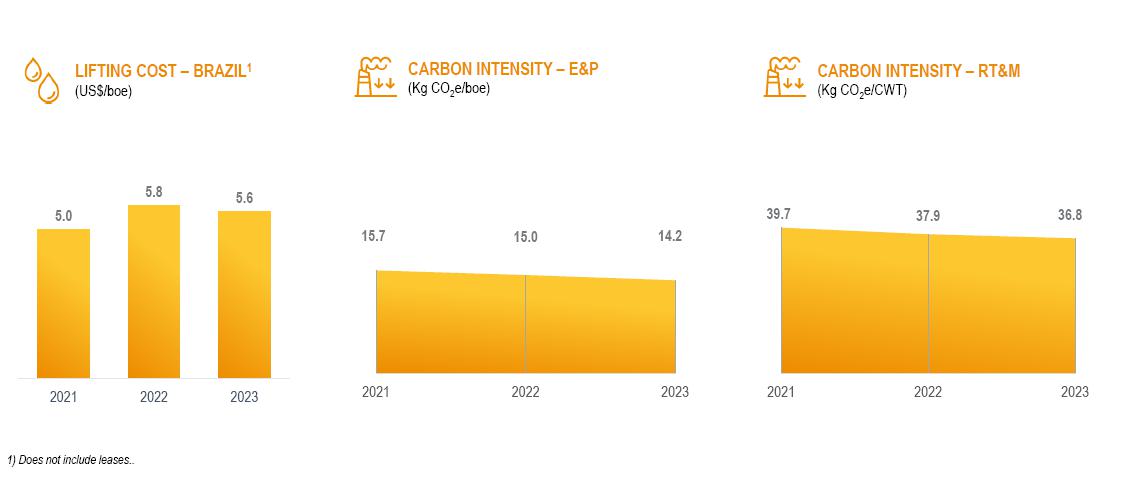
| Carbon Intensity in E&P | E&P GHG Emissions Intensity. GHG emissions, in terms of CO₂e, from E&P activities in relation to the total oil and gas operated production (wellhead) registered in the same period. Scope 1 and 2 GHG emissions are considered. This indicator represents the rate of GHG emissions per barrel of oil equivalent produced. It covers oil and gas exploration and production activities under operational control, and is used to analyze the carbon performance of the assets in our current and future portfolio. |
| Carbon Intensity in Refining | Refining GHG Emissions Intensity. GHG emissions, in terms of CO₂e, from Refining activities in relation to the activity unit called Complexity Weighted Tone (“CWT”). CWT represents a measure of activity, similar to UEDC (Utilized Equivalent Distillation Capacity), which considers the potential for GHG emissions, equivalent to distillation, per process unit, allowing better comparability between refineries of different complexities. This indicator covers refining activities with operational control and composes the analysis of the carbon performance of the assets in our current and future portfolio. |
| CBA | Acordo Coletivo de Trabalho (Collective Bargaining Agreement). |
| CCUS | Carbon Capture, Utilization and Storage. |
| Central Bank of Brazil | The Banco Central do Brasil. |
| Central Depositária | The Central Depositária de Ativos e de Registro de Operações do Mercado, which serves as the custodian of our common and preferred shares (including those represented by ADSs) on behalf of our shareholders. |
| CEO | Chief Executive Officer. |
| CFO | Chief Financial Officer. |
| CMN | The Conselho Monetário Nacional (National Monetary Council) is the highest authority of the Brazilian financial system, responsible for the formulation of the Brazilian currency, exchange and credit policy, and for the supervision of financial institutions. |
PETROBRAS | Annual Report and Form 20-F | 2023 | 11 |
| Table of Contents | |
| | Glossary |
| CNODC | CNODC Brasil Petróleo e Gás Ltda., a subsidiary in Brazil of the China National Petroleum Corporation (CNPC). |
| CNOOC | China National Offshore Oil Corporation (CNOOC), or its subsidiary that operates in Brazil, CNOOC Petroleum Brasil Ltda. |
| CNPC | China National Petroleum Corporation (CNPC). |
| CNPE | The Conselho Nacional de Política Energética (National Energy Policy Council), chaired by the Minister of Mines and Energy, is an advisory body to the Brazilian President for the formulation of energy policies and guidelines. |
| CONAMA | Conselho Nacional do Meio Ambiente (National Council for the Environment in Brazil). |
| Condensate | Hydrocarbons that are in the gaseous phase at reservoir conditions but condense into liquid as they travel up the wellbore and reach separator conditions. |
| CVM | The Comissão de Valores Mobiliários (Brazilian Securities and Exchange Commission). |
| D&M | DeGolyer and MacNaughton, an independent petroleum engineer consulting firm that conducts reserves evaluation of part of our proved crude oil, Condensate and natural gas reserves. |
| Deepwater | Between 300 and 1,500 meters (984 and 4,921 feet) deep. |
| Depositary | JPMorgan. |
| Distillation | Physical process involving vaporization and condensation, whereby petroleum is separated (refined) into oil products. |
PETROBRAS | Annual Report and Form 20-F | 2023 | 12 |
| Table of Contents | |
| | Glossary |
| E&P or Exploration & Production | Exploration & Production is our business segment that covers the activities of exploration, development and production of crude oil, NGL and natural gas in Brazil and abroad. |
| EPCI | Engineering, Procurement, Construction and Installation, a form of contracting arrangement common within the offshore industry. |
| ESG | Environmental, Social and Governance. |
| EWT | Extended well test. |
| Exchange Act | Securities Exchange Act of 1934, as amended. |
| Fitch | Fitch Ratings Inc., a credit rating agency. |
| FPSO | Floating production, storage and offloading unit. |
| G&LCE or Gas & Low Carbon Energies | Gas & Low Carbon Energies is our business segment that covers the activities of logistics and trading of natural gas and electricity, the transportation and trading of LNG, the generation of electricity by means of thermoelectric power plants, as well as natural gas processing. It also includes renewable energy businesses, low carbon services (carbon capture, utilization and storage) and the production of biodiesel and its co-products. |
| GASLUB or GASLUB Cluster | Located in southeastern Brazil (Itaboraí, in the state of Rio de Janeiro), the GASLUB Cluster is comprised of the GASLUB Itaboraí UPGNs and other underlying utilities. |
| Gaspetro | Petrobras Gás S.A. – Gaspetro was our subsidiary from which we divested in July 2022, in which we had a 51% equity interest and a holding company with equity interests in 18 Brazilian local gas distribution companies, with Mitsui holding the remaining 49% interest. |
| GHG | Greenhouse gas. |
| Gross revenues | Gross revenues represent Sales revenues plus sales taxes, which mainly includes the following taxes imposed in Brazil: Contribution for Intervention in the Economic Domain (“CIDE”), social contributions PIS and COFINS, and tax over services and goods (“ICMS”). |
| GSA | Long-term Gas Supply Agreement entered into with the Bolivian state-owned company Yacimientos Petroliferos Fiscales Bolivianos. |
| GTB | Gás Transboliviano S.A. is a company operating in the natural gas transportation industry, responsible for the administration and operation of the 557 km gas pipeline system in the Bolivian section of the Bolivia-Brazil gas pipeline (“GASBOL”), with an installed capacity of 30 million m³/d. GTB is connected to TBG on the Bolivia-Brazil border in the state of Mato Grosso do Sul. |
PETROBRAS | Annual Report and Form 20-F | 2023 | 13 |
| Table of Contents | |
| | Glossary |
| HDT or Hydrotreating | Process widely used in oil refining industry to remove heteroatoms such as sulfur and nitrogen from gasoline, kerosene and/or diesel in the presence of specific catalysts, hydrogen and adequate conditions of temperature and pressure. The aim is to adjust composition to comply with fuel specifications. |
| HSE | Health, Safety and Environment. |
| IAGEE | Índice de Atendimento às Metas de Gases do Efeito Estufa (Greenhouse Gas Emissions Target Achievement Indicator). The indicator of compliance with the Greenhouse Gas Emissions Targets. |
| IASB | International Accounting Standards Board. |
| IBAMA | The Instituto Brasileiro do Meio Ambiente e dos Recursos Naturais Renováveis (Brazilian Institute of the Environment and Renewable Natural Resources). |
| Ibovespa or IBOV | The gross total return index weighted by free float market cap and comprised of the most liquid stocks traded on the B3. It was created in 1968. |
| ICMBio | The Instituto Chico Mendes de Conservação da Biodiversidade (Chico Mendes Institute for Biodiversity Conservation). |
| IFRS | International Financial Reporting Standards. |
| IOF | Imposto sobre Operações Financeiras (Brazilian taxes over financial transactions). |
| IPCA | The Índice Nacional de Preços ao Consumidor Amplo (National Consumer Price Index). |
| JPMorgan | JPMorgan Chase Bank, N.A. |
| KPI | Key Performance Indicators. |
| Lava Jato | Operação Lava Jato (Lava Jato Operation), as detailed in “Risks – Risks Factors” and “Legal and Tax – Legal Proceedings – Lava Jato Investigation” in this annual report. |
| LIBOR | The London Interbank Offered Rate was a benchmark interest rate at which major global banks lend to one another in the international interbank market for short-term loans until June 30, 2023. |
PETROBRAS | Annual Report and Form 20-F | 2023 | 14 |
| Table of Contents | |
| | Glossary |
| Lifting Cost | An indicator that represents the unit lifting cost of an equivalent barrel, considering the relationship between costs and production. It includes expenses for the execution and maintenance of production processes. Costs related to the chartering of third-party platforms, production taxes, and depreciation, depletion, and amortization are not considered in this indicator. |
| LNG | Liquefied natural gas. |
| LPG | Liquefied petroleum gas, which is a mixture of hydrocarbons with up to four carbon atoms. |
| Mixed Capital Company | Mixed capital company means a mixed joint stock corporation (public and private shareholders). |
| MME | The Ministério de Minas e Energia (Ministry of Mines and Energy) of Brazil. |
| Moody’s | Moody’s Investors Service, Inc., a credit rating agency. |
| MTF | Euro Multilateral trading Facility. |
| Natural Gasoline (C5+) | Natural Gasoline C5+ is a NGL produced at natural gas processing plants with a vapor pressure intermediate between Condensate and LPG, that may compose a gasoline blend. |
| Nelson Complexity Index or NCI | The Nelson Complexity Index or NCI is a measure of the sophistication of an oil refinery, where more complex refineries are able to process heavier oils and produce lighter and more valuable products from a barrel of oil. The NCI is measured on a scale of one to 20, where higher numbers correspond to more complex and expensive refineries. |
| NGL | Natural Gas Liquids (NGL), the liquid resulting from the processing of natural gas and containing the heavier gaseous hydrocarbons. |
| NYSE | The New York Stock Exchange. |
PETROBRAS | Annual Report and Form 20-F | 2023 | 15 |
| Table of Contents | |
| | Glossary |
|
NYSE Arca Oil Index or Arca Oil (former AMEX Oil Index) |
The NYSE Arca Oil Index, formerly the AMEX Oil Index, ticker symbol XOI, is a price-weighted index of the leading companies involved in petroleum exploration, production and development. It measures the oil industry’s performance through changes in the sum of the prices of component stocks. The index was developed with a base level of 125 as of August 27, 1984. |
| OCF | Operating Cash Flow (net cash provided by operating activities). |
| Oil | Crude oil, including NGLs and Condensates. |
| Oil Products | Petroleum products, produced through processing in refineries (diesel, gasoline, LPG and other products). |
| ONS | The Operador Nacional do Sistema Elétrico (National Electric System Operator) of Brazil. |
| Operated Production | Production of a gas or oil field, including Petrobras share and partners’ shares. |
| Operating income | Equivalent to the caption income before net finance expense, results of equity-accounted investments and income taxes derived in our audited consolidated financial statements. |
| Organic Reserves Replacement Ratio or Organic RRR | Measures the amount of proved reserves added to a company’s reserve base during the year, excluding disposals and acquisitions of proved reserves, relative to the amount of oil and gas produced. |
| OSRL | Oil Spill Response Limited. |
| PAI | Programa de Aposentadoria Incentivado (Incentive Retirement Program). |
| PDV | Programa de Desligamento Voluntário (Voluntary Severance Program). |
| Petrochemicals | Chemicals mainly obtained from oil and natural gas (as opposed to fuels) such as ethane, ethylene, propane, propylene, benzene, xylenes, polypropylene, polyethylene and others. Renewable resources can also be used as raw materials. |
| Petros | Fundação Petros de Seguridade Social, Petrobras’ employee pension fund. |
| Petros 2 | Petrobras’ sponsored pension plan. |
| PGF | Petrobras Global Finance B.V. |
| PifCo | Petrobras International Finance Company S.A. |
PETROBRAS | Annual Report and Form 20-F | 2023 | 16 |
| Table of Contents | |
| | Glossary |
| PLR | The Participação nos Lucros e Resultados (Profit Sharing Program) is a remuneration model based on the division of profits with our employees. Our PLR is governed by Brazilian Law 10,101/2000 and follows the guidelines of the SEST. These annual guidelines define various aspects of this type of reward, such as format, flow, governance, financial and remuneration limits. |
| PLSV | Pipe laying support vessel. |
| Post-salt reservoir | A geological formation containing oil or natural gas deposits located above a salt layer. |
| PP&E | Property, plant and equipment. |
| PPP | The Prêmio por Performance (Performance Award Program) is part of our Variable Remuneration Program. |
| PPSA | Pré-Sal Petróleo S.A. |
| PRD | The Prêmio por Desempenho – PRD (Accomplishment Award) is part of our Variable Remuneration Program. |
| Pre-salt Polygon | Underground region formed by a vertical prism of undetermined depth, with a polygonal surface defined by the geographic coordinates of its vertices established by Law No. 12,351/2010, as well as other regions that may be delimited by the Brazilian federal government, according to the evolution of geological knowledge. |
| Pre-salt reservoir | A geological formation containing oil or natural gas deposits located beneath a salt layer. |
| PREVIC | The Superintendência Nacional de Previdência Complementar (National Supplementary Pension Authority). |
| Proved developed reserves | Reserves that can be expected to be recovered: (i) through existing wells with existing equipment and operating methods or for which the cost of the required equipment is relatively minor compared to the cost of a new well; and (ii) through installed extraction equipment and infrastructure operational at the time of the reserve estimate if the extraction is by means not involving a well. |
PETROBRAS | Annual Report and Form 20-F | 2023 | 17 |
| Table of Contents | |
| | Glossary |
| Proved reserves | Consistent with the definitions of Rule 4-10(a) of Regulation S-X, proved oil and gas reserves are those quantities of oil and gas, which, by analysis of geoscience and engineering data, can be estimated with reasonable certainty to be economically producible – from a given date forward, from known reservoirs, and under existing economic conditions, operating methods, and government regulations. Existing economic conditions include prices and costs at which economic producibility from a reservoir is to be determined. The price is the unweighted arithmetic average of the first-day-of-the-month price during the twelve- month period prior to December 31, unless prices are defined by contractual arrangements, excluding escalations based upon future conditions. The project to extract the hydrocarbons must have commenced or we must be reasonably certain that we will commence the project within a reasonable time. Reserves that can be produced economically through application of improved recovery techniques (such as fluid injection) are included in the “proved” classification when successful testing by a pilot project, or the operation of an installed program in the reservoir or an analogous reservoir, provides support for the engineering analysis on which the project or program was based. |
| Proved undeveloped reserves | Reserves that are expected to be recovered from new wells on undrilled acreage, or from existing wells where a relatively major expenditure is required. Reserves on undrilled acreage are limited to those directly offsetting development spacing areas that are reasonably certain of production when drilled, unless evidence using reliable technology exists that establishes reasonable certainty of economic producibility at greater distances. Undrilled locations are classified as having undeveloped reserves only if a development plan has been adopted indicating that they are scheduled to be drilled within five years, unless the specific circumstances justify a longer time. Proved undeveloped reserves do not include reserves attributable to any acreage for which an application of fluid injection or other improved recovery technique is contemplated, unless such techniques have been proved effective by actual projects in the same reservoir or an analogous reservoir or by other evidence using reliable technology establishing reasonable certainty. |
| PSC | Production Sharing Contract. |
| PTAX | The reference exchange rate for the purchase and sale of U.S. dollars in Brazil, as published by the Central Bank of Brazil. |
| R&D | Research and development. |
| Reserves Replacement Ratio or RRR | Measures the amount of proved reserves added to a company’s reserve base during the year relative to the amount of oil and gas produced. |
| Reserves to production ratio or R/P | Calculated as the amount of proved reserves of the year relative to the amount of oil and gas produced during the year, indicates a number of years reserves would last if production remains constant. |
| RT&M or Refining, Transportation & Marketing | Refining, Transportation & Marketing is our business segment that covers the activities of refining, logistics, transport, acquisition and exports of crude oil, as well as trading of oil products, in Brazil and abroad. This segment also includes the petrochemical operations (which comprehends holding interests in petrochemical companies in Brazil), and fertilizer production. |
| S&P | Standard & Poor’s Financial Services LLC, a credit rating agency. |
| SCC-CO2 production losses | Measures the absolute production loss resulting from stress corrosion cracking - induced by CO2 in production pipelines. |
| SEC | The United States Securities and Exchange Commission. |
PETROBRAS | Annual Report and Form 20-F | 2023 | 18 |
| Table of Contents | |
| | Glossary |
| SELIC | The Central Bank of Brazil base interest rate. |
| SEST | The Secretaria de Coordenação e Governança das Empresas Estatais (Secretary of Coordination and Governance of State-Owned Companies). |
| Sete Brasil | Sete Brasil Participações, S.A. |
| Shell | Shell Plc, or its subsidiary that operate in Brazil, Shell Brasil Petróleo Ltda. |
| SOFR | Secured Overnight Financing Rate. The Secured Overnight Financing Rate (“SOFR”) is a benchmark interest rate based on transactions in the Treasury repurchase marketing, for dollar-denominated derivatives and loans that replaced the LIBOR. |
| SPE | Society of Petroleum Engineers. |
| Strategic Plan | 2024-2028+ Strategic Plan. |
| Synthetic oil and synthetic gas | A mixture of hydrocarbons derived by upgrading (i.e., chemically altering) natural bitumen from oil sands, kerogen from oil shales, or processing of other substances such as natural gas or coal. Synthetic oil may contain sulfur or other non-hydrocarbon compounds and has many similarities to crude oil. |
| TAG | Transportadora Associada de Gás S.A. |
| TBG | Transportadora Brasileira Gasoduto Bolívia-Brasil S.A. is a company operating in the natural gas transportation industry, in which we have a 51% equity interest, owner of 2,593 km gas pipeline system, located mainly in the South and Southeast regions of Brazil, with installed capacity of 30 million m³/d. TBG is connected to GTB, which is responsible for the Bolivian side of the gas pipeline, which permits access to Bolivian natural gas, and is connected to Nova Transportadora do Sudeste S.A.’s (“NTS”) gas pipeline, which permits access to Brazilian natural gas. |
| TCU | The Tribunal de Contas da União (Federal Auditor’s Office) is a constitutionally established body linked to the Brazilian Congress, responsible for assisting it in matters related to the supervision of the Brazilian federal government and its resources with respect to accounting, finance, budget, operational and public property (patrimônio público) matters. |
| TJLP | The Taxa de Juros de Longo Prazo (Brazil’s long-term interest rate) is set quarterly by the CMN (as defined above). The rate is one of the benchmark rates used by BNDES in its loans to companies. |
| ToR Surplus | Volume that exceeds what has been contracted under the Transfer of Rights agreement in specified pre-salt areas. See “Legal and Tax —Material Contracts” in this annual report. |
PETROBRAS | Annual Report and Form 20-F | 2023 | 19 |
| Table of Contents | |
| | Glossary |
| TotalEnergies | TotalEnergies SE, or its subsidiary that operates in Brazil, Total E&P do Brasil Ltda. |
| Transfer of Rights Agreement or ToR | An agreement under which the Brazilian federal government assigned to us the right to explore and produce up to five billion barrels of oil equivalent (“bnboe”) in specified pre-salt areas in Brazil. See “Legal and Tax —Material Contracts” in this annual report. |
| Transpetro | Petrobras Transporte S.A. |
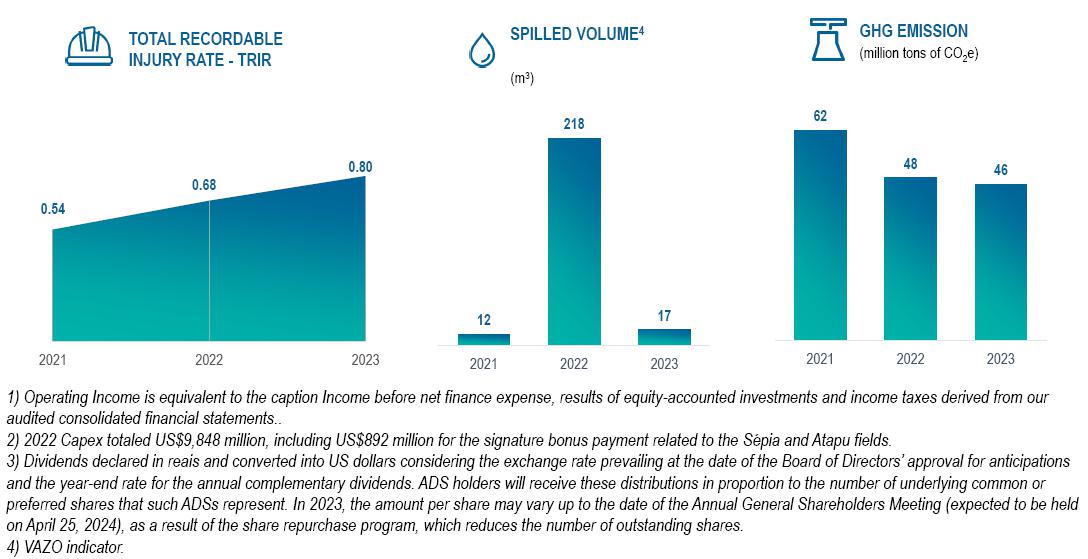
| TRIR | Total recordable injury per million man-hour frequency rate. Number of fatal accidents, lost-time injuries, injuries involving substitute work and medical treatment injuries per million hours worked. It is a performance indicator used by the industry to measure occupational safety performance. This indicator is analyzed at all management levels, including the board of directors. |
| Ultra-deepwater | Over 1,500 meters (4,921 feet) deep. |
| UPGN | Unidade de Processamento de Gás Natural (Natural-gas processing Units). A natural gas processing plant is a facility designed to process raw natural gas from the offshore production fields by separating impurities and various non-methane hydrocarbons and fluids through different technologies to produce specified natural gas for final consumption. Through the process a gas processing plant can also recover natural gas liquids (condensate, natural gasoline and liquefied petroleum gas) with higher added value. |
| UTE | Usina Termoelétrica (Thermal Power Plant). A thermoelectric plant is a power generation plant in which heat energy is converted to electrical energy. |
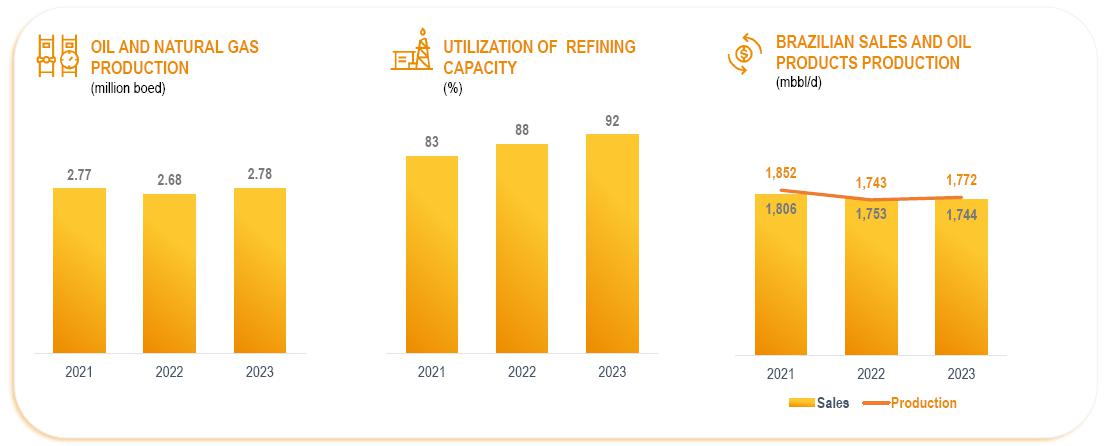
| Utilization of Refining Capacity | Measures how much crude oil refineries are processing or "running" as a percentage of their maximum capacity. |
| VAZO Indicator | Oil and Oil Products Spilled Volume’ indicator. The total volume of oil or oil products spilled in events of leakages individually greater than 1 bbl (0.159 m³) that reached water bodies or soil that wasn’t made impermeable. This volumetric criterion (>1 barrel) is aligned with the ANP Manual for reporting incidents for E&P activities. Sabotage and theft-related spills are not considered. |
| Vibra | Vibra Energia S.A., formerly “Petrobras Distribuidora.” |
| Well Abandonment Cost |
Measures the evolution of the average cost of well abandonment. The KPI represents the average cost of abandoning wells concluded in the year of analysis. The reference database only considers planned and executed deepwater well abandonments in the year being measured. |
PETROBRAS | Annual Report and Form 20-F | 2023 | 20 |
| Table of Contents | |
| | Glossary |
| Well Abandonment Duration |
Measures the evolution of the average duration of well abandonment. The KPI represents the average duration of abandoning wells concluded in the year of analysis. The reference database only considers planned and executed deepwater well abandonments in the year being measured. |
| Well Connection Cost |
Measures the evolution of the average connection cost of production development wells. The KPI is the sum of the total cost of well connections concluded in the year of analysis over the total cost of well connections planned in the strategic plan for the same well connections. It only considers pre-salt wells. |
| Well Construction Cost |
Measures the evolution of the average cost of wells construction. The KPI is the sum of the average cost of drilling and completion concluded in the year of analysis. The reference database only considers production development wells drilling and completion in the year being measured. It is not considering exploratory and reservoir data acquisition wells. |
| Well Construction Duration |
Measures the evolution of the average duration of well construction. The KPI is the sum of the average duration of drilling and completion concluded in the year of analysis. The reference database only considers production development well drilling and completion in the year being measured. It is not considering exploratory and reservoir data acquisition wells. |
| YPFB | Yacimientos Petroliferos Fiscales Bolivianos. |
PETROBRAS | Annual Report and Form 20-F | 2023 | 21 |

PETROBRAS | Annual Report and Form 20-F | 2023 | 22 |
| Table of Contents | |
| | About us |
About us
We are a Brazilian mixed capital company, one of the largest producers of oil and gas in the world according to Bloomberg, primarily engaged in exploration and production, refining, energy generation and trading. We have a large proven reserve base and have acquired expertise in deep and ultra-deepwater exploration and production since we started exploring Brazilian offshore basins decades ago, following our first subsea well in the Campos Basin in 1971. To discover these reserves and operate efficiently in deepwaters, we have developed our own technology and work in close collaboration with suppliers, universities, and research centers.
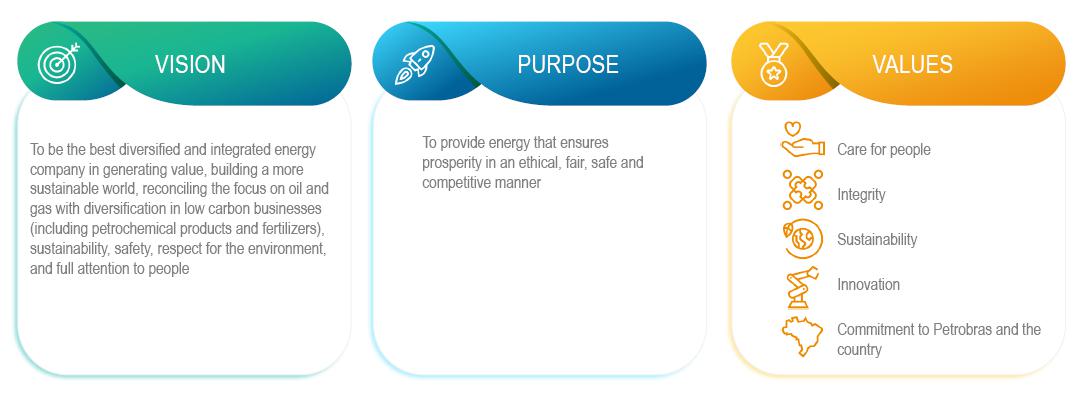
We are committed to being the best energy company in terms of diversification, integration and value generation, reconciling the focus on oil and gas with low carbon businesses. Accordingly, we seek to build a more sustainable world, with the principles of safety, respect for the environment, and full attention to people.
We are one of the largest companies in market capitalization in Latin America according to Bloomberg, with a market capitalization of US$102.2 billion as of December 31, 2023. We have over 46 thousand employees (including subsidiaries in Brazil and abroad) and we hire specialized services such as offshore drilling rigs, production platforms, subsea vessels, and subsea hardware that set the entire energy industry chain into motion. We design and contract engineering, procurement, construction and installation (“EPCI”) for our entire business stream.
| Datasheet |
|
Name of the company: Petróleo Brasileiro S.A. – Petrobras Date of Incorporation: 1953 Country of Incorporation: Brazil Registration number at the CVM: 951-2 Central Index Key (“CIK”) at the SEC: 0001119639 Address of principal executive office: Avenida República do Chile 65, 20031-912, Rio de Janeiro, RJ, Brazil Telephone number: (55 21) 3224 2401 Corporate and investor relations websites: www.petrobras.com and www.petrobras.com.br/ir. Corporate purpose established in our Bylaws: research, extraction, refining, processing, trading and the transport of oil, its by-products, natural gas and other fluid hydrocarbon from wells, shale and other rocks, in addition to energy-related activities, and the research, development, production, transport, distribution, sale and trading of all forms of energy, and other related activities or similar purposes.
|
PETROBRAS | Annual Report and Form 20-F | 2023 | 23 |
| Table of Contents | |
| | About us |
Overview
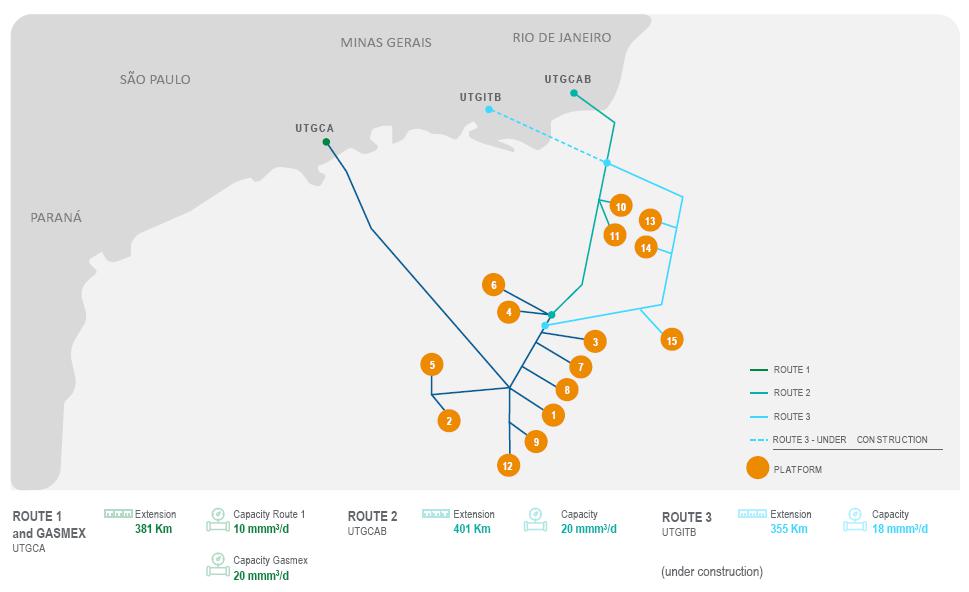
We have a large base of proved reserves and operate and produce most of Brazil’s oil and gas. The most significant part of our proved reserves is located in the adjacent offshore Campos and Santos Basins in southeast Brazil. Their proximity allows us to optimize our infrastructure and our costs of exploration, development and production. The Campos and Santos Basins are expected to remain an important source of proved reserves and oil and gas production.
Our business, however, goes beyond oil and gas exploration and production. It entails a long process through which we get the oil and gas to our refineries and gas treatment units which are themselves in constant evolution to supply the best products.
We operate the majority of the refining capacity in Brazil. Our refining capacity is distributed throughout the southeast, south and northeast regions of Brazil, reaching the largest market share in these and other regions of the country through direct deliveries, pipelines and also cabotage. We mostly meet our demand for oil products by domestic refining of crude oil, as defined in a periodic process of integrated operational planning which constantly seeks to maximize value for the company. We are also involved in the production of petrochemicals and biofuels through interests in some companies. We distribute oil products through wholesalers, retailers and direct sales.
We also participate in the Brazilian natural gas market, including the logistics and processing of natural gas.
To meet our clients’ and our own internal demand, we process natural gas derived from our onshore and offshore production (mainly from fields of the Campos, Espírito Santo and Santos Basins), import natural gas from Bolivia and import LNG through our regasification terminals. We also participate in the domestic power market primarily through our investments in gas-fired thermoelectric power plants.
On November 23, 2023, our Board of Directors approved, in the context of the Strategic Plan, a new approach in relation to our capital expenditures, changing the segment “Gas & Power” to “Gas & Low Carbon Energies”, in addition to key changes in our segments for:
Biofuels: previously presented in Corporate and other businesses, they are now integrated into the Gas & Low Carbon Energies (G&LCE) segment.
Fertilizers: previously presented in Gas & Power, they are now integrated into the Refining, Transportation & Marketing segment.
PETROBRAS | Annual Report and Form 20-F | 2023 | 24 |
| Table of Contents | |
| | About us |
As of December 31, 2023, the presentation of information by operation segment reflects the updated management model used by our Executive Officers (Chief Operating Decision Maker - CODM) to make decisions regarding resource allocation and performance evaluation.
In this context, the information by segment for the years 2022 and 2021 were not reclassified for comparability purposes since the total of assets and statement of income balances involved are immaterial.
Thus, we currently divide our business into three main segments:
Exploration & Production (E&P): this segment covers the activities of exploration, development and production of crude oil, NGL and natural gas in Brazil and abroad, for the primary purpose of supplying our domestic refineries. This segment also operates through partnerships with other companies, including holding interests in non-Brazilian companies in this segment.
Refining, Transportation & Marketing (RT&M): this segment covers the activities of refining, logistics, transport, acquisition and exports of crude oil, as well as trading of oil products in Brazil and abroad. This segment also includes petrochemical operations (which involves holding interests in petrochemical companies in Brazil), and fertilizer production.
Gas & Low Carbon Energies (G&LCE): this segment covers the activities of logistics and trading of natural gas and electricity, the transportation and trading of LNG, the generation of electricity by means of thermoelectric power plants, as well as natural gas processing. It also includes renewable energy businesses, low carbon services (carbon capture, utilization and storage) and the production of biodiesel and its co-products.
Activities that are not attributed to business segments are classified as “Corporate and Other Businesses,” including general corporate matters, in addition to distribution businesses. Corporate items mainly include those related to corporate financial management, overhead central administration, and other expenses, including actuarial costs associated with pension and health plans for beneficiaries. The other businesses cover the distribution of oil products throughout South America. The 2021 results of other businesses included the equity interest in our associate Vibra until July, when we sold the remaining interest in this company.
For further information regarding our business segments, see Note 13 to our audited consolidated financial statements, as well as “Operating and Financial Review and Prospects” in this annual report.
In 2023, we had activities, as follows, in six countries besides Brazil (i.e., Argentina, Bolivia, Colombia, the U.S., the Netherlands, and Singapore).
In Latin America, our operations include upstream, marketing and retail services. In North America, we produce oil and gas through an interest in a joint venture. We have subsidiaries that support our trading and financial activities in Rotterdam, Houston, Buenos Aires and Singapore. These companies act as complete and active trading desks for markets worldwide and are responsible for market intelligence and trading of oil, oil products, natural gas, commodity derivatives and shipping. In Africa, we approved the start of exploratory operations in the Democratic Republic of São Tomé and Príncipe, subject to the approval of the local regulatory bodies.
We operate through 15 direct subsidiaries (13 incorporated under the laws of Brazil and two incorporated abroad) and one direct joint operation as listed below. We also have indirect subsidiaries, including Petrobras Global Trading B.V., Petrobras Global Finance B.V., Petrobras America Inc. and Petrobras Netherlands B.V.
PETROBRAS | Annual Report and Form 20-F | 2023 | 25 |
| Table of Contents | |
| | About us |
| Companies | Location | Our shareholding | Other shareholders |
| Petrobras Transporte S.A. – Transpetro | Brazil | 100.00% | — |
| Petrobras Logística de Exploração e Produção S.A. – PB-LOG | Brazil | 100.00% | — |
| Petrobras Biocombustível S.A. | Brazil | 100.00% | — |
| Transportadora Brasileira Gasoduto Bolívia-Brasil S.A. – TBG | Brazil | 51.00% |
BBPP Holdings Ltda. (29%) YPFB Transporte S.A. (19.88%) Corumba Holding S.À.R.L. (0.12%) |
| Procurement Negócios Eletrônicos S.A. | Brazil | 72.00% |
SAP Brasil Ltda. (17%) Accenture do Brasil S.A. (11%) |
| Araucária Nitrogenados S.A. | Brazil | 100.00% | — |
| Termomacaé S.A. | Brazil | 100.00% | — |
| Termobahia S.A. | Brazil | 98.85% | Petros (1.15%) |
| Baixada Santista Energia S.A. | Brazil | 100.00% | — |
| Fundo de Investimento Imobiliário RB Logística – FII | Brazil | 99.15% | Pentágono SA DTVM (0.85%) |
| Petrobras Comercializadora de Gás e Energia e Participações S.A. – PBEN-P | Brazil | 100.00% | — |
| Fábrica Carioca de Catalisadores S.A. – FCC(1) | Brazil | 50.00% | Albemarle Brazil Holding Ltda. (50%) |
| Petrobras International Braspetro – PIB BV | Abroad | 100.00% | Petrobras Comercializadora de Gás e Energia e Participações S.A. (antiga 5283 Participações S.A.) (0.0007%) |
| Braspetro Oil Services Company – Brasoil | Abroad | 100.00% | — |
| Refinaria de Mucuripe S.A | Brazil | 100.00% | — |
| Associação Petrobras de Saúde - APS(2) | Brazil | 93.47% |
Transpetro (6.09%) TBG (0.26%) Pbio (0.13%) Termobahia (0.05%) |
| (1) | Joint operations. |
| (2) | A non-profit association that operates our supplementary health care plan (AMS - Saúde Petrobras) since 2021. |
For an extended list of our subsidiaries and joint operations, including each of their full names, jurisdictions of incorporation and our percentage of equity interest, see Exhibit 8.1 to this annual report and Note 30 to our Financial Statements. Additionally, we participate in consortia that engage in the exploration of blocks and the production of oil fields in Brazil – see “Our Business — Exploration & Production — Overview” for more details.
PETROBRAS | Annual Report and Form 20-F | 2023 | 26 |
| Table of Contents | |
| | About us |
2023 Highlights
 |
 |

PETROBRAS | Annual Report and Form 20-F | 2023 | 27 |
| Table of Contents | |
| | About us |

PETROBRAS | Annual Report and Form 20-F | 2023 | 28 |

PETROBRAS | Annual Report and Form 20-F | 2023 | 29 |
| Table of Contents | |
| | Risks |
Risks
We are exposed to a number of risks that, individually or jointly, may have an effect on our business and/or financial performance. The risk factors are presented in the following groups:
Risks related to (1) our company; (2) our shareholders, in particular our controlling shareholders; (3) our directors; (4) our suppliers; (5) our customers; (6) the sectors of the economy in which we act; (7) the regulation of the sectors in which we are involved; (8) foreign countries where we are involved; (9) social issues; (10) environmental issues; (11) climate issues, including physical and transition risks; (12) the use of our trademark; and (13) our shares and debt securities.
Risk Factors
1) Risks related to our company
1.a) We are exposed to health, safety and environmental risks in our operations, which may lead to accidents, significant losses, administrative proceedings and legal liabilities.
Activities related to the oil and gas business present high risks, generally because they involve high temperatures and pressures. In particular, deepwater and ultra-deepwater activities, and refining and petrochemicals, performed by us, our subsidiaries or our affiliate companies present several risks, such as oil and product leakage, collapses, aeronautical accidents, fires, and explosions in refineries and exploration and production units, including platforms, ships, pipelines, mines, terminals, laboratories, and losses of containment in dams, among other assets owned or operated by us, our subsidiaries or our affiliate companies. These events can occur due to technical or human failures or natural disasters, among other factors. The occurrence of one of these events, or other related incidents, may result in health impacts on our workforce and/or surrounding communities, fatalities, and environmental damage. They can cause material damage, production losses, financial losses and, in certain circumstances, liability in civil, labor, criminal, environmental and administrative proceedings. As a result, we may incur expenses related to mitigation, recovery and/or compensation for the damages caused.
We are also exposed to corporate security risks arising from acts of intentional interference by third parties in our pipelines and nearby areas, especially illegal taps (thefts) of oil and oil products, mainly in the states of São Paulo and Rio de Janeiro. Despite our efforts and the actions of public authorities to combat illegal taps, if this interference continues, it may result in accidents of small or large proportions, including leaks or damage to our facilities and to communities near our facilities, which may affect the continuity of our operations and lead to the payment of fines and indemnities to the affected parties, all of which may negatively impact our results.
Finally, due to risks such as those mentioned above, we may face difficulties in obtaining or maintaining operating licenses and may suffer damages to our image and reputation.
1.b) We may incur losses and spend time and financial resources defending pending litigations and arbitrations.
We are currently party to several administrative, legal and arbitration proceedings related to civil, administrative, tax, labor, environmental and corporate claims filed against us. These claims involve substantial amounts of money and other resources, and the total cost of unfavorable decisions can have a material adverse effect on our results and financial condition.
PETROBRAS | Annual Report and Form 20-F | 2023 | 30 |
| Table of Contents | |
| | Risks |
These legal, administrative and arbitration proceedings can have a negative impact on our results due to their outcome, such as contracts’ termination and/or revision of governmental authorizations. Depending on the outcome, litigation can result in restrictions on our operations and have a material adverse effect on some of our business.
We can be affected by changes in rules, regulations and jurisprudence that can have a material adverse effect on our financial condition and results.
1.c) Failures in our information technology systems, information security systems (cybersecurity) and telecommunications systems and services can adversely impact our operations and reputation.
Our operations are highly dependent on information technology and telecommunications systems and services, as well as the degree of technological protection and the strength of the associated internal controls. Interruptions or malfunctions affecting these systems and/or their infrastructure, caused by obsolescence, technical failures, and/or deliberate acts, or even arising from geopolitical factors or derived from third-party systems and digital infrastructure and the cloud may harm or even paralyze our business and adversely impact our operations and reputation. They may also bring unforeseen costs for the recovery of information and assets, in addition to the imposition of fines or legal sanctions.
Failures in information security (including industrial and automation systems), due to external, intentional or not (e.g. malware, hackers, cyberterrorism) or internal (e.g. neglect or misuse of IT assets by employees or contractors who are in a hybrid work environment working on-site and remotely), may also impact our business and reputation, our relationship with stakeholders and external agents (government, regulatory bodies, partners, suppliers, among others), our strategic positioning towards our competitors and our operational and financial results.
Additionally, we are subject to increasing regulations related to cybersecurity and information security, including among other aspects, adequate protection of data and digital assets, supervision of cyber risks, and incident reporting. Failure to comply with these regulations at the national and international levels may result in legal sanctions, as well as impacts on our image and reputation, and affect our operational and financial results.
1.d) The selection and development of our investment projects have risks that may affect our expected results.
We constantly evaluate new project opportunities for our investment portfolio. As most projects are characterized by a long period of development and maturation, we may face changes in market conditions, such as price changes, new regulatory requirements, consumer preferences, and demand profile, exchange and interest rates, and financing conditions that may jeopardize our expected rates of return. We may also change our project approval criteria, including those aimed at decarbonizing operations, resulting in different risk and return profiles.
We face specific risks for oil and gas projects. Despite our experience in deepwater and ultra-deepwater oil exploration and production and the continuous development of studies during the planning stages, the quantity and quality of oil and gas produced in a certain field will only be fully known in the production phase, which may require adjustments throughout the project life cycle and its expected rate of return.
There are also risks related to potential delays in the execution of oil and gas projects, which may result in the mismatch of required dates between upstream and downstream projects (e.g., delay in onshore infrastructure, impacting offshore oil and gas flow, and onshore gas transportation). We also face risks associated with international conflicts, wars or unplanned unavailability of critical assets and/or resources (such as drilling rigs, special vessels, and the natural gas and LNG chains) that may also impact the offshore and onshore flow and may compromise the continuity of our business production chain. Additionally, our failure to meet obligations established by the regulatory agencies may generate fines and liabilities.
Moreover, despite our expertise in exploration and production and refining, we may face new technical challenges as we move closer to the technological frontier.
Our Strategic Plan includes initiatives related to climate change, as such commitments are becoming increasingly relevant in the oil and gas business. Climate change risks may include physical risks, such as extreme weather events, as well as risks inherent in the energy transition to a low-carbon economy, including political and/or regulatory changes and shifting market demands. To address these risks, we may need to increase our investments in climate change mitigation and adaptation measures, which may result in increased capital expenditures and significantly impact our Strategic Plan. For further information on how climate change could impact our results and strategy, please see the risk “11.a) Climate change could impact our results and strategy” in this section.
PETROBRAS | Annual Report and Form 20-F | 2023 | 31 |
| Table of Contents | |
| | Risks |
Furthermore, we may decide to invest in new energy transition projects that are beyond our current scope of experience and expertise. In addition to the risks and challenges described above, we may encounter other risks associated with these new investments and ventures, which could negatively impact our portfolio’s risk profile and rate of return.
1.e) We have substantial liabilities and may be exposed to significant liquidity constraints in the short and medium term, which may materially and adversely affect our financial condition and results.
We have substantially reduced the level of our debt in recent years. However, our liabilities are still relevant and could potentially weaken our liquidity in adverse times. Considering that there may be liquidity constraints on the debt market to finance our planned investments, pay principal and interest obligations in contracted terms, and honor our financial commitments, any difficulty in raising significant amounts of debt capital in the future may affect our results and the ability to fulfill our Strategic Plan or any subsequent plan adopted.
Our lack of investment grade credit rating and any lowering of our credit ratings may have adverse consequences on our ability to obtain financing in the market through debt or equity securities, or may affect our financing cost, making it more difficult and/or costly to refinance maturing obligations. The impact on our ability to obtain resources and the cost of such resources may adversely affect our results and financial condition.
In addition, our credit rating is sensitive to any change in the credit rating of the Brazilian federal government. Any lowering in the credit ratings of the Brazilian federal government may have additional adverse consequences on our ability to obtain financing and/or on the cost of our financing and, consequently, on our results and financial condition.
1.f) Differing interpretations of tax regulation or changes in tax policies may have an adverse effect on our financial condition and results.
We and our Brazilian and foreign subsidiaries are subject to tax rules and regulations that may, over time, result in different interpretations between us, our subsidiaries and tax authorities (including federal, state and municipal authorities), which do not have uniform interpretations. As a result of such divergences, we and our subsidiaries may have to assume unanticipated provisions and charges. In some cases, when we and/or our subsidiaries exhaust all administrative remedies related to a tax contingency, further appeals may be filed in the judicial courts, which may require guarantees, such as the deposit of an amount equal to the amount of the charge. In some of these cases, the settlement of such charges through tax transactions or incentivized regularization programs may be a more favorable option for us and our subsidiaries, in which case we evaluate the alternatives, and make an informed decision on whether to proceed with the settlement of charges.
In addition, the Brazilian Congress may approve tax law reforms, implementing substantial changes to the Brazilian tax framework, that could impact our business. The tax authorities of Brazil (including the federal, state and municipal) and foreign tax authorities may also publish new legislation and/or regulation that impacts the fulfillment of tax obligations (primary and ancillary) requiring relevant efforts (human and systemic resources) by taxpayers to implement the obligations within the legal deadline. The obligation to adapt the taxpayer’s processes to the new legislation in a short time may have an adverse effect on our results and the results of our subsidiaries.
Any of these occurrences may have a material adverse effect on our financial condition and results.
1.g) Maintaining our long-term oil production objectives depends on our ability to successfully incorporate and develop our reserves.
Our ability to incorporate additional reserves depends on exploration activities, which expose us to its inherent risks and may not lead to the discovery of commercially viable oil or natural gas reserves.
Adding new reserves also depends on our ability to conceive and implement development projects. Exploration and development activities in deepwater and ultra-deepwater require significant capital investments and involve several factors that are beyond our control, such as significant changes in economic conditions, climate and environmental regulations and obtaining and/or renewing environmental permits, supply market capacity, and unexpected operating conditions, including equipment failures or incidents, which may restrict, delay or cancel our operations.
PETROBRAS | Annual Report and Form 20-F | 2023 | 32 |
| Table of Contents | |
| | Risks |
In addition, increased competition in the oil and gas sector in Brazil and capital constraints may make it more difficult or costly to obtain additional acreage in bidding rounds for new contracts and to develop existing contracted areas.
1.h) Our crude oil and natural gas reserve estimates involve some degree of uncertainty, which could adversely affect our ability to generate income.
Our proved crude oil and natural gas reserves set forth in this annual report are the estimated quantities of crude oil and natural gas that geoscience and engineering data demonstrate with reasonable certainty to be economically producible from a given date forward from known reservoirs under existing economic and operating conditions according to SEC Regulation S-X, and other applicable regulations.
The reserve estimates presented are prepared based on assumptions and interpretations that are subject to risks and uncertainties. The geoscience and engineering data that we use to estimate our reserves present uncertainties that may result in differences between the expected productions in the reported reserves and those actually produced. In addition, reserve estimates may be affected by significant changes in economic conditions.
Technical and economic uncertainties may lead to reductions in our reserve estimates and lower future productions, which may have an adverse effect on our results and financial condition.
1.i) Decommissioning projects have been growing and becoming more relevant in our portfolio, in addition to being subject to increasing regulatory requirements and stakeholder expectations, which may result in damage to our image and increased costs.
Decommissioning projects have grown and become more relevant to our portfolio as concession contracts expire or production systems lose economic viability. Despite the publication of ANP Resolution 817/2020 establishing the rules for conducting the decommissioning of production systems, we may face some difficulties in defining the scope of these projects and in meeting regulatory requirements, especially due to our and the industry’s learning curve in this area, as well as the evolution of applicable regulations. Closure of operations and decommissioning can negatively impact the environment and the surrounding communities of the sites due to the processes of dismantling structures and facilities. Although our decommissioning plans have been developed in compliance with applicable law, it is possible that these plans will also face scrutiny or fail to meet stakeholder demands or expectations regarding environmental, social and governance practices. As a result, the resource demands for the projects may increase, as well as the total project and operational costs. In addition, our image and reputation may be adversely affected.
PETROBRAS | Annual Report and Form 20-F | 2023 | 33 |
| Table of Contents | |
| | Risks |
1.j) Obligations relating to Petros and health care benefits are annually revised estimates and may diverge from future obligations due to changes in market and economic conditions, as well as changes in actuarial assumptions, which may require additional contributions to rebalance the plans.
The calculation of actuarial obligations, both for our pension plans and for our health care plan benefits, is based on estimates and actuarial assumptions, as well as on the modeling of business rules, observing the applicable regulations of each plan and the applicable law. Thus, the value of the obligations corresponds to an estimate that may change over time, as the assumptions and estimates are not confirmed.
In addition, we and Petros face risks related to supplementary pension, including a gradual increase in the longevity of the population covered, legal risks accentuating the level of benefits and risks that affect the financial assets held by Petros to cover obligations of the benefit plans sponsored by us, which may not generate the necessary returns to cover the relevant liabilities, in which case additional contributions from us and participants may be necessary, subject to the constitutional contributory parity rule.
Regarding health benefits, projected cash flows may also be impacted by the following factors:
higher increase in medical costs than expected;
additional claims arising from benefits extension; and
difficulty in adjusting the contributions of participants to reflect increases in health costs.
These factors may result in an increase in our liabilities and may adversely affect our results and our financial condition.
1.k) Difficulties in attracting, developing and retaining people with the necessary skills and qualifications can negatively impact the implementation of our strategy.
Our success depends on the capacity to continue training and qualifying our personnel so that they are qualified to assume senior positions in the future.
The entry of employees in a public position or employment in Brazil is made possible by a public selection process, as provided for in the Federal Constitution. Since the Consolidação das Leis do Trabalho (Consolidation of Labor Laws) does not allow us to require more than six months’ previous experience, we cannot guarantee that new employees have the adequate experience to perform the activities for which they are designated, that is, with qualifications, experience and skills previously developed in the market.
There is no guarantee that we will adequately allocate and train our employees, nor that we will be able to do so without incurring additional costs. Any failure may adversely affect our results and business.
1.l) Strikes, work stoppages or labor unrest by our employees or by the employees of our suppliers or of our contractors may adversely affect our results and our business.
Several factors may lead to legal issues and labor claims, giving rise to strikes and stoppages, such as:
disagreements and dissatisfaction regarding our business strategy, in particular, those related to portfolio management and its implications for the workforce;
human resources policies regarding remuneration, benefits and number of employees;
workers' contributions to cover the deficit of the pension plan (Petros);
implementation of regulations recently created for health care and pension plans; and
changes in labor legislation.
Strikes, work stoppages or other forms of labor demands at any of our facilities or in our major suppliers, contractors or their facilities or in sectors of society that affect our business may impair our ability to continue our operations and complete our projects, adversely impacting our results and our financial condition.
1.m) Our business may be materially and adversely affected by the emergence of epidemics or pandemics, such as COVID-19.
PETROBRAS | Annual Report and Form 20-F | 2023 | 34 |
| Table of Contents | |
| | Risks |
Epidemics and pandemics caused by infectious agents, such as the COVID-19 pandemic, can impact the health of our workforce, our partners and suppliers, as well as demand the redesign of routines, procedures and organization of work in general, and may consequently affect the continuity of various activities and our productivity. The operation of facilities such as platforms, refineries, terminals, among others may be impacted, as well as the full functioning of the supply chain. In addition, such public health events may affect oil prices and demand, which, consequently, may negatively impact our results and financial condition.
1.n) We do not maintain insurance against business interruption in operations in Brazil and most of our assets are not insured against war or sabotage.
We generally do not maintain insurance coverage for business interruptions of any nature for our operations in Brazil, including business interruptions caused by labor disputes. If, for instance, our workers or those of our main suppliers, vendors and service providers were to strike, the resulting work stoppages could have an adverse effect on us. In addition, as a general rule, there is no insurance for our assets in case of war or sabotage. Therefore, an attack or incident that causes the interruption of operations may have a material adverse effect on our results and financial condition.
Additionally, our insurance policies do not cover all types of risks and liabilities in the area of safety, environment, health, government fees, fines or punitive damages, which may impact our results. We cannot guarantee that incidents will not occur in the future, that there will be insurance to cover the damages or that we will not be held responsible for these events, which may negatively affect our results.
Furthermore, we cannot guarantee that the amounts of insurance coverage contracted for risks related to our activities will be sufficient to guarantee, in the event of a claim, the payment of all damages caused, which may adversely affect our business and results.
1.o) Maintaining our competitiveness depends on our ability to develop, adapt and gain access to new technologies.
Technology and innovation are central elements to ensure our competitiveness, safety and future value generation. We direct our research, development and innovation efforts both to improve the efficiency and growth of the current business, as well as to diversify future businesses, whether through incremental or disruptive innovation.
If we do not innovate in the areas of knowledge of the industry in which we operate, from the improvement of processes and assets to the conception of the industry of the future, we may face adverse effects on our competitiveness, our ability to implement our long-term strategy and our ability to expand value creation.
In addition, without technological innovation, we may have difficulties identifying and developing decarbonization solutions at lower costs to society, as well as difficulties offering access to increasingly clean energy, compromising our competitiveness and ability to respond to new environmental regulations and market trends in a timely manner.
1.p) Our developments in the energy transition segment, which includes low-carbon products and services, is subject to uncertainties that may negatively impact the risk profile and rate of return of our portfolio.
We may carry out acquisition projects or partnerships in the energy transition segment that may negatively impact the risk profile and rate of return of our portfolio, due to the risks associated with these new businesses, as already referenced in risk factor "1.d) The selection and development of our investment projects have risks that may affect our expected results".
PETROBRAS | Annual Report and Form 20-F | 2023 | 35 |
| Table of Contents | |
| | Risks |
The success of acquisition projects or partnerships in energy transition – which includes the development of low-carbon products and services - depends on the development of new processes, operational synergies, recruitment and training as new skills may be needed. Therefore, the development of low-carbon products and services is subject to uncertainties that may have an adverse effect on our expected financial results.
1.q) As a result of divestments and partnerships, we are exposed to risks that could lead to financial losses.
Upon completion of each divestment or partnership (post-closing stage), we must perform management and monitoring of the actions required and provided under the contracts related to each project, taking into account the rights and compliance with the obligations established in the documents that formalize these transactions. Failure to comply with such contractual obligations or non-exercise of rights may result in financial losses.
Furthermore, as determined by the ANP, in case of the total or partial sale of our participation in E&P contracts, we remain jointly liable for abandonment costs after the new concessionaire’s production ends, should it default on this task. Such joint liability covers obligations arising prior to or after the transfer, provided that it arises from activities carried out on a date prior to the transfer. The same applies to environmental liabilities, regardless of the segment of which the divested asset is part. According to environmental legislation, liability for environmental damage is the responsibility of all those who directly or indirectly contributed to its realization, and the adjustments made between the buyer and seller parties do not release those parties of their liability.
Additionally, the sale of our assets may negatively impact existing synergies or logistics integration within our company, which may adversely affect our results.
Our current or future partners may not be able to meet their obligations, including financial ones, which may jeopardize the viability of some projects in which we participate. Depending on the corporate structure model that rules the partnership, our partners may have the right to veto certain decisions, which may also affect the viability of some projects.
Regardless of the partner responsible for the operations of each E&P project, we may be exposed to risks associated with those operations, including litigation (where joint liability could apply) and the risks of government sanctions arising from such partnerships, which could have a material adverse effect on our operations, reputation, cash flow and financial condition.
1.r) We are subject to the risk that internal control over financial reporting may become inadequate due to changes in the control environment, or that the degree of compliance with our policies and procedures may deteriorate.
Limitations inherent in internal control over financial reporting may cause them to fail to prevent or detect errors and may adversely affect our ability to report financial results in future periods accurately and in a timely manner. In addition, it is difficult to project the effectiveness of internal control over financial reporting for future periods, as our controls may become inadequate due to changes in the control environment, or because our degree of compliance with our policies and procedures may deteriorate.
The identification of a material weakness in our internal control over financial reporting or any of the above occurrences may adversely affect our business and operations and may generate negative market reactions regarding us, potentially affecting our financial conditions and leading to a decline in the value of our shares.
PETROBRAS | Annual Report and Form 20-F | 2023 | 36 |
| Table of Contents | |
| | Risks |
1.s) Potential adverse developments related to the Lava Jato investigation or other future investigations regarding the possibility of noncompliance with the U.S. Foreign Corrupt Practices Act may adversely affect us. Violations of this or other laws may require us to pay fines and expose us and our employees to criminal penalties and civil suits.
Potential adverse developments related to the Lava Jato investigation could negatively impact us and could divert the efforts and attention of our management team from our ordinary business operations. In connection with any future investigation or proceedings carried by any authorities in Brazil or any other jurisdiction arising out of Lava Jato investigation, or other possible noncompliance with the U.S. Foreign Corrupt Practices Act or other laws, we may be required to pay fines or other types of financial convictions, or to comply with court orders on future conduct or suffer other penalties, any of which may have a material adverse effect on us.
1.t) We may face additional proceedings related to the Lava Jato investigation.
We are currently party to a collective action commenced in the Netherlands, a collective action and arbitration proceedings in Argentina and arbitration and judicial proceedings commenced in Brazil, all related to the Lava Jato investigation. In each case, the proceedings were brought by investors (or entities that allegedly represent investors’ interests) who purchased our shares traded on the B3 Stock Exchange or other securities issued by us outside the United States, alleging damages caused by facts uncovered in the Lava Jato investigations.
In Argentina, we are defendants in two criminal lawsuits brought by Consumidores Financieros Asociación Civil para su Defensa, currently named Consumidores Damnificados Asociación Civil.
In addition, EIG Management Company, LLC (“EIG Management”) and eight of its managed funds (“EIG Funds”) (together with EIG Management, “EIG”) filed a complaint against us on February 23, 2016 before the United States District Court for the District of Columbia.
For additional information on relevant legal proceedings in which we or our subsidiaries are parties, see “Legal and Tax - Legal Proceedings” in this annual report.
It is possible that additional demands or claims might be filed in the future in the United States, Brazil or elsewhere against us relating to the Lava Jato investigation. It is also possible that further information damaging to us and our interests will come to light in the course of any investigations of corruption by Brazilian authorities. Our management may be required to direct its time and attention to the defense of these claims, which could prevent them from focusing on our core business.
In addition, substantive additional information may come to light in the future that would make the estimate that we made in 2014 for overpayments incorrectly capitalized appear, retrospectively, to have been materially low or high. In previous years, we were required to write off capitalized costs representing amounts that we overpaid for the acquisition of property, plant and equipment. We may be required to restate our financial statements to further adjust the write-offs representing the overstatement of our assets recognized in our audited consolidated financial statements from prior years.
1.u) Operations with related parties may not be properly identified and handled.
In accordance with our Related Party Transaction Policy, transactions with related parties must be carried out under market conditions, executed in our best interest, without conflict of interest and meeting the necessary requirements: competitiveness, compliance, transparency, equity and commuting. The decision processes involving these transactions must be objective and documented. In addition, we must comply with the rules of adequate disclosure of information, in accordance with applicable legislation and as determined by the CVM and the SEC. Any failure in our process of identification and treatment of these situations may adversely affect our economic and financial condition, as well as lead to regulatory assessments by agencies.
PETROBRAS | Annual Report and Form 20-F | 2023 | 37 |
| Table of Contents | |
| | Risks |
1.v) Violations of applicable data protection laws may result in fines and other types of sanctions that may adversely affect us.
According to Brazilian Law No. 13,709/2018 – Lei Geral de Proteção de Dados Pessoais (General Personal Data Protection Law - “LGPD”), we will be subject to penalties in cases of disclosure or misuse of personal data. We process personal data from various stakeholders, such as: employees, outsourced employees, customers, suppliers, investors, visitors to our physical facilities and websites. Failure to comply with the requirements set by the LGPD may result in administrative penalties, including warnings, fines, publication of the infringement, blocking access to personal data and deletion of personal data.
2) Risks related to our shareholders, in particular our controlling shareholder
2.a) Our controlling shareholder may pursue certain objectives that may differ from those of certain minority shareholders, or that may affect our long-term strategy.
Brazilian law requires that the Brazilian federal government owns the majority of our voting stock and, so long as it does, it will have the power to elect a majority of the members of our Board of Directors and, through them, the executive officers, who are responsible for our day-to-day management. This means that the Brazilian federal government has a great deal of control over our operations, governance and strategy, through the influence of both our management and our Board of Directors.
The interests of our controlling shareholder may differ and not be in the best interest of our minority shareholders, and the decisions taken by our controlling shareholder may involve different considerations, strategies and policies than they have in the past.
As our controlling shareholder, the Brazilian federal government has guided, and may continue to guide, in the future, certain macroeconomic and social policies through us, as permitted by law.
For additional information on our rules for appointment of Senior Management and conflicts of interest, see “Environment, Social and Governance – Corporate Governance”, “Compliance and Internal Controls – Compliance” and “Management and Employees – Management – Additional Information on our Board of Directors and Executive Officers” in this annual report.
2.b) The payment of dividends and the amount allocated for distribution to shareholders depends on our shareholder remuneration policy, which is subject to change.
Our shareholder remuneration policy provides for the distribution of dividends and interest on capital values that depend, among other factors, on our level of investments and operating cash flow. If we decide on a strategic plan that requires a greater volume of investments, or amend our strategic plan to do so, the amount allocated to the distribution of dividends may be reduced. In addition, operating cash flow can be impacted by several factors, including oil price and production, thus influencing dividend distribution. Our ability to pay dividends to shareholders may be affected by a variety of factors, including our financial performance, capital requirements, future prospects, and other business considerations. Our shareholder remuneration policy may be amended by the Board of Directors at any time, potentially impacting parameters such as periodicity of payments, calculation formula, financial indicators, minimum payment (if any), among others. The payment of dividends above the statutory and legal minimum in previous periods is not a guarantee of future payments and does not serve as a reference level. In addition, changes to the composition of our Board of Directors and our management may result in changes to our shareholder remuneration policy. There is a possibility that any such changes to our shareholder remuneration policy will be material and may result in the payment of fewer or no dividends in the future.
PETROBRAS | Annual Report and Form 20-F | 2023 | 38 |
| Table of Contents | |
| | Risks |
3) Risks related to our directors
3.a) Failures to prevent, detect in a timely manner, or correct behaviors inconsistent with our ethical principles and rules of conduct may have a material adverse effect on our results and financial condition.
We are subject to the risk that our directors, management, employees, contractors or any person doing business with us may engage in fraudulent activities, corruption or bribery, circumvent or override our internal controls and procedures or misappropriate or manipulate our assets for its personal or third party benefit, against our interest. This risk is heightened by the fact that we have many complex, high value contracts with local and foreign suppliers and the wide variety of counterparties involved in our business. In addition, we are subject to the risk of cases of harassment and discrimination, which may involve our workforce, employees in the supply chain and/or people from the communities where we operate, and which may impact our image and reputation. We cannot guarantee that all our directors, management, employees, contractors or any other person doing business with us will comply with our principles and rules of ethical behavior and professional conduct aimed at guiding our directors, management, employees and service providers. Any failure, whether actual or perceived, to abide our ethical principles or to comply with applicable governance or regulatory obligations could harm our reputation, limit our ability to obtain financing and have a material adverse effect on our results and financial condition.
4) Risks related to our suppliers
4.a) We rely on suppliers of goods and services for the operation and execution of our projects and, as a result, we may be adversely affected by failures or delays by such suppliers.
We are susceptible to the risks of contracting, performance, product quality and capacity within our supply chain. If our suppliers and service providers delay or fail to deliver the goods and services owed to us, we may not meet our operational goals within the expected cost and/or timeframe. In this case, we may ultimately need to postpone one or more of our projects, which may have an adverse effect on our results and financial condition.
Our strategic plan foresees a concentration of contracts for oil production units in the coming years. Due to new technological obstacles, FPSOs have increased in complexity, size and weight of its process plants and this will pose a challenge to the supplier market to fully respond to the demand in this timeframe.
Moreover, due to the large volume of resources to be contracted for our project portfolio, the supplier market may be unable to absorb the total demand, causing delays in the completion of projects, especially in the procurement of subsea lines and EPC (Engineering Procurement and Construction) for downstream works.
Additionally, there may be risks of delays in the customs clearance process caused by external factors, which may impact the supply of goods to us and affect our operations and projects.
Furthermore, delays or interruptions in supply due to health events such as a pandemic or geopolitical conflicts could have an impact on our supply chain and results.
5) Risks related to our customers
5.a) We are exposed to credit risks of some of our customers and the associated default risks. Any material payment default or non-compliance by some of our customers may adversely affect our cash flow, results and financial condition.
Some of our customers may experience financial constraints or liquidity issues that could have a significant negative effect on their creditworthiness. Serious financial issues encountered by our customers could limit our ability to collect amounts owed to us or to enforce the performance of obligations owed to us under contractual arrangements.
In addition, many of our customers finance their activities through their cash flow from operations, the incurrence of short and long-term debts, with no availability of reserves for contingencies.
Declining economic conditions in Brazil and resulting decreased cash flows, combined with the difficulty of access to financing from our clients, may affect us, since many of our customers are Brazilian.
PETROBRAS | Annual Report and Form 20-F | 2023 | 39 |
| Table of Contents | |
| | Risks |
This could result in a decrease in our cash flow and may also reduce or curtail our customers’ future demand for our products and services, which may have an adverse effect on our results and financial condition.
Due to the possibility of us being obliged in court to guarantee the supply of products or services to counterparties who are in default, as stated in the risk factor “5.b) We may be required by courts to guarantee the supply of products or services to counterparties who are in default”, our cash flow may be reduced, which may have an adverse effect on our results and financial condition.
5.b) We may be required by courts to guarantee the supply of products or services to counterparties who are in default.
We may be required by the Brazilian courts to provide products and services to clients, whether public or private institutions, with the purpose of guaranteeing supplies to the domestic oil, natural gas, products and energy market. In this case, we may be required to provide products and services even in situations in which these clients and institutions are in default with contractual or legal obligations, where we have no legal and contractual obligations to provide such services or products or in unfavorable economic and commercial conditions. Although we typically appeal these decisions to higher courts, a requirement that we provide such supply in exceptional situations may adversely affect our economic and financial condition. For more information on legal proceedings in which we or our subsidiaries are parties, see item ”Legal and Tax – Legal Proceedings” in this annual report.
6) Risks related to sectors of the economy in which we act
6.a) Our cash flow and profitability are exposed to the volatility of prices of oil, gas, LNG and oil products.
Most of our revenue derives primarily from sales of crude oil, oil products and, to a lesser extent, natural gas. International prices for oil and oil products are determined by several factors that are beyond our control. Volatility and uncertainty in international oil prices will likely continue because they are structural and influenced by conditions and expectations of global supply and demand. Changes in oil prices usually result in changes in the prices of oil products and natural gas. Substantial or extended declines in international oil prices may have a material adverse effect on our business, results and financial condition and may also affect the value of our proved reserves. On May 16, 2023, we announced the approval of our commercial strategy for setting diesel and gasoline prices, replacing the gasoline and diesel pricing policy sold by our refineries. The commercial strategy uses market references such as: (a) the customer's alternative cost, as the value to be prioritized in pricing, and (b) the marginal value for us. The customer's alternative cost considers the main supply alternatives, whether suppliers of the same or substitute products, while the marginal value for us is based on the opportunity cost given the various alternatives for the company, among them, production, imports and exports of the product and/or the oils used in the refining process. The commercial strategy is premised on competitive prices per sales hub, places where the ownership of our products is transferred to third parties, in balance with the national and international markets, taking into account the best alternative accessible to customers.
Price adjustments will continue to be made without a previously defined periodicity, avoiding the transfer of the conjunctural volatility of international quotations and of the exchange rate to domestic prices. This periodicity, determined by us, may be influenced by exogenous factors that affect our customers, such as the transportation sector, among others, and, consequently, our business.
In the past, our management has adjusted our pricing of oil, gas and oil products from time to time. In the future, there may be periods during which our product prices will not be in parity with international product prices. Actions and legislation imposed by the Brazilian federal government, as our controlling shareholder, could affect these pricing decisions. Representatives of the Brazilian federal government have at times expressed their views on the need for our prices to take into account domestic conditions. Our Executive Board and management team or Board of Directors may propose new changes to our commercial strategy. Such actions by our controlling shareholder may not be in line with the best interest of our minority shareholders and could result in material adverse effects on our financial condition and results of operation. See risk factor 2.a) “Our controlling shareholder may pursue certain objectives that may differ from those of certain minority shareholders, or that may affect our long-term strategy.”
PETROBRAS | Annual Report and Form 20-F | 2023 | 40 |
| Table of Contents | |
| | Risks |
In our Gas & Low Carbon Energies segment, in addition to natural gas own production, we import gas from Bolivia and LNG worldwide. The costs of imported gas are volatile and strongly influenced by conditions and expectations of world supply and demand. They are also influenced by international geopolitics and the level of thermoelectric plants generation, which are directly related to hydrologic conditions in Brazil. Changes in sales prices in the domestic market occur influenced by contract lengths and indexes, agreed when signed, in a way there is a risk of discrepancy between sale prices and costs incurred with LNG.
We cannot guarantee that our way of setting prices will not change in the future. Changes to our commercial strategy for setting fuel prices could have a material adverse impact on our business, results, financial condition and the value of our securities.
6.b) Changes in the competitive environment of the Brazilian oil and gas market may intensify the requirements for our performance levels to remain in line with the best companies in the sector. The need to adapt to an increasingly competitive and more complex environment may compromise our ability to implement our current Strategic Plan or any subsequent plans adopted.
In 2019, we signed two agreements with the CADE, one related to divestments of the refining market, and another related to commitments of the natural gas market. On April 17, 2023, we announced that we, together with CADE, have been seeking to build a solution to reconcile the commitments previously assumed with the new proposals of the Strategic Planning. If we do not comply with these agreements, we may face negative impacts, such as administrative proceedings and fines, as well as harm our image and reputation.
Regulatory changes in antitrust and competition laws may impose penalties, business restrictions and difficulties in renewing concessions, which could adversely impact our operations and results and compromise our sustainable growth. Additionally, in the exploration and production segment, we may not be successful bidding for exploratory blocks in future auctions. In this case, we may have difficulties in repositioning our portfolio in exploration and production assets that offer greater profitability and competitive advantage, especially in the pre-salt layer, which could negatively affect our results.
On February 28, 2023, we received an official communication from the MME requesting: “(…) the suspension of the sales of assets for 90 (ninety) days, due to the reassessment of the National Energy Policy currently underway and the establishment of a new composition of the National Energy Policy Council (CNPE), respecting the Company's governance rules, commitments made to government entities and without putting Petrobras' interests at risk.”
On September 4, 2023, based on the new strategic elements approved by the Board of Directors, we made decisions regarding the divestment processes that had not yet reached the stage of signing the sales agreements and communicated these decisions to the market. The permanence of assets in the portfolio is periodically reassessed based on updated assumptions of profitability, strategic adherence, decarbonization opportunities and stage of their productive life, among others. Those assets whose divestments are approved by us will be communicated to the market in due course. These decisions are the result of a process of active management of our portfolio, through which the various assets are constantly evaluated in line with our up-to-date strategic drivers.
6.c) Fragility in the performance of the Brazilian economy, instability in the political environment, legal or regulatory changes and investor perception of these conditions may adversely affect the results of our operations and our financial performance and may have a relevant adverse effect on us.
Our activities are strongly concentrated in Brazil. Economic policies adopted by the Brazilian federal government may have important effects on Brazilian companies, including us, and on market conditions and prices of Brazilian securities. Our financial conditions and results may be adversely affected by several factors, such as:
exchange rate movements and volatility;
inflation;
financing of government fiscal deficits;
PETROBRAS | Annual Report and Form 20-F | 2023 | 41 |
| Table of Contents | |
| | Risks |
price instability;
interest rates;
liquidity of domestic capital and lending market;
tax policy;
legal or regulatory policy for state owned companies and their subsidiaries;
wages and labor costs;
regulatory policy for the oil and gas industry, including pricing, new taxes or tariffs, local content requirements and new legal requirements associated with a low-carbon economy; and
other political, diplomatic, social and economic developments affecting Brazil.
Uncertainty about whether the Brazilian federal government will implement changes in policy or regulations that may affect any of the factors mentioned above or other factors in the future may lead to economic uncertainty in Brazil and increase the volatility of the Brazilian securities market and securities issued abroad by Brazilian companies, which may have a material adverse effect on our results and financial condition.
Increased tension in the Brazilian political environment may result in difficulties for the Brazilian federal government in obtaining a majority of votes in the National Congress, which may lead to an increase in political uncertainties and adversely affect Brazil's economic growth with a potential negative impact on our operating results and financial condition.
6.d) Allegations of political corruption against members of the Brazilian federal government could create economic and political instability.
In the past, members of the Brazilian federal government and the Brazilian legislature have faced allegations of political corruption. As a result, a number of politicians, including senior federal officials and congressmen, resigned and/or were criminally prosecuted.
In the past years, elected officials and other public officials in Brazil were investigated for allegations of unethical and illegal conduct identified during investigations conducted by the Office of the Brazilian Federal Prosecutor and the Federal Police. The outcome of these investigations had an adverse impact on the image and reputation of the implicated legal entities (including us), in addition to the adverse impact on general market perception of the Brazilian economy. The proceedings related to such allegations, their conclusions or any further allegations of illicit conduct could have additional adverse effects and instability on the Brazilian economy. New investigations and allegations against Brazilian federal government officials may arise in the future, which could have a material adverse effect on us. We cannot predict the outcome of any such investigations and accusations, nor their effects on the Brazilian economy.
6.e) Market fluctuations related to political instability, acts of terrorism, insurrection, armed conflicts and wars in various regions of the world may have a material adverse effect on our business.
Geopolitical risk factors have recently become more prominent in the world. For example, as a result of the ongoing military conflict involving Russia and Ukraine, the prices of oil, natural gas and LNG remain extremely volatile. Such military conflict and the resulting economic sanctions imposed on the Russian government, certain Russian citizens and enterprises could have a negative effect on the global economy, including Brazil. We cannot predict the extent of this conflict and its impacts on our business. These events also impact crude oil flows and the related markets as could other similar events or acts. One example is the change in oil exports offered by Russia, which have moved to China and India, restricting residual demand from these markets to other bidders. Another example is the current conflict between Israel and Hamas, causing political instability to the world's leading oil and gas producing region. This conflict has resulted in Houthi attacks on vessels crossing the Red Sea. If the conflict expands, more large oil and gas producers such as Saudi Arabia and Iran could become involved and increase geopolitical instability. Additionally, the announcement on October 18, 2023 by the U.S. Treasury Department about the temporary suspension of sanctions on Venezuela's oil, gas and gold production, in addition to the removal of some restrictions on the transaction of securities in the country may be discontinued and not put into practice. Also, Venezuelan land claims within the territory of Guyana may also increase volatility in the oil and gas market. In addition, potential supply chain delays or interruptions, significant increase in costs, as well as high oil, LNG and natural gas prices, could have an adverse effect on demand for our goods and services and the price of our securities.
PETROBRAS | Annual Report and Form 20-F | 2023 | 42 |
| Table of Contents | |
| | Risks |
6.f) We are vulnerable to increased debt service resulting from depreciation of the real in relation to the U.S. dollar and increases in prevailing market interest rates.
As of December 31, 2023, 79.9% of our finance debt was denominated in currencies other than the real. A depreciation of the real against other currencies will increase our debt service in reais, as the amount of reais necessary to pay principal and interest on foreign currency debt will increase with this depreciation.
Foreign exchange variations may have an immediate impact on our reported expenses and incomes. Some of our operating expenses, capital expenditures, investments and import costs will increase in the event of a depreciation of the real. In turn, as most of our revenues are denominated in reais, but linked to international oil and oil products dollar prices, unless we increase the prices of our products in the local market to reflect the depreciation of the real, our cash generation relative to our capacity to service debt may decline.
Debt service can also be impacted by changes in interest rates. To the extent we refinance our maturing obligations with newly contracted debts, we may incur additional interest expenses.
As of December 31, 2023, 40% of our finance debt consisted of floating rate debt. We generally do not enter into derivative contracts or similar financial instruments or make other agreements with third parties to hedge against the risk of an increase in interest rates.
To the extent that floating rates rise, we may incur in additional expenses. Moreover, as we refinance our existing debt in the coming years, the mix of our indebtedness may change, specifically as it relates to the ratio of fixed to floating interest rates, the ratio of short-term to long-term debt, and the currencies in which our debt is denominated or to which it is indexed. Changes that affect the composition of our debt and cause rises in short- or long-term interest rates may increase our debt service payments, which could have an adverse effect on our results and financial condition.
6.g) External factors could impact the successful implementation of our partnerships and portfolio management.
In accordance with our strategic planning, portfolio management encompasses the acquisitions, partnerships and divestment movements. In this context, we have assets at different stages.
External factors, such as the decline of oil prices, exchange rate fluctuations, the deterioration of the Brazilian economy and global economic conditions, the Brazilian political scenario, judicial and administrative decisions, the passing of new legislation, among other unpredictable factors, may reduce, delay or hinder opportunities to buy and/or sell assets, or affect the price at which we can buy and/or sell them.
Our Strategic Plan is amended from time to time. If our Strategic Plan is amended, including due to decisions of the Brazilian federal government as our controlling shareholder, our portfolio management guidelines might be revised. See risk factor “2.a) Our controlling shareholder may pursue certain objectives that may differ from those of certain minority shareholders, or that may affect our long-term strategy.” in this section. In addition, any changes to our Board of Directors, Executive Board and our management team may affect not only our ability to implement our Strategic Plan, but also whether that Strategic Plan remains in place, as well as the direction of any subsequent strategic plans, including decisions related to the management of our operations and investments.
6.h) Developments in the economic environment, the oil and gas industry and other factors have resulted, and may result, in substantial write-downs of the carrying amount of certain of our assets, which could adversely affect our results.
We evaluate on an annual basis, or more frequently when necessary, the carrying amount of our assets for possible impairments. Our impairment tests are performed by a comparison of the carrying amount of an individual asset or a cash generating unit with its recoverable amount, whether in operation or in implementation. Whenever the recoverable amount of an individual asset or cash generating unit is less than its carrying amount, an impairment loss is recognized to reduce the carrying amount to the recoverable amount.
PETROBRAS | Annual Report and Form 20-F | 2023 | 43 |
| Table of Contents | |
| | Risks |
Changes in the economic, regulatory, business or political environment in Brazil or other markets where we operate may have a material impact on the assumptions used to conduct impairment tests. For example, a significant decline in international crude oil and gas prices, depreciation of the real, changes in financing conditions, such as deterioration of risk perception and interest rates for assets and projects, among other factors, may affect the original profitability estimates of our projects, which could imply impairment and adversely affect our results.
7) Risks related to the regulation of the sectors in which we are involved
7.a) Divergences in interpretations and new legal and/or regulatory agency requirements in our sectors of operation may result in the need to increase investments, expenses and operating costs, and it may cause delays in production or even reduce the market for our products.
Our activities are subject to regulation and supervision by regulatory agencies, such as ANP, ANEEL, ANA, ANTAQ and ANM, as well as other agencies, such as CADE, ANPD, IBAMA, ICMBio and others in the States and Municipalities. The following issues, among others, are subject to a regulatory regime overseen by Brazilian regulatory agencies:
market concentration along the natural gas and oil products value chains;
allocation of natural gas transportation costs among market participants;
oil product specifications;
percentage of mandatory addition of biofuels to fossil fuels;
compliance with local content requirements;
procedures for the unification of areas;
rules related to the monitoring and decommissioning of wells;
definition of reference prices for the calculation of royalties and government participation;
procedures for mandatory investment in research, development and innovation; and
mediation/determination of allocation of handling capacity in pipelines and maritime terminals.
Regulatory changes considered unfavorable by the industry, as well as change or differences of interpretation between us and regulatory agencies may directly affect the technical and economic assumptions that guide our investment decisions and materially impact our results and financial condition. Legal changes may impact the markets for aviation fuels, diesel and gasoline, for example, with increased mandates for biofuels or the imposition of restrictions for internal combustion engines. The Brazilian legal frameworks related to the low-carbon economy and energy transition, such as carbon capture and storage, offshore wind power plants and production of hydrogen from renewable sources, are not yet defined. Therefore, the markets and projects for these initiatives, for now, are in the initial phase. Delays in establishing such frameworks could hinder us from achieving low-carbon and energy transition goals.
7.b) We do not own any subsoil accumulations of crude oil and natural gas in Brazil.
Under Brazilian law, the Brazilian federal government is the owner of all the country's mineral resources, including subsoil accumulations of crude oil and natural gas. According to Brazilian regulations, the concessionaire or contracted party owns the oil and gas it produces from these subsoil accumulations pursuant to the exploration and production contracts signed with the Brazilian federal government. We possess, as a concessionaire or contracted party of certain oil and natural gas fields in Brazil, the exclusive right to develop and produce the volumes of crude oil and natural gas included in our reserves pursuant to the respective exploration and production contracts, for a specific time frame. The access to crude oil and natural gas reserves is essential to an oil and gas company’s sustained production and generation of income, and our ability to generate income could be adversely affected if there are restrictions on the exploitation of these crude oil and natural gas reserves, due to changes in current legislation or implementation of exception measures.
PETROBRAS | Annual Report and Form 20-F | 2023 | 44 |
| Table of Contents | |
| | Risks |
8) Risks related to foreign countries where we are involved
8.a) We have assets and investments in other countries in South America, where the political, economic and social situation may negatively impact our business.
We have significantly reduced our participation abroad. However, we still operate and may operate business in countries where there may be political, economic and social instabilities. In such regions, external factors may negatively affect the results and financial condition of our subsidiaries, including:
imposition of price control;
imposition of restrictions on hydrocarbon exports;
fluctuation of local currencies against the real;
nationalization of our oil and gas reserves and our assets;
increases in export tax and income tax rates for oil and oil products;
unilateral (governmental) and contractual institutional changes, including controls on investments and limitations on new projects; and
geopolitical crisis.
If one or more of the risks described above occurs, we may fail to achieve our strategic objectives in these countries or in our international operations as a whole, which may negatively impact our results and financial resources.
9) Risks related to social issues
9.a) Our projects and operations may negatively affect different communities, especially in relation to human rights. Such projects and operations may also be affected by the expectations and dynamics of these populations, impacting our business, image and reputation.
It is part of our policy to respect human rights, remedy violations, and maintain responsible relationships with the communities where we operate and to be diligent with suppliers and partners. However, throughout the life of projects and operations, we may inadvertently commit human rights violations in our activities, operations, and contracts due to non-compliance with the guidelines of the Code of Ethical Conduct, the Human Rights Guidelines, and the Ethical Conduct Guide for Suppliers, as well as any error in the process of identifying and assessing human rights risks in HR management, the supply chain, partnerships and communities.
We require in our contracts with suppliers evidence of compliance with their labor obligations, under penalty of payment retention and fines. However, considering that our projects and operations involve many suppliers, the risk of violation of labor legislation by such suppliers is still possible and, consequently, it could damage our image and reputation.
Our activities can have an impact on the social dynamics of the communities where we operate, including but not limited to, economy, culture, political system, environment, health and well-being, individual and property rights, people's fears and aspirations. We have no control over changes in local dynamics or the expectations of the communities where we operate.
Our direct and indirect decisions and activities may cause social impacts, especially due to investments, divestments, decommissioning and operations in new production frontiers, which may affect the schedule or budget of our projects, hinder our operations due to possible lawsuits, have a negative financial impact and damage our image and reputation.
Furthermore, the various locations where we operate are exposed to a wide range of issues related to political, social and economic instability, as well as intentional acts such as illegal taps, crime, theft, sabotage, roadblocks and protests.
PETROBRAS | Annual Report and Form 20-F | 2023 | 45 |
| Table of Contents | |
| | Risks |
For further information regarding our main activities, initiatives, management practices, indicators and commitments related to ESG issues, please see our Sustainability Report available on our website at www.petrobras.com.br/ir.
10) Risks related to environmental issues
10.a) Differing interpretations of numerous health, safety, environmental regulations and industry standards that are becoming more stringent may result in increased capital and operating expenditures and reduced production, as well as the application of sanctions and difficulty in obtaining or renewing licenses.
Our activities are subject to evolving industry standards, best practices and a wide variety of federal, state and local laws, regulations and permit requirements related to the protection of human health, safety and the environment, climate change policy, regulation of carbon emissions and the enactment of new regulatory frameworks for activities of interest, both in Brazil and in other jurisdictions where we operate. These laws, regulations and requirements may result in significant additional costs, which may have a negative impact on the profitability of projects that we intend to implement or may make such projects economically unfeasible.
Any substantial increase in expenditures for compliance with health, safety or environmental regulations may have a material adverse effect on our results and financial condition. These increasingly stringent laws, regulations and requirements may result in significant decreases in our production, including unplanned shutdowns, which may also have a material adverse effect on our results and financial condition.
There are constant changes in norms and laws related to occupational health and often there are divergences between them. In addition, the judicialization of health-related issues is increasingly frequent, as are issues related to the characterization of work accidents and all its consequences, in the civil, labor, administrative and even criminal spheres.
In addition, the implementation of the Digital Bookkeeping System of Tax, Social Security and Labor Obligations (eSocial), established by Decree No. 8373/2014, has resulted in government oversight agencies having easier access to workers' information (including those related to accidents at work), and consequently these agencies have been more proactive in their activities.
Additionally, we have operational units in several metropolitan regions of the country and, in some of these locations, the concentration of pollutants generated by a variable set of polluters (industries, passenger cars, trucks, etc.) may exceed the air quality standards defined by legislation. Since 2018, more restrictive air quality standards were defined by federal and state environmental agencies, which increased the requirements for the implementation of technological improvements that would reduce air pollution in industrial units such as refineries, power plants and terminals installed in regions that already have air quality problems. This may include obstacles to obtaining or renewing operating licenses and the need to adopt new environmental control practices, such as new types of practices, increasing frequency monitoring emissions and installing new environmental protection equipment, generating higher costs for us. There is also a risk that the use of fuels will be subject to restrictions related to the level of pollutant emissions, which may increase the need for investments in refineries or market loss. It is possible that our efforts to comply with such regulations result in increased expenditures, and failure to comply with such regulations may cause damage to our reputation and lead to the payment of fines and indemnities to the affected parties.
Situations of water scarcity in a water shed where industrial units are located may also result in the formulation or expansion of requirements of water resources management agencies in relation to the restriction of freshwater use for industrial purposes, and may require for example: the installation of water reuse units in operational units or even purchase of reused water from external sources. Such situations can lead to the need for investments and increased operating costs for this purpose.
We cannot guarantee that the planned schedules and budgets of our investment projects, acquisitions, decommissioning and divestments, are not affected by the internal procedures of regulatory and environmental agencies regarding the issuance of relevant licenses and permits in a timely manner.
PETROBRAS | Annual Report and Form 20-F | 2023 | 46 |
| Table of Contents | |
| | Risks |
Potential delays in obtaining permits and consents can impact our oil and natural gas production goals, especially in new frontiers, negatively influencing our results and financial condition.
We are also subject to sanctions that may result in delays in the delivery of some of our projects and difficulties in achieving our oil and gas production goals, such as partial or total embargoes or interdictions.
In addition, changes in interpretation or differing interpretations regarding health, safety and environmental regulations, as well as our decision to settle any claims related to such regulations, may have a material adverse effect on our financial condition and results.
11) Risks related to climate issues, including physical and transitional risks
11.a) Climate change could impact our results and strategy.
Climate change poses new challenges and opportunities for our business. With the aggravation of climate change and the advances in agreements and regulations, if we do not prepare for new global challenges, we may be subject to financial, reputational and legal impacts, which could adversely affect our cash flow, and result in the reduction of our competitiveness, diminishing shareholder value and failure to meet other stakeholders’ expectations. Changes in environmental conditions could potentially affect some of the operating conditions in our assets, such as water availability or meteorological and oceanographic patterns.
There is growing concern that climate change will affect the frequency of regional atmospheric circulation patterns leading to changes in meteorological and oceanographic conditions. These conditions may result in extreme weather events, such as waves, wind, and changes in ocean current patterns, which may cause significant damage and deterioration to our offshore facilities. Our resilience studies for offshore facilities use a return period of 50 to 100 years to account for extreme wind and wave conditions. However, due to climate change, this return period may be significantly reduced.
Stricter environmental regulations, including policy-driven responses aimed at mitigating climate change, such as GHG emission permits and other mitigation responses, can potentially increase operating costs and reduce production. The Brazilian congress is discussing the creation of a regulatory framework for the adoption of a carbon pricing instrument to reduce GHG emissions in Brazil. Environmental laws and international treaties could increase litigation risks and may have a material adverse effect on us.
A growing number of investors are seeking to align their investments with medium and long-term climate policies. Investors’ increased perception of climate risks and more significant regulatory restrictions related to carbon-intensive sectors, can lead to greater difficulty accessing capital and increased costs.
We foresee increasing pressure to develop and use more advanced technologies to improve our operational performance in emissions to keep up with the demands of a world oriented towards a low-carbon economy. Risk arises from the loss of competitiveness due to the non-implementation of technologies or the implementation of ineffective technologies that could apply to our business. This could also potentially impact our reputation related to our climate change mitigation initiatives.
Increased demand for energy and other products with lower carbon intensity may negatively impact the demand for oil and cause a drop in oil prices more significant than predicted in our planning. In Brazil, the replacement of fossil fuels, particularly in the transportation sector, due to public policies such as Renovabio and other potential initiatives and trends may affect Brazil’s market and compromise our expected revenues.
These factors may have a negative impact on demand for our products and services and may jeopardize or even impair the implementation and operation of our business, adversely impacting our results and financial condition and limiting some of our growth opportunities.
For further information on how climate changes could impact our Strategic Plan, please see risk factor “1.d) The selection and development of our investment projects have risks that may affect our expected results” in this section.
PETROBRAS | Annual Report and Form 20-F | 2023 | 47 |
| Table of Contents | |
| | Risks |
11.b) Water scarcity events in some regions where we operate may impact the availability of water in quantity and/or quality required for our operations, as well as difficulties in obtaining water use permits, impacting the business continuity of our industrial units.
We have industrial facilities that use water, ranging from large users, such as refineries, to small users, such as transport terminals that, although not very hydro intensive, are logistically important within our value chain. In recent years, several regions of the world, including some regions in Brazil, have experienced events of freshwater shortage, including for public consumption. In case of water scarcity, our water use permits may be suspended or temporarily modified and, as a result, we may be required to reduce or suspend our production activities, since the water availability for human and animal consumption has priority over industrial use. This may temporarily jeopardize our business continuity, as well as generate financial impacts on us and our image.
Water scarcity may also result in the more intense activation of thermoelectric plants, which have a higher cost when generating electricity, and increases the cost of this energy for industrial units. In addition, given that the Brazilian northern region strongly depends on the rivers to carry on logistics, the water scarcity may affect navigability in that region, impacting, impacting the logistics processes of products and inputs and, consequently, the operational continuity and the fulfillment of customer commitments.
12) Risks related to the use of our trademark
12.a) The performance of companies licensed to use our brands may impact our image and reputation.
Our former divestment plan, which we followed until 2022, included the partial or total sale of our companies in the fuel distribution segment and some of these deals involved licensing agreements for our brands. Once a licensee holds the right to display our brands in products, services and communications, it may be perceived by stakeholders as us; our legitimate representative or spokesperson. Licensees’ actions or events related to their business, such as: failures, accidents, errors in business performance, environmental crisis, corruption scandals and improper use of our brands, among other factors – may negatively impact our image and reputation, with possible financial losses.
13) Risks related to shares and debt securities
13.a) The size, volatility, liquidity or regulation of the Brazilian securities markets may curb the ability of holders of ADSs to sell the common or preferred shares underlying our ADSs.
Our shares are among the most liquid traded on the B3, but overall, the Brazilian securities markets are smaller, more volatile and less liquid than the major securities markets in the United States and other jurisdictions, and therefore may be regulated differently from the way in which U.S. investors are accustomed. Factors that may specifically affect the Brazilian stock markets may limit the ability of holders of ADSs to sell the common or preferred shares underlying our ADSs for the price and time they desire.
13.b) Holders of our ADSs may be unable to exercise preemptive rights with respect to the shares underlying the ADSs.
Holders of ADSs who are residents of the United States may not be able to exercise the preemptive rights relating to the shares underlying our ADSs, unless a registration statement under the Securities Act is effective with respect to those rights or an exemption from the registration requirements of the Securities Act is available. We are not obligated to file a registration statement with respect to shares relating to these preemptive rights and therefore we may not file such registration statement. If a registration statement is not filed or there is no exemption from registration, JPMorgan, as the depositary institution, will attempt to sell the preemptive rights and the holders of ADSs will be entitled to receive the proceeds of the sale. However, the preemptive rights will expire if the depositary cannot sell them. For a more complete description of the preemptive rights with respect to the common or preferred shares, see “Shareholders Information – Shareholders’ Rights – Other Shareholders’ Rights” in this annual report.
PETROBRAS | Annual Report and Form 20-F | 2023 | 48 |
| Table of Contents | |
| | Risks |
13.c) If holders of our ADSs exchange their ADSs for shares, they risk losing the ability to timely remit foreign currency abroad and other related advantages.
The Brazilian custodian of our shares underlying our ADSs must obtain a certificate of registration from the Central Bank of Brazil to be entitled to remit U.S. dollars abroad for payments of dividends and other distributions relating to our shares or upon the disposal of the shares.
The conversion of ADSs directly into ownership of the underlying shares is governed by CMN Resolution No. 4,373 and foreign investors wishing to do so are required to appoint a representative in Brazil for the purposes of CMN Resolution No. 4,373, who will be in charge of keeping and updating the investors’ certificates of registration with the Central Bank of Brazil, which entitles registered foreign investors to buy and sell directly on the B3. Such arrangements may require additional expenses from the foreign investor.
Moreover, if such representatives fail to obtain or update the pertinent certificates of registration, investors may incur additional expenses or be subject to operational delays which could affect their ability to receive dividends or distributions relating to the common or preferred shares or the return of their capital in a timely manner.
The custodian’s certificate of registration or any foreign capital registration directly obtained by such holders may be affected by future legislative or regulatory changes, and we cannot assure such holders that additional restrictions applicable to them, the disposal of the underlying common or preferred shares or the repatriation of the proceeds from the process will not be imposed in the future.
13.d) Holders of our ADSs may face difficulties in protecting their interests.
Our corporate affairs are governed by our Bylaws and Law No. 6,404/76 (“Brazilian Corporate Law”), which differ from the legal principles that would apply if we were incorporated in a jurisdiction in the United States or elsewhere outside Brazil. In addition, the rights of an ADS holder, which are derivative of the rights of the holders of our shares, as the case may be, to protect their interests, are different under Brazilian Corporate Law than under the laws of other jurisdictions. The laws concerning insider trading, self-dealing, shareholder rights, and the preservation of shareholders’ interests may also be different in Brazil compared to the United States.
Additionally, the structure of a class action in Brazil is different from that in the United States. Under Brazilian law, shareholders of Brazilian companies do not have standing to bring a class action and, under our Bylaws, must, generally with respect to disputes concerning rules regarding the operation of capital markets, arbitrate such disputes. For more information, see “Shareholder Information – Shares and Shareholders – Dispute Resolution” in this annual report.
We are a state-owned company controlled by the Brazilian federal government organized under the laws of Brazil and all our directors and officers reside in Brazil. Substantially all of our assets and those of our directors and officers are located in Brazil.
As a result, it may not be possible for holders of ADSs to effect service of proceedings upon us or our directors and officers within the United States or other jurisdictions outside Brazil or to enforce against us or our directors’ and officers’ judgments obtained in the United States or other jurisdictions outside Brazil.
Because judgments in U.S. courts for civil liability based on U.S. federal securities laws may only be enforced in Brazil if certain requirements are met, holders of ADSs may face more difficulties in protecting their interest in actions against us or our directors and officers than the shareholders of a company incorporated in a state or other jurisdiction of the United States.
13.e) Holders of our ADSs do not have the same voting rights as the holders of our shares. In addition, holders of ADSs representing preferred shares do not have voting rights.
Holders of our ADSs do not have the same voting rights as holders of our shares. Holders of our ADSs are entitled to the contractual rights set forth for their benefit under the terms of the deposit agreements. ADS holders exercise voting rights by providing instructions to the depositary, as opposed to attending shareholders’ meetings or voting by other means available to shareholders. In practice, the ability of a holder of ADSs to instruct the depositary as to voting will depend on the time and procedures for providing instructions to the depositary, either directly or through the holder’s custodian and clearing system.
PETROBRAS | Annual Report and Form 20-F | 2023 | 49 |
| Table of Contents | |
| | Risks |
In addition, a portion of our ADSs represents our preferred shares. Under Brazilian Corporate Law and our Bylaws, holders of preferred shares are entitled to vote on specific agenda items in shareholder meetings. Holders of ADSs representing preferred shares are not entitled to vote most of decisions. For more information, see “Shareholder Information – Shareholders’ Rights – Shareholders’ Meetings and Voting Rights” in this annual report.
13.f) The market for PGF’s debt securities may not be liquid.
Some of PGF’s notes are not listed on any securities exchange and are not quoted through an automated quotation system. Most of PGF’s notes are currently listed both on the NYSE and the Luxembourg Stock Exchange and are traded on the NYSE Euronext and MTF markets, respectively, although some trading in PGF’s notes occurs over-the-counter. PGF can issue new notes that can be listed on markets other than the NYSE and the Luxembourg Stock Exchange and traded on markets other than the NYSE Euronext and the MTF market. We can make no assurance as to the liquidity of or trading markets for PGF’s notes. We cannot guarantee that the holders of PGF’s notes will be able to sell their notes in the future. If a market for PGF’s notes does not develop, holders of PGF’s notes may not be able to resell the notes for an extended period of time, if at all.
13.g) We would be required to pay judgments of Brazilian courts enforcing our obligations under the guarantee relating to PGF’s notes only in reais.
If proceedings were brought in Brazil seeking to enforce our obligations in respect of the guarantee relating to PGF’s notes, we would be required to discharge our obligations only in reais. Under Brazilian exchange controls, an obligation to pay amounts denominated in a currency other than reais, which is payable in Brazil pursuant to a decision of a Brazilian court, will be satisfied in reais at the exchange rate in effect on the date of payment, as determined by the Central Bank of Brazil.
13.h) A finding that we are subject to U.S. bankruptcy laws and that the guarantee executed by us was a fraudulent conveyance could result in PGF’s noteholders losing their legal claim against us.
PGF’s obligation to make payments on the PGF notes is supported by our obligation under the corresponding guarantee. We have been advised by our external U.S. counsel that the guarantee is valid and enforceable in accordance with the laws of the state of New York and the United States. In addition, we have been advised by our general counsel that the laws of Brazil do not prevent the guarantee from being valid, binding and enforceable against us in accordance with its terms. In the event that U.S. federal fraudulent conveyance or similar laws are applied to the guarantee, and we, at the time we entered into the relevant guarantee:
were either insolvent or rendered insolvent by reason of our entry into such guarantee;
were either engaged in business or transactions for which the remaining assets with us constituted unreasonably small capital; or
intended to incur or incurred, or believe or believed that we would incur, debts beyond our ability to pay such debts as they mature; and
in each case, intended to receive or received less than reasonably equivalent value or fair consideration therefor, then our obligations under the guarantee could be avoided, or claims with respect to that agreement could be subordinated to the claims of other creditors.
Among other things, a legal challenge to the guarantee on fraudulent conveyance grounds may focus on the benefits, if any, realized by us as a result of the issuance of the PGF notes. To the extent that the guarantee is held to be a fraudulent conveyance or unenforceable for any other reason, the holders of the PGF notes would not have a claim against us under the relevant guarantee and would solely have a claim against PGF. We cannot ensure that, after providing for all prior claims, there will be sufficient assets to satisfy the claims of PGF noteholders relating to any avoided portion of the guarantee.
PETROBRAS | Annual Report and Form 20-F | 2023 | 50 |
| Table of Contents | |
| | Risks |
Corporate Risk Management
We believe that integrated and proactive risk management is essential for the delivery of results in a safe and sustainable way. Our risk management policy establishes guidelines and responsibilities, and is based on the following fundamental principles:
respect for life and life diversity;
full alignment and consistency with our Strategic Plan;
ethical behavior and compliance with legal and regulatory requirements;
integrated risk management; and
the risk response actions consider the possible long-term cumulative consequences, the possible impacts on our stakeholders and should be oriented towards preserving and adding value and for business continuity.
The risk management organizational structure, that is under the supervision of our CFO, is responsible for:
establishing a corporate methodology for risk management guided by an integrated and systemic view, which allows for an environment of continuous monitoring of risks in several hierarchical levels;
disseminating knowledge and supporting the use of risk management practices in organizational units; and
identifying, monitoring and reporting periodically to our Executive Officers and Board of Directors regarding our major risks.
In order to support the risk management process, our corporate risk management policy specifies authorities to be consulted, responsibilities to be undertaken, and five principles and ten guidelines that drive our risk management initiatives.
This policy has a comprehensive approach to corporate risk management, which combines the traditional economic and financial risk management approach with other relevant areas of interest, such as protection of life, health and environment, assets and business information protection (property and security) and combating fraud and corruption (legal and compliance), among other corporate risks.
For further information regarding our revised business risk management policy, please visit our website at www.petrobras.com.br/ir.
PETROBRAS | Annual Report and Form 20-F | 2023 | 51 |
| Table of Contents | |
| | Risks |
Disclosures about Market Risk
Commodity Price Risk
We operate in an integrated manner throughout the various stages of the oil industry. A significant portion of our results relate directly to oil exploration and production, refining and the sale of natural gas, biofuels, and electricity in Brazil. As our purchases and sales of crude oil and oil products are linked to international commodity prices, we are exposed to their price fluctuations, which may influence our profitability, our cash flow from operations and our financial situation.
We prefer to maintain exposure to the price cycle than use financial derivatives to systematically protect purchases and sale transactions that focus on fulfilling our operation needs. However, based on crude oil market conditions and prospects of realization of our Strategic Plan, we may decide to implement protection strategies using financial instruments to manage our cash flows.
In addition, we are party to derivative contracts in order to protect our margins for short-term commercial transactions carried out abroad. Our derivatives contracts provide economic hedges for oil product purchases and sales in the global markets, generally expected to occur within a 30 to 360-day period.
For more information about our commodity derivatives transactions, including a sensitivity analysis demonstrating the net change in fair value of an adverse change in the price of the underlying commodity for options and futures, see Note 35 to our audited consolidated financial statements.
Exposure to interest rate and exchange rate risk
For information about interest rate and exchange rate risk, see “Operating and Financial Review and Prospects” in this annual report.
Insurance
Regarding operational risks, our policy is to maintain insurance coverage when the obligation to maintain such coverage derives from a legal or contractual instrument or our Bylaws; or the event covered may cause significant damage to our financial results, and coverage is economically feasible.
We maintain several insurance policies, including policies against fire, operational risk, engineering risk, property damage coverage for onshore and offshore assets such as fixed platforms, floating production systems and offshore drilling units, well-control in drilling and workover activities in Brazil, hull insurance for tankers and auxiliary vessels, third party liability insurance and transportation insurance. The coverages of these policies are hired according to the objectives we define, and the limitations imposed by the global insurance and reinsurance markets. Although some policies are issued in Brazil, most of our policies are reinsured abroad with reinsurers rated A- or higher by Standard & Poor’s or A3 by Moody’s and/or B++ or higher by A.M. Best.
Our policies are subject to deductibles, limits, exclusions and limitations, and there is no assurance that such coverage will adequately protect us against liability from all possible consequences and damages associated with our activities. Thus, it is not possible to assure that insurance coverage will exist for all damages resulting from possible incidents or accidents, which may negatively affect our results.
We do not maintain insurance coverage to safeguard our assets in case of war or sabotage. We also do not maintain coverage for business interruption, except for some specific assets in Brazil. In addition, our third-party liability policies do not cover government fines or punitive damages.
We do not currently maintain insurance coverage for cyber related incidents given the cost and limitations on obtaining adequate coverage in the insurance and reinsurance markets for a company of our size. We will continue to evaluate our options for obtaining such insurance coverage.
PETROBRAS | Annual Report and Form 20-F | 2023 | 52 |
| Table of Contents | |
| | Risks |
In 2023, we changed the maximum deductible amount of our national property damage policies from US$180 million to US$200 million and their indemnity limits can reach US$2 billion for refineries and US$2 billion for platforms, depending on the replacement value of our assets.
Our general third-party liability policy with respect to our onshore and offshore activities in Brazil, including losses due to sudden pollution, such as oil spills, has a maximum indemnity limit of US$250 million with an associated deductible of US$10 million. We also maintain marine insurance with additional protection and indemnity against third parties related to our domestic offshore operations with an indemnity limit of US$50 million up to US$500 million, depending on the type of vessel. For activities in Brazil, in the event of an explosion or similar event on one of our non-fixed offshore platforms, these policies may provide third-party combined liability coverage of up to US$750 million. In addition, although we do not insure most of our pipelines against property damage, we have insurance against damages or losses to third parties arising from specific incidents, such as unexpected infiltration and oil pollution.
Furthermore, throughout the year we receive surveys from the insurance market that evaluate the operational risks of our facilities and make recommendations. Until 2022, we used consultants hired by insurance companies to carry out this inspection program, however, we started to directly hire a consultancy company for this service from 2022 onwards. These surveys are shared with the insurance market.
In general, the risk ratings of our assets are at or above the market average. In 2023, we had surveys in 23 onshore and offshore units. Based on these surveys, last year we heeded around 80 recommendations that improve the safety of our company.
Outside Brazil, we maintain different levels of third-party liability insurance, as a result of a variety of factors, including country risk assessments, whether we have onshore and offshore operations, or legal requirements imposed by a particular country in which we operate. We maintain separate well-control insurance policies in our international operations to cover liabilities arising from the uncontrolled eruption of oil, gas, water or drilling fluid. In addition, such policies cover claims of environmental damage caused by wellbore explosion and similar events as well as related clean-up costs with coverage limits of up to US$325 million depending on the country.
PETROBRAS | Annual Report and Form 20-F | 2023 | 53 |
| Table of Contents | |
| | Risks |
Cybersecurity Framework and Risk Management
In today's technologically advanced world, data has become increasingly valuable, making information security crucial for the success of any organization. Moreover, with the rise in global attacks on industrial systems, particularly critical infrastructure, it has become imperative to prevent damage to business, operations, reputation, and human lives. Over the years, we have developed a comprehensive set of processes and policies to address these issues, drawing on global frameworks and best practices that provide comprehensive protection for our business.
| Laws and Regulations |
|
We are subject to various Brazilian regulations regarding information security. Notably, Decree No. 9.637/2018 establishes the National Information Security Policy and Decree No. 11.856/2023 establishes the National Cybersecurity Policy and the National Cybersecurity Committee, while Normative Instruction 1/2020 GSI/PR (Institutional Security Office) guides the structure for managing information security, including the establishment of the Information Security Committee (“CSI”). Additionally, we adhere to general rules such as Brazilian Law No. 12.527/2011 (Access to Information Law), which governs public access to information. With regards to privacy, we comply with Brazilian Law No. 13,709/2018 – General Personal Data Protection Law (LGPD), and are subject to penalties in cases of disclosure or misuse of personal data. We view the legislation on the protection of personal data as an opportunity to evolve our system to greater maturity, adding continuous improvements to our privacy processes. To achieve excellence, the process is conducted through a governance model, and the adoption of technical and administrative measures to respond to legal requirements, mitigate data breach risks and guarantee the data rights of our workforce and stakeholders as data subjects. |
Governance
Management Structure
We have a dedicated Information Security executive management structure (“SI”), independent from Information Technology (“IT”), overseeing information security initiatives. It establishes strategies and guidelines aligned with business objectives, recommends investments to mitigate cyber risks, reduces vulnerabilities, and provides adequate protection for critical assets. Both SI and IT are reported to the Chief Corporate Affairs Officer.
We continuously strive to evolve our information security maturity, ensuring that Petrobras remains at a high level comparable to industry peers.
Our information security strategy covers the entire company and is based on policies, guidelines, and standards that define the principles and guidelines for information security.
Our information security efforts are led by Samara Braz, our Chief Information Security Officer (“CISO”). Samara holds multiple qualifications in IT and Information Security, including CGEIT (Certified in the Governance of Enterprise IT - ISACA), CRISC (Certified in Risk and Information Systems Control – ISACA), CDPSE (Certified Data Privacy Solutions Engineer – ISACA), CISM (Certified Information Security Manager – ISACA), CISA (Certified Information Systems Auditor – ISACA) and CCISO (Certified Chief Information Security Officer - EC-Council).
PETROBRAS | Annual Report and Form 20-F | 2023 | 54 |
| Table of Contents | |
| | Risks |
To further support our information security endeavors, we have established the CSI, which is comprised of executive members representing all business units, corporate areas, the CIO, and the President's Chief of Staff. The CSI advises on information security matters, aligning them with the National Information Security Policy and our business objectives. Strategic issues are discussed quarterly.
The Security Information Management team holds regular meetings to address operational and strategic concerns, in addition to routine interactions. Monthly discussions are held to monitor key security indicators, management processes, and project management.
Our CISO evaluates and approves information security processes at least once every two years, in compliance with internal corporate governance policies.
Role of the Board of Directors, Executive Board and Committees
Our senior management receives a periodic report relating to the risks that are part of Petrobras’ risk matrix, according to the level of severity assessed. This review includes strategic risks of very high and high severity – including risks related to cybersecurity and information security. All reports follow a standardized model, which includes an annual timeline for taking specific risk management actions and details the risk under management and the main response actions. Our senior management monitors the maturity indicators in Petrobras’ risk matrix and the timing of the response plans.
Strategic risks are those business risks that, due to their relevance to meeting our strategic objectives, are selected to be monitored by the Executive Board and Board of Directors and their respective evaluation committees. Once the strategic risks are defined, the Executive Board and Board of Directors, and their respective evaluation committees, structure a quarterly schedule of presentations.
In recent years, cybersecurity risks have been chosen by the Executive Board as strategic risks considering their relevance, interconnectedness and impact on the business for purposes of monitoring the severity level and execution of the treatment plan.
Other business risks of very high and high severity, which are not part of the set of strategic risks, are reported to the Statutory Audit Committee (CAE), except for very high and high severity business risks under the purview and scope of the Health, Safety and Environmental Committee of the Board of Directors (“CSMS”), which are reported to the CSMS, in accordance with the committee’s scope of action.
The Board of Directors approves the company's risk profile, as proposed by the Executive Board, and systematically monitors risk management. The Audit Committee advises the Board of Directors in establishing global policies relating to risk management.
The Executive Risk Committee monitors actions related to business risks and analyzes and issues recommendations on risk management policies and processes. This committee also proposes actions to mitigate the main risks and monitor metrics and risk exposure limits, with a view toward providing advice to the Executive Board on matters related to the topic. The Executive Risk Committee forwards to the Executive Board any risk management topic that it deems relevant to be made known or for deliberation by the Executive Board or the Board of Directors.
The CSI evaluates and monitors the performance of the Information Security Management System at Petrobras, cyber and information security risks, and the execution of the information security risk treatment plan, and of the corporate information security guidelines.
The CISO manages information security initiatives, establishes strategies and guidelines aligned with business objectives and recommends investments to mitigate risks that strengthen defenses, reduce vulnerabilities and provide adequate protection of critical assets. In this oversight of cybersecurity risk, the CISO incorporates strategy metrics, third party assessments, and internal audit and controls.
PETROBRAS | Annual Report and Form 20-F | 2023 | 55 |
| Table of Contents | |
| | Risks |
Cybersecurity Strategy and Risk Management
We adopt a layered defense strategy that combines policies, processes, training programs, and security tools to protect and monitor our environment.
Our cybersecurity measures have been designed primarily in accordance with the National Institute of Standards and Technology (“NIST”) Cyber Security Framework and Gartner IT Score for Security & Risk Management (“SRM”). NIST Best Practices are applied to measure our level of security.
Cyber Defense
Our incident response plan outlines activities to prepare for, detect, respond to, and recover from cybersecurity incidents while ensuring compliance with applicable legal obligations and minimizing brand and reputational damage.
We have a Computer Security Incident Response Team (“CSIRT”) that operates 24/7, triaging and coordinating responses to cybersecurity events. Material incidents, with high potential to impact investors’ decisions will be promptly communicated to the market as required by the SEC.
We are members of FIRST (Forum of Incident Response and Security Teams), a select prominent global forum of incident response and security teams. This forum brings together a wide variety of cybersecurity and incident response teams, including industrial, government, commercial, and academic sectors, with representation from different countries. This organization works primarily with prevention, helping to increase the level of information security maturity on a global scale.
We also collaborate with global cybersecurity teams, sharing threat intelligence and best practices, and engage in workshops, conferences, and partnerships with organizations across different sectors to enhance security, privacy, and technological capabilities.
To reinforce our security measures, we engage independent security companies to conduct monthly vulnerability tests and annual penetration testing. Regular IT reviews based on the NIST Cybersecurity Framework are performed by third-party auditors.
We also prioritize protecting the automation networks of our industrial units, including platforms, refineries, and thermoelectric plants, through our Cybersecurity Program for Automation.
Risk Management and Digital Controls
As part of our comprehensive cybersecurity risk management, we periodically assess and manage risks associated with cybersecurity breaches, business disruption, financial reporting, industrial and automation systems, intellectual property theft, fraud, extortion, employee or customer harm, system hacking, malware, cyberterrorism, IT asset misuse, internal control failures, information leakage, privacy law violations, litigation, legal risks, and reputational risks.
As part of our risk management process, we identify threats and vulnerabilities as well as controls and mitigating measures and then determine the likelihood and impact of each risk, using qualitative methodology. The identified risks are part of the corporate risk matrix and are periodically monitored by senior management.
Our cybersecurity risk management processes extend to the oversight and identification of threats associated with our use of third-party service providers, including the establishment of information cybersecurity requirements for our third parties (such as service providers and companies with whom we work) when we enter business transactions with them, and we seek to contractually obligate vendors to operate their environments in accordance with strict cybersecurity standards.
PETROBRAS | Annual Report and Form 20-F | 2023 | 56 |
| Table of Contents | |
| | Risks |
We do not currently maintain insurance for cybersecurity incidents due to market conditions, but we regularly evaluate available insurance options.
Our business strategy, results of operations and financial condition have not been materially affected by risks from cybersecurity threats, including as a result of previous cybersecurity incidents, but we cannot provide assurance that we will not be materially affected in the future by such risks and any future material incidents. In the last three fiscal years, we have not experienced any material information security breach incidences and the expenses we have incurred from information security breach incidences were immaterial. This includes penalties and settlements, of which there were none.
Digital Continuity Program
To ensure our ability to withstand a cyberattack scenario, we have established a comprehensive Digital Continuity Plan. This plan aims to guarantee the uninterrupted functioning of critical processes in the event of a crisis or digital disaster. We have implemented contingency measures for critical digital assets, documented recovery procedures for these assets, and regularly test the effectiveness of our plans.
In managing serious incidents, we follow the Incident Command System, a corporate crisis handling methodology. This methodology is also applied in our cybersecurity practices, ensuring a structured and coordinated response to any significant incident. To further enhance our preparedness, we conduct cybersecurity tabletop exercises, onboardings, and Tone at the Top trainings for new Board of Directors members and Executive Officers. These training sessions cover corporate security information rules, policies, best practices, and expected user behavior.
Training & Awareness
We prioritize the education and awareness of our employees and third parties when it comes to security. We provide mandatory annual security awareness education and training for our workforce and secondees. Additionally, we conduct monthly internal "phishing" testing to assess susceptibility to email scams. Mandatory security training is also a requirement for all new hires, ensuring that security practices are ingrained from the start. To reinforce the importance of information security, we carry out annual information security awareness campaigns and publish periodic cybersecurity newsletters, which highlight emerging and urgent security threats.
Furthermore, we offer specialized training for specific personnel, such as DevSecOps and OT Cybersecurity, to address their unique requirements.
As stated before, to simulate our response to cybersecurity incidents, we conduct annual tabletop exercises, allowing us to identify areas for improvement in our practices, procedures, and technologies. These ongoing training and awareness initiatives contribute to a culture of security throughout our organization.
PETROBRAS | Annual Report and Form 20-F | 2023 | 57 |

PETROBRAS | Annual Report and Form 20-F | 2023 | 58 |
| Table of Contents | |
| | Our Business |
Exploration & Production
Overview
Our oil and natural gas exploration and production activities are the major components of our portfolio and include offshore and onshore exploration, appraisal, development, production and incorporation of oil and natural gas reserves, producing oil and natural gas in a safe and profitable way.
Our activities are focused on deepwater and ultra-deepwater oil reservoirs in Brazil, which accounted for 94% of our total production in 2023. We also have activities in mature fields in shallow waters and onshore, as well as outside Brazil as detailed below in this annual report. Brazilian exploration and production assets represent 88% of our worldwide blocks and fields, 99% of our global oil production and 99.6% of our oil and natural gas reserves.

As of December 31, 2023, we had 200 blocks and fields in exploration and production, including 77 owned by consortia with other oil and gas companies in Brazil and other countries. Of the 200 blocks and fields, 172 are under Concession Agreements, 19 are under Production Sharing Agreements and 9 are regulated by Transfer of Rights Agreements. Additionally, after December 31, 2023, we entered into 29 contracts signed in connection with the bidding round held on December 13, 2023, and 3 blocks were acquired in São Tomé and Príncipe as described below under "Exploration & Production – Overview – International – Africa."
PETROBRAS | Annual Report and Form 20-F | 2023 | 59 |
| Table of Contents | |
| | Our Business |
EXPLORATION & PRODUCTION BLOCKS AND FIELDS (Number of blocks and fields)
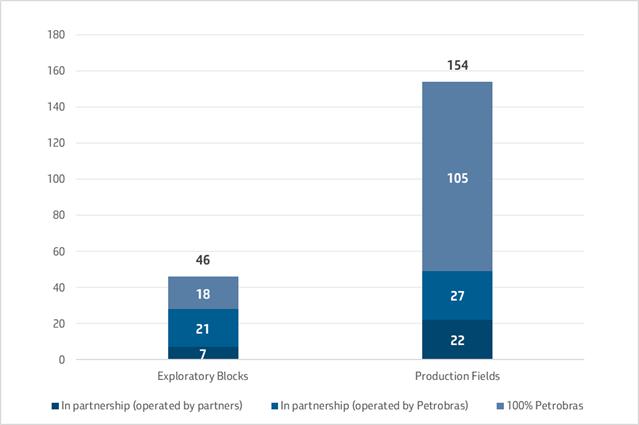
Like most major oil and gas companies, we operate in partnerships using E&P consortia in the exploration of blocks and the production of oil fields in Brazil, mainly in ultra-deepwaters.
We lead and operate E&P consortia that are responsible for some major projects under development, such as Mero, Atapu, Búzios and Sépia.
These E&P consortia also comprise some of the biggest production fields in Brazil, such as Tupi, Sapinhoá, Roncador, Berbigão and Sururu.
For the names and interests of partners of each consortia, please refer to the section further below, “Our Business - Production - Shared reservoirs: deposits between different fields”.
PETROBRAS | Annual Report and Form 20-F | 2023 | 60 |
| Table of Contents | |
| | Our Business |
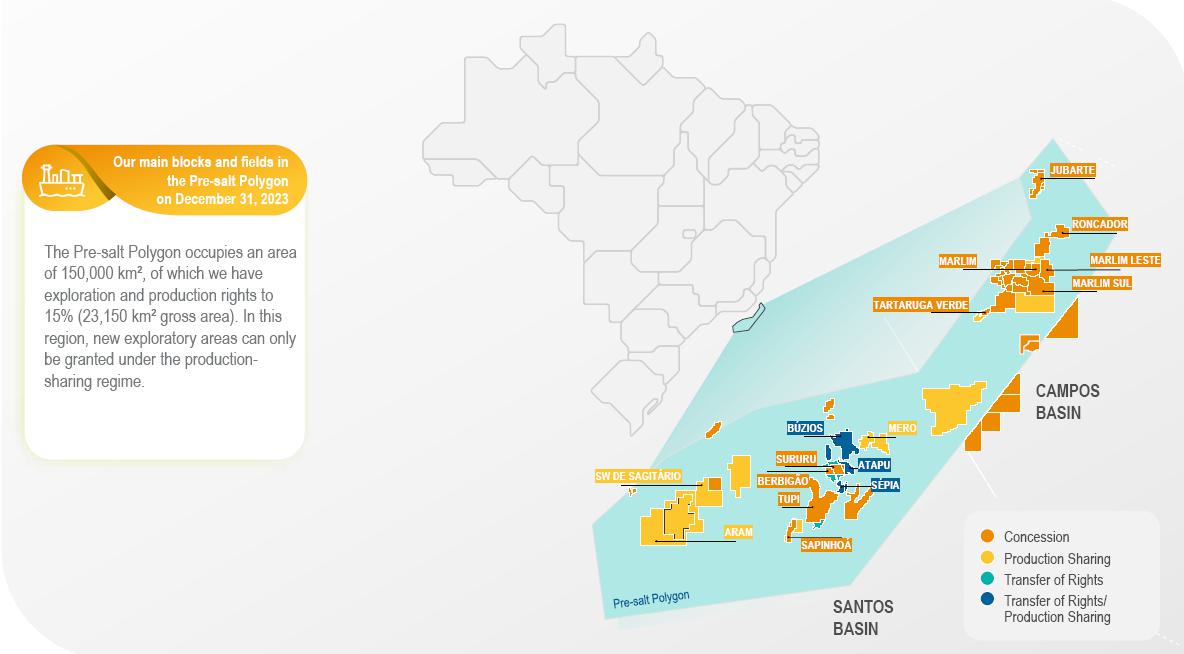
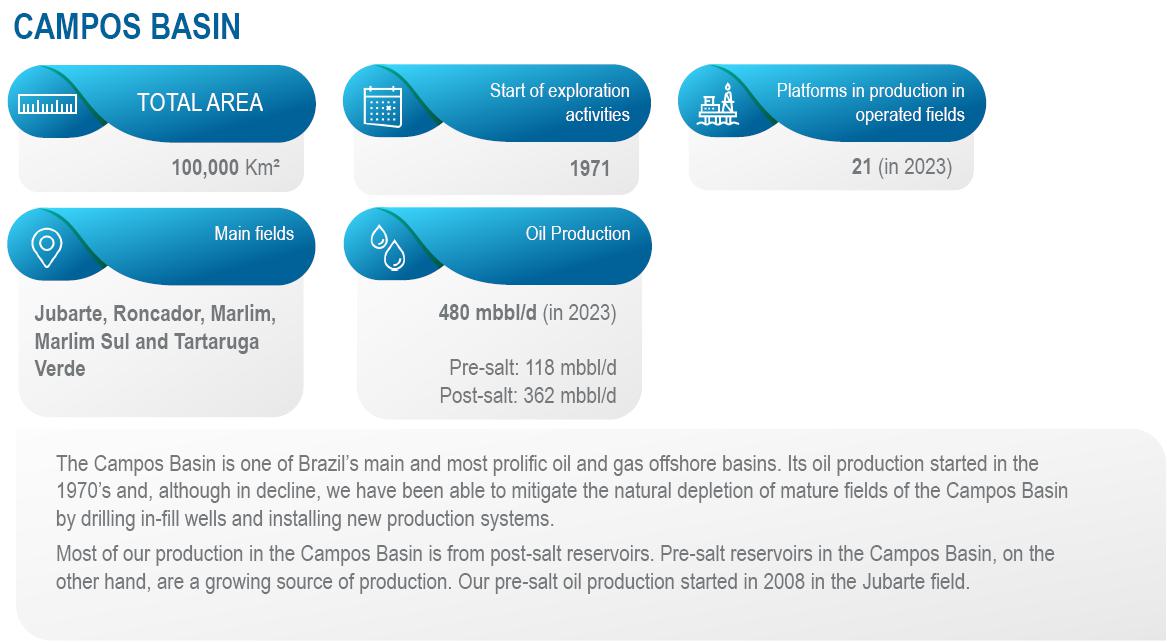
PETROBRAS | Annual Report and Form 20-F | 2023 | 61 |
| Table of Contents | |
| | Our Business |
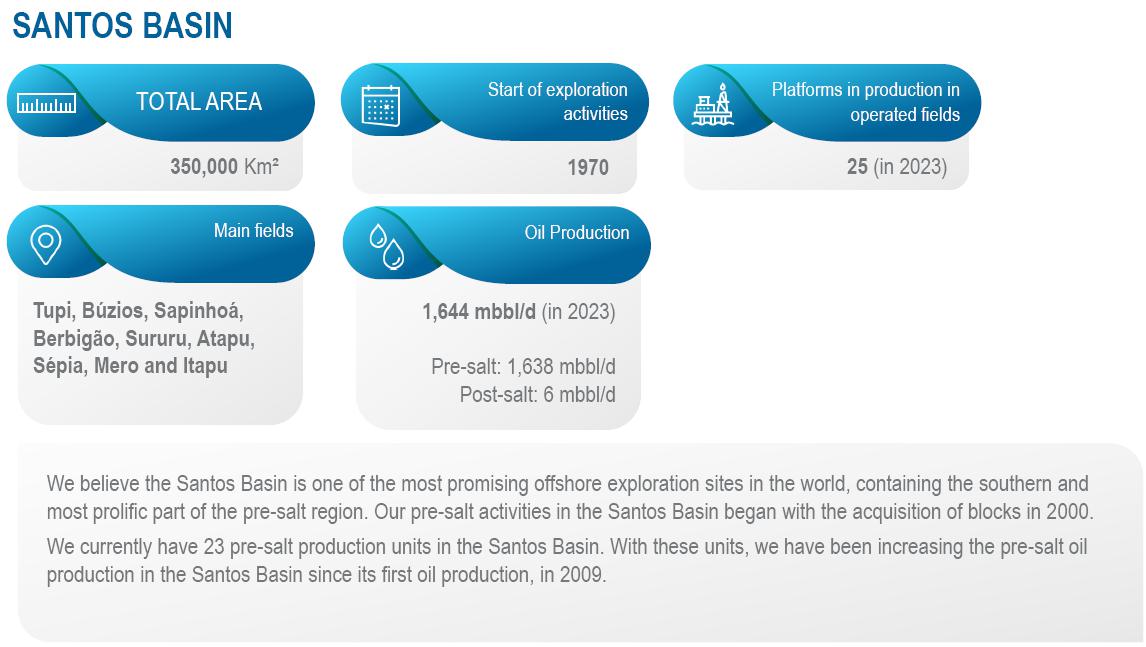
Other Basins
We produce oil and gas and hold exploration acreage in 11 other basins in Brazil. The most significant potential for exploratory success lies within the basins of the Equatorial Margin (Foz do Amazonas, Para-Maranhão, Barreirinhas and Potiguar).
International
Outside Brazil, we have E&P activities in South America and North America. We have focused on opportunities to leverage the deepwater expertise we have developed in Brazil.
Following the 2022 discovery in the Uchuva exploratory well in Colombia, we are planning more exploratory activities in this country. In addition, we are also planning the drilling of exploratory wells in Bolivia, where we are the operator. We have also acquired interests in three exploration blocks in the Democratic Republic of São Tomé and Príncipe, a country on the western coast of Africa. These operations aim to increase portfolio diversification, aligned with our long-term strategy. For more information, see "Strategic Plan – Strategic Plan 2024-2028+" in this annual report.
South America
We conduct exploration and production activities in Argentina, Bolivia and Colombia.
In Argentina, through our subsidiary Petrobras Operaciones S.A., we have a 33.6% interest in the Rio Neuquén production asset. Our unconventional gas and Condensate production is concentrated in the Neuquén Basin. In 2023, our production of oil and gas in Argentina, including NGL, was 10.8 mboed.
In Bolivia, we produce gas and Condensate primarily in the San Alberto and San Antonio fields with 35% interest in each of those service operation contracts, which are operated mainly to supply gas to Brazil and Bolivia. In 2023, our production of oil and gas in Bolivia, including NGL, was 16.4 mboed. The return on such contracts is a proportion of the production.
In Colombia, we operate and hold a 44.44% interest in the Tayrona offshore exploration block, which includes the Uchuva gas discovery.
PETROBRAS | Annual Report and Form 20-F | 2023 | 62 |
| Table of Contents | |
| | Our Business |
North America
In the United States, we focus on deepwater fields in the Gulf of Mexico, where we have non-consolidated production from the 20% participation of Petrobras America Inc. in our joint venture with Murphy Exploration & Production Company, the MPGOM LLC. The main production fields are Chinook, Saint Malo and Dalmatian. In 2023, our 20% participation represented a production of 7.5 mboed, including NGL.
For more information on our divestments, see “Our Business — Portfolio Management” in this annual report.
Africa
On February 8, 2024, we concluded the acquisition of interests in three exploratory blocks in the Democratic Republic of São Tomé and Príncipe, a country on the western coast of Africa. The operation marks the resumption of exploratory operations on the African continent, with the aim of diversifying the portfolio, and is in line with our long-term strategy.
| Main Assets |
| 2023 | 2022 | 2021 | |||
| Exploration & Production | |||||
| Production wells (oil and natural gas)(1) | 1,067 | 5,003 | 5,042 | ||
| Floating rigs | 25 | 19 | 18 | ||
| Operated platforms in production(2)(3) | 57 | 56 | 57 | ||
|
(1) Includes the total amount of wells of our equity method investees (42, 44 and 50 wells in 2023, 2022 and 2021, respectively). (2) Includes only definitive production systems, EWT and EPs units. (3) Does not include mothballed, non-producing and platforms in fields operated by partners.
| |||||
PETROBRAS | Annual Report and Form 20-F | 2023 | 63 |
| Table of Contents | |
| | Our Business |
Exploration
The oil and gas industry value chain begins in the exploratory phase, with the acquisition of exploratory blocks either through bid rounds conducted by governments or by purchases from other companies.
In Brazil, the Brazilian State owns the oil deposits, but companies and consortia are allowed to extract and explore such oil upon payment in several forms, such as royalties. Forms of payment differ, depending on the applied regulatory model. Biddings rounds are the main process for the acquisition of rights over the exploratory blocks.
There are currently three regulatory models in Brazil: Concession Agreements, Transfer of Rights Agreements and Production Sharing Agreements. The concession model fully governed the oil and natural gas exploration and production until 2010, when the Brazilian federal government enacted laws establishing the Transfer of Rights Regime and the Production Sharing Regime in the Pre-salt Polygon.
For information on the regulatory models applicable to our exploration and production activities, see “Legal and Tax” in this annual report.
| Bidding rounds |
|
Over the past few years, we have participated selectively in the bidding rounds carried out by the ANP, aiming to reorganize our exploratory portfolio and maintain the relationship between our reserves and our production in order to ensure the sustainability of our future oil and gas production. Our joint operation with large oil companies in consortia is also aligned with our strategic goal to strengthen partnerships, with the intent to share risks, combine technical and technological skills and capture synergies to leverage results. In 2021, we acquired the exploration and production rights of the surplus volumes of the Transfer of Rights from the Atapu and Sepia offshore fields in the Second Round Transfer of Rights under the Production Sharing Regime. With respect to the Atapu field, we acquired the rights to be the operator in its surplus volumes in partnership with Shell and TotalEnergies. As to the Sépia field, we exercised our preemptive right to be the operator in the acquisition of its surplus volumes. The other members of the consortium are TotalEnergies, Petronas and Qatar Petroleum. In 2022, we acquired the exploration and production rights of three exploratory blocks: Água Marinha and Norte de Brava, both in the Campos Basin, and Sudoeste de Sagitário, in the Santos Basin. With respect to the Água Marinha block, we exercised our preemptive right to be the operator with a 30% interest. The other members of the consortium are TotalEnergies (30% interest), Petronas (20% interest), and Qatar Petroleum (20% interest). As for the Norte de Brava block, we acquired the rights to be the operator, with a 100% interest. As for the Sudoeste de Sagitário block, we acquired the rights to be the operator with 60% interest, with Shell (40% interest). For the names and interests of partners for the Atapu, Sépia and Brava, please refer to the section “Our Business - Production - Shared reservoirs: deposits between different fields”. In 2023, we acquired the exploration and production rights of 29 exploratory blocks in the Pelotas basin. The Pelotas Basin is located in the southern region of Brazil. All acquired blocks are located in deepwater areas, around 200 km from the coast.
|
PETROBRAS | Annual Report and Form 20-F | 2023 | 64 |
| Table of Contents | |
| | Our Business |
Exploration Activities
As of December 31, 2023, we had 46 exploratory blocks (including 18 with 100% that had two appraisal wells drilled in 2023, in Aram block and BM-S-50 block). We serve as the operator in 21 of the exploration partnership blocks.
The table below breaks down our participation in exploration activities in 2023:
OUR PARTICIPATION IN EXPLORATION ACTIVITIES IN 2023
|
Net exploratory area (km2) |
Exploratory blocks (number) |
Evaluation plans (number) |
Wells drilled (number) | |||||||||
| 2023 | 2022 | 2021 | 2023 | 2022 | 2021 | 2023 | 2022 | 2021 | 2023 | 2022 | 2021 | |
| Brazil | 27,924 | 35,198 | 37,719 | 43 | 65 | 69 | 9 | 13(1)(2) | 14(2) | 2 | 5 | 8 |
| Other S. America | 3,474 | 4,284 | 5,466 | 3 | 3 | 4 | 1 | 1 | 1 | 0 | 2 | 1 |
| North America | 0 | 0 | 0 | 0 | 0 | 0 | 0 | 0 | 0 | 0 | 0 | 0 |
| TOTAL | 31,398 | 39,482 | 43,185 | 46 | 68 | 73 | 10 | 14 | 15 | 2 | 7 | 9 |
| (1) | These figures include only contracts signed through December 31, 2023 (which excludes blocks won in Brazil bidding round held on December 13, 2023, or blocks held in São Tomé and Príncipe). |
| (2) | In this report we are restating the number of Evaluation Plans (PADs, in the acronym in Portuguese), and using the same premise used to register PADs to ANP. Petrobras management system for exploration activities comprises numerous activities, grouped in PADs. In previous years, we reported the total number of activities within the PADs, which is higher than the number of PADs. |
In 2023, our exploratory efforts were concentrated on evaluating Brazil’s southeast margin Pre-salt provinces, with the following highlights:
Santos Basin
In 2023 we drilled two wells in the Santos Basin.
We are currently evaluating the results of an appraisal well in the Aram block where the presence of hydrocarbons have been identified. The well presented a fluid of excellent quality, confirming the low levels of contaminants. This discovery increases the possibilities of expanding the accumulation discovered by the wildcat well drilled in 2022, in this block. We are the operator of the block and hold an 80% interest, in partnership with CNPC (20% interest).
We are also currently evaluating the results in the BM-S-50 block, where we drilled the second appraisal well. We are the operators of the consortium, with Shell and Repsol.
Equatorial Margin
In 2023, Petrobras obtained the renewal of the operating license to drill two deep water wells in Potiguar Basin. Such operations aim to investigate the oil potential of the region.
We began the drilling of the first well (Pitu Oeste well) on December 23, 2023. The second well will be drilled subsequently and will test an exploratory opportunity in Anhangá block (POT-M-762). We are the exclusive concessionaire, holding 100% of interests in both concessions.
PETROBRAS | Annual Report and Form 20-F | 2023 | 65 |
| Table of Contents | |
| | Our Business |
Other basins
We have decided to return the Dois Irmãos, C-M-411 and C-M-346 exploration blocks, to ANP. The C-M-789 well and the Andurá well are under evaluation.
For information on exploration expenditures written off, see Note 27 Exploration and evaluation of oil and gas reserves of our audited consolidated financial statements.
E&P Strategic Programs Highlights
We continue the development of the strategic program EXP100, that has been designed to access and process 100% of the technical data and emerging technologies with impact on the exploration projects, by reducing uncertainties and costs.
This program aims to better estimate and predict geological properties through an integrated data platform, using data science, machine learning, artificial intelligence and high-performance computing, that enable the application of more complex algorithms to process large volumes of data.
Several initiatives are already underway, with important advances in the integration and connection of data and digital solutions on the Geological and Geophysical (G&G) interpretation workflows, that support the development of ESG solutions towards a fair energy transition.
In addition, the PROD1000 strategic program is still in progress and it aims to shorten the time between the discovery of the asset and the start of production (first oil), ultimately achieving greater return on invested capital.
The PROD1000 aims to place us in the first quartile of the oil & gas industry. Our efforts in such program are related to exploration and reservoir development integration, project design standardization, processes optimization and parallelization, faster procurement (bidding) and construction and assembly of the FPSO. The areas that currently contribute most to the reduction of project time are exploration, reservoir, surface and subsurface systems and procurement.
In 2023, we started a new phase focused on subsea tieback projects, which aims to reduce the time between the project approval and the beginning of the operation. The initiatives under development seek to maximize the consumption of the subsea equipment, seeking for an integrated and synergistic approach of the resources.
We also applied partial schedule reductions in our development projects already incorporated into the 2024-2028 Strategic Plan.
Production
Production Development
After a field is declared commercially viable, the process of production development begins. The investments made in this phase are mainly focused on designing and contracting production systems, which includes platforms, subsea systems, drilling, and the completion of wells.
We continue to achieve optimizations by implementing initiatives and solutions related to well construction. In 2023 we concluded our strategic well program with excellent deliveries such as the application of new drilling and completion technologies, optimization in the acquisition of reservoir data and the use of integrated contracts. Also in 2023, our average offshore Well Construction Duration (total time for drilling plus completion) was 90 days/well, representing a 17% reduction when compared to 2022. In terms of Well Construction Cost performance, in 2023, we had a 4% reduction compared to 2022, due to the lower durations, although balanced by increasing resource rates (inflationary pressures). Since 2021, we have reached a 8% reduction in average Well Construction Duration, while keeping the same average costs levels. Specifically in post-salt projects, we achieved a 18% reduction in average duration, when compared to 2021.
PETROBRAS | Annual Report and Form 20-F | 2023 | 66 |
| Table of Contents | |
| | Our Business |
In addition, we reduced Well Connections Costs in the Santos Basin pre-salt area by nearly 3% on average per year during the past three years. In 2023, our performance was at the same level as the previous year.
Regarding the integrity of subsea systems, we have made progress in the development and application of new tools for inspection, leading to greater reliability and availability of equipment, pipelines and other components, especially those subsea components exposed to corrosion events. In 2023, we reduced/ subsea SCC-CO2 Production Losses by 80% when compared to the forecast, through inspection campaigns on flexible pipes and engineering for life extension. We continue to implement initiatives such as expanding the supplier base to develop special tools and flexible pipes immune to the effect of corrosion.
Wells and subsea systems KPIs are used as inputs for critical analysis of the interventions operational performance and for the strategic evaluation of business performance.
As it relates to platforms, the All Electric Design was finished in 2022 for the pre-salt FPSOs, aiming for higher efficiency and lower GHG emission, representing the new generation of our FPSOs. For these units, the oil production capacity is 225 mbbl/d and 353.9 mmcf/d of gas. The Sépia 2 and Atapu 2 FPSO bids incorporate the All Electric Design, and the contracting process will be finalized in the first half of 2024.
We invest in technological solutions combined with the transition to a low-carbon global economy, focusing on reducing greenhouse gas emissions.
TECHNICAL SOLUTIONS TO REDUCE GREENHOUSE EMISSIONS IN DEVELOPMENT PRODUTION PROJECTS*
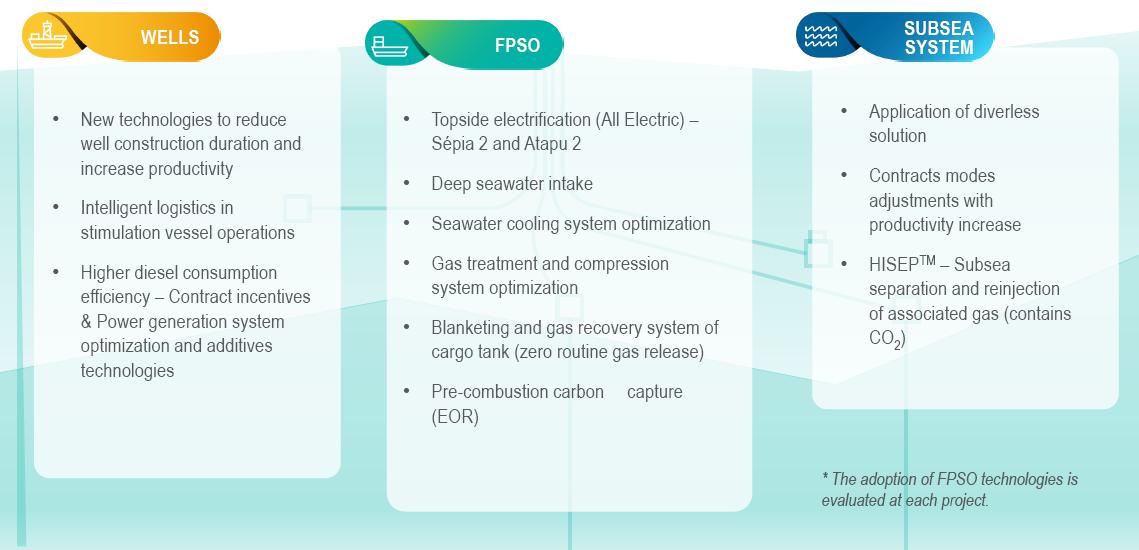
In the last three years, we have installed seven major systems, mainly in the Santos Basin pre-salt area. In 2023, we started the FPSO Anna Nery, located in Marlim and Voador fields, the FPSO Almirante Barroso, located in Búzios field, the FPSO Anita Garibaldi, also located in Marlim and Voador field and FPSO Sepetiba, in Mero field. Those seven new systems added new 42 wells (27 production and 15 injection wells) into our production systems.
In 2024, we expect to install the FPSO Marechal Duque de Caxias in the Mero field. We expect to install 14 new FPSOs in the next five years.
PETROBRAS | Annual Report and Form 20-F | 2023 | 67 |
| Table of Contents | |
| | Our Business |
In January 2023, the Guanabara platform reached its maximum production capacity, with the mark of 180 mbbl/d, about eight months after the unit started operating. The FPSO Guanabara achieved this result with four producing wells and three gas injectors. In October, the FPSO Almirante Barroso also reached its maximum production capacity, less than five months after entry into operation, with the mark of 150 mbbl/d. The Almirante Barroso platform achieved this result with three producing wells and two gas injectors. In November, the P-71 platform reached its maximum production capacity, with the mark of 150 mbbl/d with four producing wells and one gas injector. The P-71 reached this mark about 11 months after the unit started operating.
In 2023, our producing platforms had a daily production of 2.24 million barrels of oil and 3.04 million cubic feet of natural gas (discounting the liquefied volume). In 2023, we owned 30 and leased 19 offshore producing platforms. Besides these offshore platforms, there are 3 storage and offloading units and five supporting units, totaling 57 active platforms.
SYSTEMS INSTALLED IN THE PREVIOUS 5 YEARS
| Start up (year) | Basin | Field/Area | Production unit | Crude oil nominal capacity (bbl/d) | Gas nominal capacity (mmcf/d) | Water depth (meters) | Fiscal regime | Main production source | Type |
| 2023 | Santos | Mero | Sepetiba | 180,000 | 423.8 | 2,000 | Production Sharing | Pre-salt | FPSO |
| Campos | Marlim | Anita Garibaldi | 80,000 | 247 .2 | 670 | Concession | Pre-salt/Post-salt | FPSO | |
| Campos | Marlim | Ana Nery | 70,000 | 141.3 | 927 | Concession | Post-salt | FPSO | |
| Santos | Búzios | Almirante Barroso | 150,000 | 211.9 | 1,900 | Transfer of Rights/Production Sharing/Concession | Pre-salt | FPSO | |
| 2022 | Santos | Itapu | P-71 | 150,000 | 211,9 | 2,010 | Transfer of Rights/Production Sharing | Pre-salt | FPSO |
| Santos | Mero | Guanabara | 180,000 | 423.8 | 1,930 | Production Sharing | Pre-salt | FPSO | |
| 2021 | Santos | Sépia | Carioca | 180,000 | 211,9 | 2,200 | Transfer of Rights/Production Sharing/Concession | Pre-salt | FPSO |
| 2020 | Santos | Atapu | Petrobras 70 | 150,000 | 211.9 | 2,288 | Transfer of Rights/Production Sharing/Concession | Pre-salt | FPSO |
| 2019 | Santos | Berbigão | Petrobras 68 | 150,000 | 211.9 | 2,280 | Transfer of Rights/Concession | Pre-salt | FPSO |
| Santos | Búzios | Petrobras 77 | 150,000 | 247.2 | 1,980 | Transfer of Rights/Production Sharing/Concession | Pre-salt | FPSO | |
| Santos |
Búzios | Petrobras 76 |
150,000 |
247.2 |
2,025 |
Transfer of Rights/Production Sharing/Concession | Pre-salt |
FPSO | |
| Santos | Tupi | Petrobras 67 | 150,000 | 211.9 | 2,130 | Transfer of Rights/Concession | Pre-salt | FPSO |
PETROBRAS | Annual Report and Form 20-F | 2023 | 68 |
| Table of Contents | |
| | Our Business |
MAIN SYSTEMS TO BE INSTALLED THROUGH 2028
| Start up (year) | Basin | Field/Area | Production unit | Crude oil nominal capacity(bbl/d) | Gas nominal capacity (mmcf/d) | Water depth (meters) | Fiscal regime | Main production source | Type |
| Expected 2024 | Santos | Mero 3 | Marechal Duque de Caxias | 180,000 | 423.8 | 2,070 | Production Sharing | Pre-salt | FPSO |
| Expected 2025 | Campos | Parque das Baleias | Maria Quitéria | 100,000 | 176.6 | 1,385 | Concession | Pre-salt | FPSO |
| Santos | Búzios 7 | Almirante Tamandaré | 225,000 | 423.8 | 1,900 | Transfer of Rights/Production Sharing/Concession | Pre-salt | FPSO | |
| Santos | Búzios 6 | Petrobras 78 | 180,000 | 254.3 | 2,030 | Transfer of Rights/Production Sharing/Concession | Pre-salt | FPSO | |
| Santos | Mero 4 | Alexandre de Gusmão | 180,000 | 423.8 | 1,890 | Production Sharing | Pre-salt | FPSO | |
| Expected 2026 | Santos | Búzios 8 | Petrobras 79 | 180,000 | 254.3 | 1,700 | Transfer of Rights/Production Sharing/Concession | Pre-salt | FPSO |
| Santos | Búzios 9 | Petrobras 80 | 225,000 | 423.8 | 2,100 | Transfer of Rights/Production Sharing/Concession | Pre-salt | FPSO | |
| Expected 2027 | Santos | Búzios 10 | Petrobras 82 | 225,000 | 423.8 | 1,895 | Transfer of Rights/Production Sharing/Concession | Pre-salt | FPSO |
| Santos | Búzios 11 | Petrobras 83 | 225,000 | 423.8 | 2,100 | Transfer of Rights/Production Sharing/Concession | Pre-salt | FPSO | |
| Campos | Albacora | To be defined | 120,000 | 211.9 | 700 | Concession | Pre-salt | FPSO | |
| Expected 2028 | Campos | BM-C-33 | To be defined | 126,000 | 565.0 | 2,750 | Concession | Pre-salt | FPSO |
| Campos | Barracuda e Caratinga | To be defined | 100,000 | 211.9 | 1,100 | Concession | Post-salt | FPSO | |
| Sergipe Águas Profundas | SEAP 1 | To be defined | 120,000 | 353.1 | 2,510 | Concession | Post-salt | FPSO | |
| Sergipe Águas Profundas | SEAP 2 | To be defined | 120,000 | 423.8 | 2,510 | Concession | Post-salt | FPSO | |
PETROBRAS | Annual Report and Form 20-F | 2023 | 69 |
| Table of Contents | |
| | Our Business |
Decommissioning
Decommissioning of oil and gas exploration and production systems is part of the production cycle of the oil and gas industry and includes several activities, such as disposal of the platform and the subsea system and the plug and abandonment of wells.
Once the need for decommissioning has been confirmed, we plan in accordance with the applicable legal requirements, including environmental regulations and consider studies and guidelines on the best practices of the oil and gas industry worldwide. Therefore, we follow strict safety standards and analyze project alternatives based on multidisciplinary criteria (environmental, technical, security, social and economic), in the planning process, which allows us to select the decommissioning alternative that generates less impact. This decommissioning plan is approved by regulatory bodies before it is carried out.
In 2023, we concluded the first auctions for the sale of platforms P-32 and P-33, both from Campos Basins, considering our new model for the sustainable destination of vessels. These sales processes stipulated several technical criteria and requirements for bidders, aimed at guaranteeing that recycling activities and the final disposal of metallic waste take place in accordance with ESG best practices in the industry across the globe. The shipyards were also required to have an operating license that explicitly includes dismantling activities, and an installed capacity for the temporary storage and handling of materials, with a contingency and emergency plan, in addition to following the best practices in occupational safety.
We will monitor the execution of the plans to ensure compliance with the technical criteria mentioned, throughout the entire recycling process.
Concerning well abandonments, in 2023, we successfully executed 26 well abandonments, including both well suspensions and permanent abandonments. We continued to deliver substantial results in 2023 that allowed us to reach a new performance milestone in deepwater campaigns, with a 12% reduction in durations and 33% reduction in costs compared to 2019 levels, a period prior to the implementation of a strategic program aimed at reducing abandonment duration and cost. We utilized bismuth technology as a temporary barrier component for the first time in the company, resulting in a reduction in costs during the operation. Additionally, contracts for R&D were signed to promote innovation through tubing technologies for future campaigns.
Wells abandonment KPIs are used as inputs for critical analysis of the interventions operational performance and for the strategic evaluation of business performance.
Critical Resources in Exploration & Production
We seek to procure, develop and retain all of the critical resources that are necessary to meet our production targets. Drilling rigs, special vessels, supply vessels and helicopters are important resources for our exploration and production operations and are centrally coordinated to assure both technical specifications and proper lead time.
Since 2008, we have grown from three rigs capable of drilling in waters with depth greater than 2,000 meters (6,560 feet) to 24 rigs with this capacity as of December 31, 2023. We will continue to evaluate our drilling and special vessel demands and intend to adjust our fleet size as needed.
PETROBRAS | Annual Report and Form 20-F | 2023 | 70 |
| Table of Contents | |
| | Our Business |
DRILLING UNITS IN USE BY EXPLORATION & PRODUCTION AS OF DECEMBER 31, 2023 (1)
| 2023 | 2022 | 2021 | ||||
| Leased | Owned | Leased | Owned | Leased | Owned | |
| Brazil | 27 | 0 | 20 | 0 | 18 | 0 |
| Onshore | 2(2) | 0 | 1(2) | 0 | 0 | 0 |
| Offshore, by water depth (WD) | 25 | 0 | 19 | 0 | 18 | 0 |
| Jack-up rigs | 0 | 0 | 0 | 0 | 0 | 0 |
| Floating rigs | 25 | 0 | 19 | 0 | 18 | 0 |
| 500 to 999 meters WD | 1 | 0 | 1 | 0 | 1 | 0 |
| 1,000 to 1,999 meters WD | 0 | 0 | 0 | 0 | 0 | 0 |
| 2,000 to 3,200 meters WD | 24 | 0 | 18 | 0 | 17 | 0 |
| Outside Brazil | 0 | 0 | 0 | 0 | 0 | 0 |
| Onshore | 0 | 0 | 0 | 0 | 0 | 0 |
| Offshore | 0 | 0 | 0 | 0 | 0 | 0 |
| Worldwide | 27 | 0 | 20 | 0 | 18 | 0 |
| (1) | In operated fields. |
| (2) | Does not consider onshore workover rigs, not used for drilling. |
To achieve our production goals, we have also secured a number of specialized vessels (such as PLSVs) to connect wells to production systems. As of December 31, 2023, we had 15 PLSVs in use. Similarly to the rigs, we intend to adjust our fleet size as needed.
The supply of goods and transport of people is also important to achieve our exploration and production goals. By sea, we transport materials and chemical products. By air, we transport our most important assets: people. Both materials and people are transported on a daily basis so that the exploration and production of oil and gas is orchestrated in the most continuous way possible, maintaining the quality and level of services.
In 2023, we delivered more than 2.6 million tons of materials and transported over 912,000 passengers to our platforms all over the Brazilian coast. To accomplish these results, we also have a secure number of supply vessels (such as Platform Supply Vessels or “PSV”) and helicopters. As of December 31, 2023, we had 84 PSV and 79 helicopters and both our fleets were sufficient to meet our needs.
PETROBRAS | Annual Report and Form 20-F | 2023 | 71 |
| Table of Contents | |
| | Our Business |
| Mero Field |
|
Libra Block and Mero Field Mero field is a field located in the Santos Basin ultra-deepwaters (water depth 2,100 meters), 180 km from the coast of Rio de Janeiro State and inside Brazilian pre-salt province. It has a high productivity reservoir filled with a large volume of high-quality oil. It is a thick reservoir (oil columns reaches 420 meters), with high productivity and filled with a large volume of high-quality oil (29° API). In addition, the associated challenges for project development are also noteworthy, considering the high gas/oil ratio (420 std m³/std m³) and CO2 content in the associated gas (44%). In 2013, the consortium we formed with Shell, TotalEnergies, CNODC and CNOOC Limited won the bid to explore and develop the Libra block for 35 years. The consortium also has the participation of the state-owned enterprise Pré-Sal Petróleo - PPSA, which operates as a contract manager. On November 30, 2017, we announced the submission of the Declaration of Commerciality regarding oil accumulations in the northwestern portion of the Libra block, subsequently named Mero. On December 9, 2021, ANP approved Mero accumulation's AIP. The AIP occurs when the reservoirs extend beyond the areas granted or contracted, as regulated by ANP. The agreement became effective on January 1, 2022. Under the terms of the AIP, the Mero Shared Reservoir comprises two areas, namely (1) the Mero field area (as defined in the PSC from LIBRA-P1 consortium), representing 96.50% of the reservoir and (2) the adjacent area (Brazilian federal government, represented by PPSA), representing 3.50% of the reservoir. The agreement establishes the interests of each party and the rules of joint execution for the operations to develop and produce oil and natural gas in the shared reservoir. The interests of each party in the Mero Shared Reservoir were then updated as follows: Petrobras with 38.60% interest, Shell with 19.30% interest, TotalEnergies with 19.30% interest, CNODC with 9.65% interest, CNOOC Limited with 9.65% interest and PPSA, representing the Brazilian Government, with 3.50% interest.
Project development The start of production (first oil) commenced in 2017, as part of the first Early Production System (“EPS”) campaign, using two wells (one producer and one injector) and the chartered unit FPSO Pioneiro de Libra, which has a capacity of 50 mbbl/d of oil and four million m³/day of gas. The first EPS operated in Mero 2 region until July 2021. In December 2021, a second EPS started in the Mero 4 area, with the FPSO Pioneiro de Libra and two other wells from this area (one producer and one injector). This operation is still ongoing. By December 31, 2023, the combined EPSs have already produced a cumulative production of 71 mmbbl of oil, with a peak of 55 mbbl/d from one single well in each moment. In addition, over 4.7 billion m³ of associated gas has been produced, of which 9% were consumed for power generation by the FPSO, and 88% were reinjected in the reservoir along with almost 1.9 billion m³ of CO2. The production arrangement for the Mero field comprises the already operating FPSO Guanabara and Sepetiba, as well as the upcoming units FPSO Marechal Duque de Caxias and FPSO Alexandre de Gusmão (both under construction). Each FPSO (all chartered units) will be able to process up to 180 mbbl/d and 12 million m³ of gas daily. The FPSO Guanabara started operating in April 2022 and FPSO Sepetiba in December 2023. Per our Strategic Plan, FPSO Marechal Duque de Caxias is expected to begin operating in 2024 and FPSO Alexandre de Gusmão in 2025. The current estimate for Mero field is a return of over three billion bbl of oil recovery until 2048, with an annual production peak of 600 mbbl/d in 2028. |
PETROBRAS | Annual Report and Form 20-F | 2023 | 72 |
| Table of Contents | |
| | Our Business |
|
FPSO Guanabara Production In April 2022, we started producing oil and natural gas through the operations of the FPSO Guanabara, the first definitive production system installed in the Mero field, producing oil and natural gas from the Mero 1 area. The FPSO Guanabara unit was built and operated by Modec. It is equipped with gas re-injection systems, in which the gas production with 45% CO2 content, after self-consumption in the FPSO, is all re-injected into the reservoir to maintain pressure and improve oil recovery, in addition to reducing the release of CO2 into the atmosphere. From April to December 2022, eight months after operations start-up, FPSO Guanabara achieved the platform nominal capacity for oil production (180 mbbl/d). Moreover, by December 31, 2023, the unit has already produced a cumulative production of 80 mmbbl of oil, with a production of 5.1 billion m³ of gas, from which 7.7% were consumed for FPSO power generation, and 91% were reinjected in the reservoir, along with 1.9 billion tons m³ of CO2. As of December 2023, the FPSO is connected to 5 producers and 6 injectors wells. One producer and one injector wells are prepared to be connected and start operations, concluding this module's first phase of production development.
FPSO Sepetiba Production In December 2023, we started producing oil and natural gas by operating the FPSO Sepetiba, the second definitive production system installed in the Mero field, which produces oil and natural gas from the Mero 2 field area. The FPSO Sepetiba was built and operated by SBM. Like the FPSO Guanabara (mentioned above), FPSO Sepetiba is equipped with similar gas re-injection systems, in which the gas production with 45% CO2 content, after self-consumption in the FPSO, is all re-injected into the reservoir to maintain pressure and enhance oil recovery as well as reduce the release of CO2 into the atmosphere.
New technologies in Libra HISEP™ HISEP™ is a subsea separation technology that separates, at the seabed, gas with high CO2 content under high pressure, followed by direct reinjection of this separated stream to the reservoir using centrifugal pumps. HISEP™ debottlenecks the topsides gas processing plant and extends the oil production plateau by reducing the gas-oil Ratio (“GOR”) of the oil that reaches the FPSO. Hence, HISEP™ has the potential to accelerate oil production, increase the recovery factor and reduce GHG emissions. It has been developed in a collaborative and integrated environment congregating major oil companies, including the engagement of reputed and experienced market suppliers to deploy the solution and generate value for the Mero field and the oil and gas industry. Therefore, an extensive de-risking program has been carried out over the last five years to increase the maturity level of the HISEP™ solution. In 2023, part of de-risking project was awarded by the Brazilian National Agency for Petroleum, ANP with the Technological Innovation Award in the subsea project category. The first HISEP™ technology for qualification is expected to be installed in Mero 3 area in 2028, linked to the FPSO Marechal Duque de Caxias. The HISEP™ specific EPCI contract was signed in January 2024. |
PETROBRAS | Annual Report and Form 20-F | 2023 | 73 |
| Table of Contents | |
| | Our Business |
|
CTV The Cargo Transfer Vessel (“CTV”) is a new oil offloading technology which was qualified in the second semester of 2023 through an extensive field trials program in Santos Basin. The concept makes feasible the execution of oil transfer operations from the FPSO directly to conventional oil tankers with safety levels compatible with the operations with a Dynamic Positioning Shuttle Tanker (“DPST”), normally used during the offloading process. By eliminating steps in the conventional logistics, the CTV solution enables a more straightforward and flexible logistic strategy in oil export scenarios. Therefore, the technology will contribute for future cost reduction, lower GHG emissions, a shorter time to reach the market and positive impacts on the Health Safety Security Environment indicators. PRM Seismic Permanent Reservoir Monitoring (“PRM”) is a technology that will provide more profound knowledge about the distribution of fluids in the reservoir via data acquisition. This way, it will also allow greater efficiency in oil production in the Mero field. PRM in Mero has unprecedented features in Brazil, considering the water depth, a large application area (approximately 200 km²), and the high complexity for installation due to many subsea obstacles (projects infrastructure). It incorporates state-of-the-art 4D seismic monitoring technologies, in which seismic records obtained on different dates are used to monitor the behavior of reservoirs over time. According to our Strategic Plan, the system will be installed in two phases. The first phase in 2025, covering Mero 1 and Mero 2, and a second phase in 2026 to cover the remaining two modules of the field. It comprises a network of optical fibers that will be connected to the FPSO Sepetiba and our offices. It will allow remote and instant access to the data generated by the monitoring system.
|
Production
In 2023, our total production of oil and gas, including NGL, was 2,782 mboed, of which 2,748 mboed were produced in Brazil, and 35 mboed were produced abroad, a 4% increase compared to 2022. This production decline was due to divestment, decommissioning, and the natural decline of the production.
Our 2023 operating performance was partially leveraged by the ramp-up of new production systems in the Itapu and Mero fields.
Our production in the pre-salt layer reached 1,806 mbbl/d in 2023, representing an increase of 10% in relation to our production in 2022. In 2023, the oil production in the pre-salt layer represented 81% of all oil production in Brazil, compared to 76% in 2022.
PETROBRAS | Annual Report and Form 20-F | 2023 | 74 |
| Table of Contents | |
| | Our Business |
OIL AND GAS PRODUCTION
| 2023 | 2022 | 2021 | 2023 vs 2022 | |
| Crude oil and natural gas – Brazil (mboed) | 2,748 | 2,648 | 2,732 | 4% |
| Onshore (mbbl/d) | 41 | 66 | 89 | -39% |
| Shallow water (mbbl/d) | 3 | 7 | 9 | -60% |
| Post-salt deep and ultra-deepwaters (mbbl/d) | 382 | 434 | 496 | -12% |
| Pre-salt (mbbl/d) | 1,806 | 1,635 | 1,616 | +10% |
| Crude oil (mbbl/d)(1) | 2,231 | 2,142 | 2,211 | +4% |
| Natural gas (mboed) | 516 | 505 | 521 | +2% |
| Crude oil and natural gas – Abroad(2) (mboed) | 35 | 37 | 42 | -5% |
| TOTAL | 2,782 | 2,684 | 2,774 | +4% |
(1) Including NGL.
(2) Includes the proportional production of our equity method investees, based on the percentage of our interest in these entities.
Pre-salt oil production decreased by 10%, reflecting the ramp-up of new production systems in Búzios and Mero fields. The pre-salt area comprises large accumulations of light oil of excellent quality and high commercial value. The post-salt oil production in deep and ultra-deepwaters decreased by 12% due to divestment, decommissioning, and the natural decline of production.
Shallow waters oil production decreased by 60%, to 3 mbbl/d, due to divestments, decommissioning and the natural decline of the production. Onshore oil production decreased by 39%, to 41 mbbl/d, due to divestments, decommissioning, and the natural decline of the production.
We produced 86.1 million m3/d of gas in 2023. From that volume, we used 53.8 million m3/d in our production processes (reinjected, flared, consumed, liquefied) and allocated 32.3 million m3/d for sale.
Achievement of 2023 Production Target
We achieved our production targets for 2023, established in the 2023-2027 Strategic Plan.
PRODUCTION TARGETS FOR 2023 (mmboed)
| Production | Performed | Goal |
| Oil and NGL | 2.2 | 2.2 + 2% |
| Oil, NGL and commercial gas | 2.4 | 2.4 + 2% |
| Total production Oil and Gas | 2.8 | 2.8 + 2% |
This result demonstrates our commitment to meeting our goals, which have been reached by maintaining the focus of our activities on deep and ultra-deepwater assets.
PETROBRAS | Annual Report and Form 20-F | 2023 | 75 |
| Table of Contents | |
| | Our Business |
Lifting Cost
In 2023, our lifting cost (Brazil and our business outside Brazil), without government participation or leases, was US$5.6 per boe, which represents a -3% decrease from the 2022 cost of US$5.8 per boe. Including leases, our lifting cost in 2023 was US$7.6 per boe, which represents a 2% increase from the 2022 cost of US$7.4 per boe.
| Shared reservoirs: deposits between different fields |
|
The participation of consortium members in any fields mentioned refers exclusively to the participation of such members in the contract related to such field. On certain occasions, some of these fields are subject to AIPs, resulting in shared deposits between different fields. Under AIPs, costs, investments, and production volumes are shared between the parties thereto. Below are the most relevant fields subject to AIPs to which we are party. This list is not exhaustive and other fields not mentioned below may also be subject to AIPs.
TUPI The AIP of Tupi's Shared Reservoir, located in the Santos Basin, was approved by ANP in March 2019 and has been in effect since April 2019. The shared reservoir comprises Tupi’s reservoir and is shared between: Tupi concession (Concession Contract/BM-S-11), operated by us with a 65% interest, in partnership with Shell with a 25% interest and Galp with a 10% interest; Sul de Tupi (Transfer of Rights), where we have 100% of the interest; and Tupi Leste (Non-Contracted Area), which belongs to the Brazilian federal government, represented by PPSA. Tupi’s AIP does not cover the so-called Iracema reservoir, which remains with the same interests of the BM-S-11 consortium. The interests of each contract in Tupi’s Shared Reservoir (AIP of Tupi) are as follows: |
| Contract | Interest (%) of each Contract in the Shared Reservoir | ||
| Tupi (Concession Contract / BM-S-11) | 92.09 | ||
| Sul de Tupi (Transfer of Rights) | 7.36 | ||
| Tupi Leste (Non-Contracted Area) | 0.55 |
PETROBRAS | Annual Report and Form 20-F | 2023 | 76 |
| Table of Contents | |
| | Our Business |
|
The interest of each party in Tupi’s Shared Reservoir (AIP of Tupi) are as follows: |
| Partner | Interest (%) of each party in the Shared Reservoir | ||
| Petrobras (operator) | 67.22 | ||
| Shell | 23.02 | ||
| Galp | 9.21 | ||
| PPSA(1) | 0.55 |
|
(1) Party of Tupi Leste (Non-contracted area) with 0.55%.
MERO The AIP of the Mero accumulation, located in the Santos Basin, was approved by ANP in December 2021 and has been in effect since January 2022. The Mero Shared Reservoir comprises: Mero (Production Sharing Contract/Libra): operated by us with 40% interest in partnership with Shell (20% interest), TotalEnergies (20% interest), CNODC (10% interest), CNOOC (10% interest); and Sul de Mero and Norte de Mero (non-contracted areas), which belong to the Brazilian federal government, represented by PPSA. The interest of each contract in the Mero Shared Reservoir (AIP of Mero) are as follows: |
| Contract | Interest (%) of each Contract in the Shared Reservoir | ||
| Mero (Production Sharing Contract / Libra) | 96.50 | ||
| Sul de Mero and Norte de Mero (Non-Contracted Area) | 3.50 |
|
The interest of each party in the Mero Shared Reservoir (AIP of Mero) are as follows: |
| Partner | Interest (%) of each party in the Shared Reservoir | ||
| Petrobras (operator) | 38.60 | ||
| Shell | 19.30 | ||
| TotalEnergies | 19.30 | ||
| CNODC | 9.65 | ||
| CNOOC | 9.65 | ||
| PPSA(1) | 3.50 |
|
(1) PPSA is the manager of the Production Sharing Contract of Mero and party of Sul de Mero and Norte de Mero (Non-Contracted Areas) with 3.50% interest.
ATAPU The ANP has approved the AIP of Atapu accumulations, located in the Santos Basin, and it has been in effect since in September 2019. The ANP approved an amendment in April 2022, to include the Production Sharing Contract. The Atapu Shared Reservoir comprises: Oeste de Atapu (Concession Contract / BM-S-11A), operated by us with a 42.5% interest, in partnership with Shell, with a 25% interest, TotalEnergies, with a 22.5% interest, and Galp, with a 10% interest; |
PETROBRAS | Annual Report and Form 20-F | 2023 | 77 |
| Table of Contents | |
| | Our Business |
|
Atapu ECO (ToR Surplus), operated by us with a 52.5% interest, in partnership with Shell (25% interest), and TotalEnergies (22.5% interest); Atapu (Transfer of Rights), operated by us, and where we hold 100% of the interest; and Norte de Atapu (Non-Contracted Area), which belongs to the Brazilian federal government, represented by PPSA. The interest of each contract in Atapu Shared Reservoir (AIP of Atapu) are as follows: |
| Contract | Interest (%) of each Contract in the Shared Reservoir | ||
| Oeste de Atapu (Concession Contract / BM-S-11A) | 17.03 | ||
| Atapu (Transfer of Rights) | 32.40 | ||
| Atapu ECO (ToR Surplus) | 49.62 | ||
| Norte de Atapu (Non-Contracted Area) | 0.95 |
|
The interest of each party in Atapu Shared Reservoir (AIP of Atapu) are as follows: |
| Partner | Interest (%) of each party in the Shared Reservoir | ||
| Petrobras (operator) | 65.69 | ||
| Shell | 16.66 | ||
| TotalEnergies | 15.00 | ||
| Galp | 1.70 | ||
| PPSA (1) | 0.95 |
|
(1) PPSA is the manager of the Production Sharing Contract of Atapu ECO and party of Norte de Atapu (non-contracted areas) with 0.95% interest.
SÉPIA The AIP of Sépia accumulations, located in the Santos Basin, was approved by ANP and has been in effect since September 2019. An amendment was approved by ANP in April 2022 to include the Production Sharing Contract. The Sépia Shared Reservoir comprises: Sépia Leste concession contract (Concession Contract/BM-S-24) operated by us (80% interest), in partnership with Galp (20% interest); and Sépia ECO (ToR Surplus), operated by us (30% interest), in partnership with TotalEnergies (28% interest), Petronas (21% interest), and QP Brasil (21% interest); and Sépia (Transfer of Rights Agreement), operated by us (where we hold a 100% interest). |
PETROBRAS | Annual Report and Form 20-F | 2023 | 78 |
| Table of Contents | |
| | Our Business |
|
The interest of each contract in the Sépia shared reservoir (AIP of Sépia) are as follows: |
| Contract | Interest (%) of each Contract in the Shared Reservoir | ||
| Sépia Leste (Concession Contract) | 12.07 | ||
| Sépia ECO (ToR Surplus) | 60.41 | ||
| Sépia (Transfer of Rights Agreement) | 27.52 |
|
The interest of each party in the Sépia shared reservoir (AIP of Sépia) are as follows: |
| Partner(1) | Interest (%) of each party in the Shared Reservoir | ||
| Petrobras (operator) | 55.30 | ||
| TotalEnergies | 16.91 | ||
| Petronas | 12.69 | ||
| QP Brasil | 12.69 | ||
| Galp | 2.41 |
|
(1) PPSA is the manager of the Production Sharing Contract of Sépia ECO. |
|
BÚZIOS AND TAMBUATÁ The Búzios Shared Reservoir comprises: Tambuatá (Concession Contract / BS-500), operated by us with a 100% interest. Búzios (Transfer of Rights), operated by us with a 100% interest. Regarding Búzios ECO (ToR Surplus), in November 2019, we in partnership with CNODC and CNOOC, obtained the rights to explore the surplus volumes of Búzios field. The Production Sharing Regime in Búzios became effective in September 2021. In 2022, we transferred 5% of our interest in the ToR Surplus, to CNOOC. This transaction was effective as of December 1, 2022. Our interest in Búzios ECO is 85%, the interest of CNOOC is 10% and the interest of CNODC is 5%. The interest of each contract in the Búzios shared reservoir are as follows: |
| Contract | Interest (%) of each Contract in the Shared Reservoir | ||
| Búzios (Transfer of Rights) | 25.95 | ||
| Búzios ECO (ToR Surplus) | 73.41 | ||
| Tambuatá (Concession Contract / BS-500) | 0.64 |
|
The interest of each party in the Búzios shared reservoir (AIP of Búzios) are as follows: |
| Partner(1) | Interest (%) of each party in the Shared Reservoir | ||
| Petrobras (operator) | 88.9891 | ||
| CNOOC | 7.3406 | ||
| CNODC | 3.6703 |
|
(1) PPSA is the manager of the Production Sharing Contract of Búzios ECO. |
PETROBRAS | Annual Report and Form 20-F | 2023 | 79 |
| Table of Contents | |
| | Our Business |
|
The unitization agreement was submitted to ANP and is pending approval.
TARTARUGA MESTIÇA, TARTARUGA VERDE AND ESPADARTE MODULE III The concession contract BM-C-36 has two producing reservoirs: the Tartaruga Verde reservoir, which is totally contained within the ring fence limits, and the Tartaruga Mestiça reservoir, which goes beyond the ring fence limits. The AIP of the Tartaruga Mestiça Shared Reservoir was signed between us and PPSA and has been in effect since March 2018. We fully acquired the area of the limits of the concession BM-C-36 in September 2018 through the block named Sudoeste de Tartaruga Verde (Production Sharing Contract). In December 2019, we assigned to Petronas 50% of our interest of Tartaruga Verde Fields (BM-C-36) and Espadarte Module III. We also established a consortium with Petronas, pursuant to which we carry out operator activities in aforementioned operations. The Tartaruga Verde Sudoeste Field, under the Production Sharing Agreement, remained entirely with us. In January 2021, the ANP approved an amendment to the AIP. The interest of each contract in the Tartaruga Mestiça Shared Reservoir: |
| Contract | Interest (%) of each Contract in the Shared Reservoir | ||
| Tartaruga Verde (Concession Contract / BM-C-36) | 82.19 | ||
| Tartaruga Verde Sudoeste (Production Sharing Contract) | 17.81 |
|
The interest of each party in the Tartaruga Mestiça Shared Reservoir: |
| Partner(1) | Interest (%) of each party in the Shared Reservoir | ||
| Petrobras (operator) | 58.905% | ||
| Petronas | 41.095% |
|
(1) PPSA is the manager of the Production Sharing Contract of Tartaruga Verde Sudoeste
The interest of each party in the Tartaruga Verde and Espadarte Module III reservoirs are: |
| Partner | Interest (%) of each party in the Reservoir | ||
| Petrobras (operator) | 50% | ||
| Petronas | 50% |
PETROBRAS | Annual Report and Form 20-F | 2023 | 80 |
| Table of Contents | |
| | Our Business |
|
SAPINHOÁ In 2000, we, YPF Brasil Ltda (YPF) and BG E&P Brasil LTDA (BG), entered into an agreement to create the BM-S-9 consortium, and the BM-S-9 concession contract was signed in September 2000. YPF and BG interests were later acquired by Repsol and Shell, respectively. We operate Sapinhoá (Concession Contract / BM-S-09), with a 45% interest, in partnership with Shell (30% interest) and Repsol (25% interest). In October 2017, the same consortium acquired the rights to produce in the extended area of Entorno de Sapinhoá (composed of Sudoeste de Sapinhoá, Noroeste de Sapinhoá, and Nordeste de Sapinhoá). The Production Sharing Contract related to such area was signed in January 2018. ANP approved the AIP of Sapinhoá Field shared deposit, located in the Santos Basin, which has been in effect since March 2018, with the following interests of each contract in the Sapinhoá Shared Reservoir: |
| Contract | Interest (%) of each Contract in the Shared Reservoir | ||
| Sapinhoá (Concession Contract / BM-S-09) | 96.30 | ||
| Entorno de Sapinhoá (Production Sharing Contract) | 3.70 |
|
The interest of each party in the Sapinhoá shared reservoir are as follows: |
| Partner(1) | Interest (%) of each party in the Shared Reservoir | ||
| Petrobras (operator) | 45.00 | ||
| Shell | 30.00 | ||
| Repsol Sinopec | 25.00 |
|
(1) PPSA is the manager of the Production Sharing Contract of Entorno de Sapinhoá.
BRAVA We entered into an AIP with PPSA to establish the terms and conditions of the Brava shared reservoir, located in the Campos Basin, that has been in force since October 2019. PPSA represented the Brazilian federal government in the non-contracted area, while we owned the Voador and Marlim concession contract areas. In May 2023, ANP approved an amendment to the AIP to include the Production Sharing Contract of Norte de Brava, by means of which we acquired a 100% interest in the Production Sharing Contract of Norte de Brava. The interest of each Contract in the Brava shared reservoir are as follows: |
| Contract | Interest (%) of each Contract in the Shared Reservoir | ||
| Marlim (Concession Contract) | 64.27 | ||
| Voador (Concession Contract) | 33.40 | ||
| Norte de Brava (Production Sharing Contract) | 2.33 |
|
Petrobras has a 100% interest in the Brava Shared Reservoir. PPSA is the manager of the Production Sharing Contract of Norte de Brava. |
PETROBRAS | Annual Report and Form 20-F | 2023 | 81 |
| Table of Contents | |
| | Our Business |
|
ALBACORA PRE-SALT (FORNO) We entered into an AIP with PPSA to establish the terms and conditions of the Albacora Pre-salt (Forno) shared reservoir, located in the Campos Basin, that has been in force since January 2023. PPSA represented the Brazilian federal government in the non-contracted area, while we owned the Albacora concession contract area. In May 2023, ANP approved an amendment to the AIP to include the Production Sharing Contract of Norte de Brava, by means of which we acquired a 100% interest in the Production Sharing Contract of Norte de Brava. The interest of each contract in the Albacora Pre-Salt (Forno) Shared Reservoir are as follows: |
| Contract | Interest (%) of each Contract in the Shared Reservoir | ||
| Albacora (Concession Contract) | 98.33 | ||
| Norte de Brava (Production Sharing Contract) | 1.67 |
|
Petrobras has 100% interest in the Albacora Pre-Salt (Forno) Shared Reservoir. PPSA is the manager of the Production Sharing Contract of Norte de Brava. |
PETROBRAS | Annual Report and Form 20-F | 2023 | 82 |
| Table of Contents | |
| | Our Business |
MAIN PRODUCTION FIELDS
| Production units | ||||||||||
| Basin | Field | Main source | Owned | Capacity (mbbl/d) |
Leased | Capacity (mbbl/d) |
Interest (%) of each party in the Shared Reservoir | API gravity | Sulfur content (% wt) |
2023 oil production (mbbl/d) |
| Santos | Tupi | Pre-salt | 3 | 3 units with 150 | 6 | 1 unit with 100 1 unit with 120 4 units with 150 |
Petrobras (67.22%) Shell (23.02%) Petrogal (9.21%) PPSA (0.55%) |
29.5 - 32 | 0.26 – 0.37 | 592 |
| Santos | Búzios | Pre-salt | 4 | 4 units with 150 | — | — | Petrobras (89%) CNOOC (7.3%) CNODC (3.7%) | 28.4 – 28.8 | 0.31- 0.33 | 552 |
| Campos | Jubarte | Pre-salt | 2 | 2 units with 180 | 2 | 1 unit with 100 1 unit with 110 |
Petrobras (100%) | 17.1 – 30.2 | 0.29 –0.56 | 127 |
| Campos | Roncador | Post-salt | 4 | 3 units with 180 1 unit with 190 |
— | — | Petrobras (75%) Equinor (25%) |
17.7 – 28.7 | 0.54 – 0.7 | 90 |
| Campos | Marlim Sul | Post-salt | 3 | 1 unit with 140 1 unit with 180 1 unit with 200 |
— | — | Petrobras (100%) | 17.6 – 25.5 | 0.52 – 0.73 | 78 |
| Santos | Sapinhoá | Pre-salt | — | — | 2 | 2 units with 150 | Petrobras (45%) Shell (30%) Repsol Sinopec (25%) |
29.7 | 0.36 | 78 |
| Santos | Atapu | Pre-salt | 1 | 1 unit with 150 | — | — | Petrobras (65.69%) Shell (16.66%) TotalEnergies (15%) Galp (1.7%) PPSA (0.95%) |
27.9 | 0.38 | 93 |
| Santos | Sépia | Pre-salt | — | — | 1 | 1 unit with 180 |
Petrobras (55.3%) TotalEnergies (16.91%) Petronas (12.69%) QP Brasil (12.69%) Galp (2.41%) |
27.3 | 0.4 | 90 |
| Campos | Marlim Leste | Post-salt | 1 | 1 unit with 180 | 1 | 1 unit with 100 | Petrobras (100%) | 23.4 – 28.5 | 0.50 – 0.52 | 61 |
| Santos | Mero | Pre-salt | — | — | 5 |
4 units with 180 1 unit with 150 |
Petrobras (40%) Shell (20%) Total (20%) CNODC (10%) CNOOC (10%) |
29.1 – 29.7 | 0.30 – 0.31 | 71 |
| Other pre and post-salt fields | 355 | |||||||||
| Onshore | 41 | |||||||||
| Shallow waters | 3 | |||||||||
| TOTAL | 2,231 | |||||||||
PETROBRAS | Annual Report and Form 20-F | 2023 | 83 |
| Table of Contents | |
| | Our Business |
2023 PRODUCTION
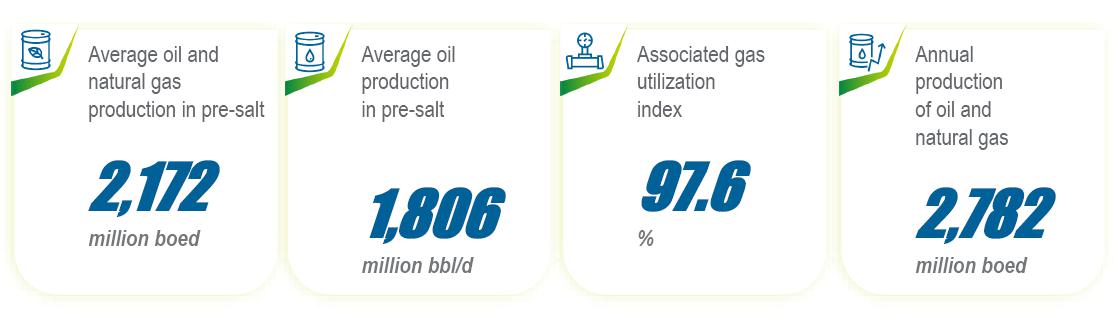
| Búzios field |
|
The Búzios field is a highly productive asset with substantial reserves of light oil, light oil, low lifting costs, and low emissions. It has demonstrated economic resilience even in a low oil price scenario. As of December 31, 2023, the Buzios field has achieved a total accumulated production of 837 million barrels of oil equivalent (mmboe) under the co-participation agreement. The composition of participation in the project is detailed in the "Our Business — Production — Shared reservoirs: deposits between different fields". Further below in this section, please refer to that box for information on the different partners' shares in Búzios. Currently, there are five operating units in Búzios. The fifth unit, FPSO Almirante Barroso, started production in May 2023 and achieved full production in record time, producing 150 thousand barrels of oil per day after five months. The sixth production system, FPSO Almirante Tamandaré, for the field, is expected to start production in 2025. Furthermore, during the period of 2021 and 2022, we have signed construction contracts for five platforms (P-78, P-79, P-80, P-82, and P-83), which will be owned by us. The production of these platforms is projected to commence in different years: P-78 in 2025, P-79 and P-80 in 2026, and P-82 and P-83 in 2027. In October 2023, the Búzios Shared Reservoir achieved a monthly production record of 653 thousand barrels of oil per day (mbbl/d), due to excellent operational performance.
|
For more information on our production of crude oil, natural gas, synthetic oil and synthetic gas by geographic area in 2023, 2022 and 2021, see Exhibit 15.3 to this annual report.
PETROBRAS | Annual Report and Form 20-F | 2023 | 84 |
| Table of Contents | |
| | Our Business |
Customers and Competitors
One of our most representative trades in terms of volume and profitability is crude oil. We sell oil through long-term and spot-market contracts, and in 2023, the crude oil volume committed through long-term contracts with quantity subject to final agreement on commercial terms was approximately 445 mbbl/d. Our domestic and overseas portfolio includes approximately 70 clients, such as refiners that process or have processed Brazilian oils regularly, distributed throughout the Americas, Europe and Asia, including China.
OIL CLIENTS (% vol)
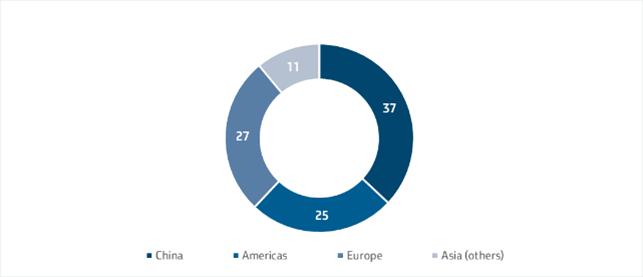
In 2023, we remain one of the most important exporters of low sulfur fuel oil in the world, even with an increased participation of the high-sulfur grade in our portfolio. Our fuel oil is available in the major hubs in the market such as Singapore, Arab Gulf, the Mediterranean and Northwest Europe, the west coast of Africa, Panama, Caribbean and China. Our counterparties list consists of major companies, trading companies and barging companies. We have sold fuel oil to approximately 30 different companies this year.
In the exploration and production industry, we deal with several competitors when we participate in bidding rounds conducted by the ANP.
PETROBRAS | Annual Report and Form 20-F | 2023 | 85 |
| Table of Contents | |
| | Our Business |
Reserves
| Preparation of reserves estimates |
|
We apply SEC rules for estimating and disclosing oil and natural gas reserve quantities included in this annual report. In accordance with rules, we estimate reserves by considering average prices calculated as the unweighted arithmetic average of the first-day-of-the-month price for each month within the 12-month period prior to the end of the reporting period. For the year ended in 2021, reserves volumes of non-traditional reserves such as synthetic oil and gas are also included in this annual report in accordance with SEC regulation. Since 2022, we no longer had these quantities due to the sale of Paraná Xisto S.A. We estimate reserves based on forecasts of field production, which depends on an array of technical information, such as seismic surveys, well logs and tests, rock and fluid samples, and geoscience, engineering and economic data. All reserve estimates involve some degree of uncertainty. The uncertainty depends primarily on the amount of reliable geological and engineering data available at the time of the estimate and the interpretation of that data. Our estimates are thus made using the most reliable data and technology available at the time of the estimate, in accordance with the best practices in the oil and gas industry and SEC rules and regulations. Thus, the reserve estimation process begins with an initial evaluation of our assets by geophysicists, geologists and engineers. Reserves managers responsible for the assets reserves of each business unit in Brazil and the corporate reserves team provide guidance for reserves estimates in compliance with SEC requirements to the asset teams. General managers responsible for the assets reserves of our business units in Brazil and executive officers of companies outside Brazil where we have interests are responsible for regional reserves estimates in compliance with SEC requirements. The corporate reserves team is responsible for consolidating our reserves estimates, standardized measures of discounted net cash flows related to proved oil and gas reserves, and other information related to proved oil and gas reserves. Our reserves estimates are approved by our Executive Officers, which then informs our Board of Directors about the approval. The technical person primarily responsible for overseeing our reserves' preparation is the corporate reserves team manager, who has 21 years of experience in the oil and gas industry and holds a bachelor's degree in civil engineering from Federal University of Juiz de Fora, a specialization in Petroleum Engineering from Petrobras University and a MBA in Oil and Gas Management from Fundação Getúlio Vargas. D&M conducted a reserves evaluation of 97.0% of our proved crude oil, condensate and natural gas reserves as of December 31, 2023 in Brazil. The amount of reserves reviewed by D&M corresponds to 96.5% of our total proved reserves company-wide on a equivalent barrel basis. For disclosure describing the qualification of D&M’s technical person primarily responsible for overseeing our reserves evaluation, see Exhibit 99.1 to this annual report. For a description of the risks relating to our reserves and our reserve estimates, see “Risks” in this annual report. Due to Brazilian regulation, we also estimate our oil and gas reserves pursuant to the ANP and the SPE definitions. The differences between the reserves estimated according to the ANP/SPE definitions and those estimated according to SEC regulation are mainly due to different economic assumptions and the possibility of considering as reserves the volumes expected to be produced beyond the concession contract expiration date in fields in Brazil according to ANP reserves regulation.
|
PETROBRAS | Annual Report and Form 20-F | 2023 | 86 |
| Table of Contents | |
| | Our Business |
We discover new areas through exploratory activity. Such areas constitute our fields after the declaration of commerciality. We then prepare a development plan for each field. As projects achieve adequate maturity, proved reserves may be reported.
Our fields’ proved reserves can be later increased with additional drilling, operational optimizations and improved recovery methods, such as water injection, among other activities.
Our proved oil, condensate and natural gas reserves as of December 31, 2023 were estimated at 10,921 million boe. This estimate includes reserves related to our interest in equity method investees, which represents 0.2% of our reserves.
PROVED RESERVES (1) (million boe)
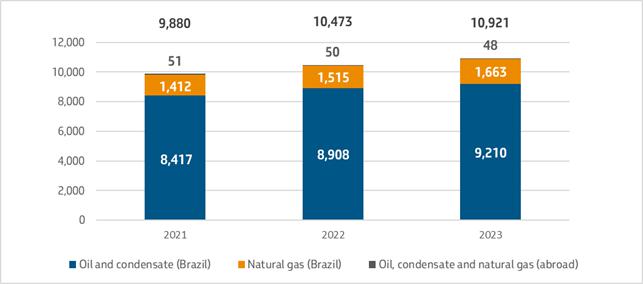
| (1) | Apparent differences in the sum of the numbers are due to rounding. |
Oil and gas reserves volumes change yearly. Quantities included in our previous year’s reserves that are produced during the year are no longer reserves at year-end. Other factors, such as reservoir performance, revisions in oil prices, discoveries, extensions, purchases and sales of assets that occurred during the year, also influence year-end reserves quantities.
PETROBRAS | Annual Report and Form 20-F | 2023 | 87 |
| Table of Contents | |
| | Our Business |
PROVED RESERVES (1) (million boe)
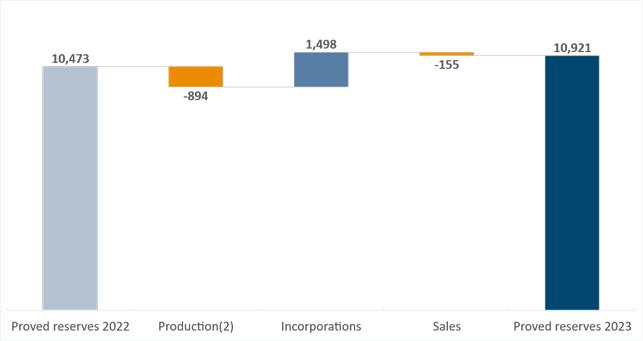
| (1) | Apparent differences in the sum of the numbers are due to rounding. |
| (2) | The 894 million boe production volume is the net volume withdrawn from our proved reserves. It therefore excludes NGL, as we estimate our oil and gas reserves at a reference point located prior to the gas processing plants, except for the United States of America and Argentina. The production does not include injected gas volumes, production of EWTs in exploratory blocks and production in Bolivia, since Bolivian reserves are not included in our reserves due to restrictions determined by Bolivian Constitution. |
In 2023, we incorporated 1,498 million boe of proved reserves, including the:
addition of 1,092 million boe, due to the good performance of assets, mainly in Búzios, Tupi and Atapu fields, in the Santos Basin;
addition of 237 million boe from discoveries and extensions, mainly due to the declaration of commerciality of Raia Manta and Raia Pintada fields (non-operated), in the Campos Basin; and
addition of 170 million boe from revisions, mainly due to new projects and other revisions.
We did not have relevant changes related to the variation in the oil price.
The additions in our proved reserves were partially offset by the reduction of 155 million boe, due to the asset sales.
PETROBRAS | Annual Report and Form 20-F | 2023 | 88 |
| Table of Contents | |
| | Our Business |
2023 RESERVES INDEXES
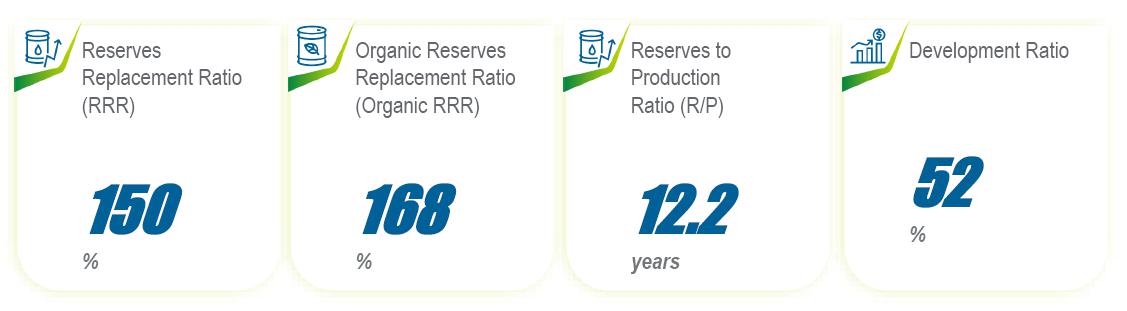
Proved Undeveloped Reserves
As of December 31, 2023, our proved undeveloped reserves were estimated at 5,194 million boe, a net decrease of 3% when compared to 2022 year-end.
In 2023, we incorporated 520 million boe of proved undeveloped reserves, including the:
addition of 235 million boe, due to discoveries and extensions, mainly the declaration of commerciality of Raia Manta and Raia Pintada fields, in the Campos Basin;
addition of 159 million boe due to the good performance of assets, mainly in the Santos Basin; and
addition of 126 million boe due to new projects and other revisions.
The additions in our proved undeveloped reserves were partially offset by:
the conversion of 629 million boe of proved undeveloped reserves to proved developed reserves, mainly as a result of the P-71 platform ramp up, the start-up of the FPSO Anna Nery in the Campos Basin, and the FPSO Almirante Barroso, in the Santos Basin; and
the reduction of 44 million boe, due to asset sales.
CHANGES IN PROVED UNDEVELOPED RESERVES (1) (million boe)
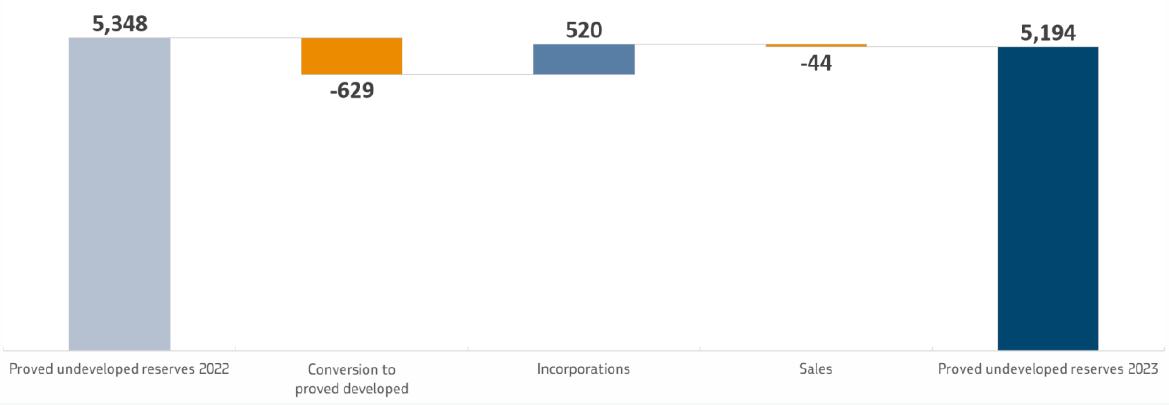
(1) Apparent differences in the sum of the numbers are due to rounding.
PETROBRAS | Annual Report and Form 20-F | 2023 | 89 |
| Table of Contents | |
| | Our Business |
As of December 31, 2023, 21% (1,080 million boe) of our proved undeveloped reserves have remained undeveloped for five years or more, mainly due to the inherent complexity of deep and ultra-deepwater development projects in giant fields, particularly in the Santos and Campos Basins, in which we are investing in the required infrastructure.
In 2023, we invested a total of US$11 billion in development projects, of which 99% was invested in Brazil.
Most of our investments relate to long-term development projects, which are developed in phases due to the large volumes and extensions involved, the deep and ultra-deepwater infrastructure and the production resources complexity. In these cases, the full development of the reserves related to these investments may exceed five years.
For further information on our reserves, see the unaudited section “Supplementary Information on Oil and Gas Exploration & Production” in our audited consolidated financial statements.
Oil and Gas Additional Information
The following tables show (i) the number of gross and net productive oil and natural gas wells and (ii) total gross and net developed and undeveloped oil and natural gas acreage in which we had interests as of December 31, 2023. A gross well or acre is a well or acre where we own a interest, while the number of net wells or acres is the sum of fractional interests in gross wells or acres. We do not have any material acreage expiring before 2025.
GROSS AND NET PRODUCTIVE WELLS
| As of December 31, 2023 | ||||
| Oil | Natural Gas | |||
| Gross | Net | Gross | Net | |
| Consolidated subsidiaries | ||||
| Brazil | 742 | 711 | 79 | 73 |
| South America (outside of Brazil) | 38 | 12.08 | 166 | 55.72 |
| Total consolidated | 780 | 723.08 | 245 | 128.72 |
| Equity method investees | ||||
| North America | 41 | 3.19 | 1 | 0.01 |
| Total equity method investees | 41 | 3.19 | 1 | 0.01 |
| TOTAL GROSS AND NET PRODUCTIVE WELLS | 821 | 726.99 | 246 | 128.73 |
PETROBRAS | Annual Report and Form 20-F | 2023 | 90 |
| Table of Contents | |
| | Our Business |
GROSS AND NET DEVELOPED AND UNDEVELOPED ACREAGE (in acres)
| As of December 31, 2023 | ||||
| Developed acreage | Undeveloped acreage | |||
| Gross | Net | Gross | Net | |
| Consolidated | ||||
| Brazil | 3,090,005 | 2,630,750 | 838,280 | 613,303 |
| South America (outside of Brazil) | 3,526 | 1,185 | 1,310 | 440.16 |
| Total consolidated | 3,093,531 | 2,631,935 | 839,590 | 613,743 |
| Equity method investees | ||||
| North America | 30,764 | 2,792 | 121,030 | 9,575 |
| Total equity method investees | 30,764 | 2,792 | 121,030 | 9,575 |
| TOTAL GROSS AND NET ACREAGE | 3,124,295 | 2,634,727 | 960,620 | 623,318 |
For “net” figures, we used our interest held on December 31, 2023. Gross and net developed and undeveloped acreage presented in this table does not include exploratory areas.
The following table sets forth the number of net productive and dry exploratory and development wells drilled in the last three years.
NET PRODUCTIVE AND DRY EXPLORATORY AND DEVELOPMENT WELLS
| 2023 | 2022 | 2021 | |
| Net productive exploratory wells drilled | |||
| Consolidated subsidiaries | |||
| Brazil | 1.80 | 1.90 | 3.40 |
| South America (outside of Brazil) | — | 0.78 | 0.32 |
| Total consolidated subsidiaries | 1.80 | 2.68 | 3.72 |
| Equity method investees | |||
| North America(1) | — | — | — |
| Total productive exploratory wells drilled | 1.80 | 2.68 | 3.72 |
| Net dry exploratory wells drilled | |||
| Consolidated subsidiaries | |||
| Brazil | — | 0.45 | 0.40 |
| South America (outside of Brazil) | — | — | — |
| Total consolidated subsidiaries | — | 0.45 | 0.40 |
| Equity method investees | |||
| North America(1) | — | — | — |
| Total dry exploratory wells drilled | — | 0.45 | 0.40 |
PETROBRAS | Annual Report and Form 20-F | 2023 | 91 |
| Table of Contents | |
| | Our Business |
| 2023 | 2022 | 2021 | |
| Total number of net exploratory wells drilled | 1.80 | 3.13 | 4.12 |
| Net productive development wells drilled | |||
| Consolidated subsidiaries | |||
| Brazil | 30.50 | 41.66 | 26.23 |
| South America (outside of Brazil) | 3.70 | 3.02 | 4.67 |
| Total consolidated subsidiaries | 34.20 | 44.68 | 30.90 |
| Equity method investees | |||
| North America(1) | 0.14 | 0.08 | 0.20 |
| Total productive development wells drilled | 34.34 | 44.76 | 31.10 |
| Net dry development wells drilled | |||
| Consolidated subsidiaries | |||
| Brazil | — | — | — |
| South America (outside of Brazil) | — | — | — |
| Total consolidated subsidiaries | — | — | — |
| Equity method investees | |||
| North America(1) | — | — | — |
| Total dry development wells drilled | — | — | — |
| TOTAL NUMBER OF NET DEVELOPMENT WELLS DRILLED | 34.34 | 44.76 | 31.10 |
| (1) | Due to the joint venture formed by Petrobras America Inc. and Murphy Exploration & Production Company, information regarding proved reserves, acreage and wells in the United States are reported in the “equity method investees” section. For “net” figures, we used the interest held as of December 31, 2023. |
The following table summarizes the number of wells in the process of being drilled as of December 31, 2023.
NUMBER OF WELLS BEING DRILLED AS OF DECEMBER 31, 2023
| Gross | Net | |
| Consolidated Subsidiaries | ||
| Brazil | 10 | 8.14 |
| International | ||
| South America (outside of Brazil) | 3 | 1.09 |
| North America | 1 | 0.05 |
| TOTAL WELLS DRILLING | 14 | 9.28 |
The following table sets forth our average sales prices and average production costs by geographic area of production and by product type for the last three years.
PETROBRAS | Annual Report and Form 20-F | 2023 | 92 |
| Table of Contents | |
| | Our Business |
AVERAGE SALES PRICES AND AVERAGE PRODUCTION COSTS (US$)
| South America | Total | ||
| Brazil | South America (outside of Brazil) | ||
| 2023 | |||
| Average sales prices | |||
| Oil and NGL, per barrel | 79.09 | 50.75 | 79.07 |
| Natural gas, per thousand cubic feet(1) | 11.37 | 3.46 | 10.92 |
| Synthetic oil, per barrel | - | - | - |
| Synthetic gas, per thousand cubic feet | - | - | - |
| Average production costs, per barrel – total(2) | 5.17 | 5.24 | 5.17 |
| 2022 | |||
| Average sales prices | |||
| Oil and NGL, per barrel | 95.91 | 51.38 | 95.88 |
| Natural gas, per thousand cubic feet(1) | 11.54 | 4.27 | 11.24 |
| Synthetic oil, per barrel | 87.76 | - | 87.76 |
| Synthetic gas, per thousand cubic feet | 8.80 | - | 8.80 |
| Average production costs, per barrel – total(2) | 5.68 | 6.33 | 5.68 |
| 2021 | |||
| Average sales prices | |||
| Oil and NGL, per barrel | 67.48 | 34.43 | 67.45 |
| Natural gas, per thousand cubic feet(1) | 7.61 | 3.21 | 7.43 |
| Synthetic oil, per barrel | 57.46 | - | 57.46 |
| Synthetic gas, per thousand cubic feet | 5.20 | - | 5.20 |
| Average production costs, per barrel – total(2) | 3.66 | 5.05 | 3.68 |
| (1) | The volumes of natural gas used in the calculation of this table are the production volumes of natural gas available for sale and are also shown in the production table above. Natural gas amounts were converted from bbl to cubic feet in accordance with the following scale: one bbl = six cubic feet. |
| (2) | Production costs, net of production taxes, divided per volume produced. |
For more information about our capitalized exploration costs, see Note 27 to our audited consolidated financial statements and the unaudited supplementary information on oil and gas exploration and production contained therein.
PETROBRAS | Annual Report and Form 20-F | 2023 | 93 |
| Table of Contents | |
| | Our Business |
Refining, Transportation & Marketing
We processed 69% of all our oil production, which includes oil and LNG and excludes Natural Gasoline (C5+), in our refineries. In 2023, we produced 1,772 mbbl/d of oil products, from the processing of Brazilian oil (90% of feedstock) and imported oil (10% of feedstock). We traded these oil products both in Brazil and abroad.
Furthermore, we operate in the petrochemical sector with interests in companies and in the fertilizer sector with plants in Brazil.
Overview
We own and operate 10 refineries in Brazil, with a total net crude distillation capacity of 1,813 mbbl/d. This represents 84% of all refining capacity in Brazil, according to the 2023 statistical yearbook published by the ANP. Until June 2023, we also owned and operated Guamaré Industrial Asset (“AIG”) refinery with a capacity of 38 mbbl/d. The sale of the AIG refinery was completed on June 8, 2023. Most of our refineries are located near our crude oil pipelines, storage facilities, refined product pipelines, and major petrochemical facilities, easing access to crude oil supplies and end-users.
We also operate a large and complex infrastructure of pipelines and terminals, and a shipping fleet to transport oil products and crude oil to Brazilian and global markets. We operate 37 of our own terminals through our wholly-owned subsidiary Petrobras Transporte S.A. (“Transpetro”), and we have contracts for the use of some of the storage capacity of 19 third-party terminals and Transpetro operates nine other third-party terminals.
PETROBRAS | Annual Report and Form 20-F | 2023 | 94 |
| Table of Contents | |
| | Our Business |
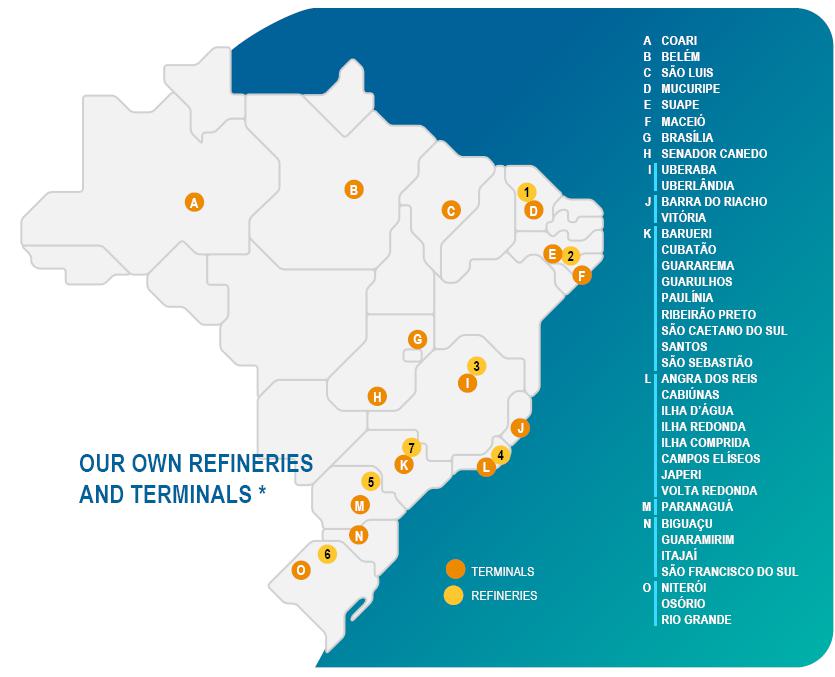
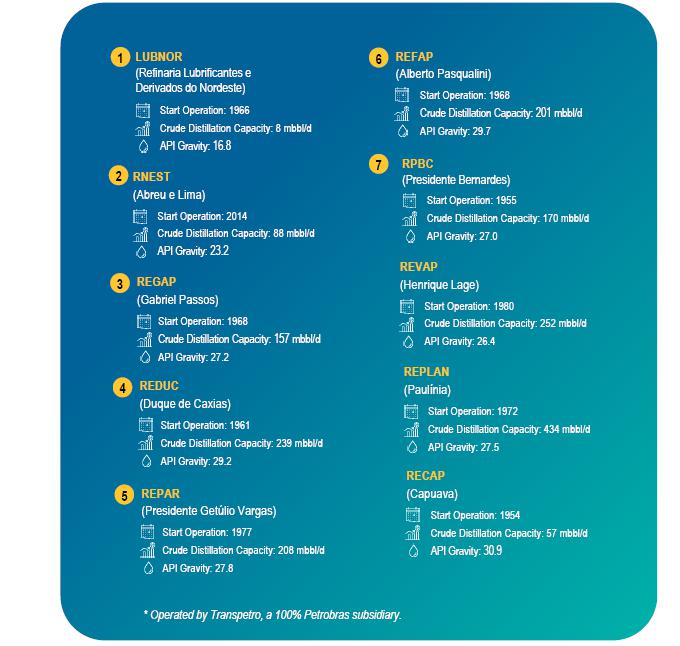
PETROBRAS | Annual Report and Form 20-F | 2023 | 95 |
| Table of Contents | |
| | Our Business |
In 2019, we signed a commitment with CADE related to the divestment of our refining assets in Brazil (REMAN, LUBNOR, RNEST, RLAM, REGAP, REPAR and REFAP) and a shale industrialization unit (SIX). As of December 31, 2023, we had already divested from the RLAM and REMAN refineries and the shale unit SIX.
However, given the new strategic direction presented in the 2024-2028+ Strategic Plan, on November 28, 2023 we formally requested a review of the agreement signed with CADE. At the time of filing this report, negotiations with CADE were still in progress.
In 2023, we concluded the sale of our interest in the Potiguar Cluster, which includes, among its assets, the AIG (Former RPCC).
In November 2023, we terminated the agreement signed in 2022 with Grepar Participações Ltda. for the sale of our shares in a new company that would be formed by LUBNOR and its associated logistics due to non-compliance with conditions precedent in the agreement.
For more information on our agreement with CADE regarding our divestments in refining assets, see “Risks – Risk Factors – 6.b”.
For more information on the progress of our divestments, see “Portfolio Management” in this annual report.
For more information on our 2024-2028+ Strategic Plan, see “Strategic Plan – 2024-2028+ Strategic Plan” in this annual report.
PETROBRAS | Annual Report and Form 20-F | 2023 | 96 |
| Table of Contents | |
| | Our Business |
| Main Assets |
| 2023 | 2022 | 2021 | |||
| Transport and storage | |||||
| Pipelines (km) | 7,768 | 7,768 | 7,719 | ||
| Own | 6,928 | 6,928(1) | 6,812 | ||
| Third parties(2) | 840 | 840(1) | 907 | ||
| Vessel fleet (owned and chartered) | 109 | 110 | 123 | ||
| Own | 26 | 26 | 26 | ||
| Chartered | 83 | 84 | 97 | ||
| Terminals | 65 | 65 | 59 | ||
| Own | 37 | 38 | 40 | ||
| Third parties(3) | 28 | 27 | 19 | ||
| Refining | |||||
| Refineries | 10 | 11 | 12 | ||
| Brazil | 10 | 11 | 12 | ||
| Abroad | - | - | - | ||
| Nominal installed capacity (mbbl/d) | 1,813 | 1,851 | 1,897 | ||
| Brazil | 1,813 | 1,851 | 1,897 | ||
| Abroad | - | - | - | ||
(1) |
The 2022 figures accounted for the expected divestment of OCAB (a 67 km duct connecting Barra do Furado Station to the Cabiúnas Terminal), which did not materialize. The values, encompassing both own and third-party assets, were adjusted according to current parameters. |
||||
(2) |
Third party pipelines that have existing Transpetro transport contracts. |
||||
(3) |
Third party terminals that have existing contracts for the use of the storage service, including nine terminals operated by Transpetro. |
||||
|
| |||||
| RefTOP - World Class Refining program |
|
With the objective of being among the best oil refining companies in the world, since 2021 we have had a specific program for this purpose, known as RefTOP Program. RefTOP consists of a set of initiatives that seek to improve reliability, productivity, operational and energy performance. In 2023, following the revision of our refining portfolio strategy, the Program has expanded to all refineries. In 2023, the utilization factor in our refineries was 92%, the highest yearly utilization since 2014. We have been focusing on analytics solutions, consistently promoting the integration of maintenance, inspection, engineering, and operation systems, allowing for more accurate diagnoses, less time for decision-making and reduction of equipment failures through the prediction of anomalous behavior. We keep implementing new projects and OPEX opportunities to increase energy efficiency, which are leading to a consistent reduction in GHG emissions intensity, energy intensity, flaring emissions, and natural gas consumption. The GHG emissions intensity has fallen from 37.9 kgCO2e/CWT in 2022 to 36.8 kgCO2e/CWT in 2023, considering all refineries. This GHG intensity reduction corresponds to a natural gas consumption decrease of 490,000 m³/day (while maintaining production levels). This achievement was due to the RefTOP initiatives. We expect to invest approximately US$1.1 billion in all refineries up to 2030.
|
PETROBRAS | Annual Report and Form 20-F | 2023 | 97 |
| Table of Contents | |
| | Our Business |
Refining
We serve our oil products clients in Brazil through a coordinated combination of oil processing, importing and exporting that according to our commercial strategy seeks to optimize our margins, considering different opportunity costs of domestic and imported oil, oil products in the different markets, as well as the costs of related transport, storage and processing.
In 2023, we processed 1,696 mbbl/d of oil in our 10 refineries. The following graphs show the processed feedstock and the performance of our refineries.
PROCESSED FEEDSTOCK (mbbl/d)
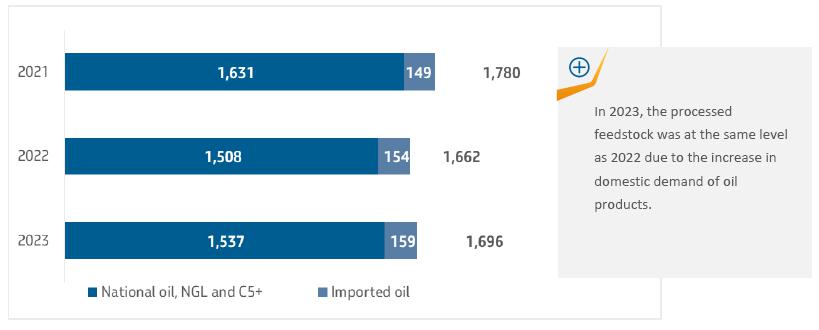
Over the past 14 years, we have made substantial investments in our existing refineries to increase our capacity to economically process heavier Brazilian crude oil, improve the quality of our oil products to meet stricter regulatory standards, modernize our refineries, and reduce the environmental impact of our refining operations.
One such investment is the implementation of a new diesel hydrotreatment unit at the Paulínia Refinery (“REPLAN”), currently in the process of contracting and assembling equipment and installations.
With this project, REPLAN will be able to produce 100% ultra-low sulfur diesel (ULSD or S-10) and increase the production of jet fuel, aiming to meet the specification and quantities demanded by the future market, in an economic way, with operational safety and lower impacts to the environment.
The new diesel hydrotreatment unit will have a production capacity of 63 mbbl/d of S-10 and is scheduled to start operation in 2025, in line with the Strategic Plan.
The following table sets out the performance of our refineries.
PETROBRAS | Annual Report and Form 20-F | 2023 | 98 |
| Table of Contents | |
| | Our Business |
PERFORMANCE OF REFINERIES
| Crude distillation capacity (mbbl/d) | Nelson Complexity Index | Average throughput(1) (mbbl/d) | Operational availability (%) | Total Utilization rate(2) (%) | |||||||
| Refinery | 2023 | 2023 | 2023 | 2022 | 2021 | 2023 | 2022 | 2021 | 2023 | 2022 | 2021 |
| LUBNOR | 8 | 3.5 | 9 | 8 | 8 | 97.7 | 97.6 | 97.8 | 107.8 | 106.7 | 94.5 |
| RECAP | 57 | 6.8 | 56 | 58 | 54 | 97.6 | 97.0 | 96.4 | 98.8 | 102.9 | 95.5 |
| REDUC | 239 | 15.4 | 221 | 205 | 186 | 91.5 | 96.0 | 96.4 | 93.7 | 86.8 | 79.0 |
| REFAP | 201 | 6.0 | 143 | 155 | 145 | 94.2 | 92.9 | 95.8 | 74.7 | 82.0 | 75.5 |
| REGAP | 157 | 7.9 | 146 | 146 | 134 | 97.6 | 97.3 | 96.5 | 95.1 | 94.7 | 87.4 |
| REMAN | — | — | — | 28(3) | 30 | — | 98.0 | 98.0 | — | 67.3 | 66.2 |
| REPAR | 208 | 7.8 | 201 | 157 | 181 | 97.8 | 97.0 | 97.7 | 98.2 | 77.9 | 87.8 |
| REPLAN | 434 | 6.9 | 398 | 376 | 355 | 97.8 | 97.5 | 96.8 | 92.5 | 87.3 | 82.5 |
| REVAP | 252 | 8.6 | 235 | 227 | 227 | 96.5 | 96.9 | 96.8 | 93.7 | 91.6 | 92.1 |
| RLAM | — | — | — | — | 179(4) | — | — | 95.1 | — | — | 72.1 |
| RPBC | 170 | 10.2 | 155 | 173 | 149 | 95,3 | 96.9 | 95.3 | 92.0 | 102.7 | 88.2 |
| AIG (Former RPCC) | — | — | 11 | 24 | 29 | — | — | — | 68.7 | 63.7 | — |
| RNEST | 88 | 10.7 | 74 | 61 | 63 | 93 | 84.9 | 92.2 | 95.1 | 83.0 | 78.9 |
| Average crude oil throughput | — | — | 1,649 | 1,619 | 1,740 | — | — | — | — | — | — |
| Average NGL throughput | — | — | 47 | 43 | 40 | — | — | — | — | — | — |
| Average throughput | — | — | 1,696 | 1,662 | 1,780 | — | — | — | — | — | — |
| Crude Distillation capacity | 1,813 | — | — | — | — | — | — | — | — | — | — |
| (1) | Includes oil and NGL processing (fresh feedstock). |
| (2) | Total utilization rate includes the entire load in the distillation units, consisting of oil, C5 + and reprocessing (of oil and other products). |
| (3) | Average until November 2022. |
| (4) | Average until November 2021. |
PETROBRAS | Annual Report and Form 20-F | 2023 | 99 |
| Table of Contents | |
| | Our Business |
MAIN PRODUCTS, MARKETS AND STORAGE CAPACITY OF OUR REFINERIES
| Storage capacity (mbbl) | ||||
| Refinery | Main products | Main markets in Brazil | Crude oil | Oil products |
| LUBNOR | Asphalt (49%); Fuel Oil (33%); Lubricants (12%); Diesel (5%) | Lubricant Oil – sold to distributors and marketed nationwide; Asphalts – states in Northern and Northeastern Brazil and Minas Gerais | 0.3 | 0.4 |
| RECAP | Diesel (42%); Gasoline (30%); LPG (8%) | Part of the São Paulo metro region and petrochemical plants | 0.6 | 1.7 |
| REDUC | Diesel (24%); Gasoline (15%); Fuel Oil (22%); LPG (9%); Jet Fuel (7%); Naphtha (10%) | Rio de Janeiro, São Paulo, Espírito Santo, Minas Gerais, Bahia, Ceará, Paraná, Rio Grande do Sul | 5.9 | 11.0 |
| REFAP | Diesel (49%); Gasoline (26%); Naphtha (5%); LPG (8%) | Rio Grande do Sul, part of Santa Catarina and Paraná, in addition to other states by means of coastal shipping | 3.1 | 5.7 |
| REGAP | Diesel (45%); Gasoline (26%); Jet Fuel (6%); LPG (7%) | Currently supplies the state of Minas Gerais and, occasionally, the state of Espírito Santo. It can also expand its reach to the Rio de Janeiro market | 2.0 | 5.4 |
| REPAR | Diesel (46%); Gasoline (27%); LPG (8%) | Paraná, Santa Catarina, Southern São Paulo and Mato Grosso do Sul | 3.3 | 5.8 |
| REPLAN | Diesel (44%); Gasoline (24%); LPG (7%); Jet Fuel (4%) | Countryside of the state of São Paulo, Mato Grosso, Mato Grosso do Sul, Rondônia and Acre, Southern Minas Gerais and the so-called “Triângulo Mineiro”, Goiás, Brasília, and Tocantins | 5.6 | 11.4 |
| REVAP | Diesel (28%); Gasoline (24%); Naphtha (7%); Jet Fuel (14%); Fuel Oil (13%) | Paraíba Valley, the northern coast of the state of São Paulo, southern Minas Gerais, the São Paulo metro region, Midwestern Brazil and Southern Rio de Janeiro. It supplies 80% of the demand for jet fuel in the São Paulo state market and 100% of the Guarulhos International Airport | 4.8 | 10.5 |
| RPBC | Diesel (48%); Gasoline (27%); Fuel Oil (11%); LPG (5%) | Most products are intended for São Paulo’s capital. A portion is also shipped to Santos and to the Northern, Northeastern, and Southern Brazilian regions | 2.6 | 7.1 |
| AIG (1) (Former RPCC) | Fuel Oil (81%); Diesel (10%); Jet Fuel (9%) | Rio Grande do Norte and southern Ceará | 0.12 | 0.12 |
| RNEST | Diesel (59%); Naphtha (14%); Coke (8%); Fuel Oil (15%) | North and Northeast of Brazil | (2) | 5.6 |
| (1) | AIG was divested on June 8, 2023. |
| (2) | Crude oil is supplied directly to RNEST’s tank farms of 4.2 mbbl, with no external crude oil storage. |
PETROBRAS | Annual Report and Form 20-F | 2023 | 100 |
| Table of Contents | |
| | Our Business |
With respect to oil products, we produced 1,772 mbbl/d of oil products in 2023, as shown in the following graphic:
OIL PRODUCTS PRODUCTION (mbbl/d)
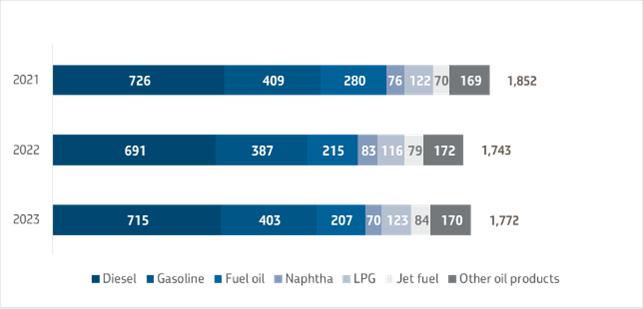
In 2023, compared to 2022, there was an increase in the production of diesel (+3.5%), gasoline (+3.9%), jet fuel (+6.3%) and asphalt (+9.9%), due to growth in domestic demand, associated with the reduction in the volume of naphtha (-15.7%) and fuel oil (-3.7%) produced in the same period. This result is supported by high performance in refineries availability, reliability and profitability.
In 2023, we achieved the annual record in Diesel S-10 production, increased by 10.9% from 2022.
PETROBRAS | Annual Report and Form 20-F | 2023 | 101 |
| Table of Contents | |
| | Our Business |
| Ongoing undertakings |
|
GASLUB Following our current strategy, the GASLUB Cluster, previously known as COMPERJ, located in Itaboraí, state of Rio de Janeiro, is being renovated. New solutions are being evaluated, such as a new refining area, a natural gas process plant and a themoeletric power plant. The basic engineering design of the new scope for the GASLUB refining area is nearing completion. This scope considers integration with REDUC refinery and consists of a catalytic hydrocracking, hydrotreating and hydroisodewaxing plant to produce Group II base lube oils which comprise a new generation of lube oils with higher viscosity indexes, improved oxidation stability and better overall performance compared to Group I base oils. The units will be able to produce high-quality fuels as well, and additional investments included in our Strategic Plan, along integration with REDUC, will increase S-10 production by 76 mbbl/d. For this scope, construction is expected to be contracted at the end of 2024. Furthermore, a study was initiated to evaluate the implementation of a dedicated plant to process renewable feedstocks (vegetable oils and animal fat) and to produce advanced fuels such as biojet SAF and/or HVO applying the Hydroprocessed Esters and Fatty Acids technology and also petrochemical products. For the natural gas processing plant, a new construction, management and commissioning contract was signed in March 2023, which will finalize construction and commissioning of the plant. GASLUB Cluster was fully connected to the power grid in December 2023. The UPGN is expected to begin commercial operations in the second half of 2024. The gas-fired thermoelectric plant is still under study, and its conceptual design has been completed and further planning steps are in progress.
RNEST RNEST (Refinery Abreu e Lima) started its operations in 2014 with the first set of units (Train I), making it the newest and most modern of our refineries. The refinery is located in the Northeast region of Brazil, and this location defines the plant as our main hub in the North-Northeast of the country. RNEST is the main project for capacity expansion, with an expected increase in ultra-low sulfur diesel (“ULSD” or “S-10”) production capacity of 94 mbbl/d. This increase in oil products output capacity further strengthens our competitive advantage in the optimized use of our refining system. The main projects for expanding capacity and improving the quality of oil products at RNEST include the revamp of Train 1, implementation of Train 2, and the SNOX’ project completion. The SNOX project will enable the processing of heavier crude oils, leading to a potential reduction in feedstock costs and thereby to an improvement in margin. The SNOX project and the revamp of Train 1 are under construction, while the Train 2 of RNEST is currently in the tender process, and it is scheduled to start operation by 2028. Other ULSD Projects With respect to the expansion of production capacity of ULSD, in addition to the new hydrotreatment unit at the REPLAN, with an additional production capacity of 63 mbbl/d of ULSD, we also have another investment at REVAP, which has focused on modifications to an existing diesel hydrotreating unit (“U-272D”) in order to improve the S-10 production in 41 mbbl/d, meeting market specifications and environmental requirements. This project is expected to start in 2026.
|
PETROBRAS | Annual Report and Form 20-F | 2023 | 102 |
| Table of Contents | |
| | Our Business |
Logistics
Oil and oil products logistics connect the oil production systems to refineries and markets seeking to maximize the value of oil refining operations and the commercialization of oil and oil products in Brazil and abroad through an integrated system of logistics planning, sales, and operations and assets, as depicted below.

We directly manage some assets of this system, while we contract others with our wholly owned subsidiary Transpetro.
Transpetro is a logistics company that performs operations for storing and handling oil and its derivates, ethanol, gas, and biofuels for the supply of Brazilian industries, thermoelectric plants and oil refineries, including import and export activities.
The terminals and pipelines operation is an important link in our supply chain. The oil is transported from the production fields to Transpetro terminals by pipeline or ship. From there, it is transported to refineries or for export. After refining, the oil products are drained through pipelines to the terminals to be delivered to fuel distribution companies, which supply the Brazilian and global markets. This operation covers a 7,768 km pipeline network and 46 terminals, of which 25 are marine and are 21 onshore1. Transpetro operates terminals owned by Petrobras and third parties, with a total nominal storage capacity of 10.73 million m3. In 2023, Transpetro handled 650.3 million m3 of oil, oil products and biofuels, totaling 6,069 operations with tankers and oil barges.
We move oil and oil products, whether by cabotage or long haul navigation, in response to the demands of our customers. The fleet operated by Transpetro comprises 35 vessels (26 of which Transpetro owns and nine of which we contract through the subsidiary Transpetro International BV), and this operating fleet has an average age of nine years. The transport capacity of this fleet is 3.4 million deadweight tons. In 2023, this fleet handled around 55 million m3 of oil and oil products, about 26% of the cargo handled by Petrobras by sea.
1 It considers the operation of Transbel, a fully-owned subsidiary of Transpetro, established due to the obligation of auctioning public port area.
PETROBRAS | Annual Report and Form 20-F | 2023 | 103 |
| Table of Contents | |
| | Our Business |
In addition, we operate 74 ships chartered directly by Petrobras from third parties. This operation has the capacity to transport 5.3 million deadweight tons and, in 2023, handled 215.8 million m3.
THROUGHPUT OF TERMINALS AND PIPELINES (million m3)
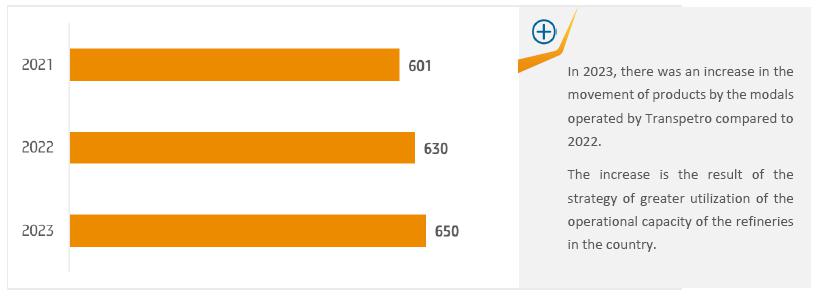
We are constantly looking for excellence in the integrity of our assets and operational efficiency.
The operational efficiency of Transpetro’s fleet, represented by the Operational Availability Index (which calculates the proportion of time the vessel was operationally ready, excluding the time spent in dry dock), was 99% in 2023 as compared to 98.9% in 2022. The increase in this index in 2023 ensured the company's best result in the last six years. This is mainly due to our teams' engagement with operational discipline and the significant improvement of planned and predictive maintenance.
Fuel theft in onshore pipelines
The engagement between Petrobras and Transpetro in 2023 remains a determining factor for considerable advancement in combating fuel theft actions in our pipeline network, also known as illegal tapping. This partnership resulted in actions that ensured our commitment to life, the environment, and operational safety.
In 2023, we strengthened our relationship with Brazil's public security forces, tightened ties with neighboring communities in our pipeline networks, expanding awareness and social projects, and invested in the improvement of technological tools, aimed at greater effectiveness in preventing illegal tapping.
These actions enabled, over the last year, a reduction of 52% in the number of cases compared to the previous year, dropping from 58 occurrences in 2022 to 28 occurrences in 2023. We also reduced the number of occurrences in urban areas, minimizing risks to the surrounding population.
Finally, the achievements denoted by the results confirm the reduction of risk associated with illegal tapping.
PETROBRAS | Annual Report and Form 20-F | 2023 | 104 |
| Table of Contents | |
| | Our Business |
OWN TERMINALS
| Location | Terminal | Type | Nominal capacity (m³) |
| Alagoas | Maceió | Marine | 58,266 |
| Amazonas | Coari | Marine | 86,147 |
| Ceará | Mucuripe | Marine | N/A (1) |
| Espírito Santo | Barra do Riacho Vitória |
Marine Marine |
107,834 10,710 |
| Distrito Federal | Brasília | Onshore | 72,308 |
| Goiás | Senador Canedo | Onshore | 127,778 |
| Maranhão | São Luís | Marine | 78,897 |
| Minas Gerais | Uberaba Uberlândia |
Onshore Onshore |
54,812 45,812 |
| Pará | Belém | Marine | 48,187 |
| Pernambuco | Suape | Marine | 108,560 |
| Paraná | Paranaguá | Marine | 204,567 |
| Rio de Janeiro |
Ilha d’ Água Ilha Redonda Ilha Comprida Cabiúnas |
Marine Marine Marine Onshore |
179,173 547,284 75,484 42,773 37,650 25,502 |
| Rio Grande do Sul |
Niterói Osório |
Marine Marine |
21,189 101,422 842,394 |
| Santa Catarina | Biguaçu Itajaí Guaramirim São Francisco do Sul |
Onshore Onshore Onshore Marine |
36,214 56,482 18,644 473,166 |
| São Paulo | Santos São Sebastião Barueri Cubatão Guararema Guarulhos Paulínia Ribeirão Preto São Caetano do Sul |
Marine Marine Onshore Onshore Onshore Onshore Onshore Onshore Onshore |
388,873 2,057,493 206,461 161,102 1,026,935 164,181 274,608 50,886 227,308 |
| TOTAL | 37 | – | 9,513,723 |
| (1) | The terminal only pumps product. There is no product tank on this site. |
PETROBRAS | Annual Report and Form 20-F | 2023 | 105 |
| Table of Contents | |
| | Our Business |
Marketing


PETROBRAS | Annual Report and Form 20-F | 2023 | 106 |
| Table of Contents | |
| | Our Business |
SALES VOLUMES OF OIL PRODUCTS TO BRAZILIAN MARKET, PER PRODUCT AND TOTAL IN THE YEAR (mbbl/d)
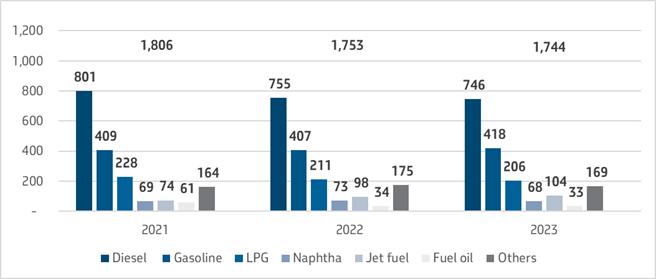
| Diesel |
|
Diesel is a medium petroleum distillate used as fuel in vehicles with compression-ignites internal combustion engines (diesel cycle engines). It is used mostly for cargo and passenger’s road transport (80%) and in the agriculture sector (10%). All diesel sold to end users in Brazil must be blended with biodiesel. In April 2023, the mandatory level of biodiesel in the fuel increased from 10% to 12%, as decided by the National Energy Policy Council (“CNPE”). The decrease in diesel oil sales in 2023 was mainly associated with the divestment of the REMAN refinery concluded on November 30, 2022, and the increase in the mandatory biodiesel blend content in April 2023.
In the third quarter of 2023, we reached a record for low-sulfur S-10 diesel sales with low-sulfur S-10 sales representing 62% of the total diesel sales. In 2023, S-10 diesel sales represented 62% of our diesel sales, surpassing the 59% achieved in 2022.
The record share of S-10 Diesel as it relates to total diesel sales reflects the commercial and operational actions that we have implemented in order to meet the Brazilian domestic demand for the product with lower sulfur content, replacing the S-500 Diesel.
|
| Gasoline |
|
Gasoline is a light petroleum distillate used in vehicles with spark-ignites internal combustion engines (Otto cycle engines). Refineries in Brazil produce a distillate called “gasoline A,” which must be blended with 27% of anhydrous ethanol (current mandate) by distributors and then sold to end users as “gasoline C” at gas stations. Its main competitors are hydrated ethanol (sold directly by producers to distributors, who resell it on gas stations) and CNG (sold by gas distributors directly to gas stations). In 2023, the “gasoline A” sold by us represented around 43% of the total Brazilian Cycle-Otto market. The main factors for the sales growth were the increase in the total Brazilian Cycle-Otto demand, and the increase of gasoline’s share in the total consumption due to its greater competitiveness compared to hydrated ethanol for most of the year.
|
| LPG |
|
The LPG is a light distillate composed by propane and butane. It is used as fuel for heating appliances such as cooking equipment, rural heating and water boilers, among others. In Brazil, around 70% of LPG is sold by distributors bottled in cylinders of up to 13 kg and primarily used for residential cooking and its demand is directly driven by population growth and real income growth. On the other hand, consumption is inversely correlated with local temperatures and the efficiency rate of cooking equipment. The remaining LPG demand 30% comes mainly from industrial and services sectors, whose demand is driven by economic growth. The drop in LPG sales in 2023 was mainly associated with the divestment of the REMAN refinery concluded on November 30, 2022, the higher temperatures registered in Brazil this year, and the participation of other suppliers through the Natural Gas Integrated Processing System (“SIP”). |
| Naphtha |
|
Naphtha is a light petroleum distillate that is mainly used as raw material for the Petrochemical sector. This product is sold to three existing petrochemical plants in Brazil, which produce commodity chemicals such as ethylene, propylene, butadiene and aromatics (benzene, toluene, xylenes). The drop in naphtha sales in 2023 was mainly associated with the decrease in Braskem’s consumption, especially at the São Paulo site. |
PETROBRAS | Annual Report and Form 20-F | 2023 | 107 |
| Table of Contents | |
| | Our Business |
| Jet Fuel |
|
Jet-fuel is a medium petroleum distillate used as aviation fuel in aircrafts powered by gas-turbine engines. It is used by all commercial aviation companies (passengers and cargo transportation), which represents 90% of total Brazilian demand. Regarding commercial aviation, prior to the COVID-19 pandemic, domestic flights comprised up to 60% of Brazilian jet-fuel demand, and the remaining 40% of jet-fuel demand came from international flights. Due to international travel restrictions, domestic flights were responsible for up to 80% of Brazilian jet-fuel demand during the pandemic. In 2023, we saw a return to the historical share. Jet-fuel demand is strongly correlated with GDP growth, as it directly affects the demand for travel – business and leisure. The main factor behind the rise of sales in 2023 was the recovery of the aviation industry post COVID-19, especially in the domestic segment, despite the divestment of the REMAN refinery. |
| Fuel Oil |
|
Fuel oil is a residual fraction of the petroleum distillation. It is used in industrial (mostly non-ferrous metallurgy companies) and electricity generation sectors (thermoelectric plants). The demand for fuel oil for industrial consumption depends mostly on GDP growth and on the natural gas availability (its main competing product). The fuel oil thermoelectric plants participate marginally in the country’s energy supply, entering into operation only when the water level in reservoirs are very low. In 2023, industrial use of fuel oil represented around 99% of demand, while the use in power generation represented only 1%. In 2023, the main factor for the sales shrinkage was the decrease in industrial consumption. |
Besides oil and oil products, we also trade natural gas, nitrogen fertilizers, renewables and other products.
BRAZILIAN SALES VOLUMES AND EXPORTS (mbbl/d)
| 2023 | 2022 | 2021 | |
| Total oil products | 1,744 | 1,753 | 1,806 |
| Natural gas | 226 | 305 | 352 |
| Crude oil | 181 | 202 | 24 |
| Ethanol, nitrogen fertilizers, renewables and other products | 4 | 3 | 4 |
| Total Brazilian market | 2,155 | 2,263 | 2,186 |
| Exports(1) | 806 | 714 | 811 |
| TOTAL BRAZILIAN MARKET AND EXPORTS | 2,961 | 2,977 | 2,997 |
| (1) | Mainly includes crude oil and oil products. |
PETROBRAS | Annual Report and Form 20-F | 2023 | 108 |
| Table of Contents | |
| | Our Business |
| Oil products prices |
|
Crude oil is a commodity, the value of which depends on its quality, usually based on its API gravity and sulfur content. Traditionally, lighter crude oils have greater added value than heavier ones, given that they can generate higher value products. Lower sulfur content crudes tend to have more market values compared to higher sulfur ones with similar yields. Recently, however, heavy crudes have shown a strong market value due to the possibility of high margin production when these crudes are processed in refineries with more complex hardware. Different refineries assign different values to the same crude oil, depending on their conversion capacity and the value of the products they intend to produce to supply their specific markets. Refineries can process a variety of crude oils, which brings flexibility to process different grades. Crude oils are globally traded and their prices are usually referenced on international quotations, such as WTI, Brent or Dubai. Depending on factors such as quality, offer, demand, size lot, trading conditions and logistics costs to make a crude oil cargo available at a certain delivery point, a premium or a discount can be negotiated between buyer and seller. Refined oil products are commodities and their prices in different regions of the global market are driven by the local balance between supply and demand, crude oil prices and crack spread. Crack spread refers to the overall pricing difference between a barrel of crude and the oil products refined from it. It is an industry-specific type of gross processing margin. “Crack” is a term used in the oil industry that represents the ability of a crude to produce different products such as gases like propane and butane; light distillates like naphtha and gasoline; middle distillates like kerosene, gas oils and diesel fuels; and heavy distillates like heavy fuel oil and asphalt. Typically, a crack is defined in terms of one specific product versus one specific crude. For example, the diesel crack on Brent indicates how much the price of the individual product is contributing to the refining profitability. The price of a barrel of crude oil and the various prices of the products refined from it are not always in perfect synchronization. Depending on seasonality and global inventories, among other factors, the supply and demand for any particular oil product may result in pricing changes that can impact the profit margins on a barrel of crude oil for the refiner. As oil products are traded globally and can be transported between markets, prices around the world tend to fluctuate subject to local conditions. Currently, as a result of the ongoing military conflict between Russia and Ukraine and the recent escalation of tensions involving Israel in the Gaza Strip, benchmark prices for oil, oil products, natural gas and LNG remain extremely volatile. We cannot predict the extent to which these conflicts will impact on our business. These events also affect oil flows and related markets. An example is the change in exports of oil supplied by Russia being diverted to China and India, limiting the demand from these markets for other suppliers. Our current positioning on pricing in Brazil takes into account domestic market conditions and seeks to align the price of oil products with international prices while avoiding the immediate transfer of volatility of international quotations and the exchange rate caused by conjunctural issues. Since 2022, we have followed our Guideline for Price Formation in the Domestic Market (“Guideline”), approved by our Board of Directors, in line with its objective of continuously improving our governance. The Guideline reiterates the Executive Board's competence in executing pricing policies, preserving and prioritizing our financial result and seeking to maximize its value creation. Furthermore, the Guideline incorporates an additional layer of supervision of the execution of the pricing policies by the Board of Directors and the Fiscal Council, based on the Executive Board's quarterly report, formalizing an already existing practice.
|
PETROBRAS | Annual Report and Form 20-F | 2023 | 109 |
| Table of Contents | |
| | Our Business |
|
Diesel and Gasoline In May 15, 2023, our Executive Board approved a new commercial strategy to define our diesel and gasoline prices, replacing the former pricing policy. The commercial strategy considers market references such as: (a) the customer's alternative cost, as a value to be prioritized in pricing, and (b) our marginal value. The customer's alternative cost refers to the cost of the main supply alternatives, whether the same or substitute products, and the marginal value is based on the opportunity cost given the various alternatives for the company, among them, production, imports and exports of the product and/or the oils used in refining. The commercial strategy is premised on competitive prices per sales hub, in balance with the national and international markets, taking into account the best alternative accessible to customers. This strategy allows us to compete more efficiently, taking into account our market share, to optimize its refining assets, and to obtain profitability on a sustainable basis. Price readjustments will continue to be made without a defined periodicity, avoiding the transfer to domestic prices of the cyclical volatility of international prices and of the exchange rate to domestic prices. The commercial strategy is aligned with the Guideline approved by the Board of Directors on July 27, 2022. During 2023, we announced adjustments to selling prices at refineries, resulting in a price decrease of 8.7% for gasoline and a decrease of 22.5% for diesel, when comparing prices in place on December 31, 2023 with those effective as of December 31, 2022.
LPG LPG prices in the Brazilian market are defined taking into account the balance with the international prices and the level of market share, in the residential and industrial/commercial LPG segments. According to our pricing policy, price adjustments are made without defined periodicity, according to market conditions and analysis of internal and external environments. During 2023, we announced adjustments to selling prices at refineries, resulting in price decreases of 24.7% for LPG, when comparing prices in place on December 31, 2023 with those effective as of December 31, 2022.
|
Imports, Exports, and International Sales
Our import and export of crude and oil products are driven by economic factors involving our domestic refining, the Brazilian demand levels and international prices. Most of the crude oil we produce in Brazil is classified as medium API gravity. We import some light crude oil to balance the slate for our refineries, and export mainly medium crude oil from our production in Brazil. In addition, we continue to import oil products in order to balance any shortfall between production from our Brazilian refineries and the market demand for each product.
In 2023, net exports increased by 164 mbbl/d, reaching 485 mbbl/d. This increase resulted mainly from higher exports of oil and gasoline and lower imports of oil and diesel.
PETROBRAS | Annual Report and Form 20-F | 2023 | 110 |
| Table of Contents | |
| | Our Business |
EXPORTS AND IMPORTS OF CRUDE OIL AND OIL PRODUCTS (mbbl/d)
| 2023 | 2022 | 2021 | |
| Exports | |||
| Crude oil | 594 | 513 | 575 |
| Fuel oil | 161 | 181 | 197 |
| Other oil products | 51 | 20 | 39 |
| Total exports | 806 | 714 | 811 |
| Imports | |||
| Crude oil | 156 | 164 | 154 |
| Diesel | 63 | 118 | 118 |
| Gasoline | 39 | 25 | 20 |
| Other oil products | 63 | 86 | 75 |
| Total imports | 321 | 393 | 367 |
Our crude oil, oil products and LNG trading activities aim to meet our internal demands or potential businesses opportunities identified by our commercial teams, seeking to optimize the buying and selling operations in the Brazilian and global markets, as well as offshore operations.
The international trading teams are based in the major global commercial hubs of oil and oil products, such as Houston, Singapore, Buenos Aires and Rotterdam and are comprised of crude oil and product traders, LNG, shipping and support operators.
For more information on our oil and oil products clients, see “Exploration & Production – Customers and Competitors” and “Refining, Transportation & Marketing – Customers and Competitors” in this annual report.
Distribution
We sell our oil products to several distribution companies in Brazil.
In 2021, we exited the distribution sector in Brazil, when we completed the sale of our interest in Vibra.
Despite this sale, we remain the owner of the main brands used by Vibra, including those that identify service stations, fuel, loyalty program, aviation segments and certification program, among others.
A 10-year trademark license agreement is in place and grants Vibra a non-exclusive, paid, temporary license on certain trademarks we own, including but not limited to “Petrobras,” “Petrobras Podium,” “Petrobras Premmia,” “De Olho no Combustível,” “BR Aviation” and “Petrobras Grid.” The contract expires in June 2029 and must comply with the established debranding obligations.
Under the terms of this agreement, the license is granted exclusively to the service station and aviation segments, for which Vibra shall exclusively use the brands licensed by us. Meanwhile, during the term of the trademark license agreement, we undertake to refrain from operating in the service stations sector across the Brazilian territory. The definition of a “service station” under this agreement is any facility where oil and gas products and services and/or services related to any other energy sources (renewable or otherwise) intended to power automotive vehicles and watercrafts are offered to the Business-to-Consumer (or B2C) public, including convenience stores.
PETROBRAS | Annual Report and Form 20-F | 2023 | 111 |
| Table of Contents | |
| | Our Business |
We also participate in the retail sector in other South American countries, as follows:
Colombia: Our operations through Petrobras Colombia Combustibles S.A. (PECOCO) include 121 service stations and a lubricant plant with a production capacity of 54,000 m3/year. PECOCO is in Petrobras divestment portfolio;
Chile: Following the sale of our distribution operations in Chile, which was concluded in January 2017, we entered into a brand licensing agreement in that country, for the initial term of eight years. To operate our acquired assets in Chile, Southern Cross created Esmax, a company that operates as our licensee in the fuel distribution segment; and
Paraguay: Following the sale of our distribution operations in Paraguay, which was concluded in 2019, we entered into a brand licensing agreement in Paraguay for the exclusive use of our brands, for the initial term of five years. The parties have approved an extension of the contract term through 2026.
For more information of the divestment process, see “Portfolio Management” in this annual report.
Customers and Competitors
We interact with approximately 462 clients in Brazil, in regard to liquid and solid products, seven of which account for 66% of the total volume sold.
LIQUID AND SOLID OIL PRODUCTS CLIENTS (% vol)

The sale of oil products to distribution companies is done by contracts executed in accordance with ANP regulations.
We offer a virtual commercial platform, called Canal Cliente to Brazilian market companies. The platform works 24 hours a day, seven days a week. Through this online platform, clients can place orders for products, schedule withdrawals and track the entire business process up to the payment phase.
According to information provided by the ANP, we have a dominant participation in the Brazilian market for refining. We own and operate 10 refineries in Brazil.
PETROBRAS | Annual Report and Form 20-F | 2023 | 112 |
| Table of Contents | |
| | Our Business |
With respect to the trading of oil products in the Brazilian market, we face competition from importers, formulators, other domestic producers and Petrochemical plants. In 2023, our participation in diesel and gasoline markets decreased compared to the previous year, mainly due to the divestment of REMAN and to the increase of the mandatory biodiesel blend from 10% to 12% in April 2023.
Other Activities
Petrochemicals
We engage in the Petrochemical sector through the following companies:
OUR SHAREHOLDING IN PETROCHEMICAL COMPANIES IN BRAZIL AND THEIR MAIN PRODUCTS
| Company/Main products | Location | Nominal capacity (mmt/y) | Our shareholding | Other shareholding |
| Braskem | ||||
| Ethylene | Brazil | 3.95 | 36.15% | Novonor (38.32%); |
| Polyethylene | Brazil | 3.06 | Others (25.53%) | |
| Mexico | 1.05 | |||
| Polypropylene | Brazil | 1.85 | ||
| USA | 2.02 | |||
| Germany | 0.63 | |||
| METANOR S.A./COPENOR S.A.(1) | ||||
| Formaldehyde |
Brazil |
0.09 |
34.34% |
Dexxos Participações (45.47%); |
| Hexamine | 0.01 | Others (19.99%) | ||
| Fábrica Carioca de Catalisadores S.A. | ||||
| Catalysts | Brazil | 0.04 | 50.00% | Albemarle (50.00%) |
| Additives | 0.01 | |||
| PETROCOQUE S.A. | ||||
| Calcined petroleum coke | Brazil | 0.55 | 50.00% | Universal Empreendimentos e Participações Ltda (50.00%) |
(1) Copernor S.A. is a subsidiary of Metanor S.A.
In December 2022, we announced the beginning of the binding phase of the sale of all of our shares in Metanor, but in 2024, we decided to cancel the divestment process.
In May 2023, we received a letter regarding the non-binding proposal for the acquisition of Novonor S.A.'s interest in Braskem. The information was forwarded to us due to the fact that we are Braskem's second largest shareholder and a party to the shareholders' agreement. In July 2023, we started the due diligence process, according to the rules provided for in the Braskem Shareholders Agreement signed between Petrobras and Novonor S.A., for the potential exercise of tag along or preemptive rights, in the event of sale of Braskem’s shares owned by Novonor S.A.
PETROBRAS | Annual Report and Form 20-F | 2023 | 113 |
| Table of Contents | |
| | Our Business |
Fertilizers
We have three fertilizer plants in Brazil, one located in the state of Bahia (“FAFEN-BA”), one in the state of Sergipe (“FAFEN-SE”), and one through our subsidiary located in Paraná, Araucaria Nitrogenados S.A. (“ANSA”). Their main products are ammonia and urea. Together these plants have an installed capacity of 1.852 million t/year of urea, 1.406 million t/y of ammonia, 319,000 t/y of ammonium sulfate and 800,000 t/y of ARLA-32.
We also have an unfinished Nitrogen Fertilizer Unit (UFN-III) in Mato Grosso do Sul. The construction of UFN-III began in September 2011, but was halted in December 2014, with about 81% of the physical construction completed. Between 2020 and 2022, the unit was subject to an unsuccessful sale process.
Since 2020, after being mothballed in 2019, our plants located in Bahia and Sergipe have been operating under a lease agreement with Proquigel Química S.A. (“Proquigel Química”), a company of the Unigel Group for an initial term of 10 years, which may be extended for an additional 10 years.
ANSA has been mothballed since January 2020. Since September 2020, we had worked on the divestment process. In December 2022, we announced the cancellation of the competitive process for the sale of all our shares in ANSA.
In May 2023, our Board of Directors approved the revision of the strategic elements for the 2024-2028+ Strategic Plan, with our new vision to be the best diversified and integrated energy company, including the fertilizer and Petrochemical segments. Since then, we began studying joint ventures involving opportunities in the areas of fertilizers, green hydrogen and low-carbon projects.
In June 2023, we signed a non-disclosure agreement with Unigel Participações S.A. (Unigel) to analyze joint business involving opportunity development in the areas of fertilizers, green hydrogen and low-carbon projects. Additionally, in 2023 we started studies for the restart of fertilizer production on ANSA, as well as the resumption of the UFN-III Project.
On December 29, 2023, Petrobras signed a contract with Unigel Participações S.A. for custom industrialization (tolling) for the production of nitrogen fertilizers in plants located in the States of Sergipe and Bahia.
On February 28 2024, Petrobras announced a signing of a non-binding Memorandum of Understanding (MoU) with Yara Brasil Fertilizantes S.A. (Yara) to study potential business partnerships for local initiatives in the fertilizer segment, production of industrial products and decarbonization of production.
Petrobras thus reinforces its commitment to leading the transformation and driving a sustainable, fair and safe energy transition.
For more information on our new vision and strategies, see “2024-2028+ Strategic Plan” in this annual report.
PETROBRAS | Annual Report and Form 20-F | 2023 | 114 |
| Table of Contents | |
| | Our Business |
Gas & Low Carbon Energies
Overview
We process gas produced in our oil fields in our UPGNs that have the capacity to treat 93.9 million m3/d of natural gas in Brazil. We market this natural gas, along with gas imported from Bolivia and LNG acquired in the global market, to several consumers and to the thermoelectric plants.
We also operate in the power generation through thermal power plants fired by natural gas and diesel oil and in the commercialization of electric energy.
| Main Assets |
| 2023 | 2022 | 2021 | |||
| Natural gas | |||||
| Gas pipelines in Brazil (km) | 2,643 | 2,643 | 2,643(1) | ||
| Processing Units (2) | 13 | 15 | 17 | ||
| Brazil (2) | 10 | 12 | 14 | ||
| Bolivia | 3 | 3 | 3 | ||
| Processing capacity (million m3/day) | 138 | 143 (3) | 149 | ||
| Brazil | 94 | 99 | 105 | ||
| Bolivia | 44 | 44 | 44 | ||
| Regasification terminals | 3(4) | 3(3) | 3 | ||
| Regasification capacity (million m3/day) | 47 | 47 | 47 | ||
| Power | |||||
| Number of thermal power plants | 14 | 14 | 14(5) | ||
| Installed capacity (thousand MWh) | 5.3 | 5.3 | 5.4 | ||
|
|
(1) |
In April 2021, we concluded the sale of our remaining 10% interest in NTS, which has 2,043 km of pipelines. |
|
|
|
(2) |
In 2023, UPGN RPBC authorization was canceled by ANP due to its continued inactivity for 2 years. |
|
|
|
(3) |
The terminal (TR-BA) was leased to Excelerate Energy Comercializadora de Gás Natural Ltda until December 31, 2023. |
|
|
|
(4) |
PECEM's operation contract was valid until December 31, 2023, when it terminated. |
|
|
|
(5) |
In 2021, the count included Alto do Rodrigues which is a solar generation unit. |
|
PETROBRAS | Annual Report and Form 20-F | 2023 | 115 |
| Table of Contents | |
| | Our Business |
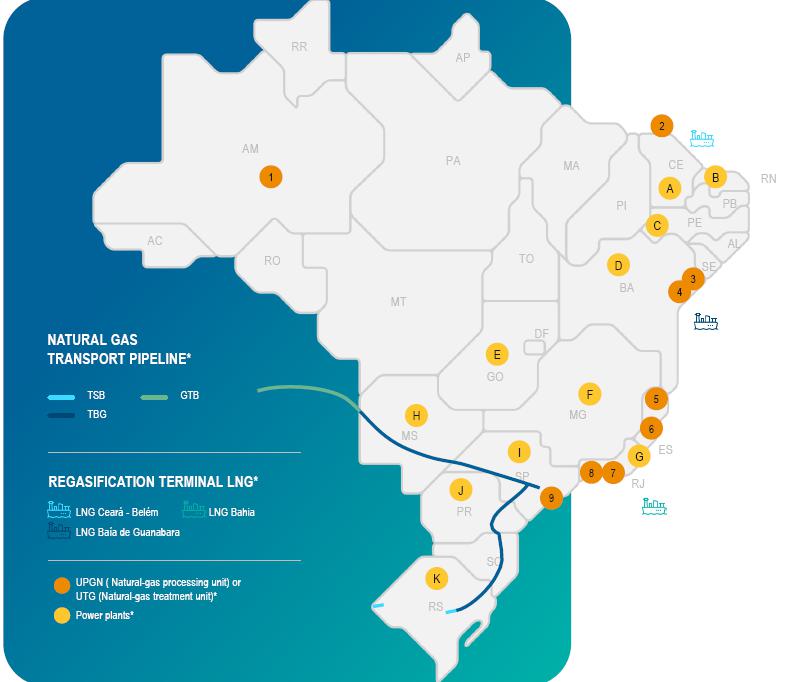
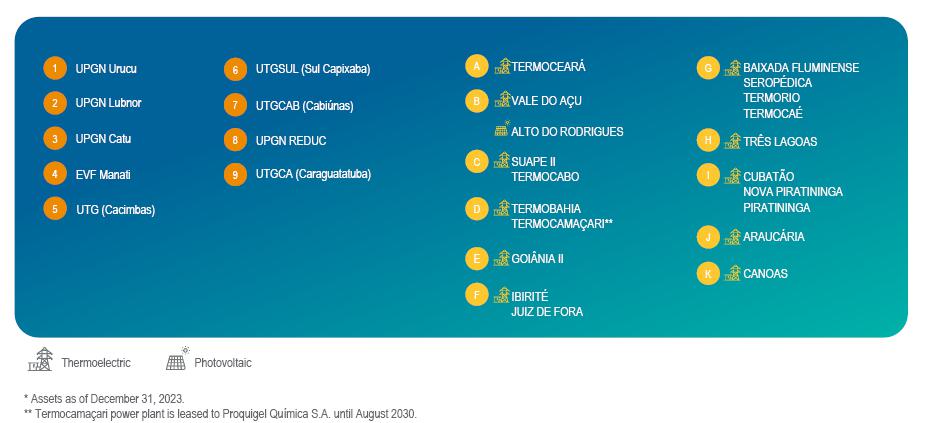
PETROBRAS | Annual Report and Form 20-F | 2023 | 116 |
| Table of Contents | |
| | Our Business |
Natural Gas
Our Gas & Low Carbon Energies segment is comprised of, among other things, gas processing, transportation, LNG regasification (Bahia and Rio de Janeiro states), gas-fired and oil-fueled power generation. The Ceará LNG regasification terminal contract was valid until December 31, 2023, when it terminated.
The Gas & Low Carbon Energies segment strategy is to act in a competitive and integrated manner in the operation and commercialization of gas and energy, optimize the portfolio and increase the insertion on renewable sources.
Processing of Natural Gas
Natural gas from our Exploration & Production segment needs to be processed in processing units, to be transformed into marketable products. These products serve as fuel and raw material for different uses, such as transportation, industrial and residential uses, as well as in the fertilizer industry and thermoelectric power generation.
Our UPGNs are located in the states of Amazonas, Ceará, Rio Grande do Norte, Bahia, Espírito Santo, Rio de Janeiro and São Paulo in Brazil as well as in Bolivia, where we have the capacity to process natural gas in its gaseous and condensed forms.
PROCESSING CAPACITY AND PRODUCTION OF OUR UPGNS IN BRAZIL (1)(2)
| 2023 | 2022 | 2021 | |||||||||
| Location | 2023 Processing capacity | Unprocessed natural gas | Processed natural gas | LPG | Unprocessed natural gas | Processed natural gas | LPG | Unprocessed natural gas | Processed natural gas | LPG | |
| (million m³/d) | (million m³/d) | (million m³/d) | (thousand t/d) | (million m³/d) | (million m³/d) | (thousand t/d) | (million m³/d) | (million m³/d) | (thousand t/d) | ||
| UTGCAB | Rio de Janeiro | 24.6 | 21.39 | 15.07 | 0.90 | 21.06 | 14.11 | 0.82 | 21.65 | 15.55 | 0.86 |
| UTGCA | São Paulo | 20.0 | 12.16 | 11.46 | 0.99 | 13.27 | 12.62 | 0.97 | 11.17 | 10.64 | 0.72 |
| UTGC | Espírito Santo | 18.1 | 2.74 | 2.42 | 0.34 | 2.04 | 1.83 | 0.24 | 3.29 | 2.97 | 0.44 |
| UTGSUL | Espírito Santo | 2.5 | 0.06 | 0.05 | - | 0.11 | 0.09 | - | 0.31 | 0.26 | – |
| UPGN REDUC | Rio de Janeiro | 2.5 | 1.11 | 1.05 | 0.23 | 1.12 | 0.49 | 0.04 | 1.19 | 0.90 | 0.02 |
| UPGN LUBNOR | Ceará | 0.35 | 0 | 0 | 0 | 0 | 0 | 0 | - | – | – |
| UPGN URUCU | Amazonas | 12.2 | 12.15 | 11.44 | 0.93 | 11.79 | 11.08 | 11.79 | 11.08 | 10.81 | 1.08 |
| UPGN GUAMARÉ(3) | Rio Grande do Norte | 5.7 | 0.30 | 0.28 | 0.05 | 0.77 | 0.70 | 0.77 | 0.70 | 0.63 | 0.1 |
| UPGN CATU | Bahia | 2.0 | 1.60 | 1.35 | 0.00 | 1.35 | 1.12 | 0.00 | 1.16 | 0.95 | 0.00 |
| EVF MANATI | Bahia | 6.0 | 1.67 | – | – | 2.47 | – | – | 3.12 | – | – |
| TOTAL | — | 93.95 | 53.18 | 43.12 | 3.44 | 54.08 | 42.14 | 3.15 | 55.30 | 43.81 | 3.18 |
(1) We concluded the sale of UPGN Pilar in February 2022.
(2) The UPGN Atalaia was mothballed in 2020.
(3) We concluded the sale of UPGN Guamaré in June 2023, part of Potiguar Cluster.
PETROBRAS | Annual Report and Form 20-F | 2023 | 117 |
| Table of Contents | |
| | Our Business |
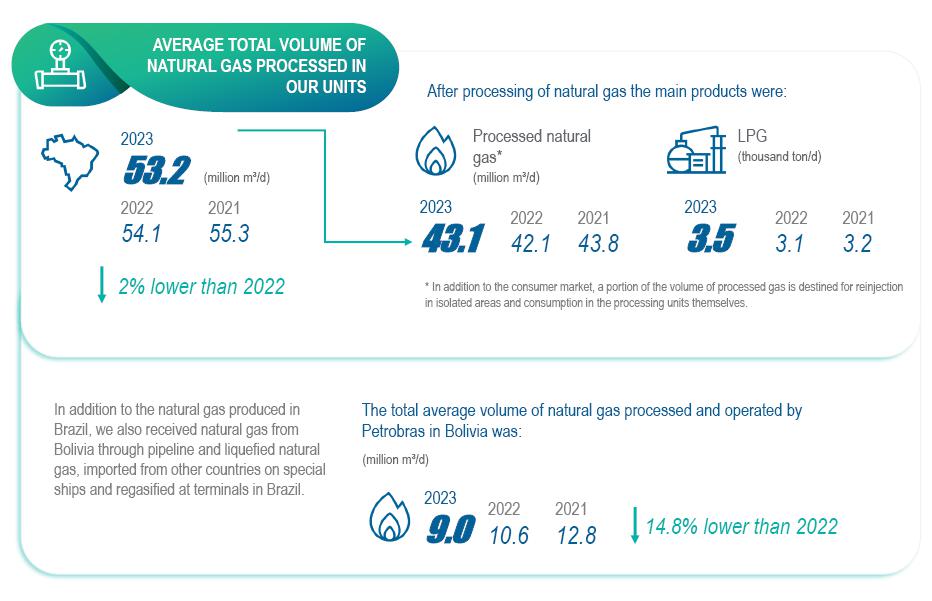
Logistics
We use a pipeline system to transport natural gas from processing plants, regasification terminals and the border with Bolivia, to the local distributors, free consumers, as well as for the internal consumption of our units. Brazil has an integrated pipeline system centered around two main interlinked pipeline networks, a gas pipeline connection with Bolivia and an isolated pipeline in the northern region of Brazil (all together spanning over 9,190 km).
OUR SHARE IN GAS TRANSPORTATION COMPANIES IN BRAZIL
| Company | Gas pipeline extension (km) | Our shareholding | Other shareholders |
| Transportadora Brasileira Gasoduto Bolívia Brasil S.A. (“TBG”) | 2,593 | 51% | BBPP Holdings Ltda. (29%) YPFB Transporte do Brasil Holding Ltda. (19.88%) Corumbá Holding S.À.R.L. (0.12%) |
| Transportadora Sulbrasileira de Gás S.A. (“TSB”) | 50 | 25% | Ipiranga Produtos de Petróleo S.A. (25%), Repsol Exploração Brasil (25%) and Total Gas and Power Brazil (25%) |
| TOTAL | 2,643 | — | — |
In addition, outside Brazil we hold an 11% interest in GTB, which is responsible for the Bolivian side of the Bolivia-Brazil gas pipeline, measuring 557 km.
PETROBRAS | Annual Report and Form 20-F | 2023 | 118 |
| Table of Contents | |
| | Our Business |
| Gas from Pre-Salt |
|
In order to derive natural gas from our production of the Santos Basin pre-salt pole, in addition to using part of the existing infrastructure, we invested in the construction of subsea pipelines (routes) integrated with the processing units, which seek to optimize the use of natural gas. We have invested in the following flow routes: ROUTE 1 AND GASMEX: The 381 km pipeline consists of two stretches: Route 1, which is the stretch connecting the Tupi Platform to the Mexilhão Platform, with capacity to flow up to 10 million m3/d, and GASMEX, which is the stretch connecting the Mexilhão platform to the Monteiro Lobato Gas Treatment Unit (“UTGCA”), in the city of Caraguatatuba in the state of São Paulo, with capacity to flow up to 20 million m3/d of gas produced in the Santos Basin pre-salt. GASMEX is 100% owned by Petrobras, and we own 65% of Route 1, Shell owns 25% and Petrogal owns the remaining 10%. |
PETROBRAS | Annual Report and Form 20-F | 2023 | 119 |
| Table of Contents | |
| | Our Business |
|
ROUTE 2: The 401 km pipeline links the Santos Basin pre-salt to the Cabiúnas Gas Treatment Unit (“UTGCAB”) processing asset, in the city of Macaé in the state of Rio de Janeiro. It had an initial authorized capacity to flow up to 13 million m3/d, which then increased to 16 million m3/d. In July 2019, ANP authorized the pipeline to operate with 20 million m3/d. We own 65% of Route 2 Tupi-NE-Cernambi, Shell owns 25% and Petrogal owns the remaining 10%. We own 55% of Route 2 Cernambi-TECAB, Shell owns 25%, Petrogal owns 10%, and Repsol owns the remaining 10%.
ROUTE 3: This 355 km gas pipeline connects the Santos Basin pre-salt to the Itaboraí Gas Treatment Unit processing asset, in the city of Itaboraí in the state of Rio de Janeiro, with a capacity of up to 18 million m3/d. 307 km of the pipeline is offshore, and the other 48 km is onshore. The natural gas processing plant will have two units with a total processing capacity of 21 million m3/d of natural gas, increasing the supply of natural gas, LPG, and Natural Gasoline (C5+) to the market. The construction of the Route 3 gas pipeline was successfully completed. However, it is not yet in operation, as it is awaiting the conclusion of the processing plant to allow the flow of gas foreseen by that route, which is scheduled to begin operations in 2024. We own 100% of Route 3. Recently installed and upcoming units in the Santos Basin pre-salt will be progressively connected to Route 2 and to Route 3. All projects will be able to flow through any of the three flow routes when the system is fully implemented.
|
Marketing and Sales
The total volume of natural gas we delivered in 2023 was 50.2 million m3/d. The volume of our natural gas consumption by industrial, gas-fired electric power generation, commercial and retail customers was 38.6 million m3/d, representing a decrease of approximately 14% compared to 2022. This decrease is mainly attributable to lower thermoelectric dispatch, lower non-thermoelectric demand, as well as the ongoing opening of the natural gas market.
In 2023, the consumption of natural gas by our refineries was 10.8 million m3/d which was the same level as in 2022.
Below we present our sources and consumption in 2023:
PETROBRAS | Annual Report and Form 20-F | 2023 | 120 |
| Table of Contents | |
| | Our Business |
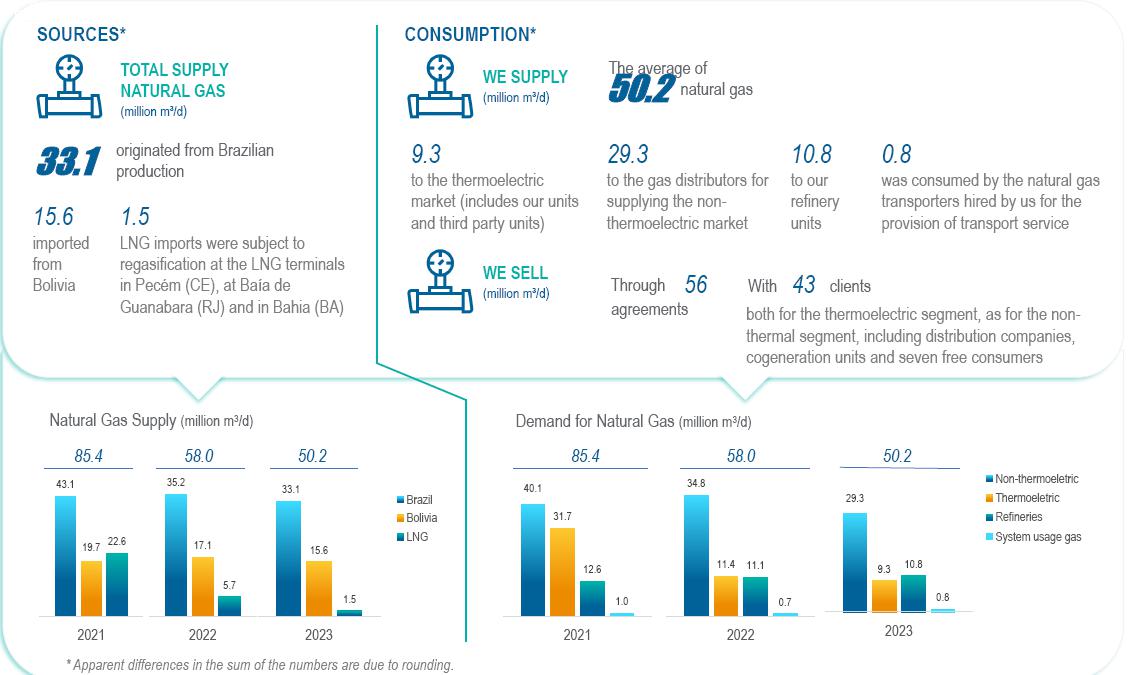
Gas & Energy + Program
In July 2019, we signed an agreement with CADE to increase competition in the natural gas industry in Brazil, which among other matters included the sale of shareholdings in gas transportation and distribution companies. Due to a more open market, in 2020 we started the GAS+ Program, an internal set of actions which aims to increase our competitiveness in the natural gas segment. In 2021, Law No. 14,134, known as the New Gas Law that set the basis for a profound reform of the Brazilian Gas Market was promulgated. As a result of the agreement with CADE and the New Gas Law, according to information provided by the ANP, in 2023 around 14 new players became holders of about 24% of the non-thermoelectric Brazilian natural gas market.
Given the new strategic direction presented in 2024-2028+ Strategic Plan, on November 28, 2023 we formally requested a review of the agreement signed with CADE. At the time of filing this report, negotiations with CADE were still in progress.
For more information on our agreement with CADE, see “Risks – Risk Factors – 6.b.”.
For more information on the progress of our divestments, see “Portfolio Management” in this annual report.
In 2023, the GAS+ Program was renamed as Gas & Energy + Program (also called “Gas and power plus Program” and “G&E+”), reinforcing actions aimed at the gas business and including actions focused on the energy business. There was also the separation of the High Performance Assets Front, which became part of the Asset Management System.
The G&E+ aims to prepare us to act competitively in the natural gas open market. This program focus is on offering the best customer relationship experience and developing and delivering products with commercial conditions adherent to the customers needs, to achieve the established market share and profitability goals. It includes initiatives such as the launch of new commercial products, new forms of customer relationships, and digital tools (such as digital contracts and sales through automated platforms), as well as actions in the field of regulation and new business models (such as alignment of regulatory procedures for the review of the Unit Variable Cost (UVC) thermal and LNG market).
PETROBRAS | Annual Report and Form 20-F | 2023 | 121 |
| Table of Contents | |
| | Our Business |
Throughout 2023, several G&E+ initiatives were implemented. The development of these initiatives is monitored periodically, at different levels of management, following the established project management structure. The main achievements for 2023 are highlighted below:
| – | Recontracting our natural gas portfolio; |
| – | Implementation of the new Customer Relationship Management platform (Evoluir Project); |
| – | Development of appropriate processes and tools for the new market (Commercialization Planning/Transport Contracting); |
| – | Expansion of sales in the Natural Gas free environment; and |
| – | Implementation of new digital solutions for operational optimization (G&E Competitive Project). |
Natural gas sales contracts and long-term gas purchase and transportation commitments
We sell our gas primarily to local gas distribution companies, free consumers and gas-powered plants, generally based on standard take-or-pay, long-term supply contracts. Free consumers are consumers that, if eligible, can freely negotiate their natural gas purchases from multiple suppliers instead of buying directly from a single distribution company. The price formulas under these contracts are mostly aligned with Brent oil prices, LNG price markers (Henry Hub and Japan Korea Marker) and the U.S. dollar. They were negotiated under the new gas law.
In 2023, we offered customers new products with flexible conditions, so that they can build their own portfolio:
| – | Inclusion of Henry Hub, a gas-to-gas indexer, in addition to the Brent indexer; |
| – | Diversified contractual terms, ranging from 4 to 11 years; |
| – | Possibility of starting supply in 2024 or 2026; and |
| – | Two location options for delivering natural gas: (a) at the hub in which Petrobras is responsible for contracting the entry into the transport system and the customer is responsible for contracting the exit or (b) at the delivery point (city-gate) in which Petrobras is responsible for contracting the entry and exit of transport. |
In addition to this diversification, our commercial conditions seek to make the competitive environment and the market opening process more dynamic by enabling, among others, the reduction of volumes contracted by distributors in the event of migration of volumes from captive customers to the free environment. As result, new contracts were signed with 12 distributing companies, totalizing 21 MMm³/d of contracted quantity to 2024. The total estimated value of contracts signed is US$ 35 billion (according to the exchange rate as of December 31, 2023), valid until 2034. The total commitment of natural gas contracts is 30.5 million m³/day with local distribution companies, including contracts signed in previous years.
In an effort to extinguish the legal controversies involving our major clients, the company successfully negotiated an agreement with Companhia Distribuidora de Gás do Rio de Janeiro and CEG RIO S/A ending the judiciary turmoil and signing a ten year supply commitment that totaled approximately US$10 billion in contracts value.
It is also worth highlighting the agreement that ended the legal dispute with the Sergipe Gás S/A, a major achievement that helped bringing economic and legal stability to the Brazilian northeast commercial environment.
When we started building the GASBOL in 1996, we entered into a GSA with the Bolivian state-owned company YPFB to purchase certain minimum volumes of natural gas, which were based on an average delivery or pay of 30 mmm3/day, at prices linked to the global fuel oil price.
The supply of gas under the GSA began on July 1, 1999. Adjustments to the contractual balance volumes agreed upon since December 31, 2023 preview a potential extension of the term of the contract until December 2027, if delivery or pay conditions are met, or September 2030, if take-or-pay withdraw volumes are taken into account. The main commitment adjustments were the Addendum 11, celebrated in August 2022, and Addendum 12, celebrated in December 2023, resulting from the negotiation to adjust the GSA to the declining production of Bolivian natural gas.
PETROBRAS | Annual Report and Form 20-F | 2023 | 122 |
| Table of Contents | |
| | Our Business |
Regarding transport contracts, we have signed agreements with (i) GTB, which operates the transmission network in Bolivia, connecting Bolivian gas production to the Brazilian border, and (ii) TBG, TAG, and NTS, which operate the Brazilian transmission network. The contracts have different durations, some of which are long-term. Since 2019, the market opening process has started with public auctions for contracting capacity in TBG's transport network taking into consideration the reduction of Petrobras, commitments in that system.
The table below shows the potential effect of the contractual commitments under the above agreements for the five-year period from 2024 through 2028.
PETROBRAS | Annual Report and Form 20-F | 2023 | 123 |
| Table of Contents | |
| | Our Business |
FUTURE COMMITMENTS UNDER NATURAL GAS SALES CONTRACTS (1)
| 2024 | 2025 | 2026 | 2027 | 2028 | |
| To non thermoelectric clients | |||||
| Related parties (mmm3/d) (2) (3) | 0.00 | 0.00 | 0.00 | 0.00 | 0.00 |
| Third parties (mmm3/d) (3) | 21.80 | 21.70 | 16.60 | 15.60 | 15.10 |
| To gas-fired power plants | |||||
| Related parties (mmm3/d) (2) (3) | 0.00 | 0.00 | 0.00 | 0.00 | 0.00 |
| Third parties (mmm3/d) (3) | 4.60 | 4.25 | 4.28 | 5.27 | 5.52 |
| Total (mmm3/d) (2) (3) | 26.40 | 25.95 | 20.88 | 20.87 | 20.62 |
| Estimated amounts to be invoiced (US$ million) (3) (4) | 3,444.05 | 3,819.27 | 3,076.42 | 2,990.38 | 2,909.72 |
| Purchase Commitments | |||||
| Purchase commitments to YPFB | |||||
| Volume obligation (mmm3/d) | 15.6 | 8.00 | 4.00 | 0.00 | 0.00 |
| Volume obligation (mmcf/d) | 550.91 | 282.52 | 141.26 | 0.00 | 0.00 |
| Brent Crude Oil projection (US$) | 80.00 | 77.5 | 75.00 | 72.50 | 70.00 |
| Estimated payments (US$ million) (5) | 1,420.30 | 711.78 | 322.72 | 0.00 | 0.00 |
| Transportation Commitments | |||||
| Ship-or-pay contract with GTB | |||||
| Volume commitment (mmm3/d) | 6.00 | 6.00 | 6.00 | 6.00 | 6.00 |
| Volume commitment (mmcf/d) | 211.89 | 211.89 | 211.89 | 211.89 | 211.89 |
| Estimated payments (US$ million) (6) | 0.40 | 0.40 | 0.40 | 0.40 | 0.40 |
| Ship-or-pay contract with TBG (7) (8) | |||||
| Volume commitment (mmm3/d) (9) | 43.54 | 12.99 | 11.60 | 11.74 | 11.23 |
| Volume commitment (mmcf/d) | 1,537.53 | 458.77 | 409.72 | 414.52 | 396.41 |
| Estimated payments (US$ million) (6) | 246.85 | 24.76 | 10.78 | 12.48 | 6.55 |
| Ship-or-pay contract with NTS | |||||
| Volume commitment (mmm3/d) | 158.21 | 158.21 | 114.40 | 114.40 | 114.40 |
| Volume commitment (mmcf/d) | 5,586.96 | 5,586.96 | 4,040.00 | 4,040.00 | 4,040.00 |
| Estimated payments (US$ million) (6) (10) | 1,360.75 | 1,363.45 | 968.90 | 978.19 | 994.59 |
| Ship-or-pay contract with TAG | |||||
| Volume commitment (mmm3/d) | 73.86 | 73.58 | 52.00 | 52.00 | 52.00 |
| Volume commitment (mmcf/d) | 2,608.49 | 2,598.4 | 1,836.19 | 1,836.19 | 1,836.19 |
| Estimated payments (US$ million) (6) (11) | 1,646.60 | 1,646.63 | 1,257.63 | 1,269.69 | 1,290.98 |
| (1) | The table considers information such as estimated volumes, estimated withdrawal and Brent Crude Oil price, based on our Strategic Plan 2024-2028+, approved on November 23, 2023 (subsequent events shall be incorporated into the next cycle of strategic planning). |
| (2) | For purposes of this table, “related parties” include all local gas distribution companies and power generation plants in which we have an equity interest and “third parties” refer to those in which we do not have equity interest. |
| (3) | Estimates are based on outside sales and do not include internal consumption or transfers. |
| (4) | Prices may be adjusted in the future, according to formula defined in contract, and actual amounts may vary. |
| (5) | Estimated payments are calculated using gas prices expected for each year based on our Brent Crude Oil price forecast. Gas prices may be adjusted in the future based on contract clauses and amounts of natural gas purchased by us may vary annually. |
| (6) | Amounts calculated based on current prices defined in natural gas transport contracts. |
| (7) | The ship-or-pay contract shown with TBG is eliminated in our audited consolidated financial statements, since such contract is considered intercompany transactions. |
| (8) | The sum of legacy contracts (TCO and CPAC) was considered with the new entry and exit contracts, object of public calls. |
| (9) | The volumes may increase as a result of public calls for contracting capacity. |
| (10) | The estimated payments from Petrobras to NTS will be monthly reduced in order to reflect the payments made by other companies to NTS in the gas transportation contracts signed as result of the agreement of reduction of flexibility signed between Petrobras and NTS in September 2022. |
| (11) | The estimated payments from Petrobras to TAG will be reduced monthly in order to reflect the payments made by other companies to TAG in the gas transportation contracts signed as result of the agreement of reduction of flexibility signed between Petrobras and TAG in December 2021. |
PETROBRAS | Annual Report and Form 20-F | 2023 | 124 |
| Table of Contents | |
| | Our Business |
Power
Brazilian electricity needs are mainly met by hydroelectric power plants and other sources of energy (wind, solar, coal, nuclear, fuel oil, diesel oil, natural gas used in thermoelectrics, and others). The Free Marketing Environment (“ACL”) and the Regulated Marketing Environment (“ACR”) are involved in the regulation of the electric energy market in Brazil.
Hydroelectric power plants are dependent on the annual level of rainfall. When rainfall is abundant, Brazilian hydroelectric power plants generate more electricity. As a result, under these circumstances, there is less demand for power generation by thermoelectric power plants.
We generate and sell electric power from a generator complex consisting of 14 thermoelectric power plants that we own or lease, operating under the authorization regime as an independent power producer. They are powered by natural gas or diesel, with a total installed capacity of 5,313 MW. These plants are designed to supplement power from the hydroelectric power plants.
In 2023, the total electricity generated in Brazil, according to the ONS, was 74.5 GWavg. Our thermoelectric power plants contributed 612 MWavg (859 MWavg in 2022 and 3,419 MWavg in 2021). This decrease in total generated electricity was due to the maintenance of storage levels in the reservoirs of hydroelectric plants and the significant expansion of wind and photovoltaic plants throughout the year.
In addition, we hold participation in other projects of power generation. This adds up to 215 MW to our electricity generation capacity.
We also have some investments in renewable power generation sources in Brazil. We own a solar power pilot plant, Alto do Rodrigues Phototovoltaic Unit with just one MW of solar capacity.
SALES AND GENERATION OF ELECTRICITY(1)
| 2023 | 2022 | 2021 | |
| Electricity sales (ACL) – average MW(2) | 1,515 | 1,099 | 1,150 |
| Electricity sales (ACR) – average MW | 1,655 | 2,053 | 2,439 |
| Electricity generation – average MW | 612 | 859 | 3,419 |
(1) The generation value in the table above includes only the plants where we manage the operation.
(2) Includes electricity sales from the Gas & Low Carbon Energies segment to other operating segments. Service and other revenues from electricity companies.
PETROBRAS | Annual Report and Form 20-F | 2023 | 125 |
| Table of Contents | |
| | Our Business |
| Electricity sales and commitments for future generation capacity |
|
Under Brazil’s power pricing regime, a thermoelectric power plant is only allowed to sell electricity that is certified by the MME and that corresponds to a fraction of its installed capacity. The certificate is granted to ensure a constant sale of commercial capacity over the course of years to each power plant, given its role within Brazil’s system to supplement hydroelectricity power during periods of unfavorable rainfall. The amount of certified capacity for each power plant is determined by its expected capacity to generate energy over time. The total capacity certified by the MME (garantia física) may be sold through long-term contracts in auctions to power distribution companies (standby availability), and through bilateral contracts executed with free customers and used to meet the energy needs of our own facilities. In exchange for selling this certified capacity, the thermoelectric power plants must produce energy whenever requested by ONS. In addition to a capacity payment, thermoelectric power plants also receive a reimbursement for variable costs (declared to MME to calculate commercial certified capacity) incurred whenever they are requested to generate electricity. In 2023, the commercial capacity certified by MME for all thermoelectric power plants we control was 3,218 MWavg. Our total generating capacity was 5,313 MWavg. Of the total 4,665 MWavg of commercial capacity available for sale in 2023, approximately 35% was sold as standby availability in public auctions in the regulated market (compared to 50% in 2022) and approximately 32% was committed under bilateral contracts and self-production, i.e. sales to related parties, (compared to 27% in 2022). Under the terms of standby availability contracts, we receive a fixed amount whether or not we generate any power. Additionally, whenever we have to deliver energy under these contracts, we receive an additional payment for the energy delivered that is set on the auction date and is revised monthly or annually, based on inflation-adjusted international fuel price indexes. The table below shows the evolution of our installed thermoelectric power plants’ capacity, our purchases in the free market and the associated certificated commercial capacity.
INSTALLED POWER CAPACITY AND UTILIZATION | |||||
| 2023 | 2022 | 2021 | |||
| Installed capacity (MW) | 5,313 | 5,313 | 5,490 | ||
| Certified commercial capacity (MWavg) | 3,218 | 3,206 | 3,461 | ||
| Purchases in the free market (MWavg) | 1,447 | 873 | 787 | ||
| Commercial capacity available (Lastro) (MWavg) | 4,665 | 4,079 | 4,248 | ||
PETROBRAS | Annual Report and Form 20-F | 2023 | 126 |
| Table of Contents | |
| | Our Business |
|
The table below shows the allocation of our sales volume between our customers and our revenues for each of the past three years:
ELECTRICITY SOLD | |||||
| 2023 | 2022 | 2021 | |||
| Total sale commitments (MWavg) | 3,170 | 3,152 | 3,605 | ||
| Bilateral contracts | 1,219 | 771 | 778 | ||
| Internal consumption | 296 | 328 | 372 | ||
| Public auctions to distribution companies | 1,655 | 2,053 | 2,455 | ||
| Generation volume (MWavg) | 612 | 859 | 3,419 | ||
| Revenues (US$ million)(1) | 1,652 | 1,870 | 3,710 | ||
|
(1) Includes electricity sales revenues from the Power segment to other operating segments, service and other revenues from electricity companies.
| |||||
Our power assets and their respective locations are listed in the table below.
OUR POWER ASSETS (1) (MW)
| Type(2) | Region | Power Plant | Fuel(2) | Installed Capacity | Shareholding or PIE | Petrobras Capacity | Partners | ||
|
Assets under Petrobras Management (own, lease or controlled) |
1 | UTE | Southeast/ Midwest | Ibirité | NG | 235 | 100% | 235 | - |
| 2 | Baixada Fluminense | NG | 530 | 100% | 530 | - | |||
| 3 | Seropédica | NG/DO | 360 | 100% | 360 | - | |||
| 4 | Cubatão | NG | 249.9 | 100% | 249.9 | - | |||
| 5 | Nova Piratininga | NG | 386 | 100% | 386 | - | |||
| 6 | Piratininga | NG | 190 | 100% | 190 | - | |||
| 7 | Termorio | NG | 989.2 | 100% | 989.2 | - | |||
| 8 | Juiz de Fora | NG/ET | 87 | 100% | 87 | - | |||
| 9 | Três Lagoas | NG | 386 | 100% | 386 | - | |||
| 10 | Termomacaé | NG | 922.6 | 100% | 922.6 | - | |||
| 11 | South | Canoas | DO/NG | 248.6 | 100% | 248.6 | - | ||
| 12 | Northeast | Termobahia | NG | 186 | 100% | 186 | - | ||
| 13 | Vale do Açu | NG | 323 | 100% | 323 | - | |||
| 14 | Termoceará | NG/DO | 220 | 100% | 220 | - | |||
| Petrobras Management | 5,313 | 100% | 5,313 | ||||||
| 15 | PV | Northeast | Solar Alto do Rodrigues | 1 | 100% | 1 | - | ||
| Subtotal Petrobras Management | 5,314 | 5,314 | |||||||
| Type(2) | Region | Power Plant | Fuel(2) | Installed Capacity | Shareholding or PIE | Petrobras Capacity | Partners | ||
|
Petrobras Shareholdings
|
1 |
UTE |
Southeast/ Midwest | Goiânia II | DO | 140.3 | 30% | 42 | Enegen Participações S.A.: 70%; Petrobras: 30% |
| 2 | South | Araucária | NG | 484 | 18.80% | 91 | Copel: 20.3%; Copel GeT: 60.9%; Petrobras: 18.8% | ||
| 3 | Northeast | Suape II | FO | 381 | 20% | 76 | Savana SPE Incorporação Ltda.: 80%; Petrobras: 20% | ||
| 4 | Termocabo | FO | 50 | 12% | 6 | Brasympe Energia S.A.: 60% (Petrobras has 20% of shareholding at Brasympe); EBRASIL S.A.: 24%; SZF Participações Ltda: 14%; OZ&M Incorporação Participação Ltda: 2% | |||
| Subtotal Petrobras Shareholdings | 1,055 | 215 | |||||||
| TOTAL | 6,369 | 5,529 | |||||||
| (1) | The Termocamaçari plant, powered by natural gas and with an installed capacity of 120MW, is leased to Proquigel Química until August 2030. |
| (2) | NG—Natural Gas; FO—Fuel Oil; DO—Diesel Oil; ET—Ethanol; PIE—Independent Power Producer; UTE—Thermoelectric Power Plant; PCH—Small Hydroelectric Plant; PV—Photovoltaic. |
PETROBRAS | Annual Report and Form 20-F | 2023 | 127 |
| Table of Contents | |
| | Our Business |
Contracts of our thermoelectric power plant in the ACR and their respective contracted power and contract expiration date are listed in the table below.
OUR CONTRACTS IN THE REGULATED MARKETING ENVIRONMENT
| Region | Power plant | Contracted power (MWavg) |
Contract expiration date |
|
Southeast /Midwest
|
Baixada Fluminense | 416.4 | 2033 |
| Seropédica | 278.0 | 2023 | |
| Cubatão |
141.0 98.3 64.2 |
2024 2025 to 2039 2026 to 2040 | |
| Termorio | 352.0 | 2024 | |
| Três Lagoas | 127.0 | 2023 | |
| Termomacaé | 200.0 | 2025 | |
| Northeast | Termoceará | 141.0 | 2023 (64MW) e 2024 (77MW) |
PETROBRAS | Annual Report and Form 20-F | 2023 | 128 |
| Table of Contents | |
| | Our Business |
Contracts of capacity reserve of our thermoelectric power plants and contract length are listed in the table below.
OUR CONTRACTS OF CAPACITY RESERVE
| Region | Power plant | Contracted available power (MWavg) |
Contract length |
| Southeast/Midwest | Termorio | 922.35 | July 2026 to June 2041 |
| Ibirité | 197.87 | July 2026 to June 2041 |
Low Carbon Energies
In 2023, we took important steps towards a fair and inclusive energy transition, in line with the guidelines of our Strategic Plan, to increase diversification in low-carbon businesses, preferably through partnerships that allow risks and expertise to be shared. Such steps include opportunities for joint investment in onshore and offshore wind, solar energies, biofuels as well as low-carbon hydrogen and carbon capture and storage (CCS). We aim to work together with major players to jointly evaluate opportunities. If these opportunities prove to be viable and attractive for all parties, we can finalize binding agreements and investments in line with our objectives of promoting the energy transition as well as our profitability.
In September 2023, we submitted a request with Ibama to start the environmental licensing process for ten areas in the Brazilian sea intended for the development of offshore wind energy projects. It aims to assess the technical-economic and environmental viability of those areas with strong potential for future project development. Of the ten areas, seven areas are in the Northeast (three in Rio Grande do Norte, three in Ceará and one in Maranhão); two in the Southeast (one in Rio de Janeiro and one in Espírito Santo) and one in the South of the country (in Rio Grande do Sul). Together, these areas, which will be evaluated, have the potential to develop offshore wind projects with a capacity of up to 23 GW. With such capacity, we could become the company with the greatest potential for offshore wind power generation in Brazil in terms of capacity registered with Ibama. Once the areas have been granted, the development of projects will be assessed and submitted to our competent bodies, with all the necessary requirements for demonstrating technical and economic viability.
Brazil has the potential to take advantage of offshore wind power generation, which provides some interesting opportunities for diversifying the country's energy matrix. Offshore wind generation uses the strength of the wind at sea to produce renewable energy. The major advantage of the sea is the consistent, high speed winds which are unaffected by barriers such as irregular wind speed, forests, mountains and buildings, for example.
In 2023, we completed a decade of offshore wind measurements and conducted the largest wind mapping campaign in some locations in the Brazilian sea, which are fundamental for assessing the technical feasibility of future offshore wind energy installations. We are also looking at other opportunities and developing technology in this area, such as the development of the Remote Offshore Wind Assessment Buoy (known as Bravo), a national technology floating LIDAR, which has been developed in a partnership with the SENAI Institute for Innovation in Renewable Energies (ISI-ER) of Rio Grande do Norte and Santa Catarina.
In addition to measuring the offshore wind resources, we will gather the main environmental information from studies already carried out in the Brazilian marine environment. The use of these synergies aims to identify and define the best areas for harnessing offshore wind resources in Brazil, giving us a competitive advantage.
During 2023 we signed the following cooperation agreements in the renewable energy sector, as specified below:
| – | Strategic Cooperation Framework Agreement with China Energy International Group Co., Ltd., with the aim of identifying potential business opportunities in Brazil related to renewable energy generation and the production of sustainable hydrogen and ammonia. |
| – | Letter of Intent with Equinor, expanding on the cooperation between the companies, in order to assess technical, economic and environmental feasibility of seven offshore wind power generation projects off the Brazilian coast, set to run until 2028, with the potential to generate up to 14.5 GW. |
| – | Non-Binding Memorandum of Understanding with TotalEnergies and Casa dos Ventos to evaluate renewable energy projects in Brazil, with the aim of developing joint studies on the business opportunities in onshore wind, offshore wind, solar and low-carbon hydrogen in the country, using the expertise of each company. |
PETROBRAS | Annual Report and Form 20-F | 2023 | 129 |
| Table of Contents | |
| | Our Business |
| – | Strategic Partnership with WEG, a global Brazilian electronics equipment company, for the joint development of a 7 megawatt (MW) onshore wind turbine, the first of this size to be manufactured in Brazil and WEG expects series production of this equipment to begin in 2025. We will invest approximately US$26 million in the project, which is already underway by WEG. The agreement covers the development of technologies for the production of wind turbine components, suitable for Brazilian wind conditions, as well as the construction and testing of a prototype, with technical and commercial counterparts for us. |
The agreements signed are non-binding, and in order to monitor the progress of the studies and discussions, committees will be formed with representatives from each company. The agreements are aligned with the strategic elements of Strategic Plan, which aim to prepare us for a more sustainable future, contributing to the success of the energy transition. Only after the necessary technical analyses have been completed can potential projects arising from the signed agreements have official cost, time and return estimates. These estimates will allow the potential project to be assessed by internal approval bodies in the future, in accordance with our governance and always giving preference to an option merger or acquisition over the own development of projects.
Biofuels
| BioRefino |
|
We have a biorefining program known as the BioRefino 2030, launched in 2020, with the purpose of transforming our refining processes into a more sustainable industry, in line with a low-carbon based economy. In 2022, our projects for the generation of new, modern and sustainable fuels, such as renewable diesel and biojet, were expanded and gained an even higher priority starting a new phase of the BioRefino Program. In 2023, the modifications in infrastructure of RPBC, REDUC and REPLAN refineries allowed the expansion of the Diesel-R production capabilities. Other projects concerning coprocessing in hydrotreating units are still waiting for the conclusion of the regulatory framework of advanced fuels to proceed. Diesel with a renewable content (Diesel-R) is partially composed of an advanced biofuel, produced from coprocessing conventional diesel with vegetable oils using our proprietary HBIO™ technology. The renewable part of resulting fuel (Hydrotreated Vegetable Oil or “HVO”) presents the same structure as conventional diesel fuel and reduces the emission of greenhouse gases compared to mineral diesel oil. Coprocessed diesel with a renewable content, as well as pure HVO, are free from contaminants and does not cause any damage to engines, effectively increasing vehicle life and reducing transportation costs. Commercialization of Diesel R, our lower carbon intensity product that contains HVO, is focused on clients who want to meet their voluntary ESG goals. Mandatory consumption of HVO is under discussion in the Brazilian Parliament.
Ongoing Projects BioQav (also known as SAF or BioJet fuel) will be used worldwide to reduce the emissions of greenhouse gases in the aviation sector. This was determined by the International Civil Aviation Organization (“ICAO”) and will be mandatory in Brazil in 2027. The production process for BioQav, through hydrogenation, uses the same raw materials required for the production of HVO, which is also formed as a coproduct of the same process. On top of coprocessing units, two dedicated plants for the production of SAF and/or HVO are on the way with Hydroprocessed Esters and Fatty Acids (“HEFA”) technology. One of the goals of producing the BioQav by these units is to meet the targets set by the ICAO. |
PETROBRAS | Annual Report and Form 20-F | 2023 | 130 |
| Table of Contents | |
| | Our Business |
|
100% renewable feedstock processing in a fluid catalytic cracking unit (“FCC”) We and Riograndense Oil Refinery (“RPR”), have achieved a historic milestone by processing, for the first time, 100% soybean oil in an industrial refining unit. The technology, developed at the Research, Development and Innovation Center of Petrobras (“CENPES”), allows us to convert 100% renewable feedstock, with innovations in process and catalyst, generating fully renewable products (petrochemical and fuels). This processing of 100% renewable feedstock in a FCC is the first of its kind in the world. The test was made possible by a cooperation agreement signed in May 2023 between the RPR shareholders companies (Petrobras, Braskem and Ultra), which provided the use of the refinery's units for testing technologies developed by CENPES. The investment in the test was made in accordance with the PD&I clauses of the ANP.
|
We also operate in the production of biodiesel through our wholly owned subsidiary PBIO, which manages our activities for the production, logistics and marketing of these products.
Since 2021, CNPE has published several resolutions setting a mandatory blend of biodiesel in all diesel sold in Brazil. In March 2023, CNPE published Resolution No 03/2023 changing the blend to 12% as of April 2023. According to the CNPE Resolution No 8, published in December 2023, the mandatory biodiesel blend will be 14% from March 2024 and 15% from March 2025.
PBIO has three biodiesel plants for its own operations. However, the Quixadá biodiesel plant has been inoperative since November 2016. Our biodiesel production capacity in the other two plants in operation is 8.63 mbbl/d. In 2023, we supplied 1.16% of Brazil’s biodiesel demand, according to the ANP.
| Main Assets |
|
| |||||
| 2023 | 2022 | 2021 | |||
| Biofuels(1) | |||||
| Biodiesel production units - PBIO | 3 | 3 | 3 | ||
| Biodiesel production capacity (mbbl/d) - PBIO | 10.5 | 10.5 | 10.5 | ||
|
|
(1) |
Includes the capacity of Quixadá biodiesel plant, which has been inoperative since November 2016. |
|
According to our Strategic Plan, we pursue sustainable results, and one of the means to achieve them is the production of biofuels. The Strategic Plan aims to reinforce the expansion of supply and access to energy and low-carbon products in a profitable transition to reduce energy shortages and portfolio exposure to GHG emissions. Historically, we have produced ethanol and biodiesel. Currently, special efforts are concentrated on producing renewable diesel and Bio jet fuel.
For more information, see “2024-2028+ Strategic Plan” in this annual report.
Customers and Competitors
Natural gas is marketed to 43 clients, most of which are distributors. The entire demand for natural gas includes our non-thermoelectric, thermoelectric, refining and fertilizer markets, as well as the consumption by natural-gas carriers contracted by us for the provision of transportation services.
GAS CLIENTS (% vol) |
NON-THERMOELECTRIC THERMOELECTRIC MARKET (% vol) |
MARKET (% vol) |
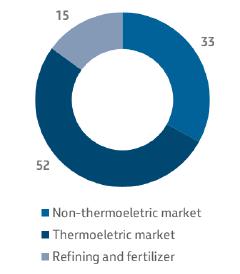 |
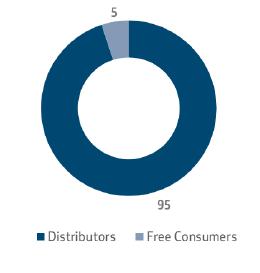 |
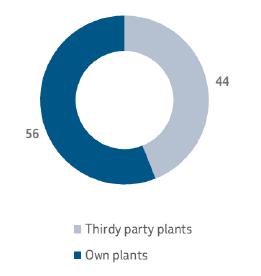 |
PETROBRAS | Annual Report and Form 20-F | 2023 | 131 |
| Table of Contents | |
| | Our Business |
In the commercialization of natural gas, we act as importers and domestic producers who can directly sell our product to distributors, free consumers, or thermoelectric plants. 2023 marked a continuation of the increase in competition, with new contracts between producers and clients, as expected due to the regulation which improved the regulatory framework of the natural gas sector and established guidelines for the open market.
The transportation of natural gas also consists of a monopoly of the Brazilian federal government and may be exercised upon concession or authorization by companies incorporated under Brazilian law, with headquarters and administration in the country.
In the power segment, we operate in generation and sale. In generation, we compete with third-party thermoelectric plants, as well as other generators with other energy sources (hydro, wind, solar). In terms of commercialization, we compete with other energy marketers and operate in the regulated market (power distributors) and free market (marketers and free consumers/large consumers). We have 114 clients and suppliers, of which 33 are distributors, 24 are marketing companies, five are generating companies and 52 are free consumers. All contracts are registered at the Electricity Trading Chamber, a sector agent responsible for the settlement and accounting of these contracts.
PETROBRAS | Annual Report and Form 20-F | 2023 | 132 |
| Table of Contents | |
| | Our Business |
Portfolio Management
Portfolio management is a market practice with a main objective of shaping our asset portfolio in a way that can lead to improved operational efficiency and return on capital and reduced risks.
Our portfolio management covers acquisitions, partnerships and divestments processes. These processes observe robust governance standards that seek to align public administration principles with best market practices. The governance for approving a portfolio management project mainly comprises:
| – | identification of opportunities and inclusion of the project in our portfolio; |
| – | non-binding stage; |
| – | binding stage; and |
| – | negotiation and signature. |
Approval from our Executive Board is required for each project to progress through each of these stages. In larger projects, approval of the Board of Directors is required.
In 2023, a strategic redirection occurred in our portfolio management process which considers the focus on increasing oil and gas production while identifying value in integration with downstream process to generate value for our business. In addition, we aim to act in the energy transition with social justice prioritizing partnerships.
This new direction led portfolio management to consider acquisition and partnership opportunities to a greater extent. These opportunities must be aligned with our Strategic Plan drivers, mainly with regard to our long-term sustainability, making profitable investments, and maintaining capital discipline.
Regarding the divestments of assets in our portfolio, from January 1, 2023 until the filing of this report, we have:
| – | three ongoing public opportunities: Brasympe, Suape 2 and rights for research and mining potassium salts located in the Amazonas Basin; |
| – | signed the sale agreement for the Uruguá and Tambaú fields, located in deepwaters in the Santos Basin, state of Rio de Janeiro, jointly called Polo Uruguá-Tambaú. The amount to be received by Petrobras from the operation is up to US$ 35 million; |
| – | signed the sale agreement for our entire interest (18.8%) held in UEG Araucária (UEGA). The amount to be received by Petrobras from the operation is up to US$ 13.5 million; and |
| – | closed four sale transactions, from January 1, 2023 until the filing of this report, as per table below: |
PETROBRAS | Annual Report and Form 20-F | 2023 | 133 |
| Table of Contents | |
| | Our Business |
| Signing date | Closing date | Main transactions |
Transaction nominal value(1) (US$ billion) |
| 04/28/2022 | 01/26/2023 | Sale of our entire interest held in the Albacora Leste field, located in deepwaters in the Campos Basin | 2.201 |
| 02/23/2022 | 04/12/2023 | Sale of our entire interest held in four onshore fields located in the Espírito Santo Basin, jointly known as the Norte Capixaba Cluster | 0.544 |
| 01/31/2022 | 06/07/2023 | Sale of our entire interest held in 26 onshore and shallow waters fields and also the entire interest held in Clara Camarão located in the Potiguar Basin, jointly known as the Potiguar Cluster | 1.400 |
| 06/24/2022 | 08/28/2023 | Sale of our entire interest held in two sets of maritime concessions in the post-salt layer deepwaters, known as the Golfinho Complex and the Camarupim Complex, located in the Espírito Santo Basin | 0.075 |
| TOTAL | 4.220 |
| (1) | Considers agreed amounts at the signing of the transaction. |
| Agreements with CADE |
|
In 2019, we signed two agreements with CADE, one related to refining and the other to gas where we committed, among other things, to the divestment of REFAP, REPAR, RNEST, REGAP, LUBNOR and TBG. However, given the new strategic direction presented in 2024-2028+ Strategic Plan, on November 28, 2023 we formally requested a review of the agreement signed with CADE. At the time of filing this report, negotiations with CADE were still in progress.
|
PETROBRAS | Annual Report and Form 20-F | 2023 | 134 |
| Table of Contents | |
| | Our Business |
External Business Environment
We are subject to external variables that can impact the performance of our business and the way we plan for the future.
Global Economy
In 2023, the global economy continues to recover from the several shocks from the last years including the effects of the COVID-19 pandemic, the conflict between Russia and Ukraine, and overall geopolitical fragmentation. New factors have also arisen such as the conflict between Hamas and Israel, attacks on ships in the Red Sea led by Houthi rebels, increasing concerns with extreme weather conditions, and the rise of commodity prices.
The effects of COVID-19 have mostly winded down, with the World Health Organization declaring in May 2023 the end of the "emergency" and with the full opening of the Chinese economy. Even so, the Chinese economy is being heavily affected by the ongoing real state crisis. China's economic slowdown has also impacted global growth.
The conflict in Ukraine has led to continued disruption of supply chains (but less than in 2022) mainly in European energy markets leading to higher energy prices (alternatives are less efficient than Russian gas). Global commodity prices also increased with Ukrainian grain production having issues leaving the country due to Russian control of the Black Sea.
The rise of commodity prices in 2022 continued throughout the beginning of 2023. Prices have fallen but are still substantially higher than before the pandemic. Inflation raised as a result, prompting a hike in interest rates. This hike, among the other factors listed before, has represented an important share of the burden on economic activity, blocking a stronger recovery. By the end of 2023, inflation started declining and economic activity is not slowing down too fast. Advanced economies are still reluctant to ease monetary policy amid inflation concerns, but developing economies have already started the move to bring rates down.
COMMODITY PRICES – CRB SPOT
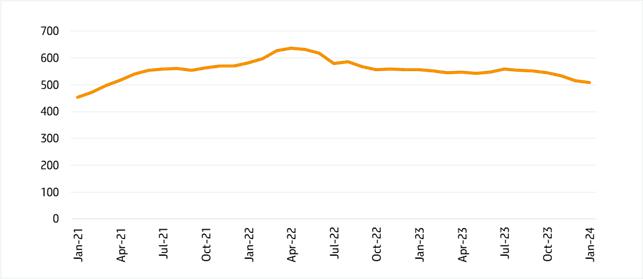
PETROBRAS | Annual Report and Form 20-F | 2023 | 135 |
| Table of Contents | |
| | Our Business |
According to the IMF, the global economy is expected to grow 3.1% in 2024 and 3.2% in 2025, due to the continuing effects of a tight monetary policy.
GDP GROWTH – IMF ESTIMATES (% YoY)
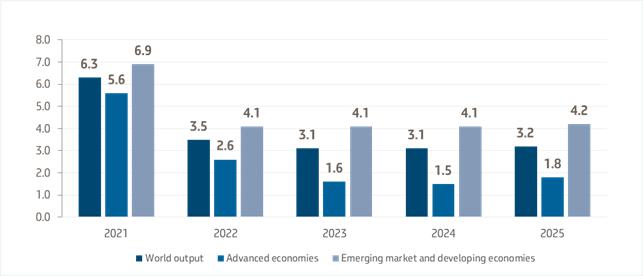
Global Oil & Gas Market
The year 2023 began with a decline in Brent prices for the third consecutive quarter, reaching its lowest quarterly average since 2021. Concerns about the global economic dynamics continued to negatively influence prices at the beginning of the period. However, the downward trajectory was interrupted by signs of Chinese demand recovery and the release of more favorable economic data.
The first quarter of 2023 was marked by financial and oil markets dynamics, oil supply disruptions and additional cuts. In February, the return of pessimism about the global economy was offset by a production cut of 500 mbbl/d announced by Russia, as well as partial supply disruptions from Kazakhstan and Norway, and the closure of a crude export terminal in Turkey, which contributed to relatively stable prices.
Towards the end of the first quarter, the banking crisis affecting the US and Europe caused a drop in Brent prices, reaching a low of $71.7/bbl. However, the easing of concerns about the spread of this crisis and the interruption of approximately 400 mbbl/d of Iraqi oil exports due to a deadlock between the central government and the semi-autonomous Kurdistan region allowed for a partial recovery of prices.
PETROBRAS | Annual Report and Form 20-F | 2023 | 136 |
| Table of Contents | |
| | Our Business |
BRENT – DAILY CRUDE OIL PRICE (US$/bbl)

Source: Bloomberg, 2023
The second quarter of 2023 recorded the fourth consecutive quarter of decline in the average Brent price. The period began with a strong recovery in prices after OPEC+ surprised the market by announcing voluntary cuts of 1.66 mmbbl/d compared to February levels. However, the momentum faded due to fears of a global recession and a slower-than-expected recovery in Chinese oil demand. On the supply side, the resilience of Russian oil production and increased crude exports from Iran, despite the restrictions imposed on both countries, contributed to the price decline.
On June 4, 2023, Saudi Arabia announced an additional voluntary cut of 1 mmbbl/d for July 2023 following the OPEC+ meeting. Once again, this announcement surprised the market, but the measure was not enough to sustain a price recovery. Pessimism about the global economic dynamics and concerns about the resumption of Chinese oil consumption continued to negatively influence the market.
After five consecutive quarters of decline, Brent ended 3Q23 on an upward trend. The movement was favored by the supply restrictions imposed by voluntary cuts from OPEC+, as well as signs of robust global demand despite higher prices.
Following the announcement of an additional 1 mmbbl/d cut for August 23, Saudi Arabia surprised the market again by extending the additional voluntary cut initially until September 2023 and later until the end of 2023. In parallel, Russia also announced a reduction of 500 mbbl/d in its crude exports in August 2023 and 300 mbbl/d by the end of 2023.
In the US, successive declines in crude oil stocks were recorded in 2023, with the country's main hub reaching 25% of its capacity by the end of the 2nd quarter. These factors also contributed to sustained upward prices. Given signs of robust demand, both the IEA and OPEC warned of a tighter oil market by the end of the 2023, with a significant supply deficit.
Towards the end of second quarter of 2023 concerns about the global economic dynamics once again negatively influenced prices. However, the announcement by Russia of a ban on derivative exports helped keep the market under pressure.
PETROBRAS | Annual Report and Form 20-F | 2023 | 137 |
| Table of Contents | |
| | Our Business |
BRENT – ANNUAL CRUDE OIL PRICE (US$/bbl)
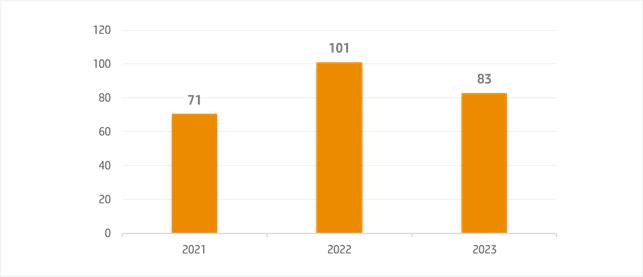
Source: Bloomberg, 2023
The Russia-Ukraine conflict, which has reduced Russian gas exports, has exerted intense pressure on the LNG market, affecting gas prices not only in Europe, but throughout the world. After reaching record levels in natural gas prices in Europe and on the LNG spot market in Asia in 2022, the first half of 2023 saw significantly lower prices compared to 2022, albeit at historically high levels. The relief in prices was a result of a sharp reduction in demand, driven by market response to high prices and milder temperatures in the winter of 2022-2023. Despite prices returning to levels more aligned with historical trends, the global LNG balance remains highly pressured.
Brazilian Economy
According to the Brazilian Institute for Geography and Statistics (IBGE), the Brazilian economy grew by 2.9% in 2023. The rate was above the expected growth at the beginning of the year, which was around 0.8%. Most of the growth came from the agricultural and mining sectors. Agriculture grew 15.1%, while industry and services only grew 1.6% and 2.4% each. Manufacturing was lower than expected, lagging other sectors. Exports were on the rise, growing 9.1% (on the back of agriculture and mining), while investment was down -3.0% due to the slowdown of manufacturing. Imports were also down, -1.2%, improving the goods and services balance.
Regarding inflation, 2023 was marked by a slowdown in the pace of price increases. The main reasons are the interest rates staying all year in contractionary territory and the exchange improving. As a result, after ending 2022 with consumer inflation measured by the IPCA at 5.8%, in 2023 the price expansion of prices was 4.6% (compared to an expectation of 5.3% at the start of the year), converging to the target of 1.75% - 4.75%. The interest rates have already started to decrease, and this will continue through 2024.
Finally, the trajectory of the Brazilian exchange rate registered low volatility throughout 2023. There was a strong valuation, taking the Brazilian currency from an exchange rate of approximately R$/US$ 5.20 in January 2023 to R$/US$ 4.90 in December 2023. The average exchange rate in 2023 was R$/US$ 5.00, representing an appreciation of 3.2%.
PETROBRAS | Annual Report and Form 20-F | 2023 | 138 |
| Table of Contents | |
| | Our Business |
Brazilian Oil and Gas Market
Despite the recovery, the cumulative effect of the rise in commodity prices, the disruption of supply chains caused by the COVID-19 pandemic and the global energy crisis exacerbated by the Russian invasion of Ukraine are still having repercussions on fuel markets.
In 2023, despite the return of federal and state tax in the beginning of the year and an increase in ethanol supply, the downward trend in international oil and gasoline prices impacted the Brazilian market and sustained demand growth on a year over year basis. Concerning diesel demand, the National Council for Energy Policies raised biodiesel mandates to 12% in 2023 and announced a 1% increase each year in order to reach the 15% mandate in 2026, resulting in a diesel demand roughly stable year over year. Jet fuel demand is firmly ramping up in a post COVID-19 environment and with Brazilian income and jobs also rebounding but yet to recover to 2019 levels. Therefore, gasoline, diesel and jet fuel demand rose 0.8%, 7% and 9.7% respectively year over year.
In specific terms, gasoline demand is expected to decrease due to its replacement by hydrous ethanol, the use of which is incentivized by public policies such as RenovaBio that induce competitive prices of hydrous ethanol compared to fossil fuel. Additionally, exclusively gasoline-fueled vehicles are being replaced by flex fuel and, in the future, the latter will be gradually replaced by electric automobiles. Moreover, the development of diesel demand is expected to be slowed by the mandatory increase of the biodiesel percentage in the fuel blend that is delivered to the final consumer and the anticipated introduction of Green Diesel (HVO) mandates by the end of the decade.
CONSUMPTION OF SELECTED FUELS IN BRAZIL (mbbl/d)
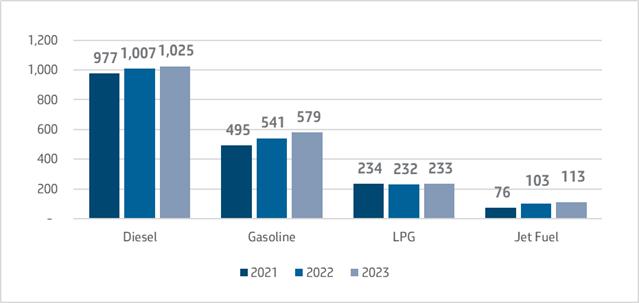
Source: Petrobras and EPE, 2022
Fuel oil is consumed in three main segments: industrial, power generation and as a marine fuel. For at least two decades now, fuel oil has been undergoing a process of substitution by other sources, especially natural gas, and there is still some room for this process to continue in the next years. In the maritime transport segment, a strong demand for decarbonization is starting to emerge, which will certainly have negative repercussions on the demand for bunker in the medium and long term.
PETROBRAS | Annual Report and Form 20-F | 2023 | 139 |
| Table of Contents | |
| | Our Business |
Regarding power generation, with the regularization of rains in early 2023, the level of the reservoirs rose, and the Electric Sector Monitoring Committee (“CMSE”) decided to reduce power generation by thermal plants. As a result, according to the Ministry of Mines and Energy, natural gas demand inter-annual data year-to-date until September 2023 has decreased by 11%, from an average of 69 million cmd in 2022 to 61 million cmd (does not include the gas used in the pipeline transport).
PETROBRAS | Annual Report and Form 20-F | 2023 | 140 |

PETROBRAS | Annual Report and Form 20-F | 2023 | 141 |
| Table of Contents | |
| | Strategic Plan |
2024-2028+ Strategic Plan
Our 2024-2028+ Strategic Plan was created to align with our vision "To be the best diversified and integrated energy company in generating value, building a more sustainable world, reconciling the focus on oil and gas with diversification in low carbon businesses (including petrochemical products and fertilizers), sustainability, safety, respect for the environment, and full attention to people.”
Additionally, our Strategic Plan was drawn up considering the following new strategic drivers, established at the beginning of 2023 to be considered in our strategic planning, in compliance with current governance practices, the commitment to create value and our long-term financial sustainability:
| – | Focus on employees with priority placed on the development, retention, and requalification of talent in order to provide us with a technical staff that is increasingly inclusive, diverse and qualified to meet the dynamic demands of the market, especially the energy transition. |
| – | Focus on profitable exploration and production assets, with increasing decarbonization of our operations and those of our suppliers. |
| – | Emphasis on the adequacy and improvement of our current refinery facilities through efficiency gains and the combination of renewable raw materials in the development of resilient industrial processes and sustainable products. |
| – | Search for a fair energy transition, in line with similar international companies, primarily through partnerships of technical excellence and social responsibility programs that mitigate negative externalities of our activities and promote local production chains. |
| – | Take advantage of Brazil's different potentialities as a country of continental dimensions and energy capacities that favor sustainable development, through the regionalization of our activities based on productive chains and local operational units. |
| – | Strengthen the access to markets and seek to be a part of the global vanguard in the energy transition, through international performance by means of technological and operational partnerships. |
Accompanying the transformations in the world, especially in the energy, digital, social, and environmental segments, we are going through a phase of changes and new perspectives, aiming to prepare for the energy transition and for a fair, inclusive low-carbon economy, with changes in energy use patterns, assessing and minimizing social impacts for different parties including our employees, communities and the entire supply chain.
Our Strategic Plan aims to strengthen and prepare us for the future by initiating a process of integrating energy sources that are essential toward a fair and sustainable energy transition to a low-carbon business. Therefore, we work toward a number of goals such as attention to people, safety and respect for the environment, perpetuating value for future generations, with a focus on capital discipline and a commitment to keeping our indebtedness under control.
Oil and natural gas commodities will continue to be the main drivers of value, with economic and environmental resilience, financing the fair transition. Profitable low-carbon investments will gain relevance for long-term value generation. Governance will be respected in all decision-making processes and project evaluations, guaranteeing sustainability and profitability, with more transparency.
Our business strategies, presented below, are aimed at achieving an effective contribution to a prosperous, sustainable future:
PETROBRAS | Annual Report and Form 20-F | 2023 | 142 |
| Table of Contents | |
| | Strategic Plan |
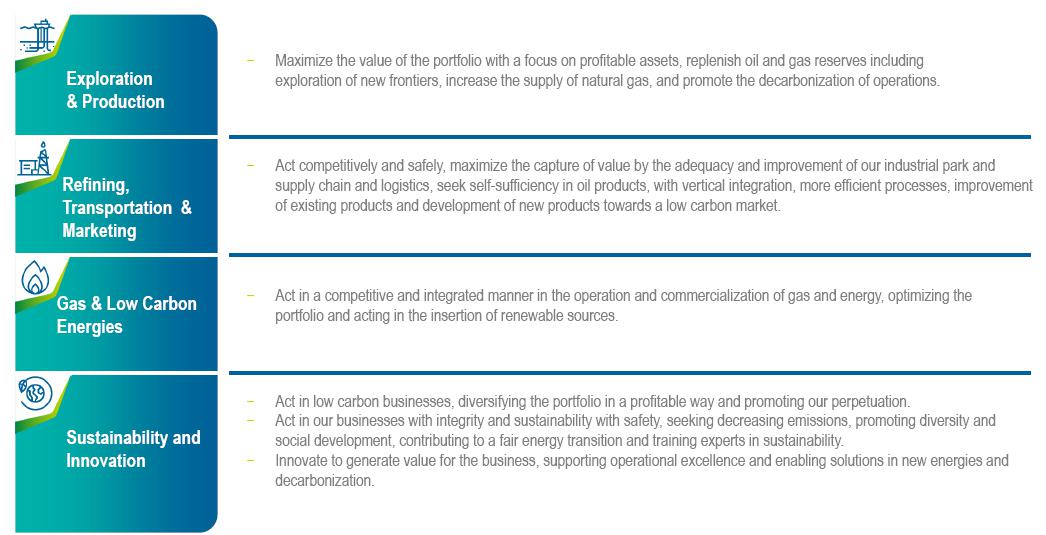
CAPEX - Capital Expenditure
The CAPEX forecast for the 2024-2028 period totals US$102 billion, 31% higher than the previous plan, with US$91 billion corresponding to projects under implementation (portfolio under implementation) and US$11 billion composed of projects under assessment (portfolio under evaluation), which are subject to additional financial feasibility studies before contracting and performance begin. When studies are completed and their economic viability is proven, these projects can migrate to the Portfolio under Implementation. The financial feasibility study for projects under evaluation is an additional item to the governance established for approving projects, which is maintained for both portfolios. This way of presenting the portfolio demonstrates a commitment to transparency and a further advance in the governance of project approval.
The increase in CAPEX is mainly associated with new projects, including potential acquisitions, assets that were in divestment and returned to the company's investment portfolio, and cost inflation, which impacted the entire supply chain.
CAPEX in the E&P segment represents 72% of the total, followed by RTM with 16%, Gas & Low Carbon Energies with 9% and Corporate with 3%.
PETROBRAS | Annual Report and Form 20-F | 2023 | 143 |
| Table of Contents | |
| | Strategic Plan |
CAPEX 2024-2028
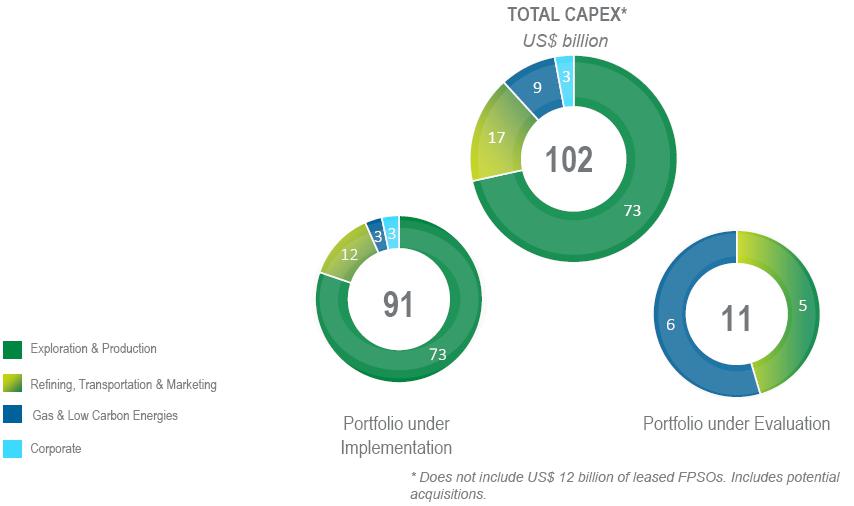

Exploration & Production
E&P CAPEX for the 2024-2028 period totals US$73 billion, with around 67% allocated to pre-salt, which has a major economic and environmental competitive advantage, with the production of better-quality oil and lower emissions of greenhouse gases.
The E&P segment remains relevant to us, with a strategic focus on profitable assets and investments compatible with a long-term vision aligned with the energy transition. At the same time, we maintain significant deepwater revitalization projects (REVIT), as well as complementary projects, to increase recovery factors in mature fields.
PETROBRAS | Annual Report and Form 20-F | 2023 | 144 |
| Table of Contents | |
| | Strategic Plan |
In terms of exploration, US$7.5 billion are planned for the five-year period, to be distributed as follows: (i) US$3.1 billion for exploration in the Equatorial Margin; (ii) US$3.1 billion for exploration in the Southeast Basins; and (iii) US$1.3 billion for other countries. This investment includes the drilling of around 50 wells in areas where we have exploration rights in acquired blocks.
The E&P segment maintains the premise of double resilience (economic and environmental), and high economic value with a portfolio that is viable in scenarios of low oil prices in the long term, including Brent with a prospective average break-even of US$25 per barrel, and with a carbon intensity commitment of up to 15 KgCO2e/boe by 2030.
Production of Oil, NGL and Natural Gas
The production curve of oil, NGL and Natural Gas considers the entry of 14 new platforms (FPSOs) in the 2024-2028 period, 10 of which have already been contracted. A new generation of platforms is being built, which will be more modern, more technological, more efficient and with lower emissions.
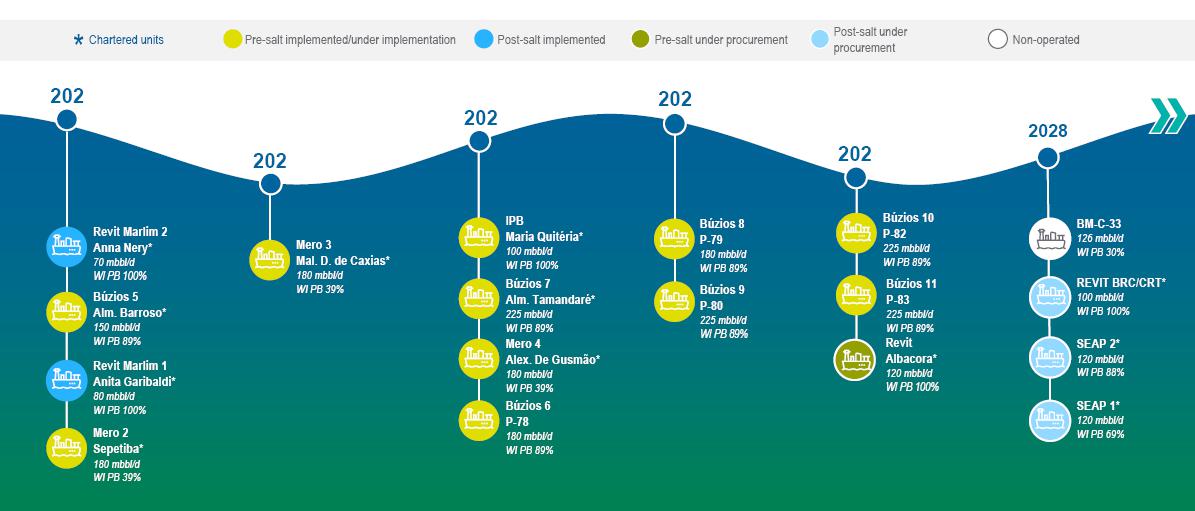
Based on the Strategic Plan, we aim to produce 3.2 million barrels of oil and gas equivalent per day in five years.
PETROBRAS | Annual Report and Form 20-F | 2023 | 145 |
| Table of Contents | |
| | Strategic Plan |
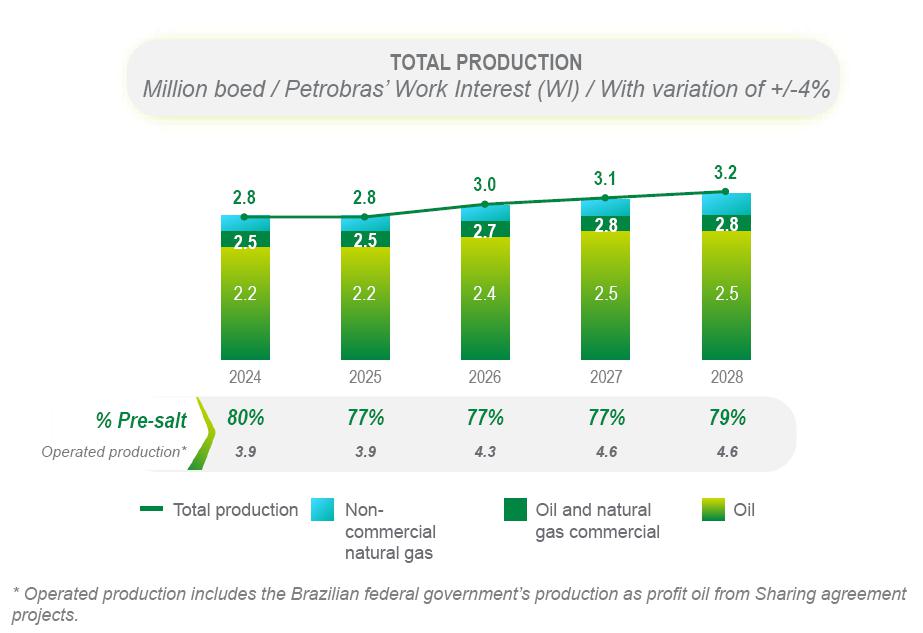
In line with our strategic focus, E&P activities are concentrated on profitable assets. Pre-salt production will represent 79% of our total production at the end of the five-year period.
The projections for oil production, total production and commercial production of oil and natural gas for 2024 have been increased by 100 mboed compared to the previous plan, considering the good performance of the fields, the forecasts for ramp-ups and the entry of new wells.
In 2025 and 2026, oil production, total production and commercial production of oil and natural gas are projected to be 100 mboed lower than projected in the previous strategic plan. This difference is mainly due to current market conditions arising from the global context, where some production systems and complementary deepwater projects have had their schedules impacted. These fluctuations are part of the dynamics of the industry and are within the range of uncertainty disclosed in the last strategic plan. For 2027, the projections for oil production and total and commercial production of oil and natural gas were maintained in comparison to the previous strategic plan. To monitor the Strategic Plan, we take into account a margin of variance of +-4%.
Refining, Transportation & Marketing
RTM CAPEX totals US$ 17 billion for the 2024-2028 period. The segment continues to focus on better use of refining and logistics assets and higher energy efficiency, aimed at expanding diesel production capacity and gradually increasing the supply of products for the low-carbon market. It is important to clarify that, in this Strategic Plan, the forecast for Commercialization and Logistics CAPEX, disclosed in the previous strategic plan, is now presented in aggregate form as RTM CAPEX, in line with the vision for this segment.
This Strategic Plan foresees an increase in refining capacity of 225 mbbl/d and an increase in low sulfur diesel production of more than 290 mbbl/d, supported by major projects such as RNEST's Train 2, revamps of current units and the implementation of new diesel treatment units (HDT) at REVAP, REGAP, REPLAN, RNEST and GASLUB.
PETROBRAS | Annual Report and Form 20-F | 2023 | 146 |
| Table of Contents | |
| | Strategic Plan |
One of the highlights of the new plan is the expansion of the Reftop Program to the entire refining facilities. Through this program, we have been achieving its efficiency and reliability targets, and aim for the industrial park to be a global leader in terms of operational and energy efficiency by 2030.
In Biorefining, we plan to invest US$1.5 billion. These investments will support the growth in R5 diesel production capacity, with 5% renewable content, at REPAR, RPBC, REDUC and REPLAN. We also plan to install dedicated BioJet Fuel and 100% renewable diesel plants at RPBC and GASLUB, which will be completed after 2028.
The Strategic Plan strengthens us in the Brazilian market by integrating the value chain from production, refining, logistics to the market. US$2.1 billion will be invested in initiatives to remove logistical bottlenecks. This includes expanding and adapting infrastructure, investing in terminals to optimize operations, expanding modes and improving efficiency and resilience. Among these projects is the construction of four handy-class ships, which will be operated by Transpetro, as well as studies for other vessels.
In the Petrochemicals segment, we plan to act in an integrated manner, maximizing synergies with its refining and oil and gas production facilities. Investments in Petrochemicals are under study, considering both projects in current assets and acquisitions.
In this Strategic Plan, we also mark our return to the fertilizer segment, with plans to resume operations at ANSA and completing works at UFN-III.
Gas & Low Carbon Energies
G&LCE CAPEX totals US$3 billion in the five-year period. The segment is making progress in competitive and integrated operations in the gas and energy trade and in improving its portfolio, working towards the inclusion of renewable sources, in line with decarbonization actions.
One of our priorities in this segment is to expand the infrastructure and portfolio of natural gas offers. Considering the investments in gas production and disposal in the E&P segment, we plan to increase our domestic gas supply by investing around US$7 billion over the next five years.
In 2024, Route 3 will begin operating with a processing plant with a capacity of 21 mmm³/d and a pipeline with a capacity of 18 mmm³/d. In 2028, the Raia Project gas pipeline (BM-C-33) will begin operating, with a capacity of 16 mmm³/d; and in 2029, the Sergipe Águas Profundas - SEAP project gas pipeline, with a capacity of 18 mmm³/d.
ESG - Environmental, Social and Governance
In our Strategic Plan, we reaffirm our ambition of zero fatalities and zero leakages, in line with our commitment to life and the environment, which are non-negotiable values.
The Strategic Plan has integrated ESG elements into a single vision, summarizing our position according to the diagram below:
PETROBRAS | Annual Report and Form 20-F | 2023 | 147 |
| Table of Contents | |
| | Strategic Plan |
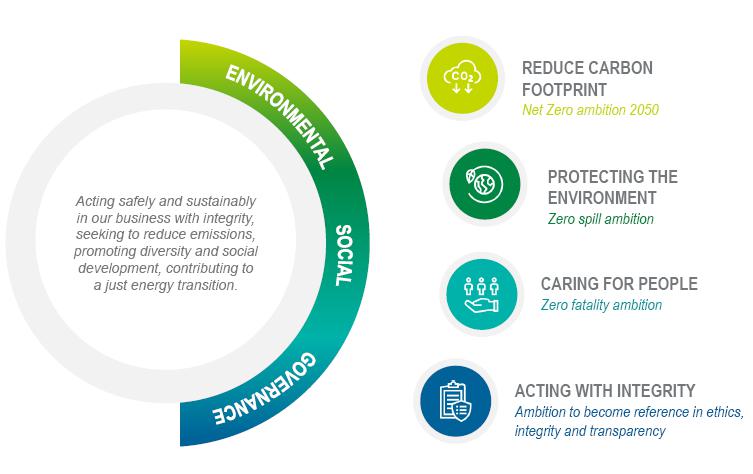
This ESG diagram guides planning and stakeholder engagement and is aligned with our strategic elements and goals. Four key ideas are highlighted: (i) reduce our carbon footprint; (ii) protect the environment; (iii) caring for people; and (iv) acting with integrity. For each of these key ideas, a set of relevant themes have been identified to support and guide our actions, projects, programs, and related commitments.
The goals related to each of the four key ideas of the diagram were consolidated into a single list, aligned with the concept of integrated ESG:

PETROBRAS | Annual Report and Form 20-F | 2023 | 148 |
| Table of Contents | |
| | Strategic Plan |
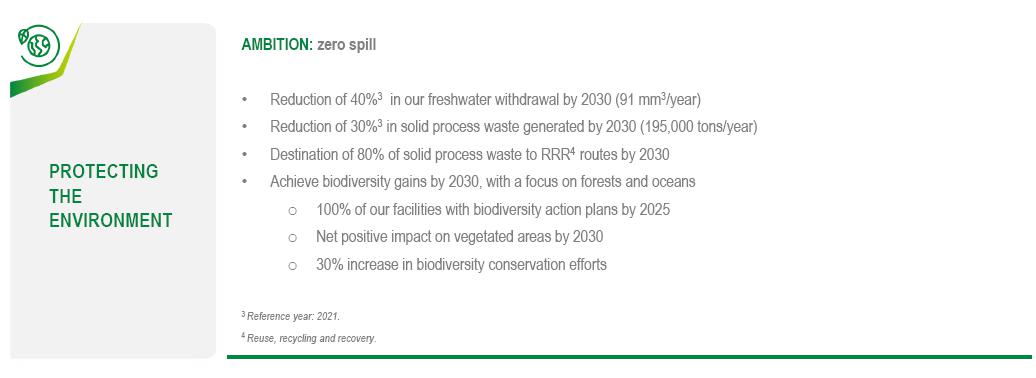
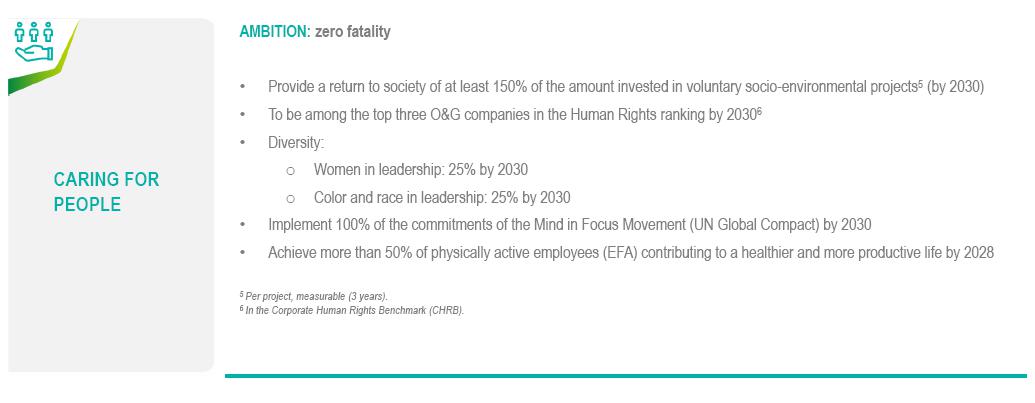

We will allocate up to US$11.5 billion to low carbon projects over the next five years, considering transversal investments in the various business segments. This includes initiatives and projects to decarbonize operations, as well as the maturing and development of businesses in the low carbon energy segment, with an emphasis on biorefining, wind, solar, CCUS, and hydrogen.
PETROBRAS | Annual Report and Form 20-F | 2023 | 149 |
| Table of Contents | |
| | Strategic Plan |
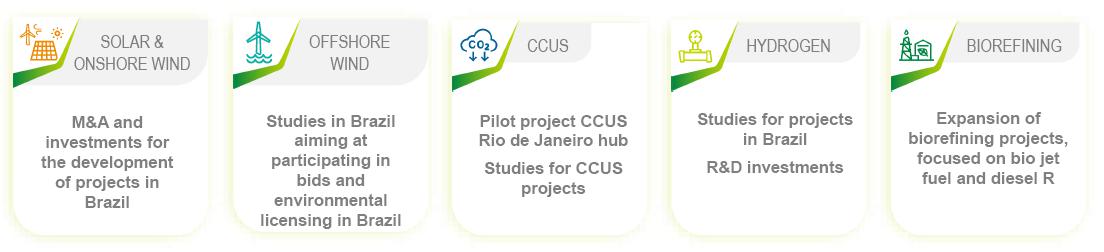
In this context, it is important to highlight the focus on profitable projects, prioritizing partnerships to reduce risk and share learning. With this new initiative, we will also develop Brazil's regional competitive advantages.

In the 2024-2028 average, low-carbon investment represents 11% of our total investment, indicating progress in our current position in relation to its market peers. The forecast is that low-carbon investment will gradually gain ground in our portfolio over the period, reaching 16% by 2028.
PETROBRAS | Annual Report and Form 20-F | 2023 | 150 |
| Table of Contents | |
| | Strategic Plan |
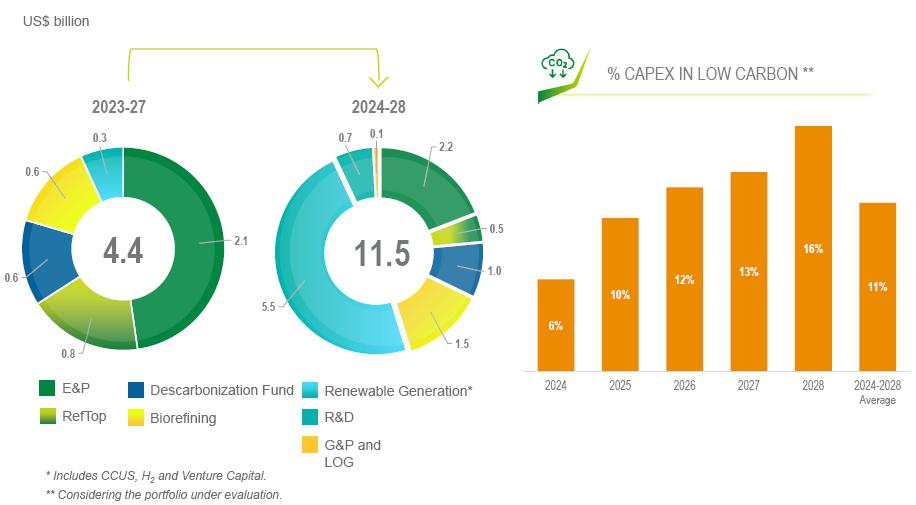
Financing
The main assumptions for financing the Strategic Plan are:
| – | Brent and Real exchange rate: |

| – | The reference cash flow defined in the Strategic Plan is US$8 billion. |
| – | Solid balance sheet with debt of less than US$65 billion, with financial debt lower than leasing debt. |
| – | Dividends in accordance with the current shareholder remuneration policy. |
PETROBRAS | Annual Report and Form 20-F | 2023 | 151 |
| Table of Contents | |
| | Strategic Plan |
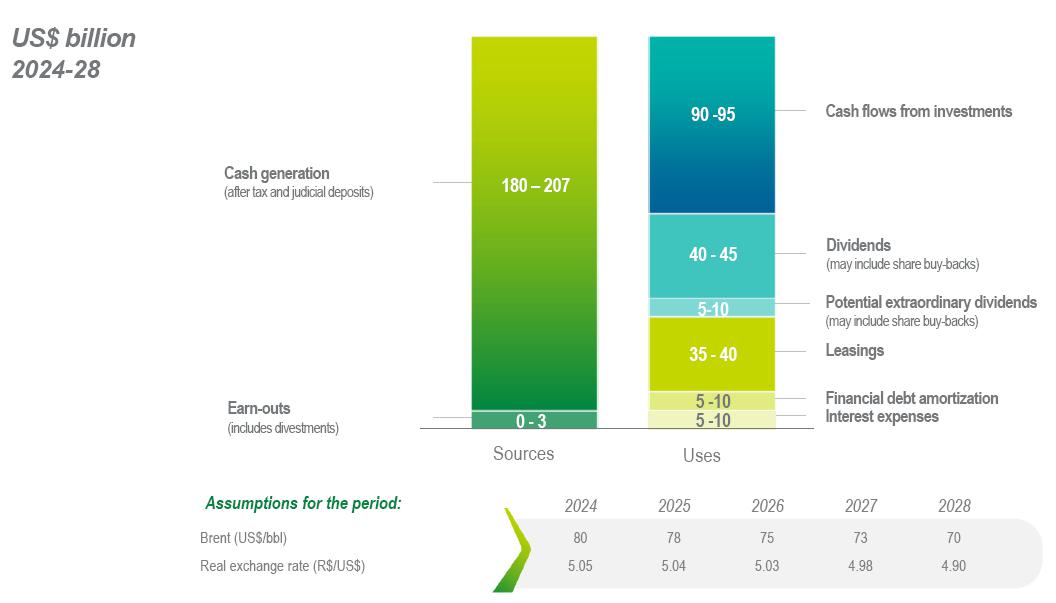
We reiterate that investments should be financed primarily by operating cash flow, at levels equivalent to those of our peers, and preferably through partnerships that allow for the sharing of risks and expertise, and should seek a return on investment, a reduction in the cost of capital, and our strengthening as an integrated energy company, maximizing our value.
PETROBRAS | Annual Report and Form 20-F | 2023 | 152 |
| Table of Contents | |
| | Strategic Plan |
Research, Development and Innovation (“RD&I”)
Investing in technology is fundamental to adding value to our business while building competitive advantages for our long-term sustainability. Our Research, Development and Innovation Center (“Cenpes”) is responsible for determining our technological solutions that compose our RD&I project portfolio. Cenpes, one of the largest RD&I centers in the energy sector, aims to develop technologies that will enable the execution of our Strategic Plan, in addition to being responsible for anticipating future trends and investing in technological routes. On December 31, 2023, Cenpes had 1,076 employees, of which 90.4% were exclusively dedicated to RD&I development.
The definition of which technological solutions to pursue starts at identifying the business areas’ needs and the deployment of our strategy, complying with the principles of operational efficiency and resource optimization. To build this portfolio, the potential technological solutions to be developed in RD&I projects go through a process of valuation and prioritization.
Our main research lines are:
R&D RESEARCH LINES
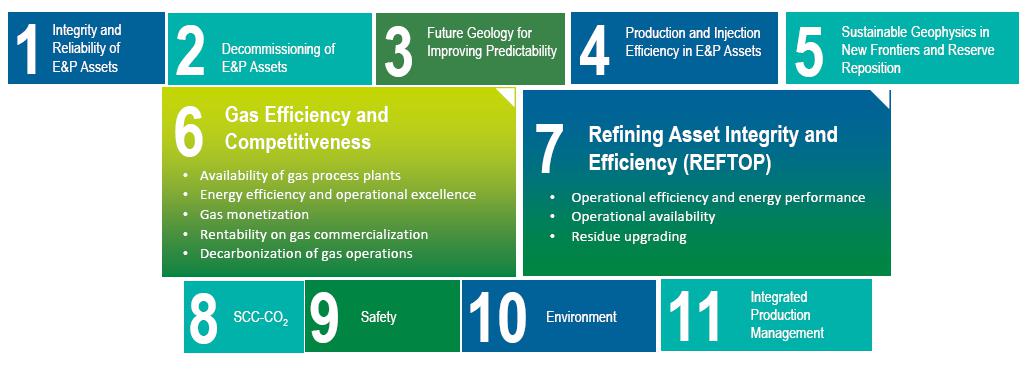
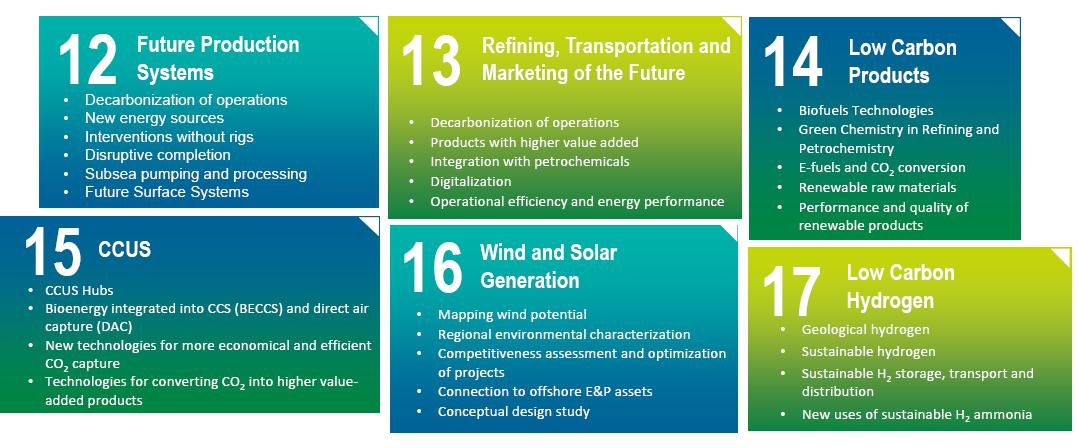
PETROBRAS | Annual Report and Form 20-F | 2023 | 153 |
| Table of Contents | |
| | Strategic Plan |
Within the topics above, our innovation portfolio includes projects focused on developing technologies for oil and gas exploration and for energy transition. In 2023, we can highlight:
| – | Development of technologies that allow investment optimization as well as a reduction in cost and uncertainty such as: i) the new Floating Lidar (Light Detection and Ranging) prototype, a sensor to measure speed and wind direction, among other weather variables, and the first developed in Brazil; ii) a new kind of seismic sensor which incorporates long duration batteries and includes optical and acoustic communication capabilities between the Nodes and autonomous underwater vehicles, allowing for multiple surveys (reservoir monitoring) within a five year period without removing the nodes from de seabed; and iii) new equipment that enabled new architecture for intelligent well completion. |
| – | Development and implementation of technologies that contributed to increased operational safety such as: the Ativo360 Technological Solution, a system to digitally manage the integrity of production assets by using digital twins and artificial intelligence; the Digital Twin for flexible pipelines, and monitoring the integrity and useful life of subsea systems; and the Digital Occurrence Monitoring System to guarantee flow. |
| – | Development of new technologies and new products with a lower carbon footprint such as: Podium Carbon Neutral Gasoline; CAP PRO AP, a high penetration asphalt; our new proprietary technology that allows vegetable oil to be used as raw material in catalytic cracking units, processing it completely and producing bioLPG with a very low sulfur content, bio-aromatics and renewable light and heavy oils; and ACV Digital, the innovative tool for measuring and making decisions concerning the carbon intensity of refining products. |
Our active portfolio management is carried out efficiently, in order to maximize gains, based on a solid valuation process, optimizing our resources, accelerating project deliveries, aimed at their fast implementation and measuring results with innovation indicators that evaluate the success rate of investments in R&D.
| Mandatory investment in RD&I |
|
Our Bylaws require that at least 0.5% of the paid-in share capital is reserved for research and development expenses. In addition, the obligation to invest in RD&I is also provisioned in contracts for the exploration, development and production of oil and/or natural gas signed between the ANP and oil companies, based on the Petroleum Law (Law No. 9,478/1997) and in the pre-salt regulatory framework (Law No. 12,351/2010). The amount of this mandatory investment is determined in accordance with the contract of each existing legal-regulatory regime. However, investments in the development and implementation of innovative technologies are not limited to fulfilling this obligation to invest in RD&I. For concession contracts, whose production volume involves the payment of a special participation, the percentage of RD&I mandatory investment is linked to the gross revenue of the fields (1%). In production sharing contracts, the percentage is also levied on the total gross revenue (1%). For the Transfer of Rights contract, the percentage is 0.5% of the value of gross revenue from any given annual production.
|
In 2023, we invested US$726 million in research and development. We are one of the companies, among the major oil and gas companies, that has invested the most in RD&I over the last few years, according to Evaluate Energy. About 10% of our RD&I portfolio is related to decarbonization and new energies solutions. Our patents portfolio covers all our areas of activities. Currently, we have 2,597 patents (applications under review and granted), 1,222 in Brazil and 1,375 abroad, within 50 countries. In 2023, we filed 353 patents: 210 abroad and 143 in Brazil, surpassing, for the third consecutive year, our record for filings in a single year. As we pursue valuable results in research and development, we are exploring new ways to innovate through disruptive technologies, digital transformation, and start-up engagement.
PETROBRAS | Annual Report and Form 20-F | 2023 | 154 |
| Table of Contents | |
| | Strategic Plan |
| Connections for Innovation |
|
Connections for Innovation is our open innovation program, designed to accelerate technological development and add value to our company. The main objective of the program is to find the best partners to cooperate and develop, test or commercialize technologies, thus increasing competitiveness and generating better alignment between our technological initiatives and the innovation ecosystem. The program has seven different modules, Pre-Commercial Procurement, Technology Transfer, Startups, Solution Acquisition, Technological Partnerships, Open Lab and Residents, tailored to support different types of technological partnerships, as well as different innovation ecosystem actors. This year, the open innovation program surpassed the US$200,000 mark in partnerships signed over the four years of Connections for Innovation. The program has been growing rapidly. When comparing the partnerships signed along the first four years with 2023's results, the value of investments increased approximately three times. In 2023 alone, more than 280 opportunities were published and more than 180 new agreements were signed. This is due to strategic prioritization, increased communication and dissemination of the program.
|
PETROBRAS | Annual Report and Form 20-F | 2023 | 155 |

PETROBRAS | Annual Report and Form 20-F | 2023 | 156 |
| Table of Contents | |
| | Environment, Social and Governance |
Environment
The protection of human health and the environment is one of our primary concerns and is essential to our success. Each year, we maintain a set of initiatives focused on the prevention of accidents and the preservation of life and the environment, aligned with one of our most important HSE program, called “Programa Compromisso com a Vida” (Commitment to Life Program). This Program, which is composed of structured projects based on the critical analysis of HSE management, with reference to the best market practices, seeks to achieve our zero fatalities and zero leaks goals while strengthening our vision of being an example of HSE for the industry with the following principles of our HSE Policy:
| – | 1. HSE as value |
| – | 2. Respect for Life |
| – | 3. Risk-Based Management |
| – | 4. Business Sustainability |
| – | 5. Excellence and Transparency in Performance |
The main initiatives of the Program for 2023 were the following:
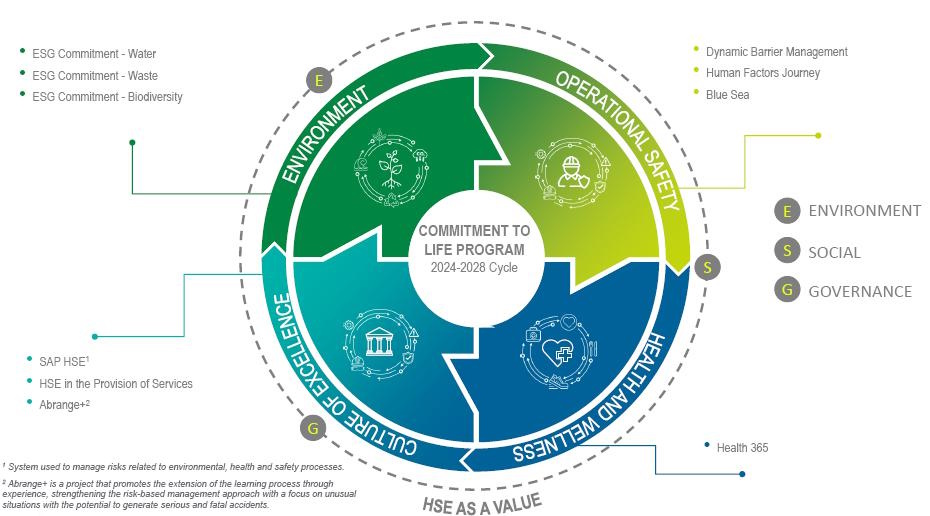
PETROBRAS | Annual Report and Form 20-F | 2023 | 157 |
| Table of Contents | |
| | Environment, Social and Governance |
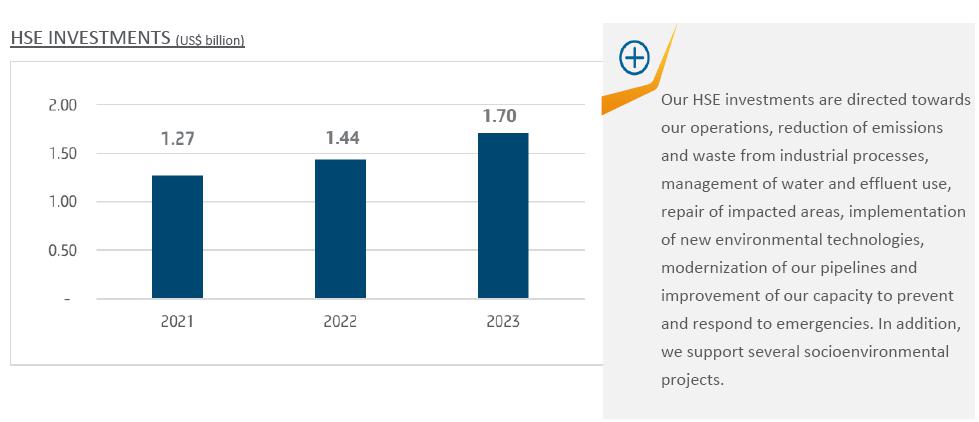
Our business development with suppliers also contains environmental requirements according to the best practices in the industry. Contracted companies must present evidence and certifications related to compliance with HSE standards and confirm that they comply with all applicable requirements, laws, regulations and ESG best practices, according to new commitments formalized in 2023.
Since 2019, we have been certified by the Association for Supply Chain Management (ASCM) Enterprise Certification, which was the industry’s first corporate supply chain designation that demonstrates social responsibility, economic sustainability, and ecological stewardship, recognizing that our Maintenance, Repair and Operations (MRO) and project materials supply chains are meeting the process, people, practices and performance standards for ethics, sustainability and economic responsibility.
Total Recordable Injury Rate
Respect for life, people and the environment is a value for Petrobras. Our goal is to operate within the best global safety standards. One of our top metrics is the Total Recordable Injury Rate (“TRIR”) below 0.7.
Within an evolutionary and continuous improvement process, Petrobras' TRIR – which until 2015 was above 2.0 – has, in the last three years, been consolidating close to 0.7. The historical series demonstrates that the Oil and Gas industry, together with Petrobras, has been reducing these rates in recent decades, having achieved the best historical result, in the 2020 – 2021 biennium, during the period of the COVID-19 pandemic. With the full resumption of activities in 2022, a return to 2019 levels can be seen, not only at Petrobras but throughout the industry. We monitor critical process indicators monthly in its critical analysis meetings, notably its top metrics such as TRIR.
In 2023, we obtained a TRIR of 0.80, 18% above that achieved in 2022, when we achieved a result of 0.68, with 0.67 being the average of the last three years. The industry's average TRIR in 2022, according to the IOGP (International Association of Oil & Gas Producers) Annual Report, was 0.90, which represented an increase of 17% compared to the industry in 2021 (0.77). It is therefore observed that Petrobras' performance has been consistently better than the industry average. Furthermore, we halved the number of serious and fatal incidents at Petrobras compared to 2022.
In accordance with the existing management mechanisms, several initiatives were launched, such as immediate execution of local actions in the units in order to prevent new events of a similar nature, creation of a working group with the objective of proposing additional response actions and the continuity of execution of Petrobras' structuring initiatives that aim to reduce accidents, which make up the Commitment to Life Program. By carrying out a critical analysis of the events that make up the TRIR, it was possible to direct strategic initiatives for 2024. These actions also focus on reducing more serious events, in line with the ambition of ZERO Fatalities.
PETROBRAS | Annual Report and Form 20-F | 2023 | 158 |
| Table of Contents | |
| | Environment, Social and Governance |
TOTAL RECORDABLE INJURY RATE – TRIR
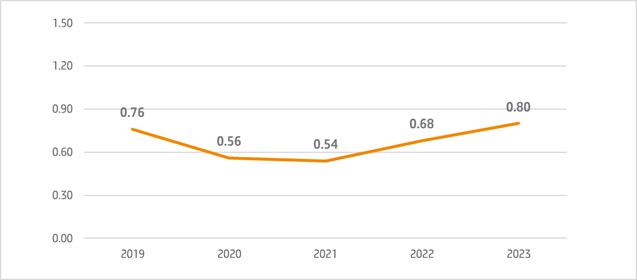
Although we develop prevention programs in all of our operating units, unfortunately we recorded two fatalities involving our own and contractors’ employees in 2023 (compared to five fatalities in 2022). Our procedure is to investigate all incidents reported in order to identify their causes and take preventative and corrective actions. These actions are regularly monitored once they are adopted. In case of serious accidents, we send company-wide alerts to enable other operating units to assess the probability of similar events occurring in their own operations.
Environmental impacts
MAIN IMPACTS

Our investments enabled lower environmental impacts resulting from our activity as an energy company focused on oil and gas in 2023, compared to 2022. In 2023, we invested US$1,072 million in environmental projects, compared to US$810 million in 2022 and US$708 million in 2021. These environmental projects continue to primarily include actions directed at reducing emissions and waste from industrial processes, managing effluents, promoting rational use and reuse of water, managing risks and impacts on biodiversity, remediating contaminated areas, recovering degraded areas, implementing new environmental technologies, modernizing pipelines and improving emergency response capacity and safety of our operations.
For more information on our ESG strategy and goals, see “2024-2028+ Strategic Plan” in this annual report.
PETROBRAS | Annual Report and Form 20-F | 2023 | 159 |
| Table of Contents | |
| | Environment, Social and Governance |
Spills and Environmental Remediation Plans
We are constantly seeking to improve our standards, procedures and oil spills response plans, which are structured at the local, regional and corporate levels.
The “Mar Azul” (Blue Ocean) program integrates the Commitment to Life Program and has the goal to identify and address the main causes for loss of primary containment events. This program incorporates lessons learned from the loss of containment events integrating safety barriers, processes, and routine activities on our units, being part of an active management that keeps continuously searching for improvement opportunities.
In 2023, we substantially reduced the volume of relevant oil and oil product spills, experiencing seven spills greater than one barrel, which led our VAZO indicator to reach a value of 16.9 m³, which represents a reduction of 92% compared to the 2022 result (218.0 m³). The causes of the events were analyzed and the lessons were incorporated into our processes. Our 2023 result is expressively lower than the average performance of our Peer Group in 20222, of 538.8 m³.
As part of our environmental plans, procedures and efforts, we maintain detailed response and remediation contingency plans to be implemented in the event of an oil spill or leak from our offshore operations. The IBAMA audits, approves and authorizes the execution of these programs. In order to respond to these events, we have dedicated oil spill recovery vessels fully equipped for oil spill control and firefighting.
We also have the structure of environmental defense centers, located in strategic areas to ensure rapid and coordinated response in case of onshore or offshore oil spills. These centers have additional support and recovery boats available to fight offshore oil spills and leaks, containment booms, absorbent booms and oil dispersants, among other resources.
We have approximately 290 trained workers available to respond to oil spills 24 hours a day, seven days a week, and we can mobilize additional trained workers for shoreline cleanups on short notice from a large group of trained environmental agents in the country. While these workers are located in Brazil, they are also available to respond to an offshore oil spill outside of Brazil.
Since 2012, we have been a member of the OSRL, an international organization that brings together over 158 corporations, including major, national and independent oil companies, energy related companies as well as other companies operating elsewhere in the oil supply chain. OSRL participates in the Global Response Network, an organization composed of several other companies dedicated to fighting oil spills. As a member of the OSRL, we have access to all resources available through that network, and also subscribe to their Subsea Well Intervention Services, which provide swift international deployment of response-ready capping and containment equipment. The capping equipment is stored and maintained at bases worldwide, including Brazil.
In 2023, we conducted 21 emergency drills: 6 in person, 7 fully remote and 8 in a hybrid format.
We continue to evaluate and develop initiatives to address HSE concerns and to reduce our exposure to HSE risks on capital projects and operations.
2 Data on spills consulted in sustainability or similar reports published by companies that make up our peer group (BP, Shell, Total, Exxon Mobil and Equinor). At the time of preparing this annual report, not all data about 2023 spilled volumes by these companies was available.
PETROBRAS | Annual Report and Form 20-F | 2023 | 160 |
| Table of Contents | |
| | Environment, Social and Governance |
Air Emissions and Transition to Low Carbon
Our actions related to climate change are supported by three pillars:
| 1 | 2 | 3 |
| Transparency, Carbon Management and Just Transition |
Oil and Gas Competitiveness |
Low-carbon Businesses and Scope 3 |
| Reliable disclosures, management and decision-making process | Resilience and portfolio value in energy transition | Mitigating portfolio risk related to carbon emissions |
|
Our Governance focused on risk management of climate change and energy transition is structured in such a way that these issues are addressed at all levels of the company, including senior management. We strive to ensure that risks and opportunities of climate change are adequately captured in our scenarios, quantified, and considered in our choices, seeking business sustainability and value creation for all stakeholders. The variable compensation of all company’s employees incorporates performance linked to carbon intensity commitments in our operations, promoting employee engagement in achieving expected results. We follow the recommendations of TCFD for climate-related disclosures, promoting carbon transparency for all stakeholders. |
In our understanding, companies will become more competitive in the long-term market the more they can produce at low costs and with lower GHG emissions, thriving in scenarios of low oil prices, carbon pricing, and possible oil differentiation practices based on the GHG emissions intensity in production. We aim to maintain our operations on a decreasing emissions trajectory with lower carbon intensity than other companies, safeguarding the competitiveness of our oil in world markets in a scenario of slowdown and subsequent contraction in demand. We focus on continue supplying oil and gas in a competitive and environmentally manner, to meet persistent demand for oil compatible with the goals of the Paris Agreement. |
We acknowledge that the Paris Agreement’s goals require significant reductions in GHG emissions and changes in energy supply. Our scenarios point to an unequivocal energy transition, albeit at an uncertain pace. We are dedicated to balancing oil and gas production with society’s decarbonization scenarios and the progressive development of new low-carbon businesses. Our strategy seeks portfolio diversification as a lever for decarbonization and value creation amid the transition, through profitable initiatives leveraging our technological capacity and projects management skills to explore Brazil’s regional competitive advantages. |
All our projects must be profitable in our scenario which provides an accelerated energy transition with a significant reduction in the price of fossil fuels, assuming a value of crude oil of US$45 per barrel in the long term.
PETROBRAS | Annual Report and Form 20-F | 2023 | 161 |
| Table of Contents | |
| | Environment, Social and Governance |
In the “2024-2028+ Strategic Plan” section of this report, we outline the six commitments related to carbon emissions, with a more ambitious target set for the methane intensity commitment. The review of the intensity target for E&P methane emissions, from 0.29 tH4/mil tHC to 0.25 t CH4/mil tHC and the aim to further reduce it to 0.20 tCH4/thousand tHC in 2030, are aligned to initiatives such as Oil and Gas Methane Partnership 2.0 (OGMP 2.0) and Near Zero Methane Ambition.
In addition to incorporating the near zero methane 2030 ambition, aligned with the review of the commitments described above, we have also added to the plan the goal to consolidate the already achieved 40% reduction in absolute operational emissions, maintaining the current emissions level over the five-year period despite the projected increase in oil production in the coming years with the commissioning of the 14 FPSOs3.
We are committed to continue improving the GHG emissions efficiency of our E&P activities. After years of producing oil and gas, it is natural for the fields to change over time. Therefore, to expand production levels, it is necessary to employ energy-intensive techniques, such as water and/or gas injection. Thus, such fields’ water production and energy demand tend to increase, and the rate of oil production tends to decrease. This affects GHG emissions intensity, reflecting the challenge to offset the GHG emissions intensity of the fields that have produced oil for longer periods of time in the portfolio. In this sense, the 13 new operated FPSOs become a challenge and an opportunity to reduce the carbon intensity.
For more information on our ESG commitments and investments in decarbonization, see the “2024-2028+ Strategic Plan” section of this report.
In 2023, our performance in terms of GHG emissions was as follows:
| – | Total GHG emissions of 46 million tCO2e, 2 million tCO2e lower than the previous year, maintaining the decreasing trend observed since 2015; |
| – | Carbon intensity in E&P of 14.2 kgCO2e/boe4, the lowest historical outcome; |
| – | Carbon intensity in Refining of 36.8 kgCO2e/CWT5, the lowest historical outcome; and |
| – | Methane intensity in E&P of 0.22 tCH4/mil tHC, the lowest historical outcome. |
Our initiatives related to energy efficiency and reduction of losses in our operations and the low thermoelectric dispatch contributed to lower GHG emissions in 2023.
Our carbon intensity targets (E&P and Refining) represented a coverage of 84.5% of emissions from activities we operated in 2023.
In 2023, we took additional steps toward our goal of promoting decarbonization. In September, we acquired forest conservation credits equivalent to 175 thousand tons of GHG emissions. In the same month, we signed a letter of intent with Vale for the development of low-carbon solutions. The partnership will last for two years and includes the evaluation of decarbonization opportunities, such as the development of initiatives in sustainable fuels like hydrogen, green methanol, biobunker, green ammonia, and renewable diesel, as well as carbon capture and storage technologies. In December 2023, we received the Gold Standard certification from the OGMP 2.0 initiative as recognition of our methane emissions quantification, reporting, and management plan, which is aligned with industry best practices.
3 Thirteen operated by Petrobras and one operated by third party.
4 The kg CO2e / boe indicator considers gross oil and gas production (“wellhead”) in its denominator.
5 The kg CO2e/CWT indicator was developed by Solomon Associates specifically for refineries in Europe, and was adopted by the European Emissions Trading System (EU Emissions Trading System, EU ETS) and by CONCAWE (association of European oil refining and distribution companies and gas). A refinery’s CWT (Complexity Weighted Tonne) considers the potential for GHG emissions, in equivalence to distillation, for each process unit. Thus, it is possible to compare emissions from refineries of various sizes and complexities.
PETROBRAS | Annual Report and Form 20-F | 2023 | 162 |
| Table of Contents | |
| | Environment, Social and Governance |
We collaborate with climate development initiatives and continue to partner with other companies and the science, technology and innovation community. We highlight, for instance, our participation in the Oil & Gas Climate Initiative, our support for the World Bank’s “Zero Routine Flaring by 2030” initiative, which is one of our sustainability commitments, and our adherence for the Oil & Gas Methane Partnership 2.0 (OGMP) and the Oil & Gas Decarbonization Charter, an initiative launched in COP28.
In addition, we note that our Climate Change Supplement is available on our website at www.petrobras.com.br/ir, which details our contributions to reducing the carbon intensity of our energy supply and how we aim to remain competitive in an evolving context.
PETROBRAS | Annual Report and Form 20-F | 2023 | 163 |
| Table of Contents | |
| | Environment, Social and Governance |
Social Responsibility
Human Rights
Corporate commitments and initiatives
A commitment to human rights is key to the sustainability of our business. Several documents and initiatives drive our approach to human rights, as follows:
| – | Code of Ethical Conduct: addresses issues such as respect for diversity, equal opportunities, fair labor relations, health and safety assurance for workers and the right to free association. |
| – | Ethical Conduct Guide for Suppliers: reinforces that our suppliers must promote dignified and safe working conditions for their employees and fight against child and slave labor, in addition to promoting diversity, gender and racial equality as well as the inclusion of people with disabilities. |
| – | Human Rights Guidelines: direct our actions, as far as respect for human rights is concerned, in all the activities and regions where we operate and throughout the life cycle of our projects and operations. Our human rights operations follow the United Nations’ Guiding Principles on Business and human rights and are structured along four axes: People Management, Community Relations, Engagement with Supplier and Partner Chain, and Due Diligence in Human Rights. Each axis describes the processes through which we aim to ensure the incorporation of respect for human rights in all areas of our business and in our relations with our stakeholders, as well as the identification of potential risks in terms of human rights violations related to operations, products or services we provide, in addition to remedying any impacts we cause. |
| – | Diversity, Equity, and Inclusion Policy: a set of principles and guidelines that support and drive the decision-making process and guide behaviors in relation to diversity, equity and inclusion. |
| – | Protective Intelligence and Corporate Security Policy: according to our policy, the protective intelligence and corporate security actions are carried as per the legislation in force and the respect of human rights, in compliance with external and internal legal requirements, and with relevant recommendations and technical standards. |
| – | Human Resources Policy: states that we must provide employees with a good working environment that promotes diversity and relationships based on trust and respect, without tolerating any form of harassment or discrimination. |
| – | Social Responsibility Policy: seeks to prevent and mitigate negative impacts on our direct activities, supply chain and partnerships. It is based on our respect for human rights and seeks to fight against discrimination in all its forms, setting forth standards related to social risk management, community relations and social investment present in the guidelines related to these subjects. |
| – | Preventing and Combating Discrimination, Moral Harassment, and Sexual Violence Guideline: provides the steps for the company to prevent and to combat discrimination, moral harassment, and sexual violence everywhere it operates throughout the cycle of its projects, operations, and professional relationships. |
| – | Technical Cooperation Agreement on Human Rights: we entered into a Technical Cooperation Agreement on Human Rights with the Ministry of Human Rights and Citizenship. The document is composed of about twenty actions that reinforce human rights policies not only in the company, but in the entire Brazilian society. |
| – | General Ombudsman's Office: we provide direct contact channels for registering queries and complaints, such as 0800 728 9001 (Contact Us) and an institutional email directed to the social responsibility teams that serve the business units. Regarding complaints from communities present in the coverage area, records are made via customer service (SAC) and the General Ombudsman's Office. |
PETROBRAS | Annual Report and Form 20-F | 2023 | 164 |
| Table of Contents | |
| | Environment, Social and Governance |
| – | Safety, Health and Environmental Policies: to reduce risks to human health and the environment, our operations have action plans and emergency drills, and our workforce undergoes frequent training courses. In addition, we sponsor a series of environmental projects aimed at mitigating carbon emissions, protecting endangered environments and species, and conserving biodiversity. |
| – | Human Rights Governance: in January 2021, we established the Petrobras Human Rights Commission, which is responsible for managing, in an integrated, broad and comprehensive manner across the business, the implementation of the human rights agenda established by the Petrobras Human Rights Guidelines. |
| – | Guidelines for Removal and Resettlement of Communities: to manage and mitigate the possible impact of resettlement processes, we have established a corporate approach that covers all our units. In this approach, we define guidelines for the removal and resettlement of individuals or communities affected by our projects and/or activities. |
Our commitments to respecting and advocating for human rights are also evident through initiatives in favor of gender equity, racial equality, and the protection of early childhood, for example. We highlight below our commitment to some of the main human rights initiatives, to which we adhere:
| – | United Nations Global Compact |
| – | Women’s Empowerment Principle |
| – | National Compact for the Eradication of Slave Labor – InPacto |
| – | Enterprise Racial Equality Initiative |
| – | Open Letter Enterprises for Human Rights |
| – | Gender and Race Pro-Equity Program, of the federal government |
| – | Corporate Statement Against Sexual Exploitation of Children and Adolescents |
| – | Early Childhood National Network |
| – | Brazil without Misogyny Initiative |
Our Human Rights Commission, established in 2021, is responsible for implementing the human rights agenda set by our Human Rights Guidelines, ensuring that this agenda is broadly and cross-sectionally integrated into our business. The commission is made up of 31 of our executive managers and two subsidiaries (Transpetro and PBIO) and 77 members, previously appointed by the respective executive manager, and it is divided into three sub-commissions:
| – | Human Rights Training |
| – | Diversity, Equity and Inclusion |
| – | Human Rights Due Diligence |
We have a Human Rights action plan, established in 2021, that is periodically monitored by the Board of Directors’ HSE committee. Our Human Rights Commission has been undergoing a review of its operating rules and improving representation of management and subsidiaries that the group is composed of and its respective members.
Aimed at strengthening our internal human rights structure, the Human Rights Sector was created in July 2023, to manage the human rights process within the company, ensuring the incorporation of respect for human rights in all areas including in our relationships with stakeholders, as well as its broad and cross-sectional integration into the company's business. It has the following strategic objectives:
PETROBRAS | Annual Report and Form 20-F | 2023 | 165 |
| Table of Contents | |
| | Environment, Social and Governance |
| – | Coordinate Petrobras’ Human Rights Commission |
| – | Manage the implementation of human rights due diligence in operations |
| – | Coordinate strategies for the protection and promotion of the rights of vulnerable groups and traditional peoples in Petrobras' practices, processes, and strategic projects |
| – | Strengthen the culture of respect of human rights within the company |
| – | Coordinate strategies relating to the respect to human rights in the fair energy transition |
These actions align with our goal of building increasingly better, fairer, more diverse and innovative working environments and improve our management of the human rights process, ensuring that respect for human rights is incorporated into all areas and into relations with our stakeholders, as well as its broad and cross-cutting integration into our business.
Also, in 2023, we carried out training initiatives related to human rights. The remote training Human Rights and Business – A Look at Petrobras provides training aimed at employees about human rights and their importance for society and the strategic planning of companies, in addition to addressing how we have been advancing in actions that aim to respect these rights in the development of all our activities. And the remote training for Preventing and Combating Discrimination, Moral Harassment and Sexual Violence provides concepts and information about the structure we have in place to deal with cases of discrimination, harassment or sexual violence, as well as prevention mechanisms and guidance on what to do if you are a victim or have knowledge of such occurrence.
Additionally, we entered into two Technological Cooperation Terms with Diversity clauses, ensuring the participation of women, Black people and people with disabilities in the project execution teams. The Terms were signed with academic and research institutions and give us the opportunity to contribute to the inclusion of audiences that have historically had limited opportunities for professional development.
Corporate programs
Petrobras Program Against Sexual Violence
In order to provide a diverse, respectful, safe work environment free of sexual violence, in May 2023, we launched the Petrobras Program against Sexual Violence, which centralizes and monitors the implementation of ongoing or to be implemented actions to combat harassment and sexual violence.
Women's Mentoring Corporate Program
We launched the third edition of the Women's Leadership Mentoring Program aiming at having more women prepared to take on leadership positions. In 2023, 60 opportunities were offered to women within our company, with a special focus on operational areas. The aim is to strengthen and increase the number of women in various areas within our business, providing a safe environment for the development of skills, the exchange of knowledge and the building of lasting support networks.
Racial Equity Program
Prepared by a working group composed of Black colleagues representing various corporate departments, the racial equity program aims to promote racial equity, aiming to build a more diverse, discrimination-free and welcoming work environment. One of its main goals is already unfolded in the Strategic Plan, which is to achieve at least 25% diversity of color and race in leadership positions by 2030.
PETROBRAS | Annual Report and Form 20-F | 2023 | 166 |
| Table of Contents | |
| | Environment, Social and Governance |
Human rights in our supply chain
In November 2022, we entered into a partnership with the UN Global Compact to offer the Human Rights and Business Track tool.
The Human Rights Track aimed to engage Petrobras suppliers in self-assessment of their performance, based on a tangible understanding of the situation of each company from a human rights perspective. Through the application of this tool, participating companies were able to obtain an initial self-diagnosis on their governance on human rights issues such as decent work, equality, inclusion, health and occupational safety, including mental health, impacts on community, environment and climate.
As part of our efforts to involve our supply chain to promote human rights issues, we implemented the Human Rights Track tool on a pilot basis for 135 suppliers who fully responded to the self-assessment questionnaire.
In December 2023, the Global Compact presented the consolidated results (diagnostic phase) and offered the Human Rights Due Diligence Course, aiming to train professionals in our supply chain to incorporate the due diligence process into their organizations.
Community Relationship
We are committed to maintaining a long-term relationship with communities based on dialogue and transparency. To achieve this, we seek to understand the dynamics of the communities that neighbor the sites where we operate and to develop relationship plans that are constantly monitored and assessed.
We foster collaborations to strengthen ties, promote networking, and generate mutual benefits while respecting the social, environmental, territorial, and cultural rights of communities. We promote committees, meetings, lectures, visits and investment in social and environmental programs and projects, which are in alignment with the objectives of our business and contributes to the conservation of the environment and the improvement of the living conditions of the communities where we operate.
In 2023, our community relationship activities carried out 421 voluntary community interactions, including meetings with community leaders through community committees, as well as visits and events. In addition, we resumed face-to-face activities full time and technology allowed for greater interaction with community members.
We carry out social risk assessments to identify and mitigate potential detrimental impacts to human rights within communities or within supply chain activities. These assessments are considered in our decision-making process with respect to investment projects, and lead to recommendations such as the review of emergency response plans through the lens of community relationships, monitoring of community incidents and complaints, disclosure of projects and operational activities, and the inclusion of social responsibility clauses in service agreements. In 2023, 14 new risk assessments were required to support projects passing through formal planning procedures.
Petrobras Socio-Environmental Program and other contributions
We also strengthened our work with communities, civil society organizations, the public sector and universities through the Petrobras Socio-Environmental Program. The program is aligned with our social responsibility policy, which has, as one of its guidelines, the development of enduring socio-environmental initiatives, in alignment with the Sustainable Development Goals of the United Nations' 2030 Agenda.
These initiatives aim to promote the development of the different regions improve the quality of life for communities and contribute to the recovery and conservation of nature. This is done by considering the expectations of stakeholders and the contribution to our business, with a priority focus on the areas where we operate.
In 2023, we launched the biggest public selection process for the Petrobras Socio-environmental Program, through which we will invest more than US$86 million in socio-environmental projects in all Brazilian regions. The public notice covers all lines of action of the Petrobras Socio-Environmental Program: forests, ocean, education and sustainable economic development. Human rights are a cross-sectional theme of the program, as it can be applied to all projects in relation to its main theme in order to expand the program’s scope and potential for transformation.
PETROBRAS | Annual Report and Form 20-F | 2023 | 167 |
| Table of Contents | |
| | Environment, Social and Governance |
This public selection process launched opportunities to support projects whose primary audiences were necessarily indigenous peoples and traditional communities. Besides that, some opportunities focused on education for human rights, gender equality and appreciation of cultural diversity, as well as promoting awareness with a focus on environmental justice, combating racism, promoting racial equity and combating prejudice. The main focus of these opportunities include indigenous people, traditional communities, fishermen, women, Black people, children, people with disabilities and the LGBTQIA+ community, in addition to opportunities focused on other communities and initiatives.
With the aim of expanding our investments in a more diverse portfolio of projects in nature-based solutions, in line with our objectives and strategic commitments, we established a partnership with the BNDES through match funding Floresta Viva. Targeting joint financial support for reforestation projects of native species in Brazilian biomes, we intend to follow the path of generating high-integrity carbon credits, which generate social and environmental benefits.
In November 2023, we announced the results of the first public selection process: “Manguezais do Brasil” (Brazilian Mangroves). We selected eight projects that will receive the total amount of US$9.5 million for actions to recover native vegetation in mangrove and restinga areas in Brazil, reaching more than 1,750 hectares of land. This initiative will reinforce our socio-environmental investments in blue carbon, carbon sequestered, stored and released by coastal and marine ecosystems.
In December 2023, we launched the second public selection process for this project, on COP28, that will support ecological restoration and strengthening of the restoration production chain in biodiversity corridors for the conservation of the Cerrado and Pantanal biomes. US$8.4 million will be invested in these initiatives that will take place over the next four years. We invested US$32 million in socioenvironmental projects in 2023.
We are committed to the development of initiatives that contribute to the solution of social and environmental problems, generating opportunities of acting together with our stakeholders, and customers. Thus, to increase our contribution to society beyond socioenvironmental projects, in 2023, we allocated US$321 thousand in donations, which included the carrying out of emergency relief for families affected by heavy rains in São Paulo and Rio Grande do Sul, and for people affected by extreme draughts in the Northern region. The chosen families were selected through a process conducted by a non-profit institution. These donations were made in accordance with our internal regulations.
Annually, we report on our actions related to sustainability and human rights in the Sustainability Report and in the Human Rights and Corporate Citizenship Supplement. In our Sustainability Report, we correlate the indicators and actions reported with the GRI indicators, the Sustainable Development Goals and the Global Compact Principles. We also use the IPIECA Oil and Gas Industry Guide for Voluntary Reporting as a complementary reporting methodology. These reports are available on our website at www.petrobras.com.br/ir.
PETROBRAS | Annual Report and Form 20-F | 2023 | 168 |
| Table of Contents | |
| | Environment, Social and Governance |
Corporate Governance
Good corporate governance and compliance practices are a pillar of support for our business. In recent years, we have made significant advances in our corporate governance and in our integrity, compliance and internal controls systems. We have also adopted rigorous ethics and integrity standards through initiatives that reinforce our purpose, values, and commitment to continuous improvement and alignment with good market practices.
Our corporate governance model has a set of rules and procedures that seek to ensure that our decisions are aligned with good governance:
OUR MAIN GOVERNANCE PRACTICES

Criteria for selection of members of the Board of Directors and the Executive Officers are set out in our Bylaws and comply with the conditions imposed by art. 147 of the Brazilian Corporation Law, as well as those provided for in Law No. 13,303/16, in Decree No. 8,945/16 and our Policy for nomination of Senior Management Members. According to the statutory revision approved in November 2023, for investiture in such positions, we will consider both material and formal conflicts provided for by Law No. 13,303/16.
Law 13,303/16, among other requirements, requires that our Board of Directors be formed by at least 25% of independent members. Our Bylaws extended the requirement to 40%; however, this provision can be amended.
Our Board of Directors nominates the chief governance and compliance officer. The majority of the board must approve the dismissal of such officer, with the vote of a majority of the directors elected by minority shareholders. As provided for in our Bylaws and in Law No. 13,303/16, the chief governance and compliance officer is guaranteed, in the exercise of his duties, the possibility of reporting directly to the Board of Directors.
In addition to the requirements of the Bylaws and current legislation, in accordance with the guidelines of our Policy for nomination of Senior Management Members, we seek to achieve diversity in the composition of the Board of Directors and complementarity of experiences and qualifications. The Executive Officers consists of members with exclusive dedication, and requires at least 10 years of leadership experience, preferably in the business or in a related area.
Our nominations process includes the verification of additional integrity criteria, provided for in our Bylaws and detailed in our Policy for nomination of Senior Management Members, through the Integrity Background Check (“BCI”). The BCI is an important decision-making support tool, that respects the privacy and data access laws that are in force in each country.
PETROBRAS | Annual Report and Form 20-F | 2023 | 169 |
| Table of Contents | |
| | Environment, Social and Governance |
As we are a mixed-capital company, the Brazilian federal government can guide our activities, with the purpose of contributing to the public interest that justified our creation, aiming to guarantee the supply of oil products throughout the national territory. However, this contribution to the public interest must be compatible with our corporate purpose and with market conditions and cannot jeopardize our profitability and financial sustainability.
Thus, if providing for the public interest calls for conditions different from those of any other private sector company operating in the same market, as explained in our Bylaws, the obligations or responsibilities that we assume must be defined in rules or regulations and outlined in a specific document, such as a contract or agreement, widely publicized and with disclosure in such instruments of detailed costs and revenues, including in the accounting plan. Then, the Brazilian federal government will compensate us, each fiscal year, for the difference between market conditions and the operating result or economic return of the assumed obligation.
Transactions with the Brazilian federal government that require our Board of Directors’ approval and occur outside the normal course of business must have been previously reviewed by the minority committee, statutory audit committee and approved by two-thirds of the board. The minority committee is formed by two members of our Board of Directors appointed by minority common shareholders and preferred shareholders, as well as one independent member, according to our Bylaws. For more information on the functioning and composition of the statutory audit committee, see "Management and Employees – Management – Statutory Board Committees" in this annual report.
Regarding our decision-making process, our Bylaws define the board advisory committees that review all matters submitted to the Board of Directors prior to a decision. Additionally, in order to ensure transparency in our most relevant decisions, we use a shared authorization model, where at least two people must come to a decision (the four-eyes principle).
We are part of the special Level 2 corporate governance listing segment of the B3, which demands compliance with differentiated governance regulation and the improvement of the quality of the information we provide. This voluntary move to Level 2 of the B3 reinforces our advances in corporate governance and ratifies our commitment to the continued improvement of processes and to our alignment with good market practices.
Possible initiatives related to changes for governance improvements require formality and transparency of process. In most cases, a shareholders’ meeting is required if the proposed change is to a governance rule provided for in our Bylaws or stems from a legislative amendment if relates to a Law 13,303/16 provision.
For more information on our Whistleblower Channel, Code of Ethical Conduct and Ethical Conduct Guide for Suppliers, see "Compliance and Internal Controls – Compliance” and "Compliance and Internal Controls – Ombudsman and Internal Investigations” in this annual report.
Corporate Governance Structure
Our corporate governance structure currently consists of a general shareholders’ meeting, our Fiscal Council, Board of Directors and its committees, audits, general ombudsman office, Executive Officers and its committees.
PETROBRAS | Annual Report and Form 20-F | 2023 | 170 |
| Table of Contents | |
| | Environment, Social and Governance |
GOVERNANCE STRUCTURE
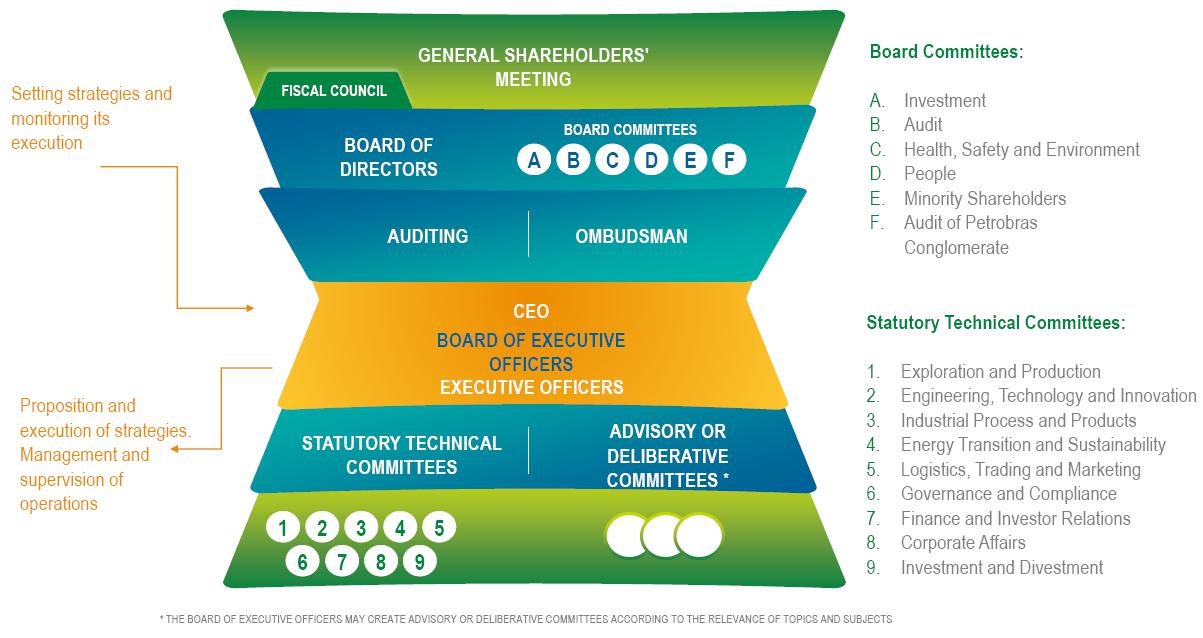
Our Code of Best Practices gathers our main governance policies and aims to improve and strengthen our governance mechanisms, guiding the performance of our directors, executive officers, managers, employees and collaborators.

PETROBRAS | Annual Report and Form 20-F | 2023 | 171 |
| Table of Contents | |
| | Environment, Social and Governance |
Major Recognition
We are members of the Brazilian Institute of Corporate Governance (“IBGC”), which ratifies our commitment to the continuous improvement of our processes and internal controls, in alignment with good corporate governance practices in the market, with the objectives and values defined in our Strategic Plan, as well as with national and international legislation.
We received, for six years in a row, the certification in the Governance Indicator of the Secretariat for Coordination and Governance of State-Owned Companies (“IG-Sest”), of the Ministry of Finance, achieving their best level, Level 1, which shows our high degree of excellence in corporate governance. There was no evaluation in 2023 because IG-Sest is undergoing restructuring and reevaluation of the issues to be evaluated, therefore, Petrobras continues with the Level 1 obtained in 2022.
This certification, besides acknowledging our advances in recent years, is an opportunity to assess our processes at a new level of quality and reaffirm our commitment to the continuous improvement of our corporate governance.
In 2023, we reached 94% adherence to the Brazilian Code of Corporate Governance (CBGC). According to the latest survey released by the IBGC, the degree of adherence of companies in the market averaged 65.3% in 2023, an increase of 2.7% compared to the previous year (62.6%).
Additionally, for the seventh consecutive year, in 2023 we won the National Association of Finance, Administration, and Accounting Executives (Anefac) award, granted to the Brazilian companies with the best quality and transparency in their financial statements. The classification is made based on a rigorous technical analysis of the financial statements published by companies based in Brazil that operate in the commercial, industrial, and service sectors. Criteria such as transparency, clarity and consistency of information, adherence to accounting standards, among others, are evaluated.
We believe that the results we have achieved prove the recognition of the market and regulatory and control entities regarding the improvement of our culture of integrity and of our governance mechanisms. We believe that a high degree of integrity reinforces our reputation among our stakeholders and, consequently, within society as a whole.
Shareholders’ Meeting
The shareholders’ meetings must take place on an ordinary or extraordinary basis. An ordinary shareholders’ meeting must take place once a year in order to: (i) examine the administrators' account, examine, discuss and vote on the financial statements; (ii) decide on the allocation of net income for the year and the distribution of dividends; and (iii) elect the members of the Board of Directors and Fiscal Council. In addition to the matters provided for by law, an extraordinary shareholders’ meeting must take place if called to decide on matters of our best interest, as defined in our Bylaws.
For more detailed information on our shareholders’ meetings, see “Shareholder Information” in this annual report.
Comparison of our Corporate Governance Practices with NYSE Corporate Governance Requirements Applicable to U.S. Companies
Under the rules of the NYSE, foreign private issuers are subject to a more limited set of corporate governance requirements than U.S. domestic issuers. As a foreign private issuer, we must comply with four principal NYSE corporate governance rules: (i) we must satisfy the requirements of Rule 10A-3 under the Exchange Act; (ii) our Chief Executive Officer must promptly notify the NYSE in writing after any executive officer becomes aware of any material non-compliance with the applicable NYSE corporate governance rules; (iii) we must provide the NYSE with annual and interim written affirmations as required under the NYSE corporate governance rules; and (iv) we must provide a brief description of any significant differences between our corporate governance practices and those followed by U.S. companies under NYSE listing standards.
PETROBRAS | Annual Report and Form 20-F | 2023 | 172 |
| Table of Contents | |
| | Environment, Social and Governance |
The table below briefly describes the significant differences between our corporate governance practices and the NYSE corporate governance rules.
| Section | New York Stock Exchange Corporate Governance Rules for U.S. Domestic Issuers | Our Practices |
| Director Independence | ||
| 303A.01 | Listed companies must have a majority of independent directors. “Controlled companies” are not required to comply with this requirement. | We are a controlled company because more than a majority of our voting capital (at least 50% plus one share) is controlled by the Brazilian federal government. As a controlled company, we would not be required to comply with the majority of independent directors requirement if it were a U.S. domestic issuer. According to our Bylaws, we are required to have at least 40% of independent directors. |
| 303A.03 | The non-management directors of each listed company must meet at regularly scheduled executive sessions without management. | Except for our CEO (who is also a director), all of our directors are non-management directors. The regulation of our Board of Directors provides that if a particular matter may represent a conflict of interests, the CEO must recuse himself from the meeting, which will continue without his presence. Additionally, the board’s regulation also establishes a regular executive session for our Board of Directors matters without management. |
| Nominating/Corporate governance committee | ||
| 303A.04 | Listed companies must have a nominating/ corporate governance committee composed entirely of independent directors, with a written charter that covers certain minimum specified duties. “Controlled companies” are not required to comply with this requirement. |
We have a statutory committee that verifies the compliance of the appointment of members of our Fiscal Council, our Executive Officers, and our Board of Directors and the external members of the committees that advise our Board of Directors. Our people committee has a written charter that requires the majority of its members to be independent. Our Board of Directors develops, evaluates and approves corporate governance principles. As a controlled company, we would not be required to comply with the nominating/corporate governance committee requirement if we were a U.S. domestic issuer. |
| Compensation committee | ||
| 303A.05 | Listed companies must have a compensation committee composed entirely of independent directors, with a written charter that covers certain minimum specified duties. “Controlled companies” are not required to comply with this requirement. |
We have a committee that advises our Board of Directors with respect to compensation and management succession. Our people committee has a written charter that requires the majority of its members to be independent. As a controlled company, we are not required to comply with the compensation committee requirement. |
PETROBRAS | Annual Report and Form 20-F | 2023 | 173 |
| Table of Contents | |
| | Environment, Social and Governance |
| Audit committee | ||
| Section | New York Stock Exchange Corporate Governance Rules for U.S. Domestic Issuers | Our Practices |
|
303A.06 303A.07 |
Generally, listed companies must have an audit committee with a minimum of three independent directors that satisfy the independence requirements of Rule 10A-3 under the Exchange Act, with a written charter that covers certain minimum specified duties. However, pursuant to Exchange Act Rule 10A-3(c)(3), a foreign private issuer is not required to have an audit committee equivalent to or comparable with a U.S. audit committee if the foreign private issuer has a body established and selected pursuant to home country legal or listing provisions expressly requiring or permitting such a body, and if the body meets the requirements that (i) it be separate from the full board, (ii) its members not be elected by management, (iii) no executive officer be a member of the body, and (iv) home country legal or listing provisions set forth standards for the independence of the members of the body. | Our audit committee is a statutory advisory committee to our Board of Directors and satisfies the exemption set forth in Rule 10A-3(c)(3) under the Exchange Act. See “Management and Employees – Statutory Board Committees” for a description of our audit committee. Our audit committee has a written charter that sets forth its responsibilities that include, among other things: (i) assess the independent auditor's qualifications and independence, and the performance of the independent audit functions, (ii) assuring legal and regulatory compliance, including with respect to internal controls, compliance procedures and ethics, and (iii) monitoring our financial position, especially as to risks, internal auditing work and financial disclosure; (iv) carry out prior analysis of transactions with related parties that meet the criteria established in the Related Party Transactions Policy, approved by our Board of Directors. In addition, one of the audit committee members is an external accounting and auditing expert, who brings valuable expertise and experience to the committee's work. |
| Equity Compensation Plans | ||
| 303A.08 | Shareholders must have the opportunity to vote for compensation plans through shares and material reviews, with limited exceptions as set forth by the NYSE’s rules. | Under Brazilian Corporate Law, shareholder approval is required for the adoption and revision of any equity compensation plans. We do not currently have any equity compensation plans. |
| Corporate Governance Guidelines | ||
| 303A.09 | Listed companies must adopt and disclose corporate governance guidelines. |
We have a set of Corporate Governance Guidelines (Diretrizes de Governança Corporativa) that address general ombudsman qualification standards, responsibilities, composition, appraisals and access to information by the management. The guidelines do not reflect the independence requirements set forth in Sections 303A.01 and 303A.02 of the NYSE rules. Certain portions of the guidelines, including the responsibilities and compensation sections, are not discussed with the same level of detail set forth in the commentaries to the NYSE rules. The guidelines are available on our website at www.petrobras.com.br/ir. We also have a Corporate Governance Policy, approved by our Board of Directors, which establishes our governance principles and guidelines. This policy applies to our company and our affiliates, pursuant to Article 16 of our Bylaws. |
PETROBRAS | Annual Report and Form 20-F | 2023 | 174 |
| Table of Contents | |
| | Environment, Social and Governance |
| Code of Ethics for Directors, Officers and Employees | ||
| Section | New York Stock Exchange Corporate Governance Rules for U.S. Domestic Issuers | Our Practices |
| 303A.10 | Listed companies must adopt and disclose a code of business conduct and ethics for directors, officers and employees, and promptly disclose any waivers of the code for directors or executive officers. | We have a Code of Ethical Conduct (Código de Conduta Ética), applicable to the members of the Board of Directors and its advisory committees, members of the Fiscal Council, members of the Executive Board, employees, interns, service providers and anyone acting on our behalf (“collaborators”), including its subsidiaries in Brazil and abroad, and a Code of Best Practices (Código de Boas Práticas) applicable to our directors, executive officers, senior management, employees and collaborators. No waivers of the provisions of the Code of Ethical Conduct or the Code of Best Practices are permitted. These documents are available on our website at www.petrobras.com.br/ir. |
| Certification Requirements | ||
| 303A.12 | Each listed company CEO must certify to the NYSE each year that he or she is not aware of any violation by us of NYSE corporate governance listing standards. | Our CEO will promptly notify the NYSE in writing if any executive officer becomes aware of any material noncompliance with any applicable provisions of the NYSE corporate governance rules. |
PETROBRAS | Annual Report and Form 20-F | 2023 | 175 |

PETROBRAS | Annual Report and Form 20-F | 2023 | 176 |
| Table of Contents | |
| | Operating and Financial Review and Prospects |
Consolidated Financial Performance
We achieved a net income of US$25.0 billion, cash provided by operating activities of US$43.2 billion, a Free Cash Flow (a non-GAAP measure defined in Liquidity and Capital Resources – Free Cash Flow) of US$31.1 billion and an Adjusted EBITDA (a non-GAAP measure defined in Liquidity and Capital Resources – Adjusted EBITDA and Net Debt/Adjusted EBITDA ratio) of US$52.4 billion.
Operating income in 2023 was US$38.0 billion, 33% lower than 2022 primarily due to the 18% depreciation of the average Brent price in 2023 when compared to 2022 and lower crack spreads of oil products in 2023 when compared to 2022, especially diesel, following the international price scenario. In addition, the result was impacted by the increase in operating expenses, including lower capital gains from the co-participation agreements in the Sépia and Atapu fields, and higher impairment (losses) reversals, net, abandonment costs and other taxes. These effects were partially offset by the increase in the volume of oil exported. Net income attributable to shareholders was US$24.9 billion in 2023, a 32% decrease compared to US$36.6 billion in 2022. This result was impacted by the same reasons that affected operating income and was partially offset by improved net finance expense and lower income taxes.
Fluctuations in our financial condition and results of operations are driven by a combination of factors, including:
| – | the volume of crude oil, oil products and natural gas we produce and sell; |
| – | changes in international prices of crude oil and oil products (denominated in U.S. dollars); |
| – | changes in the domestic prices of oil products (denominated in reais); |
| – | fluctuations in the real vs. U.S. dollar exchange rates and other currencies, as disclosed in Note 34.3(c) to our audited consolidated financial statements; |
| – | the demand for oil products in Brazil; |
| – | the recoverable amounts of assets for impairment testing purposes; and |
| – | the amount of production taxes from our operations that we are required to pay. |
PETROBRAS | Annual Report and Form 20-F | 2023 | 177 |
| Table of Contents | |
| | Operating and Financial Review and Prospects |
CONSOLIDATED STATEMENT OF INCOME INFORMATION (US$ million)
| As reported | ||||
| Jan-Dec | Variation | |||
| 2023 | 2022 | ▲ | ▲ (%) | |
| Sales revenues | 102,409 | 124,474 | (22,065) | (17.7) |
| Cost of sales | (48,435) | (59,486) | 11,051 | 18.6 |
| Gross profit | 53,974 | 64,988 | (11,014) | (16.9) |
| Selling expenses | (5,038) | (4,931) | (107) | (2.2) |
| General and administrative expenses | (1,594) | (1,332) | (262) | (19.7) |
| Exploration costs | (982) | (887) | (95) | (10.7) |
| Research and development expenses | (726) | (792) | 66 | 8.3 |
| Other taxes | (890) | (439) | (451) | (102.7) |
| Impairment (losses) reversals, net | (2,680) | (1,315) | (1,365) | (103.8) |
| Other income and expenses, net | (4,031) | 1,822 | (5,853) | (321.2) |
| Operating income | 38,033 | 57,114 | (19,081) | (33.4) |
| Net finance expense | (2,333) | (3,840) | 1,507 | 39.2 |
| Results of equity-accounted investments | (304) | 251 | (555) | (221.1) |
| Net income before income taxes | 35,396 | 53,525 | (18,129) | (33.9) |
| Income taxes | (10,401) | (16,770) | 6,369 | 38.0 |
| Net income for the year | 24,995 | 36,755 | (11,760) | (32.0) |
| Exchange rate and variation impacts |
|
As we are a Brazilian company and most of our operations are carried out in Brazil, we prepare our financial statements primarily in reais, which is our functional currency and that of all of our Brazilian subsidiaries. We also have entities that operate outside Brazil the functional currency of which is the U.S. dollar. We have selected the U.S. dollar as our presentation currency in this annual report to facilitate the comparison with other oil and gas companies. We have used criteria set forth in IAS 21 – “The effects of changes in foreign exchange rates” to translate the consolidated financial statements from reais into U.S. dollars. Based on IAS 21, we have translated (i) all assets and liabilities into U.S. dollars at the exchange rate as of the date of the statement of financial position; (ii) all accounts in the statements of income, other comprehensive income and cash flows using the average exchange rates prevailing during the relevant period and (iii) equity items at the exchange rates prevailing at the respective transactions dates. For more information regarding our functional and presentation currency, see “About Us” and Note 2.2 to our consolidated financial statements. |
PETROBRAS | Annual Report and Form 20-F | 2023 | 178 |
| Table of Contents | |
| | Operating and Financial Review and Prospects |
|
EXCHANGE AND INFLATION RATES | |||||
| 2023 | 2022 | 2021 | |||
| Year-end exchange rate (reais/US$) | 4.84 | 5.22 | 5.58 | ||
| Appreciation (depreciation) during the year(1) | 7.3% | 6.5% | (7.4%) | ||
| Average exchange rate for the year (reais/US$) | 5.00 | 5.16 | 5.40 | ||
| Appreciation (depreciation) during the year(2) | 3.1% | 4.3% | (4.7%) | ||
| IPCA | 4.62% | 5.79% | 10.06% | ||
|
(1) Based on year-end exchange rate. (2) Based on average exchange rate for the year.
From January 1, 2024 to April 10, 2024, the real depreciated -4.6% the U.S. dollar. Most of our export revenues are denominated in U.S. dollars and our domestic sales are also indirectly linked to the U.S. dollar due to our current policy to generally seek to maintain parity with international product price. Therefore, the devaluation of the real is generally favorable to our results as the positive impact in revenues is higher than the negative impact on operating costs, the majority of which are denominated in Brazilian reais. Exchange rate fluctuations may affect the results of variables such as the following: | |||||
– |
Margins: The relative pace at which our total revenues and expenses in reais increase or decrease as a result of exchange rate fluctuations, and its impact on our margins, is affected by our pricing policy in Brazil. Absent changes in the international prices of crude oil, oil products and natural gas, when the real appreciates against the U.S. dollar, and we do not adjust our prices in Brazil, our margins increase. On the other hand, absent changes in the international prices of crude oil, oil products and natural gas, when the real depreciates against the U.S. dollar and we do not adjust our prices in Brazil, our margins decline. For further information on our prices and our pricing policies, see “Sales Volumes and Prices” in this section. |
||
– |
Debt service: The depreciation of the real against the U.S. dollar also increases our debt service expenses in reais, as the amount of reais necessary to pay principal and interest on foreign currency debt increases with the depreciation of the real. As our debt denominated in other currencies increases, the negative impact of a depreciation of the real on our results and net income when expressed in reais also increases, thereby reducing earnings available for distribution. |
||
– |
Retained earnings available for distribution: Exchange rate variation also affects the amount of retained earnings available for distribution by us when expressed in U.S. dollars. Amounts reported as available for distribution in our statutory accounting records are calculated in reais and prepared in accordance with IFRS. They may increase or decrease when expressed in U.S. dollars as the real appreciates or depreciates against the U.S. dollar. |
|
We designated hedging relationships to account for the effects of the existing hedge between a foreign exchange gain or loss from portions of our long-term debt obligations (denominated in U.S. dollars) and foreign exchange gain or loss of our highly probable U.S. dollar denominated future export revenues, so that gains or losses associated with the hedged transaction (the highly probable future exports) and the hedging instrument (debt obligations) are recognized in the statement of income in the same periods. For more information about our cash flow hedge, see Notes 4.8 and 35.2.2(a) to our audited consolidated financial statements. For information about our related foreign exchange exposure related, see “Liquidity and Capital Resources – Exposure to interest rate and exchange rate risk” in this section. For more information about our foreign exchange exposure related to assets and liabilities, see Note 35.2.2(c) to our audited consolidated financial statements.
|
PETROBRAS | Annual Report and Form 20-F | 2023 | 179 |
| Table of Contents | |
| | Operating and Financial Review and Prospects |
Sales Revenues
In 2023, sales revenues decreased 18% compared to 2022, reaching US$102.4 billion, due to lower oil, and oil product prices.
| Sales volumes and prices |
|
As a vertically integrated company, we process most of our crude oil production in our refineries and sell the refined oil products primarily in the Brazilian market. Therefore, the price of oil products in Brazil has a significant impact on our financial results. International oil product prices vary over time as the result of many factors, including the price of crude oil. We take into account domestic market conditions and seek to align the price of oil products with international prices while avoiding the immediate transfer of volatility of international quotations and the exchange rate. The average price of Brent Crude Oil, as reported by Bloomberg, was US$83 per barrel in 2023, US$101 per barrel in 2022 and US$71 per barrel in 2021. As of December 31, 2023, the Brent Crude Oil price was US$77.6 per barrel. Consolidated sales revenues were US$102,409 million in 2023 as compared to US$124,474 million in 2022, primarily due to: – a decrease of US$20,958 million due to lower oil products prices; and – a decrease of US$1,107 million due to lower oil products volumes sold.
| |||||||||||
| For the year ended December 31 | |||||||||||
| 2023 | 2022 | 2021 | |||||||||
| Volume (mbbl, except as otherwise noted) | Net Average Price (US$)(1) |
Sales Revenues (US$ million) |
Volume (mbbl, except as otherwise noted) | Net Average Price (US$)(1) |
Sales Revenues (US$ million) |
Volume (mbbl, except as otherwise noted) | Net Average Price (US$)(1) |
Sales Revenues (US$ million) |
|||
| Diesel | 272,276 | 118.48 | 32,260 | 275,572 | 145.69 | 40,149 | 292,488 | 82.86 | 24,236 | ||
| Automotive gasoline | 152,509 | 93.82 | 14,309 | 148,647 | 108.81 | 16,175 | 149,132 | 79.86 | 11,910 | ||
| Fuel oil (including bunker fuel) | 11,949 | 96.91 | 1,158 | 12,239 | 115.29 | 1,411 | 22,125 | 80.23 | 1,775 | ||
| Naphtha | 24,997 | 73.49 | 1,837 | 26,692 | 89.76 | 2,396 | 25,020 | 67.91 | 1,699 | ||
| Liquefied petroleum gas | 75,151 | 46.65 | 3,506 | 77,149 | 66.38 | 5,121 | 83,320 | 53.90 | 4,491 | ||
| Jet fuel | 37,911 | 132.28 | 5,015 | 35,879 | 151.15 | 5,423 | 27,184 | 83.54 | 2,271 | ||
| Other oil products | 61,607 | 71.87 | 4,428 | 63,717 | 86.88 | 5,536 | 59,892 | 71.14 | 4,261 | ||
| Subtotal oil products | 636,400 | 98.23 | 62,513 | 639,895 | 119.10 | 76,211 | 659,161 | 76.83 | 50,643 | ||
| Natural gas (boe) | 82,536 | 68.24 | 5,632 | 111,270 | 68.96 | 7,673 | 128,504 | 45.79 | 5,884 | ||
| Oil | 66,175 | 82.74 | 5,475 | 73,771 | 104.63 | 7,719 | 8,789 | 76.35 | 671 | ||
| Ethanol, nitrogen products, renewables and other non-oil products | 1,564 | 60.10 | 94 | 1,085 | 260.83 | 283 | 1,422 | 28.13 | 40 | ||
| Electricity, services and others | — | — | 2,576 | — | — | 2,406 | — | — | 3,953 | ||
| Total Brazilian market | 786,675 | — | 76,290 | 826,021 | — | 94,292 | 797,876 | — | 61,191 | ||
| Exports | 294,291 | 84.99 | 25,012 | 260,734 | 105.46 | 27,497 | 296,055 | 72.59 | 21,491 | ||
| International sales | 16,455 | 67.27 | 1,107 | 20,511 | 130.91 | 2,685 | 16,888 | 76.03 | 1,284 | ||
| Total global market | 310,746 | — | 26,119 | 281,244 | — | 30,182 | 312,943 | — | 22,775 | ||
| CONSOLIDATED SALES REVENUES | 1,097,421 | — | 102,409 | 1,107,265 | — | 124,474 | 1,110,819 | — | 83,966 | ||
|
(1) Net average price calculated by dividing sales revenues by the volume for the year.
| |||||||||||
PETROBRAS | Annual Report and Form 20-F | 2023 | 180 |
| Table of Contents | |
| | Operating and Financial Review and Prospects |
Cost of Sales
In 2023, the cost of sales decreased 19%, reaching US$48,435 million, mainly reflecting both lower imported crude oil and oil products prices, and a lower share of imported crude oil in the refined products, which has a higher price.
Selling Expenses
Selling expenses were US$5,038 million in 2023, an increase of 2% compared to US$4,931 million in 2022, mainly due to higher crude oil and oil products exports, and higher shipping costs.
General and Administrative Expenses
General and administrative expenses were US$1,594 million in 2023, an increase of 16% compared to US$1,332 million in 2022, mainly reflecting higher employee expenses (+R$0.1 billion), resulting from salary increases, actuarial expenses, and training and development.
Exploration Costs
Exploration costs were US$982 million in 2023, a 11% increase when compared to US$887 million in 2022, mainly due to higher geological and geophysical expenses mostly in the Equatorial Margin Basin.
Impairment (losses) reversals, net
We recognized impairment in the amount of US$2,680 million in 2023, a US$1,365 million increase compared to an impairment loss of US$1,315 million in 2022.
This increase was mainly in oil and gas producing properties in Brazil (a US$2,717 million impairment in 2023 compared to a US$628 million impairment in 2022).
PETROBRAS | Annual Report and Form 20-F | 2023 | 181 |
| Table of Contents | |
| | Operating and Financial Review and Prospects |
Other income and expenses, net
Other income and expenses, net was an expense of US$4,031 million in 2023, a US$5,853 million change compared to an income of US$1,822 million in 2022, mainly due to:
| – | a US$4,286 million decrease in other income resulting from lower financial compensation from the co-participation agreements in bid areas (Sépia and Atapu fields) which occurred in 2022; and |
| – | a US$1,195 million in Losses on decommissioning of returned/abandoned areas, a US$970 million increase compared to 2022, mainly due to higher expenses with the abandonment provision in fields being returned in 2023, mainly in SEAL, BC and RNCE. |
Net Finance Expense
Net finance expense was US$2,333 million in 2023, a 39% decrease when compared to US$3,840 million in 2022, mainly due to a foreign exchange loss of US$580 million in 2023, as compared to a US$2,172 million loss in 2022, reflecting a 7.3% appreciation of the real/US$ exchange rate in 2023 compared to a 6.5% appreciation in 2022, which applied to a lower average net liability exposure to the US$ during 2023 than in 2022.
Results in equity-accounted investments
We had a loss in equity-accounted investments of US$304 million in 2023, compared to a gain of US$251 million in 2022. This reduction was mainly due to losses with Braskem reflecting lower operational results.
Income Taxes
Income tax was an expense of US$10,401 million in 2023, compared to an expense of US$16,770 million in 2022, mainly due to lower operating income.
For information regarding discussion of earlier years, please refer to our previous Annual Report and Form 20-F. Our SEC filings are available to the public on the SEC’s website at www.sec.gov and on our website at www.petrobras.com.br/ir.
PETROBRAS | Annual Report and Form 20-F | 2023 | 182 |
| Table of Contents | |
| | Operating and Financial Review and Prospects |
Financial Performance by Business Segment
SELECTED FINANCIAL DATA BY REPORTABLE OPERATING SEGMENTS AND FOR CORPORATE AND OTHER BUSINESS
| For the year ended December 31 | |||
|
2023 (US$ million) |
2022 (US$ million) |
▲ 23-22 (%) | |
| Exploration and Production | |||
| Third parties(1)(2) | 767 | 1,311 | (41.5) |
| Intersegment | 66,113 | 76,579 | (13.7) |
| Sales revenues(2) | 66,880 | 77,890 | (14.1) |
| Cost of sales | (27,239) | (30,465) | 10.6 |
| Impairment (losses) reversals, net | (2,105) | (1,218) | (72.8) |
| Net income (loss) attributable to our shareholders | 22,453 | 32,073 | (30.0) |
| Refining, Transportation and Marketing | |||
| Third parties(1)(2) | 93,464 | 111,581 | (16.2) |
| Intersegment | 1,404 | 1,950 | (28.0) |
| Sales revenues(2) | 94,868 | 113,531 | (16.4) |
| Cost of sales | (85,699) | (99,154) | 13.6 |
| Impairment (losses) reversals, net | (524) | (97) | (440.2) |
| Net income (loss) attributable to our shareholders | 3,036 | 7,426 | (59.1) |
| Gas and Low Carbon Energies | |||
| Third parties(1)(2) | 7,824 | 11,077 | (29.4) |
| Intersegment | 3,285 | 3,991 | (17.7) |
| Sales revenues(2) | 11,109 | 15,068 | (26.3) |
| Cost of sales | (5,685) | (10,518) | 45.9 |
| Impairment (losses) reversals, net | (81) | 1 | (8,200.0) |
| Net income (loss) attributable to our shareholders | 1,286 | 1,038 | 23.9 |
| Corporate and other Businesses | |||
| Third parties(1)(2) | 354 | 505 | (29.9) |
| Intersegment | 11 | 6 | 83.3 |
| Sales revenues(2) | 365 | 511 | (28.6) |
| Net income (loss) attributable to our shareholders | (1,723) | (3,014) | 42.8 |
| (1) | Not all of our segments have significant third-party revenues. For example, our Exploration and Production segment accounts for a large part of our economic activity and capital expenditures but has little third-party revenues. |
| (2) | Revenues from commercialization of oil to third parties are classified in accordance with the points of sale, which could be either the Exploration and Production or Refining, Transportation and Marketing segments. |
PETROBRAS | Annual Report and Form 20-F | 2023 | 183 |
| Table of Contents | |
| | Operating and Financial Review and Prospects |
Exploration and Production
Net income attributable to our shareholders in our E&P segment was US$22,453 million in 2023 compared to US$32,073 million in 2022, primarily due to:
| – | reduction in sales revenues due to the lower price of Brent, partially offset by higher production; |
| – | higher impairment expenses due to the update of economic assumptions, as well as the project portfolio and reserve volume estimates approved in the Strategic Plan; |
| – | increase in expenses with abandonment and dismantling areas due to the growth in provisions in fields returned in 2023, mainly in SEAL, BC and RNCE; |
| – | increase in other taxes expense, due to export tax on oil; |
| – | lower other income due to the receipt, in 2022, of compensation relating to the co-participation agreements in Búzios, Sépia and Atapu. |
Refining, Transportation and Marketing
Net income attributable to our shareholders in our RTM segment was US$3,036 million in 2023 compared to US$7,426 million in 2022, primarily due to:
| – | lower sales revenues (a decrease of US$18,663 million), primarily due to the decrease in international prices, mainly diesel, gasoline and petroleum, which was reflected in the domestic market. International prices were stronger in 2022 as a consequence of the geopolitical conflicts that year. These effects also had a negative impact on fuel oil and petroleum export revenue in 2023. The decrease of sales revenues was partially offset by higher volume of petroleum exported; |
| – | lower costs of sales due to the decrease in the average Brent, which impacts the price used for purchase oil from our E&P segment as well as oil and oil products from third parties; and |
| – | higher sales expenses mainly due to the increase in shipping costs, higher impairment losses, mainly related to the second unit of Abreu e Lima refinery in 2023, gains from disposals and write-offs of assets that occurred in 2022. |
Gas and Low Carbon Energies
In 2023, the net income attributable to our shareholders in our Gas and Low Carbon Energies segment was US$1,286 million, an increase of US$248 million compared to 2022, mainly due to the lower average cost of purchasing natural gas.
For information regarding discussion of earlier years, please refer to our previous Annual Report and Form 20-F. Our SEC filings are available to the public on the SEC’s website at www.sec.gov and on our website at www.petrobras.com.br/ir.
PETROBRAS | Annual Report and Form 20-F | 2023 | 184 |
| Table of Contents | |
| | Operating and Financial Review and Prospects |
Liquidity and Capital Resources
We closely monitor liquidity levels in order to effectively meet cash needs from our business operations and financial obligations. We have a conservative approach to the management of our liquidity, which consists mainly of (i) cash and cash equivalents (cash in hand, deposits held at call with banks, money market mutual funds and other short-term highly liquid investments with maturities of three months or less), and (ii) investments in financial assets (treasury bills). Based on the information presented below, we believe our working capital is sufficient for our present requirements.
Adjusted Cash and Cash Equivalents is a non-GAAP measure that comprises cash and cash equivalents, government bonds and time deposits from highly rated financial institutions abroad with maturities of more than three months from the end of the period, considering the expected realization of those financial investments in the short-term. This measure is not defined under the IFRS and should not be considered in isolation or as a substitute for cash and cash equivalents computed in accordance with IFRS. It may not be comparable to the adjusted cash and cash equivalents of other companies; however, management believes that it is an appropriate supplemental measure to assess our liquidity and supports leverage management.
LIQUIDITY AND CAPITAL RESOURCES
| US$ million | 2023 | 2022 |
| Cash and cash equivalents at the beginning of the period | 7,996 | 10,480 |
| Net cash provided by operating activities | 43,212 | 49,717 |
| Acquisition of PP&E and intangibles assets | (12,114) | (9,581) |
| Acquisition of equity interests | (24) | (27) |
| Proceeds from disposal of assets – Divestment | 3,606 | 4,846 |
| Financial compensation from co-participation agreements | 391 | 7,284 |
| Dividends received | 88 | 374 |
| Divestment (Investment) in marketable securities | 98 | (3,328) |
| Net cash (used in) provided by investing activities | (7,955) | (432) |
| (=) Net cash provided by operating and investing activities | 35,257 | 49,285 |
| Net change in finance debt | (3,961) | (8,304) |
| Proceeds from financing | 2,210 | 2.880 |
| Repayments | (6,171) | (11,184) |
| Repayment of lease liability | (6,286) | (5,430) |
| Dividends paid to our shareholders | (19,670) | (37,701) |
| Share repurchase program | (735) | 0 |
| Dividends paid to non-controlling interest | (49) | (81) |
| Changes in non-controlling interest | 1 | 63 |
| Net cash used in financing activities | (30,700) | (51,453) |
| Effect of exchange rate changes on cash and cash equivalents | 174 | (316) |
| Cash and cash equivalents at the end of the period | 12,727 | 7,996 |
| Government bonds and time deposits with maturities of more than three months and post-fixed Bank Deposit Certificates with daily liquidity at the end of the period | 5,175 | 4,287 |
| Cash and cash equivalents in companies classified as held for sale at the end of the period | - | - |
| Adjusted Cash and Cash Equivalents at the end of the period | 17,902 | 12,283 |
PETROBRAS | Annual Report and Form 20-F | 2023 | 185 |
| Table of Contents | |
| | Operating and Financial Review and Prospects |
| Free Cash Flow |
|
Free Cash Flow is a non-GAAP measure representing Net cash provided by operating activities minus Acquisition of PP&E, intangible assets and equity interest (“Free Cash Flow”). We use it as a supplemental measure to assess our liquidity and to support liability management. In addition, this measure is the basis for the distribution of dividends according to our shareholder remuneration policy. Free Cash Flow is a non-GAAP measure and may not be comparable to the calculation of liquidity measures presented by other companies, and it should neither be considered in isolation nor as a substitute for any measures calculated in accordance with IFRS. This metric must be considered together with other measures and indicators for a better understanding of our financial condition.
RECONCILIATION OF FREE CASH FLOW | |||||||||||
| US$ million | R$ million(1) | ||||||||||
| 2023 | 2022 | 2023 | 2022 | ||||||||
| Net cash provided by operating activities | 43,212 | 49,717 | 215,696 | 255,410 | |||||||
| (-) Acquisition of PP&E and intangible assets | (12,114) | (9,581) | (60,315) | (49,656) | |||||||
| (-) Acquisition of equity interests | (24) | (27) | (120) | (138) | |||||||
| Free Cash Flow | 31,074 | 40,109 | 155,261 | 205,616 | |||||||
| (1) According to our shareholder remuneration policy, proposed dividends to shareholders are calculated based on the Free Cash Flow measured in Brazilian reais whose numbers are derived from our annual financial statements filed with the CVM. | |||||||||||
The principal uses of funds in the year ended December 31, 2023 were for dividend payments and share repurchase program amounting to US$20,454 million, debt service obligations, including pre-payment of debts in the international banking market, interest on finance debt, repurchase of securities in the international capital market and lease payments totaling US$12,457 million and acquisition of PP&E and intangibles assets in the amount of US$12,114 million. These funds were principally provided by cash from operating activities of US$43,212 million, proceeds from divestments of US$3,606 million, proceeds from financing of US$2,210 million, and financial compensation from co-participation agreements of US$391 million.
PETROBRAS | Annual Report and Form 20-F | 2023 | 186 |
| Table of Contents | |
| | Operating and Financial Review and Prospects |
Source of Funds
In 2023, our financing strategy was mainly based in managing our existing financial liabilities, aiming to extend short-term debt maturities and improving our capital structure, preserving our solvency and liquidity.
Cash Flows from Operating Activities
Net cash provided by operating activities was US$43,212 million in 2023, a decrease of 13.1% from US$49,717 million in 2022, mainly due to lower crude oil and oil products prices, and also lower volume of oil products sold.
Disposal of Assets
We received cash inflow from the sale of assets amounting to US$3,606 million, for the year ended December 31, 2023, which represents the prices paid to us on the closing of the completed transactions and the upfront contract signing payments related to certain transactions that have not yet been closed.
| Assets | Cash-inflow (US$ million) | |
| Sale of Albacora Leste field | 1,586 | |
| Sale of Potiguar cluster | 1,010 | |
| Sale of Norte Capixaba cluster | 427 | |
| Others | 483 | |
| Total | 3,606 | |
From January 1, 2024 through February 29, 2024, we received US$298 million from divestments relating to the last installment for the sale of the Carmópolis cluster which was closed in December 2022.
For additional information on divestments, see “Our Business – Portfolio Management” in this annual report.
Debt
Our proceeds from financing are comprised of local and global notes issued in the capital markets and funds raised from banking markets (in Brazil and abroad).
Additionally, our total debt includes lease liabilities. Our Gross Debt (which represents the sum of current and non-current finance debt and lease liabilities) totaled US$62,600 million, and the Net Debt (a non-GAAP measure representing Gross Debt minus Adjusted Cash and Cash Equivalents), totaled US$44,698 million.
We can use our revolving credit lines in case of liquidity needs at any time until their maturity dates, and they will be considered as part of our Gross Debt and Net Debt only once drawn down.
For reconciliation of Net Debt and Gross Debt, see “Liquidity and Capital Resources – Sources of Funds – Finance Debt - Adjusted EBITDA and Net Debt/Adjusted EBITDA ratio” in this annual report.
PETROBRAS | Annual Report and Form 20-F | 2023 | 187 |
| Table of Contents | |
| | Operating and Financial Review and Prospects |
Finance Debt
Debt profile
In 2023, proceeds from financing amounted to US$2,210 million, reflecting notably: (i) the issuance of Global Notes in the international capital markets in the amount of US$1,235 million, maturing in 2033; and (ii) funds raised from domestic banking market in the amount of US$907 million.
We currently issue notes in the international capital markets through our wholly-owned finance subsidiary PGF. We fully and unconditionally guarantee such notes issued by PGF.
Information on weighted average interest rate and weighted average maturity of our finance debt is presented below:
| 2023 | 2022 | 2021 | |
| Weighted average interest rate (%) | 6.4 | 6.5 | 6.2 |
| Weighted average maturity (in years) | 11.38 | 12.07 | 13.39 |
| Leverage (%)(1) | 30 | 39 | 41 |
| (1) | This leverage takes into account market capitalization as of December 31 of the respective year and is defined as (Gross Debt – Adjusted cash and cash equivalents) / (Market Capitalization + Gross Debt – Adjusted cash and cash equivalents). |
For additional information on Finance Debt amortization, see “Liquidity and Capital Resources – Use of Funds – Debt Service Obligations” in this annual report.
FINANCE DEBT PROFILE PER CATEGORY AS OF DECEMBER 31, 2023 (%)
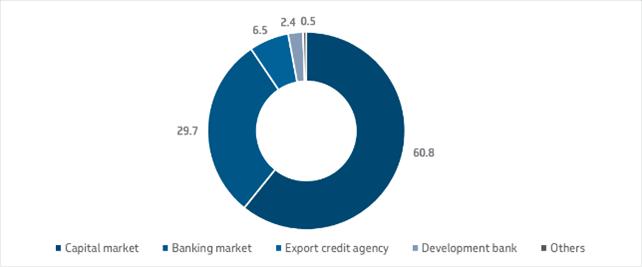
PETROBRAS | Annual Report and Form 20-F | 2023 | 188 |
| Table of Contents | |
| | Operating and Financial Review and Prospects |
DEBT PROFILE PER CURRENCY AS OF DECEMBER 31, 2023 (%)
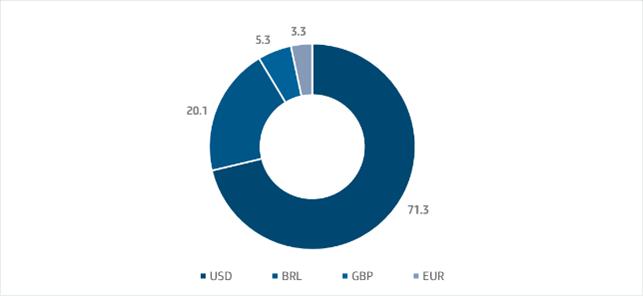
As of December 31, 2023, our finance debt amounted to US$ 28,801 million, as compared to US$29,945 million as of December 2022. This decrease was primarily due to repayment of finance debt, including early payment of US$1,218 million. See Note 32 to our audited consolidated financial statements for a breakdown of our finance debt, a roll-forward schedule of our finance debt by source and other information.
For more information about our securities, including our bonds, see Exhibit 2.4 to this annual report.
| Rating |
|
In 2023, Moody’s maintained our credit rating at “Ba1”, with a stable outlook. The agency also maintained our stand alone rating at “Ba1”, one notch above the Brazilian government. S&P upgraded our credit rating at “BB” with a stable outlook and kept our stand alone rating at “BB+”, one notch below investment grade. Fitch upgraded our credit rating at “BB”, with a stable outlook. The agency maintained our stand alone rating at “BBB”, the second level in the investment grade scale. As of April 4, 2024, there were no changes to our stand-alone credit profile rating or to our global rating.
GLOBAL RATING | |||||
| 2024(1) | 2023(2) | 2022(2) | |||
| Standard & Poor’s | BB | BB | BB- | ||
| Moody’s | Ba1 | Ba1 | Ba1 | ||
| Fitch | BB | BB | BB- | ||
|
(1) As of April 4, 2024. (2) As of December 31. |
|||||
PETROBRAS | Annual Report and Form 20-F | 2023 | 189 |
| Table of Contents | |
| | Operating and Financial Review and Prospects |
|
STAND ALONE RATING | |||||
| 2024(1) | 2023(2) | 2022(2) | |||
| Standard & Poor’s | BB+ | BB+ | BB+ | ||
| Moody’s | Ba1 | Ba1 | Ba1 | ||
| Fitch | BBB | BBB | BBB | ||
|
|
(1) |
As of April 4, 2024. |
|
|
(2) |
As of December, 31. |
| Exposure to interest rate and exchange rate risk |
|
The table below provides a summary of information regarding our exposure to interest rate and exchange rate risk in our finance debt for 2023 and 2022, including short-term and long-term debt.
TOTAL FINANCE DEBT (1) | |||||
| 2023 (%) | 2022 (%) | ||||
| Real - denominated | |||||
| Fixed rate | 9.5 | 8.8 | |||
| Floating rate | 10.6 | 7.6 | |||
| Sub-total | 20.1 | 16.4 | |||
| U.S. dollar - denominated | |||||
| Fixed rate | 41.9 | 39.9 | |||
| Floating rate | 29.4 | 35.8 | |||
| Sub-total | 71.3 | 75.7 | |||
| Other currencies | |||||
| Fixed rate | 8.6 | 7.9 | |||
| Sub-total | 8.6 | 7.9 | |||
| Total | 100.0 | 100.0 | |||
| Floating rate debt | |||||
| Real-denominated | 10.6 | 7.6 | |||
| Foreign currency-denominated | 29.4 | 35.8 | |||
| Fixed rate debt | |||||
| Real-denominated | 9.5 | 8.8 | |||
| Foreign currency denominated | 50.5 | 47.8 | |||
| Total | 100.0 | 100.0 | |||
| U.S. dollars | 71.3 | 75.7 | |||
| Euro | 3.3 | 3.1 | |||
| Gbp | 5.3 | 4.8 | |||
| Brazilian reais | 20.1 | 16.4 | |||
| Total | 100.0 | 100.0 | |||
| (1) Short term and long term. | |||||
PETROBRAS | Annual Report and Form 20-F | 2023 | 190 |
| Table of Contents | |
| | Operating and Financial Review and Prospects |
|
We aim to practice integrated risk management in every decision-making process. Thus, we do not focus solely on the individual risks of our operations or business units, but, rather, we take a broader view of our consolidated activities, capturing possible natural hedges where and when available. With respect to the management of financial risks, including market risks, we preferentially use more structural actions through the management of our equity and indebtedness levels, instead of using financial derivative instruments. Market risk management focuses on the uncertainties inherent in meeting our objectives and aims at establishing action plans towards a balanced combination of risk, return and liquidity. Acceptable limits for market risks depend on the conditions of the business environment, such as price levels, rates and volatility of risk factors, political, macroeconomic and other uncertainties that significantly influence our economic and financial performance. We define the limits for market risks when elaborating each new strategic plan we adopt, considering our strategic objectives, goals, expected value and the liquidity of financial resources required for the implementation of that strategic plan. The use of financial instruments, such as derivatives, may be necessary to meet our needs. Our foreign currency floating rate debt was principally subject to fluctuations in LIBOR. However, during 2023, we renegotiated most contracts to include SOFR variations. We are still negotiating two contracts dependent on LIBOR, but we expect to conclude these negotiations by the end of 2024. Those two contracts represent less than 1.0% of our outstanding debt. Our floating rate debt denominated in reais is subject to fluctuations in the Brazilian interbank offering rate (or “DI”) and Brazilian long-term interest rate as fixed by the CMN. We generally do not use derivative instruments to manage our exposure to interest rate fluctuation, but we may utilize these financial instruments in the future. The exchange rate risk to which we are exposed has greater impact on the balance sheet and derives principally from the presence of non-real denominated obligations in our debt portfolio. With respect to the management of foreign exchange risks, we take a broader view of our consolidated activities, capturing possible natural hedges whenever they are available, benefiting from the correlation between our income and expenses. In the short term, the management of our foreign exchange risk involves allocating our cash investments between the real and other foreign currencies. Our strategy, reevaluated annually in the revision of our Strategic Plan, may also involve the use of financial instruments, such as derivatives, to hedge certain liabilities, minimizing foreign exchange rate risk exposure, especially when we are exposed to a foreign currency in which no cash inflows are expected, for example, the Pound Sterling. In 2017, we entered into derivative transactions, through our indirect subsidiary PGT, in the form of cross-currency swaps to hedge against exposure in Pound Sterling versus U.S. dollars, arising from past issues of bonds in that currency. During 2021, the notional amount was reduced, adjusting the protection to a lower exposure to the Pound Sterling provided by the prepayment of related-party loans in this currency over the course of this period. In 2022, after carrying out a broad and integrated assessment of the main risk factors to which we are exposed, we decided to fully unwind from the Pound Sterling derivatives contracts. In September 2019, we contracted derivative operations to hedge against cash flow exposure arising from debt issued in Brazilian reais, the first series of the seventh debentures issuance, with the IPCA x CDI interest rate swap maturing in September 2029 and September 2034 and the CDI x Dollar cross-currency swap operations maturing in September 2024 and September 2029. The position in the derivatives contracts remains unchanged. In 2022, we approved the first Debenture Repurchase Plan, authorizing the acquisition of debentures issued by us to be held in treasury or later sold. In July 2023, we closed this repurchase program, having repurchased a quantity equivalent to 3% of debentures outstanding. All the acquisitions were made in the secondary market, following market prices. We have designated cash flow hedging relationships to reflect the economic essence of the structural hedge mechanism between U.S. dollar-denominated debt and future sales revenues. |
PETROBRAS | Annual Report and Form 20-F | 2023 | 191 |
| Table of Contents | |
| | Operating and Financial Review and Prospects |
|
See “Consolidated Financial Performance – Exchange Rate and Variation Impacts” in this section and Notes 4.7 and 35.3(a) to our audited consolidated financial statements for further information about our cash flow hedge. See Note 35.3 to our audited consolidated financial statements for more information about our interest rate and exchange rate risks, including a sensitivity analysis demonstrating the potential impact of an adverse change in the underlying variables as of December 31, 2023. For further information regarding expected maturity schedule and currency, the principal and interest cash flows, related average interest rates of our debt obligations, credit risk and liquidity risk, see Notes 32, 35.5 and 35.6 to our audited consolidated financial statements.
|
Lease Liabilities
We are the lessee in agreements primarily including oil and gas producing units, drilling rigs and other exploration and production equipment, vessels and support vessels, helicopters, land and buildings. As of December 31, 2023, the amount of lease liabilities totaled US$33,799 million.
Adjusted EBITDA and Net Debt/Adjusted EBITDA ratio
The Net Debt/Adjusted EBITDA ratio is non-GAAP measure that helps our management assess our liquidity and leverage, and it is measured in U.S. dollars. Net Debt/Adjusted EBITDA ratio is not defined under IFRS and should not be considered in isolation or as a substitute for net income or other measures calculated in accordance with IFRS.
Adjusted EBITDA represents an alternative measure to our net cash provided by operating activities and is computed by using the net income before net finance expense, income taxes, depreciation, depletion and amortization, adjusted by results of equity-accounted investments, impairment, translation adjustments - reclassified to the statement of income, results on disposal/write-offs of assets, and results from co-participation agreements in bid areas. Adjusted EBITDA is not defined under IFRS and should not be considered in isolation or as a substitute for net income or other measures calculated in accordance with IFRS.
| US$ million | 2023 | 2022 | 2021 |
| Net income | 24,995 | 36,755 | 19,986 |
| Net finance expense | 2,333 | 3,840 | 10,966 |
| Income taxes | 10,401 | 16,770 | 8,239 |
| Depreciation, depletion and amortization | 13,280 | 13,218 | 11,695 |
| Results of equity-accounted investments | 304 | (251) | (1,607) |
| Impairment (losses) reversals, net | 2,680 | 1,315 | (3,190) |
| Translation adjustments - Reclassified to the statement of income | 0 | 0 | 41 |
| Results on disposal/write-offs of assets | (1,295) | (1,144) | (1,941) |
| Results from co-participation agreements in bid areas | (284) | (4,286) | (631) |
| Adjusted EBITDA | 52,414 | 66,217 | 43,558 |
PETROBRAS | Annual Report and Form 20-F | 2023 | 192 |
| Table of Contents | |
| | Operating and Financial Review and Prospects |
Net Debt reflects the Gross Debt, net of Adjusted Cash and Cash Equivalents (see definition in “Liquidity and Capital Resources” in this annual report). Gross Debt reflects the sum of current and non-current finance debt and lease liabilities.
Our Adjusted EBITDA, Adjusted Cash and Cash Equivalents, Net Debt and Net Debt/Adjusted EBITDA ratio are non-GAAP measures and may not be comparable to the calculation of liquidity measures presented by other companies, and they should neither be considered in isolation nor as substitutes for any measures calculated in accordance with IFRS. These metrics must be considered together with other measures and indicators for a better understanding of our financial condition.
The following table presents the reconciliation for 2023 and 2022 of the Net Debt/Adjusted EBITDA ratio measure to the most directly comparable measure derived from IFRS captions, which is, in this case, is the finance debt plus lease liability minus cash and cash equivalents, divided by the net cash provided by operating activities:
| US$ million | 2023 | 2022 |
| Cash and cash equivalents | 12,727 | 7,996 |
| Government securities and time deposits (maturity of more than three months) | 5,175 | 4,287 |
| Adjusted Cash and Cash Equivalents | 17,902 | 12,283 |
| Finance debt (current and non-current) | 28,801 | 29,954 |
| Lease liability (current and non-current) | 33,799 | 23,845 |
| Gross Debt | 62,600 | 53,799 |
| Net Debt | 44,698 | 41,516 |
| Net cash provided by operating activities - OCF | 43,212 | 49,717 |
| Allowance (reversals) for credit loss on trade and other receivables, net | (40) | (65) |
| Trade and other receivables, net | (88) | (355) |
| Inventories | (1,564) | 1,217 |
| Trade payables | 954 | 359 |
| Taxes payable (1) | 10,463 | 13,957 |
| US$ million | 2023 | 2022 |
| Others(2) | (523) | 1,387 |
| Adjusted EBITDA | 52,414 | 66,217 |
| Gross debt net of Cash and cash equivalents/OCF ratio | 1.15 | 0.92 |
| Net Debt/Adjusted EBITDA ratio | 0.85 | 0.63 |
| (1) | It is composed of other taxes payable and Income taxes paid. |
| (2) | In 2023, it mainly comprises the remeasurement of the obligation for variable compensation programs higher than the amount paid in the year, in addition to the receipt from the legal agreement with Eletrobras. In 2022, it mainly comprises payments related to Pension plans (Term of Financial Commitment). |
PETROBRAS | Annual Report and Form 20-F | 2023 | 193 |
| Table of Contents | |
| | Operating and Financial Review and Prospects |
Our Net Debt/Adjusted EBITDA ratio computed in U.S. dollar increased from 0.63 as of December 31, 2022, to 0.85 as of December 31, 2023, reflecting the effects derived by the combination of lower Adjusted EBITDA and higher Net Debt.
Use of Funds
Capital Expenditures
Our Capital Expenditure was US$12,673 million in 2023 (of which 82% was used in E&P business), a 29% increase when compared to our Capital Expenditure of US$9,848 million in 2022. It was 21% below what was originally planned to the year in our previous strategic plan (2023-2027). Our Capital Expenditures in 2023 were primarily directed toward the most profitable investment projects relating to oil and gas production. These expenditures are based on our plan cost assumptions and financial methodology.
CAPITAL EXPENDITURES BY BUSINESS SEGMENTS (US$ million)
| For the Year Ended December 31, | 2023 | 2022 | 2021 |
| Exploration and Production | 10,424 | 7,844 | 7,129 |
| Refining, Transportation and Marketing | 1,559 | 1,193 | 932 |
| Gas and Low Carbon Energies | 277 | 350 | 412 |
| Total business segments | 12,260 | 9,387 | 8,474 |
| Corporate and Other Businesses | 413 | 461 | 298 |
| TOTAL | 12,673 | 9,848 | 8,772 |
For information on our future Capital Expenditures, see “2024-2028+ Strategic Plan” in this annual report.
PETROBRAS | Annual Report and Form 20-F | 2023 | 194 |
| Table of Contents | |
| | Operating and Financial Review and Prospects |
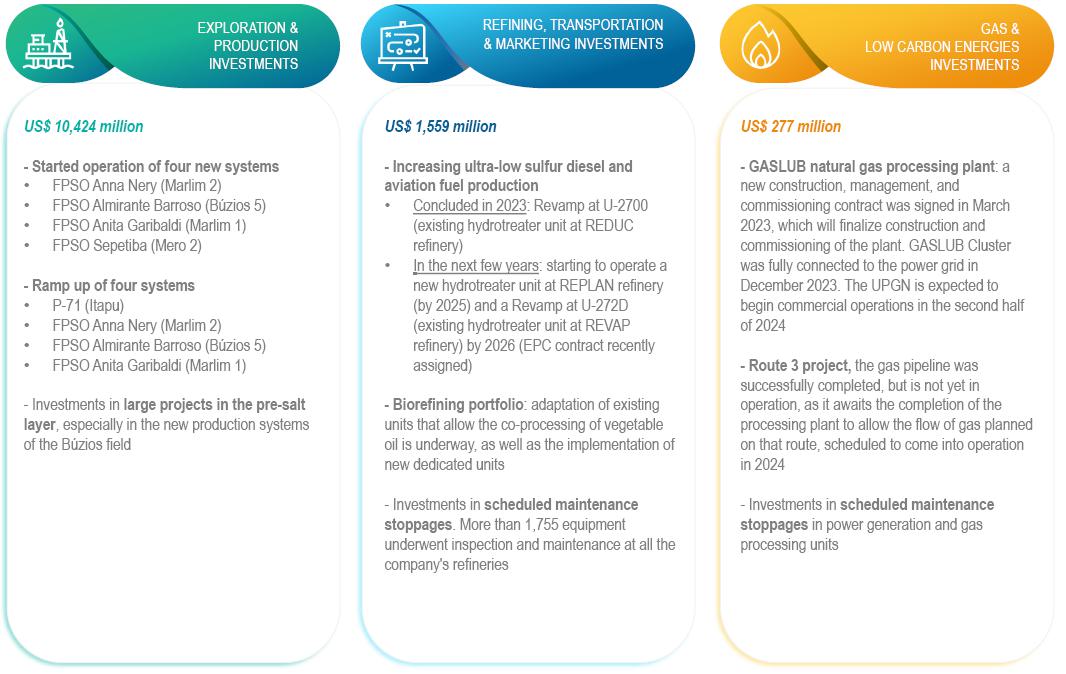
Distribution to shareholders
Our Board of Directors proposed a distribution to shareholders in 2023 in the amount of US$15,489 million. This distribution (US$14,754 million through the payment of dividends and interest on capital, and US$735 million through the share repurchase program) was calculated in Brazilian reais, in the amount of R$76,061 million, representing 60% of our Free Cash Flow for the first quarter of 2023, according to the shareholders remuneration policy in force at the time, and 45% of the free cash flow for the remaining quarters of 2023, converted to U.S. dollars based on the exchange rate prevailing at the date of approval for each anticipation and on the closing exchange rate for the complementary dividends.
For more information on our shareholder remuneration policy, see “Shareholder Information – Shareholders’ Rights” in this annual report and Note 34.5 to our audited consolidated financial statements.
PETROBRAS | Annual Report and Form 20-F | 2023 | 195 |
| Table of Contents | |
| | Operating and Financial Review and Prospects |
Debt Service Obligations
As of December 31, 2023, our debt maturity profile includes, for the next five years, US$38,307 million in finance debt and lease liability (nominal amounts).
AMORTIZATION PROFILE (1) (US$ million)
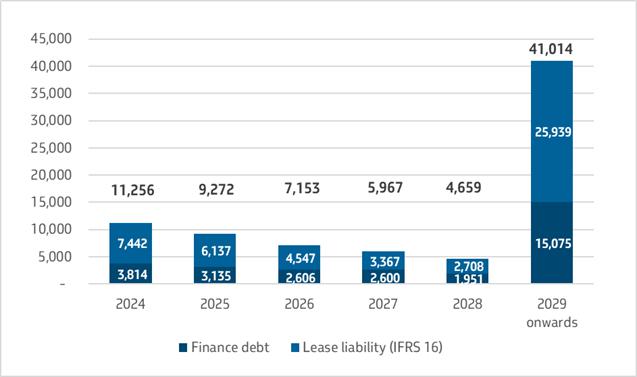
(1) Amounts composed by Lease nominal future payments and Finance debt principal.
Finance Debt
In 2023, we repaid the principal and interest on several finance debts, in the amount of US$6,171 million.
Lease Liabilities
We are the lessee in agreements that primarily include oil and gas producing units, drilling rigs and other exploration and production equipment, vessels and support vessels, helicopters, land and buildings.
Payments in certain lease agreements vary due to changes in facts or circumstances occurring after their inception other than the passage of time. These payments are not included in the measurement of the lease obligations.
In addition, there are nominal amounts of lease agreements for which the lease term has not commenced, as they relate to assets under construction or not yet available for use. As of December 31, 2023, these agreements amount to US$65,358 million (US$79,913 million on December 31, 2022).
For information on changes in the balance of lease liabilities and on leases by class of underlying assets, see Note 33 to audited consolidated financial statements.
PETROBRAS | Annual Report and Form 20-F | 2023 | 196 |
| Table of Contents | |
| | Operating and Financial Review and Prospects |
Ability of Subsidiaries to Transfer Funds to Us
As of the date hereof, we have no knowledge of any legal or economic restrictions on the ability of our subsidiaries to transfer funds to us in the form of loans and/or dividends, except for the prejudgment attachment levied by a number of EIG entities that currently prevents PIBBV from paying dividends to Petrobras. As a result, we do not anticipate any impact on our ability to meet our cash obligations. For further information on the prejudgment attachment see “Legal and Tax - Legal Proceedings - Sete Brasil’s Investor Claim and Mediation Procedure” in this annual report.
Other Information
Critical Accounting Policies and Estimates
The preparation of the consolidated financial information requires the use of estimates and judgments for certain transactions. Note 4 to our audited consolidated financial statements presents key judgments and the main sources of estimation uncertainty with a significant risk of causing material adjustments to our key accounting estimates over the next fiscal year.
Explanatory notes to our audited consolidated financial statements to each of those areas provide additional qualitative and quantitative information for a better understanding of our judgments, the estimation uncertainties and their impacts.
PETROBRAS | Annual Report and Form 20-F | 2023 | 197 |

PETROBRAS | Annual Report and Form 20-F | 2023 | 198 |
| Table of Contents | |
| | Management and Employees |
Management
Board of Directors
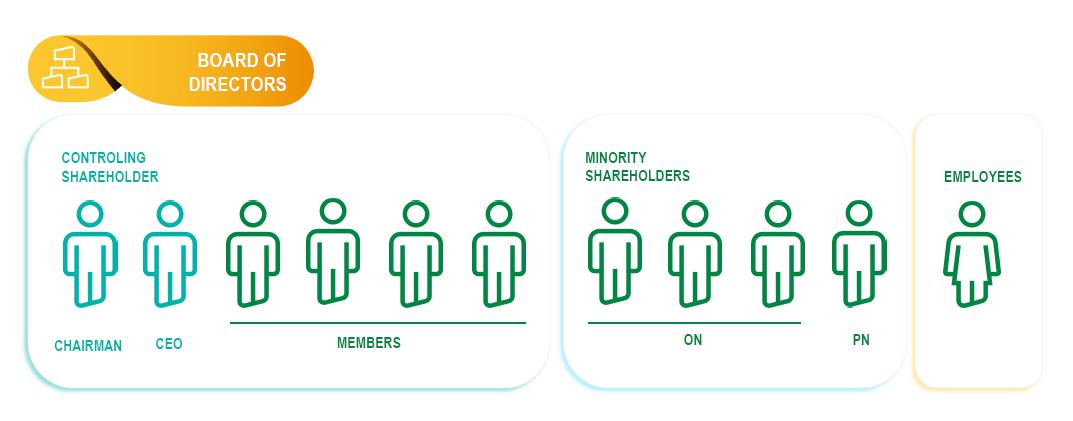
Our Board of Directors is composed of a minimum of seven and maximum of eleven members and is responsible for, among other things, establishing our general business policies. Our Bylaws specifically provide that our Board of Directors must be composed of external members only, without any current statutory or employment relationship with us, except for the member designated as our CEO and the member elected by our employees.
The Brazilian federal government controls a majority of our voting shares and has the right to elect a majority of the members of our Board of Directors. Our Board of Directors, in turn, elects our management.
As a mixed-capital company with 200 or more employees, in which the Brazilian federal government directly or indirectly holds a majority of the voting rights, our employees have the right to elect one member of our Board of Directors to represent them, by means of a separate voting procedure.
Our Bylaws also provide that, regardless of the rights granted to minority shareholders, the Brazilian federal government always has the right to elect the majority of our directors, regardless of the number of directors.
The term of office of our directors may not exceed two years and any member of our Board of Directors may be re-elected for up to three consecutive times.
In accordance with Brazilian Corporate Law, shareholders may remove any director from office at any time with or without cause at an extraordinary shareholders’ meeting, and in case of removal of any board member elected through cumulative voting procedure, it will result in the removal of all of the other members elected under the same procedure, after which new elections must occur.
Our Board of Directors must be composed of, at least, 40% independent members, in compliance with Brazilian Corporate Law and B3 Level 2 rules. In case of contradictions between these rules, the stricter rules prevail.
For further information on Level 2 listing segment, see “Shareholder Information” in this annual report.
For further information regarding the composition, attributions and duties of our Board of Directors, see Exhibit 1.1 to this annual report for a copy of our Bylaws.
As of the date of this annual report, we have the following 11 directors:
PETROBRAS | Annual Report and Form 20-F | 2023 | 199 |
| Table of Contents | |
| | Management and Employees |
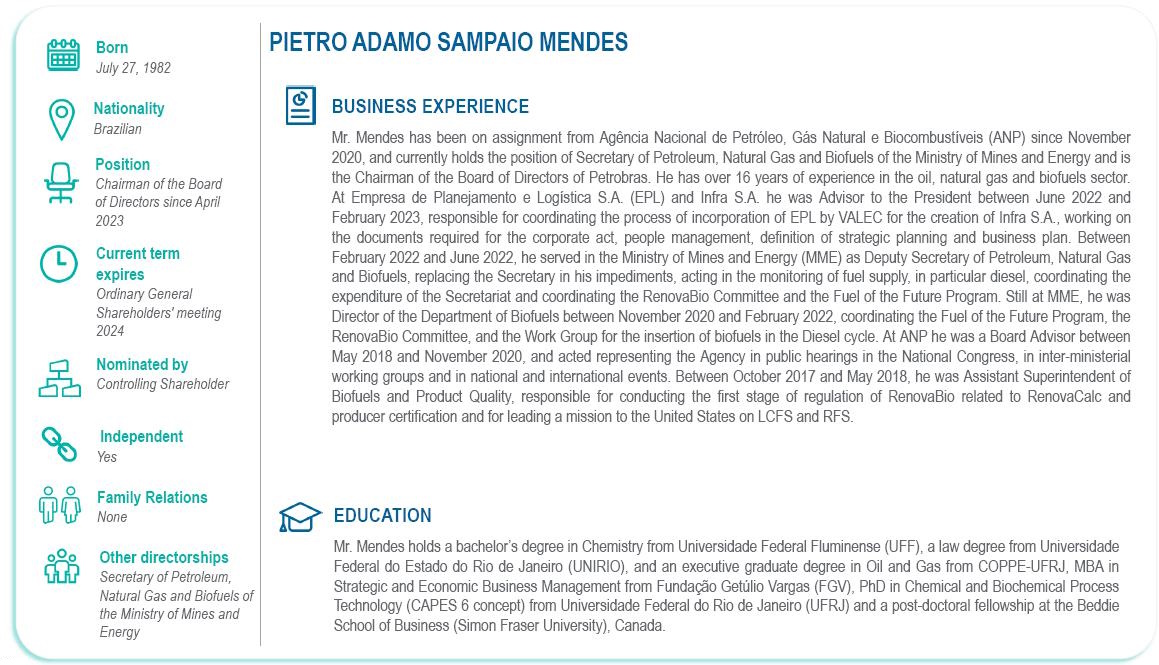

PETROBRAS | Annual Report and Form 20-F | 2023 | 200 |
| Table of Contents | |
| | Management and Employees |
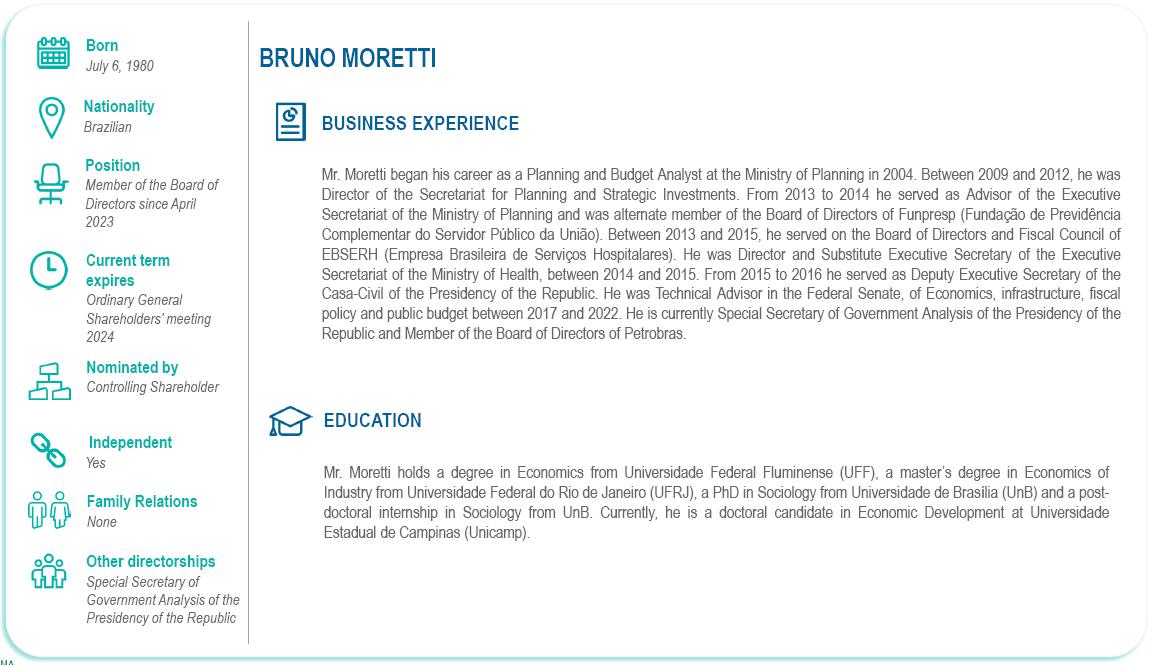
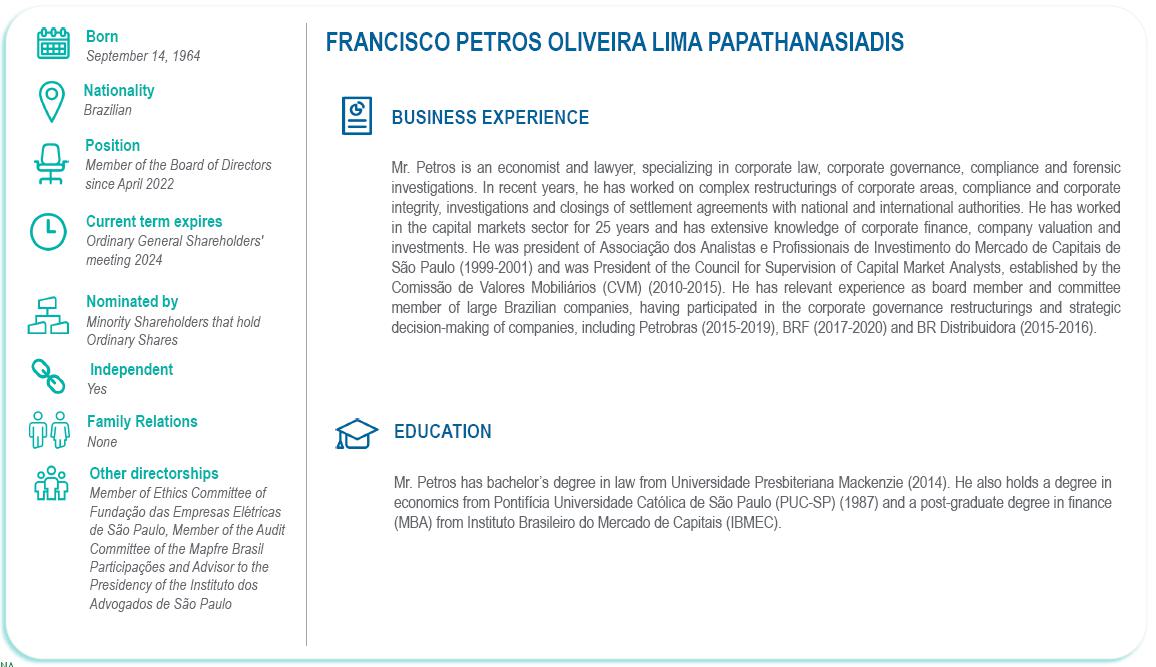
PETROBRAS | Annual Report and Form 20-F | 2023 | 201 |
| Table of Contents | |
| | Management and Employees |
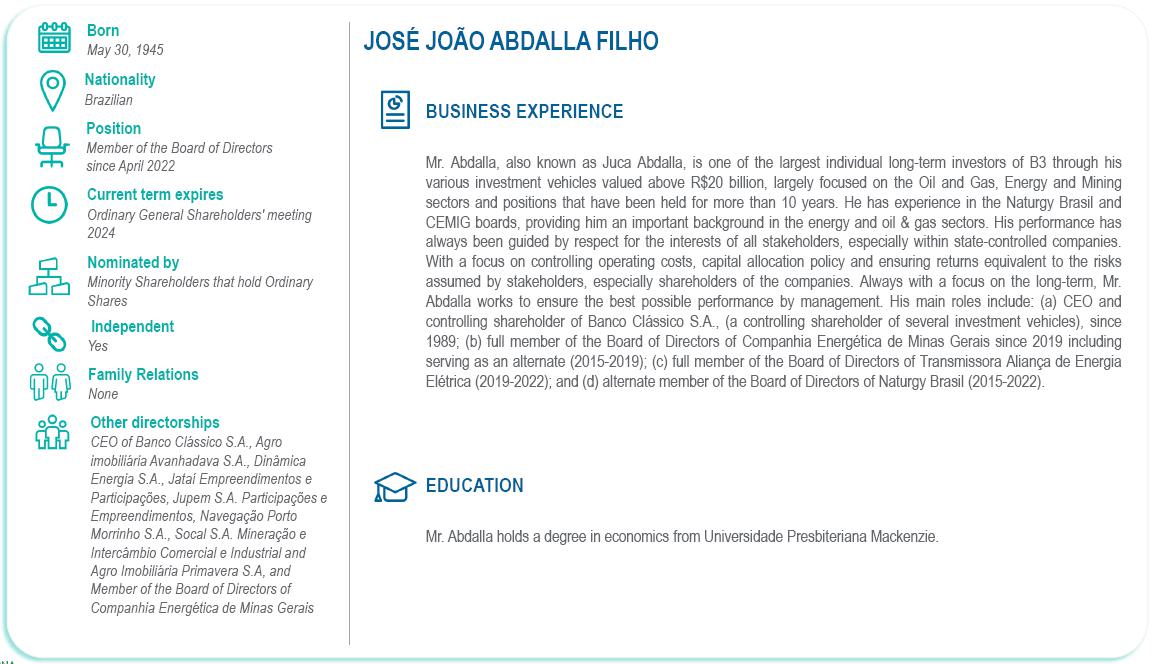
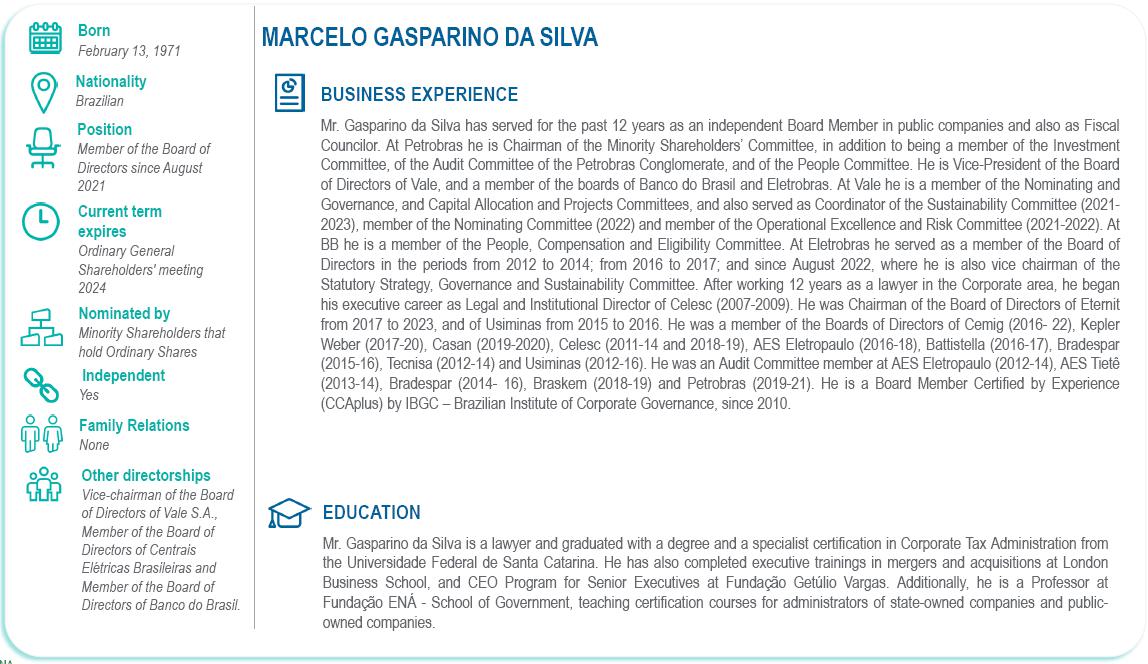
PETROBRAS | Annual Report and Form 20-F | 2023 | 202 |
| Table of Contents | |
| | Management and Employees |

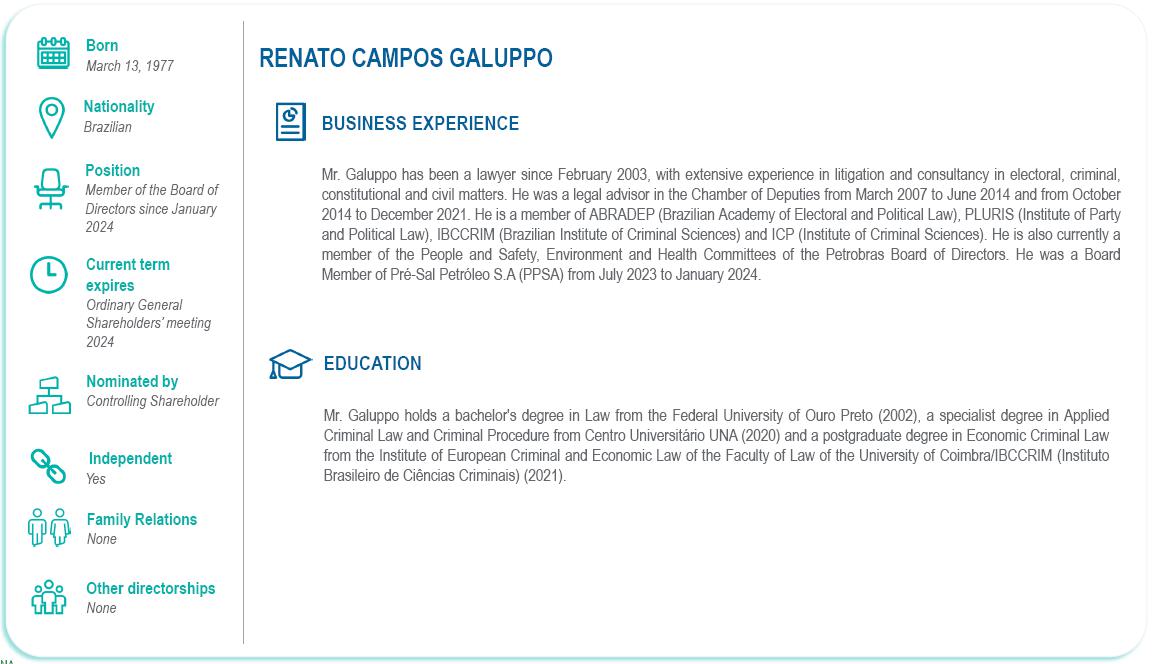
PETROBRAS | Annual Report and Form 20-F | 2023 | 203 |
| Table of Contents | |
| | Management and Employees |
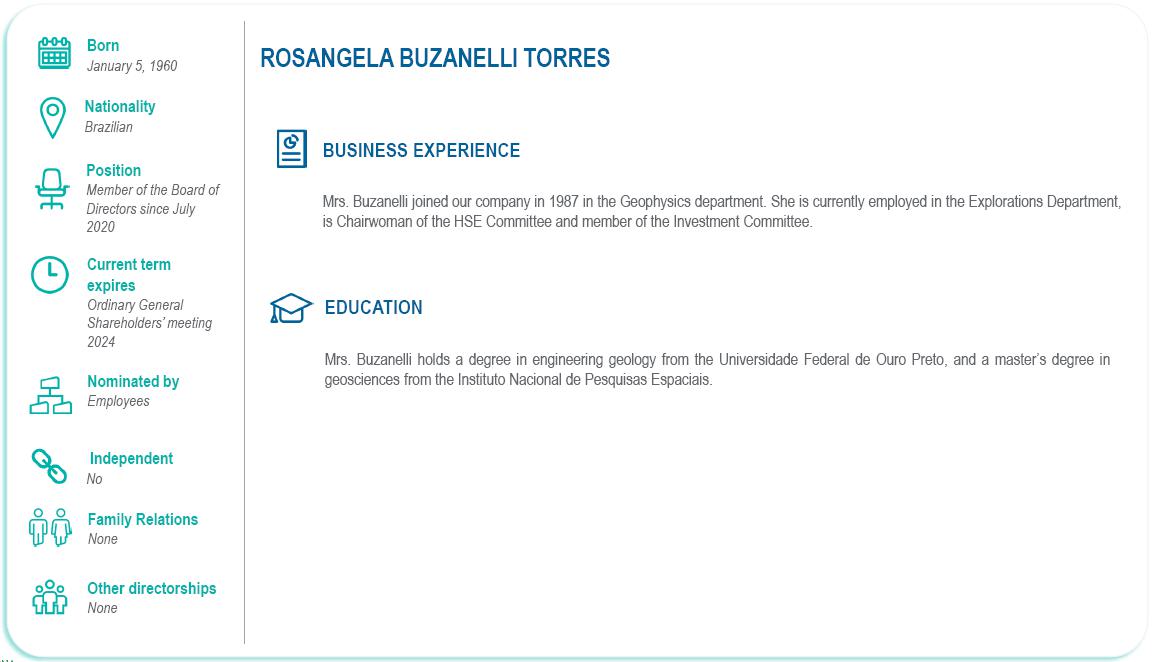
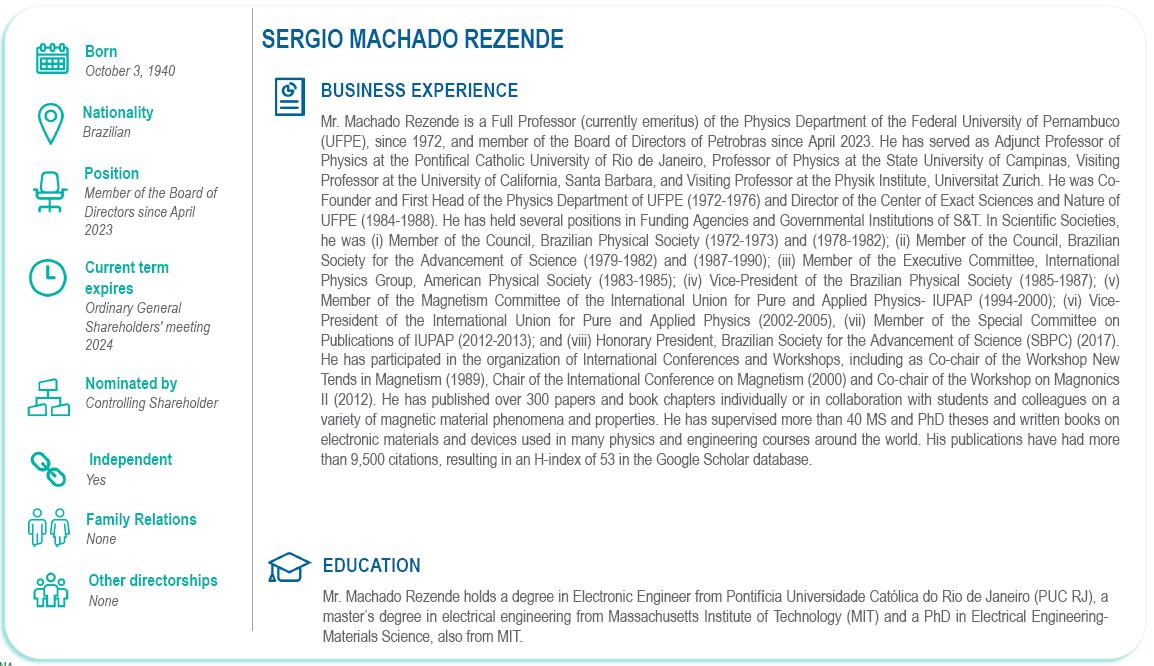
PETROBRAS | Annual Report and Form 20-F | 2023 | 204 |
| Table of Contents | |
| | Management and Employees |

Our Annual General Meeting announcing new members joining the Board of Directors will take place in April 2024, after the filing of this report. On April 5, 2024, a precautionary decision was issued in connection with a popular action in progress at the 21st Federal Court of São Paulo, suspending Mr. Sérgio Machado Rezende from serving as a Board Member of the Company. Unless such decision is reversed or vacated, the Board position previously held by Mr. Sérgio Machado Rezende will remain vacant until the election of the members of the Board of Directors in the shareholders' meeting called to be held on April 25, 2024. Information on the proposal regarding the prospective new members is available to shareholders at the Company's (www.petrobras.com.br/ri) and SEC website.
PETROBRAS | Annual Report and Form 20-F | 2023 | 205 |
| Table of Contents | |
| | Management and Employees |
Fiscal Council
We have a permanent Fiscal Council composed of up to five members, which is independent of our management and independent registered accounting firm. Our Fiscal Council’s responsibilities, as a supervisory body, include, among others: (i) representing the shareholders, monitoring management activities; (ii) verifying compliance with legal and statutory duties; and (iii) reviewing the annual management report and the audited consolidated financial statements, issuing an opinion at the end of the year.
The members of our Fiscal Council and their corresponding alternates are elected by our shareholders at the annual shareholders’ meeting for a one-year term. Two consecutive re-elections are permitted under Brazilian Corporate Law. Holders of preferred shares and minority holders of common shares are each entitled, as a class, to elect one member and the corresponding alternate of our Fiscal Council. The Brazilian federal government has the right to appoint the majority of the members of our Fiscal Council and their alternates, of which one member and the corresponding alternate will be necessarily appointed by the Minister of Finance, representing the Brazilian Treasury.
CURRENT MEMBERS OF OUR FISCAL COUNCIL
| Year of first appointment | Elected/appointed by | |
| Members | ||
| Cristina Bueno Camatta | 2023 | Brazilian federal government |
| Daniel Cabaleiro Saldanha | 2023 | Brazilian federal government |
| Viviane Aparecida da Silva Varga (Chairman) | 2023 |
Brazilian federal government/ Ministry of Finance |
| João Vicente Silva Machado | 2023 | Minority shareholder |
| Michele da Silva Gonsales Torres | 2021 | Preferred shareholder |
| Alternate members | ||
| Sidnei Bispo | 2023 | Brazilian federal government |
| Gustavo Gonçalves Manfrim | 2023 | Brazilian federal government |
| Otávio Ladeira de Medeiros | 2022 |
Brazilian federal government/ Ministry of Finance |
| Lucia Maria Guimarães Cavalcanti | 2023 | Minority shareholder |
| Aloisio Macário Ferreira de Souza | 2023 | Preferred shareholder |
Our Annual General Meeting announcing new members joining the Fiscal Council will take place in April, after the filing of this report. Information on the proposal regarding the prospective new members is available to shareholders at the Company's (www.petrobras.com.br/ri) and SEC website.
PETROBRAS | Annual Report and Form 20-F | 2023 | 206 |
| Table of Contents | |
| | Management and Employees |
Executive Officers
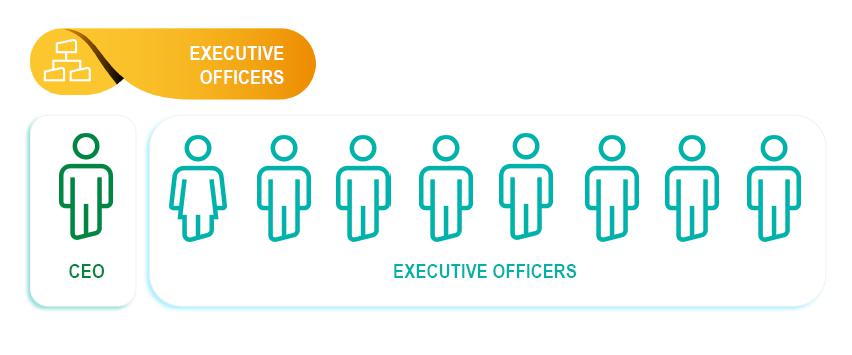
Our Executive Officers is composed of one CEO and eight executive officers. According to our Bylaws, our Executive Officers is responsible for our day-to-day management. Our executive officers are not required to be Brazilian citizens but must reside in Brazil. Pursuant to our Bylaws, our Board of Directors elects our executive officers, including the CEO, and must consider personal qualifications, expertise and specialization when electing executive officers. Our executive officers’ mandate lasts for two years, and no more than three consecutive re-elections are allowed. Our Board of Directors may remove any executive officer from office at any time and without cause, with a special procedure for the removal of the Executive Director of Governance and Compliance pursuant to the Internal Regiment of Board of Directors. According to the Internal Regiment of Board of Directors, in order to decide on the removal of the Executive Director of Governance and Compliance the Board of Directors must follow a qualified quorum which requires the vote of the Director elected by the minority shareholders or the Director elected by the preferred shareholders.
For further information regarding our Executive Officers, see Exhibit 1.1 to this annual report for a copy of our Bylaws.
As of the date of this annual report, we have the following nine executive officers:
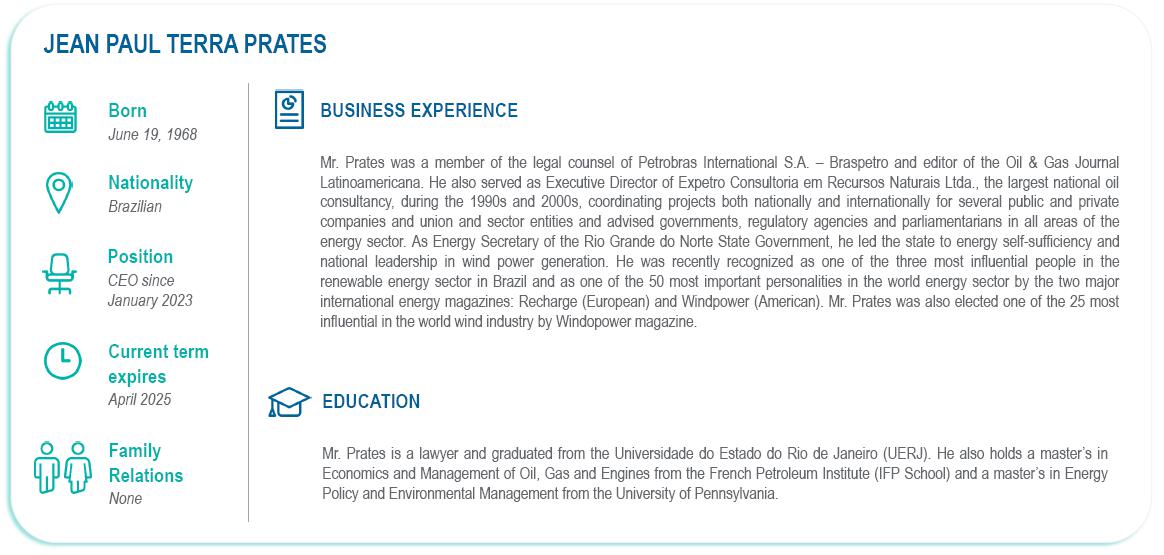
PETROBRAS | Annual Report and Form 20-F | 2023 | 207 |
| Table of Contents | |
| | Management and Employees |
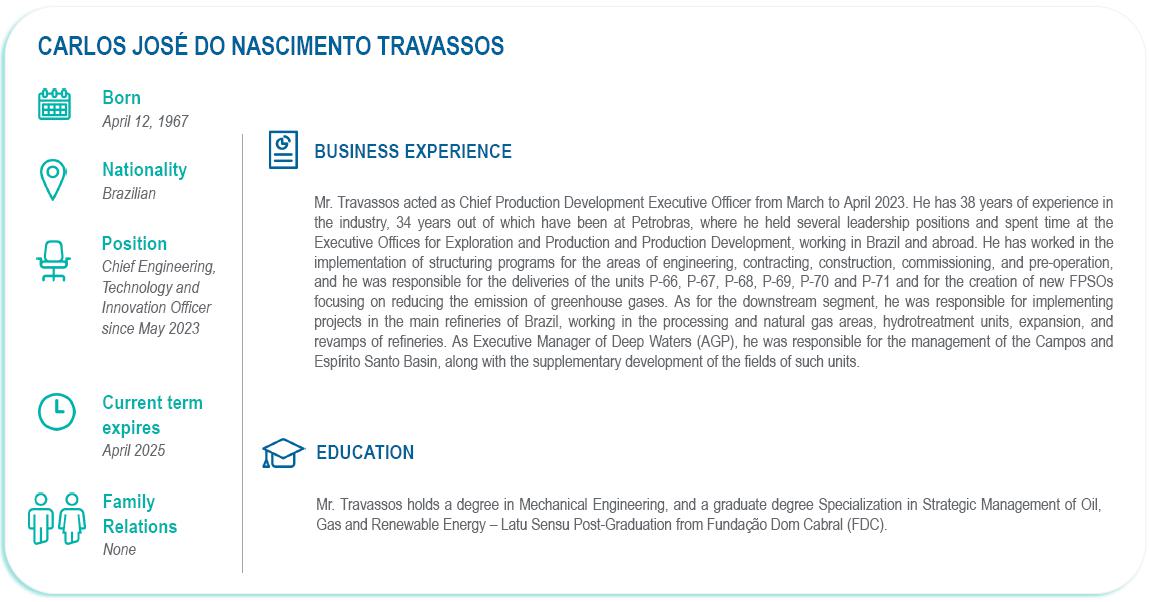
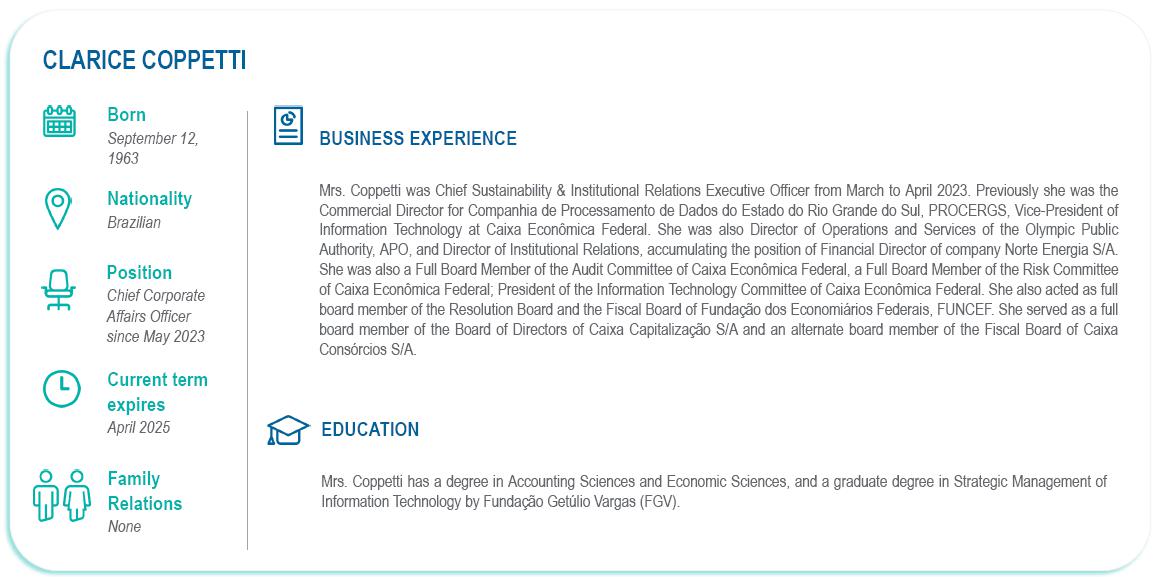
PETROBRAS | Annual Report and Form 20-F | 2023 | 208 |
| Table of Contents | |
| | Management and Employees |
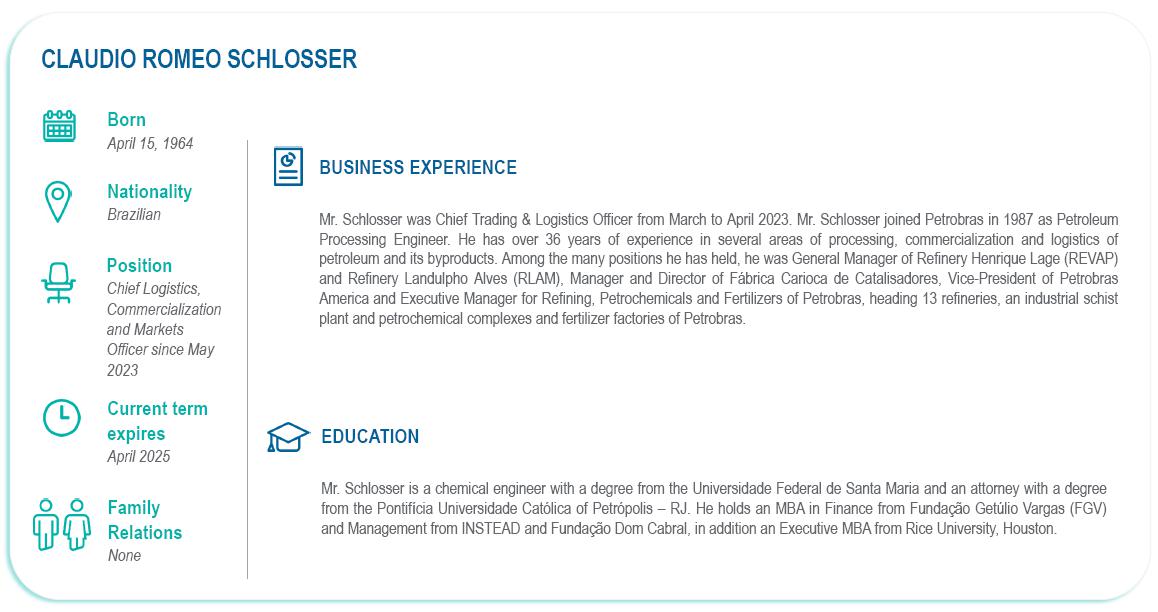
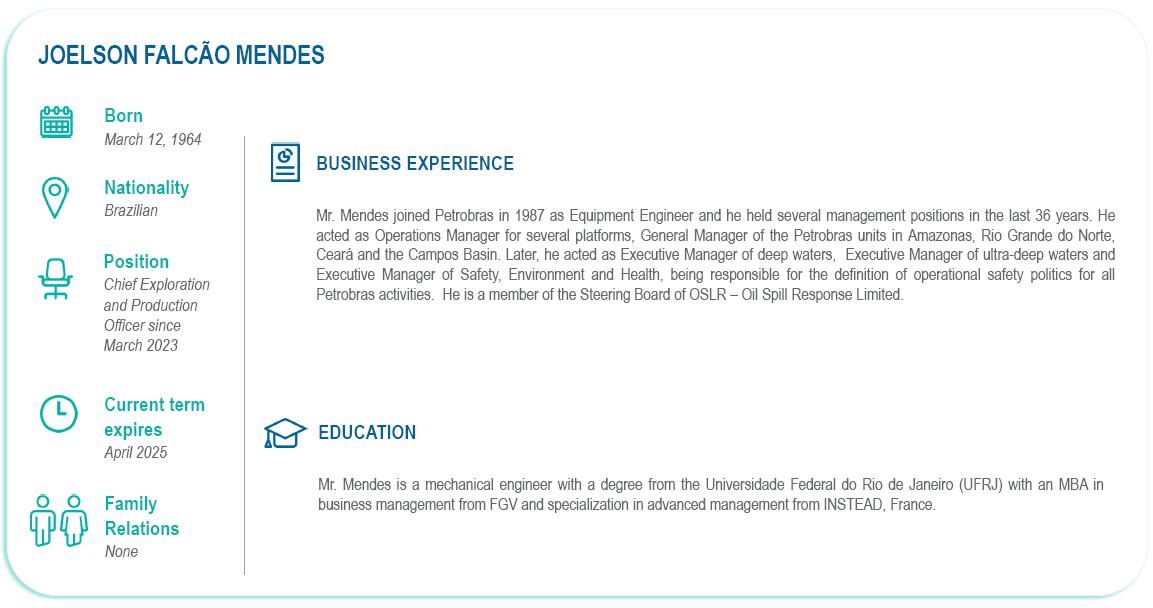
PETROBRAS | Annual Report and Form 20-F | 2023 | 209 |
| Table of Contents | |
| | Management and Employees |
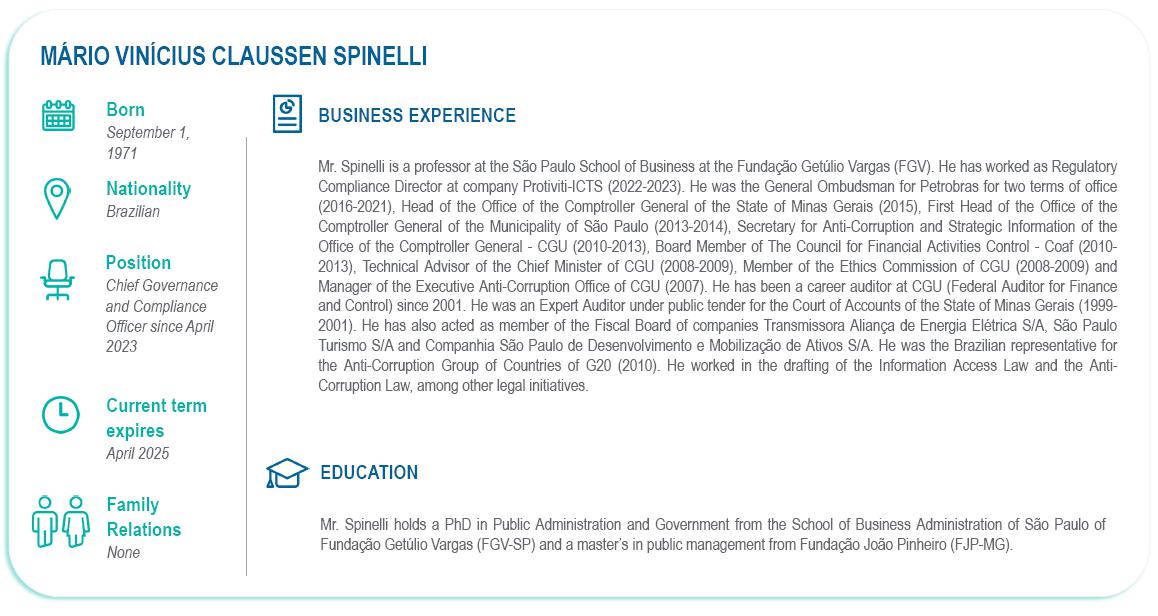
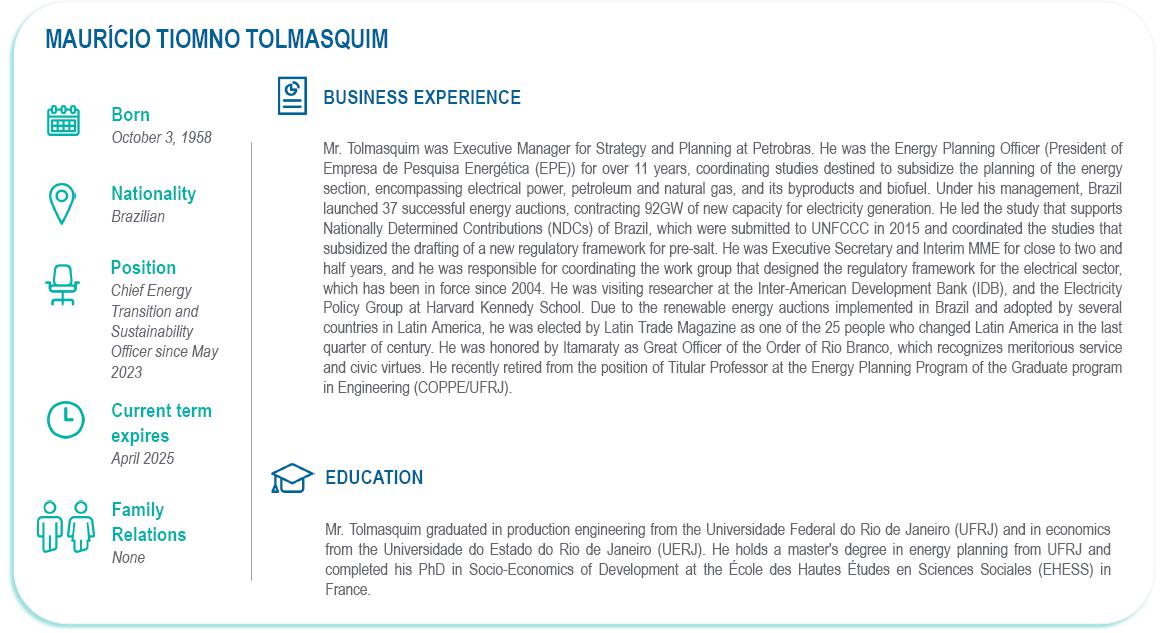
PETROBRAS | Annual Report and Form 20-F | 2023 | 210 |
| Table of Contents | |
| | Management and Employees |
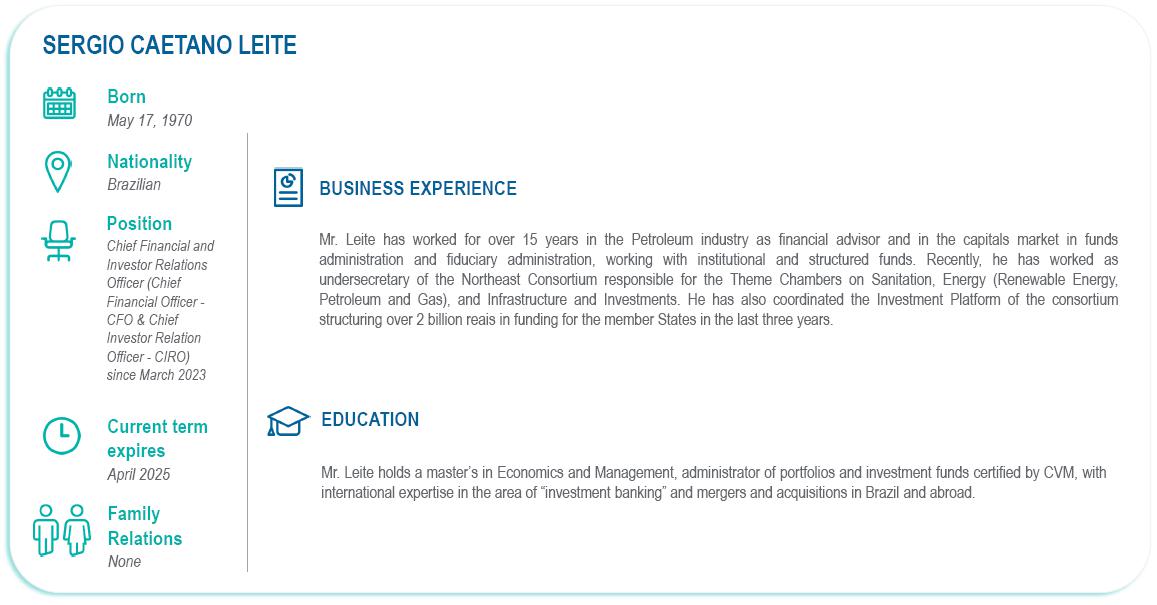
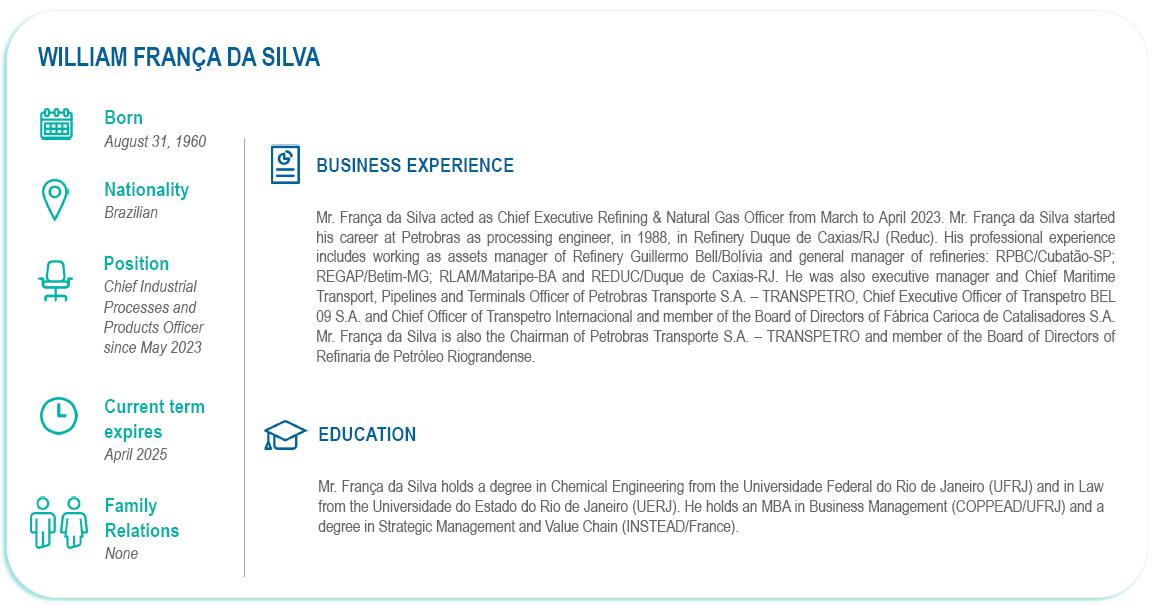
PETROBRAS | Annual Report and Form 20-F | 2023 | 211 |
| Table of Contents | |
| | Management and Employees |
Additional Information on our Board of Directors and Executive Officers
Requirements for Election
Our bylaws (as amended by the Extraordinary Shareholders Meeting dated November 30, 2023) provide that the election of Board Members and Executive Officers shall follow the requirements and restrictions provided by Law n. 6.404/76, Law n. 13.303/2016 and Decree n. 8945/16, as well as our Nomination Policy. Thus, in order to be elected, each of our executive officers and each member of our Board of Directors must:
| – | not be a defendant in any legal or administrative proceedings with an unfavorable ruling by appellate courts concerning a matter related to the activities to be performed in our company; |
| – | not have commercial or financial pending issues claimed or included in official debtor registers, although clarification on such issues may be provided to us; |
| – | demonstrate diligence in solving issues raised in reports of internal or external control bodies in processes and/or activities under their management, when applicable; |
| – | not have violated our Code of Ethical Conduct, Compliance Program or other internal rules, when applicable; |
| – | not have been included in the disciplinary system of any of our subsidiaries or affiliates, nor have been subject to labor or administrative penalty in any other legal entity in the last three years as a result of internal investigations, when applicable; and |
| – | our executive officers must have 10 years of experience in leadership, preferably, in business or in a related area, as specified in our nomination policy. |
Compensation
Under our Bylaws, our shareholders establish the aggregate compensation, or allocate the compensation on an individual basis, payable to our directors, executive officers, members of our Fiscal Council and advisory committees to our Board of Directors. In case shareholders do not allocate the compensation on an individual basis, our Board of Directors is allowed to do so.
For the year-ended December 31, 2023, the aggregate amount of compensation we paid to all members of our Board of Directors and our Executive Officers was US$7.6 million. These amounts include payment of variable compensation to our executive officers. As of December 31, 2023, we had 9 executive officers and 11 Board of Directors members.
For information regarding our variable compensation programs, and other benefits such as pension and health plans, see “Employees – Benefits” in this section.
PETROBRAS | Annual Report and Form 20-F | 2023 | 212 |
| Table of Contents | |
| | Management and Employees |
| 2023(1) | |||
| Executive Officers | Board of Directors | Fiscal Council | |
| Average number of members in the period | 9.00 | 11.00 | 5.00 |
| Average number of paid members in the period | 9.00 | 6.33 | 5.00 |
| Value of maximum compensation (US$) | 550,727.35 | 31,115.94 | 31,115.94 |
| Value of minimum compensation (US$) (2) | 29,634.79 | 31,115.94 | 31,115.94 |
| Average value of compensation (US$) (3) | 750,833.72(4) | 31,434.73 | 31,323.65 |
| (1) | The values consider all installments paid in the 2023 financial year as established by the CVM. |
| (2) | The value of the individual minimum annual remuneration was determined taking into account the remuneration actually paid to members who worked during the year. The member with the lowest annual salary served for 1 (one) month in the fiscal year. |
| (3) | The average value of compensation corresponds to the total value of the annual compensation paid divided by the average number of paid members in the period. |
| (4) | The calculation includes the values related to the termination of the position (gardening leave) and payment of the deferred installments of Variable Remuneration referring to former members of the Executive Officers who left our company. Consequently, the average value was higher than the value of the maximum compensation and does not represent the amount actually paid to our current Executive Officers, which is presented in the minimum and maximum compensation amounts indicated above. |
For further information regarding compensation of our employees and officers, see Notes 18 and 36 to our audited consolidated financial statements.
Besides compensation, the members of our Executive Officers receive additional benefits, such as medical assistance, supplementary social security benefits and a housing allowance. The members of the Board of Directors are entitled to supplementary social security benefits.
Members of the Board of Directors, Fiscal Council and the Executive Officers may be legally entitled to gardening leave (Quarentena) upon termination of office, which rules and exceptions are provided by Brazilian law.
None of the members of our Executive Officers nor any of our subsidiaries are entitled benefits upon termination of employment.
For information on our advisory committee, see “Statutory Board Committees” below.
We were not required to prepare an accounting restatement that required recovery of erroneously awarded compensation pursuant to our clawback policy. Additionally, there was no outstanding balance as of December 31, 2023 of erroneously awarded compensation to be recovered from the application of the policy to a prior restatement.
See Exhibit 97.1 to this annual report for a copy of Petrobras’ clawback policy.
PETROBRAS | Annual Report and Form 20-F | 2023 | 213 |
| Table of Contents | |
| | Management and Employees |
Share Ownership
As of December 31, 2023, the members of our Board of Directors, executive officers and members of Fiscal Council beneficially held the following shares of our capital stock:
| Board of Directors(1) | Executive Officers(1) | Fiscal Council | |
| Common shares (2) | 161,803,827(3) | 3,110 | - |
| Preferred shares (2) | 377 | 71,446 | 42 |
| (1) | Jean Paul Prates is our CEO and member of our Board of Directors. To avoid duplication of data, his share ownership was only considered in the total amount of shares owned by members of the Board of Directors. |
| (2) | Considers CVM criteria which includes the shares owned by a spouse from whom they are not legally or extrajudicially separated, a marriage partner, any dependents included in their annual income tax return and companies directly or indirectly controlled by them. It does not include the position held by external members of the Board of Directors' Advisory Committees and alternate members of the Fiscal Council. |
| (3) | Also reflects the beneficial ownership of approximately 2.17% common shares by José João Abdalla Filho. |
On an individual basis, our Directors, Executive Officers and Fiscal Council members beneficially owned less than 1% of any class of our shares, except for Mr. José João Abdalla Filho, who beneficially owned, as of December 31, 2023, 161,753,800 common shares of the Company, representing approximately 2.17% of common shares of the Company. The shares held by our Directors, Executive Officers and Fiscal Council members have the same voting rights as the shares of the same type and class that are held by our other shareholders. None of our Directors, Executive Officers and Fiscal Council members hold any options to purchase common shares or preferred shares, nor does any other person have any option to purchase our common or preferred shares. We do not have a stock option plan for our Directors, Officers or employees.
PETROBRAS | Annual Report and Form 20-F | 2023 | 214 |
| Table of Contents | |
| | Management and Employees |
Statutory Board Committees
Our Board of Directors has a total of six statutory advisory committees:
| – | Investment Committee: responsible for advising our Board of Directors with respect to the definition of our strategic guidelines, the strategic plan, the annual business plan, among other strategic matters and financial issues. The committee also assists our Board of Directors in evaluating the structure and conditions of investment and divestment transactions, including new business opportunities, mergers, consolidations, and spin-offs in which we are involved, and which are within the responsibility of the Board of Directors. In addition, the committee provides advice to our Board of Directors on analyzing our annual financing program. |
| – | Audit Committee: for further information on our audit committee, please see “Audit Committee” in this section. |
| – | Health, Safety and Environmental Committee: responsible for advising our Board of Directors on policies and guidelines related to the strategic management of HSE, climate change, transition to a low carbon economy and social responsibility issues, among other matters. This committee monitors, among other issues, indicators and research on our image and reputation, related to the HSE and sustainability matters, suggesting actions when necessary. In addition, the committee approves and monitors ESG initiatives. |
| – | People Committee: responsible for assisting our Board of Directors in aspects regarding the management of senior level human assets, including, but not limited to: compensation (fixed and variable), appointments and succession policies as well as the selection and eligibility processes. The People Committee stands in compliance with Brazilian Law No. 13,303/12 and Decree No. 8,945/16, acting as an eligibility committee for assisting shareholders to nominate members to the Board of Directors and Fiscal Council and overseeing the implementation of the required background checks on integrity and compliance regarding of the Board of Directors, Fiscal Council and Executive Officers nominees, as well as external members of the Board of Directors advisory committees, and having a deliberative role in these cases. The committee advises our Board of Directors on the possible application of penalties for the Executive Officers and, members of the Board of Directors and its Statutory Advisory Committees and, evaluates appeals of terminations of employment contracts if the Integrity Committee does not reach a consensus on disciplinary measures. The committee also monitors image and reputation surveys, recommending actions when necessary. |
| – | Minority Committee: responsible for advising our Board of Directors on transactions with related parties involving, the Brazilian federal government, its entities and foundations, or federal state-owned enterprises in case of transactions outside the ordinary course of our business, including following up the revision process of the Transfer of Rights Agreement. The minority committee also advises our shareholders issuing its opinion on certain matters that require approval in shareholders’ meetings, pursuant to article 30, §4 of our Bylaws. |
| – | Conglomerate Audit Committee: approved to meet the requirements of Law No. 13,303/16, which provides the possibility that controlled companies share the costs and structures of their corresponding parent companies. The committee is responsible for the companies of the Petrobras Conglomerate that do not have internal audit committees. In addition, the committee provides advice to our Board of Directors regarding guidelines for companies of the Petrobras Conglomerate in matters provided in its bylaws. |
PETROBRAS | Annual Report and Form 20-F | 2023 | 215 |
| Table of Contents | |
| | Management and Employees |
SUMMARY OF THE COMPOSITION OF OUR STATUTORY ADVISORY COMMITTEES, AS OF THE DATE OF THIS ANNUAL REPORT
| Committees | ||||||
| Members | Investment | Audit | Health, Safety, and Environment | People | Minority | Audit of the Petrobras Conglomerate |
| Arthur Cerqueira Valerio | ● | |||||
| Benjamin Alves Rabello Filho | ● | |||||
| Bruno Moretti | ● | |||||
| Eugênio Tiago Chagas Cordeiro e Teixeira | ● | |||||
| Evely Forjaz Loureiro | ● | |||||
| Fábio Veras de Souza | ● | ● | ● | |||
| Francisco Petros | ● | ● | ||||
| José Affonso de Albuquerque Netto | ● | |||||
| José João Abdalla Filho | ● | |||||
| Marcelo Gasparino da Silva | ● | ● | ● | ● | ||
| Marcelo Mesquita de Siqueira Filho | ● | ● | ||||
| Maurício Renato de Souza | ● | |||||
| Newton de Araujo Lopes | ● | |||||
| Raoni Iago Pinheiro Santos | ● | |||||
| Renato Campos Galuppo | ● | ● | ||||
| Rosangela Buzanelli Torres | ● | ● | ||||
| Sergio Machado Rezende* | ● | |||||
● CHAIRMAN / CHAIRWOMAN OF EACH COMMITTEE
● EXTERNAL MEMBERS OF EACH COMMITTEE
● REMAINING MEMBERS
*Service currently suspended. See “Management” in this annual report.
PETROBRAS | Annual Report and Form 20-F | 2023 | 216 |
| Table of Contents | |
| | Management and Employees |
Audit Committee
Our statutory audit committee is an advisory committee of our Board of Directors, and aids in matters involving our accounting, internal controls, financial reporting and compliance. Our statutory audit committee also recommends the appointment of our independent registered accounting firm to our Board of Directors and evaluates the effectiveness of our internal financial and legal compliance controls. In accordance with Law No. 13,303/2016 and Decree No. 8,945/2016, our statutory audit committee must have at least three members and no more than five members, who must be independent in accordance with the independence requirements of the Law No. 13,303/2016 and CVM Resolution 23/2021 and at least one of the members must have recognized experience in corporate accounting. Additionally, CVM Resolution No. 23/2021 requires at least one member of the audit committee to be a board member, although they permit the appointment of other members who are not members of the Board of Directors provided that such other members meet the independence requirements of the CVM. On November 30, 2020, our shareholders approved an amendment to our bylaws requiring our audit committee to be composed of members of our Board of Directors and external individuals.
Due to its composition, our statutory audit committee is not equivalent to or comparable with a U.S. audit committee. Pursuant to Exchange Act Rule 10A-3(c)(3), which provides for an exemption under the rules of the SEC regarding the audit committees of listed companies, a foreign private issuer is not required to have an audit committee equivalent to or comparable with a U.S. audit committee if the foreign private issuer has a body established and selected pursuant to home country legal or listing provisions expressly requiring or permitting such a body, and if the body meets the requirements that (i) it be separate from the full board, (ii) its members not be elected by management, (iii) no executive officer be a member of the body, and (iv) home country legal or listing provisions set forth standards for the independence of the members of the body.
Given that our statutory audit committee is subject to certain requirements under CVM rules (CVM Resolution 23/2021), we understand that it complies with these requirements, and we rely on the exemption provided by Rule 10A-3(c)(3) under the Exchange Act.
Our audit committee is currently composed of four members (all independent, in accordance with the independence requirements of the Law No. 13,303/2016 and CVM Resolution No. 23/2021). Until May 2023, Mr. Valdir Augusto de Assunção remained an external member of our Audit Committee. On June 12, 2023, the following nominees were elected by our Board of Directors: Mr. Francisco Petros (Board Member and Chairman of the Audit Committee); Mr. Eugênio Tiago Chagas Cordeiro e Teixeira (External Member), Mr. Newton de Araujo Lopes (External Member) and Mr. Fábio Veras de Souza (External Member). Mr. Francisco Petros and Mr. Newton de Araujo Lopes are our audit committee financial experts.
Our audit committee is responsible for, among other matters:
| – | Monitoring, analyzing, and making recommendations to our Board of Directors with respect to the appointment and dismissal of our independent registered accounting firm, as well as evaluating the independence of our independent registered accounting firm for issuing an opinion on the financial statements and their qualifications and expertise. |
| – | Advising our Board of Directors on the review of our annual and quarterly consolidated financial statements, monitoring compliance with relevant legal and listing requirements and ensuring appropriate disclosure of our economic and financial situation filed with the CVM and the SEC. |
| – | Advising our Board of Directors and our management, in consultation with internal and independent registered accounting firm and our risk management and internal controls units, in monitoring the quality and integrity of our internal control over financial reporting systems, our audited consolidated financial statements and related financial disclosures. |
| – | Reviewing and submitting proposals to our Board of Directors relating to the resolution of conflicts between management and the independent registered accounting firm relating to our audited consolidated financial statements. |
PETROBRAS | Annual Report and Form 20-F | 2023 | 217 |
| Table of Contents | |
| | Management and Employees |
| – | Assessing and monitoring, together with our internal management and audit area, the adequacy of actions to prevent and combat fraud and corruption. |
| – | Evaluating and monitoring, jointly with our management and our internal auditors, our transactions with related parties, including a review, at least once a year, of all related party transactions and a previous analysis of related party transactions involving amounts higher than certain levels. |
| – | Establishing and reviewing procedures for the receipt, retention and processing of complaints regarding accounting, internal control and auditing matters, including procedures for the confidential submission of internal and external complaints relating to the scope of the committee’s activities, as well as receiving, retaining and processing any such complaints. |
| – | Evaluating the parameters underlying the actuarial calculations, as well as the actuarial result of the benefit plans maintained by our social security foundation, Fundação Petrobras de Seguridade Social. |
| – | Conducting the formal evaluation of our internal audit executive manager on an annual basis. |
With respect to the relationship of our audit committee with our independent registered accounting firm, as provided in our Bylaws, our Board of Directors is responsible for deciding, among other matters, the appointment and dismissal of independent registered accounting firm, which are prohibited from providing consulting services to us during the term of an audit’s contract. Our audit committee has the authority to recommend pre-approval policies and procedures for the engagement of our independent registered accounting firm’s services. Our management is required to obtain the audit committee’s pre-approval before engaging an independent registered accounting firm to provide any audit or permitted non-audit services to us or any of our consolidated subsidiaries. Our audit committee has pre-approved a detailed list of audit services up to specified monetary thresholds. The list of pre-approved services is updated from time to time. The audit services that are not included in the list, or that exceed the thresholds specified therein must be directly approved by our audit committee. Our audit committee monitors the performance of the services provided by our independent registered accounting firm and reviews and monitors our independent registered accounting firm’s independence and objectivity.
| Principal accountant fees and services |
|
The following table sets forth the fees billed to us, in US$ million, by our independent registered accounting firm KPMG Auditores Independentes Ltda. (PCAOB ID 1124) during the fiscal years ended December 31, 2023 and 2022:
| ||||
| 2023 | 2022 | |||
| Audit fees(1) | 5.8 | 6.0 | ||
| Audit-related fees(2) | 0.2 | 0.3 | ||
| Total fees | 6.0 | 6.3 | ||
| (1) Audit fees comprise fees billed (including fees for services related to tax review in relation to statutory and regulatory filings) in connection with the audit of our audited individual and consolidated financial statements (IFRS and Brazilian GAAP), interim reviews (IFRS and Brazilian GAAP), audits of our subsidiaries (IFRS and Brazilian GAAP, among others), consent letters and review of periodic documents filed with the SEC. | ||||
| (2) Audit-related fees refer to assurance and related services that are reasonably related to the performance of the audit or reviews of our audited consolidated financial statements and are not reported under “audit fees.” | ||||
PETROBRAS | Annual Report and Form 20-F | 2023 | 218 |
| Table of Contents | |
| | Management and Employees |
Employees
Our workforce is our most important asset. Our approach to management is based on care for people, promoting diversity, equity, inclusion and well-being.

PETROBRAS | Annual Report and Form 20-F | 2023 | 219 |
| Table of Contents | |
| | Management and Employees |
| As of December 31, | |||
| 2023 | 2022 | 2021 | |
|
Our employees by region (not including our subsidiaries, joint operations or structured entities) |
|||
| Southeastern Brazil | 34,363 | 32,985 | 32,572 |
| Northeastern Brazil | 3,478 | 3,390 | 3,840 |
| Other locations | 2,372 | 2,307 | 2,291 |
| Total | 40,213 | 38,682 | 38,703 |
| Our subsidiaries’ employees by region | |||
| Southeastern Brazil | 4,619 | 4,596 | 4,901 |
| Northeastern Brazil | 729 | 734 | 744 |
| Other locations in Brazil | 568 | 569 | 563 |
| Abroad | 601 | 568 | 621 |
| Total | 6,517 | 6,467 | 6,829 |
| TOTAL | 46,730 | 45,149 | 45,532 |
We attract and retain talented employees by offering competitive benefits and participation in a variable compensation program. We also offer as the possibility for professional growth and development based on performance and meritocracy in addition to monthly compensation.
The table below sets forth the main expenses related to our employees for the last three years:
| US$ million | |||
| 2023 | 2022 | 2021 | |
| Salaries, accrued vacations and related charges | 3,478 | 3,006 | 2,665 |
| Employee training(1) | 94 | 42 | 8 |
| Profit-sharing distributions | 595 | 131 | 125 |
| Variable compensation program | 416 | 547 | 469 |
(1) Employee training is not considered an employee benefit in our audited consolidated financial statements.
For information regarding profit-sharing
distributions and variable compensation program see respectively “Labor Relations” and “Employees Variable Compensation”
in this annual report.
PETROBRAS | Annual Report and Form 20-F | 2023 | 220 |
| Table of Contents | |
| | Management and Employees |
Workforce
One of the main current and future challenges for our people management is to ensure the continuous adequacy of our workforce to the business portfolio.
Our workforce planning methodology is aimed at the optimal mapping of employees‘ needs. It is built through our business’s processes perspective and considers strategic scenario modifications in the medium and long terms. It considers operational safety and projects requirements, as well as portfolio management decisions and organizational restructuring.
In addition, we seek to adapt our current workforce to our strategies through the following: improvement of internal workforce mobility practices; flexibility for our portfolio management strategy; training and continuing education related to mobility programs; analysis of impacts and costs; critical thinking; knowledge management; and improvement of our workforce profile. These programs, which facilitate the increase of productivity and optimize our processes, also allow us to better adjust our workforce to our business needs.
Employees are one of the most important intangible assets to us and the ability to attract qualified and talented employees, as well as retain and nurture internal talent is critical to our success and sustainability. We focus on attracting the best external talent without neglecting the internal talent of employees, who have grown with us, and understand our organization, mission and culture.
In order to meet workforce needs, we prioritize the filling of open positions internally, through organized internal career mobility processes to retain talent and reduce external hiring costs. Afterward, to determine the number of new employees to hire, we consider both our business needs and our current vacancies. The hiring of new employees is made possible mainly by Public Selection Process (“PSP”) or direct hiring. Direct hiring is basically used for hiring in senior management, not to exceed 40% of our total senior management positions.
Since 2021, we resumed admissions through PSP, paying special attention to diversity, increasing hiring of people with disabilities and for Black people.
As a result, in 2023, 2,275 professionals were hired, of which 96% were hired through the PSP, including 104 employees with disabilities, 971 Black people, and 354 women among all new employees.
In addition to new hires, our headcount was impacted by the layoff of employees enrolled in new iterations of the Voluntary Severance Programs (“PDVs”) that were introduced throughout 2019. In 2023, 475 employees left us through the Incentive Retirement Program and three PDVs, differentiated by three corresponding target audiences: (i) PDV 2019, aimed at retired employees, (ii) a PDV for employees in certain areas undergoing the divestment process and (iii) a PDV for administrative employees. In addition to these 475 employees, another 6 employees were registered with the PDV but were dismissed due to death and, according to the PDV rules, they were entitled to compensation, totaling 481 employees who benefited from the provision.
In total, 744 employees left us in 2023, of which 649 were voluntary dismissals (includes PDVs and other types of dismissals).
PETROBRAS | Annual Report and Form 20-F | 2023 | 221 |
| Table of Contents | |
| | Management and Employees |
OUR TURNOVER (not including our subsidiaries, joint operations or structured entities)
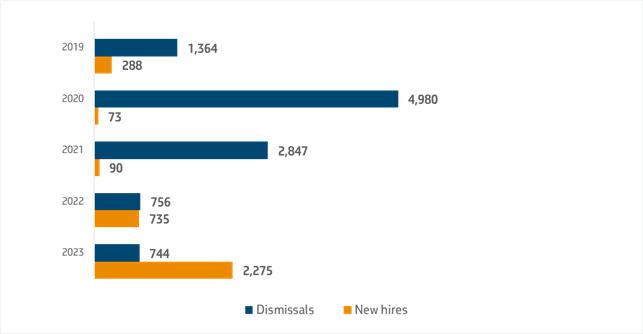
The employees that were hired in 2023 support our current Strategic Plan and enable workforce renewal. We believe that our growth helps ensure competitive advantage and value to our business, in terms of knowledge and talent management.
Hiring new employees through the PSP and the dismissals contributed to a slight change in the range distribution of our workforce by time spent with us, as well as the age pyramid.
TIME IN PETROBRAS (not including our subsidiaries, joint operations or structured entities) (%)
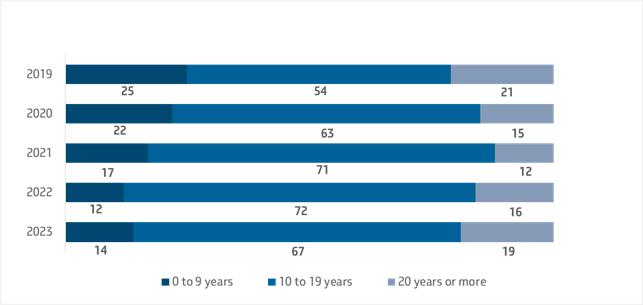
PETROBRAS | Annual Report and Form 20-F | 2023 | 222 |
| Table of Contents | |
| | Management and Employees |
Labor Relations
We respect the freedom of association and recognize the right to collective bargaining, as recommended by United Nations Global Pact. This commitment is reinforced by our Human Resources Policy, which determines the implementation of sustainable agreements built through dialogue, ethics and transparency with employee representatives, and by our Code of Ethical Conduct which ensures freedom of association. We also follow the International Labor Organization conventions ratified by Brazil.
According to Brazilian legislation, all of our employees are represented by independent unions. We maintain relationships with 17 trade unions and two federations (i.e., a top-level union entity) of oil workers, as well as six unions and one federation of maritime workers. We value our relationships with all our stakeholders. For this reason, we invest in open and permanent dialogue with trade unions. As of December 31, 2023, 40% of our employees were unionized.
We have a Collective Bargaining Agreement (2023-2025 CBA) with the oil and maritime trade unions, valid for two years, until 2025. These agreements include economic and social provisions relating to work, safety conditions, benefits, and other matters.
Our agreements seek to be aligned with the UN Sustainable Development Goals, contributing mainly to decent work and gender equality.
Currently, 100% of our employees are covered by Collective Bargaining Agreements.
In 2023, we adjusted the salaries and benefits of oil and maritime employees by 1% above inflation, according to the conditions negotiated and established in the 2023-2025 CBA.
We also have a Profit Sharing Program (“PLR”) Agreement valid for 2023, which determines the rules regarding profit sharing payment.
Another right defined in Brazilian legislation is the power of employees to embrace their causes and promote strikes under the principles defined by law. We respect the right to strike, but we maintain our activities in full operation using contingency plans. Contingency plans are the way we can deal with several types of situations by being backup plans for operational continuity and safety we can use in case of unexpected situations.
Benefits
Employees Variable Compensation
We adopt a compensation policy in line with market practices in which we operate.
The variable remuneration model for our employees is made up of the PLR, a legal requirement and our main variable remuneration practice, and the Accomplishment Award (“PRD”), which complements the PLR. The PRD was implemented in 2023 to replace the Performance Award Program (“PPP”), which was maintained only for members of our Executive Board. While the PLR only considers organizational performance, the PRD and PPP consider the employee's individual performance as well. These programs are aligned with the new guidelines of the 2024-2028+ Strategic Plan and our remuneration policy.
PLR
For the 2022 fiscal year the PLR Agreement was only for employees who did not hold leadership and specialist roles (i.e., it did not include individuals holding positions such as manager, specialist and supervisor).
Regarding the 2023 fiscal year, we approved the PLR Agreement for all employees, regardless of their position, except for members of our Executive Board, and it became our main variable remuneration program.
PETROBRAS | Annual Report and Form 20-F | 2023 | 223 |
| Table of Contents | |
| | Management and Employees |
For payment of the 2023 PLR to occur in 2024, the following conditions must be met:
| - | Declaration and payment of shareholder remuneration, for such fiscal year, approved by our Board of Directors; |
| - | Obtainment of net income for such fiscal year; and |
| - | Achievement of an average percentage (weighted) of at least 80% for target indicators established by the Board of Directors. |
In 2023, the Company provisioned US$591 million referring to PLR for 2023 for Petrobras (US$127 million for Petrobras, not including our subsidiaries, joint operations or structured entities).
PPP and PRD
The PPP and PRD are programs that seek to recognize the individual effort and performance of employees in achieving our results.
For the 2022 fiscal year, the PPP was the variable compensation program valid for all our employees. As our 2022 results met all the minimum prerequisites established for such year, in 2023, the Company paid US$562 million to the employees for Petrobras in relation to the PPP for 2022 (US$521 million to the employees for Petrobras, not including our subsidiaries, joint operations or structured entities), since the metrics relating to the Company’s and individual performances were achieved in 2022.
Regarding the 2023 fiscal year, we implemented the PRD, a new variable compensation program that replaced the PPP for all employees, except for members of the Executive Board, for whom it remained in force. With the PRD, we reinforce the recognition of individual performance of our employees.
The 2023 fiscal year PRD and PPP will be paid after the results for the year have been calculated, provided that the following conditions established by the programs are met:
| – | Declaration and payment of dividends to our shareholders, for such fiscal year, approved by our Board of Directors; and |
| – | Obtaining net income for the year. |
Additionally, the scorecards of the organizational units continue to be considered as input for the assessment of all employees, which are reflected in the calculation of their variable remuneration, and include the following items: (i) the results of our main metrics such as Delta Valor Petrobras (which measures our economic-financial performance based on the value generated by our activities in a given year), IAGEE and VAZO; and (ii) the scores of specific metrics of each executive scorecard (represented by specific indicators and strategic initiatives that address economic, environmental and social factors). The higher the hierarchical level, the greater the weight of the top metrics and, therefore, the multiple remunerations associated with the award reflecting the greater degree of responsibility of the manager in relation to the metrics of his or her area and to our performance metrics.
For members of the Executive Board that are eligible for PPP and for members of our Management eligible for PRD, as approved by our Board of Directors and SEST, the variable compensation payments must be deferred over five years as a long-term incentive. The value of such payments are based on the market value of our shares without factoring in any option to buy our shares. Consequently, payments to the members of our Executive Board and Management must be carried out as follows:
| – | 60% of the value of the compensation must be paid in a cash installment while 40% of the balance must be settled in four annual deferred installments, the value of which must be symbolically converted into the corresponding number of our common shares (PETR3), using as a base value their weighted average during the last 60 trading sessions of the applicable fiscal year. |
| – | The members of our Executive Board and Management may exercise the right to receive deferred installments after the established grace periods have been fulfilled. |
| – | The value of each installment must be equivalent to the conversion of symbolic shares into cash value based on the weighted average of our common shares during the last 20 trading sessions prior to the request date. |
PETROBRAS | Annual Report and Form 20-F | 2023 | 224 |
| Table of Contents | |
| | Management and Employees |
Main Benefits Granted to Employees
We offer benefits that are commensurate with our size and seek to value our employees. All of our employees are entitled to the same benefits, regardless of their positions or duties. There are no differences between the benefit plans of the highest governance body, senior executives and all other employees. We offer complementary pension plans, medical assistance and pharmacy benefits. In addition, some of our consolidated subsidiaries have their own benefit plans.
Pension Plans
We sponsor six post-employment benefit plans, managed by Petros, with pension characteristics:
| – | Plano Petros do Sistema Petrobras Renegotiated (PPSP-R) – Defined Benefit (DB) type, closed to new members. |
| – | Plano Petros do Sistema Petrobras Not Renegotiated (PPSP-NR) – Defined Benefit (DB) type, closed to new members. |
| – | Plano Petros do Sistema Petrobras Renegotiated Pré-70 (PPSP-R Pré-70) – Defined Benefit (DB) type, closed to new members. |
| – | Plano Petros do Sistema Petrobras Not Renegotiated Pré-70 (PPSP-NR Pré-70) – Defined Benefit (DB) type, closed to new members. |
| – | Plano Petros-2 (PP-2) – Variable Contribution (VC) type, open to new members. |
| – | Plano Petros-3 (PP-3) – Defined Contribution (DC) type, closed to new members. |
Together, these plans cover 96% of our employees, considering that only one plan (PP-2) is currently open to new members with optional membership.
PETROBRAS | Annual Report and Form 20-F | 2023 | 225 |
| Table of Contents | |
| | Management and Employees |
| Equalization of Petros Plans |
|
The main purpose of our pension plans is to supplement the social security pension benefits of our retired employees. Thus, our employees make mandatory monthly contributions as participants of our plans, and we do the same as sponsors. In March 2020, our Board of Directors deliberated on a new equalization plan (named “New DEP” at its launch, now named “DEP 2018”) of the PPSP-Renegotiated and PPSP-Not Renegotiated, managed by Petros and in compliance with Brazilian social security legislation. The DEP 2018, approved in May 2020 by PREVIC and SEST, came into effect in June 2020. It replaced the DEP 2015, mitigated the deficit registered in 2018, considered the utilization of the plans’ actuarial results achieved in 2019, and the actuarial impacts related to changes in PPSP-Renegotiated and PPSP-Not Renegotiated plans regulations, which allowed the deficit to be refinanced for a new term, throughout the life of the plans. In November 2022, we and Petros approved the plan to resolve the deficit registered by the PPSP-Renegotiated in 2021 (“DEP 2021”), which was submitted to and approved by SEST. The collection of extraordinary contributions started in April 2023, in addition to the ordinary and extraordinary contributions already provided for in the plan. In December 2022, the actuarial result pointed to a deficit of US$0.29 billion for the PPSP-Not Renegotiated Pension Plan. The main cause of the deficit, as explained by Petros, was the profitability of investments which performed below the actuarial target, due to the adverse general economic situation, mainly impacting stocks and other assets. Therefore, in accordance with current legislation, in 2023 Petros began the process of creating the Deficit Equalization Plan 2022 of PPSP-Not Renegotiated (“DEP-2022”), which was approved by the Petrobras Board of Directors and by SEST, so the extraordinary contributions can be collected from April 2024. Pursuant to Brazilian social security legislation, every deficit of each PPSP Plan must be balanced equally between the sponsors (Petrobras, Vibra and Petros) and participants, retirees, and/or pensioners. The remaining balance related to Petrobras to be settled by the extraordinary contributions contracted through the DEP 2018, DEP 2021 and DEP 2022 (together “Deficit Equalization Plans”) in the PPSP-Renegotiated and PPSP-Not Renegotiated plans was US$4.3 billion as of December 31, 2023, as recorded in Petros plans balance sheets at present value. For more information on the Deficit Equalization Plans, see Note 18.3 to our audited consolidated financial statements.
|
PETROBRAS | Annual Report and Form 20-F | 2023 | 226 |
| Table of Contents | |
| | Management and Employees |
The table below presents the benefits paid, contributions made, and outstanding pension liabilities for the years ended December 31, 2023, 2022, and 2021:
| US$ million | |||
| 2023 | 2022 | 2021 | |
| Total benefits paid – pension plans | 1,639 | 1,539 | 1,336 |
| Total contributions – pension plans(1) | 746 | 1,945 | 2,100 |
| Net actuarial liabilities(2) | 6,720 | 5,433 | 5,395 |
| (1) | Contributions of sponsors, including defined contributions recognized in the statement of income (PP-2 and PP-3). |
| (2) | Unfunded pension plans obligations. |
For more information on the Petros plan, see “Risks – Risk Factors” in this annual report and Notes 4.3 and 18 to our audited consolidated financial statements.
Health and Pharmacy Benefit Plan
We offer a supplementary health care plan, the “AMS” or “Saúde Petrobras”, which provides for medical, hospital and dental care services to all active and retired employees and their dependents. In 2023, we paid 60% of the health care costs and our employees (active and retired) paid 40%. The agreement settled with unions that represents our employees provides that this cost ratio will be maintained until a new agreement is established.
An independent actuary consultant calculates our commitment related to future benefits for plan participants on an annual basis, based on the projected unit credit method. The health care plan is not funded or otherwise collateralized by assets. Instead, we make benefit payments based on annual costs incurred by plan participants.
The Saúde Petrobras benefit also offers coverage of complementary programs, such as the Benefício Farmácia program. This program only covers drugs with a unit cost over R$150.00 and drugs of any value used in the treatment of certain non-transmissible chronic diseases. By choosing to use the Benefício Farmácia, the beneficiary must incur costs as determined by the co-participation system.
The table below shows the post-employment benefits paid and outstanding medical liabilities for the years ended December 31, 2023, 2022 and 2021:
| US$ million | |||
| 2023 | 2022 | 2021 | |
| Total benefits paid – medical plan(1) | 413 | 384 | 309 |
| Net actuarial liabilities(2) | 9,662 | 5,813 | 4,485 |
| (1) | Composed of Saúde Petrobras and Benefício Farmácia amounts. |
| (2) | Unfunded medical plan obligations. |
For more information on our employee benefits, see Notes 4.3 and 18 to our audited consolidated financial statements and “Risks – Risk Factors” in this annual report.
PETROBRAS | Annual Report and Form 20-F | 2023 | 227 |

PETROBRAS | Annual Report and Form 20-F | 2023 | 228 |
| Table of Contents | |
| | Compliance and Internal Controls |
Compliance
Ethical principles guide our business and our relations with third parties. Our activities follow clearly articulated policies, guidelines, standards, and procedures that have been formally established by us. These policies and procedures are communicated to all employees and accessible from any company device, with our main corporate policies also available on our website.
Our activities are subject to national and international laws aimed at preventing fraud and corruption, money laundering, trade sanctions, conflicts of interest and antitrust violations, such as the Brazilian Anti-Corruption Law (Law 12,846/13), the U.S. Foreign Corrupt Practices Act (FCPA), and the UK Bribery Act.
In addition, we continually work to strengthen our integrity system. We have a Code of Ethical Conduct that provides guidance on the behavior that we require from our workforce and counterparties. The Code of Ethical Conduct provides tools for self-reflection to help employees to comply with our ethical principles while performing their duties.
In order to further integrate and strengthen our integrity system, we highlight our corporate Compliance Policy, our Ethical Conduct Guide for Suppliers and our Compliance Program.
Also, our Competitive Compliance Guideline guides our workforce on the rules that regulate free competition in order to prevent and mitigate violations of Law No. 12,529/2011 (the Competition Defense Law) and provide mechanisms to detect and address any instances of anticompetitive practices.
To ensure an ethical environment for our business, we work (i) to promote a culture of integrity; (ii) prevent, detect and correct incidents of fraud, corruption, conflicts of interest and money laundering, harassment and discrimination; and (iii) manage our internal controls and the integrity analysis of managers and counterparts.
We offer training for all our employees, particularly employees working on activities with greater exposure to compliance risks, as well as the members of our Executive Officers and our Board of Directors.
In 2023, we launched an e-learning course on Preventing and Combating Discrimination, Moral Harassment and Sexual Violence. The course provided concepts and information about the structure that we developed to handle cases of discrimination, harassment, or sexual violence. It also included preventive mechanisms and guidance for victims or those aware of such incidents. This training is available to the entire workforce and is mandatory for all company employees.
This e-learning course reinforces our commitment to promoting a work culture based on mutual respect and free from violence and harassment. It aims to raise awareness among employees about everyone’s responsibility in preventing harassment and discrimination. As of December 31, 2023, 39,235 employees, representing 97.6% of our own personnel, completed this e-learning course.
In addition to the e-learning course, we also launched Corporate Guidelines on Preventing and Combating Discrimination, Moral Harassment and Sexual Violence. These guidelines comprise a set of integrated actions based on the Petrobras Compliance Program and the Petrobras Program against Sexual Violence according to the following pillars: prevention, sheltering, detection, remediation, and transparency. Attached to the guidelines there is a booklet with the same theme, accessible to the entire company.
In 2023, we also conducted face-to-face and online lectures on the topic of “Prevention and Combating of Discrimination, Moral Harassment and Sexual Violence” for employees and leadership. We conducted 88 lectures, reaching an audience of over 13,000 professionals in administrative areas and operational units.
PETROBRAS | Annual Report and Form 20-F | 2023 | 229 |
| Table of Contents | |
| | Compliance and Internal Controls |
In 2023, we also provided training sessions to directors and executive officers, covering mainly the following topics:
| – | Code of Ethical Conduct; |
| – | Our corporate governance and decision-making process; |
| – | Brazilian anti-corruption law; |
| – | Compliance, internal controls and related party transactions; |
| – | Disclosure of Information to the Market, Information and Securities Trading including blackout period; and |
| – | Risk management. |
Code of Ethical Conduct
Our Code of Ethical Conduct defines the ethical principles that guide our system’s actions and our conduct commitments, both corporate and that of our employees, explaining the ethical sense of our mission, of our vision, and of our Strategic Plan.
The Code of Ethical Conduct also applies to the members of the Board of Directors and its advisory committees, members of the Fiscal Council, members of the Executive Board, employees, interns, service providers and anyone acting on our behalf, including our subsidiaries in Brazil and abroad.
The Code of Ethical Conduct is aligned with the best corporate integrity practices and represents another step towards strengthening our integrity culture. It is based on our values such as respect for life, people and the environment, ethics and transparency, resilience and trust, market orientation and results. Based on these values, the three main principles that support the guidelines of the Code of Ethical Conduct are:
| – | Respect for life, people and the environment; |
| – | Integrity, transparency and meritocracy; and |
| – | Value addition. |
Our commitments of conduct are: example, accountability, trust, courage, union, cooperation, innovation, continuous improvement, results, reputation and transparency.
Our Code of Ethical Conduct is available on our website.
Compliance Policy
The purpose of the Compliance Policy is to ensure that we comply with the laws and rules of regulatory bodies, acting to correct and prevent misconduct.
The six principles that guide our compliance actions are:
| – | All of our activities and relations with our stakeholders must be based on ethics, integrity, and transparency, in compliance with the applicable national and international standards, to provide a safe environment for decision making. |
| – | Our priority is the active prevention of any violations of rules and regulations in order to mitigate compliance risks. |
| – | All indications of misconduct and harmful actions must be investigated and measures shall be adopted for the immediate interruption and repair of any damage to us, and proportional consequences will be imposed on those responsible. |
| – | Retaliation against whistleblowers is forbidden and we ensure privacy, confidentiality, and institutional protection to such persons. |
PETROBRAS | Annual Report and Form 20-F | 2023 | 230 |
| Table of Contents | |
| | Compliance and Internal Controls |
| – | Our directors and managers are responsible for unequivocally and continuously supporting the development and improvement of our culture of integrity. |
| – | We must encourage an increasingly ethical business environment with integrity and transparency, setting a positive example for our stakeholders. |
Ethical Conduct Guide for Suppliers
Our Ethical Conduct Guide for Suppliers is the first document exclusively aimed at our suppliers, with guidelines on expected values and ethical behavior. It applies to all suppliers, in Brazil or abroad, that are involved in business processes and have signed contracts, agreements and terms of cooperation with us. It also reaffirms our zero tolerance for any form of fraud and corruption, demanding the same stance from our supply chain, and was elaborated in accordance with the best international practices and is aligned with the guidelines of the Dow Jones Sustainability Index, the B3 Corporate Sustainability Index and the Corporate Human Rights Benchmark. The document also reinforces that suppliers must promote decent and safe working conditions for their employees, prevent and combat moral and sexual harassment and discrimination, combat child and slavery labor and respect the environment. Additionally, it determines that suppliers must promote diversity, gender and racial equality and the inclusion of people with disabilities and brings an evolution by consolidating the principles and ethical guidelines applicable to suppliers in a single document. The observance of this Ethical Conduct Guide by all suppliers is crucial for us to achieve our goals in an ethical and transparent way and is aligned with our ESG standards. Therefore, we evaluate suppliers’ compliance through the performance management system, as reinforced in our Quality Guide for Suppliers which can be found at https://canalfornecedor.petrobras.com.br/en. The information on this website is not and shall not be deemed to be incorporated by reference into this annual report.
Petrobras Compliance Program
The Petrobras Compliance Program is the set of mechanisms intended to prevent, detect and remedy any misconduct and harmful acts carried out against us, including acts related to fraud and corruption, money laundering, moral and sexual harassment, discrimination and conflicts of interest and antitrust violations.
The Governance and Compliance Officer is responsible for both the Petrobras Compliance Program and our integrity practices.
The Petrobras Compliance Program is intended for our various stakeholders, including senior management, employees, subsidiaries and affiliates, clients, suppliers, investors, partners, public authorities and all those who relate with or represent our interests in our operations.
Ethics Commission
Our ethics commission acts as a forum for discussion of subjects related to ethics. It also serves in an advisory capacity to our management and workforce, providing recommendations with respect to topics related to ethics management issues, proposing rules for the incorporation of new concepts, and adopting measures to comply with legislation and following best practices that reinforce our zero tolerance approach to acts of misconduct.
Our ethics commission is composed of employees appointed after an internal selection process consisting of background checks and interviews. Our Board of Directors and our Executive Officers approve each new appointment.
PETROBRAS | Annual Report and Form 20-F | 2023 | 231 |
| Table of Contents | |
| | Compliance and Internal Controls |
Anti-Money Laundering and Sanctions
Our Guidelines for the Anti-Money Laundering and Sanctions, as approved by our Chief Governance & Compliance Officer, are composed of specific requirements to minimize the risk of money laundering and violations of sanctions regulations.
The principles that guide our sanctions policy are:
| – | Before initiating a transaction, our organizational areas should screen the counterparty against the Sanctions List made available by Compliance. |
| – | If the organizational area identifies that the intended counterparty is sanctioned, Compliance must be consulted regarding the applicability and restrictions of the sanction before moving forward with the transaction. Compliance with the support of our Legal department, advises the area on how to proceed. |
| – | Training and tools are made available to organizational areas to ensure compliance with applicable sanctions regulations. |
| – | Members of our senior management, managers and workforce must report irregularities related to money laundering and sanctions violations through our whistleblower channel. |
| – | We monitor transactions more exposed to risk of money laundering or sanctions and take appropriate measures when needed. |
Below is the list of sanctions we and our subsidiaries must observe:
| Country | Organization | List |
| United States | Trade Department | Consolidated Screening List |
| Office of Foreign Assets Control | Non-SDN – Non-Specially Designated Nationals | |
| Office of Foreign Assets Control | SDN – Specially Designated Nationals | |
| System for Award Management | Excluded Parties List | |
| European Union | European External Action Service | Consolidated List of Persons, Groups and Entities Subject to EU Financial Sanctions |
| United Nations | United Nations Security Council | United Nations Security Council Consolidated List |
| World Bank | World Bank | Debarred & Cross-Debarred Firms & Individuals / Other Sanctions |
| United Kingdom | Office of Financial Sanctions Implementation | Consolidated List of Financial Sanction Targets |
| Canada | Global Affairs Canada | Consolidated Canadian Autonomous Sanctions List |
| France | Direction Générale du Trésor | Liste Unique de Gels de la Direction Générale du Trésor |
| Switzerland | State Secretariat for Economic Affairs – SECO | Sanctions de la Suisse |
| United Arab Emirates | The Committee for Goods and Materials Subject to Import and Export – CGMSIEC | UAE National List of Terrorist Individuals and Entities |
In 2023, we reorganized the structure of the Governance and Compliance Department with the aim of strengthening and improving its processes. We highlight the creation of an area that will act as an internal affairs department to increase accountability and make the company's application process of the Anti-Corruption Law (Law No. 12,846/13) even more robust.
PETROBRAS | Annual Report and Form 20-F | 2023 | 232 |
| Table of Contents | |
| | Compliance and Internal Controls |
Another development is the creation of an area that uses advanced technology and data intelligence to analyze compliance incidents and quickly identify irregularities. In addition, the area is also responsible for the continuous monitoring of indicators, processes, controls, projects and initiatives, aiming at the constant improvement of the Integrity System and the achievement of Petrobras' strategic objectives.
In addition, we created a department to deal specifically with complaints related to workplace misconducts (e.g. sexual violence, moral harassment, retaliation and discrimination).
Changes in organizational structure can be found in our General Organizational Chart, available on our Investor Relations website (www.petrobras.com.br/ir).
PETROBRAS | Annual Report and Form 20-F | 2023 | 233 |
| Table of Contents | |
| | Compliance and Internal Controls |
Related Party Transactions
In order to comply with Brazilian law, such as Law No. 13,303/16, Decree No. 8,945/16 and CVM regulations, the annual review of our policy for related party transactions was approved in December 2023. We aim to foster transparency in our procedures and conduct better corporate governance practices. This policy also aims to guarantee the adequate and diligent decision-making process by our management, observing market conditions or appropriate compensatory payment, in the event of potential conflicts of interest.
Some transactions with related parties must be previously analyzed by our audit committee when they meet certain criteria set out in our policy.
Our policy provides for a strict governance procedure for proposed transactions directly or indirectly involving our controlling shareholder. In the specific case of transactions with related parties involving the Federal government, its autarchies, foundations and federal state-owned companies, the latter when classified as outside our normal course of business by our audit committee, which are within the scope of approval of our Board of Directors, the following special procedures apply: (i) such transactions be analyzed by the audit committee and by the minority committee prior to submission to our Board of Directors, and (ii) such transactions be approved by two-thirds of the members attending our Board of Directors meeting.
For additional information regarding our outstanding related party transactions as of and for the year-ended December 31, 2023, see Note 36 to our audited consolidated financial statements.
Transactions with our Board of Directors or Executive Officers
Direct transactions with the companies of members of our Board of Directors or our executive officers must follow the conditions of a commercial transaction and market practice guiding transactions with third parties. None of our Board of Directors members, our executive officers or close members of their families has had any direct interest in any transaction we performed that is or was unusual in its nature or conditions, or material to our business during the year, and which remains in any way outstanding or unperformed. From the preceding financial year until February 29, 2024, we have not entered into any transaction with the companies of members of our Board of Directors or our executive officers. We have no outstanding loans or guarantees to the members of our board of directors, executive officers, key management personnel or any close member of their families.
For a description of the shares beneficially held by the members of our board of directors and close members of their families, see “Management and Employees – Management – Additional Information on our Board of Directors and Executive Officers – Share Ownership” in this annual report.
PETROBRAS | Annual Report and Form 20-F | 2023 | 234 |
| Table of Contents | |
| | Compliance and Internal Controls |
Transactions with the Brazilian Federal Government
We have engaged, and expect to continue to engage, in the ordinary course of business in numerous transactions with our controlling shareholder, the Brazilian federal government, and with banks and other entities under its control, including financing and banking, asset management and other transactions. These transactions resulted in a US$17,761 million asset and a US$3,605 million liability with the Brazilian federal government and other entities under its control as of December 31, 2023.
On November 30, 2020, there was a final decision in relation to the Petroleum and Alcohol Account lawsuit filed in 2011. As of December 31, 2023, this receivable amounted to US$278 million. We expect to receive these amounts by 2027, according to the constitutional amendments of December 2021, which established limits for disbursements by the Brazilian federal government for each fiscal year.
In addition, we are allowed to invest in securities issued by the Brazilian federal government, provided that the legal and regulatory requirements are met and we have taken into consideration market’s best practices and the conservatism that should guide our investments.
As of December 31, 2023, the balance of securities issued by the Brazilian federal government that have been directly acquired and held by us amounted to US$1,819 million.
For further information on related party transactions, see Note 36 to our audited consolidated financial statements.
Transactions with associates
On December 23, 2022, we signed a contract with UEG Araucária S.A. in the amount of US$925 million, for the sale of 2,150,000 m³/d of interruptible gas, to supply energy generation electricity by UTE Araucária. The contract expired in 2023.
PETROBRAS | Annual Report and Form 20-F | 2023 | 235 |
| Table of Contents | |
| | Compliance and Internal Controls |
Controls and Procedures
Disclosure Controls and Procedures
We, together with our CEO and CFO, have evaluated the effectiveness of our disclosure controls and procedures as of December 31, 2023. Our CEO and CFO concluded that our disclosure controls and procedures were effective to provide reasonable assurance that the information we are required to disclose in the reports that we file or submit under the Exchange Act was being recorded, processed, summarized and reported within the time periods specified in the applicable rules and forms. They also concluded that such disclosure was compiled for and communicated to our management, including our CEO and CFO, as appropriate, to allow for timely decisions regarding the required disclosure.
Management’s Report on Internal Control over Financial Reporting
Our management is responsible for establishing, adequately maintaining and assessing the effectiveness of internal control over financial reporting. Such internal control is a process designed by, or under the supervision of our CEO and CFO, and effected by our board of directors, management and other employees.
The internal control over financial reporting is designed to provide reasonable assurances regarding the reliability of financial reporting and of the preparation of our consolidated financial statements for external purposes, in accordance with IFRS, as issued by the IASB.
Due to its inherent limitations, internal control over financial reporting may not prevent or detect misstatements. In addition, projections of any evaluation of effectiveness of internal control over financial reporting to future periods are subject to the risk of becoming inadequate because of changes in its conditions and assumptions.
Our management has assessed the effectiveness of our internal control over financial reporting as of December 31, 2023 based on the criteria established in “Internal Controls – Integrated Framework (2013)” issued by the Committee of Sponsoring Organizations of Treadway Commission (“COSO”). Our management has concluded that our internal control over financial reporting was effective.
Audit of the Effectiveness of Internal Control over Financial Reporting
Our independent registered accounting firm has audited the effectiveness of our internal control over financial reporting as of December 31, 2023, as stated in their report, which is included herein.
Changes in Internal Control over Financial Reporting
There were no significant changes in our internal control over financial reporting during the year ended December 31, 2023 that have materially affected, or are reasonably likely to materially affect, our internal control over financial reporting.
PETROBRAS | Annual Report and Form 20-F | 2023 | 236 |
| Table of Contents | |
| | Compliance and Internal Controls |
Ombudsman and Internal Investigations
Our general ombudsman office provides channels for receiving comments from our internal and external audience, such as claims, requests for information, general requests, suggestions, compliments and complaints, including reports of discrimination and all kinds of harassment.
In order to receive complaints, we provide a specific whistleblower channel, operated by an independent external company, and allowing for anonymity of the informants.
All complaints received through the whistleblower channel are forwarded to the ombudsman’s office, which analyzes, classifies, and directs them to the relevant office for follow-up. Allegations regarding compliance issues (fraud, corruption and other matters), violence in the workplace (harassment, discrimination and retaliation) and sexual violence (such as sexual harassment, pedophilia, etc.) are sent to the governance and compliance office, which has full access, independence, qualification and autonomy to thoroughly investigate allegations of this nature.
Upon the conclusion of each investigation, we use any material findings to improve our compliance efforts. If the findings in some instances indicate that any of our current or former employees did not comply with certain internal policies, the matter is submitted to the integrity committee, a collegial body that acts independently and reports to the Board of Directors, and appropriate disciplinary measures and remedial actions may apply (or are taken, according with applicable labor laws and internal policies).
As a measure to reinforce the integrity system, a new executive management team was created to exclusively conduct the disciplinary accountability process, including the accountability process for contracted companies provided for in the Anti-Corruption Law, resulting in the separation of investigation and accountability practices.
We continue to allocate significant resources to investigating allegations of misconduct and responding appropriately to investigative findings, and to improve our internal investigation procedures to ensure that investigations are conducted completely and efficiently and that disciplinary measures are imposed fairly, uniformly and promptly. We remain cooperative with the authorities, in an effort to uncover wrongdoing and hold those responsible accountable.
Irrespective of the findings of our internal investigations, in order to mitigate potential risks of further non-compliance with our internal policies, we continue to develop and implement measures aimed at improving corporate governance, including those related to fraud and corruption.
PETROBRAS | Annual Report and Form 20-F | 2023 | 237 |

PETROBRAS | Annual Report and Form 20-F | 2023 | 238 |
| Table of Contents | |
| | Shareholder Information |
Listing
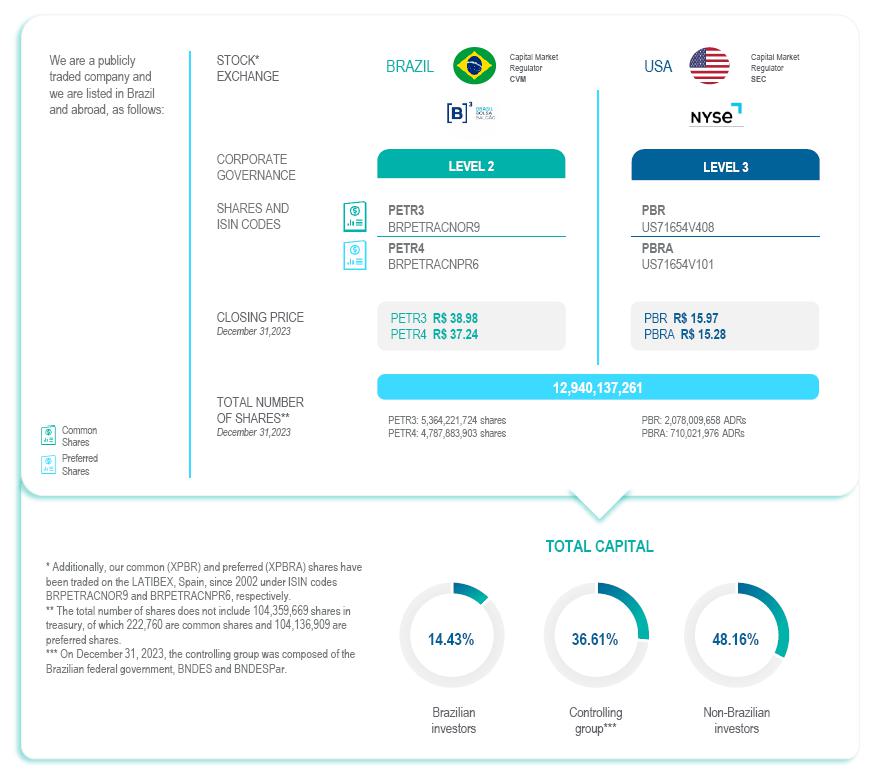
| Corporate Governance of B3 – Level 2 |
|
We are listed in the corporate governance Level 2 listing segment of the B3. Below are some of our corporate governance practices due to our listing on the Level 2 listing segment: – the roles of our minority committee are expanded; – our Board of Directors is composed of at least 40% independent members; – we disclose an annual calendar of corporate events; – we must assure 100% of tag along to holders of our preferred shares – under the same conditions granted to holders of our common shares; and – our bylaws provide for arbitration as the dispute resolution method. For more information about our corporate governance practices, see “Environment, Social and Governance - Corporate Governance” in this annual report.
|
PETROBRAS | Annual Report and Form 20-F | 2023 | 239 |
| Table of Contents | |
| | Shareholder Information |
Shares and Shareholders
Our capital stock is composed of common and preferred shares, all without par value and denominated in reais. Under Brazilian Corporate Law, the number of our preferred shares may not exceed two-thirds of the total number of our shares.
Our shares are negotiated on the B3 and registered in book-entry form. Banco Bradesco performs services of safekeeping and transfer of shares.
Holders of our common shares are entitled to one voting right for each unit of common shares held. Holders of our preferred shares are not entitled to voting rights, except for: (i) the right to appoint one member of our Board of Directors and one member of our Fiscal Council; and (ii) certain matters relating to preferred shares (such as creation, increasing, changes in the preferences or creation of a new class), whenever rights of holders of preferred shares are adversely affected.
In the U.S., our common or preferred shares, which are evidenced by ADRs, are listed in the form of ADSs on the NYSE. The ADSs are registered and delivered by a depositary bank (JPMorgan) which, since January 2, 2020, acts as the depositary for both of our common and preferred ADSs. The ratio of ADR to our common and preferred shares is two shares to one ADR.
The rights of ADS holders differ from shareholders’ rights. With respect to voting rights, ADS holders may only vote by means of proxy voting cards mailed to the ADR depositary bank while shareholders have the right to vote directly at the shareholders’ meeting.
On December 31, 2023, there were 2,078,009,658 outstanding common shares and 710,021,976 outstanding preferred shares represented by ADSs. There has been no change in the past five fiscal years in the amount of our issued share capital, as well as in the number of our common and preferred shares or in the voting rights of our common and preferred shares. See Exhibit 1.1 to this annual report for a copy of our Bylaws.
Additionally, our common (XPBR) and preferred (XPBRA) shares have been traded on the LATIBEX, Spain, since 2002 under ISIN codes BRPETRACNOR9 and BRPETRACNPR6, respectively. The LATIBEX is an electronic market created in 1999 by the Madrid Stock Exchange in order to enable trading of Euro-denominated Latin American equity securities.
In the beginning of 2024, our stock value1F6 decreased, and as of April 4, 2024, our stock price was US$15.52 (PBR) and US$15.03 (PBR/A). In both 2022 and 2023, our stock outperformed IBOV at B3 and ARCA OIL (formerly AMEXOIL) at NYSE. In 2021, our stock outperformed IBOV at B3 and underperformed ARCA OIL (formerly AMEXOIL) at NYSE.
6 Source: Bloomberg. The stock values in this paragraph consider the dividend adjustments.
PETROBRAS | Annual Report and Form 20-F | 2023 | 240 |
| Table of Contents | |
| | Shareholder Information |
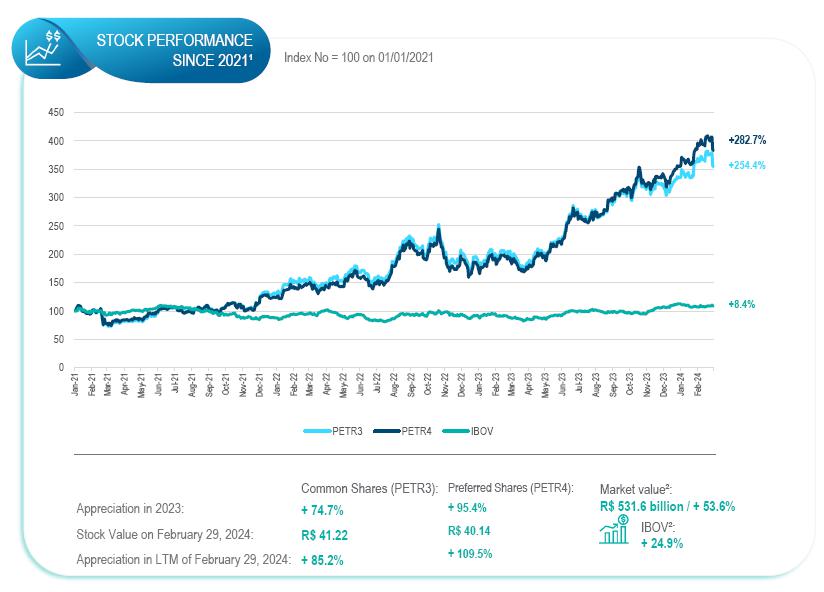

PETROBRAS | Annual Report and Form 20-F | 2023 | 241 |
| Table of Contents | |
| | Shareholder Information |
The following table sets forth information concerning the ownership of our common and preferred shares as of February 29, 2024, by the Brazilian federal government and certain public sector entities:
| Shareholders | Common Shares | % | Preferred Shares | % | Total Shares | % |
| Brazilian federal government | 3,740,470,811 | 50.26 | - | - | 3,740,470,811 | 28.67 |
| BNDES | - | - | 135,248,258 | 2.41 | 135,248,258 | 1.04 |
| BNDES Participações S.A. – BNDESPar | - | - | 900,210,496 | 16.07 | 900,210,496 | 6.90 |
| All members of our Board of Directors, Executive Officers and permanent members of our Fiscal Council(1) | 161,806,937 | 2.17 | 71,865 | 0.00 | 161,878,802 | 1.24 |
| Others | 3,540,176,394 | 47.57 | 4,566,512,169 | 81.52 | 8,106,688,563 | 62.15 |
| Total | 7,442,454,142 | 100.00 | 5,602,042,788 | 100.00 | 13,044,496,930 | 100.00 |
| (1) | Considers CVM criteria which includes the shares owned by a spouse from whom they are not legally or extrajudicially separated, a marriage partner, any dependents included in their annual income tax return and companies directly or indirectly controlled by them. It does not include the position held by external members of the Board of Directors' Advisory Committees and alternate members of the Fiscal Council.4F |
For detailed information on the shares held by the members of our Board of Directors, Executive Officers and members of our Fiscal Council, see “Management and Employees” in this annual report.
Under Brazilian Corporate Law and Law No. 13,303/16, the Brazilian federal government is required to own at least a majority of our voting shares.
Although the Brazilian federal government does not have different voting rights than our other shareholders, it is required by law to hold a majority of our voting share. As a result, any change in our control would require a change in applicable laws. Our Bylaws also provide for rules applicable to a potential transfer of control of our major shareholders.
The majority of our voting shares also gives the Brazilian federal government the right to elect a majority of our directors, regardless of the rights our minority shareholders may have to such election according to our Bylaws.
Additionally, our Bylaws clearly state that we may have our activities guided by the Brazilian federal government in order to contribute to the public interest that justified our creation. However, if the Brazilian federal government’s guidelines lead us to undertake obligations and responsibilities under conditions different from those of any other company in the private sector that operates in the same market, such obligations and responsibilities shall be defined in law or regulation and shall have their costs and revenues broken down and disclosed. In addition, the Brazilian federal government shall compensate us, at each fiscal year, for the difference between market conditions and the operational result or economic return from such obligation.
Our shareholding base includes over 1,000,000 shareholders at the B3 and ADR accounts at the NYSE.
PETROBRAS | Annual Report and Form 20-F | 2023 | 242 |
| Table of Contents | |
| | Shareholder Information |
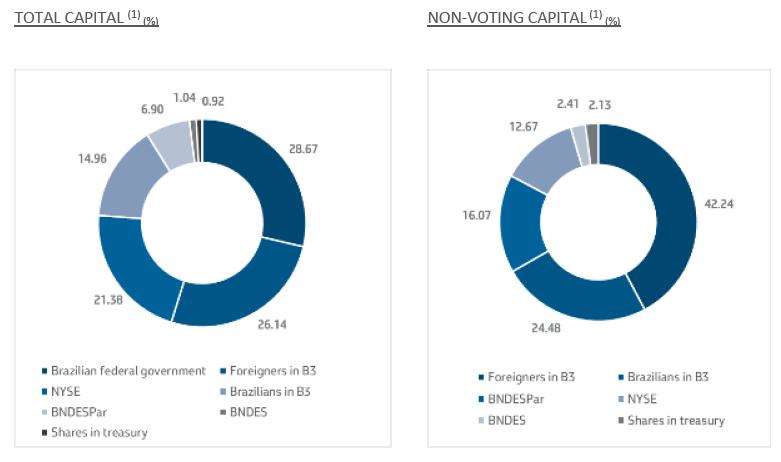
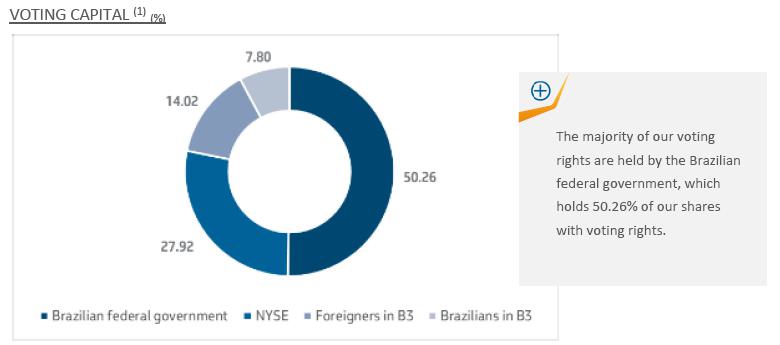
| (1) | Information about our shareholders as of February 29, 2024. |
Pursuant to CVM rules, any (i) direct or indirect controlling shareholder, (ii) shareholder who has elected members of a Brazilian public company’s Board of Directors or Fiscal Council, and (iii) person or group of persons representing the same interest, in each case that has directly or indirectly acquired or sold an interest that exceeds (either upward or downward) the threshold of 5%, or any multiple thereof, of the total number of shares of any type or class, must be disclosed by such Brazilian public company, immediately after the acquisition or sale of shares, to the CVM and the B3.
PETROBRAS | Annual Report and Form 20-F | 2023 | 243 |
| Table of Contents | |
| | Shareholder Information |
| Purchases of equity securities by the issuer and affiliated purchasers |
|
During the fiscal year ended December 31, 2023, we repurchased our equity securities. A Share Buyback Program covering preferred shares was approved by the Board of Directors on August 3, 2023. The Program is carried out in the context of the current Shareholder Remuneration Policy, which was amended and was approved by the Board of Directors on July 28, 2023, providing the possibility of repurchasing shares as a way to remunerate our shareholders.
|
| Period | Total number of preferred shares purchased | Average price paid per preferred share | Total number of preferred shares purchased as part of publicly announced plans or programs (1) | Maximum number (or approximate dollar value) of shares that may yet be purchased under the plans or programs | ||
|
September 2023 (09.06.2023 – 09.29.2023) |
28,735,700 | 6.87 | 28,735,700 | 129,081,247 | ||
|
October 2023 (10.02.2023 – 10.24.2023) |
27,596,600 | 7.03 | 27,596,600 | 101,484,647 | ||
|
November 2023 (11.10.2023 – 11.30.2023) |
17,479,900 | 7.27 | 17,479,900 | 84,004,747 | ||
|
December 2023 (12.01.2023 – 12.27.2023) |
30,251,800 | 7.16 | 30,251,800 | 53,752,947 | ||
| Total | 104,064,000 | 7.07 | 104,064,000 | 53,752,947 |
|
(1) On August 3, 2023, our Board of Directors approved a share buyback program, with a maximum term of 12 months (beginning on August 4, 2023 and ending on August 4, 2024), limited to 7F157,816,947. 8F
|
Self-Dealing Restrictions
In accordance with our Disclosure of Material Act or Fact Disclosure and Securities Negotiation Policy, the use of material information not yet disclosed, by any person who has had access to it, for the purpose of gaining advantage, for himself or for others, through trading in securities, is prohibited.
CVM Resolution 44/21, individually or combined, considers the following situations when characterizing the use of material information not yet disclosed, by any person who has had access to it, for the purpose of gaining advantage, for himself or for others, through trading in securities, as illicit act ("Insider Information"):
| – | I – the person who traded securities has material information not yet disclosed and uses such information in said trading; |
| – | II – direct or indirect controlling shareholders, directors, members of the board of directors and the fiscal council, and the company itself with access to all material information not yet disclosed and trades securities issued by the company; |
| – | III – the persons listed in item II, as well as those who have a commercial, professional or trust relationship with the company and, upon having access to material information not yet disclosed, knows that it is Insider Information; |
| – | IV – a Director who leaves the company with awareness of material information not yet disclosed and uses this information for trading securities issued by the company within a period of three months after leaving the company; |
| – | V – information shall be considered material from the moment in which studies or analyzes related to the matter are initiated, or if it is information about corporate operations such as total or partial spin-offs, mergers, transformations, or any form of corporate reorganization or business combination, change in control of the company, including the execution, alteration or termination of a shareholders' agreement, decision to go private or a change in the trading segment of its securities, notwithstanding other matters that may also constitute a material fact; and |
| – | VI – information about the request for a judicial or extrajudicial corporate reorganization and filing for bankruptcy made by the company is considered material information, from the moment in which studies or analyzes related to these requests are initiated. |
PETROBRAS | Annual Report and Form 20-F | 2023 | 244 |
| Table of Contents | |
| | Shareholder Information |
Restriction Period
In the period of 15 days before the disclosure of our quarterly information and annual information, with the exception of the provisions on individual investment/divestment plans in our Policy and in CVM Resolution 44/2021; the company, controlling shareholders, executive officers, members of the Board of Directors, the Fiscal Council and any bodies with technical or advisory functions, established by a statutory provision, shall be restricted from trading securities issued by the company, or referenced thereto, regardless if these individuals have knowledge of the content in the company's quarterly accounting information and the annual financial statements. The restriction period excludes the day of the disclosure of the financial statements, however, securities may only be traded on the day of the disclosure after the actual disclosure has occurred.
This restriction does not apply to:
| – | trading of fixed-income securities, when carried out through operations with joint repurchase commitments by the seller and resale by the buyer, in which settlement has been predefined for a date that may be prior to, or on the maturity date, of said operations, with profitability or predefined remuneration parameters; |
| – | operations aimed at fulfilling obligations that were committed before the start of the restriction period arising from loans of shares, exercise of purchase or sale options by third parties, and forward purchase and sale agreements; and |
| – | trading carried out by financial institutions and legal entities that are part of their economic group, provided that they are carried out in their normal course of business and in compliance with the parameters that have been established in the Company’s trading policy. |
Also, the restriction does not rely on an assessment if material information exists and is pending disclosure or on the intention for the trading activity.
The Investor Relations Officer (“IRO”) may, regardless of justification, establish periods in which the Company and Related Parties may not trade securities issued by Petrobras, its Subsidiaries and Affiliates (that are publicly traded companies). If this option is executed, the IRO must clearly indicate the initial term and the final term of the Blackout Period, and the Company and the Related Parties should maintain these periods confidential. The lack of communication by the IRO regarding the Blackout Period shall not exempt anyone from complying with the Policy, as well as with the provisions of CVM Resolution 44/21 and other normative acts of the CVM.
PETROBRAS | Annual Report and Form 20-F | 2023 | 245 |
| Table of Contents | |
| | Shareholder Information |
Exceptions to trading Restrictions
Anyone who has a relationship with a publicly-held company that makes them potentially subject to the presumptions referred to in § 1 of article 13 of CVM Resolution 44/21 may formalize an individual plan investment or disinvestment regulating their dealings with Securities issued by the Company or referenced to them Securities issued by the Company or referenced to them, in order to rule out the applicability of those presumptions. The individual investment plan will be governed by CVM Resolution 44/21.
Dispute Resolution
As a company listed on the B3’s Level 2, our Bylaws provide for mandatory dispute resolution, by means of arbitration before the Câmara de Arbitragem do Mercado, or the Market Arbitration Chamber, concerning any dispute or controversies that may arise among us, our shareholders, our management and members of our Fiscal Council, related to or arising from the application, validity, effectiveness, interpretation, violation and effects of the provisions contained in the applicable Brazilian Corporation Law, Law Nº 13,303/16, in the Company's Bylaws, in the rules issued by the National Monetary Council, Banco Central do Brasil and the CVM, as well as in other rules applicable to the operation of the general stock market, in addition to those contained in the Level 2 Regulation, Arbitration Regulation, Participation Agreement and Level 2 Sanctions Regulation.
Entities that are part of the direct and indirect public administration, as our company and our controlling shareholder, may use arbitration as a dispute resolution mechanism only for disputes involving negotiable economic rights. As a result, such entities cannot submit to arbitration any rights deemed non-negotiable under Brazilian law (direitos indisponíveis), such as those deemed to relate to public interest. Therefore, decisions of the Brazilian federal government exercised at any general shareholders’ meeting, if based or related to public interest, will not be subject to an arbitration proceeding.
PETROBRAS | Annual Report and Form 20-F | 2023 | 246 |
| Table of Contents | |
| | Shareholder Information |
Shareholders’ Rights
Shareholders’ Meetings and Voting Rights
Our shareholders have voting rights at the shareholders’ meeting to decide on any matters related to our corporate purposes and to pass any resolutions they deem necessary for our protection and development, except for certain matters whose authority to resolve are exclusively held by our corporate governing bodies.
Our annual shareholders’ meeting takes place at our headquarters, in Rio de Janeiro, Brazil, in April of each year. Additionally, our Board of Directors or, in some specific situations set forth in Brazilian Corporate Law, our shareholders or Fiscal Council, may call our extraordinary shareholders’ meetings. In 2023, our meeting was held partially virtually (via videoconference), in accordance with CVM Resolution No. 81/2022. Therefore, shareholders can participate in the meeting through the digital platform we provided or in person at our headquarters.
The notice of the annual shareholders’ meeting and related documents must be published at least 30 calendar days prior to the scheduled meeting date.
For ADS holders, we are required to provide notice to the ADS depositary at least 30 calendar days prior to a shareholders’ meeting. Upon receipt of our shareholders’ meeting notice, the depositary must fix the ADS record date and distribute to ADS holders a notice. This notice must contain (i) final information particular to such vote and meeting and any solicitation materials, (ii) a statement that each holder on the record date set by the depositary will be entitled to instruct the depositary as to the exercise of the voting rights, subject to any applicable provisions of Brazilian law as well as our Bylaws, and (iii) a statement as to the manner in which these instructions can be given, including instructions to give a discretionary proxy to a person designated by us. Our shareholders may vote in person, at the meeting, or remotely, prior to the date of the meeting. Electronic participation in shareholders’ meetings is not available to ADS holders, which may only vote by means of proxy voting cards mailed to the ADR depositary bank.
Quorum
Attendance quorum. In order to start, shareholders representing at least one-fourth of our issued and outstanding common shares must attend our shareholders’ meeting, except when the matter to be decided aims to amend our Bylaws. In this case, a valid meeting requires the attendance of shareholders representing at least two-thirds of our issued and outstanding common shares. If the required quorum is not reached, our Board of Directors may call a second meeting by sending a notice at least eight calendar days prior to the new scheduled meeting. The attendance quorum requirements will not apply to such second meeting, but the voting quorum requirements described below shall be observed.
Voting quorum. Matters to be approved at our shareholders’ meeting must be approved by the quorums specified below.
PETROBRAS | Annual Report and Form 20-F | 2023 | 247 |
| Table of Contents | |
| | Shareholder Information |
Matter approved by majority vote (of holders of common shares attending the meeting):
| – | amend our Bylaws; |
| – | approve any capital change; |
| – | elect or dismiss members of our Board of Directors and Fiscal Council (and its respective alternates), subject to the right of our preferred shareholders to elect or dismiss one member of our Board of Directors and to elect one member of our Fiscal Council (and its respective alternates) and to the right of our employees to elect or dismiss one member of our Board of Directors; |
| – | receive the yearly financial statements prepared by our management and accept or reject management’s financial statements, including the allocation of net income for payment of the mandatory dividend and allocation to the various reserve accounts; |
| – | authorize the issuance of debentures, except for the issuance of non-convertible unsecured debentures or the sale of such debentures when in treasury, which may be approved by our Board of Directors; |
| – | accept or reject the valuation of assets contributed by a shareholder in consideration for increase of capital stock; |
| – | approve the disposal of convertible debentures issued by our wholly-owned subsidiaries and held by us; |
| – | establish the compensation of the former members of our Executive Officers, our Board of Directors, our Fiscal Council, including the compensation due during the period of six months of forfeiture provided for in our Bylaws, and of advisory committees to our Board of Directors; |
| – | approve the cancellation of our registration as a publicly-traded company; |
| – | approve the requirements of our nomination policy, in addition to the requirements provided by law applicable to boards of directors and fiscal councils; and |
| – | approve in the case of publicly-traded company, the execution of transactions with related parties, and the sale or contribution of assets to another company, if the value of the transaction corresponds to more than 50% of the value of the total assets listed in the last approved balance sheet. |
Matter approved by at least one-half of the common shares of our total capital stock:
| – | reduce of the mandatory dividend distribution; |
| – | merge into another company or consolidate with another company, subject to the conditions set forth in Brazilian Corporate Law; |
| – | participate in a group of companies subject to the conditions set forth in Brazilian Corporate Law; |
| – | change our corporate purpose, which must be preceded by an amendment to our Bylaws by federal law, as we are controlled by the Brazilian federal government and our corporate purpose is established by law; |
| – | spin-off of a portion of us, subject to the conditions set forth in Brazilian Corporate Law; |
| – | waive the right to subscribe to shares or convertible debentures issued by our wholly-owned subsidiaries or associate; |
| – | decide on our dissolution; |
| – | create preferred shares or increase the existing classes of preferred shares, without preserving the proportions to any other class of preferred shares, except as set forth in or authorized by our Bylaws; |
| – | change the preferences, privileges or redemption or amortization conditions of any class of preferred shares; and |
| – | create new class of preferred shares entitled to more favorable conditions than the existing classes. |
PETROBRAS | Annual Report and Form 20-F | 2023 | 248 |
| Table of Contents | |
| | Shareholder Information |
Matter approved by a special quorum:
| – | select a specialized company to work out the appraisal of our shares by economic value in the event of the cancellation of our registry as a publicly traded company, which matter must be approved by the majority of votes from the holders of the outstanding shares that are present at the meeting. According to B3´s Level 2 regulation, outstanding shares means all the shares issued by a company, except for the shares held by the controlling shareholder, by persons linked to such controlling shareholder and by our managers, as well as those shares in treasury and special class of preferred shares which purpose is to guarantee differentiated political rights and be non-transferable and exclusive property of the privatizing entity. This matter must only be discussed in a shareholders’ meeting installed with the presence of at least 20% of the holders of the outstanding shares in a first call, or the presence of any number of holders of the outstanding shares in a second call. |
Pursuant to Law No. 13,303/16, no decision taken at any shareholders’ meeting can change the corporate status of our company (i.e. sociedade anônima).
Under Brazilian Corporate Law, if a shareholder has a conflict of interest with a company in connection with any proposed transaction, the shareholder may not vote in any decision regarding such transaction. Any transaction approved with the vote of a shareholder having a conflict of interest may be annulled and such shareholder may be liable for any damages caused and be required to return to us any gain it may have obtained as a result of the transaction.
Also under Brazilian Corporate Law, minority shareholders representing at least 10% of our voting capital have the right to demand that a cumulative voting procedure be adopted to entitle each common share to as many votes as there are board members and to give each common share the right to vote cumulatively for only one candidate of our Board of Directors or to distribute its votes among several candidates. Pursuant to regulations promulgated by the CVM, the 10% threshold requirement for the exercise of cumulative voting procedures may be reduced depending on the amount of capital stock we possess. For a company like us, the threshold is 5%. Thus, shareholders representing 5% of our voting capital may demand the adoption of the cumulative voting procedure.
Regarding the right to appoint members of our Board of Directors and our Fiscal Council, the following should be highlighted:
| – | our minority preferred shareholders that together hold at least 10% of the total capital stock (excluding the shares held by our controlling shareholder) have the right to elect and remove one member to our Board of Directors at a shareholders’ meeting, by a separate voting procedure; |
| – | our minority common shareholders have the right to elect and remove one member to our Board of Directors, if a greater number of directors is not elected by such minority shareholders by means of the cumulative voting procedure; |
| – | our employees have the right to directly elect one member to our Board of Directors by means of a separate voting procedure, pursuant to Law No. 12,353/10; and |
| – | subject to the provisions of applicable law, the Brazilian Minister of Economy has the right to elect and remove one member of our Board of Directors. |
Brazilian Corporate Law and our Bylaws provide that, regardless of the exercise by our minority shareholders of the rights related to the cumulative voting process, the Brazilian federal government always has the right to appoint the majority members of our directors and our Fiscal Council.
PETROBRAS | Annual Report and Form 20-F | 2023 | 249 |
| Table of Contents | |
| | Shareholder Information |
Other Shareholders’ Rights
In addition to their voting rights, shareholders have the following rights:
Preemptive rights: Each of our shareholders has a general preemptive right to subscribe for shares or securities convertible into shares in any capital increase, in proportion to his or her shareholding. A minimum period of 30 days following the publication of notice of a capital increase is assured for the exercise of the right, and the right is transferable. Under our Bylaws and Brazilian Corporate Law, and subject to the requirement for shareholder approval of any necessary increase to our authorized share capital, our Board of Directors may decide not to extend preemptive rights to our shareholders, or to reduce the 30-day period for the exercise of preemptive rights, in each case with respect to any issuance of shares, debentures convertible into shares or warrants in the context of a public offering.
In the event of a capital increase by means of the issuance of new shares, holders of ADSs and holders of common or preferred shares would have, except under circumstances described above, preemptive rights to subscribe for any class of our newly issued shares. However, holders of ADSs may not be able to exercise the preemptive rights relating to the common and preferred shares underlying their ADSs unless a registration statement under the Securities Act is effective with respect to those rights or an exemption from the registration requirements of the Securities Act is available.
For more information, see “Risks – Risk Factors – Risks related to shares and debt securities” in this annual report.
Redemption and rights of withdrawal: Brazilian Corporate Law provides that, under limited circumstances, shareholders have the right to withdraw their equity interest from a company and to receive payment for the portion of shareholder’s equity attributable to their equity interest.
This right of withdrawal may be exercised by the holders of the adversely affected common or preferred shares, provided that certain conditions set forth in Brazilian Corporate Law are met, in the event that we decide to:
| – | increase the existing classes of preferred shares, without preserving the proportions to any other class of preferred shares; |
| – | change the preferences, privileges, redemption or amortization conditions of any class of preferred shares or to create a new class of preferred shares entitled to more favorable conditions than the existing classes; |
| – | merge into another company or to consolidate with another company; |
| – | participate in a centralized group of companies as defined under Brazilian Corporate Law; |
| – | reduce the mandatory distribution of dividends; |
| – | change our corporate purposes; |
| – | spin-off a portion of us; |
| – | transfer all of our shares to another company or to receive shares of another company in order to make us, whose shares are transferred a wholly-owned subsidiary, known in Brazil as incorporação de ações; or |
| – | acquire control of another company at a price that exceeds the limits set forth in Brazilian Corporate Law. |
This right of withdrawal may also be exercised in the event that the entity resulting from a merger, consolidation or spin-off of a listed company and us do not negotiate new shares in the secondary market, within 120 days from the date of the shareholders’ meeting approving the transaction, in accordance with the applicable SEC regulations.
Considering that our Bylaws do not provide for rules to determine any value for redemption, under Brazilian Corporate Law, any redemption of shares arising out of the exercise of such withdrawal rights would be made based on the book value per share, determined on the basis of the last balance sheet approved by our shareholders. However, if a shareholders’ meeting giving rise to redemption rights occurred more than 60 days after the date of the last approved balance sheet, a shareholder would be entitled to demand that his or her shares be valued on the basis of a new balance sheet dated within 60 days of such shareholders’ meeting. In this case, we would immediately pay 80% of the amount of reimbursement calculated based on the last balance sheet and, after the special balance sheet has been drawn up, we would pay the balance within 120 days from the date of the shareholders’ meeting resolution. The right of withdrawal lapses 30 days after publication of the minutes of the shareholders’ meeting that approved the matters described above. We would be entitled to reconsider any action giving rise to withdrawal rights within ten days following the publication of the minutes of the meeting ratifying the decision if the payment of the price of reimbursement of the shares to the dissenting shareholders would jeopardize our financial stability.
PETROBRAS | Annual Report and Form 20-F | 2023 | 250 |
| Table of Contents | |
| | Shareholder Information |
Liquidation: In the event of a liquidation, holders of preferred shares are entitled to receive, prior to any distribution to shareholders, payment for the portion of shareholder’s equity attributable to their equity interest.
Conversion rights: Our common shares are not convertible into preferred shares, nor are preferred shares convertible into common shares.
Liability of our shareholders for further capital calls: Neither Brazilian Corporate Law nor our Bylaws provide liability for our shareholders for further capital calls. Our shareholders’ liability for capital stock is limited to the payment of the issuance price of the shares subscribed or acquired.
Rights not subject to waiver: According to Brazilian Corporate Law, neither a company’s Bylaws nor decisions taken at a shareholders’ meeting may deprive a shareholder of some specific rights, such as the right to:
| – | participate in the distribution of profits; |
| – | participate in any remaining residual assets in the event of our liquidation; |
| – | supervise the management of the corporate business as specified in Brazilian Corporate Law; |
| – | exercise preemptive rights in the event of a subscription of shares, debentures convertible into shares or subscription warrants (other than with respect to a public offering of such securities, as may be set out in the Bylaws); and |
| – | withdraw from us in the cases specified in Brazilian Corporate Law. |
PETROBRAS | Annual Report and Form 20-F | 2023 | 251 |
| Table of Contents | |
| | Shareholder Information |
Shareholder Remuneration
Payment of Dividends, Interest on Capital and Buyback
Payments to our shareholders are subject to the provisions of Brazilian Corporate Law and applicable local laws and regulations, our Bylaws and our shareholder remuneration policy.
Our revised shareholder remuneration policy, approved on July 28, 2023, provides for the payment of dividends and/or interest on capital (juros sobre capital próprio) and/or the repurchase of shares issued by Petrobras (“buyback”).
The buyback, when it occurs, must be carried out through a structured program approved by the Board of Directors. The payment of dividends and/or interest on capital for each fiscal year must be approved by our shareholders at the annual general meeting of shareholders.
Regarding payment of dividends and/or interest on capital, the profits are distributed to outstanding shares in proportion to the number of shares owned by each shareholder on the applicable record date. Our preferred shares have preference in the distribution of dividends and interest on capital. Thus, the payment of dividends and/or interest on capital to holders of common shares is subject to the right to dividend distributions held by the holders of preferred shares. In our current Policy we have defined that dividend distribution payments should be made quarterly.
The payment of interest on capital to our shareholders is subject to withholding income tax, pursuant to the Brazilian tax laws, which is not levied upon payments of dividends. The holders of ADSs are also subject to withholding income tax, unless provided otherwise by their applicable law.
Our current shareholder remuneration policy provides the following parameters for the distribution of remuneration, which should be followed in the decisions of the Board of Directors and in the Management proposals to the Annual General Meeting:
| – | 1. We established a minimum annual compensation of US$4 billion for fiscal years in which the average price of Brent is above US$40/bbl, which may be distributed regardless of our level of indebtedness, as long as the principles set forth in the policy are observed. |
| – | 1.1. The minimum annual compensation will be the same for common shares and preferred shares, provided that it exceeds the minimum amount for preferred shares set forth in our Bylaws. |
| – | 2. In case of gross debt equal to or lower than the maximum debt level defined in the 2024-2028 strategic plan and accumulated positive result, to be verified in the last quarterly result calculated and approved by the Board of Directors, we shall distribute to our shareholders 45% of the free cash flow, according to the equation below, provided that the result of this formula is higher than the amount provided in item 1 and does not compromise our financial sustainability: |
PETROBRAS | Annual Report and Form 20-F | 2023 | 252 |
| Table of Contents | |
| | Shareholder Information |
|
Shareholders Remuneration: 45% of Free Cash Flow Free cash flow: operating cash flow minus acquisitions of property, plant and equipment, intangible assets and equity interests. Operating cash flow: net funds generated by operating activities shown in the consolidated statement of cash flows. Acquisitions of PP&E and intangible assets and equity interests: payments made by us for the acquisition of property, plant and equipment, intangible assets and equity interests, presented in the statement of consolidated cash flows. Acquisitions of equity interest include contributions, advances for future capital increase and acquisition and/or increase in the percentage of interest, including in subsidiaries. Receipts and/or payments from other transactions of investment and financing activities presented in the consolidated statement of cash flows will not be added, as well as payments related to repurchases of shares issued by us.
|
| – | 3. We may, in exceptional cases, distribute extraordinary remuneration to shareholders, exceeding the mandatory legal minimum dividend and/or the amounts established in items 1 and 2, provided that our financial sustainability is preserved. |
Furthermore, we may exceptionally approve the distribution of remuneration to shareholders even in the event of no net income, as long as the rules regarding dividends set forth in Law No. 6,404/76 are complied with and the criteria defined in the shareholder remuneration policy are observed. In all distribution scenarios, the remuneration to shareholders must follow the rules set forth in Law 6,404/76 (e.g., Articles 201 to 205: mandatory dividend; dividends on preferred shares; interim dividends; payment of dividends) in our Bylaws, and must not compromise our short, medium, and long-term financial sustainability.
Pursuant to our Bylaws, intermediate and interim dividends and interest on capital shall be allocated as minimum mandatory dividend as set forth by the Brazilian Corporate Law, including for the purpose of paying the minimum priority dividends of preferred shares.
Law No. 9,249/95, as amended, provides for distribution of interest on capital to shareholders as an alternative form of distribution. Such interest is limited to the daily pro rata variation of the TJLP interest rate. The effective payment or credit of interest on capital depends on the existence of profits, calculated before deducting interest, or accumulated profits and profit reserves, in an amount equal to or greater than twice the amount of the interest to be paid or credited.
We may treat these payments of interest on capital as a deductible expense for calculating real profit, but the deduction cannot exceed the greater of:
| – | 50% of net income before taking into account such distribution, in case these are considered expenses, based on the calculated profit after taking into account any deductions for social contributions on net income and before deducting income tax for the period in respect of which the payment is made; or |
| – | 50% of retained earnings and profit reserves. |
PETROBRAS | Annual Report and Form 20-F | 2023 | 253 |
| Table of Contents | |
| | Shareholder Information |
With respect to the distribution of remuneration, our shareholders must also consider the following:
| – | Taxation: Any payment of interest on capital to ADS holders or shareholders, whether or not they are Brazilian residents, is subject to Brazilian withholding taxes at the rate of 15% or 25%, subject to possible reduction by an applicable tax treaty. The 25% rate applies only if the beneficiary is resident in a tax haven. The amount paid to shareholders as interest on capital, net of any withholding tax, may be included as part of any mandatory distribution of dividends. Under Brazilian Corporate Law, we are required to distribute to shareholders an amount sufficient to ensure that the net amount received, after payment by us of applicable Brazilian withholding taxes in respect of the distribution of interest on capital, is at least equal to the minimum mandatory dividend as set forth by the Brazilian law. |
For more information on Brazilian taxation of ADSs and our shares, see “Legal and Tax – Tax – Taxation Relating to the ADSs and our Common and Preferred Shares” in this annual report.
| – | Date of payment: Under Brazilian Corporate Law and our Bylaws, dividends are generally required to be paid within 60 days following the date they are declared, unless a shareholders’ resolution sets forth for another date of payment, which, in any case, must occur prior to the end of the fiscal year in which the dividend was declared. |
| – | Adjustments: Our Board of Directors may approve the payment of anticipated dividends or interest on capital to our shareholders which amount is subject to financial charges at the SELIC rate from the date of the payment until the end of each fiscal year. |
| – | Unclaimed dividends: Shareholders have a three-year period from the dividend payment date to claim dividends or interest on capital payments with respect to their shares, after which the amount of the unclaimed dividends reverts to us. |
Our total distributions to shareholders for 2023 are expected to be US$15,489 million and will be voted on at our shareholder’s annual general meeting to be held in April 2024. For further information, see Note 34.5 to our audited consolidated financial statements.
| Mandatory distribution |
|
Pursuant to Brazilian Corporate Law and our Bylaws, we must comply with two minimum mandatory distributions of dividends, both of which are provided in our shareholder remuneration policy. |
– |
We must pay at least 25% of our adjusted net income, after deducting allocations to the legal reserve and further allocations eventually required by Brazilian Corporate Law; and |
||
– |
Holders of our preferred shares have priority to receive the mandatory dividend amount, as well as to receive a payment in the event of reimbursement of capital. They are also entitled to minimum annual non-cumulative preferential dividends in case we declare dividends equal to the higher of (a) 5% of their pro rata share of our paid-in capital, or (b) 3% of the book value of their preferred shares. |
|
To the extent that we declare dividends on our common shares in any particular year in an amount that exceeds the minimum preferential dividends, holders of preferred shares are entitled to an additional dividend amount per share in the same amount per share paid to holders of common shares. Holders of preferred shares also participate equally with common shareholders in share capital increases derived from the incorporation of reserves and profits. Brazilian Corporate Law, however, permits a publicly held company such as ours to suspend the minimum mandatory distribution of dividends in case our Board of Directors and our Fiscal Council report to the annual general shareholders’ meeting that the distribution would not be advisable due to our financial condition. In this case, our Board of Directors must file with the CVM an explanation for suspending the dividend distribution. Profits not distributed due to such suspension must be allocated to a special reserve and, if not absorbed by subsequent losses, must be distributed as soon as our financial condition allows such payments.
|
PETROBRAS | Annual Report and Form 20-F | 2023 | 254 |
| Table of Contents | |
| | Shareholder Information |
Allocation of net income
At each annual general shareholders’ meeting, our Board of Directors and Executive Officers are required to recommend how to allocate net income for the preceding fiscal year. The General Shareholder’s’ Meeting may disagree with such recommendation and decide for other allocations, such as for the allocation to the statutory reserves. Under Brazilian Corporate Law, net income is obtained after deducting statutory holdings of the employees, managers and beneficiary parties.
In accordance with Brazilian Corporate Law, an amount equal to our net income, as further reduced by amounts allocated to the legal reserve, to the fiscal incentive investment reserve, to the contingency reserve or to the unrealized income reserve established by us in compliance with applicable law (discussed below) and increased by reversals of reserves constituted in prior years, is available for distribution to shareholders in any given year. After the distribution of preferred dividends, a percentage of net income may be allocated to a contingency reserve for anticipated losses that are deemed probable for future years. Any amount so allocated in a prior year must be either (i) reversed in the fiscal year in which the reasons justifying the reserve cease to exist, or (ii) written off in the event that the anticipated loss occurs.
A portion of the net income from donations or government grants for investments may also be allocated to the creation of a tax incentive reserve.
If the mandatory distribution amount, determined without deducting the amount of unrealized profits from its calculation basis, exceeds the sum of realized net income in a given year, this excess may be allocated to an unrealized revenue reserve. Brazilian Corporate Law defines realized net income as the amount of net income that exceeds the sum of the net positive result of equity adjustments and profits or revenues from operations whose financial results take place after the end of the next succeeding fiscal year. As long as we are able to make the minimum mandatory distribution described below, we must allocate an amount equivalent to 0.5% of subscribed and fully paid-in capital at year-end to a statutory reserve. The reserve is used to fund the costs of research and technological development programs. The accumulated balance of this reserve cannot exceed 5% of the subscribed and fully paid-in capital stock. Additionally, we may allocate up to 70% of the adjusted net income for the year to a capital remuneration reserve, in compliance with article 202 of the Brazilian Corporation Law and the Shareholder Remuneration Policy, up to the limit of the share capital. The purpose of the reserve is to ensure resources for the payment of dividends, interest on equity, or other forms of remuneration to shareholders provided for by law, interim or intermediate dividends, share buy-backs authorized by law, absorption of losses and incorporation into share capital. The accumulated balance of the two reserves, together with the balance of the other profit reserves, in accordance with art. 199 of the Brazilian Corporation Law, may not exceed the share capital.
Brazilian Corporate Law also provides for the retention of profits, which cannot be approved in the event there is mandatory dividend distribution and must be in accordance with the terms of our capital budget previously approved by the shareholders’ meeting. A portion of our net income that exceeds the minimum mandatory distribution may be allocated to fund working capital needs and investment projects, as long as such allocation is based on a capital budget previously approved by our shareholders. Capital budgets for more than one year must be reviewed at each annual shareholder meeting.
The creation of statutory reserves and the retention of profits cannot be approved to the detriment of the mandatory dividend.
PETROBRAS | Annual Report and Form 20-F | 2023 | 255 |
| Table of Contents | |
| | Shareholder Information |
Additional Information for Non-Brazilian Shareholders
Foreign investors may trade their shares directly on the B3 (non-Brazilian holders) or through ADSs on the NYSE. There are no restrictions on ownership of our common or preferred shares in Brazil by individuals or legal entities domiciled outside Brazil and all of them are entitled to the rights and preferences of our common or preferred shares, as the case may be.
The ability to convert dividend payments and proceeds from the sale of common or preferred shares or preemptive rights into foreign currency and to remit such amounts outside Brazil is subject to restrictions under foreign investment legislation (Brazilian foreign exchange controls). However, if foreign investors are registered with the CVM, in accordance with CMN Resolution No. 4,373, they may use the dividend payments and proceeds from the sale of shares to buy and sell securities directly on the B3, which generally requires, among other steps, the registration of the relevant investment with the Central Bank of Brazil. Nonetheless, any non-Brazilian holder who registers with the CVM in accordance with CMN Resolution No. 4,373 may buy and sell securities directly on the B3. Such non-Brazilian holders must appoint a local representative in Brazil who will be required, among other duties, to register and keep updated with the Central Bank of Brazil the record of all transactions of such investors on the B3.
The right to convert dividend payments and proceeds from the sale of shares into foreign currency and to remit such amounts outside Brazil may also be subject to restrictions under foreign investment legislation. If any restrictions are imposed on the remittance of foreign capital abroad, they could hinder or prevent the Central Depositária, as custodian for the common and preferred shares represented by the ADSs, or registered holders who have exchanged ADSs for common or preferred shares, from converting dividends, distributions or the proceeds from any sale of such common or preferred shares, as the case may be, into U.S. dollars and remitting the U.S. dollars abroad.
Non-Brazilian Holders on B3
Under CMN Resolution No. 4,373, foreign investors may invest in almost all financial assets and engage in almost all transactions available in the Brazilian financial and capital markets, provided that certain requirements are fulfilled. Therefore, a foreign investor must:
| – | appoint at least one representative in Brazil, with powers to perform actions relating to the investor’s investment; |
| – | register as a foreign investor with the CVM; |
| – | appoint at least one authorized custodian in Brazil for the investor’s investments; |
| – | register all portfolio investments of the foreign investor in Brazil, through the investor’s representative, with the Central Bank of Brazil; and |
| – | comply with other requirements provided for under CVM Resolution No. 13/20. |
After the fulfillment of these requirements, the foreign investor will be able to trade in the Brazilian financial and capital markets.
PETROBRAS | Annual Report and Form 20-F | 2023 | 256 |
| Table of Contents | |
| | Shareholder Information |
Securities and other financial assets held by investors under CMN Resolution No. 4,373 must be registered or maintained in deposit accounts or under the custody of an entity duly licensed by the Central Bank of Brazil or the CVM. In addition, any transfer of securities held under CMN Resolution No. 4,373 and CVM Resolution No. 13/20 must be carried out in the stock exchanges or through organized over-the-counter markets licensed by the CVM, except for transfers resulting from private transactions.
ADS Holders
CMN Resolution No. 4,373 allows Brazilian companies to issue depositary receipts in foreign exchange markets. CVM Resolution 13 is the rule that currently deals with the registration of these investors with the CVM. We currently have an ADR program for our common and preferred shares duly registered with the CVM and the Central Bank of Brazil. The proceeds from the sale of ADSs by holders outside Brazil are free of Brazilian foreign exchange controls.
JPMorgan is the depositary for both of our common and preferred ADSs since January 2, 2020. The Depositary will register and deliver the ADSs, each of which currently represents (i) two shares (or a right to receive two shares) deposited with an agent of the Depositary acting as custodian, and (ii) any other securities, cash or other property which may be held by the Depositary. The Depositary’s corporate trust office at which the ADSs will be administered is located at 383 Madison Avenue, Floor 11, New York, New York 10179, United States.
The Depositary has obtained from the Central Bank of Brazil an electronic certificate of registration with respect to our existing ADR programs. Pursuant to the registration, the custodian and the Depositary will be able to convert dividends and other distributions with respect to the relevant shares represented by ADSs into foreign currency and to remit the proceeds outside Brazil.
In the event that an ADS holder exchanges ADSs for the underlying common or preferred shares, the holder will be required to obtain registration as a foreign investor in Brazil pursuant to CMN Resolution No. 4,373 by appointing a local representative and obtaining a certificate of registration from the Central Bank of Brazil. Failure to take these measures may subject the holder to the inability of converting the proceeds from the disposition of, or distributions with respect to, the relevant shares, into foreign currency and to remit proceeds outside of Brazil. Additionally, the holder may be subjected to a less favorable Brazilian tax treatment than a holder of ADSs. If the foreign investor resides in a tax haven jurisdiction, the investor will also be subject to less favorable tax treatment.
For more information, see “Risks – Risk Factors – Risks related to shares and debt securities” and “Legal and Tax – Tax – Taxation Relating to the ADSs and our Common and Preferred Shares” in this annual report.
Fees Payable by ADS holders
ADS holders are required to pay various fees to the Depositary, including: (i) an annual fee of US$0.05 (or less) per ADS for administering the ADR program, and (ii) amounts in respect of expenses incurred by the Depositary or its agents on behalf of ADS holders, including expenses arising from compliance with applicable law, taxes or other governmental charges, facsimile transmission, or conversion of foreign currency into U.S. dollars. In both cases, the Depositary may decide in its sole discretion to seek payment by directly billing investors or by deducting the applicable amount from cash distributions. ADS holders may also be required to pay additional fees for certain services provided by the Depositary, as set forth in the table below.
PETROBRAS | Annual Report and Form 20-F | 2023 | 257 |
| Table of Contents | |
| | Shareholder Information |
| Depositary Services | Fees Payable by ADS Holders |
| Issuance and delivery of ADSs, including issuances resulting from a distribution of shares or rights or other property |
US$5.00 (or less) per 100 ADSs (or portion thereof) |
| Distribution of dividends | US$0.05 (or less) per ADS per year |
| Cancellation of ADSs for the purpose of withdrawal |
US$5.00 (or less) per 100 ADSs (or portion thereof) |
Fees Payable by the Depositary
The Depositary reimburses us for certain expenses we incur in connection with the administration and maintenance of the ADR program. These reimbursable expenses comprise, among others, investor relations expenses, listing fees and legal fees.
PETROBRAS | Annual Report and Form 20-F | 2023 | 258 |

PETROBRAS | Annual Report and Form 20-F | 2023 | 259 |
| Table of Contents | |
| | Legal and Tax |
Regulation
Business Regulation
Exploration & Production
Under Brazilian law, the federal government owns all crude oil and natural gas subsoil accumulations in Brazil, and any state- or privately-owned company can carry out the exploration and production of such oil and natural gas accumulations in the country. There are three different types of E&P contracts: (i) Concession Regime; (ii) Production Sharing; and (iii) Transfer of Rights.
Concession Regime
Until 1997, we were the Brazilian federal government’s exclusive agent to carry out exploration and production of oil and gas in Brazil.
In 1997, the Brazilian federal government established a concession-based regulatory framework and created an independent regulatory agency to regulate the oil, natural gas and renewable fuel industry in Brazil, namely the ANP. This framework and the ANP created a competitive environment in the oil and gas sector.
The concession-based regulatory framework granted us the right to explore crude oil reserves in each of our already existing producing fields under concession contracts for an initial term of 27 years from the date when they were declared commercially profitable. These are known as the “Round Zero” concession agreements. This initial 27-year period for production can be extended at the request of the concessionaire, subject to approval from the ANP.
Starting in 1999, all areas that were not already subject to concessions became available for public bidding conducted by the ANP. We participated in these biddings both independently or through partnerships with private companies (as operator or as non-operator, in a case-by-case analysis).
According to Law No. 9,478/1997, and as per our concession agreements for exploration and production activities, we are entitled to the oil and gas exploited from the concession areas and we are required to distribute to the Brazilian federal government a portion of the corresponding proceeds.
For information related to Taxation under Concession Regime for Oil and Gas, see item “Legal and Tax – Tax” in this annual report.
Production-Sharing Contract Regime for Unlicensed Pre-Salt and Potentially Strategic Areas
Discoveries of large oil and natural gas reserves in the pre-salt areas of the Campos Basin and the Santos Basin prompted a change in the legislation regarding oil and gas exploration and production activities. In 2010, laws were enacted to regulate contracts under a production-sharing regime in the pre-salt area, as defined under Law No. 12,351/2010 and in potentially strategic areas. The enacted legislation did not impact the concession contracts.
We are not required to be the exclusive operator of the pre-salt areas, but prior to any bid round, the Brazilian federal government must offer us the right to express our interest to exercise the preemption right to operate the blocks under production-sharing regime with minimum 30% of interest. Should there be no proposal for the areas to which we have expressed such interest that area will not be awarded and therefore, we have no remaining obligations. The preemption right only becomes effective in (i) cases of winning proposals above the minimum profit oil, should we decide to be part of such consortium and have previously expressed interest and (ii) cases in which the winning proposal is in the minimum profit oil, then we are required to be the operator, with minimum 30% of interest, as applicable according to the relevant Governmental Resolution. Regardless of whether we exercise our preemption right, we will also be able to participate, at our discretion, in the bidding process to increase our interest in any of the pre-salt areas.
PETROBRAS | Annual Report and Form 20-F | 2023 | 260 |
| Table of Contents | |
| | Legal and Tax |
The winning bidder will be the company that offers to the Brazilian federal government the highest percentage of “profit oil,” which is the gross revenue of the production of a certain field after deduction of royalties and “cost oil,” which is the cost associated with oil production. The royalty rate is 15% applicable to the gross production of oil and natural gas and there is no other government fee payable to the Brazilian federal government.
The production-sharing contracts are executed by and between the private companies that are winning bidders, the state-owned non-operating company PPSA, which represents the interests of the Brazilian federal government in the production-sharing contracts and manages the Brazilian federal government’s share of the profit oil, and the ANP. The PPSA participates in operational committees, with a casting vote and veto powers and manages and controls the relevant costs, all of it according to each specific production-sharing contract.
Transfer of Rights (Cessão Onerosa)
In 2010, we entered into an agreement with the Brazilian federal government under which the government assigned to us the right to conduct activities for the exploration and production of oil, natural gas and other fluid hydrocarbons in specified pre-salt areas, subject to a maximum production of five bn boe. The initial contract price for our rights under the Transfer of Rights Agreement was US$42.5 billion (R$74.8 billion), which was paid in full on September 1, 2010. See “Material Contracts” in this annual report.
Both Law No. 12,276/2010 (the “Transfer of Rights Law”) and the Transfer of Rights Agreement provide for a review procedure. The main purpose of the review procedure is to verify whether the price paid to the Brazilian federal government by us in 2010 was appropriate in relation to the price for granting us the rights to explore and produce five billion barrels of oil equivalent in certain pre-salt areas.
According to the Transfer of Rights Agreement, the review must be based on technical reports prepared by independent certifying entities to be contracted by the ANP and the assignee, which shall consider the best practices of the oil industry, including the following items: (a) information contained in the final report of the mandatory exploration program (as such term is defined in the Transfer of Rights Agreement); (b) the market prices of oil and natural gas; and (c) specification of the product being produced. In addition, as provided in the Transfer of Rights Agreement, the review must follow the assumptions set forth in such agreement.
An internal committee to negotiate the revision of the Transfer of Rights Agreement with representatives of the Brazilian federal government (i.e. representatives of the MME, the Ministry of Finance, and the ANP) was created. The negotiations resulted in a revision of the Transfer of Rights Agreement that was submitted to the TCU for analysis, by recommendation of the MME.
In 2019, the amendment to the Transfer of Rights Agreement was approved by us, the TCU and the National Council for Energy Policy.
The amendment consolidates one of several scenarios discussed among the Brazilian federal government and our commissions and resulted in a credit of US$9.058 billion in our favor, that was fully paid in December 2019. Additionally, the amendment establishes new percentages for local content: 25% for well construction; 40% for production collection and disposal system; and 25% for stationary production unit. For information related to the new taxation model for the oil and gas industry (“Repetro”) see “Legal and Tax – Tax” in this annual report.
Refining, Transportation & Marketing
Regarding oil refining, by the Resolution No. 852/2021, the ANP requires a specific notification before starting the construction of a new process unit, product treatment unit and/or ancillary unit of an oil refinery and a specific authorization for operation of each of the process units, product treatment units and ancillary units of an oil refinery (ANP Resolution No. 852/2021 replaced ANP Resolution No. 16/2010 on September 23, 2021). The oil products commercialization is subject to compliance with the specifications established by the ANP for each product (e.g. gasoline, diesel, jet fuel, liquefied petroleum gas).
PETROBRAS | Annual Report and Form 20-F | 2023 | 261 |
| Table of Contents | |
| | Legal and Tax |
The ANP requires information on import, export, production, processing, handling, transportation and transfer, storage and distribution of oil, oil products, natural gas products and shale products activities on a monthly basis.
Regarding fuel storage, the ANP, through Resolution No. 868/2022, established that information must be provided both daily and monthly by us and other agents.
Since 2013, the ANP requires oil product producers (refineries and other agents) and fuel distributors to ensure minimum inventories of gasoline and diesel. In 2015, the ANP established the same obligation for producers of LPG and jet fuel.
The ANP also requires that refineries and importers of oil products publicly release their price lists electronically (standard prices) as well as the prices for the previous 12 months, with a description of the specific commercial terms for: (i) regular and premium gasoline; (ii) diesel oil and marine diesel; (iii) jet fuel; (iv) LPG; (v) fuel oil; and (vi) asphalt.
Failure to comply with the ANP rules can lead to a range of fines and penalties, including the revocation of the authorization.
In December 2016, the Brazilian federal government launched the “RenovaBio” program to stimulate the production of biofuels in the local market, namely ethanol, biodiesel, biogas and biojet fuel. In June 2019, the CNPE fixed the mandatory annual reduction of carbon emission targets and the ANP established (i) the individualization of the annual mandatory greenhouse gas emission reduction targets for the commercialization of fuels (Resolution No. 791/2019) and (ii) the procedures for the primary emission of carbon emission reduction credits (Resolution No. 802/2019).
In June 2017, the CNPE established strategic guidelines for the development of the local market for fuels, other oil products and biofuels. As part of the guidelines, the MME launched the “Abastece Brasil” program on April 24, 2019, which aims to develop Brazil’s local fuel market, promote competition in the sector, diversification of players, new investments in refining and logistics, and combating tax evasion and adulteration of fuels.
Our oil and natural gas refining area is also subject to the preventive and stringent control of CADE.
In 2019, we signed a commitment with CADE (termo de cessação de conduta) that consolidates our understanding on the divestment of refining assets in Brazil. In November 2023, we formally requested a review of the agreement signed with CADE in line with the Strategic Plan. The negotiation for a new commitment is ongoing. For more information on our agreement with CADE regarding our divestments in refining assets, see “Risks – Risk Factors – 6.b)” and “Portfolio Management” in this annual report.
In October 2021, in accordance with the guidelines established by the CNPE in Resolution No. 14/2020, the ANP established the new marketing model for biodiesel acquisition to substitute the relevant bidding procedure that will be in force by January 2022 (Resolution No. 857/2021). Consequently, biodiesel producers may be sold directly to distributors in order to observe the mandatory percentage of biodiesel in diesel and there is no other regulatory requirement for us to intermediate this commercial relationship.
PETROBRAS | Annual Report and Form 20-F | 2023 | 262 |
| Table of Contents | |
| | Legal and Tax |
Gas and Power
Natural Gas Laws
In 2021, the Brazilian Congress enacted Law No. 14,134, the so-called “New Gas Law”, which revoked the Law No. 11,909 and represents a new regulatory framework for the Brazilian natural gas market, introducing relevant legal innovations.
Among other matters, the New Gas Law provides: (i) negotiated access to flow pipelines, UPGNs and LNG Terminals; (ii) the implementation of the entry and exit model for the transport of natural gas; (iii) the change in the regime of use of transportation pipelines and storage facilities (from concession to authorization); (iv) the unbundling of the natural gas transportation and distribution segments; and (v) the change of competence to approve the import and export of natural gas (from the MME to the ANP).
In addition, the New Gas Law will ensure legal certainty for administrative rules that arose from the “New Gas Market” Program, instituted by the Brazilian federal government in mid 2019.
Also in 2021, Decree No. 10,712/2021 was published, which regulates the New Gas Law, and formally revokes Decree No. 7,382 and Decree No. 9,616.
In 2022 the CNPE published Resolution No. 3, establishing (i) the strategic guidelines for the new natural gas market, (ii) the improvement of energy policies related to free competition in this market, (iii) the fundamentals of the transition period, and (iv) the revocation, among others, of the CNPE Resolution No. 4/2019.
Despite the significance of the publication of the New Gas Law, we expect further action by the ANP to establish measures that will be necessary to implement most of the changes brought about by the new law.
In August 2023, the ANP published the 3rd update of its regulatory agenda for the years 2022-2023. For more information see: https://www.gov.br/anp/pt-br/acesso-a-informacao/acoes-e-programas/agenda-regulatoria.
In November 2023, ANP published Resolution ANP No. 961/2023, with a specific revision of Resolutions ANP No. 51/2013 and No. 11/2016, which regulate, respectively, the loading activity and natural gas transportation service, in order to adapt and simplify the process of offering and contracting firm transportation capacity in accordance with the new natural gas legal framework. With this publication, it became possible to contract capacity in the transportation systems directly through the Capacity Offer Portal without the need for a previous public call.
In July 2019, we signed a commitment with CADE (termo de cessação de conduta) which consolidates the understandings between the parties on the promotion of competition in the natural gas sector in Brazil, including the sale of equity participation in companies operating in this sector. In November 2023, we formally requested a review of the agreement signed with CADE in line with the Strategic Plan. The negotiation for a new commitment is ongoing. For more information on our agreement with CADE, see “Our Business – Portfolio Management” and “Risks—Risk Factors—6.b)” in this annual report.
Price Regulation
Until 1997, the Brazilian federal government had the power to regulate all aspects of the pricing of crude oil, oil products, ethanol, natural gas, electric power and other energy sources. In 2002, the Brazilian federal government eliminated price controls for crude oil and oil products, although it retained regulation over certain existing natural gas sales agreements and electricity agreements (specifically the electric power trade contracts in the regulated market – CCEAR).
For information on our price policy, see “Our Business – Refining, Transportation & Marketing” in this annual report.
PETROBRAS | Annual Report and Form 20-F | 2023 | 263 |
| Table of Contents | |
| | Legal and Tax |
Environmental Regulation
All phases of the crude oil and natural gas business present environmental risks and hazards. Our facilities in Brazil are subject to a wide range of federal, state and local laws, regulations and permit requirements relating to the protection of human health and the environment, and they fall under the regulatory authority of CONAMA.
Our offshore activities are subject to the administrative authority of Ibama, which issues operating and drilling licenses. We are required to submit reports on a regular basis, including pollution monitoring reports to Ibama and third-party environmental audits in order to maintain our licenses. This way, we maintain an ongoing communication channel with the environmental authorities, in order to improve issues connected with the environmental management of our exploration, production and refining processes of oil and natural gas. In 2018, we designed actions and measures, together with Ibama, to adjust the treatment and discharge of produced water in some of our offshore platforms in order to accommodate recently issued requirements by Ibama. All of these actions are being met by us within the timeframes defined with Ibama.
A new regional plan is being designed by Ibama related to the social impact of the petroleum chain. We are already monitoring vessels, aircraft, workforce, inputs and wastes transport as the first part of this macroplan.
In addition, in order to help ensuring the safety of navigation, the Brazilian maritime authority also works towards the prevention of environmental pollution, with random or periodic surveys of offshore units.
Most of the onshore environmental, health and safety conditions are controlled either at the federal or the state level depending on where our facilities are located and the type of activity under development. However, it is also possible for these conditions to be controlled on a local basis whenever the activities generate a local impact or are established in a county conservation unit. Under Brazilian law, there is strict and joint liability for environmental damage, mechanisms for enforcement of environmental standards and licensing requirements for polluting activities.
Individuals or entities whose conduct or activities cause harm to the environment are subject to criminal, civil and administrative sanctions. Government environmental protection agencies may also impose administrative sanctions for noncompliance with environmental laws and regulations, including:
| – | fines; |
| – | partial or total suspension of activities; |
| – | requirements to fund reclamation and environmental projects; |
| – | forfeiture or restriction of tax incentives or benefits; |
| – | closing of establishments or operations; and |
| – | forfeiture or suspension of participation in credit lines with official credit establishments. |
PETROBRAS | Annual Report and Form 20-F | 2023 | 264 |
| Table of Contents | |
| | Legal and Tax |
Government Regulation
As a federal state-owned company, we are subject to certain rules that limit our investments, and we are required to submit our annual capital expenditures budget (Orçamento Anual de Investimentos, or OAI) to the ME and the MME. Following the review by these governmental authorities, the Brazilian Congress must approve our budget. Thus, there may be a reduction or change in our planned investments. As a result, we may not be able to implement all of our planned investments, including those related to the expansion and development of our oil and natural gas fields, which may adversely affect our results of operation and financial condition.
All medium and long-term debt incurred by us or our subsidiaries requires the approval of the Finance Executive Manager jointly with another Executive Manager within the parameters established by our Executive Offices and the Board of Directors.
The exceptions are the issuance of public debt in the capital markets and collateralized debt obligations and, specially for 2024, the issuance of unsecured debentures, which requires the approval of our Executive Officers, within the parameters established by our Board of Directors, and the issuance of secured debentures, which requires the approval of our Board of Directors.
In addition, Law No. 13,303/16 requires us to define in our Bylaws the public interest we pursue and which publicly-oriented actions we are allowed to take in the pursuit of such public interest. In order to comply with Law No. 13,303/16, we amended our Bylaws to include the definition of public interest and to state that the Brazilian federal government may orient our activities to pursue the public interest under certain circumstances, which distinguishes us from any other private company operating in the oil and gas market. See “Risks – Risk Factors – 2.a) Our controlling shareholder may pursue certain objectives that may differ from those of certain minority shareholders, or that may affect our long-term strategy.” in this annual report.
More specifically, the Brazilian federal government may guide us to take publicly-oriented obligations or responsibilities, including executing investment projects and undertaking certain operating costs, when two conditions are met: (i) the undertaking of obligations or responsibilities must be defined by law or regulation and provided for in a contract or agreement entered into with any public entity with powers to negotiate such contract or agreement; and (ii) the investment projects must have their cost and revenues broken down and disclosed in a transparent manner.
Our financial committee and our minority committee, exercising their advisory role to our Board of Directors, are in charge of evaluating whether the obligations and responsibilities undertaken by us, in connection with the pursuit of the public interest, are different from those of any other private company operating in the oil and gas market. The evaluation by our committees is based on certain technical and economic aspects of the planned investment projects and on the analysis of certain operating costs previously adopted by our management.
PETROBRAS | Annual Report and Form 20-F | 2023 | 265 |
| Table of Contents | |
| | Legal and Tax |
Material Contracts
Production Sharing Contracts (Contratos de Partilha de Produção)
First Production Sharing Contract – First Production Sharing Bidding Round
In 2013, a consortium formed by us (with a 40% interest), Shell (with a 20% interest), Total S.A. (with a 20% interest), CNODC (with a 10% interest) and CNOOC (with a 10% interest) (the “Libra Consortium”), entered into a production sharing contract with the Brazilian federal government, which holds 41.65% of the Libra Consortium’s profit oil, the ANP, as regulator and supervisor, and PPSA, as manager (the “First Production Sharing Contract”). Under the First Production Sharing Contract, the Libra Consortium was awarded the rights and obligations to operate and explore a strategic pre-salt area known as Libra block, located in the ultra-deepwaters of the Santos Basin. For further information on the Production Sharing Contract, see Exhibit 2.18 to this annual report.
Second and Third Production Sharing Contracts – Second and Third Production Sharing Bidding Rounds
In 2017, we acquired, in partnership with other international oil companies, three offshore blocks: (i) Entorno de Sapinhoá; (ii) Peroba; and (iii) Alto de Cabo Frio Central, in the second and third bidding rounds under the production sharing system held by the ANP. We are the operator of these blocks (“Second and Third Production Sharing Contracts”). In January 2018, together with our partners, the ANP, PPSA and the Brazilian federal government, we signed the Second and Third Production Sharing Contracts for exploration and production of oil and natural gas. Under the production sharing system, the consortium submits to the government a percentage of the so-called “surplus in oil profit for the Brazilian federal government,” which is applied to revenue discounted of the production costs and royalties. The only criteria adopted by the ANP to define the winning bidder was the amount of profit oil to the Brazilian federal government, since the bidding rules provided for the fixed value of the signing bonus, the minimum exploratory program and the local content commitments.
Fourth and Fifth Production Sharing Contracts – Fourth and Fifth Production Sharing Bidding Rounds
On June 7, 2018, we acquired, together with other international companies, three offshore blocks: (i) Dois Irmãos, (ii) Três Marias and (iii) Uirapuru (“Fourth Production Sharing Contracts” and, together with the First Production Sharing Contract and the Second and Third Production Sharing Contracts, the “Production Sharing Contracts”). We will be the operator of these three additional blocks under the production sharing regime. According to the regime, the consortium submits to the Brazilian federal government a percentage of the “surplus in oil profit for the Brazilian federal government.” The only criteria adopted by the ANP to define the winning bidder was the amount of oil profit to the Brazilian federal government. The bidding rules established the fixed value of the signing bonus, the minimum exploratory program, and the local content commitments. On September 28, 2018, we acquired the block Sudoeste de Tartaruga Verde under the production sharing regime and, as a result, we will be the operator of the corresponding contract.
PETROBRAS | Annual Report and Form 20-F | 2023 | 266 |
| Table of Contents | |
| | Legal and Tax |
Sixth Production Sharing Contract and First Transfer of Rights Surplus Production Sharing Contracts – Sixth Production Sharing Bidding Round and First ToR Surplus Production Sharing Bidding Rounds
On November 6, 2019, we acquired, together with other international companies, the Búzios block, and with 100% of participation, the Itapu block. On November 7, 2019, we acquired, together with another international company, the Aram block, and we will be the operator of such block. The resulting three production-sharing contracts were all signed on March 30, 2020. We will be the operator of these blocks under the production-sharing regime. According to the relevant production-sharing contracts, the appointed operator, on behalf of the parties, offers to the Brazilian federal government a percentage of the surplus in oil profit. The only criteria adopted by the ANP to define the winning bidder was the amount of oil profit to the Brazilian federal government, since the bidding rules provided for the fixed value of the signing bonus, the compensation, the minimum exploratory program and the local content commitments.
Second ToR Surplus Production Sharing Bidding Round
On December 17, 2021, we acquired, together with other international companies, the exploration and production rights over the surplus volumes in the Atapu and Sépia blocks. The production-sharing contracts were signed on April 27, 2022 and we will be the operator of these blocks under the production-sharing regime. According to the relevant production-sharing contracts, the appointed operator, on behalf of the parties, offers to the Brazilian federal government a percentage of the surplus in oil profit. The only criteria adopted by the ANP to define the winning bidder was the amount of oil profit to the Brazilian federal government, since the bidding rules provided for the fixed value of the signing bonus, the minimum exploratory program and the local content commitments.
Basic Terms:
Operating committee. The Production Sharing Contract Consortia are managed by an operating committee in which we, our partners, and PPSA all participate. PPSA represents the interests of the Brazilian federal government and although it will not invest in the blocks, PPSA holds 50% of the operating committee voting rights and also has a casting vote and veto powers, as defined in the Production Sharing Contracts.
Risks, Costs and Compensation. All exploration, development and production activities under the Production Sharing Contracts will be conducted at the expense and risk of the members of the consortium. For commercial discoveries of crude oil and/or natural gas in the blocks, the consortium will be entitled to recover, on a monthly basis, (i) a portion of the production of oil and gas in the block corresponding to its royalty expenses and (ii) the “cost oil” corresponding to costs incurred (which is the amount associated with capital expenditures incurred and operating costs of the consortium’s exploration and production activities), subject to the conditions, proportions and terms set forth in the Production Sharing Contracts. In addition, for each commercial discovery, the consortia are entitled to receive, on a monthly basis, their share of “profit oil” as defined under the Production Sharing Contracts.
Duration:
The term of the Production Sharing Contracts is 35 years.
Phases:
Our activities under the Production Sharing Contracts are divided into two phases, as follows:
Exploration phase. This phase comprises appraisal activities for purposes of determining the commerciality of any discoveries of crude oil and natural gas. The exploration phase begins upon the execution of the Production Sharing Contracts and will end for each discovery upon the declaration of commerciality. We will have four years (which may be extended upon the ANP’s prior approval) to comply with the minimum work program and other ANP-approved activities provided for in the Production Sharing Contracts.
Production Phase. The production phase for each particular discovery begins as of the date of the declaration of commerciality by the consortia to the ANP, and lasts until the termination of the Production Sharing Contracts. It comprises a development period, during which we will carry out activities pursuant to a development plan approved by the ANP.
PETROBRAS | Annual Report and Form 20-F | 2023 | 267 |
| Table of Contents | |
| | Legal and Tax |
Minimum Work Program:
During the exploration phase, we are required to undertake a minimum work program, as specified in the Production Sharing Contracts. We may perform other activities outside the scope of the minimum work program, provided that such activities are approved by the ANP.
Unitization:
A reservoir covered by a block granted to us in the Production Sharing Contracts may extend to adjacent areas outside the block. In such case, we must notify the ANP immediately after identifying the extension and we will be prevented from performing development and production activities within such block, until we have negotiated unitization agreement with the third-party concessionaire or contractor who has rights over such adjacent area, unless otherwise authorized by the ANP. The ANP will determine the deadline for the execution of unitization agreement by the parties. If the adjacent area is not licensed (i.e., not granted for E&P activities to any other party), the Brazilian federal government, represented by PPSA or by the ANP, shall negotiate with us.
In compliance with regulatory requirements, the unitization agreements of the shared reservoirs of Atapu and Sépia were signed on April 27, 2022. As a result, we are the operator of the Units.
Environmental:
We are required to preserve the environment and protect the ecosystem in the area subject to the Production Sharing Contracts and to avoid harming local fauna, flora and natural resources. We will be liable for damages to the environment resulting from our operations, including costs related to any remediation measures.
Brazilian Content:
The Production Sharing Contracts specify certain equipment, goods and services, as well as different levels of required local content, in accordance with the different phases under the Production Sharing Contracts. If we fail to comply with the Brazilian content obligations, we may be subject to fines imposed by the ANP.
Royalties and Expenses with Research and Development:
Once we begin production in each field, members of the consortia (other than PPSA) will be required to pay monthly royalties of 15% of the oil and natural gas production, to be recovered from a portion of the production of oil and gas in the block. All members of the consortia (other than PPSA) will also be required to invest 1.0% of their annual gross revenues from crude oil and natural gas production under the Production Sharing Contracts in research and development activities related to the oil, gas and biofuel sectors.
Miscellaneous Provisions:
Under the Brazilian production-sharing regime, we can assign our rights and obligations inherent to our participation above 30% in the areas in which we exercised our preemptive right to be the operator.
All members of the consortia (other than PPSA) have a right of first refusal with respect to an assignment of rights and obligations by any other member of the consortium (other than PPSA).
The Production Sharing Contracts shall be terminated in the following circumstances: (i) the expiration of their terms; (ii) if the minimum work program has not been completed by the end of the exploration phase; (iii) if there has not been any commercial discovery by the end of the exploration phase; (iv) if the consortium members (other than PPSA) exercise their withdrawal rights during the exploration phase; (v) if the consortium refuses to execute a unitization agreement after the ANP makes such determination (which termination may be complete or partial) and (vi) any other basis for termination described in the Production Sharing Contracts.
Any breach of the Production Sharing Contracts or of any regulations issued by the ANP may result in sanctions and fines imposed by the ANP on the relevant party, in accordance with applicable legislation and the terms of the Production Sharing Contracts. If any breach of the Production Sharing Contracts is considered by the Brazilian federal government not to be significant, intentional, or a result of negligence, imprudence or recklessness, or it is proved that the consortium has worked diligently to cure such breach, the Brazilian federal government may, instead of terminating the Production Sharing Contracts, propose that the ANP apply designated sanctions on the relevant parties.
PETROBRAS | Annual Report and Form 20-F | 2023 | 268 |
| Table of Contents | |
| | Legal and Tax |
We and other consortium members will use our best efforts to settle any disputes. If we are unable to do so, any consortium member may submit such dispute or controversy to an ad hoc arbitration following the rules established by the United Nations Commission On International Trade Law (“UNCITRAL”), or by the consent of the parties in interest, to the International Chamber of Commerce (“ICC”), or any other well-regarded arbitration chamber. If a dispute involves only public administration entities, it may be submitted to conciliation service of the Câmara de Conciliação e Arbitragem da Administração Federal, under the Brazilian Attorney General's Office (Advocacia-Geral da União). In the event of a dispute involving non-negotiable rights, the parties shall submit the dispute to the federal courts in Brasília, Brazil.
The Production Sharing Contracts are governed by Brazilian law.
1st cycle of the Permanent Offer under the Production Sharing Regime
On December 16, 2022, in the 1st cycle of the Permanent Offer under the Production Sharing Regime, we acquired, together with other international companies, the exploration and production rights in the Água Marinha and Sudoeste de Sagitário blocks. We also acquired 100% of the rights in the Norte de Brava block. The resulting production-sharing contracts were all signed on May 31, 2023 and we will be the operator of these blocks. The only criteria adopted by the ANP to define the winning bidder was the amount of profit oil to the Brazilian federal government.
Amendment to the Transfer of Rights Agreement
The Transfer of Rights Agreement was executed in 2010. Its amendment was approved in 2019 by the TCU and the CNPE and our governing bodies.
The parties involved discussed several scenarios about the revision of the original agreement, as both of them could be simultaneously creditor and/or debtor. The amendment consolidates one such scenario, resulting in a credit of US$9,058 billion in our favor, which was fully paid in December 2019.
In addition to such credit, the main changes as a result of the amendment to the Transfer of Rights Agreement were (i) the local content clauses that lowered the local content requirements for the production phase (development and production stages) and (ii) the dispute resolution provisions that became similar to the provisions of the Production Sharing Contracts of the latest ANP bid rounds.
PETROBRAS | Annual Report and Form 20-F | 2023 | 269 |
| Table of Contents | |
| | Legal and Tax |
Legal Proceedings
We are currently party to numerous legal proceedings mainly related to civil tax, labor and environmental issues arising in the normal course of our business. These proceedings involve claims for substantial amounts of money and other remedies. Several individual disputes account for a significant part of the total amount of claims against us. Our audited consolidated financial statements only include provisions for probable and reasonably estimable losses and expenses we may incur in connection with pending proceedings. We are also party to other claims related to administrative, corporate and criminal matters.
Some of our main legal proceedings are listed below.
Lava Jato Investigation
In 2009, the Brazilian federal police began an investigation aimed at criminal organizations engaged in money laundering in several Brazilian states, known as Lava Jato. The Lava Jato investigation is extremely broad and comprises numerous investigations into several criminal practices, spanning crimes and conduct committed by individuals in different parts of the country and different sectors of the Brazilian economy. In 2014, Lava Jato started to focus part of its investigation on irregularities involving our contractors and suppliers and uncovered a broad payment scheme that involved a wide range of participants, including our former personnel. It is possible that further information damaging us and our interests will come to light in the course of the ongoing investigations of corruption by Brazilian authorities.
We are not a target of the Lava Jato investigation and we are formally recognized, by the Brazilian authorities, as a victim of the improper payments scheme. We will continue to pursue legal measures against companies and individuals, including former employees and politicians, who have caused financial and image damages to us. We have been cooperating with the Brazilian Federal Prosecutor’s Office, the Brazilian federal police, the Federal Revenue Services and other competent authorities since the beginning of the investigation. The total amount of restitution paid to us since the beginning of Lava Jato through December 31, 2023 was US$1,727 million (most recently, US$109 million, US$96 million and US$235 million in 2023, 2022 and 2021, respectively).
Since 2021, Brazil’s higher courts have been deciding cases brought by criminal defendants in Lava Jato proceedings aimed at nullifying criminal convictions relating to the investigation. As a result, some criminal convictions have been nullified. Other cases are still in progress and their outcomes may affect our interests.
For further information regarding Lava Jato and its impacts on us, see “Risks – Risk Factors – 1.t). We may face additional proceedings related to the Lava Jato investigation” and Note 22 to our audited consolidated financial statements.
PETROBRAS | Annual Report and Form 20-F | 2023 | 270 |
| Table of Contents | |
| | Legal and Tax |
Investor Claims
Netherlands: Collective action in the Netherlands
On January 23, 2017, the Stichting Petrobras Compensation Foundation (“Foundation”) filed an action before the district court in Rotterdam, in the Netherlands, against us and our subsidiaries Petrobras International Braspetro B.V. (PIBBV), PGF, our former joint venture PO&G Petrobras Oil & Gas B.V. (PO&G) and some of our former officers.
The Foundation allegedly represents the interests of an unidentified group of investors and alleges that, based on the facts uncovered by the Lava Jato investigation, the defendants acted unlawfully towards investors. Based on the allegations, the Foundation seeks declaratory relief rulings from the Dutch court.
On May 26, 2021, after a number of prior interim judgments in which the Dutch Court accepted jurisdiction over most of the seven claims of the Foundation, the Dutch Court decided that the collective action shall continue and that the arbitration clause of our bylaws does not bar our shareholders from access to the Dutch courts and that the Foundation can represent the interests of these shareholders. Notwithstanding the foregoing, the Dutch Court decided that our investors who have commenced arbitration proceedings, as well as our investors who have commenced proceedings in which the independent public court has ruled by final decision that they are bound by the arbitration clause, are excluded from the scope of the collective action.
In 2021 and 2022, the parties presented their written submissions regarding the merits of the case. The Dutch Court scheduled hearings for the oral arguments, which occurred on January 17 and 24, 2023.
On July 26, 2023, the Dutch Court issued an intermediary decision on the merits, ordering the production of additional evidence by the parties. In addition, the Dutch Court expressed in advance their decision on the merits of certain allegations, among which include: (i) the allegations made against PIB BV, PO&G and certain former members of the Company’s management will be rejected by the Dutch Court, (ii) the Dutch Court declared that Petrobras and the PGF acted unlawfully in relation to their investors, although the Court expressed it does not consider itself sufficiently informed about relevant aspects of Brazilian, Argentine and Luxembourger laws to definitively decide on the merits of the claim, and (iii) the claims under Spanish law have expired.
We confirm that the Foundation cannot claim compensation under the collective action, because the compensation claim depends not only on a favorable outcome of the collective action but also on the outcome of possible subsequent actions to be filed by or on behalf of the investors by the Foundation itself. In the event such subsequent actions are filed, Petrobras will be able to offer all the defenses already presented in the collective action and others that it deems appropriate, including in relation to the occurrence and quantification of any damages, which will have to be proven. This collective action involves complex issues that are subject to substantial uncertainties and depend on a number of factors such as the scope of the arbitration clause in the standing of the Foundation as the alleged representative of the investors' interests, the timing of court decisions and rulings by the court on key issues, possible appeal and Supreme Court appeal proceedings, and the fact that the Foundation only seeks declaratory relief in this collective action.
Based on the assessments of our advisors, we consider that there are not enough indicative elements to qualify the universe of potential beneficiaries of any final decision unfavorable to Petrobras' interests, nor to quantify the damages allegedly compensable.
Currently, it is not possible to determine if we will be found responsible for the payment of compensation in subsequent individual complaints after this action as this assessment depends on the outcome of these complex issues. Moreover, it is uncertain which investors will be able to file subsequent individual complaints related to this matter against us. The Foundation is not able to demand compensation for damages.
In addition, the allegations asserted are broad, span a multi-year period and involve a wide range of activities, and, at the current stage, the impacts of such allegations are highly uncertain. The uncertainties inherent in all such matters affect the amount and timing of the ultimate resolution of these actions. As a result, we are unable to make a reliable estimate of eventual loss arising from this action. We maintain that we are a victim of the corruption scheme uncovered by the Lava Jato investigation and aim to prove this before the Dutch Court.
We continue to deny the allegations presented by the Foundation and will continue to defend ourselves vigorously.
PETROBRAS | Annual Report and Form 20-F | 2023 | 271 |
| Table of Contents | |
| | Legal and Tax |
Other Related Investor Claims
Arbitration in Brazil
We are also currently a party to seven arbitration proceedings brought by Brazilian and foreign investors that purchased our shares traded on the B3, alleging financial losses caused by facts uncovered in Lava Jato.
Due to substantial uncertainties inherent to these kinds of proceedings and the highly uncertain impacts of such allegations, it is not possible for us to identify possible risks related to this action and to produce a reliable estimate of eventual loss.
Depending on the outcome of these claims, we may have to pay substantial amounts, which may have a significant effect on our financial condition.
These arbitrations do not have a definitive judgment by the respective arbitral tribunals. However, in one of the arbitrations, proposed by two institutional investors, on May 26, 2020, a partial arbitration award that indicated our liability, but did not determine our payment of amounts, nor did it end the procedure, was issued. This arbitration is confidential, as well as the others in progress, and the partial award represented only the position of the three arbitrators of such arbitration panel and was not extendable to the other existing arbitrations. On July 20, 2020, we filed a lawsuit for the annulment of this partial arbitration award, considering our view that it contained serious flaws and improprieties. On November 10, 2020, the first level judge of Rio de Janeiro state court declared the partial award null. The Rio de Janeiro state court’s decision after the appeal has not yet been released. In compliance with CAM rules, the cases are confidential. We reiterate that we will continue to defend ourselves vigorously, out of respect for our current shareholders, in all arbitrations to which we are a party.
Arbitration and Collective Action in Argentina
In 2018, we were served with an arbitral claim filed by Consumidores Financieros Asociación Civil para su Defensa, currently named Consumidores Damnificados Asociación Civil, (the “Association”) against us and other individuals and legal entities, before the “Tribunal de Arbitraje General de la Bolsa de Comercio de Buenos Aires” (“Arbitral Tribunal”).
Among other issues, the Association alleged our liability for a supposed loss of market value of our shares in Argentina, due to proceedings related to Lava Jato.
In June 2019, the Arbitral Tribunal decided that the arbitral claim should be considered withdrawn due to the lack of payment of the arbitral fee by the Association. The Association has filed appeals that were rejected by the court of appeals on November 20, 2019. The Association has appealed to the Argentinian Supreme Court which denied the appeal, and the Association filed a new appeal to the Argentine Supreme Court, which was also denied. As a result, the arbitration was sent to the Arbitration Court. This arbitration concerns Petrobras' liability for an alleged loss of market value of Petrobras' shares in Argentina, as a result of the Lava Jato Operation. We are unable to provide a reliable estimate of the potential loss in this arbitration.
At the same time, the Association also filed a class action before the Civil and Commercial Court of Buenos Aires, Argentina, against us, which we became aware of on April 10, 2023. The Association claims Petrobras bears responsibility for an alleged loss of market value of its securities in Argentina, as a result of allegations made within the scope of the Lava Jato Operation and its effects on the Company's financial statements prior to 2015. We have presented our defense on August 30, 2023. We deny such allegations and will vigorously defend ourselves against the accusations made by the author of the collective action proceeding. We are unable to provide a reliable estimate of the potential loss in this proceeding.
PETROBRAS | Annual Report and Form 20-F | 2023 | 272 |
| Table of Contents | |
| | Legal and Tax |
Criminal Actions in Argentina
We were accused of these two criminal actions in Argentina, as described below:
| – | Criminal action alleging non-compliance by us with the obligation to publish as “relevant fact” in the Argentine market the existence of a class action claim filed by the Association, before the Judicial Commercial Courts (Judicial Commercial Claim), pursuant to provisions of Argentine capital market law. On March 4, 2021, the court (Room A of the Economic Criminal Chamber) decided that this criminal action should be transferred from the Criminal Economic Court No. 3 of the city of Buenos Aires to the Criminal Economic Court No. 2 of the same city. We have filed procedural and merit defenses before the criminal court, but the Criminal Economic Court No. 2 has not yet rendered a decision. |
| – | Criminal action alleging fraudulent offer of securities aggravated by allegedly having stated false data in our financial statements issued in 2015. We have filed preliminary defense on the merits, which has not yet been considered by the judge, in addition to procedural defenses that are currently the subject of appeals in the appellate courts of the Argentine justice. On October 21, 2021, after an appeal by the Association, the Court of Appeals revoked the lower court decision that had recognized our immunity from jurisdiction and recommended that the lower court take steps to certify whether we could be considered criminally immune in Argentina for further reassessment of the issue. We appealed this decision before the Court of Cassation, and our appeal was denied. After the lower court denied our immunity from jurisdiction, we appealed to the Court of Appeals. On December 27, 2022, the Court again considered the first instance decision to be premature, determining that a third decision be issued. On May 30, 2023, the lower court denied the recognition of our immunity from jurisdiction. We filed an appeal against this decision, which is still pending judgment. On another procedural front, on September 14, 2022, the decision that had recognized that the Association could not act as a representative of financial consumers was reformed by the Court of Cassation after an appeal by the Association. On November 2, 2022, we have filed an appeal against this decision before the Argentine Supreme Court, which is still pending judgment. This criminal action is pending before the Criminal Economic Court No. 2 of the city of Buenos Aires. |
Sete Brasil’s Investor Claim and Mediation Procedure
We are currently a party to a lawsuit in the District Court for the District of Columbia in Washington, D.C. (the “D.C. District Court”) filed by EIG in 2016, concerning its indirect purchase of equity interests in Sete Brasil, a company created in order to build rigs with high local content. In this proceeding, EIG alleges that we induced investors to invest in Sete Brasil and that we were among the parties responsible for the financial crisis of Sete Brasil, which filed judicial recovery proceedings (recuperação judicial), in Brazil.
The D.C. District Court denied our motion to dismiss on various grounds including sovereign immunity and ruled that the claims could proceed to discovery, which is the exchange of legal information and known facts of a case between the parties. During 2020 and 2021, the parties engaged in extensive fact and expert Discovery, and filed motions for summary judgment.
On August 8, 2022, the D.C. District Court issued a ruling holding us liable for the plaintiffs’ claims but denied the plaintiffs’ summary judgment motion with respect to damages, and any award of damages on these claims will have to be proven by EIG at trial. In the same ruling, the D.C. District Court denied our motion for summary judgment to dismiss all of the plaintiffs' claims due to our immunity from jurisdiction and deferred ruling on two procedural issues. On August 18, 2022, we filed a notice of appeal to inform the Court that we intend to appeal the denial of our motion to dismiss.
On August 26, 2022, we requested a stay of the lawsuit until the judgment of the aforementioned appeal, and the stay was granted by the judge on October 26, 2022.
An oral argument took place on October 17, 2023 before the appellate judges at the United States Court of Appeals for the District of Columbia Circuit. We are currently awaiting a decision about the appeal filed by us.
PETROBRAS | Annual Report and Form 20-F | 2023 | 273 |
| Table of Contents | |
| | Legal and Tax |
In another motion filed by EIG, on August 26, 2022, the District Court of Amsterdam granted an attachment order against certain of our assets in the Netherlands. Leave to make such pre-judgement attachments was granted by the Amsterdam District Court on a summary judgment basis and serves to guarantee the satisfaction of EIG's claims in the aforementioned U.S. proceedings. For the sole purpose of granting leave to make these attachments, the Amsterdam District Court estimated the claims of EIG at US$297.2 million in total, although the D.C. District Court ruled that any award of damages on these claims will have to be proven by EIG at trial as set out above. There is some debate on the scope of assets attached by EIG but there are no pending proceedings by EIG in the Netherlands. Such pre-judgement attachments do not prevent us and our Dutch subsidiaries from fulfilling obligations towards third parties.
We were also a party to arbitrations in Brazil filed by investors of Sete Brasil. One of them was concluded in 2017 and the other arbitrations were finished in 2020. In 2017 and 2020, two favorable arbitral awards were granted to us. On April 1, 2020, July 29, 2020, and on December 17, 2020, we disclosed the settlement of three other arbitrations related to the investment in Sete Brasil.
In addition, as result of an extrajudicial mediation initiated in 2017 in Brazil, in 2019 our Board of Directors approved the final terms of an agreement to be executed between us and Sete Brasil, the key terms of which include: (i) maintenance of charter and operation contracts referring to four drilling rigs, with termination of signed contracts in relation to the other twenty-four drilling rigs; (ii) the contracts shall have effect for ten years, with a daily rate of US$299 thousand, including the chartering and operation of the units; (iii) and our removal and the removal of our subsidiaries from the shareholding structure of the companies of Grupo Sete Brasil and FIP Sondas until we no longer hold any shares in such company; and (iv) the resulting dissolution of all other contracts that are not compatible with the terms of the agreement. Magni Partners shall charter the rigs to us and the rigs shall be operated by Etesco.
In 2020, the settlement agreement was executed by PNBV, Sete Brasil, other group companies and us, however Sete Brasil notified us in late January 2021 that certain required conditions would not be fulfilled prior to the deadline of January 31, 2021. As a result, our Executive Board authorized the beginning of a new negotiation with Sete Brasil. The terms of the new eventual agreement were submitted for analysis by internal governance.
We no longer hold any direct or indirect equity in the companies of the Sete Brasil Group.
PETROBRAS | Annual Report and Form 20-F | 2023 | 274 |
| Table of Contents | |
| | Legal and Tax |
Other Legal proceedings
Legal Proceedings and Preliminary Procedure on TCU – Divestments
There are some judicial proceedings (mainly civil suits), which allege a supposed lack of publicity and competitiveness in our proceedings, and in some cases the purchase price, for the sale of participation shares in controlled companies and assets, such as exploration and production rights in oil & gas fields (divestment bids). Some bids were suspended due to injunctions granted under preliminary analysis, which were reversed after we presented our statement of defense and/or appeals. Although the aforementioned court proceedings are still pending on the final awards, there is no injunction preventing any Divestment Bid.
There are constitutional actions and proceedings filed before the Brazilian Supreme Court challenging the constitutionality of the Decree No. 9,188/2017, which sets forth rules for divestment of assets and controlled affiliates by federal mixed-capital corporations, including us, and our divestments. On June 27, 2018, an injunction was granted by Supreme Court Minister Ricardo Lewandowski in Direct Unconstitutionality Action – ADI 5624 MC/DF, which presumably could affect our divestments. On June 6, 2019, the court partially revised the injunction to the extent that state-owned companies are allowed to sell their corporate control in affiliates’ companies provided that such state-owned companies were granted a general authorization to do so by their law of incorporation and that the sale process is competitive and executed in accordance with the constitutional principles applicable to the public administration, pursuant to Federal Decree No. 9,188/2017. Although these actions and proceedings are still ongoing before the Supreme Court, currently there are no decisions preventing the divestment of assets and controlled affiliates or finding our divestments unconstitutional.
Further, we highlight that there is a Direct Unconstitutionality Action filed against Federal Decree No. 9,355/18 (“Federal Decree”) that aims at the immediate suspension of its effects and a declaration of unconstitutionality for allegedly disregarding the provisions of articles 28 to 84 of Law No. 13,303/16 and the principles of legality, morality, impersonality and efficiency (Direct Unconstitutionality Action – ADI -5942).
On December 19, 2018, a preliminary injunction was granted to suspend the effectiveness of the Federal Decree and order us to follow the rules of Law No. 13,303/16 in relation to the procedures for the assignment of exploration and production rights in Brazil (“Decision”). On January 11, 2019, the President of the Supreme Court granted a preliminary injunction to suspend the effects of the Decision until the judgment by the plenary of the court, which occurred in virtual sessions in October 2020. The court has ruled the claim groundless by a decision published in the Federal Official Gazette on February 8, 2021.
With respect to TCU, all projects included in our divestment portfolio (excluding partnerships and acquisitions, subject to another set of rules) follow the methodology deemed appropriate by TCU under administrative procedure TC-013.056/2016 -6, which is an object of TC-002.273/2022-5. Our divestment projects were reviewed and forwarded to TCU under administrative procedure TC-009.508/2019-8 (related to 2019-2020) and TC-016.559/2021-5 (related to 2021-2022). Recently, TCU has begun the administrative procedure TC-008.244/2023-5, which intends to evaluate the adherence of the divestment projects in place during the biennium 2023-2024, according to the divestment methodology. The most up-to-date methodology took effect on August 12, 2021.
PETROBRAS | Annual Report and Form 20-F | 2023 | 275 |
| Table of Contents | |
| | Legal and Tax |
Labor Proceedings
RMNR
There are a number of lawsuits relating to Minimum Compensation per Level and Working Regime (“RMNR”) with the purpose to review its calculating criteria.
The RMNR consists of a minimum compensation guaranteed to the workforce, based on the salary level, the work regime and condition and the geographic location. This compensation policy was created and implemented in 2007 as a result of collective bargaining with union representatives and approval in employee assemblies, and it was only challenged three years after its implementation. The matter at dispute is whether to include additional working arrangements and special working conditions as a complement to RMNR.
In 2018, the Brazilian Superior Labor Court (“TST”) ruled against us and we filed an appeal against its decision. The Brazilian Supreme Court (“STF”) suspended the effects of the decision issued by the TST and called for the national suspension of the ongoing proceedings relating to RMNR.
In 2021, the Justice Rapporteur of STF recognized the validity of the collective bargaining agreement freely entered into between us and the unions, reversing the Superior Labor Court decision. An appeal was filed against Reporting Justice’s decision.
In 2023, the First Panel of the STF, with a 3 to 1 vote, recognized the validity of the collective bargaining agreement freely signed between Petrobras and the unions, regarding the calculation methodology for calculating the remuneration of our employees. The judgment was officially published in January 2024. Following this decision, motions for clarification were submitted. However, in March 2024, these motions were unanimously dismissed, thereby affirming the original decision.
Applicable rate
Since several judges were considering the application of the rate provided for by the law (Taxa Referencial) to be unconstitutional, the matter was referred to the STF. In December 2020, the STF decided that, in labor litigation, the IPCA-E rate should be applied up until the date that the process is initiated, and the SELIC rate should be applied as of the date that the process has been initiated. The effect on our largest provisions, including RMNR provisions, is already taken into account in our results.
Unification of Fields
We filed four arbitrations under the ICC administration challenging the ANP’s decision to unify our unconnected oil fields (Parque das Baleias, Tupi and Cernambi; Baúna and Piracaba; Tartaruga Verde and Tartaruga Mestiça). The Parque das Baleias arbitration was terminated by means of an agreement executed by the parties.
In the case of the Tartaruga Mestiça and Tartaruga Verde arbitration, the arbitral tribunal recognized its competence to decide on the unification of such fields. The ANP filed a lawsuit in order to annul the arbitral award, and, the Federal Court of Rio de Janeiro has allowed the arbitration to continue until the hearing.
In relation to the Baúna and Piracaba arbitration, a judicial injunction is keeping it suspended. We filed an appeal in the Brazilian Superior Court (“STJ”).
In addition, the BM-S-11 consortium, formed with Shell and Petrogal, of which we are the operator, challenged the ANP’s decision on unifying Tupi and Cernambi fields. The suspension of the arbitration was recently reverted by BM-S-11 Consortium in Brazilian Superior Court. BM-S-11 filled a submission in order to allow the continuity of the arbitration.
PETROBRAS | Annual Report and Form 20-F | 2023 | 276 |
| Table of Contents | |
| | Legal and Tax |
Petros
Since 2013, lawsuits classified as “Petros Class Actions” were filed by unions and associations related to Petros, whereby we are being sued to contribute directly to the pension plan scheme, suspension of the balancing plan (plano de equacionamento), payment of increased benefits to participants and beneficiaries, payment of all actuarial and financial insufficiencies of the plan and estimated economic value of the participants in solving the entity's accumulated deficits based on allegation of fraud and mismanagement of Petros.
There are also lawsuits filed by Petros against us, requesting i) payment of contributions for a reinstated employee (which was settled by an agreement), ii) payment of employer contributions for increased judicial benefits and iii) payment of amounts to restore the mathematical reserve. We filed a lawsuit against PETROS to obtain the reimbursement of amounts paid by us as a consequence of judicial rulings according to which PETROBRAS and PETROS would have a joint and several liability and we also filed an action for accounting due to agreements (Convênio PETROBRAS x PETROS – 1984 e Convênio PETROBRAS x PETROS – 1986) signed by us and PETROS.
There are no final decisions on the aforementioned proceedings as of the date of this annual report.
Natural Gas Distributors
Since December 2021, we were sued by some natural gas distributors and/or public entities. The requests in the lawsuit seek the extension of the terms of natural gas supply contracts that would have expired in December 2021. Since the prices of natural gas showed a large increase in the last months of 2021, we offered to the natural gas distributors proposals for new contracts with prices aligned with the current natural gas market. However, some natural gas distributors and/or public entities intend to avoid the adjusted prices alleging that we abused our economic power. In some cases, judges granted the injunction to maintain the previous contracts’ prices. We were able to execute agreements to resolve the arbitrations and lawsuits, except in two cases, one of which is suspended in order to allow the parties to seek an agreement.
Environmental
Ibama issued fines as a result of a leak from the OSPAR oil pipeline in Paraná State in July 2000. After the administrative process, there was a court proceeding, and the current decision was unfavorable to us. We appealed and decision on our appeal to the Superior Court is pending.
For further information on our material legal proceedings, see Note 19 to our audited consolidated financial statements.
Tax Proceedings
We are currently party to legal proceedings relating to tax claims. For further information on our material tax proceedings, see Note 19 to our audited consolidated financial statements.
PETROBRAS | Annual Report and Form 20-F | 2023 | 277 |
| Table of Contents | |
| | Legal and Tax |
Tax
Tax Strategy and Effect of Taxes on Our Income13F
In January 2023, our Board of Directors approved a Tax Policy, in line with the continuous improvement of our governance, establishing principles and guidelines.
Our Tax Policy aims to comply with the tax legislation of Brazil and of the countries where we operate, defining our strategy based on the technical interpretation of the rules, standards and processes, aligned with the business purpose and our tax risk management. We assume the commitment of not holding equity interests in low-tax jurisdictions, as well as observing the transfer pricing rules provided for in Brazil and in the countries where we operate, in relation to all transactions with related or unrelated parties, when required by law.
Our tax strategy outlines the compliance with tax laws of Brazil and other countries, where we operate as a corporation that influences the economic and social environment of which we are part. We also aim at engaging with tax authorities and other public authorities in an ethical and transparent manner, based on mutual respect, cooperation and in compliance with the Petrobras’ Code of Ethical Conduct. Considering that we are the largest contributors in Brazil, our operations can result in various effects on tax collection at the federal, state, and municipal levels, as well as on government take applicable to the production of oil and natural gas.
We are subject to tax on our income at a Brazilian statutory corporate rate of 34%, comprising of a 25% rate of income tax and a social contribution tax at a 9% rate. Since 2015, we have been recognizing the accounting results of our foreign subsidiaries for Brazilian income tax purposes based on Brazilian statutory corporate rates as established by Law No. 12,973/2014.
In addition to taxes paid on behalf of consumers to the Brazilian federal government, as well as state and municipal governments, such as the value-added tax (ICMS), we are required to pay three main charges on our oil production activities in Brazil under the scope of the ANP: (i) royalties, (ii) special participation and (iii) retention bonuses. See “Taxation under Concession Regime for Oil and Gas” below and “Risk Factors - 2.a) Our controlling shareholder may pursue certain objectives that may differ from those of certain minority shareholders, or that may affect our long-term strategy.” in this annual report.
In December 2023, Constitutional Amendment (EC) nº 132/2023 was enacted, establishing the Tax Reform on consumption, to be implemented from 2026.
As main measures, the EC created the Contribution on Goods and Services (CBS) and the Tax on Goods and Services (IBS) replacing the PIS/Pasep and COFINS contributions, the Tax on Operations relating to the Circulation of Goods and on the Provision of Services Interstate and Intermunicipal Transport and Communication (ICMS) and the Service Tax (ISS). Furthermore, the EC also created the Selective Tax (IS). The implementation of these new taxes requires the promulgation of complementary laws and other legal regulations.
The transition to CBS will begin in 2026, with its definitive implementation in 2027, when PIS/Pasep and COFINS contributions will be extinguished. In the case of IBS, the transition period will be longer, also starting in 2026, but with the termination of ICMS and ISS only in 2033.
IS collection will begin in 2027 when most industrialized products will be exempt from the Tax on Industrialized Products (IPI). The IPI will not be extinguished, but it will not be applied cumulatively with the Selective Tax.
PETROBRAS | Annual Report and Form 20-F | 2023 | 278 |
| Table of Contents | |
| | Legal and Tax |
Changes to the corporate income tax laws in certain countries as of 2022 may impact our activities and results. As a reference, we perform our activities through the implementation of Pillar II in target-countries that follow the OECD Guidelines (such as USA, the Netherlands, and Spain). In the case of the United States, the Inflation Reduction Act of 2022 introduced a Corporate Alternative Minimum Tax (CAMT) of 15% of the “adjusted financial statement income” effective for tax years beginning in 2023. In both Pillar II and CAMT, the countries are seeking a minimum effective tax rate of 15% on the generated profits before tax. In Brazil, we emphasize the recent changes in the transfer price legislation brought by the Provisional Executive Order No. 1,152, published on December 29, 2022, converted in Law No. 14.596 published on June 14, 2023.
For further information regarding our Tax Policy or our tax collection disclosed in our Tax Report, please visit our website at www.petrobras.com.br/ir.
Government Take in Different Regulatory Regimes
Government take is a financial compensation due to the Brazilian Federal Government, paid by companies that explore and produce oil and natural gas in Brazilian territory. The collection is made to the National Treasury Secretariat and the amounts are distributed to the beneficiaries defined by legislation, based on calculations performed by the ANP. Government take consists of royalties, special participation, signature bonuses and payment for the occupation or retention of the area. Its objective is to make pecuniary retribution to society for the exploitation of these nonrenewable resources.
In accordance with Law No. 9,478/1997 and due to the concession contracts entered into with ANP, the exploration and production activities of oil and natural gas are subject to the payment of the following government shares:
| – | Royalties established in the concession contracts at a rate ranging from 5% to 15% of the gross production revenue based on the reference prices for crude oil or natural gas established by ANP in its normative acts. When establishing the royalty rates, ANP also considers the geological risks and expected productivity levels for each concession. Most of our crude oil production currently pays the maximum royalty rate. |
| – | Special participation at a rate ranging from zero to 40% of the net revenue from the production of fields that reach high production volumes or profitability, according to the criteria established in the applicable legislation. The calculation takes into account the gross revenue (oil and gas production volume multiplied by price) from each production field, based on the reference prices for crude oil or natural gas established by Decree No. 2,705/1998 and ANP regulatory acts, minus the royalties paid, exploration investments, operational costs, and applicable depreciation and taxes adjustments. In 2023, payments of this government share were made in 12 of our fields, namely, Barracuda, Berbigão, Jubarte, Leste do Urucu, Marlim Leste, Marlim Sul, Rio Urucu, Roncador, Sapinhoá, Sururu, Tartaruga Verde, and Tupi. |
| – | The signing bonus corresponds to the amount paid by the winning bidder upon signing the contract, which can be pre-defined or offered, subject to the minimum values published in the bidding notices. |
| – | Payment for the retention or occupation of contracted areas for exploration and production, at a rate established by ANP in the relevant bid notices, based on the size, location, and geological characteristics of the concession block. |
Laws No. 9,478/1997 and No. 12351/2010 also require producers in onshore fields to pay landowners a share equivalent to a percentage of share ranging from 0.5% to 1.0% of the field's production, at the discretion of ANP.
PETROBRAS | Annual Report and Form 20-F | 2023 | 279 |
| Table of Contents | |
| | Legal and Tax |
Below, we describe how government take works in each of the different regimes of exploration and production of oil, natural gas, and other fluid hydrocarbons we deal with.
REGULATORY REGIMES: CONCESSION
| – | Contracting through bidding process. |
| – | Brazilian federal government awards the exploration right to winning companies. |
| – | Production belongs to the concessionaire. |
TRANSFER OF RIGHTS
| – | Petrobras directly contracted for production. |
| – | Right to produce up to 5 billion barrels of equivalent oil. |
PRODUCTION SHARING
| – | Specific regime for pre-salt areas and others considered strategic. |
| – | Hiring by a bidding process, where the winning companies form a consortium with Pré-Sal Petróleo S.A (PPSA), representing the Brazilian federal government. |
| – | The largest supply of surplus oil for the Brazilian federal government wins. |
| – | Shared production between the State and the contracted consortium, each one’s share calculated by discounting the royalties due and all investment and operating expenses (“cost in oil”). |
| Government Take | Frequency | Concession | Sharing |
Transfer of Rights |
| Royalties | Monthly |
10% on the gross income of the field, which can be reduced up to 5% |
15% on Gross Revenue from the field |
10% on Gross Revenue from the field |
| Special Participation | Quarterly |
Rates from zero to 40% (nominal) on net revenue of fields with high production |
Not applicable | Not applicable |
| Signature Bonus |
Upon contract signature |
Amount offered by companies in bidding |
Predefined value | Not applicable |
| Retention of Area | Yearly |
Value per Km² defined in the notice and concession contract (updated by IGP DI index) |
Not applicable | Not applicable |
Taxation Model for the Oil and Gas Industry (Repetro-SPED)
On December 28, 2017, the Brazilian federal government enacted Law No. 13,586, which outlined a new taxation model for the oil and gas industry and, along with the Decree No. 9,128/2017, established a new special regime for exploration, development and production of oil, gas and other liquid hydrocarbons named Repetro-Sped, which will expire in December 2040.
This regime provides for the continuation of total tax relief over goods imported with temporary permanence in Brazil, as previously established by the former Repetro (special customs regime for the export and import of goods designated to exploration and production of oil and natural gas reserves), and adds this relief to goods permanently held in Brazil. This benefit allowed for the migration of all the goods acquired in the former Repetro to the Repetro-Sped.
In 2018, we started to transfer the ownership of oil and gas assets under this regime from our foreign subsidiaries to our parent company and the joint ventures (consortia) in Brazil. The transfer was completed in 2020.
In addition, the legislation prescribes the Repetro-Industrialização, a special tax regime, regulated in 2019, which exempts acquisitions from the oil and gas supply chain established in Brazil.
Following the creation of Repetro-Sped and Repetro-Industrialização, some Brazilian states, pursuant to a decision by the Brazilian National Council of Finance Policies (“CONFAZ”), agreed to grant tax incentives relating to the value added tax (ICMS) over transactions under these regimes to the extent each state enacts its specific regulation providing for the tax relief on the oil and gas industry.
PETROBRAS | Annual Report and Form 20-F | 2023 | 280 |
| Table of Contents | |
| | Legal and Tax |
Taxation Relating to the ADSs and our Common and Preferred Shares
The following summary contains a description of material Brazilian and U.S. federal income tax considerations that may be relevant to the purchase, ownership and disposition of preferred or common shares or ADSs by a holder. This summary does not describe any tax consequences arising under the laws of any state, locality or taxing jurisdiction other than Brazil and the United States.
This summary is based upon the tax laws of Brazil and the United States as in effect on the date of this annual report, which are subject to change (possibly with retroactive effect). This summary is also based upon the representations of the depositary and on the assumption that the obligations in the deposit agreement and any related documents will be performed in accordance with their respective terms.
This description is not a comprehensive description of the tax considerations that may be relevant to any particular investor, including tax considerations that arise from rules that are generally applicable to all taxpayers or to certain classes of investors or rules that investors are generally assumed to know. Prospective purchasers of common or preferred shares or ADSs should consult their own tax advisors as to the tax consequences of the acquisition, ownership and disposition of common or preferred shares or ADSs.
There is no income tax treaty between the United States and Brazil. In recent years, the tax authorities of Brazil and the United States have held discussions that may culminate in such a treaty. We cannot predict, however, whether or when a treaty will enter into force or how it will affect the U.S. holders of common or preferred shares or ADSs.
Brazilian Tax Considerations
General
The following discussion summarizes the material Brazilian tax consequences of the acquisition, ownership and disposition of preferred or common shares or ADSs, as the case may be, by a holder that is not deemed to be domiciled in Brazil for purposes of Brazilian taxation, also called a non-Brazilian holder.
Under Brazilian law, investors (non-Brazilian holders) may invest in the preferred or common shares under CMN Resolution No. 4,373 or under Law No. 4,131/1962. The rules of CMN Resolution No. 4,373 allow foreign investors to invest in almost all instruments and to engage in almost all transactions available in the Brazilian financial and capital markets, provided that certain requirements are met. In accordance with CMN Resolution No. 4,373, the definition of foreign investor includes individuals, legal entities, mutual funds and other collective investment entities, domiciled or headquartered abroad.
Pursuant to this rule, foreign investors must: (i) appoint at least one representative in Brazil with powers to perform actions relating to their foreign investment (such as registration and keeping updated records of all transactions with the Central Bank of Brazil); (ii) complete the appropriate foreign investor registration form; (iii) register as a foreign investor with the CVM; and (iv) register the foreign investment with the Central Bank of Brazil.
On October 1, 2020, CMN Resolution No. 4,852 amended Resolution No. 4,373, allowing CVM to release non-resident individual investors from the obligation to obtain registration with CVM.
Securities and other financial assets held by foreign investors pursuant to CMN Resolution No. 4,373 must be registered or maintained in deposit accounts or under the custody of an entity duly licensed by the CVM. In addition, securities trading is restricted to transactions carried out in the stock exchanges or organized over-the-counter markets authorized by the CVM.
Taxation of Dividends
Generally speaking, dividends paid by us, including stock dividends and other dividends paid in property to the Depositary in respect of the ADSs, or to a non-Brazilian holder in respect of the preferred or common shares, are not subject to withholding income tax in Brazil, to the extent that such amounts are related to profits generated after January 1, 1996.
PETROBRAS | Annual Report and Form 20-F | 2023 | 281 |
| Table of Contents | |
| | Legal and Tax |
We must pay to our shareholders (including non-Brazilian holders of common or preferred shares or ADSs) interest on the amount of dividends payable to them, updated by the SELIC rate, from the end of each fiscal year through the date of effective payment of those dividends. These interest payments are considered fixed-yield income and are subject to withholding income tax at varying rates depending on the length of period of interest accrual. The tax rate for payments made to beneficiaries resident or domiciled in Brazil varies from 15%, in case of interest accrued for a period greater than 720 days, 17.5% in case of interest accrued for a period between 361 and 720 days, 20% in case of interest accrued for a period between 181 and 360 days, and to 22.5%, in case of interest accrued for a period up to 180 days. However, when the beneficiary is a non-Brazilian holder, under CMN Resolution No. 4,373 rules, the general applicable withholding income tax rate over interest is 15% except in case the beneficiary is resident or domiciled in a country or other jurisdiction that does not impose income tax or imposes it at a maximum income tax rate lower than 17% (a Low or Nil Tax Jurisdiction) or, based on the position of the Brazilian tax authorities, a country or other jurisdiction where the local legislation does not allow access to information related to the shareholding composition of legal entities, to their ownership or to the identity of the effective beneficiary of the income attributed to shareholders (the “Non-Transparency Rule”), when the applicable withholding income tax rate will be 25%. See “Tax – Taxation of Dividends – Clarifications on Non-Brazilian Holders Resident or Domiciled in a Low or Nil Tax Jurisdiction” in this annual report.
Taxation on Interest on Capital
Any payment of interest on capital to holders of ADSs or preferred or common shares, whether or not they are Brazilian residents, is subject to Brazilian withholding income tax at the rate of 15% at the time we record such liability, whether or not the effective payment is made at that time. See “Shareholder Information – Shareholder Remuneration – Payment of Dividends and Interest on Capital” in this annual report. In the case of non-Brazilian residents that are resident in a Low or Nil Tax Jurisdiction (including in the view of Brazilian authorities the jurisdictions to which the Non-Transparency Rule applies), the applicable withholding income tax rate is 25%. See “Tax – Taxation of Dividends – Clarifications on Non-Brazilian Holders Resident or Domiciled in a Low or Nil Tax Jurisdiction” in this annual report. The payment of interest with respect to updating recorded distributions by the SELIC rate that is applicable to payments of dividends applies equally to payments of interest on capital. The determination of whether or not we will make distributions in the form of interest on capital or in the form of dividends is made by our Board of Directors at the time distributions are to be made. We cannot determine how our Board of Directors will make these determinations in connection with future distributions.
PETROBRAS | Annual Report and Form 20-F | 2023 | 282 |
| Table of Contents | |
| | Legal and Tax |
Taxation of Gains
For purposes of Brazilian taxation on capital gains, two types of non-Brazilian holders have to be considered: (i) non-Brazilian holders of ADSs, preferred shares or common shares that are not resident or domiciled in a Low or Nil Tax Jurisdiction, and that, in the case of preferred or common shares, have registered before the Central Bank of Brazil and the CVM in accordance with CMN Resolution No. 4,373; and (ii) any other non-Brazilian holder, including non-Brazilian holders who invest in Brazil not in accordance with CMN Resolution No. 4,373 (including registration under Law No. 4,131/1962) and who are resident or domiciled in a Low or Nil Tax Jurisdiction. See “Tax – Taxation of Dividends – Clarifications on Non- Brazilian Holders Resident or Domiciled in a Low or Nil Tax Jurisdiction” in this annual report.
According to Law No. 10,833/2003, capital gains realized on the disposition of assets located in Brazil by non-Brazilian holders, whether or not to other non-residents and whether made outside or within Brazil, may be subject to taxation in Brazil. With respect to the disposition of common or preferred shares, as they are assets located in Brazil, the non-Brazilian holder may be subject to income tax on any gains realized, following the rules described below, regardless of whether the transactions are conducted in Brazil or with a Brazilian resident. It is possible to argue that the ADSs do not fall within the definition of assets located in Brazil for the purposes of this law, but there is still neither pronunciation from tax authorities nor judicial court rulings in this respect. Therefore, we are unable to predict whether such understanding will prevail in the courts of Brazil.
Although there are grounds to sustain otherwise, the deposit of preferred or common shares in exchange for ADSs may be subject to Brazilian taxation on capital gains if the acquisition cost of the preferred or common shares is lower than the average price per preferred or common share.
The difference between the acquisition cost and the market price of the preferred or common shares will be considered realized capital gain that is subject to taxation as described below. There are grounds to sustain that such taxation is not applicable with respect to non-Brazilian holders registered under the rules of CMN Resolution No. 4,373 and not resident or domiciled in a Low or Nil Tax Jurisdiction.
The withdrawal of ADSs in exchange for preferred or common shares should not be considered as giving rise to a capital gain subject to Brazilian income tax, provided that on receipt of the underlying preferred or common shares, the non-Brazilian holder complies with the registration procedure with the Central Bank of Brazil as described below in “Registered Capital.”
Capital gains realized by a non-Brazilian holder on a sale or disposition of preferred or common shares carried out on a Brazilian stock exchange (which includes transactions carried out on the organized over-the-counter market) are:
| – | exempt from income tax when the non-Brazilian holder (i) has registered its investment in accordance with CMN Resolution No. 4,373 and (ii) is not resident or domiciled in a Low or Nil Tax Jurisdiction; |
| – | subject to an income tax at a 25% rate, in cases of gains realized by a non-Brazilian holder resident or domiciled in a Low or Nil Tax Jurisdiction or a jurisdiction to which the Non-Transparency Rule applies. In this case, a withholding income tax at a rate of 0.005% of the sale value is levied on the transaction which can be offset against the eventual income tax due on the capital gain; or |
| – | in all other cases, including a case of capital gains realized by a non-Brazilian holder that is not registered in accordance with CMN Resolution No. 4,373, subject to income tax at the following progressive rates: 15% that do not exceed R$5 million, 17.5% on the gains between R$5 million and R$10 million, 20% on the gains between R$10 million and R$30 million and 22.5% on the gains that exceed R$30 million. In these cases, a withholding income tax at a rate of 0.005% of the sale value is levied on the transaction, which can be offset against the eventual income tax due on the capital gain. |
Any capital gains realized on a disposition of preferred or common shares that is carried out outside the Brazilian stock exchange are subject to income tax above rates in case of gains realized by a non-Brazilian holder that is domiciled or resident in a Low or Nil Tax Jurisdiction or a jurisdiction to which the Non-Transparency Rule applies. In this last case, for the capital gains related to transactions conducted on the Brazilian non-organized over-the-counter market with intermediation, the withholding income tax of 0.005% will also apply and can be offset against the eventual income tax due on the capital gain.
PETROBRAS | Annual Report and Form 20-F | 2023 | 283 |
| Table of Contents | |
| | Legal and Tax |
In the case of a redemption of preferred or common shares or ADSs or a capital reduction made by us, the positive difference between the amount received by the non-Brazilian holder and the acquisition cost of the preferred or common shares or ADSs redeemed or reduced is treated as capital gain derived from the sale or exchange of shares not carried out on a Brazilian stock exchange market and is therefore generally subject to the above rates. See “Tax – Taxation of Dividends – Clarifications on Non-Brazilian Holders Resident or Domiciled in a Low or Nil Tax Jurisdiction” in this annual report.
Any exercise of preemptive rights relating to the preferred or common shares will not be subject to Brazilian taxation. Any gain on the sale or assignment of preemptive rights will be subject to Brazilian income taxation according to the same rules applicable to the sale or disposition of preferred or common shares.
No assurance can be made that the current preferential treatment of non-Brazilian holders of the ADSs and some non-Brazilian holders of the preferred or common shares under CMN Resolution No. 4,373 will continue to apply in the future.
Additional Rules Regarding Taxation of Gains
On March 16, 2016, the Brazilian federal government converted the Provisional Executive Order (Medida Provisória) No. 692 into Law No. 13,259, which established progressive income tax rates applicable to capital gains derived from the disposition of assets by Brazilian individuals. Law No. 13,259 provides for new rates that range from 15% to 22.5% depending on the amount of the gain recognized by the Brazilian individual, as follows: (i) 15% on gains not exceeding R$5 million; (ii) 17.5% on gains that exceed R$5 million and do not exceed R$10 million; (iii) 20% on gains that exceed R$10 million and do not exceed R$30 million; and (iv) 22.5% on gains exceeding R$30 million. Pursuant to Section 18 of Law No. 9,249/95, the tax treatment applicable to capital gains earned by Brazilian individuals also applies to capital gains earned by non-Brazilian residents (except in cases that remain subject to the application of specific rules).
Clarifications on Non-Brazilian Holders Resident or Domiciled in a Low or Nil Tax Jurisdiction
Law No. 9,779/1999 states that, except for limited prescribed circumstances, income derived from transactions by a person resident or domiciled in a Low or Nil Tax Jurisdiction will be subject to withholding income tax at the rate of 25%. A Low or Nil Tax Jurisdiction is generally considered to be a country or other jurisdiction which does not impose any income tax or which imposes such tax at a maximum rate lower than 17%. Under certain circumstances, the Non-Transparency Rule is also taken into account for determining whether a country or other jurisdiction is a Low or Nil Tax Jurisdiction. In addition, Law No. 11,727/2008 introduced the concept of a “privileged tax regime,” which is defined as a tax regime which (i) does not tax income or taxes it at a maximum rate lower than 17%; (ii) grants tax benefits to non-resident entities or individuals (a) without the requirement to carry out a substantial economic activity in the country or other jurisdiction or (b) contingent on the non-exercise of a substantial economic activity in the country or other jurisdiction; (iii) does not tax or that taxes foreign source income at a maximum rate lower than 17%; or (iv) does not provide access to information related to shareholding composition, ownership of assets and rights or economic transactions carried out. We believe that the best interpretation of Law No. 11,727/2008 is that the concept of a “privileged tax regime” will apply solely for purposes of the transfer pricing rules in export and import transactions, deductibility for Brazilian corporate income taxes and the thin capitalization rules and, would therefore generally not have an impact on the taxation of a non-Brazilian holder of preferred or common shares or ADSs, as discussed herein. However, we are unable to ascertain whether the privileged tax regime concept will also apply in the context of the rules applicable to Low or Nil Tax Jurisdictions, although the Brazilian tax authorities appear to agree with our position, in view of the provisions of the Withholding Income Tax Manual (MAFON – 2023), issued by the Brazilian Revenue Service.
PETROBRAS | Annual Report and Form 20-F | 2023 | 284 |
| Table of Contents | |
| | Legal and Tax |
Taxation of Foreign Exchange Transactions (“IOF/Exchange”)
Brazilian law imposes the IOF/Exchange on the conversion of reais into foreign currency and on the conversion of foreign currency into reais. Currently, for most foreign currency exchange transactions, the rate of IOF/Exchange is 0.38%. However, foreign exchange transactions related to inflows of funds to Brazil for investments made by foreign investors in the Brazilian financial and capital markets are generally subject to IOF/Exchange at a 0% rate. Foreign exchange transactions related to outflows of proceeds from Brazil in connection with investments made by foreign investors in the Brazilian financial and capital markets are also subject to the IOF/Exchange tax at a 0% rate. This 0% rate applies to payments of dividends and interest on capital received by foreign investors with respect to investments in the Brazilian financial and capital markets, such as investments made by a non-Brazilian holder as described in CMN Resolution No. 4,373. The Brazilian tax authorities may increase such rates at any time, up to 25% of the amount of the foreign exchange transaction, but not with retroactive effect.
Taxation on Bonds and Securities Transactions (“IOF/Bonds”)
Brazilian tax legislation imposes IOF/Bonds on transactions involving equity securities, bonds and other securities, including those carried out on a Brazilian stock exchange. The rate of IOF/Bonds applicable to transactions involving preferred or common shares is currently zero. However, the Brazilian tax authorities may increase such rate at any time up to 1.5% of the transaction amount per day, but the tax increase cannot be applied retroactively.
The IOF on transfer of shares traded on the Brazilian Stock Exchange which have the specific purpose of backing the issuance of depositary receipts traded abroad, have been reduced from 1.5% to zero since December 24, 2013.
Other Brazilian Taxes
There are no Brazilian inheritance, gift or succession taxes applicable to the ownership, transfer or disposition of preferred or common shares or ADSs by a non-Brazilian holder, except for gift and inheritance taxes which are levied by certain states of Brazil on gifts made or inheritances bestowed by a non-Brazilian holder to individuals or entities resident or domiciled within such states in Brazil. There are no Brazilian stamp, issue, registration, or similar taxes or duties payable by holders of preferred or common shares or ADSs.
Registered Capital
The amount of an investment in preferred or common shares held by a non-Brazilian holder who obtains registration under CMN Resolution No. 4,373, or by the depositary representing such holder, is eligible for registration with the Central Bank of Brazil; and such registration allows the remittance outside Brazil of foreign currency, converted at the commercial market rate, acquired with the proceeds of distributions on, and amounts realized with respect to dispositions of, such preferred or common shares. The amount registered (“Registered Capital”) for each preferred or common share purchased as part of the international offering or purchased in Brazil after the date hereof, and deposited with the depositary, will be equal to its purchase price (in U.S. dollars). The Registered Capital for a preferred or common share that is withdrawn upon surrender of an ADS will be the U.S. dollar equivalent of:
| – | the average price of a preferred or common share on the Brazilian stock exchange on which the highest volume of such shares were traded on the day of withdrawal; or |
| – | if no preferred or common shares were traded on that day, the average price on the Brazilian stock exchange on which the highest volume of preferred or common shares were traded in the 15 trading sessions immediately preceding the date of such withdrawal. |
The U.S. dollar value of the average price of preferred or common shares is determined on the basis of the average of the U.S. dollar/real commercial market rates quoted by the Central Bank of Brazil information system on that date (or, if the average price of preferred or common shares is determined under the second option above, price will be determined by the average quoted rates verified on the same 15 preceding trading sessions as described above).
PETROBRAS | Annual Report and Form 20-F | 2023 | 285 |
| Table of Contents | |
| | Legal and Tax |
A non-Brazilian holder of preferred or common shares may be subject to delays in effecting such registration, which in turn may delay remittances abroad. Such a delay may adversely affect the amount, in U.S. dollars, received by the non-Brazilian holder. See “Risks – Risk Factors – Taxation Relating to the ADSs and our Common and Preferred Shares” in this annual report.
U.S. Federal Income Tax Considerations
This summary describes material U.S. federal income tax consequences that may be relevant to a U.S. Holder (as defined below) from the ownership and disposition of common or preferred shares or ADSs. This summary is based on the U.S. Internal Revenue Code of 1986, as amended (the “Code”), its legislative history, existing and proposed U.S. Treasury regulations promulgated thereunder, published rulings by the U.S. Internal Revenue Service (“IRS”), and court decisions, all as in effect as of the date hereof, and all of which are subject to change or differing interpretations, possibly with retroactive effect. This summary does not purport to be a comprehensive description of all of the tax consequences that may be relevant to a decision to hold or dispose of common or preferred shares or ADSs. This summary applies only to purchasers of common or preferred shares or ADSs who hold the common or preferred shares or ADSs as “capital assets” (generally, property held for investment), and does not apply to special classes of holders such as dealers or traders in securities or currencies, holders whose functional currency is not the U.S. dollar, holders of 10% or more of our shares, measured by voting power or value (taking into account shares held directly or through depositary arrangements), tax-exempt organizations, partnerships or partners therein, financial institutions, life insurance companies, holders liable for the alternative minimum tax, securities traders who elect to account for their investment in common or preferred shares or ADSs on a mark-to-market basis, persons that enter into a constructive sale transaction with respect to common or preferred shares or ADSs, persons holding common or preferred shares or ADSs in a hedging transaction or as part of a straddle or conversion transaction, or nonresident alien individuals present in the United States for more than 182 days in a taxable year. Moreover, this summary addresses only U.S. federal income tax consequences and does not address state, local or foreign taxes or the U.S. federal estate and gift taxes or the Medicare tax on net investment income.
EACH HOLDER SHOULD CONSULT ITS OWN TAX ADVISOR CONCERNING THE OVERALL TAX CONSEQUENCES IN ITS PARTICULAR CIRCUMSTANCES, INCLUDING THE CONSEQUENCES UNDER LAWS OTHER THAN U.S. FEDERAL INCOME TAX LAWS ADDRESSED HEREIN, OF AN INVESTMENT IN COMMON OR PREFERRED SHARES OR ADSs.
Shares of our preferred stock will be treated as equity for U.S. federal income tax purposes. In general, a holder of an ADS will be treated as the holder of the shares of common or preferred stock represented by those ADSs for U.S. federal income tax purposes, and no gain or loss will be recognized if you exchange ADSs for the shares of common or preferred stock represented by that ADS.
In this discussion, references to ADSs refer to ADSs with respect to both common and preferred shares, and references to a “U.S. Holder” are to a beneficial owner of a common or preferred share or ADS that is:
| – | an individual who is a citizen or resident of the United States; |
| – | a corporation organized under the laws of the United States, any state thereof, or the District of Columbia; or |
| – | otherwise subject to U.S. federal income taxation on a net basis with respect to the share or the ADS. |
Taxation of Distributions
The amount of any cash and the value of any property we distribute that is paid out of our current or accumulated earnings and profits, as determined for U.S. federal income tax purposes, will generally be includible in taxable income as ordinary dividend income when such distribution is received by the depositary, in the case of ADSs, or by the U.S. Holder in the case of a holder of common or preferred shares. The amount of any distribution will include distributions characterized as interest on capital and the amount of Brazilian tax withheld on the amount distributed. The amount of a distribution paid in reais will be measured by reference to the exchange rate for converting reais into U.S. dollars in effect on the date the distribution is received by the depositary, in the case of ADSs, or by a U.S. Holder in the case of a holder of common or preferred shares. If the depositary, in the case of ADSs, or U.S. Holder in the case of a holder of common or preferred shares, does not convert such reais into U.S. dollars on the date it receives them, it is possible that the U.S. Holder will recognize foreign currency loss or gain, which would be U.S. source ordinary loss or gain, when the reais are converted into U.S. dollars. Dividends paid by us will not be eligible for the dividends received deduction allowed to corporations under the Code.
PETROBRAS | Annual Report and Form 20-F | 2023 | 286 |
| Table of Contents | |
| | Legal and Tax |
The U.S. dollar amount of dividends received by a non-corporate U.S. Holder with respect to the ADSs will generally be subject to taxation at preferential rates if the dividends are “qualified dividends.” Subject to certain exceptions for short-term and hedged positions, dividends paid on the ADSs will be treated as qualified dividends if (i) the ADSs are readily tradable on an established securities market in the United States and (ii) we were not, in the year prior to the year in which the dividend was paid, and are not, in the year in which the dividend is paid, a “passive foreign investment company” as defined for U.S. federal income tax purposes (a PFIC). The ADSs are listed on the NYSE, and will qualify as readily tradable on an established securities market in the United States so long as they are so listed. Based on our audited consolidated financial statements and relevant market and shareholder data, we believe that we should not be treated as a PFIC for U.S. federal income tax purposes with respect to the 2023 or 2022 taxable year. In addition, based on our audited consolidated financial statements and our current expectations regarding the value and nature of our assets, the sources and nature of our income, and relevant market and shareholder data, we do not anticipate becoming a PFIC for our 2024 taxable year. Based on existing guidance, it is not clear whether dividends received with respect to the shares will be treated as qualified dividends, because the shares are not themselves listed on a U.S. exchange. U.S. Holders of our ADSs should consult their own tax advisors regarding the availability of the reduced dividend tax rate in the light of their particular circumstances.
Subject to generally applicable limitations and conditions, Brazilian withholding tax on dividends with respect to the shares or ADSs that is paid at the appropriate rate applicable to the U.S. Holder may be eligible for credit against such U.S. Holder’s U.S. federal income tax liability. These generally applicable limitations and conditions include new requirements adopted by the IRS in regulations promulgated in December 2021 and any Brazilian tax will need to satisfy these requirements in order to be eligible to be a creditable tax for a U.S. Holder. In the case of a U.S. holder that consistently elects to apply a modified version of these rules under recently issued temporary guidance and complies with specific requirements set forth in such guidance, the Brazilian tax on dividends will be treated as meeting the new requirements and therefore as a creditable tax. In the case of all other U.S. Holders, the application of these requirements to the Brazilian tax on dividends is uncertain and we have not determined whether these requirements have been met. If the Brazilian dividend tax is not a creditable tax or the U.S. Holder does not elect to claim a foreign tax credit for any foreign income taxes paid or accrued in the same taxable year, the U.S. Holder may be able to deduct the Brazilian tax in computing such U.S. Holder’s taxable income for U.S. federal income tax purposes. Dividend distributions will constitute income from sources without the United States and, for U.S. Holders that elect to claim foreign tax credits, generally will constitute “passive category income” for foreign tax credit purposes.
The availability and calculation of foreign tax credits and deductions for foreign taxes depend on a U.S. Holder’s particular circumstances and involve the application of complex rules to those circumstances. The temporary guidance discussed above also indicates that the Treasury and the IRS are considering proposing amendments to the December 2021 regulations and that the temporary guidance can be relied upon until additional guidance is issued that withdraws or modifies the temporary guidance. U.S. Holders should consult their own tax advisors regarding the application of these rules to their particular situations.
Holders of ADSs that are foreign corporations or nonresident alien individuals (non-U.S. Holders) generally will not be subject to U.S. federal income tax, including withholding tax, on distributions with respect to shares or ADSs that are treated as dividend income for U.S. federal income tax purposes unless such dividends are effectively connected with the conduct by the holder of a trade or business in the United States.
PETROBRAS | Annual Report and Form 20-F | 2023 | 287 |
| Table of Contents | |
| | Legal and Tax |
Taxation of Capital Gains
Upon the sale or other disposition of a share or an ADS, a U.S. Holder will generally recognize U.S. source capital gain or loss for U.S. federal income tax purposes, equal to the difference between the amount realized on the disposition and the U.S. Holder’s tax basis in such share or ADS. Any gain or loss will be long-term capital gain or loss if the shares or ADSs have been held for more than one year. Non-corporate U.S. Holders of shares or ADSs may be eligible for a preferential rate of U.S. federal income tax in respect of long-term capital gains. Capital losses may be deducted from taxable income, subject to certain limitations.
A U.S. Holder generally will not be entitled to credit any Brazilian tax imposed on the sale or other disposition of the shares against each U.S. Holder’s U.S. federal income tax liability, except in the case of a U.S. Holder that consistently elects to apply a modified version of the U.S. foreign tax credit rules that is permitted under recently issued temporary guidance and complies with the specific requirements set forth in such guidance. Additionally, capital gain or loss recognized by a U.S. Holder on the sale or other disposition of the shares generally will be U.S. source gain or loss for U.S. foreign tax credit purposes. Consequently, even if the withholding tax qualifies as a creditable tax, a U.S. Holder may not be able to credit the tax against its U.S. federal income tax liability unless such credit can be applied (subject to generally applicable conditions and limitations) against tax due on other income treated as derived from foreign sources. If the Brazilian tax is not a creditable tax for a U.S. holder, the tax would reduce the amount realized on the sale or other disposition of the shares even if the U.S. Holder has elected to claim a foreign tax credit for other taxes in the same year. The temporary guidance discussed above also indicates that the Treasury and the IRS are considering proposing amendments to the December 2021 regulations and that the temporary guidance can be relied upon until additional guidance is issued that withdraws or modifies the temporary guidance. U.S. Holders should consult their own tax advisors regarding the application of the foreign tax credit rules to a sale or other disposition of the shares and any Brazilian tax imposed on such sale or disposition.
Information Reporting and Backup Withholding
The payment of dividends on, and proceeds from the sale or other disposition of, the ADSs or common or preferred shares to a U.S. Holder within the United States (or through certain U.S. related financial intermediaries) will generally be subject to information reporting, and may be subject to “backup withholding” unless the U.S. Holder (i) is an exempt recipient, and demonstrates this fact when so required, or (ii) timely provides a taxpayer identification number and certifies that no loss of exemption from backup withholding has occurred and otherwise complies with applicable requirements of the backup withholding rules. Backup withholding is not an additional tax. The amount of any backup withholding collected from a payment to a U.S. Holder will be allowed as a credit against the U.S. Holder’s U.S. federal income tax liability and may entitle the U.S. Holder to a refund, so long as the required information is furnished to the IRS in a timely manner.
U.S. Holders should consult their own tax advisors about any additional reporting requirements that may arise as a result of their purchasing, holding or disposing of our ADSs, or common or preferred shares.
A Holder that is not a “United States person” (as defined in the Code) generally will be exempt from these information reporting requirements and backup withholding tax, but may be required to comply with certain certification and identification procedures in order to establish its eligibility for such exemption.
Specified Foreign Financial Assets
Certain U.S. Holders that own “specified foreign financial assets” with an aggregate value in excess of US$50,000 on the last day of the taxable year or US$75,000 at any time during the taxable year are generally required to file an information statement along with their tax returns, currently on Form 8938, with respect to such assets. “Specified foreign financial assets” include any financial accounts held at a non-U.S. financial institution, as well as securities issued by a non-U.S. issuer (which would include our common and preferred shares and ADSs) that are not held in accounts maintained by financial institutions. Higher reporting thresholds apply to certain individuals living abroad and to certain married individuals. Regulations extend this reporting requirement to certain entities that are treated as formed or availed of to hold direct or indirect interests in specified foreign financial assets based on certain objective criteria. U.S. Holders who fail to report the required information could be subject to substantial penalties. In addition, the statute of limitations for assessment of tax would be suspended, in whole or part. Prospective investors should consult their own tax advisors concerning the application of these rules to their investment, including the application of the rules to their particular circumstances.
PETROBRAS | Annual Report and Form 20-F | 2023 | 288 |
| Table of Contents | |
| | Legal and Tax |
Taxation Relating to PGF’s Notes
The following summary contains a description of material Brazilian, Dutch, European Union and U.S. federal income tax considerations that may be relevant to the purchase, ownership and disposition of PGF’s debt securities (the “notes”). This summary does not describe any tax consequences arising under the laws of any state, locality or taxing jurisdiction other than the Netherlands, Brazil and the United States.
This summary is based on the tax laws of the Netherlands, Brazil and the United States as in effect on the date of this annual report, which are subject to change (possibly with retroactive effect). This description is not a comprehensive description of all tax considerations that may be relevant to any particular investor, including tax considerations that arise from rules generally applicable to all taxpayers or to certain classes of investors or that investors are generally assumed to know. Prospective purchasers of notes should consult their own tax advisors regarding the tax consequences of the acquisition, ownership and disposition of the notes.
There is no tax treaty to avoid double taxation between Brazil and the United States. In recent years, the tax authorities of Brazil and the United States have held discussions that may culminate in such a treaty. We cannot predict, however, whether or when a treaty will enter into force or how it will affect the U.S. Holders of notes.
PETROBRAS | Annual Report and Form 20-F | 2023 | 289 |
| Table of Contents | |
| | Legal and Tax |
Dutch Taxation
The following is a general summary of this section only outlines certain material Dutch tax consequences to holders of the notes that are not resident nor deemed to be resident of the Netherlands in connection with the acquisition, ownership and disposal of notes in a Dutch company. This summary does not purport to describe all possible Dutch tax considerations or consequences that may be relevant to a holder or prospective holder of the notes and does not purport to deal with the tax consequences applicable to all categories of investors, some of which (such as trusts or similar arrangements) may be subject to special rules. In view of its general nature, this general summary should therefore be treated with appropriate caution.
This section is based on the tax laws of the Netherlands, published regulations thereunder and published authoritative case law, all as in effect on the date hereof, including the tax rates applicable on the date hereof, and all of which are subject to change or to different interpretation, possibly with retroactive effect. Any such change may invalidate the contents of this section, which will not be updated to reflect such change. Where the text refers to the “Netherlands” or “Dutch”, it refers only to the part of the Kingdom of the Netherlands located in Europe. In addition, the summary is based on the assumption that the notes issued by PGF do not qualify as equity of the for Dutch tax purposes.
For Dutch tax purposes, a holder of notes may include, without limitation:
| – | an owner of one or more notes who, in addition to the title to such notes, has an economic interest in such notes; |
| – | a person who or an entity that holds the entire economic interest in one or more notes; |
| – | a person who or an entity that holds an interest in an entity, such as a partnership or a mutual fund, that is transparent for Dutch tax purposes, the assets of which comprise one or more notes; and |
| – | an individual who or an entity that does not have the legal title to the notes, but to whom the notes are attributed based either on such individual or entity holding a beneficial interest in the notes or based on specific statutory provisions, including statutory provisions pursuant to which the notes are attributed to an individual who is, or who has directly or indirectly inherited the notes from a person who was, the settlor, grantor or similar originator of a trust, foundation or similar entity that holds the notes. |
The discussion below is included for general information purposes only and is not Dutch tax advice or a complete description of all Dutch tax consequences relating to the acquisition, holding and disposal of the notes. Holders or prospective holders of notes should consult their own tax advisers as to the Dutch tax consequences of purchasing, including, without limitation, the consequences of the receipt of interest and the sale or other disposition of notes or coupons, in light of their particular circumstances.
Withholding Tax
All payments of interest and principal made by or on behalf of PGF under the notes to holders of notes may be made free of withholding or deduction of, for or on account of any taxes of any nature imposed, levied, withheld or assessed by the Netherlands or any political subdivision or taxing authority thereof or therein except that Dutch withholding tax at a rate of 25.8% (rate for 2023 and 2024) may apply with respect to payments of interest made or deemed to be made by or on behalf of PGF, if such payments are made or deemed to be made to an entity related (gelieerd) to PGF (within the meaning of the Dutch Withholding Tax Act 2021, Wet Bronbelasting 2021 see below), if such related entity:
| – | is considered to be resident (gevestigd) in a jurisdiction that is listed in the yearly updated Dutch Regulation on low-taxing states and non-cooperative jurisdictions for tax purposes (Regeling laagbelastende staten en niet-coöperatieve rechtsgebieden voor belastingdoeleinden) (a "Listed Jurisdiction"); or |
| – | has a permanent establishment located in a Listed Jurisdiction to which the interest payment is attributable; or |
PETROBRAS | Annual Report and Form 20-F | 2023 | 290 |
| Table of Contents | |
| | Legal and Tax |
| – | is entitled to the interest payment with the main purpose or one of the main purposes of avoiding taxation for another person or entity and there is an artificial arrangement or transaction or a series of artificial arrangements or transactions; or |
| – | is not considered to be the recipient of the interest in its jurisdiction of residence because such jurisdiction treats another entity as the recipient of the interest (a hybrid mismatch); or |
| – | is not resident in any jurisdiction (also a hybrid mismatch); or |
| – | is a reverse hybrid (within the meaning of Article 2(12) of the Dutch Corporate Income Tax Act; Wet op de vennootschapsbelasting 1969), if and to the extent (x) there is a participant in the reverse hybrid holding a Qualifying Interest in the reverse hybrid, (y) the jurisdiction of residence of the participant holding the Qualifying Interest in the reverse hybrid treats the reverse hybrid as transparent for tax purposes and (z) such participant would have been subject to Dutch withholding tax in respect of the payments of interest without the interposition of the reverse hybrid; or |
| – | all within the meaning of the Dutch Withholding Tax Act 2021. |
Related entity
For purposes of the Dutch Withholding Tax Act 2021, an entity is considered a related entity in respect of PGF if:
| – | such entity has a Qualifying Interest (as defined below) in PGF; or |
| – | PGF has a Qualifying Interest in such entity; or |
| – | a third party has a Qualifying Interest in both PGF and such entity. |
The term "Qualifying Interest" means a direct or indirectly held interest – either by an entity individually or jointly if an entity is part of a collaborating group (samenwerkende groep) – that enables such entity or such collaborating group to exercise a definite influence over another entity's decisions, such as PGF decisions, and allows it to determine the other entity’s activities (within the meaning of case law of the European Court of Justice on the right of freedom of establishment (vrijheid van vestiging).
Taxes on Income and Capital Gains
Please note that the summary in this section does not describe the Dutch tax considerations for:
| – | holders of the notes if such holders, and in the case of an individual, his or her partner or certain of his or her relatives by blood or marriage in the direct line (including foster children), have a substantial interest (aanmerkelijk belang) or deemed substantial interest (fictief aanmerkelijk belang) in PGF under the Dutch Income Tax Act 2001 (Wet inkomstenbelasting 2001). Generally speaking, a holder of notes has a substantial interest in PGF if it has, directly or indirectly (and, in the case of an individual, alone or together with certain relatives) (i) the ownership of, a right to acquire the ownership of, or certain rights over, shares representing 5% or more of either the total issued and outstanding capital of PGF or the issued and outstanding capital of any class of shares of PGF, or (ii) the ownership of, or certain rights over, profit participating certificates (winstbewijzen) that relate to 5% or more of either the annual profit or the liquidation proceeds of PGF. A deemed substantial interest may arise if a substantial interest (or part thereof) has been disposed of, or is deemed to have been disposed of, on a non-recognition basis; |
| – | pension funds, investment institutions (fiscale beleggingsinstellingen), exempt investment institutions (vrijgestelde beleggingsinstellingen) (as defined in the Dutch Corporate Income Tax Act 1969 (Wet op de vennootschapsbelasting 1969)) and other entities that are, in whole or in part, not subject to or exempt from Dutch corporate income tax; and |
| – | holders of notes who are individuals and for whom the notes or any benefit derived from the notes are a remuneration or deemed to be a remuneration for activities performed by such holders or certain individuals related to such holders (as defined in the Dutch Income Tax Act 2001). |
PETROBRAS | Annual Report and Form 20-F | 2023 | 291 |
| Table of Contents | |
| | Legal and Tax |
A holder of notes will not be subject to any Dutch taxes on income or capital gains in respect of the notes, including such tax on any payment under the notes or in respect of any gain realized on the disposal, deemed disposal, redemption or exchange of the notes, provided that:
| – | such holder is neither a resident nor deemed to be a resident of the Netherlands; |
| – | such holder does not have, and is not deemed to have, an enterprise or an interest in an enterprise (as defined in the Dutch Income Tax Act 2001 and the Dutch Corporate Income Tax Act 1969, as applicable) that, in whole or in part, is either effectively managed in the Netherlands or carried on through a (deemed) permanent establishment (vaste inrichting) or a permanent representative (vaste vertegenwoordiger) in the Netherlands and to which enterprise or part of an enterprise the notes are attributable; |
| – | if such holder is an individual, such income or capital gains do not form “benefits from miscellaneous activities in the Netherlands” (resultaat uit overige werkzaamheden in Nederland), including without limitation activities in the Netherlands with respect to the notes that exceed “normal asset management” (normaal, actief vermogensbeheer); |
| – | if such holder is an entity, the holder is not entitled to a share in the profits of an enterprise nor a co-entitlement to the net worth of an enterprise, which is effectively managed in the Netherlands, other than by way of securities, and to which enterprise the notes are attributable; and |
| – | if such holder is an individual, the holder is not entitled to a share in the profits of an enterprise that is effectively managed in the Netherlands, other than by way of securities, and to which enterprise the notes are attributable. |
A holder of notes will not be treated as a resident of the Netherlands by reason only of the execution, delivery or enforcement of its rights and obligations connected to the notes, the issue of the notes or the performance by PGF of its obligations under the notes.
Gift and Inheritance Taxes
No gift or inheritance taxes will arise in the Netherlands with respect to an acquisition or deemed acquisition of notes by way of a gift by, or on the death of, a holder of notes who is neither resident nor deemed to be resident in the Netherlands for the relevant provisions, unless:
| – | in case of a gift of the notes under a suspensive condition by an individual who at the date of the gift was neither resident nor deemed to be resident in the Netherlands, such individual is resident or deemed to be resident in the Netherlands at the date of (i) the fulfillment of the condition or (ii) his/her death and the condition of the gift is fulfilled after the date of his/her death; or |
| – | in case of a gift of notes by an individual who at the date of the gift or, in case of a gift under a suspensive condition, at the date of the fulfillment of the condition was neither resident nor deemed to be resident in the Netherlands, such individual dies within 180 days after the date of the gift or fulfillment of the condition, while being resident or deemed to be resident in the Netherlands. |
For purposes of Dutch gift and inheritance taxes, amongst others, a person who holds the Dutch nationality will be deemed to be resident in the Netherlands if such person has been resident in the Netherlands at any time during the ten years preceding the date of the gift or such person’s death. Additionally, for purposes of Dutch gift tax, amongst others, a person not holding the Dutch nationality will be deemed to be resident in the Netherlands if such person has been resident in the Netherlands at any time during the twelve months preceding the date of the gift.
PETROBRAS | Annual Report and Form 20-F | 2023 | 292 |
| Table of Contents | |
| | Legal and Tax |
Value added tax ("VAT")
No Dutch VAT will be payable by a holder of the notes in respect of any payment in consideration for the issue of the notes or with respect to any payment by PGF of principal, interest or premium (if any) on the notes.
Other Taxes and Duties
No other Dutch registration taxes, or any other similar taxes of a documentary nature, such as capital tax or stamp duty, will be payable in the Netherlands by or on behalf of a holder of the notes by reason only of the purchase, ownership and disposal of the notes.
Brazilian Taxation
The following discussion is a summary of the Brazilian tax considerations relating to an investment in the notes by a non-resident of Brazil. The discussion is based on the tax laws of Brazil as in effect on the date hereof and is subject to any change in Brazilian law that may come into effect after such date. The information set forth below is intended to be a general discussion only and does not address all possible consequences relating to an investment in the notes.
INVESTORS SHOULD CONSULT THEIR OWN TAX ADVISERS AS TO THE CONSEQUENCES OF PURCHASING THE NOTES, INCLUDING, WITHOUT LIMITATION, THE CONSEQUENCES OF THE RECEIPT OF INTEREST AND THE SALE, REDEMPTION OR REPAYMENT OF THE NOTES OR COUPONS.
Generally, an individual, entity, trust or organization domiciled for tax purposes outside Brazil, or a “Nonresident,” is taxed in Brazil only when income is derived from Brazilian sources or when the transaction giving rise to such earnings involves assets in Brazil. Therefore, any gains or interest (including original issue discount), fees, commissions, expenses and any other income paid by PGF in respect of the notes issued by them in favor of non-resident holders are not subject to Brazilian taxes.
Interest, fees, commissions, expenses and any other income payable by us as guarantor resident in Brazil to a non-resident are generally subject to income tax withheld at source. The rate of withholding income tax in respect of interest payments is generally (in case of fixed yields – See “Taxation of Dividends”) 15%, unless (i) the holder of the notes is resident or domiciled in a “tax haven jurisdiction” (that is deemed to be a country or jurisdiction which does not impose any tax on income or which imposes such tax at a maximum effective rate lower than 17% or where the local legislation imposes restrictions on disclosing the identities of shareholders, the ownership of investments, or the ultimate beneficiary of earnings distributed to the non-resident – “tax haven jurisdiction”), in which case the applicable rate is 25% or (ii) such other lower rate as provided for in an applicable tax treaty between Brazil and another country where the beneficiary is domiciled. In case the guarantor is required to assume the obligation to pay the principal amount of the notes, Brazilian tax authorities could attempt to impose withholding income tax at the rate of up to 25% as described above. Although Brazilian legislation does not provide a specific tax rule for such cases and there is no official position from tax authorities or precedents from the Brazilian court regarding the matter, we believe that the remittance of funds by us as a guarantor for the payment of the principal amount of the notes will not be subject to income tax in Brazil, because the mere fact that the guarantor is making the payment does not convert the nature of the principal due under the notes into income of the beneficiary.
PETROBRAS | Annual Report and Form 20-F | 2023 | 293 |
| Table of Contents | |
| | Legal and Tax |
If the payments with respect to the notes are made by us, as provided for in the guaranties, the non-resident holders will be indemnified so that, after payment of all applicable Brazilian taxes collectable by withholding, deduction or otherwise, with respect to principal, interest and additional amounts payable with respect to the notes (plus any interest and penalties thereon), a non-resident holder will receive an amount equal to the amount that such non-resident holder would have received as if no such Brazilian taxes (plus interest and penalties thereon) were withheld. The Brazilian obligor will, subject to certain exceptions, pay additional amounts in respect of such withholding or deduction so that the non-resident holder receives the net amount due.
Gains on the sale or other disposition of the notes made outside of Brazil by a non-resident, other than a branch or a subsidiary of Brazilian resident, to another non-resident are not subject to Brazilian income tax.
In addition, payments made from Brazil are subject to the tax on foreign exchange transactions (“IOF/Câmbio”), which is levied on the conversion of Brazilian currency into foreign currency and on the conversion of foreign currency into Brazilian currency at a general rate of 0.38%. Other IOF/Câmbio rates may apply to specific transactions. In any case, the Brazilian federal government may increase, at any time, such rate up to 25% but only with respect to future transactions.
Generally, there are no inheritance, gift, succession, stamp, or other similar taxes in Brazil with respect to the ownership, transfer, assignment or any other disposition of the notes by a non-resident, except for gift and inheritance taxes imposed by some Brazilian states on gifts or bequests by individuals or entities not domiciled or residing in Brazil to individuals or entities domiciled or residing within such states.
U.S. Federal Income Taxation
The following summary sets forth material United States federal income tax considerations that may be relevant to the beneficial owner of a note that is, for U.S. federal income purposes, a citizen or resident of the United States or a domestic corporation or that otherwise is subject to U.S. federal income taxation on a net income basis in respect of the notes (a “U.S. Holder”). This summary is based upon the Code, its legislative history, existing and proposed U.S. Treasury regulations promulgated thereunder, published rulings by the IRS, and court decisions, all as in effect as of the date hereof, all of which are subject to change or differing interpretations, possibly with retroactive effect. This summary does not purport to discuss all aspects of the U.S. federal income taxation which may be relevant to special classes of investors, such as financial institutions, insurance companies, dealers or traders in securities or currencies, securities traders who elect to account for their investment in notes on a mark-to-market basis, regulated investment companies, tax-exempt organizations, partnerships or partners therein, holders that are subject to the alternative minimum tax, certain short-term holders of notes, persons that hedge their exposure in the notes or hold notes as part of a position in a “straddle” or as part of a hedging transaction or “conversion transaction” for U.S. federal tax purposes, persons that enter into a “constructive sale” transaction with respect to the notes, nonresident alien individuals present in the United States for more than 182 days in a taxable year, or U.S. Holders whose functional currency is not the U.S. dollar. U.S. Holders should be aware that the U.S. federal income tax consequences of holding the notes may be materially different for investors described in the prior sentence.
In addition, this summary addresses only U.S. federal income tax consequences and does not discuss any foreign, state or local tax considerations or the Medicare tax on net investment income or under special timing rules prescribed under section 451(b) of the Code. This summary only applies to original purchasers of notes who have purchased notes at the original issue price and hold the notes as “capital assets” (generally, property held for investment). U.S. Holders of notes denominated in a currency other than US$ should consult their tax advisors regarding the application of foreign currency gain or loss rules to the notes and the treatment of any foreign currency received in respect of the notes.
EACH INVESTOR SHOULD CONSULT ITS OWN TAX ADVISOR CONCERNING THE OVERALL TAX CONSEQUENCES IN ITS PARTICULAR CIRCUMSTANCES, INCLUDING THE CONSEQUENCES UNDER LAWS OTHER THAN U.S. FEDERAL INCOME TAX LAWS ADDRESSED HEREIN, OF AN INVESTMENT IN THE NOTES.
PETROBRAS | Annual Report and Form 20-F | 2023 | 294 |
| Table of Contents | |
| | Legal and Tax |
Payments of Interest
Payment of “qualified stated interest,” as defined below, on a note (including any amounts withheld and additional amounts paid with respect thereto, if any) generally will be taxable to a U.S. Holder as ordinary interest income when such interest is accrued or is actually or constructively received, in accordance with the U.S. Holder’s applicable method of accounting for U.S. federal tax purposes. In general, if a note is issued with an “issue price” that is less than its “stated redemption price at maturity” by an amount equal to or greater than a de minimis amount, such note will be considered to have “original issue discount,” or OID for U.S. tax purposes. For this purpose, the “issue price” generally is the first price at which a substantial amount of such notes is sold to investors for money. A U.S. Holder should consult its own tax advisors regarding the issue price for a note, in particular where the note has been issued pursuant to an exchange offer or a reopening or the note’s terms have been amended. The stated redemption price at maturity of a note generally includes all payments on the note other than payments of qualified stated interest. The term “qualified stated interest” generally means stated interest that is unconditionally payable in cash or property (other than debt instruments of the issuer) at least annually during the entire term of a note at a single fixed rate of interest, or subject to certain conditions, based on one or more interest indices.
In general, if a note is issued with OID at or above a de minimis threshold, a U.S. Holder, whether such holder uses the cash or the accrual method of tax accounting, will be required to include in gross income as ordinary interest income the sum of the “daily portions” of OID on the note, if any, for all days during the taxable year that the U.S. Holder owns the note. The daily portions of OID on a note are determined by allocating to each day in any accrual period a ratable portion of the OID allocable to that accrual period. In general, in the case of an initial holder, the amount of OID on a note allocable to each accrual period is determined by (i) multiplying the “adjusted issue price,” as defined below, of the note at the beginning of the accrual period by the yield to maturity of the note, and (ii) subtracting from that product the amount of qualified stated interest allocable to that accrual period. U.S. Holders should be aware that they generally must include OID in gross income as ordinary interest income for U.S. federal income tax purposes as it accrues, in advance of the receipt of cash attributable to that income. The “adjusted issue price” of a note at the beginning of any accrual period will generally be the sum of its issue price (generally including accrued interest, if any) and the amount of OID allocable to all prior accrual periods, reduced by the amount of all payments other than payments of qualified stated interest (if any) made with respect to such note in all prior accrual periods. The term “qualified stated interest” generally means stated interest that is unconditionally payable in cash or property (other than debt instruments of the issuer) at least annually during the entire term of a note at a single fixed rate of interest, or subject to certain conditions, based on one or more interest indices.
Subject to generally applicable limitations and conditions, Brazilian interest withholding tax paid at the appropriate rate applicable to the U.S. holder may be eligible for credit against such U.S. holder’s U.S. federal income tax liability. These generally applicable limitations and conditions include new requirements adopted by the IRS in regulations promulgated in December 2021and any Brazilian tax will need to satisfy these requirements in order to be eligible to be a creditable tax for a U.S. holder. In the case of a U.S. holder that consistently elects to apply a modified version of these rules under recently issued temporary guidance and complies with specific requirements set forth in such guidance, the Brazilian tax on interest generally will be treated as meeting the new requirements and therefore as a creditable tax. In the case of all other U.S. holders, the application of these requirements to the Brazilian tax on interest is uncertain and we have not determined whether these requirements have been met. If the Brazilian interest tax is not a creditable tax or the U.S. holder does not elect to claim a foreign tax credit for any foreign income taxes, the U.S. holder may be able to deduct the Brazilian tax in computing such U.S. holder’s taxable income for U.S. federal income tax purposes. Interest and additional amounts will constitute income from sources without the United States and, for U.S. holders that elect to claim foreign tax credits, generally will constitute “passive category income” for foreign tax credit purposes.
The availability and calculation of foreign tax credits and deductions for foreign taxes depend on a U.S. holder’s particular circumstances and involve the application of complex rules to those circumstances. The temporary guidance discussed above also indicates that the Treasury and the IRS are considering proposing amendments to the December 2021 regulations and that the temporary guidance can be relied upon until additional guidance is issued that withdraws or modifies the temporary guidance. U.S. holders should consult their own tax advisors regarding the application of these rules to their particular situations.
PETROBRAS | Annual Report and Form 20-F | 2023 | 295 |
| Table of Contents | |
| | Legal and Tax |
Sale or Disposition of Notes
A U.S. Holder generally will recognize capital gain or loss upon the sale, exchange, retirement or other disposition of a note in an amount equal to the difference between the amount realized upon such sale, exchange, retirement or other disposition (other than amounts attributable to accrued qualified stated interest, which will be taxed as such) and such U.S. Holder’s adjusted tax basis in the note. A U.S. Holder’s adjusted tax basis in the note generally will equal the U.S. Holder’s cost for the note increased by any amounts included in gross income by such U.S. Holder as OID, if any, and reduced by any payments other than payments of qualified stated interest on that note.
The gain or loss realized by a U.S. Holder will be capital gain or loss, and will be long-term capital gain or loss if the notes were held for more than one year. The net amount of long-term capital gain recognized by an individual holder generally is subject to taxation at preferential rates. Capital losses may be deducted from taxable income, subject to certain limitations.
A U.S. holder generally will not be entitled to credit any Brazilian tax imposed on the sale or other disposition of the Notes against such U.S. holder’s U.S. federal income tax liability, except in the case of a U.S. holder that consistently elects to apply a modified version of the U.S. foreign tax credit rules that is permitted under recently issued temporary guidance and complies with the specific requirements set forth in such guidance. Additionally, capital gain or loss realized by a U.S. Holder on the sale, exchange, retirement or other disposition of a note generally will be U.S. source gain or loss for U.S. federal income tax purposes. Consequently, even if the withholding tax qualifies as a creditable tax, a U.S. holder may not be able to credit the tax against its U.S. federal income tax liability unless such credit can be applied (subject to generally applicable conditions and limitations) against tax due on other income treated as derived from foreign sources. If the Brazilian tax is not a creditable tax, the tax would reduce the amount realized on the sale or other disposition of the Notes even if the U.S. holder has elected to claim a foreign tax credit for other taxes in the same year. The temporary guidance discussed above also indicates that the Treasury and the IRS are considering proposing amendments to the December 2021 regulations and that the temporary guidance can be relied upon until additional guidance is issued that withdraws or modifies the temporary guidance. U.S. holders should consult their own tax advisors regarding the application of the foreign tax credit rules to a sale or other disposition of the Notes and any Brazilian tax imposed on such sale or disposition.
Backup Withholding and Information Reporting
A U.S. Holder may, under certain circumstances, be subject to “backup withholding” with respect to certain payments to that U.S. Holder, unless the holder (i) is an exempt recipient, and demonstrates this fact when so required, or (ii) provides a correct taxpayer identification number, certifies that it is not subject to backup withholding and otherwise complies with applicable requirements of the backup withholding rules. Any amount withheld under these rules generally will be creditable against the U.S. Holder’s U.S. federal income tax liability. While a Holder that is not a “United States person” (as defined in the Code) generally is exempt from backup withholding, such Holder may, in certain circumstances, be required to comply with certain information and identification procedures in order to prove entitlement to this exemption.
Holders should consult their own tax advisors about any additional reporting requirements that may arise as a result of their purchasing, holding or disposing of the notes.
PETROBRAS | Annual Report and Form 20-F | 2023 | 296 |
| Table of Contents | |
| | Legal and Tax |
Specified Foreign Financial Assets
Certain U.S. Holders that own “specified foreign financial assets” with an aggregate value in excess of US$50,000 on the last day of the taxable year or US$75,000 at any time during the taxable year are generally required to file an information statement along with their tax returns, currently on Form 8938, with respect to such assets. “Specified foreign financial assets” include any financial accounts held at a non-U.S. financial institution, as well as securities issued by a non-U.S. issuer (which would include the notes) that are not held in accounts maintained by financial institutions. Higher reporting thresholds apply to certain individuals living abroad and to certain married individuals. Regulations extend this reporting requirement to certain entities that are treated as formed or availed of to hold direct or indirect interests in specified foreign financial assets based on certain objective criteria. U.S. Holders who fail to report the required information could be subject to substantial penalties. In addition, the statute of limitations for assessment of tax would be suspended, in whole or part. Prospective investors should consult their own tax advisors concerning the application of these rules to their investment in the notes, including the application of the rules to their particular circumstance.
PETROBRAS | Annual Report and Form 20-F | 2023 | 297 |

PETROBRAS | Annual Report and Form 20-F | 2023 | 298 |
| Table of Contents | |
| | Additional Information |
List of Exhibits
PETROBRAS | Annual Report and Form 20-F | 2023 | 299 |
| Table of Contents | |
| | Additional Information |
PETROBRAS | Annual Report and Form 20-F | 2023 | 300 |
| Table of Contents | |
| | Additional Information |
PETROBRAS | Annual Report and Form 20-F | 2023 | 301 |
| Table of Contents | |
| | Additional Information |
PETROBRAS | Annual Report and Form 20-F | 2023 | 302 |
| Table of Contents | |
| | Additional Information |
PETROBRAS | Annual Report and Form 20-F | 2023 | 303 |
| Table of Contents | |
| | Additional Information |
| No. | Description |
| 4.1 | Form of Concession Agreement for Exploration, Development and Production of crude oil and natural gas executed between Petrobras and the ANP (incorporated by reference to Exhibit 10.1 of Petrobras’ Registration Statement on Form F-1 filed with the Securities and Exchange Commission on July 14, 2000 (File No. 333-12298)). This was a paper filing, and is not available on the SEC website. |
| 4.2 | Purchase and Sale Agreement of natural gas, executed between Petrobras and Yacimientos Petroliferos Fiscales Bolivianos-YPFB (together with and English version) (incorporated by reference to Exhibit 10.2 to Petrobras’ Registration Statement on Form F-1 filed with the Securities and Exchange Commission on July 14, 2000 (File No. 333-12298)). This was a paper filing, and is not available on the SEC website. Until the moment eleven GSA Amendments have been signed since the original execution of the GSA on August 16, 1996, so the GSA remains in effect. |
| 8.1 | List of Subsidiaries. |
| 12.1 | Certifications Pursuant to Section 302 of the Sarbanes-Oxley Act of 2002. |
| 13.1 | Certifications Pursuant to Section 906 of the Sarbanes-Oxley Act of 2002. |
| 15.1 | Consent letter of KPMG. |
| 15.2 | Consent letter of DeGolyer and MacNaughton. |
| 15.3 | Hydrocarbon Production by Geographic Area. |
| 15.4 | List of Our Vessels. |
| 17.1 | Subsidiary Guarantors and Issuers of Guaranteed Securities. |
| 97.1 | Petrobras’ Clawback Policy (File No: 001-15106). |
| 97.2 | PGF’s Clawback Policy. |
| 99.1 | Third Party Report of DeGolyer and MacNaughton. |
| 101.INS | XBRL Instance Document. |
| 101.SCH | XBRL Taxonomy Extension Schema Document. |
| 101.CAL | XBRL Taxonomy Extension Calculation Linkbase Document. |
| 101.DEF | XBRL Taxonomy Extension Definition Linkbase Document. |
| 101.LAB | XBRL Taxonomy Extension Label Linkbase Document. |
| 101.PRE | XBRL Taxonomy Extension Presentation Linkbase Document. |
Omitted from the exhibits filed with this annual report are certain instruments and agreements with respect to long-term debt of Petrobras, none of which, individually, authorizes securities in a total amount that exceeds 10% of the total assets of Petrobras. Petrobras hereby agrees to furnish to the SEC copies of any such omitted instruments or agreements upon request.
PETROBRAS | Annual Report and Form 20-F | 2023 | 304 |
| Table of Contents | |
| | Additional Information |
Signatures
The registrant hereby certifies that it meets all the requirements for filing on Form 20-F and has duly caused this annual report to be signed on its behalf by the undersigned, thereunto duly authorized, in the City of Rio de Janeiro, on April 11, 2024.
Petróleo Brasileiro S.A. — PETROBRAS | ||
By: |
/s/ Jean Paul Terra Prates | |
Name: Jean Paul Terra Prates Title: Chief Executive Officer | ||
By: |
/s/ Sergio Caetano Leite | |
Name: Sergio Caetano Leite Title: Chief Financial Officer and Chief Investor Relations Officer | ||
PETROBRAS | Annual Report and Form 20-F | 2023 | 305 |
| Table of Contents | |
| | Additional Information |
Abbreviations
| bbl | Barrels |
| bbl/d | Barrels per day |
| bcf | Billion cubic feet |
| bn | Billion (thousand million) |
| bnbbl | Billion barrels |
| bncf | Billion cubic feet |
| bnm3 | Billion cubic meters |
| bnboe | Billion barrels of oil equivalent |
| boe | Barrels of oil equivalent |
| boed | Barrels of oil equivalent per day |
| cf | Cubic feet |
| cmd | Cubic meters per day |
| GWh | One gigawatt of power supplied or demanded for one hour |
| kgCO2e/boe | Kilogram of carbon dioxide equivalent per barrel of oil equivalent |
| KgCO2e/CWT | Kilogram of carbon dioxide equivalent per complexity weighted ton |
| km | Kilometer |
| km2 | Square kilometers |
| m3 | Cubic meter |
| mbbl | Thousand barrels |
| mbbl/d | Thousand barrels per day |
| mboe | Thousand barrels of oil equivalent |
| mboed | Thousand barrels of oil equivalent per day |
| mcf | Thousand cubic feet |
| mcf/d | Thousand cubic feet per day |
| mm3 | Thousand cubic meters |
| mm3/d | Thousand cubic meters per day |
| mm3/y | Thousand cubic meter per year |
PETROBRAS | Annual Report and Form 20-F | 2023 | 306 |
| Table of Contents | |
| | Additional Information |
| mmbbl | Million barrels |
| mmbbl/d | Million barrels per day |
| mmboe | Million barrels of oil equivalent |
| mmboed | Million barrels of oil equivalent per day |
| mmcf | Million cubic feet |
| mmcf/d | Million cubic feet per day |
| mmm3 | Million cubic meters |
| mmm3/d | Million cubic meters per day |
| mmt | Million metric tons |
| mmt/y | Million metric tons per year |
| MW | Megawatts |
| MWavg | Amount of energy (in MWh) divided by the time (in hours) in which such energy is produced or consumed |
| MWh | One megawatt of power supplied or demanded for one hour |
| ppm | Parts per million |
| R$ | Brazilian reais |
| t | Metric ton |
| tCO2e | Tonnes of carbon dioxide equivalent |
| t/d | Metric ton per day |
| Tcf | Trillion cubic feet |
| US$ | United States dollars |
| /d | Per day |
PETROBRAS | Annual Report and Form 20-F | 2023 | 307 |
| Table of Contents | |
| | Additional Information |
Conversion table
| 1 acre | = | 43,560 square feet | = | 0.004047 km2 |
| 1 barrel | = | 42 U.S. gallons | = | Approximately 0.13 t of oil |
| 1 boe | = | 1 barrel of crude oil equivalent | = | 5,615.65 cf of natural gas19F7 |
| 1 m3 of natural gas | = | 35.315 cf | = | 0.0063 boe |
| 1 km | = | 0.6214 miles | ||
| 1 meter | = | 3.2808 feet | ||
| 1 t of crude oil | = | 1,000 kilograms of crude oil | = | Approximately 7.5 barrels of crude oil (assuming an atmospheric pressure index gravity of 37°API) |
7 In 2023, we standardized the conversion from gas volume to oil equivalent, to 5,615 ft3 = 1 boe. It is equivalent to the conversion used in Brazil. Quantities from previous years were restated with the new conversion.
PETROBRAS | Annual Report and Form 20-F | 2023 | 308 |
| Table of Contents | |
| | Additional Information |
Cross-Reference to Form 20-F20F
| Form 20-F Captions |
Location in this Annual Report
|
Pages
| |
| Disclaimer | 6 | ||
| Glossary of Certain Terms used in this Annual Report | 9 | ||
| About Us | 23 | ||
| Overview | 24 | ||
| PART I | |||
| Item 1. | Identity of Directors, Senior Management and Advisers | Not applicable | |
| Item 2. | Offer Statistics and Expected Timetable | Not applicable | |
| Item 3. | Key Information | ||
| A. Reserved | Not applicable | ||
| B. Capitalization and indebtedness | Not applicable | ||
| C. Reasons for the offer and use of proceeds | Not applicable | ||
| D. Risk factors | Risks (Risk Factors) | 30 | |
| Item 4. | Information on the Company | ||
| A. History and development of the company | About Us (About us; Overview); Disclaimer (Documents on Display) | 23, 24; 28 | |
| B. Business overview | About Us (Overview); Our Business (Exploration & Production; Refining, Transportation & Marketing; Gas & Low Carbon Energies; Portfolio Management); Strategic Plan; Legal and Tax (Regulation; Material Contracts) | 24; 59, 94, 115, 133; 141; 260, 266 | |
| C. Organizational structure | About Us (Overview); Exhibit 8.1 – List of Subsidiaries | 24 | |
| D. Property, plants and equipment | Our Business; Strategic Plan; Legal and Tax (Regulation) | 58; 141; 260 | |
| Item 4A. | Unresolved Staff Comments | None | |
| Item 5. | Operating and Financial Review and Prospects | ||
| A. Operating results | Operating and Financial Review and Prospects | 176 | |
| B. Liquidity and capital resources | Operating and Financial Review and Prospects (Liquidity and Capital Resources) | 185 | |
| C. Research and development, patents and licenses, etc. | Environment, Social and Governance (Social Responsibility; Corporate Governance) | 164, 169 | |
| D. Trend information | Our Business; Risks; Operating and Financial Review and Prospects | 58; 29; 176 | |
| E. Critical Accounting Estimates | Operating and Financial Review and Prospects (Liquidity and Capital Resources) | 185 | |
| Item 6. | Directors, Senior Management and Employees | ||
| A. Directors and senior management | Management and Employees (Management) | 199 | |
| B. Compensation | Management and Employees (Management) | 199 | |
| C. Board practices | Management and Employees (Management) | 199 | |
PETROBRAS | Annual Report and Form 20-F | 2023 | 309 |
| Table of Contents | |
| | Additional Information |
| Form 20-F Captions |
Location in this Annual Report
|
Pages
| |
| D. Employees | Management and Employees (Employees) | 219 | |
| E. Share ownership | Shareholder Information (Listing; Shares and Shareholders) and Management and Employees (Management) | 239, 240; 199 | |
| F. Disclosure of a registrant’s action to recover erroneously awarded compensation | Not applicable | ||
| Item 7. | Major Shareholders and Related Party Transactions | ||
| A. Major shareholders | Shareholder Information (Shares and Shareholders) | 240 | |
| B. Related party transactions | Compliance and Internal Controls (Related Party Transactions) | 234 | |
| C. Interests of experts and counsel | Not applicable | ||
| Item 8. | Financial Information | ||
| A. Consolidated Statements and Other Financial Information | Financial Statements; Legal and Tax (Legal Proceedings); Shareholder Information | F-1; 270; 238 | |
| B. Significant Changes | Not applicable | ||
| Item 9. | The Offer and Listing | ||
| A. Offer and listing details | Not applicable | ||
| B. Plan of distribution | Not applicable | ||
| C. Markets | Shareholder Information (Listing) | 239 | |
| D. Selling shareholders | Not applicable | ||
| E. Dilution | Not applicable | ||
| F. Expenses of the issue | Not applicable | ||
| Item 10. | Additional Information | ||
| A. Share capital | Not applicable | ||
| B. Memorandum and articles of association | Environment, Social and Governance (Corporate Governance); Management and Employees; Shareholder Information; Exhibit 1.1, Exhibit 2.4 | 169; 198; 238 | |
| C. Material contracts | Legal and Tax (Material Contracts) | 266 | |
| D. Exchange controls | Shareholder Information (Additional Information for Non-Brazilian Shareholders) | 256 | |
| E. Taxation | Legal and Tax (Tax) | 278 | |
| F. Dividends and paying agents | Not applicable | ||
| G. Statement by experts | Not applicable | ||
| H. Documents on display | Disclaimer | 6 | |
| I. Subsidiary Information | Not applicable | ||
| J. Annual Report to Security Holders | Not applicable | ||
| Item 11. | Qualitative and Quantitative Disclosures about Market Risk | Risks (Disclosures About Market Risk) | 52 |
| Item 12. | Description of Securities other than Equity Securities | ||
| A. Debt Securities | Not applicable | ||
| B. Warrants and Rights | Not applicable | ||
| C. Other Securities | Not applicable | ||
| D. American Depositary Shares | Shareholder Information | 238 |
PETROBRAS | Annual Report and Form 20-F | 2023 | 310 |
| Table of Contents | |
| | Additional Information |
| Form 20-F Captions |
Location in this Annual Report
|
Pages
| |
| PART II | |||
| Item 13. | Defaults, Dividend Arrearages and Delinquencies | None | |
| Item 14. | Material Modifications to the Rights of Security Holders and Use of Proceeds | None | |
| Item 15. | Controls and Procedures | Compliance and Internal Controls (Controls and Procedures) | 236 |
| Item 16. | Reserved | Not applicable | |
| A. Audit Committee Financial Expert | Management and Employees (Management) | 199 | |
| B. Code of Ethics | Compliance and Internal Controls (Compliance) | 229 | |
| C. Principal Accountant Fees and Services | Management and Employees (Management) | 199 | |
| D. Exemptions from the Listing Standards for Audit Committees | Management and Employees (Management) | 199 | |
| E. Purchases of Equity Securities by the Issuer and Affiliated Purchasers | Shareholder Information (Shares and Shareholders) | 240 | |
| F. Change in Registrant’s Certifying Accountant | Not applicable | ||
| G. Corporate Governance |
Environment, Social and Governance (Corporate Governance) |
169 | |
| H. Mine Safety Disclosure | Not applicable | ||
| I. Disclosure Regarding Foreign Jurisdictions that Prevent Inspections | Not applicable | ||
| K. Cybersecurity Disclosure | Risks (Cybersecurity Disclosure) | ||
| PART III | |||
| Item 17. | Financial Statements | Not applicable | |
| Item 18. | Financial Statements | Financial Statements | F-1 |
| Item 19. | Exhibits | Exhibits | 299 |
| Signatures | 305 | ||
| Abbreviations | 306 | ||
| Conversion Table | 308 | ||
| Cross Reference to Form 20-F | 309 |
PETROBRAS | Annual Report and Form 20-F | 2023 | 311 |
Financial Statements
PETROBRAS | Annual Report and Form 20-F | 2023 | 312 |
INDEX
Petróleo Brasileiro S.A. – Petrobras
| F-2 |
Consolidated Statements of Financial Position
PETROBRAS
As of December 31, 2023 and December 31, 2022 (Expressed in millions of US Dollars, unless otherwise indicated)
| Assets | Note | 12.31.2023 | 12.31.2022 |
| Cash and cash equivalents | 8 | ||
| Marketable securities | 8 | ||
| Trade and other receivables | 14 | ||
| Inventories | 15 | ||
| Recoverable income taxes | 17 | ||
| Other recoverable taxes | 17 | ||
| Others | 21 | ||
| Current assets other than assets classified as held for sale | |||
| Assets classified as held for sale | 31 | ||
| Current assets | |||
| Trade and other receivables | 14 | ||
| Marketable securities | 8 | ||
| Judicial deposits | 19 | ||
| Deferred income taxes | 17 | ||
| Other recoverable taxes | 17 | ||
| Others | 21 | ||
| Long-term receivables | |||
| Investments | 30 | ||
| Property, plant and equipment - PP&E | 24 | ||
| Intangible assets | 25 | ||
| Non-current assets | |||
| Total assets |
| Liabilities | Note | 12.31.2023 | 12.31.2022 |
| Trade payables | 16 | ||
| Finance debt | 32 | ||
| Lease liability | 33 | ||
| Income taxes payable | 17 | ||
| Other taxes payable | 17 | ||
| Dividends payable | 34 | ||
| Provision for decommissioning costs | 20 | ||
| Employee benefits | 18 | ||
| Others | 21 | ||
| Current liabilities other than Liabilities on assets classified as held for sale | |||
| Liabilities related to assets classified as held for sale | 31 | ||
| Current liabilities | |||
| Finance debt | 32 | ||
| Lease liability | 33 | ||
| Income taxes payable | 17 | ||
| Deferred income taxes | 17 | ||
| Employee benefits | 18 | ||
| Provisions for legal proceedings | 19 | ||
| Provision for decommissioning costs | 20 | ||
| Others | 21 | ||
| Non-current liabilities | |||
| Current and non-current liabilities | |||
| Share capital (net of share issuance costs) | 34 | ||
| Capital reserve and capital transactions | |||
| Profit reserves | 34 | ||
| Accumulated other comprehensive deficit | ( |
( | |
| Attributable to the shareholders of Petrobras | |||
| Non-controlling interests | 30 | ||
| Equity | |||
| Total liabilities and equity | |||
| The notes form an integral part of these financial statements. | |||
| F-3 |
Consolidated Statements of Income
PETROBRAS
Years ended December 31, 2023, 2022 and 2021 (Expressed in millions of US Dollars, unless otherwise indicated)
| Note | 2023 | 2022 | 2021 | |
| Sales revenues | 9 | |||
| Cost of sales | 10 | ( |
( |
( |
| Gross profit | ||||
| Income (expenses) | ||||
| Selling expenses | 10 | ( |
( |
( |
| General and administrative expenses | 10 | ( |
( |
( |
| Exploration costs | 27 | ( |
( |
( |
| Research and development expenses | ( |
( |
( | |
| Other taxes | ( |
( |
( | |
| Impairment (losses) reversals, net | 26 | ( |
( |
|
| Other income and expenses, net | 11 | ( |
||
| Total Income (expenses) | ( |
( |
( | |
| Income before net finance expense, results of equity-accounted investments and income taxes | ||||
| Finance income | ||||
| Finance expenses | ( |
( |
( | |
| Foreign exchange gains (losses) and inflation indexation charges | ( |
( |
( | |
| Net finance expense | 12 | ( |
( |
( |
| Results of equity-accounted investments | 30 | ( |
||
| Net income before income taxes | ||||
| Income taxes | 17 | ( |
( |
( |
| Net income for the year | ||||
| Net income attributable to shareholders of Petrobras | ||||
| Net income attributable to non-controlling interests | ||||
| Basic and diluted earnings per common and preferred share - in U.S. dollars | 34 | |||
| The notes form an integral part of these financial statements. | ||||
| F-4 |
Consolidated Statements of Comprehensive Income
PETROBRAS
Years ended December 31, 2023, 2022 and 2021 (Expressed in millions of US Dollars, unless otherwise indicated)
| Note | 2023 | 2022 | 2021 | |
| Net income for the year | ||||
| Items that will not be reclassified to the statement of income: | ||||
| Actuarial gains (losses) on post-employment defined benefit plans | 18 | |||
| Recognized in equity | ( |
( |
||
| Deferred income tax | ( | |||
| Actuarial gains (losses) on defined benefit pension plans, net | ( |
( |
||
| Items that may be reclassified subsequently to the statement of income: | ||||
| Unrealized gains (losses) on cash flow hedge - highly probable future exports | 35 | |||
| Recognized in equity | ( | |||
| Reclassified to the statement of income | ||||
| Deferred income tax | ( |
( |
( | |
| Unrealized gains / (losses) on cash flow hedge-highly probable future exports, net | ||||
| Translation adjustments (1) | ||||
| Recognized in equity | ( | |||
| Reclassified to the statement of income | ||||
| Translation adjustments | ( | |||
| Share of other comprehensive income (loss) in equity-accounted investments | 30 | |||
| Recognized in equity | ||||
| Other comprehensive income (loss) | ||||
| Total comprehensive income | ||||
| Comprehensive income attributable to shareholders of Petrobras | ||||
| Comprehensive income attributable to non-controlling interests | ||||
| (1) It includes cumulative translation adjustments in associates and joint ventures. | ||||
| The notes form an integral part of these financial statements. | ||||
| F-5 |
Consolidated Statements of Cash Flows
PETROBRAS
Years ended December 31, 2023, 2022 and 2021 (Expressed in millions of US Dollars, unless otherwise indicated)
| Note | 2023 | 2022 | 2021 | |
| Cash flows from operating activities | ||||
| Net income for the year | ||||
| Adjustments for: | ||||
| Pension and medical benefits | 18 | |||
| Results of equity-accounted investments | 30 | ( |
( | |
| Depreciation, depletion and amortization | 37 | |||
| Impairment of assets (reversals), net | 26 | ( | ||
| Inventory write down (write-back) to net realizable value | 15 | ( |
( | |
| Allowance (reversals) for credit loss on trade and other receivables, net | ( | |||
| Exploratory expenditure write-offs | 27 | |||
| Gain on disposal/write-offs of assets | 11 | ( |
( |
( |
| Foreign exchange, indexation and finance charges | ||||
| Income taxes | 17 | |||
| Revision and unwinding of discount on the provision for decommissioning costs | ||||
| PIS and COFINS recovery - exclusion of ICMS (VAT tax) from the basis of calculation | ( |
( | ||
| Results from co-participation agreements in bid areas | 11 | ( |
( |
( |
| Assumption of interest in concessions | ( | |||
| Early termination and cash outflows revision of lease agreements | ( |
( |
( | |
| Losses with legal, administrative and arbitration proceedings, net | 11 | |||
| Decrease (Increase) in assets | ||||
| Trade and other receivables | ( | |||
| Inventories | ( |
( | ||
| Judicial deposits | ( |
( |
( | |
| Other assets | ( |
( | ||
| Increase (Decrease) in liabilities | ||||
| Trade payables | ( |
( |
||
| Other taxes payable | ( |
( |
||
| Pension and medical benefits | ( |
( |
( | |
| Provisions for legal proceedings | ( |
( |
( | |
| Other employee benefits | ( |
( | ||
| Provision for decommissioning costs | ( |
( |
( | |
| Other liabilities | ( |
( |
||
| Income taxes paid | ( |
( |
( | |
| Net cash provided by operating activities | ||||
| Cash flows from investing activities | ||||
| Acquisition of PP&E and intangible assets | ( |
( |
( | |
| Acquisition of equity interests | ( |
( |
( | |
| Proceeds from disposal of assets - Divestment | ||||
| Financial compensation from co-participation agreements | ||||
| Divestment (Investment) in marketable securities | ( |
|||
| Dividends received | ||||
| Net cash (used in) provided by investing activities | ( |
( |
||
| Cash flows from financing activities | ||||
| Changes in non-controlling interest | ( | |||
|
Proceeds from finance debt
|
32 | |||
| Repayment of principal - finance debt | 32 | ( |
( |
( |
| Repayment of interest - finance debt | 32 | ( |
( |
( |
| Repayment of lease liability | 33 | ( |
( |
( |
| Dividends paid to Shareholders of Petrobras | 34 | ( |
( |
( |
| Share repurchase program | 34 | ( |
||
| Dividends paid to non-controlling interests | ( |
( |
( | |
| Net cash used in financing activities | ( |
( |
( | |
| Effect of exchange rate changes on cash and cash equivalents | ( |
( | ||
| Net change in cash and cash equivalents | ( |
( | ||
| Cash and cash equivalents at the beginning of the year | ||||
| Cash and cash equivalents at the end of the year | ||||
| The notes form an integral part of these financial statements. | ||||
| F-6 |
Consolidated Statements of Changes In Shareholders’ Equity
PETROBRAS
Years ended December 31, 2023, 2022 and 2021 (Expressed in millions of US Dollars, unless otherwise indicated)
| Share capital (net of share issuance costs) | Accumulated other comprehensive income (deficit) and deemed cost | Profit Reserves | ||||||||||||||
| Share Capital | Share issuance costs | Capital reserve, Capital Transactions and Treasury shares | Cumulative translation adjustments | Cash flow hedge - highly probable future exports | Actuarial gains (losses) on defined benefit pension plans | Other comprehensive income (loss) and deemed cost | Legal | Statutory | Tax incentives | Profit retention | Additional dividends proposed | Retained earnings (losses) | Equity attributable to shareholders of Petrobras | Non-controlling interests | Total consolidated equity | |
| Balance at January 1, 2021 | ( |
( |
( |
( |
( |
|||||||||||
| 107,101 | 1,064 | (114,734) | 65,917 | − | 59,348 | 528 | 59,876 | |||||||||
| Capital increase with reserves | ||||||||||||||||
| Capital transactions | ( |
|||||||||||||||
| Net income | ||||||||||||||||
| Other comprehensive income (loss) | ( |
( |
||||||||||||||
| Appropriations: | ||||||||||||||||
| Additional dividends proposed last year approved this year | ( |
( |
( | |||||||||||||
| Transfer to reserves | ( |
|||||||||||||||
| Dividends | ( |
( |
( |
( |
( | |||||||||||
| Balance at December 31, 2021 | ( |
( |
( |
( |
( |
|||||||||||
| 107,101 | 1,143 | (111,648) | 72,811 | − | 69,407 | 405 | 69,812 | |||||||||
| Capital transactions | ( |
( | ||||||||||||||
| Net income | ||||||||||||||||
| Other comprehensive income (loss) | ( |
|||||||||||||||
| Expired unclaimed dividends | ||||||||||||||||
| Appropriations: | ||||||||||||||||
| Additional dividends proposed last year approved this year | ( |
( |
( | |||||||||||||
| Transfer to reserves | ( |
|||||||||||||||
| Dividends | ( |
( |
( |
( |
( | |||||||||||
| Balance at December 31, 2022 | ( |
( |
( |
( |
( |
|||||||||||
| 107,101 | 1,144 | (105,187) | 66,434 | − | 69,492 | 344 | 69,836 | |||||||||
| Treasury shares | ( |
( |
( | |||||||||||||
| Capital transactions | ||||||||||||||||
| Net income | ||||||||||||||||
| Other comprehensive income (loss) | ( |
|||||||||||||||
| Expired unclaimed dividends | ||||||||||||||||
| Appropriations: | ||||||||||||||||
| Additional dividends proposed last year approved this year | ( |
( |
( | |||||||||||||
| Transfer to reserves | ( |
|||||||||||||||
| Dividends | ( |
( |
( |
( | ||||||||||||
| Balance at December 31, 2023 | ( |
( |
( |
( |
( |
|||||||||||
| 107,101 | 410 | (101,569) | 72,641 | − | 78,583 | 392 | 78,975 | |||||||||
| The notes form an integral part of these financial statements. | ||||||||||||||||
| F-7 |
NOTES TO THE FINANCIAL STATEMENTS PETROBRAS (Expressed in millions of US Dollars, unless otherwise indicated) |
| 1. | The Company and its operations |
Petróleo Brasileiro S.A. (Petrobras), hereinafter referred to as “Petrobras” or “Company,” is a partially state-owned enterprise, controlled by the Brazilian Federal Government, of indefinite duration, governed by the terms and conditions under the Brazilian Corporate Law (Law 6,404 of December 15, 1976), Law 13,303 of June 30, 2016 and its Bylaws.
Petrobras’ shares are listed on the Brazilian stock exchange (B3) in the Level 2 of Corporate Governance special listing segment and, therefore, the Company, its shareholders, its managers and fiscal council members are subject to provisions under its regulation (Level 2 Regulation - Regulamento de Listagem do Nível 2 de Governança Corporativa da Brasil Bolsa Balcão – B3). The provisions of the Level 2 Regulation shall prevail over statutory provisions in the event of harm to the rights of public offers investors provided for in the Company's Bylaws, except when otherwise determined by other regulation.
The Company is dedicated to prospecting, drilling, refining, processing, trading and transporting crude oil from producing onshore and offshore oil fields and from shale or other rocks, as well as oil products, natural gas and other liquid hydrocarbons. In addition, Petrobras carries out energy related activities, such as research, development, production, transport, distribution and trading of all forms of energy, as well as other related or similar activities.
Petrobras may perform any of the activities related to its corporate purpose, directly, through its wholly-owned subsidiaries, controlled companies, alone or through joint ventures with third parties, in Brazil or abroad.
The economic activities linked to its business purpose shall be undertaken by the Company in free competition with other companies according to market conditions, in compliance with the other principles and guidelines of Laws no. 9,478/97 and 14,134/21 (oil and gas regulations, respectively). However, Petrobras may have its activities, provided they are in compliance with its corporate purpose, guided by the Brazilian Federal Government to contribute to the public interest that justified its creation, aiming to meet national energy policy objectives when:
I – established by law or regulation, as well as under agreements provisions with a public entity that is competent to establish such obligation, abiding with the broad publicly stated of such instruments; and
II – the cost and revenues thereof have been broken down and disseminated in a transparent manner.
In this case, the Company’s Investment Committee and Minority Shareholders Committee, exercising their advisory role to the Board of Directors, shall assess and measure the difference between such market conditions and the operating result or economic return of the transaction, based on technical and economic criteria for investment valuation and specific operating costs and results under the Company's operations. In case a difference is identified, for every financial year, the Brazilian Federal Government shall compensate the Company.
| 2. | Basis of preparation |
| 2.1. | Statement of compliance and authorization of consolidated financial statements |
These consolidated financial statements have been prepared and are being presented in accordance with the International Financial Reporting Standards (IFRS) as issued by the International Accounting Standards Board (IASB).
The consolidated financial statements have been prepared under the historical cost convention, except when otherwise indicated. The significant accounting policies used in the preparation of these financial statements are set out in their respective explanatory notes.
The preparation of the financial statements requires the use of estimates based on assumptions and judgements, which may affect the application of accounting policies and reported amounts of assets, liabilities, revenues and expenses. Actual results may differ from these estimates. Relevant estimates and judgments with a higher level of complexity are disclosed in explanatory note 4.
These consolidated financial statements were approved and authorized for issue by the Company’s Board of Directors in a meeting held on April 11, 2024.
| F-8 |
NOTES TO THE FINANCIAL STATEMENTS PETROBRAS (Expressed in millions of US Dollars, unless otherwise indicated) |
| 2.2. | Functional and presentation currency |
The functional currency of Petrobras and all of its Brazilian subsidiaries is the Brazilian Real. The functional currency of the Petrobras direct subsidiaries that operate outside Brazil is the U.S. dollar.
Petrobras has selected the U.S. dollar as its presentation currency to facilitate a more direct comparison to other oil and gas companies. The financial statements have been translated from the functional currency (Brazilian real) into the presentation currency (U.S. dollar). All assets and liabilities are translated into U.S. dollars at the closing exchange rate at the date of the financial statements; income and expenses, as well as cash flows are translated into U.S. dollars using the average exchange rates prevailing during the period. All exchange differences arising from the translation of the consolidated financial statements from the functional currency into the presentation currency are recognized as cumulative translation adjustments (CTA) within accumulated other comprehensive income in the consolidated statements of changes in shareholders’ equity.
| Brazilian Real x U.S. Dollar | Dec/23 | Sep/23 | Jun/23 | Mar/23 | Dec/22 | Sep/22 | Jun/22 | Mar/22 | Dec/21 | Sep/21 | Jun/21 | Mar/21 |
| Quarterly average exchange rate | ||||||||||||
| Period-end exchange rate |
| 3. | Material accounting policies |
To aid cohesion and comprehension, the significant accounting policies are set out at the end of each explanatory note to which they relate.
| 4. | Judgments and sources of estimation uncertainty |
The preparation of the consolidated financial information requires the use of estimates and judgments for certain transactions. Next is presented key judgments and the main sources of estimation uncertainty with a significant risk of causing material adjustments to the Company's key accounting estimates over the next fiscal year.
| 4.1. | Recognition of exploration costs and oil and natural gas reserves estimates |
After obtaining the legal rights to explore a specific area, the Company uses the successful efforts method to recognize costs incurred in connection with the exploration and evaluation of mineral resources, before demonstrating technical and commercial feasibility of extracting those resources. This method requires a direct relationship between costs incurred and mineral resources for these costs to be characterized as assets. The types of exploration costs and their respective recognition are presented in note 27.
The moment in which the technical and commercial feasibility of extracting a mineral resource is determined requires management judgments. An internal commission of technical executives of the Company periodically reviews the conditions of each well, by analysis of geological, geophysical and engineering data, as well as economic conditions, operating methods and government regulations.
The Company considers that the technical and commercial feasibility of a mineral resource can be demonstrated when the project has all the necessary information to characterize the reservoir as a proved reserve. Costs associated with non-commercial mineral resources are recognized as expenses in the period when identified.
According to the definitions prescribed by the SEC, proved oil and natural gas reserves are those quantities of oil and gas which, by analysis of geoscience and engineering data, can be estimated with reasonable certainty to be economically feasible from a given date, from known reservoirs and under existing economic conditions, operating methods and government regulation.
The Company also determines reserves according to the criteria of the ANP/SPE (National Agency for Petroleum, Natural Gas and Biofuels / Society of Petroleum Engineers). The main differences between these criteria and the SEC criterion are related to the use of different economic assumptions and the possibility of considering as reserves, in the ANP/SPE criteria, the volumes expected to be produced beyond the concession contract expiration date in fields in Brazil, according to the ANP technical reserves regulations.
| F-9 |
NOTES TO THE FINANCIAL STATEMENTS PETROBRAS (Expressed in millions of US Dollars, unless otherwise indicated) |
| 4.2. | Impairment testing |
| 4.2.1. | Sources of estimation uncertainty related to impairment testing |
Impairment testing involves uncertainties mainly related to: (a) the average Brent prices and to the Brazilian real/U.S. dollar average exchange rate, whose estimates are relevant to virtually all of the Company's operating segments; (b) discount rates; and (c) estimated proved and probable reserves (according to the criteria established by the ANP/SPE, as described in note 4.1). A significant number of interdependent variables are derived from these key assumptions and there is a high degree of complexity in their application in determining value in use for impairment testing.
A sensitivity analysis for assets or CGUs most sensitive to future impairment losses or reversals in the next year is presented in note 26.
Average Brent prices and average exchange rate
The markets for crude oil and natural gas have a history of significant price volatility and, although prices can drop or increase precipitously, industry prices over the long term tends to continue being driven by market supply and demand fundamentals.
Brent prices and exchange rate projections are derived from the Strategic Plan and are consistent with market evidence, such as independent macro-economic forecasts, industry analysts and experts. Backtesting analysis and feedback processes in order to continually improve forecast techniques are also performed.
The Company’s oil price forecast model is based on a nonlinear relationship between variables reflecting market supply and demand fundamentals. This model also takes into account other relevant factors, such as the effects of the Organization of the Petroleum Exporting Countries (OPEC) decisions on the oil market, industry costs, idle capacity, oil and gas production forecasted by specialized firms, and the relationship between the oil price and the Brazilian Real/U.S. dollar exchange rate.
The process of projecting Brazilian Real/U.S. dollar exchange rate is based on econometric models that consider long-term assumptions involving observable inputs, such as commodity prices, country risk, interest rates in the U.S. and the value of the U.S. dollar relative to a basket of foreign currencies (U.S. Dollar Index – USDX).
Changes in the economic environment may result in changing assumptions and, consequently, the recognition of impairment losses or reversals on certain assets or CGUs. For example, the Company’s sales revenues and refining margins are directly impacted by Brent price variations, as well as Brazilian Real/U.S. dollar exchange rate variations, which also impacts our capital and operating expenditures.
Note 26 presents Brent prices and exchange rate estimates.
Discount rates
The discount rates used in impairment tests reflect specific risks associated with the estimated cash flows of the assets or CGUs. For example, changes in the economic and political environment may result in higher country risk projections, causing increases in the discount rates used in impairment tests, as well as investment decisions that result in the postponement or interruption of projects considering specific risks related to non-completion or delayed start of operations.
Note 26 presents the main discount rates applied in impairment tests.
Estimated proved and probable reserves
Reserves estimates, according to the criteria established by the ANP/SPE (as set out in note 4.1) are revised at least annually, based on updated geological and production data of reservoirs, as well as on changes in prices and costs used in these estimates. Revisions may also result from significant changes in the Company’s strategy for development projects or in the production capacity.
Although the Company is reasonably certain that proved reserves will be produced, the timing and amount recovered can be affected by a sort of factors including completion of development projects, reservoir performance, regulatory aspects and significant changes in long-term oil and gas price levels.
| F-10 |
NOTES TO THE FINANCIAL STATEMENTS PETROBRAS (Expressed in millions of US Dollars, unless otherwise indicated) |
| 4.2.2. | Identifying cash-generating units for impairment testing |
A cash-generating unit (CGU) represents the smaller identifiable group of assets that generate cash inflows, which are largely independent of the cash inflows of other assets or groups of assets. Identifying CGUs requires management assumptions and judgment, based on the Company’s business and management model. The level of asset disaggregation in CGUs can reach the limit of assets being tested individually.
Changes in CGUs resulting from the review of investment, strategic or operational factors, may result in changes in the interdependencies of assets and, consequently, alter the aggregation or breakdown of assets that were part of certain CGUs, which may influence their ability to generate cash and cause additional losses or reversals in the recovery of such assets. If the approval for the sale of a CGU’s component occurs between the reporting date and the date of the issuance of the consolidated financial statements, the Company reassesses whether the value in use of this component, estimated with the information existing at the reporting date, reasonably represents its fair value, net of disposal expenses. Such information must include evidence of the stage at which management was committed to the sale of the CGU’s component.
The primary considerations in identifying the CGUs are set out as follows:
| a) | Exploration and Production CGUs: |
| i) | Crude oil and natural gas producing properties - individual CGUs: comprise assets related to exploration and production development of a field or a cluster (group of two or more fields) in Brazil and abroad. At December 31, 2023, there are 33 fields and 15 clusters representing different Exploration and Production CGUs in Brazil. |
| ii) | Equipment not related to crude oil and natural gas producing properties: comprise platforms, drilling rigs and other assets which are not part of any CGU and are assessed for impairment separately. |
| b) | Refining, transportation and marketing CGUs: |
i) Downstream CGU: comprises refineries and associated assets, terminals and pipelines, as well as logistics assets operated by Transpetro, with a combined and centralized operation of such assets in Brazil. These assets are managed with a common goal of serving the market at the lowest overall cost, preserving the strategic value of the whole set of assets in the long term. The operational planning is made in a centralized manner and these assets are not managed, measured or evaluated by their individual results. Refineries do not have autonomy to choose the oil to be processed, the mix of oil products to produce, the markets in which these products will be traded, which amounts will be exported, which intermediaries will be received and to decide the sale prices of oil products. Operational decisions are analyzed through an integrated model of operational planning for market supply, considering all the options for production, imports, exports, logistics and inventories, seeking to maximize the Company’s global performance. The decision on new investments is not based on the profitability of the project where the asset will be installed, but on the additional result for the CGU as a whole. The model that supports the entire planning, used in technical and economic feasibility studies of new investments in refining and logistics, seeks to allocate a certain type of oil, or a mix of oil products, define market supply (area of influence), aiming at achieving the best integrated results. Pipelines and terminals are a complementary and interdependent portion of the refining assets, required to supply the market;
ii) CGU Itaboraí Utilities: composed of assets that will support the natural gas processing plant (UPGN) of the route 3 integrated project;
iii) CGU GasLub: set of assets that remain in hibernation and are being evaluated for use in other projects;
iv) CGU Second Refining Unit of RNEST: comprises assets of the second refining unit of Abreu e Lima refinery;
v) Transportation CGU: comprises assets relating to Transpetro’s fleet of vessels;
vi) Hidrovia CGU: comprises the fleet of vessels under construction of the Hidrovia project (transportation of ethanol along the Tietê River);
vii) CGU nitrogen fertilizer plants: formed by hibernated nitrogen fertilizer plants; and
viii) Other operations abroad defined as the smallest group of assets that generates independent cash flows.
| F-11 |
NOTES TO THE FINANCIAL STATEMENTS PETROBRAS (Expressed in millions of US Dollars, unless otherwise indicated) |
| c) | Gas and Low Carbon Energies CGUs: |
i) CGU Integrated Processing System: set of assets formed by natural gas processing plants in Itaboraí, Cabiúnas and Caraguatatuba, grouped together due to the contractual characteristics of the Integrated Processing System and the Integrated Transportation System.
ii) CGUs of Natural Gas Processing Plants: each remaining natural gas processing plant represents a separate CGU.
iii) CGU Power: comprises the thermoelectric power generation plants (UTEs). The operation and trade of energy of this CGU are carried out and coordinated in an integrated manner. The economic results of each of the plants in the integrated portfolio are highly dependent on each other, due to operational optimization aimed at maximizing the overall result.
iv) Other CGUs: operations abroad defined as the smallest group of assets that generates largely independent cash flows.
v) Biodiesel CGU: an integrated unit of biodiesel plants defined based on the production planning and operation process, that takes into consideration domestic market conditions, the production capacity of each plant, as well as the results of biofuels auctions and raw materials supply.
vi) Quixadá CGU: comprises the assets of Quixadá Biofuel Plant.
Further information on impairment testing is set out in note 26.
| 4.3. | Sources of estimation uncertainty related to depreciation, depletion and amortization |
As presented in note 24, assets directly related to the oil and gas production are depleted using the units of production method, based on monthly production in relation to the respective developed proved reserves, except for the signature bonuses, where total proved reserves are used.
Proved developed reserves are those for which recovery can be expected: (i) through existing wells, equipment and operating methods, or in which the cost of the required equipment is relatively minor compared to the cost of a new well; and (ii) through extraction equipment and operational infrastructure installed at the time of the reserves estimate, if the extraction is carried out by means that do not involve a well.
Estimates of proved reserves volumes used in the unit-of-production method are prepared by Company’s technicians according to the SEC definitions (as described in note 4.1). Revisions to the Company’s proved developed and undeveloped reserves impact prospectively the amounts of depreciation, depletion and amortization recognized in the statement of income and the carrying amounts of oil and gas properties assets. Information on uncertainties related to reserve volume estimates are presented in note 4.1.
Therefore, considering all other variables being constant, a decrease in estimated proved reserves would increase, prospectively, depreciation, depletion and amortization expense, while an increase in reserves would reduce depreciation, depletion and amortization.
| 4.4. | Sources of estimation uncertainty related to pension plan and other post-employment benefits |
The net actuarial liability represents the Company's actuarial obligations, net of fair value of plan assets (when applicable), at present value, as described in note 18.3.2.
The actuarial obligations and net expenses related to defined benefit pension and health care post-employment plans are computed based on several financial and demographic assumptions, of which the most significant are:
a) Discount rate: comprises the projected future inflation in addition to an equivalent discounted interest rate that matches the duration of the pension and health care obligations with the future yield curve of long-term Brazilian Government Bonds; and
b) Medical costs: comprise the projected growth rates based on per capita health care benefits paid over the last five years, which are used as a basis for projections, converged to the general price inflation index within 30 years.
| F-12 |
NOTES TO THE FINANCIAL STATEMENTS PETROBRAS (Expressed in millions of US Dollars, unless otherwise indicated) |
These and other assumptions are revised at least annually and may differ materially from actual results due to changing market and financial conditions, as well as actual results of actuarial assumptions.
The measurement uncertainties associated with the defined benefit obligation and a sensitivity analysis of discount rates and changes in medical costs are disclosed in notes 18.3.6 and 18.3.7, respectively.
| 4.5. | Sources of estimation uncertainty related to provisions for legal proceedings and contingencies |
The Company is part in arbitrations and in legal and administrative proceedings involving civil, tax, labor and environmental issues arising from the normal course of its business and makes use of estimates to recognize the amounts and the probability of outflow of resources, based on reports and technical assessments from legal advisors and on management’s assessment.
These estimates are performed individually, or aggregated if there are cases with similar characteristics, primarily considering factors such as assessment of the plaintiff’s demands, consistency of the existing evidence, jurisprudence on similar cases and doctrine on the subject. Specifically for lawsuits by outsourced employees, the Company estimates the expected loss based on a statistical procedure, due to the number of actions with similar characteristics.
Arbitral, legal and administrative decisions against the Company, new jurisprudence and changes of existing evidence can result in changes on the probability of outflow of resources and on the estimated amounts, according to the assessment of the legal basis.
Note 19 provides further detailed information about contingencies and legal proceedings.
| 4.6. | Sources of estimation uncertainty related to decommissioning costs |
The Company has legal obligations to remove equipment and restore onshore and offshore areas at the end of operations. Its most significant asset removal obligations relate to offshore areas. Estimates of costs for future environmental cleanup and remediation activities are based on current information about costs and expected plans for remediation. The timing of abandonment and dismantling of areas is based on the length of reserves depletion, in accordance with the ANP/SPE definitions (as described in note 4.1). Therefore, revisions to reserves estimates that result in changes in the timing of reserves depletion may impact the provision for decommissioning cost. For additional information about revisions to the Company’s reserves estimates, see note 4.1.
These obligations are recognized at present value, using a risk-free discount rate, adjusted to the Company's credit risk. Changes in the discount rate can cause significant variations in the recognized amount, due to the long-term nature until abandonment. A sensitivity analysis of discount rates used in the calculation of the provision for decommissioning costs is presented in note 20.
The calculation to determine the amounts to be provisioned are complex, since: i) the obligations are long-term; ii) the contracts and regulations contain subjective definitions of the removal and remediation practices and criteria involved when the events occur; and iii) asset removal technologies and costs are constantly changing, along with regulations, environmental, safety and public relations considerations.
The Company constantly conducts studies to incorporate technologies and procedures to optimize the process of abandonment, considering industry best practices. However, the timing and amounts of future cash flows are subject to significant uncertainty.
Note 20 provides further information about provision for decommissioning costs.
| 4.7. | Sources of estimation uncertainty related to leases |
The Company uses incremental borrowing rates to determine the present value of the lease payments, when the interest rate implicit in the lease cannot be readily determined.
| F-13 |
NOTES TO THE FINANCIAL STATEMENTS PETROBRAS (Expressed in millions of US Dollars, unless otherwise indicated) |
The determination of incremental rates requires estimates based on corporate funding rates (obtained from the yields on bonds issued by Petrobras), which take into account the risk-free rate and the Company's credit risk premium, adjusted to also reflect the specific conditions and characteristics of the lease, such as the risk of the country's economic environment, guarantees, currency and duration of the payment flow.
The present value of lease liabilities is determined based on the incremental rates estimated at the start date of each lease. Therefore, even in cases where lease agreements have similar characteristics, their cash flows may be discounted at significantly different incremental rates depending on the Company's corporate funding rates on the start date of each lease.
Note 33 presents information on lease arrangements by class of underlying assets.
| 4.8. | Sources of estimation uncertainty related to cash flow hedge accounting involving the Company’s future exports |
The Company determines its future exports as “highly probable future exports” based on its current Strategic Plan and on short-term estimates on a monthly basis. The highly probable future exports are determined by a percentage of projected exports revenues.
The estimate of the amount of highly probable future exports considers future uncertainty regarding the Brent oil prices, oil production and demand for products in a model which optimizes the Company's operations and investments, in addition to considering the historical profile of exported volume in relation to total oil production.
As described in note 35.2.2, foreign exchange gains and losses relating to the effective portion of hedging instrument are recognized in other comprehensive income and reclassified to the statement of income within finance income (expense) in the periods when the hedged item affects the statement of income. However, if future exports for which foreign exchange gains and losses hedging relationship has been designated is no longer expected to occur, any related cumulative foreign exchange gains or losses that have been recognized in other comprehensive income from the date the hedging relationship was designated to the date the Company revoked the designation is immediately recycled from other comprehensive income to the statement of income.
For the long-term, future exports forecasts are reviewed whenever the Company reviews its Strategic Plan assumptions, while for the short-term future exports are reviewed monthly. The approach for determining exports as highly probable future exports is reviewed annually, at least.
See note 35.2.2 for more detailed information about cash flow hedge accounting and a sensitivity analysis of the cash flow hedge involving future exports.
| 4.9. | Sources of estimation uncertainty related to income taxes |
Income taxes rules and regulations may be interpreted differently by tax authorities, and situations may arise in which the tax authorities' interpretations differ from the Company's understanding.
Uncertainties over income taxes treatments represent the risks that the tax authority does not accept a certain tax treatment applied by the Company, mainly related to different interpretations of deductions and additions to the income taxes (Imposto de Renda sobre Pessoa Jurídica - IRPJ and Contribuição Social sobre Lucro Líquido - CSLL calculation basis. The Company evaluates each uncertain tax treatment separately or in a group where there is interdependence in relation to the expected result.
The Company estimates the probability of acceptance of an uncertain tax treatment by the tax authority based on technical assessments by its legal advisors, considering precedent jurisprudence applicable to current tax legislation, which may be impacted mainly by changes in tax rules or court decisions which may affect the analysis of the fundamentals of uncertainty. The tax risks identified are evaluated, treated and, when applicable, follows a pre-determined tax risk management methodology.
If it is probable that the tax authorities will accept an uncertain tax treatment, the amounts recorded in the financial statements are consistent with the tax records and, therefore, no uncertainty is reflected in the measurement of current or deferred income taxes. If it is not probable that the tax authorities will accept an uncertain tax treatment, the uncertainty is reflected in the measurement of current or deferred income taxes in the financial statements.
| F-14 |
NOTES TO THE FINANCIAL STATEMENTS PETROBRAS (Expressed in millions of US Dollars, unless otherwise indicated) |
The effect of uncertainty for each uncertain tax treatment is estimated by using the method that provides the best prediction of the resolution of the uncertainty. The most probable amount method provides as an estimate the single most probable amount in a set of possible outcomes, while the expected amount method represents the sum of the amounts weighted by the probability in relation to a range of possible outcomes.
Additional information on uncertainty over income taxes treatments is disclosed in Note 17.1.
| 4.10. | Sources of estimation uncertainty related to expected credit losses |
Credit losses correspond to the difference between all contractual cash flows owed to the Company and all cash flows that the entity expects to receive, discounted at the original effective interest rate. The expected credit loss of a financial asset corresponds to the average of expected credit losses weighted by the respective default risks.
Expected credit losses on financial assets are based on assumptions relating to risk of default, the determination of whether or not there has been a significant increase in credit risk, expectation of recovery, among others. The Company uses judgment for such assumptions in addition to information from credit rating agencies and inputs based on collection delays.
Notes 14.2 and 14.3 provide details on the expected credit losses recognized by the Company.
| 4.11. | Sources of estimation uncertainty related to the compensation for the surplus volume for the Transfer of Rights Agreement |
As a result of the Second Bidding Round for the Surplus Volume of the Transfer of Rights Agreement under the Production Sharing regime, the Company signed amendments and new agreements in 2022 with partners in the Atapu and Sépia fields. Such agreements provide, in addition to the compensation already received upon signature, supplementary amounts that may be owed to the Company, according to the conditions described in note 25.2.
Additionally, over the last few years the Company has sold assets considered non-strategic and established partnerships in E&P assets aiming, among other objectives, at sharing risks and developing new technologies. Such transactions were carried out through partnerships (note 29) and divestments, with procedures aligned with current legislation and regulatory bodies. In some of these transactions, contingent receipts are also provided for, subject to contractual clauses (note 31.4).
| F-15 |
NOTES TO THE FINANCIAL STATEMENTS PETROBRAS (Expressed in millions of US Dollars, unless otherwise indicated) |
| 5. | Climate Change |
Climate change may result in both negative and positive effects for the Company. Potential negative effects of climate change for the Company are referred to as climate-related risks (climate risks). Conversely, potential positive effects arising from climate change for the Company are referred to as climate-related opportunities.
Climate risks are categorized as: (i) climate-related transition risks (transition risks); and (ii) climate-related physical risks (physical risks).
Transition risks arise from efforts to the transition to a low-carbon economy. In this category, the Company has identified the following risks that can reasonably be expected to affect its cash flows, access to financing or cost of capital:
| Risk | Description | Time length (2) |
| Market |
Worldwide: increasing demand for energy and products with lower carbon intensity leading to a reduction in oil demand, a consequent decline in prices of fossil fuel products. Preference for fossil fuel products with lower Greenhouse Gas (GHG) intensity in production processes. In Brazil: the demand for our products may be affected, especially by the increase in demand for alternative fuels, also stimulated by public policies such as the RENOVABIO(1) program, among others. |
Medium to long-term |
| Technological | Loss of competitiveness due to the non-implementation or implementation of inefficient or non-effective technologies to reduce emissions from our operations and products. | Medium to long-term |
| Regulatory |
Increased requirements for controls over GHG emissions in licensing processes, which may cause operational restrictions and financial penalties for our activities. Supplementing regulation for the adoption of a carbon pricing instrument in Brazil, considering its various aspects and possible formats. |
Medium to long-term |
| Legal and Reputational | Litigation and/or reputational damage due to non-compliance with climate commitments. | Medium-term |
|
(1) National Policy for Biofuels, aiming at increasing the production and use of biofuels in the Brazilian energy chain. | ||
| (2) Criteria adopted for the time horizon: short term (1 year), medium term (between 1 and 5 years), and long term (more than 5 years). | ||
Physical risks result from climate change that can be event-driven (acute physical risk) or from long-term shifts in climate patterns (chronic physical risk). In this category, the Company has identified the following risks that can reasonably be expected to affect its cash flows, access to financing, or cost of capital:
| Risk | Description | Time length(1) |
| Water shortage | Reduction in water availability affecting onshore facilities. | Medium to long-term |
| Meteoceanografic changes | Changes in patterns of wind, waves and currents may alter the operational conditions of our assets. | Long-term |
| (1) Criteria adopted for the time horizon: short term (1 year), medium term (between 1 and 5 years), and long term (more than 5 years). | ||
| F-16 |
NOTES TO THE FINANCIAL STATEMENTS PETROBRAS (Expressed in millions of US Dollars, unless otherwise indicated) |
| 5.1. | Potential effects of climate risks on accounting estimates |
Accounting estimates are monetary amounts in financial statements that are subject to measurement uncertainty.
The following information used in relevant accounting estimates of the Company is largely determined based on the assumptions and projections of the Petrobras Strategic Plan (Strategic Plan):
| • | value in use for impairment of assets testing purposes (note 4.2.1); |
| • | timing and costs used in measuring the provision for decommissioning costs (note 4.6); |
| • | highly probable future exports used in cash flow hedge accounting involving the Company’s future exports (note 4.8); and |
| • | useful life of PP&E and intangible assets used in measuring depreciation, depletion and amortization expenses (notes 24 and 25). |
As presented in the following topic, the Company considered the effects related to climate risks in its Strategic Plan approved by the Board of Directors, which is updated annually, including actions to achieve its climate commitments and its long-term ambition to neutralize GHG emissions in activities under its control (scopes 1 and 2) by 2050.
The aforementioned ambition and commitments are not guarantees of future performance by the Company and are subject to assumptions that may prove incorrect and to risks and uncertainties that are difficult to predict.
| a) | Transition risk to low carbon economy |
The transition to a low-carbon economy brings market, technological, regulatory, legal and reputational risks, which were considered in the development of the Company's Strategic Plan. Such consideration was based on the following external environment assumptions that reflect the dynamics of the energy sector:
| • | Moderate economic growth compared to the recent past; |
| • | Shifts in consumption habits and behaviors; |
| • | Public policies focusing on mobility, air quality and adaptation of urban infrastructure to climate change; |
| • | International coordination in efforts to reduce GHG emissions; |
| • | Reduction in the GHG emissions; |
| • | Reduction in the consumption of fossil fuels; and |
| • | Diffusion of end-use technologies that reduce the need for fossil fuel consumption. |
As a result of this, demand and prices, both domestic and international, of the main products considered in the Strategic Plan are negatively affected.
In 2023, the Company adopted three distinct scenarios
that are used for different purposes in its planning activities. These scenarios are called Adaptation, Negotiation, and Commitment. In
all of them, there is a slowdown and subsequent contraction of fossil fuel sources. The Negotiation scenario, which is used as reference
scenario for quantifying the Company's Strategic Plan, considers that fossil fuels, which currently represent approximately
The Brent price considered in the reference scenario
of the Strategic Plan decreases from US$
| Brent price US$/Barrel | 2030 | 2050 |
| Strategic Plan | ||
| APS | ||
| NZE |
| F-17 |
NOTES TO THE FINANCIAL STATEMENTS PETROBRAS (Expressed in millions of US Dollars, unless otherwise indicated) |
According to the IEA, the APS scenario considers that all climate commitments made by governments around the world, including Nationally Determined Contributions (NDCs), as well as long-term net-zero targets, will be met in full and on time, with an increase of approximately 1.7oC in temperature by 2100 (with a 50% probability of occurrence). As for the NZE scenario, according to the IEA, it presents a pathway for the global energy sector to achieve net-zero CO2 emissions by 2050, consistent with limiting the temperature increase to 1.5 °C (with at least a 50% probability of occurrence).
The Strategic Plan also includes Company's actions to achieve the carbon sustainability commitments, such as low-carbon Research and Development (R&D) projects and decarbonization projects for operations. These actions aim to address transition risks as well as reflect climate opportunities.
The Company's accounting estimates did not incorporate the effect of carbon price. Currently, there are uncertainties regarding the structure and dynamics of a future carbon market in Brazil, and there is no sufficient and reliable information available to assess the effects of carbon price.
a.1) Potential effects on the value in use in impairment tests
When measuring the value in use of its assets, the Company bases its cash flow projections on reasonable and supportable assumptions that represent management's best estimate of the range of economic conditions.
A faster transition to a low-carbon economy than projected in the Strategic Plan could result in Brent prices and demand for the Company’s products that are lower than the ones considered to estimate the value in use of the Company’s assets for impairment testing purposes.
Additionally, progress in the establishment of a regulated carbon market in Brazil may lead to the inclusion of the carbon price in calculations of the value in use of the Company’s assets for impairment testing purposes.
The reduction in the value in use of the Company's assets may result in the recognition of losses due to the non-recoverability of the carrying amounts of these assets.
Given that the oil price is a variable that decisively influences the recoverable amount of assets, the Company carried out a sensitivity analysis of the effect of using the Brent prices considered in the APS and NZE scenarios, for the impairment test of the Company's E&P assets in Brazil.
Using the prices in the APS and NZE scenarios to
perform a sensitivity analysis on projected gross revenues deducted of production taxes, net of income taxes, and keeping unchanged all
other components, variables, assumptions and data for calculating the recoverable amount, the Company's E&P segment, regarding the
impairment loss recognized by the Company, as disclosed in note 26, would have additional impairment reversal of US$
The Company does not consider this sensitivity analysis, based on APS and NZE Brent price scenarios, to be the best estimates to determine expected effects on the recoverable amount of assets, sales revenues or net income.
Considering that the Company did not incorporate in its accounting estimates the carbon price effects, the Company carried out a sensitivity analysis of the effect of GHG emissions pricing costs on the impairment test of assets in the E&P segment in Brazil, considering a monetary charge per ton of CO2 emission starting from 2028, and the existence of free emission allowances.
In this context, using a base price of US$ 10/CO2 from 2024 to 2030, US$ 31/CO2 in 2035, US$ 52/CO2 in 2040, US$ 73/CO2 in 2045, and US$ 95/CO2 in 2050, including gradual emission exemptions, to simulate additional cash outflows (net of income taxes), and keeping all other components, variables, assumptions and data for the calculation of recoverable amount unchanged, the E&P segment would have an additional US$ 182 impairment loss.
The Company does not consider this sensitivity analysis of the effect of greenhouse gas emissions pricing costs on the impairment test of assets to be the best estimate to determine expected effects on the recoverable amount, neither the estimated effects on expenses nor net income.
| F-18 |
NOTES TO THE FINANCIAL STATEMENTS PETROBRAS (Expressed in millions of US Dollars, unless otherwise indicated) |
a.2) Potential effects on decommissioning costs
Due to its operations, the Company has legal obligations
to remove equipment and restore onshore and offshore areas. On December 31, 2023, the provision for decommissioning costs recognized by
the Company totaled US$
The estimated timing used by the Company to account for decommissioning costs are consistent with the useful lives of the related assets. The average decommissioning period of oil and gas assets weighted by the carrying amounts of such assets is years.
During 2023, there were no issuance of government regulations related to climate matters that changed or had potential to change the period for decommissioning the Company's assets, as well as not identifying any triggers that would accelerate the expected dates for decommissioning the Company's assets due to the Company’s climate goals and ambition to neutralize GHG emissions in activities under its control (scopes 1 and 2) by 2050.
A transition to a low-carbon economy that is faster than it was anticipated by the Company may accelerate the timing to remove equipment and restore onshore or offshore areas. Such acceleration would increase the present value of the decommissioning obligations recognized by the Company.
To illustrate the effect of a possible acceleration
of the transition to a low-carbon economy, the Company estimates that the provision for decommissioning costs would increase by US$
a.3) Potential effects on “highly probable future exports” used in cash flow hedge accounting involving the Company's future exports
A transition to a low-carbon economy that is faster than it was anticipated by the Company may negatively effect the Company's future exports. Such effect may result in certain exports, whose foreign exchange gains or losses were designated for hedge accounting, no longer be considered highly probable, but remain forecasted, or, depending on the magnitude of the transition and its speed, cease to be considered forecasted. Further details on the consequences of such effects are described in note 35.2.2 (a) involving the Company's future exports (accounting policy).
The calculation of “highly probable future exports” is based on the projected exports in the Strategic Plan, as set out in note 4.8. The Company considers only a portion of its projected exports as “highly probable future exports”. When determining future exports as highly probable, and therefore eligible as a hedged item for application of cash flow hedge accounting, the Company considers the effects related to the transition to a low-carbon economy. Carbon prices were not incorporated in such estimates.
Using the prices in the APS and NZE scenarios we carried out a sensitivity analysis to simulate the need to reclassify the foreign exchange gains or losses recorded in equity to the statement of income. Such sensitivity simulated a new future cash flow from exports, changing only the oil price, keeping all other components, variables, assumptions and data unchanged. In such sensitivity, there is no need to reclassify the foreign exchange (gains or losses) recorded in equity to the statement of income in any of the simulated scenarios.
The simulations used to perform such sensitivity analysis, based on Brent prices of the scenarios APS and NZE, are not considered by the Company as the best estimates to determine expected effects of the reclassification of foreign exchange variation recorded in equity to the statement of income.
a.4) Potential effects on the useful lives of PP&E
A transition to a low-carbon economy that is faster than the Company anticipates may reduce the useful life of its assets, which could lead to an increase in annual depreciation, depletion and amortization expenses.
Assets directly related to the production of oil
and gas in a contracted area are depleted using the units of production method and depreciated or amortized using the straight-line method.
As of December 31, 2023, the carrying amount of these assets in operation in Brazil is US$
| F-19 |
NOTES TO THE FINANCIAL STATEMENTS PETROBRAS (Expressed in millions of US Dollars, unless otherwise indicated) |
As mentioned in item “Transition risk to low carbon economy”, the reference scenario of the Strategic Plan indicates that there will be persistent global demand for oil in the coming decades. Additionally, calculations of expected production and oil and gas reserves in this scenario consider the effects of the transition to a low-carbon economy.
The Company's refining plants consist of 10 refineries
in Brazil. Based on the current depreciation rates of the assets in operation applied to the respective carrying amounts at December 31,
2023, which amounts to US$
The Company estimates persistent demand for oil products in the coming decades, although decreasing, which should be progressively supplied by models with lower carbon intensity. Thus, the depreciation rates used by the Company for the refining plants are in line with the transition to a low-carbon economy.
The Gas and Energy assets in Brazil, including
thermoelectric power plants, are depreciated using the linear method. Based on the current depreciation rates of the assets in operation
applied to their respective carrying amounts as of December 31, 2023, totaling US$
In this context, based on available information,
the Company does not foresee significant changes in the useful life of its refineries, assets directly related to oil and gas production
and those related to the Gas and Energy arising from the transition to a low-carbon economy. Such assets represent
| b) | Physical Risks |
The operating conditions of the Company’s assets are subject to physical risks associated with climate change. The variables considered most susceptible to these changes include the patterns of waves, winds and ocean currents in the areas in which the Company operates offshore, as well as the availability of freshwater for our onshore operations.
The Company estimates that the offshore structures
in the Brazilian Southeastern basins, which account for the highest percentage of Petrobras’ production (
Regarding the availability of freshwater for the operations of our facilities, the risks related to this subject are monitored, managed and mitigated by the Company. Such risks may arise from various factors that collectively put pressure on water availability, such as population growth, intensification of consumption patterns, inadequate infrastructure, pollution, resource misallocation and climate change.
As a result, the Company's water risk management covers both climatic and non-climatic risks and, based on the Company's assessment, the potential impacts of climate change on the availability of fresh water for our facilities are not representative of all the risks involved.
Consequently, regarding physical risks, as of December 31, 2023, the Company does not foresee that changes caused by climate change will have a material effect on accounting estimates, either from the perspective of meteoceanographic variables or the reduction in freshwater availability.
However, the circumstances that served as the basis for the Company's analyses of climate change scenarios may change, so the approaches used by the Company to conduct these analyses may also be improved over time.
| F-20 |
NOTES TO THE FINANCIAL STATEMENTS PETROBRAS (Expressed in millions of US Dollars, unless otherwise indicated) |
| 6. | New standards and interpretations |
| 6.1. | New International Financial Reporting Standards not yet adopted |
| Standard | Description | Effective on |
|
|
|
|
|
|
Regarding the amendments to IFRS 16 and to IAS 1, effective as of January 1, 2024, according to the assessment made, the Company estimates that there will be no significant impact with the initial application on its consolidated financial statements. In relation to the amendments to IAS 7 and IFRS 7, the Company expects additional disclosure.
As for the amendment that will be effective as of January 1, 2025, the Company is assessing the impacts that it will have on the financial statements.
| 7. | Capital Management |
The Company’s objective in its capital management is to maintain its capital structure at an adequate level in order to continue as a going concern, maximizing value to shareholders and investors. In 2023 and 2022, its main source of funding was cash provided by its operating activities.
The financial strategy of the Strategic Plan 2024-2028 is focused on:
| • | indebtedness control; |
| • | investments and business decisions respecting the ideal capital structure; |
| • | solid governance in decision-making processes ensuring profitability, rationality and value creation for all stakeholders; and |
| • | distribution of value created through dividends and share repurchase. |
| F-21 |
NOTES TO THE FINANCIAL STATEMENTS PETROBRAS (Expressed in millions of US Dollars, unless otherwise indicated) |
The target for the gross debt (composed of current
and non-current finance debt and lease liability) is to be maintained below US$
As of December 31, 2023, gross debt increased to
US$
| 8. | Cash and cash equivalents and marketable securities |
| 8.1. | Cash and cash equivalents |
They include cash, available bank deposits and short-term financial investments with high liquidity, which meet the definition of cash equivalents.
| 12.31.2023 | 12.31.2022 | |
| Cash at bank and in hand | ||
| Short-term financial investments | ||
| - In Brazil | ||
| Brazilian interbank deposit rate investment funds and other short-term deposits | ||
| Other investment funds | ||
| - Abroad | ||
| Time deposits | ||
| Automatic investing accounts and interest checking accounts | ||
| Other financial investments | ||
| Total short-term financial investments | ||
| Total cash and cash equivalents |
Short-term financial investments in Brazil primarily consist of investments in funds holding Brazilian Federal Government Bonds that can be redeemed immediately, as well as reverse repurchase agreements that mature within three months as of the date of their acquisition. Short-term financial investments abroad comprise time deposits that mature in three months or less from the date of their acquisition, highly-liquid automatic investment accounts, interest checking accounts and other short-term fixed income instruments.
The main resources constituted were substantially
provided by cash provided by operating activities of US$
The main use of these funds in 2023 were for payment
of dividends and share repurchase program of US$
Accounting policy for cash and cash equivalents
Cash and cash equivalents comprise cash on hand, term deposits with banks and short-term highly-liquid financial investments that are readily convertible to known amounts of cash, are subject to insignificant risk of changes in value and have a maturity of three months or less from the date of acquisition.
| F-22 |
NOTES TO THE FINANCIAL STATEMENTS PETROBRAS (Expressed in millions of US Dollars, unless otherwise indicated) |
| 8.2. | Marketable securities |
| 12.31.2023 | 12.31.2022 | |||||
| In Brazil | Abroad | Total | In Brazil | Abroad | Total | |
| Fair value through profit or loss | ||||||
| Amortized cost - Bank Deposit Certificates and time deposits | ||||||
| Amortized cost - Others | ||||||
| Total | ||||||
| Current | ||||||
| Non-current |
Marketable securities classified as fair value through profit or loss refer mainly to investments in Brazilian Federal Government Bonds (amounts determined by level 1 of the fair value hierarchy). These financial investments have maturities of more than three months.
Securities classified as amortized cost refer to investments in Brazil in post-fixed Bank Deposit Certificates with daily liquidity, with maturities between one and two years, and to investments abroad in time deposits with maturities of more than three months from the contracting date.
Accounting policy for marketable securities
The amounts invested in operations with terms of more than three months, as from the date of the agreement, are initially measured at fair value and subsequently according to their respective classifications, which are based on the way in which these funds are managed and their features of contractual cash flows:
| · | Amortized cost – financial assets that give rise, on specified dates, to cash flows represented exclusively by payments of principal and interest on the outstanding principal amount, the purpose of which is to receive its contractual cash flows. They are presented in current and in non-current asset according to their maturity term. Interest income from these investments is calculated using the effective interest rate method. |
| · | Fair value through profit or loss – financial assets whose purpose is to receive from its sale. They are presented in current assets due to the expectation of realization within 12 months of the reporting date. |
| 9. | Sales revenues |
| 9.1. | Revenues from contracts with customers |
As an integrated energy company, revenues from contracts with customers derive from different products sold by the Company’s operating segments, taking into consideration specific characteristics of the markets where they operate. For additional information about the operating segments of the Company, its activities and its respective products sold, see note 13.
The determination of transaction prices derives from methodologies and policies based on the parameters of these markets, reflecting operating risks, level of market share, changes in exchange rates and international commodity prices, including Brent oil prices, oil products such as diesel and gasoline, and the Henry Hub Index.
| F-23 |
NOTES TO THE FINANCIAL STATEMENTS PETROBRAS (Expressed in millions of US Dollars, unless otherwise indicated) |
| 2023 | 2022 | 2021 | |
| Diesel | |||
| Gasoline | |||
| Liquefied petroleum gas | |||
| Jet fuel | |||
| Naphtha | |||
| Fuel oil (including bunker fuel) | |||
| Other oil products | |||
| Subtotal oil products | |||
| Natural gas | |||
| Crude oil | |||
| Renewables and nitrogen products | |||
| Breakage | |||
| Electricity | |||
| Services, agency and others | |||
| Domestic market | |||
| Exports | |||
| Crude oil | |||
| Fuel oil (including bunker fuel) | |||
| Other oil products and other products | |||
| Sales abroad (1) | |||
| Foreign market | |||
| Sales revenues | |||
| (1) Sales revenues from operations outside of Brazil, including trading and excluding exports. | |||
As of December 31, 2023, the composition of sales revenues by shipping destination is presented as follows:
| 2023 | 2022 | 2021 | |
| Domestic market | |||
| China | |||
| Americas (except United States) | |||
| Europe | |||
| Asia (except China and Singapore) | |||
| United States | |||
| Singapore | |||
| Others | |||
| Foreign market | |||
| Sales revenues |
In 2023, sales to two clients of the refining,
transportation and marketing segment represented individually
| 9.2. | Remaining performance obligations |
The Company is party to sales contracts signed
until December 31, 2023 with original expected duration of more than
The estimated remaining values of these contracts in 2023 presented below are based on the contractually agreed future sales volumes, as well as prices prevailing at December 31, 2023 or practiced in recent sales reflecting more directly observable information:
| F-24 |
NOTES TO THE FINANCIAL STATEMENTS PETROBRAS (Expressed in millions of US Dollars, unless otherwise indicated) |
| Expected recognition within 1 year | Expected recognition after 1 year | Total | |
| Domestic market | |||
| Gasoline | |||
| Diesel | - | ||
| Natural gas | |||
| Liquefied petroleum gas | - | ||
| Services and others | |||
| Naphtha | |||
| Electricity | |||
| Other oil products | |||
| Jet fuel | - | ||
| Foreign market | |||
| Exports | |||
| Total |
Revenues are recognized once goods are transferred and services are provided to the customers and their measurement and timing of recognition will be subject to future demands, changes in commodities prices, exchange rates and other market factors.
The table above does not include information on contracts with original expected duration of less than one year, such as spot-market contracts, variable considerations which are constrained, and information on contracts only establishing general terms and conditions (Master Agreements), for which volumes and prices will only be defined in subsequent contracts.
In addition, electricity sales are mainly driven by demands to generate electricity from thermoelectric power plants, as and when requested by the Brazilian National Electric System Operator (ONS). These requests are substantially affected by Brazilian hydrological conditions. Thus, the table above presents mainly fixed amounts for the electricity to be available to customers in these operations.
| 9.3. | Contract liabilities |
The balance of contract liabilities carried on
the statement of financial position in 2023 amounted to US$
Accounting policy for revenues
The Company evaluates contracts with customers for the sale of oil and oil products, natural gas, electricity, services and other products, which will be subject to revenue recognition, and identifies the distinct goods and services promised in each of them.
Sales revenues are recognized when control is transferred to the client, which usually occurs upon delivery of the product or when the service is provided. At this moment, the company satisfies the performance obligation.
Performance obligations are considered to be promises to transfer to the client: (i) good or service (or group of goods or services) that is distinct; and (ii) a series of distinct goods or services that have the same characteristics or are substantially the same and that have the same pattern of transfer to the client.
Revenue is measured based on the amount of consideration to which the Company expects to be entitled in exchange for transfers of promised goods or services to the customer, excluding amounts collected on behalf of third parties. Transaction prices are based on contractually stated prices, which reflect the Company's pricing methodologies and policies based on market parameters.
Invoicing occurs in periods very close to deliveries and rendering of services, therefore, significant changes in transaction prices are not expected to be recognized in revenues for periods subsequent to satisfaction of the performance obligation, except for some exports in which final price formation occurs after the transfer of control of the products and are subject to the variation in the value of the commodity.
| F-25 |
NOTES TO THE FINANCIAL STATEMENTS PETROBRAS (Expressed in millions of US Dollars, unless otherwise indicated) |
Sales are carried out in short terms of receipt, thus there are no significant financing components.
| 10. | Costs and expenses by nature |
| 10.1. | Cost of sales |
| 2023 | 2022 | 2021 | |
| Raw material, products for resale, materials and third-party services (1) | ( |
( |
( |
| Depreciation, depletion and amortization | ( |
( |
( |
| Production taxes | ( |
( |
( |
| Employee compensation | ( |
( |
( |
| Total | ( |
( |
( |
| (1) It Includes short-term leases and inventory turnover. |
| 10.2. | Selling expenses |
| 2023 | 2022 | 2021 | |
| Materials, third-party services, freight, rent and other related costs | ( |
( |
( |
| Depreciation, depletion and amortization | ( |
( |
( |
| Allowance for expected credit losses | ( |
( |
|
| Employee compensation | ( |
( |
( |
| Total | ( |
( |
( |
| 10.3. | General and administrative expenses |
| 2023 | 2022 | 2021 | |
| Employee compensation | ( |
( |
( |
| Materials, third-party services, rent and other related costs | ( |
( |
( |
| Depreciation, depletion and amortization | ( |
( |
( |
| Total | ( |
( |
( |
| F-26 |
NOTES TO THE FINANCIAL STATEMENTS PETROBRAS (Expressed in millions of US Dollars, unless otherwise indicated) |
| 11. | Other income and expenses, net |
| 2023 | 2022 | 2021 | |
| Stoppages for asset maintenance and pre-operating expenses | ( |
( |
( |
| Gains (losses) on decommissioning of returned/abandoned areas | ( |
( |
|
| Pension and medical benefits - retirees (1) | ( |
( |
( |
| Losses with legal, administrative and arbitration proceedings | ( |
( |
( |
| Profit sharing | ( |
( |
( |
| Variable compensation programs | ( |
( |
( |
| Compensation for the termination of vessel charter agreements (2) | ( |
( |
( |
| Collective bargaining agreement | ( |
||
| Expenses with contractual fines received | ( |
( |
( |
| Operating expenses with thermoelectric power plants | ( |
( |
( |
| Institutional relations and cultural projects | ( |
( |
( |
| Gains (losses) with commodities derivatives | ( |
( | |
| Amounts recovered from Lava Jato investigation | |||
| Results of non-core activities | |||
| Ship/take or pay agreements and fines imposed to suppliers | |||
| Fines imposed on suppliers | |||
| Results from co-participation agreements in bid areas (3) | |||
| Government grants | |||
| Early termination and changes to cash flow estimates of leases | |||
| Reimbursements from E&P partnership operations | |||
| Results on disposal/write-offs of assets | |||
| Others | ( |
( |
|
| Total | ( |
||
|
(1) In 2022, this includes US$ 67 referring to the payment of a contribution as provided for in the Pre-70 Term of Financial Commitment (TFC) for the administrative funding of the PPSP-R Pre-70 and PPSP-NR Pre-70 pension plans. | |||
| (2) It includes, in 2023, expenses with compensation for the termination of a vessel charter agreement in the amount of US$ 317. | |||
| (3) In 2022, it mainly refers to income with the results of the co-participation agreements related to the transfer of rights surplus of Sépia and Atapu fields. In 2021, it refers to the agreement of the Búzios field. | |||
| F-27 |
NOTES TO THE FINANCIAL STATEMENTS PETROBRAS (Expressed in millions of US Dollars, unless otherwise indicated) |
| 12. | Net finance income (expense) |
| 2023 | 2022 | 2021 | |
| Finance income | |||
| Income from investments and marketable securities (Government Bonds) | |||
| Other finance income | |||
| Finance expenses | ( |
( |
( |
| Interest on finance debt | ( |
( |
( |
| Unwinding of discount on lease liability | ( |
( |
( |
| Discount and premium on repurchase of debt securities | ( |
( |
( |
| Capitalized borrowing costs | |||
| Unwinding of discount on the provision for decommissioning costs | ( |
( |
( |
| Other finance expenses | ( |
( |
( |
| Foreign exchange gains (losses) and indexation charges | ( |
( |
( |
| Foreign exchange gains (losses) (1) | ( | ||
| Reclassification of hedge accounting to the Statement of Income (1) | ( |
( |
( |
| Indexation to the Selic interest rate of anticipated dividends and dividends payable (2) | ( |
||
| Legal agreement with Eletrobras - compulsory loans (3) | |||
| Recoverable taxes inflation indexation income | |||
| Other foreign exchange gains and indexation charges, net | |||
| Total | ( |
( |
( |
| (1) For more information, see notes 35.2a and 35.2c. | |||
| (2) In 2023, it refers to the income on the indexation to the Selic interest rate of paid anticipated dividends, in the amount of US$ 215 (US$ 1,293 in 2022 and US$ 121 in 2021), and to the expense on the indexation to the Selic interest rate on dividends payable, in the amount of US$ 514 (US$ 299 in 2022 and US$ 13 in 2021). | |||
| (3) For more information, see note 19.6. | |||
| 13. | Information by operating segment |
On November 23, 2023, the Board of Directors approved, in the context of the Strategic Plan 2024-2028, a new approach in relation to capital expenditures that will be made by the Company, changing the vision of the segment from “Gas & Power” to “Gas and Low Carbon Energies”, in addition to new strategic business drivers for:
| · | Biofuels: previously presented in Corporate and other businesses, they are now integrated in the Gas and Low Carbon Energies (G&LCE) segment; |
| · | Fertilizers: previously presented in Gas & Power, they are now integrated in the Refining, Transportation and Marketing segment. |
As of December 31, 2023, the presentation of information by operation segment reflects the updated management model used by the Board of Executive Officers (Chief Operating Decision Maker - CODM) to make decisions regarding resource allocation and performance evaluation.
In this context, the information by segment for the years 2022 and 2021 were not reclassified for comparability purposes due to the fact that the total of assets and statement of income balances involved are immaterial.
| F-28 |
NOTES TO THE FINANCIAL STATEMENTS PETROBRAS (Expressed in millions of US Dollars, unless otherwise indicated) |
| 13.1. | Net income by operating segment |
| Consolidated statement of income by operating segment | ||||||
| 2023 | ||||||
| Exploration and Production (E&P) | Refining, Transportation & Marketing (RT&M) | Gas and Low Carbon Energies (G&LCE) | Corporate and other businesses | Eliminations | Total | |
| Sales revenues | ( |
|||||
| Intersegments | ( |
|||||
| Third parties | ||||||
| Cost of sales | ( |
( |
( |
( |
( | |
| Gross profit (loss) | ( |
( |
||||
| Income (expenses) | ( |
( |
( |
( |
( | |
| Selling expenses | ( |
( |
( |
( |
( | |
| General and administrative expenses | ( |
( |
( |
( |
( | |
| Exploration costs | ( |
( | ||||
| Research and development expenses | ( |
( |
( |
( |
( | |
| Other taxes | ( |
( |
( |
( |
( | |
| Impairment (losses) reversals, net | ( |
( |
( |
( | ||
| Other income and expenses, net | ( |
( |
( |
( |
( | |
| Income (loss) before net finance income (expense), results of equity-accounted investments and income taxes | ( |
( |
||||
| Net finance income (expense) | ( |
( | ||||
| Results of equity-accounted investments | ( |
( |
( | |||
| Net income / (loss) before income taxes | ( |
( |
||||
| Income taxes | ( |
( |
( |
( | ||
| Net income (loss) for the year | ( |
( |
||||
| Attributable to: | ||||||
| Shareholders of Petrobras | ( |
( |
||||
| Non-controlling interests | ( |
|||||
| F-29 |
NOTES TO THE FINANCIAL STATEMENTS PETROBRAS (Expressed in millions of US Dollars, unless otherwise indicated) |
| 2022 | ||||||
| Exploration and Production (E&P) | Refining, Transportation & Marketing (RT&M) | Gas and Low Carbon Energies (G&LCE) | Corporate and other businesses | Eliminations | Total | |
| Sales revenues | ( |
|||||
| Intersegments | ( |
|||||
| Third parties | ||||||
| Cost of sales | ( |
( |
( |
( |
( | |
| Gross profit (loss) | ( |
( |
||||
| Income (expenses) | ( |
( |
( |
( |
( | |
| Selling expenses | ( |
( |
( |
( |
( |
( |
| General and administrative expenses | ( |
( |
( |
( |
( | |
| Exploration costs | ( |
( | ||||
| Research and development expenses | ( |
( |
( |
( |
( | |
| Other taxes | ( |
( |
( |
( |
( | |
| Impairment (losses) reversals, net | ( |
( |
( |
( | ||
| Other income and expenses, net | ( |
( |
||||
| Income (loss) before net finance income (expense), results of equity-accounted investments and income taxes | ( |
( |
||||
| Net finance expense | ( |
( | ||||
| Results of equity-accounted investments | ( |
|||||
| Net income / (loss) before income taxes | ( |
( |
||||
| Income taxes | ( |
( |
( |
( | ||
| Net income (loss) for the year | ( |
( |
||||
| Attributable to: | ||||||
| Shareholders of Petrobras | ( |
( |
||||
| Non-controlling interests | ( |
|||||
| F-30 |
NOTES TO THE FINANCIAL STATEMENTS PETROBRAS (Expressed in millions of US Dollars, unless otherwise indicated) |
| 2021 | ||||||
| Exploration and Production (E&P) | Refining, Transportation & Marketing (RT&M) | Gas and Low Carbon Energies (G&LCE) | Corporate and other businesses | Eliminations | Total | |
| Sales revenues | ( |
|||||
| Intersegments | ( |
|||||
| Third parties | ||||||
| Cost of sales | ( |
( |
( |
( |
( | |
| Gross profit (loss) | ( |
|||||
| Income (expenses) | ( |
( |
( |
( |
( | |
| Selling expenses | ( |
( |
( |
( | ||
| General and administrative expenses | ( |
( |
( |
( |
( | |
| Exploration costs | ( |
( | ||||
| Research and development expenses | ( |
( |
( |
( |
( | |
| Other taxes | ( |
( |
( |
( |
( | |
| Impairment (losses) reversals, net | ( |
|||||
| Other income and expenses, net | ( |
( |
||||
| Income (loss) before net finance income (expense), results of equity-accounted investments and income taxes | ( |
( |
( |
|||
| Net finance expense | ( |
( | ||||
| Results of equity-accounted investments | ||||||
| Net income / (loss) before income taxes | ( |
( |
( |
|||
| Income taxes | ( |
( |
( | |||
| Net income (loss) for the year | ( |
( |
( |
|||
| Attributable to: | ||||||
| Shareholders of Petrobras | ( |
( |
( |
|||
| Non-controlling interests | ( |
|||||
The amount of depreciation, depletion and amortization by segment is set forth as follows:
| Exploration and Production (E&P) | Refining, Transportation & Marketing (RT&M) | Gas and Low Carbon Energies (G&LCE) | Corporate and other businesses | Total | |
| 2023 | |||||
| 2022 | |||||
| 2021 | |||||
| F-31 |
NOTES TO THE FINANCIAL STATEMENTS PETROBRAS (Expressed in millions of US Dollars, unless otherwise indicated) |
| 13.2. | Assets by operating segment |
| Exploration and Production (E&P) | Refining, Transportation & Marketing (RT&M) | Gas and Low Carbon Energies (G&LCE) | Corporate and other business | Eliminations | Total | |
| Consolidated assets by operating segment - 12.31.2023 | ||||||
| Current assets | ( |
|||||
| Non-current assets | ||||||
| Long-term receivables | ||||||
| Investments | ||||||
| Property, plant and equipment | ||||||
| Operating assets | ||||||
| Under construction | ||||||
| Intangible assets | ||||||
| Total Assets | ( |
|||||
| Consolidated assets by operating segment - 12.31.2022 | ||||||
| Current assets | ( |
|||||
| Non-current assets | ||||||
| Long-term receivables | ||||||
| Investments | ||||||
| Property, plant and equipment | ||||||
| Operating assets | ||||||
| Under construction | ||||||
| Intangible assets | ||||||
| Total Assets | ( |
|||||
Accounting policy for operating segments
The information related to the Company’s operating segments is prepared based on available financial information directly attributable to each segment, or items that can be allocated to each segment on a reasonable basis. This information is presented by business activity, as used by the Company’s Board of Executive Officers (Chief Operating Decision Maker – CODM) in the decision-making process of resource allocation and performance evaluation.
The measurement of segment results includes transactions carried out with third parties, including associates and joint ventures, as well as transactions between operating segments. Transfers between operating segments are recognized at internal transfer prices derived from methodologies that considers market parameters and are eliminated only to provide reconciliations to the consolidated financial statements.
The Company's business segments disclosed separately are:
Exploration and Production (E&P): this segment covers the activities of exploration, development and production of crude oil, NGL (natural gas liquid) and natural gas in Brazil and abroad, for the primary purpose of supplying its domestic refineries. The E&P segment also operates through partnerships with other companies and includes holding interest in foreign entities operating in this segment.
As an energy Company with a focus on oil and gas, intersegment sales revenue refers mainly to oil transfers to the Refining, Transportation and Marketing segment, aiming to supply the Company's refineries and meet the domestic demand for oil products. These transactions are measured by internal transfer prices based on international oil prices and their respective exchange rate impacts, taking into account the specific characteristics of the transferred oil stream.
In addition, the E&P segment revenues include transfers of natural gas to the natural gas processing plants within Gas and Low Carbon Energies segment. These transactions are measured at internal transfer prices based on the international prices of this commodity.
Revenue from sales to third parties mainly reflects services rendered relating to E&P activities, sales of the E&P’s natural gas processing plants, as well as the oil and natural gas operations carried out by subsidiaries abroad.
| F-32 |
NOTES TO THE FINANCIAL STATEMENTS PETROBRAS (Expressed in millions of US Dollars, unless otherwise indicated) |
Refining, Transportation and Marketing (RT&M): this segment covers the refining, logistics, transport, acquisition and exports of crude oil, as well as trading of oil products, in Brazil and abroad. This segment also includes the petrochemical operations (which comprehends holding interests in petrochemical companies in Brazil), and fertilizer production.
This segment carries out the acquisition of crude oil from the E&P segment, imports oil for refinery slate, and acquires oil products in international markets taking advantage of the existing price differentials between the cost of processing domestic oil and that of importing oil products. This segment also performs the acquisition of natural gas from the G&LCE segment.
Intersegment revenues primarily reflect the sale of oil products to the distribution business at market prices and the operations for the G&LCE and E&P segments at internal transfer price.
Revenues from sales to third parties primarily reflect the trading of oil products in Brazil and the export and trade of oil and oil products by foreign subsidiaries.
Gas and Low Carbon Energies (G&LCE): this segment covers the activities of logistic and trading of natural gas and electricity, the transportation and trading of liquefied natural gas (LNG), the generation of electricity by means of thermoelectric power plants, as well as natural gas processing. It also includes renewable energy businesses, low carbon services (carbon capture, utilization and storage) and the production of biodiesel and its co-products.
Intersegment revenues primarily reflect the transfers of natural gas processed, liquefied petroleum gas (LPG) and NGL to the RT&M segment. These transactions are measured at internal transfer prices.
This segment purchases national natural gas from the E&P segment, from partners and third parties, imports natural gas from Bolivia and LNG to meet national demand.
Revenues from sales to third parties primarily reflect natural gas processed to distributors and to free consumers, as well as generation and trading of electricity.
Corporate and other businesses: comprise items that cannot be attributed to business segments, including those with corporate characteristics, in addition to distribution business. Corporate items mainly include those related to corporate financial management, trade and other receivables, allowance for credit losses, gains (losses) with derivatives (except those with commodity derivatives included in their respective segments), corporate overhead and other expenses, including actuarial expenses related to pension and health care plans for beneficiaries. Other businesses include the distribution of oil products abroad (South America). In 2021, the results of other businesses included the equity interest in the associate Vibra Energia, formerly Petrobras Distribuidora, until the date of sale of the remaining interest in this associate, which took place in July 2021.
| F-33 |
NOTES TO THE FINANCIAL STATEMENTS PETROBRAS (Expressed in millions of US Dollars, unless otherwise indicated) |
| 14. | Trade and other receivables |
| 14.1. | Trade and other receivables |
| 12.31.2023 | 12.31.2022 | |
| Receivables from contracts with customers | ||
| Third parties | ||
| Related parties | ||
| Investees (note 36.1) | ||
| Subtotal | ||
| Other trade receivables | ||
| Third parties | ||
| Receivables from divestments and Transfer of Rights Agreement | ||
| Lease receivables | ||
| Other receivables | ||
| Related parties | ||
| Petroleum and alcohol accounts - receivables from Brazilian Federal Government | ||
| Subtotal | ||
| Total trade and other receivables, before ECL | ||
| Expected credit losses (ECL) - Third parties | ( |
( |
| Expected credit losses (ECL) - Related parties | ( |
( |
| Total trade and other receivables | ||
| Current | ||
| Non-current | ||
Trade and other receivables are generally classified
as measured at amortized cost, except for receivables with final prices linked to changes in commodity price after their transfer of control,
which are classified as measured at fair value through profit or loss, amounting to US$
The balance of receivables from divestments
is mainly related to the Earn Out of the Atapu and Sépia fields, totaling US$
On September 8, 2023, the Company received US$
In 2023, the average term for trade receivables from third parties in the domestic market is approximately 2 days (same term in 2022) for the sale of derivatives and 20 to 27 days for the sale of crude oil (same term as in 2022). Fuel oil exports have an average receipt term between 11 and 14 days, while oil exports have a term between 8 and 12 days (in 2022, exports have average terms ranging from 12 days to 26 days for fuel oil and from 7 to 16 days for oil).
| F-34 |
NOTES TO THE FINANCIAL STATEMENTS PETROBRAS (Expressed in millions of US Dollars, unless otherwise indicated) |
| 14.2. | Aging of trade and other receivables – third parties |
| 12.31.2023 | 12.31.2022 | |||
| Trade and other receivables | Expected credit losses | Trade and other receivables | Expected credit losses | |
| Current | ( |
( | ||
| Overdue: | ||||
| 1-90 days (1) | ( |
( | ||
| 91-180 days | ( |
( | ||
| 181-365 days | ( |
( | ||
| More than 365 days | ( |
( | ||
| Total | ( |
( | ||
| (1) On January 10, 2024, Petrobras received US$ 298 from Carmo Energy as the last installment relating to the sale of the Carmópolis cluster, due on December 20, 2023. | ||||
| 14.3. | Changes in provision for expected credit losses – third parties and related parties |
| 31.12.2023 | 31.12.2022 | |
| Opening balance | ||
| Additions | ||
| Write-offs | ( |
( |
| Reversals | ( |
( |
| Translation adjustment | ||
| Closing balance | ||
| Current | ||
| Non-current |
Accounting policy for trade and other receivables
Trade and other receivables are generally classified at amortized cost, except for certain receivables classified at fair value through profit or loss, whose cash flows are distinct from the receipt of principal and interest, including receivables with final prices linked to changes in commodity price after their transfer of control.
When the Company is the lessor in a finance lease, a receivable is recognized at the amount of the net investment in the lease, consisting of the lease payments receivable and any unguaranteed residual value accruing to the Company, discounted at the interest rate implicit in the lease.
The Company measures expected credit losses (ECL) for short-term trade receivables using a provision matrix which is based on historical observed default rates adjusted by current and forward-looking information when applicable and available without undue cost or effort.
ECL is the weighted average of historical credit losses with the respective default risks, which may occur according to the weightings. The credit loss on a financial asset is measured by the difference between all contractual cash flows due to the Company and all cash flows the Company expects to receive, discounted at the original effective interest rate.
The Company measures the allowance for ECL of other trade receivables based on their 12-month expected credit losses unless their credit risk increases significantly since their initial recognition, in which case the allowance is based on their lifetime ECL.
When determining whether there has been a significant increase in credit risk, the Company compares the risk of default on initial recognition and at the reporting date.
Regardless of the assessment of significant increase in credit risk, a delinquency period of 30 days past due triggers the definition of significant increase in credit risk on a financial asset, unless otherwise demonstrated by reasonable and supportable information.
| F-35 |
NOTES TO THE FINANCIAL STATEMENTS PETROBRAS (Expressed in millions of US Dollars, unless otherwise indicated) |
The Company assumes that the credit risk on the trade receivable has not increased significantly since initial recognition if the receivable is considered to have low credit risk at the reporting date. Low credit risk is determined based on external credit ratings or internal methodologies.
In the absence of controversy or other issues that may result in the suspension of collection, the Company assumes that a default occurs whenever the counterparty does not comply with the legal obligation to pay its debts when due or, depending on the instrument, when it is at least 90 days past due.
| 15. | Inventories |
| 12.31.2023 | 12.31.2022 | |
| Crude oil | ||
| Oil products | ||
| Intermediate products | ||
| Natural gas and Liquefied Natural Gas (LNG) | ||
| Biofuels | ||
| Fertilizers | ||
| Total products | ||
| Materials, supplies and others | ||
| Total | ||
Crude oil and LNG inventories can be traded or used for production of oil products.
Intermediate products are those product streams that have been through at least one of the refining processes, but still need further treatment, processing or converting to be available for sale.
Biofuels mainly include ethanol and biodiesel inventories.
Materials, supplies and others mainly comprise production supplies and operating materials used in the operations of the Company, stated at the average purchase cost, not exceeding replacement cost.
In 2023, the Company recognized a US$
At December 31, 2023, the Company had pledged crude oil and oil products volumes as collateral for the Term of Financial Commitment (TFC) related to Pension Plans PPSP-R, PPSP-R Pre-70 and PPSP-NR Pre-70 signed by Petrobras and Fundação Petrobras de Seguridade Social – Petros Foundation in 2008, in the estimated amount of US$ 986.
Accounting policy for inventories
Inventories are determined by the weighted average cost method adjusted to the net realizable value when it is lower than its carrying amount.
Net realizable value is the estimated selling price of inventory in the ordinary course of business, less estimated cost of completion and estimated expenses to complete its sale, considering the purpose for which the inventories are held. Inventories with identifiable sales contracts have a net realizable value based on the contracted price, as, for example, in offshore operations (without physical tanking, with loading onto the ship and direct unloading at the customer) or auctions. Other items in inventory have a net realizable value based on general selling prices, considering the most reliable evidence available at the time of the estimate.
The net realizable value of inventories is determined by grouping similar items with the same characteristic or purpose. Changes in sales prices after the reporting date of the financial statements are considered in the calculation of the net realizable value if they confirm the conditions existing on that reporting date.
| F-36 |
NOTES TO THE FINANCIAL STATEMENTS PETROBRAS (Expressed in millions of US Dollars, unless otherwise indicated) |
| 16. | Trade payables |
| 12.31.2023 | 12.31.2022 | |
| Third parties in Brazil | ||
| Third parties abroad | ||
| Related parties (note 36.1) | ||
| Total | ||
Forfaiting
The Company has a program to encourage the development of the oil and gas production chain called “Mais Valor” (More Value), operated by a partner company on a 100% digital platform.
By using this platform, the suppliers who want to anticipate their receivables may launch a reverse auction, in which the winner is the financial institution which offers the lowest discount rate. The financial institution becomes the creditor of invoices advanced by the supplier, and Petrobras pays the invoices on the same date and under the conditions originally agreed with the supplier.
Invoices are advanced in the “Mais Valor” program exclusively at the discretion of the suppliers and do not change the terms, prices and commercial conditions contracted by Petrobras with such suppliers, as well as it does not add financial charges to the Company, therefore, the classification is maintained as Trade payables in Statements of Cash Flows (Cash flows from operating activities).
As of December 31, 2023, the balance advanced by
suppliers, within the scope of the program, is US$
| 17. | Taxes |
| 17.1. | Income taxes |
| Current assets | Current liabilities | Non-current liabilities | ||||
| 12.31.2023 | 12.31.2022 | 12.31.2023 | 12.31.2022 | 12.31.2023 | 12.31.2022 | |
| Taxes in Brazil | ||||||
| Income taxes | − | − | ||||
| Income taxes - Tax settlement programs | − | − | ||||
| Taxes abroad | − | − | ||||
| Total | ||||||
Income taxes are calculated based on a
Income taxes assets refer mainly to tax credits resulting from the monthly process for estimation and payment of income taxes, in addition to the negative balance of IRPJ and CSLL related to 2017, 2018, 2019 and 2021. Income taxes within current liabilities refer to the current portion of IRPJ and CSLL to be paid.
Tax settlement programs amounts relate mainly to
a notice of deficiency issued by the Brazilian Federal Revenue Service due to the treatment of expenses arising from the Terms of
Financial Commitment (TFC) as deductible in determining taxable profit for the calculation of income taxes.
| F-37 |
NOTES TO THE FINANCIAL STATEMENTS PETROBRAS (Expressed in millions of US Dollars, unless otherwise indicated) |
Reconciliation between statutory income tax rate and effective income tax rate
The following table provides the reconciliation of Brazilian statutory tax rate to the Company’s effective rate on income before income taxes:
| 2023 | 2022 | 2021 | |
| Net income before income taxes | |||
| Nominal income taxes computed based on Brazilian statutory corporate tax rates (34%) | ( |
( |
( |
| Adjustments to arrive at the effective tax rate: | |||
| Tax benefits from the deduction of interest on capital distributions | |||
| Different jurisdictional tax rates for companies abroad | |||
| Brazilian income taxes on income of companies incorporated outside Brazil (1) | ( |
( |
( |
| Tax incentives | |||
| Tax loss carryforwards (unrecognized tax losses) | |||
| Non-taxable income (non-deductible expenses), net (2) | ( |
||
| Post-employment benefits | ( |
( |
( |
| Results of equity-accounted investments in Brazil and abroad | ( |
||
| Non-incidence of income taxes on indexation (SELIC interest rate) of undue paid taxes | |||
| Others | ( |
||
| Income taxes | ( |
( |
( |
| Deferred income taxes | ( |
( |
( |
| Current income taxes | ( |
( |
( |
| Effective tax rate of income taxes | ( | ||
| (1) It relates to Brazilian income taxes on earnings of offshore investees, as established by Law No. 12,973/2014. | |||
| (2) It includes provisions for legal proceedings and payment of an administrative contribution over the TFC Pre-70 for the administrative funding of the PPSP-R pre-70 and PPSP-NE pre-70 plans. | |||
Deferred income taxes - non-current
The changes in the deferred income taxes are presented as follows:
| 2023 | 2022 | |
| Opening balance | ( |
( |
| Recognized in the statement of income for the period | ( |
( |
| Recognized in shareholders’ equity | ( |
( |
| Translation adjustment | ( |
( |
| Use of tax loss carryforwards | ( | |
| Others | ||
| Closing balance | ( |
( |
The composition of deferred tax assets and liabilities is set out in the following table:
| Nature | Realization basis | 12.31.2023 | 12.31.2022 |
| Depreciation, amortization and write-offs of assets | ( |
( | |
| Amortization, impairment reversals and write-offs of assets | |||
| Depreciation, amortization and write-offs of assets | ( |
( | |
| Depreciation, amortization and write-offs of assets | ( |
( | |
| Payments, receipts and considerations | ( |
||
| Appropriation of the considerations | |||
| Payments and use of provisions | |||
| Payments and use of provisions | |||
| Taxable income compensation | |||
| Sales, write-downs and losses | |||
| Payments and use of provisions | |||
| Total | ( |
( | |
| Deferred tax assets | |||
| Deferred tax liabilities | ( |
( |
| F-38 |
NOTES TO THE FINANCIAL STATEMENTS PETROBRAS (Expressed in millions of US Dollars, unless otherwise indicated) |
Timing of reversal of deferred income taxes
Deferred tax assets were recognized based on projections of taxable profit in future periods supported by the assumptions within the Company’s Strategic Plan 2024-2028, whose pillars are the preservation of financial strength, financial and environment resilience of projects, and focus on value creation.
Management considers that the deferred tax assets will be realized to the extent the deferred tax liabilities are reversed and expected taxable events occur based on its Strategic Plan 2024-2028.
The estimated schedule of recovery/reversal of net deferred tax assets (liabilities) as of December 31, 2023 is set out in the following table:
| Assets | Liabilities | |
| 2024 | ( | |
| 2025 | ||
| 2026 | ||
| 2027 | ||
| 2028 | ( | |
| 2029 and thereafter | ||
| Recognized deferred tax assets |
In addition, the Company has tax loss carryforwards arising from offshore subsidiaries, for which no deferred taxes were recognized.
| Assets | ||
| 12.31.2023 | 12.31.2022 | |
| Brazil | - | |
| Abroad | ||
| Unrecognized deferred tax assets |
These unrecognized deferred tax assets arise mainly
from subsidiaries operating in the oil and gas exploration and production and refining activities in the United States. In 2023, the Company
recognized US$
An aging of the unrecognized deferred tax assets from companies abroad is set out below:
| 2030 - 2032 | 2033 - 2035 | 2036 - 2038 | Undefined expiration | Total | |
| Unrecognized deferred tax assets |
Uncertain tax treatments on income taxes
As of December 31, 2023, the Company had US$
Uncertain treatments on Corporate Income Tax (CIT)
In 2023, the Company received additional charges
from the Dutch tax authority, due to a final assessment on the calculation of the Corporate Income Tax (CIT) of subsidiaries in the Netherlands
from 2018 to 2020, arising from the valuation for tax purposes of platforms and equipment nationalized under the Repetro tax regime, in
the amount of US$
| F-39 |
NOTES TO THE FINANCIAL STATEMENTS PETROBRAS (Expressed in millions of US Dollars, unless otherwise indicated) |
Tax treatments of certain subsidiaries from 2020
to 2022 have not yet been assessed by this tax authority. Any charges by the Dutch tax authority for those years, on a similar basis to
the periods already assessed, could reach the amount of US$
The Company continues to defend its position but understands that it is not probable that the tax authority will fully accept this tax treatment. Thus, a liability was recognized with a corresponding effect in income taxes within the statement of income for the period, by means of the expected value method, constituted by the sum of amounts weighted by the probability of loss.
Accounting policy for income taxes
The Company calculates income taxes in accordance with current legislation and applying the rates in effect at the end of reporting period. Income taxes expense for the period are recognized in the statement of income of the period, except when the tax arises from a transaction or event which is recognized directly in equity.
| a) | Current income taxes |
Current income taxes are offset when they relate to income taxes levied on the same taxable entity and by the same tax authority, when there is a legal right and the entity has the intention to set off current tax assets and current tax liabilities, simultaneously.
Uncertain tax treatments are periodically assessed, considering the probability of acceptance by the tax authority.
| b) | Deferred income taxes |
Deferred income taxes are generally recognized on temporary differences between the tax base of an asset or liability and its carrying amount. They are measured at the tax rates that are provided for in the specific legislation to apply to the period when the asset is realized or the liability is settled.
Deferred tax assets and liabilities are recognized for all deductible temporary differences and carryforward of unused tax losses or credits to the extent that it is probable that taxable profit will be available against which those deductible temporary differences can be utilized. When there are insufficient taxable temporary differences relating to the same taxation authority and the same taxable entity, a deferred tax is recognized to the extent that it is probable that the entity will have sufficient taxable profit in future periods, based on projections approved by management and supported by the Company’s Strategic Plan.
Deferred tax assets and liabilities are offset when they relate to income taxes levied on the same taxable entity, when a legally enforceable right to set off current tax assets and current tax liabilities exists and when the deferred tax assets and deferred tax liabilities relate to taxes levied by the same tax authority on the same taxable entity.
| F-40 |
NOTES TO THE FINANCIAL STATEMENTS PETROBRAS (Expressed in millions of US Dollars, unless otherwise indicated) |
| 17.2. | Other taxes |
| Current assets | Non-current assets | Current liabilities | Non-current liabilities (1) | |||||
| 12.31.2023 | 12.31.2022 | 12.31.2023 | 12.31.2022 | 12.31.2023 | 12.31.2022 | 12.31.2023 | 12.31.2022 | |
| Taxes in Brazil | ||||||||
| Current / Non-current ICMS (VAT) | − | − | ||||||
| Current / Non-current PIS and COFINS | ||||||||
| Claim to recover PIS and COFINS | − | − | − | − | − | − | ||
| CIDE | − | − | − | − | − | − | ||
| Production taxes | − | − | − | − | ||||
| Withholding income taxes | − | − | − | − | − | − | ||
| Others | ||||||||
| Total in Brazil | ||||||||
| Taxes abroad | − | − | ||||||
| Total | ||||||||
| (1) Other non-current taxes are classified within other non-current liabilities in the statement of financial position. | ||||||||
Current and non-current ICMS (VAT) credits arise
from requests for extemporaneous and overpaid tax, offset in accordance with the legislation of each state. They also arise on the acquisition
of assets for property, plant and equipment, which are offset in a
Current and non-current PIS/COFINS credits mainly refer to the acquisition of goods and services for assets under construction, since their use is permitted only after these assets enter into production, as well as to extemporaneous tax credits.
Production taxes are financial compensation due to the Brazilian Federal Government by companies that explore and produce oil and natural gas in Brazilian territory. They are composed of royalties, special participations, signature bonuses and payment for retention or occupation of area. They include the amounts referring to an agreement with the ANP to close a legal proceeding involving the recalculation of royalties and special participations relating to oil production in the Jubarte field, from August 2009 to February 2011 and from December 2012 to February 2015.
From March 1 to June 30, 2023, Export Tax was charged
on the exports of crude oil, for which the Company recognized US$
Claim to recover PIS and COFINS
The Company filed four civil lawsuits against the Brazilian Federal Government, claiming to recover PIS and COFINS paid over finance income and foreign exchange variation gains, from February 1999 to January 2004.
The court granted to the Company, in all the lawsuits, the definitive right to recover those taxes. Regarding two actions relating to Petroquisa, a former subsidiary that had been incorporated by the Company, the corresponding amounts were paid by the Brazilian Federal Government in 2023. In relation to the two remaining cases, both had rulings by the court favorable to the Company and, in one of them, the Brazilian Federal Government has already expressed its agreement and there was a decision in favor of the Company, still subject to appeal. Regarding the other lawsuit, there is no court decision at this point.
Pillar Two - Global Minimum Top-up Tax
In December 2021, the Organization for Economic
Cooperation and Development (OECD) released the Pillar Two model rules to reform international corporate taxation that aim to ensure that
multinationals with revenues exceeding €
If the Parent Entity is located in a jurisdiction that has not implemented the top-up tax, this tax will be levied on the next entity in the organizational structure located in a jurisdiction that has implemented it, following a top-down approach. On December 19, 2023, the Netherlands enacted the Pillar Two income taxes legislation effective on January 1, 2024.
| F-41 |
NOTES TO THE FINANCIAL STATEMENTS PETROBRAS (Expressed in millions of US Dollars, unless otherwise indicated) |
Petrobras is in the process of assessing if there is any exposure arising from Pillar Two legislation. Based on a preliminary assessment of the new rules, Petrobras does not expect a material exposure. Considering that the information for a comprehensive analysis is still being evaluated and due to the complexity of the new legislation, Petrobras expects to complete the assessment during 2024.
Petrobras applied the temporary exemption described in the amendments to IAS 12, issued by the IASB in May 2023, on the accounting for income taxes. Accordingly, the Company neither recognizes nor discloses information about deferred tax assets or liabilities related to the Pillar Two.
| 18. | Employee benefits |
Employee benefits are all forms of consideration given by an entity in exchange for service rendered by employees or for the termination of employment. It also includes expenses with directors and management. Such benefits include salaries, post-employment benefits, termination benefits and other benefits.
| 12.31.2023 | 12.31.2022 | |
| Liabilities | ||
| Short-term employee benefits | ||
| Termination benefits | ||
| Post-employment benefits | ||
| Total | ||
| Current | ||
| Non-current |
| 18.1. | Short-term employee benefits |
| 12.31.2023 | 12.31.2022 | |
| Variable compensation programs | ||
| Accrued vacation | ||
| Salaries and related charges and other provisions | ||
| Profit sharing | ||
| Total | ||
| Current | ||
| Non-current (1) | ||
| (1) Remaining balance relating to the four-year deferral of 40% of the PPP portion of executive officers and the upper management. | ||
The Company recognized the following amounts in the statement of income:
| Expenses recognized in the statement of income | 2023 | 2022 | 2021 |
| Salaries, accrued vacations and related charges | ( |
( |
( |
| Variable compensation programs (1) | ( |
( |
( |
| Profit sharing (1) | ( |
( |
( |
| Management fees and charges | ( |
( |
( |
| Total | ( |
( |
( |
| (1) It includes adjustments to provisions related to previous years. | |||
| 18.1.1. | Variable compensation programs |
Performance award programs (Programa de Prêmio por Desempenho - PPP and Programa de Prêmio por Performance - PRD)
In 2023, the Company paid US$
| F-42 |
NOTES TO THE FINANCIAL STATEMENTS PETROBRAS (Expressed in millions of US Dollars, unless otherwise indicated) |
For 2023, Petrobras revised its variable compensation program, implementing the PRD in replacement of the PPP. In the new model, the PRD is aimed at employees with and without managerial function, as a complementary program to the Profit Sharing (PLR).
The PRD intends to recognize the effort and individual performance of each employee to achieve the Company’s results. The amounts to be paid to each employee continues to be defined by the achievement of the key metrics (which currently are Delta Valor Petrobras - VALOR, Greenhouse Gas Emissions Target Achievement Indicator - IAGEE, and Oil Leak Volume Indicator - VAZO) and of the individual goals (performance management score for all employees, with exception of executive managers, for whom the scorecard of their respective departments will be considered).
The PRD establishes that, in order to trigger this payment, it is necessary to have a declaration and payment of distribution to shareholders approved by the Company’s Board of Directors, as well as net income for the year.
The total amount is limited to a percentage of
the net income or the Adjusted EBITDA for the year (a non-GAAP measure defined as net income plus net finance income (expense); income
taxes; depreciation, depletion and amortization; results in equity-accounted investments; impairment of assets; results on disposal/write-offs
of assets; and results from co-participation agreements in bid areas). For 2023, the PRD is limited to
In 2023, the Company provisioned US$
Profit Sharing (Participações nos lucros ou resultados - PLR)
In 2023, the Company settled US$
For 2023, considering the change implemented in the Company's variable compensation programs, the PLR will also include employees with managerial functions, and it becomes the main variable compensation program of the Company.
For the payment of PLR relating to 2023, the Company needs to meet the following triggers: declaration and payment of distribution to shareholders approved by the Company’s Board of Directors, net income for the year, as well as achieving at least 80% of the weighted average of a set of proposed indicators.
For 2023, the total amount is limited to the lower of % of the net income and to % of the distribution to shareholders.
In 2023, the Company provisioned US$
Accounting policy for variable compensation programs (PRD, PPP and PLR)
The provisions for variable compensation programs are recognized on an accrual basis, during the periods in which the employees provided services. They represent the estimates of future disbursements arising from past events, based on the criteria and metrics of the PRD, PPP and PLR, provided that the requirements for activating these programs are met and that the obligation can be reliably estimated.
| 18.2. | Termination benefits |
Termination benefits are employee benefits provided in exchange for the termination of labor contract as a result of either: i) the Company’s decision to terminate the labor contract before the employee’s normal retirement date; or ii) an employee’s decision to accept an offer of benefits in exchange for the termination of their employment.
Voluntary severance programs
The Company has voluntary severance programs specific for employees of the corporate segment and of divested assets, which provide for the same legal and indemnity advantages.
| F-43 |
NOTES TO THE FINANCIAL STATEMENTS PETROBRAS (Expressed in millions of US Dollars, unless otherwise indicated) |
In 2023, 481 employees retired through these programs, while there were 55 enrollments and 179 withdrawals. Changes to the provisions for termination benefits are presented as follows:
| 2023 | 2022 | |
| Opening Balance | ||
| Effects in the statement of income | ( |
|
| Enrollments | ||
| Revision of provisions | ( |
( |
| Effects in cash and cash equivalents | ( |
( |
| Settlements in the period | ( |
( |
| Translation adjustment | ||
| Closing Balance | ||
| Current | ||
| Non-current |
The provision for expenses is recognized as employees enroll to the programs.
The Company disburse the severance payments in two installments, one at the time of termination and the remainder one year after the termination.
| 18.3. | Post-employment benefits |
The Company maintains a health care plan for its employees in Brazil (active and retiree) and their dependents (Saúde Petrobras - AMS), and five other major plans of post-employment benefits (collectively referred to as “pension plans”).
The following table presents the balance of post-employment benefits:
| 12.31.2023 | 12.31.2022 | |
| Liabilities | ||
| Health Care Plan - Saúde Petrobras - AMS | ||
| Petros Pension Plan - Renegotiated (PPSP-R) | ||
| Petros Pension Plan - Non-renegotiated (PPSP-NR) | ||
| Petros Pension Plan - Renegotiated - Pre-70 (PPSP-R Pre 70) | ||
| Petros Pension Plan - Non-renegotiated - Pre-70 (PPSP-NR Pre 70) | ||
| Petros 2 Pension Plan (PP-2) | ||
| Total | ||
| Current | ||
| Non-current |
| 18.3.1. | Nature and risks associated with defined benefit plans |
Health Care Plan
The health care plan Saúde Petrobras – AMS is managed and run by Petrobras Health Association (Associação Petrobras de Saúde – APS), a nonprofit civil association, and includes prevention and health care programs. The plan offers assistance to all employees, retirees, pensioners and eligible family members, according to the rules of the plan, and is open to new employees.
Currently sponsored by Petrobras, Transpetro, PBIO, TBG and Termobahia, this plan is primarily exposed to the risk of increase in medical costs due to inflation, new technologies, new types of coverage and an increase in the utilization of medical benefits. The Company continuously improves the quality of its technical and administrative processes, as well as the health programs offered to beneficiaries in order to mitigate such risks.
Employees, retirees and pensioners make monthly fixed contributions to cover high-risk procedures and variable contributions for the cost of medical procedures, both based on the contribution tables of the plan, which are determined based on certain parameters, such as salary and age levels. The plan also includes assistance towards the purchase of certain medicines through reimbursement or acquisition and home delivery, with co-participation of beneficiaries.
| F-44 |
NOTES TO THE FINANCIAL STATEMENTS PETROBRAS (Expressed in millions of US Dollars, unless otherwise indicated) |
Benefits are paid by the Company based on the costs incurred by the beneficiaries. The financial participation of the Company and the beneficiaries on the expenses are provided for in the Collective Bargaining Agreement (ACT), being 60% by the Company and 40% by the participants.
As provided in clause 37, paragraph 2 of the Collective Bargaining Agreement 2023-2025, if the resolutions No. 42/2022 and No. 49/2023 of the Commission on Corporate Governance and the Administration of Corporate Holdings of the Brazilian Federal Government (Comissão de Governança Corporativa e de Administração de Participações Societárias da União – CGPAR) are revoked or amended, allowing adjustments in the cost-sharing of health care plans, the Company and the labor unions will meet to implement a new cost-sharing arrangement, in order to minimize the impact on the income of its beneficiaries.
Annual revision of the health care plan
At December 31, 2023, this obligation was revised using the revised actuarial assumptions, which results are shown in note 18.3.2.
Pension plans
The Company’s post-retirement plans are managed by Petros Foundation (Fundação Petrobras de Seguridade Social), a nonprofit legal entity governed by private law with administrative and financial autonomy.
Pension plans in Brazil are regulated by the National Council for Supplementary Pension (Conselho Nacional de Previdência Complementar – CNPC), which establishes all guidelines and procedures to be adopted by the plans for their management and relationship with stakeholders.
Petros Foundation periodically carries out revisions of the plans and, when applicable, establishes measures aiming at maintaining the financial sustainability of the plans.
The net obligation with pension plans recorded by the Company is measured in accordance with the requirements of IFRS which has a different measurement methodology to that applicable to pension funds, regulated by the Post-Retirement Benefit Federal Council (Conselho Nacional de Previdência Complementar – CNPC).
On March 29, 2023, the Deliberative Council of Petros Foundation approved the financial statements of the pension plans for the year ended December 31, 2022, sponsored by the Company.
The following table below presents the reconciliation of the deficit of Petros Plan registered by Petros Foundation as of December 31, 2022 with the net actuarial liability registered by the Company at the same date (an updated reconciliation with the results of the plans as of December 31, 2023 will be disclosed in the first quarter of 2024, after the approval of Petros Foundation Deliberative Council of its financial statements for the year):
| PPSP-R (1) | PPSP-NR (1) | |
| Deficit registered by Petros | ||
| Ordinary and extraordinary future contributions - sponsor | ||
| Contributions related to the TFC - sponsor | ||
| Financial assumptions (interest rate and inflation), changes in fair value of plan assets and actuarial valuation method | ( |
( |
| Net actuarial liability recorded by the Company | ||
| (1) It includes the balance of PPSP-R pre-70 and PPSP-NR pre-70. | ||
| · | Sponsor Contributions – in the calculation of the obligation, Petros considers the future cash flow of ordinary and extraordinary sponsor and participants contributions, discounted to present value, according to the CNPC criteria, while the Company only considers them as they are made. |
| · | Financial Assumptions - the main difference is the definition of the real interest rate established by Petros, which is according to the expected profitability of the current investment portfolios and the parameters published by the CNPC, considering a moving average of recent years in setting safety limits. On the other hand, the Company determines the real interest rates through an equivalent rate that combines the maturity profile of pension and healthcare obligations with the future yield curve of long-term Brazilian Federal Government securities (“Tesouro IPCA”, formerly known as NTN). |
| F-45 |
NOTES TO THE FINANCIAL STATEMENTS PETROBRAS (Expressed in millions of US Dollars, unless otherwise indicated) |
| · | Changes in the fair value of plan assets – Petros measures government securities based on its curve, with a portfolio immunization strategy, while in the Company measures at market value. |
The major post-retirement pension benefits sponsored by the Company are:
. Petros Plan - Renegotiated (PPSP-R)
. Petros Plan - Renegotiated - Pre-70 (PPSP-R Pre-70)
. Petros Plan - Non-renegotiated (PPSP-NR)
. Petros Plan - Non-renegotiated - Pre-70 (PPSP-NR Pre-70)
. Petros 2 Plan (PP-2)
. Petros 3 Plan (PP-3)
Currently, PPSP-R, PPSP-NR, PPSP-R Pre-70, PPSP-NR Pre-70 and PP-3 are sponsored by Petrobras, and PP-2 by Petrobras, Transpetro, PBIO, TBG, Termobahia and Termomacaé.
The PPSP-R and PPSP-NR were created in 2018 as a split of Petros Plan (PPSP) originally established by the Company in July 1970. On January 1, 2020, PPSP-R Pre-70 and PPSP-NR Pre-70 were created as a split of PPSP-R and PPSP-NR, respectively.
Pension plans supplement the income of their participants during retirement, in addition to guaranteeing a pension for the beneficiaries in case of the death of a participant. The benefit consists of a monthly income supplementing the benefit granted by the Brazilian Social Security Institute.
| F-46 |
NOTES TO THE FINANCIAL STATEMENTS PETROBRAS (Expressed in millions of US Dollars, unless otherwise indicated) |
The following table provides other characteristics of these plans:
| PPSP-R | PPSP-R | PPSP-NR | PPSP-NR | PP-2 | PP-3 | |
| Pre-70 | Pre-70 | |||||
| Modality | ||||||
| Participants of the plan |
|
|||||
| New enrollments | ||||||
| Retirement payments | ||||||
| Other general benefits | ||||||
| Indexation of Retirement payments by the plan | ||||||
| Parity contributions made by participants and the Company to the plans | It is comprised of: | It is comprised of: | It is comprised of: | It is comprised of: | It is comprised of: | |
| Terms of Financial Commitment - TFC (debt agreements) assumed by the Company to settle the deficits. Amounts to be paid to Petros Foundation (1). | N/A | N/A | ||||
| (1) This obligation is recorded in these financial statements, within actuarial liabilities. | ||||||
Debt Assumption Instrument relating to Deficit Settlement Plan 2015 (PED 2015)
On October 18, 2022, the Company assumed its commitment for the payment of extraordinary sponsor’s contributions in the scope of PED 2015, implemented in 2017, together with the PPSP-R and the PPSP-NR. These contributions were not previously made due to court injunctions.
| F-47 |
NOTES TO THE FINANCIAL STATEMENTS PETROBRAS (Expressed in millions of US Dollars, unless otherwise indicated) |
The amount owed by Petrobras is US$ 230 (R$ 1,114 million) and refers to amounts not charged from July 2020 to December 2021. The Company paid US$ 44 on October 28, 2022, and the remaining balance will be paid according to the payroll in return for the collection of the portion of participants and assisted.
The effects of this plan have already been recognized in the financial statements in the years in which they were implemented.
At December 31, 2023, the balance of this instrument,
recorded within actuarial liabilities, is US$
Deficit Settlement Plan 2021 referring to the PPSP-R plan (PED 2021)
On November 10, 2022, Petros' Foundation Deliberative Council approved a plan to settle the deficit registered by the PPSP-R in 2021. On April 1, 2023, this plan was implemented, following a favorable decision held on March 17, 2023 by the SEST.
This deficit, amounting to US$ 1,759 (R$ 8,515 million) as of December 31, 2023, is being settled on an equal basis between sponsors and participants (except in certain situations where it is self-sponsored by the participants) of which US$ 829 (R$ 4,012 million) paid by Petrobras, during the lifetime of the plan.
Deficit Settlement Plan 2022 referring to the PPSP-NR plan (PED 2022)
On December 22, 2023, the Company's Board of Directors approved a plan to settle the deficit registered by the PPSP-NR in 2022 (PED 2022), which was submitted for review by the SEST.
The PED 2022 provides for the settlement of a US$ 298 deficit (R$1,557 million) as of December 31, 2022, which meets the solvency needs of the plan, according to studies conducted by the Petros Foundation. This deficit, updated by the actuarial target of the plan until December 2023, amounts to US$ 367 (R$ 1,775 million).
According to Supplementary Laws 108/2001 and 109/2001, as well as Resolution No. 30/2018 of the CNPC, the deficit must be settled in equal parts among sponsors and participants of the PPSP-NR. Therefore, the Company will contribute with US$ 171 (R$ 827 million) of the deficit updated until December 2023.
Before the implementation of extraordinary collections of the PED 2022 by the Petros Foundation, scheduled to begin in April 2024, this settlement plan must receive a favorable assessment from the SEST.
The disbursement by the sponsors will decrease over the life of the plan, with an estimated additional average annual flow of US$ 12 (R$ 60 million) in the first 5 years.
The actuarial liability of the PPSP-NR as of December 31, 2023 reflects the effects of implementing new extraordinary contributions following the implementation of the PED 2022.
Annual revision of the pension plans
At December 31, 2023, this obligation was revised using the actuarial assumptions in force, which results are shown in note 18.3.2.
| 18.3.2. | Net actuarial liabilities and expenses, and fair value of plans assets |
| a) | Changes in the actuarial liabilities recognized in the statement of financial position |
Net actuarial liabilities represent the obligations of the Company, net of the fair value of plan assets (when applicable), at present value.
For information on actuarial assumptions used to determine the defined benefit obligation, see the table in Note 18.3.6.
Changes in the actuarial liabilities related to pension and healthcare plans with defined benefit characteristics is presented as follows:
| F-48 |
NOTES TO THE FINANCIAL STATEMENTS PETROBRAS (Expressed in millions of US Dollars, unless otherwise indicated) |
| 2023 | |||||
| Pension Plans | Health Care Plan | Total | |||
| PPSP-R (1) | PPSP-NR (1) | Petros 2 | Saúde Petrobras-AMS | ||
| Amounts recognized in the Statement of Financial Position | |||||
| Present value of obligations | |||||
| (-) Fair value of plan assets | ( |
( |
( |
− | ( |
| Net actuarial liability as of December 31, 2023 | |||||
| Changes in the net actuarial liability | |||||
| Balance as of January 1, 2023 | |||||
| Recognized in the Statement of Income | |||||
| Current service cost | |||||
| Net interest | |||||
| Recognized in Equity - other comprehensive income | ( |
||||
| Remeasurement effects (2) | ( |
||||
| Cash effects | ( |
( |
( |
( |
( |
| Contributions paid | ( |
( |
( |
( |
( |
| Payments related to Term of financial commitment (TFC) | ( |
( |
( | ||
| Other changes | |||||
| Others | |||||
| Translation Adjustment | |||||
| Balance at December 31, 2023 | |||||
| (1) It includes the balance of PPSP-R pre-70 and PPSP-NR pre-70. | |||||
| (2) It includes a complement of US$ 109 related to 2022. | |||||
| 2022 | ||||||
| Pension Plans |
Health Care Plan |
Other plans |
Total | |||
| PPSP-R (1) | PPSP-NR (1) | Petros 2 |
Saúde Petrobras-AMS |
|||
| Amounts recognized in the Statement of Financial Position | ||||||
| Present value of obligations | − | |||||
| (-) Fair value of plan assets | ( |
( |
( |
− | − | ( |
| Net actuarial liability as of December 31, 2022 | − | |||||
| Changes in the net actuarial liability | ||||||
| Balance as of January 1, 2022 (2) | ||||||
| Recognized in the Statement of Income | ||||||
| Current service cost | ||||||
| Net interest | ||||||
| Recognized in Equity - other comprehensive income | ( |
|||||
| Remeasurement effects recognized in other comprehensive income | ( |
|||||
| Cash effects | ( |
( |
( |
( | ||
| Contributions paid | ( |
( |
( |
( | ||
| Payments related to Term of financial commitment (TFC) | ( |
( |
( | |||
| Other changes | ( |
|||||
| Others | ( |
( | ||||
| Translation Adjustment | ( |
|||||
| Balance at December 31, 2022 | ||||||
| (1) It includes the balance of PPSP-R pre-70 and PPSP-NR pre-70. | ||||||
| (2) It includes the payment of US$ 1,324 of a portion of the TFC made on February 25, 2022. | ||||||
| F-49 |
NOTES TO THE FINANCIAL STATEMENTS PETROBRAS (Expressed in millions of US Dollars, unless otherwise indicated) |
| b) | Changes in present value of the obligation |
| 2023 | |||||
| Pension Plans | Health Care Plan | Total | |||
| PPSP-R (1) | PPSP-NR (1) | Petros 2 | Saúde Petrobras-AMS | ||
| Present value of obligations at the beginning of the year | |||||
| Recognized in the Statement of Income | |||||
| Interest expense | |||||
| Service cost | |||||
| Recognized in Equity - other comprehensive income | |||||
| Remeasurement: Experience (gains) / losses (2) | ( |
( |
( |
( | |
| Remeasurement: (gains) / losses - demographic assumptions | ( |
||||
| Remeasurement: (gains) / losses - financial assumptions (2) | |||||
| Others | ( |
( |
( | ||
| Benefits paid, net of assisted contributions | ( |
( |
( |
( |
( |
| Contributions paid by participants | |||||
| Translation Adjustment | |||||
| Present value of obligations at the end of the year | |||||
| (1) It includes the balance of PPSP-R pre-70 and PPSP-NR pre-70. | |||||
| (2) It includes a complement of US$ 109 related to 2022. | |||||
| 2022 | ||||||
| Pension Plans |
Health Care Plan |
Other plans |
Total | |||
| PPSP-R (*) | PPSP-NR (*) | Petros 2 |
Saúde Petrobras-AMS |
|||
| Present value of obligations at the beginning of the year | ||||||
| Recognized in the Statement of Income | ||||||
| Interest expense | ||||||
| Service cost | ||||||
| Recognized in Equity - other comprehensive income | ( |
|||||
| Remeasurement: Experience (gains) / losses | ( |
|||||
| Remeasurement: (gains) / losses - demographic assumptions | ( |
( | ||||
| Remeasurement: (gains) / losses - financial assumptions | ( |
( |
( |
( | ||
| Others | ( |
( |
( |
( |
( |
( |
| Benefits paid, net of assisted contributions | ( |
( |
( |
( |
( | |
| Contributions paid by participants | ||||||
| Others | ( |
( | ||||
| Translation Adjustment | ||||||
| Present value of obligations at the end of the year | ||||||
| (*) It includes the balance of PPSP-R pre-70 and PPSP-NR pre-70. | ||||||
| c) | Changes in the fair value of plan assets |
Petrobras has four pension plans (PPSP-R, PPSP-NR, PPSP-R Pre-70) which are currently making use of plan assets, and one plan (PP-2) in which most of participants are in the phase of accumulating funds.
Therefore, changes to the fair value of plan assets reflect these effects, including inflows of contributions, outflows of funds for payment of benefits, and the return of these assets.
| F-50 |
NOTES TO THE FINANCIAL STATEMENTS PETROBRAS (Expressed in millions of US Dollars, unless otherwise indicated) |
| 2023 | |||||
| Pension Plans | Health Care Plan | Total | |||
| PPSP-R (1) | PPSP-NR (1) | Petros 2 | Saúde Petrobras-AMS | ||
| Fair value of plan assets at the beginning of the year | |||||
| Recognized in the Statement of Income | |||||
| Interest income | |||||
| Recognized in Equity - other comprehensive income | |||||
| Remeasurement: Higher/(lower) return on plan assets compared to discount rate | |||||
| Cash effects | |||||
| Contributions paid by the sponsor (Company) | |||||
| Term of financial commitment (TFC) paid by the Company | |||||
| Other Changes | ( |
( |
( |
( | |
| Contributions paid by participants | |||||
| Benefits paid, net of assisted contributions | ( |
( |
( |
( |
( |
| Translation Adjustment | ( |
||||
| Fair value of plan assets at the end of the year | |||||
| (1) It includes the balance of PPSP-R pre-70 and PPSP-NR pre-70. | |||||
| 2022 | ||||||
| Pension Plans |
Health Care Plan |
Other plans |
Total | |||
| PPSP-R (1) | PPSP-NR (1) | Petros 2 |
Saúde Petrobras-AMS |
|||
| Fair value of plan assets at the beginning of the year | ( |
|||||
| Recognized in the Statement of Income | ||||||
| Interest income | ||||||
| Recognized in Equity - other comprehensive income | ( |
( |
( | |||
| Remeasurement: Higher/(lower) return on plan assets compared to discount rate | ( |
( |
( | |||
| Cash effects | ||||||
| Contributions paid by the sponsor (Company) | ||||||
| Term of financial commitment (TFC) paid by the Company | ||||||
| Other Changes | ( |
( |
( |
( |
( | |
| Contributions paid by participants | ||||||
| Benefits paid, net of assisted contributions | ( |
( |
( |
( |
( | |
| Transfer and contribution for PP-3 | ||||||
| Translation Adjustment | ||||||
| Fair value of plan assets at the end of the year | ||||||
| (*) It includes the balance of PPSP-R pre-70 and PPSP-NR pre-70. | ||||||
Investment management of pension plan assets
Petros Foundation annually prepares Investment Policies (PI) specific to each plan, following two models:
| (i) | for Petros 2, the achievement of the actuarial goal with the lowest value at risk; and |
| (ii) | for defined benefit plans, the minimal mismatch in net cash flows, conditioned to the achievement of the actuarial target. |
Pension plans assets follow a long-term investment strategy based on the risks assessed for each different class of assets and provide for diversification, in order to lower portfolio risk. The portfolio profile must comply with the Brazilian National Monetary Council (Conselho Monetário Nacional – CMN) regulations.
| F-51 |
NOTES TO THE FINANCIAL STATEMENTS PETROBRAS (Expressed in millions of US Dollars, unless otherwise indicated) |
Petros Foundation establishes investment policies for 5-year periods, reviewed annually, using an asset liability management model (ALM) to address net cash flow mismatches of the benefit plans, based on liquidity and solvency parameters, simulating a 30-year period.
Pension plan assets by type of asset are set out as follows:
| 2023 | 2022 | |||||
| Type of asset | Quoted prices in active markets | Unquoted prices |
Total fair value
|
% |
Total fair value
|
% |
| Receivables | − | |||||
| Fixed income | ||||||
| Government bonds | − | − | ||||
| Fixed income funds | − | − | − | |||
| Other investments | − | − | ||||
| Variable income | ||||||
| Common and preferred shares | − | − | − | |||
| Other investments | − | − | − | |||
| Structured investments | ||||||
| Real estate properties | − | |||||
| Loans to participants | − | |||||
| Fair value of plan assets at the end of the year |
There is no plan asset for the health care plan. Loans to participants of pension plans are measured at amortized cost, which is considered an appropriate estimate of fair value.
As of December 31, 2023, the investment
portfolio included Company’s common shares in the amount of US$
| d) | Net expenses relating to benefit plans |
| Pension Plans | Health Care Plan | Other Plans | Total | |||
| PPSP-R (1) | PPSP-NR (1) | Petros 2 | Saúde Petrobras-AMS | |||
| Related to active employees (cost of sales and expenses) | ( |
( |
( |
( |
− | ( |
| Related to retirees (other income and expenses) | ( |
( |
( |
( |
− | ( |
| Net expenses for 2023 | ( |
( |
( |
( |
− | ( |
| Net expenses for 2022 | ( |
( |
( |
( |
− | ( |
| Net expenses for 2021 | ( |
( |
( |
( |
( | |
| (1) It includes the balance of PPSP-R pre-70 and PPSP-NR pre-70. | ||||||
| 18.3.3. | Contributions |
In 2023, the Company contributed US$
For 2024, the expected contributions for the PPSP-R,
PPSP-NR, PPSP-R pre-70, PPSP-NR pre-70 and for the defined benefit portion of PP-2, amounts to US$
The contribution to the defined benefit portion of the PP-2, which had been suspended since July 2012, was reestablished in April 2023, according to the decision of the Petros Foundation's Deliberative Council, Thus, a portion of the monthly contribution became allocated to risk coverage (mainly for the payment of benefits such as lump sum death benefit and for the coverage of minimum guarantees), reducing the balance of the actuarial obligation as contributions are made.
| F-52 |
NOTES TO THE FINANCIAL STATEMENTS PETROBRAS (Expressed in millions of US Dollars, unless otherwise indicated) |
| 18.3.4. | Expected future cash flows |
The estimate below reflects only the expected future cash flows to meet the defined benefit obligation recognized at the end of the reporting period.
| 2023 | 2022 | |||||
| Pension Plan | Health Care Plan | Total | Total | |||
| PPSP-R (1) | PPSP-NR (1) | Petros 2 |
Saúde Petrobras-AMS |
|||
| Up to 1 Year | ||||||
| 1 to 5 Years | ||||||
| 6 to 10 Years | ||||||
| 11 To 15 Years | ||||||
| Over 15 Years | ||||||
| Total | ||||||
| (1) It includes the balance of PPSP-R pre-70 and PPSP-NR pre-70. | ||||||
| 18.3.5. | Future payments to participants of defined benefit plans that are closed to new members |
The following table provides the period during which the defined benefit obligation associated with these plans are expected to continue to affect the Company's financial statements.
| PPSP-R |
PPSP-R Pré-70 |
PPSP-NR |
PPSP-NR Pré-70 | |
| Number of years during which benefits must be paid to participants of defined benefit plans. |
| 18.3.6. | Measurement uncertainties associated with the defined benefit obligation |
The significant financial and demographic actuarial assumptions used to determine the defined benefit obligation are presented in the following table:
| F-53 |
NOTES TO THE FINANCIAL STATEMENTS PETROBRAS (Expressed in millions of US Dollars, unless otherwise indicated) |
| Pension Plans | 2023 Health Care Plan | |||||
| Assumptions | PPSP-R | PPSP-NR |
PPSP-R Pré-70 |
PPSP-NR Pré-70 |
PP2 |
Saúde Petrobras-AMS |
| Nominal discount rate (including inflation)(1) | ||||||
| Real discount rate | ||||||
| Nominal expected salary growth (including inflation) (2) | n/a | |||||
| Expected changes in medical and hospital costs (3) | n/a | n/a | n/a | n/a | n/a | |
| Mortality table |
| |||||
| Disability table | n/a | n/a | ||||
| Mortality table for disabled participants | |
|
||||
| Age of retirement | ||||||
| (1) Inflation reflects market projections: 3.90% for 2024 and converging to 3.75% in 2031 onwards. | ||||||
| (2) Expected salary growth only of Petrobras, the sponsor, based on the Salaries and Benefits Plan. | ||||||
| (3) Decreasing rate, converging in 30 years to the long-term expected inflation. Refers only to Petrobras (sponsor) rate. | ||||||
| F-54 |
NOTES TO THE FINANCIAL STATEMENTS PETROBRAS (Expressed in millions of US Dollars, unless otherwise indicated) |
| Pension Plans | 2022 Health Care Plan | |||||
| Assumptions | PPSP-R | PPSP-NR | PPSP-R Pre-70 | PPSP-NR Pre-70 | PP2 |
Saúde Petrobras-AMS |
| Nominal discount rate (including inflation)(1) |
|
|
| |||
| Real discount rate | ||||||
| Nominal expected salary growth (including inflation) (2) | n/a | |||||
| Expected changes in medical and hospital costs (3) | n/a | n/a | n/a | n/a | n/a | |
| Mortality table |
| |||||
| Disability table | n/a | n/a | ||||
| Mortality table for disabled participants | |
I |
||||
| Age of retirement | n/a | n/a | ||||
| (1) Inflation reflects market projections: 5.45% for 2023 and converging to 3.25% in 2027 onwards. | ||||||
| (2) Expected salary growth only of Petrobras, the sponsor, based on the Salaries and Benefits Plan. | ||||||
| (3) Decreasing rate, converging in 30 years to the long-term expected inflation. Refers only to Petrobras (sponsor) rate. | ||||||
The most significant assumptions are described in Note 4.4.
| 18.3.7. | Sensitivity analysis of the defined benefit plans |
The effect of a 100 basis points (bps) change in the discount rate and in the estimated future medical costs is set out below:
| Discount Rate |
Expected changes in medical and hospital costs
| |||||
| Pension Benefits | Medical Benefits | Medical Benefits | ||||
| +100 bps | -100 bps | +100 bps | -100 bps | +100 bps | -100 bps | |
| Pension Obligation | ( |
( |
( | |||
| Current Service cost and interest cost | ( |
( |
( | |||
Accounting policy for post-employment defined benefits
The obligations related to post-employment defined benefit plans and health-care plans are recognized as liabilities in the statement of financial position based on actuarial calculations which are revised annually by an independent qualified actuary (updating for material changes in actuarial assumptions and estimates of expected future benefits), using the projected credit unit method, net of the fair value of plan assets, when applicable, from which the obligations are to be directly settled.
Under the projected credit unit method, each period of service gives rise to an additional unit of benefit entitlement and each unit is measured separately to determine the final obligation. Actuarial assumptions include demographic and financial assumptions, medical costs estimate, historical data related to benefits paid and employee contributions, as set out in note 4.
Service cost is accounted for within the statement of income and is comprised of: (i) current service cost, which is the increase in the present value of the defined benefit obligation resulting from employee service in the current period; (ii) past service cost, which is the change in the present value of the defined benefit obligation for employee service in prior periods, resulting from a plan amendment (the introduction, modification, or withdrawal of a defined benefit plan) or a curtailment (a significant reduction by the entity in the number of employees covered by a plan); and (iii) any gain or loss on settlement.
| F-55 |
NOTES TO THE FINANCIAL STATEMENTS PETROBRAS (Expressed in millions of US Dollars, unless otherwise indicated) |
Net interest on the net defined benefit liability is the change during the period in the net defined benefit liability that arises from the passage of time. Such interest is accounted for in the statement of income.
Remeasurement of the net defined benefit liability is recognized in shareholders’ equity, in other comprehensive income, and is comprised of: (i) actuarial gains and losses; and (ii) return on plan assets, excluding net interest on the net defined liability, net of defined benefit plan assets.
The Company also contributes to defined contribution plans, on a parity basis in relation to the employee's contribution, that are expensed when incurred.
| 19. | Provisions for legal proceedings, judicial deposits and contingent liabilities |
| 19.1. | Provisions for legal proceedings |
The Company recognizes provisions for legal, administrative and arbitral proceedings based on the best estimate of the costs for which it is probable that an outflow of resources embodying economic benefits will be required and that can be reliably estimated. These proceedings mainly include:
| · | Labor claims, in particular: (i) several individual and collective labor claims; (ii) opt-out claims related to a review of the methodology by which the minimum compensation based on an employee's position and work schedule (Remuneração Mínima por Nível e Regime - RMNR) is calculated; and (iii) actions of outsourced employees. |
| · | Tax claims including: (i) tax notices for alleged non-compliance with ancillary obligations; (ii) claims relating to benefits previously taken for Brazilian federal tax credits applied that were subsequently alleged to be disallowable; (iii) claims for alleged non-payment of CIDE on imports of propane and butane; and (iv) claims for alleged non-payment of social security contributions on allowances and bonuses. |
| · | Civil claims, in particular: (i) lawsuits related to contracts; (ii) legal and administrative proceedings involving fines applied by the ANP - Brazilian Agency of Petroleum, Natural Gas and Biofuels (Agência Nacional de Petróleo, Gás Natural e Biocombustíveis), mainly relating to production measurement systems; and (iii) legal and administrative proceedings that discuss differences of royalties and special participation charges in several fields. |
| · | Environmental claims, specially: (i) fines relating to an environmental accident in the State of Paraná in 2000; (ii) fines relating to the Company’s offshore operation; and (iii) public civil action for oil spill in 2004 in Serra do Mar-São Paulo State Park. |
Provisions for legal proceedings are set out as follows:
| Non-current liabilities | 12.31.2023 | 12.31.2022 |
| Labor claims | ||
| Tax claims | ||
| Civil claims | ||
| Environmental claims | ||
| Total |
| F-56 |
NOTES TO THE FINANCIAL STATEMENTS PETROBRAS (Expressed in millions of US Dollars, unless otherwise indicated) |
| 2023 | 2022 | |
| Opening Balance | ||
| Additions, net of reversals | ||
| Use of provision | ( |
( |
| Revaluation of existing proceedings and interest charges | ||
| Others | ( |
( |
| Translation adjustment | ||
| Closing Balance |
In preparing its consolidated financial statements of 2023, the Company considered all available information concerning legal proceedings in which the Company is a defendant, in order to estimate the amounts of obligations and probability that outflows of resources will be required.
| 19.2. | Judicial deposits |
The Company makes deposits in judicial phases, mainly to suspend the chargeability of the tax debt and to maintain its tax compliance. Judicial deposits are set out in the table below according to the nature of the corresponding lawsuits:
| Non-current assets | 12.31.2023 | 12.31.2022 |
| Tax | ||
| Labor | ||
| Civil | ||
| Environmental | ||
| Others | ||
| Total |
| 2023 | 2022 | |
| Opening Balance | ||
| Additions | ||
| Use | ( |
( |
| Accruals and charges | ||
| Others | ( |
( |
| Translation adjustment | ||
| Closing Balance |
The Company maintains a Negotiated Legal Proceeding
(NJP) agreement with the Brazilian National Treasury Attorney General's Office (PGFN), aiming to postpone judicial deposits related to
federal tax lawsuits with values exceeding US$
To achieve this, the Company makes production capacity available as a guarantee from the Tupi, Sapinhoá, and Roncador fields. As the judicial deposits are made, the mentioned capacity is released for other processes that may be included in the NJP.
The Company’s management understands that
the mentioned NJP provides greater cash predictability and ensures the maintenance of federal tax regularity. As of December 31, 2023,
the balance of production capacity held in guarantee in the NJP is US$
| F-57 |
NOTES TO THE FINANCIAL STATEMENTS PETROBRAS (Expressed in millions of US Dollars, unless otherwise indicated) |
| 19.3. | Contingent liabilities |
Contingent liabilities for which either the Company is unable to make a reliable estimate of the expected financial effect that might result from resolution of the proceeding, or a cash outflow is not probable, are not recognized as liabilities in the financial statements but are disclosed in the notes to the financial statements, unless the likelihood of any outflow of resources embodying economic benefits is considered remote.
The estimates of contingent liabilities are indexed to inflation and updated by applicable interest rates. As of December 31, 2023, estimated contingent liabilities for which the possibility of loss is classified as possible are set out in the following table:
| Nature | 12.31.2023 | 12.31.2022 |
| Tax | ||
| Labor | ||
| Civil | ||
| Environmental | ||
| Total |
| 19.3.1. | Information on contingent liabilities |
The tables below detail the main causes of tax, civil, environmental and labor nature, whose expectations of losses are classified as possible:
| F-58 |
NOTES TO THE FINANCIAL STATEMENTS PETROBRAS (Expressed in millions of US Dollars, unless otherwise indicated) |
| Estimate | ||
| Description of tax matters | 12.31.2023 | 12.31.2022 |
| Plaintiff: Secretary of the Federal Revenue of Brazil | ||
| 1) Withholding income tax (IRRF), Contribution of Intervention in the Economic Domain (CIDE), Social Integration Program (PIS) and Contribution to Social Security Financing (COFINS) on remittances for payments of vessel charters. | ||
|
Current status: The claim about the incidence of withholding income tax (Imposto de Renda Retido na Fonte- IRRF) on remittances for payments of vessel charters, occurred from 1999 to 2002, involves the legality of the normative rule issued by the Federal Revenue of Brazil, which ensured no taxation over those remittances. The Company considers the likelihood of loss as possible, since there are decisions from Superior Courts favorable to the Company, and will continue to defend its opinion. The other claims, concerning CIDE and PIS/COFINS, involve lawsuits in different administrative and judicial stages, for which the Company understands there is a possible likelihood of loss, since there are legal predictions in line with the position of the Company. In 2023, the amounts increased mainly due to inflation indexation, partially offset by the reduction in amounts of three cases already in the judicial phase that had unfavorable decisions in the Conselho Administrativo de Recursos Fiscais - CARF by the casting vote, and, as a result, the amounts of the fines were excluded from the active debt, in accordance with paragraph nine-A, article 25, of Law no. 14,689/2023. |
||
| 2) Income from foreign subsidiaries located outside Brazil not included in the computation of taxable income (IRPJ and CSLL). | ||
| Current status: This claim involves lawsuits in different administrative and judicial stages. The Company considers the likelihood of loss as possible, since there are decisions from Superior Courts favorable to the understanding of the Company. In 2023, there was a reduction in amounts, partially offset by the inflation indexation, considering that, in four cases already in the judicial phase, there were unfavorable decisions in the CARF by the casting vote, and, as a result, the amounts of the fines were excluded from the active debt, in accordance with paragraph nine-A, article 25, of Law no. 14,689/2023. | ||
| 3) Collection of Import tax (II), PIS/COFINS and customs fines including Petrobras as jointly liable. | ||
| Current status: Awaiting judgment of the Brazilian Federal Government appeal, at the CARF, because of a lower court administrative decision favorable to the Company. In 2023, the increase refers, in particular, to inflation indexation. | ||
| 4) Requests to compensate federal taxes disallowed by the Brazilian Federal Tax Authority. | ||
| Current status: This claim involves lawsuits in different administrative and judicial stages. In 2023, new tax notices were issued. | ||
| 5) Collection of IRPJ and CSLL - Transfer price - Charter contracts | ||
| Current status: The processes are in the administrative level. There are two decisions, one favorable and the other unfavorable to Petrobras in the first instance. The appeals from the Company and the Brazilian Federal Government are awaited. In 2023, the Company received a new tax notice relating to 2018. | ||
| 6) Deduction of the PIS and COFINS tax base, including in ship or pay contracts and charters of aircraft and vessels. | ||
| Current status: The claims involve lawsuits in different administrative and judicial stages. In 2023, the increase refers, in particular, to inflation indexation. | ||
| 7) Collection of PIS/COFINS – Incidences on Amnesties. | ||
| Current status: Collection of social contributions PIS/COFINS, resulting from the tax transaction provided for in article 3 of Law 13,586/2017. The Embargoes on Execution are in the stage of producing expert evidence. In 2023, the increase refers, in particular, to the registration of the debt in Active Debt of the Brazilian Federal Government. | ||
| 8) Incidence of social security contributions over contingent bonuses paid to employees. | ||
| Current status: Awaiting defense judgment and appeals at the administrative and judicial levels. | ||
| 9) Deduction of the IRPJ and CSLL tax base of the amounts paid as an incentive to the Petros Plan renegotiation and past service. | ||
| Current status: This claim involves lawsuits in different judicial stages. | ||
| 10) Income taxes (IRPJ and CSLL) - Capital gains and Amortization of goodwill on the acquisition of equity interests. | ||
| Current status: This claim involves lawsuits in different administrative stages. | ||
| 11) Collection of Contribution of Intervention in the Economic Domain (CIDE) on transactions with fuel retailers and service stations protected by judicial injunctions determining that fuel sales were made without gross-up of such tax. | ||
| Current status: This claim involves lawsuits in different judicial stages. | ||
| 12) Import tax, PIS/COFINS and customs fines - Import of vessels through Repetro's Special Customs Regime. | ||
| Current status: This claim involves lawsuits in different administrative and judicial stages. In 2023, a new tax notice was issued against the Company. | ||
| 13) Customs – Fines of 1% and 5% on the Customs Value. | ||
| Fines applied to the customs value of imported products due to inaccurated information in import declarations. | ||
| Current status: This claim involves lawsuits in different administrative and judicial stages. |
| F-59 |
NOTES TO THE FINANCIAL STATEMENTS PETROBRAS (Expressed in millions of US Dollars, unless otherwise indicated) |
| Plaintiff: States of SP, RJ, BA, PA, AL, MA, PB, PE, AM and SE Finance Departments | ||
| 14) VAT (ICMS) and VAT credits on internal consumption of bunker fuel and marine diesel, destined to chartered vessels. | ||
| Current status: This claim involves lawsuits in different administrative and judicial stages. | ||
| Plaintiff: States of RJ and BA Finance Departments | ||
| 15) VAT (ICMS) on dispatch of liquid natural gas (LNG) and C5+ (tax document not accepted by the tax authority), as well as challenges on the rights to this VAT tax credit. | ||
| Current status: This claim involves lawsuits in different administrative and judicial stages. | ||
| Plaintiff: States of PE and RJ Finance Departments | ||
| 16) VAT Tax (ICMS) on imports required by Brazilian States. | ||
| Current status: This claim involves lawsuits in different administrative and judicial stages. In 2023, the reduction refers, in particular, to the change in the expectation of loss of several processes, from possible to remote, due to the effects of the decision of the Constitutional Declaratory Action (ADC) 49 of the Federal Supreme Court. | ||
| Plaintiff: States of RJ, AM, PA, BA, MA, SP, RO, PE and RS Finance Departments | ||
| 17) Alleged failure to write-down VAT (ICMS) credits related to zero tax rated or non-taxable sales made by the Company and its customers. | ||
| Current status: This claim involves lawsuits in different administrative and judicial stages. In 2023, the increase resulted, in particular, from the receipt of new tax notices and inflation indexation. | ||
| Plaintiff: States of RJ, BA, PE and MT Finance Departments | ||
| 18) The plaintiff alleges that the transfers between branches, especially in RJ, without segregating VAT (ICMS), under the special regime, reduced the total credits of the central department. | ||
| Current status: This claim involves lawsuits in different administrative and judicial stages. In 2023, the increase refers, in particular, to the inflation indexation, partially offset by the change in the expectation of loss of several processes, from possible to remote, due to the effects of the decision of the Constitutional Declaratory Action (ADC) 49 of the Supreme Federal Court. | ||
| Plaintiff: States of RJ, BA, PB, SE, SP, ES, CE and PE Finance Departments | ||
| 19) Appropriation of ICMS credit on the acquisition of goods (products in general) that, in the understanding of the inspection, would fit into the concept of material for use and consumption, being the tax credit undue. | ||
| Current status: This claim involves lawsuits in different administrative and judicial stages. In 2023, the reduction refers, in particular, to the change in the expectation of several processes, from possible to remote loss, due to the effects of the decision of the Constitutional Declaratory Action (ADC) 49 of the Supreme Federal Court. | ||
| Plaintiff: States of RJ, PR, AM, BA, PA, PE, SP, PB and AL Finance Departments | ||
| 20) Incidence of VAT (ICMS) over alleged differences in the control of physical and fiscal inventories. | ||
| Current status: This claim involves lawsuits in different administrative and judicial stages. | ||
| Plaintiff: State of SP Finance Department | ||
| 21) Deferral of payment of VAT (ICMS) taxes on B100 Biodiesel sales and the charge of a 7% VAT rate on B100 on Biodiesel interstate sales, including states in the Midwest, North and Northeast regions of Brazil and the State of Espírito Santo. | ||
| Current status: This claim involves lawsuits in different administrative and judicial stages. | ||
| Plaintiff: States of RJ, SP, BA, PE, PR and CE Finance Departments | ||
| 22) Misappropriation of VAT tax credit (ICMS) on the acquisitions of goods that, per the tax authorities, are not related to property, plant and equipment. | ||
| Current status: This claim involves lawsuits in different administrative and judicial stages. In 2023, the increase resulted, in particular, from the receipt of new tax notices and inflation indexation. | ||
| Plaintiff: States of RJ, SP, BA, PA and AM Finance Departments | ||
| 23) Misappropriation of VAT tax credit (ICMS) on the acquisitions of drills and chemicals used in the formulation of drilling fluid, per the tax authorities. | ||
| Current status: This claim involves lawsuits in different administrative and judicial stages. In 2023, the reduction refers, in particular, to the change in the expectation of several processes from possible to remote loss, due to the effects of the decision of the Constitutional Declaratory Action (ADC) 49 of the Brazilian Superior Court. | ||
| Plaintiff: States of AC, PA, AM, MA, BA, PB, PE, SE, TO, GO, MT, RJ, SP, SC and PR Finance Departments | ||
| 24) VAT Tax (ICMS) under substitution regime required by states. | ||
| Current status: This claim involves lawsuits in different administrative and judicial stages. In 2023, the increase resulted, in particular, from the receipt of new tax notices. | ||
| Plaintiff: Municipal government of Angra dos Reis/RJ | ||
| 25) Added value of ICMS on oil import operations. | ||
| Current status: This claim involves lawsuits in several judicial stages. In 2023, due to a decision in favor of the Company's thesis, in the Brazilian Superior Court, which dismissed the Municipality's Special Appeal, the expectation of some processes was changed from possible to remote loss. A new tax notice was also received. |
| F-60 |
NOTES TO THE FINANCIAL STATEMENTS PETROBRAS (Expressed in millions of US Dollars, unless otherwise indicated) |
| Plaintiff: Several Municipalities | ||
| 26) Alleged failure to withhold and pay tax on services (ISSQN). | ||
| Current status: There are lawsuits in different administrative and judicial stages. | ||
| 27) Other tax matters | ||
| Total for tax matters |
| Estimate | ||
| Description of labor matters | 12.31.2023 | 12.31.2022 |
| Plaintiff: Employees and Sindipetro Unions. | ||
| 1) Actions requiring a review of the methodology by which the minimum compensation based on an employee's position and work schedule (Remuneração Mínima por Nível e Regime - RMNR) is calculated. | ||
| Current status: The dispute is in the Federal Supreme Court (STF). On 07/28/2021, Petrobras filed an appeal and the Minister Rapporteur decided favorably to the Company, reforming the decision of the Plenary of the Superior Labor Court (TST) which was contrary to Petrobras. The judgment of the appeals filed by the author of the action and by several amici curiae in light of the aforementioned decision of the Minister Rapporteur was concluded by the judging panel on 11/10/2023, confirming, by 3 votes to 1, the decision that recognized the merit of the collective bargaining agreement signed between Petrobras and the unions. In 2023, the increase was due, in particular, to the inflation indexation and amounts added in the period. In January 2024, the ruling was published by the Supreme Court. Against the aforementioned ruling, the complainant and union entities filed an appeal for clarification, which was discussed in a virtual plenary session started on 02/23/2024 and ended on 03/01/2024. The declaratory embargoes were not recognized by unanimous decision of the first Panel of the Supreme Court, maintaining the decision in favor of Petrobras. This decision is still pending publication. | ||
| 2) Other labor matters | ||
| Total for labor matters |
| F-61 |
NOTES TO THE FINANCIAL STATEMENTS PETROBRAS (Expressed in millions of US Dollars, unless otherwise indicated) |
| Estimate | ||
| Description of civil matters | 12.31.2023 | 12.31.2022 |
| Plaintiff: Several goods and service providers | ||
| 1) Claims related to goods and services supply contracts, with emphasis on discussions about economic and financial imbalance, contractual breach, fines and early termination of contracts. | ||
| Current status: |
||
| Plaintiff: Agência Nacional de Petróleo, Gás Natural e Biocombustíveis - ANP | ||
| 2) Proceedings challenging an ANP order requiring Petrobras to unite Tupi and Cernambi fields on the BM-S-11 joint venture; to unite Baúna and Piracicaba fields; and to unite Tartaruga Verde and Mestiça fields, which would cause changes in the payment of special participation charge. | ||
|
Current status: This list involves claims that are disputed in court and in arbitration proceedings, as follows. In 2023, there was an increase in the value, due to the judicial deposits that are made by Petrobras: a) Tupi and Cernanbi: initially, the Company made judicial deposits for the alleged differences resulting from the special participation. However, with the reversal of the favorable injunction, the payment of these alleged differences were made directly to ANP, and such judicial deposits were resumed in the 2nd quarter of 2019. The suspension of the arbitration was reversed by the BM-S-11 Consortium at the Brazilian Superior Court, so that the arbitration resumed its progress. b) Baúna and Piracicaba: the Federal Regional Court of the Second Region upheld the suspension of arbitration. Petrobras filed appeals with the Superior Courts. c) Tartaruga Verde and Mestiça: The Company has authorization to make the judicial deposits relating to these fields. The Regional Federal Court of the Second Region has the opinion that the Chamber of Arbitration has jurisdiction on this claim and the arbitration is ongoing up to item 6 of the joint schedule (pre-hearing meeting) formulated by the parties. |
||
| Plaintiff: Federations Oil Workers, Unions, employees and retired personnel from Petros | ||
| 3) Collective and individual actions that discuss topics related to Petros plans. | ||
| Current status: The matter involves proceedings at different judicial stages. In 2023, the increase refers, in particular, to the change in the expectation of remote to possible loss in a collective action request. | ||
| Plaintiff: Agência Nacional de Petróleo, Gás Natural e Biocombustíveis - ANP and other agencies | ||
|
4) Administrative and legal proceedings that discuss: a) Difference in special participation and royalties in different fields; b) Fines imposed by ANP due to alleged failure to comply with the minimum exploration activities program, as well as alleged irregularities relating to compliance with oil and gas industry regulation. It also includes fines imposed by other agencies. |
||
| Current status: The claims involve lawsuits in different administrative and judicial stages. | ||
| Plaintiff: Legal entities that participated in the purchase and sale of Petrobras assets | ||
| 5) Judicial and arbitration proceedings that discuss asset sales carried out by Petrobras. | ||
| Current status: The matter involves proceedings in different judicial and arbitration stages. In 2023, there was an increase in value due to the receipt of new processes. | ||
| 6) Several civil proceedings, with emphasis on those related to expropriation and easement of passage and civil liability. | ||
| Total for civil matters |
| Estimate | ||
| Description of environmental matters | 12.31.2023 | 12.31.2022 |
| Plaintiff: Several authors, notably: Ministério Público Federal, Ministérios Públicos Estaduais and public environmental bodies, such as IBAMA - Instituto Brasileiro de Meio Ambiente e Recursos Naturais Renováveis, state and municipal public bodies. | ||
| 1) Several lawsuits of an environmental nature, with emphasis on fines related to the Company's operations and public civil action for alleged environmental damage due to the sinking of Platform P-36. | ||
| Total for environmental matters |
| F-62 |
NOTES TO THE FINANCIAL STATEMENTS PETROBRAS (Expressed in millions of US Dollars, unless otherwise indicated) |
| 19.3.2. | Minimum Compensation Based on Employee's Position and Work Schedule (Remuneração Mínima por Nível e Regime - RMNR) |
There are lawsuits related to the Minimum Compensation Based on Employee's Position and Work Schedule (RMNR), with the objective of reviewing its calculation criteria.
The RMNR consists of a minimum remuneration guaranteed to employees, based on salary level, work schedule and geographic location. This policy was created through collective bargaining with union entities and was approved at employee meetings, being finally put into practice by Petrobras in 2007, but started being the subject of lawsuits three years after its implementation.
In 2018, the Brazilian Superior Labor Court (TST) ruled against the Company, which filed extraordinary appeals to the Brazilian Supreme Federal Court (STF) which suspended the effects of the decision issued by the TST and determined the national suspension of the ongoing proceedings related to the RMNR.
In July 2021, a monocratic decision was published in which the STF’s Judge-Rapporteur granted an extraordinary appeal filed, accepting the Company's thesis and recognizing the validity of the collective bargaining agreement freely signed between Petrobras and the unions, reversing the decision of the TST.
In November 2023, the First Panel of the Supreme Federal Court decided in favor of the Company (with 3 votes against 1), confirming that there is an understanding of recognizing the merit of the collective bargaining agreement signed between the companies and the unions. In January 2024, the ruling was published by the STF. Against this ruling, the complainant and union entities filed an appeal for clarification, which was discussed in a virtual plenary session which occurred from February 23 to March 1, 2024. The declaratory embargoes were not recognized by unanimous decision of the first Panel of the Supreme Court, maintaining the decision in favor of Petrobras. This decision is still pending publication.
As of December 31, 2023, the balance of provisions
for legal proceedings regarding RMNR amounts to US$
| 19.4. | Class action and related proceedings |
| 19.4.1. | Class action in the Netherlands |
On January 23, 2017, Stichting Petrobras Compensation Foundation ("Foundation") filed a class action in the Netherlands, at the District Court of Rotterdam, against Petróleo Brasileiro S.A. – Petrobras, Petrobras International Braspetro B.V. (PIB BV), Petrobras Global Finance B.V. (PGF), Petrobras Oil & Gas B.V. (PO&G) and some former Petrobras managers. The Foundation alleges that it represents the interests of an unidentified group of investors and asserts that, based on the facts revealed by the Lava-Jato Operation, the defendants acted illegally before the investors. On May 26, 2021, the District Court of Rotterdam decided that the class action should proceed and that the arbitration clause of Petrobras' bylaws does not prevent the Company's shareholders from having access to the Dutch Judiciary and have their interests represented by the “Foundation”. However, investors who have already started arbitration against Petrobras or who are parties to legal proceedings in which the applicability of the arbitration clause has been definitively recognized are excluded from the scope of the action. The collective action moved to the discussion phase of merit issues.
On July 26, 2023, the Court issued an intermediary decision on the merits, ordering the production of evidence, in relation to which the parties may express their views before the publication of the decision on the merits, which is appealable. In addition, the Court expressed in advance some understanding, which must be included in the decision on the merits, among which: (i) the requests made against PIB BV, PO&G and certain former members of the Company’s management were rejected; (ii) the Court declared that Petrobras and the PGF acted illegally in relation to their investors, although the Court expressed it does not consider itself sufficiently informed about relevant aspects of Brazilian, Argentine and Luxembourger laws to definitively decide on the merits of the action; and iii) the alleged rights under Spanish legislation are prescribed.
The Foundation cannot claim compensation under the class action, which will depend not only on a result favorable to the interests of the investors in the class action, but also on the filing of subsequent actions by or on behalf of the investors by the Foundation itself, an opportunity in which Petrobras will be able to offer all the defenses already presented in the class action and others that it deems appropriate, including in relation to the occurrence and quantification of any damages that must be proven. Any compensation for the alleged damages will only be determined by court decisions in subsequent actions mentioned above.
| F-63 |
NOTES TO THE FINANCIAL STATEMENTS PETROBRAS (Expressed in millions of US Dollars, unless otherwise indicated) |
This class action involves complex issues and the outcome is subject to substantial uncertainties, which depend on factors such as: the scope of the arbitration clause of the Petrobras Statute, the jurisdiction of the Dutch courts, the scope of the agreement that ended the Class Action in the United States, the Foundation's legitimacy to represent the interests of investors, the several laws applicable to the case, the information obtained from the production phase of evidence, the expert analyses, the timetable to be defined by the Court and the judicial decisions on key issues of the process, possible appeals, including before the Dutch Supreme Court, as well as the fact that the Foundation seeks only a declaratory decision in this class action.
The Company, based on the assessments of its advisors, considers that there are not enough indicative elements to qualify the universe of potential beneficiaries of a possible final decision unfavorable to Petrobras' interests, nor to quantify the supposedly compensable damages.
Thus, it is currently not possible to predict whether the Company will be liable for the effective payment of damages in any future individual claims, as this analysis will depend on the outcome of these complex procedures. In addition, it is not possible to know which investors will be able to bring subsequent individual actions related to this matter against Petrobras.
Furthermore, the claims formulated are broad, cover a multi-year period and involve a wide variety of activities and, in the current scenario, the impacts of such claims are highly uncertain. The uncertainties inherent in all of these issues affect the value and duration of final resolution of this action. As a result, Petrobras is unable to estimate an eventual loss resulting from this action. However, Petrobras reiterates its condition as a victim of the corruption scheme revealed by the Lava-Jato operation and intends to present and prove this condition before the Dutch court.
The Company denies the allegations made by the Foundation and will continue to defend themselves vigorously.
| 19.4.2. | Arbitration and other legal proceedings in Argentina |
In relation to the arbitration in Argentina, the Argentine Supreme Court denied the appeal, but the Consumidores Damnificados Asociación Civil para su Defensa (formerly Consumidores Financieros Asociación Civil, "Association") filed a new appeal to the Argentine Supreme Court, which was also denied, thus the arbitration was sent to the Arbitration Court. This arbitration discusses Petrobras' liability for an alleged loss of market value of Petrobras' shares in Argentina, as a result of the Lava Jato Operation. The Company is unable to provide a reliable estimate of the potential loss in this arbitration.
In parallel to such arbitration, the Association also initiated a collective action before the Civil and Commercial Court of Buenos Aires, in Argentina, with Petrobras appearing spontaneously on April 10, 2023, within the scope of which it alleges Petrobras' responsibility for an alleged loss of the market value of Petrobras' securities in Argentina, as a result of allegations made within the scope of Lava Jato Operation and their impact on the company's financial statements prior to 2015. Petrobras presented its defense on August 30, 2023. Petrobras denies the allegations presented by the Association and will vigorously defend itself against the accusations made by the author of the class action. The Company is unable to provide a reliable estimate of the potential loss in this arbitration.
Regarding criminal proceeding in Argentina related to an alleged fraudulent offer of securities, aggravated by the fact that Petrobras allegedly declared false data in its financial statements prior to 2015, the Court of Appeals revoked, on October 21, 2021, the lower court decision that had recognized Petrobras' immunity from jurisdiction and recommended that the lower court judge take steps to certify whether the Company could be considered criminally immune in Argentina for further reassessment of the issue. Petrobras appealed against this decision, but the higher courts upheld the decision of the Court of Appeals. After carrying out the steps determined by the Court of Appeals, on May 30, 2023, the lower court denied the recognition of immunity from jurisdiction to Petrobras. Petrobras filed an appeal against this decision, which is still pending judgment. The Court of Appeals previously recognized that the Association could not act as a representative of financial consumers, due to the loss of its registration with the competent Argentine bodies, which was also the subject of an appeal upheld by the Court of Appeals on September 15, 2022, recognizing the Association the right to represent financial consumers. The Company presented its defense, as well as other procedural defenses, still subject to assessment by the Argentine Court of Appeals. This criminal action is being processed before the Economic Criminal Court No. 2 of the City of Buenos Aires.
| F-64 |
NOTES TO THE FINANCIAL STATEMENTS PETROBRAS (Expressed in millions of US Dollars, unless otherwise indicated) |
As for the other criminal action for alleged non-compliance with the obligation to publish a “press release” in the Argentine market about the existence of a class action filed by Consumidores Damnificados Asociación Civil para su Defensa before the Commercial Court, there are no developments in 2023.
| 19.4.3. | Lawsuit in United States regarding Sete Brasil Participações S.A (“Sete”) |
The EIG Energy Fund XIV, L.P. and affiliates (“EIG”) filed a lawsuit against Petrobras, before the District Court of Columbia, United States, to recover alleged losses related to its investment in Sete Brasil Participações S.A. On August 8, 2022, the judge upheld EIG's claim as to Petrobras' responsibility for the alleged losses (which was recorded in 2022 as provisions for legal proceedings) but denied the motion for summary judgment with respect to damages, whereby the award of compensation will be subject to the proof of damages by EIG at a hearing and to the consideration of the defenses by the Company. In the same decision, the judge denied the request to dismiss the case based on Petrobras' immunity from jurisdiction, when an appeal was filed with the Federal Court of Appeals for the District of Columbia, which is still pending judgement. Considering the filing of the appeal, Petrobras requested the suspension of the process, which was granted by the lower court judge on October 26, 2022.
On August 26, 2022, on another procedural front initiated by the EIG, the District Court of Amsterdam granted a precautionary measure to block certain Petrobras assets in the Netherlands. This granting was based on the decision of the District Court of Columbia, on August 8, 2022, and was intended to ensure the satisfaction of EIG's claims contained in the aforementioned US lawsuit. For the purpose of this injunction, the District Court of Amsterdam limited EIG's claims to a total of US$ 297, although the US Court ruled that any award of damages would depend on evidence of damages by EIG at a trial hearing. There are some discussions about the scope of the assets blocked by EIG, but there is no related lawsuit pending in the Netherlands. This precautionary block does not prevent Petrobras and its subsidiaries from complying with their obligations to third parties.
| 19.5. | Arbitrations proposed by non-controlling shareholders in Brazil |
Petrobras is also currently a party to seven arbitrations proceedings before the Market Arbitration Chamber (Câmara de Arbitragem do Mercado - CAM), linked to the Brazilian Stock Exchange (B3), brought by investors who purchased Petrobras’ shares traded on B3. Six of these arbitrations were initiated by national and foreign investors. The other proceeding was brought by an association that is not a shareholder of the Company and intends to be a collective arbitration, through representation of all non-controlling shareholders of Petrobras that acquired shares on B3 between January 22, 2010 and July 28, 2015. Investors claim alleged financial losses caused by facts uncovered in the Lava Jato investigation.
These claims involve complex issues that are subject to substantial uncertainties and depend on a number of factors such as the novelty of the legal theories, the timing of the Chamber of Arbitration decisions, the information produced in discovery and analysis by retained experts.
Moreover, the claims asserted are broad and span a multi-year period. The uncertainties inherent in all such matters affect the amount and timing of their ultimate resolution. As a result, the Company is unable to make a reliable estimate of eventual loss arising from such arbitrations.
Depending on the outcome of these complaints, the Company may have to pay substantial amounts, which may have a significant effect on its consolidated financial position, financial performance and cash flows in a certain period. However, Petrobras does not recognize responsibility for the losses alleged by investors in these arbitrations.
Most of these arbitrations are still in the preliminary stages and a final decision is not expected in the near future.
However, in relation to one of the arbitrations, proposed by two institutional investors, on May 26, 2020, a partial arbitral award was issued indicating the Company's responsibility, but not determining the payment of amounts by Petrobras, nor ending the procedure. This arbitration, as well as the other arbitrations in progress, are confidential and the partial arbitral award - which does not represent a CAM position, but only of the three arbitrators that make up this arbitration panel - does not extend to the other ongoing arbitrations.
On July 20, 2020, Petrobras filed a lawsuit for the annulment of this partial arbitral award, as the Company understands that the award contains serious flaws and improprieties. On November 11, 2020, the 5th Business Court of Rio de Janeiro annulled the partial arbitration award, due to these serious flaws and improprieties pointed out by Petrobras. The appeals against this decision are still pending judgement. In compliance with CAM rules, the lawsuit is confidential and only available to those involved in the original arbitration proceeding. Petrobras will continue to defend itself in this and other arbitrations.
| F-65 |
NOTES TO THE FINANCIAL STATEMENTS PETROBRAS (Expressed in millions of US Dollars, unless otherwise indicated) |
In 2023, there were no events that changed the assessment and information arbitrations proposed by non-controlling shareholders in Brazil.
| 19.6. | Tax recoveries under dispute - Compulsory Loan - Eletrobras |
The Brazilian Federal Government, aiming to finance the expansion of the national electricity system, established the compulsory loan that lasted until 1993 in favor of Eletrobras, which was the operator of this system. The loan was charged to consumers' electricity bills.
In 2010, the Company filed a lawsuit to recognize its right to receive the differences in inflation indexation and interest on a compulsory loan from Eletrobrás, in relation to the third conversion of Eletrobrás shares, in the period from 1987 to 1993.
In December 2022, the court issued a final decision
in favor of the Company in relation to the merits of the case. On December 18, 2023, once the judgment settlement procedure began, a legal
agreement was signed between the parties to end the discussion upon payment, by Eletrobras, of US$
| 19.7. | Lawsuits brought by natural gas distributors and others |
In 2023, Petrobras entered into agreements with CEG, CEG Rio and SERGÁS, with the aim of putting an end to existing litigation and pacifying controversial issues regarding the price of natural gas supplied, based on current economic conditions in the natural gas market. Currently, Petrobras still has one arbitration against a gas distributor at the Northeast of Brazil, which is confidential.
In relation to the State of Minas Gerais, the matter remains in court, where there is no ongoing arbitration, since the gas price collection continues to be carried out in accordance with the current agreement signed between Petrobras and GASMIG.
Accounting policy for provisions for legal proceedings, contingent liabilities and contingent assets
Provisions are recognized when: (i) the Company has a present obligation as a result of a past event; (ii) it is probable that an outflow of resources embodying economic benefits will be required to settle the obligation, and (iii) the amount of the obligation can be reliably estimated.
Contingent liabilities are not recognized but are disclosed in explanatory notes when the likelihood of outflows is possible, including those whose amounts cannot be estimated, considering the best information available to the date of the issuance of these financial statements.
The methodology used to estimate the provisions is described in note 4.5.
Contingent assets are not recognized, but are disclosed in explanatory notes when the inflow of economic benefits is considered probable and the amount is considered material. However, if the inflow of economic benefits is virtually certain, which, in general, considers the final and unappealable decision, and if the value can be reliably measured, the related asset is not a contingent asset anymore and it is recognized.
| F-66 |
NOTES TO THE FINANCIAL STATEMENTS PETROBRAS (Expressed in millions of US Dollars, unless otherwise indicated) |
| 20. | Provision for decommissioning costs |
The following table details the amount of the provision for decommissioning costs by producing area:
| 12.31.2023 | 12.31.2022 | |
| Onshore | ||
| Shallow waters | ||
| Deep and ultra-deep post-salt | ||
| Pre-salt | ||
| Total |
Changes in the provision for decommissioning costs are presented as follows:
| Non-current liabilities | 2023 | 2022 |
| Opening balance | ||
| Adjustment to provision | ||
| Transfers related to liabilities held for sale (1) | ( |
( |
| Use of provisions | ( |
( |
| Interest accrued | ||
| Others | ( |
( |
| Translation adjustment | ||
| Closing balance | ||
| Current | − | |
| Non-current |
Decommissioning projects in Brazil are relatively recent and present specifications that can turn them complex and challenging to comply with the requirements of the ANP, the Brazilian Navy, and the Brazilian Institute of Environment and Renewable Natural Resources (IBAMA). The better understanding of the regulatory environment, together with recent decommissioning practices adopted, have allowed the Company to align its Strategic Plan with this new reality, including the adoption of advanced Environmental Social and Governance (ESG) practices, such as the implementation of a green model for the disposal of its own floating platforms used in the decommissioning of platform P-32.
The Company is approaching the moment when it will have to decommission various systems where oil and gas production has become unfeasible or assets have ended their useful life, as seen in the Marlim field revitalization project, which has led to the closure of several platforms in recent years. In 2023, several Facility Decommissioning Programs (PDI) related to this field were approved, with the majority concentrated in December. With the approved PDIs, the Company commits to executing the activities outlined in the programs. While there is no firm commitment regarding the execution timeline, it allows the Company to estimate with reasonable certainty the short-term portion of the provision for decommissioning costs, which is disclosed in the current liabilities.
Even small variations in the discount rate can result in significant changes in the recognized value. The following table contains information about sensitivities in this key assumption:
| Sensitivity to the discount rate (1) | Effects on provision for decommissioning costs | Effects on carrying amounts of assets | Effects on other income and expenses |
| Increase of 0.5 percentage points | ( |
( |
( |
| Decrease of 0.5 percentage points | |||
| (1) It includes liabilities held for sale. |
The transfer to liabilities held for sale refers
to the register and revision of the provision associated with E&P assets in the divestment process and classified as assets held for
sale. In 2023, it includes the provision established for the Uruguá group of fields (US$
The due date estimates for the obligations are presented below:
| Maturity | 2024 | 2025 | 2026 | 2027 | 2028 | 2029 onwards | 12.31.2023 |
| Provision for decommissioning costs |
| F-67 |
NOTES TO THE FINANCIAL STATEMENTS PETROBRAS (Expressed in millions of US Dollars, unless otherwise indicated) |
Accounting policy for decommissioning costs
The initial recognition of legal obligations to remove equipment and restore land or sea areas at the end of operations occurs after the declaration of commercial feasibility of an oil and gas field. The calculations of the cost estimates for future environmental removals and recoveries are complex and involve significant uncertainties (as set out in note 4.6).
The estimates of decommissioning costs are reviewed annually based on current information on expected costs and recovery plans. When the revision of the estimates results in an increase in the provision for decommissioning costs, there is a corresponding increase in assets. Otherwise, if a decrease in the liability exceeds the carrying amount of the asset, the excess shall be recognized immediately in profit or loss, within other income and expenses.
| 21. | Other assets and liabilities |
| Assets | 12.31.2023 | 12.31.2022 | |
| Escrow account and/ or collateral | (a) | ||
| Advances to suppliers | (b) | ||
| Prepaid expenses | (c) | ||
| Derivatives transactions | (d) | ||
| Assets related to E&P partnerships | (e) | ||
| Others | |||
| Current | |||
| Non-Current | |||
| Liabilities | 12.31.2023 | 12.31.2022 | |
| Obligations arising from divestments | (f) | ||
| Contractual retentions | (g) | ||
| Advances from customers | (h) | ||
| Provisions for environmental expenses, research and development and fines | (i) | ||
| Other taxes | (j) | ||
| Unclaimed dividends | (k) | ||
| Derivatives transactions | (d) | ||
| Obligations arising from acquisition of equity interests | (l) | ||
| Various creditors | |||
| Others | |||
| Current | |||
| Non-Current | |||
The following references detail the nature of the operations that make up the balances of other assets and liabilities:
a) Amounts deposited for payment of obligations related to the finance agreement with China Development Bank, as well as margin in guarantee for futures and over-the-counter derivatives. In addition, there are amounts in investment funds from escrow accounts related to divestment of TAG and NTS.
b) Amounts whose compensation must be made by supplying materials or providing services contracted with these suppliers.
c) Spending on platform charters and equipment rentals when the start of operations has been postponed due to legal requirements or to the need for technical adjustments.
d) Fair value of open positions and transactions closed but not yet settled.
e) Cash and amounts receivable from partners in E&P consortia operated by Petrobras.
| F-68 |
NOTES TO THE FINANCIAL STATEMENTS PETROBRAS (Expressed in millions of US Dollars, unless otherwise indicated) |
f) Provisions for contractual indemnities and financial reimbursements assumed by Petrobras to be made to the acquirer, referring to abandonment costs of divested assets. The settlement of these provisions follows decommissioning schedules, with payments beginning between two and three months after the date expected for the execution of operations, according to the contractual terms for reimbursement of abandonment of the respective oil fields.
g) Retained amounts from obligations with suppliers to guarantee the execution of the contract, accounted for when the obligations with suppliers are due. Contractual retentions will be paid to suppliers at the end of the contract, upon issuance of the contract termination term.
h) Amounts related to the advances or cash receipt from third parties, related to the sale of products or services.
i) Accrued amounts for environmental compensation assumed by the Company in the course of its operations and research projects.
j) Non-current portion of other taxes (see note 17).
k) Dividends made available to shareholders and not paid due to the existence of pending registration issues for which the shareholders are responsible with the custodian bank for the shares and with Petrobras, according to note 34.
l) Obligations arising from the acquisition of equity interests in Araucária Nitrogenados, which will be settled by the end of 2030.
Accounting policy for other assets and liabilities
The accounting recognition of obligations arising from divestment is at present value, using a risk-free discount rate, adjusted to reflect the Company's credit risk, being the best estimate of the disbursement required to settle the present obligation on the statement of financial position date. The obligations are subject to significant changes as activity execution schedules are updated and detailed by buyers.
| 22. | The “Lava Jato (Car Wash) Operation” and its effects on the Company |
The Company has monitored the progress of investigations under the “Lava Jato” Operation and, in the preparation of these annual consolidated financial statements for the the year ended December 31, 2023, did not identify any additional information that would affect the adopted calculation methodology to write off, in the third quarter of 2014, amounts overpaid for the acquisition of property, plant and equipment. The Company will continue to monitor these investigations for additional information in order to assess their potential impact on the adjustment made.
In addition, the Company has fully cooperated with the investigation of the competent authorities and will continue to do so in the future.
During 2023, new leniency and plea agreements entitled
the Company to receive funds with respect to compensation for damages, in the amount of US$
| 23. | Commitment to purchase natural gas |
The Gas Supply Agreement (GSA) entered into with Petrobras and Yacimientos Petrolíferos Fiscales Bolivianos - YPFB was initially effective until December 31, 2019. Given the agreement provided for an extension clause, the GSA was automatically extended until the entire volume contracted is delivered by YPFB and withdrawn by Petrobras.
Since December 31, 2019, the contract has been adjusted, mainly to adapt the Guaranteed Daily Quantity (QDG) to the YPFB's supply availability. On December 15, 2023, through a new amendment to the GSA, the supply commitment was last revised by request of YPFB.
According to the contractual balance, the Company
expects purchases to continue through December 2027, considering the withdrawal based on the QDG by YPFB, which means the maximum volume
contracted every day, ranging from 6 million m³ per day to 18 million m³ per day (on a monthly basis), representing an estimated
additional amount of US$
| F-69 |
NOTES TO THE FINANCIAL STATEMENTS PETROBRAS (Expressed in millions of US Dollars, unless otherwise indicated) |
If the withdrawal occurs based on the take-or-pay
choice,
| 24. | Property, plant and equipment |
| 24.1. | By class of assets |
|
Land, buildings and improvement |
Equipment and other assets (1) |
Assets under construction (2) |
Exploration and development costs (3) | Right-of-use assets | Total | |
| Balance at January 1, 2023 | ||||||
| Cost | ||||||
| Accumulated depreciation and impairment (4) | ( |
( |
( |
( |
( |
( |
| Additions | ||||||
| Decommissioning costs - Additions to / review of estimates | ||||||
| Capitalized borrowing costs | ||||||
| Signature Bonuses Transfers (5) | ||||||
| Write-offs | ( |
( |
( |
( |
( |
( |
| Transfers (6) | ( |
|||||
| Transfers to assets held for sale | ( |
( |
( |
( |
( | |
| Depreciation, amortization and depletion | ( |
( |
( |
( |
( | |
| Impairment recognition (note 26) | ( |
( |
( |
( |
( | |
| Impairment reversal (note 26) | ||||||
| Translation adjustment | ||||||
| Balance at December 31, 2023 | ||||||
| Cost | ||||||
| Accumulated depreciation and impairment (4) | ( |
( |
( |
( |
( |
( |
| F-70 |
NOTES TO THE FINANCIAL STATEMENTS PETROBRAS (Expressed in millions of US Dollars, unless otherwise indicated) |
| Balance at January 1, 2022 | ||||||
| Cost | ||||||
| Accumulated depreciation and impairment (4) | ( |
( |
( |
( |
( |
( |
| Additions | ||||||
| Decommissioning costs - Additions to / review of estimates | ||||||
| Capitalized borrowing costs | ||||||
| Signature Bonuses Transfers (5) | ||||||
| Write-offs | ( |
( |
( |
( |
( |
( |
| Transfers (6) | ( |
|||||
| Transfers to assets held for sale | ( |
( |
( |
( |
( |
( |
| Depreciation, amortization and depletion | ( |
( |
( |
( |
( | |
| Impairment recognition (note 26) | ( |
( |
( |
( |
( | |
| Impairment reversal (note 26) | ||||||
| Translation adjustment | ||||||
| Balance at December 31, 2022 | ||||||
| Cost | ||||||
| Accumulated depreciation and impairment (4) | ( |
( |
( |
( |
( |
( |
| (1) It is composed of production platforms, refineries, thermoelectric power plants, natural gas processing plants, pipelines, and other operating, storage and production plants, including subsea equipment for the production and flow of oil and gas, depreciated based on the units of production method. | ||||||
| (2) See note 13 for assets under construction by operating segment. | ||||||
| (3) It is composed of exploration and production assets related to wells, abandonment and dismantling of areas, signature bonuses associated with proved reserves and other costs directly associated with the exploration and production of oil and gas. | ||||||
| (4) In the case of land and assets under construction, it refers only to impairment losses. | ||||||
| (5) Transfers from intangible assets. In 2023, it refers to the declaration of commerciality of the Manjuba, Espadim, Raia Manta and Raia Pintada fields. In 2022, it relates to Itapu, Sépia and Atapu. | ||||||
| (6) It mainly includes transfers between classes of assets and transfers from advances to suppliers. | ||||||
The additions in right of use are mainly due to the entry into operation of FPSO Anita Garibaldi, FPSO Anna Nery, FPSO Almirante Barroso and FPSO Sepetiba, and the respective effect on lease liability (note 25).
| 24.2. | Estimated useful life |
The useful life of assets subject to depreciation are shown below:
| Asset | Weighted average useful life in years |
| Buildings and improvement | |
| Equipment and other assets | |
| Exploration and development costs | Units of production method |
| Right-of-use |
The estimated useful life of buildings and improvements, equipment and other assets is as follows:
| Buildings and improvements, equipment and other assets | |||
| Estimated useful life | Cost | Accumulated depreciation | Balance at December 31, 2023 |
| ( |
|||
| ( |
|||
| ( |
|||
| ( |
|||
| ( |
|||
| ( |
|||
| ( |
|||
| Units of production method | ( |
||
| Total | ( |
||
| Buildings and improvements | ( |
||
| Equipment and other assets | ( |
||
| F-71 |
NOTES TO THE FINANCIAL STATEMENTS PETROBRAS (Expressed in millions of US Dollars, unless otherwise indicated) |
| 24.3. | Right-of-use assets |
The table below shows the split by type of asset and readjustment clauses with possible impacts on accumulated depreciation and impairment, as follows:
| Platforms | Vessels | Properties | Total | |
| Balance at December 31, 2023 | ||||
| Cost | ||||
| Accumulated depreciation and impairment | ( |
( |
( |
( |
| Without contractual readjustment clauses | − | ( |
( |
( |
| With contractual readjustment clauses - Brazil | ( |
( |
− | ( |
| With contractual readjustment clauses – abroad | − | ( |
( |
( |
| Balance at December 31, 2022 | ||||
| Cost | ||||
| Accumulated depreciation and impairment | ( |
( |
( |
( |
| Without contractual readjustment clauses | − | ( |
( |
( |
| With contractual readjustment clauses - Brazil | ( |
( |
− | ( |
| With contractual readjustment clauses – abroad | − | ( |
( |
( |
Accounting policy for property, plant and equipment
Property, plant and equipment are measured at the cost of acquisition or construction, including all costs necessary to bring the asset to working condition for its intended use and the estimated cost of dismantling and removing the asset and restoring the site, reduced by accumulated depreciation and impairment losses.
A condition for continuing to operate certain items of property, plant and equipment, such as industrial plants, offshore plants and vessels is the performance of regular major inspections and maintenance. Those expenditures are capitalized if a maintenance campaign is expected to occur, at least, 12 months later. Otherwise, they are expensed when incurred. The capitalized costs are depreciated over the period through the next major maintenance date.
Spare parts are capitalized when they are expected to be used during more than one period and can only be used in connection with an item of property, plant and equipment, and are depreciated over the useful life of the item of property, plant and equipment to which they relate.
Borrowing costs directly attributable to the acquisition or construction of qualifying assets are capitalized as part of the costs of these assets.
General borrowing costs are capitalized based on the Company’s weighted average cost of borrowings outstanding applied over the balance of assets under construction.
In general, the Company suspends capitalization of borrowing to the extent investments in a qualifying asset hibernates during a period greater than one year or whenever the asset is prepared for its intended use.
Assets directly associated to the production of oil and gas in a contracted area whose useful lives are not less than the life of the field (reserve exhaustion time), including rights and concessions such as signature bonus, are depleted by the unit-of-production method.
The unit-of-production method of depreciation (amortization) is computed based on the monthly production volume over the proved developed oil and gas reserves, except for signature bonuses for which unit of production method takes into account the monthly production over the total proved oil and gas reserves on a field-by-field basis.
Assets related to oil and gas production with useful lives shorter than the life of the field; floating platforms and other assets unrelated to oil and gas production are depreciated on a straight-line basis over their useful lives, which are reviewed annually. Note 24.2 provides further information on the estimated useful life by class of assets. Lands are not depreciated.
| F-72 |
NOTES TO THE FINANCIAL STATEMENTS PETROBRAS (Expressed in millions of US Dollars, unless otherwise indicated) |
Right-of-use assets are presented as property, plant and equipment and, according to the useful lives of their respective underlying assets and the characteristics of lease agreements (term, asset transfer or exercise of call option), are depreciated using the straight-line method based on contractual terms.
| 24.4. | Oil and Gas fields operated by Petrobras returned to ANP |
In 2023, the following oil and gas fields, in Campos
basin, were returned to ANP: Atum, Curimã, Espada and Xaréu. These fields were returned to ANP mainly due to their economic
unfeasibility and, as a consequence, the Company wrote off the amount of US$
In 2022, the following oil and gas fields, in Ceará
basin, were returned to ANP: Anequim, Congro, Corvina, Garoupa, Garoupinha, Malhado, Namorado, Parati and Viola. These fields were returned
to ANP mainly due to their economic unfeasibility and, as a consequence, the Company wrote off the amount of US$
In 2021, the following oil and gas fields, in Santos
basin, were returned to ANP: Bijupirá, Lagosta, Merluza e Salema. These fields were returned to ANP mainly due to their economic
unfeasibility and, as a consequence, the Company wrote off the amount of US$
| 24.5. | Capitalization rate used to determine the amount of borrowing costs eligible for capitalization |
The capitalization rate used to determine the amount
of borrowing costs eligible for capitalization was the weighted average of the borrowing costs applicable to the borrowings that were
outstanding during the period, other than borrowings made specifically for the purpose of obtaining a qualifying asset. For the year ended
December 31,2023, the capitalization rate was
| F-73 |
NOTES TO THE FINANCIAL STATEMENTS PETROBRAS (Expressed in millions of US Dollars, unless otherwise indicated) |
| 25. | Intangible assets |
| 25.1. | By class of assets |
| Rights and Concessions (1) | Software | Goodwill | Total | |
| Balance at January 1, 2023 | ||||
| Cost | ||||
| Accumulated amortization and impairment | ( |
( |
− | ( |
| Addition | ||||
| Capitalized borrowing costs | ||||
| Write-offs | ( |
( | ||
| Transfers | ( |
( | ||
| Signature Bonuses Transfers (2) | ( |
( | ||
| Amortization | ( |
( |
( | |
| Impairment recognition (note 26) | ( |
( | ||
| Translation adjustment | ||||
| Balance at December 31, 2023 | ||||
| Cost | ||||
| Accumulated amortization and impairment | ( |
( |
− | ( |
| Estimated useful life in years | ( |
Indefinite | ||
| Balance at January 1, 2022 | ||||
| Cost | ||||
| Accumulated amortization and impairment | ( |
( |
− | ( |
| Addition | ||||
| Capitalized borrowing costs | ||||
| Write-offs | ( |
( |
( | |
| Transfers | ( |
( |
( | |
| Signature Bonuses Transfers (2) | ( |
( | ||
| Amortization | ( |
( |
( | |
| Impairment recognition (note 26) | ( |
( | ||
| Translation adjustment | ||||
| Balance at December 31, 2022 | ||||
| Cost | ||||
| Accumulated amortization and impairment | ( |
( |
− | ( |
| Estimated useful life in years | ( |
Indefinite | ||
| (1) It comprises mainly signature bonuses (amounts paid in concession contracts for oil or natural gas exploration and production sharing), in addition to public service concessions, trademarks and patents and others. | ||||
| (2) Transfers to PP&E. In 2023, it refers to the declaration of commerciality of the Manjuba, Espadim, Raia Manta and Raia Pintada fields. In 2022, it relates to the Itapu, Atapu and Sepia. | ||||
| (3) Mainly composed of assets with indefinite useful lives, which are reviewed annually to determine whether events and circumstances continue to support an indefinite useful life assessment. | ||||
| 25.2. | ANP Bidding Result |
Atapu and Sépia
On April 27, 2022,
Also on April 27, 2022, the Company signed the Co-participation Agreements and the Amendments to the Agreement for the Individualization of Atapu and Sépia Production (AIPs), which are necessary to manage the coexisting deposits of the Transfer of Rights Agreement and the Production Sharing Contract (related to the surplus volume) of these areas.
| F-74 |
NOTES TO THE FINANCIAL STATEMENTS PETROBRAS (Expressed in millions of US Dollars, unless otherwise indicated) |
The compensation to Petrobras for Atapu and Sépia,
including an estimate of the gross-up of the taxes levied, pursuant to Ordinance No. 8 of April 19, 2021 of the Ministry of Mines and
Energy (MME), were paid by the partners in April 2022, totaling US$
The agreements became effective on May 2, 2022, when Pré-Sal Petróleo S.A. (PPSA) confirmed there was no settlement pending for this transaction, in accordance with the provisions of Ordinance No. 519 of May 21, 2021 of the MME.
Additionally, as established in Ordinance No. 8
of April 19, 2021, between 2022 and 2032, whenever the price of Brent oil reaches an annual average ranging from US$ to US$ ,
an earn out is due to Petrobras, for which the Company expects to receive a maximum of US$
In 2022, the Company recognized a portion of this
contingent asset related to the Earn Out for 2022 and 2023, amounting to US$
During 2023, the portion of the Earn Out for 2023
had a US$
Additionally, in December 2023, the Company recognized
a portion of the contingent asset related to the Earn Out for 2024, amounting to US$
These amounts were recognized as other operating income and expenses.
Sudoeste de Sagitário, Água Marinha e Norte de Brava Blocks - 1st Cycle of Permanent Offer for Production Sharing
On December 16, 2022, Petrobras acquired the right
to explore and produce oil and natural gas in Sudoeste de Sagitário and Água Marinha blocks in partnership, and the full
right of the Norte de Brava block in the 1st Cycle of Permanent Offer for Production Sharing, carried out by the ANP. In May 2023, the
Production Sharing Agreements were signed and the signature bonus was recognized in intangible assets, in the amount of US$
The acquisition of the Southwest Sagitário
block occurred jointly with Shell Brasil, with a
In Água Marinha, Petrobras acts as the operator,
with a
The North Brava block was fully acquired by Petrobras.
Blocks in the Pelotas Basin - 4th Permanent Concession Offering Cycle
On December 13, 2023, Petrobras acquired exploration and production rights for oil and natural gas in 29 blocks in the Pelotas Basin in the 4th Permanent Concession Offering Cycle, conducted by ANP.
The total amount of the signing bonus, in the amount
of US$
Petrobras will operate all blocks, acquired in partnership:
| • | 26
blocks with |
| • | 3
blocks with |
| 25.3. | Exploration rights returned to the ANP |
In 2023, 8 exploration areas located in the pre-salt
area of the Campos Basin were returned to ANP, totaling US$
For more information see note 27 regarding exploration and evaluation of oil and gas reserves.
| F-75 |
NOTES TO THE FINANCIAL STATEMENTS PETROBRAS (Expressed in millions of US Dollars, unless otherwise indicated) |
Accounting policy for intangible assets
Intangible assets are measured at the acquisition cost, less accumulated amortization and impairment losses.
Internally-generated intangible assets are not capitalized and are expensed as incurred, except for development costs that meet the recognition criteria related to the completion and use of assets, probable future economic benefits, and others.
When the technical and commercial feasibility of oil and gas production is demonstrated for the first field in an area, the value of the signature bonus is reclassified to property, plant and equipment at their full value. While they are registered in intangible assets, they are not amortized. Other intangible assets with defined useful lives are amortized on a straight-line basis over their estimated useful lives.
If, when defining the technical and commercial feasibility of the first field of a block, there are exploratory activities being carried out in different locations in the block, so that oil and gas volumes can be estimated for other possible reservoirs in the area, then the value of the signature bonus is partially reclassified to PP&E, based on the ratio between the volume of oil and gas expected (oil in place - VOIP) of a specific reservoir and the total volume of oil and gas expected for all possible reservoirs in the area.
If exploratory activities in the remaining areas do not result in technical and commercial viability, the corresponding value of the signature bonus is not written off, but transferred to PP&E and added to the value of the signature bonus related to the location that was previously assessed as technically and commercially viable.
Intangible assets with an indefinite useful life are not amortized but are tested annually for impairment. Their useful lives are reviewed annually.
| 26. | Impairment |
| Statement of income | 2023 | 2022 | 2021 |
| Impairment (losses) reversals | ( |
( |
|
| Exploratory assets | ( |
||
| Impairment on equity-accounted investments | ( |
( |
|
| Net effect within the statement of income | ( |
( |
|
| Losses | ( |
( |
( |
| Reversals |
| Statement of financial position | 2023 | 2022 | 2021 |
| Property, plant and equipment | ( |
( |
|
| Intangible assets | ( |
( |
|
| Assets classified as held for sale | ( |
( | |
| Investiments | ( |
( |
|
| Net effect within the statement of financial position | ( |
( |
The Company annually tests its assets for impairment or when there is an indication that their carrying amount may not be recoverable, or that there may be a reversal of impairment losses recognized in previous years.
On November 23, 2023, management concluded and approved its Strategic Plan 2024-2028, considering a complete update of economic assumptions, as well as its project portfolio and estimates of reserve volumes.
The oil and gas production estimated in the scope of this plan indicates a continuous growth focused on the development of projects that generate higher value, with an increase in the participation of assets in the pre-salt layer, which present lower lifting costs. During this period, 14 new production systems are expected to enter into operation, all of which to be allocated to deep and ultra-deep water projects.
| F-76 |
NOTES TO THE FINANCIAL STATEMENTS PETROBRAS (Expressed in millions of US Dollars, unless otherwise indicated) |
| 26.1. | Impairment of property, plant and equipment and intangible assets |
| Asset or CGU by nature (1) | Carrying amount before impairment testing | Recoverable amount (2) | Impairment (losses) / reversals (3) | Business segment | Comments |
| 2023 | |||||
| Producing properties relating to oil and gas activities in Brazil (several CGUs) | ( |
Item (a1) | |||
| Second refining unit in RNEST | ( |
Item (b1) | |||
| Oil and gas exploratory assets (several CGUs) | − | ( |
Item (c) | ||
| Others | ( |
||||
| Total | ( |
||||
| 2022 | |||||
| Producing properties relating to oil and gas activities in Brazil (several CGUs) | ( |
Item (a2) | |||
| Oil and gas production and drilling equipment in Brazil (several CGUs) | ( |
Item (d1) | |||
| Itaboraí utilities | ( |
Item (d) | |||
| Second refining unit in RNEST | Item (b2) | ||||
| Others | ( |
||||
| Total | ( |
||||
| 2021 | |||||
| Producing properties relating to oil and gas activities in Brazil (several CGUs) | Item (a3) | ||||
| Oil and gas production and drilling equipment in Brazil (several CGUs) | − | ( |
Item (d2) | ||
| Second refining unit in RNEST | Item (b3) | ||||
| Others | ( |
||||
| Total | |||||
| (1) It only refers to CGUs or assets which presented impairment losses or reversals in the period. | |||||
| (2) The recoverable amounts of assets for impairment computation were their value in use, unless otherwise indicated. | |||||
| (3) Impairment losses and reversals are calculated individually for each CGU. However, there are certain line items of this table which represent several CGUs. Thus, as impairment reversals are limited to pre-impairment carrying amounts less subsequent depreciation or amortization recognized, the "Impairment (losses) / reversals" of the line items representing several CGUs may not represent a direct relation between "Carrying amount" and "Recoverable Amount". | |||||
In assessing the recoverable amount of property, plant and equipment and intangible assets, individually or grouped in CGUs, the Company bases its cash flow projections on:
| · | the estimated useful life of the asset or assets grouped into the CGU, based on the expected use of those assets, considering the Company’s maintenance policy; |
| · | assumptions and financial forecasts approved by management for the period corresponding to the expected life cycle of each different business; and |
| · | discount rates derived from the Company’s post-tax weighted average cost of capital (WACC), adjusted by specific risk-premiums in case of projects postponed for an extended period, or by specific country-risks, in case of assets abroad. The use of post-tax discount rates in determining value in use does not result in different recoverable amounts if pre-tax discount rates had been used. |
The cash flow projections used to measure the value in use of the CGUs, at December 31, 2023, were mainly based on the following updated assumptions for average Brent prices and Brazilian real/U.S. dollar average exchange rates:
| Strategic Plan 2024-2028 | 2024 | 2025 | 2026 | 2027 | 2028 | Long term Average |
| Average Brent (US$/barrel) | ||||||
| Average Brazilian Real (excluding inflation) - Real /U.S. dollar exchange rate |
At December 31, 2022, average Brent prices and Brazilian real/U.S. dollar average exchange rates used were:
| Strategic Plan 2023-2027 | 2023 | 2024 | 2025 | 2026 | 2027 | Long term Average |
| Average Brent (US$/barrel) | ||||||
| Average Brazilian Real (excluding inflation) - Real /U.S. dollar exchange rate |
| F-77 |
NOTES TO THE FINANCIAL STATEMENTS PETROBRAS (Expressed in millions of US Dollars, unless otherwise indicated) |
At December 31, 2021, average Brent prices and Brazilian real/U.S. dollar average exchange rates used were:
| Strategic Plan 2022-2026 | 2022 | 2023 | 2024 | 2025 | 2026 | Long term Average |
| Average Brent (US$/barrel) | ||||||
| Average Brazilian Real (excluding inflation) - Real /U.S. dollar exchange rate |
Post-tax discount rates, excluding inflation, applied in the tests which presented the main impairment losses and reversals for the period were:
| Activity | 12.31.2023 | 12.31.2022 |
| Producing properties relating to oil and gas activities in Brazil | ||
| RT&M in Brazil – postponed projects |
In 2023, the main changes in the CGUs were:
| · | inclusion of the Manjuba and Espadim fields in the CGU North Cluster (in the E&P segment), since these new producing fields had their technical and economic feasibility demonstrated in 2023. Now, CGU North Cluster comprises the Marlim, Voador, Albacora, Manjuba and Espadim fields and their production facilities; creation of the CGU Raia Cluster, composed of the Raia Manta and Raia Pintada fields, resulting from the Evaluation Plan for the Discoveries of Pão-de-Açúcar, Seat and Gávea (block BM-C-33); extinction of UGC Uruguá Cluster, formed by the Uruguá and Tambaú fields, due to the signing of an agreement for the sale of Petrobras' entire interests in these fields; extinction of the CGUs P-33 platform and SC-106 drilling rig, due to disposal of these assets. As of December 31, 2023, the Uruguá cluster and P-33 platform are classified as held for sale; and |
| · | return of the LUBNOR refinery to CGU Downstream (in the RT&M segment), due to the cancellation of its disposal. |
Additional information on key assumptions for impairment testing and on CGU definitions is presented in note 4.2.2.
Information on the main impairment losses of property, plant and equipment and intangible assets is presented as follows:
a1) Producing properties in Brazil – 2023
Impairment losses on producing properties in Brazil amount to US$ 2,217, mainly in Roncador field (US$ 2,004), due to the revision of the production curve, in the Strategic Plan 2024-2028, arising from below-expected performance of its wells observed in 2023, due to the interruption of production in some wells and to the accelerated decline of production due to the increase in the percentage of water in other wells.
a2) Producing properties in Brazil – 2022
Impairment losses on producing properties in Brazil amount to US$ 628, mainly in Roncador field (US$ 518), reflecting the revision of abandonment costs and of the recovery of areas, as well as changes in operational efficiency estimates, which had a negative effect over production curves of this field.
a3) Producing properties in Brazil – 2021
Impairment reversals on producing properties in Brazil amount to US$ 3,373, most of it related to CGUs of producing properties, reflecting the revision on the key assumptions of the Strategic Plan 2022-2026, mainly the increase in average Brent prices.
b1) Second refining unit of RNEST – 2023
In 2023, the Company recognized a US$ 486 loss on this asset, mainly due to: (i) the review of the scope for the implementation of logistics infrastructure, with an increase in necessary investments; and (ii) the revision of the assumptions of the Strategic Plan 2024-2028, resulting in an increase in operational costs.
| F-78 |
NOTES TO THE FINANCIAL STATEMENTS PETROBRAS (Expressed in millions of US Dollars, unless otherwise indicated) |
b2) Second refining unit of RNEST – 2022
The cash flows to measure the value in use of the second refining unit of RNEST considers operational optimization and the margins for the refining segment estimated in the Strategic Plan 2023-2027, triggering impairment reversals in the amount of US$ 89.
b3) Second refining unit of RNEST – 2021
The cash flows to measure the value in use of the second refining unit of RNEST took into account the decision to resume the works, according to the Strategic Plan 2022-2026, triggering impairment reversals in the amount of US$ 359.
c) Oil and gas exploratory assets
The assessment carried out on exploratory assets located in the pre-salt layer of the Campos basin (blocks C-M-210, C-M-277, C-M-344, C-M-346, C-M-411 and C-M-413) resulted in the recognition of a US$ 364 loss, due to the economic unfeasibility of projects in the phase of production development. In October 2023, the Company’s management approved the full and voluntary return of these blocks to the ANP.
d1) Oil and gas production and drilling equipment in Brazil - 2022
Impairment losses of US$ 478 relates to equipment and structures in the E&P segment, mainly due to the decision to cease the use of platforms P-18, P-19, P-20, P-35 and P-47 in the Marlim field, leading to the recognition of losses in the amount of US$ 402.
d2) Oil and gas production and drilling equipment in Brazil - 2021
Impairment losses of US$ 250 relates to equipment and structures in the E&P segment, mainly due to the decision to cease the use of platforms P-26 and P-33 in the Marlim field, leading to the recognition of losses in the amount of US$ 210.
e) Itaboraí utilities - 2022
The postponement of the beginning of operations of the Natural Gas Processing Unit (UPGN) of the Gaslub plant in Itaboraí, in the state of Rio de Janeiro, due to the termination of the agreement with the contractor responsible for the works, impacted revenue estimate, resulting in the recognition of a US$ 142 impairment loss.
| 26.1.1. | Assets most sensitive to future impairment |
Whenever the recoverable amount of an asset or CGU falls below the carrying amount, an impairment loss is recognized to reduce the carrying amount to the recoverable amount. The following table presents the assets and CGUs most sensitive to future impairment losses, presenting recoverable amounts close to their current carrying amounts.
The analysis presented as follows considers CGUs with estimated impairment losses or reversals if there was a 10% reduction or increase in their recoverable amounts, arising from changes in material assumptions:
| F-79 |
NOTES TO THE FINANCIAL STATEMENTS PETROBRAS (Expressed in millions of US Dollars, unless otherwise indicated) |
| Potential impairment losses - 10% reduction in the recoverable amount |
Business segment |
Carrying amount |
Recoverable amount | Sensitivity |
| Assets with impairment losses | ||||
| Producing properties relating to oil and gas activities in Brazil (CGU Roncador) | ( | |||
| Second refining unit of RNEST | ( | |||
| Itaboraí utilities | ( | |||
| ( | ||||
| Potential impairment reversals - 10% increase in the recoverable amount |
Business segment |
Carrying amount |
Recoverable amount | Sensitivity (1) |
| Assets with impairment losses | ||||
| Producing properties relating to oil and gas activities in Brazil (CGU Roncador) | ||||
| Second refining unit of RNEST | ||||
| Itaboraí utilities | ||||
| (1) When calculating a 10% increase in the recoverable amount, the amount of impairment to be reversed is limited to the accumulated impairment of the CGU or to their recoverable amounts, whichever is lower. | ||||
Accounting policy for impairment of property, plant and equipment and intangible assets
Property, plant and equipment and intangible assets are assessed for impairment at the smallest identifiable group that generates largely independent cash inflows from other assets or groups of assets (CGU). Note 4.2 presents detailed information about the Company’s CGUs.
Assets related to development and production of oil and gas assets (fields or clusters) that have indefinite useful lives, such as goodwill, are tested for impairment at least annually, irrespective of whether there is any indication of impairment.
Considering the existing synergies between the Company’s assets and businesses, as well as the expectation of the use of its assets for their remaining useful lives, value in use is generally used by the Company for impairment testing purposes. When specifically indicated, the Company assesses differences between its assumptions and assumptions that would be used by market participants in the determination of the fair value of an asset or CGU.
Reversal of previously recognized impairment losses may occur for assets other than goodwill.
| F-80 |
NOTES TO THE FINANCIAL STATEMENTS PETROBRAS (Expressed in millions of US Dollars, unless otherwise indicated) |
| 26.2. | Assets classified as held for sale |
| Asset or CGU by nature (1) | Carrying amount before impairment testing | Recoverable amount (2) | Impairment (losses) / reversals (3) | Business segment |
| 2023 | ||||
| Producing properties relating to oil and gas activities | ||||
| Others | ||||
| Total | ||||
| 2022 | ||||
| Producing properties relating to oil and gas activities | ( |
|||
| Refinery and associated logistics assets | ( |
|||
| Others | ||||
| Total | ( |
|||
| 2021 | ||||
| Thermoelectric power plants | ( |
|||
| Investments in associates and joint ventures | ( |
|||
| Oil and gas production and drilling equipment | − | ( |
||
| Refinery and associated logistics assets | ( |
|||
| Others | ||||
| Total | ( |
|||
| (1) It only refers to assets or groups of assets which presented impairment losses or reversals in the period. | ||||
| (2) The recoverable amounts of assets for impairment computation were their fair value. | ||||
| (3) Impairment losses and reversals are calculated individually for each CGU. However, certain line items of this table may represent several CGUs. Thus, as impairment reversals are limited to pre-impairment carrying amounts less subsequent depreciation or amortization recognized, the "Impairment (losses) / reversals" of each line item may not represent a direct relation between "Carrying amount" and "Recoverable Amount". | ||||
In 2023, the Company recognized reversals on assets held for sale in the amount of US$ 104 arising from the assessment at the fair value of assets, net of disposal expenses, mainly arising from the approval for the disposal of Uruguá Cluster (US$ 103).
In 2022, the Company recognized losses on assets held for sale in the amount of US$ 151, arising from the assessment at the fair value of assets, net of disposal expenses, mainly:
| i. | producing properties relating to oil and gas activities – a US$ 116 impairment loss, due to the revision of abandonment costs and of the recovery of areas of several concessions in clusters Golfinho (a US$ 72 impairment loss), Pescada (a US$ 29 impairment loss) and Camarupim (a US$ 15 impairment loss); and |
| ii. | refinery and associated logistics assets: approval for the disposal of LUBNOR refinery, in the state of Ceará, resulting in the recognition of a US$ 44 impairment loss. |
In 2021, the Company recognized losses on assets held for sale, in the amount of US$ 225, arising from the assessment at the fair value of assets, net of disposal expenses, mainly due to:
| i. | Camaçari power plants – following the closing of the sale of thermoelectric power plants Arembepe, Muryci and Bahia 1, located in Camaçari, in the state of Bahia, these assets were measured at fair value net of selling expenses, and a US$ 79 impairment loss was accounted for in the second quarter of 2021; |
| ii. | Breitener Energética S.A – following the sale of this company, in the state of Amazonas, Petrobras recognized a US$ 67 loss; |
| iii. | Oil and gas production and drilling equipment in Brazil: approval for the disposal of P-32 platform, resulting in the recognition of US$ 46 losses; and |
| iv. | Refineries and associated logistics assets: following the approval for the sale of refinery Isaac Sabbá (REMAN), in the state of Amazonas, a US$ 12 impairment loss was recognized, and of the refinery Shale Industrialization Unit (SIX), in the state of Paraná, a US$ 25 impairment loss was recognized. |
The accounting policy for assets and liabilities held for sale is set out in note 31.
| F-81 |
NOTES TO THE FINANCIAL STATEMENTS PETROBRAS (Expressed in millions of US Dollars, unless otherwise indicated) |
| 26.3. | Investments in associates and joint ventures (including goodwill) |
Value in use is generally used for impairment test of investments in associates and joint ventures (including goodwill). The basis for estimates of cash flow projections includes: projections covering a period of 5 to 12 years, zero-growth rate perpetuity, budgets, forecasts and assumptions approved by management and a post-tax discount rate derived from the WACC or the Capital Asset Pricing Model (CAPM) models, specific for each case.
Accounting policy for impairment of associates and joint ventures
Investments in associates and joint ventures are tested individually for impairment. When performing impairment testing of an equity-accounted investment, goodwill, if it exists, is also considered part of the carrying amount to be compared to the recoverable amount.
Except when specifically indicated, value in use is generally used by the Company for impairment testing purposes in proportion to the Company’s interests in the present value of future cash flow projections via dividends and other distributions.
| 26.3.1. | Investment in publicly traded associates |
Braskem S.A.
Braskem’s shares are publicly traded on stock exchanges in Brazil and abroad. As of December 31, 2023, the quoted market value of the Company’s investment in Braskem was US$ 1,294 based on the quoted values of both Petrobras’ interest in Braskem’s common stock (47% of the outstanding shares), and preferred stock (22% of the outstanding shares, see note 30.4). However, there is extremely limited trading of the common shares, since non-signatories of the shareholders’ agreement hold only approximately 3% of the common shares.
Given the operational relationship between Petrobras and Braskem, the recoverable amount of the investment for impairment testing purposes was determined based on value in use, considering future cash flow projections and the manner in which the Company can derive value from this investment via dividends and other distributions to arrive at its value in use. As the recoverable amount was higher than the carrying amount, no impairment losses were recognized for this investment.
Cash flow projections to determine the value in use of Braskem were based on estimated prices of feedstock and petrochemical products reflecting international trends on prices, petrochemical products sales volume estimates reflecting projected Brazilian and global G.D.P. growth, post-tax discount rate (excluding inflation) of 6.7% p.a., (WACC), and decreases in the EBITDA margin during the growth cycle of the petrochemical industry in the next years and increases in the long-term. Estimated exchange rates and Brent prices are the same as those set out in note 26.1.
| 27. | Exploration and evaluation of oil and gas reserves |
Changes in the balances of capitalized costs directly associated with exploratory wells pending determination of proved reserves and the balance of amounts paid for obtaining rights and concessions for exploration of oil and natural gas (capitalized acquisition costs) are set out in the following table:
| F-82 |
NOTES TO THE FINANCIAL STATEMENTS PETROBRAS (Expressed in millions of US Dollars, unless otherwise indicated) |
| Capitalized Exploratory Well Costs / Capitalized Acquisition Costs (1) | 2023 | 2022 |
| Property plant and equipment | ||
| Opening Balance | ||
| Additions | ||
| Write-offs | ( |
( |
| Transfers | ( |
( |
| Translation adjustment | ||
| Closing Balance | ||
| Intangible assets | ||
| Opening Balance | ||
| Additions | ||
| Write-offs | ( |
|
| Transfers | ( |
( |
| Losses on exploration expenditures written off | ( |
|
| Translation adjustment | ||
| Closing Balance | ||
| Capitalized Exploratory Well Costs / Capitalized Acquisition Costs | ||
| (1) Amounts capitalized and subsequently expensed in the same period have been excluded from this table. |
The transfers which occurred in Property plant
and equipment during 2023 were destined for the production development projects of the Raia Pintada and Raia Manta fields, related to
the BM-C-33 block (US$
The additions occurred in Intangible assets during
2023 mainly refer to the signature bonuses paid by the Company to obtain exploration rights in the blocks North Brava (US$
In 2023, the recognition of losses in Intangible
assets (US$
Exploration costs recognized in the statement of income and cash used in oil and gas exploration and evaluation activities are set out in the following table:
| 2023 | 2022 | 2021 | |
| Exploration costs recognized in the statement of income | |||
| Geological and geophysical expenses | ( |
( |
( |
| Exploration expenditures written off (includes dry wells and signature bonuses) | ( |
( |
( |
| Contractual penalties on local content requirements | ( | ||
| Other exploration expenses | ( |
( |
( |
| Total expenses | ( |
( |
( |
| Cash used in: | |||
| Operating activities | |||
| Investment activities | |||
| Total cash used |
In 2023 and 2022, Petrobras approved the execution, with the ANP, of a Term of Conduct Adjustment (TAC) to offset local content fines related to:
| · | 24 concessions in which Petrobras has a 100% interest, located in the Barreirinhas, Campos, Espírito Santo, Parecis, Potiguar, Recôncavo, Santos, Sergipe-Alagoas and Solimões basins; and |
| · | 22 concessions in which Petrobras operates in partnership with other concessionaires, located in the Almada, Campos, Espírito Santo, Mucuri, Parnaíba, Pelotas, Pernambuco-Paraíba, Potiguar, Recôncavo, Santos and Sergipe basins. |
| F-83 |
NOTES TO THE FINANCIAL STATEMENTS PETROBRAS (Expressed in millions of US Dollars, unless otherwise indicated) |
The TAC provides for the conversion of fines into investment commitments in the Exploration and Production segment with local content. As a result, all administrative proceedings related to the collection of fines arising from alleged non-compliance with local content in these concessions were closed, resulting in a US$ 54 gain in 2023 due to the reversal of liabilities whose settlement approvals by the ANP occurred in 2023 (a US$ 180 gain in 2022 due to the approvals which occurred in that year).
As of December 31, 2023, under the terms of the
agreement, Petrobras commits to investing US$
Accounting policy for exploration and evaluation of oil and gas reserves
The costs incurred in connection with the exploration, appraisal and development of crude oil and natural gas production are accounted for using the successful efforts method of accounting, as set out below:
| · | geological and geophysical costs related to exploration and appraisal activities incurred until economic and technical feasibility are demonstrated are immediately recognized as an expense; |
| · | amounts paid for obtaining concessions for exploration of crude oil and natural gas (capitalized acquisition costs) are initially capitalized as intangible assets and are transferred to property, plant and equipment once the technical and commercial feasibility are demonstrated. More information on intangible assets accounting policy, see note 25; |
| · | costs directly attributable to exploratory wells, including their equipment, installations and other costs necessary to identify the technical and commercial feasibility, pending determination of proved reserves, are capitalized within property, plant and equipment. In some cases, exploratory wells have discovered oil and gas reserves, but at the moment the well drilling is completed they are not yet able to be classified as proved. In such cases, the expenses continue to be capitalized if the well has found a sufficient quantity of reserves to justify its completion as a producing well and progress on assessing the reserves and the technical and commercial feasibility of the project is under way (for more information see note 27.1); |
| · | an internal commission of technical executives of the Company monthly reviews these conditions for each well, by analysis of geoscience and engineering data, existing economic conditions, operating methods and government regulations (for more information see note 4.1); |
| · | costs related to exploratory wells drilled in areas of unproved reserves are charged to expense when determined to be dry or uneconomic by the aforementioned internal commission; and |
| · | costs related to the construction, installation and completion of infrastructure facilities, such as drilling of development wells, construction of platforms and natural gas processing units, construction of equipment and facilities for the extraction, handling, storing, processing or treating crude oil and natural gas, pipelines, storage facilities, waste disposal facilities and other related costs incurred in connection with the development of proved reserve areas (technically and commercially feasible) are capitalized within property, plant and equipment. |
| 27.1. | Aging of Capitalized Exploratory Well Costs |
The following tables set out the amounts of exploratory well costs that have been capitalized for a period of one year or more after the completion of drilling, the number of projects whose costs have been capitalized for a period greater than one year, and an aging of those amounts by year (including the number of wells relating to those costs):
| Aging of capitalized exploratory well costs (1) | 2023 | 2022 |
| Exploratory well costs capitalized for a period of one year | ||
| Exploratory well costs capitalized for a period greater than one year | ||
| Total capitalized exploratory well costs | ||
| Number of projects relating to exploratory well costs capitalized for a period greater than one year |
| F-84 |
NOTES TO THE FINANCIAL STATEMENTS PETROBRAS (Expressed in millions of US Dollars, unless otherwise indicated) |
| Capitalized costs (2023) | Number of wells | |
| 2022 | ||
| 2021 | ||
| 2020 | ||
| 2018 and previous years | ||
| Exploratory well costs that have been capitalized for a period greater than one year | ||
| (1) Amounts paid for obtaining rights and concessions for exploration of oil and gas (capitalized acquisition costs) are not included. |
Exploratory well costs that have been capitalized for a period greater than one year since the completion of drilling relate to 17 projects comprising 22 wells, are composed of (i) US$ 1,301 of wells in areas in which there has been ongoing drilling or firmly planned drilling activities for the near term and for which an evaluation plan has been submitted for approval by the ANP; and (ii) US$ 131 relates to costs incurred to evaluate technical and commercial feasibility necessary for the decision on the production development and on definition of proved reserves.
| 28. | Collateral for crude oil exploration concession agreements |
The Company has granted collateral to ANP in connection
with the performance of the Minimum Exploration Programs established in the concession agreements for petroleum exploration areas in the
total amount of US$
| 29. | Consortia (partnerships) in E&P activities |
In line with its strategic objectives, Petrobras operates in association with other companies in consortia in Brazil as holder of oil and natural gas exploration and production rights in concessions and production sharing regimes.
As of December 31, 2023, the Company holds interests in 67 consortia with 32 companies, among which Petrobras is the operator in 39 (in 2022, 78 consortia with 36 companies and operator in 50).
The consortia formed in 2023 and 2022 are described below:
| Consortium | Location | Petrobras interest |
Partners interest |
Operator | Year | Additional Information | ANP Bonus Petrobras portion (1) |
|
Petronas - 20% Quatar Energy - 20% Total Energies - 30% |
|||||||
| Shell - 40% | |||||||
|
Shell - 25% TotalEnergies - 22.5% |
|||||||
|
TotalEnergies - 28% Petronas - 21% QP - 21% |
|||||||
| (1) PPSA manages the Production Sharing Agreements. | |||||||
Consortia bring benefits through risk sharing, increased investment capacity, technical and technological interchange, aiming at the growth in oil and gas production. The following table presents the production referring to Petrobras's participation in the main fields in which the Company is the operator in the consortium:
| F-85 |
NOTES TO THE FINANCIAL STATEMENTS PETROBRAS (Expressed in millions of US Dollars, unless otherwise indicated) |
| Field | Location | Petrobras interest |
Partners interest |
Petrobras production portion in 2023 (kboed) | Regime |
|
Shell - Petrogal - |
|||||
|
CNODC - CNOOC - |
|||||
| Equinor - |
|||||
|
Shell - Repsol Sinopec - |
|||||
|
TotalEnergies - Shell - CNODC - CNOOC – |
|||||
|
Shell - TotalEnergies - |
|||||
|
TotalEnergies - Petronas - Qatar - |
|||||
|
Shell - TotalEnergies - Petrogal - |
|||||
|
Shell - TotalEnergies - Petrogal - |
|||||
| Petronas - |
|||||
| Total |
Accounting policy for joint operations
The E&P consortia are classified as joint operations, where the assets, liabilities, revenues and expenses relating to these consortia are accounted for in the financial statements individually, observing the applicable specific accounting policies and reflecting the portion of the contractual rights and obligations that the company has.
| 29.1. | Unitization Agreements |
Petrobras has Production Individualization Agreements (AIP) signed in Brazil with partner companies in E&P consortia, as well as contracts resulting from divestment operations and strategic partnerships related to these consortia. These agreements result in reimbursements payable to (or receivable from) partners regarding expenses and production volumes mainly related to Agulhinha, Albacora Leste, Berbigão, Brava, Budião Noroeste, Budião Sudeste, Caratinga and Sururu.
Provision for equalizations (1)
The table below presents changes in the reimbursements payable relating to the execution of the AIP submitted to the approval of the ANP:
| 2023 | 2022 | |||||
| Opening balance | ||||||
| Additions/(Write-offs) on PP&E | ( | |||||
| Payments made | ( |
− | ||||
| Other income and expenses | ||||||
| Translation adjustments | ||||||
| Closing balance | ||||||
| (1) Berbigão, Sururu, Albacora Leste and others | ||||||
In 2023, these agreements resulted in additions
and write-offs in PP&E, in addition to US$
| F-86 |
NOTES TO THE FINANCIAL STATEMENTS PETROBRAS (Expressed in millions of US Dollars, unless otherwise indicated) |
Closed agreements
In December 2023, a Payment Adjustment Agreement
was signed, resulting from the redetermination process provided for in the Tartaruga Mestiça Individualization of Production Agreement
(AIP) (BM-C-36 concession agreement). The amount paid by Petrobras to Petronas on December 26, 2023, was US$
Accounting Policy for unitization agreements
A unitization agreement occurs when a reservoir extends across two or more license or contract areas. In this case, partners pool their individual interests in return for an interest in the overall unit (shared reservoir) and determine their new stake in the single producing unit.
Events that occurred prior to the unitization agreement may lead to the need for compensation between the partners. The compensation will be the difference between the expenses actually incurred by each party up to the reference date and those that should have been incurred by each party if the established participations in the shared reservoir by the AIP were already in effect during that period.
At the signing of the AIP, an amount to be reimbursed to the Company will be recognized as an asset only when there is a contractual right to reimbursement or when the reimbursement is practically certain. An amount to be reimbursed by the Company will be recognized as a liability when it derives from a contractual obligation or, when the outflow of funds is deemed probable and the amount can be reliable estimated. The provision will be offset by an increase or decrease in PP&E, revenues and/or expenses, according to the nature of the events to be reimbursed.
| F-87 |
NOTES TO THE FINANCIAL STATEMENTS PETROBRAS (Expressed in millions of US Dollars, unless otherwise indicated) |
| 30. | Investments |
| 30.1. | Information on direct subsidiaries, joint arrangements and associates |
|
Main business segment |
% Petrobras' ownership |
% Petrobras' voting rights |
Sales revenues (1) |
Share-holders’ equity (deficit) |
Net income (loss)for the year |
Country | |
| Subsidiaries | |||||||
| Petrobras International Braspetro - PIB BV | − | ||||||
| Petrobras Transporte S.A. - Transpetro | |||||||
| Petrobras Logística de Exploração e Produção S.A. - PB-LOG | |||||||
| Petrobras Biocombustível S.A. | ( |
||||||
| Araucária Nitrogenados S.A. | − | ( |
|||||
| Termomacaé S.A. | |||||||
| Braspetro Oil Services Company - Brasoil (2) | − | ||||||
| Termobahia S.A. | − | ||||||
| Baixada Santista Energia S.A. | − | ||||||
| Fundo de Investimento Imobiliário RB Logística - FII | − | ||||||
| Procurement Negócios Eletrônicos S.A. | |||||||
| Petrobras Comercializadora de Gás e Energia e Participações S.A. | |||||||
| Transportadora Brasileira Gasoduto Bolívia - Brasil S.A. | |||||||
| Refinaria de Mucuripe S.A (3) | − | − | − | ||||
| Associação Petrobras de Saúde (4) | |||||||
| Joint operations | |||||||
| Fábrica Carioca de Catalizadores S.A. - FCC | |||||||
| Joint ventures | |||||||
| Logum Logística S.A. | − | ( |
|||||
| Petrocoque S.A. Indústria e Comércio | − | ||||||
| Refinaria de Petróleo Riograndense S.A. | − | ||||||
| Brasympe Energia S.A. | − | ||||||
| Brentech Energia S.A. | − | ||||||
| Metanor S.A. - Metanol do Nordeste | − | ||||||
| Companhia de Coque Calcinado de Petróleo S.A. - Coquepar | − | − | − | ||||
| Associates | |||||||
| Braskem S.A. (5) | − | ( |
|||||
| UEG Araucária Ltda. | − | ( |
|||||
| Energética SUAPE II S.A. | − | ||||||
| Nitrocolor Produtos Químicos LTDA. | − | − | − | ||||
| Bioenergética Britarumã S.A. | − | − | − | ||||
| Transportadora Sulbrasileira de Gás - TSB | − | ||||||
| (1) Sales revenues refers to the home country of companies. Regarding PIBBV, the composition of sales revenue is: 56% in the Netherlands, 25% in the United States, and 19% in Singapore. | |||||||
| (2 )In December 2023, Braspetro Oil Services Company - Brasoil repurchased 105,000,000 common shares for the amount of US$1 per share. | |||||||
| (3) The contract for the sale of Refinaria de Mucuripe S.A was rescinded due to the non-fulfillment of established precedent conditions. | |||||||
| (4) APS is a non-profit civil association, which carries out health assistance activities, and is consolidated in the Company’s financial statements. | |||||||
| (5) Equity and net income at September 30, 2022, most current public information. | |||||||
The main investees of PIB BV are:
| • |
| • |
| • |
| • |
| • |
| • | platforms for Brazilian E&P consortia. Currently, the Company is assessing the liquidation of Guara BV, Libra BV, Agri Development BV, Papa-Terra BV, Roncador BV and PFISA, where conditions precedent are pending. Subsequently, the Company will assess the liquidation of Tupi BV and Iara BV. |
On December 28, 2023, the company approved the liquidation and dissolution of Ibiritermo S.A.
| F-88 |
NOTES TO THE FINANCIAL STATEMENTS PETROBRAS (Expressed in millions of US Dollars, unless otherwise indicated) |
| 30.2. | Investments in associates and joint ventures |
| Balance at 12.31.2022 | Investments | Restructuring, capital decrease and others | Results in equity-accounted investments | CTA | OCI | Dividends |
Balance at 12.31.2023 | |
| Joint Ventures | − | ( |
( |
|||||
| MP Gulf of Mexico, LLC/PIB BV | − | − | ( |
( |
− | ( |
||
| Compañia Mega S.A. - MEGA | − | − | − | ( |
||||
| Other joint ventures | − | ( |
( |
|||||
| Associates | ( |
( |
( |
( |
||||
| Other investments | − | − | − | − | − | − | ||
| Total | ( |
( |
( |
( |
| Balance at 12.31.2021 | Investments | Transfer to assets held for sale | Restructuring, capital decrease and others | Results in equity-accounted investments | CTA | OCI | Dividends |
Balance at 12.31.2022 | |
| Joint Ventures | ( |
− | ( |
||||||
| MP Gulf of Mexico, LLC/PIB BV | − | − | − | − | ( |
||||
| Compañia Mega S.A. - MEGA | − | − | − | − | ( |
||||
| Other joint ventures | ( |
( |
− | ( |
|||||
| Associates | ( |
( |
( |
( |
( |
||||
| Other investments | − | − | − | − | − | − | |||
| Total | ( |
( |
( |
( |
| 30.3. | Investments in non- consolidated listed companies |
| Thousand-share lot | Quoted stock exchange prices (US$ per share) | Fair value | |||||
| 12.31.2023 | 12.31.2022 | Type | 12.31.2023 | 12.31.2022 | 12.31.2023 | 12.31.2022 | |
| Associate | |||||||
| Braskem S.A. | Common | ||||||
| Braskem S.A. | Preferred A | ||||||
The fair value of these shares does not necessarily reflect the realizable value upon sale of a large block of shares.
Information on the main estimates used in the cash flow projections to determine the value in use of Braskem is set out in Note 26.
| 30.4. | Non-controlling interest |
The total amount of non-controlling interest at
December 31, 2023 is US$
Condensed financial information is set out as follows:
| F-89 |
NOTES TO THE FINANCIAL STATEMENTS PETROBRAS (Expressed in millions of US Dollars, unless otherwise indicated) |
| FIDC | TBG | Gaspetro(1) | |||
| 2023 | 2022 | 2023 | 2022 | 2022 | |
| Current assets | − | ||||
| Property, plant and equipment | 1 | − | − | ||
| Other non-current assets | − | − | − | ||
| − | |||||
| Current liabilities | − | ||||
| Non-current liabilities | − | − | − | ||
| Shareholders' equity | − | ||||
| − | |||||
| Sales revenues | − | − | |||
| Net income (loss) | |||||
| Increase (decrease) in cash and cash equivalents | ( |
( | |||
| (1) In July 2022, the Company completed the sale of its entire stake in Gaspetro (51%). | |||||
The Credit Rights Investment Fund (FIDC) is a fund mainly intended to securitize “performed” and “non-performed” credits for operations carried out by the Company’s subsidiaries, aiming to optimize cash management.
TBG is an indirect subsidiary which operates in
natural gas transmission activities mainly through Bolivia-Brazil Gas Pipeline. The Company holds
| 30.5. | Summarized information on joint ventures and associates |
The Company invests in joint ventures and associates in Brazil and abroad, whose activities are related to petrochemical, refining, production, trade and logistics of oil products, gas distribution, biofuels, thermoelectric power plants, and other activities. Condensed financial information is set out below:
| 2023 | 2022 | |||||||
| Joint ventures | Associates(1) | Joint ventures | Associates(1) | |||||
| In Brazil | MP Gulf of Mexico, LLC |
Other companies abroad |
In Brazil | MP Gulf of Mexico, LLC |
Other companies abroad |
|||
| Current assets | ||||||||
| Non-current assets | ||||||||
| Property, plant and equipment | ||||||||
| Other non-current assets | − | − | ||||||
| Current liabilities | ||||||||
| Non-current liabilities | ||||||||
| Shareholders' equity | ||||||||
| Non-controlling interest | − | ( |
( | |||||
| Sales revenues | − | |||||||
| Net Income (loss) for the year | ( |
( | ||||||
| Ownership interest - % | ||||||||
| (1) It is mainly composed of Braskem. | ||||||||
Accounting policy for investments
Basis of consolidation
The consolidated financial statements include the financial information of Petrobras and the entities it controls (subsidiaries), joint operations (at the level of interest the Company has in them) and consolidated structured entities.
Intragroup balances and transactions, including unrealized profits arising from intragroup transactions, are eliminated in the consolidation of the financial statements.
| F-90 |
NOTES TO THE FINANCIAL STATEMENTS PETROBRAS (Expressed in millions of US Dollars, unless otherwise indicated) |
Investments in other companies
Profit or loss, assets and liabilities related to joint ventures and associates are accounted for by the equity method.
Business combination
A business combination is a transaction in which the acquirer obtains control of another business, regardless it legal form. Acquisitions of businesses are accounted for using the acquisition method when control is obtained. Combinations of entities under common control are accounted for at cost. The acquisition method requires that the identifiable assets acquired and the liabilities assumed be measured at the acquisition-date fair value, with limited exceptions.
| 31. | Disposal of assets and other transactions |
The major classes of assets and related liabilities classified as held for sale are shown in the following table:
| 12.31.2023 | 12.31.2022 | |||
| E&P | Corporate and other businesses | Total | Total | |
| Assets classified as held for sale | ||||
| Inventories | - | − | ||
| Investments | - | − | ||
| Property, plant and equipment | − | |||
| Total | − | |||
| Liabilities on assets classified as held for sale | ||||
| Finance debt | - | |||
| Provision for decommissioning costs | - | |||
| Total |
| 31.1. | Sales pending closing at December 31, 2023 |
| a) | Urugua and Tambau fields |
On December 21, 2023, the Company signed agreements with Enauta Energia S.A. for the sale of its entire interest in the Uruguá and Tambaú fields located in the Santos basin.
The
| F-91 |
NOTES TO THE FINANCIAL STATEMENTS PETROBRAS (Expressed in millions of US Dollars, unless otherwise indicated) |
| 31.2. | Sales closed in 2023 |
| Transaction | Acquirer |
Signature date (S) Closing date (C) |
Sale amount (1) (2) | Gain/ (loss) (3) | Further infor-mation |
|
|
a | ||||
|
|
b | ||||
|
|
c | ||||
|
|
( |
d | |||
| Total | |||||
| (1) Value agreed on the signing date, plus price adjustments on the closing date, when provided for in the contract. | |||||
| (2) The amount of "Proceeds from disposal of assets" in the Statement of Cash Flows is composed of amounts received this period, including installments of operations from previous years, and advances referring to operations not completed. | |||||
| (3) Recognized in “Results on disposal/write-offs of assets” (note 11). | |||||
| a) | Sale of Albacora Leste field |
| b) | Sale of Norte Capixaba cluster |
| c) | Sale of Potiguar cluster |
| d) | Sale of Golfinho and Camarupim groups of fields |
| F-92 |
NOTES TO THE FINANCIAL STATEMENTS PETROBRAS (Expressed in millions of US Dollars, unless otherwise indicated) |
| 31.3. | Transaction interrupted |
On December 31, 2022, the main assets and liabilities classified as held for sale included the LUBNOR refinery and its associated logistics assets in the Ceará state.
In November 2023, the sales contract was interrupted due to the failure of the acquirer to fulfill the conditions precedent within the deadline foreseen in the agreement. As a result, the assets and liabilities under the transaction are no longer classified as held for sale. Petrobras has returned the advance received, in the updated amount of US$ 3.
| 31.4. | Contingent assets from disposed investments and other transactions |
Some disposed assets and other agreements provide for receipts subject to contractual clauses, especially related to the Brent variation in transactions related to E&P assets.
The transactions that may generate revenue recognition, accounted for within other income and expenses, are presented below:
| Transaction | Closing date | Contingent assets at the closing date | Assets recognized in 2023 |
Assets recognized in previous periods |
Balance of contingent assets as of December 31, 2023 | |
| Sales in previous years | ||||||
| − | ||||||
| − | ||||||
| − | ||||||
| Sales in the period | ||||||
| − | ||||||
| − | ||||||
| − | − | |||||
| Surplus volume of the Transfer of Rights Agreement | ||||||
| Total |
| 31.5. | Cash flows from sales of equity interest with loss of control |
In 2022, the Company disposed of its interest in certain subsidiaries over which control was lost. The following table summarizes cash flows arising from losing control in subsidiaries:
| Cash received | Cash in subsidiary before losing control | Net Proceeds | |
| 2022 | |||
| Mataripe refinery (former RLAM) | ( |
||
| REMAN | ( |
||
| Total | ( |
In 2023, there were no sales of equity interests resulting in loss of control.
| F-93 |
NOTES TO THE FINANCIAL STATEMENTS PETROBRAS (Expressed in millions of US Dollars, unless otherwise indicated) |
Accounting Policy for assets and liabilities held for sale
Non-current assets, disposal groups and liabilities directly associated with those assets are classified as held for sale if their carrying amounts will, principally, be recovered through the sale transaction rather than through continuing use.
The condition for classification as held for sale is met only when the sale is approved by the Company’s Board of Directors and the asset or disposal group is available for immediate sale in its present condition and there is the expectation that the sale will occur within 12 months after its classification as held for sale. However, an extended period required to complete a sale does not preclude an asset (or disposal group) from being classified as held for sale if the delay is caused by events or circumstances beyond the Company’s control and there is sufficient evidence that the Company remains committed to its plan to sell the assets (or disposal groups).
Assets (or disposal groups) classified as held for sale and the associated liabilities are measured at the lower of their carrying amount and fair value less disposal expenses. Assets and liabilities are presented separately in the statement of financial position.
In the classification of non-current assets as held for sale, provisions for decommissioning costs related to these assets are also disclosed. Any commitments with decommissioning assumed by the Company resulting from the sale process are recognized after the closing of the transaction, in accordance with the contractual terms.
When a component of the Company is disposed of or classified as held for sale, and it represented a separate major line of business, the disposed interest is considered a discontinued operation. Thus, its net income and cash flows are presented in separate line items until the date of the closing of the operation.
| 32. | Finance debt |
| 32.1. | Balance by type of finance debt |
| In Brazil | 12.31.2023 | 12.31.2022 |
| Banking market | ||
| Capital market | ||
| Development banks (1) | ||
| Others | ||
| Total | ||
| Abroad | ||
| Banking market | ||
| Capital market | ||
| Export credit agency | ||
| Others | ||
| Total | ||
| Total finance debt | ||
| Current | ||
| Non-current | ||
| (1) It includes BNDES, FINAME and FINEP. | ||
Current finance debt is composed of:
| 12.31.2023 | 12.31.2022 | |
| Short-term debt | − | |
| Current portion of long-term debt | ||
| Accrued interest on short and long-term debt | ||
| Total |
The capital market balance is mainly composed of
US$
The balance in global notes has maturities between
2024 to 2115 and does not require collateral. Such financing was carried out in dollars, euros and pounds,
| F-94 |
NOTES TO THE FINANCIAL STATEMENTS PETROBRAS (Expressed in millions of US Dollars, unless otherwise indicated) |
The debentures and the commercial notes, with maturities between 2024 and 2037, do not require collateral and are not convertible into shares or equity interests.
| 32.2. | Changes in finance debt |
| In Brazil | Abroad | Total | |
| Balance at December 31, 2022 | |||
| Proceeds from finance debt | |||
| Repayment of principal (1) | ( |
( |
( |
| Repayment of interest (1) | ( |
( |
( |
| Accrued interest (2) | |||
| Foreign exchange/ inflation indexation charges | ( |
( | |
| Translation adjustment | |||
| Modification of contractual cash flows | ( |
− | ( |
| Balance at December 31, 2023 |
| In Brazil | Abroad | Total | |
| Balance at December 31, 2021 | |||
| Proceeds from finance debt | |||
| Repayment of principal (1) | ( |
( |
( |
| Repayment of interest (1) | ( |
( |
( |
| Accrued interest (2) | |||
| Foreign exchange/ inflation indexation charges | ( |
( | |
| Translation adjustment | |||
| Balance at December 31, 2022 | |||
| (1) It includes pre-payments. | |||
| (2) It includes premium and discount over notional amounts, as well as gains and losses by modifications in contractual cash flows. | |||
In 2023, the Company repaid several finance debts, in the amount of US$ 6,171.
In the same period, the Company raised funds in
the amount of US$
The Company carried out an exchange operation under the terms of a US$ 519 debt in the domestic banking market, changing the term from 2024 to 2030. The modification of the contractual terms was not substantial and resulted in a gain of US$ 17 per modification.
| 32.3. | Reconciliation with cash flows from financing activities |
| 2023 | 2022 | |||||
| Proceeds from finance debt | Repayment of principal | Repayment of interest | Proceeds from finance debt | Repayment of principal | Repayment of interest | |
| Changes in finance debt | ( |
( |
( |
( | ||
| Repurchase of debt securities | − | ( |
− | |||
| Deposits linked to finance debt (1) | ( |
( |
( |
( | ||
| Net cash used in financing activities | ( |
( |
( |
( | ||
| (1) Deposits linked to finance debt with China Development Bank, with semiannual settlements in June and December. | ||||||
| F-95 |
NOTES TO THE FINANCIAL STATEMENTS PETROBRAS (Expressed in millions of US Dollars, unless otherwise indicated) |
| 32.4. | Summarized information on current and non-current finance debt |
| Maturity in | Up to 1 year | 1 to 2 years | 2 to 3 years | 3 to 4 years | 4 to 5 years | 5 years onwards | Total (1) | Fair Value |
| Financing in U.S.Dollars (US$): | ||||||||
| Floating rate debt (2) | ||||||||
| Fixed rate debt | ||||||||
| Average interest rate p.a. | ||||||||
| Financing in Brazilian Reais (R$): | ||||||||
| Floating rate debt (3) | ||||||||
| Fixed rate debt | ||||||||
| Average interest rate p.a. | ||||||||
| Financing in Euro (€): | − | − | ||||||
| Fixed rate debt | − | − | ||||||
| Average interest rate p.a. | ||||||||
| Financing in Pound Sterling (£): | − | − | − | |||||
| Fixed rate debt | − | − | − | |||||
| Average interest rate p.a. | ||||||||
| Total as of December 31, 2023 | ||||||||
| Average interest rate | ||||||||
| Total as of December 31, 2022 | ||||||||
| Average interest rate | ||||||||
| (1)The average maturity of outstanding debt as of December 31, 2023 is 11.38 years (12.07 years as of December 31, 2022). | ||||||||
| (2) Operations with variable index + fixed spread. | ||||||||
| (3) Operations with variable index + fixed spread, if applicable. | ||||||||
The fair value of the Company's finance debt is mainly determined and categorized into a fair value hierarchy as follows:
| • | Level 1 – quoted prices in active markets
for identical liabilities, when applicable, amounting to US$ |
| • | Level
2 – discounted cash flows based on discount rate determined by interpolating spot rates considering financing debts indexes proxies,
taking into account their currencies and also Petrobras’ credit risk, amounting to US$ |
Regarding the Interest Rate Benchmark Reform (IBOR Reform), there was a necessity to amend the Company's contracts referenced in these indexes, considering the end of the publication of LIBOR (London Interbank Offered Rate) in dollars (US$), of one, three and six months.
As of December 31, 2023, 23% of the Company's finance debt has been indexed to SOFR (Secured Overnight Financing Rate) and has the CSA (Credit Spread Adjustment) negotiated with the creditors serving as a parameter, while 1.0% will still undergo contractual changes to switch to this new index.
The renegotiations performed so far have been solely for the replacement of the LIBOR benchmark and are necessary as a direct consequence of the reform of the reference interest rate. In these renegotiated cash flows, the change of the index is economically equivalent to the previous basis. Thus, the changes were prospective with the recognition of interest at the new index in the applicable periods.
Therefore, the Company does not expect material effects for the contracts that will still undergo contractual changes for the new index, considering that they will occur under market conditions.
The sensitivity analysis for financial instruments subject to foreign exchange variation is set out in note 35.2.2.
A maturity schedule of the Company’s finance debt (undiscounted), including face value and interest payments is set out as follows:
| F-96 |
NOTES TO THE FINANCIAL STATEMENTS PETROBRAS (Expressed in millions of US Dollars, unless otherwise indicated) |
| Maturity | 2024 | 2025 | 2026 | 2027 | 2028 | 2029 and thereafter | 12.31.2023 | 12.31.2022 |
| Principal | ||||||||
| Interest | ||||||||
| Total (1) | ||||||||
| (1) A maturity schedule of the lease arrangements (nominal amounts) is set out in note 33. | ||||||||
| 32.5. | Lines of credit |
| 12.31.2023 | ||||||
| Company |
Financial institution |
Date | Maturity |
Available (Lines of Credit) |
Used | Balance |
| Abroad | ||||||
| PGT BV | Syndicate of banks | − | ||||
| PGT BV (1) | Syndicate of banks | − | ||||
| Total | − | |||||
| In Brazil | ||||||
| Petrobras | Banco do Brasil | − | ||||
| Petrobras | Banco do Brasil | − | ||||
| Transpetro | Caixa Econômica Federal | Not defined | − | |||
| Total | − | |||||
| (1) On June 30, 2023, Petrobras reduced part of the Revolving Credit Facility to US$ 2,050 compared to the US$ 3,250 contracted in 2019. Thus, US$ 2,050 will be available for withdrawal from July 1st, 2023, to February 27, 2026. | ||||||
| 32.6. | Covenants and Collateral |
| 32.6.1. | Covenants |
The Company has covenants that were not in default at December 31, 2023 in its loan agreements and notes issued in the capital markets requiring, among other obligations i) the presentation of interim financial statements within 90 days of the end of each quarter (not reviewed by Independent Registered Public Accounting Firm) and audited financial statements within 120 days of the end of each fiscal year; ii) Negative Pledge / Permitted Liens clause.
Additionally, there are other non-financial obligations that the Company has to comply with: i) clauses of compliance with the laws, rules and regulations applicable to the conduct of its business including (but not limited to) environmental laws; (ii) clauses in financing agreements that require both the borrower and the guarantor to conduct their business in compliance with anti-corruption laws and anti-money laundering laws and to institute and maintain policies necessary for such compliance; and (iii) clauses in financing agreements that restrict relations with entities or even countries sanctioned primarily by the United States (including, but not limited to, the Office of Foreign Assets Control - OFAC, Department of State and Department of Commerce), the European Union and United Nations.
If the Company breaches any of the aforementioned covenants and either is incapable of remedy or continues to fail to comply with the covenants for a period ranging from 30 to 60 calendar days (depending on the contract) after it has received a written notice from the creditors specifying such default or breach and requiring it to be remedied and stating that such notice is a “Notice of Default”, this may be declared an Event of Default, and in certain cases the debt related to that contract becomes due and payable.
| 32.6.2. | Collateral |
Most of the Company’s debt is unsecured, but certain specific funding instruments to promote economic development are collateralized. Such contracts represent 13.9% of the total financing, notably a Financing agreement with China Development Bank (CDB).
The loans obtained by structured entities are collateralized based on the projects’ assets, as well as liens on receivables of the structured entities.
Bonds issued by the Company in the capital market are unsecured.
| F-97 |
NOTES TO THE FINANCIAL STATEMENTS PETROBRAS (Expressed in millions of US Dollars, unless otherwise indicated) |
The global notes issued by the Company in the capital market through its wholly-owned subsidiary Petrobras Global Finance B.V. – PGF are unsecured. However, Petrobras fully, unconditionally and irrevocably guarantees these notes.
Accounting policy for loans and finance debt
Loans and finance debt are initially recognized at fair value less transaction costs that are directly attributable to its issue and subsequently measured at amortized cost using the effective interest method.
When the contractual cash flows of a financial liability measured at amortized cost are renegotiated or modified and this change is not substantial, its gross carrying amount will reflect the discounted present value of its cash flows under new terms using the original effective interest rate. The difference between the book value immediately prior to such modification and the new gross carrying amount is recognized as gain or loss in the statement of income. When such modification is substantial, the original liability is extinguished and a new liability is recognized, impacting the statement of income of the period.
| 33. | Lease liability |
The Company is the lessee in agreements primarily including oil and gas producing units, drilling rigs and other exploration and production equipment, vessels and support vessels, helicopters, land and buildings. Changes in the balance of lease liabilities are presented below:
|
Lessors in Brazil |
Lessors abroad |
Total | |
| Balance at December 31, 2022 | |||
| Remeasurement / new contracts | |||
| Payment of principal and interest (1) | ( |
( |
( |
| Interest expenses | |||
| Foreign exchange losses | ( |
( |
( |
| Translation adjustment | |||
| Transfers | ( |
( | |
| Balance at December 31, 2023 | |||
| Current | |||
| Non-current | |||
| (1) The Statement of Cash Flows comprises US$ 14 relating to changes on liabilities held for sale. |
|
Lessors in Brazil |
Lessors abroad |
Total | |
| Balance at December 31, 2021 | |||
| Remeasurement / new contracts | |||
| Payment of principal and interest | ( |
( |
( |
| Interest expenses | |||
| Foreign exchange losses | ( |
( |
( |
| Translation adjustment | |||
| Transfers | ( |
( |
( |
| Balance at December 31, 2022 | |||
| Current | |||
| Non-current |
A maturity schedule of the lease arrangements (nominal amounts) is set out as follows:
| F-98 |
NOTES TO THE FINANCIAL STATEMENTS PETROBRAS (Expressed in millions of US Dollars, unless otherwise indicated) |
| Nominal Future Payments | 2024 | 2025 | 2026 | 2027 | 2028 | 2029 onwards | Total | Recoverable taxes |
| Without readjustment | ||||||||
| Vessels | ||||||||
| Others | − | |||||||
| With readjustment - abroad (1) | ||||||||
| Vessels | − | − | ||||||
| Platforms | − | |||||||
| With readjustment - Brazil | ||||||||
| Vessels | ||||||||
| Properties | ||||||||
| Others | ||||||||
| Nominal amounts on December 31, 2023 | ||||||||
| Nominal amounts on December 31, 2022 | ||||||||
| (1) Contracts signed in the U.S. Dollars. | ||||||||
The following table presents the main information on leases by class of underlying assets, where platforms and vessels represent 92.3% of the lease liability:
| Present Value of Future Payments (1) | Discount rate (%) | Average Period | Recoverable taxes | 12.31.2023 | 12.31.2022 | |||
| Without readjustment | ||||||||
| Vessels | ||||||||
| Others | ||||||||
| With readjustment - abroad | ||||||||
| Platforms | − | |||||||
| Vessels | − | |||||||
| With readjustment - Brazil | ||||||||
| Vessels | ||||||||
| Properties | ||||||||
| Others | ||||||||
| Total (2) | ||||||||
| (1) Incremental nominal rate on company debt calculated from the yield curve of bonds and credit risk of the Company, as well as terms. | ||||||||
| (2) Total amount, except for the average period column. | ||||||||
In certain contracts, there are variable payments and terms of less than 1 year recognized as expenses:
| 12.31.2023 | 12.31.2022 | ||
| Variable payments | |||
| Up to 1 year maturity | |||
| Variable payments x fixed payments |
At December 31, 2023, the nominal amounts of lease
agreements for which the lease term has not commenced, as they relate to assets under construction or not yet available for use, is US$
The sensitivity analysis of financial instruments subject to exchange variation is presented in note 35.2.
Accounting policy for lease liabilities
Lease liabilities, including those whose underlying assets are of low value, are measured at the present value of lease payments, which includes recoverable taxes, non-cancellable periods and options to extend a lease when they are reasonably certain. These payments are discounted at the Company's nominal incremental rate on loans, as the interest rates implicit in lease agreements with third parties usually cannot be readily determined.
Lease remeasurements reflect changes arising from contractual rates or indexes, as well as lease terms due to new expectations of lease extensions or terminations.
| F-99 |
NOTES TO THE FINANCIAL STATEMENTS PETROBRAS (Expressed in millions of US Dollars, unless otherwise indicated) |
Unwinding of discount on the lease liability is classified as finance expense, while payments reduce their carrying amount. According to the Company’s foreign exchange risk management, foreign exchange variations on lease liabilities denominated in U.S. dollars are designated as instruments to protect cash flow hedge relationships from highly probable future exports (see note 35.2.2).
In the E&P segment, some activities are conducted by joint operations with partner companies where the Company is the operator. In cases where all parties to the joint operation are primarily responsible for the lease payments, the Company recognizes the lease liability in proportion to its share. When using underlying assets arising from a specific contract in which the Company is solely responsible for the lease payments, the lease liabilities remain fully recognized and the partners are charged in proportion to their interests.
Payments associated with short-term leases (term of 12 months or less) are recognized as an expense over the term of the lease.
| F-100 |
NOTES TO THE FINANCIAL STATEMENTS PETROBRAS (Expressed in millions of US Dollars, unless otherwise indicated) |
| 34. | Equity |
| 34.1. | Share capital (net of share issuance costs) |
As of December 31, 2023 and December 31, 2022, subscribed and fully paid share capital, net of issuance costs, was US$ , represented by common shares and preferred shares, all of which are registered, book-entry shares with no par value.
Preferred shares have priority on returns of capital, do not grant any voting rights and are non-convertible into common shares.
| 34.2. | Capital reserve |
Capital reserve comprises treasury shares owned by Petrobras, in the amount of US$ , at December 31, 2023 and December 31, 2022.
| 34.3. | Capital transactions |
| 34.3.1. | Incremental costs directly attributable to the issue of shares |
It includes any transaction costs directly attributable to the issuance of new shares, net of taxes.
| 34.3.2. | Change in interest in subsidiaries |
It includes any excess of amounts paid/received over the carrying value of the interest acquired/disposed. Changes in interests in subsidiaries that do not result in loss of control of the subsidiary are equity transactions.
| 34.3.3. | Treasury shares |
Shares held in treasury in the amount of US$ , at December 31, 2023 and US$ at December 31, 2022, represented by common shares and preferred shares.
| 34.4. | Appropriation of net income |
| 34.4.1. | Profit reserves |
Legal reserve
It represents the accumulated balance of 5% of the net income for each year, calculated pursuant to article 193 of the Brazilian Corporation Law, limited to 20% of the share capital (calculated in Brazilian reais). The balance of this reserve reached the legal limit on December 31, 2023.
Statutory reserves
On November 30, 2023, the shareholders approved, in an Extraordinary General Meeting, the revision of article 56 of Petrobras' Bylaws, creating a new statutory reserve named Capital remuneration reserve.
Thus, in accordance with the Company's Bylaws, the constitution of the statutory reserves below must be considered in the proposal for distribution of net income, observing the following order of priority:
| · | Reserve for research and development (R&D): constituted with the appropriation of net income by applying 0.5% of the year-end share capital, with the accumulated balance not exceeding 5% of the share capital, aiming at funding technological R&D. The balance of this reserve reached the legal limit on December 31, 2023. |
| · | Capital remuneration reserve: may be constituted through the appropriation of up to 70% of the adjusted net income for the year, subject to article 202 of the Brazilian Corporation Law and to the Shareholders Remuneration Policy, limited to the share capital, with the purpose of ensuring resources for the payment of dividends, interest on capital or other form of shareholder remuneration provided for by law, its anticipations, shares repurchases authorized by law, absorption of losses and, as a remaining purpose, incorporation into the share capital. |
| F-101 |
NOTES TO THE FINANCIAL STATEMENTS PETROBRAS (Expressed in millions of US Dollars, unless otherwise indicated) |
The changes in the statutory reserves are presented as follows:
| R&D reserve | Capital remuneration reserve | Total Statutory reserves | |
| Balance at December 31, 2021 | − | ||
| Transfers to reserves | − | ||
| Balance at December 31, 2022 | − | ||
| Transfers to reserves | |||
| Balance at December 31, 2023 |
Tax incentives reserve
Government grants are recognized in the statement of income and are appropriated from retained earnings to the tax incentive reserve pursuant to article 195-A of Brazilian Corporation Law. This reserve may only be used to offset losses or increase share capital.
As of December 31, 2023, this reserve amounts to
US$
Profit retention reserve
It includes funds intended for capital expenditures, primarily in oil and gas exploration and development activities, as per the capital budget of the Company, pursuant to article 196 of the Brazilian Corporation Law.
| 34.4.2. | Distributions to shareholders |
Distributions to shareholders are made by means of dividends, interest capital and share repurchases based on the limits defined in the Brazilian Corporation Law, in the Company’s bylaws and in the shareholders remuneration policy.
Pursuant to Brazilian Corporation Law, the Company’s shareholders are entitled to receive minimum mandatory dividends (and/or interest on capital) of 25% of the adjusted net income for the year in proportion to the number of common and preferred shares held by them.
To the extent the Company proposes dividend distributions, preferred shares have priority in dividend distribution, which is based on the highest of 3% of the preferred shares’ net book value or 5% of the preferred share capital. Preferred shares participate under the same terms as common shares in capital increases resulting from the capitalization of profit reserves or retained earnings. However, this priority does not necessarily grant dividend distributions to the preferred shareholders in the event of loss for a year.
The payment of dividends may be made only to preferred shareholders if the priority dividends absorb all the adjusted net income for the year or reach an amount equal to or greater than the mandatory minimum dividend of 25%.
Shareholders Remuneration Policy
The Company’s policy on distributions to shareholders, approved by the Company’s Board of Directors on July 28, 2023, defines the following:
| · | minimum distribution of US$ 4,000 for fiscal years when the average Brent price exceeds US$ 40 per barrel, which shall be distributed regardless of its level of indebtedness, provided that the parameters set forth in the policy are observed. This distribution will be equal to both common and preferred shares, once it exceeds the minimum value for preferred shares provided for in the Company's bylaws; |
| F-102 |
NOTES TO THE FINANCIAL STATEMENTS PETROBRAS (Expressed in millions of US Dollars, unless otherwise indicated) |
| · | in the event of gross debt (comprising current and non-current finance debt and lease liability) equal to or less than the maximum debt level defined in the strategic plan (US$ 65,000 in the 2024-2028 Strategic Plan), in addition to the existence of net income attributable to shareholders of Petrobras, to be verified at the end of the year, the Company shall distribute to its shareholders 45% of the difference between consolidates net cash provided by operating activities and consolidated cash used in the acquisition of PP&E and intangibles assets and on the acquisition of equity interests, calculated in Brazilian reais, provided that the result of this calculation exceeds US$ 4,000 and does not compromise the financial sustainability of the Company. This calculation will be applied on a quarterly basis; |
| · | any amounts related to share repurchases, as disclosed in the consolidated statement of cash flows, will be deducted from the amount resulting of the formula applied each quarter; |
| · | the Company may, in exceptional cases, distribute extraordinary remuneration to its shareholders, higher than the minimum mandatory dividends or than the amount calculated according to this policy, provided that the financial sustainability of the Company is preserved; |
| · | the distribution of remuneration to shareholders shall be made on a quarterly basis; and |
| · | the Company may exceptionally distribute dividends even if there is no net income for the year, in accordance with the rules provided for the Brazilian Corporation Law and the criteria defined in this policy. |
Petrobras seeks, through its shareholders remuneration policy, to ensure short, medium and long-term financial sustainability, providing predictability to the dividend payments to shareholders.
Share Repurchase Program
On August 3, 2023, the Board of Directors approved a Share Repurchase Program, for the acquisition of up to million preferred shares issued by the Company, on the Brazilian Stock Exchange (B3), to be held in treasury with subsequent cancellation, without reduction of share capital. This program will be carried in the scope of the revised Shareholders Remuneration Policy, within a maximum period of 12 months.
Proposed remuneration to the shareholders of Petrobras
For 2023, the proposed remuneration to the shareholders of Petrobras amounts to US$ 15,489, to be carried out based on the shareholders remuneration policy, considering 60% of the free cash flow for the first quarter of 2023, according to the policy in force at the time, and 45% of the free cash flow for the remaining quarters of 2023 (both calculated in Brazilian Reais), by means of dividends, interest on capital and the share repurchase program.
| 2023 | 2022 | |
| Dividends and interest on capital | ||
| Share repurchase program (1) | ||
| Total capital remuneration reserve | ||
| (1) It excludes US$ 293 thousand of transaction costs on the repurchase of shares. |
For 2022, the proposed remuneration to the shareholders
of Petrobras amounted to US$
Anticipation of dividends relating to 2023
On 2023, the Board of Directors approved the anticipation
of
| Date of approval | Date of record | Amount per common and preferred share | Amount | |
| Interim dividends and interest on capital - 1st quarter 2023 | ||||
| Interim dividends and interest on capital - 2nd quarter 2023 | ||||
| Interim dividends and interest on capital - 3rd quarter 2023 (1) | ||||
| Total anticipated dividends | ||||
| Indexation to the SELIC interest rate on anticipated dividends paid (2) | ||||
| Total of anticipated dividends including indexation to the SELIC interest rate | ||||
| (1) The amount per share of anticipated dividends for the 3rd quarter of 2023 was updated due to the change in the number of treasury shares resulting from the current Share repurchase program. | ||||
| (2) The amount per share of the indexation to the SELIC interest rate on anticipated dividends paid was calculated based on the the outstanding shares on December 31, 2023. | ||||
| F-103 |
NOTES TO THE FINANCIAL STATEMENTS PETROBRAS (Expressed in millions of US Dollars, unless otherwise indicated) |
According to the Company’s bylaws, these amounts are indexed to the Selic interest rate, from the date of the payment to the end of the fiscal year (US$ ) and are considered in determining the remaining dividends to be paid relating to 2023.
The interest on capital anticipated for the year 2023 resulted in a deductible expense which reduced the income tax expense by US$ . This amount was subject to withholding income tax (IRRF) of 15%, except for immune and exempt shareholders, as established in applicable law.
Proposed dividends for 2023
The dividends for 2023, proposed by management for approval at the Annual General Shareholders Meeting, amount to US$ (US$ 1.1415 per outstanding share), including the minimum mandatory dividend of % of the adjusted net income (US$ ) and additional dividends proposed (US$ 8,718), arising from the remaining portion of retained earnings. This proposal is superior to the priority of preferred shares and in accordance with the shareholders remuneration policy.
The amount per share of the proposed dividends may vary up to the date of the Annual General Shareholders Meeting (date of record), due to the share repurchase program that may reduce the number of outstanding shares.
Dividends payable
As of December 31, 2023, dividends payable within current liabilities, amounting to US$ , relate to the anticipation of dividend approved on November 9, 2023, related to the third quarter of 2023. The first installment of these dividends was paid on February 20, 2024 and the second installment was paid on March 20, 2024.
| 2023 | 2022 | |
| Consolidated opening balance of dividends payable | − | |
| Opening balance of dividends payable to non-controlling shareholders | ( |
− |
| Opening balance of dividends payable to shareholders of Petrobras | − | |
| Additions relating to complementary dividends | ||
| Additions relating to anticipated dividends | ||
| Payments made | ( |
( |
| Indexation to the Selic interest rate | ( |
( |
| Transfers to unclaimed dividends | ( |
( |
| Withholding income taxes over interest on capital and over Indexation to the Selic interest rate (1) | ( |
( |
| Translation adjustment | ||
| Closing balance of dividends payable to shareholders of Petrobras | ||
| Closing balance of dividends payable to non-controlling shareholders | − | |
| Consolidated closing balance of dividends payable | ||
| (1) It includes US$ 359 over dividends paid and US$ 51 over dividends payable. | ||
Additional dividends proposed, amounting to US$
| F-104 |
NOTES TO THE FINANCIAL STATEMENTS PETROBRAS (Expressed in millions of US Dollars, unless otherwise indicated) |
Share Repurchase Program for 2023
Since the start of Share Repurchase Program in
September 2023, the Company repurchased preferred shares for the amount of US$
| 34.4.3. | Unclaimed Dividends |
As of December 31, 2023, the balance of dividends
not claimed by shareholders of Petrobras is US$
| 2023 | 2022 | |
| Changes in unclaimed dividends | ||
| Opening balance | ||
| Prescription | ( |
( |
| Transfers from dividends payable | ||
| Translation adjustment | ||
| Closing Balance |
Prescribed dividends amounting to US$
The following table presents the Company’s expectation of prescription of unclaimed dividends if missing registration data is uninformed by shareholders of Petrobras.
| 12.31.2023 | ||
| Expectation of prescription of unclaimed dividends | ||
| 2024 | ||
| 2025 | ||
| 2026 | ||
Interest on capital is a deductible expense, since it is part of the dividend for the year, as provided for in the Company’s bylaws, and accounted for in the statement of income, as required by tax legislation, resulting in a tax credit for income taxes recognized in the statement of income of the year.
The dividends portion provided for in the bylaws or that represents the minimum mandatory dividends is recognized as a liability within the statement of financial position. Any excess must be maintained in shareholders' equity, as additional dividends proposed, until its approval on the Annual General Shareholders Meeting.
Dividends not claimed by Petrobras’ shareholders are transferred from dividends payable to other current liabilities. After 3 years from the date these dividends are made available to shareholders, they are reclassified from other current liabilities to equity within retained earnings, in accordance with Petrobras' bylaws.
| F-105 |
NOTES TO THE FINANCIAL STATEMENTS PETROBRAS (Expressed in millions of US Dollars, unless otherwise indicated) |
| 34.5. | Earnings per share |
| 2023 | 2022 | 2021 | |||||||
| Common | Preferred | Total | Common | Preferred | Total | Common | Preferred | Total | |
| Net income attributable to shareholders of Petrobras | |||||||||
| Weighted average number of outstanding shares | |||||||||
| Basic and diluted earnings per share - in U.S. dollars | |||||||||
| Basic and diluted earnings (losses) per ADS equivalent - in U.S. dollars (1) | |||||||||
| (1) Petrobras' ADSs are equivalent to two shares. | |||||||||
Basic earnings per share are calculated by dividing the net income (loss) attributable to shareholders of Petrobras by the weighted average number of outstanding shares during the period.
Diluted earnings per share are calculated by adjusting the net income (loss) attributable to shareholders of Petrobras and the weighted average number of outstanding shares during the period taking into account the effects of all dilutive potential shares (equity instrument or contractual arrangements that are convertible into shares).
Basic and diluted earnings are identical as the Company has no potentially dilutive shares.
| 35. | Risk management |
The Company is exposed to a variety of risks arising from its operations, including price risk (related to crude oil and oil products prices), foreign exchange rates risk, interest rates risk, credit risk and liquidity risk. Corporate risk management is part of the Company’s commitment to act ethically and comply with the legal and regulatory requirements of the countries where it operates.
To manage market and financial risks the Company prefers structuring measures through adequate capital and leverage management. While managing risks, the Company considers its corporate governance and controls, technical departments and statutory committees monitoring, under the guidance of the Board of Executive Officers and the Board of Directors. The Company takes account of risks in its business decisions and manages any such risk in an integrated manner in order to enjoy the benefits of diversification.
The Company presents a sensitivity analysis of factors relating to its corporate risk management process. The possible and remote scenarios are related to events with low and very low probability of occurrence, respectively. The period of application of the sensitivity analysis is one year, except for operations with commodity derivatives, for which a three-month period is applied, due to the short-term nature of these transactions.
| 35.1. | Derivative financial instruments |
Assets and liabilities
| 12.31.2023 | 12.31.2022 | |
| Fair value Asset Position (Liability) | ||
| Open derivatives transactions | - | |
| Closed derivatives transactions awaiting financial settlement | ||
| Recognized in Statements of Financial Position | - | |
| Other assets (note 21) | ||
| Other liabilities (note 21) | - |
- |
| F-106 |
NOTES TO THE FINANCIAL STATEMENTS PETROBRAS (Expressed in millions of US Dollars, unless otherwise indicated) |
The following table presents the details of the open derivative financial instruments held by the Company as of December 31, 2023, and represents its risk exposure:
| Statement of Financial Position | |||||
| Fair value | |||||
| Notional value | Asset Position (Liability) | Maturity | |||
| 12.31.2023 | 12.31.2022 | 12.31.2023 | 12.31.2022 | ||
| Derivatives not designated for hedge accounting | |||||
| Future contracts - total (1) | ( |
( |
|||
| Long position/Crude oil and oil products | − | - | |||
| Short position/Crude oil and oil products | ( |
( |
− | - | |
| Swap (2) | − | ||||
| Short position/ Soybean oil | ( |
( |
− | − | |
| Forward contracts (3) | |||||
| Short position/Foreign currency forwards (BRL/USD) | ( |
− | - | - | |
| Swap (3) | - | − | |||
| Swap - CDI X IPCA | R$ |
R$ |
( |
||
| Foreign currency / Cross-currency Swap (3) | US$ |
US$ |
( |
( |
|
| Total open derivative transactions | ( |
||||
| (1) Notional value in thousands of bbl. | |||||
| (2) Notional value in thousands of tons. | |||||
|
(3) Amounts in US$ and R$ are presented in million.
| |||||
Profit or loss
| Gains/ (losses) recognized in the statement of income | |||
| 2023 | 2022 | 2021 | |
| Commodity derivatives | |||
| Other commodity derivative transactions - Note 35.2.1 (a) | ( |
( | |
| Recognized in Other Income and Expenses | ( |
( | |
| Currency derivatives | |||
| Swap Pounds Sterling x Dollar | − | ( |
( |
| NDF – Pounds Sterling x Dollar | − | − | |
| Swap CDI x Dollar - Note 35.2.2 (b) | ( | ||
| Others | − | ||
| ( |
( | ||
| Interest rate derivatives | |||
| Swap - CDI X IPCA | ( |
( | |
| ( |
( | ||
| Cash flow hedge on exports -Note 35.2.2 (a) | ( |
( |
( |
| Recognized in Net finance income (expense) | ( |
( |
( |
| Total open derivative transactions | ( |
( |
( |
Comprehensive income
| Gains/ (losses) recognized in other comprehensive income | |||
| 2023 | 2022 | 2021 | |
| Cash flow hedge on exports - Note 35.2.2 (a) | |||
Collateral
| Guarantees given as collateral | |||
| 12.31.2023 | 12.31.2022 | ||
| Commodity derivatives | |||
| F-107 |
NOTES TO THE FINANCIAL STATEMENTS PETROBRAS (Expressed in millions of US Dollars, unless otherwise indicated) |
| 35.2. | Market risks |
| 35.2.1. | Risk management of products prices |
The Company is exposed to commodity price cycles, and it may use derivative instruments to hedge exposures related to prices of products purchased and sold to fulfill operational needs and in specific circumstances depending on business environment analysis and assessment of whether the targets of the Strategic Plan are being met.
| a) | Other commodity derivative transactions |
Petrobras, by use of its assets, positions and market knowledge from its operations in Brazil and abroad, may seek to optimize some of its commercial operations in the international market, with the use of commodity derivatives to manage price risk.
| b) | Sensitivity analysis of commodity derivatives |
The probable scenario uses market references, used in pricing models for oil, oil products and natural gas markets, and takes into account the closing price of the asset on December 31, 2023. Therefore, no variation is considered arising from outstanding operations in this scenario. The reasonably possible and remote scenarios reflect the potential effects on the statement of income from outstanding transactions, considering a variation in the closing price of 20% and 40%, respectively. To simulate the most unfavorable scenarios, the variation was applied to each asset according to open transactions: price decrease for long positions and increase for short positions.
| Financial Instruments | Risk | Probable Scenario | Reasonably possible scenario |
Remote Scenario |
| Derivatives not designated for hedge accounting | ||||
| Future and forward contracts | Crude oil and oil products - price changes | - | ( |
( |
| Future and forward contracts | Soybean oil - price changes | - | − | − |
| Forward contracts | Foreign currency - depreciation BRL x USD | - | - | − |
| − | ( |
( | ||
| − | ( |
( |
| 35.2.2. | Foreign exchange risk management |
The Company’s Risk Management Policy provides for, as an assumption, an integrated risk management that extends to the whole corporation, pursuing the benefit from the diversification of its businesses.
By managing its foreign exchange risk, the Company takes into account the cash flows derived from its operations as a whole. This concept is especially applicable to the risk relating to the exposure of the Brazilian Real against the U.S. dollar, in which future cash flows in U.S. dollar, as well as cash flows in Brazilian Real affected by the fluctuation between both currencies, such as cash flows derived from diesel and gasoline sales in the domestic market, are assessed in an integrated manner.
Accordingly, the financial risk management mainly involves structured actions encompassing the business of the Company.
Changes in the Real/U.S. dollar spot rate, as well as foreign exchange variation of the Real against other foreign currencies, may affect net income and the statement of financial position due to the exposures in foreign currencies, such as high probable future transactions, monetary items and firm commitments.
The Company seeks to mitigate the effect of potential variations in the Real/U.S. dollar spot rates mainly raising funds denominated in US dollars, aiming at reducing the net exposure between obligations and receipts in this currency, thus representing a form of structural protection that takes into account criteria of liquidity and cost competitiveness.
Foreign exchange variation on future exports denominated in U.S. Dollar in a given period are efficiently hedged by the US dollar debt portfolio taking into account changes in such portfolio over time.
| F-108 |
NOTES TO THE FINANCIAL STATEMENTS PETROBRAS (Expressed in millions of US Dollars, unless otherwise indicated) |
The foreign exchange risk management strategy may involve the use of derivative financial instruments to hedge certain liabilities, mitigating foreign exchange rate risk exposure, especially when the Company is exposed to a foreign currency in which no cash inflows are expected.
In the short-term, the foreign exchange risk is managed by applying resources in cash or cash equivalent denominated in Brazilian Real, U.S. Dollar or in another currency.
| a) | Cash Flow Hedge involving the Company’s future exports |
The carrying amounts, the fair value as of December 31, 2023, and a schedule of expected reclassifications to the statement of income of cumulative losses recognized in other comprehensive income (shareholders’ equity) based on a US$ 1.00 / R$ 4.8413 exchange rate are set out below:
|
Present value of hedging instrument notional value at 12.31.2023 | |||||
| Hedging Instrument | Hedged Transactions |
Nature of the Risk |
Maturity Date |
US$ million | R$ million |
| Foreign exchange gains and losses on proportion of non-derivative financial instruments cash flows | Foreign exchange gains and losses of highly probable future monthly exports revenues |
Foreign Currency – Real vs U.S. Dollar Spot Rate |
January 2024 to December 2033 | ||
| Changes in the present value of hedging instrument notional value | US$ million | R$ million |
| Amounts designated as of December 31, 2022 | ||
| Additional hedging relationships designated, designations revoked and hedging instruments re-designated | ||
| Exports affecting the statement of income | ( |
( |
| Principal repayments / amortization | ( |
( |
| Foreign exchange variation | - | ( |
| Amounts designated as of December 31, 2023 | ||
| Nominal value of hedging instrument (finance debt and lease liability) at December 31, 2023 |
In 2023, the Company recognized a US$ 172 gain within foreign exchange gains (losses) due to ineffectiveness (a US$ 62 loss in the same period of 2022).
The average ratio of future exports for which cash flow hedge accounting was designated to the highly probable future exports is 54.87%.
A roll-forward schedule of cumulative foreign exchange losses recognized in other comprehensive income as of December 31, 2023 is set out below:
| Exchange rate variation | Tax effect | Total | |
| Balance at January 1, 2023 | ( |
( | |
| Recognized in Other comprehensive income | ( |
||
| Reclassified to the statement of income - occurred exports | ( |
||
| Balance at December 31, 2023 | ( |
( | |
| Exchange rate variation | Tax effect | Total | |
| Balance at January 1, 2022 | ( |
( | |
| Recognized in Other comprehensive income | ( |
||
| Reclassified to the statement of income - occurred exports | ( |
||
| Balance at December 31, 2022 | ( |
( |
Additional hedging relationships may be revoked or additional reclassification adjustments from equity to the statement of income may occur as a result of changes in forecasted export prices and export volumes following a revision of the Company’s strategic plan. Based on a sensitivity analysis considering a US$ 10/barrel decrease in Brent prices stress scenario, when compared to the Brent price projections in the Strategic Plan 2024-2028, would not indicate a reclassification from equity to the statement of income.
| F-109 |
NOTES TO THE FINANCIAL STATEMENTS PETROBRAS (Expressed in millions of US Dollars, unless otherwise indicated) |
A schedule of expected reclassification of cumulative foreign exchange losses recognized in other comprehensive income to the statement of income as of December 31, 2023 is set out below:
| 2024 | 2025 | 2026 | 2027 | 2028 | 2029 to 2033 | Total | |
| Expected realization | ( |
( |
( |
( |
( |
( |
Accounting policy for hedge accounting
At inception of the hedge relationship, the Company documents its objective and strategy, including identification of the hedging instrument, the hedged item, the nature of the hedged risk and evaluation of hedge effectiveness requirements.
Considering the natural hedge and the risk management strategy, the Company designates hedging relationships to account for the effects of the existing hedge between a foreign exchange gain or loss from proportions of its long-term debt obligations (denominated in U.S. dollars) and foreign exchange gain or loss of its highly probable U.S. dollar denominated future exports revenues, so that gains or losses associated with the hedged transaction (the highly probable future exports) and the hedging instrument (debt obligations) are recognized in the statement of income in the same periods.
Foreign exchange gains and losses on proportions of debt obligations and lease liability (non-derivative financial instruments) have been designated as hedging instruments.
The highly probable future exports for each month are hedged by a proportion of the debt obligations with an equal US dollar nominal amount. Only a portion of the Company’s forecast exports are considered highly probable.
The Company’s future exports are exposed to the risk of variation in the Brazilian Real/U.S. dollar spot rate, which is offset by the converse exposure to the same type of risk with respect to its debt denominated in US dollar.
The hedge relationships are assessed on a monthly basis and they may cease and may be re-designated in order to achieve the risk management strategy.
Foreign exchange gains and losses relating to the effective portion of such hedges are recognized in other comprehensive income and reclassified to the statement of income within finance income (expense) in the periods when the hedged item affects the statement of income.
Whenever a portion of future exports for a certain period, for which their foreign exchange gains and losses hedging relationship has been designated is no longer highly probable, the Company revokes the designation and the cumulative foreign exchange gains or losses that have been recognized in other comprehensive income remain separately in equity until the forecast exports occur.
If future exports for which foreign exchange gains and losses hedging relationship has been designated is no longer expected to occur, any related cumulative foreign exchange gains or losses that have been recognized in other comprehensive income from the date the hedging relationship was designated to the date the Company revoked the designation is immediately recycled from other comprehensive income to the statement of income.
In addition, when a financial instrument designated as a hedging instrument expires or settles, the Company may replace it with another financial instrument in a manner in which the hedge relationship continues to occur. Likewise, whenever a hedged transaction effectively occurs, its financial instrument previously designated as a hedging instrument may be designated for a new hedge relationship.
Gains or losses relating to the ineffective portion are immediately recognized in finance income (expense). Ineffectiveness may occur as hedged items and hedge instruments have different maturity dates and due to discount rate used to determine their present value.
| F-110 |
NOTES TO THE FINANCIAL STATEMENTS PETROBRAS (Expressed in millions of US Dollars, unless otherwise indicated) |
| b) | Information on ongoing contracts |
Swap contracts – IPCA x CDI and CDI x Dollar
In September 2019, Petrobras contracted a cross currency swap aiming to protect against exposure arising from the 7th issuance of debentures, which was settled on October 9, 2019, in the total notional amount of US$ 367 for IPCA x CDI operations, maturing in September 2029 and September 2034, and US$ 240 for CDI x U.S. Dollar operations, maturing in September 2024 and September 2029.
In July 2023, the 1st repurchase plan for these debentures was closed. During the term of this plan, which started in July 2022, only an immaterial amount of this debt had been effectively repurchased. Thus, the position in this swap remains unchanged.
Changes in interest rate forward curves (CDI interest rate) may affect the Company's results, due to the market value of these swap contracts. In preparing a sensitivity analysis for these curves, a parallel shock on this curve was estimated based on the average maturity of these swap contracts, in the scope of the Company’s Risk Management Policy. For possible and remote scenarios, the effects of 40% (400 b.p.) and 80% (800 b.p.) variations, respectively, on the interest rate forward curves were estimated. The effects of this sensitivity analysis, keeping all other variables remaining constant, are shown in the following table:
| Possible Result | Remote Result | |
| SWAP Exchange rate (IPCA x USD) | ( |
( |
The methodology used to calculate the fair value of this swap operation consists of calculating the future value of the operations, using rates agreed in each contract and the projections of the forward curves, IPCA coupon and foreign exchange coupon, discounting to present value using the risk-free rate. Curves are obtained from Bloomberg based on forward contracts traded in stock exchanges.
Finally, the mark-to-market is adjusted to the credit risk of the financial institutions, which is not relevant in terms of financial volume, since the Company makes contracts with highly rated banks.
| c) | Sensitivity analysis for foreign exchange risk on financial instruments |
A sensitivity analysis is set out below, showing the probable scenario for foreign exchange risk on financial instruments, computed based on external data along with reasonably possible and remote scenarios (20% and 40% changes in the foreign exchange rates prevailing on December 31, 2023, respectively), except for assets and liabilities of foreign subsidiaries, when transacted in a currency equivalent to their respective functional currencies. This analysis only covers the exchange rate variation and maintains all other variables constant.
| F-111 |
NOTES TO THE FINANCIAL STATEMENTS PETROBRAS (Expressed in millions of US Dollars, unless otherwise indicated) |
| Risk | Financial Instruments | Exposure at 12.31.2023 | Probable Scenario (1) | Reasonably possible scenario |
Remote Scenario |
| Dollar/Real | Assets | ||||
| Liabilities | ( |
( |
( |
( | |
| Exchange rate - Cross currency swap | ( |
( |
( |
( | |
| Cash flow hedge on exports | |||||
| Total | ( |
( |
( |
( | |
| Euro/Dollar | Assets | ||||
| Liabilities | ( |
( |
( |
( | |
| Total | ( |
( |
( |
( | |
| Pound/Dollar | Assets | ||||
| Liabilities | ( |
( |
( |
( | |
| Total | ( |
( |
( |
( | |
| Pound/Real | Assets | − | − | − | |
| Liabilities | ( |
( |
( |
( | |
| Total | ( |
( |
( |
( | |
| Euro/Real | Assets | − | |||
| Liabilities | ( |
( |
( |
( | |
| Total | ( |
( |
( |
( | |
| Peso/Dollar | Assets | ( |
( |
( | |
| Total | ( |
( |
( | ||
| Total at December 31, 2023 | ( |
( |
( |
( | |
| (1) At December 31, 2023, the probable scenario was computed based on the following risks: R$ x U.S. dollar - a 3.28% depreciation of the real; peso x U.S. dollar - a 98,7% depreciation of the peso; euro x dollar: a 1.3% appreciation of the euro; pound sterling x U.S. dollar - a 1.42% appreciation of the pound sterling; real x euro: a 4.7% depreciation of the real; real x pound sterling - a 4.7% depreciation of the real. Source: Focus and Thomson Reuters. | |||||
| 35.2.3. | Interest rate risk management |
The Company considers that interest rate risk does not create a significant exposure and therefore, preferably does not use derivative financial instruments to manage interest rate risk, except for specific situations faced by certain subsidiaries of Petrobras.
The sensitivity analysis of interest rate risk presented in the table below is carried out for a twelve-month term. Amounts referring to reasonably possible and remote scenarios mean the total floating interest expense if there is a variation of 40% and 80% in these interest rates, respectively, maintaining all other variables constant.
The following table presents the amounts to be disbursed by Petrobras with the payment of interest related to debts with floating interest rates at December 31, 2023:
| Risk | Probable Scenario (1) |
Reasonably possible scenario |
Remote Scenario | |
| LIBOR 6M | ||||
| SOFR 3M (2) | ||||
| SOFR 6M (2) | ||||
| SOFR O/N (2) | ||||
| CDI | ||||
| TR | ||||
| TJLP | ||||
| IPCA | ||||
| (1) The probable scenario was calculated considering the quotations of currencies and floating rates to which the debts are indexed. | ||||
| (2) It represents the Secured Overnight Financing Rate. | ||||
| F-112 |
NOTES TO THE FINANCIAL STATEMENTS PETROBRAS (Expressed in millions of US Dollars, unless otherwise indicated) |
| 35.3. | Liquidity risk management |
The possibility of insufficient cash to settle obligations on the scheduled dates is continuously managed by the company. The Company mitigates its liquidity risk by defining reference parameters for treasury management and by periodically analyzing the risks of the projected cash flows, quantifying its main risk factors through Monte Carlo simulations. These risks comprise oil prices, exchange rates, gasoline and international diesel prices, among others. Thus, the Company is able to predict cash needs for its operational continuity and for the execution of its strategic plan.
In this context, even in the case of the financial statements presenting a negative net working capital, management believes it does not compromise its liquidity.
Additionally, the Company maintains revolving credit facilities contracted as a liquidity reserve to be used in adverse scenarios (see note 32.5). The Company regularly assesses market conditions and may enter into transactions to repurchase its own securities or those of its subsidiaries, through a variety of means, including tender offers, make whole exercises and open market repurchases, since they are in line with the Company's liability management strategy, in order to improve its debt repayment profile and cost of debt.
The maturity schedules for the Company’s undiscounted finance debt and lease liability are presented in note 32.4 and 33, respectively.
| 35.4. | Credit risk |
Credit risk management in Petrobras aims to mitigate risk of not collecting receivables, financial deposits or collateral from third parties or financial institutions through efficient credit analysis, granting and management based on quantitative and qualitative parameters that are appropriate for each market segment in which the Company operates.
The commercial credit portfolio is broad and diversified and comprises clients from the domestic and foreign markets.
Credit granted to financial institutions is related to collaterals received, cash surplus invested and derivative financial instruments. It is spread among “investment grade” international banks rated by international rating agencies and Brazilian banks with low credit risk.
| 35.4.1. | Credit quality of financial assets |
| a) | Trade and other receivables |
Most of Petrobras's clients do not have a risk rating granted by rating agencies. Thus, for the definition and monitoring of credit limits, management evaluates the customer's field of activity, commercial relationship, financial relationship with Petrobras and its financial statements, among other aspects.
| b) | Other financial assets |
Credit quality of cash and cash equivalents, as well as marketable securities, is based on external credit ratings provided by Standard & Poor’s, Moody’s and Fitch. The credit quality of those financial assets, that are neither past due nor considered to be credit impaired, are set out below:
| Cash and cash equivalents | Marketable securities | |||
| 12.31.2023 | 12.31.2022 | 12.31.2023 | 12.31.2022 | |
| AA | − | − | ||
| A | ||||
| BBB | − | − | ||
| BB | − | |||
| AAA.br | ||||
| AA.br | − | − | ||
| Other ratings | − | − | ||
| F-113 |
NOTES TO THE FINANCIAL STATEMENTS PETROBRAS (Expressed in millions of US Dollars, unless otherwise indicated) |
| 35.5. | Fair value of financial assets and liabilities |
| Level I | Level II | Level III |
Total fair value recorded | |
| Assets | ||||
| Commodity derivatives | - | - | ||
| Interest rate derivatives | - | - | ||
| Balance at December 31, 2023 | - | |||
| Balance at December 31, 2022 | − | − | − | − |
| Liabilities | ||||
| Foreign currency derivatives | - | ( |
- | ( |
| Balance at December 31, 2023 | − | ( |
- | ( |
| Balance at December 31, 2022 | ( |
( |
− | ( |
The fair value of other financial assets and liabilities is presented in the respective notes: 8 – Marketable securities; 14 – Trade and other receivables; and 32 – Finance debt (estimated amount).
The fair values of cash and cash equivalents, current debt and other financial assets and liabilities are equivalent or do not differ significantly from their carrying amounts.
| 36. | Related-party transactions |
The Company has a related-party transactions policy, which is annually revised and approved by the Board of Directors in accordance with the Company’s bylaws.
In order to ensure the goals of the Company are achieved and to align them with transparency of processes and corporate governance best practices, this policy guides Petrobras while entering into related-party transactions and dealing with potential conflicts of interest on these transactions, based on the following assumptions and provisions: competitiveness, compliance, transparency, fairness and commutability.
The Statutory Audit Committee (CAE) must approve in advance transactions between the Company and: i) the Brazilian Federal Government, including its agencies or similar bodies; ii) Petros Foundation; iii) Petrobras Health Association; iv) entities controlled by Petrobras in which there is a participation in the share capital of the controlled company by the Brazilian Federal Government, its Entities, or any authority of a public entity to which Petrobras is linked, or by individuals connected to it; v) Petrobras’ associated entities (including entities controlled by its associates); and vi) entities controlled by key management personnel or by their close family members, taking into account the materiality established by this policy.
Transactions with the Brazilian Federal Government, including its agencies or similar bodies and controlled entities (the latter when classified as out of the Company's normal course of business by the CAE), which are under the scope of Board of Directors approval, must be preceded by the CAE and Minority Shareholders Committee assessment and must have prior approval of, at least, 2/3 of the board members.
The related-party transactions policy also aims to ensure an adequate and diligent decision-making process for the Company’s key management.
| 36.1. | Transactions with joint ventures, associates, government entities and pension plans |
The Company has engaged, and expects to continue to engage, in the ordinary course of business in numerous transactions with joint ventures, associates, pension plans, as well as with the Company’s controlling shareholder, the Brazilian Federal Government, which include transactions with banks and other entities under its control, such as financing and banking, asset management and other transactions.
| F-114 |
NOTES TO THE FINANCIAL STATEMENTS PETROBRAS (Expressed in millions of US Dollars, unless otherwise indicated) |
The balances of significant transactions are set out in the following table:
| 12.31.2023 | 12.31.2022 | |||
| Assets | Liabilities | Assets | Liabilities | |
| Joint ventures and associates | ||||
| Petrochemical companies (associates) | ||||
| Other associates and joint ventures | ||||
| Subtotal | ||||
| Brazilian government – Parent and its controlled entities | ||||
| Government bonds | − | − | ||
| Banks controlled by the Brazilian Government | ||||
| Petroleum and alcohol account - receivables from the Brazilian Government (note 14.1) | − | − | ||
| Brazilian Federal Government (1) | − | − | ||
| Pré-Sal Petróleo S.A. – PPSA | − | − | ||
| Others | ||||
| Subtotal | ||||
| Petros | ||||
| Total | ||||
| Current | ||||
| Non-Current | ||||
| (1) It includes amounts related to lease liability. | ||||
The income/expenses of significant transactions are set out in the following table:
| 2023 | 2022 | 2021 | ||
| Joint ventures and associates | ||||
| BR Distribuidora (now called Vibra Energia) | − | − | ||
| Natural Gas Transportation Companies | − | − | ( | |
| State-controlled gas distributors (joint ventures) (1) | − | |||
| Petrochemical companies (associates) | ||||
| Other associates and joint ventures | ||||
| Subtotal | ||||
| Brazilian government – Parent and its controlled entities | ||||
| Government bonds | ||||
| Banks controlled by the Brazilian Government | ( |
( | ||
| Receivables from the Electricity sector | − | |||
| Petroleum and alcohol account - receivables from the Brazilian Government | ||||
| Brazilian Federal Government | ( |
|||
| Pré-Sal Petróleo S.A. – PPSA | ( |
( |
( | |
| Others | ( |
( |
( | |
| Subtotal | ( |
( |
( | |
| Petros | ( |
( |
− | |
| Total | ||||
| Revenues, mainly sales revenues | ||||
| Purchases and services | ( |
( | ||
| Income (expenses) | ( |
( |
( | |
| Foreign exchange and inflation indexation charges, net | ( |
( | ||
| Finance income (expenses), net | ||||
| Total | ||||
| (1) In July 2022, the Company disposed its entire interest in Gaspetro. | ||||
Information on the judicialized debts from the Brazilian Federal Government (precatórios) issued in favor of the Company arising from the petroleum and alcohol accounts is disclosed in note 14.
The liability related to pension plans of the Company's employees and managed by the Petros Foundation, including debt instruments, is presented in note 18.
| 36.2. | Compensation of key management personnel |
The criteria for compensation of employees and officers are established based on the relevant labor legislation and the Company’s Positions, Salaries and Benefits Plan (Plano de Cargos e Salários e de Benefícios e Vantagens).
| F-115 |
NOTES TO THE FINANCIAL STATEMENTS PETROBRAS (Expressed in millions of US Dollars, unless otherwise indicated) |
The compensation of employees (including those occupying managerial positions) in December 2023 and December 2022 were:
| Compensation of employees, excluding officers (amounts in U.S. dollars) | 2023 | 2022 |
| Lowest compensation | ||
| Average compensation | ||
| Highest compensation | ||
| Employees | 2023 | 2022 |
| Number of employees |
The annual compensation of Executive Officers, including variable compensation, for the years 2023 and 2022 were:
| Compensation of the Director of Petrobras (includes variable compensation) | 2023 | 2022 |
| Lowest compensation (1) | ||
| Average compensation (2) | ||
| Highest compensation (3) | ||
| (1) It corresponds to the lowest annual compensation, including former members, according to the Annual Circular Letter CVM/SEP of March 28, 2023. In 2023, no members have served for 12 months in the fiscal year. The value of the minimum annual individual compensation was determined based on the actual remuneration paid to members who worked throughout the year. The member with the lowest remuneration served for 1 month in the fiscal year. On the other hand, if we consider the member who served for the longest period in the fiscal year (11 months), the lowest remuneration corresponds to US$ 342,459. If the Company excluded from the calculation the amounts paid to former members, as termination of office and deferred variable compensation, and considered the amounts paid to members who held the position for less than 12 months, the lowest amount would be US$ 14,318 in 2023 and US$ 65,172 in 2022. | ||
| (2) It corresponds to the total value of the annual compensation, including expenses with former members, divided by the number of remunerated positions (9), according to the Annual Circular Letter CVM/SEP of March 28, 2023. If the Company excluded from the average compensation the amounts paid to former members, as termination of office and deferred variable compensation, the average amount would be US$ 359,629 in 2023 and US$ 414,854 in 2022. | ||
| (3) It corresponds to the annual compensation, without any exclusions, of the officer with the highest individual compensation, according to the Annual Circular Letter CVM/SEP of March 28, 2023. In the years 2023 and 2022, it corresponds to members who held the position for 4 and 12 months in the fiscal year, respectively. | ||
The criteria for compensation of members of the Board of Directors and the Board Executive Officers is based on the guidelines established by the Secretariat of Management and Governance of the State-owned Companies (SEST) of the Ministry of Management and Innovation in Public Services, and by the Ministry of Mines and Energy. The total compensation is set out as follows:
| Parent Company | ||||||
| 2023 | 2022 | |||||
| Executive Officers | Board of Directors | Total | Executive Officers | Board of Directors | Total | |
| Wages and short-term benefits | ||||||
| Social security and other employee-related taxes | − | − | ||||
| Post-employment benefits (pension plan) | − | − | ||||
| Variable compensation | − | − | ||||
| Benefits due to termination of tenure | − | − | ||||
| Total compensation recognized in the statement of income | ||||||
| Total compensation paid (1) | − | − | ||||
| Monthly average number of members in the period | ||||||
| Monthly average number of paid members in the period | ||||||
| (1) It includes Variable Compensation Program (PPP) for Executive Officers. | ||||||
In 2023, expenses related to compensation of the board members and executive officers of Petrobras amounted to US$ 13.9 (US$ 13.7 in 2022 and US$ 14.7 in 2021).
The compensation of the Advisory Committees to the Board of Directors is separate from the fixed compensation set for the Board Members and, therefore, has not been classified under compensation of Petrobras’ key management personnel.
In accordance with Brazilian regulations applicable to companies controlled by the Brazilian Federal Government, Board members who are also members of the Statutory Audit Committees are only compensated with respect to their Audit Committee duties. The total compensation concerning these members was US$ 403 thousand for 2023 (US$ 484 thousand with tax and social security costs). For 2022, the total compensation concerning these members was US$ 613 thousand (US$ 728 thousand with tax and social security costs). For 2021, it was US$ 544 thousand (US$ 642 thousand with tax and social security costs).
| F-116 |
NOTES TO THE FINANCIAL STATEMENTS PETROBRAS (Expressed in millions of US Dollars, unless otherwise indicated) |
On April 27, 2023, the shareholders, at the Company’s Annual General Shareholders Meeting, set the threshold for the overall compensation for executive officers and board members at US$ 8.9 (R$ 44.99 million) from April 2023 to March 2024.
The average annual remuneration of the members of Petrobras' Fiscal Council, in fiscal year 2023, was US$ 31 (US$ 38, considering social security costs). In 2022, the average annual remuneration was US$ 28 (US$ 33, considering social security costs). In 2021, the average annual remuneration was US$ 25 (US$ 29, considering social security costs).
The Variable Compensation Program for Executive Officers is subject to compliance with prerequisites and performance indicators. The variable remuneration to be paid changes according to the percentage of goals achievement and its payment is deferred in 5 years.
In 2023, the Company provisioned US$ 2.9 referring to the Performance Award Program – PPP 2023 for Executive Directors.
Exemption from damage (indemnity)
The Company's Bylaws establish since 2002 the obligation to indemnify and keep its managers, members with statutory functions and other employees and agents who legally act by delegation of the Company's managers, in order to cover certain expenses due to complaints, inquiries, administrative, arbitration or judicial investigations and proceedings, in Brazil or in any other jurisdiction, which aim to impute any responsibility for regular management acts practiced exclusively in the exercise of its activities since the date of its investiture or the beginning of the contractual relationship with the Company.
The first Indemnity Commitment was approved by the Board of Directors on December 18, 2018, starting from its signature until the Ordinary General Meeting of 2020. The maximum exposure established by the Company (global limit for all eventual damages) was US$ 500.
The second Indemnity Commitment was approved by the Board of Directors on March 25, 2020, starting from its signature until the Ordinary General Meeting of 2022. The maximum exposure established by the Company (global limit for all possible damages) was US$ 300.
The third Indemnity Commitment was approved by the Board of Directors on March 30, 2022, starting from its signature, until the Ordinary General Meeting of 2024. The maximum exposure established by the Company (global limit for all possible damages) was US$ 200.
The term of coverage provided for in the Commitment begins from the date of signature until the occurrence of the following events, whichever comes last: (i) the end of the fifth year following the date on which the beneficiary leave, for any reason, to exercise the mandate or function/position; (ii) the course of the time required in transit of any Process in which the Beneficiary is partly due to the practice of Regular Management Act; or (iii) the course of the limitation period according to law to events that can generate the obligations of indemnification by the Company, including, but not limited to, the criminal statute applicable deadline, even if such period is applied by administrative authorities or at any time when there is an indemnifiable event based on an imprescriptible fact.
Indemnity agreements shall not cover: (i) acts covered under Directors and Officers (D&O) insurance policy purchased by the Company, as formally recognized and implemented by the insurance Company; (ii) acts outside the regular exercise of the duties or powers of the Beneficiaries; (iii) acts in bad faith act, malicious acts, fraud or serious fault on the part of the Beneficiaries, observing the principle of presumed innocence; (iv) self-interested acts or in favor of third parties that damage the Company’s social interest; (v) obligation to pay damages arising from social action according to article 159 of Law 6,404/76 or reimbursement of the damages according to art. 11, § 5°, II of Law 6,385/76; (vi) other cases where a manifest conflict of interest with the Company is established.
Petrobras will have no obligation to indemnify the Beneficiaries for loss of profits, loss of business opportunity, interruption of professional activity, moral damages or indirect damages eventually claimed by the Beneficiaries, with compensation or reimbursement limited to the cases provided for in the Indemnity Commitment.
In the case of conviction for an intentional act or committed with gross error, final and unappealable in criminal, public civil, impropriety, popular action, action proposed by a third party, or by shareholders in favor of the Company, or, still, of an unappealable administrative decision in which if it concludes by the practice of a malicious act or committed with gross error and that has not been subject to judicial suspension, the beneficiary undertakes, regardless of any manifestation of the independent third party, to reimburse the Company for all amounts spent by the Company within the scope of this Commitment, including all expenses and costs related to the process, refunding them within a period of up to 30 (thirty) days from the competent notification.
| F-117 |
NOTES TO THE FINANCIAL STATEMENTS PETROBRAS (Expressed in millions of US Dollars, unless otherwise indicated) |
In order to avoid the configuration of conflicts of interest, notably as provided for in art. 156 of Law 6,404/76, the Company will hire external professionals, who may act individually or jointly, with an unblemished, impartial and independent reputation (“Independent Third Party”), and with robust experience to analyze any claim by the Beneficiaries on the characterization of Regular Management Act or on the hypothesis of exclusions. In addition, Beneficiaries who are claiming said amounts are prohibited from participating in meetings or discussions that deal with the approval of the payment of expenses, in compliance with the provisions of art. 156, head provision of Law 6,404/76, Brazilian Corporate Law.
| 37. | Supplemental information on statement of cash flows |
| 2023 | 2022 | 2021 | |
| Amounts paid/received during the year: | |||
| Withholding income tax paid on behalf of third-parties | |||
| Transactions not involving cash | |||
| Purchase of property, plant and equipment on credit | |||
| Lease | |||
| Provision for decommissioning costs | ( | ||
| Use of tax credits and judicial deposit for the payment of contingency | |||
| Assets received due to the increase of interest in concessions without disbursement | |||
| Remeasurement of property, plant and equipment acquired in previous periods | |||
| Earn Out related to Atapu and Sépia fields |
The opening balance of Cash and cash equivalents in the Statements of Cash Flows includes amounts related to assets classified as held for sale, as shown in the reconciliation below:
| 2023 | 2022 | |
| Reconciliation of the balance at the beginning of the period | ||
| Cash and cash equivalents in statements of financial position | ||
| Cash and cash equivalents classified as assets held for sale | ||
| Cash and cash equivalents according to Statements of Cash Flows (opening balance) |
| 37.1. | Reconciliation of Depreciation, depletion and amortization with Statements of Cash Flows |
| 2023 | 2022 | 2021 | |
| Depreciation of Property, plant and equipment | |||
| Amortization of Intangible assets | |||
| Capitalized depreciation | ( |
( |
( |
| Depreciation of right of use - recovery of PIS/COFINS | ( |
( |
( |
| Depreciation, depletion and amortization in the Statements of Cash Flows |
| 38. | Subsequent events |
Receipt of Earn Out relating to Sépia and Atapu
In January 2024, the Company received the amount of US$ 371 for the complement of the earnout of 2023 relating to the Sépia and Atapu fields. This amount includes the gross-up of the taxes levied on the 28%, 21%, and 21% interests held in Sépia by TotalEnergies EP Brasil Ltda., PETRONAS Petróleo Brasil Ltda., and QatarEnergy Brasil Ltda., respectively, and on the 25% and 22.5% held in Atapu by Shell Brasil Petróleo Ltda. and TotalEnergies EP Brasil Ltda., respectively. For more information, see note 25.
| F-118 |
NOTES TO THE FINANCIAL STATEMENTS PETROBRAS (Expressed in millions of US Dollars, unless otherwise indicated) |
Petrobras signs agreement with ANP
On January 30, 2024, Petrobras signed an agreement with ANP to settle a lawsuit relating to the recalculation of production taxes (royalties and special participation) related to oil production in the Jubarte field, from August 2009 to February 2011 and December 2012 to February 2015.
The agreement involves the payment of US$
As of December 31, 2023, these amounts are accounted for within other non-current liabilities. For further information, see note 17.2.
| F-119 |
Petróleo Brasileiro S.A. – Petrobras Supplementary information (unaudited) (Expressed in millions of US Dollars, unless otherwise indicated) |
Supplementary information on Oil and Gas Exploration and Production (unaudited)
In accordance with Codification Topic 932 - Extractive Activities – Oil and Gas, this section provides supplemental information on oil and gas exploration and production activities of the Company. The information included in items (i) through (iii) provides historical cost information pertaining to costs incurred in exploration, property acquisition and development, capitalized costs and results of operations. The information included in items (iv) and (v) presents information on Petrobras’ estimated net proved reserve quantities, standardized measure of estimated discounted future net cash flows related to proven reserves, and changes in estimated discounted future net cash flows.
The Company, on December 31, 2023, maintains activities mainly in Brazil, in addition to activities in Argentina, Colombia and Bolivia, in South America. The equity-accounted investments are comprised of the operations of the joint venture company MP Gulf of Mexico, LLC (MPGoM), in the USA, in which Murphy Exploration & Production Company ("Murphy") has an 80% stake and Petrobras America Inc ("PAI") a 20% stake. The Company reports its reserves in Brazil, United States of America and Argentina. Volumes in Bolivia are not registered as the Constitution of this country does not allow. In Colombia, our activities are exploratory, and therefore, there are no associated reserves.
i) Capitalized costs relating to oil and gas producing activities
As set out in note 27, the Company uses the successful efforts method of accounting for appraisal and development costs of crude oil and natural gas production. In addition, notes 24 and 25 presents the accounting policies applied by the Company for recognition, measurement and disclosure of property, plant and equipment and intangible assets.
The following table summarizes capitalized costs for oil and gas exploration and production activities with the related accumulated depreciation, depletion and amortization, and asset retirement obligations:
| Consolidated entities | ||||||
| Brazil | Abroad | Total |
Equity Method Investees | |||
|
South America |
Others | Total | ||||
| December 31, 2023 | ||||||
| Unproved oil and gas properties | − | − | ||||
| Proved oil and gas properties | − | |||||
| Support Equipment | − | |||||
| Gross Capitalized costs | ||||||
| Depreciation, depletion and amortization | ( |
( |
( |
( |
( |
( |
| Net capitalized costs | − | |||||
| December 31, 2022 | ||||||
| Unproved oil and gas properties | − | − | ||||
| Proved oil and gas properties | − | |||||
| Support Equipment | − | |||||
| Gross Capitalized costs | ||||||
| Depreciation, depletion and amortization | ( |
( |
( |
( |
( |
( |
| Net capitalized costs | − | |||||
| December 31, 2021 | ||||||
| Unproved oil and gas properties | − | − | ||||
| Proved oil and gas properties | − | |||||
| Support Equipment | − | |||||
| Gross Capitalized costs | ||||||
| Depreciation, depletion and amortization | ( |
( |
( |
( |
( |
( |
| Net capitalized costs | − | |||||
| F-120 |
Petróleo Brasileiro S.A. – Petrobras Supplementary information (unaudited) (Expressed in millions of US Dollars, unless otherwise indicated) |
ii) Costs incurred in oil and gas property acquisition, exploration and development activities
Costs incurred are summarized below and include both amounts expensed and capitalized:
| Consolidated entities | |||||
| Brazil | Abroad | Total |
Equity Method Investees | ||
|
South America |
Total | ||||
| December 31, 2023 | |||||
| Acquisition costs: | |||||
| Proved | − | − | − | − | − |
| Unproved | − | − | − | ||
| Exploration costs | |||||
| Development costs | |||||
| Total | |||||
| December 31, 2022 | |||||
| Acquisition costs: | |||||
| Proved | − | − | − | − | − |
| Unproved | − | − | − | ||
| Exploration costs | |||||
| Development costs | |||||
| Total | |||||
| December 31, 2021 | |||||
| Acquisition costs: | |||||
| Proved | − | − | − | − | − |
| Unproved | − | − | − | − | − |
| Exploration costs | − | ||||
| Development costs | |||||
| Total | |||||
(iii) Results of operations for oil and gas producing activities
The Company’s results of operations from oil and gas producing activities for the years ended December 31, 2023, 2022 and 2021 are shown in the following table. The Company transfers substantially all of its Brazilian crude oil and gas production to the RT&M and G&LCE segments, respectively, in Brazil. The internal transfer prices calculated by the Company’s model may not be indicative of the price the Company would have realized had this production been sold in an unregulated spot market. Additionally, the prices calculated by the Company’s model may not be indicative of the future prices to be realized by the Company. Gas prices used are those set out in contracts with third parties.
Production costs are lifting costs incurred to operate and maintain productive wells and related equipment and facilities, including operating employees’ compensation, materials, supplies, fuel consumed in operations and operating costs related to natural gas processing plants.
Exploration expenses include the costs of geological and geophysical activities and projects without economic feasibility. Depreciation and amortization expenses relate to assets employed in exploration and development activities. In accordance with Codification Topic 932 – Extractive Activities – Oil and Gas, income taxes are based on statutory tax rates, reflecting allowable deductions. Interest income and expense are excluded from the results reported in this table.
| F-121 |
Petróleo Brasileiro S.A. – Petrobras Supplementary information (unaudited) (Expressed in millions of US Dollars, unless otherwise indicated) |
| Consolidated entities |
Equity Method Investees | ||||||
| Brazil | Abroad | Total | |||||
|
South America |
North America |
Others | Total | ||||
| December 31, 2023 | |||||||
| Net operation revenues: | |||||||
| Sales to third parties | − | − | |||||
| Intersegment | − | − | − | − | − | ||
| − | − | ||||||
| Production costs | ( |
( |
− | − | ( |
( |
( |
| Exploration expenses | ( |
( |
− | − | ( |
( |
− |
| Depreciation, depletion and amortization | ( |
( |
− | − | ( |
( |
( |
| Impairment of oil and gas properties | ( |
− | − | − | − | ( |
( |
| Other operating expenses | ( |
( |
( |
( |
( |
( |
( |
| Results before income tax expenses | ( |
( |
( | ||||
| Income tax expenses | ( |
( |
( |
( |
− | ||
|
Results of operations (excluding corporate overhead and interest costs) |
( |
( |
( | ||||
| December 31, 2022 | |||||||
| Net operation revenues: | |||||||
| Sales to third parties | − | − | |||||
| Intersegment | − | − | − | − | − | ||
| − | − | ||||||
| Production costs | ( |
( |
− | − | ( |
( |
( |
| Exploration expenses | ( |
( |
− | − | ( |
( |
− |
| Depreciation, depletion and amortization | ( |
( |
− | − | ( |
( |
( |
| Impairment of oil and gas properties | ( |
( |
− | − | ( |
( |
− |
| Other operating expenses | ( |
( |
( | ||||
| Results before income tax expenses | ( |
( |
( |
||||
| Income tax expenses | ( |
− | ( |
( |
− | ||
|
Results of operations (excluding corporate overhead and interest costs) |
( |
( |
( |
||||
| December 31, 2021 | |||||||
| Net operation revenues: | |||||||
| Sales to third parties | − | − | |||||
| Intersegment | − | − | − | − | − | ||
| − | − | ||||||
| Production costs | ( |
( |
− | − | ( |
( |
( |
| Exploration expenses | ( |
( |
− | − | ( |
( |
− |
| Depreciation, depletion and amortization | ( |
( |
− | − | ( |
( |
( |
| Impairment of oil and gas properties | − | − | − | − | − | ||
| Other operating expenses | ( |
( | |||||
| Results before income tax expenses | ( |
||||||
| Income tax expenses | ( |
( |
− | ( |
− | ||
|
Results of operations (excluding corporate overhead and interest costs) |
( |
||||||
| F-122 |
Petróleo Brasileiro S.A. – Petrobras Supplementary information (unaudited) (Expressed in millions of US Dollars, unless otherwise indicated) |
(iv) Reserve quantities information
As presented in note 4.1, proved oil and gas reserves are those quantities of oil and gas, which, by analysis of geoscience and engineering data, can be estimated with reasonable certainty to be economically producible from a given date forward, from known reservoirs, and under existing economic conditions, operating methods, and government regulations – prior to the time at which contracts providing the right to operate expire, unless evidence indicates that renewal is reasonably certain. The project to extract the hydrocarbons must have commenced or there must be reasonable certainty that the project will commence within a reasonable time. Reserves estimate involves a high degree of judgment and complexity and its application affects different items of these Financial Statements.
The Company’s estimated net proved oil and gas reserves and changes thereto for the years 2023, 2022 and 2021 are presented in the following table. Proved reserves are estimated in accordance with the reserve definitions prescribed by the Securities and Exchange Commission.
Proved developed oil and gas reserves are proved reserves that can be expected to be recovered: (i) through existing wells with existing equipment and operating methods or in which the cost of the required equipment is relatively minor compared to the cost of a new well; and (ii) through installed extraction equipment and infrastructure operational at the time of the reserves estimate if the extraction is done by means not involving a well.
Proved reserves for which substantial new investments in additional wells and related facilities will be required are named proved undeveloped reserves.
Reserve estimates are subject to variations due to technical uncertainties in the reservoir and changes in economic scenarios. A summary of the annual changes in the proved reserves of oil is as follows (in millions of barrels):
| Consolidated Entities | Equity Method Investees | |||||||
| Proved developed and undeveloped reserves (*) | Crude oil in Brazil |
Crude Oil in South America |
Synthetic Oil in Brazil | Consolidated Total |
Crude Oil in North America |
Total | ||
| At January 1, 2023 | − | |||||||
| Extensions and discoveries | − | − | − | |||||
| Revisions of previous estimates | − | − | ||||||
| Sales of reserves | ( |
− | − | ( |
− | ( | ||
| Production for the year | ( |
− | − | ( |
( |
( | ||
| Reserves at December 31, 2023 | − | |||||||
| At January 1, 2022 | ||||||||
| Revisions of previous estimates | − | − | ||||||
| Sales of reserves (1) | ( |
− | ( |
( |
( |
( | ||
| Production for the year | ( |
− | ( |
( |
( |
( | ||
| Reserves at December 31, 2022 | − | |||||||
| At January 1, 2021 | − | − | ||||||
| Extensions and discoveries | − | − | − | − | − | − | ||
| Revisions of previous estimates | ||||||||
| Sales of reserves | ( |
− | − | ( |
− | ( | ||
| Production for the year | ( |
− | ( |
( |
( |
( | ||
| Reserves at December 31, 2021 | ||||||||
| (1) Includes the effects of the write-offs related to the Co-Participation Agreements of Atapu and Sepia fields. | ||||||||
| (*) Apparent differences in the sum of the numbers are due to rounding. | ||||||||
| In 2023, we standardized the conversion between gas and oil equivalent to 5,614.65 ft3 = 1 boe, which is equivalent to the conversion used in contracts in Brazil. Quantities from previous years were restated with the new conversion. | ||||||||
| F-123 |
Petróleo Brasileiro S.A. – Petrobras Supplementary information (unaudited) (Expressed in millions of US Dollars, unless otherwise indicated) |
A summary of the annual changes in the proved reserves of natural gas is as follows (in billions of cubic feet):
| Consolidated Entities | Equity Method Investees | |||||||
| Proved developed and undeveloped reserves (*) | Natural Gas in Brazil |
Natural Gas in South America |
Synthetic Gas in Brazil | Consolidated Total |
Natural Gas in North America |
Total | ||
| At January 1, 2023 | − | |||||||
| Extensions and discoveries | − | − | ||||||
| Revisions of previous estimates | ( |
− | ||||||
| Sales of reserves | ( |
− | − | ( |
− | ( | ||
| Production for the year | ( |
( |
− | ( |
( |
( | ||
| Reserves at December 31, 2023 | − | |||||||
| At January 1, 2022 | ||||||||
| Revisions of previous estimates | − | − | ||||||
| Sales of reserves (1) | ( |
− | ( |
( |
( |
( | ||
| Production for the year | ( |
( |
( |
( |
( |
( | ||
| Reserves at December 31, 2022 | − | |||||||
| At January 1, 2021 | − | |||||||
| Extensions and discoveries | − | − | − | − | − | − | ||
| Revisions of previous estimates | − | |||||||
| Sales of reserves | ( |
− | − | ( |
− | ( | ||
| Production for the year | ( |
( |
( |
( |
( |
( | ||
| Reserves at December 31, 2021 | ||||||||
| (1) Includes the effects of the write-offs related to the Co-Participation Agreements of Atapu and Sepia fields. | ||||||||
| (*) Apparent differences in the sum of the numbers are due to rounding. | ||||||||
| In 2023, we standardized the conversion between gas and oil equivalent to 5,614.65 ft3 = 1 boe, which is equivalent to the conversion used in contracts in Brazil. Quantities from previous years were restated with the new conversion. | ||||||||
Natural gas production volumes used in these tables are the net volumes withdrawn from our proved reserves, including gas consumed in operations and excluding reinjected gas. Our disclosure of proved gas reserves includes gas consumed in operations, which represent 35% of our total proved reserves of natural gas as of December 31, 2023.
| F-124 |
Petróleo Brasileiro S.A. – Petrobras Supplementary information (unaudited) (Expressed in millions of US Dollars, unless otherwise indicated) |
The tables below summarize information about the changes in total proved reserves of crude oil and natural gas, in millions of barrels of oil equivalent, in our consolidated entities and equity method investees for 2023, 2022 and 2021:
| Consolidated Entities | Equity Method Investees | |||||||
| Proved developed and undeveloped reserves (*) | Oil equivalent in Brazil |
Oil equivalent in South America |
Synthetic Oil in Brazil | Consolidated Total |
Oil equivalent in North America |
Total | ||
| At January 1, 2023 | − | |||||||
| Extensions and discoveries | − | − | ||||||
| Revisions of previous estimates | ( |
− | ||||||
| Sales of reserves | ( |
− | − | ( |
− | ( | ||
| Production for the year | ( |
( |
− | ( |
( |
( | ||
| Reserves at December 31, 2023 | − | |||||||
| At January 1, 2022 | ||||||||
| Revisions of previous estimates | − | |||||||
| Sales of reserves (1) | ( |
− | ( |
( |
( |
( | ||
| Production for the year | ( |
( |
( |
( |
( |
( | ||
| Reserves at December 31, 2022 | − | |||||||
| At January 1, 2021 | − | |||||||
| Extensions and discoveries | − | − | − | − | ||||
| Revisions of previous estimates | ||||||||
| Sales of reserves | ( |
− | − | ( |
− | ( | ||
| Production for the year | ( |
( |
( |
( |
( |
( | ||
| Reserves at December 31, 2021 | ||||||||
| (1) Includes the effects of the write-offs related to the Co-Participation Agreements of Atapu and Sepia fields. | ||||||||
| (*) Apparent differences in the sum of the numbers are due to rounding. | ||||||||
| In 2023, we standardized the conversion between gas and oil equivalent to 5,614.65 ft3 = 1 boe, which is equivalent to the conversion used in contracts in Brazil. Quantities from previous years were restated with the new conversion. | ||||||||
In 2023, we incorporated 1,262 million boe of proved reserves by revising previous estimates, including:
(i) addition of 1,092 million boe arising from the good performance of assets, mainly in Búzios, Tupi and Atapu fields, in the Santos Basin; and
(ii) addition of 170 million boe due to new projects and other revisions.
We did not have relevant changes related to the variation in the oil price.
In addition, we incorporated 237 million boe from discoveries and extensions, mainly due to the declaration of commerciality of Raia Manta and Raia Pintada fields (non-operated), in the Campos Basin.
Moreover, proved reserves were reduced by 155 million boe, resulting from sales.
The Company's total proved reserve resulted in 10,921 million boe in 2023, considering the variations above and the reduction from 2023 production of 894 million boe. Production refers to volumes that were previously included in our reserves and, therefore, does not consider natural gas liquids, since the reserve is estimated at a reference point prior to gas processing, except in the United States of America and Argentina. The production also does not consider volumes of injected gas, the production of Extended Well Tests in exploratory blocks and production in Bolivia, since the Bolivian Constitution does not allow the registration of reserves by the Company.
In 2022, we incorporated 1,989 million boe of proved reserves by revising previous estimates, including:
(i) addition of 1,279 million boe due to new projects, mainly in Búzios field and in other fields in the Santos and Campos Basins; and
(ii) addition of 710 million boe arising from other revisions, mainly due to good performance of reservoirs in the pre-salt layer of Santos Basin and to the contract term extension of Rio Urucu and Leste do Urucu fields.
| F-125 |
Petróleo Brasileiro S.A. – Petrobras Supplementary information (unaudited) (Expressed in millions of US Dollars, unless otherwise indicated) |
We did not have relevant changes related to the variation in the oil price.
The addition in our proved reserves were partially offset by the reduction of 536 million boe, due to the effects of the transfer of interests of 5% of the Surplus Volume of the Transfer of Rights of Búzios field, of the write-offs related to the Co-Participation Agreements of Atapu and Sepia fields and of sales of properties in mature fields.
The Company's total proved reserve resulted in 10,473 million boe in 2022, considering the variations above and the reduction from 2022 production of 860 million boe. Production refers to volumes that were previously included in our reserves and, therefore, does not consider natural gas liquids, since the reserve is estimated at a reference point prior to gas processing, except in the United States of America and Argentina. The production also does not consider volumes of injected gas, the production of Extended Well Tests in exploratory blocks and production in Bolivia, since the Bolivian Constitution does not allow the registration of reserves by the Company.
In 2021, we incorporated 1,971 million boe of proved reserves by revising previous estimates, including:
(i) addition of 1,376 million boe due to new projects, mainly in Búzios field and in other fields in the Santos and Campos Basins. The new projects in Búzios field were made possible due to the acquisition of the Transfer of Rights Surplus and the approval of Búzios Coparticipation Agreement;
(ii) addition of 429 million boe related to economic revisions, mainly due to the increase in oil prices; and
(iii) addition of 166 million boe arising from technical revisions, mainly due to good performance and increased production experience in reservoirs in the pre-salt layer of Santos Basin.
The additions in our proved reserves were partially offset by the reduction of 11 million boe due to sales of proved reserves.
The Company's total proved reserve resulted in 9,880 million boe in 2021, considering the variations above and the reduction from 2021 production of 896 million boe. Production refers to volumes that were previously included in our reserves and, therefore, does not consider natural gas liquids, since the reserve is estimated at a reference point prior to gas processing, except in the United States of America and Argentina. The production also does not consider volumes of injected gas, the production of Extended Well Tests in exploratory blocks and production in Bolivia, since the Bolivian Constitution does not allow the registration of reserves by the Company.
| F-126 |
Petróleo Brasileiro S.A. – Petrobras Supplementary information (unaudited) (Expressed in millions of US Dollars, unless otherwise indicated) |
The tables below present the volumes of proved developed and undeveloped reserves, net, that is, reflecting Petrobras' participation:
| 2023 | |||||
| Crude Oil | Synthetic Oil | Natural Gas | Synthetic Gas | Total oil and gas | |
| (mmbbl) | (bncf) | (mmboe) | |||
| Net proved developed reserves (*): | |||||
| Consolidated Entities | |||||
| Brazil | − | − | |||
| South America, outside Brazil (1) | − | − | |||
| Total Consolidated Entities | − | − | |||
| Equity Method Investees | |||||
| North America (1) | − | − | |||
| Total Equity Method Investees | − | − | |||
| Total developed Consolidated and Equity Method Investees | − | − | |||
| Net proved undeveloped reserves (*): | |||||
| Consolidated Entities | |||||
| Brazil | − | − | |||
| South America, outside Brazil (1) | − | − | |||
| Total Consolidated Entities | − | − | |||
| Equity Method Investees | |||||
| North America (1) | − | − | |||
| Total Equity Method Investees | − | − | |||
| Total undeveloped Consolidated and Equity Method Investees | − | − | |||
| Total proved reserves (developed and undeveloped) | − | − | |||
| (1) South America oil reserves includes 25% of natural gas liquid (NGL) in proved developed reserves and 26% of NGL in proved undeveloped reserves. North America oil reserves includes 6% of natural gas liquid (NGL) in proved developed reserves and 7% of NGL in proved undeveloped reserves. | |||||
| (*) Apparent differences in the sum of the numbers are due to rounding. | |||||
| In 2023, we standardized the conversion between gas and oil equivalent to 5,614.65 ft3 = 1 boe, which is equivalent to the conversion used in contracts in Brazil. Quantities from previous years were restated with the new conversion. | |||||
| 2022 | |||||
| Crude Oil | Synthetic Oil | Natural Gas | Synthetic Gas | Total oil and gas | |
| (mmbbl) | (bncf) | (mmboe) | |||
| Net proved developed reserves (*): | |||||
| Consolidated Entities | |||||
| Brazil | − | − | |||
| South America, outside Brazil (1) | − | − | |||
| Total Consolidated Entities | − | − | |||
| Equity Method Investees | |||||
| North America (1) | − | − | |||
| Total Equity Method Investees | − | − | |||
| Total developed Consolidated and Equity Method Investees | − | − | |||
| Net proved undeveloped reserves (*): | |||||
| Consolidated Entities | |||||
| Brazil | − | − | |||
| South America, outside Brazil (1) | − | − | |||
| Total Consolidated Entities | − | − | |||
| Equity Method Investees | |||||
| North America (1) | − | − | |||
| Total Equity Method Investees | − | − | |||
| Total undeveloped Consolidated and Equity Method Investees | − | − | |||
| Total proved reserves (developed and undeveloped) | − | − | |||
| (1) South America oil reserves includes 24% of natural gas liquid (NGL) in proved developed reserves and 24% of NGL in proved undeveloped reserves. North America oil reserves includes 2% of natural gas liquid (NGL) in proved developed reserves and 4% of NGL in proved undeveloped reserves. | |||||
| (*) Apparent differences in the sum of the numbers are due to rounding. | |||||
| In 2023, we standardized the conversion between gas and oil equivalent to 5,614.65 ft3 = 1 boe, which is equivalent to the conversion used in contracts in Brazil. Quantities from previous years were restated with the new conversion. | |||||
| F-127 |
Petróleo Brasileiro S.A. – Petrobras Supplementary information (unaudited) (Expressed in millions of US Dollars, unless otherwise indicated) |
| 2021 | |||||
| Crude Oil | Synthetic Oil | Natural Gas | Synthetic Gas | Total oil and gas | |
| (mmbbl) | (bncf) | (mmboe) | |||
| Net proved developed reserves (*): | |||||
| Consolidated Entities | |||||
| Brazil | |||||
| South America, outside Brazil (1) | − | − | |||
| Total Consolidated Entities | |||||
| Equity Method Investees | |||||
| North America (1) | − | − | |||
| Total Equity Method Investees | − | − | |||
| Total developed Consolidated and Equity Method Investees | |||||
| Net proved undeveloped reserves (*): | |||||
| Consolidated Entities | |||||
| Brazil | − | − | |||
| South America, outside Brazil (1) | − | − | |||
| Total Consolidated Entities | − | − | |||
| Equity Method Investees | |||||
| North America (1) | − | − | |||
| Total Equity Method Investees | − | − | |||
| Total undeveloped Consolidated and Equity Method Investees | − | − | |||
| Total proved reserves (developed and undeveloped) | |||||
| (1) South America oil reserves includes 24% of natural gas liquid (NGL) in proved developed reserves and 24% of NGL in proved undeveloped reserves. North America oil reserves includes 2% of natural gas liquid (NGL) in proved developed reserves and 3% of NGL in proved undeveloped reserves. | |||||
| (*) Apparent differences in the sum of the numbers are due to rounding. | |||||
| In 2023, we standardized the conversion between gas and oil equivalent to 5,614.65 ft3 = 1 boe, which is equivalent to the conversion used in contracts in Brazil. Quantities from previous years were restated with the new conversion. | |||||
| F-128 |
Petróleo Brasileiro S.A. – Petrobras Supplementary information (unaudited) (Expressed in millions of US Dollars, unless otherwise indicated) |
(v) Standardized measure of discounted future net cash flows relating to proved oil and gas quantities and changes therein
The standardized measure of discounted future net cash flows, related to the above proved oil and gas reserves, is calculated in accordance with the requirements of Codification Topic 932 – Extractive Activities – Oil and Gas.
Estimated future cash inflows from production in Brazil are computed by applying the average price during the 12-month period prior to the ending date of the period covered by the report, determined as an unweighted arithmetic average of the first-day-of-the-month price for each month within such period, unless prices are defined by contractual arrangements, excluding escalations based upon future conditions. Future price changes are limited to those provided by contractual arrangements existing at the end of each reporting year. Future development and production costs are those estimated future expenditures necessary to develop and produce year-end estimated proved reserves based on current costs, including abandonment costs, assuming continuing economic conditions. Estimated future income taxes (including future social contributions on net income - CSLL) are calculated by applying appropriate year-end statutory tax rates. The amounts presented as future income taxes expenses reflect allowable deductions considering statutory tax rates. Discounted future net cash flows are calculated using 10% mid-period discount factors. This discounting requires a year-by-year estimate of when the future expenditures will be incurred and when the reserves will be produced.
The valuation prescribed under Codification Topic 932 – Extractive Activities – Oil and Gas requires assumptions as to the timing and amount of future development and production costs. The calculations are made as of December 31 each year and should not be relied upon as an indication of Petrobras’ future cash flows or the value of its oil and gas reserves.
| F-129 |
Petróleo Brasileiro S.A. – Petrobras Supplementary information (unaudited) (Expressed in millions of US Dollars, unless otherwise indicated) |
Standardized measure of discounted future net cash flows:
| Consolidated entities |
Equity Method Investees | |||
| Abroad | ||||
| Brazil |
South America |
Total | ||
| December 31, 2023 | ||||
| Future cash inflows | ||||
| Future production costs | ( |
( |
( |
( |
| Future development costs | ( |
( |
( |
( |
| Future income tax expenses | ( |
( |
( |
− |
| Undiscounted future net cash flows | ||||
| 10 percent midyear annual discount for timing of estimated cash flows (1) | ( |
( |
( |
( |
| Standardized measure of discounted future net cash flows | ||||
| December 31, 2022 | ||||
| Future cash inflows | ||||
| Future production costs | ( |
( |
( |
( |
| Future development costs | ( |
( |
( |
( |
| Future income tax expenses | ( |
( |
( |
− |
| Undiscounted future net cash flows | ||||
| 10 percent midyear annual discount for timing of estimated cash flows (1) | ( |
( |
( |
( |
| Standardized measure of discounted future net cash flows | ||||
| December 31, 2021 | ||||
| Future cash inflows | ||||
| Future production costs | ( |
( |
( |
( |
| Future development costs | ( |
( |
( |
( |
| Future income tax expenses | ( |
( |
( |
− |
| Undiscounted future net cash flows | ||||
| 10 percent midyear annual discount for timing of estimated cash flows (1) | ( |
( |
( |
( |
| Standardized measure of discounted future net cash flows | ||||
| (1) Semiannual capitalization | ||||
| Apparent differences in the sum of the numbers are due to rouding. | ||||
| F-130 |
Petróleo Brasileiro S.A. – Petrobras Supplementary information (unaudited) (Expressed in millions of US Dollars, unless otherwise indicated) |
Changes in discounted net future cash flows:
| Consolidated entities |
Equity Method Investees | |||
| Abroad | ||||
| Brazil |
South America |
Total | ||
| Balance at January 1, 2023 | ||||
| Sales and transfers of oil and gas, net of production cost | ( |
( |
( |
( |
| Development cost incurred | ||||
| Net change due to purchases and sales of minerals in place | ( |
− | ( |
− |
| Net change due to extensions, discoveries and improved recovery related costs | ||||
| Revisions of previous quantity estimates | ||||
| Net change in prices, transfer prices and in production costs | ( |
( |
( |
( |
| Changes in estimated future development costs | ( |
( |
( |
( |
| Accretion of discount | ||||
| Net change in income taxes | − | |||
| Other - unspecified | − | ( | ||
| Balance at December 31, 2023 | ||||
| Balance at January 1, 2022 | ||||
| Sales and transfers of oil and gas, net of production cost | ( |
( |
( |
( |
| Development cost incurred | ||||
| Net change due to purchases and sales of minerals in place | ( |
− | ( |
− |
| Net change due to extensions, discoveries and improved recovery related costs | − | − | − | |
| Revisions of previous quantity estimates | ||||
| Net change in prices, transfer prices and in production costs | ||||
| Changes in estimated future development costs | ( |
( |
( |
( |
| Accretion of discount | ||||
| Net change in income taxes | ( |
( |
( |
− |
| Other - unspecified | − | ( |
( |
|
| Balance at December 31, 2022 | ||||
| Balance at January 1, 2021 | ||||
| Sales and transfers of oil and gas, net of production cost | ( |
( |
( |
( |
| Development cost incurred | ||||
| Net change due to purchases and sales of minerals in place | ( |
− | ( |
− |
| Net change due to extensions, discoveries and improved recovery related costs | − | − | − | |
| Revisions of previous quantity estimates | ||||
| Net change in prices, transfer prices and in production costs | ||||
| Changes in estimated future development costs | ( |
( |
( |
|
| Accretion of discount | − | |||
| Net change in income taxes | ( |
( |
( |
|
| Other - unspecified | − | ( |
( |
( |
| Balance at December 31, 2021 | ||||
| Apparent differences in the sum of the numbers are due to rounding. | ||||
| F-131 |
Management’s Report on Internal Control over Financial Reporting
Our management is responsible for establishing, adequately maintaining and assessing the effectiveness of internal control over financial reporting. Such internal control is a process designed by, or under the supervision of our CEO and CFO, and effected by our board of directors, management and other employees.
The internal control over financial reporting is designed to provide reasonable assurances regarding the reliability of financial reporting and of the preparation of our consolidated financial statements for external purposes, in accordance with IFRS, as issued by the IASB.
Due to its inherent limitations, internal control over financial reporting may not prevent or detect misstatements. In addition, projections of any evaluation of effectiveness of internal control over financial reporting to future periods are subject to the risk of becoming inadequate because of changes in its conditions and assumptions.
Our management has assessed the effectiveness of our internal control over financial reporting as of December 31, 2023 based on the criteria established in “Internal Controls – Integrated Framework (2013)” issued by the Committee of Sponsoring Organizations of Treadway Commission (“COSO”). Our management has concluded that our internal control over financial reporting was effective.
/s/ Jean Paul Prates
Jean Paul Prates
Chief Executive Officer
/s/ Sergio Caetano Leite
Sergio Caetano Leite
Chief Financial Officer and Chief Investor Relations Officer
| F-132 |
 |
Independent auditor's report on the consolidated financial statements
KPMG Auditores Independentes Ltda.
Rua do Passeio, 38 - Setor 2 - 17º andar - Centro
20021-290 - Rio de Janeiro/RJ - Brasil
Caixa Postal 2888 - CEP 20001-970 - Rio de Janeiro/RJ - Brasil
Telefone +55 (21) 2207-9400
www.kpmg.com.br
Report of Independent Registered Public Accounting Firm
To the Shareholders and Board of Directors
Petróleo Brasileiro S.A. - Petrobras
Rio de Janeiro
Opinions on the Consolidated Financial Statements and Internal Control Over Financial Reporting
We have audited the accompanying consolidated statements of financial position of Petróleo Brasileiro S.A. – Petrobras and subsidiaries (“the Company”) as of December 31, 2023 and 2022, the related consolidated statements of income, comprehensive income, changes in shareholders’ equity and cash flows for each of the years in the three-year period ended December 31, 2023, and the related notes (collectively, the “consolidated financial statements”). We also have audited the Company’s internal control over financial reporting as of December 31, 2023, based on criteria established in Internal Control – Integrated Framework (2013) issued by the Committee of Sponsoring Organizations of the Treadway Commission.
In our opinion, the consolidated financial statements referred to above present fairly, in all material respects, the financial position of the Company as of December 31, 2023 and 2022, and the results of its operations and its cash flows for each of the years in the three-year period ended December 31, 2023, in conformity with International Financial Reporting Standards as issued by the International Accounting Standards Board. Also in our opinion, the Company maintained, in all material respects, effective internal control over financial reporting as of December 31, 2023 based on criteria established in Internal Control – Integrated Framework (2013) issued by the Committee of Sponsoring Organizations of the Treadway Commission.
Basis for Opinions
The Company’s management is responsible for these consolidated financial statements, for maintaining effective internal control over financial reporting, and for its assessment of the effectiveness of internal control over financial reporting, included in the accompanying Management’s Report on Internal Control over Financial Reporting. Our responsibility is to express an opinion on the Company’s consolidated financial statements and an opinion on the Company’s internal control over financial reporting based on our audits. We are a public accounting firm registered with the Public Company Accounting Oversight Board (United States) (“PCAOB”) and are required to be independent with respect to the Company in accordance with the U.S. federal securities laws and the applicable rules and regulations of the Securities and Exchange Commission and the PCAOB.
KPMG Auditores Independentes Ltda., uma sociedade simples brasileira, de responsabilidade limitada e firma-membro da organização global KPMG de firmas-membro independentes licenciadas da KPMG International Limited, uma empresa inglesa privada de responsabilidade limitada. |
KPMG Auditores Independentes Ltda., a Brazilian limited liability company and a member firm of the KPMG global organization of independent member firms affiliated with KPMG International Limited, a private English company limited by guarantee. |
| F-133 |
| |
We conducted our audits in accordance with the standards of the PCAOB. Those standards require that we plan and perform the audit to obtain reasonable assurance about whether the consolidated financial statements are free of material misstatement, whether due to error or fraud, and whether effective internal control over financial reporting was maintained in all material respects.
Our audits of the consolidated financial statements included performing procedures to assess the risks of material misstatement of the consolidated financial statements, whether due to error or fraud, and performing procedures that respond to those risks. Such procedures included examining, on a test basis, evidence regarding the amounts and disclosures in the consolidated financial statements. Our audits also included evaluating the accounting principles used and significant estimates made by management, as well as evaluating the overall presentation of the consolidated financial statements. Our audit of internal control over financial reporting included obtaining an understanding of internal control over financial reporting, assessing the risk that a material weakness exists, and testing and evaluating the design and operating effectiveness of internal control based on the assessed risk. Our audits also included performing such other procedures as we considered necessary in the circumstances. We believe that our audits provide a reasonable basis for our opinions.
Definition and Limitations of Internal Control Over Financial Reporting
A company’s internal control over financial reporting is a process designed to provide reasonable assurance regarding the reliability of financial reporting and the preparation of financial statements for external purposes in accordance with generally accepted accounting principles. A company’s internal control over financial reporting includes those policies and procedures that (1) pertain to the maintenance of records that, in reasonable detail, accurately and fairly reflect the transactions and dispositions of the assets of the company; (2) provide reasonable assurance that transactions are recorded as necessary to permit preparation of financial statements in accordance with generally accepted accounting principles, and that receipts and expenditures of the company are being made only in accordance with authorizations of management and directors of the company; and (3) provide reasonable assurance regarding prevention or timely detection of unauthorized acquisition, use, or disposition of the company’s assets that could have a material effect on the financial statements.
Because of its inherent limitations, internal control over financial reporting may not prevent or detect misstatements. Also, projections of any evaluation of effectiveness to future periods are subject to the risk that controls may become inadequate because of changes in conditions, or that the degree of compliance with the policies or procedures may deteriorate.
Critical Audit Matters
The critical audit matters communicated below are matters arising from the current period audit of the consolidated financial statements that were communicated or required to be communicated to the audit committee and that: (1) relate to accounts or disclosures that are material to the consolidated financial statements and (2) involved our especially challenging, subjective, or complex judgments. The communication of critical audit matters does not alter in any way our opinion on the consolidated financial statements, taken as a whole, and we are not, by communicating the critical audit matters below, providing separate opinions on the critical audit matters or on the accounts or disclosures to which they relate.
KPMG Auditores Independentes Ltda., uma sociedade simples brasileira, de responsabilidade limitada e firma-membro da organização global KPMG de firmas-membro independentes licenciadas da KPMG International Limited, uma empresa inglesa privada de responsabilidade limitada. |
KPMG Auditores Independentes Ltda., a Brazilian limited liability company and a member firm of the KPMG global organization of independent member firms affiliated with KPMG International Limited, a private English company limited by guarantee. |
| F-134 |
| |
Assessment of the measurement of the defined benefit obligations for pension and health care plans
As discussed in notes 4.4 and 18.3 to the consolidated financial statements, the Company sponsors defined benefit pension and health care plans that provide supplementary retirement benefits and medical care to its employees. As of December 31, 2023, the defined benefit obligations for these pension and health care plans were US$ 16,382 million. The measurement of the Company’s defined benefit obligations with respect to these plans requires the determination of certain actuarial assumptions. These assumptions include the discount rates and projected medical and hospital costs. The Company hires an external actuarial firm to assist in the process of determining the actuarial assumptions and the valuation of the defined benefit obligations for its pension and health care plans.
We identified the assessment of the measurement of the defined benefit obligations for the pension and health care plans as a critical audit matter. Subjective auditor judgment was required because changes to the discount rates and projected medical and hospital costs used to determine the defined benefit obligations can cause significant changes to the measurement of the defined benefit obligations for the pension and health care plans.
The following are the primary procedures we performed to address this critical audit matter:
| · | we evaluated the design and tested the operating effectiveness of certain internal controls over the Company’s process for determining the defined benefit obligations for pension and health care plans. This included controls related to the determination, review and approval of the discount rates and projected medical and hospital costs; |
| · | we assessed the scope of the work, competency, and objectivity of the external actuarial firm hired by the Company to assist in the process of determining the actuarial assumptions and the measurement of the defined benefit obligations for the pension and health care plans. This included assessing the nature and scope of the work performed by the external actuarial firm and its qualifications and professional experience; and |
| · | we involved actuarial professionals with specialized skills and knowledge, who assisted in evaluating the Company’s discount rates and projected medical and hospital costs including comparisons to data obtained from external sources. |
Evaluation of the impairment testing of exploration and production cash generating units
As discussed in notes 4.2.1, 4.2.2 and 26 to the consolidated financial statements, for the purposes of impairment testing, the Company identifies its cash generating units (“CGUs”), estimates the recoverable amount of these CGUs and compares the recoverable amount with the carrying amount of these CGUs. The carrying amount before the impairment testing of the exploration and production CGUs as of December 31, 2023 was US$ 8,332 million. For the year ended December 31, 2023, the amount of impairment losses recognized in relation to the exploration and production CGUs was US$ 2,217 million.
KPMG Auditores Independentes Ltda., uma sociedade simples brasileira, de responsabilidade limitada e firma-membro da organização global KPMG de firmas-membro independentes licenciadas da KPMG International Limited, uma empresa inglesa privada de responsabilidade limitada. |
KPMG Auditores Independentes Ltda., a Brazilian limited liability company and a member firm of the KPMG global organization of independent member firms affiliated with KPMG International Limited, a private English company limited by guarantee. |
| F-135 |
| |
We identified the evaluation of the impairment testing of exploration and production CGUs as a critical audit matter. A high degree of complexity and subjectivity of auditor judgment was involved in evaluating the Company’s determination of these CGUs and the estimate of the recoverable amount. The determination of exploration and production CGUs requires auditor judgment in the consideration of operational factors that impact the interdependencies between oil and gas assets. These interdependencies alter the aggregation or segregation of the oil and gas assets into CGUs. The expected future cash flows used to determine the recoverable amount depend on certain assumptions about the future including average Brent oil and natural gas prices; exchange rate (Brazilian Real / US Dollar); capital and operating expenditures and volume and timing of recovery of the oil and gas reserves. The recoverable amount is also sensitive to changes in the discount rate. The assessment of these assumptions required significant auditor judgment.
The following are the primary procedures we performed to address this critical audit matter:
| · | we evaluated the design and tested the operating effectiveness of certain internal controls over the Company’s impairment assessment process. These included controls related to the review and approval of the Company’s determination of the CGUs and of the key assumptions used to estimate the recoverable amount; |
| · | we assessed the operational factors considered by the Company for changes in exploration and production CGUs during the year, when determining these changes by comparing to information obtained from internal and external sources; |
| · | we evaluated the Company’s internally prepared projections of recovery of oil and gas reserves, by comparing them with estimated volumes certified by an external reservoir specialist hired by the Company and, for a selection of CGUs, with historical production; |
| · | we evaluated the scope of the work, competency, and objectivity of the internal engineers responsible for the estimate of the oil and gas reserves, as well as the external reservoir specialist hired by the Company that certified the estimated reserve volumes. This included assessing the nature and scope of the work they were engaged to perform and their qualifications and professional experience; |
| · | we evaluated, for a selection of CGUs, the Company’s projected future capital and operating expenditures by comparing these projections with the latest approved business and management plan and long-term budgets; |
| · | we evaluated the Company’s ability to accurately project cash flows by comparing, for a selection of CGUs, the prior years’ estimated cash flows for the year ended December 31, 2023 with actual cash flows in this year; and |
| · | we involved valuation professionals with specialized skill and knowledge, who assisted in evaluating certain assumptions used in the impairment testing such as the discount rates, average Brent oil and natural gas prices and the exchange rates by comparing them against available external market data. |
KPMG Auditores Independentes Ltda., uma sociedade simples brasileira, de responsabilidade limitada e firma-membro da organização global KPMG de firmas-membro independentes licenciadas da KPMG International Limited, uma empresa inglesa privada de responsabilidade limitada. |
KPMG Auditores Independentes Ltda., a Brazilian limited liability company and a member firm of the KPMG global organization of independent member firms affiliated with KPMG International Limited, a private English company limited by guarantee. |
| F-136 |
| |
Evaluation of the estimate of the provision for decommissioning costs
As discussed in notes 4.6 and 20 to the consolidated financial statements the Company records a provision for decommissioning costs which reflects its obligations to restore the environment and dismantle and remove oil and gas production facilities upon abandonment. As of December 31, 2023, the carrying amount of the provision for decommissioning costs was US$ 23,202 million. The Company’s estimate of the provision for decommissioning costs includes assumptions in relation to the nature and extent of the environmental restoration and the dismantlement and removal work as well as the cost and timing of this work.
We identified the evaluation of the estimate of the provision for decommissioning costs as a critical audit matter. Subjective auditor judgment was necessary to evaluate the key assumptions used in the estimate such as the extent of the decommissioning work that will be required by contract and regulations, the criteria to be met when the decommissioning actually occurs and the costs and related timing of the future payments that will be incurred in the decommissioning process.
The following are the primary procedures we performed to address this critical audit matter:
| · | we evaluated the design and tested the operating effectiveness of certain internal controls over the Company’s process to estimate the provision for decommissioning costs. This included controls related to the determination, review and approval of the key assumptions, including estimates of the timing of abandonment and estimated costs of decommissioning; |
| · | we assessed the estimates of timing until abandonment used by the Company by comparing the production curves and life of the oil and gas reserves used with estimated reserve volumes certified by the external reservoir specialist hired by the Company; |
| · | we assessed the estimated costs of decommissioning by comparing certain key assumptions with external market data; |
| · | we evaluated the scope of the work, competency, and objectivity of the internal engineers that estimated the production curves and life of the oil and gas reserves and the external reservoir specialist hired by the Company that certified the estimated reserve volumes. This included assessing the nature and scope of the work they were engaged to perform and their qualifications and professional experience; and |
KPMG Auditores Independentes Ltda., uma sociedade simples brasileira, de responsabilidade limitada e firma-membro da organização global KPMG de firmas-membro independentes licenciadas da KPMG International Limited, uma empresa inglesa privada de responsabilidade limitada. |
KPMG Auditores Independentes Ltda., a Brazilian limited liability company and a member firm of the KPMG global organization of independent member firms affiliated with KPMG International Limited, a private English company limited by guarantee. |
| F-137 |
| |
| · | we evaluated the Company´s ability to accurately forecast costs of decommissioning work, by comparing a selection of actual expenditure incurred with the decommissioning of oil and gas production facilities during the year to the Company´s forecasts of that expenditure at the prior year-end. |
/s/ KPMG Auditores Independentes Ltda.

We have served as the Company’s auditor since 2017.
April 11, 2024
KPMG Auditores Independentes Ltda., uma sociedade simples brasileira, de responsabilidade limitada e firma-membro da organização global KPMG de firmas-membro independentes licenciadas da KPMG International Limited, uma empresa inglesa privada de responsabilidade limitada. |
KPMG Auditores Independentes Ltda., a Brazilian limited liability company and a member firm of the KPMG global organization of independent member firms affiliated with KPMG International Limited, a private English company limited by guarantee. |
| F-138 |