Managed Funds Association
Additional Comments of Managed Funds Association
for the
U.S. Securities and Exchange Commission
Roundtable on Hedge Funds
May 14 - 15, 2003
Submitted August 5, 2003 by:
John G. Gaine
President
Managed Funds Association
Via Electronic Mail: hedgefunds@sec.gov
August 5, 2003
Mr. Jonathan G. Katz
Secretary
Securities and Exchange Commission
450 Fifth Street, NW
Washington, DC 20549-0609
Re: File No. 4-476 - Additional Materials Related to "Hedge Fund Roundtable" by Managed Funds Association
Dear Mr. Katz:
Managed Funds Association ("MFA") is pleased to submit its 2003 Sound Practices for Hedge Fund Managers to the Commission in connection with the Commission's review of the hedge fund industry.
As explained in our cover letter to the Commission dated July 7, 2003, MFA organized its follow-up submission to the Hedge Fund Roundtable into three key documents. The first two documents, MFA's "White Paper on Registration of Hedge Fund Advisers Under the Investment Advisers Act of 1940" and MFA's "White Paper on Increasing Financial Eligibility Standards for Investors in Hedge Funds", were submitted with our letter dated July 7th. The enclosed document represents the third part of our submission.
The Sound Practices is the product of several months of preparation by MFA and its members. This document builds upon the sound practices that were published for the hedge fund industry in February 2000 in response to a recommendation by the President's Working Group on Financial Markets that hedge funds establish a set of sound practices for their risk management and internal controls. Recognizing the valuable guidance provided by the recommendations contained in the original publication and in light of the growth and evolution of the hedge fund industry since 2000, MFA has undertaken to update and republish the Sound Practices so that the document continues to provide useful and timely guidance to hedge fund managers and other industry participants.
In particular, MFA has expanded and updated the original recommendations to address additional topics of importance to the industry, such as responsibilities to investors, valuation practices, and business continuity and disaster recovery. In response to the hedge fund industry's growth over the past few years, MFA has also sought to make the recommendations applicable to a broader range of hedge fund managers and to take account of evolving management practices in the industry.
The Sound Practices have been developed and republished in the belief that the most effective form of oversight is self-evaluation combined with self-discipline and self-policing. MFA is hopeful that hedge funds and hedge fund managers, by evaluating the recommendations in the Sound Practices and applying those that are relevant to their particular business models, will continue to strengthen their own business practices and, in doing so, enhance investor protection while contributing to market soundness.
MFA is pleased to submit the Sound Practices to the Commission as the staff prepares its report regarding the hedge fund industry and welcomes the opportunity to discuss any of the issues raised in the Sound Practices, or any of the other materials filed by MFA as part of its submission, at your convenience.
Thank you for your consideration.
Sincerely,
/s/ John G. Gaine
John G. Gaine
President
Enclosure
Managed Funds Association
2025 M Street, NW, Suite 800, Washington, D.C. 20036
Phone: 202 367 1140 · Fax: 202 367 2140 · Web: www.mfainfo.org
2003 SOUND PRACTICES FOR HEDGE FUND MANAGERS
Copyright © 2003 by Managed Funds Association.
2003 Sound Practices for Hedge Fund Managers may be reproduced
on the condition that reproductions are not sold or otherwise reproduced for profit.
All other rights reserved.
TABLE OF CONTENTS
I. MANAGEMENT AND INTERNAL CONTROLS
II. RESPONSIBILITIES TO INVESTORS
III. VALUATION POLICIES AND PROCEDURES
V. REGULATORY AND DOCUMENTATION CONTROLS
VI. DISASTER RECOVERY AND BUSINESS CONTINUITY
APPENDIX I: Risk Monitoring
APPENDIX II: U.S. Regulatory Filings by Hedge Fund Managers
APPENDIX III: MFA's Preliminary Guidance for Hedge Funds and Hedge Fund Managers on Developing Anti-Money Laundering Programs
APPENDIX IV: Glossary
Managed Funds Association ("MFA") is pleased to publish 2003 Sound Practices for Hedge Fund Managers (the "Sound Practices") for the benefit of its members and the hedge fund industry as a whole.
The Sound Practices builds upon the sound practices that were published for the hedge fund industry in February 2000 in response to a recommendation by the President's Working Group on Financial Markets that hedge funds establish a set of sound practices for their risk management and internal controls. Since the publication of the original sound practices document, it has been widely recognized by members of the hedge fund industry as a highly useful resource for hedge fund managers. Recognizing the valuable guidance provided by the recommendations contained in the original publication and in light of the growth and evolution of the hedge fund industry since 2000, MFA has undertaken to update and republish Sound Practices so that it continues to provide useful and timely guidance to hedge fund managers and other industry participants.
In particular, MFA has expanded and updated the original recommendations to address additional topics of importance to the industry, such as responsibilities to investors, valuation practices, and business continuity and disaster recovery. In response to the hedge fund industry's growth over the past few years, MFA has also sought to make the recommendations applicable to a broader range of hedge fund managers and to take account of evolving management practices in the industry.
Capitalized terms and certain technical words and phrases used in this document are defined in the Glossary in Appendix IV.
About Managed Funds Association
Managed Funds Association ("MFA") has over 700 members who manage a significant portion of the estimated $600 billion invested in hedge fund products globally. Since its inception in 1991, MFA has provided leadership to the hedge fund and managed funds industries in government relations, communications, media relations and education for members and investors. For example, in response to the enactment of the USA PATRIOT Act, MFA recently published Preliminary Guidance for Hedge Funds and Hedge Fund Managers on Developing Anti-Money Laundering Programs (2002), which is attached as Appendix III. MFA also maintains a library of hedge fund industry materials, many of which are accessible on its web site at www.mfainfo.org. These materials include government reports on hedge funds, comment letters on proposed legislation and regulations, Congressional testimony, speeches by regulators regarding hedge funds, legislation and rules relevant to hedge funds, as well as academic and industry papers and reports on hedge funds.
Objectives of the Recommendations
Strengthen Hedge Fund Business Practices. The recommendations contained in this document (the "Recommendations") are intended to provide a framework of internal policies, practices and controls that will enhance the ability of Hedge Fund Managers to manage their operations, satisfy their responsibilities to investors and address unexpected market events or losses. MFA is hopeful that Hedge Funds and Hedge Fund Managers, by evaluating the Recommendations and applying those that are relevant to their particular business models, will continue to strengthen their own business practices and, in doing so, enhance investor protection while contributing to market soundness.
Prior to the publication of Sound Practices for Hedge Fund Managers in 2000, many recommended practices had already been adopted by a number of Hedge Fund Managers as part of the implementation of more formalized and sophisticated management policies and structures necessitated by their growth. MFA believes that the publication of the original document has effectively promoted a broader implementation of certain of the recommended practices in the industry as a whole. Other recommended practices remain aspirational and represent goals that a Hedge Fund Manager should strive to achieve or utilize as an "ideal" benchmark, depending on its size and objectives and the applicability of the practice to its particular business model and circumstances.
As the Hedge Fund industry and global financial markets continue to evolve, MFA anticipates that the Recommendations will be further adapted and refined. As noted below, the Recommendations should not be viewed as static or "one size fits all". In addition the Recommendations should not be viewed as prescriptive requirements to be applied to all Hedge Fund Managers or as a potential basis for governmental regulation or supervision of Hedge Funds or Hedge Fund Managers. Rather, the Recommendations have been developed and updated in the belief that the most effective form of oversight is self-evaluation combined with self-discipline and self-policing. As a whole the Recommendations represent a possible "ideal" set of policies and practices that can serve as an aspirational reference benchmark for Hedge Funds and Hedge Fund Managers.
One Size Does Not Fit All. It is important to recognize in evaluating the Recommendations that the strategies, investment approaches, organizational structures and extent of assets managed by individual Hedge Fund Managers vary greatly. The variations in organizational structures can be attributed partly to differences in size and partly to the different strategies used by Hedge Fund Managers, which are distinguishable both in terms of their complexity and their product focus.
The complexity of the strategy employed and the breadth of markets covered, combined with the amount of assets under management and the size of the organization, play a large part in determining the operational requirements of a Hedge Fund Manager. For example, the infrastructure needs of a Hedge Fund Manager managing several diversified macro funds with several billion dollars in net assets will be significantly greater than those of a fund manager that principally trades U.S. equities for a fund of modest size. While some Hedge Fund Managers may have different personnel performing the various practices described in the Recommendations, the personnel of other Hedge Fund Managers may reasonably perform multiple roles.
Individualized Assessment and Application of Recommendations. The Recommendations are not necessarily the only means of achieving sound practices, and they should not be viewed as prescriptive requirements to be rigidly applied by all Hedge Funds or Hedge Fund Managers. Rather, each Hedge Fund Manager should assess the Recommendations based on the size, nature and complexity of its organization, its strategies and resources, as well as the objectives of the Funds it manages, and apply them as appropriate.
In evaluating the relevance of the Recommendations and the ability to implement them, Hedge Fund Managers should recognize that, while some Recommendations can be implemented easily or unilaterally, others may require substantial planning and significant budgetary commitments, involve internal systems changes and infrastructure development, or negotiation with and cooperation by third parties. Certain Recommendations may not be relevant or appropriate to every Hedge Fund or Hedge Fund Manager, especially considering their diverse nature and structures and the individualized cost/benefit analyses applicable to them. Consequently, the Recommendations should not be construed as definitive requirements that could serve as a basis for either auditing or examining the operations of Hedge Funds or Hedge Fund Managers.
No Substitute for Professional Advice. The Recommendations are not intended to serve as or be a substitute for professional advice. Rather, the Recommendations are specifically intended to provide Hedge Fund Managers with a general description of aspirational management and business practices to consider as they develop their operations and business model. As such, the Recommendations do not seek to address specific legal requirements with which Hedge Fund Managers must comply, nor are they exhaustive or all-inclusive. Hedge Funds and Hedge Fund Managers should consult with their professional legal, accounting and tax advisors in determining the applicability of the Recommendations to their business operations and appropriate methods for their implementation.
General Considerations Relating to Hedge Funds
Hedge Fund Defined; Other Defined Terms. The term "hedge fund" is used to describe a wide range of investment vehicles, which can vary substantially in terms of size, strategy, business model and organizational structure, among other characteristics. Although there is no statutory or regulatory definition of a hedge fund, for purposes of this document, the term hedge fund ("Hedge Fund" or "Fund") refers to a fund that meets the following definition:
A privately offered, pooled investment vehicle that is not widely available to the public and the assets of which are managed by a professional investment management firm (referred to in this document as a "Hedge Fund Manager").
The term Hedge Fund, as used in these Recommendations, is not intended to capture private equity, venture capital or real estate funds.
The Nature of Hedge Funds. In assessing the appropriateness of the Recommendations for risk management and internal controls, it is important to distinguish the needs of Hedge Fund Managers from those of credit providers, such as banks and other financial institutions that seek to eliminate or minimize the risks of their businesses through hedging and other risk management methods that seek to reduce risk. Hedge Fund Managers are in the business of seeking and assuming calculated risks and do so in order to achieve the returns desired by their Hedge Fund clients.
By participating in the market as risk seekers, Hedge Fund Managers provide needed liquidity to financial markets, which helps to reduce systemic risk. In this sense Hedge Funds often act as "risk absorbers" in markets by serving as ready counterparties to those wishing to hedge risk, even when markets are volatile, and, in doing so, reduce pressure on market prices while increasing liquidity. In addition Hedge Fund Managers, through their trading based on extensive research, bring price information to the markets that translates into market price efficiencies. Without Hedge Fund Managers' research and commitment of capital, the markets might well have potentially wider price spreads, pricing inefficiencies and illiquidity. Perhaps most importantly, by standing ready to lose capital, Hedge Funds act as a buffer for other market participants in absorbing "shocks."
"...many of the things which [hedge funds] do ... tend to refine the pricing system in the United States and elsewhere, and it is that really exceptionally and increasingly sophisticated pricing system which is one of the reasons why the use of capital in this country is so efficient ... there is an economic value here which we should not merely dismiss...I do think it is important to remember that [hedge funds] - by what they do - they do make a contribution to this country." - Alan Greenspan, Chairman of the Board of Governors of the Federal Reserve, testifying before the Committee on Banking and Financial Services, U.S. House of Representatives. October 1, 1998. |
Hedge Funds can provide investors with valuable portfolio diversification given that the performance of many Hedge Fund investments can exhibit low correlation to that of traditional investments such as stocks and bonds. Hedge Fund Managers, like other large market participants, are known to market regulators and supervisory authorities through various regulatory reports they file in connection with their trading activities (see Appendix II with respect to the United States).
Relationship of Hedge Funds and Hedge Fund Managers. The Recommendations assume that a Hedge Fund is a legal entity governed by a board of directors, managing member, general partner, trustee or similar individual or entity with the legal authority and responsibility to direct and oversee the activities of the Fund. In addition, it is assumed that the assets of each Fund are managed by an investment manager (the "Hedge Fund Manager") and that the Hedge Fund Manager is itself governed by a management committee or other body, or by selected executives, with the authority and responsibility to direct and oversee the Hedge Fund Manager's activities.
A Hedge Fund Manager is typically compensated in part based on the performance of the Hedge Fund and often is a significant investor in the Hedge Funds it manages. This structure creates a strong unity of interests between a Hedge Fund's investors and the Hedge Fund Manager.
It is important to recognize, however, that the nature and structure of Funds and their relationships with Hedge Fund Managers vary substantially and that these assumptions may not apply to all Hedge Funds. Consequently, in determining the applicability of the Recommendations to its organization, a Hedge Fund Manager should interpret and adapt the Recommendations based upon its particular structure and relationship with the Hedge Fund or Funds it manages, taking into account the assumptions upon which the Recommendations were based.
In some cases a Hedge Fund may have a formal board of directors that oversees the Fund's activities and a separate sponsor that retains the Hedge Fund Manager to exercise trading and ancillary authority pursuant to an investment management agreement. In other cases the Hedge Fund Manager conducts all material aspects of the Hedge Fund's management; for example, many U.S. Hedge Funds are organized as limited partnerships in which the Hedge Fund Manager manages the Hedge Fund as general partner in addition to being the investment manager. Certain Hedge Funds may have multiple investment managers that have authority to manage only a portion of the Hedge Fund's assets. Some Hedge Fund Managers may be primarily governed by an executive committee or supervisory board, while others may be managed by their senior investment personnel, which may be a single person in the case of smaller managers.
Risk Functions of Hedge Fund Managers. A Hedge Fund Manager is retained by a Hedge Fund in order to seek returns by assuming market risk consistent with the Hedge Fund's investment objectives. In performing this role, a Hedge Fund Manager needs to be able to identify, select and monitor the types and levels of risk associated with these returns. In this regard, a Hedge Fund Manager should generally perform the following risk functions:
1. Consistent with disclosure made to investors, the Hedge Fund Manager should determine the appropriate overall level of market risk for a particular Fund or strategy. This overall level of market risk should then be appropriately allocated, among, for example, individual portfolio managers, investment strategies or asset classes.
2. Once the market risk allocation is determined, portfolio managers should choose the market-specific risks to be assumed by the Hedge Fund consistent with the Hedge Fund Manager's risk allocation and policies.
3. The risk actually assumed by a Fund must then be analyzed and monitored as part of an established "Risk Monitoring Function". The resulting risk information should be disseminated to senior management and portfolio managers, as appropriate.
4. The Hedge Fund Manager should regularly assess whether risk levels are acceptable and consistent with established risk policies and parameters.
To summarize, a Hedge Fund Manager needs to establish the overall level of market risk to be assumed and how it will be allocated and controlled (steps 1 and 4); portfolio managers are responsible for putting the plan into action (step 2); and the Risk Monitoring Function is responsible for monitoring and analyzing the levels of risk actually assumed by the Hedge Fund in relation to the risk policies set by the Hedge Fund Manager (step 3).
As mentioned above, certain personnel may perform more than one function depending on the business model and circumstances of a particular Hedge Fund Manager. For example, a portfolio manager may also be a key member of a Hedge Fund Manager's senior management. Likewise, overlap between senior management and Risk Monitoring often occurs, e.g., it is not uncommon for a senior manager to play an active role in the Risk Monitoring Function. To the extent practicable, a Hedge Fund Manager should seek to ensure the integrity and objectivity of the Risk Monitoring Function. For example, the Risk Monitoring Function might be either structured internally to ensure that risk analysis is not inappropriately influenced by trading operations or performed through reliance upon independent external resources.
The management and monitoring of risk is a complex and technical subject that must take into account the specific considerations applicable to a particular manager's internal management structure and investment style. The Recommendations seek to address the risk functions of Hedge Fund Managers in a concise manner while acknowledging the variety of structures possible for a Hedge Fund Manager and a Hedge Fund. Appendix I, "Risk Monitoring," seeks to elaborate on certain of the issues addressed in the Recommendations with respect to Risk Monitoring; however, an exhaustive treatment of the topic is beyond the scope of this document.
Organization of the Recommendations
The Recommendations are divided into six major sections, as follows:
2003 SOUND PRACTICES RECOMMENDATIONS
I. MANAGEMENT AND INTERNAL CONTROLS
Consistent with its investment mandate, a Hedge Fund Manager should define the investment objectives and risk parameters applicable to a Hedge Fund, and the trading policies and risk limits necessary to achieve these objectives, in accordance with the investment management agreement with the Hedge Fund. Suitably qualified personnel should be retained and adequate systems established (either internally or through outsourcing) to produce periodic reporting that permits the Hedge Fund Manager to monitor trading activities and operations as well as risk levels effectively. If third-party service providers perform key business functions (such as net asset value calculation or risk monitoring), they also should be subject to appropriate controls and review processes. |
Key Management Policies of a Hedge Fund Manager
1.1 A Hedge Fund Manager should establish management policies and practices commensurate with the size, nature and complexity of the Hedge Fund Manager's trading activities and the Funds it manages.
Management policies should be established for trading activities, valuation, risk analysis, compliance and other key areas as appropriate (see specific recommendations in the sections that follow). A Hedge Fund Manager should adopt an organizational structure that facilitates effective monitoring of compliance with management policies. Policies and practices should be reviewed and updated as appropriate, e.g., when changes in structure or strategy are adopted or significant market events occur.
1.2 A Hedge Fund Manager should determine the investment, risk and trading policies to be observed with respect to each Hedge Fund it manages based on the specific investment objectives of the Hedge Fund.
A Hedge Fund Manager should allocate capital and risk (among, for example, portfolio managers, strategies and/or asset classes, as applicable) based on a Fund's performance objectives and targeted risk profile, taking into account the risk analysis produced by the Risk Monitoring Function. Allocations should be reexamined and adjusted periodically (e.g., at least once annually and following major market events). Appropriate trading and exposure limits should also be established consistent with these allocations.
1.3 A Hedge Fund Manager should impose appropriate controls over its portfolio management and trading activities to ensure that these activities are undertaken on a basis consistent with allocated investment and trading parameters and the investment objectives/strategies disclosed to a Hedge Fund's investors.
A Hedge Fund Manager's senior management should analyze and evaluate trading activities by regularly reviewing the performance of the Hedge Fund's portfolio and the associated risk levels. Internal reporting should provide the Hedge Fund Manager with information regarding the risk and performance levels of the different investment strategies employed and should identify deviations from trading parameters and risk limits.
If the Hedge Fund Manager changes or proposes to change its trading activities on behalf of a Fund in a way that differs materially from the disclosure contained in the Fund's offering documents, it should take steps to ensure that timely and appropriate disclosure is provided so that offering documents accurately reflect the Fund's trading activities.
1.4 A Hedge Fund Manager should determine the allocation of capital among portfolio managers and establish policies for the monitoring of their performance.
All portfolio managers, including external portfolio managers, should be subject to controls and review processes commensurate with the amount of assets managed and form of allocation. Where capital is invested with an external portfolio manager in a managed account, applicable trading restrictions and limits, reporting requirements and termination provisions should be clearly defined in written management agreements. The performance of all portfolio managers should be monitored on a periodic basis as appropriate, depending on the form of the allocation (e.g., monthly performance review of a passive investment in a fund vs. daily or weekly review of a significant managed account investment).
1.5 A Hedge Fund Manager should establish the criteria and methods applicable to selecting and monitoring third-party service providers that perform key business functions (e.g., those related to risk monitoring, valuation, prime brokerage or other administrative functions).
The roles, responsibilities and liability of key third-party service providers should be clearly defined in written service agreements, and the process employed for selecting service providers and monitoring their performance should be periodically reviewed.
Structure of Risk Monitoring Function
1.6 A Hedge Fund Manager should establish a Risk Monitoring Function, either internally or in reliance upon external resources. The Risk Monitoring Function should review objective risk data and prepare analysis of a Hedge Fund's performance and current risk position, the sources of its risk and resulting exposures to changes in market conditions.
The Risk Monitoring Function should report directly to senior management and possess sufficient expertise to understand a Fund's trading strategies and the nature and risks of its investments. To the extent appropriate, risk analysis with respect to a particular investment strategy should be performed independently of portfolio management personnel responsible for that strategy so that trading activities and operations may be effectively supervised and compliance with trading policies and risk limits can be controlled.
Alternatively, a Hedge Fund Manager might seek to ensure the objectivity of risk analysis by providing for an appropriate level of checks and balances with respect to risk monitoring. To the extent appropriate, the Risk Monitoring Function should produce regular risk reports that present risk measures and appropriate breakdowns by category of risk for review by appropriate members of senior management. The Risk Monitoring Function, in consultation with relevant portfolio management personnel, should conduct routine backtests of their risk measures, to ensure that their systems capture all reasonably anticipated significant exposures and that the output is consistent with the assumptions of the models.
II. RESPONSIBILITIES TO INVESTORS
A Hedge Fund Manager should work together with the Hedge Fund so that investors are provided with information regarding the Hedge Fund's investment objectives and strategies, as well as periodic summary performance information, in order to enhance the ability of investors to determine the appropriateness of an investment in the Hedge Fund. |
2.1 A Hedge Fund Manager should create a management environment that recognizes its responsibility to act in the interest of the Hedge Fund and its investors as set forth in the investment management agreement.
A Hedge Fund Manager is retained by a Hedge Fund to act as its investment manager, and, consequently, a Hedge Fund Manager has a responsibility to act in the interest of the Hedge Fund and its investors pursuant to its investment management agreement with the Hedge Fund. A Hedge Fund Manager should therefore take steps to ensure that it manages the Hedge Fund's assets in accordance with its investment management agreement with the Hedge Fund.
2.2 A Hedge Fund's prospective and existing investors should be provided with information regarding the Hedge Fund's investment objectives, the strategies to be employed by the Hedge Fund Manager and the range of permissible investments in order to enhance the ability of investors to determine the appropriateness of an investment in the Hedge Fund.
Informative disclosure regarding a Hedge Fund's investment objectives and strategies will enhance the ability of investors to form appropriate expectations as to the Hedge Fund's performance and therefore facilitate a good match between investor and investment product. A Hedge Fund Manager should therefore seek to ensure that appropriate disclosures are prepared for dissemination to investors on a timely basis (without compromising proprietary information regarding the Hedge Fund's positions). Material changes should be disclosed promptly as appropriate.
2.3 A Hedge Fund Manager should prepare certain base-line standardized performance and other relevant information for distribution to the Hedge Fund's investors based upon relevant characteristics of the Hedge Fund.
Possible disclosures include:
2.4 A Hedge Fund Manager should assess whether its operations or particular circumstances may present potential conflicts of interest and seek to ensure that any conflicts of interest that may be material are appropriately disclosed.
2.5 Appropriately qualified external auditors should be engaged to prepare annual audited financial statements with respect to any Hedge Fund with external investors. Financial statements should be delivered to investors in a timely manner.
III. VALUATION POLICIES AND PROCEDURES
A Hedge Fund Manager should determine policies for the manner and frequency of computing net asset value, or "NAV", based upon GAAP (as defined below) and its management agreement with the Hedge Fund and seek to ensure that material aspects of those policies are appropriately disclosed. Such policies should establish valuation methods that are fair, consistent and verifiable, recognizing that investors may both subscribe and redeem interests in the Hedge Fund in reliance on such values. A Hedge Fund Manager should also develop policies for the manner and frequency of computing portfolio valuation for purposes of internal risk monitoring of the portfolio. |
Fair, Consistent and Verifiable
3.1 A Hedge Fund Manager's valuation methods should be fair, consistent and verifiable.
A Hedge Fund Manager should either calculate or verify the accuracy of prices independent of the trading function to the extent practicable. To that end, a Hedge Fund Manager should seek to rely on price quotes from external sources wherever practicable and cost-effective to do so and establish policies for determining the value of assets for which appropriate external price quotes are not reasonably available (as discussed further below under Pricing Sources).
The valuation of portfolio positions for NAV purposes will be used to determine the prices at which investors subscribe to or redeem from the Fund. Accordingly, a Hedge Fund Manager should seek to utilize valuation practices that are consistent and fair to both subscribing and redeeming investors to the extent practicable and make appropriate disclosures of circumstances in which practices may necessarily deviate from this standard in a material way.
3.2 A Hedge Fund Manager's valuation policies and practices should incorporate the concept of "fair value".
For NAV purposes, a Hedge Fund Manager generally should value investments according to applicable generally accepted accounting principles (GAAP), recognizing that investors will both buy and sell shares of a Fund on the basis of NAV and that its financial statements must reflect NAV. Calculation of NAV must take into account not only the value of the financial instruments in the portfolio (sometimes referred to as "trading P&L"), but also accruals of interest, dividends and other receivables and fees, expenses and other payables.
For companies such as Hedge Funds, GAAP typically requires the use of "fair value" in determining the value of an investment or instrument. For example, under FASB Statement of Financial Accounting Standards No. 107, the "fair value" of financial assets and liabilities under U.S. GAAP is the amount at which the item could be exchanged in a current transaction between willing parties, other than in a forced or liquidation sale. In circumstances where a Hedge Fund Manager believes that the application of fair value would not produce an accurate or fair valuation for a given instrument, it may employ alternative means to value an instrument as permitted by agreement. A Hedge Fund Manager should be prepared to provide explanations for exceptions made to the Fund's external auditors. In addition, the potential for this type of exception should be disclosed in the Fund's financials and offering documentation.
Pricing Policies and Procedures
3.3 A Hedge Fund Manager should establish pricing policies and practices that assure that NAV is marked at fair value.
Hedge Fund Managers should develop practices and/or systems for capturing pricing data for their positions from independent sources on a daily basis where practicable. Procedures for periodically verifying the accuracy of pricing data should also be adopted, and material discrepancies between price sources should be investigated. Where an instrument is not traded actively or where obtaining price information requires significant effort, weekly (or less frequent) pricing may be appropriate depending on the nature and the size of the position. For positions traded over-the-counter, where the only external source of fair value may be quotes from relevant market-makers (the number of which, based on the liquidity of the position, may be very limited), the number of quotes sought by Hedge Fund Manager to gain comfort with the fair value should also be considered. This may also lead to model pricing (as discussed below).
Where market prices do not exist or are not indicative of fair value, a Hedge Fund Manager should clearly establish the valuation methods to be used for NAV purposes.
3.4 A Hedge Fund Manger should choose reliable and recognized pricing sources to the extent practicable.
In general, where market prices for an instrument are readily available from organized exchanges or markets or recognized data vendors, a Hedge Fund Manager should use such market prices to compute NAV. In such circumstances fair value can be based on the official closing price of an exchange or other relevant market price as published by a recognized data vendor for that market.
Where market prices for an instrument are not readily available from such sources, a Hedge Fund Manager should determine the methods to be used in obtaining values from alternative sources. For example, reliable quotes for certain over-the-counter derivative instruments and structured or distressed securities may not be available from data vendors, either because the transactions are "one of a kind" or not actively traded. In many cases the only market for these instruments may be with the counterparty to the transaction itself. Such instruments could be valued either by obtaining a quote or estimate from the counterparty or based on a pricing model. Where a pricing model is used, a Hedge Fund Manager should be capable of justifying the model parameters used in determining the valuation.
3.5 A Hedge Fund Manager should establish practices for verifying the accuracy of prices obtained from data vendors, dealers or other sources.
For certain actively traded instruments, it may be appropriate to establish multiple feeds from data vendors in order to compare and verify their prices. With respect to less liquid instruments, dealer quotes, prices generated by models or other estimation methods used should be checked periodically against realized prices as appropriate to gauge their accuracy.
Frequency of NAV Determinations
3.6 A Hedge Fund Manager should establish policies for the frequency of determining a Hedge Fund's NAV both for purposes of disclosure and for internal risk monitoring purposes.
A Hedge Fund's official NAV, which reflects all fee and expense accruals in addition to trading profit and loss, is typically determined on an established periodic basis and is used for purposes of pricing investor subscriptions and redemptions. A Hedge Fund Manager may also prepare an estimated or indicative NAV more frequently, based upon estimates of accrued fees and expenses and trading profit and loss. A Hedge Fund Manager should determine whether indicative NAV calculations will be used solely for internal risk monitoring purposes or whether it may be disclosed to counterparties and investors (e.g., upon request or through a web site posting).
3.7 A Hedge Fund Manager should establish policies for determining when risk monitoring valuation methods may differ from NAV for operational or risk analysis reasons.
Portfolio values used to calculate NAV should also be used for risk monitoring valuation unless the Hedge Fund Manager has determined that operational or risk analysis reasons may justify a different approach. For example, in order to examine potential effects on the portfolio of changes in market conditions, the Hedge Fund Manager may permit the Risk Monitoring Function to use alternative values or make adjustments to the position values calculated in accordance with GAAP for NAV purposes. Similarly, in volatile markets, a Hedge Fund Manager may wish to discount prices for risk analysis purposes if the Risk Monitoring Function does not believe that quoted bids or offers are prices at which a trade could actually be executed.
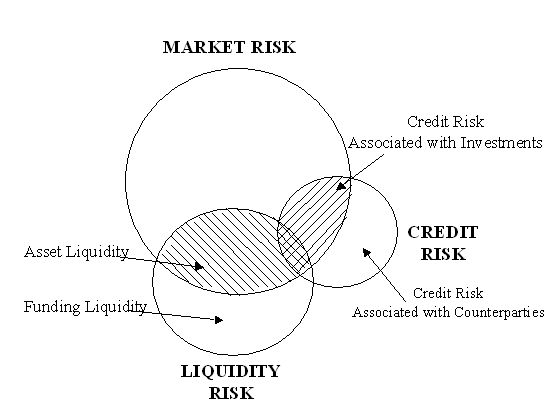
Current market practice is to focus on three categories of risk that are measurable - "market risk," "credit risk" (including sovereign risk) and "liquidity risk". In addition a Hedge Fund Manager should seek to assess "operational risk" depending on its particular circumstances. Market risk relates to losses that could be incurred due to changes in market factors (i.e., prices, volatilities, and correlations). Credit risk relates to losses that could be incurred due to declines in the creditworthiness of entities in which the Fund invests or with which the Fund deals as a counterparty. Funding liquidity risk relates to losses that could be incurred when declines in a Fund's capital due to redemptions or other sources of funding or liquidity reduce the ability of the Fund to fund its investments. It differs from asset liquidity risk (a form of market risk), which is defined as the potential exposure to loss associated with the inability to execute transactions - particularly on the liquidation side - at prevailing prices.
While current market practice is to treat the risks separately, it is crucial for Hedge Fund Managers to recognize and evaluate the overlap that exists between and among market, credit and liquidity risks. This overlap is illustrated in the following diagram (recognizing that the relative sizes of the circles will be different for different strategies):
|
For a more detailed discussion of the concepts and limitations referenced in the Recommendations in this section, please see Appendix I, "Risk Monitoring."
Encompasses interest rate risk, foreign exchange rate risk, equity price risk, and commodity price risk, as well as asset liquidity risk and the credit risk associated with investments.
4.1 A Hedge Fund Manager should evaluate market risk, not only for each Hedge Fund portfolio in aggregate, but also for relevant subcomponents of a portfolio - e.g., by strategy, by asset class, by type of instruments used, by geographic region or by industry sector, as appropriate. In addition, the market risk assumed by each individual portfolio manager should be determined. A Hedge Fund Manager should employ a consistent framework for measuring the risk of loss for a portfolio (and relevant subcomponents of the portfolio), such as a "Value at Risk" (or VAR) model. While the choice of model should be left to each Hedge Fund Manager, the Hedge Fund Manager should be aware of the structural limitations of the model selected and actively manage these limitations, including the impact of any model breakdown.
A sound market risk monitoring process should incorporate the confidence level(s) and holding period(s) deemed appropriate depending on the markets traded and the risks assumed. The holding period(s) should take into account the time necessary to liquidate and/or neutralize positions in the portfolio.
The role of the Risk Monitoring Function is to identify the factors affecting the risk and return of the Fund's investments, both within individual portfolios and across the entire range of activities of the Hedge Fund Manager. Those factors (e.g., market rates and prices, credit spreads, volatilities, correlation) should be incorporated into the risk monitoring process and, where appropriate, be included in the market risk model.
Positions managed as a separate account by external portfolio managers on behalf of the Hedge Fund should be incorporated in the routine risk assessment of the overall portfolio. Passive investments in funds managed by external portfolio managers should be monitored as appropriate.
Hedge Fund Managers should recognize that market risk measures such as VAR do not give a complete picture of risk in that they assess the risk of "standard" market movements rather than extreme events. Hedge Fund Managers should therefore complement risk modeling with relevant stress tests and backtesting, as discussed below.
4.2 A Hedge Fund Manager should perform "stress tests" to determine how potential changes in market conditions could impact the value of a Hedge Fund's portfolio.
A Hedge Fund Manager should perform stress tests by changing the parameters used in its market risk model to magnify their effects. Stress tests permit the Hedge Fund Manager to see what will happen to its market risk measures if the actual values of market factors (e.g., prices, rates, volatilities, etc.) differ from the values used as inputs in the base-case market risk model.
In addition, a Hedge Fund Manager should incorporate the impact of correlated events into stress testing, where appropriate.
A Hedge Fund Manager also should consider conducting "scenario analyses" to benchmark the risk of a Fund's current portfolio against various scenarios of market behavior (historical or prospective) that are relevant to the Hedge Fund Manager's trading activities (e.g., the October 1987 stock market event, the Asian financial crisis of 1997 or a scenario where concerns about general credit quality lead to dramatic declines in asset values combined with decreases in asset and funding liquidity).
4.3 A Hedge Fund Manager should validate its market risk models via "backtesting."
For internal control purposes, the Risk Monitoring Function should perform backtesting of its market risk models, that is, it should compare the distribution of observed changes in the value of a Hedge Fund's portfolio to the distribution of changes in value generated by its market risk model.
If the frequency of changes in the value of the portfolio exceeds the frequency generated by the market risk model (a statistical expectation based on the confidence level of the market risk model), such deviation should be scrutinized to determine its source. If appropriate after investigation, the market risk model should be modified.
Funding liquidity is critical to a Hedge Fund Manager's ability to continue trading in times of stress. Funding liquidity analysis should take into account the investment strategies employed, the terms governing the rights of investors to redeem their interests and the liquidity of assets (e.g., all things being equal, the longer the expected period necessary to liquidate assets, the greater the potential funding requirements) and the funding arrangements negotiated with counterparties such as prime brokers. Adequate funding liquidity gives a Hedge Fund Manager the ability to continue a trading strategy without being forced to liquidate assets when losses arise. |
4.4 Cash should be actively managed.
A Hedge Fund Manager should evaluate the effectiveness of the cash management process and establish policies for investing a Hedge Fund's excess cash, based on established risk parameters and taking into account the credit risk presented by the party with whom cash is invested. In establishing cash management policies, a Hedge Fund Manager should consider cash flow needs based on the risk and funding profile of the portfolio and investor subscription and redemption windows.
4.5 A Hedge Fund Manager should employ appropriate liquidity measures in order to gauge, on an ongoing basis, whether a Fund is maintaining adequate liquidity. Liquidity should be assessed relative to the size of the Fund and the risk of its portfolio and investment strategies.
A discussion of possible liquidity measures is included in Appendix I.
4.6 A Hedge Fund Manager should evaluate the stability of sources of liquidity and plan for funding needs accordingly, including a contingency plan in periods of stress.
Hedge Fund Managers should assess their Cash and Borrowing Capacity under the worst historical drawdown and stressed market conditions, taking into account potential investor redemptions and contractual arrangements that affect a Fund's liquidity (e.g., notice periods for reduction of credit lines by counterparties).
Hedge Fund Managers should periodically forecast their liquidity requirements and potential changes in liquidity measures.
Hedge Fund Managers should perform scenario tests to determine the impact of potential changes in market conditions on a Fund's liquidity. Among these scenario tests, Hedge Fund Managers should consider including the potential response to a creditor experiencing a liquidity problem during times of market stress (e.g., reluctance to release collateral).
Hedge Fund Managers should take into account in their liquidity planning redemption "windows" or other rights of investors to redeem their interests. Hedge Fund Managers should also take into account the relationship between a Fund's performance and redemptions and between a Fund's performance and the availability of credit lines.
4.7 In an effort to enhance the stability of financing and trading relationships, a Hedge Fund Manager should engage in constructive dialogue with a Hedge Fund's credit providers and counterparties to determine the extent of financial and risk information to be provided.
The extent of disclosure to be provided should be mutually agreed with such parties depending on their requirements and the extent and nature of the relationship.
A counterparty's credit department should be required to provide assurances that financial and other confidential information furnished by the Hedge Fund Manager will only be used for credit evaluation purposes and will not be made available to any member of a counterparty's trading desk or department. These assurances could be confirmed by the counterparty's credit department in a written confidentiality agreement or by providing a copy of its confidentiality policies.
4.8 A Hedge Fund Manager should understand and manage the Fund's exposure to potential defaults by trading counterparties.
A Hedge Fund Manager should identify acceptable counterparties based on an analysis of creditworthiness and set appropriate exposure limits. Where a judgment call with respect to a particular counterparty is necessary, a Hedge Fund Manager's senior management should determine whether the counterparty's creditworthiness is acceptable, e.g., based on an analysis of the costs and benefits of dealing with the counterparty to the extent practicable.
Once a trading relationship with a counterparty is established, a Hedge Fund Manager should ensure that the counterparty's creditworthiness is appropriately monitored. A Hedge Fund Manager should also seek to establish appropriate collateral arrangements with the counterparty (see Recommendation 5.8) and establish the ability to make and respond to collateral calls.
A Hedge Fund Manager should recognize that, although leverage is not an independent source of risk, leverage is important because of the magnifying effect it can have on market risk, credit risk and liquidity risk. Recognizing the impact that leverage can have on a portfolio's exposure to market risk, credit risk, and liquidity risk, a Hedge Fund Manager should assess the degree to which a Hedge Fund is able to modify its risk-based leverage in periods of stress or increased market risk. |
4.9 A Hedge Fund Manager should develop and monitor several measures of leverage, recognizing that leverage, appropriately defined, can magnify the effect of changes in market, credit or liquidity risk factors on the value of the portfolio and can adversely impact a Hedge Fund's liquidity.
A Hedge Fund Manager should recognize that leverage is not an independent source of risk; rather, it is a factor that influences the rapidity with which changes in market risk, credit risk or liquidity risk factors impact the value of a Fund's portfolio. A Hedge Fund Manager should seek to assess leverage while taking into account the limitations inherent in different leverage measures, as noted below and discussed in further detail in Appendix I.
Risk-Based Leverage
A Hedge Fund Manager should track a Fund's leverage using "risk-based leverage" measures reflecting the relationship between the riskiness of a Fund's portfolio and the capacity of the Fund to absorb the impact of that risk. Risk-based leverage measures that could perform this function are described in Appendix I. Some of the liquidity measures discussed in Appendix I can also be viewed as risk-based leverage measures.
The Hedge Fund Manager must be aware of limitations of the models used and must guard against placing too much reliance on mathematical measures of leverage alone. For example, market risk measures such as VAR are incomplete measures of market risk because they focus on "standard" market movements rather than extreme events. Consequently, the Hedge Fund Manager should consider assessing the impact of extreme events by comparing a market risk measure derived from analysis of extreme event scenarios (or stress tests) to the Fund's capital. In addition, it is essential that the Hedge Fund Manager use judgment based on business experience in calculating and assessing quantitative measures of leverage.
A crucial factor influencing the Fund's ability to absorb the impact of extreme market events is the degree to which the Fund can modify its risk-based leverage, especially during periods of market stress. A Hedge Fund Manager should therefore assess its ability to reduce risk-based leverage by modifying (upward or downward) traditional leverage or by reducing the level of risk that is being accepted (e.g., by changing strategy or the types of assets being held in the portfolio).
Accounting-Based Leverage
A Hedge Fund Manager may consider tracking certain traditional accounting-based measures of leverage as part of its financial reporting or in connection with the analysis and interpretation of certain risk-based leverage measures or funding liquidity. However, a Hedge Fund Manager should recognize that although such measures can provide useful information if they are understood fully and interpreted correctly, they have a number of weaknesses, particularly as stand-alone measures of leverage, as discussed in greater detail in Appendix I.
4.10 Hedge Fund Managers should seek to limit the Fund's exposure to potential operational risks, including data entry errors, fraud, system failures and errors in valuation or risk measurement models.
Hedge Fund Managers should consider measures to limit or mitigate operational risk, including:
V. REGULATORY AND DOCUMENTATION CONTROLS
A Hedge Fund Manager should seek to actively monitor and manage its regulatory responsibilities to ensure compliance with all applicable rules and regulations. A Hedge Fund Manager also should pursue a consistent and methodical approach to documenting transactions in order to enhance the legal certainty of its positions. |
Compliance with Applicable Rules and Regulations
5.1 A Hedge Fund Manager should create a management environment that provides for compliance with all rules and regulations applicable to its business operations.
Hedge Funds and Hedge Fund Managers are required to comply with a wide variety of rules and regulations and furnish significant information and reports to regulators in connection with their trading activities. See Appendix II for a list of some of the reporting requirements and other regulations applicable to Hedge Funds and their activities in the United States.
A Hedge Fund Manager should take steps, in reliance upon its internal and external resources (including prime brokers, administrators, attorneys and accountants), to ensure that its personnel are cognizant of and comply with the rules and regulations applicable to its business operations, as well as those of the Hedge Funds it manages. For example, a Hedge Fund Manager should seek to ensure compliance with rules and regulations applicable to private offerings and sales practices, anti-money laundering, soft dollar practices, insider trading and market manipulation, among others.
5.2 A Hedge Fund Manager should identify all actual and potential required regulatory filings and clearly allocate responsibility for such filings to appropriate personnel or service providers who will supervise and ensure timely compliance with applicable regulations and filing requirements.
5.3 Taking into account the size and complexity of the Hedge Fund Manager's operations, a Hedge Fund Manager should establish written compliance policies that address, where applicable, trading rules and restrictions, confidentiality requirements, policies designed to ensure compliance with applicable securities, commodities and related laws (e.g., prohibitions on insider trading and other forms of market manipulation, measures to prevent the flow of non-public information from one function to another, personal trading policies).
Compliance policies should be regularly updated and internal controls should be established to monitor compliance with such policies. All employees should be required to attest in writing upon hiring and on an annual basis to their understanding and acceptance of relevant compliance policies.
5.4 A Hedge Fund Manager should be aware of the anti-money laundering regulations to which it and the Hedge Funds it manages are subject and ensure that appropriate investor identification procedures are performed where required.
Hedge Fund Managers may wish to consult MFA's Preliminary Guidance for Hedge Funds and Hedge Fund Managers on Developing Anti-Money Laundering Programs, attached as Appendix III, for practical guidance in this evolving area.
5.5 A Hedge Fund Manager should establish transaction execution and documentation management practices that seek to ensure timely execution of necessary transaction documents and enforceability of transactions.
To the extent practicable, a Hedge Fund Manager may wish to implement the following practices:
5.6 A Hedge Fund Manager should track the status of documentation and the negotiation of key provisions and terms such as termination events (including use of a database if needed) to seek to ensure consistency and standardization across Funds and counterparties to the extent appropriate.
5.7 A Hedge Fund Manager should seek consistent bilateral terms with counterparties to the extent practicable in order to enhance stability during periods of market stress or declining asset levels.
For example, a Hedge Fund Manager may seek to negotiate standardized events of default and other termination or collateral events to achieve consistency in documentation with different counterparties to the extent practicable. A Hedge Fund Manager may also endeavor to avoid including provisions that permit counterparties to terminate or make demands for collateral solely at their discretion or based upon highly subjective determinations.
5.8 A Hedge Fund Manager should seek to negotiate bilateral collateral agreements that require each party to furnish collateral, taking into account the relative creditworthiness of the parties.
To the extent feasible, a Hedge Fund Manager should seek to establish collateral arrangements either internally or through reliance on external resources that permit the Hedge Fund Manager to effectively and regularly make calls for deliveries and returns of collateral from counterparties when permitted.
5.9 A Hedge Fund Manager should consider providing input to the Risk Monitoring Function for use in stress/scenario testing as well as liquidity analyses based on legal or contractual relationships.
For example, in performing stress tests or scenario analyses, the Risk Monitoring Function may wish to take into account the legal or contractual sales restrictions applicable to certain investments. The contractual rights of counterparties to terminate or otherwise unwind trading relationships or increase margin/collateral requirements upon the occurrence of certain events (such as declines in NAV) may also need to be considered.
5.10 A Hedge Fund Manager should have appropriate documentation and approval processes for retaining external traders as well as administrators, prime brokers or other third-party service providers.
VI. DISASTER RECOVERY AND BUSINESS CONTINUITY
While the need to establish a functional disaster recovery and business continuity plan ("BCP") is not unique to Hedge Funds, it is particularly important for a Hedge Fund Manager because the inability to carry out routine trading and risk monitoring functions (even on a very short-term basis) as a result of a disruption could result in large financial losses. |
6.1 A Hedge Fund Manager should establish a business continuity plan that includes practices to ensure, to the greatest extent practicable, that appropriate personnel will have the ability to monitor a Hedge Fund's existing portfolio positions and execute transactions where necessary in the event of a market emergency or other severe market disruption.
A Hedge Fund Manager should establish a written business continuity and disaster recovery plan that outlines practices to be followed in an emergency or significant market disruption. Hedge Fund Managers should consider addressing the following items as applicable to its operations:
The plan should be updated as necessary to respond to material changes in a fund's operations. It is also recommended that the Hedge Fund Manager test its plan for effectiveness.
6.2 A Hedge Fund Manager should establish contingency plans for responding to failure of a third party administrator, credit provider or other party that would affect the market, credit, or liquidity risk of a Fund.
Contingency planning should address responses to a failure of a third party on a Fund's ability to meet its obligation, including transfers of activity to back-up clearing systems, credit providers and other service providers and back-up providers.
APPENDIX I
RISK MONITORING PRACTICES FOR HEDGE FUND MANAGERS
The objective of this appendix is to elaborate upon the discussion of risk monitoring practices contained in the Recommendations. In so doing, this appendix describes the general array of risk management techniques and methodologies currently available, in addition to addressing the specific techniques and methodologies that should be considered as part of sound risk monitoring practices for Hedge Fund Managers. The latter discussion includes further explanations of valuation, liquidity and leverage from the perspective of Hedge Fund Managers.
This appendix begins by providing an overview of the risks faced by a Hedge Fund Manager in Section 1.1 The descriptions of the practices for monitoring Market Risk (Section 2), Funding Liquidity Risk (Section 3) and Leverage (Section 4) form the core of this appendix and address the following key issues:
This appendix concludes with a description of practices for monitoring Counterparty Credit Risk (Section 5). Because Hedge Funds generally deal with counterparties having high credit quality, the credit risk of counterparties may be of less concern to Hedge Fund Managers than the other sources of risk but should nonetheless by appropriately monitored.
1. Overview: The Risks Faced by a Hedge Fund Manager
Effective risk management requires that the Hedge Fund Manager recognize and understand the source of the returns the Fund is earning - i.e., the risks to which the Fund is exposed. Consequently, one of the primary responsibilities of the Risk Monitoring Function is to identify and quantify the sources of risk.
While observers often distinguish four broad types of risk - Market Risk, Credit Risk, Liquidity Risk and Operational Risk2 - it is important to recognize that these risks are interrelated. Indeed, Hedge Fund Managers should recognize that "market risk" incorporates elements of credit risk and liquidity risk. Defined most narrowly, market risk focuses on the impact of changes in the prices of (or rates for) securities and derivatives, the volatilities of those prices, and the correlations between pairs of prices on the value of the portfolio. However, elements of liquidity risk and credit risk have a similar focus; for example:
Because these three risks all focus explicitly on changes in the value of an asset or the portfolio, Hedge Fund Managers should integrate the monitoring and management of them (i.e., view them as a group, rather than individually). Hence, in Section 2 of this appendix, "market risk" will encompass the credit risk associated with assets held in the portfolio and asset (or market) liquidity risk, as well as the more commonly cited market risk factors: interest rate risk, foreign exchange rate risk, equity price risk and commodity price risk.
In addition to having an impact on the value of securities or derivatives held by the Hedge Fund, changes in funding liquidity can impact on the Hedge Fund Managers' ability to finance its positions. Section 3 will indicate why this risk is of greater concern to Hedge Fund Managers than to other entities and will describe the techniques that should be used by Hedge Fund Managers to monitor funding liquidity risk.
The Hedge Fund Manager must also consider "leverage." However, leverage is not an independent source of risk; rather, it is a factor that influences the rapidity with which changes in market risk, credit risk or liquidity risk factors change the value of the portfolio. Indeed, it is essential to consider what leverage means - or doesn't mean - in the context of a Hedge Fund:
Stylized Portfolios In Sections 2, 3 and 4, a collection of stylized portfolios and balance sheets are used to illustrate and compare the measures of market risk, funding liquidity risk and leverage that are discussed in the Recommendations and this appendix. As described below, these simple portfolios are composed of various combinations of three hypothetical securities (which are denoted as Asset 1, Asset 2 and Asset 3) and two derivative contracts. Two of the securities are lower risk assets, with annualized volatility of 30% and 25%, respectively. The third asset is a higher risk asset with annual volatility of 60%. The two derivatives are simple futures contracts on the two low risk securities; therefore they have the same volatility as those securities. Each portfolio is part of a simple balance sheet. It is assumed that $100 of investor equity funds each strategy. To calculate all of the various risk measures, the stylized balance sheets also indicate a cash position, a futures margin position, and a liability account that reflects any financing transactions. The required futures margin is 10% in cash, which is not counted as liquidity. In addition, up to 50% of Assets 1, 2, or 3 can be borrowed, and 50% of the proceeds from a short sale are available to finance investments. For each portfolio various measures of market risk, liquidity and leverage have been calculated. Note that not all the risk measures are relevant for every portfolio.
|
As noted above, for Hedge Fund Managers, changes in credit quality that affect the value of the portfolio through a change in the price of securities owned are incorporated into "market risk." However, Hedge Fund Managers are also exposed to counterparty credit risk. Changes in the credit quality of counterparties can impose costs on the Hedge Fund either in the form of an increase in expected losses due to counterparty failure to perform or by forcing the Hedge Fund Manager to find alternative counterparties.
Operational risks faced by Hedge Fund Managers are much the same as those faced by other financial institutions - data entry errors, fraud, system failures and errors in valuation or risk measurement models. The appropriate techniques and practices to deal with these risks are, likewise, the same techniques and practices used by other entities. As noted in the Recommendations, these include random spot checks, maintenance of a single, centralized data set, contingency plans for responding to failures in the Hedge Fund Manager's systems or for responding to the failure of a third party service provider.
Encompassing the credit risk associated with securities and derivatives in the portfolio and asset liquidity risk, as well as interest rate risk, foreign exchange rate risk, equity price risk, and commodity price risk.
A Hedge Fund Manager should employ a consistent framework for measuring the risk of loss for a portfolio (and relevant subcomponents of the portfolio). In order that the Hedge Fund Manager be able to manage the risks that the Hedge Fund faces, the Risk Monitoring Function needs to produce some useful measures and analyses of risk. While the choice of framework or model for measuring risk should be left to each Hedge Fund Manager, the Hedge Fund Manager should be aware of the structural limitations of the model selected and actively manage these limitations, including the impact of any model breakdown.
For example, measuring the degree to which the portfolio is diversified (e.g., the percentages of the portfolio allocated to different asset classes or to different geographical regions) may be useful, but it is important for the Hedge Fund Manager to recognize and understand the correlations between positions. For complex portfolios, many summary measures of market risk do not reflect such correlations.
One model that is intended to provide a summary market risk measure that incorporates correlations between positions is Value-at-Risk (VAR). VAR measures the maximum change in the value of the portfolio that would be expected at a specified confidence level over a specified holding period. For example, if the 95% confidence level, one-day VAR for a portfolio is $500,000, one would expect to gain or lose more than $500,000 in only 5 of every 100 trading days on average. One of the roles of the Risk Monitoring Function is to identify the factors affecting the risk and return of the Fund's investments, both within individual portfolios and across the entire range of activities of the Hedge Fund Manager. Those factors should be incorporated into the risk monitoring process and, where appropriate, be included in the market risk model. Factors that are commonly incorporated in a market risk model include:
The Risk Monitoring Function may also consider incorporating "asset liquidity" (i.e., the potential exposure to loss attributable to changes in the liquidity of the market in which the asset is traded) as an additional factor. Measures of asset liquidity that may be considered include:
Parameter Selection
In order to calculate a VAR measure, a number of parameters must be input; these parameters describe the positions in the portfolio and the underlying markets. In addition, users of VAR must select across three methodologies that have become standard forms of VAR over the past several years:
Variance/Covariance. Under this method, which is probably the most widely used VAR methodology, the program draws volatility (Variance) and correlation (Covariance) information from data histories, for each position in the portfolio, and calculates the volatility estimate under the assumption that the returns for the overall portfolio will assume a normal distribution. It is the least process intensive and perhaps the easiest of the VAR methodologies.
Historical Volatility. Under this approach, the VAR portfolio actually is repriced each day over the data history, a daily P/L calculation is derived and ranked in ascending order. The risk estimate is then set at the level consistent with the confidence interval selected for the analysis. Historical Volatility is very process intensive, but is considered by many to be the most effective form of VAR.
Monte Carlo Simulation. Under the Monte Carlo approach, the portfolio is repriced across large numbers of random observations that are consistent with the volatility history of the underlying instruments. Like historical VAR, these observations are then ranked in ascending order, and the risk estimate is set at a level consisted with the applicable confidence interval. Historical Monte Carlo VAR is typically only used for very complex portfolios, featuring abundant nonlinearities.
Each method, if applied accurately and in a manner consistent with the Risk and Capital allocation policies of the Hedge Fund, can be an effective, if imperfect, means of estimating exposure.
In addition to the selection of VAR methodology, for a given portfolio, the parameters most likely to have a significant impact on the VAR value are the time horizon or holding period (the period of time that would be necessary for the portfolio to be liquidated or neutralized), the confidence level (the probability that the change in the value of the portfolio would exceed the VAR), and the variance-covariance data (which reflects the volatility of the individual market factors and the correlation between pairs of factors). These parameters are explained further below.
Time Horizon
The time horizon or holding period used in the VAR calculation is intended to reflect the time period necessary to liquidate (or neutralize) the positions in the portfolio. In practice, if the Hedge Fund has positions in thinly traded or illiquid instruments, it is difficult to determine the correct liquidation/neutralization period for the portfolio. Consequently, good practice is to use standard holding periods - e.g., one day, three days, 5 days, and 10 days in the base-case VAR calculation and then employ stress tests to determine the degree of holding period risk in the portfolio.
Confidence Level
There is no mathematical formula that defines the appropriate confidence level; the appropriate confidence level is determined by the business circumstances of the entity. Different types of businesses should and do use different confidence levels. The appropriate confidence level for a specific Hedge Fund will be a business decision that is determined by the specific circumstances of the Fund; and senior management of the Hedge Fund Manager should be actively involved in this determination.
Variance-Covariance Data3
While the measure of the riskiness of individual market factors (i.e., the variances of the market factors) is important, the question of the degree of correlation (i.e., covariance) between pairs of market factors is critical, because correlation has such a large impact on the VAR calculation. A number of VAR models use historic correlations. However, since historic correlations are unstable (especially during periods of market stress), the Hedge Fund Manager should employ scenario analyses and stress testing (see below) to ascertain the impact of inaccurate correlation assumptions.
Beyond a Single VAR Number
Scenario Analysis, Stress Testing and Backtesting
Hedge Fund Managers must recognize that a single VAR number is not sufficient to capture all risks faced by the Hedge Fund and that successful risk management requires the Risk Monitoring Function to analyze both the sensitivity of the VAR to alternative market conditions and the reliability of the VAR calculations.
Scenario Analysis
By their nature, VAR calculations are based on "typical" market days. Periods of market stress or crisis - the very times of greatest concern - will not be well represented in the data for a typical period; so the resulting VAR number will underestimate the risks of severe markets. To address this limitation, the Hedge Fund Manager should perform scenario analyses regularly, to assess the VAR for the current portfolio in periods of market stress.
In creating scenario analyses, a Hedge Fund Manager should use both historical stress periods - e.g., October 19, 1987 when the equity markets "crashed," February 4, 1994 when the US Federal Reserve changed direction and started increasing US interest rates, December 20, 1994 when the Mexican Peso was devalued - as well as hypothetical periods, designed perhaps to put the most pressure on the current portfolio.
Stress Testing
Hedge Fund Managers should stress test the VAR number by changing the parameters of the VAR model. Stress tests permit the Hedge Fund Manager to see what will happen to the VAR number if the actual values of market factors (i.e., prices, rates, volatilities, etc.) differ from the values used as inputs in the base-case VAR calculation.
Among the potential changes in market conditions that should be considered in stress testing are:
If the portfolio contains options or instruments with options characteristics, additional changes that should be considered as part of stress testing are:
Hedge Fund Managers also should consider including the effects of changes in the liquidity of various assets in their stress testing. For example, Hedge Fund Managers could examine the effects of changing the holding period. A horizon of several days may reveal strings of losses (or gains) that, while individually consistent with the one-day predicted distributions, in total add up to a significant deviation from the market risk model's predicted distribution.
Rather than changing the holding period to reflect the illiquidity of securities or derivatives, the Hedge Fund Manager could gauge the impact of illiquidity by inputting changes for the appropriate market risk factors that are reflective of multiple-day market price movements (as opposed to single day changes).
If specific asset liquidity factors are incorporated in the market risk model (see above), these asset liquidity factors can be "stressed" to examine the impact of (1) changes in the value that could be lost if the position in question were to be liquidated and/or neutralized completely during the standard holding period, or (2) changes in the number of days required to liquidate and/or neutralize the position in question.
Of particular concern to Hedge Fund Managers are "breakdowns" in the correlations reflected in current market data. In times of market crisis, the correlations between asset prices or rates can change dramatically and unexpectedly, with the result that positions that were thought to be diversifying - or even hedging - end up compounding risk. While it remains difficult to hedge correlation risk, stress tests to evaluate the impact of correlation changes permit the Hedge Fund Manager to help ensure that, when the Hedge Fund Manager selects the assets to be included in the portfolio, the Fund is accepting the desired level of correlation risk (and is being compensated for bearing that risk).
Illustrative Risk Measures Table 2 contains several illustrative VAR measures for each of the nine stylized portfolios introduced earlier:
Table 2 provides confirmation of some general propositions regarding the VAR measures:
|
Back Testing
Perhaps even more important than analyzing the sensitivity of the VAR number is "back testing" the VAR to see how it performed. By comparing actual changes in the value of the portfolio to the changes generated by the VAR calculation, the Hedge Fund Manager can gain insight into whether the VAR model is accurately measuring a Fund's risk.
In back testing, one expects that the portfolio will lose more than the VAR from time to time. For example, a 95% one-day VAR should be exceeded 5 days in every 100 trading days on average. When the actual changes in the value of the portfolio exceed VAR, the Hedge Fund Manager should determine the source of the discrepancy, i.e., whether the VAR measure is flawed or whether this loss is simply one which was expected given the confidence level employed. Other potential sources of deviations include:
Relating Earnings and Risk
It was noted at the outset that effective risk management requires the Hedge Fund Manager to recognize and understand the risks the Fund faces. That, in turn, requires the Hedge Fund Manager to understand the various sources of the Fund's earnings, both the size of the earnings and their volatility.
One way that Hedge Fund Managers can accomplish this attribution is by decomposing the daily value changes by market factors. The objective is to determine if the actual changes were what would have been predicted, given the now known changes in the market factors. If the observed change in the value of the portfolio differs significantly from the change that would be expected, given the composition of the portfolio and the observed changes in the market factors, the differences should be reconciled.
Such a source-of-return and source-of-risk attribution process sets the stage for linking performance measurement with risk measurement. The Sharpe Ratio is widely used by investors to measure a portfolio's risk-adjusted performance over a specific period.4 The numerator of the Sharpe Ratio is a measure of portfolio return during the period; the denominator is a measure of the risk incurred in achieving the return. (For example, over the past decade the Sharpe Ratio for the S&P 500 has been approximately 1.2.) Investors prefer higher Sharpe Ratios, since a higher Sharpe ratio indicates that the portfolio earned superior returns relative to the level of risk incurred.
There are a number of ways in which return and risk could be calculated. Below is the Sharpe Ratio for an arbitrary portfolio - designated as Portfolio j - calculated using the most common conventions for measuring return and risk. The numerator is the return earned on the portfolio (Rj) in excess of the risk-free rate of return (Rf), i.e., the interest rate earned on risk-free securities such as U.S. Treasury securities, over the same period. The denominator - the risk incurred - is measured as the standard deviation of the portfolio's daily return ( σj ).
| R j - R f | ||
| (Sharpe Ratio) | = | --------- |
| σ j |
While Value at Risk and the Sharpe Ratio contain some similar information, the two measures are different tools, designed for different purposes. VAR is primarily a risk measurement tool. The Sharpe Ratio is a summary measure, combining both risk and return information. Moreover, while VAR is a risk measure and the denominator of the Sharpe Ratio contains a risk measure, these two risk measures are quite different. The risk measure used in the denominator of the Sharpe Ratio is a historical measure; it characterizes the actual volatility of the return over some historical period. In contrast, VAR is intended to be a prospective measure of risk.
3. Funding Liquidity Risk
While other entities face funding liquidity risk, this risk is a more central concern to Hedge Fund Managers than others, because funding liquidity problems can rapidly increase a Hedge Fund's risk of failure. As is described in the following box, a lack of funding liquidity can contribute to a crisis situation for the Hedge Fund.
Liquidity Crisis Cycle Hedge Fund Managers should be concerned about a confluence of risks - i.e., market or credit risk events affecting illiquid positions that are leveraged. Such a confluence of events could require the Hedge Fund to liquidate positions into a market that cascades in price because of a high volume of liquidation orders. Such a situation could be decomposed into three stages: 1. A loss that acts as the triggering event. 2. A need to liquidate positions in a disorderly manner to raise cash, because of this loss. The liquidation may be required either because the Fund must post margin with its counterparties or because of redemptions by investors due to the loss. 3. A further drop in the Fund's net asset value as the market reacts to actions by the Fund. Obviously, attempts by the Fund to sell in too great a quantity or too quickly for the market liquidity to bear can cause a further drop in prices, precipitating a further decline in the Fund's net asset value, and leading in turn to yet a further need to liquidate to satisfy margin calls or redemptions. This downward spiral can be exacerbated if other market participants have information about the Fund's positions. The point of no return comes when the effect of liquidation has a greater impact on the value of the remaining Fund position than the amount of cash raised from the liquidation. If this happens, the Fund is caught in an accelerating, downward spiral; and eventually it will not be able to satisfy the demands of its creditors or investors. Once the losses move beyond a critical point, it becomes a self-sustaining crisis that feeds off of the need for liquidity, a need imposed by the demands of the Fund's creditors and investors. |
Because of its importance, Hedge Fund Managers should focus significant attention and resources on measuring and managing funding liquidity risk. There exist a range of measures Hedge Fund Managers can use to track funding liquidity risk. Hedge Fund Managers should monitor the liquidity available in the Fund by tracking its cash position (i.e., cash and short-term securities issued by high-credit-quality entities) and its borrowing capacity (e.g., access to borrowings under margin rules or credit lines).
Beyond measures of available liquidity, Hedge Fund Managers should also monitor measures of relative liquidity. Hedge Fund Managers should relate the measures of liquidity (Cash or Cash + Borrowing Capacity) to the need for that liquidity. The following measures are indicators of a Fund's potential need for liquidity:
Illustrative Liquidity Measures Table 3 contains the results of calculating five of the liquidity measures discussed in this section for each of the nine stylized portfolios. Available liquidity is measured by cash that is not committed as margin, and by cash plus the "borrowing capacity" of the assets. For the three cash market assets, it is assumed that 50% of the value of a long position can be borrowed (i.e., assume current Regulation T margin requirements if the three assets were equities). For simplicity, short positions in the assets are assumed to have a 50% margin requirement, in effect, allowing 50% of short trades to be used to fund long positions, or for cash. Several features of funding liquidity risk measurement are evidenced by the stylized portfolios.
|
Additional insight about funding liquidity can be gained by looking at the variability in the relative liquidity measure over time. A relative liquidity measure that varies over time is evidence consistent with "effective liquidity" - i.e., the assets are liquid and the manager is willing to take advantage of that liquidity.
Beyond simply monitoring liquidity, Hedge Fund Managers should manage liquidity in several dimensions. Foremost is the use of the Hedge Fund Manager's experience and judgment to maintain liquidity levels that are adequate given the risk of loss and/or the likelihood of investor redemptions. Also, Hedge Fund Managers should strengthen lines of communication with their credit providers, providing them with summary measures of the Fund's risk and liquidity consistent with the nature of the relationship. Hedge Fund Managers should actively manage (or monitor) the cash in margin accounts. Similarly, Managers should negotiate haircuts, the speed at which prime brokers can dictate an increase in margin rates and two-way collateral agreements, where appropriate, to further reduce the likelihood of running out of liquidity.
4. Leverage
As the Recommendations made clear, leverage is not a concept that can be uniquely defined, nor is it an independently useful measure of risk. Nevertheless, leverage is important to Hedge Fund Managers because of the impact it can have on the three major quantifiable sources of risk: market risk, credit risk, and liquidity risk.
That leverage is not a uniquely defined concept is evidenced by the variety of "leverage" measures used in banking and finance. These measures, which are described in more detail below, may be accounting-based (also referred to as "asset-based") or risk-based. The accounting-based measures attempt to capture the traditional notion of leverage as "investing borrowed funds." Using borrowed money (or its equivalent) enables an investor to increase the assets controlled for a given level of equity capital. Accounting-based measures of leverage relate some measure of asset value to equity. Both returns and risk, relative to equity, are magnified through the use of traditional, accounting-based leverage. The risk-based measures of leverage capture another aspect associated with leverage, namely, the risk of insolvency due to changes in the value of the portfolio. The risk-based measures relate a measure of a Fund's market risk to its equity (or liquidity). Although useful in this capacity, as described below, risk-based leverage measures do not convey any information about the role borrowed money plays in the risk of insolvency.
No single measure captures all of the elements that market participants, regulators, or market observers attribute to the concept of leverage. Indeed, examples will be presented in which a risk-reducing transaction increases some leverage measures while decreasing others. This leads to the observation that leverage is not an independently useful concept, but must be evaluated in the context of the quantifiable exposures of market, credit and liquidity.
While continuing to track and use accounting-based measures of leverage, Hedge Fund Managers should focus their attention on measures of leverage that relate the riskiness of the portfolio to the capacity of the Fund to absorb that risk - i.e., the measures must include elements of market risk (including the credit risk associated with assets in the portfolio) and funding liquidity risk. Hedge Fund Managers should focus on such measures because traditional accounting-based leverage by itself does not necessarily convey risk of insolvency. To say that one Fund is levered 2-to-1 while another is not levered does not necessarily mean that the levered Fund is more risky or more likely to encounter liquidity problems. If the levered Fund is invested in government securities while the Fund that is not levered is invested in equities, accounting-based leverage would lead to erroneous conclusions about the riskiness of the two Funds. In this sense, accounting-based measures of leverage are arguably deficient since they convey the least information about the nature and risk of the assets in a portfolio.
Risk-based measures (see below) present a measure of market risk (usually VAR) relative to a measure of the resources available to absorb risk (cash or equity). However, in doing so, risk-based measures effectively condense several dimensions of risk into a single number. The result of this compression is that some of the detail is lost; the specific effect of leverage is intertwined with dimensions of market, credit and liquidity risk. To illustrate, consider two Funds with identical risk-based leverage. One Fund employs 2-to-1 accounting leverage while investing in "low risk" strategies (e.g., long/short strategies) using borrowed funds, while the other Fund uses no accounting leverage but employs "high risk" strategies (e.g., macro directional) and large cash reserves. One is "high risk" and "high cash" and the other is "low risk" and "low cash/high borrowing," yet each achieves the same risk-based leverage. This comparison highlights the second reason why leverage measures are not independently useful: more comprehensive measures blend the effect of multiple risk dimensions. To assess the contribution of leverage requires additional information.
Accounting-Based Leverage Measures
There exist a number of accounting-based measures of leverage. In addition to the pragmatic recognition that counterparties and credit providers routinely request these measures, a more compelling rationale for calculating these measures is that they can contribute to an understanding of leverage measures that incorporate risk. This is particularly true when accounting and risk-based leverage are tracked over time.
Certain accounting measures can also provide information regarding how much direct or indirect credit in the form of repurchase agreements, short sales, or derivatives are employed by a Fund. However, it must be recognized that even these accounting-based measures have serious weaknesses, discussed below, particularly as stand-alone measures of leverage.
The most widely used and generally accepted accounting-based measures of leverage are those that relate items from a Fund's balance sheet:
This straightforward measure is easily calculated from published financial statements; however, it fails to incorporate two important elements of a Fund's effective leverage.
While this measure requires more detailed information about the positions in a Fund's portfolio, it does provide a partial solution to the shortcomings of the Gross Balance Sheet Assets to Equity measure by including offsets and direct hedges as reflected in matched book assets. However, important elements of the Fund's effective leverage are still not incorporated:
Other accounting-based measures have been proposed to capture off-balance-sheet transactions (e.g., forward contracts, swaps and other derivatives). For example:
Gross Accounting Leverage incorporates the gross amount of off-balance-sheet derivatives. Such a measure cannot reliably indicate the effective amount of leverage obtained from off-balance sheet transactions because offsetting exposures are not netted. An active derivative user that uses offsetting transactions rather than closeouts to reduce or eliminate positions will accumulate a substantial number of transactions even though the risk of the related positions and their effective leverage may be quite low.
Risk-Based Leverage Measures
Risk-based leverage measures reflect the relation between the riskiness of a Fund's portfolio and the capacity of the Fund to absorb the impact of that risk. While not the only measure that could be used, the Hedge Fund's equity provides a useful measure of "capacity." There are, however, different measures of market risk that could be used as the "riskiness" measure:
This is a measure of actual performance volatility over a given horizon relative to equity. While useful, it is subject to criticism. Since it is a retrospective measure, it is less useful if the composition of the portfolio changes or if future market conditions are not like historical conditions. Moreover, it does not isolate the effect of financing on the risk of the fund since it includes financed assets.
This measure gives a picture of the Fund's capacity to absorb "typical" market movements. The criticism of such a measure is that it does not reflect the risk of the Fund's portfolio in extreme markets.
To assess the impact of extreme events, the leverage measure could be calculated using a market risk measure derived from analysis of extreme event scenarios (or stress tests). This measure gives senior management information about the Hedge Fund's ability to absorb extreme market events.
Illustrative Leverage Measures Table 4 contains the results of calculating all of the accounting-based leverage measures and two of the risk-based leverage measures discussed in this section. Note that "Net balance sheet leverage" and "Net accounting leverage" are only relevant for Portfolios 8 and 9, because these portfolios are the only ones in which the long and short positions can be netted under accounting rules. Leverage can be interpreted in several ways: as the use of borrowed money to fund larger asset positions than would otherwise be achievable, and as the use of economic leverage to increase effect of a given change in market prices on the value of Fund's equity. The illustrative portfolios demonstrate several common features of accounting-based and risk-based leverage.
|
While the preceding leverage measures are the ones most commonly used by Hedge Fund Managers, other measures may be used to analyze leverage. Indeed, because of the interrelation between market risk, funding liquidity risk and leverage, measures of funding liquidity risk described in Section 4 - particularly Cash + Borrowing Capacity relative to VAR - also provide the Hedge Fund Manager with insights about a Fund's leverage.
Dynamic Measures of Leverage
A crucial factor influencing a Fund's ability to absorb the impact of extreme market events is the degree to which a Fund can modify its risk-based leverage, especially during periods of market stress.
Treating equity as constant, there are two ways a Hedge Fund Manager could reduce risk-based leverage:
1. If a Hedge Fund Manager wishes to continue an existing investment strategy, risk-based leverage could be reduced by reducing traditional leverage resulting from either on- or off-balance-sheet transactions.
2. A Hedge Fund Manager could reduce risk-based leverage by reducing the level of risk that is being accepted (e.g., by changing strategy or the types of assets being held in the portfolio). To track the degree to which the Fund is able to modify its risk-based leverage, the Hedge Fund Manager should track variations in the Fund's market risk measure (e.g., VAR) over time.
The following two measures could be used to track the relationship over time between measures of market risk and actions taken by the Hedge Fund Manager to adjust leverage. Both of these measures consider a short time interval (1 day, 2 days,..., 1 week) ; and, both assume that equity is constant.
A decline in a portfolio's market risk measure (e.g., VAR) in a period following an increase in that market risk measure in the preceding period could be evidence of the Hedge Fund Manager's ability to de-lever the portfolio during a period of market stress. (The market risk measure could be VAR or the observed volatility of the value of the portfolio during the relevant period.)
All other things equal, if a Hedge Fund Manager is able to reduce the portfolio's accounting-based leverage, the result would be an increase in cash or in borrowing capacity. Therefore, an increase in Cash + Borrowing Capacity in a period following an increase in the market risk measure for the portfolio (e.g., VAR) could be evidence of the Hedge Fund Manager's reacting to market stress by reducing leverage.
5. Counterparty Credit Risk
Hedge Fund Managers enter into transactions with a variety of counterparties including banks, securities firms, exchanges, and other financial institutions. The risk of loss to the Fund as a result of the failure of a counterparty to perform as expected constitutes counterparty credit risk.
Credit risk is present to some extent in almost any dealing with a third party, including the settlement of securities and derivatives transactions, repurchase agreements, collateral arrangements, and margin accounts. It is also present in open derivatives positions where the exposure of one counterparty to another will change over the life of the contract as the contract's value fluctuates. Hedge Fund Managers should be aware of, and track, concentrations of credit risk with particular counterparties, and where applicable, different regions of the world.
The willingness of the Hedge Fund Manager to enter into a transaction with a specific counterparty should depend on the loss the Hedge Fund would suffer were the counterparty to default. That, in turn, depends on the magnitude of the Hedge Fund's exposure to the counterparty and the likelihood of default, i.e., the counterparty's creditworthiness.
An assessment of exposure to a particular counterparty should include analysis of the following elements of exposure:
APPENDIX II
U.S. REGULATORY FILINGS BY HEDGE FUND MANAGERS
Listed below are regulatory filings (excluding tax-related, broker-dealer and state "blue sky" filings) that Hedge Fund Managers may be required to make in the United States depending on either their trading activity or their status as a regulated entity. The filings made to regulators by individual Hedge Fund Managers will vary depending on the type and volume of trading in which they engage, their business model and the jurisdictions in which they operate. For example, like other market participants and institutional investors, Hedge Fund Managers are required to make certain filings in the United States if the size of the positions they hold in certain markets reaches "reportable" levels. In addition, some Hedge Fund Managers are regulated entities in the United States or are otherwise subject to a regulatory regime, and, like other similarly situated entities, are required to make certain filings in that capacity. This appendix lists filings required in the United States where the above circumstances apply to a Hedge Fund Manager. Hedge Fund Managers may also be subject to regulatory reporting and filing requirements in the foreign jurisdictions in which they conduct their business.
Federal Reserve
Treasury Securities Position and Foreign Exchange Transaction Reporting
1. Large Position Reporting |
|
Reports are filed in response to notices issued by the U.S. Department of the Treasury if such threshold is met. | |
Reports are filed with the Federal Reserve Bank of New York and are not public. | |
2. Form FC-1 |
Report of weekly, consolidated data on the foreign exchange contracts and positions of major market participants. |
Reports to be filed throughout the calendar year by each foreign exchange market participant which had more than $50 billion equivalent in foreign exchange contracts on the last business day of any calendar quarter during the previous year. | |
The report is filed with the appropriate Federal Reserve Bank acting as agent for the U.S. Department of the Treasury and is confidential. | |
3. Form FC-2 |
Report of monthly, consolidated data on the foreign exchange contracts and foreign currency denominated assets and liabilities of major market participants. |
Reports to be filed throughout the calendar year by each foreign exchange market participant which had more than $50 billion equivalent in foreign exchange contracts on the last business day of any calendar quarter during the previous year. | |
The report is filed with the appropriate Federal Reserve Bank acting as agent for the U.S. Department of the Treasury and is confidential. | |
4. Form FC-3 |
Report of quarterly, consolidated data on the foreign exchange contracts and foreign currency denominated assets and liabilities of major market participants. |
Reports to be filed throughout the calendar year by each foreign exchange market participant which had more than $5 billion equivalent in foreign exchange contracts on the last business day of any calendar quarter during the previous year and which does not file Form FC-2. | |
The report is filed with the appropriate Federal Reserve Bank acting as agent for the U.S. Department of the Treasury and is confidential. |
Treasury Auction Filings
5. Treasury Auction |
Treasury security reports filed as necessary. Confirmations must be filed by any customer who is awarded a par amount of$500 million or more in U.S. government securities in a Treasury auction. The confirmation must include its reportable net long position, if any. |
The confirmation is filed with the Federal Reserve Bank to which the bid was submitted and is not public. |
Treasury International Capital Forms
6. Forms CM, CQ-1 and CQ-2 |
|
The forms are filed with the Federal Reserve Bank of New York are non-public except for aggregate information. | |
7. Form S |
Form filed by any U.S. person who purchases or sells $2 million or more of long-term marketable domestic and foreign securities in a month in direct transactions with foreign persons. |
The form is filed with the Federal Reserve Bank of New York and is non-public except as to aggregate information. |
Securities and Exchange Commission ("SEC")
Sale of Securities by an Issuer Exempt from Registration under Reg. D or 4(6)
8. Form D |
Notice of sale filed after securities, such as interests in a private hedge fund, are sold in reliance on a Regulation D private placement exemption or a Section 4(6) exemption from the registration provisions of the 1933 Act. The form is filed with the SEC and relevant states and is publicly available. |
Secondary Sale of Restricted and Control Securities Under Rule 144
9. Form 144 |
Form filed as notice of the proposed sale of restricted securities or securities held by an affiliate of the issuer in reliance on Rule 144 when the amount to be sold during any three month period exceeds 500 shares or units or has an aggregate sales price in excess of $10,000. The form is filed with the SEC and the principal national securities exchange, if any, on which such security is traded and is publicly available. |
Ownership of Equity Securities Publicly Traded in the United States
10. Schedule 13D |
Disclosure report for any investor, including a hedge fund and its fund manager, who is considered beneficially to own more than 5% of a class of equity securities publicly traded in the U.S. The report identifies the source and amount of the funds used for the acquisition and the purpose of the acquisition. |
This reporting requirement is triggered by direct or indirect acquisition of more than 5% of beneficial ownership of a class of equity securities publicly traded in the U.S. Amendments must be filed promptly for material ownership changes. Some investors may instead report on short-form Schedule 13G if they are eligible. See "11. Schedule 13G" | |
The report is filed with the SEC and is publicly available. | |
11. Schedule 13G |
Short form disclosure report for any passive investor, including a hedge fund and its fund manager, who would otherwise have to file a Schedule 13D but who owns less than 20% of the subject securities (or is in certain U.S. regulated investment businesses) and has not been purchased for the purpose of influencing control. |
This reporting requirement is triggered by direct or indirect acquisition of beneficial ownership of more than 5% of a class of equity securities publicly traded in the U.S. Amendments must be filed annually if there are any changes, and either monthly (for U.S. regulated investment businesses) or promptly (for other passive investors) if ownership changes by more than 5% of the class | |
The report is filed with the SEC and is publicly available. | |
12. Forms 3, 4 and 5 |
Every director, officer or owner of more than 10% of a class of equity securities of a domestic public company must file a statement of ownership. The initial filing is on Form 3 and changes are reported on Form 4. The Annual Statement of beneficial ownership of securities is on Form 5. The statements contain information on the reporting person's relationship to the company and on purchases and sales of the equity securities. |
Form 3 reporting is triggered by acquisition of more than 10% of the equity securities of a domestic public company, the reporting person becoming a director or officer, or the equity securities becoming publicly traded, as the case may be. Form 4 reporting is triggered by any open market purchase, sale, or an exercise of options of those reporting under Form 3. Form 5 reporting is required annually for those insiders who have had exempt transactions and have not reported them previously on a Form 4. | |
The statements are filed with the SEC and are publicly available. |
Registered and Unregistered Institutional Investment Managers
13. Form 13F |
Quarterly position report for registered and unregistered institutional investment managers (i.e., any person, other than a natural person, investing in or buying and selling securities for its own account, and any person exercising investment discretion with respect to the account of any other person) with investment discretion over $100 million or more in equity securities publicly traded in the U.S. Reports contain position information about the equity securities under the discretion of the fund manager, and the type of voting authority exercised by the fund manager. |
The reporting requirement is triggered by an institutional investment manager holding equity securities having an aggregate fair market value of at least $100 million on the last trading day of a calendar year and require a report as of the end of that year and each of the next three quarters. | |
The reports are filed with the SEC and are publicly available. |
Material Associated Persons of Registered Broker-Dealers
14. Form 17-H |
Material Associated Persons (MAP) reports, filed by registered broker-dealers. Some Hedge Fund Managers are affiliated with registered broker-dealers. MAPs generally include material affiliates and parents and may therefore include an affiliated Hedge Fund Manager or the related hedge fund. Broker-dealers must report (1) organizational chart of the broker-dealer, (2) risk management policies of the broker-dealer, (3) material legal proceedings and (4) additional financial information including aggregate positions, borrowing and off-balance sheet risk for each MAP. |
The reporting requirement is triggered by status as broker or dealer registered under Section 15 of the Exchange Act. | |
This report is filed with the SEC quarterly and cumulatively at year-end and is not public. | |
There are also a variety of filings with the SEC and the securities self-regulatory organizations that must be made by registered broker-dealers and their employees who are associated persons. |
Commodity Futures Trading Commission ("CFTC") and National Futures Association ("NFA")
Registered Commodity Trading Advisors ("CTAs") and Commodity Pool Operators ("CPOs")
15. Commodity Pool Operator and Commodity Trading Advisor Registration |
|
An individual or entity that, for compensation or profit, advises others as to the value of or advisability of buying or selling futures contracts or options on futures must generally register as a Commodity Trading Advisor unless it has provided advice to 15 or fewer persons (including each person in an advised fund or pool) in the past 12 months and does not generally hold itself out to the public as a CTA. Providing advice indirectly includes exercising trading authority over a fund or account. A Hedge Fund Manager, therefore, may also be required to register as a CTA if the related hedge fund trades futures or options on futures. (Editor's Note: At the time the 2003 Sound Practices for Hedge Fund Managers was going to press, the CFTC was in the process of considering certain exemptions applicable to CTAs.) | |
The documents required for registration as a Commodity Pool Operator or Commodity Trading Advisor are: a completed Form 7-R (which provides CPO or CTA information), a completed Form 8-R (which provides biographical data) and fingerprint card, for each principal (defined to include executive officers, directors and 10% owners), branch office manager and associated person (defined to include persons soliciting fund interests or accounts or supervising persons so engaged), and proof of passage of the "Series 3" exam for each associated person and proof of passage of the "Series 3" and futures branch office manager exams for each branch office manager. | |
Applications for registration are filed with and approved by the NFA under authority granted to it by the CFTC and the registration documents are generally public except for fingerprint cards, although confidentiality may be requested for certain information relating to the principals. | |
16. Form 3-R |
Form used to report any changes to information contained in the basic registration Form 7-R. The requirement to file this form is triggered by changes in the information provided in Form 7-R. The form is filed with the NFA and is public, though confidentiality may be requested for certain information relating to principals. |
17. Form 8-T Associated Person Termination |
Form that must be filed within 20 days of the termination of an Associated Person, principal or branch manager. The form is filed with the NFA and is generally public. |
18. Annual Report |
Annual report of a fund must be filed pursuant to Reg. §4.22(c) by that fund's CPO (unless the fund is exempt under §4.7). The Annual Report must contain certain information, such as actual performance information and fees, and must be distributed to each participant in the fund. |
The annual report must be filed by a registered CPO with the CFTC within 60 days of the fund's fiscal year-end and is generally publicly available; however, the CFTC is prohibited from disclosing information that would separately disclose the business transactions or market positions of any person or trade secrets or names of any investors. | |
19. CPO/CTA Questionnaire |
Annual compliance questionnaire concerning its business activities for applicants registered as CPOs or CTAs. The questionnaire is filed with the NFA and is not public. |
20. NFA Self-Audits |
In order to satisfy their continuing supervisory responsibilities, NFA members must review their operations on an annual basis using a self-examination checklist. The checklist focuses on a member's regulatory responsibilities and solicits information on whether the member's internal procedures are adequate for meeting those responsibilities. |
Registered CPOs and CTAs as members of the NFA are required to conduct such self-audit annually. A written attestation affirming completion of the self-audit must be signed and dated by supervisory personnel. The attestation must be retained by the member for five years and provided to NFA upon request. | |
21. Claims for exemption |
Filings made pursuant to Reg. §4.12(b)(3) (notice of claim for exemption from certain requirements by a CPO that complies with the Securities Act and manages a fund with limited trading in commodity futures and options), Reg. §4.7(d) (notice of claim for exemption by a CPO or CTA with "qualified eligible persons" as investors). Reg. §4.7 provides exemptions for qualifying CPOs and CTAs from most disclosure, recordkeeping and reporting requirements applicable to CPOs and CTAs. |
These statements are filed with the CFTC and NFA and are public. | |
22. Disclosure Document |
CPOs and CTAs are generally required to prepare detailed Disclosure documents containing specified information. Such documents are filed with the CFTC and NFA and provided to investors but are not publicly available. |
CPOs and CTAs operating under Reg. §4.7, however, are exempt from the disclosure document requirement and are required only to provide all material disclosures (and include specified legends on their materials). In addition, under the exemption provided in Reg. §4.8, funds (which would otherwise be treated as commodity pools) with exemptions under Reg. §4.12(b) (compliance with the requirements of the Securities Act and certain limits on the trading of commodity futures and options) or which sell interests solely to "accredited investors" and rely on the safe harbor provisions of Rule 506 or 507 of Regulation D under the Securities Act may begin soliciting, accepting and receiving money upon providing the CFTC and the participants with disclosure documents for the fund, which requirement may be satisfied by a private placement memorandum. | |
23. Year-End Financial Reports for §4.7 Funds |
Annual reports for §4.7 funds (i.e., funds that are limited to qualified eligible persons and are exempt from the normal disclosure requirements applicable to commodity pools) must contain a Statement of Financial Condition, a Statement of Income (Loss), appropriate footnote disclosure and other material information, as well as a legend as to any claim made for exemption. The Annual Report must be presented and computed in accordance with GAAP consistently applied and, if it is certified by an independent public accountant, it must be certified in accordance with Rule 1.16. |
The annual report is filed with the CFTC, NFA and distributed to each investor, and the report is not public. |
Position Reports
24. Form 40 |
"Statement of Reporting Trader" for persons who own or control reportable positions in futures. A hedge fund and/or Hedge Fund Manager will be required to file a Form 40 if it holds reportable positions [upon special call by the CFTC or its designee]. The form must be filed within ten business days following the day that a hedge fund's and/or its managers' position equals or exceeds specified levels. Such specified levels are set separately for each type of contract. For example, the reportable level for S&P 500 futures is 600 contracts. The Form 40 requires the disclosure of information about ownership and control of futures and option positions held by the reporting trader as well as the trader's use of the markets for hedging. Hedging exemptions from speculative position limits must be reported. |
The form is filed with the CFTC and is not publicly available. | |
25. Form 102 |
Form filed by clearing members, futures commission merchants (FCMs), and foreign brokers, which identifies persons, including Hedge Funds, having financial interest in, or trading control of, special accounts in futures and options, informs the CFTC of the type of account that is being reported and gives preliminary information regarding whether positions and transactions are commercial or noncommercial in nature. The form must be filed when the account first becomes "reportable" (i.e. when it first contains reportable futures or options positions), and updated when information concerning financial interest in, or control of, the special account changes. In addition, the form is used by exchanges to identify accounts reported through their large trader reporting systems for both futures and options. |
The form is filed with the CFTC and is non-public. |
Selected Stock and Futures Exchange Reports
Application for Exemption from Speculative Position Limits
26. Spec. Position Limit Exemption |
|
For example, under Rule 543 of the Chicago Mercantile Exchange ("CME"), persons intending to exceed speculative position limits on S&P 500 contracts must either file the required exemption application and receive approval prior to exceeding such limits or receive verbal approval prior to exceeding such limits and, if approved, file the required application promptly thereafter. Generally, an application for any speculative position limit exemption must show that such position is a bona fide hedging, risk management, arbitrage or spread position. | |
The filing is made with the appropriate exchange in the case of physical commodities and stock index contracts and with the CFTC in the case of agricultural commodities. |
Federal Trade Commission ("FTC")
Filings Made Prior to Mergers and Acquisitions
27. Hart-Scott-Rodino Notice |
|
As a general matter, both the acquiring person and the acquired person must file notifications when either the acquiring person or the acquired person is engaged in U.S. commerce or an activity affecting U.S. commerce, and either of the following tests is met: | |
(1) (A) one person has total assets or annual net sales of $100 million or more and the other person has total assets or annual net sales of $10 million or more, and (B) as a result of the transaction, the acquiring person will hold an aggregate total amount of more than $50 million of the voting securities and assets of the acquired person, or | |
(2) as a result of the transaction, the acquiring person will hold an aggregate total amount of more than $200 million of the voting securities and assets of the acquired person, regardless of the sales or assets of the acquiring and acquired persons. | |
Acquisitions of voting securities are exempt from filing if they are made "solely for the purpose of investment" and if, as a result of the acquisition, the securities held do not exceed 10% of the outstanding voting securities of the issuer. Securities are acquired "solely for investment purposes" if the person acquiring the securities has no intention of participating in the formulation, determination, or direction of the basic business decisions of the issuer. | |
The notice is filed with the FTC and the Department of Justice and is confidential. |
APPENDIX III
AML GUIDELINES
Managed Funds Association
Preliminary Guidance for
Hedge Funds and Hedge Fund Managers
on Developing Anti-Money Laundering Programs
Sponsored by
Managed Funds Association
March 2002
(Release No. 1)
NOTE: This Preliminary Guidance is solely for the use of
Managed Funds Association (MFA) and its Members and should not be copied,
altered or redistributed without the express permission of MFA.
Table of Contents
Preamble 1
I. Fundamental Elements of Anti-Money Laundering Programs
1.1. General
1.2. Role of Senior Management and the Anti-Money Laundering Compliance Officer
1.3. Investor Identification Policies and Procedures
1.4. Designation of Anti-Money Laundering Compliance Officer
II. Investor Identification Policies and Procedures
2.1. General
2.2. Investor Identification Procedures
2.2.1. Natural Persons as Investors
2.2.2. Corporations, Partnerships and Comparable Legal Entities as Investors
2.3. Prohibited Investors
2.4. High Risk Investors
2.5. Investor Records Retention
2.6. Risk-Focused Review of Existing Investors and Detection of Suspicious Activity
III. Reliance Upon Investor Identification Procedures Performed by
Third Parties
3.1. Relationships between Hedge Fund Managers and Third Parties
3.2. Deciding to Rely Upon Investor Identification Procedures Performed by Third Parties
Annex A Definitions
Annex B Proposed Template for Anti-Money Laundering Policies & Procedures
Annex C Sample Provisions for Fund Administrators, Investor Intermediaries and Subscription Documents
Annex D Sample Board Resolutions
Annex E Effective Dates of Certain Key Anti-Money Laundering Provisions
of the USA PATRIOT Act
Annex F Members of Financial Action Task Force on Money Laundering
Annex G List of FATF Non-Cooperative Countries and Territories
Annex H Lists Maintained by the Office of Foreign Assets Control
Annex I Money Laundering Advisories Issued by Treasury's Financial Crimes Enforcement Network
________________________
The Guidance was prepared by Managed Funds Association with the advice and assistance of Sullivan & Cromwell.
Managed Funds Association
Preliminary Guidance for Hedge Funds and Hedge Fund Managers
on Developing Anti-Money Laundering Programs
Preamble
Purpose of Guidance. On October 26, 2001, President Bush signed into law the USA PATRIOT Act. Title III of the USA PATRIOT Act, entitled the "International Money Laundering Abatement and Anti-Terrorist Financing Act of 2001", requires all "financial institutions" to establish an anti-money laundering program by April 24, 2002. In particular Section 352 of the USA PATRIOT Act states that each financial institution must establish an anti-money laundering program that includes at a minimum:
As defined in the USA PATRIOT Act, the term "financial institution" includes, among other things, any entity that is "an investment company"6, as well as any entity that is registered (or required to register) as a commodity pool operator ("CPO") or a commodity trading advisor ("CTA") under the Commodity Exchange Act 7. Although it is not entirely clear whether the reference to an investment company could be construed to include a hedge fund excepted from the definition of investment company under the Investment Company Act of 1940, Managed Funds Association ("MFA") believes that hedge funds and their Hedge Fund Managers should adopt and implement anti-money laundering programs consistent with Section 352 of the USA PATRIOT Act as a matter of sound practice.8 Consequently, this preliminary guidance ("Guidance") is intended to highlight what MFA believes to be key elements for hedge funds and Hedge Fund Managers to consider in developing an effective anti-money laundering program.9
Role of MFA. MFA is the only U.S.-based association of managed funds professionals. MFA is a national trade association of more than 690 members that represents the alternative investment industry globally. MFA and its member firms have long been strong supporters of the industry's anti-money laundering efforts.
MFA recognizes that anti-money laundering compliance will be undergoing great change as regulations implementing the USA PATRIOT Act are promulgated and as industry practice develops. MFA is publishing this Guidance at this time in order to help hedge funds and Hedge Fund Managers implement or enhance their anti-money laundering programs in a timely manner. MFA may update this Guidance in the future to reflect regulations promulgated under the USA PATRIOT Act that may be applicable to hedge funds and Hedge Fund Managers and changes in industry practice.
Applicability of Guidance. This Guidance is intended primarily for U.S.-based hedge funds and Hedge Fund Managers. MFA also believes that the Guidance may be applicable to offshore hedge funds and Hedge Fund Managers to the extent that they utilize U.S.-based prime brokers, since, in order to comply with the requirements of the USA PATRIOT Act and implementing regulations, these prime brokers may require comfort regarding their fund clients' anti-money laundering policies, procedures and controls. Similarly, the Guidance may also be applied more generally to commodity pools, CPOs and CTAs based in the United States.10 In light of MFA's expectation that most hedge funds will rely on their Hedge Fund Managers for development of and compliance with an appropriate anti-money laundering program, the Guidance has been written from the perspective of the Hedge Fund Manager. If a hedge fund were to develop an anti-money laundering program without involvement of its Hedge Fund Manager, the Guidance would apply equally to the hedge fund itself.
One Size Does Not Fit All. Given the considerable differences among Hedge Fund Managers and the investors with which they deal, MFA believes that no one standard or model anti-money laundering program can be appropriate for all hedge funds. Hedge funds vary not only in size, strategy and organizational structure, but also in the profile of their investor bases. Some hedge funds may have mostly natural persons as investors, whereas others may have primarily an institutional client base; some maintain relationships with investor intermediaries and nominees, while others have predominantly direct investors; some have an international client base, while others are purely domestic; some may limit their investors to insiders and other investors that are known to the Hedge Fund Manager, while others deal with investors from a wide variety of sources. The characteristics of a hedge fund's investor base should influence the types of anti-money laundering policies and procedures adopted by the Hedge Fund Manager.
Individualized Assessment and Application of Guidance. The Guidance focuses on the responsibilities of an established, global Hedge Fund Manager and contains aspects that are aspirational in nature. Each Hedge Fund Manager should assess the Guidance in light of the characteristics of its investor base, its business model and the resources of its organization, and, based upon this assessment, apply the Guidance as appropriate. Certain aspects of the Guidance may not be relevant or appropriate to every Hedge Fund Manager. Consequently, the Guidance should not be viewed as definitive requirements that could be rigidly applied by all Hedge Fund Managers or that could serve as a basis either for auditing a Hedge Fund Manager's anti-money laundering policies and practices or for any legal claim or action. Nor should the Guidance be viewed as exhaustive or addressing the only issues to consider in developing an anti-money laundering program. In evaluating the relevance of the Guidance and its ability to implement the recommended policies and procedures, a Hedge Fund Manager should recognize that, while some recommendations can be implemented easily or unilaterally, others may require planning, and in some cases negotiation with, and cooperation by, third parties.
No Substitute for Professional Advice. The Guidance is not intended to serve as or be a substitute for professional advice, and neither hedge funds nor their Hedge Fund Managers should rely upon the Guidance as such. In developing an anti-money laundering program, a Hedge Fund Manager should consult with its professional legal and accounting advisors.
I. Fundamental Elements of Anti-Money Laundering Programs
Broad Policy Statement. As part of its anti-money laundering program, a Hedge Fund Manager should adopt a broad statement, at its highest executive level, that clearly sets forth its policy against money laundering and any activity which facilitates money laundering or the funding of terrorist activities.11
Objectives. The Hedge Fund Manager should clearly state the objectives of its anti-money laundering program, which may include the detection and deterrence of instances of money laundering, terrorist financing and other illegal activity.
1.2. Role of Senior Management and the Anti-Money Laundering Compliance Officer
Involvement in Policy Development and Enforcement. Senior Management and the Anti-Money Laundering Compliance Officer (designated in accordance with 1.4 below) should be involved in the development, adoption and enforcement of written anti-money laundering policies, procedures and controls so as to ensure the efficacy of the Hedge Fund Manager's anti-money laundering program.
Involvement in Decision-Making. The anti-money laundering policies, procedures and controls should provide that the decision to accept or reject an Investor should involve the Anti-Money Laundering Compliance Officer, who, consistent with the Hedge Fund Manager's policies, may consult with Senior Management on such decisions as appropriate.
Determinations Regarding Third Party Reliance. As discussed in Part III, the Anti-Money Laundering Compliance Officer should be involved in any decision to rely upon Investor Identification Procedures performed by a third party.
1.3. Investor Identification Policies and Procedures
Establishing Investor Identification Policies and Procedures. The Hedge Fund Manager should establish written policies and procedures regarding investor identification that are reasonably designed to be both feasible and effective in achieving the stated objectives of the anti-money laundering program. Key elements to consider in developing these procedures are addressed in Part II. The Guidance also addresses reliance upon third parties for the performance of investor identification procedures in Part III.
Review and Update as Necessary. Hedge Fund Managers should periodically review and update their anti-money laundering policies and procedures based on applicable amendments to existing anti-money laundering legislation and regulations, as well as changes in the characteristics of the investor base of the hedge funds managed. In this regard MFA may periodically update the Guidance to reflect changes in anti-money laundering law and regulation applicable to the hedge fund industry. In particular a Hedge Fund Manager should ensure that investor due diligence checklists and procedures are updated on a periodic basis and that changes are independently reviewed and approved by the Anti-Money Laundering Compliance Officer.
1.4. Designation of Anti-Money Laundering Compliance Officer
The Hedge Fund Manager should designate an Anti-Money Laundering Compliance Officer and should provide the Anti-Money Laundering Compliance Officer with adequate authority and resources to effectively implement the Hedge Fund Manager's anti-money laundering program.12
The Anti-Money Laundering Compliance Officer's responsibilities should specifically include:
The Anti-Money Laundering Compliance Officer may serve other functions and may serve multiple departments within the Hedge Fund Manager's organization. However, the Anti-Money Laundering Compliance Officer should not be responsible for functional areas within the organization where money laundering activity may occur.
1.5. Ongoing Employee Training Program
Establishment and Content of Program. The Hedge Fund Manager should establish anti-money laundering training programs for all relevant personnel to be conducted on a periodic basis, as appropriate. The training programs should, among other things:
Requiring Attendance. The Hedge Fund Manager should develop and maintain policies, procedures and controls reasonably designed to ensure that all appropriate personnel attend the anti-money laundering training programs as required.
Recordkeeping. Records of all anti-money laundering training sessions conducted, including the dates and locations of the training sessions and the names and departments of attendees, should be retained for at least five years, or for such longer period as may be required by applicable law or regulation.
1.6. Independent Audit Function
The Hedge Fund Manager's anti-money laundering program should include an independent audit function to assess compliance with and the effectiveness of its anti-money laundering program on a periodic basis. The independent audit function should involve:
The Hedge Fund Manager's anti-money laundering program should also provide for appropriate follow-up to ensure that any deficiencies detected in the course of the audit of its anti-money laundering program are addressed and rectified.
II. Investor Identification Policies and Procedures
Objective. As part of an anti-money laundering program, a Hedge Fund Manager should establish and maintain reasonable procedures that are designed to verify Investors' identities to the extent reasonable and practicable (such procedures are referred to generally as "Investor Identification Procedures").13
Consider Characteristics of Investor Base. The Hedge Fund Manager's Investor Identification Procedures should take into account the specific risks presented by the Investor base of the hedge fund(s) it manages.
General Premise. The Hedge Fund Manager's Investor Identification Procedures should further be based on the premise that the Hedge Fund Manager should accept an investment from a new Investor only after:
2.2. Investor Identification Procedures
Perform Procedures Appropriate to Type of Investor. Where the Hedge Fund Manager undertakes to confirm the identity of an Investor (rather than relying on its fund administrator or another third party, as discussed in Part III), it should conduct Investor Identification Procedures based upon the specific characteristics presented by an Investor. Possible identification procedures are presented in 2.2.1. and 2.2.2, and procedures for screening for prohibited Investors are addressed in 2.3. Possible enhanced procedures for addressing "high risk" Investors are addressed in 2.4. These procedures are provided as examples only and are not intended to be prescriptive or exhaustive. For example, a Hedge Fund Manager may elect to apply alternative Investor Identification Procedures based upon the specific characteristics of an Investor or apply enhanced measures for reasons other than those discussed in the Guidance.
Timing. A Hedge Fund Manager should complete appropriate Investor Identification Procedures with regard to an Investor prior to accepting an investment from the Investor.
Due Diligence Checklists. A Hedge Fund Manager may wish to develop a due diligence checklist to facilitate the performance of Investor Identification Procedures.
Document Procedures Undertaken. The Hedge Fund Manager should retain copies of all documents reviewed or checklists completed in connection with its Investor Identification Procedures in accordance with its investor records retention policies (see 2.5.).
Include Appropriate Identity Provisions in Subscription Documents. Fund subscription documents should require an Investor to:
2.2.1. Natural Persons as Investors
In order to confirm the identity of a natural person, a Hedge Fund Manager should take reasonable steps to ascertain satisfactory evidence of the Investor's name, address and date of birth (such as official driver's license with photograph, passport or other government-issued identification). In certain circumstances, to gain additional comfort regarding an Investor's identity, a Hedge Fund Manager may wish to consider obtaining:
2.2.2. Corporations, Partnerships and Comparable Legal Entities as Investors
In order to confirm the identity of a legal entity, the Hedge Fund Manager should obtain satisfactory evidence of the entity's name and address and its authority to make the contemplated investment. Where the Investor is neither a publicly traded company listed on a major, regulated exchange (or a subsidiary or a pension fund of such a company) nor a regulated institution organized in a FATF-Compliant Jurisdiction,15 the Hedge Fund Manager may wish to gain additional comfort regarding the Investor's identity by obtaining certain of the following, as appropriate under the circumstances:
Listed Investors. A Hedge Fund Manager should not accept an investment from or on behalf of any Investor (a "Listed Investor") whose name appears on:
Necessity to Check for List Updates. A Hedge Fund Manager should update the information that it maintains and relies upon for purposes of checking the above lists as necessary in order to ensure that it does not accept an investment from a prohibited Investor.17
Foreign Shell Banks. Hedge Fund Managers should not accept investments from or on behalf of a Foreign Shell Bank. With respect to Investors that are Foreign Banks, Hedge Fund Managers may wish to consider obtaining a representation that the bank either (i) has a Physical Presence; or (ii) does not have a Physical Presence, but is a Regulated Affiliate.
Prior to accepting an investment from an Investor that the Hedge Fund Manager has reason to believe presents high risk factors (a "High Risk Investor") with regard to money laundering or terrorist financing, the Hedge Fund Manager should conduct enhanced due diligence with regard to the Investor in addition to routine Investor Identification Procedures.
The enhanced due diligence procedures undertaken with respect to High Risk Investors should be well documented, and any questions or concerns with regard to a High Risk Investor should be directed to the Anti-Money Laundering Compliance Officer.
The following are examples of types of Investors that may be deemed to present high risk factors with regard to money laundering or terrorist financing:
Examples of enhanced due diligence procedures that a Hedge Fund Manager might consider in order to address high risk factors presented by Investors are detailed in 2.4.1. (for natural persons) and 2.4.2. (for legal entities).
2.4.1. Natural Persons as High Risk Investors
Below are examples of measures a Hedge Fund Manager might consider, as appropriate, in order to seek comfort with respect to certain High Risk Investors who are natural persons:
2.4.2. Legal Entities as High Risk Investors
Below are examples of measures a Hedge Fund Manager might consider, as appropriate, in order to seek comfort with respect to certain High Risk Investors who are legal entities:
2.5. Investor Records Retention
The Hedge Fund Manager should establish procedures requiring that copies of documents reviewed as part of the performance of its Investor Identification Procedures be retained for an appropriate period of time and, at a minimum, the period of time required by applicable law or regulation. For example, a Hedge Fund Manager might require that documents be retained for so long as an Investor remains invested in one of the hedge funds it manages and for a minimum of five years following the final redemption by the Investor.
The following are examples of the types of documents that the Hedge Fund Manager might wish to retain as part of its investor records retention policy:
2.6. Risk-Focused Review of Existing Investors and Detection of Suspicious Activity
As appropriate, a Hedge Fund Manager should undertake a periodic review of its existing Investor base in order to ensure that no Investor is a Listed Investor, as defined in 2.3. Based on its own risk assessment, a Hedge Fund Manager should periodically review, for example, as part of the audit function addressed in 1.6, the adequacy of due diligence performed on existing Investors.
In addition a Hedge Fund Manager's policies, procedures and controls should provide for the detection of suspicious activity and should include examples of the types and patterns of activities that may require further review to determine whether the activity is suspicious. For example, in some circumstances, the following activities, none of which per se constitutes suspicious activity, may be indicative of activity that may require further investigation:
The Hedge Fund Manager's anti-money laundering program should require any employee who detects suspicious activity or has reason to believe that suspicious activity is taking place to immediately inform his or her immediate supervisor as well as the Anti-Money Laundering Compliance Officer. In addition, as discussed in 3.3 below, a Hedge Fund Manager should seek to establish effective lines of communication for addressing suspicious activity detected by its fund administrator or another third party on which the Hedge Fund Manager relies for investor due diligence and provide, for example, that the fund administrator or other third party should immediately notify the Hedge Fund Manager's Anti-Money Laundering Compliance Officer of any suspicious activity relating to the Hedge Fund Manager's funds.
III. Reliance Upon Investor Identification Procedures Performed by Third Parties
3.1. Relationships between Hedge Fund Managers and Third Parties
As in the banking and mutual fund industries, Hedge Fund Managers often rely on third parties for the introduction of investors and the processing of fund investments and subscription documents. For example, investor intermediaries and nominees may introduce their investor clients to a hedge fund or may invest in hedge funds on their clients' behalf. Similarly, a "fund of funds" may make investments in a hedge fund on behalf of its investors. In addition, hedge funds typically rely on their fund administrators for the processing of subscription documents and compliance with anti-money laundering laws and regulations applicable in the fund's jurisdiction of organization.21
These third parties often have direct contact and maintain the primary relationship with the Investor and are consequently in the best position to "know the customer". As a result, a Hedge Fund Manager may, directly or indirectly, rely upon the Investor Identification Procedures performed by such third parties, as set forth below. Given the complexity and importance of appropriately allocating investor identification responsibilities to such a third party, the Anti-Money Laundering Compliance Officer should be directly involved in the decision to rely upon a particular third party to perform investor due diligence.
3.2. Deciding to Rely Upon Investor Identification Procedures Performed by Third Parties
(i) Determination of Circumstances Where Reliance May Generally Be Appropriate
The Anti-Money Laundering Compliance Officer should be directly involved with the determination of circumstances in which the Hedge Fund Manager may appropriately rely on third parties for the performance of Investor Identification Procedures. In order to direct its due diligence efforts where they are most likely to be productive, the Anti-Money Laundering Compliance Officer might determine, taking into account applicable law and regulation, its own risk assessment and available resources, that it believes it will generally be appropriate (absent any suspicious circumstances) to rely on the Investor Identification Procedures performed by certain categories of third parties. For example, a Hedge Fund Manager might establish a policy providing that it will generally rely upon the Investor Identification Procedures performed with respect to Investors by:
(ii) Case-by-Case Assessment of Third Parties' Investor Identification Procedures
In some cases a Hedge Fund Manager may conclude that it must assess whether to rely on certain third parties on a case-by-case basis, for example, when dealing with unregulated entities or entities that are not based in jurisdictions that have been pre-determined to be acceptable to the Hedge Fund Manager. In determining whether the Investor Identification Procedures of such third parties may be appropriately relied upon, the Hedge Fund Manager may wish to consider various factors, as appropriate, such as:
(iii) Further Assurances
Should the Hedge Fund Manager determine that further assurances from a third party are warranted, it may also wish to consider some of the following possibilities:
3.3. Allocation of Responsibilities Between the Parties
Agreements with Third Parties Generally. As discussed below, agreements with third parties that either introduce or process hedge fund investments should clearly allocate anti-money laundering responsibilities between the third party and the hedge fund and its Hedge Fund Manager, as appropriate. As noted above, the Hedge Fund Manager may wish to obtain a copy of the third party's anti-money laundering and investor due diligence policies, procedures and controls and to require that the third party promptly notify the Hedge Fund Manager of any amendment thereto. Agreements with third parties should also seek to establish effective lines of communication for addressing investor due diligence issues and suspicious activity or circumstances as they arise. Such agreements should also contemplate means by which a hedge fund or its Hedge Fund Manager may periodically verify or audit the third party's compliance with its anti-money laundering policies, procedures and controls.
Agreements with Fund Administrators. A hedge fund's agreement with its fund administrator should specifically allocate between the administrator, on the one hand, and the fund and the Hedge Fund Manager, on the other hand, their respective obligations for compliance with applicable U.S. anti-money laundering law and regulation as well as the law and regulations applicable in the fund's home country jurisdiction.25 Sample representations and covenants that could be sought from fund administrators are included in Annex C-1.
Agreements with Investor Intermediaries. A Hedge Fund Manager's agreement with an introducing firm or asset aggregator should clearly allocate responsibilities for investor identification in accordance with the policies adopted by the Hedge Fund Manager. Sample representations and covenants that could be sought from investor intermediaries in this regard are included in Annex C-2.
Annex A
Definitions
1. The Anti-Money Laundering Compliance Officer is the person appointed by Senior Management to, among other things, administer the Hedge Fund Manager's anti-money laundering program.
2. A Close Associate of a Senior Foreign Political Figure is a person who is widely and publicly known internationally to maintain an unusually close relationship with the Senior Foreign Political Figure, and includes a person who is in a position to conduct substantial domestic and international financial transactions on behalf of the Senior Foreign Political Figure.
3. A Direct Investor is an investor who invests in a hedge fund as principal and not for the benefit of any third party.
4. A FATF-Compliant Jurisdiction is a jurisdiction that (i) is a member in good standing of FATF; and (ii) has undergone two rounds of FATF mutual evaluations.
5. Foreign Bank means an organization that (i) is organized under the laws of a foreign country; (ii) engages in the business of banking; (iii) is recognized as a bank by the bank supervisory or monetary authority of the country of its organization or principal banking operations; (iv) receives deposits to a substantial extent in the regular course of its business; and (v) has the power to accept demand deposits, but does not include the U.S. branches or agencies of a foreign bank.
6. Foreign Shell Bank means a Foreign Bank without a Physical Presence in any country, but does not include a Regulated Affiliate.
7. A hedge fund is a pooled investment vehicle that is privately organized, not widely available to the public and administered by a Hedge Fund Manager. The term "hedge fund" is used to describe a wide range of investment vehicles, which can vary substantially in terms of size, strategy, business model and organizational structure, among other characteristics.
8. A Hedge Fund Manager is a professional investment management firm that manages a hedge fund or funds.
9. High Risk Investor has the meaning set forth in 2.4.
10. The Immediate Family of a Senior Foreign Political Figure typically includes the political figure's parents, siblings, spouse, children and in-laws.
11. The term Investor includes, unless otherwise indicated, any Direct Investor, and any intermediary or nominee that makes an investment on behalf of other investors.
12. Listed Investor has the meaning set forth in 2.3.
13. Non-Cooperative Jurisdiction means any foreign country that has been designated as non-cooperative with international anti-money laundering principles or procedures by an intergovernmental group or organization, such as the Financial Action Task Force on Money Laundering ("FATF"), of which the United States is a member and with which designation the United States representative to the group or organization continues to concur.
14. Physical Presence means a place of business that is maintained by a Foreign Bank and is located at a fixed address, other than solely a post office box or an electronic address, in a country in which the Foreign Bank is authorized to conduct banking activities, at which location the Foreign Bank: (1) employs one or more individuals on a full-time basis; (2) maintains operating records related to its banking activities; and (3) is subject to inspection by the banking authority that licensed the Foreign Bank to conduct banking activities.
15. A Prohibited Investor includes a Listed Investor, a Foreign Shell Bank and other Investors prohibited by law or regulation, as well as those prohibited by the Hedge Fund Manager in its sole discretion.
16. Regulated Affiliate means a Foreign Shell Bank that: (1) is an affiliate of a depository institution, credit union, or Foreign Bank that maintains a Physical Presence in the United States or a foreign country, as applicable; and (2) is subject to supervision by a banking authority in the country regulating such affiliated depository institution, credit union, or Foreign Bank.
17. Senior Foreign Political Figure means a senior official in the executive, legislative, administrative, military or judicial branches of a foreign government (whether elected or not), a senior official of a major foreign political party, or a senior executive of a foreign government-owned corporation. In addition, a Senior Foreign Political Figure includes any corporation, business or other entity that has been formed by, or for the benefit of, a Senior Foreign Political Figure.
18. Senior Management refers to members of a group of senior executives or other management body with the authority and responsibility to direct and oversee a Hedge Fund Manager's day-to-day activities on behalf of a hedge fund or funds.
19. USA PATRIOT Act means the Uniting and Strengthening America by Providing Appropriate Tools Required to Intercept and Obstruct Terrorism (USA PATRIOT) Act of 2001 (Pub. L. No. 107-56).
Annex B
Proposed Template for Anti-Money Laundering Policies & Procedures
MFA believes that the template below sets forth the key elements that should be included in a Hedge Fund Manager's anti-money laundering policies, procedures and controls. Anti-money laundering compliance will be undergoing great change as regulations implementing the USA PATRIOT Act are promulgated and as industry guidance develops over time, and MFA anticipates that it will periodically update this template accordingly. Similarly, a Hedge Fund Manager should therefore update its anti-money laundering policies, procedures and controls as necessary to reflect applicable law and regulation and developing industry practice.
Given the degree to which hedge funds vary in size and organizational structure, as well as in the profile of their investor bases, MFA believes that no one standard or model anti-money laundering program can be appropriate for all Hedge Fund Managers. The appropriateness of policies and procedures for a Hedge Fund Manager will depend on a number of factors, including, but not limited to, (i) law and regulation applicable to the Hedge Fund Manager and its hedge funds; (ii) the specific risks presented by the investor base of the hedge funds it manages; (iii) the Hedge Fund Manager's relationships with its fund administrator and its investor intermediaries; and (iv) the Hedge Fund Manager's available resources. Consequently, a Hedge Fund Manager's anti-money laundering policies, procedures and controls need to be tailored to the specific circumstances presented and should only be adopted on the advice of qualified professional advisors.
Unless otherwise defined, capitalized terms shall have the meanings ascribed to them in the Guidance. All cross-references are to the provisions of the Guidance.
[NAME OF HEDGE FUND MANAGER]
ANTI-MONEY LAUNDERING POLICIES, PROCEDURES AND CONTROLS
Dated as of [insert date adopted/last updated]
This section should clearly set forth the Hedge Fund Manager's policy against money laundering and any activity which facilitates money laundering or the funding of terrorist activity (See 1.1.). This policy should be adopted at the Hedge Fund Manager's highest executive level.
The following is an example of such a policy statement:
"[SENIOR MANAGEMENT/THE BOARD OF DIRECTORS] HAS DETERMINED THAT IT IS THE POLICY OF ______________ TO SEEK TO PREVENT THE MISUSE OF THE FUNDS IT MANAGES AND ITS PERSONNEL AND FACILITIES FOR PURPOSES OF MONEY LAUNDERING AND TERRORIST FINANCING. ______________ HAS ADOPTED AND ENFORCES RIGOROUS POLICIES, PROCEDURES AND CONTROLS TO DETECT AND DETER THE OCCURRENCE OF MONEY LAUNDERING AND OTHER ILLEGAL ACTIVITY.]"
A statement could also be included to emphasize that (i) anti-money laundering compliance is the responsibility of every employee of the Hedge Fund Manager; and (ii) any employee that detects activity that seems to be suspicious should immediately report such activity to the Anti-Money Laundering Compliance Officer.
B. OBJECTIVES OF THE ANTI-MONEY LAUNDERING PROGRAM
This section should clearly set forth the objectives of the Hedge Fund Manager's anti-money laundering program (See 1.1.). These objectives should include the detection and deterrence of instances of money laundering, terrorist financing and other illegal activity.
C. ANTI-MONEY LAUNDERING COMPLIANCE OFFICER
This section should clearly identify the Anti-Money Laundering Compliance Officer appointed by the Hedge Fund Manager and provide sufficient contact details for this person. In addition the responsibilities of the Anti-Money Laundering Compliance Officer should be clearly set forth. See 1.4 for a discussion of the role and possible responsibilities of the Anti-Money Laundering Compliance Officer. This section might also include a statement that (i) encourages the employees of the Hedge Fund Manager to seek the assistance of the Anti-Money Laundering Compliance Officer in addressing any money laundering-related concerns that they may have; and (ii) directs the employees of the Hedge Fund Manager to immediately report suspicious activity to the Anti-Money Laundering Compliance Officer.
This section should describe the Hedge Fund Manager's employee training program (See 1.5) and in particular might set forth:
(1) The general content of the Hedge Fund Manager's anti-money laundering training program(s);
(2) Regularity with which the training program will be conducted;
(3) Person(s) responsible for conducting the program (e.g., the Anti-Money Laundering Compliance Officer);
(4) The employee functions that will be required to attend the anti-money laundering training program(s) and procedures to ensure attendance; and
(5) The procedures for creating and maintaining records of all anti-money laundering training sessions conducted, including the dates and locations of the training sessions and the names and departments of attendees, and maintenance of these records for a minimum specified period (e.g., five years).
This section should provide for an independent audit function to assess the Hedge Fund Manager's compliance with, and the effectiveness of, its anti-money laundering program (See 1.6) and in particular might set forth:
(1) Regularity with which the independent audit will be performed (e.g., annually at a specified time);
(2) Person(s) responsible for performing the audit (e.g., appropriate member of Senior Management or external professionals);
(3) Procedures applicable to auditing performance of third parties upon whom the Hedge Fund Manager relies for the performance of Investor Identification Procedures and other anti-money laundering responsibilities.
F. INVESTOR IDENTIFICATION PROCEDURES
This section should describe in detail the procedures required by the Hedge Fund Manager to verify the identities of Investors to the extent reasonable and practicable and to ensure that Prohibited Investors are not permitted to invest in the hedge funds it manages (See Part II). To the extent that the Hedge Fund Manager relies on third parties to perform certain Investor Identification Procedures (as discussed in Part III of the Guidance and as addressed in Section H of this template), this section should take into account those arrangements as applicable.
Investor Identification Procedures should be based upon the specific characteristics presented by the following types of Investors:
See 2.2.1 for examples of the types of procedures that might be included here.
(2) Corporations, partnerships and comparable legal entities
See 2.2.2 for examples of types of procedures that might be included here.
This section should clearly identify those types of Investors that are prohibited from investing in the hedge funds managed by the Hedge Fund Manager. See 2.2.3. for examples of the types of Investors that should be so prohibited from investing; a Hedge Fund Manager or hedge fund may wish to identify other types of Investors that are prohibited. This section should also include procedures that provide for screening for Prohibited Investors, including:
a. Listed Investors, i.e., Investors whose names appear on (1) the List of Specially Designated Nationals and Blocked Persons maintained by the Office of Foreign Assets Control ("OFAC")26; and (2) such other lists of prohibited persons and entities as may be mandated by applicable law or regulation;
c. Other Investors identified as Prohibited Investors by the Hedge Fund Manager.
This section should identify the types of Investors that the Hedge Fund Manager considers to be "high risk" and requiring enhanced Investor Identification Procedures. Examples of High Risk Investors are discussed in 2.4 and include:
a. A Senior Foreign Political Figure, any member of a Senior Foreign Political Figure's Immediate Family, and any Close Associate of a Senior Foreign Political Figure;27
b. Any Investor resident in, or organized or chartered under the laws of, a Non-Cooperative Jurisdiction;28
c. Any Investor resident in, or organized or chartered under the laws of, a jurisdiction that has been designated by the Secretary of the Treasury under Section 311 or 312 of the USA PATRIOT Act as warranting special measures due to money laundering concerns;
d. Any Investor who gives the Hedge Fund Manager reason to believe that its subscription funds originate from, or are routed through, an account maintained at an "offshore bank",29 or a bank organized or chartered under the laws of a Non-Cooperative Jurisdiction.
This section should then address the enhanced Investor Identification Procedures that should be applied to High Risk Investors. The procedures should distinguish between:
This section should describe the Hedge Fund Manager's procedures regarding retention of documents reviewed as part of its performance of Investor Identification Procedures. See 2.5 for examples of the types of procedures that might be included here.
H. RELIANCE ON INVESTOR IDENTIFICATION PROCEDURES PERFORMED BY THIRD PARTIES
This section should set forth the Hedge Fund Manager's policies and procedures for reliance on the Investor Identification Procedures performed by third parties See Part III generally. These policies and procedures should distinguish between reliance on Investor Identification Procedures performed by fund administrators and investor intermediaries (See 3.1). In each case, these procedures should clearly identify:
(1) Circumstances where the Hedge Fund Manager has determined it may generally be appropriate to rely on the Investor Identification Procedures performed by a third party (See 3.2(i));
(2) Factors to be considered in reviewing the Investor Identification Procedures of a third party where an individualized assessment of a third party's Investor Identification Procedures may be warranted (See 3.2(ii)); and
(3) Required representations/agreements to be obtained from a third party in those instances where the Hedge Fund Manager determines that written assurances from the third party are needed in order to appropriately rely upon such party's Investor Identification Procedures (See 3.2(iii)).
This section should also provide that, where anti-money laundering responsibilities are to be shared between the Hedge Fund Manager and a third party, the agreement with the third party, such as an Administrator Agreement with a fund administrator or an Introducing Agreement with an investor intermediary, should clearly allocate such responsibilities between the parties (See 3.3.). In addition, this section should specify the representations and covenants that should be obtained from fund administrators (See Appendix C-1 for examples) and investor intermediaries (See Appendix C-2 for examples), as applicable.
I. REVIEW OF EXISTING INVESTOR BASE AND DETECTION OF SUSPICIOUS ACTIVITY
This section should set forth the Hedge Fund Manager's policies, procedures and controls for a risk-focused periodic review of the existing Investor base of the hedge funds it manages. See 2.6 for examples of the types of procedures that might be included here. This section could also address procedures for the detection of suspicious activity (see 2.6) and might specifically include:
(1) Examples of possible suspicious activity; and
(2) A statement directing employees of the Hedge Fund Manager (i) to report suspicious activity immediately to their immediate supervisor and the Anti-Money Laundering Compliance Officer; and (ii) not to discuss the suspicious activity or the fact that it has been referred to the Anti-Money Laundering Compliance Officer with the Investor concerned.
CONCLUSION
Any questions, comments or concerns regarding the Hedge Fund Manager's anti-money laundering policies, procedures and controls should be directed to the Anti-Money Laundering Compliance Officer.
Annex C
Sample Provisions for Fund Administrators,
Investor Intermediaries and Subscription Documents
1. Sample Provisions for Fund Administrators - Annex C-1
2. Sample Provisions for Investor Intermediaries - Annex C-2
3. Sample Provisions for Subscription Documents - Annex C-3
Annex C-1
Sample Provisions for Fund Administrators
Below are examples of representations and covenants that a Hedge Fund Manager might seek from a fund administrator (an "Administrator"). These examples are provided for illustrative purposes only and should not be viewed as prescriptive requirements, nor as addressing the only issues to consider when seeking representations and covenants from an Administrator. The appropriateness of representations and covenants will depend on a number of factors, including, but not limited to, (i) the anti-money laundering policies, procedures and controls established by the Administrator; (ii) the Hedge Fund Manager's anti-money laundering program; and (iii) the risks presented by a hedge fund's investor base. Consequently, such provisions need to be tailored to the specific circumstances presented and should only be adopted on the advice of qualified legal counsel. Unless otherwise defined, capitalized terms shall have the meanings ascribed to them in the Guidance.
(i) Provisions Related to the Administrator's Anti-Money Laundering Program
· The Administrator has adopted and implemented anti-money laundering policies, procedures and controls that comply and will continue to comply in all respects with the requirements of applicable anti-money laundering laws and regulations in its home country jurisdiction.
· The Administrator has provided the Hedge Fund Manager with a copy of its anti-money laundering policies, procedures and controls, and will promptly provide the Hedge Fund Manager with any [material/substantive] amendment thereto. [Alternatively, the Hedge Fund Manager may wish to incorporate the Administrator's anti-money laundering policies, procedures and controls into its agreement with the Administrator so that the Administrator's anti-money laundering policies, procedures and controls could only be amended with the consent of the Hedge Fund Manager.]
· The Administrator strictly adheres to, and will at all times during its relationship with the Hedge Fund Manager strictly adhere to, its anti-money laundering policies, procedures and controls.
· The Administrator agrees to [annually] submit, at its own expense, to an independent audit by [the Hedge Fund Manager][external auditors or other experts agreed by the Hedge Fund Manager] to assess its compliance with and the effectiveness of its anti-money laundering policies, procedures and controls.
(ii) Provisions Related to Prospective Investors
(a) the List of Specially Designated Nationals and Blocked Persons maintained by the U.S. Office of Foreign Assets Control ("OFAC");30
(b) [such other lists of prohibited persons and entities as may be mandated by [applicable][U.S.] law or regulation] [consider specifying other lists to be verified]; or
(c) such other lists of prohibited persons and entities as may be provided to the Administrator by the Hedge Fund Manager;
- A U.S.-regulated financial institution where the investor is a customer of the U.S.-regulated financial institution and the customer's investment funds are wired from its account at the U.S.-regulated financial institution;31
- A regulated foreign financial institution organized [in a FATF-Compliant Jurisdiction] [in a jurisdiction determined by the Hedge Fund Manager to have an acceptable anti-money laundering regime] where the investor is a customer of the regulated foreign financial institution and the customer's investment funds are wired from its account at the foreign financial institution;
- An investor intermediary that [has been approved by the Hedge Fund Manager] [is itself a U.S.-regulated financial institution or a regulated foreign financial institution organized [in a FATF-Compliant Jurisdiction] [in a jurisdiction determined by the Hedge Fund Manager to have an acceptable anti-money laundering regime]].
(iii) Provisions Related to Suspicious Activity
Annex C-2
Sample Provisions for Investor Intermediaries
Below are sample representations and covenants that a Hedge Fund Manager might seek from an investor intermediary, which, for purposes of this Annex, may include, without limitation, an introducing firm, an asset aggregator, a nominee or a fund of funds (each, an "Intermediary"). These examples should not be viewed as prescriptive requirements, nor as addressing the only issues to consider in obtaining representations and covenants from an Intermediary. The appropriateness of representations and covenants will depend on a number of factors, including, but not limited to, (i) the anti-money laundering policies, procedures and controls established by the Intermediary; (ii) the Hedge Fund Manager's own anti-money laundering program; and (iii) the risks presented by a hedge fund's investor base. Consequently, such provisions need to be tailored to the specific circumstances presented and should only be adopted on the advice of qualified legal counsel. Unless otherwise defined, capitalized terms shall have the meanings ascribed to them in the Guidance.
(i) Provisions Relating to Status of Intermediary
(ii) Provisions Relating to Intermediary's Anti-Money Laundering Program
(iii) Provisions Relating to Prospective Investors
(iv) Provisions Relating to Suspicious Activity
Annex C-3
Sample Provisions for Subscription Documents
Below are examples of types of provisions that a Hedge Fund Manager might include in subscription documentation in connection with its Investor Identification Procedures. These examples should neither be viewed as prescriptive requirements, nor as exhaustive or addressing the only issues to consider in developing provisions related to investor identification in subscription documentation. Consequently, such provisions need to be tailored to the specific circumstances presented and should only be adopted on the advice of qualified legal counsel. Unless otherwise defined, capitalized terms shall have the meanings ascribed to them in the Guidance.
(i) Provisions Relating to Identity of Investor
(ii) Provisions Relating to Purpose of Investment
For an Investor investing for its own account:
For an investor intermediary investing in its own name on behalf of other Investors, which, for these purposes, may include, without limitation, an introducing firm, an asset aggregator, a nominee or a fund of funds (each, an "Intermediary"):
· The Intermediary (i) has all requisite power and authority from the Underlying Investors to execute and perform the obligations under the Subscription Agreement; (ii) has carried out agreed Investor Identification Procedures with regard to all Underlying Investors; and (iii) has established the identity of all Underlying Investors, holds evidence of such identities [and will make such information available to the Hedge Fund Manager upon request].
(iii) Provisions Relating to Prohibited Investors
(iv) Other Possible Disclosures and Acknowledgements
Annex D
Sample Board Resolutions
1. Sample Board Resolution Adopting Anti-Money Laundering Program and Policy Statement Against Money Laundering and Terrorist Financing - Annex D-1
2. Sample Board Resolution Appointing Anti-Money Laundering Compliance Officer - Annex D-2
Annex D-1
Sample Board Resolution Adopting Anti-Money Laundering Program
and Policy Statement Against Money Laundering and Terrorist Financing
[name of hedge fund manager]
WHEREAS, a proposed draft of the Anti-Money Laundering Program (the "Program") developed by [Name of Hedge Fund Manager] (the "Company") and attached hereto as Exhibit A has been distributed to each member of the Board of Directors of the Company.
WHEREAS, a proposed draft of the Company's Policy Statement Against Money Laundering and Terrorist Financing (the "Policy Statement"), attached hereto as Exhibit B, has been distributed to each member of the Board of Directors.
NOW, THEREFORE, BE IT RESOLVED, that the Program, in the form submitted to the Board of Directors and attached hereto as Exhibit A, be, and the same hereby is, approved and adopted, to be effective as of the date of adoption of this resolution.
RESOLVED FURTHER, that the Policy Statement, in the form submitted to the Board of Directors and attached hereto as Exhibit B, be, and the same hereby is, approved and adopted, to be effective as of the date of adoption of this resolution.
RESOLVED FURTHER, that the officers of the Company be, and each acting alone is, hereby authorized, empowered and directed, for and on behalf of the Company, to take or cause to be taken any and all actions as such officers may deem necessary or advisable to carry out and perform the responsibilities and obligations of the Company under the Program and the Policy Statement.
RESOLVED FURTHER, that the officers of the Company are, and each acting alone is, hereby authorized to do and perform any and all such acts as such officers shall deem necessary or advisable, to carry out the purposes and intent of the foregoing resolutions.
Annex D-2
Sample Board Resolution Appointing
Anti-Money Laundering Compliance Officer
[name of hedge fund manager]
WHEREAS, [Name of the Hedge Fund Manager]'s Anti-Money Laundering Program (the "Program") requires the appointment of an Anti-Money Laundering Compliance Officer who will be responsible for the day-to-day administration of the Program in accordance with the provisions thereof.
RESOLVED, that ______________ is hereby appointed as the Anti-Money Laundering Compliance Officer of [Name of Hedge Fund Manager] to serve until [his][her] successor shall be duly appointed or, if earlier, until [he][she] resigns, is removed from office or is otherwise disqualified from serving as the Anti-Money Laundering Compliance Officer.
RESOLVED FURTHER, that the Anti-Money Laundering Compliance Officer is hereby authorized to do and perform any and all such acts and functions as [he][she] is charged with under the provisions of the Program.
Annex E
Effective Dates of Certain Key Anti-Money Laundering
Provisions of the USA PATRIOT Act
- Enactment.
- Prohibition on U.S. correspondent accounts with foreign shell banks and "nested" shell banks (Section 313) becomes effective.
- Treasury, in consultation with the Securities and Exchange Commission and the Federal Reserve, required to publish proposed regulations requiring registered brokers and dealers to submit suspicious activity reports (Section 356). Final regulations to be published by no later than July 1, 2002.
- Treasury required to adopt regulations encouraging further cooperation among financial institutions, their regulatory authorities and law enforcement authorities (Section 314).
- All "financial institutions" required to establish anti-money laundering programs (Section 352).
- Treasury to adopt regulations considering the extent to which the requirements of Section 352 are commensurate with size, location and activities of financial institutions to which such regulations apply.
- Treasury to promulgate regulations delineating due diligence requirements for correspondent accounts and private banking accounts under Section 312.
- Special due diligence required for correspondent accounts and private banking accounts (Section 312).
- Final regulations regarding the identification and verification of accountholders to become effective (Section 326).
- The Secretary of the Treasury, the Board of Governors of the Federal Reserve System and the Securities and Exchange Commission to jointly submit a report to Congress on recommendations for effective regulations to apply the requirements of subchapter II of chapter 53 of title 31 of the United States Code to registered investment companies as well as investment companies excepted from the definition of investment company pursuant to 3(c)(1) and 3(c)(7) of the Investment Company Act of 1940 (Section 356).
Annex F
Members of Financial Action Task Force on Money Laundering ("FATF")
(as of March 27, 2002)
1. Argentina
2. Australia
3. Austria
4. Belgium
5. Brazil
6. Canada
7. Denmark
8. European Commission
9. Finland
10. France
11. Germany
12. Greece
13. Gulf Co-operation Council
14. Hong Kong, China
15. Iceland
16. Ireland
17. Italy
18. Japan
19. Luxembourg
20. Mexico
21. Kingdom of the Netherlands
22. New Zealand
23. Norway
24. Portugal
25. Singapore
26. Spain
27. Sweden
28. Switzerland
29. Turkey
30. United Kingdom
31. United States
Please Note: The list of FATF Members is amended periodically. FATF Members are not per se FATF-Compliant Jurisdictions.
Annex G
List of FATF Non-Cooperative Countries and Territories
(As of March 27, 2002)
1. Cook Islands
2. Dominica
3. Egypt
4. Grenada
5. Guatemala
6. Hungary
7. Indonesia
8. Israel
9. Lebanon
10. Marshall Islands
11. Myanmar (Burma)
12. Nauru
13. Nigeria
14. Niue
15. Philippines
16. Russia
17. St. Kitts and Nevis
18. St. Vincent and the Grenadines
19. Ukraine
Please Note: The list of Non-Cooperative Countries and Territories is amended periodically. For a current list of Non-Cooperative Countries and Territories, please refer to the FATF website at www1.oecd.org/fatf.
Annex H
Lists Maintained by the Office of Foreign Assets Control ("OFAC")
A. Persons and Entities Subject to OFAC Sanctions
See list of "Specially Designated Nationals and Blocked Persons" at http://www.treas.gov/ofac.35
B. Countries Subject to OFAC-Administered Sanctions (as of March 27, 2002)36
1. Balkans
Please Note: These lists are amended periodically. For current OFAC lists, please refer to the OFAC website at http://www.treas.gov/ofac.
Annex I
Money Laundering Advisories Issued by the Financial Crimes
Enforcement Network ("FinCEN") of the Department of the Treasury
As of March 27, 2002, FinCEN has issued advisories with regard to deficiencies in the anti-money laundering regimes of the following jurisdictions:
1. The Cook Islands
Please Note: FinCEN Advisories with regard to the anti-money laundering regimes in certain jurisdictions are issued and withdrawn by Treasury periodically. Advisories are also issued by FinCEN that generally describe trends and developments related to money laundering and financial crime. Please refer to the FinCEN website at www. treas.gov/fincen.
APPENDIX IV
GLOSSARY
Terms contained in this glossary are defined for the purpose of the Recommendations and may have a wider or different meaning outside the context of the Recommendations.
Italicized terms in the definitions are defined elsewhere in the Glossary.
Accounting-Based Leverage See Leverage Measures.
Arbitrage A type of financial transaction or strategy that seeks to profit from a price differential perceived with respect to related or correlated instruments in different markets and typically involves the simultaneous purchase of an instrument in one market and the sale of the same or related instrument in another market.
Asset Liquidity See Liquidity and Liquidity Risk.
Backtest (Backtesting) An examination of the results generated by a model (e.g., a Value-at-Risk model) as compared to actual or realized results in order to assess the accuracy of the model.
Balance Sheet Leverage See Leverage Measures.
Borrowing Capacity The amount of money a Hedge Fund can borrow from a broker or dealer or other credit provider (e.g., in order to fund purchases of securities). For example, according to Regulation T of the Federal Reserve Board (12 C.F.R. 220.4), a borrower may borrow up to 50% of the value of a security, depending on the type of security.
Capital The total assets of a Hedge Fund net of liabilities but including assets such as deferred compensation owed to the Hedge Fund Manager. In the Recommendations, capital and equity are often used interchangeably.
Cash Cash balances held in bank accounts and short-term, high-quality marketable securities, such as government bonds.
Cash Market A market in which goods are purchased either immediately for cash, as in a cash and carry contract, or where they are contracted for presently, with delivery and payment occurring shortly thereafter. All terms of the contract are negotiated between buyer and seller.
Collateral An asset that is pledged as security, or whose title is transferred to a secured party, in order to secure payment or performance obligations. If the party providing collateral defaults, the asset pledged or transferred may be taken and sold by the secured party to satisfy obligations of the pledgee/transferee. Instruments that are typically accepted as collateral include government securities, cash and, to a lesser extent, corporate debt and equities. Collateral generally serves to mitigate counterparty credit risk (see Credit Risk).
Collateral Agreement An agreement between two parties that governs the delivery and use of collateral. Key provisions of such agreements are: collateral delivery and return requirements, the rights of the secured party in the collateral, the level of unsecured credit risk that each party is willing to assume (i.e., exposure thresholds above which the transfer of collateral is required), the type of instruments that can be posted as collateral, minimum transfer amounts, haircut provisions, among others.
Collateral Call A notice given by a secured party to the provider of collateral informing the latter that the change in the market value of a position has required the posting of collateral.
Collateral Event An event that triggers an obligation to post additional collateral (rather than causing a termination of all transactions that are subject to a Master Agreement, for example).
Commodity Generally, an article of commerce or a product that can be used for commerce. In the United States the term often is narrowly used to refer to products underlying futures contracts traded on regulated futures exchanges. The types of "commodities" that underlie such contracts include both physical and financial commodities such as agricultural and energy products, metals, foreign currencies, and interest rate and equity instruments (see Futures). Commodities are also traded in the forward and cash markets.
Concentration Arises when a significant percentage of a Hedge Fund's portfolio is exposed to the same or similar market factors or other risk factors, increasing the risk of losses caused by adverse market or economic events affecting such risk factors. Hedge Fund Managers may track concentration levels with respect to asset classes, industry sectors, regions or other relevant areas.
Correlation A standardized measure of the relative movement between two variables, such as the prices of two different securities. The level of correlation between two variables is measured on a scale of -1 to +1. If two variables move up or down together, they are positively correlated. If they tend to move in opposite directions, they are negatively correlated.
Counterparty A third party that enters into transactions with a Hedge Fund.
Credit Provider A bank, securities firm or other third party that extends credit to a Hedge Fund, either in connection with financing a Hedge Fund's purchases of securities or other instruments or through stand-alone loan facilities. A counterparty may be viewed as a credit provider when it engages in uncollateralized or partially collateralized OTC derivatives transactions with a Hedge Fund.
Credit Risk The risk that an issuer of a security (asset credit risk) or a counterparty (counterparty credit risk) will not meet its obligations when due. Asset credit risk also includes sovereign risk where the potential loss is related to the financial solvency of a sovereign issuer of a security. Counterparty credit risk is frequently broken down into component risks for monitoring purposes (see, e.g., Settlement Risk and Pre-Settlement Risk)).
Credit Spread The difference between the yield (or percentage rate of return) of a Treasury security and a non-Treasury debt security (e.g., a corporate bond) that are identical in most respects (particularly the term of the obligation), except with respect to credit rating.
Derivative A derivative is a financial instrument whose value depends on, or is derived from, the value of an underlying asset, index, rate or instrument.
Equity In the context of investing, a synonym for stocks or shares of companies. When used in connection with accounting, equity refers to the amount by which the assets of an entity exceeds its liabilities. With respect to Hedge Funds, see also Capital.
Fair Value Generally refers to the price at which a single unit of an instrument would trade between disinterested parties in an arm's-length transaction. Fair value does not generally take into account control premiums (the price difference between the market price per share of an individual security and the price per share of a block of such securities that carries the power to control a corporation) or discounts for large or illiquid positions (see Illiquid Instrument).
Funding Liquidity See Liquidity and Liquidity Risk.
Gross Balance Sheet Assets See Leverage Measures.
Haircuts The difference between the market value of an asset posted as collateral and the value attributed to such an asset by a party in determining whether the collateral requirements of such party have been met. A haircut is intended to protect a party that receives collateral from fluctuations in the value of the instruments posted as collateral.
Hedge Fund A privately offered, pooled investment vehicle that is not widely available to the public and the assets of which are managed by a Hedge Fund Manager. The term Hedge Fund, as used in the Recommendations, is not intended to capture private equity, venture capital or real estate funds.
Hedge Fund Manager An entity that serves as investment manager for a Hedge Fund and manages its assets and investments. Offshore Hedge Funds typically have Hedge Fund Managers that are separate legal entities, while many U.S. Hedge Fund Managers may be part of the Hedge Fund structure (e.g., as general partner of a limited partnership or managing member of a limited liability company). Hedge Fund Managers are often investors in the Hedge Funds they manage and are compensated in part based on the performance of the Hedge Fund.
Holding Period The period over which Value-at-Risk is calculated - e.g., one day, three days, one week, 10 days. The holding period should reflect the amount of time it would take to liquidate or neutralize the positions in the relevant portfolio.
Illiquid Instrument See Liquidity.
Interest Rate Term Structure The relationship among interest rates of fixed income instruments with different maturities usually depicted as a graph, also referred to as a "yield curve".
Legal Risk The risk of loss arising from uncertainty in laws, regulations or legal actions which may affect transactions between parties. Legal risk may include issues related to the enforceability of netting agreements, the perfection of collateral, the capacity of parties, the legality of contracts, among others.
Leverage A factor (rather than an independent source of risk) that influences the rapidity with which changes in market risk, credit risk or liquidity risk change the value of a portfolio.
Leverage Measures Generally, Hedge Funds use two types of leverage measures. Accounting-based leverage measures compare the nominal sizes of Hedge Fund balance sheet positions to a Hedge Fund's equity. Risk-based leverage measures assess the relationship between the riskiness of a Hedge Fund's portfolio and its capacity to absorb the impact of that risk.
Liquidity There are two separate but related types of liquidity. Funding liquidity is the ability of a Hedge Fund to hold its market positions and meet the cash and/or collateral demands of counterparties, other credit providers and investors (see Collateral Call and Redemption). Asset liquidity refers to the ability to liquidate an asset quickly, and in large volume, without substantially affecting the asset's price. An asset that cannot be liquidated in a short period of time without substantially affecting the asset's price is considered an illiquid instrument.
Liquidity Risk With respect to asset liquidity, the inability to sell an asset quickly and/or in large volume at a reasonable price. With respect to funding liquidity, the risk that a party will not have or cannot obtain sufficient funds to meet its obligations.
Margin A certain amount of assets that must be deposited in a margin account in order to secure a portion of a party's obligations under a contract (see Margin Account). For example, to buy or sell an exchange-traded futures contract, a party must post a specified amount which is determined by the exchange, referred to as an "initial margin". In addition, a party will be required to post "variation margin" if the futures contracts change in value. Margin is also required in connection with the purchase and sale of securities where the full purchase price is not paid upfront or the securities sold are not owned by the seller.
Margin Accounts The account in which margin is held for securities or exchange-traded futures or options. Positions that are subject to margin requirements are generally valued, or "marked to market," daily, and additional margin may be required if the market value of a position declines.
Market Factors Refers collectively to interest rates, foreign exchange rates, equity prices, commodity prices and indices constructed from these rates and prices, as well as their volatility and correlation.
Market Risk Narrowly defined, it is the risk of a decline in value of a Hedge Fund's portfolio resulting from changes in market factors. Since asset liquidity risk and the credit risk of an asset's issuer may also affect the value of instruments in a portfolio, Hedge Funds frequently manage all of these risks jointly as market risk.
Master Agreement An agreement that sets forth the standard terms and conditions of privately negotiated, bilateral transactions between two parties, such as the "1992 ISDA Master Agreement" form published by the International Swaps and Derivatives Association, Inc. ("ISDA") for OTC derivatives transactions (see OTC). These agreements typically include payment netting and close-out netting provisions (see Netting).
Model A program or process that is designed to create a depiction of reality through graphs, pictures or mathematical representations.
Net Asset Value (NAV) The fair value of a Hedge Fund's assets minus the fair value of its liabilities. NAV is the basis for determining the prices applicable to investor subscription and redemptions. NAV would generally not include special adjustments that may be made to valuations for risk monitoring purposes, such as adjustments for illiquidity concerns. Under generally accepted accounting principles, NAV computations should include accrued interest, dividends and other receivables of the Hedge Fund, as well as accrued expenses and other payables.
Netting Netting involves aggregating exposures on multiple transactions between the same two counterparties and reducing them down to a single net exposure amount by offsetting the positive exposures with the negative. Netting provisions are typically included in master agreements between two parties and provide that positive mark-to-market values on transactions for one counterparty will be offset by negative mark-to-market values for the same counterparty on other transactions for purposes of determining net payments to be made or amounts of collateral to be delivered, for example.
Off-Balance-Sheet Transaction A transaction entered into by a Hedge Fund that does not appear on its balance sheet. Until the adoption of Financial Accounting Standards Board's Statement 133, most derivatives had been treated as off-balance-sheet transactions.
On-Balance-Sheet Transaction A transaction that is recorded as an asset or liability on a Hedge Fund's balance sheet.
Operational risk The risk of loss due to system breakdowns, employee fraud or misconduct, errors in models or natural or man-made catastrophes, among other risks. It may also include the risk of loss due to the incomplete or incorrect documentation of trades. Operational risk may be defined by what it does not include: market risk, credit risk and liquidity risk.
OTC See Over-the-Counter Transaction.
Over-the-Counter (OTC) Transaction A transaction between parties that is not executed on an organized exchange but rather is privately negotiated on a bilateral basis between the parties. Stocks of smaller companies, as well as forward contracts and other derivatives, are traded in OTC markets.
Pooled Investment Vehicle An investment entity, such as a limited partnership, trust, corporation or similar form of enterprise operated for the purpose of trading securities or other investment instruments, and which is exempt from registration under the Investment Company Act of 1940.
Portfolio Manager A person who invests and manages an amount of capital allocated to it by a Hedge Fund Manager on behalf of a Hedge Fund. Portfolio Managers may be either employees of the Hedge Fund Manager itself or external managers who are actively managed by the Hedge Fund Manager or with whom the Hedge Fund Manager makes a passive investment.
Pre-settlement Risk A form of credit risk; the risk that a counterparty will default on an OTC derivative contract prior to the contract's settlement at expiration.
Prime Broker A brokerage firm that provides multiple services to a Hedge Fund which are beyond the scope of those offered by a traditional broker, such as clearing and settlement of securities transactions, financing, recordkeeping, custodial services and research capabilities.
Redemption The redemption of shares or other interests in, or withdrawals of funds from, a Hedge Fund by an investor.
Redemption Window The time period during which an investor can redeem shares or other interests in, or otherwise withdraw funds from, a Hedge Fund. Investments in a Hedge Fund are often "locked-up" for a minimum period or during certain intervals, meaning withdrawals or redemptions can only be made during prescribed periods (e.g., once per year) provided sufficient notice is given by the investor.
Risk-Based Leverage Measure See Leverage Measures.
Risk Monitoring Function A Hedge Fund employee or a team of employees that is responsible for measuring and tracking the risk assumed by a Hedge Fund. In most cases, the Risk Monitoring Function provides an independent source of information about, and analysis of, a Hedge Fund's performance, current risk position, sources of risk and exposures to changes in Market Factors. The risk monitoring function generally does not make decisions about how much risk or the types of risk the Hedge Fund should assume.
Scenario Analysis Similar to a "stress test," the practice of subjecting a model (e.g., a Value-at-Risk model) to adjusted inputs in order to assess the impact of a specified scenario of market events on a Hedge Fund's portfolio. (See Stress Test, Value-at-Risk and Model). A scenario could be historical (e.g., by reproducing the events of October 1987) or hypothetical (e.g., by simulating an event that would stress the market factors to which the Hedge Fund is most exposed).
Settlement Risk The risk that a counterparty will fail to perform its obligations under a contract on the settlement date; a form of credit risk.
Sharpe Ratio A measure that is widely used by investors to evaluate the performance of a portfolio or to compare the performance of different portfolios on a "risk-adjusted" basis. The numerator of the Sharpe Ratio is a measure of a portfolio's return during a given period, generally the return earned on the portfolio in excess of the risk-free rate of return over one year. The denominator of the ratio is a measure of the risk incurred in achieving the return, usually measured as the standard deviation of the portfolio's daily return. The higher the Sharpe Ratio, the better the portfolio's return in risk-adjusted terms. While the Sharpe Ratio contains information similar to that contained in a Value at Risk measure, the two measures have different purposes and different perspectives. VAR is a forward-looking measure which is strictly a risk measurement tool; the Sharpe Ratio is a retrospective measure that compares risk and return information for an elapsed period.
Sovereign Risk See Credit Risk and Market Risk
Spread The excess of the price or yield on a particular security or instrument relative to a benchmark. For example, the "spread over Treasury" is the difference between the yield for a certain fixed income instrument and the yield for a comparable U.S. Treasury security.
Standard Deviation Technically, a statistical measure of the dispersion of a set of numbers around a central point. Standard deviation measures the volatility, or uncertainty, of investment returns, and is therefore commonly used to measure the risk of a portfolio. The higher the standard deviation of a portfolio, the higher the uncertainty of the portfolio's return.
Stress Test A general term for the practice of subjecting a model (e.g., a Value-at-Risk model) to inputs that are adjusted to represent extreme or unusual changes in market factors. The sources of stress may be actual historical changes in market factors or hypothetical changes.
Systemic Risk The risk that the failure of a significant market participant in a payment or settlement system to meet its obligations when due will cause other participants or financial institutions to be unable to meet their obligations. Such a failure could potentially cause significant market liquidity or credit problems and threaten the stability of financial markets generally.
Third Party Service Provider A firm that provides certain administrative, technical, financial or other services to a Hedge Fund Manager that chooses to outsource parts of its operations.
Valuation The process of determining the value of positions in a Hedge Fund portfolio. Valuation serves two distinct purposes: it provides the base input for both the risk monitoring process and the calculation of a Hedge Fund's Net Asset Value, which serves as the basis for pricing investor subscriptions and redemptions.
Value at Risk (VAR) An integrated measure of the market risk of a portfolio of assets and/or liabilities. At the most general level, VAR is a measure of the potential change in value of a specified portfolio over a specified time interval or holding period, resulting from potential changes in market factors (e.g., prices and volatilities). The VAR measure is based on the distribution of potential changes in the value of the portfolio and is expressed in terms of a confidence level. A Hedge Fund Manager's risk monitoring function may choose to use VAR to estimate the maximum expected amount a Hedge Fund could lose over a specified time horizon at a specified probability level. For instance, the risk monitoring function could calculate the maximum expected loss for a one-day period at a 95% probability level - i.e., the level of loss that should be exceeded on only five trading days out of 100.
The challenge in calculating an accurate VAR is determining the distribution of potential value changes for market factors, which requires the risk monitoring function to choose a methodology for modeling potential changes in market factors. Different methods are currently used to determine such distribution when calculating VAR (e.g., Historical Simulation Method, Monte Carlo Simulation Method, Analytic Variance - Covariance Method).
Volatility A measure of risk based on the standard deviation of an asset's return (see Standard Deviation). The greater the degree of an asset's volatility, the greater the risk of the asset.
Worst Historical Drawdown The largest decrease in the net asset value of a Hedge Fund measured as the difference between the highest and lowest value since its inception or during a given period of time (e.g., last five years).
ENDNOTES
1 Valuation policies and practices are discussed in Section III of the Recommendations. While not explicitly part of the Risk Monitoring Function, proper valuation practices are crucial to effective risk monitoring.
2 "Sovereign risk" may be viewed either as "credit risk," if the potential loss is related to the financial solvency of the sovereign, or as "market risk," if the potential loss is related to policy decisions made by the sovereign that change the market value of positions (e.g., currency controls). "Legal risk," other than those covered by the preceding discussion of "sovereign risk," would be included as "operational risk."
3 Parameter selection is only applicable for Variance/Covariance matrix.
4 The Sharpe Ratio is attributed to William F. Sharpe, who described a measure of "return to variability" for use in comparing investment performance.
5 Derivative instruments will be required to be carried on balance sheet under Financial Accounting Standard 133, which is scheduled to become effective in 2000. [TO REVISE BASED ON FASB CHANGES]
6 The reference to "an investment company" in this definition is not expressly limited to registered investment companies; as a result, it is unclear whether the definition is intended to include unregistered, private investment funds, i.e., funds excepted from the definition of "investment company" under the Investment Company Act of 1940. This ambiguity may be resolved by the "investment company study" to be undertaken by the Secretary of the Treasury, the Federal Reserve Board and the Securities and Exchange Commission by October 26, 2002 pursuant to Section 356(c) of the USA PATRIOT Act, which requires these agencies to report on recommendations for effective regulations to apply the currency reporting and related requirements of the Bank Secrecy Act to registered investment companies as well as certain funds excepted from the definition of "investment company."
7 Section 321 of the USA PATRIOT Act expands the definition of "financial institution" in the Bank Secrecy Act to include "any futures commission merchant, commodity trading advisor, or commodity pool operator registered or required to register under the Commodity Exchange Act," and as a result, any CPO or CTA managing a hedge fund would be required to comply with Section 352 of the USA PATRIOT Act.
8 MFA believes that hedge funds and their Hedge Fund Managers should adopt effective anti-money laundering programs for a number of compelling reasons, including (but not limited to) ensuring compliance with applicable blocking statutes and other restrictions on assisting money laundering and terrorist financing, satisfying the potential requirements of prime brokers and other institutions subject to the provisions of and regulations promulgated under the USA PATRIOT Act and the Bank Secrecy Act regarding the soundness of their customer due diligence procedures, and minimizing exposure to reputational and legal risks, e.g., risks associated with accepting an investment from a Listed Investor (as defined below).
9 Unless otherwise defined, capitalized terms used in the Guidance have the meanings ascribed to them in Annex A.
10 Entities registered with the Commodity Futures Trading Commission ("CFTC") must also consider applicable rules and regulations issued by the CFTC and the National Futures Association. Firms with international offices would also need to consider the applicability of non-U.S. law on their businesses.
11 A sample resolution of the board of directors of a Hedge Fund Manager adopting a policy statement against money laundering and terrorist financing is attached as Annex D-1.
12 A sample resolution of the board of directors of a Hedge Fund Manager appointing the Hedge Fund Manager's Anti-Money Laundering Compliance Officer is attached as Annex D-2.
13 Section 326 of the USA PATRIOT Act provides that the Secretary of the Treasury shall prescribe regulations that require financial institutions to implement reasonable procedures for "verifying the identity of any person seeking to open an account to the extent reasonable and practicable."
14 Sample provisions that could be included in subscription documents are attached as Annex C-3. The Hedge Fund Manager may also wish to include some or all of these sample provisions in amendments (in the form of a letter or otherwise) to subscription documents with existing Investors.
15 The term "FATF-Compliant Jurisdiction" is defined in Annex A to the Guidance. It should be noted that the term, as defined and used in the Guidance, requires not only that a jurisdiction be a member in good standing of the Financial Action Task Force on Money Laundering ("FATF"), but also that such jurisdiction has undergone two rounds of FATF mutual evaluations.
16 For a description of the lists maintained by OFAC, please refer to Annex H. The complete OFAC lists may be accessed at http://www.treas.gov/ofac. While the Guidance recommends the adoption of procedures to ensure investments are not accepted from a Listed Investor, compliance with regulations promulgated by OFAC and specific issues related thereto are beyond the scope of the Guidance.
17 Where compliance resources are limited, a Hedge Fund Manager may wish to consider using a third party compliance service for assistance with monitoring prohibited lists.
18 See Supervisory Letter SR 01-03 (SUP), Guidance on Enhanced Scrutiny for Transactions That May Involve the Proceeds of Foreign Official Corruption (January 16, 2001), available on the website of the Board of Governors of the Federal Reserve System at http://www.federalreserve.gov/boarddocs/SRLETTERS/2001/sr0103.htm.
19 For a list of countries and territories that have been designated by the Financial Action Task Force on Money Laundering ("FATF") as non-cooperative with international anti-money laundering efforts, please refer to Annex G.
20 Here the term "offshore bank" refers to a Foreign Bank that is barred, pursuant to its banking license, from conducting banking activities with the citizens of, or with the local currency of, the country that issued the license, but does not include a Regulated Affiliate.
21 For example, fund administrators organized under the laws of the Bahamas, Bermuda and the Cayman Islands are required to comply with anti-money laundering laws and regulations enacted in these jurisdictions during the past few years. The anti-money laundering laws and regulations of these jurisdictions impose detailed "know your customer" obligations on fund administrators.
22 As used herein, the term "U.S.-regulated financial institution" would include institutions subject to the anti-money laundering provisions of the USA PATRIOT Act, such as a registered broker-dealers and a U.S. branch or agency of a Foreign Bank. Where doubt exists as to the existence of a formal "customer" relationship between such a financial institution and an Investor, the Hedge Fund Manager may wish to obtain representations from the financial institution confirming the existence of a customer relationship and the performance of customer due diligence.
23 Another way in which a Hedge Fund Manager could evaluate the adequacy of a jurisdiction's anti-money laundering regime may be to obtain a legal opinion from local counsel in such jurisdiction with regard to applicable anti-money laundering laws and regulations. However, MFA recognizes that it may be time-consuming, inefficient and costly for a Hedge Fund Manager to seek a legal opinion from local counsel in the jurisdiction of every third party with which it maintains a relationship. Consequently, MFA is considering an initiative to obtain legal opinions regarding the anti-money laundering regimes in various jurisdictions from local counsel in such jurisdictions.
24 In this regard, a Hedge Fund Manager may wish to consult pronouncements and publications by the Financial Action Task Force on Money Laundering ("FATF") (see also Annexes F and G hereto), the Financial Crimes Enforcement Network ("FinCEN") (see also Annex I hereto) and the U.S. Department of State's annual International Narcotics Control Strategy Report ("INCSR").
25 The Hedge Fund Manager may wish to seek amendments (in the form of a letter or otherwise) to its existing agreements with fund administrators.
26 OFAC's List of Specially Designated Nationals and Blocked Persons may be accessed at http://www.treas.gov/ofac.
27 See Supervisory Letter SR 01-03 (SUP), Guidance on Enhanced Scrutiny for Transactions That May Involve the Proceeds of Foreign Official Corruption (January 16, 2001), available on the website of the Board of Governors of the Federal Reserve System at http://www.federalreserve.gov/boarddocs/SRLETTERS/2001/sr0103.htm.
28 The current list of non-cooperative countries and territories maintained by the Financial Action Task Force on Money Laundering ("FATF") may be accessed at http://www1.oecd.org/fatf/NCCT_en.htm.
29 Here the term "offshore bank" refers to a Foreign Bank that is barred, pursuant to its banking license, from conducting banking activities with the citizens of, or with the local currency of, the country that issued the license, but does not include a Regulated Affiliate.
30 OFAC's list may be accessed at http://www.treas.gov/ofac.
31 The term "U.S.-regulated financial institution" includes any U.S. branch and agency of a Foreign Bank. Where doubt exists as to the existence of a formal "customer" relationship between such a financial institution and an investor, the Hedge Fund Manager may wish to obtain representations from the financial institution confirming the existence of a customer relationship and the performance of customer due diligence.
32 See Supervisory Letter SR 01-03 (SUP), Guidance on Enhanced Scrutiny for Transactions That May Involve the Proceeds of Foreign Official Corruption (January 16, 2001), available on the website of the Board of Governors of the Federal Reserve System at http://www.federalreserve.gov/boarddocs/SRLETTERS/2001/sr0103.htm.
33 Here the term "offshore bank" refers to a Foreign Bank that is barred, pursuant to its banking license, from conducting banking activities with the citizens of, or with the local currency of, the country that issued the license, but does not include a Regulated Affiliate.
34 The term "person" means any nominee account, beneficial owner, individual, bank, corporation, partnership, limited liability company, or any other legal entity.
35 This list includes "Specially Designated Global Terrorists", including those persons listed in Executive Order 13224 - Blocking Property and Prohibiting Transactions With Persons Who Commit, Threaten to Commit or Support Terrorism.
36 The OFAC-administered sanctions targeting specific countries take many different forms. The sanctions are generally couched in terms of identifying certain forbidden transactions, which may or may not include transactions such as hedge fund investments. Compliance with regulations promulgated by OFAC are beyond the scope of the Guidance.


