


 |
Home | Previous Page | |
|
||
 |
|
|
|
||
 |
|
|
|
|
|||||||||||||||
|
|
|||||||||||||||
|

|
Report of the Advisory Committee
|
||||||||||||||||||||||||||||||||||||||||||||||||||||||||||||||||||||||||||||||||||||||||||||||||||||||||||||||||||||||||||||||||||||||||||||||||||||||||||||||||||||||||||||||||||||||||||||||||||||||||||||||||||||||||||||||||||||||||||||||||||||||||||||||||||||||||||||||||||||||||||||||||||||||||||||||||||||||||||||||||||||||||||||||||||||||||||||||||||||||||||||||||||||||||||||||||||||||||||||||||||||||||||||||||||||||||||||||||||||||||||||||||||||||||||||||||||||||||||||||||||||||||||||||||||||||||||||||||||||||||||||||||||||||||||||||||||||||||||||||||||||||||||||||||||||||||||||||||||||||||||||||||||||||||||||||||||||||||||||||||||||||||||||||||||||||||||||||||||||||||||||||||||||||||||||||||||||||||||||||||||||||||||
| Intl. Business Machines (IBM) | Last | Size | Market | Change | Time | Volume |
| 98.24 | 1,500 | NYSE | -2.11 | 10:18 | 2,550,500 |
| Exchange/ Market Maker | Bid | Size | Exchange/ Market Maker | Offer | Size |
| Madoff | 98.32 | 100 | NYSE | 98.35 | 100 |
These streams of market information are distributed to market data vendors and users, and the resulting net revenues are divided among the market centers (the exchanges and Nasdaq) that provide the data. The sale of market information represents a significant percentage of market center revenue. Total market information revenues were $598 million in 2000.4
1. Equity Markets
In the early 1970s, the SEC took the initial steps toward facilitating the development of a central market system in which investors would have broad access to information from all markets.5 Congress endorsed this approach when it enacted the Securities Acts Amendments of 1975 ("1975 Amendments").6 In particular, it directed the SEC to facilitate the creation of a national market system for securities, with the following paramount objectives: (1) the maintenance of stable and orderly markets; and (2) the centralization of all buying and selling interest so that each investor would have the opportunity for the best possible execution of his order, regardless of where in the system it originates.7 To achieve these objectives, Congress recognized that communication systems, particularly those designed to provide automated dissemination of last sale and quotation information, would form the heart of the national market system.8 Rather than attempt to dictate the specific elements of a national market system, however, Congress chose to rely on an approach designed to provide maximum flexibility to the SEC and the securities industry in giving specific content to the general concept of the national market system.9
Congress implemented this approach by adding Exchange Act Section 11A to the Securities Exchange Act of 1934 ("Exchange Act").10 Section 11A(a) directs the SEC to facilitate the establishment of a national market system in accordance with specific congressional findings and objectives. Among these findings were that new data processing and communications techniques created the opportunity for more efficient and effective market operations, and that the linking of all markets through such data processing and communications facilities would increase the information available to broker-dealers and investors. The objectives set forth in Section 11A(a) to guide the SEC in its oversight of the national market system were to assure: (1) economically efficient execution of securities transactions; (2) fair competition among broker-dealers, among exchange markets, and between exchange markets and markets other than exchange markets; (3) the availability to broker-dealers and investors of market information; (4) the practicability of broker-dealers executing investors' orders in the best market; and (5) an opportunity for investors' orders to be executed without the participation of a broker-dealer.
The SEC has engaged in a series of rulemaking under Section 11A to further these national market system objectives. The collection and distribution of market information in the equity markets are addressed primarily by four Exchange Act rules:
2. Options Markets
The trading of standardized options on securities exchanges began in 1973, with the Commission's registration of the Chicago Board Options Exchange ("CBOE") as a national securities exchange.22 Initially, trading was limited to call options on only sixteen underlying stocks.23 By July 1977, however, the rapid expansion in listed options trading, including trading of certain options classes on more than one exchange, led to allegations of manipulation in the market for exchange-traded options. In response, the Commission requested that the options exchanges voluntarily refrain from listing any options classes beyond those already listed as of July 15, 1977, and initiated an investigation and special study of the options markets in October 1977.24 In 1980, the Commission ended the voluntary moratorium on expansion of standardized options trading, and in 1989, adopted Exchange Act Rule 19c-5, which generally prohibits any exchange from adopting rules limiting its ability to list any stock options class because that options class is listed on another exchange.25
Today, five exchanges trade standardized options--Amex, CBOE, International Securities Exchange ("ISE"), Pacific Exchange ("PCX"), and Philadelphia Stock Exchange ("Phlx")--but practical and legal differences remain between the stock and options markets. Unlike exchange-listed equities, standardized options do not trade in the OTC market, including on alternative trading systems. Further, the options markets use different trading increments than those used by the markets trading the underlying securities. Currently, the underlying securities trade in minimum one-cent increments, while options with a premium of three dollars or less trade in increments of five cents, and options with a premium of greater than three dollars trade in ten-cent increments.
The legal differences between the two markets arise, in part, from the fact that many of the national market system initiatives embodied in Section 11A of the Exchange Act were implemented in the equity markets at a time when standardized options trading was relatively new. Thus, when the Quote Rule,26 the Transaction Reporting Rule,27 and the Display Rule28 were adopted, they did not apply to the options markets.29 This means that: (a) the options exchanges are not required by SEC rule to establish procedures for making their members' options transaction information available to information vendors; and (b) vendors and broker-dealers that distribute options information are not required by SEC rule to make available consolidated quotation or last sale information on options.
Nevertheless, the Plan for Reporting of Consolidated Options Last Sale Reports and Quotation Information ("OPRA Plan"),30 which governs the dissemination of market information relating to options, imposes consolidation requirements on OPRA Plan participants and vendors that are very similar to the requirements under the Transaction Reporting Rule, the Quote Rule, and the Display Rule.31 Consolidated quotation and transaction information in listed options is disseminated under the terms of the OPRA Plan. Furthermore, Section VII of the OPRA Plan requires the options exchanges to include provisions in their vendor agreements prohibiting vendors from: (a) distributing options data in a manner that is discriminatory or contrary to the orderly operation and regulation of the options markets; and (b) excluding reports or otherwise discriminating on the basis of the market in which a transaction or quotation took place.32
In addition, although the options markets continue to operate with limited market integration facilities, the Commission has taken several recent actions to more fully integrate the options market into the national market system.33 In particular, the Commission adopted amendments to extend most aspects of the Quote Rule to transactions in listed options.34 The amendments to the Quote Rule require the options exchanges and options market makers to publish firm quotes. In extending the Quote Rule to apply to options transactions, however, the Commission made certain accommodations to the options markets. For example, because of capacity concerns, the options exchanges can elect not to collect and make available the size associated with each quotation in listed options. Instead, each exchange may establish by rule and periodically publish the size for which its best bid and offer in each options series that is listed on the exchange is firm.35
Finally, the dissemination of market data by the options exchanges has been restricted by the "exclusivity clause" of the OPRA Plan. The "exclusivity clause" in the OPRA Plan36 governs to whom last sale reports and quotation information relating to options transactions may be disseminated. Specifically, the exclusivity clause permits the dissemination of options market data only through the OPRA System. In April 2001, however, OPRA submitted an amendment to the OPRA Plan that would permit the options exchanges to disseminate unconsolidated market information to certain members under certain conditions.37 Those conditions are that: (i) the options exchanges provide this unconsolidated market data only to their own members and not to any other person, including customers; (ii) market data is displayed in a manner that restricts display to persons permitted to transmit orders or effect transactions on the exchanges; (iii) persons with access to market data have comparable access to consolidated information disseminated by OPRA; and (iv) market data not be disseminated to exchange members on a more timely basis than the exchange provides it to, and it is accepted by, OPRA. On July 20, 2001, the Commission granted partial approval of the amendment.38
B. Joint SRO Market Information Plans and Information Networks
In accordance with this regulatory framework, the SROs have acted jointly under four national market system plans ("Plans") in disseminating consolidated market information. These Plans govern all aspects of the arrangements for collecting and distributing market information. Among other things, they require the individual SROs to transmit market information to a central processor, which then consolidates the information into a single stream for dissemination to vendors and some larger end-users. In turn, vendors disseminate the information to the public. The Plans also govern the fees that are charged for market data and the distribution of revenues derived from those fees, as well as non-fee terms, such as reporting obligations, hours of operation, and regulatory halt procedures.
The Plans govern the four networks developed by the SROs to disseminate market information for different categories of securities: (1) Consolidated Tape Association ("CTA") Network A for securities listed on the NYSE; (2) CTA Network B for securities listed on the Amex or the regional exchanges that meet Amex listing criteria; (3) the Nasdaq System for securities listed on Nasdaq; and (4) the OPRA System for exchange-listed options (collectively, the "Networks").
1. CTA Plan, CQ Plan, and Network A
Network A is operated under the CTA Plan, which governs the collection and distribution of transaction information, and the Consolidated Quotation Plan ("CQ Plan"), which governs the collection and distribution of quotation information. Network A disseminates market information for any common stock, long-term warrant, or preferred stock listed on the NYSE.39 There are approximately 3,550 securities reported on Network A.
The nine SRO participants in the CTA Plan and CQ Plan are the Amex, Boston Stock Exchange ("BSE"), CBOE, Chicago Stock Exchange ("CHX"), Cincinnati Stock Exchange ("CSE"), NASD, NYSE, PCX, and Phlx. All of the participant exchanges are auction markets. For example, on the NYSE, all order flow for a stock is directed to a central location-the trading post for the specialist in the stock-and orders interact to the maximum extent possible. An NYSE specialist acts as agent for buy and sell orders, and may also trade for its own account to help alleviate temporary disparities in supply and demand for the stock.
The CTA is an association of SRO participants in the CTA Plan, each of which names one representative to the CTA committee.40 The CTA administers the CTA Plan and is registered as a securities information processor ("SIP") under Section 11A(b) of the Exchange Act.41 The CQ Plan is administered by an Operating Committee that is substantially the same as the CTA. Under delegated authority, the administrator of Network A's day-to-day operations is the NYSE.42 The NYSE also administers data-fee access for Networks A and B. The Securities Industry Automation Corporation ("SIAC"), also a registered SIP under Exchange Act Section 11A(b), acts as Network A's information processor.43
Diagram 2 demonstrates how Network A data is made available under the CTA Plan and CQ Plan.
2. CTA Plan, CQ Plan, and Network B
Network B also operates under the CTA Plan and the CQ Plan. It disseminates market information for any common stock, long-term warrant, or preferred stock listed on the Amex or listed on the regional exchanges and meeting Amex listing criteria, but not also listed on the NYSE or the Nasdaq Stock Market.44 Network B revenues are derived from information disseminated on approximately 1,920 securities (1,280 equity securities and 640 debt securities). Network B's day-to-day administrator is Amex, under delegated authority,45 and its information processor is SIAC. The CTA and CQ Plans differentiate between Network A and Network B with respect to most financial matters and fee structures.46
Diagram 3 demonstrates how Network B data is made available under the CTA and CQ Plans.
3. Nasdaq/UTP Plan and Nasdaq System
Information for Nasdaq National Market securities47 is collected and disseminated under NASD rules and the Joint Self-Regulatory Organization Plan Governing the Collection, Consolidation, and Dissemination of Quotation and Transaction Information for Nasdaq-Listed Securities Traded on Exchanges on an Unlisted Trading Privilege Basis ("Nasdaq/UTP Plan").48 Unlike the exchange auction markets, Nasdaq is a decentralized dealer market. Nasdaq is a screen-based market, comprised of independent dealers, electronic communications networks ("ECNs"),49 and exchanges trading Nasdaq securities that submit quotations and compete with one another for investors' orders in Nasdaq securities. While the Nasdaq/UTP Plan currently covers only 1,000 Nasdaq National Market securities, a proposal is pending with the SEC that would, if approved, allow additional Nasdaq National Market and SmallCap Market securities to be phased in over the next year.
The day-to-day administrator and information processor for the Nasdaq System is Nasdaq. Nasdaq is registered as a SIP under Section 11A(b) of the Exchange Act. The participants in the Nasdaq/UTP Plan are Amex, BSE, CHX, CSE, NASD, PCX, and Phlx. To date, only the CHX and CSE have connected to Nasdaq for disseminating quotation and last sale information in Nasdaq issues to the Nasdaq/UTP Plan processor.
One significant difference between the Nasdaq System and the other Networks is the manner in which the Plan participants share revenue. The other Networks' revenues generally are distributed to their participants in accordance with their proportional share of the total transaction volume for the Network, while the Nasdaq/UTP Plan distribution formula is based on an average of transaction and share volume.50 The Nasdaq System is similar to the other Networks in most remaining respects, however, including its provision for an Operating Committee composed of one representative from each participant, and its requirement of unanimous consent for Plan amendments.
Diagram 4 demonstrates how Nasdaq data is made available under the Nasdaq/UTP Plan.51
On January 19, 2001, the SEC approved a new Nasdaq system, SuperMontage.52 In its order approving the SuperMontage system, the SEC stated its intention to require, as a condition for extending the Nasdaq/UTP Plan beyond its March 2001 termination date, that Nasdaq and the other Plan participants negotiate revisions to the Nasdaq/UTP Plan that provide for a new exclusive SIP or for multiple non-exclusive SIPs. If the revised Plan provides for an exclusive SIP, there will be a presumption that the SIP should not be a Plan participant (e.g., Nasdaq), but that presumption can be overcome under certain conditions. Finally, the SEC stated that the revised Nasdaq/UTP Plan would need to address other conditions relating to access by all exchanges, sharing of market data revenues among SRO participants, and equitable governance. The SEC subsequently included these conditions in an order approving an extension to the current Nasdaq/UTP Plan.
4. OPRA Plan and OPRA System
The OPRA System is operated under the OPRA Plan, which was approved by the SEC as a national market system plan under Rule 11Aa3-2. The OPRA System disseminates market information for series of options contracts traded by an OPRA Plan participant.53 A stock option is a contract that gives the buyer the right, but not the obligation, to buy or sell shares of the underlying security or index at a specific price for a specified period of time. They are classified according to their type, class, and series. Exchange-listed stock option contracts generally are for 100 shares of the underlying stock.
The OPRA Plan disseminates information on approximately 350,000 series of options contracts.54 The OPRA Plan participants are Amex, CBOE, ISE, PCX, and Phlx.55 The OPRA System is administered by OPRA, a committee made up of one representative from each of the parties to the OPRA Plan. OPRA is a registered SIP under Section 11A(b) of the Exchange Act. OPRA administration is handled by persons who nominally are employees of CBOE, but who report to all Plan participants. OPRA has contracted with SIAC to act as its processor.
Diagram 5 demonstrates how OPRA data is made available under the OPRA Plan.
Because of the nature of trading in standardized options, the number of instruments included, and the volume of quotes disseminated, the OPRA System collects and distributes a far larger volume of information than the equity Networks. Options data accounts for approximately 70-80% of the U.S. market data traffic.56 Among other things, this is due to the fact that there generally are numerous series of option contracts for each underlying stock, and that two-sided quotes are disseminated continuously in each of these series. Those quotes generally change whenever the underlying stock price changes.57 The average number of quotes per trade in the options markets is estimated to be 300:1.
Diagram 6 demonstrates a display of quotation and last sale information for all the series of options for Intel Corp. expiring in September.
The quantity of options market information, propelled by the volatility in the stock market, increased multiple listing of option classes, conversion to decimal pricing, technological advancements in options autoquote systems, and the dissemination of quotes with size, has led to pressure on OPRA's capacity.58 To help alleviate these capacity problems, OPRA has built a larger processing system, which is currently capable of handling 24,000 messages per second, and is scheduled to handle 38,000 messages per second by the end of 2001. In addition, the options exchanges have implemented internal quote message mitigation strategies, such as limiting the frequency of quote updates by their market makers and delisting options classes with little or no open interest. In addition, in November 2000, the SEC amended the OPRA Plan to provide for an objective formula for allocating, during peak usage periods, OPRA's limited systems capacity on a short-term basis.59 The options exchanges are continuing to explore permanent, industry-wide solutions to the capacity problems, including the dissemination of an NBBO by OPRA,60 development of a "request-for-quote" system,61 and the imposition of industry-wide limitations on options products that may be listed, based on numeric criteria.
The CTA, CQ, Nasdaq/UTP, and OPRA Plans incorporate similar rules for governing their affairs. Each Plan is governed by an Operating Committee composed of one representative from each SRO participant. Votes to amend the CTA and CQ Plans, including reductions in existing fees, generally require the unanimous vote of all Plan participants.62 However, votes to establish a new fee or to increase an existing fee require an affirmative vote of two-thirds of the participants in those Plans.63 Matters not requiring an amendment to the CTA or CQ Plan, such as decisions necessary to facilitate the operation of the legal, operational, systems and administrative framework created by the Plans, are decided by a majority vote.
Under the Nasdaq/UTP Plan, there must be a unanimous vote for: amendments to the Plan; amendments to contracts between the processor and vendors, subscribers, news services and others receiving market data; replacement of the processor (except for termination for cause); reductions in existing fees relating to information; requests for certain system changes; and all other matters not specifically addressed by the Plan. The establishment of new fees or increases in existing fees relating to market information requires the affirmative vote of two-thirds of the participants. All other actions generally require a majority vote.64
The OPRA Plan requires a unanimous vote to amend the Plan.65 All other operational and administrative actions require a simple majority vote, except that changes in fees require an affirmative vote of two-thirds of the participants.66
D. Administration of the Plans
1. Overview
The Plans and NASD rules establish the terms and conditions under which market information is disseminated by the Networks. In general, they require that market information be disseminated only to those persons that have been approved by the Network administrator and have entered into specified agreements. These market data customers can be divided into two major categories -- vendors and subscribers.67 Vendors, such as Reuters and Bloomberg, are in the business of distributing information to others. As a general matter, they receive a data feed of information from the Network processors and, in turn, disseminate the information to their customers (e.g., broker-dealers, institutional investors, and individual investors), often providing enhanced information services as well. Subscribers, on the other hand, receive market information for their own business or personal use, typically from vendors and broker-dealers.
One of the primary duties of each Network administrator is to contract with vendors, subscribers, and other parties for access to and use of the Network's data.68 Each Network's basic agreement (i.e., the vendor form69 and professional subscriber form) contains a standard set of terms and conditions for use by all vendors and subscribers of the same class.70 Attached to each basic agreement is an "Exhibit A" or "Attachment A" ("Data Feed Questionnaire"), which is unique to each vendor or subscriber. Because the Data Feed Questionnaire describes the particular manner in which the vendor or subscriber intends to receive and use the market data, vendors and subscribers are required to disclose certain confidential and sensitive information about their business operations and use of market information. This information includes how the firm will use the data, the type of services it provides, its technology for distributing and displaying market data, and how it monitors its internal users (e.g., customer service representatives in branch offices or call centers). This information is necessary to prepare accurate bills, assess appropriate fees, establish appropriate usage-reporting and record-keeping procedures, assess the data recipient's security safeguards, and identify authorized affiliates and service facilitators. The Networks' basic vendor and subscriber agreements, including the form of the applicable Data Feed Questionnaire, can be found at www.nysedata.com, www.nasdaqtrader.com, www.amextrader.com, www.fisd.net, and from OPRA's contract administration department.71 Due to the confidential nature of the information disclosed in the Data Feed Questionnaire, individual vendor and subscriber agreements are not publicly available.
The Network administrators also assemble usage reports, bill and collect the appropriate fees under the Network's rate structure,72 provide an accounting and distribution of the net revenues to the Plan participants, and develop pilot programs.73 In addition, the NYSE and Amex, as the administrators of Network A and Network B, respectively, act as liaisons between the Networks and SIAC.
2. Current Issues
Some believe that the administration of the Networks creates substantial and unjustifiable burdens on vendors and subscribers, as a result, among other things, of (a) the wide discretion given to the Plan administrators in interpreting market data contracts, (b) the Networks' Data Feed Questionnaire requirements, and (c) the costs of complex contract administration incurred by data users.74
For example, some users view the Networks' contracts as lengthy, complex and, at times, ambiguous.75 Because form contracts generally cannot address new technologies, special situations, or new applications, there are often conflicts of interpretation between the Networks and the vendors or subscribers. Some believe the Plan administrators have significant discretion in resolving these conflicts, and the resulting interpretive disputes have led at least one subscriber to believe the market data fees it pays may be "unreasonably discriminatory."76
The Data Feed Questionnaire requires disclosure of certain sensitive information, which some believe is unnecessary for legitimate market data administration, and could be used for competitive purposes.77 Some also complain there is little transparency surrounding the basis for rejection or acceptance of potential market data uses, making it difficult for those firms to determine whether the process is fair and non-discriminatory.78 Moreover, some subscribers note that obtaining the Networks' prior approval for each new data-feed recipient, subscriber or new market data product can take several weeks, considerably slowing down a vendor's or broker-dealer's ability to quickly respond to marketplace needs.79 In addition, substantial technical staff input is needed to comply with the various filing and updating requirements associated with the Data Feed Questionnaire.80
Some believe the administrative burdens of complying with the Networks' contracts are substantial and costly. For example, firms must pay separate fees and submit separate contracts and system descriptions to obtain each Network's data. In addition, a firm must amend the Data Feed Questionnaire each time it adds a new market data product. Monitoring market data usage, disclosing substantially similar information to multiple Networks, tracking market data services and fees, and reconciling invoices requires firms to commit substantial system and staff resources.81
Finally, some also believe that the burdens of market data administration are exacerbated by the lack of common standards and uniform pricing among the Networks. They contend that, in the absence of elimination of burdensome administrative requirements such as prior approvals and Data Feed Questionnaires, the Networks should adopt a common format and standard for subscriber agreements. They believe that ensuring that the Networks' contracts have simple, clear contract language would reduce the cost of market data and allow customers to initiate receipt of market data more quickly.82
E. Collection and Processing of Information
The Plans require their SRO participants to collect and promptly report market information to the Plan processors. The processors are responsible for receiving the information from the Plan participants, consolidating the information, and then disseminating it in accordance with the Plans. In addition to the information provided under the Plans, SROs and vendors may choose to separately disseminate additional market information.
1. CTA and CQ Data
The CTA and CQ Plans designate SIAC as the exclusive processor for Network A and Network B.83 Each of the Plan participants provides SIAC with its last sale and quote information electronically. SIAC then processes the information and calculates volume data and an NBBO that identifies the applicable market center.84 SIAC distributes the consolidated data feed to recipients approved by the Networks.
Diagram 7 shows the current Network A and Network B data distribution arrangement.
SIAC currently provides a consolidated feed directly to approximately 86 entities, consisting of exchanges, press organizations, vendors, and broker-dealers. Most of the vendors, as well as a few broker-dealers, offer data feed services to others. These services typically also provide OPRA and Nasdaq data, as well as data from domestic futures exchanges and from non-U.S. exchanges.
In addition, approximately 1,500 information users receive consolidated data feeds indirectly, through one or more of the data feed providers. For the most part, these indirect data-feed recipients are broker-dealers, institutions, and others that redistribute data internally to their employees and retail customers.
SIAC performs the processing function at cost.85 In 2000, SIAC's Network A and Network B consolidation costs were $7,743,000.86 SIAC's costs are verified by the Plan auditors and annually reported to Plan members.
2. Nasdaq Data
Nasdaq is the exclusive processor for the Nasdaq system.87 Under the Nasdaq/UTP Plan, Nasdaq offers two market information services directly to vendors and other subscribers. Level 1 service includes the NBBO, all last sale reports, and volume data for securities included in the Nasdaq National Market and the Nasdaq SmallCap Market. The Nasdaq Quotation Dissemination Service ("NQDS" or "Level 2") includes information provided in Level 1, plus real-time quotes from each Nasdaq market maker, ECN, and exchange participating in the Nasdaq system.
Diagram 8 demonstrates a display of Level 1 versus NQDS for Intel Corp.
Nasdaq distributes data to approximately 133 direct distributors (79 vendors and 54 internal distributors) and 1,197 indirect distributors. Nasdaq has approximately 425,262 professional subscribers and 1,385,090 non-professional subscribers who receive Level 1 service. Further, 90,170 professional subscribers and 64,017 non-professional subscribers receive NQDS service. In 2000, Nasdaq's processing costs for providing this information were $29,223,000. The Nasdaq/UTP Plan expenses are verified by the Plan auditors.
3. OPRA Data
For securities subject to the OPRA Plan, OPRA has contracted with SIAC to disseminate quotations, last sale reports, the options series, number of contracts, marketplace identification, open interest, end of day summaries, and other administrative messages. SIAC performs the processing function for OPRA at cost.88 The OPRA Plan does not require the dissemination of an NBBO,89 but most options exchanges generate their own best bids and offers,90 and at least one vendor creates an NBBO for the options markets.
OPRA has two types of service: (1) Basic, which includes all equity and index options; and (2) Foreign Currency Options ("FCOs"). Vendors can receive this information either directly from SIAC or indirectly from another vendor. Currently, 33 vendors receive options data directly from SIAC, and the remaining 139 receive it indirectly.
Approximately half of the 172 vendors disseminate the data in real-time. These vendors supply data to OPRA's approximately 8,600 basic service professional customers who have 289,000 terminals worldwide, and to the 1,800 FCO customers who have 12,800 terminals worldwide.
It is estimated that during June 2001, these same vendors supplied options data to roughly 178,000 non-professional customers who pay a flat $1 per month rate.91 In addition, OPRA has a $1 cap on the non-professional per quote fees. Vendors can switch their customers between the flat rate and per quote rate at any time.
4. Information Provided Outside of the Plans
In addition to the information provided in accordance with the Plans, the SROs, and vendors may choose to separately disseminate additional information not covered by the Plans or the Display Rule. Some examples are set forth below.
a. NYSE Depth Indication and Limit Order Book
In March 2001, the NYSE enabled its specialists to voluntarily disseminate a depth indication and depth condition to indicate that there is additional market interest in a security not shown in the published NYSE quotation - specifically, interest to buy within a certain range below the current published bid, or interest to sell within a certain range above the current published offer.92 The program permits specialists to disseminate a depth condition that shows the actual number of shares of additional market interest at a particular price below the published bid or above the published offer. The NYSE initiated this program in response to concerns, particularly from institutional investors, about the decreased transparency of trading interest that resulted from the penny ticks that accompanied decimalization.93
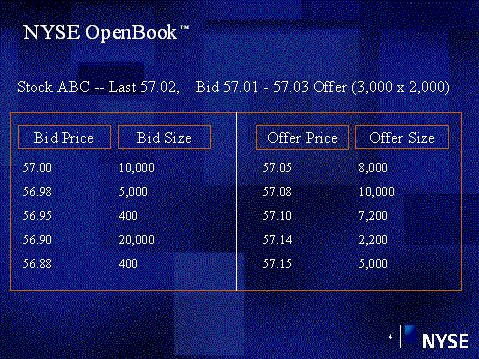
In addition, the NYSE has announced its intent to begin publicly disseminating its limit order books. NYSE OpenBookTM will provide a real-time, dynamically-updated view of the limit order books for all NYSE-traded issues.
Diagram 9 shows an example of a hypothetical display of the NYSE OpenBookTM.
Diagram 9
b. Nasdaq SuperMontage
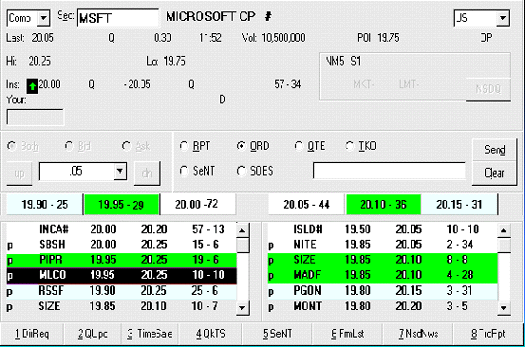
Nasdaq's SuperMontage will combine Nasdaq's stand-alone quotation and order routing systems with a means for aggregating orders/quotes at multiple price levels--similar to a limit order book-to create an integrated trading system. When implemented, it will display greater depth of trading interest than is presently available. SuperMontage will permit, but not require, Nasdaq market makers, participating ECNs, and exchanges trading Nasdaq securities pursuant to unlisted trading privileges ("UTP Exchanges") to enter multiple quotes/orders at the same price or at different prices.94 In addition, trading interest will be permitted to be entered on a non-attributable basis.95
This additional information will be displayed by Nasdaq in two ways. First, the best-priced non-attributable quotes/orders from all participants will be aggregated and displayed in the quotation montage under the generic name (or market participant identification symbol) "SIZE," along with the best-priced attributable quotes/orders of each Nasdaq quoting market participant and UTP Exchange. Second, SuperMontage will aggregate all quotes/orders (attributable and non-attributable) at each price level, and dynamically display (i.e., in real-time) the three best prices with associated aggregate size on each side of the market. The same information will be distributed to market data vendors so that they can provide an equivalent display service to their customers. In addition, Nasdaq intends to provide, on a real-time basis, all individual attributable quote and order information at the three best price levels displayed in the Nasdaq order display facility through a new vendor data feed called NQDS Prime. Thus, the intention is for market participants to be able to see the aggregate Nasdaq trading interest at three price levels, as well as the individual attributed orders that comprise that interest.96
Diagram 10 shows an example of a hypothetical SuperMontage display for Microsoft Corp.
Diagram 10
c. ECN Limit Order Books
The Internet has significantly improved the accessibility of market-related data, particularly ECN limit order books. Certain ECNs, such as Island and Archipelago, make their limit order books available on their websites at no charge. In addition, several Internet portals, such as www.yahoo.com and www.3dStockCharts.com,97 offer free access to ECN limit order books and other market data. Currently, ECNs are the only market centers to publicly disseminate full depth of book.
Diagram 11 demonstrates a display of an integrated ECN book for Intel Corp.
Diagram 11
| Bid Orders | Ask Orders | ||||
| Price | Total Order Size | ECN | Price | Total Order Size | ECN |
| 30.281 | 1,000 | Island | 30.32 | 4,000 | Island |
| 30.25 | 600 | Island | 30.32 | 200 | Archipelago |
| 30.21 | 500 | Island | 30.40 | 1,400 | Island |
| 30.20 | 1,550 | Island | 30.41 | 700 | Island |
| 30.18 | 3,500 | Island | 30.42 | 4,302 | Island |
| 30.15 | 195 | Island | 30.44 | 1,000 | Archipelago |
| 30.14 | 200 | Island | 30.44 | 950 | Island |
| 30.13 | 4,100 | Island | 30.46 | 1,238 | Island |
| 30.12 | 1,000 | Island | 30.47 | 500 | Island |
| 30.11 | 400 | Island | 30.48 | 2,000 | Island |
5. Volume of Information
With the expansion in trading volume of recent years, the amount of information handled by the Plan processors has expanded dramatically. For example, in 1994, SIAC processed 73 million transaction reports and 115 million quotations for Network A and Network B. In 2000, these figures increased to 312 million transaction reports and 691 million quotations, for an increase, respectively, of 327% and 500%.98 The increase in peak messages per second also reflects the recent growth in trading volume. For example, the highest peak messages per second for quotations processed by Nasdaq in 1995 and 2000 were 37 and 569, respectively.99 The annual number of transaction reports, annual number of quotations, messages per second capability, and highest peak messages per second, processed by each Network beginning in 1980 and for every fifth year thereafter, are set forth in Appendix D.
Before 1972, there were no Commission rules requiring the SROs to distribute market information to the public or to consolidate their information. Each SRO acted individually and disseminated information on its own terms. The SROs decided what information to disseminate, to whom to disseminate the information, and the amount of fees to charge.
Today, the SROs, through the various Plans, collectively set the level of fees for access to market information. They also determine the way market data revenues are allocated among the SRO participants. However, the Exchange Act, through the 1975 Amendments, and the rules adopted thereunder, create minimum baseline standards with respect to the type of information distributed, as well as the level of fees and nature of the fee structures, that limit the SROs' discretion. As described below, the Plans must be administered in a manner that is consistent with the requirements of the Exchange Act and the rules thereunder, and are subject to SEC oversight.
Although Congress intended to rely on competitive forces to the greatest extent possible to shape the national market system, it also recognized that the SEC would need ample authority to achieve the goal of providing investors and broker-dealers with a central source of consolidated market information. For example, in those situations where competition might not be sufficient, such as the creation of a composite quotation system or a consolidated transactional reporting system, the SEC was expected to use its powers under the 1975 Amendments to act promptly and effectively to ensure that the essential mechanisms of an integrated market were implemented.100 Accordingly, Congress granted the SEC pervasive rulemaking power to regulate securities communications systems.101
Congress was particularly concerned about entities that would be exclusive processors of market information for the SROs (including the SROs themselves). It noted that any such processor would be, in effect, a public utility, and thus must function in a manner that is absolutely neutral with respect to all market centers, all market makers, and all private firms.102 Section 11A of the Exchange Act granted the SEC broad powers over any exclusive processor, including the responsibility to assure the processor's neutrality and the reasonableness of its charges.103
Section 11A(b)(1) of the Exchange Act requires registration with the SEC of any SIP that is an exclusive processor. An "exclusive processor" is defined in Section 3(a)(22)(B) as any SIP or SRO that, directly or indirectly, engages on an exclusive basis in collecting, processing, or distributing the market information of an SRO. If a registered SIP limits the access of any person to its services, Section 11A(b)(5) provides for SEC review of that limitation. The SEC may uphold a limitation on access only if it is consistent with the Exchange Act and the rules thereunder, and the entity subject to the prohibition or limitation has not been discriminated against unfairly. If the SEC cannot make this finding, or if the prohibition or limitation imposes any burden on competition not necessary or appropriate in furtherance of the purposes of the Exchange Act, the SEC must set aside the limitation on access.
Section 11A(c)(1) of the Exchange Act prohibits SROs, SIPs, and broker-dealers from contravening rules prescribed by the SEC to: (1) prevent the use, distribution, or publication of fraudulent, deceptive, or manipulative market information;104 (2) assure the prompt, accurate, reliable, and fair collection and dissemination of market information, and that the form and content of the information is fair and useful;105 (3) assure that exclusive processors make their market information available to all SIPs on terms that are "fair and reasonable;"106 (4) assure that all persons have access to market information from SROs and SIPs on terms that are "not unreasonably discriminatory;"107 (5) assure that all broker-dealers transmit orders in a manner consistent with the establishment of a national market system;108 and (6) assure equal regulation of all markets and broker-dealers effecting transactions in national market system securities.109
B. SRO and Plan Approval of Fee Proposals110
The process of setting a market data fee for Network A, Network B, and the Nasdaq/UTP Plan typically begins with the Network administrator identifying a business need or opportunity for sale of market data in a particular form or for a particular use.111 Generally, the administrator will discuss the resulting proposal with a representative portion of the market data community, including vendors, member firms, other data recipients, and industry trade groups. For OPRA, a Policy Committee examines fee issues and recommends any changes. In practice, over the last 10 years, OPRA has implemented fee changes only after meeting with the SIA to seek its input and acceptance. 112
If favorable feedback is received, the new fee for this use of the data is presented to the SRO representatives on the Operating Committee of the applicable Plan. The SRO representatives then take the fee proposal back to their respective Boards of Directors for review and approval, before casting their vote as a member of the Plan Operating Committee.113 The CTA Plan, CQ Plan, and Nasdaq/UTP Plan require a unanimous vote to reduce fees, and an affirmative vote of two-thirds of the participants to establish a new fee or increase an existing fee.114 All changes in fees under the OPRA Plan require an affirmative vote of two-thirds of the SRO participants.115 Once a fee proposal is approved by a Plan, it is filed with the SEC.
C. SEC's Review of Market Information Fees
The SEC most often has reviewed market information fees as amendments to the CTA, CQ, and OPRA Plans under Rule 11Aa3-2(c) of the Exchange Act and proposed rule changes by the NASD under Section 19(b) of the Exchange Act (for fee changes impacting the Nasdaq/UTP Plan). In this context, as with other rule proposals, the SEC staff has relied to a great extent on the ability of the SROs and Plans to develop fair and reasonable fees that are acceptable to SRO members, information vendors, investors, and other interested parties. This approach was adopted soon after the 1975 Amendments were enacted.116
The industry negotiation process is buttressed by the public notice and comment procedures that accompany Plan amendments and proposed rule changes.117 In addition to commenting on proposed rule changes, vendors or subscribers who believe that a fee is so high as to constitute an unjustifiable limitation of their access to market information may, under Section 11A(b)(5) of the Exchange Act, apply to the SEC to institute proceedings to review the fee.
1. Filing of Plan Amendments and SEC Review
All Plan amendments, including matters relating to fees, are subject to SEC review under Rule 11Aa3-2. To amend a Plan, the SROs must file, to the extent applicable, the following information with the SEC: (a) the amendment text; (b) a statement of purpose; (c) a description of the manner in which the amendment will be implemented; (d) a listing of the significant phases of development and implementation and the projected dates of completion; (e) an analysis of the impact of the amendment on competition; (f) a statement that the amendment has been approved by the sponsors in accordance with the terms of the Plan; (g) the terms and conditions under which brokers, dealers, or SROs will be granted or denied access (including specific procedures and standards governing the granting or denial of access); and (h) the method by which fees or charges will be determined and imposed and the amount of such fees or charges.
After receiving the filing, the SEC publishes a notice of the amendment to provide the public with an opportunity to submit comments. In general, under Rule 11Aa3-2(c)(2), the SEC has 120 days from the date of publication of the notice to determine whether or not to approve the Plan amendment.118 Under Rule 11Aa3-2(c)(3)(i), however, an amendment may be effective on filing so long as it, among other things, merely establishes or changes a fee in connection with the access to, or use of, any facility contemplated by the amendment.119 In evaluating any Plan amendment, including market data fees, the SEC would consider whether the fees are "fair and reasonable,"120 and whether the fee structure is "not unreasonably discriminatory."121
2. Filing of SRO Proposed Rule Changes and SEC Review
Historically, proposed rule changes by the NASD that relate to the Nasdaq System have been filed with the SEC under Section 19(b) and Rule 19b-4 of the Exchange Act. These provisions govern all proposed rule changes by the individual SROs, including fees or charges for market information provided outside of the Plans.
SRO proposed rule changes are filed on Form 19b-4. The following information must be included in the form: (1) text of the proposed rule change; (2) a detailed statement of the purpose and an explanation of why the rule change is consistent with the requirements of the Act; (3) whether the rule change will impose any burden on competition and, if so, why the burden is necessary or appropriate in furtherance of the purposes of the Act; (4) the substance of any written comments received by the SRO's members and other interested parties; and (5) if applicable, the basis for immediate effectiveness under Section 19(b)(3) or accelerated effectiveness under Section 19(b)(2) of the Exchange Act.
The SEC publishes notice of the proposed rule change to give the public an opportunity to submit written data, views, and arguments concerning the proposal. Similar to Plan amendments, however, the proposed rule change will be effective upon filing if it, among other things, merely establishes or changes a due, fee, or other charge imposed by the SRO.122 It is the SEC's policy, however, to require fee filings that either raise significant regulatory issues or apply to non-members or non-participants to be submitted pursuant to Exchange Act Section 19(b)(2) for full notice and comment, rather than to be immediately effective upon filing.123
3. Denial or Limitation of Access Review
The SEC has reviewed market information fees under the Exchange Act Section 11A(b)(5) "denial/limitation of access" provision on only two occasions. The first involved OPRA and several information vendors; the second involved the NASD and Instinet.
In 1978, the SEC issued an order addressing OPRA's decision to impose an access fee on information vendors.124 OPRA's justification for the proposed fee was to recoup the costs of developing and operating its new high-speed consolidated options reporting system. The vendors challenged OPRA's statutory authority to impose an access fee, but the SEC determined that the language of Sections 11A(b)(3), 11A(b)(5), and 11A(c) of the Exchange Act indicated that a registered SIP is permitted to impose terms of access on vendors, including access fees. The SEC specifically declined, however, to evaluate the amount of the fee.125
The second instance occurred in 1984, when the SEC evaluated a market information fee in a limitation of access proceeding involving a dispute between the NASD and Instinet over the sale of a market data product. The NASD sold the product to Instinet, which then resold it to its own subscribers. The NASD also provided virtually the same product to its own direct subscribers. The NASD charged Instinet a fee for the product, and charged an additional fee to Instinet's subscribers.
The SEC issued an order finding that the NASD's fee to Instinet's subscribers represented an unwarranted denial of access, primarily because the NASD had failed to submit an adequate cost-based justification for its proposed fee.126 The SEC emphasized, however, that the scope of its decision was limited to the particular competitive situation presented in the proceedings. Because the NASD also was in the business of providing enhanced information products to its own direct subscribers, the fees that the NASD charged to vendors could directly and substantially affect the ability of these vendors to compete in the market for providing enhanced information.127 In this context, the SEC found that the requirement of Section 11A(b)(5)(B) - that a limitation on access not impose any burden on competition not necessary or appropriate in furtherance of the purposes of the Exchange Act - could be satisfied only if the fee was based on the NASD's costs of providing the information to vendors.128
The SEC emphasized, however, that it was the peculiar competitive context of the proceedings that led to its decision to require a strict, cost-based justification. It specifically distinguished fees for services that the NASD did not provide in competition with vendors.129
The Instinet order was affirmed in National Assoc. of Securities Dealers, Inc. v. SEC.130 The court agreed with the SEC's analysis of the competitive context of the NASD's proposed fee, noting that had the SEC approved NASD's value-of-service fee proposal, Instinet's subscribers effectively would have been required to pay NASD retail rates for a wholesale service.131 Although it recognized that strict cost allocation was a difficult task, the court affirmed the SEC's view that such an approach was necessary given the NASD's competitive position in relation to Instinet.132
4. Pilot Programs
The CTA Plan, CQ Plan, and NASD rules contain provisions that authorize market data "pilot programs" to be implemented without formal Plan approval or SEC filing or review.133 These pilot programs are to be limited in duration, geography, and scope.
Representatives of the Networks noted that a significant benefit of the pilot program process is that it allows new market data services and rates to be tested quickly and efficiently - free from the formal rule filing process associated with permanent fee changes- until its viability first has been established. In addition, pilot programs afford a Network a competitive incentive to be the first to offer or accommodate an innovative new service.
Others note that pilot programs can raise significant concerns, including their potential impact on competition, potential discrimination, and potential lack of transparency, as well as the business uncertainty they can create for broker-dealers. They believe that significant pricing changes implemented through these temporary programs, for example, can interfere with the ability of broker-dealers to plan and budget their market data expenses.134
In addition, pilot programs are intended to permit a Network's administrator to test fee arrangements, for limited periods of time, before they are filed with the SEC. However, some pilot programs have, in the past, been used by the Networks for many years before they were filed with the SEC for approval.135 Currently, there are only two pilot programs maintained by the Networks (one by Network B and one by Nasdaq). These are discussed below.
a. CTA/CQ Pilot Programs
Section IX(e) of the CTA Plan provides that the Network administrator, on behalf of the Plan participants, may enter into arrangements of limited duration, geography, and scope with vendors and other persons for pilot test operations designed to develop new last sale price information services and uses. The Network administrator must promptly report to Plan participants the commencement of each pilot program and, upon its conclusion, any market research obtained from the pilot. Section VII(e) of the CQ Plan contains a nearly identical provision.
For pilot programs under the CTA and CQ Plans, the parties enter into an addendum to the standard form of vendor agreement that governs the pilot. As Network A administrator, the NYSE's policy is to disclose a new pilot program to the other Participants and the SEC at the CTA meeting that follows the commencement of that program.136
Network A currently has no pilot programs. Network B has one pilot program for the distribution of real-time quotes on television. This program, introduced in March 1999,137 currently has two participants. The monthly fees per 1,000 households range from $1.60, for up to 1,000,000 households, to $.01, for more than 60,000,000 households, and are capped at a $125,000 annually.138 The revenue from the pilot represented 0.2% of Network B's total year 2000 revenue.
b. Nasdaq Pilot Programs
NASD Rule 7100(b) permits the NASD to enter into market data pilot arrangements of limited duration, geography and scope. These arrangements permit the testing and operation of new information services and uses to evaluate their impact, and to develop the technical, cost and market research information necessary to formulate permanent charges, terms and conditions.
Nasdaq currently has one Rule 7100(b) pilot program involving distribution of real-time data on television. The fees for this program, which began in 1997, are $.002 per household for the first 10,000,000 households, $.001 per household for the next 10,000,000 households, and $.0005 per household for additional households.
The various fee structures that have been established by the Networks139 for the dissemination of market information reflect a vendor/subscriber dichotomy. Vendors contract directly with the Networks for the right to receive information and distribute it to their customers (e.g., broker-dealers, institutional investors, and individual investors). Vendors pay a variety of access and usage fees to the Networks.140
Professional subscribers may contract directly with the Networks for receipt of market information, but generally obtain access to information through a vendor. Broker-dealers that both use information internally and distribute it to others (e.g., their brokerage customers) act as both vendors and subscribers.
Each of the Networks receives the vast majority of its revenues through subscriber fees. The most significant subscriber fees fall into two categories - monthly and per-query. Monthly fees entitle the subscriber to an unlimited amount of real-time market information during the calendar month. Monthly fees are charged to professional subscribers on a per-device basis and to nonprofessional subscribers on a per-customer basis.141 Under the per-query fee structures, subscribers are required to pay an amount for each request for a packet of real-time market information.142
The fee schedules for each Network are set forth in Appendix B.
1. Professional Subscriber Fees
Monthly fees for professional subscribers generally range from $18.00 to $127.25 per Network.143 Based on an average of 21 trading days per month, a professional subscriber generally is charged from approximately $0.85 to $6.00 per trading day for market information.
These fees produced revenues of $469 million in 2000 compared to $231 million in 1994, an increase of 103%. The revenues generated by professional subscriber fees represented approximately 78% of the total amount of the Networks' revenues in 2000. The fees themselves have remained essentially the same over the last five years.144 It is an increase in the number of professional subscribers that has produced the increase in revenues.
2. Retail Investor Fees
The monthly fee currently applicable to retail investors is $1.00 for unlimited access to a particular Network's core information, and the per-query fees range from $.0025 to .02.145 The revenues from fees applicable to retail investors (which include monthly fees for nonprofessional subscribers and per-query fees) have grown rapidly in recent years, increasing from $3.7 million in 1994 to $115 million in 2000. This increase is attributable to the shift in data dissemination to retail investors from the telephone/registered representative channel to the on-line channel, and the resulting increased demand by retail investors for market data, and not to fee increases by the SROs. In fact, per-query fees have fallen in recent years.146 These revenues now represent approximately 19% of total market information revenues.
3. Fee Discounts
The fee structures for Network A, Network B, and the OPRA System include various discounts that are based on the size of the subscribing firm or on whether the firm is a member of an SRO that is a participant in the particular Network. They include: (1) a Network A and Network B "enterprise arrangement," adopted in 1999 and 2000, respectively, that caps the aggregate amount a registered broker-dealer must pay for most of the information services provided to its employees and customers at $500,000 per month;147 (2) an OPRA "enterprise rate" for professional subscribers of $10 per month for each registered representative;148 (3) Network A monthly professional subscriber fees that range from $18.75 per device for subscribers with more than 10,000 devices to $127.25 for subscribers with a single device; (4) OPRA monthly professional subscriber fees that are $6-$10 less per device for members of an SRO that is a participant in OPRA than for non-members; (5) Network A nonprofessional subscriber fees that are $1 per month for the first 250,000 subscribers per vendor, and 50¢ per month for subscribers above 250,000; and (6) Network A, Network B, and OPRA per-query fees that are reduced based on the number of quotes distributed by a vendor during a month.149
E. Distribution of Market Information Revenues
The Plans have adopted similar rules governing their financial matters.150 All revenues derived from fees charged for a Network's market information are included in a single pool. The Network's operating expenses (amounts incurred by the Network's administrator and processor in performing their Network functions) are paid directly out of the Network's revenues. A Network's operating expenses do not, however, include any of the costs incurred by the individual SROs in reporting their information to the Network processors.151
After deduction of operating expenses, each Network's revenues generally are distributed to its participants in accordance with their proportional share of the total transaction volume for the Network.152 Finally, each of the Plans also requires that its participants annually be provided with audited statements of its financial affairs.153 The revenues, expenses, and distributions for each of the Networks are set forth in Appendix C.
In recent years, a number of significant market structure changes led the SEC to reexamine the existing model for collecting and distributing market information, including growth of online trading, for-profit market centers, and decimalization. As part of this process, the SEC issued a Concept Release on market information and, ultimately, formed the Advisory Committee to assist it in this examination.
A. Changes in Market Structure
1. Growth of Online Trading
Many of the significant changes in the securities industry that have occurred since 1975 are attributable to technological advances. For example, retail investors now regularly buy and sell securities over the Internet through "on-line" accounts with their broker-dealers. To effectively trade online, investors need access to real-time market information to make informed trading decisions (e.g., what type of order to use, how to price an order, when to place an order, and whether to break up an order).154
The first Internet-based trading systems were introduced in 1995. Since that time, the demand by retail investors for useful and timely information has grown dramatically, so that today there are over 20 million online accounts and an average of 853,000 online trades per day.155 Broad access to real-time market information is critical to retail investors' ability to monitor and control their own securities transactions, including the quality of execution of their transactions by broker-dealers.
2. For-Profit Market Centers
A second major development leading to the SEC's reexamination of market information was the rise of for-profit market centers, and the potential impact of the profit motive on market data fee structures. Recent years have seen the growth of alternative trading systems ("ATSs"),156 such as ECNs, that compete with the traditional markets operated by the exchanges and the NASD.157 Some ECNs, which are operated by for-profit entities, have applied for registration or indicated an interest in registering as national securities exchanges.158 ECNs also have sought to have their quote and trade information widely publicized, including as part of the consolidated quote.
In 2000, ISE became the first for-profit SRO. In addition, traditional markets, such as Nasdaq, are in the process of, or are exploring the possibility of, converting from membership organizations to publicly-held for-profit corporations in order to compete more effectively.159 Some have expressed concern that the growth of publicly-held for-profit market centers might require closer monitoring of market data fees and revenues, to assure that the profit motive and competitive pressures, heightened by public investor expectations, do not result in unreasonable or inequitable fee structures.
3. Decimalization
The implementation of decimal pricing in 2001, and the concurrent move to a minimum tick of one penny in the equity markets,160 was another factor that caused the SEC to reassess current market data systems.161 By increasing the potential number of quote increments by more than six-fold, decimalization was widely expected to lead to less depth being available at each price point.162 This, in turn, could reduce the value of the NBBO as an indication of an obtainable market price, particularly for market participants with larger orders. In addition, there was concern that decimalization might lead to a surge in quote traffic and a corresponding drain on systems capacity, since the larger number of price increments could cause market participants to update their quotes more frequently. Some industry participants thought that these anticipated, rapidly changing (or flickering) quotes would likely make the NBBO less meaningful.163 Accordingly, decimalization led some to question whether deeper or different levels of market data should be collected and distributed.
With the recent growth of online trading, a broker-dealer offering online brokerage services called for a reexamination of various market data issues, including the level of market data fees and the way in which fee structures are determined.164 In December 1999, the SEC issued a Concept Release on the Regulation of Market Information Fees and Revenues ("Concept Release"), which focused primarily on the fees charged for market information and the role of revenues derived from those fees in funding the operation and self-regulation of the markets.165
The Concept Release solicited public comment on various market data issues, including a proposed flexible cost-based approach for evaluating market data fees, possible ways of distributing market data revenues to fund more directly certain self-regulatory functions, greater public disclosure concerning fees and revenues, and broader industry and public participation in the process of setting and administering fees.
The comments received by the SEC in response to the Concept Release reflected a wide range of views.166 Some commenters thought the current system worked well, and that further SEC action was unwarranted.167 Others were of the view that, while modifications to the system may be necessary in the future, the time was not right for SEC action because significant structural changes were taking place in the markets.168 Still other commenters believed the SEC should make significant changes to the system for collecting and distributing market information.169 Specific comments on each of the issues raised in the Concept Release are discussed below.
1. SEC's Proposed Cost-Based Approach
Commenters held widely varying views on the SEC's proposed conceptual approach for setting a cost-based limit on total market information revenues. Under this approach, each SRO would: (a) calculate the amount of its direct market data costs; (b) calculate a gross common cost pool, and multiply that by a standard allocation percentage to determine its net common cost pool; and (c) allocate its total cost of market information - the sum of (a) and (b) - to the various Networks whose securities it trades. The total amounts allocated to each Network from its SRO participants would form the basis of the limit of the fees that could be charged for that Network's market data.170
Although some commenters generally supported the idea of a flexible cost-based standard for setting fees,171 no commenter explicitly supported implementation of the SEC's proposal. The majority of commenters on this issue believed the SEC's cost-based approach would be unnecessary and impractical.172 These commenters cautioned that classification of common costs could not be done without significant disagreements, continual auditing, and considerable expense. Some further pointed out that, historically, cost-based systems have encouraged cost-padding, and created disincentives to reduce the costs through efficient operation or innovation.173
In addition, some commenters objected to the proposed formula because it included the SROs' "common costs."174 These commenters contended that to be fair, effective, and enforceable, a cost-based standard must only include those SRO costs directly associated with gathering and disseminating market information.175
2. Fairness and Reasonableness of Specific Fees
Views also were requested on the fairness and reasonableness of the various market data fee structures, which include separate fees for professional and retail subscribers.176 The SROs unanimously responded that the levels of both professional and non-professional market data fees were fair and reasonable, and not unreasonably discriminatory.177 In contrast, other commenters argued that the present fee structure unfairly discriminates against broker-dealers and vendors that repackage or otherwise add value to the information for retail customers.178 They indicated that the fee levels in effect at that time made it cost-prohibitive to offer retail customers access to the full scope of market data available to professionals, such as streaming, dynamically-updated quotes, real-time securities and account valuation, and quotes from all Nasdaq market makers. These commenters urged that any variance in fees should be based only on differences in costs to deliver data to specific categories of users.179
3. Distribution of Network Revenues and SRO Funding
In addition, the Concept Release solicited comment on a conceptual approach to distributing market information revenues that could provide for more direct funding of SRO functions that enhance the integrity and reliability of market information.180 Specifically, comment was requested on (a) whether certain SRO costs that most directly enhance the integrity of market information - principally, the cost of market regulation - should be funded as part of the initial "direct distribution"181 in addition to Plan costs, and (b) whether the formula for making the subsequent "proportional distribution"182 should be revised to compensate the SROs more in accordance with the value of the information they contribute to the stream of consolidated information.
The commenters were almost evenly divided on whether SRO costs that directly enhance the integrity and reliability of market information should be funded.183 They also generally disagreed on which costs should be associated with the direct production of market information and with market regulation.
The SROs were the primary commenters on the issue of whether the revenue distributions should be revised to reflect more directly the value that each SRO's information contributes to the stream of consolidated market data.184 Many commenters believed the current system is preferable to the SEC's proposed approach, primarily due to the practical difficulties in designing a system that would accurately value quotations.185 A few commenters thought revenue distributions should be revised to reward the generation of high-value market data, although each commenter proposed a different formula.186
4. Plan and SRO Disclosure
Comment was requested on whether the Plans should be required to make annual public filings for the Networks that would contain: (a) a complete listing of all their fees; (b) the number of users participating in each fee program; and (c) audited financial statements setting forth their revenues (including an itemized listing of revenues attributable to each fee program), expenses, and distributions. In addition, the Concept Release asked whether the SROs should be required to provide greater disclosure of their financial condition, including disclosure of the costs associated with the performance of their various SRO functions.
All of those who commented on the issue believed that the SEC should require annual public filings for the Networks.187 Several commenters further believed that the SROs should provide greater financial disclosure to the public, particularly the costs associated with providing market information.188 The SROs, on the other hand, noted that they currently publish audited financial statements, which are prepared in accordance with generally accepted accounting principles. The SROs added that a more detailed disclosure of the costs associated with each SRO function would lead to arbitrary decisions, and require the SEC to establish uniform accounting standards and procedures in this area.189
5. Plan Governance and Administration
The Concept Release requested comment on a variety of issues relating to the governance structures of the Plans. These issues included: (a) whether non-SRO market participants, such as vendors, broker-dealers and investors, should be members of the Plan Operating Committees; (b) whether additional committees with broad participation should be established to address the issues of most direct concern to non-SRO market participants; (c) the appropriate mechanism for selecting non-SRO representatives to a committee; (d) whether the non-SRO representatives should have voting rights; and (e) if permitted to vote, the appropriate weighting of votes by non-SRO representatives.
In response to these questions, a majority of the commenters believed that the SROs did not adequately represent the interests of all market data consumers, and recommended broader industry and public representation in the Plan governance structures.190 These commenters, however, disagreed on the manner of participation by the non-SRO representatives (e.g., whether or not they should have voting rights, and whether their participation should be limited to certain issues).191 Some SROs noted that market data decisions currently reflect input from a variety of market participants through the broad-based constituent boards of the SROs, which ultimately approve all significant market data matters.192
The Concept Release also solicited comment on ways to improve the administration of the market data Plans. All of those who commented on the issue of administration favored reducing the administrative burden associated with distributing market data by simplifying and standardizing agreements, policies, and reporting requirements.193 Some of the specific suggestions included creating a comprehensive database of market information, devising common language for Internet subscriber agreements, and eliminating case-by-case approval procedures.194
6. Pilot Programs
Comment was solicited on the advisability and usefulness of pilot programs, and whether their terms should be publicly disclosed and their duration more precisely limited. The majority of commenters supported the continued use of pilot programs as a means of ensuring that SROs, vendors, and market data users can quickly respond to a rapidly evolving marketplace.195 The commenters disagreed, however, on whether there should be notice and public comment prior to the initiation of a pilot program.196 No commenter objected to a reasonable limitation on the duration of the programs.
7. Alternative Approaches to Dissemination of Market Data
Finally, although the Concept Release did not explicitly request comment on alternative approaches to the dissemination of market information, a number of commenters offered suggestions in this area. Several recommended introducing competition into the compilation and distribution of market data, but only a few proposed specific approaches.197
For example, Fidelity recommended opening the central processor function to competitive bidding. The processor role could be awarded to a single firm, or to multiple firms that would carry out severable functions. Bids would be submitted based on maximum level of fees, with vendors and subscribers free to negotiate more favorable rates. In addition, all bidders would be required to provide for enterprise fees and fees for individual users that access market data through multiple terminals.198
NexTrade suggested having one national market system plan, with broad-based governance, including ECNs, broker-dealers, issuers, and at least fifty-percent non-industry participants. In addition, there would be competing processors for all market information.199
The NYSE believed markets should be permitted to withdraw from the Plans, and separately distribute and price their data.200 In the NYSE's view, possible benefits of this approach could include increased quote competition, more accurate valuation of data, better system efficiency, and less use of Commission resources.
Under Bloomberg's approach, a number of competing data consolidators would be permitted. SROs would be required to make their data available to each consolidator on the same basis and at the same cost, but would be able to recover their costs of aggregating the data. In turn, each consolidator would have to make its data available to vendors and end-users at the same price.201
The Mercatus Center suggested a completely free-market approach, in which each SRO would make its data available on its own terms, competing consolidators would be permitted, and investors would choose the degree of transparency they wished to receive.202 In their view, arbitrageurs likely would cause prices across trading venues to equalize, so that investors might only need to subscribe to information from one market.
In light of the divergent views expressed in the comment letters to the Concept Release, and the fundamental market data issues that were raised, the SEC decided to explore this area in more depth, and to formally tap private sector expertise in the process. In August 2000, at the suggestion of former SEC Chairman Arthur Levitt, the SEC formed the Advisory Committee to assist it in evaluating issues relating to the public availability of market information in the equity and options markets.
The Chairman of the Advisory Committee is Joel Seligman, Dean of the Washington University School of Law in St. Louis. The Commission selected 25 members to represent a diverse range of perspectives, including exchanges, ECNs, broker-dealers, retail and institutional investors, and data vendors, as well as the public at large. The members of the Advisory Committee and their affiliations are set forth in the preface to this Report.
The SEC gave the Advisory Committee a broad mandate to explore both fundamental matters, such as the benefits of consolidated market information, and practical issues such as how prices for market data should be determined. Specifically, the Advisory Committee was expected to address issues such as: (1) the value of transparency to the markets; (2) the impact of decimalization and electronic quote generation on market transparency; (3) the merits of consolidated market information; (4) alternative models for collecting and distributing market information; (5) how market data fees should be determined and evaluated; and (6) practical matters relating to the joint market information plans, such as appropriate governance structures and issues relating to plan administration and oversight.203
The Advisory Committee met six times from October 2000 to July 2001,204 and discussed in depth a broad spectrum of issues relating to market information. The first meeting was devoted to an examination of the more fundamental market data issues, such as the value of transparency and consolidated information, and the impact of decimalization and electronic quote generation on them.
Two meetings were devoted to a discussion of ways to improve the current market data model in the equity markets. The topics discussed included the amount of market information that vendors and broker-dealers should be required to provide to customers, how market information should be consolidated, the governance structure of the consolidators, how user fees are determined and revenues allocated among Plan participants, the administration of the fee structures, the need for technological innovation, and the use of pilot programs.
Two meetings focused on alternative market data models - primarily on a model in which there are competing consolidators. A subcommittee was formed to conduct background work and prepare an agenda for the full Advisory Committee's discussion of alternative models. This 11-member subcommittee met twice and was chaired by Professor Donald Langevoort of the Georgetown University Law Center.205 Members of the subcommittee prepared written submissions for deliberation by the full Advisory Committee on matters such as the technological and economic benefits, costs and risks posed by an alternative model.
The final meeting of the Advisory Committee was devoted to market data issues in the options markets. The topics discussed included the unique aspects of the options markets, in terms of structure and regulation, as well as special concerns, such as those relating to capacity. The Advisory Committee focused on the extent to which its recommendations for the options markets should differ from those made for the equity markets.
The Advisory Committee drew upon the expertise of its members and others in its examination of market data issues. Over the course of the past year, the Advisory Committee held four full-day and two half-day meetings that generated transcripts totaling more than 1,000 pages. Meetings typically began with background presentations, supplemented by written materials, on relevant topics by those with particular expertise. Written submissions on issues of interest, such as deficiencies with the existing system and alternative market data models, also were solicited from Advisory Committee members. These submissions are available on the SEC's website, and several are included as Appendices to this Report.206 The Advisory Committee could not, however, conduct extensive independent fact finding (as might be expected, for example, from an SEC Special Study), given the limited time and resources available to the Advisory Committee, as set forth in its charter.
In accordance with the Federal Advisory Committee Act,207 which governs the operation of federal advisory committees, meetings of the Advisory Committee were open to the public, and public participation was invited at the conclusion of each meeting. All Advisory Committee members were given the opportunity to voice their views at the meetings, and invited to supplement their thoughts in writing. All submissions made by members were distributed to the full Advisory Committee, and are publicly available on the Commission's website at www.sec.gov. This Report, including the findings and recommendations set forth below, is designed to reflect the various viewpoints of Advisory Committee members.208
The Commission expressly asked the Advisory Committee to examine the value of transparency to the U.S. equity and options markets, and the significance in our markets of the widespread availability of real-time price information. As discussed below, the Advisory Committee unanimously believes that transparency plays a fundamental role in the fairness and efficiency of the U.S. securities markets.209
Price transparency is essential for efficient price discovery and the best execution of customer orders. Investors need ready access to real-time prices from the various markets in which a security is trading in order to make informed decisions and obtain the best price. In addition, transparency is critical for broker-dealers in fulfilling their best execution obligations.210
Transparency also enhances market efficiency by counterbalancing the effects of market fragmentation. While the open nature of the U.S. national market system promotes competition among markets, competition can lead to market fragmentation, which occurs when orders for a particular security trade in several locations without interacting with each other. Market fragmentation can interfere with efficient price discovery. Price transparency mitigates the potentially deleterious effects of market fragmentation by making market participants aware of trading interest no matter where it arises in the national market system.
In addition, price transparency promotes investor protection by allowing investors to monitor the quality of executions they receive from their broker-dealers. For example, investors can use market information to check how the price their broker obtains for them compares to the NBBO at the time of the trade. Finally, price transparency may enhance market liquidity. Because transparency promotes market integrity and fosters investor confidence, it encourages greater investor participation in a market. This, in turn, may lead to increased market liquidity.
Several members raised the more complex issue of whether the existing system achieves the appropriate level of price transparency. Some questioned whether the current level of transparency is adequate, particularly with the advent of decimalization, which has increased the number of price increments more than six-fold, and reduced the depth of trading interest available at each price level. In light of the impact of decimalization, some believe the most common form of quote transparency - the single best price, or NBBO - will become less meaningful, particularly for those investors seeking to trade in larger size.211 These members believe that, while the NBBO remains essential in practice, many market participants will need more extensive quote and order information.212
Some Advisory Committee members noted that there are limits on the ability to achieve full transparency of all trading interest. Certain market participants, particularly institutional investors, legitimately fear that revealing their trading interest would lead to an adverse market move or otherwise put them at a competitive disadvantage. These market participants stated that the right to elect not to display some or all of one's trading interest therefore must be retained.213
In addition, some members pointed out that the volume of market data likely will increase dramatically, both on account of automated quote generation technology and decimalization. In some cases, quotes may change faster than the human eye can see.214 This anticipated increase in quote traffic could further strain systems capacity.215 Accordingly, techniques to sort useful from non-useful information ultimately may need to be developed.
Nevertheless, the Advisory Committee recognizes the many beneficial effects of price transparency and views it as fundamental to our market's health and vitality. Accordingly, the Advisory Committee recommends that the goal of transparency be retained as a core market objective. To achieve this goal, the Advisory Committee recommends that the Commission continue to assure that market information is widely available to investors and other market participants.
B. The Merits of Consolidated Information and the Display Rule
The Commission expressly asked the Advisory Committee to explore the merits of providing consolidated market information to intermediaries and customers. As part of its review, the Advisory Committee examined: (1) whether the Display Rule should be retained (i.e., whether basic market information should continue to be required to be provided in a consolidated format to market participants); and (2) the extent to which consolidation is appropriate for the provision of market information beyond the consolidated stream mandated by the Display Rule.
Like price transparency, consolidated market information is a central component of our national market system. Many believe that, to achieve the goals of efficient price discovery and best execution, not only must quotation and transaction information from each market be accessible to investors, but that information must be available in a consolidated data stream. The wide availability to investors of the best quotes and a consolidated stream of transaction reports from all the market centers that trade a security, arguably, is a minimum essential element of a truly "national" market system.
Advisory Committee members generally agreed that consolidated information is an important component of our markets, and will become increasingly so as the volume of market data increases.216 Views differed, however, on whether the delivery of basic consolidated information should continue to be mandated by regulation and, if so, the extent to which the provision of additional information should be regulated. Nevertheless, as discussed below, a substantial majority of the Advisory Committee believes the Display Rule should be retained, although market participants should generally have the flexibility to distribute separately additional market information.
1. Display Rule
Before the adoption of the Display Rule217 in 1980, some vendors only provided trade and quote information from the primary markets, or provided data that favored the primary markets in terms of format and ease of access.218 The Commission had encouraged vendors to make consolidated data at least as accessible as primary market data but, for competitive reasons, vendors were reluctant to do so voluntarily. Instead, some vendors preferred that the Commission establish mandatory, industry-wide minimum display criteria. As a result, the Commission adopted the Display Rule that, in effect, requires consolidated data to be displayed in a manner that is at least as accessible as any individual market's data. In so doing, the Commission recognized that the manner in which vendors and broker-dealers distribute market data impacts both market competition and transparency.219
By requiring the distribution of consolidated data, the Commission sought to promote market competition by assuring that markets can compete through the display of their quoted prices. If vendors and broker-dealers were permitted only to distribute information from individual markets, such as the dominant exchanges, the ability of smaller or newer markets to compete for market share on an equal basis could be substantially inhibited. In addition, the Display Rule promotes transparency by assuring that market participants are apprised of basic pricing information for securities.220
Although the merits of the Display Rule were much debated within the Advisory Committee, a substantial majority favors its retention.221 Those members supporting retention of the Display Rule offered various justifications for it. Some believe that it plays an important role in assuring that a minimum "baseline" level of trade and quotation information is provided to market participants. In so doing, it serves core investor protection and market integrity functions. The Display Rule also may promote market competition by assuring that information from newer or smaller exchanges is widely distributed.
Several members of the Advisory Committee expressed concerns that, were the Display Rule to be eliminated, there would be no assurance that the information provided to investors, either directly or through their brokers, would contain the best quotes and trade prices from all public markets. While investors would likely continue to receive some market data, they would not necessarily be aware of which market's data was excluded from the stream they were viewing, or when a better price was available on another market. As a result, investors entering limit orders could price them inaccurately, and investors entering market orders could be misled regarding current trading patterns.222
Some members also noted that investors seeking to monitor execution of their orders by their broker-dealers could be deprived of information on better prices available at the time of execution. Because it is difficult for investors to assess the importance of data they do not receive, investors may not recognize the need for consolidated data and, thus, broker-dealers would be less likely to compete by providing this information. Moreover, broker-dealers would have to obtain the full data stream on their own initiative, in order to assure best execution of customer orders.223 In the absence of consistent presentation of consolidated information to broker-dealers and investors, the Commission could be impelled to comprehensively inspect for, and enforce, the broker-dealer's duty of best execution, and to inspect for the misleading provision of limited market data. This would require an increased commitment of scarce Commission resources, and necessarily involve subjective determinations on the part of Commission staff.
Less intermarket competition might also result from the absence of the Display Rule. Without the requirement to distribute a new market's information, a nearly insurmountable barrier to entry might be created for new marketplaces (or for an established market that wishes to commence trading in an issue that already trades on another market). The non-primary markets also may suffer competitively if vendors and broker-dealers elect not to distribute their data. After all, a market's inability to widely disseminate its prices undoubtedly will adversely impact its ability to attract limit orders and, ultimately, all order flow. This barrier to intermarket competition, in turn, could decrease liquidity and innovation in the marketplace.
Several Advisory Committee members that support retention of the Display Rule, however, believe it should be applied somewhat more flexibly, and urge the Commission to consider providing exemptions in appropriate circumstances.224 For example, some believe individual markets should be able to make their own data available separately on their Internet websites, so long as they also are providing that data at the same time to the appropriate consolidator(s). A few suggest that application of the Display Rule be limited to specific points in time, such as immediately prior to an execution decision.225
Those who favor eliminating the Display Rule226 in the equity markets argue that market forces, along with the duty of best execution, would lead to the delivery of appropriate high-quality, affordable information to investors.227 Market forces, rather than regulation, should determine the nature of the market data provided. For example, vendors and broker-dealers should have the flexibility to meet the demand of those market participants who wish to receive less than fully-consolidated data. If an investor does not want to purchase the NBBO or all last sale information, those wishes should be accommodated. With this increased flexibility, many different data products might emerge, fueled by technology and innovation. The ability to choose the level of data received also may result in a lower overall cost for market data users, and permit them to better evaluate the cost-to-value ratio of the data.
In addition, those favoring elimination of the Display Rule contend that without the requirement that data from all market centers be purchased, any inordinate pricing power of the non-primary market centers would likely diminish. Because consolidators would not be required to buy every market's data, the non-primary markets would have to price their information based on its value relative to that of other market centers, or risk that it would not be used. In other words, the non-primary markets would have to compete on the price or quality of their data (e.g., by offering consistently better quotes) to generate interest in their data and to earn market data revenues. This added incentive to compete, in turn, could enhance liquidity and have a beneficial effect on intermarket competition.
Supporters of the Display Rule point out, however, that while the abandonment of the rule plainly would take away any artificial market power of the non-primary markets, it is unlikely to be a significant restraint on the pricing power of the primary markets. To the extent that market participants need the data generated by, for example, the NYSE or Nasdaq, they would still be forced to buy it. Accordingly, the absence of the Display Rule would not ensure the appropriate level of fees for the primary markets' data.
2. Provision of Market Data Outside of the Display Rule
The Advisory Committee considered two issues with respect to the provision of market information outside of the Display Rule: (a) whether an individual market participant in an exchange or the Nasdaq market should be able to sell core market data away from that market; and (b) the conditions that should apply to any market participant that wishes to sell, or otherwise provide, non-core market data (i.e., data beyond that required to be provided under the Display Rule).
a. Provision of Core Information by Non-SROs
The Advisory Committee discussed whether market participants other than the SROs, such as specialists, market makers, ECNs and other broker-dealers, should be permitted to sell their core market data directly, apart from the markets in which they participate. Several members suggested that, by introducing additional competition into the provision of core market data, the pricing power of the SROs would be reduced. Others questioned how effective a check this would be. Nevertheless, a majority of the Advisory Committee concluded that Commission rules should not prevent non-SROs from offering their core market data independently, so long as they are providing that data to the appropriate SRO at the same time.228 The Advisory Committee recognizes that the SEC would need to amend the Transaction Reporting Rule to permit non-SROs to offer transaction data outside of an SRO plan.229
b. Provision of Non-Core Information by Any Market Participant
The Advisory Committee also discussed whether the Display Rule mandates the appropriate level of price transparency, particularly in light of decimalization and the resulting reduction in the depth of trading interest available at each price level. Members generally believe that data deeper than that provided by the Display Rule should be available to market participants.230 Useful deeper information might include: (1) quote and limit order information at three to five price levels below the NBBO; (2) an aggregation of orders at the 10,000 and 25,000 share level; (3) the high, low, and average price of the last five minutes, as well as the high and low price of the day; and (4) the full limit order book.
Taking the analysis a step further, the Advisory Committee discussed whether members supported: (1) requiring the SROs to make deeper information available to vendors and subscribers; and (2) requiring vendors to furnish deeper information to their customers. The Advisory Committee was almost evenly divided on whether the SEC should require SROs to make deeper market information available to vendors and subscribers.231 A substantial majority of the Advisory Committee, however, does not believe that vendors or broker-dealers should be required to furnish deeper information to customers, on either an individual or consolidated market basis.232 Once the provision of full core information is assured by the Display Rule, the extent and manner of dissemination of deeper market information can be determined by market forces-i.e., by the business decisions of individual market participants-rather than by regulation. Attempting to mandate the display of deeper information, among other things, would create inflexibility and exacerbate "one-size-fits-all" informational concerns.
That said, the Advisory Committee considered the conditions under which any market participant should be able to provide market data that is not covered by the Display Rule. The Advisory Committee recommends that market participants generally have the flexibility to distribute individually market information in addition to that which the Display Rule requires.233 Accordingly, the Commission should permit market participants to separately distribute information beyond the consolidated stream mandated by the Display Rule.
3. Summary
In essence, a majority of the Advisory Committee made two significant sets of recommendations with respect to the merits of consolidated information. First, the Advisory Committee determined that, on balance, the Display Rule continues to play a useful role in promoting transparency and facilitating best execution. While the national market system ultimately may evolve to the point that the Display Rule no longer is necessary, a substantial majority of the Advisory Committee believes that the costs and risks of eliminating the Display Rule, at this time, outweigh the potential benefits. Therefore, the Advisory Committee recommends that the Commission retain the Display Rule. In other words, if core real-time market information is provided to market participants, this information should include the best quote and the last sale prices from all reporting market centers.234 The Commission should, however, consider providing appropriate exemptions to increase the flexibility of the Display Rule, such as permitting markets to make their own data available separately on their Internet websites, so long as they also are providing that data at the same time to the appropriate consolidators.
Second, the Advisory Committee recommends that market participants generally have the flexibility to distribute separately additional market information. Commission rules should not prevent non-SROs from offering their core market data independently, so long as they are providing that data to the appropriate SRO at the same time for inclusion in the consolidated display required by the Display Rule. Furthermore, the Commission should permit market participants to separately distribute deeper market information, beyond the core market data made available on a consolidated basis. The Advisory Committee was evenly divided, however, on whether the SROs should be required to make this deeper data available to vendors and subscribers.
C. Models for Achieving Consolidation of Market Data
The idea of creating a single central processor of market information emerged in the early 1970s as the most practical and reliable way, at that time, to generate a consolidated stream of transaction and quotation information. The Advisory Committee reviewed whether this "single consolidator" model continues to make sense in light of today's technology and market structure, or whether there are better alternative models for consolidating and disseminating information from multiple markets. In so doing, Advisory Committee members generally acknowledged that the current "single consolidator" model has achieved the national market system goal of widespread availability of market information, and in no sense is systemically "broken."235
A majority of the Advisory Committee, however, is of the view that there is a better alternative model for consolidating and distributing market information - one that permits the individual markets to sell their data to a number of "competing consolidators." 236 In light of technological and competitive developments over the last 25 years, this majority believes that there is no clear need to require market centers to act jointly to consolidate information under the existing national market system Plans. Instead, the Commission should permit the establishment of a new "competing consolidators" model - discussed in Section 2 below - that allows more competition and innovation and, at the same time, is unlikely to jeopardize access by market participants to a reliable stream of consolidated market data.
A minority of the Advisory Committee does not favor the competing consolidators model because they do not believe the economic benefits of implementing a new model outweigh the technological and economic risks of doing so, particularly since, in their view, the existing model has worked well for the past 25 years. Accordingly, this minority would retain the current "single consolidator" model, albeit with several improvements which are discussed in Section 3 below.237
A third group, also representing a minority of the Advisory Committee, would favor the competing consolidators model if, but only if, the Display Rule were eliminated. These members view the elimination of the Display Rule as necessary to achieve the economic benefits of the competing consolidators model.238
1. Background
In the early 1970s, the Commission recognized the need for broad public access to consolidated market information.239 In early 1972, the Commission proposed Rules 17a-14 and 17a-15 under the Exchange Act, which would require the creation of a composite quotation system and a consolidated transaction reporting system.240 The Commission then established the Advisory Committee on Market Disclosure to make recommendations on the development of a comprehensive market data disclosure system, including the technological means for disseminating market information.241
In May 1972, the NYSE and Amex proposed that the consolidated reporting system be implemented by the recently formed SIAC, which was jointly owned by the two exchanges.242 A few months later, the Advisory Committee on Market Disclosure made specific recommendations for a mechanism for consolidating market information. It suggested that each market center collect and validate its own data and transmit it to a central processor or service bureau for sequencing. The processor, which would function under a set of rules approved by the Commission, would be a "neutral" body, not under the control or domination of any particular market center. It might take the form of a corporate enterprise jointly owned and controlled by the SROs, or could be a quasi-governmental entity created for this purpose.243
The legislative history of the 1975 Amendments makes clear that Congress shared the Committee's view that any central processor of market information be neutral.244 In fact, Congress indicated it would have to consider the establishment of a quasi-governmental entity to operate a processor if rigorous standards could not be established to assure fair access for all affected interests in a privately-owned communication system, or if it became a vehicle for restricting competition. Any exclusive processor of market information in effect would be a public utility, and thus must function in a manner that is absolutely neutral with respect to all market participants.245 Accordingly, Section 11A granted the Commission broad powers over any exclusive processor of market information in order to assure, among other things, the processor's neutrality and the reasonableness of its charges.
In its rulemaking implementing the 1975 Amendments, the Commission provided for the registration of any exclusive SIP. In addition, it established procedures through which national market system plans, jointly established by the SROs, are approved and overseen by the Commission. Each of the CTA, CQ, Nasdaq/UTP, and OPRA Plans have been filed with the Commission pursuant to these procedures. In addition, CTA, SIAC, Nasdaq and OPRA are registered with the Commission as SIPs, although only SIAC and Nasdaq actually provide processing services.
2. Majority View: Recommendations for Establishing a New "Competing Consolidators" Model
The Advisory Committee engaged in substantial debate on whether it should recommend to the Commission an alternative model for consolidating and distributing market information. Ultimately, a majority of Advisory Committee members concluded that the potential economic benefits of implementing a new "competing consolidators" model outweighed the anticipated technological and economic risks of doing so.
The Advisory Committee initiated its analysis of alternative models by soliciting suggestions from members. Six alternative models were submitted,246 and a subcommittee was formed to review them and prepare an agenda of issues posed by competing consolidators. The subcommittee presented its work to the entire Advisory Committee, which then fully deliberated the merits of the alternative models.247 The deliberation included extensive analysis of various technological and economic considerations associated with those models. A majority of the Advisory Committee concluded that the Commission should permit the establishment of the competing consolidators model described below.248
a. Model Design
The competing consolidators model assumes that an SRO can fulfill its regulatory obligations with respect to market data without participating in a joint national market system Plan.249 If an SRO did not wish to participate in a joint Plan, it would be required to file a separate transaction reporting plan under the Transaction Reporting Rule that specifies, among other things, the manner in which last sale reports would be consolidated with those from other market centers.250 If the SEC approves the separate transaction reporting plan, after finding it is consistent with the national market system objectives of the Exchange Act, the SRO then would: (1) separately establish and collect its own fees; (2) separately enter into and administer its own market data contracts; and (3) provide its own data distribution facility. Any number of competing consolidators could purchase market data individually from those SROs that have withdrawn from the Plans, and jointly from any remaining Plan participants.251 These "competing consolidators" would then consolidate the data and distribute it to end-users.252
Diagram 12 depicts the structure of the competing consolidators model for market data in listed equities.
Diagram 12 (in PDF)
b. Technological Considerations
The Advisory Committee believes that a competing consolidators model is technologically feasible. In reaching this conclusion, the Advisory Committee has identified four technological risks that might be heightened if that model were implemented. These risks relate to: (1) sequencing of information; (2) validation tolerances; (3) capacity; and (4) protocols/data formats.253 While the Advisory Committee believes these risks are manageable, it also concluded that, in reviewing any petition to withdraw from a joint national market system Plan, or any new plan proposal, the Commission must assure that the technological considerations described below have been effectively addressed.
(i) Sequencing of Information
In a competing consolidators model, there is a risk that market data messages would be processed in different sequences by different consolidators. Multiple consolidators may very well use different hardware, software or communications platforms to process the data received from the individual exchanges. Different hardware, for example, might service market centers' input differently, which could lead to variances in the sequencing of market data in a particular security. Other factors that could result in variations in sequencing among competing consolidators include message gapping, internal system software design, and the overall choice of dissemination technology. For example, one consolidator might experience message gapping in receiving a message from a market center due to a communication line problem, while the other consolidators process the messages normally.254 There also could be variances in internal system software design that could lead to differences in processing time, which also could lead to sequencing differences among consolidators.
(ii) Validation Tolerances
The central information processors currently check all market center messages to verify that they utilize the correct message structures. If the message format is incorrect, the message will be rejected and returned to the originating market center. Information processors also calculate various information for the industry, such as the NBBO and trade summary information (e.g., high, low, and volume information), and process trade corrections. A zero quote capability is provided to eliminate stale quotes when a market center is experiencing technical difficulties. In a competing consolidator environment, standards would need to be established to verify the consistency of information, particularly with respect to mandated data such as the NBBO.
(iii) Capacity
It is critical that information processors have sufficient capacity to process the information from all reporting market centers. There are a number of elements within a consolidators design that must have sufficient capacity, including the network capacity, input and output line capacities, system capacity, internal system threading capacity, storage and memory capacity, and database size. If any one of these components cannot handle the required capacity level, queuing will result, thereby delaying messages to the data recipients. Capacity issues, of course, exist today with the single consolidator model, but these concerns will be multiplied with competing consolidators.255
(iv) Protocols/Data Formats
Information processors currently receive the market centers' information utilizing standard input formats, and disseminate the consolidated data streams to the data recipients using standard output formats. In a competing consolidators model, different protocols, message formats, and technologies may be used by different consolidators, which could make the market data system more cumbersome and prone to error.
In general, the Advisory Committee believes that each of these technological risks would be manageable in a competing consolidators model. Although the Advisory Committee did not reach a consensus on mitigation strategies, most members did not favor direct Commission involvement in setting technical standards for competing consolidators.256 Rather, the Advisory Committee believes that the private sector has a significant stake in ensuring the integrity of market data, and market centers, consolidators, vendors, and information users should be incentivized to develop appropriate technical standards to help manage these risks.
c. Economic Considerations
The Advisory Committee also discussed the economic benefits, costs, and risks associated with moving to a competing consolidators model.257 As with the technological considerations, the Advisory Committee concluded that the Commission must assure, when reviewing an SRO's petition to withdraw from a joint national market system Plan, or any new plan proposal, that the economic costs and risks described below have been effectively addressed.
(i) Economic Benefits
Advisory Committee members discussed three primary benefits that might result from the implementation of a competing consolidators model. These potential benefits assume the SROs will elect to dissolve the Plans, and that the SEC approves such dissolution.258
First, market participants would have a greater ability to innovate. Dissolution of the Plans' joint governance structure, combined with the force of competition, may allow for system modifications to occur more quickly in response to new technologies and market opportunities.
Second, there could be ancillary gains from dismantling the Plans. Today, competitors act in concert with respect to an important data dissemination activity. Dissolution of the consortia would remove the administrative burdens associated with joint administration, along with potential antitrust exposure. The administrative functions would be shifted to the individual market level, however, potentially adding administrative complexity at that level.
Third, the explicit information sharing arrangements imposed by the Plans on their participants would be eliminated. Removing this environment of artificial cooperation among competitors could enhance the forces of competition.
Finally, the revenue sharing arrangements under which market data revenues are allocated among Plan participants would be eliminated. Because each market would separately establish and collect its own fees, intermarket competition may be enhanced.
(ii) Economic Costs and Risks
Advisory Committee members identified several direct costs that could result from the implementation of a competing consolidators model, such as the duplication of the hardware, software and personnel needed to perform the consolidation function.259 Accordingly, the system-wide costs associated with consolidation might increase beyond those currently incurred by the Plan processors. In addition, there could be an increase in transaction costs incurred by the individual exchanges, since they will need to negotiate and administer market data contracts with a number of competing consolidators.
The economic risk that engendered the most discussion, however, involves the issue of pricing power by the individual market centers.260 The competing consolidators would be compelled to buy data from each market center in order to fulfill their obligations under the Display Rule, leading some Advisory Committee members to believe that the model could give both the primary and secondary markets power to seek monopoly rents for their data.261 If this premise holds true, there could be a substantial increase in the total revenue flowing from data users to market centers.
But Advisory Committee members pointed out that countervailing forces exist to keep market center pricing power in check. For example, some argue that market centers are constrained by their own constituents. Members of the exchanges are users of data, and would oppose excessive pricing because they have to absorb it. Public board members would have a similar influence on behalf of investors generally. And issuers over whom the exchanges compete for listings would oppose any pricing that unnecessarily reduces the general public availability of data about trading in their shares. Nevertheless, some members believe these countervailing forces may be less effective with for-profit SROs, which will have the paramount duty of maximizing shareholder value.
In any event, the Commission would retain its backstop authority to assure that market data fees are "fair and reasonable" and "not unreasonably discriminatory." A number of Advisory Committee members believe that the potential for Commission intervention alone would deter the market centers from being overly aggressive in their pricing.
Some members further recognized that if the Display Rule does not, in fact, give market power to the regional exchanges, the elimination of the existing revenue sharing arrangements may result in less market data revenue for the regional exchanges, perhaps even impairing their ability to compete effectively against the primary markets.262
d. SEC Role
If the competing consolidators model were implemented, some Advisory Committee members believe the Commission would need to play a more active oversight role with respect to market data. The number of filings subject to Commission review necessarily would increase, since each SRO would be making separate fee filings. The Commission also may need to increase its level of "backstop" oversight of the various fees charged by the individual SROs to deter pricing abuses.263 This increased level of review could be performed, however, under the existing statutory "fair and reasonable" and "not unreasonably discriminatory" standards. In addition, the Commission would need to review and approve the SROs' transaction reporting plans to assure they are feasible and would operate in a nondiscriminatory manner. Finally, the Commission would need to review any technical standards for competing consolidators developed by the SROs.
e. Advisory Committee Recommendation
On balance, the Advisory Committee concluded that, while the competing consolidators model may lead to some increase in technological risks, these risks should be manageable, with additional Commission oversight. Furthermore, the Advisory Committee concluded that the potential economic benefits of enhanced competition and innovation created by competing consolidators should outweigh the potential costs and risks of pricing power and reduced efficiency. Accordingly, a majority of the Advisory Committee recommends that the Commission permit the implementation of the competing consolidators model.264
3. Minority View: Recommendations for Retaining and Improving the Existing "Single Consolidator" Model
A minority of the Advisory Committee, on the other hand, does not favor the competing consolidators model. In their view, the potential costs and risks of an alternative market data model outweigh the potential economic benefits, particularly considering that the current model has worked relatively well for the last 25 years.265 Accordingly, this minority recommends that the existing "single consolidator" model be retained, with the suggested improvements discussed below.266
a. Selection of the Single Consolidator
The Advisory Committee considered whether the current methods for selecting a consolidator should be retained - where Plan participants technically have the ability to subject the exclusive consolidator function to competitive bidding, but in practice have not done so - or whether competitive bidding at the end of each contract term should be required.
A substantial majority of the Advisory Committee believes that, if a single consolidator model is retained, there should be mandatory competitive bidding for the exclusive consolidator function.267 While the Advisory Committee was informed that central processors essentially operate on a cost-basis today and, accordingly, there may be little interest from potential competitors in performing this function, there was consensus that competitive bidding, nevertheless, should be encouraged.
A minority, however, argued that there is no need to mandate competition for the central processor function, particularly in light of the fact that the Plan participants have the flexibility to replace the processor if it fails to meet agreed-upon standards, including the ability to use competitive bidding.268 Under this view, mandating competitive bidding would add unnecessary expense and, if the processor were changed frequently, data integrity might be undermined.
b. Plan Governance - Participation and Voting Provisions
The Advisory Committee considered whether participation in the governance of the Plans should be broadened. Three possibilities were discussed: (1) retaining the existing composition of the Operating Committees; (2) broadening the Operating Committees to include voting representatives of other constituencies (e.g., vendors, broker-dealers, and public investors); and (3) broadening participation by other constituencies through a non-voting advisory committee to each of the Operating Committees.
A majority supported broader participation in the governance process through a non-voting advisory committee.269 This approach was viewed as a way of providing earlier and better information on Plan issues to interested constituencies, as well as an opportunity for them to offer direct input into the decision-making process. At the same time, the voting rights of the SRO members, who have a more direct stake in the market information, would not be diluted.270
The Advisory Committee also discussed whether the voting provisions of the Plans should be modified. Both the idea of weighted voting and altering the approval thresholds were debated.271 The vast majority of those expressing an opinion supported retaining the "one SRO/one vote" rule.272 The concept of voting weighted by market share was discussed, but no consensus formed in support of it.
As to voting thresholds, most members expressing an opinion agreed that the existing unanimity provisions are troublesome, and create inefficiencies in the Plan decision-making process.273 No alternative approach discussed, however, received substantial support.
c. Plan Administration
The Advisory Committee reviewed and discussed a memorandum prepared by the SIIA/FISD on issues relating to market data administration.274 That memorandum focused in particular on the interrelationship between market data fees, policies, contracts, billing and reporting requirements, and administration. The Advisory Committee acknowledges the complexity of these issues, and believes the private sector should continue to take steps to streamline market data administration. Specifically, the securities industry, with the help of trade groups, such as the SIIA/FISD, should work cooperatively toward the following objectives:
Utilization of the leading technology to automate all areas of market data administration.
D. Market Information Fees and Revenues
The Commission also expressly asked the Advisory Committee to examine how market information fees should be determined, including the role of public disclosure of market information costs, fees, revenues, and other matters, and how the fairness and reasonableness of fees should be evaluated. In conjunction with this inquiry, the Advisory Committee reviewed the Commission's proposed flexible cost-based approach set forth in the Concept Release, and summarized in Section 1 below. The Advisory Committee also reviewed whether to require the SROs to offer their data on a strictly non-discriminatory basis, through use of a "most favored nation" pricing structure.275
There was widespread agreement among Advisory Committee members that a cost-based approach is both unnecessary and impractical.276 In addition, the "most favored nation" pricing approach did not receive substantial Advisory Committee support. Accordingly, the Advisory Committee does not recommend any changes to the statutory standard under which the Commission reviews market data fees and revenues, or to the manner in which the Commission conducts this review. The Advisory Committee, however, did raise several issues for Commission consideration, which are set forth in Section 3 below.
1. Commission's Flexible Cost-Based Approach
The Concept Release outlined a four-step approach to setting a cost-based limit on the total market information revenues of the Networks. First, each SRO would calculate the amount of its direct market information costs. These would include, for example, the Plan costs incurred by processors and administrators of the Networks in performing their Plan responsibilities and any other costs incurred only and entirely for providing market information services.
Second, each SRO would calculate a gross common cost pool made up of the total amount of its costs that are appropriately classified as contributing substantially to the value of market information.277 Appropriate categories of costs would include the costs of market operation and market regulation, but would not include the costs of member regulation or other direct costs of services other than market information (such as an SRO's advertising and marketing expenditures to obtain corporate listings).
Third, each SRO would apply a standard allocation percentage to its gross common cost pool to determine its net common cost pool. A percentage allocation is necessary to reflect the fact that these costs are incurred by the SROs not only to provide market information services, but also to provide listing and transaction services. The percentage would be the same for all SROs.278 It could be derived from the historical experience of the SROs or based on any other rationale that furthers the national market system objectives of the Exchange Act.
Finally, it would be necessary for each SRO to allocate its total cost of market information (direct costs plus the net common cost pool) to the various Networks whose securities it trades. This allocation could be done directly (for those costs that can be associated with a particular Network), with the remainder allocated based on the proportion of the SRO's total trading volume represented by a Network's securities. The total amount of the costs allocated to each Network from the individual SROs would represent a limit on the amount of revenues that could be generated by each Network's fees. Under this conceptual approach, separate rules would govern the distribution of Network revenues, and therefore an individual SRO would not necessarily recover the amount of its total cost of market information in distributions from the Networks.279
This conceptual approach could have three principal benefits. First, it could provide a much closer and more objective link between SRO costs and market information revenues than has been required in the past. Second, it potentially could be implemented in a more efficient manner than a strict, cost-of-service approach that required each SRO to establish a basis for allocating its common costs down to the last dollar. Third, the conceptual approach outlined above could put all the Networks on a more equal footing in terms of the proportion of relevant costs funded by market information revenues, thereby possibly furthering the Exchange Act objective of fair competition.
In establishing their fee structures, the Networks would be required to adjust their fees so that they did not generate a total amount of revenues that would exceed the limit generated by this cost-based approach. To implement this approach, the Networks would, at a minimum, need to provide sufficient periodic financial disclosures to demonstrate their compliance with relevant requirements. In addition, the SROs would have to file proposed fee changes with the Commission periodically to maintain compliance with the limit. Finally, the Commission itself could initiate direct action if necessary to assure that the Networks comply with all relevant requirements.
1. Other Approaches
The Advisory Committee also discussed the possibility of more precisely defining the way the SEC reviews market data fees under the statutory "fair and reasonable" and "not unreasonably discriminatory" standards. Historically, the SEC has recognized that these concepts permit distinctions among market data recipients, such as those based on use (e.g., professional v. non-professional subscribers) or the number of users (e.g., enterprise fees and volume discounts).
The Advisory Committee considered the suggestion of requiring the SROs to offer their data on a strictly non-discriminatory basis, through use of a "most favored nation" pricing structure. Under this structure, the SROs would be required to make their "core" or mandatory data streams available to any person or entity for the same price. The fees would be enterprise-based, without regard to the buyer's business model and without restrictions on redistribution channels.280 This approach, however, did not receive substantial Advisory Committee support.281
3. Recommendations and Considerations on Market Information Fees
In general, Advisory Committee members believe the Commission's proposed flexible cost-based approach essentially is a "ratemaking" approach, and that this is unwise and, ultimately, would prove unworkable. The "public utility" cost-based ratemaking approach is generally disfavored today. It is resource-intensive, involves arbitrary judgments on appropriate costs, and creates distortive economic incentives. Accordingly, the Advisory Committee recommends that the Commission not adopt a cost-based approach for determining whether market information fees are consistent with the Exchange Act.
In addition, the Advisory Committee did not reach consensus that a "most favored nation" pricing structure was appropriate. The Advisory Committee determined that altering market data pricing would likely benefit one user group at the expense of another. For example, a strict "one-fee-fits-all" structure would tend to benefit large users at the expense of smaller ones, and could lead to something akin to monopsony pricing.282 Accordingly, the Advisory Committee does not recommend adoption of a "most favored nation" pricing approach. Furthermore, the Advisory Committee does not recommend any specific changes to the standard under which the Commission reviews market data fees and revenues, or to the manner in which it conducts this review.
Although the Advisory Committee makes no specific recommendations for changing the way in which the Commission assesses market information fees to determine whether they are consistent with the Exchange Act, members did raise several issues with the current system for Commission consideration. As discussed below, these issues involve the lack of transparency of the fee setting process, the regulatory requirements for SRO fee filings, market data pilot programs, and for-profit SROs.
a. Transparency of Fee-Setting Process
Several members expressed concerns about the lack of transparency of the fee setting process and the potential for unfair discrimination in the interpretation of the Networks' market data contracts. The Advisory Committee believes that efforts to improve the disclosure of matters relating to market data should be encouraged. Members found helpful the presentations by the Plan administrators regarding the fee-setting process, and are pleased that form contracts, prices, and other market data information are being made available by the Plan administrators and others, such as the SIIA/FISD, on the internet. The Advisory Committee supports greater transparency in market data administration, and encourages industry efforts in this regard.
In addition, several Advisory Committee members are of the view that Plan administrators exercise too much discretion in the interpretation of the market data contracts they administer and, in particular, negotiations regularly occur over the "Data Feed Questionnaire" prepared for each firm. Some believe that the discretion Plan administrators have in interpreting the contracts they administer results in unfair discrimination by the Plans among market data users. To address this concern, the Advisory Committee urges Plan administrators to continue their efforts to implement clear and consistent interpretations of their market data contracts and policies, and clearly communicate them.
b. SRO Fee Filing Process
As previously noted, the Advisory Committee recommends that market participants generally have the flexibility to distribute separately market information in addition to that required by the Display Rule. Some Advisory Committee members noted, however, that, under the existing regulatory scheme, only SROs would be required to make fee filings with the Commission with respect to non-core data, thereby potentially placing the SROs at a competitive disadvantage. The Advisory Committee encourages the Commission to consider ways to address this regulatory disparity, perhaps by streamlining the SRO fee filing requirement for non-core data.283
c. Pilot Programs
The Advisory Committee recognizes that the existence of the pilot program option promotes the development of innovative market data products, and that this benefits the marketplace as a whole. The Advisory Committee believes that the Plans should continue to be permitted to use pilot programs, so long as they are limited in duration and scope, and are available on a non-discriminatory basis.284 To help address concerns about unreasonable discrimination among purchasers of market data, there should be, at a minimum, adequate public notice of all pilot programs.285 The Advisory Committee further recommends requiring pilot programs to be filed with the Commission within a specific time period after they are implemented.286
d. For-Profit SROs
Some Advisory Committee members expressed concerns that the rise of publicly-held for-profit exchanges, and their obligation to maximize shareholder value, will put upward pressure on market data fees. Other members argued that the motivation to enhance shareholder value by increasing market data fees will be checked by the need to make data available to generate order flow and attract listings. Nevertheless, the Commission may want to be more vigilant in assuring that a for-profit SRO's market data fees meet the statutory "fair and reasonable" standard.
1. Special Recommendations and Considerations
As discussed in Section III.A.2., there are a number of structural and regulatory differences between the equity markets and the options markets. There also are special concerns associated with options market data, primarily related to systems capacity.287 As a result, the Advisory Committee developed several specific recommendations and considerations relating to market data in the options markets.
a. Minimum Quoting Increments
Unlike the equity markets, the options markets currently do not quote in minimum increments of a penny.288 Instead, options with a premium of more than three dollars quote in minimum increments of ten cents, and options with a premium of three dollars or less quote in minimum increments of five cents. The Advisory Committee considered whether minimum quoting increments of one cent should be introduced in the options markets.
Although the full impact of decimalization is still being assessed, members of the Advisory Committee recognized that spreads in the equity markets appear to have narrowed as a result of the move to penny quoting increments. To achieve a comparable result in the options markets, it may be desirable, in the future, to reduce the minimum quoting increment for options to one cent as well. However, in light of the capacity concerns currently facing the options markets, and the fact that a reduction in the minimum increment likely would increase quote volume, the Advisory Committee expressed serious concerns with the idea of the options markets commencing quoting in penny increments at this time.289
b. Dissemination of a Consolidated NBBO
The options exchanges currently do not disseminate a consolidated NBBO through the OPRA System.290 Instead, each options exchange calculates a best bid or offer for use by its market. As part of the reform of OPRA, however, the options exchanges have agreed that an NBBO should be calculated by OPRA, but have not yet come to agreement on how to do so. The Advisory Committee considered whether an NBBO should be calculated in the options markets at the consolidator level and, if so, whether quotation size and the applicable market identifier should be included.
The Advisory Committee believes that the benefits of transparency are equally applicable in the equity markets and the options markets, although the desire for transparency must be balanced against legitimate capacity concerns in the options markets. The Advisory Committee is of the view that an NBBO should be calculated for the options markets at the consolidator level, and made available to vendors and subscribers.291 Further, the availability of an NBBO may have the additional benefit of reducing systems capacity needs, at least at the vendor and subscriber levels, since receipt of the full quotation stream may no longer be required by some market participants.
The Advisory Committee also believes that the size of trading interest at the NBBO is critical to an understanding of market conditions, and that this information should be disseminated together with the NBBO.292 There was more debate, however, on whether the market with the best quote should be identified. Ultimately, a substantial majority of the Advisory Committee favored the dissemination of a market identifier with the NBBO, on the theory that a market participant needs to know not only what the best quote is, but where to obtain it.293 Those who opposed market identifiers (which included four of the five options exchanges)294 did so primarily because of concern that this additional data would further strain systems capacity.295 Some members also argued that investor protection concerns would not be raised by the failure to disseminate a market identifier, because customers that subscribe to an NBBO service do not make order routing decisions - the broker-dealers who do so would receive the full data stream, including market identifiers.296
As to timing, a significant majority of the Advisory Committee believes the centralized production of an NBBO should not be mandated until effective access to, or linkage among, the options exchanges is established.297 A few members, and one of the non-member options exchanges, disagreed on the grounds that, while intermarket access may currently be less than ideal, the dissemination of a centralized NBBO is too critical to wait for resolution of the linkage problem.298
In sum, the Advisory Committee recommends that the Commission continue to work with the options exchanges toward production of an NBBO, with size and market identifiers, at the consolidator level. Dissemination of this data should not be required, however, until effective access or intermarket linkage is established.
c. Quote Mitigation Strategies
At present, there are capacity concerns at every level in the distribution chain of options market data - at the options exchanges, the consolidator (SIAC), vendors, and broker-dealers. To help alleviate capacity concerns, the options exchanges have been working on developing appropriate quote mitigation strategies. Possible strategies include: (1) a "request-for-quote" system for less actively-traded options series;299 (2) more stringent listing standards (and more aggressive delisting policies); (3) desensitization of autoquote systems; and (4) modification of the "firm quote" rule300 to reduce the need to autoquote "out of the money" and away from the market quotes.
While several members favored a "request-for-quote" system,301 others argued that such a system would reduce transparency and could potentially be circumvented to the extent market participants automatically request quotes.302 Others believe that the options exchanges have undertaken effective mitigation strategies, such as the desensitization of autoquote systems (which reduces the phenomenon of "flickering" quotes) and aggressive listing/delisting standards.303
The Advisory Committee ultimately concluded that it should abstain from making specific recommendations with respect to mitigation strategies, in light of the fact that the options exchanges are actively engaged in this effort. The Advisory Committee does recommend, however, that the options exchanges continue to pursue quote mitigation strategies to the extent capacity problems persist, and that they should solicit input from vendors and end-users in this process.304
2. General Applicability of Equity Market Recommendations
The Advisory Committee also considered whether the recommendations it made in the context of discussions about the equity markets - set forth in Sections VII.A. through VII.D. above - should apply equally to the options markets. As discussed below, the Advisory Committee concluded that these recommendations, in general, should be applied to the options markets.
A majority of the Advisory Committee believes the Commission should permit a competing consolidators model in the options market, so long as it is satisfied the attendant technological and economic risks have been adequately addressed.305 The Advisory Committee recognizes, however, that the technological considerations may be more complex for the options markets because of the volume of options market data and the corresponding capacity concerns. Those who opposed the competing consolidators model in the equity markets also opposed it in the options markets.306 As with the equity markets, a third group would support a competing consolidators model in the options markets if, but only if, the Display Rule was not extended to those markets.307
In addition, those who supported retaining the Display Rule in the equity markets recommended extending it308 to the options markets.309 Those Advisory Committee members who opposed the Display Rule in the equity markets also opposed extending it to the options markets.310
The Advisory Committee also discussed whether to support amendments to the "exclusivity clause" of the OPRA Plan that permit the options exchanges to separately distribute their data so long as, among other things, that data is provided on at least as timely a basis to OPRA.311 The Advisory Committee supports these amendments.312 Finally, the Advisory Committee recommends that, as in the equity markets, options market participants generally should have the flexibility to distribute separately market information in addition to that required in the equities markets by the Display Rule.313
In sum, the Advisory Committee, with varying degrees of majority support, makes the following recommendations:
| 1 | Specialists and market makers maintain firm bid and offer prices in a given security by standing ready to buy or sell stock at publicly quoted prices. A limit order is an order to buy or sell a security at a specific price or better. |
| 2 | The NASD collects and distributes firm quotes for less active stocks included on the over-the-counter ("OTC") Bulletin Board. |
| 3 | Currently, there is no NBBO for listed options, but other quotation and trade information is available for listed options on nearly a real-time basis. See infra Sections III.A.1 and III.A.2 for the provisions governing the dissemination of market information in the equities and options markets. |
| 4 | See Appendix C. The fees applicable to professional subscribers and retail investors, as well as the revenues derived from such fees, are described in Sections IV.D and IV.E and detailed in Appendices B and C. |
| 5 | See e.g., SEC, Institutional Investor Study Report, H.R. Doc. No. 92-64, 92d Cong., 1st Sess. (1971) ("Institutional Investor Study Report"); SEC, Statement of the Securities and Exchange Commission on the Future Structure of the Securities Markets (February 2, 1972), 37 FR 5286 (February 4, 1972) ("Future Structure Statement"); and SEC, Policy Statement of the Securities and Exchange Commission on the Structure of a Central Market System (March 29, 1973) reprinted in 1973 Sec. Reg. & L. Rep. (BNA) No. 196, at D-1 (April 4, 1973) ("Central Market System Policy Statement"). |
| 6 | Pub. L. No. 94-29, 89 Stat. 97 (1975). |
| 7 | S. Rep. No. 94-75, 94th Cong., 1st Sess. 7 (1975) ("Senate Report"). |
| 8 | H.R. Rep. No. 94-229, 94th Cong., 1st Sess. 93 (1975) ("Conference Report"). |
| 9 | Id. at 92. |
| 10 | 15 U.S.C. 78k-1. |
| 11 | 17 CFR 240.11Aa3-1. |
| 12 | A "national market system security" is defined in Rule 11Aa2-1, 17 CFR 240.11Aa2-1, as any "reported security" as defined in Rule 11Aa3-1. Currently, reported securities under Rule 11Aa3-1 are equity securities that are listed on a national securities exchange or that are included in the National Market tier of Nasdaq. Options are not defined as national market system securities and, as a result, are not subject to the Transaction Reporting Rule. |
| 13 | Section 3(a)(26) of the Exchange Act defines an SRO as any national securities exchange, registered securities association, registered clearing agency, or the Municipal Securities Rulemaking Board. SROs are registered under the Exchange Act for the purpose of assisting the Commission in regulating the activities of broker-dealers and markets. SROs promulgate their own rules, subject to Commission approval, that deal both with member regulation and market regulation. |
| 14 | In practice, the SROs have complied with this requirement by jointly filing transaction reporting plans, which are described in Section III.B. |
| 15 | 17 CFR 240.11Ac1-1. |
| 16 | Most aspects of the Quote Rule now apply to listed options. See infra Section III.A.2. |
| 17 | Generally, a quote is "firm" when the specialist or market maker providing the quote is obligated to execute an order in any amount up to the published quotation size. See Rule 11Ac1-1(c). |
| 18 | 17 CFR 240.11Ac1-2. |
| 19 | The Display Rule does not apply to options, although vendors of options market information must provide a consolidated stream of data under the terms of the applicable national market system plan. See infra Section III.A.2. (One Advisory Committee member, Reuters, disagrees with this interpretation of the national market system plan for options. Reuters is currently involved in an arbitration proceeding with certain participants in that plan over the interpretation of these provisions. See infra note 32). |
| 20 | The term "reporting market center" is generally defined as (a) any national securities exchange on which, or through whose facilities, transactions in a security are executed and which collects, processes and makes available transaction reports with respect to transactions in a security on a current basis pursuant to the Transaction Reporting Rule; (b) any person acting in the capacity of a third market maker with respect to a security which reports transactions to a national securities association on a current basis pursuant to the Transaction Reporting Rule and disseminates quotations in such security pursuant to the Quote Rule; and (c) any person acting in the capacity of an OTC market maker who is authorized to disseminate quotations in a security, through Nasdaq, and who makes such quotations available through that system on a regular and continuous basis. 17 CFR 240.11Ac1-2(a)(14). |
| 21 | 17 CFR 240.11Aa3-2. |
| 22 | See Securities Exchange Act Release No. 9985 (February 1, 1973), 1 S.E.C. Doc. 11 (February 13, 1973). |
| 23 | Today, an option contract can be either a call option or put option. A call option gives the holder the right to buy 100 shares of the underlying stock at a fixed price. A put option gives the holder the right to sell 100 shares of the underlying stock at a fixed price. All option contracts of the same type and covering the same underlying stock are a "class." For example, all call options on General Electric constitute a class. All option contracts of the same class and having the same expiration date and exercise (strike) price are a "series." For example, all "IBM January 140" call options are a series. |
| 24 | The result of the Commission's investigation was The Report of the Special Study of the Options Markets to the Securities and Exchange Commission, 96th Cong., 1st Sess. (Comm. Print No. 96-IFC3, December 22, 1978) ("Options Study"). |
| 25 | 17 CFR 240.19c-5. See Securities Exchange Act Release No. 26870 (May 26, 1989), 54 FR 23963 (June 5, 1989). |
| 26 | See Securities Exchange Act Release No. 14415 (January 26, 1978), 43 FR 4342 (February 1, 1978), as amended in Securities Exchange Act Release Nos. 37619A (September 6, 1996), 61 FR 48290 (September 12, 1996); and 40760 (December 8, 1998), 63 FR 70844 (December 22, 1998). |
| 27 | 17 CFR 240.11Aa3-1. See Securities Exchange Act Release No. 16589 (February 19, 1980), 45 FR 12377 (February 26, 1980). |
| 28 | See Securities Exchange Act Release No. 16590 (February 19, 1980), 45 FR 12391 (February 26, 1980). |
| 29 | In addition, Rule 11Ac1-4 ("Limit Order Display Rule") does not extend to standardized options. 17 CFR 240.11Ac1-4. The Limit Order Display Rule requires exchange specialists and OTC market makers to immediately display in their quotes qualified customer limit orders that improve the price or add to the size of their quotes. Alternatively, the specialist or market maker may execute those limit orders or re-route them to other market centers. See Securities Exchange Act Release No. 37619A (September 6, 1996), 61 FR 48290 (September 12, 1996). Amex, PCX, and Phlx have filed proposed rule changes to adopt the Limit Order Display Rule requirements in their own markets. ISE's system is designed to immediately display all customer limit orders that improve the best price on the exchange. |
| 30 | The OPRA Plan is described in Section III.B.4. |
| 31 | One Advisory Committee member, Reuters, disagrees with this characterization of the impact of the OPRA Plan. |
| 32 | See paragraphs (b)(ii) and (iii) of Section VII of the OPRA Plan. In February 2001, the SEC made an amicus submission in connection with an arbitration proceeding involving certain OPRA Plan participants and Reuters Limited. In that submission, the SEC expressed its view that a vendor's dissemination of market information for a particular options class that reflects last sale and quotation information only from the dominant exchange contravenes the OPRA Plan and is contrary to the Congressional goals of Section 11A of the Exchange Act. The SEC further stated that, to be consistent with these provisions, a vendor's dissemination of market information to market participants should include, at a minimum, for each options class that the vendor carries, the last sale information generated by all exchanges and the best bid and offer currently available in the marketplace. See Letter to Tamara B. Young, Case Administrator, American Arbitration Association, from David M. Becker, General Counsel, SEC, and Annette L. Nazareth, Director, Division of Market Regulation, SEC, dated February 5, 2001. |
| 33 | In response to the introduction in August 1999 of wide-scale trading on multiple exchanges of options classes that had been previously listed on only one exchange, on October 19, 1999, the Commission issued an Order directing the options exchanges to act jointly to file a national market system plan for linking the options markets. See Securities Exchange Act Release No. 42029, 64 FR 57674 (October 26, 1999). On July 28, 2000, the Commission approved an intermarket linkage plan proposed by three of the options exchanges ("Linkage Plan"), see Securities Exchange Act Release No. 43086, 65 FR 48023 (August 4, 2000), and subsequently, the other two exchanges filed with the Commission amendments to permit their participation in the Linkage Plan. See Securities Exchange Act Release Nos. 43573 (November 16, 2000), 65 FR 70851 (November 28, 2000); and 43574 (November 16, 2000), 65 FR 70850 (November 28, 2000). The options exchanges are continuing to work on implementing the Linkage Plan. |
| 34 | See Securities Exchange Act Release No. 43591 (November 17, 2000), 65 FR 75439 (December 1, 2000). |
| 35 | Exchange Act Rule 11Ac1-1(d), 17 CFR 240.11Ac1-1(d). |
| 36 | Section V(c) of the OPRA Plan. |
| 37 | See Securities Exchange Act Release No. 44347 (May 24, 2001), 66 FR 29612 (May 31, 2001). |
| 38 | See Securities Exchange Act Release No. 44580 (July 20, 2001), 66 FR 39218 (July 27, 2001). The Commission did not approve that portion of the proposed amendment that would permit the dissemination of proprietary information through means other than the OPRA System that is additional or updated more frequently than the information disseminated through OPRA, such as information relating to the size associated with an exchange's quotes. The Commission found this portion of the proposed amendment to be inconsistent with the Quote Rule. |
| 39 | CTA Plan, Sections I(p) and VII(a)(i). The minimum public market value requirement for original listing of common stock on the NYSE is $100 million ($60 million for a domestic initial public offering). |
| 40 | According to the NYSE, in practice, CTA representatives take all material decisions back to their respective Boards of Directors for approval before casting their votes. |
| 41 | See Section IV.A for discussion of the requirements for SIPs. |
| 42 | CTA Plan, Section I(t). |
| 43 | The NYSE currently owns two-thirds and Amex owns one-third of the equity of SIAC. The NYSE and Amex plan to enter into a transaction under which the NYSE would become the sole owner of SIAC, but SIAC would continue to provide certain services to Amex for a specified period. |
| 44 | CTA Plan, Sections I(q) and VII(a). The minimum shareholders' equity requirements for listing on Amex is $4 million. |
| 45 | CTA Plan, Section I(t). |
| 46 | See, e.g., CTA Plan, Section XII(a) ("Except as otherwise indicated, each income, expense and cost item, and each formula therefore described in this Section XII, applies separately to each of the two CTA networks and its respective Participants."). |
| 47 | To be included in the Nasdaq National Market, the minimum public market capitalization is generally $75 million. |
| 48 | The Nasdaq Stock Market also disseminates unconsolidated information for Nasdaq SmallCap and other securities traded in the OTC market. See NASD Rules 4200(a)(27) and 7010(a). For example, Nasdaq Level 1 service includes inside bid and ask quotations for securities quoted in the OTC Bulletin Board service. |
| 49 | An ECN is generally defined as any automated trading system that widely disseminates market maker or specialist orders to third parties and permits such orders to be executed through the system. 17 CFR 240.11Ac1-1(a)(8). In 1997, the Commission adopted amendments to the Quote Rule, which require, among other things, that a market maker or specialist make publicly available any superior prices that it privately offers through ECNs. See also Securities Exchange Act Release No. 37619A (September 6, 1996), 61 FR 48290 (September 12, 1996). However, the Quote Rule permits an ECN to fulfill these obligations on behalf of market makers or specialists using its system by submitting the ECN's best-priced market maker or specialist quotations to an SRO for inclusion into public quotation displays. While this rule helped integrate certain market maker and specialist orders into the public quotation system, other orders entered into ECNs, such as institutional orders, were not required to be publicly displayed. Accordingly, in December 1998, the Commission adopted Rule 301(b)(3) under the Exchange Act ("Regulation ATS") to further enhance transparency of orders displayed on alternative trading systems, including ECNs, and to ensure that publicly displayed prices better reflect market-wide supply and demand. 17 CFR 242.301(b)(3). See also Securities Exchange Act Release No. 40760 (December 8, 1998), 63 FR 70844 (December 22, 1998). Among other things, Regulation ATS generally requires ECNs with five percent or more of the trading volume in a particular national market system security or Nasdaq SmallCap security to publicly disseminate their best-priced orders in that security. Those orders are then included in the quotation data made available to vendors by the SROs. 17 CFR 240.11Ac1-1. |
| 50 | See Nasdaq/UTP Plan, Exhibit 1. |
| 51 | At present, CHX and CSE are the only UTP exchanges that submit data to the securities information processor. |
| 52 | See Securities Exchange Act Release No. 43863 (January 19, 2001), 66 FR 8020 (January 26, 2001). See Section III.E.4.b. for further details on SuperMontage. |
| 53 | OPRA Plan, Section III(a). |
| 54 | The number of series traded by the options exchanges changes monthly due to the expiration cycle. |
| 55 | While the NYSE remains a signatory to the OPRA Plan, it sold its options business to the CBOE in 1997, and thus generally abstains from voting. See Securities Exchange Act Release No. 38542 (April 23, 1997), 62 FR 23521 (April 30, 1997). |
| 56 | See FISD Survey, Appendix X. |
| 57 | As an example, during the late 1990s, there were, at times, more than 900 active series for Yahoo!, Inc. In that case, each of the three options exchanges trading Yahoo would generate as many as 900 new quotes every time Yahoo's stock quote changed. In other words, there could have been 2,700 options quotes generated for every 1/16th price change in the underlying stock. |
| 58 | Reuters notes that the increased volume of options market information also has led to pressure on the capacity of vendors and subscribers throughout the industry. |
| 59 | See Securities Exchange Act Release No. 43621 (November 27, 2000), 65 FR 75564 (December 1, 2000). The Amex, CBOE, PCX, and Phlx have also consented, as part of a settlement of an enforcement action with the Commission, to, among other things, modify the organizational structure and operation of OPRA so that each exchange will independently determine the amount of capacity that it will obtain. See In the Matter of Certain Activities of Options Exchanges, Securities Exchange Act Release No. 43268 (September 11, 2000), Administrative Proceeding File No. 3-10282. |
| 60 | The OPRA participants have agreed that an NBBO should be calculated by OPRA, but have not reached an agreement on how to do so. Although the dissemination of an NBBO by OPRA will not reduce the capacity requirements of SIAC, OPRA's processor, it could lessen the capacity needs of vendors and subscribers that may elect to receive only an NBBO service from OPRA. Reuters, however, does not believe that, as a practical matter, dissemination of an NBBO by OPRA will reduce pressure on system capacity, and that it could, in fact, exacerbate the problem. |
| 61 | In general, a "request-for-quote" system does not continuously provide quotation data; instead, a market participant seeking a quote must affirmatively request it. For example, a "request-for-quote" system might provide that quotes for a less actively traded series be held at either the exchange level or at SIAC until a market participant sends an order, at which time the series would be opened for quoting. |
| 62 | See CTA Plan, Sections IV(b) and XII(b)(iii) and CQ Plan, Section IV(c) and IX(b)(iii). Amendments to the Plans, including matters involving fees, are subject to SEC oversight. A detailed description of the fee setting process is set forth in Section IV. |
| 63 | Id. In practice, all fee changes under the CTA and CQ Plans require unanimous consent because they require the filing of an amendment to the Plans, which must be executed by each Plan participant. |
| 64 | See Nasdaq/UTP Plan, Section IV(C). |
| 65 | See OPRA Plan, Section X. |
| 66 | See OPRA Plan, Sections II(c) and VII (d). |
| 67 | See, e.g., CTA Plan, Section IX(a) (specifying a "Consolidated Vendor Form" and a "Consolidated Subscriber Form"). |
| 68 | A detailed discussion of the process for obtaining market information from the Networks, including the applicable forms and their terms and conditions, is provided in a report on market data pricing commissioned by the Technology Management Committee of the Securities Industry Association ("SIA"). Arthur Andersen LLP, Report on Market Data Pricing 8-15 (June 1999) ("Andersen Report"). |
| 69 | In addition to traditional market data vendors such as Bloomberg, ILX, and Reuters, broker-dealers and other end-users that internally redistribute market data or make other fee-liable uses of the data are required to enter into the vendor agreement. |
| 70 | The Plans generally mandate the use of these standardized agreements. See CTA Plan, Section IX; CQ Plan, Section VII; OPRA Plan, Section VII. |
| 71 | OPRA's contract administration department can be reached at the Options Price Reporting Authority, 400 South Lasalle St., Chicago, IL, 60605, Attn: Contract Administration. |
| 72 | The NYSE and Nasdaq note that the invoicing of subscribers has evolved over the past 25 years. The traditional industry arrangement involved the Networks invoicing subscribers directly based on reports from vendors indicating the number of display devices installed by each vendor at subscriber locations. Network A, Network B, and OPRA maintain this practice with respect to professional subscribers, while Nasdaq professional fees are administered by vendors on a pass-through basis. None of the Networks' nonprofessional and "per-quote" fees are invoiced directly to nonprofessional subscribers. Rather, these fees are imposed on and invoiced to vendors and broker-dealers. |
| 73 | The use of pilot programs is discussed in Section IV.C.4. |
| 74 | The Andersen Report, the FISD memorandum on Market Data Administration (Appendix M), a memorandum to the Advisory Committee from Carrie Dwyer, Executive Vice President, Charles Schwab, dated July 12, 2001, ("Schwab Memorandum") (Appendix V), and a memorandum to the Advisory Committee from Reuters, dated August 8, 2001, (Appendix Z) describe the administrative burdens some believe are associated with the Networks' fee structures. The Plan administrators, on the other hand, believe that any administrative burdens are necessary for the effective management of the appropriate fee structures. For example, the NYSE urges that the discretion to map new products to existing contract requirements, as well as the disclosure requirements and compliance costs, are inherent in assuring nondiscriminatory application of rate structures that are designed to equitably allocate fees and assure that market data is disseminated on fair, reasonable and nondiscriminatory terms. See April 12, 2001 transcript, pp. 45-52, 76-80. |
| 75 | Charles Schwab noted that some of its customers complain that they do not understand the agreements the Networks require them to consent to before they can access real-time quotes online. For example, Schwab believes that the provisions that limit how a subscriber may present the data, require a subscriber to take security precautions to prevent unauthorized access to the data, grant the right to inspect subscriber premises, and discuss notices and invoices under the agreement are unnecessary, inappropriate, and confusing to retail investors. Reuters notes that some subscribers even go so far as to hire outside consultants to advise them on these matters, which considerably raises the cost of market data. |
| 76 | See Schwab Memorandum, Appendix V. The provisions of the Exchange Act governing market information fees are set forth in Section IV. The NYSE argues, however, that what appears to a particular data-feed recipient as an opportunity to negotiate an interpretation is, in fact, greatly constrained by the need for the Network administrators to achieve uniformity in discharging their mapping responsibilities in compliance with their statutory obligations to provide data on terms that are not unreasonably discriminatory. The NYSE further notes that the standard form of Network A and Network B vendor agreement recognizes that it cannot anticipate every new technology, special situation and new application. It therefore provides for an "Exhibit C" that contains "provisions applicable to any non-standard aspects of a [data-feed recipient's] receipt and use of Market Data." The NYSE reports, however, that only a small number of situations have triggered the use of Exhibit C's non-standard provisions over the years. |
| 77 | Reuters believes that the prior approval requirements put the Networks in the privileged position of learning about new vendor market data systems and services. Reuters is concerned that, as the exchanges become demutualized commercial organizations, prior approval requirements could give the exchanges an unfair competitive advantage. Accordingly, Reuters favors replacing prior approval requirements with clear, publicly available contract language. The NYSE and Nasdaq indicate, however, that they collect only information that is necessary to provide proper monitoring and auditing of the applicable systems for billing purposes, and that the information is confined to the clerical group that administers data fees. Nasdaq states that this information is held strictly confidential and is accessible only by those employees who provide contract administration and auditing functions for the Plan administrator. |
| 78 | In Reuters' view, approval of the receipt of data is withheld until the Plan administrator is satisfied, without any appeal based on objective criteria. The NYSE counters that it knows of no instance in which a proposed use of market data has been rejected. |
| 79 | The NYSE notes, however, that it achieves same-day approval notification for most new subscribers and one-day-later notification for virtually all other subscribers. The NYSE and Nasdaq further note that approval of new market data products (centering on the update of the Data Feed Questionnaire), on average, requires 30 days of interactive communication between the Network and the data-feed recipient, but sometimes occurs within a matter of days. The NYSE contends that the majority of time is spent waiting for the data-feed recipient to submit its information. Further, the NYSE and Nasdaq do not know of an instance where the start of a new product has been delayed as a result of processing delays on their end, and note that they try to accommodate a vendor or firm that requests accelerated processing.
Reuters believes that online subscription to exchange data should be a simple matter of clicking on a catalog of options and inputting key subscriber billing information, followed by immediate dissemination of the data. In addition, Reuters notes that if the Networks allowed click-on agreements for professional subscribers, rather than just for "non-professionals," the prior approval process would be quicker, unnecessary paperwork would be reduced, and vendors could respond more rapidly to marketplace needs. The NYSE and Nasdaq agree. Nasdaq currently has click-on agreements for professional subscribers. The NYSE currently is performing the systems work necessary to collect billing data on-line, so as to accommodate click-on agreements for professional subscribers. The NYSE points out, however, that it has proceeded cautiously in embracing click-on agreements for the professional community until it has greater assurance that those agreements are legally enforceable. Moreover, the NYSE notes that the wisdom of a cautious approach when relying on others' technology was recently underscored when a faulty software release by a broker-dealer enabled its customers to access the firm's website for six months without clicking through its on-line non-professional agreement. |
| 80 | For example, Charles Schwab argues that it must have systems and personnel to track professional and non-professional users, continuously maintain and update internal entitlements for accessing market data, and count quote usage per quote and per subscriber across all channels, products, and services for each of the four Plans. Every change or addition to a tool or service for customers or registered representatives that incorporates real-time data requires the design and implementation of a system interface application to track and count users or quotes. Schwab estimates that the annual person hours required for all aspects of market data administration is the equivalent of six and one quarter full-time positions. In addition, Charles Schwab has 25 different processes or systems to count, track, report, and pay for market data. It estimates that the expense for these systems and personnel is $1 million annually. See Schwab Memorandum, Appendix V.
The NYSE responds that the tracking and entitlement requirements for a sophisticated data user/redistributor are standard business practices that enable the Networks (a) to reconcile charges and to approve payment of invoices received from the Networks and vendors, and (b) to fulfill the user/redistributor's contractual obligations to the Networks and vendors in respect of its data redistribution. The NYSE further notes that the market data system and staff resources of a large broker-dealer that maintains a complex network of data-distribution channels is principally dedicated to maintaining its relationships with its market data vendors and customers, rather than with the Networks. |
| 81 | The NYSE notes, however, that while it continually seeks to apply technology to, and otherwise improve, its administrative operations, the difference in the kinds of criticisms made by traditional vendors and those expressed by brokerage firms may be attributable to the fact that the brokerage firms only recently entered the vending business and, therefore, have not yet developed all the necessary capabilities to support their vendor infrastructure.
To ameliorate some of the costs associated with market data administration, Reuters suggests flexible and simplified billing models. For example, Network A, Network B and OPRA impose indirect access fees on clients who take data feeds from vendors and broker-dealers, as opposed to clients who have the data directed to stand-alone terminals. Reuters contends that this fee may discourage users from pursuing solutions that are the most technologically efficient for them. Reuters suggests that technology-neutral market data fees would encourage customers to access market data in the manner that makes the most sense to them. |
| 82 | As a step in this direction, the FISD has consolidated the Networks' policies regarding the most frequently arising interpretive questions and other issues under the agreements. The FISD notes that, within the last two years, it has succeeded in bringing the four Networks together to create a standardized form of the Data Feed Questionnaire that is currently in use by all four Networks. |
| 83 | See Section VII.C.1. for a description of how SIAC was chosen as the processor. The CTA and CQ Plans provide that the Operating Committees must review SIAC's performance at least every two years to determine whether: (1) it has failed to perform its functions in a reasonably acceptable manner in accordance with the provisions of the Plan; (2) its reimbursable expenses have become excessive and are not justified on a cost basis; and (3) it should be replaced. In making the review, the Operating Committee gives consideration to such factors as experience, technological capability, quality and reliability of service, relative costs, back-up facilities and regulatory considerations. CTA Plan, Section V(d); CQ Plan, Section V(c). |
| 84 | CQ Plan, Sections I(b) and VI(c). |
| 85 | CTA Plan, Sections V(b) and XII. SIAC passes through all expenses for running Network A and Network B and adds a General and Administrative charge of 7.7%. Dedicated expenses (e.g., the cost of a lease of a piece of hardware dedicated to Network A and Network B) are passed through in their entirety, but some expenses are allocated (e.g., shared communications facilities with OPRA, or shared employees). |
| 86 | Network A and Network B share SIAC's consolidated costs on the basis of their proportion of transaction and quotation message activity. |
| 87 | The Nasdaq/UTP Plan, Section V.A., also provides that the processor's performance shall be reviewed at least every two years. |
| 88 | SIAC's costs as information processor for OPRA data were $5,413,800 for 2000. Of this amount, $4,522,100 was allocated to the processing function, and $891,700 was allocated to development. OPRA prepares audited financial statements, which are supplied to the SEC by CBOE. |
| 89 | The non-discrimination provisions of the OPRA Plan, however, require vendors not distributing a NBBO to disseminate quotes from all options markets. See supra note 32 and accompanying text. (One Advisory Committee member, Reuters, disagrees with this interpretation of the OPRA Plan. See note 19). |
| 90 | This information is used only for internal purposes at the options exchanges. |
| 91 | OPRA estimates that the number of non-professional customers accessing options quotes through a per query basis is at least equal to the number of monthly non-professional customers. |
| 92 | Securities Exchange Act Release No. 44084 (March 16, 2001), 66 FR 16307 (March 23, 2001). Any additional market interest reflected would include the specialist's proprietary interest, orders in the limit order book, and other orders the specialist is representing as an agent. The NYSE does not charge a fee for this service. |
| 93 | See Section V.A.3. for further discussion of the impact of decimalization. |
| 94 | UTP Exchanges will not be permitted to enter multiple principal quotes/orders. |
| 95 | A non-attributable quote or order is anonymous. Market makers will be obligated to maintain a two-sided attributable quote/order consistent with SEC and NASD rules. UTP Exchanges will not be permitted to enter principal quotes on a non-attributable basis, but may enter agency quote/orders on a non-attributable basis. |
| 96 | Nasdaq has not yet established a fee structure for SuperMontage. |
| 97 | Yahoo provides the individual order books for the participating institutions (Island, Archipelago, and Knight), and a Combined ECN Order Book, which represents an aggregated version of the individual order books of the participating ECNs. Yahoo's website cautions that the Combined ECN Order Book does not necessarily represent all orders in the marketplace, and that each real-time ECN quote is a real-time quote for the participating ECN only and is not necessarily the best bid or ask in the marketplace. 3dStockCharts imports, integrates, and displays the limit order books of the major ECNs, including Instinet, Island, REDIBook, BRUT, and Archipelago. 3dStockCharts represents that this data covers approximately 90% of the ECN market share and over a third of all Nasdaq volume. |
| 98 | According to the NYSE, due largely to the conversion to decimal trading for listed equity securities, Network A transaction report activity levels increased 31% for the first six months of 2001 and quotation levels increased 69%, compared to the same period in the prior year. |
| 99 | The data for Nasdaq quotations includes both Level 1 and NQDS. |
| 100 | Conference Report at 92, supra note 8. |
| 101 | Id. at 93. |
| 102 | Senate Report at 11, supra note 7. |
| 103 | Id. at 12. |
| 104 | 15 U.S.C. 78k-1(c)(1)(A). |
| 105 | 15 U.S.C. 78k-1(c)(1)(B). |
| 106 | 15 U.S.C. 78k-1(c)(1)(C). |
| 107 | 15 U.S.C. 78k-1(c)(1)(D). |
| 108 | 15 U.S.C. 78k-1(c)(1)(E). |
| 109 | 15 U.S.C. 78k-1(c)(1)(F). Congress explicitly defined "equal regulation" in the Exchange Act in terms of the effect of regulation on competition. Section 3(a)(36) provides that a "class of persons or markets is subject to `equal regulation' if no member of the class has a competitive advantage over any other member thereof resulting from a disparity in their regulation under this title which the Commission determines is unfair and not necessary or appropriate in furtherance of the purposes of this title." The legislative history of this section emphasizes that equal regulation "is a competitive concept intended to guide the Commission in its oversight and regulation of the trading markets and the conduct of the securities industry." Senate Report at 94, supra note 7. |
| 110 | This Section is not necessarily applicable to pilot programs, which are discussed in Section IV.C.4. |
| 111 | According to the NYSE, new services or fees often come at the suggestion of market data vendors and end-users. |
| 112 | OPRA notes that it regularly listens to its end-users in developing creative fee structures to respond to users' needs. |
| 113 | The NYSE notes that the SROs' Boards of Directors are comprised of a cross- section of the SROs' constituents-broker-dealers, listed companies, institutional investors, and public representatives. |
| 114 | See CTA Plan, Sections IV(b) and XII(b)(iii); CQ Plan, Section IV(c) and IX(b)(iii); Nasdaq/UTP Plan, Section IV(C). In practice, all fee changes under the CTA and CQ Plans require unanimity because fee changes require the filing of an amendment to the Plans, which must be executed by each Plan participant. |
| 115 | See OPRA Plan, Sections II(c) and VII (d). |
| 116 | For example, the 1978 SEC release adopting the Quote Rule, addressed a dispute between the SROs and vendors concerning fees for quotation information. The release states that "[t]he Commission expects that the vendors and self-regulatory organizations will resolve these matters satisfactorily without Commission intervention prior to the effective date of the Rule. However, the Commission will monitor the progress of these discussions to assure that compliance with the Rule and the other provisions of the Act are achieved and will take appropriate action if necessary." Securities Exchange Act Release No. 14415 (January 26, 1978), 43 FR 4342. |
| 117 | As discussed in Section IV.C.4, the SEC's public notice and comment procedures do not apply to the Plans' pilot programs. |
| 118 | The Commission, however, may designate a period of up to 180 days of the date of publication of the notice of filing of a national market system plan or plan amendment to approve the plan or amendment if the Commission finds it appropriate and publishes its reasons for designating the longer period. Rule 11Aa3-2(c)(2). The Commission also is authorized to make changes to a Plan or amendment prior to approving it. Id. |
| 119 | Within 60 days after filing, the SEC may summarily abrogate an amendment that is effective upon filing, and require that it be re-filed if it appears to the SEC that such action is "necessary or appropriate in the public interest, for the protection of investors, or the maintenance of fair and orderly markets, to remove impediments to, and perfect mechanisms of, a national market system or otherwise in furtherance of the purposes of the Act." 17 CFR 240.11Aa3-2(c)(3)(iii). If it is abrogated, the amendment must be re-filed under Rule 11Aa3-2(b)(1). The SEC generally must approve these amendments within 120 days after the date of publication of the notice if it finds that the amendment is consistent with the Exchange Act. 17 CFR 240.11Aa3-2(c)(2). In addition, the SEC considers the proposed fee's impact on efficiency, competition, and capital formation. 15 U.S.C. 78c(f). |
| 120 | 15 U.S.C. 78k-1(c)(1)(C). |
| 121 | 15 U.S.C. 78k-1(c)(1)(D). |
| 122 | 15 U.S.C. 78s(b)(3)(A). Also similar to Plan amendments, the SEC may summarily abrogate a proposed rule change that is effective upon filing within 60 days of the filing date, and require that it be re-filed under Section 19(b)(2) for full notice and comment. |
| 123 | See Securities Exchange Act Release 35123 (December 20, 1994), 59 FR 66692 (December 28, 1994) (Adopting amendments to Rule 19b-4 and Form 19b-4 under the Exchange Act). |
| 124 | In the Matter of Bunker Ramo Corp., GTE Information Systems, Inc., and Options Price Reporting Authority, Securities Exchange Act Release No. 15372 (November 29, 1978). |
| 125 | The Commission's determination was limited solely to a finding that the Exchange Act permitted some form of an access fee to be charged by OPRA, in its capacity as a registered SIP. The Commission did not address whether the costs incorporated by OPRA into the access fee represented limitations on access that are permitted under the Exchange Act, or whether the level of the fee charged by OPRA was reasonable. Id. |
| 126 | Securities Exchange Act Release No. 20874 (April 17, 1984), 49 FR 17640 (April 24, 1984). |
| 127 | The NASD provided its most basic quotation service, Nasdaq Level 1 (which included only the best bid and offer), solely through vendors. In contrast, it provided its enhanced Nasdaq Level 2 service (which included a full montage showing each market maker and its quotations) directly to subscribers. Instinet also wanted to participate in the market for providing the full montage to subscribers. The NASD had proposed to charge Instinet's subscribers a fee based on the fee it charged its own subscribers, thereby charging a retail price to a competitor in the wholesale market. |
| 128 | The order states that "because Instinet seeks to distribute certain NASDAQ quotation information in competition with the NASD, which is an exclusive processor of that information, the proposed fees must be cost-based and calculated by allocating the percentage of system use of each quotation service offered by the NASD (`functional analysis'), to ensure the neutrality and reasonableness of the NASD's charges to Instinet and its subscribers." Id. |
| 129 | The order states that "[w]hen the Commission approved the current NASDAQ fee schedule, it was addressing a situation markedly different from the situation in the current case. . . . In instances such as Level 1 service, the NASD has no incentive to establish fees that would influence a subscriber's choice of particular vendors from which to receive the service; because the NASD does not market the service on a retail level, it theoretically is immaterial to the NASD from whom particular subscribers receive the data. In such cases, it well may be appropriate for the NASD to have a limited amount of flexibility in determining how to base its fees, although all NASD fees must be consistent with the Act." Id. |
| 130 | 801 F.2d 1415 (D.C. Cir. 1986). |
| 131 | Id. at 1418. In its decision, the court noted that both parties conceded that the fee should be cost-based. Id. at 1419. Accordingly, the court limited its review to whether the SEC had erred in requiring the NASD to deduct the cost of a particular function that was offered to NASD subscribers (i.e., the Level 2/3 query functions) but not to Instinet subscribers from the fee the NASD charged to Instinet's subscribers. Id. In affirming the SEC's order the court stated that "the Commission wished to prevent Instinet's subscribers from being forced to subsidize Nasdaq Level 2 service." Id. at 1420-21. |
| 132 | Id. at 1420-1421. As discussed in Section VII.D., the Advisory Committee opposes the SEC relying on a cost-based standard in assessing market information fees. |
| 133 | See CTA Plan, Section IX(e), CQ Plan, Section VII(e), and NASD Rule 7100(b). The OPRA Plan does not contain similar provisions, and OPRA has never utilized market data pilot programs. |
| 134 | The NYSE and Nasdaq note that every Network A and Nasdaq pilot has been in addition to existing modes of dissemination (i.e., data-fee recipients are free to continue their existing modes at existing prices rather than sign on to the pilot), and has reduced the otherwise applicable charges. |
| 135 | See, e.g., Securities Exchange Act Release No. 40689 (November 19, 1998), 63 FR 65626 (November 27, 1998) (NASD proposed rule change to make permanent a pilot program for delivery of market information through automated voice response services that had been in operation for eleven years); Securities Exchange Act Release No. 39235 (October 14, 1997), 62 FR 54886 (October 22, 1997) (Network A proposal to include a per-query fee in its permanent fee schedule; noting that Network A had conducted pilot programs for per-query fees since 1991). |
| 136 | According to the NYSE, Network A made its pilots available to any party willing to abide by the terms and conditions established for the pilot. |
| 137 | Amex intends to file this program as a permanent fee within the next six months. |
| 138 | The monthly fee structure per 1,000 households is as follows: (1) 1 to 1,000,000 households--$1.60; (2) 1,000,001 to 3,000,000 households--$1.50; (3) 3,000,001 to 5,000,000 households--$1.30; (4) 5,000,001 to $7,500,000 households--$1.20; (5) 7,500,001 to $10,000,000 households--$.40; (6) 10,000,001 to $15,000,000 households--$.20; (7) 15,000,001 to $20,000,000 households--$.10; (8) 20,000,001 to $30,000,000 households--$.05; (9) 30,000,001 to 60,000,000 households--$.03; and (10) more than 60,000,000--$.01. Both participants currently reach the annual cap. |
| 139 | Fees are set separately for each of the four Networks. The Networks' current fee schedules can be found at www.nysedata.com, www.amextrader.com, www.nasdaqtrader.com, www.fisd.net, as well as from OPRA (400 South LaSalle St., Chicago, IL, 60605). |
| 140 | For example, vendors pay a fee to gain systemic access to Network A data. Some also pay fees for using Network A data for such data applications as compiling stock tables for the newspapers, calculating index values, and supporting proprietary execution facilities. |
| 141 | In general, nonprofessional subscribers are defined as those who use market information solely for their personal, non-business use and do not distribute the information to others. |
| 142 | A "per-quote" packet generally includes the last sale price, best bid, best offer and volume for a single security. The NYSE notes that the per-query fee structures arose in the early 1990s at the request of several broker-dealers for a "pay-for-use" fee. As a result, the Networks implemented various pilot programs to test alternative measures of data usage, such as "per-minute" and "per-quote." After several years of testing, the "per-quote" measurement gained the widest industry acceptance and was adopted by each of the Networks. The NYSE further notes that, in response to industry concerns over potential financial exposure for nonprofessional per-quote usage, some of the Networks have capped the per-quote charges at the monthly nonprofessional fee. Each month, the vendor or broker-dealer pays the lower of the month's per quote charges or monthly nonprofessional fee applicable to a non-professional subscriber. |
| 143 | As described in Section IV.D.3, Network A, Network B, and OPRA provide a variety of discounts to these fees, including a monthly cap. |
| 144 | Nasdaq's monthly fees for professional subscribers increased by $1 per month, from $19 to $20, in 1997. Network A and Network B professional subscriber fees were unchanged. The changes in OPRA's professional subscriber fees are shown in Appendix C. |
| 145 | The NYSE notes that Network A imposes the retail subscriber and per-quote fees on the vendor, not on the subscriber, and that each vendor decides whether to mark-up, mark-down, absorb or pass-through those fees. More generally, Charles Schwab points out that if an online broker-dealer elects to absorb the retail investor fees applicable to its client, it will pay twice for the same data-once as a professional subscriber and once for the retail investor fee it absorbs. The NYSE counters, however, that no double counting in fact occurs: a broker-dealer pays device fees for customers accessing market data by telephone through the broker-dealer's registered representatives, and pays per-quote fees for customers accessing market data over its website. |
| 146 | For example, Nasdaq's per-query fees remained at one cent from 1995 to 1999, yet revenues attributable to this fee grew from $2.6 million in 1997 to $13.5 million in 1998. In 1999, Nasdaq established a pilot program, which was approved at that time by the SEC, to lower the per-query fee to $.005. The SEC approved this pilot program permanently in June 2001. See Securities Exchange Act Release No. 44363 (May 29, 2001), 66 FR 30254 (June 5, 2001). The NYSE also notes that the Networks have several times decreased the fees paid by vendors and broker-dealers providing Internet access. |
| 147 | The terms and conditions of the Network A and Network B enterprise arrangements are described in Securities Exchange Act Release Nos. 41977 (October 5, 1999), 64 FR 55503 (October 13, 1999) (Network A); 42314 (January 4, 2000), 65 FR 1418 (January 10, 2000) (Network B). The amount of the cap on the aggregate amount a registered broker-dealer must pay is indexed to reflect increases in usage (based on the percentage increase in annual composite share volume for the preceding year, with a maximum annual increase of 5%). |
| 148 | The terms and conditions for OPRA's enterprise rate are described in Securities Exchange Act Release No. 40791 (December 15, 1998), 63 FR 70815 (December 22, 1998). OPRA estimates that this rate saves participating firms an average of approximately 25% in OPRA fees, in addition to any reduction in administrative costs as a result of eliminating the need to monitor the number of devices being utilized. |
| 149 | In general, the Networks historically have justified these fee discounts as reflecting differences in the administrative costs associated with different categories of subscribers. See, e.g., Securities Exchange Act Release No. 26689 (April 3, 1989), 54 FR 14306 (April 10, 1989) (discounts for subscribers that are members of OPRA participants explained on the basis of higher administrative costs for non-member subscribers); Securities Exchange Act Release No. 24130 (February 20, 1987), 52 FR 6413 (March 3, 1987) (Network A fee structure requiring subscribers with a single device to pay a monthly device fee that is 6 1/2 times higher than the fee for large subscribers "reflect[s] the fact that total CTA and CQ Plan administrative costs for any subscriber on an average per terminal basis decrease as the average number of terminals increases"). In more recent contexts, the NYSE has justified Network A fee discounts as necessary to comply with Section 6(b)(4) of the Exchange Act, which requires an SRO to equitably allocate its fees and charges. In determining market data fees, Network A recognizes that large firms make substantial contributions to the funding of the operations of the securities markets when they pay the SROs' non-market data fees. Moreover, another Advisory Committee member, Fidelity, believes that economies of scale must be taken into account when assessing the reasonableness of a fee structure, particularly if the fee is being set by a for-profit SRO. |
| 150 | The OPRA Plan is somewhat different from the others in that it provides for three separate "accounting centers" -- basic, index options, and foreign currency options -- for the allocation of revenues and expenses. OPRA Plan, Section VIII(a). |
| 151 | See, e.g., CTA Plan, Section XII(c)(v) ("Except as otherwise provided in this Section XII(c), each Participant and each other reporting party shall be responsible for paying the full cost and expense (without any reimbursement or sharing) incurred by it in collecting and reporting to the Processor in New York City last sale price information relating to Eligible Securities or associated with its market surveillance function."); OPRA Plan, Section VIII(a)(ii) ("Each party shall be responsible for paying the full cost incurred by it in collecting and reporting to the Processor last sale reports and quotation information related to eligible securities for dissemination through the OPRA System."). |
| 152 | See CTA Plan, Section XII(a); CQ Plan, Section IX(a); OPRA Plan, Section XIII(b). For CTA, the Network shares revenues on the basis of each participant's share of the total number of trades reported to CTA. OPRA distributes net revenue to Plan participants based on each participant's proportional share of cleared (not reported) transactions through the Options Clearing Corporation. The Nasdaq/UTP Plan distribution formula differs from the other plans in that it is based on an average of the percentage of total transaction volume and the percentage of total share volume. See Nasdaq/UTP Plan, Exhibit A. Thus far, CHX is the only non-NASD participant in the Nasdaq/UTP Plan to receive a distribution. |
| 153 | CTA Plan, Section XII(a)(v); CQ Plan, Section IX(a)(v); Nasdaq/UTP Plan, Section XIV(C); OPRA Plan, Section VIII(a)(v). The Plans provide copies of the audited statements to the SEC. |
| 154 | Implementation of rules enabling customers to display their orders directly in the market-namely the Limit Order Display Rule and Regulation ATS-and the significant increase in market volatility have also contributed to the need for online customer access to real-time data in recent years. |
| 155 | J.P. Morgan Securities Inc., Equity Trading Market Share Analysis: First Quarter 2001 (May 29, 2001). |
| 156 | The term "alternative trading system" is generally defined as any organization, association, person, group of persons, or system that: (1) constitutes, maintains, or provides a market place or facilities for bringing together purchasers and sellers of securities; and (2) does not set rules governing the conduct of subscribers other than a subscriber's trading or discipline subscribers other than by exclusion from trading. 17 CFR 242.300(a). This term encompasses all ECNs. |
| 157 | See Regulation ATS release, supra note 49. |
| 158 | Both NexTrade Holdings and Island ECN submitted Form 1 applications under the Exchange Act, seeking registration as national securities exchanges pursuant to Section 6 of the Exchange Act. 15 U.S.C. §78f. In May 2000, the Pacific Exchange became the first U.S. stock exchange to demutualize part of its business, when the SEC approved the conversion of its equity business into a wholly-owned subsidiary, PCX Equities, Inc. In the interim, PCX has finalized an arrangement with the parent holding company of ECN Archipelago ("ARCA") and has filed proposed rule changes by which a separate affiliate of that holding company would become a facility of the PCX, and replace the PCX equities business. See Securities Exchange Act Release No. 43608 (November 21, 2000), 65 FR 78822 (December 15, 2000). |
| 159 | Nasdaq, which had been a wholly-owned subsidiary of the NASD, has completed a two-part private placement of its securities. In addition, in March 2001, a private equity firm signed an agreement to purchase $240 million of debentures, convertible into Nasdaq common stock at any time during the next five years. On April 26, 2001, Nasdaq announced its intent to become a publicly traded company, and is currently reviewing the timing of its initial public offering. Nasdaq's application for registration as a national securities exchange under Section 6 of the Exchange Act was recently published for public notice and comment. See Exchange Act Release No. 44396 (June 7, 2001), 66 FR 31952 (June 13, 2001). The NYSE has also considered the costs and benefits of converting to a for-profit exchange, but has recently announced that it plans to remain as a mutualized membership organization. |
| 160 | In the options markets, options with a premium of three dollars or less trade in increments of five cents, and options with a premium of greater than three dollars trade in ten cent increments. See Section III.A.2. |
| 161 | The move to decimal pricing happened over the course of several years. In its Market 2000 report, the SEC's Division of Market Regulation recommended eliminating the one-eighth pricing system to improve intramarket transparency. Division of Market Regulation, Market 2000: An Examination of Current Equity Market Developments (January, 1994). The Division noted that the minimum variation of one-eighth could cause artificially wide spreads and hinder quote competition. In April 2000, several members of Congress urged that decimal pricing in equity securities be implemented as expeditiously as possible. See Letter from Chairman Thomas Bliley, Committee on Commerce, U.S. House of Representatives; Chairman Michael G. Oxley, Subcommittee on Finance and Hazardous Materials, U.S. House of Representatives; and Congressman Edward J. Markey Ranking Member, Subcommittee on Telecommunications, Trade, and Consumer Protection, U.S. House of Representatives to Arthur Levitt, Chairman, Commission, dated April 4, 2000. On June 8, 2000, the SEC ordered the SROs to submit a decimal pricing phase-in plan ("Implementation Plan") to the SEC no later than July 24, 2000. In the Implementation Plan, the SROs outlined a schedule that called for the complete transition from quoting in fractions to decimal pricing in the securities markets by April 9, 2001. Decimal pricing in listed securities, Nasdaq securities, and options was implemented in three phases. By January 29, 2001, all exchange-listed stocks and options on those stocks were converted to decimal pricing. All Nasdaq securities and options on those securities were quoting in decimals by April 9, 2001. |
| 162 | "Depth" can be defined as the aggregate number of shares available at each price point, and is analogous to the notion of liquidity. |
| 163 | This concern was viewed as particularly troublesome for the options markets because each quote update in the underlying stock potentially corresponds to automatic changes in numerous options series. See Section III.B.4. |
| 164 | In June 1999, Charles Schwab & Co. submitted a petition to the SEC requesting that it institute rulemaking to govern the terms of access to market data. The petition requested that the rules ensure the provision of market data on terms that are fair, reasonable and non-discriminatory, based upon the costs for collecting and disseminating the data. In addition, the petition requested additional public disclosure of the fees, costs, contracts, and policies relating to the collection and dissemination of market data. See Letter from Sam Scott Miller, Orrick, Herrington & Sutcliffe, to the SEC, dated June 29, 1999. |
| 165 | See Securities Exchange Act Release No. 42208 (December 9, 2000), 64 FR 70613 (December 17, 1999). |
| 166 | See Letters to Jonathan G. Katz, Secretary, SEC from Jerome M. Pustilnik, President, Professional Expert Trading Systems, Inc., dated May 3, 2000 ("Pustilnik Letter"); Henry W. Carter, Chief Compliance Officer and Vice President, E*Trade Securities, Inc., dated February 16, 2000 ("E*Trade Letter"); Gene L. Finn, Finn Associates, Inc., dated March 6, 2000 ("Finn Letter"); Dan Jamieson, dated February 28, 2000 ("Jamieson Letter"); David S. Pottruck, President and Co-Chief Executive Officer, Charles Schwab & Co., Inc., dated March 14, 2000 ("Schwab Letter #1"); Daniel Mintz, Amex Option Market Makers Association, dated March 15, 2000 ("OMMA Letter"); Craig S. Tyle, General Counsel, Investment Company Institute, dated March 24, 2000 ("ICI Letter"); Steve Wunsch, President, AZX, Inc., dated March 28, 2000 ("AZX Letter"); H. Pim Goodbody, Jr., dated March 28, 2000 ("Goodbody Letter"); Charles J. Henry, President and Chief Operating Officer, CBOE, dated March 29, 2000 ("CBOE Letter"); Kerry G. Baker, Director, Amex, dated March 31, 2000 ("Amex Letter"); Robert H. Forney, President and Chief Executive Officer, CHX, dated March 30, 2000 ("CHX Letter"); George W. Mann, Jr., Senior Vice President and General Counsel, BSE, , dated March 30, 2000 ("BSE Letter"); Kenneth S. Spirer, First Vice President and Assistant General Counsel, Merrill Lynch, Pierce, Fenner & Smith, Inc., dated March 31, 2000 ("Merrill Lynch Letter"); W. Hardy Callcott, Senior Vice President and General Counsel, Charles Schwab & Co., Inc., dated July 10, 2000 ("Schwab Letter #2"); David M. Battan, Vice President and General Counsel, Interactive Brokers/The Timber Hill Group, dated March 31, 2000 ("Interactive Letter"); Steven Goldberg, Manager, Jefferies & Company, Inc., dated April 4, 2000 ("Jefferies Letter"); Devin Wenig, Managing Director, Reuters America Inc., dated April 6, 2000 ("Reuters Letter"); Michael Atkin, Vice President, Software & Information Industry Association, dated March 30, 2000 ("SIIA Letter"); Scott E. Lehrer, Vice President, Lehman Brothers, dated April 6, 2000 ("Lehman Letter"); Meyer S. Frucher, Chairman and Chief Executive Officer, Phlx, , dated April 6, 2000 ("PHLX Letter"); Wendy L. Gramm, Director, Regulatory Studies Program, Mercatus Center, George Mason University, dated March 31, 2000 ("Mercatus Center"); James E. Buck, Senior Vice President and Secretary, NYSE, dated April 10, 2000 ("NYSE Letter"); Marc E. Lackritz, President, Securities Industry Association, dated April 11, 2000 ("SIA Letter"); Lou Eccleston, Bloomberg L.P., dated April 11, 2000 ("Bloomberg Letter"); Joan C. Conley, Corporate Secretary, the Nasdaq Stock Market, Inc., dated April 13, 2000 ("Nasdaq Letter"); Eric D. Roiter, Senior Vice President and General Counsel, Fidelity Investment, dated April 12, 2000 ("Fidelity Letter"); Sara Banerjee, Vice President, Telekurs USA Inc., dated March 28, 2000 ("Telekurs Letter"); Zachary Snow, Executive Vice President and General Counsel, Bridge Information Systems, dated March 31, 2000 ("Bridge Letter"); Louise Bulley, dated March 31, 2000 ("Bulley Letter"); Robert B. Sloan, dated March 31, 2000 ("Sloan Letter"); John M. Schaible, President, NextTrade Holdings, Inc., dated April 7, 2000 ("NexTrade Letter"); Michael T. Dorsey, Senior Vice President and General Counsel, Knight Trading Group, Inc., dated April 19, 2000, ("Knight Letter"); Thomas J. Jordan, President, Jordan & Jordan, dated April 7, 2000 ("Jordan Letter"); Vincent P. Marray, Chairman, Corporate Bond Division, Bond Market Association, dated May 22, 2000 ("Bond Market Letter"); James E. Buck, Senior Vice President and Secretary, NYSE, dated May 24, 2000. The comment letters are available for public inspection and copying in the SEC's Public Reference Room, 450 Fifth Street, N.W., Washington, D.C. 20549. Electronically submitted comment letters are also posted on the SEC's Internet web site www.sec.gov. |
| 167 | See Amex Letter, p. 3; CHX Letter, pp. 2-3; BSE Letter, pp. 2-3; Merrill Letter, pp. 2-4; and Jefferies Letter, p. 2. |
| 168 | See BSE Letter, p. 2; SIIA Letter, pp. 2-4; Lehman Brothers, p. 1; Phlx Letter, p. 10; and Telekurs Letter, pp. 1-2, 4-5. |
| 169 | The commenters requesting the most significant changes proposed alternative models. These alternative approaches are discussed in Section V.B.7. below. |
| 170 | See Concept Release, pp. 65-69 and Section VII.D.1 for a more detailed description of the SEC's proposed cost-based approach. |
| 171 | See E-Trade Letter, p. 3; Schwab1 Letter, p. 7; Institute Letter, p. 2; SIIA Letter, p. 2; SIA Letter, pp. 1-2; and Nasdaq Letter, pp. 2-3. |
| 172 | See Jamieson Letter, p. 5-6; Amex Letter, pp. 4, 14-16; CBOE Letter, pp. 2-3; CHX Letter, p. 3; BSE Letter, p. 3; Merill Letter, p. 2; IB Letter, p. 6; Jefferies Letter, p. 2; SIIA Letter, pp. 2-3; NYSE Letter, pp. 5-10; Nasdaq Letter, pp. 2-3; Telekurs Letter, pp. 4-5; NexTrade Letter, pp. 12-13; and Jordan Letter, pp. 1-2. |
| 173 | See SIIA Letter, pp. 2-3; Mercatus Letter, pp. 8-10; NYSE Letter, pp. 6-10 and Appendix C; and Jordan Letter, p. 2. These commenters further suggested that any cost-based standard must include a fair rate of return to provide appropriate incentives. |
| 174 | "Common costs" are defined on pp. 57-60, and 66 of the Concept Release. |
| 175 | See E-Trade Letter, p. 9; Jamieson Letter, pp. 3-4; Schwab1 Letter, pp. 7-8; SIA Letter, p. 1; Bloomberg Letter, p. 2; Fidelity Letter, p. 3; Bridge Letter, p. 1; Sloan Letter, p. 1; and Bond Letter, p. 4. |
| 176 | The fees applicable to professional subscribers and retail investors, as well as the revenues derived from such fees, are set forth in Sections IV.D and E. |
| 177 | The SROs generally noted that they have succeeded in making market data widely available, at little or no cost to individual investors. See Amex Letter, pp. 5-6; CBOE Letter, pp. 3-5 (with the exception of Network B fees); CHX Letter, pp. 2-4; BSE Letter, pp. 3-4; NYSE Letter, pp. 11-12; and Nasdaq Letter, pp. 5-6. Amex asserted that when fees are analyzed on the basis of use of real-time information, retail subscribers are not paying more than professional subscribers. See Amex Letter, pp. 128-131. Two non-SRO commenters also believed that the system has proven to be workable and fair. See Merrill Letter, pp. 1-2; and Jefferies Letter, p. 2. |
| 178 | See E-Trade Letter, pp. 3-4; Finn Associates, pp. 2-3; Schwab1 Letter, pp. 2, 7; SIA Letter, p. 5; Fidelity Letter, p. 4; Bridge Letter, pp. 1-2; and Bulley Letter, pp. 2-3. |
| 179 | See E-Trade Letter, p. 3; Schwab1 Letter, p. 7; SIA Letter, p. 5; Fidelity Letter, pp. 3-4; and Bulley Letter, p. 2. |
| 180 | The SEC's conceptual approach to distributing market information revenues is described on pp. 76-81 of the Concept Release. |
| 181 | "Direct distribution" refers to the initial distribution of a Network's revenues to cover expenses the Network's administrator and processor incur in performing their Plan functions. See Concept Release, p. 76. |
| 182 | "Proportional distribution" refers to the distribution of a Network's revenues remaining after the "direct distribution" is made. See Concept Release, p. 76. Currently, these revenues generally are allocated on the basis of an SRO's proportion of transaction and/or share volume. See Concept Release, pp. 17-18. |
| 183 | The SEC's proposal would fund these costs as part of the "direct distribution." Nine commenters were against funding these additional costs, while eight commenters contended that market regulation costs generally should be recoverable through market data fees. Against: E-Trade Letter, p. 9; Jamieson Letter, pp. 3-4; Schwab1 Letter, pp. 7-8; SIA Letter, p. 1; Bloomberg Letter, pp. 2, 8; Fidelity Letter, p. 3; Bridge Letter, p. 1; Sloan Letter, p. 1; and Bond Letter, p. 4. For: OMMA Letter p. 1; BSE Letter, p. 3; Merrill Letter, p. 2; Phlx Letter, pp. 3-5; SIA Letter, pp. 1-2, 4; Nasdaq Letter, p. 3; Bulley Letter, p. 2; and Knight Letter, p. 3. |
| 184 | The SEC proposed to reflect this value in the "proportional distribution." See Concept Release, pp. 32-33. |
| 185 | See E-Trade Letter, p. 9; CBOE Letter, pp. 7-8; CHX Letter, p. 19; BSE Letter, p. 3; Jefferies Letter, p. 2; and Bulley Letter, p. 3. |
| 186 | See OMMA Letter, p. 1; Amex Letter, pp. 145-152; Phlx Letter, p. 7; and Sloan Letter, p. 3. |
| 187 | See E-Trade Letter, p. 10; Finn Letter, p. 5; Schwab1 Letter, p. 12; Jefferies Letter, p. 5; SIA Letter, pp. 6-7; Fidelity Letter, p. 3; Bulley Letter, p. 4; Sloan Letter, p. 3; and NexTrade Letter, pp. 11-12. The NYSE had no objection to releasing the audited Network A revenue information if required by the SEC to do so. See NYSE Letter, Appendix E, p. 9. |
| 188 | See E-Trade Letter, p. 10; Finn Letter, p. 5; Schwab1 Letter, p. 12; Merrill Letter, p. 4; SIA Letter, pp. 6-7; Bulley Letter, p. 4; and NexTrade Letter, pp. 11-12. |
| 189 | See Amex Letter, p. 187; CBOE Letter, p. 9; CHX Letter, p. 20; Phlx Letter, p. 10; and NYSE Letter, Appendix E, p. 9. However, the BSE stated that it is generally willing to provide annual audited financial statements to the SEC for availability to the public. See BSE Letter, p. 12. |
| 190 | See E-Trade Letter, p. 9; Finn Letter, p. 2; Schwab1 Letter, p. 13; Goodbody Letter, p. 4; Amex Letter, pp. 165-173; CHX Letter, p. 3; Jefferies Letter, p. 3; Reuters Letter, p. 4; SIIA Letter, p. 5; Lehman Letter, p. 2; Phlx Letter, pp. 9-10; SIA Letter, p. 7; Telekurs Letter, p. 4; Bulley Letter, p. 4; Sloan Letter, p. 3; NexTrade Letter, p. 6; Jordan Letter, p. 2; and Bond Letter, pp. 4-5. |
| 191 | See E-Trade Letter, p. 9, Reuters Letter, p. 4; SIA Letter, p. 7; Telekurs Letter, p. 4; Bulley Letter, p. 4; Sloan Letter, p. 3; NexTrade Letter, pp. 6-10; Amex Letter, pp. 164-174; CHX Letter, p.3; and Phlx Letter, p. 10. |
| 192 | See BSE Letter, p. 11; CBOE Letter, p. 9; NYSE Letter, pp. 13-15; and Nasdaq Letter, p. 8. |
| 193 | See Schwab1 Letter, p. 11; Amex Letter, pp. 174-175; BSE Letter, p. 12; CBOE Letter, p. 10; Jefferies Letter, p. 3; Reuters Letter, pp. 1-3; SIIA Letter, pp. 3-4; Lehman Letter, p. 2; NYSE Letter, Appendix E, p. 10; SIA Letter, p. 7; Nasdaq Letter, p. 9; Telekurs Letter, pp. 2-3; Bridge Letter, p. 2; Bulley Letter, p. 4; and Jordan Letter, p. 1. |
| 194 | See SIA Letter, pp. 3-4, 7; and Telekurs Letter, pp. 2-4. |
| 195 | See E-Trade Letter, p. 10; Amex Letter, p. 11; BSE Letter, p. 12; CBOE Letter, p. 10; Merrill Letter, p. 4; Reuters Letter, p. 4; SIIA Letter, p. 4; NYSE Letter, Appendix E, pp. 11-12; SIA Letter, p. 7; Nasdaq Letter, p. 9; Sloan Letter, p. 4. |
| 196 | E-Trade, Schwab, the SIA, and Sloan believe the public should be allowed to comment prior to the implementation of a pilot program. See E-Trade Letter, p. 10; Schwab Letter, p. 13; SIA Letter, p. 7; and Sloan Letter, p. 4. The BSE, Merrill Lynch, and the NYSE disagreed. See BSE Letter, p. 12; Merrill Letter, p. 4; and NYSE Letter, Appendix E, p. 11-12. |
| 197 | See Finn Letter, pp. 2-4; Reuters Letter, pp. 4-5; Mercatus Letter, pp. 3, 12; NYSE Letter, pp. 9-10; Bloomberg Letter, p. 3; Fidelity Letter, p. 2; NexTrade Letter, p. 6; Jordan Letter, p. 2; and Bond Letter, p. 6. |
| 198 | See Fidelity Letter, p. 2. |
| 199 | See NexTrade Letter, pp. 4-5. |
| 200 | See NYSE Letter, pp. 19-23. In April 2000, the NYSE Board of Directors authorized it to seek SEC approval to withdraw from the CTA and CQ Plans. As discussed in Section VII.C.2, withdrawal from an effective transaction reporting plan requires SEC approval. Among other factors that would be considered before approving such a request, the SEC must be assured that the exchange's individual transaction reporting plan specifies an effective manner in which transaction reports would be consolidated with the reports from other exchanges. |
| 201 | See Bloomberg Letter, p. 13. |
| 202 | See Mercatus Letter, pp. 12-16. |
| 203 | The Advisory Committee's charter is attached as Appendix A. In response to the Concept Release, some commenters also raised the issue of who properly owns market information. This subject is outside the scope of the Advisory Committee's charter. Congress, however, has held hearings on whether legislation regarding the ownership of market data is appropriate. See, e.g., Hearing on Market Data II: Implications to Investors and Market Transparency of Granting Ownership Rights Over Stock Quotes Before the Subcomm. on Capital Markets, Insurance and Government Sponsored Enterprises, 107th Cong. (July 26, 2001). |
| 204 | The Advisory Committee met on October 10, 2000, December 14, 2000, March 1, 2001, April 12, 2001, May 14, 2001, and July 19, 2001. Transcripts of the meetings, as well as materials submitted in connection therewith, are available on the SEC's website: www.sec.gov. |
| 205 | In addition to Professor Langevoort, the members of the subcommittee were Archipelago, Amex, Schwab, CHX, Datek, Fidelity, Nasdaq, NYSE, Reuters, and Professor Johnson. The subcommittee met on March 26, 2001 and April 16, 2001. Although the subcommittee meetings were not public, summary minutes for both meetings were prepared and are available on the SEC's website: www.sec.gov. |
| 206 | See, e.g., Appendices F, G, I, J, K, and L. |
| 207 | 5 U.S.C., App. 2, Pub. L. 92-463, 86 Stat. 770 (Oct. 6, 1972). |
| 208 | The Chairman did not take a position on any issue before the Advisory Committee. Each member was telephoned and asked to confirm its position on certain issues-specifically, support of the Display Rule and the competing consolidators model-shortly before publication of this Report. All members, except Susquehanna, responded to this request. |
| 209 | See October 10, 2000 transcript, pp. 51-93. |
| 210 | In accepting orders and routing them to an exchange for execution, broker-dealers act as agents for their customers and owe them a duty of best execution. This duty requires a broker-dealer to seek the most favorable terms reasonably available under the circumstances for a customer's transaction. Newton v. Merrill, Lynch, Pierce, Fenner & Smith, 135 F.3d 266, 270 (1998). As a result, brokers must periodically assess the quality of competing markets. See Exchange Act Release No. 37619A (September 6, 1996), 61 FR 48290 (September 12, 1996). Price is one of several factors that broker-dealers may consider in fulfilling their duty of best execution. A broker-dealer also may consider factors such as: (1) execution speed; (2) the likelihood of execution; (3) order size; (4) the trading characteristics of the security involved; (5) the availability of accurate information; and (6) the cost and difficulty of achieving an execution in a particular market. In the context of aggregate order handling decisions, the opportunity for customer orders to be executed at prices that are better than the NBBO also is a factor in best execution determinations. In addition, the scope of the duty must evolve as changes occur in the market that give rise to improved executions for customer orders, such as technological developments. Id.; SEC, Report on the Practice of Preferencing (April 11, 1997), at 89 n. 207; NASD Notice to Members 01-22. |
| 211 | E.g., Archipelago, Datek, Fidelity, First Union, Nasdaq, NYSE, Reuters, Schwab, and T. Rowe Price. (October 10, 2000 transcript, pp. 51-93). |
| 212 | See Section VI.B.2.b. infra for a more detailed discussion of ways to increase the depth of transparency. |
| 213 | E.g., American Century, Fidelity, and Salomon Smith Barney. (October 10, 2000 transcript, pp. 55-58, 75-76, 86-88). |
| 214 | E.g., CHX and Reuters. (October 10, 2000 transcript, pp. 52-54, 77-79). |
| 215 | E.g., Mr. Minister and T Rowe Price. (October 10, 2000 transcript, pp. 64-66, 84-85). |
| 216 | See October 10, 2000 transcript, pp. 66-122. |
| 217 | Exchange Act Rule 11Ac1-2. See Section III.A. for a description of the Display Rule's requirements. |
| 218 | See Securities Exchange Act Release No. 16590 (February 19, 1980), 45 FR 12391 (February 26, 1980). |
| 219 | Id. |
| 220 | Id. |
| 221 | American Century, Amex, CBOE, CHX, Fidelity, First Union, Mr. Hunt, Prof. Johnson, Prof. Langevoort, Madoff, Mr. Minister, Morgan Stanley, Merrill Lynch, Nasdaq, NYSE, Salomon Smith Barney, and T. Rowe Price. (See, e.g., May 14, 2001 transcript, pp. 122-137). The Advisory Committee discussed retention of the Display Rule in the equity markets at two separate meetings. At its final meeting, the Advisory Committee also discussed application of the Display Rule to the options markets. See Section VII.E.2. The last discussion involving the equity markets occurred at the May 14 meeting, after a majority of the Advisory Committee concluded that the Commission should permit the "competing consolidators" model discussed in Section VII.C.2. below. The retention of the Display Rule in that model has specific consequences because market data fees will be set by each SRO or group of SROs, and the Display Rule, in effect, requires vendors to purchase data from all SROs. The description of the Advisory Committee's discussion and conclusions with respect to the Display Rule in this Section, therefore, assumes a competing consolidators model. |
| 222 | A few Advisory Committee members believe this potential investor confusion can be adequately addressed through clear and conspicuous disclosure of the nature of the market data included in the display. |
| 223 | Some members who favored eliminating the Display Rule noted that, as long as there is a duty of best execution, broker-dealers could not ignore superior prices offered by any trading venue. Thus, marketplace demand would call for at least some vendors to provide consolidated quotation and transaction information. Other members countered that, to the extent this occurred, the benefits of eliminating the Display Rule would diminish because the pricing power of the smaller markets would remain. |
| 224 | E.g., Salmon Smith Barney and T. Rowe Price. |
| 225 | E.g., T. Rowe Price would limit the application of the Display Rule to the point in time immediately prior to an execution decision. When an execution decision is made, T. Rowe Price is of the view that the broker-dealer or investor must have knowledge of (and access to) the NBBO in order to achieve best execution. In other contexts, however, T. Rowe Price believes market participants should have the flexibility to elect to receive market data in other formats, with appropriate disclosure. |
| 226 | Archipelago, Datek, FISD, Knight, Reuters, and Schwab. (See, e.g., May 14, 2001 transcript, pp. 122-137). Datek summarizes the reasons for its opposition to the Display Rule as follows: (1) there are no findings that consolidated data would not be produced in the absence of the Display Rule, and those who favor regulation should bear the burden of proof that it is needed; (2) the Display Rule makes it necessary for the Commission to regulate market data fees; (3) the Display Rule unnecessarily limits the amount of market data available to investors by requiring all data to include consolidated data; (4) the Display Rule inhibits innovation by limiting how the data is displayed; (5) the Display Rule distorts competition between markets by subsidizing regional markets; and (6) the goals of the Display Rule, such as transparency and best execution, can be met in other ways that do not distort the availability and price of market data. See Appendix AA. |
| 227 | Market forces have already stimulated the collection and dissemination of market-related data by the private sector. See, e.g., www.yahoo.com and www.3dstockcharts.com. |
| 228 | E.g., American Century, Amex, Archipelago, Datek, Fidelity, Knight, Madoff, Reuters, T. Rowe Price, Salomon Smith Barney, Schwab, and Susquehanna. (See, e.g., March 1, 2001 transcript, pp. 141-190; May 14, 2001 transcript, pp. 158-170). |
| 229 | Exchange Act Rule 11Aa3-1(c)(2) prohibits exchange members from making available transaction reports or last sale data with respect to any reported security except pursuant to an effective transaction reporting plan filed by the exchange. Although the question was raised, the Advisory Committee did not address whether an SRO should be permitted to prevent its members from separately distributing data produced in the SRO's market. |
| 230 | E.g., Archipelago, Datek, Fidelity, First Union, Mr. Hunt, Nasdaq, NYSE, Reuters, T. Rowe Price, and Schwab. (March 1, 2001 transcript, pp. 15-45; May 14, 2001 transcript, pp. 158-175). Mr. Hunt believes the provision of deeper data should be mandated by expanding the scope of the Display Rule. |
| 231 | Archipelago, American Century, Fidelity, First Union, Prof. Johnson, Knight, Madoff, Mr. Minister, Morgan Stanley, Salomon Smith Barney, and T. Rowe Price favored requiring the SROs to make deeper information available. (See, e.g., March 1, 2001 transcript, pp. 50-92). |
| 232 | See March 1, 2001 transcript, pp. 50-92. |
| 233 | E.g., American Century, Amex, Archipelago, CBOE, CHX, Datek, Fidelity, First Union, FISD, Mr. Hunt, Prof. Johnson, Knight, Madoff, Mr. Minister, Morgan Stanley, Nasdaq, NYSE, Reuters, Salomon Smith Barney, Schwab, Susquehanna, and T. Rowe Price. (March 1, 2001 transcript, pp. 190-193; May 14, 2001 transcript, pp. 172-182). |
| 234 | See note 221, supra. |
| 235 | See May 14, 2001 transcript, pp. 78-81. |
| 236 | American Century, Archipelago, Fidelity, Mr. Hunt, Prof. Langevoort, Madoff, Merrill Lynch, Mr. Minister, Morgan Stanley, NYSE, Nasdaq, Reuters, Salomon Smith Barney, and T. Rowe Price. (See, e.g., May 14, 2001 transcript, pp. 122-137). While Reuters supports the competing consolidators model, it believes that the model's benefits would be severely limited without the elimination of the Display Rule. Archipelago suggests a model that would phase-in competing consolidators over time. See Appendices I and DD. Salomon Smith Barney believes that any competing consolidators model should require market centers to make their data available to all competing consolidators on the same terms. |
| 237 | Amex, CBOE, CHX, First Union, and Prof. Johnson. (See, e.g., May 14, 2001 transcript, pp. 122-137; Appendix Y). |
| 238 | Datek, FISD, Knight, and Schwab. (See, e.g., Appendices BB and EE). |
| 239 | See Institutional Investor Study Report and Future Structure Statement, supra note 5. |
| 240 | Securities Exchange Act Release No. 9529 (March 8, 1972), 37 FR 5760 (proposing Rule 17a-14 for quotation dissemination); Securities Exchange Act Release No. 9530 (March 8, 1972), 37 FR 5761 (proposing Rule 17a-15 for transaction reporting). |
| 241 | See Minute Order, Advisory Committee on Market Disclosure To Study the Development of a Comprehensive Market Disclosure System, Securities and Exchange Commission (March 30, 1972). The Market Disclosure Advisory Committee met from March to November 1972. |
| 242 | See Letters from Paul Kolton, President, Amex to Ronald F. Hunt, Secretary, Commission, dated May 22, 1972; Robert W. Haack, President, NYSE, to William J. Casey, Chairman, Commission, dated May 22, 1972. |
| 243 | See Report to the Securities and Exchange Commission by the Advisory Committee on Market Disclosure on a Composite Transaction Reporting System (July 17, 1972). |
| 244 | Subcomm. on Securities of the Senate Comm. on Banking, Housing and Urban Affairs, Securities Industry Study, 93rd Cong., 1st Sess., Sen. Doc. No. 93-13 (1973). |
| 245 | S. Rep. No. 94-75, 94th Cong., 1st Sess. 7 (1975). |
| 246 | The models are attached as Appendices E through J. Schwab subsequently summarized its model, which is attached as Appendix N. |
| 247 | See Appendix P for the memorandum from the Chairman of the subcommittee to the Advisory Committee that summarizes the subcommittee's work. Charles Schwab also submitted a separate statement on the subcommittee's work. See Appendix S. |
| 248 | See note 236, supra. |
| 249 | The Advisory Committee recognizes that the withdrawal by an SRO from a Plan requires SEC approval. See Rule 11Aa3-1(b)(2) and (3). |
| 250 | Transaction reporting plans are filed and approved in accordance with the procedures governing national market system plans in Rule 11Aa3-2. |
| 251 | In the NYSE's view, the competing consolidators model does not require an SRO to impose charges on the consolidators that collect its market data. A market could choose to continue to impose fees directly on data recipients, as the Networks do today. |
| 252 | Some believe that, as a practical matter, very few competing consolidators will arise. There are preliminary indications that few vendors would choose to become consolidators. See FISD Survey, Appendix O. |
| 253 | These risks were primarily identified through the FISD survey of vendors on the impact of multiple consolidators (Appendix O), and a memorandum prepared by SIAC (Appendix Q). |
| 254 | SIAC noted that with the use of TCP/IP technology as the communication protocol layer for receiving messages from a market center, the frequency of gaps due to communication line problems are minimal. With the use of IP Multicasting to distribute the data to the data recipients and the dual streams of redundant data, the frequency of gaps experienced by the data recipients due to communications line problems would likely be minimal. SIAC noticed a decrease in the number of gaps experienced with the use of IP Multicasting. |
| 255 | On the other hand, multiple competing consolidators assure that there is no longer a "single point of failure" with capacity at the consolidator level. |
| 256 | Some of the mitigation strategies discussed included: (1) an SRO plan that would establish appropriate protocols and other technical specifications for competing consolidators, as well as capacity requirements and performance standards; (2) an industry technology standards committee formed to standardize message formats and protocols, validation tolerances, and other matters, as well as develop capacity guidelines, for competing consolidators; and (3) informal mitigation strategies undertaken by individual firms. |
| 257 | Advisory Committee members discussed economic considerations relating to a competing consolidators model both in a world with the Display Rule and without it. As discussed in Section VII.B. above, however, a substantial majority of members favor retention of the Display Rule. Accordingly, the summary of economic considerations associated with a competing consolidators model assumes the Display Rule will be retained. |
| 258 | The NYSE believes that withdrawal from the Plans by the primary market, rather than complete dissolution of the Plans, is enough to achieve most or all of the benefits that derive from a competing consolidators model. |
| 259 | For example, a new entrant into the market for collecting and disseminating market data would have to establish the necessary linkages to the SROs, as well as the processing capability for aggregating, calculating and disseminating quotes and last sale information. |
| 260 | Salomon Smith Barney believes that any competing consolidators model should require market centers to make their data available to all competing consolidators on the same terms. |
| 261 | As previously noted, those Advisory Committee members who support repeal of the Display Rule argue that its elimination would avoid much of the inordinate pricing power the competing consolidators model might create for the non-primary exchanges. |
| 262 | In evaluating any proposal to withdraw from a joint national market system Plan or any new plan proposal, the Commission must take into account its statutory obligation to promote fair competition in the securities markets. 15 U.S.C. 78k-1(a)(1)(C)(ii). |
| 263 | The CHX, for example, believes that, with a competing consolidators model, the SEC most likely would be required to increase its oversight over the fee process because each SRO would clearly be acting in its own interest. In addition, some members feel the SEC may need to apply a heightened level of scrutiny to fees imposed by for-profit SROs. |
| 264 | See note 236, supra. |
| 265 | See note 237, supra. Amex believes that the best way to encourage competition between the markets, without altering the existing single consolidator model, is to change the current revenue distribution methodology. Specifically, Amex suggests rewarding markets for providing liquidity and "quality quotes." See Amex Letter, pp. 145-152 for a detailed description of the Amex revenue distribution model. See also Appendix CC. |
| 266 | Although only a minority of the Advisory Committee recommends retaining the single consolidator model, the improvements discussed in this section are based on input from all Advisory Committee members. In the event the competing consolidators model is not implemented, a majority of the Advisory Committee favors these changes. |
| 267 | E.g., Archipelago, CHX, Datek, Fidelity, First Union, Knight, Prof. Langevoort, and Mr. Minister. (March 1, 2001 transcript, pp. 94-120; April 12, 2001 transcript, pp. 212-216). |
| 268 | E.g., Amex, CBOE, Nasdaq, NYSE, and Schwab (March 1, 2001 transcript, pp. 94-120). |
| 269 | E.g., Amex, CHX, CBOE, Datek, Fidelity, First Union, FISD, Knight, Prof. Langevoort, Madoff, Mr. Minister, and NASD. (March 1 Transcript, pp. 193-221). |
| 270 | Small minorities favored each of the other two alternatives: retaining the current governance model, and allowing voting participation by non-SRO representatives. Those supporting the current model argue that the views of other constituencies currently are represented adequately through their membership on SRO boards of directors and participation in the SEC's notice and comment process for Plan amendments. E.g., Amex, Archipelago, and NYSE. (March 1, 2001 transcript, pp. 193-223). Those supporting voting rights for non-SRO constituencies suggest that this is the only mechanism to ensure that these constituencies' views are taken seriously. E.g., First Union, Prof. Johnson, and Reuters. (March 1, 2001 transcript, pp. 193-221). |
| 271 | Several members felt they did not have sufficient knowledge to express an opinion on appropriate voting provisions, and abstained from making a recommendation on this issue. |
| 272 | E.g., Archipelago, CBOE, CHX, Fidelity, Prof. Johnson, and Knight. (March 1, 2001 transcript, pp. 227-243). |
| 273 | Nasdaq believes, however, that the unanimity requirement, at least with respect to Plan amendments, can help to prevent a majority of Plan participants from imposing potentially harmful rules on one of their competitors. |
| 274 | See Appendix M. |
| 275 | A "most favored nation" pricing structure would require that all purchasers of market data be charged no more than the lowest fee charged to any market data recipient, thus eliminating any volume or similar discounts. See Section VII.D.2. for further discussion of this approach. |
| 276 | Several commenters to the Concept Release, including Charles Schwab, did support a cost-based standard, if it included only those SRO costs directly associated with gathering and disseminating market information. See supra note 175 and accompanying text. |
| 277 | See Concept Release, pp. 23-26, for a full discussion of the principles guiding such a classification. |
| 278 | If different allocation percentages applied to different SROs, it might result in some Networks being entitled to charge higher fees in relation to costs than other Networks. SROs that primarily traded the securities of the favored Network could receive a higher proportion of their funding from market information fees than other SROs. |
| 279 | Currently, revenues are generally distributed in accordance with an SRO's proportion of transaction volume in a Network's securities. See Section IV.E. |
| 280 | See Memorandum to Advisory Committee from Carrie Dwyer, Executive Vice President, Charles Schwab, dated February 15, 2001 (available at www.sec.gov). The Advisory Committee also received a suggestion from a non-member, Bloomberg, L.P. Bloomberg's approach would require the SROs to provide core market data (defined as all depth-of-market data, as well as any other information market participants need to evaluate the state of the market) to all distributors on the same terms and for the same cost-based prices. See Appendix W. |
| 281 | See April 12, 2001 transcript, pp. 137-172. The NYSE notes that "most-favored nation" clauses have as their predicate a homogeneity that does not exist across the market data world. They could, for example, prohibit distinctions among users based on the scale of data usage or the extent of external redistribution. |
| 282 | See Simon Johnson, Memorandum on Economic Matters, dated May 7, 2001 (Appendix R). |
| 283 | Two Advisory Committee members, Nasdaq and NYSE, suggested approaches. Nasdaq proposed a three-tiered approach: (1) each individual SRO-operated market and exclusive processor would be subject to a full notice and comment rule review process with respect to market data fees for information subject to the Display Rule (each market's BBO and last sale data); (2) market data fees for enhanced data (data other than real-time BBO and last sale data) would also be filed with the SEC, but would be effective upon filing; and (3) commercial products and services, including market data products, that are not mandatory and are outside the core functions of an SRO-operated market should not be subject to any rule-filing requirements. See Appendix T. The NYSE proposed a two-tiered approach: (1) usual SEC filing requirements if (a) the registered exchange is the exclusive source of the data; and (b) the data is derived from the core functionality of the registered exchange; and (2) for enhanced data offerings that are non-exclusive and non-core functions, the registered exchange should only be required to file notice with the SEC on a confidential basis. See Appendix U. |
| 284 | E.g., Nasdaq, NYSE, and Schwab. (April 12, 2001 transcript, pp. 193-205). Schwab favors the continued use of market data pricing pilots only if there is advance notice and opportunity to comment. |
| 285 | Nasdaq represented to the Advisory Committee that it intends to: (1) inform the SEC in writing of the commencement of any pilot market data program; (2) monitor the effective time periods of pilot market data programs to ensure that no such pilot continues beyond a two-year period without the appropriate filing with the SEC; and (3) post on a publicly-accessible Nasdaq website the general terms and conditions of all currently operating Nasdaq pilot market data programs that were implemented under NASD Rule 7100(b). |
| 286 | E.g., Amex, FISD, Nasdaq, NYSE, and Schwab (April 12, 2001 transcript, pp. 192-215). The Advisory Committee did not reach any consensus on the maximum duration for pilot programs. The Advisory Committee's recommendations on pilot programs also would apply if the Plans are dissolved, and the SROs separately develop pilot programs, at least as to the data required by the Display Rule. Of course, to the extent that an SRO's authority to implement a pilot program currently comes from one of the Plans, any SRO that withdraws from a Plan would need to file a proposed rule change requesting pilot authority, similar to NASD Rule 7100(b). |
| 287 | See Section III.B.4. |
| 288 | See Section V.A.3. |
| 289 | See July 19, 2001 Transcript, pp. 84-85. |
| 290 | See Section III.B.4. |
| 291 | E.g., Amex, Archipelago, CBOE, FISD, Professor Johnson, Knight, Professor Langevoort, Madoff, Morgan Stanley, Nasdaq, NYSE, T. Rowe Price, Salomon Smith Barney, and Susquehanna. (July 19, 2001 transcript, pp. 85-108). However, the Advisory Committee did not reach a consensus on whether the consolidator should be required by the Commission or by the OPRA Plan to calculate an NBBO. |
| 292 | E.g., Amex, Archipelago, CBOE, FISD, Professor Johnson, Knight, Professor Langevoort, Madoff, Morgan Stanley, Nasdaq, NYSE, T. Rowe Price, Salomon Smith Barney, and Schwab. (July 19, 2001 transcript, pp. 85-108). |
| 293 | E.g., Archipelago, FISD, Professor Johnson, Professor Langevoort, Madoff, Morgan Stanley, Nasdaq, NYSE, T. Rowe Price, and Salomon Smith Barney. (July 19, 2001 transcript, pp. 85-108). |
| 294 | Although only representatives of CBOE and Amex are members of the Advisory Committee, representatives from the other three options exchanges-ISE, Phlx, and PCX-participated at the meeting where options market issues were discussed. Amex, CBOE, ISE, and Phlx opposed the dissemination of a market identifier, while PCX supported it. |
| 295 | Disseminating data without market identifiers, however, arguably would require users to purchase data from all the options exchanges. |
| 296 | See July 19, 2001 transcript, pp. 76-77. |
| 297 | Several members of the Advisory Committee are of the view that, currently, a specialist or market marker on one options exchange does not have effective and timely access to the other options exchanges. E.g., Amex, FISD, Professor Johnson, Professor Langevoort, Madoff, Morgan Stanley, Nasdaq, Salomon Smith Barney, Susquehanna, and T. Rowe Price. (July 19, 2001 transcript, pp. 85-108). |
| 298 | E.g., CBOE, ISE, Knight, and Nasdaq. (e.g., July 19, 2001 transcript, pp. 88-89, 95, and 101-102). CBOE believes that an options NBBO at the consolidator level should be made available as soon as the necessary development work can be completed. (See Appendix Y). |
| 299 | See supra note 58 for a description of a "request-for-quote" system. |
| 300 | See Rule 11Ac1-1(c)(2). |
| 301 | E.g., Amex, Archipelago, Morgan Stanley, and Schwab. (July 19, 2001 transcript, pp. 66-70, and 107-123). The ISE also favors a "request-for-quote" approach, with the series not opening up for quoting until there has been a trade. |
| 302 | See July 19, 2001 transcript, pp. 67-68. |
| 303 | Id. |
| 304 | See July 19, 2001 transcript, pp. 118-119. |
| 305 | American Century, Archipelago, Fidelity, Mr. Hunt, Prof. Langevoort, Madoff, Merrill Lynch, Mr. Minister, Morgan Stanley, NYSE, Nasdaq, Reuters, Salomon Smith Barney, and T. Rowe Price. (See, e.g., July 19, 2001 transcript, pp. 122-144). Of the five options exchanges, however, only one (ISE) favored the competing consolidators model. Nasdaq believes that deference should be given to the views of the options markets in this context. |
| 306 | Amex, CBOE, CHX, First Union, and Prof. Johnson. |
| 307 | Datek, FISD, Knight, and Schwab. |
| 308 | The Advisory Committee recognizes that, in the event a competing consolidators model is implemented and the OPRA Plan is dissolved, the Commission will need to consider whether to formally extend the Transaction Reporting Rule and the Display Rule to the options markets. As discussed in Section III.A.2., those rules presently do not apply to the options markets, but provisions of the OPRA Plan impose comparable requirements on the options exchanges. It should be noted that Reuters disagrees that the OPRA Plan imposes comparable requirements to the Display Rule. See supra note 19. |
| 309 | American Century, Amex, CBOE, CHX, Fidelity, First Union, Mr. Hunt, Prof. Johnson, Prof. Langevoort, Madoff, Mr. Minister, Morgan Stanley, Merrill Lynch, Nasdaq, NYSE, Salomon Smith Barney, and T. Rowe Price. Nasdaq believes that deference should be given to the views of the options markets in this context. |
| 310 | Archipelago, Datek, FISD, Knight, Reuters, and Schwab. (See, e.g., July 19, 2001 transcript, pp. 144-167). |
| 311 | See Section III.E.4.c. |
| 312 | See July 19, 2001 transcript, pp. 144-167. The restrictions imposed by the "exclusivity clause" of the OPRA Plan would become irrelevant if a competing consolidators model is adopted and the OPRA Plan is dissolved. |
| 313 | Id. |
http://www.sec.gov/divisions/marketreg/marketinfo/finalreport.htm
| Home | Previous Page | Modified: 09/19/2001 |